EP4083827A1 - Authentication system, method, and program - Google Patents
Authentication system, method, and program Download PDFInfo
- Publication number
- EP4083827A1 EP4083827A1 EP19958026.7A EP19958026A EP4083827A1 EP 4083827 A1 EP4083827 A1 EP 4083827A1 EP 19958026 A EP19958026 A EP 19958026A EP 4083827 A1 EP4083827 A1 EP 4083827A1
- Authority
- EP
- European Patent Office
- Prior art keywords
- terminals
- terminal
- biometric authentication
- authentication function
- server device
- Prior art date
- Legal status (The legal status is an assumption and is not a legal conclusion. Google has not performed a legal analysis and makes no representation as to the accuracy of the status listed.)
- Withdrawn
Links
Images




Classifications
-
- G—PHYSICS
- G06—COMPUTING OR CALCULATING; COUNTING
- G06F—ELECTRIC DIGITAL DATA PROCESSING
- G06F21/00—Security arrangements for protecting computers, components thereof, programs or data against unauthorised activity
- G06F21/30—Authentication, i.e. establishing the identity or authorisation of security principals
- G06F21/31—User authentication
- G06F21/32—User authentication using biometric data, e.g. fingerprints, iris scans or voiceprints
-
- G—PHYSICS
- G06—COMPUTING OR CALCULATING; COUNTING
- G06F—ELECTRIC DIGITAL DATA PROCESSING
- G06F11/00—Error detection; Error correction; Monitoring
- G06F11/30—Monitoring
- G06F11/34—Recording or statistical evaluation of computer activity, e.g. of down time, of input/output operation ; Recording or statistical evaluation of user activity, e.g. usability assessment
- G06F11/3438—Recording or statistical evaluation of computer activity, e.g. of down time, of input/output operation ; Recording or statistical evaluation of user activity, e.g. usability assessment monitoring of user actions
-
- G—PHYSICS
- G06—COMPUTING OR CALCULATING; COUNTING
- G06F—ELECTRIC DIGITAL DATA PROCESSING
- G06F21/00—Security arrangements for protecting computers, components thereof, programs or data against unauthorised activity
- G06F21/30—Authentication, i.e. establishing the identity or authorisation of security principals
- G06F21/31—User authentication
- G06F21/316—User authentication by observing the pattern of computer usage, e.g. typical user behaviour
-
- G—PHYSICS
- G06—COMPUTING OR CALCULATING; COUNTING
- G06Q—INFORMATION AND COMMUNICATION TECHNOLOGY [ICT] SPECIALLY ADAPTED FOR ADMINISTRATIVE, COMMERCIAL, FINANCIAL, MANAGERIAL OR SUPERVISORY PURPOSES; SYSTEMS OR METHODS SPECIALLY ADAPTED FOR ADMINISTRATIVE, COMMERCIAL, FINANCIAL, MANAGERIAL OR SUPERVISORY PURPOSES, NOT OTHERWISE PROVIDED FOR
- G06Q50/00—Information and communication technology [ICT] specially adapted for implementation of business processes of specific business sectors, e.g. utilities or tourism
- G06Q50/10—Services
- G06Q50/26—Government or public services
- G06Q50/265—Personal security, identity or safety
-
- G—PHYSICS
- G06—COMPUTING OR CALCULATING; COUNTING
- G06Q—INFORMATION AND COMMUNICATION TECHNOLOGY [ICT] SPECIALLY ADAPTED FOR ADMINISTRATIVE, COMMERCIAL, FINANCIAL, MANAGERIAL OR SUPERVISORY PURPOSES; SYSTEMS OR METHODS SPECIALLY ADAPTED FOR ADMINISTRATIVE, COMMERCIAL, FINANCIAL, MANAGERIAL OR SUPERVISORY PURPOSES, NOT OTHERWISE PROVIDED FOR
- G06Q50/00—Information and communication technology [ICT] specially adapted for implementation of business processes of specific business sectors, e.g. utilities or tourism
- G06Q50/40—Business processes related to the transportation industry
Definitions
- the present invention relates to an authentication system, a method, and a program.
- face authentication has started to be applied to various procedures (for example, check in, baggage check, security check, and the like) at airports.
- PTL 1 discloses a configuration in which a flow of a series of procedures from check in to boarding is performed by a passenger himself/herself in a security booth.
- traceability check of passengers is performed by a network camera installed in an airport.
- an image of the passenger captured by the network camera in any place in the airport is collated with an image including a face image of the passenger stored as personal authentication information.
- the behavior of the passenger is tracked and managed by position information of the network camera installation place and timestamp of the captured image.
- a face authentication system has been started to be applied to various procedures in the airport.
- not all of airport users use the face authentication system, and a certain percentage of the users do not use the face authentication system at present. Therefore, all of terminals installed in the various procedures cannot support the face authentication.
- the terminal set in each area where the procedure is performed supports both the procedure using a face authentication function and the procedure not using the face authentication. That is, it is conceivable to install a hybrid terminal having both the face authentication function and a conventional procedure function. In this case, if the user of the face authentication system passes in front of the terminal (hybrid terminal), the procedure ends, but the non-user of the face authentication system performs identify authentication using a passport or the like on the same terminal.
- a main object of the present invention is to provide an authentication system, a method, and a program that contribute to improving convenience of a user.
- an authentication system including: at least one or more first terminals capable of providing a service by a biometric authentication function or a non-biometric authentication function; a plurality of second terminals each capable of switching a biometric authentication function and a non-biometric authentication function and capable of providing a service by the biometric authentication function or the non-biometric authentication function; and a server device connected to the at least one or more first terminals and the plurality of second terminals, in which the server device calculates a use rate of the biometric authentication function in the at least one or more first terminals, and determines an operation mode of at least one or more second terminals among the plurality of second terminals in accordance with the calculated use rate.
- a method including: in an authentication system including at least one or more first terminals capable of providing a service by a biometric authentication function or a non-biometric authentication function, a plurality of second terminals each capable of switching a biometric authentication function and a non-biometric authentication function and capable of providing a service by the biometric authentication function or the non-biometric authentication function, and a server device connected to the at least one or more first terminals and the plurality of second terminals, calculating a use rate of the biometric authentication function in the at least one or more first terminals; and determining an operation mode of at least one or more second terminals among the plurality of second terminals in accordance with the calculated use rate.
- a computer-readable recording medium recording a program for causing a computer mounted on a server device connected to at least one or more first terminals and a plurality of second terminals to execute: the at least one or more first terminals capable of providing a service by a biometric authentication function or a non-biometric authentication function, and the plurality of second terminals each capable of switching a biometric authentication function and a non-biometric authentication function and capable of providing a service by the biometric authentication function or the non-biometric authentication function, processing of calculating a use rate of the biometric authentication function in the at least one or more first terminals; and processing of determining an operation mode of at least one or more second terminals among the plurality of second terminals in accordance with the calculated use rate.
- an authentication system, a method, and a program that contribute to improving convenience of a user are provided.
- the effect of the present invention is not limited to the above. According to the present invention, other effects may be exhibited instead of or in addition to the effect.
- An authentication system includes at least one or more first terminals 101, a plurality of second terminals 102, and a server device 103 (see Fig. 1 ).
- the first terminal 101 is a terminal capable of providing a service using a biometric authentication function or a non-biometric authentication function.
- Each of the second terminals 102 is a terminal capable of switching the biometric authentication function and the non-biometric authentication function and capable of providing a service using the biometric authentication function or the non-biometric authentication function.
- the server device 103 is a server connected to the first terminal 101 and the plurality of second terminals 102.
- the server device 103 calculates a use rate of the biometric authentication function in the at least one or more first terminals 101.
- the server device 103 determines an operation mode for at least one or more of the plurality of second terminals 102 based on the calculated use rate.
- the server device 103 grasps a use situation of the biometric authentication in the first terminal 101.
- the server device 103 determines the operation mode of the second terminal 102 according to the grasped use situation of the biometric authentication. Specifically, server device 103 increases the number of second terminals 102 that provides the service by biometric authentication setting in a situation where the biometric authentication is frequently used. On the other hand, the server device 103 reduces the number of second terminals 102 that provides the service by biometric authentication setting if the use situation of biometric authentication is infrequent.
- the operation mode of the second terminal 102 which is a subsequent-stage terminal, is optimized, and the throughput of the system increases. As a result, the convenience of the system is improved.
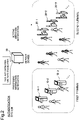
- Fig. 2 is a diagram illustrating an example of a schematic configuration of an authentication system according to the first example embodiment.
- the authentication system includes a plurality of first terminals 10-1 to 10-3, a plurality of second terminals 20-1 to 20-3, and a server device 30.
- the configuration illustrated in Fig. 2 is an example and is not intended to limit the number of terminals and the like.
- first terminals 10-1 to 10-3 when there is no particular reason to distinguish the first terminals 10-1 to 10-3, they are simply referred to as "first terminals 10". Similarly, other elements are represented by reference numerals before hyphens.
- the first terminals 10 and the server device 30 are configured to be communicable by wired or wireless communication means.
- the second terminals 20 and the server device 30 are similarly configured to be communicable.
- Each of the first terminals 10 is configured to perform a predetermined procedure.
- the first terminal 10 is configured to perform a check-in procedure.
- Each of the second terminals 20 is configured to perform a procedure subsequent to the procedure performed in the first terminal. That is, the second terminal 20 is installed at a subsequent stage of the first terminal 10, and is configured to perform a procedure different from that of the first terminal 10. For example, the second terminal 20 is configured to perform processing related to a security check of the user who has completed the check-in procedure.
- the first terminal 10 and the second terminal 20 are configured to be able to switch their operation modes. Specifically, the first terminal 10 and the second terminal 20 are configured to be switchable between a setting for performing a procedure by face authentication (hereinafter referred to as a face authentication setting) and a setting for performing a conventional procedure without using the face authentication (hereinafter referred to as a non-face authentication setting). That is, the first terminal 10 and the second terminal 20 can switch the face authentication function and the non-face authentication function (conventional function), and provide the service to the user using one of the functions.
- a face authentication setting a setting for performing a procedure by face authentication
- a non-face authentication setting a setting for performing a conventional procedure without using the face authentication
- the first terminal 10 is assumed to be a terminal that performs the check-in procedure.
- the first terminal 10 in the face authentication setting acquires biometric information (face image) of the user in front, and generates a feature amount (a feature vector including a plurality of feature amounts) from the acquired biometric information.
- the first terminal 10 acquires related biometric information (face image) from an integrated circuit (IC) chip of a passport presented by the user, and generates the feature amount from the face image.
- the first terminal 10 collates the two feature amounts (one-to-one collation).
- the first terminal 10 transmits the biometric information (or the feature amount) of the user, an identifier (ID) for uniquely identifying the user, and the like to a management server (not illustrated).
- the management server provides the user with the face authentication service using the received information.
- the first terminal 10 with the non-face authentication setting operates as a terminal operated by airline staff. That is, the first terminal 10 with the non-face authentication setting operates as a terminal that issues a boarding pass when a staff member checks the passport and determines that the user in front has the correct passport.
- the second terminal 20 is assumed to be a terminal that performs processing related to the security check.
- the second terminal 20 with the face authentication setting acquires the face image of the user whose security check has been completed by a gate o metal detection or the like, and generates a feature amount from the acquired face image.
- the second terminal 20 transmits the generated feature amount to the management server.
- the management server performs collation (one-to-N matching; N is a positive integer and the same applies to below) using the acquired feature amount and the feature amount stored in a database (the database that stores the information transmitted from the first terminal 10).
- the management server transmits a collation result (the ID of the user specified by the collation) to the second terminal 20.
- the second terminal 20 manages the user who has passed the security check by the transmitted ID.
- the second terminal 20 with the non-face authentication setting operates as a terminal operated by the staff member in charge.
- the second terminal 20 with the non-face authentication setting operates as a terminal to which the staff member in charge inputs information and the like of the user who has passed the security check.
- the function of the management server may be implemented in the server device 30 or may be implemented in a device different from the server device 30. Since an existing technique can be used for the collation (one-to-one matching or one-to-N matching) performed by the management server, detailed description thereof will be omitted.
- the management server calculates a Euclidean distance or the like between the biometric information of a collation target (the feature vector of a target to be collated) and the biometric information on a registration side (the feature vector) as similarity, and performs the above collation by threshold processing or the like for the similarity.
- the server device 30 is a device that switches the operation mode of the subsequent-stage terminal (second terminal 20) in such a way as to maximize the throughput of the authentication system, that is, the number of times of processing per unit time.
- Each of the first terminals 10 notifies the server device 30 of "processing information" including the number of users processed by the first terminal 10. More specifically, the first terminal 10 operating with the face authentication setting notifies the server device 30 of the number of users (the number of times of face authentication processing) for which the service by the setting has been provided in unit time (for example, 10 minutes or 1 hour). More specifically, the first terminal 10 operating with the non-face authentication setting notifies the server device 30 of the number of users (the number of times of non-face authentication processing) for which the service by the setting has been provided in unit time.
- the server device 30 calculates a face authentication use rate per unit time based on the processing information notified from a first terminal group (the first terminal 10 with the face authentication setting and the first terminal 10 with the non-face authentication setting). Specifically, the server device 30 calculates the face authentication use rate by the following Equation (1).
- FACE AUTHENTICATION USE RATE TOTAL NUMBER OF TIMES OF FACE AUTHENTICATION PROCESSING / TOTAL NUMBER OF TIMES OF FACE AUTHENTICATION PROCESSING + TOTAL NUMBER OF TIMES OF NON ⁇ FACE AUTHENTICATION PROCESSING
- the total number of face authentication processing is the total number of users (the number of times of face authentication processing) processed per unit time by the first terminal 10 that provides the service by the face authentication function among the plurality of first terminals 10.
- the total number of non-face authentication processing is the total number of users (the number of times of non-face authentication processing) processed per unit time by the first terminal 10 that provides the service by the non-face authentication function among the plurality of first terminals 10. That is, the server device 30 aggregates the processing information acquired from each of the plurality of first terminals 10 and calculates the face authentication use rate.
- the server device 30 determines and switches the operation mode (the face authentication setting or the non-face authentication setting) of each terminal included in a second terminal group (the second terminal 20 with the face authentication setting and the second terminal 20 with the non-face authentication setting) based on the calculated face authentication use rate.
- the server device 30 increases the number of second terminals 20 operating with the face authentication setting when the face authentication use rate is high. Alternatively, the server device 30 reduces the number of second terminals 20 operating with the face authentication setting when the face authentication use rate is low.
- the server device 30 assumes that the use of the face authentication will be frequent in the second terminal group following the first terminal group and increases the number of second terminals 20 with the face authentication setting when the number of users who have used the face authentication among the users who have passed through the first terminal 10 is large. In this case, in an extreme example, when the face authentication use rate is 100%, there is no need to install terminals supporting the conventional procedure in the second terminal group, and the server device 30 can set all terminals in the second terminal group to the face authentication setting.
- the server device 30 assumes that the use of the face authentication will be less frequent in the second terminal group following the first terminal group and reduces the number of second terminals 20 with the face authentication setting when the number of users who have used the face authentication among the users who have passed through the first terminal group is small. In this case, in an extreme example, when the face authentication use rate is 0%, there is no need to install terminals supporting the face authentication procedure in the second terminal group, and the server device 30 can set all the terminals in the second terminal group to the non-face authentication setting.
- the face authentication function may be mounted on the digital signage to improve user convenience.
- the digital signage may display (instruct) the second terminal 20 to which the user is to go.
- the server device 30 notifies the digital signage of the operation mode of the second terminal 20.
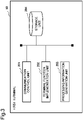
- Fig. 3 is a diagram illustrating an example of a processing configuration of the first terminal 10 according to the first example embodiment.
- the first terminal 10 includes a communication control unit 201, a terminal function implementation unit 202, a processing information generation unit 203, and a storage unit 204.
- the communication control unit 201 is a means that controls communication with other devices. Specifically, the communication control unit 201 receives data (packet) from the server device 30. Further, the communication control unit 201 transmits data to the server device 30.
- the terminal function implementation unit 202 is a means that implements a function allocated to the first terminal 10. Specifically, in a case where the first terminal 10 operates as a check-in terminal, the terminal function implementation unit 202 executes processing related to the check in.
- the terminal function implementation unit 202 executes processing related to the face authentication. Specifically, the terminal function implementation unit 202 acquires a face image of the user in front and calculates the feature amount. Furthermore, in the case of operating with non-face authentication setting, the terminal function implementation unit 202 receives information input by the staff member in charge and processes the received information.
- terminal function implementation unit 202 changes according to the function allocated to the first terminal 10, more detailed description regarding implementation of the function will be omitted.
- the terminal function implementation unit 202 notifies the processing information generation unit 203 of the processing content each time the terminal function implementation unit processes the user's procedure. For example, when the check-in procedure of the user is completed, the terminal function implementation unit 202 notifies the processing information generation unit 203 of the completion of the procedure together with the operation mode (face authentication setting or non-face authentication setting) at that time.
- the processing information generation unit 203 is a means that generates "processing information" to be notified to the server device 30.
- the processing information generation unit 203 counts the number of user procedures processed by the terminal function implementation unit 202 every predetermined period.
- the processing information generation unit 203 transmits the "processing information” including the number of users counted each time the predetermined period passes to the server device 30. More specifically, the processing information generation unit 203 transmits "processing information" including the setting mode (face authentication setting and non-face authentication setting) of the terminal and the number of times of processing of the user to the server device 30.
- the storage unit 204 is a means that stores information necessary for the operation of the first terminal 10.
- the plurality of second terminals 20 is terminals installed at a subsequent stage of the at least one or more first terminals 10. That is, the second terminal 20 is a terminal that provides a service for the user who has completed the procedure (service) by the first terminal 10.
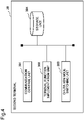
- Fig. 4 is a diagram illustrating an example of a processing configuration of the second terminal 20 according to the first example embodiment.
- the second terminal 20 includes a communication control unit 301, a terminal function implementation unit 302, an operation mode switching unit 303, and a storage unit 304.
- the communication control unit 301 is a means that controls communication with other devices. Specifically, the communication control unit 301 receives data (packet) from the server device 30. Further, the communication control unit 301 transmits data to the server device 30.
- the terminal function implementation unit 302 is a means that implements a function allocated to the second terminal 20. Specifically, in a case where the second terminal 20 operates as a terminal related to a security check, the terminal function implementation unit 302 executes processing related to the security check. Note that since the terminal function implementation unit 302 changes according to the function allocated to the second terminal 20, more detailed description regarding implementation of the function will be omitted, similarly to the terminal function implementation unit 202 of the first terminal 10.
- the operation mode switching unit 303 is a means that switches the operation mode of the terminal function implementation unit 302 according to a "setting switching notification" received from the server device 30. In the case where "face authentication setting" is notified from the server device 30, the operation mode switching unit 303 instructs the terminal function implementation unit 302 to operate with the "face authentication setting”. Similarly, in the case where the "non-face authentication setting" is notified from the server device 30, the operation mode switching unit 303 instructs the terminal function implementation unit 302 to operate with the "non-face authentication setting".
- the storage unit 304 is a means that stores information necessary for the operation of the second terminal 20.
- the operation mode of the first terminal 10 can be set by any method.
- an administrator or the like may input the operation mode by changing a setting menu of the first terminal 10.
- the server device 30 may notify the first terminal 10 of the operation mode.
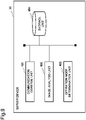
- Fig. 5 is a diagram illustrating an example of a processing configuration of the server device 30 according to the first example embodiment.
- the server device 30 includes a communication control unit 401, a face authentication use rate calculation unit 402, an operation mode determination unit 403, and a storage unit 404.
- the communication control unit 401 is a means that controls communication with other devices. Specifically, the communication control unit 401 receives data (packets) from first terminal 10 and the second terminal 20. Furthermore, the communication control unit 401 transmits data to the first terminal 10 and the second terminal 20.
- the face authentication use rate calculation unit 402 is a means that calculates the face authentication use rate.
- the face authentication use rate calculation unit 402 counts the processing information transmitted from each of the plurality of first terminals 10, and calculates the face authentication use rate per unit time. Specifically, the face authentication use rate calculation unit 402 classifies the number of times of processing of each terminal into either "the number of times of face authentication processing" or "the number of times of non-face authentication processing” based on the operation mode of the processing information transmitted from the first terminal 10.
- the face authentication use rate calculation unit 402 adds the number of times of processing of each terminal for each operation mode, calculates the total number of times of face authentication processing and the total number of times of non-face authentication processing, and calculates the face authentication use rate by applying these calculated total numbers to the above-described Equation (1).
- the face authentication use rate calculation unit 402 passes the calculated face authentication use rate to the operation mode determination unit 403.
- the operation mode determination unit 403 is a means that determines the operation mode of the second terminal 20 based on the calculated face authentication use rate. Specifically, the operation mode determination unit 403 determines the operation mode of at least one or more of the plurality of second terminals 20. For example, the operation mode determination unit 403 determines the operation mode of the second terminal 20 in such a way that the number of second terminals 20 operating with the face authentication setting becomes large when the face authentication use rate is high. In contrast, the operation mode determination unit 403 determines the operation mode of the second terminal 20 in such a way that the number of second terminals 20 operating with the non-face authentication setting becomes large when the face authentication use rate is low.
- the operation mode determination unit 403 determines the operation mode of the second terminal 20 with reference to table information in which the face authentication use rate is associated with the number of second terminals 20 to operate with the face authentication setting.
- the operation mode determination unit 403 refers to the table information as illustrated in Fig. 6 , and determines the number of second terminals 20 to operate with the face authentication setting according to the face authentication use rate.
- the face authentication use rate is equal to or more than 90%
- the number of second terminals 20 operating with the face authentication setting is set to A1.
- A1 > A2 > A3 is satisfied.
- the operation mode determination unit 403 determines the second terminals 20 for which the operation mode is to be changed. Specifically, in a case of increasing the number of second terminals 20 operating with the face authentication setting, the operation mode determination unit 403 selects the number of increase (change) of the second terminals 20 operating with the non-face authentication setting. The operation mode determination unit 403 instructs the selected second terminals 20 to change the operation mode. In the above example, the operation mode determination unit 403 transmits the setting switching notification to the selected second terminals 20 to operate with the face authentication setting.
- the face authentication use rate calculation unit 402 calculates the use rate of the face authentication function in at least one or more first terminals 10. Further, the operation mode determination unit 403 determines the number of terminals that provides the service with the face authentication function among the plurality of second terminals 20 based on the calculated use rate. More specifically, the operation mode determination unit 403 selects terminals that require switching between the face authentication function and the non-face authentication function among the plurality of second terminals 20 based on the face authentication use rate, and transmits the setting switching notification to the selected second terminals 20.
- FIG. 7 is a sequence diagram illustrating an example of an operation of the authentication system according to the first example embodiment.
- the first terminal 10 generates the processing information including the number of processed users per unit time (the number of users processed by the face authentication and the number of users processed by the conventional processing) (step S01).
- the first terminal 10 transmits the generated processing information to the server device 30 (step S02).
- each of the plurality of first terminals 10 generates the processing information including the number of users for which the service by the face authentication function has been provided per unit time or the number of users for which the service by the non-face authentication function has been provided per unit time.
- each of the plurality of first terminals 10 transmits the processing information to the server device 30.
- the server device 30 counts the processing information acquired from the first terminals 10, and calculates the total number of face authentication users (the total number of times of face authentication processing) and the total number of times of non-face authentication users (the total number of times of non-face authentication processing) processed per unit time. The server device 30 calculates the face authentication use rate using these total numbers (step S03).
- the server device 30 determines the operation mode of the second terminal 20 based on the face authentication use rate (step S04). Specifically, the server device 30 increases the number of second terminals 20 operating with the face authentication setting when the face authentication use rate is high.
- the server device 30 transmits the setting switching notification to the second terminal 20 of which the operation mode is to be switched (step S05).
- the second terminal 20 switches the setting (the face authentication setting or the conventional processing setting) of the second terminal according to the notification (step S06).
- the server device 30 grasps the use situation of the face authentication in the first terminal 10.
- the server device 30 determines the operation mode of the second terminal 20 belonging to the second terminal group (the plurality of second terminals 20) according to the grasped use situation of the face authentication. Specifically, the server device 30 increases the number of second terminals 20 that provides the service with the face authentication setting in the situation where the face authentication is frequently used. In contrast, the server device 30 reduces the number of second terminals 20 that provides the service with the face authentication setting when the use situation of the face authentication is infrequent.
- the server device 30 dynamically switches the operation mode (enables the biometric authentication or disables the biometric authentication) in the subsequent-stage terminal (second terminal 20) located downstream of the system according to the use situation of the face authentication (biometric authentication) in the preceding-stage terminal (first terminal 10) located upstream of the system. Even if the ratios of attributes (the face authentication user and the face authentication non-user) of the system users substantially change according to a time zone, a season, or the like, the operation mode of the subsequent-stage terminal is optimized by the switching and the throughput of the system can be increased. As a result of the increase in the throughput of the system, the convenience of the authentication system is improved.
- the operation mode of the second terminal 20 is determined based on the "processing information" notified from the first terminal 10.
- an operation mode of a second terminal 20 is determined based on information obtained from a camera device installed in a field.
- Fig. 8 is a diagram illustrating an example of a schematic configuration of an authentication system according to the second example embodiment.
- the authentication system includes camera devices 40-1 to 40-K (K is a positive integer and the same applies to below), a second terminal 20, and a server device 30.
- the camera devices 40 are installed at various places in the field (for example, in an airport).
- the camera devices 40 are configured to be communicable with the server device 30 by wired or wireless communication means.
- Each of the camera devices 40 transmits an image obtained by imaging an inside of the field to the server device 30.
- the server device 30 analyzes the acquired field image, and switches the operation mode of the second terminal 20 based on a result of the analysis.
- the server device 30 switches the operation mode of the second terminal 20 to non-face authentication setting.
- the server device 30 switches the operation mode to the non-face authentication setting that requires an operation of a staff member or the like instead of the second terminal 20 automatically operating (operating in an unmanned manner).
- the security in the field in the airport
- the server device 30 reinforces a monitoring system in the field by increasing the number of second terminals 20 operating with the non-face authentication setting (alternatively, setting all the second terminals 20 to the non-face authentication setting).
- the server device 30 may switch the operation mode of the second terminal 20 to the non-face authentication setting in a case of finding a person who needs support of the staff member, such as a physically handicapped person or a pregnant female, by analyzing the field image. That is, in a case of finding a physically handicapped person or the like, the server device 30 may increase the number of the second terminals 20 operating with the non-face authentication setting.
- the server device 30 may calculate a congestion status of each procedure area (for example, in the case of an airport, a security inspection area or a boarding area) by analyzing the field image, and switch the operation mode of the second terminal 20 based on the calculated congestion status.
- a congestion status of each procedure area for example, in the case of an airport, a security inspection area or a boarding area
- the server device 30 included in the authentication system according to the second example embodiment will be described.
- a general-purpose web camera or the like can be used as the camera device 40.
- the second terminal 20 can have the same configuration and function as those described in the first example embodiment. Therefore, detailed description of these devices is omitted.
- Fig. 9 is a diagram illustrating an example of a processing configuration (processing module) of the server device 30 according to the second example embodiment.
- the server device 30 includes a communication control unit 401, an operation mode determination unit 403, a storage unit 404, and an image analysis unit 405.
- the image analysis unit 405 is added instead of the face authentication use rate calculation unit 402.
- the image analysis unit 405 is a means that analyzes the field image acquired from the camera device 40 and notifies the operation mode determination unit 403 of the result.
- the image analysis unit 405 executes analysis regarding whether a suspicious person is present in the field.
- the image analysis unit 405 extracts a person from the acquired field image and extracts a face area of the extracted person.
- the image analysis unit 405 calculates a feature amount (a feature vector including a plurality of feature amounts) from the extracted face area (face image).
- the image analysis unit 405 compares the calculated feature amount with a feature amount of a list stored in advance (a blacklist in which feature amounts of suspicious persons are described), and confirms whether the calculated feature amount is registered in the blacklist.
- the image analysis unit 405 When the feature amount calculated from the field image (the feature amount of the person moving in the field) is registered in the blacklist, the image analysis unit 405 notifies the operation mode determination unit 403 of the presence of the suspicious person as an "image analysis result". Alternatively, in a case of confirming a plurality of suspicious persons, the image analysis unit 405 may notify the operation mode determination unit 403 of the number of suspicious persons as the "image analysis result”.
- the image analysis unit 405 may execute analysis regarding whether a physically handicapped person or a pregnant female is present in the field. In this case, the image analysis unit 405 extracts a whole-body image of the person from the field image. Specifically, the image analysis unit 405 detects an area including the whole body of the person (whole body area) from the field image. Thereafter, the image analysis unit 405 extracts the whole-body image by cutting out the detected whole-body area from the field image.
- the image analysis unit 405 compares the extracted whole-body image with a template prepared in advance to detect a physically handicapped person or the like.
- the image analysis unit 405 may detect a physically handicapped person or the like using a learning model generated by machine learning. For example, a large number of images of physically handicapped persons and the like to which labels are given is prepared as training data, and a learning model is generated using the training data. Any algorithm such as a support vector machine, boosting, or a neural network can be used to generate the learning model. A known technique can be used for the algorithm such as the support vector machine, and thus description thereof is omitted.
- the image analysis unit 405 In the case of detecting a physically handicapped person or the like in the field, the image analysis unit 405 notifies the operation mode determination unit 403 of the detection as the "image analysis result". Alternatively, in the case of detecting a plurality of physically handicapped persons or the like, the image analysis unit 405 may notify the operation mode determination unit 403 of the number of the physically handicapped persons or the like as the "image analysis result".
- the operation mode determination unit 403 is a means that switches the operation mode in the second terminal 20 based on the image analysis result acquired from the image analysis unit 405.
- the operation mode determination unit 403 increases the number of second terminals 20 operating with the non-face authentication setting.
- the operation mode determination unit 403 may set the operation modes of all the second terminals 20 to the non-face authentication setting.
- the operation mode determination unit 403 may determine the operation mode of the second terminal 20 according to the number of suspicious persons, physically handicapped persons, or the like. For example, the operation mode determination unit 403 may increase the number of second terminals 20 operating with the non-face authentication setting as the number of suspicious persons or the like increases.
- the authentication system by analyzing the field image acquired from the camera device 40, it is possible to reinforce the security in the airport and provide the service suitable for the physically handicapped person or the like.
- Fig. 10 is a diagram illustrating an example of a hardware configuration of the server device 30.
- the server device 30 can be configured by an information processing device (so-called computer), and has the configuration illustrated in Fig. 10 .
- the server device 30 includes a processor 311, a memory 312, an input/output interface 313, a communication interface 314, and the like.
- the components such as the processor 311 are connected by an internal bus or the like and are configured to be able to communicate with each other.
- Fig. 10 is not intended to limit the hardware configuration of the server device 30.
- the server device 30 may include hardware (not illustrated) or may not include the input/output interface 313 as necessary.
- the numbers of processors 311 and the like included in the server device 30 are not limited to the example of Fig. 10 , and for example, a plurality of the processors 311 may be included in the server device 30.
- the processor 311 is a programmable device such as a central processing unit (CPU), a micro processing unit (MPU), or a digital signal processor (DSP). Alternatively, the processor 311 may be a device such as a field programmable gate array (FPGA) or an application specific integrated circuit (ASIC). The processor 311 executes various programs including an operating system (OS).
- OS operating system
- the memory 312 is a random access memory (RAM), a read only memory (ROM), a hard disk drive (HDD), a solid state drive (SSD), or the like.
- the memory 312 stores an OS program, an application program, and various data.
- the input/output interface 313 is an interface of a display device or an input device (not illustrated).
- the display device is, for example, a liquid crystal display or the like.
- the input device is, for example, a device that receives a user operation of a keyboard or a mouse.
- the communication interface 314 is a circuit, a module, or the like that communicates with another device.
- the communication interface 314 includes a network interface card (NIC) or the like.
- NIC network interface card
- the functions of the server device 30 are implemented by various processing modules.
- the processing modules are implemented by, for example, the processor 311 executing a program stored in the memory 312.
- the program can be recorded in a computer-readable storage medium.
- the storage medium may be a non-transient (non-transitory) medium such as a semiconductor memory, a hard disk, a magnetic recording medium, or an optical recording medium. That is, the present invention can also be embodied as a computer program product.
- the program can be downloaded via a network or updated using a storage medium storing the program.
- the processing module may be implemented by a semiconductor chip.
- the first terminal 10 and the second terminal 20 can also be configured by an information processing device similarly to the server device 30, and since there is no difference in the basic hardware configuration from the server device 30, the description thereof will be omitted.
- the first terminal 10 and the second terminal 20 may include a camera device (camera module) or the like as necessary.
- the case where the authentication system includes the plurality of first terminals 10 has been described as an example, but it is sufficient that the authentication system includes one or more first terminals 10.
- the first terminal 10 may be a hybrid terminal. That is, the first terminal 10 is configured to be able to perform both the service provision by the face authentication function and the service provision by the non-face authentication function without requiring a setting change.
- the first terminal 10 calculates the number of times of face authentication processing and the number of times of non-face authentication processing per unit time, and reports them to the server device 30.
- the server device 30 only needs to calculate the face authentication use rate using these numbers of times of processing.
- biometric information available in the present disclosure is not limited to "face”.
- another biometric information such as an iris can be used.
- the use situation of the face authentication in the pre-stage terminal has been described, but the use situation may be grasped by another index.
- a non-face authentication use rate (a ratio of users for which the service is provided by the conventional procedure) in the first terminal 10 may be calculated. Since the face authentication use rate and the non-face authentication use rate are in an inextricable relationship, the non-face authentication use rate can be substantially regarded as the face authentication use rate.
- the second terminal 20 has been described as a subsequent-stage terminal, but the second terminal 20 may operate as a preceding-stage terminal depending on a system configuration.
- the second terminal 20 only needs to include the function of the first terminal 10. That is, a processing module corresponding to the "processing information generation unit 203" is mounted on the second terminal 20, and the processing information is transmitted from the second terminal 20 to the server device 30.
- the server device 30 may calculate the face authentication use rate (the use situation of the face authentication in the second terminal 20) based on the processing information transmitted from the second terminal 20 and determine the operation mode of the subsequent-stage terminal.
- the terminal that provides the service by the face authentication setting or the non-face authentication setting has been described as an example.
- the terminal may have a setting of a hybrid terminal that provides the service by both the face authentication and the non-face authentication. That is, the first terminal 10 and the second terminal 20 in the first example embodiment, and the second terminal 20 in the second example embodiment may be switchable among three operation modes of the face authentication setting, the non-face authentication setting, and the hybrid setting.
- the number of second terminals 20 operating with the face authentication setting is determined by the table information as illustrated in Fig. 6 has been described.
- the number of second terminals may be determined using a predetermined function or the like.
- a function using the face authentication use rate as input and the number of second terminals 20 operating with the face authentication setting as output may be defined in advance, and the number of second terminals 20 operating with the face authentication setting may be determined using the function.
- the number of second terminals 20 operating with an optimum face authentication setting for each face authentication use rate may be prepared in advance as training data, and the number of second terminals 20 operating with the face authentication setting may be calculated using a learning model constructed using the training data.
- Any algorithm such as a support vector machine, boosting, or a neural network can be used to generate the learning model.
- a known technique can be used for the algorithm such as the support vector machine, and thus description thereof is omitted.
- the server device 30 may change the setting of the first terminal group based on the face authentication use rate in the first terminal group.
- the computer By installing a terminal operation determination program in the storage unit of the computer, the computer can be caused to function as the server device 30. Further, a terminal operation determination method can be executed by the computer by causing the computer to execute the terminal operation determination program.
- the example embodiment may be used alone or in combination.
- a part of the configuration of the example embodiment can be replaced with the configuration of another example embodiment, or the configuration of another example embodiment can be added to the configuration of the example embodiment.
- another configuration may be added to, deleted from, or replaced with another configuration a part of the configuration of the example embodiment.
- the present invention is suitably applicable to an authentication system and the like in an airport.
- An authentication system including:
- the authentication system according to claim 1, in which the server device (30 or 103) determines the number of second terminals that provides the service by the biometric authentication function among the plurality of second terminals (20 or 102).
- the authentication system in which the server device (30 or 103) selects a second terminal that requires switching between the biometric authentication function and the non-biometric authentication function among the plurality of second terminals (20 or 102) in accordance with the use rate, and transmits a setting switching notification to the selected second terminal (20 or 102).
- each of the plurality of first terminals transmits (10 or 101) the processing information to the server device (30 or 103).
- the authentication system in which the server device (30 or 103) counts the processing information acquired from each of the plurality of first terminals (10 or 101) and calculates the use rate.
- the authentication system in which the server device (30 or 103) calculates the use rate in accordance with a total number of users processed per unit time by the first terminal (10 or 101) that provides the service by the biometric authentication function among the plurality of first terminals (10 or 101) and a total number of users processed per unit time by the first terminal (10 or 101) that provides the service by the non-biometric authentication function among the plurality of first terminals (10 or 101).
- the authentication system according to supplementary note 7, in which the server device (30 or 103) calculates the use rate by dividing a total number of users for which the service by the biometric authentication function has been provided by a sum of the total number of users for which the service by the biometric authentication function has been provided and a total number of users for which the service by the non-biometric authentication function has been provided.
- the authentication system according to any one of supplementary notes 1 to 8, wherein the plurality of second terminals (20 or 102) is terminals installed at a subsequent stage of the at least one or more first terminals (10 or 101).
- the authentication system according to any one of supplementary notes 1 to 9, in which the at least one or more first terminals (10 or 101) are terminals that execute processing related to a check-in procedure.
- the authentication system according to any one of supplementary notes 1 to 10, wherein the plurality of second terminals (20 or 102) is terminals that execute processing related to a security check.
- a method including:
- a computer-readable recording medium recording a program for causing a computer (311) mounted on a server device (30 or 103) connected to at least one or more first terminals (10 or 101) and a plurality of second terminals (20 or 102) to execute:
- the form of the supplementary note 12 and the form of the supplementary note 13 can be developed into the form of the supplementary note 2 to the form of the supplementary note 11, similarly to the form of the supplementary note 1.
Landscapes
- Engineering & Computer Science (AREA)
- Theoretical Computer Science (AREA)
- Business, Economics & Management (AREA)
- General Physics & Mathematics (AREA)
- Physics & Mathematics (AREA)
- Computer Security & Cryptography (AREA)
- General Engineering & Computer Science (AREA)
- Computer Hardware Design (AREA)
- Tourism & Hospitality (AREA)
- Health & Medical Sciences (AREA)
- General Health & Medical Sciences (AREA)
- Software Systems (AREA)
- Primary Health Care (AREA)
- Economics (AREA)
- Human Resources & Organizations (AREA)
- Marketing (AREA)
- Strategic Management (AREA)
- General Business, Economics & Management (AREA)
- Quality & Reliability (AREA)
- Development Economics (AREA)
- Educational Administration (AREA)
- Social Psychology (AREA)
- Collating Specific Patterns (AREA)
- Management, Administration, Business Operations System, And Electronic Commerce (AREA)
- Operations Research (AREA)
Abstract
Description
- The present invention relates to an authentication system, a method, and a program.
- Services using face authentication have started to spread. For example, face authentication has started to be applied to various procedures (for example, check in, baggage check, security check, and the like) at airports.
- For example, PTL 1 discloses a configuration in which a flow of a series of procedures from check in to boarding is performed by a passenger himself/herself in a security booth. In the technique disclosed in PTL 1, traceability check of passengers is performed by a network camera installed in an airport. In the traceability check, an image of the passenger captured by the network camera in any place in the airport is collated with an image including a face image of the passenger stored as personal authentication information. The behavior of the passenger is tracked and managed by position information of the network camera installation place and timestamp of the captured image.
- [PTL 1]
WO 2005/055151 - As described above, a face authentication system has been started to be applied to various procedures in the airport. Here, not all of airport users use the face authentication system, and a certain percentage of the users do not use the face authentication system at present. Therefore, all of terminals installed in the various procedures cannot support the face authentication.
- Therefore, it is conceivable that the terminal set in each area where the procedure is performed supports both the procedure using a face authentication function and the procedure not using the face authentication. That is, it is conceivable to install a hybrid terminal having both the face authentication function and a conventional procedure function. In this case, if the user of the face authentication system passes in front of the terminal (hybrid terminal), the procedure ends, but the non-user of the face authentication system performs identify authentication using a passport or the like on the same terminal.
- By such a measure (introduction of the hybrid terminal having the two functions), it is possible to cope with a mixture of the system user and the non-user, but there is also an aspect that the system user and the non-user line up in the same terminal, and the convenience of the face authentication system is impaired.
- A main object of the present invention is to provide an authentication system, a method, and a program that contribute to improving convenience of a user.
- According to the first aspect of the present invention, there is provided an authentication system including: at least one or more first terminals capable of providing a service by a biometric authentication function or a non-biometric authentication function; a plurality of second terminals each capable of switching a biometric authentication function and a non-biometric authentication function and capable of providing a service by the biometric authentication function or the non-biometric authentication function; and a server device connected to the at least one or more first terminals and the plurality of second terminals, in which the server device calculates a use rate of the biometric authentication function in the at least one or more first terminals, and determines an operation mode of at least one or more second terminals among the plurality of second terminals in accordance with the calculated use rate.
- According to the second aspect of the present invention, there is provided a method including: in an authentication system including at least one or more first terminals capable of providing a service by a biometric authentication function or a non-biometric authentication function, a plurality of second terminals each capable of switching a biometric authentication function and a non-biometric authentication function and capable of providing a service by the biometric authentication function or the non-biometric authentication function, and a server device connected to the at least one or more first terminals and the plurality of second terminals, calculating a use rate of the biometric authentication function in the at least one or more first terminals; and determining an operation mode of at least one or more second terminals among the plurality of second terminals in accordance with the calculated use rate.
- According to the third aspect of the present invention, there is provided a computer-readable recording medium recording a program for causing a computer mounted on a server device connected to at least one or more first terminals and a plurality of second terminals to execute: the at least one or more first terminals capable of providing a service by a biometric authentication function or a non-biometric authentication function, and the plurality of second terminals each capable of switching a biometric authentication function and a non-biometric authentication function and capable of providing a service by the biometric authentication function or the non-biometric authentication function, processing of calculating a use rate of the biometric authentication function in the at least one or more first terminals; and processing of determining an operation mode of at least one or more second terminals among the plurality of second terminals in accordance with the calculated use rate.
- According to each aspect of the present invention, an authentication system, a method, and a program that contribute to improving convenience of a user are provided. The effect of the present invention is not limited to the above. According to the present invention, other effects may be exhibited instead of or in addition to the effect.
-
-
Fig. 1 is a diagram for describing an outline of an example embodiment. -
Fig. 2 is a diagram illustrating an example of a schematic configuration of an authentication system according to a first example embodiment. -
Fig. 3 is a diagram illustrating an example of a processing configuration of a first terminal according to the first example embodiment. -
Fig. 4 is a diagram illustrating an example of a processing configuration of a second terminal according to the first example embodiment. -
Fig. 5 is a diagram illustrating an example of a processing configuration of a server device according to the first example embodiment. -
Fig. 6 is a diagram for describing an operation of an operation mode determination unit. -
Fig. 7 is a sequence diagram illustrating an example of an operation of the authentication system according to the first example embodiment. -
Fig. 8 is a diagram illustrating an example of a schematic configuration of an authentication system according to a second example embodiment. -
Fig. 9 is a diagram illustrating an example of a processing configuration of a server device according to the second example embodiment. -
Fig. 10 is a diagram illustrating an example of a hardware configuration of the server device. - First, an outline of an example embodiment will be described. Note that the reference numerals in the drawings attached to this outline are attached to elements for convenience as an example for assisting understanding, and description of this outline is not intended to be any limitation. In addition, in a case where there is no particular explanation, a block illustrated in each drawing represents not a configuration of a hardware unit but a configuration of a functional unit. A connection line between blocks in each drawing includes both bidirectional and unidirectional lines. A unidirectional arrow schematically indicates a flow of a main signal (data) and does not exclude bidirectionality. In the present specification and the drawings, elements that can be similarly described are denoted by the same reference numerals, and redundant description can be omitted.
- An authentication system according to an example embodiment includes at least one or more
first terminals 101, a plurality ofsecond terminals 102, and a server device 103 (seeFig. 1 ). Thefirst terminal 101 is a terminal capable of providing a service using a biometric authentication function or a non-biometric authentication function. Each of thesecond terminals 102 is a terminal capable of switching the biometric authentication function and the non-biometric authentication function and capable of providing a service using the biometric authentication function or the non-biometric authentication function. Theserver device 103 is a server connected to thefirst terminal 101 and the plurality ofsecond terminals 102. Theserver device 103 calculates a use rate of the biometric authentication function in the at least one or morefirst terminals 101. Theserver device 103 determines an operation mode for at least one or more of the plurality ofsecond terminals 102 based on the calculated use rate. - In the-described authentication system, the
server device 103 grasps a use situation of the biometric authentication in thefirst terminal 101. Theserver device 103 determines the operation mode of thesecond terminal 102 according to the grasped use situation of the biometric authentication. Specifically,server device 103 increases the number ofsecond terminals 102 that provides the service by biometric authentication setting in a situation where the biometric authentication is frequently used. On the other hand, theserver device 103 reduces the number ofsecond terminals 102 that provides the service by biometric authentication setting if the use situation of biometric authentication is infrequent. With such a response, the operation mode of thesecond terminal 102, which is a subsequent-stage terminal, is optimized, and the throughput of the system increases. As a result, the convenience of the system is improved. - Hereinafter, specific example embodiments will be described in more detail with reference to the drawings.
- A first example embodiment will be described in more detail with reference to the drawings.
-
Fig. 2 is a diagram illustrating an example of a schematic configuration of an authentication system according to the first example embodiment. Referring toFig. 2 , the authentication system includes a plurality of first terminals 10-1 to 10-3, a plurality of second terminals 20-1 to 20-3, and aserver device 30. The configuration illustrated inFig. 2 is an example and is not intended to limit the number of terminals and the like. - In the following description, when there is no particular reason to distinguish the first terminals 10-1 to 10-3, they are simply referred to as "
first terminals 10". Similarly, other elements are represented by reference numerals before hyphens. - The
first terminals 10 and theserver device 30 are configured to be communicable by wired or wireless communication means. Thesecond terminals 20 and theserver device 30 are similarly configured to be communicable. - Each of the
first terminals 10 is configured to perform a predetermined procedure. For example, thefirst terminal 10 is configured to perform a check-in procedure. - Each of the
second terminals 20 is configured to perform a procedure subsequent to the procedure performed in the first terminal. That is, thesecond terminal 20 is installed at a subsequent stage of thefirst terminal 10, and is configured to perform a procedure different from that of thefirst terminal 10. For example, thesecond terminal 20 is configured to perform processing related to a security check of the user who has completed the check-in procedure. - The
first terminal 10 and thesecond terminal 20 are configured to be able to switch their operation modes. Specifically, thefirst terminal 10 and thesecond terminal 20 are configured to be switchable between a setting for performing a procedure by face authentication (hereinafter referred to as a face authentication setting) and a setting for performing a conventional procedure without using the face authentication (hereinafter referred to as a non-face authentication setting). That is, thefirst terminal 10 and thesecond terminal 20 can switch the face authentication function and the non-face authentication function (conventional function), and provide the service to the user using one of the functions. - For example, the
first terminal 10 is assumed to be a terminal that performs the check-in procedure. In this case, thefirst terminal 10 in the face authentication setting acquires biometric information (face image) of the user in front, and generates a feature amount (a feature vector including a plurality of feature amounts) from the acquired biometric information. Thereafter, thefirst terminal 10 acquires related biometric information (face image) from an integrated circuit (IC) chip of a passport presented by the user, and generates the feature amount from the face image. Thefirst terminal 10 collates the two feature amounts (one-to-one collation). When the collation is successful, thefirst terminal 10 transmits the biometric information (or the feature amount) of the user, an identifier (ID) for uniquely identifying the user, and the like to a management server (not illustrated). The management server provides the user with the face authentication service using the received information. - Meanwhile, the
first terminal 10 with the non-face authentication setting operates as a terminal operated by airline staff. That is, thefirst terminal 10 with the non-face authentication setting operates as a terminal that issues a boarding pass when a staff member checks the passport and determines that the user in front has the correct passport. - For example, the
second terminal 20 is assumed to be a terminal that performs processing related to the security check. In this case, thesecond terminal 20 with the face authentication setting acquires the face image of the user whose security check has been completed by a gate o metal detection or the like, and generates a feature amount from the acquired face image. Thesecond terminal 20 transmits the generated feature amount to the management server. The management server performs collation (one-to-N matching; N is a positive integer and the same applies to below) using the acquired feature amount and the feature amount stored in a database (the database that stores the information transmitted from the first terminal 10). The management server transmits a collation result (the ID of the user specified by the collation) to thesecond terminal 20. Thesecond terminal 20 manages the user who has passed the security check by the transmitted ID. - Meanwhile, the
second terminal 20 with the non-face authentication setting operates as a terminal operated by the staff member in charge. Thesecond terminal 20 with the non-face authentication setting operates as a terminal to which the staff member in charge inputs information and the like of the user who has passed the security check. - The function of the management server may be implemented in the
server device 30 or may be implemented in a device different from theserver device 30. Since an existing technique can be used for the collation (one-to-one matching or one-to-N matching) performed by the management server, detailed description thereof will be omitted. For example, the management server calculates a Euclidean distance or the like between the biometric information of a collation target (the feature vector of a target to be collated) and the biometric information on a registration side (the feature vector) as similarity, and performs the above collation by threshold processing or the like for the similarity. - The
server device 30 is a device that switches the operation mode of the subsequent-stage terminal (second terminal 20) in such a way as to maximize the throughput of the authentication system, that is, the number of times of processing per unit time. - Next, a schematic operation of the authentication system according to the first example embodiment will be described with reference to
Fig. 2 . - Each of the
first terminals 10 notifies theserver device 30 of "processing information" including the number of users processed by thefirst terminal 10. More specifically, the first terminal 10 operating with the face authentication setting notifies theserver device 30 of the number of users (the number of times of face authentication processing) for which the service by the setting has been provided in unit time (for example, 10 minutes or 1 hour). More specifically, the first terminal 10 operating with the non-face authentication setting notifies theserver device 30 of the number of users (the number of times of non-face authentication processing) for which the service by the setting has been provided in unit time. - The
server device 30 calculates a face authentication use rate per unit time based on the processing information notified from a first terminal group (thefirst terminal 10 with the face authentication setting and thefirst terminal 10 with the non-face authentication setting). Specifically, theserver device 30 calculates the face authentication use rate by the following Equation (1).
[Math. 1]
- In Equation (1), the total number of face authentication processing is the total number of users (the number of times of face authentication processing) processed per unit time by the
first terminal 10 that provides the service by the face authentication function among the plurality offirst terminals 10. Similarly, the total number of non-face authentication processing is the total number of users (the number of times of non-face authentication processing) processed per unit time by thefirst terminal 10 that provides the service by the non-face authentication function among the plurality offirst terminals 10. That is, theserver device 30 aggregates the processing information acquired from each of the plurality offirst terminals 10 and calculates the face authentication use rate. - The
server device 30 determines and switches the operation mode (the face authentication setting or the non-face authentication setting) of each terminal included in a second terminal group (thesecond terminal 20 with the face authentication setting and thesecond terminal 20 with the non-face authentication setting) based on the calculated face authentication use rate. - Specifically, the
server device 30 increases the number ofsecond terminals 20 operating with the face authentication setting when the face authentication use rate is high. Alternatively, theserver device 30 reduces the number ofsecond terminals 20 operating with the face authentication setting when the face authentication use rate is low. - For example, in
Fig. 2 , the user who has completed the procedure in thefirst terminal 10 by the face authentication is illustrated in gray. Theserver device 30 assumes that the use of the face authentication will be frequent in the second terminal group following the first terminal group and increases the number ofsecond terminals 20 with the face authentication setting when the number of users who have used the face authentication among the users who have passed through thefirst terminal 10 is large. In this case, in an extreme example, when the face authentication use rate is 100%, there is no need to install terminals supporting the conventional procedure in the second terminal group, and theserver device 30 can set all terminals in the second terminal group to the face authentication setting. - In contrast, the
server device 30 assumes that the use of the face authentication will be less frequent in the second terminal group following the first terminal group and reduces the number ofsecond terminals 20 with the face authentication setting when the number of users who have used the face authentication among the users who have passed through the first terminal group is small. In this case, in an extreme example, when the face authentication use rate is 0%, there is no need to install terminals supporting the face authentication procedure in the second terminal group, and theserver device 30 can set all the terminals in the second terminal group to the non-face authentication setting. - It is desirable to install a bulletin board (digital signage or the like) that guides a terminal number and the like available to each user (face authentication system user or face authentication system non-user) near the second terminal group in consideration of convenience of the user. Alternatively, the face authentication function may be mounted on the digital signage to improve user convenience. For example, in a case where the user in front is found to be a user of the face authentication system (a user with an ID registered in the management server), the digital signage may display (instruct) the
second terminal 20 to which the user is to go. In this case, theserver device 30 notifies the digital signage of the operation mode of thesecond terminal 20. - Next, details of each device included in the authentication system will be described.
-
Fig. 3 is a diagram illustrating an example of a processing configuration of thefirst terminal 10 according to the first example embodiment. Referring toFig. 3 , thefirst terminal 10 includes acommunication control unit 201, a terminalfunction implementation unit 202, a processinginformation generation unit 203, and astorage unit 204. - The
communication control unit 201 is a means that controls communication with other devices. Specifically, thecommunication control unit 201 receives data (packet) from theserver device 30. Further, thecommunication control unit 201 transmits data to theserver device 30. - The terminal
function implementation unit 202 is a means that implements a function allocated to thefirst terminal 10. Specifically, in a case where thefirst terminal 10 operates as a check-in terminal, the terminalfunction implementation unit 202 executes processing related to the check in. - In the case of operating with the face authentication setting, the terminal
function implementation unit 202 executes processing related to the face authentication. Specifically, the terminalfunction implementation unit 202 acquires a face image of the user in front and calculates the feature amount. Furthermore, in the case of operating with non-face authentication setting, the terminalfunction implementation unit 202 receives information input by the staff member in charge and processes the received information. - Since the terminal
function implementation unit 202 changes according to the function allocated to thefirst terminal 10, more detailed description regarding implementation of the function will be omitted. - The terminal
function implementation unit 202 notifies the processinginformation generation unit 203 of the processing content each time the terminal function implementation unit processes the user's procedure. For example, when the check-in procedure of the user is completed, the terminalfunction implementation unit 202 notifies the processinginformation generation unit 203 of the completion of the procedure together with the operation mode (face authentication setting or non-face authentication setting) at that time. - The processing
information generation unit 203 is a means that generates "processing information" to be notified to theserver device 30. The processinginformation generation unit 203 counts the number of user procedures processed by the terminalfunction implementation unit 202 every predetermined period. The processinginformation generation unit 203 transmits the "processing information" including the number of users counted each time the predetermined period passes to theserver device 30. More specifically, the processinginformation generation unit 203 transmits "processing information" including the setting mode (face authentication setting and non-face authentication setting) of the terminal and the number of times of processing of the user to theserver device 30. - The
storage unit 204 is a means that stores information necessary for the operation of thefirst terminal 10. - The plurality of
second terminals 20 is terminals installed at a subsequent stage of the at least one or morefirst terminals 10. That is, thesecond terminal 20 is a terminal that provides a service for the user who has completed the procedure (service) by thefirst terminal 10. -
Fig. 4 is a diagram illustrating an example of a processing configuration of thesecond terminal 20 according to the first example embodiment. Referring toFig. 4 , thesecond terminal 20 includes acommunication control unit 301, a terminalfunction implementation unit 302, an operationmode switching unit 303, and astorage unit 304. - The
communication control unit 301 is a means that controls communication with other devices. Specifically, thecommunication control unit 301 receives data (packet) from theserver device 30. Further, thecommunication control unit 301 transmits data to theserver device 30. - The terminal
function implementation unit 302 is a means that implements a function allocated to thesecond terminal 20. Specifically, in a case where thesecond terminal 20 operates as a terminal related to a security check, the terminalfunction implementation unit 302 executes processing related to the security check. Note that since the terminalfunction implementation unit 302 changes according to the function allocated to thesecond terminal 20, more detailed description regarding implementation of the function will be omitted, similarly to the terminalfunction implementation unit 202 of thefirst terminal 10. - The operation
mode switching unit 303 is a means that switches the operation mode of the terminalfunction implementation unit 302 according to a "setting switching notification" received from theserver device 30. In the case where "face authentication setting" is notified from theserver device 30, the operationmode switching unit 303 instructs the terminalfunction implementation unit 302 to operate with the "face authentication setting". Similarly, in the case where the "non-face authentication setting" is notified from theserver device 30, the operationmode switching unit 303 instructs the terminalfunction implementation unit 302 to operate with the "non-face authentication setting". - The
storage unit 304 is a means that stores information necessary for the operation of thesecond terminal 20. - Note that the operation mode of the
first terminal 10 can be set by any method. For example, an administrator or the like may input the operation mode by changing a setting menu of thefirst terminal 10. Alternatively, theserver device 30 may notify thefirst terminal 10 of the operation mode. -
Fig. 5 is a diagram illustrating an example of a processing configuration of theserver device 30 according to the first example embodiment. Referring toFig. 5 , theserver device 30 includes acommunication control unit 401, a face authentication userate calculation unit 402, an operationmode determination unit 403, and astorage unit 404. - The
communication control unit 401 is a means that controls communication with other devices. Specifically, thecommunication control unit 401 receives data (packets) fromfirst terminal 10 and thesecond terminal 20. Furthermore, thecommunication control unit 401 transmits data to thefirst terminal 10 and thesecond terminal 20. - The face authentication use
rate calculation unit 402 is a means that calculates the face authentication use rate. The face authentication userate calculation unit 402 counts the processing information transmitted from each of the plurality offirst terminals 10, and calculates the face authentication use rate per unit time. Specifically, the face authentication userate calculation unit 402 classifies the number of times of processing of each terminal into either "the number of times of face authentication processing" or "the number of times of non-face authentication processing" based on the operation mode of the processing information transmitted from thefirst terminal 10. - Thereafter, the face authentication use
rate calculation unit 402 adds the number of times of processing of each terminal for each operation mode, calculates the total number of times of face authentication processing and the total number of times of non-face authentication processing, and calculates the face authentication use rate by applying these calculated total numbers to the above-described Equation (1). The face authentication userate calculation unit 402 passes the calculated face authentication use rate to the operationmode determination unit 403. - The operation
mode determination unit 403 is a means that determines the operation mode of thesecond terminal 20 based on the calculated face authentication use rate. Specifically, the operationmode determination unit 403 determines the operation mode of at least one or more of the plurality ofsecond terminals 20. For example, the operationmode determination unit 403 determines the operation mode of thesecond terminal 20 in such a way that the number ofsecond terminals 20 operating with the face authentication setting becomes large when the face authentication use rate is high. In contrast, the operationmode determination unit 403 determines the operation mode of thesecond terminal 20 in such a way that the number ofsecond terminals 20 operating with the non-face authentication setting becomes large when the face authentication use rate is low. - For example, the operation
mode determination unit 403 determines the operation mode of thesecond terminal 20 with reference to table information in which the face authentication use rate is associated with the number ofsecond terminals 20 to operate with the face authentication setting. For example, the operationmode determination unit 403 refers to the table information as illustrated inFig. 6 , and determines the number ofsecond terminals 20 to operate with the face authentication setting according to the face authentication use rate. In the example ofFig. 6 , when the face authentication use rate is equal to or more than 90%, the number ofsecond terminals 20 operating with the face authentication setting is set to A1. In the example ofFig. 6 , A1 > A2 > A3 is satisfied. - When determining the number of
second terminals 20 to operate with the face authentication setting in accordance with the face authentication use rate, the operationmode determination unit 403 determines thesecond terminals 20 for which the operation mode is to be changed. Specifically, in a case of increasing the number ofsecond terminals 20 operating with the face authentication setting, the operationmode determination unit 403 selects the number of increase (change) of thesecond terminals 20 operating with the non-face authentication setting. The operationmode determination unit 403 instructs the selectedsecond terminals 20 to change the operation mode. In the above example, the operationmode determination unit 403 transmits the setting switching notification to the selectedsecond terminals 20 to operate with the face authentication setting. - In this manner, the face authentication use
rate calculation unit 402 calculates the use rate of the face authentication function in at least one or morefirst terminals 10. Further, the operationmode determination unit 403 determines the number of terminals that provides the service with the face authentication function among the plurality ofsecond terminals 20 based on the calculated use rate. More specifically, the operationmode determination unit 403 selects terminals that require switching between the face authentication function and the non-face authentication function among the plurality ofsecond terminals 20 based on the face authentication use rate, and transmits the setting switching notification to the selectedsecond terminals 20. - Next, an operation of the authentication system according to the first example embodiment will be described.
Fig. 7 is a sequence diagram illustrating an example of an operation of the authentication system according to the first example embodiment. - The
first terminal 10 generates the processing information including the number of processed users per unit time (the number of users processed by the face authentication and the number of users processed by the conventional processing) (step S01). - The
first terminal 10 transmits the generated processing information to the server device 30 (step S02). - In this manner, each of the plurality of
first terminals 10 generates the processing information including the number of users for which the service by the face authentication function has been provided per unit time or the number of users for which the service by the non-face authentication function has been provided per unit time. In addition, each of the plurality offirst terminals 10 transmits the processing information to theserver device 30. - The
server device 30 counts the processing information acquired from thefirst terminals 10, and calculates the total number of face authentication users (the total number of times of face authentication processing) and the total number of times of non-face authentication users (the total number of times of non-face authentication processing) processed per unit time. Theserver device 30 calculates the face authentication use rate using these total numbers (step S03). - The
server device 30 determines the operation mode of thesecond terminal 20 based on the face authentication use rate (step S04). Specifically, theserver device 30 increases the number ofsecond terminals 20 operating with the face authentication setting when the face authentication use rate is high. - The
server device 30 transmits the setting switching notification to thesecond terminal 20 of which the operation mode is to be switched (step S05). - When receiving the setting switching notification, the
second terminal 20 switches the setting (the face authentication setting or the conventional processing setting) of the second terminal according to the notification (step S06). - As described above, in the authentication system according to the first example embodiment, the
server device 30 grasps the use situation of the face authentication in thefirst terminal 10. Theserver device 30 determines the operation mode of thesecond terminal 20 belonging to the second terminal group (the plurality of second terminals 20) according to the grasped use situation of the face authentication. Specifically, theserver device 30 increases the number ofsecond terminals 20 that provides the service with the face authentication setting in the situation where the face authentication is frequently used. In contrast, theserver device 30 reduces the number ofsecond terminals 20 that provides the service with the face authentication setting when the use situation of the face authentication is infrequent. That is, theserver device 30 dynamically switches the operation mode (enables the biometric authentication or disables the biometric authentication) in the subsequent-stage terminal (second terminal 20) located downstream of the system according to the use situation of the face authentication (biometric authentication) in the preceding-stage terminal (first terminal 10) located upstream of the system. Even if the ratios of attributes (the face authentication user and the face authentication non-user) of the system users substantially change according to a time zone, a season, or the like, the operation mode of the subsequent-stage terminal is optimized by the switching and the throughput of the system can be increased. As a result of the increase in the throughput of the system, the convenience of the authentication system is improved. - Next, a second example embodiment will be described in detail with reference to the drawings.
- In the first example embodiment, it has been described that the operation mode of the
second terminal 20 is determined based on the "processing information" notified from thefirst terminal 10. In the second example embodiment, it will be described that an operation mode of asecond terminal 20 is determined based on information obtained from a camera device installed in a field. -
Fig. 8 is a diagram illustrating an example of a schematic configuration of an authentication system according to the second example embodiment. Referring toFig. 8 , the authentication system includes camera devices 40-1 to 40-K (K is a positive integer and the same applies to below), asecond terminal 20, and aserver device 30. - The
camera devices 40 are installed at various places in the field (for example, in an airport). Thecamera devices 40 are configured to be communicable with theserver device 30 by wired or wireless communication means. - Each of the
camera devices 40 transmits an image obtained by imaging an inside of the field to theserver device 30. Theserver device 30 analyzes the acquired field image, and switches the operation mode of thesecond terminal 20 based on a result of the analysis. - For example, in a case of finding a suspicious person (a person illustrated in gray in
Fig. 8 ) in the field, theserver device 30 switches the operation mode of thesecond terminal 20 to non-face authentication setting. In the case of finding a suspicious person, theserver device 30 switches the operation mode to the non-face authentication setting that requires an operation of a staff member or the like instead of thesecond terminal 20 automatically operating (operating in an unmanned manner). By such switching, the security in the field (in the airport) is reinforced. That is, theserver device 30 reinforces a monitoring system in the field by increasing the number ofsecond terminals 20 operating with the non-face authentication setting (alternatively, setting all thesecond terminals 20 to the non-face authentication setting). - Alternatively, the
server device 30 may switch the operation mode of thesecond terminal 20 to the non-face authentication setting in a case of finding a person who needs support of the staff member, such as a physically handicapped person or a pregnant female, by analyzing the field image. That is, in a case of finding a physically handicapped person or the like, theserver device 30 may increase the number of thesecond terminals 20 operating with the non-face authentication setting. - Alternatively, the
server device 30 may calculate a congestion status of each procedure area (for example, in the case of an airport, a security inspection area or a boarding area) by analyzing the field image, and switch the operation mode of thesecond terminal 20 based on the calculated congestion status. - Next, details of the
server device 30 included in the authentication system according to the second example embodiment will be described. Note that a general-purpose web camera or the like can be used as thecamera device 40. Further, thesecond terminal 20 can have the same configuration and function as those described in the first example embodiment. Therefore, detailed description of these devices is omitted. -
Fig. 9 is a diagram illustrating an example of a processing configuration (processing module) of theserver device 30 according to the second example embodiment. Referring toFig. 9 , theserver device 30 includes acommunication control unit 401, an operationmode determination unit 403, astorage unit 404, and animage analysis unit 405. - Comparing
Figs. 5 and9 , in the second example embodiment, theimage analysis unit 405 is added instead of the face authentication userate calculation unit 402. - The
image analysis unit 405 is a means that analyzes the field image acquired from thecamera device 40 and notifies the operationmode determination unit 403 of the result. - For example, the
image analysis unit 405 executes analysis regarding whether a suspicious person is present in the field. In this case, theimage analysis unit 405 extracts a person from the acquired field image and extracts a face area of the extracted person. Theimage analysis unit 405 calculates a feature amount (a feature vector including a plurality of feature amounts) from the extracted face area (face image). Theimage analysis unit 405 compares the calculated feature amount with a feature amount of a list stored in advance (a blacklist in which feature amounts of suspicious persons are described), and confirms whether the calculated feature amount is registered in the blacklist. - When the feature amount calculated from the field image (the feature amount of the person moving in the field) is registered in the blacklist, the
image analysis unit 405 notifies the operationmode determination unit 403 of the presence of the suspicious person as an "image analysis result". Alternatively, in a case of confirming a plurality of suspicious persons, theimage analysis unit 405 may notify the operationmode determination unit 403 of the number of suspicious persons as the "image analysis result". - For example, the
image analysis unit 405 may execute analysis regarding whether a physically handicapped person or a pregnant female is present in the field. In this case, theimage analysis unit 405 extracts a whole-body image of the person from the field image. Specifically, theimage analysis unit 405 detects an area including the whole body of the person (whole body area) from the field image. Thereafter, theimage analysis unit 405 extracts the whole-body image by cutting out the detected whole-body area from the field image. - The
image analysis unit 405 compares the extracted whole-body image with a template prepared in advance to detect a physically handicapped person or the like. Alternatively, theimage analysis unit 405 may detect a physically handicapped person or the like using a learning model generated by machine learning. For example, a large number of images of physically handicapped persons and the like to which labels are given is prepared as training data, and a learning model is generated using the training data. Any algorithm such as a support vector machine, boosting, or a neural network can be used to generate the learning model. A known technique can be used for the algorithm such as the support vector machine, and thus description thereof is omitted. - In the case of detecting a physically handicapped person or the like in the field, the
image analysis unit 405 notifies the operationmode determination unit 403 of the detection as the "image analysis result". Alternatively, in the case of detecting a plurality of physically handicapped persons or the like, theimage analysis unit 405 may notify the operationmode determination unit 403 of the number of the physically handicapped persons or the like as the "image analysis result". - The operation
mode determination unit 403 is a means that switches the operation mode in thesecond terminal 20 based on the image analysis result acquired from theimage analysis unit 405. - For example, when a suspicious person, a physically handicapped person, or the like is present in the field, the operation
mode determination unit 403 increases the number ofsecond terminals 20 operating with the non-face authentication setting. Alternatively, the operationmode determination unit 403 may set the operation modes of all thesecond terminals 20 to the non-face authentication setting. - Alternatively, the operation
mode determination unit 403 may determine the operation mode of thesecond terminal 20 according to the number of suspicious persons, physically handicapped persons, or the like. For example, the operationmode determination unit 403 may increase the number ofsecond terminals 20 operating with the non-face authentication setting as the number of suspicious persons or the like increases. - As described above, in the authentication system according to the second example embodiment, by analyzing the field image acquired from the
camera device 40, it is possible to reinforce the security in the airport and provide the service suitable for the physically handicapped person or the like. - Next, hardware of each device constituting the authentication system will be described.
Fig. 10 is a diagram illustrating an example of a hardware configuration of theserver device 30. - The
server device 30 can be configured by an information processing device (so-called computer), and has the configuration illustrated inFig. 10 . For example, theserver device 30 includes aprocessor 311, amemory 312, an input/output interface 313, acommunication interface 314, and the like. The components such as theprocessor 311 are connected by an internal bus or the like and are configured to be able to communicate with each other. - However, the configuration illustrated in
Fig. 10 is not intended to limit the hardware configuration of theserver device 30. Theserver device 30 may include hardware (not illustrated) or may not include the input/output interface 313 as necessary. In addition, the numbers ofprocessors 311 and the like included in theserver device 30 are not limited to the example ofFig. 10 , and for example, a plurality of theprocessors 311 may be included in theserver device 30. - The
processor 311 is a programmable device such as a central processing unit (CPU), a micro processing unit (MPU), or a digital signal processor (DSP). Alternatively, theprocessor 311 may be a device such as a field programmable gate array (FPGA) or an application specific integrated circuit (ASIC). Theprocessor 311 executes various programs including an operating system (OS). - The
memory 312 is a random access memory (RAM), a read only memory (ROM), a hard disk drive (HDD), a solid state drive (SSD), or the like. Thememory 312 stores an OS program, an application program, and various data. - The input/
output interface 313 is an interface of a display device or an input device (not illustrated). The display device is, for example, a liquid crystal display or the like. The input device is, for example, a device that receives a user operation of a keyboard or a mouse. - The
communication interface 314 is a circuit, a module, or the like that communicates with another device. For example, thecommunication interface 314 includes a network interface card (NIC) or the like. - The functions of the
server device 30 are implemented by various processing modules. The processing modules are implemented by, for example, theprocessor 311 executing a program stored in thememory 312. Furthermore, the program can be recorded in a computer-readable storage medium. The storage medium may be a non-transient (non-transitory) medium such as a semiconductor memory, a hard disk, a magnetic recording medium, or an optical recording medium. That is, the present invention can also be embodied as a computer program product. In addition, the program can be downloaded via a network or updated using a storage medium storing the program. Further, the processing module may be implemented by a semiconductor chip. - The
first terminal 10 and thesecond terminal 20 can also be configured by an information processing device similarly to theserver device 30, and since there is no difference in the basic hardware configuration from theserver device 30, the description thereof will be omitted. Thefirst terminal 10 and thesecond terminal 20 may include a camera device (camera module) or the like as necessary. - Note that the configuration, operation, and the like of the authentication system described in the above example embodiments are merely examples, and are not intended to limit the configuration and the like of the system.
- For example, in the first example embodiment, the case where the authentication system includes the plurality of
first terminals 10 has been described as an example, but it is sufficient that the authentication system includes one or morefirst terminals 10. In a case where onefirst terminal 10 is included in the authentication system, thefirst terminal 10 may be a hybrid terminal. That is, thefirst terminal 10 is configured to be able to perform both the service provision by the face authentication function and the service provision by the non-face authentication function without requiring a setting change. Thefirst terminal 10 calculates the number of times of face authentication processing and the number of times of non-face authentication processing per unit time, and reports them to theserver device 30. Theserver device 30 only needs to calculate the face authentication use rate using these numbers of times of processing. - In the above example embodiment, the case of using "face or face image" as the biometric information of the user has been described, but the biometric information available in the present disclosure is not limited to "face". In the present disclosure, another biometric information such as an iris can be used.
- In the first example embodiment, the case of using the face authentication use rate as an index for grasping the use situation of the face authentication in the pre-stage terminal (the first terminal 10) has been described, but the use situation may be grasped by another index. For example, a non-face authentication use rate (a ratio of users for which the service is provided by the conventional procedure) in the
first terminal 10 may be calculated. Since the face authentication use rate and the non-face authentication use rate are in an inextricable relationship, the non-face authentication use rate can be substantially regarded as the face authentication use rate. - In the first example embodiment, the
second terminal 20 has been described as a subsequent-stage terminal, but thesecond terminal 20 may operate as a preceding-stage terminal depending on a system configuration. In this case, thesecond terminal 20 only needs to include the function of thefirst terminal 10. That is, a processing module corresponding to the "processinginformation generation unit 203" is mounted on thesecond terminal 20, and the processing information is transmitted from thesecond terminal 20 to theserver device 30. Theserver device 30 may calculate the face authentication use rate (the use situation of the face authentication in the second terminal 20) based on the processing information transmitted from thesecond terminal 20 and determine the operation mode of the subsequent-stage terminal. - In the above example embodiment, the terminal that provides the service by the face authentication setting or the non-face authentication setting has been described as an example. However, in addition to the above two settings, the terminal may have a setting of a hybrid terminal that provides the service by both the face authentication and the non-face authentication. That is, the
first terminal 10 and thesecond terminal 20 in the first example embodiment, and thesecond terminal 20 in the second example embodiment may be switchable among three operation modes of the face authentication setting, the non-face authentication setting, and the hybrid setting. - In the first example embodiment, the case where the number of
second terminals 20 operating with the face authentication setting is determined by the table information as illustrated inFig. 6 has been described. However, the number of second terminals may be determined using a predetermined function or the like. For example, a function using the face authentication use rate as input and the number ofsecond terminals 20 operating with the face authentication setting as output may be defined in advance, and the number ofsecond terminals 20 operating with the face authentication setting may be determined using the function. - Alternatively, the number of
second terminals 20 operating with an optimum face authentication setting for each face authentication use rate may be prepared in advance as training data, and the number ofsecond terminals 20 operating with the face authentication setting may be calculated using a learning model constructed using the training data. Any algorithm such as a support vector machine, boosting, or a neural network can be used to generate the learning model. A known technique can be used for the algorithm such as the support vector machine, and thus description thereof is omitted. - The
server device 30 may change the setting of the first terminal group based on the face authentication use rate in the first terminal group. - By installing a terminal operation determination program in the storage unit of the computer, the computer can be caused to function as the
server device 30. Further, a terminal operation determination method can be executed by the computer by causing the computer to execute the terminal operation determination program. - In the flowcharts (flowchart and sequence diagram) used in the above description, a plurality of steps (processes) is described in order, but the execution order of the steps executed in the example embodiments is not limited to the described order. In the example embodiments, for example, the order of the illustrated steps can be changed in a range including no trouble in terms of content, such as executing the processes in parallel.
- The above example embodiments have been described in detail in order to facilitate understanding of the present disclosure, and it is not intended that all the configurations described above are necessary. In addition, in the case where a plurality of example embodiments has been described, the example embodiment may be used alone or in combination. For example, a part of the configuration of the example embodiment can be replaced with the configuration of another example embodiment, or the configuration of another example embodiment can be added to the configuration of the example embodiment. Furthermore, another configuration may be added to, deleted from, or replaced with another configuration a part of the configuration of the example embodiment.
- Although the industrial applicability of the present invention is apparent from the above description, the present invention is suitably applicable to an authentication system and the like in an airport.
- Some or all of the above example embodiments can be described as but are not limited to the following supplementary notes.
- An authentication system including:
- at least one or more first terminals (10 or 101) capable of providing a service by a biometric authentication function or a non-biometric authentication function;
- a plurality of second terminals (20 or 102) each capable of switching a biometric authentication function and a non-biometric authentication function and capable of providing a service by the biometric authentication function or the non-biometric authentication function; and
- a server device (30 or 103) connected to the at least one or more first terminals (10 or 101) and the plurality of second terminals (20 or 102), wherein
- the server device (30 or 103)
- calculates a use rate of the biometric authentication function in the at least one or more first terminals (10 or 101), and
- determines an operation mode of at least one or more second terminals among the plurality of second terminals (20 or 102) in accordance with the calculated use rate.
- The authentication system according to claim 1, in which the server device (30 or 103) determines the number of second terminals that provides the service by the biometric authentication function among the plurality of second terminals (20 or 102).
- The authentication system according to supplementary note 1 or 2, in which the server device (30 or 103)
selects a second terminal that requires switching between the biometric authentication function and the non-biometric authentication function among the plurality of second terminals (20 or 102) in accordance with the use rate, and transmits a setting switching notification to the selected second terminal (20 or 102). - The authentication system according to any one of supplementary notes 1 to 3, in which
- a plurality of the first terminals (10 or 101) is included, and
- each of the plurality of first terminals (10 or 101) generates processing information including the number of users for which the service by the biometric authentication function has been provided or the number of users for which the service by the non-biometric authentication function has been provided, per unit time.
- The authentication system according to supplementary note 4, in which each of the plurality of first terminals transmits (10 or 101) the processing information to the server device (30 or 103).
- The authentication system according to supplementary note 5, in which the server device (30 or 103) counts the processing information acquired from each of the plurality of first terminals (10 or 101) and calculates the use rate.
- The authentication system according to supplementary note 6, in which the server device (30 or 103) calculates the use rate in accordance with a total number of users processed per unit time by the first terminal (10 or 101) that provides the service by the biometric authentication function among the plurality of first terminals (10 or 101) and a total number of users processed per unit time by the first terminal (10 or 101) that provides the service by the non-biometric authentication function among the plurality of first terminals (10 or 101).
- The authentication system according to supplementary note 7, in which the server device (30 or 103) calculates the use rate by dividing a total number of users for which the service by the biometric authentication function has been provided by a sum of the total number of users for which the service by the biometric authentication function has been provided and a total number of users for which the service by the non-biometric authentication function has been provided.
- The authentication system according to any one of supplementary notes 1 to 8, wherein the plurality of second terminals (20 or 102) is terminals installed at a subsequent stage of the at least one or more first terminals (10 or 101).
- The authentication system according to any one of supplementary notes 1 to 9, in which the at least one or more first terminals (10 or 101) are terminals that execute processing related to a check-in procedure.
- The authentication system according to any one of supplementary notes 1 to 10, wherein the plurality of second terminals (20 or 102) is terminals that execute processing related to a security check.
- A method including:
- in an authentication system including
- at least one or more first terminals (10 or 101) capable of providing a service by a biometric authentication function or a non-biometric authentication function,
- a plurality of second terminals (20 or 102) each capable of switching a biometric authentication function and a non-biometric authentication function and capable of providing a service by the biometric authentication function or the non-biometric authentication function, and
- a server device (30 or 103) connected to the at least one or more first terminals (10 or 101) and the plurality of second terminals (20 or 102),
- calculating a use rate of the biometric authentication function in the at least one or more first terminals (10 or 101); and
- determining an operation mode of at least one or more second terminals among the plurality of second terminals (20 or 102) in accordance with the calculated use rate.
- A computer-readable recording medium recording a program for causing a computer (311) mounted on a server device (30 or 103) connected to at least one or more first terminals (10 or 101) and a plurality of second terminals (20 or 102) to execute:
- the at least one or more first terminals (10 or 101) capable of providing a service by a biometric authentication function or a non-biometric authentication function, and
- the plurality of second terminals (20 or 102) each capable of switching a biometric authentication function and a non-biometric authentication function and capable of providing a service by the biometric authentication function or the non-biometric authentication function,
- processing of calculating a use rate of the biometric authentication function in the at least one or more first terminals (10 or 101); and
- processing of determining an operation mode of at least one or more second terminals among the plurality of second terminals (20 or 102) in accordance with the calculated use rate.
- Note that the form of the supplementary note 12 and the form of the supplementary note 13 can be developed into the form of the supplementary note 2 to the form of the supplementary note 11, similarly to the form of the supplementary note 1.
- The disclosures of the cited prior art documents are incorporated herein by reference. Although the example embodiments of the present invention have been described, the present invention is not limited to these example embodiments. It will be understood by those skilled in the art that these example embodiments are exemplary only and that various modifications are possible without departing from the scope and spirit of the present invention. That is, it goes without saying that the present invention includes various modifications and corrections that can be made by those skilled in the art in accordance with the entire disclosure including the claims and the technical idea.
-
- 10, 10-1 to 10-3, 101
- First terminal
- 20, 20-1 to 20-3, 102
- Second terminal
- 30, 103
- Server device
- 40, 40-1 to 40-K
- Camera device
- 201, 301, 401
- Communication control unit
- 202, 302
- Terminal function implementation unit
- 203
- Processing information generation unit
- 204, 304, 404
- Storage unit
- 303
- Operation mode switching unit
- 311
- Processor
- 312
- Memory
- 313
- Input/output interface
- 314
- Communication interface
- 402
- Face authentication use rate calculation unit
- 403
- Operation mode determination unit
- 405
- Image analysis unit
Claims (13)
- An authentication system comprising:at least one or more first terminals capable of providing a service by a biometric authentication function or a non-biometric authentication function;a plurality of second terminals each capable of switching a biometric authentication function and a non-biometric authentication function and capable of providing a service by the biometric authentication function or the non-biometric authentication function; anda server device connected to the at least one or more first terminals and the plurality of second terminals, whereinthe server devicecalculates a use rate of the biometric authentication function in the at least one or more first terminals, anddetermines an operation mode of at least one or more second terminals among the plurality of second terminals in accordance with the calculated use rate.
- The authentication system according to claim 1, wherein the server device determines the number of second terminals that provides the service by the biometric authentication function among the plurality of second terminals.
- The authentication system according to claim 1 or 2, wherein the server deviceselects a second terminal, in accordance with the use rate, that requires switching between the biometric authentication function and the non-biometric authentication function among the plurality of second terminals, andtransmits a setting switching notification to the selected second terminal.
- The authentication system according to any one of claims 1 to 3, whereina plurality of the first terminals is included, andeach of the plurality of first terminals generates processing information including the number of users for which the service by the biometric authentication function has been provided or the number of users for which the service by the non-biometric authentication function has been provided, per unit time.
- The authentication system according to claim 4, wherein each of the plurality of first terminals transmits the processing information to the server device.
- The authentication system according to claim 5, wherein the server device calculates the processing information acquired from each of the plurality of first terminals and calculates the use rate.
- The authentication system according to claim 6, wherein the server device calculates the use rate in accordance with a total number of users processed per unit time by the first terminal that provides the service by the biometric authentication function among the plurality of first terminals and a total number of users processed per unit time by the first terminal that provides the service by the non-biometric authentication function among the plurality of first terminals.
- The authentication system according to claim 7, wherein the server device calculates the use rate by dividing a total number of users for which the service by the biometric authentication function has been provided by a sum of the total number of users for which the service by the biometric authentication function has been provided and a total number of users for which the service by the non-biometric authentication function has been provided.
- The authentication system according to any one of claims 1 to 8, wherein the plurality of second terminals are terminals installed at a subsequent stage of the at least one or more first terminals.
- The authentication system according to any one of claims 1 to 9, wherein the at least one or more first terminals are terminals that execute processing related to a check-in procedure.
- The authentication system according to any one of claims 1 to 10, wherein the plurality of second terminals are terminals that execute processing related to a security check.
- A method comprising:in an authentication system includingat least one or more first terminals capable of providing a service by a biometric authentication function or a non-biometric authentication function,a plurality of second terminals each capable of switching a biometric authentication function and a non-biometric authentication function and capable of providing a service by the biometric authentication function or the non-biometric authentication function, anda server device connected to the at least one or more first terminals and the plurality of second terminals,calculating a use rate of the biometric authentication function in the at least one or more first terminals; anddetermining an operation mode of at least one or more second terminals among the plurality of second terminals in accordance with the calculated use rate.
- A computer-readable recording medium recording a program for causing a computer mounted on a server device connected to at least one or more first terminals and a plurality of second terminals to execute:the at least one or more first terminals capable of providing a service by a biometric authentication function or a non-biometric authentication function, andthe plurality of second terminals each capable of switching a biometric authentication function and a non-biometric authentication function and capable of providing a service by the biometric authentication function or the non-biometric authentication function,processing of calculating a use rate of the biometric authentication function in the at least one or more first terminals; andprocessing of determining an operation mode of at least one or more second terminals among the plurality of second terminals in accordance with the calculated use rate.
Applications Claiming Priority (1)
| Application Number | Priority Date | Filing Date | Title |
|---|---|---|---|
| PCT/JP2019/051075 WO2021130948A1 (en) | 2019-12-26 | 2019-12-26 | Authentication system, method, and program |
Publications (2)
| Publication Number | Publication Date |
|---|---|
| EP4083827A1 true EP4083827A1 (en) | 2022-11-02 |
| EP4083827A4 EP4083827A4 (en) | 2022-12-14 |
Family
ID=76573770
Family Applications (1)
| Application Number | Title | Priority Date | Filing Date |
|---|---|---|---|
| EP19958026.7A Withdrawn EP4083827A4 (en) | 2019-12-26 | 2019-12-26 | Authentication system, method, and program |
Country Status (4)
| Country | Link |
|---|---|
| US (1) | US12242579B2 (en) |
| EP (1) | EP4083827A4 (en) |
| JP (1) | JP7264279B2 (en) |
| WO (1) | WO2021130948A1 (en) |
Cited By (1)
| Publication number | Priority date | Publication date | Assignee | Title |
|---|---|---|---|---|
| EP4462288A1 (en) * | 2023-05-12 | 2024-11-13 | Hand Held Products, Inc. | Secure multi-user biometric template authentication |
Families Citing this family (2)
| Publication number | Priority date | Publication date | Assignee | Title |
|---|---|---|---|---|
| JP7760878B2 (en) * | 2021-09-24 | 2025-10-28 | 富士フイルムビジネスイノベーション株式会社 | Information processing device and program |
| JP7108243B1 (en) * | 2022-02-14 | 2022-07-28 | 日本電気株式会社 | SYSTEM, SERVER DEVICE, CONTROL METHOD AND PROGRAM FOR SERVER DEVICE |
Family Cites Families (16)
| Publication number | Priority date | Publication date | Assignee | Title |
|---|---|---|---|---|
| US7801629B2 (en) * | 1999-08-10 | 2010-09-21 | Disney Enterprises, Inc. | Management of the flow of passengers, baggage and cargo in relation to travel facilities |
| JP4528262B2 (en) | 2003-12-03 | 2010-08-18 | 株式会社日立製作所 | Boarding security check system and method, and computer program. |
| JP2007079656A (en) | 2005-09-12 | 2007-03-29 | Hitachi Ltd | Ticketless boarding system and ticketless boarding method |
| CN101226653A (en) | 2007-01-18 | 2008-07-23 | 中国科学院自动化研究所 | Rapid boarding system and method based on ID card and biometric identification technology |
| JP5387414B2 (en) | 2007-12-11 | 2014-01-15 | 日本電気株式会社 | Authentication device, authentication system, authentication method and program |
| JP5228872B2 (en) * | 2008-12-16 | 2013-07-03 | 富士通株式会社 | Biometric authentication apparatus, biometric authentication method, biometric authentication computer program, and computer system |
| JP5351858B2 (en) * | 2010-08-27 | 2013-11-27 | 株式会社日立情報制御ソリューションズ | Biometric terminal device |
| JP5951057B1 (en) | 2015-02-13 | 2016-07-13 | エヌ・ティ・ティ・インターネット株式会社 | Biometric authentication platform system, biometric authentication information management apparatus, biometric authentication information management method, and biometric authentication information management program |
| CN106888195B (en) * | 2015-12-16 | 2020-05-05 | 阿里巴巴集团控股有限公司 | Verification method and device |
| JP6145210B1 (en) * | 2016-12-26 | 2017-06-07 | 株式会社スバルカーベル | Passenger management device and passenger management method |
| WO2018170155A1 (en) * | 2017-03-14 | 2018-09-20 | Rutgers, The State University Of New Jersey | Method and system for dynamically improving the performance of security screening |
| US10136320B1 (en) * | 2017-11-22 | 2018-11-20 | International Business Machines Corporation | Authentication of users at multiple terminals |
| JP6627894B2 (en) * | 2018-01-12 | 2020-01-08 | 日本電気株式会社 | Face recognition device |
| WO2020026368A1 (en) * | 2018-07-31 | 2020-02-06 | 日本電気株式会社 | Information processing device, information processing method, and recording medium |
| JP7153205B2 (en) * | 2018-10-11 | 2022-10-14 | 日本電気株式会社 | Information processing device, information processing method and program |
| US12118067B2 (en) * | 2019-04-10 | 2024-10-15 | Rakuten Group, Inc. | Authentication system, authentication terminal, user terminal, authentication method, and program |
-
2019
- 2019-12-26 WO PCT/JP2019/051075 patent/WO2021130948A1/en not_active Ceased
- 2019-12-26 US US17/784,734 patent/US12242579B2/en active Active
- 2019-12-26 JP JP2021566674A patent/JP7264279B2/en active Active
- 2019-12-26 EP EP19958026.7A patent/EP4083827A4/en not_active Withdrawn
Cited By (1)
| Publication number | Priority date | Publication date | Assignee | Title |
|---|---|---|---|---|
| EP4462288A1 (en) * | 2023-05-12 | 2024-11-13 | Hand Held Products, Inc. | Secure multi-user biometric template authentication |
Also Published As
| Publication number | Publication date |
|---|---|
| US20230011336A1 (en) | 2023-01-12 |
| JP7264279B2 (en) | 2023-04-25 |
| US12242579B2 (en) | 2025-03-04 |
| WO2021130948A1 (en) | 2021-07-01 |
| JPWO2021130948A1 (en) | 2021-07-01 |
| EP4083827A4 (en) | 2022-12-14 |
Similar Documents
| Publication | Publication Date | Title |
|---|---|---|
| US20210398416A1 (en) | Systems and methods for a hand hygiene compliance checking system with explainable feedback | |
| EP4120216B1 (en) | Status notification device, status notification method, and computer-readable recording medium | |
| EP4083827A1 (en) | Authentication system, method, and program | |
| JP2022082561A (en) | Analysis server, monitoring system, monitoring method and program | |
| EP4016483A1 (en) | Information processing device, information processing method, and recording medium | |
| EP4160527A1 (en) | Information processing device, information processing method, and program | |
| JP2024003090A (en) | Information processing device, information processing method and program | |
| EP4123110A1 (en) | Gate device, authentication system, gate device control method, and storage medium | |
| JP7298733B2 (en) | SERVER DEVICE, SYSTEM, CONTROL METHOD FOR SERVER DEVICE, AND COMPUTER PROGRAM | |
| EP3770846A1 (en) | Information acquisition system, information acquisition device, server, information terminal, and information acquisition method | |
| CN111563479A (en) | Same-pedestrian duplicate removal method, group analysis method, device and electronic equipment | |
| US20230325955A1 (en) | Server device, system, method for controlling server device, and storage medium | |
| EP4123607A1 (en) | Gate device, authentication system, gate device control method, and storage medium | |
| US20190347473A1 (en) | Suspiciousness degree estimation model generation device | |
| JP2026016517A (en) | Information processing device, information processing control method, and recording medium | |
| US20250061178A1 (en) | Terminal, system, control method of terminal, and storage medium | |
| US12217324B2 (en) | Delivery support apparatus, delivery support method, and computer-readable recording medium | |
| CN110221355A (en) | A kind of method and apparatus of efficient safety check | |
| EP4109383A1 (en) | Gate device, management server, emigration and immigration examination system, and emigration and immigration examination method | |
| US20220299450A1 (en) | Inspection system and inspection method | |
| CN113112619B (en) | Ticket checking method, ticket checking equipment, system and storage medium for online ticket card | |
| US12361753B2 (en) | Face authentication apparatus, face authentication method, and computer-readable recording medium | |
| JP7622490B2 (en) | Inspection system and inspection method | |
| JP7643114B2 (en) | Inspection system and inspection method | |
| JP7540542B2 (en) | Server device, system, server device control method and computer program |
Legal Events
| Date | Code | Title | Description |
|---|---|---|---|
| STAA | Information on the status of an ep patent application or granted ep patent |
Free format text: STATUS: THE INTERNATIONAL PUBLICATION HAS BEEN MADE |
|
| PUAI | Public reference made under article 153(3) epc to a published international application that has entered the european phase |
Free format text: ORIGINAL CODE: 0009012 |
|
| STAA | Information on the status of an ep patent application or granted ep patent |
Free format text: STATUS: REQUEST FOR EXAMINATION WAS MADE |
|
| 17P | Request for examination filed |
Effective date: 20220215 |
|
| AK | Designated contracting states |
Kind code of ref document: A1 Designated state(s): AL AT BE BG CH CY CZ DE DK EE ES FI FR GB GR HR HU IE IS IT LI LT LU LV MC MK MT NL NO PL PT RO RS SE SI SK SM TR |
|
| A4 | Supplementary search report drawn up and despatched |
Effective date: 20221116 |
|
| RIC1 | Information provided on ipc code assigned before grant |
Ipc: G06F 21/31 20130101ALI20221110BHEP Ipc: G06F 21/32 20130101AFI20221110BHEP |
|
| DAV | Request for validation of the european patent (deleted) | ||
| DAX | Request for extension of the european patent (deleted) | ||
| GRAP | Despatch of communication of intention to grant a patent |
Free format text: ORIGINAL CODE: EPIDOSNIGR1 |
|
| STAA | Information on the status of an ep patent application or granted ep patent |
Free format text: STATUS: GRANT OF PATENT IS INTENDED |
|
| RIC1 | Information provided on ipc code assigned before grant |
Ipc: G06Q 50/30 20120101ALI20230628BHEP Ipc: G06Q 50/26 20120101ALI20230628BHEP Ipc: G06F 21/31 20130101ALI20230628BHEP Ipc: G06F 21/32 20130101AFI20230628BHEP |
|
| INTG | Intention to grant announced |
Effective date: 20230719 |
|
| STAA | Information on the status of an ep patent application or granted ep patent |
Free format text: STATUS: THE APPLICATION IS DEEMED TO BE WITHDRAWN |
|
| 18D | Application deemed to be withdrawn |
Effective date: 20231130 |