EP4083750B1 - Backup power supply system for backup operation - Google Patents
Backup power supply system for backup operation Download PDFInfo
- Publication number
- EP4083750B1 EP4083750B1 EP21305538.7A EP21305538A EP4083750B1 EP 4083750 B1 EP4083750 B1 EP 4083750B1 EP 21305538 A EP21305538 A EP 21305538A EP 4083750 B1 EP4083750 B1 EP 4083750B1
- Authority
- EP
- European Patent Office
- Prior art keywords
- data backup
- backup operation
- chip
- microcontroller
- mct
- Prior art date
- Legal status (The legal status is an assumption and is not a legal conclusion. Google has not performed a legal analysis and makes no representation as to the accuracy of the status listed.)
- Active
Links
Images
Classifications
-
- G—PHYSICS
- G06—COMPUTING OR CALCULATING; COUNTING
- G06F—ELECTRIC DIGITAL DATA PROCESSING
- G06F1/00—Details not covered by groups G06F3/00 - G06F13/00 and G06F21/00
- G06F1/26—Power supply means, e.g. regulation thereof
- G06F1/28—Supervision thereof, e.g. detecting power-supply failure by out of limits supervision
-
- G—PHYSICS
- G06—COMPUTING OR CALCULATING; COUNTING
- G06F—ELECTRIC DIGITAL DATA PROCESSING
- G06F1/00—Details not covered by groups G06F3/00 - G06F13/00 and G06F21/00
- G06F1/26—Power supply means, e.g. regulation thereof
- G06F1/263—Arrangements for using multiple switchable power supplies, e.g. battery and AC
-
- G—PHYSICS
- G06—COMPUTING OR CALCULATING; COUNTING
- G06F—ELECTRIC DIGITAL DATA PROCESSING
- G06F1/00—Details not covered by groups G06F3/00 - G06F13/00 and G06F21/00
- G06F1/26—Power supply means, e.g. regulation thereof
- G06F1/30—Means for acting in the event of power-supply failure or interruption, e.g. power-supply fluctuations
- G06F1/305—Means for acting in the event of power-supply failure or interruption, e.g. power-supply fluctuations in the event of power-supply fluctuations
-
- G—PHYSICS
- G06—COMPUTING OR CALCULATING; COUNTING
- G06F—ELECTRIC DIGITAL DATA PROCESSING
- G06F1/00—Details not covered by groups G06F3/00 - G06F13/00 and G06F21/00
- G06F1/16—Constructional details or arrangements
- G06F1/20—Cooling means
- G06F1/206—Cooling means comprising thermal management
-
- G—PHYSICS
- G06—COMPUTING OR CALCULATING; COUNTING
- G06F—ELECTRIC DIGITAL DATA PROCESSING
- G06F11/00—Error detection; Error correction; Monitoring
- G06F11/07—Responding to the occurrence of a fault, e.g. fault tolerance
- G06F11/14—Error detection or correction of the data by redundancy in operations
- G06F11/1446—Point-in-time backing up or restoration of persistent data
- G06F11/1448—Management of the data involved in backup or backup restore
-
- G—PHYSICS
- G06—COMPUTING OR CALCULATING; COUNTING
- G06F—ELECTRIC DIGITAL DATA PROCESSING
- G06F11/00—Error detection; Error correction; Monitoring
- G06F11/07—Responding to the occurrence of a fault, e.g. fault tolerance
- G06F11/14—Error detection or correction of the data by redundancy in operations
- G06F11/1446—Point-in-time backing up or restoration of persistent data
- G06F11/1456—Hardware arrangements for backup
-
- G—PHYSICS
- G06—COMPUTING OR CALCULATING; COUNTING
- G06F—ELECTRIC DIGITAL DATA PROCESSING
- G06F11/00—Error detection; Error correction; Monitoring
- G06F11/07—Responding to the occurrence of a fault, e.g. fault tolerance
- G06F11/14—Error detection or correction of the data by redundancy in operations
- G06F11/1446—Point-in-time backing up or restoration of persistent data
- G06F11/1458—Management of the backup or restore process
-
- H—ELECTRICITY
- H02—GENERATION; CONVERSION OR DISTRIBUTION OF ELECTRIC POWER
- H02J—ELECTRIC POWER NETWORKS; CIRCUIT ARRANGEMENTS OR SYSTEMS FOR SUPPLYING OR DISTRIBUTING ELECTRIC POWER; SYSTEMS FOR STORING ELECTRIC ENERGY
- H02J9/00—Circuit arrangements for emergency or stand-by power supply, e.g. for emergency lighting
- H02J9/04—Circuit arrangements for emergency or stand-by power supply, e.g. for emergency lighting in which the distribution system is disconnected from the normal source and connected to a standby source
- H02J9/06—Circuit arrangements for emergency or stand-by power supply, e.g. for emergency lighting in which the distribution system is disconnected from the normal source and connected to a standby source with automatic change-over, e.g. UPS systems
- H02J9/061—Circuit arrangements for emergency or stand-by power supply, e.g. for emergency lighting in which the distribution system is disconnected from the normal source and connected to a standby source with automatic change-over, e.g. UPS systems for DC powered loads
-
- H—ELECTRICITY
- H02—GENERATION; CONVERSION OR DISTRIBUTION OF ELECTRIC POWER
- H02J—ELECTRIC POWER NETWORKS; CIRCUIT ARRANGEMENTS OR SYSTEMS FOR SUPPLYING OR DISTRIBUTING ELECTRIC POWER; SYSTEMS FOR STORING ELECTRIC ENERGY
- H02J9/00—Circuit arrangements for emergency or stand-by power supply, e.g. for emergency lighting
- H02J9/04—Circuit arrangements for emergency or stand-by power supply, e.g. for emergency lighting in which the distribution system is disconnected from the normal source and connected to a standby source
- H02J9/06—Circuit arrangements for emergency or stand-by power supply, e.g. for emergency lighting in which the distribution system is disconnected from the normal source and connected to a standby source with automatic change-over, e.g. UPS systems
- H02J9/08—Circuit arrangements for emergency or stand-by power supply, e.g. for emergency lighting in which the distribution system is disconnected from the normal source and connected to a standby source with automatic change-over, e.g. UPS systems requiring starting of a prime-mover
-
- G—PHYSICS
- G06—COMPUTING OR CALCULATING; COUNTING
- G06F—ELECTRIC DIGITAL DATA PROCESSING
- G06F2201/00—Indexing scheme relating to error detection, to error correction, and to monitoring
- G06F2201/84—Using snapshots, i.e. a logical point-in-time copy of the data
Definitions
- the present disclosure relates generally to a backup power source for supplying power to an electronical device, based on the thermoelectric effect, when a voltage of a primary power source for the electronical device drops under a predefined value.
- Some electronical devices can be supplied with backup energy by capacitors as secondary power source after the voltage of a primary power source for the electronical device has dropped to zero. More especially, this secondary power source supplies a microcontroller for a sufficient period of time to perform data backup operation. These capacitors require a high volume and may not be practical when the electronic device is of small size.
- This traditional management and energy source of a microcontroller during backup data is made of multiples aluminum capacitors placed in parallel with MOS transistor in serial. This implies a costly and bulky solution, presenting a short mean time between failures (MTBF) due to thermal sensitivity of capacitors.
- MTBF mean time between failures
- EP 3 598 511 A1 relates to a backup power supply system for an electronic device.
- US2013/133710 A1 relates to a thermoelectric generator for heating or cooling an electronic circuit.
- the method allows to manage and optimize electrical energy for data backup operation by keeping powered only essential components of the electronic device. In case of sudden interruption of power supply to the electronic device, it can be prevented any damage or loss of data for the microcontroller.
- a computer-readable medium having embodied thereon a computer program for executing a method for managing data backup operation of an electronic device.
- Said computer program comprises instructions which carry out steps according to the method according to the invention.
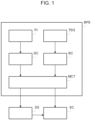
- FIG. 1 is a block diagram depicting an embodiment of a backup power supply system BPS for an electronic device.
- the electronic device may be any device performing actions using electronic components.
- the backup power supply system BPS includes a microcontroller MCT, a primary power input PI that provides a power input to a DC/DC converter DCV and a thermoelectric generator TEG that provides a power input to a boost converter BCV.
- the backup power supply system BPS is implemented on a printed circuit board of the electronic device.
- the microcontroller MCT is electrically connected to both the DC/DC converter DCV and the boost converter BCV and is able to selectively output power from one of the DC/DC converter DCV and the boost converter BCV to the power input of a set of sensors SS and to the power input of a set of critical components SC of the printed circuit board of the electronic device.
- the set of critical components SC of the printed circuit board is able to perform data backup operation when power supply to the printed circuit board falls under a defined threshold.
- the set of critical components comprises a microprocessor and memories, including a non-volatile memory, storing data relating to the operating context of the electronic device in the memories.
- the data backup operation occurs when the electronic device is powered down and stores essential values needed for the proper functioning for the electronic device when it is rebooted. These essential values are data relating to the operating context of the electronic device just before the power outage.
- the printed circuit board of the electronic device further contains a set of peripheric components SPC that are non-essential to perform data backup operation.
- the set of peripheric components comprises LEDs, Ethernet ports, etc.
- the printed circuit board contains at least two rails for power supply of components of the printed circuit board, one acting as an Uninterruptible Power Source (UPS) and another one acting as an Interruptible Power Source (IPS).
- UPS Uninterruptible Power Source
- IPS Interruptible Power Source
- the set of critical components SC and the set of sensors SS are powered by the Uninterruptible Power Source, whereas the peripheric set of components is powered by the Interruptible Power Source.
- the two rails for UPS and IPS can be powered by the DC/DC converter DCV, whereas the rail for UPS can be powered by the boost converter BCV as backup power source when the primary power input PI fails.
- thermoelectric generator TEG is a Peltier-element that is in direct thermal contact with a chip of the printed circuit board and operates according to the Peltier effect.
- the effect creates a temperature difference by transferring heat between two electrical junctions. A voltage is applied across joined conductors to create an electric current. When the current flows through the junctions of the two conductors, heat is removed at one junction and cooling occurs. Heat is deposited at the other junction.
- the main application of the Peltier effect is cooling. However the Peltier effect can also be used for heating or control of temperature. In every case, a DC voltage is required.
- the voltage supplied by the thermoelectric generator TEG is fed to the boost converter BCV.
- the boost converter BCV is a DC-to-DC power converter that steps up the voltage from the thermoelectric generator TEG at its input to a higher voltage at its output while stepping down current.
- the microcontroller MCT is able to command the heating or cooling of the chip by the thermoelectric generator TEG.
- the microcontroller MCT is connected to the set of sensors SS that is able to monitor the power consumption of the set of critical components. More especially, during a data backup operation after a power down of the primary power input PI, the set of sensors SS can monitor the ambient temperature, the voltage and current of the set of critical components and thus retrieve the real time power consumption of the set of critical components. Moreover, the set of sensors SS can monitor the duration required to perform the data backup operation.
- the microcontroller MCT implements an algorithm which determines an electrical energy required to perform data backup operation by the set of critical components.
- the algorithm takes as input the values retrieved by the set of sensors during data backup operation: the duration of the data backup operation, the ambient temperature and the real time power consumption of the set of critical components. With the duration of the data backup operation and the real time power consumption of the set of critical components, the microcontroller MCT can determine the electrical energy required to perform data backup operation by the set of critical components.
- the determined electrical energy is updated as the values retrieved by the set of sensors are changing.
- the algorithm takes into account the ageing of the set of critical components. For example, the algorithm learns the evolution of the required electrical energy determined for at least two consecutive data backup operations with the same ambient temperature. An increase of the determined electrical energy is an indication of the ageing of at least some of the components. The indication of ageing can be used to adjust a determined electrical energy, for example by adding a margin to the determined electrical energy.
- the determined electrical energy can be updated regularly, for example after each data backup operation, depending on the variations of the values retrieved by the set of sensors.
- the microcontroller MCT is initially set up default values related to the set of critical components.
- the algorithm is updated a first time to define an electrical energy required to perform backup operation by initiating a data backup operation.
- the microcontroller MCT is configured to compute from the determined electrical energy a temperature deviation to reach by the chip, wherein the temperature deviation is the difference between the temperature inside the chip and the ambient temperature of the chip.
- thermoelectric generator TEG is able to convert the heat flux of the temperature deviation from the chip into electrical energy.
- the microcontroller MCT can compute the required temperature deviation of the chip in order that the thermoelectric generator TEG converts the corresponding heat flux from the chip into the determined electrical energy.
- the chip is selected for having the property to present in operation a temperature inside the chip always hotter than the ambient temperature of the chip.
- the chip is a microprocessor.
- the microcontroller MCT is also configured to command the regulation of the temperature inside the chip by means of the thermoelectric generator to reach the computed temperature deviation. Thanks to the Peltier effect, the thermoelectric generator can operate for heating or cooling the temperature of the chip. The thermoelectric generator is instructed to control the temperature inside the chip in view of the ambient temperature to reach always substantially the computed temperature deviation.
- the microcontroller MCT commands the thermoelectric generator to heat the chip in order to reduce current temperature deviation and to reach the determined temperature deviation.
- the microcontroller MCT is configured to supply electrical energy to the set of critical components when data backup operation is triggered, the electrical power being converted from the heat flux of the temperature deviation from the chip.
- the thermoelectric generator TEG converts the heat flux of the temperature deviation from the chip into electrical power, which corresponds to the power consumption need for the set of components during the backup operation.
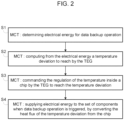
- a method for managing data backup operation of an electronic device comprises steps S1 to S4.
- step S1 a data backup operation is performed by the set of critical components and the microcontroller MCT determines an electrical energy required to perform data backup operation by the set of components.
- Step S1 is triggered each time a power supply by the main power input to the printed circuit board falls under a defined threshold.
- the data backup operation is monitored by the set of sensors that retrieves values of the ambient temperature, the voltage and current of the set of critical components.
- step S2 the microcontroller MCT computes from the determined electrical energy a temperature deviation to reach by the thermoelectric generator TEG, wherein the temperature deviation is the difference between the temperature inside the chip and the ambient temperature of the chip.
- the computed temperature deviation of the chip should correspond to a heat flux from the chip that the thermoelectric generator TEG is able to convert into a quantity of electrical energy substantially equal to the determined electrical energy.
- the computed temperature deviation thus depends on the properties of the thermoelectric generator TEG associated with the chip.
- step S3 the microcontroller MCT commands the regulation of the temperature inside the chip by means of the thermoelectric generator to reach the temperature deviation.
- the printed circuit board of the electronic device is supplied with electrical energy by the primary power input PI and the thermoelectric generator is designed and configured for supplying the set of critical components SC with electrical energy in case the voltage of the primary power input drops to zero or under a predefined value defining a level needed to sufficiently supply the set of critical components.
- thermoelectric generator regulates the temperature inside the chip to reach the computed temperature deviation.
- step S4 when a data backup operation is triggered, for example in case the voltage of the primary power input drops to zero, the microcontroller MCT is configured to supply electrical energy to the set of critical components, the electrical energy being converted by the thermoelectric generator TEG from the heat flux of the temperature deviation from the chip. As the temperature inside the chip was regulated to reach the temperature deviation in normal operation, the thermoelectric generator TEG is able to supply the electrical energy previously determined and required to perform the data backup operation.
- the microcontroller only supplies the rail for UPS and switch off the rail for IPS, allowing only the set of critical elements to perform the data backup operation and the set of sensors to monitor the set of critical elements.
- the set of critical elements requires a power around 5W while the set of sensors requires a power around 0,1 W.
Landscapes
- Engineering & Computer Science (AREA)
- Theoretical Computer Science (AREA)
- Physics & Mathematics (AREA)
- General Engineering & Computer Science (AREA)
- General Physics & Mathematics (AREA)
- Quality & Reliability (AREA)
- Power Engineering (AREA)
- Business, Economics & Management (AREA)
- Emergency Management (AREA)
- Human Computer Interaction (AREA)
- Power Sources (AREA)
Description
- The present disclosure relates generally to a backup power source for supplying power to an electronical device, based on the thermoelectric effect, when a voltage of a primary power source for the electronical device drops under a predefined value.
- Some electronical devices can be supplied with backup energy by capacitors as secondary power source after the voltage of a primary power source for the electronical device has dropped to zero. More especially, this secondary power source supplies a microcontroller for a sufficient period of time to perform data backup operation. These capacitors require a high volume and may not be practical when the electronic device is of small size.
- This traditional management and energy source of a microcontroller during backup data is made of multiples aluminum capacitors placed in parallel with MOS transistor in serial. This implies a costly and bulky solution, presenting a short mean time between failures (MTBF) due to thermal sensitivity of capacitors.
-
EP 3 598 511 A1US2013/133710 A1 relates to a thermoelectric generator for heating or cooling an electronic circuit. - There is therefore a need for an efficient management of a backup power source of an electronic device for a data backup operation of the electronic device after a shutdown of the electronic device.
- This summary is provided to introduce concepts related to the present inventive subject matter. This summary is not intended to identify essential features of the claimed subject matter nor is it intended for use in determining or limiting the scope of the claimed subject matter.
- In one implementation, there is provided a method for managing data backup operation of an electronic device by a backup power supply system in accordance with appended
claim 1. - Advantageously, the method allows to manage and optimize electrical energy for data backup operation by keeping powered only essential components of the electronic device. In case of sudden interruption of power supply to the electronic device, it can be prevented any damage or loss of data for the microcontroller.
- In another implementation, there is provided a backup power supply system for managing data backup operation of an electronic device, in accordance with appended claim 8.
- Preferable features of the invention are defined in the appended dependent claims.
- In another implementation there is provided a computer-readable medium having embodied thereon a computer program for executing a method for managing data backup operation of an electronic device. Said computer program comprises instructions which carry out steps according to the method according to the invention.
- The detailed description is described with reference to the accompanying figures. In the figures, the left-most digit(s) of a reference number identifies the figure in which the reference number first appears. The same numbers are used throughout the figures to reference like features and components. Some embodiments of system and/or methods in accordance with embodiments of the present subject matter are now described, by way of example only, and with reference to the accompanying figures, in which:
-
FIG. 1 illustrates schematically an example of a backup power supply system for managing data backup operation of an electronic device according to one embodiment of the invention. -
FIG. 2 shows a flow chart illustrating a method for managing data backup operation of an electronic device according to one embodiment of the invention. - The same reference number represents the same element or the same type of element on all drawings.
- It should be appreciated by those skilled in the art that any block diagrams herein represent conceptual views of illustrative systems embodying the principles of the present subject matter. Similarly, it will be appreciated that any flow charts, flow diagrams, state transition diagrams, pseudo code, and the like represent various processes which may be substantially represented in computer readable medium and so executed by a computer or processor, whether or not such computer or processor is explicitly shown.
- The figures and the following description illustrate specific exemplary embodiments of the invention. It will thus be appreciated that those skilled in the art will be able to devise various arrangements that, although not explicitly described or shown herein, embody the principles of the invention and are included within the scope of the invention. Furthermore, any examples described herein are intended to aid in understanding the principles of the invention, and are to be construed as being without limitation to such specifically recited examples and conditions. As a result, the invention is not limited to the specific embodiments or examples described below, but by the claims.
-
FIG. 1 is a block diagram depicting an embodiment of a backup power supply system BPS for an electronic device. The electronic device may be any device performing actions using electronic components. The backup power supply system BPS includes a microcontroller MCT, a primary power input PI that provides a power input to a DC/DC converter DCV and a thermoelectric generator TEG that provides a power input to a boost converter BCV. The backup power supply system BPS is implemented on a printed circuit board of the electronic device. - The microcontroller MCT is electrically connected to both the DC/DC converter DCV and the boost converter BCV and is able to selectively output power from one of the DC/DC converter DCV and the boost converter BCV to the power input of a set of sensors SS and to the power input of a set of critical components SC of the printed circuit board of the electronic device.
- Especially, the set of critical components SC of the printed circuit board is able to perform data backup operation when power supply to the printed circuit board falls under a defined threshold. For example, the set of critical components comprises a microprocessor and memories, including a non-volatile memory, storing data relating to the operating context of the electronic device in the memories. The data backup operation occurs when the electronic device is powered down and stores essential values needed for the proper functioning for the electronic device when it is rebooted. These essential values are data relating to the operating context of the electronic device just before the power outage.
- The printed circuit board of the electronic device further contains a set of peripheric components SPC that are non-essential to perform data backup operation. For example, the set of peripheric components comprises LEDs, Ethernet ports, etc.
- The printed circuit board contains at least two rails for power supply of components of the printed circuit board, one acting as an Uninterruptible Power Source (UPS) and another one acting as an Interruptible Power Source (IPS).
- The set of critical components SC and the set of sensors SS are powered by the Uninterruptible Power Source, whereas the peripheric set of components is powered by the Interruptible Power Source.
- More especially, the two rails for UPS and IPS can be powered by the DC/DC converter DCV, whereas the rail for UPS can be powered by the boost converter BCV as backup power source when the primary power input PI fails.
- The thermoelectric generator TEG is a Peltier-element that is in direct thermal contact with a chip of the printed circuit board and operates according to the Peltier effect. The effect creates a temperature difference by transferring heat between two electrical junctions. A voltage is applied across joined conductors to create an electric current. When the current flows through the junctions of the two conductors, heat is removed at one junction and cooling occurs. Heat is deposited at the other junction. The main application of the Peltier effect is cooling. However the Peltier effect can also be used for heating or control of temperature. In every case, a DC voltage is required.
- The voltage supplied by the thermoelectric generator TEG is fed to the boost converter BCV. The boost converter BCV is a DC-to-DC power converter that steps up the voltage from the thermoelectric generator TEG at its input to a higher voltage at its output while stepping down current.
- The microcontroller MCT is able to command the heating or cooling of the chip by the thermoelectric generator TEG.
- The microcontroller MCT is connected to the set of sensors SS that is able to monitor the power consumption of the set of critical components. More especially, during a data backup operation after a power down of the primary power input PI, the set of sensors SS can monitor the ambient temperature, the voltage and current of the set of critical components and thus retrieve the real time power consumption of the set of critical components. Moreover, the set of sensors SS can monitor the duration required to perform the data backup operation.
- The microcontroller MCT implements an algorithm which determines an electrical energy required to perform data backup operation by the set of critical components.
- The algorithm takes as input the values retrieved by the set of sensors during data backup operation: the duration of the data backup operation, the ambient temperature and the real time power consumption of the set of critical components. With the duration of the data backup operation and the real time power consumption of the set of critical components, the microcontroller MCT can determine the electrical energy required to perform data backup operation by the set of critical components.
- At each data backup operation, the determined electrical energy is updated as the values retrieved by the set of sensors are changing.
- In one embodiment, the algorithm takes into account the ageing of the set of critical components. For example, the algorithm learns the evolution of the required electrical energy determined for at least two consecutive data backup operations with the same ambient temperature. An increase of the determined electrical energy is an indication of the ageing of at least some of the components. The indication of ageing can be used to adjust a determined electrical energy, for example by adding a margin to the determined electrical energy.
- Thus the determined electrical energy can be updated regularly, for example after each data backup operation, depending on the variations of the values retrieved by the set of sensors.
- For example, the microcontroller MCT is initially set up default values related to the set of critical components. In one embodiment, the algorithm is updated a first time to define an electrical energy required to perform backup operation by initiating a data backup operation.
- The microcontroller MCT is configured to compute from the determined electrical energy a temperature deviation to reach by the chip, wherein the temperature deviation is the difference between the temperature inside the chip and the ambient temperature of the chip.
- The thermoelectric generator TEG is able to convert the heat flux of the temperature deviation from the chip into electrical energy. According to the properties of the thermoelectric generator TEG, the microcontroller MCT can compute the required temperature deviation of the chip in order that the thermoelectric generator TEG converts the corresponding heat flux from the chip into the determined electrical energy.
- It is assumed that the chip is selected for having the property to present in operation a temperature inside the chip always hotter than the ambient temperature of the chip. For instance, the chip is a microprocessor.
- The microcontroller MCT is also configured to command the regulation of the temperature inside the chip by means of the thermoelectric generator to reach the computed temperature deviation. Thanks to the Peltier effect, the thermoelectric generator can operate for heating or cooling the temperature of the chip. The thermoelectric generator is instructed to control the temperature inside the chip in view of the ambient temperature to reach always substantially the computed temperature deviation.
- For example, at a given ambient temperature, if the current temperature deviation is too high, the microcontroller MCT commands the thermoelectric generator to heat the chip in order to reduce current temperature deviation and to reach the determined temperature deviation.
- The microcontroller MCT is configured to supply electrical energy to the set of critical components when data backup operation is triggered, the electrical power being converted from the heat flux of the temperature deviation from the chip. In this case, the thermoelectric generator TEG converts the heat flux of the temperature deviation from the chip into electrical power, which corresponds to the power consumption need for the set of components during the backup operation.
- Referring to
FIG. 2 , a method for managing data backup operation of an electronic device according to one embodiment of the invention comprises steps S1 to S4. - In step S1, a data backup operation is performed by the set of critical components and the microcontroller MCT determines an electrical energy required to perform data backup operation by the set of components. Step S1 is triggered each time a power supply by the main power input to the printed circuit board falls under a defined threshold. The data backup operation is monitored by the set of sensors that retrieves values of the ambient temperature, the voltage and current of the set of critical components.
- In step S2, the microcontroller MCT computes from the determined electrical energy a temperature deviation to reach by the thermoelectric generator TEG, wherein the temperature deviation is the difference between the temperature inside the chip and the ambient temperature of the chip.
- The computed temperature deviation of the chip should correspond to a heat flux from the chip that the thermoelectric generator TEG is able to convert into a quantity of electrical energy substantially equal to the determined electrical energy. The computed temperature deviation thus depends on the properties of the thermoelectric generator TEG associated with the chip.
- In step S3, the microcontroller MCT commands the regulation of the temperature inside the chip by means of the thermoelectric generator to reach the temperature deviation.
- During normal operation, the printed circuit board of the electronic device is supplied with electrical energy by the primary power input PI and the thermoelectric generator is designed and configured for supplying the set of critical components SC with electrical energy in case the voltage of the primary power input drops to zero or under a predefined value defining a level needed to sufficiently supply the set of critical components.
- Depending on the ambient temperature and the current temperature inside the chip, the thermoelectric generator regulates the temperature inside the chip to reach the computed temperature deviation.
- In step S4, when a data backup operation is triggered, for example in case the voltage of the primary power input drops to zero, the microcontroller MCT is configured to supply electrical energy to the set of critical components, the electrical energy being converted by the thermoelectric generator TEG from the heat flux of the temperature deviation from the chip. As the temperature inside the chip was regulated to reach the temperature deviation in normal operation, the thermoelectric generator TEG is able to supply the electrical energy previously determined and required to perform the data backup operation.
- More especially, the microcontroller only supplies the rail for UPS and switch off the rail for IPS, allowing only the set of critical elements to perform the data backup operation and the set of sensors to monitor the set of critical elements. In one example, the set of critical elements requires a power around 5W while the set of sensors requires a power around 0,1 W.
- Although the present invention has been described above with reference to specific embodiments, it is not intended to be limited to the specific form set forth herein. Rather, the invention is limited only by the accompanying claims and, other embodiments than the specific above are equally possible within the scope of these appended claims.
- Furthermore, although exemplary embodiments have been described above in some exemplary combination of components and/or functions, it should be appreciated that, alternative embodiments may be provided by different combinations of members and/or functions without departing from the scope of the present disclosure. In addition, it is specifically contemplated that a particular feature described, either individually or as part of an embodiment, can be combined with other individually described features, or parts of other embodiments
Claims (9)
- A method for managing data backup operation of an electronic device by a backup power supply system (BPS) comprising a DC/DC converter (DC) having a main power input and a power output, a boost converter (BC) having a power input and a power output, a thermoelectric generator (TEG) associated with a chip and electrically connected to the power input of the Boost converter, wherein the thermoelectric generator is able to heat or cool the chip, and a microcontroller (MCT) electrically connected to the power outputs of the DC/DC converter (DC) and the Boost converter (BC) and electrically connected to a set of components (SC) able to perform data backup operation of the electronic device, the method comprising:determining (S1), by the microcontroller (MCT), an electrical energy required to perform data backup operation by the set of components,computing (S2), by the microcontroller (MCT), from the determined electrical energy a temperature deviation to reach by the thermoelectric generator (TEG), wherein the temperature deviation is the difference between the temperature inside the chip and the ambient temperature of the chip,commanding (S3), by the microcontroller (MCT), the regulation of the temperature inside the chip by the thermoelectric generator to reach the temperature deviation,supplying (S4) electrical energy, by the microcontroller (MCT), to the set of components (SC) when data backup operation is triggered, the electrical energy being converted from the heat flux of the temperature deviation from the chip,wherein the microcontroller (MCT) is connected to a set of sensors (SS) that retrieves values of voltage and current of the set of components (SC) during a data backup operation and the duration required to perform the data backup operation,wherein the microcontroller (MCT) determines the electrical energy required to perform data backup operation by the set of components based on the values retrieved by the set of sensors (SS).
- A method according to claim 1, wherein a data backup operation is triggered when a voltage of the main power input drops under a predefined value.
- A method according to any of previous claims, wherein the microcontroller (MCT) is connected to the set of sensors (SS) that is able to monitor the power consumption of the set of components (SC) during any data backup operation.
- A method according to any of previous claims, wherein the determined electrical energy is updated after each data backup operation, depending on the variations of the values retrieved by the set of sensors.
- A method according to any of previous claims, wherein the thermoelectric generator is a Peltier-element.
- A method according to any of previous claims, wherein the thermoelectric generator (TEG) is able to heat or cool the chip for the regulation of the temperature inside the chip.
- A method according to claim 6, wherein the thermoelectric generator (TEG) regulates the temperature inside the chip in view of the ambient temperature to reach the computed temperature deviation.
- A backup power supply system (BPS) for managing data backup operation of an electronic device, comprising:a DC/DC converter (DC) having a main power input and a power output;a boost converter (BC) having a power input and a power output;a thermoelectric generator (TEG) associated with a chip and electrically connected to the power input of the boost converter, wherein the thermoelectric generator is able to heat or cool the chip;a microcontroller (MCT) electrically connected to the power outputs of the DC/DC converter (DC) and the boost converter (BC), and electrically connected to a set of components (SC) able to perform data backup operation of the electronic device,wherein the microcontroller (MCT) is configured to determine an electrical energy required to perform data backup operation by the set of components,wherein the microcontroller (MCT) is configured to compute from the determined electrical energy a temperature deviation to reach by the thermoelectric generator (TEG), wherein the temperature deviation is the difference between the temperature inside the chip and the ambient temperature of the chip,wherein the microcontroller (MCT) is configured to command the regulation of the temperature inside the chip by means of the thermoelectric generator to reach the temperature deviation,wherein the microcontroller (MCT) is configured to supply electrical energy to the set of components (SC) when data backup operation is triggered, the electrical energy being converted from the heat flux of the temperature deviation from the chip,wherein the microcontroller (MCT) is connected to a set of sensors (SS) that retrieves values of voltage and current of the set of components (SC) during a data backup operation and the duration required to perform the data backup operation,wherein the microcontroller (MCT) determines the electrical energy required to perform data backup operation by the set of components based on the values retrieved by the set of sensors (SS).
- A computer-readable medium having embodied thereon a computer program for causing the backup power supply system of claim 8 to execute a method for managing data backup operation of an electronic device according to any of claims 1 to 7.
Priority Applications (4)
| Application Number | Priority Date | Filing Date | Title |
|---|---|---|---|
| ES21305538T ES2986764T3 (en) | 2021-04-27 | 2021-04-27 | Backup power system for backup operation |
| EP21305538.7A EP4083750B1 (en) | 2021-04-27 | 2021-04-27 | Backup power supply system for backup operation |
| US17/723,540 US12061508B2 (en) | 2021-04-27 | 2022-04-19 | Backup power supply system using a thermoelectric generator for managing data backup operation of an electronic device |
| CN202210453652.5A CN115248628A (en) | 2021-04-27 | 2022-04-24 | Backup power system for backup operations |
Applications Claiming Priority (1)
| Application Number | Priority Date | Filing Date | Title |
|---|---|---|---|
| EP21305538.7A EP4083750B1 (en) | 2021-04-27 | 2021-04-27 | Backup power supply system for backup operation |
Publications (2)
| Publication Number | Publication Date |
|---|---|
| EP4083750A1 EP4083750A1 (en) | 2022-11-02 |
| EP4083750B1 true EP4083750B1 (en) | 2024-06-05 |
Family
ID=75825761
Family Applications (1)
| Application Number | Title | Priority Date | Filing Date |
|---|---|---|---|
| EP21305538.7A Active EP4083750B1 (en) | 2021-04-27 | 2021-04-27 | Backup power supply system for backup operation |
Country Status (4)
| Country | Link |
|---|---|
| US (1) | US12061508B2 (en) |
| EP (1) | EP4083750B1 (en) |
| CN (1) | CN115248628A (en) |
| ES (1) | ES2986764T3 (en) |
Families Citing this family (1)
| Publication number | Priority date | Publication date | Assignee | Title |
|---|---|---|---|---|
| CN116436147B (en) * | 2023-06-13 | 2023-09-19 | 苏州浪潮智能科技有限公司 | A power supply circuit and electronic equipment |
Family Cites Families (10)
| Publication number | Priority date | Publication date | Assignee | Title |
|---|---|---|---|---|
| JP2001282396A (en) * | 2000-03-24 | 2001-10-12 | Internatl Business Mach Corp <Ibm> | Power generating mechanism and computer device and electronic equipment |
| KR101370338B1 (en) * | 2007-02-23 | 2014-03-05 | 삼성전자 주식회사 | Computer and its power supply method |
| JP4799658B2 (en) * | 2009-11-30 | 2011-10-26 | 株式会社東芝 | Information processing device |
| US20120204577A1 (en) * | 2011-02-16 | 2012-08-16 | Ludwig Lester F | Flexible modular hierarchical adaptively controlled electronic-system cooling and energy harvesting for IC chip packaging, printed circuit boards, subsystems, cages, racks, IT rooms, and data centers using quantum and classical thermoelectric materials |
| US9588558B2 (en) * | 2013-06-13 | 2017-03-07 | Microsoft Technology Licensing, Llc | On-chip integrated processing and power generation |
| US10263424B2 (en) * | 2014-04-02 | 2019-04-16 | Leddynamics, Inc. | Energy management system for controlling energy to a load powered by a thermoelectric module |
| JP2016053757A (en) * | 2014-09-02 | 2016-04-14 | 株式会社東芝 | Memory system |
| US10162394B2 (en) * | 2014-09-10 | 2018-12-25 | Arizona Board Of Regents On Behalf Of Arizona State University | Systems and methods for sustainable self-cooling of central processing unit thermal hot spots using thermoelectric materials |
| US10963408B2 (en) * | 2017-06-01 | 2021-03-30 | University Of Virginia Patent Foundation | System on a chip with customized data flow architecture |
| EP3598511B1 (en) * | 2018-07-17 | 2021-01-27 | Continental Automotive GmbH | Power source for an electronical device |
-
2021
- 2021-04-27 EP EP21305538.7A patent/EP4083750B1/en active Active
- 2021-04-27 ES ES21305538T patent/ES2986764T3/en active Active
-
2022
- 2022-04-19 US US17/723,540 patent/US12061508B2/en active Active
- 2022-04-24 CN CN202210453652.5A patent/CN115248628A/en active Pending
Also Published As
| Publication number | Publication date |
|---|---|
| US20220342470A1 (en) | 2022-10-27 |
| ES2986764T3 (en) | 2024-11-12 |
| US12061508B2 (en) | 2024-08-13 |
| CN115248628A (en) | 2022-10-28 |
| EP4083750A1 (en) | 2022-11-02 |
Similar Documents
| Publication | Publication Date | Title |
|---|---|---|
| US8595521B2 (en) | Increasing mean time between failures for power supplies | |
| EP2807719B1 (en) | Battery leakage current elimination in ups units | |
| US7991588B1 (en) | Power consumption measurement | |
| US10305320B2 (en) | Method of controlling an uninterruptible power supply system to optimize component life | |
| CN112787506B (en) | Voltage modulator with piecewise linear load line | |
| KR20100080333A (en) | Apparatus, system, and method for fault tolerant cooling in a redundant power system | |
| US12061508B2 (en) | Backup power supply system using a thermoelectric generator for managing data backup operation of an electronic device | |
| WO2012087617A2 (en) | Two-way switching regulator | |
| US20060203406A1 (en) | Undervoltage warning method, undervoltage warning circuit and switching power supply | |
| AU2017219124B2 (en) | Monitoring unit for monitoring a circuit breaker comprising an electrical power supply management system and circuit breaker comprising such a unit | |
| US20220004239A1 (en) | Enhanced battery backup unit battery management system | |
| CN115704868A (en) | Power conversion, fault management and notification | |
| WO2016082433A1 (en) | Mainframe power management method, apparatus and mainframe system | |
| SE518590C2 (en) | Power on and reconnection system | |
| JP6137387B1 (en) | Power relay unit | |
| EP4025027A2 (en) | Thermal management system and method for power optimization for cooling an electronic rack | |
| CN115793832A (en) | Apparatus and method for providing power to servers and IT equipment racks | |
| CN111781967B (en) | Terminal device | |
| CN120743075B (en) | Power module and server | |
| JP5923327B2 (en) | Power supply system, power supply method, and load connection control device | |
| TWI684315B (en) | Battery device for providing power supply | |
| CN118432400A (en) | Integrated power adapter, integrated power management method, power supply system and storage medium | |
| CN105322648A (en) | Systems and methods for preventing electric power converters from operating in sleep mode | |
| CN112963372A (en) | Fan control system and method thereof | |
| KR20020030584A (en) | Power supply apparatus of hot chuck controller |
Legal Events
| Date | Code | Title | Description |
|---|---|---|---|
| PUAI | Public reference made under article 153(3) epc to a published international application that has entered the european phase |
Free format text: ORIGINAL CODE: 0009012 |
|
| STAA | Information on the status of an ep patent application or granted ep patent |
Free format text: STATUS: THE APPLICATION HAS BEEN PUBLISHED |
|
| AK | Designated contracting states |
Kind code of ref document: A1 Designated state(s): AL AT BE BG CH CY CZ DE DK EE ES FI FR GB GR HR HU IE IS IT LI LT LU LV MC MK MT NL NO PL PT RO RS SE SI SK SM TR |
|
| STAA | Information on the status of an ep patent application or granted ep patent |
Free format text: STATUS: REQUEST FOR EXAMINATION WAS MADE |
|
| 17P | Request for examination filed |
Effective date: 20230417 |
|
| RBV | Designated contracting states (corrected) |
Designated state(s): AL AT BE BG CH CY CZ DE DK EE ES FI FR GB GR HR HU IE IS IT LI LT LU LV MC MK MT NL NO PL PT RO RS SE SI SK SM TR |
|
| GRAP | Despatch of communication of intention to grant a patent |
Free format text: ORIGINAL CODE: EPIDOSNIGR1 |
|
| STAA | Information on the status of an ep patent application or granted ep patent |
Free format text: STATUS: GRANT OF PATENT IS INTENDED |
|
| INTG | Intention to grant announced |
Effective date: 20240301 |
|
| GRAS | Grant fee paid |
Free format text: ORIGINAL CODE: EPIDOSNIGR3 |
|
| GRAA | (expected) grant |
Free format text: ORIGINAL CODE: 0009210 |
|
| STAA | Information on the status of an ep patent application or granted ep patent |
Free format text: STATUS: THE PATENT HAS BEEN GRANTED |
|
| AK | Designated contracting states |
Kind code of ref document: B1 Designated state(s): AL AT BE BG CH CY CZ DE DK EE ES FI FR GB GR HR HU IE IS IT LI LT LU LV MC MK MT NL NO PL PT RO RS SE SI SK SM TR |
|
| REG | Reference to a national code |
Ref country code: CH Ref legal event code: EP |
|
| REG | Reference to a national code |
Ref country code: DE Ref legal event code: R096 Ref document number: 602021014057 Country of ref document: DE |
|
| REG | Reference to a national code |
Ref country code: IE Ref legal event code: FG4D |
|
| REG | Reference to a national code |
Ref country code: LT Ref legal event code: MG9D |
|
| PG25 | Lapsed in a contracting state [announced via postgrant information from national office to epo] |
Ref country code: BG Free format text: LAPSE BECAUSE OF FAILURE TO SUBMIT A TRANSLATION OF THE DESCRIPTION OR TO PAY THE FEE WITHIN THE PRESCRIBED TIME-LIMIT Effective date: 20240605 |
|
| REG | Reference to a national code |
Ref country code: NL Ref legal event code: MP Effective date: 20240605 |
|
| PG25 | Lapsed in a contracting state [announced via postgrant information from national office to epo] |
Ref country code: FI Free format text: LAPSE BECAUSE OF FAILURE TO SUBMIT A TRANSLATION OF THE DESCRIPTION OR TO PAY THE FEE WITHIN THE PRESCRIBED TIME-LIMIT Effective date: 20240605 Ref country code: HR Free format text: LAPSE BECAUSE OF FAILURE TO SUBMIT A TRANSLATION OF THE DESCRIPTION OR TO PAY THE FEE WITHIN THE PRESCRIBED TIME-LIMIT Effective date: 20240605 |
|
| PG25 | Lapsed in a contracting state [announced via postgrant information from national office to epo] |
Ref country code: GR Free format text: LAPSE BECAUSE OF FAILURE TO SUBMIT A TRANSLATION OF THE DESCRIPTION OR TO PAY THE FEE WITHIN THE PRESCRIBED TIME-LIMIT Effective date: 20240906 |
|
| PG25 | Lapsed in a contracting state [announced via postgrant information from national office to epo] |
Ref country code: LV Free format text: LAPSE BECAUSE OF FAILURE TO SUBMIT A TRANSLATION OF THE DESCRIPTION OR TO PAY THE FEE WITHIN THE PRESCRIBED TIME-LIMIT Effective date: 20240605 |
|
| PG25 | Lapsed in a contracting state [announced via postgrant information from national office to epo] |
Ref country code: NO Free format text: LAPSE BECAUSE OF FAILURE TO SUBMIT A TRANSLATION OF THE DESCRIPTION OR TO PAY THE FEE WITHIN THE PRESCRIBED TIME-LIMIT Effective date: 20240905 Ref country code: LV Free format text: LAPSE BECAUSE OF FAILURE TO SUBMIT A TRANSLATION OF THE DESCRIPTION OR TO PAY THE FEE WITHIN THE PRESCRIBED TIME-LIMIT Effective date: 20240605 Ref country code: HR Free format text: LAPSE BECAUSE OF FAILURE TO SUBMIT A TRANSLATION OF THE DESCRIPTION OR TO PAY THE FEE WITHIN THE PRESCRIBED TIME-LIMIT Effective date: 20240605 Ref country code: GR Free format text: LAPSE BECAUSE OF FAILURE TO SUBMIT A TRANSLATION OF THE DESCRIPTION OR TO PAY THE FEE WITHIN THE PRESCRIBED TIME-LIMIT Effective date: 20240906 Ref country code: FI Free format text: LAPSE BECAUSE OF FAILURE TO SUBMIT A TRANSLATION OF THE DESCRIPTION OR TO PAY THE FEE WITHIN THE PRESCRIBED TIME-LIMIT Effective date: 20240605 Ref country code: BG Free format text: LAPSE BECAUSE OF FAILURE TO SUBMIT A TRANSLATION OF THE DESCRIPTION OR TO PAY THE FEE WITHIN THE PRESCRIBED TIME-LIMIT Effective date: 20240605 Ref country code: RS Free format text: LAPSE BECAUSE OF FAILURE TO SUBMIT A TRANSLATION OF THE DESCRIPTION OR TO PAY THE FEE WITHIN THE PRESCRIBED TIME-LIMIT Effective date: 20240905 |
|
| REG | Reference to a national code |
Ref country code: ES Ref legal event code: FG2A Ref document number: 2986764 Country of ref document: ES Kind code of ref document: T3 Effective date: 20241112 |
|
| PG25 | Lapsed in a contracting state [announced via postgrant information from national office to epo] |
Ref country code: NL Free format text: LAPSE BECAUSE OF FAILURE TO SUBMIT A TRANSLATION OF THE DESCRIPTION OR TO PAY THE FEE WITHIN THE PRESCRIBED TIME-LIMIT Effective date: 20240605 |
|
| REG | Reference to a national code |
Ref country code: AT Ref legal event code: MK05 Ref document number: 1692923 Country of ref document: AT Kind code of ref document: T Effective date: 20240605 |
|
| PG25 | Lapsed in a contracting state [announced via postgrant information from national office to epo] |
Ref country code: NL Free format text: LAPSE BECAUSE OF FAILURE TO SUBMIT A TRANSLATION OF THE DESCRIPTION OR TO PAY THE FEE WITHIN THE PRESCRIBED TIME-LIMIT Effective date: 20240605 |
|
| PG25 | Lapsed in a contracting state [announced via postgrant information from national office to epo] |
Ref country code: PT Free format text: LAPSE BECAUSE OF FAILURE TO SUBMIT A TRANSLATION OF THE DESCRIPTION OR TO PAY THE FEE WITHIN THE PRESCRIBED TIME-LIMIT Effective date: 20241007 |
|
| PG25 | Lapsed in a contracting state [announced via postgrant information from national office to epo] |
Ref country code: PT Free format text: LAPSE BECAUSE OF FAILURE TO SUBMIT A TRANSLATION OF THE DESCRIPTION OR TO PAY THE FEE WITHIN THE PRESCRIBED TIME-LIMIT Effective date: 20241007 |
|
| PG25 | Lapsed in a contracting state [announced via postgrant information from national office to epo] |
Ref country code: PL Free format text: LAPSE BECAUSE OF FAILURE TO SUBMIT A TRANSLATION OF THE DESCRIPTION OR TO PAY THE FEE WITHIN THE PRESCRIBED TIME-LIMIT Effective date: 20240605 |
|
| PG25 | Lapsed in a contracting state [announced via postgrant information from national office to epo] |
Ref country code: EE Free format text: LAPSE BECAUSE OF FAILURE TO SUBMIT A TRANSLATION OF THE DESCRIPTION OR TO PAY THE FEE WITHIN THE PRESCRIBED TIME-LIMIT Effective date: 20240605 |
|
| PG25 | Lapsed in a contracting state [announced via postgrant information from national office to epo] |
Ref country code: IS Free format text: LAPSE BECAUSE OF FAILURE TO SUBMIT A TRANSLATION OF THE DESCRIPTION OR TO PAY THE FEE WITHIN THE PRESCRIBED TIME-LIMIT Effective date: 20241005 Ref country code: AT Free format text: LAPSE BECAUSE OF FAILURE TO SUBMIT A TRANSLATION OF THE DESCRIPTION OR TO PAY THE FEE WITHIN THE PRESCRIBED TIME-LIMIT Effective date: 20240605 |
|
| PG25 | Lapsed in a contracting state [announced via postgrant information from national office to epo] |
Ref country code: CZ Free format text: LAPSE BECAUSE OF FAILURE TO SUBMIT A TRANSLATION OF THE DESCRIPTION OR TO PAY THE FEE WITHIN THE PRESCRIBED TIME-LIMIT Effective date: 20240605 |
|
| PG25 | Lapsed in a contracting state [announced via postgrant information from national office to epo] |
Ref country code: RO Free format text: LAPSE BECAUSE OF FAILURE TO SUBMIT A TRANSLATION OF THE DESCRIPTION OR TO PAY THE FEE WITHIN THE PRESCRIBED TIME-LIMIT Effective date: 20240605 Ref country code: SK Free format text: LAPSE BECAUSE OF FAILURE TO SUBMIT A TRANSLATION OF THE DESCRIPTION OR TO PAY THE FEE WITHIN THE PRESCRIBED TIME-LIMIT Effective date: 20240605 |
|
| PG25 | Lapsed in a contracting state [announced via postgrant information from national office to epo] |
Ref country code: SM Free format text: LAPSE BECAUSE OF FAILURE TO SUBMIT A TRANSLATION OF THE DESCRIPTION OR TO PAY THE FEE WITHIN THE PRESCRIBED TIME-LIMIT Effective date: 20240605 |
|
| PG25 | Lapsed in a contracting state [announced via postgrant information from national office to epo] |
Ref country code: SM Free format text: LAPSE BECAUSE OF FAILURE TO SUBMIT A TRANSLATION OF THE DESCRIPTION OR TO PAY THE FEE WITHIN THE PRESCRIBED TIME-LIMIT Effective date: 20240605 Ref country code: SK Free format text: LAPSE BECAUSE OF FAILURE TO SUBMIT A TRANSLATION OF THE DESCRIPTION OR TO PAY THE FEE WITHIN THE PRESCRIBED TIME-LIMIT Effective date: 20240605 Ref country code: RO Free format text: LAPSE BECAUSE OF FAILURE TO SUBMIT A TRANSLATION OF THE DESCRIPTION OR TO PAY THE FEE WITHIN THE PRESCRIBED TIME-LIMIT Effective date: 20240605 Ref country code: PL Free format text: LAPSE BECAUSE OF FAILURE TO SUBMIT A TRANSLATION OF THE DESCRIPTION OR TO PAY THE FEE WITHIN THE PRESCRIBED TIME-LIMIT Effective date: 20240605 Ref country code: IS Free format text: LAPSE BECAUSE OF FAILURE TO SUBMIT A TRANSLATION OF THE DESCRIPTION OR TO PAY THE FEE WITHIN THE PRESCRIBED TIME-LIMIT Effective date: 20241005 Ref country code: EE Free format text: LAPSE BECAUSE OF FAILURE TO SUBMIT A TRANSLATION OF THE DESCRIPTION OR TO PAY THE FEE WITHIN THE PRESCRIBED TIME-LIMIT Effective date: 20240605 Ref country code: CZ Free format text: LAPSE BECAUSE OF FAILURE TO SUBMIT A TRANSLATION OF THE DESCRIPTION OR TO PAY THE FEE WITHIN THE PRESCRIBED TIME-LIMIT Effective date: 20240605 Ref country code: AT Free format text: LAPSE BECAUSE OF FAILURE TO SUBMIT A TRANSLATION OF THE DESCRIPTION OR TO PAY THE FEE WITHIN THE PRESCRIBED TIME-LIMIT Effective date: 20240605 |
|
| REG | Reference to a national code |
Ref country code: DE Ref legal event code: R097 Ref document number: 602021014057 Country of ref document: DE |
|
| PLBE | No opposition filed within time limit |
Free format text: ORIGINAL CODE: 0009261 |
|
| STAA | Information on the status of an ep patent application or granted ep patent |
Free format text: STATUS: NO OPPOSITION FILED WITHIN TIME LIMIT |
|
| PG25 | Lapsed in a contracting state [announced via postgrant information from national office to epo] |
Ref country code: DK Free format text: LAPSE BECAUSE OF FAILURE TO SUBMIT A TRANSLATION OF THE DESCRIPTION OR TO PAY THE FEE WITHIN THE PRESCRIBED TIME-LIMIT Effective date: 20240605 |
|
| 26N | No opposition filed |
Effective date: 20250306 |
|
| PGFP | Annual fee paid to national office [announced via postgrant information from national office to epo] |
Ref country code: DE Payment date: 20250428 Year of fee payment: 5 |
|
| PGFP | Annual fee paid to national office [announced via postgrant information from national office to epo] |
Ref country code: ES Payment date: 20250513 Year of fee payment: 5 |
|
| PGFP | Annual fee paid to national office [announced via postgrant information from national office to epo] |
Ref country code: IT Payment date: 20250422 Year of fee payment: 5 |
|
| PGFP | Annual fee paid to national office [announced via postgrant information from national office to epo] |
Ref country code: FR Payment date: 20250424 Year of fee payment: 5 |
|
| PG25 | Lapsed in a contracting state [announced via postgrant information from national office to epo] |
Ref country code: SE Free format text: LAPSE BECAUSE OF FAILURE TO SUBMIT A TRANSLATION OF THE DESCRIPTION OR TO PAY THE FEE WITHIN THE PRESCRIBED TIME-LIMIT Effective date: 20240605 |
|
| REG | Reference to a national code |
Ref country code: CH Ref legal event code: H13 Free format text: ST27 STATUS EVENT CODE: U-0-0-H10-H13 (AS PROVIDED BY THE NATIONAL OFFICE) Effective date: 20251125 |
|
| PG25 | Lapsed in a contracting state [announced via postgrant information from national office to epo] |
Ref country code: LU Free format text: LAPSE BECAUSE OF NON-PAYMENT OF DUE FEES Effective date: 20250427 |
|
| PG25 | Lapsed in a contracting state [announced via postgrant information from national office to epo] |
Ref country code: MC Free format text: LAPSE BECAUSE OF FAILURE TO SUBMIT A TRANSLATION OF THE DESCRIPTION OR TO PAY THE FEE WITHIN THE PRESCRIBED TIME-LIMIT Effective date: 20240605 |
|
| GBPC | Gb: european patent ceased through non-payment of renewal fee |
Effective date: 20250427 |
|
| REG | Reference to a national code |
Ref country code: BE Ref legal event code: MM Effective date: 20250430 |
|
| PG25 | Lapsed in a contracting state [announced via postgrant information from national office to epo] |
Ref country code: GB Free format text: LAPSE BECAUSE OF NON-PAYMENT OF DUE FEES Effective date: 20250427 |
|
| PG25 | Lapsed in a contracting state [announced via postgrant information from national office to epo] |
Ref country code: BE Free format text: LAPSE BECAUSE OF NON-PAYMENT OF DUE FEES Effective date: 20250430 |
|
| PG25 | Lapsed in a contracting state [announced via postgrant information from national office to epo] |
Ref country code: CH Free format text: LAPSE BECAUSE OF NON-PAYMENT OF DUE FEES Effective date: 20250430 |
|
| PG25 | Lapsed in a contracting state [announced via postgrant information from national office to epo] |
Ref country code: IE Free format text: LAPSE BECAUSE OF NON-PAYMENT OF DUE FEES Effective date: 20250427 |