EP4083521A1 - Method for controlling a domestic hot water system and system - Google Patents
Method for controlling a domestic hot water system and system Download PDFInfo
- Publication number
- EP4083521A1 EP4083521A1 EP21171214.6A EP21171214A EP4083521A1 EP 4083521 A1 EP4083521 A1 EP 4083521A1 EP 21171214 A EP21171214 A EP 21171214A EP 4083521 A1 EP4083521 A1 EP 4083521A1
- Authority
- EP
- European Patent Office
- Prior art keywords
- water
- temperature
- user
- water heater
- heated water
- Prior art date
- Legal status (The legal status is an assumption and is not a legal conclusion. Google has not performed a legal analysis and makes no representation as to the accuracy of the status listed.)
- Pending
Links
Images
Classifications
-
- F—MECHANICAL ENGINEERING; LIGHTING; HEATING; WEAPONS; BLASTING
- F24—HEATING; RANGES; VENTILATING
- F24D—DOMESTIC- OR SPACE-HEATING SYSTEMS, e.g. CENTRAL HEATING SYSTEMS; DOMESTIC HOT-WATER SUPPLY SYSTEMS; ELEMENTS OR COMPONENTS THEREFOR
- F24D19/00—Details
- F24D19/10—Arrangement or mounting of control or safety devices
- F24D19/1006—Arrangement or mounting of control or safety devices for water heating systems
- F24D19/1051—Arrangement or mounting of control or safety devices for water heating systems for domestic hot water
-
- F—MECHANICAL ENGINEERING; LIGHTING; HEATING; WEAPONS; BLASTING
- F24—HEATING; RANGES; VENTILATING
- F24D—DOMESTIC- OR SPACE-HEATING SYSTEMS, e.g. CENTRAL HEATING SYSTEMS; DOMESTIC HOT-WATER SUPPLY SYSTEMS; ELEMENTS OR COMPONENTS THEREFOR
- F24D17/00—Domestic hot-water supply systems
- F24D17/0026—Domestic hot-water supply systems with conventional heating means
- F24D17/0031—Domestic hot-water supply systems with conventional heating means with accumulation of the heated water
-
- F—MECHANICAL ENGINEERING; LIGHTING; HEATING; WEAPONS; BLASTING
- F24—HEATING; RANGES; VENTILATING
- F24D—DOMESTIC- OR SPACE-HEATING SYSTEMS, e.g. CENTRAL HEATING SYSTEMS; DOMESTIC HOT-WATER SUPPLY SYSTEMS; ELEMENTS OR COMPONENTS THEREFOR
- F24D17/00—Domestic hot-water supply systems
- F24D17/02—Domestic hot-water supply systems using heat pumps
Definitions
- the present invention concerns a method for controlling a domestic hot water (DHW) system and a DHW system.
- the method is directed at optimizing a specified temperature set point of a water heater of the DHW in order to improve efficiency and achieve a more economic operation of the system.
- United States Patent Application Publication No. US 2017/167736 A1 discloses a system for heating water in which a temperature setpoint of the system may be checked. If the setpoint is not at a certain level, normal operation may continue. If the setpoint is at the certain level, the water temperature of the system is measured and if this water temperature is less than a desired level, one or more draws of water are checked for a preset temperature drop. If the draws meet the temperature drop, then the setpoint may be reduced.
- German Patent Application Publication No. DE 10 2019 001 743 A1 describes a water storage system with a cold water supply and hot water outlet, a water heater, a temperature sensor, a control device with a communication device and a temperature controller, wherein the communication device communicates with a user terminal device such as a smartphone.
- the temperature controller can learn a user behavior and control the operation parameters of the system accordingly.
- the present invention has been made to improve a domestic hot water (DHW) system.
- DHW domestic hot water
- a method for controlling the DHW system is provided which carries out an optimization process with feedback by a user of the DHW system.
- the invention provides a method for controlling a domestic hot water (DHW) system in accordance with claim 1.
- DHW domestic hot water
- the invention provides a domestic hot water (DHW) system in accordance with claim 10. Further aspects of the invention are set forth in the dependent claims, the drawings and the following description of embodiments.
- a DHW system is generally installed in a residential building.
- the present invention can also be applied to hot water systems of other types of buildings, for example office buildings or other buildings with commercial purposes.
- a DHW system comprises a pipeline network with water pipes carrying hot or cold water.
- the pipeline network is installed in the building and connected to a fresh water supply for receiving a supply of fresh water from a waterworks.
- a main valve may be provided at the water supply to open or close the connection to an external water network from the waterworks.
- the DHW system comprises at least one water heater which heats the cold water received from the fresh water supply to a specified temperature setpoint.
- the specified temperature setpoint can be one of many operation parameters of the water heater.
- the water heater may generate heat from an energy source such as oil or gas in order to heat the cold water from the supply.
- the water heat may be a heat pump which extracts heat, for example from ambient air or the ground.
- DHW systems comprising a heat pump for heating water may operate more efficiently if water a setpoint temperature is set as low as possible.
- the water heater provides the heated water (i.e. hot water) to a flow.
- At least one water outlet preferably a plurality of water outlets (i.e. faucets or water taps in any known form), is arranged downstream of the water heater for providing heated water to a user, for example at a sink, a bath tub, or a shower.
- a water outlet preferably a plurality of water outlets (i.e. faucets or water taps in any known form)
- other consumers of hot water may be connected to the pipeline network, for example a washing machine or a dish washer.
- a typical DHW system further comprises a water storage tank arranged downstream of the water heater for storing heated water.
- the water storage tank receives heated water from the water heater via the flow.
- the water storage tank may also receive cold water from the fresh water supply. By mixing hot water from the water heater and cold water from the supply, the water temperature in the storage tank may be set to a specified temperature setpoint.
- the water heater is controlled by a control device.
- the control device may control the water heater and receive information from and/or control other components of the DHW system.
- the control device may comprise an interface for connecting to a network for communication with a server or cloud and/or a user terminal.
- the interface may be an internet gateway, such that the control device may connect to the internet and communicate with a central server for uploading and/or receiving data.
- the control device may also communicate with the user terminal via the internet.
- the control device may connect to a local network to communicate with the water heater, sensors, the user terminal, and/or other devices and components of the DHW system.
- the server may read out or receive a plurality of operation parameters from the water heater and/or from the control device and/or from the user terminal.
- the water heater and/or the control device and/or the user terminal may receive operation parameters from the server, for example a new set of operation parameters.
- the DHW system may comprise one or more temperature sensors for measuring a temperature of the heated water (and/or the cold water) flowing in the pipeline network. Each sensor provides a signal indicative of the measured temperature to the control device. For this purpose the sensor(s) may communicated via a wired connection or via a wireless connection with the control device. In particular, the sensors may be connected to a local network and or the internet for communicating with the control device or with the central server or cloud and/or with the user terminal. For example, using an application executed by the user terminal, the user may receive and read data on measured temperatures.
- the temperature sensors may be arranged at various positions in the DHW system for measuring the temperature of hot water, for example at the flow near the water heater, at the storage tank, and/or at a water outlet. Furthermore, one or more temperature sensors may be arranged for measuring the temperature of cold water, for example near the fresh water supply.
- the method according to the present invention may be executed by an application on the user terminal of the user.
- the user terminal may be a (mobile) device such as a smartphone, laptop, tablet computer, or any other network-capable device with a display and an input device (e.g. touch screen, keyboard, trackpad, mouse, or the like).
- the application executed by the user terminal provides a human-machine interface for implementing a continued guided interaction of the user with the DHW system, and in particular with the control device and/or the central server or cloud.
- a graphical user interface may be displayed on the user terminal to provide the human-machine interface for inputting and/or outputting information.
- a dedicated application (“app") may be executed by the terminal device.
- the application may be executed by an internet browser.
- the application issues instructions prompting the user to perform an action and/or to input information.
- the application may receive data input by the user and transmit the data to the server.
- the application serves as a frontend for a program that is executed as a backend on the server.
- the frontend application and/or the backend program each may comprise instructions which correspond to one or more steps of the method according to the present invention.
- the user terminal may provide information on a state of the DHW system to the user. Furthermore, the user terminal may receive inputs from the user to control the DHW system. The input and/or output of information can be achieved by the human-machine interface which is provided by the application.
- the term "user” may refer, for example, to an end user, an operator, a maintainer, or the like, of the DHW system.
- the user may be a resident of the building where the DHW system is installed.
- a number of conditions may be queried, which determine, for example, whether boundary conditions are met or whether it is worthwhile to carry out the optimization process at all. In particular, it is queried whether at least one of currently set operation parameters of the water heater or at least one measured temperature fulfils a preset condition. If the preset condition is met, the optimization process is started.
- the preset condition may be that a temperature of the heated water measured by one or more temperature sensor is equal to or higher than a first threshold.
- Another condition may depend on the temperature setpoint of the water heater and/or the water storage tank.
- a sufficient condition for starting the optimization process may be that the water heater is operating with operation parameters corresponding to factory settings or default settings.
- the currently set operation parameters of the water heater are stored as initial parameters.
- the control device may comprise a storage device.
- the initial parameters may be stored at the user terminal and/or the server or cloud.
- the operation parameters of the water heater may include a temperature setpoint. This temperature setpoint may be defined with respect to a flow temperature and/or a storage temperature and/or an outlet temperature, which are measured at the flow downstream of the water heater, at the storage tank, or at a water outlet, respectively using the one or more temperature sensors. Furthermore, the operation parameters may include a schedule defining one or more start and end times of operation of the water heater. These operation times may be set according to a user behavior. Moreover, the operation parameters may include flow rates of water through the water heater and/or a flow rate of hot water into the water storage tank.
- a new set of parameters for reducing the temperature of the heated water by a preset value are determined, wherein the preset value may be a variable temperature difference which is determined using a function.
- the temperature setpoint may be reduced with regard to any of the above-mentioned temperatures of the hot water.
- one of the aims of the present invention is to reduce energy consumption.
- the water heater may heat the water to a lower temperature and thereby requires less energy.
- the reduction of the temperature setpoint can be performed incrementally, for example by one, two, three or more Kelvin, or by a smaller increment of, for example 0.5 Kelvin.
- the preset value of the temperature reduction is not necessarily a fixed value.
- the preset value for reducing the temperature of the heated water is determined based on at least one of the currently set operation parameters of the water heater. An example is described in the following.
- the actual size of the temperature decrease step suggested for the user can be based on a function of the temperature setpoint during the start of the optimization process.
- the initial temperature setpoint may be 50°C and a lowest setpoint which is considered to still provide sufficiently high hot water temperature for the user may be 40°C, for example.
- the function can also take into account characteristics of the system, such as a rate of cooling down or a rate of heating up water and/or a usage amount in the specific household learned from water temperature sensor data. For example, rapid temperature drops can mean high water usage amounts.
- a similar function may be applied to the size of the specified period of time.
- the water heater is operated with the new set of parameters for a specified period of time.
- This period of time is chosen long enough to reach a steady state in the DHW system.
- the specified period of time may be set to one or more days.
- the period of time may be set to one week or more in order to cover at least one hot water consumption schedule.
- the duration of the period of time may be set according to a user behavior to ensure that the length of the period of time is representative for the specific DHW system.
- the period of time may be specified by the user, for example via the user terminal.
- the temperature measurements by the one or more temperature sensors can be used to detect that a thermal equilibrium has been reached in a sufficient manner.
- the user terminal may provide information to the user regarding an expected duration or a remaining duration of the period of time.
- Such an evaluation and analysis can preferably be executed by a central server or cluster or cloud computer connected to the network and receiving data from the control device of each DHW system and/or from a plurality of user terminals.
- the user is prompted to provide feedback on the temperature of the heated water.
- the user is guided by the application on the user terminal and prompted to answer one or more questions regarding the hot water temperature and/or availability of hot water during the specified period of time. For example, the user can input whether or not the temperature of the heated water was warm enough or not warm enough. Additionally, the user may input whether or not enough heated water was available during the specified period of time.
- the user may provide qualitative feedback concerning the temperature and/or availability of heated water, i.e. indicate whether the water was “too warm” or “too cold” or whether “enough” or “not enough” hot water was available at all times during the waiting period.
- the application can be set up in such a way that the user may select buttons for providing the qualitative feedback. These buttons may allow the user to also specify a quantitative degree (weighing) to the qualitative feedback such as "much too cold” or "somewhat too cold” for example.
- the qualitative user feedback (with or without weighting) may then be translated by the application into specific temperature deviations of, for example, one Kelvin (i.e. "too cold”) or two Kelvin (i.e. "much too cold”).
- the user may input an estimated value of the deviation in Kelvin or degrees Celsius in the application, such as for example “one Kelvin too cold” or “two Kelvin too cold”.
- the user feedback is indicative of whether or not the temperature of the heated water was lower than a second threshold during the specified period of time.
- the second threshold may be a desired hot water temperature set by the user.
- a water temperature near an outlet may be measured by a temperature sensor and compared to the second threshold. Accordingly, the comparison between the measured temperature and the second threshold can be performed by the control device and/or the application executed by the user terminal or the server.
- a quantitative result of the feedback can be gained, even without prompting the user to provide feedback. In this case, the user only needs to specify a desired outlet temperature.
- the water heater is controlled in dependence on the user feedback. In particular, if the user was satisfied with the availability and temperature of hot water, the optimization process may be repeated. If the user was not satisfied, the DHW system may be controlled to return to the initial parameters or a previous set of operation parameters.
- the entire optimization process may be performed repeatedly.
- the process may be repeated until the user provides a negative feedback, i.e. that the hot water temperature was "too cold” and/or that not enough hot water was available during the period of time.
- the water heater is controlled to operate with the last set of parameters which resulted in a positive feedback by the user.
- an optimal setting may be found for the DHW system for providing enough hot water at a sufficient temperature, for example at an optimized (lowered) temperature setpoint of the water heater and/or the water storage tank.
- the optimization process can be repeated, wherein in the determination step a smaller reduction of the temperature of the heated water is used. For example, if in the previous optimization iteration the temperature was reduced by a first value, for example 3 K, the next optimization iteration is carried out by reducing the temperature by a second value smaller than the first value, for example 1 K or 2 K.
- the hot water temperature is initially set to 50°C. In the first iteration, the hot water temperature is reduced to 47°C. As a result, the user gives a feedback that the hot water temperature was too low. In the next iteration, the hot water temperature is then set to 49°C or 48°C, for example.
- the temperature increment (preset value) can also be set variably based on various parameters of the system as explained above.
- a plurality of boundary conditions may be queried before the optimization process is carried out, which must be fulfilled so that it makes sense to carry out the optimization process.
- at least one of the following parameters such as current date, current outdoor temperature, current temperature set point of the water heater, current temperature set point of the water storage tank, device type or model of the water heater and/or storage tank, current flow temperature, current storage temperature etc., may be queried and compared with respective reference values.
- This query may be programmed as a start condition in the frontend application and/or the backend program.
- the reference values may be stored at the server or cloud, for example.
- the optimization process may be carried out depending on the season (i.e. time of year).
- winter cold season
- a query of the date can thus be made.
- the optimization process is only carried out if the currently setpoint(s) of the water heater and/or water storage tank indicate that there is potential for optimization.
- a first threshold may be defined for the temperature of the heated water measured by one or more temperature sensors. If the measured temperature is higher than the first threshold, the optimization process may be started.
- one or more flow sensors may be provided in the pipeline network. Furthermore, a sensor for measuring the filling level of the water storage tank may be provided. The measured values may be correlated to the user feedback in order to learn user preferences.
- the invention provides a domestic hot water system which is configured to execute a method according to one or more aspects described herein.
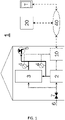
- Fig. 1 illustrates an exemplary embodiment of a domestic hot water (DHW) system 1 according to the invention for providing hot water.
- the DHW system 1 is arranged in a residential building and comprises a pipeline network, a water heater 2, a water storage tank 3, a plurality of water outlets 5 (or at least one as shown in Fig. 1 ), a control device 10, a plurality of temperature sensors 4, a user terminal T, and a central server 20.
- the pipeline network is depicted as thick solid and dotted lines, wherein the solid lines indicate flow of hot water and the dotted lines indicate flow of cold water.
- the illustrated pipeline network has been simplified for a better overview.
- the pipeline network is connected to a fresh water supply 6 of an external waterworks network.
- a main connection valve 7 allows to open or close the connection to the fresh water supply 6.
- the water heater 2 receives water from the supply 6, heats the water, and providing the heated water to the flow. Via the flow, hot water is supplied to the water storage tank 3 and the at least one water outlet 5 which are arranged downstream of the water heater 2.
- the water storage tank 3 may also be connected to the fresh water supply 6. Controllable valves may be provided at the connections to and from the storage tank 3 to control a flow from and to the storage tank 3.
- a plurality of temperature sensors 4 for measuring a temperature of the heated water is provided in the pipeline network, for example at the flow downstream of the water heater 2 and at the flow downstream of the water storage tank 3.
- Each temperature sensor 4 provides a signal indicative of the measured temperature to the control device 10 via a wired or wireless transmission channel (illustrated by thin dashed arrows).
- the control device 10 controls the DHW system 1 and is communicatively coupled to the water heater 2 (thin dashed arrow) for reading out and/or setting operation parameters of the water heater 2. Specifically, the control device 10 may control an operational state of the water heater 2. Furthermore, the control device 10 is connected to a communication network 40 via a network interface (not shown).
- a smartphone T serving as a user terminal for providing information on a state of the DHW system 1 to a user and for receiving inputs from the user to control the DHW system 1 is also connected to the network 40. Furthermore, the central server 20 is connected to the network 40. Thus, the control device 10, the terminal T, and the server 20 can communicate with each other via network 40.
- the DHW system 1 illustrated in Fig. 1 is configured to execute a method according to the present invention in accordance with one or more aspects described herein, an exemplary embodiment of which will be described below.
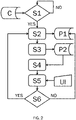
- FIG. 2 An exemplary embodiment of a method for controlling a DHW system 1 is illustrated by the flow diagram depicted in Fig. 2 .
- the method is essentially executed as a guided human-machine interaction using a graphical user interface provided as an application on user terminal T, which serves as a human-machine interface.
- a graphical user interface provided as an application on user terminal T, which serves as a human-machine interface.
- instructions are presented to the user in the graphical user interface and the user can input feedback.
- the user terminal T may be a device comprising a display and an input device such as a smartphone or tablet computer.
- step S1 of the method it is queried if at least one of currently set operation parameters of the water heater 2 or at least one temperature measured by at least one temperature sensor 4 fulfils a preset condition C.
- the preset condition C may be provided, for example, by the central server 20.
- a plurality of initial conditions or boundary conditions can be queried in order to decide whether an optimization process is to be executed or not.
- This query can be used in particular to determine whether there is potential for optimization and whether it makes sense to execute the optimization process accordingly.
- the initial or boundary conditions may concern, among others, a time of year or season, a device type or model of the water heater2 , currently set operation parameters of the water heater 2 and/or the water storage tank 3, and/or a hydraulic layout of the DHW system 1, as well as user preferences and/or user behavior.
- a plurality of data and conditions C can first be read, including values such as a current outdoor temperature, a current flow temperature, a current water storage temperature, a current temperature setpoint of the water heater 2 and/or of the storage tank 3, a current date, and/or a recent consumption of water in a specified time.
- the queried initial or boundary conditions can be compared with corresponding comparison values C.
- the comparison values C can be stored, for example, in the control device 10 and/or queried from the server 20.
- step S1 it may be queried in step S1, if a temperature of the heated water measured by at least one of the sensors 4 is equal to or higher than a first threshold.
- step S1 If the query in step S1 indicates that it makes sense to perform the optimization process (YES in S1), the user can be shown in the graphical user interface that a procedure for optimizing the DHW system 1 is available. In this case, the user may be prompted to confirm that the optimization process should be performed. If the user decides to start the process, the method continues with step S2. If the query in S1 returns NO, the optimization process is not carried out.
- step S2 the currently set operation parameters of the water heater 2 are stored as initial parameters P1.
- the method may return to the initial parameters P1, for example in case that optimized parameters do not meet a condition.
- the process continues to step S3.
- a new set of operation parameters P2 are determined in order to reduce the temperature of the heated water by a preset value.
- a temperature setpoint of the water heater 2 and/or the water storage tank 3 may be reduced.
- the reduction of the temperature setpoint can be performed incrementally, for example by one, two, three or more Kelvin, or by a smaller increment of, for example 0.5 Kelvin.
- the user may be asked by how much the setpoint shall be reduced.
- the water heater 2 is operated with the new set of parameters P2 for a specified period of time.
- this period of time is chosen long enough to allow reaching a steady state (temperature equilibrium) in the DHW system 1.
- the specified period of time may be set to one or more days.
- the period of time may be set to one week or more in order to cover at least one hot water consumption schedule.
- the duration of the period of time may be set according to a user behavior to ensure that the length of the period of time is representative for the specific DHW system 1.
- step S4 any changes to the operation parameters may be prevented.
- the user may usually be able to manually change operation parameters using the app on the user terminal T.
- the user may be informed that the process is ongoing and that manual changes are currently not allowed.
- step S5 the user is prompted in step S5 to provide feedback UI on the temperature of the heated water.
- the user is guided by the application on the user terminal T and prompted to answer one or more questions regarding the hot water temperature and/or availability of hot water during the specified period of time (i.e. during step S4).
- the user can input whether or not the temperature of the heated water was warm enough or not warm enough.
- the user may input whether or not enough heated water was available during the specified period of time.
- the user may provide an input UI in the form of a qualitative feedback concerning the temperature and/or availability of heated water.
- the user may indicate whether the water was "too warm” or “too cold” or whether “enough” or “not enough” hot water was available at all times during the waiting period S4.
- the user may be asked specifically, whether the temperature of the hot water was too cold at some point during the specified period of time. Additionally, the user may be asked if sufficient hot water was available at all times.
- step S6 the water heater is controlled in dependence on the user feedback UI provided in S5.
- the optimization process may be repeated by returning to step S2.
- further room for optimization is available, for example by further reducing the temperature setpoint.
- the entire optimization process (S2 to S6) may be performed repeatedly.
- the optimization process may be repeated until the user provides a negative feedback (NO in S6).
- the water heater is controlled to operate with the last set of parameters which resulted in a positive feedback by the user.
- an optimal setting may be found for the DHW system for providing enough hot water at a sufficient temperature, for example at an optimized (lowered) temperature setpoint of the water heater and/or the water storage tank.
- the DHW system 1 is controlled to return to the initial parameters P1 stored in step S2 or a previous set of operation parameters.
- DHW systems In order to improve the optimization, data acquired from other (similar) DHW systems of other users with similar characteristics and user behavior may be evaluated. In particular, systems with similar initial boundary conditions and operation parameters may be chosen for the comparison in order to improve statistics. Machine learning algorithms executed by the server or cloud may improve the statistical analysis of the user data.
- the method may be advantageous for DHW systems 1 comprising a water heater 2 with a heat pump.
- Users of suitable systems may be notified by the application on their user terminal that an optimization process is available, for example by means of a push notification or an email.
Landscapes
- Engineering & Computer Science (AREA)
- Physics & Mathematics (AREA)
- Thermal Sciences (AREA)
- Chemical & Material Sciences (AREA)
- Combustion & Propulsion (AREA)
- Mechanical Engineering (AREA)
- General Engineering & Computer Science (AREA)
- Heat-Pump Type And Storage Water Heaters (AREA)
Abstract
Description
- The present invention concerns a method for controlling a domestic hot water (DHW) system and a DHW system. Particularly, the method is directed at optimizing a specified temperature set point of a water heater of the DHW in order to improve efficiency and achieve a more economic operation of the system.
-
United States Patent Application Publication No. US 2017/167736 A1 discloses a system for heating water in which a temperature setpoint of the system may be checked. If the setpoint is not at a certain level, normal operation may continue. If the setpoint is at the certain level, the water temperature of the system is measured and if this water temperature is less than a desired level, one or more draws of water are checked for a preset temperature drop. If the draws meet the temperature drop, then the setpoint may be reduced. -
German Patent Application Publication No. DE 10 2019 001 743 A1 describes a water storage system with a cold water supply and hot water outlet, a water heater, a temperature sensor, a control device with a communication device and a temperature controller, wherein the communication device communicates with a user terminal device such as a smartphone. The temperature controller can learn a user behavior and control the operation parameters of the system accordingly. - The present invention has been made to improve a domestic hot water (DHW) system. In particular, it is an object of the present invention to lower a temperature setpoint of a water heater in a DHW system in order to reduce energy consumption. A method for controlling the DHW system is provided which carries out an optimization process with feedback by a user of the DHW system.
- According to a first aspect the invention provides a method for controlling a domestic hot water (DHW) system in accordance with
claim 1. According to a second aspect the invention provides a domestic hot water (DHW) system in accordance withclaim 10. Further aspects of the invention are set forth in the dependent claims, the drawings and the following description of embodiments. - A DHW system is generally installed in a residential building. However, the present invention can also be applied to hot water systems of other types of buildings, for example office buildings or other buildings with commercial purposes.
- A DHW system comprises a pipeline network with water pipes carrying hot or cold water. The pipeline network is installed in the building and connected to a fresh water supply for receiving a supply of fresh water from a waterworks. A main valve may be provided at the water supply to open or close the connection to an external water network from the waterworks.
- The DHW system comprises at least one water heater which heats the cold water received from the fresh water supply to a specified temperature setpoint. The specified temperature setpoint can be one of many operation parameters of the water heater. For example, the water heater may generate heat from an energy source such as oil or gas in order to heat the cold water from the supply. Alternatively, the water heat may be a heat pump which extracts heat, for example from ambient air or the ground. In particular DHW systems comprising a heat pump for heating water may operate more efficiently if water a setpoint temperature is set as low as possible. The water heater provides the heated water (i.e. hot water) to a flow.
- At least one water outlet, preferably a plurality of water outlets (i.e. faucets or water taps in any known form), is arranged downstream of the water heater for providing heated water to a user, for example at a sink, a bath tub, or a shower. Furthermore, other consumers of hot water (and/or cold water) may be connected to the pipeline network, for example a washing machine or a dish washer.
- A typical DHW system further comprises a water storage tank arranged downstream of the water heater for storing heated water. In particular, the water storage tank receives heated water from the water heater via the flow. The water storage tank may also receive cold water from the fresh water supply. By mixing hot water from the water heater and cold water from the supply, the water temperature in the storage tank may be set to a specified temperature setpoint.
- The water heater is controlled by a control device. The control device may control the water heater and receive information from and/or control other components of the DHW system.
- The control device may comprise an interface for connecting to a network for communication with a server or cloud and/or a user terminal. For example, the interface may be an internet gateway, such that the control device may connect to the internet and communicate with a central server for uploading and/or receiving data. The control device may also communicate with the user terminal via the internet. Alternatively or additionally the control device may connect to a local network to communicate with the water heater, sensors, the user terminal, and/or other devices and components of the DHW system.
- The server may read out or receive a plurality of operation parameters from the water heater and/or from the control device and/or from the user terminal. On the other hand, the water heater and/or the control device and/or the user terminal may receive operation parameters from the server, for example a new set of operation parameters.
- The DHW system may comprise one or more temperature sensors for measuring a temperature of the heated water (and/or the cold water) flowing in the pipeline network. Each sensor provides a signal indicative of the measured temperature to the control device. For this purpose the sensor(s) may communicated via a wired connection or via a wireless connection with the control device. In particular, the sensors may be connected to a local network and or the internet for communicating with the control device or with the central server or cloud and/or with the user terminal. For example, using an application executed by the user terminal, the user may receive and read data on measured temperatures.
- The temperature sensors may be arranged at various positions in the DHW system for measuring the temperature of hot water, for example at the flow near the water heater, at the storage tank, and/or at a water outlet. Furthermore, one or more temperature sensors may be arranged for measuring the temperature of cold water, for example near the fresh water supply.
- The method according to the present invention may be executed by an application on the user terminal of the user. In particular, the user terminal may be a (mobile) device such as a smartphone, laptop, tablet computer, or any other network-capable device with a display and an input device (e.g. touch screen, keyboard, trackpad, mouse, or the like). The application executed by the user terminal provides a human-machine interface for implementing a continued guided interaction of the user with the DHW system, and in particular with the control device and/or the central server or cloud.
- As part of the method according to the present invention, a graphical user interface may be displayed on the user terminal to provide the human-machine interface for inputting and/or outputting information. For this purpose, a dedicated application ("app") may be executed by the terminal device. Alternatively, the application may be executed by an internet browser. In particular, the application issues instructions prompting the user to perform an action and/or to input information. Furthermore, the application may receive data input by the user and transmit the data to the server. In other words, the application serves as a frontend for a program that is executed as a backend on the server. The frontend application and/or the backend program each may comprise instructions which correspond to one or more steps of the method according to the present invention.
- The user terminal may provide information on a state of the DHW system to the user. Furthermore, the user terminal may receive inputs from the user to control the DHW system. The input and/or output of information can be achieved by the human-machine interface which is provided by the application.
- The term "user" may refer, for example, to an end user, an operator, a maintainer, or the like, of the DHW system. In particular, the user may be a resident of the building where the DHW system is installed.
- As part of the method according to the invention, before the optimization process is executed, a number of conditions may be queried, which determine, for example, whether boundary conditions are met or whether it is worthwhile to carry out the optimization process at all. In particular, it is queried whether at least one of currently set operation parameters of the water heater or at least one measured temperature fulfils a preset condition. If the preset condition is met, the optimization process is started.
- Preferably, the preset condition may be that a temperature of the heated water measured by one or more temperature sensor is equal to or higher than a first threshold. Another condition may depend on the temperature setpoint of the water heater and/or the water storage tank. Furthermore, a sufficient condition for starting the optimization process may be that the water heater is operating with operation parameters corresponding to factory settings or default settings.
- In a first step the currently set operation parameters of the water heater are stored as initial parameters. For this purpose the control device may comprise a storage device. Alternatively or additionally, the initial parameters may be stored at the user terminal and/or the server or cloud. By storing the initial parameters, the method may always return to the initial parameters, for example in case the optimized parameters do not meet a preset condition.
- The operation parameters of the water heater may include a temperature setpoint. This temperature setpoint may be defined with respect to a flow temperature and/or a storage temperature and/or an outlet temperature, which are measured at the flow downstream of the water heater, at the storage tank, or at a water outlet, respectively using the one or more temperature sensors. Furthermore, the operation parameters may include a schedule defining one or more start and end times of operation of the water heater. These operation times may be set according to a user behavior. Moreover, the operation parameters may include flow rates of water through the water heater and/or a flow rate of hot water into the water storage tank.
- In another step of the process, a new set of parameters for reducing the temperature of the heated water by a preset value are determined, wherein the preset value may be a variable temperature difference which is determined using a function. In particular, the temperature setpoint may be reduced with regard to any of the above-mentioned temperatures of the hot water. As mentioned before, one of the aims of the present invention is to reduce energy consumption. By reducing the temperature setpoint, the water heater may heat the water to a lower temperature and thereby requires less energy. The reduction of the temperature setpoint can be performed incrementally, for example by one, two, three or more Kelvin, or by a smaller increment of, for example 0.5 Kelvin.
- The preset value of the temperature reduction is not necessarily a fixed value. In a preferred embodiment of the method, the preset value for reducing the temperature of the heated water is determined based on at least one of the currently set operation parameters of the water heater. An example is described in the following.
- The actual size of the temperature decrease step suggested for the user can be based on a function of the temperature setpoint during the start of the optimization process. In an exemplary case, the initial temperature setpoint may be 50°C and a lowest setpoint which is considered to still provide sufficiently high hot water temperature for the user may be 40°C, for example.
- Preferably, the function can also take into account characteristics of the system, such as a rate of cooling down or a rate of heating up water and/or a usage amount in the specific household learned from water temperature sensor data. For example, rapid temperature drops can mean high water usage amounts. A similar function may be applied to the size of the specified period of time.
- In a next step of the process, the water heater is operated with the new set of parameters for a specified period of time. This period of time is chosen long enough to reach a steady state in the DHW system. Depending on numerous variables which depend for example on insulation of the building, outside temperature, and many other (partially unknown) characteristics including dimensions and used materials of the infrastructure etc., it can take several hours to a few days until the steady state is reached. Therefore, the specified period of time may be set to one or more days.
- Preferably, the period of time may be set to one week or more in order to cover at least one hot water consumption schedule. Advantageously, the duration of the period of time may be set according to a user behavior to ensure that the length of the period of time is representative for the specific DHW system.
- In another preferred embodiment, the period of time may be specified by the user, for example via the user terminal.
- Instead of waiting for a preset period of time, the temperature measurements by the one or more temperature sensors can be used to detect that a thermal equilibrium has been reached in a sufficient manner. The user terminal may provide information to the user regarding an expected duration or a remaining duration of the period of time.
- Whenever user behavior is evaluated for controlling the DHW system and/or for determining a new set of parameters, machine learning algorithms may be used and a large number of data gained from a plurality of similar DHW systems may be evaluated. Such an evaluation and analysis can preferably be executed by a central server or cluster or cloud computer connected to the network and receiving data from the control device of each DHW system and/or from a plurality of user terminals.
- After the specified period of time has lapsed, the user is prompted to provide feedback on the temperature of the heated water. In particular, the user is guided by the application on the user terminal and prompted to answer one or more questions regarding the hot water temperature and/or availability of hot water during the specified period of time. For example, the user can input whether or not the temperature of the heated water was warm enough or not warm enough. Additionally, the user may input whether or not enough heated water was available during the specified period of time.
- In particular, the user may provide qualitative feedback concerning the temperature and/or availability of heated water, i.e. indicate whether the water was "too warm" or "too cold" or whether "enough" or "not enough" hot water was available at all times during the waiting period. Furthermore, the application can be set up in such a way that the user may select buttons for providing the qualitative feedback. These buttons may allow the user to also specify a quantitative degree (weighing) to the qualitative feedback such as "much too cold" or "somewhat too cold" for example. The qualitative user feedback (with or without weighting) may then be translated by the application into specific temperature deviations of, for example, one Kelvin (i.e. "too cold") or two Kelvin (i.e. "much too cold").
- In a preferred embodiment, in addition to the qualitative feedback (or instead), the user may input an estimated value of the deviation in Kelvin or degrees Celsius in the application, such as for example "one Kelvin too cold" or "two Kelvin too cold".
- In another preferred embodiment, the user feedback is indicative of whether or not the temperature of the heated water was lower than a second threshold during the specified period of time. For example, the second threshold may be a desired hot water temperature set by the user. Preferably, a water temperature near an outlet may be measured by a temperature sensor and compared to the second threshold. Accordingly, the comparison between the measured temperature and the second threshold can be performed by the control device and/or the application executed by the user terminal or the server. In this preferred embodiment, a quantitative result of the feedback can be gained, even without prompting the user to provide feedback. In this case, the user only needs to specify a desired outlet temperature.
- Finally, the water heater is controlled in dependence on the user feedback. In particular, if the user was satisfied with the availability and temperature of hot water, the optimization process may be repeated. If the user was not satisfied, the DHW system may be controlled to return to the initial parameters or a previous set of operation parameters.
- The entire optimization process may be performed repeatedly. In particular, the process may be repeated until the user provides a negative feedback, i.e. that the hot water temperature was "too cold" and/or that not enough hot water was available during the period of time. Then the water heater is controlled to operate with the last set of parameters which resulted in a positive feedback by the user. This way, an optimal setting may be found for the DHW system for providing enough hot water at a sufficient temperature, for example at an optimized (lowered) temperature setpoint of the water heater and/or the water storage tank.
- Alternatively, if the user input indicates that the temperature of the heated water was lower than the second threshold during the specified period of time, the optimization process can be repeated, wherein in the determination step a smaller reduction of the temperature of the heated water is used. For example, if in the previous optimization iteration the temperature was reduced by a first value, for example 3 K, the next optimization iteration is carried out by reducing the temperature by a second value smaller than the first value, for example 1 K or 2 K.
- As an example, the hot water temperature is initially set to 50°C. In the first iteration, the hot water temperature is reduced to 47°C. As a result, the user gives a feedback that the hot water temperature was too low. In the next iteration, the hot water temperature is then set to 49°C or 48°C, for example. The temperature increment (preset value) can also be set variably based on various parameters of the system as explained above.
- Preferably, a plurality of boundary conditions may be queried before the optimization process is carried out, which must be fulfilled so that it makes sense to carry out the optimization process. For this purpose, at least one of the following parameters, such as current date, current outdoor temperature, current temperature set point of the water heater, current temperature set point of the water storage tank, device type or model of the water heater and/or storage tank, current flow temperature, current storage temperature etc., may be queried and compared with respective reference values. This query may be programmed as a start condition in the frontend application and/or the backend program. The reference values may be stored at the server or cloud, for example.
- For example, the optimization process may be carried out depending on the season (i.e. time of year). In particular, it may be preferable to carry out the optimization process in the cold season (winter) when more hot water is required since low outside temperatures can be expected for the entire duration of the process. As an initial condition for carrying out the optimization process, a query of the date can thus be made.
- Preferably, the optimization process is only carried out if the currently setpoint(s) of the water heater and/or water storage tank indicate that there is potential for optimization. In particular, a first threshold may be defined for the temperature of the heated water measured by one or more temperature sensors. If the measured temperature is higher than the first threshold, the optimization process may be started.
- In order to evaluate the availability of heated water independently of the user feedback, one or more flow sensors may be provided in the pipeline network. Furthermore, a sensor for measuring the filling level of the water storage tank may be provided. The measured values may be correlated to the user feedback in order to learn user preferences.
- Furthermore, the invention provides a domestic hot water system which is configured to execute a method according to one or more aspects described herein.
- Preferred embodiments of the invention are described in more detail below with reference to the drawings, to which, however, the present invention is not limited.
- The figures schematically show:
-
Fig. 1 illustrates a domestic hot water according to an embodiment of the present invention. -
Fig. 2 illustrates a method for controlling a domestic hot water according to an embodiment of the present invention. - In the following description of preferred embodiments of the present invention, identical reference signs denote identical or comparable components.
-
Fig. 1 illustrates an exemplary embodiment of a domestic hot water (DHW)system 1 according to the invention for providing hot water. TheDHW system 1 is arranged in a residential building and comprises a pipeline network, awater heater 2, awater storage tank 3, a plurality of water outlets 5 (or at least one as shown inFig. 1 ), acontrol device 10, a plurality of temperature sensors 4, a user terminal T, and acentral server 20. - The pipeline network is depicted as thick solid and dotted lines, wherein the solid lines indicate flow of hot water and the dotted lines indicate flow of cold water. The illustrated pipeline network has been simplified for a better overview. For receiving fresh cold water, the pipeline network is connected to a fresh water supply 6 of an external waterworks network. A main connection valve 7 allows to open or close the connection to the fresh water supply 6.
- The
water heater 2 receives water from the supply 6, heats the water, and providing the heated water to the flow. Via the flow, hot water is supplied to thewater storage tank 3 and the at least onewater outlet 5 which are arranged downstream of thewater heater 2. Thewater storage tank 3 may also be connected to the fresh water supply 6. Controllable valves may be provided at the connections to and from thestorage tank 3 to control a flow from and to thestorage tank 3. - A plurality of temperature sensors 4 for measuring a temperature of the heated water is provided in the pipeline network, for example at the flow downstream of the
water heater 2 and at the flow downstream of thewater storage tank 3. Each temperature sensor 4 provides a signal indicative of the measured temperature to thecontrol device 10 via a wired or wireless transmission channel (illustrated by thin dashed arrows). - The
control device 10 controls theDHW system 1 and is communicatively coupled to the water heater 2 (thin dashed arrow) for reading out and/or setting operation parameters of thewater heater 2. Specifically, thecontrol device 10 may control an operational state of thewater heater 2. Furthermore, thecontrol device 10 is connected to acommunication network 40 via a network interface (not shown). - A smartphone T serving as a user terminal for providing information on a state of the
DHW system 1 to a user and for receiving inputs from the user to control theDHW system 1 is also connected to thenetwork 40. Furthermore, thecentral server 20 is connected to thenetwork 40. Thus, thecontrol device 10, the terminal T, and theserver 20 can communicate with each other vianetwork 40. - The
DHW system 1 illustrated inFig. 1 is configured to execute a method according to the present invention in accordance with one or more aspects described herein, an exemplary embodiment of which will be described below. - An exemplary embodiment of a method for controlling a
DHW system 1 is illustrated by the flow diagram depicted inFig. 2 . - The method is essentially executed as a guided human-machine interaction using a graphical user interface provided as an application on user terminal T, which serves as a human-machine interface. For this purpose, instructions are presented to the user in the graphical user interface and the user can input feedback. The user terminal T may be a device comprising a display and an input device such as a smartphone or tablet computer.
- In step S1 of the method, it is queried if at least one of currently set operation parameters of the
water heater 2 or at least one temperature measured by at least one temperature sensor 4 fulfils a preset condition C. The preset condition C may be provided, for example, by thecentral server 20. - In S1, for example, a plurality of initial conditions or boundary conditions can be queried in order to decide whether an optimization process is to be executed or not. This query can be used in particular to determine whether there is potential for optimization and whether it makes sense to execute the optimization process accordingly.
- The initial or boundary conditions may concern, among others, a time of year or season, a device type or model of the water heater2 , currently set operation parameters of the
water heater 2 and/or thewater storage tank 3, and/or a hydraulic layout of theDHW system 1, as well as user preferences and/or user behavior. - To perform step S1, a plurality of data and conditions C, for example in the form of thresholds, can first be read, including values such as a current outdoor temperature, a current flow temperature, a current water storage temperature, a current temperature setpoint of the
water heater 2 and/or of thestorage tank 3, a current date, and/or a recent consumption of water in a specified time. - In order to make a decision regarding the execution of the optimization process, the queried initial or boundary conditions can be compared with corresponding comparison values C. The comparison values C can be stored, for example, in the
control device 10 and/or queried from theserver 20. - As an example, it may be queried in step S1, if a temperature of the heated water measured by at least one of the sensors 4 is equal to or higher than a first threshold.
- If the query in step S1 indicates that it makes sense to perform the optimization process (YES in S1), the user can be shown in the graphical user interface that a procedure for optimizing the
DHW system 1 is available. In this case, the user may be prompted to confirm that the optimization process should be performed. If the user decides to start the process, the method continues with step S2. If the query in S1 returns NO, the optimization process is not carried out. - In step S2 the currently set operation parameters of the
water heater 2 are stored as initial parameters P1. By storing the initial parameters P1, the method may return to the initial parameters P1, for example in case that optimized parameters do not meet a condition. After storing the initial parameters P1, the process continues to step S3. - In step S3 a new set of operation parameters P2 are determined in order to reduce the temperature of the heated water by a preset value. In particular, a temperature setpoint of the
water heater 2 and/or thewater storage tank 3 may be reduced. Thereby it is possible to reduce energy consumption of theDHW system 1. The reduction of the temperature setpoint can be performed incrementally, for example by one, two, three or more Kelvin, or by a smaller increment of, for example 0.5 Kelvin. In a preferred embodiment, the user may be asked by how much the setpoint shall be reduced. These values are only examples and not meant to limit the present invention. - In the next step S4, the
water heater 2 is operated with the new set of parameters P2 for a specified period of time. Preferably, this period of time is chosen long enough to allow reaching a steady state (temperature equilibrium) in theDHW system 1. Depending on numerous variables related for example to insulation of the building, outside temperatures, and other (partially unknown) characteristics of thesystem 1 including dimensions and used materials of the infrastructure etc., it can take several hours to a few days until the steady state is reached. Therefore, the specified period of time may be set to one or more days. - Preferably, the period of time may be set to one week or more in order to cover at least one hot water consumption schedule. Advantageously, the duration of the period of time may be set according to a user behavior to ensure that the length of the period of time is representative for the
specific DHW system 1. - While the process is in step S4, any changes to the operation parameters may be prevented. For example, the user may usually be able to manually change operation parameters using the app on the user terminal T. In order to successfully complete the optimization process, the user may be informed that the process is ongoing and that manual changes are currently not allowed.
- After the specified period of time has lapsed, the user is prompted in step S5 to provide feedback UI on the temperature of the heated water. In particular, the user is guided by the application on the user terminal T and prompted to answer one or more questions regarding the hot water temperature and/or availability of hot water during the specified period of time (i.e. during step S4). For example, the user can input whether or not the temperature of the heated water was warm enough or not warm enough. Additionally, the user may input whether or not enough heated water was available during the specified period of time.
- In particular, the user may provide an input UI in the form of a qualitative feedback concerning the temperature and/or availability of heated water. In other words, the user may indicate whether the water was "too warm" or "too cold" or whether "enough" or "not enough" hot water was available at all times during the waiting period S4. For this purpose, the user may be asked specifically, whether the temperature of the hot water was too cold at some point during the specified period of time. Additionally, the user may be asked if sufficient hot water was available at all times.
- Finally, in step S6, the water heater is controlled in dependence on the user feedback UI provided in S5. In particular, if the user was satisfied (YES) with the availability and temperature of hot water, the optimization process may be repeated by returning to step S2. In other words, from the positive user feedback it is concluded that further room for optimization is available, for example by further reducing the temperature setpoint.
- Preferably, the entire optimization process (S2 to S6) may be performed repeatedly. In particular, the optimization process may be repeated until the user provides a negative feedback (NO in S6). Then the water heater is controlled to operate with the last set of parameters which resulted in a positive feedback by the user. This way, an optimal setting may be found for the DHW system for providing enough hot water at a sufficient temperature, for example at an optimized (lowered) temperature setpoint of the water heater and/or the water storage tank.
- If the user is not satisfied (NO in S6), the
DHW system 1 is controlled to return to the initial parameters P1 stored in step S2 or a previous set of operation parameters. - Thus an iterative trial and error optimization process is provided in which the user is guided through the process with a graphical user interface. As a result, it is easy for a user without a lot of technical knowledge of the system to improve the DHW system's efficiency.
- In order to improve the optimization, data acquired from other (similar) DHW systems of other users with similar characteristics and user behavior may be evaluated. In particular, systems with similar initial boundary conditions and operation parameters may be chosen for the comparison in order to improve statistics. Machine learning algorithms executed by the server or cloud may improve the statistical analysis of the user data.
- In particular, the method may be advantageous for
DHW systems 1 comprising awater heater 2 with a heat pump. Users of suitable systems may be notified by the application on their user terminal that an optimization process is available, for example by means of a push notification or an email. - The features disclosed in the foregoing description, claims, and drawings may be significant, both individually and in any combination, in carrying out the invention in its various embodiments.
Claims (14)
- Method for controlling a domestic hot water (DHW) system (1), the system (1) comprising:a pipeline network comprising a fresh water supply (6) and a flow;a water heater (2) receiving water from the supply (6), heating the water, and providing the heated water to the flow;at least one water outlet (5) arranged downstream of the water heater (2) for providing heated water to a user;a control device (10) for controlling the DHW system (1);one or more temperature sensors (4) for measuring a temperature of the heated water, each sensor (4) providing a signal indicative of the measured temperature to the control device (10); anda user terminal (T) for providing information on a state of the DHW system (1) to a user and for receiving inputs from the user to control the DHW system (1), the method comprising:
if (S1) at least one of currently set operation parameters of the water heater (2) or at least one measured temperature fulfils a preset condition, start an optimization process, comprising:storing (S2) the currently set operation parameters of the water heater (2) as initial parameters;determining (S3) a new set of parameters P2 for reducing the temperature of the heated water by a preset value;operating (S4) the water heater (2) with the new set of parameters for a specified period of time;after the specified period of time, prompting (S5) the user to provide feedback on the temperature and/or availability of the heated water; andcontrolling the water heater (2) in dependence on the user feedback. - Method according to claim 1, wherein the DHW system (1) further comprises a water storage tank (3) arranged downstream of the water heater (2) for storing heated water.
- Method according to claim 1 or 2, wherein the one or more temperature sensors (4) measure a temperature of the heated water at the flow and/or at the supply (6) and/or at the water storage tank (3) and/or at a water outlet (5).
- Method according to claim 3, wherein the preset condition is that the measured temperature of the heated water is equal to or higher than a first threshold.
- Method according to any of the preceding claims, wherein the user feedback is indicative of whether or not the temperature of the heated water was lower than a second threshold during the specified period of time.
- Method according to claim 5, wherein:if the user input indicates that the temperature of the heated water was lower than the second threshold during the specified period of time, return to operating the water heater (2) with the initial parameters; orif the user input indicates that the temperature of the heated water was lower than the second threshold during the specified period of time, repeat the optimization process, wherein in the determination step (S3) a smaller reduction of the temperature of the heated water is used; orif the user input indicates that the temperature of the heated water was not lower than the second threshold during the specified period of time, repeat the optimization process.
- Method according to any of the preceding claims, wherein the control device (10) and the user terminal (T) each have an interface for connecting to a network (40) for communication with a server (20) or cloud.
- Method according to claim 7, wherein the method steps are executed by the server (20) or cloud and/or the user terminal (T).
- Method according to any of the preceding claims, wherein the duration of the period of time is specified by the user via the user terminal (T).
- Method according to any of the preceding claims, wherein the preset value for reducing the temperature of the heated water is determined based on at least one of the currently set operation parameters of the water heater (2).
- Domestic hot water (DHW) system (1), comprising:a pipeline network comprising a fresh water supply (6) and a flow;a water heater (2) receiving water from the supply (6), heating the water, and providing the heated water to the flow;a plurality of water outlets (5) arranged downstream of the water heater (2) for providing heated water to a user;a control device (10) for controlling the DHW system (1);one or more temperature sensors (4) for measuring a temperature of the heated water, each sensor (4) providing a signal indicative of the measured temperature to the control device (10); anda user terminal (T) for providing information on a state of the DHW system (1) to a user and for receiving inputs from the user to control the DHW system (1), whereinthe DHW system (1) is configured to execute a method according to any one of claims 1 to 10.
- System according to claim 11, further comprising a water storage tank (3) arranged downstream of the water heater (2) for storing heated water.
- System according to claim 11 or 12, wherein the control device (10) and the user terminal (T) each have an interface for connecting to a network (40) for communication with a server (20) or cloud.
- System according to any of claims 11 to 13, wherein the water heater (2) comprises a heat pump.
Priority Applications (1)
| Application Number | Priority Date | Filing Date | Title |
|---|---|---|---|
| EP21171214.6A EP4083521A1 (en) | 2021-04-29 | 2021-04-29 | Method for controlling a domestic hot water system and system |
Applications Claiming Priority (1)
| Application Number | Priority Date | Filing Date | Title |
|---|---|---|---|
| EP21171214.6A EP4083521A1 (en) | 2021-04-29 | 2021-04-29 | Method for controlling a domestic hot water system and system |
Publications (1)
| Publication Number | Publication Date |
|---|---|
| EP4083521A1 true EP4083521A1 (en) | 2022-11-02 |
Family
ID=75746267
Family Applications (1)
| Application Number | Title | Priority Date | Filing Date |
|---|---|---|---|
| EP21171214.6A Pending EP4083521A1 (en) | 2021-04-29 | 2021-04-29 | Method for controlling a domestic hot water system and system |
Country Status (1)
| Country | Link |
|---|---|
| EP (1) | EP4083521A1 (en) |
Citations (7)
| Publication number | Priority date | Publication date | Assignee | Title |
|---|---|---|---|---|
| EP2597380A2 (en) * | 2011-11-22 | 2013-05-29 | BSH Bosch und Siemens Hausgeräte GmbH | Device, method, computer program and hot water tank for regulating a temperature |
| US20140203093A1 (en) * | 2013-01-23 | 2014-07-24 | Honeywell International Inc. | Multi-tank water heater systems |
| WO2016193928A1 (en) * | 2015-06-03 | 2016-12-08 | Mobile Telephone Networks (Proprietary) Limited | A water heater controller |
| US20170167736A1 (en) | 2015-12-09 | 2017-06-15 | Honeywell International Inc. | System and approach for water heater comfort and efficiency improvement |
| EP3591309A1 (en) * | 2017-04-19 | 2020-01-08 | Gree Electric Appliances (Wuhan) Co., Ltd. | Water heater control method and device, water heater, and control system |
| WO2020041700A1 (en) * | 2018-08-24 | 2020-02-27 | Prexcel Solutions, Inc. | Water preconditioner system |
| DE102019001743A1 (en) | 2019-03-14 | 2020-09-17 | Stiebel Eltron Gmbh & Co. Kg | Household appliance and associated method of controlling |
-
2021
- 2021-04-29 EP EP21171214.6A patent/EP4083521A1/en active Pending
Patent Citations (7)
| Publication number | Priority date | Publication date | Assignee | Title |
|---|---|---|---|---|
| EP2597380A2 (en) * | 2011-11-22 | 2013-05-29 | BSH Bosch und Siemens Hausgeräte GmbH | Device, method, computer program and hot water tank for regulating a temperature |
| US20140203093A1 (en) * | 2013-01-23 | 2014-07-24 | Honeywell International Inc. | Multi-tank water heater systems |
| WO2016193928A1 (en) * | 2015-06-03 | 2016-12-08 | Mobile Telephone Networks (Proprietary) Limited | A water heater controller |
| US20170167736A1 (en) | 2015-12-09 | 2017-06-15 | Honeywell International Inc. | System and approach for water heater comfort and efficiency improvement |
| EP3591309A1 (en) * | 2017-04-19 | 2020-01-08 | Gree Electric Appliances (Wuhan) Co., Ltd. | Water heater control method and device, water heater, and control system |
| WO2020041700A1 (en) * | 2018-08-24 | 2020-02-27 | Prexcel Solutions, Inc. | Water preconditioner system |
| DE102019001743A1 (en) | 2019-03-14 | 2020-09-17 | Stiebel Eltron Gmbh & Co. Kg | Household appliance and associated method of controlling |
Similar Documents
| Publication | Publication Date | Title |
|---|---|---|
| AU2013274827B2 (en) | System and method for optimizing use of individual HVAC units in multi-unit chiller-based systems | |
| CN104220948B (en) | Improvements to temperature control units for heating systems in buildings | |
| US12169072B2 (en) | Predictive control for domestic heating system | |
| CN114183928B (en) | Water heaters, water heater control methods and related equipment | |
| CN108224690B (en) | System and method for balancing temperature within a building | |
| US9784472B2 (en) | Managing hot water delivery | |
| WO2010046498A2 (en) | An apparatus for analysing an interior energy system | |
| WO2023183576A1 (en) | Predictive control for heat transfer to fluids | |
| CN105066460A (en) | Water temperature setting method and device for water heating equipment | |
| EP3619675A1 (en) | Energy consumption estimation | |
| US7500453B2 (en) | Boiler control unit | |
| EP4038322B1 (en) | Device and method for regulating a heating and/or cooling system | |
| CN104896573A (en) | An intelligent thermostat for heating and heating | |
| US20250354698A1 (en) | Improvements to heating systems | |
| EP4261627A2 (en) | Configuration of systems with applications for small and medium buildings | |
| Osman et al. | Comparison of the theoretical mathematical model and the experimental approach in the development of an automatic control system in a smart family house | |
| CN113494733A (en) | Heating stove control system and heating stove control method | |
| WO2024018200A1 (en) | A heating control system for a building | |
| GB2620858A (en) | A heating control system for a building | |
| EP1801508A1 (en) | System and method for the optimised management of a heating system | |
| IL281009B2 (en) | System, device and method for remote controlling a water heater | |
| CN116300682B (en) | Centralized control method and system based on PLC and PLC controller | |
| US20250060134A1 (en) | Water heaters with indication systems configured to provide one or more alerts to users | |
| US12601525B2 (en) | Water heater with electronic mixing valve and automatic tank set point | |
| CN119156506A (en) | Method for monitoring and/or controlling a heating installation |
Legal Events
| Date | Code | Title | Description |
|---|---|---|---|
| PUAI | Public reference made under article 153(3) epc to a published international application that has entered the european phase |
Free format text: ORIGINAL CODE: 0009012 |
|
| STAA | Information on the status of an ep patent application or granted ep patent |
Free format text: STATUS: THE APPLICATION HAS BEEN PUBLISHED |
|
| AK | Designated contracting states |
Kind code of ref document: A1 Designated state(s): AL AT BE BG CH CY CZ DE DK EE ES FI FR GB GR HR HU IE IS IT LI LT LU LV MC MK MT NL NO PL PT RO RS SE SI SK SM TR |
|
| STAA | Information on the status of an ep patent application or granted ep patent |
Free format text: STATUS: REQUEST FOR EXAMINATION WAS MADE |
|
| 17P | Request for examination filed |
Effective date: 20230331 |
|
| RBV | Designated contracting states (corrected) |
Designated state(s): AL AT BE BG CH CY CZ DE DK EE ES FI FR GB GR HR HU IE IS IT LI LT LU LV MC MK MT NL NO PL PT RO RS SE SI SK SM TR |
|
| RAP1 | Party data changed (applicant data changed or rights of an application transferred) |
Owner name: VIESSMANN HOLDING INTERNATIONAL GMBH |
|
| GRAP | Despatch of communication of intention to grant a patent |
Free format text: ORIGINAL CODE: EPIDOSNIGR1 |
|
| STAA | Information on the status of an ep patent application or granted ep patent |
Free format text: STATUS: GRANT OF PATENT IS INTENDED |
|
| INTG | Intention to grant announced |
Effective date: 20260119 |
|
| GRAS | Grant fee paid |
Free format text: ORIGINAL CODE: EPIDOSNIGR3 |
|
| GRAA | (expected) grant |
Free format text: ORIGINAL CODE: 0009210 |
|
| STAA | Information on the status of an ep patent application or granted ep patent |
Free format text: STATUS: THE PATENT HAS BEEN GRANTED |