EP4082845B1 - Brake control device, brake control method, brake control program, and insufficient brake release determination device - Google Patents
Brake control device, brake control method, brake control program, and insufficient brake release determination device Download PDFInfo
- Publication number
- EP4082845B1 EP4082845B1 EP22167591.1A EP22167591A EP4082845B1 EP 4082845 B1 EP4082845 B1 EP 4082845B1 EP 22167591 A EP22167591 A EP 22167591A EP 4082845 B1 EP4082845 B1 EP 4082845B1
- Authority
- EP
- European Patent Office
- Prior art keywords
- brake
- unit
- application state
- control device
- maintained
- Prior art date
- Legal status (The legal status is an assumption and is not a legal conclusion. Google has not performed a legal analysis and makes no representation as to the accuracy of the status listed.)
- Active
Links
Images



Classifications
-
- B—PERFORMING OPERATIONS; TRANSPORTING
- B60—VEHICLES IN GENERAL
- B60T—VEHICLE BRAKE CONTROL SYSTEMS OR PARTS THEREOF; BRAKE CONTROL SYSTEMS OR PARTS THEREOF, IN GENERAL; ARRANGEMENT OF BRAKING ELEMENTS ON VEHICLES IN GENERAL; PORTABLE DEVICES FOR PREVENTING UNWANTED MOVEMENT OF VEHICLES; VEHICLE MODIFICATIONS TO FACILITATE COOLING OF BRAKES
- B60T7/00—Brake-action initiating means
- B60T7/12—Brake-action initiating means for automatic initiation; for initiation not subject to will of driver or passenger
- B60T7/128—Self-acting brakes of different types for railway vehicles
-
- B—PERFORMING OPERATIONS; TRANSPORTING
- B60—VEHICLES IN GENERAL
- B60T—VEHICLE BRAKE CONTROL SYSTEMS OR PARTS THEREOF; BRAKE CONTROL SYSTEMS OR PARTS THEREOF, IN GENERAL; ARRANGEMENT OF BRAKING ELEMENTS ON VEHICLES IN GENERAL; PORTABLE DEVICES FOR PREVENTING UNWANTED MOVEMENT OF VEHICLES; VEHICLE MODIFICATIONS TO FACILITATE COOLING OF BRAKES
- B60T13/00—Transmitting braking action from initiating means to ultimate brake actuator with power assistance or drive; Brake systems incorporating such transmitting means, e.g. air-pressure brake systems
- B60T13/10—Transmitting braking action from initiating means to ultimate brake actuator with power assistance or drive; Brake systems incorporating such transmitting means, e.g. air-pressure brake systems with fluid assistance, drive, or release
- B60T13/24—Transmitting braking action from initiating means to ultimate brake actuator with power assistance or drive; Brake systems incorporating such transmitting means, e.g. air-pressure brake systems with fluid assistance, drive, or release the fluid being gaseous
- B60T13/26—Compressed-air systems
-
- B—PERFORMING OPERATIONS; TRANSPORTING
- B60—VEHICLES IN GENERAL
- B60T—VEHICLE BRAKE CONTROL SYSTEMS OR PARTS THEREOF; BRAKE CONTROL SYSTEMS OR PARTS THEREOF, IN GENERAL; ARRANGEMENT OF BRAKING ELEMENTS ON VEHICLES IN GENERAL; PORTABLE DEVICES FOR PREVENTING UNWANTED MOVEMENT OF VEHICLES; VEHICLE MODIFICATIONS TO FACILITATE COOLING OF BRAKES
- B60T17/00—Component parts, details, or accessories of power brake systems not covered by groups B60T8/00, B60T13/00 or B60T15/00, or presenting other characteristic features
- B60T17/18—Safety devices; Monitoring
- B60T17/22—Devices for monitoring or checking brake systems; Signal devices
- B60T17/221—Procedure or apparatus for checking or keeping in a correct functioning condition of brake systems
-
- B—PERFORMING OPERATIONS; TRANSPORTING
- B60—VEHICLES IN GENERAL
- B60T—VEHICLE BRAKE CONTROL SYSTEMS OR PARTS THEREOF; BRAKE CONTROL SYSTEMS OR PARTS THEREOF, IN GENERAL; ARRANGEMENT OF BRAKING ELEMENTS ON VEHICLES IN GENERAL; PORTABLE DEVICES FOR PREVENTING UNWANTED MOVEMENT OF VEHICLES; VEHICLE MODIFICATIONS TO FACILITATE COOLING OF BRAKES
- B60T17/00—Component parts, details, or accessories of power brake systems not covered by groups B60T8/00, B60T13/00 or B60T15/00, or presenting other characteristic features
- B60T17/18—Safety devices; Monitoring
- B60T17/22—Devices for monitoring or checking brake systems; Signal devices
- B60T17/228—Devices for monitoring or checking brake systems; Signal devices for railway vehicles
-
- B—PERFORMING OPERATIONS; TRANSPORTING
- B60—VEHICLES IN GENERAL
- B60T—VEHICLE BRAKE CONTROL SYSTEMS OR PARTS THEREOF; BRAKE CONTROL SYSTEMS OR PARTS THEREOF, IN GENERAL; ARRANGEMENT OF BRAKING ELEMENTS ON VEHICLES IN GENERAL; PORTABLE DEVICES FOR PREVENTING UNWANTED MOVEMENT OF VEHICLES; VEHICLE MODIFICATIONS TO FACILITATE COOLING OF BRAKES
- B60T8/00—Arrangements for adjusting wheel-braking force to meet varying vehicular or ground-surface conditions, e.g. limiting or varying distribution of braking force
- B60T8/17—Using electrical or electronic regulation means to control braking
- B60T8/1701—Braking or traction control means specially adapted for particular types of vehicles
- B60T8/1705—Braking or traction control means specially adapted for particular types of vehicles for rail vehicles
-
- B—PERFORMING OPERATIONS; TRANSPORTING
- B61—RAILWAYS
- B61H—BRAKES OR OTHER RETARDING DEVICES SPECIALLY ADAPTED FOR RAIL VEHICLES; ARRANGEMENT OR DISPOSITION THEREOF IN RAIL VEHICLES
- B61H1/00—Applications or arrangements of brakes with a braking member or members co-operating with the periphery of the wheel rim, a drum or the like
Definitions
- the present invention relates to a brake control device, a brake control method, a brake control program, and an insufficient brake release determination device.
- EP 2 151 363 A1 shows a railway vehicle equipped with an electric brake and a machine brake, wherein a transition between the electric brake and the machine brake is controlled.
- Patent Literature 1 describes a detection device for detecting insufficient release of the brakes of the brake device. This detection device detects the insufficient brake release of the brake device through temperature of the wheel while the railway vehicle is traveling.
- Patent Literature 1 Japanese Patent Application Publication No. 2014-040171
- Patent Literature 1 To detect the insufficient brake release by the brake device, the detection device of Patent Literature 1 requires the railway vehicle to be traveling while the brake device is in the insufficient release state. Therefore, it is desired to be able to determine the insufficient brake release by the brake device even when the railway vehicle is not traveling.
- a brake control device for applying a brake to a railway vehicle provided with a target member by pressing a frictional member against the target member.
- the brake control device includes: a detection unit detecting whether it is in a brake application state in which the frictional member is pressed against the target member; an acquiring unit acquiring a brake release command for releasing the pressing of the target member by the frictional member; and a determination unit determining whether the brake application state is maintained by using a detection result provided by the detection unit after the acquiring unit has acquired the brake release command.
- the detection unit may determine whether the brake application state is maintained based on a physical quantity.
- the physical quantity is at least one selected from the group consisting of: a force applied to the frictional member in the brake application state, a force applied to a transmission member in the brake application state, a displacement of the frictional member, and a displacement of the transmission member.
- the determination unit may determine whether the brake application state is maintained based on a change in the physical quantity during a predetermined time period, the predetermined time period being the length of time from when the brake release command is acquired to when the brake is actually released in a normal state.
- the determination unit may determine whether the brake application state is maintained by comparing the physical quantity with a previous physical quantity.
- the above brake control device further includes a control unit controlling driving of an electric actuator. The frictional member is driven by the electric actuator via the transmission member. When the determination unit determines that the brake application state is maintained, the control unit drives the electric actuator again in a direction in which the pressing by the frictional member is released.
- the control unit may once drive the electric actuator in a direction opposite to the direction in which the pressing by the frictional member is released, and then drive the electric actuator in the direction in which the pressing by the frictional member is released.
- the above brake control device may include a control unit controlling an anti-skid valve.
- the frictional member is driven by a pressure supplied from a pressure source via a relay valve and the anti-skid valve.
- the control unit may drive the frictional member in a direction in which the pressing by the frictional member is released by exhausting through the anti-skid valve when the determination unit determines that the brake application state is maintained.
- a plurality of the detection units may be provided on at least one of the frictional member or the transmission member, and each of the plurality of detection units detects a force applied to the at least one of the frictional material or the transmission member in the brake application state.
- the determination unit may predict a failure from a difference between physical quantities detected by the plurality of detection units.
- the determination unit may predict a failure due to a malfunction based on an elapsed time from when the command acquiring unit acquires the brake release command to when the brake is actually released.
- a brake control method for applying a brake to a railway vehicle provided with a target member by pressing a frictional member against the target member.
- the method includes: a detection step of detecting whether it is in a brake application state in which the frictional member is pressed against the target member; an acquiring step of acquiring a brake release command for releasing the pressing of the target member by the frictional member; and a determination step of determining whether the brake application state is maintained by using a detection result provided by the detection unit after the acquiring unit has acquired the brake release command.
- a brake control program for applying a brake to a railway vehicle provided with a target member by pressing a frictional member against the target member the program causing a computer to perform: a detection step of detecting whether it is in a brake application state in which the frictional member is pressed against the target member; an acquiring step of acquiring a brake release command for releasing the pressing of the target member by the frictional member; and a determination step of determining whether the brake application state is maintained by using a detection result provided by the detection unit after the acquiring unit has acquired the brake release command.
- An insufficient brake release determination device for determining insufficient brake release of a brake device that applies a brake to a railway vehicle provided with a target member by pressing a frictional member against the target member.
- the insufficient brake release determination device includes: a detection unit detecting whether it is in a brake application state in which the frictional member is pressed against the target member; a detection unit detecting whether it is in a brake application state in which the frictional member is pressed against the target member; a determination unit determining whether the brake application state is maintained by using a detection result provided by the detection unit after the acquiring unit has acquired the brake release command.
- the brake device is provided in railway vehicles.
- the brake device 10 is a tread brake for pressing a brake shoe 14 against the tread surface 2a of a wheel 2 of a railway vehicle, so that a braking force is generated.
- the brake device 10 includes a rotating motor 11 and is driven by the motor 11.
- the brake device 10 includes a transmission member 12 and a brake shoe retainer 13.
- the transmission member 12 is configured to transmit the driving force of the motor 11 to the brake shoe 14.
- the transmission member 12 uses the driving force from the motor 11 to move the brake shoe retainer 13 in the radial direction of the wheel 2.
- the brake shoe 14 is attached onto the brake shoe retainer 13.
- the brake shoe 14 is moved as the brake shoe retainer 13 is moves, so that the brake shoe 14 is pressed against the tread surface 2A of the wheel 2.
- the brake shoe 14 As pressed against the tread surface 2A of the wheel 2, the brake shoe 14 wars out. As a result, the brake shoe 14 becomes thinner.
- the motor 11 is equivalent to an electric actuator.
- the wheel 2 is equivalent to a target member, and the brake shoe 14 is equivalent to the frictional member.
- the brake device 10 is controlled by a control device 20.
- the control device 20 may be formed of one or more processors that perform various processes in accordance with computer programs (software).
- the processes to be executed by the control device 20 or processors include a brake control method.
- the brake control method includes a brake application state detection process and an inflexibility determination process, which will be described later.
- the control device 20 may be formed of one or more dedicated hardware circuits such as application-specific integrated circuits (ASICs) that perform at least a part of the various processes, or it may be formed of circuitry including a combination of such circuits.
- the processors include a CPU and a memory such as a RAM or ROM.
- the memory stores program codes or instructions configured to cause the CPU to perform processes.
- the memory encompasses any kind of available media accessible via a general-purpose or dedicated computer.
- the programs stored in the computer-readable storage medium include a brake control program.
- the brake control program causes the computer to execute a detection step, an acquisition step, and a determination step.
- the control device 20 corresponds to the brake control device and the insufficient brake release determination device.
- the control device 20 controls the braking force based on a brake command from a vehicle control panel 5.
- the control device 20 includes a control unit 21 for controlling the brake device 10.
- the control unit 21 drives and controls the motor 11 according to a required braking force.
- the control unit 21 performs a control such that the brake shoe 14 moves from a position where it contacts the tread surface 2A of the wheel 2 to a position where it is at a predetermined distance from the tread surface 2A. With this control, the time until braking is initiated by bringing the brake shoe 14 into contact with the tread 2A of the wheel 2 can be made constant.
- a stress sensor 12A is provided in the transmission member 12.
- the stress sensor 12A is, for example, a strain gage that measures a force applied to the transmission member 12 and provides measurement information to the control device 20.
- the control device 20 is able to obtain information about the force applied to the transmission member 12 in the brake application state.
- a stress sensor 13A is provided in the brake shoe retainer 13.
- the stress sensor 13A is, for example, a strain gage that measures a force applied to the brake shoe retainer 13 and provides measurement information to the control device 20.
- the control device 20 is able to obtain information about the force applied to the brake shoe 14 in the brake application state. Since the stress is almost zero when the brake is released, a threshold value may be set and the release of the brake may be detected when the acquired force falls below the threshold value.
- a stress sensor may be provided on the brake shoe 14 to measure the force applied to the brake shoe 14 when the brake is applied.
- the control device 20 includes a drive information acquiring unit 22, a storage unit 23, and a command acquiring unit 2 as an acquiring unit, 4 and a determination unit 25.
- the drive information acquiring unit 22 obtains drive information of the motor 11.
- the drive information acquiring unit 22 calculates displacements of the transmission member 12 and the brake shoe 14 based on at least one of the product of the duration and the current of the motor 11 (i.e., the product of the value of the current flowing through the motor 11 and the period of time during which the current flows through the motor 11) or the rotation speed of the motor 11.
- the driving information acquiring unit 22 is configured to acquire measurement information provided by the stress sensors 12A and 13A.
- the drive information acquiring unit 22 calculates the force applied to the transmission member 12 in the brake application state from the measurement information provided by the stress sensor 12A.
- the drive information acquiring unit 22 also calculates the force applied to the brake shoe 14 in the brake application state from the measurement information provided by the stress sensor 13A.
- the drive information acquiring unit 22 detects whether it is in the brake application state in which the brake shoe 14 is pressed against the tread surface 2A of the wheel 2. In other words, the drive information acquiring unit 22 detects whether the brake is applied through a physical quantity(ies).
- the physical quantity may be at least one selected from the group consisting of: the force applied to the brake shoe 14 in the brake application state, the force applied to the transmission member 12 in the brake application state, the displacement of the brake shoe 14, and the displacement of the transmission member 12.
- the displacement of the transmission member 12, the displacement of the brake shoe 14, the force applied to the transmission member 12, and the force applied to the brake shoe 14 are stored.
- the command acquiring unit 24 obtains, from the vehicle control panel 5, a release command for releasing the press against the tread surface 2A of the wheel 2 by the brake shoe 14.
- the drive information acquiring unit 22 corresponds to a detection unit that detects whether it is in the brake application state.
- the determination unit 25 uses a detection result of the drive information acquiring unit 22 to determine whether the application of the brake is maintained or not.
- the determination unit 25 obtains a change in the physical quantity during a predetermined period of time, which is the length of time of the normal state from when the brake release command is obtained to when the brake is actually released.
- the determination unit 25 determines whether the application of the brake is maintained based on the obtained change in the physical quantity.
- the change(s) in the physical quantity(ies) during the predetermined time period in the normal state is stored in the storage unit 23.
- the determination unit 25 determines that the application of the brake is not maintained since the brake is released.
- the determination unit 25 acquires the physical quantity and determines whether the application of the brake is maintained by comparing a currently acquired value of the physical quantity with a previously acquired value of the physical quantity. The values of the physical quantity obtained in the past are stored in the storage unit 23. When the acquired physical quantity matches a previous physical quantity obtained at the time of the brake release and stored in the storage unit, the determination unit 25 determines that the application of the brake is not maintained since the brake is released.
- the determination unit 25 may determine whether the application of the brake is maintained based on at least one of the change in the physical quantity during the predetermined time period in the normal state or the previous physical quantity.
- the control unit 21 drives the motor 11 again in the direction in which the pressing by the brake shoe 14 is released. By retrying in this way, the possibility of the brake release can be increased.
- the control unit 21 once drives the motor 11 in a direction opposite to the direction in which the pressing by the brake shoe 14 is released, and then drives the motor 11 in the direction in which the pressing by the brake shoe 14 is released.
- driving the brake shoe 14 in the direction opposite to the direction in which the brake shoe is detached may eliminate the sticking or jam. Therefore, when the transmission member 12 is jammed and the brake shoe 14 does not operate, it is possible to increase the possibility that the jam is released and pressing by the brake shoe 14 is released.
- the brake device 10 includes the informing unit 26.
- the informing unit 26 informs the insufficient brake release when the release of the brake becomes insufficient at the time when the brake is supposed to be completely released.
- the informing unit 26 may be a speaker that emits sound, an alert lamp that lights, a display, and the like. It is preferable that the informing unit 26 is provided on the vehicle control panel 5 to allow the driver to easily notice the informing unit. Alternatively, it is preferable that the informing unit 26 is installed near the brake device 10 to allow an operator to notice it at the time of start-up inspection, work inspection, or the like.
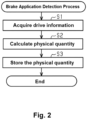
- Fig. 2 illustrates a process for the brake device 10 to detect the brake application state when the brake device 10 is activated.
- the brake device 10 stores the processing.
- the control device 20 first acquires the drive information (step S1). That is, the drive information acquiring unit 22 acquires at least one of the current value of the motor 11 or the rotation speed of the motor 11. Further, the drive information acquiring unit 22 acquires the measurement information of the stress sensors 12A and 13A.
- the control device 20 calculates one or more physical quantities (step S2). Specifically, the drive information acquiring unit 22 calculates the displacements of the transmission member 12 and the brake shoe 14 based on at least one of the product of the duration and the current of the motor 11 or the rotation speed of the motor 11. The drive information acquiring unit 22 calculates the force applied to the transmission member 12 in the brake application state from the measurement information provided by the stress sensor 12A. The drive information acquiring unit 22 also calculates the force applied to the brake shoe 14 in the brake application state from the measurement information provided by the stress sensor 13A.
- the control device 20 stores the one or more physical quantities (step S3) and ends the process. That is, the drive information acquiring unit 22 stores, in the storage unit 23, the displacements and the forces applied in the brake application state. Once the drive information acquiring unit 22 acquires the brake release command, the drive information acquiring unit 22 acquires the change(s) in the one or more physical quantities in the predetermined time period and stores them in the storage unit 23.
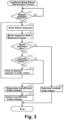
- Fig. 3 shows the process of determining whether the release of the brake is insufficient when the brake release command is acquired from the vehicle control panel 5.
- the control device 20 first determines whether the brake release command is acquired when the railroad vehicle is stopped (step S11). Specifically, the control unit 21 determines whether the command acquiring unit 24 has acquired the brake release command from the vehicle control panel 5. When the control unit 21 determines that the brake release command has not been acquired (step S11: NO), the control unit 21 waits until the brake release command is acquired.
- step S12 the control unit 21 performs a release operation to release the brake (step S12). That is, the control unit 21 drives and controls the motor 11 to move the brake shoe 14 in the direction away from the tread surface 2A of the wheel 2. Step S12 corresponds to the acquisition step.
- step S13 the control device 20 performs the brake application state detection process described above (step S13). That is, the drive information acquiring unit 22 acquires a change(s) in the physical quantity(ies) during the predetermined time period starting from the receipt of the brake release command or the physical quantity(ies) after the elapse of the predetermined time period. Step S13 corresponds to the detection step.
- the control unit 20 determines whether the brake is being applied (step S24). Specifically, the determination unit 25 determines whether the application of the brake is maintained based on the change in the physical quantity during the predetermined time period starting from the receipt of the brake release command. When the obtained change in the physical quantity is same as the change in the physical quantity of the normal state stored in the storage unit 23, the determination unit 25 determines that the application of the brake is not maintained since the brake is released. Alternatively, the determination unit 25 determines whether the application of the brake is maintained by comparing the currently acquired value of the physical quantity with a previously acquired value of the physical quantity.
- the determination unit 25 determines that the application of the brake is not maintained since the brake is released.
- the determination unit 25 determines that the brake is not applied (step S14: NO), and determines that the brake is "released” (step S19), and ends the process.
- Step S14 corresponds to the determination step.
- the determination unit 25 determines that the application of the brake is maintained because the brake has not been released. Alternatively, when the currently acquired value of the physical quantity does not match the previous value of the physical quantity, the determination unit 25 determines that the application of the brake is maintained because the brake has not been released.
- the determination unit 25 determines whether the number of determinations performed is less than a predetermined number (step S15). That is, the control unit 21 retries the release operation until the number of times it is determined that the application of the brake is maintained reaches the predetermined number of times.
- step S15 When it is determined that the number of times it is determined that the application of the brake is maintained is less than the predetermined number of times (step S15: YES), the control unit 21 drives the motor 11 in the direction opposite to that of the brake release operation (step S16). The process then proceeds to step S12. That is, by driving the motor 11 in the direction opposite to that of the brake release operation, the control unit 21 increases the possibility that the transmission member 12 and the brake shoe 14 are released from the state of being jammed due to foreign matters, or the like. The control unit 21 retries the brake release operation in step S12.
- step S15 determines that the number of determinations performed is equal to or greater than the predetermined number (step S15: NO)
- the control unit 21 determines that the release of the brake is insufficient (step S17), and outputs the "insufficient brake release” (step S18). That is, the control unit 21 gives up the retry and processes as the "insufficient brake release” because the application of the brake is maintained even after the motor 11 is driven in the direction opposite to that of the brake release operation and the brake release operation is performed at the predetermined number of times. Subsequently, the control unit 21 informs the "insufficient brake release" by the informing unit 26. In this way, it is possible to determine the insufficient brake release even when the railway vehicle is not traveling.
- the vehicle control panel 5 may prevent the start of the railway vehicle.
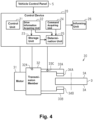
- the second embodiment of the brake device equipped with the brake control device and the insufficient brake release determination device will be described.
- the second embodiment is different from the first embodiment in that the brake device is a disc brake device.
- the following description will be focused on the differences from the first embodiment.
- a brake device 30 is a disc brake for generating a braking force by pressing brake pads 34A and 34B against a disc 3 integrally rotating with the wheel 2 of the railway vehicle.
- the brake device 30 includes a rotating motor 31 and is driven by the motor 31.
- the brake device 30 includes a transmission member 32 for transmitting the driving force of the motor 31 and also includes a left arm 33A and right arm 33B.
- the transmission member 32 uses the driving force from the motor 31 to move the left and right arms 33A and 33B.
- the brake pad 34A is attached to the left arm 33A, and the brake pad 34B is attached to the right arm 33B.
- the left and right arms 33A and 33B are vertically moved by the transmission member 32 toward the side surface 3A of the disc 3.
- the brake pads 34A and 34B are displaced with the left and right arms 33A and 33B, so that the brake pads 34A and 34B are pressed against the side surface 3A of the disc 3. As pressed against the side surface 3A of the disc 3, the brake pads 34A and 34B wear out. As a result, the brake pads 34A and 34B become thinner.
- the motor 31 is equivalent to an electric actuator.
- the disc 3 is a rotatable member and equivalent to a target member, and the brake pads 34A and 34B are equivalent to the frictional member.
- the wheel 2 may be used as the frictional member instead of the disc 3.
- the brake device 30 is controlled by a controller device 20, which is configured in the same manner as in the first embodiment.
- the control device 20 controls the braking force based on a braking command from a vehicle control panel 5.
- the control device 20 includes a control unit 21 for controlling the brake device 30.
- the control unit 21 drives and controls the motor 31 according to a required braking force.
- the control unit 21 controls the motor 31 such that the brake pads 34A and 34B can move a predetermined distance from the position where they contact the side surface 3A of the disc 3. In this way, after the brake pads 34A and 34B are brought into contact with the side surface 3A of the disc 3, the braking starts working after the same period of time.
- a stress sensor 32A is provided in the transmission member 32.
- the stress sensor 32A is, for example, a strain gage that measures a force applied to the transmission member 32 and provides measurement information to the control device 20. Thus, the control device 20 is able to obtain information about the force applied to the transmission member 32 in the brake application state.
- the left arm 33A is provided with a stress sensor 33C.
- the stress sensor 33C is, for example, a strain gage that measures a force applied to the left arm 33A and provides measurement information to the control device 20.
- the control device 20 is able to obtain information about the force applied to the brake pads 33A and 34B in the brake application state. Since the stress is almost zero when the brake is released, a threshold value may be set and the release of the brake may be detected when the acquired force falls below the threshold value. Stress sensors may be provided on the brake pads 33A and 34B to measure the forces applied to the brake pads 33A and 34B when the brake is applied.
- the control device 20 includes the drive information acquiring unit 22, the storage unit 23, and the command acquiring unit 24, and the determination unit 25.
- the drive information acquiring unit 22 obtains drive information of the motor 31.
- the drive information acquiring unit 22 calculates the displacements of the transmission member 32 and the brake pads 34A and 34B based on at least one of the product of the duration and the current of the motor 31 or the rotation speed of the motor 31. Further, the drive information acquiring unit 22 acquires the measurement information of the stress sensors 32A and 33C.
- the drive information acquiring unit 22 calculates the force applied to the transmission member 32 in the brake application state from the measurement information provided by the stress sensor 32A.
- the drive information acquiring unit 22 also calculates the forces applied to the brake pads 34A and 34B in the brake application state from the measurement information provided by the stress sensor 33C.
- the drive information acquiring unit 22 detects whether it is in the brake application state where the brake pads 34A and 34B are pressed against the tread surfaces 3A of the disc 3. In other words, the drive information acquiring unit 22 detects whether the brake is applied through a physical quantity.
- the physical quantity may be at least one selected from the group consisting of: the forces applied to the brake pads 34A and 34B in the brake application state, the force applied to the transmission member 32 in the brake application state, the displacements of the brake pads 34A and 34B, and the displacement of the transmission member 32.
- the displacement of the transmission member 32, the displacements of the brake pads 34A and 34B, the force applied to the transmission member 32, and the forces applied to the brake pads 34A and 34B are stored.
- the command acquiring unit 24 obtains, from the vehicle control panel 5, a brake release command for releasing the press against the tread surfaces 3A of the disc 3 by the brake pads 34A and 34B.
- the drive information acquiring unit 22 corresponds to a detection unit that detects whether the brake is applied.
- the determination unit 25 uses a detection result of the drive information acquiring unit 22 to determine whether the application of the brake is maintained or not.
- the determination unit 25 obtains a change in the physical quantity during a predetermined period of time, which is the length of time of the normal state from when the brake release command is obtained to when the brake is actually released.
- the determination unit 25 determines whether the application of the brake is maintained based on the obtained change in the physical quantity.
- the change in the physical quantity in the predetermined period of time in the normal state is stored in the storage unit 23.
- the determination unit 25 determines that the application of the brake is not maintained since the brake is released.
- the determination unit 25 acquires the physical quantity and determines whether the application of the brake is maintained by comparing a currently acquired value of the physical quantity with a previously acquired value of the physical quantity.
- the values of the physical quantity obtained in the past are stored in the storage unit 23.
- the determination unit 25 determines that the application of the brake is not maintained since the brake is released.
- the determination unit 25 may determine whether the brake application state is maintained based on at least one of the change in the physical quantity during the predetermined time period in the normal state or the previous physical quantity.
- the control unit 21 drives the motor 31 again in the direction of detaching the brake pads 34A and 34B. By retrying in this way, the possibility of the brake release can be increased.
- the control unit 21 once drives the motor 31 in a direction opposite to the direction in which the pressing by the brake pads 34A and 34B are released, and then drives the motor 31 in the direction in which the pressing by the brake pads 34A and 34B are released.
- the control unit 21 drives the motor 31 again in the direction of detaching the brake pads 34A and 34B. By retrying in this way, the possibility of the brake release can be increased.
- the control unit 21 once drives the motor 31 in a direction opposite to the direction in which the pressing by the brake pads 34A and 34B are released, and then drives the motor 31 in the direction in which the pressing by the brake pads 34A and 34B are released.
- driving the brake pads 34A and 34B in the direction opposite to the direction in which the pressing by the brake pads 34A and 34B are released may eliminate the sticking or jam. Therefore, when the transmission member 32 is jammed and the brake pads 34A and 34B do not operate, it is possible to increase the possibility that the jam is released and pressing by the brake pads 34A and 34B are released.
- the brake device 30 includes the informing unit 26.
- the informing unit 26 informs the insufficient brake release when the release of the brake becomes insufficient at the time when the brake is supposed to be completely released.
- the informing unit 26 may be a speaker that emits sound, an alert lamp that lights, a display, and the like. It is preferable that the informing unit 26 is provided on the vehicle control panel 5 to allow the driver to easily notice the informing unit. Alternatively, it is preferable that the informing unit 26 is installed near the brake device 30 to allow an operator to notice it at the time of start-up inspection, work inspection, or the like.
- Fig. 2 illustrates a process for the brake device 30 to detect the brake application state when the brake device 30 is activated.
- the brake device 30 stores the processing.
- the control device 20 first acquires the drive information (step S1). That is, the drive information acquiring unit 22 acquires at least one of the current value of the motor 31 or the number of rotations of the motor 31. Further, the drive information acquiring unit 22 acquires the measurement information of the stress sensors 32A and 33C.
- the control device 20 calculates one or more physical quantities (step S2). Specifically, the drive information acquiring unit 22 calculates the displacements of the transmission member 32 and the brake pads 34A and 34B based on at least one of the product of the duration and the current of the motor 31 or the rotation speed of the motor 31. The drive information acquiring unit 22 calculates the force applied to the transmission member 32 in the brake application state from the measurement information provided by the stress sensor 32A. The drive information acquiring unit 22 also calculates the forces applied to the brake pads 34A and 34B in the brake application state from the measurement information provided by the stress sensor 33C.
- the control device 20 stores the one or more physical quantities (step S3) and ends the process. That is, the drive information acquiring unit 22 stores, in the storage unit 23, the displacements and the forces applied in the brake application state. Once the drive information acquiring unit 22 acquires the brake release command, the drive information acquiring unit 22 acquires the change(s) in the one or more physical quantities in the predetermined time period and stores them in the storage unit 23.
- Fig. 3 shows the process of determining whether the release of the brake is insufficient when the brake release command is acquired from the vehicle control panel 5.
- the control device 20 first determines whether the brake release command is acquired when the railroad vehicle is stopped (step S11). Specifically, the control unit 21 determines whether the command acquiring unit 24 has acquired the brake release command from the vehicle control panel 5. When the control unit 21 determines that the brake release command has not been acquired (step S11: NO), the control unit 21 waits until the brake release command is acquired.
- step S12 the control unit 21 performs a brake release operation to release the brake. More specifically, the control unit 21 controls the driving of the motor 31 to move the brake pads 34A and 34B away from the side surfaces 3A of the disc 3. Step S12 corresponds to the acquisition step.
- step S13 the control device 20 performs the brake application state detection process described above (step S13). That is, the drive information acquiring unit 22 acquires a change(s) in the physical quantity(ies) during the predetermined time period starting from the receipt of the brake release command or the physical quantity(ies) after the elapse of the predetermined time period. Step S13 corresponds to the detection step.
- the control unit 20 determines whether the brake is being applied (step S24). Specifically, the determination unit 25 determines whether the application of the brake is maintained based on the change in the physical quantity during the predetermined time period starting from the receipt of the brake release command. When the obtained change in the physical quantity is same as the change in the physical quantity of the normal state stored in the storage unit 23, the determination unit 25 determines that the application of the brake is not maintained since the brake is released. Alternatively, the determination unit 25 determines whether the application of the brake is maintained by comparing the currently acquired value of the physical quantity with a previously acquired value of the physical quantity.
- Step S14 corresponds to the determination step.
- the determination unit 25 determines that the application of the brake is maintained because the brake has not been released. Alternatively, when the acquired value of the physical quantity does not match the previous value of the physical quantity, the determination unit 25 determines that the application of the brake is maintained because the brake has not been released.
- the determination unit 25 determines whether the number of determinations performed is less than a predetermined number (step S15). That is, the control unit 21 retries the release operation until the number of times it is determined that the application of the brake is maintained reaches the predetermined number of times.
- step S15 When it is determined that the number of times it is determined that the application of the brake is maintained is less than the predetermined number of times (step S15: YES), the control unit 21 drives the motor 31 in the direction opposite to that of the brake release operation (step S16). The process then proceeds to step S12. That is, by driving the motor 31 in the direction opposite to that of the brake release operation, the control unit 21 increases the possibility that the transmission member 32 and the brake pads 34A and 34B are released from the state of being jammed due to foreign matters, or the like. The control unit 21 retries the brake release operation in step S12.
- step S15 determines that the number of determinations performed is equal to or greater than the predetermined number (step S15: NO)
- the control unit 21 determines that the release of the brake is insufficient (step S17), and outputs the "insufficient brake release” (step S18). That is, the control unit 21 gives up the retry and processes as the "insufficient brake release” because the application of the brake is maintained even after the motor 31 is driven in the direction opposite to that of the brake release operation and the brake release operation is performed at the predetermined number of times. Subsequently, the control unit 21 informs the "insufficient brake release" by the informing unit 26. In this way, it is possible to determine the insufficient brake release even when the railway vehicle is not traveling.
- the vehicle control panel 5 may prevent the start of the railway vehicle.
- the third embodiment of the brake device equipped with the brake control device and the insufficient brake release determination device will be described.
- the third embodiment is different from the first embodiment in that the drive source is compressed air. The following description will be focused on the differences from the first embodiment.
- the brake device 40 compressed air is supplied from a pressure source 51 to an air cylinder 41 via a relay valve 52 and an anti-skid valve 53.
- the anti-skid valve 53 is a valve for exhausting the compressed air supplied to the air cylinder 41 when the wheels skid relative to the track.
- the brake device 40 may be a tread brake device or a disc brake device.
- the air cylinder 41 drives the frictional member 43 in the brake application direction via the transmission member 42.
- the air cylinder 41 drives the frictional member 43 via the transmission member 42 in a direction of the brake release which is opposite to the brake application direction.
- a stress sensor (not shown) is provided on the transmission member 42 and the frictional member 43, and the forces applied to the transmission member 42 and the frictional member 43 are outputted to the control device 20.
- the determination unit 25 performs the insufficient brake release determination process as in the first embodiment and the second embodiment.
- the control unit 21 causes the anti-skid valve 53 to exhaust the air.
- the frictional member 43 is driven in the brake release direction via the air cylinder 41 and the transmission member 42.
- the fourth embodiment of the brake device equipped with the brake control device will now be described.
- the fourth embodiment is different from the first to third embodiment in that a failure prediction process is performed.
- the following description will be focused on the differences from the first embodiment.
- the brake device 10 will be hereunder described as the fourth embodiment, the brake devices 30 and 40 may be used instead.
- the determination unit 25 of the brake device 10 predicts a failure from a difference between physical quantities acquired by the drive information acquiring unit 22.
- the physical quantities are a force applied to the brake shoe 14 in the brake application state measured by the stress sensor 13A of the brake shoe retainer 13, and a force applied to the transmission member 12 in the brake application state measured by the stress sensor 12A of the transmission member 12.
- the drive information acquiring unit 22 that acquires detection result from the stress sensors 12A and 13A corresponds to the detection unit. Two or more stress sensors may be provided in the transmission member 12, or two or more stress sensors may be provided in at least one of the brake shoe retainer 13 or the brake shoe 14.
- the determination unit 25 compares two or more physical quantities. When there is a difference between the physical quantities, it is determined that a failure is predicted. Further, the determination unit 25 predicts a failure due to a malfunction based on the elapsed time from when the command acquiring unit 24 acquires the brake release command to when the brake is actually released. When the brake works normally, the elapsed time will be the same every time. Whereas if there is a malfunction, the elapsed time will be longer. The elapsed time becomes longer if parts movement becomes dull due to deterioration over time. Therefore, the determination unit 25 determines that a failure is predicted due to a malfunction when the elapsed time is different from the previous elapsed time. "A failure is predicted” means a state in which there is no failure but the possibility of failure is increasing. The determination unit 25 may determine that a failure is predicted based on at least one of two or more physical quantities or the elapsed time.
- Fig. 6 illustrates a process for the brake device 10 to detect the brake application state when the brake device 10 is activated.
- the brake device 10 stores the processing.
- the control device 20 first acquires measurement information (step S21).
- the drive information acquiring unit 22 acquires the measurement information from the stress sensors 12A and 13A. Subsequently, the control device 20 calculates one or more physical quantities (step S22). Specifically, the drive information acquiring unit 22 calculates the force applied to the transmission member 12 in the brake application state from the measurement information provided by the stress sensor 12A. The drive information acquiring unit 22 also calculates the force applied to the brake shoe 14 in the brake application state from the measurement information provided by the stress sensor 13A.
- the control device 20 store the one or more physical quantities (step S23). That is, the drive information acquiring unit 22 stores, in the storage unit 23, the displacements and the forces applied in the brake application state. Once the drive information acquiring unit 22 acquires the brake release command, the drive information acquiring unit 22 acquires the change(s) in the one or more physical quantities in the predetermined time period and stores them in the storage unit 23.
- the control device 20 determines whether a failure is predicted, which means whether a possibility of failure is increased (step S24).
- the determination unit 25 determines whether a failure is predicted based on the two or more physical quantities. Further, the determination unit 25 predicts a failure due to a malfunction based on the elapsed time from when the command acquiring unit 24 acquires the brake release command to when the brake is actually released. Then, when the determination unit 25 determines that a failure is not predicted (step S24: NO), the determination unit 25 outputs "no failure predicted". That is, when the two or more physical quantities are the same and the elapsed time remains the same, the determination unit 25 determines that a failure is not predicted.
- step S24 the determination unit 25 outputs "a failure is predicted". That is, when the two or more physical quantities are different or the elapsed time changes, the determination unit 25 determines that a failure is predicted. Therefore, it is possible to predict a failure before insufficient brake release occurs.
- the control unit 21 informs that "failure is predicted" through the informing unit 26.
- the fourth embodiment produces the following advantageous effects in addition to the effects (1-1) to (1-6) achieved by the first embodiment, the effects (2-5) and (2-6) achieved by the second embodiment, and the effect (3-1) achieved by the third embodiment.
Landscapes
- Engineering & Computer Science (AREA)
- Mechanical Engineering (AREA)
- Transportation (AREA)
- Braking Arrangements (AREA)
- Regulating Braking Force (AREA)
- Valves And Accessory Devices For Braking Systems (AREA)
Description
- The present invention relates to a brake control device, a brake control method, a brake control program, and an insufficient brake release determination device.
-
EP 2 151 363 A1 shows a railway vehicle equipped with an electric brake and a machine brake, wherein a transition between the electric brake and the machine brake is controlled. - Railway vehicles are equipped with a brake device that applies the brakes on the wheels. When the railway vehicle is traveling, the brake device is in a release state in which the brakes on the wheels are released. Patent Literature 1 describes a detection device for detecting insufficient release of the brakes of the brake device. This detection device detects the insufficient brake release of the brake device through temperature of the wheel while the railway vehicle is traveling.
- Patent Literature 1:
Japanese Patent Application Publication No. 2014-040171 - To detect the insufficient brake release by the brake device, the detection device of Patent Literature 1 requires the railway vehicle to be traveling while the brake device is in the insufficient release state. Therefore, it is desired to be able to determine the insufficient brake release by the brake device even when the railway vehicle is not traveling.
- This object is achieved by a brake control device according to the features of claim 1, a brake control method according to
claim 11, and a brake control program according toclaim 12. According to one aspect disclosed herein, provided is a brake control device for applying a brake to a railway vehicle provided with a target member by pressing a frictional member against the target member. The brake control device includes: a detection unit detecting whether it is in a brake application state in which the frictional member is pressed against the target member; an acquiring unit acquiring a brake release command for releasing the pressing of the target member by the frictional member; and a determination unit determining whether the brake application state is maintained by using a detection result provided by the detection unit after the acquiring unit has acquired the brake release command. - In the above configuration, whether the brake is kept being applied is determined after the brake release command has been acquired. Therefore, unlike the prior arts in which the insufficient brake release cannot be determined unless the temperature of the wheels rise while the railway vehicle travels, it is possible to determine the insufficient brake release even when the railway vehicle is not running.
- In the above brake control device, the detection unit may determine whether the brake application state is maintained based on a physical quantity. The physical quantity is at least one selected from the group consisting of: a force applied to the frictional member in the brake application state, a force applied to a transmission member in the brake application state, a displacement of the frictional member, and a displacement of the transmission member.
- In the above brake control device, the determination unit may determine whether the brake application state is maintained based on a change in the physical quantity during a predetermined time period, the predetermined time period being the length of time from when the brake release command is acquired to when the brake is actually released in a normal state.
- In the above brake control device, the determination unit may determine whether the brake application state is maintained by comparing the physical quantity with a previous physical quantity. The above brake control device further includes a control unit controlling driving of an electric actuator. The frictional member is driven by the electric actuator via the transmission member. When the determination unit determines that the brake application state is maintained, the control unit drives the electric actuator again in a direction in which the pressing by the frictional member is released.
- In the above brake control device, when the determination unit determines that the brake application state is maintained, the control unit may once drive the electric actuator in a direction opposite to the direction in which the pressing by the frictional member is released, and then drive the electric actuator in the direction in which the pressing by the frictional member is released.
- The above brake control device may include a control unit controlling an anti-skid valve. The frictional member is driven by a pressure supplied from a pressure source via a relay valve and the anti-skid valve. The control unit may drive the frictional member in a direction in which the pressing by the frictional member is released by exhausting through the anti-skid valve when the determination unit determines that the brake application state is maintained.
- In the above brake control device, a plurality of the detection units may be provided on at least one of the frictional member or the transmission member, and each of the plurality of detection units detects a force applied to the at least one of the frictional material or the transmission member in the brake application state. The determination unit may predict a failure from a difference between physical quantities detected by the plurality of detection units.
- In the above brake control device, the determination unit may predict a failure due to a malfunction based on an elapsed time from when the command acquiring unit acquires the brake release command to when the brake is actually released.
- According to one aspect disclosed herein, provided is a brake control method for applying a brake to a railway vehicle provided with a target member by pressing a frictional member against the target member. The method includes: a detection step of detecting whether it is in a brake application state in which the frictional member is pressed against the target member; an acquiring step of acquiring a brake release command for releasing the pressing of the target member by the frictional member; and a determination step of determining whether the brake application state is maintained by using a detection result provided by the detection unit after the acquiring unit has acquired the brake release command.
- In the above configuration, whether the brake is kept being applied is determined after the brake release command has been acquired. Therefore, unlike the prior arts in which the insufficient brake release cannot be determined unless the temperature of the wheels rise while the railway vehicle travels, it is possible to determine the insufficient brake release even when the railway vehicle is not running.
- A brake control program for applying a brake to a railway vehicle provided with a target member by pressing a frictional member against the target member, the program causing a computer to perform: a detection step of detecting whether it is in a brake application state in which the frictional member is pressed against the target member; an acquiring step of acquiring a brake release command for releasing the pressing of the target member by the frictional member; and a determination step of determining whether the brake application state is maintained by using a detection result provided by the detection unit after the acquiring unit has acquired the brake release command.
- According to the above program, whether the brake is kept being applied is determined after the brake release command has been acquired. Therefore, unlike the prior arts in which the insufficient brake release cannot be determined unless the temperature of the wheels rise while the railway vehicle travels, it is possible to determine the insufficient brake release even when the railway vehicle is not running.
- An insufficient brake release determination device for determining insufficient brake release of a brake device that applies a brake to a railway vehicle provided with a target member by pressing a frictional member against the target member. The insufficient brake release determination device includes: a detection unit detecting whether it is in a brake application state in which the frictional member is pressed against the target member; a detection unit detecting whether it is in a brake application state in which the frictional member is pressed against the target member; a determination unit determining whether the brake application state is maintained by using a detection result provided by the detection unit after the acquiring unit has acquired the brake release command.
- In the above configuration, whether the brake is kept being applied is determined after the brake release command has been acquired. Therefore, unlike the prior arts in which the insufficient brake release cannot be determined unless the temperature of the wheels rise while the railway vehicle travels, it is possible to determine the insufficient brake release even when the railway vehicle is not running.
- According to the aspects of the inventions, it is possible to determine the insufficient brake release even when the railway vehicle is not running.
-
-
Fig. 1 is a schematic view showing the configuration of a brake device relating to a first embodiment. -
Fig. 2 is a flowchart showing a brake application state detection process of the brake control device relating to the first embodiment. -
Fig. 3 is a flowchart showing an insufficient brake release determination process of the brake control device relating to the first embodiment. -
Fig. 4 is a schematic view showing the configuration of a brake device relating to a second embodiment. -
Fig. 5 is a schematic view showing the configuration of a brake device relating to a third embodiment. -
Fig. 6 is a flowchart showing a failure prediction process of a brake control device relating to a fourth embodiment. - With reference to
Figs. 1 to 3 , a first embodiment of a brake device equipped with a brake control device and an insufficient brake release determination device will be described. The brake device is provided in railway vehicles. - As shown in
Fig. 1 , thebrake device 10 is a tread brake for pressing abrake shoe 14 against the tread surface 2a of awheel 2 of a railway vehicle, so that a braking force is generated. Thebrake device 10 includes a rotatingmotor 11 and is driven by themotor 11. Thebrake device 10 includes atransmission member 12 and abrake shoe retainer 13. Thetransmission member 12 is configured to transmit the driving force of themotor 11 to thebrake shoe 14. Thetransmission member 12 uses the driving force from themotor 11 to move thebrake shoe retainer 13 in the radial direction of thewheel 2. Thebrake shoe 14 is attached onto thebrake shoe retainer 13. Thebrake shoe 14 is moved as thebrake shoe retainer 13 is moves, so that thebrake shoe 14 is pressed against thetread surface 2A of thewheel 2. As pressed against thetread surface 2A of thewheel 2, thebrake shoe 14 wars out. As a result, thebrake shoe 14 becomes thinner. Here, themotor 11 is equivalent to an electric actuator. Thewheel 2 is equivalent to a target member, and thebrake shoe 14 is equivalent to the frictional member. - The
brake device 10 is controlled by acontrol device 20. Thecontrol device 20 may be formed of one or more processors that perform various processes in accordance with computer programs (software). The processes to be executed by thecontrol device 20 or processors include a brake control method. The brake control method includes a brake application state detection process and an inflexibility determination process, which will be described later. Thecontrol device 20 may be formed of one or more dedicated hardware circuits such as application-specific integrated circuits (ASICs) that perform at least a part of the various processes, or it may be formed of circuitry including a combination of such circuits. The processors include a CPU and a memory such as a RAM or ROM. The memory stores program codes or instructions configured to cause the CPU to perform processes. The memory, or a computer-readable medium, encompasses any kind of available media accessible via a general-purpose or dedicated computer. The programs stored in the computer-readable storage medium include a brake control program. The brake control program causes the computer to execute a detection step, an acquisition step, and a determination step. Thecontrol device 20 corresponds to the brake control device and the insufficient brake release determination device. - The
control device 20 controls the braking force based on a brake command from avehicle control panel 5. Thecontrol device 20 includes acontrol unit 21 for controlling thebrake device 10. Thecontrol unit 21 drives and controls themotor 11 according to a required braking force. Thecontrol unit 21 performs a control such that thebrake shoe 14 moves from a position where it contacts thetread surface 2A of thewheel 2 to a position where it is at a predetermined distance from thetread surface 2A. With this control, the time until braking is initiated by bringing thebrake shoe 14 into contact with thetread 2A of thewheel 2 can be made constant. Astress sensor 12A is provided in thetransmission member 12. Thestress sensor 12A is, for example, a strain gage that measures a force applied to thetransmission member 12 and provides measurement information to thecontrol device 20. Thus, thecontrol device 20 is able to obtain information about the force applied to thetransmission member 12 in the brake application state. Similarly, astress sensor 13A is provided in thebrake shoe retainer 13. Thestress sensor 13A is, for example, a strain gage that measures a force applied to thebrake shoe retainer 13 and provides measurement information to thecontrol device 20. Thus, thecontrol device 20 is able to obtain information about the force applied to thebrake shoe 14 in the brake application state. Since the stress is almost zero when the brake is released, a threshold value may be set and the release of the brake may be detected when the acquired force falls below the threshold value. A stress sensor may be provided on thebrake shoe 14 to measure the force applied to thebrake shoe 14 when the brake is applied. - The
control device 20 includes a driveinformation acquiring unit 22, astorage unit 23, and acommand acquiring unit 2 as an acquiring unit, 4 and adetermination unit 25. The driveinformation acquiring unit 22 obtains drive information of themotor 11. The driveinformation acquiring unit 22 calculates displacements of thetransmission member 12 and thebrake shoe 14 based on at least one of the product of the duration and the current of the motor 11 (i.e., the product of the value of the current flowing through themotor 11 and the period of time during which the current flows through the motor 11) or the rotation speed of themotor 11. The drivinginformation acquiring unit 22 is configured to acquire measurement information provided by thestress sensors information acquiring unit 22 calculates the force applied to thetransmission member 12 in the brake application state from the measurement information provided by thestress sensor 12A. The driveinformation acquiring unit 22 also calculates the force applied to thebrake shoe 14 in the brake application state from the measurement information provided by thestress sensor 13A. - The drive
information acquiring unit 22 detects whether it is in the brake application state in which thebrake shoe 14 is pressed against thetread surface 2A of thewheel 2. In other words, the driveinformation acquiring unit 22 detects whether the brake is applied through a physical quantity(ies). The physical quantity may be at least one selected from the group consisting of: the force applied to thebrake shoe 14 in the brake application state, the force applied to thetransmission member 12 in the brake application state, the displacement of thebrake shoe 14, and the displacement of thetransmission member 12. In thestorage unit 23, the displacement of thetransmission member 12, the displacement of thebrake shoe 14, the force applied to thetransmission member 12, and the force applied to thebrake shoe 14 are stored. Thecommand acquiring unit 24 obtains, from thevehicle control panel 5, a release command for releasing the press against thetread surface 2A of thewheel 2 by thebrake shoe 14. The driveinformation acquiring unit 22 corresponds to a detection unit that detects whether it is in the brake application state. - After the
command acquiring unit 24 has acquired the brake release command, thedetermination unit 25 uses a detection result of the driveinformation acquiring unit 22 to determine whether the application of the brake is maintained or not. Thedetermination unit 25 obtains a change in the physical quantity during a predetermined period of time, which is the length of time of the normal state from when the brake release command is obtained to when the brake is actually released. Thedetermination unit 25 determines whether the application of the brake is maintained based on the obtained change in the physical quantity. The change(s) in the physical quantity(ies) during the predetermined time period in the normal state is stored in thestorage unit 23. When the obtained change in the physical quantity during the predetermined time period is same as the change in the physical quantity during the predetermined time period in the normal state stored in thestorage unit 23, thedetermination unit 25 determines that the application of the brake is not maintained since the brake is released. Alternatively, thedetermination unit 25 acquires the physical quantity and determines whether the application of the brake is maintained by comparing a currently acquired value of the physical quantity with a previously acquired value of the physical quantity. The values of the physical quantity obtained in the past are stored in thestorage unit 23. When the acquired physical quantity matches a previous physical quantity obtained at the time of the brake release and stored in the storage unit, thedetermination unit 25 determines that the application of the brake is not maintained since the brake is released. Thedetermination unit 25 may determine whether the application of the brake is maintained based on at least one of the change in the physical quantity during the predetermined time period in the normal state or the previous physical quantity. - When the
determination unit 25 determines that the brake application is maintained, thecontrol unit 21 drives themotor 11 again in the direction in which the pressing by thebrake shoe 14 is released. By retrying in this way, the possibility of the brake release can be increased. Alternatively, when thedetermination unit 25 determines that the brake application is maintained, thecontrol unit 21 once drives themotor 11 in a direction opposite to the direction in which the pressing by thebrake shoe 14 is released, and then drives themotor 11 in the direction in which the pressing by thebrake shoe 14 is released. When there is sticking or jam in thetransmission member 12, driving thebrake shoe 14 in the direction opposite to the direction in which the brake shoe is detached may eliminate the sticking or jam. Therefore, when thetransmission member 12 is jammed and thebrake shoe 14 does not operate, it is possible to increase the possibility that the jam is released and pressing by thebrake shoe 14 is released. - The
brake device 10 includes the informingunit 26. The informingunit 26 informs the insufficient brake release when the release of the brake becomes insufficient at the time when the brake is supposed to be completely released. The informingunit 26 may be a speaker that emits sound, an alert lamp that lights, a display, and the like. It is preferable that the informingunit 26 is provided on thevehicle control panel 5 to allow the driver to easily notice the informing unit. Alternatively, it is preferable that the informingunit 26 is installed near thebrake device 10 to allow an operator to notice it at the time of start-up inspection, work inspection, or the like. - The following now describes the steps of the brake application state detection process performed by the
control device 20, with reference toFig. 2. Fig. 2 illustrates a process for thebrake device 10 to detect the brake application state when thebrake device 10 is activated. Thebrake device 10 stores the processing. - The
control device 20 first acquires the drive information (step S1). That is, the driveinformation acquiring unit 22 acquires at least one of the current value of themotor 11 or the rotation speed of themotor 11. Further, the driveinformation acquiring unit 22 acquires the measurement information of thestress sensors - Subsequently, the
control device 20 calculates one or more physical quantities (step S2). Specifically, the driveinformation acquiring unit 22 calculates the displacements of thetransmission member 12 and thebrake shoe 14 based on at least one of the product of the duration and the current of themotor 11 or the rotation speed of themotor 11. The driveinformation acquiring unit 22 calculates the force applied to thetransmission member 12 in the brake application state from the measurement information provided by thestress sensor 12A. The driveinformation acquiring unit 22 also calculates the force applied to thebrake shoe 14 in the brake application state from the measurement information provided by thestress sensor 13A. - Subsequently, the
control device 20 stores the one or more physical quantities (step S3) and ends the process. That is, the driveinformation acquiring unit 22 stores, in thestorage unit 23, the displacements and the forces applied in the brake application state. Once the driveinformation acquiring unit 22 acquires the brake release command, the driveinformation acquiring unit 22 acquires the change(s) in the one or more physical quantities in the predetermined time period and stores them in thestorage unit 23. - The following now describes the steps of the insufficient brake release determination process performed by the
control device 20, with reference toFig. 3. Fig. 3 shows the process of determining whether the release of the brake is insufficient when the brake release command is acquired from thevehicle control panel 5. - The
control device 20 first determines whether the brake release command is acquired when the railroad vehicle is stopped (step S11). Specifically, thecontrol unit 21 determines whether thecommand acquiring unit 24 has acquired the brake release command from thevehicle control panel 5. When thecontrol unit 21 determines that the brake release command has not been acquired (step S11: NO), thecontrol unit 21 waits until the brake release command is acquired. - Whereas when it is determined that the brake release command has been acquired (step S11: YES), the
control unit 21 performs a release operation to release the brake (step S12). That is, thecontrol unit 21 drives and controls themotor 11 to move thebrake shoe 14 in the direction away from thetread surface 2A of thewheel 2. Step S12 corresponds to the acquisition step. - Subsequently, the
control device 20 performs the brake application state detection process described above (step S13). That is, the driveinformation acquiring unit 22 acquires a change(s) in the physical quantity(ies) during the predetermined time period starting from the receipt of the brake release command or the physical quantity(ies) after the elapse of the predetermined time period. Step S13 corresponds to the detection step. - Subsequently, the
control unit 20 determines whether the brake is being applied (step S24). Specifically, thedetermination unit 25 determines whether the application of the brake is maintained based on the change in the physical quantity during the predetermined time period starting from the receipt of the brake release command. When the obtained change in the physical quantity is same as the change in the physical quantity of the normal state stored in thestorage unit 23, thedetermination unit 25 determines that the application of the brake is not maintained since the brake is released. Alternatively, thedetermination unit 25 determines whether the application of the brake is maintained by comparing the currently acquired value of the physical quantity with a previously acquired value of the physical quantity. When the acquired physical quantity matches the previous physical quantity that has been obtained at the time of the brake release and stored in the storage unit, thedetermination unit 25 determines that the application of the brake is not maintained since the brake is released. Thedetermination unit 25 determines that the brake is not applied (step S14: NO), and determines that the brake is "released" (step S19), and ends the process. Step S14 corresponds to the determination step. - Whereas when the acquired change in the physical quantity does not match the change in the physical quantity of the normal state, the
determination unit 25 determines that the application of the brake is maintained because the brake has not been released. Alternatively, when the currently acquired value of the physical quantity does not match the previous value of the physical quantity, thedetermination unit 25 determines that the application of the brake is maintained because the brake has not been released. When thedetermination unit 25 determines that the brake is applied (step S14: YES), thedetermination unit 25 determines whether the number of determinations performed is less than a predetermined number (step S15). That is, thecontrol unit 21 retries the release operation until the number of times it is determined that the application of the brake is maintained reaches the predetermined number of times. When it is determined that the number of times it is determined that the application of the brake is maintained is less than the predetermined number of times (step S15: YES), thecontrol unit 21 drives themotor 11 in the direction opposite to that of the brake release operation (step S16). The process then proceeds to step S12. That is, by driving themotor 11 in the direction opposite to that of the brake release operation, thecontrol unit 21 increases the possibility that thetransmission member 12 and thebrake shoe 14 are released from the state of being jammed due to foreign matters, or the like. Thecontrol unit 21 retries the brake release operation in step S12. - Whereas when the
control unit 21 determines that the number of determinations performed is equal to or greater than the predetermined number (step S15: NO), thecontrol unit 21 determines that the release of the brake is insufficient (step S17), and outputs the "insufficient brake release" (step S18). That is, thecontrol unit 21 gives up the retry and processes as the "insufficient brake release" because the application of the brake is maintained even after themotor 11 is driven in the direction opposite to that of the brake release operation and the brake release operation is performed at the predetermined number of times. Subsequently, thecontrol unit 21 informs the "insufficient brake release" by the informingunit 26. In this way, it is possible to determine the insufficient brake release even when the railway vehicle is not traveling. In addition, thevehicle control panel 5 may prevent the start of the railway vehicle. - Advantageous effects of the first embodiment will be now described.
- (1-1) After the
command acquiring unit 24 has acquired the brake release command, it is determined whether the application of the brake is maintained based on the detection result of the driveinformation acquiring unit 22. Therefore, unlike the prior arts in which the insufficient brake release cannot be determined unless the temperature of the wheels rise while the railway vehicle travels, the invention makes it possible to determine the insufficient brake release even when the railway vehicle is not running. - (1-2) The physical quantity(ies) changes once the brake release command is acquired. By detecting whether the vehicle is in the brake applied state based on the physical quantity, the detection accuracy can be improved.
- (1-3) It takes a predetermined time from the reception of the brake release command to the actual brake release in the normal state. By determining whether the application of the brake is maintained based on a change in the physical quantity during the predetermined time, the determination accuracy can be further improved.
- (1-4) The determination accuracy can be improved by performing the determination whether the brake application is maintained by comparing the acquired physical quantity with a previous physical quantity.
- (1-5) By driving the
motor 11 again when it is determined that the application of the brake by thebrake device 10 is maintained, the possibility of the brake release can be increased. - (1-6) When there is sticking or jam in the
transmission member 12, driving thebrake shoe 14 in the direction opposite to the direction in which the brake shoe is detached may eliminate the sticking or jam. This can increase the possibility of the brake release. - With reference to
Fig. 4 , the second embodiment of the brake device equipped with the brake control device and the insufficient brake release determination device will be described. The second embodiment is different from the first embodiment in that the brake device is a disc brake device. The following description will be focused on the differences from the first embodiment. - As shown in
Fig. 4 , abrake device 30 is a disc brake for generating a braking force by pressingbrake pads disc 3 integrally rotating with thewheel 2 of the railway vehicle. Thebrake device 30 includes arotating motor 31 and is driven by themotor 31. Thebrake device 30 includes atransmission member 32 for transmitting the driving force of themotor 31 and also includes aleft arm 33A andright arm 33B. Thetransmission member 32 uses the driving force from themotor 31 to move the left andright arms brake pad 34A is attached to theleft arm 33A, and thebrake pad 34B is attached to theright arm 33B. The left andright arms transmission member 32 toward theside surface 3A of thedisc 3. Thebrake pads right arms brake pads side surface 3A of thedisc 3. As pressed against theside surface 3A of thedisc 3, thebrake pads brake pads motor 31 is equivalent to an electric actuator. Thedisc 3 is a rotatable member and equivalent to a target member, and thebrake pads wheel 2 may be used as the frictional member instead of thedisc 3. - The
brake device 30 is controlled by acontroller device 20, which is configured in the same manner as in the first embodiment. Thecontrol device 20 controls the braking force based on a braking command from avehicle control panel 5. Thecontrol device 20 includes acontrol unit 21 for controlling thebrake device 30. Thecontrol unit 21 drives and controls themotor 31 according to a required braking force. When releasing the brake, thecontrol unit 21 controls themotor 31 such that thebrake pads side surface 3A of thedisc 3. In this way, after thebrake pads side surface 3A of thedisc 3, the braking starts working after the same period of time. Astress sensor 32A is provided in thetransmission member 32. Thestress sensor 32A is, for example, a strain gage that measures a force applied to thetransmission member 32 and provides measurement information to thecontrol device 20. Thus, thecontrol device 20 is able to obtain information about the force applied to thetransmission member 32 in the brake application state. Similarly, theleft arm 33A is provided with astress sensor 33C. Thestress sensor 33C is, for example, a strain gage that measures a force applied to theleft arm 33A and provides measurement information to thecontrol device 20. Thus, thecontrol device 20 is able to obtain information about the force applied to thebrake pads brake pads brake pads - The
control device 20 includes the driveinformation acquiring unit 22, thestorage unit 23, and thecommand acquiring unit 24, and thedetermination unit 25. The driveinformation acquiring unit 22 obtains drive information of themotor 31. The driveinformation acquiring unit 22 calculates the displacements of thetransmission member 32 and thebrake pads motor 31 or the rotation speed of themotor 31. Further, the driveinformation acquiring unit 22 acquires the measurement information of thestress sensors information acquiring unit 22 calculates the force applied to thetransmission member 32 in the brake application state from the measurement information provided by thestress sensor 32A. The driveinformation acquiring unit 22 also calculates the forces applied to thebrake pads stress sensor 33C. - The drive
information acquiring unit 22 detects whether it is in the brake application state where thebrake pads disc 3. In other words, the driveinformation acquiring unit 22 detects whether the brake is applied through a physical quantity. The physical quantity may be at least one selected from the group consisting of: the forces applied to thebrake pads transmission member 32 in the brake application state, the displacements of thebrake pads transmission member 32. In thestorage unit 23, the displacement of thetransmission member 32, the displacements of thebrake pads transmission member 32, and the forces applied to thebrake pads command acquiring unit 24 obtains, from thevehicle control panel 5, a brake release command for releasing the press against the tread surfaces 3A of thedisc 3 by thebrake pads information acquiring unit 22 corresponds to a detection unit that detects whether the brake is applied. - After the
command acquiring unit 24 obtains the brake release command, thedetermination unit 25 uses a detection result of the driveinformation acquiring unit 22 to determine whether the application of the brake is maintained or not. Thedetermination unit 25 obtains a change in the physical quantity during a predetermined period of time, which is the length of time of the normal state from when the brake release command is obtained to when the brake is actually released. Thedetermination unit 25 determines whether the application of the brake is maintained based on the obtained change in the physical quantity. The change in the physical quantity in the predetermined period of time in the normal state is stored in thestorage unit 23. When the obtained change in the physical quantity in the predetermined period of time is same as the change in the physical quantity at the predetermined period of time in the normal state stored in thememory section 23, thedetermination unit 25 determines that the application of the brake is not maintained since the brake is released. Alternatively, thedetermination unit 25 acquires the physical quantity and determines whether the application of the brake is maintained by comparing a currently acquired value of the physical quantity with a previously acquired value of the physical quantity. The values of the physical quantity obtained in the past are stored in thestorage unit 23. When the acquired physical quantity matches a previous physical quantity obtained at the time of the brake release and stored in the storage unit, thedetermination unit 25 determines that the application of the brake is not maintained since the brake is released. Thedetermination unit 25 may determine whether the brake application state is maintained based on at least one of the change in the physical quantity during the predetermined time period in the normal state or the previous physical quantity. When thedetermination unit 25 determines that the brake application is maintained, thecontrol unit 21 drives themotor 31 again in the direction of detaching thebrake pads determination unit 25 determines that the brake application is maintained, thecontrol unit 21 once drives themotor 31 in a direction opposite to the direction in which the pressing by thebrake pads motor 31 in the direction in which the pressing by thebrake pads transmission member 32, driving thebrake pads brake pads transmission member 32 is jammed and thebrake pads brake pads - When the
determination unit 25 determines that the brake application is maintained, thecontrol unit 21 drives themotor 31 again in the direction of detaching thebrake pads determination unit 25 determines that the brake application is maintained, thecontrol unit 21 once drives themotor 31 in a direction opposite to the direction in which the pressing by thebrake pads motor 31 in the direction in which the pressing by thebrake pads transmission member 32, driving thebrake pads brake pads transmission member 32 is jammed and thebrake pads brake pads - The
brake device 30 includes the informingunit 26. The informingunit 26 informs the insufficient brake release when the release of the brake becomes insufficient at the time when the brake is supposed to be completely released. The informingunit 26 may be a speaker that emits sound, an alert lamp that lights, a display, and the like. It is preferable that the informingunit 26 is provided on thevehicle control panel 5 to allow the driver to easily notice the informing unit. Alternatively, it is preferable that the informingunit 26 is installed near thebrake device 30 to allow an operator to notice it at the time of start-up inspection, work inspection, or the like. - The following now describes the steps of the brake application state detection process performed by the
control device 20, with reference toFig. 2. Fig. 2 illustrates a process for thebrake device 30 to detect the brake application state when thebrake device 30 is activated. Thebrake device 30 stores the processing. - The
control device 20 first acquires the drive information (step S1). That is, the driveinformation acquiring unit 22 acquires at least one of the current value of themotor 31 or the number of rotations of themotor 31. Further, the driveinformation acquiring unit 22 acquires the measurement information of thestress sensors - Subsequently, the
control device 20 calculates one or more physical quantities (step S2). Specifically, the driveinformation acquiring unit 22 calculates the displacements of thetransmission member 32 and thebrake pads motor 31 or the rotation speed of themotor 31. The driveinformation acquiring unit 22 calculates the force applied to thetransmission member 32 in the brake application state from the measurement information provided by thestress sensor 32A. The driveinformation acquiring unit 22 also calculates the forces applied to thebrake pads stress sensor 33C. - Subsequently, the
control device 20 stores the one or more physical quantities (step S3) and ends the process. That is, the driveinformation acquiring unit 22 stores, in thestorage unit 23, the displacements and the forces applied in the brake application state. Once the driveinformation acquiring unit 22 acquires the brake release command, the driveinformation acquiring unit 22 acquires the change(s) in the one or more physical quantities in the predetermined time period and stores them in thestorage unit 23. - The following now describes the steps of the insufficient brake release determination process performed by the
control device 20, with reference toFig. 3. Fig. 3 shows the process of determining whether the release of the brake is insufficient when the brake release command is acquired from thevehicle control panel 5. - The
control device 20 first determines whether the brake release command is acquired when the railroad vehicle is stopped (step S11). Specifically, thecontrol unit 21 determines whether thecommand acquiring unit 24 has acquired the brake release command from thevehicle control panel 5. When thecontrol unit 21 determines that the brake release command has not been acquired (step S11: NO), thecontrol unit 21 waits until the brake release command is acquired. - Whereas when it is determined that the brake release command has been acquired (step S11: YES), the
control unit 21 performs a brake release operation to release the brake (step S12). More specifically, thecontrol unit 21 controls the driving of themotor 31 to move thebrake pads disc 3. Step S12 corresponds to the acquisition step. - Subsequently, the
control device 20 performs the brake application state detection process described above (step S13). That is, the driveinformation acquiring unit 22 acquires a change(s) in the physical quantity(ies) during the predetermined time period starting from the receipt of the brake release command or the physical quantity(ies) after the elapse of the predetermined time period. Step S13 corresponds to the detection step. - Subsequently, the
control unit 20 determines whether the brake is being applied (step S24). Specifically, thedetermination unit 25 determines whether the application of the brake is maintained based on the change in the physical quantity during the predetermined time period starting from the receipt of the brake release command. When the obtained change in the physical quantity is same as the change in the physical quantity of the normal state stored in thestorage unit 23, thedetermination unit 25 determines that the application of the brake is not maintained since the brake is released. Alternatively, thedetermination unit 25 determines whether the application of the brake is maintained by comparing the currently acquired value of the physical quantity with a previously acquired value of the physical quantity. When the acquired physical quantity matches a previous physical quantity obtained at the time of the brake release and stored in the storage unit, thedetermination unit 25 determines that the application of the brake is not maintained since the brake is released. Thedetermination unit 25 determines that the brake is not applied (step S14: NO), and determines that the brake is "released" (step S19), and ends the process. Step S14 corresponds to the determination step. - Whereas when the acquired change in the physical quantity does not match the change in the physical quantity of the normal state, the
determination unit 25 determines that the application of the brake is maintained because the brake has not been released. Alternatively, when the acquired value of the physical quantity does not match the previous value of the physical quantity, thedetermination unit 25 determines that the application of the brake is maintained because the brake has not been released. When thedetermination unit 25 determines that the brake is applied (step S14: YES), thedetermination unit 25 determines whether the number of determinations performed is less than a predetermined number (step S15). That is, thecontrol unit 21 retries the release operation until the number of times it is determined that the application of the brake is maintained reaches the predetermined number of times. When it is determined that the number of times it is determined that the application of the brake is maintained is less than the predetermined number of times (step S15: YES), thecontrol unit 21 drives themotor 31 in the direction opposite to that of the brake release operation (step S16). The process then proceeds to step S12. That is, by driving themotor 31 in the direction opposite to that of the brake release operation, thecontrol unit 21 increases the possibility that thetransmission member 32 and thebrake pads control unit 21 retries the brake release operation in step S12. - Whereas when the
control unit 21 determines that the number of determinations performed is equal to or greater than the predetermined number (step S15: NO), thecontrol unit 21 determines that the release of the brake is insufficient (step S17), and outputs the "insufficient brake release" (step S18). That is, thecontrol unit 21 gives up the retry and processes as the "insufficient brake release" because the application of the brake is maintained even after themotor 31 is driven in the direction opposite to that of the brake release operation and the brake release operation is performed at the predetermined number of times. Subsequently, thecontrol unit 21 informs the "insufficient brake release" by the informingunit 26. In this way, it is possible to determine the insufficient brake release even when the railway vehicle is not traveling. In addition, thevehicle control panel 5 may prevent the start of the railway vehicle. - Advantageous effects of the second embodiment will be now described. The following advantageous effects are obtained in addition to the advantageous effects (1-1) to (1-4) of the first embodiment.
- (2-5) By driving the
motor 31 again when it is determined that the application of the brake by thebrake device 30 is maintained, the possibility of the brake release can be increased. - (2-6) When there is sticking or jam in the
transmission member 32, driving thebrake pads brake pads - With reference to
Fig. 5 , the third embodiment of the brake device equipped with the brake control device and the insufficient brake release determination device will be described. The third embodiment is different from the first embodiment in that the drive source is compressed air. The following description will be focused on the differences from the first embodiment. - As shown in
Fig. 5 , in thebrake device 40, compressed air is supplied from apressure source 51 to anair cylinder 41 via arelay valve 52 and ananti-skid valve 53. Theanti-skid valve 53 is a valve for exhausting the compressed air supplied to theair cylinder 41 when the wheels skid relative to the track. Thebrake device 40 may be a tread brake device or a disc brake device. When the compressed air is supplied, theair cylinder 41 drives thefrictional member 43 in the brake application direction via thetransmission member 42. Once the compressed air is exhausted, theair cylinder 41 drives thefrictional member 43 via thetransmission member 42 in a direction of the brake release which is opposite to the brake application direction. - A stress sensor (not shown) is provided on the
transmission member 42 and thefrictional member 43, and the forces applied to thetransmission member 42 and thefrictional member 43 are outputted to thecontrol device 20. In thecontrol device 20, thedetermination unit 25 performs the insufficient brake release determination process as in the first embodiment and the second embodiment. When thedetermination unit 25 determines that the application of the brake is maintained and the brake release is insufficient through the determination process, thecontrol unit 21 causes theanti-skid valve 53 to exhaust the air. When the air is exhausted from theanti-skid valve 53, thefrictional member 43 is driven in the brake release direction via theair cylinder 41 and thetransmission member 42. - Advantageous effects of the third embodiment will be now described. The following advantageous effects are obtained in addition to the advantageous effects (1-1) to (1-4) of the first embodiment.
- (3-1) By exhausting the compressed air through the
anti-skid valve 53 to drive thefrictional member 43 in a direction to release the brake, the possibility of the complete brake release can be increased even when a malfunction of therelay valve 52 occurs. - With reference to
Fig. 1 , the fourth embodiment of the brake device equipped with the brake control device will now be described. The fourth embodiment is different from the first to third embodiment in that a failure prediction process is performed. The following description will be focused on the differences from the first embodiment. Although thebrake device 10 will be hereunder described as the fourth embodiment, thebrake devices - Since it is desirable that the railway vehicle does not travel while the insufficient brake release by the
brake device 10 occurs, failure prediction of thebrake device 10 is desired. To realize this, thedetermination unit 25 of thebrake device 10 predicts a failure from a difference between physical quantities acquired by the driveinformation acquiring unit 22. The physical quantities are a force applied to thebrake shoe 14 in the brake application state measured by thestress sensor 13A of thebrake shoe retainer 13, and a force applied to thetransmission member 12 in the brake application state measured by thestress sensor 12A of thetransmission member 12. The driveinformation acquiring unit 22 that acquires detection result from thestress sensors transmission member 12, or two or more stress sensors may be provided in at least one of thebrake shoe retainer 13 or thebrake shoe 14. - Since these physical quantities are the same, the
determination unit 25 compares two or more physical quantities. When there is a difference between the physical quantities, it is determined that a failure is predicted. Further, thedetermination unit 25 predicts a failure due to a malfunction based on the elapsed time from when thecommand acquiring unit 24 acquires the brake release command to when the brake is actually released. When the brake works normally, the elapsed time will be the same every time. Whereas if there is a malfunction, the elapsed time will be longer. The elapsed time becomes longer if parts movement becomes dull due to deterioration over time. Therefore, thedetermination unit 25 determines that a failure is predicted due to a malfunction when the elapsed time is different from the previous elapsed time. "A failure is predicted" means a state in which there is no failure but the possibility of failure is increasing. Thedetermination unit 25 may determine that a failure is predicted based on at least one of two or more physical quantities or the elapsed time. - The following now describes the steps of the brake application state detection process performed by the
control device 20, with reference toFig. 6. Fig. 6 illustrates a process for thebrake device 10 to detect the brake application state when thebrake device 10 is activated. Thebrake device 10 stores the processing. - The
control device 20 first acquires measurement information (step S21). The driveinformation acquiring unit 22 acquires the measurement information from thestress sensors control device 20 calculates one or more physical quantities (step S22). Specifically, the driveinformation acquiring unit 22 calculates the force applied to thetransmission member 12 in the brake application state from the measurement information provided by thestress sensor 12A. The driveinformation acquiring unit 22 also calculates the force applied to thebrake shoe 14 in the brake application state from the measurement information provided by thestress sensor 13A. - Subsequently, the
control device 20 store the one or more physical quantities (step S23). That is, the driveinformation acquiring unit 22 stores, in thestorage unit 23, the displacements and the forces applied in the brake application state. Once the driveinformation acquiring unit 22 acquires the brake release command, the driveinformation acquiring unit 22 acquires the change(s) in the one or more physical quantities in the predetermined time period and stores them in thestorage unit 23. - Subsequently, the
control device 20 determines whether a failure is predicted, which means whether a possibility of failure is increased (step S24). Thedetermination unit 25 determines whether a failure is predicted based on the two or more physical quantities. Further, thedetermination unit 25 predicts a failure due to a malfunction based on the elapsed time from when thecommand acquiring unit 24 acquires the brake release command to when the brake is actually released. Then, when thedetermination unit 25 determines that a failure is not predicted (step S24: NO), thedetermination unit 25 outputs "no failure predicted". That is, when the two or more physical quantities are the same and the elapsed time remains the same, thedetermination unit 25 determines that a failure is not predicted. - Whereas when the
determination unit 25 determines that the failure is predicted (step S24: YES), thedetermination unit 25 outputs "a failure is predicted". That is, when the two or more physical quantities are different or the elapsed time changes, thedetermination unit 25 determines that a failure is predicted. Therefore, it is possible to predict a failure before insufficient brake release occurs. Thecontrol unit 21 informs that "failure is predicted" through the informingunit 26. - Advantageous effects of the fourth embodiment will be now described. The fourth embodiment produces the following advantageous effects in addition to the effects (1-1) to (1-6) achieved by the first embodiment, the effects (2-5) and (2-6) achieved by the second embodiment, and the effect (3-1) achieved by the third embodiment.
- (4-1) Since the forces relating to the
brake shoe 14 and thetransmission unit 12 to which the driving force is transmitted change in the same manner, it is possible to predict a failure based on their physical quantities are different from each other. - (4-2) By monitoring the elapsed time from the acquisition of the brake release command by the
command acquiring unit 24 to when the brake is actually released, it is possible to predict a failure due to a malfunction. - The foregoing embodiments can be modified as described below. The above embodiments and the following modifications can be combined with each other to such an extent that they are technically consistent with each other.
- • In each of the above embodiments, the applied force is measured by the strain gauge, but a limit switch may be used instead. Specifically, a deformation that occurs during the brake application and the displacement of the frictional member of the brake device are detected to determine insufficient brake release after the brake release command is issued.
- •In the first and second embodiments, when the
determination unit 25 determines that the brake application is maintained, thecontrol unit 21 once drives themotor 11 in a direction opposite to the direction in which the pressing by thebrake shoe 14 is released, and then drives themotor 11 in the direction in which the pressing by thebrake shoe 14 is released. Alternatively, when thedetermination unit 25 determines that the brake application is maintained, thecontrol unit 21 may not drive themotor 11 in the direction opposite to the direction in which the pressing by thebrake shoe 14 is released. - • When the
determination unit 25 determines that the brake application is maintained, thecontrol unit 2 drives themotor 11 again in the direction in which the pressing by thebrake shoe 14 is released. Alternatively, when thedetermination unit 25 determines that the brake application is maintained, thecontrol unit 21 may not drive themotor 11 in the direction in which the pressing by thebrake shoe 14 is released. - •In the first and second embodiments, the drive
information acquisition unit 22 may acquire only one of the physical quantity change during the predetermined time period or the previous physical quantity, and thedetermination unit 25 may determine whether the brake application is maintained. - •In the first and second embodiment, as the physical quantity, at least one selected from the group consisting of: the force applied to the
brake shoe 14 in the brake application state, the force applied to thetransmission member 12 in the brake application state, the displacement of thebrake shoe 14, and the displacement of thetransmission member 12 is obtained. However, as the physical quantity, only one of the force applied to thebrake shoe 14 in the brake application state, the force applied to thetransmission member 12 in the brake application state, the displacement of thebrake shoe 14, or the displacement of thetransmission member 12 may be obtained. - •In the fourth embodiment, the
brake device 10 may perform only the failure prediction by acquiring the physical quantity and may not perform the insufficient brake release determination process. - •In the fourth embodiment, the drive
information acquiring unit 22 may acquire only one of the two or more physical quantities or the elapsed time, and thedetermination unit 25 may determine whether a failure is predicted. - • In the above-described embodiments, the
brake devices unit 26 to inform the wear when the wear amount of the frictional member becomes equal to or greater than a predetermined value. However, the present invention may be worked without the informingunit 26. - •In the above-described embodiments, the
control unit 21 causes the frictional member to move to the position where the gap between the frictional member and the target member becomes a predetermined distance and kept it at the position after the frictional member touches the target member to apply the brake. The invention is, however, not limited to such. Thecontrol unit 21 may cause the frictional member to move to any position and kept it at the position after the frictional member touches the target member to apply the brake. - •In the first and second embodiments, the frictional member is displaced using the
rotating motors - • The foregoing embodiments describe a plurality of physically separate constituent parts. They may be combined into a single part, and any one of them may be divided into a plurality of physically separate constituent parts. Irrespective of whether or not the constituent parts are integrated, they are acceptable as long as they are configured to solve the problems.
- • According to the foregoing embodiments, a plurality of functions are distributively provided. Some or all of the functions may be integrated. Any one of the functions may be partly or entirely segmented into a plurality of functions, which are distributively provided. Irrespective of whether or not the functions are integrated or distributed, they are acceptable as long as they are configured to solve the problems.
-
- 2
- wheel (target)
- 2A
- tread surface
- 3
- disc (target)
- 3A
- side surface
- 5
- vehicle control panel
- 10
- brake device
- 11
- motor
- 12
- transmission member
- 12A
- sensor
- 13
- brake shoe retainer
- 13A
- stress sensor
- 14
- brake shoe (frictional member)
- 20
- controller device
- 21
- control unit
- 22
- driving information acquiring unit
- 23
- storage unit
- 24
- command acquiring unit
- 25
- determination unit
- 26
- informing unit
- 30
- brake device
- 31
- motor
- 32
- transmission member
- 32A
- stress sensor
- 33A
- left arm
- 33B
- right arm
- 33C
- stress sensor
- 34A
- brake pad (frictional member)
- 34B
- brake pad (frictional member)
- 40
- brake device
- 41
- air cylinder
- 42
- transmission member
- 43
- frictional member
- 51
- pressure source
- 52
- relay valve
- 53
- anti-skid valve
Claims (12)
- A brake control device (20) for applying a brake to a railway vehicle provided with a target member (2, 3) by pressing a frictional member (14, 34A, 34B) against the target member (2, 3), the brake control device (20) comprising:a detection unit (22) detecting whether it is in a brake application state in which the frictional member (14, 34A, 34B) is pressed against the target member (2, 3); and characterized in that it comprisesan acquiring unit (24) acquiring, when the railway vehicle is stopped, a brake release command for releasing the pressing of the target member (2, 3) by the frictional member (14, 34A, 34B); anda determination unit (25) determining, when the railway vehicle is stopped, whether the brake application state is maintained by using a detection result provided by the detection unit (22) after the acquiring unit (24) has acquired the brake release command.
- The brake control device (20) of claim 1, wherein the detection unit (22) determines whether the brake application state is maintained based on a physical quantity, the physical quantity being at least one selected from the group consisting of: a force applied to the frictional member (14, 34A, 34B) in the brake application state, a force applied to a transmission member (12) in the brake application state, a displacement of the frictional member (14, 34A, 34B), and a displacement of the transmission member (12).
- The brake control device (20) of claim 2, wherein the determination unit determines whether the brake application state is maintained based on a change in the physical quantity during a predetermined time period, the predetermined time period being a length of time from when the brake release command is acquired to when the brake is actually released in a normal state.
- The brake control device (20) of claim 2 or 3, wherein the determination unit (25) determines whether the brake application state is maintained by comparing the physical quantity with a previous physical quantity.
- The brake control device (20) of any one of claims 2 to 4, further comprising:a control unit (21) controlling driving of an electric actuator (11, 31),wherein the frictional member (14, 34A, 34B) is driven by the electric actuator via the transmission member (12),wherein when the determination unit (21) determines that the brake application state is maintained, the control unit drives the electric actuator again in a direction in which the pressing by the frictional member (14, 34A, 34B) is released.
- The brake control device (20) of claim 5, wherein when the determination unit (25) determines that the brake application state is maintained, the control unit once drives the electric actuator in a direction opposite to the direction in which the pressing by the frictional member (14, 34A, 34B) is released, and then drives the electric actuator in the direction in which the pressing by the frictional member (14, 34A, 34B) is released.
- The brake control device (20) of any one of claims 1 to 4, further comprising:a control unit (21) controlling an anti-skid valve (53),wherein the frictional member (14, 34A, 34B) is driven by a pressure supplied from a pressure source (51) via a relay valve (52) and the anti-skid valve (53),wherein the control unit (21) drives the frictional member (14, 34A, 34B) in a direction in which the pressing by the frictional member (14, 34A, 34B) is released by exhausting through the anti-skid valve (53) when the determination unit (25) determines that the brake application state is maintained.
- The brake control device (20) of claim 2, wherein a plurality of the detection units (22) are provided on at least one of the frictional member (14, 34A, 34B) or the transmission member (12), and each of the plurality of detection units (22) detects a force applied to the at least one of the frictional material or the transmission member (12) in the brake application state,
wherein the determination unit (25) predicts a failure from a difference between physical quantities detected by the plurality of detection units (22). - The brake control device (20) of any one of claims 1 to 8, wherein the determination unit (25) predicts a failure due to a malfunction based on an elapsed time from when the command acquiring unit (24) acquires the brake release command to when the brake is actually released.
- The brake control device (20) of any one of claims 1 to 9, wherein the target member (2, 3) is a wheel (2) of the railway vehicle or a rotating body (3) rotatable integrally with the wheel (2).
- A brake control method for applying a brake to a railway vehicle provided with a target member (2, 3) by pressing a frictional member (14, 34A, 34B) against the target member (2, 3), the method comprising:a detection step of detecting whether it is in a brake application state in which the frictional member (14, 34A, 34B) is pressed against the target member (2, 3);an acquiring step of acquiring, when the railway vehicle is stopped, a brake release command for releasing the pressing of the target member (2, 3) by the frictional member (14, 34A, 34B); anda determination step of determining, when the railway vehicle is stopped, whether the brake application state is maintained by using a detection result provided by the detection unit (22) after the acquiring unit (24) has acquired the brake release command.
- A brake control program for applying a brake to a railway vehicle provided with a target member (2, 3) by pressing a frictional member (14, 34A, 34B) against the target member (2, 3), the program causing a computer to perform:a detection step of detecting whether it is in a brake application state in which the frictional member (14, 34A, 34B) is pressed against the target member (2, 3);an acquiring step of acquiring, when the railway vehicle is stopped, a brake release command for releasing the pressing of the target member (2, 3) by the frictional member (14, 34A, 34B); anda determination step of determining, when the railway vehicle is stopped, whether the brake application state is maintained by using a detection result provided by the detection unit (22) after the acquiring unit (24) has acquired the brake release command.
Applications Claiming Priority (1)
| Application Number | Priority Date | Filing Date | Title |
|---|---|---|---|
| JP2021074176A JP7672872B2 (en) | 2021-04-26 | 2021-04-26 | Brake control device, brake control method, brake control program, and non-release determination device |
Publications (2)
| Publication Number | Publication Date |
|---|---|
| EP4082845A1 EP4082845A1 (en) | 2022-11-02 |
| EP4082845B1 true EP4082845B1 (en) | 2025-06-04 |
Family
ID=81306908
Family Applications (1)
| Application Number | Title | Priority Date | Filing Date |
|---|---|---|---|
| EP22167591.1A Active EP4082845B1 (en) | 2021-04-26 | 2022-04-11 | Brake control device, brake control method, brake control program, and insufficient brake release determination device |
Country Status (3)
| Country | Link |
|---|---|
| EP (1) | EP4082845B1 (en) |
| JP (1) | JP7672872B2 (en) |
| CN (1) | CN115246380B (en) |
Families Citing this family (1)
| Publication number | Priority date | Publication date | Assignee | Title |
|---|---|---|---|---|
| JP7785245B2 (en) * | 2023-06-30 | 2025-12-12 | 三菱電機株式会社 | Brake control device, mechanical brake device, and brake control system |
Family Cites Families (18)
| Publication number | Priority date | Publication date | Assignee | Title |
|---|---|---|---|---|
| US4347569A (en) * | 1980-08-12 | 1982-08-31 | General Signal Corporation | Wheel slip system |
| JPS59201604A (en) * | 1983-04-30 | 1984-11-15 | Nippon Air Brake Co Ltd | Monitoring device |
| JP2597135B2 (en) * | 1988-03-15 | 1997-04-02 | 株式会社ナブコ | Failure detection device for electromagnetic direct communication controller |
| US5209551A (en) * | 1991-05-28 | 1993-05-11 | Westinghouse Air Brake Company | Analog service brake response enhancing circuit for railway vehicles |
| JPH08240236A (en) * | 1995-03-03 | 1996-09-17 | Mitsubishi Denki Bill Techno Service Kk | Device for detecting defective opening of brake |
| JPH08290766A (en) * | 1995-04-24 | 1996-11-05 | Shinko Electric Co Ltd | Brake device |
| JP2000052952A (en) * | 1998-08-03 | 2000-02-22 | Kayaba Ind Co Ltd | Brake equipment |
| KR20010077765A (en) * | 2000-02-08 | 2001-08-20 | 밍 루 | Prevention apparatus for sudden start of vehicle |
| JP3943856B2 (en) | 2001-04-18 | 2007-07-11 | 本田技研工業株式会社 | Freezing release device in electric parking brake device |
| JP2003237561A (en) | 2002-02-18 | 2003-08-27 | Nabco Ltd | Brake device for railway rolling stock and control method thereof |
| CN101472777B (en) * | 2007-05-30 | 2012-11-28 | 三菱电机株式会社 | Device for controlling tramcar brake |
| JP2014040171A (en) * | 2012-08-22 | 2014-03-06 | Toshiba Corp | Brake incompatibility detection device and brake incompatibility detection method |
| JP5898035B2 (en) * | 2012-09-28 | 2016-04-06 | 日立オートモティブシステムズ株式会社 | Disc brake device |
| CN103171588B (en) * | 2013-03-25 | 2016-03-09 | 湖南铁道职业技术学院 | A kind of locomotive brake brake shoe and rim wear working condition on-line monitoring device |
| DE102014226856B4 (en) * | 2014-12-22 | 2026-02-05 | Robert Bosch Gmbh | Method and device for operating a braking device, braking device |
| JP6498579B2 (en) * | 2015-09-29 | 2019-04-10 | 日立オートモティブシステムズ株式会社 | Brake device |
| KR102101769B1 (en) * | 2020-01-07 | 2020-05-28 | 유진기공산업주식회사 | Brake signal transformation apparatus for relief wrecking drive between railroad cars |
| JP7330364B2 (en) | 2020-03-31 | 2023-08-21 | 三菱電機株式会社 | Monitoring system |
-
2021
- 2021-04-26 JP JP2021074176A patent/JP7672872B2/en active Active
-
2022
- 2022-04-08 CN CN202210367049.5A patent/CN115246380B/en active Active
- 2022-04-11 EP EP22167591.1A patent/EP4082845B1/en active Active
Also Published As
| Publication number | Publication date |
|---|---|
| JP2022168600A (en) | 2022-11-08 |
| EP4082845A1 (en) | 2022-11-02 |
| CN115246380B (en) | 2025-08-05 |
| JP7672872B2 (en) | 2025-05-08 |
| CN115246380A (en) | 2022-10-28 |
Similar Documents
| Publication | Publication Date | Title |
|---|---|---|
| US7185745B2 (en) | Electrically actuatable vehicle brake and method for controlling an electrically actuatable vehicle brake | |
| US7140697B2 (en) | Electric parking brake apparatus | |
| US6539297B2 (en) | Method and device for evaluating a sensor signal | |
| JP6141278B2 (en) | Brake control device for brake system, brake system, rail vehicle, and operation method of brake system | |
| KR101836628B1 (en) | Electro-mechanical brake system and control method thereof | |
| CN110614988A (en) | Technique for determining a wear value indicative of the wear of a friction pad of a vehicle brake | |
| US6487487B2 (en) | Process and apparatus for detecting and compensating for wheel brake irregularities | |
| CN101109668B (en) | Roller brake testing dynamometer | |
| EP4067181B1 (en) | Brake device, method for calculating wear amount, and program for calculating wear amount | |
| US20180031065A1 (en) | Electromechanical brake system and method | |
| CN103781682A (en) | Brake control device for a brake system of a rail vehicle, brake system, rail vehicle and method for performing a state analysis on a rail vehicle | |
| EP4082845B1 (en) | Brake control device, brake control method, brake control program, and insufficient brake release determination device | |
| US12523269B2 (en) | Electronic parking brake system and control method thereof | |
| JP6221111B2 (en) | Wear detection device | |
| US12459482B2 (en) | Rotor condition monitoring system and method | |
| KR20250040730A (en) | Method for detecting the state of a brake, brake and brake system having a brake | |
| KR102179748B1 (en) | Apparatus and method for monitoring status of brake pad | |
| CN120773706A (en) | Braking system and control method thereof | |
| EP4124527B1 (en) | Brake device, abnormal operation determination method, and abnormal operation determination program | |
| EP1772335B1 (en) | Brake pad contact detection method | |
| KR101928527B1 (en) | Electro-Mechanical Brake System by using current control and initiating Method thereof | |
| US12618445B2 (en) | Method and device for determining the wear of a brake | |
| JP2004116621A (en) | Vehicle braking force control device | |
| US20240052902A1 (en) | Method and device for determining the wear of a brake | |
| JP7486624B1 (en) | Vehicle brake device |
Legal Events
| Date | Code | Title | Description |
|---|---|---|---|
| PUAI | Public reference made under article 153(3) epc to a published international application that has entered the european phase |
Free format text: ORIGINAL CODE: 0009012 |
|
| STAA | Information on the status of an ep patent application or granted ep patent |
Free format text: STATUS: REQUEST FOR EXAMINATION WAS MADE |
|
| 17P | Request for examination filed |
Effective date: 20220411 |
|
| AK | Designated contracting states |
Kind code of ref document: A1 Designated state(s): AL AT BE BG CH CY CZ DE DK EE ES FI FR GB GR HR HU IE IS IT LI LT LU LV MC MK MT NL NO PL PT RO RS SE SI SK SM TR |
|
| P01 | Opt-out of the competence of the unified patent court (upc) registered |
Effective date: 20230523 |
|
| GRAP | Despatch of communication of intention to grant a patent |
Free format text: ORIGINAL CODE: EPIDOSNIGR1 |
|
| STAA | Information on the status of an ep patent application or granted ep patent |
Free format text: STATUS: GRANT OF PATENT IS INTENDED |
|
| INTG | Intention to grant announced |
Effective date: 20241210 |
|
| GRAS | Grant fee paid |
Free format text: ORIGINAL CODE: EPIDOSNIGR3 |
|
| GRAA | (expected) grant |
Free format text: ORIGINAL CODE: 0009210 |
|
| STAA | Information on the status of an ep patent application or granted ep patent |
Free format text: STATUS: THE PATENT HAS BEEN GRANTED |
|
| AK | Designated contracting states |
Kind code of ref document: B1 Designated state(s): AL AT BE BG CH CY CZ DE DK EE ES FI FR GB GR HR HU IE IS IT LI LT LU LV MC MK MT NL NO PL PT RO RS SE SI SK SM TR |
|
| REG | Reference to a national code |
Ref country code: GB Ref legal event code: FG4D |
|
| REG | Reference to a national code |
Ref country code: CH Ref legal event code: EP |
|
| REG | Reference to a national code |
Ref country code: DE Ref legal event code: R096 Ref document number: 602022015350 Country of ref document: DE |
|
| REG | Reference to a national code |
Ref country code: IE Ref legal event code: FG4D |
|
| REG | Reference to a national code |
Ref country code: NL Ref legal event code: MP Effective date: 20250604 |
|
| PG25 | Lapsed in a contracting state [announced via postgrant information from national office to epo] |
Ref country code: ES Free format text: LAPSE BECAUSE OF FAILURE TO SUBMIT A TRANSLATION OF THE DESCRIPTION OR TO PAY THE FEE WITHIN THE PRESCRIBED TIME-LIMIT Effective date: 20250604 Ref country code: FI Free format text: LAPSE BECAUSE OF FAILURE TO SUBMIT A TRANSLATION OF THE DESCRIPTION OR TO PAY THE FEE WITHIN THE PRESCRIBED TIME-LIMIT Effective date: 20250604 |
|
| REG | Reference to a national code |
Ref country code: LT Ref legal event code: MG9D |
|
| PG25 | Lapsed in a contracting state [announced via postgrant information from national office to epo] |
Ref country code: GR Free format text: LAPSE BECAUSE OF FAILURE TO SUBMIT A TRANSLATION OF THE DESCRIPTION OR TO PAY THE FEE WITHIN THE PRESCRIBED TIME-LIMIT Effective date: 20250905 Ref country code: NO Free format text: LAPSE BECAUSE OF FAILURE TO SUBMIT A TRANSLATION OF THE DESCRIPTION OR TO PAY THE FEE WITHIN THE PRESCRIBED TIME-LIMIT Effective date: 20250904 |
|
| PG25 | Lapsed in a contracting state [announced via postgrant information from national office to epo] |
Ref country code: PL Free format text: LAPSE BECAUSE OF FAILURE TO SUBMIT A TRANSLATION OF THE DESCRIPTION OR TO PAY THE FEE WITHIN THE PRESCRIBED TIME-LIMIT Effective date: 20250604 |
|
| PG25 | Lapsed in a contracting state [announced via postgrant information from national office to epo] |
Ref country code: BG Free format text: LAPSE BECAUSE OF FAILURE TO SUBMIT A TRANSLATION OF THE DESCRIPTION OR TO PAY THE FEE WITHIN THE PRESCRIBED TIME-LIMIT Effective date: 20250604 |
|
| PG25 | Lapsed in a contracting state [announced via postgrant information from national office to epo] |
Ref country code: HR Free format text: LAPSE BECAUSE OF FAILURE TO SUBMIT A TRANSLATION OF THE DESCRIPTION OR TO PAY THE FEE WITHIN THE PRESCRIBED TIME-LIMIT Effective date: 20250604 |
|
| PG25 | Lapsed in a contracting state [announced via postgrant information from national office to epo] |
Ref country code: RS Free format text: LAPSE BECAUSE OF FAILURE TO SUBMIT A TRANSLATION OF THE DESCRIPTION OR TO PAY THE FEE WITHIN THE PRESCRIBED TIME-LIMIT Effective date: 20250904 |
|
| PG25 | Lapsed in a contracting state [announced via postgrant information from national office to epo] |
Ref country code: LV Free format text: LAPSE BECAUSE OF FAILURE TO SUBMIT A TRANSLATION OF THE DESCRIPTION OR TO PAY THE FEE WITHIN THE PRESCRIBED TIME-LIMIT Effective date: 20250604 |
|
| PG25 | Lapsed in a contracting state [announced via postgrant information from national office to epo] |
Ref country code: NL Free format text: LAPSE BECAUSE OF FAILURE TO SUBMIT A TRANSLATION OF THE DESCRIPTION OR TO PAY THE FEE WITHIN THE PRESCRIBED TIME-LIMIT Effective date: 20250604 |
|
| PG25 | Lapsed in a contracting state [announced via postgrant information from national office to epo] |
Ref country code: PT Free format text: LAPSE BECAUSE OF FAILURE TO SUBMIT A TRANSLATION OF THE DESCRIPTION OR TO PAY THE FEE WITHIN THE PRESCRIBED TIME-LIMIT Effective date: 20251006 |
|
| REG | Reference to a national code |
Ref country code: AT Ref legal event code: MK05 Ref document number: 1800068 Country of ref document: AT Kind code of ref document: T Effective date: 20250604 |
|
| PG25 | Lapsed in a contracting state [announced via postgrant information from national office to epo] |
Ref country code: IS Free format text: LAPSE BECAUSE OF FAILURE TO SUBMIT A TRANSLATION OF THE DESCRIPTION OR TO PAY THE FEE WITHIN THE PRESCRIBED TIME-LIMIT Effective date: 20251004 |
|
| PG25 | Lapsed in a contracting state [announced via postgrant information from national office to epo] |
Ref country code: SM Free format text: LAPSE BECAUSE OF FAILURE TO SUBMIT A TRANSLATION OF THE DESCRIPTION OR TO PAY THE FEE WITHIN THE PRESCRIBED TIME-LIMIT Effective date: 20250604 Ref country code: AT Free format text: LAPSE BECAUSE OF FAILURE TO SUBMIT A TRANSLATION OF THE DESCRIPTION OR TO PAY THE FEE WITHIN THE PRESCRIBED TIME-LIMIT Effective date: 20250604 |
|
| PG25 | Lapsed in a contracting state [announced via postgrant information from national office to epo] |
Ref country code: CZ Free format text: LAPSE BECAUSE OF FAILURE TO SUBMIT A TRANSLATION OF THE DESCRIPTION OR TO PAY THE FEE WITHIN THE PRESCRIBED TIME-LIMIT Effective date: 20250604 |
|
| PG25 | Lapsed in a contracting state [announced via postgrant information from national office to epo] |
Ref country code: EE Free format text: LAPSE BECAUSE OF FAILURE TO SUBMIT A TRANSLATION OF THE DESCRIPTION OR TO PAY THE FEE WITHIN THE PRESCRIBED TIME-LIMIT Effective date: 20250604 |
|
| PG25 | Lapsed in a contracting state [announced via postgrant information from national office to epo] |
Ref country code: SK Free format text: LAPSE BECAUSE OF FAILURE TO SUBMIT A TRANSLATION OF THE DESCRIPTION OR TO PAY THE FEE WITHIN THE PRESCRIBED TIME-LIMIT Effective date: 20250604 |
|
| REG | Reference to a national code |
Ref country code: DE Ref legal event code: R097 Ref document number: 602022015350 Country of ref document: DE |
|
| PLBE | No opposition filed within time limit |
Free format text: ORIGINAL CODE: 0009261 |
|
| STAA | Information on the status of an ep patent application or granted ep patent |
Free format text: STATUS: NO OPPOSITION FILED WITHIN TIME LIMIT |
|
| PG25 | Lapsed in a contracting state [announced via postgrant information from national office to epo] |
Ref country code: DK Free format text: LAPSE BECAUSE OF FAILURE TO SUBMIT A TRANSLATION OF THE DESCRIPTION OR TO PAY THE FEE WITHIN THE PRESCRIBED TIME-LIMIT Effective date: 20250604 |
|
| REG | Reference to a national code |
Ref country code: CH Ref legal event code: L10 Free format text: ST27 STATUS EVENT CODE: U-0-0-L10-L00 (AS PROVIDED BY THE NATIONAL OFFICE) Effective date: 20260416 |