EP4082812B1 - Pinch detection system - Google Patents
Pinch detection system Download PDFInfo
- Publication number
- EP4082812B1 EP4082812B1 EP21171330.0A EP21171330A EP4082812B1 EP 4082812 B1 EP4082812 B1 EP 4082812B1 EP 21171330 A EP21171330 A EP 21171330A EP 4082812 B1 EP4082812 B1 EP 4082812B1
- Authority
- EP
- European Patent Office
- Prior art keywords
- pressure
- sensor device
- closure member
- sensitive sensor
- open
- Prior art date
- Legal status (The legal status is an assumption and is not a legal conclusion. Google has not performed a legal analysis and makes no representation as to the accuracy of the status listed.)
- Active
Links
Images



Classifications
-
- G—PHYSICS
- G01—MEASURING; TESTING
- G01N—INVESTIGATING OR ANALYSING MATERIALS BY DETERMINING THEIR CHEMICAL OR PHYSICAL PROPERTIES
- G01N3/00—Investigating strength properties of solid materials by application of mechanical stress
- G01N3/08—Investigating strength properties of solid materials by application of mechanical stress by applying steady tensile or compressive forces
-
- B—PERFORMING OPERATIONS; TRANSPORTING
- B60—VEHICLES IN GENERAL
- B60J—WINDOWS, WINDSCREENS, NON-FIXED ROOFS, DOORS, OR SIMILAR DEVICES FOR VEHICLES; REMOVABLE EXTERNAL PROTECTIVE COVERINGS SPECIALLY ADAPTED FOR VEHICLES
- B60J10/00—Sealing arrangements
- B60J10/80—Sealing arrangements specially adapted for opening panels, e.g. doors
- B60J10/82—Sealing arrangements specially adapted for opening panels, e.g. doors for movable panels in roofs
-
- B—PERFORMING OPERATIONS; TRANSPORTING
- B60—VEHICLES IN GENERAL
- B60J—WINDOWS, WINDSCREENS, NON-FIXED ROOFS, DOORS, OR SIMILAR DEVICES FOR VEHICLES; REMOVABLE EXTERNAL PROTECTIVE COVERINGS SPECIALLY ADAPTED FOR VEHICLES
- B60J7/00—Non-fixed roofs; Roofs with movable panels, e.g. rotary sunroofs
- B60J7/02—Non-fixed roofs; Roofs with movable panels, e.g. rotary sunroofs of sliding type, e.g. comprising guide shoes
- B60J7/04—Non-fixed roofs; Roofs with movable panels, e.g. rotary sunroofs of sliding type, e.g. comprising guide shoes with rigid plate-like element or elements, e.g. open roofs with harmonica-type folding rigid panels
-
- B—PERFORMING OPERATIONS; TRANSPORTING
- B60—VEHICLES IN GENERAL
- B60J—WINDOWS, WINDSCREENS, NON-FIXED ROOFS, DOORS, OR SIMILAR DEVICES FOR VEHICLES; REMOVABLE EXTERNAL PROTECTIVE COVERINGS SPECIALLY ADAPTED FOR VEHICLES
- B60J7/00—Non-fixed roofs; Roofs with movable panels, e.g. rotary sunroofs
- B60J7/02—Non-fixed roofs; Roofs with movable panels, e.g. rotary sunroofs of sliding type, e.g. comprising guide shoes
- B60J7/04—Non-fixed roofs; Roofs with movable panels, e.g. rotary sunroofs of sliding type, e.g. comprising guide shoes with rigid plate-like element or elements, e.g. open roofs with harmonica-type folding rigid panels
- B60J7/057—Driving or actuating arrangements e.g. manually operated levers or knobs
- B60J7/0573—Driving or actuating arrangements e.g. manually operated levers or knobs power driven arrangements, e.g. electrical
-
- E—FIXED CONSTRUCTIONS
- E05—LOCKS; KEYS; WINDOW OR DOOR FITTINGS; SAFES
- E05F—DEVICES FOR MOVING WINGS INTO OPEN OR CLOSED POSITION; CHECKS FOR WINGS; WING FITTINGS NOT OTHERWISE PROVIDED FOR, CONCERNED WITH THE FUNCTIONING OF THE WING
- E05F15/00—Power-operated mechanisms for wings
- E05F15/40—Safety devices, e.g. detection of obstructions or end positions
- E05F15/42—Detection using safety edges
- E05F15/44—Detection using safety edges responsive to changes in electrical conductivity
- E05F15/443—Detection using safety edges responsive to changes in electrical conductivity specially adapted for vehicle windows or roofs
-
- G—PHYSICS
- G01—MEASURING; TESTING
- G01L—MEASURING FORCE, STRESS, TORQUE, WORK, MECHANICAL POWER, MECHANICAL EFFICIENCY, OR FLUID PRESSURE
- G01L1/00—Measuring force or stress, in general
- G01L1/14—Measuring force or stress, in general by measuring variations in capacitance or inductance of electrical elements, e.g. by measuring variations of frequency of electrical oscillators
-
- E—FIXED CONSTRUCTIONS
- E05—LOCKS; KEYS; WINDOW OR DOOR FITTINGS; SAFES
- E05Y—INDEXING SCHEME ASSOCIATED WITH SUBCLASSES E05D AND E05F, RELATING TO CONSTRUCTION ELEMENTS, ELECTRIC CONTROL, POWER SUPPLY, POWER SIGNAL OR TRANSMISSION, USER INTERFACES, MOUNTING OR COUPLING, DETAILS, ACCESSORIES, AUXILIARY OPERATIONS NOT OTHERWISE PROVIDED FOR, APPLICATION THEREOF
- E05Y2900/00—Application of doors, windows, wings or fittings thereof
- E05Y2900/50—Application of doors, windows, wings or fittings thereof for vehicles
- E05Y2900/53—Type of wing
- E05Y2900/542—Roof panels
-
- G—PHYSICS
- G01—MEASURING; TESTING
- G01N—INVESTIGATING OR ANALYSING MATERIALS BY DETERMINING THEIR CHEMICAL OR PHYSICAL PROPERTIES
- G01N2203/00—Investigating strength properties of solid materials by application of mechanical stress
- G01N2203/0001—Type of application of the stress
- G01N2203/0003—Steady
-
- G—PHYSICS
- G01—MEASURING; TESTING
- G01N—INVESTIGATING OR ANALYSING MATERIALS BY DETERMINING THEIR CHEMICAL OR PHYSICAL PROPERTIES
- G01N2203/00—Investigating strength properties of solid materials by application of mechanical stress
- G01N2203/0014—Type of force applied
- G01N2203/0016—Tensile or compressive
- G01N2203/0019—Compressive
-
- G—PHYSICS
- G01—MEASURING; TESTING
- G01N—INVESTIGATING OR ANALYSING MATERIALS BY DETERMINING THEIR CHEMICAL OR PHYSICAL PROPERTIES
- G01N2203/00—Investigating strength properties of solid materials by application of mechanical stress
- G01N2203/0058—Kind of property studied
- G01N2203/0069—Fatigue, creep, strain-stress relations or elastic constants
- G01N2203/0075—Strain-stress relations or elastic constants
-
- G—PHYSICS
- G01—MEASURING; TESTING
- G01N—INVESTIGATING OR ANALYSING MATERIALS BY DETERMINING THEIR CHEMICAL OR PHYSICAL PROPERTIES
- G01N2203/00—Investigating strength properties of solid materials by application of mechanical stress
- G01N2203/02—Details not specific for a particular testing method
- G01N2203/06—Indicating or recording means; Sensing means
- G01N2203/0617—Electrical or magnetic indicating, recording or sensing means
-
- G—PHYSICS
- G01—MEASURING; TESTING
- G01N—INVESTIGATING OR ANALYSING MATERIALS BY DETERMINING THEIR CHEMICAL OR PHYSICAL PROPERTIES
- G01N2203/00—Investigating strength properties of solid materials by application of mechanical stress
- G01N2203/02—Details not specific for a particular testing method
- G01N2203/06—Indicating or recording means; Sensing means
- G01N2203/067—Parameter measured for estimating the property
- G01N2203/0676—Force, weight, load, energy, speed or acceleration
-
- G—PHYSICS
- G01—MEASURING; TESTING
- G01N—INVESTIGATING OR ANALYSING MATERIALS BY DETERMINING THEIR CHEMICAL OR PHYSICAL PROPERTIES
- G01N2203/00—Investigating strength properties of solid materials by application of mechanical stress
- G01N2203/02—Details not specific for a particular testing method
- G01N2203/06—Indicating or recording means; Sensing means
- G01N2203/067—Parameter measured for estimating the property
- G01N2203/0682—Spatial dimension, e.g. length, area, angle
Definitions
- the invention relates to a pinch detection system for detecting a pinch of an object between a moveably arranged closure member of an open-roof assembly and an edge of a roof opening. Further, the invention relates to a corresponding method of detecting a pinch.
- the open-roof assembly is well-known.
- the open-roof assembly is configured to be mounted in a vehicle roof and comprises at least one moveably arranged closure member.
- the closure member is configured and arranged to cover an opening in the vehicle roof or at least partly uncover the opening in the vehicle roof.
- the closure member is a transparent panel and comprises glass or a suitable plastics.
- the closure member may be configured to tilt or to slide.
- a foreign object may become trapped between an edge of the opening in the vehicle roof and the moving closure member.
- a pinch detection system is intended to detect a pinch with a foreign object as soon as possible and to reverse a movement to ensure safe release of the foreign object.
- a pinch needs to be detected as soon as possible such that a force exerted on the foreign object is kept as small as possible. Further, legal requirements applicable in certain jurisdictions limit the maximum force under specified conditions.
- pinch detection system One of the known kinds of pinch detection systems is an indirect system, wherein a property of the open-roof system is detected, when the closure member is moving. The detected property is immediately analysed and an unexpected value of the property may be used to determine that a pinch has occurred.
- a pinch detection system needs to be able to detect a pinch with any foreign object irrespective of properties of the foreign object.
- Indirect pinch detection systems need to designed with different kind of properties of foreign objects in mind.
- a stiffness or compression rate of the object needs to be considered. The stiffer the object, i.e. the higher the compression rate of the object, the faster an exerted force increases with displacement of the closure member.
- the stiffness or compression rate may be represented with a spring rate expressed in N/mm. With a soft object having a relatively small spring rate, e.g. a spring rate of about 10 or about 20 N/mm, the closure member may move over a small distance before a maximum pinch force of e.g.
- a pinch detection system comprises a direct detection.
- a pressure sensitive sensor is provided along an edge of the moveably arranged closure member or along an edge of the roof opening.
- the known pressure sensitive sensor functions like a switch, wherein upon application of sufficient pressure, two electrodes are brought into electrical contact.
- a capacitive measurement is performed.
- an approaching object may be detected when it is nearby, but not yet touching.
- the known direct pinch detection systems are relatively simple in the sense that they only provide an output indicating that a pinch occurred or is about to occur.
- the sensor adds costs to the open-roof assembly for pinch detection.
- such pinch detection system does not add functionality or any improved user experience. Therefore, such costs are commercially not feasible and, as a result, the known direct pinch detection systems are commonly omitted and the indirect pinch detection systems are used instead.
- reliable detection of a pinch with a hard object may be challenging for an indirect pinch detection system and a direct pinch detection system may sometimes be preferred over an indirect pinch detection system.
- DE4201019A1 discloses an 'accident preventing arrangement for a panel moved by switchable drive'.
- the object is achieved in an open-roof assembly for covering or at least partly uncovering an opening in a vehicle roof according to claim 1.
- the pressure-sensitive sensor device is configured to detect a location of the exerted pressure along its length. Thus, more information is obtained when an object touches the pressure-sensitive device. Such additional information may be used to provide further functionality other than for merely detecting a pinch as described in more detail hereinafter in the description of certain embodiments.
- the pressure-sensitive sensor device may be technically provided by one or more of a number of embodiments employing generally known methods and techniques. For example, a number of individually pressure-sensitive switches may be arranged in an elongated array or a number of capacitive sensors may be applied.
- the pressure-sensitive sensor device is configured to detect a local deformation due to the local pressure exerted on the pressure-sensitive sensor device.
- a local pressure is detected, including the location and a local deformation, which may provide information regarding shape or size of an object exerting the pressure.
- a sensor detecting a local deformation employs capacitive sensing.
- An example of such a sensor is disclosed in US2020124397 .
- the disclosed sensor comprises a reference strip and a sliding strip, separated from each other by a spacer. Electrodes are located on the reference strip and the sliding strip. Bending of the sensor results in shifting of the sliding strip with respect to the reference strip. Measurements obtained from the electrodes show such shifting. Due to the presence of multiple electrodes, a location of the exerted pressure is detectable and a local deformation can be derived from the measurements.
- an open-roof assembly for covering or at least partly uncovering an opening in a vehicle roof, the open-roof assembly comprising a frame defining the opening, a moveably arranged closure member and a pressure-sensitive sensor device.
- the open-roof assembly comprises a closed state, in which the closure member covers the opening (3a) in the vehicle roof, and an open state, in which the closure member uncovers the roof opening (3a) at least partly.
- the pressure-sensitive sensor device is arranged between the closure member and the frame for detecting presence of an object between the closure member and the frame, at least when the closure member is moving from the open state towards the closed state.
- the pressure-sensitive sensor device further extends over a sensor device length and is configured to detect a location of a local pressure, which local pressure is exerted locally on the pressure-sensitive sensor device, along the sensor device length.
- the pressure-sensitive sensor device is moreover configured to detect a local deformation due to the local pressure exerted on the pressure-sensitive sensor device (40).
- the closure member is tiltably arranged and the pressure-sensitive sensor device, which is configured for detecting a local deformation, is arranged and configured to detect a hinge angle between the frame and the closure member.
- the pressure-sensitive device may be arranged extending between the frame and the closure member such that the pressure-sensitive sensor device forms a substantially right angle, which is detectable by the pressure-sensitive sensor.
- a part of the pressure-sensitive sensor device coupled to the closure member is moved away from the frame, due to which the pressure-sensitive sensor device no longer forms a right angle, but an obtuse angle.
- the change in angle is detectable by the pressure-sensitive sensor device.
- a tilt angle between the frame and the closure member may be derived from the change in angle of the pressure-sensitive sensor device.
- a pressure sensitive sensor device for detecting a pinched or trapped object is advantageously further used for detecting a tilt angle of the closure member, thereby enabling to omit or simplify any other position detection system, which improves a cost-effectiveness of the pressure-sensitive sensor device.
- the pressure-sensitive sensor device is integrated with a compressable seal arranged along a perimeter of the opening in the frame.
- a compressible compressable seal may be provided along a perimeter of the opening in the frame, for example for reducing noise when the open-roof assembly is in the closed state.
- the pressure-sensitive sensor device may be arranged in a compartment of the compressable seal, may be arranged on a surface of the compressable seal or may be integrated in the compressable seal. While, in this embodiment, the pressure-sensitive sensor device is arranged on the frame, in another embodiment, the pressure-sensitive sensor device may be arranged on the closure member.
- the pressure-sensitive sensor device is configured to detect a position of the moveably arranged closure member.
- a tilt angle may be detected, or a pressure may be exerted on the pressure-sensitive sensor device when the open-roof assembly is in the open state.
- a protruding element e.g. a roller on an extending arm, may be configured to push on the pressure-sensitive sensor device when the closure member is in its position of the open state.
- the closure member is slidably arranged and wherein the closure member exerts locally a pressure on the pressure-sensitive sensor device, when the open-roof assembly is in the open state.
- the closure member is first tilted and then slides. After the tilting movement, an edge of the closure member may still be at a level of the pressure-sensitive sensor device and may thus locally push the pressure-sensitive sensor device, while the closure member slides.
- another position detection system may be omitted or simplified.
- the pressure-sensitive sensor device is arranged such that an occupant of the vehicle is enabled to touch the pressure-sensitive sensor device in at least one of the closed state and the open state for operating at least one function of the open-roof assembly.
- a human-machine interface may be provided. Detecting the touch of an object like a human finger, or the like, at a specific location along the sensor length may be interpreted as a command, for example to open or to close the closure member.
- the pressure-sensitive sensor device may need to be arranged such that pressure may be exerted even when the closure member is arranged in contact with or close to the pressure-sensitive sensor device.
- the open-roof assembly further comprises a control unit, the control unit being configured to control the open-roof assembly in accordance with an operating parameter and being configured to execute an indirect pinch detection, wherein the control unit is configured to adapt the operating parameter upon detection of a locally exerted pressure on the pressure-sensitive sensor device.
- the pressure-sensitive sensor device may be used for preventing a pinch or entrapment, a further pinch detection system may be present as well.
- an indirect detection method may be present.
- the operating parameter may be a speed of the closure member during a closing movement, i.e. when moving from the open state towards the closed state.
- the operating parameter may relate to the indirect pinch detection system.
- the indirect detection system may comprise a threshold that is configured relatively high to prevent accidental incorrect pinch detection. When pressure is exerted on the pressure-sensitive sensor device, the threshold may be lowered in order to timely detect an actual pinch situation.
- Fig. 1A illustrates a vehicle roof 1 having an open roof assembly arranged therein.
- the open roof assembly comprises a moveable panel 2a and a fixed panel 2b.
- the moveable panel 2a is also referred to as a closure member, since the moveable panel 2a is moveable over a first roof opening 3a such to enable to open and to close the first roof opening 3a.
- a wind deflector 4 is arranged at a front side of the first roof opening 3a.
- the moveable panel 2a may be in a closed position, which is a position wherein the moveable panel 2a is arranged over and closes the first roof opening 3a and thus usually is arranged in a plane of the vehicle roof 1. Further, the moveable panel 2a may be in a tilted position, which is a position wherein a rear end RE of the moveable panel 2a is raised as compared to the closed position, while a front end FE of the moveable panel 2a is still in the closed position. Further, the moveable panel 2a may be in an open position, which is a position wherein the moveable panel 2a is slid open and the first roof opening 3a is partly or completely exposed.
- the illustrated vehicle roof 1 corresponds to a passenger car.
- the present invention is however not limited to passenger cars. Any other kind of vehicles that may be provided with a moveable panel are contemplated as well.
- Fig. 1B illustrates the same vehicle roof as shown in Fig. 1A having panels 2a and 2b.
- Fig. 1A shows the open roof assembly in the open position
- Fig. 1B is an exploded view of the open roof assembly in a closed position. Further, in this exploded view of Fig. 1B , it is shown that there is a second roof opening 3b.
- the first and second roof openings 3a, 3b are provided in a frame 5 of the open roof assembly. An edge 5a of the frame 5 defines the first roof opening 3a.
- the second roof opening 3b is arranged under the fixed panel 2b such that light may enter a vehicle interior passenger compartment through the fixed panel 2b, presuming that the fixed panel 2b is a glass panel or a similarly transparent panel, for example made of a plastic material or any other suitable material.
- the second roof opening 3b with a transparent or translucent fixed panel 2b is optional and may be omitted in another embodiment of the open roof assembly.
- the wind deflector 4 is commonly a flexible material, e.g. a woven or non-woven cloth having through holes arranged therein or a web or net.
- the flexible material is supported by a support structure 4a, e.g. a bar-like or tube-like structure, which structure is hingedly coupled, directly or indirectly, to the frame 5 at a hinge 4b.
- the wind deflector 4 is arranged in front of the first roof opening 3a and adapts air flow when the moveable panel 2a is in the open position. In its raised position, the wind deflector 4 reduces inconvenient noise due to air flow during driving. When the moveable panel 2a is in the closed position or in the tilted position, the wind deflector 4 is held down below the front end FE of the moveable panel 2a.
- the wind deflector 4 is raised by a spring force when the moveable panel 2a slides to an open position and the wind deflector 4 is pushed down by the moveable panel 2a when the moveable panel 2a slides back into its closed position.
- the moveable panel 2a is shown in an open position and the wind deflector 4 is shown in a raised position.
- Fig. 1B the moveable panel 2a is shown in a closed position and the wind deflector 4 is correspondingly shown in a position in which it is held down.
- Fig. 1B further illustrates a drive assembly having a first guide assembly 6a, a second guide assembly 6b, a first drive cable 7 and a second drive cable 8.
- the first and second guide assemblies 6a, 6b are arranged on respective side ends SE of the moveable panel 2a and may each comprise a guide and a mechanism.
- the guide is coupled to the frame 5, while the mechanism comprises moveable parts and is slideably moveable in the guide.
- the first and the second drive cables 7, 8 are provided between the mechanisms of the respective guide assemblies 6a, 6b and a electric motor 9.
- the drive cables 7, 8 couple the electric motor 9 to the mechanisms of the respective guide assemblies 6a, 6b such that upon operating the electric motor 9, the mechanisms start to move.
- a core of the drive cable 7, 8 is moved by the electric motor 9 such to push or pull on the mechanisms of the respective guides 6a, 6b.
- a drive assembly is well known in the art and is therefore not further elucidated herein.
- any other suitable drive assembly may be employed as well without departing from the scope of the present invention.
- an electric motor may be operatively arranged between the respective guides and the respective mechanisms of the guide assemblies 6a, 6b and, in such embodiment, a drive assembly may be omitted completely.
- the guide assemblies 6a, 6b may start movement with raising the rear end RE of the moveable panel 2a, thereby bringing the moveable panel 2a in the tilted position. Then, from the tilted position, the guide assemblies 6a, 6b may start to slide to bring the moveable panel 2a in the open position.
- the moveable panel 2a may be moveable to a tilted position by raising the rear end RE, while an open position is reached by first lowering the rear end RE and then sliding the moveable panel 2a under the fixed panel 2b or any other structure or element provided behind the rear end RE of the moveable panel 2a.
- the moveable panel 2a may be merely moveable between a closed position and a tilted position or between a closed position and an open position.
- the electric motor 9 is mounted near or below the front end FE of the moveable panel 2a at a recess 10. In another embodiment, the electric motor 9 may be positioned at any other suitable position or location. For example, the electric motor 9 may be arranged near or below the rear end RE of the moveable panel 2a or below the fixed panel 2b.
- a control module 11 is schematically illustrated and is operatively coupled to the electric motor 9.
- the control module 11 may be any kind of processing module, either a software controlled processing module or a dedicated processing module, like an ASIC, which are both well known to those skilled in the art.
- the control module 11 may be a stand-alone control module or it may be operatively connected to another control module, like a multipurpose, generic vehicle control module.
- the control module 11 may be embedded in or be part of such a generic vehicle control module.
- the control module 11 may be embodied by any control module suitable for, capable of and configured for performing operation of the electric motor 9 and thus the moveable roof assembly.
- Fig. 2A shows an open-roof assembly 20 in the open state.
- the open-roof assembly comprises the frame 5, in which the opening 3a is provided, and the moveably arranged closure member 2a is slid away to uncover the opening 3a.
- the closure member 2a is supported on the frame 5 by a suitable guide assembly comprising a stationary element 61 mounted on the frame 5 and a movable element 62, slidably supported by the stationary element 61.
- the movable element 62 is mounted on the closure member 2a such that the closure member 2a is slidably mounted.
- the moveable element 62 and closure member 2a are tiltable for lifting the closure member 2a out of a plane of the vehicle roof, when moving from the closed state to the open state, as above described in relation to Figs. 1A and 1B .
- the frame 5 comprises a frame edge 5a forming a perimeter of the opening 3a.
- a compressable seal 30 is arranged around the perimeter, close to the frame edge 5a.
- FIG. 2B A cross-section of the open-roof assembly 20 of Fig. 2A along line II-II is shown in Fig. 2B .
- the open-roof assembly 20 is illustrated in the closed state.
- the closure member 2a In the closed state, the closure member 2a is in contact with the compressable seal 30.
- the compressable seal 30 removes the guide assembly from view from a passenger compartment and reduces noise entering the passenger compartment of the vehicle.
- the compressable seal 30 is provided with a pressure-sensitive sensor device 40 arranged in an internal channel 31 of the compressable seal 30.
- the pressure-sensitive sensor device 40 is embodied as a strip-shaped sensor comprising a reference strip and a sliding strip, separated from each other by a spacer.
- the reference strip and the sliding strip have electrodes located thereon. Bending of the sensor results in shifting of the sliding strip with respect to the reference strip and thus shifting of the electrodes relative to each other. Measurements obtained from the electrodes show such shifting. Due to the presence of multiple electrodes, a location of the exerted pressure is detectable and a local deformation can be derived from the measurements.
- a sensor is described in more detail in US2020124397 , for example.
- another kind of sensor device may be applied equally well.
- a capacitive measurement or contact detection (e.g. a switch) based sensor device may be used, wherein such sensor device is configured to detect locally applied pressure and to detect the location of the applied pressure.
- the pressure-sensitive sensor device 40 is thus arranged between the closure member 2a and the frame 5 for detecting presence of an object between the closure member 2a and the frame 5.
- a control unit cf. control unit 11 of Fig. 1b ; not shown in Figs. 2A and 2B .
- the control unit may be configured to respond to such detection signal by controlling a movement of the closure member 2a, such as stopping a movement, reversing a movement, starting a movement, changing a speed of movement, and the like.
- the control unit may perform other operations as well in response to the detection signal.
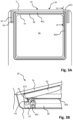
- Figs. 3A and 3B illustrate a second embodiment of an open-roof assembly 20, wherein the closure member 2a (not shown in Fig. 3A for clarity) is tiltably (hingably) mounted.
- a stationary element 61 of a guide assembly is mounted on the frame 5 and a moveable element 62 is coupled to the stationary element 61 through a hinge 63.
- the moveable element 62 comprises a protruding arm 621, which extends over the compressable seal 30.
- the closure member 2a is attached to the moveable element 62 such that the closure member 2a may rotate around the hinge 63.
- a first pressure-sensitive sensor device 401 is integrated in the compressable seal 30 at a position of the front end (FE) of the closure member 2a.
- a second pressure-sensitive sensor device 402 is arranged on top of a large part of the remainder of the compressable seal 30. Further, each end of the second pressure-sensitive sensor device 402 is attached to the protruding arm 621 of the moveable element 62. At least the second pressure-sensitive device 402 is configured to detect a deformation such that the second pressure-sensitive device 402 is configured to detect an angle 41 between the protruding arm 621 and an upper surface of the compressable seal 30.
- the angle 41 corresponds to a substantially right angle. In the open state, the angle 41 will be become an acute angle.
- the detected angle 41 may be used by a control unit to control the operation of the opening and closing of the closure member 2a, wherein the detected angle 41 represents a position of the closure member 2a.
- the pressure-sensitive sensor device 402 configured to detect a deformation may be used solely for detecting a position of the moveable closure member 2a, in which case the pressure-sensitive sensor device 402 may be embodied as a short strip extending between the compressable seal 30 (or any other element stationarily attached to or part of the frame 5) and the closure member 2a. Further, there may be provided one such a short strip or two, one at each hinge 63.
- the pressure-sensitive sensor device 40 and the first and second pressure-sensitive sensor devices 401, 402 extend completely around the perimeter of the opening 3a. In another embodiment, only relevant parts of the perimeter may be provided with such a pressure-sensitive sensor device.
- Fig. 4 illustrates an embodiment of an open-roof assembly 20, wherein the closure member 2a is slidably arranged.
- the pressure-sensitive sensor device 40 is shown to be arranged in the compressable seal 30, but may as well be arranged on the compressable seal 30 or may be arranged on or in any other element stationary mounted on the frame 5.
- the closure member 2a or an element attached to the closure member 2a slides along the pressure-sensitive sensor device 40 such that the pressure-sensitive sensor device 40 detects a local pressure 80 that moves with the sliding movement of the closure member 2a.
- a tip end of the closure member 2a slides over the compressable seal 30, thereby exerting the local pressure 80 on the pressure-sensitive sensor device 40.
- a protruding element may be mounted on the closure member 2a, wherein the protruding element exerts the local pressure 80 on the pressure-sensitive sensor device 40.
- a rotatable element e.g. a roller or wheel, may be mounted on the closure member 2a such that the rotatable element rolls over the compressable seal 30, thereby reducing wear of the compressable seal 30 as compared to an element sliding over the compressable seal 30.
- Detection of the position in accordance with the embodiment of Fig. 4 may be used as a feedback to a control unit controlling a movement of the closure member 2a.
- Other parts or elements known from the prior art for detecting a position or a speed of movement may, optionally, be omitted in such embodiment.
- Fig. 5 shows an embodiment similar to the embodiment of Figs. 2A and 2B . Further, an anti-trap zone 70 is shown and arrow 71 indicates a closing movement direction. In the closing movement direction the closure member 2a moves from the open position towards the closed position.
- FIG. 5 a number of object touches are indicated, wherein an object touch corresponds to a local pressure exerted by an object on the pressure-sensitive sensor device integrated or embedded in the compressable seal 30.
- a first object touch 81 is indicated just in front of the closure member 2a, wherein it is assumed that the closure member 2a is moving in the closing movement direction 71.
- the first object touch 81 is outside the anti-trap zone and may therefore be regarded as not immediately leading to an entrapment.
- the closure member 2a may move further in the closing movement direction 71.
- a speed of the movement of the closure member 2a may be reduced, a visible or audible warning signal may be provided, or the like.
- it may be regarded a control signal from a user indicating that the closure member should stop and stay in its position.
- a second object touch comprises two simultaneous second object touches 82a, 82b, e.g. two fingers tapping on the compressable seal 30, exerting pressure on the pressure-sensitive sensor device.
- Such a simultaneous dual object touch 82a, 82b may be recognized as a user command.
- a control unit (not shown in Fig. 5 ) any specific command may be linked to such a user command, even in dependence of a position of the closure member 2a, for example.
- In a closed state it may be interpreted as a user command for opening; in the open state, it may be interpreted as a user command for closing. Further, if the closure member 2a is moving, it may be interpreted as a user command for stopping such movement.
- the front edge (FE) of the closure member 2a may be regarded as a potential entrapment and the closure member 2a may be stopped and possibly reversed to a full open state or to an open state at a position where the front edge (FE) is just outside the anti-trap zone 70, for example.
- a third object touch 83 is in the anti-trap zone 70.
- the closure member 2a may be controlled to change its state.
- the third object touch 83 may affect an anti-trap system or anti-pinch system that is based on an indirect detection. For example, based on an electrical current consumption of a motor driving the closure member 2a in relation to a position or speed of the closure member 2a, it may be determined that a movement of the closure member 2a is obstructed.
- Such an indirect detection system commonly uses a predetermined threshold such that, as soon as a particular parameter exceeds such threshold, a potential pinch is detected.
- the threshold is usually relatively high to prevent accidental, incorrect pinch detection, which may result in potentially relatively late detection, resulting in potentially relatively high forces exerted by the closure member 2a on the pinched object. If the third object touch 83 is detected in the anti-trap zone 70, the threshold may be lowered to detect an actual pinch sooner, thereby reducing a force exerted by the closure member 2a. Additionally or alternatively, a speed of the closure member 2a may be reduced. Further, an audible or visible warning signal may be provided.
- a fourth object touch 84 is at a position below the closure member 2a. Entrapment of an object is not expected at such position of the fourth object touch 84. Therefore, the fourth object touch 84 may be interpreted as a user command and in a control unit one or more commands may be linked to such fourth object touch 84, e.g. depending on actual conditions, like a state of the closure member 2a, daylight or night-time conditions for operating a lighting device or a sunblind device, or any other command as apparent to those skilled in the art.
- structural elements may be generated by application of three-dimensional (3D) printing techniques. Therefore, any reference to a structural element is intended to encompass any computer executable instructions that instruct a computer to generate such a structural element by three-dimensional printing techniques or similar computer controlled manufacturing techniques. Furthermore, any such reference to a structural element is also intended to encompass a computer readable medium carrying such computer executable instructions.
- the terms and phrases used herein are not intended to be limiting, but rather to provide an understandable description of the invention.
- the terms "a” or “an”, as used herein, are defined as one or more than one.
- the term plurality, as used herein, is defined as two or more than two.
- the term another, as used herein, is defined as at least a second or more.
- the terms including and/or having, as used herein, are defined as comprising (i.e., open language).
- the term coupled, as used herein, is defined as connected, although not necessarily directly.
Landscapes
- Engineering & Computer Science (AREA)
- Mechanical Engineering (AREA)
- Physics & Mathematics (AREA)
- General Physics & Mathematics (AREA)
- Health & Medical Sciences (AREA)
- Life Sciences & Earth Sciences (AREA)
- Chemical & Material Sciences (AREA)
- Analytical Chemistry (AREA)
- Biochemistry (AREA)
- General Health & Medical Sciences (AREA)
- Immunology (AREA)
- Pathology (AREA)
- Power-Operated Mechanisms For Wings (AREA)
Description
- The invention relates to a pinch detection system for detecting a pinch of an object between a moveably arranged closure member of an open-roof assembly and an edge of a roof opening. Further, the invention relates to a corresponding method of detecting a pinch.
- An open-roof assembly is well-known. The open-roof assembly is configured to be mounted in a vehicle roof and comprises at least one moveably arranged closure member. The closure member is configured and arranged to cover an opening in the vehicle roof or at least partly uncover the opening in the vehicle roof. Usually, but not necessarily, the closure member is a transparent panel and comprises glass or a suitable plastics. The closure member may be configured to tilt or to slide.
- During a movement, i.e. a tilting movement or a sliding movement, a foreign object may become trapped between an edge of the opening in the vehicle roof and the moving closure member. In order to prevent damage to the closure member and the trapped object, it is known to provide a pinch detection system. Such a pinch detection system is intended to detect a pinch with a foreign object as soon as possible and to reverse a movement to ensure safe release of the foreign object. A pinch needs to be detected as soon as possible such that a force exerted on the foreign object is kept as small as possible. Further, legal requirements applicable in certain jurisdictions limit the maximum force under specified conditions.
- Several different pinch detection system are known. One of the known kinds of pinch detection systems is an indirect system, wherein a property of the open-roof system is detected, when the closure member is moving. The detected property is immediately analysed and an unexpected value of the property may be used to determine that a pinch has occurred.
- A pinch detection system needs to be able to detect a pinch with any foreign object irrespective of properties of the foreign object. Indirect pinch detection systems need to designed with different kind of properties of foreign objects in mind. In particular, a stiffness or compression rate of the object needs to be considered. The stiffer the object, i.e. the higher the compression rate of the object, the faster an exerted force increases with displacement of the closure member. The stiffness or compression rate may be represented with a spring rate expressed in N/mm. With a soft object having a relatively small spring rate, e.g. a spring rate of about 10 or about 20 N/mm, the closure member may move over a small distance before a maximum pinch force of e.g. 100N is reached, giving the pinch detection system a small period of time to accurately detect whether a pinch actually has occurred. Thus, it is possible to prevent too frequent false pinch detections. However, with a hard object having a relatively large spring rate, e.g. about 65 N/mm, there is less time available and reliable detection becomes more challenging.
- Another known embodiment of a pinch detection system comprises a direct detection. For example, a pressure sensitive sensor is provided along an edge of the moveably arranged closure member or along an edge of the roof opening. Usually, the known pressure sensitive sensor functions like a switch, wherein upon application of sufficient pressure, two electrodes are brought into electrical contact. In another known embodiment, a capacitive measurement is performed. In a particular embodiment thereof, an approaching object may be detected when it is nearby, but not yet touching.
- The known direct pinch detection systems are relatively simple in the sense that they only provide an output indicating that a pinch occurred or is about to occur. Thus, the sensor adds costs to the open-roof assembly for pinch detection. In normal use, however, such pinch detection system does not add functionality or any improved user experience. Therefore, such costs are commercially not feasible and, as a result, the known direct pinch detection systems are commonly omitted and the indirect pinch detection systems are used instead. Still, as above described, reliable detection of a pinch with a hard object may be challenging for an indirect pinch detection system and a direct pinch detection system may sometimes be preferred over an indirect pinch detection system. It is noted that
DE4201019A1 discloses an 'accident preventing arrangement for a panel moved by switchable drive'. - It is an object of the present invention to provide a direct pinch detection system that reliably and timely detects a pinch with an object and that is commercially feasible.
- In a first aspect, the object is achieved in an open-roof assembly for covering or at least partly uncovering an opening in a vehicle roof according to
claim 1. - Instead of merely detecting a pinch by detecting an exerted pressure on the pressure-sensitive device, the pressure-sensitive sensor device is configured to detect a location of the exerted pressure along its length. Thus, more information is obtained when an object touches the pressure-sensitive device. Such additional information may be used to provide further functionality other than for merely detecting a pinch as described in more detail hereinafter in the description of certain embodiments.
- The pressure-sensitive sensor device may be technically provided by one or more of a number of embodiments employing generally known methods and techniques. For example, a number of individually pressure-sensitive switches may be arranged in an elongated array or a number of capacitive sensors may be applied.
- In an embodiment of the open-roof assembly, the pressure-sensitive sensor device is configured to detect a local deformation due to the local pressure exerted on the pressure-sensitive sensor device. In this embodiment, a local pressure is detected, including the location and a local deformation, which may provide information regarding shape or size of an object exerting the pressure. In an exemplary embodiment of a sensor detecting a local deformation employs capacitive sensing. An example of such a sensor is disclosed in
US2020124397 . The disclosed sensor comprises a reference strip and a sliding strip, separated from each other by a spacer. Electrodes are located on the reference strip and the sliding strip. Bending of the sensor results in shifting of the sliding strip with respect to the reference strip. Measurements obtained from the electrodes show such shifting. Due to the presence of multiple electrodes, a location of the exerted pressure is detectable and a local deformation can be derived from the measurements. - In another aspect of the present disclosure, an open-roof assembly is provided for covering or at least partly uncovering an opening in a vehicle roof, the open-roof assembly comprising a frame defining the opening, a moveably arranged closure member and a pressure-sensitive sensor device. The open-roof assembly comprises a closed state, in which the closure member covers the opening (3a) in the vehicle roof, and an open state, in which the closure member uncovers the roof opening (3a) at least partly. The pressure-sensitive sensor device is arranged between the closure member and the frame for detecting presence of an object between the closure member and the frame, at least when the closure member is moving from the open state towards the closed state. The pressure-sensitive sensor device further extends over a sensor device length and is configured to detect a location of a local pressure, which local pressure is exerted locally on the pressure-sensitive sensor device, along the sensor device length. The pressure-sensitive sensor device is moreover configured to detect a local deformation due to the local pressure exerted on the pressure-sensitive sensor device (40). Also, the closure member is tiltably arranged and the pressure-sensitive sensor device, which is configured for detecting a local deformation, is arranged and configured to detect a hinge angle between the frame and the closure member. For example, the pressure-sensitive device may be arranged extending between the frame and the closure member such that the pressure-sensitive sensor device forms a substantially right angle, which is detectable by the pressure-sensitive sensor. Upon tilting the closure member, a part of the pressure-sensitive sensor device coupled to the closure member is moved away from the frame, due to which the pressure-sensitive sensor device no longer forms a right angle, but an obtuse angle. The change in angle is detectable by the pressure-sensitive sensor device. A tilt angle between the frame and the closure member may be derived from the change in angle of the pressure-sensitive sensor device. In this embodiment, a pressure sensitive sensor device for detecting a pinched or trapped object is advantageously further used for detecting a tilt angle of the closure member, thereby enabling to omit or simplify any other position detection system, which improves a cost-effectiveness of the pressure-sensitive sensor device.
- In an embodiment of the open-roof assembly, the pressure-sensitive sensor device is integrated with a compressable seal arranged along a perimeter of the opening in the frame. As well known in the art, a compressible compressable seal may be provided along a perimeter of the opening in the frame, for example for reducing noise when the open-roof assembly is in the closed state. The pressure-sensitive sensor device may be arranged in a compartment of the compressable seal, may be arranged on a surface of the compressable seal or may be integrated in the compressable seal. While, in this embodiment, the pressure-sensitive sensor device is arranged on the frame, in another embodiment, the pressure-sensitive sensor device may be arranged on the closure member.
- According to both aspects of the invention, the pressure-sensitive sensor device is configured to detect a position of the moveably arranged closure member. As above-mentioned, a tilt angle may be detected, or a pressure may be exerted on the pressure-sensitive sensor device when the open-roof assembly is in the open state. For example, a protruding element, e.g. a roller on an extending arm, may be configured to push on the pressure-sensitive sensor device when the closure member is in its position of the open state. According to the first aspect of the invention according to
claim 1, the closure member is slidably arranged and wherein the closure member exerts locally a pressure on the pressure-sensitive sensor device, when the open-roof assembly is in the open state. For example, in a known embodiment of an open-roof assembly, the closure member is first tilted and then slides. After the tilting movement, an edge of the closure member may still be at a level of the pressure-sensitive sensor device and may thus locally push the pressure-sensitive sensor device, while the closure member slides. Hence, another position detection system may be omitted or simplified. - In an embodiment of the open-roof assembly, the pressure-sensitive sensor device is arranged such that an occupant of the vehicle is enabled to touch the pressure-sensitive sensor device in at least one of the closed state and the open state for operating at least one function of the open-roof assembly. With the localized detection enabled with the pressure-sensitive sensor device, a human-machine interface may be provided. Detecting the touch of an object like a human finger, or the like, at a specific location along the sensor length may be interpreted as a command, for example to open or to close the closure member. In particular for use in the closed state, the pressure-sensitive sensor device may need to be arranged such that pressure may be exerted even when the closure member is arranged in contact with or close to the pressure-sensitive sensor device.
- In an embodiment of the open-roof assembly, the open-roof assembly further comprises a control unit, the control unit being configured to control the open-roof assembly in accordance with an operating parameter and being configured to execute an indirect pinch detection, wherein the control unit is configured to adapt the operating parameter upon detection of a locally exerted pressure on the pressure-sensitive sensor device. While the pressure-sensitive sensor device may be used for preventing a pinch or entrapment, a further pinch detection system may be present as well. In particular, an indirect detection method may be present. In a practical exemplary embodiment, the operating parameter may be a speed of the closure member during a closing movement, i.e. when moving from the open state towards the closed state. If pressure is exerted on the pressure-sensitive sensor device at a location away from an edge of the moving closure member, the speed of the closure member may be reduced, possibly combined with a kind of warning signal. In another embodiment, the operating parameter may relate to the indirect pinch detection system. For example, as mentioned above, the indirect detection system may comprise a threshold that is configured relatively high to prevent accidental incorrect pinch detection. When pressure is exerted on the pressure-sensitive sensor device, the threshold may be lowered in order to timely detect an actual pinch situation.
- Further scope of applicability of the present invention will become apparent from the detailed description given hereinafter. However, it should be understood that the detailed description and specific examples, while indicating embodiments of the invention, are given by way of illustration only, since various changes and modifications within the scope of the invention will become apparent to those skilled in the art from this detailed description with reference to the appended schematical drawings, in which:
- Fig. 1A
- shows a perspective view of a vehicle roof with an open roof assembly;
- Fig. 1B
- shows an exploded view of the open roof assembly of
Fig. 1A ; - Fig. 2A
- shows a top view of a first embodiment of an open-roof assembly comprising a pressure-sensitive sensor device;
- Fig. 2B
- shows a cross-section of the first embodiment along line II-II of
Fig. 2A ; - Fig. 3A
- shows a top view of a second embodiment of an open-roof assembly comprising a pressure-sensitive sensor device;
- Fig. 3B
- shows a cross-section of the second embodiment along line III-III of
Fig. 3A ; - Fig. 4
- shows a partial side view of a third embodiment of an open-roof assembly comprising a pressure-sensitive sensor device; and
- Fig. 5
- shows a top view of a fourth embodiment of an open-roof assembly comprising a pressure-sensitive sensor device.
- The present invention will now be described with reference to the accompanying drawings, wherein the same reference numerals have been used to identify the same or similar elements throughout the several views.
-
Fig. 1A illustrates avehicle roof 1 having an open roof assembly arranged therein. The open roof assembly comprises amoveable panel 2a and a fixedpanel 2b. Themoveable panel 2a is also referred to as a closure member, since themoveable panel 2a is moveable over a first roof opening 3a such to enable to open and to close thefirst roof opening 3a. Awind deflector 4 is arranged at a front side of thefirst roof opening 3a. - In the illustrated embodiment, the
moveable panel 2a may be in a closed position, which is a position wherein themoveable panel 2a is arranged over and closes the first roof opening 3a and thus usually is arranged in a plane of thevehicle roof 1. Further, themoveable panel 2a may be in a tilted position, which is a position wherein a rear end RE of themoveable panel 2a is raised as compared to the closed position, while a front end FE of themoveable panel 2a is still in the closed position. Further, themoveable panel 2a may be in an open position, which is a position wherein themoveable panel 2a is slid open and thefirst roof opening 3a is partly or completely exposed. - It is noted that the illustrated
vehicle roof 1 corresponds to a passenger car. The present invention is however not limited to passenger cars. Any other kind of vehicles that may be provided with a moveable panel are contemplated as well. -
Fig. 1B illustrates the same vehicle roof as shown inFig. 1A having panels Fig. 1A shows the open roof assembly in the open position,Fig. 1B is an exploded view of the open roof assembly in a closed position. Further, in this exploded view ofFig. 1B , it is shown that there is a second roof opening 3b. The first andsecond roof openings frame 5 of the open roof assembly. Anedge 5a of theframe 5 defines thefirst roof opening 3a. - The second roof opening 3b is arranged under the fixed
panel 2b such that light may enter a vehicle interior passenger compartment through the fixedpanel 2b, presuming that the fixedpanel 2b is a glass panel or a similarly transparent panel, for example made of a plastic material or any other suitable material. The second roof opening 3b with a transparent or translucent fixedpanel 2b is optional and may be omitted in another embodiment of the open roof assembly. - The
wind deflector 4 is commonly a flexible material, e.g. a woven or non-woven cloth having through holes arranged therein or a web or net. The flexible material is supported by asupport structure 4a, e.g. a bar-like or tube-like structure, which structure is hingedly coupled, directly or indirectly, to theframe 5 at ahinge 4b. - The
wind deflector 4 is arranged in front of the first roof opening 3a and adapts air flow when themoveable panel 2a is in the open position. In its raised position, thewind deflector 4 reduces inconvenient noise due to air flow during driving. When themoveable panel 2a is in the closed position or in the tilted position, thewind deflector 4 is held down below the front end FE of themoveable panel 2a. - Usually, the
wind deflector 4 is raised by a spring force when themoveable panel 2a slides to an open position and thewind deflector 4 is pushed down by themoveable panel 2a when themoveable panel 2a slides back into its closed position. InFig. 1A , themoveable panel 2a is shown in an open position and thewind deflector 4 is shown in a raised position. InFig. 1B , themoveable panel 2a is shown in a closed position and thewind deflector 4 is correspondingly shown in a position in which it is held down. -
Fig. 1B further illustrates a drive assembly having a first guide assembly 6a, asecond guide assembly 6b, afirst drive cable 7 and asecond drive cable 8. The first andsecond guide assemblies 6a, 6b are arranged on respective side ends SE of themoveable panel 2a and may each comprise a guide and a mechanism. The guide is coupled to theframe 5, while the mechanism comprises moveable parts and is slideably moveable in the guide. The first and thesecond drive cables respective guide assemblies 6a, 6b and aelectric motor 9. - The
drive cables electric motor 9 to the mechanisms of therespective guide assemblies 6a, 6b such that upon operating theelectric motor 9, the mechanisms start to move. In particular, a core of thedrive cable electric motor 9 such to push or pull on the mechanisms of therespective guides 6a, 6b. Such a drive assembly is well known in the art and is therefore not further elucidated herein. Still, any other suitable drive assembly may be employed as well without departing from the scope of the present invention. Moreover, in a particular embodiment, an electric motor may be operatively arranged between the respective guides and the respective mechanisms of theguide assemblies 6a, 6b and, in such embodiment, a drive assembly may be omitted completely. - In the illustrated embodiment, the
guide assemblies 6a, 6b may start movement with raising the rear end RE of themoveable panel 2a, thereby bringing themoveable panel 2a in the tilted position. Then, from the tilted position, theguide assemblies 6a, 6b may start to slide to bring themoveable panel 2a in the open position. The present invention is however not limited to such embodiment. For example, in another embodiment, themoveable panel 2a may be moveable to a tilted position by raising the rear end RE, while an open position is reached by first lowering the rear end RE and then sliding themoveable panel 2a under the fixedpanel 2b or any other structure or element provided behind the rear end RE of themoveable panel 2a. In further exemplary embodiments, themoveable panel 2a may be merely moveable between a closed position and a tilted position or between a closed position and an open position. - In the illustrated embodiment, the
electric motor 9 is mounted near or below the front end FE of themoveable panel 2a at arecess 10. In another embodiment, theelectric motor 9 may be positioned at any other suitable position or location. For example, theelectric motor 9 may be arranged near or below the rear end RE of themoveable panel 2a or below the fixedpanel 2b. - A
control module 11 is schematically illustrated and is operatively coupled to theelectric motor 9. Thecontrol module 11 may be any kind of processing module, either a software controlled processing module or a dedicated processing module, like an ASIC, which are both well known to those skilled in the art. Thecontrol module 11 may be a stand-alone control module or it may be operatively connected to another control module, like a multipurpose, generic vehicle control module. In yet another embodiment, thecontrol module 11 may be embedded in or be part of such a generic vehicle control module. Essentially, thecontrol module 11 may be embodied by any control module suitable for, capable of and configured for performing operation of theelectric motor 9 and thus the moveable roof assembly. -
Fig. 2A shows an open-roof assembly 20 in the open state. The open-roof assembly comprises theframe 5, in which theopening 3a is provided, and the moveably arrangedclosure member 2a is slid away to uncover theopening 3a. Theclosure member 2a is supported on theframe 5 by a suitable guide assembly comprising astationary element 61 mounted on theframe 5 and amovable element 62, slidably supported by thestationary element 61. Themovable element 62 is mounted on theclosure member 2a such that theclosure member 2a is slidably mounted. Usually, themoveable element 62 andclosure member 2a are tiltable for lifting theclosure member 2a out of a plane of the vehicle roof, when moving from the closed state to the open state, as above described in relation toFigs. 1A and 1B . - The
frame 5 comprises aframe edge 5a forming a perimeter of theopening 3a. Acompressable seal 30 is arranged around the perimeter, close to theframe edge 5a. - A cross-section of the open-
roof assembly 20 ofFig. 2A along line II-II is shown inFig. 2B . InFig. 2B , the open-roof assembly 20 is illustrated in the closed state. In the closed state, theclosure member 2a is in contact with thecompressable seal 30. Thecompressable seal 30 removes the guide assembly from view from a passenger compartment and reduces noise entering the passenger compartment of the vehicle. - Referring to
Figs. 2A and 2B , thecompressable seal 30 is provided with a pressure-sensitive sensor device 40 arranged in aninternal channel 31 of thecompressable seal 30. For example, the pressure-sensitive sensor device 40 is embodied as a strip-shaped sensor comprising a reference strip and a sliding strip, separated from each other by a spacer. The reference strip and the sliding strip have electrodes located thereon. Bending of the sensor results in shifting of the sliding strip with respect to the reference strip and thus shifting of the electrodes relative to each other. Measurements obtained from the electrodes show such shifting. Due to the presence of multiple electrodes, a location of the exerted pressure is detectable and a local deformation can be derived from the measurements. Such a sensor is described in more detail inUS2020124397 , for example. In another embodiment, another kind of sensor device may be applied equally well. For example, a capacitive measurement or contact detection (e.g. a switch) based sensor device may be used, wherein such sensor device is configured to detect locally applied pressure and to detect the location of the applied pressure. - The pressure-
sensitive sensor device 40 is thus arranged between theclosure member 2a and theframe 5 for detecting presence of an object between theclosure member 2a and theframe 5. In particular, when an object is trapped between theclosure member 2a and theframe 5, pressure is applied on thecompressable seal 30. Such pressure and its location is detected by the pressure-sensitive sensor device 40, which may supply a corresponding detection signal to a control unit (cf.control unit 11 ofFig. 1b ; not shown inFigs. 2A and 2B ). The control unit may be configured to respond to such detection signal by controlling a movement of theclosure member 2a, such as stopping a movement, reversing a movement, starting a movement, changing a speed of movement, and the like. As described in more detail hereinafter in relation to the embodiment ofFig. 5 , the control unit may perform other operations as well in response to the detection signal. -
Figs. 3A and 3B illustrate a second embodiment of an open-roof assembly 20, wherein theclosure member 2a (not shown inFig. 3A for clarity) is tiltably (hingably) mounted. Astationary element 61 of a guide assembly is mounted on theframe 5 and amoveable element 62 is coupled to thestationary element 61 through ahinge 63. Themoveable element 62 comprises aprotruding arm 621, which extends over thecompressable seal 30. Theclosure member 2a is attached to themoveable element 62 such that theclosure member 2a may rotate around thehinge 63. - A first pressure-
sensitive sensor device 401 is integrated in thecompressable seal 30 at a position of the front end (FE) of theclosure member 2a. A second pressure-sensitive sensor device 402 is arranged on top of a large part of the remainder of thecompressable seal 30. Further, each end of the second pressure-sensitive sensor device 402 is attached to theprotruding arm 621 of themoveable element 62. At least the second pressure-sensitive device 402 is configured to detect a deformation such that the second pressure-sensitive device 402 is configured to detect anangle 41 between theprotruding arm 621 and an upper surface of thecompressable seal 30. When thehingable closure member 2a is in the closed state, theangle 41 corresponds to a substantially right angle. In the open state, theangle 41 will be become an acute angle. The detectedangle 41 may be used by a control unit to control the operation of the opening and closing of theclosure member 2a, wherein the detectedangle 41 represents a position of theclosure member 2a. - As apparent to those skilled in the art, the pressure-
sensitive sensor device 402 configured to detect a deformation may be used solely for detecting a position of themoveable closure member 2a, in which case the pressure-sensitive sensor device 402 may be embodied as a short strip extending between the compressable seal 30 (or any other element stationarily attached to or part of the frame 5) and theclosure member 2a. Further, there may be provided one such a short strip or two, one at eachhinge 63. - In the first and the second embodiments of
Figs. 2A, 2B ,3A and 3B , the pressure-sensitive sensor device 40 and the first and second pressure-sensitive sensor devices opening 3a. In another embodiment, only relevant parts of the perimeter may be provided with such a pressure-sensitive sensor device. -
Fig. 4 illustrates an embodiment of an open-roof assembly 20, wherein theclosure member 2a is slidably arranged. The pressure-sensitive sensor device 40 is shown to be arranged in thecompressable seal 30, but may as well be arranged on thecompressable seal 30 or may be arranged on or in any other element stationary mounted on theframe 5. In this embodiment, theclosure member 2a or an element attached to theclosure member 2a slides along the pressure-sensitive sensor device 40 such that the pressure-sensitive sensor device 40 detects alocal pressure 80 that moves with the sliding movement of theclosure member 2a. - In the embodiment of
Fig. 4 , a tip end of theclosure member 2a slides over thecompressable seal 30, thereby exerting thelocal pressure 80 on the pressure-sensitive sensor device 40. In another embodiment, a protruding element may be mounted on theclosure member 2a, wherein the protruding element exerts thelocal pressure 80 on the pressure-sensitive sensor device 40. For example, a rotatable element, e.g. a roller or wheel, may be mounted on theclosure member 2a such that the rotatable element rolls over thecompressable seal 30, thereby reducing wear of thecompressable seal 30 as compared to an element sliding over thecompressable seal 30. - Detection of the position in accordance with the embodiment of
Fig. 4 may be used as a feedback to a control unit controlling a movement of theclosure member 2a. Other parts or elements known from the prior art for detecting a position or a speed of movement may, optionally, be omitted in such embodiment. -
Fig. 5 shows an embodiment similar to the embodiment ofFigs. 2A and 2B . Further, ananti-trap zone 70 is shown andarrow 71 indicates a closing movement direction. In the closing movement direction theclosure member 2a moves from the open position towards the closed position. - Further, in
Fig. 5 , a number of object touches are indicated, wherein an object touch corresponds to a local pressure exerted by an object on the pressure-sensitive sensor device integrated or embedded in thecompressable seal 30. Afirst object touch 81 is indicated just in front of theclosure member 2a, wherein it is assumed that theclosure member 2a is moving in theclosing movement direction 71. Thefirst object touch 81 is outside the anti-trap zone and may therefore be regarded as not immediately leading to an entrapment. Theclosure member 2a may move further in theclosing movement direction 71. In an embodiment, a speed of the movement of theclosure member 2a may be reduced, a visible or audible warning signal may be provided, or the like. In an embodiment, it may be regarded a control signal from a user indicating that the closure member should stop and stay in its position. - A second object touch comprises two simultaneous second object touches 82a, 82b, e.g. two fingers tapping on the
compressable seal 30, exerting pressure on the pressure-sensitive sensor device. Such a simultaneousdual object touch Fig. 5 ) any specific command may be linked to such a user command, even in dependence of a position of theclosure member 2a, for example. In a closed state, it may be interpreted as a user command for opening; in the open state, it may be interpreted as a user command for closing. Further, if theclosure member 2a is moving, it may be interpreted as a user command for stopping such movement. Still, if the front edge (FE) of theclosure member 2a is in theanti-trap zone 70 and theclosure member 2a is moving in theclosing movement direction 71, it may be regarded as a potential entrapment and theclosure member 2a may be stopped and possibly reversed to a full open state or to an open state at a position where the front edge (FE) is just outside theanti-trap zone 70, for example. - A
third object touch 83 is in theanti-trap zone 70. Depending on the state of theclosure member 2a, i.e. whether theclosure member 2a is closed, open, in stand-still or moving, theclosure member 2a may be controlled to change its state. In a particular embodiment, thethird object touch 83 may affect an anti-trap system or anti-pinch system that is based on an indirect detection. For example, based on an electrical current consumption of a motor driving theclosure member 2a in relation to a position or speed of theclosure member 2a, it may be determined that a movement of theclosure member 2a is obstructed. Such an indirect detection system commonly uses a predetermined threshold such that, as soon as a particular parameter exceeds such threshold, a potential pinch is detected. The threshold is usually relatively high to prevent accidental, incorrect pinch detection, which may result in potentially relatively late detection, resulting in potentially relatively high forces exerted by theclosure member 2a on the pinched object. If thethird object touch 83 is detected in theanti-trap zone 70, the threshold may be lowered to detect an actual pinch sooner, thereby reducing a force exerted by theclosure member 2a. Additionally or alternatively, a speed of theclosure member 2a may be reduced. Further, an audible or visible warning signal may be provided. - A
fourth object touch 84 is at a position below theclosure member 2a. Entrapment of an object is not expected at such position of thefourth object touch 84. Therefore, thefourth object touch 84 may be interpreted as a user command and in a control unit one or more commands may be linked to suchfourth object touch 84, e.g. depending on actual conditions, like a state of theclosure member 2a, daylight or night-time conditions for operating a lighting device or a sunblind device, or any other command as apparent to those skilled in the art. - Detailed embodiments of the present invention are disclosed herein; however, it is to be understood that the disclosed embodiments are merely exemplary of the invention, which can be embodied in various forms. Therefore, specific structural and functional details disclosed herein are not to be interpreted as limiting, but merely as a basis for the claims and as a representative basis for teaching one skilled in the art to variously employ the present invention in expectedly any appropriately detailed structure. In particular, features presented and described in separate dependent claims may be applied in combination and any advantageous combination of such claims are herewith disclosed.
- Further, it is contemplated that structural elements may be generated by application of three-dimensional (3D) printing techniques. Therefore, any reference to a structural element is intended to encompass any computer executable instructions that instruct a computer to generate such a structural element by three-dimensional printing techniques or similar computer controlled manufacturing techniques. Furthermore, any such reference to a structural element is also intended to encompass a computer readable medium carrying such computer executable instructions.
- Further, the terms and phrases used herein are not intended to be limiting, but rather to provide an understandable description of the invention. The terms "a" or "an", as used herein, are defined as one or more than one. The term plurality, as used herein, is defined as two or more than two. The term another, as used herein, is defined as at least a second or more. The terms including and/or having, as used herein, are defined as comprising (i.e., open language). The term coupled, as used herein, is defined as connected, although not necessarily directly.
- The invention being thus described, it is apparent that the same may be varied in many ways. Such variations are not to be regarded as a departure from the scope of the invention, and all such modifications as would be apparent to one skilled in the art are intended to be included within the scope of the following claims.
Claims (6)
- An open-roof assembly for covering or at least partly uncovering an opening (3a) in a vehicle roof, the open-roof assembly comprising a frame (5) defining the opening, a moveably arranged closure member (2a) and a pressure-sensitive sensor device (40),wherein the open-roof assembly comprises a closed state, in which the closure member covers the opening (3a) in the vehicle roof, and an open state, in which the closure member uncovers the roof opening (3a) at least partly,wherein the pressure-sensitive sensor device (40) is arranged between the closure member (2a) and the frame (5) for detecting presence of an object between the closure member (2a) and the frame (5), at least when the closure member (2a) is moving from the open state towards the closed state, andwherein the pressure-sensitive sensor device (40) extends over a sensor device length and is configured to detect a location of a local pressure, which local pressure is exerted locally on the pressure-sensitive sensor device (40), along the sensor device length,wherein the pressure-sensitive sensor device (40) is configured to detect a position of the moveably arranged closure member (2a, andthe closure member (2a) is slidably arranged and wherein the closure member (2a) exerts locally a pressure on the pressure-sensitive sensor device (40), when the open-roof assembly is in the open state,characterised in thatthe closure member (2a) is configured to slide along the pressure-sensitive sensor device (40) for the pressure-sensitive sensor device (40) to detect the position of the local pressure exerted by the closure member (2a), that moves with the sliding movement of the closure member (2a).
- The open-roof assembly according to claim 1, wherein the pressure-sensitive sensor device (40) is configured to detect a local deformation due to the local pressure exerted on the pressure-sensitive sensor device (40).
- An open-roof assembly for covering or at least partly uncovering an opening (3a) in a vehicle roof, the open-roof assembly comprising a frame (5) defining the opening, a moveably arranged closure member (2a) and a pressure-sensitive sensor device (40),wherein the open-roof assembly comprises a closed state, in which the closure member covers the opening (3a) in the vehicle roof, and an open state, in which the closure member uncovers the roof opening (3a) at least partly,wherein the pressure-sensitive sensor device (40) is arranged between the closure member (2a) and the frame (5) for detecting presence of an object between the closure member (2a) and the frame (5), at least when the closure member (2a) is moving from the open state towards the closed state, andwherein the pressure-sensitive sensor device (40) extends over a sensor device length and is configured to detect a location of a local pressure, which local pressure is exerted locally on the pressure-sensitive sensor device (40), along the sensor device length, and wherein the pressure-sensitive sensor (40) device is configured to detect a local deformation due to the local pressure exerted on the pressure-sensitive sensor device (40, and the closure member (2a) is tiltably arranged and wherein the pressure-sensitive sensor device (40) is arranged and configured to detect a hinge angle between the frame (5) and the closure member (2a).
- The open-roof assembly according to claim 1 or 3, wherein the pressure-sensitive sensor device (40) is integrated with a compressable seal (30) arranged along a perimeter of the opening in the frame (5).
- The open-roof assembly according to claim 1 or 3, wherein the pressure-sensitive sensor device (40) is arranged such that an occupant of the vehicle is enabled to touch the pressure-sensitive sensor device (40) in at least one of the closed state and the open state for operating at least one function of the open-roof assembly.
- The open-roof assembly according to claim 1 or 3, wherein the open-roof assembly further comprises a control unit (11), the control unit (11) being configured to control the open-roof assembly in accordance with an operating parameter and being configured to execute an indirect pinch detection, wherein the control unit (11) is configured to adapt the operating parameter upon detection of a locally exerted pressure on the pressure-sensitive sensor device (40).
Priority Applications (3)
| Application Number | Priority Date | Filing Date | Title |
|---|---|---|---|
| EP21171330.0A EP4082812B1 (en) | 2021-04-29 | 2021-04-29 | Pinch detection system |
| US17/729,555 US12215532B2 (en) | 2021-04-29 | 2022-04-26 | Pinch detection system |
| CN202210445278.4A CN115266324A (en) | 2021-04-29 | 2022-04-26 | Extrusion detecting system |
Applications Claiming Priority (1)
| Application Number | Priority Date | Filing Date | Title |
|---|---|---|---|
| EP21171330.0A EP4082812B1 (en) | 2021-04-29 | 2021-04-29 | Pinch detection system |
Publications (2)
| Publication Number | Publication Date |
|---|---|
| EP4082812A1 EP4082812A1 (en) | 2022-11-02 |
| EP4082812B1 true EP4082812B1 (en) | 2025-02-26 |
Family
ID=75746337
Family Applications (1)
| Application Number | Title | Priority Date | Filing Date |
|---|---|---|---|
| EP21171330.0A Active EP4082812B1 (en) | 2021-04-29 | 2021-04-29 | Pinch detection system |
Country Status (3)
| Country | Link |
|---|---|
| US (1) | US12215532B2 (en) |
| EP (1) | EP4082812B1 (en) |
| CN (1) | CN115266324A (en) |
Family Cites Families (4)
| Publication number | Priority date | Publication date | Assignee | Title |
|---|---|---|---|---|
| DE4201019C2 (en) * | 1992-01-16 | 1993-10-21 | Daimler Benz Ag | Device for avoiding accidents when a panel movable by a drive approaches a closing edge |
| DE10151840A1 (en) * | 2001-10-24 | 2003-05-08 | Bosch Gmbh Robert | Device and method for moving a part |
| DE202005012636U1 (en) | 2005-08-11 | 2006-12-28 | Brose Fahrzeugteile Gmbh & Co. Kommanditgesellschaft, Coburg | anti-pinch |
| US11221202B2 (en) | 2018-10-22 | 2022-01-11 | Tactual Labs Co. | Multibend sensor |
-
2021
- 2021-04-29 EP EP21171330.0A patent/EP4082812B1/en active Active
-
2022
- 2022-04-26 CN CN202210445278.4A patent/CN115266324A/en active Pending
- 2022-04-26 US US17/729,555 patent/US12215532B2/en active Active
Also Published As
| Publication number | Publication date |
|---|---|
| US12215532B2 (en) | 2025-02-04 |
| EP4082812A1 (en) | 2022-11-02 |
| CN115266324A (en) | 2022-11-01 |
| US20220349233A1 (en) | 2022-11-03 |
Similar Documents
| Publication | Publication Date | Title |
|---|---|---|
| CN101934711B (en) | Sunroof system with pinch protection including a sunroof panel and a sunshade panel | |
| US10493826B2 (en) | Motor vehicle device comprising a movable windowpane, motor vehicle comprising a motor vehicle device of this type, and method for operating a motor vehicle device of this type | |
| KR20040110463A (en) | Safety Apparatus of Automobile Sun Roof | |
| CN113165519A (en) | Roof console for a vehicle | |
| CN102029879B (en) | The vehicle anti-pinch with variable thresholding controls and method | |
| US20180094471A1 (en) | Vehicle window with gesture control | |
| US9015993B2 (en) | Control device for operating an electric window lifter | |
| US20220048390A1 (en) | Roof Console for a Vehicle | |
| EP4082812B1 (en) | Pinch detection system | |
| KR101844251B1 (en) | Convenient device control system using window glass of car | |
| EP4446145B1 (en) | Open-roof assembly comprising a lighting assembly and a contact-free switch therefor | |
| EP4043681B1 (en) | Pinch detection system | |
| JP2002256762A (en) | Electric moving device | |
| KR101883169B1 (en) | Operating apparatus and method of touch panel window of car | |
| EP4379179A1 (en) | Pinch detection system | |
| EP4011665B1 (en) | Control unit and method for operating an open roof assembly | |
| CN112977025B (en) | Open roof assembly for use in vehicles and methods for operating it | |
| JP3846713B2 (en) | Door opening / closing control device and method | |
| US20210162845A1 (en) | Open roof assembly for use in a vehicle and a method for operating same | |
| KR20030027588A (en) | Power window safety system in vehicle | |
| JP2023106775A (en) | Door jam detection sensor and door jam prevention device | |
| JP5112826B2 (en) | Power sliding door | |
| JPH10504619A (en) | Sensor device for detecting pinching of vehicles | |
| JP4866614B2 (en) | Control device for opening / closing panel for vehicle roof | |
| JP5386153B2 (en) | Window regulator |
Legal Events
| Date | Code | Title | Description |
|---|---|---|---|
| PUAI | Public reference made under article 153(3) epc to a published international application that has entered the european phase |
Free format text: ORIGINAL CODE: 0009012 |
|
| STAA | Information on the status of an ep patent application or granted ep patent |
Free format text: STATUS: THE APPLICATION HAS BEEN PUBLISHED |
|
| AK | Designated contracting states |
Kind code of ref document: A1 Designated state(s): AL AT BE BG CH CY CZ DE DK EE ES FI FR GB GR HR HU IE IS IT LI LT LU LV MC MK MT NL NO PL PT RO RS SE SI SK SM TR |
|
| STAA | Information on the status of an ep patent application or granted ep patent |
Free format text: STATUS: REQUEST FOR EXAMINATION WAS MADE |
|
| 17P | Request for examination filed |
Effective date: 20230502 |
|
| RBV | Designated contracting states (corrected) |
Designated state(s): AL AT BE BG CH CY CZ DE DK EE ES FI FR GB GR HR HU IE IS IT LI LT LU LV MC MK MT NL NO PL PT RO RS SE SI SK SM TR |
|
| STAA | Information on the status of an ep patent application or granted ep patent |
Free format text: STATUS: EXAMINATION IS IN PROGRESS |
|
| 17Q | First examination report despatched |
Effective date: 20240214 |
|
| GRAP | Despatch of communication of intention to grant a patent |
Free format text: ORIGINAL CODE: EPIDOSNIGR1 |
|
| STAA | Information on the status of an ep patent application or granted ep patent |
Free format text: STATUS: GRANT OF PATENT IS INTENDED |
|
| INTG | Intention to grant announced |
Effective date: 20241010 |
|
| GRAS | Grant fee paid |
Free format text: ORIGINAL CODE: EPIDOSNIGR3 |
|
| GRAA | (expected) grant |
Free format text: ORIGINAL CODE: 0009210 |
|
| STAA | Information on the status of an ep patent application or granted ep patent |
Free format text: STATUS: THE PATENT HAS BEEN GRANTED |
|
| AK | Designated contracting states |
Kind code of ref document: B1 Designated state(s): AL AT BE BG CH CY CZ DE DK EE ES FI FR GB GR HR HU IE IS IT LI LT LU LV MC MK MT NL NO PL PT RO RS SE SI SK SM TR |
|
| REG | Reference to a national code |
Ref country code: GB Ref legal event code: FG4D |
|
| REG | Reference to a national code |
Ref country code: CH Ref legal event code: EP |
|
| REG | Reference to a national code |
Ref country code: DE Ref legal event code: R096 Ref document number: 602021026633 Country of ref document: DE |
|
| REG | Reference to a national code |
Ref country code: IE Ref legal event code: FG4D |
|
| REG | Reference to a national code |
Ref country code: NL Ref legal event code: MP Effective date: 20250226 |
|
| PG25 | Lapsed in a contracting state [announced via postgrant information from national office to epo] |
Ref country code: RS Free format text: LAPSE BECAUSE OF FAILURE TO SUBMIT A TRANSLATION OF THE DESCRIPTION OR TO PAY THE FEE WITHIN THE PRESCRIBED TIME-LIMIT Effective date: 20250526 |
|
| PG25 | Lapsed in a contracting state [announced via postgrant information from national office to epo] |
Ref country code: FI Free format text: LAPSE BECAUSE OF FAILURE TO SUBMIT A TRANSLATION OF THE DESCRIPTION OR TO PAY THE FEE WITHIN THE PRESCRIBED TIME-LIMIT Effective date: 20250226 |
|
| PG25 | Lapsed in a contracting state [announced via postgrant information from national office to epo] |
Ref country code: PL Free format text: LAPSE BECAUSE OF FAILURE TO SUBMIT A TRANSLATION OF THE DESCRIPTION OR TO PAY THE FEE WITHIN THE PRESCRIBED TIME-LIMIT Effective date: 20250226 |
|
| PGFP | Annual fee paid to national office [announced via postgrant information from national office to epo] |
Ref country code: DE Payment date: 20250429 Year of fee payment: 5 |
|
| PG25 | Lapsed in a contracting state [announced via postgrant information from national office to epo] |
Ref country code: ES Free format text: LAPSE BECAUSE OF FAILURE TO SUBMIT A TRANSLATION OF THE DESCRIPTION OR TO PAY THE FEE WITHIN THE PRESCRIBED TIME-LIMIT Effective date: 20250226 |
|
| REG | Reference to a national code |
Ref country code: LT Ref legal event code: MG9D |
|
| PG25 | Lapsed in a contracting state [announced via postgrant information from national office to epo] |
Ref country code: NO Free format text: LAPSE BECAUSE OF FAILURE TO SUBMIT A TRANSLATION OF THE DESCRIPTION OR TO PAY THE FEE WITHIN THE PRESCRIBED TIME-LIMIT Effective date: 20250526 Ref country code: IS Free format text: LAPSE BECAUSE OF FAILURE TO SUBMIT A TRANSLATION OF THE DESCRIPTION OR TO PAY THE FEE WITHIN THE PRESCRIBED TIME-LIMIT Effective date: 20250626 |
|
| PG25 | Lapsed in a contracting state [announced via postgrant information from national office to epo] |
Ref country code: NL Free format text: LAPSE BECAUSE OF FAILURE TO SUBMIT A TRANSLATION OF THE DESCRIPTION OR TO PAY THE FEE WITHIN THE PRESCRIBED TIME-LIMIT Effective date: 20250226 |
|
| PG25 | Lapsed in a contracting state [announced via postgrant information from national office to epo] |
Ref country code: HR Free format text: LAPSE BECAUSE OF FAILURE TO SUBMIT A TRANSLATION OF THE DESCRIPTION OR TO PAY THE FEE WITHIN THE PRESCRIBED TIME-LIMIT Effective date: 20250226 |
|
| PG25 | Lapsed in a contracting state [announced via postgrant information from national office to epo] |
Ref country code: LV Free format text: LAPSE BECAUSE OF FAILURE TO SUBMIT A TRANSLATION OF THE DESCRIPTION OR TO PAY THE FEE WITHIN THE PRESCRIBED TIME-LIMIT Effective date: 20250226 Ref country code: PT Free format text: LAPSE BECAUSE OF FAILURE TO SUBMIT A TRANSLATION OF THE DESCRIPTION OR TO PAY THE FEE WITHIN THE PRESCRIBED TIME-LIMIT Effective date: 20250626 |
|
| PGFP | Annual fee paid to national office [announced via postgrant information from national office to epo] |
Ref country code: FR Payment date: 20250425 Year of fee payment: 5 |
|
| PG25 | Lapsed in a contracting state [announced via postgrant information from national office to epo] |
Ref country code: BG Free format text: LAPSE BECAUSE OF FAILURE TO SUBMIT A TRANSLATION OF THE DESCRIPTION OR TO PAY THE FEE WITHIN THE PRESCRIBED TIME-LIMIT Effective date: 20250226 Ref country code: GR Free format text: LAPSE BECAUSE OF FAILURE TO SUBMIT A TRANSLATION OF THE DESCRIPTION OR TO PAY THE FEE WITHIN THE PRESCRIBED TIME-LIMIT Effective date: 20250527 |
|
| REG | Reference to a national code |
Ref country code: AT Ref legal event code: MK05 Ref document number: 1770310 Country of ref document: AT Kind code of ref document: T Effective date: 20250226 |
|
| PG25 | Lapsed in a contracting state [announced via postgrant information from national office to epo] |
Ref country code: SE Free format text: LAPSE BECAUSE OF FAILURE TO SUBMIT A TRANSLATION OF THE DESCRIPTION OR TO PAY THE FEE WITHIN THE PRESCRIBED TIME-LIMIT Effective date: 20250226 |
|
| PG25 | Lapsed in a contracting state [announced via postgrant information from national office to epo] |
Ref country code: SM Free format text: LAPSE BECAUSE OF FAILURE TO SUBMIT A TRANSLATION OF THE DESCRIPTION OR TO PAY THE FEE WITHIN THE PRESCRIBED TIME-LIMIT Effective date: 20250226 |
|
| PG25 | Lapsed in a contracting state [announced via postgrant information from national office to epo] |
Ref country code: DK Free format text: LAPSE BECAUSE OF FAILURE TO SUBMIT A TRANSLATION OF THE DESCRIPTION OR TO PAY THE FEE WITHIN THE PRESCRIBED TIME-LIMIT Effective date: 20250226 |
|
| PG25 | Lapsed in a contracting state [announced via postgrant information from national office to epo] |
Ref country code: IT Free format text: LAPSE BECAUSE OF FAILURE TO SUBMIT A TRANSLATION OF THE DESCRIPTION OR TO PAY THE FEE WITHIN THE PRESCRIBED TIME-LIMIT Effective date: 20250226 |
|
| PG25 | Lapsed in a contracting state [announced via postgrant information from national office to epo] |
Ref country code: AT Free format text: LAPSE BECAUSE OF FAILURE TO SUBMIT A TRANSLATION OF THE DESCRIPTION OR TO PAY THE FEE WITHIN THE PRESCRIBED TIME-LIMIT Effective date: 20250226 |
|
| PG25 | Lapsed in a contracting state [announced via postgrant information from national office to epo] |
Ref country code: EE Free format text: LAPSE BECAUSE OF FAILURE TO SUBMIT A TRANSLATION OF THE DESCRIPTION OR TO PAY THE FEE WITHIN THE PRESCRIBED TIME-LIMIT Effective date: 20250226 Ref country code: CZ Free format text: LAPSE BECAUSE OF FAILURE TO SUBMIT A TRANSLATION OF THE DESCRIPTION OR TO PAY THE FEE WITHIN THE PRESCRIBED TIME-LIMIT Effective date: 20250226 |
|
| PG25 | Lapsed in a contracting state [announced via postgrant information from national office to epo] |
Ref country code: RO Free format text: LAPSE BECAUSE OF FAILURE TO SUBMIT A TRANSLATION OF THE DESCRIPTION OR TO PAY THE FEE WITHIN THE PRESCRIBED TIME-LIMIT Effective date: 20250226 |
|
| PG25 | Lapsed in a contracting state [announced via postgrant information from national office to epo] |
Ref country code: SK Free format text: LAPSE BECAUSE OF FAILURE TO SUBMIT A TRANSLATION OF THE DESCRIPTION OR TO PAY THE FEE WITHIN THE PRESCRIBED TIME-LIMIT Effective date: 20250226 |
|
| REG | Reference to a national code |
Ref country code: CH Ref legal event code: H13 Free format text: ST27 STATUS EVENT CODE: U-0-0-H10-H13 (AS PROVIDED BY THE NATIONAL OFFICE) Effective date: 20251125 |
|
| REG | Reference to a national code |
Ref country code: DE Ref legal event code: R097 Ref document number: 602021026633 Country of ref document: DE |
|
| PG25 | Lapsed in a contracting state [announced via postgrant information from national office to epo] |
Ref country code: LU Free format text: LAPSE BECAUSE OF NON-PAYMENT OF DUE FEES Effective date: 20250429 |
|
| PG25 | Lapsed in a contracting state [announced via postgrant information from national office to epo] |
Ref country code: MC Free format text: LAPSE BECAUSE OF FAILURE TO SUBMIT A TRANSLATION OF THE DESCRIPTION OR TO PAY THE FEE WITHIN THE PRESCRIBED TIME-LIMIT Effective date: 20250226 |
|
| REG | Reference to a national code |
Ref country code: BE Ref legal event code: MM Effective date: 20250430 |
|
| PLBE | No opposition filed within time limit |
Free format text: ORIGINAL CODE: 0009261 |
|
| STAA | Information on the status of an ep patent application or granted ep patent |
Free format text: STATUS: NO OPPOSITION FILED WITHIN TIME LIMIT |
|
| PG25 | Lapsed in a contracting state [announced via postgrant information from national office to epo] |
Ref country code: BE Free format text: LAPSE BECAUSE OF NON-PAYMENT OF DUE FEES Effective date: 20250430 |
|
| PG25 | Lapsed in a contracting state [announced via postgrant information from national office to epo] |
Ref country code: CH Free format text: LAPSE BECAUSE OF NON-PAYMENT OF DUE FEES Effective date: 20250430 |
|
| GBPC | Gb: european patent ceased through non-payment of renewal fee |
Effective date: 20250526 |
|
| 26N | No opposition filed |
Effective date: 20251127 |
|
| PG25 | Lapsed in a contracting state [announced via postgrant information from national office to epo] |
Ref country code: GB Free format text: LAPSE BECAUSE OF NON-PAYMENT OF DUE FEES Effective date: 20250526 |
|
| PG25 | Lapsed in a contracting state [announced via postgrant information from national office to epo] |
Ref country code: IE Free format text: LAPSE BECAUSE OF NON-PAYMENT OF DUE FEES Effective date: 20250429 |