EP4082778B1 - Cladding for power storage device and power storage device in which same is used - Google Patents
Cladding for power storage device and power storage device in which same is used Download PDFInfo
- Publication number
- EP4082778B1 EP4082778B1 EP20907484.8A EP20907484A EP4082778B1 EP 4082778 B1 EP4082778 B1 EP 4082778B1 EP 20907484 A EP20907484 A EP 20907484A EP 4082778 B1 EP4082778 B1 EP 4082778B1
- Authority
- EP
- European Patent Office
- Prior art keywords
- layer
- packaging material
- power storage
- storage device
- resin
- Prior art date
- Legal status (The legal status is an assumption and is not a legal conclusion. Google has not performed a legal analysis and makes no representation as to the accuracy of the status listed.)
- Active
Links
Images

Classifications
-
- H—ELECTRICITY
- H01—ELECTRIC ELEMENTS
- H01M—PROCESSES OR MEANS, e.g. BATTERIES, FOR THE DIRECT CONVERSION OF CHEMICAL ENERGY INTO ELECTRICAL ENERGY
- H01M50/00—Constructional details or processes of manufacture of the non-active parts of electrochemical cells other than fuel cells, e.g. hybrid cells
- H01M50/10—Primary casings; Jackets or wrappings
- H01M50/116—Primary casings; Jackets or wrappings characterised by the material
- H01M50/124—Primary casings; Jackets or wrappings characterised by the material having a layered structure
- H01M50/126—Primary casings; Jackets or wrappings characterised by the material having a layered structure comprising three or more layers
-
- C—CHEMISTRY; METALLURGY
- C08—ORGANIC MACROMOLECULAR COMPOUNDS; THEIR PREPARATION OR CHEMICAL WORKING-UP; COMPOSITIONS BASED THEREON
- C08G—MACROMOLECULAR COMPOUNDS OBTAINED OTHERWISE THAN BY REACTIONS ONLY INVOLVING UNSATURATED CARBON-TO-CARBON BONDS
- C08G18/00—Polymeric products of isocyanates or isothiocyanates
- C08G18/06—Polymeric products of isocyanates or isothiocyanates with compounds having active hydrogen
- C08G18/28—Polymeric products of isocyanates or isothiocyanates with compounds having active hydrogen characterised by the compounds used containing active hydrogen
- C08G18/40—High-molecular-weight compounds
- C08G18/42—Polycondensates having carboxylic or carbonic ester groups in the main chain
-
- B—PERFORMING OPERATIONS; TRANSPORTING
- B32—LAYERED PRODUCTS
- B32B—LAYERED PRODUCTS, i.e. PRODUCTS BUILT-UP OF STRATA OF FLAT OR NON-FLAT, e.g. CELLULAR OR HONEYCOMB, FORM
- B32B15/00—Layered products comprising a layer of metal
- B32B15/04—Layered products comprising a layer of metal comprising metal as the main or only constituent of a layer, which is next to another layer of the same or of a different material
- B32B15/08—Layered products comprising a layer of metal comprising metal as the main or only constituent of a layer, which is next to another layer of the same or of a different material of synthetic resin
-
- B—PERFORMING OPERATIONS; TRANSPORTING
- B32—LAYERED PRODUCTS
- B32B—LAYERED PRODUCTS, i.e. PRODUCTS BUILT-UP OF STRATA OF FLAT OR NON-FLAT, e.g. CELLULAR OR HONEYCOMB, FORM
- B32B15/00—Layered products comprising a layer of metal
- B32B15/04—Layered products comprising a layer of metal comprising metal as the main or only constituent of a layer, which is next to another layer of the same or of a different material
- B32B15/08—Layered products comprising a layer of metal comprising metal as the main or only constituent of a layer, which is next to another layer of the same or of a different material of synthetic resin
- B32B15/085—Layered products comprising a layer of metal comprising metal as the main or only constituent of a layer, which is next to another layer of the same or of a different material of synthetic resin comprising polyolefins
-
- B—PERFORMING OPERATIONS; TRANSPORTING
- B32—LAYERED PRODUCTS
- B32B—LAYERED PRODUCTS, i.e. PRODUCTS BUILT-UP OF STRATA OF FLAT OR NON-FLAT, e.g. CELLULAR OR HONEYCOMB, FORM
- B32B15/00—Layered products comprising a layer of metal
- B32B15/04—Layered products comprising a layer of metal comprising metal as the main or only constituent of a layer, which is next to another layer of the same or of a different material
- B32B15/08—Layered products comprising a layer of metal comprising metal as the main or only constituent of a layer, which is next to another layer of the same or of a different material of synthetic resin
- B32B15/088—Layered products comprising a layer of metal comprising metal as the main or only constituent of a layer, which is next to another layer of the same or of a different material of synthetic resin comprising polyamides
-
- B—PERFORMING OPERATIONS; TRANSPORTING
- B32—LAYERED PRODUCTS
- B32B—LAYERED PRODUCTS, i.e. PRODUCTS BUILT-UP OF STRATA OF FLAT OR NON-FLAT, e.g. CELLULAR OR HONEYCOMB, FORM
- B32B15/00—Layered products comprising a layer of metal
- B32B15/04—Layered products comprising a layer of metal comprising metal as the main or only constituent of a layer, which is next to another layer of the same or of a different material
- B32B15/08—Layered products comprising a layer of metal comprising metal as the main or only constituent of a layer, which is next to another layer of the same or of a different material of synthetic resin
- B32B15/09—Layered products comprising a layer of metal comprising metal as the main or only constituent of a layer, which is next to another layer of the same or of a different material of synthetic resin comprising polyesters
-
- B—PERFORMING OPERATIONS; TRANSPORTING
- B32—LAYERED PRODUCTS
- B32B—LAYERED PRODUCTS, i.e. PRODUCTS BUILT-UP OF STRATA OF FLAT OR NON-FLAT, e.g. CELLULAR OR HONEYCOMB, FORM
- B32B15/00—Layered products comprising a layer of metal
- B32B15/20—Layered products comprising a layer of metal comprising aluminium or copper
-
- B—PERFORMING OPERATIONS; TRANSPORTING
- B32—LAYERED PRODUCTS
- B32B—LAYERED PRODUCTS, i.e. PRODUCTS BUILT-UP OF STRATA OF FLAT OR NON-FLAT, e.g. CELLULAR OR HONEYCOMB, FORM
- B32B27/00—Layered products comprising a layer of synthetic resin
- B32B27/32—Layered products comprising a layer of synthetic resin comprising polyolefins
-
- B—PERFORMING OPERATIONS; TRANSPORTING
- B32—LAYERED PRODUCTS
- B32B—LAYERED PRODUCTS, i.e. PRODUCTS BUILT-UP OF STRATA OF FLAT OR NON-FLAT, e.g. CELLULAR OR HONEYCOMB, FORM
- B32B27/00—Layered products comprising a layer of synthetic resin
- B32B27/34—Layered products comprising a layer of synthetic resin comprising polyamides
-
- B—PERFORMING OPERATIONS; TRANSPORTING
- B32—LAYERED PRODUCTS
- B32B—LAYERED PRODUCTS, i.e. PRODUCTS BUILT-UP OF STRATA OF FLAT OR NON-FLAT, e.g. CELLULAR OR HONEYCOMB, FORM
- B32B27/00—Layered products comprising a layer of synthetic resin
- B32B27/36—Layered products comprising a layer of synthetic resin comprising polyesters
-
- B—PERFORMING OPERATIONS; TRANSPORTING
- B32—LAYERED PRODUCTS
- B32B—LAYERED PRODUCTS, i.e. PRODUCTS BUILT-UP OF STRATA OF FLAT OR NON-FLAT, e.g. CELLULAR OR HONEYCOMB, FORM
- B32B7/00—Layered products characterised by the relation between layers; Layered products characterised by the relative orientation of features between layers, or by the relative values of a measurable parameter between layers, i.e. products comprising layers having different physical, chemical or physicochemical properties; Layered products characterised by the interconnection of layers
- B32B7/02—Physical, chemical or physicochemical properties
- B32B7/023—Optical properties
-
- B—PERFORMING OPERATIONS; TRANSPORTING
- B32—LAYERED PRODUCTS
- B32B—LAYERED PRODUCTS, i.e. PRODUCTS BUILT-UP OF STRATA OF FLAT OR NON-FLAT, e.g. CELLULAR OR HONEYCOMB, FORM
- B32B7/00—Layered products characterised by the relation between layers; Layered products characterised by the relative orientation of features between layers, or by the relative values of a measurable parameter between layers, i.e. products comprising layers having different physical, chemical or physicochemical properties; Layered products characterised by the interconnection of layers
- B32B7/04—Interconnection of layers
- B32B7/12—Interconnection of layers using interposed adhesives or interposed materials with bonding properties
-
- C—CHEMISTRY; METALLURGY
- C08—ORGANIC MACROMOLECULAR COMPOUNDS; THEIR PREPARATION OR CHEMICAL WORKING-UP; COMPOSITIONS BASED THEREON
- C08G—MACROMOLECULAR COMPOUNDS OBTAINED OTHERWISE THAN BY REACTIONS ONLY INVOLVING UNSATURATED CARBON-TO-CARBON BONDS
- C08G18/00—Polymeric products of isocyanates or isothiocyanates
- C08G18/06—Polymeric products of isocyanates or isothiocyanates with compounds having active hydrogen
- C08G18/28—Polymeric products of isocyanates or isothiocyanates with compounds having active hydrogen characterised by the compounds used containing active hydrogen
- C08G18/30—Low-molecular-weight compounds
- C08G18/32—Polyhydroxy compounds; Polyamines; Hydroxyamines
- C08G18/3203—Polyhydroxy compounds
- C08G18/3221—Polyhydroxy compounds hydroxylated esters of carboxylic acids other than higher fatty acids
-
- C—CHEMISTRY; METALLURGY
- C08—ORGANIC MACROMOLECULAR COMPOUNDS; THEIR PREPARATION OR CHEMICAL WORKING-UP; COMPOSITIONS BASED THEREON
- C08G—MACROMOLECULAR COMPOUNDS OBTAINED OTHERWISE THAN BY REACTIONS ONLY INVOLVING UNSATURATED CARBON-TO-CARBON BONDS
- C08G18/00—Polymeric products of isocyanates or isothiocyanates
- C08G18/06—Polymeric products of isocyanates or isothiocyanates with compounds having active hydrogen
- C08G18/28—Polymeric products of isocyanates or isothiocyanates with compounds having active hydrogen characterised by the compounds used containing active hydrogen
- C08G18/40—High-molecular-weight compounds
- C08G18/42—Polycondensates having carboxylic or carbonic ester groups in the main chain
- C08G18/44—Polycarbonates
-
- C—CHEMISTRY; METALLURGY
- C08—ORGANIC MACROMOLECULAR COMPOUNDS; THEIR PREPARATION OR CHEMICAL WORKING-UP; COMPOSITIONS BASED THEREON
- C08G—MACROMOLECULAR COMPOUNDS OBTAINED OTHERWISE THAN BY REACTIONS ONLY INVOLVING UNSATURATED CARBON-TO-CARBON BONDS
- C08G18/00—Polymeric products of isocyanates or isothiocyanates
- C08G18/06—Polymeric products of isocyanates or isothiocyanates with compounds having active hydrogen
- C08G18/28—Polymeric products of isocyanates or isothiocyanates with compounds having active hydrogen characterised by the compounds used containing active hydrogen
- C08G18/40—High-molecular-weight compounds
- C08G18/48—Polyethers
-
- C—CHEMISTRY; METALLURGY
- C08—ORGANIC MACROMOLECULAR COMPOUNDS; THEIR PREPARATION OR CHEMICAL WORKING-UP; COMPOSITIONS BASED THEREON
- C08G—MACROMOLECULAR COMPOUNDS OBTAINED OTHERWISE THAN BY REACTIONS ONLY INVOLVING UNSATURATED CARBON-TO-CARBON BONDS
- C08G18/00—Polymeric products of isocyanates or isothiocyanates
- C08G18/06—Polymeric products of isocyanates or isothiocyanates with compounds having active hydrogen
- C08G18/28—Polymeric products of isocyanates or isothiocyanates with compounds having active hydrogen characterised by the compounds used containing active hydrogen
- C08G18/40—High-molecular-weight compounds
- C08G18/62—Polymers of compounds having carbon-to-carbon double bonds
- C08G18/6204—Polymers of olefins
-
- C—CHEMISTRY; METALLURGY
- C08—ORGANIC MACROMOLECULAR COMPOUNDS; THEIR PREPARATION OR CHEMICAL WORKING-UP; COMPOSITIONS BASED THEREON
- C08G—MACROMOLECULAR COMPOUNDS OBTAINED OTHERWISE THAN BY REACTIONS ONLY INVOLVING UNSATURATED CARBON-TO-CARBON BONDS
- C08G18/00—Polymeric products of isocyanates or isothiocyanates
- C08G18/06—Polymeric products of isocyanates or isothiocyanates with compounds having active hydrogen
- C08G18/28—Polymeric products of isocyanates or isothiocyanates with compounds having active hydrogen characterised by the compounds used containing active hydrogen
- C08G18/40—High-molecular-weight compounds
- C08G18/62—Polymers of compounds having carbon-to-carbon double bonds
- C08G18/6216—Polymers of alpha-beta ethylenically unsaturated carboxylic acids or of derivatives thereof
- C08G18/622—Polymers of esters of alpha-beta ethylenically unsaturated carboxylic acids
- C08G18/6225—Polymers of esters of acrylic or methacrylic acid
- C08G18/6229—Polymers of hydroxy groups containing esters of acrylic or methacrylic acid with aliphatic polyalcohols
-
- C—CHEMISTRY; METALLURGY
- C08—ORGANIC MACROMOLECULAR COMPOUNDS; THEIR PREPARATION OR CHEMICAL WORKING-UP; COMPOSITIONS BASED THEREON
- C08G—MACROMOLECULAR COMPOUNDS OBTAINED OTHERWISE THAN BY REACTIONS ONLY INVOLVING UNSATURATED CARBON-TO-CARBON BONDS
- C08G18/00—Polymeric products of isocyanates or isothiocyanates
- C08G18/06—Polymeric products of isocyanates or isothiocyanates with compounds having active hydrogen
- C08G18/28—Polymeric products of isocyanates or isothiocyanates with compounds having active hydrogen characterised by the compounds used containing active hydrogen
- C08G18/40—High-molecular-weight compounds
- C08G18/64—Macromolecular compounds not provided for by groups C08G18/42 - C08G18/63
- C08G18/6415—Macromolecular compounds not provided for by groups C08G18/42 - C08G18/63 having nitrogen
- C08G18/6423—Polyalkylene polyamines; polyethylenimines; Derivatives thereof
-
- C—CHEMISTRY; METALLURGY
- C08—ORGANIC MACROMOLECULAR COMPOUNDS; THEIR PREPARATION OR CHEMICAL WORKING-UP; COMPOSITIONS BASED THEREON
- C08G—MACROMOLECULAR COMPOUNDS OBTAINED OTHERWISE THAN BY REACTIONS ONLY INVOLVING UNSATURATED CARBON-TO-CARBON BONDS
- C08G18/00—Polymeric products of isocyanates or isothiocyanates
- C08G18/06—Polymeric products of isocyanates or isothiocyanates with compounds having active hydrogen
- C08G18/70—Polymeric products of isocyanates or isothiocyanates with compounds having active hydrogen characterised by the isocyanates or isothiocyanates used
- C08G18/72—Polyisocyanates or polyisothiocyanates
- C08G18/74—Polyisocyanates or polyisothiocyanates cyclic
- C08G18/75—Polyisocyanates or polyisothiocyanates cyclic cycloaliphatic
- C08G18/751—Polyisocyanates or polyisothiocyanates cyclic cycloaliphatic containing only one cycloaliphatic ring
- C08G18/752—Polyisocyanates or polyisothiocyanates cyclic cycloaliphatic containing only one cycloaliphatic ring containing at least one isocyanate or isothiocyanate group linked to the cycloaliphatic ring by means of an aliphatic group
- C08G18/753—Polyisocyanates or polyisothiocyanates cyclic cycloaliphatic containing only one cycloaliphatic ring containing at least one isocyanate or isothiocyanate group linked to the cycloaliphatic ring by means of an aliphatic group containing one isocyanate or isothiocyanate group linked to the cycloaliphatic ring by means of an aliphatic group having a primary carbon atom next to the isocyanate or isothiocyanate group
- C08G18/755—Polyisocyanates or polyisothiocyanates cyclic cycloaliphatic containing only one cycloaliphatic ring containing at least one isocyanate or isothiocyanate group linked to the cycloaliphatic ring by means of an aliphatic group containing one isocyanate or isothiocyanate group linked to the cycloaliphatic ring by means of an aliphatic group having a primary carbon atom next to the isocyanate or isothiocyanate group and at least one isocyanate or isothiocyanate group linked to a secondary carbon atom of the cycloaliphatic ring, e.g. isophorone diisocyanate
-
- C—CHEMISTRY; METALLURGY
- C08—ORGANIC MACROMOLECULAR COMPOUNDS; THEIR PREPARATION OR CHEMICAL WORKING-UP; COMPOSITIONS BASED THEREON
- C08G—MACROMOLECULAR COMPOUNDS OBTAINED OTHERWISE THAN BY REACTIONS ONLY INVOLVING UNSATURATED CARBON-TO-CARBON BONDS
- C08G18/00—Polymeric products of isocyanates or isothiocyanates
- C08G18/06—Polymeric products of isocyanates or isothiocyanates with compounds having active hydrogen
- C08G18/70—Polymeric products of isocyanates or isothiocyanates with compounds having active hydrogen characterised by the isocyanates or isothiocyanates used
- C08G18/72—Polyisocyanates or polyisothiocyanates
- C08G18/74—Polyisocyanates or polyisothiocyanates cyclic
- C08G18/76—Polyisocyanates or polyisothiocyanates cyclic aromatic
- C08G18/7657—Polyisocyanates or polyisothiocyanates cyclic aromatic containing two or more aromatic rings
- C08G18/7664—Polyisocyanates or polyisothiocyanates cyclic aromatic containing two or more aromatic rings containing alkylene polyphenyl groups
-
- C—CHEMISTRY; METALLURGY
- C08—ORGANIC MACROMOLECULAR COMPOUNDS; THEIR PREPARATION OR CHEMICAL WORKING-UP; COMPOSITIONS BASED THEREON
- C08G—MACROMOLECULAR COMPOUNDS OBTAINED OTHERWISE THAN BY REACTIONS ONLY INVOLVING UNSATURATED CARBON-TO-CARBON BONDS
- C08G18/00—Polymeric products of isocyanates or isothiocyanates
- C08G18/06—Polymeric products of isocyanates or isothiocyanates with compounds having active hydrogen
- C08G18/70—Polymeric products of isocyanates or isothiocyanates with compounds having active hydrogen characterised by the isocyanates or isothiocyanates used
- C08G18/72—Polyisocyanates or polyisothiocyanates
- C08G18/77—Polyisocyanates or polyisothiocyanates having heteroatoms in addition to the isocyanate or isothiocyanate nitrogen and oxygen or sulfur
- C08G18/78—Nitrogen
- C08G18/79—Nitrogen characterised by the polyisocyanates used, these having groups formed by oligomerisation of isocyanates or isothiocyanates
- C08G18/791—Nitrogen characterised by the polyisocyanates used, these having groups formed by oligomerisation of isocyanates or isothiocyanates containing isocyanurate groups
- C08G18/792—Nitrogen characterised by the polyisocyanates used, these having groups formed by oligomerisation of isocyanates or isothiocyanates containing isocyanurate groups formed by oligomerisation of aliphatic and/or cycloaliphatic isocyanates or isothiocyanates
-
- C—CHEMISTRY; METALLURGY
- C08—ORGANIC MACROMOLECULAR COMPOUNDS; THEIR PREPARATION OR CHEMICAL WORKING-UP; COMPOSITIONS BASED THEREON
- C08G—MACROMOLECULAR COMPOUNDS OBTAINED OTHERWISE THAN BY REACTIONS ONLY INVOLVING UNSATURATED CARBON-TO-CARBON BONDS
- C08G18/00—Polymeric products of isocyanates or isothiocyanates
- C08G18/06—Polymeric products of isocyanates or isothiocyanates with compounds having active hydrogen
- C08G18/70—Polymeric products of isocyanates or isothiocyanates with compounds having active hydrogen characterised by the isocyanates or isothiocyanates used
- C08G18/72—Polyisocyanates or polyisothiocyanates
- C08G18/80—Masked polyisocyanates
- C08G18/8003—Masked polyisocyanates masked with compounds having at least two groups containing active hydrogen
- C08G18/8006—Masked polyisocyanates masked with compounds having at least two groups containing active hydrogen with compounds of C08G18/32
- C08G18/8009—Masked polyisocyanates masked with compounds having at least two groups containing active hydrogen with compounds of C08G18/32 with compounds of C08G18/3203
- C08G18/8022—Masked polyisocyanates masked with compounds having at least two groups containing active hydrogen with compounds of C08G18/32 with compounds of C08G18/3203 with polyols having at least three hydroxy groups
- C08G18/8025—Masked aliphatic or cycloaliphatic polyisocyanates
-
- C—CHEMISTRY; METALLURGY
- C08—ORGANIC MACROMOLECULAR COMPOUNDS; THEIR PREPARATION OR CHEMICAL WORKING-UP; COMPOSITIONS BASED THEREON
- C08G—MACROMOLECULAR COMPOUNDS OBTAINED OTHERWISE THAN BY REACTIONS ONLY INVOLVING UNSATURATED CARBON-TO-CARBON BONDS
- C08G18/00—Polymeric products of isocyanates or isothiocyanates
- C08G18/06—Polymeric products of isocyanates or isothiocyanates with compounds having active hydrogen
- C08G18/70—Polymeric products of isocyanates or isothiocyanates with compounds having active hydrogen characterised by the isocyanates or isothiocyanates used
- C08G18/72—Polyisocyanates or polyisothiocyanates
- C08G18/80—Masked polyisocyanates
- C08G18/8003—Masked polyisocyanates masked with compounds having at least two groups containing active hydrogen
- C08G18/8006—Masked polyisocyanates masked with compounds having at least two groups containing active hydrogen with compounds of C08G18/32
- C08G18/8009—Masked polyisocyanates masked with compounds having at least two groups containing active hydrogen with compounds of C08G18/32 with compounds of C08G18/3203
- C08G18/8022—Masked polyisocyanates masked with compounds having at least two groups containing active hydrogen with compounds of C08G18/32 with compounds of C08G18/3203 with polyols having at least three hydroxy groups
- C08G18/8029—Masked aromatic polyisocyanates
-
- C—CHEMISTRY; METALLURGY
- C09—DYES; PAINTS; POLISHES; NATURAL RESINS; ADHESIVES; COMPOSITIONS NOT OTHERWISE PROVIDED FOR; APPLICATIONS OF MATERIALS NOT OTHERWISE PROVIDED FOR
- C09D—COATING COMPOSITIONS, e.g. PAINTS, VARNISHES OR LACQUERS; FILLING PASTES; CHEMICAL PAINT OR INK REMOVERS; INKS; CORRECTING FLUIDS; WOODSTAINS; PASTES OR SOLIDS FOR COLOURING OR PRINTING; USE OF MATERIALS THEREFOR
- C09D5/00—Coating compositions, e.g. paints, varnishes or lacquers, characterised by their physical nature or the effects produced; Filling pastes
- C09D5/08—Anti-corrosive paints
-
- C—CHEMISTRY; METALLURGY
- C09—DYES; PAINTS; POLISHES; NATURAL RESINS; ADHESIVES; COMPOSITIONS NOT OTHERWISE PROVIDED FOR; APPLICATIONS OF MATERIALS NOT OTHERWISE PROVIDED FOR
- C09J—ADHESIVES; NON-MECHANICAL ASPECTS OF ADHESIVE PROCESSES IN GENERAL; ADHESIVE PROCESSES NOT PROVIDED FOR ELSEWHERE; USE OF MATERIALS AS ADHESIVES
- C09J175/00—Adhesives based on polyureas or polyurethanes; Adhesives based on derivatives of such polymers
- C09J175/02—Polyureas
-
- C—CHEMISTRY; METALLURGY
- C09—DYES; PAINTS; POLISHES; NATURAL RESINS; ADHESIVES; COMPOSITIONS NOT OTHERWISE PROVIDED FOR; APPLICATIONS OF MATERIALS NOT OTHERWISE PROVIDED FOR
- C09J—ADHESIVES; NON-MECHANICAL ASPECTS OF ADHESIVE PROCESSES IN GENERAL; ADHESIVE PROCESSES NOT PROVIDED FOR ELSEWHERE; USE OF MATERIALS AS ADHESIVES
- C09J175/00—Adhesives based on polyureas or polyurethanes; Adhesives based on derivatives of such polymers
- C09J175/04—Polyurethanes
-
- C—CHEMISTRY; METALLURGY
- C09—DYES; PAINTS; POLISHES; NATURAL RESINS; ADHESIVES; COMPOSITIONS NOT OTHERWISE PROVIDED FOR; APPLICATIONS OF MATERIALS NOT OTHERWISE PROVIDED FOR
- C09J—ADHESIVES; NON-MECHANICAL ASPECTS OF ADHESIVE PROCESSES IN GENERAL; ADHESIVE PROCESSES NOT PROVIDED FOR ELSEWHERE; USE OF MATERIALS AS ADHESIVES
- C09J175/00—Adhesives based on polyureas or polyurethanes; Adhesives based on derivatives of such polymers
- C09J175/04—Polyurethanes
- C09J175/06—Polyurethanes from polyesters
-
- C—CHEMISTRY; METALLURGY
- C09—DYES; PAINTS; POLISHES; NATURAL RESINS; ADHESIVES; COMPOSITIONS NOT OTHERWISE PROVIDED FOR; APPLICATIONS OF MATERIALS NOT OTHERWISE PROVIDED FOR
- C09J—ADHESIVES; NON-MECHANICAL ASPECTS OF ADHESIVE PROCESSES IN GENERAL; ADHESIVE PROCESSES NOT PROVIDED FOR ELSEWHERE; USE OF MATERIALS AS ADHESIVES
- C09J175/00—Adhesives based on polyureas or polyurethanes; Adhesives based on derivatives of such polymers
- C09J175/04—Polyurethanes
- C09J175/08—Polyurethanes from polyethers
-
- H—ELECTRICITY
- H01—ELECTRIC ELEMENTS
- H01G—CAPACITORS; CAPACITORS, RECTIFIERS, DETECTORS, SWITCHING DEVICES, LIGHT-SENSITIVE OR TEMPERATURE-SENSITIVE DEVICES OF THE ELECTROLYTIC TYPE
- H01G11/00—Hybrid capacitors, i.e. capacitors having different positive and negative electrodes; Electric double-layer [EDL] capacitors; Processes for the manufacture thereof or of parts thereof
- H01G11/78—Cases; Housings; Encapsulations; Mountings
-
- H—ELECTRICITY
- H01—ELECTRIC ELEMENTS
- H01G—CAPACITORS; CAPACITORS, RECTIFIERS, DETECTORS, SWITCHING DEVICES, LIGHT-SENSITIVE OR TEMPERATURE-SENSITIVE DEVICES OF THE ELECTROLYTIC TYPE
- H01G11/00—Hybrid capacitors, i.e. capacitors having different positive and negative electrodes; Electric double-layer [EDL] capacitors; Processes for the manufacture thereof or of parts thereof
- H01G11/84—Processes for the manufacture of hybrid or EDL capacitors, or components thereof
-
- H—ELECTRICITY
- H01—ELECTRIC ELEMENTS
- H01M—PROCESSES OR MEANS, e.g. BATTERIES, FOR THE DIRECT CONVERSION OF CHEMICAL ENERGY INTO ELECTRICAL ENERGY
- H01M10/00—Secondary cells; Manufacture thereof
- H01M10/05—Accumulators with non-aqueous electrolyte
- H01M10/056—Accumulators with non-aqueous electrolyte characterised by the materials used as electrolytes, e.g. mixed inorganic/organic electrolytes
- H01M10/0561—Accumulators with non-aqueous electrolyte characterised by the materials used as electrolytes, e.g. mixed inorganic/organic electrolytes the electrolyte being constituted of inorganic materials only
- H01M10/0562—Solid materials
-
- H—ELECTRICITY
- H01—ELECTRIC ELEMENTS
- H01M—PROCESSES OR MEANS, e.g. BATTERIES, FOR THE DIRECT CONVERSION OF CHEMICAL ENERGY INTO ELECTRICAL ENERGY
- H01M50/00—Constructional details or processes of manufacture of the non-active parts of electrochemical cells other than fuel cells, e.g. hybrid cells
- H01M50/10—Primary casings; Jackets or wrappings
- H01M50/102—Primary casings; Jackets or wrappings characterised by their shape or physical structure
- H01M50/105—Pouches or flexible bags
-
- H—ELECTRICITY
- H01—ELECTRIC ELEMENTS
- H01M—PROCESSES OR MEANS, e.g. BATTERIES, FOR THE DIRECT CONVERSION OF CHEMICAL ENERGY INTO ELECTRICAL ENERGY
- H01M50/00—Constructional details or processes of manufacture of the non-active parts of electrochemical cells other than fuel cells, e.g. hybrid cells
- H01M50/10—Primary casings; Jackets or wrappings
- H01M50/116—Primary casings; Jackets or wrappings characterised by the material
- H01M50/117—Inorganic material
- H01M50/119—Metals
-
- H—ELECTRICITY
- H01—ELECTRIC ELEMENTS
- H01M—PROCESSES OR MEANS, e.g. BATTERIES, FOR THE DIRECT CONVERSION OF CHEMICAL ENERGY INTO ELECTRICAL ENERGY
- H01M50/00—Constructional details or processes of manufacture of the non-active parts of electrochemical cells other than fuel cells, e.g. hybrid cells
- H01M50/10—Primary casings; Jackets or wrappings
- H01M50/116—Primary casings; Jackets or wrappings characterised by the material
- H01M50/121—Organic material
-
- H—ELECTRICITY
- H01—ELECTRIC ELEMENTS
- H01M—PROCESSES OR MEANS, e.g. BATTERIES, FOR THE DIRECT CONVERSION OF CHEMICAL ENERGY INTO ELECTRICAL ENERGY
- H01M50/00—Constructional details or processes of manufacture of the non-active parts of electrochemical cells other than fuel cells, e.g. hybrid cells
- H01M50/10—Primary casings; Jackets or wrappings
- H01M50/116—Primary casings; Jackets or wrappings characterised by the material
- H01M50/124—Primary casings; Jackets or wrappings characterised by the material having a layered structure
-
- H—ELECTRICITY
- H01—ELECTRIC ELEMENTS
- H01M—PROCESSES OR MEANS, e.g. BATTERIES, FOR THE DIRECT CONVERSION OF CHEMICAL ENERGY INTO ELECTRICAL ENERGY
- H01M50/00—Constructional details or processes of manufacture of the non-active parts of electrochemical cells other than fuel cells, e.g. hybrid cells
- H01M50/10—Primary casings; Jackets or wrappings
- H01M50/183—Sealing members
-
- H—ELECTRICITY
- H01—ELECTRIC ELEMENTS
- H01M—PROCESSES OR MEANS, e.g. BATTERIES, FOR THE DIRECT CONVERSION OF CHEMICAL ENERGY INTO ELECTRICAL ENERGY
- H01M50/00—Constructional details or processes of manufacture of the non-active parts of electrochemical cells other than fuel cells, e.g. hybrid cells
- H01M50/10—Primary casings; Jackets or wrappings
- H01M50/183—Sealing members
- H01M50/19—Sealing members characterised by the material
- H01M50/193—Organic material
-
- B—PERFORMING OPERATIONS; TRANSPORTING
- B32—LAYERED PRODUCTS
- B32B—LAYERED PRODUCTS, i.e. PRODUCTS BUILT-UP OF STRATA OF FLAT OR NON-FLAT, e.g. CELLULAR OR HONEYCOMB, FORM
- B32B2250/00—Layers arrangement
- B32B2250/02—2 layers
-
- B—PERFORMING OPERATIONS; TRANSPORTING
- B32—LAYERED PRODUCTS
- B32B—LAYERED PRODUCTS, i.e. PRODUCTS BUILT-UP OF STRATA OF FLAT OR NON-FLAT, e.g. CELLULAR OR HONEYCOMB, FORM
- B32B2255/00—Coating on the layer surface
- B32B2255/06—Coating on the layer surface on metal layer
-
- B—PERFORMING OPERATIONS; TRANSPORTING
- B32—LAYERED PRODUCTS
- B32B—LAYERED PRODUCTS, i.e. PRODUCTS BUILT-UP OF STRATA OF FLAT OR NON-FLAT, e.g. CELLULAR OR HONEYCOMB, FORM
- B32B2255/00—Coating on the layer surface
- B32B2255/10—Coating on the layer surface on synthetic resin layer or on natural or synthetic rubber layer
-
- B—PERFORMING OPERATIONS; TRANSPORTING
- B32—LAYERED PRODUCTS
- B32B—LAYERED PRODUCTS, i.e. PRODUCTS BUILT-UP OF STRATA OF FLAT OR NON-FLAT, e.g. CELLULAR OR HONEYCOMB, FORM
- B32B2255/00—Coating on the layer surface
- B32B2255/26—Polymeric coating
-
- B—PERFORMING OPERATIONS; TRANSPORTING
- B32—LAYERED PRODUCTS
- B32B—LAYERED PRODUCTS, i.e. PRODUCTS BUILT-UP OF STRATA OF FLAT OR NON-FLAT, e.g. CELLULAR OR HONEYCOMB, FORM
- B32B2307/00—Properties of the layers or laminate
- B32B2307/70—Other properties
- B32B2307/72—Density
-
- B—PERFORMING OPERATIONS; TRANSPORTING
- B32—LAYERED PRODUCTS
- B32B—LAYERED PRODUCTS, i.e. PRODUCTS BUILT-UP OF STRATA OF FLAT OR NON-FLAT, e.g. CELLULAR OR HONEYCOMB, FORM
- B32B2307/00—Properties of the layers or laminate
- B32B2307/70—Other properties
- B32B2307/724—Permeability to gases, adsorption
- B32B2307/7242—Non-permeable
- B32B2307/7246—Water vapor barrier
-
- B—PERFORMING OPERATIONS; TRANSPORTING
- B32—LAYERED PRODUCTS
- B32B—LAYERED PRODUCTS, i.e. PRODUCTS BUILT-UP OF STRATA OF FLAT OR NON-FLAT, e.g. CELLULAR OR HONEYCOMB, FORM
- B32B2307/00—Properties of the layers or laminate
- B32B2307/70—Other properties
- B32B2307/732—Dimensional properties
-
- B—PERFORMING OPERATIONS; TRANSPORTING
- B32—LAYERED PRODUCTS
- B32B—LAYERED PRODUCTS, i.e. PRODUCTS BUILT-UP OF STRATA OF FLAT OR NON-FLAT, e.g. CELLULAR OR HONEYCOMB, FORM
- B32B2307/00—Properties of the layers or laminate
- B32B2307/70—Other properties
- B32B2307/748—Releasability
-
- B—PERFORMING OPERATIONS; TRANSPORTING
- B32—LAYERED PRODUCTS
- B32B—LAYERED PRODUCTS, i.e. PRODUCTS BUILT-UP OF STRATA OF FLAT OR NON-FLAT, e.g. CELLULAR OR HONEYCOMB, FORM
- B32B2307/00—Properties of the layers or laminate
- B32B2307/70—Other properties
- B32B2307/752—Corrosion inhibitor
-
- B—PERFORMING OPERATIONS; TRANSPORTING
- B32—LAYERED PRODUCTS
- B32B—LAYERED PRODUCTS, i.e. PRODUCTS BUILT-UP OF STRATA OF FLAT OR NON-FLAT, e.g. CELLULAR OR HONEYCOMB, FORM
- B32B2311/00—Metals, their alloys or their compounds
- B32B2311/24—Aluminium
-
- B—PERFORMING OPERATIONS; TRANSPORTING
- B32—LAYERED PRODUCTS
- B32B—LAYERED PRODUCTS, i.e. PRODUCTS BUILT-UP OF STRATA OF FLAT OR NON-FLAT, e.g. CELLULAR OR HONEYCOMB, FORM
- B32B2439/00—Containers; Receptacles
-
- B—PERFORMING OPERATIONS; TRANSPORTING
- B32—LAYERED PRODUCTS
- B32B—LAYERED PRODUCTS, i.e. PRODUCTS BUILT-UP OF STRATA OF FLAT OR NON-FLAT, e.g. CELLULAR OR HONEYCOMB, FORM
- B32B2457/00—Electrical equipment
- B32B2457/10—Batteries
-
- B—PERFORMING OPERATIONS; TRANSPORTING
- B32—LAYERED PRODUCTS
- B32B—LAYERED PRODUCTS, i.e. PRODUCTS BUILT-UP OF STRATA OF FLAT OR NON-FLAT, e.g. CELLULAR OR HONEYCOMB, FORM
- B32B2553/00—Packaging equipment or accessories not otherwise provided for
-
- H—ELECTRICITY
- H01—ELECTRIC ELEMENTS
- H01G—CAPACITORS; CAPACITORS, RECTIFIERS, DETECTORS, SWITCHING DEVICES, LIGHT-SENSITIVE OR TEMPERATURE-SENSITIVE DEVICES OF THE ELECTROLYTIC TYPE
- H01G11/00—Hybrid capacitors, i.e. capacitors having different positive and negative electrodes; Electric double-layer [EDL] capacitors; Processes for the manufacture thereof or of parts thereof
- H01G11/78—Cases; Housings; Encapsulations; Mountings
- H01G11/80—Gaskets; Sealings
-
- H—ELECTRICITY
- H01—ELECTRIC ELEMENTS
- H01M—PROCESSES OR MEANS, e.g. BATTERIES, FOR THE DIRECT CONVERSION OF CHEMICAL ENERGY INTO ELECTRICAL ENERGY
- H01M10/00—Secondary cells; Manufacture thereof
- H01M10/05—Accumulators with non-aqueous electrolyte
- H01M10/058—Construction or manufacture
- H01M10/0585—Construction or manufacture of accumulators having only flat construction elements, i.e. flat positive electrodes, flat negative electrodes and flat separators
-
- Y—GENERAL TAGGING OF NEW TECHNOLOGICAL DEVELOPMENTS; GENERAL TAGGING OF CROSS-SECTIONAL TECHNOLOGIES SPANNING OVER SEVERAL SECTIONS OF THE IPC; TECHNICAL SUBJECTS COVERED BY FORMER USPC CROSS-REFERENCE ART COLLECTIONS [XRACs] AND DIGESTS
- Y02—TECHNOLOGIES OR APPLICATIONS FOR MITIGATION OR ADAPTATION AGAINST CLIMATE CHANGE
- Y02E—REDUCTION OF GREENHOUSE GAS [GHG] EMISSIONS, RELATED TO ENERGY GENERATION, TRANSMISSION OR DISTRIBUTION
- Y02E60/00—Enabling technologies; Technologies with a potential or indirect contribution to GHG emissions mitigation
- Y02E60/10—Energy storage using batteries
Definitions
- the present disclosure relates to a power storage device packaging material and a power storage device using the same.
- Known power storage devices include secondary batteries such as lithium-ion batteries, nickel hydride batteries and lead batteries, and electrochemical capacitors such as electric double layer capacitors. Due to miniaturization of mobile devices, limitation of installation spaces, or the like, further miniaturization of power storage devices is sought, and thus attention is given to lithium-ion batteries for their high energy density. Metal cans that have been used for packaging materials for lithium-ion batteries are being replaced by multilayer films due to their light weight, high heat dissipation, and low manufacturing cost.
- Lithium-ion batteries using such a multilayer film as a packaging material are called laminated lithium-ion batteries.
- the packaging material covers the battery contents (e.g., cathode, separator, anode, electrolyte solution) and prevents moisture from infiltrating into the battery.
- Laminated lithium-ion batteries are manufactured by, for example, forming a recess in part of the packaging material by cold forming, accommodating the battery contents in the recess, folding back the remaining part of the packaging material, and sealing the edge portions by heat-sealing (see, for example, PTL 1).
- a polyurethane adhesive for packaging materials for batteries contains a base material and a polyisocyanate curing agent.
- the base material contains: (A) a polyol component that contains (A1) a polyester polyol having a glass transition temperature of 40°C or more and (A2) a polyester polyol having a glass transition temperature of less than 40°C at a specific composition ratio; and (B) a silane coupling agent.
- PTL 3 to 10 relate to packaging materials for power storage devices comprising adhesives.
- the fully solid-state batteries are characterized in that they use a solid electrolyte as an electrolytic substance, instead of an organic electrolyte solution. While the lithium-ion batteries cannot be used under temperature conditions higher than the boiling point of their electrolyte solution (about 80°C), the fully solid-state batteries can be used under temperature conditions higher than 100°C and can enhance the conductivity of lithium ions when the batteries are used under high temperature conditions (e.g., 100°C to 150°C or 100°C to 170°C).
- the packaging material has a structure in which a substrate layer, a metal foil layer (barrier layer) and a sealant layer are laminated via an adhesive layer or the like.
- the adhesion between the substrate layer and the metal foil layer are likely to be deteriorated in a high temperature environment.
- epoxy adhesives are known as heat-resistant adhesives, but cured epoxy adhesives tend to be brittle and are likely to be insufficient to provide deep drawing formability required for packaging materials and lamination strength under a room temperature environment.
- the object of the present disclosure is to provide a power storage device packaging material capable of exhibiting excellent lamination strength in both room temperature environment and high temperature environment and having excellent deep drawing formability, and a power storage device using the power storage device packaging material.
- the present disclosure provides a power storage device packaging material (which may hereinafter also be simply referred to as "packaging material”) including: a laminate at least including a substrate layer, a barrier layer, and a sealant layer, which are disposed in this order; and an adhesive layer interposed between the substrate layer and the barrier layer, the adhesive layer containing a polyurethane-based compound made of a reaction product of at least one polyester polyol resin and at least one polyfunctional isocyanate compound, wherein the polyfunctional isocyanate compound contains an isocyanurate of isophorone diisocyanate, and a content of isocyanate groups derived from the isocyanurate of isophorone diisocyanate in the polyfunctional isocyanate compound is 5 mol% to 100 mol% relative to a total amount of isocyanate groups contained in the polyfunctional isocyanate compound of 100 mol%.
- This is the power storage device packaging material having feature (I) as claimed in claim 1.
- a cured film (adhesive layer) of an adhesive using a polyfunctional isocyanate compound containing a polyester polyol resin as a base resin and an isocyanurate of isophorone diisocyanate (hereinafter, also referred to as an "IPDI-isocyanurate”) as a hardener at a specific ratio relaxation of molecular chain mixing is unlikely to occur even when exposed to high temperatures because of the bulky molecular structure of the IPDI-isocyanurate. Therefore, adhesion between the layers is not likely to decrease even in a high temperature environment, and sufficient lamination strength between the substrate layer and the barrier layer via the above adhesive layer can be obtained.
- the above adhesive layer has toughness higher than that of a cured film of epoxy-based adhesive, and can exhibit excellent deep drawing formability and excellent lamination strength in a room temperature environment. Therefore, according to the power storage device packaging material of the present disclosure having the above configuration, excellent lamination strength in both room temperature environment and high temperature environment can be achieved, and deep drawing formability can be improved. Further, since the IPDI-isocyanurate has an alicyclic structure and does not have an aromatic ring, the adhesive layer using the IPDI-isocyanurate as a hardener has an advantage that it is not likely to cause yellowing (deterioration in appearance) even when exposed to a high temperature environment for a long period of time.
- a ratio of a number of isocyanate groups contained in the polyfunctional isocyanate compound to a number of hydroxyl groups contained in the polyester polyol resin may be 2 to 60.
- the ratio (NCO/OH) of the number of isocyanate groups to the number of hydroxyl groups is 2 or more, lamination strength in a high temperature environment can be further improved.
- the reason is as follows.
- the hardeners react with each other to produce by-products such as urea resin and biuret resin. These resins contain active hydrogen groups, which interact with polar groups in each layer, increasing the interfacial adhesion. Accordingly, the heat resistance is considered to be improved.
- the ratio (NCO/OH) of 60 or less can prevent occurrence of insufficient curing caused by an excessively high ratio of the hardener.
- lamination strength in a room temperature environment and a high temperature environment can be further improved.
- an excessively high ratio of the hardener which causes an excessively high ratio of urea resin or biuret resin in the cured film, may cause the cured film to be brittle and have poor formability.
- Such a problem can be avoided by setting the ratio (NCO/OH) to 60 or less.
- the polyfunctional isocyanate compound may further contain an adduct of tolylene diisocyanate (hereinafter, referred to a "TDI-adduct").
- the TDI-adduct has intermolecular interaction ( ⁇ - ⁇ stacking) and urethane bonds, and has high cohesive force. Accordingly, the TDI-adduct has relatively good heat resistance, although lower than that of the IPDI-isocyanurate. Further, the TDI-adduct can exhibit adhesion strength in a room temperature environment and deep drawing formability higher than those of the IPDI-isocyanurate.
- a ratio of a number of isocyanate groups derived from the isocyanurate of isophorone diisocyanate to a number of isocyanate groups derived from the adduct of tolylene diisocyanate contained in the polyfunctional isocyanate compound may be 0.05 to 20.
- the ratio (NCO A /NCO B ) of the number of isocyanate groups (NCOa) derived from the IPDI-isocyanurate to the number of isocyanate groups (NCO B ) derived from the TDI-adduct is 0.05 or more, a sufficient heat resistance improvement effect of the IPDI-isocyanurate can be achieved, and sufficient lamination strength in a high temperature environment can be obtained. Further, when the ratio (NCO A /NCO B ) is 0.05 or more, occurrence of delamination when the packaging material is exposed to a high temperature after the deep drawing can be sufficiently prevented.
- a mass per unit area of the adhesive layer may be 2.0 g/m 2 to 6.0 g/m 2 .
- the adhesive layer can have a sufficient thickness, whereby the rigidity of the adhesive layer becomes close to that of the substrate layer and the barrier layer. Accordingly, the deep drawing formability and the lamination strength in both a room temperature environment and a high temperature environment can be further improved.
- the mass per unit area is larger than 6.0 g/m 2 , it is difficult to further improve deep drawing formability and lamination strength. Therefore, from the viewpoint of preventing the film thickness and the cost from increasing, the mass per unit area is preferably 6.0 g/m 2 or less.
- an anticorrosion treatment layer may be provided on one or both surfaces of the barrier layer.
- the anticorrosion treatment layer can prevent corrosion of the barrier layer, and further enhance adhesion between the barrier layer and a layer adjacent thereto.
- a sulfide-based material may be used for the electrolyte. When water infiltrates into the packaging material, a sulfide-based compound reacts with water to generate hydrogen sulfide (H 2 S). The H 2 S may deteriorate adhesion between the barrier layer and a layer adjacent thereto.
- the anticorrosion treatment layer provided on a surface of the barrier layer can impart H 2 S resistance to the barrier layer, preventing deterioration in adhesion between the barrier layer and a layer adjacent thereto.
- the substrate layer may be made of a polyamide film or a polyester film.
- the deep drawing formability can be further improved.
- a polyethylene terephthalate film is used as the substrate layer, adhesion to the adhesive layer is further improved. As a result, the heat resistance and the deep drawing formability tend to be further improved.
- the above power storage device packaging material may be for use with a fully solid-state battery.
- the present disclosure provides a power storage device including: a power storage device main body; a current extraction terminal extending from the power storage device main body; and the power storage device packaging material of the above disclosure, the power storage device packaging material sandwiching and holding the current extraction terminal and accommodating the power storage device main body.
- the above power storage device may be a fully solid-state battery.
- the present disclosure provides a power storage device packaging material (which may hereinafter also be simply referred to as "packaging material”) including: a laminate at least including a substrate layer, a barrier layer, and a sealant layer, which are disposed in this order; and an adhesive layer interposed between the substrate layer and the barrier layer, the adhesive layer containing a polyurethane-based compound and a polyamide-imide resin.
- a power storage device packaging material (which may hereinafter also be simply referred to as "packaging material”) including: a laminate at least including a substrate layer, a barrier layer, and a sealant layer, which are disposed in this order; and an adhesive layer interposed between the substrate layer and the barrier layer, the adhesive layer containing a polyurethane-based compound and a polyamide-imide resin.
- the adhesive layer containing the polyurethane-based compound has toughness higher than a cured film of epoxy-based adhesive, and can exhibit excellent deep drawing formability and excellent lamination strength in a room temperature environment.
- the lamination strength in a high temperature environment for example, 170°C or higher is not sufficient.
- a polyurethane-based compound made of a reaction product of polyester polyol and an isocyanurate (IPDI-n) of isophorone diisocyanate has relatively excellent heat resistance.
- the lamination strength in a high temperature environment for example, 170°C or higher cannot be regarded as being sufficient.
- the polyamide-imide resin is relatively brittle and therefore inferior in toughness, but has excellent heat resistance. Accordingly, when the adhesive layer is prepared by formulating the polyamide-imide resin and the polyurethane-based compound, it exhibits sufficient lamination strength in a high temperature environment, for example, 170°C or higher, and also has excellent deep drawing formability. Further, it can maintain high lamination strength in a high temperature environment after the deep drawing.
- the content preferably satisfies 1.0 mass% ⁇ A.
- the solid content A of the polyamide-imide resin to the solid content of the polyurethane-based compound is 1.0 mass% or less, the lamination strength in a high temperature environment may be insufficient.
- the content preferably satisfies A ⁇ 20.0 mass%.
- the solid content A of the polyamide-imide resin to the solid content of the polyurethane-based compound is 20.0 mass% or higher, the deep drawing formability may be poor.
- the polyamide-imide resin preferably has a number average molecular weight Mn of 3,000 ⁇ Mn ⁇ 36,000. On the other hand, when the number average molecular weight Mn of the polyamide-imide resin is 3,000 or less, the polyamide-imide resin has a low glass transition temperature or softening temperature, which may cause insufficient lamination strength in a high temperature environment. When the number average molecular weight Mn of the polyamide-imide resin is 36,000 or more, the polyamide-imide resin is not likely to dissolve in a solvent, and it is difficult to apply and form an adhesive layer.
- the polyurethane-based compound may also be made of a reaction product of at least one polyol resin and at least one polyfunctional isocyanate compound.
- the polyol resin at least one polyol resin selected from the group consisting of polyester polyol, acrylic polyol and polycarbonate polyol can be used.
- the polyol resin is composed of polyester polyol, acrylic polyol or polycarbonate polyol, both the lamination strength in a high temperature environment and the formability are improved.
- the polyfunctional isocyanate compound at least one isocyanate polymer selected from the group consisting of an alicyclic isocyanate polymer and an isocyanate polymer containing an aromatic ring in the molecular structure can be used.
- the polyfunctional isocyanate compound is composed of an alicyclic isocyanate polymer or an isocyanate polymer containing an aromatic ring in the molecular structure, both the lamination strength and the formability are improved. The reason for this is not clear, but seems to be that, due to the alicyclic isocyanate polymer having a bulky molecular structure, relaxation of molecular chain mixing is unlikely to occur even in a high temperature environment.
- the ratio (NCO/OH) of the number of isocyanate groups contained in the polyfunctional isocyanate compound to the number of hydroxyl groups contained in the polyol resin is preferably 1.5 ⁇ NCO/OH ⁇ 40.0.
- the heat resistance is improved.
- the hardeners react with each other to produce by-products such as urea resin and biuret resin.
- the urea resin and biuret resin contain active hydrogen groups, which interact with polar groups in each interface, increasing the interfacial adhesion. Accordingly, the heat resistance is considered to be improved.
- a power storage device packaging material capable of exhibiting excellent lamination strength in both room temperature environment and high temperature environment and having excellent deep drawing formability, and a power storage device using the power storage device packaging material can be provided.
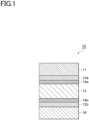
- Fig. 1 is a cross-sectional view schematically illustrating an embodiment of a power storage device packaging material of the present disclosure.
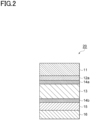
- a packaging material (power storage device packaging material) 10 of the present embodiment is a laminate including, in the following order, a substrate layer 11, a first adhesive layer 12a formed on a surface of the substrate layer 11, a barrier layer 13 formed on the first adhesive layer 12a on a side opposite to that facing the substrate layer 11, the barrier layer 13 provided with first and second anticorrosion treatment layers 14a and 14b on respective sides, a second adhesive layer 12b formed on the barrier layer 13 on a side opposite to that facing the first adhesive layer 12a, and a sealant layer 16 formed on the second adhesive layer 12b on a side opposite to that facing the barrier layer 13.
- the first anticorrosion treatment layer 14a is provided on a surface of the barrier layer 13 facing the substrate layer 11, and the second anticorrosion treatment layer 14b is provided on a surface of the barrier layer 13 facing the sealant layer 16.
- the substrate layer 11 is the outermost layer and the sealant layer 16 is the innermost layer.
- the packaging material 10 is used with the substrate layer 11 being on the outside of the power storage device and the sealant layer 16 being on the inside of the power storage device.
- At least one of the first adhesive layer 12a and the second adhesive layer 12b is a layer containing a polyurethane-based compound made of a reaction product of at least one polyester polyol resin and at least one polyfunctional isocyanate compound.
- the polyfunctional isocyanate compound contains an isocyanurate of isophorone diisocyanate (IPDI-isocyanurate), and the content of isocyanate groups derived from the IPDI-isocyanurate in the polyfunctional isocyanate compound is 5 mol% to 100 mol% relative to the total amount of isocyanate groups contained in the polyfunctional isocyanate compound of 100 mol%.
- the substrate layer 11 imparts heat resistance to the packaging material in the sealing step during production of the power storage device, and prevents pinholes from occurring during forming processing or distribution. Particularly in the case of a packaging material for a large power storage device, the substrate layer 11 can also impart scratch resistance, chemical resistance, and insulating properties.
- the substrate layer 11 is preferably formed of a resin film made of a resin having insulating properties.
- the resin film include stretched or unstretched films such as polyester films, polyamide films, polyimide films, and polypropylene films.
- the substrate layer 11 may be a monolayer film made of one of these resin films, or a laminated film made of two or more of these resin films.
- the substrate layer 11 is preferably made of, among the above resin films, a polyester film or a polyamide film, and more preferably a polyester film from the perspective of having excellent formability. These films are preferably biaxially stretched.
- a polyester resin constituting the polyester film may be, for example, polyethylene terephthalate (PET).
- PET polyethylene terephthalate
- a polyamide resin constituting the polyamide film may be, for example, Nylon-6, Nylon-6,6, a copolymer of Nylon-6 and Nylon-6,6, Nylon-6,10, polymetaxylylene adipamide (MXD6), Nylon-11, or Nylon-12.
- nylon 6 ONy is preferred from the perspective of having good heat resistance, piercing strength and impact strength.
- the stretching method used for the biaxially stretched film may be, for example, sequential biaxial stretching, tubular biaxial stretching, or simultaneous biaxial stretching. From the perspective of obtaining better deep drawing formability, the biaxially stretched film is preferably stretched using a tubular biaxial stretching method.
- the substrate layer 11 has a peak melting temperature higher than that of the sealant layer 16.
- the peak melting temperature of the sealant layer 16 refers to that of the layer having a maximum peak melting temperature.
- the peak melting temperature of the substrate layer 11 is preferably 290°C or higher, and more preferably 290°C to 350°C.
- the resin film that can be used as the substrate layer 11 and has a peak melting temperature within the above range may be a nylon film, PET film, polyamide film, polyimide film, or polyphenylene sulfide film (PPS film).
- the substrate layer 11 may be a commercially available film, or may be a coating film (obtained by applying and drying a coating liquid).
- the substrate layer 11 may have a single layer structure or a multilayer structure, or may be formed by applying a thermosetting resin. Further, the substrate layer 11 may contain various additives (e.g., a flame retardant, slip agent, anti-blocking agent, antioxidant, photostabilizer, and tackifier).
- various additives e.g., a flame retardant, slip agent, anti-blocking agent, antioxidant, photostabilizer, and tackifier.
- the difference between them is preferably 20°C or more.
- the temperature difference is 20°C or more, deterioration in appearance of the packaging material 10 due to heat-sealing can be more sufficiently prevented.
- the substrate layer 11 preferably has a thickness of 5 ⁇ m to 50 ⁇ m, more preferably 6 ⁇ m to 40 ⁇ m, still more preferably 10 ⁇ m to 30 ⁇ m, and particularly preferably 12 ⁇ m to 30 ⁇ m.
- the thickness of the substrate layer 11 is 5 ⁇ m or more, there is a tendency to improve pinhole resistance and insulation properties of the power storage device packaging material 10.
- the substrate layer 11 has a thickness of greater than 50 ⁇ m, the total thickness of the power storage device packaging material 10 increases, and the electrical capacity of the battery may have to be reduced, which is not desirable.
- the first adhesive layer 12a bonds the substrate layer 11 and the barrier layer 13.
- the first adhesive layer 12a (hereinafter, also referred to as a "specific adhesive layer”) is a layer containing a polyurethane-based compound made of a reaction product of at least one polyester polyol resin and at least one polyfunctional isocyanate compound, in which the polyfunctional isocyanate compound contains IPDI-isocyanurate, and the content of isocyanate groups derived from the IPDI-isocyanurate in the polyfunctional isocyanate compound is 5 mol% to 100 mol% relative to the total amount of isocyanate groups contained in the polyfunctional isocyanate compound of 100 mol%.
- the content of isocyanate groups derived from the IPDI-isocyanurate in the polyfunctional isocyanate compound is 5 mol% to 100 mol%, preferably 25 mol% to 95 mol%, and more preferably 50 mol% to 75 mol% relative to the total amount of isocyanate groups contained in the polyfunctional isocyanate compound of 100 mol%.
- the content is 5 mol% or more, lamination strength in a high temperature environment can be obtained, and occurrence of delamination when the packaging material is exposed to a high temperature after the deep drawing can be prevented.
- the above content may be 100 mol%, or may be less than 100 mol% when a polyfunctional isocyanate compound other than the IPDI-isocyanurate is used in combination with the IPDI-isocyanurate.
- a polyfunctional isocyanate compound other than the IPDI-isocyanurate is used in combination with the IPDI-isocyanurate.
- the content is 95 mol% or less, lamination strength in a room temperature environment and deep drawing formability tend to be further improved due to the effect of combined use of other polyfunctional isocyanate compounds.
- the polyfunctional isocyanate compound may include, in addition to the IPDI-isocyanurate, at least one selected from the group consisting of an adduct of tolylene diisocyanate (TDI-adduct), an adduct of hexamethylene diisocyanate, a biuret and an isocyanurate of hexamethylene diisocyanate, a biuret and an isocyanurate of tolylene diisocyanate, an adduct, a biuret and an isocyanurate of diphenylmethane diisocyanate, and an adduct, a biuret and an isocyanurate of xylylene diisocyanate, or may include TDI-adduct.
- TDI-adduct adduct of tolylene diisocyanate
- lamination strength in a room temperature environment and deep drawing formability can be further improved.
- a ratio (NCO A /NCO B ) of the number of isocyanate groups (NCOa) derived from the IPDI-isocyanurate to the number of isocyanate groups (NCO B ) derived from the TDI-adduct may be 0.05 to 20.
- the ratio (NCO A /NCO B ) may be 0.3 to 6, preferably 2 to 4, and more preferably 3. Further, the ratio (NCO A /NCO B ) may also be 7 to 20.
- the ratio is 0.05 or more, sufficient lamination strength in a high temperature environment can be obtained, and occurrence of delamination when the packaging material is exposed to a high temperature after the deep drawing can be sufficiently prevented.
- the ratio is 20 or less, lamination strength in a room temperature environment and deep drawing formability can be further improved.
- a ratio (NCO/OH) of the number of isocyanate groups contained in the polyfunctional isocyanate compound to the number of hydroxyl groups contained in the polyester polyol resin may be 2 to 60, preferably 5 to 50, and more preferably 10 to 30.
- the ratio is 2 or more, lamination strength in a high temperature environment can be further improved.
- the ratio is 60 or less, lamination strength in a room temperature environment and a high temperature environment can be further improved.
- the thickness of the first adhesive layer 12a is not specifically limited, but may be, for example, preferably 1 ⁇ m to 10 ⁇ m, and more preferably 3 ⁇ m to 7 ⁇ m from the perspective of obtaining desired adhesive strength, conformability, and processability.
- a mass per unit area of the first adhesive layer 12a may be 2.0 g/m 2 to 6.0 g/m 2 , preferably 2.5 g/m 2 to 5.0 g/m 2 , and more preferably 3.0 g/m 2 to 4.0 g/m 2 from the perspective of ensuring further improved lamination strength in a room temperature environment and a high temperature environment, and obtaining further improved deep drawing formability.
- the barrier layer 13 has water vapor barrier properties to prevent moisture from infiltrating into the power storage device. Further, the barrier layer 13 has ductility and malleability for deep drawing.
- the barrier layer 13 can be made of, for example, various metal foils such as an aluminum, stainless steel and copper, or a metal vapor deposition film, an inorganic oxide vapor deposition film, a carbon-containing inorganic oxide vapor deposition film, or a film having these vapor deposition films. Examples of the film having a vapor deposition film include an aluminum vapor deposition film and an inorganic oxide vapor deposition film. These can be used singly or in combination of two or more.
- the barrier layer 13 is preferably made of a metal foil, and more preferably made of an aluminum foil from the viewpoint of the weight (specific gravity), moisture resistance, processability, and cost.
- the aluminum foil may be a soft aluminum foil, particularly one subjected to an annealing treatment from the perspective of imparting desired ductility and malleability during forming. It is more preferable to use an iron-containing aluminum foil for the purpose of further imparting pinhole resistance, ductility and malleability during forming.
- the iron content in the aluminum foil is preferably 0.1 mass% to 9.0 mass%, and more preferably 0.5 mass% to 2.0 mass% relative to 100 mass% of the aluminum foil.
- the iron content of 0.1 mass% or more can improve pinhole resistance, ductility and malleability of a packaging material 10.
- the iron content of 9.0 mass% or less can improve flexibility of a packaging material 10.
- an untreated aluminum foil may also be used as the aluminum foil
- an aluminum foil subjected to a degreasing treatment is preferably used from the perspective of imparting electrolyte resistance.
- the aluminum foil is degreased, only one surface of the aluminum foil may be degreased, or both surfaces may be degreased.
- the thickness of the barrier layer 13 is not specifically limited, but is preferably 9 ⁇ m to 200 ⁇ m, and more preferably 15 ⁇ m to 100 ⁇ m from the perspective of barrier properties, pinhole resistance and processability.
- the thickness less than 15 ⁇ m may decrease formability. Further, the thickness greater than 100 ⁇ m tends to decrease the weight energy density of the battery, leading to a high cost.
- the first and second anticorrosion treatment layers 14a and 14b are disposed on respective surfaces of the barrier layer 13 to prevent corrosion of the metal foil (metal foil layer) constituting the barrier layer 13.
- the first anticorrosion treatment layer 14a enhances adhesion between the barrier layer 13 and the first adhesive layer 12a.
- the second anticorrosion treatment layer 14b enhances adhesion between the barrier layer 13 and the second adhesive layer 12b.
- the first and second anticorrosion treatment layers 14a and 14b may have the same configuration or different configurations.
- the first and second anticorrosion treatment layers 14a and 14b may be formed by, for example, degreasing treatment, hydrothermal modification treatment, anodic oxidation treatment, chemical conversion treatment, or a combination of these treatments.
- the degreasing treatment may be acid degreasing or alkaline degreasing.
- the acid degreasing may be a method using an inorganic acid, such as sulfuric acid, nitric acid, hydrochloric acid or hydrofluoric acid, alone or in combination.
- the acid degreasing may include use of an acid degreasing agent obtained by dissolving a fluorine-containing compound such as monosodium ammonium difluoride with the aforementioned inorganic acid.
- the alkaline degreasing may be a method using sodium hydroxide.
- the hydrothermal modification treatment may be, for example, a boehmite treatment in which an aluminum foil is immersed in boiling water to which triethanolamine has been added.
- the anodic oxidation treatment may be, for example, an alumite treatment.
- the chemical conversion treatment may be an immersion type or a coating type.
- immersion type chemical conversion treatment include chromate treatment, zirconium treatment, titanium treatment, vanadium treatment, molybdenum treatment, calcium phosphate treatment, strontium hydroxide treatment, cerium treatment, ruthenium treatment, and various chemical conversion treatments of mixed phases thereof.
- coating type chemical conversion treatment include a method of applying a coating agent having a corrosion prevention performance to the barrier layer 13.
- degreasing treatment is preferably performed in advance. Further, when a degreased metal foil such as an annealed metal foil is used as the barrier layer 13, it is not necessary to perform degreasing treatment again in forming the anticorrosion treatment layers 14a and 14b.
- the coating agent used for the coating type chemical conversion treatment preferably contains trivalent chromium. Further, the coating agent may contain at least one polymer selected from the group consisting of a cationic polymer and an anionic polymer described later.
- the hydrothermal modification treatment and the anodic oxidation treatment in particular, dissolve a surface of an aluminum foil with a treating agent to form an aluminum compound (such as boehmite or alumite) having good corrosion resistance.
- a treating agent such as boehmite or alumite
- the anticorrosion treatment layers 14a and 14b can also be formed only by a pure coating method, which is not included in the definition of the chemical conversion treatment, as will be described later.
- this coating method may use a rare-earth oxide sol such as cerium oxide with a mean particle size of 100 nm or less as a material exhibiting an anticorrosion effect (inhibitor effect) for aluminum and preferable in terms of environmental aspects.
- a rare-earth oxide sol such as cerium oxide with a mean particle size of 100 nm or less as a material exhibiting an anticorrosion effect (inhibitor effect) for aluminum and preferable in terms of environmental aspects.
- Use of this method makes it possible to impart an anticorrosion effect to a metal foil such as an aluminum foil even when using an ordinary coating method.
- the rare-earth oxide sol examples include sols using various solvents such as an aqueous solvent, an alcohol-based solvent, a hydrocarbon-based solvent, a ketone-based solvent, an ester-based solvent, and an ether-based solvent. Of these sols, an aqueous sol is preferred.
- the rare-earth oxide sol may contain, as a dispersion stabilizer, an inorganic acid such as nitric acid, hydrochloric acid, phosphoric acid, or a salt thereof, or an organic acid such as acetic acid, malic acid, ascorbic acid, or lactic acid.
- phosphoric acid in particular, is expected to impart the packaging material 10 with features of (1) stabilizing dispersion of the sol, (2) improving adhesion to the barrier layer 13 making use of an aluminum chelate ability of phosphoric acid, and (3) improving cohesive force of the anticorrosion treatment layers 14a and 14b (oxide layers) by readily inducing dehydration condensation of phosphoric acid even at low temperature.
- the phosphoric acid or a salt thereof may be orthophosphoric acid, pyrophosphoric acid, metaphosphoric acid, or an alkali metal salt or an ammonium salt thereof.
- a condensed phosphoric acid such as trimetaphosphoric acid, tetrametaphosphoric acid, hexametaphosphoric acid or ultrametaphosphoric acid, or an alkali metal salt thereof or an ammonium salt thereof is preferred for functional development in the packaging material 10.
- a sodium salt is more preferred from the perspective of exhibiting good dehydrating condensation at low temperature.
- the phosphate is preferably a water-soluble salt.
- the content of the phosphoric acid (or a salt thereof) in the rare-earth oxide is preferably 1 part by mass to 100 parts by mass relative to 100 parts by mass of the rare-earth oxide.
- the above content of the phosphoric acid or a salt thereof is 1 part by mass or more relative to 100 parts by mass of the rare-earth oxide, the rare-earth oxide sol becomes more stable and the function of the packaging material 10 becomes much better.
- the above content is more preferably 5 parts by mass or more relative to 100 parts by mass of the rare-earth oxide.
- the function of the rare-earth oxide sol is enhanced.
- the above content is preferably 50 parts by mass or less, and more preferably 20 parts by mass or less, relative to 100 parts by mass of the rare-earth oxide.
- the anticorrosion treatment layers 14a and 14b formed of the rare-earth oxide sol are aggregates of inorganic particles, the cohesive force of these layers may be lowered even after being dry-cured. Therefore, the anticorrosion treatment layers 14a and 14b in this case are preferably compounded with an anionic polymer or a cationic polymer described below in order to supplement the cohesive force.
- the anionic polymer may be a polymer having a carboxy group.
- poly(meth)acrylic acid (or a salt thereof), or a copolymer containing poly(meth)acrylic acid as a main component may be used.
- the copolymerization component of the copolymer includes an alkyl (meth)acrylate monomer (having a methyl group, an ethyl group, an n-propyl group, an i-propyl group, an n-butyl group, an i-butyl group, a t-butyl group, a 2-ethylhexyl group, a cyclohexyl group, etc.
- an amide group-containing monomer such as (meth)acrylamide, N-alkyl (meth)acrylamide, or N,N-dialkyl (meth)acrylamide (having a methyl group, an ethyl group, an n-propyl group, an i-propyl group, an n-butyl group, an i-butyl group, a t-butyl group, a 2-ethylhexyl group, a cyclohexyl group, etc.
- N-alkoxy (meth)acrylamide as an alkyl group
- N-alkoxy (meth)acrylamide or N,N-dialkoxy (meth)acrylamide (having a methoxy group, an ethoxy group, a butoxy group, an isobutoxy group, etc.
- N-methylol (meth)acrylamide, or N-phenyl (meth)acrylamide a hydroxyl group-containing monomer such as 2-hydroxyethyl (meth)acrylate, or 2-hydroxypropyl (meth)acrylate
- a glycidyl group-containing monomer such as glycidyl (meth)acrylate, or allyl glycidyl ether
- silane-containing monomer such as (meth)acryloxypropyltrimethoxysilane or (meth)acryloxypropyltriethoxysilane
- an isocyanate such as (meth)acryloxypropyl isocyanate.
- anionic polymers improve the stability of the anticorrosion treatment layers 14a and 14b (oxide layers) obtained using the rare-earth element oxide sol.
- the improvement is achieved by the effect of protecting a hard and brittle oxide layer with an acrylic resin component, and the effect of capturing ion contamination (particularly sodium ions) derived from the phosphate contained in the rare-earth oxide sol (cation catcher). That is, if the anticorrosion treatment layers 14a and 14b obtained using the rare-earth oxide sol contain alkali metal ions such as sodium ions or alkaline earth metal ions in particular, the anticorrosion treatment layers 14a and 14b are likely to be deteriorated starting from the ion-containing site. Therefore, the sodium ion contained in the rare-earth oxide sol is fixed with the anionic polymer to improve the durability of the anticorrosion treatment layers 14a and 14b.
- the anticorrosion treatment layers 14a and 14b obtained by combining the anionic polymer and the rare-earth oxide sol have anticorrosion performance equivalent to that of the anticorrosion treatment layers 14a and 14b formed by applying chromate treatment to an aluminum foil.
- the anionic polymer preferably has a structure in which a polyanionic polymer which is essentially water-soluble is crosslinked.
- the crosslinking agent used for forming this structure may be a compound having, for example, an isocyanate group, a glycidyl group, a carboxy group or an oxazoline group.
- Examples of the compound having an isocyanate group include diisocyanates such as tolylene diisocyanate, xylylene diisocyanate or a hydrogenated product thereof, hexamethylene diisocyanate, 4,4'-diphenylmethane diisocyanate or a hydrogenated product thereof, and isophorone diisocyanate; polyisiocyanates such as an adduct obtained by reacting these isocyanates with a polyhydric alcohol such as trimethylolpropane, a biuret obtained by reacting the isocyanates with water, or an isocyanurate as a trimer; and a blocked polyisocyanate obtained by blocking these polyisocyanates with an alcohol, a lactam, or an oxime.
- diisocyanates such as tolylene diisocyanate, xylylene diisocyanate or a hydrogenated product thereof, hexamethylene diisocyanate, 4,4'-diphenylmethane di
- Examples of the compound having a glycidyl group include epoxy compounds obtained by permitting epichlorohydrin to act on a glycol such as ethylene glycol, diethylene glycol, triethylene glycol, polyethylene glycol, propylene glycol, dipropylene glycol, tripropylene glycol, polypropylene glycol, 1,4-butanediol, 1,6-hexanediol or neopentyl glycol; epoxy compounds obtained by permitting epichlorohydrin to act on a polyhydric alcohol such as glycerin, polyglycerin, trimethylolpropane, pentaerythritol or sorbitol; and epoxy compounds obtained by permitting epichlorohydrin to act on a dicarboxylic acid such as phthalic acid, terephthalic acid, oxalic acid or adipic acid.
- a glycol such as ethylene glycol, diethylene glycol, triethylene glycol, polyethylene glycol, propylene
- Examples of the compound having a carboxy group includes various aliphatic or aromatic dicarboxylic acids. Also, poly(meth)acrylic acid or an alkali (earth) metal salt of poly(meth)acrylic acid may be used.
- Examples of the compound having an oxazoline group include low molecular weight compounds having two or more oxazoline units, or when using a polymerizable monomer such as isopropenyloxazoline, compounds obtained by copolymerizing with acrylic monomers such as (meth)acrylic acid, (meth)acrylic acid alkyl ester and hydroxyalkyl (meth)acrylate.
- the crosslinking point may be a siloxane bond by reacting an anionic polymer with a silane coupling agent, more specifically, by selectively reacting a carboxy group of an anionic polymer with a functional group of a silane coupling agent.
- ⁇ -glycidoxypropyltrimethoxysilane, ⁇ -glycidoxypropyltriethoxysilane, ⁇ -(3,4-epoxycyclohexyl)ethyltrimethoxysilane, ⁇ -chloropropylmethoxysilane, vinyltrichlorosilane, ⁇ -mercaptopropyltrimethoxysilane, ⁇ -aminopropyltriethoxysilane, N- ⁇ (aminoethyl)- ⁇ -aminopropyltrimethoxysilane, or ⁇ -isocyanatopropyltriethoxysilane may be used.
- an epoxy silane, aminosilane or isocyanate silane is preferable in terms of reactivity with an anionic polymer or a copolymer thereof in particular.
- the ratio of these crosslinking agents to the anionic polymer is preferably 1 part by mass to 50 parts by mass, and more preferably 10 parts by mass to 20 parts by mass, relative to 100 parts by mass of the anionic polymer.
- the ratio of the crosslinking agent is 1 part by mass or more relative to 100 parts by mass of the anionic polymer, a sufficiently crosslinked structure is likely to be formed.
- the ratio of the crosslinking agent is 50 parts by mass or less relative to 100 parts by mass of the anionic polymer, the pot life of the coating solution improves.
- the method used for crosslinking the anionic polymer may be a method of forming an ionic crosslinkage using titanium, or zirconium compound, and is not limited to the use of the crosslinking agents mentioned above.
- the cationic polymer may be a polymer having an amine, including polyethyleneimine, an ionic polymer complex composed of a polymer having polyethyleneimine and a carboxylic acid, a primary amine graft acrylic resin obtained by grafting a primary amine to an acrylic backbone, polyallylamine or derivatives thereof, and aminophenol.
- the polyallylamine include homopolymers or copolymers of allylamine, allylamine amide sulfate, diallylamine, and dimethylallylamine. These amines may be free amines or may be ones stabilized with acetic acid or hydrochloric acid. Maleic acid, or sulfur dioxide may be used as a copolymer component.
- a primary amine may be used after being partially methoxylated to impart crosslinking properties thereto, or aminophenol may also be used. In particular, allylamine or derivatives thereof are preferable.
- the cationic polymer is preferably used in combination with a crosslinking agent having a functional group, such as a carboxy group or a glycidyl group, capable of reacting with an amine/imine.
- the crosslinking agent to be used in combination with the cationic polymer may be polymers having carboxylic acid that forms an ionic polymer complex with polyethyleneimine.
- Examples of such a crosslinking agent include polycarboxylic acid (salt) such as polyacrylic acid or ionic salts thereof, copolymers having a comonomer introduced thereto, and polysaccharides having a carboxy group such as carboxymethyl cellulose or ionic salts thereof.
- the cationic polymer is a more preferable material from the perspective of improving adhesiveness. Since the cationic polymer is water-soluble similarly to the anionic polymer mentioned above, it is more preferable to impart water resistance by permitting it to form a crosslinked structure.
- the crosslinking agent that can be used for forming a crosslinked structure in the cationic polymer may include ones mentioned in the section on the anionic polymer.
- a rare-earth oxide sol is used as the anticorrosion treatment layers 14a and 14b
- a cationic polymer may be used as a protective layer, instead of using the anionic polymer mentioned above.
- the anticorrosion treatment layer is a chemical conversion treatment layer obtained through chemical conversion treatment represented by a chromate treatment, and can form a gradient structure on the aluminum foil in which the chemical conversion treatment layer is formed on the aluminum foil by treating the aluminum foil using, in particular, a chemical conversion treating agent containing hydrofluoric acid, hydrochloric acid, nitric acid, sulfuric acid, or a salt thereof, followed by permitting it to react with a chromium- or non-chromium-based compound.
- the chemical conversion treatment which uses an acid as a chemical conversion treating agent, causes deterioration of the working environment and corrosion of the coating device.
- the coating-type anticorrosion treatment layers 14a and 14b mentioned above do not need to form a gradient structure on the barrier layer 13 of an aluminum foil, unlike the anticorrosion treatment layer obtained through the chemical conversion treatment represented by a chromate treatment. Therefore, the properties of the coating agent are not restricted in terms of acidity, alkalinity, and neutrality, and a good working environment can be achieved.
- the coating-type anticorrosion treatment layers 14a and 14b are preferred since chromate treatment using a chromium compound requires alternatives in terms of environmental health.
- coating-type anticorrosion treatments as mentioned above can be combined as follows, for example: (1) rare-earth oxide sol alone, (2) anionic polymer alone, (3) cationic polymer alone, (4) rare-earth oxide sol + anionic polymer (laminated composite), (5) rare-earth oxide sol + cationic polymer (laminated composite), (6) rare-earth oxide sol + anionic polymer (laminated composite) / cationic polymer (multilayered), (7) rare-earth oxide sol + cationic polymer (laminated composite) / anionic polymer (multilayered).
- (1) and (4) through (7) are preferred, and (4) through (7) are more preferred.
- the present embodiment is not limited to the above combinations.
- an anticorrosion treatment may be selected as follows.
- the cationic polymer is a highly preferable material in terms of having good adhesion to a modified polyolefin resin, as will be described in the section of adhesive resin layer. Therefore, when the adhesive resin layer is formed of a modified polyolefin resin, it is possible to design it that the cationic polymer is provided on the surface contacting the adhesive resin layer (e.g., configurations (5) and (6)).
- the anticorrosion treatment layers 14a and 14b are not limited to the layer mentioned above.
- the anticorrosion treatment layers may be formed using a treating agent prepared by blending a phosphoric acid and a chromium compound with a resin binder (such as aminophenol) as in a coating-type chromate based on known art.
- a coating agent may be prepared in advance by integrating a rare-earth oxide sol with a polycationic polymer or a polyanionic polymer, and using this coating agent, the anticorrosion treatment layers may be formed being imparted with both the corrosion-preventing function and adhesion.
- the anticorrosion treatment layers 14a and 14b preferably have mass per unit area of 0.005 g/m 2 to 0.200 g/m 2 , and more preferably 0.010 g/m 2 to 0.100 g/m 2 .
- mass per unit area is 0.005 g/m 2 or more, a corrosion-preventing function can be readily imparted to the barrier layer 13. Even if the mass per unit area exceeds 0.200 g/m 2 , there is little change in the corrosion-preventing function. If a rare-earth oxide sol is used and if the coating film is thick, heat-curing during drying may be insufficient, and may decrease the cohesive force.
- the thickness of the anticorrosion treatment layers 14a and 14b can be calculated from their specific gravity.
- the anticorrosion treatment layers 14a and 14b may contain, for example, cerium oxide, 1 part by mass to 100 parts by mass of phosphoric acid or phosphate relative to 100 parts by mass of the cerium oxide, and a cationic polymer, or may be formed by applying a chemical conversion treatment to the barrier layer 13, or may contain a cationic polymer and be formed by applying a chemical conversion treatment to the barrier layer 13.
- the second adhesive layer 12b bonds the barrier layer 13, on which the second anticorrosion treatment layer 14b is formed, to the sealant layer 16.
- the second adhesive layer 12b may be a general purpose adhesive for bonding a barrier layer to a sealant layer.
- examples of the material used for forming the second adhesive layer 12b include a polyurethane resin prepared by reacting a bifunctional or higher functional isocyanate compound with a main resin such as a polyester polyol, polyether polyol, acrylic polyol, or carbonate polyol.
- the second adhesive layer 12b may be the specific adhesive layer described above.
- the thickness of the second adhesive layer 12b is not particularly limited, but from the perspective of obtaining a desired adhesive strength, and processability, the thickness is preferably 1 ⁇ m to 10 ⁇ m, and more preferably 3 ⁇ m to 7 ⁇ m.
- a mass per unit area of the second adhesive layer 12b may be 2.0 g/m 2 to 6.0 g/m 2 , preferably 2.5 g/m 2 to 5.0 g/m 2 , and more preferably 3.5 g/m 2 to 4.5 g/m 2 from the perspective of ensuring further improved lamination strength in a room temperature environment and a high temperature environment, and obtaining further improved deep drawing formability.
- the sealant layer 16 imparts sealing properties to the packaging material 10 due to heat-sealing.
- the sealant layer 16 may be a resin film made of a polyolefin-based resin or a polyester-based resin. These resins (hereinafter, also referred to as "base resins") constituting the sealant layer 16 may be used singly or in combination of two or more.
- polystyrene-based resin examples include: low density, medium density or high density polyethylenes; ethylene- ⁇ olefin copolymers; polypropylenes; block or random copolymers containing propylene as a copolymerization component; and propylene- ⁇ olefin copolymers.
- polyester-based resin examples include polyethylene terephthalate (PET) resin, polybutylene terephthalate (PBT) resin, polyethylene naphthalate (PEN) resin, polybutylene naphthalate (PBN) resin, and polytrimethylene terephthalate (PTT) resin.
- PET polyethylene terephthalate
- PBT polybutylene terephthalate
- PEN polyethylene naphthalate
- PBN polybutylene naphthalate
- PTT polytrimethylene terephthalate
- the sealant layer 16 may contain a polyolefin-based elastomer.
- the polyolefin-based elastomer may or may not have miscibility with the base resin described above, or may contain both a miscible polyolefin-based elastomer having miscibility and an immiscible polyolefin-based elastomer having no miscibility.
- Having miscibility (miscible system) means that the polyolefin-based elastomer is dispersed with a dispersed phase size of 1 nm or more and less than 500 nm in the base resin.
- Having no miscibility (immiscible system) means that the polyolefin-based elastomer is dispersed with a dispersed phase size of 500 nm or more and less than 20 ⁇ m in the base resin.
- the miscible polyolefin-based elastomer may be, for example, propylene-butene-1 random copolymer
- the immiscible polyolefin-based elastomer may be, for example, ethylene-butene-1 random copolymer.
- the polyolefin-based elastomers can be used singly or in combination of two or more.
- the sealant layer 16 may contain additive components such as a slip agent, an anti-blocking agent, an antioxidant, a photostabilizer, and a flame retardant.
- additive components such as a slip agent, an anti-blocking agent, an antioxidant, a photostabilizer, and a flame retardant.
- the content of these additive components is preferably 5 parts by mass or less when the total mass of the sealant layer 16 is 100 parts by mass.
- the thickness of the sealant layer 16 is not specifically limited, but may be preferably in the range of 5 to 100 ⁇ m, more preferably in the range of 10 to 100 ⁇ m, and still more preferably in the range of 20 to 80 ⁇ m from the perspective of reducing the film thickness and enhancing the heat seal strength in a high temperature environment.
- the sealant layer 16 may be either a single-layer film or a multi-layer film, and may be suitably selected according to the required function.
- Fig. 1 illustrates an example in which the anticorrosion treatment layers 14a and 14b are disposed on respective sides of the barrier layer 13. However, only one of the anticorrosion treatment layers 14a and 14b may be provided, or the anticorrosion treatment layer may not be provided.
- Fig. 1 illustrates an example in which the barrier layer 13 and the sealant layer 16 are laminated using the second adhesive layer 12b.
- the barrier layer 13 and the sealant layer 16 may also be laminated using an adhesive resin layer 15, as in a power storage device packaging material 20 shown in Fig. 2 .
- the second adhesive layer 12b may also be provided between the barrier layer 13 and the adhesive resin layer 15.
- the adhesive resin layer 15 is substantially composed of an adhesive resin composition as the main component and additive components, if necessary.
- the adhesive resin composition is not particularly limited, but preferably contains a modified polyolefin resin.
- the modified polyolefin resin is preferably a polyolefin resin graft-modified with an unsaturated carboxylic acid derivative derived from any of an unsaturated carboxylic acid, acid anhydride thereof and ester thereof.
- polystyrene resin examples include low density, medium density and high density polyethylenes, ethylene- ⁇ olefin copolymers, homopolypropylenes, blocked polypropylenes, random polypropylenes, and propylene- ⁇ olefin copolymers.
- the modified polyolefin resin is preferably a polyolefin resin modified with maleic anhydride.
- a polyolefin resin modified with maleic anhydride for example, "ADMER” manufactured by Mitsui Chemicals, Inc., and "MODIC” manufactured by Mitsubishi Chemical Corporation are suitable for the modified polyolefin resin.
- Such a modified polyolefin resin excels at reactivity with various metals and polymers having various functional groups, and thus can impart adhesion to the adhesive resin layer 15 making use of the reactivity and can accordingly improve electrolyte resistance.
- the adhesive resin layer 15 may contain, if necessary, various miscible and immiscible elastomers and various additives such as flame retardants, slip agents, anti-blocking agents, antioxidants, photostabilizers and tackifiers.
- the thickness of the adhesive resin layer 15 is not specifically limited, but preferably equal to or less than that of the sealant layer 16 from the perspective of stress relaxation and moisture/electrolyte permeation.
- the total thickness of the adhesive resin layer 15 and the sealant layer 16 in the power storage device packaging material 20 is preferably in the range of 5 ⁇ m to 100 ⁇ m, and more preferably 20 ⁇ m to 80 ⁇ m from the perspective of reducing the film thickness and enhancing the heat seal strength in a high temperature environment.
- the method of producing the packaging material 10 of the present embodiment includes a step of laminating the anticorrosion treatment layers 14a and 14b on respective sides of the barrier layer 13, a step of bonding the substrate layer 11 and the barrier layer 13 using the first adhesive layer 12a, a step of preparing a laminate by further laminating the sealant layer 16 via the second adhesive layer 12b, and, if necessary, a step of aging the resultant laminate.
- the anticorrosion treatment layers 14a and 14b are formed on the barrier layer 13.
- the method may include applying a degreasing treatment, hydrothermal modification treatment, anodic oxidation treatment, or chemical conversion treatment to the barrier layer 13, or applying a coating agent having a corrosion prevention performance to the barrier layer 13.
- a coating liquid (coating agent) that serves as a lower layer-side (barrier layer 13-side) anticorrosion treatment layer may be applied to the barrier layer 13, followed by baking to form a first layer, and then, a coating liquid (coating agent) that serves as an upper layer-side anticorrosion treatment layer may be applied to the first layer, followed by baking to form a second layer.
- the degreasing treatment may be performed by spraying or immersion.
- the hydrothermal conversion treatment and the anodic oxidation treatment may be performed by immersion.
- the chemical conversion treatment may be selected from among immersion, spraying and coating depending on the type of chemical conversion treatment.
- the various treatments may be applied to either side or both sides of the metal foil.
- the treatment is preferably applied to the surface on which the sealant layer 16 is to be laminated. If needed, the treatment mentioned above may also be applied to the surface of the substrate layer 11.
- the amounts of the coating agents for forming the first and second layers are preferably 0.005 g/m 2 to 0.200 g/m 2 , and more preferably 0.010 g/m 2 to 0.100 g/m 2 .
- dry curing may be carried out within a base material temperature range of 60°C to 300°C depending on the drying conditions of the anticorrosion treatment layers 14a and 14b used.
- the barrier layer 13 provided with the anticorrosion treatment layers 14a and 14b on respective sides is bonded to the substrate layer 11 via the first adhesive layer 12a.
- These layers are bonded to each other using the material constituting the first adhesive layer 12a described above by a bonding method such as dry lamination, non-solvent lamination or wet lamination.
- the dry coating weight of the first adhesive layer 12a is in the range of 1 g/m 2 to 10 g/m 2 , and more preferably 2 g/m 2 to 6 g/m 2 .
- the sealant layer 16 is bonded to the second anticorrosion treatment layer 14b-side of the barrier layer 13 via the second adhesive layer 12b.
- the bonding method may be wet processing or dry lamination.
- a solution or a dispersion of the adhesive forming the second adhesive layer 12b is applied to the second anticorrosion treatment layer 14b, and the solvent is vaporized at a predetermined temperature, followed by drying, which may be further followed by baking, if necessary, to thereby form a film. Then, the sealant layer 16 is laminated, thereby preparing the packaging material 10.
- the coating method may be any of the various coating methods mentioned above.
- the preferred dry coating weight of the second adhesive layer 12b is the same as that of the first adhesive layer 12a.
- the sealant layer 16 can be produced, for example, using a resin composition for forming a sealant layer, containing a constituent component of the sealant layer 16 described above by using a melt extrusion molding machine.
- the processing rate of the melt extrusion molding machine may be set to 80 m/min or more from the viewpoint of productivity.
- the laminate is aged (cured). Aging of the laminate can expedite adhesion between the barrier layer 13 / the second anticorrosion treatment layer 14b / the second adhesive layer 12b / the sealant layer 16. Aging may be conducted in the range of room temperature to 100°C. Aging time may be, for example, 1 day to 10 days.
- the packaging material 10 of the present embodiment as shown in Fig. 1 can be produced.
- the method of producing the packaging material 20 is not limited to the following one.
- the method of producing the packaging material 20 of the present embodiment includes a step of laminating the anticorrosion treatment layers 14a and 14b on respective sides of the barrier layer 13, a step of bonding the substrate layer 11 and the barrier layer 13 using the first adhesive layer 12a, a step of preparing a laminate by further laminating the adhesive resin layer 15 and the sealant layer 16, and, if necessary, a step of heating the resultant laminate.
- the steps up to the step of bonding the substrate layer 11 and the barrier layer 13 can be performed in the same manner as in the method of producing the packaging material 10.
- the adhesive resin layer 15 and the sealant layer 16 are formed on the second anticorrosion treatment layer 14b formed in the previous step.
- the method includes sandwich-laminating the adhesive resin layer 15 together with the sealant layer 16 using an extrusion laminator. Further, tandem lamination or co-extrusion by which the adhesive resin layer 15 and the sealant layer 16 are extruded can also be used.
- the components of the adhesive resin layer 15 and the sealant layer 16 may be formulated, for example, to meet the above-mentioned configurations of the adhesive resin layer 15 and the sealant layer 16.
- the sealant layer 16 is formed by using the above resin composition for forming a sealant layer.
- a laminate as shown in Fig. 2 , where the substrate layer 11 / the first adhesive layer 12a / the first anticorrosion treatment layer 14a / the barrier layer 13 / the second anticorrosion treatment layer 14b / the adhesive resin layer 15 / the sealant layer 16 are laminated in this order.
- materials that are dry-blended so as to have the composition of the material formulation mentioned above may be directly laminated using an extrusion laminator.
- granules obtained in advance by melt-blending materials using a melt kneading device such as a single-screw extruder, twin-screw extruder or Brabender mixer may be laminated using an extrusion laminator.
- materials that are dry-blended so as to have the composition of the material formulation mentioned above, as a resin composition for forming a sealant layer may be directly laminated using an extrusion laminator.
- granules obtained in advance by melt-blending materials using a melt kneading device such as a single-screw extruder, twin-screw extruder or Brabender mixer may be used to laminate the adhesive resin layer 15 and the sealant layer 16 by tandem lamination or co-extrusion using an extrusion laminator.
- a sealant monolayer film may be formed in advance as a cast film using a resin composition for forming a sealant layer, and the film may be laminated by sandwich-lamination together with an adhesive resin.
- the formation rate (processing rate) of the adhesive resin layer 15 and the sealant layer 16 may be set to 80 m/min or more from the viewpoint of productivity.
- the laminate is heat-treated.
- Heat-treatment of the laminate can improve adhesion between the barrier layer 13 /the second anticorrosion treatment layer 14b / the adhesive resin layer 15 / the sealant layer 16.
- the heat-treatment is preferably performed at a temperature at least higher than the melting point of the adhesive resin layer 15.
- the packaging material 20 of the present embodiment as shown in Fig. 2 can be prepared.
- the power storage device packaging material of the present disclosure can be suitably used as a packaging material for power storage devices including, for example, secondary batteries such as a lithium-ion battery, a nickel-hydrogen battery and a lead storage battery, and electrochemical capacitors such as an electric double layer capacitor.
- the power storage device packaging material of the present disclosure is suitable as a packaging material for fully solid-state batteries using a solid electrolyte.
- Fig. 3 is a perspective view of an embodiment of the power storage device produced by using the aforementioned packaging material.
- a power storage device 50 includes a battery element (power storage device main body) 52, two metal terminals (current extraction terminals) 53 for externally extracting current from the battery element 52, and the packaging material 10 that contains the battery element 52 in a hermetically sealed state.
- the packaging material 10 is the aforementioned packaging material 10 according to the present embodiment.
- the substrate layer 11 is the outermost layer and the sealant layer 16 is the innermost layer.
- the packaging material 10 has a configuration in which a single laminate film is folded in half and heat-sealed, or two laminate films are overlapped with each other and heat-sealed, with the substrate layer 11 being on the outside of the power storage device 50 and the sealant layer 16 being on the inside of the power storage device 50, such that the battery element 52 is contained inside the packaging material 10.
- the packaging material 20 may be used instead of the packaging material 10.
- the battery element 52 is formed by interposing an electrolyte between a positive electrode and a negative electrode.
- the metal terminal 53 is a part of a current collector extending out from the packaging material 10, and made of a metal foil such as a copper foil or an aluminum foil.
- the power storage device 50 of the present embodiment may be a fully solid-state battery.
- a solid electrolyte such as a sulfide solid electrolyte may be used as the electrolyte of the battery element 52. Since the power storage device 50 of the present embodiment uses the packaging material 10 of the present embodiment, excellent lamination strength can be achieved even when the power storage device 50 is used in a high temperature environment.
- the power storage device packaging material according to the second aspect and the power storage device packaging material according to the first aspect are different in the first adhesive layer 12a.
- the first adhesive layer 12a bonds the substrate layer 11 and the barrier layer 13.
- the first adhesive layer 12a needs to contain a polyurethane-based compound and a polyamide-imide resin.
- the adhesive layer containing the polyurethane-based compound has high toughness, and is excellent in deep drawing formability and lamination strength in a room temperature environment.
- a polyamide-imide resin has good heat resistance.
- the adhesive layer is prepared by formulating the polyamide-imide resin and the polyurethane-based compound, it is possible to obtain sufficient lamination strength between the substrate layer 11 and the barrier layer 13 in a high temperature environment, for example, 170°C or higher, and excellent deep drawing formability of the packaging material 10, and further possible to maintain the lamination strength between the substrate layer 11 and the barrier layer 13 in a high temperature environment in the packaging material 10 after the deep drawing.
- the content of the polyamide-imide resin to the solid content of the polyurethane-based compound is defined as A mass%
- the content preferably satisfies 1.0 mass% ⁇ A ⁇ 20.0 mass%, and more preferably 10.0 mass% ⁇ A ⁇ 20.0 mass%.
- the number average molecular weight Mn of the polyamide-imide resin is preferably 3,000 ⁇ Mn ⁇ 36,000.
- the polyurethane-based compound may also be made of a reaction product of at least one polyol resin and at least one polyfunctional isocyanate compound.
- the type of the polyol resin is not specifically limited, but at least one polyol resin selected from the group consisting of polyester polyol, acrylic polyol and polycarbonate polyol can be preferably used. In this case, both the lamination strength between the substrate layer 11 and the barrier layer 13 in a high temperature environment and the formability of the packaging material 10 are improved.
- the type of the polyfunctional isocyanate compound is not specifically limited, but at least one isocyanate polymer selected from the group consisting of an alicyclic isocyanate polymer and an isocyanate polymer containing an aromatic ring in the molecular structure can be preferably used. In this case, both the lamination strength and the formability are improved.
- Examples of the alicyclic isocyanate polymer include an isocyanurate of isophorone diisocyanate (IPDI-isocyanurate).
- Examples of the isocyanate polymer containing an aromatic ring in the molecular structure include an adduct of tolylene diisocyanate (TDI-adduct). Further, an adduct, a biuret and an isocyanurate of diphenylmethane diisocyanate may be used. Further, an adduct, a biuret and an isocyanurate of xylylene diisocyanate may also be used.
- the polyurethane-based compound is a reaction product of a polyol resin at least partially made of polyester polyol and a polyfunctional isocyanate compound at least partially made of IPDI-isocyanurate.
- the packaging material 10 having the first adhesive layer 12a containing a polyurethane-based compound made of a reaction product of polyester polyol and IPDI-isocyanurate is particularly excellent in lamination strength between the substrate layer 11 and the barrier layer 13 in a high temperature environment and the formability of the packaging material 10.
- the content of isocyanate groups derived from the IPDI-isocyanurate in the polyfunctional isocyanate compound is the same as that in the first aspect.
- the ratio (NCO/OH) of the number of isocyanate groups contained in the polyfunctional isocyanate compound to the number of hydroxyl groups contained in the polyol resin is preferably 1.5 ⁇ NCO/OH ⁇ 40.0.
- the number of isocyanate groups contained in the hardener (polyfunctional isocyanate compound) of a polyurethane-based compound is very large relative to the number of hydroxyl groups contained in the base resin (polyol resin) (NCO/OH >> 1.0), the heat resistance is improved.
- the polyurethane-based compound is made of a reaction product of polyester polyol and IPDI-isocyanurate, the optimum value of the above NCO/OH is 20.
- Fig. 3 is a perspective view of an embodiment of the power storage device produced by using the aforementioned packaging material.
- a power storage device 50 includes a battery element (power storage device main body) 52, two metal terminals (current extraction terminals) 53 for externally extracting current from the battery element 52, and the packaging material 10 that contains the battery element 52 in a hermetically sealed state.
- the packaging material 10 is the aforementioned packaging material 10 according to the present embodiment.
- the substrate layer 11 is the outermost layer and the sealant layer 16 is the innermost layer.
- the packaging material 10 has a configuration in which it is folded in half with the substrate 11 being on the outside of the power storage device 50 and the sealant layer 16 being on the inside of the power storage device 50, and heat-sealed after deep drawing is performed on one of the double-folded sides, such that the battery element 52 is contained and sealed in the packaging material 10.
- one of two packaging materials 10, on which deep drawing is performed may be overlaid on the other and heat-sealed thereto to form the power storage device 50 in which the battery element 52 is contained and sealed.
- the packaging material 20 may be used instead of the packaging material 10.
- Fig. 4 is a schematic cross-sectional view of a power storage device packaging material of the present disclosure.
- a packaging material (power storage device packaging material) 25 is a laminate including, in the following order, a substrate layer 11, a first adhesive layer 12 formed on a surface of the substrate layer 11, a barrier layer 13 formed on the first adhesive layer 12 on a side opposite to that facing the substrate layer 11, the barrier layer 13 provided with anticorrosion treatment layers 14a and 14b on respective sides, a second adhesive layer 17 formed on the barrier layer 13 on a side opposite to that facing the first adhesive layer 12, and a sealant layer 16 formed on the second adhesive layer 17 on a side opposite to that facing the barrier layer 13.
- the anticorrosion treatment layer 14a is provided on a surface of the barrier layer 13 facing the first adhesive layer 12, and the anticorrosion treatment layer 14b is provided on a surface of the barrier layer 13 facing the second adhesive layer 17.
- the substrate layer 11 is the outermost layer and the sealant layer 16 is the innermost layer.
- the packaging material 25 is used with the substrate layer 11 being on the outside of the power storage device and the sealant layer 16 being on the inside of the power storage device.
- a method of producing a power storage device using the packaging material 25 will be described.
- the following description will be given of an example in which a secondary battery 40 is produced using an embossed packaging material 30.
- Fig. 5 is a set of diagrams each illustrating the embossed packaging material 30.
- Fig. 6 is a set of diagrams (a) to (d), each being a perspective view of a process of producing a single-sided battery using the packaging material 25.
- the secondary battery 40 may be a double-sided battery produced by providing two packaging materials such as the embossed packaging materials 30, and bonding the packaging materials to each other while adjusting the alignment.
- the secondary battery 40 which is a single-sided battery, can be produced through steps S21 to S26 below, for example.
- Step S21 Providing a packaging material 25, a battery element 1 including electrodes, and leads 2 extending from the electrodes.
- Step S22 Obtaining an embossed packaging material 30 by forming a recess 32 on one side of the packaging material 25 for accommodating the battery elements 1 (see Figs. 6(a) and 6(b) ).
- Step S23 Placing the battery element 1 in the formed area (recess 32) of the embossed packaging material 30, folding back the embossed packaging material 30 to cover the recess 32 with a cover portion 34, and heat-sealing one side of the embossed packaging material 30 so that the leads 2 extending from the battery element 1 are sandwiched and held by the packaging material (see Figs. 6(b) and 6(c) ).
- Step S24 Heat-sealing another side of the embossed packaging material 30, leaving one side other than the side where the leads 2 are sandwiched and held unsealed, injecting an electrolyte through the unsealed side, and heat-sealing the unsealed side in a vacuum (see Fig. 6(c) ).
- Step S25 Performing charging and discharging while setting the current value, voltage value, environmental temperature, etc., to predetermined values to induce chemical changes (chemical conversion).
- Step S26 Trimming the ends of the heat-sealed sides other than the side where the leads 2 are sandwiched and held, and turning up the end portions towards the formed area (recess 32) ( Fig. 6(d) ).
- a packaging material 25 a battery element 1 including electrodes, and leads 2 extending from the electrodes are provided.
- the packaging material 25 is provided according to the embodiment described above.
- the battery element 1 and the leads 2 are not particularly limited, but a known battery element 1 and known leads 2 may be used.
- a recess 32 for accommodating the battery element 1 is formed by shaping the sealant layer 16-side of the packaging material 25.
- the recess 32 has a shape such as a rectangular shape in plan view conforming to the shape of the battery element 1.
- the recess 32 may be formed by, for example, pressing a pressing member having a rectangular pressing surface against part of the packaging material 25 in the thickness direction thereof.
- the position to be pressed i.e., the position where the recess 32 is to be formed, is a position offset from the center of the packaging material 25, which has been cut in a rectangular shape, to one end of the packaging material 25 in the longitudinal direction.
- the other end portion having no recess 32 is folded back to provide a cover (cover portion 34).
- the method of forming the recess 32 may be one using a die (deep drawing).
- the forming method may be one that uses a female die and a male die arranged with a gap equal to or greater than the thickness of the packaging material 25 therebetween, so that the male die together with the packaging material 25 is pressed into the female die.
- the depth (deep drawing degree) of the recess 32 can be adjusted as desired by adjusting the pressing amount of the male die.
- an embossed packaging material 30 is obtained.
- the embossed packaging material 30 has a shape, for example, as illustrated in Fig. 2 .
- Fig. 5(a) is a perspective view of the embossed packaging material 30
- Fig. 5(b) is a vertical cross-sectional view of the embossed packaging material 30 taken along the line b-b shown in Fig. 5(a) .
- the battery element 1 including a cathode, a separator, an anode, and the like is disposed in the formed area (recess 32) of the embossed packaging material 30.
- the leads 2 extending from the battery element 1 and respectively joined to the cathode and the anode are drawn out of the formed area (recess 32).
- the embossed packaging material 30 is then folded back at the approximate center thereof in the longitudinal direction so that surfaces of the sealant layer 16 are located on the inside and overlaid with each other, followed by heat-sealing the side of the embossed packaging material 30 where the leads 2 are sandwiched and held.
- the heat-sealing is controlled by three conditions of temperature, pressure and time, which are appropriately set.
- the heat-sealing temperature is preferably not less than the temperature at which the sealant layer 16 is melted, and can be specifically 180°C or higher.
- a curing step is performed to heat the entire sealant layer 16. This promotes crystallization of the portions other than the heat-sealed portion so that the entire packaging material 25 has heat resistance.
- the curing step can be performed at 80°C to 150°C.
- the thickness of the sealant layer 16 before being heat-sealed is preferably 40% or more and 80% or less of the thickness of the leads 2. With the thickness of the sealant layer 16 being not less than the lower limit, the resin constituting the sealant layer 16 tends to adequately fill the end portions of the leads 2. With the thickness of the sealant layer 16 being not more than the upper limit, the thickness of the end portions of the packaging material 25 of the secondary battery 40 can have a moderate thickness, reducing the amount of moisture penetrating from the end portions of the packaging material 25.
- a side of the packaging material is heat-sealed, leaving one side other than the side where the leads 2 are sandwiched and held unsealed.
- An electrolyte is then injected through the unsealed side, which is then heat-sealed in vacuum.
- the heat-sealing conditions are similar to those of step S23.
- step S25 the secondary battery 40 obtained at step S23 is charged and discharged to induce chemical changes (chemical conversion: for 3 days in 40°C environment). Then, the secondary battery 40 is opened once to remove gas generated by the chemical conversion and refill the electrolyte. Thereafter, final sealing is performed. Step S25 can be omitted.
- the end portions of the heat-sealed sides except for the side where the leads 2 are sandwiched and held are trimmed to remove the portion of the sealant layer 16 extending out of the end portions. Then, the heat-sealed portions are turned up toward the formed area 32 to form turned-up portions 42. Thus, the secondary battery 40 is obtained.
- Nylon (Ny) film manufactured by Toyobo Co., Ltd. having one surface subjected to a corona treatment was used.
- PET a polyethylene terephthalate film having one surface subjected to a corona treatment was used.
- the base resin and the hardener shown in Table 1 were used to prepare a first adhesive.
- the hardener was blended with the base resin at the NCO/OH ratio or the epoxy group/OH shown in the table, and the mixture was diluted with ethyl acetate to the solid content of 26 mass%.
- the hardeners were mixed so that the ratio of the NCO groups of each hardener relative to the total NCO groups of the hardener was the value shown in Table 1.
- the details of each component constituting the first adhesive are as follows.
- (CL-1) A Sodium polyphosphate stabilized cerium oxide sol was used after being adjusted to a solid concentration of 10 mass% by using distilled water as a solvent.
- the sodium polyphosphate stabilized cerium oxide sol was obtained by formulating 10 parts by mass of Na salt of phosphoric acid per 100 parts by mass of cerium oxide.
- CL-2 A composition having 90 mass% of polyallylamine (manufactured by Nitto Boseki Co., Ltd) and 10 mass% of polyglycerol polyglycidyl ether (manufactured by Nagase Chemtex Corp.) was used after being adjusted to a solid concentration of 5 mass% using distilled water as a solvent.
- a polyurethane-based adhesive obtained by blending a polyisocyanate with an acid-modified polyolefin dissolved in a mixed solvent of toluene and methylcyclohexane was used.
- a polyolefin film (a non-stretched polypropylene film having a second adhesive layer-side surface subjected to a corona treatment) was used.
- the barrier layer was dry laminated to the substrate layer using the first adhesive (first adhesive layer).
- first adhesive first adhesive layer
- the first adhesive was applied to one surface of the barrier layer at a dry coating weight (mass per unit area) shown in Table 1, followed by drying at 80°C for 1 minute, and the surface was then laminated to the substrate layer.
- the laminate was aged at 80°C for 120 hours.
- a surface of the barrier layer on a side opposite to that facing the substrate layer was dry laminated to the sealant layer (80 ⁇ m thickness) using a polyurethane-based adhesive (second adhesive layer).
- the polyurethane-based adhesive was applied to a surface of the barrier layer on a side opposite to that facing the substrate layer at a dry coating weight (mass per unit area) of 3 g/m 2 , followed by drying at 80°C for 1 minute, and the surface was then laminated to the sealant layer.
- the laminate was aged at 120°C for 3 hours.
- Packaging materials (laminates of the substrate layer / first adhesive layer / barrier layer / second adhesive layer / sealant layer) of Examples A-2 to A-16 were produced in the same manner as in Example A-1 except that at least one of the composition of the first adhesive and the coating amount of the first adhesive was changed as shown in Table 1.
- the first and second anticorrosion treatment layers were respectively provided on the barrier layer through the following procedure. That is, (CL-1) was applied to both surfaces of the barrier layer by micro gravure coating at a dry coating weight of 70 mg/m 2 , followed by baking at 200°C in a drying unit. Next, (CL-2) was applied to the obtained layer by micro gravure coating at a dry coating weight of 20 mg/m 2 , thereby forming a composite layer made of (CL-1) and (CL-2) as first and second anticorrosion treatment layers.
- the composite layer developed corrosion prevention performance by compounding two materials (CL-1) and (CL-2).
- the first anticorrosion treatment layer-side of the barrier layer provided with the first and second anticorrosion treatment layers was dry laminated to the substrate layer using the first adhesive (first adhesive layer).
- the second anticorrosion treatment layer-side of the barrier layer provided with the first and second anticorrosion treatment layers was dry laminated to the sealant layer (80 ⁇ m thickness) using a polyurethane-based adhesive (second adhesive layer).
- the conditions for laminating the barrier layer and the substrate layer, and the conditions for laminating the barrier layer and the sealant layer were the same as those in Example A-1.
- Example A packaging material (laminate of the substrate layer / first adhesive layer / first anticorrosion treatment layer / barrier layer / second anticorrosion treatment layer / second adhesive layer / sealant layer) of Example A-18 was produced in the same manner as in Example A-17 except that the substrate layer was changed to PET.
- Packaging materials (laminates of the substrate layer / first adhesive layer / barrier layer / second adhesive layer / sealant layer) of Comparative Examples A-1 to A-5 were produced in the same manner as in Example A-1 except that the composition of the first adhesive was changed as shown in Table 1.
- the packaging material was cut to a width of 15 mm, and the lamination strength between the barrier layer and the substrate layer in a room temperature environment (25°C) was measured by a 90 degree peel test using a tensile tester (manufactured by Shimadzu Corporation) under the condition of a tension rate of 50 mm/min. Based on the obtained lamination strength, evaluation was performed according to the following criteria. Table 2 shows the results.
- the packaging material was cut to a width of 15 mm and left in a high temperature environment of 150°C for 5 minutes. Then, the lamination strength between the barrier layer and the substrate layer of the packaging material in the environment of 150°C was measured by a 90 degree peel test using a tensile tester (manufactured by Shimadzu Corporation) under the condition of a tension rate of 50 mm/min. Based on the obtained lamination strength, evaluation was performed according to the following criteria. Table 2 shows the results.
- the drawing depth at which deep drawing was possible for the packaging material was evaluated by the following method.
- the packaging material was deep drawn with the drawing depth of the drawing device being set to 1.00 mm to 5.00 mm in steps of 0.25 mm.
- the presence or absence of breakage and pinholes in the sample after the deep drawing was visually checked by irradiating the packaging material with light to obtain a maximum drawing depth with which the packaging material has been successfully deep drawn causing neither breakage nor pinholes.
- the drawing depth was evaluated according to the following criteria. Table 2 shows the results.
- a 25- ⁇ m thick nylon (Ny) film (manufactured by Toyobo Co., Ltd.) having one surface subjected to a corona treatment was used as the substrate layer 11.
- the material constituting the first adhesive layer 12a five types of polyamide-imides having different number average molecular weights (Mn) were prepared.
- the number average molecular weight (Mn) of each polyamide-imide was 2,000, 5,000, 20,000, 30,000 and 40,000, respectively.
- polyether polyol polyether polyol
- polyester polyol polyol
- acrylic polyol polycarbonate polyol
- PCD polycarbonate polyol
- hardener polyfunctional isocyanate compound
- HDI-a hexamethylene diisocyanate
- IPDI-n isocyanurate of isophorone diisocyanate
- TDI-a adduct of tolylene diisocyanate
- a soft aluminum foil (8079 Material manufactured by Toyo Aluminum K.K.) provided with the anticorrosion treatment layers 14a and 14b on respective sides was used as the barrier layer 13.
- the anticorrosion treatment layers 14a and 14b were formed by using a sodium polyphosphate stabilized cerium oxide sol prepared by blending 10 parts by mass of Na salt of phosphoric acid with 100 parts by mass of cerium oxide.
- the adhesive constituting the second adhesive layer 12b a polyurethane-based adhesive prepared by blending a polyisocyanate with an acid-modified polyolefin dissolved in a mixed solvent of toluene and methylcyclohexane was used.
- the second adhesive layer 12b was formed at the coating amount of 3 g/m 2 .
- a polyolefin film (a non-stretched polypropylene film having a second adhesive layer-side surface subjected to a corona treatment) was used as the sealant layer 16.
- the thickness of the sealant layer 16 was 80 ⁇ m.
- the packaging material 10 of this example was produced as follows.
- Table 5 shows the number average molecular weight (Mn) and the formulation amount (solid content of polyamide-imide resin relative to the solid content of polyurethane-based compound) A of the polyamide-imide used, the base resin and the hardener of the polyurethane-based compound, and the ratio (NCO/OH) of the number of isocyanate groups contained therein.
- the barrier layer 13 was dry laminated to the substrate layer 11 using the first adhesive (first adhesive layer) 12a.
- first adhesive first adhesive layer 12a
- the first adhesive was applied to one surface of the barrier layer 13, followed by drying at 80°C for 1 minute, and the surface was then laminated to the substrate layer 11.
- the laminate was aged at 80°C for 120 hours.
- a surface of the barrier layer 13 on a side opposite to that facing the substrate layer 11 was dry laminated to the sealant layer (80 ⁇ m thickness) 16 using a polyurethane-based adhesive (second adhesive layer) 12b.
- the polyurethane-based adhesive was applied to a surface of the barrier layer 13 on a side opposite to that facing the substrate layer 11, followed by drying at 80°C for 1 minute, and the surface was then laminated to the sealant layer.
- the laminate was aged at 120°C for 3 hours.
- Comparative examples C-1 to C-4 were compared with Example C-1, in which polyamide-imide was formulated, to examine the effect of the presence or absence of the polyamide-imide.
- Table 5 shows the number average molecular weight (Mn) and the formulation amount A of the polyamide-imide used in the comparative examples, the base resin and the hardener of the polyurethane-based compound, and NCO/OH thereof.
- Example C-1 Example C-1
- Table 5 shows the number average molecular weight (Mn) and the formulation amount A of the polyamide-imide, the base resin and the hardener of the polyurethane-based compound, and NCO/OH thereof.
- Example C-1 Example C-1 to examine the effect of the number average molecular weight (Mn) of the polyamide-imide.
- Table 5 shows the number average molecular weight (Mn) and the formulation amount A of the polyamide-imide, the base resin and the hardener of the polyurethane-based compound, and NCO/OH thereof.
- Example C-1 Example C-1
- Table 5 shows the number average molecular weight (Mn) and the formulation amount A of the polyamide-imide, the base resin and the hardener of the polyurethane-based compound, and NCO/OH thereof.
- Example C-1 Example C-1
- Table 5 shows the number average molecular weight (Mn) and the formulation amount A of the polyamide-imide, the base resin and the hardener of the polyurethane-based compound, and NCO/OH thereof.
- Example C-1 Example C-1
- Table 5 shows the number average molecular weight (Mn) and the formulation amount A of the polyamide-imide, the base resin and the hardener of the polyurethane-based compound, and NCO/OH thereof.
- the packaging materials 10 produced in the examples and the comparative examples the following four points were evaluated. That is, evaluation by measurement of lamination strength in a room temperature environment, evaluation by measurement of lamination strength in a high temperature environment (170°C), evaluation of deep drawing formability, and evaluation of reliability (formation reliability) of the packaging material 10 in a high temperature environment (170°C) after deep drawing were performed.
- the packaging material was cut to a width of 15 mm, and the lamination strength between the barrier layer and the substrate layer in a room temperature environment (25°C) was measured by a 90 degree peel test using a tensile tester (manufactured by Shimadzu Corporation) under the condition of a tension rate of 50 mm/min. Based on the obtained lamination strength, evaluation was performed according to the following criteria. Table 5 shows the results.
- the packaging material was cut to a width of 15 mm and left in a high temperature environment of 170°C for 5 minutes. Then, the lamination strength between the barrier layer and the substrate layer of the packaging material in the environment of 150°C was measured by a 90 degree peel test using a tensile tester (manufactured by Shimadzu Corporation) under the condition of a tension rate of 50 mm/min. Based on the obtained lamination strength, evaluation was performed according to the following criteria. Table 5 shows the results.
- the drawing depth at which deep drawing was possible for the packaging material was evaluated by the following method.
- the packaging material was deep drawn with the drawing depth of the drawing device being set to 1.00 mm to 5.00 mm in steps of 0.25 mm.
- the presence or absence of breakage and pinholes in the sample after the deep drawing was visually checked by irradiating the packaging material with light to obtain a maximum drawing depth with which the packaging material has been successfully deep drawn causing neither breakage nor pinholes.
- the drawing depth was evaluated according to the following criteria. Table 5 shows the results.
- Example C-1 and Comparative Examples C-1 to C-4 there is no significant difference in lamination strength in a room temperature environment depending on the presence or absence of formulation of polyamide-imide, whereas the lamination strength in a high temperature environment and the deep drawing formability are greatly improved by formulating polyamide-imide. Further, the same applies to the reliability (formation reliability) of the packaging material 10 in a high temperature environment after the deep drawing.
- Example C-1 in which polyamide-imide is formulated is excellent in lamination strength in a high temperature environment and formation reliability compared with Comparative Examples C-3 and C-4 containing the polyurethane-based compound. Moreover, Example C-1 is superior to Comparative Example C-4, even though Comparative Example C-4 has larger NCO/OH to further improve heat resistance.
- Example C-5 having the formulation amount A of 20.0 mass%, the lamination strength in a high temperature environment is lowered and the deep drawing formability is greatly reduced compared with those in Examples C-1 to C-4 having the formulation amount A of 15.0 mass% or less.
- the formulation amount A of the polyamide-imide should be 1.0 mass% ⁇ A ⁇ 20.0 mass%.
- the lamination strength in a high temperature environment is particularly excellent when the formulation amount A is 10.0 mass% to 15.0 mass%.
- the polyamide-imide resin exhibits excellent lamination strength in a high temperature environment when it has the number average molecular weight (Mn) satisfying 3,000 ⁇ Mn ⁇ 36,000 (Examples C-6 to C-8). Within this range, the smaller the number average molecular weight (Mn), the better the lamination strength. The reason for this is not clear, but seems to be that, for example, the polyamide-imide resin having a low molecular weight excels at interfacial adhesion since it has a large number of functional groups per unit mass.
- the lamination strength in a high temperature environment is lower than that in the examples having the number average molecular weight of 5,000 or more (Examples C-6 to C-9).
- the reason for this seems to be that the brittleness of the polyamide-imide increases with an increase in the number of functional groups per unit mass when the number average molecular weight (Mn) is smaller than 5,000, and the melting point, glass transition temperature, or softening point of the polyamide-imide decreases and thus the heat resistance thereof decreases.
- Examples C-10 to C-12 are excellent in lamination strength in a high temperature environment compared with the example in which polyether polyol is used (Example C-1).
- the lamination strength in a high temperature environment is higher when polyester polyol is used (Example C-10) than when acrylic polyol or PCD is used (Examples C-11 and C-12).
- these examples are also excellent in deep drawing formability and formation reliability.
- a polyethylene terephthalate film having one surface subjected to a corona treatment was used.
- Adhesives in which the base resin, the hardener and the hydrogen sulfide adsorbent shown in Table 6 were formulated in the proportions shown in Table 7 were used.
- the details of the base resin and the hardener shown in Tables 6 and 7 are as follows. Further, as the hydrogen sulfide adsorbent, the compound described below was used.
- a sodium polyphosphate stabilized cerium oxide sol was used after being adjusted to a solid concentration of 10 mass% by using distilled water as a solvent.
- the sodium polyphosphate stabilized cerium oxide sol was obtained by formulating 10 parts by mass of Na salt of phosphoric acid per 100 parts by mass of cerium oxide.
- a film shown in Table 6 was used as the sealant layer.
- the barrier layer was dry laminated to the substrate layer using an adhesive (first adhesive layer). Then, a surface of the barrier layer on a side opposite to that to which the first adhesive layer was adhered was dry laminated to the sealant layer using an adhesive (second adhesive layer).
- the laminate thus obtained was heat-treated under the conditions shown in Table 7 to produce a packaging material (substrate layer / first adhesive layer / barrier layer / second adhesive layer / sealant layer).
- the sodium polyphosphate-stabilized cerium oxide sol was applied to both sides of the barrier layer by gravure coating. Then, the applied sodium polyphosphate-stabilized cerium oxide sol was dried, followed by baking, to form an anticorrosion treatment layer on both sides of the barrier layer.
- the baking conditions were the temperature of 150°C and the treatment time of 30 seconds.
- one of the surfaces of the barrier layer on which the anticorrosion treatment layer was formed was dry laminated to the substrate layer using the adhesive (first adhesive layer).
- the other of the surfaces of the barrier layer on which the anticorrosion treatment layer was formed was dry laminated to the sealant layer using the adhesive (second adhesive layer).
- the laminate thus obtained was heat-treated under the conditions shown in Table 7 to produce a packaging material (substrate layer / first adhesive layer / anticorrosion treatment layer / barrier layer / anticorrosion treatment layer / second adhesive layer / sealant layer).
- the barrier layer and the substrate layer bonded to the first adhesive layer were removed to expose the first adhesive layer.
- the barrier layer and the sealant layer bonded to the second adhesive layer were removed to expose the second adhesive layer.
- a urea abundance ratio in the exposed second adhesive layer was calculated in the same manner as for the first adhesive layer. Table 6 shows the results.
- the packaging material was cut to a width of 15 mm, and the lamination strength between the barrier layer and the sealant layer of the packaging material was measured under any one of the conditions 1 to 3.
- the 90° peeling was performed at a peeling rate of 50 mm/min.
- Condition 3 After the packaging material was exposed to hydrogen sulfide having a concentration of 20 ppm for 1 week while being heated at 100°C, the lamination strength was measured in the same manner as in Condition 2.
- the lamination strength was evaluated according to the following criteria, and C or higher was judged as a pass.
- Table 8 shows the results.
- the drawing depth at which deep drawing was possible for the packaging material obtained in each example was evaluated by the following method.
- the presence or absence of breakage and pinholes in the sample that has been deep drawn with the drawing depth of the drawing device being set to 1.00 mm to 5.00 mm in steps of 0.25 mm was visually checked by irradiating the packaging material with light to obtain a maximum drawing depth with which the packaging material was successfully deep drawn causing neither breakage nor pinholes.
- the drawing depth was evaluated according to the following criteria. Table 8 shows the results.
- the packaging materials (5 samples for each example) having the drawing depth of 2.00 mm obtained in the above evaluation of the [Deep Drawing Formability] were stored for 1week while being heated at 80°C or 150°C. Then, a portion of the sample near the convexity formed by deep drawing was irradiated with light to visually check whether delamination has occurred between the substrate layer and the barrier layer. This test was evaluated according to the following criteria. Table 8 shows the results.
- the pot life was evaluated from the gel fraction of the adhesive coating liquid at predetermined time intervals.
- the gel fraction was measured by the following method.
- the gel fraction was evaluated according to the following criteria. Table 8 shows the results.
- Step A) A part of the adhesive coating liquid was collected after 4 hours elapsed from the preparation of the coating liquid, and the solvent of the coating liquid was dried.
- Step B) The weight (referred to as w1) of a mesh on which the sample was to be placed was measured, and the total weight (referred to as w2) of the mesh with the dried coating film of Step A placed thereon was measured.
- Step C) The dried coating film of Step A was immersed in xylene, and stored at room temperature for 1 week.
- Step D) The xylene solution of Step C was filtered through the mesh used in Step B, and the residue was washed with a large amount of xylene.
- Step E The residue of Step D was dried and weighed (referred to as w3).
- Step F From the weight data obtained above, the gel fraction was calculated by the following formula.
- Gel fraction w3 ⁇ w1 / w2 ⁇ w1
- the packaging material having the drawing depth of 2.00 mm obtained in the above evaluation of the [Deep Drawing Formability] was placed on a flat surface.
- the packaging material was placed with the recessed side of the packaging material being in contact with the flat surface.
- the curl heights from the flat surface at four corners of the packaging material were measured, and a total value was calculated.
- the total value was evaluated according to the following evaluation criteria. Table 8 shows the results.
- the packaging material was cut to a size of 120 mm ⁇ 60 mm, folded in half with the sealant layer inside, and an end opposite to the fold is heat-sealed to a width of 10 mm at 190°C / 0.5 MPa / 3 seconds, and stored at room temperature for 6 hours. Then, a size of 15 mm width ⁇ 300 mm length was cut out from a longitudinal center part of the heat-sealed portion to prepare a sample for measuring heat seal strength.
- the sample was left in a test environment of 150°C for 5 minutes, and the heat-sealed portion in the sample was subjected to a T-peel test using a tensile tester (manufactured by Shimadzu Corporation) under the condition of a tension rate of 50 mm/min.
- the heat seal strength was evaluated according to the following evaluation criteria. Table 8 shows the results.
- a power storage device packaging material capable of exhibiting excellent lamination strength in both room temperature environment and high temperature environment and having excellent deep drawing formability, and a power storage device using the power storage device packaging material are provided.
Landscapes
- Chemical & Material Sciences (AREA)
- Chemical Kinetics & Catalysis (AREA)
- Organic Chemistry (AREA)
- Health & Medical Sciences (AREA)
- Medicinal Chemistry (AREA)
- Polymers & Plastics (AREA)
- Electrochemistry (AREA)
- General Chemical & Material Sciences (AREA)
- Engineering & Computer Science (AREA)
- Power Engineering (AREA)
- Manufacturing & Machinery (AREA)
- Inorganic Chemistry (AREA)
- Microelectronics & Electronic Packaging (AREA)
- General Physics & Mathematics (AREA)
- Condensed Matter Physics & Semiconductors (AREA)
- Physics & Mathematics (AREA)
- Life Sciences & Earth Sciences (AREA)
- Materials Engineering (AREA)
- Wood Science & Technology (AREA)
- Laminated Bodies (AREA)
- Sealing Battery Cases Or Jackets (AREA)
- Electric Double-Layer Capacitors Or The Like (AREA)
- Battery Mounting, Suspending (AREA)
Description
- The present disclosure relates to a power storage device packaging material and a power storage device using the same.
- Known power storage devices include secondary batteries such as lithium-ion batteries, nickel hydride batteries and lead batteries, and electrochemical capacitors such as electric double layer capacitors. Due to miniaturization of mobile devices, limitation of installation spaces, or the like, further miniaturization of power storage devices is sought, and thus attention is given to lithium-ion batteries for their high energy density. Metal cans that have been used for packaging materials for lithium-ion batteries are being replaced by multilayer films due to their light weight, high heat dissipation, and low manufacturing cost.
- Lithium-ion batteries using such a multilayer film as a packaging material are called laminated lithium-ion batteries. The packaging material covers the battery contents (e.g., cathode, separator, anode, electrolyte solution) and prevents moisture from infiltrating into the battery. Laminated lithium-ion batteries are manufactured by, for example, forming a recess in part of the packaging material by cold forming, accommodating the battery contents in the recess, folding back the remaining part of the packaging material, and sealing the edge portions by heat-sealing (see, for example, PTL 1).
- PTL 2 relates to an adhesive which enables the formation of a packaging material for batteries. Said packaging material is stated to have excellent moldability and high adhesive strength even after long-term endurance test. A polyurethane adhesive for packaging materials for batteries contains a base material and a polyisocyanate curing agent. The base material contains: (A) a polyol component that contains (A1) a polyester polyol having a glass transition temperature of 40°C or more and (A2) a polyester polyol having a glass transition temperature of less than 40°C at a specific composition ratio; and (B) a silane coupling agent.
- PTL 3 to 10 relate to packaging materials for power storage devices comprising adhesives.
-
- [PTL 1]
JP 2013-101765 A - [PTL 2]
WO 2014/068986 A1 - [PTL 3]
JP 2019 117706 A - [PTL 4]
WO2018/025924 A1 - [PTL 5]
WO2019/054008 A1 - [PTL 6]
WO2018/117080 A1 - [PTL 7]
EP 3 439 067 A1 - [PTL 8]
EP 3 413 371 A1 - [PTL 9]
EP 3 116 044 A1 - [PTL 10]
JP 2016 124877 A - As the next generation batteries replacing lithium-ion batteries, research and development have been made on power storage devices called fully solid-state batteries. The fully solid-state batteries are characterized in that they use a solid electrolyte as an electrolytic substance, instead of an organic electrolyte solution. While the lithium-ion batteries cannot be used under temperature conditions higher than the boiling point of their electrolyte solution (about 80°C), the fully solid-state batteries can be used under temperature conditions higher than 100°C and can enhance the conductivity of lithium ions when the batteries are used under high temperature conditions (e.g., 100°C to 150°C or 100°C to 170°C).
- However, in manufacturing of laminated fully solid-state batteries using the above-mentioned multilayer film as a packaging material, the adhesion between layers in a high temperature environment may not be achieved if the packaging material has insufficient heat resistance. This causes a deterioration in lamination strength, leading to a decrease in sealing performance of the package of fully solid-state batteries. As described in
PTL 1, for example, the packaging material has a structure in which a substrate layer, a metal foil layer (barrier layer) and a sealant layer are laminated via an adhesive layer or the like. In this case, the adhesion between the substrate layer and the metal foil layer are likely to be deteriorated in a high temperature environment. In addition, epoxy adhesives are known as heat-resistant adhesives, but cured epoxy adhesives tend to be brittle and are likely to be insufficient to provide deep drawing formability required for packaging materials and lamination strength under a room temperature environment. - In view of the above issue, the object of the present disclosure is to provide a power storage device packaging material capable of exhibiting excellent lamination strength in both room temperature environment and high temperature environment and having excellent deep drawing formability, and a power storage device using the power storage device packaging material.
- In order to achieve the object of the present disclosure, the present disclosure provides a power storage device packaging material (which may hereinafter also be simply referred to as "packaging material") including: a laminate at least including a substrate layer, a barrier layer, and a sealant layer, which are disposed in this order; and an adhesive layer interposed between the substrate layer and the barrier layer, the adhesive layer containing a polyurethane-based compound made of a reaction product of at least one polyester polyol resin and at least one polyfunctional isocyanate compound, wherein the polyfunctional isocyanate compound contains an isocyanurate of isophorone diisocyanate, and a content of isocyanate groups derived from the isocyanurate of isophorone diisocyanate in the polyfunctional isocyanate compound is 5 mol% to 100 mol% relative to a total amount of isocyanate groups contained in the polyfunctional isocyanate compound of 100 mol%. This is the power storage device packaging material having feature (I) as claimed in
claim 1. - In a cured film (adhesive layer) of an adhesive using a polyfunctional isocyanate compound containing a polyester polyol resin as a base resin and an isocyanurate of isophorone diisocyanate (hereinafter, also referred to as an "IPDI-isocyanurate") as a hardener at a specific ratio, relaxation of molecular chain mixing is unlikely to occur even when exposed to high temperatures because of the bulky molecular structure of the IPDI-isocyanurate. Therefore, adhesion between the layers is not likely to decrease even in a high temperature environment, and sufficient lamination strength between the substrate layer and the barrier layer via the above adhesive layer can be obtained. In addition, the above adhesive layer has toughness higher than that of a cured film of epoxy-based adhesive, and can exhibit excellent deep drawing formability and excellent lamination strength in a room temperature environment. Therefore, according to the power storage device packaging material of the present disclosure having the above configuration, excellent lamination strength in both room temperature environment and high temperature environment can be achieved, and deep drawing formability can be improved. Further, since the IPDI-isocyanurate has an alicyclic structure and does not have an aromatic ring, the adhesive layer using the IPDI-isocyanurate as a hardener has an advantage that it is not likely to cause yellowing (deterioration in appearance) even when exposed to a high temperature environment for a long period of time.
- In the above power storage device packaging material, a ratio of a number of isocyanate groups contained in the polyfunctional isocyanate compound to a number of hydroxyl groups contained in the polyester polyol resin may be 2 to 60.
- When the ratio (NCO/OH) of the number of isocyanate groups to the number of hydroxyl groups is 2 or more, lamination strength in a high temperature environment can be further improved. The reason is as follows. When the amount of the hardener is large relative to the base resin, the hardeners react with each other to produce by-products such as urea resin and biuret resin. These resins contain active hydrogen groups, which interact with polar groups in each layer, increasing the interfacial adhesion. Accordingly, the heat resistance is considered to be improved. On the other hand, the ratio (NCO/OH) of 60 or less can prevent occurrence of insufficient curing caused by an excessively high ratio of the hardener. Accordingly, lamination strength in a room temperature environment and a high temperature environment can be further improved. Further, an excessively high ratio of the hardener, which causes an excessively high ratio of urea resin or biuret resin in the cured film, may cause the cured film to be brittle and have poor formability. Such a problem can be avoided by setting the ratio (NCO/OH) to 60 or less.
- In the above power storage device packaging material, the polyfunctional isocyanate compound may further contain an adduct of tolylene diisocyanate (hereinafter, referred to a "TDI-adduct"). The TDI-adduct has intermolecular interaction (π-π stacking) and urethane bonds, and has high cohesive force. Accordingly, the TDI-adduct has relatively good heat resistance, although lower than that of the IPDI-isocyanurate. Further, the TDI-adduct can exhibit adhesion strength in a room temperature environment and deep drawing formability higher than those of the IPDI-isocyanurate. Therefore, by using the IPDI-isocyanurate and the TDI-adduct in combination, excellent lamination strength in both a room temperature environment and a high temperature environment at a high level in a balanced manner can be obtained, and deep drawing formability can be further improved.
- In the above power storage device packaging material, a ratio of a number of isocyanate groups derived from the isocyanurate of isophorone diisocyanate to a number of isocyanate groups derived from the adduct of tolylene diisocyanate contained in the polyfunctional isocyanate compound may be 0.05 to 20. When the ratio (NCOA/NCOB) of the number of isocyanate groups (NCOa) derived from the IPDI-isocyanurate to the number of isocyanate groups (NCOB) derived from the TDI-adduct is 0.05 or more, a sufficient heat resistance improvement effect of the IPDI-isocyanurate can be achieved, and sufficient lamination strength in a high temperature environment can be obtained. Further, when the ratio (NCOA/NCOB) is 0.05 or more, occurrence of delamination when the packaging material is exposed to a high temperature after the deep drawing can be sufficiently prevented. On the other hand, when the ratio (NCOA/NCOB) is 20 or less, a sufficient adhesion improvement effect of the TDI-adduct in room temperature can be achieved, and lamination strength in a room temperature environment and deep drawing formability can be further improved.
- In the above power storage device packaging material, a mass per unit area of the adhesive layer may be 2.0 g/m2 to 6.0 g/m2. When the mass per unit area is 2.0 g/m2 or more, the adhesive layer can have a sufficient thickness, whereby the rigidity of the adhesive layer becomes close to that of the substrate layer and the barrier layer. Accordingly, the deep drawing formability and the lamination strength in both a room temperature environment and a high temperature environment can be further improved. On the other hand, when the mass per unit area is larger than 6.0 g/m2, it is difficult to further improve deep drawing formability and lamination strength. Therefore, from the viewpoint of preventing the film thickness and the cost from increasing, the mass per unit area is preferably 6.0 g/m2 or less.
- In the above power storage device packaging material, an anticorrosion treatment layer may be provided on one or both surfaces of the barrier layer. The anticorrosion treatment layer can prevent corrosion of the barrier layer, and further enhance adhesion between the barrier layer and a layer adjacent thereto. In fully solid-state batteries, a sulfide-based material may be used for the electrolyte. When water infiltrates into the packaging material, a sulfide-based compound reacts with water to generate hydrogen sulfide (H2S). The H2S may deteriorate adhesion between the barrier layer and a layer adjacent thereto. However, when the aforementioned power storage device packaging material is used as a packaging material of fully solid-state batteries, the anticorrosion treatment layer provided on a surface of the barrier layer can impart H2S resistance to the barrier layer, preventing deterioration in adhesion between the barrier layer and a layer adjacent thereto.
- In the above power storage device packaging material, the substrate layer may be made of a polyamide film or a polyester film. When a polyamide film or a polyester film is used as the substrate layer, the deep drawing formability can be further improved. Further, when a polyethylene terephthalate film is used as the substrate layer, adhesion to the adhesive layer is further improved. As a result, the heat resistance and the deep drawing formability tend to be further improved.
- The above power storage device packaging material may be for use with a fully solid-state battery.
- Furthermore, the present disclosure provides a power storage device including: a power storage device main body; a current extraction terminal extending from the power storage device main body; and the power storage device packaging material of the above disclosure, the power storage device packaging material sandwiching and holding the current extraction terminal and accommodating the power storage device main body. The above power storage device may be a fully solid-state battery.
- In order to achieve the object of the present disclosure, the present disclosure provides a power storage device packaging material (which may hereinafter also be simply referred to as "packaging material") including: a laminate at least including a substrate layer, a barrier layer, and a sealant layer, which are disposed in this order; and an adhesive layer interposed between the substrate layer and the barrier layer, the adhesive layer containing a polyurethane-based compound and a polyamide-imide resin. This is the power storage device packaging material having feature (II) as claimed in
claim 1. - The adhesive layer containing the polyurethane-based compound has toughness higher than a cured film of epoxy-based adhesive, and can exhibit excellent deep drawing formability and excellent lamination strength in a room temperature environment. However, the lamination strength in a high temperature environment, for example, 170°C or higher is not sufficient. A polyurethane-based compound made of a reaction product of polyester polyol and an isocyanurate (IPDI-n) of isophorone diisocyanate has relatively excellent heat resistance. However, in this case as well, the lamination strength in a high temperature environment, for example, 170°C or higher cannot be regarded as being sufficient.
- The polyamide-imide resin is relatively brittle and therefore inferior in toughness, but has excellent heat resistance. Accordingly, when the adhesive layer is prepared by formulating the polyamide-imide resin and the polyurethane-based compound, it exhibits sufficient lamination strength in a high temperature environment, for example, 170°C or higher, and also has excellent deep drawing formability. Further, it can maintain high lamination strength in a high temperature environment after the deep drawing.
- When the solid content of the polyamide-imide resin to the solid content of the polyurethane-based compound in the adhesive layer is defined as A mass%, the content preferably satisfies 1.0 mass% <A. On the other hand, when the solid content A of the polyamide-imide resin to the solid content of the polyurethane-based compound is 1.0 mass% or less, the lamination strength in a high temperature environment may be insufficient. Further, the content preferably satisfies A < 20.0 mass%. On the other hand, when the solid content A of the polyamide-imide resin to the solid content of the polyurethane-based compound is 20.0 mass% or higher, the deep drawing formability may be poor.
- The polyamide-imide resin preferably has a number average molecular weight Mn of 3,000 < Mn < 36,000. On the other hand, when the number average molecular weight Mn of the polyamide-imide resin is 3,000 or less, the polyamide-imide resin has a low glass transition temperature or softening temperature, which may cause insufficient lamination strength in a high temperature environment. When the number average molecular weight Mn of the polyamide-imide resin is 36,000 or more, the polyamide-imide resin is not likely to dissolve in a solvent, and it is difficult to apply and form an adhesive layer.
- The polyurethane-based compound may also be made of a reaction product of at least one polyol resin and at least one polyfunctional isocyanate compound. In this case, as the polyol resin, at least one polyol resin selected from the group consisting of polyester polyol, acrylic polyol and polycarbonate polyol can be used. When the polyol resin is composed of polyester polyol, acrylic polyol or polycarbonate polyol, both the lamination strength in a high temperature environment and the formability are improved.
- Further, as the polyfunctional isocyanate compound, at least one isocyanate polymer selected from the group consisting of an alicyclic isocyanate polymer and an isocyanate polymer containing an aromatic ring in the molecular structure can be used. When the polyfunctional isocyanate compound is composed of an alicyclic isocyanate polymer or an isocyanate polymer containing an aromatic ring in the molecular structure, both the lamination strength and the formability are improved. The reason for this is not clear, but seems to be that, due to the alicyclic isocyanate polymer having a bulky molecular structure, relaxation of molecular chain mixing is unlikely to occur even in a high temperature environment. In addition, it seems that, in an isocyanate polymer containing an aromatic ring in the molecular structure, the cohesive force increases due to the intermolecular interaction, leading to an increase in heat resistance of the cured film itself, and thus an increase in lamination strength.
- The ratio (NCO/OH) of the number of isocyanate groups contained in the polyfunctional isocyanate compound to the number of hydroxyl groups contained in the polyol resin is preferably 1.5 < NCO/OH < 40.0.
- When the number of isocyanate groups contained in the hardener (polyfunctional isocyanate compound) of a polyurethane-based compound is very large relative to the number of hydroxyl groups contained in the base resin (polyol resin) (NCO/OH >> 1.0), the heat resistance is improved. When the amount of the NCO group is sufficiently larger than the OH groups, the hardeners react with each other to produce by-products such as urea resin and biuret resin. The urea resin and biuret resin contain active hydrogen groups, which interact with polar groups in each interface, increasing the interfacial adhesion. Accordingly, the heat resistance is considered to be improved.
- According to the aspects of the present disclosure, a power storage device packaging material capable of exhibiting excellent lamination strength in both room temperature environment and high temperature environment and having excellent deep drawing formability, and a power storage device using the power storage device packaging material can be provided.
-
-
Fig. 1 is a schematic cross-sectional view of a power storage device packaging material according to an embodiment of the present disclosure. -
Fig. 2 is a schematic cross-sectional view of a power storage device packaging material according to an embodiment of the present disclosure. -
Fig. 3 is a perspective view of a power storage device according to an embodiment of the present disclosure. -
Fig. 4 is a schematic cross-sectional view of a power storage device packaging material according to the present disclosure. -
Fig. 5 is a set of diagrams illustrating an embossed packaging material obtained using a power storage device packaging material according to the present disclosure, in which (a) is a perspective view of the embossed packaging material and (b) is a vertical cross-sectional view of the embossed packaging material shown in (a) taken along the line b-b. -
Fig. 6 is a set of perspective views illustrating steps of producing a secondary battery using a power storage device packaging material according to the present disclosure, in which (a) illustrates a state in which the power storage device packaging material is provided, (b) illustrates a state in which the power storage device packaging material that has been embossed and a battery element are provided, (c) illustrates a state in which part of the power storage device packaging material is folded back and the end portion is heat-sealed, and (d) illustrates a state in which both sides of the folded-back portion are turned up. - With reference to the drawings, preferred embodiments of the present disclosure will be specifically described. Throughout the drawings, the same or corresponding components are denoted by the same reference signs, and repeated description is omitted. Further, dimensional ratios of the drawings are not limited to the ratios shown in the drawings.
- The following description will be given of a power storage device packaging material, a method of producing the packaging material and a power storage device according to a first aspect of the present disclosure.
-
Fig. 1 is a cross-sectional view schematically illustrating an embodiment of a power storage device packaging material of the present disclosure. As shown inFig. 1 , a packaging material (power storage device packaging material) 10 of the present embodiment is a laminate including, in the following order, asubstrate layer 11, a firstadhesive layer 12a formed on a surface of thesubstrate layer 11, abarrier layer 13 formed on the firstadhesive layer 12a on a side opposite to that facing thesubstrate layer 11, thebarrier layer 13 provided with first and secondanticorrosion treatment layers adhesive layer 12b formed on thebarrier layer 13 on a side opposite to that facing the firstadhesive layer 12a, and asealant layer 16 formed on the secondadhesive layer 12b on a side opposite to that facing thebarrier layer 13. The firstanticorrosion treatment layer 14a is provided on a surface of thebarrier layer 13 facing thesubstrate layer 11, and the secondanticorrosion treatment layer 14b is provided on a surface of thebarrier layer 13 facing thesealant layer 16. In thepackaging material 10, thesubstrate layer 11 is the outermost layer and thesealant layer 16 is the innermost layer. In other words, thepackaging material 10 is used with thesubstrate layer 11 being on the outside of the power storage device and thesealant layer 16 being on the inside of the power storage device. - In the
packaging material 10 of the present embodiment, at least one of the firstadhesive layer 12a and the secondadhesive layer 12b is a layer containing a polyurethane-based compound made of a reaction product of at least one polyester polyol resin and at least one polyfunctional isocyanate compound. The polyfunctional isocyanate compound contains an isocyanurate of isophorone diisocyanate (IPDI-isocyanurate), and the content of isocyanate groups derived from the IPDI-isocyanurate in the polyfunctional isocyanate compound is 5 mol% to 100 mol% relative to the total amount of isocyanate groups contained in the polyfunctional isocyanate compound of 100 mol%. - In the following description, each of layers constituting the
packaging material 10 will be specifically described. - The
substrate layer 11 imparts heat resistance to the packaging material in the sealing step during production of the power storage device, and prevents pinholes from occurring during forming processing or distribution. Particularly in the case of a packaging material for a large power storage device, thesubstrate layer 11 can also impart scratch resistance, chemical resistance, and insulating properties. - The
substrate layer 11 is preferably formed of a resin film made of a resin having insulating properties. Examples of the resin film include stretched or unstretched films such as polyester films, polyamide films, polyimide films, and polypropylene films. Thesubstrate layer 11 may be a monolayer film made of one of these resin films, or a laminated film made of two or more of these resin films. - The
substrate layer 11 is preferably made of, among the above resin films, a polyester film or a polyamide film, and more preferably a polyester film from the perspective of having excellent formability. These films are preferably biaxially stretched. A polyester resin constituting the polyester film may be, for example, polyethylene terephthalate (PET). A polyamide resin constituting the polyamide film may be, for example, Nylon-6, Nylon-6,6, a copolymer of Nylon-6 and Nylon-6,6, Nylon-6,10, polymetaxylylene adipamide (MXD6), Nylon-11, or Nylon-12. Among the polyamide films, nylon 6 (ONy) is preferred from the perspective of having good heat resistance, piercing strength and impact strength. - The stretching method used for the biaxially stretched film may be, for example, sequential biaxial stretching, tubular biaxial stretching, or simultaneous biaxial stretching. From the perspective of obtaining better deep drawing formability, the biaxially stretched film is preferably stretched using a tubular biaxial stretching method.
- Preferably, the
substrate layer 11 has a peak melting temperature higher than that of thesealant layer 16. When thesealant layer 16 has a multilayer structure, the peak melting temperature of thesealant layer 16 refers to that of the layer having a maximum peak melting temperature. The peak melting temperature of thesubstrate layer 11 is preferably 290°C or higher, and more preferably 290°C to 350°C. The resin film that can be used as thesubstrate layer 11 and has a peak melting temperature within the above range may be a nylon film, PET film, polyamide film, polyimide film, or polyphenylene sulfide film (PPS film). Thesubstrate layer 11 may be a commercially available film, or may be a coating film (obtained by applying and drying a coating liquid). Thesubstrate layer 11 may have a single layer structure or a multilayer structure, or may be formed by applying a thermosetting resin. Further, thesubstrate layer 11 may contain various additives (e.g., a flame retardant, slip agent, anti-blocking agent, antioxidant, photostabilizer, and tackifier). - When the peak melting temperature of the
substrate layer 11 is expressed as T11 and that of thesealant layer 16 is expressed as T16, the difference between them (T11-T16) is preferably 20°C or more. When the temperature difference is 20°C or more, deterioration in appearance of thepackaging material 10 due to heat-sealing can be more sufficiently prevented. - The
substrate layer 11 preferably has a thickness of 5 µm to 50 µm, more preferably 6 µm to 40 µm, still more preferably 10 µm to 30 µm, and particularly preferably 12 µm to 30 µm. When the thickness of thesubstrate layer 11 is 5 µm or more, there is a tendency to improve pinhole resistance and insulation properties of the power storagedevice packaging material 10. When thesubstrate layer 11 has a thickness of greater than 50 µm, the total thickness of the power storagedevice packaging material 10 increases, and the electrical capacity of the battery may have to be reduced, which is not desirable. - The first
adhesive layer 12a bonds thesubstrate layer 11 and thebarrier layer 13. In thepackaging material 10 of the present embodiment, the firstadhesive layer 12a (hereinafter, also referred to as a "specific adhesive layer") is a layer containing a polyurethane-based compound made of a reaction product of at least one polyester polyol resin and at least one polyfunctional isocyanate compound, in which the polyfunctional isocyanate compound contains IPDI-isocyanurate, and the content of isocyanate groups derived from the IPDI-isocyanurate in the polyfunctional isocyanate compound is 5 mol% to 100 mol% relative to the total amount of isocyanate groups contained in the polyfunctional isocyanate compound of 100 mol%. - In the specific adhesive layer, the content of isocyanate groups derived from the IPDI-isocyanurate in the polyfunctional isocyanate compound is 5 mol% to 100 mol%, preferably 25 mol% to 95 mol%, and more preferably 50 mol% to 75 mol% relative to the total amount of isocyanate groups contained in the polyfunctional isocyanate compound of 100 mol%. When the content is 5 mol% or more, lamination strength in a high temperature environment can be obtained, and occurrence of delamination when the packaging material is exposed to a high temperature after the deep drawing can be prevented. On the other hand, the above content may be 100 mol%, or may be less than 100 mol% when a polyfunctional isocyanate compound other than the IPDI-isocyanurate is used in combination with the IPDI-isocyanurate. When the content is 95 mol% or less, lamination strength in a room temperature environment and deep drawing formability tend to be further improved due to the effect of combined use of other polyfunctional isocyanate compounds.
- In the specific adhesive layer, the polyfunctional isocyanate compound may include, in addition to the IPDI-isocyanurate, at least one selected from the group consisting of an adduct of tolylene diisocyanate (TDI-adduct), an adduct of hexamethylene diisocyanate, a biuret and an isocyanurate of hexamethylene diisocyanate, a biuret and an isocyanurate of tolylene diisocyanate, an adduct, a biuret and an isocyanurate of diphenylmethane diisocyanate, and an adduct, a biuret and an isocyanurate of xylylene diisocyanate, or may include TDI-adduct. When such a polyfunctional isocyanate compound is used together with the IPDI-isocyanurate, lamination strength in a room temperature environment and deep drawing formability can be further improved.
- When the polyfunctional isocyanate compound contains a TDI-adduct, a ratio (NCOA/NCOB) of the number of isocyanate groups (NCOa) derived from the IPDI-isocyanurate to the number of isocyanate groups (NCOB) derived from the TDI-adduct may be 0.05 to 20. From the viewpoint of heat resistance, the ratio (NCOA/NCOB) may be 0.3 to 6, preferably 2 to 4, and more preferably 3. Further, the ratio (NCOA/NCOB) may also be 7 to 20. When the ratio is 0.05 or more, sufficient lamination strength in a high temperature environment can be obtained, and occurrence of delamination when the packaging material is exposed to a high temperature after the deep drawing can be sufficiently prevented. When the ratio is 20 or less, lamination strength in a room temperature environment and deep drawing formability can be further improved.
- In the specific adhesive layer, a ratio (NCO/OH) of the number of isocyanate groups contained in the polyfunctional isocyanate compound to the number of hydroxyl groups contained in the polyester polyol resin may be 2 to 60, preferably 5 to 50, and more preferably 10 to 30. When the ratio is 2 or more, lamination strength in a high temperature environment can be further improved. When the ratio is 60 or less, lamination strength in a room temperature environment and a high temperature environment can be further improved.
- The thickness of the first
adhesive layer 12a is not specifically limited, but may be, for example, preferably 1 µm to 10 µm, and more preferably 3 µm to 7 µm from the perspective of obtaining desired adhesive strength, conformability, and processability. - When the first
adhesive layer 12a is the specific adhesive layer, a mass per unit area of the firstadhesive layer 12a may be 2.0 g/m2 to 6.0 g/m2, preferably 2.5 g/m2 to 5.0 g/m2, and more preferably 3.0 g/m2 to 4.0 g/m2 from the perspective of ensuring further improved lamination strength in a room temperature environment and a high temperature environment, and obtaining further improved deep drawing formability. - The
barrier layer 13 has water vapor barrier properties to prevent moisture from infiltrating into the power storage device. Further, thebarrier layer 13 has ductility and malleability for deep drawing. Thebarrier layer 13 can be made of, for example, various metal foils such as an aluminum, stainless steel and copper, or a metal vapor deposition film, an inorganic oxide vapor deposition film, a carbon-containing inorganic oxide vapor deposition film, or a film having these vapor deposition films. Examples of the film having a vapor deposition film include an aluminum vapor deposition film and an inorganic oxide vapor deposition film. These can be used singly or in combination of two or more. Thebarrier layer 13 is preferably made of a metal foil, and more preferably made of an aluminum foil from the viewpoint of the weight (specific gravity), moisture resistance, processability, and cost. - The aluminum foil may be a soft aluminum foil, particularly one subjected to an annealing treatment from the perspective of imparting desired ductility and malleability during forming. It is more preferable to use an iron-containing aluminum foil for the purpose of further imparting pinhole resistance, ductility and malleability during forming. The iron content in the aluminum foil is preferably 0.1 mass% to 9.0 mass%, and more preferably 0.5 mass% to 2.0 mass% relative to 100 mass% of the aluminum foil. The iron content of 0.1 mass% or more can improve pinhole resistance, ductility and malleability of a
packaging material 10. The iron content of 9.0 mass% or less can improve flexibility of apackaging material 10. Although an untreated aluminum foil may also be used as the aluminum foil, an aluminum foil subjected to a degreasing treatment is preferably used from the perspective of imparting electrolyte resistance. When the aluminum foil is degreased, only one surface of the aluminum foil may be degreased, or both surfaces may be degreased. - The thickness of the
barrier layer 13 is not specifically limited, but is preferably 9 µm to 200 µm, and more preferably 15 µm to 100 µm from the perspective of barrier properties, pinhole resistance and processability. The thickness less than 15 µm may decrease formability. Further, the thickness greater than 100 µm tends to decrease the weight energy density of the battery, leading to a high cost. - The first and second
anticorrosion treatment layers barrier layer 13 to prevent corrosion of the metal foil (metal foil layer) constituting thebarrier layer 13. The firstanticorrosion treatment layer 14a enhances adhesion between thebarrier layer 13 and the firstadhesive layer 12a. Further, the secondanticorrosion treatment layer 14b enhances adhesion between thebarrier layer 13 and the secondadhesive layer 12b. The first and secondanticorrosion treatment layers anticorrosion treatment layers anticorrosion treatment layers - The degreasing treatment may be acid degreasing or alkaline degreasing. The acid degreasing may be a method using an inorganic acid, such as sulfuric acid, nitric acid, hydrochloric acid or hydrofluoric acid, alone or in combination. The acid degreasing may include use of an acid degreasing agent obtained by dissolving a fluorine-containing compound such as monosodium ammonium difluoride with the aforementioned inorganic acid. Specifically when an aluminum foil is used as the
barrier layer 13, use of this acid degreasing agent is effective in terms of corrosion resistance, for its contribution to forming a fluoride of aluminum in a passive state, in addition to obtaining the effect of degreasing aluminum. The alkaline degreasing may be a method using sodium hydroxide. - The hydrothermal modification treatment may be, for example, a boehmite treatment in which an aluminum foil is immersed in boiling water to which triethanolamine has been added.
- The anodic oxidation treatment may be, for example, an alumite treatment.
- The chemical conversion treatment may be an immersion type or a coating type. Examples of the immersion type chemical conversion treatment include chromate treatment, zirconium treatment, titanium treatment, vanadium treatment, molybdenum treatment, calcium phosphate treatment, strontium hydroxide treatment, cerium treatment, ruthenium treatment, and various chemical conversion treatments of mixed phases thereof. On the other hand, examples of the coating type chemical conversion treatment include a method of applying a coating agent having a corrosion prevention performance to the
barrier layer 13. - Of these anticorrosion treatments, when any of the hydrothermal modification treatment, anodic oxidation treatment, and chemical conversion treatment is used to form at least part of the anticorrosion treatment layer, degreasing treatment is preferably performed in advance. Further, when a degreased metal foil such as an annealed metal foil is used as the
barrier layer 13, it is not necessary to perform degreasing treatment again in forming theanticorrosion treatment layers - The coating agent used for the coating type chemical conversion treatment preferably contains trivalent chromium. Further, the coating agent may contain at least one polymer selected from the group consisting of a cationic polymer and an anionic polymer described later.
- Of the treatments mentioned above, the hydrothermal modification treatment and the anodic oxidation treatment, in particular, dissolve a surface of an aluminum foil with a treating agent to form an aluminum compound (such as boehmite or alumite) having good corrosion resistance. These treatments are included in the definition of the chemical conversion treatment since a co-continuous structure is formed from the
barrier layer 13 made of an aluminum foil to theanticorrosion treatment layers anticorrosion treatment layers - Examples of the rare-earth oxide sol include sols using various solvents such as an aqueous solvent, an alcohol-based solvent, a hydrocarbon-based solvent, a ketone-based solvent, an ester-based solvent, and an ether-based solvent. Of these sols, an aqueous sol is preferred.
- To stabilize dispersion, the rare-earth oxide sol may contain, as a dispersion stabilizer, an inorganic acid such as nitric acid, hydrochloric acid, phosphoric acid, or a salt thereof, or an organic acid such as acetic acid, malic acid, ascorbic acid, or lactic acid. Of these dispersion stabilizers, phosphoric acid, in particular, is expected to impart the
packaging material 10 with features of (1) stabilizing dispersion of the sol, (2) improving adhesion to thebarrier layer 13 making use of an aluminum chelate ability of phosphoric acid, and (3) improving cohesive force of theanticorrosion treatment layers - The phosphoric acid or a salt thereof may be orthophosphoric acid, pyrophosphoric acid, metaphosphoric acid, or an alkali metal salt or an ammonium salt thereof. Of these phosphoric acids or salts thereof, a condensed phosphoric acid such as trimetaphosphoric acid, tetrametaphosphoric acid, hexametaphosphoric acid or ultrametaphosphoric acid, or an alkali metal salt thereof or an ammonium salt thereof is preferred for functional development in the
packaging material 10. Further, considering the dry film forming properties (drying capacity and heat quantity) in formation of theanticorrosion treatment layers - The content of the phosphoric acid (or a salt thereof) in the rare-earth oxide is preferably 1 part by mass to 100 parts by mass relative to 100 parts by mass of the rare-earth oxide. When the above content of the phosphoric acid or a salt thereof is 1 part by mass or more relative to 100 parts by mass of the rare-earth oxide, the rare-earth oxide sol becomes more stable and the function of the
packaging material 10 becomes much better. The above content is more preferably 5 parts by mass or more relative to 100 parts by mass of the rare-earth oxide. Further, when the above content is 100 parts by mass or less relative to 100 parts by mass of the rare-earth oxide, the function of the rare-earth oxide sol is enhanced. The above content is preferably 50 parts by mass or less, and more preferably 20 parts by mass or less, relative to 100 parts by mass of the rare-earth oxide. - Since the
anticorrosion treatment layers anticorrosion treatment layers - The anionic polymer may be a polymer having a carboxy group. For example, poly(meth)acrylic acid (or a salt thereof), or a copolymer containing poly(meth)acrylic acid as a main component may be used. The copolymerization component of the copolymer includes an alkyl (meth)acrylate monomer (having a methyl group, an ethyl group, an n-propyl group, an i-propyl group, an n-butyl group, an i-butyl group, a t-butyl group, a 2-ethylhexyl group, a cyclohexyl group, etc. as an alkyl group); an amide group-containing monomer such as (meth)acrylamide, N-alkyl (meth)acrylamide, or N,N-dialkyl (meth)acrylamide (having a methyl group, an ethyl group, an n-propyl group, an i-propyl group, an n-butyl group, an i-butyl group, a t-butyl group, a 2-ethylhexyl group, a cyclohexyl group, etc. as an alkyl group), N-alkoxy (meth)acrylamide, or N,N-dialkoxy (meth)acrylamide (having a methoxy group, an ethoxy group, a butoxy group, an isobutoxy group, etc. as an alkoxy group), N-methylol (meth)acrylamide, or N-phenyl (meth)acrylamide; a hydroxyl group-containing monomer such as 2-hydroxyethyl (meth)acrylate, or 2-hydroxypropyl (meth)acrylate; a glycidyl group-containing monomer such as glycidyl (meth)acrylate, or allyl glycidyl ether; a silane-containing monomer such as (meth)acryloxypropyltrimethoxysilane or (meth)acryloxypropyltriethoxysilane; or an isocyanate such as (meth)acryloxypropyl isocyanate.
- These anionic polymers improve the stability of the
anticorrosion treatment layers anticorrosion treatment layers anticorrosion treatment layers anticorrosion treatment layers - The
anticorrosion treatment layers anticorrosion treatment layers - Examples of the compound having an isocyanate group include diisocyanates such as tolylene diisocyanate, xylylene diisocyanate or a hydrogenated product thereof, hexamethylene diisocyanate, 4,4'-diphenylmethane diisocyanate or a hydrogenated product thereof, and isophorone diisocyanate; polyisiocyanates such as an adduct obtained by reacting these isocyanates with a polyhydric alcohol such as trimethylolpropane, a biuret obtained by reacting the isocyanates with water, or an isocyanurate as a trimer; and a blocked polyisocyanate obtained by blocking these polyisocyanates with an alcohol, a lactam, or an oxime.
- Examples of the compound having a glycidyl group include epoxy compounds obtained by permitting epichlorohydrin to act on a glycol such as ethylene glycol, diethylene glycol, triethylene glycol, polyethylene glycol, propylene glycol, dipropylene glycol, tripropylene glycol, polypropylene glycol, 1,4-butanediol, 1,6-hexanediol or neopentyl glycol; epoxy compounds obtained by permitting epichlorohydrin to act on a polyhydric alcohol such as glycerin, polyglycerin, trimethylolpropane, pentaerythritol or sorbitol; and epoxy compounds obtained by permitting epichlorohydrin to act on a dicarboxylic acid such as phthalic acid, terephthalic acid, oxalic acid or adipic acid.
- Examples of the compound having a carboxy group includes various aliphatic or aromatic dicarboxylic acids. Also, poly(meth)acrylic acid or an alkali (earth) metal salt of poly(meth)acrylic acid may be used.
- Examples of the compound having an oxazoline group include low molecular weight compounds having two or more oxazoline units, or when using a polymerizable monomer such as isopropenyloxazoline, compounds obtained by copolymerizing with acrylic monomers such as (meth)acrylic acid, (meth)acrylic acid alkyl ester and hydroxyalkyl (meth)acrylate.
- Further, the crosslinking point may be a siloxane bond by reacting an anionic polymer with a silane coupling agent, more specifically, by selectively reacting a carboxy group of an anionic polymer with a functional group of a silane coupling agent. In this case, γ-glycidoxypropyltrimethoxysilane, γ-glycidoxypropyltriethoxysilane, β-(3,4-epoxycyclohexyl)ethyltrimethoxysilane, γ-chloropropylmethoxysilane, vinyltrichlorosilane, γ-mercaptopropyltrimethoxysilane, γ-aminopropyltriethoxysilane, N-β(aminoethyl)-γ-aminopropyltrimethoxysilane, or γ-isocyanatopropyltriethoxysilane may be used. Of these materials, an epoxy silane, aminosilane or isocyanate silane is preferable in terms of reactivity with an anionic polymer or a copolymer thereof in particular.
- The ratio of these crosslinking agents to the anionic polymer is preferably 1 part by mass to 50 parts by mass, and more preferably 10 parts by mass to 20 parts by mass, relative to 100 parts by mass of the anionic polymer. When the ratio of the crosslinking agent is 1 part by mass or more relative to 100 parts by mass of the anionic polymer, a sufficiently crosslinked structure is likely to be formed. When the ratio of the crosslinking agent is 50 parts by mass or less relative to 100 parts by mass of the anionic polymer, the pot life of the coating solution improves.
- The method used for crosslinking the anionic polymer may be a method of forming an ionic crosslinkage using titanium, or zirconium compound, and is not limited to the use of the crosslinking agents mentioned above.
- The cationic polymer may be a polymer having an amine, including polyethyleneimine, an ionic polymer complex composed of a polymer having polyethyleneimine and a carboxylic acid, a primary amine graft acrylic resin obtained by grafting a primary amine to an acrylic backbone, polyallylamine or derivatives thereof, and aminophenol. Examples of the polyallylamine include homopolymers or copolymers of allylamine, allylamine amide sulfate, diallylamine, and dimethylallylamine. These amines may be free amines or may be ones stabilized with acetic acid or hydrochloric acid. Maleic acid, or sulfur dioxide may be used as a copolymer component. Furthermore, a primary amine may be used after being partially methoxylated to impart crosslinking properties thereto, or aminophenol may also be used. In particular, allylamine or derivatives thereof are preferable.
- The cationic polymer is preferably used in combination with a crosslinking agent having a functional group, such as a carboxy group or a glycidyl group, capable of reacting with an amine/imine. The crosslinking agent to be used in combination with the cationic polymer may be polymers having carboxylic acid that forms an ionic polymer complex with polyethyleneimine. Examples of such a crosslinking agent include polycarboxylic acid (salt) such as polyacrylic acid or ionic salts thereof, copolymers having a comonomer introduced thereto, and polysaccharides having a carboxy group such as carboxymethyl cellulose or ionic salts thereof.
- The cationic polymer is a more preferable material from the perspective of improving adhesiveness. Since the cationic polymer is water-soluble similarly to the anionic polymer mentioned above, it is more preferable to impart water resistance by permitting it to form a crosslinked structure. The crosslinking agent that can be used for forming a crosslinked structure in the cationic polymer may include ones mentioned in the section on the anionic polymer. When a rare-earth oxide sol is used as the
anticorrosion treatment layers - The anticorrosion treatment layer is a chemical conversion treatment layer obtained through chemical conversion treatment represented by a chromate treatment, and can form a gradient structure on the aluminum foil in which the chemical conversion treatment layer is formed on the aluminum foil by treating the aluminum foil using, in particular, a chemical conversion treating agent containing hydrofluoric acid, hydrochloric acid, nitric acid, sulfuric acid, or a salt thereof, followed by permitting it to react with a chromium- or non-chromium-based compound. However, the chemical conversion treatment, which uses an acid as a chemical conversion treating agent, causes deterioration of the working environment and corrosion of the coating device. In this regard, the coating-type
anticorrosion treatment layers barrier layer 13 of an aluminum foil, unlike the anticorrosion treatment layer obtained through the chemical conversion treatment represented by a chromate treatment. Therefore, the properties of the coating agent are not restricted in terms of acidity, alkalinity, and neutrality, and a good working environment can be achieved. The coating-typeanticorrosion treatment layers - From the above description, coating-type anticorrosion treatments as mentioned above can be combined as follows, for example: (1) rare-earth oxide sol alone, (2) anionic polymer alone, (3) cationic polymer alone, (4) rare-earth oxide sol + anionic polymer (laminated composite), (5) rare-earth oxide sol + cationic polymer (laminated composite), (6) rare-earth oxide sol + anionic polymer (laminated composite) / cationic polymer (multilayered), (7) rare-earth oxide sol + cationic polymer (laminated composite) / anionic polymer (multilayered). Of these combinations, (1) and (4) through (7) are preferred, and (4) through (7) are more preferred. However, the present embodiment is not limited to the above combinations. For example, an anticorrosion treatment may be selected as follows. Specifically, the cationic polymer is a highly preferable material in terms of having good adhesion to a modified polyolefin resin, as will be described in the section of adhesive resin layer. Therefore, when the adhesive resin layer is formed of a modified polyolefin resin, it is possible to design it that the cationic polymer is provided on the surface contacting the adhesive resin layer (e.g., configurations (5) and (6)).
- The
anticorrosion treatment layers - Regardless of having a multilayer structure or a monolayer structure, the
anticorrosion treatment layers barrier layer 13. Even if the mass per unit area exceeds 0.200 g/m2, there is little change in the corrosion-preventing function. If a rare-earth oxide sol is used and if the coating film is thick, heat-curing during drying may be insufficient, and may decrease the cohesive force. The thickness of theanticorrosion treatment layers - From the perspective of enhancing adhesion between the sealant layer and the barrier layer, the
anticorrosion treatment layers barrier layer 13, or may contain a cationic polymer and be formed by applying a chemical conversion treatment to thebarrier layer 13. - The second
adhesive layer 12b bonds thebarrier layer 13, on which the secondanticorrosion treatment layer 14b is formed, to thesealant layer 16. The secondadhesive layer 12b may be a general purpose adhesive for bonding a barrier layer to a sealant layer. Specifically, examples of the material used for forming the secondadhesive layer 12b include a polyurethane resin prepared by reacting a bifunctional or higher functional isocyanate compound with a main resin such as a polyester polyol, polyether polyol, acrylic polyol, or carbonate polyol. - These various polyols can be used singly or in combination of two or more, according to the functions and performance sought in the packaging material.
- Moreover, other various additives and stabilizers may be added to the polyurethane resin mentioned above depending on the performance required of the adhesive.
- In the
packaging material 10 of the present embodiment, the secondadhesive layer 12b may be the specific adhesive layer described above. - The thickness of the second
adhesive layer 12b is not particularly limited, but from the perspective of obtaining a desired adhesive strength, and processability, the thickness is preferably 1 µm to 10 µm, and more preferably 3 µm to 7 µm. - When the second
adhesive layer 12b is the specific adhesive layer, a mass per unit area of the secondadhesive layer 12b may be 2.0 g/m2 to 6.0 g/m2, preferably 2.5 g/m2 to 5.0 g/m2, and more preferably 3.5 g/m2 to 4.5 g/m2 from the perspective of ensuring further improved lamination strength in a room temperature environment and a high temperature environment, and obtaining further improved deep drawing formability. - The
sealant layer 16 imparts sealing properties to thepackaging material 10 due to heat-sealing. Thesealant layer 16 may be a resin film made of a polyolefin-based resin or a polyester-based resin. These resins (hereinafter, also referred to as "base resins") constituting thesealant layer 16 may be used singly or in combination of two or more. - Examples of the polyolefin-based resin include: low density, medium density or high density polyethylenes; ethylene-α olefin copolymers; polypropylenes; block or random copolymers containing propylene as a copolymerization component; and propylene-α olefin copolymers.
- Examples of the polyester-based resin include polyethylene terephthalate (PET) resin, polybutylene terephthalate (PBT) resin, polyethylene naphthalate (PEN) resin, polybutylene naphthalate (PBN) resin, and polytrimethylene terephthalate (PTT) resin.
- The
sealant layer 16 may contain a polyolefin-based elastomer. The polyolefin-based elastomer may or may not have miscibility with the base resin described above, or may contain both a miscible polyolefin-based elastomer having miscibility and an immiscible polyolefin-based elastomer having no miscibility. Having miscibility (miscible system) means that the polyolefin-based elastomer is dispersed with a dispersed phase size of 1 nm or more and less than 500 nm in the base resin. Having no miscibility (immiscible system) means that the polyolefin-based elastomer is dispersed with a dispersed phase size of 500 nm or more and less than 20 µm in the base resin. - When the resin is a polypropylene-based resin, the miscible polyolefin-based elastomer may be, for example, propylene-butene-1 random copolymer, and the immiscible polyolefin-based elastomer may be, for example, ethylene-butene-1 random copolymer. The polyolefin-based elastomers can be used singly or in combination of two or more.
- Further, the
sealant layer 16 may contain additive components such as a slip agent, an anti-blocking agent, an antioxidant, a photostabilizer, and a flame retardant. The content of these additive components is preferably 5 parts by mass or less when the total mass of thesealant layer 16 is 100 parts by mass. - The thickness of the
sealant layer 16 is not specifically limited, but may be preferably in the range of 5 to 100 µm, more preferably in the range of 10 to 100 µm, and still more preferably in the range of 20 to 80 µm from the perspective of reducing the film thickness and enhancing the heat seal strength in a high temperature environment. - The
sealant layer 16 may be either a single-layer film or a multi-layer film, and may be suitably selected according to the required function. - Although the preferred embodiments of the power storage device packaging material of the present embodiment have been specifically described above, the present disclosure is not limited to the specific embodiments and can be modified or changed in various ways within the spirit of the present disclosure recited in the claims.
- For example,
Fig. 1 illustrates an example in which theanticorrosion treatment layers barrier layer 13. However, only one of theanticorrosion treatment layers -
Fig. 1 illustrates an example in which thebarrier layer 13 and thesealant layer 16 are laminated using the secondadhesive layer 12b. However, thebarrier layer 13 and thesealant layer 16 may also be laminated using anadhesive resin layer 15, as in a power storagedevice packaging material 20 shown inFig. 2 . Further, in the power storagedevice packaging material 20 shown inFig. 2 , the secondadhesive layer 12b may also be provided between thebarrier layer 13 and theadhesive resin layer 15. - The
adhesive resin layer 15 is substantially composed of an adhesive resin composition as the main component and additive components, if necessary. The adhesive resin composition is not particularly limited, but preferably contains a modified polyolefin resin. - The modified polyolefin resin is preferably a polyolefin resin graft-modified with an unsaturated carboxylic acid derivative derived from any of an unsaturated carboxylic acid, acid anhydride thereof and ester thereof.
- Examples of the polyolefin resin include low density, medium density and high density polyethylenes, ethylene-α olefin copolymers, homopolypropylenes, blocked polypropylenes, random polypropylenes, and propylene-α olefin copolymers.
- The modified polyolefin resin is preferably a polyolefin resin modified with maleic anhydride. For example, "ADMER" manufactured by Mitsui Chemicals, Inc., and "MODIC" manufactured by Mitsubishi Chemical Corporation are suitable for the modified polyolefin resin. Such a modified polyolefin resin excels at reactivity with various metals and polymers having various functional groups, and thus can impart adhesion to the
adhesive resin layer 15 making use of the reactivity and can accordingly improve electrolyte resistance. Further, theadhesive resin layer 15 may contain, if necessary, various miscible and immiscible elastomers and various additives such as flame retardants, slip agents, anti-blocking agents, antioxidants, photostabilizers and tackifiers. - The thickness of the
adhesive resin layer 15 is not specifically limited, but preferably equal to or less than that of thesealant layer 16 from the perspective of stress relaxation and moisture/electrolyte permeation. - Further, the total thickness of the
adhesive resin layer 15 and thesealant layer 16 in the power storagedevice packaging material 20 is preferably in the range of 5 µm to 100 µm, and more preferably 20 µm to 80 µm from the perspective of reducing the film thickness and enhancing the heat seal strength in a high temperature environment. - Next, an example of a method of producing the
packaging material 10 shown inFig. 1 will be described. It should be noted that the method of producing thepackaging material 10 should not be limited to the methods described below. - The method of producing the
packaging material 10 of the present embodiment includes a step of laminating theanticorrosion treatment layers barrier layer 13, a step of bonding thesubstrate layer 11 and thebarrier layer 13 using the firstadhesive layer 12a, a step of preparing a laminate by further laminating thesealant layer 16 via the secondadhesive layer 12b, and, if necessary, a step of aging the resultant laminate. - In the present step, the
anticorrosion treatment layers barrier layer 13. As described above, the method may include applying a degreasing treatment, hydrothermal modification treatment, anodic oxidation treatment, or chemical conversion treatment to thebarrier layer 13, or applying a coating agent having a corrosion prevention performance to thebarrier layer 13. - If the
anticorrosion treatment layers barrier layer 13, followed by baking to form a first layer, and then, a coating liquid (coating agent) that serves as an upper layer-side anticorrosion treatment layer may be applied to the first layer, followed by baking to form a second layer. - The degreasing treatment may be performed by spraying or immersion. The hydrothermal conversion treatment and the anodic oxidation treatment may be performed by immersion. The chemical conversion treatment may be selected from among immersion, spraying and coating depending on the type of chemical conversion treatment.
- Various methods such as gravure coating, reverse coating, roll coating and bar coating may be used as the method of applying the coating agent having corrosion prevention performance.
- As described above, the various treatments may be applied to either side or both sides of the metal foil. In the case of a single-side treatment, the treatment is preferably applied to the surface on which the
sealant layer 16 is to be laminated. If needed, the treatment mentioned above may also be applied to the surface of thesubstrate layer 11. - The amounts of the coating agents for forming the first and second layers are preferably 0.005 g/m2 to 0.200 g/m2, and more preferably 0.010 g/m2 to 0.100 g/m2.
- If necessary, dry curing may be carried out within a base material temperature range of 60°C to 300°C depending on the drying conditions of the
anticorrosion treatment layers - In the present step, the
barrier layer 13 provided with theanticorrosion treatment layers substrate layer 11 via the firstadhesive layer 12a. These layers are bonded to each other using the material constituting the firstadhesive layer 12a described above by a bonding method such as dry lamination, non-solvent lamination or wet lamination. The dry coating weight of the firstadhesive layer 12a is in the range of 1 g/m2 to 10 g/m2, and more preferably 2 g/m2 to 6 g/m2. - In the present step, the
sealant layer 16 is bonded to the secondanticorrosion treatment layer 14b-side of thebarrier layer 13 via the secondadhesive layer 12b. The bonding method may be wet processing or dry lamination. - If wet processing is used, a solution or a dispersion of the adhesive forming the second
adhesive layer 12b is applied to the secondanticorrosion treatment layer 14b, and the solvent is vaporized at a predetermined temperature, followed by drying, which may be further followed by baking, if necessary, to thereby form a film. Then, thesealant layer 16 is laminated, thereby preparing thepackaging material 10. The coating method may be any of the various coating methods mentioned above. The preferred dry coating weight of the secondadhesive layer 12b is the same as that of the firstadhesive layer 12a. - In this case, the
sealant layer 16 can be produced, for example, using a resin composition for forming a sealant layer, containing a constituent component of thesealant layer 16 described above by using a melt extrusion molding machine. The processing rate of the melt extrusion molding machine may be set to 80 m/min or more from the viewpoint of productivity. - In the present step, the laminate is aged (cured). Aging of the laminate can expedite adhesion between the
barrier layer 13 / the secondanticorrosion treatment layer 14b / the secondadhesive layer 12b / thesealant layer 16. Aging may be conducted in the range of room temperature to 100°C. Aging time may be, for example, 1 day to 10 days. - In this manner, the
packaging material 10 of the present embodiment as shown inFig. 1 can be produced. - Next, an example of a method of producing the
packaging material 20 shown inFig. 2 will be described. The method of producing thepackaging material 20 is not limited to the following one. - The method of producing the
packaging material 20 of the present embodiment includes a step of laminating theanticorrosion treatment layers barrier layer 13, a step of bonding thesubstrate layer 11 and thebarrier layer 13 using the firstadhesive layer 12a, a step of preparing a laminate by further laminating theadhesive resin layer 15 and thesealant layer 16, and, if necessary, a step of heating the resultant laminate. The steps up to the step of bonding thesubstrate layer 11 and thebarrier layer 13 can be performed in the same manner as in the method of producing thepackaging material 10. - In the present step, the
adhesive resin layer 15 and thesealant layer 16 are formed on the secondanticorrosion treatment layer 14b formed in the previous step. The method includes sandwich-laminating theadhesive resin layer 15 together with thesealant layer 16 using an extrusion laminator. Further, tandem lamination or co-extrusion by which theadhesive resin layer 15 and thesealant layer 16 are extruded can also be used. The components of theadhesive resin layer 15 and thesealant layer 16 may be formulated, for example, to meet the above-mentioned configurations of theadhesive resin layer 15 and thesealant layer 16. Thesealant layer 16 is formed by using the above resin composition for forming a sealant layer. - According to the present step, there can be obtained a laminate, as shown in
Fig. 2 , where thesubstrate layer 11 / the firstadhesive layer 12a / the firstanticorrosion treatment layer 14a / thebarrier layer 13 / the secondanticorrosion treatment layer 14b / theadhesive resin layer 15 / thesealant layer 16 are laminated in this order. - When laminating the
adhesive resin layer 15, materials that are dry-blended so as to have the composition of the material formulation mentioned above may be directly laminated using an extrusion laminator. Alternatively, when laminating theadhesive resin layer 15, granules obtained in advance by melt-blending materials using a melt kneading device such as a single-screw extruder, twin-screw extruder or Brabender mixer may be laminated using an extrusion laminator. - When laminating the
sealant layer 16, materials that are dry-blended so as to have the composition of the material formulation mentioned above, as a resin composition for forming a sealant layer, may be directly laminated using an extrusion laminator. Alternatively, when laminating theadhesive resin layer 15 and thesealant layer 16, granules obtained in advance by melt-blending materials using a melt kneading device such as a single-screw extruder, twin-screw extruder or Brabender mixer may be used to laminate theadhesive resin layer 15 and thesealant layer 16 by tandem lamination or co-extrusion using an extrusion laminator. Moreover, a sealant monolayer film may be formed in advance as a cast film using a resin composition for forming a sealant layer, and the film may be laminated by sandwich-lamination together with an adhesive resin. The formation rate (processing rate) of theadhesive resin layer 15 and thesealant layer 16 may be set to 80 m/min or more from the viewpoint of productivity. - In the present step, the laminate is heat-treated. Heat-treatment of the laminate can improve adhesion between the
barrier layer 13 /the secondanticorrosion treatment layer 14b / theadhesive resin layer 15 / thesealant layer 16. The heat-treatment is preferably performed at a temperature at least higher than the melting point of theadhesive resin layer 15. - In this manner, the
packaging material 20 of the present embodiment as shown inFig. 2 can be prepared. - Although the preferred embodiments of the power storage device packaging material of the present disclosure have been specifically described above, the present disclosure is not limited to the specific embodiments and can be modified or changed in various ways within the spirit of the present disclosure recited in the claims.
- The power storage device packaging material of the present disclosure can be suitably used as a packaging material for power storage devices including, for example, secondary batteries such as a lithium-ion battery, a nickel-hydrogen battery and a lead storage battery, and electrochemical capacitors such as an electric double layer capacitor. In particular, the power storage device packaging material of the present disclosure is suitable as a packaging material for fully solid-state batteries using a solid electrolyte.
-
Fig. 3 is a perspective view of an embodiment of the power storage device produced by using the aforementioned packaging material. As shown inFig. 3 , apower storage device 50 includes a battery element (power storage device main body) 52, two metal terminals (current extraction terminals) 53 for externally extracting current from the battery element 52, and thepackaging material 10 that contains the battery element 52 in a hermetically sealed state. Thepackaging material 10 is theaforementioned packaging material 10 according to the present embodiment. In thepackaging material 10, thesubstrate layer 11 is the outermost layer and thesealant layer 16 is the innermost layer. That is, thepackaging material 10 has a configuration in which a single laminate film is folded in half and heat-sealed, or two laminate films are overlapped with each other and heat-sealed, with thesubstrate layer 11 being on the outside of thepower storage device 50 and thesealant layer 16 being on the inside of thepower storage device 50, such that the battery element 52 is contained inside thepackaging material 10. In thepower storage device 50, thepackaging material 20 may be used instead of thepackaging material 10. - The battery element 52 is formed by interposing an electrolyte between a positive electrode and a negative electrode. The metal terminal 53 is a part of a current collector extending out from the
packaging material 10, and made of a metal foil such as a copper foil or an aluminum foil. - The
power storage device 50 of the present embodiment may be a fully solid-state battery. In this case, a solid electrolyte such as a sulfide solid electrolyte may be used as the electrolyte of the battery element 52. Since thepower storage device 50 of the present embodiment uses thepackaging material 10 of the present embodiment, excellent lamination strength can be achieved even when thepower storage device 50 is used in a high temperature environment. - The following description will be given of a power storage device packaging material and a power storage device according to a second aspect of the present disclosure. The description of the same elements as those in the power storage device packaging material and the power storage device of the first aspect will be omitted. Since a method of producing a power storage device according to the second aspect is the same as that in the first aspect, the description thereof will be omitted.
- The power storage device packaging material according to the second aspect and the power storage device packaging material according to the first aspect are different in the first
adhesive layer 12a. - The first
adhesive layer 12a bonds thesubstrate layer 11 and thebarrier layer 13. In the present disclosure, the firstadhesive layer 12a needs to contain a polyurethane-based compound and a polyamide-imide resin. The adhesive layer containing the polyurethane-based compound has high toughness, and is excellent in deep drawing formability and lamination strength in a room temperature environment. On the other hand, a polyamide-imide resin has good heat resistance. Therefore, when the adhesive layer is prepared by formulating the polyamide-imide resin and the polyurethane-based compound, it is possible to obtain sufficient lamination strength between thesubstrate layer 11 and thebarrier layer 13 in a high temperature environment, for example, 170°C or higher, and excellent deep drawing formability of thepackaging material 10, and further possible to maintain the lamination strength between thesubstrate layer 11 and thebarrier layer 13 in a high temperature environment in thepackaging material 10 after the deep drawing. - When the solid content of the polyamide-imide resin to the solid content of the polyurethane-based compound is defined as A mass%, the content preferably satisfies 1.0 mass% < A < 20.0 mass%, and more preferably 10.0 mass% < A < 20.0 mass%. Further, the number average molecular weight Mn of the polyamide-imide resin is preferably 3,000 < Mn < 36,000.
- The polyurethane-based compound may also be made of a reaction product of at least one polyol resin and at least one polyfunctional isocyanate compound. The type of the polyol resin is not specifically limited, but at least one polyol resin selected from the group consisting of polyester polyol, acrylic polyol and polycarbonate polyol can be preferably used. In this case, both the lamination strength between the
substrate layer 11 and thebarrier layer 13 in a high temperature environment and the formability of thepackaging material 10 are improved. - Further, the type of the polyfunctional isocyanate compound is not specifically limited, but at least one isocyanate polymer selected from the group consisting of an alicyclic isocyanate polymer and an isocyanate polymer containing an aromatic ring in the molecular structure can be preferably used. In this case, both the lamination strength and the formability are improved.
- Examples of the alicyclic isocyanate polymer include an isocyanurate of isophorone diisocyanate (IPDI-isocyanurate).
- Examples of the isocyanate polymer containing an aromatic ring in the molecular structure include an adduct of tolylene diisocyanate (TDI-adduct). Further, an adduct, a biuret and an isocyanurate of diphenylmethane diisocyanate may be used. Further, an adduct, a biuret and an isocyanurate of xylylene diisocyanate may also be used.
- Preferably, the polyurethane-based compound is a reaction product of a polyol resin at least partially made of polyester polyol and a polyfunctional isocyanate compound at least partially made of IPDI-isocyanurate. Thus, the
packaging material 10 having the firstadhesive layer 12a containing a polyurethane-based compound made of a reaction product of polyester polyol and IPDI-isocyanurate is particularly excellent in lamination strength between thesubstrate layer 11 and thebarrier layer 13 in a high temperature environment and the formability of thepackaging material 10. - In the specific adhesive layer, the content of isocyanate groups derived from the IPDI-isocyanurate in the polyfunctional isocyanate compound is the same as that in the first aspect.
- In the specific adhesive layer, the ratio (NCO/OH) of the number of isocyanate groups contained in the polyfunctional isocyanate compound to the number of hydroxyl groups contained in the polyol resin is preferably 1.5 < NCO/OH < 40.0. When the number of isocyanate groups contained in the hardener (polyfunctional isocyanate compound) of a polyurethane-based compound is very large relative to the number of hydroxyl groups contained in the base resin (polyol resin) (NCO/OH >> 1.0), the heat resistance is improved. When the polyurethane-based compound is made of a reaction product of polyester polyol and IPDI-isocyanurate, the optimum value of the above NCO/OH is 20.
-
Fig. 3 is a perspective view of an embodiment of the power storage device produced by using the aforementioned packaging material. As shown inFig. 3 , apower storage device 50 includes a battery element (power storage device main body) 52, two metal terminals (current extraction terminals) 53 for externally extracting current from the battery element 52, and thepackaging material 10 that contains the battery element 52 in a hermetically sealed state. Thepackaging material 10 is theaforementioned packaging material 10 according to the present embodiment. In thepackaging material 10, thesubstrate layer 11 is the outermost layer and thesealant layer 16 is the innermost layer. That is, thepackaging material 10 has a configuration in which it is folded in half with thesubstrate 11 being on the outside of thepower storage device 50 and thesealant layer 16 being on the inside of thepower storage device 50, and heat-sealed after deep drawing is performed on one of the double-folded sides, such that the battery element 52 is contained and sealed in thepackaging material 10. Alternatively, one of twopackaging materials 10, on which deep drawing is performed, may be overlaid on the other and heat-sealed thereto to form thepower storage device 50 in which the battery element 52 is contained and sealed. In thepower storage device 50, thepackaging material 20 may be used instead of thepackaging material 10. - Other configurations of the power storage device according to the second aspect are the same as those in the first aspect.
-
Fig. 4 is a schematic cross-sectional view of a power storage device packaging material of the present disclosure. As shown inFig. 4 , a packaging material (power storage device packaging material) 25 is a laminate including, in the following order, asubstrate layer 11, a firstadhesive layer 12 formed on a surface of thesubstrate layer 11, abarrier layer 13 formed on the firstadhesive layer 12 on a side opposite to that facing thesubstrate layer 11, thebarrier layer 13 provided withanticorrosion treatment layers adhesive layer 17 formed on thebarrier layer 13 on a side opposite to that facing the firstadhesive layer 12, and asealant layer 16 formed on the secondadhesive layer 17 on a side opposite to that facing thebarrier layer 13. Theanticorrosion treatment layer 14a is provided on a surface of thebarrier layer 13 facing the firstadhesive layer 12, and theanticorrosion treatment layer 14b is provided on a surface of thebarrier layer 13 facing the secondadhesive layer 17. In thepackaging material 25, thesubstrate layer 11 is the outermost layer and thesealant layer 16 is the innermost layer. In other words, thepackaging material 25 is used with thesubstrate layer 11 being on the outside of the power storage device and thesealant layer 16 being on the inside of the power storage device. - Next, a method of producing a power storage device using the
packaging material 25 will be described. The following description will be given of an example in which asecondary battery 40 is produced using an embossedpackaging material 30.Fig. 5 is a set of diagrams each illustrating the embossedpackaging material 30.Fig. 6 is a set of diagrams (a) to (d), each being a perspective view of a process of producing a single-sided battery using thepackaging material 25. Thesecondary battery 40 may be a double-sided battery produced by providing two packaging materials such as the embossedpackaging materials 30, and bonding the packaging materials to each other while adjusting the alignment. - The
secondary battery 40, which is a single-sided battery, can be produced through steps S21 to S26 below, for example. - Step S21: Providing a
packaging material 25, abattery element 1 including electrodes, and leads 2 extending from the electrodes. - Step S22: Obtaining an embossed
packaging material 30 by forming arecess 32 on one side of thepackaging material 25 for accommodating the battery elements 1 (seeFigs. 6(a) and 6(b) ). - Step S23: Placing the
battery element 1 in the formed area (recess 32) of the embossedpackaging material 30, folding back the embossedpackaging material 30 to cover therecess 32 with acover portion 34, and heat-sealing one side of the embossedpackaging material 30 so that the leads 2 extending from thebattery element 1 are sandwiched and held by the packaging material (seeFigs. 6(b) and 6(c) ). - Step S24: Heat-sealing another side of the embossed
packaging material 30, leaving one side other than the side where the leads 2 are sandwiched and held unsealed, injecting an electrolyte through the unsealed side, and heat-sealing the unsealed side in a vacuum (seeFig. 6(c) ). - Step S25: Performing charging and discharging while setting the current value, voltage value, environmental temperature, etc., to predetermined values to induce chemical changes (chemical conversion).
- Step S26: Trimming the ends of the heat-sealed sides other than the side where the leads 2 are sandwiched and held, and turning up the end portions towards the formed area (recess 32) (
Fig. 6(d) ). - At step S21, a
packaging material 25, abattery element 1 including electrodes, and leads 2 extending from the electrodes are provided. Thepackaging material 25 is provided according to the embodiment described above. Thebattery element 1 and the leads 2 are not particularly limited, but a knownbattery element 1 and known leads 2 may be used. - At step S22, a
recess 32 for accommodating thebattery element 1 is formed by shaping the sealant layer 16-side of thepackaging material 25. Therecess 32 has a shape such as a rectangular shape in plan view conforming to the shape of thebattery element 1. Therecess 32 may be formed by, for example, pressing a pressing member having a rectangular pressing surface against part of thepackaging material 25 in the thickness direction thereof. The position to be pressed, i.e., the position where therecess 32 is to be formed, is a position offset from the center of thepackaging material 25, which has been cut in a rectangular shape, to one end of thepackaging material 25 in the longitudinal direction. After therecess 32 is formed, the other end portion having norecess 32 is folded back to provide a cover (cover portion 34). - More specifically, the method of forming the
recess 32 may be one using a die (deep drawing). The forming method may be one that uses a female die and a male die arranged with a gap equal to or greater than the thickness of thepackaging material 25 therebetween, so that the male die together with thepackaging material 25 is pressed into the female die. The depth (deep drawing degree) of therecess 32 can be adjusted as desired by adjusting the pressing amount of the male die. With therecess 32 being formed in thepackaging material 25, an embossedpackaging material 30 is obtained. The embossedpackaging material 30 has a shape, for example, as illustrated inFig. 2 .Fig. 5(a) is a perspective view of the embossedpackaging material 30 andFig. 5(b) is a vertical cross-sectional view of the embossedpackaging material 30 taken along the line b-b shown inFig. 5(a) . - At step S23, the
battery element 1 including a cathode, a separator, an anode, and the like is disposed in the formed area (recess 32) of the embossedpackaging material 30. The leads 2 extending from thebattery element 1 and respectively joined to the cathode and the anode are drawn out of the formed area (recess 32). The embossedpackaging material 30 is then folded back at the approximate center thereof in the longitudinal direction so that surfaces of thesealant layer 16 are located on the inside and overlaid with each other, followed by heat-sealing the side of the embossedpackaging material 30 where the leads 2 are sandwiched and held. The heat-sealing is controlled by three conditions of temperature, pressure and time, which are appropriately set. The heat-sealing temperature is preferably not less than the temperature at which thesealant layer 16 is melted, and can be specifically 180°C or higher. - After the heat-sealing, a curing step is performed to heat the
entire sealant layer 16. This promotes crystallization of the portions other than the heat-sealed portion so that theentire packaging material 25 has heat resistance. The curing step can be performed at 80°C to 150°C. - The thickness of the
sealant layer 16 before being heat-sealed is preferably 40% or more and 80% or less of the thickness of the leads 2. With the thickness of thesealant layer 16 being not less than the lower limit, the resin constituting thesealant layer 16 tends to adequately fill the end portions of the leads 2. With the thickness of thesealant layer 16 being not more than the upper limit, the thickness of the end portions of thepackaging material 25 of thesecondary battery 40 can have a moderate thickness, reducing the amount of moisture penetrating from the end portions of thepackaging material 25. - At step S24, a side of the packaging material is heat-sealed, leaving one side other than the side where the leads 2 are sandwiched and held unsealed. An electrolyte is then injected through the unsealed side, which is then heat-sealed in vacuum. The heat-sealing conditions are similar to those of step S23.
- At step S25, the
secondary battery 40 obtained at step S23 is charged and discharged to induce chemical changes (chemical conversion: for 3 days in 40°C environment). Then, thesecondary battery 40 is opened once to remove gas generated by the chemical conversion and refill the electrolyte. Thereafter, final sealing is performed. Step S25 can be omitted. - The end portions of the heat-sealed sides except for the side where the leads 2 are sandwiched and held are trimmed to remove the portion of the
sealant layer 16 extending out of the end portions. Then, the heat-sealed portions are turned up toward the formedarea 32 to form turned-upportions 42. Thus, thesecondary battery 40 is obtained. - Preferred embodiments of the power storage device packaging material of the invention have been specifically described above. However, the present invention should not be construed as limited to such specific embodiments, and can be modified or altered in various ways within the scope of the present invention recited in the claims.
- The present disclosure will be described below in more detail by way of examples. However, the present disclosure should not be limited to the following examples.
- Materials used in examples and comparative examples are described below.
- Ny: Nylon (Ny) film (manufactured by Toyobo Co., Ltd.) having one surface subjected to a corona treatment was used.
- PET: a polyethylene terephthalate film having one surface subjected to a corona treatment was used.
- The base resin and the hardener shown in Table 1 were used to prepare a first adhesive. The hardener was blended with the base resin at the NCO/OH ratio or the epoxy group/OH shown in the table, and the mixture was diluted with ethyl acetate to the solid content of 26 mass%. When two types of hardeners were used, the hardeners were mixed so that the ratio of the NCO groups of each hardener relative to the total NCO groups of the hardener was the value shown in Table 1. The details of each component constituting the first adhesive are as follows.
-
- A-1: Polyester polyol (manufactured by Hitachi Chemical Company, Ltd., trade name: TESLAC 2505-63, hydroxyl group value: 7 to 11 mgKOH/g)
- A-2: Acrylic polyol (manufactured by Taisei Fine Chemical Co., Ltd., trade name: 6KW-700, hydroxyl group value: 10 mgKOH/g)
-
- B-1: Isocyanurate of isophorone diisocyanate (manufactured by Mitsui Chemicals, Inc., trade name: TAKENATE 600)
- B-2: Adduct of tolylene diisocyanate (manufactured by Mitsui Chemicals, Inc., trade name: TAKENATE 500)
- B-3: Adduct of hexamethylene diisocyanate (manufactured by Asahi Kasei Corp., trade name: DURANATE P301-75E)
- B-4: Epoxy-based resin (manufactured by ADEKA Corporation, trade name: ADEKA RESIN EP4100)
- (CL-1): A Sodium polyphosphate stabilized cerium oxide sol was used after being adjusted to a solid concentration of 10 mass% by using distilled water as a solvent. The sodium polyphosphate stabilized cerium oxide sol was obtained by formulating 10 parts by mass of Na salt of phosphoric acid per 100 parts by mass of cerium oxide.
- (CL-2): A composition having 90 mass% of polyallylamine (manufactured by Nitto Boseki Co., Ltd) and 10 mass% of polyglycerol polyglycidyl ether (manufactured by Nagase Chemtex Corp.) was used after being adjusted to a solid concentration of 5 mass% using distilled water as a solvent.
- An annealed and degreased soft aluminum foil (8079 Material manufactured by Toyo Aluminum K.K.) was used.
- A polyurethane-based adhesive obtained by blending a polyisocyanate with an acid-modified polyolefin dissolved in a mixed solvent of toluene and methylcyclohexane was used.
- A polyolefin film (a non-stretched polypropylene film having a second adhesive layer-side surface subjected to a corona treatment) was used.
- The barrier layer was dry laminated to the substrate layer using the first adhesive (first adhesive layer). For lamination of the barrier layer to the substrate layer, the first adhesive was applied to one surface of the barrier layer at a dry coating weight (mass per unit area) shown in Table 1, followed by drying at 80°C for 1 minute, and the surface was then laminated to the substrate layer. The laminate was aged at 80°C for 120 hours.
- Then, a surface of the barrier layer on a side opposite to that facing the substrate layer was dry laminated to the sealant layer (80 µm thickness) using a polyurethane-based adhesive (second adhesive layer). For lamination of the barrier layer to the sealant layer, the polyurethane-based adhesive was applied to a surface of the barrier layer on a side opposite to that facing the substrate layer at a dry coating weight (mass per unit area) of 3 g/m2, followed by drying at 80°C for 1 minute, and the surface was then laminated to the sealant layer. The laminate was aged at 120°C for 3 hours. By the method described above, a packaging material (laminate of the substrate layer / first adhesive layer / barrier layer / second adhesive layer / sealant layer) was produced.
- Packaging materials (laminates of the substrate layer / first adhesive layer / barrier layer / second adhesive layer / sealant layer) of Examples A-2 to A-16 were produced in the same manner as in Example A-1 except that at least one of the composition of the first adhesive and the coating amount of the first adhesive was changed as shown in Table 1.
- First, the first and second anticorrosion treatment layers were respectively provided on the barrier layer through the following procedure. That is, (CL-1) was applied to both surfaces of the barrier layer by micro gravure coating at a dry coating weight of 70 mg/m2, followed by baking at 200°C in a drying unit. Next, (CL-2) was applied to the obtained layer by micro gravure coating at a dry coating weight of 20 mg/m2, thereby forming a composite layer made of (CL-1) and (CL-2) as first and second anticorrosion treatment layers. The composite layer developed corrosion prevention performance by compounding two materials (CL-1) and (CL-2).
- Next, the first anticorrosion treatment layer-side of the barrier layer provided with the first and second anticorrosion treatment layers was dry laminated to the substrate layer using the first adhesive (first adhesive layer). Next, the second anticorrosion treatment layer-side of the barrier layer provided with the first and second anticorrosion treatment layers was dry laminated to the sealant layer (80 µm thickness) using a polyurethane-based adhesive (second adhesive layer). The conditions for laminating the barrier layer and the substrate layer, and the conditions for laminating the barrier layer and the sealant layer were the same as those in Example A-1. By the method described above, a packaging material (laminate of the substrate layer / first adhesive layer / first anticorrosion treatment layer / barrier layer / second anticorrosion treatment layer / second adhesive layer / sealant layer) was produced.
- A packaging material (laminate of the substrate layer / first adhesive layer / first anticorrosion treatment layer / barrier layer / second anticorrosion treatment layer / second adhesive layer / sealant layer) of Example A-18 was produced in the same manner as in Example A-17 except that the substrate layer was changed to PET.
- Packaging materials (laminates of the substrate layer / first adhesive layer / barrier layer / second adhesive layer / sealant layer) of Comparative Examples A-1 to A-5 were produced in the same manner as in Example A-1 except that the composition of the first adhesive was changed as shown in Table 1.
- The packaging material was cut to a width of 15 mm, and the lamination strength between the barrier layer and the substrate layer in a room temperature environment (25°C) was measured by a 90 degree peel test using a tensile tester (manufactured by Shimadzu Corporation) under the condition of a tension rate of 50 mm/min. Based on the obtained lamination strength, evaluation was performed according to the following criteria. Table 2 shows the results.
- A: Lamination strength is 6.0 N/15 mm or more.
- B: Lamination strength is 4.5 N/15 mm or more and less than 6.0 N/15 mm.
- C: Lamination strength is 3.0 N/15 mm or more and less than 4.5 N/15 mm.
- D: Lamination strength is less than 3.0 N/15 mm.
- The packaging material was cut to a width of 15 mm and left in a high temperature environment of 150°C for 5 minutes. Then, the lamination strength between the barrier layer and the substrate layer of the packaging material in the environment of 150°C was measured by a 90 degree peel test using a tensile tester (manufactured by Shimadzu Corporation) under the condition of a tension rate of 50 mm/min. Based on the obtained lamination strength, evaluation was performed according to the following criteria. Table 2 shows the results.
- A: Lamination strength is 3.5 N/15 mm or more.
- B: Lamination strength is 2.5 N/15 mm or more and less than 3.5 N/15 mm.
- C: Lamination strength is 2.0 N/15 mm or more and less than 2.5 N/15 mm.
- D: Lamination strength is less than 2.0 N/15 mm.
- The drawing depth at which deep drawing was possible for the packaging material was evaluated by the following method. The packaging material was deep drawn with the drawing depth of the drawing device being set to 1.00 mm to 5.00 mm in steps of 0.25 mm. The presence or absence of breakage and pinholes in the sample after the deep drawing was visually checked by irradiating the packaging material with light to obtain a maximum drawing depth with which the packaging material has been successfully deep drawn causing neither breakage nor pinholes. The drawing depth was evaluated according to the following criteria. Table 2 shows the results.
- A: The maximum drawing depth is 4.00 mm or more.
- B: The maximum drawing depth is 3.50 mm or more and less than 4.00 mm.
- C: The maximum drawing depth is 3.00 mm or more and less than 3.50 mm.
- D: The maximum drawing depth is less than 3.00 mm.
- The samples having the drawing depth of 2.00 mm (5 samples for each example) prepared in the above evaluation of deep drawing formability were left in an environment of 150°C for 1 week. Then, a portion of the sample near the convexity formed by deep drawing was irradiated with light to visually check whether delamination has occurred between the substrate layer and the barrier layer. The environmental reliability was evaluated according to the following criteria. Table 2 shows the results.
- A: No delamination occurred in any of the 5 samples.
- D: Delamination occurred in 1 or more of the 5 samples.
- Materials used in examples and comparative examples are described below.
- A 25-µm thick nylon (Ny) film (manufactured by Toyobo Co., Ltd.) having one surface subjected to a corona treatment was used as the
substrate layer 11. - Next, as the material constituting the first
adhesive layer 12a, five types of polyamide-imides having different number average molecular weights (Mn) were prepared. - The number average molecular weight (Mn) of each polyamide-imide was 2,000, 5,000, 20,000, 30,000 and 40,000, respectively.
- In addition, as the base resin (polyol resin) of the polyurethane-based compound constituting the first
adhesive layer 12a, polyether polyol, polyester polyol, acrylic polyol and polycarbonate polyol (PCD) were prepared. Further, as the hardener (polyfunctional isocyanate compound) of the polyurethane-based compound, an adduct of hexamethylene diisocyanate (HDI-a), an isocyanurate of isophorone diisocyanate (IPDI-n) and an adduct of tolylene diisocyanate (TDI-a) were prepared. - A soft aluminum foil (8079 Material manufactured by Toyo Aluminum K.K.) provided with the
anticorrosion treatment layers barrier layer 13. Theanticorrosion treatment layers - Next, as the adhesive constituting the second
adhesive layer 12b, a polyurethane-based adhesive prepared by blending a polyisocyanate with an acid-modified polyolefin dissolved in a mixed solvent of toluene and methylcyclohexane was used. The secondadhesive layer 12b was formed at the coating amount of 3 g/m2. - A polyolefin film (a non-stretched polypropylene film having a second adhesive layer-side surface subjected to a corona treatment) was used as the
sealant layer 16. The thickness of thesealant layer 16 was 80 µm. - The
packaging material 10 of this example was produced as follows. Table 5 shows the number average molecular weight (Mn) and the formulation amount (solid content of polyamide-imide resin relative to the solid content of polyurethane-based compound) A of the polyamide-imide used, the base resin and the hardener of the polyurethane-based compound, and the ratio (NCO/OH) of the number of isocyanate groups contained therein. - That is, the
barrier layer 13 was dry laminated to thesubstrate layer 11 using the first adhesive (first adhesive layer) 12a. For lamination of thebarrier layer 13 to thesubstrate layer 11, the first adhesive was applied to one surface of thebarrier layer 13, followed by drying at 80°C for 1 minute, and the surface was then laminated to thesubstrate layer 11. The laminate was aged at 80°C for 120 hours. - Then, a surface of the
barrier layer 13 on a side opposite to that facing thesubstrate layer 11 was dry laminated to the sealant layer (80 µm thickness) 16 using a polyurethane-based adhesive (second adhesive layer) 12b. For lamination of thebarrier layer 13 to thesealant layer 16, the polyurethane-based adhesive was applied to a surface of thebarrier layer 13 on a side opposite to that facing thesubstrate layer 11, followed by drying at 80°C for 1 minute, and the surface was then laminated to the sealant layer. The laminate was aged at 120°C for 3 hours. By the method described above, a packaging material (laminate of thesubstrate layer 11 / firstadhesive layer 12a /barrier layer 13 / secondadhesive layer 12b / sealant layer 16) 10 was produced. - Comparative examples C-1 to C-4 were compared with Example C-1, in which polyamide-imide was formulated, to examine the effect of the presence or absence of the polyamide-imide. Table 5 shows the number average molecular weight (Mn) and the formulation amount A of the polyamide-imide used in the comparative examples, the base resin and the hardener of the polyurethane-based compound, and NCO/OH thereof.
- These examples were compared with Example C-1 to examine the effect of the formulation amount A of the polyamide-imide. Table 5 shows the number average molecular weight (Mn) and the formulation amount A of the polyamide-imide, the base resin and the hardener of the polyurethane-based compound, and NCO/OH thereof.
- These examples were compared with Example C-1 to examine the effect of the number average molecular weight (Mn) of the polyamide-imide. Table 5 shows the number average molecular weight (Mn) and the formulation amount A of the polyamide-imide, the base resin and the hardener of the polyurethane-based compound, and NCO/OH thereof.
- These examples were compared with Example C-1 to examine the effect of the type of the base resin of the polyurethane-based compound. Table 5 shows the number average molecular weight (Mn) and the formulation amount A of the polyamide-imide, the base resin and the hardener of the polyurethane-based compound, and NCO/OH thereof.
- These examples were compared with Example C-1 to examine the effect of the type of the hardener of the polyurethane-based compound. Table 5 shows the number average molecular weight (Mn) and the formulation amount A of the polyamide-imide, the base resin and the hardener of the polyurethane-based compound, and NCO/OH thereof.
- These examples were compared with Example C-1 to examine the effect of NCO/OH of the polyurethane-based compound. Table 5 shows the number average molecular weight (Mn) and the formulation amount A of the polyamide-imide, the base resin and the hardener of the polyurethane-based compound, and NCO/OH thereof.
- For the
packaging materials 10 produced in the examples and the comparative examples, the following four points were evaluated. That is, evaluation by measurement of lamination strength in a room temperature environment, evaluation by measurement of lamination strength in a high temperature environment (170°C), evaluation of deep drawing formability, and evaluation of reliability (formation reliability) of thepackaging material 10 in a high temperature environment (170°C) after deep drawing were performed. - The packaging material was cut to a width of 15 mm, and the lamination strength between the barrier layer and the substrate layer in a room temperature environment (25°C) was measured by a 90 degree peel test using a tensile tester (manufactured by Shimadzu Corporation) under the condition of a tension rate of 50 mm/min. Based on the obtained lamination strength, evaluation was performed according to the following criteria. Table 5 shows the results.
- A: Lamination strength is 6.0 N/15 mm or more.
- B: Lamination strength is 4.5 N/15 mm or more and less than 6.0 N/15 mm.
- C: Lamination strength is 3.0 N/15 mm or more and less than 4.5 N/15 mm.
- D: Lamination strength is less than 3.0 N/15 mm.
- The packaging material was cut to a width of 15 mm and left in a high temperature environment of 170°C for 5 minutes. Then, the lamination strength between the barrier layer and the substrate layer of the packaging material in the environment of 150°C was measured by a 90 degree peel test using a tensile tester (manufactured by Shimadzu Corporation) under the condition of a tension rate of 50 mm/min. Based on the obtained lamination strength, evaluation was performed according to the following criteria. Table 5 shows the results.
- A: Lamination strength is 3.0 N/15 mm or more.
- B: Lamination strength is 2.0 N/15 mm or more and less than 3.0 N/15 mm.
- C: Lamination strength is 1.0 N/15 mm or more and less than 2.0 N/15 mm.
- D: Lamination strength is less than 1.0 N/15 mm.
- The drawing depth at which deep drawing was possible for the packaging material was evaluated by the following method. The packaging material was deep drawn with the drawing depth of the drawing device being set to 1.00 mm to 5.00 mm in steps of 0.25 mm. The presence or absence of breakage and pinholes in the sample after the deep drawing was visually checked by irradiating the packaging material with light to obtain a maximum drawing depth with which the packaging material has been successfully deep drawn causing neither breakage nor pinholes. The drawing depth was evaluated according to the following criteria. Table 5 shows the results.
- A: The maximum drawing depth is 4.00 mm or more.
- B: The maximum drawing depth is 3.50 mm or more and less than 4.00 mm.
- C: The maximum drawing depth is 3.00 mm or more and less than 3.50 mm.
- D: The maximum drawing depth is less than 3.00 mm.
- The samples having the drawing depth of 2.00 mm (5 samples for each example) prepared in the above evaluation of deep drawing formability were left in an environment of 170°C for 1 week. Then, a portion of the sample near the convexity formed by deep drawing was irradiated with light to visually check whether delamination has occurred between the substrate layer and the barrier layer. The formation reliability was evaluated according to the following criteria. Table 5 shows the results.
- A: No delamination occurred in any of the 5 samples.
- B: Delamination occurred in 1 or 2 of the 5 samples.
- C: Delamination occurred in 3 or more of the 5 samples.
- As seen from the results of Example C-1 and Comparative Examples C-1 to C-4, there is no significant difference in lamination strength in a room temperature environment depending on the presence or absence of formulation of polyamide-imide, whereas the lamination strength in a high temperature environment and the deep drawing formability are greatly improved by formulating polyamide-imide. Further, the same applies to the reliability (formation reliability) of the
packaging material 10 in a high temperature environment after the deep drawing. - Although polyurethane-based compound made of a reaction product of polyester polyol and IPDI-n is considered to have relatively high heat resistance, Example C-1 in which polyamide-imide is formulated is excellent in lamination strength in a high temperature environment and formation reliability compared with Comparative Examples C-3 and C-4 containing the polyurethane-based compound. Moreover, Example C-1 is superior to Comparative Example C-4, even though Comparative Example C-4 has larger NCO/OH to further improve heat resistance.
- As seen from the results of Examples C-1 to C-4, the larger the formulation amount of polyamide-imide (solid content of polyamide-imide resin relative to the solid content of polyurethane-based compound) A, the higher the lamination strength in a high temperature environment and the formation reliability. However, in Example C-5 having the formulation amount A of 20.0 mass%, the lamination strength in a high temperature environment is lowered and the deep drawing formability is greatly reduced compared with those in Examples C-1 to C-4 having the formulation amount A of 15.0 mass% or less.
- Therefore, it is found that, in order to achieve both the lamination strength in a high temperature environment and the formation reliability, the formulation amount A of the polyamide-imide should be 1.0 mass% < A < 20.0 mass%. The lamination strength in a high temperature environment is particularly excellent when the formulation amount A is 10.0 mass% to 15.0 mass%.
- As seen from the results of Examples C-1 and C-6 to C-9, the polyamide-imide resin exhibits excellent lamination strength in a high temperature environment when it has the number average molecular weight (Mn) satisfying 3,000 < Mn < 36,000 (Examples C-6 to C-8). Within this range, the smaller the number average molecular weight (Mn), the better the lamination strength. The reason for this is not clear, but seems to be that, for example, the polyamide-imide resin having a low molecular weight excels at interfacial adhesion since it has a large number of functional groups per unit mass.
- Further, when the number average molecular weight (Mn) is smaller than 5,000 (Example C-1), the lamination strength in a high temperature environment is lower than that in the examples having the number average molecular weight of 5,000 or more (Examples C-6 to C-9). The reason for this seems to be that the brittleness of the polyamide-imide increases with an increase in the number of functional groups per unit mass when the number average molecular weight (Mn) is smaller than 5,000, and the melting point, glass transition temperature, or softening point of the polyamide-imide decreases and thus the heat resistance thereof decreases.
- Further, when the number average molecular weight (Mn) of the polyamide-imide is larger than 36,000 (Example C-9), a polyamide-imide having such a high molecular weight does not dissolve in a solvent. Accordingly, an adhesive containing such polyamide-imide cannot be used.
- As seen from the results of Examples C-1 and C-10 to C-12, the examples in which a polyol resin selected from the group consisting of polyester polyol, acrylic polyol and polycarbonate polyol (PCD) is used as the base resin (polyol resin) of the polyurethane-based compound (Examples C-10 to C-12) are excellent in lamination strength in a high temperature environment compared with the example in which polyether polyol is used (Example C-1). Among Examples C-10 to C-12, the lamination strength in a high temperature environment is higher when polyester polyol is used (Example C-10) than when acrylic polyol or PCD is used (Examples C-11 and C-12). In addition, these examples are also excellent in deep drawing formability and formation reliability.
- As seen from the results of Examples C-1, C-13 and C-14, the examples in which alicyclic IPDI-n or TDI-a containing an aromatic ring in the molecular structure is used as the hardener (polyfunctional isocyanate compound) of the polyurethane-based compound (Examples C-13 and C-14) are excellent in lamination strength in a high temperature environment compared with the example in which aliphatic HDI-a is used (Example C-1). In addition, these examples are also excellent in deep drawing formability and formation reliability.
- As seen from the results of Examples C-1 and C-15 to C-19, when NCO/OH of the polyurethane-based compound satisfies 1.5 < NCO/OH < 40.0 (Examples C-1 and C-15 to C-19), both the lamination strength in a high temperature environment and the deep drawing formability can be improved. In particular, when NCO/OH is 10.0 to 30.0 (Examples C-16 to C-18), both the lamination strength in a high temperature environment and the deep drawing formability are excellent.
- Materials used in reference examples and comparative examples are described below. The reference examples are for illustration and not covered by the claims.
- A polyethylene terephthalate film having one surface subjected to a corona treatment was used.
- Adhesives in which the base resin, the hardener and the hydrogen sulfide adsorbent shown in Table 6 were formulated in the proportions shown in Table 7 were used. The details of the base resin and the hardener shown in Tables 6 and 7 are as follows. Further, as the hydrogen sulfide adsorbent, the compound described below was used.
-
- Amine-based resin (manufactured by Nippon Shokubai Co., Ltd., trade name: POLYMENT MK-380)
- Epoxy-based resin (manufactured by Arakawa Chemical Industries, Ltd., trade name: ARAKYD 9201N)
- Polyester polyol-based resin (manufactured by UNITIKA LTD., trade name: ELITEL UE-3600)
-
- HDI-B (hexamethylene diisocyanate-biuret, manufactured by Asahi Kasei Corp., trade name: DURANATE 24A-100)
- HDI-N1 (hexamethylene diisocyanate-isocyanurate, manufactured by Asahi Kasei Corp., trade name: DURANATE TPA-100)
- HDI-N2 (compound in which the isocyanate group of hexamethylene diisocyanate-isocyanurate is bonded to a blocking agent, manufactured by Asahi Kasei Corp., trade name: DURANATE MF-K60B)
- HDI-N3 (compound in which the isocyanate group of hexamethylene diisocyanate-isocyanurate is bonded to a blocking agent, manufactured by Asahi Kasei Corp., trade name: DURANATE MF-B60B)
- HDI-A (hexamethylene diisocyanate-adduct, manufactured by TOYO INK CO., LTD., trade name: CAT-10L)
- Bisphenol A (manufactured by Mitsubishi Chemical Corporation, trade name: bisphenol A)
-
- Zinc oxide (manufactured by ISHIHARA SANGYO KAISHA, LTD., trade name: FZO-50)
- A sodium polyphosphate stabilized cerium oxide sol was used after being adjusted to a solid concentration of 10 mass% by using distilled water as a solvent. The sodium polyphosphate stabilized cerium oxide sol was obtained by formulating 10 parts by mass of Na salt of phosphoric acid per 100 parts by mass of cerium oxide.
- An annealed and degreased soft aluminum foil (8079 Material manufactured by Toyo Aluminum K.K.) was used.
- A film shown in Table 6 was used as the sealant layer.
- The barrier layer was dry laminated to the substrate layer using an adhesive (first adhesive layer). Then, a surface of the barrier layer on a side opposite to that to which the first adhesive layer was adhered was dry laminated to the sealant layer using an adhesive (second adhesive layer).
- The laminate thus obtained was heat-treated under the conditions shown in Table 7 to produce a packaging material (substrate layer / first adhesive layer / barrier layer / second adhesive layer / sealant layer).
- First, the sodium polyphosphate-stabilized cerium oxide sol was applied to both sides of the barrier layer by gravure coating. Then, the applied sodium polyphosphate-stabilized cerium oxide sol was dried, followed by baking, to form an anticorrosion treatment layer on both sides of the barrier layer. The baking conditions were the temperature of 150°C and the treatment time of 30 seconds.
- Then, one of the surfaces of the barrier layer on which the anticorrosion treatment layer was formed was dry laminated to the substrate layer using the adhesive (first adhesive layer). The other of the surfaces of the barrier layer on which the anticorrosion treatment layer was formed was dry laminated to the sealant layer using the adhesive (second adhesive layer).
- The laminate thus obtained was heat-treated under the conditions shown in Table 7 to produce a packaging material (substrate layer / first adhesive layer / anticorrosion treatment layer / barrier layer / anticorrosion treatment layer / second adhesive layer / sealant layer).
- The barrier layer and the substrate layer bonded to the first adhesive layer were removed to expose the first adhesive layer. The infrared absorption spectrum peak intensity of the exposed first adhesive layer was measured by infrared spectroscopy (IR). With the infrared absorption spectrum peak intensity at 1680 cm-1 to 1720 cm-1 represented as A1 and the infrared absorption spectrum peak intensity at 1590 cm-1 to 1640 cm-1 represented as B1, a urea abundance ratio (X1) was calculated by the following formula (2-A). Table 6 shows the results.

- The barrier layer and the sealant layer bonded to the second adhesive layer were removed to expose the second adhesive layer. A urea abundance ratio in the exposed second adhesive layer was calculated in the same manner as for the first adhesive layer. Table 6 shows the results.
- The packaging material was cut to a width of 15 mm, and the lamination strength between the barrier layer and the sealant layer of the packaging material was measured under any one of the
conditions 1 to 3. The 90° peeling was performed at a peeling rate of 50 mm/min. - Condition 1: After the packaging material was heated at 80°C for 5 minutes, the lamination strength was measured while heating at 80°C.
- Condition 2: After the packaging material was heated at 150°C for 5 minutes, the lamination strength was measured while heating at 150°C.
- Condition 3: After the packaging material was exposed to hydrogen sulfide having a concentration of 20 ppm for 1 week while being heated at 100°C, the lamination strength was measured in the same manner as in Condition 2.
- The lamination strength was evaluated according to the following criteria, and C or higher was judged as a pass. Table 8 shows the results.
- A: Lamination strength is 2.5 N/15 mm or more.
- B: Lamination strength is 2.0 N/15 mm or more and less than 2.5 N/15 mm.
- C: Lamination strength is 1.5 N/15 mm or more and less than 2.0 N/15 mm.
- D: Lamination strength is less than 1.5 N/15 mm.
- The drawing depth at which deep drawing was possible for the packaging material obtained in each example was evaluated by the following method. The presence or absence of breakage and pinholes in the sample that has been deep drawn with the drawing depth of the drawing device being set to 1.00 mm to 5.00 mm in steps of 0.25 mm was visually checked by irradiating the packaging material with light to obtain a maximum drawing depth with which the packaging material was successfully deep drawn causing neither breakage nor pinholes. The drawing depth was evaluated according to the following criteria. Table 8 shows the results.
-
- A: The maximum drawing depth is 4.00 mm or more.
- B: The maximum drawing depth is 3.50 mm or more and less than 4.00 mm.
- C: The maximum drawing depth is 3.00 mm or more and less than 3.50 mm.
- D: The maximum drawing depth is less than 3.00 mm.
- The packaging materials (5 samples for each example) having the drawing depth of 2.00 mm obtained in the above evaluation of the [Deep Drawing Formability] were stored for 1week while being heated at 80°C or 150°C. Then, a portion of the sample near the convexity formed by deep drawing was irradiated with light to visually check whether delamination has occurred between the substrate layer and the barrier layer. This test was evaluated according to the following criteria. Table 8 shows the results.
-
- A: Delamination occurred in 0 or 1 of the 5 samples.
- B: Delamination occurred in 2 to 4 of the 5 samples.
- D: Delamination occurred in all the 5 samples.
- The pot life was evaluated from the gel fraction of the adhesive coating liquid at predetermined time intervals. The gel fraction was measured by the following method. The gel fraction was evaluated according to the following criteria. Table 8 shows the results.
- Step A) A part of the adhesive coating liquid was collected after 4 hours elapsed from the preparation of the coating liquid, and the solvent of the coating liquid was dried.
- Step B) The weight (referred to as w1) of a mesh on which the sample was to be placed was measured, and the total weight (referred to as w2) of the mesh with the dried coating film of Step A placed thereon was measured.
- Step C) The dried coating film of Step A was immersed in xylene, and stored at room temperature for 1 week.
- Step D) The xylene solution of Step C was filtered through the mesh used in Step B, and the residue was washed with a large amount of xylene.
- Step E) The residue of Step D was dried and weighed (referred to as w3).
- Step F) From the weight data obtained above, the gel fraction was calculated by the following formula.

-
- A: Gel fraction is less than 40%
- B: Gel fraction is 40% or more and less than 50%
- C: Gel fraction is 50% or more and less than 60%
- D: Gel fraction is 60% or more
- The packaging material having the drawing depth of 2.00 mm obtained in the above evaluation of the [Deep Drawing Formability] was placed on a flat surface. The packaging material was placed with the recessed side of the packaging material being in contact with the flat surface. For each packaging material placed on the flat surface, the curl heights from the flat surface at four corners of the packaging material were measured, and a total value was calculated. The total value was evaluated according to the following evaluation criteria. Table 8 shows the results.
-
- A: The total value of curl heights of four corners is less than 40 mm.
- B: The total value of curl heights of four corners is 40 mm or more and less than 100 mm.
- D: The total value of curl heights of four corners is 100 mm or more.
- The packaging material was cut to a size of 120 mm × 60 mm, folded in half with the sealant layer inside, and an end opposite to the fold is heat-sealed to a width of 10 mm at 190°C / 0.5 MPa / 3 seconds, and stored at room temperature for 6 hours. Then, a size of 15 mm width × 300 mm length was cut out from a longitudinal center part of the heat-sealed portion to prepare a sample for measuring heat seal strength. The sample was left in a test environment of 150°C for 5 minutes, and the heat-sealed portion in the sample was subjected to a T-peel test using a tensile tester (manufactured by Shimadzu Corporation) under the condition of a tension rate of 50 mm/min. The heat seal strength was evaluated according to the following evaluation criteria. Table 8 shows the results.
-
- A: Heat seal strength is 15 N/15 mm or more
- B: Heat seal strength is 10 N/15 mm or more and less than 15 N/15 mm
- C: Heat seal strength is 5 N/15 mm or more and less than 10 N/15 mm
- D: Heat seal strength is less than 5 N/15 mm
- As seen from the measurement results of the heat resistant lamination strength on the sealant layer-side when heated at 80°C and 150°C, the examples in which the urea abundance ratio (X1) is 10 to 99 (Reference Examples D-1, D-2 and D-4 to D-12) are excellent in heat resistance compared with the examples in which the urea abundance ratio (X1) is less than 10 or greater than 99 (Comparative Examples D-1 to D-3). Further, as seen from the evaluation of the heat resistance after the deep drawing, the examples in which the urea abundance ratio (X1) is 10 to 99 (Reference Examples D-1, D-2 and D-4 to D-12) are excellent in heat resistance compared with the examples in which the urea abundance ratio (X1) is less than 10 or greater than 99 (Comparative Examples D-1 to D-3).
- According to the present disclosure, a power storage device packaging material capable of exhibiting excellent lamination strength in both room temperature environment and high temperature environment and having excellent deep drawing formability, and a power storage device using the power storage device packaging material are provided.
-
- 1
- Battery element
- 2
- Lead
- 10, 20, 25
- Power storage device packaging material
- 11
- Substrate layer
- 12a
- First adhesive layer
- 12b
- Second adhesive layer
- 13
- Barrier layer
- 14a
- First anticorrosion treatment layer
- 14b
- Second anticorrosion treatment layer
- 15
- Adhesive resin layer
- 16
- Sealant layer
- 17
- Second adhesive layer
- 30
- Embossed packaging material
- 32
- Formed area (recess)
- 34
- Cover portion
- 40
- Secondary battery
- 50
- Power storage device
- 52
- Battery element
- 53
- Metal terminal
| First adhesive layer | Anticorr osion treatment layer | Substrate layer | |||||||
| Base resin | Hardener | Details of hardener (mol%) | Hardener ratio | Coating amount | |||||
| Harden er a | Harden er b | NCO (Hardene r a) | NCO (Hardene r b) | NCO/OH or Epoxy group/OH | g/m2 | ||||
| Example A-1 | A-1 | B-1 | - | 100 | - | 2 | 1.5 | None | Ny |
| Example A-2 | A-1 | B-1 | B-2 | 95 | 5 | 2 | 1.5 | None | Ny |
| Example A-3 | A-1 | B-1 | B-3 | 95 | 5 | 2 | 1.5 | None | Ny |
| Example A-4 | A-1 | B-1 | B-2 | 95 | 5 | 5 | 1.5 | None | Ny |
| Example A-5 | A-1 | B-1 | B-2 | 95 | 5 | 20 | 1.5 | None | Ny |
| Example A-6 | A-1 | B-1 | B-2 | 95 | 5 | 30 | 1.5 | None | Ny |
| Example A-7 | A-1 | B-1 | B-2 | 95 | 5 | 40 | 1.5 | None | Ny |
| Example A-8 | A-1 | B-1 | B-2 | 95 | 5 | 50 | 1.5 | None | Ny |
| Example A-9 | A-1 | B-1 | B-2 | 95 | 5 | 60 | 1.5 | None | Ny |
| Example A-10 | A-1 | B-1 | B-2 | 75 | 25 | 30 | 1.5 | None | Ny |
| Example A-11 | A-1 | B-1 | B-2 | 50 | 50 | 30 | 1.5 | None | Ny |
| Example A-12 | A-1 | B-1 | B-2 | 25 | 75 | 30 | 1.5 | None | Ny |
| Example A-13 | A-1 | B-1 | B-2 | 5 | 95 | 30 | 1.5 | None | Ny |
| Example A-14 | A-1 | B-1 | B-2 | 75 | 25 | 30 | 2.0 | None | Ny |
| Example A-15 | A-1 | B-1 | B-2 | 75 | 25 | 30 | 4.0 | None | Ny |
| Example A-16 | A-1 | B-1 | B-2 | 75 | 25 | 30 | 6.0 | None | Ny |
| Example A-17 | A-1 | B-1 | B-2 | 75 | 25 | 30 | 4.0 | Provided | Ny |
| Example A-18 | A-1 | B-1 | B-2 | 75 | 25 | 30 | 4.0 | Provided | PET |
| Compara tive example A-1 | A-2 | B-1 | - | 100 | - | 2 | 1.5 | None | Ny |
| Compara tive example A-2 | A-1 | B-2 | - | 100 | - | 2 | 1.5 | None | Ny |
| Compara tive example A-3 | A-1 | B-3 | - | 100 | - | 2 | 1.5 | None | Ny |
| Compara tive example A-4 | A-1 | B-4 | - | - | - | 1 | 1.5 | None | Ny |
| Compara tive example A-5 | A-2 | B-4 | - | - | - | 1 | 1.5 | None | Ny |
| Lamination Strength | Deep drawing formability | 150°C environment reliability | ||||||
| Room temperature environment | 150°C environment | Drawing depth (mm) | Evaluation | Number of occurrences of delamination | Evaluation | |||
| N/15mm | Evaluation | N/15mm | Evaluation | |||||
| Example A-1 | 4.0 | C | 2.1 | C | 3.25 | C | 0 | A |
| Example A-2 | 5.2 | B | 2.1 | C | 3.75 | B | 0 | A |
| Example A-3 | 3.8 | C | 2.0 | C | 3.25 | C | 0 | A |
| Example A-4 | 5.2 | B | 2.6 | B | 3.75 | B | 0 | A |
| Example A-5 | 5.1 | B | 3.4 | B | 3.75 | B | 0 | A |
| Example A-6 | 5.1 | B | 3.7 | A | 3.75 | B | 0 | A |
| Example A-7 | 4.6 | B | 3.3 | B | 3.75 | B | 0 | A |
| Example A-8 | 4.4 | B | 2.8 | B | 3.75 | B | 0 | A |
| Example A-9 | 4.1 | B | 2.5 | B | 3.75 | B | 0 | A |
| Example A-10 | 6.3 | A | 3.7 | A | 4.50 | A | 0 | A |
| Example A-11 | 6.7 | A | 3.5 | A | 4.50 | A | 0 | A |
| Example A-12 | 6.9 | A | 3.4 | B | 4.50 | A | 0 | A |
| Example A-13 | 7.1 | A | 2.9 | B | 4.50 | A | 0 | A |
| Example A-14 | 6.3 | A | 3.8 | A | 4.75 | A | 0 | A |
| Example A-15 | 6.5 | A | 3.9 | A | 5.00 | A | 0 | A |
| Example A-16 | 6.3 | A | 3.8 | A | 5.00 | A | 0 | A |
| Example A-17 | 6.9 | A | 3.9 | A | 5.00 | A | 0 | A |
| Example A-18 | 7.2 | A | 4.0 | A | 5.25 | A | 0 | A |
| Comparative example A-1 | 3.7 | C | 0.7 | D | 3.25 | C | 5 | D |
| Comparative example A-2 | 6.4 | A | 1.9 | D | 3.25 | C | 2 | D |
| Comparative example A-3 | 3.6 | C | 0.3 | D | 2.75 | D | 5 | D |
| Comparative example A-4 | 2.4 | D | 0.3 | D | 2.25 | D | 5 | D |
| Comparative example A-5 | 2.6 | D | 0.2 | D | 2.25 | D | 5 | D |
| Polyamide-imide | Polyurethane-based compound | Lamination strength | Deep drawing formability | Formation reliability | |||||||||
| Room temperature | 170°C environment | Drawin g depth mm | Evaluat ion | Number of occurren ces of delamina tion | Evaluat ion | ||||||||
| Formulat ion amount A (wt%) | Mn | Base resin | Hardener | NCO/ OH | N/15mm | Evaluat ion | N/15mm | Evaluat ion | |||||
| Example C-1 | 1.0 | 2000 | Polyether polyol | HDI-a | 1.5 | 4.30 | C | 1.30 | C | 3.25 | C | 2 | B |
| Comparative example C-1 | 0.0 | 2000 | Polyether polyol | HDI-a | 1.5 | 4.40 | C | 0.10 | D | 3.50 | B | 5 | C |
| Comparative example C-2 | 0.0 | 2000 | Polyester polyol | HDI-a | 1.5 | 5.10 | B | 0.30 | D | 3.50 | B | 5 | C |
| Comparative example C-3 | 0.0 | 2000 | Polyester polyol | IPDI-n | 1.5 | 6.60 | A | 0.50 | D | 4.25 | A | 5 | C |
| Comparative example C-4 | 0.0 | 2000 | Polyester polyol | IPDI-n | 20.0 | 6.10 | A | 0.70 | D | 5.00 | A | 5 | C |
| Example C-2 | 5.0 | 2000 | Polyether polyol | HDI-a | 1.5 | 4.10 | C | 2.10 | B | 3.25 | C | 1 | B |
| Example C-3 | 10.0 | 2000 | Polyether polyol | HDI-a | 1.5 | 4.10 | C | 2.50 | B | 3.25 | C | 0 | A |
| Example C-4 | 15.0 | 2000 | Polyether polyol | HDI-a | 1.5 | 3.40 | C | 2.50 | B | 3.00 | C | 0 | A |
| Example C-5 | 20.0 | 2000 | Polyether polyol | HDI-a | 1.5 | 3.00 | C | 1.70 | C | 2.75 | D | 1 | B |
| Example C-6 | 10.0 | 5000 | Polyether polyol | HDI-a | 1.5 | 4.10 | C | 2.80 | B | 3.25 | C | 0 | A |
| Example C-7 | 10.0 | 20000 | Polyether polyol | HDI-a | 1.5 | 4.10 | C | 2.50 | B | 3.25 | C | 0 | A |
| Example C-8 | 10.0 | 30000 | Polyether polyol | HDI-a | 1.5 | 3.90 | C | 2.50 | B | 3.00 | C | 0 | A |
| Example C-9 | 10.0 | 40000 | Polyether polyol | HDI-a | 1.5 | - | - | - | - | - | - | - | - |
| Example C-10 | 10.0 | 5000 | Polyester polyol | HDI-a | 1.5 | 5.10 | B | 2.90 | B | 3.75 | B | 0 | A |
| Example C-11 | 10.0 | 5000 | Acrylic polyol | HDI-a | 1.5 | 4.80 | B | 2.70 | B | 3.50 | B | 0 | A |
| Example C-12 | 10.0 | 5000 | PCD | HDI-a | 1.5 | 4.50 | B | 2.70 | B | 3.25 | C | 0 | A |
| Example C-13 | 10.0 | 5000 | Polyester polyol | IPDI-n | 1.5 | 6.40 | A | 3.20 | A | 4.00 | A | 0 | A |
| Example C-14 | 10.0 | 5000 | Polyester polyol | TDI-a | 1.5 | 6.70 | A | 3.10 | A | 4.00 | A | 0 | A |
| Example C-15 | 10.0 | 5000 | Polyester polyol | IPDI-n | 3.0 | 6.40 | A | 3.70 | A | 4.50 | A | 0 | A |
| Example C-16 | 10.0 | 5000 | Polyester polyol | IPDI-n | 10.0 | 6.30 | A | 4.00 | A | 4.50 | A | 0 | A |
| Example C-17 | 10.0 | 5000 | Polyester polyol | IPDI-n | 20.0 | 6.30 | A | 4.50 | A | 4.75 | A | 0 | A |
| Example C-18 | 10.0 | 5000 | Polyester polyol | IPDI-n | 30.0 | 6.00 | A | 4.10 | A | 4.25 | A | 0 | A |
| Example C-19 | 10.0 | 5000 | Polyester polyol | IPDI-n | 40.0 | 4.40 | C | 2.90 | B | 3.75 | B | 0 | A |
| First adhesive layer | Second adhesive layer | Sealant layer | ||||||||||
| Base resin | Type of hardener | Urea abund ance ratio (X1) | Base resin | Type of hardener | Urea abunda nce ratio (X1) | Hydrogen sulfide adsorbent | Type | |||||
| Structure | Type | Presence/ absence of blocking agent | Dissociat ion temperat ure of blocking agent | Structure | Type | Presence/ absence of blocking agent | Dissoci ation temper ature of blockin g agent | |||||
| Example D-1* | Amine-bas ed resin | HDI-B | - | - | 10 | Amine-bas ed resin | HDI-B | - | - | 10 | - | Acrylic resin film |
| Example D-2* | Amine-bas ed resin | HDI-N1 | - | - | 90 | Amine-bas ed resin | HDI-N1 | - | - | 90 | - | Acrylic resin film |
| Comparati ve example D-1 | Epoxy-bas ed resin | Bisphenol A | - | - | 0 | Epoxy-bas ed resin | Bisphenol A | - | - | 0 | - | Acrylic resin film |
| Comparati ve example D-2 | Amine-bas ed resin | TDI-A | - | - | 100 | Amine-bas ed resin | TDI-A | - | - | 100 | - | Acrylic resin film |
| Comparati ve example D-3 | Amine-bas ed resin | HDI-B | - | - | 5 | Amine-bas ed resin | HDI-B | - | - | 5 | - | Acrylic resin film |
| Example D-4* | Amine-bas ed resin | HDI-N2 | Present | 50 | 80 | Amine-bas ed resin | HDI-N2 | Present | 50 | 80 | - | Acrylic resin film |
| Example D-5* | Amine-bas ed resin | HDI-N3 | Present | 130 | 70 | Amine-bas ed resin | HDI-N3 | Present | 130 | 70 | - | Acrylic resin film |
| Example D-6* | Amine-bas ed resin | HDI-N2 | Present | 60 | 75 | Amine-bas ed resin | HDI-N2 | Present | 60 | 75 | - | Acrylic resin film |
| Example D-7* | Amine-bas ed resin | HDI-N3 | Present | 120 | 75 | Amine-bas ed resin | HDI-N3 | Present | 120 | 75 | - | Acrylic resin film |
| Example D-8* | Amine-bas ed resin | HDI-N3 | Present | 120 | 75 | Amine-bas ed resin | HDI-N3 | Present | 120 | 75 | - | Acrylic resin film |
| Example D-9* | Polyester polyol | TDI-A | - | - | 10 | Amine-bas ed resin | HDI-N3 | Present | 120 | 75 | - | Acrylic resin film |
| Example D-10* | Polyester polyol | TDI-A | - | - | 10 | Amine-bas ed resin | HDI-N3 | Present | 120 | 75 | - | Polyprop ylene-bas ed resin film |
| Example D-11 * | Polyester polyol | TDI-A | - | - | 10 | Amine-bas ed resin | HDI-N3 | Present | 120 | 75 | - | Polyester -based resin film |
| Example D-12* | Polyester polyol | TDI-A | - | - | 10 | Amine-bas ed resin | HDI-N3 | Present | 120 | 75 | Yes | Polyester -based resin film |
| * Reference example outside the scope of the claimed invention. |
| Formulation amount (parts by mass) | Heat treatment | ||||||
| First adhesive layer | Second adhesive layer | Temperature (°C) | Time (min.) | ||||
| Base resin | Hardener | Base resin | Hardener | Hydrogen sulfide adsorbent | |||
| Example D-1* | 15 | 95 | 15 | 95 | - | 80 | 1 |
| Example D-2* | 30 | 15 | 30 | 15 | - | 80 | 1 |
| Comparative example D-1 | 25 | 10 | 25 | 10 | - | 80 | 1 |
| Comparative example D-2 | 30 | 1 | 30 | 1 | - | 80 | 1 |
| Comparative example D-3 | 10 | 97 | 10 | 97 | - | 80 | 1 |
| Example D-4* | 30 | 20 | 30 | 20 | - | 100 | 1 |
| Example D-5* | 30 | 20 | 30 | 20 | - | 140 | 1 |
| Example D-6* | 30 | 20 | 30 | 20 | - | 100 | 1 |
| Example D-7* | 30 | 20 | 30 | 20 | - | 140 | 1 |
| Example D-8* | 30 | 20 | 30 | 20 | - | 140 | 1 |
| Example D-9* | 10 | 30 | 30 | 20 | - | 140 | 1 |
| Example D-10* | 10 | 30 | 30 | 20 | - | 140 | 1 |
| Example D-11 * | 10 | 30 | 30 | 20 | - | 140 | 1 |
| Example D-12* | 10 | 30 | 30 | 20 | 0.1 | 140 | 1 |
| * Reference example outside the scope of the claimed invention. |
| Heat resistant lamination strength on the sealant layer-side (N/15mm) | Heat resistance after deep drawing (1 week) | Pot life | Curling resistance | Deep drawing formability | Heat resistant seal strength | |||||
| 80°C environment | 150°C environment | 150°C environment after exposure to hydrogen sulfide | 80°C environment | 150°C environment | Depth (mm) | Evaluat ion | ||||
| Example D-1* | C | - | C | B | B | C | B | 3.25 | C | C |
| Example D-2* | C | - | C | B | B | C | B | 3.25 | C | C |
| Comparative example D-1 | D | D | D | D | D | C | B | 2.00 | D | C |
| Comparative example D-2 | D | D | D | D | D | D | B | 3.25 | C | C |
| Comparative example D-3 | D | D | D | D | D | C | B | 2.75 | C | C |
| Example D-4* | C | C | C | B | B | B | A | 3.25 | C | C |
| Example D-5* | C | C | C | B | B | A | B | 3.25 | C | C |
| Example D-6* | C | C | C | B | B | A | A | 3.25 | C | C |
| Example D-7* | C | C | C | B | B | A | A | 3.25 | C | C |
| Example D-8* | B | B | C | A | A | A | A | 3.25 | C | C |
| Example D-9* | B | B | C | A | A | A | A | 4.00 | A | C |
| Example D-10* | A | B | C | A | A | A | A | 4.00 | A | B |
| Example D-11 * | A | A | C | A | A | A | A | 4.00 | A | A |
| Example D-12* | A | A | B | A | A | A | A | 4.00 | A | A |
| * Reference example outside the scope of the claimed invention. |
Claims (10)
- A power storage device packaging material comprising:a laminate at least including a substrate layer, a barrier layer, and a sealant layer, which are disposed in this order; andan adhesive layer interposed between the substrate layer and the barrier layer, wherein the adhesive layer has the following feature I) or II):I) the adhesive layer contains a polyurethane-based compound made of a reaction product of at least one polyester polyol resin and at least one polyfunctional isocyanate compound, whereinthe polyfunctional isocyanate compound contains an isocyanurate of isophorone diisocyanate, anda content of isocyanate groups derived from the isocyanurate of isophorone diisocyanate in the polyfunctional isocyanate compound is 5 mol% to 100 mol% relative to a total amount of isocyanate groups contained in the polyfunctional isocyanate compound of 100 mol%;II) the adhesive layer contains a polyurethane-based compound and a polyamide-imide resin.
- The power storage device packaging material according to claim 1, wherein the substrate layer is made of a polyamide film or a polyester-based film.
- The power storage device packaging material according to claim 1 or 2, wherein the power storage device packaging material has feature I) and has at least one of the following further features i) and ii):i) a ratio of a number of isocyanate groups contained in the polyfunctional isocyanate compound to a number of hydroxyl groups contained in the polyester polyol resin is 2 to 60;ii) the polyfunctional isocyanate compound further contains an adduct of tolylene diisocyanate.
- The power storage device packaging material according to claim 3, wherein a ratio of a number of isocyanate groups derived from the isocyanurate of isophorone diisocyanate to a number of isocyanate groups derived from the adduct of tolylene diisocyanate contained in the polyfunctional isocyanate compound is 0.05 to 20.
- The power storage device packaging material according to any one of claims 1 to 4 which has feature I), wherein the adhesive layer and/or the barrier layer have at least one of the following further features iii) and iv):iii) a mass per unit area of the adhesive layer is 2.0 g/m2 to 6.0 g/m2;iv) an anticorrosion treatment layer is provided on one or both surfaces of the barrier layer.
- The power storage device packaging material according to claim 1, wherein the adhesive layer has feature II) and at least one of the following further features v) and vi):v) a solid content (A) of the polyamide-imide resin to a solid content of the polyurethane-based compound in the adhesive layer is 1.0 mass% < A < 20.0 mass%;vi) the polyamide-imide resin has a number average molecular weight (Mn) of 3,000 < Mn < 36,000.
- The power storage device packaging material according to claim 1, wherein the adhesive layer has feature II) and the polyurethane-based compound is made of a reaction product of at least one polyol resin and at least one polyfunctional isocyanate compound.
- The power storage device packaging material according to claim 7, wherein the polyol resin and/or the polyfunctional isocyanate compound have at least one of the following further features vii) to ix):vii) the polyol resin is at least one polyol resin selected from the group consisting of polyester polyol, acrylic polyol and polycarbonate polyol;viii) the polyfunctional isocyanate compound is at least one isocyanate polymer selected from the group consisting of an alicyclic isocyanate polymer and an isocyanate polymer containing an aromatic ring in a molecular structure;ix) a ratio (NCO/OH) of a number of isocyanate groups contained in the polyfunctional isocyanate compound to a number of hydroxyl groups contained in the polyol resin is 1.5 < NCO/OH < 40.0.
- The packaging material according to any one of claims 1 to 8, wherein the packaging material is for use with a fully solid-state battery.
- A power storage device comprising:a power storage device main body;a current extraction terminal extending from the power storage device main body; andthe power storage device packaging material according to any one of claims 1 to 8, the power storage device packaging material sandwiching and holding the current extraction terminal and accommodating the power storage device main body.
Priority Applications (1)
| Application Number | Priority Date | Filing Date | Title |
|---|---|---|---|
| EP24204961.7A EP4467624A3 (en) | 2019-12-27 | 2020-12-17 | Power storage device packaging material and power storage device using the same |
Applications Claiming Priority (6)
| Application Number | Priority Date | Filing Date | Title |
|---|---|---|---|
| JP2019239358A JP2021108264A (en) | 2019-12-27 | 2019-12-27 | Power storage device sheath material and power storage device using the same |
| JP2019239385A JP7528442B2 (en) | 2019-12-27 | 2019-12-27 | Exterior materials for power storage devices |
| JP2020068509A JP7731659B2 (en) | 2020-04-06 | 2020-04-06 | Exterior materials for energy storage devices |
| JP2020071561A JP7596646B2 (en) | 2020-04-13 | 2020-04-13 | Exterior for all-solid-state battery and all-solid-state battery using same |
| JP2020119066A JP7631687B2 (en) | 2020-07-10 | 2020-07-10 | Exterior material for power storage device and power storage device using same |
| PCT/JP2020/047213 WO2021132025A1 (en) | 2019-12-27 | 2020-12-17 | Cladding for power storage device and power storage device in which same is used |
Related Child Applications (2)
| Application Number | Title | Priority Date | Filing Date |
|---|---|---|---|
| EP24204961.7A Division EP4467624A3 (en) | 2019-12-27 | 2020-12-17 | Power storage device packaging material and power storage device using the same |
| EP24204961.7A Division-Into EP4467624A3 (en) | 2019-12-27 | 2020-12-17 | Power storage device packaging material and power storage device using the same |
Publications (3)
| Publication Number | Publication Date |
|---|---|
| EP4082778A1 EP4082778A1 (en) | 2022-11-02 |
| EP4082778A4 EP4082778A4 (en) | 2023-01-25 |
| EP4082778B1 true EP4082778B1 (en) | 2024-11-13 |
Family
ID=76574484
Family Applications (2)
| Application Number | Title | Priority Date | Filing Date |
|---|---|---|---|
| EP24204961.7A Pending EP4467624A3 (en) | 2019-12-27 | 2020-12-17 | Power storage device packaging material and power storage device using the same |
| EP20907484.8A Active EP4082778B1 (en) | 2019-12-27 | 2020-12-17 | Cladding for power storage device and power storage device in which same is used |
Family Applications Before (1)
| Application Number | Title | Priority Date | Filing Date |
|---|---|---|---|
| EP24204961.7A Pending EP4467624A3 (en) | 2019-12-27 | 2020-12-17 | Power storage device packaging material and power storage device using the same |
Country Status (5)
| Country | Link |
|---|---|
| US (1) | US20220328871A1 (en) |
| EP (2) | EP4467624A3 (en) |
| KR (1) | KR20220122672A (en) |
| CN (1) | CN114846676A (en) |
| WO (1) | WO2021132025A1 (en) |
Families Citing this family (8)
| Publication number | Priority date | Publication date | Assignee | Title |
|---|---|---|---|---|
| US20230261290A1 (en) * | 2020-06-29 | 2023-08-17 | Dai Nippon Printing Co., Ltd. | All-solid-state battery packaging material, method for producing same, and all-solid-state battery |
| KR102790884B1 (en) * | 2021-03-04 | 2025-04-04 | 주식회사 엘지에너지솔루션 | Pouch forming method |
| JP2023125593A (en) * | 2022-02-28 | 2023-09-07 | スリーエム イノベイティブ プロパティズ カンパニー | thermoforming sheet |
| CN116250127A (en) * | 2022-06-24 | 2023-06-09 | 宁德新能源科技有限公司 | Encapsulation films, electrochemical devices and electronic devices |
| JP7816022B2 (en) * | 2022-06-30 | 2026-02-18 | Toppanホールディングス株式会社 | Protective film for all-solid-state batteries |
| JP7426518B1 (en) * | 2023-03-17 | 2024-02-01 | 日立造船株式会社 | All solid state battery |
| KR102763173B1 (en) * | 2023-04-06 | 2025-02-07 | 율촌화학 주식회사 | Film for cell pouch with minimal deformation of laminate and manufacturing method thereof |
| WO2026079175A1 (en) * | 2024-10-07 | 2026-04-16 | 大日本印刷株式会社 | Method for manufacturing exterior material for electricity storage device, and method for manufacturing electricity storage device |
Family Cites Families (22)
| Publication number | Priority date | Publication date | Assignee | Title |
|---|---|---|---|---|
| CN102264855B (en) * | 2008-12-26 | 2014-03-12 | 东洋纺织株式会社 | Resin composition for adhesive, adhesive comprising same, adhesive sheet, and printed wiring board including same as adhesive layer |
| TWI511351B (en) * | 2010-10-14 | 2015-12-01 | Toppan Printing Co Ltd | Lithium-ion battery exterior material |
| JP5187468B1 (en) * | 2011-09-30 | 2013-04-24 | 東洋紡株式会社 | Adhesive composition, laminate and polyester polyol |
| JP5942385B2 (en) | 2011-11-07 | 2016-06-29 | 凸版印刷株式会社 | Power storage device exterior materials |
| CN107845743A (en) * | 2012-09-28 | 2018-03-27 | 大日本印刷株式会社 | Battery use packing material |
| JP5267718B1 (en) * | 2012-11-01 | 2013-08-21 | 東洋インキScホールディングス株式会社 | Polyurethane adhesive for battery packaging material, battery packaging material, battery container and battery |
| JP5382256B1 (en) * | 2013-07-19 | 2014-01-08 | 東洋インキScホールディングス株式会社 | Battery packaging material, battery container and battery |
| WO2015012134A1 (en) * | 2013-07-25 | 2015-01-29 | 株式会社Adeka | Heat-curable adhesive composition |
| KR20160130240A (en) * | 2014-03-06 | 2016-11-10 | 도판 인사츠 가부시키가이샤 | Sheathing material for lithium batteries |
| JP2015179618A (en) * | 2014-03-19 | 2015-10-08 | 凸版印刷株式会社 | Outer case, laminate film for outer case, and battery module |
| JP6592933B2 (en) * | 2014-09-30 | 2019-10-23 | 大日本印刷株式会社 | Battery packaging materials |
| JP6254933B2 (en) * | 2014-12-26 | 2017-12-27 | 大日精化工業株式会社 | Resin composition and outer package for lithium ion battery |
| US20180162100A1 (en) * | 2015-06-10 | 2018-06-14 | Showa Denko K.K. | Adhesive for laminating metal foil and resin film, laminated body, packaging material for battery exterior, and battery case and method for manufacturing same |
| WO2017047634A1 (en) * | 2015-09-16 | 2017-03-23 | 凸版印刷株式会社 | Outer package material for electricity storage device, and method for manufacturing outer package material for electricity storage device |
| EP3413371B1 (en) * | 2016-02-03 | 2021-12-08 | Toppan Printing Co., Ltd. | Exterior material for power storage device and method for manufacturing exterior material for power storage device |
| CN108886113B (en) * | 2016-04-01 | 2022-04-26 | 凸版印刷株式会社 | Power storage device packaging material and method for manufacturing power storage device packaging material |
| WO2018025924A1 (en) * | 2016-08-05 | 2018-02-08 | 凸版印刷株式会社 | Exterior material for power storage device and method for manufacturing exterior material for power storage device |
| JP2018067525A (en) * | 2016-10-17 | 2018-04-26 | 凸版印刷株式会社 | Method for manufacturing exterior material for lithium ion battery |
| CN110072964B (en) * | 2016-12-20 | 2021-05-25 | Dic株式会社 | Adhesives for battery packaging materials, battery packaging materials, battery containers, and batteries |
| JP6525121B1 (en) * | 2017-08-03 | 2019-06-05 | 大日本印刷株式会社 | Corrosion-resistant film, packaging material, method for producing packaging material, metal material with corrosion-resistant film, metal material with resin film, packaging material for battery, method for producing packaging material for battery, and battery |
| JP7033414B2 (en) * | 2017-09-14 | 2022-03-10 | 昭和電工パッケージング株式会社 | Packaging materials for molding, exterior cases for power storage devices and power storage devices |
| JP7340323B2 (en) * | 2017-12-27 | 2023-09-07 | 株式会社レゾナック・パッケージング | Exterior material for power storage devices and power storage devices |
-
2020
- 2020-12-17 EP EP24204961.7A patent/EP4467624A3/en active Pending
- 2020-12-17 CN CN202080090250.2A patent/CN114846676A/en active Pending
- 2020-12-17 WO PCT/JP2020/047213 patent/WO2021132025A1/en not_active Ceased
- 2020-12-17 KR KR1020227024905A patent/KR20220122672A/en not_active Ceased
- 2020-12-17 EP EP20907484.8A patent/EP4082778B1/en active Active
-
2022
- 2022-06-21 US US17/845,176 patent/US20220328871A1/en active Pending
Also Published As
| Publication number | Publication date |
|---|---|
| EP4467624A3 (en) | 2025-02-19 |
| US20220328871A1 (en) | 2022-10-13 |
| WO2021132025A1 (en) | 2021-07-01 |
| CN114846676A (en) | 2022-08-02 |
| KR20220122672A (en) | 2022-09-02 |
| EP4082778A1 (en) | 2022-11-02 |
| EP4467624A2 (en) | 2024-11-27 |
| EP4082778A4 (en) | 2023-01-25 |
Similar Documents
| Publication | Publication Date | Title |
|---|---|---|
| EP4082778B1 (en) | Cladding for power storage device and power storage device in which same is used | |
| EP3413371B1 (en) | Exterior material for power storage device and method for manufacturing exterior material for power storage device | |
| EP3474340B1 (en) | Exterior material for power storage device | |
| EP3128568B1 (en) | Outer casing material for lithium batteries | |
| CN110998895B (en) | Packaging materials for power storage devices | |
| EP4084192A1 (en) | Outer package material for electricity storage devices, electricity storage device using same, method for producing outer package material for electricity storage devices, and method for selecting sealant film that is used as sealant layer in outer package material for electricity storage devices | |
| US20210359361A1 (en) | Solid-state battery packaging material and solid-state battery using the same | |
| EP3633755A1 (en) | Exterior material for electricity storage device | |
| JP7782653B2 (en) | Exterior for all-solid-state battery and all-solid-state battery using the same | |
| EP3439067B1 (en) | Exterior material for power storage device and method for manufacturing exterior material for power storage device | |
| JP7816433B2 (en) | Sheathing material for power storage device and power storage device using the same | |
| JP7383240B2 (en) | Exterior material for power storage devices | |
| EP4693632A1 (en) | Power storage device external packaging material | |
| JP7631687B2 (en) | Exterior material for power storage device and power storage device using same | |
| EP4629407A1 (en) | Housing material for power storage device, and power storage device | |
| JP7841355B2 (en) | Exterior material for energy storage devices and energy storage devices using the same | |
| JP2021108264A (en) | Power storage device sheath material and power storage device using the same | |
| CN117941131A (en) | Packaging material for power storage device and power storage device using same |
Legal Events
| Date | Code | Title | Description |
|---|---|---|---|
| STAA | Information on the status of an ep patent application or granted ep patent |
Free format text: STATUS: THE INTERNATIONAL PUBLICATION HAS BEEN MADE |
|
| TPAC | Observations filed by third parties |
Free format text: ORIGINAL CODE: EPIDOSNTIPA |
|
| PUAI | Public reference made under article 153(3) epc to a published international application that has entered the european phase |
Free format text: ORIGINAL CODE: 0009012 |
|
| STAA | Information on the status of an ep patent application or granted ep patent |
Free format text: STATUS: REQUEST FOR EXAMINATION WAS MADE |
|
| 17P | Request for examination filed |
Effective date: 20220701 |
|
| AK | Designated contracting states |
Kind code of ref document: A1 Designated state(s): AL AT BE BG CH CY CZ DE DK EE ES FI FR GB GR HR HU IE IS IT LI LT LU LV MC MK MT NL NO PL PT RO RS SE SI SK SM TR |
|
| A4 | Supplementary search report drawn up and despatched |
Effective date: 20221222 |
|
| RIC1 | Information provided on ipc code assigned before grant |
Ipc: B32B 27/36 20060101ALN20221216BHEP Ipc: B32B 27/32 20060101ALN20221216BHEP Ipc: B32B 15/20 20060101ALN20221216BHEP Ipc: B32B 15/09 20060101ALN20221216BHEP Ipc: B32B 15/088 20060101ALN20221216BHEP Ipc: B32B 15/08 20060101ALN20221216BHEP Ipc: C09J 175/08 20060101ALI20221216BHEP Ipc: C09J 175/06 20060101ALI20221216BHEP Ipc: C09J 175/02 20060101ALI20221216BHEP Ipc: C08G 18/80 20060101ALI20221216BHEP Ipc: C08G 18/79 20060101ALI20221216BHEP Ipc: C08G 18/64 20060101ALI20221216BHEP Ipc: C08G 18/76 20060101ALI20221216BHEP Ipc: C08G 18/62 20060101ALI20221216BHEP Ipc: C08G 18/48 20060101ALI20221216BHEP Ipc: C08G 18/44 20060101ALI20221216BHEP Ipc: C08G 18/42 20060101ALI20221216BHEP Ipc: B32B 7/12 20060101ALI20221216BHEP Ipc: H01M 50/183 20210101ALI20221216BHEP Ipc: H01M 50/10 20210101ALI20221216BHEP Ipc: H01M 10/0585 20100101ALI20221216BHEP Ipc: H01M 10/0562 20100101ALI20221216BHEP Ipc: H01G 11/78 20130101ALI20221216BHEP Ipc: B32B 27/00 20060101AFI20221216BHEP |
|
| DAV | Request for validation of the european patent (deleted) | ||
| DAX | Request for extension of the european patent (deleted) | ||
| STAA | Information on the status of an ep patent application or granted ep patent |
Free format text: STATUS: EXAMINATION IS IN PROGRESS |
|
| 17Q | First examination report despatched |
Effective date: 20230626 |
|
| TPAC | Observations filed by third parties |
Free format text: ORIGINAL CODE: EPIDOSNTIPA |
|
| GRAP | Despatch of communication of intention to grant a patent |
Free format text: ORIGINAL CODE: EPIDOSNIGR1 |
|
| STAA | Information on the status of an ep patent application or granted ep patent |
Free format text: STATUS: GRANT OF PATENT IS INTENDED |
|
| RIC1 | Information provided on ipc code assigned before grant |
Ipc: B32B 27/36 20060101ALN20240503BHEP Ipc: B32B 27/32 20060101ALN20240503BHEP Ipc: B32B 15/20 20060101ALN20240503BHEP Ipc: B32B 15/09 20060101ALN20240503BHEP Ipc: B32B 15/088 20060101ALN20240503BHEP Ipc: B32B 15/08 20060101ALN20240503BHEP Ipc: C09J 175/08 20060101ALI20240503BHEP Ipc: C09J 175/06 20060101ALI20240503BHEP Ipc: C09J 175/02 20060101ALI20240503BHEP Ipc: C08G 18/80 20060101ALI20240503BHEP Ipc: C08G 18/79 20060101ALI20240503BHEP Ipc: C08G 18/64 20060101ALI20240503BHEP Ipc: C08G 18/76 20060101ALI20240503BHEP Ipc: C08G 18/62 20060101ALI20240503BHEP Ipc: C08G 18/48 20060101ALI20240503BHEP Ipc: C08G 18/44 20060101ALI20240503BHEP Ipc: C08G 18/42 20060101ALI20240503BHEP Ipc: B32B 7/12 20060101ALI20240503BHEP Ipc: H01M 50/183 20210101ALI20240503BHEP Ipc: H01M 50/10 20210101ALI20240503BHEP Ipc: H01M 10/0585 20100101ALI20240503BHEP Ipc: H01M 10/0562 20100101ALI20240503BHEP Ipc: H01G 11/78 20130101ALI20240503BHEP Ipc: B32B 27/00 20060101AFI20240503BHEP |
|
| RIC1 | Information provided on ipc code assigned before grant |
Ipc: B32B 27/36 20060101ALN20240521BHEP Ipc: B32B 27/32 20060101ALN20240521BHEP Ipc: B32B 15/20 20060101ALN20240521BHEP Ipc: B32B 15/09 20060101ALN20240521BHEP Ipc: B32B 15/088 20060101ALN20240521BHEP Ipc: B32B 15/08 20060101ALN20240521BHEP Ipc: C09J 175/08 20060101ALI20240521BHEP Ipc: C09J 175/06 20060101ALI20240521BHEP Ipc: C09J 175/02 20060101ALI20240521BHEP Ipc: C08G 18/80 20060101ALI20240521BHEP Ipc: C08G 18/79 20060101ALI20240521BHEP Ipc: C08G 18/64 20060101ALI20240521BHEP Ipc: C08G 18/76 20060101ALI20240521BHEP Ipc: C08G 18/62 20060101ALI20240521BHEP Ipc: C08G 18/48 20060101ALI20240521BHEP Ipc: C08G 18/44 20060101ALI20240521BHEP Ipc: C08G 18/42 20060101ALI20240521BHEP Ipc: B32B 7/12 20060101ALI20240521BHEP Ipc: H01M 50/183 20210101ALI20240521BHEP Ipc: H01M 50/10 20210101ALI20240521BHEP Ipc: H01M 10/0585 20100101ALI20240521BHEP Ipc: H01M 10/0562 20100101ALI20240521BHEP Ipc: H01G 11/78 20130101ALI20240521BHEP Ipc: B32B 27/00 20060101AFI20240521BHEP |
|
| INTG | Intention to grant announced |
Effective date: 20240612 |
|
| GRAS | Grant fee paid |
Free format text: ORIGINAL CODE: EPIDOSNIGR3 |
|
| GRAA | (expected) grant |
Free format text: ORIGINAL CODE: 0009210 |
|
| STAA | Information on the status of an ep patent application or granted ep patent |
Free format text: STATUS: THE PATENT HAS BEEN GRANTED |
|
| AK | Designated contracting states |
Kind code of ref document: B1 Designated state(s): AL AT BE BG CH CY CZ DE DK EE ES FI FR GB GR HR HU IE IS IT LI LT LU LV MC MK MT NL NO PL PT RO RS SE SI SK SM TR |
|
| REG | Reference to a national code |
Ref country code: GB Ref legal event code: FG4D |
|
| REG | Reference to a national code |
Ref country code: CH Ref legal event code: EP |
|
| REG | Reference to a national code |
Ref country code: IE Ref legal event code: FG4D |
|
| REG | Reference to a national code |
Ref country code: DE Ref legal event code: R096 Ref document number: 602020041490 Country of ref document: DE |
|
| REG | Reference to a national code |
Ref country code: LT Ref legal event code: MG9D |
|
| REG | Reference to a national code |
Ref country code: NL Ref legal event code: MP Effective date: 20241113 |
|
| PG25 | Lapsed in a contracting state [announced via postgrant information from national office to epo] |
Ref country code: IS Free format text: LAPSE BECAUSE OF FAILURE TO SUBMIT A TRANSLATION OF THE DESCRIPTION OR TO PAY THE FEE WITHIN THE PRESCRIBED TIME-LIMIT Effective date: 20250313 Ref country code: HR Free format text: LAPSE BECAUSE OF FAILURE TO SUBMIT A TRANSLATION OF THE DESCRIPTION OR TO PAY THE FEE WITHIN THE PRESCRIBED TIME-LIMIT Effective date: 20241113 Ref country code: PT Free format text: LAPSE BECAUSE OF FAILURE TO SUBMIT A TRANSLATION OF THE DESCRIPTION OR TO PAY THE FEE WITHIN THE PRESCRIBED TIME-LIMIT Effective date: 20250313 |
|
| PG25 | Lapsed in a contracting state [announced via postgrant information from national office to epo] |
Ref country code: FI Free format text: LAPSE BECAUSE OF FAILURE TO SUBMIT A TRANSLATION OF THE DESCRIPTION OR TO PAY THE FEE WITHIN THE PRESCRIBED TIME-LIMIT Effective date: 20241113 Ref country code: NL Free format text: LAPSE BECAUSE OF FAILURE TO SUBMIT A TRANSLATION OF THE DESCRIPTION OR TO PAY THE FEE WITHIN THE PRESCRIBED TIME-LIMIT Effective date: 20241113 |
|
| REG | Reference to a national code |
Ref country code: AT Ref legal event code: MK05 Ref document number: 1741398 Country of ref document: AT Kind code of ref document: T Effective date: 20241113 |
|
| PG25 | Lapsed in a contracting state [announced via postgrant information from national office to epo] |
Ref country code: BG Free format text: LAPSE BECAUSE OF FAILURE TO SUBMIT A TRANSLATION OF THE DESCRIPTION OR TO PAY THE FEE WITHIN THE PRESCRIBED TIME-LIMIT Effective date: 20241113 |
|
| PG25 | Lapsed in a contracting state [announced via postgrant information from national office to epo] |
Ref country code: ES Free format text: LAPSE BECAUSE OF FAILURE TO SUBMIT A TRANSLATION OF THE DESCRIPTION OR TO PAY THE FEE WITHIN THE PRESCRIBED TIME-LIMIT Effective date: 20241113 |
|
| PG25 | Lapsed in a contracting state [announced via postgrant information from national office to epo] |
Ref country code: NO Free format text: LAPSE BECAUSE OF FAILURE TO SUBMIT A TRANSLATION OF THE DESCRIPTION OR TO PAY THE FEE WITHIN THE PRESCRIBED TIME-LIMIT Effective date: 20250213 |
|
| PG25 | Lapsed in a contracting state [announced via postgrant information from national office to epo] |
Ref country code: GR Free format text: LAPSE BECAUSE OF FAILURE TO SUBMIT A TRANSLATION OF THE DESCRIPTION OR TO PAY THE FEE WITHIN THE PRESCRIBED TIME-LIMIT Effective date: 20250214 Ref country code: LV Free format text: LAPSE BECAUSE OF FAILURE TO SUBMIT A TRANSLATION OF THE DESCRIPTION OR TO PAY THE FEE WITHIN THE PRESCRIBED TIME-LIMIT Effective date: 20241113 Ref country code: AT Free format text: LAPSE BECAUSE OF FAILURE TO SUBMIT A TRANSLATION OF THE DESCRIPTION OR TO PAY THE FEE WITHIN THE PRESCRIBED TIME-LIMIT Effective date: 20241113 |
|
| PG25 | Lapsed in a contracting state [announced via postgrant information from national office to epo] |
Ref country code: PL Free format text: LAPSE BECAUSE OF FAILURE TO SUBMIT A TRANSLATION OF THE DESCRIPTION OR TO PAY THE FEE WITHIN THE PRESCRIBED TIME-LIMIT Effective date: 20241113 |
|
| PG25 | Lapsed in a contracting state [announced via postgrant information from national office to epo] |
Ref country code: RS Free format text: LAPSE BECAUSE OF FAILURE TO SUBMIT A TRANSLATION OF THE DESCRIPTION OR TO PAY THE FEE WITHIN THE PRESCRIBED TIME-LIMIT Effective date: 20250213 |
|
| PG25 | Lapsed in a contracting state [announced via postgrant information from national office to epo] |
Ref country code: SM Free format text: LAPSE BECAUSE OF FAILURE TO SUBMIT A TRANSLATION OF THE DESCRIPTION OR TO PAY THE FEE WITHIN THE PRESCRIBED TIME-LIMIT Effective date: 20241113 |
|
| PG25 | Lapsed in a contracting state [announced via postgrant information from national office to epo] |
Ref country code: DK Free format text: LAPSE BECAUSE OF FAILURE TO SUBMIT A TRANSLATION OF THE DESCRIPTION OR TO PAY THE FEE WITHIN THE PRESCRIBED TIME-LIMIT Effective date: 20241113 |
|
| PG25 | Lapsed in a contracting state [announced via postgrant information from national office to epo] |
Ref country code: EE Free format text: LAPSE BECAUSE OF FAILURE TO SUBMIT A TRANSLATION OF THE DESCRIPTION OR TO PAY THE FEE WITHIN THE PRESCRIBED TIME-LIMIT Effective date: 20241113 |
|
| PG25 | Lapsed in a contracting state [announced via postgrant information from national office to epo] |
Ref country code: RO Free format text: LAPSE BECAUSE OF FAILURE TO SUBMIT A TRANSLATION OF THE DESCRIPTION OR TO PAY THE FEE WITHIN THE PRESCRIBED TIME-LIMIT Effective date: 20241113 |
|
| PG25 | Lapsed in a contracting state [announced via postgrant information from national office to epo] |
Ref country code: SK Free format text: LAPSE BECAUSE OF FAILURE TO SUBMIT A TRANSLATION OF THE DESCRIPTION OR TO PAY THE FEE WITHIN THE PRESCRIBED TIME-LIMIT Effective date: 20241113 |
|
| PG25 | Lapsed in a contracting state [announced via postgrant information from national office to epo] |
Ref country code: CZ Free format text: LAPSE BECAUSE OF FAILURE TO SUBMIT A TRANSLATION OF THE DESCRIPTION OR TO PAY THE FEE WITHIN THE PRESCRIBED TIME-LIMIT Effective date: 20241113 |
|
| PG25 | Lapsed in a contracting state [announced via postgrant information from national office to epo] |
Ref country code: IT Free format text: LAPSE BECAUSE OF FAILURE TO SUBMIT A TRANSLATION OF THE DESCRIPTION OR TO PAY THE FEE WITHIN THE PRESCRIBED TIME-LIMIT Effective date: 20241113 |
|
| REG | Reference to a national code |
Ref country code: CH Ref legal event code: PL |
|
| REG | Reference to a national code |
Ref country code: DE Ref legal event code: R097 Ref document number: 602020041490 Country of ref document: DE |
|
| PG25 | Lapsed in a contracting state [announced via postgrant information from national office to epo] |
Ref country code: LU Free format text: LAPSE BECAUSE OF NON-PAYMENT OF DUE FEES Effective date: 20241217 |
|
| PG25 | Lapsed in a contracting state [announced via postgrant information from national office to epo] |
Ref country code: SE Free format text: LAPSE BECAUSE OF FAILURE TO SUBMIT A TRANSLATION OF THE DESCRIPTION OR TO PAY THE FEE WITHIN THE PRESCRIBED TIME-LIMIT Effective date: 20241113 |
|
| PG25 | Lapsed in a contracting state [announced via postgrant information from national office to epo] |
Ref country code: MC Free format text: LAPSE BECAUSE OF FAILURE TO SUBMIT A TRANSLATION OF THE DESCRIPTION OR TO PAY THE FEE WITHIN THE PRESCRIBED TIME-LIMIT Effective date: 20241113 |
|
| PLBE | No opposition filed within time limit |
Free format text: ORIGINAL CODE: 0009261 |
|
| STAA | Information on the status of an ep patent application or granted ep patent |
Free format text: STATUS: NO OPPOSITION FILED WITHIN TIME LIMIT |
|
| REG | Reference to a national code |
Ref country code: BE Ref legal event code: MM Effective date: 20241231 |
|
| PG25 | Lapsed in a contracting state [announced via postgrant information from national office to epo] |
Ref country code: BE Free format text: LAPSE BECAUSE OF NON-PAYMENT OF DUE FEES Effective date: 20241231 |
|
| PG25 | Lapsed in a contracting state [announced via postgrant information from national office to epo] |
Ref country code: CH Free format text: LAPSE BECAUSE OF NON-PAYMENT OF DUE FEES Effective date: 20241231 |
|
| 26N | No opposition filed |
Effective date: 20250814 |
|
| PG25 | Lapsed in a contracting state [announced via postgrant information from national office to epo] |
Ref country code: IE Free format text: LAPSE BECAUSE OF NON-PAYMENT OF DUE FEES Effective date: 20241217 |
|
| GBPC | Gb: european patent ceased through non-payment of renewal fee |
Effective date: 20250213 |
|
| PGFP | Annual fee paid to national office [announced via postgrant information from national office to epo] |
Ref country code: DE Payment date: 20251028 Year of fee payment: 6 |
|
| PG25 | Lapsed in a contracting state [announced via postgrant information from national office to epo] |
Ref country code: GB Free format text: LAPSE BECAUSE OF NON-PAYMENT OF DUE FEES Effective date: 20250213 |
|
| PGFP | Annual fee paid to national office [announced via postgrant information from national office to epo] |
Ref country code: FR Payment date: 20251110 Year of fee payment: 6 |