EP4082621A1 - ISOBUTYRATE ESTER COMPOUND HAVING CARBONATE GROUP AT alpha-POSITION, AND FRAGRANCE COMPOSITION - Google Patents
ISOBUTYRATE ESTER COMPOUND HAVING CARBONATE GROUP AT alpha-POSITION, AND FRAGRANCE COMPOSITION Download PDFInfo
- Publication number
- EP4082621A1 EP4082621A1 EP20904849.5A EP20904849A EP4082621A1 EP 4082621 A1 EP4082621 A1 EP 4082621A1 EP 20904849 A EP20904849 A EP 20904849A EP 4082621 A1 EP4082621 A1 EP 4082621A1
- Authority
- EP
- European Patent Office
- Prior art keywords
- group
- formula
- aroma
- fragrance
- compound
- Prior art date
- Legal status (The legal status is an assumption and is not a legal conclusion. Google has not performed a legal analysis and makes no representation as to the accuracy of the status listed.)
- Granted
Links
Classifications
-
- A—HUMAN NECESSITIES
- A61—MEDICAL OR VETERINARY SCIENCE; HYGIENE
- A61Q—SPECIFIC USE OF COSMETICS OR SIMILAR TOILETRY PREPARATIONS
- A61Q13/00—Formulations or additives for perfume preparations
-
- C—CHEMISTRY; METALLURGY
- C07—ORGANIC CHEMISTRY
- C07C—ACYCLIC OR CARBOCYCLIC COMPOUNDS
- C07C69/00—Esters of carboxylic acids; Esters of carbonic or haloformic acids
- C07C69/96—Esters of carbonic or haloformic acids
-
- A—HUMAN NECESSITIES
- A61—MEDICAL OR VETERINARY SCIENCE; HYGIENE
- A61K—PREPARATIONS FOR MEDICAL, DENTAL OR TOILETRY PURPOSES
- A61K8/00—Cosmetics or similar toiletry preparations
- A61K8/18—Cosmetics or similar toiletry preparations characterised by the composition
- A61K8/30—Cosmetics or similar toiletry preparations characterised by the composition containing organic compounds
- A61K8/33—Cosmetics or similar toiletry preparations characterised by the composition containing organic compounds containing oxygen
- A61K8/37—Esters of carboxylic acids
-
- C—CHEMISTRY; METALLURGY
- C11—ANIMAL OR VEGETABLE OILS, FATS, FATTY SUBSTANCES OR WAXES; FATTY ACIDS THEREFROM; DETERGENTS; CANDLES
- C11B—PRODUCING, e.g. BY PRESSING RAW MATERIALS OR BY EXTRACTION FROM WASTE MATERIALS, REFINING OR PRESERVING FATS, FATTY SUBSTANCES, e.g. LANOLIN, FATTY OILS OR WAXES; ESSENTIAL OILS; PERFUMES
- C11B9/00—Essential oils; Perfumes
- C11B9/0007—Aliphatic compounds
- C11B9/0015—Aliphatic compounds containing oxygen as the only heteroatom
- C11B9/0019—Aliphatic compounds containing oxygen as the only heteroatom carbocylic acids; Salts or esters thereof
-
- A—HUMAN NECESSITIES
- A61—MEDICAL OR VETERINARY SCIENCE; HYGIENE
- A61Q—SPECIFIC USE OF COSMETICS OR SIMILAR TOILETRY PREPARATIONS
- A61Q19/00—Preparations for care of the skin
- A61Q19/10—Washing or bathing preparations
Definitions
- the present invention relates to an isobutyric acid ester compound having a carbonate group at the ⁇ -position and a fragrance composition.
- Non-Patent Literature 1 describes that various isobutyric acid esters are mainly used as flavors, and all the isobutyric acid esters are flavor materials having a fruit scent; specifically, methyl isobutyrate gives a sweet apricot-like scent, propyl isobutyrate gives a strong pineapple-like scent, butyl isobutyrate gives a fresh apple- and banana-like scent, and isoamyl isobutyrate gives a sweet apricot- and pineapple-like scent.
- Patent Document 1 discloses that, as an isobutyric acid ester having a bond with oxygen at ⁇ -position, a straight-chain or branched alkyl ester of ⁇ -alkoxyisobutyric acid, the alkyl ester having 4 to 12 carbon atoms, is useful as a fragrance, and n-hexyl ⁇ -ethoxyisobutyrate has a lavender-like aroma.
- isobutyric acid esters having a carbonate group at the ⁇ -position also include known substances; for example, Non-Patent Literature 2 discloses that ethyl ⁇ -(n-pentyloxycarbonyl)oxyisobutyrate and ethyl ⁇ -(n-butoxycarbonyl)oxyisobutyrate are useful as plasticizers for cellulose resins and vinyl resins.
- Non-Patent Literature 3 discloses that ethyl ⁇ -(ethoxycarbonyl)oxyisobutyrate can be synthesized by reacting ethyl ⁇ -hydroxyisobutyrate and diethyl carbonate in the presence of a sodium ethoxide catalyst.
- Non-Patent Literature 4 discloses that methyl ⁇ -(ethoxycarbonyl)oxyisobutyrate is produced by hydrolysis reaction of the corresponding trimethylsilyl carboimide compound.
- Patent Document 1 US 3,368,943
- the present inventors have synthesized various compounds and diligently studied the aromas of these compounds and found that a specific ester compound of an isobutyric acid ester compound having a carbonate group at the ⁇ -position is useful as a fragrance and fragrance ingredient.
- the present invention is as follows.
- the present invention can provide the isobutyric acid ester compound useful as a fragrance and a fragrance ingredient, the isobutyric acid ester compound having a carbonate group at the ⁇ -position. Further, the present invention can provide the fragrance composition containing the isobutyric acid ester compound having a carbonate group at the ⁇ -position as an active ingredient.
- a fragrance composition of the present invention contains a compound represented by Formula (1) below as an active ingredient.
- a compound used in the fragrance composition of the present invention (hereinafter also referred to as the "isobutyric acid ester having a carbonate group at the ⁇ -position”) is represented by Formula (1) below: where in Formula (1), R 1 represents a linear, branched, or cyclic alkyl group having from 1 to 4 carbon(s); and R 2 represents a linear, branched, or cyclic alkyl group having from 1 to 6 carbon(s).
- R 1 in Formula (1) specifically include a methyl group, an ethyl group, a n-propyl group, an isopropyl group, a n-butyl group, an isobutyl group (2-methylpropyl group), a sec-butyl group (1-methylpropyl group), a tert-butyl group, a cyclopropyl group, and a cyclobutyl group.
- R 1 is preferably a methyl group, an ethyl group, a n-propyl group, an isopropyl group, a n-butyl group, or an isobutyl group (2-methylpropyl group), and more preferably a methyl group or an ethyl group.
- R 2 in Formula (1) specifically include a methyl group, an ethyl group, a n-propyl group, an isopropyl group, a n-butyl group, an isobutyl group (2-methylpropyl group), a sec-butyl group (1-methylpropyl group), a tert-butyl group, a n-pentyl group, a 1-methylbutyl group (2-pentyl group), a 2-methylbutyl group, a 3-methylbutyl group, a neopentyl group (2,2-dimethylpropyl group), a 2-methylbutan-2-yl group, a 1-ethylpropyl group (3-pentyl group), a 3-methylbutan-2-yl group, a n-hexyl group, a 1-methylpentyl group (2-hexyl group), a 2-methylpentyl group, a 3-methylpentyl group, a 4-methylp
- the compound represented by Formula (1) contains any one of the resulting optical isomers or a mixture of the optical isomers in any proportion.
- the compound represented by Formula (1) is useful as a fragrance and fragrance ingredient, has a floral aroma, and in addition, simultaneously exhibits an aroma of a fruity note, woody note, spicy note, green note, mint note, or the like depending on the difference in R 1 or R 2 .
- R 1 is preferably a methyl group.
- R 1 is preferably an ethyl group.
- R 2 is preferably an isopropyl group.
- R 2 is preferably a sec-butyl group.
- R 2 is preferably an isobutyl group.
- R 1 is a methyl group and R 2 is an isopropyl group.
- R 1 is an ethyl group and R 2 is an isopropyl group.
- R 1 is a methyl group and R 2 is a sec-butyl group.
- R 1 is an ethyl group and R 2 is a sec-butyl group.
- R 1 is a methyl group and R 2 is an isobutyl group.
- R 1 is an ethyl group and R 2 is an isobutyl group.
- the compound represented by Formula (1) is exemplified by a compound represented by any of Formulas (1-1) to (1-34) below, and a particularly preferred compound is a compound represented by any of Formulas (1-4), (1-5), (1-8), (1-12), (1-13), and (1-16) below.
- the compound represented by Formula (1) itself has an excellent aroma as described later and thus is useful as a fragrance. Also, in general, a fragrance is rarely used alone and is often used in a fragrance formulation (fragrance composition) formed by blending a plurality of fragrances according to the purpose.
- the compound represented by Formula (1) is useful as a fragrance (also referred to as a "fragrance ingredient") to be blended in a fragrance formulation (fragrance composition), and the fragrance composition of the present invention contains the compound represented by Formula (1) as an active ingredient.
- the fragrance one of the compounds represented by Formula (1) above may be used alone, or two or more of the compounds may be used in combination.
- the compound represented by Formula (1) has a floral aroma as well as an aroma of a fruity note, woody note, spicy note, green note, mint note, or the like, and also has excellent diffusivity.
- the compound represented by Formula (1) may be used alone as a fragrance and added to various perfumes and cosmetics, healthcare and sanitary materials as well as pharmaceutical products, household goods, foods, and the like, to impart an aroma to those products.
- the compound represented by Formula (1) may be mixed with another fragrance ingredient or the like to prepare a fragrance composition (fragrance formulation) described later, and this composition may be blended in various products to impart an aroma to those products.
- the compound represented by Formula (1) is preferably blended in a fragrance composition as a fragrance ingredient to prepare a fragrance composition containing the compound represented by Formula (1) as an active ingredient, and the fragrance composition is preferably blended in a product to perfume the product.
- the fragrance composition (fragrance formulation) of the present invention contains the compound represented by Formula (1) as an active ingredient.
- the fragrance composition is any composition containing at least one compound represented by Formula (1) and is not particularly limited and may contain two or more compounds represented by Formula (1).
- the fragrance composition of the present invention contains the compound represented by Formula (1) as an active ingredient; however other components are not particularly limited, and the fragrance composition preferably further contains another fragrance ingredient (hereinafter also referred to as the "known fragrance").
- the "fragrance composition (fragrance formulation)” is a composition to be added to various perfumes and cosmetics, pharmaceutical products, foods, beverages, and the like to impart an aroma to these products, or a composition used as it is in a perfume or the like.
- the fragrance composition may contain an additive, such as a solvent, as necessary in addition to the known fragrance.
- the amount of the compound represented by Formula (1) to be blended depends on the type of the compound, the type of intended aroma, the intensity of the aroma, and the like.
- the amount of the compound represented by Formula (1) in the fragrance composition is preferably 0.001 mass% or greater, more preferably 0.01 mass% or greater, even more preferably 0.1 mass% or greater, and preferably 90 mass% or less, more preferably 70 mass% or less, and even more preferably 50 mass% or less.
- the known fragrance is not particularly limited as long as it is a known fragrance component, and a wide range of fragrances can be used.
- one, or two or more of the following fragrances can be selected and used at any mixing ratio.
- examples thereof include hydrocarbons such as limonene, ⁇ -pinene, ⁇ -pinene, terpinene, cedrene, longifolene, and valencene; alcohols such as linalool, citronellol, geraniol, nerol, terpineol, dihydromyrcenol, ethyllinalool, farnesol, nerolidol, cis-3-hexenol, cedrol, menthol, borneol, ⁇ -phenylethyl alcohol, benzyl alcohol, phenyl hexanol, 2,2,6-trimethylcyclohexyl-3-hexanol, 1-(2-t-butylcyclohe
- the fragrance composition may also contain, as a component other than the fragrance ingredient, a surfactant, such as polyoxyethylene lauryl sulfate ether; a solvent, such as dipropylene glycol, diethyl phthalate, ethylene glycol, propylene glycol, methyl myristate, or triethyl citrate; an antioxidant; or a colorant.
- a surfactant such as polyoxyethylene lauryl sulfate ether
- a solvent such as dipropylene glycol, diethyl phthalate, ethylene glycol, propylene glycol, methyl myristate, or triethyl citrate
- an antioxidant such as sodium sulfate
- the compound represented by Formula (1) has a floral aroma as well as an aroma of a fruity note, woody note, spicy note, green note, mint note, or the like and thus can impart a natural fruity note, woody note, spicy note, green note, or mint note together with a floral note in combination with the known fragrance.
- the compound is usefully added to various perfumes and cosmetics, healthcare and sanitary materials as well as to pharmaceutical products, household goods, foods, and the like to impart an aroma to these products.
- fragrance composition containing the compound represented by Formula (1) can include various products, such as perfumes and cosmetics, health and sanitary materials, miscellaneous goods, beverages, foods, quasi-pharmaceutical products, and pharmaceutical products, and the fragrance composition can be used as an aroma component of, for example, fragrance products, such as perfumes and colognes; hair cosmetics, such as shampoos, rinses, hair tonics, hair creams, mousses, gels, pomades, sprays, and others; skin cosmetics, such as skin lotions, essences, creams, milky lotions, packs, foundations, face powders, lipsticks, and various make-up products; various health and sanitary detergents, such as dish washing detergents, laundry detergents, softeners, disinfecting detergents, anti-odor detergents, indoor fragrances, furniture cares, glass cleaners, furniture cleaners, floor cleaners, disinfectants, insecticides, bleaching agents, bactericides, repellants, and
- the amount of the fragrance composition blended in the product is not particularly limited, and the amount of the fragrance composition blended can be selected over a wide range, depending on the type, nature, and sensory benefits of the product to be perfumed.
- the amount may be 0.00001 mass% or greater, preferably 0.0001 mass% or greater, more preferably 0.001 mass% or greater.
- the amount may be 100 mass%, preferably 80 mass% or less, more preferably 60 mass% or less, and even more preferably 40 mass% or less.
- the compound of the present invention is represented by Formula (2).
- the compound represented by Formula (2) is hereinafter also referred to as the "isobutyric acid ester of the present invention".
- R 3 represents a linear, branched, or cyclic alkyl group having from 1 to 4 carbon(s); and R 4 represents a linear, branched, or cyclic alkyl group having from 1 to 6 carbon(s), with the proviso that a compound where R 3 is an ethyl group and R 4 is a methyl group, a compound where R 3 is an ethyl group and R 4 is an ethyl group, and a compound where R 3 is a n-butyl group and R 4 is an ethyl group are excluded.
- R 3 in Formula (2) specifically include a methyl group, an ethyl group, a n-propyl group, an isopropyl group, a n-butyl group, an isobutyl group (2-methylpropyl group), a sec-butyl group (1-methylpropyl group), a tert-butyl group, a cyclopropyl group, and a cyclobutyl group.
- R 3 is preferably a methyl group, an ethyl group, a n-propyl group, an isopropyl group, a n-butyl group, or an isobutyl group (2-methylpropyl group), and more preferably a methyl group or an ethyl group.
- R 4 in Formula (2) specifically include a methyl group, an ethyl group, a n-propyl group, an isopropyl group, a n-butyl group, an isobutyl group (2-methylpropyl group), a sec-butyl group (1-methylpropyl group), a tert-butyl group, a n-pentyl group, a 1-methylbutyl group (2-pentyl group), a 2-methylbutyl group, a 3-methylbutyl group, a neopentyl group (2,2-dimethylpropyl group), a 2-methylbutan-2-yl group, a 1-ethylpropyl group (3-pentyl group), a 3-methylbutan-2-yl group, a n-hexyl group, a 1-methylpentyl group (2-hexyl group), a 2-methylpentyl group, a 3-methylpentyl group, a 4-methylp
- the compound represented by Formula (2) contains any one of the resulting optical isomers or a mixture of the optical isomers in any proportion.
- R 3 in Formula (2) is preferably a methyl group or an ethyl group.
- R 4 is preferably an isopropyl group, a sec-butyl group, or an isobutyl group.
- a compound where R 3 is an ethyl group and R 4 is a methyl group, a compound where R 3 is an ethyl group and R 4 is an ethyl group, and a compound where R 3 is a n-butyl group and R 4 is an ethyl group are excluded.
- the isobutyric acid ester of the present invention is particularly preferably a compound below.
- R 3 is preferably a methyl group.
- R 3 is preferably an ethyl group. However, a compound where R 4 is a methyl group or an ethyl group is excluded.
- R 4 is preferably an isopropyl group.
- R 4 is preferably a sec-butyl group.
- R 4 is preferably an isobutyl group.
- R 3 is a methyl group and R 4 is an isopropyl group.
- R 3 is an ethyl group and R 4 is an isopropyl group.
- R 3 is a methyl group and R 4 is a sec-butyl group.
- R 3 is an ethyl group and R 4 is a sec-butyl group.
- R 3 is a methyl group and R 4 is an isobutyl group.
- R 3 is an ethyl group and R 4 is an isobutyl group.
- the isobutyric acid ester of the present invention is preferably a compound represented by any of Formulas (2-1) to (2-26) below and particularly preferably a compound represented by any of Formulas (2-4), (2-5), (2-8), (2-10), (2-11), and (2-14) below.
- the isobutyric acid ester of the present invention is a compound represented by Formula (2),with the proviso that the following are excluded: a compound where R 3 is an ethyl group and R 4 is a methyl group, a compound where R 3 is an ethyl group and R 4 is an ethyl group, and a compound where R 3 is a n-butyl group and R 4 is an ethyl group.
- the isobutyric acid ester according to the present invention is useful by itself as a fragrance and is also useful as an active ingredient for a fragrance composition.
- the methods for producing the isobutyric acid ester of the present invention represented by Formula (2) and the compound represented by Formula (1) are not particularly limited and are appropriately selected from known methods.
- the isobutyric acid ester having a carbonate group at the ⁇ -position can be produced by reacting an ⁇ -hydroxyisobutyric acid ester or its alkali metal alkoxide with a halogenoformate.
- the reaction formula for this reaction is shown in Formula (3) below: where in Formula (3), R 1 represents a linear, branched, or cyclic alkyl group having from 1 to 4 carbon(s); and R 2 represents a linear, branched, or cyclic alkyl group having from 1 to 6 carbon(s); M represents a hydrogen atom or an alkali metal atom, such as sodium, potassium, or cesium; and X represents a halogen atom, such as chlorine, bromine, or iodine.
- the isobutyric acid ester having a carbonate group at the ⁇ -position can be produced by transesterifi cation reaction of an ⁇ -hydroxyisobutyric acid ester and a carbonate ester in the presence of a catalyst.
- the reaction formula of this reaction is shown in Formula (4) below: where in Formula (4), R 1 represents a linear, branched, or cyclic alkyl group having from 1 to 4 carbon(s); and R 2 represents a linear, branched, or cyclic alkyl group having from 1 to 6 carbon(s).
- an intended isobutyric acid ester having a carbonate group at the ⁇ -position can be produced by transesterification reaction of a different type of isobutyric acid ester having a carbonate group at the ⁇ -position and an alcohol in the presence of a catalyst.
- the reaction formula of this reaction is shown in Formula (5) below: where in Formula (5), R 1 represents a linear, branched, or cyclic alkyl group having from 1 to 4 carbon(s); R 2 represents a linear, branched, or cyclic alkyl group having from 1 to 6 carbon(s); R 11 represents a group different from R 1 ; and R 12 represents a group different from R 2 .
- a catalyst, a reaction method, reaction conditions, reaction apparatus, and the like to be used in these reactions, a catalyst, a reaction method, reaction conditions, and a reaction apparatus known in the art can be used without any particular limitation.
- known purification methods can be employed without any particular limitation.
- reaction performance was evaluated according to the following expression.
- Reaction yield % number of moles of product ester in reaction solution / number of moles of raw material ester in solution fed ⁇ 100 %
- Identification of the compounds was also performed by determining the molecular weight by GC-MS measurement (chemical ionization method [CI+], high-resolution mass spectrometry [millimass]). The measurement conditions are shown below.
- reaction solution was then washed twice with a 10% aqueous sodium bicarbonate solution and twice with a saturated aqueous ammonium chloride solution, dried with sodium sulfate, then concentrated, and 3.2 g (GC purity: 99.6%) of isopropyl ⁇ -(methoxycarbonyl)oxyisobutyrate was obtained with a column chromatograph.
- GC purity: 99.6% The results of the NMR spectral analysis and GC-MS analysis of the product are shown below.
- a reaction was performed using a reaction device similar to that of Reference Example 1 and using appropriate amounts of isopropyl ⁇ -hydroxyisobutyrate prepared in Reference Example 1, a chloroformate of various types (ethyl chloroformate, n-propyl chloroformate, isopropyl chloroformate, n-butyl chloroformate, or isobutyl chloroformate; all available from Tokyo Chemical Industry Co., Ltd.), N-methylimidazole (available from Tokyo Chemical Industry Co., Ltd.), and dichloromethane (available from FUJIFILM Wako Pure Chemical Corporation).
- a chloroformate of various types ethyl chloroformate, n-propyl chloroformate, isopropyl chloroformate, n-butyl chloroformate, or isobutyl chloroformate; all available from Tokyo Chemical Industry Co., Ltd.
- N-methylimidazole available from Tokyo Chemical Industry Co., Ltd.
- a reaction was performed using a reaction device similar to that of Example 1 and using appropriate amounts of isobutyl ⁇ -hydroxyisobutyrate prepared in Reference Example 2, ethyl chloroformate (available from Tokyo Chemical Industry Co., Ltd.), N-methylimidazole (available from Tokyo Chemical Industry Co., Ltd.), and dichloromethane (available from FUJIFILM Wako Pure Chemical Corporation).
- Isobutyl ⁇ -(ethoxycarbonyl)oxyisobutyrate below was obtained with a column chromatograph in the same manner as in Example 1. The GC purity of the resulting esters and the results of NMR spectral analysis and GC-MS analysis are shown in combination.
- a reaction was performed using a reaction device similar to that of Example 1 and using appropriate amounts of sec-butyl ⁇ -hydroxyisobutyrate prepared in Reference Example 3, ethyl chloroformate (available from Tokyo Chemical Industry Co., Ltd.), N-methylimidazole (available from Tokyo Chemical Industry Co., Ltd.), and dichloromethane (available from FUJIFILM Wako Pure Chemical Corporation).
- sec-Butyl ⁇ -(ethoxycarbonyl)oxyisobutyrate below was obtained with a column chromatograph in the same manner as in Example 1. The GC purity of the resulting esters and the results of NMR spectral analysis and GC-MS analysis are shown in combination.
- a fragrance composition was formulated in which 75 parts by mass of isopropyl ⁇ -(ethoxycarbonyl)oxyisobutyrate obtained in Example 2 was added to 925 parts by mass of a fragrance composition with a composition shown in Table 2.
- Isopropyl ⁇ -(ethoxycarbonyl)oxyisobutyrate of Example 2 was added to the fragrance composition with the composition described in Table 2, and this composition increased the intensity as well as diffusivity of the scent.
- This composition brought out spread and integrity of the scent and was able to impart a fresher fruity floral impression to the composition according to aroma evaluation by a perfumer.
- a novel fragrance composition for a fruity floral type shower gel was able to obtain.
- the isobutyric acid ester compound having a carbonate group at the ⁇ -position of the present invention has an excellent aroma and is expected to be used itself as a fragrance.
- the compound is used as a fragrance ingredient and provides a fragrance composition having excellent aroma properties.
- the composition is blended in various products and exhibits desired perfuming properties.
Landscapes
- Chemical & Material Sciences (AREA)
- Organic Chemistry (AREA)
- Life Sciences & Earth Sciences (AREA)
- Health & Medical Sciences (AREA)
- Engineering & Computer Science (AREA)
- Wood Science & Technology (AREA)
- Oil, Petroleum & Natural Gas (AREA)
- Chemical Kinetics & Catalysis (AREA)
- Animal Behavior & Ethology (AREA)
- Veterinary Medicine (AREA)
- Public Health (AREA)
- General Health & Medical Sciences (AREA)
- Birds (AREA)
- Epidemiology (AREA)
- Emergency Medicine (AREA)
- Organic Low-Molecular-Weight Compounds And Preparation Thereof (AREA)
Abstract
Description
- The present invention relates to an isobutyric acid ester compound having a carbonate group at the α-position and a fragrance composition.
- Some isobutyric acid esters are known to be compounds useful as fragrances. For example, Non-Patent Literature 1 describes that various isobutyric acid esters are mainly used as flavors, and all the isobutyric acid esters are flavor materials having a fruit scent; specifically, methyl isobutyrate gives a sweet apricot-like scent, propyl isobutyrate gives a strong pineapple-like scent, butyl isobutyrate gives a fresh apple- and banana-like scent, and isoamyl isobutyrate gives a sweet apricot- and pineapple-like scent.
- Additionally, Patent Document 1 discloses that, as an isobutyric acid ester having a bond with oxygen at α-position, a straight-chain or branched alkyl ester of α-alkoxyisobutyric acid, the alkyl ester having 4 to 12 carbon atoms, is useful as a fragrance, and n-hexyl α-ethoxyisobutyrate has a lavender-like aroma.
- On the other hand, isobutyric acid esters having a carbonate group at the α-position also include known substances; for example, Non-Patent Literature 2 discloses that ethyl α-(n-pentyloxycarbonyl)oxyisobutyrate and ethyl α-(n-butoxycarbonyl)oxyisobutyrate are useful as plasticizers for cellulose resins and vinyl resins.
- Non-Patent Literature 3 discloses that ethyl α-(ethoxycarbonyl)oxyisobutyrate can be synthesized by reacting ethyl α-hydroxyisobutyrate and diethyl carbonate in the presence of a sodium ethoxide catalyst.
- Non-Patent Literature 4 discloses that methyl α-(ethoxycarbonyl)oxyisobutyrate is produced by hydrolysis reaction of the corresponding trimethylsilyl carboimide compound.
- Patent Document 1:
US 3,368,943 -
- Non-Patent Literature 1: "Gousei Koryo: Kagaku to Shohin Chisiki, zoho sinban (Synthetic fragrance: chemistry and product knowledge, new enlarged edition)", The Chemical Daily Co. Ltd., 2016, p. 580 to 582
- Non-Patent Literature 2: Journal of Organic Chemistry, 1948, Vol. 13, p. 254-264
- Non-Patent Literature 3: Journal of the American Chemical Society, 1959, Vol. 81, p. 3083-3088
- Non-Patent Literature 4: Journal of Organic Chemistry, 1987, vol. 52 (12), p. 2584-2586
- An object to be solved by the present invention is to provide an isobutyric acid ester compound having a carbonate group at the α-position useful as a fragrance and fragrance ingredient. Yet another object to be solved by the present invention is to provide a fragrance composition containing the compound as an active ingredient.
- The present inventors have synthesized various compounds and diligently studied the aromas of these compounds and found that a specific ester compound of an isobutyric acid ester compound having a carbonate group at the α-position is useful as a fragrance and fragrance ingredient.
- That is, the present invention is as follows.
- <1> A fragrance composition containing a compound represented by Formula (1) as an active ingredient:

- <2> The fragrance composition according to <1>, wherein in Formula (1), R1 is a methyl group or an ethyl group.
- <3> The fragrance composition according to <1> or <2>, wherein in Formula (1), R2 is an isopropyl group, a sec-butyl group, or an isobutyl group.
- <4> A compound represented by Formula (2):

- <5> The compound according to <4>, wherein in Formula (2), R3 is a methyl group or an ethyl group.
- <6> The compound according to <4> or <5>, wherein in Formula (2), R4 is an isopropyl group, a sec-butyl group, or an isobutyl group.
- The present invention can provide the isobutyric acid ester compound useful as a fragrance and a fragrance ingredient, the isobutyric acid ester compound having a carbonate group at the α-position. Further, the present invention can provide the fragrance composition containing the isobutyric acid ester compound having a carbonate group at the α-position as an active ingredient.
- A fragrance composition of the present invention contains a compound represented by Formula (1) below as an active ingredient. Although some of isobutyric acid ester compounds having a carbonate group at the α-positions have been known, there has been no description of the scent peculiar to the isobutyric acid esters having a carbonate group at the α-position.
- Hereinafter, the present invention will be described in detail.
- A compound used in the fragrance composition of the present invention (hereinafter also referred to as the "isobutyric acid ester having a carbonate group at the α-position") is represented by Formula (1) below:

- Examples of R1 in Formula (1) specifically include a methyl group, an ethyl group, a n-propyl group, an isopropyl group, a n-butyl group, an isobutyl group (2-methylpropyl group), a sec-butyl group (1-methylpropyl group), a tert-butyl group, a cyclopropyl group, and a cyclobutyl group. R1 is preferably a methyl group, an ethyl group, a n-propyl group, an isopropyl group, a n-butyl group, or an isobutyl group (2-methylpropyl group), and more preferably a methyl group or an ethyl group.
- Examples of R2 in Formula (1) specifically include a methyl group, an ethyl group, a n-propyl group, an isopropyl group, a n-butyl group, an isobutyl group (2-methylpropyl group), a sec-butyl group (1-methylpropyl group), a tert-butyl group, a n-pentyl group, a 1-methylbutyl group (2-pentyl group), a 2-methylbutyl group, a 3-methylbutyl group, a neopentyl group (2,2-dimethylpropyl group), a 2-methylbutan-2-yl group, a 1-ethylpropyl group (3-pentyl group), a 3-methylbutan-2-yl group, a n-hexyl group, a 1-methylpentyl group (2-hexyl group), a 2-methylpentyl group, a 3-methylpentyl group, a 4-methylpentyl group, a 2-methylpentan-2-yl group, a 2,2-dimethylbutyl group, a 3,3-dimethylbutyl group, a 3-methylpentan-2-yl group, a 2,3-dimethylbutyl group, a 4-methylpentan-2-yl group, a 3-hexyl group, a 2-ethylbutyl group, a 2,3-dimethylbutan-2-yl group, a 3,3-dimethylbutan-2-yl group, a 4-methylpentan-3-yl group, a cyclopropyl group, a cyclobutyl group, a cyclopentyl group, and a cyclohexyl group. R2 is preferably an isopropyl group, a sec-butyl group, or an isobutyl group.
- When R1 or R2 has an asymmetric carbon, the compound represented by Formula (1) contains any one of the resulting optical isomers or a mixture of the optical isomers in any proportion.
- The compound represented by Formula (1) is useful as a fragrance and fragrance ingredient, has a floral aroma, and in addition, simultaneously exhibits an aroma of a fruity note, woody note, spicy note, green note, mint note, or the like depending on the difference in R1 or R2.
- R1 is preferably a methyl group.
- R1 is preferably an ethyl group.
- R2 is preferably an isopropyl group.
- R2 is preferably a sec-butyl group.
- R2 is preferably an isobutyl group.
- Particularly preferably, R1 is a methyl group and R2 is an isopropyl group.
- Particularly preferably, R1 is an ethyl group and R2 is an isopropyl group.
- Particularly preferably, R1 is a methyl group and R2 is a sec-butyl group.
- Particularly preferably, R1 is an ethyl group and R2 is a sec-butyl group.
- Particularly preferably, R1 is a methyl group and R2 is an isobutyl group.
- Particularly preferably, R1 is an ethyl group and R2 is an isobutyl group.
- In the present invention, the compound represented by Formula (1) is exemplified by a compound represented by any of Formulas (1-1) to (1-34) below, and a particularly preferred compound is a compound represented by any of Formulas (1-4), (1-5), (1-8), (1-12), (1-13), and (1-16) below.


- The compound represented by Formula (1) itself has an excellent aroma as described later and thus is useful as a fragrance. Also, in general, a fragrance is rarely used alone and is often used in a fragrance formulation (fragrance composition) formed by blending a plurality of fragrances according to the purpose. The compound represented by Formula (1) is useful as a fragrance (also referred to as a "fragrance ingredient") to be blended in a fragrance formulation (fragrance composition), and the fragrance composition of the present invention contains the compound represented by Formula (1) as an active ingredient. As the fragrance, one of the compounds represented by Formula (1) above may be used alone, or two or more of the compounds may be used in combination.
- In addition, this does not exclude that the compound represented by Formula (1) may contain a small amount of impurities, by-products, contaminants, or the like, within a range that does not impair the effects of the present invention.
- The compound represented by Formula (1) has a floral aroma as well as an aroma of a fruity note, woody note, spicy note, green note, mint note, or the like, and also has excellent diffusivity. The compound represented by Formula (1) may be used alone as a fragrance and added to various perfumes and cosmetics, healthcare and sanitary materials as well as pharmaceutical products, household goods, foods, and the like, to impart an aroma to those products. In addition, the compound represented by Formula (1) may be mixed with another fragrance ingredient or the like to prepare a fragrance composition (fragrance formulation) described later, and this composition may be blended in various products to impart an aroma to those products. Among these, from the viewpoint of obtaining an intended aroma, the compound represented by Formula (1) is preferably blended in a fragrance composition as a fragrance ingredient to prepare a fragrance composition containing the compound represented by Formula (1) as an active ingredient, and the fragrance composition is preferably blended in a product to perfume the product.
- The fragrance composition (fragrance formulation) of the present invention contains the compound represented by Formula (1) as an active ingredient. The fragrance composition is any composition containing at least one compound represented by Formula (1) and is not particularly limited and may contain two or more compounds represented by Formula (1).
- The fragrance composition of the present invention contains the compound represented by Formula (1) as an active ingredient; however other components are not particularly limited, and the fragrance composition preferably further contains another fragrance ingredient (hereinafter also referred to as the "known fragrance").
- The "fragrance composition (fragrance formulation)" is a composition to be added to various perfumes and cosmetics, pharmaceutical products, foods, beverages, and the like to impart an aroma to these products, or a composition used as it is in a perfume or the like. The fragrance composition may contain an additive, such as a solvent, as necessary in addition to the known fragrance.
- The amount of the compound represented by Formula (1) to be blended depends on the type of the compound, the type of intended aroma, the intensity of the aroma, and the like. The amount of the compound represented by Formula (1) in the fragrance composition is preferably 0.001 mass% or greater, more preferably 0.01 mass% or greater, even more preferably 0.1 mass% or greater, and preferably 90 mass% or less, more preferably 70 mass% or less, and even more preferably 50 mass% or less.
- The known fragrance is not particularly limited as long as it is a known fragrance component, and a wide range of fragrances can be used. For example, one, or two or more of the following fragrances can be selected and used at any mixing ratio.
Examples thereof include hydrocarbons such as limonene, α-pinene, β-pinene, terpinene, cedrene, longifolene, and valencene; alcohols such as linalool, citronellol, geraniol, nerol, terpineol, dihydromyrcenol, ethyllinalool, farnesol, nerolidol, cis-3-hexenol, cedrol, menthol, borneol, β-phenylethyl alcohol, benzyl alcohol, phenyl hexanol, 2,2,6-trimethylcyclohexyl-3-hexanol, 1-(2-t-butylcyclohexyloxy)-2-butanol, 4-isopropylcyclohexane methanol, 4-t-butylcyclohexanol, 4-methyl-2-(2-methylpropyl)tetrahydro-2H-pyran-4-ol, 2-methyl-4-(2,2,3-trimethyl-3-cyclopenten-1-yl)-2-butene-1-ol, 2-ethyl-4-(2,2,3-trimethyl-3-cyclopenten-1-yl)-2-buten-1-ol, isocamphylcyclohexanol, and 3,7-dimethyl-7-methoxyoctane-2-ol; phenols such as eugenol, thymol, and vanillin; esters such as linalyl formate, citronellyl formate, geranyl formate, n-hexyl acetate, cis-3-hexenyl acetate, linalyl acetate, citronellyl acetate, geranyl acetate, neryl acetate, terpinyl acetate, nopyl acetate, bornyl acetate, isobornyl acetate, o-t-butylcyclohexyl acetate, p-t-butylcyclohexyl acetate, tricyclodecenyl acetate, benzyl acetate, styralyl acetate, cinnamyl acetate, dimethylbenzylcarbinyl acetate, 3-pentyltetrahydropyran-4-yl acetate, citronellyl propionate, tricyclodecenyl propionate, allylcyclohexyl propionate, ethyl-2-cyclohexyl propionate, benzyl propionate, citronellyl butyrate, dimethylbenzylcarbinyl n-butyrate, tricyclodecenyl isobutyrate, methyl-2-nonenoate, methyl benzoate, benzyl benzoate, methyl cinnamate, methyl salicylate, n-hexyl salicylate, cis-3-hexenyl salicylate, geranyl tiglate, cis-3-hexenyl tiglate, methyl jasmonate, methyldihydro jasmonate, methyl-2,4-dihydroxy-3,6-dimethyl benzoate, ethylmethylphenyl glycidate, methyl anthranilate, and FRUITATE; aldehydes such as n-octanal, n-decanal, n-dodecanal, 2-methylundecanal, 10-undecenal, citronellal, citral, hydroxycitronellal, dimethyl tetrahydrobenzaldehyde, 4(3)-(4-hydroxy-4-methylpentyl)-3-cyclohexene-1-carboaldehyde, 2-cyclohexyl propanal, p-t-butyl-α-methylhydrocinnamic aldehyde, p-isopropyl-α-methylhydrocinnamic aldehyde, p-ethyl-α,α-dimethylhydrocinnamic aldehyde, α-amylcinnamic aldehyde, α-hexylcinnamic aldehyde, piperonal, and α-methyl-3,4-methylenedioxyhydrocinnamic aldehyde; ketones such as methylheptenone, 4-methylene-3,5,6,6-tetramethyl-2-heptanone, amylcyclopentanone, 3-methyl-2-(cis-2-pentene-1-yl)-2-cyclopentene-1-on, methylcyclopentenolone, rose ketones, γ-methylionone, α-ionone, carbone, menthone, camphor, nootkatone, benzylacetone, anisylacetone, methyl-β-naphthylketone, 2,5-dimethyl-4-hydroxy-3(2H)-furanone, maltol, 7-acetyl-1,2,3,4,5,6,7,8-octahydro-1,1,6,7-tetramethyl naphthalene, muscone, civetone, cyclopentadecanone, and cyclohexadecenone; acetals and ketals such as acetoaldehyde ethylphenylpropyl acetal, citraldiethyl acetal, phenylacetoaldehyde glycerin acetal, and ethylacetoacetate ethyleneglycol ketals; ethers such as anethole, β-naphthylmethyl ether, β-naphthylethyl ether, limonene oxide, rose oxide, 1,8-cineol, and racemic or photoactive dodecahydro-3a,6,6,9a-tetramethylnaphtho[2, 1-b]furane; nitriles such as citronellyl nitrile; lactones such as γ-nonalactone, γ-undecalactone, α-decalactone, γ-jasmolactone, coumarin, cyclopentadecanolide, cyclohexadecanolide, ambrettolide, ethylene brassylate, and 11-oxahexadecanolide; natural essential oils and natural extracts of orange, lemon, bergamot, mandarin, peppermint, spearmint, lavender, chamomile, rosemary, eucalyptus, sage, basil, rose, geranium, jasmine, ylang-ylang, anise, clove, ginger, nutmeg, cardamom, cedar, Japanese cypress, sandalwood, vetiver, patchouli, and labdanum; and other fragrance materials such as synthetic fragrances. - In addition, the fragrance composition may also contain, as a component other than the fragrance ingredient, a surfactant, such as polyoxyethylene lauryl sulfate ether; a solvent, such as dipropylene glycol, diethyl phthalate, ethylene glycol, propylene glycol, methyl myristate, or triethyl citrate; an antioxidant; or a colorant.
- The compound represented by Formula (1) has a floral aroma as well as an aroma of a fruity note, woody note, spicy note, green note, mint note, or the like and thus can impart a natural fruity note, woody note, spicy note, green note, or mint note together with a floral note in combination with the known fragrance. Thus, the compound is usefully added to various perfumes and cosmetics, healthcare and sanitary materials as well as to pharmaceutical products, household goods, foods, and the like to impart an aroma to these products.
- Examples of the products to which the fragrance composition containing the compound represented by Formula (1) can be added to impart an aroma and improve the aroma of such a product can include various products, such as perfumes and cosmetics, health and sanitary materials, miscellaneous goods, beverages, foods, quasi-pharmaceutical products, and pharmaceutical products, and the fragrance composition can be used as an aroma component of, for example, fragrance products, such as perfumes and colognes; hair cosmetics, such as shampoos, rinses, hair tonics, hair creams, mousses, gels, pomades, sprays, and others; skin cosmetics, such as skin lotions, essences, creams, milky lotions, packs, foundations, face powders, lipsticks, and various make-up products; various health and sanitary detergents, such as dish washing detergents, laundry detergents, softeners, disinfecting detergents, anti-odor detergents, indoor fragrances, furniture cares, glass cleaners, furniture cleaners, floor cleaners, disinfectants, insecticides, bleaching agents, bactericides, repellants, and others; quasi-pharmaceutical products, such as toothpastes, mouthwashes, bath additives, antiperspirant products, and permanent liquids; miscellaneous goods, such as toilet paper and tissue paper; pharmaceutical products; and foods.
- The amount of the fragrance composition blended in the product is not particularly limited, and the amount of the fragrance composition blended can be selected over a wide range, depending on the type, nature, and sensory benefits of the product to be perfumed. For example, the amount may be 0.00001 mass% or greater, preferably 0.0001 mass% or greater, more preferably 0.001 mass% or greater. In the case of a fragrance such as perfume or the like, for example, the amount may be 100 mass%, preferably 80 mass% or less, more preferably 60 mass% or less, and even more preferably 40 mass% or less.
- The compound of the present invention is represented by Formula (2). The compound represented by Formula (2) is hereinafter also referred to as the "isobutyric acid ester of the present invention".

- Examples of R3 in Formula (2) specifically include a methyl group, an ethyl group, a n-propyl group, an isopropyl group, a n-butyl group, an isobutyl group (2-methylpropyl group), a sec-butyl group (1-methylpropyl group), a tert-butyl group, a cyclopropyl group, and a cyclobutyl group. R3 is preferably a methyl group, an ethyl group, a n-propyl group, an isopropyl group, a n-butyl group, or an isobutyl group (2-methylpropyl group), and more preferably a methyl group or an ethyl group.
- Examples of R4 in Formula (2) specifically include a methyl group, an ethyl group, a n-propyl group, an isopropyl group, a n-butyl group, an isobutyl group (2-methylpropyl group), a sec-butyl group (1-methylpropyl group), a tert-butyl group, a n-pentyl group, a 1-methylbutyl group (2-pentyl group), a 2-methylbutyl group, a 3-methylbutyl group, a neopentyl group (2,2-dimethylpropyl group), a 2-methylbutan-2-yl group, a 1-ethylpropyl group (3-pentyl group), a 3-methylbutan-2-yl group, a n-hexyl group, a 1-methylpentyl group (2-hexyl group), a 2-methylpentyl group, a 3-methylpentyl group, a 4-methylpentyl group, a 2-methylpentan-2-yl group, a 2,2-dimethylbutyl group, a 3,3-dimethylbutyl group, a 3-methylpentan-2-yl group, a 2,3-dimethylbutyl group, a 4-methylpentan-2-yl group, a 3-hexyl group, a 2-ethylbutyl group, a 2,3-dimethylbutan-2-yl group, a 3,3-dimethylbutan-2-yl group, a 4-methylpentan-3-yl group, a cyclopropyl group, a cyclobutyl group, a cyclopentyl group, and a cyclohexyl group. R4 is preferably an isopropyl group, a sec-butyl group, or an isobutyl group.
- However, a compound where R3 is an ethyl group and R4 is a methyl group in Formula (2), a compound where R3 is an ethyl group and R4 is an ethyl group, and a compound where R3 is a n-butyl group and R4 is an ethyl group are excluded.
- When R3 or R4 has an asymmetric carbon, the compound represented by Formula (2) contains any one of the resulting optical isomers or a mixture of the optical isomers in any proportion.
- For the isobutyric acid ester of the present invention, R3 in Formula (2) is preferably a methyl group or an ethyl group. In addition, R4 is preferably an isopropyl group, a sec-butyl group, or an isobutyl group. However, a compound where R3 is an ethyl group and R4 is a methyl group, a compound where R3 is an ethyl group and R4 is an ethyl group, and a compound where R3 is a n-butyl group and R4 is an ethyl group are excluded.
- That is, the isobutyric acid ester of the present invention is particularly preferably a compound below.
- R3 is preferably a methyl group.
- R3 is preferably an ethyl group. However, a compound where R4 is a methyl group or an ethyl group is excluded.
- R4 is preferably an isopropyl group.
- R4 is preferably a sec-butyl group.
- R4 is preferably an isobutyl group.
- Particularly preferably, R3 is a methyl group and R4 is an isopropyl group.
- Particularly preferably, R3 is an ethyl group and R4 is an isopropyl group.
- Particularly preferably, R3 is a methyl group and R4 is a sec-butyl group.
- Particularly preferably, R3 is an ethyl group and R4 is a sec-butyl group.
- Particularly preferably, R3 is a methyl group and R4 is an isobutyl group.
- Particularly preferably, R3 is an ethyl group and R4 is an isobutyl group.
- The isobutyric acid ester of the present invention is preferably a compound represented by any of Formulas (2-1) to (2-26) below and particularly preferably a compound represented by any of Formulas (2-4), (2-5), (2-8), (2-10), (2-11), and (2-14) below.


- The isobutyric acid ester of the present invention is a compound represented by Formula (2),with the proviso that the following are excluded: a compound where R3 is an ethyl group and R4 is a methyl group, a compound where R3 is an ethyl group and R4 is an ethyl group, and a compound where R3 is a n-butyl group and R4 is an ethyl group. Thus, the isobutyric acid ester according to the present invention is useful by itself as a fragrance and is also useful as an active ingredient for a fragrance composition.
- The methods for producing the isobutyric acid ester of the present invention represented by Formula (2) and the compound represented by Formula (1) are not particularly limited and are appropriately selected from known methods.
- For example, the isobutyric acid ester having a carbonate group at the α-position can be produced by reacting an α-hydroxyisobutyric acid ester or its alkali metal alkoxide with a halogenoformate. The reaction formula for this reaction is shown in Formula (3) below:

- In addition, the isobutyric acid ester having a carbonate group at the α-position can be produced by transesterifi cation reaction of an α-hydroxyisobutyric acid ester and a carbonate ester in the presence of a catalyst. The reaction formula of this reaction is shown in Formula (4) below:

- In addition, an intended isobutyric acid ester having a carbonate group at the α-position can be produced by transesterification reaction of a different type of isobutyric acid ester having a carbonate group at the α-position and an alcohol in the presence of a catalyst. The reaction formula of this reaction is shown in Formula (5) below:

- For the catalyst, reaction method, reaction conditions, reaction apparatus, and the like, to be used in these reactions, a catalyst, a reaction method, reaction conditions, and a reaction apparatus known in the art can be used without any particular limitation. In addition, as to the methods of purifying the resulting isobutyric acid ester of the present invention represented by Formula (2) and the compound represented by Formula (1), known purification methods can be employed without any particular limitation.
- Hereinafter, the present invention will be described in further detail with reference to examples, but the present invention is not limited to these examples.
- The reaction performance was evaluated according to the following expression.

-
- Apparatus: "GC-2010" (available from Shimadzu Corporation, trade name)
- Detector: FID
- Column: "DB-1" (capillary column available from J&W Scientific, Inc., trade name) (0.25 mmϕ x 60 m x 0.25 µm)
- Identification of the ester was performed by 1H-NMR measurement and 13C-NMR measurement. The measurement conditions are shown below.
- Apparatus: "ECA500" (available from JEOL Ltd., trade name)
- [1H-NMR]
- Nuclide: 1H
- Measurement frequency: 500 MHz
- Measurement sample: 5% CDCl3 solution
- (13C-NMR)
- Nuclide: 13C
- Measurement frequency: 125 MHz
- Measurement sample: 5% CDCl3 solution
- Identification of the compounds was also performed by determining the molecular weight by GC-MS measurement (chemical ionization method [CI+], high-resolution mass spectrometry [millimass]). The measurement conditions are shown below.
- GC apparatus: "Agilent 7890A" (available from Agilent Technologies, Inc., trade name)
- GC measurement conditions
- Column: "DB-1" (capillary column available from J&W Scientific, Inc., trade name) (0.25 mmϕ x 30 m x 0.25 µm)
- MS apparatus: "JMS-T100GCV" (available from JEOL Ltd., trade name)
- MS measurement conditions, chemical ionization method
- Detector conditions: 200 eV, 300 µA
- Reagent gas: isobutane
- The exact mass values of fragments detected in the protonated state by the chemical ionization method and the chemical composition formula thus attributed were described.
- For product isolation by chromatography, materials described below were used.
- Filler: "Wakogel C-200" (available from FUJIFILM Wako Pure Chemical Corporation, trade name)
- Development solvent: ethyl acetate - hexane
- A 300-mL glass flask equipped with a distillation tube was charged with 88.7 g of methyl α-hydroxyisobutyrate (available from Mitsubishi Gas Chemical Company, Inc.), 106.1 g of isopropanol (available from FUJIFILM Wako Pure Chemical Corporation), and 0.21 g of sodium methoxide (available from FUJIFILM Wako Pure Chemical Corporation). A transesterification reaction was performed under normal pressure with heating and refluxing. The reaction was performed for 48 hours while methanol produced was extracted out of the system. As a result, isopropyl α-hydroxyisobutyrate was obtained by a reaction of Formula (6) below with a reaction yield of 98.4%. Water was added to the reaction system to deactivate the catalyst, then the reaction system was distilled under reduced pressure, and 77.7 g of isopropyl α-hydroxyisobutyrate (purity by GC analysis (hereinafter also referred to as GC purity): 99.6%) was obtained as a distillate at 40 mmHg and 65°C.

- Using the same reaction apparatus as in Reference Example 1, an appropriate amount of methyl α-hydroxyisobutyrate (available from Mitsubishi Gas Chemical Company, Inc.) was transesterified with an alcohol of various types (isobutanol or sec-butanol) in the presence of a suitable catalyst, such as a titanium tetraalkoxide and/or a sodium alkoxide, and in some cases in the co-presence of a solvent, such as hexane or toluene, under appropriate reaction conditions with heating. The transesterification reaction was completed while methanol produced by the reaction was extracted out of the system by distillation or through azeotrope with a reaction solvent under the reaction conditions. The same separation operation as in Reference Example 1 was performed to obtain each of the following α-hydroxyisobutyric acid ester. The GC purity of the resulting isobutyric acid ester was also described.
- Isobutyl α-hydroxyisobutyrate (GC purity: 99.6%)
- sec-Butyl α-hydroxyisobutyrate (GC purity: 99.6%)
- A 50-mL glass flask equipped with a stirrer and a dropping device was charged with 5.0 g of isopropyl α-hydroxyisobutyrate synthesized in Reference Example 1, 5.6 g of N-methylimidazole (available from Tokyo Chemical Industry Co., Ltd.), and 6.5 mL of dichloromethane (available from FUJIFILM Wako Pure Chemical Corporation) and cooled to 0°C. A solution of 4.9 g of methyl chloroformate (available from Tokyo Chemical Industry Co., Ltd.) dissolved in 6.5 mL of dichloromethane (available from FUJIFILM Wako Pure Chemical Corporation) was slowly added dropwise with stirring. After the end of the drop-wise addition, stirring was continued for 2 hours while the temperature was kept at 0°C. Cooling was then stopped, stirring was continued while the temperature was slowly returned to ordinary temperature, and the reaction was continued for 15 hours. GC analysis of the reaction solution revealed that isopropyl α-(methoxycarbonyl)oxyisobutyrate was obtained with a reaction yield of 81% by the reaction of Formula (6) below. The reaction solution was then washed twice with a 10% aqueous sodium bicarbonate solution and twice with a saturated aqueous ammonium chloride solution, dried with sodium sulfate, then concentrated, and 3.2 g (GC purity: 99.6%) of isopropyl α-(methoxycarbonyl)oxyisobutyrate was obtained with a column chromatograph. The results of the NMR spectral analysis and GC-MS analysis of the product are shown below.
- 1H NMR (500 MHz, CDCl3) δ1.251 (6H, d, J = 6.0 Hz), 1.590 (6H, s), 3.768 (3H, s), 5.070 (1H, sept (7), J = 6.25 Hz)
- 13C NMR (125 MHz, CDCl3) δ21.66, 24.55, 54.77, 69.11, 80.42, 154.26, 171.75
- Exact. Mass 205.10847 (C9H16O5, parent peak), 129.09197 (C7H12O2)

- A reaction was performed using a reaction device similar to that of Reference Example 1 and using appropriate amounts of isopropyl α-hydroxyisobutyrate prepared in Reference Example 1, a chloroformate of various types (ethyl chloroformate, n-propyl chloroformate, isopropyl chloroformate, n-butyl chloroformate, or isobutyl chloroformate; all available from Tokyo Chemical Industry Co., Ltd.), N-methylimidazole (available from Tokyo Chemical Industry Co., Ltd.), and dichloromethane (available from FUJIFILM Wako Pure Chemical Corporation). Various isopropyl α-(alkoxycarbonyl)oxyisobutyrates below were each obtained with a column chromatograph in the same manner as in Example 1. The GC purity of the resulting esters and the results of NMR spectral analysis and GC-MS analysis are shown in combination.
- GC purity: 99.7%
- 1H NMR (500 MHz, CDCl3) δ1.251 (6H, d, J = 6.5 Hz), 1.315 (3H, t, J = 7.5 Hz), 1.591 (6H, s), 4.179 (2H, q, J = 7.0 Hz), 5.070 (1H, spt (7), J = 6.25 Hz)
- 13C NMR (125 MHz, CDCl3) δ14.34, 21.67, 24.57, 64.06, 69.04, 80.21, 153.64, 171.83
- Exact. Mass 219.12564 (C10H18O5, parent peak)
- GC purity: 99.9%
- 1H NMR (500 MHz, CDCl3) δ0.97 (3H, t, J = 7.5 Hz), 1.25 (6H, d, J = 6.5 Hz), 1.59 (6H, s), 1.70 (2H, qt, J = 6.5, 7.5 Hz), 4.08 (2H, t, J = 6.5 Hz), 5.07 (1H, sept, J = 6.5 Hz)
- 13C NMR (125 MHz, CDCl3) δ10.12, 21.51, 21.96, 24.43, 68.87, 69.51, 80.04, 153.65, 171.67
- Exact. Mass 233.13737 (C11H20O5, parent peak)
- GC purity: 99.3%
- 1H NMR (500 MHz, CDCl3) δ1.249 (6H, d, J = 6.5 Hz), 1.305 (6H, d, J = 6.5 Hz), 1.587 (6H, s), 4.844 (1H, sept (7), J = 6.25 Hz), 5.068 (1H, sept (7), J = 6.25 Hz)
- 13C NMR (125 MHz, CDCl3) δ21.69, 21.85, 24.60, 69.00, 72.12, 80.07, 153.16, 171.92
- Exact. Mass 233.13768 (C11H20O5, parent peak), 129.09123 (C7H12O2)
- GC purity: 99.8%
- 1H NMR (500 MHz, CDCl3) δ0.94 (3H, t, J = 7.5 Hz), 1.25 (6H, d, J = 6.5 Hz), 1.36-1.46 (2H, m), 1.59 (6H, s), 1.62-1.69 (2H, m), 4.12 (2H, t, J = 6.5 Hz), 5.07 (1H, sept, J = 6.5 Hz)
- 13C NMR (125 MHz, CDCl3) δ13.60, 18.85, 21.52, 24.43, 30.62, 67.81, 68.87, 80.04, 153.65, 171.70
- Exact.Mass 247.15379 (C12H22O5, parent peak)
- GC purity: 99.5%
- 1H NMR (500 MHz, CDCl3) δ0.95 (6H, d, J = 7.0 Hz), 1.24 (6H, d, J = 6.5 Hz), 1.59 (6H, s), 1.94-2.03 (1H, m), 3.90 (2H, d, J = 6.5 Hz), 5.06 (1H, sept, J = 6.5 Hz)
- 13C NMR (125 MHz, CDCl3) δ18.85, 21.51, 24.43, 27.74, 68.87, 73.98, 80.03, 153.73, 171.72
- Exact. Mass 247.15746 (C12H22O5, parent peak)
- A reaction was performed using a reaction device similar to that of Example 1 and using appropriate amounts of isobutyl α-hydroxyisobutyrate prepared in Reference Example 2, ethyl chloroformate (available from Tokyo Chemical Industry Co., Ltd.), N-methylimidazole (available from Tokyo Chemical Industry Co., Ltd.), and dichloromethane (available from FUJIFILM Wako Pure Chemical Corporation). Isobutyl α-(ethoxycarbonyl)oxyisobutyrate below was obtained with a column chromatograph in the same manner as in Example 1. The GC purity of the resulting esters and the results of NMR spectral analysis and GC-MS analysis are shown in combination.
- GC purity: 99.5%
- 1H NMR (500 MHz, CDCl3) δ0.94 (6H, d, J = 7.0 Hz), 1.31 (3H, t, J = 7.0 Hz), 1.61 (6H, s), 1.96 (1H, nonatet, J = 7.0 Hz), 3.93 (2H, d, J = 7.0 Hz), 4.17 (1H, q, J = 7.0 Hz), 4.18 (1H, q, J = 7.0 Hz)
- 13C NMR (125 MHz, CDCl3) δ14.16, 18.92, 24.57, 27.62, 63.98, 71.47, 80.14, 153.54, 172.27
- Exact. Mass 233.13845 (C11H20O5, parent peak), 143.10793 (C8H14O2)
- A reaction was performed using a reaction device similar to that of Example 1 and using appropriate amounts of sec-butyl α-hydroxyisobutyrate prepared in Reference Example 3, ethyl chloroformate (available from Tokyo Chemical Industry Co., Ltd.), N-methylimidazole (available from Tokyo Chemical Industry Co., Ltd.), and dichloromethane (available from FUJIFILM Wako Pure Chemical Corporation). sec-Butyl α-(ethoxycarbonyl)oxyisobutyrate below was obtained with a column chromatograph in the same manner as in Example 1. The GC purity of the resulting esters and the results of NMR spectral analysis and GC-MS analysis are shown in combination.
- GC purity: 99.8%
- 1H NMR (500 MHz, CDCl3) δ0.90 (3H, t, J = 7.5 Hz), 1.22 (3H, d J = 6.0 Hz), 1.31 (3H, t, J = 7.0 Hz), 1.56-1.65 (2H, m), 1.60 (6H, s), 4.18 (1H, q, J = 7.0 Hz), 4.18 (1H, q, J = 7.0 Hz), 4.90 (1H, sext, J = 6.5 Hz).
- 13C NMR (125 MHz, CDCl3) δ9.49, 14.16, 19.09, 24.42, 24.51, 28.59, 63.89, 73.44, 80.11, 153.45, 171.78
- Exact. Mass 233.14004 (C11H20O5, parent peak), 177.07780 (C7H12O5)
- The various isobutyric acid esters having a carbonate group at the α-position obtained by the methods described above were evaluated for aroma by a perfumer. The results are shown in Table 1.
-
Table 1-1 Structural formula Aroma evaluation Example 1 
Rose-like floral aroma Violet-like floral aroma Floral green aroma Mint-like aroma Example 2 
Violet-like floral aroma Iris-like floral and woody aroma Fresh fruity aroma Woody aroma Mint-like aroma Example 3 
Floral and balsamic aroma Coconut-like fruity aroma Iris-like floral and woody aroma Rose-like floral aroma Mint-like aroma Example 4 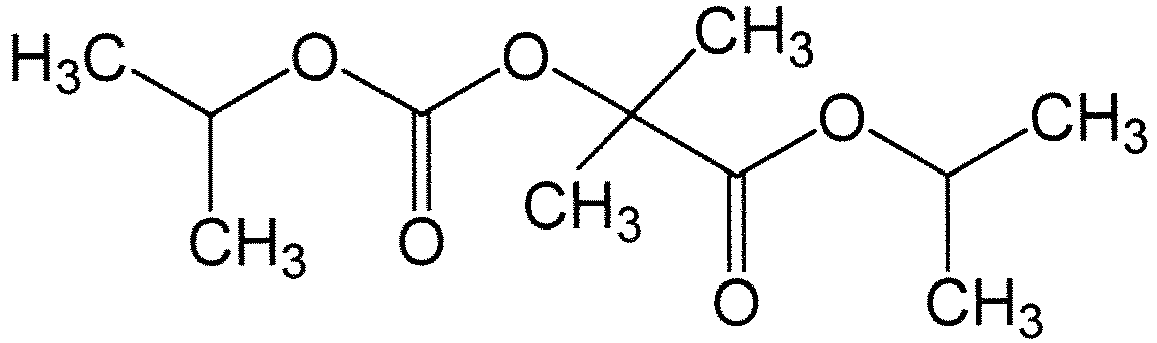
Fruity aroma Rose-like floral aroma Woody aroma Jasmine-like spicy aroma Table 1-2 Structural formula Aroma evaluation Example 5 
Violet-like floral aroma Rose-like floral aroma Woody aroma Mint-like aroma Example 6 
Fruity aroma White floral aroma Rose-like green aroma Spicy aroma Example 7 
Woody aroma Woody umber aroma Floral green aroma Coconut-like fruity aroma Rose-like fresh floral aroma Example 8 
Rose-like floral aroma Jasmine-like spicy aroma Mint-like aroma Apple-like fruity aroma - A fragrance composition was formulated in which 75 parts by mass of isopropyl α-(ethoxycarbonyl)oxyisobutyrate obtained in Example 2 was added to 925 parts by mass of a fragrance composition with a composition shown in Table 2.
- Isopropyl α-(ethoxycarbonyl)oxyisobutyrate of Example 2 was added to the fragrance composition with the composition described in Table 2, and this composition increased the intensity as well as diffusivity of the scent. This composition brought out spread and integrity of the scent and was able to impart a fresher fruity floral impression to the composition according to aroma evaluation by a perfumer. As a result, a novel fragrance composition for a fruity floral type shower gel was able to obtain.
[Table 2] Blend ingredients parts by mass Aldehyde C-12 lauric 2.0 Allyl amyl glycolate 5.0 Allyl heptanoate 3.0 Iso E Super 160.0 Ambroxan 0.4 Bacdanol 5.0 Benzaldehyde 0.1 Benzyl acetate 90.0 Cedarwood Virginia 65.0 cis-3-Hexenol 1.6 cis-3-Hexenyl isobutyrate 2.0 cis-3-Hexenyl salicylate 10.0 α-Damascone 2.7 γ-Decalactone 1.3 Dihydromyrcenol 25.0 Floralozone 2.3 Florol 45.0 Geranyl acetate 13.0 Hedione 65.0 Hexyl acetate 10.0 Cyclogalbanate 3.0 Liffarome 13.0 Linalool 160.0 Manzanate 0.7 Methyl caprate 5.0 Methyl octanoate 5.0 Galaxolide 50 IPM 95.0 Neryl acetate 10.0 Styralyl acetate 20.0 α-Terpineol 13.0 Dipropylene glycol 21.2 Vertenex 65.0 Trifernal 3.0 Undecavertol 2.7 Total 925.0 - The isobutyric acid ester compound having a carbonate group at the α-position of the present invention has an excellent aroma and is expected to be used itself as a fragrance. In addition, the compound is used as a fragrance ingredient and provides a fragrance composition having excellent aroma properties. The composition is blended in various products and exhibits desired perfuming properties.
Claims (6)
- A fragrance composition comprising a compound represented by Formula (1) as an active ingredient:

- The fragrance composition according to claim 1, wherein in Formula (1), R1 is a methyl group or an ethyl group.
- The fragrance composition according to claim 1 or 2, wherein in Formula (1), R2 is an isopropyl group, a sec-butyl group, or an isobutyl group.
- A compound represented by Formula (2):

- The compound according to claim 4, wherein in Formula (2), R3 is a methyl group or an ethyl group.
- The compound according to claim 4 or 5, wherein in Formula (2), R4 is an isopropyl group, a sec-butyl group, or an isobutyl group.
Applications Claiming Priority (2)
| Application Number | Priority Date | Filing Date | Title |
|---|---|---|---|
| JP2019233331 | 2019-12-24 | ||
| PCT/JP2020/047848 WO2021132211A1 (en) | 2019-12-24 | 2020-12-22 | ISOBUTYRATE ESTER COMPOUND HAVING CARBONATE GROUP AT α-POSITION, AND FRAGRANCE COMPOSITION |
Publications (3)
| Publication Number | Publication Date |
|---|---|
| EP4082621A1 true EP4082621A1 (en) | 2022-11-02 |
| EP4082621A4 EP4082621A4 (en) | 2023-03-29 |
| EP4082621B1 EP4082621B1 (en) | 2024-02-28 |
Family
ID=76573003
Family Applications (1)
| Application Number | Title | Priority Date | Filing Date |
|---|---|---|---|
| EP20904849.5A Active EP4082621B1 (en) | 2019-12-24 | 2020-12-22 | ISOBUTYRATE ESTER COMPOUND HAVING CARBONATE GROUP AT alpha-POSITION, AND FRAGRANCE COMPOSITION |
Country Status (6)
| Country | Link |
|---|---|
| US (1) | US12565471B2 (en) |
| EP (1) | EP4082621B1 (en) |
| JP (1) | JP7622650B2 (en) |
| CN (1) | CN114846126B (en) |
| ES (1) | ES2973187T3 (en) |
| WO (1) | WO2021132211A1 (en) |
Families Citing this family (1)
| Publication number | Priority date | Publication date | Assignee | Title |
|---|---|---|---|---|
| CN113603596A (en) * | 2021-08-05 | 2021-11-05 | 四川三联新材料有限公司 | Benzyl alcohol ambroxol carbonate latent aroma compound and preparation method and application thereof |
Family Cites Families (11)
| Publication number | Priority date | Publication date | Assignee | Title |
|---|---|---|---|---|
| US3368943A (en) | 1965-10-20 | 1968-02-13 | Allan H. Gilbert | alpha-alkoxyisobutyrates and alpha-halo-beta-alkoxyisovalerates in perfumes and cleaning products |
| EP0177807B1 (en) * | 1984-10-10 | 1989-03-15 | L. GIVAUDAN & CIE Société Anonyme | Hexanoates, process for their preparation and perfumes and/or flavouring agents having a content of such compounds |
| JP3619261B2 (en) | 1993-06-15 | 2005-02-09 | 三菱レイヨン株式会社 | Solvent composition |
| JP5333711B2 (en) * | 2008-03-27 | 2013-11-06 | 宇部興産株式会社 | Method for producing hydrocarbon oxycarbonyloxyalkanoic acid ester compound |
| RU2585761C2 (en) | 2011-03-25 | 2016-06-10 | Мицубиси Гэс Кемикал Компани, Инк. | Novel compound of carboxylic ester and production method thereof, and composition of aromatic substances |
| JP2015018667A (en) | 2013-07-10 | 2015-01-29 | 富士フイルム株式会社 | Electrolyte for nonaqueous secondary battery, nonaqueous secondary battery and additive for nonaqueous electrolyte |
| US11441098B2 (en) | 2018-06-26 | 2022-09-13 | Mitsubishi Gas Chemical Company, Inc. | α-hydroxyisobutyrate ester compound, fragrance composition, and use thereof as fragrance |
| US11326125B2 (en) | 2018-06-26 | 2022-05-10 | Mitsubishi Gas Chemical Company, Inc. | Isobutyric ester compound having acetoxy group at alpha-position, fragrance composition, and use thereof as fragrance |
| US11485932B2 (en) | 2018-06-26 | 2022-11-01 | Mitsubishi Gas Chemical Company, Inc. | Isobutyric ester compound having propanoyloxy group at alpha-position, fragrance composition, and use thereof as fragrance |
| US11485931B2 (en) | 2018-06-26 | 2022-11-01 | Mitsubishi Gas Chemical Company, Inc. | Isobutyric ester compound having formyloxy group at α-position, fragrance composition, and use thereof as fragrance |
| CN113474324B (en) | 2019-02-27 | 2025-08-22 | 三菱瓦斯化学株式会社 | Isobutyrate compound having n-butyryloxy group at α position, fragrance composition and use as fragrance |
-
2020
- 2020-12-22 JP JP2021567472A patent/JP7622650B2/en active Active
- 2020-12-22 CN CN202080088685.3A patent/CN114846126B/en active Active
- 2020-12-22 ES ES20904849T patent/ES2973187T3/en active Active
- 2020-12-22 EP EP20904849.5A patent/EP4082621B1/en active Active
- 2020-12-22 US US17/787,543 patent/US12565471B2/en active Active
- 2020-12-22 WO PCT/JP2020/047848 patent/WO2021132211A1/en not_active Ceased
Also Published As
| Publication number | Publication date |
|---|---|
| JPWO2021132211A1 (en) | 2021-07-01 |
| ES2973187T3 (en) | 2024-06-18 |
| WO2021132211A1 (en) | 2021-07-01 |
| EP4082621A4 (en) | 2023-03-29 |
| CN114846126B (en) | 2024-05-28 |
| US12565471B2 (en) | 2026-03-03 |
| JP7622650B2 (en) | 2025-01-28 |
| US20220402857A1 (en) | 2022-12-22 |
| EP4082621B1 (en) | 2024-02-28 |
| CN114846126A (en) | 2022-08-02 |
Similar Documents
| Publication | Publication Date | Title |
|---|---|---|
| US11441098B2 (en) | α-hydroxyisobutyrate ester compound, fragrance composition, and use thereof as fragrance | |
| US11326125B2 (en) | Isobutyric ester compound having acetoxy group at alpha-position, fragrance composition, and use thereof as fragrance | |
| EP3816149B1 (en) | Isobutyric ester compound having an isobutyryloxy group or pivaloyloxy group at alpha position, and perfume composition | |
| US12162833B2 (en) | Isobutyric acid ester compound having n-butyryloxy at α-position, perfume composition, and use as perfume | |
| US11485931B2 (en) | Isobutyric ester compound having formyloxy group at α-position, fragrance composition, and use thereof as fragrance | |
| US11485932B2 (en) | Isobutyric ester compound having propanoyloxy group at alpha-position, fragrance composition, and use thereof as fragrance | |
| EP4082621B1 (en) | ISOBUTYRATE ESTER COMPOUND HAVING CARBONATE GROUP AT alpha-POSITION, AND FRAGRANCE COMPOSITION | |
| CN103201250B (en) | Novel carboxylic acid ester cpds and manufacture method thereof and its flavor compositions | |
| US12522781B2 (en) | Alpha-hydroxyisobutyric acid ester compound and fragrance composition | |
| US11479738B2 (en) | Fragrance composition containing alpha-methoxyisobutyric ester compound, and use thereof as fragrance | |
| JP7845360B2 (en) | Isobutyric acid ester compounds having an alkenoyloxy group at the α-position, fragrance compositions, and use as fragrances | |
| EP4230612B1 (en) | Alicyclic alcohol, alicyclic alcohol composition, and perfume composition | |
| EP3882233B1 (en) | Carboxylic acid ester compound, production method thereof, and fragrance composition |
Legal Events
| Date | Code | Title | Description |
|---|---|---|---|
| STAA | Information on the status of an ep patent application or granted ep patent |
Free format text: STATUS: THE INTERNATIONAL PUBLICATION HAS BEEN MADE |
|
| PUAI | Public reference made under article 153(3) epc to a published international application that has entered the european phase |
Free format text: ORIGINAL CODE: 0009012 |
|
| STAA | Information on the status of an ep patent application or granted ep patent |
Free format text: STATUS: REQUEST FOR EXAMINATION WAS MADE |
|
| 17P | Request for examination filed |
Effective date: 20220617 |
|
| AK | Designated contracting states |
Kind code of ref document: A1 Designated state(s): AL AT BE BG CH CY CZ DE DK EE ES FI FR GB GR HR HU IE IS IT LI LT LU LV MC MK MT NL NO PL PT RO RS SE SI SK SM TR |
|
| A4 | Supplementary search report drawn up and despatched |
Effective date: 20230228 |
|
| RIC1 | Information provided on ipc code assigned before grant |
Ipc: A61Q 19/10 20060101ALN20230222BHEP Ipc: C11B 9/00 20060101ALI20230222BHEP Ipc: C07C 69/96 20060101ALI20230222BHEP Ipc: A61K 47/14 20060101ALI20230222BHEP Ipc: A61K 8/37 20060101ALI20230222BHEP Ipc: A23L 27/20 20160101ALI20230222BHEP Ipc: A61Q 13/00 20060101AFI20230222BHEP |
|
| DAV | Request for validation of the european patent (deleted) | ||
| DAX | Request for extension of the european patent (deleted) | ||
| RIC1 | Information provided on ipc code assigned before grant |
Ipc: A61Q 19/10 20060101ALN20230824BHEP Ipc: C11B 9/00 20060101ALI20230824BHEP Ipc: C07C 69/96 20060101ALI20230824BHEP Ipc: A61K 8/37 20060101ALI20230824BHEP Ipc: A61Q 13/00 20060101AFI20230824BHEP |
|
| GRAP | Despatch of communication of intention to grant a patent |
Free format text: ORIGINAL CODE: EPIDOSNIGR1 |
|
| STAA | Information on the status of an ep patent application or granted ep patent |
Free format text: STATUS: GRANT OF PATENT IS INTENDED |
|
| INTG | Intention to grant announced |
Effective date: 20231005 |
|
| GRAS | Grant fee paid |
Free format text: ORIGINAL CODE: EPIDOSNIGR3 |
|
| GRAA | (expected) grant |
Free format text: ORIGINAL CODE: 0009210 |
|
| STAA | Information on the status of an ep patent application or granted ep patent |
Free format text: STATUS: THE PATENT HAS BEEN GRANTED |
|
| P01 | Opt-out of the competence of the unified patent court (upc) registered |
Effective date: 20240116 |
|
| AK | Designated contracting states |
Kind code of ref document: B1 Designated state(s): AL AT BE BG CH CY CZ DE DK EE ES FI FR GB GR HR HU IE IS IT LI LT LU LV MC MK MT NL NO PL PT RO RS SE SI SK SM TR |
|
| REG | Reference to a national code |
Ref country code: GB Ref legal event code: FG4D |
|
| REG | Reference to a national code |
Ref country code: CH Ref legal event code: EP |
|
| REG | Reference to a national code |
Ref country code: NL Ref legal event code: FP |
|
| REG | Reference to a national code |
Ref country code: DE Ref legal event code: R096 Ref document number: 602020026604 Country of ref document: DE |
|
| REG | Reference to a national code |
Ref country code: IE Ref legal event code: FG4D |
|
| REG | Reference to a national code |
Ref country code: ES Ref legal event code: FG2A Ref document number: 2973187 Country of ref document: ES Kind code of ref document: T3 Effective date: 20240618 |
|
| REG | Reference to a national code |
Ref country code: LT Ref legal event code: MG9D |
|
| PG25 | Lapsed in a contracting state [announced via postgrant information from national office to epo] |
Ref country code: IS Free format text: LAPSE BECAUSE OF FAILURE TO SUBMIT A TRANSLATION OF THE DESCRIPTION OR TO PAY THE FEE WITHIN THE PRESCRIBED TIME-LIMIT Effective date: 20240628 |
|
| PG25 | Lapsed in a contracting state [announced via postgrant information from national office to epo] |
Ref country code: LT Free format text: LAPSE BECAUSE OF FAILURE TO SUBMIT A TRANSLATION OF THE DESCRIPTION OR TO PAY THE FEE WITHIN THE PRESCRIBED TIME-LIMIT Effective date: 20240228 |
|
| PG25 | Lapsed in a contracting state [announced via postgrant information from national office to epo] |
Ref country code: GR Free format text: LAPSE BECAUSE OF FAILURE TO SUBMIT A TRANSLATION OF THE DESCRIPTION OR TO PAY THE FEE WITHIN THE PRESCRIBED TIME-LIMIT Effective date: 20240529 |
|
| PG25 | Lapsed in a contracting state [announced via postgrant information from national office to epo] |
Ref country code: HR Free format text: LAPSE BECAUSE OF FAILURE TO SUBMIT A TRANSLATION OF THE DESCRIPTION OR TO PAY THE FEE WITHIN THE PRESCRIBED TIME-LIMIT Effective date: 20240228 Ref country code: RS Free format text: LAPSE BECAUSE OF FAILURE TO SUBMIT A TRANSLATION OF THE DESCRIPTION OR TO PAY THE FEE WITHIN THE PRESCRIBED TIME-LIMIT Effective date: 20240528 |
|
| PG25 | Lapsed in a contracting state [announced via postgrant information from national office to epo] |
Ref country code: RS Free format text: LAPSE BECAUSE OF FAILURE TO SUBMIT A TRANSLATION OF THE DESCRIPTION OR TO PAY THE FEE WITHIN THE PRESCRIBED TIME-LIMIT Effective date: 20240528 Ref country code: NO Free format text: LAPSE BECAUSE OF FAILURE TO SUBMIT A TRANSLATION OF THE DESCRIPTION OR TO PAY THE FEE WITHIN THE PRESCRIBED TIME-LIMIT Effective date: 20240528 Ref country code: LT Free format text: LAPSE BECAUSE OF FAILURE TO SUBMIT A TRANSLATION OF THE DESCRIPTION OR TO PAY THE FEE WITHIN THE PRESCRIBED TIME-LIMIT Effective date: 20240228 Ref country code: IS Free format text: LAPSE BECAUSE OF FAILURE TO SUBMIT A TRANSLATION OF THE DESCRIPTION OR TO PAY THE FEE WITHIN THE PRESCRIBED TIME-LIMIT Effective date: 20240628 Ref country code: HR Free format text: LAPSE BECAUSE OF FAILURE TO SUBMIT A TRANSLATION OF THE DESCRIPTION OR TO PAY THE FEE WITHIN THE PRESCRIBED TIME-LIMIT Effective date: 20240228 Ref country code: GR Free format text: LAPSE BECAUSE OF FAILURE TO SUBMIT A TRANSLATION OF THE DESCRIPTION OR TO PAY THE FEE WITHIN THE PRESCRIBED TIME-LIMIT Effective date: 20240529 Ref country code: FI Free format text: LAPSE BECAUSE OF FAILURE TO SUBMIT A TRANSLATION OF THE DESCRIPTION OR TO PAY THE FEE WITHIN THE PRESCRIBED TIME-LIMIT Effective date: 20240228 Ref country code: BG Free format text: LAPSE BECAUSE OF FAILURE TO SUBMIT A TRANSLATION OF THE DESCRIPTION OR TO PAY THE FEE WITHIN THE PRESCRIBED TIME-LIMIT Effective date: 20240228 |
|
| PG25 | Lapsed in a contracting state [announced via postgrant information from national office to epo] |
Ref country code: PL Free format text: LAPSE BECAUSE OF FAILURE TO SUBMIT A TRANSLATION OF THE DESCRIPTION OR TO PAY THE FEE WITHIN THE PRESCRIBED TIME-LIMIT Effective date: 20240228 Ref country code: PT Free format text: LAPSE BECAUSE OF FAILURE TO SUBMIT A TRANSLATION OF THE DESCRIPTION OR TO PAY THE FEE WITHIN THE PRESCRIBED TIME-LIMIT Effective date: 20240628 |
|
| REG | Reference to a national code |
Ref country code: AT Ref legal event code: MK05 Ref document number: 1660705 Country of ref document: AT Kind code of ref document: T Effective date: 20240228 |
|
| PG25 | Lapsed in a contracting state [announced via postgrant information from national office to epo] |
Ref country code: SE Free format text: LAPSE BECAUSE OF FAILURE TO SUBMIT A TRANSLATION OF THE DESCRIPTION OR TO PAY THE FEE WITHIN THE PRESCRIBED TIME-LIMIT Effective date: 20240228 Ref country code: PT Free format text: LAPSE BECAUSE OF FAILURE TO SUBMIT A TRANSLATION OF THE DESCRIPTION OR TO PAY THE FEE WITHIN THE PRESCRIBED TIME-LIMIT Effective date: 20240628 Ref country code: PL Free format text: LAPSE BECAUSE OF FAILURE TO SUBMIT A TRANSLATION OF THE DESCRIPTION OR TO PAY THE FEE WITHIN THE PRESCRIBED TIME-LIMIT Effective date: 20240228 Ref country code: LV Free format text: LAPSE BECAUSE OF FAILURE TO SUBMIT A TRANSLATION OF THE DESCRIPTION OR TO PAY THE FEE WITHIN THE PRESCRIBED TIME-LIMIT Effective date: 20240228 |
|
| PG25 | Lapsed in a contracting state [announced via postgrant information from national office to epo] |
Ref country code: DK Free format text: LAPSE BECAUSE OF FAILURE TO SUBMIT A TRANSLATION OF THE DESCRIPTION OR TO PAY THE FEE WITHIN THE PRESCRIBED TIME-LIMIT Effective date: 20240228 |
|
| PG25 | Lapsed in a contracting state [announced via postgrant information from national office to epo] |
Ref country code: SM Free format text: LAPSE BECAUSE OF FAILURE TO SUBMIT A TRANSLATION OF THE DESCRIPTION OR TO PAY THE FEE WITHIN THE PRESCRIBED TIME-LIMIT Effective date: 20240228 |
|
| PG25 | Lapsed in a contracting state [announced via postgrant information from national office to epo] |
Ref country code: EE Free format text: LAPSE BECAUSE OF FAILURE TO SUBMIT A TRANSLATION OF THE DESCRIPTION OR TO PAY THE FEE WITHIN THE PRESCRIBED TIME-LIMIT Effective date: 20240228 Ref country code: CZ Free format text: LAPSE BECAUSE OF FAILURE TO SUBMIT A TRANSLATION OF THE DESCRIPTION OR TO PAY THE FEE WITHIN THE PRESCRIBED TIME-LIMIT Effective date: 20240228 |
|
| PG25 | Lapsed in a contracting state [announced via postgrant information from national office to epo] |
Ref country code: AT Free format text: LAPSE BECAUSE OF FAILURE TO SUBMIT A TRANSLATION OF THE DESCRIPTION OR TO PAY THE FEE WITHIN THE PRESCRIBED TIME-LIMIT Effective date: 20240228 |
|
| PG25 | Lapsed in a contracting state [announced via postgrant information from national office to epo] |
Ref country code: SK Free format text: LAPSE BECAUSE OF FAILURE TO SUBMIT A TRANSLATION OF THE DESCRIPTION OR TO PAY THE FEE WITHIN THE PRESCRIBED TIME-LIMIT Effective date: 20240228 |
|
| PG25 | Lapsed in a contracting state [announced via postgrant information from national office to epo] |
Ref country code: SM Free format text: LAPSE BECAUSE OF FAILURE TO SUBMIT A TRANSLATION OF THE DESCRIPTION OR TO PAY THE FEE WITHIN THE PRESCRIBED TIME-LIMIT Effective date: 20240228 Ref country code: SK Free format text: LAPSE BECAUSE OF FAILURE TO SUBMIT A TRANSLATION OF THE DESCRIPTION OR TO PAY THE FEE WITHIN THE PRESCRIBED TIME-LIMIT Effective date: 20240228 Ref country code: RO Free format text: LAPSE BECAUSE OF FAILURE TO SUBMIT A TRANSLATION OF THE DESCRIPTION OR TO PAY THE FEE WITHIN THE PRESCRIBED TIME-LIMIT Effective date: 20240228 Ref country code: EE Free format text: LAPSE BECAUSE OF FAILURE TO SUBMIT A TRANSLATION OF THE DESCRIPTION OR TO PAY THE FEE WITHIN THE PRESCRIBED TIME-LIMIT Effective date: 20240228 Ref country code: DK Free format text: LAPSE BECAUSE OF FAILURE TO SUBMIT A TRANSLATION OF THE DESCRIPTION OR TO PAY THE FEE WITHIN THE PRESCRIBED TIME-LIMIT Effective date: 20240228 Ref country code: CZ Free format text: LAPSE BECAUSE OF FAILURE TO SUBMIT A TRANSLATION OF THE DESCRIPTION OR TO PAY THE FEE WITHIN THE PRESCRIBED TIME-LIMIT Effective date: 20240228 Ref country code: AT Free format text: LAPSE BECAUSE OF FAILURE TO SUBMIT A TRANSLATION OF THE DESCRIPTION OR TO PAY THE FEE WITHIN THE PRESCRIBED TIME-LIMIT Effective date: 20240228 |
|
| REG | Reference to a national code |
Ref country code: DE Ref legal event code: R097 Ref document number: 602020026604 Country of ref document: DE |
|
| PG25 | Lapsed in a contracting state [announced via postgrant information from national office to epo] |
Ref country code: IT Free format text: LAPSE BECAUSE OF FAILURE TO SUBMIT A TRANSLATION OF THE DESCRIPTION OR TO PAY THE FEE WITHIN THE PRESCRIBED TIME-LIMIT Effective date: 20240228 |
|
| PG25 | Lapsed in a contracting state [announced via postgrant information from national office to epo] |
Ref country code: IT Free format text: LAPSE BECAUSE OF FAILURE TO SUBMIT A TRANSLATION OF THE DESCRIPTION OR TO PAY THE FEE WITHIN THE PRESCRIBED TIME-LIMIT Effective date: 20240228 |
|
| PLBE | No opposition filed within time limit |
Free format text: ORIGINAL CODE: 0009261 |
|
| STAA | Information on the status of an ep patent application or granted ep patent |
Free format text: STATUS: NO OPPOSITION FILED WITHIN TIME LIMIT |
|
| 26N | No opposition filed |
Effective date: 20241129 |
|
| PG25 | Lapsed in a contracting state [announced via postgrant information from national office to epo] |
Ref country code: SI Free format text: LAPSE BECAUSE OF FAILURE TO SUBMIT A TRANSLATION OF THE DESCRIPTION OR TO PAY THE FEE WITHIN THE PRESCRIBED TIME-LIMIT Effective date: 20240228 |
|
| PG25 | Lapsed in a contracting state [announced via postgrant information from national office to epo] |
Ref country code: MC Free format text: LAPSE BECAUSE OF FAILURE TO SUBMIT A TRANSLATION OF THE DESCRIPTION OR TO PAY THE FEE WITHIN THE PRESCRIBED TIME-LIMIT Effective date: 20240228 |
|
| PG25 | Lapsed in a contracting state [announced via postgrant information from national office to epo] |
Ref country code: LU Free format text: LAPSE BECAUSE OF NON-PAYMENT OF DUE FEES Effective date: 20241222 |
|
| REG | Reference to a national code |
Ref country code: BE Ref legal event code: MM Effective date: 20241231 |
|
| PG25 | Lapsed in a contracting state [announced via postgrant information from national office to epo] |
Ref country code: BE Free format text: LAPSE BECAUSE OF NON-PAYMENT OF DUE FEES Effective date: 20241231 |
|
| PG25 | Lapsed in a contracting state [announced via postgrant information from national office to epo] |
Ref country code: IE Free format text: LAPSE BECAUSE OF NON-PAYMENT OF DUE FEES Effective date: 20241222 |
|
| PGFP | Annual fee paid to national office [announced via postgrant information from national office to epo] |
Ref country code: NL Payment date: 20251112 Year of fee payment: 6 |
|
| REG | Reference to a national code |
Ref country code: CH Ref legal event code: U11 Free format text: ST27 STATUS EVENT CODE: U-0-0-U10-U11 (AS PROVIDED BY THE NATIONAL OFFICE) Effective date: 20260101 |
|
| PGFP | Annual fee paid to national office [announced via postgrant information from national office to epo] |
Ref country code: DE Payment date: 20251028 Year of fee payment: 6 |
|
| PGFP | Annual fee paid to national office [announced via postgrant information from national office to epo] |
Ref country code: GB Payment date: 20251030 Year of fee payment: 6 |
|
| PGFP | Annual fee paid to national office [announced via postgrant information from national office to epo] |
Ref country code: FR Payment date: 20251110 Year of fee payment: 6 |
|
| PGFP | Annual fee paid to national office [announced via postgrant information from national office to epo] |
Ref country code: ES Payment date: 20260108 Year of fee payment: 6 |
|
| PGFP | Annual fee paid to national office [announced via postgrant information from national office to epo] |
Ref country code: CH Payment date: 20260101 Year of fee payment: 6 |
|
| PG25 | Lapsed in a contracting state [announced via postgrant information from national office to epo] |
Ref country code: CY Free format text: LAPSE BECAUSE OF FAILURE TO SUBMIT A TRANSLATION OF THE DESCRIPTION OR TO PAY THE FEE WITHIN THE PRESCRIBED TIME-LIMIT Effective date: 20240228 |
|
| PG25 | Lapsed in a contracting state [announced via postgrant information from national office to epo] |
Ref country code: TR Free format text: LAPSE BECAUSE OF FAILURE TO SUBMIT A TRANSLATION OF THE DESCRIPTION OR TO PAY THE FEE WITHIN THE PRESCRIBED TIME-LIMIT Effective date: 20240228 |
|
| PG25 | Lapsed in a contracting state [announced via postgrant information from national office to epo] |
Ref country code: HU Free format text: LAPSE BECAUSE OF FAILURE TO SUBMIT A TRANSLATION OF THE DESCRIPTION OR TO PAY THE FEE WITHIN THE PRESCRIBED TIME-LIMIT; INVALID AB INITIO Effective date: 20201222 |