EP4082295B1 - Downlink protocol alignment and decoding - Google Patents
Downlink protocol alignment and decoding Download PDFInfo
- Publication number
- EP4082295B1 EP4082295B1 EP20915256.0A EP20915256A EP4082295B1 EP 4082295 B1 EP4082295 B1 EP 4082295B1 EP 20915256 A EP20915256 A EP 20915256A EP 4082295 B1 EP4082295 B1 EP 4082295B1
- Authority
- EP
- European Patent Office
- Prior art keywords
- packet
- code block
- mac sub
- physical layer
- mac
- Prior art date
- Legal status (The legal status is an assumption and is not a legal conclusion. Google has not performed a legal analysis and makes no representation as to the accuracy of the status listed.)
- Active
Links
Images



Classifications
-
- H—ELECTRICITY
- H04—ELECTRIC COMMUNICATION TECHNIQUE
- H04L—TRANSMISSION OF DIGITAL INFORMATION, e.g. TELEGRAPHIC COMMUNICATION
- H04L1/00—Arrangements for detecting or preventing errors in the information received
- H04L1/12—Arrangements for detecting or preventing errors in the information received by using return channel
- H04L1/16—Arrangements for detecting or preventing errors in the information received by using return channel in which the return channel carries supervisory signals, e.g. repetition request signals
- H04L1/18—Automatic repetition systems, e.g. Van Duuren systems
- H04L1/1867—Arrangements specially adapted for the transmitter end
- H04L1/1887—Scheduling and prioritising arrangements
-
- H—ELECTRICITY
- H04—ELECTRIC COMMUNICATION TECHNIQUE
- H04L—TRANSMISSION OF DIGITAL INFORMATION, e.g. TELEGRAPHIC COMMUNICATION
- H04L1/00—Arrangements for detecting or preventing errors in the information received
- H04L1/004—Arrangements for detecting or preventing errors in the information received by using forward error control
- H04L1/0056—Systems characterized by the type of code used
- H04L1/0061—Error detection codes
-
- H—ELECTRICITY
- H04—ELECTRIC COMMUNICATION TECHNIQUE
- H04L—TRANSMISSION OF DIGITAL INFORMATION, e.g. TELEGRAPHIC COMMUNICATION
- H04L69/00—Network arrangements, protocols or services independent of the application payload and not provided for in the other groups of this subclass
- H04L69/30—Definitions, standards or architectural aspects of layered protocol stacks
- H04L69/32—Architecture of open systems interconnection [OSI] 7-layer type protocol stacks, e.g. the interfaces between the data link level and the physical level
- H04L69/321—Interlayer communication protocols or service data unit [SDU] definitions; Interfaces between layers
-
- H—ELECTRICITY
- H04—ELECTRIC COMMUNICATION TECHNIQUE
- H04L—TRANSMISSION OF DIGITAL INFORMATION, e.g. TELEGRAPHIC COMMUNICATION
- H04L69/00—Network arrangements, protocols or services independent of the application payload and not provided for in the other groups of this subclass
- H04L69/04—Protocols for data compression, e.g. ROHC
-
- H—ELECTRICITY
- H04—ELECTRIC COMMUNICATION TECHNIQUE
- H04L—TRANSMISSION OF DIGITAL INFORMATION, e.g. TELEGRAPHIC COMMUNICATION
- H04L69/00—Network arrangements, protocols or services independent of the application payload and not provided for in the other groups of this subclass
- H04L69/30—Definitions, standards or architectural aspects of layered protocol stacks
- H04L69/32—Architecture of open systems interconnection [OSI] 7-layer type protocol stacks, e.g. the interfaces between the data link level and the physical level
- H04L69/322—Intralayer communication protocols among peer entities or protocol data unit [PDU] definitions
- H04L69/324—Intralayer communication protocols among peer entities or protocol data unit [PDU] definitions in the data link layer [OSI layer 2], e.g. HDLC
-
- H—ELECTRICITY
- H04—ELECTRIC COMMUNICATION TECHNIQUE
- H04W—WIRELESS COMMUNICATION NETWORKS
- H04W80/00—Wireless network protocols or protocol adaptations to wireless operation
- H04W80/02—Data link layer protocols
Definitions
- the user equipment devices may be responsible for decoding data from the packets.Related arts can be found in US 2010/232356 A1 and Anonymous: "5G NR MAC layer-architecture, channel mapping, procedures, header, subheaders", 8 June 2019, pages 1-9, retrieved from the Internet URL: https://web.archive.org/web/20190608172210/http://www.rfwireless-world.com/S G/5 G-NR-MAC-layer-overview.html .
- references in the specification to "one embodiment,” “an embodiment,” “an example embodiment,” “some embodiments,” “certain embodiments,” etc. indicate that the embodiment described may include a particular feature, structure, or characteristic, but every embodiment may not necessarily include the particular feature, structure, or characteristic. Moreover, such phrases do not necessarily refer to the same embodiment. Further, when a particular feature, structure or characteristic is described in connection with an embodiment, it would be within the knowledge of a person skilled in the pertinent art to effect such feature, structure or characteristic in connection with other embodiments whether or not explicitly described.
- LTE Long Term Evolution
- CDMA code division multiple access
- TDMA time division multiple access
- FDMA frequency division multiple access
- OFDMA orthogonal frequency division multiple access
- SC-FDMA single-carrier frequency division multiple access
- a CDMA network may implement a radio technology such as Universal Terrestrial Radio Access (UTRA), CDMA 2000, etc.
- UTRA includes Wideband CDMA (WCDMA) and other variants of CDMA.
- CDMA 2000 covers IS-2000, IS-95, and IS-856 standards.
- Core network element 230 may connect with a large network, such as the Internet 240, or another IP network, to communicate packet data over any distance.
- data from user equipment 210 may be communicated to other user equipment connected to other access points, including, for example, a personal computer 250 connected to Internet 240, for example, using a wired connection, or a tablet 270 connected to Internet 240 via a router 260.
- personal computer 250 and tablet 270 provide additional examples of possible user equipment devices
- router 260 provides an example of another access point device.
- Downlink scheduling can rely on various scheduling algorithms, such as a proportional fair (PF) algorithm that aims to balance bit rate and fairness, or DP-VT-MLDWDF, which is a scheduler that aims to maximize the quality of service (QoS) of real-time traffic while sacrificing the performance of non-real-time traffic using a delay priority function.
- PF proportional fair
- DP-VT-MLDWDF which is a scheduler that aims to maximize the quality of service (QoS) of real-time traffic while sacrificing the performance of non-real-time traffic using a delay priority function.
- QoS quality of service
- processor 802 and transceiver 806 may not be integrated on the same SoC, but instead on separate chips.
- processor 802 and memory 804 may be integrated on a baseband chip (also known as a modem chip), and transceiver 806 may be on a separate transceiver chip or integrated with RF front-end on an RF SoC.
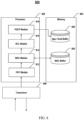
- FIG. 9 illustrates a block diagram of an exemplary access node 900 for efficient transmission, according to some embodiments of the present disclosure.
- Access node 900 may include a processor 902, a memory 904, and a transceiver 906, which may be examples of processor 1010, memory 1020, and transceiver 1030 described below in detail with respect to FIG. 10 .
- processor 902, memory 904, and transceiver 906 may be integrated on a baseband SoC (also known as a modem SoC or a baseband model chipset).
- baseband SoC also known as a modem SoC or a baseband model chipset
- access node 900 may include multiple modules implemented as software and/or firmware modules executed by processor 902, including, for example, a PHY module 912, a MAC module 914, an RLC module 916, and a PDCP module 918.
- processor 902 may run an operating system, such as an RTOS, that executes instructions stored in memory 904 (e.g., an on-chip RAM) to implement the above-mentioned software and/or firmware modules.
- memory 904 e.g., an on-chip RAM
- one or more of the above-mentioned software and/or firmware modules may be implemented as dedicated hardware elements in the SoC as well.
- Access node 900 may also include various buffers or other information stored in memory 904 (e.g., an off-chip RAM or external storage), such as a MAC buffer 925 that stores packet data for the operation of MAC module 914 (similar buffers may be provided for the modules of other layers) and PDCP L2 queue 920 that stores packet data units corresponding to, for example, TCP/IP packets received over a network at access node 900. Certain embodiments of the present disclosure may reduce the size of MAC buffer 925 or reduce the frequency of relying on buffers for higher layers of the protocol stack.
- Transceiver 906 may be configured to send signals over the network to terminals, such as user equipment 210 in FIG. 2 .
- the PHY module 912 can forward the sub-packet bounded by the physical layer boundary for transmission, for example, by providing a complete TB to the transceiver 906.
- the sub-packet can be a downlink sub-packet, for example, a downlink MACsubPDU.
- the physical layer boundary can be at least one of a code block boundary or a code block group boundary. In most of the discussion above, the focus is on using a single code block boundary, but in certain embodiments, a code block group can be treated as a unit. This approach may provide more HARQ flexibility, although it may not have the same buffer advantages at the MAC layer.
- PDCP module 918 may further be configured to receive a plurality of layer 3 packets for communication, generate packet data units based on the received layer 3 packets, and queue the packet data units in layer 2 logical channels.
- the aligning the sub-packet can include aligning one of the packet data units in one of the layer 2 logical channels, as shown, for example, in FIG. 5 .
- the packet data units can be packet data convergence protocol (PDCP) packet data units.
- An upper protocol module, for example, RLC module 916 or PDCP module 918 can be configured to align the sub-packet by a process that includes segmenting a transport block into code blocks taking to account a bit amount of cyclic redundancy check bits.
- the segmenting can include identifying a code block size by PHY module 912, providing the code block size to MAC module 914, and composing a plurality of MACSubPDU packets by MAC module 914 corresponding to the code block size.
- FIGs. 8 and 9 can be variously implemented in hardware alone or hardware running software, such as computer-program instructions being stored in a memory and being run on a hardware processor.
- FIG. 10 provides a possible device for implementing such modules.
- Various modules can be combined or re-arranged. The above-illustrated examples are just illustrative and not limiting.
- FIG. 10 illustrates a device according to certain embodiments of the present disclosure.
- a node 1000 can include various components.
- Node 1000 can correspond to user equipment 210, access node 220, or core network element 230 in FIG. 2 .
- node 1000 corresponds to the modem in user equipment 210, access node 220, or core network element 230 in FIG. 2 .
- node 1000 When node 1000 is a user equipment, additional components may also be included, such as a user interface (UI), sensors, and the like. Similarly, node 1000 may be implemented as a blade in a server system when node 1000 is configured as a core network element 230. Other implementations are also possible.
- UI user interface
- sensors sensors
- node 1000 may be implemented as a blade in a server system when node 1000 is configured as a core network element 230. Other implementations are also possible.
- node 1000 may include processor 1010. Although only one processor is shown, it is understood that multiple processors can be included.
- Processor 1010 may be any suitable computational device, such as a central processing unit (CPU), a microcontroller unit (MCU), application-specific integrated circuit (ASIC), field-programmable gate array (FPGA), or the like.
- Processor 1010 may be a hardware device having one or many processing cores.
- processor 1010 may be a baseband processor.
- node 1000 may also include memory 1020. Although only memory is shown, it is understood that multiple memories can be included. Memory 1020 can broadly include both memory and storage. For example, memory 1020 can include random access memory (RAM) included on the same chip with processor 1010. Memory 1020 can also include storage, such as a hard disk drive (HDD), solid-state drive (SSD), or the like. Other memory types and storage types are also permitted.
- RAM random access memory
- SSD solid-state drive
- an apparatus can include at least one processor and at least one memory including computer program code.
- the at least one memory and the computer program code can be configured to, with the at least one processor, cause the apparatus at least to decode a physical layer code block or a physical layer code block group.
- the at least one memory and the computer program code can also be configured to, with the at least one processor, cause the apparatus at least to decode a MAC sub-packet corresponding to the decoded physical layer code block or the physical code block group without waiting for any subsequent physical layer code blocks to be decoded.
- the at least one memory and the computer program code can further be configured to, with the at least one processor, cause the apparatus at least to pass the decoded MAC sub-packet up the protocol stack.
- the MAC sub-packet can be a downlink MAC sub-packet.
- the MAC sub-packet can be a MACSubPDU packet.
- the at least one memory and the computer program code can be configured to, with the at least one processor, cause the apparatus at least to receive the decoded MAC sub-packet at a media access control layer and pass a payload of the MAC sub-packet up the protocol stack without waiting for a subsequent MAC sub-packet to be decoded.
- the at least one memory and the computer program code can be configured to, with the at least one processor, cause the apparatus at least to pass the MAC sub-packet up the protocol stack by, for each of a plurality of protocol layers of the stack, reading and removing a layer-specific header for a given layer of the protocol stack and passing a payload portion of the MAC sub-packet to an adjacent layer of the protocol stack.
- a method for code block processing can include decoding a physical layer code block or a physical layer code block group.
- the method can also include decoding a MAC sub-packet corresponding to the decoded physical layer code block or the physical code block group without waiting for any subsequent physical layer code blocks to be decoded.
- the method can further include passing the decoded MAC sub-packet up the protocol stack.
- the MAC sub-packet can be a downlink MAC sub-packet.
- the MAC sub-packet can be a MACSubPDU packet.
- the method can include receiving the decoded MAC sub-packet at a media access control layer.
- the method can also include passing a payload of the MAC sub-packet up the protocol stack without waiting for a subsequent MAC sub-packet to be decoded.
- an apparatus can include at least one processor and at least one memory including computer program code.
- the at least one memory and the computer program code can be configured to, with the at least one processor, cause the apparatus at least to align a sub-packet with a physical layer boundary.
- a packet can include the sub-packet and a plurality of other sub-packets.
- the at least one memory and the computer program code can be configured to, with the at least one processor, cause the apparatus at least to forward for transmission the sub-packet bounded by the physical layer boundary.
- the sub-packet can be a downlink sub-packet.
- the sub-packet can be a MACSubPDU packet.
- the physical layer boundary can be at least one of a code block boundary or a code block group boundary.
- the at least one memory and the computer program code can be configured to, with the at least one processor, cause the apparatus at least to receive a plurality of layer 3 packets for communication.
- the at least one memory and the computer program code can also be configured to, with the at least one processor, cause the apparatus at least to generate packet data units based on the received layer 3 packets.
- the at least one memory and the computer program code can further be configured to, with the at least one processor, cause the apparatus at least to queue the packet data units in layer 2 logical channels.
- the aligning the sub-packet can include aligning one of the packet data units in one of the layer 2 logical channels.
- the packet data units can include PDCP packet data units.
- the at least one memory and the computer program code can be configured to, with the at least one processor, cause the apparatus at least to align the sub-packet by a process comprising segmenting a transport block into code blocks taking to account a bit amount of cyclic redundancy check bits.
- the sub-packet can be a MACSubPDU packet.
- the packet data units can include PDCP packet data units.
- the MAC sub-packet can be a downlink MAC sub-packet.
- the MAC sub-packet can be a MACSubPDU packet.
- an apparatus can include an upper protocol module configured to align a sub-packet with a physical layer boundary.
- a packet can include the sub-packet and a plurality of other sub-packets.
- the apparatus can also include a physical layer module configured to forward for transmission the sub-packet bounded by the physical layer boundary.
- the sub-packet can be a MACSubPDU packet.
- the physical layer boundary can be at least one of a code block boundary or a code block group boundary.
- the upper protocol module can be further configured to receive a plurality of layer 3 packets for communication, generate packet data units based on the received layer 3 packets, and queue the packet data units in layer 2 logical channels.
- the aligning the sub-packet can include aligning one of the packet data units in one of the layer 2 logical channels.
- the segmenting can include identifying a code block size by the physical layer module, providing the code block size to a media access control module, and composing a plurality of MACSubPDU packets by the media access control module corresponding to the code block size.
- a system can include a first apparatus and a second apparatus.
- the first apparatus can include at least one first processor and at least one first memory including first computer program code.
- the at least one first memory and the first computer program code can be configured to, with the at least one first processor, cause the first apparatus at least to align a sub-packet with a physical layer boundary.
- a packet can include the sub-packet and a plurality of other sub-packets.
- the at least one first memory and the first computer program code can be configured to, with the at least one first processor, cause the first apparatus at least to forward for transmission the sub-packet bounded by the physical layer boundary.
- Alignment of the size of the physical layer code block or the physical layer code block group with the size of the packet or the sub-packet can include a one-to-one relationship between the physical layer code block or the physical layer code block group and the packet or the sub-packet.
Landscapes
- Engineering & Computer Science (AREA)
- Computer Networks & Wireless Communication (AREA)
- Signal Processing (AREA)
- Computer Security & Cryptography (AREA)
- Mobile Radio Communication Systems (AREA)
Description
- This application claims the benefit of priority to
U.S. Provisional Patent Application No. 62/964,066 filed January 21, 2020 - Embodiments of the present disclosure relate to apparatus and methods that may be used to communicate data according to an aligned protocol structure.
- Wireless communication systems are widely deployed to provide various telecommunication services such as telephony, video, data, messaging, and broadcasts. Various wireless communication systems rely on communication of data using various wireless protocols. For example, in a 5th-generation (5G) communication system, an access node may transmit user plane (UP) and/or control plane (CP) data in packets to one or more user equipment (UE) devices. The user equipment devices may be responsible for decoding data from the packets.Related arts can be found in
US 2010/232356 A1 and Anonymous: "5G NR MAC layer-architecture, channel mapping, procedures, header, subheaders", 8 June 2019, pages 1-9, retrieved from the Internet URL: https://web.archive.org/web/20190608172210/http://www.rfwireless-world.com/S G/5 G-NR-MAC-layer-overview.html. - Embodiments of methods and apparatus that may be used to communicate and decode data packets are disclosed herein.
- The present invention is defined in the claims.
- The accompanying drawings, which are incorporated herein and form a part of the specification, illustrate embodiments of the present disclosure and, together with the description, further serve to explain the principles of the present disclosure and to enable a person skilled in the pertinent art to make and use the present disclosure.
-
FIG. 1 illustrates a protocol stack in a communication system. -
FIG. 2 illustrates an exemplary wireless network according to certain embodiments of the present disclosure. -
FIG. 3 illustrates an exemplary method for efficient data transmission according to certain embodiments of the present disclosure. -
FIG. 4 illustrates additional details of the method shown inFIG. 3 . -
FIG. 5 illustrates an exemplary packet flow within a protocol stack corresponding to an implementation of the method shown inFIG. 3 and expanded inFIG. 4 . -
FIG. 6 illustrates an exemplary method for efficient data transmission according to certain embodiments of the present disclosure. -
FIG. 7 illustrates an exemplary packet flow within a protocol stack corresponding to an implementation of the method shown inFIG. 6 . -
FIG. 8 illustrates a block diagram of an exemplary terminal device for efficient decoding, according to some embodiments of the present disclosure. -
FIG. 9 illustrates a block diagram of an exemplary access node for efficient transmission, according to some embodiments of the present disclosure. -
FIG. 10 illustrates a device according to certain embodiments of the present disclosure. - Embodiments of the present disclosure will be described with reference to the accompanying drawings.
- Although specific configurations and arrangements are discussed, it should be understood that this is done for illustrative purposes only. A person skilled in the pertinent art will recognize that other configurations and arrangements can be used without departing from the scope of the present disclosure. It will be apparent to a person skilled in the pertinent art that the present disclosure can also be employed in a variety of other applications.
- It is noted that references in the specification to "one embodiment," "an embodiment," "an example embodiment," "some embodiments," "certain embodiments," etc., indicate that the embodiment described may include a particular feature, structure, or characteristic, but every embodiment may not necessarily include the particular feature, structure, or characteristic. Moreover, such phrases do not necessarily refer to the same embodiment. Further, when a particular feature, structure or characteristic is described in connection with an embodiment, it would be within the knowledge of a person skilled in the pertinent art to effect such feature, structure or characteristic in connection with other embodiments whether or not explicitly described.
- In general, terminology may be understood at least in part from usage in context. For example, the term "one or more" as used herein, depending at least in part upon context, may be used to describe any feature, structure, or characteristic in a singular sense or may be used to describe combinations of features, structures or characteristics in a plural sense. Similarly, terms, such as "a," "an," or "the," again, may be understood to convey a singular usage or to convey a plural usage, depending at least in part upon context. In addition, the term "based on" may be understood as not necessarily intended to convey an exclusive set of factors and may, instead, allow for existence of additional factors not necessarily expressly described, again, depending at least in part on context.
- Various aspects of wireless communication systems will now be described with reference to various apparatus and methods. These apparatus and methods will be described in the following detailed description and illustrated in the accompanying drawings by various blocks, modules, units, components, circuits, steps, operations, processes, algorithms, etc. (collectively referred to as "elements"). These elements may be implemented using electronic hardware, firmware, computer software, or any combination thereof. Whether such elements are implemented as hardware, firmware, or software depends upon the particular application and design constraints imposed on the overall system.
- The techniques described herein may be used for various wireless communication networks such as Long Term Evolution (LTE) system, code division multiple access (CDMA) system, time division multiple access (TDMA) system, frequency division multiple access (FDMA) system, orthogonal frequency division multiple access (OFDMA) system, single-carrier frequency division multiple access (SC-FDMA) system, and other networks. The terms "network" and "system" are often used interchangeably. A CDMA network may implement a radio technology such as Universal Terrestrial Radio Access (UTRA), CDMA 2000, etc. UTRA includes Wideband CDMA (WCDMA) and other variants of CDMA. CDMA 2000 covers IS-2000, IS-95, and IS-856 standards. A TDMA network may implement a radio technology such as Global System for Mobile Communications (GSM). An OFDMA network may implement a radio technology such as new radio (NR) (e.g., 5G RAT), Evolved UTRA (E-UTRA), Ultra Mobile Broadband (UMB), IEEE 802.11 (Wi-Fi), IEEE 802.16 (WiMAX), IEEE 802.20, Flash-OFDMA, etc. UTRA and E-UTRA are part of Universal Mobile Telecommunication System (UMTS). NR is an emerging wireless communications technology under development in conjunction with the 5G Technology Forum (5GTF). 3GPP Long Term Evolution (LTE) and LTE-Advanced (LTE-A) are releases of UMTS that use E-UTRA. UTRA, E-UTRA, UMTS, LTE, LTE-A, and GSM are described in documents from an organization named "3rd Generation Partnership Project" (3GPP). CDMA2000 and UMB are described in documents from an organization named "3rd Generation Partnership Project 2" (3GPP2). The techniques described herein may be used for the wireless networks and radio technologies mentioned above as well as other wireless networks and radio technologies.
-
FIG. 1 illustrates a protocol stack in a communication system. As shown inFIG. 1 , in a 5G cellular wireless communication system, the protocol stack can include the Internet protocol (IP) layer (also known as Layer 3 (L3)), the packet data convergence protocol (PDCP) layer, the radio link control (RLC) layer, the media access control (MAC) layer, and the physical (PHY) layer. Each layer is responsible for processing packet data and ensuring that data transmission is secure, on-time, and error-free. Both the control plane and user plane data can be transmitted using the protocol stack. - In the downlink (DL) direction, incoming packet data from in the form of IP packets corresponding to a protocol data unit (PDU) session may arrive from the network at the Layer 3 protocol stack. These IP packets may have been originally generated by a remote terminal device, by a core network element, or by an access node or other base station (BS). The received IP packets may be processed by each of the layers in order and ultimately passed to the PHY layer for MAC PDU transmission (Tx) over the air to a user equipment (UE).
- For example, the base station can prepare packets incoming from the network by encapsulating L3 IP packets into PDCP packets after PDCP processing of header compression, integrity checking, and ciphering. The PDCP packets can then be transferred to the RLC layer for datalink layer control and error recovery. The 5G PDCP PDUs can be encapsulated to one RLC frame, which can be packaged into one MAC sub-protocol data unit (MACSubPDU) packet (referred herein as "MACSubPDUs" as well) as well. At the MAC layer, these MACSubPDUs can be concatenated into one MAC PDU for the PHY transport block (TB). The PHY layer can then break down the transport block into multiple code blocks (CB) for individual channel coding and further transmission processing.
- Thus, according to one approach, each 5G MACSubPDU packet can be constructed from one IP packet mapped to one PDCP PDU, and one RLC PDU. Then, once the MACSubPDUs are concatenated into one transport block and sent to the PHY layer. The PHY layer processes this one transport block, adds cyclic redundancy check (CRC), and segment the one transport block into code blocks with fixed segment sizes. The code blocks can then be appended with CRC bits, and go through channel coding and further transmission processing.
- At the user equipment side, MAC PDU reception (Rx) at the PHY layer may result in the packets being processed and sequentially passed up the protocol layer of the user equipment. Ultimately, the packets may be passed to an external application processor (AP) or a host (e.g., through universal serial bus (USB) or peripheral component interconnected express (PCIe)).
- Thus, at the user equipment side, the PHY layer decodes each code block of the transport block and forwards the transport block to the MAC layer. In the absence of alignment, the MAC layer decodes each of the MACSubPDUs after concatenating several code blocks and finding the boundary of each MACSubPDU. The MAC layer then forwards the payload to the RLC layer, which decodes further and forwards the packet to PDCP layer and beyond for PDCP and L3 processing.
- A challenge in the DL MAC reception is that at the user equipment, the MAC layer may need to wait for multiple PHY code blocks to be received and concatenated before the MAC layer can find the boundary of the MACSubPDU packet for further decoding. This introduces a delay in decoding. In some cases, the PHY layer may not be able to receive one or more of the missing code blocks in between, resulting in DL decode failure of the MACSubPDU and packet reception errors.
- In such an approach, the MACSubPDU is not aligned to the code block boundary. The non-alignment may result in various effects on the user equipment side. For example, the non-alignment may result in a delay in forming MACSubPDUs from code blocks, frequent transmission errors, large memory storage needed for code block reassembly and concatenation, and increased power due to large memory storage and more processing work. These impacts may be present at the user equipment side and may also have an impact on the base station side in the form of additional requests for repeated transmission or the like.
- In certain embodiments of the present disclosure, fast decoding of DL MAC packets received at the user equipment can be facilitated by a method for the composition of 5G DL MAC packets for data transmission at the base station. For example, in certain embodiments, the base station can package and transmit each DL MACSubPDU packet aligned with the PHY layer code block boundary at the base station. At the user equipment, once each PHY code block is decoded successfully, the MACSubPDU can be decoded immediately and passed up to the RLC layer and above. Such an approach may eliminate waiting for multiple PHY code blocks to be received and decoded and may eliminate the risk of discarding the whole MACSubPDU packet in the case that even one code block is missing.
- One aspect of certain embodiments is a one-to-one mapping of each physical code block to a corresponding MACSubPDU. At the BS PHY layer, each PHY transport block may be segmented into code blocks, where the code block size is given to the MAC layer to compose one MACSubPDU that fits exactly in one PHY code block. Thus, for example, there may be communication between the MAC layer and the PHY layer to ensure the MAC composes the MACSubPDU appropriately.
- According to another aspect of certain embodiments, one PDCP packet may be transmitted in multiple RLC Segments mapped to code blocks. If the PDCP PDU is larger than a code block size, the PDCP PDU may be segmented into RLC segments before transmission, each fitting into the constraints of one MACSubPDU per code block, taking into account the headers in the RLC segment and MACSubPDU. In this case, while there may not be a one-to-one mapping of PDCP packet to a code block, there may still be a one-to-one mapping between code block and MACSubPDU. Moreover, the first RLC segment of the PDCP PDU may be aligned with the start of one of the code blocks.
- According to yet another aspect of certain embodiments, a user equipment can perform streamlined decoding of code blocks to RLC segment reassembly. At the equipment, decoding of each successful PHY CB received can be streamlined to the MAC layer for immediate decoding of the MACSubPDU and the RLC Segment, and so on to RLC segment reassembly into a PDCP packet. In the case where a single PDCP packet is composed of multiple MACSubPDUs, the PDCP packet reassembly may only require waiting until exactly the number of code blocks corresponding to the MACSubPDUs have been received.
-
FIG. 2 illustrates an exemplary wireless network 200, such as an NR or 5G network, in which aspects of the present disclosure may be performed, for example, for enabling efficient downlink data transmission, as described in greater detail below. As shown inFIG. 2 , wireless network 200 may include a network of nodes, such as auser equipment 210, anaccess node 220, and acore network element 230.User equipment 210 may be any terminal device, such as a smart phone, personal computer, laptop computer, tablet computer, vehicle computer, wearable electronic device, smart sensor, or any other device capable of receiving, processing, and transmitting information, such as any member of a vehicle to everything (V2X) network, a cluster network, a smart grid node, or an Internet-of-Things (IoT) node. Other devices are also permitted.User equipment 210 is illustrated as a smart phone simply by way of illustration and not by way of limitation. - An
access node 220 may be a device that communicates with theuser equipment 210, such as a wireless access point, a base station, an enhanced Node B (eNB), a cluster master node, or the like.Access node 220 may have a wired connection touser equipment 210, a wireless connection touser equipment 210, or any combination thereof.Access node 220 may be connected touser equipment 210 by multiple connections, anduser equipment 210 may be connected to other access nodes in addition toaccess node 220.Access node 220 may also be connected to other user equipment.Access node 220 is illustrated by a radio tower by way of illustration and not by way of limitation. - A
core network element 230 may serveaccess node 220 anduser equipment 210 to provide core network services. Examples of acore network element 230 include a home subscriber server (HSS), a mobility management entity (MME), a serving gateway (GW), a packet data network (PDN) GW. These are examples of core network elements of an evolved packet core (EPC) system, which is a core network for the LTE system. Other core network elements may be used in LTE and other communication systems.Core network element 230 is shown as a set of rack-mounted servers by way of illustration and not by way of limitation. -
Core network element 230 may connect with a large network, such as theInternet 240, or another IP network, to communicate packet data over any distance. In this way, data fromuser equipment 210 may be communicated to other user equipment connected to other access points, including, for example, apersonal computer 250 connected toInternet 240, for example, using a wired connection, or atablet 270 connected toInternet 240 via arouter 260. Thus,personal computer 250 andtablet 270 provide additional examples of possible user equipment devices, androuter 260 provides an example of another access point device. - A generic example of a rack-mounted server is provided as an illustration of
core network element 230. However, there may be multiple elements in the core network including database servers, such asdatabase 280 and security and authentication servers, such asauthentication server 290.Database 280 may, for example, manage data related to user subscription to network services. A home location register (HLR) is an example of a standardized database of subscriber information for a mobile network. Likewise,authentication server 290 may handle authentication of users, sessions, and so on. In 5G, an authentication server function (AUSF) may be the specific entity to perform user equipment authentication. In certain embodiments, a single server rack may handle multiple such functions, such that the connections betweencore network element 230,authentication server 290, anddatabase 280 may be local connections within a single rack. - Certain embodiments of the present disclosure may be implemented in a modem of a user equipment, such as
user equipment 210,tablet 270, orpersonal computer 250. For example, a modem or other transceiver ofuser equipment 210 may be scheduled for transmission by a communication fromaccess node 220. As described below in detail,user equipment 210 may prepare in advance of receiving a service grant that schedules transmission and then may finalize one or more MAC PDU based on the service grant. - Each of the elements of
FIG. 2 may be considered a node of a communication network. More detail regarding the possible implementation of communication nodes is provided by way of example in the description ofFIG. 10 andnode 1000 below. For example,user equipment 210 inFIG. 2 may be implemented asnode 1000 shown inFIG. 10 . -
FIG. 3 illustrates anexemplary method 300 for efficient data transmission according to certain embodiments of the present disclosure.FIG. 4 illustrates additional details ofmethod 300 shown inFIG. 3 .FIG. 5 illustrates an example packet flow within a protocol stack corresponding to an implementation ofmethod 300 shown inFIG. 3 and expanded inFIG. 4 . It is understood that the operations shown inmethod 300 are not exhaustive and that other operations can be performed as well before, after, or between any of the illustrated operations. Further, some of the operations may be performed simultaneously, or in a different order than shown inFIG. 3 .Method 300 can be implemented by a modem with a PDCP layer processing packets for transmission. As mentioned above, the modem can be provided in a base station on the transmitting side. A corresponding modem can be provided in a user equipment on the receiving side. The modem on each of the transmitting side and the receiving side can include any suitable transceiver, processor, and memory, such astransceiver 1030,processor 1010, andmemory 1020 inFIG. 10 . - At the base station (BS) or other access node, L3 IP packets can arrive at the L3 layer of the protocol stack. As shown in
FIG. 3 , starting atoperation 310, a PDCP layer of the modem can process and queue packets to channels. For example, the PDCP layer can perform header compression if necessary, as well as integrity checking and ciphering, and can queue the PDCP PDUs to respective L2 logical channels (LCs). InFIG. 5 , an example of a TCP/IP packet is illustrated as coming from a network, such as a wireless network, but other implementations are also permitted. - At
operation 320, the modem can determine the transport block (TB) grant allocation size. For example, a DL scheduler in the modem can determine TB grant resource allocation for a given TB, based on available resources at the time. - LTE downlink physical resources can be represented as a time-frequency resource grid consisting of multiple resource blocks (RBs). An RB may be the smallest unit of resources that can be allocated to a user. A resource block may, for example, be 180 kHz wide in frequency and may have a duration of 0.5 millisecond (ms), which may correspond to one slot. The resource blocks can be divided into multiple resource elements (RE). On the other hand, a single code block can occupy multiple resource blocks, which may be widely separated physical resource blocks.
- Downlink scheduling can rely on various scheduling algorithms, such as a proportional fair (PF) algorithm that aims to balance bit rate and fairness, or DP-VT-MLDWDF, which is a scheduler that aims to maximize the quality of service (QoS) of real-time traffic while sacrificing the performance of non-real-time traffic using a delay priority function. Many other downlink scheduling algorithms exist, and any desired downlink scheduling algorithm can be used.
- At
operation 330, the DL scheduler of the modem can prepare PDCP PDUs for the TB. The DL scheduler can prepare the PDCP PDUs for sending in the allocated TB size by gathering based on priority the PDCP PDUs from various LCs. For example, the highest priority PDCP PDUs may be gathered first, followed by lower priority PDCP PDUs. Other prioritization mechanisms can be used. For example, a PDCP L2 Queue, such as illustrated inFIG. 5 can be sorted by order of priority, andoperation 330 can involve moving packets from the PDCP L2 queue according to the order of priority. - At
operation 340, the physical layer (PHY) can set aside TB cyclic redundancy check (CRC) bits and segment the transport block into code blocks. More particularly, the PHY layer can segment the TB into code blocks using TB size, low-density parity-check (LDPC) codes, a channel coding selection algorithm, and so on. The CB size can be given to the MAC layer to compose one MACSubPDU that fits exactly in the PHY CB. Thus, as illustrated inFIG. 5 , each CB (with accompanying CRC bits) can correspond to a given MACSubPDU for the entire MAC/PHY transport block. There can also be additional CRC bits at the end of the PHY transport block, as shown inFIG. 5 . Likewise, the MACSubPDUs can correspond to corresponding RLC segments. - Referring to
FIG. 3 , atoperation 350, the modem can map code blocks to MACSubPDUs/ RLC segments. Thus, as shown inFIG. 5 , RLC Seg1 can map to a MACSubPDU, which can map to CB3. Thus, a one-to-one mapping can be maintained across multiple layers of the protocol stack, including the PHY layer. - As mentioned above,
FIG. 4 illustrates further details ofmethod 300 shown inFIG. 3 according to certain embodiments of the present disclosure. For example,FIG. 4 illustrates moredetails regarding operation 350 inFIG. 3 . As shown inFIG 4 , after setting aside CRC for the TB atoperation 340, atoperation 405, the modem can map one MACSubPDU to each CB, as also mentioned above. - At
operation 410, the PHY layer can tell the MAC layer each CB payload size. The payload size can refer to the size of the CB, minus the portion of the CB reserved for CRC for that CB itself. Then, atoperation 415, the MAC layer can tell the RLC layer each CB payload size. Again, the MAC layer can take into account any additional overhead that may need to be added to the packet at the MAC layer, such as the MAC header. This is one way that the RLC layer inFIG. 5 can properly size the RLC segments to exactly fit and align with the boundaries of the corresponding code blocks. - Referring to
FIG. 4 , atoperation 420, the RLC layer can segment the PDCP PDU into RLC segments to fit the CB and MACSubPDU payload. The RLC layer can retrieve each PDCP PDU in the TB queue, break down the PDCP PDU into RLC segments, add an RLC segment header to each RLC segment, and send the RLC segments to the MAC layer to be packaged in one MACSubPDU per RLC segment. - At
operation 425, a comparison can be made between the PDCP PDU and the CB/MAC payload. In case one PDCP PDU is larger than one MACSubPDU (CB), the "yes" path fromoperation 425, atoperation 430, the modem can segment the PDCP into RLC segments and fill each CB. For example, a first portion of the PDCP PDU can be put into a first RLC segment, and a next portion of the PDCP PDU can be put into the next RLC segment. This can carry on until all the RLC segments / MACSubPDUs in the TB are filled up. For example, atoperation 435, there can be a determination as to whether all CBs for the TB are filled. If not, themethod 300 can loop back tooperation 415, described above. - If the PDCP is less than the CB/MAC payload, illustrated as the "no" path from
operation 425 inFIG. 4 , then atoperation 440, the modem can grab more prepared data MAC PDU packets to fill. Atoperation 445, a determination can be made as to whether the CB/MAC payload is full. If not, the method can proceed back tooperation 420. If the CB/MAC payload is full, the modem can proceed to the checking atoperation 435, mentioned above, namely checking with all CBs for the TB are full. When they are all full, illustrated as the "yes" path fromoperation 435, the modem can proceed tooperation 360 shown both inFIG. 4 andFIG. 3 . As shown inFIG. 5 , a single MAC PDU may include multiple PDCP service data units (SDUs), shown by the dashed ovals. Thus, for example, CB3, CB4, and CB5 may be the first three CBs for the illustrated PDCP SDU, while CB1 and CB2 may be code blocks for other purposes, such as for the MAC control elements (CEs) as illustrated. - Referring back to
FIG. 3 ,operation 360 can followoperation 350. Atoperation 360, the modem can send the MACSubPDUs to the PHY layer. The modem can also package the MACSubPDUs, for example, by adding a MAC header. Once the MAC layer provides the MACSubPDUs to the PHY layer, atoperation 370, the PHY layer can process the CBs and transmit the TB as a whole. For example, the PHY layer can continue with LDPC Channel Coding per CB, and further PHY layer processing, and can send the TB to the UE. -
FIG. 6 illustrates anexemplary method 600 for efficient data transmission according to certain embodiments of the present disclosure.Method 600 can operate together withmethod 300, wheremethod 300 is a transmission method, andmethod 600 is a corresponding reception method to receive a packet transmitted bymethod 300.FIG. 7 illustrates an exemplary packet flow within a protocol stack corresponding to an implementation ofmethod 600 shown inFIG. 6 . - At
operation 610, the PHY layer of a UE modem can decode a received CB. The CB can be a CB sent from a base station serving the UE. Thus, for example,operation 610 can be a next operation aftermethod 300. More specifically, the PHY layer can decide a TB, which can be composed of individual CBs. For example,FIG. 7 illustrates CB1, CB2, CB3, and so on. - At
operation 620, the PHY layer can forward each successfully decoded CB to the MAC layer. More particularly, once the PHY has decoded each CB successfully, the PHY forwards the decoded CB to the MAC layer. Because each CB is mapped to one MACSubPDU, as shown inFIG. 7 , the MAC layer can do a fast decode of the header of each MACSubPDU to extract the payload immediately without waiting for more CBs to arrive from the PHY layer. - At
operation 630, the MAC layer can forward each MACSubPDU to the RLC layer. More particularly, once the RLC layer receives each MACSubPDU payload from MAC, the RLC layer can decode the RLC header immediately to extract the RLC segment in the payload. As shown inFIG. 7 , the RLC layer can collect multiple RLC segments, for example, RLC Seg1, RLC Seg2, and so on, and can reassemble a PDCP packet. Atoperation 640, once the PDCP packets are successfully decoded, the modem can continue processing up to L3 and beyond to the AP/Host and so on. - Various modifications above the above approaches may be made. For example, a MACSubPDU boundary could be modified to fit into a hybrid automatic repeat request (HARQ) transmission unit, such as a code block group (CBG). This can be applied where the PHY layer forwards units in CBGs after HARQ success, instead of after individual CB decode. Likewise, while the above discussion has focused on the DL processing, a similar approach could be provided for UL MAC processing.
- As an example of a user equipment that implements the efficient decoding scheme described above, such as shown in
FIGs. 6 and 7 ,FIG. 8 illustrates a block diagram of an exemplaryterminal device 800 for efficient decoding, according to some embodiments of the present disclosure.Terminal device 800 may include aprocessor 802, amemory 804, and atransceiver 806, which may be examples ofprocessor 1010,memory 1020, andtransceiver 1030 described below in detail with respect toFIG. 10 . In some embodiments, some or all ofprocessor 802,memory 804, andtransceiver 806 may be integrated on a baseband SoC (also known as a modem SoC or a baseband model chipset). It is understood that in some examples,processor 802 andtransceiver 806 may not be integrated on the same SoC, but instead on separate chips. For example,processor 802 andmemory 804 may be integrated on a baseband chip (also known as a modem chip), andtransceiver 806 may be on a separate transceiver chip or integrated with RF front-end on an RF SoC. - As shown in
FIG. 8 ,terminal device 800 may include multiple modules implemented as software and/or firmware modules executed byprocessor 802, including, for example, aPHY module 812, aMAC module 814, anRLC module 816, and aPDCP module 818. As described above,processor 802 may run an operating system, such as an RTOS, that executes instructions stored in memory 804 (e.g., an on-chip RAM) to implement the above-mentioned software and/or firmware modules. It is understood that in some examples, one or more of the above-mentioned software and/or firmware modules may be implemented as dedicated hardware elements in the SoC as well. Mapping to the LTE layer architecture, the implementation of the above-mentioned modules may be at the protocol stack layer or the physical layer.Terminal device 800 may also include various buffers or other information stored in memory 804 (e.g., an off-chip RAM or external storage), such as aMAC buffer 825 that stores packet data for the operation of theMAC module 814 and App/Host Buffer 820 that stores packet data and other information for applications and other aspects ofterminal device 800. Certain embodiments of the present disclosure may reduce the size ofMAC buffer 825.Transceiver 806 may be configured to receive signals from the network, such asaccess node 220 inFIG. 2 . -
PHY module 812 may be for decoding a physical layer code block or a physical layer code block group. For example, each code block can be decoded individually and passed up, or a plurality of code blocks of a code block group can be decoded together and passed up. For example,PHY module 812 may decode, at a physical layer, a physical layer code block or a physical layer code block group. The size of the physical layer code block or the physical layer code block group is aligned with the size of a packet or a sub- ' packet, at an upper layer of a protocol stack comprising the physical layer. More particularly, alignment of the size of the physical layer code block or the physical layer code block group with the size of the packet or the sub-packet includes a one-to-one relationship between the physical layer code block or the physical layer code block group and the packet or the sub-packet. The number of bytes of the physical layer code block or the physical layer code block group may be larger than the number of bytes of the packet or the sub-packet, because, for example, header information and other overhead bytes or bits may be included. Any layer from the MAC layer up may be considered an "upper layer," with respect to the PHY layer. -
MAC module 814 may be an adjacent module logically abovePHY module 812.MAC module 814 may be for decoding a MAC sub-packet corresponding to the decoded physical layer code block or the physical code block group without waiting for any subsequent physical layer code blocks to be decoded.MAC module 814 may be further configured to pass the decoded MAC sub-packet up the protocol stack. The MAC sub-packet can be a downlink MAC sub-packet. More particularly, the MAC sub-packet can be a MAC sub-protocol data unit (MACSubPDU) packet. -
MAC module 814 may be configured to receive the decoded MAC sub-packet and pass a payload of the MAC sub-packet up the protocol stack without waiting for a subsequent MAC sub-packet to be decoded. For example, the passing the MAC sub-packet up the protocol stack can involveMAC module 814 andRLC module 816 each reading and removing a layer-specific header for a respective layer of the protocol stack and passing a payload portion of the MAC sub-packet to an adjacent layer of the protocol stack. For example,MAC module 814 can remove a MAC header, and theRLC module 816 can remove an RLC header.PDCP module 818 can receive a PDCP packet fromRLC module 816, which can correspond to the payload of an RLC packet received atRLC module 816 fromMAC module 814. - As an example of a user equipment that implements the efficient decoding scheme described above, such as shown in
FIGs. 3-5 ,FIG. 9 illustrates a block diagram of anexemplary access node 900 for efficient transmission, according to some embodiments of the present disclosure.Access node 900 may include aprocessor 902, amemory 904, and atransceiver 906, which may be examples ofprocessor 1010,memory 1020, andtransceiver 1030 described below in detail with respect toFIG. 10 . In some embodiments, some or all ofprocessor 902,memory 904, andtransceiver 906 may be integrated on a baseband SoC (also known as a modem SoC or a baseband model chipset). It is understood that in some examples,processor 902 andtransceiver 906 may not be integrated on the same SoC, but instead on separate chips. For example,processor 902 andmemory 904 may be integrated on a baseband chip (also known as a modem chip), andtransceiver 906 may be on a separate transceiver chip or integrated with RF front-end on an RF SoC. - As shown in
FIG. 9 ,access node 900 may include multiple modules implemented as software and/or firmware modules executed byprocessor 902, including, for example, aPHY module 912, aMAC module 914, anRLC module 916, and aPDCP module 918. As described above,processor 902 may run an operating system, such as an RTOS, that executes instructions stored in memory 904 (e.g., an on-chip RAM) to implement the above-mentioned software and/or firmware modules. It is understood that in some examples, one or more of the above-mentioned software and/or firmware modules may be implemented as dedicated hardware elements in the SoC as well. Mapping to the LTE layer architecture, the implementation of the above-mentioned modules may be at the protocol stack layer or the physical layer.Access node 900 may also include various buffers or other information stored in memory 904 (e.g., an off-chip RAM or external storage), such as aMAC buffer 925 that stores packet data for the operation of MAC module 914 (similar buffers may be provided for the modules of other layers) andPDCP L2 queue 920 that stores packet data units corresponding to, for example, TCP/IP packets received over a network ataccess node 900. Certain embodiments of the present disclosure may reduce the size ofMAC buffer 925 or reduce the frequency of relying on buffers for higher layers of the protocol stack.Transceiver 906 may be configured to send signals over the network to terminals, such asuser equipment 210 inFIG. 2 . -
PDCP module 918 may be for aligning a sub-packet with a physical layer boundary. A packet can include the sub-packet and a plurality of other sub-packets. The properly aligned first sub-packet can be passed down the protocol stack toRLC module 916, which can add RLC headers. Similarly, the sub-packet can be further passed down the protocol stack toMAC module 914, which can MAC headers. WhenMAC module 914 has a complete MAC PDU, the MAC PDU can pass the sub-packet with the remainder of the sub-packets toPHY module 912. -
PHY module 912 can forward the sub-packet bounded by the physical layer boundary for transmission, for example, by providing a complete TB to thetransceiver 906. The sub-packet can be a downlink sub-packet, for example, a downlink MACsubPDU. The physical layer boundary can be at least one of a code block boundary or a code block group boundary. In most of the discussion above, the focus is on using a single code block boundary, but in certain embodiments, a code block group can be treated as a unit. This approach may provide more HARQ flexibility, although it may not have the same buffer advantages at the MAC layer. -
PDCP module 918 may further be configured to receive a plurality of layer 3 packets for communication, generate packet data units based on the received layer 3 packets, and queue the packet data units in layer 2 logical channels. The aligning the sub-packet can include aligning one of the packet data units in one of the layer 2 logical channels, as shown, for example, inFIG. 5 . The packet data units can be packet data convergence protocol (PDCP) packet data units. An upper protocol module, for example,RLC module 916 orPDCP module 918 can be configured to align the sub-packet by a process that includes segmenting a transport block into code blocks taking to account a bit amount of cyclic redundancy check bits. The segmenting can include identifying a code block size byPHY module 912, providing the code block size toMAC module 914, and composing a plurality of MACSubPDU packets byMAC module 914 corresponding to the code block size. - The modules of
FIGs. 8 and9 can be variously implemented in hardware alone or hardware running software, such as computer-program instructions being stored in a memory and being run on a hardware processor.FIG. 10 provides a possible device for implementing such modules. Various modules can be combined or re-arranged. The above-illustrated examples are just illustrative and not limiting. -
FIG. 10 illustrates a device according to certain embodiments of the present disclosure. As shown inFIG. 10 , anode 1000 can include various components.Node 1000 can correspond touser equipment 210,access node 220, orcore network element 230 inFIG. 2 . In some embodiments,node 1000 corresponds to the modem inuser equipment 210,access node 220, orcore network element 230 inFIG. 2 . - As shown in
FIG. 10 ,node 1000 can include aprocessor 1010, amemory 1020, and atransceiver 1030. These components are shown as connected to one another by a bus, but other connection types are also permitted.Transceiver 1030 may include any suitable device for sending and/or receiving data.Node 1000 may include one or many transceivers, although only onetransceiver 1030 is shown for simplicity of illustration. Anantenna 1040 is shown as a possible communication mechanism fornode 1000. Multiple antennas and/or arrays of antennas may be utilized. Additionally, examples ofnode 1000 may communicate using wired techniques rather than (or in addition to) wireless techniques. For example,access node 220 may communicate wirelessly touser equipment 210 and may communicate by a wired connection (for example, by optical or coaxial cable) tocore network element 230. Other communication hardware, such as a network interface card (NIC), can be included. - When
node 1000 is a user equipment, additional components may also be included, such as a user interface (UI), sensors, and the like. Similarly,node 1000 may be implemented as a blade in a server system whennode 1000 is configured as acore network element 230. Other implementations are also possible. - As shown in
FIG. 10 ,node 1000 may includeprocessor 1010. Although only one processor is shown, it is understood that multiple processors can be included.Processor 1010 may be any suitable computational device, such as a central processing unit (CPU), a microcontroller unit (MCU), application-specific integrated circuit (ASIC), field-programmable gate array (FPGA), or the like.Processor 1010 may be a hardware device having one or many processing cores. In some embodiments in whichnode 1000 corresponds to a modem,processor 1010 may be a baseband processor. - As shown in
FIG. 10 ,node 1000 may also includememory 1020. Although only memory is shown, it is understood that multiple memories can be included.Memory 1020 can broadly include both memory and storage. For example,memory 1020 can include random access memory (RAM) included on the same chip withprocessor 1010.Memory 1020 can also include storage, such as a hard disk drive (HDD), solid-state drive (SSD), or the like. Other memory types and storage types are also permitted. - Similarly,
node 1000 can also be configured aspersonal computer 250,router 260,tablet 270,database 280, orauthentication server 290 inFIG. 2 .Node 1000 can be configured to perform any of the above-described methods using hardware alone or hardware operating together with software. - Another aspect of the disclosure is directed to a non-transitory computer-readable medium encoded with instructions that, when executed by at least one processor (e.g.,
processor 1010 inFIG. 10 ), perform any processes disclosed herein. The computer-readable medium may include volatile or non-volatile, magnetic, semiconductor, tape, optical, removable, non-removable, or other types of computer-readable medium or computer-readable storage devices. For example, the computer-readable medium may be the storage device or the memory module having the computer instructions stored thereon, as disclosed. In some embodiments, the computer-readable medium may be a disc, a flash drive, or a solid-state drive having the computer instructions stored thereon. - Certain embodiments may have various benefits and/or advantages. Certain embodiments, for example, may eliminate waiting for multiple PHY Code Blocks to be received and decoded for a MACSubPDU. Additionally, certain embodiments may prevent discarding the whole MACSubPDU packet in cases where just one or a small number of CBs are missing. Furthermore, certain embodiments may provide less latency in decoding MAC packets, because the packets may be passed to the MAC layer and upward more quickly. Also, certain embodiments may reduce the reception error rate at the MAC layer, as errors regarding any given CB will only affect at most once MACSubPDU. Certain embodiments may use less on-chip or external memory because this method may not need to buffer multiple CBs to form MACSubPDUs. Less power may be needed for the entire chipset in certain embodiments due to reduced memory and data movement.
- Certain embodiments may be applied to a variety of different communication protocols and radio access technologies. For example, certain embodiments may be applicable for different wireless technologies requiring transmitting large IP layer packets that are not aligned with smaller PHY layer transmission block units, such as 5G, LTE, or future 3GPP or other standards, such as ETSI.
- According to one aspect of the present disclosure, an apparatus can include at least one processor and at least one memory including computer program code. The at least one memory and the computer program code can be configured to, with the at least one processor, cause the apparatus at least to decode a physical layer code block or a physical layer code block group. The at least one memory and the computer program code can also be configured to, with the at least one processor, cause the apparatus at least to decode a MAC sub-packet corresponding to the decoded physical layer code block or the physical code block group without waiting for any subsequent physical layer code blocks to be decoded. The at least one memory and the computer program code can further be configured to, with the at least one processor, cause the apparatus at least to pass the decoded MAC sub-packet up the protocol stack.
- In some embodiments, the MAC sub-packet can be a downlink MAC sub-packet.
- In some embodiments, the MAC sub-packet can be a MACSubPDU packet.
- In some embodiments, the at least one memory and the computer program code can be configured to, with the at least one processor, cause the apparatus at least to receive the decoded MAC sub-packet at a media access control layer and pass a payload of the MAC sub-packet up the protocol stack without waiting for a subsequent MAC sub-packet to be decoded.
- In some embodiments, the at least one memory and the computer program code can be configured to, with the at least one processor, cause the apparatus at least to pass the MAC sub-packet up the protocol stack by, for each of a plurality of protocol layers of the stack, reading and removing a layer-specific header for a given layer of the protocol stack and passing a payload portion of the MAC sub-packet to an adjacent layer of the protocol stack.
- According to another aspect of the present disclosure, a method for code block processing can include decoding a physical layer code block or a physical layer code block group. The method can also include decoding a MAC sub-packet corresponding to the decoded physical layer code block or the physical code block group without waiting for any subsequent physical layer code blocks to be decoded. The method can further include passing the decoded MAC sub-packet up the protocol stack.
- In some embodiments, the MAC sub-packet can be a downlink MAC sub-packet.
- In some embodiments, the MAC sub-packet can be a MACSubPDU packet.
- In some embodiments, the method can include receiving the decoded MAC sub-packet at a media access control layer. The method can also include passing a payload of the MAC sub-packet up the protocol stack without waiting for a subsequent MAC sub-packet to be decoded.
- In some embodiments, the passing the MAC sub-packet up the protocol stack can include, for each of a plurality of protocol layers of the stack, reading and removing a layer-specific header for a given layer of the protocol stack and passing a payload portion of the MAC sub-packet to an adjacent layer of the protocol stack.
- As an example useful for understanding the invention but do not form a part of the present invention, according to a further aspect of the present disclosure, an apparatus can include at least one processor and at least one memory including computer program code. The at least one memory and the computer program code can be configured to, with the at least one processor, cause the apparatus at least to align a sub-packet with a physical layer boundary. A packet can include the sub-packet and a plurality of other sub-packets. The at least one memory and the computer program code can be configured to, with the at least one processor, cause the apparatus at least to forward for transmission the sub-packet bounded by the physical layer boundary.
- The sub-packet can be a downlink sub-packet.
- The sub-packet can be a MACSubPDU packet.
- The physical layer boundary can be at least one of a code block boundary or a code block group boundary.
- The at least one memory and the computer program code can be configured to, with the at least one processor, cause the apparatus at least to receive a plurality of layer 3 packets for communication. The at least one memory and the computer program code can also be configured to, with the at least one processor, cause the apparatus at least to generate packet data units based on the received layer 3 packets. The at least one memory and the computer program code can further be configured to, with the at least one processor, cause the apparatus at least to queue the packet data units in layer 2 logical channels. The aligning the sub-packet can include aligning one of the packet data units in one of the layer 2 logical channels.
- The packet data units can include PDCP packet data units.
- The at least one memory and the computer program code can be configured to, with the at least one processor, cause the apparatus at least to align the sub-packet by a process comprising segmenting a transport block into code blocks taking to account a bit amount of cyclic redundancy check bits.
- The segmenting can include identifying a code block size by a physical layer, providing the code block size to a media access control layer, and composing a plurality of MACSubPDU packets in the media access control layer corresponding to the code block size.
- As an example useful for understanding the invention but do not form a part of the present invention, according to an additional aspect of the present disclosure, a method for sub-packet alignment can include aligning a sub-packet with a physical layer boundary. A packet can include the sub-packet and a plurality of other sub-packets. The method can also include forwarding for transmission the sub-packet bounded by the physical layer boundary.
- The sub-packet can be a downlink sub-packet.
- The sub-packet can be a MACSubPDU packet.
- The physical layer boundary can be at least one of a code block boundary or a code block group boundary.
- The method can include receiving a plurality of layer 3 packets for communication. The method can also include generating packet data units based on the received layer 3 packets. The method can further include queuing the packet data units in layer 2 logical channels. The aligning the sub-packet can include aligning one of the packet data units in one of the layer 2 logical channels.
- The packet data units can include PDCP packet data units.
- The aligning the sub-packet can include segmenting a transport block into code blocks taking to account a bit amount of cyclic redundancy check bits.
- The segmenting can include identifying a code block size by a physical layer, providing the code block size to a media access control layer, and composing a plurality of MACSubPDU packets in the media access control layer corresponding to the code block size.
- As an example useful for understanding the invention but do not form a part of the present invention, according to a further aspect of the present disclosure, an apparatus can include a physical layer module configured to decode a physical layer code block or a physical layer code block group. The apparatus can also include a MAC module configured to decode a MAC sub-packet corresponding to the decoded physical layer code block or the physical code block group without waiting for any subsequent physical layer code blocks to be decoded, wherein the medium access control module is further for passing the decoded MAC sub-packet up the protocol stack.
- The MAC sub-packet can be a downlink MAC sub-packet.
- The MAC sub-packet can be a MACSubPDU packet.
- The MAC module can be configured to receive the decoded MAC sub-packet and pass a payload of the MAC sub-packet up the protocol stack without waiting for a subsequent MAC sub-packet to be decoded.
- The apparatus can also include an RLC module. The passing the MAC sub-packet up the protocol stack can include the MAC module and the RLC module each reading and removing a layer-specific header for a respective layer of the protocol stack and passing a payload portion of the MAC sub-packet to an adjacent layer of the protocol stack.
- The apparatus can further include a PDCP module. The passing the MAC sub-packet up the protocol stack can include the RLC module passing the payload portion removed at the respective layer to the PDCP module.
- As an example useful for understanding the invention but do not form a part of the present invention, according to another aspect of the present disclosure, an apparatus can include an upper protocol module configured to align a sub-packet with a physical layer boundary. A packet can include the sub-packet and a plurality of other sub-packets. The apparatus can also include a physical layer module configured to forward for transmission the sub-packet bounded by the physical layer boundary.
- The sub-packet can be a downlink sub-packet.
- The sub-packet can be a MACSubPDU packet.
- The physical layer boundary can be at least one of a code block boundary or a code block group boundary.
- The upper protocol module can be further configured to receive a plurality of layer 3 packets for communication, generate packet data units based on the received layer 3 packets, and queue the packet data units in layer 2 logical channels. The aligning the sub-packet can include aligning one of the packet data units in one of the layer 2 logical channels.
- The packet data units can be PDCP packet data units.
- The upper protocol module can be configured to align the sub-packet by a process that includes segmenting a transport block into code blocks taking to account a bit amount of cyclic redundancy check bits.
- The segmenting can include identifying a code block size by the physical layer module, providing the code block size to a media access control module, and composing a plurality of MACSubPDU packets by the media access control module corresponding to the code block size.
- The upper protocol module can include a PDCP module or an RLC module.
- As an example useful for understanding the invention but do not form a part of the present invention, according to an additional aspect of the present disclosure, a system can include a first apparatus and a second apparatus. The first apparatus can include at least one first processor and at least one first memory including first computer program code. The at least one first memory and the first computer program code can be configured to, with the at least one first processor, cause the first apparatus at least to align a sub-packet with a physical layer boundary. A packet can include the sub-packet and a plurality of other sub-packets. The at least one first memory and the first computer program code can be configured to, with the at least one first processor, cause the first apparatus at least to forward for transmission the sub-packet bounded by the physical layer boundary. The second apparatus can include at least one second processor and at least one second memory including second computer program code. The at least one second memory and the second computer program code can be configured to, with the at least one second processor, cause the second apparatus at least to decode a physical layer code block or a physical layer code block group. The at least one second memory and the second computer program code can also be configured to, with the at least one second processor, cause the second apparatus at least to decode a MAC sub-packet corresponding to the decoded physical layer code block or the physical code block group without waiting for any subsequent physical layer code blocks to be decoded. The at least one second memory and the second computer program code can further be configured to, with the at least one second processor, cause the second apparatus at least to pass the decoded MAC sub-packet up the protocol stack, wherein the physical layer code block or the physical code block group comprises the sub-packet transmitted from the first apparatus to the second apparatus.
- According to yet another aspect of the present disclosure, a computer program product can encode instructions for performing a process. The process can include any of the above-described methods.
- As an example useful for understanding the invention but do not form a part of the present invention, according to a further aspect of the present disclosure, an apparatus can include at least one processor and at least one memory including computer program code. The at least one memory and the computer program code can be configured to, with the at least one processor, cause the apparatus at least to decode, at a physical layer, a physical layer code block or a physical layer code block group. The size of the physical layer code block or the physical layer code block group can be aligned with the size of a packet or a sub-packet, at an upper layer of a protocol stack comprising the physical layer.
- Alignment of the size of the physical layer code block or the physical layer code block group with the size of the packet or the sub-packet can include a one-to-one relationship between the physical layer code block or the physical layer code block group and the packet or the sub-packet.
- It is to be understood that the phraseology or terminology herein is for the purpose of description and not of limitation, such that the terminology or phraseology of the present specification is to be interpreted by the skilled artisan in light of the teachings and guidance.
- Embodiments of the present disclosure have been described above with the aid of functional building blocks illustrating the implementation of specified functions and relationships thereof. The boundaries of these functional building blocks have been arbitrarily defined herein for the convenience of the description. Alternate boundaries can be defined so long as the specified functions and relationships thereof are appropriately performed.
- The Summary and Abstract sections may set forth one or more but not all exemplary embodiments of the present disclosure as contemplated by the inventor(s), and thus, are not intended to limit the present disclosure and the appended claims in any way.
- Various functional blocks, modules, and steps are disclosed above. The particular arrangements provided are illustrative and without limitation. Accordingly, the functional blocks, modules, and steps may be re-ordered or combined in different ways than in the examples provided above. Likewise, certain embodiments include only a subset of the functional blocks, modules, and steps, and any such subset is permitted.
- The breadth and scope of the present disclosure should not be limited by any of the above-described exemplary embodiments, but should be defined only in accordance with the following claims.
Claims (12)
- An apparatus, comprisingat least one processor; andat least one memory including computer program code that, when executed by the at least one processor, cause the apparatus at least to:decode a physical layer code block or a physical layer code block group;decode a medium access control, MAC, sub-packet corresponding to the decoded physical layer code block or the physical code block group without waiting for any subsequent physical layer code blocks to be decoded, wherein the MAC sub-packet is a MAC sub-protocol data unit, MACSubPDU, packet; andpass the decoded MAC sub-packet up a protocol stack;wherein a size of the physical layer code block or the physical layer code block group is aligned with a size of the MAC sub-packet, at an upper layer of the protocol stack;alignment of the size of the physical layer code block or the physical layer code block group with the size of the MAC sub-packet comprises a one-to-one relationship between the physical layer code block or the physical layer code block group and the MAC sub-packet.
- The apparatus of claim 1, wherein the MAC sub-packet comprises a downlink MAC sub-packet.
- The apparatus of any of claims 1-2, wherein the at least one memory and the computer program code are configured to, with the at least one processor, cause the apparatus at least to:receive the decoded MAC sub-packet at a MAC layer; andpass a payload of the MAC sub-packet up the protocol stack without waiting for a subsequent MAC sub-packet to be decoded.
- The apparatus of any of claims 1-3, wherein the at least one memory and the computer program code are configured to, with the at least one processor, cause the apparatus at least to:pass the decoded MAC sub-packet up the protocol stack by, for each of a plurality of protocol layers of the stack, reading and removing a layer-specific header for a given layer of the protocol stack; andpassing a payload portion of the MAC sub-packet to an adjacent layer of the protocol stack.
- A method for code block processing, comprising:decoding a physical layer code block or a physical layer code block group;decoding a medium access control, MAC, sub-packet corresponding to the decoded physical layer code block or the physical code block group without waiting for any subsequent physical layer code blocks to be decoded, wherein the MAC sub-packet is a MAC sub-protocol data unit, MACSubPDU, packet; andpassing the decoded MAC sub-packet up a protocol stack;wherein a size of the physical layer code block or the physical layer code block group is aligned with a size of the MAC sub-packet, at an upper layer of the protocol stack;alignment of the size of the physical layer code block or the physical layer code block group with the size of the MAC sub-packet comprises a one-to-one relationship between the physical layer code block or the physical layer code block group and the MAC sub-packet.
- The method of claim 5, wherein the MAC sub-packet comprises a downlink MAC sub-packet.
- The method of any of claims 5-6, further comprising:receiving the decoded MAC sub-packet at a media access control layer; andpassing a payload of the MAC sub-packet up the protocol stack without waiting for a subsequent MAC sub-packet to be decoded.
- The method of any of claims 5-6, wherein the passing the decoded MAC sub-packet up the protocol stack comprises, for each of a plurality of protocol layers of the stack, reading and removing a layer-specific header for a given layer of the protocol stack and passing a payload portion of the MAC sub-packet to an adjacent layer of the protocol stack.
- A computer program product encoding instructions that, when executed by a processor, cause the processor to perform a process, the process comprising:decoding a physical layer code block or a physical layer code block group;decoding a medium access control, MAC, sub-packet corresponding to the decoded physical layer code block or the physical code block group without waiting for any subsequent physical layer code blocks to be decoded, wherein the MAC sub-packet is a MAC sub-protocol data unit, MACSubPDU, packet; andpassing the decoded MAC sub-packet up the protocol stack;wherein a size of the physical layer code block or the physical layer code block group is aligned with a size of the MAC sub-packet, at an upper layer of the protocol stack;alignment of the size of the physical layer code block or the physical layer code block group with the size of the MAC sub-packet comprises a one-to-one relationship between the physical layer code block or the physical layer code block group and the MAC sub-packet.
- The computer program product of claim 9, wherein the MAC sub-packet comprises a downlink MAC sub-packet.
- The computer program product of any of claims 9-10, wherein the process further comprises:receiving the decoded MAC sub-packet at a media access control layer; andpassing a payload of the MAC sub-packet up the protocol stack without waiting for a subsequent MAC sub-packet to be decoded.
- The computer program product of any of claims 9-11, wherein the passing the decoded MAC sub-packet up the protocol stack comprises, for each of a plurality of protocol layers of the stack, reading and removing a layer-specific header for a given layer of the protocol stack and passing a payload portion of the MAC sub-packet to an adjacent layer of the protocol stack.
Applications Claiming Priority (2)
| Application Number | Priority Date | Filing Date | Title |
|---|---|---|---|
| US202062964066P | 2020-01-21 | 2020-01-21 | |
| PCT/IB2020/058542 WO2021148857A1 (en) | 2020-01-21 | 2020-09-15 | Downlink protocol alignment and decoding |
Publications (3)
| Publication Number | Publication Date |
|---|---|
| EP4082295A1 EP4082295A1 (en) | 2022-11-02 |
| EP4082295A4 EP4082295A4 (en) | 2023-01-25 |
| EP4082295B1 true EP4082295B1 (en) | 2024-07-03 |
Family
ID=76993100
Family Applications (1)
| Application Number | Title | Priority Date | Filing Date |
|---|---|---|---|
| EP20915256.0A Active EP4082295B1 (en) | 2020-01-21 | 2020-09-15 | Downlink protocol alignment and decoding |
Country Status (4)
| Country | Link |
|---|---|
| US (1) | US12316725B2 (en) |
| EP (1) | EP4082295B1 (en) |
| CN (1) | CN115136727A (en) |
| WO (1) | WO2021148857A1 (en) |
Families Citing this family (1)
| Publication number | Priority date | Publication date | Assignee | Title |
|---|---|---|---|---|
| CN115412969A (en) * | 2021-05-26 | 2022-11-29 | 华为技术有限公司 | Method for transmitting and receiving data and communication device |
Family Cites Families (11)
| Publication number | Priority date | Publication date | Assignee | Title |
|---|---|---|---|---|
| US20100232356A1 (en) | 2009-03-16 | 2010-09-16 | Qualcomm Incorporated | Layer two segmentation techniques for high data rate transmissions |
| US8842530B2 (en) * | 2010-07-07 | 2014-09-23 | Futurewei Technologies, Inc. | Deterministic placement of timestamp packets using a periodic gap |
| JP6122039B2 (en) * | 2012-03-01 | 2017-04-26 | インターデイジタル パテント ホールディングス インコーポレイテッド | Multi-user parallel channel access in WLAN systems |
| US9160604B2 (en) * | 2013-03-12 | 2015-10-13 | Cisco Technology, Inc. | Systems and methods to explicitly realign packets |
| WO2014166102A1 (en) * | 2013-04-12 | 2014-10-16 | 华为技术有限公司 | Data processing method, apparatus and system |
| US9344901B2 (en) * | 2013-04-16 | 2016-05-17 | Qualcomm Incorporated | Apparatus and methods of processing a protocol data unit |
| JP6482652B2 (en) * | 2015-04-30 | 2019-03-13 | 株式会社東芝 | Wireless communication apparatus and wireless communication method |
| US10153868B2 (en) * | 2015-06-12 | 2018-12-11 | Apple Inc. | Hybrid automatic repeat request (H-ARQ) for a wireless local area network |
| US10135760B2 (en) * | 2015-06-30 | 2018-11-20 | Ciena Corporation | Flexible Ethernet chip-to-chip inteface systems and methods |
| CN109743752B (en) * | 2019-01-29 | 2022-04-22 | 上海海事大学 | Communication method |
| US20240106573A1 (en) * | 2022-09-23 | 2024-03-28 | Apple Inc. | Code block group boundary and mac subheader alignment |
-
2020
- 2020-09-15 CN CN202080094118.9A patent/CN115136727A/en active Pending
- 2020-09-15 WO PCT/IB2020/058542 patent/WO2021148857A1/en not_active Ceased
- 2020-09-15 EP EP20915256.0A patent/EP4082295B1/en active Active
-
2022
- 2022-07-21 US US17/870,716 patent/US12316725B2/en active Active
Also Published As
| Publication number | Publication date |
|---|---|
| US20220360652A1 (en) | 2022-11-10 |
| US12316725B2 (en) | 2025-05-27 |
| CN115136727A (en) | 2022-09-30 |
| EP4082295A1 (en) | 2022-11-02 |
| WO2021148857A1 (en) | 2021-07-29 |
| EP4082295A4 (en) | 2023-01-25 |
Similar Documents
| Publication | Publication Date | Title |
|---|---|---|
| US10999890B2 (en) | Data processing method, apparatus, and system | |
| EP3737183B1 (en) | Communication methods, apparatuses and computer-readable storage medium | |
| EP3709704B1 (en) | Method for transmitting pdcp status report | |
| RU2390960C2 (en) | Method for generation of low level data unit in wireless mobile communication networks | |
| JP6959331B2 (en) | A method for sending data to a data transmitting node, a data receiving node, a data receiving node, and a method for receiving data from a data transmitting node. | |
| CN102598624B (en) | Apparatus for transmitting MAC PDU with a fragmentation and packing extended header and method thereof | |
| US20180219791A1 (en) | Data sending method, data receiving method, and related device | |
| US20220368494A1 (en) | Uplink re-transmission with compact memory usage | |
| US20250392407A1 (en) | Communication method and apparatus | |
| US20110019568A1 (en) | Method and apparatus for transmitting and receiving data in mobile communication system | |
| US9967695B2 (en) | Method and apparatus for transmitting and receiving data by machine type communication terminal in wireless communication system | |
| WO2022228467A1 (en) | Data transmission method and apparatus, and readable storage medium | |
| US12316725B2 (en) | Downlink protocol alignment and decoding | |
| EP3637840B1 (en) | Uplink data transmission method, timer configuration method and related equipment | |
| WO2008079081A1 (en) | Method for indication of consecutive data units in a ran | |
| US20230019547A1 (en) | Uplink data transmission scheduling | |
| CN117335932A (en) | Radio link control accumulation mode for new radios | |
| CN118869622A (en) | Data transmission method and device, chip and communication equipment | |
| CN104170447B (en) | A communication method and device |
Legal Events
| Date | Code | Title | Description |
|---|---|---|---|
| STAA | Information on the status of an ep patent application or granted ep patent |
Free format text: STATUS: THE INTERNATIONAL PUBLICATION HAS BEEN MADE |
|
| PUAI | Public reference made under article 153(3) epc to a published international application that has entered the european phase |
Free format text: ORIGINAL CODE: 0009012 |
|
| STAA | Information on the status of an ep patent application or granted ep patent |
Free format text: STATUS: REQUEST FOR EXAMINATION WAS MADE |
|
| 17P | Request for examination filed |
Effective date: 20220726 |
|
| AK | Designated contracting states |
Kind code of ref document: A1 Designated state(s): AL AT BE BG CH CY CZ DE DK EE ES FI FR GB GR HR HU IE IS IT LI LT LU LV MC MK MT NL NO PL PT RO RS SE SI SK SM TR |
|
| A4 | Supplementary search report drawn up and despatched |
Effective date: 20230103 |
|
| RIC1 | Information provided on ipc code assigned before grant |
Ipc: H04L 69/324 20220101ALI20221221BHEP Ipc: H04W 80/08 20090101AFI20221221BHEP |
|
| DAV | Request for validation of the european patent (deleted) | ||
| DAX | Request for extension of the european patent (deleted) | ||
| RAP1 | Party data changed (applicant data changed or rights of an application transferred) |
Owner name: ZEKU TECHNOLOGY (SHANGHAI) CORP., LTD. |
|
| GRAP | Despatch of communication of intention to grant a patent |
Free format text: ORIGINAL CODE: EPIDOSNIGR1 |
|
| STAA | Information on the status of an ep patent application or granted ep patent |
Free format text: STATUS: GRANT OF PATENT IS INTENDED |
|
| RIC1 | Information provided on ipc code assigned before grant |
Ipc: H04L 1/1867 20230101ALI20240315BHEP Ipc: H04L 1/00 20060101ALI20240315BHEP Ipc: H04L 69/04 20220101ALI20240315BHEP Ipc: H04W 80/02 20090101ALI20240315BHEP Ipc: H04L 69/321 20220101ALI20240315BHEP Ipc: H04L 69/324 20220101ALI20240315BHEP Ipc: H04W 80/08 20090101AFI20240315BHEP |
|
| INTG | Intention to grant announced |
Effective date: 20240408 |
|
| GRAS | Grant fee paid |
Free format text: ORIGINAL CODE: EPIDOSNIGR3 |
|
| GRAA | (expected) grant |
Free format text: ORIGINAL CODE: 0009210 |
|
| STAA | Information on the status of an ep patent application or granted ep patent |
Free format text: STATUS: THE PATENT HAS BEEN GRANTED |
|
| AK | Designated contracting states |
Kind code of ref document: B1 Designated state(s): AL AT BE BG CH CY CZ DE DK EE ES FI FR GB GR HR HU IE IS IT LI LT LU LV MC MK MT NL NO PL PT RO RS SE SI SK SM TR |
|
| REG | Reference to a national code |
Ref country code: CH Ref legal event code: EP |
|
| REG | Reference to a national code |
Ref country code: DE Ref legal event code: R096 Ref document number: 602020033567 Country of ref document: DE |
|
| REG | Reference to a national code |
Ref country code: DE Ref legal event code: R081 Ref document number: 602020033567 Country of ref document: DE Owner name: GREATER SHINE LTD., TW Free format text: FORMER OWNER: ZEKU TECHNOLOGY (SHANGHAI) CORP., LTD., SHANGHAI, CN |
|
| P01 | Opt-out of the competence of the unified patent court (upc) registered |
Free format text: CASE NUMBER: APP_49556/2024 Effective date: 20240902 |
|
| REG | Reference to a national code |
Ref country code: GB Ref legal event code: 732E Free format text: REGISTERED BETWEEN 20240926 AND 20241002 |
|
| REG | Reference to a national code |
Ref country code: LT Ref legal event code: MG9D |
|
| REG | Reference to a national code |
Ref country code: NL Ref legal event code: MP Effective date: 20240703 |
|
| PG25 | Lapsed in a contracting state [announced via postgrant information from national office to epo] |
Ref country code: PT Free format text: LAPSE BECAUSE OF FAILURE TO SUBMIT A TRANSLATION OF THE DESCRIPTION OR TO PAY THE FEE WITHIN THE PRESCRIBED TIME-LIMIT Effective date: 20241104 |
|
| REG | Reference to a national code |
Ref country code: AT Ref legal event code: MK05 Ref document number: 1701107 Country of ref document: AT Kind code of ref document: T Effective date: 20240703 |
|
| PG25 | Lapsed in a contracting state [announced via postgrant information from national office to epo] |
Ref country code: NL Free format text: LAPSE BECAUSE OF FAILURE TO SUBMIT A TRANSLATION OF THE DESCRIPTION OR TO PAY THE FEE WITHIN THE PRESCRIBED TIME-LIMIT Effective date: 20240703 |
|
| PG25 | Lapsed in a contracting state [announced via postgrant information from national office to epo] |
Ref country code: PT Free format text: LAPSE BECAUSE OF FAILURE TO SUBMIT A TRANSLATION OF THE DESCRIPTION OR TO PAY THE FEE WITHIN THE PRESCRIBED TIME-LIMIT Effective date: 20241104 Ref country code: NL Free format text: LAPSE BECAUSE OF FAILURE TO SUBMIT A TRANSLATION OF THE DESCRIPTION OR TO PAY THE FEE WITHIN THE PRESCRIBED TIME-LIMIT Effective date: 20240703 |
|
| PG25 | Lapsed in a contracting state [announced via postgrant information from national office to epo] |
Ref country code: NO Free format text: LAPSE BECAUSE OF FAILURE TO SUBMIT A TRANSLATION OF THE DESCRIPTION OR TO PAY THE FEE WITHIN THE PRESCRIBED TIME-LIMIT Effective date: 20241003 |
|
| PG25 | Lapsed in a contracting state [announced via postgrant information from national office to epo] |
Ref country code: GR Free format text: LAPSE BECAUSE OF FAILURE TO SUBMIT A TRANSLATION OF THE DESCRIPTION OR TO PAY THE FEE WITHIN THE PRESCRIBED TIME-LIMIT Effective date: 20241004 Ref country code: FI Free format text: LAPSE BECAUSE OF FAILURE TO SUBMIT A TRANSLATION OF THE DESCRIPTION OR TO PAY THE FEE WITHIN THE PRESCRIBED TIME-LIMIT Effective date: 20240703 Ref country code: PL Free format text: LAPSE BECAUSE OF FAILURE TO SUBMIT A TRANSLATION OF THE DESCRIPTION OR TO PAY THE FEE WITHIN THE PRESCRIBED TIME-LIMIT Effective date: 20240703 |
|
| PG25 | Lapsed in a contracting state [announced via postgrant information from national office to epo] |
Ref country code: BG Free format text: LAPSE BECAUSE OF FAILURE TO SUBMIT A TRANSLATION OF THE DESCRIPTION OR TO PAY THE FEE WITHIN THE PRESCRIBED TIME-LIMIT Effective date: 20240703 |
|
| PG25 | Lapsed in a contracting state [announced via postgrant information from national office to epo] |
Ref country code: LV Free format text: LAPSE BECAUSE OF FAILURE TO SUBMIT A TRANSLATION OF THE DESCRIPTION OR TO PAY THE FEE WITHIN THE PRESCRIBED TIME-LIMIT Effective date: 20240703 |
|
| PG25 | Lapsed in a contracting state [announced via postgrant information from national office to epo] |
Ref country code: IS Free format text: LAPSE BECAUSE OF FAILURE TO SUBMIT A TRANSLATION OF THE DESCRIPTION OR TO PAY THE FEE WITHIN THE PRESCRIBED TIME-LIMIT Effective date: 20241103 Ref country code: AT Free format text: LAPSE BECAUSE OF FAILURE TO SUBMIT A TRANSLATION OF THE DESCRIPTION OR TO PAY THE FEE WITHIN THE PRESCRIBED TIME-LIMIT Effective date: 20240703 |
|
| PG25 | Lapsed in a contracting state [announced via postgrant information from national office to epo] |
Ref country code: HR Free format text: LAPSE BECAUSE OF FAILURE TO SUBMIT A TRANSLATION OF THE DESCRIPTION OR TO PAY THE FEE WITHIN THE PRESCRIBED TIME-LIMIT Effective date: 20240703 Ref country code: CZ Free format text: LAPSE BECAUSE OF FAILURE TO SUBMIT A TRANSLATION OF THE DESCRIPTION OR TO PAY THE FEE WITHIN THE PRESCRIBED TIME-LIMIT Effective date: 20240703 |
|
| PG25 | Lapsed in a contracting state [announced via postgrant information from national office to epo] |
Ref country code: RS Free format text: LAPSE BECAUSE OF FAILURE TO SUBMIT A TRANSLATION OF THE DESCRIPTION OR TO PAY THE FEE WITHIN THE PRESCRIBED TIME-LIMIT Effective date: 20241003 Ref country code: ES Free format text: LAPSE BECAUSE OF FAILURE TO SUBMIT A TRANSLATION OF THE DESCRIPTION OR TO PAY THE FEE WITHIN THE PRESCRIBED TIME-LIMIT Effective date: 20240703 |
|
| PG25 | Lapsed in a contracting state [announced via postgrant information from national office to epo] |
Ref country code: RS Free format text: LAPSE BECAUSE OF FAILURE TO SUBMIT A TRANSLATION OF THE DESCRIPTION OR TO PAY THE FEE WITHIN THE PRESCRIBED TIME-LIMIT Effective date: 20241003 Ref country code: PL Free format text: LAPSE BECAUSE OF FAILURE TO SUBMIT A TRANSLATION OF THE DESCRIPTION OR TO PAY THE FEE WITHIN THE PRESCRIBED TIME-LIMIT Effective date: 20240703 Ref country code: NO Free format text: LAPSE BECAUSE OF FAILURE TO SUBMIT A TRANSLATION OF THE DESCRIPTION OR TO PAY THE FEE WITHIN THE PRESCRIBED TIME-LIMIT Effective date: 20241003 Ref country code: LV Free format text: LAPSE BECAUSE OF FAILURE TO SUBMIT A TRANSLATION OF THE DESCRIPTION OR TO PAY THE FEE WITHIN THE PRESCRIBED TIME-LIMIT Effective date: 20240703 Ref country code: IS Free format text: LAPSE BECAUSE OF FAILURE TO SUBMIT A TRANSLATION OF THE DESCRIPTION OR TO PAY THE FEE WITHIN THE PRESCRIBED TIME-LIMIT Effective date: 20241103 Ref country code: HR Free format text: LAPSE BECAUSE OF FAILURE TO SUBMIT A TRANSLATION OF THE DESCRIPTION OR TO PAY THE FEE WITHIN THE PRESCRIBED TIME-LIMIT Effective date: 20240703 Ref country code: GR Free format text: LAPSE BECAUSE OF FAILURE TO SUBMIT A TRANSLATION OF THE DESCRIPTION OR TO PAY THE FEE WITHIN THE PRESCRIBED TIME-LIMIT Effective date: 20241004 Ref country code: FI Free format text: LAPSE BECAUSE OF FAILURE TO SUBMIT A TRANSLATION OF THE DESCRIPTION OR TO PAY THE FEE WITHIN THE PRESCRIBED TIME-LIMIT Effective date: 20240703 Ref country code: ES Free format text: LAPSE BECAUSE OF FAILURE TO SUBMIT A TRANSLATION OF THE DESCRIPTION OR TO PAY THE FEE WITHIN THE PRESCRIBED TIME-LIMIT Effective date: 20240703 Ref country code: CZ Free format text: LAPSE BECAUSE OF FAILURE TO SUBMIT A TRANSLATION OF THE DESCRIPTION OR TO PAY THE FEE WITHIN THE PRESCRIBED TIME-LIMIT Effective date: 20240703 Ref country code: BG Free format text: LAPSE BECAUSE OF FAILURE TO SUBMIT A TRANSLATION OF THE DESCRIPTION OR TO PAY THE FEE WITHIN THE PRESCRIBED TIME-LIMIT Effective date: 20240703 Ref country code: AT Free format text: LAPSE BECAUSE OF FAILURE TO SUBMIT A TRANSLATION OF THE DESCRIPTION OR TO PAY THE FEE WITHIN THE PRESCRIBED TIME-LIMIT Effective date: 20240703 |
|
| REG | Reference to a national code |
Ref country code: DE Ref legal event code: R097 Ref document number: 602020033567 Country of ref document: DE |
|
| PG25 | Lapsed in a contracting state [announced via postgrant information from national office to epo] |
Ref country code: RO Free format text: LAPSE BECAUSE OF FAILURE TO SUBMIT A TRANSLATION OF THE DESCRIPTION OR TO PAY THE FEE WITHIN THE PRESCRIBED TIME-LIMIT Effective date: 20240703 Ref country code: DK Free format text: LAPSE BECAUSE OF FAILURE TO SUBMIT A TRANSLATION OF THE DESCRIPTION OR TO PAY THE FEE WITHIN THE PRESCRIBED TIME-LIMIT Effective date: 20240703 Ref country code: SM Free format text: LAPSE BECAUSE OF FAILURE TO SUBMIT A TRANSLATION OF THE DESCRIPTION OR TO PAY THE FEE WITHIN THE PRESCRIBED TIME-LIMIT Effective date: 20240703 |
|
| PG25 | Lapsed in a contracting state [announced via postgrant information from national office to epo] |
Ref country code: MC Free format text: LAPSE BECAUSE OF FAILURE TO SUBMIT A TRANSLATION OF THE DESCRIPTION OR TO PAY THE FEE WITHIN THE PRESCRIBED TIME-LIMIT Effective date: 20240703 Ref country code: EE Free format text: LAPSE BECAUSE OF FAILURE TO SUBMIT A TRANSLATION OF THE DESCRIPTION OR TO PAY THE FEE WITHIN THE PRESCRIBED TIME-LIMIT Effective date: 20240703 |
|
| PG25 | Lapsed in a contracting state [announced via postgrant information from national office to epo] |
Ref country code: SK Free format text: LAPSE BECAUSE OF FAILURE TO SUBMIT A TRANSLATION OF THE DESCRIPTION OR TO PAY THE FEE WITHIN THE PRESCRIBED TIME-LIMIT Effective date: 20240703 Ref country code: IT Free format text: LAPSE BECAUSE OF FAILURE TO SUBMIT A TRANSLATION OF THE DESCRIPTION OR TO PAY THE FEE WITHIN THE PRESCRIBED TIME-LIMIT Effective date: 20240703 |
|
| REG | Reference to a national code |
Ref country code: CH Ref legal event code: PL |
|
| PLBE | No opposition filed within time limit |
Free format text: ORIGINAL CODE: 0009261 |
|
| STAA | Information on the status of an ep patent application or granted ep patent |
Free format text: STATUS: NO OPPOSITION FILED WITHIN TIME LIMIT |
|
| PG25 | Lapsed in a contracting state [announced via postgrant information from national office to epo] |
Ref country code: LU Free format text: LAPSE BECAUSE OF NON-PAYMENT OF DUE FEES Effective date: 20240915 |
|
| 26N | No opposition filed |
Effective date: 20250404 |
|
| REG | Reference to a national code |
Ref country code: BE Ref legal event code: MM Effective date: 20240930 |
|
| PG25 | Lapsed in a contracting state [announced via postgrant information from national office to epo] |
Ref country code: BE Free format text: LAPSE BECAUSE OF NON-PAYMENT OF DUE FEES Effective date: 20240930 |
|
| PG25 | Lapsed in a contracting state [announced via postgrant information from national office to epo] |
Ref country code: CH Free format text: LAPSE BECAUSE OF NON-PAYMENT OF DUE FEES Effective date: 20240930 |
|
| PG25 | Lapsed in a contracting state [announced via postgrant information from national office to epo] |
Ref country code: IE Free format text: LAPSE BECAUSE OF NON-PAYMENT OF DUE FEES Effective date: 20240915 |
|
| PG25 | Lapsed in a contracting state [announced via postgrant information from national office to epo] |
Ref country code: SE Free format text: LAPSE BECAUSE OF FAILURE TO SUBMIT A TRANSLATION OF THE DESCRIPTION OR TO PAY THE FEE WITHIN THE PRESCRIBED TIME-LIMIT Effective date: 20240703 |
|
| PGFP | Annual fee paid to national office [announced via postgrant information from national office to epo] |
Ref country code: DE Payment date: 20250923 Year of fee payment: 6 |
|
| PGFP | Annual fee paid to national office [announced via postgrant information from national office to epo] |
Ref country code: GB Payment date: 20250915 Year of fee payment: 6 |
|
| PGFP | Annual fee paid to national office [announced via postgrant information from national office to epo] |
Ref country code: FR Payment date: 20250915 Year of fee payment: 6 |
|
| PG25 | Lapsed in a contracting state [announced via postgrant information from national office to epo] |
Ref country code: CY Free format text: LAPSE BECAUSE OF FAILURE TO SUBMIT A TRANSLATION OF THE DESCRIPTION OR TO PAY THE FEE WITHIN THE PRESCRIBED TIME-LIMIT; INVALID AB INITIO Effective date: 20200915 |
|
| PG25 | Lapsed in a contracting state [announced via postgrant information from national office to epo] |
Ref country code: HU Free format text: LAPSE BECAUSE OF FAILURE TO SUBMIT A TRANSLATION OF THE DESCRIPTION OR TO PAY THE FEE WITHIN THE PRESCRIBED TIME-LIMIT; INVALID AB INITIO Effective date: 20200915 |
|
| PG25 | Lapsed in a contracting state [announced via postgrant information from national office to epo] |
Ref country code: TR Free format text: LAPSE BECAUSE OF FAILURE TO SUBMIT A TRANSLATION OF THE DESCRIPTION OR TO PAY THE FEE WITHIN THE PRESCRIBED TIME-LIMIT Effective date: 20240703 |
|
| PG25 | Lapsed in a contracting state [announced via postgrant information from national office to epo] |
Ref country code: SI Free format text: LAPSE BECAUSE OF FAILURE TO SUBMIT A TRANSLATION OF THE DESCRIPTION OR TO PAY THE FEE WITHIN THE PRESCRIBED TIME-LIMIT Effective date: 20240703 |
|
| PG25 | Lapsed in a contracting state [announced via postgrant information from national office to epo] |
Ref country code: LT Free format text: LAPSE BECAUSE OF FAILURE TO SUBMIT A TRANSLATION OF THE DESCRIPTION OR TO PAY THE FEE WITHIN THE PRESCRIBED TIME-LIMIT Effective date: 20240703 |