EP4082091B1 - Electrical generator with an electrical bus connectable to different electrical power sources and different loads - Google Patents
Electrical generator with an electrical bus connectable to different electrical power sources and different loads Download PDFInfo
- Publication number
- EP4082091B1 EP4082091B1 EP20905910.4A EP20905910A EP4082091B1 EP 4082091 B1 EP4082091 B1 EP 4082091B1 EP 20905910 A EP20905910 A EP 20905910A EP 4082091 B1 EP4082091 B1 EP 4082091B1
- Authority
- EP
- European Patent Office
- Prior art keywords
- electrical
- power
- generator
- electrical power
- output
- Prior art date
- Legal status (The legal status is an assumption and is not a legal conclusion. Google has not performed a legal analysis and makes no representation as to the accuracy of the status listed.)
- Active
Links
Images










Classifications
-
- F—MECHANICAL ENGINEERING; LIGHTING; HEATING; WEAPONS; BLASTING
- F02—COMBUSTION ENGINES; HOT-GAS OR COMBUSTION-PRODUCT ENGINE PLANTS
- F02B—INTERNAL-COMBUSTION PISTON ENGINES; COMBUSTION ENGINES IN GENERAL
- F02B63/00—Adaptations of engines for driving pumps, hand-held tools or electric generators; Portable combinations of engines with engine-driven devices
- F02B63/04—Adaptations of engines for driving pumps, hand-held tools or electric generators; Portable combinations of engines with engine-driven devices for electric generators
-
- E—FIXED CONSTRUCTIONS
- E21—EARTH OR ROCK DRILLING; MINING
- E21B—EARTH OR ROCK DRILLING; OBTAINING OIL, GAS, WATER, SOLUBLE OR MELTABLE MATERIALS OR A SLURRY OF MINERALS FROM WELLS
- E21B47/00—Survey of boreholes or wells
-
- E—FIXED CONSTRUCTIONS
- E21—EARTH OR ROCK DRILLING; MINING
- E21B—EARTH OR ROCK DRILLING; OBTAINING OIL, GAS, WATER, SOLUBLE OR MELTABLE MATERIALS OR A SLURRY OF MINERALS FROM WELLS
- E21B7/00—Special methods or apparatus for drilling
- E21B7/02—Drilling rigs characterised by means for land transport with their own drive, e.g. skid mounting or wheel mounting
- E21B7/022—Control of the drilling operation; Hydraulic or pneumatic means for activation or operation
-
- E—FIXED CONSTRUCTIONS
- E21—EARTH OR ROCK DRILLING; MINING
- E21B—EARTH OR ROCK DRILLING; OBTAINING OIL, GAS, WATER, SOLUBLE OR MELTABLE MATERIALS OR A SLURRY OF MINERALS FROM WELLS
- E21B7/00—Special methods or apparatus for drilling
- E21B7/04—Directional drilling
- E21B7/046—Directional drilling horizontal drilling
-
- F—MECHANICAL ENGINEERING; LIGHTING; HEATING; WEAPONS; BLASTING
- F02—COMBUSTION ENGINES; HOT-GAS OR COMBUSTION-PRODUCT ENGINE PLANTS
- F02B—INTERNAL-COMBUSTION PISTON ENGINES; COMBUSTION ENGINES IN GENERAL
- F02B63/00—Adaptations of engines for driving pumps, hand-held tools or electric generators; Portable combinations of engines with engine-driven devices
- F02B63/04—Adaptations of engines for driving pumps, hand-held tools or electric generators; Portable combinations of engines with engine-driven devices for electric generators
- F02B63/044—Adaptations of engines for driving pumps, hand-held tools or electric generators; Portable combinations of engines with engine-driven devices for electric generators the engine-generator unit being placed on a frame or in an housing
-
- F—MECHANICAL ENGINEERING; LIGHTING; HEATING; WEAPONS; BLASTING
- F02—COMBUSTION ENGINES; HOT-GAS OR COMBUSTION-PRODUCT ENGINE PLANTS
- F02D—CONTROLLING COMBUSTION ENGINES
- F02D29/00—Controlling engines, such controlling being peculiar to the devices driven thereby, the devices being other than parts or accessories essential to engine operation, e.g. controlling of engines by signals external thereto
- F02D29/06—Controlling engines, such controlling being peculiar to the devices driven thereby, the devices being other than parts or accessories essential to engine operation, e.g. controlling of engines by signals external thereto peculiar to engines driving electric generators
-
- H—ELECTRICITY
- H02—GENERATION; CONVERSION OR DISTRIBUTION OF ELECTRIC POWER
- H02P—CONTROL OR REGULATION OF ELECTRIC MOTORS, ELECTRIC GENERATORS OR DYNAMO-ELECTRIC CONVERTERS; CONTROLLING TRANSFORMERS, REACTORS OR CHOKE COILS
- H02P9/00—Arrangements for controlling electric generators for the purpose of obtaining a desired output
- H02P9/04—Control effected upon non-electric prime mover and dependent upon electric output value of the generator
-
- E—FIXED CONSTRUCTIONS
- E21—EARTH OR ROCK DRILLING; MINING
- E21B—EARTH OR ROCK DRILLING; OBTAINING OIL, GAS, WATER, SOLUBLE OR MELTABLE MATERIALS OR A SLURRY OF MINERALS FROM WELLS
- E21B21/00—Methods or apparatus for flushing boreholes, e.g. by use of exhaust air from motor
- E21B21/01—Arrangements for handling drilling fluids or cuttings outside the borehole, e.g. mud boxes
-
- H—ELECTRICITY
- H02—GENERATION; CONVERSION OR DISTRIBUTION OF ELECTRIC POWER
- H02J—ELECTRIC POWER NETWORKS; CIRCUIT ARRANGEMENTS OR SYSTEMS FOR SUPPLYING OR DISTRIBUTING ELECTRIC POWER; SYSTEMS FOR STORING ELECTRIC ENERGY
- H02J3/00—Circuit arrangements for AC mains or AC distribution networks
- H02J3/38—Arrangements for feeding a single network from two or more generators or sources in parallel; Arrangements for feeding already energised networks from additional generators or sources in parallel
- H02J3/46—Controlling the sharing of generated power between the generators, sources or networks
-
- Y—GENERAL TAGGING OF NEW TECHNOLOGICAL DEVELOPMENTS; GENERAL TAGGING OF CROSS-SECTIONAL TECHNOLOGIES SPANNING OVER SEVERAL SECTIONS OF THE IPC; TECHNICAL SUBJECTS COVERED BY FORMER USPC CROSS-REFERENCE ART COLLECTIONS [XRACs] AND DIGESTS
- Y02—TECHNOLOGIES OR APPLICATIONS FOR MITIGATION OR ADAPTATION AGAINST CLIMATE CHANGE
- Y02E—REDUCTION OF GREENHOUSE GAS [GHG] EMISSIONS, RELATED TO ENERGY GENERATION, TRANSMISSION OR DISTRIBUTION
- Y02E20/00—Combustion technologies with mitigation potential
- Y02E20/14—Combined heat and power generation [CHP]
Definitions
- This technical disclosure relates to an electrical generator that can simultaneously output different types of electrical power, as well as output a thermal control fluid for use in thermal control of a component that may or may not be electrically connected to one of the electrical power outputs of the electrical generator.
- the electrical generator is configured to simultaneously output different types of electrical power so that electrically powered components that require different types of electrical power can be simultaneously powered by the electrical generator.
- the electrical generator can be used at any location where electrically powered components that require different types of electrical power are utilized.
- the electrical generator is also configured to output at least one type of electrical power as well as a thermal control fluid that can include, but is not limited to, a liquid, gas, or mixture thereof for use in thermal control (heating and/or cooling) of an external component.
- the electrical generator is configured to generate and output a modulated electrical power that is output at a modulated electrical power output (which may also be referred to as a variable frequency and/or variable amplitude power output), as well as configured to generate and output an export (or standard) electrical power that is output at an export electrical power output (which may also be referred to as a synchronous electrical power output).
- a modulated electrical power output which may also be referred to as a variable frequency and/or variable amplitude power output
- an export (or standard) electrical power that is output at an export electrical power output which may also be referred to as a synchronous electrical power output.
- An electrically powered component that requires modulated electrical power can be powered from the modulated electrical power output.
- An electrically powered component that requires export/standard/synchronous electrical power may also be simultaneously powered from the export electrical power output.
- the electrical generator is provided with a thermal control system and can output a thermal control fluid, which can be a liquid, gas, or mixture thereof, for thermal control of a component at the job site.
- the thermal control fluid can be a cooling fluid used to cool one of the electrically powered components receiving electrical power from the electrical generator.
- the thermal control fluid can be used to cool or heat an electrical component that is not electrically powered by the electrical generator.
- the thermal control fluid can be pumped back to the electrical generator for heat exchange before being returned back to the component for additional thermal control.
- the heat exchange of the thermal control fluid can occur entirely within the electrical generator via a heat exchanger that is internal to the electrical generator.
- the thermal control fluid can be directed into a heat exchanger that is external to the electrical generator but fluidly connected to the electrical generator to receive the thermal control fluid for heat exchange before the thermal control fluid is directed back into the electrical generator.
- the thermal control fluid can be directed through both an internal heat exchanger and an external heat exchanger.
- each user interface module can be individually removably installed on the electrical generator to control operation of the electrical generator.
- each user interface module can be associated with a particular electrically powered component to be powered by the modulated electrical power to appropriately control the modulated electrical power at the modulated electrical power output based on the particular electrically powered component connected to the modulated electrical power output.
- each user interface module can be associated with a particular electrically powered component to be powered by the export electrical power to appropriately control the export electrical power at the export electrical power output based on the particular electrically powered component connected to the export electrical power output.
- the user interface modules can be changed out based on the electrically powered component connected to (or to be connected to) the modulated electrical power output and/or to the export electrical power output.
- an electrical generator can include an engine having a mechanical output, a first electrical power output that outputs a first type of electrical power, and a second electrical power output that outputs a second type of electrical power, where the second type of electrical power differs from the first type of electrical power.
- Conversion components are connected to the mechanical output and to the first and second electrical power outputs, where the conversion components are configured to convert the mechanical output into the first type of electrical power and the second type of electrical power.
- the first type of electrical power output at the first electrical power output can be direct current electrical power
- the second type of electrical power output at the second electrical power output can be synchronous alternating current electrical power.
- the first type of electrical power output at the first electrical power output can be modulated alternating current electrical power
- the second type of electrical power output at the second electrical power output can be synchronous alternating current electrical power
- the first type of electrical power output at the first electrical power output can be direct current electrical power
- the second type of electrical power output at the second electrical power output can be modulated alternating current electrical power
- the electrical generator can have more than two electrical power outputs with any combination of modulated alternating current electrical power, synchronous alternating current electrical power, and direct current electrical power.
- a system can include an electrical generator as described herein, a first component of a horizontal directional drilling system connected to the first electrical power output of the electrical generator, and a second component of a horizontal directional drilling system connected to the second electrical power output of the electrical generator.
- a system can include an electrical generator as described herein, and a plurality of user interface modules.
- Each user interface module is individually removably installable on the electrical generator to control operation of the electrical generator, and each user interface module is configured to control the electrical power that is output at the electrical power output whereby the electrical power differs for each user interface module.
- a method can include connecting an electric drive motor of an implement/device including, but not limited to, a pit pump, to an electrical power output of an electrical generator controlled by a first user interface module. Thereafter, the first user interface module is removed and a second user interface module is installed that is configured to operate with a second electrically operated implement other than the electric drive motor of the first implement. The electric drive motor of the first implement is disconnected from the electrical power output of the electrical generator, and the second electrically operated implement is connected to the electrical power output of the electrical generator.
- the electrical generator 10 is configured to simultaneously output different types of electrical power from at least two different electrical outputs 12, 14.
- the electrical output 12 may be considered a first electrical output or a second electrical output, while the electrical output 14 may be considered a second electrical output (if the electrical output 12 is considered the first) or a first electrical output (if the electrical output 12 is considered the second).
- Different electrically powered components 16, 18 that require different types of electrical power can receive power from the outputs 12, 14 so as to be simultaneously powered by the electrical generator 10. In some embodiments, both of the components 16, 18 need not be powered simultaneously. Instead, the electrical generator 10 can be used to power only the component 16 or only the component 18.
- the different types of electrical power that can be output from the outputs 12, 14 can include direct current electrical power and an alternating current electrical power, or different forms of alternating current electrical power such as modulated alternating current electrical power (which may also be referred to as a variable frequency and/or variable amplitude power output) and synchronous alternating current electrical power.
- the output 12 can be a direct current output that outputs a direct current (DC) electrical power that is then converted by a power converter externally of the electrical generator 10 into either a modulated, alternating current (AC) electrical power or a synchronous AC electrical power depending upon the electrical power requirements of the component 16.
- the output 12 can output a modulated AC electrical power or a synchronous AC electrical power required by the component 16 where the power converter and the conversion into the modulated or synchronous AC electrical power occurs internally of the electrical generator 10.
- the output 12 can output DC electrical power that is not converted to AC.
- the output 12 may be referred to as a modulated electrical power output that outputs modulated electrical power (which may also be referred to as a variable frequency and/or variable amplitude power output).
- the output 14 can be a direct current output that outputs DC electrical power that is then converted by a power converter externally of the electrical generator 10 into either a modulated, alternating current (AC) electrical power or a synchronous AC electrical power depending upon the electrical power requirements of the component 18.
- the output 14 can output a modulated AC electrical power or a synchronous AC electrical power required by the component 18 where the power converter and the conversion into the modulated or synchronous AC electrical power occurs internally of the electrical generator 10.
- the output 14 can output DC electrical power that is not converted to AC.
- the output 14 may be referred to as an export electrical power output that outputs an export (or standard or synchronous) AC electrical power required by the component 18.
- the component 16 may be powered by the output 14 and the component 18 may be powered by the output 12.
- the component 16 may be electrically connected to the output 12 via a power line 20, while the component 18 may be electrically connected to the output 14 via a power line 22.
- a data line 24 can be provided between the component 16 and the electrical generator 10 to transmit various data between the electrical generator 10 and the component 16
- a data line 26 can be provided between the component 18 and the electrical generator 10 to transmit various data between the electrical generator 10 and the component 18.
- thermal control fluid supply and return lines 28a, 28b can extend between the electrical generator 10 and the component 16 and/or thermal control fluid supply and return lines 30a, 30b (depicted in dashed lines) can extend between the electrical generator 10 and the component 18.
- one or more additional ones of the components 16 may be connected to one another in series as illustrated (or in parallel) with one or more power, data and/or thermal control fluid lines 17 connecting the components 16.
- one or more additional ones of the components 18 may be connected to one another in series as illustrated (or in parallel) with one or more power, data and/or thermal control fluid lines 19 connecting the components 18.
- the electrical generator 10 illustrated in Figure 1 is useful in locations where different electrically powered components, such as the components 16, 18, are used that have different electrical power requirements.
- the component 16 may be an electrically powered component or system that experiences variable loads.
- Examples of the components 16 that can be powered by the electrical generator 10 include, but are not limited to, an electric drive motor of a pit pump used at a horizontal directional drilling site, one or more electrically powered components of a horizontal directional drilling (HDD) rig, a drilling mud cleaning system used with the HDD rig, a tool truck, maintenance trailer, a light plant, a control cab, a building, a portable saw mill, a cement mixing plant, a welder, or a pipe flange facing machine.
- HDD horizontal directional drilling
- the component 18 may be an electrically powered component that requires standard (or clean or synchronous) electrical power which may be referred to as export power.
- Examples of the components 18 that can be powered by the electrical generator 10 include, but are not limited to, the same components as the components 16 but configured to be run by synchronous power; a heater at an HDD site; an air compressor; and hand tools.
- FIG. 2 illustrates one embodiment of an electrical system architecture of the electrical generator 10 that produces different electrical powers at the outputs 12, 14.
- the output 12 outputs DC electrical power that is then converted externally of the electrical generator 10 into modulated AC electrical power, while the output 14 outputs synchronous AC electrical power.
- the electrical generator 10 includes a housing 56 (illustrated in dashed lines) that houses some of the elements described herein.
- the electrical generator 10 includes an engine 40, such as a diesel engine, a gasoline powered engine, a propane powered engine, or the like, that outputs mechanical energy via an output shaft 42.
- the engine 40 can be powered by any suitable engine fuel (wet/dry). Examples of suitable engine fuels that can be used include, but are not limited to, gasoline, diesel fuel, natural gas, propane, and the like.
- conversion components are provided that convert the mechanical energy of the output shaft 42 into the different electrical powers at the outputs 12, 14.
- the conversion components can be any elements suitable for generating the different electrical powers at the outputs 12, 14.
- the conversion components include an electrical generating element 44, a first power converter 48, and a second power converter 50.
- the electrical generating element 44 can be any device that is suitable for converting the torque of the output shaft 42 into an AC output 46, for example single phase or 3-phase AC.
- the electrical generating element 44 can be a permanent magnet motor that is mechanically connected to and driven by the output shaft 42.
- the permanent magnet motor can be any permanent magnet motor that is suitable for converting the mechanical input of the shaft 42 into the AC output 46.
- the power converter 48 is configured to receive the AC output 46 and convert the AC to DC electrical power that is output along a DC output bus 52.
- the power converter 48 can have any configuration that is suitable for converting the AC to DC.
- the DC output bus 52 has at least two branches, with one branch directing DC electrical power to the power converter 50.
- the power converter 50 converts the DC electrical power into the export, synchronous AC electrical power that is output at the electrical power output 14.
- the power converter 50 can be configured to generate 120/240 VAC single phase AC that is output from the output 14.
- the power converter 50 can generate 480 VAC 3-phase AC that can be output from the output 14.
- the power converter 50 can have any configuration that is suitable for converting DC electrical power into the synchronous AC electrical power.
- An example of the power converter 50 can be a DC to AC inverter.
- the other branch of the DC output bus 52 directs the DC electrical power to the output 12.
- the electrical component 16 that is electrically connected to the output 12 includes a power converter 54 that is configured to convert the DC electrical power to modulated AC electrical power for use by the electrical component 16.
- the power converter 54 can have any configuration that is suitable for converting DC electrical power to modulated AC electrical power.
- Figure 3 illustrates another embodiment of an electrical system architecture of the electrical generator 10 that can produce different electrical powers at electrical outputs thereof. Elements that are identical to elements in Figure 2 are referenced using the same reference numerals. Like the embodiment in Figure 2 , the embodiment in Figure 3 can output DC electrical power at the output 12 that is then converted externally of the electrical generator 10 by the power converter 54 into modulated AC electrical power, while the output 14 outputs synchronous AC electrical power. Instead of or in addition to the output 12, the embodiment in Figure 3 can include an internal power converter 54' that can be similar in function and construction to the power converter 54 and that converts the DC electrical power to modulated AC electrical power internally within the electrical generator 10 and then directs the modulated AC electrical power to an output 12' for use by an external electrical component.
- an internal power converter 54' can be similar in function and construction to the power converter 54 and that converts the DC electrical power to modulated AC electrical power internally within the electrical generator 10 and then directs the modulated AC electrical power to an output 12' for use by an external electrical component.
- the embodiment in Figure 3 can include an output 13 that outputs DC electrical power for use by an external electrical component requiring DC electrical power.
- the embodiment in Figure 3 can include an output 14' that outputs DC electrical power that is then converted externally of the electrical generator 10 by an external power converter 50' into synchronous AC electrical power for use by the external electrical component 18 requiring synchronous AC electrical power.
- the embodiment of the electrical generator 10 in Figure 3 can include any two or more of the outputs 12, 12', 13, 14, 14' in any combination thereof.
- the electrical generator 10 in Figure 3 includes the output 12' and the output 14.
- Figure 4 illustrates another embodiment of an electrical system architecture of the electrical generator 10 that can produce different electrical powers at different electrical outputs thereof. Elements that are identical to elements in Figures 2 and/or 3 are referenced using the same reference numerals, or the same reference numerals with the ending "-1" or "-2". Like the embodiments in Figures 2 and 3 , the embodiment in Figure 4 can output DC electrical power at the output 12 that is then converted externally of the electrical generator 10 by the power converter 54 into modulated AC electrical power. Alternatively, similar to the construction depicted in Figure 3 , the electrical generator 10 in Figure 4 can include an internal power converter 54'. In addition, the electrical generator 10 in Figure 4 can include two outputs 14-1, 14-2 each of which outputs DC electrical power from the bus 52.
- Each of the DC electrical powers is then converted by an external power converter 50-1, 50-2, respectively, into synchronous AC electrical power.
- the power converter 50-1 is configured for high power conversion, while the power converter 50-2 is configured for lower power conversion.
- High power conversion can include, but is not limited to, generating power of about 50 kW or more.
- Lower power conversion can include, but is not limited to, generating power of about 1.8 kW (or about 15 amps), or about 3.6 kW (or about 30 amps).
- the power from the power converter 50-1 can be used to power a device requiring synchronous AC electrical power including, but not limited to, a device with higher power requirements, for example up to about 50 kW or more.
- the power from the power converter 50-2 can be used to power a device requiring synchronous AC electrical power including, but not limited to, a device with lower power requirements, for example about 1.8 kW (or 15 amps) or about 3.6 kW (or about 30 amps).
- the electrical generator 10 can be connected to one or more alternative power sources that are external to the electrical generator 10.
- the electrical generator 10 may receive electrical power from these alternative power sources and/or the electrical generator 10 may direct electrical power to these alternative power sources.
- the electrical generator 10 may also be referred to as an energy handling system since the electrical generator 10 can handle electrical energy from and/or direct electrical power to multiple electrical power sources, including an internal electrical energy source formed by the engine 40 and the electrical generating element 44 as well as one or more electrical energy sources that are external to the electrical generator 10.
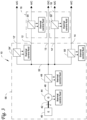
- Figure 16 illustrates an embodiment where elements that are similar to elements in Figure 3 are referenced using the same reference numerals.
- Figure 16 illustrates the electrical generator 10 as being connectable to utility lines 57a external to the generator 10 that provide input AC power; one or more energy storage devices 57b external to the generator 10 such as one or more batteries that provide input DC power; and one or more other electrical energy sources 57c external to the generator that can provide input AC or DC power.
- a power conversion device 58a receives the AC power from the utility lines 57a and converts the incoming AC to DC.
- An optional power conversion device 58b may receive DC power from the energy storage device 57b and convert the DC to AC.
- a power conversion device 58c receives AC or DC power from the energy source 57c and convert the AC to DC or converts DC to AC.
- a switching system 59 is provided that can control the flow of electrical power between the power sources 40, 42, 57a-c and the bus 52.
- the switching system 59 may be configured so that any one of the power sources can provide electrical power to the bus 52.
- the switching system 59 may also be configured so that any two or more of the power sources can simultaneously provide electric power to the bus 52.
- the switching system 59 may be configured so that electrical power is provided from the bus 52 to one of the power sources.
- electrical energy generated from the engine 40 can be directed to the utility lines 57a to supply power to the electrical grid or to the energy storage devices 57b.
- the alternative power sources depicted in Figure 16 be used with the systems illustrated in Figures 2 and 4 as well.
- the electrical generators 10 described herein also include a thermal control system 60 that can be configured to provide a thermal control fluid for thermal control of a component that is external to the electrical generator 10.
- the thermal control fluid can be provided to the component 16 and/or to the component 18.
- the thermal control fluid can be provided to a component that is not electrically connected to the electrical generator 10.
- the thermal control system 60 may also be configured to supply the thermal control fluid to one or more components that are internal to the electrical generator 10.
- the thermal control fluid can be a liquid, gas, or a mixture of liquid and gas.
- the thermal control fluid can be a cooling fluid that cools the external/internal component, or a heating fluid that heats the external/internal component.
- the system 60 may be configured to export a heated liquid for providing heat, either in addition to the cooling liquid or without the cooling liquid.
- the heated liquid can be used to, for example, heat one of the components 16, 18, and/or heat a component internal to the electrical generator 10, and/or heat any external component or structure such as a control cab, or used for any other purpose.
- the system 60 exports a heated liquid
- the system 60 may be referred to as a liquid heating system.
- the system 60 may be referred to as a thermal control system regardless of whether it exports cooling liquid and/or heated liquid for heating.
- the system 60 will hereinafter be described as a liquid cooling system that provides a cooled liquid as the thermal control fluid.
- Figure 5 illustrates one embodiment of the system 60 configured as a liquid cooling system.
- the liquid cooling system 60 can include a liquid coolant tank 62 that is configured to contain a liquid coolant and act as a supply of the liquid coolant, a coolant pump 64 connected to the liquid coolant tank 62 for pumping the liquid coolant through the cooling system 60, and a heat exchanger (or chiller) 66 for cooling the liquid coolant.
- the system 60 includes a coolant supply manifold 68 with a plurality of outlet ports and an inlet receiving coolant from the coolant pump 64, and a coolant return manifold 70 with a plurality of inlet ports and an outlet connected to the heat exchanger/chiller 66.
- the system 60 further includes at least one externally accessible quick disconnect connector 72 for directing coolant to, and receiving return heated coolant from, at least one external heat generating component, such as the component 16 or a different component, via an umbilical that contains the coolant supply and return lines 28a, 28b ( Figure 1 ).
- the cooling system 60 such as the tank 62, the pump 64 and the heat exchanger/chiller 66, are disposed within the housing 56.
- a thermal control fluid supply bus and a thermal control fluid return bus can be provided on the generator 10.
- the supply bus and the return bus can be connected to in order to supply thermal control fluid to and return thermal control fluid from one of the modules described below in Figure 14 , one of the electrical components 16, 18, or any external device that is supplied with thermal control fluid from the generator 10.
- the liquid coolant can be any liquid coolant that is suitable for cooling the heat producing component.
- the liquid coolant can be water mixed with an anti-freeze agent such as ethylene glycol or propylene glycol, or an oil-based coolant.
- the tank 62 acts as a reservoir for the liquid coolant to supply coolant and receive returning coolant after performing its cooling function.
- the pump 64 pumps the coolant through the system 60.
- the pump 64 can be an electric motor driven pump that is powered using the electrical power created by the generator 10 or mechanically driven via a suitable drive train by the output shaft 42 of the engine 40.
- the heat exchanger/chiller 66 receives returning coolant from the return manifold 70 and cools the liquid coolant before it is returned into the tank 62.
- the heat exchanger/chiller 66 can have any configuration that is suitable for cooling the liquid coolant.
- the heat exchanger can be configured as an air-to-liquid heat exchanger or configured as a liquid-to-liquid heat exchanger.
- Other arrangements of the pump 64 and the heat exchanger/chiller 66 are possible.
- the heat exchanger/chiller 66 can be located on the supply path of the coolant, for example between the pump 64 and the supply manifold 68.
- the pump 64 can be located on the return path of the coolant, for example between the manifold 70 and the heat exchanger/chiller 66.
- the supply manifold 68 supplies the cooling liquid to various destinations in the cooling system 60 via its outlet ports.
- a supply line 78a can extend from one of the outlet ports in the supply manifold 68 to the power converter 50 in order to direct the cooling liquid to the power converter 50 to cool the power converter 50.
- a supply line 78b can extend from another one of the outlet ports in the supply manifold 68 to an external outlet in the quick disconnect connector 72 (or to a coolant supply bus) to direct the cooling liquid externally of the electrical generator 10.
- the cooling liquid can be directed to both the external power converter 54 and an electric drive motor 74 that drives the component 16 (for example an impeller of a pit pump) for cooling the power converter 54 and the electric drive motor 74.
- the cooling liquid is directed serially through the electric drive motor 74 and the power converter 54, with the cooling liquid first cooling the electric drive motor 74 and then being directed into the power converter 54 to cool the power converter 54 before the cooling liquid is directed back to the electrical generator 10.
- the cooling liquid can be directed to the power converter 54 first before being directed to the electric drive motor 74.
- the cooling liquid can be directed to the power converter 54 and the electric drive motor 74 in parallel where separate streams of the cooling liquid are directed to the power converter 54 and the electric drive motor 74.
- the cooling liquid could be supplied just to the electric drive motor 74 to cool the electric drive motor 74.
- the cooling liquid can be supplied just to the power converter 54.
- supply lines 78c, 78d extend from respective outlet ports in the supply manifold 68 to the electrical generating element 44 and the power converter 48.
- An optional bypass loop 80 may also be provided that extends between the supply manifold 68 and the return manifold 70. The bypass loop 80 helps to increase the cooling capacity of the system 60.
- the return manifold 70 receives the returning heated liquid coolant from the various cooling destinations in the cooling system 60.
- a return line 82a extends from the power converter 50 to one of the inlet ports in the return manifold 70
- a return line 82b extends from an external inlet in the quick disconnect connector 72 (or from a coolant return bus) to one of the inlet ports in the return manifold 70.
- Additional return lines 82c, 82d extend from the electrical generating element 44 and the power converter 48, respectively, to respective inlet ports in the return manifold 70.
- temperature sensors 84 and flow meters 86 can be provided in the return lines 82a-d.
- the temperature sensors 84 and the flow meters 86 provide data that is useful for providing health monitoring and/or performance optimization of the electrical generator 10 and its components, as well as health monitoring and/or performance optimization of the heat generating component(s) 74.
- Data from the temperature sensors 84 and the flow meters 86 can be fed to suitable control logic to monitor these parameters.
- Variations in the individual temperatures and flows of the cooling liquid can indicate problems with the respective elements including, but not limited to, elements 44, 48, 50, 54, 74, etc., and suitable signals can be generated to warn an operator of a problem or potential problem.
- Figure 6 is a schematic depiction of a variation of the thermal control system 60 from Figure 5 .
- the system 60 in Figure 6 elements that are the same as elements in Figure 5 are referenced using the same reference numbers.
- the system 60 in Figure 6 is similar to the system 60 in Figure 5 , with the tank 62, the pump 64, the heat exchanger 66, the supply manifold 68, and the return manifold 70 internal to the housing 56.
- the system 60 in Figure 6 differs from Figure 5 in that a flow selector 90 is provided in the system 60 that can be used to divert the flow of the coolant from the return manifold 70 to an external heat exchanger/chiller 92.
- the heat exchanger/chiller 92 can be connected to the generator via quick connect connectors 94 or any other suitable form of fluid connector.
- the flow selector 90 can be actuated so as to permit flow of the cooling liquid directly from the return manifold 70 to the internal heat exchanger/chiller 66.
- the flow selector 90 can also be actuated so as to direct flow of the cooling liquid from the return manifold 70 to the external heat exchanger/chiller 92, before flowing back into the generator to the internal heat exchanger/chiller 66.
- heat exchanger/chiller 92 is depicted as being a stand-alone component, the heat exchanger/chiller 92 can be incorporated into the component 16 and/or into the component 18. In some embodiments, one or more additional quick connect connectors 94 (shown in dashed lines) can be provided for connection with additional external devices.
- external components can also be connected in series and/or parallel to the flow of the cooling liquid for cooling the external components.
- Figure 6 illustrates 3 external components 96a, 96b, 96c fluidly connected to and receiving cooling liquid via the supply line 78a.
- the components 96a, 96b are fluidly connected in series whereby the cooling liquid flows through and cools the component 96a before flowing to and cooling the component 96, and then being returned to the return manifold 70.
- the component 96c is fluidly connected in parallel with the component 96b, where a portion of the cooling liquid is diverted from the component 96a to the component 96c for cooling the component 96c before being returned to the return manifold 70.
- the cooling liquid can be diverted to the components 96b, 96c before flowing into the component 96a.
- Figure 7 is a schematic depiction of another variation of the thermal control system 60 from Figures 5 and 6 .
- the system 60 in Figure 7 elements that are the same as elements in Figures 5 and 6 are referenced using the same reference numbers.
- the system 60 in Figure 7 is similar to the system 60 in Figures 5 and 6 , with the tank 62, the pump 64, the heat exchanger 66, the supply manifold 68, and the return manifold 70 internal to the housing 56.
- the system 60 in Figure 7 differs from the system in Figure 6 in that the cooling liquid from the supply line 78a initially flows into a first external component, such as the component 18, to cool the first external component, and the cooling liquid is then directed into and cools the second external component, such as the component 16, before being returned to the return manifold 70.
- the system 60 is configured so that the first and second external components receive the cooling liquid in series.
- the first and second external components can receive the cooling liquid in series, with the second external component receiving the cooling liquid first followed by the first external component receiving the cooling liquid before returning to the return manifold 70.
- the electrical generator 10 can include the two outputs 12, 14 without the thermal control system 60 of Figures 5-7 . In other embodiments, the electrical generator 10 can include only one of the outputs 12, 14 together with the thermal control system 60 of any one of Figures 5-7 .
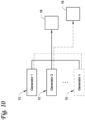
- FIG 8 an embodiment of a control system architecture 100 of the electrical generator 10 is illustrated. Elements that are the same as elements in Figures 1-7 are referenced using the same reference numbers.
- a removable and replaceable user interface module 102 is installed on the electrical generator 10 for controlling operation of the electrical generator 10 based on the component 16 that is connected to or to be connected to the modulated electrical output, or optionally based on the component 18 that is connected to or to be connected to the export electrical power output.
- the user interface module 102 can be used remotely from the electrical generator 10 (as indicated in broken line) to control the electrical generator 10.
- the user interface module 102 can be replaced with one of a plurality of additional user interface modules 102a... 102n each one of which is specifically configured to be installed on the electrical generator 10 depending upon the external component 16 to be powered by the generator 10.
- Each user interface module 102, 102a,... 102n is specifically configured for use with its associated external component 16 to control the electrical generator 10 to ensure that the correct electrical power required by the component 16 is supplied at the modulated electrical output 12. Since each different component 16 that may be connected to the modulated electrical output 12 may require a different modulated electrical power, the modulated electrical power at the modulated electrical output 12 can be different for each user interface module 102, 102a,... 102n.
- the programming of the interface module 102 can be changed or added to in order to add a new component 16 so that the interface module 102 can be used with each new component 16 by modifying the programming of the interface module 102 based on each new component 16.
- control system architecture 100 is also illustrated as including a Bluetooth module 104 that can connect to a smart device, such as a smart phone or tablet, via Bluetooth to receive feedback from the electrical generator 10 and to permit control of the electrical generator 10 by the smart device, a communication modem 106 to permit remote connection to a remote controller, such as a personal computer or the like, to receive feedback from the electrical generator 10 and to permit control of the electrical generator 10 by the remote controller, a slave module 108 that receives sensor signals and outputs all control signals for the electrical generator 10, and an isolation monitor 110 that forms an electrical safety system that monitors electrical isolation between the chassis of the electrical generator 10 and high voltage.
- a Bluetooth module 104 can connect to a smart device, such as a smart phone or tablet, via Bluetooth to receive feedback from the electrical generator 10 and to permit control of the electrical generator 10 by the smart device
- a communication modem 106 to permit remote connection to a remote controller, such as a personal computer or the like, to receive feedback from the electrical generator 10 and to permit control of the electrical generator 10 by the remote controller
- the electrical generator 10 described herein can be used at any location where electrically powered components that require different types of electrical power are utilized.
- the electrical generator 10 is used at a site where horizontal directional drilling is occurring.
- the site includes a horizontal directional drilling (HDD) rig 110 and a pit pump 112.
- the HDD rig 110 is configured to perform horizontal directional drilling which is well known to those of ordinary skill in the art.
- the HDD rig 110 can be electrically powered with components such as traverse carrier drive components and drill pipe rotation components driven by electric motors.
- the HDD rig 110 can also include other electrically powered components such as a chiller system that is part of a cooling fluid circuit that circulates and cools a refrigerant liquid that is circulated through various ones of the electric motors on the HDD rig 110 for cooling the electric motors.
- a chiller system that is part of a cooling fluid circuit that circulates and cools a refrigerant liquid that is circulated through various ones of the electric motors on the HDD rig 110 for cooling the electric motors.
- An example of an electrically powered HDD rig 110 is disclosed in U.S. Patent Application Publication 2017/0342816 .
- the pit pump 112 is disposed in a pit 114, submerged in drilling fluid, and is configured to pump the drilling fluid to a recycling system of the HDD rig 110 to be recycled for re-use by the HDD rig 110.
- the pit pump 112 is part of a drilling fluid recycling system that is used to recycle used drilling fluid for re-use during a borehole drilling operation. Used drilling fluid from the drilling operation, mixed together with solids from the borehole, can collect in the pit 114, which can be an exit pit or an entry pit, with the used drilling fluid mixed with solids then being pumped by the pit pump 112 to the rest of the recycling system where the used drilling fluid is processed to remove the solids and to make the drilling fluid otherwise suitable for pumping back into the borehole.
- the pit pump 112 includes an electric drive motor (such as the motor 74 shown in Figure 5 ) that drives a pump impeller.
- a suitable pit pump is available from LaValley Industries of Bemidji, Minnesota.
- the electrical generator 10 can adjust a temperature of the thermal control fluid directed to the external component(s).
- a fan of the internal heat exchanger/chiller can be turned on/off and/or the thermal control fluid can be directed to the external heat exchanger/chiller 92 to adjust the temperature of the thermal control fluid.
- the temperature of the thermal control fluid can be determined using suitable temperature sensor(s), for example the temperature sensor 84 in the return line 82b and/or a temperature sensor in the supply line 78b and/or a temperature sensor on the output from the tank 62.
- the external component to be thermally controlled is an electric drive motor, such as the electric drive motor of the pit pump 112
- adjusting the temperature of the thermal control fluid directed to the drive motor adjusts the performance capacity/efficiency of the electric drive motor, e.g. adjusts the power or revolutions per minute (RPMs) of the electric drive motor because the electric drive motor is more efficient the cooler it is.
- RPMs revolutions per minute
- the RPM's of the engine can be varied based on the load connected to the output 12 in order to maximize the operating fuel efficiency of the engine 40 based on the specific load.
- the export electrical power at the output 14 allows the generator 10 to operate traditional synchronous electrical loads at all common voltages including 120 V, 240 V, 480 V, etc.
- the modulated electrical power can output 100% of the electrical generator 10 power capacity with the export electrical power outputting 0%; or the export electrical power can output 100% of the electrical generator 10 power capacity with the modulated electrical power outputting 0%).
- the power can be split between both the modulated electrical power and the export electrical power simultaneously. If the electrical generator 10 has more than two electrical outputs, the power can be split among the various electrical outputs. The power can be split in any ratio. However, the available generator power (i.e. 100% capacity) cannot be exceeded. In one embodiment, power can be prioritized by the control system of the electrical generator 10 to the external component 16, 18 that needs the most power. The prioritization can be manually set or automatically set based on communications from the component(s) 16, 18. For example, when a component 16, 18 is connected to the generator 10, the component 16, 18 can inform the generator 10 of its power requirements and thus of its priority.
- either output type can be selected as a priority.
- the modulated electrical power is selected as a priority
- the export electrical power will be reduced in proportion to any increase in the modulated electrical power so that the total remains 100%.
- the modulated electrical power will be automatically reduced in proportion to any increase in the export electrical power so that the total remains 100%.
- the export electrical power will be automatically decreased proportionally toward 0%.
- a user can also be permitted to select a power ratio limit that will, if needed, automatically limit the modulated electrical power and the export electrical power to the selected ratio. For example, if one selects a ratio of 70%-30% of the modulated electrical power versus the export electrical power, the modulated electrical power would be limited to a maximum of 70% of the total generator capacity if the device(s) using export electrical power is using its allotted 30% limit of the total generator capacity. In this example, if the device(s) using export electrical power is using only 10% (or some other value less than 30%) of the total generator capacity, the modulated electrical power can exceed the 70% limit by a corresponding amount. However, if the device(s) using the export electrical power then increases to 30%, the modulated electrical power would then be reduced to the 70% limit.
- the electrical generator 10 also provides fuel savings by the unique system architecture that provides the modulated electrical power which allows the engine 40 to operate at lower RPM's when the load is lower reducing power consumption and unnecessary wear.
- Health monitoring can also be provided on the components of the electrical generator 10 to provide state of the art feedback of all critical operating parameters such as duty cycle, temperature, peak cycle, vibration, and the like.
- Each of the components including, but not limited to, the components 16, 18, 40, 44, 48, 50, 50', 54, 54' 62, 64, 66, 68, 70, etc., can be monitored using temperature sensors, and other sensors, which readings can be fed directly to the user interface module 102, or to the slave module 108 and then the user interface module 102. The readings serve to provide health monitoring of the various components of the electrical generator 10 and used with the generator 10.
- two or more of the electrical generators 10 can be connected in parallel to increase capacity in electrically driving a load, for example driving the component 16 and/or driving the component 18. Further description on paralleling two or more electrical generators is discussed below with respect to Figures 14 and 15 .
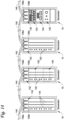
- FIGS 11-13 illustrate another embodiment of the electrical generator 10.
- the electrical generator 10 uses a plurality of modules, including output modules that incorporate the different electrical outputs 12, 14.
- the internal components of the generator 10 in Figures 11-13 can be similar to the generator 10 in Figures 1-7 , including the engine 40 (or other AC input power source), the output shaft 42, the electrical generating element 44, the first power converter 48, and the thermal control system 60.
- one or more of the power converters may also be included in the generator of Figures 11-13 .
- the power converters 50, 50', 50-1, 50-2, 54, 54' described herein are preferably included within output modules that are removably installable in the electrical generator 10.
- the generator 10 can include a first power output module 120, a second power output module 122, and optionally a third power output module 124.
- the first power output module 120 can be configured to output, via the electrical output 12 incorporated into the module 120, the desired form of AC electrical power for powering the component 16.
- the module 120 includes the power converter 54, 54' that converts the DC power from the DC bus to the desired form of AC electrical power.
- the second power output module 122 can be configured to output, via the electrical output 14 incorporated into the module 122, the desired form of AC electrical power for powering the component 18.
- the module 122 includes the power converter 50, 50' that converts the DC power from the DC bus to the desired form of AC electrical power.
- the optional third power output module 124 can be configured to output a lower power from the electrical output 14-2, such as AC electrical power with a lower voltage than the output 14, for example as described above with respect to the output 14-2 of Figure 4 .
- the module 124 includes the power converter 50-2 that converts the DC power from the DC bus to the desired form of lower power AC electrical power.
- the power output modules 120, 122, 124 are each removably installed in the generator 10.
- the power output of the generator 10 can be modified by using any combination of the modules 120, 122, 124, and/or replacing one of the modules 120, 122, 124 with a similar module that is configured with a different power converter to change the AC electrical power output therefrom.
- a separate module, or one of the power output modules 120, 122, 124 can be configured to output DC power therefrom which DC power is modified from the form obtained from the DC bus.
- the DC power from the DC bus need not be modified and unmodified DC power from the DC bus can be output directly from the DC bus including from a power output module.
- the first power output module 120 can also include a data port 126 for exporting data from and/or inputting data into the module 120.
- the module 120 can also include thermal control fluid inlet and outlet ports 128a, 128b that can be used to direct thermal control fluid from the internal thermal control system 60 of the generator 10 to the component 16 receiving power from the module 120.
- the thermal control fluid from the internal thermal control system 60 can be input into the module 120 via suitable fluid connectors (not shown) on the rear of the module 120 that are fluidly connected to fluid connectors 130 (see Figure 14 ) within the generator 10.
- the fluid connectors 130 can be configured for manual connection, or they can be blind mate, quick connect fluid couplers.
- the additional module 142 can be an additional one of the power output modules 120, 122, 124.
- the additional module 142 can be a thermal control module used for thermally controlling the thermal control fluid, for example the thermal control module can include the external heat exchanger/chiller 92 described above with respect to Figures 6 and 7 .
- the additional module 142 can be used as a thermal control module that acts as a cooling and/or heating module. When configured as a cooling module, the module can act as a source for directing additional flows of the liquid coolant from the internal liquid cooling system 60 of the generator 10 to external devices needing cooling.
- the module When configured as a heating module, the module can direct heated coolant externally for heating use, for example to heat a building, a control cab of an HDD rig, or other heating need.
- the thermal control module can also include a plurality of liquid inlet and outlet ports on the front side thereof permitting connection of fluid lines for directing the cooled liquid coolant to one or more external devices needing cooling or directing the heated coolant to one or more external devices needing heating.
- electrical power for the modules 120, 122, 124, 132 of the generator 10 can be provided via DC bus bars 144 that form the DC output bus 52 of the generator 10.
- Each one of the modules is configured to electrically connect to the DC bus bars 144.
- the modules can electrically connect to the DC bus bars 144 in any suitable manner.
- the rear side of the each module can include electrical connectors 146 that connect to the DC bus bars 144.
- the electrical connectors 146 can be blind mate electrical connectors that automatically connect to the DC bus bars 144 when each module is slid into position in its slot in the generator 10, and that automatically disconnect from the DC bus bars 144 when each module is removed from the generator 10.
- Figure 14 illustrates a plurality of the generators 10 connected to one another in parallel.
- the generator 10 on the right is configured to output electrical power via the output modules 120, 122, 124.
- the generator 10 on the right is able to supply 100% of the electrical power that is available from all of the generators 10.
- modules can be added to any of the generators 10.
- the second generator 10 is illustrated as including the output module 120 (in dashed lines) and the output module 122 (in dashed lines).
- the generators 10 have a common bus connection.
- the modules can be located in any generator 10 and connect to the common bus while sharing the single common bus power source.
- Any generator 10 can be contributing as little or as much electrical power to the bus as needed.
- Load management control can be used to shed generators 10 or bring generators 10 on as needed without changing connections between the generators 10 since there is a single common bus.
- the RPMs of the engines 40 of the paralleled generators 10 can be automatically controlled.
- all of the generators 10 may be controlled so as to adjust their RPMs up or down as needed to match the system load. If the system load that is required becomes less than the paralleled generators 10 are producing, then one or more of the generators can be shed (i.e. shut down or its power output not contributing to the total power output of the paralleled generators) as needed. If the system load thereafter increases, then one or more of the generators can be brought back on as needed to contribute to the total power output as.
- FIG 15 illustrates the common DC bus connection of the paralleled electrical generators 10 of Figure 14 .
- Each generator 10 contributes to the common DC bus 150 of the system, and each output module 120, 122, 124 draws electrical power from the common DC bus 150 for powering its associated load (e.g. components 16, 18).
- the bus 150 can be an AC bus.
- the configurations in Figures 11-15 permit electrically connecting a plurality of the generators 10 in parallel via a DC bus.
- the performance of the generator 10 can be modified by replacing one of the modules, for example one of the power output modules 120, 122, 124, with another module that is configured to have different performance, for example outputting a different amount or type of AC power or DC power in the case of the power output modules 120, 122, 124.
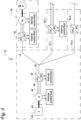
- Figure 17 illustrates another example of a common bus connection. Elements in Figure 17 that are the same as elements in Figure 15 are referenced using the same reference numerals.
- a plurality of the electrical generators 10 are depicted as being connected in parallel.
- one or more energy storage devices which can be similar to the energy storage device 57b of Figure 16 , may also be connected to the bus 150.
- the energy storage device(s) 57b can be part of or separate from the electrical generator(s) 10 and can be used to store electrical energy generated by the electrical generator(s) 10.
- the energy storage device(s) 57b can be any energy storage device that can store electrical energy.
- the energy storage device(s) 57b can be one or more batteries, capacitors, and the like.
- the energy storage device(s) 57b may also be used to provide electrical power for use by the output modules 120, 122, 124, or the energy storage device(s) 57b can be used to provide electrical power for any device external to the electrical generator(s) 10.
- a power output module 120, 122, 124 that is configured for use in outputting electrical energy from the energy storage device(s) 57b and/or controlling charging of the energy storage device(s) 57b can be provided.
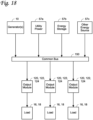
- Figure 18 illustrates another example of a common bus connection. Elements in Figure 18 that are the same as elements in Figures 15 and 17 are referenced using the same reference numerals.
- Figure 18 depicts one or more of the electrical generators 10 connected to the bus 150 along with the utility lines 57a, one or more of the energy storage devices 57b, and the other energy source 57c.
- the generator 10 acts as an energy handling system, where the electrical bus 150 is electrically connectable to a first source of electrical power within the housing 56 or enclosure, and is also electrically connectable to a second source of electrical power external to the enclosure, such as the utility lines 57a, the energy storage 57b and/or the other energy source 57c.
- a plurality of electrical power outputs can be provided, for example via the output modules 120, 122, 124, where the power outputs can be connected to in order to direct electrical power to the external loads 16, 18 that are external to the housing/enclosure.
- the bus 150 can receive electrical power from the second, external source of electrical power and the bus 15 can also be used to direct electrical power to the second, external source of electrical power, for example to direct excess electrical power to the electrical grid via the utility lines 57a and/or to charge the energy storage device(s) 57b.
- Figure 19 illustrates another embodiment where the bus 150, and a supply manifold 200 and a return manifold 202 for the thermal control fluid are integrated together in a common assembly 204 (illustrated schematically by the dashed line box).
- the common assembly 204 forms a common structure where both electrical energy transfer and thermal energy transfers take place.
- the common assembly 204 can be integrated into the electrical generator structures described herein.
- the common assembly 204 can be a structure that is physically separate from the electrical generator structures described herein, but which can be interfaced with the electrical generator structures described herein.
- different power consuming components can be electrically connected to the assembly 204 to receive electrical power from the bus 150 and/or to receive thermal control fluid from the supply manifold 200.
- the power consuming components can be any components that can be powered by electrical power received from the assembly 204 and/or that can receive thermal control fluid from the assembly 204 for use in thermal control of the power consuming component.
- the components can be the components 16, 18, a component 208 that can be directly powered from DC (or AC) power of the bus 150 (i.e.
- a DC powered component 210 that has a DC/DC power converter 212, an AC higher powered component 214 that has a DC/AC power converter 216 providing higher AC power, and an AC lower powered component 218 that has a DC/AC power converter 220 providing lower AC power (i.e. lower than the DC/AC power converter 216).
- Figure 19 also depicts a control system 230 that can be used to control some or all of the system depicted in Figure 19 .
- the control system 230 can be in communication with the pump 64 and each of the power sources 40, 57a, 57b, 57d, 57e, 57f.
- the control system 230 can also be in communication with the power conversion devices 48, 58b, 58d, 58e, 58f, flow control valves 232 in the supply line 222 and the return line 224, and communication interfaces 234 associated with the power consuming components 16, 18, 208, 210, 214, 218.
- the control system 230 can receive data inputs from the various elements to allow monitoring of performance.
- the control system 230 can also control operation of the various elements.
- control system 230 can determine which electrical power source(s) 40/44, 57a, 57b, 57d, 57e, 57f supplies electrical power to the bus 150 and/or direct electrical power from one power source, such as the power source 40/44, to the utility lines 57a and/or to the energy storage devices 57b.
- the control system 230 can also control the flow of thermal control fluid to and from the power consuming devices by controlling the flow control valves 232.
- Figure 20 illustrates a non-limiting example of how the bus 150, and the supply manifold 200 and the return manifold 202, can be integrated together in the common assembly 204.
- metallic pipes forming the supply manifold 200 and the return manifold 202 form the bus 150, with the pipe of the supply manifold 200 forming the positive portion of the bus 150 and the return manifold 202 forming the negative portion of the bus 150.
- the pipes can be formed of any material suitable for conducting electricity sufficient to act as a DC (or AC) bus.
- the pipes can be made of metal including, but not limited to, copper, brass or aluminum.
- other techniques for integrating the bus 150 and the manifolds 200, 202 into the common assembly 204 are possible.
Landscapes
- Engineering & Computer Science (AREA)
- Mining & Mineral Resources (AREA)
- Geology (AREA)
- Life Sciences & Earth Sciences (AREA)
- Physics & Mathematics (AREA)
- Mechanical Engineering (AREA)
- Fluid Mechanics (AREA)
- Environmental & Geological Engineering (AREA)
- General Life Sciences & Earth Sciences (AREA)
- Geochemistry & Mineralogy (AREA)
- Chemical & Material Sciences (AREA)
- General Engineering & Computer Science (AREA)
- Combustion & Propulsion (AREA)
- Power Engineering (AREA)
- Geophysics (AREA)
- Control Of Eletrric Generators (AREA)
- Connection Of Motors, Electrical Generators, Mechanical Devices, And The Like (AREA)
Description
- This technical disclosure relates to an electrical generator that can simultaneously output different types of electrical power, as well as output a thermal control fluid for use in thermal control of a component that may or may not be electrically connected to one of the electrical power outputs of the electrical generator.
- The use of electrical generators to provide electrical power to components is known. One example use of an electrical generator is on a job site where line power (also known as utility power) may not be present or where the electrical generator is used in place of line power/utility power. In some instances, different components at a job site may require different types of electrical power, in which case separate electrical generators may be used to power the different components. Document
WO 01/61820 A1 US 2012/292992 A1 discloses a dual fuel system and method of supplying power to loads of a drilling rig. DocumentUS 2006/270280 A1 discloses an electric generator having multiple receptacles. - An electrical generator and associated methods are described herein where the electrical generator is configured to simultaneously output different types of electrical power so that electrically powered components that require different types of electrical power can be simultaneously powered by the electrical generator. The electrical generator can be used at any location where electrically powered components that require different types of electrical power are utilized. In addition to outputting different types of electrical power, the electrical generator is also configured to output at least one type of electrical power as well as a thermal control fluid that can include, but is not limited to, a liquid, gas, or mixture thereof for use in thermal control (heating and/or cooling) of an external component.
- In one embodiment, the electrical generator is configured to generate and output a modulated electrical power that is output at a modulated electrical power output (which may also be referred to as a variable frequency and/or variable amplitude power output), as well as configured to generate and output an export (or standard) electrical power that is output at an export electrical power output (which may also be referred to as a synchronous electrical power output). An electrically powered component that requires modulated electrical power can be powered from the modulated electrical power output. An electrically powered component that requires export/standard/synchronous electrical power may also be simultaneously powered from the export electrical power output.
- According to the invention, the electrical generator is provided with a thermal control system and can output a thermal control fluid, which can be a liquid, gas, or mixture thereof, for thermal control of a component at the job site. For example, the thermal control fluid can be a cooling fluid used to cool one of the electrically powered components receiving electrical power from the electrical generator. In another embodiment, the thermal control fluid can be used to cool or heat an electrical component that is not electrically powered by the electrical generator. After exchanging heat with the component, the thermal control fluid can be pumped back to the electrical generator for heat exchange before being returned back to the component for additional thermal control. In one embodiment, the heat exchange of the thermal control fluid can occur entirely within the electrical generator via a heat exchanger that is internal to the electrical generator. In another embodiment, the thermal control fluid can be directed into a heat exchanger that is external to the electrical generator but fluidly connected to the electrical generator to receive the thermal control fluid for heat exchange before the thermal control fluid is directed back into the electrical generator. In still another embodiment, the thermal control fluid can be directed through both an internal heat exchanger and an external heat exchanger.
- In another embodiment, a plurality of user interface modules can be provided where each user interface module can be individually removably installed on the electrical generator to control operation of the electrical generator. In one embodiment, each user interface module can be associated with a particular electrically powered component to be powered by the modulated electrical power to appropriately control the modulated electrical power at the modulated electrical power output based on the particular electrically powered component connected to the modulated electrical power output. In another embodiment, each user interface module can be associated with a particular electrically powered component to be powered by the export electrical power to appropriately control the export electrical power at the export electrical power output based on the particular electrically powered component connected to the export electrical power output. The user interface modules can be changed out based on the electrically powered component connected to (or to be connected to) the modulated electrical power output and/or to the export electrical power output.
- In one embodiment described herein, an electrical generator can include an engine having a mechanical output, a first electrical power output that outputs a first type of electrical power, and a second electrical power output that outputs a second type of electrical power, where the second type of electrical power differs from the first type of electrical power. Conversion components are connected to the mechanical output and to the first and second electrical power outputs, where the conversion components are configured to convert the mechanical output into the first type of electrical power and the second type of electrical power. The first type of electrical power output at the first electrical power output can be direct current electrical power, and the second type of electrical power output at the second electrical power output can be synchronous alternating current electrical power. Alternatively, the first type of electrical power output at the first electrical power output can be modulated alternating current electrical power, and the second type of electrical power output at the second electrical power output can be synchronous alternating current electrical power. In another embodiment, the first type of electrical power output at the first electrical power output can be direct current electrical power, and the second type of electrical power output at the second electrical power output can be modulated alternating current electrical power. In another embodiment, the electrical generator can have more than two electrical power outputs with any combination of modulated alternating current electrical power, synchronous alternating current electrical power, and direct current electrical power.
- In another embodiment described herein, an electrical generator can include an engine having a mechanical output, conversion components connected to the mechanical output that are configured to convert the mechanical output into at least one alternating current that is output from at least one alternating current output, and a thermal control system that can output a thermal control fluid, which can be a liquid, gas or mixture thereof, from the electrical generator for cooling or heating an external component. The thermal control system can include a tank configured to contain a thermal control fluid, a pump connected to the tank, a heat exchanger connected to the pump, and a first flow path between the thermal control system and a thermal control fluid outlet connector that can be connected to in order to direct thermal control fluid to a component external to the electrical generator. In this embodiment, the electrical generator not only provides electrical power (for example modulated electrical power and/or export electrical power) but also provides a thermal control fluid for thermal control of a component that is external to the electrical generator.
- In another embodiment described herein, a system can include an electrical generator as described herein, a first component of a horizontal directional drilling system connected to the first electrical power output of the electrical generator, and a second component of a horizontal directional drilling system connected to the second electrical power output of the electrical generator.
- In another embodiment described herein, a system can include an electrical generator as described herein, and a plurality of user interface modules. Each user interface module is individually removably installable on the electrical generator to control operation of the electrical generator, and each user interface module is configured to control the electrical power that is output at the electrical power output whereby the electrical power differs for each user interface module.
- In another embodiment described herein, a method can include connecting an electric drive motor of an implement/device including, but not limited to, a pit pump, to an electrical power output of an electrical generator controlled by a first user interface module. Thereafter, the first user interface module is removed and a second user interface module is installed that is configured to operate with a second electrically operated implement other than the electric drive motor of the first implement. The electric drive motor of the first implement is disconnected from the electrical power output of the electrical generator, and the second electrically operated implement is connected to the electrical power output of the electrical generator.
-
-
Figure 1 is a schematic illustration of the electrical generator described herein powering different electrically powered components. -
Figure 2 is a schematic illustration of one embodiment of an electrical system architecture of the electrical generator described herein. -
Figure 3 is a schematic illustration of another embodiment of an electrical system architecture of the electrical generator described herein. -
Figure 4 is a schematic illustration of still another embodiment of an electrical system architecture of the electrical generator described herein. -
Figure 5 is a schematic illustration of one embodiment of a thermal control system architecture of the electrical generator described herein. -
Figure 6 is a schematic illustration of another embodiment of a thermal control system architecture of the electrical generator described herein. -
Figure 7 is a schematic illustration of still another embodiment of a thermal control system architecture of the electrical generator described herein. -
Figure 8 is a schematic illustration of an embodiment of a control system architecture of the electrical generator described herein. -
Figure 9 is a schematic illustration of the electrical generator described herein used at a site where horizontal directional drilling is occurring. -
Figure 10 is a schematic illustration of a plurality of the electrical generators described herein connected in parallel for powering a load. -
Figure 11 is a perspective view of another embodiment of an electrical generator described herein where the electrical outputs are incorporated into output modules. -
Figure 12 is a front view of the electrical generator ofFigure 11 with the modules installed. -
Figure 13 is a cross-sectional side view of the electrical generator ofFigure 11 . -
Figure 14 illustrates a plurality of the electrical generators ofFigure 11 paralleled together. -
Figure 15 schematically depicts a common bus connection of the paralleled electrical generators. -
Figure 16 is a schematic illustration of another embodiment of an electrical system architecture of an electrical generator described herein. -
Figure 17 schematically depicts another example of a common bus connection. -
Figure 18 schematically depicts another example of a common bus connection. -
Figure 19 schematically depicts an example of integrated common bus and thermal control fluid manifolds. -
Figure 20 schematically depicts one example of integrating the common bus and thermal control fluid manifolds. - Referring to
Figure 1 , anelectrical generator 10 as described in more detail below is illustrated. Theelectrical generator 10 is configured to simultaneously output different types of electrical power from at least two differentelectrical outputs electrical output 12 may be considered a first electrical output or a second electrical output, while theelectrical output 14 may be considered a second electrical output (if theelectrical output 12 is considered the first) or a first electrical output (if theelectrical output 12 is considered the second). Different electricallypowered components outputs electrical generator 10. In some embodiments, both of thecomponents electrical generator 10 can be used to power only thecomponent 16 or only thecomponent 18. The different types of electrical power that can be output from theoutputs - In one embodiment, the
output 12 can be a direct current output that outputs a direct current (DC) electrical power that is then converted by a power converter externally of theelectrical generator 10 into either a modulated, alternating current (AC) electrical power or a synchronous AC electrical power depending upon the electrical power requirements of thecomponent 16. In another embodiment, theoutput 12 can output a modulated AC electrical power or a synchronous AC electrical power required by thecomponent 16 where the power converter and the conversion into the modulated or synchronous AC electrical power occurs internally of theelectrical generator 10. In another embodiment, theoutput 12 can output DC electrical power that is not converted to AC. In some embodiments, theoutput 12 may be referred to as a modulated electrical power output that outputs modulated electrical power (which may also be referred to as a variable frequency and/or variable amplitude power output). - Similarly, the
output 14 can be a direct current output that outputs DC electrical power that is then converted by a power converter externally of theelectrical generator 10 into either a modulated, alternating current (AC) electrical power or a synchronous AC electrical power depending upon the electrical power requirements of thecomponent 18. In another embodiment, theoutput 14 can output a modulated AC electrical power or a synchronous AC electrical power required by thecomponent 18 where the power converter and the conversion into the modulated or synchronous AC electrical power occurs internally of theelectrical generator 10. In another embodiment, theoutput 14 can output DC electrical power that is not converted to AC. In some embodiments, theoutput 14 may be referred to as an export electrical power output that outputs an export (or standard or synchronous) AC electrical power required by thecomponent 18. - In some embodiments, the
component 16 may be powered by theoutput 14 and thecomponent 18 may be powered by theoutput 12. - The
component 16 may be electrically connected to theoutput 12 via apower line 20, while thecomponent 18 may be electrically connected to theoutput 14 via apower line 22. In addition, adata line 24 can be provided between thecomponent 16 and theelectrical generator 10 to transmit various data between theelectrical generator 10 and thecomponent 16, while adata line 26 can be provided between thecomponent 18 and theelectrical generator 10 to transmit various data between theelectrical generator 10 and thecomponent 18. In addition, as discussed in further detail below, in some embodiments thermal control fluid supply andreturn lines electrical generator 10 and thecomponent 16 and/or thermal control fluid supply andreturn lines electrical generator 10 and thecomponent 18. - In addition, one or more additional ones of the
components 16 may be connected to one another in series as illustrated (or in parallel) with one or more power, data and/or thermalcontrol fluid lines 17 connecting thecomponents 16. Similarly, one or more additional ones of thecomponents 18 may be connected to one another in series as illustrated (or in parallel) with one or more power, data and/or thermalcontrol fluid lines 19 connecting thecomponents 18. - The
electrical generator 10 illustrated inFigure 1 is useful in locations where different electrically powered components, such as thecomponents component 16 may be an electrically powered component or system that experiences variable loads. Examples of thecomponents 16 that can be powered by theelectrical generator 10 include, but are not limited to, an electric drive motor of a pit pump used at a horizontal directional drilling site, one or more electrically powered components of a horizontal directional drilling (HDD) rig, a drilling mud cleaning system used with the HDD rig, a tool truck, maintenance trailer, a light plant, a control cab, a building, a portable saw mill, a cement mixing plant, a welder, or a pipe flange facing machine. - The
component 18 may be an electrically powered component that requires standard (or clean or synchronous) electrical power which may be referred to as export power. Examples of thecomponents 18 that can be powered by theelectrical generator 10 include, but are not limited to, the same components as thecomponents 16 but configured to be run by synchronous power; a heater at an HDD site; an air compressor; and hand tools. -
Figure 2 illustrates one embodiment of an electrical system architecture of theelectrical generator 10 that produces different electrical powers at theoutputs output 12 outputs DC electrical power that is then converted externally of theelectrical generator 10 into modulated AC electrical power, while theoutput 14 outputs synchronous AC electrical power. Theelectrical generator 10 includes a housing 56 (illustrated in dashed lines) that houses some of the elements described herein. In this example, theelectrical generator 10 includes anengine 40, such as a diesel engine, a gasoline powered engine, a propane powered engine, or the like, that outputs mechanical energy via anoutput shaft 42. Theengine 40 can be powered by any suitable engine fuel (wet/dry). Examples of suitable engine fuels that can be used include, but are not limited to, gasoline, diesel fuel, natural gas, propane, and the like. - In addition, conversion components are provided that convert the mechanical energy of the
output shaft 42 into the different electrical powers at theoutputs outputs electrical generating element 44, afirst power converter 48, and asecond power converter 50. - The
electrical generating element 44 can be any device that is suitable for converting the torque of theoutput shaft 42 into anAC output 46, for example single phase or 3-phase AC. In one non-limiting example, theelectrical generating element 44 can be a permanent magnet motor that is mechanically connected to and driven by theoutput shaft 42. The permanent magnet motor can be any permanent magnet motor that is suitable for converting the mechanical input of theshaft 42 into theAC output 46. - The
power converter 48 is configured to receive theAC output 46 and convert the AC to DC electrical power that is output along aDC output bus 52. Thepower converter 48 can have any configuration that is suitable for converting the AC to DC. - In the illustrated example, the
DC output bus 52 has at least two branches, with one branch directing DC electrical power to thepower converter 50. Thepower converter 50 converts the DC electrical power into the export, synchronous AC electrical power that is output at theelectrical power output 14. In one embodiment, thepower converter 50 can be configured to generate 120/240 VAC single phase AC that is output from theoutput 14. In another embodiment, thepower converter 50 can generate 480 VAC 3-phase AC that can be output from theoutput 14. Thepower converter 50 can have any configuration that is suitable for converting DC electrical power into the synchronous AC electrical power. An example of thepower converter 50 can be a DC to AC inverter. - The other branch of the
DC output bus 52 directs the DC electrical power to theoutput 12. In this embodiment, theelectrical component 16 that is electrically connected to theoutput 12 includes apower converter 54 that is configured to convert the DC electrical power to modulated AC electrical power for use by theelectrical component 16. Thepower converter 54 can have any configuration that is suitable for converting DC electrical power to modulated AC electrical power. -
Figure 3 illustrates another embodiment of an electrical system architecture of theelectrical generator 10 that can produce different electrical powers at electrical outputs thereof. Elements that are identical to elements inFigure 2 are referenced using the same reference numerals. Like the embodiment inFigure 2 , the embodiment inFigure 3 can output DC electrical power at theoutput 12 that is then converted externally of theelectrical generator 10 by thepower converter 54 into modulated AC electrical power, while theoutput 14 outputs synchronous AC electrical power. Instead of or in addition to theoutput 12, the embodiment inFigure 3 can include an internal power converter 54' that can be similar in function and construction to thepower converter 54 and that converts the DC electrical power to modulated AC electrical power internally within theelectrical generator 10 and then directs the modulated AC electrical power to an output 12' for use by an external electrical component. Further, instead of or in addition to theoutput 12 and the output 12', the embodiment inFigure 3 can include anoutput 13 that outputs DC electrical power for use by an external electrical component requiring DC electrical power. Similarly, instead of or in addition to theoutput 14, the embodiment inFigure 3 can include an output 14' that outputs DC electrical power that is then converted externally of theelectrical generator 10 by an external power converter 50' into synchronous AC electrical power for use by the externalelectrical component 18 requiring synchronous AC electrical power. - The embodiment of the
electrical generator 10 inFigure 3 can include any two or more of theoutputs electrical generator 10 inFigure 3 includes the output 12' and theoutput 14. -
Figure 4 illustrates another embodiment of an electrical system architecture of theelectrical generator 10 that can produce different electrical powers at different electrical outputs thereof. Elements that are identical to elements inFigures 2 and/or 3 are referenced using the same reference numerals, or the same reference numerals with the ending "-1" or "-2". Like the embodiments inFigures 2 and3 , the embodiment inFigure 4 can output DC electrical power at theoutput 12 that is then converted externally of theelectrical generator 10 by thepower converter 54 into modulated AC electrical power. Alternatively, similar to the construction depicted inFigure 3 , theelectrical generator 10 inFigure 4 can include an internal power converter 54'. In addition, theelectrical generator 10 inFigure 4 can include two outputs 14-1, 14-2 each of which outputs DC electrical power from thebus 52. Each of the DC electrical powers is then converted by an external power converter 50-1, 50-2, respectively, into synchronous AC electrical power. The power converter 50-1 is configured for high power conversion, while the power converter 50-2 is configured for lower power conversion. High power conversion can include, but is not limited to, generating power of about 50 kW or more. Lower power conversion can include, but is not limited to, generating power of about 1.8 kW (or about 15 amps), or about 3.6 kW (or about 30 amps). The power from the power converter 50-1 can be used to power a device requiring synchronous AC electrical power including, but not limited to, a device with higher power requirements, for example up to about 50 kW or more. The power from the power converter 50-2 can be used to power a device requiring synchronous AC electrical power including, but not limited to, a device with lower power requirements, for example about 1.8 kW (or 15 amps) or about 3.6 kW (or about 30 amps). - In another embodiment, the
electrical generator 10 can be connected to one or more alternative power sources that are external to theelectrical generator 10. Theelectrical generator 10 may receive electrical power from these alternative power sources and/or theelectrical generator 10 may direct electrical power to these alternative power sources. In this embodiment, theelectrical generator 10 may also be referred to as an energy handling system since theelectrical generator 10 can handle electrical energy from and/or direct electrical power to multiple electrical power sources, including an internal electrical energy source formed by theengine 40 and theelectrical generating element 44 as well as one or more electrical energy sources that are external to theelectrical generator 10. - For example,
Figure 16 illustrates an embodiment where elements that are similar to elements inFigure 3 are referenced using the same reference numerals.Figure 16 illustrates theelectrical generator 10 as being connectable toutility lines 57a external to thegenerator 10 that provide input AC power; one or moreenergy storage devices 57b external to thegenerator 10 such as one or more batteries that provide input DC power; and one or more otherelectrical energy sources 57c external to the generator that can provide input AC or DC power. Apower conversion device 58a receives the AC power from theutility lines 57a and converts the incoming AC to DC. An optionalpower conversion device 58b may receive DC power from theenergy storage device 57b and convert the DC to AC. In addition, apower conversion device 58c receives AC or DC power from theenergy source 57c and convert the AC to DC or converts DC to AC. - A switching
system 59 is provided that can control the flow of electrical power between thepower sources bus 52. For example, the switchingsystem 59 may be configured so that any one of the power sources can provide electrical power to thebus 52. The switchingsystem 59 may also be configured so that any two or more of the power sources can simultaneously provide electric power to thebus 52. In another embodiment, the switchingsystem 59 may be configured so that electrical power is provided from thebus 52 to one of the power sources. For example, electrical energy generated from theengine 40 can be directed to theutility lines 57a to supply power to the electrical grid or to theenergy storage devices 57b. The alternative power sources depicted inFigure 16 be used with the systems illustrated inFigures 2 and4 as well. - According to the invention, the
electrical generators 10 described herein also include athermal control system 60 that can be configured to provide a thermal control fluid for thermal control of a component that is external to theelectrical generator 10. For example, the thermal control fluid can be provided to thecomponent 16 and/or to thecomponent 18. In another example, the thermal control fluid can be provided to a component that is not electrically connected to theelectrical generator 10. Thethermal control system 60 may also be configured to supply the thermal control fluid to one or more components that are internal to theelectrical generator 10. - The thermal control fluid can be a liquid, gas, or a mixture of liquid and gas. The thermal control fluid can be a cooling fluid that cools the external/internal component, or a heating fluid that heats the external/internal component. In some embodiments, the
system 60 may be configured to export a heated liquid for providing heat, either in addition to the cooling liquid or without the cooling liquid. The heated liquid can be used to, for example, heat one of thecomponents electrical generator 10, and/or heat any external component or structure such as a control cab, or used for any other purpose. When thesystem 60 exports a heated liquid, thesystem 60 may be referred to as a liquid heating system. Thesystem 60 may be referred to as a thermal control system regardless of whether it exports cooling liquid and/or heated liquid for heating. - For sake of convenience, the
system 60 will hereinafter be described as a liquid cooling system that provides a cooled liquid as the thermal control fluid.Figure 5 illustrates one embodiment of thesystem 60 configured as a liquid cooling system. Theliquid cooling system 60 can include aliquid coolant tank 62 that is configured to contain a liquid coolant and act as a supply of the liquid coolant, acoolant pump 64 connected to theliquid coolant tank 62 for pumping the liquid coolant through thecooling system 60, and a heat exchanger (or chiller) 66 for cooling the liquid coolant. In addition, thesystem 60 includes acoolant supply manifold 68 with a plurality of outlet ports and an inlet receiving coolant from thecoolant pump 64, and acoolant return manifold 70 with a plurality of inlet ports and an outlet connected to the heat exchanger/chiller 66. Thesystem 60 further includes at least one externally accessiblequick disconnect connector 72 for directing coolant to, and receiving return heated coolant from, at least one external heat generating component, such as thecomponent 16 or a different component, via an umbilical that contains the coolant supply andreturn lines Figure 1 ). In this example, thecooling system 60, such as thetank 62, thepump 64 and the heat exchanger/chiller 66, are disposed within thehousing 56. - As described in detail further below with respect to
Figure 14 , a thermal control fluid supply bus and a thermal control fluid return bus can be provided on thegenerator 10. The supply bus and the return bus can be connected to in order to supply thermal control fluid to and return thermal control fluid from one of the modules described below inFigure 14 , one of theelectrical components generator 10. - In embodiments where the thermal control fluid is a liquid coolant, the liquid coolant can be any liquid coolant that is suitable for cooling the heat producing component. For example, the liquid coolant can be water mixed with an anti-freeze agent such as ethylene glycol or propylene glycol, or an oil-based coolant. The
tank 62 acts as a reservoir for the liquid coolant to supply coolant and receive returning coolant after performing its cooling function. Thepump 64 pumps the coolant through thesystem 60. Thepump 64 can be an electric motor driven pump that is powered using the electrical power created by thegenerator 10 or mechanically driven via a suitable drive train by theoutput shaft 42 of theengine 40. The heat exchanger/chiller 66 receives returning coolant from thereturn manifold 70 and cools the liquid coolant before it is returned into thetank 62. The heat exchanger/chiller 66 can have any configuration that is suitable for cooling the liquid coolant. For example, in the case of a heat exchanger, the heat exchanger can be configured as an air-to-liquid heat exchanger or configured as a liquid-to-liquid heat exchanger. Other arrangements of thepump 64 and the heat exchanger/chiller 66 are possible. For example, the heat exchanger/chiller 66 can be located on the supply path of the coolant, for example between thepump 64 and thesupply manifold 68. In another embodiment, thepump 64 can be located on the return path of the coolant, for example between the manifold 70 and the heat exchanger/chiller 66. - The
supply manifold 68 supplies the cooling liquid to various destinations in thecooling system 60 via its outlet ports. For example, asupply line 78a can extend from one of the outlet ports in thesupply manifold 68 to thepower converter 50 in order to direct the cooling liquid to thepower converter 50 to cool thepower converter 50. In addition, asupply line 78b can extend from another one of the outlet ports in thesupply manifold 68 to an external outlet in the quick disconnect connector 72 (or to a coolant supply bus) to direct the cooling liquid externally of theelectrical generator 10. In the illustrated example, the cooling liquid can be directed to both theexternal power converter 54 and anelectric drive motor 74 that drives the component 16 (for example an impeller of a pit pump) for cooling thepower converter 54 and theelectric drive motor 74. In the illustrated example, the cooling liquid is directed serially through theelectric drive motor 74 and thepower converter 54, with the cooling liquid first cooling theelectric drive motor 74 and then being directed into thepower converter 54 to cool thepower converter 54 before the cooling liquid is directed back to theelectrical generator 10. In another embodiment, the cooling liquid can be directed to thepower converter 54 first before being directed to theelectric drive motor 74. In still another embodiment, the cooling liquid can be directed to thepower converter 54 and theelectric drive motor 74 in parallel where separate streams of the cooling liquid are directed to thepower converter 54 and theelectric drive motor 74. In some embodiments, if thepower converter 54 is not present or does not need cooling, the cooling liquid could be supplied just to theelectric drive motor 74 to cool theelectric drive motor 74. Similarly, in some embodiments, of theelectric drive motor 74 does not require cooling or is not present, the cooling liquid can be supplied just to thepower converter 54. - With continued reference to
Figure 5 , in some embodiments, other internal components of theelectrical generator 10, such as theelectrical generating element 44 and thepower converter 48, may also be configured to be liquid cooled. In such a case,supply lines supply manifold 68 to theelectrical generating element 44 and thepower converter 48. Anoptional bypass loop 80 may also be provided that extends between thesupply manifold 68 and thereturn manifold 70. Thebypass loop 80 helps to increase the cooling capacity of thesystem 60. - The
return manifold 70 receives the returning heated liquid coolant from the various cooling destinations in thecooling system 60. For example, areturn line 82a extends from thepower converter 50 to one of the inlet ports in thereturn manifold 70, and areturn line 82b extends from an external inlet in the quick disconnect connector 72 (or from a coolant return bus) to one of the inlet ports in thereturn manifold 70.Additional return lines electrical generating element 44 and thepower converter 48, respectively, to respective inlet ports in thereturn manifold 70. - Optionally,
temperature sensors 84 and flowmeters 86 can be provided in thereturn lines 82a-d. Thetemperature sensors 84 and theflow meters 86 provide data that is useful for providing health monitoring and/or performance optimization of theelectrical generator 10 and its components, as well as health monitoring and/or performance optimization of the heat generating component(s) 74. Data from thetemperature sensors 84 and theflow meters 86 can be fed to suitable control logic to monitor these parameters. Variations in the individual temperatures and flows of the cooling liquid can indicate problems with the respective elements including, but not limited to,elements -
Figure 6 is a schematic depiction of a variation of thethermal control system 60 fromFigure 5 . In thesystem 60 inFigure 6 , elements that are the same as elements inFigure 5 are referenced using the same reference numbers. Thesystem 60 inFigure 6 is similar to thesystem 60 inFigure 5 , with thetank 62, thepump 64, theheat exchanger 66, thesupply manifold 68, and thereturn manifold 70 internal to thehousing 56. - The
system 60 inFigure 6 differs fromFigure 5 in that aflow selector 90 is provided in thesystem 60 that can be used to divert the flow of the coolant from thereturn manifold 70 to an external heat exchanger/chiller 92. The heat exchanger/chiller 92 can be connected to the generator viaquick connect connectors 94 or any other suitable form of fluid connector. In this embodiment, theflow selector 90 can be actuated so as to permit flow of the cooling liquid directly from thereturn manifold 70 to the internal heat exchanger/chiller 66. Theflow selector 90 can also be actuated so as to direct flow of the cooling liquid from thereturn manifold 70 to the external heat exchanger/chiller 92, before flowing back into the generator to the internal heat exchanger/chiller 66. Although the heat exchanger/chiller 92 is depicted as being a stand-alone component, the heat exchanger/chiller 92 can be incorporated into thecomponent 16 and/or into thecomponent 18. In some embodiments, one or more additional quick connect connectors 94 (shown in dashed lines) can be provided for connection with additional external devices. - With continued reference to
Figure 6 , external components can also be connected in series and/or parallel to the flow of the cooling liquid for cooling the external components. For example,Figure 6 illustrates 3external components supply line 78a. Thecomponents component 96a before flowing to and cooling the component 96, and then being returned to thereturn manifold 70. Thecomponent 96c is fluidly connected in parallel with thecomponent 96b, where a portion of the cooling liquid is diverted from thecomponent 96a to thecomponent 96c for cooling thecomponent 96c before being returned to thereturn manifold 70. In other embodiments, the cooling liquid can be diverted to thecomponents component 96a. -
Figure 7 is a schematic depiction of another variation of thethermal control system 60 fromFigures 5 and6 . In thesystem 60 inFigure 7 , elements that are the same as elements inFigures 5 and6 are referenced using the same reference numbers. Thesystem 60 inFigure 7 is similar to thesystem 60 inFigures 5 and6 , with thetank 62, thepump 64, theheat exchanger 66, thesupply manifold 68, and thereturn manifold 70 internal to thehousing 56. - The
system 60 inFigure 7 differs from the system inFigure 6 in that the cooling liquid from thesupply line 78a initially flows into a first external component, such as thecomponent 18, to cool the first external component, and the cooling liquid is then directed into and cools the second external component, such as thecomponent 16, before being returned to thereturn manifold 70. In the embodiment inFigure 7 , thesystem 60 is configured so that the first and second external components receive the cooling liquid in series. In another embodiment, the first and second external components can receive the cooling liquid in series, with the second external component receiving the cooling liquid first followed by the first external component receiving the cooling liquid before returning to thereturn manifold 70. - In some embodiments, the
electrical generator 10 can include the twooutputs thermal control system 60 ofFigures 5-7 . In other embodiments, theelectrical generator 10 can include only one of theoutputs thermal control system 60 of any one ofFigures 5-7 . - Referring to
Figure 8 , an embodiment of acontrol system architecture 100 of theelectrical generator 10 is illustrated. Elements that are the same as elements inFigures 1-7 are referenced using the same reference numbers. A removable and replaceableuser interface module 102 is installed on theelectrical generator 10 for controlling operation of theelectrical generator 10 based on thecomponent 16 that is connected to or to be connected to the modulated electrical output, or optionally based on thecomponent 18 that is connected to or to be connected to the export electrical power output. Instead of being installed on theelectrical generator 10, theuser interface module 102 can be used remotely from the electrical generator 10 (as indicated in broken line) to control theelectrical generator 10. - In some embodiments, the
user interface module 102 can be replaced with one of a plurality of additionaluser interface modules 102a... 102n each one of which is specifically configured to be installed on theelectrical generator 10 depending upon theexternal component 16 to be powered by thegenerator 10. Eachuser interface module external component 16 to control theelectrical generator 10 to ensure that the correct electrical power required by thecomponent 16 is supplied at the modulatedelectrical output 12. Since eachdifferent component 16 that may be connected to the modulatedelectrical output 12 may require a different modulated electrical power, the modulated electrical power at the modulatedelectrical output 12 can be different for eachuser interface module user interface modules module mounting location 103 on theelectrical generator 10. In other embodiments, instead of adding a new interface module, the programming of theinterface module 102 can be changed or added to in order to add anew component 16 so that theinterface module 102 can be used with eachnew component 16 by modifying the programming of theinterface module 102 based on eachnew component 16. - With continued reference to
Figure 8 , thecontrol system architecture 100 is also illustrated as including aBluetooth module 104 that can connect to a smart device, such as a smart phone or tablet, via Bluetooth to receive feedback from theelectrical generator 10 and to permit control of theelectrical generator 10 by the smart device, acommunication modem 106 to permit remote connection to a remote controller, such as a personal computer or the like, to receive feedback from theelectrical generator 10 and to permit control of theelectrical generator 10 by the remote controller, aslave module 108 that receives sensor signals and outputs all control signals for theelectrical generator 10, and anisolation monitor 110 that forms an electrical safety system that monitors electrical isolation between the chassis of theelectrical generator 10 and high voltage. - The
electrical generator 10 described herein can be used at any location where electrically powered components that require different types of electrical power are utilized. One specific application of theelectrical generator 10 will be described with respect toFigure 9 . In this example application, theelectrical generator 10 is used at a site where horizontal directional drilling is occurring. In particular, the site includes a horizontal directional drilling (HDD)rig 110 and apit pump 112. TheHDD rig 110 is configured to perform horizontal directional drilling which is well known to those of ordinary skill in the art. TheHDD rig 110 can be electrically powered with components such as traverse carrier drive components and drill pipe rotation components driven by electric motors. TheHDD rig 110 can also include other electrically powered components such as a chiller system that is part of a cooling fluid circuit that circulates and cools a refrigerant liquid that is circulated through various ones of the electric motors on theHDD rig 110 for cooling the electric motors. An example of an electricallypowered HDD rig 110 is disclosed inU.S. Patent Application Publication 2017/0342816 . - The
pit pump 112 is disposed in apit 114, submerged in drilling fluid, and is configured to pump the drilling fluid to a recycling system of theHDD rig 110 to be recycled for re-use by theHDD rig 110. Thepit pump 112 is part of a drilling fluid recycling system that is used to recycle used drilling fluid for re-use during a borehole drilling operation. Used drilling fluid from the drilling operation, mixed together with solids from the borehole, can collect in thepit 114, which can be an exit pit or an entry pit, with the used drilling fluid mixed with solids then being pumped by thepit pump 112 to the rest of the recycling system where the used drilling fluid is processed to remove the solids and to make the drilling fluid otherwise suitable for pumping back into the borehole. The construction and operation of a drilling fluid recycling system in a HDD system is well known in the art. Thepit pump 112 includes an electric drive motor (such as themotor 74 shown inFigure 5 ) that drives a pump impeller. A suitable pit pump is available from LaValley Industries of Bemidji, Minnesota. - With continued reference to
Figure 9 , the drive motor of thepit pump 112 is electrically connected to theoutput 12 to receive the modulated electrical power for powering the drive motor. At the same time, one or more electrical components on the HDD rig 100 (or other electrical component(s) at the drilling site) can be electrically connected to theoutput 14 to receive the export electrical power. In addition, with reference toFigures 5 and9 , the drive motor of thepit pump 112 may be configured to be liquid cooled, in which case the drive motor is fluidly connected to thequick disconnect connector 72 of theelectrical generator 10 to receive cooling fluid or other thermal control fluid from thethermal control system 60 thereof for cooling the drive motor, with the cooling fluid then being recirculated back to theelectrical generator 10 for removing heat from the cooling fluid. - With reference to
Figures 5-7 , in one embodiment, theelectrical generator 10 can adjust a temperature of the thermal control fluid directed to the external component(s). For example, a fan of the internal heat exchanger/chiller can be turned on/off and/or the thermal control fluid can be directed to the external heat exchanger/chiller 92 to adjust the temperature of the thermal control fluid. The temperature of the thermal control fluid can be determined using suitable temperature sensor(s), for example thetemperature sensor 84 in thereturn line 82b and/or a temperature sensor in thesupply line 78b and/or a temperature sensor on the output from thetank 62. When the external component to be thermally controlled is an electric drive motor, such as the electric drive motor of thepit pump 112, adjusting the temperature of the thermal control fluid directed to the drive motor adjusts the performance capacity/efficiency of the electric drive motor, e.g. adjusts the power or revolutions per minute (RPMs) of the electric drive motor because the electric drive motor is more efficient the cooler it is. - In one embodiment of the
electrical generator 10 described herein, the RPM's of the engine can be varied based on the load connected to theoutput 12 in order to maximize the operating fuel efficiency of theengine 40 based on the specific load. In addition, the export electrical power at theoutput 14 allows thegenerator 10 to operate traditional synchronous electrical loads at all common voltages including 120 V, 240 V, 480 V, etc. By providing both the modulated electrical power and the export electrical power, either one can be used at full power (i.e. the modulated electrical power canoutput 100% of theelectrical generator 10 power capacity with the export electrical power outputting 0%; or the export electrical power canoutput 100% of theelectrical generator 10 power capacity with the modulated electrical power outputting 0%). In addition, the power can be split between both the modulated electrical power and the export electrical power simultaneously. If theelectrical generator 10 has more than two electrical outputs, the power can be split among the various electrical outputs. The power can be split in any ratio. However, the available generator power (i.e. 100% capacity) cannot be exceeded. In one embodiment, power can be prioritized by the control system of theelectrical generator 10 to theexternal component component generator 10, thecomponent generator 10 of its power requirements and thus of its priority. - In the embodiments described herein, either output type can be selected as a priority. For example, if the modulated electrical power is selected as a priority, the export electrical power will be reduced in proportion to any increase in the modulated electrical power so that the total remains 100%. Likewise, if the export electrical power is selected as a priority, the modulated electrical power will be automatically reduced in proportion to any increase in the export electrical power so that the total remains 100%. For example, with the modulated electrical power selected as a priority, as the modulated electrical power increases toward 100%, the export electrical power will be automatically decreased proportionally toward 0%.
- In addition, in the embodiments described herein, a user can also be permitted to select a power ratio limit that will, if needed, automatically limit the modulated electrical power and the export electrical power to the selected ratio. For example, if one selects a ratio of 70%-30% of the modulated electrical power versus the export electrical power, the modulated electrical power would be limited to a maximum of 70% of the total generator capacity if the device(s) using export electrical power is using its allotted 30% limit of the total generator capacity. In this example, if the device(s) using export electrical power is using only 10% (or some other value less than 30%) of the total generator capacity, the modulated electrical power can exceed the 70% limit by a corresponding amount. However, if the device(s) using the export electrical power then increases to 30%, the modulated electrical power would then be reduced to the 70% limit.
- The
electrical generator 10 also provides fuel savings by the unique system architecture that provides the modulated electrical power which allows theengine 40 to operate at lower RPM's when the load is lower reducing power consumption and unnecessary wear. Health monitoring can also be provided on the components of theelectrical generator 10 to provide state of the art feedback of all critical operating parameters such as duty cycle, temperature, peak cycle, vibration, and the like. Each of the components including, but not limited to, thecomponents user interface module 102, or to theslave module 108 and then theuser interface module 102. The readings serve to provide health monitoring of the various components of theelectrical generator 10 and used with thegenerator 10. - With reference to
Figure 10 , in one embodiment two or more of theelectrical generators 10 can be connected in parallel to increase capacity in electrically driving a load, for example driving thecomponent 16 and/or driving thecomponent 18. Further description on paralleling two or more electrical generators is discussed below with respect toFigures 14 and15 . -
Figures 11-13 illustrate another embodiment of theelectrical generator 10. In this embodiment, theelectrical generator 10 uses a plurality of modules, including output modules that incorporate the differentelectrical outputs generator 10 inFigures 11-13 can be similar to thegenerator 10 inFigures 1-7 , including the engine 40 (or other AC input power source), theoutput shaft 42, theelectrical generating element 44, thefirst power converter 48, and thethermal control system 60. In some embodiments, one or more of the power converters may also be included in the generator ofFigures 11-13 . However, in the embodiment ofFigures 11-13 , thepower converters 50, 50', 50-1, 50-2, 54, 54' described herein are preferably included within output modules that are removably installable in theelectrical generator 10. - For example, with continued reference to
Figures 11-13 , thegenerator 10 can include a firstpower output module 120, a secondpower output module 122, and optionally a thirdpower output module 124. The firstpower output module 120 can be configured to output, via theelectrical output 12 incorporated into themodule 120, the desired form of AC electrical power for powering thecomponent 16. Themodule 120 includes thepower converter 54, 54' that converts the DC power from the DC bus to the desired form of AC electrical power. Similarly, the secondpower output module 122 can be configured to output, via theelectrical output 14 incorporated into themodule 122, the desired form of AC electrical power for powering thecomponent 18. Themodule 122 includes thepower converter 50, 50' that converts the DC power from the DC bus to the desired form of AC electrical power. The optional thirdpower output module 124 can be configured to output a lower power from the electrical output 14-2, such as AC electrical power with a lower voltage than theoutput 14, for example as described above with respect to the output 14-2 ofFigure 4 . Themodule 124 includes the power converter 50-2 that converts the DC power from the DC bus to the desired form of lower power AC electrical power. - The
power output modules generator 10. As a result, the power output of thegenerator 10 can be modified by using any combination of themodules modules power output modules - Each power output module can be configured based on the device intended to be connected to the power output module and/or based on the function of the power output module. For example, if the
pit pump 112 ofFigure 9 is to be connected to thegenerator 10, the power output module to be connected to by the pit pump is configured to output electrical power suitable for thepit pump 112. Similarly, if a component on theHDD rig 110 ofFigure 9 is to be connected to thegenerator 10, the power output module to be connected to by the HDD rig component is configured to output electrical power suitable for the HDD rig component. Theelectrical generator 10 may also be used to charge an electric vehicle (EV) in which case a power output module, which may be referred to an EV charging module, is configured to output electrical power suitable for charging the EV. Many other examples of power output modules are possible. - With continued reference to
Figures 11 and12 , the firstpower output module 120 can also include adata port 126 for exporting data from and/or inputting data into themodule 120. In addition, themodule 120 can also include thermal control fluid inlet andoutlet ports thermal control system 60 of thegenerator 10 to thecomponent 16 receiving power from themodule 120. The thermal control fluid from the internalthermal control system 60 can be input into themodule 120 via suitable fluid connectors (not shown) on the rear of themodule 120 that are fluidly connected to fluid connectors 130 (seeFigure 14 ) within thegenerator 10. Thefluid connectors 130 can be configured for manual connection, or they can be blind mate, quick connect fluid couplers. Thefluid connectors 130 can be part of a thermal control fluid bus assembly formed on each one of thegenerators 10, with one of thefluid connectors 130 of each pair offluid connectors 130 connected to a thermal control fluid supply bus that is fluidly connected to the supply manifold 68 (seeFigure 5 ) and the other one of thefluid connectors 130 of each pair being connected to a thermal control fluid return bus that is fluidly connected to the return manifold 70 (seeFigure 5 ). The thermal control fluid directed into themodule 120 can also be used to thermally control the internal power converter and other heat generating components of themodule 120. If desired, thermal control fluid inlet and outlet ports similar to theports modules - Returning to
Figures 11-13 , thegenerator 10 can also include aparalleling module 132 and at least onemodule expansion slot 134 covered by aremovable cover 136. Theparalleling module 132 is configured for interconnecting thegenerator 10 in parallel with one or more additional ones of thegenerators 10 as illustrated inFigure 14 . For example, in the illustrated embodiment, theparalleling module 132 is provided with upper, input and lower,output rows generators 10 in parallel usingsuitable paralleling cables 140 depicted inFigure 14 . Returning toFigures 11-13 , themodule expansion slot 134 is configured to permit the addition of one or more additional modules 142 (depicted in dashed lines inFigure 13 ) to thegenerator 10 when thecover 136 is removed. Theadditional module 142 can be an additional one of thepower output modules additional module 142 can be a thermal control module used for thermally controlling the thermal control fluid, for example the thermal control module can include the external heat exchanger/chiller 92 described above with respect toFigures 6 and7 . In still another embodiment, theadditional module 142 can be used as a thermal control module that acts as a cooling and/or heating module. When configured as a cooling module, the module can act as a source for directing additional flows of the liquid coolant from the internalliquid cooling system 60 of thegenerator 10 to external devices needing cooling. When configured as a heating module, the module can direct heated coolant externally for heating use, for example to heat a building, a control cab of an HDD rig, or other heating need. The thermal control module can also include a plurality of liquid inlet and outlet ports on the front side thereof permitting connection of fluid lines for directing the cooled liquid coolant to one or more external devices needing cooling or directing the heated coolant to one or more external devices needing heating. - Referring to
Figures 13 and14 , electrical power for themodules generator 10 can be provided via DC bus bars 144 that form theDC output bus 52 of thegenerator 10. Each one of the modules is configured to electrically connect to the DC bus bars 144. The modules can electrically connect to the DC bus bars 144 in any suitable manner. For example, as best seen inFigure 13 , the rear side of the each module can includeelectrical connectors 146 that connect to the DC bus bars 144. Theelectrical connectors 146 can be blind mate electrical connectors that automatically connect to the DC bus bars 144 when each module is slid into position in its slot in thegenerator 10, and that automatically disconnect from the DC bus bars 144 when each module is removed from thegenerator 10. Similarly, themodules connect fluid couplers 130 when each module is slid into position in its slot in thegenerator 10, and that automatically disconnect when each module is removed from thegenerator 10. -
Figure 14 illustrates a plurality of thegenerators 10 connected to one another in parallel. In the illustrated example, thegenerator 10 on the right is configured to output electrical power via theoutput modules generator 10 on the right is able to supply 100% of the electrical power that is available from all of thegenerators 10. However, modules can be added to any of thegenerators 10. For example, thesecond generator 10 is illustrated as including the output module 120 (in dashed lines) and the output module 122 (in dashed lines). Thegenerators 10 have a common bus connection. The modules can be located in anygenerator 10 and connect to the common bus while sharing the single common bus power source. - Any
generator 10 can be contributing as little or as much electrical power to the bus as needed. Load management control can be used to shedgenerators 10 or bringgenerators 10 on as needed without changing connections between thegenerators 10 since there is a single common bus. In particular, the RPMs of theengines 40 of the paralleledgenerators 10 can be automatically controlled. For example, in the case of multiple paralleledgenerators 10, all of thegenerators 10 may be controlled so as to adjust their RPMs up or down as needed to match the system load. If the system load that is required becomes less than the paralleledgenerators 10 are producing, then one or more of the generators can be shed (i.e. shut down or its power output not contributing to the total power output of the paralleled generators) as needed. If the system load thereafter increases, then one or more of the generators can be brought back on as needed to contribute to the total power output as. -
Figure 15 illustrates the common DC bus connection of the paralleledelectrical generators 10 ofFigure 14 . Eachgenerator 10 contributes to thecommon DC bus 150 of the system, and eachoutput module common DC bus 150 for powering its associated load (e.g. components 16, 18). In some embodiments, thebus 150 can be an AC bus. - So the configurations in
Figures 11-15 permit electrically connecting a plurality of thegenerators 10 in parallel via a DC bus. In addition, the performance of thegenerator 10 can be modified by replacing one of the modules, for example one of thepower output modules power output modules -
Figure 17 illustrates another example of a common bus connection. Elements inFigure 17 that are the same as elements inFigure 15 are referenced using the same reference numerals. InFigure 17 , a plurality of theelectrical generators 10 are depicted as being connected in parallel. In addition, one or more energy storage devices, which can be similar to theenergy storage device 57b ofFigure 16 , may also be connected to thebus 150. The energy storage device(s) 57b can be part of or separate from the electrical generator(s) 10 and can be used to store electrical energy generated by the electrical generator(s) 10. The energy storage device(s) 57b can be any energy storage device that can store electrical energy. For example, the energy storage device(s) 57b can be one or more batteries, capacitors, and the like. The energy storage device(s) 57b may also be used to provide electrical power for use by theoutput modules power output module -
Figure 18 illustrates another example of a common bus connection. Elements inFigure 18 that are the same as elements inFigures 15 and17 are referenced using the same reference numerals.Figure 18 depicts one or more of theelectrical generators 10 connected to thebus 150 along with theutility lines 57a, one or more of theenergy storage devices 57b, and theother energy source 57c. Referring toFigures 16 and18 , thegenerator 10 acts as an energy handling system, where theelectrical bus 150 is electrically connectable to a first source of electrical power within thehousing 56 or enclosure, and is also electrically connectable to a second source of electrical power external to the enclosure, such as theutility lines 57a, theenergy storage 57b and/or theother energy source 57c. In addition, a plurality of electrical power outputs can be provided, for example via theoutput modules external loads bus 150 can receive electrical power from the second, external source of electrical power and the bus 15 can also be used to direct electrical power to the second, external source of electrical power, for example to direct excess electrical power to the electrical grid via theutility lines 57a and/or to charge the energy storage device(s) 57b. -
Figure 19 illustrates another embodiment where thebus 150, and asupply manifold 200 and areturn manifold 202 for the thermal control fluid are integrated together in a common assembly 204 (illustrated schematically by the dashed line box). InFigure 19 , elements that are identical or similar to elements previously described above are referenced using the same reference numerals. Thecommon assembly 204 forms a common structure where both electrical energy transfer and thermal energy transfers take place. Thecommon assembly 204 can be integrated into the electrical generator structures described herein. In another embodiment, thecommon assembly 204 can be a structure that is physically separate from the electrical generator structures described herein, but which can be interfaced with the electrical generator structures described herein. - Different sources of electrical power can electrically connect to the
bus 150 of thecommon assembly 204 to direct electrical power into thebus 150 and/or to receive electrical power via thebus 150. The sources of electrical power can include, but are not limited to, theengine 40 and thegenerator 44, theutility lines 57a, theenergy storage devices 57b, asolar panel array 57d, afuel cell 57e, or a microturbine 57f.Power conversion devices array 57d, thefuel cell 57e and themicroturbine 57f, respectively, to convert and/or condition the electrical energy in a manner making it suitable for input to thebus 150.Figure 19 depicts theutility lines 57a feeding electrical power to and/or receiving electrical power from thepower conversion device 48 via atransfer switch 206. However, theutility lines 57a can have their own power conversion device, like thepower conversion device 58a inFigure 16 . - With continued reference to
Figure 19 , different power consuming components can be electrically connected to theassembly 204 to receive electrical power from thebus 150 and/or to receive thermal control fluid from thesupply manifold 200. The power consuming components can be any components that can be powered by electrical power received from theassembly 204 and/or that can receive thermal control fluid from theassembly 204 for use in thermal control of the power consuming component. For example, the components can be thecomponents component 208 that can be directly powered from DC (or AC) power of the bus 150 (i.e. without requiring a power converter), a DC poweredcomponent 210 that has a DC/DC power converter 212, an AC higherpowered component 214 that has a DC/AC power converter 216 providing higher AC power, and an AC lowerpowered component 218 that has a DC/AC power converter 220 providing lower AC power (i.e. lower than the DC/AC power converter 216). - One or more of the power consuming components in
Figure 19 can also be fluidly connected to thesupply manifold 200 and thereturn manifold 202 for directing thermal control fluid to and from the power consuming component(s) for performing thermal control of components on or associated with the power consuming components. For example, for each power consuming component, asupply line 222 fluidly connects the power consuming component and thesupply manifold 200 to direct incoming thermal control fluid to the power consuming device, and areturn line 224 fluidly connects the power consuming component and thereturn manifold 202 to direct returning thermal control fluid from the power consuming device to the heat exchanger/chiller 66. -
Figure 19 also depicts acontrol system 230 that can be used to control some or all of the system depicted inFigure 19 . For example, thecontrol system 230 can be in communication with thepump 64 and each of thepower sources control system 230 can also be in communication with thepower conversion devices flow control valves 232 in thesupply line 222 and thereturn line 224, andcommunication interfaces 234 associated with thepower consuming components control system 230 can receive data inputs from the various elements to allow monitoring of performance. Thecontrol system 230 can also control operation of the various elements. For example, thecontrol system 230 can determine which electrical power source(s) 40/44, 57a, 57b, 57d, 57e, 57f supplies electrical power to thebus 150 and/or direct electrical power from one power source, such as thepower source 40/44, to theutility lines 57a and/or to theenergy storage devices 57b. Thecontrol system 230 can also control the flow of thermal control fluid to and from the power consuming devices by controlling theflow control valves 232. -
Figure 20 illustrates a non-limiting example of how thebus 150, and thesupply manifold 200 and thereturn manifold 202, can be integrated together in thecommon assembly 204. In this example, metallic pipes forming thesupply manifold 200 and thereturn manifold 202 form thebus 150, with the pipe of thesupply manifold 200 forming the positive portion of thebus 150 and thereturn manifold 202 forming the negative portion of thebus 150. The pipes can be formed of any material suitable for conducting electricity sufficient to act as a DC (or AC) bus. For example, the pipes can be made of metal including, but not limited to, copper, brass or aluminum. However, other techniques for integrating thebus 150 and themanifolds common assembly 204 are possible. -
Figure 20 also depicts an example of how thepower consuming components assembly 204. For example, the hoses forming thesupply line 222 and thereturn line 224 can be electrically conductive, and thecontrol valves 232 can be zero leak fluid connectors that are also electrically conductive. Electrically conductive hoses and fluid connectors are known in the art and available from Parker Hannifin Corporation. - The examples disclosed in this application are to be considered in all respects as illustrative and not limitative. The scope of the invention is indicated by the appended claims.
Claims (6)
- An electrical generator (10) comprising:an electrical bus (52, 144, 150) within the electrical generator, the electrical bus is electrically connectable to a first source (40, 44) of electrical power within the electrical generator and to a second source (57a, 57b, 57c, 57d, 57e, 57f) of electrical power external to the electrical generator;a plurality of electrical power outputs (12, 14) electrically connected to and receiving electrical power from the electrical bus that provide electrical power to external loads (16, 18) that can be electrically connected to the electrical power outputs;the electrical generator being characterized in that it comprises:a plurality of power output modules (120, 122, 124) each of which is removably installable on the electrical generator, each power output module includes a bus connector (146) that electrically connects to the electrical bus when the power output module is installed on the electrical generator;a supply manifold (68, 200) that supplies a thermal control fluid and a return manifold (70, 202) that receives returning thermal control fluid, and each power output module is fluidly connected to the supply manifold and to the return manifold.
- The electrical generator (10) of claim 1, wherein a first one of the power output modules includes at least one of the electrical power outputs, and a second one of the power output modules includes at least one of the electrical power outputs.
- The electrical generator (10) of claim 1, wherein the electrical bus receives electrical power from the second source of electrical power and directs electrical power to the second source of electrical power.
- The electrical generator (10) of claim 1, wherein the power output modules include blind mate quick connect fluid connectors that are configured to blind mate connect with blind mate quick connect fluid couplers 130 in the electrical generator.
- The electrical generator (10) of claim 1, further comprising a thermal control module (142) mountable on the electrical generator, the thermal control module includes liquid inlet and outlet ports on a front side thereof.
- The electrical generator (10) of claim 1, wherein the supply manifold (200) and the return manifold (202) are integrated with the electrical bus in a common assembly (204).
Priority Applications (1)
| Application Number | Priority Date | Filing Date | Title |
|---|---|---|---|
| EP25151052.5A EP4513016A3 (en) | 2019-12-26 | 2020-12-23 | Electrical generator with an electrical bus connectable to different electrical power sources and different loads |
Applications Claiming Priority (2)
| Application Number | Priority Date | Filing Date | Title |
|---|---|---|---|
| US201962953670P | 2019-12-26 | 2019-12-26 | |
| PCT/IB2020/062409 WO2021130703A1 (en) | 2019-12-26 | 2020-12-23 | Electrical generator with an electrical bus connectable to different electrical power sources and different loads |
Related Child Applications (2)
| Application Number | Title | Priority Date | Filing Date |
|---|---|---|---|
| EP25151052.5A Division EP4513016A3 (en) | 2019-12-26 | 2020-12-23 | Electrical generator with an electrical bus connectable to different electrical power sources and different loads |
| EP25151052.5A Division-Into EP4513016A3 (en) | 2019-12-26 | 2020-12-23 | Electrical generator with an electrical bus connectable to different electrical power sources and different loads |
Publications (4)
| Publication Number | Publication Date |
|---|---|
| EP4082091A1 EP4082091A1 (en) | 2022-11-02 |
| EP4082091A4 EP4082091A4 (en) | 2024-01-17 |
| EP4082091C0 EP4082091C0 (en) | 2025-03-05 |
| EP4082091B1 true EP4082091B1 (en) | 2025-03-05 |
Family
ID=76545531
Family Applications (2)
| Application Number | Title | Priority Date | Filing Date |
|---|---|---|---|
| EP20905910.4A Active EP4082091B1 (en) | 2019-12-26 | 2020-12-23 | Electrical generator with an electrical bus connectable to different electrical power sources and different loads |
| EP25151052.5A Pending EP4513016A3 (en) | 2019-12-26 | 2020-12-23 | Electrical generator with an electrical bus connectable to different electrical power sources and different loads |
Family Applications After (1)
| Application Number | Title | Priority Date | Filing Date |
|---|---|---|---|
| EP25151052.5A Pending EP4513016A3 (en) | 2019-12-26 | 2020-12-23 | Electrical generator with an electrical bus connectable to different electrical power sources and different loads |
Country Status (4)
| Country | Link |
|---|---|
| US (3) | US11515710B2 (en) |
| EP (2) | EP4082091B1 (en) |
| CA (1) | CA3162682A1 (en) |
| WO (1) | WO2021130703A1 (en) |
Families Citing this family (3)
| Publication number | Priority date | Publication date | Assignee | Title |
|---|---|---|---|---|
| US9307654B2 (en) * | 2013-03-15 | 2016-04-05 | Johnson & Johnson Vision Care, Inc. | Method of forming a patterned multi-piece insert for an ophthalmic lens |
| US9977260B2 (en) * | 2013-03-15 | 2018-05-22 | Johnson & Johnson Vision Care, Inc. | Sealing and encapsulation in energized ophthalmic devices with annular inserts |
| CN115341888B (en) * | 2022-09-02 | 2025-03-18 | 上海中联重科桩工机械有限公司 | Control method and device for rotary drilling rig, rotary drilling rig and storage medium |
Family Cites Families (20)
| Publication number | Priority date | Publication date | Assignee | Title |
|---|---|---|---|---|
| AU6638400A (en) * | 1999-08-16 | 2001-03-13 | Coleman Powermate, Inc. | System that supplies electrical power and compressed air |
| WO2001061838A1 (en) | 2000-02-17 | 2001-08-23 | Powerline Ges Pty Ltd | An energy generating and supply system |
| WO2005036721A2 (en) * | 2003-10-06 | 2005-04-21 | Edward Woods | Power generation systems and methods of generating power |
| US7104847B2 (en) * | 2004-02-26 | 2006-09-12 | Briggs & Stratton Power Products Group, Llc | Electric power system and method of operating the same |
| KR100702039B1 (en) * | 2004-12-10 | 2007-03-30 | 엘지전자 주식회사 | Cogeneration System |
| EP1693625B1 (en) * | 2005-01-21 | 2008-09-10 | C.R.F. Società Consortile per Azioni | A modular energy-generating system |
| US9065300B2 (en) * | 2009-12-04 | 2015-06-23 | Kevin R. Williams | Dual fuel system and method of supplying power to loads of a drilling rig |
| US9995210B2 (en) * | 2012-03-23 | 2018-06-12 | Thermo King Corporation | Control system for a generator |
| US20140277791A1 (en) * | 2013-03-15 | 2014-09-18 | Planetary Power, Inc. | Hybrid generator |
| US9516794B2 (en) * | 2014-10-31 | 2016-12-06 | Transistor Devices, Inc. | Modular scalable liquid cooled power system |
| EP3188335A1 (en) * | 2015-12-30 | 2017-07-05 | Openhydro IP Limited | Electrical generator unit |
| US11512579B2 (en) | 2016-05-25 | 2022-11-29 | Lavalley Industries, Llc | Horizontal directional drilling rig with health monitoring of components |
| US20180123349A1 (en) * | 2016-11-01 | 2018-05-03 | IAP Worldwide Services, Inc. | Modular power supply and storage products |
| JP6825961B2 (en) * | 2017-03-30 | 2021-02-03 | 本田技研工業株式会社 | Engine generator |
| US10541535B2 (en) * | 2017-04-18 | 2020-01-21 | Kilowatt Labs, Inc. | Apparatus and method for aggregating and supplying energy to a load |
| US10538337B2 (en) * | 2017-04-21 | 2020-01-21 | General Electric Company | Propulsion system for an aircraft |
| KR101927374B1 (en) * | 2017-05-24 | 2019-03-12 | 주식회사 알오씨오토시스템 | Muti-functional internal combustion engine system generator for generating electric power |
| US10907627B2 (en) * | 2017-10-30 | 2021-02-02 | Illinois Tool Works Inc. | Systems and methods for running an air compressor using a permanent magnet generator |
| IT201700122951A1 (en) * | 2017-10-30 | 2019-04-30 | A T S Alta Tecnologia Santarcangiolese S R L | Improved immersion system for cogeneration of energy for the supply of small peripheral users. |
| AR114091A1 (en) * | 2018-02-05 | 2020-07-22 | Us Well Services Inc | ELECTRICAL CHARGE MANAGEMENT IN MICROGRID |
-
2020
- 2020-12-23 US US17/132,142 patent/US11515710B2/en active Active
- 2020-12-23 CA CA3162682A patent/CA3162682A1/en active Pending
- 2020-12-23 EP EP20905910.4A patent/EP4082091B1/en active Active
- 2020-12-23 EP EP25151052.5A patent/EP4513016A3/en active Pending
- 2020-12-23 WO PCT/IB2020/062409 patent/WO2021130703A1/en not_active Ceased
-
2022
- 2022-10-27 US US18/050,399 patent/US12218508B2/en active Active
-
2024
- 2024-12-23 US US18/999,746 patent/US20250125629A1/en active Pending
Also Published As
| Publication number | Publication date |
|---|---|
| EP4513016A2 (en) | 2025-02-26 |
| EP4513016A3 (en) | 2025-06-18 |
| EP4082091A4 (en) | 2024-01-17 |
| US20210203166A1 (en) | 2021-07-01 |
| CA3162682A1 (en) | 2021-07-01 |
| EP4082091A1 (en) | 2022-11-02 |
| US20250125629A1 (en) | 2025-04-17 |
| EP4082091C0 (en) | 2025-03-05 |
| US20230073847A1 (en) | 2023-03-09 |
| US12218508B2 (en) | 2025-02-04 |
| WO2021130703A1 (en) | 2021-07-01 |
| US11515710B2 (en) | 2022-11-29 |
Similar Documents
| Publication | Publication Date | Title |
|---|---|---|
| US20250125629A1 (en) | Electrical generator with an electrical bus connectable to different electrical power sources and different loads | |
| US9502943B2 (en) | Power generation systems and methods of generating power | |
| CA2902691C (en) | Mining machine and charging station comprising refrigeration circuits | |
| US20170288400A1 (en) | Energy process handling system, assembly, and apparatus, and method of using or assembling the same | |
| CN102624077A (en) | Enclosure housing electronic components having hybrid HVAC/R system with power back-up | |
| EP2963768B1 (en) | Method of monitoring power provision of a generator set | |
| CN114109335B (en) | Fracturing equipment driven by variable-frequency speed regulation integrated machine and well site layout | |
| US20180123349A1 (en) | Modular power supply and storage products | |
| CN1808316A (en) | Modular energy-generating system | |
| EP4320002B1 (en) | Electric drive vehicle | |
| US7637790B1 (en) | Outboard propulsion system for vessels | |
| GB2527806A (en) | A generator set and control system | |
| CN102109210A (en) | Air conditioning system | |
| US20130145762A1 (en) | Coupling system for a hybrid energy plant | |
| CN224032582U (en) | Well cementation equipment | |
| JP2005278232A (en) | Power generation system | |
| AU2024284511A1 (en) | Control system for an electric drive system of a horizontal directional drilling machine | |
| GB2527805A (en) | A generator set | |
| CN121529935A (en) | A hybrid cementing electrical control system architecture | |
| GB2527807A (en) | Method of monitoring power provision of a generator set | |
| KR20130068893A (en) | Electric apparatus cooling system of hybrid vehicle |
Legal Events
| Date | Code | Title | Description |
|---|---|---|---|
| STAA | Information on the status of an ep patent application or granted ep patent |
Free format text: STATUS: THE INTERNATIONAL PUBLICATION HAS BEEN MADE |
|
| PUAI | Public reference made under article 153(3) epc to a published international application that has entered the european phase |
Free format text: ORIGINAL CODE: 0009012 |
|
| STAA | Information on the status of an ep patent application or granted ep patent |
Free format text: STATUS: REQUEST FOR EXAMINATION WAS MADE |
|
| 17P | Request for examination filed |
Effective date: 20220726 |
|
| AK | Designated contracting states |
Kind code of ref document: A1 Designated state(s): AL AT BE BG CH CY CZ DE DK EE ES FI FR GB GR HR HU IE IS IT LI LT LU LV MC MK MT NL NO PL PT RO RS SE SI SK SM TR |
|
| DAV | Request for validation of the european patent (deleted) | ||
| DAX | Request for extension of the european patent (deleted) | ||
| A4 | Supplementary search report drawn up and despatched |
Effective date: 20231218 |
|
| RIC1 | Information provided on ipc code assigned before grant |
Ipc: F02B 63/04 20060101ALI20231212BHEP Ipc: H02P 9/30 20060101ALI20231212BHEP Ipc: H02J 3/38 20060101AFI20231212BHEP |
|
| RIC1 | Information provided on ipc code assigned before grant |
Ipc: F02B 63/04 20060101ALI20240814BHEP Ipc: H02P 9/30 20060101ALI20240814BHEP Ipc: H02J 3/38 20060101AFI20240814BHEP |
|
| GRAP | Despatch of communication of intention to grant a patent |
Free format text: ORIGINAL CODE: EPIDOSNIGR1 |
|
| STAA | Information on the status of an ep patent application or granted ep patent |
Free format text: STATUS: GRANT OF PATENT IS INTENDED |
|
| INTG | Intention to grant announced |
Effective date: 20240926 |
|
| GRAS | Grant fee paid |
Free format text: ORIGINAL CODE: EPIDOSNIGR3 |
|
| GRAA | (expected) grant |
Free format text: ORIGINAL CODE: 0009210 |
|
| STAA | Information on the status of an ep patent application or granted ep patent |
Free format text: STATUS: THE PATENT HAS BEEN GRANTED |
|
| AK | Designated contracting states |
Kind code of ref document: B1 Designated state(s): AL AT BE BG CH CY CZ DE DK EE ES FI FR GB GR HR HU IE IS IT LI LT LU LV MC MK MT NL NO PL PT RO RS SE SI SK SM TR |
|
| REG | Reference to a national code |
Ref country code: GB Ref legal event code: FG4D |
|
| REG | Reference to a national code |
Ref country code: CH Ref legal event code: EP |
|
| REG | Reference to a national code |
Ref country code: IE Ref legal event code: FG4D |
|
| REG | Reference to a national code |
Ref country code: DE Ref legal event code: R096 Ref document number: 602020047437 Country of ref document: DE |
|
| U01 | Request for unitary effect filed |
Effective date: 20250326 |
|
| U07 | Unitary effect registered |
Designated state(s): AT BE BG DE DK EE FI FR IT LT LU LV MT NL PT RO SE SI Effective date: 20250401 |
|
| PG25 | Lapsed in a contracting state [announced via postgrant information from national office to epo] |
Ref country code: RS Free format text: LAPSE BECAUSE OF FAILURE TO SUBMIT A TRANSLATION OF THE DESCRIPTION OR TO PAY THE FEE WITHIN THE PRESCRIBED TIME-LIMIT Effective date: 20250605 |
|
| PG25 | Lapsed in a contracting state [announced via postgrant information from national office to epo] |
Ref country code: ES Free format text: LAPSE BECAUSE OF FAILURE TO SUBMIT A TRANSLATION OF THE DESCRIPTION OR TO PAY THE FEE WITHIN THE PRESCRIBED TIME-LIMIT Effective date: 20250305 |
|
| PG25 | Lapsed in a contracting state [announced via postgrant information from national office to epo] |
Ref country code: NO Free format text: LAPSE BECAUSE OF FAILURE TO SUBMIT A TRANSLATION OF THE DESCRIPTION OR TO PAY THE FEE WITHIN THE PRESCRIBED TIME-LIMIT Effective date: 20250605 |
|
| PG25 | Lapsed in a contracting state [announced via postgrant information from national office to epo] |
Ref country code: HR Free format text: LAPSE BECAUSE OF FAILURE TO SUBMIT A TRANSLATION OF THE DESCRIPTION OR TO PAY THE FEE WITHIN THE PRESCRIBED TIME-LIMIT Effective date: 20250305 |
|
| PG25 | Lapsed in a contracting state [announced via postgrant information from national office to epo] |
Ref country code: GR Free format text: LAPSE BECAUSE OF FAILURE TO SUBMIT A TRANSLATION OF THE DESCRIPTION OR TO PAY THE FEE WITHIN THE PRESCRIBED TIME-LIMIT Effective date: 20250606 |
|
| PG25 | Lapsed in a contracting state [announced via postgrant information from national office to epo] |
Ref country code: SM Free format text: LAPSE BECAUSE OF FAILURE TO SUBMIT A TRANSLATION OF THE DESCRIPTION OR TO PAY THE FEE WITHIN THE PRESCRIBED TIME-LIMIT Effective date: 20250305 |
|
| PG25 | Lapsed in a contracting state [announced via postgrant information from national office to epo] |
Ref country code: PL Free format text: LAPSE BECAUSE OF FAILURE TO SUBMIT A TRANSLATION OF THE DESCRIPTION OR TO PAY THE FEE WITHIN THE PRESCRIBED TIME-LIMIT Effective date: 20250305 |
|
| PG25 | Lapsed in a contracting state [announced via postgrant information from national office to epo] |
Ref country code: CZ Free format text: LAPSE BECAUSE OF FAILURE TO SUBMIT A TRANSLATION OF THE DESCRIPTION OR TO PAY THE FEE WITHIN THE PRESCRIBED TIME-LIMIT Effective date: 20250305 |
|
| PG25 | Lapsed in a contracting state [announced via postgrant information from national office to epo] |
Ref country code: SK Free format text: LAPSE BECAUSE OF FAILURE TO SUBMIT A TRANSLATION OF THE DESCRIPTION OR TO PAY THE FEE WITHIN THE PRESCRIBED TIME-LIMIT Effective date: 20250305 |
|
| PG25 | Lapsed in a contracting state [announced via postgrant information from national office to epo] |
Ref country code: IS Free format text: LAPSE BECAUSE OF FAILURE TO SUBMIT A TRANSLATION OF THE DESCRIPTION OR TO PAY THE FEE WITHIN THE PRESCRIBED TIME-LIMIT Effective date: 20250705 |
|
| U20 | Renewal fee for the european patent with unitary effect paid |
Year of fee payment: 6 Effective date: 20251118 |
|
| PGFP | Annual fee paid to national office [announced via postgrant information from national office to epo] |
Ref country code: GB Payment date: 20251001 Year of fee payment: 6 |
|
| PLBE | No opposition filed within time limit |
Free format text: ORIGINAL CODE: 0009261 |
|
| STAA | Information on the status of an ep patent application or granted ep patent |
Free format text: STATUS: NO OPPOSITION FILED WITHIN TIME LIMIT |
|
| REG | Reference to a national code |
Ref country code: CH Ref legal event code: L10 Free format text: ST27 STATUS EVENT CODE: U-0-0-L10-L00 (AS PROVIDED BY THE NATIONAL OFFICE) Effective date: 20260114 |
|
| 26N | No opposition filed |
Effective date: 20251208 |