EP4081835B1 - Methods, apparatuses, systems and computer program products for estimating road surface temperature - Google Patents
Methods, apparatuses, systems and computer program products for estimating road surface temperature Download PDFInfo
- Publication number
- EP4081835B1 EP4081835B1 EP20839053.4A EP20839053A EP4081835B1 EP 4081835 B1 EP4081835 B1 EP 4081835B1 EP 20839053 A EP20839053 A EP 20839053A EP 4081835 B1 EP4081835 B1 EP 4081835B1
- Authority
- EP
- European Patent Office
- Prior art keywords
- data
- location
- sensor data
- road surface
- surface temperature
- Prior art date
- Legal status (The legal status is an assumption and is not a legal conclusion. Google has not performed a legal analysis and makes no representation as to the accuracy of the status listed.)
- Active
Links
Images




Classifications
-
- B—PERFORMING OPERATIONS; TRANSPORTING
- B60—VEHICLES IN GENERAL
- B60W—CONJOINT CONTROL OF VEHICLE SUB-UNITS OF DIFFERENT TYPE OR DIFFERENT FUNCTION; CONTROL SYSTEMS SPECIALLY ADAPTED FOR HYBRID VEHICLES; ROAD VEHICLE DRIVE CONTROL SYSTEMS FOR PURPOSES NOT RELATED TO THE CONTROL OF A PARTICULAR SUB-UNIT
- B60W40/00—Estimation or calculation of non-directly measurable driving parameters for road vehicle drive control systems not related to the control of a particular sub unit, e.g. by using mathematical models
- B60W40/02—Estimation or calculation of non-directly measurable driving parameters for road vehicle drive control systems not related to the control of a particular sub unit, e.g. by using mathematical models related to ambient conditions
- B60W40/06—Road conditions
-
- G—PHYSICS
- G01—MEASURING; TESTING
- G01K—MEASURING TEMPERATURE; MEASURING QUANTITY OF HEAT; THERMALLY-SENSITIVE ELEMENTS NOT OTHERWISE PROVIDED FOR
- G01K13/00—Thermometers specially adapted for specific purposes
-
- G—PHYSICS
- G01—MEASURING; TESTING
- G01W—METEOROLOGY
- G01W1/00—Meteorology
-
- G—PHYSICS
- G01—MEASURING; TESTING
- G01W—METEOROLOGY
- G01W1/00—Meteorology
- G01W1/02—Instruments for indicating weather conditions by measuring two or more variables, e.g. humidity, pressure, temperature, cloud cover or wind speed
-
- G—PHYSICS
- G06—COMPUTING OR CALCULATING; COUNTING
- G06N—COMPUTING ARRANGEMENTS BASED ON SPECIFIC COMPUTATIONAL MODELS
- G06N3/00—Computing arrangements based on biological models
- G06N3/02—Neural networks
- G06N3/04—Architecture, e.g. interconnection topology
- G06N3/044—Recurrent networks, e.g. Hopfield networks
- G06N3/0442—Recurrent networks, e.g. Hopfield networks characterised by memory or gating, e.g. long short-term memory [LSTM] or gated recurrent units [GRU]
-
- G—PHYSICS
- G06—COMPUTING OR CALCULATING; COUNTING
- G06N—COMPUTING ARRANGEMENTS BASED ON SPECIFIC COMPUTATIONAL MODELS
- G06N3/00—Computing arrangements based on biological models
- G06N3/02—Neural networks
- G06N3/08—Learning methods
- G06N3/09—Supervised learning
-
- G—PHYSICS
- G08—SIGNALLING
- G08G—TRAFFIC CONTROL SYSTEMS
- G08G1/00—Traffic control systems for road vehicles
- G08G1/09—Arrangements for giving variable traffic instructions
- G08G1/0962—Arrangements for giving variable traffic instructions having an indicator mounted inside the vehicle, e.g. giving voice messages
- G08G1/0967—Systems involving transmission of highway information, e.g. weather, speed limits
- G08G1/096766—Systems involving transmission of highway information, e.g. weather, speed limits where the system is characterised by the origin of the information transmission
-
- B—PERFORMING OPERATIONS; TRANSPORTING
- B60—VEHICLES IN GENERAL
- B60W—CONJOINT CONTROL OF VEHICLE SUB-UNITS OF DIFFERENT TYPE OR DIFFERENT FUNCTION; CONTROL SYSTEMS SPECIALLY ADAPTED FOR HYBRID VEHICLES; ROAD VEHICLE DRIVE CONTROL SYSTEMS FOR PURPOSES NOT RELATED TO THE CONTROL OF A PARTICULAR SUB-UNIT
- B60W2555/00—Input parameters relating to exterior conditions, not covered by groups B60W2552/00, B60W2554/00
- B60W2555/20—Ambient conditions, e.g. wind or rain
-
- B—PERFORMING OPERATIONS; TRANSPORTING
- B60—VEHICLES IN GENERAL
- B60W—CONJOINT CONTROL OF VEHICLE SUB-UNITS OF DIFFERENT TYPE OR DIFFERENT FUNCTION; CONTROL SYSTEMS SPECIALLY ADAPTED FOR HYBRID VEHICLES; ROAD VEHICLE DRIVE CONTROL SYSTEMS FOR PURPOSES NOT RELATED TO THE CONTROL OF A PARTICULAR SUB-UNIT
- B60W2556/00—Input parameters relating to data
- B60W2556/45—External transmission of data to or from the vehicle
-
- G—PHYSICS
- G01—MEASURING; TESTING
- G01W—METEOROLOGY
- G01W2203/00—Real-time site-specific personalized weather information, e.g. nowcasting
-
- G—PHYSICS
- G06—COMPUTING OR CALCULATING; COUNTING
- G06N—COMPUTING ARRANGEMENTS BASED ON SPECIFIC COMPUTATIONAL MODELS
- G06N3/00—Computing arrangements based on biological models
- G06N3/02—Neural networks
- G06N3/04—Architecture, e.g. interconnection topology
- G06N3/044—Recurrent networks, e.g. Hopfield networks
-
- G—PHYSICS
- G06—COMPUTING OR CALCULATING; COUNTING
- G06N—COMPUTING ARRANGEMENTS BASED ON SPECIFIC COMPUTATIONAL MODELS
- G06N3/00—Computing arrangements based on biological models
- G06N3/02—Neural networks
- G06N3/08—Learning methods
Definitions
- the present invention generally relates to estimating current road surface temperature for a geographic location.
- sensors In modern vehicles, a wide variety of sensors are available, which directly or indirectly yield information about current conditions of the car and its ambient surroundings in order to, for instance, adapt vehicle behavior accordingly.
- One parameter of interest is the current temperature of the road surface, as this may have influence on tire-road interaction (e.g. friction) and thereby influence vehicle behavior, e.g. during an ABS braking.
- RWIS Road Weather Information System
- these conventional approaches rely on the presence and availability of data from roadside weather stations and the estimation accuracy is correlated to the geographic density of road weather stations.
- a high density of road weather stations are required.
- these data may not be available for a number of reasons, such as: remote roads may not be equipped with RWIS stations; RWIS stations may be temporarily unavailable for technical, economical or environmental reasons; a provider of RWIS data may make the data available only to a limited group of subscribers; the data is representative only for a limited geographical region, or a variety of other reasons.
- a user of the RWIS data may need to obtain such data from a plurality of local providers and the user may need a plurality of different models describing the dependencies for each geographical location.
- a method of estimating road surface temperature for a geographic location is disclosed.
- the method comprises retrieving location-specific reference ambient sensor data and retrieving location-specific reference roadside sensor data.
- the location-specific reference ambient sensor data is indicative of ambient conditions in vicinity to mobile vehicles at a first geographical location and the location-specific reference roadside sensor data is indicative of at least road surface temperature in vicinity to distributed roadside sensors at the first geographical location.
- the retrieving may be carried out in a data warehouse unit.
- Data indicative of ambient conditions are of a type to be collectable at least using vehicles sensors.
- ambient conditions may include one or more of the following: Ambient air temperature, sun radiation, GPS location, time, date, humidity, air pressure, wind speed, rain intensity, vehicle speed, fog, surface water amount, snow amount, ice presence, traffic intensity (e.g. vehicles per time), wind direction, salt amount, surface type (such as asphalt, concrete, gravel etc.), estimated friction coefficient.
- a plurality of the above-mentioned ambient conditions is used. The use of multiple ambient conditions increases the basis of data on which a relationship is to be built and thereby increases the reliability and accuracy of the road surface temperature estimation using such comprehensive information.
- Examples of distributed roadside sensors may include the above-mentioned roadside weather stations (RWIS).
- Other examples include advanced vehicle-mounted sensors, which are distributed across the road network dynamically by virtue of the vehicles equipped therewith and which may be configured to provide data indicative of road surface temperature for some distributed reference vehicles.
- the method further comprises establishing a relationship between the reference ambient sensor data and road surface temperature, based on the location-specific reference ambient sensor data and the location-specific reference roadside sensor data for the same first geographic location, and creating a data structure encoding the established relationship.
- Examples of establishing a relationship may include training a neural network or applying a filtering method, as will be detailed below. Such relationships and corresponding data structures may thus allow to lay down the dependency of road surface temperature on one or more measurable input variables.
- a neural network may be trained on the reference ambient sensor data and on the reference roadside sensor data (including road surface temperature) such that the trained neural network may take (current) vehicle ambient sensor data as input to provide road surface temperature as output.
- Such neural network thus encodes the dependency of road surface temperature on ambient sensor data.
- the method further comprises collecting, at one or more vehicles, location-specific current vehicle ambient sensor data indicative of current ambient conditions in vicinity to the one or more vehicles at a second geographical location.
- non-limiting examples of current ambient conditions may include one or more of the following: Ambient air temperature, sun radiation, GPS location, time, date, humidity, air pressure, wind speed, rain intensity, vehicle speed, fog, surface water amount, snow amount, ice presence, traffic intensity (e.g. vehicles per time), wind direction, salt amount, surface type (such as asphalt, concrete, gravel etc.), estimated friction coefficient.
- the location-specific current vehicle ambient sensor data may be of the same type as the location-specific reference ambient sensor data.
- both data may be indicative of ambient air temperature, irrespective of the particular sensor used for collecting this type of data. This allows to feed the relationship established using (reference) ambient sensor data with the same type of data, namely (current vehicle) ambient sensor data.
- the method comprises determining, using the data structure and using the collected current vehicle ambient sensor data a the second geographical location, a current road surface temperature estimate for the second geographic location.
- the collected current vehicle ambient sensor data may be used as an input to the data structure. The relationship encoded by the data structure thus allows to obtain as an output a current road surface temperature estimate for the second geographic location.
- the determining of the current road surface temperature estimate may exclude the use of current roadside sensor data (once the relationship has been established), which allows to estimate current road surface temperature even in the absence or unavailability of distributed roadside stations for the geographic location at which the current road surface temperature is to be estimated
- the method further comprises transmitting the collected current vehicle ambient sensor data from the one or more vehicles to the data warehouse unit. This allows to centralize the determining of the current road surface temperature estimate and thereby reduce processing needs at the vehicles as well as increase the amount of current vehicle ambient sensor data, namely by using such data from a plurality of vehicles.
- time series refers to a set of data points, which is indicative of the measurable values (e.g. of ambient conditions, such as ambient air temperature) for a plurality of points in time, irrespective of whether all measurements are performed by a same sensor or by multiple sensors, and irrespective of whether the plurality of points in time are continuous or discrete or any combination thereof.
- a time series may be measured in entirety or it may be measured partly and then completed by way of interpolation or extrapolation.
- An exemplary duration of time series may be in the range of one day to several months, more preferably 3 days to 30 days, such as a duration of (approx.) 10 days. For instance, such durations may be suited to capture freezing and melting behavior in the ground.
- the method further comprises generating road condition data based on the determined current road surface temperature estimate and transmitting the generated road condition data to at least one of the vehicles and/or to other vehicles.
- This allows to apply the estimated current road surface temperature in a connected-driving environment, e.g. by performing the estimation of the current road surface temperature remotely to the vehicles and by transmitted information about road conditions to the vehicle(s).
- the vehicle(s) may use these road condition data to control vehicle behavior, e.g. to take into account how the road conditions would affect a potential ABS braking.
- the retrieved location-specific reference ambient sensor data may comprise a (first) time series indicative of ambient conditions for a (first) plurality of points in time.
- This allows to establish the relationship based on a more comprehensive basis of data, in particular showing the temporal evolution of ambient conditions.
- the inventors have recognized that such temporal evolution encodes valuable information about the micro-climate typical for geographic locations, which show such temporal evolution. For instance, presence of a nearby lake not only affects ambient conditions (such as the moist in the air, represented by measurements of humidity), but may also affect the speed of heating/cooling of the road surface temperature.
- Such dependency may be encoded in the relationship, e.g. by training a neural network with time series of reference ambient sensor data. The use of time series thus allows to capture physical dynamics (such as ground freezing) and thereby implicitly contains information about meteorological specifics.
- the collected current vehicle ambient sensor data may comprise a (second) time series indicative of current ambient conditions for a (second) plurality of points in time. This allows to determine the road surface temperature estimate based on a more comprehensive basis of data, in particular showing the temporal evolution of ambient conditions. Similarly to the establishing of the relationship, such temporal evolution encodes valuable information about the micro-climate for the particular geographic location in question.
- both the establishing of the relationship and the determining of the road surface temperature estimate may be based on such time series.
- the relationship may be established by training a neural network and the data structure is representative of the neural network.
- it may be established by applying a filtering method, in particular a Kalman filter or a Bayesian filter or a non-statistical filter, and wherein the data structure is representative of the output of the filter.
- a filtering method in particular a Kalman filter or a Bayesian filter or a non-statistical filter, and wherein the data structure is representative of the output of the filter.
- the reference ambient sensor data, the reference roadside sensor data, and the current vehicle ambient sensor data are location-specific. For instance, knowledge about the location for the reference ambient sensor data and reference roadside sensor data facilitates to establish a link between these two sets of data. Similarly, knowledge about the location for the current vehicle ambient sensor data allows to use this additional information as further input to the relationship in determining a road surface temperature estimate.
- the location-specific reference roadside sensor data may, in addition to road surface temperature, further be indicative of one or more of the following ambient conditions: Ambient air temperature, ground temperature at one or more depths; sun radiation, humidity, wind speed, GPS location, time, date, air pressure, rain intensity, fog, surface water amount, snow amount, ice presence, traffic intensity (e.g. vehicles per time), wind direction, salt amount, surface type (such as asphalt, concrete, gravel etc.), estimated friction coefficient. It may be collected by one or more of a variety of means, such as dedicated sensors, cameras, weather stations, visual inspection, lidar, radar, or a fusion of data from multiple sources.
- the method may further comprise retrieving, in the data warehouse unit, reference weather data indicative of general weather conditions, and receiving current weather data indicative of current general weather conditions for the geographic location.
- the establishing of the relationship may further be based on the reference weather data.
- weather data (which is typically readily and globally available, without significant restrictions, contrary to roadside data) may be used as a further input parameter, used both during establishing of the relationship (e.g. training of a neural network) and during determining of a road surface temperature estimate.
- the determining of the road surface temperature estimate may further be based on the current weather data.
- Non-limiting examples of the reference weather data or current weather data include one or more of the following: Ambient air temperature, sun inclination, cloudiness, geographic area, humidity, wind speed, time, date, air pressure, rain intensity, fog, surface water amount, snow amount, ice presence, temperature profile at different heights, wind direction, surface temperature.
- a computer program product in a second aspect, includes program code configured to, when executed in a computing device, to carry out the steps of a method according to the first aspect.
- an apparatus for estimating current road surface temperature for a geographical location comprises a data storage unit, a communication interface and a processing unit.
- the data storage unit is configured to store a data structure encoding a relationship between reference ambient sensor data, measurable by vehicles, and road surface temperature.
- the communication interface is for receiving current vehicle ambient sensor data indicative of current ambient conditions in vicinity to the vehicle.
- the processing unit is configured to be communicatively coupled with the vehicle sensor and the data storage unit and to determine, using the data structure, a road surface temperature estimate for the geographical location based on the collected current vehicle ambient sensor data.
- Such apparatus thus allows to take full advantage of the relationship encoded in the data structure, irrespective of whether the relationship has been established by the apparatus or by another entity (and received by the apparatus).
- a data warehouse unit for producing a data structure is disclosed, which is configured to (i) obtain location-specific reference ambient sensor data indicative of ambient conditions in vicinity to vehicles at a first geographical location, (ii) obtain location-specific reference roadside sensor data indicative of at least road surface temperature in vicinity to and measured by roadside sensors at the first geographical location, (iii) establish a relationship between the location-specific reference ambient sensor data and road surface temperature, based on the location-specific reference ambient sensor data and the location-specific reference roadside sensor data for the same first geographic location, (iv) create a data structure encoding the established relationship; and (v) transmit the data structure to the apparatus.
- Such data warehouse unit allows to produce a data structure encoding a relationship for a wide variety of users or user equipment.
- the data structure may be transmitted to an apparatus according to the third aspect or any other apparatus configured to use the relationship encoded in the data structure.
- a system for estimating current road surface temperature for a geographic location comprises an apparatus according to the third aspect and a data warehouse unit according to the fourth aspect.
- the data warehouse unit is coupled communicatively to the apparatus to transmit the data structure of the data warehouse unit to the apparatus.
- the system may further comprise a vehicle sensor, configured to collect current vehicle ambient sensor data indicative of current ambient conditions in vicinity to the vehicle, and communicatively coupled to the communication interface of the apparatus.
- a vehicle sensor configured to collect current vehicle ambient sensor data indicative of current ambient conditions in vicinity to the vehicle, and communicatively coupled to the communication interface of the apparatus.
- Fig. 1 schematically illustrates a situation with roads and vehicles, in which situation methods, data warehouse units or systems according to the present disclosure may be used.
- Fig. 1 shows a first geographic location 10.
- first geographic location 10 is a road segment.
- the present disclosure applies to geographic location of essentially any level of granularity.
- a geographic location may be a state, a region, a municipality, a road, a road segment, a unit area of a grid, a cross-roads, etc.
- the geographic location is a road segment.
- the road segment 10 is provided with a stationary roadside sensor 12, which is configured to measure reference roadside sensor data indicative of at least road surface temperature at road segment 10.
- the function of the stationary roadside sensors may additionally or alternatively be performed by other distributed roadside sensors, such as sensors of a mobile reference station, e.g. a specially equipped reference vehicle.
- the reference roadside sensor data is transmitted from stationary roadside sensor 12 to a data warehouse unit 16 for further processing.
- Fig. 1 further shows another road segment 11, which is not provided with any sensor capable of measuring road surface temperature.
- Two vehicles 13, 14 are approaching road segment 10. Both vehicles 13, 14 are equipped with respective reference ambient sensors, configured to collect reference ambient sensor data, such as an ambient air temperature sensor (not shown).
- reference ambient sensor data such as an ambient air temperature sensor (not shown).
- Vehicle 13 may reach road segment 10 earlier than vehicle 14 will. Once vehicle 13 is in vicinity of road segment 10, at a first point in time, it will collect reference ambient sensor data, such as a first ambient air temperature. The reference ambient sensor data collected by the first vehicle 13 is transmitted by vehicle 13 to the data warehouse unit 16, e.g. together with additional information such as location and/or time/date.
- vehicle 14 once vehicle 14 is in vicinity of road segment 10, at a second point in time, it will collect reference ambient sensor data, such as a second ambient air temperature.
- the reference ambient sensor data collected by second vehicle 14 is transmitted by vehicle 14 to the data warehouse unit 16, e.g. together with additional information such as location and/or time/date.
- the collection of reference ambient sensor data may additionally or alternatively be carried out by roadside sensor 12. This allows to collect the two sets of data for the establishing of a relationship (i.e. reference ambient sensor data and reference roadside sensor data) from a same location (namely where sensor 12 is located) and thereby increases the accuracy of the relationship to be established.
- the transmission to data warehouse unit 16 may occur wirelessly, for instance via internet 15.
- the data collected by roadside sensor 12 and vehicles 13, 14 is further processed in order to establish a relationship therebetween and creating a data structure encoding this relationship, as will be detailed in the following.
- the teaching according to the present disclosure then allows to use such relationship and data structure in order to reliably predict or estimate the road surface temperature at other geographic locations, in the vicinity (such as at road segment 11) or remotely (such as in another country).
- the present disclosure allows to collect ambient vehicle sensor data near another geographic location 11 (that does not have a roadside sensor to measure road surface temperature) and determine a road surface temperature estimate using the established relationship, without the need for roadside sensor data.
- first vehicle 13 will reach the second geographic location 11 before second vehicle 14.
- first vehicle 13 may collect current ambient vehicle sensor data near geographic location 11. These data may be used by an apparatus (or a method) according to the present disclosure (not shown in Fig. 1 ) to generate a road surface temperature estimate, as will be detailed with reference to the Figures in the following.
- Fig. 2 illustrates a box diagram of a system 20 for estimating road surface temperature for a geographic location.
- the system 20 has a data warehouse unit 21, an apparatus 24, and a vehicle sensor 28. In other examples, not shown, the system may exclude the vehicle sensor 28.
- the data warehouse unit 21 is for producing a data structure.
- the data warehouse unit 21 comprises a data memory 22 and a processing unit 23.
- the data memory 22 is configured to obtain reference ambient sensor data (indicated as “Ref data a”, “Ref data b”, etc. in Fig. 2 ) indicative of ambient conditions in vicinity to vehicles, measured by vehicle sensors.
- the data memory 22 is further configured to obtain reference roadside sensor data indicative of at least road surface temperature (indicated as T suf,a , T surf,b etc in Fig. 2 ) in vicinity to and measured by roadside sensors.
- the processing unit 23 is configured to establish a relationship between the reference ambient sensor data and road surface temperature, based on the information in data memory 22. It is further configured to create a data structure encoding the established relationship.
- the data warehouse unit 21 is coupled communicatively to the apparatus 24 to transmit the data structure of the data warehouse unit to the apparatus 24, in particular to a data storage unit 25 of the apparatus.
- the data warehouse unit 21 is thus to produce a data structure encoding a relationship between ambient data and road surface temperature and to transmit it to the apparatus 24, which is configured to use the relationship encoded in the data structure.
- the apparatus 24 is for estimating road surface temperature for a geographical location.
- the apparatus 24 comprises a data storage unit 25, a communication interface 26 and a processing unit 27.
- the data storage unit 25 is configured to store the data structure transmitted by the data warehouse unit 21.
- the data structure encodes the relationship between reference ambient sensor data, measurable by vehicles, and road surface temperature.
- the communication interface 26 is for receiving current vehicle ambient sensor data indicative of current ambient conditions in vicinity to the vehicle. These current vehicle ambient sensor data are measured by one or more vehicle sensors 28, which transmit these data to the communication interface 26.
- the processing unit 27 of the apparatus is communicatively coupled with the vehicle sensor 28 via interface 26 and with the data storage unit 25.
- the processing unit 27 is configured to determine a road surface temperature estimate for the geographical location, using the data structure and based on the collected current vehicle ambient sensor data.
- the apparatus 24 is thus for using the relationship encoded in the data structure in order to estimate road surface temperature.
- Fig. 3 illustrates a general flow diagram of a method 30 for estimating road surface temperature for a geographic location.
- the method 30 comprises a step 31 of retrieving reference ambient sensor data and a step 32 of retrieving reference roadside sensor data.
- the reference ambient sensor data is indicative of ambient conditions in vicinity to mobile vehicles and the reference roadside sensor data is indicative of at least road surface temperature in vicinity to distributed roadside sensors, such as roadside weather stations (e.g. RWIS).
- roadside weather stations e.g. RWIS
- the steps 31 and 32 are performed essentially in parallel. In other examples, these steps may be performed sequentially (first step 31 and then step 32; or first step 32 and then step 31) or only partly in parallel.
- the step 32 of retrieving reference roadside sensor data may also include a step (similar to step 31) of retrieving reference ambient sensor data indicative of ambient conditions (such as a time series of ambient air temperature in vicinity to vehicles), as measured by distributed roadside sensors.
- the method 30 further comprises a step 33 of establishing a relationship between the reference ambient sensor data and road surface temperature, based on the reference ambient sensor data and based on the reference roadside sensor data. It further comprises a step 34 of creating a data structure encoding the established relationship.
- the set of steps 31 to 34 may for instance be carried out in a data warehouse and may be considered as a method of producing a relationship data structure.
- the method 30 further comprises a step 35 of collecting, at one or more vehicles, current vehicle ambient sensor data indicative of current ambient conditions in vicinity to the one or more vehicles.
- the method 30 comprises a step 36 of determining a road surface temperature estimate for the geographic location using the data structure and the collected current vehicle ambient sensor data.
- the collected current vehicle ambient sensor data may be used as an input to the data structure. The relationship encoded by the data structure thus allows to obtain as an output a road surface temperature estimate for the geographic location.
- the determining 36 of the road surface temperature estimate excludes the use of current roadside sensor data. Data from distributed roadside stations is only used in steps 32 and 33 for the establishing of the relationship.
- the set of steps 35, 36 may for instance be carried out in a network backend and may be considered as a use of a relationship data structure to estimate road surface temperature.
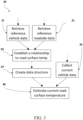
- Fig. 4 illustrates a flow diagram of a particular method 40 for estimating road surface temperature for a geographic location.
- the method 40 may be considered a preferred embodiment of the more general method 30 shown in Fig. 3 .
- the method 40 comprises a step 41 of retrieving reference ambient sensor data in form of a time series of reference ambient air temperature.
- the reference ambient sensor data is thus indicative of the ambient condition of temperature in vicinity to mobile vehicles for a plurality of points in time.
- the reference ambient sensor data may include further quantities, such as time series of humidity, air pressure, wind speed, rain intensity, fog, surface water amount, snow amount, ice presence, wind direction, and/or salt amount.
- the present example focusses on reference ambient sensor data in the form of a time series of reference ambient air temperature.
- the method 40 further comprises a step 42 of retrieving reference roadside sensor data in form of a time series of road surface temperature.
- the reference roadside sensor data is thus indicative of road surface temperature in vicinity to distributed roadside sensors, such as roadside weather stations (e.g. RWIS).
- ambient air temperature is used as an exemplary ambient condition.
- ambient conditions including sun radiation, GPS location, time, date, humidity, air pressure, wind speed, rain intensity, vehicle speed, fog, surface water amount, snow amount, ice presence, traffic intensity (e.g. vehicles per time), wind direction, salt amount, surface type (such as asphalt, concrete, gravel etc.), estimated friction coefficient.
- the method 40 further comprises a step 43 of training a neural network.
- a relationship is established between the ambient air temperature (reference ambient sensor data) as measured by the vehicles on the one hand and road surface temperature as measured by the distributed roadside sensors on the other hand.
- the trained neural network may serve to output a road surface temperature estimate upon taking a time series of current vehicle ambient sensor data as input.
- the neural network may be trained on the reference ambient sensor data and on the reference roadside sensor data (including road surface temperature) such that the trained neural network may take (current) vehicle ambient sensor data as input to output road surface temperature as output.
- Such neural network thus encodes the dependency of road surface temperature on ambient sensor data.
- the neural network to be trained may be a recurrent neural network (i.e. which exhibit not only feed-forward links to downstream layers, but also feedback links to the same layer or upstream layers). This allows to include temporal dynamic behavior.
- a neural network may serve to output a road surface temperature estimate upon taking a time series of current vehicle ambient sensor data as input.
- embodiments may comprise applying a filtering method.
- the method 40 further comprises a step 44 of creating a data structure encoding the trained neural network and a step 45 of collecting current vehicle ambient sensor data in form of a time series of current ambient air temperature.
- the time series of current ambient air temperature is indicative of current ambient conditions in vicinity to the one or more vehicles for a plurality of points in time.
- the ambient air temperature is preferably measured at multiple vehicles for plurality of points in time, such that the time series is constructed (or estimated) based on data from multiple vehicles for multiple points in time.
- Such time series of ambient conditions may be measured also for other examples of current ambient conditions, further including one or more of the following: sun radiation, GPS location, time, date, humidity, air pressure, wind speed, rain intensity, vehicle speed, fog, surface water amount, snow amount, ice presence, traffic intensity (e.g. vehicles per time), wind direction, salt amount, surface type (such as asphalt, concrete, gravel etc.), estimated friction coefficient.
- the method 40 comprises a step 46 of determining a road surface temperature estimate for the geographic location, using the trained neural network and using the collected current ambient air temperature data.
- the collected current ambient air temperature data may be used as an input to the trained neural network. The relationship encoded by the neural network thus allows to obtain as an output a road surface temperature estimate for the geographic location.
- the method 40 may further comprise retrieving reference weather data indicative of general weather conditions (e.g. humidity), similar to the retrieving of steps 41, 42. Then, the establishing of the relationship is further based on the reference weather data (in addition to the reference ambient sensor data). Thus, the relationship is established such that it further takes weather data as a (further) input.
- reference weather data indicative of general weather conditions (e.g. humidity)
- general weather conditions e.g. humidity
- the method 40 may further comprise receiving current weather data indicative of current general weather conditions for the geographic location, similar to the collecting of step 45.
- the step 46 of determining of a road surface temperature estimate would further be based on the current weather data (in addition to the current vehicle ambient sensor data).
- Fig. 5 schematically illustrates a situation with roads and vehicles, in which situation methods, apparatuses or systems according to the present disclosure may be used.
- Fig. 5 shows an apparatus 50 for estimating road surface temperature for a geographical location.
- the apparatus 50 stores a data structure (not shown) encoding the relationship between ambient sensor data, measurable by vehicles, and road surface temperature.
- a first vehicle 52 has passed a geographic location 51.
- First vehicle 52 has collected current ambient vehicle sensor data near geographic location 51 and has transmitted these data to apparatus 50.
- apparatus 50 is configured to estimate road surface temperature using the data structure and based on the transmitted ambient vehicle sensor data of geographic location 51.
- the apparatus may base the estimation on a plurality of measurement from a plurality of vehicles, e.g. in form of a time series of ambient vehicle sensor data.
- the apparatus 50 may generate road condition data (e.g. indicating that the road is icy in case the estimated road surface temperature indicates the presence of ice) and transmit these road condition data (and/or the estimated road surface temperature) to a second vehicle 53 which is currently approaching geographical location 51.
- road condition data e.g. indicating that the road is icy in case the estimated road surface temperature indicates the presence of ice
Landscapes
- Engineering & Computer Science (AREA)
- Physics & Mathematics (AREA)
- Life Sciences & Earth Sciences (AREA)
- Theoretical Computer Science (AREA)
- General Physics & Mathematics (AREA)
- Environmental & Geological Engineering (AREA)
- Mathematical Physics (AREA)
- Atmospheric Sciences (AREA)
- Computational Linguistics (AREA)
- Biomedical Technology (AREA)
- General Health & Medical Sciences (AREA)
- Molecular Biology (AREA)
- Computing Systems (AREA)
- General Engineering & Computer Science (AREA)
- Data Mining & Analysis (AREA)
- Biophysics (AREA)
- Software Systems (AREA)
- Evolutionary Computation (AREA)
- Artificial Intelligence (AREA)
- Health & Medical Sciences (AREA)
- Biodiversity & Conservation Biology (AREA)
- Ecology (AREA)
- Environmental Sciences (AREA)
- Automation & Control Theory (AREA)
- Transportation (AREA)
- Mechanical Engineering (AREA)
- Traffic Control Systems (AREA)
- Arrangements For Transmission Of Measured Signals (AREA)
Description
- The present invention generally relates to estimating current road surface temperature for a geographic location.
- In modern vehicles, a wide variety of sensors are available, which directly or indirectly yield information about current conditions of the car and its ambient surroundings in order to, for instance, adapt vehicle behavior accordingly. One parameter of interest is the current temperature of the road surface, as this may have influence on tire-road interaction (e.g. friction) and thereby influence vehicle behavior, e.g. during an ABS braking.
- However, standard vehicles typically do not have sensors which allow to directly measure road surface temperature. In order to estimate the surface temperature of a road segment at a given geographic location, conventional approaches have relied on roadside weather stations, such as the Road Weather Information System (RWIS), which uses a plurality of environmental sensor stations distributed along roads to perform measurements and which reports these measurements to a central server for interpretation (e.g. using a model) and dissemination (e.g. to vehicles).
- As a result, these conventional approaches rely on the presence and availability of data from roadside weather stations and the estimation accuracy is correlated to the geographic density of road weather stations. To achieve a high accuracy, a high density of road weather stations are required. However, these data may not be available for a number of reasons, such as: remote roads may not be equipped with RWIS stations; RWIS stations may be temporarily unavailable for technical, economical or environmental reasons; a provider of RWIS data may make the data available only to a limited group of subscribers; the data is representative only for a limited geographical region, or a variety of other reasons.
- For a worldwide coverage, a user of the RWIS data may need to obtain such data from a plurality of local providers and the user may need a plurality of different models describing the dependencies for each geographical location.
- Further road surface temperature estimation methods are known e.g. from
JP 2007 017197 A JP 2002 048878 A - As can be seen from these examples, a common problem in estimation of road surface temperature is the reliance on the availability of roadside weather stations. Therefore, it is of great interest to provide alternative ways to estimate road surface temperature.
- Therefore, it is an object of the present invention to provide enhanced solutions for an estimation of road surface temperature for a geographic location.
- Methods, apparatuses, systems and computer program products are disclosed, to overcome at least partially the shortcomings of the type mentioned above and others.
- In a first aspect, a method of estimating road surface temperature for a geographic location is disclosed.
- The method comprises retrieving location-specific reference ambient sensor data and retrieving location-specific reference roadside sensor data. The location-specific reference ambient sensor data is indicative of ambient conditions in vicinity to mobile vehicles at a first geographical location and the location-specific reference roadside sensor data is indicative of at least road surface temperature in vicinity to distributed roadside sensors at the first geographical location. In particular, the retrieving may be carried out in a data warehouse unit.
- Data indicative of ambient conditions are of a type to be collectable at least using vehicles sensors. Non-limiting examples of ambient conditions may include one or more of the following: Ambient air temperature, sun radiation, GPS location, time, date, humidity, air pressure, wind speed, rain intensity, vehicle speed, fog, surface water amount, snow amount, ice presence, traffic intensity (e.g. vehicles per time), wind direction, salt amount, surface type (such as asphalt, concrete, gravel etc.), estimated friction coefficient. Preferably, a plurality of the above-mentioned ambient conditions is used. The use of multiple ambient conditions increases the basis of data on which a relationship is to be built and thereby increases the reliability and accuracy of the road surface temperature estimation using such comprehensive information.
- Examples of distributed roadside sensors may include the above-mentioned roadside weather stations (RWIS). Other examples include advanced vehicle-mounted sensors, which are distributed across the road network dynamically by virtue of the vehicles equipped therewith and which may be configured to provide data indicative of road surface temperature for some distributed reference vehicles.
- The method further comprises establishing a relationship between the reference ambient sensor data and road surface temperature, based on the location-specific reference ambient sensor data and the location-specific reference roadside sensor data for the same first geographic location, and creating a data structure encoding the established relationship. Examples of establishing a relationship may include training a neural network or applying a filtering method, as will be detailed below. Such relationships and corresponding data structures may thus allow to lay down the dependency of road surface temperature on one or more measurable input variables.
- For instance, a neural network may be trained on the reference ambient sensor data and on the reference roadside sensor data (including road surface temperature) such that the trained neural network may take (current) vehicle ambient sensor data as input to provide road surface temperature as output. Such neural network thus encodes the dependency of road surface temperature on ambient sensor data.
- The method further comprises collecting, at one or more vehicles, location-specific current vehicle ambient sensor data indicative of current ambient conditions in vicinity to the one or more vehicles at a second geographical location.
- Similarly to the ambient conditions mentioned above with reference to the reference ambient senor data, non-limiting examples of current ambient conditions may include one or more of the following: Ambient air temperature, sun radiation, GPS location, time, date, humidity, air pressure, wind speed, rain intensity, vehicle speed, fog, surface water amount, snow amount, ice presence, traffic intensity (e.g. vehicles per time), wind direction, salt amount, surface type (such as asphalt, concrete, gravel etc.), estimated friction coefficient.
- Preferably, the location-specific current vehicle ambient sensor data may be of the same type as the location-specific reference ambient sensor data. For instance, both data may be indicative of ambient air temperature, irrespective of the particular sensor used for collecting this type of data. This allows to feed the relationship established using (reference) ambient sensor data with the same type of data, namely (current vehicle) ambient sensor data.
- Further, the method comprises determining, using the data structure and using the collected current vehicle ambient sensor data a the second geographical location, a current road surface temperature estimate for the second geographic location. In particular, the collected current vehicle ambient sensor data may be used as an input to the data structure. The relationship encoded by the data structure thus allows to obtain as an output a current road surface temperature estimate for the second geographic location.
- As a result, the determining of the current road surface temperature estimate may exclude the use of current roadside sensor data (once the relationship has been established), which allows to estimate current road surface temperature even in the absence or unavailability of distributed roadside stations for the geographic location at which the current road surface temperature is to be estimated
- In some embodiments, the method further comprises transmitting the collected current vehicle ambient sensor data from the one or more vehicles to the data warehouse unit. This allows to centralize the determining of the current road surface temperature estimate and thereby reduce processing needs at the vehicles as well as increase the amount of current vehicle ambient sensor data, namely by using such data from a plurality of vehicles.
- This may further allow to collect ambient data for one geographic location from a plurality of vehicles, in particular throughout an extended period of time in order to build a time series of current vehicle ambient sensor data for one geographic location. For the purpose of the present disclosure, the term "time series" refers to a set of data points, which is indicative of the measurable values (e.g. of ambient conditions, such as ambient air temperature) for a plurality of points in time, irrespective of whether all measurements are performed by a same sensor or by multiple sensors, and irrespective of whether the plurality of points in time are continuous or discrete or any combination thereof.
- In particular, a time series may be measured in entirety or it may be measured partly and then completed by way of interpolation or extrapolation. An exemplary duration of time series may be in the range of one day to several months, more preferably 3 days to 30 days, such as a duration of (approx.) 10 days. For instance, such durations may be suited to capture freezing and melting behavior in the ground.
- In some embodiments, the method further comprises generating road condition data based on the determined current road surface temperature estimate and transmitting the generated road condition data to at least one of the vehicles and/or to other vehicles. This allows to apply the estimated current road surface temperature in a connected-driving environment, e.g. by performing the estimation of the current road surface temperature remotely to the vehicles and by transmitted information about road conditions to the vehicle(s). The vehicle(s) may use these road condition data to control vehicle behavior, e.g. to take into account how the road conditions would affect a potential ABS braking.
- In some embodiments the retrieved location-specific reference ambient sensor data may comprise a (first) time series indicative of ambient conditions for a (first) plurality of points in time. This allows to establish the relationship based on a more comprehensive basis of data, in particular showing the temporal evolution of ambient conditions. The inventors have recognized that such temporal evolution encodes valuable information about the micro-climate typical for geographic locations, which show such temporal evolution. For instance, presence of a nearby lake not only affects ambient conditions (such as the moist in the air, represented by measurements of humidity), but may also affect the speed of heating/cooling of the road surface temperature. Such dependency may be encoded in the relationship, e.g. by training a neural network with time series of reference ambient sensor data. The use of time series thus allows to capture physical dynamics (such as ground freezing) and thereby implicitly contains information about meteorological specifics.
- Additionally, or alternatively, the collected current vehicle ambient sensor data may comprise a (second) time series indicative of current ambient conditions for a (second) plurality of points in time. This allows to determine the road surface temperature estimate based on a more comprehensive basis of data, in particular showing the temporal evolution of ambient conditions. Similarly to the establishing of the relationship, such temporal evolution encodes valuable information about the micro-climate for the particular geographic location in question.
- Preferably, both the establishing of the relationship and the determining of the road surface temperature estimate may be based on such time series.
- In some embodiments, the relationship may be established by training a neural network and the data structure is representative of the neural network. Alternatively, it may be established by applying a filtering method, in particular a Kalman filter or a Bayesian filter or a non-statistical filter, and wherein the data structure is representative of the output of the filter. This allows to establish the dependency of road surface temperature with a minimum of hypothesis or knowledge about the dependency (contrary to a regression analysis, for instance, which requires an assumption about a parametric function describing such dependency).
- According to the claimed invention, the reference ambient sensor data, the reference roadside sensor data, and the current vehicle ambient sensor data are location-specific. For instance, knowledge about the location for the reference ambient sensor data and reference roadside sensor data facilitates to establish a link between these two sets of data. Similarly, knowledge about the location for the current vehicle ambient sensor data allows to use this additional information as further input to the relationship in determining a road surface temperature estimate.
- In some embodiments, the location-specific reference roadside sensor data may, in addition to road surface temperature, further be indicative of one or more of the following ambient conditions: Ambient air temperature, ground temperature at one or more depths; sun radiation, humidity, wind speed, GPS location, time, date, air pressure, rain intensity, fog, surface water amount, snow amount, ice presence, traffic intensity (e.g. vehicles per time), wind direction, salt amount, surface type (such as asphalt, concrete, gravel etc.), estimated friction coefficient. It may be collected by one or more of a variety of means, such as dedicated sensors, cameras, weather stations, visual inspection, lidar, radar, or a fusion of data from multiple sources.
- This allows to take into account any discrepancies between the values of these ambient conditions indicated by the reference roadside sensor data as compared to the values of these ambient conditions indicated by the reference ambient sensor data.
- In some embodiments, the method may further comprise retrieving, in the data warehouse unit, reference weather data indicative of general weather conditions, and receiving current weather data indicative of current general weather conditions for the geographic location. In such cases the establishing of the relationship may further be based on the reference weather data. This allows to establish a more comprehensive relationship between the road surface temperature and input data. For instance, weather data (which is typically readily and globally available, without significant restrictions, contrary to roadside data) may be used as a further input parameter, used both during establishing of the relationship (e.g. training of a neural network) and during determining of a road surface temperature estimate. In particular, in such cases, the determining of the road surface temperature estimate may further be based on the current weather data.
- Non-limiting examples of the reference weather data or current weather data include one or more of the following: Ambient air temperature, sun inclination, cloudiness, geographic area, humidity, wind speed, time, date, air pressure, rain intensity, fog, surface water amount, snow amount, ice presence, temperature profile at different heights, wind direction, surface temperature.
- In a second aspect, a computer program product is disclosed. The computer program product includes program code configured to, when executed in a computing device, to carry out the steps of a method according to the first aspect.
- In a third aspect, an apparatus for estimating current road surface temperature for a geographical location is disclosed. The apparatus comprises a data storage unit, a communication interface and a processing unit. The data storage unit is configured to store a data structure encoding a relationship between reference ambient sensor data, measurable by vehicles, and road surface temperature. The communication interface is for receiving current vehicle ambient sensor data indicative of current ambient conditions in vicinity to the vehicle.
- The processing unit is configured to be communicatively coupled with the vehicle sensor and the data storage unit and to determine, using the data structure, a road surface temperature estimate for the geographical location based on the collected current vehicle ambient sensor data.
- Such apparatus thus allows to take full advantage of the relationship encoded in the data structure, irrespective of whether the relationship has been established by the apparatus or by another entity (and received by the apparatus).
- In a fourth aspect, a data warehouse unit for producing a data structure is disclosed, which is configured to (i) obtain location-specific reference ambient sensor data indicative of ambient conditions in vicinity to vehicles at a first geographical location, (ii) obtain location-specific reference roadside sensor data indicative of at least road surface temperature in vicinity to and measured by roadside sensors at the first geographical location, (iii) establish a relationship between the location-specific reference ambient sensor data and road surface temperature, based on the location-specific reference ambient sensor data and the location-specific reference roadside sensor data for the same first geographic location, (iv) create a data structure encoding the established relationship; and (v) transmit the data structure to the apparatus. Such data warehouse unit allows to produce a data structure encoding a relationship for a wide variety of users or user equipment. For instance, the data structure may be transmitted to an apparatus according to the third aspect or any other apparatus configured to use the relationship encoded in the data structure.
- In a fifth aspect, a system for estimating current road surface temperature for a geographic location is disclosed. The system comprises an apparatus according to the third aspect and a data warehouse unit according to the fourth aspect. The data warehouse unit is coupled communicatively to the apparatus to transmit the data structure of the data warehouse unit to the apparatus. Such system allows to take full advantage of all of the aspects mentioned above, as it includes both the data warehouse unit and the apparatus.
- In some embodiments, the system may further comprise a vehicle sensor, configured to collect current vehicle ambient sensor data indicative of current ambient conditions in vicinity to the vehicle, and communicatively coupled to the communication interface of the apparatus.
- In a sixth aspect, use of a system according to the fifth aspect is disclosed, for estimating current road surface temperature for a geographical location.
- The following detailed description refers to the appended drawings, wherein:
-
Fig. 1 schematically illustrates a situation with roads and vehicles, in which situation methods, data warehouse units or systems according to embodiments may be used; -
Fig. 2 illustrates a box diagram of a system with an apparatus and a data warehouse unit according to embodiments; -
Fig. 3 illustrates a general flow diagram of a method according to embodiments; and -
Fig. 4 illustrates a flow diagram of a method according to one particular embodiment; and -
Fig. 5 schematically illustrates a situation with roads and vehicles, in which situation methods, apparatuses or systems according to embodiments may be used. -
Fig. 1 schematically illustrates a situation with roads and vehicles, in which situation methods, data warehouse units or systems according to the present disclosure may be used. - In particular,
Fig. 1 shows a firstgeographic location 10. In the example shown, firstgeographic location 10 is a road segment. The present disclosure applies to geographic location of essentially any level of granularity. For instance, a geographic location may be a state, a region, a municipality, a road, a road segment, a unit area of a grid, a cross-roads, etc. Preferably, the geographic location is a road segment. - The
road segment 10 is provided with astationary roadside sensor 12, which is configured to measure reference roadside sensor data indicative of at least road surface temperature atroad segment 10. - Although the example shown in
Fig. 1 is a stationary measurement station, the function of the stationary roadside sensors may additionally or alternatively be performed by other distributed roadside sensors, such as sensors of a mobile reference station, e.g. a specially equipped reference vehicle. - In any case, the reference roadside sensor data is transmitted from
stationary roadside sensor 12 to adata warehouse unit 16 for further processing. -
Fig. 1 further shows anotherroad segment 11, which is not provided with any sensor capable of measuring road surface temperature. - Two
vehicles road segment 10. Bothvehicles -
Vehicle 13 may reachroad segment 10 earlier thanvehicle 14 will. Oncevehicle 13 is in vicinity ofroad segment 10, at a first point in time, it will collect reference ambient sensor data, such as a first ambient air temperature. The reference ambient sensor data collected by thefirst vehicle 13 is transmitted byvehicle 13 to thedata warehouse unit 16, e.g. together with additional information such as location and/or time/date. - Similarly, once
vehicle 14 is in vicinity ofroad segment 10, at a second point in time, it will collect reference ambient sensor data, such as a second ambient air temperature. The reference ambient sensor data collected bysecond vehicle 14 is transmitted byvehicle 14 to thedata warehouse unit 16, e.g. together with additional information such as location and/or time/date. - In other embodiments, not shown, the collection of reference ambient sensor data may additionally or alternatively be carried out by
roadside sensor 12. This allows to collect the two sets of data for the establishing of a relationship (i.e. reference ambient sensor data and reference roadside sensor data) from a same location (namely wheresensor 12 is located) and thereby increases the accuracy of the relationship to be established. - Returning to the description of
Fig. 1 , the transmission todata warehouse unit 16 may occur wirelessly, for instance viainternet 15. - At
data warehouse unit 16, the data collected byroadside sensor 12 andvehicles - As will be apparent from the following description, the teaching according to the present disclosure then allows to use such relationship and data structure in order to reliably predict or estimate the road surface temperature at other geographic locations, in the vicinity (such as at road segment 11) or remotely (such as in another country).
- For instance, with the established relationship between road surface temperature and vehicle sensor data for
geographic location 10, the present disclosure allows to collect ambient vehicle sensor data near another geographic location 11 (that does not have a roadside sensor to measure road surface temperature) and determine a road surface temperature estimate using the established relationship, without the need for roadside sensor data. - In the example of
Fig. 1 ,first vehicle 13 will reach the secondgeographic location 11 beforesecond vehicle 14. As a result,first vehicle 13 may collect current ambient vehicle sensor data neargeographic location 11. These data may be used by an apparatus (or a method) according to the present disclosure (not shown inFig. 1 ) to generate a road surface temperature estimate, as will be detailed with reference to the Figures in the following. -
Fig. 2 illustrates a box diagram of asystem 20 for estimating road surface temperature for a geographic location. Thesystem 20 has adata warehouse unit 21, anapparatus 24, and avehicle sensor 28. In other examples, not shown, the system may exclude thevehicle sensor 28. - The
data warehouse unit 21 is for producing a data structure. Thedata warehouse unit 21 comprises adata memory 22 and aprocessing unit 23. - The
data memory 22 is configured to obtain reference ambient sensor data (indicated as "Ref data a", "Ref data b", etc. inFig. 2 ) indicative of ambient conditions in vicinity to vehicles, measured by vehicle sensors. Thedata memory 22 is further configured to obtain reference roadside sensor data indicative of at least road surface temperature (indicated as Tsuf,a, Tsurf,b etc inFig. 2 ) in vicinity to and measured by roadside sensors. - The
processing unit 23 is configured to establish a relationship between the reference ambient sensor data and road surface temperature, based on the information indata memory 22. It is further configured to create a data structure encoding the established relationship. - The
data warehouse unit 21 is coupled communicatively to theapparatus 24 to transmit the data structure of the data warehouse unit to theapparatus 24, in particular to adata storage unit 25 of the apparatus. - The
data warehouse unit 21 is thus to produce a data structure encoding a relationship between ambient data and road surface temperature and to transmit it to theapparatus 24, which is configured to use the relationship encoded in the data structure. - The
apparatus 24 is for estimating road surface temperature for a geographical location. Theapparatus 24 comprises adata storage unit 25, acommunication interface 26 and aprocessing unit 27. - The
data storage unit 25 is configured to store the data structure transmitted by thedata warehouse unit 21. As detailed above, the data structure encodes the relationship between reference ambient sensor data, measurable by vehicles, and road surface temperature. - The
communication interface 26 is for receiving current vehicle ambient sensor data indicative of current ambient conditions in vicinity to the vehicle. These current vehicle ambient sensor data are measured by one ormore vehicle sensors 28, which transmit these data to thecommunication interface 26. - The
processing unit 27 of the apparatus is communicatively coupled with thevehicle sensor 28 viainterface 26 and with thedata storage unit 25. Theprocessing unit 27 is configured to determine a road surface temperature estimate for the geographical location, using the data structure and based on the collected current vehicle ambient sensor data. - The
apparatus 24 is thus for using the relationship encoded in the data structure in order to estimate road surface temperature. -
Fig. 3 illustrates a general flow diagram of amethod 30 for estimating road surface temperature for a geographic location. - The
method 30 comprises astep 31 of retrieving reference ambient sensor data and astep 32 of retrieving reference roadside sensor data. The reference ambient sensor data is indicative of ambient conditions in vicinity to mobile vehicles and the reference roadside sensor data is indicative of at least road surface temperature in vicinity to distributed roadside sensors, such as roadside weather stations (e.g. RWIS). - In the example shown, the
steps first step 31 and then step 32; orfirst step 32 and then step 31) or only partly in parallel. In still further examples, thestep 32 of retrieving reference roadside sensor data (which includes at least road surface temperature in vicinity to distributed roadside sensors) may also include a step (similar to step 31) of retrieving reference ambient sensor data indicative of ambient conditions (such as a time series of ambient air temperature in vicinity to vehicles), as measured by distributed roadside sensors. - Returning to
Fig. 3 , themethod 30 further comprises astep 33 of establishing a relationship between the reference ambient sensor data and road surface temperature, based on the reference ambient sensor data and based on the reference roadside sensor data. It further comprises astep 34 of creating a data structure encoding the established relationship. - The set of
steps 31 to 34 may for instance be carried out in a data warehouse and may be considered as a method of producing a relationship data structure. - The
method 30 further comprises astep 35 of collecting, at one or more vehicles, current vehicle ambient sensor data indicative of current ambient conditions in vicinity to the one or more vehicles. - Further, the
method 30 comprises astep 36 of determining a road surface temperature estimate for the geographic location using the data structure and the collected current vehicle ambient sensor data. In particular, the collected current vehicle ambient sensor data may be used as an input to the data structure. The relationship encoded by the data structure thus allows to obtain as an output a road surface temperature estimate for the geographic location. - As can be seen from
Fig. 3 , the determining 36 of the road surface temperature estimate excludes the use of current roadside sensor data. Data from distributed roadside stations is only used insteps - The set of
steps -
Fig. 4 illustrates a flow diagram of aparticular method 40 for estimating road surface temperature for a geographic location. Themethod 40 may be considered a preferred embodiment of the moregeneral method 30 shown inFig. 3 . - The
method 40 comprises astep 41 of retrieving reference ambient sensor data in form of a time series of reference ambient air temperature. The reference ambient sensor data is thus indicative of the ambient condition of temperature in vicinity to mobile vehicles for a plurality of points in time. In preferred examples, the reference ambient sensor data may include further quantities, such as time series of humidity, air pressure, wind speed, rain intensity, fog, surface water amount, snow amount, ice presence, wind direction, and/or salt amount. However, for illustration purposes, the present example focusses on reference ambient sensor data in the form of a time series of reference ambient air temperature. - The
method 40 further comprises astep 42 of retrieving reference roadside sensor data in form of a time series of road surface temperature. The reference roadside sensor data is thus indicative of road surface temperature in vicinity to distributed roadside sensors, such as roadside weather stations (e.g. RWIS). - In the example shown, ambient air temperature is used as an exemplary ambient condition. Additionally, or alternatively other examples of ambient conditions may be used, including sun radiation, GPS location, time, date, humidity, air pressure, wind speed, rain intensity, vehicle speed, fog, surface water amount, snow amount, ice presence, traffic intensity (e.g. vehicles per time), wind direction, salt amount, surface type (such as asphalt, concrete, gravel etc.), estimated friction coefficient.
- The
method 40 further comprises astep 43 of training a neural network. By training the neural network, a relationship is established between the ambient air temperature (reference ambient sensor data) as measured by the vehicles on the one hand and road surface temperature as measured by the distributed roadside sensors on the other hand. - By virtue of the training of the neural network using ambient air temperature (measured by vehicles) and using the reference road surface temperature, this allows to lay down the dependency of road surface temperature on the measurable input variable of ambient air temperature. In other examples, not shown, further input variables may be used. In any case, the trained neural network may serve to output a road surface temperature estimate upon taking a time series of current vehicle ambient sensor data as input.
- In the example shown, the neural network may be trained on the reference ambient sensor data and on the reference roadside sensor data (including road surface temperature) such that the trained neural network may take (current) vehicle ambient sensor data as input to output road surface temperature as output. Such neural network thus encodes the dependency of road surface temperature on ambient sensor data.
- In particular for reference data in form of time series, the neural network to be trained may be a recurrent neural network (i.e. which exhibit not only feed-forward links to downstream layers, but also feedback links to the same layer or upstream layers). This allows to include temporal dynamic behavior.
- Thus, in the depicted case of training a neural network with a time series of reference ambient sensor data, it may serve to output a road surface temperature estimate upon taking a time series of current vehicle ambient sensor data as input.
- Alternatively to training a neural network, other embodiments (not shown) may comprise applying a filtering method.
- The
method 40 further comprises astep 44 of creating a data structure encoding the trained neural network and astep 45 of collecting current vehicle ambient sensor data in form of a time series of current ambient air temperature. - The time series of current ambient air temperature is indicative of current ambient conditions in vicinity to the one or more vehicles for a plurality of points in time. As each vehicle is moving and remains at a given geographic location only for a limited period of time, the ambient air temperature is preferably measured at multiple vehicles for plurality of points in time, such that the time series is constructed (or estimated) based on data from multiple vehicles for multiple points in time.
- Such time series of ambient conditions may be measured also for other examples of current ambient conditions, further including one or more of the following: sun radiation, GPS location, time, date, humidity, air pressure, wind speed, rain intensity, vehicle speed, fog, surface water amount, snow amount, ice presence, traffic intensity (e.g. vehicles per time), wind direction, salt amount, surface type (such as asphalt, concrete, gravel etc.), estimated friction coefficient.
- Further, the
method 40 comprises astep 46 of determining a road surface temperature estimate for the geographic location, using the trained neural network and using the collected current ambient air temperature data. In particular, the collected current ambient air temperature data may be used as an input to the trained neural network. The relationship encoded by the neural network thus allows to obtain as an output a road surface temperature estimate for the geographic location. - Although not explicitly shown in
Fig. 4 , themethod 40 may further comprise retrieving reference weather data indicative of general weather conditions (e.g. humidity), similar to the retrieving ofsteps - In such cases, the
method 40 may further comprise receiving current weather data indicative of current general weather conditions for the geographic location, similar to the collecting ofstep 45. As a result, thestep 46 of determining of a road surface temperature estimate would further be based on the current weather data (in addition to the current vehicle ambient sensor data). -
Fig. 5 schematically illustrates a situation with roads and vehicles, in which situation methods, apparatuses or systems according to the present disclosure may be used. - In particular,
Fig. 5 shows anapparatus 50 for estimating road surface temperature for a geographical location. Theapparatus 50 stores a data structure (not shown) encoding the relationship between ambient sensor data, measurable by vehicles, and road surface temperature. - A
first vehicle 52 has passed ageographic location 51.First vehicle 52 has collected current ambient vehicle sensor data neargeographic location 51 and has transmitted these data toapparatus 50. - Although
geographic location 51 is not provided with any conventional means to determine road surface temperature,apparatus 50 is configured to estimate road surface temperature using the data structure and based on the transmitted ambient vehicle sensor data ofgeographic location 51. - In other instances (not shown), the apparatus may base the estimation on a plurality of measurement from a plurality of vehicles, e.g. in form of a time series of ambient vehicle sensor data.
- Once the
apparatus 50 has estimated road surface temperature, it may generate road condition data (e.g. indicating that the road is icy in case the estimated road surface temperature indicates the presence of ice) and transmit these road condition data (and/or the estimated road surface temperature) to asecond vehicle 53 which is currently approachinggeographical location 51.
Claims (14)
- Method for estimating current road surface temperature for a geographical location (11), comprising- retrieving, in a data warehouse unit (16), location-specific reference ambient sensor data indicative of ambient conditions in vicinity to mobile vehicles (13, 14) at a first geographic location (10);- retrieving, in the data warehouse unit (16), location-specific reference roadside sensor data indicative of at least road surface temperature in vicinity to distributed roadside sensors (12) at the first geographic location (10);- establishing a relationship between the location-specific reference ambient sensor data and road surface temperature, based on the location-specific reference ambient sensor data and the location-specific reference roadside sensor data for the same first geographic location (10);- creating a data structure encoding the established relationship;- collecting, at one or more vehicles (13), location-specific current vehicle ambient sensor data indicative of current ambient conditions in vicinity to the one or more vehicles (13, 14) at a second geographical location (11);- determining, using the data structure and using the collected location-specific current vehicle ambient sensor data at the second geographic location (11), a current road surface temperature estimate for the second geographic location (11).
- Method according to claim 1, wherein the method further comprises:- transmitting the collected location-specific current vehicle ambient sensor data from the one or more vehicles (13, 14) to the data warehouse unit (16).
- Method according to claim 1 or 2, wherein the method further comprises:- Generating road condition data based on the determined current road surface temperature estimate; and- transmitting the generated road condition data to at least one of the vehicles (13, 14) and/or to other vehicles (13, 14).
- Method according to one of the preceding claims, wherein- the retrieved location-specific reference ambient sensor data comprises a first time series indicative of ambient conditions for a first plurality of points in time,- the collected location-specific current vehicle ambient sensor data comprises a second time series indicative of current ambient conditions for a second plurality of points in time.
- Method according to one of the preceding claims, wherein the relationship is established by(a) training a neural network and wherein the data structure is representative of the neural network, or(b) applying a filtering method, in particular a Kalman filter or a Bayesian filter or a non-statistical filter, and wherein the data structure is representative of the output of the filter.
- Method according to one of the preceding claims, wherein the determining excludes the use of current roadside sensor data.
- Method according to one of the preceding claims, wherein the location-specific reference ambient sensor data and/or the location-specific current vehicle ambient sensor data and/or the location-specific reference roadside sensor data are indicative of one or more of the following:
Ambient air temperature, sun radiation, GPS location, time, date, humidity, air pressure, wind speed, rain intensity, vehicle speed, fog, surface water amount, snow amount, ice presence, traffic intensity, wind direction, salt amount, surface type, estimated friction coefficient. - Method according to one of the preceding claims, wherein the method further comprises:- retrieving, in the data warehouse unit (16), reference weather data indicative of general weather conditions, and- receiving current weather data indicative of current general weather conditions for the first geographic location,and wherein- the establishing of the relationship is further based on the reference weather data, and- the determining of the current road surface temperature estimate is further based on the current weather data.
- Computer program product including program code configured to, when executed in a computing device, to carry out the steps of a method of one of the preceding claims.
- A data warehouse unit (16) for producing a data structure, configured to- obtain location-specific reference ambient sensor data indicative of ambient conditions in vicinity to vehicles (13, 14) at a first geographic location (10);- obtain, location-specific reference roadside sensor data indicative of at least road surface temperature in vicinity to and measured by roadside sensors (12) at the first geographic location (10);- establish, in the data warehouse unit (16), a relationship between the location-specific reference ambient sensor data and road surface temperature, based on the location-specific reference ambient sensor data and the location-specific reference roadside sensor data for the same first geographic location (10); and- create a data structure encoding the established relationship.
- Apparatus (24) for estimating current road surface temperature for a geographical location (11), comprising:- a data storage unit (25) configured to store a data structure produced by a data warehouse unit (16) according to claim 10;- a communication interface (26) for receiving from a vehicle sensor (28) current vehicle ambient sensor data indicative of current ambient conditions in vicinity to the vehicle (13, 14) at the geographical location (11);- a processing unit (27), the processing unit (27) being configured to be communicatively coupled with the vehicle sensor (28) and the data storage unit (25) and to determine, using the data structure, a current road surface temperature estimate for the geographical location (11) based on the collected current vehicle ambient sensor data.
- System (20) for estimating current road surface temperature for a geographic location (11), comprising- a data warehouse unit (16) according to claim 10, and- an apparatus (24) according to claim 11,wherein the data warehouse unit (16) is coupled communicatively to the apparatus (24) to transmit the data structure of the data warehouse unit (16) to the apparatus (24) and the system (20) is configured to perform the steps of a method according to claim 1,
- System (20) according to the preceding claim, further comprising- a vehicle sensor (28), configured to collect current vehicle ambient sensor data indicative of current ambient conditions in vicinity to the vehicle (13, 14) at the geographic location (11), and communicatively coupled to the communication interface (26) of the apparatus (24).
- Use of a system (20) according to claim 12 or 13 for estimating current road surface temperature for a geographic location (11).
Applications Claiming Priority (2)
| Application Number | Priority Date | Filing Date | Title |
|---|---|---|---|
| DE102019135751.9A DE102019135751B4 (en) | 2019-12-23 | 2019-12-23 | Methods, devices, systems and computer program products for estimating a road surface temperature |
| PCT/EP2020/087630 WO2021130227A1 (en) | 2019-12-23 | 2020-12-22 | Methods, apparatuses, systems and computer program products for estimating road surface temperature |
Publications (2)
| Publication Number | Publication Date |
|---|---|
| EP4081835A1 EP4081835A1 (en) | 2022-11-02 |
| EP4081835B1 true EP4081835B1 (en) | 2023-12-06 |
Family
ID=74175832
Family Applications (1)
| Application Number | Title | Priority Date | Filing Date |
|---|---|---|---|
| EP20839053.4A Active EP4081835B1 (en) | 2019-12-23 | 2020-12-22 | Methods, apparatuses, systems and computer program products for estimating road surface temperature |
Country Status (6)
| Country | Link |
|---|---|
| US (1) | US12311952B2 (en) |
| EP (1) | EP4081835B1 (en) |
| CN (1) | CN114868043B (en) |
| DE (1) | DE102019135751B4 (en) |
| ES (1) | ES2973843T3 (en) |
| WO (1) | WO2021130227A1 (en) |
Families Citing this family (10)
| Publication number | Priority date | Publication date | Assignee | Title |
|---|---|---|---|---|
| US12420801B2 (en) * | 2019-11-28 | 2025-09-23 | Nira Dynamics Ab | Methods, apparatuses, systems and computer program products for estimating road condition information |
| DE102019135751B4 (en) | 2019-12-23 | 2024-11-14 | Nira Dynamics Ab | Methods, devices, systems and computer program products for estimating a road surface temperature |
| US12145617B2 (en) | 2021-10-28 | 2024-11-19 | Nvidia Corporation | 3D surface reconstruction with point cloud densification using artificial intelligence for autonomous systems and applications |
| US12172667B2 (en) | 2021-10-28 | 2024-12-24 | Nvidia Corporation | 3D surface reconstruction with point cloud densification using deep neural networks for autonomous systems and applications |
| US12190448B2 (en) * | 2021-10-28 | 2025-01-07 | Nvidia Corporation | 3D surface structure estimation using neural networks for autonomous systems and applications |
| US12039663B2 (en) | 2021-10-28 | 2024-07-16 | Nvidia Corporation | 3D surface structure estimation using neural networks for autonomous systems and applications |
| US12100230B2 (en) | 2021-10-28 | 2024-09-24 | Nvidia Corporation | Using neural networks for 3D surface structure estimation based on real-world data for autonomous systems and applications |
| DE102023001090A1 (en) | 2023-03-20 | 2024-09-26 | Mercedes-Benz Group AG | Method for predicting expected road surface temperatures |
| DE102023001617A1 (en) | 2023-04-24 | 2024-10-24 | Mercedes-Benz Group AG | Methods for predicting road surface conditions |
| CN119249075B (en) * | 2024-12-05 | 2025-03-04 | 南京气象科技创新研究院 | Expressway road surface temperature forecasting method based on physical constraint |
Family Cites Families (21)
| Publication number | Priority date | Publication date | Assignee | Title |
|---|---|---|---|---|
| US6173231B1 (en) * | 2000-01-31 | 2001-01-09 | Navigation Technologies Corp. | Method and system for collecting data concerning thermal properties of roads for a geographic database and use thereof in a vehicle safety system |
| JP2002048878A (en) | 2000-08-02 | 2002-02-15 | Nagoya Electric Works Co Ltd | Method and apparatus for estimating road surface temperature or road surface condition |
| JP2007017197A (en) * | 2005-07-05 | 2007-01-25 | Yuki Center | Temperature measurement / management method on road, installation method of observation equipment, temperature estimation method on road, and temperature prediction method on road |
| US20110112720A1 (en) * | 2009-11-09 | 2011-05-12 | Dale Keep | Road Conditions Reporting |
| US9207323B2 (en) * | 2013-04-11 | 2015-12-08 | Google Inc. | Methods and systems for detecting weather conditions including wet surfaces using vehicle onboard sensors |
| US9187099B2 (en) * | 2013-10-17 | 2015-11-17 | Richard M. Powers | Systems and methods for predicting weather performance for a vehicle |
| DE102015216483A1 (en) | 2015-01-29 | 2016-08-04 | Robert Bosch Gmbh | Method for operating a coefficient of friction database and coefficient of friction database |
| WO2017102086A1 (en) | 2015-12-18 | 2017-06-22 | Nira Dynamics Ab | Tire stiffness estimation and road friction estimation |
| FR3057972B1 (en) * | 2016-10-25 | 2019-11-01 | Dreamsafe | INFORMATION SHARING SYSTEM USING HYDROMETRY AND GROUND TEMPERATURE SENSORS |
| US10696227B2 (en) | 2017-01-12 | 2020-06-30 | Mobileye Vision Technologies Ltd. | Determining a road surface characteristic |
| US10106168B2 (en) * | 2017-02-27 | 2018-10-23 | GM Global Technology Operations LLC | Methods and systems for proactively estimating road surface friction coefficient |
| JP6572264B2 (en) | 2017-06-28 | 2019-09-04 | 株式会社Subaru | Vehicle road friction coefficient estimation apparatus and vehicle road friction coefficient estimation method |
| DE102017214032A1 (en) | 2017-08-11 | 2019-02-14 | Robert Bosch Gmbh | A method for determining a coefficient of friction for a contact between a tire of a vehicle and a road and method for controlling a vehicle function of a vehicle |
| DE102017214053A1 (en) * | 2017-08-11 | 2019-02-14 | Robert Bosch Gmbh | A method for determining a coefficient of friction for a contact between a tire of a vehicle and a road and method for controlling a vehicle function of a vehicle |
| DE102018202933A1 (en) | 2018-02-27 | 2019-08-29 | Robert Bosch Gmbh | A method for providing a correction parameter for correcting input values for friction coefficient estimation for a vehicle and method for correcting input values for friction coefficient estimation for a vehicle and method for controlling a vehicle |
| DE102018203807A1 (en) * | 2018-03-13 | 2019-09-19 | Continental Teves Ag & Co. Ohg | Method and device for detecting and evaluating road conditions and weather-related environmental influences |
| US11592566B2 (en) * | 2019-08-15 | 2023-02-28 | Volvo Car Corporation | Vehicle systems and methods utilizing LIDAR data for road condition estimation |
| DE102018008788A1 (en) * | 2018-11-08 | 2019-05-02 | Daimler Ag | Method for determining a road surface roughness |
| DE102018132157B3 (en) | 2018-12-13 | 2020-06-18 | Nira Dynamics Ab | Tire stiffness estimation and road friction estimation |
| DE102019135751B4 (en) | 2019-12-23 | 2024-11-14 | Nira Dynamics Ab | Methods, devices, systems and computer program products for estimating a road surface temperature |
| US20230245509A1 (en) * | 2022-01-28 | 2023-08-03 | Murray Armstrong | Safety system and method for motor vehicles |
-
2019
- 2019-12-23 DE DE102019135751.9A patent/DE102019135751B4/en active Active
-
2020
- 2020-12-22 US US17/785,381 patent/US12311952B2/en active Active
- 2020-12-22 CN CN202080089445.5A patent/CN114868043B/en active Active
- 2020-12-22 EP EP20839053.4A patent/EP4081835B1/en active Active
- 2020-12-22 ES ES20839053T patent/ES2973843T3/en active Active
- 2020-12-22 WO PCT/EP2020/087630 patent/WO2021130227A1/en not_active Ceased
Also Published As
| Publication number | Publication date |
|---|---|
| CN114868043B (en) | 2024-05-28 |
| US20230032819A1 (en) | 2023-02-02 |
| EP4081835A1 (en) | 2022-11-02 |
| DE102019135751A1 (en) | 2021-06-24 |
| CN114868043A (en) | 2022-08-05 |
| WO2021130227A1 (en) | 2021-07-01 |
| DE102019135751B4 (en) | 2024-11-14 |
| ES2973843T3 (en) | 2024-06-24 |
| US12311952B2 (en) | 2025-05-27 |
Similar Documents
| Publication | Publication Date | Title |
|---|---|---|
| EP4081835B1 (en) | Methods, apparatuses, systems and computer program products for estimating road surface temperature | |
| US20240185709A1 (en) | Short-term traffic speed prediction and forecasting using machine learning analysis of spatiotemporal traffic speed dependencies in probe and weather data | |
| De Vos et al. | The potential of urban rainfall monitoring with crowdsourced automatic weather stations in Amsterdam | |
| US20140222321A1 (en) | Traffic state estimation with integration of traffic, weather, incident, pavement condition, and roadway operations data | |
| Hapuarachchi et al. | A review of advances in flash flood forecasting | |
| US8744822B2 (en) | Pavement condition analysis from modeling impact of traffic characteristics, weather data and road conditions on segments of a transportation network infrastructure | |
| US20120035898A1 (en) | Method and apparatus for generating an environmental element prediction for a point of interest | |
| Garcia et al. | A real time urban flood monitoring system for metro Manila | |
| US20170140077A1 (en) | Method for assessing efficiency of power generation systems | |
| EP3951439B1 (en) | Advection fog forecasting system and forecasting method | |
| CN119694138A (en) | A dynamic construction method for highway digital twin | |
| CN112488477A (en) | Highway emergency management system and method | |
| CN116129631B (en) | Vehicle-road cooperative data processing method and related equipment | |
| JPWO2020016924A1 (en) | Traffic information generation system | |
| CN118366312B (en) | Traffic detection system and method | |
| Wong et al. | Latest developments of Hong Kong’s landslip warning system | |
| Bouilloud et al. | Road surface condition forecasting in France | |
| CN109118731B (en) | Method and system for monitoring and early warning of ice and snow on power transmission line | |
| Pirc et al. | Highway travel time estimation using multiple data sources | |
| Wu et al. | Advances in sustainable winter road maintenance and management for future smart cities | |
| CN120408271B (en) | Data-driven flood classification method and system | |
| Sokol et al. | Nowcasting of precipitation–advective statistical forecast model (SAM) for the Czech Republic | |
| CN117671971A (en) | Vehicle speed control method, system and device based on V2X and feedforward neural network | |
| CN111221056B (en) | Road rainfall information processing method, device and system and storage medium | |
| Wang et al. | A geostatistical investigation into the effective spatiotemporal coverage of road weather information systems in Alberta, Canada |
Legal Events
| Date | Code | Title | Description |
|---|---|---|---|
| STAA | Information on the status of an ep patent application or granted ep patent |
Free format text: STATUS: UNKNOWN |
|
| STAA | Information on the status of an ep patent application or granted ep patent |
Free format text: STATUS: THE INTERNATIONAL PUBLICATION HAS BEEN MADE |
|
| PUAI | Public reference made under article 153(3) epc to a published international application that has entered the european phase |
Free format text: ORIGINAL CODE: 0009012 |
|
| STAA | Information on the status of an ep patent application or granted ep patent |
Free format text: STATUS: REQUEST FOR EXAMINATION WAS MADE |
|
| 17P | Request for examination filed |
Effective date: 20220708 |
|
| AK | Designated contracting states |
Kind code of ref document: A1 Designated state(s): AL AT BE BG CH CY CZ DE DK EE ES FI FR GB GR HR HU IE IS IT LI LT LU LV MC MK MT NL NO PL PT RO RS SE SI SK SM TR |
|
| DAV | Request for validation of the european patent (deleted) | ||
| DAX | Request for extension of the european patent (deleted) | ||
| GRAP | Despatch of communication of intention to grant a patent |
Free format text: ORIGINAL CODE: EPIDOSNIGR1 |
|
| STAA | Information on the status of an ep patent application or granted ep patent |
Free format text: STATUS: GRANT OF PATENT IS INTENDED |
|
| INTG | Intention to grant announced |
Effective date: 20230616 |
|
| GRAS | Grant fee paid |
Free format text: ORIGINAL CODE: EPIDOSNIGR3 |
|
| GRAA | (expected) grant |
Free format text: ORIGINAL CODE: 0009210 |
|
| STAA | Information on the status of an ep patent application or granted ep patent |
Free format text: STATUS: THE PATENT HAS BEEN GRANTED |
|
| AK | Designated contracting states |
Kind code of ref document: B1 Designated state(s): AL AT BE BG CH CY CZ DE DK EE ES FI FR GB GR HR HU IE IS IT LI LT LU LV MC MK MT NL NO PL PT RO RS SE SI SK SM TR |
|
| REG | Reference to a national code |
Ref country code: GB Ref legal event code: FG4D |
|
| REG | Reference to a national code |
Ref country code: CH Ref legal event code: EP |
|
| REG | Reference to a national code |
Ref country code: DE Ref legal event code: R096 Ref document number: 602020022457 Country of ref document: DE |
|
| REG | Reference to a national code |
Ref country code: IE Ref legal event code: FG4D |
|
| REG | Reference to a national code |
Ref country code: LT Ref legal event code: MG9D |
|
| PG25 | Lapsed in a contracting state [announced via postgrant information from national office to epo] |
Ref country code: GR Free format text: LAPSE BECAUSE OF FAILURE TO SUBMIT A TRANSLATION OF THE DESCRIPTION OR TO PAY THE FEE WITHIN THE PRESCRIBED TIME-LIMIT Effective date: 20240307 |
|
| REG | Reference to a national code |
Ref country code: NL Ref legal event code: MP Effective date: 20231206 |
|
| PG25 | Lapsed in a contracting state [announced via postgrant information from national office to epo] |
Ref country code: LT Free format text: LAPSE BECAUSE OF FAILURE TO SUBMIT A TRANSLATION OF THE DESCRIPTION OR TO PAY THE FEE WITHIN THE PRESCRIBED TIME-LIMIT Effective date: 20231206 |
|
| PG25 | Lapsed in a contracting state [announced via postgrant information from national office to epo] |
Ref country code: LT Free format text: LAPSE BECAUSE OF FAILURE TO SUBMIT A TRANSLATION OF THE DESCRIPTION OR TO PAY THE FEE WITHIN THE PRESCRIBED TIME-LIMIT Effective date: 20231206 Ref country code: GR Free format text: LAPSE BECAUSE OF FAILURE TO SUBMIT A TRANSLATION OF THE DESCRIPTION OR TO PAY THE FEE WITHIN THE PRESCRIBED TIME-LIMIT Effective date: 20240307 Ref country code: BG Free format text: LAPSE BECAUSE OF FAILURE TO SUBMIT A TRANSLATION OF THE DESCRIPTION OR TO PAY THE FEE WITHIN THE PRESCRIBED TIME-LIMIT Effective date: 20240306 |
|
| REG | Reference to a national code |
Ref country code: AT Ref legal event code: MK05 Ref document number: 1638930 Country of ref document: AT Kind code of ref document: T Effective date: 20231206 |
|
| PG25 | Lapsed in a contracting state [announced via postgrant information from national office to epo] |
Ref country code: NL Free format text: LAPSE BECAUSE OF FAILURE TO SUBMIT A TRANSLATION OF THE DESCRIPTION OR TO PAY THE FEE WITHIN THE PRESCRIBED TIME-LIMIT Effective date: 20231206 |
|
| PG25 | Lapsed in a contracting state [announced via postgrant information from national office to epo] |
Ref country code: SE Free format text: LAPSE BECAUSE OF FAILURE TO SUBMIT A TRANSLATION OF THE DESCRIPTION OR TO PAY THE FEE WITHIN THE PRESCRIBED TIME-LIMIT Effective date: 20231206 Ref country code: RS Free format text: LAPSE BECAUSE OF FAILURE TO SUBMIT A TRANSLATION OF THE DESCRIPTION OR TO PAY THE FEE WITHIN THE PRESCRIBED TIME-LIMIT Effective date: 20231206 Ref country code: NO Free format text: LAPSE BECAUSE OF FAILURE TO SUBMIT A TRANSLATION OF THE DESCRIPTION OR TO PAY THE FEE WITHIN THE PRESCRIBED TIME-LIMIT Effective date: 20240306 Ref country code: NL Free format text: LAPSE BECAUSE OF FAILURE TO SUBMIT A TRANSLATION OF THE DESCRIPTION OR TO PAY THE FEE WITHIN THE PRESCRIBED TIME-LIMIT Effective date: 20231206 Ref country code: LV Free format text: LAPSE BECAUSE OF FAILURE TO SUBMIT A TRANSLATION OF THE DESCRIPTION OR TO PAY THE FEE WITHIN THE PRESCRIBED TIME-LIMIT Effective date: 20231206 Ref country code: HR Free format text: LAPSE BECAUSE OF FAILURE TO SUBMIT A TRANSLATION OF THE DESCRIPTION OR TO PAY THE FEE WITHIN THE PRESCRIBED TIME-LIMIT Effective date: 20231206 |
|
| REG | Reference to a national code |
Ref country code: ES Ref legal event code: FG2A Ref document number: 2973843 Country of ref document: ES Kind code of ref document: T3 Effective date: 20240624 |
|
| PG25 | Lapsed in a contracting state [announced via postgrant information from national office to epo] |
Ref country code: IS Free format text: LAPSE BECAUSE OF FAILURE TO SUBMIT A TRANSLATION OF THE DESCRIPTION OR TO PAY THE FEE WITHIN THE PRESCRIBED TIME-LIMIT Effective date: 20240406 |
|
| PG25 | Lapsed in a contracting state [announced via postgrant information from national office to epo] |
Ref country code: CZ Free format text: LAPSE BECAUSE OF FAILURE TO SUBMIT A TRANSLATION OF THE DESCRIPTION OR TO PAY THE FEE WITHIN THE PRESCRIBED TIME-LIMIT Effective date: 20231206 Ref country code: AT Free format text: LAPSE BECAUSE OF FAILURE TO SUBMIT A TRANSLATION OF THE DESCRIPTION OR TO PAY THE FEE WITHIN THE PRESCRIBED TIME-LIMIT Effective date: 20231206 |
|
| PG25 | Lapsed in a contracting state [announced via postgrant information from national office to epo] |
Ref country code: SK Free format text: LAPSE BECAUSE OF FAILURE TO SUBMIT A TRANSLATION OF THE DESCRIPTION OR TO PAY THE FEE WITHIN THE PRESCRIBED TIME-LIMIT Effective date: 20231206 |
|
| PG25 | Lapsed in a contracting state [announced via postgrant information from national office to epo] |
Ref country code: SM Free format text: LAPSE BECAUSE OF FAILURE TO SUBMIT A TRANSLATION OF THE DESCRIPTION OR TO PAY THE FEE WITHIN THE PRESCRIBED TIME-LIMIT Effective date: 20231206 Ref country code: SK Free format text: LAPSE BECAUSE OF FAILURE TO SUBMIT A TRANSLATION OF THE DESCRIPTION OR TO PAY THE FEE WITHIN THE PRESCRIBED TIME-LIMIT Effective date: 20231206 Ref country code: RO Free format text: LAPSE BECAUSE OF FAILURE TO SUBMIT A TRANSLATION OF THE DESCRIPTION OR TO PAY THE FEE WITHIN THE PRESCRIBED TIME-LIMIT Effective date: 20231206 Ref country code: IT Free format text: LAPSE BECAUSE OF FAILURE TO SUBMIT A TRANSLATION OF THE DESCRIPTION OR TO PAY THE FEE WITHIN THE PRESCRIBED TIME-LIMIT Effective date: 20231206 Ref country code: IS Free format text: LAPSE BECAUSE OF FAILURE TO SUBMIT A TRANSLATION OF THE DESCRIPTION OR TO PAY THE FEE WITHIN THE PRESCRIBED TIME-LIMIT Effective date: 20240406 Ref country code: EE Free format text: LAPSE BECAUSE OF FAILURE TO SUBMIT A TRANSLATION OF THE DESCRIPTION OR TO PAY THE FEE WITHIN THE PRESCRIBED TIME-LIMIT Effective date: 20231206 Ref country code: CZ Free format text: LAPSE BECAUSE OF FAILURE TO SUBMIT A TRANSLATION OF THE DESCRIPTION OR TO PAY THE FEE WITHIN THE PRESCRIBED TIME-LIMIT Effective date: 20231206 Ref country code: AT Free format text: LAPSE BECAUSE OF FAILURE TO SUBMIT A TRANSLATION OF THE DESCRIPTION OR TO PAY THE FEE WITHIN THE PRESCRIBED TIME-LIMIT Effective date: 20231206 |
|
| REG | Reference to a national code |
Ref country code: CH Ref legal event code: PL |
|
| PG25 | Lapsed in a contracting state [announced via postgrant information from national office to epo] |
Ref country code: PL Free format text: LAPSE BECAUSE OF FAILURE TO SUBMIT A TRANSLATION OF THE DESCRIPTION OR TO PAY THE FEE WITHIN THE PRESCRIBED TIME-LIMIT Effective date: 20231206 Ref country code: PT Free format text: LAPSE BECAUSE OF FAILURE TO SUBMIT A TRANSLATION OF THE DESCRIPTION OR TO PAY THE FEE WITHIN THE PRESCRIBED TIME-LIMIT Effective date: 20240408 |
|
| PG25 | Lapsed in a contracting state [announced via postgrant information from national office to epo] |
Ref country code: LU Free format text: LAPSE BECAUSE OF NON-PAYMENT OF DUE FEES Effective date: 20231222 |
|
| REG | Reference to a national code |
Ref country code: BE Ref legal event code: MM Effective date: 20231231 |
|
| PG25 | Lapsed in a contracting state [announced via postgrant information from national office to epo] |
Ref country code: PT Free format text: LAPSE BECAUSE OF FAILURE TO SUBMIT A TRANSLATION OF THE DESCRIPTION OR TO PAY THE FEE WITHIN THE PRESCRIBED TIME-LIMIT Effective date: 20240408 Ref country code: PL Free format text: LAPSE BECAUSE OF FAILURE TO SUBMIT A TRANSLATION OF THE DESCRIPTION OR TO PAY THE FEE WITHIN THE PRESCRIBED TIME-LIMIT Effective date: 20231206 Ref country code: LU Free format text: LAPSE BECAUSE OF NON-PAYMENT OF DUE FEES Effective date: 20231222 |
|
| REG | Reference to a national code |
Ref country code: DE Ref legal event code: R097 Ref document number: 602020022457 Country of ref document: DE |
|
| PG25 | Lapsed in a contracting state [announced via postgrant information from national office to epo] |
Ref country code: MC Free format text: LAPSE BECAUSE OF FAILURE TO SUBMIT A TRANSLATION OF THE DESCRIPTION OR TO PAY THE FEE WITHIN THE PRESCRIBED TIME-LIMIT Effective date: 20231206 |
|
| REG | Reference to a national code |
Ref country code: IE Ref legal event code: MM4A |
|
| PG25 | Lapsed in a contracting state [announced via postgrant information from national office to epo] |
Ref country code: IE Free format text: LAPSE BECAUSE OF NON-PAYMENT OF DUE FEES Effective date: 20231222 |
|
| PG25 | Lapsed in a contracting state [announced via postgrant information from national office to epo] |
Ref country code: DK Free format text: LAPSE BECAUSE OF FAILURE TO SUBMIT A TRANSLATION OF THE DESCRIPTION OR TO PAY THE FEE WITHIN THE PRESCRIBED TIME-LIMIT Effective date: 20231206 |
|
| PLBE | No opposition filed within time limit |
Free format text: ORIGINAL CODE: 0009261 |
|
| STAA | Information on the status of an ep patent application or granted ep patent |
Free format text: STATUS: NO OPPOSITION FILED WITHIN TIME LIMIT |
|
| PG25 | Lapsed in a contracting state [announced via postgrant information from national office to epo] |
Ref country code: BE Free format text: LAPSE BECAUSE OF NON-PAYMENT OF DUE FEES Effective date: 20231231 |
|
| PG25 | Lapsed in a contracting state [announced via postgrant information from national office to epo] |
Ref country code: CH Free format text: LAPSE BECAUSE OF NON-PAYMENT OF DUE FEES Effective date: 20231231 |
|
| PG25 | Lapsed in a contracting state [announced via postgrant information from national office to epo] |
Ref country code: SI Free format text: LAPSE BECAUSE OF FAILURE TO SUBMIT A TRANSLATION OF THE DESCRIPTION OR TO PAY THE FEE WITHIN THE PRESCRIBED TIME-LIMIT Effective date: 20231206 |
|
| PG25 | Lapsed in a contracting state [announced via postgrant information from national office to epo] |
Ref country code: SI Free format text: LAPSE BECAUSE OF FAILURE TO SUBMIT A TRANSLATION OF THE DESCRIPTION OR TO PAY THE FEE WITHIN THE PRESCRIBED TIME-LIMIT Effective date: 20231206 Ref country code: IE Free format text: LAPSE BECAUSE OF NON-PAYMENT OF DUE FEES Effective date: 20231222 Ref country code: DK Free format text: LAPSE BECAUSE OF FAILURE TO SUBMIT A TRANSLATION OF THE DESCRIPTION OR TO PAY THE FEE WITHIN THE PRESCRIBED TIME-LIMIT Effective date: 20231206 Ref country code: BE Free format text: LAPSE BECAUSE OF NON-PAYMENT OF DUE FEES Effective date: 20231231 Ref country code: CH Free format text: LAPSE BECAUSE OF NON-PAYMENT OF DUE FEES Effective date: 20231231 |
|
| 26N | No opposition filed |
Effective date: 20240909 |
|
| PG25 | Lapsed in a contracting state [announced via postgrant information from national office to epo] |
Ref country code: FI Free format text: LAPSE BECAUSE OF FAILURE TO SUBMIT A TRANSLATION OF THE DESCRIPTION OR TO PAY THE FEE WITHIN THE PRESCRIBED TIME-LIMIT Effective date: 20231207 |
|
| PG25 | Lapsed in a contracting state [announced via postgrant information from national office to epo] |
Ref country code: CY Free format text: LAPSE BECAUSE OF FAILURE TO SUBMIT A TRANSLATION OF THE DESCRIPTION OR TO PAY THE FEE WITHIN THE PRESCRIBED TIME-LIMIT; INVALID AB INITIO Effective date: 20201222 |
|
| PG25 | Lapsed in a contracting state [announced via postgrant information from national office to epo] |
Ref country code: HU Free format text: LAPSE BECAUSE OF FAILURE TO SUBMIT A TRANSLATION OF THE DESCRIPTION OR TO PAY THE FEE WITHIN THE PRESCRIBED TIME-LIMIT; INVALID AB INITIO Effective date: 20201222 |
|
| PG25 | Lapsed in a contracting state [announced via postgrant information from national office to epo] |
Ref country code: TR Free format text: LAPSE BECAUSE OF FAILURE TO SUBMIT A TRANSLATION OF THE DESCRIPTION OR TO PAY THE FEE WITHIN THE PRESCRIBED TIME-LIMIT Effective date: 20231206 |
|
| PGFP | Annual fee paid to national office [announced via postgrant information from national office to epo] |
Ref country code: GB Payment date: 20251218 Year of fee payment: 6 |
|
| PGFP | Annual fee paid to national office [announced via postgrant information from national office to epo] |
Ref country code: FR Payment date: 20251217 Year of fee payment: 6 |
|
| PGFP | Annual fee paid to national office [announced via postgrant information from national office to epo] |
Ref country code: ES Payment date: 20260119 Year of fee payment: 6 |
|
| PGFP | Annual fee paid to national office [announced via postgrant information from national office to epo] |
Ref country code: DE Payment date: 20251222 Year of fee payment: 6 |