EP4081297B1 - Tetrahydrobenzo-quinoline sulfonamide derivatives useful as ige modulators - Google Patents
Tetrahydrobenzo-quinoline sulfonamide derivatives useful as ige modulators Download PDFInfo
- Publication number
- EP4081297B1 EP4081297B1 EP20841927.5A EP20841927A EP4081297B1 EP 4081297 B1 EP4081297 B1 EP 4081297B1 EP 20841927 A EP20841927 A EP 20841927A EP 4081297 B1 EP4081297 B1 EP 4081297B1
- Authority
- EP
- European Patent Office
- Prior art keywords
- optionally substituted
- tetrahydrobenzo
- alkyl
- cyclopropyl
- methylpropyl
- Prior art date
- Legal status (The legal status is an assumption and is not a legal conclusion. Google has not performed a legal analysis and makes no representation as to the accuracy of the status listed.)
- Active
Links
Classifications
-
- C—CHEMISTRY; METALLURGY
- C07—ORGANIC CHEMISTRY
- C07D—HETEROCYCLIC COMPOUNDS
- C07D221/00—Heterocyclic compounds containing six-membered rings having one nitrogen atom as the only ring hetero atom, not provided for by groups C07D211/00 - C07D219/00
- C07D221/02—Heterocyclic compounds containing six-membered rings having one nitrogen atom as the only ring hetero atom, not provided for by groups C07D211/00 - C07D219/00 condensed with carbocyclic rings or ring systems
- C07D221/04—Ortho- or peri-condensed ring systems
- C07D221/06—Ring systems of three rings
-
- C—CHEMISTRY; METALLURGY
- C07—ORGANIC CHEMISTRY
- C07D—HETEROCYCLIC COMPOUNDS
- C07D401/00—Heterocyclic compounds containing two or more hetero rings, having nitrogen atoms as the only ring hetero atoms, at least one ring being a six-membered ring with only one nitrogen atom
- C07D401/02—Heterocyclic compounds containing two or more hetero rings, having nitrogen atoms as the only ring hetero atoms, at least one ring being a six-membered ring with only one nitrogen atom containing two hetero rings
- C07D401/12—Heterocyclic compounds containing two or more hetero rings, having nitrogen atoms as the only ring hetero atoms, at least one ring being a six-membered ring with only one nitrogen atom containing two hetero rings linked by a chain containing hetero atoms as chain links
-
- A—HUMAN NECESSITIES
- A61—MEDICAL OR VETERINARY SCIENCE; HYGIENE
- A61P—SPECIFIC THERAPEUTIC ACTIVITY OF CHEMICAL COMPOUNDS OR MEDICINAL PREPARATIONS
- A61P11/00—Drugs for disorders of the respiratory system
-
- C—CHEMISTRY; METALLURGY
- C07—ORGANIC CHEMISTRY
- C07D—HETEROCYCLIC COMPOUNDS
- C07D401/00—Heterocyclic compounds containing two or more hetero rings, having nitrogen atoms as the only ring hetero atoms, at least one ring being a six-membered ring with only one nitrogen atom
- C07D401/02—Heterocyclic compounds containing two or more hetero rings, having nitrogen atoms as the only ring hetero atoms, at least one ring being a six-membered ring with only one nitrogen atom containing two hetero rings
- C07D401/04—Heterocyclic compounds containing two or more hetero rings, having nitrogen atoms as the only ring hetero atoms, at least one ring being a six-membered ring with only one nitrogen atom containing two hetero rings directly linked by a ring-member-to-ring-member bond
-
- C—CHEMISTRY; METALLURGY
- C07—ORGANIC CHEMISTRY
- C07D—HETEROCYCLIC COMPOUNDS
- C07D401/00—Heterocyclic compounds containing two or more hetero rings, having nitrogen atoms as the only ring hetero atoms, at least one ring being a six-membered ring with only one nitrogen atom
- C07D401/14—Heterocyclic compounds containing two or more hetero rings, having nitrogen atoms as the only ring hetero atoms, at least one ring being a six-membered ring with only one nitrogen atom containing three or more hetero rings
-
- C—CHEMISTRY; METALLURGY
- C07—ORGANIC CHEMISTRY
- C07D—HETEROCYCLIC COMPOUNDS
- C07D413/00—Heterocyclic compounds containing two or more hetero rings, at least one ring having nitrogen and oxygen atoms as the only ring hetero atoms
- C07D413/14—Heterocyclic compounds containing two or more hetero rings, at least one ring having nitrogen and oxygen atoms as the only ring hetero atoms containing three or more hetero rings
Definitions
- the present invention relates to tetrahydrobenzo-isoquinoline sulfonamide derivatives of formula (I), processes for preparing them, pharmaceutical compositions containing them and their use in treating disorders caused by IgE (such as allergic responses, non-allergic mast cell responses or certain autoimmune responses), and in particular disorders caused by the interaction of IgE with the Fc ⁇ RI receptor.
- IgE such as allergic responses, non-allergic mast cell responses or certain autoimmune responses
- IgE immunoglobulin E
- IgE immunoglobulin E
- IgE is secreted by, and expressed on the surface of, B-cells.
- IgE synthesized by B-cells is anchored in the B-cell membrane by a transmembrane domain linked to the mature IgE sequence by a short membrane binding region.
- IgE also is bound to B-cells (and monocytes, eosinophils and platelets) through its Fc region to a low affinity IgE receptor (Fc ⁇ RII).
- Fc ⁇ RII low affinity IgE receptor
- This IgE in turn is released into the circulation by the B-cells where it is bound by B-cells (through Fc ⁇ RII) and by mast cells and basophils through the so-called high affinity receptor (Fc ⁇ RI) found on the surface of the mast cells and basophils.
- Fc ⁇ RI high affinity receptor
- Such mast cells and basophils are thereby sensitized for allergen.
- the next exposure to the allergen cross-links the Fc ⁇ RI on these cells and thus activate their release of histamine and other factors which are responsible for clinical hypersensitivity and anaphylaxis.
- allergic diseases, urticaria, and asthma are usually treated with one or more of the following drugs: (1) antihistamines and antileukotrienes which antagonize the inflammatory mediators histamine and leukotrienes, (2) local or systemic (oral or injectable) corticosteroids or immunosuppressants which suppress a broad spectrum of inflammatory mechanisms, (3) short or long-acting bronchodilators which relax smooth muscle of constricted airway in asthma, or (4) mast cell stabilizers which inhibit the degranulation of mast cells that is normally triggered by IgE-binding at Fc ⁇ RI , (5) biologicals which prevent the binding of IgE at Fc ⁇ RI.
- drugs (1) antihistamines and antileukotrienes which antagonize the inflammatory mediators histamine and leukotrienes, (2) local or systemic (oral or injectable) corticosteroids or immunosuppressants which suppress a broad spectrum of inflammatory mechanisms, (3) short or long-acting bronchodilators
- EP 0 419 676 B1 discloses thionaphtalene derivatives having an immunoglobuline E antibody production suppressive action, and chemical mediator liberation inhibitory action, and useful as a therapeutical preparation for allergy symptoms such as bronchial asthma, allergic rhinitis, urticaria, anaphylaxy shock, atopic dermatitis, and hypersensitivity.
- the present invention provides compounds of formula (I) and pharmaceutically acceptable salts thereof:
- R1, R2 represents independently from each other a group chosen amongst:
- the term "pharmaceutically acceptable salt” embraces salts of the compounds of formula (I) with a pharmaceutically acceptable acid or base, in particular an acid addition salt.
- the acid addition salt form of a compound of formula (I) that occurs in its free form as a base can be obtained by treating the free base with an appropriate acid such as an inorganic acid, for example, a hydrohalic acid such as hydrochloric acid or hydrobromic acid, sulfuric acid, nitric acid, phosphoric acid and the like; or an organic acid, such as, for example, acetic acid, trifluoroacetic acid, oxalic acid, hydroxyacetic acid, propanoic acid, lactic acid, pyruvic acid, malonic acid, succinic acid, maleic acid, fumaric acid, malic acid, tartaric acid, citric acid, methanesulfonic acid, ethanesulfonic acid, benzenesulfonic acid, p-toluenesulfonic acid,
- the invention also relates to all stereoisomeric forms such as enantiomeric and diastereoisomeric forms of the compounds of formula (I) or mixtures thereof (including all possible mixtures of stereoisomers such as racemates).
- reference to a compound or compounds is intended to encompass that compound in each of its possible isomeric forms and mixtures thereof, unless the particular isomeric form is referred to specifically.
- each individual atom present in formula (I), or in formulae depicted herein may in fact be present in the form of any of its naturally occurring isotopes, with the most abundant isotope(s) being preferred.
- each individual hydrogen atom present in formula (I), or in the formulae depicted herein may be present as a 1H, 2H (deuterium) or 3H (tritium) atom, preferably 1H.
- each individual carbon atom present in formula (I) or in the formulae depicted herein, may be present as a 12C, 13C or 14C atom, preferably 12C.
- the present invention includes within its scope solvates of the compounds of formula (I) above. Such solvates may be formed with common organic solvents or water.
- the present invention also includes within its scope co-crystals of the compounds of formula (I) above.
- co-crystal is used to describe the situation where neutral molecular components are present within a crystalline compound in a definite stoichiometric ratio.
- the preparation of pharmaceutical co-crystals enables modifications to be made to the crystalline form of an active pharmaceutical ingredient, which in turn can alter its physicochemical properties without compromising its intended biological activity (see Pharmaceutical Salts and Co-crystals, ed. J. Wouters & L. Quere, RSC Publishing, 2012 ).
- compounds of the invention are chosen amongst compounds of formula (I) wherein:
- compounds of the invention are chosen amongst compounds of formula (I) wherein: R3 represents a group chosen amongst:
- compounds of the invention are chosen amongst compounds of formula (I) wherein:
- compounds of the invention are chosen amongst compounds of formula (I) wherein:
- Another embodiment of the present invention concerns a pharmaceutical composition
- a pharmaceutical composition comprising a detectable amount of a compound of formula (I) or a pharmaceutically acceptable salt, solvate or co-crystal thereof in combination with a pharmaceutically acceptable diluent or carrier.
- the present invention concerns a compound of formula (I), a pharmaceutically acceptable salt, solvate or co-crystal thereof for use as a medicament, in particular for use in a method for the treatment or prevention of disorders caused by IgE, including allergy, type 1 hypersensitivity, familiar sinus inflammation, urticaria or related conditions, such as airway constriction in asthma, local inflammation in eczema, increased mucus secretion in allergic rhinitis, or increased vascular permeability.
- disorders caused by IgE including allergy, type 1 hypersensitivity, familiar sinus inflammation, urticaria or related conditions, such as airway constriction in asthma, local inflammation in eczema, increased mucus secretion in allergic rhinitis, or increased vascular permeability.
- compounds of the invention are chosen amongst:
- 1,2,3,4-tetrahydronaphthalene (5.17 mL, 37.8 mmol) was added slowly to a suspension of AlCl 3 (10.6 g, 79.4 mmol) and prop-2-enoyl chloride (3.4 mL, 41.6 mmol) in DCM (300 mL) at -78 °C. The mixture was subsequently allowed to warm to room temperature overnight. The solution was carefully hydrolysed on ice and organic phase separated. The aq. phase was extracted twice with DCM and the combined organic fractions were washed with an aqueous solution of potassium carbonate and dried over sodium sulfate.
- the resultant orange mixture was purged with N 2 for 5 min then heated at 120 °C for 11 hours after which further palladium (II) acetate (90 mg, 0.40 mmol) and tricyclohexylphosphonium tetrafluoroborate (400 mg, 1.05 mmol) were added and the mixture purged with N 2 for a further 5 min then heated at 120 °C for 3 days.
- the reaction mixture was conc. in vacuo and the resiude taken up in EtOAc (400 mL containing a few millilitres of IPA). Water (150 mL) and brine (200 mL) were added and the phases separated.
- the material was then buffer exchanged into Phosphate Buffered Saline (being, 137 mM NaCl, 2.7 mM KCI, 10 mM Na 2 HPO 4 , 1.8 mM K 2 HPO 4 , pH 7.4) and the material quantified and the degree of Tb conjugation determined by measuring the absorption at 280 nm and 343 nm.
- Phosphate Buffered Saline being, 137 mM NaCl, 2.7 mM KCI, 10 mM Na 2 HPO 4 , 1.8 mM K 2 HPO 4 , pH 7.4
- the integrity of the conjugated material was determined by analytical size exclusion chromatography on a S200 HR 10x300 column (GE Healthcare). Typical conjugation ratios were 4:1 Tb:lgE-Fc.
- FRET reagents used were IgE labelled with Terbium (FRET donor), and soluble IgE receptor Fc ⁇ R1 ⁇ with a Y131A mutation, labelled with Alexa Fluor TM 488 (FRET acceptor). Unlabelled Fc ⁇ R1 ⁇ was also used to generate a background control.
- the assay buffer consisted of 20mM Tris pH7.2, 150mM NaCl, and 0.002% Tween, 1% DMSO.
- the assay was conducted according to the following: Each assay reaction was conducted in a volume of 25 ⁇ l in a 384-well half-volume plate. 10 point compound serial dilutions (3-fold) were generated in DMSO at a concentration of x50 that of the final assay concentration (FAC). Compound solutions were then prepared by IgE-Tb diluting 10-fold in assay buffer. For the assay, 5 ⁇ l of diluted compound was added to 10 ⁇ l of, followed by addition of 10 ⁇ l Fc ⁇ R1 ⁇ -Y131A-AF488. FRET reagents FACs were 5nM IgE-Tb, 25nM Fc ⁇ R1 ⁇ -Y131A-AF488.
- the top FAC of compound in the assay was 10 ⁇ M.
- the final DMSO concentration was 2%.
- the maximum FRET signal (MAX) was measured in wells containing FRET reagents but no compound.
- the assay was incubated for 2 hours at room temperature, protected from light and evaporation, and with gentle agitation.
- FRET ratio was calculated as follows: Emission at 520 / Emission at 495 ⁇ 1000 .
- the FRET ratio was used for the data analysis.
- IC50 values for each compound were determined using four parameter logistic fit model using the XLFIT5 software package.
Landscapes
- Chemical & Material Sciences (AREA)
- Organic Chemistry (AREA)
- Health & Medical Sciences (AREA)
- Engineering & Computer Science (AREA)
- Bioinformatics & Cheminformatics (AREA)
- Pulmonology (AREA)
- Chemical Kinetics & Catalysis (AREA)
- General Chemical & Material Sciences (AREA)
- Medicinal Chemistry (AREA)
- Nuclear Medicine, Radiotherapy & Molecular Imaging (AREA)
- Pharmacology & Pharmacy (AREA)
- Life Sciences & Earth Sciences (AREA)
- Animal Behavior & Ethology (AREA)
- General Health & Medical Sciences (AREA)
- Public Health (AREA)
- Veterinary Medicine (AREA)
- Pharmaceuticals Containing Other Organic And Inorganic Compounds (AREA)
- Plural Heterocyclic Compounds (AREA)
Description
- The present invention relates to tetrahydrobenzo-isoquinoline sulfonamide derivatives of formula (I), processes for preparing them, pharmaceutical compositions containing them and their use in treating disorders caused by IgE (such as allergic responses, non-allergic mast cell responses or certain autoimmune responses), and in particular disorders caused by the interaction of IgE with the FcεRI receptor.
- IgE (immunoglobulin E) is a member of the immunoglobulin family and mediates allergic responses such as asthma, food allergies, type 1 hypersensitivity and the familiar sinus inflammation.
- IgE is secreted by, and expressed on the surface of, B-cells. IgE synthesized by B-cells is anchored in the B-cell membrane by a transmembrane domain linked to the mature IgE sequence by a short membrane binding region. IgE also is bound to B-cells (and monocytes, eosinophils and platelets) through its Fc region to a low affinity IgE receptor (FcεRII). Upon exposure of a mammal to an allergen, B-cells are clonally amplified which synthesize IgE that binds the allergen. This IgE in turn is released into the circulation by the B-cells where it is bound by B-cells (through FcεRII) and by mast cells and basophils through the so-called high affinity receptor (FcεRI) found on the surface of the mast cells and basophils. Such mast cells and basophils are thereby sensitized for allergen. The next exposure to the allergen cross-links the FcεRI on these cells and thus activate their release of histamine and other factors which are responsible for clinical hypersensitivity and anaphylaxis.
- Currently, allergic diseases, urticaria, and asthma are usually treated with one or more of the following drugs: (1) antihistamines and antileukotrienes which antagonize the inflammatory mediators histamine and leukotrienes, (2) local or systemic (oral or injectable) corticosteroids or immunosuppressants which suppress a broad spectrum of inflammatory mechanisms, (3) short or long-acting bronchodilators which relax smooth muscle of constricted airway in asthma, or (4) mast cell stabilizers which inhibit the degranulation of mast cells that is normally triggered by IgE-binding at FcεRI , (5) biologicals which prevent the binding of IgE at FcεRI. There has been also attempts to use peptides that modulate IgE binding to FcεRI. As an example,
WO96/01643 EP 0 419 676 B1 discloses thionaphtalene derivatives having an immunoglobuline E antibody production suppressive action, and chemical mediator liberation inhibitory action, and useful as a therapeutical preparation for allergy symptoms such as bronchial asthma, allergic rhinitis, urticaria, anaphylaxy shock, atopic dermatitis, and hypersensitivity. - However, there is still a need to identify compounds which have therapeutic utility in the treatment or prevention of disorders caused by IgE, particularly disorders caused by the interaction of IgE with the FcεRI receptor.
- It has been found that compounds of formula (I) and their pharmaceutically acceptable salts can be used for this purpose.
- The present invention provides compounds of formula (I) and pharmaceutically acceptable salts thereof:

- R1, R2 represents independently from each other a group chosen amongst:
- Hydrogen; or NHC(O)NH-C1-6-alkyl; or NHSO2-C1-6-alkyl; or NHC(O)NH-heteroaryl optionally substituted with one or more R1a; or heteroaryl optionally substituted with one or more group chosen amongst amino; C1-6-alkyl; C(O)O-C1-6-alkyl; nitrile; heteroaryl optionally substituted with one or more R1a; NH-C1-6-alkyl; NH-C1-6-heterocycloalkyl; NH-C3-9-cycloalkyl; NH-heteroaryl optionally substituted with one or more R1a; or NH-heteroaryl optionally substituted with one or more group chosen amongst; C1-6-alkyl; C1-6-hydroxyalkyl; C3-9-hydroxyheterocycloalkyl; heteroaryl optionally substituted with one or more R1a; or NHC(O)-C1-6-alkyl; or NHC(O)-heteroaryl optionally substituted with one or more R1a
R1a represents a group chosen amongst:
Halogen; nitrile; C1-6-alkyl; C1-6-haloalkyl; C1-6-alkoxy; C1-6-haloalkoxy; C(O)O-C1-6-alkyl; C(O)OH; - R3 represents a group chosen amongst:
- C1-6-alkyl optionally substituted with one or more group chosen amongst R3a;
- C1-3-alkanediyl-C3-6-cycloalkyl optionally substituted with one or more R3a;
- C1-3-alkanediyl-C3-6-heterocycloalkyl optionally substituted with one or more R3a;
- C3-6-heterocycloalkyl optionally substituted with one or more R3a;
- C3-6-cycloalkyl optionally substituted with one or more R3a;
- R4 represents a group chosen amongst:
- C3-6-cycloalkyl optionally substituted with one or more R4a group; or C1-6-alkanediyl-C3-6-cycloalkyl optionally substituted with one or more R4a group; or C1-6-alkanediyl-C3-6-heterocycloalkyl optionally substituted with one or more R4a group;
- R4a represents a group chosen amongst hydroxy; Halogen; C1-2-alkyl.
- The term "pharmaceutically acceptable salt" according to the invention embraces salts of the compounds of formula (I) with a pharmaceutically acceptable acid or base, in particular an acid addition salt. The acid addition salt form of a compound of formula (I) that occurs in its free form as a base can be obtained by treating the free base with an appropriate acid such as an inorganic acid, for example, a hydrohalic acid such as hydrochloric acid or hydrobromic acid, sulfuric acid, nitric acid, phosphoric acid and the like; or an organic acid, such as, for example, acetic acid, trifluoroacetic acid, oxalic acid, hydroxyacetic acid, propanoic acid, lactic acid, pyruvic acid, malonic acid, succinic acid, maleic acid, fumaric acid, malic acid, tartaric acid, citric acid, methanesulfonic acid, ethanesulfonic acid, benzenesulfonic acid, p-toluenesulfonic acid, cyclamic acid, salicylic acid, p-aminosalicylic acid, pamoic acid and the like.
- The invention also relates to all stereoisomeric forms such as enantiomeric and diastereoisomeric forms of the compounds of formula (I) or mixtures thereof (including all possible mixtures of stereoisomers such as racemates). With respect to the present invention reference to a compound or compounds is intended to encompass that compound in each of its possible isomeric forms and mixtures thereof, unless the particular isomeric form is referred to specifically.
- Some of the compounds of formula (I) may also exist in tautomeric forms. Such forms although not explicitly indicated in the above formula are intended to be included within the scope of the present invention.
- It is to be understood that each individual atom present in formula (I), or in formulae depicted herein, may in fact be present in the form of any of its naturally occurring isotopes, with the most abundant isotope(s) being preferred. Thus, by way of example, each individual hydrogen atom present in formula (I), or in the formulae depicted herein, may be present as a 1H, 2H (deuterium) or 3H (tritium) atom, preferably 1H. Similarly, by way of example, each individual carbon atom present in formula (I) , or in the formulae depicted herein, may be present as a 12C, 13C or 14C atom, preferably 12C.
- The present invention includes within its scope solvates of the compounds of formula (I) above. Such solvates may be formed with common organic solvents or water.
- The present invention also includes within its scope co-crystals of the compounds of formula (I) above. The technical term "co-crystal" is used to describe the situation where neutral molecular components are present within a crystalline compound in a definite stoichiometric ratio. The preparation of pharmaceutical co-crystals enables modifications to be made to the crystalline form of an active pharmaceutical ingredient, which in turn can alter its physicochemical properties without compromising its intended biological activity (see Pharmaceutical Salts and Co-crystals, ed. J. Wouters & L. Quere, RSC Publishing, 2012).
- Compounds according to the present invention may exist in different polymorphic forms. Although not explicitly indicated in the above formula, such forms are intended to be included within the scope of the present invention.
- In the frame of the present invention:
- Ct-z represents a carbon chain which may have from t to z carbon atoms, for example a C1-7 carbon chain which may have from 1 to 7 carbon atoms;
- Alkyl is a saturated, linear or branched aliphatic group; for example, a C1-6-alkyl group represents a carbon chain of 1 to 6 carbon atoms, linear or branched, for example a methyl, ethyl, propyl, isopropyl, butyl, isobutyl, tertbutyl, pentyl, hexyl. Alkyl encompass deuterated groups, where one or more hydrogen atoms are replaced with deuterium atom 2H.
- Alkanediyl is a divalent linear or branched saturated hydrocarbon group of general formula CnH2n, such as -CH2-CH2-;
- Alkylamino refers to one or more alkyl groups substituted on an amino radical. As examples of alkylamino one can mention methylamino; ethylamino; tertbutylamino ; dimethylamino ;
- hydroxy is a -OH group;
- hydroxyalkyl is an alkyl group of which one or more hydrogen atom has been substituted with a hydroxy group;
- haloalkyl is an alkyl group of which one or more hydrogen atom has been substituted with a halogen atom;
- alkoxy, -O-alkyl group;
- haloalkoxy is an alkoxy group of which one or more hydrogen atom has been substituted with a halogen atom;
- halogen atom, a fluorine, chlorine, bromine or iodine atom;
- cycloalkyl refers to a mono or bicyclic aliphatic group that may comprise a double bond without being aromatic and comprising between 3 and 14 atoms, preferably 3 to 9 atoms in the group. As an example of cycloalkyl one can mention cyclopropyl; cyclobutyl; cyclobutenyl; cyclopentyl; cyclohexyl; spiro-undecanyl; spiro[2.2]pentanyl
- heterocycloalkyl refers to a mono or bicyclic saturated group comprising between 3 and 14 atoms, preferably between 3 and 10 atoms in the group that may comprise a double bond without being aromatic and wherein one or more carbon atom is replaced with an atom chosen amongst nitrogen; oxygen; sulfur. As an example of heterocycloalkyl one can mention aziridinyl; pyrrolidinyl; piperidyl; oxetane; oxa-spiro-undecanyl;
- hydroxyheterocycloalkyl is an heterocycloalkyl group of which one or more hydrogen atom has been substituted with a hydroxy group;
- Heteroaryl refers to a mono- or bicyclic group comprising from 5 to 14, preferably 5 to 10 atoms wherein at least one ring in the group is aromatic and wherein at least one atom in the group is chosen amongst nitrogen; oxygen; sulfur. As examples of a heteroarylgroup one can mention triazolyl; furanyl; pyrrolyl; chromanyl; isoquinolinyl.
- According to an embodiment, compounds of the invention are chosen amongst compounds of formula (I) wherein:
- when R1 is different than hydrogen, R2 is hydrogen;
- when R2 is different than hydrogen, R1 is hydrogen;
- According to an embodiment, compounds of the invention are chosen amongst compounds of formula (I) wherein:
R3 represents a group chosen amongst: - C1-6-alkyl optionally substituted with one or more group chosen amongst R3a;
- C1-3-alkanediyl-C3-6-cycloalkyl optionally substituted with one or more R3a;
- C1-3-alkanediyl-C3-6-heterocycloalkyl optionally substituted with one or more R3a;
- C3-6-heterocycloalkyl optionally substituted with one or more R3a;
- C3-6-cycloalkyl optionally substituted with one or more R3a;
R3a represents a group chosen amongst hydrogen Halogen, C1-2-alkyl; hydroxy; C1-2-alkoxy; other substituents are as herein defined above and below. - According to an embodiment, compounds of the invention are chosen amongst compounds of formula (I) wherein:
- R4 represents a group chosen amongst:
- C3-6-cycloalkyl optionally substituted with one or more R4a group; or C1-6-alkanediyl-C3-6-cycloalkyl optionally substituted with one or more R4a group; or C1-6-alkanediyl-C3-6-heterocycloalkyl optionally substituted with one or more R4a group;
- R4a represents a group chosen amongst hydroxy; Halogen; C1-2-alkyl;
- other substituents are as herein defined above and below.
- According to an embodiment, compounds of the invention are chosen amongst compounds of formula (I) wherein:
- R4 represents cyclopropyl;
- other substituents are as herein defined above and below.
- Another embodiment of the present invention concerns a pharmaceutical composition comprising a detectable amount of a compound of formula (I) or a pharmaceutically acceptable salt, solvate or co-crystal thereof in combination with a pharmaceutically acceptable diluent or carrier.
- In yet another embodiment, the present invention concerns a compound of formula (I), a pharmaceutically acceptable salt, solvate or co-crystal thereof for use as a medicament, in particular for use in a method for the treatment or prevention of disorders caused by IgE, including allergy, type 1 hypersensitivity, familiar sinus inflammation, urticaria or related conditions, such as airway constriction in asthma, local inflammation in eczema, increased mucus secretion in allergic rhinitis, or increased vascular permeability.
- According to an embodiment, compounds of the invention are chosen amongst:
- 3-cyclopropyl-N-(2-methylpropyl)-7,8,9,10-tetrahydrobenzo[h]isoquinoline-5-sulfonamide;
- 1-[3-cyclopropyl-5-(2-methylpropylsulfamoyl)-7,8,9,10-tetrahydrobenzo[h]isoquinolin-7-yl]-3-ethylurea;
- 1-[3-cyclopropyl-5-(2-methylpropylsulfamoyl)-7,8,9,10-tetrahydrobenzo[h]isoquinolin-10-yl]-3-ethylurea;
- 3-cyclopropyl-7-(methanesulfonamido)-N-(2-methylpropyl)-7,8,9,10-tetrahydrobenzo[h]isoquinoline-5-sulfonamide;
- 3-cyclopropyl-10-(methanesulfonamido)-N-(2-methylpropyl)-7,8,9,10-tetrahydrobenzo[h]isoquinoline-5-sulfonamide;
- 3-cyclopropyl-N-(2-fluoro-2-methylpropyl)-7-[[6-(2-methyltetrazol-5-yl)pyridin-3-yl]amino]-7,8,9,10-tetrahydrobenzo[h]isoquinoline-5-sulfonamide;
- 3-cyclopropyl-7-[3-[(2,5-dimethylpyrazol-3-yl)amino]-1,2,4-triazol-4-yl]-N-(2-fluoro-2-methylpropyl)-7,8,9,10-tetrahydrobenzo[h]isoquinoline-5-sulfonamide;
- 3-cyclopropyl-N-(2-fluoro-2-methylpropyl)-10-[[6-(2-methyltetrazol-5-yl)pyridin-3-yl]amino]-7,8,9,10-tetrahydrobenzo[h]isoquinoline-5-sulfonamide;
- ethyl 5-amino-1-[3-cyclopropyl-5-[(2-fluoro-2-methylpropyl)sulfamoyl]-7,8,9,10-tetrahydrobenzo[h]isoquinolin-7-yl]imidazole-4-carboxylate;
- 3-cyclopropyl-N-(2-fluoro-2-methylpropyl)-7-[[5-(3-methyl-1,2,4-oxadiazol-5-yl)pyridin-3-yl]amino]-7,8,9,10-tetrahydrobenzo[h]isoquinoline-5-sulfonamide;
- 1-[3-cyclopropyl-5-[(2-fluoro-2-methylpropyl)sulfamoyl]-7,8,9,10-tetrahydrobenzo[h]isoquinolin-7-yl]-3-(2,5-dimethylpyrazol-3-yl)urea;
- ethyl 1-[3-cyclopropyl-5-[(2-fluoro-2-methylpropyl)sulfamoyl]-7,8,9,10-tetrahydrobenzo[h]isoquinolin-7-yl]imidazole-4-carboxylate.
- The following examples illustrate how the compounds covered by formula (I) may be synthesized.
- They are provided for illustrative purposes only and are not intended, nor should they be construed, as limiting the invention in any manner.
- The following examples illustrate how the compounds covered by formula I may be synthesized. They are provided for illustrative purposes only and are not intended, nor should they be construed, as limiting the invention in any manner. Those skilled in the art will appreciate that routine variations and modifications of the following examples can be made without exceeding the spirit or scope of the invention.
-
- DCM
- Dichloromethane
- THF
- Tetrahydrofuran
- EtOAc
- Ethyl acetate
- MeCN
- Acetonitrile
- MeOH
- Methanol
- M
- Mass or Molar
- Brine
- Saturated sodium chloride solution
- HPLC
- High performance liquid chromatography
- LCMS
- Liquid Chromatography Mass Spectrometry
- DIPEA
- N,N-di-iso-propylethylamine
- RT
- Retention time
- DMF
- N,N'-dimethylformamide
- sat.
- saturated
- aq.
- aqueous
- tBuXPhos Pd G3
- [(2-Di-tert-butylphosphino-2',4',6'-triisopropyl-1,1'-biphenyl)-2-(2'-amino-1,1' biphenyl)] palladium(II) methanesulfonate
- IPA
- Isopropyl alcohol
- conc.
- concentrated
- SCX
- Biotage® ISOLUTE® SCX-2 Propylsulfonic acid functionalized silica
- TEA
- Triethylamine
- AcOH
- Acetic acid
- AIBN
- 2,2'-Azobis(2-methylpropionitrile)
- Bedford Catalyst
- Chloro(η2-P,C-tris(2,4-di-tert butylphenyl)phosphite)(tricyclohexylphosphine)palladium(II)
- NBS
- N-Bromosuccinimide
- min
- minutes
- X-Bridge C18 Waters 2.1 × 20 mm, 2.5 µm column
Column Temperature 40 °C Mobile Phase A: 10 mM Ammonium formate in water + 0.1% formic acid Mobile Phase B: Acetonitrile + 5% water + 0.1% formic acid Gradient program: Flow rate 1 mL/minute Time A% B% 0.00 95.00 5.00 1.50 5.00 95.00 2.25 5.00 95.00 2.50 95.00 5.00 -
Mobile Phase A: 0.1% Formic Acid in water Mobile Phase B: 0.1% Formic Acid in Acetonitrile Phenomenex, Kinetex-XB C18, 2.1 mm × 100 mm, 1.7 µm column Flow rate: 0.6 mL/min Column temperature: 40 °C Injection volume: 1 µL Gradient: Time (minutes): %A %B 0.00 95 5 5.30 0 100 5.80 0 100 5.82 95 5 7.00 95 5 - UV 215 nM, PDA spectrum 200 - 400 nm, step: 1 nm
- MSD Scan Positive 150-850
- X-Bridge C18 Waters 2.1 × 20 mm, 2.5 µM column
Column Temperature 40 °C Mobile Phase A: 10 mM Ammonium formate in water + 0.1% formic acid Mobile Phase B: Acetonitrile + 5% water + 0.1% Formic acid Gradient program: Flow rate 1 mL/min Time A% B% 0.00 95.00 5.00 4.00 5.00 95.00 5.00 5.00 95.00 5.10 95.00 5.00 -
Stationary phase: X-Bridge C18 Waters 2.1 × 20 mm, 2.5 µM column Mobile Phase A: 10 mM Ammonium formate in water + 0.1% Ammonia solution Mobile Phase B: Acetonitrile + 5% water + 0.1% Ammonia Solution Flow rate: 1 mL/min Gradient program: Time A% B% 0.00 95.00 5.00 1.50 5.00 95.00 2.25 5.00 95.00 2.50 95.00 5.00 -
System: Waters Classic Acquity-QDa, Acquity PDA Stationary phase: Waters Acquity UPLC BEH, C18, 2.1 × 50 mm, 1.7 µm Mobile Phase A: 10 mM Ammonium Formate in water + 0.1% Ammonia Solution Mobile Phase B: Acetonitrile + 5 % water + 0.1% Ammonia Solution Flow rate: 0.7 mL/min Temp: 40 °C Gradient program: Time A% B% 0.00 98.00 2.00 4.00 5.00 95.00 5.00 5.00 95.00 5.10 98.00 2.00 -
Stationary phase: X-Bridge C18 Waters 2.1 × 20 mm, 2.5 µM column Mobile Phase A: 10 mM Ammonium formate in water + 0.1% Formic acid Mobile Phase B: Acetonitrile + 5% water + 0.1% Formic acid Flow rate: Pump 1: 1 mL/min, Pump 2: 0.5 mL/min Gradient program: Pump 1: Pump 2: Time A% B% Time A% B% 0.00 95.10 4.90 0.10 5.00 95.00 4.00 5.00 95.00 1.00 5.00 95.00 5.00 5.00 95.00 1.10 95.00 5.00 5.10 95.10 4.90 -
Stationary phase: X-Bridge C18 Waters 2.1 × 20 mm, 2.5 µM column Mobile Phase A: 10 mM Ammonium formate in water + 0.1% ammonia solution Mobile Phase B: Acetonitrile + 5% water + 0.1% Ammonia Solution Flow rate: 1 mL/min Gradient program: Time A% B% 0.00 95.00 5.00 4.00 5.00 95.00 5.00 5.00 95.00 5.10 95.00 5.00 -
Stationary phase: X-Bridge C18 Waters 2.1 × 20 mm, 2.5 µM column Mobile Phase A: 10 mM Ammonium formate in water + 0.1% Ammonia solution Mobile Phase B: Acetonitrile + 5% water + 0.1% Ammonia solution Flow rate: Pump 1: 1 mL/min, Pump 2: 0.5 mL/min Gradient program: Pump 1: Pump 2: Time A% B% Time A% B% 0.00 95.10 4.90 0.10 5.00 95.00 4.00 5.00 95.00 1.00 5.00 95.00 5.00 5.00 95.00 1.10 95.00 5.00 5.10 95.10 4.90 -
Stationary phase: X-Bridge C18 Waters 2.1 × 20 mm, 2.5 µM column Mobile Phase A: 10 mM Ammonium formate in water + 0.1% Ammonia solution Mobile Phase B: Acetonitrile + 5% water + 0.1% Ammonia Solution Flow rate: 1 mL/min Gradient program: Time A% B% 0.00 95.00 5.00 1.50 5.00 95.00 2.25 5.00 95.00 2.50 95.00 5.00 -

- 1,2,3,4-tetrahydronaphthalene (5.17 mL, 37.8 mmol) was added slowly to a suspension of AlCl3 (10.6 g, 79.4 mmol) and prop-2-enoyl chloride (3.4 mL, 41.6 mmol) in DCM (300 mL) at -78 °C. The mixture was subsequently allowed to warm to room temperature overnight. The solution was carefully hydrolysed on ice and organic phase separated. The aq. phase was extracted twice with DCM and the combined organic fractions were washed with an aqueous solution of potassium carbonate and dried over sodium sulfate. The solvent was removed under vacuum and the crude reside purified by column chromatography, eluting with a gradient of 0 % to 20 % EtOAc in heptane to afford the title compound (1.01 g, 12% Yield). LCMS [M+H]+ 187, RT 1.89 min (Method 1).

- To a solution of Intermediate 1 (1.0 g, 5.36 mmol) in ether (13 mL), first saturated ethanolic HCl (0.22 mL) and then 15% ethanolic soliton of ethyl nitrite (4.81 mL, 7.62 mmol) were added dropwise at 0 °C. After 30 minutes at 0 °C, the precipitated product was collected by filtration, washed with ether and dried to give the crude title compound (1.15 g, 74% yield), which was used in the next stage without further purification. LCMS [M+H]+ 216, RT 1.77 min (Method 1).

- To a suspension of Intermediate 2 (0.86 g, 3.99 mmol) in POCl3 (24 mL), PCl5 (940 mg, 4.51 mmol) was added at 0 °C. Then gaseous HCl was introduced until the solution was saturated and the reaction stirred at 60 °C for 4 hours. Then again PCl5 (316 mg) was added and stirring was continued for 2 hours at 80 °C. The solvent was removed under vacuum and the residue slowly hydrolysed by addition of water to give a precipitate which was collected by filtration. The collected solid was washed with water and dried to give the crude title compound (1 g, 84% yield), which was used in the next stage without further purification. LCMS [M+H]+ 252, RT 2.50 min (Method 1).

- A mixture of Intermediate 3 (0.88 g, 3.52 mmol), a solution of red phosphorus (261 mg, 8.45 mmol) in AcOH (4 mL) and HI (57%) (1.59 mL, 12.1 mmol) was refluxed for 8 hours. The hot reaction mixture was filtered, evaporated, the residue was dissolved in water and basified by addition of conc. aq. NH4OH. The precipitate was collected by filtration, dissolved in DCM, washed with brine, dried over MgSO4 and evaporated. The resulting crude residue was purified by column chromatography eluting with a gradient of 8 % to 40 % EtOAc in heptane to afford the title compound (600 mg, 74% yield). LCMS [M+H]+ 218, RT 2.03 min (Method 1).

- A mixture of intermediate 4 (15.0 g, 68.9 mmol) and chlorosulfonic acid (55 mL, 819 mmol) was heated at 80 °C in a sealed tube for 3 hours 15 min. The reaction mixture was then diluted with DCM (400 mL) and poured into H2O (400 mL) at 0 °C. The phases were separated and the aqueous was extracted with DCM (4 × 100 mL), the organics combined, dried (Na2SO4), filtered and conc. in vacuo to give crude the title compound (21.8 g, assumed quantitative) which was taken onto the next step without further purification. LCMS [M+H]+353 (quenched withiBuNH2), RT 1.33 min (Method 4).

- To a stirred solution of intermediate 5 (21.8 g, 68.9 mmol) in DCM (250 mL) at 0 °C were added 2-fluoro-2-methylpropan-1-amine HCl (9.85 g, 77.2 mmol) followed by DIPEA (30 mL, 172 mmol). The reaction was then stirred at room temperature for 15 hours. The mixture was diluted with H2O (200 mL), brine (200 mL) and the phases separated. The aqueous phase was extracted with DCM (2 × 50 mL), and the combined organics extracted with H2O (150 mL) then brine (150 mL), dried and concentrated in vacuo. The resultant solid was triturated with an 8:2 mixture of EtOAc:iso-hexane (100 mL) to give the title compound (19.7 g, 73% Yield). The filtrate was conc in vacuo and purified by column chromatography eluting with 0-50% EtOAc in iso-hexane to give a second crop of the title compound (3.7 g, 12% Yield). LCMS [M+H]+ 371, RT 1.23 min (Method 4).

- To a solution of intermediate 6 (9.10 g, 24.5 mmol) in EtOAc (235 mL) at 50 °C were added NBS (4.85 g, 27.2 mmol) and 2,2'-azobis(2-methylpropionitrile) (400 mg, 2.44 mmol). The reaction mixture was heated to 90 °C under N2 for 2.5 hours. The mixture was conc. in vacuo the reside dissolved in THF (200 mL), purged with NH3 gas for 10 min then heated at 70 °C in a sealed vessel for 11 hours. The mixture was then conc. in vacuo, suspended in DCM (200 mL) in an ice-bath, to which was then added a solution of di-tert-butyl dicarbonate (7.9 g, 35 mmol) in DCM (30 mL) followed by TEA (9 mL, 64.6 mmol). After 4 h, further di-tert-butyl dicarbonate (1.0 g, 4.4 mmol) was added and the reaction stirred for 3 days. The reaction mixture was then diluted with brine (200 mL), sat. NaHCO3 (200 mL) and the phases separated. The aqueous was extracted with DCM (3 × 50 mL), and the combined organics dried and conc. in vacuo. Purification by column chromatography eluting with 0-20% EtOAc in iso-hexane gave the title compounds:
- Intermediate 7 (2.35 g, 19% Yield); LCMS [M+H]+486, RT 1.28 (Method 4).
- Intermediate 8 (3.53 g, 27% Yield); LCMS [M+H]+486, RT 1.23 (Method 4).

- To a suspension of intermediate 8 (3.52 g, 6.52 mmol) in a mixture of toluene (70 mL), 1,4-dioxane (40 mL) and H2O (3.5 mL) were added cyclopropylboronic acid (1.87 g, 21.8 mmol) and potassium phosphate tribasic (3.95 g, 18.2 mmol). The mixture was purged with N2 for 5 min followed by the addition of palladium(II) acetate (90 mg, 0.40 mmol) and tricyclohexylphosphonium tetrafluoroborate (400 mg, 1.05 mmol). The resultant orange mixture was purged with N2 for 5 min then heated at 120 °C for 11 hours after which further palladium (II) acetate (90 mg, 0.40 mmol) and tricyclohexylphosphonium tetrafluoroborate (400 mg, 1.05 mmol) were added and the mixture purged with N2 for a further 5 min then heated at 120 °C for 3 days. The reaction mixture was conc. in vacuo and the resiude taken up in EtOAc (400 mL containing a few millilitres of IPA). Water (150 mL) and brine (200 mL) were added and the phases separated. The aqueous phase was extracted with EtOAc (100 mL) and the combined organics dried, conc. in vacuo and triturated with Et2O (150 mL) to give the title compound (2.20 g, 69% Yield). LCMS [M+H]+492, RT 1.25 min (Method 4).
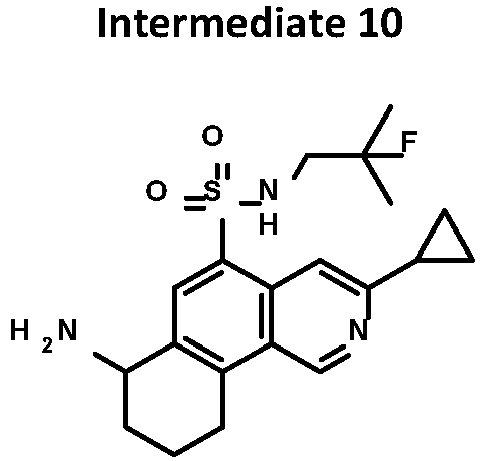
- Hydrochloric acid (4 N in dioxane, 6 mL) was added to intermediate 9 (500 mg, 0.98 mmol) followed by MeOH (2 mL) and the resultant solution stirred at room temperature for 1.5 hours. The reaction mixture was conc. in vacuo and passed through a 10 g SCX cartridge eluting with 7 N NH3 in MeOH then triturated with Et2O (20 mL) to give the title compound (356 mg, 93% Yield). LCMS [M+H]+392, RT 1.32 min (Method 9).

- To a suspension of intermediate 7 (2.35 g, 4.84 mmol) in a mixture of toluene (50 mL), 1,4-dioxane (20 mL) and H2O (3 mL) were added cyclopropylboronic acid (1.2 g, 14 mmol) and potassium phosphate tribasic (2.6 g, 12 mmol). The mixture was purged with N2 for 5 min followed by the addition of palladium(II) acetate (55 mg, 0.24 mmol) and tricyclohexylphosphonium tetrafluoroborate (270 mg, 0.71 mmol). The resultant orange mixture was purged with N2 for 5 min then heated at 120 °C for 9 hours after which further palladium (II) acetate (55 mg, 0.24 mmol) and tricyclohexylphosphonium tetrafluoroborate (270 mg, 0.71 mmol) were added and the mixture purged with N2 for a further 5 min then heated at 120 °C for 8 hours. The reaction mixture was conc. in vacuo, taken up in EtOAc (400 mL) and washed with brine (150 mL). The phases were separated and the aqueous was extracted with EtOAc (2 × 100 mL). The combined organics were dried, conc. in vacuo and triturated with Et2O (100 mL) to give the title compound (1.96 g, 82% Yield). LCMS [M+H]+ 492, RT 1.29 min (Method 4).

- Hydrochloric acid (4 N in dioxane, 6 mL) was added to intermediate 11 (500 mg, 1.00 mmol) followed by MeOH (2 mL) and the solution stirred at room temperature for 1 hour. The reaction mixture was conc. in vacuo and passed through an SCX cartridge eluting with 7 N NH3 in MeOH then triturated with Et2O (10 mL) to give the title compound (307 mg, 75% Yield). LCMS [M+H]+ 392, RT 0.97 min (Method 4).
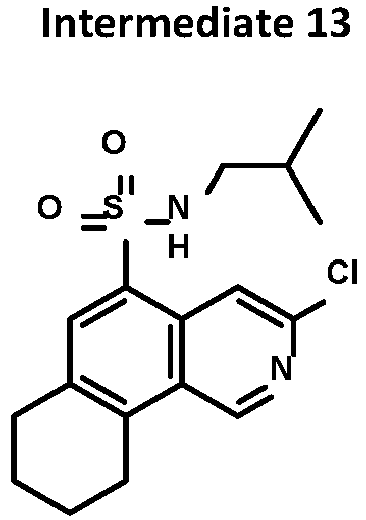
- To a solution of Intermediate 5 (475 mg, 1.50 mmol) in DCM (20 mL), 2-methylpropan-1-amine (0.74 mL, 7.51 mmol) was added dropwise and reaction mixture was stirred at room temperature for 2 hours. The reaction mixture was diluted with DCM (50 mL) and washed with water. The organic layer was dried over MgSO4 and concentrated under reduced pressure. The residue was then purified by column chromatography eluting with a gradient of 12% to 60% EtOAc in heptane to afford the title compound (497 mg, 92% yield). LCMS [M+H]+ 353, RT 3.97 min (Method 2).

- Intermediate 13 (150 mg, 0.42 mmol) was dissolved in EtOAc (15 mL) and NBS (75.6 mg, 0.42 mmol) followed by AIBN (6.98 mg, 0.043 mmol) were added. The heterogeneous mixture was heated to 90 °C for 3 hours. Reaction mixture was diluted with EtOAc and washed with aq. Na2S2O3, water and brine. The organic layer was dried over MgSO4 and concentrated under reduced pressure. The crude reside was purified by column chromatography eluting with a gradient of 0% to 50% EtOAc in heptane to afford the title compounds (145 mg, 56% yield) as a mixture of regio-isomers in 71% purity. LCMS [M+H]+ 431/433, RT 3.33 min (Method 3) [Note: both regio- isomers co-eluted same RT].


- A mixture of intermediates 14 & 15 (71%, 145 mg, 0.24 mmol) was dissolved in ammonia 7 N in MeOH (2 mL) and stirred at room temperature for 16 hours. The solvent was removed under vacuum and DCM followed by water were added. The organic layer was separated, dried over Na2SO4 and concentrated under reduced pressure. The crude residue was purified by column chromatography eluting first with a gradient of 5% to 100% EtOAc in heptane to remove the non-brominated starting material, then eluting with a gradient of 0 % to 10 % MeOH in DCM to afford the title compounds (84 mg, 94% yield) as mixture of regio-isomers. LCMS [M+H]+ 368, RT 2.09 and 2.14 min (Method 3).

- Isocyanatoethane (19.8 µL, 0.25 mmol) was added to a mixture of intermediates 16 & 17 (84 mg, 0.22 mmol) in DCM (4 mL). The solution was stirred at room temperature for 5 hours after which time a precipitate had appeared. MeOH (5 mL) was added. Then solvents were removed, and the crude was purified by acidic reverse phase HPLC to afford the title compounds:
- Intermediate 18 (37 mg, 70% yield). LCMS [M+H]+ 439, RT 2.63 min (Method 3).
- Intermediate 19 (24 mg, 44% yield). LCMS [M+H]+ 439, RT 2.70 min (Method 3).


- DIPEA (103.4 µL, 0.58 mmol) followed by methanesulphonyl chloride (23 µL, 0.29 mmol) were added to a mixture of intermediates 16 & 17 (120 mg, 0.29 mmol) in DCM (4 mL). The reaction mixture was stirred at room temperature for 4 hours. The reaction mixture was then diluted with DCM and water. The organic layer was separated, dried over Na2SO4, and concentrated under reduced pressure. Purification by reverse phase HPLC (acidic conditions) afforded the title compounds:
- Intermediate 20 (65 mg, 98% yield). LCMS [M+H]+ 446, RT 2.68 min (Method 3).
- Intermediate 21 (31 mg, 43% yield). LCMS [M+H]+ 446, RT 2.74 min (Method 3).

- To a vessel charged with 5-isothiocyanato-1,3-dimethyl-pyrazole (25 mg, 0.16 mmol) was added a suspension of intermediate 10 (50 mg, 0.13 mmol) in DCM (1 mL) and THF (2 mL). The resultant reaction mixture was stirred at room temperature for 3 days then filtered to obtain the title compound (56 mg, 76% Yield). LCMS [M+H]+545, RT 1.11 min (Method 4).
-

- A mixture of Intermediate 13 (100 mg, 0.28 mmol) and cyclopropyl boronic acid (48.6 mg, 0.56 mmol) was dissolved in nitrogen sparged dioxane (5 mL). A 2 M aq. solution of K2CO3 (0.42 mL, 0.85 mmol) was then added followed by Bedford catalyst (30.2 mg, 0.028 mmol). The reaction mixture was stirred at 100 °C for 16 hours under an atmosphere of N2, then concentrated under reduced pressure to remove the dioxane. The residual solution was diluted with DCM (20 mL) and the organic layer washed with water, dried over MgSO4 and concentrated under reduced pressure. Purification by reverse phase HPLC (basic conditions) afforded the title compound (41 mg, 40% yield). δH (500 MHz, Chloroform-d) 9.39 (s, 1H), 8.18 (s, 1H), 8.09 (s, 1H), 4.61 (t, J = 6.5 Hz 1H), 3.24 (t, J = 6.3 Hz, 2H), 2.93 (t, J = 6.1 Hz, 2H), 2.70 (t, J = 6.6 Hz, 2H), 2.28 - 2.18 (m, 1H), 2.02 - 1.95 (m, 2H), 1.94 - 1.86 (m, 2H), 1.73 - 1.64 (m, 1H), 1.17 -1.10 (m, 2H), 1.10 - 1.03 (m, 2H), 0.83 (d, J = 6.7 Hz, 6H). LCMS [M+H]+359, RT 3.67 min (Method 2).
-

- A mixture of Intermediate 16 (35 mg, 0.08 mmol) and cyclopropyl boronic acid (13.7 mg, 0.15 mmol) was dissolved in nitrogen sparged dioxane (2 mL). An aq. 2 M solution of K2CO3 (119.6 µL, 0.23 mmol) was then added followed by Bedford catalyst (8.5 mg, 0.008 mmol). The mixture was stirred at 120° C in the microwave for 2 hours under an atmosphere of N2. The reaction mixture was concentrated under reduced pressure to remove the dioxane. The residual solution was diluted with DCM (15 mL) and the organic layer washed with water, dried over MgSO4 and concentrated under reduced pressure. Purification by reverse phase HPLC (acidic conditions) afforded the title compound (4 mg, 11% yield). δH (500 MHz, Chloroform-d) 9.30 (s, 1H), 8.30 (s, 1H), 8.20 (s, 1H), 5.15 - 5.07 (m, 1H), 5.05 - 4.96 (m, 1H), 4.92 - 4.82 (m, 1H), 4.67 - 4.57 (m, 1H), 3.32 - 3.06 (m, 4H), 2.86-2.76 (m, 1H), 2.73 - 2.64 (m, 1H), 2.27 - 2.19 (m, 1H), 2.16 - 2.07 (m, 1H), 2.06 - 1.91 (m, 2H), 1.88-1.79 (m, 1H), 1.75 - 1.66 (m, 1H), 1.19 - 1.00 (m, 7H), 0.91 - 0.80 (m, 6H). LCMS [M+H]+ 445, RT 2.70 min (Method 2).
-

- A mixture of intermediate 17 (20 mg, 0.046 mmol) and cyclopropyl boronic acid (7.8 mg, 0.091 mmol) was dissolved in nitrogen sparged dioxane (2 mL). An aq. 2 M solution of K2CO3 (68.3 µL, 0.23 mmol) was added followed by Bedford catalyst (4.8 mg, 0.005 mmol). The mixture was stirred at 120 °C in a microwave for 2 hours under an atmosphere of nitrogen. The reaction mixture was concentrated under reduced pressure to remove the dioxane. The residual solution was diluted with DCM (15 mL) and the organic layer washed with water, dried over MgSO4 and concentrated under reduced pressure. Purification by reverse phase HPLC (acidic conditions) afforded the title compound (6 mg, 30% yield). δH (500 MHz, Methanol-d4) 9.35 (s, 1H), 8.31 (s, 1H), 8.08 (s, 1H), 5.82-5.49 (m, 1H), 3.24 - 3.12 (m, 2H), 3.06 - 2.98 (m, 1H), 2.98 - 2.88 (m, 1H), 2.63 (d, J = 6.9 Hz, 2H), 2.32 - 2.22 (m, 1H), 2.21 - 2.10 (m, 1H), 2.07 - 1.80 (m, 3H), 1.71 -1.55 (m, 1H), 1.22 - 0.99 (m, 7H), 0.82-0.76 (m, 6H). LCMS [M+H]+ 445, RT 2.78 min (Method 2).
-
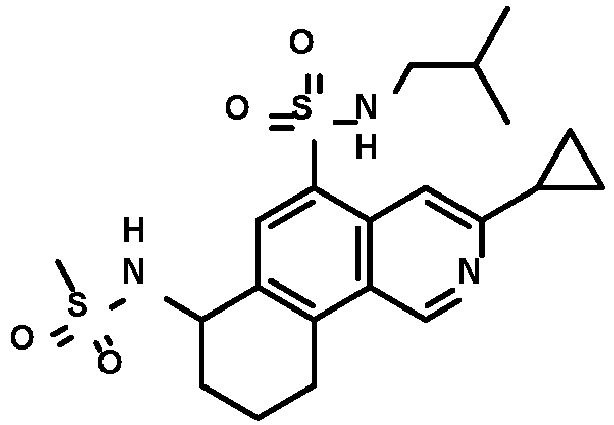
- A mixture of intermediate 16 (63 mg, 0.14 mmol) and cyclopropyl boronic acid (24.2 mg, 0.28 mmol) was dissolved in nitrogen sparged dioxane (3 mL). An aq. 2 M solution of K2CO3 (0.21 mL, 0.42 mmol) was added followed by Bedford catalyst (15.1 mg, 0.014 mmol). The reaction mixture was concentrated under reduced pressure to remove the dioxane. The residual solution was diluted with DCM (20 mL) and the organic layer washed with water, dried over MgSO4 and concentrated under reduced pressure. Purification by reverse phase HPLC (acidic conditions) afforded the title compound (27 mg, 41% yield). δH (500 MHz, Chloroform-d) 9.35 (s, 1H), 8.34 (s, 1H), 8.22 (s, 1H), 4.91 - 4.72 (m, 3H), 3.32 - 3.22 (m, 1H), 3.21 - 3.08 (m, 4H), 2.94 - 2.70 (m, 2H), 2.33 - 2.15 (m, 2H), 2.11 - 1.95 (m, 3H), 1.83 - 1.69 (m, 1H), 1.19 - 1.13 (m, 2H), 1.12 - 1.06 (m, 2H), 0.91 - 0.84 (m, 6H). LCMS [M+H]+ 452, RT 2.89 min (Method 2).
-

- A mixture of intermediate 17 (30 mg, 0.067 mmol) and cyclopropyl boronic acid (11.56 mg, 0.13 mmol) was dissolved in nitrogen sparged dioxane (2 mL). An aq. 2 M solution of K2CO3 (0.10 mL, 0.20 mmol) was added followed by Bedford catalyst (7.1 mg, 0.007 mmol). The mixture was stirred at 120 °C in microwave for 2 hours under an atmosphere of nitrogen. The reaction mixture was concentrated under reduced pressure to remove the dioxane. The residual solution was diluted with DCM (15 mL) and the organic layer washed with water, dried over MgSO4 and concentrated under reduced pressure. Purification by reverse phase HPLC (acidic conditions) afforded the title compound (10 mg, 33% yield). δH (500 MHz, Chloroform-d) 9.60 (s, 1H), 8.18 (s, 1H), 8.08 (s, 1H), 5.59 - 5.53 (m, 1H), 4.66 (t, J = 6.2 Hz, 1H), 4.54 (d, J = 7.3 Hz, 1H), 3.13 (s, 3H), 3.07 - 3.00 (m, 1H), 2.99 - 2.89 (m, 1H), 2.71(t, J = 6.6 Hz, 2H), 2.50 - 2.44 (m, 1H), 2.24 - 2.18 (m, 1H), 2.09 - 2.00 (m, 2H), 1.98 - 1.89 (m, 1H), 1.76 - 1.67 (m, 1H), 1.20 - 1.13 (m, 2H), 1.11 - 1.04 (m, 2H), 0.85 (d, J = 6.7 Hz, 6H). LCMS [M+H]+452, RT 2.94 min (Method 2).
-

- To a stirred suspension of intermediate 10 (30 mg, 0.08 mmol) in anhydrous 1,4-dioxane (2.5 mL) at room temperature were added 5-bromo-2-(2-methyltetrazol-5-yl)pyridine (37 mg, 0.15 mmol), sodium tert-butoxide (22 mg, 0.23 mmol) and tBuXPhos Pd G3 (9 mg, 0.01 mmol). The resultant mixture was purged with N2 for 10 min. After a further 15 min, the reaction mixture was filtered through celite and conc. in vacuo. Purification by column chromatography eluting with 0-20% MeOH in EtOAc followed by basic reverse phase column chromatography gave the title compound (20 mg, 44% Yield). δH (300 MHz, d6-DMSO) 9.48 (s, 1H), 8.36 (s, 2H), 8.22 (d, J = 2.7 Hz, 1H), 8.15 (s, 1H), 7.88 (d, J = 8.6 Hz, 1H), 7.24 (dd, J = 8.8, 2.8 Hz, 1H), 6.93 (d, J = 8.7 Hz, 1H), 4.95 (d, J = 8.6 Hz, 1H), 4.39 (s, 3H), 3.39 (s, 1H), 3.20 (d, J = 18.0 Hz, 1H), 2.96 - 2.79 (m, 2H), 2.34 - 2.25 (m, 1H), 1.97 (s, 4H), 1.19 (dd, J = 21.4, 3.2 Hz, 6H), 1.06 (d, J = 6.3 Hz, 4H). LCMS [M-H]-549, RT 2.16 min (Method 8).
-

- To a solution of intermediate 22 (55 mg, 0.10 mmol) in DMF (1 mL) were added formic acid hydrazide (18 mg, 0.30 mmol) and mercuric chloride (52 mg, 0.19 mmol). TEA (40 µL, 0.29 mmol) was then added and the reaction mixture was heated at 80 °C for 4 hours. The reaction mixture was then filtered through celite (20 mL MeCN washings) and conc. in vacuo. Purification by column chromatography gave the title compound (10 mg, 19% Yield). δH (300 MHz, d6-DMSO) 9.51 (s, 1H), 8.54 (s, 1H), 8.35 (s, 1H), 7.89 (s, 1H), 7.75 (s, 1H), 5.85 (s, 1H), 5.67 (s, 1H), 3.38 (s, 5H), 2.78 (d, J = 20.0 Hz, 2H), 2.29 (q, J = 6.1 Hz, 1H), 2.20 (s, 2H), 2.07 (s, 3H), 1.98 (s, 2H), 1.13 (dd, J = 21.4, 4.9 Hz, 6H), 1.07 (d, J = 6.6 Hz, 4H). [one H not visible]. LCMS [M+H]+553, RT 2.14 min (Method 5).
-

- Synthesised in the same manner as Example 6 using intermediate 12 (30 mg, 0.08 mmol) and comparable stoichiometries of reagents. Purification by column chromatography eluting with 0-20% MeOH in EtOAc followed by reverse phase column chromatography (basic conditions) gave the title compound (6 mg, 14% Yield). δH (300 MHz, d6-DMSO) 9.09 (s, 1H), 8.43 (s, 1H), 8.24 (d, J = 2.7 Hz, 1H), 7.99 (s, 1H), 7.93 (d, J = 8.6 Hz, 1H), 7.36 (dd, J = 8.7, 2.8 Hz, 1H), 7.02 (d, J = 8.4 Hz, 1H), 5.55 (s, 1H), 4.40 (s, 3H), 2.92 (dd, J = 19.6, 9.9 Hz, 4H), 2.25 - 2.07 (m, 2H), 1.94 (s, 1H), 1.80 (d, J = 14.2 Hz, 2H), 1.24 (d, J = 21.4 Hz, 6H), 0.97 (d, J = 8.2 Hz, 4H) [one H not visible]. LCMS [M-H]- 549, RT 1.18 min (Method 6).
-

- To a solution of ethyl 2-amino-2-cyanoacetate (15 mg, 0.07 mmol, 64% purity) in MeCN (1 mL) was added triethyl orthoformate (13 µL, 0.08 mmol). The resultant solution was heated at 90 °C for 1 hour then cooled to room temperature. Intermediate 10 (20 mg, 0.05 mmol) was then added and after 1 hour, the reaction mixture was conc. in vacuo and purified by reverse phase column chromatography (acidic conditions) to give the title compound (9 mg, 31% Yield). δH (300 MHz, d6-DMSO) 9.50 (s, 1H), 8.40 (s, 1H), 8.34 (d, J = 0.8 Hz, 1H), 7.65 (s, 1H), 6.78 (s, 1H), 6.24 - 6.09 (m, 2H), 5.61 (t, J = 6.1 Hz, 1H), 4.18 (q, J = 7.1 Hz, 2H), 3.39 (d, J = 16.4 Hz, 2H), 2.81 (dt, J = 20.0, 6.7 Hz, 2H), 2.35 - 2.28 (m, 1H), 2.19 - 2.03 (m, 2H), 1.92 (d, J = 10.2 Hz, 2H), 1.25 (t, J = 7.1 Hz, 3H), 1.16 (d, J = 21.4 Hz, 6H), 1.07 (d, J = 6.9 Hz, 4H). LCMS [M+H]+530, RT 1.68 min (Method 7).
-

- Synthesised in the same manner as example 6 using intermediate 10 (25 mg, 0.06 mmol) and comparable stoichiometries of reagents and heating at 100 °C for 6 hours. Purification by column chromatography gave the title compound (3 mg, 8% Yield). δH (300 MHz, d6-DMSO) 9.49 (s, 1H), 8.54 (s, 1H), 8.47 (d, J = 1.8 Hz, 1H), 8.37 (d, J = 2.8 Hz, 2H), 8.16 (s, 1H), 7.69 (t, J = 2.3 Hz, 1H), 6.92 (d, J = 8.8 Hz, 1H), 5.02 (s, 1H), 3.43 (d, J = 18.9 Hz, 2H), 2.86 (d, J = 17.8 Hz, 2H), 2.43 (s, 3H), 2.32 (d, J = 6.4 Hz, 1H), 1.97 (s, 4H), 1.20 (dd, J = 21.4, 5.5 Hz, 6H), 1.07 (d, J = 6.3 Hz, 4H). LCMS [M+H]+551, RT 2.31 min (Method 8).
-

- To a stirred solution of 1,3-dimethyl-1H-pyrazol-5-amine (8 mg, 0.07 mmol) in MeCN (1 mL) were added TEA (20 µL, 0.14 mmol) and 1,1'-carbonyldiimidazole (11 mg, 0.07 mmol). After 1 hour, intermediate 10 (25 mg, 0.07 mmol) was added. After a further 12 hours, the reaction mixture was diluted with brine (20 mL) and extracted with DCM (3 × 20 mL), the combined organics dried and conc. in vacuo. Purification by column chromatography eluting with 0-30% MeOH in EtOAc followed by reverse phase column chromatography (acidic conditions) gave the title compound (3 mg, 9% Yield). δH (300 MHz, d6-DMSO) 9.44 (s, 1H), 8.38 (s, 1H), 8.33 (d, J = 7.6 Hz, 2H), 8.18 (s, 1H), 6.98 (d, J = 8.6 Hz, 1H), 5.93 (s, 1H), 5.01 (s, 1H), 3.54 (s, 3H), 3.26 (s, 2H), 2.92 (d, J = 18.9 Hz, 2H), 2.31 (d, J = 6.5 Hz, 1H), 2.07 (s, 3H), 1.98 (s, 4H), 1.21 (dd, J = 21.4, 6.8 Hz, 6H), 1.06 (d, J = 6.8 Hz, 4H). LCMS [M+H]+529, RT 1.88 min (Method 8).
-

- To a stirred solution of ethyl (Z)-3-(dimethylamino)-2-isocyano-prop-2-enoate * (10 mg, 0.06 mmol) in 1-butanol (1 mL) was added intermediate 10 (20 mg, 0.05 mmol) and the resultant mixture heated at 150 °C for 9 hours. The mixture was then conc. in vacuo and purified by column chromatography eluting with 0-20% MeOH in EtOAc followed by reverse phase column chromatography eluting (basic conditions) to give the title compound (4 mg, 15% Yield). δH (400 MHz, d6-DMSO) 9.51 (s, 1H), 8.38 (s, 1H), 8.34 (s, 1H), 7.85 (d, J = 1.3 Hz, 1H), 7.79 (d, J = 1.3 Hz, 1H), 7.60 (s, 1H), 5.83 (t, J = 6.3 Hz, 1H), 4.17 (qd, J = 7.1, 2.0 Hz, 2H), 3.45 - 3.39 (m, 1H), 3.39 - 3.35 (m, 1H), 2.88 - 2.69 (m, 2H), 2.31 - 2.23 (m, 2H), 2.22 - 2.11 (m, 1H), 1.95 (s, 2H), 1.22 (t, J = 7.0 Hz, 3H), 1.13 (dd, J = 21.3, 2.4 Hz, 6H), 1.09 - 1.04 (m, 4H). LCMS [M+H]+ 515, RT 2.03 min (Method 8).
- * Synthesised according to the procedure in WO2007/42545 A1, 2007.
- 86 nmoles of IgE-Fc(N265Q, N371Q) (Young et al., 1995) at 172 µM in 100 mM NaHCO3, pH 9.5 was added to 1 mg of LanthaScreen™ Amine Reactive Tb Chelate (ThermoFisher catalogue number PV3583) and incubated for 16 hours at 20 °C. The material was then buffer exchanged into Phosphate Buffered Saline (being, 137 mM NaCl, 2.7 mM KCI, 10 mM Na2HPO4, 1.8 mM K2HPO4, pH 7.4) and the material quantified and the degree of Tb conjugation determined by measuring the absorption at 280 nm and 343 nm.
- The integrity of the conjugated material was determined by analytical size exclusion chromatography on a S200 HR 10x300 column (GE Healthcare). Typical conjugation ratios were 4:1 Tb:lgE-Fc.
- Young RJ., Owens, RJ., MacKay GA., Chan CMW., Shi J., Hide M., Francis DM., Henry AJ., Sutton BJ., and Gould HJ (1995) Protein Engineering 8:193-199
- 400 nmoles FcεR1α (Y131A mutant) (Cook et al., 1997) at 400 µM in 100 mM NaOAc pH 5.5 was reacted with 1 mM final concentration sodium periodate (in 100 mM NaOAc, pH 5.5) for 60 minutes at 22 °C. Oxidation was quenched with the addition of 40 µL of ethanediol and incubation for 60 minutes at 22 °C. The protein was buffer exchanged in to conjugation buffer (50 mM NaHCO3, 150 mM NaCl, pH 9.5) and concentrated to 750 µM.
- 175 nmoles of protein was added to 1 mg of Alexa Fluor™ 488 hydrazide (Invitrogen) and incubated for 16 hours at 22 °C. Sodium cyanoborohydride (at 100 mM in conjugation buffer) was added to a final concentration of 1 mM and incubated for 60 minutes on ice. The protein was buffer exchanged into Phosphate Buffered Saline (being, 137 mM NaCl, 2.7 mM KCI, 10 mM Na2HPO4, 1.8 mM K2HPO4, pH 7.4) and the material quantified and the degree of Alexa Fluor™ 488 conjugation determined by measuring the absorption at 280 nm and 495 nm.
- The integrity of the conjugated material was determined by analytical size exclusion chromatography on a S200 HR 10x300 column (GE Healthcare). Typical conjugation ratios were 2:1 Alexa Fluor™488: sFcεR1α
- Cook JPD., Henry AJ., McDonnell JM., Owens RJ., Sutton BJ., and Gould HJ (1997) Biochemistry 36:15579-15588
- The aim was to measure binding of IgE-Tb to receptor, and the inhibition thereof by compounds, using an in vitro Fluorescence Resonance Energy Transfer (FRET) Assay.
- FRET reagents used were IgE labelled with Terbium (FRET donor), and soluble IgE receptor FcεR1α with a Y131A mutation, labelled with Alexa Fluor™ 488 (FRET acceptor). Unlabelled FcεR1α was also used to generate a background control. The assay buffer consisted of 20mM Tris pH7.2, 150mM NaCl, and 0.002% Tween, 1% DMSO.
- The assay was conducted according to the following: Each assay reaction was conducted in a volume of 25µl in a 384-well half-volume plate. 10 point compound serial dilutions (3-fold) were generated in DMSO at a concentration of x50 that of the final assay concentration (FAC). Compound solutions were then prepared by IgE-Tb diluting 10-fold in assay buffer. For the assay, 5µl of diluted compound was added to 10µl of, followed by addition of 10µl FcεR1α-Y131A-AF488. FRET reagents FACs were 5nM IgE-Tb, 25nM FcεR1α-Y131A-AF488. Usually the top FAC of compound in the assay was 10µM. The final DMSO concentration was 2%. The minimum signal (MIN) was measured by adding 5µl unlabelled FcεRIα at 1µM (FAC = 200nM) to the FRET reagents. The maximum FRET signal (MAX) was measured in wells containing FRET reagents but no compound.
- The assay was incubated for 2 hours at room temperature, protected from light and evaporation, and with gentle agitation.
- Measurement of FRET for each well was carried out by exciting at 330nm and measuring emission at 495/520nm using an Envision plate reader (Perkin Elmer). FRET ratio was calculated as follows:

- The FRET ratio was used for the data analysis.
- Z' was calculated as follows (σ = standard deviation and µ = mean):

- Z' above 0.5 was considered a good assay.
- Background signal (MIN) was subtracted from all wells. Using the background subtracted values, the percent inhibition by compound in each test-well was calculated as follows:

- Percent inhibition was plotted against compound concentration. IC50 values for each compound were determined using four parameter logistic fit model using the XLFIT5 software package.
- The results are as follows:
Compounds of the invention show an IC50 value ranging from 19.8 nM to 5098 nM. - The table below shows the range of IC50 values for each example:
Example Number FRET IC50 range 6 10 - 50 nanomolar 2, 10 50 - 100 nanomolar 1, 3, 4, 7, 8, 9, 11, 12 0.1 - 1 micromolar 5 1 - 5 micromolar
Claims (15)
- Compound of formula (I) and pharmaceutically acceptable salts thereof:

R1, R2 represents independently from each other a group chosen amongst:Hydrogen; or NHC(O)NH-C1-6-alkyl; or NHSO2-C1-6-alkyl; or NHC(O)NH-heteroaryl optionally substituted with one or more R1a; or heteroaryl optionally substituted with one or more group chosen amongst amino; C1-6-alkyl; C(O)O-C1-6-alkyl; nitrile; heteroaryl optionally substituted with one or more R1a; NH-C1-6-alkyl; NH-C1-6-heterocycloalkyl; NH-C3-9-cycloalkyl; NH-heteroaryl optionally substituted with one or more R1a; or NH-heteroaryl optionally substituted with one or more group chosen amongst; C1-6-alkyl; C1-6-hydroxyalkyl; C3-9-hydroxyheterocycloalkyl;heteroaryl optionally substituted with one or more R1a; or NHC(O)-C1-6-alkyl; or NHC(O)-heteroaryl optionally substituted with one or more R1a
R1a represents a group chosen amongst:Halogen; nitrile; C1-6-alkyl; C1-6-haloalkyl; C1-6-alkoxy; C1-6-haloalkoxy; C(O)O-C1-6-alkyl; C(O)OH;R3 represents a group chosen amongst:C1-6-alkyl optionally substituted with one or more group chosen amongst R3a;C1-3-alkanediyl-C3-6-cycloalkyl optionally substituted with one or more R3a;C1-3-alkanediyl-C3-6-heterocycloalkyl optionally substituted with one or more R3a;C3-6-heterocycloalkyl optionally substituted with one or more R3a;C3-6-cycloalkyl optionally substituted with one or more R3a;
R3a represents a group chosen amongst hydrogen Halogen, C1-2-alkyl; hydroxy; C1-2-alkoxyR4 represents a group chosen amongst:C3-6-cycloalkyl optionally substituted with one or more R4a group; or C1-6-alkanediyl-C3-6-cycloalkyl optionally substituted with one or more R4a group; or C1-6-alkanediyl-C3-6-heterocycloalkyl optionally substituted with one or more R4a group;R4a represents a group chosen amongst hydroxy; Halogen; C1-2-alkyl. - Compound according to Claim 1, wherein
R1, R2 represents independently from each other a group chosen amongst:Hydrogen; or NH-heteroaryl optionally substituted with one or more group chosen amongst;C1-6-alkyl; heteroaryl optionally substituted with one or more R1a; or heteroaryl optionally substituted with one or more group chosen amongst amino; C(O)O-C1-6-alkyl; nitrile;heteroaryl optionally substituted with one or more R1a; NH-C1-6-alkyl; NH-C3-9-heterocycloalkyl; NH-C3-9-cycloalkyl; NH-heteroaryl optionally substituted with one or more R1a. - Compound according to any of preceding claims, whereinWhen R1 is different than hydrogen, R2 is hydrogen;When R2 is different than hydrogen, R1 is hydrogen.
- Compound according to any of preceding claims, wherein
R3 represents C1-6-alkyl optionally substituted with a fluorine atom. - Compound according to any of preceding claims, wherein
R4 represents cyclopropyl. - Compound according to Claim 1, chosen amongst:3-cyclopropyl-N-(2-methylpropyl)-7,8,9,10-tetrahydrobenzo[h]isoquinoline-5-sulfonamide;1-[3-cyclopropyl-5-(2-methylpropylsulfamoyl)-7,8,9,10-tetrahydrobenzo[h]isoquinolin-7-yl]-3-ethylurea;1-[3-cyclopropyl-5-(2-methylpropylsulfamoyl)-7,8,9,10-tetrahydrobenzo[h]isoquinolin-10-yl]-3-ethylurea;3-cyclopropyl-7-(methanesulfonamido)-N-(2-methylpropyl)-7,8,9,10-tetrahydrobenzo[h]isoquinoline-5-sulfonamide;3-cyclopropyl-10-(methanesulfonamido)-N-(2-methylpropyl)-7,8,9,10-tetrahydrobenzo[h]isoquinoline-5-sulfonamide;3-cyclopropyl-N-(2-fluoro-2-methylpropyl)-7-[[6-(2-methyltetrazol-5-yl)pyridin-3-yl]amino]-7,8,9,10-tetrahydrobenzo[h]isoquinoline-5-sulfonamide;3-cyclopropyl-7-[3-[(2,5-dimethylpyrazol-3-yl)amino]-1,2,4-triazol-4-yl]-N-(2-fluoro-2-methylpropyl)-7,8,9,10-tetrahydrobenzo[h]isoquinoline-5-sulfonamide;3-cyclopropyl-N-(2-fluoro-2-methylpropyl)-10-[[6-(2-methyltetrazol-5-yl)pyridin-3-yl]amino]-7,8,9,10-tetrahydrobenzo[h]isoquinoline-5-sulfonamide;ethyl 5-amino-1-[3-cyclopropyl-5-[(2-fluoro-2-methylpropyl)sulfamoyl]-7,8,9,10-tetrahydrobenzo[h]isoquinolin-7-yl]imidazole-4-carboxylate;3-cyclopropyl-N-(2-fluoro-2-methylpropyl)-7-[[5-(3-methyl-1,2,4-oxadiazol-5-yl)pyridin-3-yl]amino]-7,8,9,10-tetrahydrobenzo[h]isoquinoline-5-sulfonamide;1-[3-cyclopropyl-5-[(2-fluoro-2-methylpropyl)sulfamoyl]-7,8,9,10-tetrahydrobenzo[h]isoquinolin-7-yl]-3-(2,5-dimethylpyrazol-3-yl)urea;ethyl 1-[3-cyclopropyl-5-[(2-fluoro-2-methylpropyl)sulfamoyl]-7,8,9,10-tetrahydrobenzo[h]isoquinolin-7-yl]imidazole-4-carboxylate.
- A pharmaceutical composition comprising a compound according to any one of claims 1 to 6 or a pharmaceutically acceptable salt thereof.
- A compound according to any one of claims 1 to 6 or a pharmaceutically acceptable salt thereof for use in therapy.
- A compound according to any one of claims 1 to 6 or a pharmaceutically acceptable salt thereof for use in a method for the treatment or prevention of allergy, non-allergic mast cell responses, type 1 hypersensitivity, urticaria, or familiar sinus inflammation.
- A compound according to any one of claims 1 to 6 or a pharmaceutically acceptable salt thereof for use in a method for the treatment or prevention of airway constriction in asthma, local inflammation in eczema, increased mucus secretion in allergic rhinitis, urticaria, or increased vascular permeability.
- A compound according to any one of claims 1 to 6 or a pharmaceutically acceptable salt thereof for use in a method for the treatment or prevention of eosinophilic granulomatosis with polyangiitis (also known as "Churg Strauss syndrome"), aspirin exacerbated respiratory disease, or cutaneous T-cell lymphoma.
- A pharmaceutical composition comprising a compound of formula (I) according to Claim 1 to 6 or a pharmaceutically acceptable salt thereof in association with a pharmaceutically acceptable carrier.
- A compound according to any of claims 1 to 6 or a pharmaceutically acceptable salt thereof for use as a medicament.
- A compound according to any of claims 1 to 6 or a pharmaceutically acceptable salt thereof for use as a medicament in the treatment and/or prevention of allergy, non-allergic mast cell responses, type 1 hypersensitivity, urticaria, or familiar sinus inflammation.
- A compound according to any one of claims 1 to 6 or a pharmaceutically acceptable salt thereof for use in the treatment or prevention of allergy, non-allergic mast cell responses, type 1 hypersensitivity, urticaria, familiar sinus inflammation, eosinophilic granulomatosis with polyangiitis (also known as "Churg Strauss syndrome"), aspirin exacerbated respiratory disease, or cutaneous T-cell lymphoma.
Applications Claiming Priority (2)
| Application Number | Priority Date | Filing Date | Title |
|---|---|---|---|
| GBGB1919214.5A GB201919214D0 (en) | 2019-12-23 | 2019-12-23 | Tetrahydrobenzo-quinoline sulfonamide derivatives useful as IGE modulators |
| PCT/EP2020/087688 WO2021130260A1 (en) | 2019-12-23 | 2020-12-22 | Tetrahydrobenzo-quinoline sulfonamide derivatives useful as ige modulators |
Publications (2)
| Publication Number | Publication Date |
|---|---|
| EP4081297A1 EP4081297A1 (en) | 2022-11-02 |
| EP4081297B1 true EP4081297B1 (en) | 2024-06-12 |
Family
ID=69322650
Family Applications (1)
| Application Number | Title | Priority Date | Filing Date |
|---|---|---|---|
| EP20841927.5A Active EP4081297B1 (en) | 2019-12-23 | 2020-12-22 | Tetrahydrobenzo-quinoline sulfonamide derivatives useful as ige modulators |
Country Status (8)
| Country | Link |
|---|---|
| US (1) | US20230050670A1 (en) |
| EP (1) | EP4081297B1 (en) |
| JP (1) | JP7664930B2 (en) |
| CN (1) | CN114845776A (en) |
| CA (1) | CA3165675A1 (en) |
| ES (1) | ES2985943T3 (en) |
| GB (1) | GB201919214D0 (en) |
| WO (1) | WO2021130260A1 (en) |
Families Citing this family (3)
| Publication number | Priority date | Publication date | Assignee | Title |
|---|---|---|---|---|
| GB201919212D0 (en) | 2019-12-23 | 2020-02-05 | Ucb Biopharma Sprl | Dihydro-cyclopenta-isoquinoline sulfonamides derivatives |
| GB201919213D0 (en) | 2019-12-23 | 2020-02-05 | Ucb Biopharma Sprl | Dihydrocyclopenta-Isoquinoline-Sulfanamide derivatives compounds |
| GB201919210D0 (en) * | 2019-12-23 | 2020-02-05 | UCB Biopharma SRL | Dihydro-cyclopenta-isoquinoline derivatives |
Citations (2)
| Publication number | Priority date | Publication date | Assignee | Title |
|---|---|---|---|---|
| EP0419676B1 (en) * | 1989-03-30 | 1994-12-07 | Teijin Limited | Thionaphthalene derivatives, method of producing the same, and antiallergic agent containing the same |
| WO2019243550A1 (en) * | 2018-06-21 | 2019-12-26 | UCB Biopharma SRL | Thiophene derivatives for the treatment of disorders caused by ige |
Family Cites Families (15)
| Publication number | Priority date | Publication date | Assignee | Title |
|---|---|---|---|---|
| US4857301A (en) * | 1987-09-25 | 1989-08-15 | Schering Corporation | Sulfonamide compounds, compositions and method of use |
| US5962634A (en) | 1994-07-08 | 1999-10-05 | Thomas Jefferson University | IgE antagonists |
| MXPA02006474A (en) * | 1999-12-28 | 2002-11-29 | Eisai Co Ltd | Heterocyclic compounds having sulfonamide groups. |
| US7378525B2 (en) * | 2002-12-23 | 2008-05-27 | Millennium Pharmaceuticals, Inc. | CCR8 inhibitors |
| TW200510311A (en) * | 2002-12-23 | 2005-03-16 | Millennium Pharm Inc | CCr8 inhibitors |
| CA2615574A1 (en) * | 2005-07-29 | 2007-02-08 | Kalypsys, Inc. | Multicyclic sulfonamide compounds as inhibitors of histone deacetylase for the treatment of disease |
| EP1932841B1 (en) * | 2005-08-30 | 2014-01-01 | Asahi Kasei Pharma Corporation | Sulfonamide compound |
| JP2007099676A (en) * | 2005-10-04 | 2007-04-19 | Asahi Kasei Pharma Kk | Therapeutic agent for dermatitis and/or therapeutic composition for dermatitis |
| WO2007042545A1 (en) | 2005-10-14 | 2007-04-19 | Neurosearch A/S | Imidazole derivatives and their use for modulating the gaba-a receptor complex |
| WO2008129276A1 (en) * | 2007-04-19 | 2008-10-30 | Boehringer Ingelheim International Gmbh | Disulfonamides useful in the treatment of inflammation |
| AU2013406206B2 (en) * | 2013-11-26 | 2017-07-20 | Gilead Sciences, Inc. | Quinoline derivatives as bromodomain inhibitors |
| GB201919210D0 (en) * | 2019-12-23 | 2020-02-05 | UCB Biopharma SRL | Dihydro-cyclopenta-isoquinoline derivatives |
| GB201919216D0 (en) * | 2019-12-23 | 2020-02-05 | UCB Biopharma SRL | Tetrahydrobenzo-quinoline sulfonamides derivative compounds |
| GB201919213D0 (en) * | 2019-12-23 | 2020-02-05 | Ucb Biopharma Sprl | Dihydrocyclopenta-Isoquinoline-Sulfanamide derivatives compounds |
| GB201919212D0 (en) * | 2019-12-23 | 2020-02-05 | Ucb Biopharma Sprl | Dihydro-cyclopenta-isoquinoline sulfonamides derivatives |
-
2019
- 2019-12-23 GB GBGB1919214.5A patent/GB201919214D0/en not_active Ceased
-
2020
- 2020-12-22 CN CN202080089312.8A patent/CN114845776A/en active Pending
- 2020-12-22 EP EP20841927.5A patent/EP4081297B1/en active Active
- 2020-12-22 CA CA3165675A patent/CA3165675A1/en active Pending
- 2020-12-22 WO PCT/EP2020/087688 patent/WO2021130260A1/en not_active Ceased
- 2020-12-22 US US17/786,309 patent/US20230050670A1/en active Pending
- 2020-12-22 JP JP2022538776A patent/JP7664930B2/en active Active
- 2020-12-22 ES ES20841927T patent/ES2985943T3/en active Active
Patent Citations (2)
| Publication number | Priority date | Publication date | Assignee | Title |
|---|---|---|---|---|
| EP0419676B1 (en) * | 1989-03-30 | 1994-12-07 | Teijin Limited | Thionaphthalene derivatives, method of producing the same, and antiallergic agent containing the same |
| WO2019243550A1 (en) * | 2018-06-21 | 2019-12-26 | UCB Biopharma SRL | Thiophene derivatives for the treatment of disorders caused by ige |
Also Published As
| Publication number | Publication date |
|---|---|
| JP7664930B2 (en) | 2025-04-18 |
| JP2023508150A (en) | 2023-03-01 |
| ES2985943T3 (en) | 2024-11-07 |
| GB201919214D0 (en) | 2020-02-05 |
| US20230050670A1 (en) | 2023-02-16 |
| CN114845776A (en) | 2022-08-02 |
| EP4081297A1 (en) | 2022-11-02 |
| WO2021130260A1 (en) | 2021-07-01 |
| CA3165675A1 (en) | 2021-07-01 |
Similar Documents
| Publication | Publication Date | Title |
|---|---|---|
| EP4509512A2 (en) | Amino acid compounds and methods of use | |
| EP4520329A2 (en) | Treatment of respiratory diseases with amino acid compounds | |
| EP3983064B1 (en) | Cot modulators and methods of use thereof | |
| EP3596078B1 (en) | Fused pentacyclic imidazole derivatives as modulators of tnf activity | |
| JP7664930B2 (en) | Tetrahydrobenzo-quinoline sulfonamide derivatives useful as IGE modulators - Patents.com | |
| EP1685131B1 (en) | Hydroxyalkyl substituted pyrido-7-pyrimidin-7-ones | |
| CA3145868A1 (en) | N-methyl, n-(6-(methoxy)pyridazin-3-yl) amine derivatives as autotaxi n (atx) modulators for the treatment of inflammatory airway or fibrotic diseases | |
| EP4081295B1 (en) | Dihydro-cyclopenta-isoquinoline sulfonamides derivatives | |
| HUE024989T2 (en) | Derivatives of azaindoles as inhibitors of protein kinases abl and src | |
| JP7623385B2 (en) | Tetrahydrobenzo-quinoline sulfonamide derivative compounds | |
| NZ586486A (en) | Pyrrolopyrimidinecarboxamides | |
| EP4081299B1 (en) | Dihydro-cyclopenta-isoquinoline derivatives | |
| EP4081296B1 (en) | Dihydrocyclopenta-isoquinoline-sulfonamide derivatives compounds | |
| DE69523571T2 (en) | PYRIDYLIMIDAZOLE DERIVATIVES AND METHOD FOR THE PRODUCTION THEREOF | |
| AU2021408311A9 (en) | Borate derivative and uses thereof | |
| WO2007039580A1 (en) | Imidazolyl-substituted benzophenone compounds | |
| WO2007039578A1 (en) | Imidazolyl-substituted azabenzophenone compounds | |
| WO2025011479A1 (en) | Pyrazole based inhibitors of LDH and their use in immune and inflammatory diseases | |
| CN121914122A (en) | Small molecule TNF-alpha inhibitors and uses thereof | |
| WO2025106691A9 (en) | Alpha 4 beta 7 integrin modulators and uses thereof | |
| WO2007039581A1 (en) | Imidazolyl-substituted diazabenzophenone compounds | |
| TW202521543A (en) | Substituted imidazoarenes and methods of their use | |
| WO2025165746A1 (en) | Certain chemical entities, compositions, and methods | |
| WO2025133961A1 (en) | Nitrogen-containing heteroaryl compounds for the treatment of chronic diseases | |
| CN116731022A (en) | Tri-ring ubiquitin-specific protease 1 inhibitors and uses thereof |
Legal Events
| Date | Code | Title | Description |
|---|---|---|---|
| STAA | Information on the status of an ep patent application or granted ep patent |
Free format text: STATUS: UNKNOWN |
|
| STAA | Information on the status of an ep patent application or granted ep patent |
Free format text: STATUS: THE INTERNATIONAL PUBLICATION HAS BEEN MADE |
|
| PUAI | Public reference made under article 153(3) epc to a published international application that has entered the european phase |
Free format text: ORIGINAL CODE: 0009012 |
|
| STAA | Information on the status of an ep patent application or granted ep patent |
Free format text: STATUS: REQUEST FOR EXAMINATION WAS MADE |
|
| 17P | Request for examination filed |
Effective date: 20220725 |
|
| AK | Designated contracting states |
Kind code of ref document: A1 Designated state(s): AL AT BE BG CH CY CZ DE DK EE ES FI FR GB GR HR HU IE IS IT LI LT LU LV MC MK MT NL NO PL PT RO RS SE SI SK SM TR |
|
| DAV | Request for validation of the european patent (deleted) | ||
| DAX | Request for extension of the european patent (deleted) | ||
| STAA | Information on the status of an ep patent application or granted ep patent |
Free format text: STATUS: EXAMINATION IS IN PROGRESS |
|
| 17Q | First examination report despatched |
Effective date: 20230711 |
|
| GRAP | Despatch of communication of intention to grant a patent |
Free format text: ORIGINAL CODE: EPIDOSNIGR1 |
|
| STAA | Information on the status of an ep patent application or granted ep patent |
Free format text: STATUS: GRANT OF PATENT IS INTENDED |
|
| INTG | Intention to grant announced |
Effective date: 20240219 |
|
| GRAS | Grant fee paid |
Free format text: ORIGINAL CODE: EPIDOSNIGR3 |
|
| GRAA | (expected) grant |
Free format text: ORIGINAL CODE: 0009210 |
|
| STAA | Information on the status of an ep patent application or granted ep patent |
Free format text: STATUS: THE PATENT HAS BEEN GRANTED |
|
| P01 | Opt-out of the competence of the unified patent court (upc) registered |
Effective date: 20240426 |
|
| AK | Designated contracting states |
Kind code of ref document: B1 Designated state(s): AL AT BE BG CH CY CZ DE DK EE ES FI FR GB GR HR HU IE IS IT LI LT LU LV MC MK MT NL NO PL PT RO RS SE SI SK SM TR |
|
| REG | Reference to a national code |
Ref country code: GB Ref legal event code: FG4D |
|
| REG | Reference to a national code |
Ref country code: CH Ref legal event code: EP |
|
| REG | Reference to a national code |
Ref country code: DE Ref legal event code: R096 Ref document number: 602020032436 Country of ref document: DE |
|
| REG | Reference to a national code |
Ref country code: IE Ref legal event code: FG4D |
|
| PG25 | Lapsed in a contracting state [announced via postgrant information from national office to epo] |
Ref country code: BG Free format text: LAPSE BECAUSE OF FAILURE TO SUBMIT A TRANSLATION OF THE DESCRIPTION OR TO PAY THE FEE WITHIN THE PRESCRIBED TIME-LIMIT Effective date: 20240612 |
|
| PG25 | Lapsed in a contracting state [announced via postgrant information from national office to epo] |
Ref country code: HR Free format text: LAPSE BECAUSE OF FAILURE TO SUBMIT A TRANSLATION OF THE DESCRIPTION OR TO PAY THE FEE WITHIN THE PRESCRIBED TIME-LIMIT Effective date: 20240612 Ref country code: FI Free format text: LAPSE BECAUSE OF FAILURE TO SUBMIT A TRANSLATION OF THE DESCRIPTION OR TO PAY THE FEE WITHIN THE PRESCRIBED TIME-LIMIT Effective date: 20240612 |
|
| REG | Reference to a national code |
Ref country code: LT Ref legal event code: MG9D |
|
| PG25 | Lapsed in a contracting state [announced via postgrant information from national office to epo] |
Ref country code: GR Free format text: LAPSE BECAUSE OF FAILURE TO SUBMIT A TRANSLATION OF THE DESCRIPTION OR TO PAY THE FEE WITHIN THE PRESCRIBED TIME-LIMIT Effective date: 20240913 |
|
| REG | Reference to a national code |
Ref country code: NL Ref legal event code: MP Effective date: 20240612 |
|
| PG25 | Lapsed in a contracting state [announced via postgrant information from national office to epo] |
Ref country code: LV Free format text: LAPSE BECAUSE OF FAILURE TO SUBMIT A TRANSLATION OF THE DESCRIPTION OR TO PAY THE FEE WITHIN THE PRESCRIBED TIME-LIMIT Effective date: 20240612 |
|
| PG25 | Lapsed in a contracting state [announced via postgrant information from national office to epo] |
Ref country code: NO Free format text: LAPSE BECAUSE OF FAILURE TO SUBMIT A TRANSLATION OF THE DESCRIPTION OR TO PAY THE FEE WITHIN THE PRESCRIBED TIME-LIMIT Effective date: 20240912 Ref country code: LV Free format text: LAPSE BECAUSE OF FAILURE TO SUBMIT A TRANSLATION OF THE DESCRIPTION OR TO PAY THE FEE WITHIN THE PRESCRIBED TIME-LIMIT Effective date: 20240612 Ref country code: HR Free format text: LAPSE BECAUSE OF FAILURE TO SUBMIT A TRANSLATION OF THE DESCRIPTION OR TO PAY THE FEE WITHIN THE PRESCRIBED TIME-LIMIT Effective date: 20240612 Ref country code: GR Free format text: LAPSE BECAUSE OF FAILURE TO SUBMIT A TRANSLATION OF THE DESCRIPTION OR TO PAY THE FEE WITHIN THE PRESCRIBED TIME-LIMIT Effective date: 20240913 Ref country code: FI Free format text: LAPSE BECAUSE OF FAILURE TO SUBMIT A TRANSLATION OF THE DESCRIPTION OR TO PAY THE FEE WITHIN THE PRESCRIBED TIME-LIMIT Effective date: 20240612 Ref country code: BG Free format text: LAPSE BECAUSE OF FAILURE TO SUBMIT A TRANSLATION OF THE DESCRIPTION OR TO PAY THE FEE WITHIN THE PRESCRIBED TIME-LIMIT Effective date: 20240612 Ref country code: RS Free format text: LAPSE BECAUSE OF FAILURE TO SUBMIT A TRANSLATION OF THE DESCRIPTION OR TO PAY THE FEE WITHIN THE PRESCRIBED TIME-LIMIT Effective date: 20240912 |
|
| REG | Reference to a national code |
Ref country code: ES Ref legal event code: FG2A Ref document number: 2985943 Country of ref document: ES Kind code of ref document: T3 Effective date: 20241107 |
|
| PG25 | Lapsed in a contracting state [announced via postgrant information from national office to epo] |
Ref country code: NL Free format text: LAPSE BECAUSE OF FAILURE TO SUBMIT A TRANSLATION OF THE DESCRIPTION OR TO PAY THE FEE WITHIN THE PRESCRIBED TIME-LIMIT Effective date: 20240612 |
|
| REG | Reference to a national code |
Ref country code: AT Ref legal event code: MK05 Ref document number: 1693728 Country of ref document: AT Kind code of ref document: T Effective date: 20240612 |
|
| PG25 | Lapsed in a contracting state [announced via postgrant information from national office to epo] |
Ref country code: NL Free format text: LAPSE BECAUSE OF FAILURE TO SUBMIT A TRANSLATION OF THE DESCRIPTION OR TO PAY THE FEE WITHIN THE PRESCRIBED TIME-LIMIT Effective date: 20240612 |
|
| PG25 | Lapsed in a contracting state [announced via postgrant information from national office to epo] |
Ref country code: PT Free format text: LAPSE BECAUSE OF FAILURE TO SUBMIT A TRANSLATION OF THE DESCRIPTION OR TO PAY THE FEE WITHIN THE PRESCRIBED TIME-LIMIT Effective date: 20241014 |
|
| PG25 | Lapsed in a contracting state [announced via postgrant information from national office to epo] |
Ref country code: PT Free format text: LAPSE BECAUSE OF FAILURE TO SUBMIT A TRANSLATION OF THE DESCRIPTION OR TO PAY THE FEE WITHIN THE PRESCRIBED TIME-LIMIT Effective date: 20241014 |
|
| PG25 | Lapsed in a contracting state [announced via postgrant information from national office to epo] |
Ref country code: PL Free format text: LAPSE BECAUSE OF FAILURE TO SUBMIT A TRANSLATION OF THE DESCRIPTION OR TO PAY THE FEE WITHIN THE PRESCRIBED TIME-LIMIT Effective date: 20240612 |
|
| PG25 | Lapsed in a contracting state [announced via postgrant information from national office to epo] |
Ref country code: EE Free format text: LAPSE BECAUSE OF FAILURE TO SUBMIT A TRANSLATION OF THE DESCRIPTION OR TO PAY THE FEE WITHIN THE PRESCRIBED TIME-LIMIT Effective date: 20240612 |
|
| PG25 | Lapsed in a contracting state [announced via postgrant information from national office to epo] |
Ref country code: IS Free format text: LAPSE BECAUSE OF FAILURE TO SUBMIT A TRANSLATION OF THE DESCRIPTION OR TO PAY THE FEE WITHIN THE PRESCRIBED TIME-LIMIT Effective date: 20241012 Ref country code: AT Free format text: LAPSE BECAUSE OF FAILURE TO SUBMIT A TRANSLATION OF THE DESCRIPTION OR TO PAY THE FEE WITHIN THE PRESCRIBED TIME-LIMIT Effective date: 20240612 |
|
| PG25 | Lapsed in a contracting state [announced via postgrant information from national office to epo] |
Ref country code: CZ Free format text: LAPSE BECAUSE OF FAILURE TO SUBMIT A TRANSLATION OF THE DESCRIPTION OR TO PAY THE FEE WITHIN THE PRESCRIBED TIME-LIMIT Effective date: 20240612 |
|
| PG25 | Lapsed in a contracting state [announced via postgrant information from national office to epo] |
Ref country code: SK Free format text: LAPSE BECAUSE OF FAILURE TO SUBMIT A TRANSLATION OF THE DESCRIPTION OR TO PAY THE FEE WITHIN THE PRESCRIBED TIME-LIMIT Effective date: 20240612 Ref country code: RO Free format text: LAPSE BECAUSE OF FAILURE TO SUBMIT A TRANSLATION OF THE DESCRIPTION OR TO PAY THE FEE WITHIN THE PRESCRIBED TIME-LIMIT Effective date: 20240612 |
|
| PG25 | Lapsed in a contracting state [announced via postgrant information from national office to epo] |
Ref country code: SM Free format text: LAPSE BECAUSE OF FAILURE TO SUBMIT A TRANSLATION OF THE DESCRIPTION OR TO PAY THE FEE WITHIN THE PRESCRIBED TIME-LIMIT Effective date: 20240612 |
|
| PG25 | Lapsed in a contracting state [announced via postgrant information from national office to epo] |
Ref country code: SM Free format text: LAPSE BECAUSE OF FAILURE TO SUBMIT A TRANSLATION OF THE DESCRIPTION OR TO PAY THE FEE WITHIN THE PRESCRIBED TIME-LIMIT Effective date: 20240612 Ref country code: SK Free format text: LAPSE BECAUSE OF FAILURE TO SUBMIT A TRANSLATION OF THE DESCRIPTION OR TO PAY THE FEE WITHIN THE PRESCRIBED TIME-LIMIT Effective date: 20240612 Ref country code: RO Free format text: LAPSE BECAUSE OF FAILURE TO SUBMIT A TRANSLATION OF THE DESCRIPTION OR TO PAY THE FEE WITHIN THE PRESCRIBED TIME-LIMIT Effective date: 20240612 Ref country code: PL Free format text: LAPSE BECAUSE OF FAILURE TO SUBMIT A TRANSLATION OF THE DESCRIPTION OR TO PAY THE FEE WITHIN THE PRESCRIBED TIME-LIMIT Effective date: 20240612 Ref country code: IS Free format text: LAPSE BECAUSE OF FAILURE TO SUBMIT A TRANSLATION OF THE DESCRIPTION OR TO PAY THE FEE WITHIN THE PRESCRIBED TIME-LIMIT Effective date: 20241012 Ref country code: EE Free format text: LAPSE BECAUSE OF FAILURE TO SUBMIT A TRANSLATION OF THE DESCRIPTION OR TO PAY THE FEE WITHIN THE PRESCRIBED TIME-LIMIT Effective date: 20240612 Ref country code: CZ Free format text: LAPSE BECAUSE OF FAILURE TO SUBMIT A TRANSLATION OF THE DESCRIPTION OR TO PAY THE FEE WITHIN THE PRESCRIBED TIME-LIMIT Effective date: 20240612 Ref country code: AT Free format text: LAPSE BECAUSE OF FAILURE TO SUBMIT A TRANSLATION OF THE DESCRIPTION OR TO PAY THE FEE WITHIN THE PRESCRIBED TIME-LIMIT Effective date: 20240612 |
|
| REG | Reference to a national code |
Ref country code: DE Ref legal event code: R097 Ref document number: 602020032436 Country of ref document: DE |
|
| PG25 | Lapsed in a contracting state [announced via postgrant information from national office to epo] |
Ref country code: DK Free format text: LAPSE BECAUSE OF FAILURE TO SUBMIT A TRANSLATION OF THE DESCRIPTION OR TO PAY THE FEE WITHIN THE PRESCRIBED TIME-LIMIT Effective date: 20240612 |
|
| PLBE | No opposition filed within time limit |
Free format text: ORIGINAL CODE: 0009261 |
|
| STAA | Information on the status of an ep patent application or granted ep patent |
Free format text: STATUS: NO OPPOSITION FILED WITHIN TIME LIMIT |
|
| 26N | No opposition filed |
Effective date: 20250313 |
|
| PG25 | Lapsed in a contracting state [announced via postgrant information from national office to epo] |
Ref country code: MC Free format text: LAPSE BECAUSE OF FAILURE TO SUBMIT A TRANSLATION OF THE DESCRIPTION OR TO PAY THE FEE WITHIN THE PRESCRIBED TIME-LIMIT Effective date: 20240612 |
|
| PG25 | Lapsed in a contracting state [announced via postgrant information from national office to epo] |
Ref country code: LU Free format text: LAPSE BECAUSE OF NON-PAYMENT OF DUE FEES Effective date: 20241222 |
|
| PG25 | Lapsed in a contracting state [announced via postgrant information from national office to epo] |
Ref country code: SE Free format text: LAPSE BECAUSE OF FAILURE TO SUBMIT A TRANSLATION OF THE DESCRIPTION OR TO PAY THE FEE WITHIN THE PRESCRIBED TIME-LIMIT Effective date: 20240612 |
|
| PG25 | Lapsed in a contracting state [announced via postgrant information from national office to epo] |
Ref country code: IE Free format text: LAPSE BECAUSE OF NON-PAYMENT OF DUE FEES Effective date: 20241222 |
|
| REG | Reference to a national code |
Ref country code: CH Ref legal event code: U11 Free format text: ST27 STATUS EVENT CODE: U-0-0-U10-U11 (AS PROVIDED BY THE NATIONAL OFFICE) Effective date: 20260101 |
|
| PGFP | Annual fee paid to national office [announced via postgrant information from national office to epo] |
Ref country code: DE Payment date: 20251104 Year of fee payment: 6 |
|
| PGFP | Annual fee paid to national office [announced via postgrant information from national office to epo] |
Ref country code: GB Payment date: 20251030 Year of fee payment: 6 |
|
| PGFP | Annual fee paid to national office [announced via postgrant information from national office to epo] |
Ref country code: IT Payment date: 20251121 Year of fee payment: 6 |
|
| PGFP | Annual fee paid to national office [announced via postgrant information from national office to epo] |
Ref country code: FR Payment date: 20251110 Year of fee payment: 6 |
|
| PGFP | Annual fee paid to national office [announced via postgrant information from national office to epo] |
Ref country code: BE Payment date: 20251117 Year of fee payment: 6 |
|
| PGFP | Annual fee paid to national office [announced via postgrant information from national office to epo] |
Ref country code: ES Payment date: 20260114 Year of fee payment: 6 |
|
| PGFP | Annual fee paid to national office [announced via postgrant information from national office to epo] |
Ref country code: CH Payment date: 20260101 Year of fee payment: 6 |