EP4080948A1 - Method and device for determining timing position, apparatus, and storage medium - Google Patents
Method and device for determining timing position, apparatus, and storage medium Download PDFInfo
- Publication number
- EP4080948A1 EP4080948A1 EP20901266.5A EP20901266A EP4080948A1 EP 4080948 A1 EP4080948 A1 EP 4080948A1 EP 20901266 A EP20901266 A EP 20901266A EP 4080948 A1 EP4080948 A1 EP 4080948A1
- Authority
- EP
- European Patent Office
- Prior art keywords
- pheromone
- matrix
- timing position
- matrices
- determining
- Prior art date
- Legal status (The legal status is an assumption and is not a legal conclusion. Google has not performed a legal analysis and makes no representation as to the accuracy of the status listed.)
- Pending
Links
- 238000000034 method Methods 0.000 title claims abstract description 50
- 238000003860 storage Methods 0.000 title claims abstract description 16
- 239000003016 pheromone Substances 0.000 claims abstract description 203
- 238000009826 distribution Methods 0.000 claims abstract description 20
- 238000012549 training Methods 0.000 claims abstract description 9
- 239000011159 matrix material Substances 0.000 claims description 90
- 230000005484 gravity Effects 0.000 claims description 20
- 238000004590 computer program Methods 0.000 claims description 9
- 241000257303 Hymenoptera Species 0.000 description 6
- 230000005540 biological transmission Effects 0.000 description 5
- 238000010586 diagram Methods 0.000 description 5
- 230000006870 function Effects 0.000 description 5
- 230000008569 process Effects 0.000 description 5
- 238000013500 data storage Methods 0.000 description 3
- 238000005516 engineering process Methods 0.000 description 3
- 238000005070 sampling Methods 0.000 description 3
- 238000012935 Averaging Methods 0.000 description 2
- 238000007476 Maximum Likelihood Methods 0.000 description 2
- 238000005844 autocatalytic reaction Methods 0.000 description 2
- 230000008901 benefit Effects 0.000 description 2
- 239000000969 carrier Substances 0.000 description 2
- 239000003795 chemical substances by application Substances 0.000 description 2
- 239000013256 coordination polymer Substances 0.000 description 2
- 125000004122 cyclic group Chemical group 0.000 description 2
- 238000005562 fading Methods 0.000 description 2
- 238000012423 maintenance Methods 0.000 description 2
- 238000011112 process operation Methods 0.000 description 2
- 230000009467 reduction Effects 0.000 description 2
- 230000002159 abnormal effect Effects 0.000 description 1
- 230000006399 behavior Effects 0.000 description 1
- 238000004891 communication Methods 0.000 description 1
- 230000001934 delay Effects 0.000 description 1
- 230000004069 differentiation Effects 0.000 description 1
- 238000001914 filtration Methods 0.000 description 1
- 238000010295 mobile communication Methods 0.000 description 1
- 238000012986 modification Methods 0.000 description 1
- 230000004048 modification Effects 0.000 description 1
- 230000003287 optical effect Effects 0.000 description 1
- 238000005457 optimization Methods 0.000 description 1
- 230000009024 positive feedback mechanism Effects 0.000 description 1
- 238000012545 processing Methods 0.000 description 1
- 230000004044 response Effects 0.000 description 1
- 230000028327 secretion Effects 0.000 description 1
- 230000011664 signaling Effects 0.000 description 1
- 238000004088 simulation Methods 0.000 description 1
- 230000011273 social behavior Effects 0.000 description 1
- 239000007787 solid Substances 0.000 description 1
- 238000001228 spectrum Methods 0.000 description 1
- 230000002123 temporal effect Effects 0.000 description 1
- 230000001052 transient effect Effects 0.000 description 1
Images
Classifications
-
- H—ELECTRICITY
- H04—ELECTRIC COMMUNICATION TECHNIQUE
- H04W—WIRELESS COMMUNICATION NETWORKS
- H04W56/00—Synchronisation arrangements
- H04W56/0055—Synchronisation arrangements determining timing error of reception due to propagation delay
-
- H—ELECTRICITY
- H04—ELECTRIC COMMUNICATION TECHNIQUE
- H04L—TRANSMISSION OF DIGITAL INFORMATION, e.g. TELEGRAPHIC COMMUNICATION
- H04L27/00—Modulated-carrier systems
- H04L27/26—Systems using multi-frequency codes
- H04L27/2601—Multicarrier modulation systems
- H04L27/2647—Arrangements specific to the receiver only
- H04L27/2655—Synchronisation arrangements
- H04L27/2662—Symbol synchronisation
-
- H—ELECTRICITY
- H04—ELECTRIC COMMUNICATION TECHNIQUE
- H04L—TRANSMISSION OF DIGITAL INFORMATION, e.g. TELEGRAPHIC COMMUNICATION
- H04L27/00—Modulated-carrier systems
- H04L27/26—Systems using multi-frequency codes
- H04L27/2601—Multicarrier modulation systems
- H04L27/2647—Arrangements specific to the receiver only
- H04L27/2655—Synchronisation arrangements
- H04L27/2689—Link with other circuits, i.e. special connections between synchronisation arrangements and other circuits for achieving synchronisation
- H04L27/2695—Link with other circuits, i.e. special connections between synchronisation arrangements and other circuits for achieving synchronisation with channel estimation, e.g. determination of delay spread, derivative or peak tracking
-
- H—ELECTRICITY
- H04—ELECTRIC COMMUNICATION TECHNIQUE
- H04W—WIRELESS COMMUNICATION NETWORKS
- H04W56/00—Synchronisation arrangements
- H04W56/0055—Synchronisation arrangements determining timing error of reception due to propagation delay
- H04W56/0095—Synchronisation arrangements determining timing error of reception due to propagation delay estimated based on signal strength
Definitions
- the present disclosure relates to the technical field of communication device, and in particular to a method and apparatus for determining a timing position, a device, and a storage medium.
- a high-order modulation mode and a high bit rate rely on an operating environment with a high Signal-to-Noise Ratio (SNR) and a terminal channel estimation to provide a sufficient degree of accuracy.
- SNR Signal-to-Noise Ratio
- Channel estimation and frequency domain noise reduction technologies put forward a higher requirement for synchronization maintenance of a terminal system.
- a large timing position deviation will cause the rotation of sub-carriers on a frequency domain channel, which reduces the operating SNR of MIMO and channel estimation.
- Embodiments of the present disclosure provide a method and apparatus for determining timing position, a device, and a storage medium.
- Embodiments of the present disclosure provide a method for determining a timing position, which includes the following operations. Multiple estimated values for a timing position of a terminal are acquired. An actual timing position is determined based on the multiple estimated values and distribution features of multiple pheromone matrices. The pheromone matrices are obtained by performing training based on information of the timing position.
- the embodiments of the present disclosure provide an apparatus for determining a timing position, which includes an acquiring module and a determining module.
- the acquiring module is configured to acquire the multiple estimated values for the timing position of the terminal.
- the determining module is configured to determine the actual timing position based on the multiple estimated values and the distribution features of the multiple pheromone matrices.
- the pheromone matrices are obtained by performing training based on information of the timing position.
- the embodiments of the present disclosure provide a device, which includes: one or more processors; and a memory, configured to store one or more programs. When executed by the one or more processors, the one or more programs cause the one or more processors to implement any method in the embodiments of the present disclosure.
- the embodiments of the present application provide a storage medium, which may store a computer program. When executed by the processor, the computer program implements any method in the embodiments of the present disclosure.
- the method and apparatus for determining a timing position, the device, and the storage medium provided by the embodiments of the present disclosure solve the problem in the related art of low accuracy of the single method for determining a timing position in some specific scenarios.
- the 5th generation mobile networks can provide a peak data rate on Gbps scale, an access experience with a delay of less than one millisecond, the ability to connect hundreds of billions of devices, and consistent services in scenarios of high mobility and high connection density.
- An Enhanced Mobile Broadband (eMBB) scenario is an enhancement of the traditional mobile broadband service. Enhancements include improving the transmission rate and reducing the transmission delay, as well as providing the consistent services for the scenarios of high mobility and high connection density.
- a large number of methods for timing synchronization estimation have been proposed in the related art, which may be divided into three kinds: a training sequence based algorithm based on the Schmidl & Cox (SC) algorithm, a cyclic prefix based algorithm based on the Maximum Likelihood (ML) algorithm and a blind estimation algorithm based on the MUSIC algorithm.
- SC Schmidl & Cox
- ML Maximum Likelihood
- blind estimation does not need additional signaling overhead and has no impact on the data transmission rate, blind estimation is rarely adopted in commercial chips due to its non-ideal performance and high complexity.
- three types of timing positions may be obtained, namely an earliest arriving path, a maximum power path and a time-domain gravity center.
- the earliest arriving path refers to selecting the first path whose power exceeds a threshold in a multi-path channel environment as the timing position.
- the path whose power exceeds the threshold may be either a direct path or the first reflection path.
- the maximum power path refers to selecting the path with the maximum power from all arrival paths in the multi-path channel environment as the timing position.
- the time-domain gravity center refers to performing weighted averaging to the paths at different positions according to the power, and taking the position of power center of gravity of multiple paths on the time axis as the timing position.
- the advantage of using the earliest arriving path as the timing position is that all the multiple paths are on the right side of timing base, which enables to make full use of the length of a cyclic prefix, so as to achieve the purpose of reducing inter-symbol interference in the case of large channel delay spread.
- the earliest arriving path is also the most widely used way of timing position selection in the related art.
- the earliest arriving path is probably not the strongest path, and in a scenario where the power of the earliest arriving path is relatively low, the timing position is prone to deviation, jitter and even error, which affects the demodulation performance under 5G high-order modulation.
- the maximum power path as the timing position alleviates the robustness of the environment where the earliest arriving path is weak, but the instantaneous strongest paths at different time points under a multi-path fading channel may come from the reflection paths with different time delays on the channel. Selecting the maximum power path as the timing position is easy to introduce frequent jumps of timing in a multi-path rich scenario, which has a negative impact on the way of temporal filtering of channel estimation.
- the time-domain gravity center refers to performing weighted averaging to the paths at different positions according to the power, and taking the position of power center of gravity of multiple paths on the time axis as the timing position. Because the time-domain gravity center takes the power weighting of each path into account and less depends on the judgment accuracy of a single path, the time-domain gravity center is the most robust of the three timing positions and is not prone to an abnormal result. However, the time-domain gravity center uses an additional path with low SNR, and even introduces a noise path, which results in the large noise due to taking the time-domain gravity center as the timing position. In a scenario where each path of the multi-path channel fades with time, a time-domain position changes with time and is not stable.
- the three principles of determining the timing position may have the problem of accuracy in some specific scenarios.
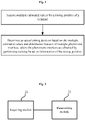
- Fig. 1 is a flowchart of a method for determining a timing position provided by an embodiment of the present disclosure.
- the method may be applicable to determining a timing position in the case of high demand raised by the 5G terminal services.
- the method may be performed by an apparatus for determining a timing position provided by an embodiment of the present disclosure.
- the apparatus for determining a timing position may be implemented by software and/or hardware.
- the method for determining a timing position mainly includes operations S11 and S12.
- an actual timing position is determined based on the multiple estimated values and distribution features of multiple pheromone matrices.
- the pheromone matrices are obtained by performing training based on information of the timing position.
- the operation that the actual timing position is determined based on the estimated values and the distribution features of the pheromone matrices may include the following operations.
- the multiple pheromone matrices are updated based on the multiple estimated values.
- a pheromone matrix with the most concentrated pheromone distribution among the updated pheromone matrices is determined as a target matrix.
- a position corresponding to a maximum pheromone concentration in the target matrix is determined as the actual timing position.
- the operation that the estimated values for the timing position of the terminal are acquired may include the following operations.
- a first estimated value for the timing position of the terminal is acquired by an earliest arriving path criterion.
- a second estimated value for the timing position of the terminal is acquired by a maximum power path criterion.
- a second estimated value for the timing position of the terminal is acquired by a time-domain gravity center criterion.
- the operation that the multiple pheromone matrices are updated based on the multiple estimated values may include the following operations.
- a first estimated value is used to update a first pheromone matrix, wherein the first pheromone matrix is a matrix related to an earliest arriving path criterion.
- a second estimated value is used to update a second pheromone matrix, wherein the second pheromone matrix is a matrix related to a maximum power path criterion.
- a third estimated value is used to update a third pheromone matrix, wherein the third pheromone matrix is a matrix related to a time-domain gravity center.
- the operation that the pheromone matrices are updated based on the estimated values may include the following operations.
- Pheromone is released at a rate of a pheromone release coefficient at a position of the n'-th row and the n-th column of the pheromone matrix, and the updated pheromone at the position is obtained.
- the updated pheromone is greater than a maximum pheromone concentration in the pheromone matrix
- the updated pheromone is replaced with the maximum pheromone concentration.
- the operation that the pheromone matrices are updated based on the estimated values may include the following operations.
- Pheromones at all positions in the pheromone matrix are volatilized at a rate of a pheromone volatilization coefficient, and updated pheromones at all positions are obtained.
- the updated pheromone is replaced with the minimum pheromone concentration.
- the method may include the following operation.
- ants in nature have underdeveloped vision, they can find the shortest path from a food source to the nest without any hints, and can adaptively search for the best new path after the environment changes, for example, when there are obstacles on the original path.
- This ability is supported by a behavior that ants can release, on a path they pass, a special secretion, namely pheromone, which can be detected by other ants within a certain range and affect their actions.
- pheromones increase on a path (diminish over time), subsequent ants are more likely to choose that path, thereby increasing the pheromone intensity of the path.
- Such a selection process is called auto-catalysis process of ants, and its principle is a positive feedback mechanism.
- An ant colony system is also called an enhanced learning system.
- the basic idea of the ant colony system is imitating the social behavior that ants show by relying on the pheromones to communicate.
- each agent is guided by the auto-catalysis process that is guided by a greedy algorithm. It is a random general heuristic method that may be used to solve a variety of different portfolio optimization problems.
- the pheromone of the ant colony system is introduced as the criterion of timing synchronization acquisition, so as to make full use of the characteristics of historical information to obtain the actual optimal timing position.
- a method for determining a pheromone matrix is first provided.
- the pheromone matrix is also called the pheromone matrix.
- the method for determining a pheromone matrix is described below.
- the timing position estimated by the current method is selected from the N possible ending bit positions.
- An N ⁇ N pheromone matrix P is defined, where P [n', n] represents the pheromone concentration during changing from the n'-th timing position to the n-th timing position.
- An estimation range depends on the estimation accuracy of the rough timing estimation, and further, a value range is the total number of discrete sampling points in [-CP/2, CP/2].
- a pheromone release coefficient p_r In order to state the process of updating the pheromone matrix, a pheromone release coefficient p_r, a pheromone volatilization coefficient p_v, the maximum pheromone concentration p_max and the minimum pheromone concentration p_min are defined.
- the pheromone matrix is updated in the following way: pheromone is released at a rate of a pheromone release coefficient at the corresponding position in the pheromone matrix P , and the updated pheromone concentration at the position is made not greater than the maximum pheromone concentration. Pheromones at all positions in the pheromone matrix P are volatilized at a rate of a pheromone volatilization coefficient, and the concentration of all the pheromones after volatilization is made not less than the minimum pheromone concentration.
- P [ i , j ] is made to be equal to the minimum pheromone concentration p_min.
- the characteristics of element distribution in the pheromone matrix reflect the prediction of the timing position and its reliability.
- the pheromone concentration should be concentrated at one point on the diagonal.
- the timing position has reliability problems like deviation, jitter or error, the optimal pheromone concentration will decrease and the distribution of pheromone concentration will spread, which blurs the pattern in the pheromone matrix. Therefore, the reliability of the timing position and the optimal timing position may be determined through the distribution features of the pheromone concentration in the pheromone matrix.
- the method for accurately determining a timing position may include the following steps.
- N is the total number of discrete sampling points within an estimated range.
- a sampling rate is 15.36MHz, the value of N is 36.
- the current timing position of the 5G terminal is obtained through reference signals such as SSS, including the estimated values of the three positions, namely the earliest arriving path, the maximum power path and the time-domain gravity center.
- a first estimated value for the timing position of the terminal is acquired by an earliest arriving path criterion
- a second estimated value for the timing position of the terminal is acquired by a maximum power path criterion
- a second estimated value for the timing position of the terminal is acquired by a time-domain gravity center criterion.
- pheromone is released on the corresponding first pheromone matrix P f , the second pheromone matrix P m and the second pheromone matrix P c by using the three estimated values acquired at step 2.
- the upper limit of the pheromone is applied.
- P [ n ', n ] is greater than the maximum pheromone concentration p_max
- P [ n ', n ] is made to be equal to the maximum pheromone concentration p_max, the typical value of p_max being 1.
- the pheromone is volatilized.
- the lower limit of the pheromone is applied.
- P [ i , j ] is made to be equal to the minimum pheromone concentration p_min, the typical value of p_min being 0.
- a pheromone matrix with the most concentrated pheromone distribution is selected from three pheromone matrices as a data source of adopting a timing strategy, that is, the pheromones with the greatest value are found respectively from the three matrices and compared, and then the matrix where the largest pheromone is located is selected as the data source of adopting a timing strategy.
- the position corresponding to the largest pheromone in the matrix is used as the actual timing position.
- step 8 return to step 2 to maintain and update the timing position of the next moment.
- step 3 to step 6 may also be realized by hardware, and other steps and parameter configuration may be realized by software. There is no limit in the embodiment.
- step 3 and step 5 The selection of parameters involved in the pheromone release coefficient and the pheromone volatilization coefficient mentioned in step 3 and step 5 are not unique, which may be optimized according to simulation results of a specific environment model.
- step 7 There may be many different ways in selecting the optimal pheromone matrix in step 7.
- the step that "the pheromones with the greatest value are found respectively from the three matrices and compared, and then the matrix where the largest pheromone is located is selected as the data source of adopting a timing strategy" mentioned in the exemplary embodiment is only an implementation example in the method that "a pheromone matrix with the most concentrated pheromone distribution is selected as a data source of adopting a timing strategy".
- the technical solution provided by the embodiments of the present disclosure avoids the reliability problem in the specific channel environment caused by using only one of the earliest arriving path, the maximum power path or the time-domain gravity center, and makes full use of the historical data information estimated at the timing position to reduce the impact of single estimation deviation or error on the system performance.
- the data source of the optimal timing position may be adaptively selected in different channel environments: when the power of the earliest arriving path is relatively low, the timing position determined by the earliest arriving path is prone to deviation, jitter and even error, the position at which the pheromone is released in the pheromone matrix P f of the earliest arriving path changes constantly, so it is difficult to release the pheromone continuously at some positions, and with the volatilization of the pheromone, the distribution features of the pheromone matrix are divergent, which reduces the probability of selecting the pheromone matrix of the earliest arriving path as the data source of adopting the timing strategy.
- the distribution features of each pheromone matrix are also divergent, which reduces the probability of selecting the corresponding pheromone matrix as the data source of adopting the timing strategy. Therefore, the present disclosure is conducive to adaptively selecting the data source of the optimal timing position in different channel environments.
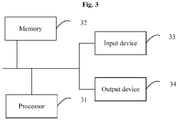
- Fig. 2 is a structural schematic diagram of an apparatus for determining a timing position provided by an embodiment of the present disclosure.
- the apparatus may be applicable to determining a timing position in the case of high demand raised by the 5G terminal services.
- the apparatus for determining a timing position may be realized by software and/or hardware.
- the apparatus for determining a timing position mainly includes an acquiring module 21 and a determining module 22.
- the acquiring module 21 is configured to acquire multiple estimated values for the timing position of the terminal.
- the determining module 22 is configured to determine the actual timing position based on the multiple estimated values and distribution features of multiple pheromone matrices.
- the pheromone matrices are obtained by performing training based on information of the timing position.
- the determining module 22 is configured to update the multiple pheromone matrices based on the multiple estimated values, determine a pheromone matrix with the most concentrated pheromone distribution among the updated pheromone matrices as the target matrix, and determine the position corresponding to the maximum pheromone concentration in the target matrix as the actual timing position.
- the acquiring module 21 is configured to acquire, by an earliest arriving path criterion, a first estimated value for the timing position of the terminal, acquire, by a maximum power path criterion, a second estimated value for the timing position of the terminal, and acquire, by a time-domain gravity center criterion, a second estimated value for the timing position of the terminal.
- the determining module 22 is configured to use a first estimated value to update the first pheromone matrix, where the first pheromone matrix is a matrix related to an earliest arriving path criterion, use a second estimated value to update the second pheromone matrix, where the second pheromone matrix is a matrix related to a maximum power path criterion, and use a third estimated value to update the third pheromone matrix, where the third pheromone matrix is a matrix related to a time-domain gravity center.
- the determining module 22 is configured to: release pheromone at a rate of a pheromone release coefficient at a position of the n'-th row and the n-th column of the pheromone matrix, and obtain updated pheromone at the position; and in a case where the updated pheromone is greater than a maximum pheromone concentration in the pheromone matrix, replace the updated pheromone with the maximum pheromone concentration.
- the determining module 22 is configured to: volatilize pheromones at all positions in the pheromone matrix at a rate of a pheromone volatilization coefficient, and obtain updated pheromones at all positions; and in a case where any of the updated pheromones is greater than a minimum pheromone concentration in the pheromone matrix, replace the updated pheromone with the minimum pheromone concentration.
- the determining module 22 is configured to proceed to the operation of updating the multiple pheromone matrices based on the multiple estimated values after the updated pheromone matrix is determined as a new pheromone matrix.
- Fig. 3 is a structural schematic diagram of a device provided by an embodiment of the present disclosure.
- the device provided by an embodiment of the present disclosure includes one or more processors 31 and a memory 32.
- the memory 32 is configured to store one or more programs. When executed by the one or more processors 31, the one or more programs cause the one or more processors 31 to implement the methods in the embodiments of the present disclosure.
- the device may also include: an input device 33 and an output device 34.
- the processor 31, the memory 32, the input device 33, and the output device 34 in the device may be connected by a bus or in other ways.
- the processor 31, the memory 32, the input device 33, and the output device 34 are connected by a bus.
- the input device 33 may be configured to receive input number or character information and generate a key signal input related to the user settings and function control of the device.
- the output device 34 may include a display screen and other display devices.
- the memory 32 may be configured to store software programs, computer executable programs and modules, such as the program instructions/modules corresponding to the method for determining a timing position described in the embodiments of the present disclosure (for example, the acquiring module 21 and the determining module 22 in the apparatus for determining a timing position).
- the memory 32 may include a program storage area and a data storage area.
- the program storage area may store an operating system and an application program required for at least one function.
- the data storage area may store data created based on the use of the device.
- the memory 32 may include a high-speed random access memory and may also include a non-volatile memory, for example, at least one disk storage device, a flash storage device, or other non-volatile solid state storage device.
- the memory 32 may further include a memory arranged remotely relative to the processor 31 and the remote memory may be connected to the device through a network.
- An example of the network includes, but not limited to, the Internet, an Intranet, a local area network, a mobile communication network and a combination thereof.
- the embodiments of the present application provide a storage medium, which may store a computer program.
- the computer program When executed by the processor, the computer program implements the method for determining a timing position in the embodiments of the present disclosure.
- the method may include the following operations.
- the actual timing position is determined based on the multiple estimated values and distribution features of multiple pheromone matrices.
- the pheromone matrices are obtained by performing training based on information of the timing position.
- a computer executable instruction included in the storage medium provided by the embodiments of the present disclosure is not limited to the above operations of the method described above, but may also perform the relevant operations in the method for determining a timing position provided by any embodiment of the present disclosure.
- the present disclosure may be realized by means of software plus necessary general-purpose hardware, certainly by means of hardware; but in many cases, the former is the better implementation.
- the technical solution of the present disclosure substantially or the part making a contribution to the related art can be embodied in the form of software product; the computer software product may be stored in a computer-readable storage medium, for example, a Read-Only Memory (ROM), a Random Access Memory (RAM), a flash memory, a hard disk or a compact disc, and includes a number of instructions to make a computer device (which can be a personal computer, a server or a network device, etc.) perform the method in each embodiment of the present disclosure.
- ROM Read-Only Memory
- RAM Random Access Memory
- flash memory a hard disk or a compact disc
- units and modules included in the embodiment of the apparatus for determining a timing position are only divided according to functional logic, but not limited to the above division, as long as the corresponding functions can be realized.
- the specific name of each functional unit is only intended to facilitate differentiation and not intended to limit the scope of protection of the present disclosure.
- user terminal covers any suitable type of wireless user device, such as a mobile phone, a portable data processing device, a portable Web browser, or a vehicle-mounted mobile station.
- multiple embodiments of the present disclosure may be implemented in hardware or dedicated circuits, software, logic or any combination thereof.
- some aspects may be implemented in hardware, while other aspects may be implemented in firmware or software that may be executed by a controller, a microprocessor, or other computing devices, although the present disclosure is not limited to this.
- the embodiments of the present disclosure may be implemented by executing computer program instructions by a data processor of a mobile device, for example, in a processor entity, or through hardware, or through a combination of software and hardware.
- the computer program instructions may be assembly instructions, Instruction Set Architecture (ISA) instructions, machine instructions, machine-related instructions, microcodes, firmware instructions, state setting data, or source codes or object codes written in any combination of one or more programming languages.
- ISA Instruction Set Architecture
- a block diagram of any logical flow in the accompanying drawings of the present disclosure may represent process operations, or interconnected logical circuits, modules and functions, or a combination of the process operations and the logical circuits, modules and functions.
- the computer program may be stored in the memory.
- the memory may have any type suitable for the local technical environment and may be implemented using any suitable data storage technology, such as but not limited to a Read-Only Memory (ROM), a Random Access Memory (RAM), an optical storage device and system (DVD or CD), etc.
- the computer-readable media may include non-transient storage media.
- the data processor may be any type suitable for the local technical environment, such as but not limited to a general-purpose computer, a special-purpose computer, a microprocessor, a Digital Signal Processor (DSP), an Application-Specific Integrated Circuit (ASIC), a Field Programmable Gate Array (FGPA), and a processor based on a multi-core processor architecture.
- DSP Digital Signal Processor
- ASIC Application-Specific Integrated Circuit
- FGPA Field Programmable Gate Array
Landscapes
- Engineering & Computer Science (AREA)
- Computer Networks & Wireless Communication (AREA)
- Signal Processing (AREA)
- Position Fixing By Use Of Radio Waves (AREA)
Abstract
Description
- The present disclosure relates to the technical field of communication device, and in particular to a method and apparatus for determining a timing position, a device, and a storage medium.
- With the increase of a transmission rate of 5th Generation mobile networks (5G), a high-order modulation mode and a high bit rate rely on an operating environment with a high Signal-to-Noise Ratio (SNR) and a terminal channel estimation to provide a sufficient degree of accuracy. Channel estimation and frequency domain noise reduction technologies put forward a higher requirement for synchronization maintenance of a terminal system. A large timing position deviation will cause the rotation of sub-carriers on a frequency domain channel, which reduces the operating SNR of MIMO and channel estimation.
- Under the high demand on 5G terminal services, the accuracy of a timing position determination principle in the related art is low in some specific scenarios.
- Embodiments of the present disclosure provide a method and apparatus for determining timing position, a device, and a storage medium.
- Embodiments of the present disclosure provide a method for determining a timing position, which includes the following operations. Multiple estimated values for a timing position of a terminal are acquired. An actual timing position is determined based on the multiple estimated values and distribution features of multiple pheromone matrices. The pheromone matrices are obtained by performing training based on information of the timing position.
- In a second aspect, the embodiments of the present disclosure provide an apparatus for determining a timing position, which includes an acquiring module and a determining module. The acquiring module is configured to acquire the multiple estimated values for the timing position of the terminal. The determining module is configured to determine the actual timing position based on the multiple estimated values and the distribution features of the multiple pheromone matrices. The pheromone matrices are obtained by performing training based on information of the timing position.
- In a third aspect, the embodiments of the present disclosure provide a device, which includes: one or more processors; and a memory, configured to store one or more programs. When executed by the one or more processors, the one or more programs cause the one or more processors to implement any method in the embodiments of the present disclosure.
- In a fourth aspect, the embodiments of the present application provide a storage medium, which may store a computer program. When executed by the processor, the computer program implements any method in the embodiments of the present disclosure.
- The method and apparatus for determining a timing position, the device, and the storage medium provided by the embodiments of the present disclosure solve the problem in the related art of low accuracy of the single method for determining a timing position in some specific scenarios.
-
-
Fig. 1 is a flowchart of a method for determining a timing position provided by an embodiment of the present disclosure. -
Fig. 2 is a structural schematic diagram of an apparatus for determining a timing position provided by an embodiment of the present disclosure. -
Fig. 3 is a structural schematic diagram of a device provided by an embodiment of the present disclosure. - In order to make the purpose, technical solutions and advantages of the present disclosure clearer, the embodiments of the present disclosure will be described below in combination with the drawings in detail. It is to be noted that the embodiments in the present disclosure and the characteristics in the embodiments may be combined under the condition of no conflicts.
- These operations shown in the flowchart of the accompanying drawings can be executed in a computer system like a group of computer executable instructions. Moreover, although a logical sequence is shown in the flowchart, in some cases, the shown or described operations can be performed in a sequence different from that described herein.
- Under the premise of higher energy efficiency, higher spectrum efficiency, lower cost and more security, the 5th generation mobile networks can provide a peak data rate on Gbps scale, an access experience with a delay of less than one millisecond, the ability to connect hundreds of billions of devices, and consistent services in scenarios of high mobility and high connection density. An Enhanced Mobile Broadband (eMBB) scenario is an enhancement of the traditional mobile broadband service. Enhancements include improving the transmission rate and reducing the transmission delay, as well as providing the consistent services for the scenarios of high mobility and high connection density.
- With the increase of 5G transmission rate, a high-order modulation mode and a high bit rate need to rely on a terminal channel estimation and an operating environment with a high SNR to provide a high enough accuracy. Channel estimation and frequency domain noise reduction technologies put forward a higher requirement for synchronization maintenance of a terminal system. A large timing position deviation will cause the rotation of sub-carriers on a frequency domain channel, which reduces the operating SNR of MIMO and channel estimation.
- A large number of methods for timing synchronization estimation have been proposed in the related art, which may be divided into three kinds: a training sequence based algorithm based on the Schmidl & Cox (SC) algorithm, a cyclic prefix based algorithm based on the Maximum Likelihood (ML) algorithm and a blind estimation algorithm based on the MUSIC algorithm. Although blind estimation does not need additional signaling overhead and has no impact on the data transmission rate, blind estimation is rarely adopted in commercial chips due to its non-ideal performance and high complexity.
- In the above methods, after obtaining a time-domain response of the channel estimation, three types of timing positions may be obtained, namely an earliest arriving path, a maximum power path and a time-domain gravity center.
- The earliest arriving path refers to selecting the first path whose power exceeds a threshold in a multi-path channel environment as the timing position. The path whose power exceeds the threshold may be either a direct path or the first reflection path.
- The maximum power path refers to selecting the path with the maximum power from all arrival paths in the multi-path channel environment as the timing position.
- The time-domain gravity center refers to performing weighted averaging to the paths at different positions according to the power, and taking the position of power center of gravity of multiple paths on the time axis as the timing position.
- The advantage of using the earliest arriving path as the timing position is that all the multiple paths are on the right side of timing base, which enables to make full use of the length of a cyclic prefix, so as to achieve the purpose of reducing inter-symbol interference in the case of large channel delay spread. The earliest arriving path is also the most widely used way of timing position selection in the related art.
- But in the typical Rayleigh-fading channel environment in the urban area, the earliest arriving path is probably not the strongest path, and in a scenario where the power of the earliest arriving path is relatively low, the timing position is prone to deviation, jitter and even error, which affects the demodulation performance under 5G high-order modulation.
- Taking the maximum power path as the timing position alleviates the robustness of the environment where the earliest arriving path is weak, but the instantaneous strongest paths at different time points under a multi-path fading channel may come from the reflection paths with different time delays on the channel. Selecting the maximum power path as the timing position is easy to introduce frequent jumps of timing in a multi-path rich scenario, which has a negative impact on the way of temporal filtering of channel estimation.
- The time-domain gravity center refers to performing weighted averaging to the paths at different positions according to the power, and taking the position of power center of gravity of multiple paths on the time axis as the timing position. Because the time-domain gravity center takes the power weighting of each path into account and less depends on the judgment accuracy of a single path, the time-domain gravity center is the most robust of the three timing positions and is not prone to an abnormal result. However, the time-domain gravity center uses an additional path with low SNR, and even introduces a noise path, which results in the large noise due to taking the time-domain gravity center as the timing position. In a scenario where each path of the multi-path channel fades with time, a time-domain position changes with time and is not stable.
- To sum up, the three principles of determining the timing position may have the problem of accuracy in some specific scenarios. In the case of high demand raised by the 5G terminal services, it is increasingly important to seek a method for determining a timing position that has high accuracy and less depends on the scenario.
-
Fig. 1 is a flowchart of a method for determining a timing position provided by an embodiment of the present disclosure. The method may be applicable to determining a timing position in the case of high demand raised by the 5G terminal services. The method may be performed by an apparatus for determining a timing position provided by an embodiment of the present disclosure. The apparatus for determining a timing position may be implemented by software and/or hardware. - As shown in
Fig. 1 , the method for determining a timing position provided by the embodiments of the present disclosure mainly includes operations S11 and S12. - At S11, multiple estimated values for a timing position of a terminal are acquired.
- At S12, an actual timing position is determined based on the multiple estimated values and distribution features of multiple pheromone matrices. The pheromone matrices are obtained by performing training based on information of the timing position.
- In an exemplary embodiment, the operation that the actual timing position is determined based on the estimated values and the distribution features of the pheromone matrices may include the following operations.
- The multiple pheromone matrices are updated based on the multiple estimated values.
- A pheromone matrix with the most concentrated pheromone distribution among the updated pheromone matrices is determined as a target matrix.
- A position corresponding to a maximum pheromone concentration in the target matrix is determined as the actual timing position.
- In an exemplary embodiment, the operation that the estimated values for the timing position of the terminal are acquired may include the following operations.
- A first estimated value for the timing position of the terminal is acquired by an earliest arriving path criterion.
- A second estimated value for the timing position of the terminal is acquired by a maximum power path criterion.
- A second estimated value for the timing position of the terminal is acquired by a time-domain gravity center criterion.
- In an exemplary embodiment, the operation that the multiple pheromone matrices are updated based on the multiple estimated values may include the following operations.
- A first estimated value is used to update a first pheromone matrix, wherein the first pheromone matrix is a matrix related to an earliest arriving path criterion.
- A second estimated value is used to update a second pheromone matrix, wherein the second pheromone matrix is a matrix related to a maximum power path criterion.
- A third estimated value is used to update a third pheromone matrix, wherein the third pheromone matrix is a matrix related to a time-domain gravity center.
- In an exemplary embodiment, the operation that the pheromone matrices are updated based on the estimated values may include the following operations.
- Pheromone is released at a rate of a pheromone release coefficient at a position of the n'-th row and the n-th column of the pheromone matrix, and the updated pheromone at the position is obtained.
- In a case where the updated pheromone is greater than a maximum pheromone concentration in the pheromone matrix, the updated pheromone is replaced with the maximum pheromone concentration.
- In an exemplary embodiment, the operation that the pheromone matrices are updated based on the estimated values may include the following operations.
- Pheromones at all positions in the pheromone matrix are volatilized at a rate of a pheromone volatilization coefficient, and updated pheromones at all positions are obtained.
- In a case where any of the updated pheromones is greater than a minimum pheromone concentration in the pheromone matrix, the updated pheromone is replaced with the minimum pheromone concentration.
- In an exemplary embodiment, after the position corresponding to the maximum pheromone concentration in the target matrix is determined as the actual timing position, the method may include the following operation.
- After the updated pheromone matrix is determined as a new pheromone matrix, an operation of updating the multiple pheromone matrices based on the multiple estimated values is executed.
- In an application example, it is found according to the observations of entomologists that although ants in nature have underdeveloped vision, they can find the shortest path from a food source to the nest without any hints, and can adaptively search for the best new path after the environment changes, for example, when there are obstacles on the original path. This ability is supported by a behavior that ants can release, on a path they pass, a special secretion, namely pheromone, which can be detected by other ants within a certain range and affect their actions. As the pheromones increase on a path (diminish over time), subsequent ants are more likely to choose that path, thereby increasing the pheromone intensity of the path. Such a selection process is called auto-catalysis process of ants, and its principle is a positive feedback mechanism. An ant colony system is also called an enhanced learning system.
- The basic idea of the ant colony system is imitating the social behavior that ants show by relying on the pheromones to communicate. Based on the definition of agent, each agent is guided by the auto-catalysis process that is guided by a greedy algorithm. It is a random general heuristic method that may be used to solve a variety of different portfolio optimization problems.
- In the technical solution of the embodiments of the present disclosure, the pheromone of the ant colony system is introduced as the criterion of timing synchronization acquisition, so as to make full use of the characteristics of historical information to obtain the actual optimal timing position.
- In the embodiment, a method for determining a pheromone matrix is first provided. The pheromone matrix is also called the pheromone matrix. The method for determining a pheromone matrix is described below.
- Assuming that there may be N timing positions, through an estimation method, the timing position estimated by the current method is selected from the N possible ending bit positions. An N×N pheromone matrix P is defined, where P[n', n] represents the pheromone concentration during changing from the n'-th timing position to the n-th timing position. An estimation range depends on the estimation accuracy of the rough timing estimation, and further, a value range is the total number of discrete sampling points in [-CP/2, CP/2].
- In order to state the process of updating the pheromone matrix, a pheromone release coefficient p_r, a pheromone volatilization coefficient p_v, the maximum pheromone concentration p_max and the minimum pheromone concentration p_min are defined.
- After the timing position estimation at the current time is completed, the pheromone matrix is updated in the following way: pheromone is released at a rate of a pheromone release coefficient at the corresponding position in the pheromone matrix P, and the updated pheromone concentration at the position is made not greater than the maximum pheromone concentration. Pheromones at all positions in the pheromone matrix P are volatilized at a rate of a pheromone volatilization coefficient, and the concentration of all the pheromones after volatilization is made not less than the minimum pheromone concentration.
- Further, the process of updating the pheromone matrix may be described as the following two steps.
- At step 1, pheromone is released at the n'-th row and the n-th column of the matrix by using the following formula: P[n', n] = P[n',n] + p_r.
- In a case where the updated P[n',n] is greater than the maximum pheromone concentration p_max, P[n',n] is made to be equal to the maximum pheromone concentration p_max. The timing position estimated at the previous moment is n', and the timing position estimated at the current moment is n.
- At step 2, pheromone is volatilized at the position of each element in the matrix by using the following formula: P[i,j] = P[i,j] - p_v,
where both i and j can be any integers in the interval [0, N-1]. - In a case where any updated P[i,j] is less than the minimum pheromone concentration p_min, P[i,j] is made to be equal to the minimum pheromone concentration p_min.
- The characteristics of element distribution in the pheromone matrix reflect the prediction of the timing position and its reliability. Ideally, the pheromone concentration should be concentrated at one point on the diagonal. When the timing position has reliability problems like deviation, jitter or error, the optimal pheromone concentration will decrease and the distribution of pheromone concentration will spread, which blurs the pattern in the pheromone matrix. Therefore, the reliability of the timing position and the optimal timing position may be determined through the distribution features of the pheromone concentration in the pheromone matrix.
- In an application example, the implementation of a method for accurately determining a timing position of a 5G terminal is further described in detail.
- The method for accurately determining a timing position may include the following steps.
- At step 1, three N×N ant colony pheromone matrices corresponding to the earliest arriving path, the maximum power path and the time-domain gravity center are defined respectively, namely a first pheromone matrix P f , a second pheromone matrix P m and a second pheromone matrix P c , where N is the total number of discrete sampling points within an estimated range. When a sampling rate is 15.36MHz, the value of N is 36.
- At step 2, the current timing position of the 5G terminal is obtained through reference signals such as SSS, including the estimated values of the three positions, namely the earliest arriving path, the maximum power path and the time-domain gravity center.
- Further, a first estimated value for the timing position of the terminal is acquired by an earliest arriving path criterion, a second estimated value for the timing position of the terminal is acquired by a maximum power path criterion, and a second estimated value for the timing position of the terminal is acquired by a time-domain gravity center criterion.
- At step 3, pheromone is released on the corresponding first pheromone matrix P f , the second pheromone matrix P m and the second pheromone matrix P c by using the three estimated values acquired at step 2.
- A releasing method is: assuming that the timing position estimated at the previous moment is n', the timing position estimated at the current moment is n, pheromone is released at a position of the n'-th row and the n-th column of the matrix by the following formula: P[n',n] = P[n'n] + p_ r, where the value of p_r is a value in the range from 0.05 to 0.2, for example, 0.1.
- At step 4, the upper limit of the pheromone is applied. For the three pheromone matrices, in a case where any updated element P[n',n] is greater than the maximum pheromone concentration p_max, P[n',n] is made to be equal to the maximum pheromone concentration p_max, the typical value of p_max being 1.
- At step 5, the pheromone is volatilized. For the three pheromone matrices, the pheromone is volatilized at the position of each element in the matrix by using P[i,j] = P[i,j] - p_v, where both i and j can be any integers in the interval [0, N-1], and the value of p_v is a value in the range from 0.01 to 0.05, for example, 0.02.
- At step 6, the lower limit of the pheromone is applied. In the three matrices, in a case where any updated P[i,j] is less than the minimum pheromone concentration p_min, P[i,j] is made to be equal to the minimum pheromone concentration p_min, the typical value of p_min being 0.
- At step 7, a pheromone matrix with the most concentrated pheromone distribution is selected from three pheromone matrices as a data source of adopting a timing strategy, that is, the pheromones with the greatest value are found respectively from the three matrices and compared, and then the matrix where the largest pheromone is located is selected as the data source of adopting a timing strategy. The position corresponding to the largest pheromone in the matrix is used as the actual timing position.
- At step 8, return to step 2 to maintain and update the timing position of the next moment.
- It is to be noted that the methods in the above exemplary embodiments may be realized by software. Because of the relatively large amount of computation in step 3 to step 6, step 3 to step 6 may also be realized by hardware, and other steps and parameter configuration may be realized by software. There is no limit in the embodiment.
- The selection of parameters involved in the pheromone release coefficient and the pheromone volatilization coefficient mentioned in step 3 and step 5 are not unique, which may be optimized according to simulation results of a specific environment model.
- There may be many different ways in selecting the optimal pheromone matrix in step 7. The step that "the pheromones with the greatest value are found respectively from the three matrices and compared, and then the matrix where the largest pheromone is located is selected as the data source of adopting a timing strategy" mentioned in the exemplary embodiment is only an implementation example in the method that "a pheromone matrix with the most concentrated pheromone distribution is selected as a data source of adopting a timing strategy".
- By adaptively selecting the most suitable data source of timing strategy in the current channel environment according to the characteristics of the current and historical information, the technical solution provided by the embodiments of the present disclosure avoids the reliability problem in the specific channel environment caused by using only one of the earliest arriving path, the maximum power path or the time-domain gravity center, and makes full use of the historical data information estimated at the timing position to reduce the impact of single estimation deviation or error on the system performance.
- By means of the technical solution provided by the embodiments of the present disclosure, the data source of the optimal timing position may be adaptively selected in different channel environments: when the power of the earliest arriving path is relatively low, the timing position determined by the earliest arriving path is prone to deviation, jitter and even error, the position at which the pheromone is released in the pheromone matrix P f of the earliest arriving path changes constantly, so it is difficult to release the pheromone continuously at some positions, and with the volatilization of the pheromone, the distribution features of the pheromone matrix are divergent, which reduces the probability of selecting the pheromone matrix of the earliest arriving path as the data source of adopting the timing strategy. Similarly, in a scenario with rich multiple paths and large noise power in the gravity center, the distribution features of each pheromone matrix are also divergent, which reduces the probability of selecting the corresponding pheromone matrix as the data source of adopting the timing strategy. Therefore, the present disclosure is conducive to adaptively selecting the data source of the optimal timing position in different channel environments.
-
Fig. 2 is a structural schematic diagram of an apparatus for determining a timing position provided by an embodiment of the present disclosure. The apparatus may be applicable to determining a timing position in the case of high demand raised by the 5G terminal services. The apparatus for determining a timing position may be realized by software and/or hardware. - As shown in
Fig. 2 , the apparatus for determining a timing position provided by the embodiments of the present disclosure mainly includes an acquiringmodule 21 and a determiningmodule 22. - The acquiring
module 21 is configured to acquire multiple estimated values for the timing position of the terminal. - The determining
module 22 is configured to determine the actual timing position based on the multiple estimated values and distribution features of multiple pheromone matrices. The pheromone matrices are obtained by performing training based on information of the timing position. - In an exemplary embodiment, the determining
module 22 is configured to update the multiple pheromone matrices based on the multiple estimated values, determine a pheromone matrix with the most concentrated pheromone distribution among the updated pheromone matrices as the target matrix, and determine the position corresponding to the maximum pheromone concentration in the target matrix as the actual timing position. - In an exemplary embodiment, the acquiring
module 21 is configured to acquire, by an earliest arriving path criterion, a first estimated value for the timing position of the terminal, acquire, by a maximum power path criterion, a second estimated value for the timing position of the terminal, and acquire, by a time-domain gravity center criterion, a second estimated value for the timing position of the terminal. - In an exemplary embodiment, the determining
module 22 is configured to use a first estimated value to update the first pheromone matrix, where the first pheromone matrix is a matrix related to an earliest arriving path criterion, use a second estimated value to update the second pheromone matrix, where the second pheromone matrix is a matrix related to a maximum power path criterion, and use a third estimated value to update the third pheromone matrix, where the third pheromone matrix is a matrix related to a time-domain gravity center. - In an exemplary embodiment, the determining
module 22 is configured to: release pheromone at a rate of a pheromone release coefficient at a position of the n'-th row and the n-th column of the pheromone matrix, and obtain updated pheromone at the position; and in a case where the updated pheromone is greater than a maximum pheromone concentration in the pheromone matrix, replace the updated pheromone with the maximum pheromone concentration. - In an exemplary embodiment, the determining
module 22 is configured to: volatilize pheromones at all positions in the pheromone matrix at a rate of a pheromone volatilization coefficient, and obtain updated pheromones at all positions; and in a case where any of the updated pheromones is greater than a minimum pheromone concentration in the pheromone matrix, replace the updated pheromone with the minimum pheromone concentration. - In an exemplary embodiment, the determining
module 22 is configured to proceed to the operation of updating the multiple pheromone matrices based on the multiple estimated values after the updated pheromone matrix is determined as a new pheromone matrix. - The embodiments of the present disclosure also provide a device.
Fig. 3 is a structural schematic diagram of a device provided by an embodiment of the present disclosure. As shown inFig. 3 , the device provided by an embodiment of the present disclosure includes one ormore processors 31 and amemory 32. There may be one ormore processors 31 in the device, and oneprocessor 31 is shown inFig. 3 as an example. Thememory 32 is configured to store one or more programs. When executed by the one ormore processors 31, the one or more programs cause the one ormore processors 31 to implement the methods in the embodiments of the present disclosure. - The device may also include: an
input device 33 and anoutput device 34. - The
processor 31, thememory 32, theinput device 33, and theoutput device 34 in the device may be connected by a bus or in other ways. For example, inFig. 3 , theprocessor 31, thememory 32, theinput device 33, and theoutput device 34 are connected by a bus. - The
input device 33 may be configured to receive input number or character information and generate a key signal input related to the user settings and function control of the device. Theoutput device 34 may include a display screen and other display devices. - As a computer-readable storage medium, the
memory 32 may be configured to store software programs, computer executable programs and modules, such as the program instructions/modules corresponding to the method for determining a timing position described in the embodiments of the present disclosure (for example, the acquiringmodule 21 and the determiningmodule 22 in the apparatus for determining a timing position). Thememory 32 may include a program storage area and a data storage area. The program storage area may store an operating system and an application program required for at least one function. The data storage area may store data created based on the use of the device. In addition, thememory 32 may include a high-speed random access memory and may also include a non-volatile memory, for example, at least one disk storage device, a flash storage device, or other non-volatile solid state storage device. In some examples, thememory 32 may further include a memory arranged remotely relative to theprocessor 31 and the remote memory may be connected to the device through a network. An example of the network includes, but not limited to, the Internet, an Intranet, a local area network, a mobile communication network and a combination thereof. - The embodiments of the present application provide a storage medium, which may store a computer program. When executed by the processor, the computer program implements the method for determining a timing position in the embodiments of the present disclosure. The method may include the following operations.
- Multiple estimated values for the timing position of the terminal are acquired.
- The actual timing position is determined based on the multiple estimated values and distribution features of multiple pheromone matrices. The pheromone matrices are obtained by performing training based on information of the timing position.
- Of course, a computer executable instruction included in the storage medium provided by the embodiments of the present disclosure is not limited to the above operations of the method described above, but may also perform the relevant operations in the method for determining a timing position provided by any embodiment of the present disclosure.
- Through the above description of the embodiments, those having ordinary skill in the art can clearly know that the present disclosure may be realized by means of software plus necessary general-purpose hardware, certainly by means of hardware; but in many cases, the former is the better implementation. Based on this understanding, the technical solution of the present disclosure substantially or the part making a contribution to the related art can be embodied in the form of software product; the computer software product may be stored in a computer-readable storage medium, for example, a Read-Only Memory (ROM), a Random Access Memory (RAM), a flash memory, a hard disk or a compact disc, and includes a number of instructions to make a computer device (which can be a personal computer, a server or a network device, etc.) perform the method in each embodiment of the present disclosure.
- It is to be noted that units and modules included in the embodiment of the apparatus for determining a timing position are only divided according to functional logic, but not limited to the above division, as long as the corresponding functions can be realized. In addition, the specific name of each functional unit is only intended to facilitate differentiation and not intended to limit the scope of protection of the present disclosure.
- The above is only the exemplary embodiments of the disclosure and not intended to limit the protection scope of the disclosure.
- Those having ordinary skill in the art should understand that the term user terminal covers any suitable type of wireless user device, such as a mobile phone, a portable data processing device, a portable Web browser, or a vehicle-mounted mobile station.
- Generally speaking, multiple embodiments of the present disclosure may be implemented in hardware or dedicated circuits, software, logic or any combination thereof. For example, some aspects may be implemented in hardware, while other aspects may be implemented in firmware or software that may be executed by a controller, a microprocessor, or other computing devices, although the present disclosure is not limited to this.
- The embodiments of the present disclosure may be implemented by executing computer program instructions by a data processor of a mobile device, for example, in a processor entity, or through hardware, or through a combination of software and hardware. The computer program instructions may be assembly instructions, Instruction Set Architecture (ISA) instructions, machine instructions, machine-related instructions, microcodes, firmware instructions, state setting data, or source codes or object codes written in any combination of one or more programming languages.
- A block diagram of any logical flow in the accompanying drawings of the present disclosure may represent process operations, or interconnected logical circuits, modules and functions, or a combination of the process operations and the logical circuits, modules and functions. The computer program may be stored in the memory. The memory may have any type suitable for the local technical environment and may be implemented using any suitable data storage technology, such as but not limited to a Read-Only Memory (ROM), a Random Access Memory (RAM), an optical storage device and system (DVD or CD), etc. The computer-readable media may include non-transient storage media. The data processor may be any type suitable for the local technical environment, such as but not limited to a general-purpose computer, a special-purpose computer, a microprocessor, a Digital Signal Processor (DSP), an Application-Specific Integrated Circuit (ASIC), a Field Programmable Gate Array (FGPA), and a processor based on a multi-core processor architecture.
- The exemplary embodiments of the present disclosure have been described in detail above through demonstrative and non-restrictive examples. However, with reference to the accompanying drawings and claims, various modifications and adjustments to the above embodiments are obvious to those having ordinary skill in the art, but do not depart from the scope of the present disclosure. Therefore, the proper scope of the present disclosure will be determined by the claims.
Claims (10)
- A method for determining a timing position, comprising:acquiring multiple estimated values for a timing position of a terminal; anddetermining an actual timing position based on the multiple estimated values and distribution features of multiple pheromone matrices, wherein the pheromone matrices are obtained by performing training based on information of the timing position.
- The method according to claim 1, wherein determining the actual timing position based on the estimated values and the distribution features of the pheromone matrices comprises:updating the multiple pheromone matrices based on the multiple estimated values;determining a pheromone matrix with the most concentrated pheromone distribution among the updated pheromone matrices as a target matrix; anddetermining a position corresponding to a maximum pheromone concentration in the target matrix as the actual timing position.
- The method according to claim 1, wherein acquiring the estimated values for the timing position of the terminal comprises:acquiring, by an earliest arriving path criterion, a first estimated value for the timing position of the terminal;acquiring, by a maximum power path criterion, a second estimated value for the timing position of the terminal; andacquiring, by a time-domain gravity center criterion, a second estimated value for the timing position of the terminal.
- The method according to claim 2, wherein updating the multiple pheromone matrices based on the multiple estimated values comprises:using a first estimated value to update a first pheromone matrix, wherein the first pheromone matrix is a matrix related to an earliest arriving path criterion;using a second estimated value to update a second pheromone matrix, wherein the second pheromone matrix is a matrix related to a maximum power path criterion; andusing a third estimated value to update a third pheromone matrix, wherein the third pheromone matrix is a matrix related to a time-domain gravity center.
- The method according to claim 4, wherein updating the pheromone matrices based on the estimated values comprises:releasing pheromone at a rate of a pheromone release coefficient at a position of the n'-th row and the n-th column of the pheromone matrix, and obtaining updated pheromone at the position; andin a case where the updated pheromone is greater than a maximum pheromone concentration in the pheromone matrix, replacing the updated pheromone with the maximum pheromone concentration.
- The method according to claim 4, wherein updating the pheromone matrices based on the estimated values comprises:volatilizing pheromones at all positions in the pheromone matrix at a rate of a pheromone volatilization coefficient, and obtaining updated pheromones at all positions;in a case where any of the updated pheromones is greater than a minimum pheromone concentration in the pheromone matrix, replacing the updated pheromone with the minimum pheromone concentration.
- The method according to claim 2, wherein after determining the position corresponding to the maximum pheromone concentration in the target matrix as the actual timing position, further comprising:after determining the updated pheromone matrix as a new pheromone matrix, proceeding to an operation of updating the multiple pheromone matrices based on the multiple estimated values.
- An apparatus for determining a timing position, comprising:an acquiring module, configured to acquire multiple estimated values for a timing position of a terminal; anda determining module, configured to determine an actual timing position based on the multiple estimated values and distribution features of multiple pheromone matrices, wherein the pheromone matrices are obtained by performing training based on information of the timing position.
- A device, comprising:one or more processors; anda memory, configured to store one or more programs;when executed by the one or more processors, the one or more programs cause the one or more processors to implement the method according to any one of claims 1 to 7.
- A storage medium, storing a computer program, wherein when executed by a processor, the computer program implements the method according to any one of claims 1 to 7.
Applications Claiming Priority (2)
| Application Number | Priority Date | Filing Date | Title |
|---|---|---|---|
| CN201911312743.1A CN112996097B (en) | 2019-12-18 | 2019-12-18 | Timing position determining method, device, equipment and storage medium |
| PCT/CN2020/136592 WO2021121229A1 (en) | 2019-12-18 | 2020-12-15 | Method and device for determining timing position, apparatus, and storage medium |
Publications (2)
| Publication Number | Publication Date |
|---|---|
| EP4080948A1 true EP4080948A1 (en) | 2022-10-26 |
| EP4080948A4 EP4080948A4 (en) | 2023-01-25 |
Family
ID=76344036
Family Applications (1)
| Application Number | Title | Priority Date | Filing Date |
|---|---|---|---|
| EP20901266.5A Pending EP4080948A4 (en) | 2019-12-18 | 2020-12-15 | METHOD AND DEVICE FOR DETERMINING A SYNCHRONIZATION POSITION, APPARATUS AND STORAGE MEDIA |
Country Status (3)
| Country | Link |
|---|---|
| EP (1) | EP4080948A4 (en) |
| CN (1) | CN112996097B (en) |
| WO (1) | WO2021121229A1 (en) |
Family Cites Families (8)
| Publication number | Priority date | Publication date | Assignee | Title |
|---|---|---|---|---|
| US7342536B2 (en) * | 2005-09-12 | 2008-03-11 | Lockheed Martin Corporation | System and method for determining the location of emitters having well-behaved timing features |
| CN102123125A (en) * | 2010-01-07 | 2011-07-13 | 上海华虹集成电路有限责任公司 | Method for realizing fine timing synchronization estimation of OFDM (Orthogonal Frequency Division Multiplexing) system |
| WO2011106626A2 (en) * | 2010-02-25 | 2011-09-01 | Interdigital Patent Holdings, Inc. | Blind timing synchronization and low complexity channel estimation in aco-ofdm systems |
| CN102369707B (en) * | 2011-09-02 | 2013-10-09 | 华为技术有限公司 | Method and device for eliminating co-channel interference on pilot frequency |
| CN103346991B (en) * | 2013-06-20 | 2017-02-08 | 哈尔滨工业大学 | Channel estimation and synchronization method based on cyclic prefixes |
| KR101654733B1 (en) * | 2015-09-14 | 2016-09-06 | 국방과학연구소 | Method for providing Bio-Inspired Routing Protocol Using Overhearing and Probabilistic Path Exploration in Mobile Ad Hoc Networks and System thereof |
| CN105516045B (en) * | 2015-12-04 | 2018-07-24 | 中国科学院上海微系统与信息技术研究所 | A kind of OFDM training sequence structures and synchronous method |
| CN108075996A (en) * | 2016-11-11 | 2018-05-25 | 索尼公司 | Control device, device and method, signal processing apparatus and method and mobile terminal |
-
2019
- 2019-12-18 CN CN201911312743.1A patent/CN112996097B/en active Active
-
2020
- 2020-12-15 WO PCT/CN2020/136592 patent/WO2021121229A1/en not_active Ceased
- 2020-12-15 EP EP20901266.5A patent/EP4080948A4/en active Pending
Also Published As
| Publication number | Publication date |
|---|---|
| CN112996097B (en) | 2024-08-27 |
| CN112996097A (en) | 2021-06-18 |
| WO2021121229A1 (en) | 2021-06-24 |
| EP4080948A4 (en) | 2023-01-25 |
Similar Documents
| Publication | Publication Date | Title |
|---|---|---|
| US11424963B2 (en) | Channel prediction method and related device | |
| US11057297B2 (en) | Method, device and computer program product for path optimization | |
| TWI591995B (en) | Reduced Demodulation Reference Signal (DMRS) configuration and method and apparatus for adaptively selecting a DMRS configuration | |
| Salem et al. | Traffic-aware advanced sleep modes management in 5G networks | |
| WO2023134761A1 (en) | Beam information exchange method and apparatus, and device and storage medium | |
| KR102297614B1 (en) | Method and Apparatus for Optimizing the average bit error probability via deep multi armed bandit in OFDM with index modulation system for low power communication | |
| CN108880909A (en) | A kind of network energy-saving method and device based on intensified learning | |
| CN120128534B (en) | An adaptive network offloading method and system based on deep reinforcement learning | |
| CN116233906A (en) | Measuring method, device, equipment and storage medium | |
| WO2024067281A1 (en) | Ai model processing method and apparatus, and communication device | |
| Qiao et al. | A novel signal detection scheme based on adaptive ensemble deep learning algorithm in SC-FDE systems | |
| CN104954033B (en) | A kind of speed automatic gain for ofdm system controls circuit and method | |
| CN118432765A (en) | A wireless ad hoc network communication mode selection method, system, medium and device based on LSTM neural network model | |
| Uzunidis et al. | Enhancing closed-form based physical layer performance estimations in EONs via machine learning techniques | |
| KR20220078344A (en) | Method of performing federated learning and apparatus therefor | |
| Adiguzel et al. | Deep learning‐based channel estimation for OFDM‐IM systems over Rayleigh fading channels | |
| CN112996097B (en) | Timing position determining method, device, equipment and storage medium | |
| WO2024017025A1 (en) | Pilot frequency parameter configuration method and device | |
| CN110113418B (en) | A collaborative cache update method for vehicle-linked information center network | |
| Liu et al. | A general deep reinforcement learning framework for grant-free NOMA optimization in mURLLC | |
| CN115315005A (en) | Pilot frequency auxiliary state updating method under short data packet communication condition | |
| Tang et al. | Sparsity-aware intelligent massive random access control for massive MIMO networks: A reinforcement learning based approach | |
| CN111132370B (en) | Dynamic probability backoff underwater acoustic medium access control method based on reinforcement learning | |
| KR102156501B1 (en) | Apparatus to estimate channel based MMSE | |
| CN118118298A (en) | PDCCH noise processing method, device, user equipment and storage medium |
Legal Events
| Date | Code | Title | Description |
|---|---|---|---|
| STAA | Information on the status of an ep patent application or granted ep patent |
Free format text: STATUS: THE INTERNATIONAL PUBLICATION HAS BEEN MADE |
|
| PUAI | Public reference made under article 153(3) epc to a published international application that has entered the european phase |
Free format text: ORIGINAL CODE: 0009012 |
|
| STAA | Information on the status of an ep patent application or granted ep patent |
Free format text: STATUS: REQUEST FOR EXAMINATION WAS MADE |
|
| 17P | Request for examination filed |
Effective date: 20220718 |
|
| AK | Designated contracting states |
Kind code of ref document: A1 Designated state(s): AL AT BE BG CH CY CZ DE DK EE ES FI FR GB GR HR HU IE IS IT LI LT LU LV MC MK MT NL NO PL PT RO RS SE SI SK SM TR |
|
| A4 | Supplementary search report drawn up and despatched |
Effective date: 20221222 |
|
| RIC1 | Information provided on ipc code assigned before grant |
Ipc: H04L 27/26 20060101ALI20221216BHEP Ipc: H04W 56/00 20090101AFI20221216BHEP |
|
| DAV | Request for validation of the european patent (deleted) | ||
| DAX | Request for extension of the european patent (deleted) | ||
| STAA | Information on the status of an ep patent application or granted ep patent |
Free format text: STATUS: EXAMINATION IS IN PROGRESS |
|
| 17Q | First examination report despatched |
Effective date: 20231222 |