EP4080814A1 - Cryptographic method using a hash-based signature scheme and merkle tree traversal techniques - Google Patents
Cryptographic method using a hash-based signature scheme and merkle tree traversal techniques Download PDFInfo
- Publication number
- EP4080814A1 EP4080814A1 EP21169152.2A EP21169152A EP4080814A1 EP 4080814 A1 EP4080814 A1 EP 4080814A1 EP 21169152 A EP21169152 A EP 21169152A EP 4080814 A1 EP4080814 A1 EP 4080814A1
- Authority
- EP
- European Patent Office
- Prior art keywords
- hash
- signatures
- computer
- signature scheme
- based signature
- Prior art date
- Legal status (The legal status is an assumption and is not a legal conclusion. Google has not performed a legal analysis and makes no representation as to the accuracy of the status listed.)
- Withdrawn
Links
Images

Classifications
-
- H—ELECTRICITY
- H04—ELECTRIC COMMUNICATION TECHNIQUE
- H04L—TRANSMISSION OF DIGITAL INFORMATION, e.g. TELEGRAPHIC COMMUNICATION
- H04L9/00—Cryptographic mechanisms or cryptographic arrangements for secret or secure communications; Network security protocols
- H04L9/08—Key distribution or management, e.g. generation, sharing or updating, of cryptographic keys or passwords
- H04L9/0816—Key establishment, i.e. cryptographic processes or cryptographic protocols whereby a shared secret becomes available to two or more parties, for subsequent use
- H04L9/0819—Key transport or distribution, i.e. key establishment techniques where one party creates or otherwise obtains a secret value, and securely transfers it to the other(s)
- H04L9/083—Key transport or distribution, i.e. key establishment techniques where one party creates or otherwise obtains a secret value, and securely transfers it to the other(s) involving central third party, e.g. key distribution center [KDC] or trusted third party [TTP]
- H04L9/0833—Key transport or distribution, i.e. key establishment techniques where one party creates or otherwise obtains a secret value, and securely transfers it to the other(s) involving central third party, e.g. key distribution center [KDC] or trusted third party [TTP] involving conference or group key
- H04L9/0836—Key transport or distribution, i.e. key establishment techniques where one party creates or otherwise obtains a secret value, and securely transfers it to the other(s) involving central third party, e.g. key distribution center [KDC] or trusted third party [TTP] involving conference or group key using tree structure or hierarchical structure
-
- H—ELECTRICITY
- H04—ELECTRIC COMMUNICATION TECHNIQUE
- H04L—TRANSMISSION OF DIGITAL INFORMATION, e.g. TELEGRAPHIC COMMUNICATION
- H04L9/00—Cryptographic mechanisms or cryptographic arrangements for secret or secure communications; Network security protocols
- H04L9/06—Cryptographic mechanisms or cryptographic arrangements for secret or secure communications; Network security protocols the encryption apparatus using shift registers or memories for block-wise or stream coding, e.g. DES systems or RC4; Hash functions; Pseudorandom sequence generators
- H04L9/0643—Hash functions, e.g. MD5, SHA, HMAC or f9 MAC
-
- H—ELECTRICITY
- H04—ELECTRIC COMMUNICATION TECHNIQUE
- H04L—TRANSMISSION OF DIGITAL INFORMATION, e.g. TELEGRAPHIC COMMUNICATION
- H04L9/00—Cryptographic mechanisms or cryptographic arrangements for secret or secure communications; Network security protocols
- H04L9/08—Key distribution or management, e.g. generation, sharing or updating, of cryptographic keys or passwords
- H04L9/0816—Key establishment, i.e. cryptographic processes or cryptographic protocols whereby a shared secret becomes available to two or more parties, for subsequent use
- H04L9/0852—Quantum cryptography
-
- H—ELECTRICITY
- H04—ELECTRIC COMMUNICATION TECHNIQUE
- H04L—TRANSMISSION OF DIGITAL INFORMATION, e.g. TELEGRAPHIC COMMUNICATION
- H04L9/00—Cryptographic mechanisms or cryptographic arrangements for secret or secure communications; Network security protocols
- H04L9/08—Key distribution or management, e.g. generation, sharing or updating, of cryptographic keys or passwords
- H04L9/0891—Revocation or update of secret information, e.g. encryption key update or rekeying
-
- H—ELECTRICITY
- H04—ELECTRIC COMMUNICATION TECHNIQUE
- H04L—TRANSMISSION OF DIGITAL INFORMATION, e.g. TELEGRAPHIC COMMUNICATION
- H04L9/00—Cryptographic mechanisms or cryptographic arrangements for secret or secure communications; Network security protocols
- H04L9/08—Key distribution or management, e.g. generation, sharing or updating, of cryptographic keys or passwords
- H04L9/0894—Escrow, recovery or storing of secret information, e.g. secret key escrow or cryptographic key storage
-
- H—ELECTRICITY
- H04—ELECTRIC COMMUNICATION TECHNIQUE
- H04L—TRANSMISSION OF DIGITAL INFORMATION, e.g. TELEGRAPHIC COMMUNICATION
- H04L9/00—Cryptographic mechanisms or cryptographic arrangements for secret or secure communications; Network security protocols
- H04L9/32—Cryptographic mechanisms or cryptographic arrangements for secret or secure communications; Network security protocols including means for verifying the identity or authority of a user of the system or for message authentication, e.g. authorization, entity authentication, data integrity or data verification, non-repudiation, key authentication or verification of credentials
- H04L9/3236—Cryptographic mechanisms or cryptographic arrangements for secret or secure communications; Network security protocols including means for verifying the identity or authority of a user of the system or for message authentication, e.g. authorization, entity authentication, data integrity or data verification, non-repudiation, key authentication or verification of credentials using cryptographic hash functions
-
- H—ELECTRICITY
- H04—ELECTRIC COMMUNICATION TECHNIQUE
- H04L—TRANSMISSION OF DIGITAL INFORMATION, e.g. TELEGRAPHIC COMMUNICATION
- H04L9/00—Cryptographic mechanisms or cryptographic arrangements for secret or secure communications; Network security protocols
- H04L9/32—Cryptographic mechanisms or cryptographic arrangements for secret or secure communications; Network security protocols including means for verifying the identity or authority of a user of the system or for message authentication, e.g. authorization, entity authentication, data integrity or data verification, non-repudiation, key authentication or verification of credentials
- H04L9/3247—Cryptographic mechanisms or cryptographic arrangements for secret or secure communications; Network security protocols including means for verifying the identity or authority of a user of the system or for message authentication, e.g. authorization, entity authentication, data integrity or data verification, non-repudiation, key authentication or verification of credentials involving digital signatures
-
- H—ELECTRICITY
- H04—ELECTRIC COMMUNICATION TECHNIQUE
- H04L—TRANSMISSION OF DIGITAL INFORMATION, e.g. TELEGRAPHIC COMMUNICATION
- H04L9/00—Cryptographic mechanisms or cryptographic arrangements for secret or secure communications; Network security protocols
- H04L9/50—Cryptographic mechanisms or cryptographic arrangements for secret or secure communications; Network security protocols using hash chains, e.g. blockchains or hash trees
Definitions
- the present invention is related to a computer implemented cryptographic method using a hash-based signature scheme and Merkle tree traversal techniques.
- the present invention is further related to a system using such method.
- Quantum computing is one of the uprising technologies nowadays. This technology brings a lot of advantages and a tremendous increment of computational power.
- one drawback of this technologies is that traditional asymmetric cryptographic algorithms, i.e. ECC and RSA, no longer are secure. Therefore, different standardization bodies and researcher investigate into the area of post-quantum cryptography.
- One very promising class of algorithms for future security application with regards to signature handling are so called hash-based schemes.
- the advantage of hash-based schemes is that the security of these constructions is well understood.
- a computer implemented cryptographic method using a hash-based signature scheme and Merkle tree traversal techniques comprises:
- a classic Merkle tree traversal technique is selected if the number of signatures SN is ⁇ 2 ⁇ 3.
- Classic Merkle traversal techniques perform best for Merkle trees of up to a size of 3 or up to a number of 8 signatures.
- a fractal traversal technique is selected if the number of signatures SN is 2 ⁇ 3 ⁇ SN ⁇ 2 ⁇ 16.
- the fractal traversal technique provides the lowest storage complexity from a number of 8 up to a number of 2 ⁇ 16 signatures.
- a logarithmic traversal technique is selected if the number of signatures SN is > 2 ⁇ 16.
- the logarithmic traversal technique has the lowest storage complexity for large Merkle trees that can be used to generate more than 2 ⁇ 16 signatures.
- selecting the traversal technique is based on the number of planned signatures with existing public and private key pairs of the hash-based signature scheme.
- the storage consumption can be reduced and tailored to the actual needs regarding required number of signatures for each private public key pair.
- selecting the traversal technique is carried out during key generation time of the hash-based signature scheme. Based on this embodiment it is possible to set up a storage efficient hierarchical private and public key structure for signature handling.
- the advantage of an adaption during key generation time is that the size of the Merkle tree is adaptable and the storage space can be managed during the key generation time. Thus, no hard constrain for an amount of signatures needs to be set during development time.
- a data processing system comprising a processor configured to perform the cryptographic method in accordance to the present invention.
- a computer program product comprises instructions which, when the program is executed by a computer, cause the computer to carry out the cryptographic method in accordance to the present invention.
- a computer-readable data storage medium comprises instructions which, when executed by a computer, cause the computer to carry out the cryptographic method in accordance to the present invention.
- Fig. 1 shows a sketch of an embodiment of a cryptographic method 100 according to the invention.
- the cryptographic method 100 uses 101 a hash-based signature scheme and Merkle tree traversal techniques.
- a traversal technique 11, 12, 13 is selected 102.
- the number of signatures SN is ⁇ 2 ⁇ 3 a classic 11 Merkle tree traversal technique is selected 102.
- the number of signatures SN is 2 ⁇ 3 ⁇ SN ⁇ 2 ⁇ 16 a fractal 12 traversal technique is selected 102.
- the number of signatures SN is > 2 ⁇ 16 a logarithmic 13 traversal technique is selected 102.
- the decision which traversal technique 11, 12, 13 is selected 102 is based on the number of planned signatures with existing public and private key pairs of the hash-based signature scheme.
- the selection 102 of the traversal technique 11, 12, 13 is carried out during key generation time of the hash-based signature scheme.
- Fig. 2 shows a sketch of space requirements for different Merkle tree traversal techniques.
- the storage complexity is shown in dependency of the number of signatures for three different Merkle tree traversal techniques 11, 12, 13, namely a classic Merkle tree travesal technique 11, a fractal traversal technique and a logarithmic traversal technique.
- All three traversal techniques 11, 12, 13 provide for different numbers of signatures the lowest storage complexity.
- Classic Merkle tree traversal techniques performs best for hash-trees of up to a number of 8 signatures.
- the fractal traversal technique provides the lowest storage complexity from 8 up to 2 ⁇ 16 signatures.
- the logarithmic traversal technique has the lowest storage complexity for large Merkle trees that can be used to generate more than 2 ⁇ 16 signatures.
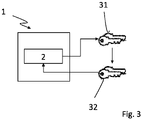
- Fig. 3 shows a sketch of an embodiment of a system 1 according to the invention.
- the system 1 comprises an embedded device 2 that uses a first private public key pair 31 for updating a second public private key pair 32.
- the second key pair 32 is used for secure software updates of the embedded device 2.
- the second key pair 32 needs to be updated up to six times for revocation cases of the current second private key pair 32.
- a classic Merkle traversal technique 11 is selected.
- a monthly software update for the embedded device 2 is considered for a live time of five years.
- a fractal traversal technique 12 is selected for supporting up to seventy signatures for each software update.
- the selection of the traversal technique 11, 12, 13 is carried out during key generation time of the hash-based signature scheme, e.g. in case for a later series, the amount of signatures using the first key pair 31 or the second key pair 32 changes.
Landscapes
- Engineering & Computer Science (AREA)
- Computer Security & Cryptography (AREA)
- Computer Networks & Wireless Communication (AREA)
- Signal Processing (AREA)
- Physics & Mathematics (AREA)
- Electromagnetism (AREA)
- Theoretical Computer Science (AREA)
- Power Engineering (AREA)
- Storage Device Security (AREA)
Abstract
The present invention is related to a computer implemented cryptographic method using a hash-based signature scheme and Merkle tree traversal techniques. The present invention is further related to a system using such method. To reduce the amount of storage to store the Merkle tree used for the signature generation in hash-based signature schemes, the method comprises selecting the traversal technique in dependency of a number of signatures SN used in accordance with the hash-based signature scheme.
Description
- The present invention is related to a computer implemented cryptographic method using a hash-based signature scheme and Merkle tree traversal techniques. The present invention is further related to a system using such method.
- Quantum computing is one of the uprising technologies nowadays. This technology brings a lot of advantages and a tremendous increment of computational power. However, one drawback of this technologies is that traditional asymmetric cryptographic algorithms, i.e. ECC and RSA, no longer are secure. Therefore, different standardization bodies and researcher investigate into the area of post-quantum cryptography. One very promising class of algorithms for future security application with regards to signature handling are so called hash-based schemes. The advantage of hash-based schemes is that the security of these constructions is well understood.
- The Bachelor Thesis "Merkle Tree Traversal Techniques" from Boris Ederov [1] comprises a basic description of different Merkle tree traversal techniques.
- Nevertheless, hash-based schemes have two known drawbacks:
- Hash-based schemes can only be used for signature handling and not encryption operations and
- Hash-based schemes consume a lot of memory for signature generation, because these schemes exploit Merkle tree structures of hashed values for establishment of few-time signatures.
- It is an object of the present invention to reduce the amount of storage to store the Merkle tree used for the signature generation in hash-based signature schemes.
- This object is achieved by a computer implemented cryptographic method and system according to the independent claims.
- The dependent claims include advantageous further developments and improvements of the present principles as described below.
- According to a first aspect of the invention, a computer implemented cryptographic method using a hash-based signature scheme and Merkle tree traversal techniques comprises:
- selecting the traversal technique in dependency of a number of signatures SN used in accordance with the hash-based signature scheme.
- There exist different Merkle tree traversal techniques which may be used in accordance with hash-based signature schemes. It has been shown that by selecting the traversal technique in dependency of the number signatures SN used in accordance with the hash-based signature scheme, the storage size of the Merkle tree can be reduced.
- In an embodiment of the present disclosure, a classic Merkle tree traversal technique is selected if the number of signatures SN is < 2^3. Classic Merkle traversal techniques perform best for Merkle trees of up to a size of 3 or up to a number of 8 signatures.
- In another embodiment of the present disclosure, a fractal traversal technique is selected if the number of signatures SN is 2^3 ≤ SN ≤ 2^16. The fractal traversal technique provides the lowest storage complexity from a number of 8 up to a number of 2^16 signatures.
- In an embodiment of the present disclosure, a logarithmic traversal technique is selected if the number of signatures SN is > 2^16. The logarithmic traversal technique has the lowest storage complexity for large Merkle trees that can be used to generate more than 2^16 signatures.
- 1. Dynamic select traversal technique due to the number of planed signatures with the existing public and private key pair.
- 2. Build storage efficient hierarchical private and public key structures for signature handling based on a priory selection of traversal technique during key generation time.
- In another embodiment of the present disclosure, selecting the traversal technique is based on the number of planned signatures with existing public and private key pairs of the hash-based signature scheme. The storage consumption can be reduced and tailored to the actual needs regarding required number of signatures for each private public key pair.
- In yet another embodiment of the present disclosure, selecting the traversal technique is carried out during key generation time of the hash-based signature scheme. Based on this embodiment it is possible to set up a storage efficient hierarchical private and public key structure for signature handling. The advantage of an adaption during key generation time is that the size of the Merkle tree is adaptable and the storage space can be managed during the key generation time. Thus, no hard constrain for an amount of signatures needs to be set during development time.
- According to a second aspect of the invention, a data processing system comprising a processor configured to perform the cryptographic method in accordance to the present invention.
- According to a third aspect of the invention, a computer program product comprises instructions which, when the program is executed by a computer, cause the computer to carry out the cryptographic method in accordance to the present invention.
- According to a fourth aspect of the invention, a computer-readable data storage medium comprises instructions which, when executed by a computer, cause the computer to carry out the cryptographic method in accordance to the present invention.
- Further features of the present invention will become apparent from the following description and the appended claims in conjunction with the figures.
-
-
Fig. 1 shows a sketch of an embodiment of a cryptographic method according to the invention, -
Fig. 2 shows a sketch of space requirements for different Merkle tree traversal techniques, and -
Fig. 3 shows a sketch of an embodiment of a system according to the invention. - For a better understanding of the principles of the present invention, embodiments of the invention will be explained in more detail below with reference to the figures. Like reference numerals are used in the figures for the same or equivalent elements and are not necessarily described again for each figure. It is to be understood that the invention is not limited to the illustrated embodiments and that the features described may also be combined or modified without departing from the scope of the invention as defined in the appended claims.
-
Fig. 1 shows a sketch of an embodiment of acryptographic method 100 according to the invention. Thecryptographic method 100 uses 101 a hash-based signature scheme and Merkle tree traversal techniques. In dependency of the number of signatures SN used in accordance with the hash-based signature scheme atraversal technique fractal 12 traversal technique is selected 102. If the number of signatures SN is > 2^16 a logarithmic 13 traversal technique is selected 102. - Optionally, the decision which
traversal technique selection 102 of thetraversal technique -
Fig. 2 shows a sketch of space requirements for different Merkle tree traversal techniques. The storage complexity is shown in dependency of the number of signatures for three different Merkle treetraversal techniques travesal technique 11, a fractal traversal technique and a logarithmic traversal technique. As can be seen all threetraversal techniques -
Fig. 3 shows a sketch of an embodiment of asystem 1 according to the invention. Thesystem 1 comprises an embeddeddevice 2 that uses a first privatepublic key pair 31 for updating a second publicprivate key pair 32. Thesecond key pair 32 is used for secure software updates of the embeddeddevice 2. During the live time of the embeddeddevice 2 the secondkey pair 32 needs to be updated up to six times for revocation cases of the current second privatekey pair 32. For updating the secondkey pair 32 with the used hash-based signature scheme, a classicMerkle traversal technique 11 is selected. In addition, in the specification of the embeddeddevice 2, a monthly software update for the embeddeddevice 2 is considered for a live time of five years. For updating the embedded device in accordance with the specification, afractal traversal technique 12 is selected for supporting up to seventy signatures for each software update. Optionally, the selection of thetraversal technique key pair 31 or the secondkey pair 32 changes. - [1] B. Ederov: "Merkle Tree Traversal Techniques ". Bachelor Thesis, April 2007, Darmstadt University of Technology, Department of Computer Science, Cryptography and Computer Algebra.
Claims (9)
- A computer implemented cryptographic method (100) using (101) a hash-based signature scheme and Merkle tree traversal techniques, the method comprising:• selecting (102) the traversal technique in dependency of a number of signatures SN used in accordance with the hash-based signature scheme.
- A computer implemented cryptographic method (100) according to claim 1, wherein selecting (102) the traversal technique is based on the number of planned signatures with existing public and private key pairs of the hash-based signature scheme.
- A computer implemented cryptographic method (100) according to one of claims 1 or 2, wherein selecting (102) the traversal technique is carried out during key generation time of the hash-based signature scheme.
- A computer implemented cryptographic method (100) according to anyone of the preceding claims, wherein a classical (11) Merkle tree traversal technique is selected if the number of signatures SN is < 2^3.
- A computer implemented cryptographic method (100) according to anyone of the preceding claims, wherein a fractal (12) traversal technique is selected if the number of signatures SN is 2^3 ≤ SN ≤ 2^16.
- A computer implemented cryptographic method (100) according to anyone of the preceding claims, wherein a logarithmic (13) traversal technique is selected if the number of signatures SN is > 2^16.
- A data processing system (1) comprising a processor configured to perform the method (100) of any one of claims 1-6.
- A computer program product comprising instructions which, when the program is executed by a computer, cause the computer to carry out the method (100) of any one of claims 1-6.
- A computer-readable data storage medium comprising instructions which, when executed by a computer, cause the computer to carry out the method (100) of any one of claims 1-6.
Priority Applications (2)
| Application Number | Priority Date | Filing Date | Title |
|---|---|---|---|
| EP21169152.2A EP4080814A1 (en) | 2021-04-19 | 2021-04-19 | Cryptographic method using a hash-based signature scheme and merkle tree traversal techniques |
| CN202210406969.3A CN115225252A (en) | 2021-04-19 | 2022-04-18 | Cryptographic methods using hash-based signature schemes and Merkle tree traversal techniques |
Applications Claiming Priority (1)
| Application Number | Priority Date | Filing Date | Title |
|---|---|---|---|
| EP21169152.2A EP4080814A1 (en) | 2021-04-19 | 2021-04-19 | Cryptographic method using a hash-based signature scheme and merkle tree traversal techniques |
Publications (1)
| Publication Number | Publication Date |
|---|---|
| EP4080814A1 true EP4080814A1 (en) | 2022-10-26 |
Family
ID=75581470
Family Applications (1)
| Application Number | Title | Priority Date | Filing Date |
|---|---|---|---|
| EP21169152.2A Withdrawn EP4080814A1 (en) | 2021-04-19 | 2021-04-19 | Cryptographic method using a hash-based signature scheme and merkle tree traversal techniques |
Country Status (2)
| Country | Link |
|---|---|
| EP (1) | EP4080814A1 (en) |
| CN (1) | CN115225252A (en) |
-
2021
- 2021-04-19 EP EP21169152.2A patent/EP4080814A1/en not_active Withdrawn
-
2022
- 2022-04-18 CN CN202210406969.3A patent/CN115225252A/en active Pending
Non-Patent Citations (4)
| Title |
|---|
| B. EDEROV: "Bachelor Thesis", April 2007, DARMSTADT UNIVERSITY OF TECHNOLOGY, article "Merkle Tree Traversal Techniques" |
| EDEROV BORIS ET AL: "Merkle Tree Traversal Techniques Bachelor Thesis by", 24 April 2007 (2007-04-24), XP055843915, Retrieved from the Internet <URL:https://citeseerx.ist.psu.edu/viewdoc/download?doi=10.1.1.84.9700&rep=rep1&type=pdf> [retrieved on 20210922] * |
| ISARA: "Draft - DTR/CYBER-QSC-0016v003 (TR 103 692) State management for stateful authentication mechanisms", vol. WG CYBER QSC Quantum-Safe Cryptography, no. .0.3, 1 March 2021 (2021-03-01), pages 1 - 33, XP014391928, Retrieved from the Internet <URL:ftp://docbox.etsi.org/CYBER/QSC/05-CONTRIBUTIONS/2021/CYBERQSC(21)020007_Draft_-_DTR_CYBER-QSC-0016v003__TR_103_692___State_managemen.zip CYBER-QSC-0016v003.docx> [retrieved on 20210301] * |
| ZHANG FENG ET AL: "RegTT: Accelerating Tree Traversals on GPUs by Exploiting Regularities", 2016 45TH INTERNATIONAL CONFERENCE ON PARALLEL PROCESSING (ICPP), IEEE, 16 August 2016 (2016-08-16), pages 562 - 571, XP032969687, DOI: 10.1109/ICPP.2016.71 * |
Also Published As
| Publication number | Publication date |
|---|---|
| CN115225252A (en) | 2022-10-21 |
Similar Documents
| Publication | Publication Date | Title |
|---|---|---|
| CN111788791B (en) | Computer-implemented voting processes and systems | |
| US9942039B1 (en) | Applying modular reductions in cryptographic protocols | |
| EP3506561B1 (en) | Secure hash operations in a trusted execution environment | |
| Karmakar et al. | Pushing the speed limit of constant-time discrete Gaussian sampling. A case study on the Falcon signature scheme | |
| JP2022540857A (en) | Managing Cryptographic Hash Tree Nodes in Hash-Based Digital Signature Schemes | |
| US10999056B2 (en) | Apparatus and method for performing operation being secure against side channel attack | |
| TW200822664A (en) | Modular reduction using folding | |
| US12388654B2 (en) | Method for superflous hash usage in hash-based signatures | |
| Tian et al. | Data integrity auditing for secure cloud storage using user behavior prediction | |
| Apostal et al. | Password recovery using MPI and CUDA | |
| CN103778387B (en) | Big data dynamic memory integrity verification method based on lattice | |
| US10812260B2 (en) | Apparatus and method for performing operation being secure against side channel attack | |
| US6546104B1 (en) | Montgomery reduction apparatus | |
| Fournaris et al. | Running longer to slim down: Post-quantum cryptography on memory-constrained devices | |
| JP6870738B2 (en) | Random number generation system, random number generation method and random number generation program | |
| EP4716144A2 (en) | Low-cost masking for post-quantum cryptography | |
| Liu | Efficient processing of encrypted data in honest-but-curious clouds | |
| US20180316498A1 (en) | Apparatus and method for performing operation being secure against side channel attack | |
| JP2010096787A (en) | Secret information dispersion device, secret information dispersion program, secret information dispersion method, secret information restoration device, secret information restoration program, secret information restoration method, and secret information dispersion/restoration system | |
| JP2018205511A (en) | Parameter conversion method, parameter conversion device, parameter conversion program, pairing operation method, pairing operation device and pairing operation program | |
| CN115225252A (en) | Cryptographic methods using hash-based signature schemes and Merkle tree traversal techniques | |
| US20240223389A1 (en) | Computer-Implemented Method for Providing Cryptographic Keys for Signing Data, Signature Module, Method for Signing Data, and Method for Authenticated Communication | |
| CN114666054B (en) | RSA private key operation method, apparatus, electronic device and storage medium | |
| Lee | Sparse subset sum problem from Gentry–Halevi's fully homomorphic encryption | |
| CN118101158A (en) | Secure outsourcing computing method and device using fully homomorphic encryption under machine learning |
Legal Events
| Date | Code | Title | Description |
|---|---|---|---|
| PUAI | Public reference made under article 153(3) epc to a published international application that has entered the european phase |
Free format text: ORIGINAL CODE: 0009012 |
|
| STAA | Information on the status of an ep patent application or granted ep patent |
Free format text: STATUS: THE APPLICATION HAS BEEN PUBLISHED |
|
| AK | Designated contracting states |
Kind code of ref document: A1 Designated state(s): AL AT BE BG CH CY CZ DE DK EE ES FI FR GB GR HR HU IE IS IT LI LT LU LV MC MK MT NL NO PL PT RO RS SE SI SK SM TR |
|
| STAA | Information on the status of an ep patent application or granted ep patent |
Free format text: STATUS: THE APPLICATION IS DEEMED TO BE WITHDRAWN |
|
| 18D | Application deemed to be withdrawn |
Effective date: 20230427 |