EP4080727B1 - Method and apparatus for providing a near field, full duplex data link intended for use in static and dynamic resonant induction wireless charging - Google Patents
Method and apparatus for providing a near field, full duplex data link intended for use in static and dynamic resonant induction wireless charging Download PDFInfo
- Publication number
- EP4080727B1 EP4080727B1 EP22171667.3A EP22171667A EP4080727B1 EP 4080727 B1 EP4080727 B1 EP 4080727B1 EP 22171667 A EP22171667 A EP 22171667A EP 4080727 B1 EP4080727 B1 EP 4080727B1
- Authority
- EP
- European Patent Office
- Prior art keywords
- signal
- transmit
- frequency
- vehicle
- receive
- Prior art date
- Legal status (The legal status is an assumption and is not a legal conclusion. Google has not performed a legal analysis and makes no representation as to the accuracy of the status listed.)
- Active
Links
Images




Classifications
-
- H—ELECTRICITY
- H01—ELECTRIC ELEMENTS
- H01F—MAGNETS; INDUCTANCES; TRANSFORMERS; SELECTION OF MATERIALS FOR THEIR MAGNETIC PROPERTIES
- H01F38/00—Adaptations of transformers or inductances for specific applications or functions
- H01F38/14—Inductive couplings
-
- H—ELECTRICITY
- H02—GENERATION; CONVERSION OR DISTRIBUTION OF ELECTRIC POWER
- H02J—ELECTRIC POWER NETWORKS; CIRCUIT ARRANGEMENTS OR SYSTEMS FOR SUPPLYING OR DISTRIBUTING ELECTRIC POWER; SYSTEMS FOR STORING ELECTRIC ENERGY
- H02J50/00—Circuit arrangements or systems for wireless supply or distribution of electric power
- H02J50/10—Circuit arrangements or systems for wireless supply or distribution of electric power using inductive coupling
-
- H—ELECTRICITY
- H02—GENERATION; CONVERSION OR DISTRIBUTION OF ELECTRIC POWER
- H02J—ELECTRIC POWER NETWORKS; CIRCUIT ARRANGEMENTS OR SYSTEMS FOR SUPPLYING OR DISTRIBUTING ELECTRIC POWER; SYSTEMS FOR STORING ELECTRIC ENERGY
- H02J50/00—Circuit arrangements or systems for wireless supply or distribution of electric power
- H02J50/80—Circuit arrangements or systems for wireless supply or distribution of electric power involving the exchange of data, concerning supply or distribution of electric power, between transmitting devices and receiving devices
-
- H—ELECTRICITY
- H04—ELECTRIC COMMUNICATION TECHNIQUE
- H04B—TRANSMISSION
- H04B1/00—Details of transmission systems, not covered by a single one of groups H04B3/00 - H04B13/00; Details of transmission systems not characterised by the medium used for transmission
- H04B1/06—Receivers
- H04B1/16—Circuits
- H04B1/30—Circuits for homodyne or synchrodyne receivers
-
- H—ELECTRICITY
- H04—ELECTRIC COMMUNICATION TECHNIQUE
- H04B—TRANSMISSION
- H04B5/00—Near-field transmission systems, e.g. inductive or capacitive transmission systems
- H04B5/20—Near-field transmission systems, e.g. inductive or capacitive transmission systems characterised by the transmission technique; characterised by the transmission medium
- H04B5/24—Inductive coupling
- H04B5/26—Inductive coupling using coils
-
- H—ELECTRICITY
- H04—ELECTRIC COMMUNICATION TECHNIQUE
- H04B—TRANSMISSION
- H04B5/00—Near-field transmission systems, e.g. inductive or capacitive transmission systems
- H04B5/40—Near-field transmission systems, e.g. inductive or capacitive transmission systems characterised by components specially adapted for near-field transmission
- H04B5/45—Transponders
-
- H—ELECTRICITY
- H04—ELECTRIC COMMUNICATION TECHNIQUE
- H04B—TRANSMISSION
- H04B5/00—Near-field transmission systems, e.g. inductive or capacitive transmission systems
- H04B5/70—Near-field transmission systems, e.g. inductive or capacitive transmission systems specially adapted for specific purposes
- H04B5/72—Near-field transmission systems, e.g. inductive or capacitive transmission systems specially adapted for specific purposes for local intradevice communication
-
- H—ELECTRICITY
- H04—ELECTRIC COMMUNICATION TECHNIQUE
- H04B—TRANSMISSION
- H04B5/00—Near-field transmission systems, e.g. inductive or capacitive transmission systems
- H04B5/70—Near-field transmission systems, e.g. inductive or capacitive transmission systems specially adapted for specific purposes
- H04B5/79—Near-field transmission systems, e.g. inductive or capacitive transmission systems specially adapted for specific purposes for data transfer in combination with power transfer
-
- H—ELECTRICITY
- H04—ELECTRIC COMMUNICATION TECHNIQUE
- H04B—TRANSMISSION
- H04B5/00—Near-field transmission systems, e.g. inductive or capacitive transmission systems
- H04B5/20—Near-field transmission systems, e.g. inductive or capacitive transmission systems characterised by the transmission technique; characterised by the transmission medium
- H04B5/24—Inductive coupling
-
- Y—GENERAL TAGGING OF NEW TECHNOLOGICAL DEVELOPMENTS; GENERAL TAGGING OF CROSS-SECTIONAL TECHNOLOGIES SPANNING OVER SEVERAL SECTIONS OF THE IPC; TECHNICAL SUBJECTS COVERED BY FORMER USPC CROSS-REFERENCE ART COLLECTIONS [XRACs] AND DIGESTS
- Y02—TECHNOLOGIES OR APPLICATIONS FOR MITIGATION OR ADAPTATION AGAINST CLIMATE CHANGE
- Y02T—CLIMATE CHANGE MITIGATION TECHNOLOGIES RELATED TO TRANSPORTATION
- Y02T90/00—Enabling technologies or technologies with a potential or indirect contribution to GHG emissions mitigation
- Y02T90/10—Technologies relating to charging of electric vehicles
- Y02T90/12—Electric charging stations
Definitions
- the invention describes a full duplex, near field data link intended for control of a resonant induction, wireless power transfer system used for recharging electric vehicles in an exemplary embodiment.
- the invention uses a coherent transponder configuration that enables interference rejecting synchronous detection and positive rejection of signals originating from nearby and adjacent vehicles.
- Resonant induction wireless power apparatus can be viewed as a switch mode DC-to-DC power supply having a large air gap transformer separating and isolating the power supply input and output sections. Because the output current is controlled by adjustment of the input side parameters, there must be a way to communicate the output parameters to the input side control circuitry.
- Conventional, isolated, switch mode power supplies use opto-couplers or coupling transformers to communicate across the isolation barrier but these conventional methods are not useful in the presence of a large physical gap. Acoustic and optical communications across the power transfer gap are possible in principle but are inadequate in practice when challenged by mud, road debris, snow and ice as well as standing water.
- Radio frequency based data communications systems are therefore preferred as they are immune to the difficulties listed above; however, conventional radio frequency data communications systems are inadequate in several aspects.
- Half-duplex systems transmit only in one direction but rapidly alternate the direction of transmission, thereby creating a data link that functions as a full duplex link.
- Transmission data buffering or queueing introduces significant and variable transmission latency which is especially undesirable as a cause of control system instability when placed in the control system feedback path.
- conventional radio data links do not intrinsically discriminate against other nearby data links of the same type. This means that conventional radio based data links when employed to mediate wireless charging of electric vehicles often respond to the radio commands emitted by charging apparatus in nearby or adjacent parking slots, a behavior that greatly complicates unambiguous vehicle identification and subsequent wireless charging control.
- the communications link should be able, during operation, to assure that one vehicle communicates with only one designated ground station and no other vehicle or ground station once communications is established.
- US 5 302 954 A describes an RFID system comprising a transponder having receiver means adapted to extract powering energy from a surrounding electromagnet field, transponder transmitter means adapted to transmit at least one unique signal from the transponder, frequency generating means for generating a plurality of pre-determined frequencies, each frequency adapted to carry the signal from the transmitter means to an interrogator receiver means adapted to receive said signals to achieve identification of said transponder, said transponder transmitting signals successively or repetitively using at each successive or repetitive transmission a newly selected frequency or set of newly selected frequencies.
- US 2013/029595 A1 discloses a power transmission apparatus for wireless power transfer and data transfer.
- the power transmission apparatus includes a transmitter configured to wirelessly transmit power via a wireless power transfer field at a level sufficient to power or charge an electric vehicle.
- the power transmission apparatus further includes a controller circuit configured to establish a first wireless communication link with the electric vehicle.
- the controller circuit is further configured to establish a second wireless communication link with the electric vehicle in response to detecting that the electric vehicle is being charged.
- WO2014/050430 A1 also concerns a power transmission system.
- the power transmission system is capable of efficiently transmitting power in the cases of charging a battery using a power receiving-side system and comprises: a power transmitting antenna, which constitutes a series resonator having an inductance component and a capacitance component, and which has alternating current power inputted thereto; a power receiving antenna, which constitutes a series resonator having an inductance component and a capacitance component, and which receives electromagnetic energy from the power transmitting antenna via an electromagnetic field; a rectifying section, which rectifies output from the power receiving antenna to direct current power, and which outputs the direct current power; and a load for inputting the output from the rectifying section.
- the power transmission system is characterized in that, when the power transmission system is used within a range wherein a load resistance value (R) satisfies formula Rmin ⁇ R ⁇ max in the cases including a case where a coupling coefficient between the power transmitting antenna and the power receiving antenna is k, there are predetermined relationships among respective components and the coefficient.
- R load resistance value
- the invention is a system and method as defined in the appended claims.
- the invention addresses the above needs and the limitations of the prior art by implementing a coherent, full-duplex radio frequency data link that relies upon near field inductive coupling as opposed to far field propagation as in conventional systems to restrict effective communication range, that employs synchronous detection to reject off channel and some co-channel interference without sophisticated frequency domain filtering, and that employs a coherent transponder architecture for positive identification of data link transmission-reception equipment pairs.
- coherent means that the respective frequencies are related to each other exactly by a ratio M/N where M and N are integers. In other words, a period of time containing M integer cycles of the first frequency contains exactly N integer cycles of the second frequency.
- two apparatuses are provided, one associated with the ground side wireless power transmission equipment, and another associated with the vehicle side wireless power reception equipment.
- a crystal controlled reference oscillator located in the ground side apparatus provides a common basis for the coherent generation of all radio frequency signals needed for transmission and for detection.
- the vehicle side loop antennas are typically located below the conductive underbody of the vehicle and are parallel with respect to the ground surface.
- the forward and return inductive links are multiplexed onto wireless power transfer coils of the vehicle side and ground side wireless power transmission equipment.
- the forward link transmission signal is derived from the reference oscillator.
- Serial data is imposed upon the forward link carrier by the modulator. Transmission occurs between two electrically small loop antennas having significant mutual induction coupling that are separated by much less than a wavelength at the forward link operating frequency.
- the received signal is detected by a homodyne detector that extracts the carrier of the signal and uses it as a detection reference in a synchronous detector.
- the extracted carrier is used as a frequency reference for the return link carrier with the return link data imposed upon the carrier with a second modulator.
- the return link carrier is thus coherent with the forward link carrier but multiplied in frequency.
- Return link transmission occurs by near field, inductive coupling between two closely spaced, electrically small loop antennas as before.
- each return path data channel transmitting data at a different M/N multiple of the transmission frequency of the first inductive link, where M and N are integers, may also be used.
- a synchronous detector on the ground side of the link extracts the return link data using a frequency multiplied version of the original reference oscillator signal as the detection reference.
- Link modulation in both directions can be amplitude modulation, frequency modulation, phase modulation, or a combination thereof.
- the forward link carrier, the forward link detection reference, the return link carrier, and the return link detection reference are all derived from the same primary side reference oscillator, coherency of these four critical signals is assured by design.
- Complex frequency acquisition and synchronization circuitry is not required. Harmonic cancellation circuitry may be used in order to avoid self-interference between signals on the forward and return communication links.
- production tolerance and environmentally induced frequency variations between reference oscillators insures that the link signals from apparatus located in adjacent parking spaces will not be coherent and therefore will not be subject to synchronous detection.
- a system and associated method for providing full duplex data communication employing near field inductive transmission between a first transmit/receive system and a second transmit/receive system.
- the method includes the steps of the first transmit/receive system transmitting a first signal over a first inductive link, the second transmit/receive system receiving the first signal over the first inductive link, the second transmit/receive system transmitting a second signal over a second inductive link, and the first transmit/receive system receiving the second signal over the second inductive link, where the second signals are derived from the first signals and the first and second signals are frequency coherent.
- the first and second signals are frequency synchronized and the frequencies of the first and second signals are related by a ratio M/N where M and N are both integers.
- the first and second signals have an integer harmonic relationship with each other, where the integer is not equal to 1.
- the first and second signals have an exact integer or an exact rational fraction frequency relationship with each other.
- the methods described herein also include methods for wireless charging a vehicle using a wireless inductive power transfer system by establishing a full duplex communication link between the vehicle and a charging station, where the full duplex communication link employs near field inductive transmission between a first transmit/receive system at the charging station and a second transmit/receive system on the vehicle.
- the full duplex communication link includes the first transmit/receive system transmitting a first signal over a first inductive link, the second transmit/receive system receiving the first signal over the first inductive link, the second transmit/receive system transmitting a second signal over a second inductive link, and the first transmit/receive system receiving the second signal over the second inductive link, where the second signals are derived from the first signals and the first and second signals are frequency coherent.
- Wireless power transfer between the charging station and the vehicle is then controlled by sending control signals over the full-duplex communication link.
- the communication link may be initiated when the charging station detects a change caused by an overhead vehicle in impedance or mutual impedance between isolated electromagnetic elements of a wireless power transfer coil, alignment coils, and/or a near field communications antenna of the charging station. Transmission of the control signals over the first inducting link is initiated when the inductance change is detected.
- the communication system described herein also may be adapted to provide dynamic wireless charging of a moving vehicle using a wireless inductive power transfer system including a plurality of charging stations installed in a roadway.
- a method includes establishing a full duplex communication link between the vehicle and a first charging station, where the full duplex communication link employs frequency coherent near field inductive transmission between a first transmit/receive system at the first charging station and a second transmit/receive system on the vehicle.
- the first charging station and/or a vehicle transmitter provides location, timing, and/or speed information regarding the vehicle to a second charging station, which uses the location, timing, and/or speed information to determine a time when the vehicle's wireless charging receiving device will be positioned over the second charging station.
- the second charging station provides wireless power transfer at the determined time to provide wireless power transfer to the vehicle, whereby the vehicle is charged as the vehicle passes over the plurality of charging stations.
- a pre-sequence firing procedure establishes a traveling wave of magnetic energy that moves at the same rate as the vehicle's wireless charging receiving device.
- Figure 1 illustrates a conceptual representation of the invention wherein two apparatuses are provided, a ground side apparatus associated with the ground side wireless power transmission equipment, and a vehicle side apparatus associated with the vehicle side wireless power reception equipment.
- the data link illustrated in Figure 1 may, for example, be implemented in the coil alignment error detecting apparatus described in U.S. Provisional Patent Application No. 61/682,572, filed August 6, 2013 , the wireless power transfer coils, or on the near field communication antenna .
- the ground side apparatus includes a frequency multiplier 10, a data modulator 20 that receives input data for transmission, and a synchronous detector 30 that receives data on a return link from the vehicle side apparatus and provides output data.
- the vehicle side apparatus includes a frequency multiplier 40, a homodyne detector 50 that receives data on a forward link from the ground side apparatus, and a modulator 60 that transmits data on the return link to the ground side apparatus.
- Loop antennas 70 and 70' of the ground side apparatus communicate wirelessly by induction with loop antennas 80 and 80' on the vehicle side apparatus in a conventional manner.
- a crystal controlled reference oscillator 90 located in the ground side apparatus provides a common basis for the coherent generation of all radio frequency signals needed for transmission and for detection.
- "coherent" as used herein means that the respective frequencies are related to each other exactly by a ratio M/N where M and N are integers.
- the vehicle side loop antennas 80 and 80' are typically located below the conductive underbody of the vehicle and are parallel with respect to the ground side loop antennas 70 and 70'.
- the forward path signal generation begins with reference quartz crystal oscillator 90 operating at a frequency of 13.560 MHz. This signal is applied to a waveform generation stage including 3 rd harmonic cancellation circuit 22 and amplitude shift modulator 24 that together comprise the modulator 20 of Figure 1 .
- 3 rd harmonic cancellation circuit 22 and amplitude shift modulator 24 that together comprise the modulator 20 of Figure 1 .
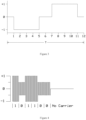
- amplitude shift modulator 24 generates the rectangular waveform shown in Figure 3 where T is the waveform period and the 3 rd harmonic power is approximately zero.
- a small loop antenna 70 with a balanced feed serves as the forward path transmit antenna, while a second, vehicle mounted, balanced feed, small loop antenna 80 is used for the forward path receive antenna.
- Both antennas 70, 80 are much smaller than a wavelength at the operating frequency and for this reason are poor free-space radiators. However, when in close physical proximity, the two small loop antennas 70, 80 have significant mutual magnetic field coupling that enables both forward and reverse communications paths without significant free space propagation.
- the waveform of Figure 3 generated by the 3 rd harmonic cancellation circuit 22 with the circuit shown in Figure 5 has excellent third harmonic suppression (3 rd harmonic energy approaching zero), a highly desirable feature to avoid self - interference between the third harmonic of the forward transmission path and detection of the 40.680 MHz return path. Remaining residual third harmonic energy can be further suppressed, if necessary, using conventional harmonic filtering techniques.
- the low third harmonic generation circuit shown in Figure 5 includes a walking ring counter comprised of three D flip-flops 102, 104, 106 clocked at six times the desired output frequency as derived from the 13.560 MHz frequency from the reference oscillator 90 by PLL frequency multiplier 108.
- a pair of logic (NAND) gates 110, 112 decodes the walking ring counter to produce the desired rectangular wave that drives the forward link loop antenna 70 by means of two transistors 114, 116 arranged in a symmetrical, push-pull configuration.
- amplitude shift keying (ASK) modulation is imposed upon the forward link carrier by amplitude shift modulator 24 by varying the value of the forward link transmitting stage supply voltage.
- Logic one bits are encoded as full signal amplitude with the transmitting stage operating from full supply voltage.
- Logic zero bits are encoded as one half of the full signal amplitude with the transmitting stage operating with a reduced supply voltage. Varying the transmitter stage supply voltage in this fashion produces the transmission waveform shown in Figure 4 .
- a variable gain controlled amplifier 52 increases received signal amplitude from loop antenna 80. Since the received signal has non-zero values even for logic zero bits, the 13.56 MHz carrier is always present (see Figure 4 ).
- a portion of the amplified, received signal is applied to a limiting amplifier 54 that removes received signal amplitude variations, both those introduced by amplitude data modulation and those occurring due to incidental changes in the magnetic field coupling between the two forward path loop antennas 70, 80.
- the output of the limiting amplifier 54 is a constant amplitude square wave that indicates the instantaneous polarity of the received signal.
- the portion of the variable gain amplifier 52 output not applied to the limiting amplifier 54 is applied to one input of the multiplicative mixer 56.
- the limiting amplifier 54 output drives the other mixer input.
- the limiting amplifier 54 and the mixer 56 comprise the homodyne detector 50 in which the incoming signal carrier is extracted and used to synchronously detect the incoming signal.
- the propagation delay of the limiting amplifier 54 must be negligible or compensated for to achieve the full advantages of coherent detection.
- the output of the homodyne detector 50 is equivalent to full wave rectification of the incoming amplitude modulated signal. Resistor-capacitor low pass filtering removes the twice carrier frequency ripple leaving a direct current voltage that varies amplitude according to the impressed serial digital modulation.
- the carrier ripple filtered, post-homodyne detector signal is applied to a level detection circuit 59 that feeds the AGC control loop 58 and that also extracts the forward path serial data by means of amplitude level detection. Its implementation will be described in greater detail below with respect to Figure 7 .
- the forward path carrier recovered by the limiting amplifier 54 is applied to a frequency tripler 42 implemented as a pulse generator followed by a filter or equivalently by a phase locked loop after first having passed through a crystal filter 44 that prohibits frequency multiplier operation except in the presence of a sufficiently strong forward link signal, thus avoiding conflicting frequencies.
- the resulting 40.680 MHz carrier is applied to a second amplitude shift modulator 62 using 100% and 50% modulations levels as before to encode serial, digital data on the return data path.
- the return path amplitude shift modulator 62 drives a small, resonant loop antenna 80' as before except that harmonic emission cancellation elements 102-112 of Figure 5 are not needed.
- synchronous detector 30 On the ground side of the return link, there is a small resonant loop receiving antenna 70' and an amplifier 32 controlled by AGC circuit 34. Amplifier 32 and mixers 17 and 38 together with frequency tripler 14 form synchronous detector 30. Synchronous detection of the received return path signal is implemented by generating a 40.680 MHz synchronous detection reference signal by means of frequency tripling. While the frequency error of the synchronous detection reference signal is guaranteed to be zero by the overall design of the apparatus, zero phase error is not assured and is obtained through the use of quadrature channel phase detection and phase lock loop control of a phase shifter stage.
- phase shift stage phase shifter 12
- frequency tripler 14 which outputs two square waves offset by 90°.
- the frequency tripler 14 is implemented by a factor of six phase locked loop frequency multiplier followed by a quadrature divide-by-two circuit as shown in Figure 6 including D flip-flops 130, 132 to obtain I and Q synchronous detection reference signals. It will be appreciated that when the Q channel signal output at 17 equals 0 V then there is no phase error. However, if the output at 17 is not 0 V, then there is phase error and the phase lock loop operation of phase shifter 12 functions to drive the phase difference to zero.
- the variable phase shift circuit 12 is implemented as a series of capacitively loaded, logic inverters with variable supply voltage.
- the capacitive loading increases the propagation delay from inverter input to inverter output. Increased supply voltage decreases inverter propagation delay, thereby reducing inverter phase shift.
- a conventional phase locked loop comprised by the Q channel mixer 17 and associated loop filter 16 drives Q channel output of the synchronous detector 30 to zero thereby insuring proper phase synchronization for the I channel amplitude detection.
- level detection circuit 36 is identical to the forward path, level detection circuit 59 with the exception that the former includes the carrier detection function and associated voltage comparator 138 ( Figure 7 ) which detects the presence of the return patch signal.
- FIG 7 shows an embodiment of the receiver level detection circuit 36.
- a peak hold capacitor 134 driven by a full wave precision rectifier 136 holds the maximum detected voltage level which, in turn, is held to a constant value by the automatic gain control (AGC) circuit 34 ( Figure 2 ).
- the AGC amplitude stabilized, peak detected voltage provides the reference voltage for the 1-0 serial, binary detection voltage comparator 138 and the reference voltage for the carrier detection voltage comparator 140 by means of a R-2R-R resistor voltage divider 142 that sets the voltage comparator reference voltages at 25% and 75% respectively of the peak value of the post detection waveform shown in Figure 4 .
- the carrier detection voltage comparator 140 provides fast indication of vehicle side fault occurrence.
- the return link carrier is disabled immediately.
- the ground side apparatus detects the carrier removal delayed only by pre- and post-detection filter delay and immediately halts wireless power transfer.
- the full value of the peak hold function is applied to the AGC integrator 144 that adjusts the AGC loop voltage and thus the gain of amplifier 32 to maintain the peak hold capacitor 134 voltage equal to the AGC set point 146 voltage.
- the conventional precision rectifier 136 generates an output voltage proportional to the absolute value of the input voltage and consists of one or more small signal diodes placed within an op-amp feedback path, a configuration that effectively cancels the diode forward voltage drop thereby enabling precision rectification of low level signals with minimal error.
- return link synchronous detection can be made by making use of a coherent, but not phase synchronized, I and Q detection channels.
- Amplitude and phase modulation can be extracted in the conventional fashion where amplitude is the root mean square of the I and Q channels and the phase angle is the arctangent of the ratio of I and Q.
- the phase shifting and phase control loop circuitry is not needed.
- Figures 1 and 2 show four loop antennas: a sending and a receiving antenna pair 70, 80 for the forward link and a second pair of antennas 70', 80' for the return link.
- the forward and return link antenna pair can be consolidated into a single loop antenna with a conventional antenna duplexer to separate and isolate the forward and return link signals.
- the problem then is the combination and subsequent separation of the forward path and the reverse path signal from each other and from other electrical signals encountered by combining functionality into a single antenna structure.
- the first method uses hybrid transformers, hybrid couplers, or directional couplers which distinguish between forward and reverse path signals by means of signal flow direction.
- the second method relies upon frequency selective filters that distinguish between signals on the basis of frequency.
- a frequency selective multiplexer can be implemented with LC lumped components, with distributed components or as a monolithic circuit containing a plurality of resonant elements and coupling elements.
- a frequency multiplexing functional block may combine both signal direction and signal frequency discrimination.
- the performance of a signal multiplexer functional block can be enhanced by the addition of electronic signal cancellation as shown in Figure 8 .
- the electronic signal cancellation functional block (circuit) is placed in the path between the common forward/reverse path antenna and the receiver.
- the common antenna is connected to port 202 of signal splitter 204.
- One splitter output goes to the input port of mixer 206 by means of isolation amplifier 208.
- a sample of the signal to be cancelled is applied to port 210, and the applied signal is shifted in phase by variable phase shifter 212 and applied to the local oscillator port of mixer 206 by means of limiting amplifier 214.
- the mixer 206 output is applied to a loop filter 216 and then applied to the control port of the variable phase shifter 212.
- Components 212, 214, 206, and 216 constitute a phase control loop that insures the cancellation signal is 90 degrees out of phase with the unwanted signal component applied to port 202.
- Zero phase error corresponds to zero direct current voltage at the output of mixer 206.
- a second output of splitter 204 goes to combiner 218 by means of isolation amplifier 220.
- signal combiner 218, splitter 222, isolation amplifier 224, mixer 226, loop filter 228, and attenuator 230 together constitute an amplitude control loop.
- a portion of the quadrature sample signal output by phase shifter 212 is applied to the fixed 90 degree phase shifter 232 creating a 180 degree out-of-phase version of the cancellation signal, which passes through controlled attenuator 230 and into signal combiner 218, where if the cancellation signal amplitude is correct, complete cancellation of the unwanted signal is accomplished.
- One portion of the combiner 218 output signal is directed to the receiver input at 234 via splitter 222.
- Another portion is directed through isolation amplifier 224 to the signal port of mixer 226 which serves as a coherent amplitude detector driven by an unattenuated portion of the 180 degree out-of-phase cancellation signal.
- the output of mixer 226 is passed through loop filter 228 that controls the variable attenuator 230.
- the ground equipment can continuously or periodically emit a forward path signal while listening for a vehicle generated return path signal.
- Duplex communication is initiated upon detection of a vehicle generated return path signal.
- the vehicle side electronics can make initial contact with a return path signal temporarily derived from a temporary crystal oscillator (not shown) instead of the normally used carrier recovered by the homodyne detector 50, and non-coherently detected by the ground side electronics.
- the ground side equipment Upon ground side reception of the vehicle signal, the ground side equipment emits a forward path signal. In the case of vehicle side communication initiation, the vehicle side apparatus disables the temporary crystal oscillator and reverts to coherent transponder operation upon successful homodyne detection and carrier recovery.
- the ground equipment detects the change caused by an overhead vehicle in the impedance of the wireless power transfer coil and responds by emitting a forward path signal. This embodiment reduces or eliminates unnecessary signal emissions and is advantageous in some regulatory environments.
- the initiating impedance change can also be detected in the coil alignment auxiliary coils or in the near field communications antenna. In addition to impedance change, changes in mutual impedance between isolated electromagnetic elements can also be used to initiate communications.
- the reverse signal at 40.680 MHz is a simple integer multiple of the forward signal frequency at 13.560 MHz with both signals falling within existing, internationally designated ISM- Industrial, Scientific Medical- frequency assignments.
- Other frequencies and frequency pairs with non-integer frequency ratios can be used as well.
- the two international ISM frequency bands with center frequencies of 2450 MHz and 5800 MHz may also be used.
- ISM bands and non-ISM band frequencies frequency pairs with other integer or rational fraction frequency and multiple simultaneous transmission and reception carrier frequencies are also possible.
- multiple return path data channels each return path data channel transmitting data at a different M/N multiple of the transmission frequency of the first inductive link, where M and N are integers, may also be used.
- Full duplex, frequency coherent communications is also possible with the ground and the remote apparatus linked by far field as opposed to near field propagation.
- Dynamic electric vehicle charging is a specialized case of providing electrical energy to an electrically powered vehicle while the vehicle is in motion.
- the use of dynamic charging may be accomplished using resonant magnetic induction in which a plurality of independent transmitters 300 are installed in a roadway in a linear array and energized in a controlled sequence as a target vehicle 310, 312 travels above the linear array 300.
- Dynamic charging may be implemented when there is just one vehicle 310 moving over the array of transmitters 300, or in the more realistic circumstance, when there are multiple electric vehicles 310, 312 of differing types, velocities, and power requirements moving over the array of transmitters 300.
- inductive power transmission In every instance of inductive power transmission, whether in the dynamic charging mode described here, or in the simpler case of stationary charging described above where a vehicle that is equipped with a single power receiver is parked and remains immobile above a single power transmitter that is embedded in the pavement, communication between the vehicle-based receiver and the ground-based transmitter must occur. This is desirable for vehicle identification, billing for energy purchases, regulating current and voltage, resonant frequency, vertical gap separation distance, primary-to-secondary alignment, and for other purposes, such as safe operations and emergency power cut-off. This is also true in the case of a moving vehicle that is charging while it is in motion, except that the single transmitter built into the vehicle communicates with a plurality of independent transmitters in sequence. This moving one-to-one relationship imposes very significant communications challenges.
- the method of operation for charging a moving vehicle is to have each independent transmitter 300 in the linear array energize to create a resonant magnetic field in a sequential pattern as the vehicle receiver 320 passes over each independent transmitter 300.
- the type of vehicle, its specific charging requirements, its velocity, alignment with respect to the transmitter 300, and its predicted trajectory are all important factors that make this problem difficult to solve.
- the first requirement is to have a highly proximal send-receive capability that is limited to less than 2 meters. (A vehicle moving at 60 MPH travels 88 feet per second. The time of exposure of the receiver to the transmitter may be on the order of 0.02 seconds. In this timeframe, a time delay in the signal transmission typical of digital communications systems of 0.04 to 0.07 seconds is clearly untenable).
- the fourth requirement is for full duplex operation, or bidirectionality, so as to assure that in the very short time span that the vehicle 310, 312 is present over the transmitter 300, data may be exchanged in both directions - from the vehicle to the ground, and from the ground to the vehicle.
- the sixth requirement is to avoid the problem of multiple antennas that are distal to the vehicle 310, 312.
- Multiple distal antennas introduce significant problems due to road pavement and vehicle body interference, such as multipath signal nullification.
- High reliability vehicle identification with multiple antennas is difficult to secure to avoid malicious hacking or other cyber-vandalism.
- each charging station and/or vehicle transmitter provides information including, for example, vehicle identification, billing for energy purchases, regulating current and voltage, resonant frequency, vertical gap separation distance, primary-to-secondary alignment, and for other purposes, such as safe operations and emergency power cut-off, location, timing, trajectory, and/or speed information regarding the vehicle 310, 312 to the next transmitter so that the next transmitter fires when the vehicle's wireless charging receiver 320 is positioned over the transmitter 300 during travel.
Landscapes
- Engineering & Computer Science (AREA)
- Computer Networks & Wireless Communication (AREA)
- Power Engineering (AREA)
- Signal Processing (AREA)
- Near-Field Transmission Systems (AREA)
- Current-Collector Devices For Electrically Propelled Vehicles (AREA)
- Electric Propulsion And Braking For Vehicles (AREA)
- Charge And Discharge Circuits For Batteries Or The Like (AREA)
Description
- The invention describes a full duplex, near field data link intended for control of a resonant induction, wireless power transfer system used for recharging electric vehicles in an exemplary embodiment. The invention uses a coherent transponder configuration that enables interference rejecting synchronous detection and positive rejection of signals originating from nearby and adjacent vehicles.
- Inductive power transmission has many important applications spanning many industries and markets. Resonant induction wireless power apparatus can be viewed as a switch mode DC-to-DC power supply having a large air gap transformer separating and isolating the power supply input and output sections. Because the output current is controlled by adjustment of the input side parameters, there must be a way to communicate the output parameters to the input side control circuitry. Conventional, isolated, switch mode power supplies use opto-couplers or coupling transformers to communicate across the isolation barrier but these conventional methods are not useful in the presence of a large physical gap. Acoustic and optical communications across the power transfer gap are possible in principle but are inadequate in practice when challenged by mud, road debris, snow and ice as well as standing water. It is possible to communicate across the power transfer gap by means of modulating the receiving inductor impedance and detecting the voltage and current variations induced on the primary side inductor. However, because of the generally low operating frequency employed by the resonant induction wireless power transfer apparatus and the moderate to high loaded Q of the primary and secondary side inductors of such resonant induction wireless power transfer systems, available data communications bandwidth is severely constrained and full duplex communications implementation is difficult.
- Radio frequency based data communications systems are therefore preferred as they are immune to the difficulties listed above; however, conventional radio frequency data communications systems are inadequate in several aspects. Half-duplex systems transmit only in one direction but rapidly alternate the direction of transmission, thereby creating a data link that functions as a full duplex link. Transmission data buffering or queueing introduces significant and variable transmission latency which is especially undesirable as a cause of control system instability when placed in the control system feedback path.
- Conventional super-heterodyne receivers generally require rather good intermediate frequency filters to provide off-channel interference rejection. However, such filters tend to be expensive and do not easily lend themselves to monolithic integration.
- Furthermore, conventional radio data links do not intrinsically discriminate against other nearby data links of the same type. This means that conventional radio based data links when employed to mediate wireless charging of electric vehicles often respond to the radio commands emitted by charging apparatus in nearby or adjacent parking slots, a behavior that greatly complicates unambiguous vehicle identification and subsequent wireless charging control.
- For the safe operation of high power wireless charging, it is highly desirable to provide a communications link with minimum latency to provide safe, fast shutdown in the event of loss of load. For the safe and practical operation of wireless power transmission devices, it is also desirable that the communications link be inherently discriminatory so that there is minimized risk of crosstalk or misread communication between adjacent devices or vehicles. The communications link should be able, during operation, to assure that one vehicle communicates with only one designated ground station and no other vehicle or ground station once communications is established.
-
US 5 302 954 A describes an RFID system comprising a transponder having receiver means adapted to extract powering energy from a surrounding electromagnet field, transponder transmitter means adapted to transmit at least one unique signal from the transponder, frequency generating means for generating a plurality of pre-determined frequencies, each frequency adapted to carry the signal from the transmitter means to an interrogator receiver means adapted to receive said signals to achieve identification of said transponder, said transponder transmitting signals successively or repetitively using at each successive or repetitive transmission a newly selected frequency or set of newly selected frequencies.US 2013/029595 A1 discloses a power transmission apparatus for wireless power transfer and data transfer. The power transmission apparatus includes a transmitter configured to wirelessly transmit power via a wireless power transfer field at a level sufficient to power or charge an electric vehicle. The power transmission apparatus further includes a controller circuit configured to establish a first wireless communication link with the electric vehicle. The controller circuit is further configured to establish a second wireless communication link with the electric vehicle in response to detecting that the electric vehicle is being charged.WO2014/050430 A1 also concerns a power transmission system. The power transmission system is capable of efficiently transmitting power in the cases of charging a battery using a power receiving-side system and comprises: a power transmitting antenna, which constitutes a series resonator having an inductance component and a capacitance component, and which has alternating current power inputted thereto; a power receiving antenna, which constitutes a series resonator having an inductance component and a capacitance component, and which receives electromagnetic energy from the power transmitting antenna via an electromagnetic field; a rectifying section, which rectifies output from the power receiving antenna to direct current power, and which outputs the direct current power; and a load for inputting the output from the rectifying section. The power transmission system is characterized in that, when the power transmission system is used within a range wherein a load resistance value (R) satisfies formula Rmin≤R≤max in the cases including a case where a coupling coefficient between the power transmitting antenna and the power receiving antenna is k, there are predetermined relationships among respective components and the coefficient. - The invention is a system and method as defined in the appended claims. The invention addresses the above needs and the limitations of the prior art by implementing a coherent, full-duplex radio frequency data link that relies upon near field inductive coupling as opposed to far field propagation as in conventional systems to restrict effective communication range, that employs synchronous detection to reject off channel and some co-channel interference without sophisticated frequency domain filtering, and that employs a coherent transponder architecture for positive identification of data link transmission-reception equipment pairs. As used herein, "coherent" means that the respective frequencies are related to each other exactly by a ratio M/N where M and N are integers. In other words, a period of time containing M integer cycles of the first frequency contains exactly N integer cycles of the second frequency.
- In exemplary embodiments of the invention, two apparatuses are provided, one associated with the ground side wireless power transmission equipment, and another associated with the vehicle side wireless power reception equipment. A crystal controlled reference oscillator located in the ground side apparatus provides a common basis for the coherent generation of all radio frequency signals needed for transmission and for detection. As this is a full duplex communication apparatus, there are two independent transmission-reception links: a forward link from the ground side to the vehicle side apparatus, and a return link from the vehicle side to the ground side apparatus. The vehicle side loop antennas are typically located below the conductive underbody of the vehicle and are parallel with respect to the ground surface. In exemplary embodiments, the forward and return inductive links are multiplexed onto wireless power transfer coils of the vehicle side and ground side wireless power transmission equipment.
- The forward link transmission signal is derived from the reference oscillator. Serial data is imposed upon the forward link carrier by the modulator. Transmission occurs between two electrically small loop antennas having significant mutual induction coupling that are separated by much less than a wavelength at the forward link operating frequency. On the vehicle side of the forward link, the received signal is detected by a homodyne detector that extracts the carrier of the signal and uses it as a detection reference in a synchronous detector. The extracted carrier is used as a frequency reference for the return link carrier with the return link data imposed upon the carrier with a second modulator. The return link carrier is thus coherent with the forward link carrier but multiplied in frequency. Return link transmission occurs by near field, inductive coupling between two closely spaced, electrically small loop antennas as before. Multiple return path data channels, each return path data channel transmitting data at a different M/N multiple of the transmission frequency of the first inductive link, where M and N are integers, may also be used. A synchronous detector on the ground side of the link extracts the return link data using a frequency multiplied version of the original reference oscillator signal as the detection reference. Link modulation in both directions can be amplitude modulation, frequency modulation, phase modulation, or a combination thereof.
- Because the forward link carrier, the forward link detection reference, the return link carrier, and the return link detection reference are all derived from the same primary side reference oscillator, coherency of these four critical signals is assured by design. Complex frequency acquisition and synchronization circuitry is not required. Harmonic cancellation circuitry may be used in order to avoid self-interference between signals on the forward and return communication links. Furthermore, production tolerance and environmentally induced frequency variations between reference oscillators insures that the link signals from apparatus located in adjacent parking spaces will not be coherent and therefore will not be subject to synchronous detection. Further rejection of link signals originating from apparatus and vehicles in adjacent parking slots arises from attenuation that results when the link transmission wavelength exceeds the vehicle underbody to ground surface separation distance with the vehicle underbody and the ground surface functioning as the two plates of a waveguide operating below the guide propagation cutoff frequency.
- In an exemplary embodiment, a system and associated method are provided for providing full duplex data communication employing near field inductive transmission between a first transmit/receive system and a second transmit/receive system. The method includes the steps of the first transmit/receive system transmitting a first signal over a first inductive link, the second transmit/receive system receiving the first signal over the first inductive link, the second transmit/receive system transmitting a second signal over a second inductive link, and the first transmit/receive system receiving the second signal over the second inductive link, where the second signals are derived from the first signals and the first and second signals are frequency coherent. The first and second signals are frequency synchronized and the frequencies of the first and second signals are related by a ratio M/N where M and N are both integers. In exemplary embodiments, the first and second signals have an integer harmonic relationship with each other, where the integer is not equal to 1. Thus the first and second signals have an exact integer or an exact rational fraction frequency relationship with each other.
- The methods described herein also include methods for wireless charging a vehicle using a wireless inductive power transfer system by establishing a full duplex communication link between the vehicle and a charging station, where the full duplex communication link employs near field inductive transmission between a first transmit/receive system at the charging station and a second transmit/receive system on the vehicle. In an exemplary embodiment, the full duplex communication link includes the first transmit/receive system transmitting a first signal over a first inductive link, the second transmit/receive system receiving the first signal over the first inductive link, the second transmit/receive system transmitting a second signal over a second inductive link, and the first transmit/receive system receiving the second signal over the second inductive link, where the second signals are derived from the first signals and the first and second signals are frequency coherent. Wireless power transfer between the charging station and the vehicle is then controlled by sending control signals over the full-duplex communication link. The communication link may be initiated when the charging station detects a change caused by an overhead vehicle in impedance or mutual impedance between isolated electromagnetic elements of a wireless power transfer coil, alignment coils, and/or a near field communications antenna of the charging station. Transmission of the control signals over the first inducting link is initiated when the inductance change is detected.
- The communication system described herein also may be adapted to provide dynamic wireless charging of a moving vehicle using a wireless inductive power transfer system including a plurality of charging stations installed in a roadway. Such a method includes establishing a full duplex communication link between the vehicle and a first charging station, where the full duplex communication link employs frequency coherent near field inductive transmission between a first transmit/receive system at the first charging station and a second transmit/receive system on the vehicle. During operation, the first charging station and/or a vehicle transmitter provides location, timing, and/or speed information regarding the vehicle to a second charging station, which uses the location, timing, and/or speed information to determine a time when the vehicle's wireless charging receiving device will be positioned over the second charging station. The second charging station provides wireless power transfer at the determined time to provide wireless power transfer to the vehicle, whereby the vehicle is charged as the vehicle passes over the plurality of charging stations. In an exemplary embodiment, a pre-sequence firing procedure establishes a traveling wave of magnetic energy that moves at the same rate as the vehicle's wireless charging receiving device.
- The foregoing and other beneficial features and advantages of the invention will become apparent from the following detailed description in connection with the attached figures, of which:
-
Figure 1 shows a conceptual representation of the invention. -
Figure 2 shows an illustrative embodiment of the invention. -
Figure 3 shows the low harmonic waveform employed by an illustrative embodiment to avoid self-interference. -
Figure 4 shows a representation of digital amplitude shift modulation used by an illustrative embodiment of the invention. -
Figure 5 shows an embodiment of the low harmonic generation circuit that produces the waveform shown inFigure 3 . -
Figure 6 shows a representation of digital amplitude shift modulation used by an illustrative embodiment of the invention. -
Figure 7 shows an embodiment of the receiver level detection circuits. -
Figure 8 shows an embodiment of an apparatus for self-interference cancellation. -
Figure 9 illustrates an embodiment of dynamic charging using the communications methodology described herein. - An exemplary embodiment of the invention will be described with respect to
Figures 1-9 for use in charging electrically powered vehicles, although those skilled in the art will appreciate that the teachings provided herein may be used in other non-vehicular resonant magnetic induction wireless power transfer systems. Such embodiments are intended to be within the scope of the present disclosure. -
Figure 1 illustrates a conceptual representation of the invention wherein two apparatuses are provided, a ground side apparatus associated with the ground side wireless power transmission equipment, and a vehicle side apparatus associated with the vehicle side wireless power reception equipment. The data link illustrated inFigure 1 may, for example, be implemented in the coil alignment error detecting apparatus described inU.S. Provisional Patent Application No. 61/682,572, filed August 6, 2013 Figure 1 , the ground side apparatus includes afrequency multiplier 10, adata modulator 20 that receives input data for transmission, and asynchronous detector 30 that receives data on a return link from the vehicle side apparatus and provides output data. Similarly, the vehicle side apparatus includes afrequency multiplier 40, ahomodyne detector 50 that receives data on a forward link from the ground side apparatus, and amodulator 60 that transmits data on the return link to the ground side apparatus.Loop antennas 70 and 70' of the ground side apparatus communicate wirelessly by induction withloop antennas 80 and 80' on the vehicle side apparatus in a conventional manner. A crystal controlledreference oscillator 90 located in the ground side apparatus provides a common basis for the coherent generation of all radio frequency signals needed for transmission and for detection. As noted above, "coherent" as used herein means that the respective frequencies are related to each other exactly by a ratio M/N where M and N are integers. As this is a full duplex communication apparatus, there are two independent transmission-reception links: a forward link from the ground side to the vehicle side apparatus, and a return link from the vehicle side to the ground side apparatus. The vehicleside loop antennas 80 and 80' are typically located below the conductive underbody of the vehicle and are parallel with respect to the groundside loop antennas 70 and 70'. - The invention described herein and shown in
Figure 1 departs from conventional radio data communications as follows: - The communications path is full duplex and bi-directional having a forward path from the ground side apparatus to the vehicle side apparatus and a second return data path originating with the vehicle side apparatus sending data to the ground side apparatus.
- The electronic communication mechanism is near field, magnetic field coupling between two
antennas - The forward path signal carrier provides the reference frequency for the generation of the return path signal by means of frequency multiplication. This means that the return path signal is coherent with the forward path signal and the technical difficulty of deriving a synchronous and coherent reference signal for return path synchronous detection is avoided. Furthermore, the coherent forward and return path signals make possible simple, unambiguous rejection of co-channel and off channel-interference and rejection of data link signals originating from other identical apparatus in adjacent parking slots.
- In the exemplary embodiment shown in
Figure 2 , the forward path frequency fromreference oscillator 90 is 13.560 MHz. The return path operates on the third harmonic of the forward path (M/N=3), 40.680 MHz. Both frequencies are internationally allocated for non-communications Industrial, Scientific and Medical (ISM) use. Communications use is also permitted in ISM channels with reduced regulatory requirements but must accept interference from all other ISM channel users. The non-radiating, near field nature of the coherent transponder system described herein along with the waveguide below cutoff structure comprised by the vehicle conductive underbody and the ground surface in a typical application makes the described system very tolerant of co-channel interference and for this reason is well suited for use on ISM assigned frequencies. - The forward path signal generation begins with reference
quartz crystal oscillator 90 operating at a frequency of 13.560 MHz. This signal is applied to a waveform generation stage including 3rdharmonic cancellation circuit 22 andamplitude shift modulator 24 that together comprise themodulator 20 ofFigure 1 . Of course, other types of modulators, such as frequency shift modulators, QPSK modulators, and the like may be used. In the exemplary embodiment,amplitude shift modulator 24 generates the rectangular waveform shown inFigure 3 where T is the waveform period and the 3rd harmonic power is approximately zero. Asmall loop antenna 70 with a balanced feed serves as the forward path transmit antenna, while a second, vehicle mounted, balanced feed,small loop antenna 80 is used for the forward path receive antenna. Bothantennas small loop antennas - From the "Engineering Mathematics Handbook, Third Edition, Tuma, Jan J., McGraw-Hill 1987 ISBN 0-07-065443-3, the Fourier series coefficients for the modified sine waveform shown in
Figure 3 are given by:
- Of the first twenty Fourier series coefficients, all but six are zero. The non-zero coefficients are the 5th and 7th, which are suppressed -14 dB and -16.9 dB, the 11th and 13th which are suppressed -20.8 dB and -22.3 dB, and the 17th and 19th which are suppressed -22.9 and -25.5 dB with respect to the desired n=1 component. While a mathematically ideal waveform has infinite third harmonic suppression, a practical implementation will have less than infinite harmonic cancellation due to non-equal 0-1 and 1-0 logic propagation delays and from other small waveform asymmetries. Even so, the waveform of
Figure 3 generated by the 3rdharmonic cancellation circuit 22 with the circuit shown inFigure 5 has excellent third harmonic suppression (3rd harmonic energy approaching zero), a highly desirable feature to avoid self - interference between the third harmonic of the forward transmission path and detection of the 40.680 MHz return path. Remaining residual third harmonic energy can be further suppressed, if necessary, using conventional harmonic filtering techniques. - The low third harmonic generation circuit shown in
Figure 5 includes a walking ring counter comprised of three D flip-flops reference oscillator 90 byPLL frequency multiplier 108. A pair of logic (NAND)gates link loop antenna 70 by means of twotransistors voltage source 122, combined with the inductance of theloop antenna 70 and theantenna resonating capacitor 124 shown inFigure 5 , constitute a resonant circuit that provides suppression of residual harmonic energy, particularly third harmonics in the illustrated embodiment. - As shown in
Figure 2 , in an exemplary embodiment amplitude shift keying (ASK) modulation is imposed upon the forward link carrier byamplitude shift modulator 24 by varying the value of the forward link transmitting stage supply voltage. Logic one bits are encoded as full signal amplitude with the transmitting stage operating from full supply voltage. Logic zero bits are encoded as one half of the full signal amplitude with the transmitting stage operating with a reduced supply voltage. Varying the transmitter stage supply voltage in this fashion produces the transmission waveform shown inFigure 4 . - On the vehicle side of the forward link, a variable gain controlled
amplifier 52 increases received signal amplitude fromloop antenna 80. Since the received signal has non-zero values even for logic zero bits, the 13.56 MHz carrier is always present (seeFigure 4 ). A portion of the amplified, received signal is applied to a limitingamplifier 54 that removes received signal amplitude variations, both those introduced by amplitude data modulation and those occurring due to incidental changes in the magnetic field coupling between the two forwardpath loop antennas amplifier 54 is a constant amplitude square wave that indicates the instantaneous polarity of the received signal. The portion of thevariable gain amplifier 52 output not applied to the limitingamplifier 54 is applied to one input of themultiplicative mixer 56. The limitingamplifier 54 output drives the other mixer input. The limitingamplifier 54 and themixer 56 comprise thehomodyne detector 50 in which the incoming signal carrier is extracted and used to synchronously detect the incoming signal. The propagation delay of the limitingamplifier 54 must be negligible or compensated for to achieve the full advantages of coherent detection. The output of thehomodyne detector 50 is equivalent to full wave rectification of the incoming amplitude modulated signal. Resistor-capacitor low pass filtering removes the twice carrier frequency ripple leaving a direct current voltage that varies amplitude according to the impressed serial digital modulation. The carrier ripple filtered, post-homodyne detector signal is applied to alevel detection circuit 59 that feeds theAGC control loop 58 and that also extracts the forward path serial data by means of amplitude level detection. Its implementation will be described in greater detail below with respect toFigure 7 . - The forward path carrier recovered by the limiting
amplifier 54 is applied to afrequency tripler 42 implemented as a pulse generator followed by a filter or equivalently by a phase locked loop after first having passed through acrystal filter 44 that prohibits frequency multiplier operation except in the presence of a sufficiently strong forward link signal, thus avoiding conflicting frequencies. The resulting 40.680 MHz carrier is applied to a secondamplitude shift modulator 62 using 100% and 50% modulations levels as before to encode serial, digital data on the return data path. The return pathamplitude shift modulator 62 drives a small, resonant loop antenna 80' as before except that harmonic emission cancellation elements 102-112 ofFigure 5 are not needed. - On the ground side of the return link, there is a small resonant loop receiving antenna 70' and an
amplifier 32 controlled byAGC circuit 34.Amplifier 32 andmixers frequency tripler 14form synchronous detector 30. Synchronous detection of the received return path signal is implemented by generating a 40.680 MHz synchronous detection reference signal by means of frequency tripling. While the frequency error of the synchronous detection reference signal is guaranteed to be zero by the overall design of the apparatus, zero phase error is not assured and is obtained through the use of quadrature channel phase detection and phase lock loop control of a phase shifter stage. Putting the phase shift stage (phase shifter 12) before rather than afterfrequency tripler 14 means total phase shift control range need only exceed 120 degrees rather than the full 360 degrees required at thesynchronous detector 30 to insure phase synchronous detection. To ease the quadrature reference signal generation at 40.680 MHz, the ground side 13.560 MHz signal from thecrystal oscillator 90 is multiplied byfrequency tripler 14 which outputs two square waves offset by 90°. Thefrequency tripler 14 is implemented by a factor of six phase locked loop frequency multiplier followed by a quadrature divide-by-two circuit as shown inFigure 6 including D flip-flops phase shifter 12 functions to drive the phase difference to zero. - The variable
phase shift circuit 12 is implemented as a series of capacitively loaded, logic inverters with variable supply voltage. The capacitive loading increases the propagation delay from inverter input to inverter output. Increased supply voltage decreases inverter propagation delay, thereby reducing inverter phase shift. A conventional phase locked loop comprised by theQ channel mixer 17 and associatedloop filter 16 drives Q channel output of thesynchronous detector 30 to zero thereby insuring proper phase synchronization for the I channel amplitude detection. - The I channel
mixer 38 of thesynchronous detector 30 mixes the output ofamplifier 32 with the I channel output offrequency tripler 14, thereby providing the amplitude input signal for thelevel detection circuit 36. Return path,level detection circuit 36 is identical to the forward path,level detection circuit 59 with the exception that the former includes the carrier detection function and associated voltage comparator 138 (Figure 7 ) which detects the presence of the return patch signal. -
Figure 7 shows an embodiment of the receiverlevel detection circuit 36. Apeak hold capacitor 134 driven by a fullwave precision rectifier 136 holds the maximum detected voltage level which, in turn, is held to a constant value by the automatic gain control (AGC) circuit 34 (Figure 2 ). The AGC amplitude stabilized, peak detected voltage provides the reference voltage for the 1-0 serial, binarydetection voltage comparator 138 and the reference voltage for the carrierdetection voltage comparator 140 by means of a R-2R-Rresistor voltage divider 142 that sets the voltage comparator reference voltages at 25% and 75% respectively of the peak value of the post detection waveform shown inFigure 4 . The carrierdetection voltage comparator 140 provides fast indication of vehicle side fault occurrence. If a fault occurs on the vehicle side, such as sudden unexpected load shedding, the return link carrier is disabled immediately. The ground side apparatus detects the carrier removal delayed only by pre- and post-detection filter delay and immediately halts wireless power transfer. The full value of the peak hold function is applied to theAGC integrator 144 that adjusts the AGC loop voltage and thus the gain ofamplifier 32 to maintain thepeak hold capacitor 134 voltage equal to the AGC set point 146 voltage. Theconventional precision rectifier 136 generates an output voltage proportional to the absolute value of the input voltage and consists of one or more small signal diodes placed within an op-amp feedback path, a configuration that effectively cancels the diode forward voltage drop thereby enabling precision rectification of low level signals with minimal error. - Alternatively, return link synchronous detection can be made by making use of a coherent, but not phase synchronized, I and Q detection channels. Amplitude and phase modulation can be extracted in the conventional fashion where amplitude is the root mean square of the I and Q channels and the phase angle is the arctangent of the ratio of I and Q. In this alternative embodiment, the phase shifting and phase control loop circuitry is not needed.
-
Figures 1 and2 show four loop antennas: a sending and a receivingantenna pair U.S. Provisional Patent Application No. 61/682,572 - For reasons of simplicity and cost reduction it is desirable that the forward and reverse paths share a common antenna structure. The problem then is the combination and subsequent separation of the forward path and the reverse path signal from each other and from other electrical signals encountered by combining functionality into a single antenna structure. In general, there are two general methods to implement signal combination, separation and routing. The first method uses hybrid transformers, hybrid couplers, or directional couplers which distinguish between forward and reverse path signals by means of signal flow direction. The second method relies upon frequency selective filters that distinguish between signals on the basis of frequency. A frequency selective multiplexer can be implemented with LC lumped components, with distributed components or as a monolithic circuit containing a plurality of resonant elements and coupling elements. A frequency multiplexing functional block may combine both signal direction and signal frequency discrimination.
- The performance of a signal multiplexer functional block (circuit) can be enhanced by the addition of electronic signal cancellation as shown in
Figure 8 . The electronic signal cancellation functional block (circuit) is placed in the path between the common forward/reverse path antenna and the receiver. The common antenna is connected to port 202 ofsignal splitter 204. One splitter output goes to the input port ofmixer 206 by means ofisolation amplifier 208. A sample of the signal to be cancelled is applied toport 210, and the applied signal is shifted in phase byvariable phase shifter 212 and applied to the local oscillator port ofmixer 206 by means of limitingamplifier 214. Themixer 206 output is applied to aloop filter 216 and then applied to the control port of thevariable phase shifter 212.Components port 202. Zero phase error corresponds to zero direct current voltage at the output ofmixer 206. - As illustrated in
Figure 8 , a second output ofsplitter 204 goes tocombiner 218 by means ofisolation amplifier 220. As illustrated,signal combiner 218,splitter 222,isolation amplifier 224,mixer 226,loop filter 228, andattenuator 230 together constitute an amplitude control loop. A portion of the quadrature sample signal output byphase shifter 212 is applied to the fixed 90degree phase shifter 232 creating a 180 degree out-of-phase version of the cancellation signal, which passes through controlledattenuator 230 and intosignal combiner 218, where if the cancellation signal amplitude is correct, complete cancellation of the unwanted signal is accomplished. One portion of thecombiner 218 output signal is directed to the receiver input at 234 viasplitter 222. Another portion is directed throughisolation amplifier 224 to the signal port ofmixer 226 which serves as a coherent amplitude detector driven by an unattenuated portion of the 180 degree out-of-phase cancellation signal. The output ofmixer 226 is passed throughloop filter 228 that controls thevariable attenuator 230. Those skilled in the art will appreciate that zero cancellation signal amplitude error corresponds to zero direct current voltage at the output ofmixer 226. - In operation, as a vehicle approaches a wireless charging station, communications is established before charging commences. Once charging commences, the full-duplex communications is used to mediate and to control multiple aspects of the wireless power transfer operation including transferred power level, output voltage and current, as well as monitoring of proper system operation. To establish control communications, the ground equipment can continuously or periodically emit a forward path signal while listening for a vehicle generated return path signal. Duplex communication is initiated upon detection of a vehicle generated return path signal. Alternatively, the vehicle side electronics can make initial contact with a return path signal temporarily derived from a temporary crystal oscillator (not shown) instead of the normally used carrier recovered by the
homodyne detector 50, and non-coherently detected by the ground side electronics. Upon ground side reception of the vehicle signal, the ground side equipment emits a forward path signal. In the case of vehicle side communication initiation, the vehicle side apparatus disables the temporary crystal oscillator and reverts to coherent transponder operation upon successful homodyne detection and carrier recovery. - Both initiation methods described above rely upon the emission of a forward or a return path signal. Communications can also be advantageously initiated with no forward or reverse path emissions. In an exemplary embodiment, the ground equipment detects the change caused by an overhead vehicle in the impedance of the wireless power transfer coil and responds by emitting a forward path signal. This embodiment reduces or eliminates unnecessary signal emissions and is advantageous in some regulatory environments. In addition to the wireless power transfer coils, the initiating impedance change can also be detected in the coil alignment auxiliary coils or in the near field communications antenna. In addition to impedance change, changes in mutual impedance between isolated electromagnetic elements can also be used to initiate communications.
- In the exemplary embodiment described herein, the reverse signal at 40.680 MHz is a simple integer multiple of the forward signal frequency at 13.560 MHz with both signals falling within existing, internationally designated ISM- Industrial, Scientific Medical- frequency assignments. Other frequencies and frequency pairs with non-integer frequency ratios can be used as well. For example, the two international ISM frequency bands with center frequencies of 2450 MHz and 5800 MHz may also be used. The coherent transponder architecture described herein combined with conventional phase locked loop techniques can generate a 5800 MHz signal that is frequency synchronized with a 2450 MHz signal with a frequency ratio M/N of 116/49, where M=5800 MHz and N=2450 MHz. Other combinations of ISM bands and non-ISM band frequencies, frequency pairs with other integer or rational fraction frequency and multiple simultaneous transmission and reception carrier frequencies are also possible. For example, multiple return path data channels, each return path data channel transmitting data at a different M/N multiple of the transmission frequency of the first inductive link, where M and N are integers, may also be used. Full duplex, frequency coherent communications is also possible with the ground and the remote apparatus linked by far field as opposed to near field propagation.
- Dynamic electric vehicle charging is a specialized case of providing electrical energy to an electrically powered vehicle while the vehicle is in motion. As illustrated in
Figure 9 , the use of dynamic charging may be accomplished using resonant magnetic induction in which a plurality ofindependent transmitters 300 are installed in a roadway in a linear array and energized in a controlled sequence as atarget vehicle linear array 300. Dynamic charging may be implemented when there is just onevehicle 310 moving over the array oftransmitters 300, or in the more realistic circumstance, when there are multipleelectric vehicles transmitters 300. In the latter case, the sequencing of the energization ofspecific transmitters 300 will be variable within the array and will depend on the various vehicle types and their motion, factors which are inherently unpredictable. Thus, the technology requirements of dynamic charging pose special technical challenges. The system described above solves the multiple problems of dynamic charging as enumerated below. - The most acute problem for dynamic charging is the need for vehicle-to-ground and ground-to-vehicle communications, where discrete, high speed, highly discriminatory and reliable data must be transferred as a requirement for commanding and controlling the charging system. This data is required to operate the charging system in the case of one or several vehicles that may traverse a serial array of ground-embedded inductive power transmitters.
- As shown in
Figure 9 , an array ofinductive power transmitters 300 is installed below a roadway, eachtransmitter 300 placed in a serial array along the longitudinal axis of the roadway. The intent is to provide a length of roadway that, when driven over by an electricallypowered vehicle vehicle inductive transmitters 300. It is desirable that only thetransmitters 300 that are directly underneath the vehicle receiver be energized. Thetransmitters 300 that do not have a vehicle above them should remain inert (i.e., not energized). - In every instance of inductive power transmission, whether in the dynamic charging mode described here, or in the simpler case of stationary charging described above where a vehicle that is equipped with a single power receiver is parked and remains immobile above a single power transmitter that is embedded in the pavement, communication between the vehicle-based receiver and the ground-based transmitter must occur. This is desirable for vehicle identification, billing for energy purchases, regulating current and voltage, resonant frequency, vertical gap separation distance, primary-to-secondary alignment, and for other purposes, such as safe operations and emergency power cut-off. This is also true in the case of a moving vehicle that is charging while it is in motion, except that the single transmitter built into the vehicle communicates with a plurality of independent transmitters in sequence. This moving one-to-one relationship imposes very significant communications challenges.
- The method of operation for charging a moving vehicle is to have each
independent transmitter 300 in the linear array energize to create a resonant magnetic field in a sequential pattern as thevehicle receiver 320 passes over eachindependent transmitter 300. The type of vehicle, its specific charging requirements, its velocity, alignment with respect to thetransmitter 300, and its predicted trajectory are all important factors that make this problem difficult to solve. - As depicted in
Figure 9 , it is certain to be the case that an array of pavement-embeddedtransmitters 300 will experience the presence of two ormore vehicles vehicle vehicle specific ground transmitter 300 over which it is positioned is discrete and discriminatory so that noother vehicle nearby vehicle vehicle - The first requirement is to have a highly proximal send-receive capability that is limited to less than 2 meters. (A vehicle moving at 60 MPH travels 88 feet per second. The time of exposure of the receiver to the transmitter may be on the order of 0.02 seconds. In this timeframe, a time delay in the signal transmission typical of digital communications systems of 0.04 to 0.07 seconds is clearly untenable).
- The second requirement is to have no or very low time delay (or latency) in the signal. This is required because the
vehicles transmitters 300, and discrete communications between theonboard receiver 320 and any onetransmitter 300 should be assured. - The third requirement is for the communications system to be able to "hand-off" or sequence the communications to the sequenced array of
transmitters 300. This can be done by wiring thetransmitters 300 to each other, or by allowing onetransmitter 300 to communicate using the present invention near field communication system to address theadjacent transmitter 300 in the sequenced array. - The fourth requirement is for full duplex operation, or bidirectionality, so as to assure that in the very short time span that the
vehicle transmitter 300, data may be exchanged in both directions - from the vehicle to the ground, and from the ground to the vehicle. - The fifth requirement is to allow uninterrupted communications under all weather and environmental conditions. This is accomplished by using magnetic energy, as described herein, which allows communication through bodies of water, snow, ice, and other inclement road surface conditions.
- The sixth requirement is to avoid the problem of multiple antennas that are distal to the
vehicle - Those skilled in the art will appreciate that the communication system described herein offers a uniform solution to each of these requirements.
- As noted above, dynamic charging allows moving vehicles to be charged while driving as the
vehicles transmitters 300 in the roadway. Eachtransmitter 300 is energized in a controlled sequence as it anticipates the presence of avehicle vehicle receiver 320 is only "present" above any one charging station for a short time, a sequencing system is needed that knows where the vehicle's receiver and the charging station's transmitter are in relation to each other in real-time. Ideally, a pre-sequence firing procedure effectively establishes a traveling wave of magnetic energy that moves at the same rate as thevehicle receiver 320. In order to do this, a communication system with minimal latency, such as that described herein, is needed. As noted above, the communication system described herein is very fast (near-zero latency) and very proximal, so that where thereceiver 320 is relative to atransmitter 300 is known. Thus, to enable dynamic charging, a series of charging stations equipped with the communications system described herein is provided. During operation, each charging station and/or vehicle transmitter provides information including, for example, vehicle identification, billing for energy purchases, regulating current and voltage, resonant frequency, vertical gap separation distance, primary-to-secondary alignment, and for other purposes, such as safe operations and emergency power cut-off, location, timing, trajectory, and/or speed information regarding thevehicle wireless charging receiver 320 is positioned over thetransmitter 300 during travel. - Those skilled in the art will appreciate that the topology and circuit implementation methodology described herein enables effective realization as a single application specific integrated circuit. Further, while the disclosure contained herein pertains to the provision of electrical power to vehicles, it should be understood that this is only one of many possible applications, and other embodiments including non-vehicular applications are possible. For example, those skilled in the art will appreciate that there are numerous applications of providing a full duplex data link in non-vehicle inductive charging applications such as portable consumer electronic device chargers, such as those (e.g., PowerMatTM) used to charge toothbrushes, cellular telephones, and other devices. In addition, those skilled in the art will appreciate that the transmission bandwidth (data rate) of the communications system described herein may be increased using simultaneous amplitude and angle modulation using other complex modulation methods and by use of multiple modulated forward and reverse path carriers. Accordingly, these and other such applications are included within the scope of the following claims.
Claims (15)
- A full duplex data communication system for simultaneous transmission and reception of data over a forward inductive link and a return inductive link between a vehicle and a charging station, the forward inductive link and the return inductive link employing inductive transmission, the system comprising:a first transmit/receive system (20,30) at the charging station that transmits a first signal over the forward inductive link and receives a second signal over the return inductive link; anda second transmit/receive system (50,60) on the vehicle that receives the first signal over the forward inductive link and transmits the second signal over the return inductive link,wherein said first and second signals are frequency synchronized and a carrier frequency of said second signal is an M/N multiple of a carrier frequency of said first signal, where M and N are both integers and M/N is not equal to 1,wherein said first transmit/receive system includes a harmonic cancellation circuit (22) that cancels integer harmonics of said first signal at a frequency of said second signal to avoid self-interference between the first and second signals , andwherein the first and second signals transmitted over said forward and return inductive links are modulated with data for the operation of a transponder based communications link that controls a wireless inductive power transfer system for charging the vehicle.
- A system as in claim 1, wherein said first and second transmit/receive systems each further comprise an amplitude shift modulator (24) that modulates said data for the operation of the transponder based communications link to generate a rectangular wave transmission waveform with Fourier series coefficients βn selected to give intrinsic integer harmonic rejection so as to suppress coherent transponder harmonic self-interference between the first and second signals, wherein said Fourier series coefficients βn are given by:

- A system as in claim 2, wherein each amplitude shift modulator (24) encodes logic one bits of said rectangular wave transmission waveform as full signal amplitude of a supply voltage and encodes logic zero bits of said rectangular wave transmission waveform as one half of the full signal amplitude of the supply voltage.
- A system as in claim 1, wherein said first transmit/receive system is on a ground side and said second transmit/receive system is on a vehicle side of a wireless inductive power transfer system for wirelessly charging the vehicle, wherein said first and second signals have carrier frequencies sufficiently low such that the wavelengths of said carrier frequencies are larger than a distance between a conductive underbody of the vehicle and a surface of the ground such that the vehicle underbody and the surface of the ground function as a waveguide below a waveguide propagation cutoff frequency, and wherein at least one of said forward and return inductive links is multiplexed onto wireless power transfer coils.
- A system as in claim 4, wherein said first transmit/receive system comprises a first transmit antenna (70) and a first receive antenna (70') and said second transmit/receive system comprises a second transmit antenna (80') and a second receive antenna (80), and wherein said vehicle conductive underbody and the surface of the ground contain the first and second signals within an immediate vicinity of the first and second transmit antennas (70; 80').
- A system as in claim 5, wherein each of said first and second transmit and receive antennas (70, 70', 80, 80') are smaller than a wavelength of said carrier frequencies whereby when the first transmit antenna (70) and second receive antenna (80) and second transmit antenna (80') and first receive antenna (70') are in close physical proximity the first transmit antenna (70) and second receive antenna (80) and second transmit antenna (80') and first receive antenna (70') respectively have sufficient mutual magnetic field coupling that enables both forward and reverse communications paths between the first and second transmit/receive systems without significant free space propagation.
- A system as in claim 5, wherein said first transmit antenna (70) and said first receive antenna (70') are consolidated into a single loop antenna having an antenna duplexer that separates and forwards the first and second signals, and wherein the system further comprises a frequency multiplexing circuit that discriminates signals in said forward and return inductive links and an electronic signal cancellation circuit functionally disposed between said single loop antenna and a receiver of said first transmit/receive system.
- A system as in claim 7, wherein said electronic signal cancellation circuit comprises a splitter (204) connected to said single loop antenna so as to receive a signal to be canceled, said splitter providing a first output of said splitter to a first input of a mixer (206) and a sample of the signal to be canceled is provided to a phase shifter (212) and an output of said phase shifter is provided to a second input of said mixer (206), wherein an output of said mixer is provided to a control input of said phase shifter (212) to create a phase locked loop to ensure that a signal at said first input of the mixer (206) is 90 degrees out of phase with a signal at said second input of the mixer (206), and wherein a second output of said splitter (204) is provided to an amplitude control loop and the output of said phase shifter (212) is provided to a 90 degree phase shifter (232) to create a 180 degree out-of-phase version of the signal to be canceled for combination with the second output of said splitter at a signal combiner (218).
- A system as in claim 1, wherein said first transmit/receive system comprises a first modulator (20) that generates said first signal, a synchronous detector (30), a reference oscillator (90) that provides a modulating signal at a first frequency to said first modulator (20), and a frequency multiplier (10) that multiplies the first frequency of said modulating signal by an integer for application to said synchronous detector (30), and wherein said second transmit/receive system comprises a homodyne detector (50) that synchronous detects and full-wave rectifies said first signal, a frequency multiplier (40) that multiplies the received first frequency of the modulating signal by said integer, and a second modulator (60) that generates said second signal at a second frequency that is said integer multiple of said first frequency.
- A system as in claim 1, wherein the harmonic cancellation circuit (22) cancels integer harmonics of said first signal at the carrier frequency of said second signal to avoid self-interference between said first and second signals, said harmonic cancellation circuit (22) comprising a walking ring counter (102, 104, 106) clocked at an integer multiple of a first frequency and a pair of logic gates (110, 112) that decodes the walking ring counter to produce a rectangular wave that drives a first transmit antenna (70) of said first transmit/receive system, and said harmonic cancellation circuit (22) further comprises a resonating capacitor (124) and radio frequency chokes (118, 120) connected to a voltage source (122), said radio frequency chokes (118, 120) and resonating capacitor (124) combining with an inductance of said first transmit antenna (70) to form a resonant circuit that provides suppression of integer harmonics of said first frequency.
- A system as in claim 1, wherein said second transmit/receive system comprises a variable gain controlled amplifier (52) that increases a signal amplitude of the first signal received over the forward inductive link and a limiting amplifier (54) that removes received signal amplitude variations from an output of said variable gain controller amplifier, an output of said limiting amplifier (54) indicating an instantaneous polarity of the first signal received over the forward inductive link.
- A system as in claim 11, further comprising a multiplicative mixer (56) that receives the output of said variable gain controlled amplifier (52) at a first input and the output of the limiting amplifier (54) at a second input, an output of said multiplicative mixer (56) providing a full wave rectification of the first signal received over the forward inductive link, and a level detection circuit (59) responsive to an output of said multiplicative mixer (56) to extract amplitude modulated data using amplitude level detection from said full wave rectification of the first signal received over the forward inductive link and to provide a control signal to an automatic gain control circuit (58) that provides a feedback control signal to said variable gain controlled amplifier (52).
- A system as in claim 1, wherein said first transmit/receive system comprises a synchronous detector (30) that synchronously detects said second signal and a synchronous detection reference signal generator comprising a frequency multiplier (10; 15) that multiplies a frequency of said first signal by said integer and a phase shifter (12) controlled by quadrature channel phase detection and phase lock loop control from an output of said synchronous detector.
- A system as in claim 13, wherein said first transmit/receive system further comprises a level detection circuit (36) responsive to an output of said synchronous detector (30) to extract amplitude modulated data using amplitude level detection of the synchronously detected second signal, said level detection circuit (36) including a full wave precision amplifier (136) that receives said synchronously detected second signal and provides an output to a peak hold capacitor that holds a maximum detected voltage level output of said full wave precision amplifier (136) to a constant value using a control signal from an automatic gain control circuit (34) set to a reference voltage, said level detection circuit (36) further comprising a carrier detection voltage comparator (140) that compares the output of said synchronous detector (30) to a percentage of the reference voltage to determine if a carrier is present in the output of said synchronous detector (30).
- A system as in claim 1, wherein the charging station comprises first and second charging transmitters installed in a roadway, each charging transmitter comprising:the first transmit/receive system (20,30),wherein at least one of the first charging transmitter or the second transmit/receive system on the vehicle provides at least one of location, timing, and speed information regarding the vehicle to the second charging transmitter,the second charging transmitter uses said at least one of location, timing, and speed information to determine a time when a wireless charging receiving device of the vehicle will be positioned over the second charging transmitter, andwherein the second charging transmitter provides wireless power transfer at the determined time to provide wireless power transfer to the vehicle, whereby the vehicle is charged as the vehicle passes over the first and second charging transmitters.
Applications Claiming Priority (3)
| Application Number | Priority Date | Filing Date | Title |
|---|---|---|---|
| US201462046392P | 2014-09-05 | 2014-09-05 | |
| PCT/US2015/048521 WO2016037045A1 (en) | 2014-09-05 | 2015-09-04 | Near field, full duplex data link for use in static and dynamic resonant induction wireless charging |
| EP15838022.0A EP3189532A4 (en) | 2014-09-05 | 2015-09-04 | Near field, full duplex data link for use in static and dynamic resonant induction wireless charging |
Related Parent Applications (1)
| Application Number | Title | Priority Date | Filing Date |
|---|---|---|---|
| EP15838022.0A Division EP3189532A4 (en) | 2014-09-05 | 2015-09-04 | Near field, full duplex data link for use in static and dynamic resonant induction wireless charging |
Publications (3)
| Publication Number | Publication Date |
|---|---|
| EP4080727A1 EP4080727A1 (en) | 2022-10-26 |
| EP4080727C0 EP4080727C0 (en) | 2025-05-14 |
| EP4080727B1 true EP4080727B1 (en) | 2025-05-14 |
Family
ID=55440387
Family Applications (2)
| Application Number | Title | Priority Date | Filing Date |
|---|---|---|---|
| EP15838022.0A Withdrawn EP3189532A4 (en) | 2014-09-05 | 2015-09-04 | Near field, full duplex data link for use in static and dynamic resonant induction wireless charging |
| EP22171667.3A Active EP4080727B1 (en) | 2014-09-05 | 2015-09-04 | Method and apparatus for providing a near field, full duplex data link intended for use in static and dynamic resonant induction wireless charging |
Family Applications Before (1)
| Application Number | Title | Priority Date | Filing Date |
|---|---|---|---|
| EP15838022.0A Withdrawn EP3189532A4 (en) | 2014-09-05 | 2015-09-04 | Near field, full duplex data link for use in static and dynamic resonant induction wireless charging |
Country Status (9)
| Country | Link |
|---|---|
| US (2) | US10135496B2 (en) |
| EP (2) | EP3189532A4 (en) |
| JP (2) | JP6608116B2 (en) |
| KR (3) | KR20250050117A (en) |
| CN (1) | CN107112123B (en) |
| CA (1) | CA2960196C (en) |
| ES (1) | ES3032210T3 (en) |
| MX (1) | MX368445B (en) |
| WO (1) | WO2016037045A1 (en) |
Families Citing this family (38)
| Publication number | Priority date | Publication date | Assignee | Title |
|---|---|---|---|---|
| US11121740B2 (en) | 2014-09-05 | 2021-09-14 | Momentum Dynamics Corporation | Near field, full duplex data link for resonant induction wireless charging |
| CN107112123B (en) * | 2014-09-05 | 2018-08-07 | 动量动力学公司 | Near field full-duplex data link for the charging of static and dynamic resonance induction wireless |
| US10826565B2 (en) | 2014-09-05 | 2020-11-03 | Momentum Dynamics Corporation | Near field, full duplex data link for resonant induction wireless charging |
| CN107210776B (en) * | 2015-02-03 | 2019-07-12 | 株式会社村田制作所 | Frequency channels setting method and base station apparatus |
| US10097046B2 (en) * | 2016-03-18 | 2018-10-09 | Global Energy Transmission, Co. | Wireless power assembly |
| KR20180005910A (en) | 2016-07-07 | 2018-01-17 | 삼성전자주식회사 | Wireless power transmission apparatus in electronic device and methof thereof |
| US10950956B2 (en) * | 2017-06-05 | 2021-03-16 | Maxlinear, Inc. | Methods and systems for utilizing ideal taps in coaxial networks |
| JP6834877B2 (en) * | 2017-09-20 | 2021-02-24 | トヨタ自動車株式会社 | Contactless power supply system and power receiving side device |
| US10790692B2 (en) | 2017-10-09 | 2020-09-29 | Ford Global Technologies, Llc | Mobile electric vehicle wireless charging |
| CN108032748B (en) * | 2017-11-30 | 2020-07-03 | 北京经纬恒润科技有限公司 | Communication interaction method and device for charging terminal and whole vehicle |
| KR20190082483A (en) * | 2018-01-02 | 2019-07-10 | 엘지이노텍 주식회사 | Near Field Communication Signal Detection Method and Apparatus Therefor |
| CN109038862B (en) * | 2018-07-12 | 2020-05-12 | 杭州电子科技大学 | Mobile power receiver and traveling wave type non-contact power supply system using the same |
| US10381995B1 (en) * | 2018-07-19 | 2019-08-13 | Nxp B.V. | Vehicle radio interference sensor device |
| DE102018212957B3 (en) | 2018-08-02 | 2020-01-02 | Fraunhofer-Gesellschaft zur Förderung der angewandten Forschung e.V. | TRANSFER OF DATA FROM ONE USER TERMINAL TO ANOTHER DEVICE |
| DE102018214716A1 (en) | 2018-08-30 | 2020-03-05 | Fraunhofer-Gesellschaft zur Förderung der angewandten Forschung e.V. | TRANSFER OF DATA BETWEEN A USER TERMINAL AND ANOTHER DEVICE |
| EP3657759B1 (en) | 2018-11-22 | 2021-06-23 | MAN Truck & Bus SE | Technique for wirelessly exchanging data with a vehicle |
| CN109318729A (en) * | 2018-11-28 | 2019-02-12 | 淮阴师范学院 | A Harmonic Suppression Method for AC Charging Pile of Electric Vehicles |
| US11214163B2 (en) * | 2018-12-04 | 2022-01-04 | Cisco Technology, Inc. | Coil association in multisite stationary wireless power transfer (WPT) and (quasi-)dynamic WPT deployments |
| US10559208B1 (en) * | 2019-01-25 | 2020-02-11 | Caterpillar Paving Products Inc | System and method for controlling reporting frequency |
| DE102019201152B3 (en) | 2019-01-30 | 2020-06-18 | Fraunhofer-Gesellschaft zur Förderung der angewandten Forschung e.V. | Bi-directional configuration of sensor nodes with a mobile phone without expansion |
| JP2020167833A (en) * | 2019-03-29 | 2020-10-08 | ローム株式会社 | Wireless power receivers and electronic devices |
| US11482921B2 (en) | 2019-05-03 | 2022-10-25 | Witricity Corporation | Active harmonics cancellation |
| DE102019206836A1 (en) | 2019-05-10 | 2020-11-12 | Fraunhofer-Gesellschaft zur Förderung der angewandten Forschung e.V. | Efficient communication for configuring sensor nodes |
| EP4029042A4 (en) * | 2019-09-13 | 2022-11-30 | Momentum Dynamics Corporation | DATA LINK FOR RESONANT INDUCTION WIRELESS CHARGING |
| JP6849778B1 (en) * | 2019-12-05 | 2021-03-31 | パナソニック株式会社 | Wireless transmitter and wireless receiver |
| US11837882B2 (en) * | 2020-01-06 | 2023-12-05 | Aira, Inc. | Amplitude shift key modulation for multi-device wireless chargers |
| US11505077B2 (en) * | 2020-05-27 | 2022-11-22 | Toyota Motor Engineering & Manufacturing North America, Inc. | Systems and methods for wireless vehicle power transfer and misalignment estimation |
| US11418060B2 (en) * | 2020-06-04 | 2022-08-16 | Aira, Inc. | Phase modulated wireless charger |
| CN111987813B (en) * | 2020-08-31 | 2022-05-20 | 重庆大学 | Synchronous full-duplex communication wireless power transmission system based on single-coil coupling mechanism |
| EP4267424A4 (en) * | 2020-10-29 | 2025-01-22 | 14156048 Canada Inc. | ARTIFICIAL INTELLIGENCE PLATFORM FOR VEHICLE ELECTRIFICATION |
| CN112477664A (en) * | 2020-11-03 | 2021-03-12 | 王万辉 | Positioning distance detection method in wireless charging process |
| KR102613656B1 (en) * | 2020-12-17 | 2023-12-15 | 한국전자통신연구원 | Magnetic field communication method and apparatus using gmi magnetometer |
| US11817722B2 (en) | 2021-03-11 | 2023-11-14 | Inductev Inc. | Opportunity charging of queued electric vehicles |
| US12202360B2 (en) | 2021-03-19 | 2025-01-21 | Inductev Inc. | Modular magnetic flux control |
| CN114337707B (en) * | 2021-12-20 | 2023-10-13 | 中国船舶重工集团公司第七二三研究所 | Harmonic/intermodulation signal judging circuit and method of superheterodyne receiver |
| US12145461B2 (en) | 2022-01-06 | 2024-11-19 | Ev Charging Solutions, Llc | Inductive charging station |
| WO2024144824A1 (en) | 2022-12-30 | 2024-07-04 | Inductev Inc. | Strategic opportunity charging for on-route electric vehicles |
| EP4620081A1 (en) | 2023-02-21 | 2025-09-24 | Reach Power, Inc. | Method and system for wireless power delivery |
Family Cites Families (30)
| Publication number | Priority date | Publication date | Assignee | Title |
|---|---|---|---|---|
| GB1166841A (en) | 1966-01-21 | 1969-10-08 | Plessey Co Ltd | Improvements in or relating to Static Inverters |
| JPS5558639A (en) * | 1978-10-25 | 1980-05-01 | Kokusai Electric Co Ltd | Mobile object communication unit |
| US5302954A (en) | 1987-12-04 | 1994-04-12 | Magellan Corporation (Australia) Pty. Ltd. | Identification apparatus and methods |
| WO1989005549A1 (en) * | 1987-12-04 | 1989-06-15 | Magellan Corporation (Australia) Pty. Ltd. | Identification apparatus and methods |
| JP2612190B2 (en) * | 1988-08-31 | 1997-05-21 | 山武ハネウエル株式会社 | Full-duplex communication device consisting of answering device and interrogation device |
| US5483186A (en) * | 1994-05-05 | 1996-01-09 | At&T Corp. | Push-pull optical modulator driver circuit |
| EP0788212B1 (en) * | 1996-01-30 | 2002-04-17 | Sumitomo Wiring Systems, Ltd. | Connection system and connection method for an electric automotive vehicle |
| ES2402447T3 (en) * | 1998-10-21 | 2013-05-03 | Parkervision, Inc. | System and procedure for frequency upstream conversion |
| US7015826B1 (en) * | 2002-04-02 | 2006-03-21 | Digital Angel Corporation | Method and apparatus for sensing and transmitting a body characteristic of a host |
| DE602006010553D1 (en) * | 2005-06-29 | 2009-12-31 | Nxp Bv | SYNCHRONIZATION SCHEME WITH ADAPTIVE REFERENCE FREQUENCY CORRECTION |
| JP2010022183A (en) * | 2008-02-08 | 2010-01-28 | Suri-Ai:Kk | Electric vehicle and inductive power-transmission device suitable therefor |
| GB2457955B (en) * | 2008-02-29 | 2012-08-15 | Radiodetection Ltd | System for and method of detecting a buried conductor |
| NZ591383A (en) * | 2008-09-04 | 2013-08-30 | Allflex Usa Inc | Combination full-duplex and half-duplex electronic identification tag |
| US8749199B2 (en) | 2009-05-08 | 2014-06-10 | William Gibbens Redmann | Method and apparatus for charging an electric vehicle from a streetlight |
| JP5519367B2 (en) * | 2010-03-29 | 2014-06-11 | パナソニック株式会社 | Power receiving device and power transmission system |
| CN102947124B (en) | 2010-05-19 | 2017-02-08 | 高通股份有限公司 | Adaptive wireless energy transfer system |
| IT1400748B1 (en) * | 2010-06-30 | 2013-07-02 | St Microelectronics Srl | SYSTEM FOR WIRELESS TRANSFER OF ENERGY BETWEEN TWO DEVICES AND SIMULTANEOUS DATA TRANSFER. |
| US20120155344A1 (en) * | 2010-12-16 | 2012-06-21 | Qualcomm Incorporated | Out-of-band communication on harmonics of the primary carrier in a wireless power system |
| DE102011003516A1 (en) * | 2011-02-02 | 2012-08-02 | Osram Ag | Emergency power box has semiconductor light source that is utilized for displaying usage data and for optically transmitting the usage data |
| JP5490046B2 (en) * | 2011-03-22 | 2014-05-14 | 株式会社東芝 | Transmission equipment |
| US20130029595A1 (en) * | 2011-07-29 | 2013-01-31 | Qualcomm Incorporated | Communications related to electric vehicle wired and wireless charging |
| JP5691939B2 (en) * | 2011-08-30 | 2015-04-01 | 三菱自動車工業株式会社 | Wireless power supply system |
| US9264108B2 (en) * | 2011-10-21 | 2016-02-16 | Qualcomm Incorporated | Wireless power carrier-synchronous communication |
| GB201121938D0 (en) * | 2011-12-21 | 2012-02-01 | Dames Andrew N | Supply of grid power to moving vehicles |
| JP6083121B2 (en) * | 2012-03-22 | 2017-02-22 | 株式会社豊田自動織機 | Power feeding device and charging device, power feeding method and power feeding program |
| JP2014017934A (en) * | 2012-07-06 | 2014-01-30 | Toyota Industries Corp | Contactless electric power transmission device |
| JP5988211B2 (en) * | 2012-09-28 | 2016-09-07 | 株式会社エクォス・リサーチ | Power transmission system |
| US9505314B2 (en) * | 2013-08-09 | 2016-11-29 | Qualcomm Incorporated | Systems, methods, and apparatus related to detecting and identifying electric vehicle and charging station |
| US9772401B2 (en) * | 2014-03-17 | 2017-09-26 | Qualcomm Incorporated | Systems, methods, and apparatus for radar-based detection of objects in a predetermined space |
| CN107112123B (en) | 2014-09-05 | 2018-08-07 | 动量动力学公司 | Near field full-duplex data link for the charging of static and dynamic resonance induction wireless |
-
2015
- 2015-09-04 CN CN201580058034.9A patent/CN107112123B/en active Active
- 2015-09-04 CA CA2960196A patent/CA2960196C/en active Active
- 2015-09-04 EP EP15838022.0A patent/EP3189532A4/en not_active Withdrawn
- 2015-09-04 WO PCT/US2015/048521 patent/WO2016037045A1/en not_active Ceased
- 2015-09-04 ES ES22171667T patent/ES3032210T3/en active Active
- 2015-09-04 KR KR1020257010195A patent/KR20250050117A/en active Pending
- 2015-09-04 KR KR1020177009280A patent/KR20170048571A/en not_active Ceased
- 2015-09-04 US US15/508,611 patent/US10135496B2/en active Active
- 2015-09-04 KR KR1020217018262A patent/KR102853763B1/en active Active
- 2015-09-04 EP EP22171667.3A patent/EP4080727B1/en active Active
- 2015-09-04 MX MX2017002836A patent/MX368445B/en active IP Right Grant
- 2015-09-04 JP JP2017512901A patent/JP6608116B2/en active Active
-
2018
- 2018-10-12 US US16/158,978 patent/US20190207654A1/en not_active Abandoned
-
2019
- 2019-09-14 JP JP2019167800A patent/JP6953032B2/en active Active
Also Published As
| Publication number | Publication date |
|---|---|
| KR20250050117A (en) | 2025-04-14 |
| CN107112123B (en) | 2018-08-07 |
| JP2020080636A (en) | 2020-05-28 |
| KR102853763B1 (en) | 2025-09-03 |
| ES3032210T3 (en) | 2025-07-16 |
| US10135496B2 (en) | 2018-11-20 |
| JP6608116B2 (en) | 2019-11-20 |
| EP4080727C0 (en) | 2025-05-14 |
| EP3189532A1 (en) | 2017-07-12 |
| CA2960196C (en) | 2021-06-01 |
| CA2960196A1 (en) | 2016-03-10 |
| JP2017536068A (en) | 2017-11-30 |
| MX368445B (en) | 2019-10-02 |
| EP3189532A4 (en) | 2018-12-05 |
| KR20210075222A (en) | 2021-06-22 |
| WO2016037045A1 (en) | 2016-03-10 |
| EP4080727A1 (en) | 2022-10-26 |
| US20190207654A1 (en) | 2019-07-04 |
| JP6953032B2 (en) | 2021-10-27 |
| CN107112123A (en) | 2017-08-29 |
| US20170294941A1 (en) | 2017-10-12 |
| MX2017002836A (en) | 2017-08-02 |
| KR20170048571A (en) | 2017-05-08 |
Similar Documents
| Publication | Publication Date | Title |
|---|---|---|
| EP4080727B1 (en) | Method and apparatus for providing a near field, full duplex data link intended for use in static and dynamic resonant induction wireless charging | |
| US11671145B2 (en) | Near field, full duplex data link for resonant induction wireless charging | |
| US10826565B2 (en) | Near field, full duplex data link for resonant induction wireless charging | |
| CA3150596C (en) | Data link for resonant induction wireless charging | |
| US8295764B2 (en) | Inductive communications system | |
| JP5238420B2 (en) | Wireless charging system for vehicles | |
| JP2017536068A5 (en) | ||
| US20170324283A1 (en) | Ipt communication system for dynamic pairing | |
| JP2017526320A (en) | Transmitter for metal environment magnetic resonance wireless power transmission system | |
| Sanborn et al. | Standards and methods of power control for variable power bidirectional wireless power transfer | |
| HK1241137A1 (en) | Near field, full duplex data link for use in static and dynamic resonant induction wireless charging |
Legal Events
| Date | Code | Title | Description |
|---|---|---|---|
| PUAI | Public reference made under article 153(3) epc to a published international application that has entered the european phase |
Free format text: ORIGINAL CODE: 0009012 |
|
| STAA | Information on the status of an ep patent application or granted ep patent |
Free format text: STATUS: THE APPLICATION HAS BEEN PUBLISHED |
|
| AC | Divisional application: reference to earlier application |
Ref document number: 3189532 Country of ref document: EP Kind code of ref document: P |
|
| AK | Designated contracting states |
Kind code of ref document: A1 Designated state(s): AL AT BE BG CH CY CZ DE DK EE ES FI FR GB GR HR HU IE IS IT LI LT LU LV MC MK MT NL NO PL PT RO RS SE SI SK SM TR |
|
| STAA | Information on the status of an ep patent application or granted ep patent |
Free format text: STATUS: REQUEST FOR EXAMINATION WAS MADE |
|
| 17P | Request for examination filed |
Effective date: 20230111 |
|
| RBV | Designated contracting states (corrected) |
Designated state(s): AL AT BE BG CH CY CZ DE DK EE ES FI FR GB GR HR HU IE IS IT LI LT LU LV MC MK MT NL NO PL PT RO RS SE SI SK SM TR |
|
| RAP3 | Party data changed (applicant data changed or rights of an application transferred) |
Owner name: INDUCTEV INC. |
|
| GRAP | Despatch of communication of intention to grant a patent |
Free format text: ORIGINAL CODE: EPIDOSNIGR1 |
|
| STAA | Information on the status of an ep patent application or granted ep patent |
Free format text: STATUS: GRANT OF PATENT IS INTENDED |
|
| INTG | Intention to grant announced |
Effective date: 20241213 |
|
| RAP3 | Party data changed (applicant data changed or rights of an application transferred) |
Owner name: INDUCTEV INC. |
|
| RIN1 | Information on inventor provided before grant (corrected) |
Inventor name: DAGA, ANDREW Inventor name: LONG, BRUCE RICHARD |
|
| GRAS | Grant fee paid |
Free format text: ORIGINAL CODE: EPIDOSNIGR3 |
|
| GRAA | (expected) grant |
Free format text: ORIGINAL CODE: 0009210 |
|
| STAA | Information on the status of an ep patent application or granted ep patent |
Free format text: STATUS: THE PATENT HAS BEEN GRANTED |
|
| AC | Divisional application: reference to earlier application |
Ref document number: 3189532 Country of ref document: EP Kind code of ref document: P |
|
| AK | Designated contracting states |
Kind code of ref document: B1 Designated state(s): AL AT BE BG CH CY CZ DE DK EE ES FI FR GB GR HR HU IE IS IT LI LT LU LV MC MK MT NL NO PL PT RO RS SE SI SK SM TR |
|
| REG | Reference to a national code |
Ref country code: GB Ref legal event code: FG4D |
|
| REG | Reference to a national code |
Ref country code: CH Ref legal event code: EP |
|
| REG | Reference to a national code |
Ref country code: IE Ref legal event code: FG4D |
|
| REG | Reference to a national code |
Ref country code: DE Ref legal event code: R096 Ref document number: 602015091685 Country of ref document: DE |
|
| U01 | Request for unitary effect filed |
Effective date: 20250530 |
|
| U07 | Unitary effect registered |
Designated state(s): AT BE BG DE DK EE FI FR IT LT LU LV MT NL PT RO SE SI Effective date: 20250610 |
|
| REG | Reference to a national code |
Ref country code: ES Ref legal event code: FG2A Ref document number: 3032210 Country of ref document: ES Kind code of ref document: T3 Effective date: 20250716 |
|
| PG25 | Lapsed in a contracting state [announced via postgrant information from national office to epo] |
Ref country code: NO Free format text: LAPSE BECAUSE OF FAILURE TO SUBMIT A TRANSLATION OF THE DESCRIPTION OR TO PAY THE FEE WITHIN THE PRESCRIBED TIME-LIMIT Effective date: 20250814 Ref country code: GR Free format text: LAPSE BECAUSE OF FAILURE TO SUBMIT A TRANSLATION OF THE DESCRIPTION OR TO PAY THE FEE WITHIN THE PRESCRIBED TIME-LIMIT Effective date: 20250815 |
|
| PG25 | Lapsed in a contracting state [announced via postgrant information from national office to epo] |
Ref country code: PL Free format text: LAPSE BECAUSE OF FAILURE TO SUBMIT A TRANSLATION OF THE DESCRIPTION OR TO PAY THE FEE WITHIN THE PRESCRIBED TIME-LIMIT Effective date: 20250514 |
|
| PG25 | Lapsed in a contracting state [announced via postgrant information from national office to epo] |
Ref country code: HR Free format text: LAPSE BECAUSE OF FAILURE TO SUBMIT A TRANSLATION OF THE DESCRIPTION OR TO PAY THE FEE WITHIN THE PRESCRIBED TIME-LIMIT Effective date: 20250514 |
|
| PG25 | Lapsed in a contracting state [announced via postgrant information from national office to epo] |
Ref country code: RS Free format text: LAPSE BECAUSE OF FAILURE TO SUBMIT A TRANSLATION OF THE DESCRIPTION OR TO PAY THE FEE WITHIN THE PRESCRIBED TIME-LIMIT Effective date: 20250814 |
|
| PG25 | Lapsed in a contracting state [announced via postgrant information from national office to epo] |
Ref country code: IS Free format text: LAPSE BECAUSE OF FAILURE TO SUBMIT A TRANSLATION OF THE DESCRIPTION OR TO PAY THE FEE WITHIN THE PRESCRIBED TIME-LIMIT Effective date: 20250914 |
|
| PG25 | Lapsed in a contracting state [announced via postgrant information from national office to epo] |
Ref country code: SM Free format text: LAPSE BECAUSE OF FAILURE TO SUBMIT A TRANSLATION OF THE DESCRIPTION OR TO PAY THE FEE WITHIN THE PRESCRIBED TIME-LIMIT Effective date: 20250514 |
|
| PG25 | Lapsed in a contracting state [announced via postgrant information from national office to epo] |
Ref country code: CZ Free format text: LAPSE BECAUSE OF FAILURE TO SUBMIT A TRANSLATION OF THE DESCRIPTION OR TO PAY THE FEE WITHIN THE PRESCRIBED TIME-LIMIT Effective date: 20250514 |
|
| PG25 | Lapsed in a contracting state [announced via postgrant information from national office to epo] |
Ref country code: SK Free format text: LAPSE BECAUSE OF FAILURE TO SUBMIT A TRANSLATION OF THE DESCRIPTION OR TO PAY THE FEE WITHIN THE PRESCRIBED TIME-LIMIT Effective date: 20250514 |
|
| U21 | Renewal fee for the european patent with unitary effect paid with additional fee |
Year of fee payment: 11 Effective date: 20260128 |
|
| PLBE | No opposition filed within time limit |
Free format text: ORIGINAL CODE: 0009261 |
|
| STAA | Information on the status of an ep patent application or granted ep patent |
Free format text: STATUS: NO OPPOSITION FILED WITHIN TIME LIMIT |
|
| REG | Reference to a national code |
Ref country code: CH Ref legal event code: L10 Free format text: ST27 STATUS EVENT CODE: U-0-0-L10-L00 (AS PROVIDED BY THE NATIONAL OFFICE) Effective date: 20260325 |
|
| U1N | Appointed representative for the unitary patent procedure changed after the registration of the unitary effect |
Representative=s name: PEARL COHEN UK; GB |
|
| PGFP | Annual fee paid to national office [announced via postgrant information from national office to epo] |
Ref country code: GB Payment date: 20260128 Year of fee payment: 11 |
|
| PGFP | Annual fee paid to national office [announced via postgrant information from national office to epo] |
Ref country code: ES Payment date: 20260128 Year of fee payment: 11 |
|
| 26N | No opposition filed |
Effective date: 20260217 |