EP4080634A2 - Cylindrical secondary cell - Google Patents
Cylindrical secondary cell Download PDFInfo
- Publication number
- EP4080634A2 EP4080634A2 EP22168814.6A EP22168814A EP4080634A2 EP 4080634 A2 EP4080634 A2 EP 4080634A2 EP 22168814 A EP22168814 A EP 22168814A EP 4080634 A2 EP4080634 A2 EP 4080634A2
- Authority
- EP
- European Patent Office
- Prior art keywords
- cylindrical
- lead plate
- electrode lead
- secondary cell
- beading
- Prior art date
- Legal status (The legal status is an assumption and is not a legal conclusion. Google has not performed a legal analysis and makes no representation as to the accuracy of the status listed.)
- Pending
Links
Images
Classifications
-
- H—ELECTRICITY
- H01—ELECTRIC ELEMENTS
- H01M—PROCESSES OR MEANS, e.g. BATTERIES, FOR THE DIRECT CONVERSION OF CHEMICAL ENERGY INTO ELECTRICAL ENERGY
- H01M50/00—Constructional details or processes of manufacture of the non-active parts of electrochemical cells other than fuel cells, e.g. hybrid cells
- H01M50/10—Primary casings; Jackets or wrappings
- H01M50/102—Primary casings; Jackets or wrappings characterised by their shape or physical structure
- H01M50/107—Primary casings; Jackets or wrappings characterised by their shape or physical structure having curved cross-section, e.g. round or elliptic
-
- H—ELECTRICITY
- H01—ELECTRIC ELEMENTS
- H01M—PROCESSES OR MEANS, e.g. BATTERIES, FOR THE DIRECT CONVERSION OF CHEMICAL ENERGY INTO ELECTRICAL ENERGY
- H01M10/00—Secondary cells; Manufacture thereof
- H01M10/02—Details
-
- H—ELECTRICITY
- H01—ELECTRIC ELEMENTS
- H01M—PROCESSES OR MEANS, e.g. BATTERIES, FOR THE DIRECT CONVERSION OF CHEMICAL ENERGY INTO ELECTRICAL ENERGY
- H01M10/00—Secondary cells; Manufacture thereof
- H01M10/04—Construction or manufacture in general
- H01M10/0422—Cells or battery with cylindrical casing
-
- H—ELECTRICITY
- H01—ELECTRIC ELEMENTS
- H01M—PROCESSES OR MEANS, e.g. BATTERIES, FOR THE DIRECT CONVERSION OF CHEMICAL ENERGY INTO ELECTRICAL ENERGY
- H01M10/00—Secondary cells; Manufacture thereof
- H01M10/04—Construction or manufacture in general
- H01M10/0431—Cells with wound or folded electrodes
-
- H—ELECTRICITY
- H01—ELECTRIC ELEMENTS
- H01M—PROCESSES OR MEANS, e.g. BATTERIES, FOR THE DIRECT CONVERSION OF CHEMICAL ENERGY INTO ELECTRICAL ENERGY
- H01M10/00—Secondary cells; Manufacture thereof
- H01M10/05—Accumulators with non-aqueous electrolyte
- H01M10/058—Construction or manufacture
- H01M10/0587—Construction or manufacture of accumulators having only wound construction elements, i.e. wound positive electrodes, wound negative electrodes and wound separators
-
- H—ELECTRICITY
- H01—ELECTRIC ELEMENTS
- H01M—PROCESSES OR MEANS, e.g. BATTERIES, FOR THE DIRECT CONVERSION OF CHEMICAL ENERGY INTO ELECTRICAL ENERGY
- H01M50/00—Constructional details or processes of manufacture of the non-active parts of electrochemical cells other than fuel cells, e.g. hybrid cells
- H01M50/50—Current conducting connections for cells or batteries
- H01M50/531—Electrode connections inside a battery casing
- H01M50/533—Electrode connections inside a battery casing characterised by the shape of the leads or tabs
-
- H—ELECTRICITY
- H01—ELECTRIC ELEMENTS
- H01M—PROCESSES OR MEANS, e.g. BATTERIES, FOR THE DIRECT CONVERSION OF CHEMICAL ENERGY INTO ELECTRICAL ENERGY
- H01M50/00—Constructional details or processes of manufacture of the non-active parts of electrochemical cells other than fuel cells, e.g. hybrid cells
- H01M50/50—Current conducting connections for cells or batteries
- H01M50/531—Electrode connections inside a battery casing
- H01M50/538—Connection of several leads or tabs of wound or folded electrode stacks
-
- H—ELECTRICITY
- H01—ELECTRIC ELEMENTS
- H01M—PROCESSES OR MEANS, e.g. BATTERIES, FOR THE DIRECT CONVERSION OF CHEMICAL ENERGY INTO ELECTRICAL ENERGY
- H01M50/00—Constructional details or processes of manufacture of the non-active parts of electrochemical cells other than fuel cells, e.g. hybrid cells
- H01M50/50—Current conducting connections for cells or batteries
- H01M50/543—Terminals
- H01M50/552—Terminals characterised by their shape
- H01M50/559—Terminals adapted for cells having curved cross-section, e.g. round, elliptic or button cells
-
- Y—GENERAL TAGGING OF NEW TECHNOLOGICAL DEVELOPMENTS; GENERAL TAGGING OF CROSS-SECTIONAL TECHNOLOGIES SPANNING OVER SEVERAL SECTIONS OF THE IPC; TECHNICAL SUBJECTS COVERED BY FORMER USPC CROSS-REFERENCE ART COLLECTIONS [XRACs] AND DIGESTS
- Y02—TECHNOLOGIES OR APPLICATIONS FOR MITIGATION OR ADAPTATION AGAINST CLIMATE CHANGE
- Y02E—REDUCTION OF GREENHOUSE GAS [GHG] EMISSIONS, RELATED TO ENERGY GENERATION, TRANSMISSION OR DISTRIBUTION
- Y02E60/00—Enabling technologies; Technologies with a potential or indirect contribution to GHG emissions mitigation
- Y02E60/10—Energy storage using batteries
-
- Y—GENERAL TAGGING OF NEW TECHNOLOGICAL DEVELOPMENTS; GENERAL TAGGING OF CROSS-SECTIONAL TECHNOLOGIES SPANNING OVER SEVERAL SECTIONS OF THE IPC; TECHNICAL SUBJECTS COVERED BY FORMER USPC CROSS-REFERENCE ART COLLECTIONS [XRACs] AND DIGESTS
- Y02—TECHNOLOGIES OR APPLICATIONS FOR MITIGATION OR ADAPTATION AGAINST CLIMATE CHANGE
- Y02P—CLIMATE CHANGE MITIGATION TECHNOLOGIES IN THE PRODUCTION OR PROCESSING OF GOODS
- Y02P70/00—Climate change mitigation technologies in the production process for final industrial or consumer products
- Y02P70/50—Manufacturing or production processes characterised by the final manufactured product
Definitions
- the present disclosure relates to a cylindrical secondary cell and a method for assembling it.
- lithium-ion batteries are becoming increasingly popular. They represent a type of rechargeable battery in which lithium ions move from the negative electrode to the positive electrode during discharge and back when charging.
- a rechargeable battery or, in other words, a secondary battery, comprises one or more secondary cells.
- the disclosure provides a cylindrical secondary cell comprising:
- the electrode lead plate comprises a flange extending away from the jelly roll and arranged along the edge of the electrode lead plate, and wherein the beading groove is arranged on the cylindrical can such that the flange of the electrode lead plate is bent and pressed inwards, towards a centre of the cylindrical can, by the beading groove.
- the electrode lead plate can be secured in its position in the beading process. Also, the electrode lead plate is clamped between the jelly roll and the beading groove so that the electrode lead plate holds the jelly roll in position in the cylindrical can.
- Beading is a common method for cylindrical secondary cells where a groove is created in the cylindrical can side.
- the beading groove runs around the can side. Beading is used to form a shelf for holding a cap or lid for closing a can end side and it can also be used to form a stop which prevents the jelly roll from moving in the can.
- the claimed cylindrical secondary cell By the claimed cylindrical secondary cell, the number of parts used, and the steps required for assembly can be minimized due to the electrode lead plate being secured between the jelly roll and the beading groove in the beading process. In other words, there is no need for any additional steps, other than the beading, to secure the jelly roll and/or the electrode lead plate.
- the pressure of the electrode lead plate on the jelly roll is ensured so that there is good electrical contact therebetween and also so that the jelly roll is prevented from moving.
- the electrode lead plate comprises, for example, copper, when it is used on the negative side, i.e. the anode side, of the jelly roll.
- Alternative materials comprise for example, any of, or a mix of: of stainless steel, nickel, nickel/copper clad material.
- the electrode lead plate comprises, for example, aluminium or stainless steel or a mixture thereof, when it is used on the positive side, i.e. the cathode side, of the jelly roll.
- the electrode lead plate comprises at least one slit arranged in the flange and at least the edge of the electrode lead plate.
- at least one slit may be used to reduce stress in the electrode lead plate that may arise from the forces in the deformation.
- the electrode lead plate comprises at least two slits arranged in the flange and at least the edge of the electrode lead plate in a symmetrical pattern around the edge.
- more or less slits can be used to reduce stress in the material.
- the width of the slits can also be varied.
- the electrode lead plate may comprise two slits which are wider than if the electrode lead plate has six slits.
- the one or more slits may be designed depending on material and the number of slits.
- the electrode lead plate comprises at least one through hole for electrolyte filling.
- the cylindrical secondary cell is filled with electrolyte, there may be a need to have a hole or several holes in the electrode lead plate for filling and distribution of the electrolyte inside the cell.
- the electrode lead plate is in direct contact with the cylindrical can.
- the side of the can be used as a terminal for external loads and also, the current can be led to either of the end sides of the cylindrical can for having a terminal there.
- Direct electrical contact means direct electrical and physical contact.
- the flange of the electrode lead plate is welded to the cylindrical can. Welding, in addition to securing the electrode lead plate in its position in the beading process, improves the electrical contact between the electrode lead plate and the cylindrical can.
- the cylindrical secondary cell comprises an insulating member arranged between the electrode lead plate and the cylindrical can.
- the terminal will be arranged on the end side of the cylindrical can associated with the first end side of the jelly roll.
- a terminal arrangement on the end side may be arranged in electrical contact with the electrode lead plate.
- a part closest to the edge of the electrode lead plate is bent towards the jelly roll.
- the electrode lead plate edge may be bent towards the jelly roll.
- the cylindrical secondary cell comprises a lid, wherein the lid is resting on the beading groove, on a side of the beading groove opposite the electrode lead plate.
- the disclosure provides a method for assembling the cylindrical secondary cell according to above.
- the assembling the cylindrical secondary cell comprises:
- the method provides an efficient way to secure the jelly roll and the electrode lead plate in the cylindrical can.
- the steps and number of components are thus minimized.
- the same advantages as for the above also applies here.
- the method comprises, before beading:
- the method comprises, welding the flange to the cylindrical can. Welding, in addition to securing the electrode lead plate in its position in the beading process, improves the electrical contact between the electrode lead plate and the cylindrical can.
- the beading the cylindrical can to form the beading groove also bends a part of the electrode lead plate which is closest to the edge towards the jelly roll.
- terminal is meant a part of a secondary cell which is to be connect to an external load.
- conductive sheet are “conductive substrate” and “current collector”.
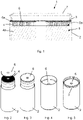
- Figure 1 shows a cut through of an example cylindrical secondary cell 1 where an electrode lead plate and a jelly roll 5 are secured in place in the cylindrical can 2 by a beading groove 3.
- the cylindrical secondary cell 1 comprises a cylindrical can 2 comprising a beading groove 3 formed in a wall of the cylindrical can 2 and arranged around the circumference of the cylindrical can 2.
- the beading groove 3 is arranged around the cylindrical wall side.
- the cylindrical secondary cell 1 comprises a first conductive sheet 4, with first electrode coating 4a wound to form a jelly roll 5 which is arranged in the can.
- the cylindrical secondary cell 1 comprises a second conductive sheet with second electrode coating.
- the cylindrical secondary cell 1 may also comprise a separator sheet.
- the first conductive sheet 4 and the second conductive sheet, and optionally, the separator sheet, are wound to form the jelly roll 5.
- there are two separator sheets so that the first conductive sheet 4, a first separator sheet, the second conductive sheet and a second separator sheet are wound to form the jelly roll 5.
- there is no separator sheet for example if a solid electrolyte is used in the cylindrical secondary cell 1.
- the first conductive sheet 4, with first electrode coating 4a is the most relevant part because it might be that a second conductive sheet is realized another way in the future which does not affect the disclosure.
- the first conductive sheet 4 comprises a portion free of first electrode coating 4a which protrudes on a first end side 5a of the jelly roll 5.
- Such a cylindrical secondary cell 1, with uncoated conductive sheet protruding on the end side of the jelly roll 5 is known as a tabless cell.
- the cylindrical secondary cell 1 comprises an electrode lead plate 6 which is electrically conductive and arranged at the first end side 5a of the jelly roll 5 and in direct contact with at least part of the portion free of first electrode coating 4a of the first conductive sheet 4.
- the electrode lead plate 6 is arranged in the cylindrical can 2 directly against, and abutting, the at least part of the portion free of first electrode coating 4a of the first conductive sheet 4.
- the electrode lead plate 6 is arranged in direct electrical and physical contact with the first conductive sheet 4.
- the electrode lead plate 6 comprises a flange extending away from the jelly roll 5 and arranged along the edge of the electrode lead plate 6, and wherein the beading groove 3 is arranged on the cylindrical can 2 such that the flange of the electrode lead plate 6 is bent and pressed inwards, towards a centre of the cylindrical can 2, by the beading groove 3.
- the electrode lead plate 6 has a protrusion along its edge, that protrudes on a side of the electrode lead plate 6 opposite of the jelly roll 5.
- the flange thus points away from the jelly roll 5.
- the flange does not need to be continuous around the whole circumference of the electrode lead plate 6.
- the flange may comprise several separate flanges arranged on the edge and directed away from the jelly roll 5.
- the flange is, for example, made by stamping a flat electrode lead plate so that the edge is bent.
- the flange looks to be completely bent so that it the bend is in parallel with the rest of the electrode lead plate 6. That may be the case, but it may also be bent inwards less than shown in figure 1 . It is sufficient that the beading groove 3 bends the flange slightly inwards.
- Figures 2-5 shows different stages when the jelly roll 5 and electrode lead plate is inserted into the cylindrical can 2.
- Figure 2 shows a cylindrical can 2 where a jelly roll 5 is being inserted and an electrode lead plate is being put on top.
- Figure 3 shows when the electrode lead plate has been arranged against the first end side 5a of the jelly roll 5.
- Figure 4 shown when the jelly roll 5 and the electrode lead plate have been inserted fully into the cylindrical can 2.
- Figure 5 shows the cylindrical can 2 after beading and how the beading groove 3 is arranged just over the electrode lead plate 6 to push it towards the jelly roll 5.
- the dark end of the jelly roll 5 is the portion free of first electrode coating 4a which protrudes on a first end side 5a of the jelly roll 5.
- the electrode lead plate is arranged. It should be noted that in the figure, the electrode lead plate is not fully visible, but slightly cut off.
- the electrode lead plate 6 has been arranged to abut the portion free of first electrode coating 4a. It may be the case that the electrode lead plate 6 is welded to the portion free of first electrode coating 4a or in another way conductively attached to the portion free of first electrode coating 4a.
- the jelly roll 5 and the electrode lead plate have been arranged in the cylindrical can 2 and in figure 5 , the cylindrical can 2 has been beaded so that the electrode lead plate is clamped towards the jelly roll 5.
- the cylindrical secondary cell 1 is not finished here; the cylindrical can 2 is open over the electrode lead plate 6 and should be closed, for example by a lid 7 as further explained below.
- the electrode lead plate 6 can be secured in its position in the beading process. Also, the electrode lead plate 6 is clamped between the jelly roll 5 and the beading groove 3 so that the electrode lead plate 6 holds the jelly roll 5 in position in the cylindrical can 2.
- Beading is a common method for cylindrical secondary cells where a groove is created in the cylindrical can 2 side.
- the beading groove 3 runs around the can side. Beading is used to form a shelf for holding a cap or lid 7 for closing a can end side and it can also be used to form a stop which prevents the jelly roll 5 from moving in the can.
- the claimed cylindrical secondary cell 1 By the claimed cylindrical secondary cell 1, the number of parts used, and the steps required for assembly can be minimized due to the electrode lead plate 6 being secured between the jelly roll 5 and the beading groove 3 in the beading process. In other words, there is no need for any additional steps, other than the beading, to secure the jelly roll 5 and/or the electrode lead plate 6.
- the pressure of the electrode lead plate 6 on the jelly roll 5 is ensured so that there is good electrical contact therebetween and also so that the jelly roll 5 is prevented from moving.
- the electrode lead plate 6 comprises, for example, copper, when it is used on the positive side, i.e. the anode side, of the jelly roll 5.
- the electrode lead plate 6 comprises, for example, aluminium, when it is used on the positive side, i.e. the cathode side, of the jelly roll 5.
- the flange of the electrode lead plate 6 is welded to the cylindrical can at the beading groove.
- the welding can be done either before beading or after beading of the cylindrical can.
- the welding is for example done from the outside of the cylindrical can, which is especially beneficial if the welding is done after beading because it is easier to reach the welding location.
- the welding method can be any method suitable to weld the cylindrical can to the electrode lead plate 6.
- the welding method is for example laser welding or resistance welding.
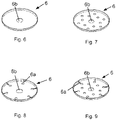
- Figure 6 shows an example of an electrode lead plate.
- Figure 7 shows an example of an electrode lead plate with more electrolyte filling holes.
- the electrode lead plate 6 comprises at least one through hole for electrolyte filling.
- the cylindrical secondary cell 1 is filled with electrolyte, there may be a need to have a hole or several holes in the electrode lead plate 6 for filling and distribution of the electrolyte inside the cell.
- the at least one hole may be differently arranged than shown in the figures.
- the star shaped form in figure 7 may be beneficial if the electrode lead plate is to be welded to the uncoated part because the alignment of the holes allows for several straight welding lines across the disc, from one end to another.
- Figure 8 shows an example of an electrode lead plate with slits in the edge.
- Figure 9 shows an example of an electrode lead plate with slits in the edge and with more electrolyte filling holes.
- the electrode lead plate 6 comprises at least one slit arranged in the flange and at least the edge of the electrode lead plate 6.
- at least one slit may be used to reduce stress in the electrode lead plate that may arise from the forces in the deformation.
- the at least one slit is for example cut out of the electrode lead plate. If the flange is made in a stamping process, the at least one slit may be made before the stamping or in the same process.
- the electrode lead plate 6 comprises at least two slits arranged in the flange and at least the edge of the electrode lead plate 6 in a symmetrical pattern around the edge.
- more or fewer slits can be used to reduce stress in the material.
- the width of the slits can also be varied.
- the electrode lead plate may comprise two slits which are wider than if the electrode lead plate has six slits.
- the one or more slits may be designed depending on material and the number of slits.
- the at least one slits are formed on the flange and extending into the electrode lead plate from the edge and inwards. According to some aspect, the at least one slit extends into the electrode lead plate between 1 and 20 mm, preferably between 1 and 10 mm. According to some aspect, the at least one slit has a width of between 0.5 and 4 mm, and preferably between 0.5 and 2 mm. As an example, the at least one slit extends into the disc, directed towards the centre of the electrode lead plate, 5 mm and has a width of 1 mm.
- the at least one slits extend into at least some of the electrolyte filling holes.
- the electrode lead plate 6 may be in direct contact with the cylindrical can 2.
- the side of the can be used as a terminal for external loads and also, the current can be led to either of the end sides of the cylindrical can 2 for having a terminal there.
- the lead plate is arranged in direct electrical and physical contact with the cylindrical can.
- the cylindrical secondary cell 1 may comprise an insulating member arranged between the electrode lead plate 6 and the cylindrical can 2.
- the terminal will be arranged on the end side of the cylindrical can 2 associated with the first end side 5a of the jelly roll 5.
- a terminal arrangement on the end side may be arranged in electrical contact with the electrode lead plate 6.
- a part closest to the edge of the electrode lead plate 6 may be bent towards the jelly roll 5.
- the electrode lead plate 6 edge may be bent towards the jelly roll 5.
- the outer edge of the electrode lead plate 6 can thus be bent towards the jelly roll and the flange then first extends upwards before being bent inwards towards the centre of the cylindrical can.
- the cylindrical secondary cell 1 may comprise a lid 7, wherein the lid 7 is resting on the beading groove 3, on a side of the beading groove 3 opposite the electrode lead plate 6.
- the lid 7 can be designed in different ways and fastened to the can by, for example, beading or seaming.
- the opposite end side of the cylindrical secondary cell 1 than the one comprising the beading groove 3 is not discussed in this disclosure.
- the terminal for an external load may be arranged on either side of the cylindrical can 2.
- one terminal of the cylindrical secondary cell 1 may be arranged in the centre of the bottom side, the bottom side being the bottom side when the cylindrical secondary cell is arranged as in figures 2-5 , and the other terminal may be arranged around the first terminal with an insulator therebetween.
- the disclosure provides a method for assembling the cylindrical secondary cell 1 according to above.
- the assembling the cylindrical secondary cell 1 comprises:
- the method provides an efficient way to secure the jelly roll 5 and the electrode lead plate 6 in the cylindrical can 2.
- the steps and number of components are thus minimized.
- the same advantages as for the above also applies here. These steps can be seen in figure 2 to 5 .
- the method comprises, before beading, to arrange an insulating member between the electrode lead plate 6 and the cylindrical can 2. This is for the case when the electrode lead plate 6 is electrically connected to a terminal in the end side associated with the first end side 5a of the jelly roll 5 and not to the cylindrical can 2 side wall.
- the beading the cylindrical can 2, to form the beading groove 3 also bends a part of the electrode lead plate 6 which is closest to the edge towards the jelly roll 5.
Landscapes
- Chemical & Material Sciences (AREA)
- Chemical Kinetics & Catalysis (AREA)
- Electrochemistry (AREA)
- General Chemical & Material Sciences (AREA)
- Engineering & Computer Science (AREA)
- Manufacturing & Machinery (AREA)
- Connection Of Batteries Or Terminals (AREA)
- Secondary Cells (AREA)
- Sealing Battery Cases Or Jackets (AREA)
- Cell Separators (AREA)
- Filling, Topping-Up Batteries (AREA)
- Battery Electrode And Active Subsutance (AREA)
Abstract
Description
- The present disclosure relates to a cylindrical secondary cell and a method for assembling it.
- The transition from fossil fuels towards renewable energy has gained considerable momentum. One of the most important contributing factors is the development of better and cheaper rechargeable batteries. Currently, lithium-ion batteries are becoming increasingly popular. They represent a type of rechargeable battery in which lithium ions move from the negative electrode to the positive electrode during discharge and back when charging.
- As the demand for rechargeable batteries increases, more and more focus is being placed on production speed so that producing companies can meet the demand. To achieve an effective production of rechargeable batteries, steps of the manufacturing process can be optimized. Another aspect to consider is that the rechargeable batteries must be safe to use.
- A rechargeable battery, or, in other words, a secondary battery, comprises one or more secondary cells.
- In view of the above, it is an aim of the disclosure to provide an improved cylindrical secondary cell for rechargeable batteries.
- This aim is achieved by a device as defined in
claims 1, and a method as defined in claim 9. - The disclosure provides a cylindrical secondary cell comprising:
- a cylindrical can comprising a beading groove formed in a wall of the cylindrical can and arranged around the circumference of the cylindrical can,
- a first conductive sheet, with first electrode coating, wound to form a jelly roll which is arranged in the can, and wherein the first conductive sheet comprises a portion free of first electrode coating which protrudes on a first end side of the jelly roll, and
- an electrode lead plate which is electrically conductive and arranged at the first end side of the jelly roll and in direct contact with at least part of the portion free of first electrode coating of the first conductive sheet,
- The electrode lead plate comprises a flange extending away from the jelly roll and arranged along the edge of the electrode lead plate, and wherein the beading groove is arranged on the cylindrical can such that the flange of the electrode lead plate is bent and pressed inwards, towards a centre of the cylindrical can, by the beading groove.
- By this cylindrical secondary cell, the electrode lead plate can be secured in its position in the beading process. Also, the electrode lead plate is clamped between the jelly roll and the beading groove so that the electrode lead plate holds the jelly roll in position in the cylindrical can.
- Beading is a common method for cylindrical secondary cells where a groove is created in the cylindrical can side. The beading groove runs around the can side. Beading is used to form a shelf for holding a cap or lid for closing a can end side and it can also be used to form a stop which prevents the jelly roll from moving in the can.
- By the claimed cylindrical secondary cell, the number of parts used, and the steps required for assembly can be minimized due to the electrode lead plate being secured between the jelly roll and the beading groove in the beading process. In other words, there is no need for any additional steps, other than the beading, to secure the jelly roll and/or the electrode lead plate.
- By having a flange of the electrode lead plate that is deformed by the beading groove, the pressure of the electrode lead plate on the jelly roll is ensured so that there is good electrical contact therebetween and also so that the jelly roll is prevented from moving.
- It should be noted that the disclosure herein may be used on either the positive or negative side of the cylindrical secondary cell.
- The electrode lead plate comprises, for example, copper, when it is used on the negative side, i.e. the anode side, of the jelly roll. Alternative materials comprise for example, any of, or a mix of: of stainless steel, nickel, nickel/copper clad material.
- The electrode lead plate comprises, for example, aluminium or stainless steel or a mixture thereof, when it is used on the positive side, i.e. the cathode side, of the jelly roll.
- According to some aspects, the electrode lead plate comprises at least one slit arranged in the flange and at least the edge of the electrode lead plate. When the flange of the electrode lead plate is deformed by the beading groove, at least one slit may be used to reduce stress in the electrode lead plate that may arise from the forces in the deformation.
- According to some aspects, the electrode lead plate comprises at least two slits arranged in the flange and at least the edge of the electrode lead plate in a symmetrical pattern around the edge. Depending on the material of the electrode lead plate, more or less slits can be used to reduce stress in the material. The width of the slits can also be varied. For example, the electrode lead plate may comprise two slits which are wider than if the electrode lead plate has six slits. In other words, the one or more slits may be designed depending on material and the number of slits.
- According to some aspects, the electrode lead plate comprises at least one through hole for electrolyte filling. Depending on how the cylindrical secondary cell is filled with electrolyte, there may be a need to have a hole or several holes in the electrode lead plate for filling and distribution of the electrolyte inside the cell.
- According to some aspects, the electrode lead plate is in direct contact with the cylindrical can. By having the lead plate in direct electrical contact with the cylindrical can, the side of the can be used as a terminal for external loads and also, the current can be led to either of the end sides of the cylindrical can for having a terminal there. Thus, it is very flexible where to arrange the terminal. Direct electrical contact means direct electrical and physical contact.
- According to some aspects, the flange of the electrode lead plate is welded to the cylindrical can. Welding, in addition to securing the electrode lead plate in its position in the beading process, improves the electrical contact between the electrode lead plate and the cylindrical can.
- According to some aspects, the cylindrical secondary cell comprises an insulating member arranged between the electrode lead plate and the cylindrical can. In such a case, the terminal will be arranged on the end side of the cylindrical can associated with the first end side of the jelly roll. A terminal arrangement on the end side may be arranged in electrical contact with the electrode lead plate.
- According to some aspects, a part closest to the edge of the electrode lead plate is bent towards the jelly roll. In other words, when the flange of the electrode lead plate is bent inwards by the beading groove, the electrode lead plate edge may be bent towards the jelly roll.
- Accordingto some aspects, the cylindrical secondary cell comprises a lid, wherein the lid is resting on the beading groove, on a side of the beading groove opposite the electrode lead plate.
- The disclosure provides a method for assembling the cylindrical secondary cell according to above. The assembling the cylindrical secondary cell comprises:
- arranging the jelly roll in the cylindrical can,
- arranging the electrode lead plate (6) in the cylindrical can so that at least part of the portion free of first electrode coating of the first conductive sheet is in direct contact with the electrode lead plate,
- beading the cylindrical can to form the beading groove at a position on the cylindrical can so that the flange of the electrode lead plate is bent and pressed inwards, towards a centre of the cylindrical can, by the beading groove.
- The method provides an efficient way to secure the jelly roll and the electrode lead plate in the cylindrical can. The steps and number of components are thus minimized. The same advantages as for the above also applies here.
- According to some aspects, the method comprises, before beading:
- arranging an insulating member between the electrode lead plate and the cylindrical can.
- This is for the case when the electrode lead plate is electrically connected to a terminal in the end side associated with the first end side of the jelly roll and not to the cylindrical can side wall.
- According to some aspects, the method comprises, welding the flange to the cylindrical can. Welding, in addition to securing the electrode lead plate in its position in the beading process, improves the electrical contact between the electrode lead plate and the cylindrical can.
- According to some aspects, the beading the cylindrical can to form the beading groove also bends a part of the electrode lead plate which is closest to the edge towards the jelly roll.
- Different aspects are now described, by way of example, with reference to the accompanying drawings, in which:
-
Fig. 1 shows a cut through of an example cylindrical secondary cell where an electrode lead plate and a jelly roll are secured in place in the cylindrical can by a beading groove. -
Fig. 2 shows a cylindrical can where a jelly roll is being inserted and an electrode lead plate is being put on top. -
Fig. 3 shows when the electrode lead plate has been arranged against the first end side of the jelly roll. -
Fig. 4 shown when the jelly roll and the electrode lead plate have been inserted fully into the cylindrical can. -
Fig. 5 shows the cylindrical can after beading and how the beading groove is arranged just over the electrode lead plate to push it towards the jelly roll. -
Fig. 6 shows an example of an electrode lead plate. -
Fig. 7 shows an example of an electrode lead plate with more electrolyte filling holes. -
Fig. 8 shows an example of an electrode lead plate with slits in the edge. -
Fig. 9 shows an example of an electrode lead plate with slits in the edge and with more electrolyte filling holes. - The disclosure is not limited to the embodiments disclosed but may be varied and modified within the scope of the claims.
- Aspects of the disclosure will now be described with reference to the accompanying drawings. The device and method disclosed herein can, however, be realized in many different forms and should not be construed as being limited to the aspects set forth herein.
- The terminology used herein is for the purpose of describing particular aspects of the disclosure only and is not intended to limit the invention. The singular forms "a", "an" and "the" are intended to include plural forms as well, unless the context clearly indicates otherwise.
- With the term "terminal" is meant a part of a secondary cell which is to be connect to an external load.
- Alternative terms for the term "can" are "case" and "housing case".
- Alternative terms for the term "conductive sheet" are "conductive substrate" and "current collector".
-
Figure 1 shows a cut through of an example cylindricalsecondary cell 1 where an electrode lead plate and ajelly roll 5 are secured in place in thecylindrical can 2 by abeading groove 3. - The cylindrical
secondary cell 1 comprises acylindrical can 2 comprising abeading groove 3 formed in a wall of thecylindrical can 2 and arranged around the circumference of thecylindrical can 2. In other words, thebeading groove 3 is arranged around the cylindrical wall side. - The cylindrical
secondary cell 1 comprises a firstconductive sheet 4, withfirst electrode coating 4a wound to form ajelly roll 5 which is arranged in the can. - According to some aspects, the cylindrical
secondary cell 1 comprises a second conductive sheet with second electrode coating. The cylindricalsecondary cell 1 may also comprise a separator sheet. The firstconductive sheet 4 and the second conductive sheet, and optionally, the separator sheet, are wound to form thejelly roll 5. Alternatively, there are two separator sheets so that the firstconductive sheet 4, a first separator sheet, the second conductive sheet and a second separator sheet are wound to form thejelly roll 5. It may also be the case that there is no separator sheet, for example if a solid electrolyte is used in the cylindricalsecondary cell 1. For the purpose of the present disclosure, the firstconductive sheet 4, withfirst electrode coating 4a, is the most relevant part because it might be that a second conductive sheet is realized another way in the future which does not affect the disclosure. - The first
conductive sheet 4 comprises a portion free offirst electrode coating 4a which protrudes on afirst end side 5a of thejelly roll 5. Such a cylindricalsecondary cell 1, with uncoated conductive sheet protruding on the end side of thejelly roll 5 is known as a tabless cell. - The cylindrical
secondary cell 1 comprises anelectrode lead plate 6 which is electrically conductive and arranged at thefirst end side 5a of thejelly roll 5 and in direct contact with at least part of the portion free offirst electrode coating 4a of the firstconductive sheet 4. In other words, and as can be seen infigure 1 , theelectrode lead plate 6 is arranged in thecylindrical can 2 directly against, and abutting, the at least part of the portion free offirst electrode coating 4a of the firstconductive sheet 4. Theelectrode lead plate 6 is arranged in direct electrical and physical contact with the firstconductive sheet 4. - The
electrode lead plate 6 comprises a flange extending away from thejelly roll 5 and arranged along the edge of theelectrode lead plate 6, and wherein thebeading groove 3 is arranged on thecylindrical can 2 such that the flange of theelectrode lead plate 6 is bent and pressed inwards, towards a centre of thecylindrical can 2, by thebeading groove 3. - In other words, the
electrode lead plate 6 has a protrusion along its edge, that protrudes on a side of theelectrode lead plate 6 opposite of thejelly roll 5. The flange thus points away from thejelly roll 5. - It should be noted that the flange does not need to be continuous around the whole circumference of the
electrode lead plate 6. The flange may comprise several separate flanges arranged on the edge and directed away from thejelly roll 5. - The flange is, for example, made by stamping a flat electrode lead plate so that the edge is bent.
- It should also be noted that in
figure 1 , the flange looks to be completely bent so that it the bend is in parallel with the rest of theelectrode lead plate 6. That may be the case, but it may also be bent inwards less than shown infigure 1 . It is sufficient that thebeading groove 3 bends the flange slightly inwards. -
Figures 2-5 shows different stages when thejelly roll 5 and electrode lead plate is inserted into thecylindrical can 2.Figure 2 shows acylindrical can 2 where ajelly roll 5 is being inserted and an electrode lead plate is being put on top.Figure 3 shows when the electrode lead plate has been arranged against thefirst end side 5a of thejelly roll 5.Figure 4 shown when thejelly roll 5 and the electrode lead plate have been inserted fully into thecylindrical can 2.Figure 5 shows thecylindrical can 2 after beading and how thebeading groove 3 is arranged just over theelectrode lead plate 6 to push it towards thejelly roll 5. - In
figure 2 , the dark end of thejelly roll 5 is the portion free offirst electrode coating 4a which protrudes on afirst end side 5a of thejelly roll 5. Directly on top of it, the electrode lead plate is arranged. It should be noted that in the figure, the electrode lead plate is not fully visible, but slightly cut off. - In
figure 3 , theelectrode lead plate 6 has been arranged to abut the portion free offirst electrode coating 4a. It may be the case that theelectrode lead plate 6 is welded to the portion free offirst electrode coating 4a or in another way conductively attached to the portion free offirst electrode coating 4a. - In
figure 4 , thejelly roll 5 and the electrode lead plate have been arranged in thecylindrical can 2 and infigure 5 , thecylindrical can 2 has been beaded so that the electrode lead plate is clamped towards thejelly roll 5. It should be noted that the cylindricalsecondary cell 1 is not finished here; thecylindrical can 2 is open over theelectrode lead plate 6 and should be closed, for example by alid 7 as further explained below. - By this cylindrical
secondary cell 1, theelectrode lead plate 6 can be secured in its position in the beading process. Also, theelectrode lead plate 6 is clamped between thejelly roll 5 and thebeading groove 3 so that theelectrode lead plate 6 holds thejelly roll 5 in position in thecylindrical can 2. - Beading is a common method for cylindrical secondary cells where a groove is created in the
cylindrical can 2 side. Thebeading groove 3 runs around the can side. Beading is used to form a shelf for holding a cap orlid 7 for closing a can end side and it can also be used to form a stop which prevents thejelly roll 5 from moving in the can. - By the claimed cylindrical
secondary cell 1, the number of parts used, and the steps required for assembly can be minimized due to theelectrode lead plate 6 being secured between thejelly roll 5 and thebeading groove 3 in the beading process. In other words, there is no need for any additional steps, other than the beading, to secure thejelly roll 5 and/or theelectrode lead plate 6. - By having a flange of the
electrode lead plate 6 that is deformed by thebeading groove 3, the pressure of theelectrode lead plate 6 on thejelly roll 5 is ensured so that there is good electrical contact therebetween and also so that thejelly roll 5 is prevented from moving. - The
electrode lead plate 6 comprises, for example, copper, when it is used on the positive side, i.e. the anode side, of thejelly roll 5. - The
electrode lead plate 6 comprises, for example, aluminium, when it is used on the positive side, i.e. the cathode side, of thejelly roll 5. - According to some aspects, the flange of the
electrode lead plate 6 is welded to the cylindrical can at the beading groove. The welding can be done either before beading or after beading of the cylindrical can. In other words, in the method of assembling the cylindrical secondary cell described below, there might be an additional step of welding the flange to the cylindrical can, either before or after beading. The welding is for example done from the outside of the cylindrical can, which is especially beneficial if the welding is done after beading because it is easier to reach the welding location. The welding method can be any method suitable to weld the cylindrical can to theelectrode lead plate 6. The welding method is for example laser welding or resistance welding. -
Figure 6 shows an example of an electrode lead plate.Figure 7 shows an example of an electrode lead plate with more electrolyte filling holes. - According to some aspects, the
electrode lead plate 6 comprises at least one through hole for electrolyte filling. Depending on how the cylindricalsecondary cell 1 is filled with electrolyte, there may be a need to have a hole or several holes in theelectrode lead plate 6 for filling and distribution of the electrolyte inside the cell. The at least one hole may be differently arranged than shown in the figures. The star shaped form infigure 7 may be beneficial if the electrode lead plate is to be welded to the uncoated part because the alignment of the holes allows for several straight welding lines across the disc, from one end to another. -
Figure 8 shows an example of an electrode lead plate with slits in the edge.Figure 9 shows an example of an electrode lead plate with slits in the edge and with more electrolyte filling holes. - According to some aspects, the
electrode lead plate 6 comprises at least one slit arranged in the flange and at least the edge of theelectrode lead plate 6. When the flange of the electrode lead plate is deformed by thebeading groove 3, at least one slit may be used to reduce stress in the electrode lead plate that may arise from the forces in the deformation. The at least one slit is for example cut out of the electrode lead plate. If the flange is made in a stamping process, the at least one slit may be made before the stamping or in the same process. - According to some aspects, the
electrode lead plate 6 comprises at least two slits arranged in the flange and at least the edge of theelectrode lead plate 6 in a symmetrical pattern around the edge. Depending on the material of the electrode lead plate, more or fewer slits can be used to reduce stress in the material. The width of the slits can also be varied. For example, the electrode lead plate may comprise two slits which are wider than if the electrode lead plate has six slits. In other words, the one or more slits may be designed depending on material and the number of slits. - The at least one slits are formed on the flange and extending into the electrode lead plate from the edge and inwards. According to some aspect, the at least one slit extends into the electrode lead plate between 1 and 20 mm, preferably between 1 and 10 mm. According to some aspect, the at least one slit has a width of between 0.5 and 4 mm, and preferably between 0.5 and 2 mm. As an example, the at least one slit extends into the disc, directed towards the centre of the electrode lead plate, 5 mm and has a width of 1 mm.
- As can be seen in the example
electrode lead plates 6 offigures 8 and 9 , the at least one slits extend into at least some of the electrolyte filling holes. - As can be seen in the example of
figure 1 , theelectrode lead plate 6 may be in direct contact with thecylindrical can 2. By having the lead plate in direct electrical contact with thecylindrical can 2, the side of the can be used as a terminal for external loads and also, the current can be led to either of the end sides of thecylindrical can 2 for having a terminal there. Thus, it is very flexible where to arrange the terminal. The lead plate is arranged in direct electrical and physical contact with the cylindrical can. - An example that is not shown in the figures is that the cylindrical
secondary cell 1 may comprise an insulating member arranged between theelectrode lead plate 6 and thecylindrical can 2. In such a case, the terminal will be arranged on the end side of thecylindrical can 2 associated with thefirst end side 5a of thejelly roll 5. A terminal arrangement on the end side may be arranged in electrical contact with theelectrode lead plate 6. - Another example that is not shown in the figures is that a part closest to the edge of the
electrode lead plate 6 may be bent towards thejelly roll 5. In other words, when the flange of theelectrode lead plate 6 is bent inwards by thebeading groove 3, theelectrode lead plate 6 edge may be bent towards thejelly roll 5. The outer edge of theelectrode lead plate 6 can thus be bent towards the jelly roll and the flange then first extends upwards before being bent inwards towards the centre of the cylindrical can. - As can be seen in the example of
figure 1 , the cylindricalsecondary cell 1 may comprise alid 7, wherein thelid 7 is resting on thebeading groove 3, on a side of thebeading groove 3 opposite theelectrode lead plate 6. Thelid 7 can be designed in different ways and fastened to the can by, for example, beading or seaming. - The opposite end side of the cylindrical
secondary cell 1 than the one comprising thebeading groove 3 is not discussed in this disclosure. There are many ways to connect the opposite side of thejelly roll 5 to a terminal and they do not impact how theelectrode lead plate 6 is locked in place by thebeading groove 3. In the case when the electrode lead plate is in direct contact with thecylindrical can 2, the terminal for an external load may be arranged on either side of thecylindrical can 2. As an example, one terminal of the cylindricalsecondary cell 1 may be arranged in the centre of the bottom side, the bottom side being the bottom side when the cylindrical secondary cell is arranged as infigures 2-5 , and the other terminal may be arranged around the first terminal with an insulator therebetween. - The disclosure provides a method for assembling the cylindrical
secondary cell 1 according to above. The assembling the cylindricalsecondary cell 1 comprises: - arranging the
jelly roll 5 in thecylindrical can 2, - arranging the
electrode lead plate 6 in thecylindrical can 2 so that at least part of the portion free offirst electrode coating 4a of the firstconductive sheet 4 is in direct contact with theelectrode lead plate 6, - beading the
cylindrical can 2 to form thebeading groove 3 at a position on thecylindrical can 2 so that the flange of theelectrode lead plate 6 is bent and pressed inwards, towards a centre of thecylindrical can 2, by thebeading groove 3. - The method provides an efficient way to secure the
jelly roll 5 and theelectrode lead plate 6 in thecylindrical can 2. The steps and number of components are thus minimized. The same advantages as for the above also applies here. These steps can be seen infigure 2 to 5 . - According to some aspects, the method comprises, before beading, to arrange an insulating member between the
electrode lead plate 6 and thecylindrical can 2. This is for the case when theelectrode lead plate 6 is electrically connected to a terminal in the end side associated with thefirst end side 5a of thejelly roll 5 and not to thecylindrical can 2 side wall. - According to some aspects, the beading the
cylindrical can 2, to form thebeading groove 3 also bends a part of theelectrode lead plate 6 which is closest to the edge towards thejelly roll 5. -
- 1.
- Cylindrical secondary cell
- 2.
- Cylindrical can
- 3.
- Beading groove
- 4.
- First conductive sheet
a. First electrode coating - 5.
- Jelly roll
a. First end side - 6.
- Electrode lead plate
- 7.
- Lid
Claims (13)
- A cylindrical secondary cell (1) comprising:- a cylindrical can (2) comprising a beading groove (3) formed in a wall of the cylindrical can (2) and arranged around the circumference of the cylindrical can (2),- a first conductive sheet (4), with first electrode coating (4a), wound to form a jelly roll (5) which is arranged in the cylindrical can (2), and wherein the first conductive sheet (4) comprises a portion free of first electrode coating (4a) which protrudes on a first end side (5a) of the jelly roll (5), and- an electrode lead plate (6) which is electrically conductive and arranged at the first end side (5a) of the jelly roll (5) and in direct contact with at least part of the portion free of first electrode coating (4a) of the first conductive sheet (4),characterized in that the electrode lead plate (6) comprises a flange (6a) extending away from the jelly roll (5) and arranged along the edge of the electrode lead plate (6), and wherein the beading groove (3) is arranged on the cylindrical can (2) such that the flange of the electrode lead plate (6) is bent and pressed inwards, towards a centre of the cylindrical can (2), by the beading groove (3).
- The cylindrical secondary cell (1) according to claim 1, wherein the electrode lead plate (6) comprises at least one slit (6a) arranged in the flange and at least the edge of the electrode lead plate (6).
- The cylindrical secondary cell (1) according to claim 2, wherein the electrode lead plate (6) comprises at least two slits (6a) arranged in the flange and at least the edge of the electrode lead plate (6) in a symmetrical pattern around the edge.
- The cylindrical secondary cell (1) according to any preceding claim, wherein the electrode lead plate (6) comprises at least one through hole (6b) for electrolyte filling.
- The cylindrical secondary cell (1) according to any preceding claim, wherein the electrode lead plate (6) is in direct contact with the cylindrical can (2).
- The cylindrical secondary cell (1) according to any preceding claim, wherein the flange of the electrode lead plate (6) is welded to the cylindrical can (3).
- The cylindrical secondary cell (1) according to any one of claims 1 to 5, comprising an insulating member arranged between the electrode lead plate (6) and the cylindrical can (2).
- The cylindrical secondary cell (1) according to any preceding claim, wherein a part closest to the edge of the electrode lead plate (6) is bent towards the jelly roll (5).
- The cylindrical secondary cell (1) according to any preceding claim, comprising a lid (7), wherein the lid (7) is resting on the beading groove (3), on a side of the beading groove (3) opposite the electrode lead plate (6).
- Method for assembling the cylindrical secondary cell (1) according to any one of claims 1 to 8, wherein the assembling the cylindrical secondary cell (1) comprises:- arranging the jelly roll (5) in the cylindrical can (2),- arranging the electrode lead plate (6) in the cylindrical can (2) so that at least part of the portion (4a) free of first electrode coating (4a) of the first conductive sheet (4) is in direct contact with the electrode lead plate (6),- beading the cylindrical can (2) to form the beading groove (3) at a position on the cylindrical can (2) so that the flange of the electrode lead plate (6) is bent and pressed inwards, towards a centre of the cylindrical can (2), by the beading groove (3).
- The method according to claim 10, comprising, before beading:- arranging an insulating member between the electrode lead plate (6) and the cylindrical can (2).
- The method according to claim 10, comprises:- welding the flange to the cylindrical can.
- The method according to any one of claims 10 to 12, wherein the beading the cylindrical can (2) to form the beading groove (3) also bends a part of the electrode lead plate (6) which is closest to the edge towards the jelly roll (5).
Applications Claiming Priority (1)
| Application Number | Priority Date | Filing Date | Title |
|---|---|---|---|
| SE2150507A SE544360C2 (en) | 2021-04-22 | 2021-04-22 | Cylindrical secondary cell |
Publications (2)
| Publication Number | Publication Date |
|---|---|
| EP4080634A2 true EP4080634A2 (en) | 2022-10-26 |
| EP4080634A3 EP4080634A3 (en) | 2023-03-08 |
Family
ID=81184737
Family Applications (1)
| Application Number | Title | Priority Date | Filing Date |
|---|---|---|---|
| EP22168814.6A Pending EP4080634A3 (en) | 2021-04-22 | 2022-04-19 | Cylindrical secondary cell |
Country Status (7)
| Country | Link |
|---|---|
| US (1) | US11670815B2 (en) |
| EP (1) | EP4080634A3 (en) |
| JP (1) | JP7781909B2 (en) |
| KR (1) | KR20230160343A (en) |
| CN (1) | CN117157790A (en) |
| SE (1) | SE544360C2 (en) |
| WO (1) | WO2022223531A1 (en) |
Cited By (5)
| Publication number | Priority date | Publication date | Assignee | Title |
|---|---|---|---|---|
| EP4199238A4 (en) * | 2021-10-20 | 2023-08-16 | Contemporary Amperex Technology Co., Limited | Battery cell, battery, electrical device, and method and device for manufacturing battery cell |
| SE2251580A1 (en) * | 2022-12-23 | 2023-09-18 | Northvolt Ab | Secondary cell |
| EP4307462A4 (en) * | 2021-03-08 | 2025-04-16 | LG Energy Solution, Ltd. | CYLINDRICAL SECONDARY BATTERY, BATTERY PACK AND MEANS OF TRANSPORT |
| EP4693635A1 (en) * | 2024-08-01 | 2026-02-11 | SK On Co., Ltd. | Current collecting plate and battery cell comprising the same |
| EP4697463A1 (en) * | 2024-08-15 | 2026-02-18 | AESC Japan Ltd. | Secondary battery, battery cell, and electronic device |
Families Citing this family (8)
| Publication number | Priority date | Publication date | Assignee | Title |
|---|---|---|---|---|
| JP7610018B2 (en) * | 2021-07-06 | 2025-01-07 | ジアンス・コンテンポラリー・アンプレックス・テクノロジー・リミテッド | Battery cell, battery, power consumption device, and method and device for manufacturing battery cell |
| KR102530339B1 (en) * | 2022-01-19 | 2023-05-09 | 삼성에스디아이 주식회사 | Secondary battery |
| EP4297171A4 (en) * | 2022-05-12 | 2024-10-02 | Eve Power Co., Ltd. | Connector and battery |
| KR102559656B1 (en) * | 2022-10-06 | 2023-07-24 | 삼성에스디아이 주식회사 | Rechargeable battery |
| EP4572000A4 (en) * | 2022-11-08 | 2025-12-31 | Lg Energy Solution Ltd | BATTERY AND BATTERY PACK AS WELL AS VEHICLE WITH IT |
| SE546927C2 (en) * | 2022-12-23 | 2025-03-11 | Northvolt Ab | Secondary cell |
| CN221080159U (en) * | 2023-11-07 | 2024-06-04 | 株式会社Aesc日本 | Secondary battery, battery pack, and electronic device |
| CN222953317U (en) * | 2024-08-15 | 2025-06-06 | 株式会社Aesc日本 | Secondary battery, battery pack and electronic device |
Family Cites Families (11)
| Publication number | Priority date | Publication date | Assignee | Title |
|---|---|---|---|---|
| JP4436587B2 (en) | 2002-01-31 | 2010-03-24 | パナソニック株式会社 | Battery and battery pack |
| KR100599749B1 (en) * | 2004-06-23 | 2006-07-12 | 삼성에스디아이 주식회사 | Secondary Battery and Electrode Assembly Used in the Same |
| JP4817871B2 (en) * | 2005-03-30 | 2011-11-16 | 三洋電機株式会社 | battery |
| JP5051410B2 (en) * | 2005-05-30 | 2012-10-17 | 株式会社Gsユアサ | Sealed battery lead, sealed battery using the lead, and method of manufacturing the battery |
| KR100709862B1 (en) * | 2005-12-23 | 2007-04-23 | 삼성에스디아이 주식회사 | Cylindrical secondary battery |
| US9490079B2 (en) | 2014-03-28 | 2016-11-08 | Cooper Technologies Company | Electrochemical energy storage device with flexible metal contact current collector and methods of manufacture |
| KR102143576B1 (en) | 2015-01-19 | 2020-09-09 | 엘에스엠트론 주식회사 | Improved electric energy storage device for inner terminal installation structure |
| KR102203249B1 (en) * | 2017-10-10 | 2021-01-13 | 주식회사 엘지화학 | Cylindrical Battery Cell Having Connection Cap |
| JP7315005B2 (en) | 2019-07-30 | 2023-07-26 | 株式会社村田製作所 | Secondary batteries, battery packs, electric tools, electric aircraft and electric vehicles |
| CA3202317A1 (en) | 2021-01-19 | 2022-07-28 | Lg Energy Solution, Ltd. | Battery and current collector applied thereto, and battery pack and vehicle including the same |
| US12407028B2 (en) * | 2021-02-19 | 2025-09-02 | Lg Energy Solution, Ltd. | Electrode assembly, battery, and battery pack and vehicle including the same |
-
2021
- 2021-04-22 SE SE2150507A patent/SE544360C2/en unknown
-
2022
- 2022-04-18 US US17/659,586 patent/US11670815B2/en active Active
- 2022-04-19 EP EP22168814.6A patent/EP4080634A3/en active Pending
- 2022-04-19 CN CN202280028841.6A patent/CN117157790A/en active Pending
- 2022-04-19 JP JP2023563883A patent/JP7781909B2/en active Active
- 2022-04-19 WO PCT/EP2022/060268 patent/WO2022223531A1/en not_active Ceased
- 2022-04-19 KR KR1020237036080A patent/KR20230160343A/en active Pending
Cited By (6)
| Publication number | Priority date | Publication date | Assignee | Title |
|---|---|---|---|---|
| EP4307462A4 (en) * | 2021-03-08 | 2025-04-16 | LG Energy Solution, Ltd. | CYLINDRICAL SECONDARY BATTERY, BATTERY PACK AND MEANS OF TRANSPORT |
| EP4199238A4 (en) * | 2021-10-20 | 2023-08-16 | Contemporary Amperex Technology Co., Limited | Battery cell, battery, electrical device, and method and device for manufacturing battery cell |
| SE2251580A1 (en) * | 2022-12-23 | 2023-09-18 | Northvolt Ab | Secondary cell |
| SE547682C2 (en) * | 2022-12-23 | 2025-11-11 | Northvolt Ab | Secondary cell |
| EP4693635A1 (en) * | 2024-08-01 | 2026-02-11 | SK On Co., Ltd. | Current collecting plate and battery cell comprising the same |
| EP4697463A1 (en) * | 2024-08-15 | 2026-02-18 | AESC Japan Ltd. | Secondary battery, battery cell, and electronic device |
Also Published As
| Publication number | Publication date |
|---|---|
| JP7781909B2 (en) | 2025-12-08 |
| JP2024514664A (en) | 2024-04-02 |
| CN117157790A (en) | 2023-12-01 |
| WO2022223531A1 (en) | 2022-10-27 |
| US11670815B2 (en) | 2023-06-06 |
| US20220344749A1 (en) | 2022-10-27 |
| EP4080634A3 (en) | 2023-03-08 |
| KR20230160343A (en) | 2023-11-23 |
| SE2150507A1 (en) | 2022-04-19 |
| SE544360C2 (en) | 2022-04-19 |
Similar Documents
| Publication | Publication Date | Title |
|---|---|---|
| EP4080634A2 (en) | Cylindrical secondary cell | |
| JP2024514664A5 (en) | ||
| KR102885306B1 (en) | Rechargeable battery | |
| KR102902140B1 (en) | Cylindrical secondary battery | |
| KR20230032898A (en) | Cylindrical battery cell, and battery pack and vehicle including the same | |
| US20230246317A1 (en) | Electrochemical Cell Design And Structure | |
| CN222015520U (en) | Button type secondary battery | |
| EP4572000A1 (en) | Battery, and battery pack and vehicle comprising same | |
| WO2024133407A1 (en) | Secondary cell | |
| US20250379339A1 (en) | Current collector plates for batteries | |
| US20250219267A1 (en) | Cylindrical battery cell, and battery pack and vehicle including the same | |
| EP4696451A1 (en) | Welding mask jig | |
| US20260005405A1 (en) | Battery module | |
| EP4641724A1 (en) | Battery cell and manufacturing method of the same | |
| JP7617267B2 (en) | Secondary battery, battery pack, and automobile | |
| EP4513613A1 (en) | Secondary battery | |
| SE2330594A1 (en) | Cylindrical secondary cell | |
| WO2025133036A1 (en) | Secondary cell | |
| WO2024133544A1 (en) | Secondary cell | |
| SE545612C2 (en) | A cylindrical secondary cell comprising an enclosure with a reduced radius section, a lid, and a collector plate | |
| WO2025132882A1 (en) | Secondary cell | |
| KR20250081396A (en) | Can, secondary battery including same, and method of manufacturing secondary battery including same | |
| KR20240162376A (en) | Cylindrical battery cell, and battery pack and vehicle including the same | |
| WO2024133557A1 (en) | Secondary cell | |
| WO2024133554A1 (en) | Secondary cell |
Legal Events
| Date | Code | Title | Description |
|---|---|---|---|
| PUAI | Public reference made under article 153(3) epc to a published international application that has entered the european phase |
Free format text: ORIGINAL CODE: 0009012 |
|
| STAA | Information on the status of an ep patent application or granted ep patent |
Free format text: STATUS: THE APPLICATION HAS BEEN PUBLISHED |
|
| AK | Designated contracting states |
Kind code of ref document: A2 Designated state(s): AL AT BE BG CH CY CZ DE DK EE ES FI FR GB GR HR HU IE IS IT LI LT LU LV MC MK MT NL NO PL PT RO RS SE SI SK SM TR |
|
| PUAL | Search report despatched |
Free format text: ORIGINAL CODE: 0009013 |
|
| AK | Designated contracting states |
Kind code of ref document: A3 Designated state(s): AL AT BE BG CH CY CZ DE DK EE ES FI FR GB GR HR HU IE IS IT LI LT LU LV MC MK MT NL NO PL PT RO RS SE SI SK SM TR |
|
| RIC1 | Information provided on ipc code assigned before grant |
Ipc: H01M 50/538 20210101ALI20230127BHEP Ipc: H01M 10/0587 20100101ALI20230127BHEP Ipc: H01M 10/04 20060101AFI20230127BHEP |
|
| STAA | Information on the status of an ep patent application or granted ep patent |
Free format text: STATUS: REQUEST FOR EXAMINATION WAS MADE |
|
| 17P | Request for examination filed |
Effective date: 20230822 |
|
| RBV | Designated contracting states (corrected) |
Designated state(s): AL AT BE BG CH CY CZ DE DK EE ES FI FR GB GR HR HU IE IS IT LI LT LU LV MC MK MT NL NO PL PT RO RS SE SI SK SM TR |
|
| 19U | Interruption of proceedings before grant |
Effective date: 20250312 |