EP4080618A1 - Positive electrode active material and positive electrode plate for all-solid lithium secondary battery, all-solid lithium secondary battery, and device - Google Patents
Positive electrode active material and positive electrode plate for all-solid lithium secondary battery, all-solid lithium secondary battery, and device Download PDFInfo
- Publication number
- EP4080618A1 EP4080618A1 EP21803650.7A EP21803650A EP4080618A1 EP 4080618 A1 EP4080618 A1 EP 4080618A1 EP 21803650 A EP21803650 A EP 21803650A EP 4080618 A1 EP4080618 A1 EP 4080618A1
- Authority
- EP
- European Patent Office
- Prior art keywords
- positive electrode
- electrode active
- solid
- lithium secondary
- secondary battery
- Prior art date
- Legal status (The legal status is an assumption and is not a legal conclusion. Google has not performed a legal analysis and makes no representation as to the accuracy of the status listed.)
- Granted
Links
Images

Classifications
-
- H—ELECTRICITY
- H01—ELECTRIC ELEMENTS
- H01M—PROCESSES OR MEANS, e.g. BATTERIES, FOR THE DIRECT CONVERSION OF CHEMICAL ENERGY INTO ELECTRICAL ENERGY
- H01M4/00—Electrodes
- H01M4/02—Electrodes composed of, or comprising, active material
- H01M4/36—Selection of substances as active materials, active masses, active liquids
- H01M4/48—Selection of substances as active materials, active masses, active liquids of inorganic oxides or hydroxides
- H01M4/52—Selection of substances as active materials, active masses, active liquids of inorganic oxides or hydroxides of nickel, cobalt or iron
- H01M4/525—Selection of substances as active materials, active masses, active liquids of inorganic oxides or hydroxides of nickel, cobalt or iron of mixed oxides or hydroxides containing iron, cobalt or nickel for inserting or intercalating light metals, e.g. LiNiO2, LiCoO2 or LiCoOxFy
-
- H—ELECTRICITY
- H01—ELECTRIC ELEMENTS
- H01M—PROCESSES OR MEANS, e.g. BATTERIES, FOR THE DIRECT CONVERSION OF CHEMICAL ENERGY INTO ELECTRICAL ENERGY
- H01M10/00—Secondary cells; Manufacture thereof
- H01M10/05—Accumulators with non-aqueous electrolyte
- H01M10/052—Li-accumulators
-
- H—ELECTRICITY
- H01—ELECTRIC ELEMENTS
- H01M—PROCESSES OR MEANS, e.g. BATTERIES, FOR THE DIRECT CONVERSION OF CHEMICAL ENERGY INTO ELECTRICAL ENERGY
- H01M10/00—Secondary cells; Manufacture thereof
- H01M10/05—Accumulators with non-aqueous electrolyte
- H01M10/052—Li-accumulators
- H01M10/0525—Rocking-chair batteries, i.e. batteries with lithium insertion or intercalation in both electrodes; Lithium-ion batteries
-
- H—ELECTRICITY
- H01—ELECTRIC ELEMENTS
- H01M—PROCESSES OR MEANS, e.g. BATTERIES, FOR THE DIRECT CONVERSION OF CHEMICAL ENERGY INTO ELECTRICAL ENERGY
- H01M10/00—Secondary cells; Manufacture thereof
- H01M10/05—Accumulators with non-aqueous electrolyte
- H01M10/056—Accumulators with non-aqueous electrolyte characterised by the materials used as electrolytes, e.g. mixed inorganic/organic electrolytes
- H01M10/0561—Accumulators with non-aqueous electrolyte characterised by the materials used as electrolytes, e.g. mixed inorganic/organic electrolytes the electrolyte being constituted of inorganic materials only
- H01M10/0562—Solid materials
-
- H—ELECTRICITY
- H01—ELECTRIC ELEMENTS
- H01M—PROCESSES OR MEANS, e.g. BATTERIES, FOR THE DIRECT CONVERSION OF CHEMICAL ENERGY INTO ELECTRICAL ENERGY
- H01M10/00—Secondary cells; Manufacture thereof
- H01M10/05—Accumulators with non-aqueous electrolyte
- H01M10/058—Construction or manufacture
- H01M10/0585—Construction or manufacture of accumulators having only flat construction elements, i.e. flat positive electrodes, flat negative electrodes and flat separators
-
- H—ELECTRICITY
- H01—ELECTRIC ELEMENTS
- H01M—PROCESSES OR MEANS, e.g. BATTERIES, FOR THE DIRECT CONVERSION OF CHEMICAL ENERGY INTO ELECTRICAL ENERGY
- H01M4/00—Electrodes
- H01M4/02—Electrodes composed of, or comprising, active material
- H01M4/04—Processes of manufacture in general
- H01M4/0402—Methods of deposition of the material
- H01M4/0404—Methods of deposition of the material by coating on electrode collectors
-
- H—ELECTRICITY
- H01—ELECTRIC ELEMENTS
- H01M—PROCESSES OR MEANS, e.g. BATTERIES, FOR THE DIRECT CONVERSION OF CHEMICAL ENERGY INTO ELECTRICAL ENERGY
- H01M4/00—Electrodes
- H01M4/02—Electrodes composed of, or comprising, active material
- H01M4/13—Electrodes for accumulators with non-aqueous electrolyte, e.g. for lithium-accumulators; Processes of manufacture thereof
-
- H—ELECTRICITY
- H01—ELECTRIC ELEMENTS
- H01M—PROCESSES OR MEANS, e.g. BATTERIES, FOR THE DIRECT CONVERSION OF CHEMICAL ENERGY INTO ELECTRICAL ENERGY
- H01M4/00—Electrodes
- H01M4/02—Electrodes composed of, or comprising, active material
- H01M4/13—Electrodes for accumulators with non-aqueous electrolyte, e.g. for lithium-accumulators; Processes of manufacture thereof
- H01M4/131—Electrodes based on mixed oxides or hydroxides, or on mixtures of oxides or hydroxides, e.g. LiCoOx
-
- H—ELECTRICITY
- H01—ELECTRIC ELEMENTS
- H01M—PROCESSES OR MEANS, e.g. BATTERIES, FOR THE DIRECT CONVERSION OF CHEMICAL ENERGY INTO ELECTRICAL ENERGY
- H01M4/00—Electrodes
- H01M4/02—Electrodes composed of, or comprising, active material
- H01M4/13—Electrodes for accumulators with non-aqueous electrolyte, e.g. for lithium-accumulators; Processes of manufacture thereof
- H01M4/136—Electrodes based on inorganic compounds other than oxides or hydroxides, e.g. sulfides, selenides, tellurides, halogenides or LiCoFy
-
- H—ELECTRICITY
- H01—ELECTRIC ELEMENTS
- H01M—PROCESSES OR MEANS, e.g. BATTERIES, FOR THE DIRECT CONVERSION OF CHEMICAL ENERGY INTO ELECTRICAL ENERGY
- H01M4/00—Electrodes
- H01M4/02—Electrodes composed of, or comprising, active material
- H01M4/13—Electrodes for accumulators with non-aqueous electrolyte, e.g. for lithium-accumulators; Processes of manufacture thereof
- H01M4/139—Processes of manufacture
- H01M4/1391—Processes of manufacture of electrodes based on mixed oxides or hydroxides, or on mixtures of oxides or hydroxides, e.g. LiCoOx
-
- H—ELECTRICITY
- H01—ELECTRIC ELEMENTS
- H01M—PROCESSES OR MEANS, e.g. BATTERIES, FOR THE DIRECT CONVERSION OF CHEMICAL ENERGY INTO ELECTRICAL ENERGY
- H01M4/00—Electrodes
- H01M4/02—Electrodes composed of, or comprising, active material
- H01M4/36—Selection of substances as active materials, active masses, active liquids
-
- H—ELECTRICITY
- H01—ELECTRIC ELEMENTS
- H01M—PROCESSES OR MEANS, e.g. BATTERIES, FOR THE DIRECT CONVERSION OF CHEMICAL ENERGY INTO ELECTRICAL ENERGY
- H01M4/00—Electrodes
- H01M4/02—Electrodes composed of, or comprising, active material
- H01M4/36—Selection of substances as active materials, active masses, active liquids
- H01M4/362—Composites
- H01M4/366—Composites as layered products
-
- H—ELECTRICITY
- H01—ELECTRIC ELEMENTS
- H01M—PROCESSES OR MEANS, e.g. BATTERIES, FOR THE DIRECT CONVERSION OF CHEMICAL ENERGY INTO ELECTRICAL ENERGY
- H01M4/00—Electrodes
- H01M4/02—Electrodes composed of, or comprising, active material
- H01M4/36—Selection of substances as active materials, active masses, active liquids
- H01M4/48—Selection of substances as active materials, active masses, active liquids of inorganic oxides or hydroxides
- H01M4/485—Selection of substances as active materials, active masses, active liquids of inorganic oxides or hydroxides of mixed oxides or hydroxides for inserting or intercalating light metals, e.g. LiTi2O4 or LiTi2OxFy
-
- H—ELECTRICITY
- H01—ELECTRIC ELEMENTS
- H01M—PROCESSES OR MEANS, e.g. BATTERIES, FOR THE DIRECT CONVERSION OF CHEMICAL ENERGY INTO ELECTRICAL ENERGY
- H01M4/00—Electrodes
- H01M4/02—Electrodes composed of, or comprising, active material
- H01M4/36—Selection of substances as active materials, active masses, active liquids
- H01M4/48—Selection of substances as active materials, active masses, active liquids of inorganic oxides or hydroxides
- H01M4/50—Selection of substances as active materials, active masses, active liquids of inorganic oxides or hydroxides of manganese
- H01M4/505—Selection of substances as active materials, active masses, active liquids of inorganic oxides or hydroxides of manganese of mixed oxides or hydroxides containing manganese for inserting or intercalating light metals, e.g. LiMn2O4 or LiMn2OxFy
-
- H—ELECTRICITY
- H01—ELECTRIC ELEMENTS
- H01M—PROCESSES OR MEANS, e.g. BATTERIES, FOR THE DIRECT CONVERSION OF CHEMICAL ENERGY INTO ELECTRICAL ENERGY
- H01M4/00—Electrodes
- H01M4/02—Electrodes composed of, or comprising, active material
- H01M4/36—Selection of substances as active materials, active masses, active liquids
- H01M4/58—Selection of substances as active materials, active masses, active liquids of inorganic compounds other than oxides or hydroxides, e.g. sulfides, selenides, tellurides, halogenides or LiCoFy; of polyanionic structures, e.g. phosphates, silicates or borates
- H01M4/581—Chalcogenides or intercalation compounds thereof
- H01M4/5815—Sulfides
-
- H—ELECTRICITY
- H01—ELECTRIC ELEMENTS
- H01M—PROCESSES OR MEANS, e.g. BATTERIES, FOR THE DIRECT CONVERSION OF CHEMICAL ENERGY INTO ELECTRICAL ENERGY
- H01M4/00—Electrodes
- H01M4/02—Electrodes composed of, or comprising, active material
- H01M4/36—Selection of substances as active materials, active masses, active liquids
- H01M4/58—Selection of substances as active materials, active masses, active liquids of inorganic compounds other than oxides or hydroxides, e.g. sulfides, selenides, tellurides, halogenides or LiCoFy; of polyanionic structures, e.g. phosphates, silicates or borates
- H01M4/5825—Oxygenated metallic salts or polyanionic structures, e.g. borates, phosphates, silicates, olivines
-
- H—ELECTRICITY
- H01—ELECTRIC ELEMENTS
- H01M—PROCESSES OR MEANS, e.g. BATTERIES, FOR THE DIRECT CONVERSION OF CHEMICAL ENERGY INTO ELECTRICAL ENERGY
- H01M4/00—Electrodes
- H01M4/02—Electrodes composed of, or comprising, active material
- H01M4/62—Selection of inactive substances as ingredients for active masses, e.g. binders, fillers
-
- H—ELECTRICITY
- H01—ELECTRIC ELEMENTS
- H01M—PROCESSES OR MEANS, e.g. BATTERIES, FOR THE DIRECT CONVERSION OF CHEMICAL ENERGY INTO ELECTRICAL ENERGY
- H01M4/00—Electrodes
- H01M4/02—Electrodes composed of, or comprising, active material
- H01M4/62—Selection of inactive substances as ingredients for active masses, e.g. binders, fillers
- H01M4/628—Inhibitors, e.g. gassing inhibitors, corrosion inhibitors
-
- H—ELECTRICITY
- H01—ELECTRIC ELEMENTS
- H01M—PROCESSES OR MEANS, e.g. BATTERIES, FOR THE DIRECT CONVERSION OF CHEMICAL ENERGY INTO ELECTRICAL ENERGY
- H01M50/00—Constructional details or processes of manufacture of the non-active parts of electrochemical cells other than fuel cells, e.g. hybrid cells
- H01M50/10—Primary casings; Jackets or wrappings
- H01M50/102—Primary casings; Jackets or wrappings characterised by their shape or physical structure
- H01M50/103—Primary casings; Jackets or wrappings characterised by their shape or physical structure prismatic or rectangular
-
- H—ELECTRICITY
- H01—ELECTRIC ELEMENTS
- H01M—PROCESSES OR MEANS, e.g. BATTERIES, FOR THE DIRECT CONVERSION OF CHEMICAL ENERGY INTO ELECTRICAL ENERGY
- H01M50/00—Constructional details or processes of manufacture of the non-active parts of electrochemical cells other than fuel cells, e.g. hybrid cells
- H01M50/20—Mountings; Secondary casings or frames; Racks, modules or packs; Suspension devices; Shock absorbers; Transport or carrying devices; Holders
- H01M50/204—Racks, modules or packs for multiple batteries or multiple cells
- H01M50/207—Racks, modules or packs for multiple batteries or multiple cells characterised by their shape
- H01M50/209—Racks, modules or packs for multiple batteries or multiple cells characterised by their shape adapted for prismatic or rectangular cells
-
- H—ELECTRICITY
- H01—ELECTRIC ELEMENTS
- H01M—PROCESSES OR MEANS, e.g. BATTERIES, FOR THE DIRECT CONVERSION OF CHEMICAL ENERGY INTO ELECTRICAL ENERGY
- H01M4/00—Electrodes
- H01M4/02—Electrodes composed of, or comprising, active material
- H01M2004/021—Physical characteristics, e.g. porosity, surface area
-
- H—ELECTRICITY
- H01—ELECTRIC ELEMENTS
- H01M—PROCESSES OR MEANS, e.g. BATTERIES, FOR THE DIRECT CONVERSION OF CHEMICAL ENERGY INTO ELECTRICAL ENERGY
- H01M4/00—Electrodes
- H01M4/02—Electrodes composed of, or comprising, active material
- H01M2004/026—Electrodes composed of, or comprising, active material characterised by the polarity
- H01M2004/028—Positive electrodes
-
- H—ELECTRICITY
- H01—ELECTRIC ELEMENTS
- H01M—PROCESSES OR MEANS, e.g. BATTERIES, FOR THE DIRECT CONVERSION OF CHEMICAL ENERGY INTO ELECTRICAL ENERGY
- H01M2220/00—Batteries for particular applications
- H01M2220/20—Batteries in motive systems, e.g. vehicle, ship, plane
-
- H—ELECTRICITY
- H01—ELECTRIC ELEMENTS
- H01M—PROCESSES OR MEANS, e.g. BATTERIES, FOR THE DIRECT CONVERSION OF CHEMICAL ENERGY INTO ELECTRICAL ENERGY
- H01M2300/00—Electrolytes
- H01M2300/0017—Non-aqueous electrolytes
- H01M2300/0065—Solid electrolytes
- H01M2300/0068—Solid electrolytes inorganic
-
- Y—GENERAL TAGGING OF NEW TECHNOLOGICAL DEVELOPMENTS; GENERAL TAGGING OF CROSS-SECTIONAL TECHNOLOGIES SPANNING OVER SEVERAL SECTIONS OF THE IPC; TECHNICAL SUBJECTS COVERED BY FORMER USPC CROSS-REFERENCE ART COLLECTIONS [XRACs] AND DIGESTS
- Y02—TECHNOLOGIES OR APPLICATIONS FOR MITIGATION OR ADAPTATION AGAINST CLIMATE CHANGE
- Y02E—REDUCTION OF GREENHOUSE GAS [GHG] EMISSIONS, RELATED TO ENERGY GENERATION, TRANSMISSION OR DISTRIBUTION
- Y02E60/00—Enabling technologies; Technologies with a potential or indirect contribution to GHG emissions mitigation
- Y02E60/10—Energy storage using batteries
Definitions
- Embodiments of this application relate to the field of batteries, and specifically, to a positive electrode active material and a positive electrode plate for all-solid-state lithium secondary battery, an all-solid-state lithium secondary battery, and an apparatus.
- this application provides a positive electrode active material for all-solid-state lithium secondary battery.
- this application provides a positive electrode active material for all-solid-state lithium secondary battery, including a positive electrode active substance and a sodium thiosulfate coating layer coating a surface of the positive electrode active substance.
- the sodium thiosulfate coating layer isolates a substance causing side reactions from the positive electrode active substance, alleviating degradation of a positive electrode plate caused by the side reactions on contact interfaces between electrodes and an electrolyte, and improving the cycling performance and capacity retention rate of the battery.
- this application provides a positive electrode plate for all-solid-state lithium secondary battery, including a positive electrode current collector and a positive electrode active substance layer disposed on at least one surface of the positive electrode current collector, where the positive electrode active substance layer includes a solid-state electrolyte and the positive electrode active material according to the first aspect of this application.
- this application provides an all-solid-state lithium secondary battery, including a positive electrode plate, a negative electrode plate, and a solid-state electrolyte membrane disposed between the positive electrode plate and the negative electrode plate, where the positive electrode plate is the positive electrode plate according to the second aspect of this application.
- the all-solid-state lithium secondary battery may be used as a power source of an apparatus or an energy storage unit of an apparatus.
- this application provides an apparatus, including the all-solid-state lithium secondary battery according to the third aspect of this application, where the all-solid-state lithium secondary battery is used as a power source of the apparatus or an energy storage unit of the apparatus.
- a secondary battery (Cell), a battery module (Module), or a battery pack (Pack) may be selected for the apparatus according to requirements for using the apparatus.
- this application has at least the following advantages:
- high electrochemical activity of a positive electrode active material easily causes side reactions on contact interfaces between electrodes and an electrolyte, resulting in degradation of battery cycling performance.
- electrodes are in solid-phase contact with an electrolyte, which is not as good as solid-liquid contact in a liquid battery. Therefore, the all-solid-state lithium secondary battery has a higher requirement for electrochemical activity of positive electrode materials, which easily causes degradation of battery cycling performance.
- the positive electrode active material for all-solid-state lithium secondary battery provided in this application forms a physical sodium thiosulfate coating layer on a surface of a positive electrode active substance.
- the coating layer effectively isolates a substance causing the side reactions from the positive electrode active substance, thereby alleviating degradation of a positive electrode plate caused by side reactions occurring on a contact interface between the positive electrode plate and the electrolyte. Applying the positive electrode active material provided in this application to the positive electrode plate for all-solid-state lithium secondary battery can significantly improve the cycling performance and capacity retention rate of the battery.
- a first aspect of this application relates to a positive electrode active material for all-solid-state lithium secondary battery, including a positive electrode active substance and a sodium thiosulfate coating layer coating a surface of the positive electrode active substance.
- the sodium thiosulfate coating layer isolates a substance causing side reactions from the positive electrode active substance, alleviating degradation of a positive electrode plate caused by the side reactions on contact interfaces between electrodes and an electrolyte, and improving the cycling performance and capacity retention rate of the battery.
- the sodium thiosulfate coating layer physically coats the surface of the positive electrode active substance.
- Such physical coating on the surface is formed not by a simple mixture of sodium thiosulfate and the positive electrode active substance, or by the sodium thiosulfate in the coating layer entering the positive electrode active substance, but by the sodium thiosulfate uniformly coating the surface of the positive electrode active substance. Therefore, in this embodiment of this application, the sodium thiosulfate coating layer has no impact on electronic conductivity and rate performance of the positive electrode active substance.
- the sodium thiosulfate coating layer is a continuous amorphous membrane layer on the surface of the positive electrode active substance.
- the sodium thiosulfate coating layer is a crystal long-range ordered structure, even if there is an electric field, it is difficult for lithium ions to be intercalated into or deintercalated from a surface of the positive electrode material over a long distance, such that a battery is severely polarized and may not be normally charged or discharged.
- the surface is coated through ball milling. Therefore, fast temperature drop after the ball milling does not cause the sodium thiosulfate to form a long-range ordered structure, and only forms crystallites in a small zone, with massive amorphous structures of crystalline boundaries.
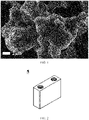
- FIG. 1 is a scanning electron microscope graph of a positive electrode active material according to an embodiment of this application. As can be seen from FIG. 1 , there is a coating layer on a surface of a positive electrode active substance, and the coating layer is formed by coagulation after liquefied sodium thiosulfate uniformly coats the surface of the positive electrode active substance.
- the sodium thiosulfate is used to coat the surface of the positive electrode active substance, which can significantly improve the cycling performance and capacity retention rate of the battery, but may also have some adverse effects on the first-cycle specific capacity and first-cycle coulombic efficiency.
- first-cycle charging and discharging of a battery usually occurs in the battery factory test process, the first-cycle specific capacity and first-cycle coulombic efficiency do not affect the use by users.
- national standards require that the electric vehicle battery has a capacity retention rate of more than 80% after 8 years or 120,000 kilometers of usage under normal operating conditions. Therefore, for the users, it is more important to improve the cycling performance and capacity retention rate of the battery.
- a coating rate of the sodium thiosulfate coating layer on the surface of the positive electrode active substance is not less than 95%. In some embodiments, a coating rate of the sodium thiosulfate coating layer on the surface of the positive electrode active substance is not less than 98%. Therefore, the cycling performance and capacity retention rate of the battery can be significantly improved without affecting the first-cycle specific capacity and first-cycle coulombic efficiency of the battery.
- the coating rate of the sodium thiosulfate coating layer on the surface of the positive electrode active substance means a percentage of an area of the sodium thiosulfate coating layer to a surface area of the positive electrode active substance.
- the coating rate may be determined by selecting several positive electrode particles under a scanning electron microscopy (Scanning Electron Microscopy, SEM) and using an energy dispersive spectrum analysis (Energy Dispersive Spectrum Analysis, EDS) method to test element sulfur distribution on their surfaces. Because the positive electrode active substance has no sulfur and only the sodium thiosulfate has sulfur, the coating rate on the surface can be calculated by measuring an area of zones with sulfur on the surfaces of the positive electrode particles and the total surface area.
- a mass percentage of the sodium thiosulfate coating layer in the positive electrode active material is 1% to 30%, and optionally, 3% to 10% in some embodiments, so as to better improve the cycling performance and capacity retention rate of the battery. If a mass percentage of the sodium thiosulfate in the positive electrode active material is less than 1%, an amount of sodium thiosulfate is not enough to well coat the surface of the positive electrode active substance, and the cycling performance and capacity retention rate of the battery are not obviously improved.
- a mass percentage of the sodium thiosulfate in the positive electrode active material is higher than 30%, a coating amount is too large, which causes the positive electrode active substance unable to contact electrons and lithium ions, easily leading to charge and discharge failure due to excessive polarization.
- the sodium thiosulfate (Na 2 S 2 O 3 ) coating the surface of the positive electrode active substance, with a molecular formula of Na 2 S 2 O 3 is a common thiosulfate.
- the embodiments of this application do not impose special limitations on a specific type of the positive electrode active substance, as long as the positive electrode active substance can accept and release lithium ions.
- the positive electrode active substance may be selected from at least one of lithium metal oxides with an olivine structure, lithium metal oxides with a layered structure, lithium metal oxides with a spinel structure, or modified materials of the foregoing materials.
- the sodium thiosulfate is used to coat surfaces of different positive electrode active substances, obviously reducing capacity decline during charging and discharging of the battery.
- the positive electrode active substance may be selected from at least one of LiFe x1 Mn y1 M z1 PO 4 , Li 3 V 2 (PO 4 ) 3 , Li 3 V 3 (PO 4 ) 3 , LiVPO 4 F, LiNi 0.5-x2 Mn 1.5-y2 M' x2+y2 O 4 , or Li 1+x3 Ni 1-y3-z3 Co y3 M" z3 O 2 ;
- the positive electrode active substance may be selected from at least one of LiFePO 4 , LiMnPO 4 , LiNiPO 4 , LiCoPO 4 , Li 3 V 3 (PO 4 ) 3 , LiMn 2 O 4 , LiNi 0.5 Mn 1.5 O 4 , LiCoO 2 , LiNiO 2 , LiCo 1/3 Ni 1/3 Mn 1/3 O 2 , LiNi 0.8 Co 0.1 Al 0.1 O 2 , or LiNi 0.8 Co 0.1 Mn 0.1 O 2 .
- the positive electrode active substance is Li 1+x3 Ni 1-y3-z3 CO y3 M" z3 O 2 , where -0.1 ⁇ x3 ⁇ 0.2, 0 ⁇ y3 ⁇ 1, 0 ⁇ z3 ⁇ 1, and 0.05 ⁇ y3 + z3 ⁇ 0.4, and M" is selected from at least one of Mn, Al, Mg, or Ti.
- the lithium nickel cobalt manganese metal oxide with high nickel content is selected as the positive electrode active substance.
- stability of the surfaces of the positive electrode active substance particles is effectively improved.
- high first-cycle energy density, high first-cycle coulombic efficiency, and good cycling performance of the battery can be achieved at the same time.
- the positive electrode active substance is Li 1+x3 Ni 1-y3-z3 Co y3 M" z3 O 2 (-0.1 ⁇ x3 ⁇ 0.2, 0 ⁇ y3 ⁇ 1, 0 ⁇ z3 ⁇ 1, and 0.05 ⁇ y3 + z3 ⁇ 0.4, and M" is selected from at least one of Mn, Al, Mg, or Ti), a volume-based median particle size D v 50 of the positive electrode active substance is 3 microns ( ⁇ m) to 20 ⁇ m.
- the volume-based median particle size D v 50 of the positive electrode active substance means that particles accounting for 50% of a total volume have a size larger than this value, and the other particles accounting for 50% of the total volume have a size less than this value.
- the volume-based median particle size D v 50 may be measured by using related methods in national standard GB/T 19077-2016.
- the positive electrode active substance is Li 1+x3 Ni 1-y3-z3 Co y3 M" z3 O 2 (-0.1 ⁇ x3 ⁇ 0.2, 0 ⁇ y3 ⁇ 1, 0 ⁇ z3 ⁇ 1, and 0.05 ⁇ y3 + z3 ⁇ 0.4, and M" is selected from at least one of Mn, Al, Mg, or Ti), a volume-based median particle size D v 50 of the positive electrode active substance is 4 ⁇ m to 18 ⁇ m.
- the positive electrode active substance particles are not easy to disperse, and have a small specific surface area, which can effectively control occurrence of side reactions and ensure that electrons and ions of the positive electrode active material have small transmission resistance.
- An embodiment of this application also provides a method for preparing the positive electrode active material, including: in a dry atmosphere, mixing a positive electrode active substance with sodium thiosulfate, putting the mixture into a ball mill for ball milling, and drying the mixture to obtain a positive electrode active material.
- a melting point of the sodium thiosulfate is 48 degrees Celsius (°C).
- This embodiment of this application takes advantage of the characteristics that the sodium thiosulfate has a low melting point and can liquefy at a low temperature.
- the positive electrode active substance is mixed with the sodium thiosulfate, and a mixture is subject to ball milling. Heat generated during the ball milling liquefies the sodium thiosulfate, and the sodium thiosulfate in a liquid form uniformly coats the surface of the positive electrode active substance. After the ball milling finishes, the sodium thiosulfate in the liquid form solidifies again, so as to form a stable and uniform coating layer on the surface of the positive electrode active substance.
- the method for preparing a positive electrode active material provided in this embodiment of this application is easy to operate and suitable for industrial production.
- a raw material of the sodium thiosulfate for preparing the positive electrode active material may be sodium thiosulfate anhydrous, sodium thiosulfate pentahydrate, or a mixture of the sodium thiosulfate anhydrous and the sodium thiosulfate pentahydrate in any ratio.
- the sodium thiosulfate pentahydrate is a hydrate of the sodium thiosulfate. Because this embodiment of this application has a drying step during preparation of the positive electrode active material, the sodium thiosulfate anhydrous, the sodium thiosulfate pentahydrate, or a mixture thereof can be selected as the raw material to coat the positive electrode active substance.
- the ball milling means putting materials into a ball mill for crushing and mixture.
- This application does not impose special limitations on a type of the ball milling, which may be, for example, planetary ball milling, vibration ball milling, or stirring ball milling according to different types of the ball mill.
- a ball milling medium is selected from one or more of zirconium oxide, aluminum oxide, and silicon carbide, and a ratio of the ball mill to the material is 50:1 to 5:1.
- a revolution speed ranges from 450 revolutions per minute (rpm) to 1200 rpm according to power of the ball mill.
- the specific process may be: putting the materials into a ZrO 2 ball mill tank of 45 milliliter (mL) (the ratio of the ball mill to the materials is 30:1), and performing planetary ball milling for 1 h at the revolution speed of 500 rpm.
- the specific process may be: putting the materials into a ZrO 2 ball mill tank of 45 mL (the ratio of the ball mill to the materials is 30:1), setting a vibration frequency to 20 hertz (Hz), and performing the ball milling for 1 hour (h).
- the specific process may be: putting the materials and a ball milling ball (the ratio of the ball mill to the materials is 30:1) into a grinding cylinder, setting a stirring speed to 300 rpm, and stirring for 1 h to manufacture the product.
- the step of mixing the positive electrode active substance with the sodium thiosulfate is performed in a dry atmosphere.
- the sodium thiosulfate has good affinity with water, and easily absorbs moisture in the air.
- the moisture has adverse effects on stability of electrolyte composition in a positive electrode, which may cause electrolyte decomposition or failure and affect cycling performance.
- the positive electrode active substance is mixed with the sodium thiosulfate in a dry atmosphere with moisture content lower than 0.1%.
- the step of drying the materials is performed after the ball milling. Because a high temperature needs to be used to dry under a non-vacuum condition, and the high temperature may cause the sodium thiosulfate to liquefy again, in some embodiments, vacuum drying is used. Specifically, the ball-milled materials are put under a negative pressure to lower a boiling point of the water, and the boiling point of the water under the negative pressure is reached by heating, so as to evaporate moisture in the materials and dry the materials. In addition, to prevent the sodium thiosulfate from liquefying, a longer drying time is required in a medium or low temperature. Therefore, in some embodiments of this application, a vacuum drying temperature may be 40°C to 47°C.
- a second aspect of this application relates to a positive electrode plate for all-solid-state lithium secondary battery, including a positive electrode current collector and a positive electrode active substance layer disposed on at least one surface of the positive electrode current collector, where the positive electrode active substance layer includes a solid-state electrolyte and the positive electrode active material according to the first aspect of this application.
- a type of the positive electrode current collector is not specifically limited, and may be selected according to actual needs.
- the positive electrode current collector may typically be layered, and the positive electrode current collector is typically a structure or component that can collect current.
- the positive electrode current collector may be various materials suitable to be used as the positive electrode current collector for an electrochemical energy storage apparatus in the art.
- the positive electrode current collector may include but is not limited to a metal foil, and more specifically, may include but is not limited to a nickel foil or an aluminum foil.
- the positive electrode active substance layer may be provided on one surface of the positive electrode current collector or on two surfaces of the positive electrode current collector.
- a type of the solid-state electrolyte is not specifically limited, and may be selected according to actual needs as long as the solid-state electrolyte helps transmission of lithium ions in the positive electrode active substance layer.
- the solid-state electrolyte may be a sulfide solid-state electrolyte.
- the sulfide solid-state electrolyte may include lithium and sulfur, and in some embodiments, may further include other elements, for example, may include but is not limited to at least one of P, Si, Ge, Sn, Al, and other elements.
- a general formula of the sulfide solid-state electrolyte may be described as yLi 2 S-(100-y) LS, where 0 ⁇ y ⁇ 100, LS may be but is not limited to one or more of P 2 S 5 , SiS 2 , GeS 2 , SnS 2 , Al 2 S 3 , and other substances, and a solid-state electrolyte system formed by the sulfide solid-state electrolyte may include but is not limited to one or more of a Li 2 S-P 2 S 5 system, a Li 2 S-SiS 2 system, a Li 2 S-GeS 2 system, a Li 2 S-SnS 2 system, and a Li 2 S-Al 2 S 3 system.
- the sulfide solid-state electrolyte may be in a crystal state, an amorphous state, or a crystal-amorphous compound state.
- the sulfide solid-state electrolyte may further include a doping material, and the doping material may be a lithium-containing compound LiQ.
- the doping material LiQ may include but is not limited to one or more of lithium halide, lithium oxide, lithium nitride, and lithium oxacid salt.
- the sulfide solid-state electrolyte may be one or more of Li 6 PS 5 Cl, Li 3 PS 4 , and Li 7 P 3 S 11 .
- a mass ratio of element sulfur on a surface of the positive electrode active material to element sulfur in the solid-state electrolyte ranges from 0.06:1 to 0.28:1.
- sulfur atoms on the surface of the positive electrode active material easily attract sulfur atoms in the solid-state electrolyte
- constraints on lithium ions in the solid-state electrolyte can be effectively reduced, improving ion conductivity performance on interfaces between the active material in the positive electrode plate and solid-state electrolyte particles, and increasing a capacity retention rate of a solid-state battery during cycling.
- a mass ratio of the positive electrode active material to the solid-state electrolyte may range from 60:40 to 85:15. In some embodiments, the mass ratio of the positive electrode active material to the solid-state electrolyte ranges from 70:30 to 80:20.
- the positive electrode active substance layer may further include a conductive agent and a binder, where a type and content of the conductive agent and the binder are not specifically limited, which may be selected according to actual needs.
- the binder may be selected from at least one of SBS, SEBS, PVDF, PTFE, PAALi, styrene-butadiene rubber, nitrile rubber, butene rubber, styrene rubber, and polyurethane; and the conductive agent may be selected from at least one of conductive carbon black (Super-P), acetylene black, vapor-grown carbon fiber (Vapor-Grown Carbon Fiber, VGCF for short), carbon nanotube, and graphene.
- Super-P conductive carbon black
- VGCF vapor-grown carbon fiber
- a suitable method for preparing the positive electrode plate may be selected by mixing the positive electrode active material, the solid-state electrolyte, the binder, and the conductive agent in a ratio to form a solid mixed material, or disperse the same in an organic solvent to form a liquid slurry, and applying the liquid slurry on at least one surface of the positive electrode current collector for hot pressing, so as to obtain the positive electrode plate.
- a third aspect of this application relates to an all-solid-state lithium secondary battery, including a positive electrode plate, a negative electrode plate, and a solid-state electrolyte membrane disposed between the positive electrode plate and the negative electrode plate, where the positive electrode plate is the positive electrode plate according to the second aspect of this application.
- the negative electrode plate may be a negative electrode plate made of a lithium metal sheet and alloy thereof. In some embodiments, the negative electrode plate may be a lithium metal sheet. The negative electrode plate is directly made of the lithium metal sheet, which can increase working voltage of an all-solid-state lithium battery, thereby enhancing energy density.
- a type of the solid-state electrolyte membrane is not specifically limited, which may be selected according to actual needs.
- the solid-state electrolyte membrane may alternatively be a sulfide solid-state electrolyte.
- the type of the solid-state electrolyte membrane may be the same as a solid-state electrolyte in the positive electrode plate.
- FIG. 2 shows a rectangular all-solid-state lithium secondary battery 5 as an example.
- all-solid-state lithium secondary batteries may be assembled into a battery module, and the battery module may include a plurality of all-solid-state lithium secondary batteries. A specific quantity may be adjusted based on application and capacity of the battery module.
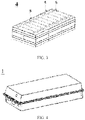
- FIG. 3 shows a battery module 4 as an example.
- a plurality of all-solid-state lithium secondary batteries 5 may be sequentially arranged in a length direction of the battery module 4.
- the all-solid-state lithium secondary batteries may alternatively be arranged in any other manner.
- the plurality of all-solid-state lithium secondary batteries 5 may be fastened by using fasteners.
- the battery module 4 may further include a housing with an accommodating space, and the plurality of all-solid-state lithium secondary batteries 5 are accommodated in the accommodating space.
- the battery modules may be further assembled into a battery pack, and a quantity of battery modules included in the battery pack may be adjusted based on application and capacity of the battery pack.
- FIG. 4 and FIG. 5 show a battery pack 1 as an example.
- the battery pack 1 may include a battery box and a plurality of battery modules 4 arranged in the battery box.
- the battery box includes an upper box body 2 and a lower box body 3.
- the upper box body 2 can cover the lower box body 3 to form an enclosed space for accommodating the battery modules 4.
- the plurality of battery modules 4 may be arranged in the battery box in any manner.
- a fourth aspect of this application relates to an apparatus, and the apparatus includes the all-solid-state lithium secondary battery according to the third aspect of this application, where the all-solid-state lithium secondary battery is used as a power source of the apparatus or an energy storage unit of the apparatus.
- the apparatus may be, but is not limited to, a mobile device (for example, a mobile phone or a notebook computer), an electric vehicle (for example, a battery electric vehicle, a hybrid electric vehicle, a plug-in hybrid electric vehicle, an electric bicycle, an electric scooter, an electric golf vehicle, or an electric truck), an electric train, a ship, a satellite, an energy storage system, and the like.
- a secondary battery (Cell), a battery module (Module), or a battery pack (Pack) may be selected for the apparatus according to requirements for using the apparatus.
- FIG. 6 shows an apparatus as an example.
- the apparatus is a battery electric vehicle, a hybrid electric vehicle, a plug-in hybrid electric vehicle, or the like.
- a battery pack or a battery module may be used.
- the apparatus may be a mobile phone, a tablet computer, a notebook computer, or the like.
- the apparatus is usually required to be light and thin, and the secondary battery may be used as a power source.
- a raw material of a positive electrode active substance and a raw material of sodium thiosulfate were mixed in a specific mass ratio, and then the mixture was ball-milled and dried to obtain a positive electrode active material.
- the prepared positive electrode active material and a solid-state electrolyte Li 6 PS 5 Cl were fully stirred and uniformly mixed at a mass ratio of 70:30 and dispersed on a surface of aluminum foil, and then the mixture was pressed for 2 minutes (min) at 100°C and 250 megapascal (MPa) to obtain a positive electrode plate with a thickness of 50 ⁇ m.
- a sulfide solid-state electrolyte Li 6 PS 5 Cl was pressed for 2 minutes at 100°C and 250 MPa to obtain a solid-state electrolyte membrane with a thickness of 50 ⁇ m; and a lithium metal sheet of 25 ⁇ m was used as a negative electrode plate.
- the prepared positive electrode plate, solid-state electrolyte membrane, and negative electrode plate were stacked in sequence with their centers aligned, and subject to cold pressing for 2 minutes at room temperature and 250 MPa to obtain a battery cell unit. 10 battery cell units were cold pressed and packaged in an outer package to obtain an all-solid-state lithium secondary battery.
- a raw material of a positive electrode active substance and a raw material of sodium thiosulfate were mixed in a specific mass ratio, and then the mixture was ground by a mortar for 10 minutes under at a liquid nitrogen temperature to obtain a positive electrode active material.
- the sodium thiosulfate and the positive electrode active substance were mixed and ground at the liquid nitrogen temperature without a process of liquefaction and then solidification of the sodium thiosulfate.
- the all-solid-state lithium secondary battery was put on a charge-discharge tester for a charge-discharge test, and then charged to 4.2 volt (V) at a constant current of 0.1C.
- V 4.2 volt
- the all-solid-state lithium secondary battery was charged to 4.2 V at a constant current of 0.1C.
- the all-solid-state lithium secondary battery was charged to 0.05C at a constant voltage of 4.2 V to obtain an initial charge capacity, recorded as Q n , and then discharged to 2.8 V at a constant current of 0.1C to obtain an initial discharge capacity, recorded as Q m .
- the all-solid-state lithium secondary battery was charged to 4.2 V at a constant current of 0.1C.
- the all-solid-state lithium secondary battery was charged to 0.05C at a constant voltage of 4.2 V, and then discharged to 3.0 V at a constant current of 0.1C. This was one charge-discharge cycle, and a discharge capacity at this time was a discharge capacity of the first cycle.
- Charge/discharge test was performed for the all-solid-state lithium secondary battery for 100 cycles according to the foregoing method, to obtain a discharge capacity at the 100 th cycle.
- Capacity retention rate % of the all-solid-state lithium secondary battery after 100 cycles Discharge capacity at the 100 th cycle / Discharge capacity at the first cycle ⁇ 100 % .
- Examples 1 to 6 and Comparative Examples 1 to 3 show to what degree changes of a coating amount of the sodium thiosulfate affect improvement of the cycling performance and capacity retention rate of the battery.
- the sodium thiosulfate was used to coat the positive electrode active substance LiNi 0.8 Co 0.1 Mn 0.1 O 2 , and a coating process was planetary ball milling.
- the positive electrode active substance LiNi 0.8 Co 0.1 Mn 0.1 O 2 was not coated. It can be seen that compared with no coating in Comparative Example 3, coating by the sodium thiosulfate of 1% to 30% in Examples 1 to 6 significantly improved the cycling performance and capacity retention rate of the battery.
- the proportion of the sodium thiosulfate was 3% to 10%, a more significant effect of improving the cycling performance and capacity retention rate of the battery was achieved. If the proportion of the sodium thiosulfate was less than 1%, the amount of the sodium thiosulfate was not enough to well coat a surface of the positive electrode active substance, such that the cycling performance and capacity retention rate of the secondary battery were not obviously improved. If the proportion of the sodium thiosulfate was higher than 30% (for example, in Comparative Examples 1 and 2), the coating amount is too large, which caused the positive electrode active substance unable to contact electrons and lithium ions, and results in charge and discharge failure due to excessive polarization, leading to degradation of battery performance.
- Examples 7 and 8 respectively show examples in which the sodium thiosulfate pentahydrate and other ball milling manners were used to coat the positive electrode active substance LiNi 0.8 Co 0.1 Mn 0.1 O 2 . It can be seen that the technical effects of this application do not impose limitations on a type of ball milling process. In some examples, whether the sodium thiosulfate anhydrous, the sodium thiosulfate pentahydrate, or the mixture thereof is selected as a raw material to coat the positive electrode active substance, the cycling performance and capacity retention rate of the battery can be improved.
- Examples 9 to 12 and Comparative Examples 4 and 5 show comparative data of the battery cycling performance of different positive electrode active substances coated with the sodium thiosulfate. It can be seen that the all-solid-state lithium secondary battery prepared with LiCoO 2 , Li 3 V 3 (PO 4 ) 3 , and other various positive electrode active substances coated with sodium thiosulfate had a significant improvement on the capacity retention rate after 100 cycles. It indicates that with the technical solutions provided by this application, the surfaces of different positive electrode active substances are coated with sodium thiosulfate, and all the all-solid-state lithium secondary batteries prepared using the positive electrode active materials after coating had good cycling performance and capacity retention rate.
- Examples 13 to 15 show how the positive electrode active substances with different median particle sizes, which are coated with sodium thiosulfate and serve as the positive electrode active materials of the battery, affect the battery cycling performance. It can be seen that, in Example 13, a volume-based median particle size of the positive electrode active substance was small, and a specific surface area of the positive electrode active substance was large, which increased occurrence frequency of side reactions, and slightly decreased the first-cycle coulombic efficiency and capacity retention rate of the battery. In Example 15, a median particle size of the positive electrode active substance was large. Because ions and electrons encountered greater resistance when entering into particles, capacity of the battery was also slightly decreased.
- the positive electrode active substance with a volume-based median particle size D v 50 of 3 ⁇ m to 20 ⁇ m, and optionally 4 ⁇ m to 18 ⁇ m, was selected. In some examples, this helps improve the cycling performance and capacity retention rate of the battery.
- Example 16 shows how a structure with the sodium thiosulfate coating the surface and a coating rate affect the battery cycling performance. It can be seen that, because a slow cooling method was used in Example 16, the sodium thiosulfate coating the surface formed a long-range ordered crystal structure, which affected deintercalation of the lithium ions, and decreased the capacity and first-cycle coulombic efficiency of the battery. However, resistance to the side reactions was not affected.
- Example 16 shows how continuity of the sodium thiosulfate coating the surface affects the battery cycling performance. It can be seen that, after the continuity of surface coating decreased, because more surfaces were in contact with an electrolyte material, an initial capacity of the battery was increased. However, because the side reactions increased, the first-cycle coulombic efficiency was slightly decreased. In some examples, the cycling performance was slightly degraded.
- Comparative Example 6 the sodium thiosulfate and the positive electrode active substance were mixed and ground at the liquid nitrogen temperature. Therefore, the sodium thiosulfate and the positive electrode active substance were physically mixed without a process in which the sodium thiosulfate was liquefied by heat produced by ball milling, coated the surface of the positive electrode active substance, and then was solidified. It can be seen that, the all-solid-state lithium secondary battery in Comparative Example 6 had a capacity retention rate after 100 cycles similar to that in Comparative Example 3. This indicates that the physical mixture of the ground sodium thiosulfate and positive electrode active substance cannot effectively improve the cycling performance and capacity retention rate of the battery.
- the preparation is basically the same as that in Example 4, and differences lie in the selected substance of a solid-state electrolyte in a positive electrode active substance layer of the positive electrode plate and a mass ratio of the positive electrode active material to the solid-state electrolyte.
- the preparation is basically the same as that in Example 4, and a difference lies in the selected substance of the solid-state electrolyte for preparing a solid-state electrolyte membrane.
- Table 3 Selected substance of solid-state electrolyte in positive electrode plate Mass ratio of positive electrode active material to solid-state electrolyte in positive electrode plate Mass ratio of element sulfur on surface of positive electrode active material to element sulfur in solid-state electrolyte in positive electrode plate
- Example 18 Li 6 PS 5 Cl 60:40 0.075:1
- Example 19 Li 6 PS 5 Cl 70:30 0.116:1
- Example 20 Li 6 PS 5 Cl 80:20 0.2:1
- Example 21 Li 6 PS 5 Cl 85:15 0.283:1
- Example 22 Li 3 PS 4 70:30 0.097:1
- Example 23 Li 7 P 3 S 11 70:30 0.097:1
- Examples 18 to 21 show how the ratio of the solid-state electrolyte Li 6 PS 5 Cl to the positive electrode active material in the positive electrode plate affects the battery performance.
- mass ratio of the positive electrode active material in the positive electrode active substance layer to the solid-state electrolyte was lower than 60:40, because density of the solid-state electrolyte material was lower than that of the positive electrode active substance, this usually caused an excessively large volume fraction of the solid-state electrolyte.
- the positive electrode active substance was coated, making it more difficult for electrons to contact the positive electrode active substance, thereby affecting normal deintercalation of lithium ions and decreasing capacity of the battery.
- Examples 22 and 23 show how different solid-state electrolytes affect the battery performance. Because Li 6 PS 5 Cl and Li 7 P 3 S 11 at room temperature are both a fast-ion solid-state electrolyte with ionic conductivity larger than 10 -3 siemens per centimeter (S/cm), they have small conduction resistance to lithium ions in the positive electrode active material, so that good capacity and cycling performance of the battery can be maintained. Ionic conductivity of another common solid-state electrolyte Li 3 PS 4 is generally 10 -4 S/cm, which slightly affects extractable capacity of the battery. Therefore, the type and amount of the solid-state electrolyte used in the battery also affect the extractable capacity of the battery.
Landscapes
- Chemical & Material Sciences (AREA)
- Chemical Kinetics & Catalysis (AREA)
- Electrochemistry (AREA)
- General Chemical & Material Sciences (AREA)
- Engineering & Computer Science (AREA)
- Inorganic Chemistry (AREA)
- Manufacturing & Machinery (AREA)
- Materials Engineering (AREA)
- General Physics & Mathematics (AREA)
- Condensed Matter Physics & Semiconductors (AREA)
- Physics & Mathematics (AREA)
- Crystallography & Structural Chemistry (AREA)
- Composite Materials (AREA)
- Secondary Cells (AREA)
- Battery Electrode And Active Subsutance (AREA)
Abstract
Description
- This application claims priority to
Chinese Patent Application No. 202010384073.0, filed on May 09, 2020 - Embodiments of this application relate to the field of batteries, and specifically, to a positive electrode active material and a positive electrode plate for all-solid-state lithium secondary battery, an all-solid-state lithium secondary battery, and an apparatus.
- With development and maturity of science and technology, lithium batteries are being applied more widely. Cycling performance is an important indicator for measuring quality of a lithium battery. In the same condition, quality of a battery is poorer if battery capacity declines faster. In some examples, longer cycle life means smaller resource consumption from a macro perspective.
- To improve performance of batteries, a series of positive electrode active materials with high electrochemical activity are developed in the technical field of lithium batteries. However, the high electrochemical activity of the positive electrode active materials easily causes a series of side reactions on contact interfaces between electrodes and an electrolyte, resulting in gradual loss of battery capacity along charging and discharging of the battery, that is, degradation of battery cycling performance. Especially in an all-solid-state lithium secondary battery, electrodes are in solid-phase contact with an electrolyte, which is not as good as solid-liquid contact in a liquid battery. Therefore, the all-solid-state lithium secondary battery has a higher requirement for electrochemical activity of positive electrode materials, which easily causes degradation of battery cycling performance.
- In view of the problem in the background, this application provides a positive electrode active material for all-solid-state lithium secondary battery.
- According to a first aspect, this application provides a positive electrode active material for all-solid-state lithium secondary battery, including a positive electrode active substance and a sodium thiosulfate coating layer coating a surface of the positive electrode active substance.
- The sodium thiosulfate coating layer isolates a substance causing side reactions from the positive electrode active substance, alleviating degradation of a positive electrode plate caused by the side reactions on contact interfaces between electrodes and an electrolyte, and improving the cycling performance and capacity retention rate of the battery.
- According to a second aspect, this application provides a positive electrode plate for all-solid-state lithium secondary battery, including a positive electrode current collector and a positive electrode active substance layer disposed on at least one surface of the positive electrode current collector, where the positive electrode active substance layer includes a solid-state electrolyte and the positive electrode active material according to the first aspect of this application.
- Because sulfur atoms on a surface of the positive electrode active material are easy to attract sulfur atoms in the solid-state electrolyte, when a mass ratio of element sulfur on the surface of the positive electrode active material to element sulfur in the solid-state electrolyte ranges from 0.06:1 to 0.28:1, constraints on lithium ions in the solid-state electrolyte can be effectively reduced, improving ion conductivity performance on interfaces between the active material in the positive electrode plate and solid-state electrolyte particles, and increasing a capacity retention rate of a solid-state battery during cycling.
- According to a third aspect, this application provides an all-solid-state lithium secondary battery, including a positive electrode plate, a negative electrode plate, and a solid-state electrolyte membrane disposed between the positive electrode plate and the negative electrode plate, where the positive electrode plate is the positive electrode plate according to the second aspect of this application.
- The all-solid-state lithium secondary battery may be used as a power source of an apparatus or an energy storage unit of an apparatus.
- According to a fourth aspect, this application provides an apparatus, including the all-solid-state lithium secondary battery according to the third aspect of this application, where the all-solid-state lithium secondary battery is used as a power source of the apparatus or an energy storage unit of the apparatus.
- A secondary battery (Cell), a battery module (Module), or a battery pack (Pack) may be selected for the apparatus according to requirements for using the apparatus.
- Compared with the prior art, this application has at least the following advantages:
In a lithium secondary battery, high electrochemical activity of a positive electrode active material easily causes side reactions on contact interfaces between electrodes and an electrolyte, resulting in degradation of battery cycling performance. In an all-solid-state lithium secondary battery, electrodes are in solid-phase contact with an electrolyte, which is not as good as solid-liquid contact in a liquid battery. Therefore, the all-solid-state lithium secondary battery has a higher requirement for electrochemical activity of positive electrode materials, which easily causes degradation of battery cycling performance. - The positive electrode active material for all-solid-state lithium secondary battery provided in this application forms a physical sodium thiosulfate coating layer on a surface of a positive electrode active substance. The coating layer effectively isolates a substance causing the side reactions from the positive electrode active substance, thereby alleviating degradation of a positive electrode plate caused by side reactions occurring on a contact interface between the positive electrode plate and the electrolyte. Applying the positive electrode active material provided in this application to the positive electrode plate for all-solid-state lithium secondary battery can significantly improve the cycling performance and capacity retention rate of the battery.
- To describe the technical solutions in the embodiments of this application or in the prior art more clearly, the following briefly describes the accompanying drawings required for describing the embodiments or the prior art. Apparently, the accompanying drawings in the following description show merely some embodiments of this application, and a person of ordinary skill in the art may still derive other drawings from these accompanying drawings without creative efforts.
-
FIG. 1 is a scanning electron microscope graph of a positive electrode active material according to an embodiment of this application. -
FIG. 2 is a schematic diagram of an embodiment of an all-solid-state lithium secondary battery according to this application. -
FIG. 3 is a schematic diagram of an embodiment of a battery module according to this application. -
FIG. 4 is a schematic diagram of an embodiment of a battery pack according to this application. -
FIG. 5 is an exploded view ofFIG. 4 . -
FIG. 6 is a schematic diagram of an embodiment of an apparatus using an all-solid-state lithium secondary battery as a power source according to this application. - Reference signs are described as follows:
- 1. battery pack;
- 2. upper box body;
- 3. lower box body;
- 4. battery module; and
- 5. all-solid-state lithium secondary battery.
- This application is further described with reference to specific embodiments. It should be understood that these specific embodiments are merely intended to illustrate this application but not to limit the scope of this application.
- A first aspect of this application relates to a positive electrode active material for all-solid-state lithium secondary battery, including a positive electrode active substance and a sodium thiosulfate coating layer coating a surface of the positive electrode active substance. The sodium thiosulfate coating layer isolates a substance causing side reactions from the positive electrode active substance, alleviating degradation of a positive electrode plate caused by the side reactions on contact interfaces between electrodes and an electrolyte, and improving the cycling performance and capacity retention rate of the battery.
- In an embodiment of this application, the sodium thiosulfate coating layer physically coats the surface of the positive electrode active substance. Such physical coating on the surface is formed not by a simple mixture of sodium thiosulfate and the positive electrode active substance, or by the sodium thiosulfate in the coating layer entering the positive electrode active substance, but by the sodium thiosulfate uniformly coating the surface of the positive electrode active substance. Therefore, in this embodiment of this application, the sodium thiosulfate coating layer has no impact on electronic conductivity and rate performance of the positive electrode active substance. In some embodiments, the sodium thiosulfate coating layer is a continuous amorphous membrane layer on the surface of the positive electrode active substance. A possible reason is that: If the sodium thiosulfate coating layer is a crystal long-range ordered structure, even if there is an electric field, it is difficult for lithium ions to be intercalated into or deintercalated from a surface of the positive electrode material over a long distance, such that a battery is severely polarized and may not be normally charged or discharged. In this specification, the surface is coated through ball milling. Therefore, fast temperature drop after the ball milling does not cause the sodium thiosulfate to form a long-range ordered structure, and only forms crystallites in a small zone, with massive amorphous structures of crystalline boundaries. In this way, anisotropy between different zones cancels each other out, so that overall isotropy is achieved and an apparent dielectric constant is lowered, thereby enhancing the electric field to help deintercalation of the lithium ions. In addition, a short-range ordered structure does not hinder conduction of lithium ions. Therefore, an amorphous structure is an effective means to overcome the shortcomings. In addition, in some embodiments, the continuous coating layer is used, to prevent uncoated zones from impairing a barrier effect on the side reactions.
FIG. 1 is a scanning electron microscope graph of a positive electrode active material according to an embodiment of this application. As can be seen fromFIG. 1 , there is a coating layer on a surface of a positive electrode active substance, and the coating layer is formed by coagulation after liquefied sodium thiosulfate uniformly coats the surface of the positive electrode active substance. - In this application, X-ray diffraction analysis is performed on samples, to determine whether a sodium thiosulfate coating layer is amorphous. If there is a sharp peak of the sodium thiosulfate (2θ = 19.906°, 21.729°, or 29.271°), it indicates that the sodium thiosulfate is in a crystalline state; if no such peaks exist, it indicates that the sodium thiosulfate is in an amorphous state.
- It should be noted that, in this embodiment of this application, the sodium thiosulfate is used to coat the surface of the positive electrode active substance, which can significantly improve the cycling performance and capacity retention rate of the battery, but may also have some adverse effects on the first-cycle specific capacity and first-cycle coulombic efficiency. However, because first-cycle charging and discharging of a battery usually occurs in the battery factory test process, the first-cycle specific capacity and first-cycle coulombic efficiency do not affect the use by users. In addition, national standards require that the electric vehicle battery has a capacity retention rate of more than 80% after 8 years or 120,000 kilometers of usage under normal operating conditions. Therefore, for the users, it is more important to improve the cycling performance and capacity retention rate of the battery.
- In some embodiments of this application, a coating rate of the sodium thiosulfate coating layer on the surface of the positive electrode active substance is not less than 95%. In some embodiments, a coating rate of the sodium thiosulfate coating layer on the surface of the positive electrode active substance is not less than 98%. Therefore, the cycling performance and capacity retention rate of the battery can be significantly improved without affecting the first-cycle specific capacity and first-cycle coulombic efficiency of the battery.
- In this embodiment of this application, the coating rate of the sodium thiosulfate coating layer on the surface of the positive electrode active substance means a percentage of an area of the sodium thiosulfate coating layer to a surface area of the positive electrode active substance. The coating rate may be determined by selecting several positive electrode particles under a scanning electron microscopy (Scanning Electron Microscopy, SEM) and using an energy dispersive spectrum analysis (Energy Dispersive Spectrum Analysis, EDS) method to test element sulfur distribution on their surfaces. Because the positive electrode active substance has no sulfur and only the sodium thiosulfate has sulfur, the coating rate on the surface can be calculated by measuring an area of zones with sulfur on the surfaces of the positive electrode particles and the total surface area.
- In some embodiments of this application, a mass percentage of the sodium thiosulfate coating layer in the positive electrode active material is 1% to 30%, and optionally, 3% to 10% in some embodiments, so as to better improve the cycling performance and capacity retention rate of the battery. If a mass percentage of the sodium thiosulfate in the positive electrode active material is less than 1%, an amount of sodium thiosulfate is not enough to well coat the surface of the positive electrode active substance, and the cycling performance and capacity retention rate of the battery are not obviously improved. If a mass percentage of the sodium thiosulfate in the positive electrode active material is higher than 30%, a coating amount is too large, which causes the positive electrode active substance unable to contact electrons and lithium ions, easily leading to charge and discharge failure due to excessive polarization.
- In this embodiment of this application, the sodium thiosulfate (Na2S2O3) coating the surface of the positive electrode active substance, with a molecular formula of Na2S2O3, is a common thiosulfate.
- The embodiments of this application do not impose special limitations on a specific type of the positive electrode active substance, as long as the positive electrode active substance can accept and release lithium ions. For example, the positive electrode active substance may be selected from at least one of lithium metal oxides with an olivine structure, lithium metal oxides with a layered structure, lithium metal oxides with a spinel structure, or modified materials of the foregoing materials. In this embodiment of this application, the sodium thiosulfate is used to coat surfaces of different positive electrode active substances, obviously reducing capacity decline during charging and discharging of the battery.
- In this embodiment of this application, the positive electrode active substance may be selected from at least one of LiFex1Mny1Mz1PO4, Li3V2(PO4)3, Li3V3(PO4)3, LiVPO4F, LiNi0.5-x2Mn1.5-y2M'x2+y2O4, or Li1+x3Ni1-y3-z3Coy3M"z3O2;
- where 0 ≤ x1 ≤ 1, 0 ≤ y1 ≤ 1, 0 ≤ z1 ≤ 1, and x1 + y1 + z1 = 1, and M does not exist or M is selected from at least one of Al, Mg, Ga, Ti, Cr, Cu, Zn, or Mo;
- -0.1 ≤ x2 ≤ 0.5, and 0 ≤ y2 ≤ 1.5, and M' does not exist or M' is selected from at least one of Mn, Co, Fe, Al, Mg, Ca, Ti, Mo, Cr, Cu, or Zn; and
- -0.1 ≤ x3 ≤ 0.2, 0 ≤ y3 ≤ 1, 0 ≤ z3 ≤ 1, and 0 ≤ y3 + z3 ≤ 1, and M" does not exist or M" is selected from at least one of Mn, Fe, Al, Mg, Ga, Ti, Cr, Cu, Zn, or Mo.
- In this embodiment of this application, the positive electrode active substance may be selected from at least one of LiFePO4, LiMnPO4, LiNiPO4, LiCoPO4, Li3V3(PO4)3, LiMn2O4, LiNi0.5Mn1.5O4, LiCoO2, LiNiO2, LiCo1/3Ni1/3Mn1/3O2, LiNi0.8Co0.1Al0.1O2, or LiNi0.8Co0.1Mn0.1O2.
- In some embodiments, the positive electrode active substance is Li1+x3Ni1-y3-z3COy3M"z3O2, where -0.1 ≤ x3 ≤ 0.2, 0 ≤ y3 ≤ 1, 0 ≤ z3 ≤ 1, and 0.05 ≤ y3 + z3 ≤ 0.4, and M" is selected from at least one of Mn, Al, Mg, or Ti. In some embodiments of this application, the lithium nickel cobalt manganese metal oxide with high nickel content is selected as the positive electrode active substance. After being coated with the sodium thiosulfate, stability of the surfaces of the positive electrode active substance particles is effectively improved. In some embodiments, high first-cycle energy density, high first-cycle coulombic efficiency, and good cycling performance of the battery can be achieved at the same time.
- In this embodiment of this application, when the positive electrode active substance is Li1+x3Ni1-y3-z3Coy3M"z3O2 (-0.1 ≤ x3 ≤ 0.2, 0 ≤ y3 ≤ 1, 0 ≤ z3 ≤ 1, and 0.05 ≤ y3 + z3 ≤ 0.4, and M" is selected from at least one of Mn, Al, Mg, or Ti), a volume-based median particle size Dv50 of the positive electrode active substance is 3 microns (µm) to 20 µm.
- In the embodiments of this application, the volume-based median particle size Dv50 of the positive electrode active substance means that particles accounting for 50% of a total volume have a size larger than this value, and the other particles accounting for 50% of the total volume have a size less than this value. The volume-based median particle size Dv50 may be measured by using related methods in national standard GB/T 19077-2016.
- In this embodiment of this application, when the positive electrode active substance is Li1+x3Ni1-y3-z3Coy3M"z3O2 (-0.1 ≤ x3 ≤ 0.2, 0 ≤ y3 ≤ 1, 0 ≤ z3 ≤ 1, and 0.05 ≤ y3 + z3 ≤ 0.4, and M" is selected from at least one of Mn, Al, Mg, or Ti), a volume-based median particle size Dv50 of the positive electrode active substance is 4 µm to 18 µm. In this application, when a lithium nickel cobalt manganese metal oxide with high nickel content and with a volume-based median particle size Dv50 within the foregoing range is selected as the positive electrode active substance, the positive electrode active substance particles are not easy to disperse, and have a small specific surface area, which can effectively control occurrence of side reactions and ensure that electrons and ions of the positive electrode active material have small transmission resistance.
- An embodiment of this application also provides a method for preparing the positive electrode active material, including: in a dry atmosphere, mixing a positive electrode active substance with sodium thiosulfate, putting the mixture into a ball mill for ball milling, and drying the mixture to obtain a positive electrode active material.
- A melting point of the sodium thiosulfate is 48 degrees Celsius (°C). This embodiment of this application takes advantage of the characteristics that the sodium thiosulfate has a low melting point and can liquefy at a low temperature. The positive electrode active substance is mixed with the sodium thiosulfate, and a mixture is subject to ball milling. Heat generated during the ball milling liquefies the sodium thiosulfate, and the sodium thiosulfate in a liquid form uniformly coats the surface of the positive electrode active substance. After the ball milling finishes, the sodium thiosulfate in the liquid form solidifies again, so as to form a stable and uniform coating layer on the surface of the positive electrode active substance. The method for preparing a positive electrode active material provided in this embodiment of this application is easy to operate and suitable for industrial production.
- In this embodiment of this application, a raw material of the sodium thiosulfate for preparing the positive electrode active material may be sodium thiosulfate anhydrous, sodium thiosulfate pentahydrate, or a mixture of the sodium thiosulfate anhydrous and the sodium thiosulfate pentahydrate in any ratio. The sodium thiosulfate pentahydrate is a hydrate of the sodium thiosulfate. Because this embodiment of this application has a drying step during preparation of the positive electrode active material, the sodium thiosulfate anhydrous, the sodium thiosulfate pentahydrate, or a mixture thereof can be selected as the raw material to coat the positive electrode active substance.
- In this embodiment of this application, the ball milling means putting materials into a ball mill for crushing and mixture. This application does not impose special limitations on a type of the ball milling, which may be, for example, planetary ball milling, vibration ball milling, or stirring ball milling according to different types of the ball mill. A ball milling medium is selected from one or more of zirconium oxide, aluminum oxide, and silicon carbide, and a ratio of the ball mill to the material is 50:1 to 5:1. In some embodiments, a revolution speed ranges from 450 revolutions per minute (rpm) to 1200 rpm according to power of the ball mill. If the planetary ball milling is used, the specific process may be: putting the materials into a ZrO2 ball mill tank of 45 milliliter (mL) (the ratio of the ball mill to the materials is 30:1), and performing planetary ball milling for 1 h at the revolution speed of 500 rpm. If the vibration ball milling is used, the specific process may be: putting the materials into a ZrO2 ball mill tank of 45 mL (the ratio of the ball mill to the materials is 30:1), setting a vibration frequency to 20 hertz (Hz), and performing the ball milling for 1 hour (h). If the stirring ball milling is used, the specific process may be: putting the materials and a ball milling ball (the ratio of the ball mill to the materials is 30:1) into a grinding cylinder, setting a stirring speed to 300 rpm, and stirring for 1 h to manufacture the product.
- In this embodiment of this application, in some examples, the step of mixing the positive electrode active substance with the sodium thiosulfate is performed in a dry atmosphere. This is because the sodium thiosulfate has good affinity with water, and easily absorbs moisture in the air. However, the moisture has adverse effects on stability of electrolyte composition in a positive electrode, which may cause electrolyte decomposition or failure and affect cycling performance. Specifically, in some embodiments, the positive electrode active substance is mixed with the sodium thiosulfate in a dry atmosphere with moisture content lower than 0.1%.
- In this embodiment of this application, the step of drying the materials is performed after the ball milling. Because a high temperature needs to be used to dry under a non-vacuum condition, and the high temperature may cause the sodium thiosulfate to liquefy again, in some embodiments, vacuum drying is used. Specifically, the ball-milled materials are put under a negative pressure to lower a boiling point of the water, and the boiling point of the water under the negative pressure is reached by heating, so as to evaporate moisture in the materials and dry the materials. In addition, to prevent the sodium thiosulfate from liquefying, a longer drying time is required in a medium or low temperature. Therefore, in some embodiments of this application, a vacuum drying temperature may be 40°C to 47°C.
- A second aspect of this application relates to a positive electrode plate for all-solid-state lithium secondary battery, including a positive electrode current collector and a positive electrode active substance layer disposed on at least one surface of the positive electrode current collector, where the positive electrode active substance layer includes a solid-state electrolyte and the positive electrode active material according to the first aspect of this application.
- In an embodiment of this application, a type of the positive electrode current collector is not specifically limited, and may be selected according to actual needs. The positive electrode current collector may typically be layered, and the positive electrode current collector is typically a structure or component that can collect current. The positive electrode current collector may be various materials suitable to be used as the positive electrode current collector for an electrochemical energy storage apparatus in the art. For example, the positive electrode current collector may include but is not limited to a metal foil, and more specifically, may include but is not limited to a nickel foil or an aluminum foil. In some examples, the positive electrode active substance layer may be provided on one surface of the positive electrode current collector or on two surfaces of the positive electrode current collector.
- In this embodiment of this application, a type of the solid-state electrolyte is not specifically limited, and may be selected according to actual needs as long as the solid-state electrolyte helps transmission of lithium ions in the positive electrode active substance layer. For example, the solid-state electrolyte may be a sulfide solid-state electrolyte. The sulfide solid-state electrolyte may include lithium and sulfur, and in some embodiments, may further include other elements, for example, may include but is not limited to at least one of P, Si, Ge, Sn, Al, and other elements.
- Specifically, a general formula of the sulfide solid-state electrolyte may be described as yLi2S-(100-y) LS, where 0 < y < 100, LS may be but is not limited to one or more of P2S5, SiS2, GeS2, SnS2, Al2S3, and other substances, and a solid-state electrolyte system formed by the sulfide solid-state electrolyte may include but is not limited to one or more of a Li2S-P2S5 system, a Li2S-SiS2 system, a Li2S-GeS2 system, a Li2S-SnS2 system, and a Li2S-Al2S3 system. The sulfide solid-state electrolyte may be in a crystal state, an amorphous state, or a crystal-amorphous compound state.
- In some embodiments, the sulfide solid-state electrolyte may further include a doping material, and the doping material may be a lithium-containing compound LiQ. Specifically, a general formula of the doped sulfide electrolyte may be described as z(Li2S-LS)-(100-z) LiQ, where 90 ≤ z ≤ 100, and the doping material LiQ may include but is not limited to one or more of lithium halide, lithium oxide, lithium nitride, and lithium oxacid salt. LiQ may include but is not limited to one or more of LiF, LiCl, LiBr, LiI, Li2O, Li3N, LiAlO2, Li3PO4, Li2SO4, Li3BO3, Li4SiO4, LiN(SO2F)2, LiN(SO2RF)2, and LiN(SO2F)(SO2RF) (substituent group RF = CnF2n+1, which is saturated perfluoroalkyl, where n is an integer of 1 or 2).
- In this embodiment of this application, the sulfide solid-state electrolyte may be one or more of Li6PS5Cl, Li3PS4, and Li7P3S11.
- In this embodiment of this application, in the positive electrode plate, a mass ratio of element sulfur on a surface of the positive electrode active material to element sulfur in the solid-state electrolyte ranges from 0.06:1 to 0.28:1. In this application, because sulfur atoms on the surface of the positive electrode active material easily attract sulfur atoms in the solid-state electrolyte, when the mass ratio of element sulfur on the surface of the positive electrode active material to element sulfur in the solid-state electrolyte is in the foregoing range, constraints on lithium ions in the solid-state electrolyte can be effectively reduced, improving ion conductivity performance on interfaces between the active material in the positive electrode plate and solid-state electrolyte particles, and increasing a capacity retention rate of a solid-state battery during cycling.
- In this embodiment of this application, in the positive electrode plate, a mass ratio of the positive electrode active material to the solid-state electrolyte may range from 60:40 to 85:15. In some embodiments, the mass ratio of the positive electrode active material to the solid-state electrolyte ranges from 70:30 to 80:20.
- In this embodiment of this application, the positive electrode active substance layer may further include a conductive agent and a binder, where a type and content of the conductive agent and the binder are not specifically limited, which may be selected according to actual needs. Specifically, the binder may be selected from at least one of SBS, SEBS, PVDF, PTFE, PAALi, styrene-butadiene rubber, nitrile rubber, butene rubber, styrene rubber, and polyurethane; and the conductive agent may be selected from at least one of conductive carbon black (Super-P), acetylene black, vapor-grown carbon fiber (Vapor-Grown Carbon Fiber, VGCF for short), carbon nanotube, and graphene.
- Those skilled in the art may select a suitable method for preparing the positive electrode plate according to the second aspect of this application. For example, the following steps may be included: mixing the positive electrode active material, the solid-state electrolyte, the binder, and the conductive agent in a ratio to form a solid mixed material, or disperse the same in an organic solvent to form a liquid slurry, and applying the liquid slurry on at least one surface of the positive electrode current collector for hot pressing, so as to obtain the positive electrode plate.
- A third aspect of this application relates to an all-solid-state lithium secondary battery, including a positive electrode plate, a negative electrode plate, and a solid-state electrolyte membrane disposed between the positive electrode plate and the negative electrode plate, where the positive electrode plate is the positive electrode plate according to the second aspect of this application.
- In an embodiment of this application, the negative electrode plate may be a negative electrode plate made of a lithium metal sheet and alloy thereof. In some embodiments, the negative electrode plate may be a lithium metal sheet. The negative electrode plate is directly made of the lithium metal sheet, which can increase working voltage of an all-solid-state lithium battery, thereby enhancing energy density.
- In this embodiment of this application, a type of the solid-state electrolyte membrane is not specifically limited, which may be selected according to actual needs. For example, the solid-state electrolyte membrane may alternatively be a sulfide solid-state electrolyte. In some examples, the type of the solid-state electrolyte membrane may be the same as a solid-state electrolyte in the positive electrode plate.
- This application does not impose special limitations on the shape of the all-solid-state lithium secondary battery, and the all-solid-state lithium secondary battery may be cylindrical, rectangular, or of any other shapes.
FIG. 2 shows a rectangular all-solid-state lithiumsecondary battery 5 as an example. - In some embodiments of this application, all-solid-state lithium secondary batteries may be assembled into a battery module, and the battery module may include a plurality of all-solid-state lithium secondary batteries. A specific quantity may be adjusted based on application and capacity of the battery module.
-
FIG. 3 shows abattery module 4 as an example. Referring toFIG. 3 , in thebattery module 4, a plurality of all-solid-state lithiumsecondary batteries 5 may be sequentially arranged in a length direction of thebattery module 4. Certainly, the all-solid-state lithium secondary batteries may alternatively be arranged in any other manner. In some embodiments, the plurality of all-solid-state lithiumsecondary batteries 5 may be fastened by using fasteners. - In some embodiments, the
battery module 4 may further include a housing with an accommodating space, and the plurality of all-solid-state lithiumsecondary batteries 5 are accommodated in the accommodating space. - In some embodiments of this application, the battery modules may be further assembled into a battery pack, and a quantity of battery modules included in the battery pack may be adjusted based on application and capacity of the battery pack.
-
FIG. 4 andFIG. 5 show abattery pack 1 as an example. Referring toFIG. 4 andFIG. 5 , thebattery pack 1 may include a battery box and a plurality ofbattery modules 4 arranged in the battery box. The battery box includes anupper box body 2 and alower box body 3. Theupper box body 2 can cover thelower box body 3 to form an enclosed space for accommodating thebattery modules 4. The plurality ofbattery modules 4 may be arranged in the battery box in any manner. - A fourth aspect of this application relates to an apparatus, and the apparatus includes the all-solid-state lithium secondary battery according to the third aspect of this application, where the all-solid-state lithium secondary battery is used as a power source of the apparatus or an energy storage unit of the apparatus. The apparatus may be, but is not limited to, a mobile device (for example, a mobile phone or a notebook computer), an electric vehicle (for example, a battery electric vehicle, a hybrid electric vehicle, a plug-in hybrid electric vehicle, an electric bicycle, an electric scooter, an electric golf vehicle, or an electric truck), an electric train, a ship, a satellite, an energy storage system, and the like.
- A secondary battery (Cell), a battery module (Module), or a battery pack (Pack) may be selected for the apparatus according to requirements for using the apparatus.
-
FIG. 6 shows an apparatus as an example. The apparatus is a battery electric vehicle, a hybrid electric vehicle, a plug-in hybrid electric vehicle, or the like. To meet requirements of the apparatus for high power and high energy density of the secondary battery, a battery pack or a battery module may be used. - In another example, the apparatus may be a mobile phone, a tablet computer, a notebook computer, or the like. The apparatus is usually required to be light and thin, and the secondary battery may be used as a power source.
- Those skilled in the art may understand that the foregoing definitions or optional ranges of component selection, component content, and material physicochemical performance parameters in electrochemical active materials in different embodiments of this application may be randomly combined, and various embodiments obtained through the combination shall still fall within the scope of this application and shall be considered as a part of content disclosed in this specification.
- Unless otherwise specified, various parameters in this specification have general meanings well known in the art, and may be measured by using a method well known in the art. For example, a test may be conducted in a method provided in an example of this application. In some examples, optional ranges and options of different parameters provided in various optional examples may be randomly combined, and it is considered that various combinations obtained shall fall within the disclosed scope of this application.
- The following further describes advantages of this application with reference to specific examples. It should be understood that these examples are merely used to describe this application but not to limit the scope of this application.
- In a dry argon atmosphere, a raw material of a positive electrode active substance and a raw material of sodium thiosulfate were mixed in a specific mass ratio, and then the mixture was ball-milled and dried to obtain a positive electrode active material.
- In a glove box, the prepared positive electrode active material and a solid-state electrolyte Li6PS5Cl were fully stirred and uniformly mixed at a mass ratio of 70:30 and dispersed on a surface of aluminum foil, and then the mixture was pressed for 2 minutes (min) at 100°C and 250 megapascal (MPa) to obtain a positive electrode plate with a thickness of 50 µm.
- In a glove box, a sulfide solid-state electrolyte Li6PS5Cl was pressed for 2 minutes at 100°C and 250 MPa to obtain a solid-state electrolyte membrane with a thickness of 50 µm; and a lithium metal sheet of 25 µm was used as a negative electrode plate. The prepared positive electrode plate, solid-state electrolyte membrane, and negative electrode plate were stacked in sequence with their centers aligned, and subject to cold pressing for 2 minutes at room temperature and 250 MPa to obtain a battery cell unit. 10 battery cell units were cold pressed and packaged in an outer package to obtain an all-solid-state lithium secondary battery.
- A raw material of a positive electrode active substance and a raw material of sodium thiosulfate were mixed in a specific mass ratio, and then the mixture was ground by a mortar for 10 minutes under at a liquid nitrogen temperature to obtain a positive electrode active material. In this comparative example, the sodium thiosulfate and the positive electrode active substance were mixed and ground at the liquid nitrogen temperature without a process of liquefaction and then solidification of the sodium thiosulfate.
- 2. Preparations of a positive electrode plate and an all-solid-state lithium secondary battery were the same as those in Examples 1 to 15 and Comparative Examples 1 to 5.
- Specific parameters of the positive electrode active materials in Examples 1 to 15 and Comparative Examples 1 to 6 are shown in Table 1.
Table 1 Positive electrode active substance Sodium thiosulfate Ball milling process Coating rate State of coating layer Type Mass proportion Median particle size Dv50 (µm) Type Mass proportion Example 1 LiNi0.8Co0.1Mn0.1O2 70 12 Sodium thiosulfate anhydrous 30 Planetary ball milling 99% Amorphous, continuous Example 2 LiNi0.8Co0.1Mn0.1O2 80 12 Sodium thiosulfate anhydrous 20 Planetary ball milling 98% Amorphous, continuous Example 3 LiNi0.8Co0.1Mn0.1O2 90 12 Sodium thiosulfate anhydrous 10 Planetary ball milling 98% Amorphous, continuous Example 4 LiNi0.8Co0.1Mn0.1O2 95 12 Sodium thiosulfate anhydrous 5 Planetary ball milling 98% Amorphous, continuous Example 5 LiNi0.8Co0.1Mn0.1O2 97 12 Sodium thiosulfate anhydrous 3 Planetary ball milling 95% Amorphous, continuous Example 6 LiNi0.8Co0.1Mn0.1O2 99 12 Sodium thiosulfate anhydrous 1 Planetary ball milling 93% Amorphous, continuous Example 7 LiNi0.8Co0.1Mn0.1O2 95 12 Sodium thiosulfate anhydrous 5 Vibration ball milling 98% Amorphous, continuous Example 8 LiNi0.8Co0.1Mn0.1O2 95 12 Sodium thiosulfate pentahydrate 5 Planetary ball milling 98% Amorphous, continuous Example 9 LiCoO2 95 20 Sodium thiosulfate anhydrous 5 Planetary ball milling 98% Amorphous, continuous Example 10 LiCoO2 90 20 Sodium thiosulfate anhydrous 10 Planetary ball milling 98% Amorphous, continuous Example 11 Li3V3(PO4)3 95 5 Sodium thiosulfate pentahydrate 5 Planetary ball milling 99% Amorphous, continuous Example 12 Li3V3(PO4)3 90 5 Sodium thiosulfate pentahydrate 10 Planetary ball milling 99% Amorphous, continuous Example 13 LiNi0.8Co0.1Mn0.1O2 95 3 Sodium thiosulfate anhydrous 5 Planetary ball milling 93% Amorphous, continuous Example 14 LiNi0.8Co0.1Mn0.1O2 95 18 Sodium thiosulfate anhydrous 5 Planetary ball milling 98% Amorphous, continuous Example 15 LiNi0.8Co0.1Mn0.1O2 95 20 Sodium thiosulfate anhydrous 5 Planetary ball milling 98% Amorphous, continuous Example 16 LiNi0.8Co0.1Mn0.1O2 95 12 Sodium thiosulfate anhydrous 5 Planetary ball milling 98% Crystalline, continuous Example 17 LiNi0.8Co0.1Mn0.1O2 95 12 Sodium thiosulfate anhydrous 5 Planetary ball milling 70% Amorphous, di screte Comparative Example 1 LiNi0.8Co0.1Mn0.1O2 50 12 Sodium thiosulfate anhydrous 50 Planetary ball milling 100% Amorphous, continuous Comparative Example 2 LiNi0.8Co0.1Mn0.1O2 55 12 Sodium thiosulfate anhydrous 45 Planetary ball milling 100% Amorphous, continuous Comparative Example 3 LiNi0.8Co0.1Mn0.1O2 100 12 Sodium thiosulfate anhydrous 0 Planetary ball milling / / Comparative Example 4 LiCoO2 100 20 Sodium thiosulfate anhydrous 0 Planetary ball milling / / Comparative Example 5 Li3V3(PO4)3 100 5 Sodium thiosulfate pentahydrate 0 Planetary ball milling / / Comparative Example 6 LiNi0.8Co0.1Mn0.1O2 95 12 Sodium thiosulfate anhydrous 5 Doping / / - Cycle test of all-solid-state lithium secondary battery
- At 25°C, the all-solid-state lithium secondary battery was put on a charge-discharge tester for a charge-discharge test, and then charged to 4.2 volt (V) at a constant current of 0.1C. In some examples, the all-solid-state lithium secondary battery was charged to 0.05C at a constant voltage of 4.2 V, and then discharged to 2.8 V at a constant current of 0.1C to obtain an initial specific discharge capacity M milliampere hour per gram (mAh/g) of the all-solid-state lithium secondary battery, where 1C = 160 milliampere per gram (mA/g).
- At 25°C, the all-solid-state lithium secondary battery was charged to 4.2 V at a constant current of 0.1C. In some examples, the all-solid-state lithium secondary battery was charged to 0.05C at a constant voltage of 4.2 V to obtain an initial charge capacity, recorded as Qn, and then discharged to 2.8 V at a constant current of 0.1C to obtain an initial discharge capacity, recorded as Qm.
- The initial coulombic efficiency of the all-solid-state lithium secondary battety is η(%)=(Qm/Qn) × 100%.
- At 25°C, the all-solid-state lithium secondary battery was charged to 4.2 V at a constant current of 0.1C. In some examples, the all-solid-state lithium secondary battery was charged to 0.05C at a constant voltage of 4.2 V, and then discharged to 3.0 V at a constant current of 0.1C. This was one charge-discharge cycle, and a discharge capacity at this time was a discharge capacity of the first cycle. Charge/discharge test was performed for the all-solid-state lithium secondary battery for 100 cycles according to the foregoing method, to obtain a discharge capacity at the 100th cycle.

- Performance test results of the all-solid-state lithium secondary batteries prepared in Examples 1 to 15 and Comparative Examples 1 to 6 are shown in Table 2.
Table 2 Performance test results of all-solid-state lithium secondary batteries First-cycle specific capacity (mAh/g) First-cycle coulombic efficiency (%) Capacity retention rate (%) after 100 cycles Example 1 79 60 86 Example 2 91 62 91.3 Example 3 106 65 98.6 Example 4 159 83 98.7 Example 5 161 83 96.5 Example 6 168 82 83.2 Example 7 157 82 98.3 Example 8 154 80 97.3 Example 9 124 80 97.4 Example 10 107 76 92.4 Example 11 146 82 93.2 Example 12 109 77 92.1 Example 13 164 78 96.4 Example 14 152 79 97.5 Example 15 149 77 97.1 Example 16 146 76 98.9 Example 17 168 80 86.7 Comparative Example 1 2 1 0 Comparative Example 2 10 3 6 Comparative Example 3 170 85 82.5 Comparative Example 4 141 78 68.4 Comparative Example 5 137 76 58 Comparative Example 6 162 84 84.5 - Examples 1 to 6 and Comparative Examples 1 to 3 show to what degree changes of a coating amount of the sodium thiosulfate affect improvement of the cycling performance and capacity retention rate of the battery. In Examples 1 to 6 and Comparative Examples 1 and 2, the sodium thiosulfate was used to coat the positive electrode active substance LiNi0.8Co0.1Mn0.1O2, and a coating process was planetary ball milling. In Comparative Example 3, the positive electrode active substance LiNi0.8Co0.1Mn0.1O2 was not coated. It can be seen that compared with no coating in Comparative Example 3, coating by the sodium thiosulfate of 1% to 30% in Examples 1 to 6 significantly improved the cycling performance and capacity retention rate of the battery. When the proportion of the sodium thiosulfate was 3% to 10%, a more significant effect of improving the cycling performance and capacity retention rate of the battery was achieved. If the proportion of the sodium thiosulfate was less than 1%, the amount of the sodium thiosulfate was not enough to well coat a surface of the positive electrode active substance, such that the cycling performance and capacity retention rate of the secondary battery were not obviously improved. If the proportion of the sodium thiosulfate was higher than 30% (for example, in Comparative Examples 1 and 2), the coating amount is too large, which caused the positive electrode active substance unable to contact electrons and lithium ions, and results in charge and discharge failure due to excessive polarization, leading to degradation of battery performance.
- Examples 7 and 8 respectively show examples in which the sodium thiosulfate pentahydrate and other ball milling manners were used to coat the positive electrode active substance LiNi0.8Co0.1Mn0.1O2. It can be seen that the technical effects of this application do not impose limitations on a type of ball milling process. In some examples, whether the sodium thiosulfate anhydrous, the sodium thiosulfate pentahydrate, or the mixture thereof is selected as a raw material to coat the positive electrode active substance, the cycling performance and capacity retention rate of the battery can be improved.
- Examples 9 to 12 and Comparative Examples 4 and 5 show comparative data of the battery cycling performance of different positive electrode active substances coated with the sodium thiosulfate. It can be seen that the all-solid-state lithium secondary battery prepared with LiCoO2, Li3V3(PO4)3, and other various positive electrode active substances coated with sodium thiosulfate had a significant improvement on the capacity retention rate after 100 cycles. It indicates that with the technical solutions provided by this application, the surfaces of different positive electrode active substances are coated with sodium thiosulfate, and all the all-solid-state lithium secondary batteries prepared using the positive electrode active materials after coating had good cycling performance and capacity retention rate.
- Examples 13 to 15 show how the positive electrode active substances with different median particle sizes, which are coated with sodium thiosulfate and serve as the positive electrode active materials of the battery, affect the battery cycling performance. It can be seen that, in Example 13, a volume-based median particle size of the positive electrode active substance was small, and a specific surface area of the positive electrode active substance was large, which increased occurrence frequency of side reactions, and slightly decreased the first-cycle coulombic efficiency and capacity retention rate of the battery. In Example 15, a median particle size of the positive electrode active substance was large. Because ions and electrons encountered greater resistance when entering into particles, capacity of the battery was also slightly decreased. Therefore, the positive electrode active substance with a volume-based median particle size Dv50 of 3 µm to 20 µm, and optionally 4 µm to 18 µm, was selected. In some examples, this helps improve the cycling performance and capacity retention rate of the battery.
- Example 16 shows how a structure with the sodium thiosulfate coating the surface and a coating rate affect the battery cycling performance. It can be seen that, because a slow cooling method was used in Example 16, the sodium thiosulfate coating the surface formed a long-range ordered crystal structure, which affected deintercalation of the lithium ions, and decreased the capacity and first-cycle coulombic efficiency of the battery. However, resistance to the side reactions was not affected.
- Example 16 shows how continuity of the sodium thiosulfate coating the surface affects the battery cycling performance. It can be seen that, after the continuity of surface coating decreased, because more surfaces were in contact with an electrolyte material, an initial capacity of the battery was increased. However, because the side reactions increased, the first-cycle coulombic efficiency was slightly decreased. In some examples, the cycling performance was slightly degraded.
- In Comparative Example 6, the sodium thiosulfate and the positive electrode active substance were mixed and ground at the liquid nitrogen temperature. Therefore, the sodium thiosulfate and the positive electrode active substance were physically mixed without a process in which the sodium thiosulfate was liquefied by heat produced by ball milling, coated the surface of the positive electrode active substance, and then was solidified. It can be seen that, the all-solid-state lithium secondary battery in Comparative Example 6 had a capacity retention rate after 100 cycles similar to that in Comparative Example 3. This indicates that the physical mixture of the ground sodium thiosulfate and positive electrode active substance cannot effectively improve the cycling performance and capacity retention rate of the battery.
- Preparation of the positive electrode active material is the same as that in Example 4.
- The preparation is basically the same as that in Example 4, and differences lie in the selected substance of a solid-state electrolyte in a positive electrode active substance layer of the positive electrode plate and a mass ratio of the positive electrode active material to the solid-state electrolyte.
- The preparation is basically the same as that in Example 4, and a difference lies in the selected substance of the solid-state electrolyte for preparing a solid-state electrolyte membrane.
- Related parameters of the positive electrode plates and the all-solid-state lithium secondary batteries in Examples 16 to 21 are shown in Table 3.
Table 3 Selected substance of solid-state electrolyte in positive electrode plate Mass ratio of positive electrode active material to solid-state electrolyte in positive electrode plate Mass ratio of element sulfur on surface of positive electrode active material to element sulfur in solid-state electrolyte in positive electrode plate Example 18 Li6PS5Cl 60:40 0.075:1 Example 19 Li6PS5Cl 70:30 0.116:1 Example 20 Li6PS5Cl 80:20 0.2:1 Example 21 Li6PS5Cl 85:15 0.283:1 Example 22 Li3PS4 70:30 0.097:1 Example 23 Li7P3S11 70:30 0.097:1 - A same method is used for cycling performance tests of the all-solid-state lithium secondary batteries in Examples 18 to 23, and test results are shown in Table 4.
Table 4 Performance test results of all-solid-state lithium secondary batteries First-cycle specific capacity (mAh/g) First-cycle coulombic efficiency (%) Capacity retention rate (%) after 100 cycles Example 18 142 76 93.6 Example 19 159 83 98.7 Example 20 157 82 98.2 Example 21 154 78 92.5 Example 22 150 78 96.4 Example 23 155 81 98.5 - Examples 18 to 21 show how the ratio of the solid-state electrolyte Li6PS5Cl to the positive electrode active material in the positive electrode plate affects the battery performance. When the mass ratio of the positive electrode active material in the positive electrode active substance layer to the solid-state electrolyte was lower than 60:40, because density of the solid-state electrolyte material was lower than that of the positive electrode active substance, this usually caused an excessively large volume fraction of the solid-state electrolyte. The positive electrode active substance was coated, making it more difficult for electrons to contact the positive electrode active substance, thereby affecting normal deintercalation of lithium ions and decreasing capacity of the battery. However, when the mass ratio of the positive electrode active material in the positive electrode active substance layer to the solid-state electrolyte was higher than 85:15, this was not enough to maintain a good ion conductivity, thereby affecting extractable capacity of the battery. For example, the first-cycle specific capacity, the first-cycle coulombic efficiency, and the cycling capacity retention rate in Examples 18 and 21 were lower than those in Examples 19 and 20. In conclusion, in the positive electrode plate of this application, when the mass ratio of the positive electrode active material in the positive electrode active substance layer to the solid-state electrolyte was 60:40 to 85:15, and optionally, was 70:30 to 80:20, ionic conductivity and electronic conductivity can be ensured, thereby ensuring high extractable capacity and cycling capacity of the battery.
- Examples 22 and 23 show how different solid-state electrolytes affect the battery performance. Because Li6PS5Cl and Li7P3S11 at room temperature are both a fast-ion solid-state electrolyte with ionic conductivity larger than 10-3 siemens per centimeter (S/cm), they have small conduction resistance to lithium ions in the positive electrode active material, so that good capacity and cycling performance of the battery can be maintained. Ionic conductivity of another common solid-state electrolyte Li3PS4 is generally 10-4 S/cm, which slightly affects extractable capacity of the battery. Therefore, the type and amount of the solid-state electrolyte used in the battery also affect the extractable capacity of the battery.
- According to the disclosure and teaching of this specification, those skilled in the art may further make changes or modifications to the foregoing embodiments. Therefore, this application is not limited to the foregoing disclosure and the described embodiments, and some changes or modifications to this application shall also fall within the protection scope of the claims of this application. In addition, although some specific terms are used in this specification, these terms are used only for ease of description, and do not constitute any limitation on this application.
Claims (10)
- A positive electrode active material for all-solid-state lithium secondary battery, comprising: a positive electrode active substance and a sodium thiosulfate coating layer coating a surface of the positive electrode active substance.
- The positive electrode active material for all-solid-state lithium secondary battery according to claim 1, wherein the sodium thiosulfate coating layer is a continuous amorphous membrane layer on the surface of the positive electrode active substance.
- The positive electrode active material for all-solid-state lithium secondary battery according to claim 1 or 2, wherein a coating rate of the sodium thiosulfate coating layer on the surface of the positive electrode active substance is not less than 95%.
- The positive electrode active material for all-solid-state lithium secondary battery according to any one of claims 1 to 3, wherein a mass percentage of the sodium thiosulfate coating layer in the positive electrode active material is 1% to 30%.
- The positive electrode active material for all-solid-state lithium secondary battery according to any one of claims 1 to 4, wherein the positive electrode active substance is selected from at least one of lithium metal oxides with an olivine structure, lithium metal oxides with a layered structure, lithium metal oxides with a spinel structure, or modified materials of the foregoing materials.
- The positive electrode active material for all-solid-state lithium secondary battery according to any one of claims 1 to 5, wherein the positive electrode active substance is selected from at least one of Li1+x3Ni1-y3-z3Coy3M"z3O2,
wherein -0.1 ≤ x3 ≤ 0.2, 0 ≤ y3 ≤ 1, 0 ≤ z3 ≤ 1, and 0.05 ≤ y3 + z3 ≤ 0.4, and M" is selected from at least one of Mn, Al, Mg, and Ti. - A positive electrode plate for all-solid-state lithium secondary battery, comprising: a positive electrode current collector and a positive electrode active substance layer disposed on at least one surface of the positive electrode current collector, wherein the positive electrode active substance layer comprises a solid-state electrolyte and the positive electrode active material according to any one of claims 1 to 6.
- The positive electrode plate for all-solid-state lithium secondary battery according to claim 7, wherein the solid-state electrolyte is a sulfide solid-state electrolyte.
- An all-solid-state lithium secondary battery, comprising: a positive electrode plate, a negative electrode plate, and a solid-state electrolyte membrane disposed between the positive electrode plate and the negative electrode plate, wherein the positive electrode plate is the positive electrode plate according to claim 7 or 8.
- An apparatus, comprising the all-solid-state lithium secondary battery according to claim 9, wherein the all-solid-state lithium secondary battery is used as a power source of the apparatus or an energy storage unit of the apparatus.
Applications Claiming Priority (2)
| Application Number | Priority Date | Filing Date | Title |
|---|---|---|---|
| CN202010384073.0A CN111293313B (en) | 2020-05-09 | 2020-05-09 | Positive pole piece, all-solid-state lithium secondary battery and device |
| PCT/CN2021/080522 WO2021227638A1 (en) | 2020-05-09 | 2021-03-12 | Positive electrode active material and positive electrode plate for all-solid lithium secondary battery, all-solid lithium secondary battery, and device |
Publications (3)
| Publication Number | Publication Date |
|---|---|
| EP4080618A1 true EP4080618A1 (en) | 2022-10-26 |
| EP4080618A4 EP4080618A4 (en) | 2023-01-25 |
| EP4080618B1 EP4080618B1 (en) | 2024-09-11 |
Family
ID=71029673
Family Applications (1)
| Application Number | Title | Priority Date | Filing Date |
|---|---|---|---|
| EP21803650.7A Active EP4080618B1 (en) | 2020-05-09 | 2021-03-12 | Positive electrode active material and positive electrode plate for all-solid lithium secondary battery, all-solid lithium secondary battery, and device |
Country Status (5)
| Country | Link |
|---|---|
| US (1) | US20230075778A1 (en) |
| EP (1) | EP4080618B1 (en) |
| CN (1) | CN111293313B (en) |
| HU (1) | HUE069250T2 (en) |
| WO (1) | WO2021227638A1 (en) |
Cited By (1)
| Publication number | Priority date | Publication date | Assignee | Title |
|---|---|---|---|---|
| WO2025228856A1 (en) * | 2024-04-29 | 2025-11-06 | Umicore | Positive electrode composite material |
Families Citing this family (3)
| Publication number | Priority date | Publication date | Assignee | Title |
|---|---|---|---|---|
| KR102191806B1 (en) * | 2019-10-10 | 2020-12-16 | 에스케이이노베이션 주식회사 | Cathode active material for lithium secondary battery and methode of manufacturing the same |
| CN111293313B (en) * | 2020-05-09 | 2020-12-11 | 江苏时代新能源科技有限公司 | Positive pole piece, all-solid-state lithium secondary battery and device |
| CN116936776B (en) * | 2023-09-15 | 2024-03-19 | 宁德时代新能源科技股份有限公司 | Positive electrode active material, pole piece, battery and electric equipment |
Family Cites Families (11)
| Publication number | Priority date | Publication date | Assignee | Title |
|---|---|---|---|---|
| JP5448020B2 (en) * | 2007-03-23 | 2014-03-19 | トヨタ自動車株式会社 | Method for producing composite layer and method for producing solid battery |
| US20130059209A1 (en) * | 2010-05-17 | 2013-03-07 | Sumitomo Electric Industries, Ltd. | Positive-electrode body for nonaqueous-electrolyte battery, method for producing the positive-electrode body, and nonaqueous-electrolyte battery |
| CN102842713B (en) * | 2011-06-22 | 2015-03-04 | 北京中新联科技股份有限公司 | Phosphate-coated nano-grade lithium iron phosphate cathode material and preparation method thereof |
| CN111033828B (en) * | 2017-08-28 | 2023-03-24 | 三井金属矿业株式会社 | Positive electrode active material for all-solid-state lithium secondary battery |
| KR102631719B1 (en) * | 2017-09-26 | 2024-01-31 | 주식회사 엘지에너지솔루션 | Positive Electrode Active Material for High Voltage Comprising Lithium Manganese-Based Oxide and Preparation Method Thereof |
| KR102047256B1 (en) * | 2018-11-06 | 2019-11-21 | 에스케이이노베이션 주식회사 | Cathode active material for lithium secondary battery and methode of manufacturing the same |
| CN112909239B (en) * | 2018-11-06 | 2023-03-24 | Sk新能源株式会社 | Positive electrode active material for lithium secondary battery and method for manufacturing same |
| CN109585810A (en) * | 2018-11-09 | 2019-04-05 | 江苏容汇通用锂业股份有限公司 | Preparation method of modified lithium ion battery positive electrode material |
| CN110190327B (en) * | 2019-05-30 | 2020-05-19 | 湖南电将军新能源有限公司 | Lithium ion battery and preparation method thereof |
| CN112420977B (en) * | 2019-08-21 | 2021-12-07 | 比亚迪股份有限公司 | Lithium battery and preparation method thereof |
| CN111293313B (en) * | 2020-05-09 | 2020-12-11 | 江苏时代新能源科技有限公司 | Positive pole piece, all-solid-state lithium secondary battery and device |
-
2020
- 2020-05-09 CN CN202010384073.0A patent/CN111293313B/en active Active
-
2021
- 2021-03-12 EP EP21803650.7A patent/EP4080618B1/en active Active
- 2021-03-12 HU HUE21803650A patent/HUE069250T2/en unknown
- 2021-03-12 WO PCT/CN2021/080522 patent/WO2021227638A1/en not_active Ceased
-
2022
- 2022-11-08 US US18/053,749 patent/US20230075778A1/en active Pending
Cited By (1)
| Publication number | Priority date | Publication date | Assignee | Title |
|---|---|---|---|---|
| WO2025228856A1 (en) * | 2024-04-29 | 2025-11-06 | Umicore | Positive electrode composite material |
Also Published As
| Publication number | Publication date |
|---|---|
| HUE069250T2 (en) | 2025-02-28 |
| EP4080618A4 (en) | 2023-01-25 |
| CN111293313B (en) | 2020-12-11 |
| US20230075778A1 (en) | 2023-03-09 |
| CN111293313A (en) | 2020-06-16 |
| WO2021227638A1 (en) | 2021-11-18 |
| EP4080618B1 (en) | 2024-09-11 |
Similar Documents
| Publication | Publication Date | Title |
|---|---|---|
| CN112909238B (en) | Positive active material, positive pole piece and electrochemical energy storage device | |
| EP4080618B1 (en) | Positive electrode active material and positive electrode plate for all-solid lithium secondary battery, all-solid lithium secondary battery, and device | |
| EP3923385B1 (en) | Negative electrode active material, process for preparing the same, and secondary battery, battery module, battery pack and apparatus related to the same | |
| EP4071860A1 (en) | Negative electrode active material, preparation method therefor, secondary battery, battery module comprising secondary battery, battery pack, and device | |
| JP7111468B2 (en) | Prelithiation of electrode materials in semi-solid electrodes | |
| EP3968430A1 (en) | Secondary battery and apparatus comprising same | |
| KR101887952B1 (en) | Negative-electrode material for lithium-ion secondary battery | |
| CN106410129A (en) | Anode mixture and all solid battery | |
| CN109390622A (en) | Lithium solid state battery | |
| WO2020135766A1 (en) | Positive electrode active material, positive electrode plate, electrochemical energy storage apparatus, and apparatus | |
| JPWO2017141735A1 (en) | Solid electrolyte composition, electrode sheet for all-solid secondary battery and all-solid secondary battery, and electrode sheet for all-solid secondary battery and method for producing all-solid secondary battery | |
| CN109273771B (en) | Secondary battery | |
| WO2013073038A1 (en) | Electrolyte-coated positive electrode active material particles, all-solid-state battery, and production method for electrolyte-coated positive electrode active material particles | |
| WO2020135110A1 (en) | Negative active material, battery and apparatus | |
| TW201933660A (en) | Negative electrode material for lithium-ion secondary cells | |
| JP2017520892A (en) | Positive electrode for lithium battery | |
| US12438143B2 (en) | Anode material and method for producing the same | |
| KR20170103610A (en) | Lithium ion secondary battery | |
| JP3048808B2 (en) | Non-aqueous electrolyte secondary battery | |
| US20260018665A1 (en) | Composite solid electrolyte and preparation method thereof, solid-state battery, and electric apparatus | |
| JP5245201B2 (en) | Negative electrode, secondary battery | |
| JP2012084554A (en) | Anode, secondary battery, and method for manufacturing anode | |
| CN111952588B (en) | Lithium battery with buffer layer and preparation method thereof | |
| Chung et al. | Structural and Electrochemical Properties of Li 2 Mn 0.5 Fe 0.5 SiO 4/C Cathode Nanocomposite | |
| US12355041B2 (en) | Method for producing solid-state battery |
Legal Events
| Date | Code | Title | Description |
|---|---|---|---|
| STAA | Information on the status of an ep patent application or granted ep patent |
Free format text: STATUS: THE INTERNATIONAL PUBLICATION HAS BEEN MADE |
|
| PUAI | Public reference made under article 153(3) epc to a published international application that has entered the european phase |
Free format text: ORIGINAL CODE: 0009012 |
|
| STAA | Information on the status of an ep patent application or granted ep patent |
Free format text: STATUS: REQUEST FOR EXAMINATION WAS MADE |
|
| 17P | Request for examination filed |
Effective date: 20220718 |
|
| AK | Designated contracting states |
Kind code of ref document: A1 Designated state(s): AL AT BE BG CH CY CZ DE DK EE ES FI FR GB GR HR HU IE IS IT LI LT LU LV MC MK MT NL NO PL PT RO RS SE SI SK SM TR |
|
| A4 | Supplementary search report drawn up and despatched |
Effective date: 20230102 |
|
| RIC1 | Information provided on ipc code assigned before grant |
Ipc: H01M 50/209 20210101ALI20221220BHEP Ipc: H01M 50/103 20210101ALI20221220BHEP Ipc: H01M 10/0562 20100101ALI20221220BHEP Ipc: H01M 10/0525 20100101ALI20221220BHEP Ipc: H01M 4/136 20100101ALI20221220BHEP Ipc: H01M 4/131 20100101ALI20221220BHEP Ipc: H01M 4/58 20100101ALI20221220BHEP Ipc: H01M 4/525 20100101ALI20221220BHEP Ipc: H01M 4/505 20100101ALI20221220BHEP Ipc: H01M 4/62 20060101AFI20221220BHEP |
|
| STAA | Information on the status of an ep patent application or granted ep patent |
Free format text: STATUS: EXAMINATION IS IN PROGRESS |
|
| 17Q | First examination report despatched |
Effective date: 20230601 |
|
| DAV | Request for validation of the european patent (deleted) | ||
| DAX | Request for extension of the european patent (deleted) | ||
| REG | Reference to a national code |
Ref country code: DE Ref legal event code: R079 Free format text: PREVIOUS MAIN CLASS: H01M0004620000 Ipc: H01M0004020000 Ref document number: 602021018758 Country of ref document: DE |
|
| GRAP | Despatch of communication of intention to grant a patent |
Free format text: ORIGINAL CODE: EPIDOSNIGR1 |
|
| STAA | Information on the status of an ep patent application or granted ep patent |
Free format text: STATUS: GRANT OF PATENT IS INTENDED |
|
| RIC1 | Information provided on ipc code assigned before grant |
Ipc: H01M 10/0585 20100101ALI20240603BHEP Ipc: H01M 10/052 20100101ALI20240603BHEP Ipc: H01M 4/485 20100101ALI20240603BHEP Ipc: H01M 4/1391 20100101ALI20240603BHEP Ipc: H01M 4/36 20060101ALI20240603BHEP Ipc: H01M 4/13 20100101ALI20240603BHEP Ipc: H01M 4/04 20060101ALI20240603BHEP Ipc: H01M 4/02 20060101AFI20240603BHEP |
|
| INTG | Intention to grant announced |
Effective date: 20240621 |
|
| GRAS | Grant fee paid |
Free format text: ORIGINAL CODE: EPIDOSNIGR3 |
|
| GRAA | (expected) grant |
Free format text: ORIGINAL CODE: 0009210 |
|
| STAA | Information on the status of an ep patent application or granted ep patent |
Free format text: STATUS: THE PATENT HAS BEEN GRANTED |
|
| RAP3 | Party data changed (applicant data changed or rights of an application transferred) |
Owner name: JIANGSU CONTEMPORARY AMPEREX TECHNOLOGY LIMITED |
|
| RIN1 | Information on inventor provided before grant (corrected) |
Inventor name: GUO, YONGSHENG Inventor name: CHENG, MENG Inventor name: LI, QIAN Inventor name: HU, BOBING Inventor name: LIU, CHENGYONG Inventor name: FU, JIAWEI |
|
| AK | Designated contracting states |
Kind code of ref document: B1 Designated state(s): AL AT BE BG CH CY CZ DE DK EE ES FI FR GB GR HR HU IE IS IT LI LT LU LV MC MK MT NL NO PL PT RO RS SE SI SK SM TR |
|
| REG | Reference to a national code |
Ref country code: GB Ref legal event code: FG4D |
|
| REG | Reference to a national code |
Ref country code: CH Ref legal event code: EP |
|
| REG | Reference to a national code |
Ref country code: DE Ref legal event code: R096 Ref document number: 602021018758 Country of ref document: DE |
|
| REG | Reference to a national code |
Ref country code: IE Ref legal event code: FG4D |
|
| P01 | Opt-out of the competence of the unified patent court (upc) registered |
Free format text: CASE NUMBER: APP_52955/2024 Effective date: 20240923 |
|
| REG | Reference to a national code |
Ref country code: NL Ref legal event code: FP |
|
| REG | Reference to a national code |
Ref country code: LT Ref legal event code: MG9D |
|
| PG25 | Lapsed in a contracting state [announced via postgrant information from national office to epo] |
Ref country code: GR Free format text: LAPSE BECAUSE OF FAILURE TO SUBMIT A TRANSLATION OF THE DESCRIPTION OR TO PAY THE FEE WITHIN THE PRESCRIBED TIME-LIMIT Effective date: 20241212 Ref country code: FI Free format text: LAPSE BECAUSE OF FAILURE TO SUBMIT A TRANSLATION OF THE DESCRIPTION OR TO PAY THE FEE WITHIN THE PRESCRIBED TIME-LIMIT Effective date: 20240911 |
|
| PG25 | Lapsed in a contracting state [announced via postgrant information from national office to epo] |
Ref country code: BG Free format text: LAPSE BECAUSE OF FAILURE TO SUBMIT A TRANSLATION OF THE DESCRIPTION OR TO PAY THE FEE WITHIN THE PRESCRIBED TIME-LIMIT Effective date: 20240911 |
|
| PG25 | Lapsed in a contracting state [announced via postgrant information from national office to epo] |
Ref country code: LV Free format text: LAPSE BECAUSE OF FAILURE TO SUBMIT A TRANSLATION OF THE DESCRIPTION OR TO PAY THE FEE WITHIN THE PRESCRIBED TIME-LIMIT Effective date: 20240911 |
|
| PG25 | Lapsed in a contracting state [announced via postgrant information from national office to epo] |
Ref country code: HR Free format text: LAPSE BECAUSE OF FAILURE TO SUBMIT A TRANSLATION OF THE DESCRIPTION OR TO PAY THE FEE WITHIN THE PRESCRIBED TIME-LIMIT Effective date: 20240911 |
|
| PG25 | Lapsed in a contracting state [announced via postgrant information from national office to epo] |
Ref country code: ES Free format text: LAPSE BECAUSE OF FAILURE TO SUBMIT A TRANSLATION OF THE DESCRIPTION OR TO PAY THE FEE WITHIN THE PRESCRIBED TIME-LIMIT Effective date: 20240911 Ref country code: RS Free format text: LAPSE BECAUSE OF FAILURE TO SUBMIT A TRANSLATION OF THE DESCRIPTION OR TO PAY THE FEE WITHIN THE PRESCRIBED TIME-LIMIT Effective date: 20241211 |
|
| PG25 | Lapsed in a contracting state [announced via postgrant information from national office to epo] |
Ref country code: RS Free format text: LAPSE BECAUSE OF FAILURE TO SUBMIT A TRANSLATION OF THE DESCRIPTION OR TO PAY THE FEE WITHIN THE PRESCRIBED TIME-LIMIT Effective date: 20241211 Ref country code: LV Free format text: LAPSE BECAUSE OF FAILURE TO SUBMIT A TRANSLATION OF THE DESCRIPTION OR TO PAY THE FEE WITHIN THE PRESCRIBED TIME-LIMIT Effective date: 20240911 Ref country code: HR Free format text: LAPSE BECAUSE OF FAILURE TO SUBMIT A TRANSLATION OF THE DESCRIPTION OR TO PAY THE FEE WITHIN THE PRESCRIBED TIME-LIMIT Effective date: 20240911 Ref country code: GR Free format text: LAPSE BECAUSE OF FAILURE TO SUBMIT A TRANSLATION OF THE DESCRIPTION OR TO PAY THE FEE WITHIN THE PRESCRIBED TIME-LIMIT Effective date: 20241212 Ref country code: FI Free format text: LAPSE BECAUSE OF FAILURE TO SUBMIT A TRANSLATION OF THE DESCRIPTION OR TO PAY THE FEE WITHIN THE PRESCRIBED TIME-LIMIT Effective date: 20240911 Ref country code: ES Free format text: LAPSE BECAUSE OF FAILURE TO SUBMIT A TRANSLATION OF THE DESCRIPTION OR TO PAY THE FEE WITHIN THE PRESCRIBED TIME-LIMIT Effective date: 20240911 Ref country code: BG Free format text: LAPSE BECAUSE OF FAILURE TO SUBMIT A TRANSLATION OF THE DESCRIPTION OR TO PAY THE FEE WITHIN THE PRESCRIBED TIME-LIMIT Effective date: 20240911 |
|
| REG | Reference to a national code |
Ref country code: AT Ref legal event code: MK05 Ref document number: 1723501 Country of ref document: AT Kind code of ref document: T Effective date: 20240911 |
|
| REG | Reference to a national code |
Ref country code: HU Ref legal event code: AG4A Ref document number: E069250 Country of ref document: HU |
|
| PG25 | Lapsed in a contracting state [announced via postgrant information from national office to epo] |
Ref country code: IS Free format text: LAPSE BECAUSE OF FAILURE TO SUBMIT A TRANSLATION OF THE DESCRIPTION OR TO PAY THE FEE WITHIN THE PRESCRIBED TIME-LIMIT Effective date: 20250111 Ref country code: PT Free format text: LAPSE BECAUSE OF FAILURE TO SUBMIT A TRANSLATION OF THE DESCRIPTION OR TO PAY THE FEE WITHIN THE PRESCRIBED TIME-LIMIT Effective date: 20250113 |
|
| PG25 | Lapsed in a contracting state [announced via postgrant information from national office to epo] |
Ref country code: RO Free format text: LAPSE BECAUSE OF FAILURE TO SUBMIT A TRANSLATION OF THE DESCRIPTION OR TO PAY THE FEE WITHIN THE PRESCRIBED TIME-LIMIT Effective date: 20240911 Ref country code: SM Free format text: LAPSE BECAUSE OF FAILURE TO SUBMIT A TRANSLATION OF THE DESCRIPTION OR TO PAY THE FEE WITHIN THE PRESCRIBED TIME-LIMIT Effective date: 20240911 |
|
| PG25 | Lapsed in a contracting state [announced via postgrant information from national office to epo] |
Ref country code: EE Free format text: LAPSE BECAUSE OF FAILURE TO SUBMIT A TRANSLATION OF THE DESCRIPTION OR TO PAY THE FEE WITHIN THE PRESCRIBED TIME-LIMIT Effective date: 20240911 Ref country code: AT Free format text: LAPSE BECAUSE OF FAILURE TO SUBMIT A TRANSLATION OF THE DESCRIPTION OR TO PAY THE FEE WITHIN THE PRESCRIBED TIME-LIMIT Effective date: 20240911 |
|
| PG25 | Lapsed in a contracting state [announced via postgrant information from national office to epo] |
Ref country code: PL Free format text: LAPSE BECAUSE OF FAILURE TO SUBMIT A TRANSLATION OF THE DESCRIPTION OR TO PAY THE FEE WITHIN THE PRESCRIBED TIME-LIMIT Effective date: 20240911 Ref country code: CZ Free format text: LAPSE BECAUSE OF FAILURE TO SUBMIT A TRANSLATION OF THE DESCRIPTION OR TO PAY THE FEE WITHIN THE PRESCRIBED TIME-LIMIT Effective date: 20240911 |
|
| PG25 | Lapsed in a contracting state [announced via postgrant information from national office to epo] |
Ref country code: SK Free format text: LAPSE BECAUSE OF FAILURE TO SUBMIT A TRANSLATION OF THE DESCRIPTION OR TO PAY THE FEE WITHIN THE PRESCRIBED TIME-LIMIT Effective date: 20240911 |
|
| REG | Reference to a national code |
Ref country code: DE Ref legal event code: R097 Ref document number: 602021018758 Country of ref document: DE |
|
| PG25 | Lapsed in a contracting state [announced via postgrant information from national office to epo] |
Ref country code: DK Free format text: LAPSE BECAUSE OF FAILURE TO SUBMIT A TRANSLATION OF THE DESCRIPTION OR TO PAY THE FEE WITHIN THE PRESCRIBED TIME-LIMIT Effective date: 20240911 |
|
| PLBE | No opposition filed within time limit |
Free format text: ORIGINAL CODE: 0009261 |
|
| STAA | Information on the status of an ep patent application or granted ep patent |
Free format text: STATUS: NO OPPOSITION FILED WITHIN TIME LIMIT |
|
| 26N | No opposition filed |
Effective date: 20250612 |
|
| PG25 | Lapsed in a contracting state [announced via postgrant information from national office to epo] |
Ref country code: SE Free format text: LAPSE BECAUSE OF FAILURE TO SUBMIT A TRANSLATION OF THE DESCRIPTION OR TO PAY THE FEE WITHIN THE PRESCRIBED TIME-LIMIT Effective date: 20240911 |
|
| PG25 | Lapsed in a contracting state [announced via postgrant information from national office to epo] |
Ref country code: MC Free format text: LAPSE BECAUSE OF FAILURE TO SUBMIT A TRANSLATION OF THE DESCRIPTION OR TO PAY THE FEE WITHIN THE PRESCRIBED TIME-LIMIT Effective date: 20240911 |
|
| REG | Reference to a national code |
Ref country code: CH Ref legal event code: H13 Free format text: ST27 STATUS EVENT CODE: U-0-0-H10-H13 (AS PROVIDED BY THE NATIONAL OFFICE) Effective date: 20251023 |
|
| PG25 | Lapsed in a contracting state [announced via postgrant information from national office to epo] |
Ref country code: LU Free format text: LAPSE BECAUSE OF NON-PAYMENT OF DUE FEES Effective date: 20250312 |
|
| REG | Reference to a national code |
Ref country code: BE Ref legal event code: MM Effective date: 20250331 |
|
| PG25 | Lapsed in a contracting state [announced via postgrant information from national office to epo] |
Ref country code: BE Free format text: LAPSE BECAUSE OF NON-PAYMENT OF DUE FEES Effective date: 20250331 |
|
| PG25 | Lapsed in a contracting state [announced via postgrant information from national office to epo] |
Ref country code: CH Free format text: LAPSE BECAUSE OF NON-PAYMENT OF DUE FEES Effective date: 20250331 |
|
| PG25 | Lapsed in a contracting state [announced via postgrant information from national office to epo] |
Ref country code: IE Free format text: LAPSE BECAUSE OF NON-PAYMENT OF DUE FEES Effective date: 20250312 |
|
| PGFP | Annual fee paid to national office [announced via postgrant information from national office to epo] |
Ref country code: GB Payment date: 20260325 Year of fee payment: 6 |
|
| PGFP | Annual fee paid to national office [announced via postgrant information from national office to epo] |
Ref country code: NO Payment date: 20260324 Year of fee payment: 6 Ref country code: DE Payment date: 20260324 Year of fee payment: 6 |
|
| PGFP | Annual fee paid to national office [announced via postgrant information from national office to epo] |
Ref country code: IT Payment date: 20260323 Year of fee payment: 6 |
|
| PGFP | Annual fee paid to national office [announced via postgrant information from national office to epo] |
Ref country code: HU Payment date: 20260316 Year of fee payment: 6 Ref country code: NL Payment date: 20260330 Year of fee payment: 6 |
|
| PGFP | Annual fee paid to national office [announced via postgrant information from national office to epo] |
Ref country code: FR Payment date: 20260330 Year of fee payment: 6 |