EP4080440A1 - Device and method for providing fodder information optimized for individuals - Google Patents
Device and method for providing fodder information optimized for individuals Download PDFInfo
- Publication number
- EP4080440A1 EP4080440A1 EP20902054.4A EP20902054A EP4080440A1 EP 4080440 A1 EP4080440 A1 EP 4080440A1 EP 20902054 A EP20902054 A EP 20902054A EP 4080440 A1 EP4080440 A1 EP 4080440A1
- Authority
- EP
- European Patent Office
- Prior art keywords
- food
- information
- target individual
- analysis result
- microbiome analysis
- Prior art date
- Legal status (The legal status is an assumption and is not a legal conclusion. Google has not performed a legal analysis and makes no representation as to the accuracy of the status listed.)
- Pending
Links
Images


Classifications
-
- G—PHYSICS
- G06—COMPUTING OR CALCULATING; COUNTING
- G06Q—INFORMATION AND COMMUNICATION TECHNOLOGY [ICT] SPECIALLY ADAPTED FOR ADMINISTRATIVE, COMMERCIAL, FINANCIAL, MANAGERIAL OR SUPERVISORY PURPOSES; SYSTEMS OR METHODS SPECIALLY ADAPTED FOR ADMINISTRATIVE, COMMERCIAL, FINANCIAL, MANAGERIAL OR SUPERVISORY PURPOSES, NOT OTHERWISE PROVIDED FOR
- G06Q30/00—Commerce
- G06Q30/02—Marketing; Price estimation or determination; Fundraising
- G06Q30/0282—Rating or review of business operators or products
-
- G—PHYSICS
- G06—COMPUTING OR CALCULATING; COUNTING
- G06N—COMPUTING ARRANGEMENTS BASED ON SPECIFIC COMPUTATIONAL MODELS
- G06N5/00—Computing arrangements using knowledge-based models
- G06N5/04—Inference or reasoning models
-
- A—HUMAN NECESSITIES
- A23—FOODS OR FOODSTUFFS; TREATMENT THEREOF, NOT COVERED BY OTHER CLASSES
- A23K—FODDER
- A23K10/00—Animal feeding-stuffs
- A23K10/10—Animal feeding-stuffs obtained by microbiological or biochemical processes
- A23K10/16—Addition of microorganisms or extracts thereof, e.g. single-cell proteins, to feeding-stuff compositions
-
- A—HUMAN NECESSITIES
- A23—FOODS OR FOODSTUFFS; TREATMENT THEREOF, NOT COVERED BY OTHER CLASSES
- A23K—FODDER
- A23K50/00—Feeding-stuffs specially adapted for particular animals
-
- G—PHYSICS
- G06—COMPUTING OR CALCULATING; COUNTING
- G06Q—INFORMATION AND COMMUNICATION TECHNOLOGY [ICT] SPECIALLY ADAPTED FOR ADMINISTRATIVE, COMMERCIAL, FINANCIAL, MANAGERIAL OR SUPERVISORY PURPOSES; SYSTEMS OR METHODS SPECIALLY ADAPTED FOR ADMINISTRATIVE, COMMERCIAL, FINANCIAL, MANAGERIAL OR SUPERVISORY PURPOSES, NOT OTHERWISE PROVIDED FOR
- G06Q30/00—Commerce
- G06Q30/06—Buying, selling or leasing transactions
- G06Q30/0601—Electronic shopping [e-shopping]
- G06Q30/0621—Electronic shopping [e-shopping] by configuring or customising goods or services
-
- G—PHYSICS
- G06—COMPUTING OR CALCULATING; COUNTING
- G06Q—INFORMATION AND COMMUNICATION TECHNOLOGY [ICT] SPECIALLY ADAPTED FOR ADMINISTRATIVE, COMMERCIAL, FINANCIAL, MANAGERIAL OR SUPERVISORY PURPOSES; SYSTEMS OR METHODS SPECIALLY ADAPTED FOR ADMINISTRATIVE, COMMERCIAL, FINANCIAL, MANAGERIAL OR SUPERVISORY PURPOSES, NOT OTHERWISE PROVIDED FOR
- G06Q30/00—Commerce
- G06Q30/06—Buying, selling or leasing transactions
- G06Q30/0601—Electronic shopping [e-shopping]
- G06Q30/0631—Recommending goods or services
-
- G—PHYSICS
- G06—COMPUTING OR CALCULATING; COUNTING
- G06Q—INFORMATION AND COMMUNICATION TECHNOLOGY [ICT] SPECIALLY ADAPTED FOR ADMINISTRATIVE, COMMERCIAL, FINANCIAL, MANAGERIAL OR SUPERVISORY PURPOSES; SYSTEMS OR METHODS SPECIALLY ADAPTED FOR ADMINISTRATIVE, COMMERCIAL, FINANCIAL, MANAGERIAL OR SUPERVISORY PURPOSES, NOT OTHERWISE PROVIDED FOR
- G06Q50/00—Information and communication technology [ICT] specially adapted for implementation of business processes of specific business sectors, e.g. utilities or tourism
- G06Q50/02—Agriculture; Fishing; Forestry; Mining
-
- G—PHYSICS
- G16—INFORMATION AND COMMUNICATION TECHNOLOGY [ICT] SPECIALLY ADAPTED FOR SPECIFIC APPLICATION FIELDS
- G16H—HEALTHCARE INFORMATICS, i.e. INFORMATION AND COMMUNICATION TECHNOLOGY [ICT] SPECIALLY ADAPTED FOR THE HANDLING OR PROCESSING OF MEDICAL OR HEALTHCARE DATA
- G16H20/00—ICT specially adapted for therapies or health-improving plans, e.g. for handling prescriptions, for steering therapy or for monitoring patient compliance
- G16H20/60—ICT specially adapted for therapies or health-improving plans, e.g. for handling prescriptions, for steering therapy or for monitoring patient compliance relating to nutrition control, e.g. diets
-
- G—PHYSICS
- G16—INFORMATION AND COMMUNICATION TECHNOLOGY [ICT] SPECIALLY ADAPTED FOR SPECIFIC APPLICATION FIELDS
- G16H—HEALTHCARE INFORMATICS, i.e. INFORMATION AND COMMUNICATION TECHNOLOGY [ICT] SPECIALLY ADAPTED FOR THE HANDLING OR PROCESSING OF MEDICAL OR HEALTHCARE DATA
- G16H50/00—ICT specially adapted for medical diagnosis, medical simulation or medical data mining; ICT specially adapted for detecting, monitoring or modelling epidemics or pandemics
- G16H50/20—ICT specially adapted for medical diagnosis, medical simulation or medical data mining; ICT specially adapted for detecting, monitoring or modelling epidemics or pandemics for computer-aided diagnosis, e.g. based on medical expert systems
-
- G—PHYSICS
- G16—INFORMATION AND COMMUNICATION TECHNOLOGY [ICT] SPECIALLY ADAPTED FOR SPECIFIC APPLICATION FIELDS
- G16H—HEALTHCARE INFORMATICS, i.e. INFORMATION AND COMMUNICATION TECHNOLOGY [ICT] SPECIALLY ADAPTED FOR THE HANDLING OR PROCESSING OF MEDICAL OR HEALTHCARE DATA
- G16H50/00—ICT specially adapted for medical diagnosis, medical simulation or medical data mining; ICT specially adapted for detecting, monitoring or modelling epidemics or pandemics
- G16H50/70—ICT specially adapted for medical diagnosis, medical simulation or medical data mining; ICT specially adapted for detecting, monitoring or modelling epidemics or pandemics for mining of medical data, e.g. analysing previous cases of other patients
Definitions
- the present disclosure relates to a device and method for providing food information optimized for each individual.
- the pets vary in types and breeds, and the nutrients that the pet should consume vary depending on its age, size, physical condition, disease, etc. Therefore, it is not easy for the pet owners to choose food that contains the necessary nutrients customized for their pets.
- the present disclosure provides a device and method for providing food information optimized for each individual.
- a food information providing device optimized for each individual comprising a data acquisition unit configured to acquire characteristic information and microbiome analysis result information of a target individual, and a processor configured to determine a food customized for the target individual based on the acquired characteristic information and microbiome analysis result information.
- the characteristic information may include a type, a breed, a weight, an age, a sex, an obesity status, a disease status, a blood test result, and a neutering surgery of an individual.
- the processor may be configured to determine nutrients required for the target individual based on the acquired characteristic information and microbiome analysis result information and determine a food composition capable of providing the determined nutrients.
- the food composition may include a type, a quality, and a quantity of components of the food.
- the processor may be configured to determine a health state of the target individual based on the acquired characteristic information and microbiome analysis result information, and when the determined health state is abnormal, determine types and a ratio of harmful bacteria and beneficial bacteria in the target individual using the microbiome analysis result information, determine types and an amount of beneficial bacteria required for the target individual, and determine the food composition considering the types and the amount of beneficial bacteria required for the target individual.
- the food information providing device may further comprise an output unit configured to output information on the determined food.
- the food information may include a food type, product information, and a dietary method.
- the processor may be configured to use a food recommendation model trained to determine an optimal food customized for an individual based on characteristic information and microbiome analysis result information.
- a method of providing food information optimized for each individual comprising acquiring characteristic information and microbiome analysis result information of a target individual, and determining a food customized for the target individual based on the acquired characteristic information and microbiome analysis result information.
- the characteristic information may include a type, a breed, a weight, an age, a sex, an obesity status, a disease status, a blood test result, and a neutering operation of an individual.
- Determining the food customized for the target individual may comprise determining nutrients required for the target individual based on the acquired characteristic information and microbiome analysis result information, and determining a food composition capable of providing the determined nutrients.
- the food composition may include a type, a quality, and a quantity of components of the food.
- Determining the food composition may comprise determining a health state of the target individual based on the acquired characteristic information and microbiome analysis result information, and when the determined health state is abnormal, determining types and a ratio of harmful bacteria and beneficial bacteria in the target individual using the microbiome analysis result information, determining types and an amount of beneficial bacteria required for the target individual, and determining the food composition considering the types and the amount of beneficial bacteria required for the target individual.
- the method may further comprise outputting information on the determined food.
- the food information may include a food type, product information, and a dietary method.
- Determining the food customized for the target individual may comprise determining the food customized for the target individual using a food recommendation model trained to determine an optimal food customized for an individual based on characteristic information and microbiome analysis result information.
- the present disclosure can recommend food optimized for each individual based on characteristics and a microbiome analysis result of individuals. Hence, a user can easily select food of individual.
- respective steps may be performed in a different order from the stated order unless the context clearly indicates a specific order. That is, the respective steps may be performed in the same order as specified, or may be performed substantially simultaneously, or may be performed in the reverse order.
- the classification of components is merely classified based on the main function for which each component is responsible. That is, two or more components may be combined into one component, or one component may be divided into two or more components for each more subdivided function. Each of the components may additionally perform all or part of function of another component in addition to the main function for which each component is responsible, and part of the main function of each component may be exclusively performed by another component. Each component may be implemented as hardware or software, or may be implemented as a combination of hardware and software.
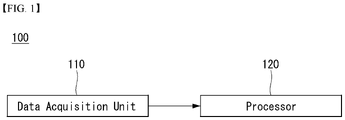
- FIG. 1 illustrates a food information providing device optimized for each individual according to an exemplary embodiment.
- a food information providing device 100 optimized for each individual (hereinafter, referred to as a 'food information providing device') illustrated in FIG. 1 is a device for providing food information optimized for a target individual based on characteristics and a microbiome analysis result of the target individual, and may be mounted on an electronic device or may be surrounded by a housing and formed as a separate device.
- the electronic device may include a personal computer, a mobile phone, a smartphone, a tablet, a laptop, a personal digital assistant (PDA), a portable multimedia player (PMP), a navigation device, an MP3 player, a digital camera, a wearable device, and the like.
- PDA personal digital assistant
- PMP portable multimedia player
- Examples of the wearable device may include a glasses type, a wrist watch type, a wristband type, a ring type, an earring type, a belt type, a necklace type, an ankle band type, a thigh band type, a forearm band type, and the like.
- the electronic device is not limited to the examples described above, and the wearable device is not limited to the examples described above.
- the food information providing device 100 may include a data acquisition unit 110 and a processor 120.
- the data acquisition unit 110 may acquire characteristic information of the target individual and information of microbiome analysis result of the target individual.
- the individual may include human and animal that consume food (e.g., feed, fodder, etc.), and the characteristic information of the individual may include a type (e.g., human, dog, cat, etc.), breed, weight, age, sex, an obesity status, a disease status, a blood test result, a neutering surgery of individual, and the like.
- the data acquisition unit 110 may acquire the characteristic information of the target individual from a hospital (including a veterinary hospital) server that measures and/or stores characteristic information of individuals, and acquire the microbiome analysis result of the target individual from a company server that performs microbiome analysis of individuals.
- the data acquisition unit 110 may use wired and wireless communication technology.
- the wireless communication technology may include Bluetooth communication, Bluetooth Low Energy (BLE) communication, near field communication (NFC), WLAN communication, Zigbee communication, Infrared Data Association (IrDA) communication, Wi-Fi direct (WFD) communication, ultra-wideband (UWB) communication, Ant+ communication, WiFi communication, radio frequency identification (RFID) communication, 3G communication, 4G communication, 5G communication, and the like, but is not limited thereto.
- BLE Bluetooth Low Energy
- NFC near field communication
- WLAN communication Zigbee communication
- IrDA Infrared Data Association
- Wi-Fi direct (WFD) communication Wi-Fi direct (WFD) communication
- ultra-wideband (UWB) communication ultra-wideband
- Ant+ communication WiFi communication
- RFID radio frequency identification
- the data acquisition unit 110 may receive the characteristic information and the microbiome analysis result information of the target individual from the user through a predetermined input means to acquire the characteristic information of the target individual and the microbiome analysis result information of the target individual.
- the processor 120 may control an overall operation of the food information providing device 100.
- the processor 120 may determine an optimal food for the target individual based on the characteristic information and the microbiome analysis result information of the target individual, and output information on the determined food through an output means.
- the food information may include food type, product information, dietary methods, etc.
- the product information may include product name, manufacturer, food components, nutrients, additives, etc.
- the processor 120 may determine an optimal food composition customized for the target individual based on the characteristic information and the microbiome analysis result information of the target individual.
- the food composition may include type, quality, quantity, etc. of components of food.
- Nutrients required for each individual may vary depending on the characteristics of each individual, such as the type, breed, weight, age, sex, obesity status, disease status, blood test result, neutering surgery, etc. of each individual and/or the microorganisms present in each individual. Accordingly, according to an embodiment, the processor 120 may determine nutrients required for the target individual based on the acquired characteristic information and the microbiome analysis result information of the target individual, and may determine an optimal food composition that can provide the determined nutrients, for example, type, quality, quantity, etc. of components of food. In this instance, the processor 120 may consider components of food that cannot be consumed for each type of individuals.
- the processor 120 may determine whether a health state of the target individual is normal or abnormal based on the characteristic information and the microbiome analysis result information of the target individual. If it is determined that the health state of the target individual is abnormal, the processor 120 may determine types and a ratio of harmful bacteria and beneficial bacteria in the target individual using the microbiome analysis result information, and determine types and an amount of beneficial bacteria required for the target individual. In this instance, the processor 120 may consider type and ratio of beneficial bacteria that exist in an individual with a normal health state. Further, the processor 120 may determine an optimal food composition customized for the target individual considering the types and amount of beneficial bacteria required for the target individual.
- the processor 120 may determine a microbiome product including beneficial bacteria required for the target individual and output information of the determined microbiome product through an output means.
- the microbiome product information may include a product name, a manufacturer, and types and an amount of microorganisms, and the like.
- Multiple microbiome product information may be previously stored in a database inside or outside the food information providing device 100, and the processor 120 may search the database to determine a microbiome product customized for the target individual.
- the processor 120 may determine the optimal food customized for the target individual based on the determined food composition. In this instance, the processor 120 may consider quality and quantity of food ingredients that help food components. Multiple food information may be previously stored in a database inside or outside the food information providing device 100, and the processor 120 may search the database to determine optimal food for the target individual.
- the processor 120 may determine the optimal food for the target individual using a food recommendation model.
- the food recommendation model may be a machine learning model trained to determine an optimal food customized for individual based on characteristic information and microbiome analysis result information of individuals.
- the food recommendation model may be previously generated through machine learning based on learning data including characteristics and microbiome analysis result of each individual for various individuals, and food corresponding to them.
- the machine learning model may include artificial neural network, decision tree, genetic algorithm, genetic programming, K-nearest neighbor, radial basis function network, random forest, support vector machine, and deep-learning, and the like.
- the processor 120 may periodically update the food recommendation model. For example, the processor 120 may continue to collect additional learning data, for example, actual data on the target individual (characteristics and microbiome analysis result of the target individual and the corresponding optimal food), and periodically additionally learn it using the collected additional learning data to update the food recommendation model.
- additional learning data for example, actual data on the target individual (characteristics and microbiome analysis result of the target individual and the corresponding optimal food)
- a performance of the food recommendation model can be improved by continuously updating the food recommendation model. That is, as the number of usages of the food recommendation model increases, it can learn with more data. Therefore, the performance of the food recommendation model can be further improved by an increase in the number of usages.
- FIG. 2 illustrates a food information providing device optimized for each individual according to an exemplary embodiment.
- a food information providing device 200 may include a data acquisition unit 110, a processor 120, an input unit 210, a storage unit 220, a communication unit 230, and an output unit 240. Since the data acquisition unit 110 and the processor 120 are the same as those described above with reference to FIG. 1 , a detailed description thereof is omitted.
- the input unit 210 may receive various operating signals and information from a user.
- the input unit 210 may include a key pad, a dome switch, a touch pad, a jog wheel, a jog switch, an H/W button, and the like.
- the touch pad forms an inter-layer structure with a display, it may be referred to as a touch screen.
- the storage unit 220 may store programs or commands for an operation of the food information providing device 200, and store input data and processed data of the food information providing device 200, data required to determine food optimized for a target individual, and the like.
- the storage unit 220 may include at least one type of storage medium such as, a flash memory type, a hard disk type, a multimedia card micro type, a card type memory (e.g., SD or XD memory, etc.), a random access memory (RAM), a static random access memory (SRAM), a read only memory (ROM), an electrically erasable programmable read only memory (EEPROM), a programmable read only memory (PROM), a magnetic memory, a magnetic disk, or an optical disk.
- the food information providing device 200 may operate an external storage medium such as web storage that performs a storage function of the storage unit 220 on the Internet.
- the communication unit 230 may communicate with an external device.
- the communication unit 230 may transmit input data, stored data, processed data, etc. of the food information providing device 200 to the external device, or receive, from the external device, various data required to determine food optimized for the target individual.
- the communication unit 230 may communicate with the external device using wired and wireless communication technology.
- the wireless communication technology may include Bluetooth communication, Bluetooth Low Energy (BLE) communication, near field communication (NFC), WLAN communication, Zigbee communication, Infrared Data Association (IrDA) communication, Wi-Fi direct (WFD) communication, ultra-wideband (UWB) communication, Ant+ communication, WiFi communication, radio frequency identification (RFID) communication, 3G communication, 4G communication, 5G communication, and the like, but is merely an example and is not limited thereto.
- the output unit 240 may output input data, stored data, processed data, etc. of the food information providing device 200. According to an embodiment, the output unit 240 may output acquired characteristic information and microbiome analysis result information of the target individual, and optimal food composition information, optimal food information, and microbiome product information determined based on them through at least one method of an auditory method, a visual method, and a tactile method. To the end, the output unit 240 may include a display, a speaker, a vibrator, and the like.
- FIG. 3 illustrates a method of providing food information optimized for each individual according to an exemplary embodiment.
- the method of providing food information illustrated in FIG. 3 may be performed by the food information providing device 100 or 200 of FIG. 1 or 2 .
- a food information providing device may acquire characteristic information of a target individual and microbiome analysis result information of the target individual, in 310.
- the food information providing device may acquire the characteristic information of the target individual from a hospital (including a veterinary hospital) server that measures and/or stores characteristic information of individuals, and acquire the microbiome analysis result of the target individual from a company server that performs microbiome analysis of individuals.
- a hospital including a veterinary hospital
- the microbiome analysis result of the target individual from a company server that performs microbiome analysis of individuals.
- the food information providing device may receive the characteristic information and the microbiome analysis result information of the target individual from a user through a predetermined input means to acquire the characteristic information of the target individual and the microbiome analysis result information of the target individual.
- the food information providing device may determine an optimal food for the target individual based on the characteristic information and the microbiome analysis result information of the target individual, and output information on the determined food, in 320.
- the food information may include food type, product information, dietary methods, etc.
- the product information may include product name, manufacturer, food components, nutrients, additives, etc.
- the food information providing device may determine an optimal food composition customized for the target individual based on the characteristic information and the microbiome analysis result information of the target individual.
- the food composition may include type, quality, quantity, etc. of components of food.
- the food information providing device may determine nutrients required for the target individual based on the acquired characteristic information and the microbiome analysis result information of the target individual, and may determine an optimal food composition that can provide the determined nutrients, for example, type, quality, quantity, etc. of components of food. In this instance, the food information providing device may consider components of food that cannot be consumed for each type of individuals.
- the food information providing device may determine whether a health state of the target individual is normal or abnormal based on the characteristic information and the microbiome analysis result information of the target individual. If it is determined that the health state of the target individual is abnormal, the food information providing device may determine types and a ratio of harmful bacteria and beneficial bacteria in the individual using the microbiome analysis result information, and determine the types and amount of beneficial bacteria required for the target individual. Further, the food information providing device may determine an optimal food composition customized for the target individual considering the type and ratio of beneficial bacteria required for the target individual.
- the food information providing device may determine a microbiome product including beneficial bacteria required for the target individual and output information of the determined microbiome product.
- the microbiome product information may include a product name, a manufacturer, and types and amount of microorganisms, and the like.
- the food information providing device may determine the optimal food customized for the target individual based on the determined food composition. In this instance, the food information providing device may consider quality and quantity of food ingredients that help food components.
- the food information providing device may determine the optimal food for the target individual based on the characteristic information and the microbiome analysis result information of the target individual, and a food recommendation model.
- the food recommendation model may be a machine learning model trained to determine an optimal food customized for individual based on characteristic information and microbiome analysis result information of individuals.
- the food recommendation model may be previously generated through machine learning based on learning data including characteristics and microbiome analysis result of each individual for various individuals, and food corresponding to them.
- the device and method for providing food information may complete may complete an optimal food composition customized for the target individual based on the characteristic information and the microbiome analysis result information of the target individual, determine food close to the completed food composition, and provide information on the food.
- microbiome product information required for the target individual may be provided together, if necessary or desired.
- the completed food composition may be used to newly product food of the target individual.
- the device and method for providing food information according to an exemplary embodiment may be used in a field of animal insurance to set an insurance rate. That is, the food information providing device and method may cause disease decrease/increase, etc. based on food customized for each individual, and may be used to calculate the insurance rate based on this result. For example, animals that are fed based on the food information providing device and method according to an exemplary embodiment may be given a relatively lower insurance rate than other animals.
- the embodiments described above may be implemented using a computer-readable medium with programs recorded thereon to perform various methods presented herein.
- the computer-readable medium may include all kinds of recording devices storing data that is readable by a computer system. Examples of the computer-readable medium may include ROM, RAM, CD-ROM, a magnetic tape, a floppy disk, an optical disc, and the like.
- the computer-readable medium may be distributed into computer systems connected via networks and may be executed by being written in computer-readable codes through a distribution method.
Landscapes
- Engineering & Computer Science (AREA)
- Business, Economics & Management (AREA)
- Health & Medical Sciences (AREA)
- Life Sciences & Earth Sciences (AREA)
- Theoretical Computer Science (AREA)
- Accounting & Taxation (AREA)
- Finance (AREA)
- Chemical & Material Sciences (AREA)
- General Physics & Mathematics (AREA)
- Physics & Mathematics (AREA)
- Strategic Management (AREA)
- Medical Informatics (AREA)
- Public Health (AREA)
- Polymers & Plastics (AREA)
- Biomedical Technology (AREA)
- Data Mining & Analysis (AREA)
- Primary Health Care (AREA)
- Economics (AREA)
- General Health & Medical Sciences (AREA)
- Marketing (AREA)
- General Business, Economics & Management (AREA)
- Development Economics (AREA)
- Animal Husbandry (AREA)
- Epidemiology (AREA)
- Zoology (AREA)
- Microbiology (AREA)
- Food Science & Technology (AREA)
- Pathology (AREA)
- Databases & Information Systems (AREA)
- Molecular Biology (AREA)
- Biotechnology (AREA)
- Artificial Intelligence (AREA)
- Birds (AREA)
- Computational Linguistics (AREA)
- General Engineering & Computer Science (AREA)
- Computing Systems (AREA)
- Software Systems (AREA)
- Physiology (AREA)
- Biochemistry (AREA)
- Evolutionary Computation (AREA)
Abstract
Description
- The present disclosure relates to a device and method for providing food information optimized for each individual.
- Recently, as the number of pet households has rapidly increased, the need for a food recommendation service for pets is being strongly raised. As the number of types of food has rapidly increased along with an increase in the number of pet households, pet owner are always sensitive to food feeding. However, since it is difficult for the pet owners to determine whether the corresponding food is suitable for pets, it is common to purchase food based on brand awareness only.
- However, the pets vary in types and breeds, and the nutrients that the pet should consume vary depending on its age, size, physical condition, disease, etc. Therefore, it is not easy for the pet owners to choose food that contains the necessary nutrients customized for their pets.
- Accordingly, a research on technology that recommends food optimized for each pet is continuing.
- The present disclosure provides a device and method for providing food information optimized for each individual.
- In one aspect of the present disclosure, there is provided a food information providing device optimized for each individual comprising a data acquisition unit configured to acquire characteristic information and microbiome analysis result information of a target individual, and a processor configured to determine a food customized for the target individual based on the acquired characteristic information and microbiome analysis result information.
- The characteristic information may include a type, a breed, a weight, an age, a sex, an obesity status, a disease status, a blood test result, and a neutering surgery of an individual.
- The processor may be configured to determine nutrients required for the target individual based on the acquired characteristic information and microbiome analysis result information and determine a food composition capable of providing the determined nutrients.
- The food composition may include a type, a quality, and a quantity of components of the food.
- The processor may be configured to determine a health state of the target individual based on the acquired characteristic information and microbiome analysis result information, and when the determined health state is abnormal, determine types and a ratio of harmful bacteria and beneficial bacteria in the target individual using the microbiome analysis result information, determine types and an amount of beneficial bacteria required for the target individual, and determine the food composition considering the types and the amount of beneficial bacteria required for the target individual.
- The food information providing device may further comprise an output unit configured to output information on the determined food.
- The food information may include a food type, product information, and a dietary method.
- The processor may be configured to use a food recommendation model trained to determine an optimal food customized for an individual based on characteristic information and microbiome analysis result information.
- In another aspect of the present disclosure, there is provided a method of providing food information optimized for each individual, the method comprising acquiring characteristic information and microbiome analysis result information of a target individual, and determining a food customized for the target individual based on the acquired characteristic information and microbiome analysis result information.
- The characteristic information may include a type, a breed, a weight, an age, a sex, an obesity status, a disease status, a blood test result, and a neutering operation of an individual.
- Determining the food customized for the target individual may comprise determining nutrients required for the target individual based on the acquired characteristic information and microbiome analysis result information, and determining a food composition capable of providing the determined nutrients.
- The food composition may include a type, a quality, and a quantity of components of the food.
- Determining the food composition may comprise determining a health state of the target individual based on the acquired characteristic information and microbiome analysis result information, and when the determined health state is abnormal, determining types and a ratio of harmful bacteria and beneficial bacteria in the target individual using the microbiome analysis result information, determining types and an amount of beneficial bacteria required for the target individual, and determining the food composition considering the types and the amount of beneficial bacteria required for the target individual.
- The method may further comprise outputting information on the determined food.
- The food information may include a food type, product information, and a dietary method.
- Determining the food customized for the target individual may comprise determining the food customized for the target individual using a food recommendation model trained to determine an optimal food customized for an individual based on characteristic information and microbiome analysis result information.
- The present disclosure can recommend food optimized for each individual based on characteristics and a microbiome analysis result of individuals. Hence, a user can easily select food of individual.
-
-
FIG. 1 illustrates a food information providing device optimized for each individual according to an exemplary embodiment. -
FIG. 2 illustrates a food information providing device optimized for each individual according to an exemplary embodiment. -
FIG. 3 illustrates a method of providing food information optimized for each individual according to an exemplary embodiment. - Reference will now be made in detail to embodiments of the disclosure, examples of which are illustrated in the accompanying drawings. Wherever possible, the same reference numbers will be used throughout the drawings to refer to the same or like parts. It will be noted that a detailed description of known arts will be omitted if it is determined that the detailed description of the known arts can obscure the embodiments of the disclosure.
- For respective steps, respective steps may be performed in a different order from the stated order unless the context clearly indicates a specific order. That is, the respective steps may be performed in the same order as specified, or may be performed substantially simultaneously, or may be performed in the reverse order.
- The terms to be described later are terms defined in consideration of functions in the present disclosure and may vary depending on intentions or customs, etc. of users or operators. Therefore, the definition should be made based on the contents throughout the present disclosure.
- The terms including an ordinal number such as first, second, etc. may be used to describe various components, but the components are not limited by such terms. The terms are used only for the purpose of distinguishing one component from other components. A singular expression can include a plural expression as long as it does not have an apparently different meaning in context. In the present disclosure, terms "include" and "have" should be understood to be intended to designate that illustrated features, numbers, steps, operations, components, parts or combinations thereof are present and not to preclude the existence of one or more different features, numbers, steps, operations, components, parts or combinations thereof, or the possibility of the addition thereof.
- In the present disclosure, the classification of components is merely classified based on the main function for which each component is responsible. That is, two or more components may be combined into one component, or one component may be divided into two or more components for each more subdivided function. Each of the components may additionally perform all or part of function of another component in addition to the main function for which each component is responsible, and part of the main function of each component may be exclusively performed by another component. Each component may be implemented as hardware or software, or may be implemented as a combination of hardware and software.
-
FIG. 1 illustrates a food information providing device optimized for each individual according to an exemplary embodiment. A foodinformation providing device 100 optimized for each individual (hereinafter, referred to as a 'food information providing device') illustrated inFIG. 1 is a device for providing food information optimized for a target individual based on characteristics and a microbiome analysis result of the target individual, and may be mounted on an electronic device or may be surrounded by a housing and formed as a separate device. Examples of the electronic device may include a personal computer, a mobile phone, a smartphone, a tablet, a laptop, a personal digital assistant (PDA), a portable multimedia player (PMP), a navigation device, an MP3 player, a digital camera, a wearable device, and the like. Examples of the wearable device may include a glasses type, a wrist watch type, a wristband type, a ring type, an earring type, a belt type, a necklace type, an ankle band type, a thigh band type, a forearm band type, and the like. The electronic device is not limited to the examples described above, and the wearable device is not limited to the examples described above. - Referring to
FIG. 1 , the foodinformation providing device 100 according to an exemplary embodiment may include adata acquisition unit 110 and aprocessor 120. - The
data acquisition unit 110 may acquire characteristic information of the target individual and information of microbiome analysis result of the target individual. Herein, the individual may include human and animal that consume food (e.g., feed, fodder, etc.), and the characteristic information of the individual may include a type (e.g., human, dog, cat, etc.), breed, weight, age, sex, an obesity status, a disease status, a blood test result, a neutering surgery of individual, and the like. - For example, the
data acquisition unit 110 may acquire the characteristic information of the target individual from a hospital (including a veterinary hospital) server that measures and/or stores characteristic information of individuals, and acquire the microbiome analysis result of the target individual from a company server that performs microbiome analysis of individuals. In this instance, thedata acquisition unit 110 may use wired and wireless communication technology. Herein, the wireless communication technology may include Bluetooth communication, Bluetooth Low Energy (BLE) communication, near field communication (NFC), WLAN communication, Zigbee communication, Infrared Data Association (IrDA) communication, Wi-Fi direct (WFD) communication, ultra-wideband (UWB) communication, Ant+ communication, WiFi communication, radio frequency identification (RFID) communication, 3G communication, 4G communication, 5G communication, and the like, but is not limited thereto. - As another example, the
data acquisition unit 110 may receive the characteristic information and the microbiome analysis result information of the target individual from the user through a predetermined input means to acquire the characteristic information of the target individual and the microbiome analysis result information of the target individual. - The
processor 120 may control an overall operation of the foodinformation providing device 100. - The
processor 120 may determine an optimal food for the target individual based on the characteristic information and the microbiome analysis result information of the target individual, and output information on the determined food through an output means. The food information may include food type, product information, dietary methods, etc., and the product information may include product name, manufacturer, food components, nutrients, additives, etc. - According to an embodiment, the
processor 120 may determine an optimal food composition customized for the target individual based on the characteristic information and the microbiome analysis result information of the target individual. The food composition may include type, quality, quantity, etc. of components of food. - Nutrients required for each individual may vary depending on the characteristics of each individual, such as the type, breed, weight, age, sex, obesity status, disease status, blood test result, neutering surgery, etc. of each individual and/or the microorganisms present in each individual. Accordingly, according to an embodiment, the
processor 120 may determine nutrients required for the target individual based on the acquired characteristic information and the microbiome analysis result information of the target individual, and may determine an optimal food composition that can provide the determined nutrients, for example, type, quality, quantity, etc. of components of food. In this instance, theprocessor 120 may consider components of food that cannot be consumed for each type of individuals. - For example, the
processor 120 may determine whether a health state of the target individual is normal or abnormal based on the characteristic information and the microbiome analysis result information of the target individual. If it is determined that the health state of the target individual is abnormal, theprocessor 120 may determine types and a ratio of harmful bacteria and beneficial bacteria in the target individual using the microbiome analysis result information, and determine types and an amount of beneficial bacteria required for the target individual. In this instance, theprocessor 120 may consider type and ratio of beneficial bacteria that exist in an individual with a normal health state. Further, theprocessor 120 may determine an optimal food composition customized for the target individual considering the types and amount of beneficial bacteria required for the target individual. - The
processor 120 may determine a microbiome product including beneficial bacteria required for the target individual and output information of the determined microbiome product through an output means. The microbiome product information may include a product name, a manufacturer, and types and an amount of microorganisms, and the like. Multiple microbiome product information may be previously stored in a database inside or outside the foodinformation providing device 100, and theprocessor 120 may search the database to determine a microbiome product customized for the target individual. - When the optimal food composition customized for the target individual is determined, the
processor 120 may determine the optimal food customized for the target individual based on the determined food composition. In this instance, theprocessor 120 may consider quality and quantity of food ingredients that help food components. Multiple food information may be previously stored in a database inside or outside the foodinformation providing device 100, and theprocessor 120 may search the database to determine optimal food for the target individual. - According to an embodiment, the
processor 120 may determine the optimal food for the target individual using a food recommendation model. - The food recommendation model may be a machine learning model trained to determine an optimal food customized for individual based on characteristic information and microbiome analysis result information of individuals. For example, the food recommendation model may be previously generated through machine learning based on learning data including characteristics and microbiome analysis result of each individual for various individuals, and food corresponding to them. The machine learning model may include artificial neural network, decision tree, genetic algorithm, genetic programming, K-nearest neighbor, radial basis function network, random forest, support vector machine, and deep-learning, and the like.
- The
processor 120 may periodically update the food recommendation model. For example, theprocessor 120 may continue to collect additional learning data, for example, actual data on the target individual (characteristics and microbiome analysis result of the target individual and the corresponding optimal food), and periodically additionally learn it using the collected additional learning data to update the food recommendation model. A performance of the food recommendation model can be improved by continuously updating the food recommendation model. That is, as the number of usages of the food recommendation model increases, it can learn with more data. Therefore, the performance of the food recommendation model can be further improved by an increase in the number of usages. -
FIG. 2 illustrates a food information providing device optimized for each individual according to an exemplary embodiment. - Referring to
FIG. 2 , a foodinformation providing device 200 may include adata acquisition unit 110, aprocessor 120, aninput unit 210, astorage unit 220, acommunication unit 230, and anoutput unit 240. Since thedata acquisition unit 110 and theprocessor 120 are the same as those described above with reference toFIG. 1 , a detailed description thereof is omitted. - The
input unit 210 may receive various operating signals and information from a user. According to an embodiment, theinput unit 210 may include a key pad, a dome switch, a touch pad, a jog wheel, a jog switch, an H/W button, and the like. In particular, when the touch pad forms an inter-layer structure with a display, it may be referred to as a touch screen. - The
storage unit 220 may store programs or commands for an operation of the foodinformation providing device 200, and store input data and processed data of the foodinformation providing device 200, data required to determine food optimized for a target individual, and the like. - The
storage unit 220 may include at least one type of storage medium such as, a flash memory type, a hard disk type, a multimedia card micro type, a card type memory (e.g., SD or XD memory, etc.), a random access memory (RAM), a static random access memory (SRAM), a read only memory (ROM), an electrically erasable programmable read only memory (EEPROM), a programmable read only memory (PROM), a magnetic memory, a magnetic disk, or an optical disk. The foodinformation providing device 200 may operate an external storage medium such as web storage that performs a storage function of thestorage unit 220 on the Internet. - The
communication unit 230 may communicate with an external device. For example, thecommunication unit 230 may transmit input data, stored data, processed data, etc. of the foodinformation providing device 200 to the external device, or receive, from the external device, various data required to determine food optimized for the target individual. - The
communication unit 230 may communicate with the external device using wired and wireless communication technology. The wireless communication technology may include Bluetooth communication, Bluetooth Low Energy (BLE) communication, near field communication (NFC), WLAN communication, Zigbee communication, Infrared Data Association (IrDA) communication, Wi-Fi direct (WFD) communication, ultra-wideband (UWB) communication, Ant+ communication, WiFi communication, radio frequency identification (RFID) communication, 3G communication, 4G communication, 5G communication, and the like, but is merely an example and is not limited thereto. - The
output unit 240 may output input data, stored data, processed data, etc. of the foodinformation providing device 200. According to an embodiment, theoutput unit 240 may output acquired characteristic information and microbiome analysis result information of the target individual, and optimal food composition information, optimal food information, and microbiome product information determined based on them through at least one method of an auditory method, a visual method, and a tactile method. To the end, theoutput unit 240 may include a display, a speaker, a vibrator, and the like. -
FIG. 3 illustrates a method of providing food information optimized for each individual according to an exemplary embodiment. The method of providing food information illustrated inFIG. 3 may be performed by the foodinformation providing device FIG. 1 or2 . - Referring to
FIG. 3 , a food information providing device may acquire characteristic information of a target individual and microbiome analysis result information of the target individual, in 310. - For example, the food information providing device may acquire the characteristic information of the target individual from a hospital (including a veterinary hospital) server that measures and/or stores characteristic information of individuals, and acquire the microbiome analysis result of the target individual from a company server that performs microbiome analysis of individuals.
- As another example, the food information providing device may receive the characteristic information and the microbiome analysis result information of the target individual from a user through a predetermined input means to acquire the characteristic information of the target individual and the microbiome analysis result information of the target individual.
- The food information providing device may determine an optimal food for the target individual based on the characteristic information and the microbiome analysis result information of the target individual, and output information on the determined food, in 320. The food information may include food type, product information, dietary methods, etc., and the product information may include product name, manufacturer, food components, nutrients, additives, etc.
- According to an embodiment, the food information providing device may determine an optimal food composition customized for the target individual based on the characteristic information and the microbiome analysis result information of the target individual. The food composition may include type, quality, quantity, etc. of components of food. For example, the food information providing device may determine nutrients required for the target individual based on the acquired characteristic information and the microbiome analysis result information of the target individual, and may determine an optimal food composition that can provide the determined nutrients, for example, type, quality, quantity, etc. of components of food. In this instance, the food information providing device may consider components of food that cannot be consumed for each type of individuals.
- For example, the food information providing device may determine whether a health state of the target individual is normal or abnormal based on the characteristic information and the microbiome analysis result information of the target individual. If it is determined that the health state of the target individual is abnormal, the food information providing device may determine types and a ratio of harmful bacteria and beneficial bacteria in the individual using the microbiome analysis result information, and determine the types and amount of beneficial bacteria required for the target individual. Further, the food information providing device may determine an optimal food composition customized for the target individual considering the type and ratio of beneficial bacteria required for the target individual.
- The food information providing device may determine a microbiome product including beneficial bacteria required for the target individual and output information of the determined microbiome product. The microbiome product information may include a product name, a manufacturer, and types and amount of microorganisms, and the like.
- When the optimal food composition customized for the target individual is determined, the food information providing device may determine the optimal food customized for the target individual based on the determined food composition. In this instance, the food information providing device may consider quality and quantity of food ingredients that help food components.
- According to another embodiment, the food information providing device may determine the optimal food for the target individual based on the characteristic information and the microbiome analysis result information of the target individual, and a food recommendation model.
- The food recommendation model may be a machine learning model trained to determine an optimal food customized for individual based on characteristic information and microbiome analysis result information of individuals. For example, the food recommendation model may be previously generated through machine learning based on learning data including characteristics and microbiome analysis result of each individual for various individuals, and food corresponding to them.
- The device and method for providing food information according to an exemplary embodiment may complete may complete an optimal food composition customized for the target individual based on the characteristic information and the microbiome analysis result information of the target individual, determine food close to the completed food composition, and provide information on the food. In this instance, microbiome product information required for the target individual may be provided together, if necessary or desired. The completed food composition may be used to newly product food of the target individual.
- The device and method for providing food information according to an exemplary embodiment may be used in a field of animal insurance to set an insurance rate. That is, the food information providing device and method may cause disease decrease/increase, etc. based on food customized for each individual, and may be used to calculate the insurance rate based on this result. For example, animals that are fed based on the food information providing device and method according to an exemplary embodiment may be given a relatively lower insurance rate than other animals.
- The embodiments described above may be implemented using a computer-readable medium with programs recorded thereon to perform various methods presented herein. The computer-readable medium may include all kinds of recording devices storing data that is readable by a computer system. Examples of the computer-readable medium may include ROM, RAM, CD-ROM, a magnetic tape, a floppy disk, an optical disc, and the like. The computer-readable medium may be distributed into computer systems connected via networks and may be executed by being written in computer-readable codes through a distribution method.
- So far, the present disclosure has been described with reference to a number of illustrative embodiments thereof. It should be understood that numerous other modifications and embodiments can be implemented by those skilled in the technical field to which the present disclosure pertains within the scope of the principles of the present disclosure. Accordingly, the scope of the present disclosure is not limited to embodiments described above, and various variations and modifications are possible in the component parts and/or arrangements of the subject combination arrangement within the scope of the appended claims.
Claims (16)
- A food information providing device optimized for each individual, comprising:a data acquisition unit configured to acquire characteristic information and microbiome analysis result information of a target individual; anda processor configured to determine a food customized for the target individual based on the acquired characteristic information and microbiome analysis result information.
- The food information providing device of claim 1, wherein the characteristic information includes a type, a breed, a weight, an age, a sex, an obesity status, a disease status, a blood test result, and a neutering surgery of an individual.
- The food information providing device of claim 1, wherein the processor is configured to determine nutrients required for the target individual based on the acquired characteristic information and microbiome analysis result information and determine a food composition capable of providing the determined nutrients.
- The food information providing device of claim 3, wherein the food composition includes a type, a quality, and a quantity of components of the food.
- The food information providing device of claim 3, wherein the processor is configured to:determine a health state of the target individual based on the acquired characteristic information and microbiome analysis result information; andwhen the determined health state is abnormal, determine types and a ratio of harmful bacteria and beneficial bacteria in the target individual using the microbiome analysis result information, determine types and an amount of beneficial bacteria required for the target individual, and determine the food composition considering the types and the amount of beneficial bacteria required for the target individual.
- The food information providing device of claim 1, further comprising:
an output unit configured to output information on the determined food. - The food information providing device of claim 6, wherein the food information includes a food type, product information, and a dietary method.
- The food information providing device of claim 1, wherein the processor is configured to use a food recommendation model trained to determine an optimal food customized for an individual based on characteristic information and microbiome analysis result information.
- A method of providing food information optimized for each individual, the method comprising:acquiring characteristic information and microbiome analysis result information of a target individual; anddetermining a food customized for the target individual based on the acquired characteristic information and microbiome analysis result information.
- The method of claim 9, wherein the characteristic information includes a type, a breed, a weight, an age, a sex, an obesity status, a disease status, a blood test result, and a neutering surgery of an individual.
- The method of claim 9, wherein determining the food customized for the target individual comprises:determining nutrients required for the target individual based on the acquired characteristic information and microbiome analysis result information; anddetermining a food composition capable of providing the determined nutrients.
- The method of claim 11, wherein the food composition includes a type, a quality, and a quantity of components of the food.
- The method of claim 11, wherein determining the food composition comprises:determining a health state of the target individual based on the acquired characteristic information and microbiome analysis result information; andwhen the determined health state is abnormal, determining types and a ratio of harmful bacteria and beneficial bacteria in the target individual using the microbiome analysis result information, determining types and an amount of beneficial bacteria required for the target individual, and determining the food composition considering the types and the amount of beneficial bacteria required for the target individual.
- The method of claim 9, further comprising:
outputting information on the determined food. - The method of claim 14, wherein the food information includes a food type, product information, and a dietary method.
- The method of claim 9, wherein determining the food customized for the target individual comprises:
determining the food customized for the target individual using a food recommendation model trained to determine an optimal food customized for an individual based on characteristic information and microbiome analysis result information.
Applications Claiming Priority (3)
| Application Number | Priority Date | Filing Date | Title |
|---|---|---|---|
| KR20190171652 | 2019-12-20 | ||
| KR1020200178224A KR102599418B1 (en) | 2019-12-20 | 2020-12-18 | Apparatus and method for providing feeding information |
| PCT/KR2020/018736 WO2021125908A1 (en) | 2019-12-20 | 2020-12-21 | Device and method for providing fodder information optimized for individuals |
Publications (2)
| Publication Number | Publication Date |
|---|---|
| EP4080440A1 true EP4080440A1 (en) | 2022-10-26 |
| EP4080440A4 EP4080440A4 (en) | 2023-08-02 |
Family
ID=76478489
Family Applications (1)
| Application Number | Title | Priority Date | Filing Date |
|---|---|---|---|
| EP20902054.4A Pending EP4080440A4 (en) | 2019-12-20 | 2020-12-21 | DEVICE AND METHOD FOR PROVIDING OPTIMIZED FORAGE INFORMATION FOR INDIVIDUALS |
Country Status (5)
| Country | Link |
|---|---|
| US (1) | US20230010377A1 (en) |
| EP (1) | EP4080440A4 (en) |
| JP (1) | JP2023507950A (en) |
| CN (1) | CN114830161A (en) |
| WO (1) | WO2021125908A1 (en) |
Family Cites Families (12)
| Publication number | Priority date | Publication date | Assignee | Title |
|---|---|---|---|---|
| AU2006331551A1 (en) * | 2005-12-20 | 2007-07-05 | Mars, Incorporated | Method and system for determining and providing a comprehensive pet health and nutrition feeding plan |
| CA2905413A1 (en) * | 2013-03-15 | 2014-09-25 | Nestec S.A. | Systems and methods for ordering and manufacturing custom pet food |
| KR20150133978A (en) * | 2014-05-21 | 2015-12-01 | (주)디자인크라프트 | Pet weight care system and service with E-chart |
| CN106447117B (en) * | 2016-10-10 | 2018-05-01 | 重庆科技学院 | Pet feeding method and system based on the daily data analysis of pet |
| KR20180078458A (en) * | 2016-12-30 | 2018-07-10 | 이경문 | Method for providing customized food product service correspondance with individual animal |
| KR20180107630A (en) * | 2017-03-22 | 2018-10-02 | 장재원 | System and method for providing information in order to choose pet's supplies |
| US11361368B2 (en) * | 2018-01-16 | 2022-06-14 | Habi, Inc. | Methods for pet wellness platform |
| US11183080B2 (en) * | 2018-02-12 | 2021-11-23 | Zoe Limited | Generating predicted values of biomarkers for scoring food |
| US11183291B2 (en) * | 2018-02-12 | 2021-11-23 | Zoe Limited | Generating personalized nutritional recommendations using predicted values of biomarkers |
| US11672446B2 (en) * | 2018-03-23 | 2023-06-13 | Medtronic Minimed, Inc. | Insulin delivery recommendations based on nutritional information |
| US20190295440A1 (en) * | 2018-03-23 | 2019-09-26 | Nutrino Health Ltd. | Systems and methods for food analysis, personalized recommendations and health management |
| TWI772781B (en) * | 2019-04-16 | 2022-08-01 | 日商電通股份有限公司 | Pet food suggestion device and pet food suggestion method |
-
2020
- 2020-12-21 EP EP20902054.4A patent/EP4080440A4/en active Pending
- 2020-12-21 JP JP2022536906A patent/JP2023507950A/en active Pending
- 2020-12-21 WO PCT/KR2020/018736 patent/WO2021125908A1/en not_active Ceased
- 2020-12-21 CN CN202080086480.1A patent/CN114830161A/en active Pending
- 2020-12-21 US US17/784,618 patent/US20230010377A1/en not_active Abandoned
Also Published As
| Publication number | Publication date |
|---|---|
| US20230010377A1 (en) | 2023-01-12 |
| WO2021125908A1 (en) | 2021-06-24 |
| EP4080440A4 (en) | 2023-08-02 |
| JP2023507950A (en) | 2023-02-28 |
| CN114830161A (en) | 2022-07-29 |
Similar Documents
| Publication | Publication Date | Title |
|---|---|---|
| US12063910B2 (en) | System, method, and apparatus for tracking and monitoring pet activity | |
| US10264765B2 (en) | Pet monitoring and recommendation system | |
| US20160042038A1 (en) | Methods and systems for managing animals | |
| KR102346521B1 (en) | Pet recommendation system and method | |
| KR102004438B1 (en) | Device and method of providing health care service based on collecting user’s health habit information | |
| CA3215537A1 (en) | System, method, and apparatus for pet condition detection | |
| CN107006389B (en) | Terminal and pet action signal identification method and device | |
| KR20210100485A (en) | Method for Recommending Personalized Sample Items for Companion Animal in Network, and Managing Server Used Therein | |
| KR102188050B1 (en) | System and method for providing nutrition information | |
| US20230010377A1 (en) | Device and method for providing fodder information optimized for individuals | |
| KR102808399B1 (en) | Method, server and computer program for feed recommendation using emr big data and providing un-tact veterinary clinic integration solution | |
| KR102599418B1 (en) | Apparatus and method for providing feeding information | |
| CN110972991A (en) | Wearable equipment of pet and management system thereof | |
| KR102574972B1 (en) | Method for recommending dog food and server thereof | |
| JP6607665B2 (en) | Information processing apparatus, terminal apparatus, information processing system, portable recording medium, information processing apparatus control method, control program, and recording medium | |
| KR20220089168A (en) | Nutrition information providing system | |
| KR102732753B1 (en) | Animal health support device and method enabling emergency support | |
| KR102597008B1 (en) | System for inferencing disease of companion animal and Method therefor | |
| KR20240033789A (en) | System and method for integrated health management pet | |
| KR102602050B1 (en) | Apparatus and method for providing animal-tailored solutions | |
| Kontogiannis et al. | Design and implementation of an identification productivity recording and breeding system for the sheep industry | |
| KR102936390B1 (en) | Muzzle device for health care | |
| KR20120132746A (en) | Pet of the call and training device | |
| Vazquez-Briseno et al. | mHealth Platform and Architectures to Provide Nutritional Guidance to Children. | |
| Pindter-Medina | mHealth and web applications |
Legal Events
| Date | Code | Title | Description |
|---|---|---|---|
| STAA | Information on the status of an ep patent application or granted ep patent |
Free format text: STATUS: THE INTERNATIONAL PUBLICATION HAS BEEN MADE |
|
| PUAI | Public reference made under article 153(3) epc to a published international application that has entered the european phase |
Free format text: ORIGINAL CODE: 0009012 |
|
| STAA | Information on the status of an ep patent application or granted ep patent |
Free format text: STATUS: REQUEST FOR EXAMINATION WAS MADE |
|
| 17P | Request for examination filed |
Effective date: 20220614 |
|
| AK | Designated contracting states |
Kind code of ref document: A1 Designated state(s): AL AT BE BG CH CY CZ DE DK EE ES FI FR GB GR HR HU IE IS IT LI LT LU LV MC MK MT NL NO PL PT RO RS SE SI SK SM TR |
|
| DAV | Request for validation of the european patent (deleted) | ||
| DAX | Request for extension of the european patent (deleted) | ||
| A4 | Supplementary search report drawn up and despatched |
Effective date: 20230629 |
|
| RIC1 | Information provided on ipc code assigned before grant |
Ipc: A61B 10/00 20060101ALI20230623BHEP Ipc: A61B 5/00 20060101ALI20230623BHEP Ipc: G06Q 30/06 20120101AFI20230623BHEP |