EP4080379A1 - Information processing program, information processing method, and information processing device - Google Patents
Information processing program, information processing method, and information processing device Download PDFInfo
- Publication number
- EP4080379A1 EP4080379A1 EP19956466.7A EP19956466A EP4080379A1 EP 4080379 A1 EP4080379 A1 EP 4080379A1 EP 19956466 A EP19956466 A EP 19956466A EP 4080379 A1 EP4080379 A1 EP 4080379A1
- Authority
- EP
- European Patent Office
- Prior art keywords
- vector
- sentence
- primary structure
- basis
- information processing
- Prior art date
- Legal status (The legal status is an assumption and is not a legal conclusion. Google has not performed a legal analysis and makes no representation as to the accuracy of the status listed.)
- Withdrawn
Links
Images












Classifications
-
- G—PHYSICS
- G06—COMPUTING OR CALCULATING; COUNTING
- G06F—ELECTRIC DIGITAL DATA PROCESSING
- G06F16/00—Information retrieval; Database structures therefor; File system structures therefor
- G06F16/30—Information retrieval; Database structures therefor; File system structures therefor of unstructured textual data
- G06F16/33—Querying
- G06F16/3331—Query processing
- G06F16/334—Query execution
- G06F16/3347—Query execution using vector based model
-
- G—PHYSICS
- G06—COMPUTING OR CALCULATING; COUNTING
- G06F—ELECTRIC DIGITAL DATA PROCESSING
- G06F16/00—Information retrieval; Database structures therefor; File system structures therefor
- G06F16/30—Information retrieval; Database structures therefor; File system structures therefor of unstructured textual data
- G06F16/31—Indexing; Data structures therefor; Storage structures
Definitions
- FIG. 32 is a diagram for describing embedding in the Poincare space.
- words such as "tiger” and “jaguar” are defined for a category “carnivorous animal”
- the word “carnivorous animal” the word “tiger”, and the word “jaguar” are embedded in a Poincare space P.
- vectors corresponding to positions on the Poincare space P are assigned to the word “carnivorous animal", the word "tiger”, and the word "jaguar”.
- an information processing program for causing a computer to execute processing of embedding a plurality of vocabularies in a vector space on the basis of similar vocabulary information in which, for a plurality of different types of parts of speech, vocabularies that are synonymous or similar to a predetermined degree or more are associated; calculating, for each of a first sentence and a second sentence, a vector of the sentence on the basis of a vector in the vector space of each of a plurality of vocabularies included in the sentence; and determining similarity between the first sentence and the second sentence on the basis of the vector of the first sentence and the vector of the second sentence.
- a sentence vector may be calculated accurately and efficiently, and similarity determination accuracy may be improved.
- FIG. 1 is a diagram for describing the reference technology.
- a word vector table 11 is generated by calculating a word vector of each word included in text data 10 by Word2vec.
- Word2vec words and word vectors are associated.
- a dimension of a word vector in the word vector table 11 is 200 dimensions.
- a part of speech of the word “liked” is “adjective”
- a part of speech of the word “favorite” is “noun”
- a part of speech of the word “treasure” is “noun”
- even words whose parts of speech are different are associated with the same concept number when the words have similar meanings.
- the definition information 5 associates a category and a word.
- a part of speech corresponding to a word is indicated for performing comparison with the similar vocabulary information 142.
- words whose part of speech is a noun are classified by categories.
- a word "tiger”, a word “jaguar”, and a word "lion” are associated with a category "carnivorous animal".
- the part of speech of the words in the definition information 5 is limited to the noun.
- the information processing apparatus aggregates each word corresponding to the same concept number defined in the similar vocabulary information 142 at an approximate position on the Poincare space.
- the information processing apparatus performs embedding in the Poincare space on the basis of the similar vocabulary information 142, to calculate word vectors and generate a word vector table 143.
- word vector table 143 words and word vectors are associated.
- a dimension of a word vector in the word vector table 143 is 200 dimensions.
- the communication unit 110 is a processing unit that executes information communication with an external device (not illustrated) via a network.
- the communication unit 110 corresponds to a communication device such as a network interface card (NIC).
- NIC network interface card
- the control unit 150 to be described below exchanges information with an external device via the communication unit 110.
- the input unit 120 is an input device that inputs various types of information to the information processing apparatus 100.
- the input unit 120 corresponds to a keyboard, a mouse, a touch panel, or the like.
- a user may operate the input unit 120 to input query data 147 to be described below.
- the text data 141 is information (text) including a plurality of sentences. Sentences are delimited by punctuation marks.
- FIG. 6 is a diagram illustrating an example of a data structure of the text data. As illustrated in FIG. 6 , the text data 141 includes a plurality of sentences. Contents of the text data 141 are not limited to those of FIG. 6 .
- the similar vocabulary information 142 is information that associates a plurality of words (vocabularies) that is synonymous or similar to a predetermined degree or more with the same concept number.
- FIG. 7 is a diagram illustrating an example of a data structure of the similar vocabulary information according to the present first embodiment. As illustrated in FIG. 7 , the similar vocabulary information 142 associates a concept number, a word, and a part of speech. For example, a word “liked”, a word “favorite”, a word “treasure”, and the like are associated with a concept number "1101".
- the compressed word vector table 144 is a table that retains information regarding each word vector obtained by dimension compression (compressed word vector).
- FIG. 9 is a diagram illustrating an example of a data structure of the compressed word vector table according to the present first embodiment. As illustrated in FIG. 9 , the compressed word vector table 144 associates a word and a compressed word vector. For example, a dimension of the compressed word vector is assumed to be 19 dimensions, but the dimension is not limited to this.
- the dimension compression unit 153 executes the processing described above on the basis vectors of 1 or prime numbers of 19 dimensions distributed to dimensionally compress a 200-dimensional vector into a 19-dimensional vector. For example, the dimension compression unit 153 calculates each of basis vector values of 1 or prime numbers "1", “11", “23”, “41”, “43”, “53”, “61”, “73”, “83”, "97”, “107”, “113”, “127”, “137”, “149”, “157”, “167”, “179”, and "191" to perform dimension compression into a 19-dimensional vector.
- a 19-dimensional vector is described as an example in the present embodiment, it may be a vector of another dimension.
- the basis vectors of 1 or prime numbers divided by the prime numbers "3 or more" and distributed it becomes possible to implement highly accurate dimension decompression, although it is irreversible. Note that, while the accuracy is improved as the prime number to be divided increases, a compression rate is lowered.
- the dimension compression unit 153 orthogonally transforms the respective remaining basis vectors a 1 e 1 to a 130 e 130 and a 132 e 132 to a 200 e 200 with respect to the basis vector a 131 e 131 , and integrates the values of the respective orthogonally transformed basis vectors a 1 e 1 to a 130 e 130 and a 132 e 132 to a 20 e 200 , thereby calculating a value of the basis vector a 131 e 131 .
- the sentence vector calculation unit 154 repeatedly executes the processing described above also for other sentences included in the text data 141, to execute registration of compressed sentence vectors with respect to the compressed sentence vector data 145 and setting of flags to the inverted index 146.
- the similarity determination unit 155 calculates a degree of similarity between the first compressed sentence vector and the second compressed sentence vector on the basis of Formula (2). For example, the closer a distance between the first compressed sentence vector and the second compressed sentence vector, the greater the degree of similarity.
- the similarity determination unit 155 specifies an offset of a sentence corresponding to the specific compressed sentence vector on the basis of a flag of a row corresponding to the specific compressed sentence vector among rows of the second compressed sentence vectors of the inverted index 146. For example, in a case where the specific compressed sentence vector is "S_Vec1", offsets "3" and "30" are specified.
- the information processing apparatus 100 performs embedding in the Poincare space on the basis of the similar vocabulary information 142, to calculate a word vector and generate the word vector table 143.
- the word vector table 143 in which approximate word vectors are assigned to a plurality of words that is synonymous or similar to a predetermined degree or more.
- the information processing apparatus 100 Since the information processing apparatus 100 generates the compressed word vector table 144 obtained by compressing the dimension of the word vector table 143, and calculates a sentence vector by using compressed word vectors, a calculation amount may be reduced compared with a sentence vector calculation amount of the reference technology.
- a sentence vector of a sentence including a plurality of words is calculated and similarity of each sentence vector is determined, but the present invention is not limited to this.
- a primary structure of a protein hereinafter simply referred to as the primary structure
- vectors of the protein and the primary structure may be calculated by regarding one protein as one word and also one primary structure as one sentence.
- similarity of each primary structure may be determined.
- the information processing apparatus aggregates each protein corresponding to the same concept number defined in the similar protein information 242 at an approximate position on the Poincare space.
- the communication unit 210 is a processing unit that executes information communication with an external device (not illustrated) via a network.
- the communication unit 210 corresponds to a communication device such as a NIC.
- the control unit 250 to be described below exchanges information with an external device via the communication unit 210.
- the display unit 230 is a display device that displays information output from the control unit 250.
- the display unit 230 corresponds to a liquid crystal display, an organic EL display, a touch panel, or the like.
- the display unit 230 displays information output from the control unit 250.
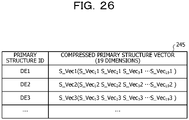
- the compressed primary structure vector data 245 is a table that retains information regarding a compressed primary structure vector of each primary structure included in the primary structure data 241.
- FIG. 26 is a diagram illustrating an example of a data structure of the compressed primary structure vector data according to the present second embodiment. As illustrated in FIG. 26 , the compressed primary structure vector data 245 associates a primary structure ID and a compressed primary structure vector.
- the primary structure ID is information that uniquely identifies a primary structure included in the primary structure data 241.
- the compressed primary structure vector is a compressed primary structure vector of a primary structure identified by the primary structure ID. For example, a compressed primary structure vector with a primary structure ID "DE1" is "S_Vecil S_Vec 2 1 S_Vec 3 1... S_Vec 19 1". "S Vec 1 1 S_Vec 2 1 S_Vec 3 1... S_Vec 19 1" are collectively referred to as S_Vec1. The same applies to other compressed primary structure vectors.
- the protein vector calculation unit 252 embeds the protein "thrombin”, the protein “chymotrypsin”, and the protein "nattokinase” in an approximate position on the Poincare space, and calculates protein vectors according to the positions.
- the protein vector calculation unit 252 registers a protein and a protein vector in the protein vector table 243 in association with each other.
- the protein vector calculation unit 252 repeatedly executes the processing described above also for other proteins, to calculate protein vectors corresponding to the proteins and register the protein vectors in the protein vector table 243.
- the primary structure vector calculation unit 254 repeatedly executes the processing described above also for other primary structures included in the primary structure data 241, to execute registration of compressed primary structure vectors with respect to the compressed primary structure vector data 245 and setting of flags to the inverted index 246.
- the similarity determination unit 255 compares the primary structure included in the query data 247 with the protein dictionary 240a, and extracts proteins included in the primary structure included in the query data 247.
- the similarity determination unit 255 compares the proteins included in the primary structure with the compressed protein vector table 244, and acquires a compressed protein vector of each protein included in the primary structure.
- the similarity determination unit 255 accumulates (sums up) the compressed protein vector of each protein included in the primary structure to calculate a compressed primary structure vector.
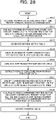
- FIG. 28 is a flowchart (1) illustrating the processing procedure of the information processing apparatus according to the present second embodiment.
- the acquisition unit 251 of the information processing apparatus 200 acquires the primary structure data 241, and stores the primary structure data 241 in the storage unit 240 (Step S301).
- the information processing apparatus generates the compressed protein vector table 244 obtained by compressing the dimension of the protein vector table 243, and calculates a vector of a primary structure by using compressed protein vectors.
- a calculation amount may be reduced as compared with a case where a vector of a primary structure is calculated and then dimension compression is performed.
- a computer 300 includes a CPU 301 that executes various types of calculation processing, an input device 302 that receives input of data from a user, and a display 303. Furthermore, the computer 300 includes a reading device 304 that reads a program and the like from a storage medium, and a communication device 305 that exchanges data with an external device via a wired or wireless network. Furthermore, the computer 300 includes a RAM 306 that temporarily stores various types of information and a hard disk device 307. Additionally, each of the devices 301 to 307 is connected to a bus 308.
- the acquisition program 307a functions as an acquisition process 306a.
- the word vector calculation program 307b functions as a word vector calculation process 306b.
- the dimension compression program 307c functions as a dimension compression process 306c.
- the sentence vector calculation program 307d functions as a sentence vector calculation process 306d.
- the similarity determination program 307e functions as a similarity determination process 306e.
- Processing of the acquisition process 306a corresponds to the processing of the acquisition unit 151.
- Processing of the word vector calculation process 306b corresponds to the processing of the word vector calculation unit 152.
- Processing of the dimension compression process 306c corresponds to the processing of the dimension compression unit 153.
- Processing of the sentence vector calculation process 306d corresponds to the processing of the sentence vector calculation unit 154.
- Processing of the similarity determination process 306e corresponds to the processing of the similarity determination unit 155.
- each of the programs 307a to 307e do not necessarily have to be stored in the hard disk device 307 beforehand.
- each of the programs is stored in a "portable physical medium" to be inserted in the computer 300, such as a flexible disk (FD), a CD-ROM, a DVD, a magneto-optical disk, or an IC card. Then, the computer 300 may read and execute each of the programs 307a to 307e.
- FIG. 31 is a diagram illustrating an example of the hardware configuration of the computer that implements the functions similar to those of the information processing apparatus according to the second embodiment.
- the hard disk device 407 includes an acquisition program 407a, a protein vector calculation program 407b, a dimension compression program 407c, a primary structure vector calculation program 407d, and a similarity determination program 407e. Furthermore, the CPU 401 reads each of the programs 407a to 407e, and develops each of the programs 407a to 407e to the RAM 406.
- the acquisition program 407a functions as an acquisition process 406a.
- the protein vector calculation program 407b functions as a protein vector calculation process 406b.
- the dimension compression program 407c functions as a dimension compression process 406c.
- the primary structure vector calculation program 407d functions as a primary structure vector calculation process 406d.
- the similarity determination program 407e functions as a similarity determination process 406e.
Landscapes
- Engineering & Computer Science (AREA)
- Theoretical Computer Science (AREA)
- Data Mining & Analysis (AREA)
- Databases & Information Systems (AREA)
- Physics & Mathematics (AREA)
- General Engineering & Computer Science (AREA)
- General Physics & Mathematics (AREA)
- Computational Linguistics (AREA)
- Software Systems (AREA)
- Information Retrieval, Db Structures And Fs Structures Therefor (AREA)
Abstract
Description
- The present invention relates to an information processing program or the like.
- There is Word2vec (Skip-Gram Model or CBOW) or the like as a conventional technology of analyzing a text or a sentence (hereinafter simply referred to as sentence) and expressing each word included in the sentence by a vector. There is a characteristic that words mutually having similar meanings have similar vector values even when the words have different expressions. In the following description, a vector of a word is referred to as a "word vector". For example, in Word2vec, a word vector is expressed in 200 dimensions.
- A vector of a sentence is calculated by accumulating word vectors of words included in a sentence. In the following description, a vector of a sentence is referred to as a "sentence vector". There is a characteristic that sentences mutually having similar meanings have similar sentence vector values even when the sentences have different expressions. For example, meaning of a sentence "I like apples." and meaning of a sentence "Apples are my favorite." are the same, and a sentence vector of "I like apples." and a sentence vector of "Apples are my favorite." have to be similar.
- Note that there is also a technology called Poincare Embeddings as a technology of assigning vectors to words. In this technology, a relationship between a word and a category is defined, and the word is embedded in a Poincare space on the basis of the defined relationship. Then, in the Poincare space, a vector corresponding to a position of the embedded word is assigned to the word.
-
FIG. 32 is a diagram for describing embedding in the Poincare space. For example, in a case where words such as "tiger" and "jaguar" are defined for a category "carnivorous animal", the word "carnivorous animal", the word "tiger", and the word "jaguar" are embedded in a Poincare space P. Then, vectors corresponding to positions on the Poincare space P are assigned to the word "carnivorous animal", the word "tiger", and the word "jaguar". - Non-Patent Document 1: Valentin Khrulkov et al. "Hyperbolic Image Embeddings"Cornell University, 2019 April 3
- In Word2vec, in a case where a word vector of a word included in a sentence is calculated, the word vector of the target word is calculated on the basis of words appearing before and after the target word. Thus, even when words have similar meanings, word vector values may change depending on contents of the sentence. Furthermore, even when words have similar meanings, words that may appear before and after the words differ depending on parts of speech of the words, so that word vector values of the words mutually having the same meaning may not necessarily be similar.
- For example, "liked" whose part of speech is "adjective" and "favorite" whose part of speech is "noun" have the same meaning, but the parts of speech are different. Thus, when sentences each including "liked" or "favorite" are compared, a tendency of words appearing before and after "liked" is different from a tendency of words appearing before and after "favorite", and a word vector of "liked" and a word vector of "favorite" are different.
- Accordingly, when a sentence vector is calculated by using word vectors calculated by using Word2vec, sentence vector values of sentences having the same meaning may deviate, and it is not possible to accurately calculate the sentence vectors. Therefore, there is a problem that determination accuracy is lowered in a case where similarity of each sentence is determined by using sentence vectors.
- Furthermore, in a conventional method of simply embedding a plurality of words whose parts of speech are the same in the Poincare space, it is not possible to accurately calculate a sentence vector as in the case of Word2vec.
- Moreover, in Word2vec, there is a problem that, since a word vector is in 200 dimensions, a calculation amount and a data amount are large in a case where a sentence vector is calculated. There are technologies of dimensionally compressing and decompressing vectors, such as principal component analysis. However, the technologies are not suitable for calculating a sentence vector because compression and decompression are performed in different dimensions for each word. The same applies to Poincare Embeddings.
- In one aspect, an object of the present invention is to provide an information processing program, an information processing method, and an information processing apparatus capable of accurately and efficiently calculating a sentence vector and improving similarity determination accuracy.
- In a first idea, a computer is caused to execute the following processing. The computer embeds a plurality of vocabularies in a vector space on the basis of similar vocabulary information in which, for a plurality of different types of parts of speech, vocabularies that are synonymous or similar to a predetermined degree or more are associated. The computer calculates, for each of a first sentence and a second sentence, a vector of the sentence on the basis of a vector in the vector space of each of a plurality of vocabularies included in the sentence. The computer determines similarity between the first sentence and the second sentence on the basis of the vector of the first sentence and the vector of the second sentence.
- According to an aspect of the embodiments, an information processing program for causing a computer to execute processing of embedding a plurality of vocabularies in a vector space on the basis of similar vocabulary information in which, for a plurality of different types of parts of speech, vocabularies that are synonymous or similar to a predetermined degree or more are associated; calculating, for each of a first sentence and a second sentence, a vector of the sentence on the basis of a vector in the vector space of each of a plurality of vocabularies included in the sentence; and determining similarity between the first sentence and the second sentence on the basis of the vector of the first sentence and the vector of the second sentence.
- A sentence vector may be calculated accurately and efficiently, and similarity determination accuracy may be improved.
-
-
FIG. 1 is a diagram for describing a reference technology; -
FIG. 2 is a diagram for describing processing of an information processing apparatus according to a present first embodiment; -
FIG. 3 is a diagram for describing similar vocabulary information according to the present first embodiment; -
FIG. 4 is a diagram illustrating an example of an embedding result in a Poincare space; -
FIG. 5 is a functional block diagram illustrating a configuration of the information processing apparatus according to the present first embodiment; -
FIG. 6 is a diagram illustrating an example of a data structure of text data; -
FIG. 7 is a diagram illustrating an example of a data structure of the similar vocabulary information according to the present first embodiment; -
FIG. 8 is a diagram illustrating an example of a data structure of a word vector table according to the present first embodiment; -
FIG. 9 is a diagram illustrating an example of a data structure of a compressed word vector table according to the present first embodiment; -
FIG. 10 is a diagram illustrating an example of a data structure of compressed sentence vector data according to the present first embodiment; -
FIG. 11 is a diagram illustrating an example of a data structure of an inverted index according to the present first embodiment; -
FIG. 12 is a diagram (1) for describing processing of a dimension compression unit according to the present first embodiment; -
FIG. 13 is a diagram (2) for describing the processing of the dimension compression unit according to the present first embodiment; -
FIG. 14 is a flowchart (1) illustrating a processing procedure of the information processing apparatus according to the present first embodiment; -
FIG. 15 is a flowchart (2) illustrating the processing procedure of the information processing apparatus according to the present first embodiment; -
FIG. 16 is a diagram for describing other data structures of the similar vocabulary information; -
FIG. 17 is a diagram for describing processing of an information processing apparatus according to a present second embodiment; -
FIG. 18 is a diagram illustrating a data structure of similar protein information according to the present second embodiment; -
FIG. 19 is a functional block diagram illustrating a configuration of the information processing apparatus according to the present second embodiment; -
FIG. 20 is a diagram for describing a genome; -
FIG. 21 is a diagram illustrating relationships between amino acids, bases, and codons; -
FIG. 22 is a diagram illustrating an example of a data structure of a protein dictionary according to the present second embodiment; -
FIG. 23 is a diagram illustrating an example of a data structure of primary structure data according to the present second embodiment; -
FIG. 24 is a diagram illustrating an example of a data structure of a protein vector table according to the present second embodiment; -
FIG. 25 is a diagram illustrating an example of a data structure of a compressed protein vector table according to the present second embodiment; -
FIG. 26 is a diagram illustrating an example of a data structure of compressed primary structure vector data according to the present second embodiment; -
FIG. 27 is a diagram illustrating an example of a data structure of an inverted index according to the present second embodiment; -
FIG. 28 is a flowchart (1) illustrating a processing procedure of the information processing apparatus according to the present second embodiment; -
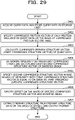
FIG. 29 is a flowchart (2) illustrating the processing procedure of the information processing apparatus according to the present second embodiment; -
FIG. 30 is a diagram illustrating an example of a hardware configuration of a computer that implements functions similar to those of the information processing apparatus according to the first embodiment; -
FIG. 31 is a diagram illustrating an example of a hardware configuration of a computer that implements functions similar to those of the information processing apparatus according to the second embodiment; and -
FIG. 32 is a diagram for describing embedding in the Poincare space. - Embodiments of an information processing program, an information processing method, and an information processing apparatus disclosed in the present application are hereinafter described in detail with reference to the drawings. Note that the present invention is not limited by the embodiments.
- Prior to description of an information processing apparatus according to a present first embodiment, a reference technology of calculating a sentence vector will be described.
FIG. 1 is a diagram for describing the reference technology. As illustrated inFIG. 1 , in the reference technology, a word vector table 11 is generated by calculating a word vector of each word included intext data 10 by Word2vec. In the word vector table 11, words and word vectors are associated. For example, a dimension of a word vector in the word vector table 11 is 200 dimensions. - In the reference technology, the word vector table 11 is used to calculate a sentence vector of each sentence included in the
text data 10. In the reference technology, a sentence vector of a sentence is calculated by dividing the sentence into a plurality of words and accumulating a word vector of each word. In the reference technology, the 200-dimensional word vectors registered in the word vector table 11 are used to calculatesentence vector data 12. - Furthermore, in the reference technology, the number of dimensions of a sentence vector is compressed by using principal component analysis. A sentence vector with the compressed number of dimensions is referred to as a "compressed sentence vector". In the reference technology, the processing described above is repeatedly executed for a plurality of other sentences to calculate compressed sentence vectors for the plurality of other sentences and generate compressed
sentence vector data 12A. - In the reference technology, a word vector of each word included in the
text data 10 is calculated in 200 dimensions by Word2vec. Thus, in a case where a sentence vector is calculated, 200-dimensional word vectors are accumulated as they are, so that a calculation amount becomes large. Moreover, in a case where a degree of similarity of each sentence is compared, since a compressed sentence vector is not compressed to a common dimension in the principal component analysis, it is not possible to perform evaluation with the compressed sentence vector as it is. Thus, it is needed to decompress each sentence to 200-dimensional sentence vectors and compare degrees of similarity, which increases the calculation amount. - On the other hand, in the reference technology, each word vector is subjected to the principal component analysis to generate a compressed word vector table 11A. Then, the compressed word vector table 11A is used to calculate a sentence vector of each sentence included in the
text data 10 and generate compressedsentence vector data 12B. However, in the principal component analysis, since each word vector is not common and individually dimensionally compressed, it is not suitable for calculating a sentence vector. - Similarly, also in Poincare Embeddings, a problem occurs in calculation of a sentence vector by 200 dimensions or in a compressed word vector table by principal component analysis.
- Subsequently, an example of processing of the information processing apparatus according to the present first embodiment will be described.
FIG. 2 is a diagram for describing the processing of the information processing apparatus according to the present first embodiment. As illustrated inFIG. 2 , the information processing apparatus embeds a word included intext data 141 in a Poincare space on the basis ofsimilar vocabulary information 142, and calculates a word vector. -
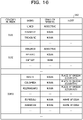
FIG. 3 is a diagram for describing the similar vocabulary information according to the present first embodiment. InFIG. 3 , thesimilar vocabulary information 142 used in the present first embodiment anddefinition information 5 used in Poincare Embeddings of the conventional technology are indicated. - The
similar vocabulary information 142 associates a concept number, a word, and a part of speech. For convenience, a part of speech corresponding to a word is indicated for performing comparison with thedefinition information 5. Thesimilar vocabulary information 142 associates a plurality of words (vocabularies) that is synonymous or similar to a predetermined degree or more with the same concept number. For example, a word "liked", a word "favorite", a word "treasure", and the like are associated with a concept number "1101". A part of speech of the word "liked" is "adjective", a part of speech of the word "favorite" is "noun", and a part of speech of the word "treasure" is "noun", and even words whose parts of speech are different are associated with the same concept number when the words have similar meanings. - The
definition information 5 associates a category and a word. Here, for convenience, a part of speech corresponding to a word is indicated for performing comparison with thesimilar vocabulary information 142. In thedefinition information 5, words whose part of speech is a noun are classified by categories. In the example illustrated inFIG. 3 , a word "tiger", a word "jaguar", and a word "lion" are associated with a category "carnivorous animal". The part of speech of the words in thedefinition information 5 is limited to the noun. - For example, in the
similar vocabulary information 142, as compared with thedefinition information 5, a plurality of words that is synonymous or similar to a predetermined degree or more is assigned to the same concept number regardless of types of the parts of speech of the words. In the case of embedding words in the Poincare space, the information processing apparatus according to the present first embodiment aggregates each word corresponding to the same concept number defined in thesimilar vocabulary information 142 at an approximate position on the Poincare space. -
FIG. 4 is a diagram illustrating an example of an embedding result in the Poincare space. As illustrated inFIG. 4 , since the same concept number is assigned to the word "liked", the word "favorite", and the word "treasure", these words are embedded in an approximate position p1 in a Poincare space P. The information processing apparatus assigns a word vector corresponding to the position p1 on the Poincare space P to each of the word "liked", the word "favorite", and the word "treasure". With this configuration, approximate word vectors are assigned to words corresponding to the same concept number. A dimension of a vector corresponding to a position on the Poincare space may be set as appropriate, and in the present first embodiment, the dimension is set to 200 dimensions. - Return to the description of
FIG. 2 . Also for other words included in thetext data 141, the information processing apparatus performs embedding in the Poincare space on the basis of thesimilar vocabulary information 142, to calculate word vectors and generate a word vector table 143. In the word vector table 143, words and word vectors are associated. For example, a dimension of a word vector in the word vector table 143 is 200 dimensions. - The information processing apparatus compresses the dimension of each word vector stored in the word vector table 143 before calculating a sentence vector. For example, the information processing apparatus generates a word vector obtained by compressing a dimension by compressing a 200-dimensional word vector into a 19-dimensional (19-dimensional is an example) word vector. A word vector obtained by compressing a dimension is referred to as a "compressed word vector". The information processing apparatus compresses each word vector in the word vector table 143 to generate a compressed word vector table 144.
- The information processing apparatus uses the compressed word vector table 144 to calculate a compressed sentence vector of each sentence included in the
text data 141. The information processing apparatus divides a sentence into a plurality of words, and acquires a compressed word vector of each word from the compressed word vector table 144. The information processing apparatus accumulates each word vector to calculate a compressed sentence vector of a sentence. The information processing apparatus repeatedly executes the processing described above for a plurality of other sentences to calculate compressed sentence vectors for the plurality of other sentences and generate 19-dimensional compressedsentence vector data 145. - The information processing apparatus according to the present first embodiment performs embedding in the Poincare space on the basis of the
similar vocabulary information 142, to calculate word vectors and generate the word vector table 143. Unlike Word2vec described in the reference technology, it is possible to generate the word vector table 143 in which approximate word vectors are assigned to a plurality of words that is synonymous or similar to a predetermined degree or more. Thus, when sentence vectors are calculated by using the word vector table 143, sentence vectors of sentences mutually having the same meaning become similar sentence vectors, and the sentence vectors may be calculated accurately. Furthermore, in a case where similarity is determined by comparing a plurality of sentence vectors, since the sentence vectors may be calculated accurately, similarity determination accuracy is improved. - Furthermore, since the information processing apparatus generates the compressed word vector table 144 obtained by compressing the word vector table 143 into common 19 dimensions, and calculates a compressed sentence vector by using compressed word vectors, a calculation amount may be significantly reduced compared with a sentence vector calculation amount in 200 dimensions of the reference technology. Moreover, since a degree of similarity of each sentence may be evaluated with a common 19-dimensional compressed sentence vector as it is, the calculation amount may be significantly reduced compared with the reference technology in which decompression to a 200-dimensional sentence vector and evaluation of a degree of similarity in 200 dimensions are performed.
- Next, a configuration of the information processing apparatus according to the present first embodiment will be described.
FIG. 5 is a functional block diagram illustrating the configuration of the information processing apparatus according to the present first embodiment. As illustrated inFIG. 5 , aninformation processing apparatus 100 includes acommunication unit 110, aninput unit 120, adisplay unit 130, astorage unit 140, and acontrol unit 150. - The
communication unit 110 is a processing unit that executes information communication with an external device (not illustrated) via a network. Thecommunication unit 110 corresponds to a communication device such as a network interface card (NIC). For example, thecontrol unit 150 to be described below exchanges information with an external device via thecommunication unit 110. - The
input unit 120 is an input device that inputs various types of information to theinformation processing apparatus 100. Theinput unit 120 corresponds to a keyboard, a mouse, a touch panel, or the like. A user may operate theinput unit 120 to inputquery data 147 to be described below. - The
display unit 130 is a display device that displays information output from thecontrol unit 150. Thedisplay unit 130 corresponds to a liquid crystal display, an organic electro luminescence (EL) display, a touch panel, or the like. Thedisplay unit 130 displays information output from thecontrol unit 150. - The
storage unit 140 includes thetext data 141, thesimilar vocabulary information 142, the word vector table 143, the compressed word vector table 144, the compressedsentence vector data 145, aninverted index 146, and thequery data 147. Thestorage unit 140 corresponds to a semiconductor memory element such as a random access memory (RAM) or a flash memory, or a storage device such as a hard disk drive (HDD). - The
text data 141 is information (text) including a plurality of sentences. Sentences are delimited by punctuation marks.FIG. 6 is a diagram illustrating an example of a data structure of the text data. As illustrated inFIG. 6 , thetext data 141 includes a plurality of sentences. Contents of thetext data 141 are not limited to those ofFIG. 6 . - The
similar vocabulary information 142 is information that associates a plurality of words (vocabularies) that is synonymous or similar to a predetermined degree or more with the same concept number.FIG. 7 is a diagram illustrating an example of a data structure of the similar vocabulary information according to the present first embodiment. As illustrated inFIG. 7 , thesimilar vocabulary information 142 associates a concept number, a word, and a part of speech. For example, a word "liked", a word "favorite", a word "treasure", and the like are associated with a concept number "1101". A part of speech of the word "liked" is "adjective", a part of speech of the word "favorite" is "noun", and a part of speech of the word "treasure" is "noun". Thesimilar vocabulary information 142 does not necessarily have to include information regarding the part of speech. - The word vector table 143 is a table that retains information regarding a word vector of each word.
FIG. 8 is a diagram illustrating an example of a data structure of the word vector table according to the present first embodiment. As illustrated inFIG. 8 , the word vector table 143 associates a word and a word vector. Each word vector is a word vector calculated by embedding in the Poincare space, and is assumed to be, for example, a 200-dimensional vector. - The compressed word vector table 144 is a table that retains information regarding each word vector obtained by dimension compression (compressed word vector).
FIG. 9 is a diagram illustrating an example of a data structure of the compressed word vector table according to the present first embodiment. As illustrated inFIG. 9 , the compressed word vector table 144 associates a word and a compressed word vector. For example, a dimension of the compressed word vector is assumed to be 19 dimensions, but the dimension is not limited to this. - The compressed
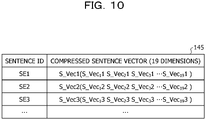
sentence vector data 145 is a table that retains information regarding a compressed sentence vector of each sentence included in thetext data 141.FIG. 10 is a diagram illustrating an example of a data structure of the compressed sentence vector data according to the present first embodiment. As illustrated inFIG. 10 , the compressedsentence vector data 145 associates a sentence ID and a compressed sentence vector. The sentence ID is information that uniquely identifies a sentence included in thetext data 141. The compressed sentence vector is a compressed sentence vector of a sentence identified by the sentence ID. For example, a compressed sentence vector with a sentence ID "SE1" is "S_Vec 11S_Vec 21S_Vec 31...S_Vec 191". "S_Vecil S_Vec 21S_Vec 31...S_Vec 191" are collectively referred to as S_Vec1. The same applies to other compressed sentence vectors. - The
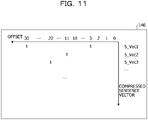
inverted index 146 associates a compressed sentence vector of a sentence and a position (offset) on thetext data 141 of the sentence corresponding to the compressed sentence vector. For example, an offset of a first word on thetext data 141 becomes "0", and an offset of an M-th word from the beginning becomes "M-1".FIG. 11 is a diagram illustrating an example of a data structure of the inverted index according to the present first embodiment. In theinverted index 146 illustrated inFIG. 11 , a horizontal axis indicates an offset on thetext data 141. A vertical axis corresponds to a compressed sentence vector of a sentence. For example, it is indicated that a first word of a sentence with a compressed sentence vector "S_Vec1" is positioned at offsets "3" and "30" on thetext data 141. - The
query data 147 is data of a sentence specified in similarity search. In the present first embodiment, as an example, a sentence included in thequery data 147 is assumed to be one sentence. - Return to the description of
FIG. 5 . Thecontrol unit 150 includes anacquisition unit 151, a wordvector calculation unit 152, adimension compression unit 153, a sentencevector calculation unit 154, and asimilarity determination unit 155. Thecontrol unit 150 may be implemented by a central processing unit (CPU), a micro processing unit (MPU), or the like. Furthermore, thecontrol unit 150 may also be implemented by hard wired logic such as an application specific integrated circuit (ASIC) or a field programmable gate array (FPGA). - The
acquisition unit 151 is a processing unit that acquires various types of information from an external device or theinput unit 120. For example, in a case where thetext data 141, thesimilar vocabulary information 142, thequery data 147, and the like are received, theacquisition unit 151 stores, in thestorage unit 140, the receivedtext data 141,similar vocabulary information 142,query data 147, and the like. - The word
vector calculation unit 152 is a processing unit that embeds a word (vocabulary) included in thetext data 141 in the Poincare space and calculates a word vector according to a position of the word embedded in the Poincare space. In the case of embedding a word in the Poincare space, the wordvector calculation unit 152 refers to thesimilar vocabulary information 142 and embeds each word corresponding to the same concept number at an approximate position. - For example, the word
vector calculation unit 152 embeds the word "liked", the word "favorite", and the word "treasure" in an approximate position on the Poincare space, and calculates word vectors according to the position. The wordvector calculation unit 152 registers a word and a word vector in the word vector table 143 in association with each other. The wordvector calculation unit 152 repeatedly executes the processing described above also for other words, to calculate word vectors corresponding to the words and register the word vectors in the word vector table 143. - The
dimension compression unit 153 is a processing unit that compresses a dimension of a word vector stored in the word vector table 143 to generate the compressed word vector table 144. Thedimension compression unit 153 evenly distributes and arranges, in a circle, respective 200 vectors aiei (i = 1 to 200), which are component-decomposed into 200 dimensions. "ei" is a basis vector. In the following description, a component-decomposed vector is referred to as a basis vector. Thedimension compression unit 153 selects one basis vector of a prime number, and integrates a value obtained by orthogonally transforming basis vectors of other dimensions into the basis vector. Thedimension compression unit 153 executes the processing described above on the basis vectors of 1 or prime numbers of 19 dimensions distributed to dimensionally compress a 200-dimensional vector into a 19-dimensional vector. For example, thedimension compression unit 153 calculates each of basis vector values of 1 or prime numbers "1", "11", "23", "41", "43", "53", "61", "73", "83", "97", "107", "113", "127", "137", "149", "157", "167", "179", and "191" to perform dimension compression into a 19-dimensional vector. - Note that, although a 19-dimensional vector is described as an example in the present embodiment, it may be a vector of another dimension. By selecting the basis vectors of 1 or prime numbers divided by the prime numbers "3 or more" and distributed, it becomes possible to implement highly accurate dimension decompression, although it is irreversible. Note that, while the accuracy is improved as the prime number to be divided increases, a compression rate is lowered.
-
FIGs. 12 and13 are diagrams for describing processing of the dimension compression unit according to the present first embodiment. As illustrated inFIG. 12 , thedimension compression unit 153 evenly distributes and arranges, in a circle (semicircle), 200 basis vectors aiei (i = 1 to 200), which are component-decomposed into 200 dimensions. Note that a relationship between a vector A before component decomposition and each component-decomposed basis vector aiei is defined by Formula (1). InFIG. 12 , as an example, a case of compressing 200 dimensions to three dimensions will be described, but the same applies to a case of compressing 200 dimensions to 19 dimensions.
[Expression 1]
- As illustrated in
FIG. 13 , first, thedimension compression unit 153 orthogonally transforms the respective remaining basis vectors a2e2 to a200e200 with respect to the basis vector a1e1, and integrates the values of the respective orthogonally transformed basis vectors a2e2 to a200e200, thereby calculating a value of the basis vector a1e1. - The
dimension compression unit 153 orthogonally transforms the respective remaining basis vectors a1e1 (solid line + arrow), a2e2, a3e3 to a66e66, and a68e68 to a200e200 with respect to the basis vector a67e67, and integrates the values of the respective orthogonally transformed basis vectors a1e1 to a66e66 and a68e68 to a200e200, thereby calculating a value of the basis vector a67e67. - The
dimension compression unit 153 orthogonally transforms the respective remaining basis vectors a1e1 to a130e130 and a132e132 to a200e200 with respect to the basis vector a131e131, and integrates the values of the respective orthogonally transformed basis vectors a1e1 to a130e130 and a132e132 to a20e200, thereby calculating a value of the basis vector a131e131. - The
dimension compression unit 153 sets the respective components of the compressed vector obtained by dimensionally compressing the 200-dimensional vector as "the value of the basis vector a1e1, the value of the basis vector a67e67, and the value of the basis vector a131e131". Thedimension compression unit 153 also calculates other dimensions in a similar manner. Note that thedimension compression unit 153 may perform dimension compression by using KL expansion or the like. Thedimension compression unit 153 executes the dimension compression described above for each word of the word vector table 143 to generate the compressed word vector table 144. - Return to the description of
FIG. 5 . The sentencevector calculation unit 154 is a processing unit that calculates a sentence vector of each sentence included in thetext data 141. The sentencevector calculation unit 154 scans thetext data 141 from the beginning and extracts a sentence. It is assumed that sentences included in thetext data 141 are delimited by punctuation marks. - The sentence
vector calculation unit 154 executes morphological analysis on a sentence to divide the sentence into a plurality of words. The sentencevector calculation unit 154 compares the words included in the sentence with the compressed word vector table 144, and acquires a compressed word vector of each word included in the sentence. The sentencevector calculation unit 154 accumulates (sums up) the compressed word vector of each word included in the sentence to calculate a compressed sentence vector. The sentencevector calculation unit 154 assigns a sentence ID to the sentence, and registers the sentence ID and the compressed sentence vector in the compressedsentence vector data 145 in association with each other. - Furthermore, the sentence
vector calculation unit 154 refers to theinverted index 146, and sets a flag "1" at an intersection of an offset of the sentence corresponding to the compressed sentence vector and the compressed sentence vector. For example, in a case where a sentence of a compressed sentence vector "S_Vec1" is positioned at offsets "3" and "30", the sentencevector calculation unit 154 sets a flag "1" at an intersection of a column of the offset "3" and a row of the compressed sentence vector "S_Vec1", and an intersection of a column of the offset "30" and the row of the compressed sentence vector "S_Vec1". - The sentence
vector calculation unit 154 repeatedly executes the processing described above also for other sentences included in thetext data 141, to execute registration of compressed sentence vectors with respect to the compressedsentence vector data 145 and setting of flags to theinverted index 146. - The
similarity determination unit 155 is a processing unit that determines similarity between a vector of a first sentence and a vector of a second sentence. Here, as an example, it is assumed that the vector of the first sentence is a compressed sentence vector of a sentence included in thequery data 147. Description will be made assuming that the vector of the second sentence is a compressed sentence vector (compressed sentence vector arranged on the vertical axis of the inverted index 146) of the compressedsentence vector data 145, but the present invention is not limited to this. - The
similarity determination unit 155 executes morphological analysis on a sentence included in thequery data 147 to divide the sentence into a plurality of words. Thesimilarity determination unit 155 compares the words included in the sentence with the compressed word vector table 144, and acquires a compressed word vector of each word included in the sentence. Thesimilarity determination unit 155 accumulates (sums up) the compressed word vector of each word included in the sentence to calculate a compressed sentence vector. In the following description, a compressed sentence vector of thequery data 147 is referred to as a "first compressed sentence vector". A compressed sentence vector (compressed sentence vector arranged on the vertical axis of the inverted index 146) registered in the compressedsentence vector data 145 is referred to as a "second compressed sentence vector". - The
similarity determination unit 155 calculates a degree of similarity between the first compressed sentence vector and the second compressed sentence vector on the basis of Formula (2). For example, the closer a distance between the first compressed sentence vector and the second compressed sentence vector, the greater the degree of similarity.
[Expression 2]
- The
similarity determination unit 155 specifies the second compressed sentence vector whose degree of similarity with the first compressed sentence vector is equal to or greater than a threshold. In the following description, a second compressed sentence vector whose degree of similarity with the first compressed sentence vector is equal to or greater than a threshold is referred to as a "specific compressed sentence vector". - The
similarity determination unit 155 specifies an offset of a sentence corresponding to the specific compressed sentence vector on the basis of a flag of a row corresponding to the specific compressed sentence vector among rows of the second compressed sentence vectors of theinverted index 146. For example, in a case where the specific compressed sentence vector is "S_Vec1", offsets "3" and "30" are specified. - The
similarity determination unit 155 acquires a sentence corresponding to the compressed word sentence vector from thetext data 141 on the basis of the specified offset. Thesimilarity determination unit 155 outputs the acquired sentence as a sentence similar to the sentence specified in thequery data 147 to thedisplay unit 130 for display. - Next, an example of a processing procedure of the
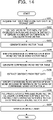
information processing apparatus 100 according to the present first embodiment will be described.FIG. 14 is a flowchart (1) illustrating the processing procedure of the information processing apparatus according to the present first embodiment. As illustrated inFIG. 14 , theacquisition unit 151 of theinformation processing apparatus 100 acquires thetext data 141, and stores thetext data 141 in the storage unit 140 (Step S101). - For each word in the
text data 141, the wordvector calculation unit 152 of theinformation processing apparatus 100 executes embedding in the Poincare space on the basis of thesimilar vocabulary information 142, to calculate a word vector (Step S102). The wordvector calculation unit 152 generates the word vector table 143 (Step S103). - The
dimension compression unit 153 of theinformation processing apparatus 100 executes dimension compression for each word vector in the word vector table 143 (Step S104). Thedimension compression unit 153 generates the compressed word vector table 144 (Step S105). - The sentence
vector calculation unit 154 of theinformation processing apparatus 100 extracts a sentence from the text data 141 (Step S106). The sentencevector calculation unit 154 specifies a compressed word vector of each word included in the sentence on the basis of the compressed word vector table 144 (Step S107). - The sentence
vector calculation unit 154 accumulates each compressed word vector, calculates a compressed sentence vector, and registers the compressed sentence vector in the compressed sentence vector data 145 (Step S108). The sentencevector calculation unit 154 generates theinverted index 146 on the basis of a relationship between an offset of the sentence on thetext data 141 and the compressed sentence vector (Step S109). -
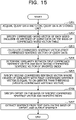
FIG. 15 is a flowchart (2) illustrating the processing procedure of the information processing apparatus according to the present first embodiment. As illustrated inFIG. 15 , theacquisition unit 151 of theinformation processing apparatus 100 acquires thequery data 147, and stores thequery data 147 in the storage unit 140 (Step S201). - The
similarity determination unit 155 of theinformation processing apparatus 100 specifies a compressed word vector of each word included in a sentence of thequery data 147 on the basis of the compressed word vector table 144 (Step S202). Thesimilarity determination unit 155 accumulates the compressed word vector of each word and calculates a compressed sentence vector (first compressed sentence vector) of the query data 147 (Step S203). - The
similarity determination unit 155 determines similarity between the first compressed sentence vector and each second compressed sentence vector of the inverted index 146 (Step S204). Thesimilarity determination unit 155 specifies a second compressed sentence vector whose degree of similarity with the first compressed sentence vector is equal to or greater than a threshold (specific compressed sentence vector) (Step S205). - The
similarity determination unit 155 specifies an offset on the basis of the specific compressed sentence vector and the inverted index 146 (Step S206). Thesimilarity determination unit 155 extracts a sentence from thetext data 141 on the basis of the offset, and outputs the sentence to the display unit 130 (Step S207). - Next, effects of the
information processing apparatus 100 according to the present first embodiment will be described. Theinformation processing apparatus 100 performs embedding in the Poincare space on the basis of thesimilar vocabulary information 142, to calculate a word vector and generate the word vector table 143. Unlike Word2vec described in the reference technology, it is possible to generate the word vector table 143 in which approximate word vectors are assigned to a plurality of words that is synonymous or similar to a predetermined degree or more. Thus, when sentence vectors are calculated by using the word vector table 143, sentence vectors of sentences mutually having the same meaning become similar sentence vectors, and the sentence vectors may be calculated accurately. Furthermore, in a case where similarity is determined by comparing a plurality of sentence vectors, since the sentence vectors may be calculated accurately, similarity determination accuracy is improved. For example, a sentence similar to the sentence specified in thequery data 147 may be appropriately searched from thetext data 141. - Since the
information processing apparatus 100 generates the compressed word vector table 144 obtained by compressing the dimension of the word vector table 143, and calculates a sentence vector by using compressed word vectors, a calculation amount may be reduced compared with a sentence vector calculation amount of the reference technology. - Incidentally, the data structure of the
similar vocabulary information 142 described inFIG. 7 is an example, and may be a data structure illustrated inFIG. 16. FIG. 16 is a diagram for describing other data structures of the similar vocabulary information. As illustrated inFIG. 16 , in thesimilar vocabulary information 142, words "Brazil", "Colombia", "Kilimanjaro", "Espresso", "American", and the like with the same parts of speech "noun" and in the same category of coffee may be associated with the same concept number. The words "Brazil", "Colombia", and "Kilimanjaro" are words that indicate places of origin or countries. "Espresso" and "American" are words that indicate names of dishes. The wordvector calculation unit 152 of theinformation processing apparatus 100 may execute embedding in the Poincare space by using thesimilar vocabulary information 142 illustrated inFIG. 16 , to calculate a word vector. - In the first embodiment, a case has been described where a sentence vector of a sentence including a plurality of words is calculated and similarity of each sentence vector is determined, but the present invention is not limited to this. For example, also for a primary structure of a protein (hereinafter simply referred to as the primary structure) including a plurality of proteins, vectors of the protein and the primary structure may be calculated by regarding one protein as one word and also one primary structure as one sentence. By using the vector of the primary structure, similarity of each primary structure may be determined.
-
FIG. 17 is a diagram for describing processing of an information processing apparatus according to a present second embodiment. As illustrated inFIG. 17 , the information processing apparatus regards each protein included inprimary structure data 241 of a protein as a word on the basis ofsimilar protein information 242, performs embedding in a Poincare space, and calculates a vector of the protein. In the following description, a vector of a protein is referred to as a "protein vector". -
FIG. 18 is a diagram illustrating a data structure of the similar protein information according to the present second embodiment. Thesimilar protein information 242 associates a concept number, a protein, an origin, and a stem. Thesimilar protein information 242 associates proteins having similar properties to the same concept number. For example, proteins "thrombin", "chymotrypsin", "nattokinase", and the like are associated with a concept number "1101". - The origin indicates an origin of a protein. For example, an origin of the protein "thrombin" is "blood coagulation factor". An origin of the protein "chymotrypsin" is "enzyme". An origin of the protein "nattokinase" is "enzyme". The stem is attached to an end of a name of a protein, depending on an origin. Exceptionally, ends of the proteins "thrombin" and "chymotrypsin" do not correspond to stems.
- For example, in the
similar protein information 242, a plurality of proteins having similar properties is assigned to the same concept number regardless of the origins of the proteins. In the case of embedding proteins in the Poincare space, the information processing apparatus according to the present second embodiment aggregates each protein corresponding to the same concept number defined in thesimilar protein information 242 at an approximate position on the Poincare space. - Return to the description of
FIG. 17 . Also for other proteins included in theprimary structure data 241, the information processing apparatus performs embedding in the Poincare space on the basis of thesimilar protein information 242, to calculate protein vectors and generate a protein vector table 243. In the protein vector table 243, proteins and protein vectors are associated. For example, a dimension of a protein vector in the protein vector table 243 is 200 dimensions. - The information processing apparatus compresses the dimension of each protein vector included in the protein vector table 243 before calculating a vector of a primary structure. For example, the information processing apparatus generates a compressed protein vector by compressing a 200-dimensional protein vector into a 19-dimensional (19-dimensional is an example) protein vector. A protein vector obtained by compressing a dimension is referred to as a "compressed protein vector". The information processing apparatus compresses each protein vector in the protein vector table 243 to generate a compressed protein vector table 244.
- The information processing apparatus uses the compressed protein vector table 244 to calculate a compressed protein vector of each primary structure included in the
primary structure data 241. The information processing apparatus divides a primary structure into a plurality of proteins, and acquires a compressed protein vector of each protein from the compressed protein vector table 244. The information processing apparatus accumulates each compressed protein vector to calculate a 19-dimensional vector of a primary structure. In the following description, a vector of a primary structure is referred to as "compressed primary structure vector". The information processing apparatus repeatedly executes the processing described above for a plurality of other primary structures to calculate compressed primary structure vectors for the plurality of other primary structures and generate compressed primarystructure vector data 245. - The information processing apparatus according to the present second embodiment performs embedding in the Poincare space on the basis of the
similar protein information 242, to calculate protein vectors and generate the protein vector table 243. With this configuration, it is possible to generate the protein vector table 243 in which approximate protein vectors are assigned to a plurality of proteins having similar properties. Thus, when vectors of primary structures are calculated by using the protein vector table 243, primary structures mutually having similar properties become similar vectors of the primary structures, and the vectors of the primary structures may be calculated accurately. Furthermore, in a case where similarity is determined by comparing a plurality of vectors of primary structures, since the vectors of the primary structures may be calculated accurately, similarity determination accuracy is improved. - Furthermore, the information processing apparatus generates the compressed protein vector table 244 obtained by compressing the dimension of the protein vector table 243, and calculates a compressed vector of a primary structure by using compressed protein vectors. Thus, a calculation amount may be reduced as compared with a case where a vector of a primary structure is calculated and then dimension compression is performed.
- Next, a configuration of the information processing apparatus according to the present second embodiment will be described.
FIG. 19 is a functional block diagram illustrating the configuration of the information processing apparatus according to the present second embodiment. As illustrated inFIG. 19 , aninformation processing apparatus 200 includes acommunication unit 210, aninput unit 220, adisplay unit 230, astorage unit 240, and acontrol unit 250. - The
communication unit 210 is a processing unit that executes information communication with an external device (not illustrated) via a network. Thecommunication unit 210 corresponds to a communication device such as a NIC. For example, thecontrol unit 250 to be described below exchanges information with an external device via thecommunication unit 210. - The
input unit 220 is an input device that inputs various types of information to theinformation processing apparatus 200. Theinput unit 220 corresponds to a keyboard, a mouse, a touch panel, or the like. A user may operate theinput unit 220 to inputquery data 247 to be described below. - The
display unit 230 is a display device that displays information output from thecontrol unit 250. Thedisplay unit 230 corresponds to a liquid crystal display, an organic EL display, a touch panel, or the like. Thedisplay unit 230 displays information output from thecontrol unit 250. - The
storage unit 240 includes aprotein dictionary 240a, theprimary structure data 241, thesimilar protein information 242, and the protein vector table 243. Thestorage unit 240 includes the compressed protein vector table 244, the compressed primarystructure vector data 245, aninverted index 246, and thequery data 247. Thestorage unit 240 corresponds to a semiconductor memory element such as a RAM or a flash memory, or a storage device such as an HDD. - Prior to description of the
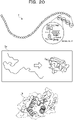
protein dictionary 240a, a genome will be described.FIG. 20 is a diagram for describing a genome. Agenome 1 is genetic information in which a plurality of amino acids is linked. Here, the amino acid is determined by a plurality of bases and codons. Furthermore, thegenome 1 includes aprotein 1a. Theprotein 1a includes a chain-like linkage of 20 types of and a large number of amino acids linked to each other. Structures of theprotein 1a include a primary structure, a secondary structure, and a tertiary (high-order) structure. Aprotein 1b is a high-order structure protein. In the present second embodiment, the primary structure is dealt with, but the secondary structure and the tertiary structure may be targeted. - There are four types of bases in DNAs and RNAs, indicated by symbols of "A", "G", "C", and "T" or "U". Furthermore, a group of three base sequences determines each of 20 types of amino acids. Each amino acid is indicated by each of symbols of "A" to "Y".
FIG. 21 is a diagram illustrating relationships between amino acids, bases, and codons. The group of three base sequences is referred to as a "codon". The sequence of the bases determines a codon, and an amino acid is determined when the codon is determined. - As illustrated in
FIG. 21 , a plurality of types of codons is associated with one amino acid. Thus, when the codon is determined, the amino acid is determined. However, even when the amino acid is determined, the codon is not uniquely specified. For example, an amino acid "alanine (Ala)" is associated with codons "GCU", "GCC", "GCA", or "GCG". - The
protein dictionary 240a is information for associating a protein and a base sequence corresponding to the protein. The protein is uniquely determined by the base sequence.FIG. 22 is a diagram illustrating an example of a data structure of the protein dictionary according to the present second embodiment. As illustrated inFIG. 22 , theprotein dictionary 240a associates a protein and a base sequence. In theprotein dictionary 240a of the present second embodiment, a case will be described where a protein and a base sequence are associated, but instead of the base sequence, a codon sequence or an amino acid sequence may be defined in association with the protein. - The
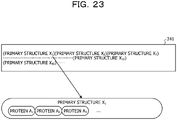
primary structure data 241 is information including a plurality of primary structures including a plurality of proteins.FIG. 23 is a diagram illustrating an example of a data structure of the primary structure data of a protein according to the present second embodiment. As illustrated inFIG. 23 , theprimary structure data 241 of the protein includes a plurality of primary structures. Here, a primary structure includes a plurality of proteins, and each protein is set by a base sequence (or a codon sequence or an amino acid sequence). Each primary structure included in theprimary structure data 241 includes a protein that may become cancerous or a protein that has become cancerous. - The
similar protein information 242 is information that associates proteins having similar properties to the same concept number. A data structure of thesimilar protein information 242 corresponds to that described inFIG. 18 . - The protein vector table 243 is a table that retains information regarding a protein vector of each protein.
FIG. 24 is a diagram illustrating an example of a data structure of the protein vector table according to the present second embodiment. As illustrated inFIG. 24 , the protein vector table 243 associates a protein and a protein vector. Each protein vector is a protein vector calculated by embedding in the Poincare space, and is assumed to be, for example, a 200-dimensional vector. - The compressed protein vector table 244 is a table that retains information regarding each protein vector obtained by dimension compression (compressed protein vector).
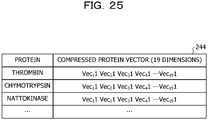
FIG. 25 is a diagram illustrating an example of a data structure of the compressed protein vector table according to the present second embodiment. As illustrated inFIG. 25 , the compressed protein vector table 244 associates a protein and a compressed protein vector. For example, a dimension of the compressed protein vector is assumed to be 19 dimensions, but the dimension is not limited to this. - The compressed primary
structure vector data 245 is a table that retains information regarding a compressed primary structure vector of each primary structure included in theprimary structure data 241.FIG. 26 is a diagram illustrating an example of a data structure of the compressed primary structure vector data according to the present second embodiment. As illustrated inFIG. 26 , the compressed primarystructure vector data 245 associates a primary structure ID and a compressed primary structure vector. The primary structure ID is information that uniquely identifies a primary structure included in theprimary structure data 241. The compressed primary structure vector is a compressed primary structure vector of a primary structure identified by the primary structure ID. For example, a compressed primary structure vector with a primary structure ID "DE1" is "S_Vecil S_Vec 21S_Vec 31...S_Vec 191". "S Vec 11S_Vec 21S_Vec 31...S_Vec 191" are collectively referred to as S_Vec1. The same applies to other compressed primary structure vectors. - The
inverted index 246 associates a compressed primary structure vector of a primary structure and a position (offset) on theprimary structure data 241 of the primary structure corresponding to the compressed primary structure vector. For example, an offset of a first protein on theprimary structure data 241 becomes "0", and an offset of an M-th protein from the beginning becomes "M-1".FIG. 27 is a diagram illustrating an example of a data structure of the inverted index according to the present second embodiment. In theinverted index 246 illustrated inFIG. 27 , a horizontal axis indicates an offset on theprimary structure data 241. A vertical axis corresponds to a compressed primary structure vector. For example, it is indicated that a first protein of a primary structure with a compressed primary structure vector "S_Vec1" is positioned at offsets "3" and "10" on theprimary structure data 241. - The
query data 247 is data of a primary structure specified in similarity search. In the present second embodiment, as an example, a primary structure included in thequery data 247 is assumed to be one. The primary structure specified in thequery data 247 includes a protein that may become cancerous or a protein that has become cancerous. - Return to the description of
FIG. 19 . Thecontrol unit 250 includes anacquisition unit 251, a proteinvector calculation unit 252, adimension compression unit 253, a primary structurevector calculation unit 254, and asimilarity determination unit 255. Thecontrol unit 250 may be implemented by a CPU, an MPU, or the like. Furthermore, thecontrol unit 250 may also be implemented by hard wired logic such as an ASIC or an FPGA. - The
acquisition unit 251 is a processing unit that acquires various types of information from an external device or theinput unit 220. For example, in a case where theprotein dictionary 240a, theprimary structure data 241, thesimilar protein information 242, thequery data 247, and the like are received, theacquisition unit 251 stores, in thestorage unit 240, the receivedprotein dictionary 240a,primary structure data 241,similar protein information 242,query data 247, and the like. - The protein
vector calculation unit 252 compares theprotein dictionary 240a with theprimary structure data 241 to extract a protein included in theprimary structure data 241, regards the extracted protein as one word, and performs embedding in the Poincare space. The proteinvector calculation unit 252 calculates a protein vector according to a position of the protein embedded in the Poincare space. In the case of embedding a protein in the Poincare space, the proteinvector calculation unit 252 refers to thesimilar protein information 242 and embeds each protein corresponding to the same concept number at an approximate position. - For example, the protein
vector calculation unit 252 embeds the protein "thrombin", the protein "chymotrypsin", and the protein "nattokinase" in an approximate position on the Poincare space, and calculates protein vectors according to the positions. The proteinvector calculation unit 252 registers a protein and a protein vector in the protein vector table 243 in association with each other. The proteinvector calculation unit 252 repeatedly executes the processing described above also for other proteins, to calculate protein vectors corresponding to the proteins and register the protein vectors in the protein vector table 243. - The
dimension compression unit 253 is a processing unit that compresses a dimension of a protein vector stored in the protein vector table 243 to generate the compressed protein vector table 244. The processing in which thedimension compression unit 253 compresses the dimension of the protein vector is similar to the processing in which thedimension compression unit 153 of the first embodiment compresses the dimension of the word vector. - The primary structure
vector calculation unit 254 is a processing unit that calculates a vector of each primary structure included in theprimary structure data 241. The primary structurevector calculation unit 254 scans theprimary structure data 241 from the beginning and extracts a primary structure. It is assumed that a delimiter of each primary structure included in theprimary structure data 241 is set in advance. - The primary structure
vector calculation unit 254 compares a primary structure with theprotein dictionary 240a, and specifies each protein included in the primary structure. The primary structurevector calculation unit 254 compares the proteins included in the primary structure with the compressed protein vector table 244, and acquires a compressed protein vector of each protein included in the primary structure. The primary structurevector calculation unit 254 accumulates (sums up) the compressed protein vector of each protein included in the primary structure to calculate a compressed primary structure vector. The primary structurevector calculation unit 254 assigns a primary structure ID to the primary structure, and registers the primary structure ID and the compressed primary structure vector in the compressed primarystructure vector data 245 in association with each other. - Furthermore, the primary structure
vector calculation unit 254 refers to theinverted index 246, and sets a flag "1" at an intersection of an offset of the primary structure corresponding to the compressed primary structure vector and the compressed primary structure vector. For example, in a case where a primary structure of a compressed primary structure vector "S_Vec1" is positioned at offsets "3" and "10", the primary structurevector calculation unit 254 sets a flag "1" at an intersection of a column of the offset "3" and a row of the compressed primary structure vector "S_Vec1", and an intersection of a column of the offset "10" and the row of the compressed primary structure vector "S_Vec1". - The primary structure
vector calculation unit 254 repeatedly executes the processing described above also for other primary structures included in theprimary structure data 241, to execute registration of compressed primary structure vectors with respect to the compressed primarystructure vector data 245 and setting of flags to theinverted index 246. - The
similarity determination unit 255 is a processing unit that determines similarity between a vector of a first primary structure and a vector of a second primary structure. Here, as an example, it is assumed that the vector of the first primary structure is a compressed primary structure vector of a primary structure included in thequery data 247. Description will be made assuming that the vector of the second primary structure is a compressed primary structure vector (compressed primary structure vector arranged on the vertical axis of the inverted index 246) of the compressed primarystructure vector data 245, but the present invention is not limited to this. - The
similarity determination unit 255 compares the primary structure included in thequery data 247 with theprotein dictionary 240a, and extracts proteins included in the primary structure included in thequery data 247. Thesimilarity determination unit 255 compares the proteins included in the primary structure with the compressed protein vector table 244, and acquires a compressed protein vector of each protein included in the primary structure. Thesimilarity determination unit 255 accumulates (sums up) the compressed protein vector of each protein included in the primary structure to calculate a compressed primary structure vector. - In the following description, a compressed primary structure vector of the
query data 247 is referred to as a "first compressed structure vector". A compressed primary structure vector (compressed primary structure vector arranged on the vertical axis of the inverted index 246) registered in the compressed primarystructure vector data 245 is referred to as a "second compressed structure vector". - The
similarity determination unit 255 calculates a degree of similarity between the first compressed structure vector and the second compressed structure vector on the basis of Formula (2) indicated in the first embodiment. For example, the closer a distance between the first compressed structure vector and the second compressed structure vector, the greater the degree of similarity. - The
similarity determination unit 255 specifies the second compressed structure vector whose degree of similarity with the first compressed structure vector is equal to or greater than a threshold. In the following description, a second compressed structure vector whose degree of similarity with the first compressed structure vector is equal to or greater than a threshold is referred to as a "specific compressed structure vector". - The
similarity determination unit 255 specifies an offset of a primary structure corresponding to the specific compressed structure vector on the basis of a flag of a row corresponding to the specific compressed structure vector among rows of the second compressed structure vectors of theinverted index 246. For example, in a case where the specific compressed structure vector is "S_Vec1", offsets "3" and "10" are specified. - The
similarity determination unit 255 acquires a primary structure corresponding to the compressed word structure vector from theprimary structure data 241 on the basis of the specified offset. Thesimilarity determination unit 255 outputs the acquired primary structure as a primary structure similar to the primary structure specified in thequery data 247 to thedisplay unit 230 for display. - Next, an example of a processing procedure of the
information processing apparatus 200 according to the present second embodiment will be described.FIG. 28 is a flowchart (1) illustrating the processing procedure of the information processing apparatus according to the present second embodiment. As illustrated inFIG. 28 , theacquisition unit 251 of theinformation processing apparatus 200 acquires theprimary structure data 241, and stores theprimary structure data 241 in the storage unit 240 (Step S301). - For each protein in the
primary structure data 241, the proteinvector calculation unit 252 of theinformation processing apparatus 200 executes embedding in the Poincare space on the basis of thesimilar protein information 242, to calculate a protein vector (Step S302). The proteinvector calculation unit 252 generates the protein vector table 243 (Step S303). - The
dimension compression unit 253 of theinformation processing apparatus 200 executes dimension compression for each protein vector in the protein vector table 243 (Step S304). Thedimension compression unit 253 generates the compressed protein vector table 244 (Step S305). - The primary structure
vector calculation unit 254 of theinformation processing apparatus 200 extracts a primary structure from the primary structure data 241 (Step S306). The primary structurevector calculation unit 254 specifies a compressed protein vector of each protein included in the primary structure on the basis of the compressed protein vector table 244 (Step S307). - The primary structure
vector calculation unit 254 accumulates each compressed protein vector, calculates a compressed primary structure vector, and registers the compressed primary structure vector in the compressed primary structure vector data 245 (Step S308). The primary structurevector calculation unit 254 generates theinverted index 246 on the basis of a relationship between an offset of the primary structure on theprimary structure data 241 and the compressed primary structure vector (Step S309). -
FIG. 29 is a flowchart (2) illustrating the processing procedure of the information processing apparatus according to the present second embodiment. As illustrated inFIG. 29 , theacquisition unit 251 of theinformation processing apparatus 200 acquires thequery data 247, and stores thequery data 247 in the storage unit 240 (Step S401). - The
similarity determination unit 255 of theinformation processing apparatus 200 specifies a compressed protein vector of each protein included in thequery data 247 on the basis of the compressed protein vector table 244 (Step S402). Thesimilarity determination unit 255 accumulates the compressed protein vector of each protein and calculates a compressed primary structure vector (first compressed structure vector) of the query data 247 (Step S403). - The
similarity determination unit 255 determines similarity between the first compressed structure vector and each second compressed structure vector of the inverted index 246 (Step S404). Thesimilarity determination unit 255 specifies a second compressed structure vector whose degree of similarity with the first compressed structure vector is equal to or greater than a threshold (specific compressed structure vector) (Step S405). - The
similarity determination unit 155 specifies an offset on the basis of the specific compressed structure vector and the inverted index 246 (Step S406). Thesimilarity determination unit 255 extracts a primary structure from theprimary structure data 241 on the basis of the offset, and outputs the primary structure to the display unit 230 (Step S407). - Next, effects of the
information processing apparatus 200 according to the present second embodiment will be described. Theinformation processing apparatus 200 performs embedding in the Poincare space on the basis of thesimilar protein information 242, to calculate a protein vector and generate the protein vector table 243. With this configuration, it is possible to generate the protein vector table 243 in which approximate protein vectors are assigned to a plurality of proteins having similar properties. Thus, when vectors of primary structures are calculated by using the protein vector table 243, primary structures mutually having similar properties become similar vectors of the primary structures, and the vectors of the primary structures may be calculated accurately. Furthermore, in a case where similarity is determined by comparing a plurality of vectors of primary structures, since the vectors of the primary structures may be calculated accurately, similarity determination accuracy is improved. - Furthermore, the information processing apparatus generates the compressed protein vector table 244 obtained by compressing the dimension of the protein vector table 243, and calculates a vector of a primary structure by using compressed protein vectors. Thus, a calculation amount may be reduced as compared with a case where a vector of a primary structure is calculated and then dimension compression is performed.
- Next, an example of a hardware configuration of a computer that implements functions similar to those of the
information processing apparatus 100 indicated in the embodiment described above will be described.FIG. 30 is a diagram illustrating an example of the hardware configuration of the computer that implements the functions similar to those of the information processing apparatus according to the first embodiment. - As illustrated in
FIG. 30 , acomputer 300 includes aCPU 301 that executes various types of calculation processing, aninput device 302 that receives input of data from a user, and adisplay 303. Furthermore, thecomputer 300 includes areading device 304 that reads a program and the like from a storage medium, and acommunication device 305 that exchanges data with an external device via a wired or wireless network. Furthermore, thecomputer 300 includes aRAM 306 that temporarily stores various types of information and ahard disk device 307. Additionally, each of thedevices 301 to 307 is connected to abus 308. - The
hard disk device 307 includes anacquisition program 307a, a wordvector calculation program 307b, adimension compression program 307c, a sentencevector calculation program 307d, and asimilarity determination program 307e. Furthermore, theCPU 301 reads each of theprograms 307a to 307e, and develops each of theprograms 307a to 307e to theRAM 306. - The
acquisition program 307a functions as anacquisition process 306a. The wordvector calculation program 307b functions as a wordvector calculation process 306b. Thedimension compression program 307c functions as adimension compression process 306c. The sentencevector calculation program 307d functions as a sentencevector calculation process 306d. Thesimilarity determination program 307e functions as asimilarity determination process 306e. - Processing of the
acquisition process 306a corresponds to the processing of theacquisition unit 151. Processing of the wordvector calculation process 306b corresponds to the processing of the wordvector calculation unit 152. Processing of thedimension compression process 306c corresponds to the processing of thedimension compression unit 153. Processing of the sentencevector calculation process 306d corresponds to the processing of the sentencevector calculation unit 154. Processing of thesimilarity determination process 306e corresponds to the processing of thesimilarity determination unit 155. - Note that each of the
programs 307a to 307e do not necessarily have to be stored in thehard disk device 307 beforehand. For example, each of the programs is stored in a "portable physical medium" to be inserted in thecomputer 300, such as a flexible disk (FD), a CD-ROM, a DVD, a magneto-optical disk, or an IC card. Then, thecomputer 300 may read and execute each of theprograms 307a to 307e. - Next, an example of a hardware configuration of a computer that implements functions similar to those of the
information processing apparatus 200 indicated in the embodiment described above will be described.FIG. 31 is a diagram illustrating an example of the hardware configuration of the computer that implements the functions similar to those of the information processing apparatus according to the second embodiment. - As illustrated in
FIG. 31 , acomputer 400 includes aCPU 401 that executes various types of calculation processing, aninput device 402 that receives input of data from a user, and adisplay 403. Furthermore, thecomputer 400 includes areading device 404 that reads a program and the like from a storage medium, and acommunication device 405 that exchanges data with an external device via a wired or wireless network. Furthermore, thecomputer 400 includes aRAM 406 that temporarily stores various types of information and ahard disk device 407. Additionally, each of thedevices 401 to 407 is connected to abus 408. - The
hard disk device 407 includes anacquisition program 407a, a proteinvector calculation program 407b, adimension compression program 407c, a primary structurevector calculation program 407d, and asimilarity determination program 407e. Furthermore, theCPU 401 reads each of theprograms 407a to 407e, and develops each of theprograms 407a to 407e to theRAM 406. - The
acquisition program 407a functions as anacquisition process 406a. The proteinvector calculation program 407b functions as a proteinvector calculation process 406b. Thedimension compression program 407c functions as adimension compression process 406c. The primary structurevector calculation program 407d functions as a primary structurevector calculation process 406d. Thesimilarity determination program 407e functions as asimilarity determination process 406e. - Processing of the
acquisition process 406a corresponds to the processing of theacquisition unit 251. Processing of the proteinvector calculation process 406b corresponds to the processing of the proteinvector calculation unit 252. Processing of thedimension compression process 406c corresponds to the processing of thedimension compression unit 253. Processing of the primary structurevector calculation process 406d corresponds to the processing of the primary structurevector calculation unit 254. Processing of thesimilarity determination process 406e corresponds to the processing of thesimilarity determination unit 255. - Note that each of the
programs 407a to 407e do not necessarily have to be stored in thehard disk device 407 beforehand. For example, each of the programs is stored in a "portable physical medium" to be inserted in thecomputer 400, such as a flexible disk (FD), a CD-ROM, a DVD, a magneto-optical disk, or an IC card. Then, thecomputer 400 may read and execute each of theprograms 407a to 407e. -
- 110, 210Communication unit
- 120, 220Input unit
- 130, 230Display unit
- 140, 240Storage unit
- 141Text data
- 142Similar vocabulary information
- 143Word vector table
- 144Compressed word vector table
- 145Compressed sentence vector data
- 146, 246Inverted index
- 147, 247Query data
- 150, 250Control unit
- 151, 251Acquisition unit
- 152Word vector calculation unit
- 153, 253Dimension compression unit
- 154Sentence vector calculation unit
- 155, 255Similarity determination unit
- 240aProtein dictionary
- 241Primary structure data
- 242Similar protein information
- 243Protein vector table
- 244Compressed protein vector table
- 245Compressed primary structure vector data
- 252Protein vector calculation unit
- 254Primary structure vector calculation unit
Claims (30)
- An information processing program for causing a computer to execute processing of:embedding a plurality of vocabularies in a vector space on the basis of similar vocabulary information in which, for a plurality of different types of parts of speech, vocabularies that are synonymous or similar to a predetermined degree or more are associated;calculating, for each of a first sentence and a second sentence, a vector of the sentence on the basis of a vector in the vector space of each of a plurality of vocabularies included in the sentence; anddetermining similarity between the first sentence and the second sentence on the basis of the vector of the first sentence and the vector of the second sentence.
- The information processing program according to claim 1, wherein processing of compressing a dimension of the vector in the vector space is further executed, and in the processing of calculating the vector of the sentence, the vector of the sentence is calculated on the basis of a vector obtained by compression of a dimension.
- The information processing program according to claim 1, wherein, in the processing of embedding in the vector space, a plurality of vocabularies that is synonymous or similar to a predetermined degree or more is embedded at an approximate position in the vector space on the basis of the similar vocabulary information.
- The information processing program according to claim 3, wherein the vector space is a Poincare space, and processing of assigning vectors of the vocabularies on the basis of the position of the vocabularies embedded in the Poincare space is further executed.
- The information processing program according to claim 1, wherein processing of generating index information in which the vector of the second sentence and an offset that indicates a position of the second sentence in a text are associated, and extracting a second sentence that has similarity on the basis of a determination result of the similarity and the index information is further executed.
- An information processing program for causing a computer to execute processing of:embedding a plurality of proteins that has different origins in a vector space on the basis of similar protein information in which, for the plurality of different origins related to the proteins, proteins that have similar properties are associated;calculating, for each of a first primary structure and a second primary structure, a vector of the primary structure on the basis of a vector in the vector space of each of a plurality of proteins included in the primary structure; anddetermining similarity between the first primary structure and the second primary structure on the basis of the vector of the first primary structure and the vector of the second primary structure.
- The information processing program according to claim 6, wherein processing of compressing a dimension of the vector in the vector space is further executed, and in the processing of calculating the vector of the primary structure, the vector of the primary structure is calculated on the basis of a vector obtained by compression of a dimension.
- The information processing program according to claim 7, wherein, in the processing of embedding in the vector space, a plurality of proteins that has similar properties is embedded at an approximate position in the vector space on the basis of the similar protein information.
- The information processing program according to claim 8, wherein the vector space is a Poincare space, and processing of assigning vectors of the proteins on the basis of the position of the proteins embedded in the Poincare space is further executed.
- The information processing program according to claim 6, wherein processing of generating index information in which the vector of the second primary structure and an offset that indicates a position of the second primary structure in data that includes a plurality of primary structures are associated, and extracting a second primary structure that has similarity on the basis of a determination result of the similarity and the index information is further executed.
- An information processing method for causing a computer to execute processing of:embedding a plurality of vocabularies in a vector space on the basis of similar vocabulary information in which, for a plurality of different types of parts of speech, vocabularies that are synonymous or similar to a predetermined degree or more are associated;calculating, for each of a first sentence and a second sentence, a vector of the sentence on the basis of a vector in the vector space of each of a plurality of vocabularies included in the sentence; anddetermining similarity between the first sentence and the second sentence on the basis of the vector of the first sentence and the vector of the second sentence.
- The information processing method according to claim 11, wherein processing of compressing a dimension of the vector in the vector space is further executed, and in the processing of calculating the vector of the sentence, the vector of the sentence is calculated on the basis of a vector obtained by compression of a dimension.
- The information processing method according to claim 11, wherein, in the processing of embedding in the vector space, a plurality of vocabularies that is synonymous or similar to a predetermined degree or more is embedded at an approximate position in the vector space on the basis of the similar vocabulary information.
- The information processing method according to claim 13, wherein the vector space is a Poincare space, and processing of assigning vectors of the vocabularies on the basis of the position of the vocabularies embedded in the Poincare space is further executed.
- The information processing method according to claim 11, wherein processing of generating index information in which the vector of the second sentence and an offset that indicates a position of the second sentence in a text are associated, and extracting a second sentence that has similarity on the basis of a determination result of the similarity and the index information is further executed.
- An information processing method for causing a computer to execute processing of:embedding a plurality of proteins that has different origins in a vector space on the basis of similar protein information in which, for the plurality of different origins related to the proteins, proteins that have similar properties are associated;calculating, for each of a first primary structure and a second primary structure, a vector of the primary structure on the basis of a vector in the vector space of each of a plurality of proteins included in the primary structure; anddetermining similarity between the first primary structure and the second primary structure on the basis of the vector of the first primary structure and the vector of the second primary structure.
- The information processing method according to claim 16, wherein processing of compressing a dimension of the vector in the vector space is further executed, and in the processing of calculating the vector of the primary structure, the vector of the primary structure is calculated on the basis of a vector obtained by compression of a dimension.
- The information processing program according to claim 17, wherein, in the processing of embedding in the vector space, a plurality of proteins that has similar properties is embedded at an approximate position in the vector space on the basis of the similar protein information.
- The information processing method according to claim 18, wherein the vector space is a Poincare space, and processing of assigning vectors of the proteins on the basis of the position of the proteins embedded in the Poincare space is further executed.
- The information processing method according to claim 16, wherein processing of generating index information in which the vector of the second primary structure and an offset that indicates a position of the second primary structure in data that includes a plurality of primary structures are associated, and extracting a second primary structure that has similarity on the basis of a determination result of the similarity and the index information is further executed.
- An information processing apparatus comprising:a word vector calculation unit that embeds a plurality of vocabularies in a vector space on the basis of similar vocabulary information in which, for a plurality of different types of parts of speech, vocabularies that are synonymous or similar to a predetermined degree or more are associated;a sentence vector calculation unit that calculates, for each of a first sentence and a second sentence, a vector of the sentence on the basis of a vector in the vector space of each of a plurality of vocabularies included in the sentence; anda similarity determination unit that determines similarity between the first sentence and the second sentence on the basis of the vector of the first sentence and the vector of the second sentence.
- The information processing apparatus according to claim 21, wherein further comprisinga dimension compression unit that compresses a dimension of the vector in the vector space, whereinthe sentence vector calculation unit further that calculates the vector of the sentence on the basis of a vector obtained by compression of a dimension.
- The information processing apparatus according to claim 21, wherein the word vector calculation unit further that embeds a plurality of vocabularies that is synonymous or similar to a predetermined degree or more at an approximate position in the vector space on the basis of the similar vocabulary information.
- The information processing apparatus according to claim 23, wherein the vector space is a Poincare space, and
the word vector calculation unit further that assigns vectors of the vocabularies on the basis of the position of the vocabularies embedded in the Poincare space. - The information processing apparatus according to claim 21, wherein the word vector calculation unit further that generates index information in which the vector of the second sentence and an offset that indicates a position of the second sentence in a text are associated, and
the similarity determination unit extracts a second sentence that has similarity on the basis of a determination result of the similarity and the index information. - An information processing apparatus comprising:a protein vector calculation unit that embeds a plurality of proteins that has different origins in a vector space on the basis of similar protein information in which, for the plurality of different origins related to the proteins, proteins that have similar properties are associated;a primary structure vector calculation unit that calculates, for each of a first primary structure and a second primary structure, a vector of the primary structure on the basis of a vector in the vector space of each of a plurality of proteins included in the primary structure; anddetermining similarity between the first primary structure and the second primary structure on the basis of the vector of the first primary structure and the vector of the second primary structure.
- The information processing apparatus according to claim 26, wherein further comprisinga dimension compression unit that compresses a dimension of the vector in the vector space, whereinthe primary structure vector calculation unit further that calculates the vector of the primary structure on the basis of a vector obtained by compression of a dimension.
- The information processing apparatus according to claim 27, wherein,
the protein vector calculation unit further that embeds a plurality of proteins that has similar properties at an approximate position in the vector space on the basis of the similar protein information. - The information processing v according to claim 28, whereinthe vector space is a Poincare space, andthe protein vector calculation unit further that assigns vectors of the proteins on the basis of the position of the proteins embedded in the Poincare space.
- The information processing apparatus according to claim 26, whereinthe protein vector calculation unit further that generates index information in which the vector of the second primary structure and an offset that indicates a position of the second primary structure in data that includes a plurality of primary structures are associated, andthe similarity determination unit extracts a second primary structure that has similarity on the basis of a determination result of the similarity and the index information.
Applications Claiming Priority (1)
| Application Number | Priority Date | Filing Date | Title |
|---|---|---|---|
| PCT/JP2019/049967 WO2021124535A1 (en) | 2019-12-19 | 2019-12-19 | Information processing program, information processing method, and information processing device |
Publications (2)
| Publication Number | Publication Date |
|---|---|
| EP4080379A1 true EP4080379A1 (en) | 2022-10-26 |
| EP4080379A4 EP4080379A4 (en) | 2022-12-28 |
Family
ID=76477387
Family Applications (1)
| Application Number | Title | Priority Date | Filing Date |
|---|---|---|---|
| EP19956466.7A Withdrawn EP4080379A4 (en) | 2019-12-19 | 2019-12-19 | INFORMATION PROCESSING PROGRAM, METHOD AND DEVICE |
Country Status (4)
| Country | Link |
|---|---|
| US (1) | US20220261430A1 (en) |
| EP (1) | EP4080379A4 (en) |
| JP (1) | JP7342972B2 (en) |
| WO (1) | WO2021124535A1 (en) |
Families Citing this family (1)
| Publication number | Priority date | Publication date | Assignee | Title |
|---|---|---|---|---|
| US12130790B1 (en) * | 2023-07-20 | 2024-10-29 | Elm | Method for accelerated long document search using Hilbert curve mapping |
Family Cites Families (15)
| Publication number | Priority date | Publication date | Assignee | Title |
|---|---|---|---|---|
| JP2005182696A (en) * | 2003-12-24 | 2005-07-07 | Fuji Xerox Co Ltd | Machine learning system and method, and computer program |
| US8874432B2 (en) * | 2010-04-28 | 2014-10-28 | Nec Laboratories America, Inc. | Systems and methods for semi-supervised relationship extraction |
| JP6179889B2 (en) * | 2013-05-16 | 2017-08-16 | パナソニックIpマネジメント株式会社 | Comment information generation device and comment display device |
| US9262406B1 (en) * | 2014-05-07 | 2016-02-16 | Google Inc. | Semantic frame identification with distributed word representations |
| US10248718B2 (en) * | 2015-07-04 | 2019-04-02 | Accenture Global Solutions Limited | Generating a domain ontology using word embeddings |
| US10037360B2 (en) | 2016-06-20 | 2018-07-31 | Rovi Guides, Inc. | Approximate template matching for natural language queries |
| JP6828335B2 (en) | 2016-09-15 | 2021-02-10 | 富士通株式会社 | Search program, search device and search method |
| WO2018150453A1 (en) * | 2017-02-14 | 2018-08-23 | 三菱電機株式会社 | Data analyzer and data analysis method |
| CN111373391B (en) * | 2017-11-29 | 2023-10-20 | 三菱电机株式会社 | Language processing device, language processing system and language processing method |
| JP7024364B2 (en) | 2017-12-07 | 2022-02-24 | 富士通株式会社 | Specific program, specific method and information processing device |
| JP2019159826A (en) | 2018-03-13 | 2019-09-19 | 富士通株式会社 | Display control program, display control device, and display control method |
| US11055555B2 (en) * | 2018-04-20 | 2021-07-06 | Sri International | Zero-shot object detection |
| JP7058556B2 (en) | 2018-05-24 | 2022-04-22 | ヤフー株式会社 | Judgment device, judgment method, and judgment program |
| US11182415B2 (en) * | 2018-07-11 | 2021-11-23 | International Business Machines Corporation | Vectorization of documents |
| CN110008465B (en) * | 2019-01-25 | 2023-05-12 | 网经科技(苏州)有限公司 | Method for measuring semantic distance of sentence |
-
2019
- 2019-12-19 EP EP19956466.7A patent/EP4080379A4/en not_active Withdrawn
- 2019-12-19 WO PCT/JP2019/049967 patent/WO2021124535A1/en not_active Ceased
- 2019-12-19 JP JP2021565275A patent/JP7342972B2/en active Active
-
2022
- 2022-05-06 US US17/738,582 patent/US20220261430A1/en not_active Abandoned
Non-Patent Citations (1)
| Title |
|---|
| VALENTIN KHRULKOV ET AL.: "Hyperbolic Image Embeddings", 3 April 2019, CORNELL UNIVERSITY |
Also Published As
| Publication number | Publication date |
|---|---|
| WO2021124535A1 (en) | 2021-06-24 |
| JP7342972B2 (en) | 2023-09-12 |
| US20220261430A1 (en) | 2022-08-18 |
| JPWO2021124535A1 (en) | 2021-06-24 |
| EP4080379A4 (en) | 2022-12-28 |
Similar Documents
| Publication | Publication Date | Title |
|---|---|---|
| AU2022291509B2 (en) | Identification method, generation method, dimensional compression method, display method, and information processing device | |
| Lyons et al. | Protein fold recognition using HMM–HMM alignment and dynamic programming | |
| EP4080379A1 (en) | Information processing program, information processing method, and information processing device | |
| EP3848935A1 (en) | Specification method, specification program, and information processing device | |
| Shi et al. | Learning the comparing and converting method of sequence Phred quality score | |
| JP7102710B2 (en) | Information generation program, word extraction program, information processing device, information generation method and word extraction method | |
| KR102355731B1 (en) | Analysis program, analysis method, and analysis device | |
| US12346358B2 (en) | Non-transitory computer-readable recording medium storing information processing program, information processing method, and information processing apparatus | |
| AU2022469863A1 (en) | Information processing program, information processing method, and information processing device | |
| AU2021451504B2 (en) | Information processing program, information processing method, and information processing apparatus | |
| CN110709830B (en) | Recording medium storing analysis program, analysis method, and analysis device | |
| CN113811949A (en) | Evaluation method, evaluation procedure and evaluation device | |
| JP4983397B2 (en) | Document search apparatus, document search method, and computer program | |
| WO2022264385A1 (en) | Retrieval method, retrieval program, and information processing device |
Legal Events
| Date | Code | Title | Description |
|---|---|---|---|
| STAA | Information on the status of an ep patent application or granted ep patent |
Free format text: STATUS: THE INTERNATIONAL PUBLICATION HAS BEEN MADE |
|
| PUAI | Public reference made under article 153(3) epc to a published international application that has entered the european phase |
Free format text: ORIGINAL CODE: 0009012 |
|
| STAA | Information on the status of an ep patent application or granted ep patent |
Free format text: STATUS: REQUEST FOR EXAMINATION WAS MADE |
|
| 17P | Request for examination filed |
Effective date: 20220524 |
|
| AK | Designated contracting states |
Kind code of ref document: A1 Designated state(s): AL AT BE BG CH CY CZ DE DK EE ES FI FR GB GR HR HU IE IS IT LI LT LU LV MC MK MT NL NO PL PT RO RS SE SI SK SM TR |
|
| A4 | Supplementary search report drawn up and despatched |
Effective date: 20221125 |
|
| RIC1 | Information provided on ipc code assigned before grant |
Ipc: G06F 16/33 20190101ALI20221121BHEP Ipc: G06F 16/908 20190101ALI20221121BHEP Ipc: G06F 16/901 20190101ALI20221121BHEP Ipc: G06F 16/383 20190101ALI20221121BHEP Ipc: G06F 16/31 20190101AFI20221121BHEP |
|
| DAV | Request for validation of the european patent (deleted) | ||
| DAX | Request for extension of the european patent (deleted) | ||
| STAA | Information on the status of an ep patent application or granted ep patent |
Free format text: STATUS: THE APPLICATION HAS BEEN WITHDRAWN |
|
| 18W | Application withdrawn |
Effective date: 20240529 |