EP4079736A1 - Thermally-activated delayed fluorescence green light polymer material and preparation method therefor - Google Patents
Thermally-activated delayed fluorescence green light polymer material and preparation method therefor Download PDFInfo
- Publication number
- EP4079736A1 EP4079736A1 EP20859656.9A EP20859656A EP4079736A1 EP 4079736 A1 EP4079736 A1 EP 4079736A1 EP 20859656 A EP20859656 A EP 20859656A EP 4079736 A1 EP4079736 A1 EP 4079736A1
- Authority
- EP
- European Patent Office
- Prior art keywords
- green light
- polymer material
- activated delayed
- thermally activated
- delayed fluorescent
- Prior art date
- Legal status (The legal status is an assumption and is not a legal conclusion. Google has not performed a legal analysis and makes no representation as to the accuracy of the status listed.)
- Pending
Links
Images

Classifications
-
- C—CHEMISTRY; METALLURGY
- C07—ORGANIC CHEMISTRY
- C07F—ACYCLIC, CARBOCYCLIC OR HETEROCYCLIC COMPOUNDS CONTAINING ELEMENTS OTHER THAN CARBON, HYDROGEN, HALOGEN, OXYGEN, NITROGEN, SULFUR, SELENIUM OR TELLURIUM
- C07F5/00—Compounds containing elements of Groups 3 or 13 of the Periodic Table
- C07F5/02—Boron compounds
- C07F5/027—Organoboranes and organoborohydrides
-
- C—CHEMISTRY; METALLURGY
- C09—DYES; PAINTS; POLISHES; NATURAL RESINS; ADHESIVES; COMPOSITIONS NOT OTHERWISE PROVIDED FOR; APPLICATIONS OF MATERIALS NOT OTHERWISE PROVIDED FOR
- C09K—MATERIALS FOR MISCELLANEOUS APPLICATIONS, NOT PROVIDED FOR ELSEWHERE
- C09K11/00—Luminescent materials, e.g. electroluminescent or chemiluminescent
- C09K11/02—Use of particular materials as binders, particle coatings or suspension media therefor
-
- C—CHEMISTRY; METALLURGY
- C09—DYES; PAINTS; POLISHES; NATURAL RESINS; ADHESIVES; COMPOSITIONS NOT OTHERWISE PROVIDED FOR; APPLICATIONS OF MATERIALS NOT OTHERWISE PROVIDED FOR
- C09K—MATERIALS FOR MISCELLANEOUS APPLICATIONS, NOT PROVIDED FOR ELSEWHERE
- C09K11/00—Luminescent materials, e.g. electroluminescent or chemiluminescent
- C09K11/06—Luminescent materials, e.g. electroluminescent or chemiluminescent containing organic luminescent materials
-
- H—ELECTRICITY
- H10—SEMICONDUCTOR DEVICES; ELECTRIC SOLID-STATE DEVICES NOT OTHERWISE PROVIDED FOR
- H10K—ORGANIC ELECTRIC SOLID-STATE DEVICES
- H10K85/00—Organic materials used in the body or electrodes of devices covered by this subclass
- H10K85/30—Coordination compounds
- H10K85/321—Metal complexes comprising a group IIIA element, e.g. Tris (8-hydroxyquinoline) gallium [Gaq3]
- H10K85/322—Metal complexes comprising a group IIIA element, e.g. Tris (8-hydroxyquinoline) gallium [Gaq3] comprising boron
-
- H—ELECTRICITY
- H10—SEMICONDUCTOR DEVICES; ELECTRIC SOLID-STATE DEVICES NOT OTHERWISE PROVIDED FOR
- H10K—ORGANIC ELECTRIC SOLID-STATE DEVICES
- H10K85/00—Organic materials used in the body or electrodes of devices covered by this subclass
- H10K85/60—Organic compounds having low molecular weight
- H10K85/649—Aromatic compounds comprising a hetero atom
- H10K85/657—Polycyclic condensed heteroaromatic hydrocarbons
-
- H—ELECTRICITY
- H10—SEMICONDUCTOR DEVICES; ELECTRIC SOLID-STATE DEVICES NOT OTHERWISE PROVIDED FOR
- H10K—ORGANIC ELECTRIC SOLID-STATE DEVICES
- H10K85/00—Organic materials used in the body or electrodes of devices covered by this subclass
- H10K85/60—Organic compounds having low molecular weight
- H10K85/649—Aromatic compounds comprising a hetero atom
- H10K85/657—Polycyclic condensed heteroaromatic hydrocarbons
- H10K85/6572—Polycyclic condensed heteroaromatic hydrocarbons comprising only nitrogen in the heteroaromatic polycondensed ring system, e.g. phenanthroline or carbazole
-
- H—ELECTRICITY
- H10—SEMICONDUCTOR DEVICES; ELECTRIC SOLID-STATE DEVICES NOT OTHERWISE PROVIDED FOR
- H10K—ORGANIC ELECTRIC SOLID-STATE DEVICES
- H10K85/00—Organic materials used in the body or electrodes of devices covered by this subclass
- H10K85/60—Organic compounds having low molecular weight
- H10K85/658—Organoboranes
-
- C—CHEMISTRY; METALLURGY
- C09—DYES; PAINTS; POLISHES; NATURAL RESINS; ADHESIVES; COMPOSITIONS NOT OTHERWISE PROVIDED FOR; APPLICATIONS OF MATERIALS NOT OTHERWISE PROVIDED FOR
- C09K—MATERIALS FOR MISCELLANEOUS APPLICATIONS, NOT PROVIDED FOR ELSEWHERE
- C09K2211/00—Chemical nature of organic luminescent or tenebrescent compounds
- C09K2211/10—Non-macromolecular compounds
- C09K2211/1003—Carbocyclic compounds
- C09K2211/1007—Non-condensed systems
-
- C—CHEMISTRY; METALLURGY
- C09—DYES; PAINTS; POLISHES; NATURAL RESINS; ADHESIVES; COMPOSITIONS NOT OTHERWISE PROVIDED FOR; APPLICATIONS OF MATERIALS NOT OTHERWISE PROVIDED FOR
- C09K—MATERIALS FOR MISCELLANEOUS APPLICATIONS, NOT PROVIDED FOR ELSEWHERE
- C09K2211/00—Chemical nature of organic luminescent or tenebrescent compounds
- C09K2211/10—Non-macromolecular compounds
- C09K2211/1018—Heterocyclic compounds
-
- C—CHEMISTRY; METALLURGY
- C09—DYES; PAINTS; POLISHES; NATURAL RESINS; ADHESIVES; COMPOSITIONS NOT OTHERWISE PROVIDED FOR; APPLICATIONS OF MATERIALS NOT OTHERWISE PROVIDED FOR
- C09K—MATERIALS FOR MISCELLANEOUS APPLICATIONS, NOT PROVIDED FOR ELSEWHERE
- C09K2211/00—Chemical nature of organic luminescent or tenebrescent compounds
- C09K2211/10—Non-macromolecular compounds
- C09K2211/1018—Heterocyclic compounds
- C09K2211/1025—Heterocyclic compounds characterised by ligands
- C09K2211/1029—Heterocyclic compounds characterised by ligands containing one nitrogen atom as the heteroatom
-
- C—CHEMISTRY; METALLURGY
- C09—DYES; PAINTS; POLISHES; NATURAL RESINS; ADHESIVES; COMPOSITIONS NOT OTHERWISE PROVIDED FOR; APPLICATIONS OF MATERIALS NOT OTHERWISE PROVIDED FOR
- C09K—MATERIALS FOR MISCELLANEOUS APPLICATIONS, NOT PROVIDED FOR ELSEWHERE
- C09K2211/00—Chemical nature of organic luminescent or tenebrescent compounds
- C09K2211/10—Non-macromolecular compounds
- C09K2211/1018—Heterocyclic compounds
- C09K2211/1025—Heterocyclic compounds characterised by ligands
- C09K2211/1029—Heterocyclic compounds characterised by ligands containing one nitrogen atom as the heteroatom
- C09K2211/1033—Heterocyclic compounds characterised by ligands containing one nitrogen atom as the heteroatom with oxygen
-
- C—CHEMISTRY; METALLURGY
- C09—DYES; PAINTS; POLISHES; NATURAL RESINS; ADHESIVES; COMPOSITIONS NOT OTHERWISE PROVIDED FOR; APPLICATIONS OF MATERIALS NOT OTHERWISE PROVIDED FOR
- C09K—MATERIALS FOR MISCELLANEOUS APPLICATIONS, NOT PROVIDED FOR ELSEWHERE
- C09K2211/00—Chemical nature of organic luminescent or tenebrescent compounds
- C09K2211/10—Non-macromolecular compounds
- C09K2211/1018—Heterocyclic compounds
- C09K2211/1025—Heterocyclic compounds characterised by ligands
- C09K2211/1029—Heterocyclic compounds characterised by ligands containing one nitrogen atom as the heteroatom
- C09K2211/104—Heterocyclic compounds characterised by ligands containing one nitrogen atom as the heteroatom with other heteroatoms
-
- C—CHEMISTRY; METALLURGY
- C09—DYES; PAINTS; POLISHES; NATURAL RESINS; ADHESIVES; COMPOSITIONS NOT OTHERWISE PROVIDED FOR; APPLICATIONS OF MATERIALS NOT OTHERWISE PROVIDED FOR
- C09K—MATERIALS FOR MISCELLANEOUS APPLICATIONS, NOT PROVIDED FOR ELSEWHERE
- C09K2211/00—Chemical nature of organic luminescent or tenebrescent compounds
- C09K2211/10—Non-macromolecular compounds
- C09K2211/1018—Heterocyclic compounds
- C09K2211/1025—Heterocyclic compounds characterised by ligands
- C09K2211/1088—Heterocyclic compounds characterised by ligands containing oxygen as the only heteroatom
-
- C—CHEMISTRY; METALLURGY
- C09—DYES; PAINTS; POLISHES; NATURAL RESINS; ADHESIVES; COMPOSITIONS NOT OTHERWISE PROVIDED FOR; APPLICATIONS OF MATERIALS NOT OTHERWISE PROVIDED FOR
- C09K—MATERIALS FOR MISCELLANEOUS APPLICATIONS, NOT PROVIDED FOR ELSEWHERE
- C09K2211/00—Chemical nature of organic luminescent or tenebrescent compounds
- C09K2211/10—Non-macromolecular compounds
- C09K2211/1018—Heterocyclic compounds
- C09K2211/1025—Heterocyclic compounds characterised by ligands
- C09K2211/1096—Heterocyclic compounds characterised by ligands containing other heteroatoms
-
- H—ELECTRICITY
- H10—SEMICONDUCTOR DEVICES; ELECTRIC SOLID-STATE DEVICES NOT OTHERWISE PROVIDED FOR
- H10K—ORGANIC ELECTRIC SOLID-STATE DEVICES
- H10K2101/00—Properties of the organic materials covered by group H10K85/00
- H10K2101/20—Delayed fluorescence emission
-
- H—ELECTRICITY
- H10—SEMICONDUCTOR DEVICES; ELECTRIC SOLID-STATE DEVICES NOT OTHERWISE PROVIDED FOR
- H10K—ORGANIC ELECTRIC SOLID-STATE DEVICES
- H10K50/00—Organic light-emitting devices
- H10K50/10—OLEDs or polymer light-emitting diodes [PLED]
- H10K50/11—OLEDs or polymer light-emitting diodes [PLED] characterised by the electroluminescent [EL] layers
Landscapes
- Chemical & Material Sciences (AREA)
- Engineering & Computer Science (AREA)
- Materials Engineering (AREA)
- Organic Chemistry (AREA)
- Physics & Mathematics (AREA)
- Spectroscopy & Molecular Physics (AREA)
- Inorganic Chemistry (AREA)
- Optics & Photonics (AREA)
- Electroluminescent Light Sources (AREA)
Abstract
Description
- The disclosure relates to technical fields of organic photoelectric materials, in particular to thermally activated delayed fluorescent green light polymer materials and preparation methods thereof.
- Organic light emitting diodes (OLED) attract attention of many researchers because of its advantages, such as active Illumination without backlight, high luminous efficiency, large viewing angles, fast response times, wide temperature ranges, relatively simple production and processing technology, low driving voltage, small energy consumption, lighter and thinner, flexible display, and so on. In OLEDs, the dominant luminescent guest material is very important. The luminescence subject material used in early OLEDs was fluorescent materials. Because the exciton ratio of singlet state and triplet state in OLEDs is 1:3, the theoretical internal quantum efficiency (IQE) of OLEDs based on fluorescent materials can only reach 25%, which greatly restricts the application of fluorescent electroluminescent devices.
- Due to the spin orbit coupling of heavy atoms, heavy metal complex phosphorescent materials can utilize singlet state and triplet state excitons simultaneously to achieve 100% IQE. However, commonly used heavy metals are precious metals such as iridium (Ir) and platinum, and the breakthrough of the phosphorescent luminescent materials based on heavy metal complexes is needed in the field of blue light materials. Pure organic thermally activated delayed fluorescence (TADF) materials, through ingenious molecular design, make the molecules to have a small minimum singlet state and triplet state energy difference (ΔEST), so that the triplet state exciton can return to the singlet state through reverse intersystem crossing (RISC), and then emits light by transitioning to the ground state through radiation, so that the singlet state and triplet state excitons can be used at the same time, and 100% IQE can be achieved.
- For the TADF materials, fast reverse intersystem crossing constant (kRISC) and high photoluminescence quantum yield (PLQY) are the necessary requirements for the preparation of high efficiency OLED. Currently, compared with the heavy metal Ir complexes, TADF materials satisfying the above requirements are still scarce.
- Therefore, it is necessary to develop a TADF polymer to overcome the defects of the prior art.
- Technical problems: The object of the present disclosure is to provide a thermally activated delayed fluorescent deep red light polymer material, a preparation method and application thereof to solve the problem of low luminous efficiency of organic light emitting diodes in the prior art.
- To achieve the above objects, the present disclosure provides a thermally activated delayed fluorescent deep red light polymer material, the structural formula of which is as follows:

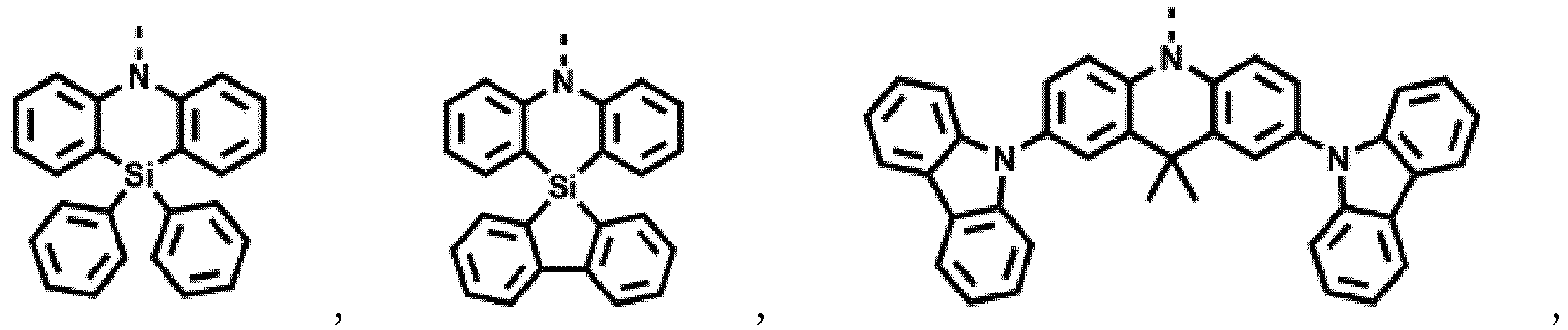
- In different embodiments, the benzene compound with the nitrogen-containing ring structure is selected one of following structural formulas:


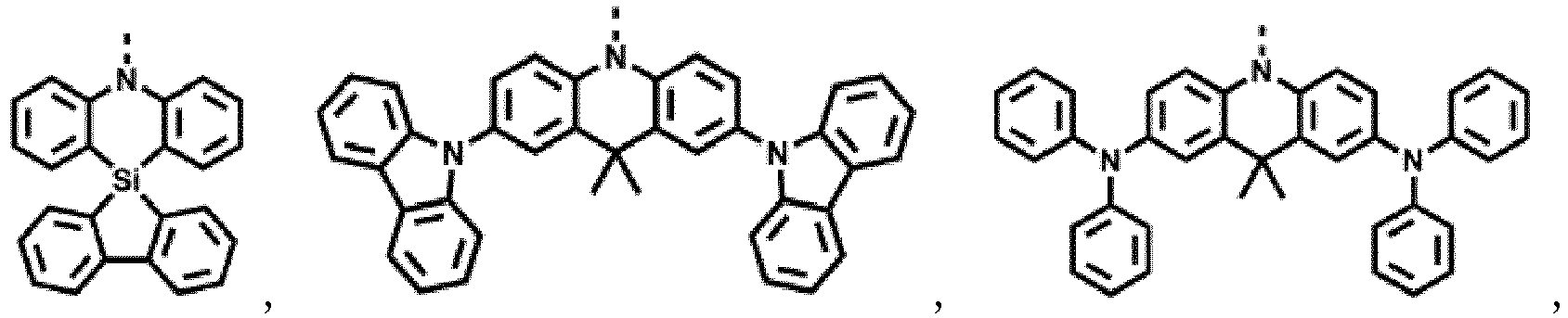


- Furthermore, in different embodiments, the R is


- Furthermore, in different embodiments, the R is


- Furthermore, in different embodiments, the R is


- The present disclosure further provides a preparation method for preparing the thermally activated delayed fluorescent green light polymer material according to the present disclosure, including following steps of:
- adding a benzene compound with a boron ring structure, a benzene compound with a nitrogen ring structure, palladium acetate, and tri-tert-butyl phosphine tetrafluoroborate into a reaction bottle, wherein in the benzene compound with the nitrogen ring structure, the nitrogen ring structure forms an amino group; and a chemical structural formula of the benzene compound with the boron ring structure is as follows:

- placing the reaction bottle into a glove box, and adding NaOt-Bu to the reaction bottle in the glove box, and further adding toluene under an argon atmosphere, followed by reacting at 100-140°C for 20 to 30 hours, and cooling to a room temperature to obtain a mixed solution; and
- pouring the mixed solution into an ice water, extracting organic phases from the mixed solution multiple times with dichloromethane, combining the organic phases extracted by the multiple times, and separating and purifying the extracted organic phases by a silica gel chromatography to obtain the thermally activated delayed fluorescent green light polymer material.
- Furthermore, in different embodiments, the benzene compound with the nitrogen-containing ring structure is selected one of following structural formulas:



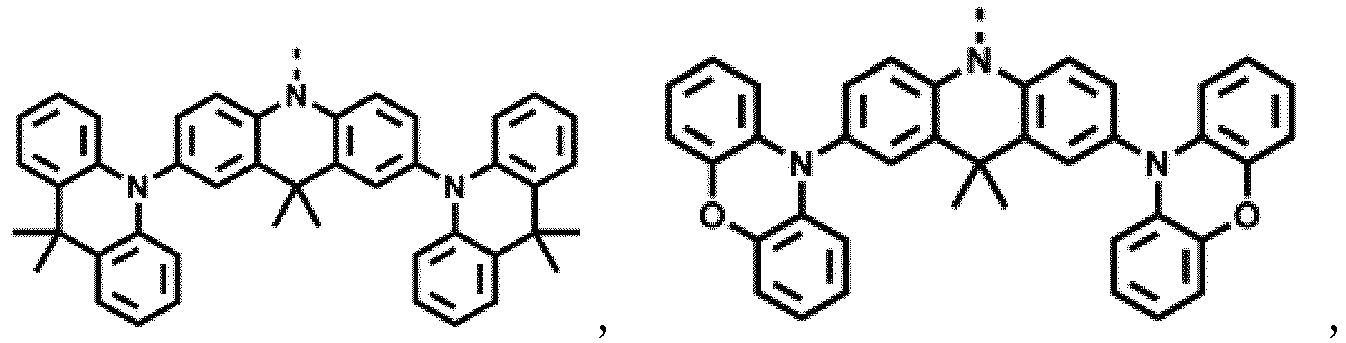


- Furthermore, in different embodiments, when the benzene compound with the nitrogen-containing ring structure is carbazole, and a chemical structural formula of the carbazole is
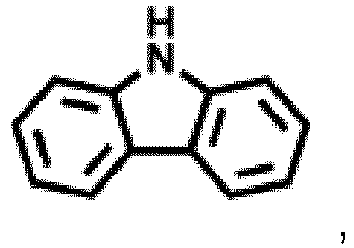
- a chemical structural formula of the thermally activated delayed fluorescent green light polymer material is:

- when the benzene compound with the nitrogen-containing ring structure is phenoxazine, and a chemical structural formula of the phenoxazine is

- a chemical structural formula of the thermally activated delayed fluorescent green light polymer material is:

- when the benzene compound with the nitrogen-containing ring structure is 9,9'-dimethylacridine, and a chemical structural formula of the 9,9'-dimethylacridine is:

- a chemical structural formula of the thermally activated delayed fluorescent green light polymer material is:

- Furthermore, in different embodiments, a molar mass ratio of the benzene compound with the boron ring structure, the benzene compound with the nitrogen ring structure, the palladium acetate, and the tri-tert-butyl phosphine tetrafluoroborate is: (12-15): (15-20): (1-1.5): (3-4).
- The present disclosure also provides an organic electroluminescent device, including a light-emitting layer containing the thermally activated delayed fluorescent green light polymer material according to the present disclosure.
- The organic electroluminescent device includes a glass and conductive glass (ITO) substrate layer, a hole transport and injection layer, the light emitting layer, an electron transport layer, and a cathode layer.
- Beneficial effect: Compared with the prior art, the beneficial effect of the present disclosure is that: the present disclosure relates to a thermally activated delayed fluorescent green light polymer material, wherein based on a boron-containing structure, an overall charge transfer strength is adjusted through different electron donor units, so as to synthesize a series of green light thermally activated delayed fluorescence materials with low single-triplet energy level differences, high luminous efficiency, and fast reverse intersystem crossing constants, while realizing the fine-tuning of the electron-donor ability of the electronic donor unit to make the spectrum fine-tune.
- Furthermore, the present disclosure also provides an organic electroluminescent device that uses the thermally activated delayed fluorescent green light polymer material as a light-emitting layer, which can improve the luminous efficiency of the device and make the performance of the light-emitting device more stable.
- The technical solutions and other beneficial effects of the present application will be apparent through the detailed description of the specific implementation of the present application in conjunction with the drawings.
-
FIG. 1 is a schematic structural view of an organic electroluminescent device according to an embodiment of the present disclosure. - The technical solutions in the embodiments of the present disclosure will be described clearly and completely in conjunction with the drawings in the embodiments of the present disclosure. It is apparent that the described embodiments are only a part of the embodiments of the present disclosure, but not all the embodiments. Based on the embodiments of the present disclosure, all other embodiments obtained by those of ordinary skill in the art without making creative works fall within the protection scope of the present disclosure.
- The present disclosure provides a thermally activated delayed fluorescent deep red light polymer material, a structural formula is as follows:

- In the formula, R is a benzene compound with a nitrogen-containing ring structure, and the benzene compound with the nitrogen-containing ring structure is one of following structural formulas:


- When the R is

- A chemical structural formula of the thermally activated delayed fluorescent green light polymer material is:

- When R is

- A chemical structural formula of the thermally activated delayed fluorescent green light polymer material is:

- When R is

- A chemical structural formula of the thermally activated delayed fluorescent green light polymer material is:

- The lowest singlet state (S1), lowest triplet state level (T1), and electrochemical energy level of compound A, compound B, and compound C are shown in Table 1 below.
Table 1 PL Peak (nm) S1 (eV) T1 (eV) ΔEST (eV) HOMO (eV) LUMO (eV) compound A 520 2.39 2.30 0.09 -5.46 -2.87 compound B 543 2.29 2.18 0.11 -5.48 -2.87 compound C 529 2.34 2.28 0.06 -5.41 -2.87 - The present disclosure further provides a preparation method for preparing the thermally activated delayed fluorescent green light polymer material according to the present disclosure, including following steps of:
- adding a benzene compound with a boron ring structure, a benzene compound with a nitrogen ring structure, palladium acetate, and tri-tert-butyl phosphine tetrafluoroborate into a reaction bottle, wherein in the benzene compound with the nitrogen ring structure, the nitrogen ring structure forms an amino group; and a chemical structural formula of the benzene compound with the boron ring structure is as follows:

- placing the reaction bottle into a glove box, and adding NaOt-Bu to the reaction bottle in the glove box, and further adding toluene under an argon atmosphere, followed by reacting at 100-140°C for 20 to 30 hours, and cooling to a room temperature to obtain a mixed solution; and pouring the mixed solution into an ice water, extracting organic phases from the mixed solution multiple times with dichloromethane, combining the organic phases extracted by the multiple times, and separating and purifying the extracted organic phases by a silica gel chromatography to obtain the thermally activated delayed fluorescent green light polymer material.
- In this embodiment, the benzene compound with the nitrogen-containing ring structure is carbazole, and a chemical structural formula of the carbazole is

- A chemical structural formula of the thermally activated delayed fluorescent green light polymer material is:

- The synthetic path is as follows:

- The preparation method of the thermally activated delayed fluorescent green light polymer material includes the following steps:
- Adding 5 mmol of benzene compound with a boron ring structure, 6 mmol of carbazole, 0.4 mmol of palladium acetate and 1.2 mmol of tri-tert-butyl phosphine tetrafluoroborate into a reaction bottle, and placing the reaction bottle into a glove box, and adding 12 mmol NaOt-Bu in the glove box, adding 120 mL of toluene that has been dehydrated and deoxygenated under the argon atmosphere, followed by reacting at 100-140°C for 20 to 30 hours, then cool to a room temperature to obtain a mixed solution, pouring the mixed solution into 300 mL of ice water, extracting the organic phase in the mixed solution multiple times with dichloromethane, combining the organic phases extracted by multiple times, and separating and purifying it by a silica gel chromatography to obtain 2.0 g of the thermally activated delayed fluorescent green light polymer material, wherein the yield is 67%.
- In this embodiment, the benzene compound with a nitrogen-containing ring structure is phenoxazine, and a chemical structural formula of the phenoxazine is

- A chemical structural formula of the thermally activated delayed fluorescent green light polymer material is:

- The synthetic path is as follows:

- The preparation method of the thermally activated delayed fluorescent green light polymer material includes the following steps:
- Adding 5 mmol of benzene compound with a boron ring structure, 6 mmol of phenoxazine, 0.4 mmol of palladium acetate and 1.2 mmol of tri-tert-butyl phosphine tetrafluoroborate into a reaction bottle, and placing the reaction bottle into a glove box, and adding 12 mmol NaOt-Bu in the glove box, adding 120 mL of toluene that has been dehydrated and deoxygenated under the argon atmosphere, followed by reacting at 100-140°C for 20 to 30 hours, then cool to a room temperature to obtain a mixed solution, pouring the mixed solution into 300 mL of ice water, extracting the organic phase in the mixed solution multiple times with dichloromethane, combining the organic phases extracted by multiple times, and separating and purifying it by a silica gel chromatography to obtain 2.2 g of the thermally activated delayed fluorescent green light polymer material, wherein the yield is 71%.
- In this embodiment, the benzene compound with a nitrogen-containing ring structure is 9,9'-dimethylacridine, and a chemical structure of the 9,9'-dimethylacridine is

- A chemical structural formula of the thermally activated delayed fluorescent green light polymer material is:

- The synthetic path is as follows:

- The preparation method of the thermally activated delayed fluorescent green light polymer material includes following steps:
- Adding 5 mmol of benzene compound with a boron ring structure, 6 mmol of 9,9'-dimethylacridine, 0.4 mmol of palladium acetate and 1.2 mmol of tri-tert-butyl phosphine tetrafluoroborate into a reaction bottle, and placing the reaction bottle into a glove box, and adding 12 mmol NaOt-Bu in the glove box, and adding 12 mmol NaOt-Bu in the glove box, adding 120 mL of toluene that has been dehydrated and deoxygenated under the argon atmosphere, followed by reacting at 100-140°C for 20 to 30 hours, then cool to a room temperature to obtain a mixed solution, pouring the mixed solution into 300 mL of ice water, extracting the organic phase in the mixed solution multiple times with dichloromethane, combining the organic phases extracted by multiple times, and separating and purifying it by a silica gel chromatography to obtain 2.3 g of the thermally activated delayed fluorescent green light polymer material, wherein the yield is 72%.
- The present disclosure further provides an organic electroluminescent device, including a light-emitting layer containing the thermally activated delayed fluorescent green light polymer material according to the present disclosure.
- Please refer to
FIG. 1. FIG. 1 is a schematic structural view of an organic electroluminescent device provided by the present disclosure. The organic electroluminescent device includes a glass and conductive glass (ITO)substrate layer 1, a hole transport andinjection layer 2, and alight emitting layer 3, aelectron transport layer 4, and acathode layer 5. - When the light-emitting
layer 3 contains compound A, compound B, and compound C, the organic electroluminescent devices are respectivelydevice 1,device 2, anddevice 3, and the performance data ofdevice 1,device 2, anddevice 3 are shown in Table 2 below:Device Maximum current efficiency (cd/A) EL peak (nm) Maximum external quantum efficiency (%) Device 171.3 520 24.9 Device 266.3 543 22.1 Device 368.6 529 23.3 - Compared with the prior art, the beneficial effect of the present disclosure is that: the present disclosure relates to a thermally activated delayed fluorescent green light polymer material, wherein based on a boron-containing structure, an overall charge transfer strength is adjusted through different electron donor units, so as to synthesize a series of green light thermally activated delayed fluorescence materials with low single-triplet energy level differences, high luminous efficiency, and fast reverse intersystem crossing constants, while realizing the fine-tuning of the electron-donor ability of the electronic donor unit to make the spectrum fine-tune.
- Furthermore, the present disclosure also provides an organic electroluminescent device that uses the thermally activated delayed fluorescent green light polymer material as a light-emitting layer, which can improve the luminous efficiency of the device and make the performance of the light-emitting device more stable.
- The above description is only the preferred embodiment of the present disclosure. It should be noted that for those of ordinary skill in the art, without departing from the principles of the present disclosure, many improvements and retouches can be made. These improvements and retouches should also be regarded as the disclosure.
Claims (14)
- A thermally activated delayed fluorescent green light polymer material, characterized in that the thermally activated delayed fluorescent green light polymer material comprises a structural formula as follows:

- The thermally activated delayed fluorescent green light polymer material according to claim 1, characterized in that the benzene compound with the nitrogen-containing ring structure is selected one of following structural formulas:


- The thermally activated delayed fluorescent green light polymer materialaccording to claim 2, characterized in that the R is
 a chemical structural formula of the thermally activated delayed fluorescent green light polymer material is:
- A thermally activated delayed fluorescent green light polymer materialaccording to claim 2, characterized in that the R is
 a chemical structural formula of the thermally activated delayed fluorescent green light polymer material is:
- A thermally activated delayed fluorescent green light polymer materialaccording to claim 2, characterized in that the R is
 a chemical structural formula of the thermally activated delayed fluorescent green light polymer material is:
- A preparation method for preparing the thermally activated delayed fluorescent green light polymer material according to claim 1, characterized in that the preparation method for preparing the thermally activated delayed fluorescent green light polymer material comprises following steps of:adding a benzene compound with a boron ring structure, a benzene compound with a nitrogen ring structure, palladium acetate, and tri-tert-butyl phosphine tetrafluoroborate into a reaction bottle, wherein in the benzene compound with the nitrogen ring structure, the nitrogen ring structure forms an amino group; and a chemical structural formula of the benzene compound with the boron ring structure is as follows:
 placing the reaction bottle into a glove box, and adding NaOt-Bu to the reaction bottle in the glove box, and further adding toluene under an argon atmosphere, followed by reacting at 100-140°C for 20 to 30 hours, and cooling to a room temperature to obtain a mixed solution; andpouring the mixed solution into an ice water, extracting organic phases from the mixed solution multiple times with dichloromethane, combining the organic phases extracted by the multiple times, and separating and purifying the extracted organic phases by a silica gel chromatography to obtain the thermally activated delayed fluorescent green light polymer material.
 - The preparation method for preparing the thermally activated delayed fluorescent green light polymer material according to claim 6, characterized in that the benzene compound with the nitrogen-containing ring structure is selected one of following structural formulas:


- The preparation method for preparing the thermally activated delayed fluorescent green light polymer material according to claim 7, characterized in that when the benzene compound with the nitrogen-containing ring structure is carbazole, and a chemical structural formula of the carbazole is
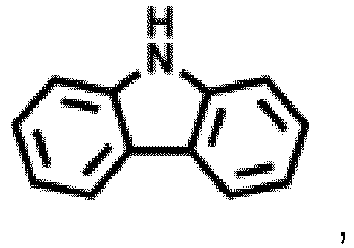 a chemical structural formula of the thermally activated delayed fluorescent green light polymer material is:
 when the benzene compound with the nitrogen-containing ring structure is phenoxazine, and a chemical structural formula of the phenoxazine is
 a chemical structural formula of the thermally activated delayed fluorescent green light polymer material is:
 when the benzene compound with the nitrogen-containing ring structure is 9,9'-dimethylacridine, and a chemical structural formula of the 9,9'-dimethylacridine is:
 a chemical structural formula of the thermally activated delayed fluorescent green light polymer material is:
- The preparation method for preparing the thermally activated delayed fluorescent green light polymer material according to claim 7, characterized in that a molar mass ratio of the benzene compound with the boron ring structure, the benzene compound with the nitrogen ring structure, the palladium acetate, and the tri-tert-butyl phosphine tetrafluoroborate is: (12-15): (15-20): (1-1.5): (3-4).
- An organic electroluminescence device, characterized in that the organic electroluminescence device comprises a light-emitting layer (3) containing the thermally activated delayed fluorescent green light polymer material according to any one of claim 1.
- The thermally activated delayed fluorescent green light polymer material according to claim 10, characterized in that the benzene compound with the nitrogen-containing ring structure is selected one of following structural formulas:




- The thermally activated delayed fluorescent green light polymer materialaccording to claim 11, characterized in that the R is
 a chemical structural formula of the thermally activated delayed fluorescent green light polymer material is:
- A thermally activated delayed fluorescent green light polymer materialaccording to claim 11, characterized in that the R is
 a chemical structural formula of the thermally activated delayed fluorescent green light polymer material is: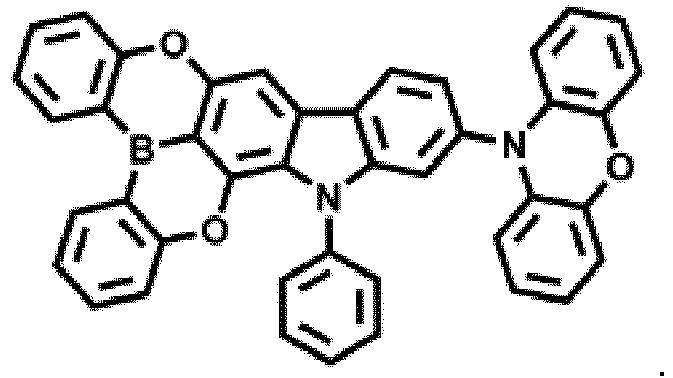
- A thermally activated delayed fluorescent green light polymer materialaccording to claim 11, characterized in that the R is
 a chemical structural formula of the thermally activated delayed fluorescent green light polymer material is: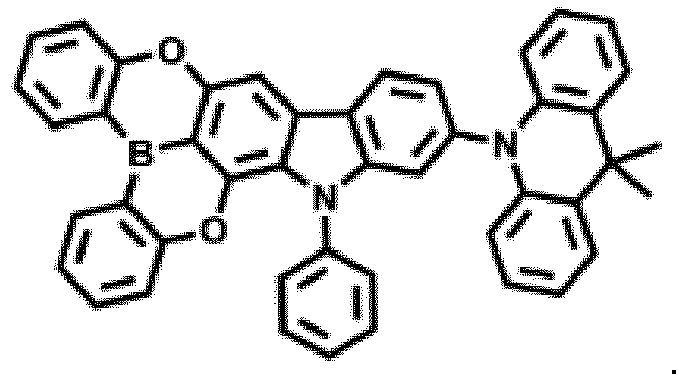
Applications Claiming Priority (2)
| Application Number | Priority Date | Filing Date | Title |
|---|---|---|---|
| CN201911309897.5A CN111116623B (en) | 2019-12-18 | 2019-12-18 | Thermal activation delayed fluorescence green light high polymer material and preparation method thereof |
| PCT/CN2020/083246 WO2021120450A1 (en) | 2019-12-18 | 2020-04-03 | Thermally-activated delayed fluorescence green light polymer material and preparation method therefor |
Publications (2)
| Publication Number | Publication Date |
|---|---|
| EP4079736A1 true EP4079736A1 (en) | 2022-10-26 |
| EP4079736A4 EP4079736A4 (en) | 2024-02-28 |
Family
ID=76438782
Family Applications (1)
| Application Number | Title | Priority Date | Filing Date |
|---|---|---|---|
| EP20859656.9A Pending EP4079736A4 (en) | 2019-12-18 | 2020-04-03 | THERMALLY ACTIVATED GREEN LIGHT POLYMER MATERIAL WITH DELAYED FLUORESCENCE AND METHOD FOR PRODUCING SAME |
Country Status (2)
| Country | Link |
|---|---|
| US (1) | US11882757B2 (en) |
| EP (1) | EP4079736A4 (en) |
Family Cites Families (8)
| Publication number | Priority date | Publication date | Assignee | Title |
|---|---|---|---|---|
| JP5884807B2 (en) * | 2013-10-16 | 2016-03-15 | トヨタ自動車株式会社 | Hybrid vehicle |
| TWI636056B (en) | 2014-02-18 | 2018-09-21 | 學校法人關西學院 | Polycyclic aromatic compound and method for production the same, material for organic device and application thereof |
| US10686141B2 (en) | 2016-09-07 | 2020-06-16 | Kwansei Gakuin Educational Foundation | Polycyclic aromatic compound |
| JP6756603B2 (en) * | 2016-12-16 | 2020-09-16 | 株式会社日立製作所 | Power system state estimation device and state estimation method |
| CN110719914B (en) | 2017-07-07 | 2023-07-28 | 学校法人关西学院 | Polycyclic aromatic compound, material for organic element, organic electroluminescent element, display device, and lighting device |
| WO2019206288A1 (en) | 2018-04-27 | 2019-10-31 | 中国石油化工股份有限公司 | Polar monomer grafted polypropylene resin, preparation method therefor and application thereof |
| JP7445923B2 (en) | 2018-06-06 | 2024-03-08 | 学校法人関西学院 | Tertiary alkyl-substituted polycyclic aromatic compound |
| CN110003260B (en) | 2019-04-30 | 2021-06-01 | 武汉天马微电子有限公司 | Boron heterocyclic compound, display panel, and display device |
-
2020
- 2020-04-03 EP EP20859656.9A patent/EP4079736A4/en active Pending
- 2020-04-03 US US16/968,923 patent/US11882757B2/en active Active
Also Published As
| Publication number | Publication date |
|---|---|
| EP4079736A4 (en) | 2024-02-28 |
| US11882757B2 (en) | 2024-01-23 |
| US20210193926A1 (en) | 2021-06-24 |
Similar Documents
| Publication | Publication Date | Title |
|---|---|---|
| EP1499624B1 (en) | Electroluminescent materials | |
| WO2017101675A1 (en) | Thermally activated delayed fluorescence material and use thereof in organic electroluminescent device | |
| US20210280797A1 (en) | Efficient blue-green to orange-red thermally activated delayed fluorescence material, manufacture method, and application thereof | |
| US12378271B2 (en) | Platinum metal complex and use thereof in organic electroluminescent device | |
| CN105837602B (en) | A yellow-green light cuprous complex with heat-activated delayed fluorescence performance and its preparation method | |
| Ding et al. | Efficient solution-processed OLEDs featuring deep-blue triplet-triplet annihilation emitter based on pyrene derivative | |
| CN106749341B (en) | Balancing charge injects organic semiconductor and its Organic Light Emitting Diode application | |
| WO2017000779A1 (en) | Nitrogen-containing heterocyclic ring derivative and organic light emitting diode device using same | |
| CN106467551B (en) | A kind of optoelectronic material with homobenzene as the core and its application | |
| CN111116623B (en) | Thermal activation delayed fluorescence green light high polymer material and preparation method thereof | |
| US11678570B2 (en) | Hole transport material, preparation method thereof, and electroluminescent device | |
| EP4079736A1 (en) | Thermally-activated delayed fluorescence green light polymer material and preparation method therefor | |
| CN111423330B (en) | Aromatic amine derivative based on spirofluorene and application thereof | |
| CN116056545A (en) | An organic material composition and an organic electroluminescent device comprising the same | |
| US11326096B2 (en) | Red light thermally activated delayed fluorescence material, method for preparing the same, and organic light emitting diode device | |
| CN103242322B (en) | Indolocarbazole derivatives and the application in electroluminescent device thereof | |
| Li et al. | Highly efficient orange and red organic light-emitting diodes with iridium (III) complexes bearing benzothiazole cyclometallate ligands as emitters | |
| CN101747356A (en) | Phenol-pyridine boron complexes containing carbazolyl and application in electroluminescent devices | |
| WO2022088113A1 (en) | Doped electronic device based on green thermally activated delayed fluorescence material, and manufacturing method therefor | |
| CN121604623B (en) | An organic electroluminescent device and display device | |
| CN106495975B (en) | 9, 9' -bianthracene blue light multifunctional material and application thereof | |
| CN107068879B (en) | Organic electroluminescent device containing triazine compounds and application thereof | |
| CN112289942B (en) | Doped electronic device based on green thermally activated delayed fluorescence material and its preparation method | |
| CN103626683A (en) | Organic semiconductor material, preparation method of organic semiconductor material and electroluminescent device | |
| AU2018101476A4 (en) | Organic electroluminescent material and applications |
Legal Events
| Date | Code | Title | Description |
|---|---|---|---|
| STAA | Information on the status of an ep patent application or granted ep patent |
Free format text: STATUS: UNKNOWN |
|
| STAA | Information on the status of an ep patent application or granted ep patent |
Free format text: STATUS: THE INTERNATIONAL PUBLICATION HAS BEEN MADE |
|
| PUAI | Public reference made under article 153(3) epc to a published international application that has entered the european phase |
Free format text: ORIGINAL CODE: 0009012 |
|
| STAA | Information on the status of an ep patent application or granted ep patent |
Free format text: STATUS: REQUEST FOR EXAMINATION WAS MADE |
|
| 17P | Request for examination filed |
Effective date: 20210311 |
|
| AK | Designated contracting states |
Kind code of ref document: A1 Designated state(s): AL AT BE BG CH CY CZ DE DK EE ES FI FR GB GR HR HU IE IS IT LI LT LU LV MC MK MT NL NO PL PT RO RS SE SI SK SM TR |
|
| DAV | Request for validation of the european patent (deleted) | ||
| DAX | Request for extension of the european patent (deleted) | ||
| A4 | Supplementary search report drawn up and despatched |
Effective date: 20240126 |
|
| RIC1 | Information provided on ipc code assigned before grant |
Ipc: H10K 101/20 20230101ALI20240122BHEP Ipc: H10K 85/60 20230101ALI20240122BHEP Ipc: H10K 85/30 20230101ALI20240122BHEP Ipc: C09K 11/02 20060101ALI20240122BHEP Ipc: C09K 11/06 20060101ALI20240122BHEP Ipc: C07F 5/02 20060101AFI20240122BHEP |