EP4078756B1 - Variable reliability and capacity data center design - Google Patents
Variable reliability and capacity data center design Download PDFInfo
- Publication number
- EP4078756B1 EP4078756B1 EP20820676.3A EP20820676A EP4078756B1 EP 4078756 B1 EP4078756 B1 EP 4078756B1 EP 20820676 A EP20820676 A EP 20820676A EP 4078756 B1 EP4078756 B1 EP 4078756B1
- Authority
- EP
- European Patent Office
- Prior art keywords
- power
- power supply
- server racks
- server
- sets
- Prior art date
- Legal status (The legal status is an assumption and is not a legal conclusion. Google has not performed a legal analysis and makes no representation as to the accuracy of the status listed.)
- Active
Links
Images


Classifications
-
- H—ELECTRICITY
- H05—ELECTRIC TECHNIQUES NOT OTHERWISE PROVIDED FOR
- H05K—PRINTED CIRCUITS; CASINGS OR CONSTRUCTIONAL DETAILS OF ELECTRIC APPARATUS; MANUFACTURE OF ASSEMBLAGES OF ELECTRICAL COMPONENTS
- H05K7/00—Constructional details common to different types of electric apparatus
- H05K7/14—Mounting supporting structure in casing or on frame or rack
- H05K7/1485—Servers; Data center rooms, e.g. 19-inch computer racks
- H05K7/1488—Cabinets therefor, e.g. chassis or racks or mechanical interfaces between blades and support structures
- H05K7/1492—Cabinets therefor, e.g. chassis or racks or mechanical interfaces between blades and support structures having electrical distribution arrangements, e.g. power supply or data communications
-
- H—ELECTRICITY
- H02—GENERATION; CONVERSION OR DISTRIBUTION OF ELECTRIC POWER
- H02J—ELECTRIC POWER NETWORKS; CIRCUIT ARRANGEMENTS OR SYSTEMS FOR SUPPLYING OR DISTRIBUTING ELECTRIC POWER; SYSTEMS FOR STORING ELECTRIC ENERGY
- H02J1/00—Circuit arrangements for DC mains or DC distribution networks
- H02J1/08—Three-wire DC power distribution systems; Systems having more than three wires
- H02J1/084—Three-wire DC power distribution systems; Systems having more than three wires for selectively connecting the load or loads to one or several among a plurality of power lines or power sources
- H02J1/086—Three-wire DC power distribution systems; Systems having more than three wires for selectively connecting the load or loads to one or several among a plurality of power lines or power sources for providing alternative feeding paths between load or loads and source or sources when the main path fails
-
- G—PHYSICS
- G06—COMPUTING OR CALCULATING; COUNTING
- G06F—ELECTRIC DIGITAL DATA PROCESSING
- G06F1/00—Details not covered by groups G06F3/00 - G06F13/00 and G06F21/00
- G06F1/16—Constructional details or arrangements
- G06F1/18—Packaging or power distribution
- G06F1/189—Power distribution
-
- H—ELECTRICITY
- H02—GENERATION; CONVERSION OR DISTRIBUTION OF ELECTRIC POWER
- H02J—ELECTRIC POWER NETWORKS; CIRCUIT ARRANGEMENTS OR SYSTEMS FOR SUPPLYING OR DISTRIBUTING ELECTRIC POWER; SYSTEMS FOR STORING ELECTRIC ENERGY
- H02J3/00—Circuit arrangements for AC mains or AC distribution networks
- H02J3/007—Arrangements for selectively connecting one or more loads to one or more power sources or power lines
- H02J3/0073—Arrangements for selectively connecting one or more loads to one or more power sources or power lines by providing alternative feeding paths when the main path fails
-
- H—ELECTRICITY
- H05—ELECTRIC TECHNIQUES NOT OTHERWISE PROVIDED FOR
- H05K—PRINTED CIRCUITS; CASINGS OR CONSTRUCTIONAL DETAILS OF ELECTRIC APPARATUS; MANUFACTURE OF ASSEMBLAGES OF ELECTRICAL COMPONENTS
- H05K7/00—Constructional details common to different types of electric apparatus
- H05K7/14—Mounting supporting structure in casing or on frame or rack
- H05K7/1485—Servers; Data center rooms, e.g. 19-inch computer racks
- H05K7/1497—Rooms for data centers; Shipping containers therefor
-
- H—ELECTRICITY
- H02—GENERATION; CONVERSION OR DISTRIBUTION OF ELECTRIC POWER
- H02J—ELECTRIC POWER NETWORKS; CIRCUIT ARRANGEMENTS OR SYSTEMS FOR SUPPLYING OR DISTRIBUTING ELECTRIC POWER; SYSTEMS FOR STORING ELECTRIC ENERGY
- H02J9/00—Circuit arrangements for emergency or stand-by power supply, e.g. for emergency lighting
- H02J9/04—Circuit arrangements for emergency or stand-by power supply, e.g. for emergency lighting in which the distribution system is disconnected from the normal source and connected to a standby source
- H02J9/06—Circuit arrangements for emergency or stand-by power supply, e.g. for emergency lighting in which the distribution system is disconnected from the normal source and connected to a standby source with automatic change-over, e.g. UPS systems
Definitions
- a data center is a physical facility that is used to house computer systems and associated components.
- a data center typically includes a large number of servers, which may be stacked in racks that are placed in rows.
- a colocation center (which is sometimes referred to simply as a "colo”) is a type of data center where equipment, space, and bandwidth are available for rental to customers.
- the electrical infrastructure of a data center (such as a colocation center) includes a connection to the main power grid, which is typically provided by the local utility company.
- the electricity from the local utility company is typically delivered with a medium voltage.
- the medium-voltage electricity is then transformed by one or more transformers to low voltage for use within the data center.
- data centers are typically connected to at least one backup generator. Electricity from the backup generator may be delivered at low voltage, or it may be delivered at medium voltage and then transformed to low voltage for use within the data center.
- the low-voltage electricity is distributed to endpoints through one or more Uninterrupted Power Supply (UPS) systems and one or more power distribution units (PDUs).
- UPS Uninterrupted Power Supply
- a UPS system provides short-term power when the input power source fails and protects critical components against voltage spikes, harmonic distortion, and other common power problems.
- a PDU includes multiple outputs that are designed to distribute electric power to racks of computers and networking equipment located within a data center.
- the electrical infrastructure of a data center can utilize a plurality of different cells.
- Each of the cells can include its own power supply system.
- the term "power supply system” may refer to one or more components that provide a source of power to at least some of the servers and/or other components in the data center.
- a power supply system may include one or more of the components described previously (e.g., a connection to the main grid, a backup generator, one or more transformers, a UPS system, and one or more PDUs).
- US 2019/377394 A1 discloses a system to identify connection paths between a power source and a plurality of loads. A reachability signal is sent on a cable connecting a power output of the power source to a power distribution unit (PDU).
- PDU power distribution unit
- the PDU receives the reachability and forwards a modified reachability signal on one or more power outputs of the PDU to one or more loads.
- the PDU receives a return reachability signal from the one or more loads and forwards corresponding modified return reachability signals on the cable to the power source.
- US 6 449 112 B1 discloses a data center power system including an electrical power conductor that includes a live conductor surface and is configured to carry direct current power from a power source through a human-occupiable workspace of a data center; a grounded conductor positioned in the human-occupiable workspace apart from the electrical power conductor; a first electrical connector configured to mount to a data center rack that supports a plurality of electronic devices; and a second electrical conductor positioned on the rack and configured to electrically contact the grounded conductor.
- a method in accordance with one aspect of the present disclosure, includes providing a plurality of power supply systems, a plurality of sets of server racks, and a plurality of power buses.
- the plurality of power supply systems are configured to supply electrical power to at least a section of a data center.
- the plurality of power buses are configured to conduct the electrical power from the plurality of power supply systems to the plurality of sets of server racks.
- the method also includes connecting the plurality of sets of server racks and the plurality of power buses in accordance with a first connection pattern to place the section of the data center in a distributed, redundant configuration.
- Each server rack in the plurality of sets of server racks is connected to two different power supply systems when the plurality of sets of server racks and the plurality of power buses are connected in accordance with the first connection pattern.
- the method also includes connecting the plurality of sets of server racks and the plurality of power buses in accordance with a second connection pattern to place the section of the data center in a non-redundant configuration.
- Each server rack in the plurality of sets of server racks is connected to only one power supply system when the plurality of sets of server racks and the plurality of power buses are connected in accordance with the second connection pattern.
- the distributed, redundant configuration may provide higher server reliability than the non-redundant configuration.
- the non-redundant configuration may provide higher power capacity than the distributed, redundant configuration.
- the method may further include transitioning between the distributed, redundant configuration and the non-redundant configuration without making any internal changes to the data center other than modifying connections between the plurality of sets of server racks and the plurality of power buses.
- Connecting the plurality of sets of server racks and the plurality of power buses in accordance with the first connection pattern may include connecting each server rack in the plurality of sets of server racks to two different power buses that are connected to two different power supply systems.
- Connecting the plurality of sets of server racks and the plurality of power buses in accordance with the second connection pattern may include connecting each server rack in the plurality of sets of server racks to only one power bus.
- the plurality of power supply systems may operate at full capacity without maintaining any reserve capacity when the plurality of sets of server racks and the plurality of power buses are arranged in the non-redundant configuration.
- the plurality of power supply systems may maintain reserve capacity during normal operation when the plurality of sets of server racks and the plurality of power buses are arranged in the distributed, redundant configuration.
- the distributed, redundant configuration may enable load shifting when a power supply system becomes unavailable.
- the method may further include connecting equal numbers of power buses to different power supply systems of the plurality of power supply systems.
- a system in accordance with another aspect of the present disclosure, includes a plurality of power supply systems that are configured to supply electrical power to at least a section of a data center.
- the system also includes a first plurality of sets of server racks and a first plurality of power buses that are configured to conduct the electrical power from at least some of the plurality of power supply systems to the first plurality of sets of server racks.
- the first plurality of sets of server racks and the first plurality of power buses are connected in accordance with a first connection pattern to create a distributed, redundant configuration.
- the system also includes a second plurality of sets of server racks and a second plurality of power buses that are configured to conduct the electrical power from at least some of the plurality of power supply systems to the second plurality of sets of server racks.
- the second plurality of sets of server racks and the second plurality of power buses are connected in accordance with a second connection pattern to create a non-redundant configuration.
- the distributed, redundant configuration may provide higher server reliability than the non-redundant configuration.
- the non-redundant configuration may provide higher power capacity than the distributed, redundant configuration.
- Each server rack in the first plurality of sets of server racks may be connected to two different power supply systems.
- Each server rack in the second plurality of sets of server racks may be connected to only one power supply system.
- the first plurality of power supply systems may maintain reserve capacity during normal operation.
- the second plurality of power supply systems may operate at full capacity without maintaining any reserve capacity.
- a system in accordance with another aspect of the present disclosure, includes a plurality of power supply systems that are configured to supply electrical power to at least a section of a data center.
- the system also includes a plurality of sets of server racks and a plurality of power buses that are configured to conduct the electrical power from the plurality of power supply systems to the plurality of sets of server racks.
- Each server rack in the plurality of sets of server racks has two connections to a power bus.
- Each server rack in the plurality of sets of server racks is connected to only one power bus. Adjacent server racks in a row of server racks are connected to different power buses.
- the plurality of power supply systems may operate at full capacity without maintaining any reserve capacity. Equal numbers of power buses may be connected to different power supply systems of the plurality of power supply systems.
- a first power bus runs parallel to a first side of the row of server racks
- a second power bus runs parallel to a second side of the row of server racks. Every other server rack in the row of server racks may be connected to a different one of the first power bus and the second power bus.
- the present disclosure is generally related to a design for the electrical infrastructure of a data center that enables two different configurations to be utilized without requiring any significant changes to the underlying infrastructure components.
- These configurations can include a first configuration that provides higher reliability at the cost of lower capacity, and a second configuration that provides higher capacity at the cost of lower reliability.
- the first configuration may be referred to herein as a "higher reliability, lower capacity” configuration
- the second configuration may be referred to herein as a "higher capacity, lower reliability” configuration.
- the term "reliability” can refer to the ability of the electrical infrastructure of a data center to supply electrical power to servers and other electrical components in a data center in a consistent and dependable way, such that the servers and other electrical components are able to remain in operating condition for a high percentage of the time. In other words, reliability can be considered to be synonymous with availability.
- the term “capacity” can refer to the amount of electrical power that can be supplied by the electrical infrastructure of a data center.
- a higher capacity, lower reliability configuration may be capable of supplying a greater amount of electrical power than a higher reliability, lower capacity configuration.
- a higher reliability, lower capacity configuration may be capable of supplying electrical power more consistently and dependably than a higher capacity, lower reliability configuration. More specifically, a higher reliability, lower capacity configuration may be capable of producing higher server availability than a higher capacity, lower reliability configuration.
- the electrical infrastructure of a data center can utilize a plurality of different cells, and each of the cells can include its own power supply system.
- the electrical infrastructure can utilize a distributed, redundant architecture in which each server in the data center draws power from at least two different power supply systems. If a power supply system becomes unavailable, the load that was being provided by the now unavailable power supply system can be shifted to one or more other power supply systems. In this way, the servers that were being supplied by the now unavailable power supply system can continue to receive power. Therefore, the use of a distributed, redundant architecture enables load shifting, which can have the effect of increasing the reliability of servers in a data center.
- Load shifting in the manner just described involves increasing the amount of power that is supplied by at least some of the other power supply systems in the data center.
- the electrical infrastructure can be designed so that it operates with a certain amount of reserve capacity under normal circumstances.
- the utilization of a data center can be limited so that the servers' total power consumption does not exceed a threshold level that is lower than the electrical infrastructure's total capacity. The difference between this threshold level and the total capacity can be thought of as the reserve capacity.
- the higher capacity, lower reliability configuration does not utilize load shifting. Therefore, the higher capacity, lower reliability configuration can utilize a non-redundant architecture in which each server in the data center draws power from only one power supply system. Because load shifting is not utilized, there is no need to maintain any reserve capacity. Eliminating the need to maintain reserve capacity effectively increases the capacity of the data center's electrical infrastructure. In other words, the utilization of the data center can be higher than it would be if reserve capacity had to be maintained. However, this increased capacity is achieved at the expense of lower reliability. Without the possibility of load shifting, the failure of a power supply system causes the servers that were being supplied by the now unavailable power supply system to lose power and experience an outage.
- One aspect of the present disclosure includes techniques for arranging the components of a data center's electrical infrastructure so that it is possible to easily switch between the higher reliability, lower capacity configuration that utilizes a distributed, redundant architecture and the higher capacity, lower reliability configuration that utilizes a non-redundant architecture.
- the techniques disclosed herein make it possible to switch between these two configurations without making any significant changes to the underlying infrastructure components.
- Figure 1 illustrates an example showing how servers and power buses can be arranged in a section of a data center 100 in order to facilitate the techniques disclosed herein.
- cells that are configured to supply power to servers in a particular section of the data center 100.
- These cells will be referred to as cell A, cell B, cell C, and cell D.
- Each of the cells includes a power supply system.
- cell A includes a power supply system 102a
- cell B includes a power supply system 102b
- cell C includes a power supply system 102c
- cell D includes a power supply system 102d.
- the data center 100 shown in Figure 1 includes a plurality of sets of server racks 106a-x, 108a-x.
- rack can refer to a physical structure that holds servers.
- a set of server racks can include a plurality of server racks.
- the data center 100 shown in Figure 1 includes a plurality of power buses. More specifically, the data center 100 includes a first set of power buses 110a-x that are connected to the power supply system 102a of cell A, a second set of power buses 112a-x that are connected to the power supply system 102b of cell B, a third set of power buses 114a-x that are connected to the power supply system 102c of cell C, and a fourth set of power buses 116a-x that are connected to the power supply system 102d of cell D.
- the term "power bus” can refer to an electrical conductor that is configured to conduct electrical power.
- a power bus can alternatively be referred to as a busbar.
- the power buses 110a-x, 112a-x, 114a-x, 116a-x shown in Figure 1 are configured to conduct electrical power from the power supply systems 102a-d of cells A, B, C, and D to the sets of server racks 106a-x, 108a-x.
- the sets of server racks 106a-x, 108a-x and the sets of power buses 110a-x, 112a-x, 114a-x, 116a-x are arranged so that each set of server racks is accessible to two power buses that are connected to different power supply systems.
- a set of server racks is accessible to two power buses if the set of server racks can be connected to both of the power buses without having to physically move (or reposition) the set of server racks.
- a set of server racks is accessible to two power buses if the set of server racks can be connected to both of the power buses without having to physically move (or reposition) the set of server racks or either of the power buses.
- each set of server racks is located between two power buses that are connected to different power supply systems.
- the first set of server racks 106a is located between a power bus 110a that is connected to the power supply system 102a of cell A and a power bus 112a that is connected to the power supply system 102b of cell B.
- Connecting a server rack to a power bus can be accomplished via one or more electrical cables.
- power buses 110a-x that are connected to the power supply system 102a of cell A
- one fourth are power buses 112a-x that are connected to the power supply system 102b of cell B
- one fourth are power buses 114a-x that are connected to the power supply system 102c of cell C
- one fourth are power buses 116a-x that are connected to the power supply system 102d of cell D.
- power supply systems 102a-d sets of server racks 106a-x, 108a-x, and sets of power buses 110a-x, 112a-x, 114a-x, 116a-x shown in Figure 1 is just an example and should not be interpreted as limiting the scope of the present disclosure.
- the sets of server racks 106a-x, 108a-x, and the sets of power buses 110a-x, 1 12a-x, 114a-x, 1 16a-x that are consistent with the present disclosure.
- the power supply systems 102a-d, the sets of server racks 106a-x, 108a-x, and the sets of power buses 110a-x, 112a-x, 114a-x, 116a-x can be connected in different ways and still utilize the techniques disclosed herein.
- the arrangement of the sets of server racks 106a-x, 108a-x and the power buses 110a-x, 112a-x, 114a-x, 116a-x shown in Figure 1 facilitates either a higher reliability, lower capacity configuration that utilizes a distributed, redundant architecture or a higher capacity, lower reliability configuration that utilizes a non-redundant architecture. More specifically, if the sets of server racks 106a-x, 108a-x and the power buses 110a-x, 112a-x, 114a-x, 116a-x are connected in accordance with a first connection pattern, this produces a higher reliability, lower capacity configuration that utilizes a distributed, redundant architecture.
- either configuration can be achieved without changing or moving any of the sets of server racks 106a-x, 108a-x or the power buses 110a-x, 112a-x, 114a-x, 116a-x.
- Some external changes may be needed as well, such as increasing the size of the utility feed to the data center 100 in order to produce the higher capacity, lower reliability configuration.
- the higher reliability, lower capacity configuration that utilizes a distributed, redundant architecture may be referred to simply as a "distributed, redundant configuration.”
- the higher capacity, lower reliability configuration that utilizes a non-redundant architecture may be referred to simply as a “non-redundant configuration.”
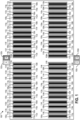
- Figure 1A illustrates an example showing how the first set of server racks 106a can be connected to the power buses 110a, 112a in order to produce the distributed, redundant configuration.
- the first set of server racks 106a includes a plurality of server racks 106a(1)-106a(20).
- the server racks 106a(1)-106a(20) are arranged in a row.
- the power bus 110a runs parallel to a first side of the row of server racks 106a(1)-106a(20).
- the power bus 112a runs parallel to a second side of the row of server racks 106a(1)-106a(20).
- connection pattern can refer to an arrangement of sequence of connections between the server racks 106a(1)-106a(20) and the power buses 110a, 112a.
- each of the server racks 106a(1)-106a(20) is connected to both the power bus 110a that is connected to the power supply system 102a of cell A and the power bus 112a that is connected to the power supply system 102b of cell B.
- connection 118a between that server rack 106a(1) and the power bus 110a that is connected to the power supply system 102a of cell A.
- connection 120a between that server rack 106a(1) and the power bus 112a that is connected to the power supply system 102b of cell B.
- connection 118b between that server rack 106a(2) and the power bus 110a that is connected to the power supply system 102a of cell A.
- connection 120b between that server rack 106a(2) and the power bus 112a that is connected to the power supply system 102b of cell B.
- connection 120b there is also a connection 120b between that server rack 106a(2) and the power bus 112a that is connected to the power supply system 102b of cell B.
- connections 118c-t between the server racks 106a(3)-(20) and the power bus 110a that is connected to the power supply system 102a of cell A, and similar connections 120c-t between the server racks 106a(3)-(20) and the power bus 112a that is connected to the power supply system 102b of cell B.
- connections 118a-t, 120a-t shown in Figure 1A between the first set of server racks 106a and the power buses 110a, 112a are representative of the connections that can be made between the various sets of server racks 106a-x, 108a-x and the sets of power buses 110a-x, 112a-x, 114a-x, 116a-x shown in Figure 1 in order to produce a distributed, redundant configuration.
- a distributed, redundant configuration can be achieved by connecting each server rack in the various sets of server racks 106a-x, 108a-x to two different power buses similarly to the way that the server racks 106a(1)-106a(20) shown in Figure 1A are connected to two different power buses (i.e., the power buses 110a, 112a).
- the server racks 106a(1)-106a(20) shown in Figure 1A are an example of the set of server racks 106a in the data center 100 shown in Figure 1 .
- the server racks 106a(1)-106a(20) shown in Figure 1A are connected to cell A and cell B, in the depicted embodiment other sets of server racks 106b-x, 108a-x in the data center 100 would be connected to different combinations of cells.
- each of the server racks in the set of server racks 108m can be connected to both the power bus 114u that is connected to the power supply system 102c of cell C and the power bus 116m that is connected to the power supply system 102d of cell D.
- each of the server racks in the set of server racks 108o can be connected to both the power bus 112u that is connected to the power supply system 102b of cell B and the power bus 116o that is connected to the power supply system 102d of cell D.
- Other combinations are also possible, as shown in Figure 1 .
- the distributed, redundant configuration just described makes it possible for servers to continue to receive power when a power supply system becomes unavailable.
- the distributed, redundant configuration enables load shifting. Therefore, if a power supply system becomes unavailable, the load that was being provided by the now unavailable power supply system can be shifted to one or more other power supply systems, so that the servers that were being supplied by the now unavailable power supply system can continue to receive power.
- the power supply system 102c in cell C When the power supply system 102c in cell C is operational, it supplies power to several sets of server racks 106g, 106h, 106i, 1061, 106n, 106s, 106t, 106u, 108a, 108b, 108c, 108d, 108e, 108f, 108g, 108h, 108i, 108j, 108k, 1081, 108m, 108p, 108q, 108r in the data center shown in Figure 1 .
- the load that the power supply system 102c in cell C was supplying to these sets of server racks 106g, 106h, 106i, 106l, 106n, 106s, 106t, 106u, 108a, 108b, 108c, 108d, 108e, 108f, 108g, 108h, 108i, 108j, 108k, 108l, 108m, 108p, 108q, 108r can be transferred from the power supply system 102c in cell C to other power supply systems 102a, 102b, 102d in other cells.
- the set of server racks 106g receives power from cell A (via a power bus 110g that is connected to the power supply system 102a of cell A) and from cell C (via a power bus 114a that is connected to the power supply system 102c of cell C).
- the load that the power supply system 102c in cell C was supplying to the set of server racks 106g can be shifted to the power supply system 102a of cell A.
- the set of server racks 106n receives power from cell C (via a power bus 114e that is connected to the power supply system 102c of cell C) and from cell B (via a power bus 112f that is connected to the power supply system 102b of cell B).
- the load that the power supply system 102c in cell C was supplying to the set of server racks 106n can be shifted to the power supply system 102b of cell B.
- load shifting can be performed with respect to the other sets of server racks 106h, 106i, 106l, 106s, 106t, 106u, 108a, 108b, 108c, 108d, 108e, 108f, 108g, 108h, 108i, 108j, 108k, 108l, 108m, 108p, 108q, 108r that were receiving power from the power supply system 102c of cell C before that power supply system became unavailable.
- Load shifting in the manner just described involves increasing the amount of power that is supplied by the power supply systems 102a, 102b, 102d in other cells.
- the electrical infrastructure can be designed so that the power supply systems 102a-d of the various cells operate with a certain amount of reserve capacity under normal circumstances.
- a power supply system e.g., the power supply system 102c in cell C
- the load that was being supplied by the now unavailable power supply system is shifted to other power supply systems (e.g., the power supply systems 102a, 102b, 102d in other cells)
- these other power supply systems can utilize their reserve capacity to supply the additional load.
- each of the power supply systems 102a-d in each of the cells is 1.2 MW. Because there are four cells, this means that the total capacity is 4.8 MW in this example. Further suppose that the utilization of the data center 100 is limited so that the servers' total power consumption does not exceed 3.6 MW. Therefore, the amount of power supplied by the power supply systems 102a-d in each of the cells can be limited to 0.9 MW during normal operation. This leaves a reserve capacity of 0.3 MW for each of the cells, and a total reserve capacity of 1.2 MW for the entire system (which is equal to the total capacity of one of the power supply systems 102a-d in one of the cells).
- each of the three other cells increases the amount of power that it supplies by 0.3 MW, the total amount of power that is supplied by these other cells increases by 0.9 MW. Therefore, increasing the amount of power that is supplied by the power supply systems 102a, 102b, 102d in these other cells compensates for the loss of power from the power supply system 102c in cell C.
- the power supply systems 102a-d in the various cells are each capable of supplying 1.2 MW of power, but they only supply 0.9 MW during normal operation in order to maintain some reserve capacity in the event that load shifting becomes necessary.
- the distributed, redundant configuration can be beneficial. However, there are some scenarios in which capacity can be more important than reliability.
- the arrangement of power supply systems 102a-d, sets of server racks 106a-x, 108a-x, and sets of power buses 110a-x, 112a-x, 114a-x, 116a-x shown in Figure 1 makes it possible to easily change from the distributed, redundant configuration to a non-redundant configuration that provides higher capacity. Changing from the distributed, redundant configuration to the non-redundant configuration simply involves changing the connections between the sets of server racks 106a-x, 108a-x and the sets of power buses 110a-x, 112a-x, 114a-x, 116ax.
- each server rack in the various sets of server racks 106a-x, 108a-x is connected to two different power buses.
- each of the server racks 106a(1)-106a(20) is connected to two different power buses 110a, 112a.
- each server rack in the various sets of server racks 106a-x, 108a-x is connected to just one power bus.
- Figure 1B illustrates an example showing how the first set of server racks 106a can be connected to the power buses 110a, 112a in accordance with a second connection pattern in order to produce the non-redundant configuration.
- each of the server racks 106a(1)-106a(20) includes two distinct connections to the same power bus.
- the server rack 106a(1) that is located at the top of the first set of server racks 106a, there are two distinct connections (a first connection 120a and a second connection 120b') between that server rack 106a(1) and the power bus 112a that is connected to the power supply system 102b of cell B.
- that server rack 106a(1) is not connected to the power bus 110a that is connected to the power supply system 102a of cell A.
- next server rack 106a(2) there are two distinct connections (a first connection 118a' and a second connection 118b) between that server rack 106a(2) and the power bus 110a that is connected to the power supply system 102a of cell A.
- that server rack 106a(2) is not connected to the power bus 112a that is connected to the power supply system 102b of cell B.
- each of the server racks 106a(3), 106a(5), 106a(7), 106a(9), 106a(11), 106a(13), 106a(15), 106a(17), 106a(19) includes two distinct connections to the power bus 112a that is connected to the power supply system 102b of cell B.
- the server rack 106a(3) includes connections 120c, 120d' to the power bus 112a
- the server rack 106a(5) includes connections 120e, 120f to the power bus 112a
- the server rack 106a(7) includes connections 120g, 120h' to the power bus 112a
- the server rack 106a(9) includes connections 120i, 120j' to the power bus 112a
- the server rack 106a(11) includes connections 120k, 120l' to the power bus 112a
- the server rack 106a(13) includes connections 120m, 120n' to the power bus 112a
- the server rack 106a(15) includes connections 120o, 120p' to the power bus 112a
- the server rack 106a(17) includes connections 120q, 120r' to the power bus 112a
- the server rack 106a(19) includes connections 120s, 120t' to the power bus 112a.
- server racks 106a(3), 106a(5), 106a(7), 106a(9), 106a(11), 106a(13), 106a(15), 106a(17), 106a(19) are connected to the power bus 110a that is connected to the power supply system 102a of cell A.
- each of the server racks 106a(4), 106a(6), 106a(8), 106a(10), 106a(12), 106a(14), 106a(16), 106a(18), 106a(20) includes two distinct connections to the power bus 110a that is connected to the power supply system 102a of cell A.
- the server rack 106a(4) includes connections 118c', 118d to the power bus 110a
- the server rack 106a(6) includes connections 118e', 118f to the power bus 110a
- the server rack 106a(8) includes connections 118g', 118h to the power bus 110a
- the server rack 106a(10) includes connections 118i', 118j to the power bus 110a
- the server rack 106a(12) includes connections 118k', 118l to the power bus 110a
- the server rack 106a(14) includes connections 118m', 118n to the power bus 110a
- the server rack 106a(16) includes connections 118o', 118p to the power bus 110a
- the server rack 106a(18) includes connections 118q', 118r to the power bus 110a
- the server rack 106a(20) includes connections 118s', 118t to the power bus 110a.
- server racks 106a(4), 106a(6), 106a(8), 106a(10), 106a(12), 106a(14), 106a(16), 106a(18), 106a(20) are connected to the power bus 112a that is connected to the power supply system 102b of cell B.
- Adjacent server racks in the row of server racks 106a(1)-106a(20) are connected to different power buses.
- the server racks 106a(1), 106a(2) are adjacent to one another, and they are connected to different power buses (the server rack 106a(1) is connected to the power bus 112a, and the server rack 106a(2) is connected to the power bus 110a).
- the server racks 106a(2), 106a(3) are adjacent to one another, and they are connected to different power buses (the server rack 106a(2) is connected to the power bus 110a, and the server rack 106a(3) is connected to the power bus 112a).
- every other server rack in the row of server racks 106a(1)-106a(20) is connected to a different power bus, alternating between the power bus 110a and the power bus 112a.
- connection pattern shown in Figure 1B between the first set of server racks 106a and the power buses 110a, 112a is representative of the connection pattern that can be used to connect the sets of server racks 106a-x, 108a-x and the sets of power buses 110a-x, 112a-x, 114a-x, 116a-x shown in Figure 1 in order to produce the non-redundant configuration.
- the non-redundant configuration can be achieved by connecting each server rack in the various sets of server racks 106a-x, 108a-x to a single power bus similarly to the way that the server racks 106a(1)-106a(20) shown in Figure 1B are connected to a single power bus (either the power bus 110a that is connected to the power supply system 102a of cell A, or the power bus 112b that is connected to the power supply system 102b of cell B).
- non-redundant configuration shown in Figure 1B is just one example and should not be interpreted as limiting the scope of the present disclosure.
- server racks 106a(1)-106a(20) can be connected to the power buses 110a, 112a in order to create a non-redundant configuration.
- the server racks 106a(1)-106a(20) shown in Figure 1A are an example of the set of server racks 106a in the data center 100 shown in Figure 1 .
- each of the server racks 106a(1)-106a(20) shown in Figure 1B are connected to cell A or cell B, in the depicted embodiment other sets of server racks 106b-x, 108a-x in the data center 100 would be connected to different combinations of cells.
- each of the server racks in the set of server racks 108m can be connected to either the power bus 114u that is connected to the power supply system 102c of cell C or the power bus 116m that is connected to the power supply system 102d of cell D.
- each of the server racks in the set of server racks 108o can be connected to either the power bus 112u that is connected to the power supply system 102b of cell B or the power bus 116o that is connected to the power supply system 102d of cell D.
- Other combinations are also possible, as shown in Figure 1 .
- the power supply systems 102a-d in all of the cells can operate at full capacity under normal conditions.
- the total capacity of each of the power supply systems 102a-d in each of the cells is 1.2 MW. Therefore, in the non-redundant configuration, the power supply systems 102a-d in each of the cells can supply 1.2 MW of power during normal operation (instead of supplying 0.9 MW of power and leaving 0.3 MW as reserve capacity, as is the case with the distributed, redundant configuration).
- the non-redundant configuration does not facilitate load shifting. Therefore, when one of the power supply systems becomes unavailable, outages can occur.
- the arrangement of power supply systems 102a-d, sets of server racks 106a-x, 108a-x, and sets of power buses 110a-x, 112a-x, 114a-x, 116a-x shown in Figure 1 limits the extent of the outages so that only some of the servers are affected. In particular, the extent of the outages is limited to those servers that were previously receiving power from the now unavailable power supply system.
- the loss of the power supply system 102c in cell C was considered.
- the power supply system 102c in cell C when the power supply system 102c in cell C is operational, it supplies power to several sets of server racks 106g, 106h, 106i, 106l, 106n, 106s, 106t, 106u, 108a, 108b, 108c, 108d, 108e, 108f, 108g, 108h, 108i, 108j, 108k, 108l, 108m, 108p, 108q, 108r in the data center 100 shown in Figure 1 .
- Figure 2 illustrates an example of a method 200 that can be performed in order to facilitate different configurations (a distributed, redundant configuration and a non-redundant configuration) for the electrical infrastructure that is utilized in a section of a data center.
- the method 200 will be described in relation to the data center 100 shown in Figure 1 and the examples of connection patterns shown in Figures 1A and 1B .
- the method 200 includes providing 202 a plurality of power supply systems 102a-d, a plurality of sets of server racks 106a-x, 108a-x, and a plurality of power buses 110a-x, 112a-x, 114a-x, 116a-x.
- the power supply systems 102a-d are configured to supply electrical power to a section of a data center 100.
- the power buses 110a-x are configured to conduct the electrical power from the power supply systems 102a-d to the server racks 106a-x, 108a-x.
- the sets of server racks 106a-x, 108a-x and the power buses 110a-x, 112a-x, 114a-x, 116a-x can be arranged 204 so that each set of server racks is accessible to two power buses that are connected to different power supply systems.
- the first set of server racks 106a is accessible to a power bus 110a that is connected to the power supply system 102a of cell A and a power bus 112a that is connected to the power supply system 102b of cell B.
- the method 200 can include determining 206 the relative importance of server reliability compared to power capacity. If server reliability is more important than power capacity, then the method 200 can include connecting 208 the sets of server racks 106a-x, 108a-x and the power buses 110a-x, 112a-x, 114a-x, 116a-x in a distributed, redundant configuration. More specifically, the sets of server racks 106a-x, 108a-x and the power buses 110a-x, 112a-x, 114a-x, 116a-x can be connected 208 in accordance with a first connection pattern in which each server rack is connected to two different power buses that are connected to two different power supply systems.
- FIG. 1A An example of this type of connection pattern is shown in Figure 1A , in which each of the server racks 106a(1)-106a(20) is connected to both the power bus 110a that is connected to the power supply system 102a of cell A and the power bus 112a that is connected to the power supply system 102b of cell B.
- the method 200 can include connecting 210 the sets of server racks 106a-x, 108a-x and the power buses 110a-x, 112a-x, 114a-x, 116a-x in a non-redundant configuration. More specifically, the sets of server racks 106a-x, 108a-x and the power buses 110a-x, 112a-x, 114a-x, 116a-x can be connected 210 in accordance with a second connection pattern in which each server rack is connected to only one power bus.
- FIG. 1B An example of this type of connection pattern is shown in Figure 1B , in which some of the server racks 106a(4), 106a(6), 106a(8), 106a(10), 106a(12), 106a(14), 106a(16), 106a(18), 106a(20) are connected to the power supply system 102a of cell A via the power bus 110a, while other server racks 106a(3), 106a(5), 106a(7), 106a(9), 106a(11), 106a(13), 106a(15), 106a(17), 106a(19) are connected to the power supply system 102b of cell B via the power bus 112a.
- the arrangement of power supply systems 102a-d, sets of server racks 106a-x, 108a-x, and sets of power buses 110a-x, 112a-x, 114a-x, 116a-x disclosed herein makes it possible to switch between the distributed, redundant configuration and the non-redundant configuration without any internal changes to the data center 100 other than changing the connections between the sets of server racks 106a-x, 108a-x and the power buses 110a-x, 112a-x, 114a-x, 116a-x. Therefore, the method 200 can include determining 212 whether a configuration change would be desirable. If so, then the method 200 can include transitioning 214 between the distributed, redundant configuration and the non-redundant configuration.
- a section of a data center 100 can initially be set up in the distributed, redundant configuration. If at a later point in time capacity becomes more important than reliability, the section of the data center 100 can be transitioned 214 from the distributed, redundant configuration to the non-redundant configuration simply by changing the connections between the sets of server racks 106a-x, 108a-x and the power buses 110a-x, 112a-x, 114a-x, 116a-x. Alternatively, a transition could be made from the non-redundant configuration to the distributed, redundant configuration if reliability becomes more important than capacity.
- Figure 3 illustrates examples of components that enable the power supply systems 302a-d of various cells to be connected so as to facilitate a distributed, redundant configuration.
- Cell A includes a power supply system 302a
- cell B includes a power supply system 302b
- cell C includes a power supply system 302c
- cell D includes a power supply system 302d.
- the system 300 includes a plurality of switchboards 346a-d.
- a server 356a is shown in Figure 3 .
- the server 356a In addition to receiving electrical power from the power supply system 302a of cell A, the server 356a also receives electrical power from the power supply system 302b of cell B.
- the server 356a receives electrical power from the power supply system 302a of cell A via the first switchboard 356a
- the server 356b receives electrical power from the power supply system 302b of cell B via the second switchboard 356b.
- the power supply systems 302a-d can, of course, supply power to a plurality of servers.
- Each server can be configured to draw power from at least two different power supply systems when the overall system is connected in accordance with a distributed, redundant configuration.
- the first switchboard 346a In addition to being connected to the power supply system 302a of cell A, the first switchboard 346a also includes connections to the power supply system 302b of cell B, the power supply system 302c of cell C, and the power supply system 302c of cell D. If the power supply system 302a of cell A should fail or otherwise become unavailable, the switchboard 346a can transfer the server 356a (and other servers being supplied by cell A) to the power supply systems 302b, 302c, 302d of the B, C, and D cells.
- the other switchboards 346b-d are also connected to the power supply systems 302a-d of each of the cells. If the power supply system 302b of cell B becomes unavailable, the second switchboard 346b can transfer the servers being supplied by the power supply system 302b of cell B to the power supply systems 302a, 302c, 302d of the A, C, and D cells. If the power supply system 302c of cell C becomes unavailable, the third switchboard 346c can transfer the servers being supplied by the power supply system 302c of cell C to the power supply systems 302a, 302b, 302d of the A, B, and D cells.
- the fourth switchboard 346d can transfer the servers being supplied by the power supply system 302d of cell D to the power supply systems 302a, 302b, 302c of the A, B, and C cells.
- different sections of a data center can utilize different configurations. For example, one section of a data center can be configured in accordance with a distributed, redundant configuration, while another section of the data center can be configured in accordance with a non-redundant configuration.
- Figure 4 illustrates an example of a data center 400 in which different sections utilize different configurations.
- the data center 400 includes a first section 458a and a second section 458b.
- the first section 458a of the data center 400 includes four power supply systems 402a(1), 402a(2), 402a(3), 402a(4).
- the second section 458b of the data center 400 includes four power supply systems 402b(1), 402b(2), 402b(3), 402b(4).
- Both sections 458a, 458b of the data center 400 also include a plurality of sets of server racks 406a, 406b, and a plurality of power buses 410a, 410b that are configured to conduct electrical power from the power supply systems 402a, 402b to the sets of server racks 406a, 406b.
- the different sections 458a-b of the data center 400 can utilize different configurations.
- the first section 458a of the data center 400 can be configured in accordance with a distributed, redundant configuration in which each server rack in the various sets of server racks 406a is connected to two different power buses 410a, similarly to the way that the server racks 106a(1)-106a(20) shown in Figure 1A are connected to two different power buses 110a, 112a.
- the second section 458b of the data center 400 can be configured in accordance with a non-redundant configuration in which each server rack in the various sets of server racks 406b is connected to only one power bus 410b, similarly to the way that the server racks 106a(1)-106a(20) shown in Figure 1B are connected to a single power bus (either the power bus 110a or the power bus 112b).
- These different configurations can be achieved in the different sections 458a, 458b of the data center 400 by the way that the connections between the sets of server racks 406a, 406b and the power buses 110a, 112b are configured, as described above.
- determining can encompass a wide variety of actions. For example, “determining” can include calculating, computing, processing, deriving, investigating, looking up (e.g., looking up in a table, a database or another data structure), ascertaining and the like. Also, “determining” can include receiving (e.g., receiving information), accessing (e.g., accessing data in a memory) and the like. Also, “determining” can include resolving, selecting, choosing, establishing and the like.
Landscapes
- Engineering & Computer Science (AREA)
- Power Engineering (AREA)
- General Engineering & Computer Science (AREA)
- Computer Hardware Design (AREA)
- Microelectronics & Electronic Packaging (AREA)
- Theoretical Computer Science (AREA)
- Human Computer Interaction (AREA)
- Physics & Mathematics (AREA)
- General Physics & Mathematics (AREA)
- Power Sources (AREA)
Description
- A data center is a physical facility that is used to house computer systems and associated components. A data center typically includes a large number of servers, which may be stacked in racks that are placed in rows. A colocation center (which is sometimes referred to simply as a "colo") is a type of data center where equipment, space, and bandwidth are available for rental to customers.
- The electrical infrastructure of a data center (such as a colocation center) includes a connection to the main power grid, which is typically provided by the local utility company. The electricity from the local utility company is typically delivered with a medium voltage. The medium-voltage electricity is then transformed by one or more transformers to low voltage for use within the data center. To ensure uninterrupted operation even in the case of a large-scale power outage, data centers are typically connected to at least one backup generator. Electricity from the backup generator may be delivered at low voltage, or it may be delivered at medium voltage and then transformed to low voltage for use within the data center. The low-voltage electricity is distributed to endpoints through one or more Uninterrupted Power Supply (UPS) systems and one or more power distribution units (PDUs). A UPS system provides short-term power when the input power source fails and protects critical components against voltage spikes, harmonic distortion, and other common power problems. A PDU includes multiple outputs that are designed to distribute electric power to racks of computers and networking equipment located within a data center.
- The electrical infrastructure of a data center can utilize a plurality of different cells. Each of the cells can include its own power supply system. In this context, the term "power supply system" may refer to one or more components that provide a source of power to at least some of the servers and/or other components in the data center. A power supply system may include one or more of the components described previously (e.g., a connection to the main grid, a backup generator, one or more transformers, a UPS system, and one or more PDUs).
US 2019/377394 A1 discloses a system to identify connection paths between a power source and a plurality of loads. A reachability signal is sent on a cable connecting a power output of the power source to a power distribution unit (PDU). The PDU receives the reachability and forwards a modified reachability signal on one or more power outputs of the PDU to one or more loads. The PDU receives a return reachability signal from the one or more loads and forwards corresponding modified return reachability signals on the cable to the power source.
US 6 449 112 B1 discloses a data center power system including an electrical power conductor that includes a live conductor surface and is configured to carry direct current power from a power source through a human-occupiable workspace of a data center; a grounded conductor positioned in the human-occupiable workspace apart from the electrical power conductor; a first electrical connector configured to mount to a data center rack that supports a plurality of electronic devices; and a second electrical conductor positioned on the rack and configured to electrically contact the grounded conductor. - It is the object of the present invention to provide an improved solution for power supply systems in data centers.
- This object is solved by the subject matter of the
independent claim 1. - Embodiments are defined in the dependent claims.
- In accordance with one aspect of the present disclosure, a method,not claimed, is disclosed that includes providing a plurality of power supply systems, a plurality of sets of server racks, and a plurality of power buses. The plurality of power supply systems are configured to supply electrical power to at least a section of a data center. The plurality of power buses are configured to conduct the electrical power from the plurality of power supply systems to the plurality of sets of server racks. The method also includes connecting the plurality of sets of server racks and the plurality of power buses in accordance with a first connection pattern to place the section of the data center in a distributed, redundant configuration. Each server rack in the plurality of sets of server racks is connected to two different power supply systems when the plurality of sets of server racks and the plurality of power buses are connected in accordance with the first connection pattern. The method also includes connecting the plurality of sets of server racks and the plurality of power buses in accordance with a second connection pattern to place the section of the data center in a non-redundant configuration. Each server rack in the plurality of sets of server racks is connected to only one power supply system when the plurality of sets of server racks and the plurality of power buses are connected in accordance with the second connection pattern.
- The distributed, redundant configuration may provide higher server reliability than the non-redundant configuration. The non-redundant configuration may provide higher power capacity than the distributed, redundant configuration.
- The method may further include transitioning between the distributed, redundant configuration and the non-redundant configuration without making any internal changes to the data center other than modifying connections between the plurality of sets of server racks and the plurality of power buses.
- Connecting the plurality of sets of server racks and the plurality of power buses in accordance with the first connection pattern may include connecting each server rack in the plurality of sets of server racks to two different power buses that are connected to two different power supply systems. Connecting the plurality of sets of server racks and the plurality of power buses in accordance with the second connection pattern may include connecting each server rack in the plurality of sets of server racks to only one power bus.
- The plurality of power supply systems may operate at full capacity without maintaining any reserve capacity when the plurality of sets of server racks and the plurality of power buses are arranged in the non-redundant configuration. The plurality of power supply systems may maintain reserve capacity during normal operation when the plurality of sets of server racks and the plurality of power buses are arranged in the distributed, redundant configuration. The distributed, redundant configuration may enable load shifting when a power supply system becomes unavailable.
- The method may further include connecting equal numbers of power buses to different power supply systems of the plurality of power supply systems.
- In accordance with another aspect of the present disclosure, a system , as claimed, is disclosed that includes a plurality of power supply systems that are configured to supply electrical power to at least a section of a data center. The system also includes a first plurality of sets of server racks and a first plurality of power buses that are configured to conduct the electrical power from at least some of the plurality of power supply systems to the first plurality of sets of server racks. The first plurality of sets of server racks and the first plurality of power buses are connected in accordance with a first connection pattern to create a distributed, redundant configuration. The system also includes a second plurality of sets of server racks and a second plurality of power buses that are configured to conduct the electrical power from at least some of the plurality of power supply systems to the second plurality of sets of server racks. The second plurality of sets of server racks and the second plurality of power buses are connected in accordance with a second connection pattern to create a non-redundant configuration.
- The distributed, redundant configuration may provide higher server reliability than the non-redundant configuration. The non-redundant configuration may provide higher power capacity than the distributed, redundant configuration.
- Each server rack in the first plurality of sets of server racks may be connected to two different power supply systems. Each server rack in the second plurality of sets of server racks may be connected to only one power supply system.
- The first plurality of power supply systems may maintain reserve capacity during normal operation. The second plurality of power supply systems may operate at full capacity without maintaining any reserve capacity.
- In accordance with another aspect of the present disclosure, a system , not claimed, is disclosed that includes a plurality of power supply systems that are configured to supply electrical power to at least a section of a data center. The system also includes a plurality of sets of server racks and a plurality of power buses that are configured to conduct the electrical power from the plurality of power supply systems to the plurality of sets of server racks. Each server rack in the plurality of sets of server racks has two connections to a power bus. Each server rack in the plurality of sets of server racks is connected to only one power bus. Adjacent server racks in a row of server racks are connected to different power buses.
- The plurality of power supply systems may operate at full capacity without maintaining any reserve capacity. Equal numbers of power buses may be connected to different power supply systems of the plurality of power supply systems.
- In some embodiments, a first power bus runs parallel to a first side of the row of server racks, and a second power bus runs parallel to a second side of the row of server racks. Every other server rack in the row of server racks may be connected to a different one of the first power bus and the second power bus.
- This Summary is provided to introduce a selection of concepts in a simplified form that are further described below in the Detailed Description. This Summary is not intended to identify key features or essential features of the claimed subject matter, nor is it intended to be used as an aid in determining the scope of the claimed subject matter.
- Additional features and advantages will be set forth in the description that follows. Features and advantages of the disclosure may be realized and obtained by means of the systems that are particularly pointed out in the appended claims Features of the present disclosure will become more fully apparent from the following description and appended claims, or may be learned by the practice of the disclosed subject matter as set forth hereinafter.
- In order to describe the manner in which the above-recited and other features of the disclosure can be obtained, a more particular description will be rendered by reference to specific embodiments thereof which are illustrated in the appended drawings. For better understanding, the like elements have been designated by like reference numbers throughout the various accompanying figures. Understanding that the drawings depict some example embodiments, the embodiments will be described and explained with additional specificity and detail through the use of the accompanying drawings in which:
-
Figure 1 illustrates an example showing how servers and power buses can be arranged in a section of a data center in order to enable different configurations to be utilized. -
Figure 1A illustrates an example showing how the server racks within a set of server racks can be connected to power buses in order to produce a distributed, redundant configuration. -
Figure 1B illustrates an example showing how the server racks within a set of server racks can be connected to power buses in order to produce a non-redundant configuration. -
Figure 2 illustrates an example of a method that can be performed in order to facilitate a distributed, redundant configuration and a non-redundant configuration for the electrical infrastructure that is utilized in a section of a data center. -
Figure 3 illustrates examples of components that can be included in the power supply systems of various cells in order to facilitate a distributed, redundant configuration. -
Figure 4 illustrates an example of a data center in which different sections utilize different configurations. - The present disclosure is generally related to a design for the electrical infrastructure of a data center that enables two different configurations to be utilized without requiring any significant changes to the underlying infrastructure components. These configurations can include a first configuration that provides higher reliability at the cost of lower capacity, and a second configuration that provides higher capacity at the cost of lower reliability. The first configuration may be referred to herein as a "higher reliability, lower capacity" configuration, and the second configuration may be referred to herein as a "higher capacity, lower reliability" configuration.
- In this context, the term "reliability" can refer to the ability of the electrical infrastructure of a data center to supply electrical power to servers and other electrical components in a data center in a consistent and dependable way, such that the servers and other electrical components are able to remain in operating condition for a high percentage of the time. In other words, reliability can be considered to be synonymous with availability. On the other hand, the term "capacity" can refer to the amount of electrical power that can be supplied by the electrical infrastructure of a data center. A higher capacity, lower reliability configuration may be capable of supplying a greater amount of electrical power than a higher reliability, lower capacity configuration. However, a higher reliability, lower capacity configuration may be capable of supplying electrical power more consistently and dependably than a higher capacity, lower reliability configuration. More specifically, a higher reliability, lower capacity configuration may be capable of producing higher server availability than a higher capacity, lower reliability configuration.
- As noted previously, the electrical infrastructure of a data center can utilize a plurality of different cells, and each of the cells can include its own power supply system. For the higher reliability, lower capacity configuration, the electrical infrastructure can utilize a distributed, redundant architecture in which each server in the data center draws power from at least two different power supply systems. If a power supply system becomes unavailable, the load that was being provided by the now unavailable power supply system can be shifted to one or more other power supply systems. In this way, the servers that were being supplied by the now unavailable power supply system can continue to receive power. Therefore, the use of a distributed, redundant architecture enables load shifting, which can have the effect of increasing the reliability of servers in a data center.
- Load shifting in the manner just described involves increasing the amount of power that is supplied by at least some of the other power supply systems in the data center. To reduce the likelihood that load shifting would cause any of the components of the other power supply systems to become overloaded, the electrical infrastructure can be designed so that it operates with a certain amount of reserve capacity under normal circumstances. In other words, under normal circumstances (when all power supply systems are operational), the utilization of a data center can be limited so that the servers' total power consumption does not exceed a threshold level that is lower than the electrical infrastructure's total capacity. The difference between this threshold level and the total capacity can be thought of as the reserve capacity. When a power supply system fails and the load that was being supplied by the now unavailable power supply system is shifted to other power supply systems, these other power supply systems can tap into their reserve capacity to handle the additional load.
- As noted above, in addition to the higher reliability, lower capacity configuration that was just described, another possible configuration for the electrical infrastructure of a data center is a higher capacity, lower reliability configuration. The higher capacity, lower reliability configuration does not utilize load shifting. Therefore, the higher capacity, lower reliability configuration can utilize a non-redundant architecture in which each server in the data center draws power from only one power supply system. Because load shifting is not utilized, there is no need to maintain any reserve capacity. Eliminating the need to maintain reserve capacity effectively increases the capacity of the data center's electrical infrastructure. In other words, the utilization of the data center can be higher than it would be if reserve capacity had to be maintained. However, this increased capacity is achieved at the expense of lower reliability. Without the possibility of load shifting, the failure of a power supply system causes the servers that were being supplied by the now unavailable power supply system to lose power and experience an outage.
- One aspect of the present disclosure includes techniques for arranging the components of a data center's electrical infrastructure so that it is possible to easily switch between the higher reliability, lower capacity configuration that utilizes a distributed, redundant architecture and the higher capacity, lower reliability configuration that utilizes a non-redundant architecture. Advantageously, the techniques disclosed herein make it possible to switch between these two configurations without making any significant changes to the underlying infrastructure components.
-
Figure 1 illustrates an example showing how servers and power buses can be arranged in a section of adata center 100 in order to facilitate the techniques disclosed herein. In this example, it will be assumed that there are four cells that are configured to supply power to servers in a particular section of thedata center 100. These cells will be referred to as cell A, cell B, cell C, and cell D. Each of the cells includes a power supply system. In particular, cell A includes apower supply system 102a, cell B includes apower supply system 102b, cell C includes apower supply system 102c, and cell D includes a power supply system 102d. - The
data center 100 shown inFigure 1 includes a plurality of sets ofserver racks 106a-x, 108a-x. In this context, the term "rack" can refer to a physical structure that holds servers. A set of server racks can include a plurality of server racks. - The
data center 100 shown inFigure 1 includes a plurality of power buses. More specifically, thedata center 100 includes a first set ofpower buses 110a-x that are connected to thepower supply system 102a of cell A, a second set ofpower buses 112a-x that are connected to thepower supply system 102b of cell B, a third set ofpower buses 114a-x that are connected to thepower supply system 102c of cell C, and a fourth set of power buses 116a-x that are connected to the power supply system 102d of cell D. In this context, the term "power bus" can refer to an electrical conductor that is configured to conduct electrical power. A power bus can alternatively be referred to as a busbar. Thepower buses 110a-x, 112a-x, 114a-x, 116a-x shown inFigure 1 are configured to conduct electrical power from thepower supply systems 102a-d of cells A, B, C, and D to the sets ofserver racks 106a-x, 108a-x. - The sets of
server racks 106a-x, 108a-x and the sets ofpower buses 110a-x, 112a-x, 114a-x, 116a-x are arranged so that each set of server racks is accessible to two power buses that are connected to different power supply systems. In some embodiments, a set of server racks is accessible to two power buses if the set of server racks can be connected to both of the power buses without having to physically move (or reposition) the set of server racks. In other embodiments, a set of server racks is accessible to two power buses if the set of server racks can be connected to both of the power buses without having to physically move (or reposition) the set of server racks or either of the power buses. - In the depicted example, each set of server racks is located between two power buses that are connected to different power supply systems. For example, the first set of
server racks 106a is located between apower bus 110a that is connected to thepower supply system 102a of cell A and apower bus 112a that is connected to thepower supply system 102b of cell B. This makes it possible for each server rack in the set ofserver racks 106a to be connected to one or both of thepower buses - There are equal numbers of power buses that are connected to the different
power supply systems 102a-d of the various cells. More specifically, in the depicted example there are four cells. Thus, of the total number of power buses, one fourth arepower buses 110a-x that are connected to thepower supply system 102a of cell A, one fourth arepower buses 112a-x that are connected to thepower supply system 102b of cell B, one fourth arepower buses 114a-x that are connected to thepower supply system 102c of cell C, and one fourth are power buses 116a-x that are connected to the power supply system 102d of cell D. - Of course, the particular arrangement of
power supply systems 102a-d, sets ofserver racks 106a-x, 108a-x, and sets ofpower buses 110a-x, 112a-x, 114a-x, 116a-x shown inFigure 1 is just an example and should not be interpreted as limiting the scope of the present disclosure. There are other alternative arrangements for thepower supply systems 102a-d, the sets ofserver racks 106a-x, 108a-x, and the sets ofpower buses 110a-x, 1 12a-x, 114a-x, 1 16a-x that are consistent with the present disclosure. In other words, thepower supply systems 102a-d, the sets ofserver racks 106a-x, 108a-x, and the sets ofpower buses 110a-x, 112a-x, 114a-x, 116a-x can be connected in different ways and still utilize the techniques disclosed herein. - The arrangement of the sets of
server racks 106a-x, 108a-x and thepower buses 110a-x, 112a-x, 114a-x, 116a-x shown inFigure 1 facilitates either a higher reliability, lower capacity configuration that utilizes a distributed, redundant architecture or a higher capacity, lower reliability configuration that utilizes a non-redundant architecture. More specifically, if the sets ofserver racks 106a-x, 108a-x and thepower buses 110a-x, 112a-x, 114a-x, 116a-x are connected in accordance with a first connection pattern, this produces a higher reliability, lower capacity configuration that utilizes a distributed, redundant architecture. Alternatively, if the sets ofserver racks 106a-x, 108a-x and thepower buses 110a-x, 112a-x, 114a-x, 116a-x are connected in accordance with a second connection pattern, this produces a higher capacity, lower reliability configuration that utilizes a non-redundant architecture. Either configuration can be achieved without any internal changes to thedata center 100 other than changing the connections between the sets ofserver racks 106a-x, 108a-x and thepower buses 110a-x, 112a-x, 114a-x, 116a-x. For example, either configuration can be achieved without changing or moving any of the sets ofserver racks 106a-x, 108a-x or thepower buses 110a-x, 112a-x, 114a-x, 116a-x. Some external changes may be needed as well, such as increasing the size of the utility feed to thedata center 100 in order to produce the higher capacity, lower reliability configuration. - For simplicity, in the discussion that follows the higher reliability, lower capacity configuration that utilizes a distributed, redundant architecture may be referred to simply as a "distributed, redundant configuration." Similarly, the higher capacity, lower reliability configuration that utilizes a non-redundant architecture may be referred to simply as a "non-redundant configuration."
-
Figure 1A illustrates an example showing how the first set ofserver racks 106a can be connected to thepower buses server racks 106a includes a plurality ofserver racks 106a(1)-106a(20). The server racks 106a(1)-106a(20) are arranged in a row. Thepower bus 110a runs parallel to a first side of the row ofserver racks 106a(1)-106a(20). Thepower bus 112a runs parallel to a second side of the row ofserver racks 106a(1)-106a(20). - The server racks 106a(1)-106a(20) are arranged in accordance with a connection pattern. In this context, the term "connection pattern" can refer to an arrangement of sequence of connections between the
server racks 106a(1)-106a(20) and thepower buses server racks 106a(1)-106a(20) is connected to both thepower bus 110a that is connected to thepower supply system 102a of cell A and thepower bus 112a that is connected to thepower supply system 102b of cell B. - For example, referring to the
server rack 106a(1) that is at the top of the first set ofserver racks 106a, there is aconnection 118a between thatserver rack 106a(1) and thepower bus 110a that is connected to thepower supply system 102a of cell A. In addition, there is also aconnection 120a between thatserver rack 106a(1) and thepower bus 112a that is connected to thepower supply system 102b of cell B. Similarly, referring to thenext server rack 106a(2), there is aconnection 118b between thatserver rack 106a(2) and thepower bus 110a that is connected to thepower supply system 102a of cell A. In addition, there is also aconnection 120b between thatserver rack 106a(2) and thepower bus 112a that is connected to thepower supply system 102b of cell B. There aresimilar connections 118c-t between theserver racks 106a(3)-(20) and thepower bus 110a that is connected to thepower supply system 102a of cell A, andsimilar connections 120c-t between theserver racks 106a(3)-(20) and thepower bus 112a that is connected to thepower supply system 102b of cell B. - The
connections 118a-t, 120a-t shown inFigure 1A between the first set ofserver racks 106a and thepower buses server racks 106a-x, 108a-x and the sets ofpower buses 110a-x, 112a-x, 114a-x, 116a-x shown inFigure 1 in order to produce a distributed, redundant configuration. In other words, a distributed, redundant configuration can be achieved by connecting each server rack in the various sets ofserver racks 106a-x, 108a-x to two different power buses similarly to the way that theserver racks 106a(1)-106a(20) shown inFigure 1A are connected to two different power buses (i.e., thepower buses - The server racks 106a(1)-106a(20) shown in
Figure 1A are an example of the set ofserver racks 106a in thedata center 100 shown inFigure 1 . Although theserver racks 106a(1)-106a(20) shown inFigure 1A are connected to cell A and cell B, in the depicted embodiment other sets of server racks 106b-x, 108a-x in thedata center 100 would be connected to different combinations of cells. For example, each of the server racks in the set ofserver racks 108m can be connected to both thepower bus 114u that is connected to thepower supply system 102c of cell C and thepower bus 116m that is connected to the power supply system 102d of cell D. As another example, each of the server racks in the set of server racks 108o can be connected to both thepower bus 112u that is connected to thepower supply system 102b of cell B and the power bus 116o that is connected to the power supply system 102d of cell D. Other combinations are also possible, as shown inFigure 1 . - As noted previously, one or more of the power supply systems within a data center's electrical infrastructure can become unavailable from time to time (e.g., due to component failure and/or scheduled maintenance). The distributed, redundant configuration just described makes it possible for servers to continue to receive power when a power supply system becomes unavailable. In other words, because each server rack draws power from at least two different power supply systems, the distributed, redundant configuration enables load shifting. Therefore, if a power supply system becomes unavailable, the load that was being provided by the now unavailable power supply system can be shifted to one or more other power supply systems, so that the servers that were being supplied by the now unavailable power supply system can continue to receive power.
- As an example, consider the loss of the
power supply system 102c in cell C. When thepower supply system 102c in cell C is operational, it supplies power to several sets ofserver racks Figure 1 . When thepower supply system 102c in cell C becomes unavailable, the load that thepower supply system 102c in cell C was supplying to these sets ofserver racks power supply system 102c in cell C to otherpower supply systems - For example, during normal operation the set of server racks 106g receives power from cell A (via a
power bus 110g that is connected to thepower supply system 102a of cell A) and from cell C (via apower bus 114a that is connected to thepower supply system 102c of cell C). When thepower supply system 102c in cell C becomes unavailable, the load that thepower supply system 102c in cell C was supplying to the set of server racks 106g can be shifted to thepower supply system 102a of cell A. - As another example, during normal operation the set of
server racks 106n receives power from cell C (via apower bus 114e that is connected to thepower supply system 102c of cell C) and from cell B (via apower bus 112f that is connected to thepower supply system 102b of cell B). When thepower supply system 102c in cell C becomes unavailable, the load that thepower supply system 102c in cell C was supplying to the set ofserver racks 106n can be shifted to thepower supply system 102b of cell B. - In a similar manner, load shifting can be performed with respect to the other sets of
server racks power supply system 102c of cell C before that power supply system became unavailable. - Load shifting in the manner just described involves increasing the amount of power that is supplied by the
power supply systems power supply systems power supply systems 102a-d of the various cells operate with a certain amount of reserve capacity under normal circumstances. When a power supply system (e.g., thepower supply system 102c in cell C) fails and the load that was being supplied by the now unavailable power supply system is shifted to other power supply systems (e.g., thepower supply systems - Consider a numerical example. Suppose that the total capacity of each of the
power supply systems 102a-d in each of the cells is 1.2 MW. Because there are four cells, this means that the total capacity is 4.8 MW in this example. Further suppose that the utilization of thedata center 100 is limited so that the servers' total power consumption does not exceed 3.6 MW. Therefore, the amount of power supplied by thepower supply systems 102a-d in each of the cells can be limited to 0.9 MW during normal operation. This leaves a reserve capacity of 0.3 MW for each of the cells, and a total reserve capacity of 1.2 MW for the entire system (which is equal to the total capacity of one of thepower supply systems 102a-d in one of the cells). - Having this much reserve capacity allows the electrical infrastructure of the
data center 100 to maintain smooth operation and prevent outages from occurring when one of the power supply systems becomes unavailable. Continuing with the previous example in which thepower supply system 102c in cell C becomes unavailable, consider that thepower supply system 102c in cell C was previously supplying 0.9 MW of power before becoming unavailable. When thepower supply system 102c in cell C becomes unavailable, the otherpower supply systems power supply system 102c in cell C. Because each of the three other cells increases the amount of power that it supplies by 0.3 MW, the total amount of power that is supplied by these other cells increases by 0.9 MW. Therefore, increasing the amount of power that is supplied by thepower supply systems power supply system 102c in cell C. - As can be seen from this example, one benefit of the distributed, redundant configuration is that it is possible for servers to continue to receive power when a power supply system becomes unavailable. However, this higher reliability comes at the cost of lower capacity. In the example just described, the
power supply systems 102a-d in the various cells are each capable of supplying 1.2 MW of power, but they only supply 0.9 MW during normal operation in order to maintain some reserve capacity in the event that load shifting becomes necessary. - In scenarios where reliability is more important than capacity, the distributed, redundant configuration can be beneficial. However, there are some scenarios in which capacity can be more important than reliability. Advantageously, the arrangement of
power supply systems 102a-d, sets ofserver racks 106a-x, 108a-x, and sets ofpower buses 110a-x, 112a-x, 114a-x, 116a-x shown inFigure 1 makes it possible to easily change from the distributed, redundant configuration to a non-redundant configuration that provides higher capacity. Changing from the distributed, redundant configuration to the non-redundant configuration simply involves changing the connections between the sets ofserver racks 106a-x, 108a-x and the sets ofpower buses 110a-x, 112a-x, 114a-x, 116ax. As noted above, if the sets ofserver racks 106a-x, 108a-x and thepower buses 1 10a-x, 112a-x, 114a-x, 116a-x are connected in accordance with a first connection pattern, this produces the distributed, redundant configuration. Alternatively, if the sets ofserver racks 106a-x, 108a-x and thepower buses 110a-x, 112a-x, 114a-x, 116a-x are connected in accordance with a second connection pattern, this produces the non-redundant configuration. In the distributed, redundant configuration, each server rack in the various sets ofserver racks 106a-x, 108a-x is connected to two different power buses. For example, as shown inFigure 1A , each of theserver racks 106a(1)-106a(20) is connected to twodifferent power buses server racks 106a-x, 108a-x is connected to just one power bus. -
Figure 1B illustrates an example showing how the first set ofserver racks 106a can be connected to thepower buses - In the depicted example, each of the
server racks 106a(1)-106a(20) includes two distinct connections to the same power bus. For example, referring to theserver rack 106a(1) that is located at the top of the first set ofserver racks 106a, there are two distinct connections (afirst connection 120a and asecond connection 120b') between thatserver rack 106a(1) and thepower bus 112a that is connected to thepower supply system 102b of cell B. However, thatserver rack 106a(1) is not connected to thepower bus 110a that is connected to thepower supply system 102a of cell A. Similarly, referring to thenext server rack 106a(2), there are two distinct connections (afirst connection 118a' and asecond connection 118b) between thatserver rack 106a(2) and thepower bus 110a that is connected to thepower supply system 102a of cell A. However, thatserver rack 106a(2) is not connected to thepower bus 112a that is connected to thepower supply system 102b of cell B. - In a similar manner, each of the
server racks 106a(3), 106a(5), 106a(7), 106a(9), 106a(11), 106a(13), 106a(15), 106a(17), 106a(19) includes two distinct connections to thepower bus 112a that is connected to thepower supply system 102b of cell B. In particular, theserver rack 106a(3) includesconnections power bus 112a, theserver rack 106a(5) includesconnections power bus 112a, theserver rack 106a(7) includesconnections power bus 112a, theserver rack 106a(9) includesconnections power bus 112a, theserver rack 106a(11) includesconnections 120k, 120l' to thepower bus 112a, theserver rack 106a(13) includesconnections power bus 112a, theserver rack 106a(15) includesconnections 120o, 120p' to thepower bus 112a, theserver rack 106a(17) includesconnections power bus 112a, and theserver rack 106a(19) includesconnections power bus 112a. However, none of theserver racks 106a(3), 106a(5), 106a(7), 106a(9), 106a(11), 106a(13), 106a(15), 106a(17), 106a(19) are connected to thepower bus 110a that is connected to thepower supply system 102a of cell A. - Conversely, each of the
server racks 106a(4), 106a(6), 106a(8), 106a(10), 106a(12), 106a(14), 106a(16), 106a(18), 106a(20) includes two distinct connections to thepower bus 110a that is connected to thepower supply system 102a of cell A. In particular, theserver rack 106a(4) includesconnections 118c', 118d to thepower bus 110a, theserver rack 106a(6) includesconnections 118e', 118f to thepower bus 110a, theserver rack 106a(8) includesconnections 118g', 118h to thepower bus 110a, theserver rack 106a(10) includesconnections 118i', 118j to thepower bus 110a, theserver rack 106a(12) includesconnections 118k', 118l to thepower bus 110a, theserver rack 106a(14) includesconnections 118m', 118n to thepower bus 110a, theserver rack 106a(16) includes connections 118o', 118p to thepower bus 110a, theserver rack 106a(18) includesconnections 118q', 118r to thepower bus 110a, and theserver rack 106a(20) includesconnections 118s', 118t to thepower bus 110a. However, none of theserver racks 106a(4), 106a(6), 106a(8), 106a(10), 106a(12), 106a(14), 106a(16), 106a(18), 106a(20) are connected to thepower bus 112a that is connected to thepower supply system 102b of cell B. - Adjacent server racks in the row of
server racks 106a(1)-106a(20) are connected to different power buses. For example, theserver racks 106a(1), 106a(2) are adjacent to one another, and they are connected to different power buses (theserver rack 106a(1) is connected to thepower bus 112a, and theserver rack 106a(2) is connected to thepower bus 110a). As another example, theserver racks 106a(2), 106a(3) are adjacent to one another, and they are connected to different power buses (theserver rack 106a(2) is connected to thepower bus 110a, and theserver rack 106a(3) is connected to thepower bus 112a). In other words, every other server rack in the row ofserver racks 106a(1)-106a(20) is connected to a different power bus, alternating between thepower bus 110a and thepower bus 112a. - The connection pattern shown in
Figure 1B between the first set ofserver racks 106a and thepower buses server racks 106a-x, 108a-x and the sets ofpower buses 110a-x, 112a-x, 114a-x, 116a-x shown inFigure 1 in order to produce the non-redundant configuration. In other words, the non-redundant configuration can be achieved by connecting each server rack in the various sets ofserver racks 106a-x, 108a-x to a single power bus similarly to the way that theserver racks 106a(1)-106a(20) shown inFigure 1B are connected to a single power bus (either thepower bus 110a that is connected to thepower supply system 102a of cell A, or thepower bus 112b that is connected to thepower supply system 102b of cell B). - Of course, the non-redundant configuration shown in
Figure 1B is just one example and should not be interpreted as limiting the scope of the present disclosure. There are other ways that theserver racks 106a(1)-106a(20) can be connected to thepower buses - As noted previously, the
server racks 106a(1)-106a(20) shown inFigure 1A are an example of the set ofserver racks 106a in thedata center 100 shown inFigure 1 . Although each of theserver racks 106a(1)-106a(20) shown inFigure 1B are connected to cell A or cell B, in the depicted embodiment other sets of server racks 106b-x, 108a-x in thedata center 100 would be connected to different combinations of cells. For example, each of the server racks in the set ofserver racks 108m can be connected to either thepower bus 114u that is connected to thepower supply system 102c of cell C or thepower bus 116m that is connected to the power supply system 102d of cell D. As another example, each of the server racks in the set of server racks 108o can be connected to either thepower bus 112u that is connected to thepower supply system 102b of cell B or the power bus 116o that is connected to the power supply system 102d of cell D. Other combinations are also possible, as shown inFigure 1 . - In the non-redundant configuration, it is not necessary to maintain any reserve capacity. Therefore, the
power supply systems 102a-d in all of the cells can operate at full capacity under normal conditions. In the example described previously, it was assumed that the total capacity of each of thepower supply systems 102a-d in each of the cells is 1.2 MW. Therefore, in the non-redundant configuration, thepower supply systems 102a-d in each of the cells can supply 1.2 MW of power during normal operation (instead of supplying 0.9 MW of power and leaving 0.3 MW as reserve capacity, as is the case with the distributed, redundant configuration). - The non-redundant configuration does not facilitate load shifting. Therefore, when one of the power supply systems becomes unavailable, outages can occur. However, the arrangement of
power supply systems 102a-d, sets ofserver racks 106a-x, 108a-x, and sets ofpower buses 110a-x, 112a-x, 114a-x, 116a-x shown inFigure 1 limits the extent of the outages so that only some of the servers are affected. In particular, the extent of the outages is limited to those servers that were previously receiving power from the now unavailable power supply system. - In the example described previously, the loss of the
power supply system 102c in cell C was considered. As noted previously, when thepower supply system 102c in cell C is operational, it supplies power to several sets ofserver racks data center 100 shown inFigure 1 . If thepower supply system 102c in cell C becomes unavailable, then these sets ofserver racks data center 100 shown inFigure 1 would be affected by the loss of thepower supply system 102c in cell C. -
Figure 2 illustrates an example of amethod 200 that can be performed in order to facilitate different configurations (a distributed, redundant configuration and a non-redundant configuration) for the electrical infrastructure that is utilized in a section of a data center. Themethod 200 will be described in relation to thedata center 100 shown inFigure 1 and the examples of connection patterns shown inFigures 1A and1B . - The
method 200 includes providing 202 a plurality ofpower supply systems 102a-d, a plurality of sets ofserver racks 106a-x, 108a-x, and a plurality ofpower buses 110a-x, 112a-x, 114a-x, 116a-x. As discussed above, thepower supply systems 102a-d are configured to supply electrical power to a section of adata center 100. Thepower buses 110a-x are configured to conduct the electrical power from thepower supply systems 102a-d to theserver racks 106a-x, 108a-x. - The sets of
server racks 106a-x, 108a-x and thepower buses 110a-x, 112a-x, 114a-x, 116a-x can be arranged 204 so that each set of server racks is accessible to two power buses that are connected to different power supply systems. For example, in thedata center 100 shown inFigure 1 , the first set ofserver racks 106a is accessible to apower bus 110a that is connected to thepower supply system 102a of cell A and apower bus 112a that is connected to thepower supply system 102b of cell B. - The
method 200 can include determining 206 the relative importance of server reliability compared to power capacity. If server reliability is more important than power capacity, then themethod 200 can include connecting 208 the sets ofserver racks 106a-x, 108a-x and thepower buses 110a-x, 112a-x, 114a-x, 116a-x in a distributed, redundant configuration. More specifically, the sets ofserver racks 106a-x, 108a-x and thepower buses 110a-x, 112a-x, 114a-x, 116a-x can be connected 208 in accordance with a first connection pattern in which each server rack is connected to two different power buses that are connected to two different power supply systems. An example of this type of connection pattern is shown inFigure 1A , in which each of theserver racks 106a(1)-106a(20) is connected to both thepower bus 110a that is connected to thepower supply system 102a of cell A and thepower bus 112a that is connected to thepower supply system 102b of cell B. - On the other hand, if it is determined 206 that power capacity is more important than server reliability, then the
method 200 can include connecting 210 the sets ofserver racks 106a-x, 108a-x and thepower buses 110a-x, 112a-x, 114a-x, 116a-x in a non-redundant configuration. More specifically, the sets ofserver racks 106a-x, 108a-x and thepower buses 110a-x, 112a-x, 114a-x, 116a-x can be connected 210 in accordance with a second connection pattern in which each server rack is connected to only one power bus. An example of this type of connection pattern is shown inFigure 1B , in which some of theserver racks 106a(4), 106a(6), 106a(8), 106a(10), 106a(12), 106a(14), 106a(16), 106a(18), 106a(20) are connected to thepower supply system 102a of cell A via thepower bus 110a, whileother server racks 106a(3), 106a(5), 106a(7), 106a(9), 106a(11), 106a(13), 106a(15), 106a(17), 106a(19) are connected to thepower supply system 102b of cell B via thepower bus 112a. - Advantageously, the arrangement of
power supply systems 102a-d, sets ofserver racks 106a-x, 108a-x, and sets ofpower buses 110a-x, 112a-x, 114a-x, 116a-x disclosed herein makes it possible to switch between the distributed, redundant configuration and the non-redundant configuration without any internal changes to thedata center 100 other than changing the connections between the sets ofserver racks 106a-x, 108a-x and thepower buses 110a-x, 112a-x, 114a-x, 116a-x. Therefore, themethod 200 can include determining 212 whether a configuration change would be desirable. If so, then themethod 200 can include transitioning 214 between the distributed, redundant configuration and the non-redundant configuration. For example, if at one point in time reliability is more important than capacity, a section of adata center 100 can initially be set up in the distributed, redundant configuration. If at a later point in time capacity becomes more important than reliability, the section of thedata center 100 can be transitioned 214 from the distributed, redundant configuration to the non-redundant configuration simply by changing the connections between the sets ofserver racks 106a-x, 108a-x and thepower buses 110a-x, 112a-x, 114a-x, 116a-x. Alternatively, a transition could be made from the non-redundant configuration to the distributed, redundant configuration if reliability becomes more important than capacity. -
Figure 3 illustrates examples of components that enable thepower supply systems 302a-d of various cells to be connected so as to facilitate a distributed, redundant configuration. As before, it will be assumed that there are four cells that are configured to supply power to servers in a particular section of the data center. These cells will once again be referred to as cell A, cell B, cell C, and cell D. Cell A includes apower supply system 302a, cell B includes apower supply system 302b, cell C includes apower supply system 302c, and cell D includes apower supply system 302d. The system 300 includes a plurality ofswitchboards 346a-d. - A
server 356a is shown inFigure 3 . In addition to receiving electrical power from thepower supply system 302a of cell A, theserver 356a also receives electrical power from thepower supply system 302b of cell B. In particular, theserver 356a receives electrical power from thepower supply system 302a of cell A via thefirst switchboard 356a, and the server 356b receives electrical power from thepower supply system 302b of cell B via the second switchboard 356b. Although for the sake of simplicity only oneserver 356a is shown inFigure 3 , thepower supply systems 302a-d can, of course, supply power to a plurality of servers. Each server can be configured to draw power from at least two different power supply systems when the overall system is connected in accordance with a distributed, redundant configuration. - In addition to being connected to the
power supply system 302a of cell A, thefirst switchboard 346a also includes connections to thepower supply system 302b of cell B, thepower supply system 302c of cell C, and thepower supply system 302c of cell D. If thepower supply system 302a of cell A should fail or otherwise become unavailable, theswitchboard 346a can transfer theserver 356a (and other servers being supplied by cell A) to thepower supply systems - Like the
first switchboard 346a, theother switchboards 346b-d are also connected to thepower supply systems 302a-d of each of the cells. If thepower supply system 302b of cell B becomes unavailable, thesecond switchboard 346b can transfer the servers being supplied by thepower supply system 302b of cell B to thepower supply systems power supply system 302c of cell C becomes unavailable, thethird switchboard 346c can transfer the servers being supplied by thepower supply system 302c of cell C to thepower supply systems power supply system 302d of cell D becomes unavailable, thefourth switchboard 346d can transfer the servers being supplied by thepower supply system 302d of cell D to thepower supply systems - In some embodiments, different sections of a data center can utilize different configurations. For example, one section of a data center can be configured in accordance with a distributed, redundant configuration, while another section of the data center can be configured in accordance with a non-redundant configuration.
-
Figure 4 illustrates an example of adata center 400 in which different sections utilize different configurations. In the depicted example, thedata center 400 includes afirst section 458a and asecond section 458b. Thefirst section 458a of thedata center 400 includes fourpower supply systems 402a(1), 402a(2), 402a(3), 402a(4). Similarly, thesecond section 458b of thedata center 400 includes fourpower supply systems 402b(1), 402b(2), 402b(3), 402b(4). Bothsections data center 400 also include a plurality of sets ofserver racks power buses power supply systems server racks - The
different sections 458a-b of thedata center 400 can utilize different configurations. For example, thefirst section 458a of thedata center 400 can be configured in accordance with a distributed, redundant configuration in which each server rack in the various sets ofserver racks 406a is connected to twodifferent power buses 410a, similarly to the way that theserver racks 106a(1)-106a(20) shown inFigure 1A are connected to twodifferent power buses second section 458b of thedata center 400 can be configured in accordance with a non-redundant configuration in which each server rack in the various sets ofserver racks 406b is connected to only onepower bus 410b, similarly to the way that theserver racks 106a(1)-106a(20) shown inFigure 1B are connected to a single power bus (either thepower bus 110a or thepower bus 112b). These different configurations can be achieved in thedifferent sections data center 400 by the way that the connections between the sets ofserver racks power buses - The steps, operations, and/or actions of the methods described herein may be interchanged with one another without departing from the scope of the claims. In other words, unless a specific order of steps, operations, and/or actions is required for proper functioning of the method that is being described, the order and/or use of specific steps, operations, and/or actions may be modified without departing from the scope of the claims.
- The term "determining" (and grammatical variants thereof) can encompass a wide variety of actions. For example, "determining" can include calculating, computing, processing, deriving, investigating, looking up (e.g., looking up in a table, a database or another data structure), ascertaining and the like. Also, "determining" can include receiving (e.g., receiving information), accessing (e.g., accessing data in a memory) and the like. Also, "determining" can include resolving, selecting, choosing, establishing and the like.
- The terms "comprising," "including," and "having" are intended to be inclusive and mean that there can be additional elements other than the listed elements. Additionally, it should be understood that references to "one embodiment" or "an embodiment" of the present disclosure are not intended to be interpreted as excluding the existence of additional embodiments that also incorporate the recited features. For example, any element or feature described in relation to an embodiment herein may be combinable with any element or feature of any other embodiment described herein, where compatible.
Claims (6)
- A system, comprising:a plurality of power supply systems (402a, 402b) that are configured to supply electrical power to at least a section (458a, 458b) of a data center;a first plurality of sets of server racks (406a);
a first plurality of power buses (410a) that are configured to conduct the electrical power from at least some of the plurality of power supply systems to the first plurality of sets of server racks, wherein the first plurality of sets of server racks and the first plurality of power buses are connected in accordance with a first connection pattern to create a distributed, redundant configuration;the system being characterized in comprising:
a second plurality of sets of server racks (406b); and
a second plurality of power buses (410b) that are configured to conduct the electrical power from at least some of the plurality of power supply systems to the second plurality of sets of server racks, wherein the second plurality of sets of server racks and the second plurality of power buses are connected in accordance with a second connection pattern to create a non-redundant configuration. - The system of claim 1, wherein the distributed, redundant configuration provides higher server reliability than the non-redundant configuration.
- The system of claim 1, wherein the non-redundant configuration provides higher power capacity than the distributed, redundant configuration.
- The system of claim 1, wherein each server rack in the first plurality of sets of server racks is connected to two different power supply systems.
- The system of claim 1, wherein each server rack in the second plurality of sets of server racks is connected to only one power supply system.
- The system of claim 1, wherein the plurality of power supply systems comprise:a first plurality of power supply systems (402a) that maintain reserve capacity during normal operation; anda second plurality of power supply systems (402b) that operate at full capacity without maintaining any reserve capacity.
Applications Claiming Priority (2)
| Application Number | Priority Date | Filing Date | Title |
|---|---|---|---|
| US16/716,392 US11083104B2 (en) | 2019-12-16 | 2019-12-16 | Variable reliability and capacity data center design |
| PCT/US2020/060316 WO2021126425A1 (en) | 2019-12-16 | 2020-11-13 | Variable reliability and capacity data center design |
Publications (2)
| Publication Number | Publication Date |
|---|---|
| EP4078756A1 EP4078756A1 (en) | 2022-10-26 |
| EP4078756B1 true EP4078756B1 (en) | 2024-05-22 |
Family
ID=73740566
Family Applications (1)
| Application Number | Title | Priority Date | Filing Date |
|---|---|---|---|
| EP20820676.3A Active EP4078756B1 (en) | 2019-12-16 | 2020-11-13 | Variable reliability and capacity data center design |
Country Status (4)
| Country | Link |
|---|---|
| US (2) | US11083104B2 (en) |
| EP (1) | EP4078756B1 (en) |
| CN (1) | CN114830483A (en) |
| WO (1) | WO2021126425A1 (en) |
Families Citing this family (3)
| Publication number | Priority date | Publication date | Assignee | Title |
|---|---|---|---|---|
| US20230209763A1 (en) * | 2020-09-10 | 2023-06-29 | Panduit Corp. | Modular and scalable power distribution |
| US20220077663A1 (en) * | 2020-09-10 | 2022-03-10 | Panduit Corp. | Modular and scalable power distribution |
| CN118739242A (en) | 2023-03-30 | 2024-10-01 | 台达电子企业管理(上海)有限公司 | Power supply system and power supply method |
Family Cites Families (27)
| Publication number | Priority date | Publication date | Assignee | Title |
|---|---|---|---|---|
| US6040982A (en) * | 1997-10-16 | 2000-03-21 | Dell Usa, L.P. | Electronic system implementing redundant and nonredundant power supply configurations |
| US6967283B2 (en) * | 2001-03-20 | 2005-11-22 | American Power Conversion Corporation | Adjustable scalable rack power system and method |
| US7512830B2 (en) | 2004-05-14 | 2009-03-31 | International Business Machines Corporation | Management module failover across multiple blade center chassis |
| US7760516B2 (en) * | 2006-03-17 | 2010-07-20 | Eaton Corporation | Modular UPS systems and methods using modular interconnect assemblies |
| KR100922893B1 (en) * | 2008-05-30 | 2009-10-20 | (주) 지트시스템 | Power monitoring system |
| US8484354B2 (en) | 2009-11-02 | 2013-07-09 | Beaumaris Networks, Inc. | Distributed resource management |
| TWI458422B (en) * | 2011-06-02 | 2014-10-21 | Hon Hai Prec Ind Co Ltd | Server system |
| US20130250755A1 (en) | 2012-02-09 | 2013-09-26 | TruCom, LLC | Real-Time Dynamic Failover For Redundant Data Communication Network |
| US20130218497A1 (en) * | 2012-02-22 | 2013-08-22 | Schneider Electric USA, Inc. | Systems, methods and devices for detecting branch circuit load imbalance |
| US9041250B1 (en) * | 2012-03-15 | 2015-05-26 | Amazon Technologies, Inc. | System and method for maintaining power to electrical systems |
| WO2014012120A1 (en) * | 2012-07-13 | 2014-01-16 | Inertech Ip Llc | Energy efficient electrical systems and methods for modular data centers and modular data pods |
| CN202817874U (en) * | 2012-10-12 | 2013-03-20 | 广东易事特电源股份有限公司 | A Redundant System of Uninterruptible Power Supply |
| CN103117591A (en) * | 2013-01-29 | 2013-05-22 | 浪潮电子信息产业股份有限公司 | A data center power supply system |
| US9350601B2 (en) | 2013-06-21 | 2016-05-24 | Microsoft Technology Licensing, Llc | Network event processing and prioritization |
| US9146814B1 (en) | 2013-08-26 | 2015-09-29 | Amazon Technologies, Inc. | Mitigating an impact of a datacenter thermal event |
| US9846467B2 (en) * | 2014-02-14 | 2017-12-19 | Amazon Technologies, Inc. | Power routing assembly for data center |
| US9723742B2 (en) * | 2014-04-14 | 2017-08-01 | General Electric Company | Integrated power racks and methods of assembling the same |
| US9451722B2 (en) * | 2014-05-12 | 2016-09-20 | Lenovo Enterprise Solutions (Singapore) Pte. Ltd. | Rack mountable network switch |
| US20150357798A1 (en) * | 2014-06-05 | 2015-12-10 | Eaton Corporation | Integrated bus duct and ups systems |
| US9891682B1 (en) * | 2015-09-25 | 2018-02-13 | Amazon Technologies, Inc. | Power management for devices |
| US10468909B2 (en) * | 2015-12-15 | 2019-11-05 | Eaton Intelligent Power Limited | Data center power systems with dynamic source designation |
| US10599676B2 (en) | 2015-12-15 | 2020-03-24 | Microsoft Technology Licensing, Llc | Replication control among redundant data centers |
| US10944823B2 (en) | 2016-06-28 | 2021-03-09 | At&T Intellectual Property I, L.P. | Highly redundant and scalable storage area network architecture |
| CN107769364B (en) * | 2016-08-17 | 2021-07-27 | 阿里巴巴集团控股有限公司 | Power supply system and power supply method of computer room |
| EP3694300B1 (en) | 2016-12-30 | 2024-05-22 | Google LLC | Powering electronic devices in a data center |
| CN109426326B (en) * | 2017-09-01 | 2022-03-25 | 台达电子工业股份有限公司 | Multi-input power distributor and bus group thereof |
| DK3579376T3 (en) | 2018-06-08 | 2020-06-08 | Ovh | METHODS AND SYSTEMS TO IDENTIFY A CONNECTION ROUTE BETWEEN A POWER SOURCE AND A LOAD |
-
2019
- 2019-12-16 US US16/716,392 patent/US11083104B2/en active Active
-
2020
- 2020-11-13 EP EP20820676.3A patent/EP4078756B1/en active Active
- 2020-11-13 CN CN202080086834.2A patent/CN114830483A/en active Pending
- 2020-11-13 WO PCT/US2020/060316 patent/WO2021126425A1/en not_active Ceased
-
2021
- 2021-08-02 US US17/391,786 patent/US11839047B2/en active Active
Also Published As
| Publication number | Publication date |
|---|---|
| US20210368646A1 (en) | 2021-11-25 |
| WO2021126425A1 (en) | 2021-06-24 |
| US11839047B2 (en) | 2023-12-05 |
| US20210185848A1 (en) | 2021-06-17 |
| EP4078756A1 (en) | 2022-10-26 |
| CN114830483A (en) | 2022-07-29 |
| US11083104B2 (en) | 2021-08-03 |
Similar Documents
| Publication | Publication Date | Title |
|---|---|---|
| US10164464B1 (en) | Modular uninterruptible power supply | |
| WO2021126425A1 (en) | Variable reliability and capacity data center design | |
| US9857855B2 (en) | Redundant secondary power support system | |
| US7542268B2 (en) | Modular electronic systems and methods using flexible power distribution unit interface | |
| US11196291B2 (en) | Data center with backup power system | |
| US7561411B2 (en) | Uninterruptible power distribution systems and methods using distributed power distribution units | |
| US8850237B2 (en) | Data processing system power distribution using UPS units selectively coupled to loads by reserve bus based on the load states | |
| US11048311B1 (en) | Power system for multi-input devices with shared reserve power | |
| CN106104493B (en) | Power Routing Components for Data Centers | |
| US12554298B2 (en) | Switching network for dynamically reconfigurable power plane | |
| WO2024234639A1 (en) | Power supply backup power system and method | |
| CN111769628A (en) | IDC machine room power supply system based on distributed UPS | |
| US12149156B1 (en) | Bipole power transmission schemes | |
| US12074437B2 (en) | Superconductor network for dynamically reconfigurable power plane | |
| US12100989B2 (en) | Power strip with integrated automatic transfer switch | |
| US10897831B2 (en) | Data center stranded power recovery design | |
| HK40039468A (en) | Superconductor network for dynamically reconfigurable power plane | |
| CN216162459U (en) | Multistage redundant computer lab power supply system | |
| CN111769629A (en) | Distributed UPS power supply system suitable for IDC computer lab | |
| Park et al. | Electrical Design in Data Centers | |
| HK40039467B (en) | Switching network for dynamically reconfigurable power plane | |
| HK40039468B (en) | Superconductor network for dynamically reconfigurable power plane | |
| CN116960752A (en) | Small busbar integrated power distribution system | |
| HK40039467A (en) | Switching network for dynamically reconfigurable power plane | |
| CN112000606A (en) | Computer cluster and infrastructure cluster suitable for deploying application cluster |
Legal Events
| Date | Code | Title | Description |
|---|---|---|---|
| STAA | Information on the status of an ep patent application or granted ep patent |
Free format text: STATUS: UNKNOWN |
|
| STAA | Information on the status of an ep patent application or granted ep patent |
Free format text: STATUS: THE INTERNATIONAL PUBLICATION HAS BEEN MADE |
|
| PUAI | Public reference made under article 153(3) epc to a published international application that has entered the european phase |
Free format text: ORIGINAL CODE: 0009012 |
|
| STAA | Information on the status of an ep patent application or granted ep patent |
Free format text: STATUS: REQUEST FOR EXAMINATION WAS MADE |
|
| 17P | Request for examination filed |
Effective date: 20220615 |
|
| AK | Designated contracting states |
Kind code of ref document: A1 Designated state(s): AL AT BE BG CH CY CZ DE DK EE ES FI FR GB GR HR HU IE IS IT LI LT LU LV MC MK MT NL NO PL PT RO RS SE SI SK SM TR |
|
| DAV | Request for validation of the european patent (deleted) | ||
| DAX | Request for extension of the european patent (deleted) | ||
| GRAP | Despatch of communication of intention to grant a patent |
Free format text: ORIGINAL CODE: EPIDOSNIGR1 |
|
| STAA | Information on the status of an ep patent application or granted ep patent |
Free format text: STATUS: GRANT OF PATENT IS INTENDED |
|
| INTG | Intention to grant announced |
Effective date: 20231220 |
|
| RIN1 | Information on inventor provided before grant (corrected) |
Inventor name: SOLOMON, STEVE TODD Inventor name: DELAPAZ, JOSE SEAH Inventor name: BEAL, ERIC MATTHEW Inventor name: REDDING, KRIS SEAN Inventor name: WANGIA, PETER ODONGO Inventor name: KUNNATH, LALU VANNANKANDY Inventor name: KRUEGER, KEITH ALLEN Inventor name: MORALES, OSVALDO P. Inventor name: CARVER, RYAN DOUGLAS Inventor name: SEATON, SCOTT THOMAS |
|
| P01 | Opt-out of the competence of the unified patent court (upc) registered |
Effective date: 20240111 |
|
| GRAS | Grant fee paid |
Free format text: ORIGINAL CODE: EPIDOSNIGR3 |
|
| GRAA | (expected) grant |
Free format text: ORIGINAL CODE: 0009210 |
|
| STAA | Information on the status of an ep patent application or granted ep patent |
Free format text: STATUS: THE PATENT HAS BEEN GRANTED |
|
| AK | Designated contracting states |
Kind code of ref document: B1 Designated state(s): AL AT BE BG CH CY CZ DE DK EE ES FI FR GB GR HR HU IE IS IT LI LT LU LV MC MK MT NL NO PL PT RO RS SE SI SK SM TR |
|
| REG | Reference to a national code |
Ref country code: GB Ref legal event code: FG4D |
|
| REG | Reference to a national code |
Ref country code: CH Ref legal event code: EP |
|
| REG | Reference to a national code |
Ref country code: DE Ref legal event code: R096 Ref document number: 602020031384 Country of ref document: DE |
|
| REG | Reference to a national code |
Ref country code: IE Ref legal event code: FG4D |
|
| REG | Reference to a national code |
Ref country code: LT Ref legal event code: MG9D |
|
| REG | Reference to a national code |
Ref country code: NL Ref legal event code: MP Effective date: 20240522 |
|
| PG25 | Lapsed in a contracting state [announced via postgrant information from national office to epo] |
Ref country code: IS Free format text: LAPSE BECAUSE OF FAILURE TO SUBMIT A TRANSLATION OF THE DESCRIPTION OR TO PAY THE FEE WITHIN THE PRESCRIBED TIME-LIMIT Effective date: 20240922 |
|
| PG25 | Lapsed in a contracting state [announced via postgrant information from national office to epo] |
Ref country code: BG Free format text: LAPSE BECAUSE OF FAILURE TO SUBMIT A TRANSLATION OF THE DESCRIPTION OR TO PAY THE FEE WITHIN THE PRESCRIBED TIME-LIMIT Effective date: 20240522 |
|
| PG25 | Lapsed in a contracting state [announced via postgrant information from national office to epo] |
Ref country code: FI Free format text: LAPSE BECAUSE OF FAILURE TO SUBMIT A TRANSLATION OF THE DESCRIPTION OR TO PAY THE FEE WITHIN THE PRESCRIBED TIME-LIMIT Effective date: 20240522 Ref country code: HR Free format text: LAPSE BECAUSE OF FAILURE TO SUBMIT A TRANSLATION OF THE DESCRIPTION OR TO PAY THE FEE WITHIN THE PRESCRIBED TIME-LIMIT Effective date: 20240522 |
|
| PG25 | Lapsed in a contracting state [announced via postgrant information from national office to epo] |
Ref country code: GR Free format text: LAPSE BECAUSE OF FAILURE TO SUBMIT A TRANSLATION OF THE DESCRIPTION OR TO PAY THE FEE WITHIN THE PRESCRIBED TIME-LIMIT Effective date: 20240823 |
|
| PG25 | Lapsed in a contracting state [announced via postgrant information from national office to epo] |
Ref country code: PT Free format text: LAPSE BECAUSE OF FAILURE TO SUBMIT A TRANSLATION OF THE DESCRIPTION OR TO PAY THE FEE WITHIN THE PRESCRIBED TIME-LIMIT Effective date: 20240923 |
|
| REG | Reference to a national code |
Ref country code: AT Ref legal event code: MK05 Ref document number: 1689555 Country of ref document: AT Kind code of ref document: T Effective date: 20240522 |
|
| PG25 | Lapsed in a contracting state [announced via postgrant information from national office to epo] |
Ref country code: NL Free format text: LAPSE BECAUSE OF FAILURE TO SUBMIT A TRANSLATION OF THE DESCRIPTION OR TO PAY THE FEE WITHIN THE PRESCRIBED TIME-LIMIT Effective date: 20240522 |
|
| PG25 | Lapsed in a contracting state [announced via postgrant information from national office to epo] |
Ref country code: ES Free format text: LAPSE BECAUSE OF FAILURE TO SUBMIT A TRANSLATION OF THE DESCRIPTION OR TO PAY THE FEE WITHIN THE PRESCRIBED TIME-LIMIT Effective date: 20240522 |
|
| PG25 | Lapsed in a contracting state [announced via postgrant information from national office to epo] |
Ref country code: AT Free format text: LAPSE BECAUSE OF FAILURE TO SUBMIT A TRANSLATION OF THE DESCRIPTION OR TO PAY THE FEE WITHIN THE PRESCRIBED TIME-LIMIT Effective date: 20240522 |
|
| PG25 | Lapsed in a contracting state [announced via postgrant information from national office to epo] |
Ref country code: PL Free format text: LAPSE BECAUSE OF FAILURE TO SUBMIT A TRANSLATION OF THE DESCRIPTION OR TO PAY THE FEE WITHIN THE PRESCRIBED TIME-LIMIT Effective date: 20240522 |
|
| PG25 | Lapsed in a contracting state [announced via postgrant information from national office to epo] |
Ref country code: LV Free format text: LAPSE BECAUSE OF FAILURE TO SUBMIT A TRANSLATION OF THE DESCRIPTION OR TO PAY THE FEE WITHIN THE PRESCRIBED TIME-LIMIT Effective date: 20240522 |
|
| PG25 | Lapsed in a contracting state [announced via postgrant information from national office to epo] |
Ref country code: PT Free format text: LAPSE BECAUSE OF FAILURE TO SUBMIT A TRANSLATION OF THE DESCRIPTION OR TO PAY THE FEE WITHIN THE PRESCRIBED TIME-LIMIT Effective date: 20240923 Ref country code: PL Free format text: LAPSE BECAUSE OF FAILURE TO SUBMIT A TRANSLATION OF THE DESCRIPTION OR TO PAY THE FEE WITHIN THE PRESCRIBED TIME-LIMIT Effective date: 20240522 Ref country code: NO Free format text: LAPSE BECAUSE OF FAILURE TO SUBMIT A TRANSLATION OF THE DESCRIPTION OR TO PAY THE FEE WITHIN THE PRESCRIBED TIME-LIMIT Effective date: 20240822 Ref country code: NL Free format text: LAPSE BECAUSE OF FAILURE TO SUBMIT A TRANSLATION OF THE DESCRIPTION OR TO PAY THE FEE WITHIN THE PRESCRIBED TIME-LIMIT Effective date: 20240522 Ref country code: LV Free format text: LAPSE BECAUSE OF FAILURE TO SUBMIT A TRANSLATION OF THE DESCRIPTION OR TO PAY THE FEE WITHIN THE PRESCRIBED TIME-LIMIT Effective date: 20240522 Ref country code: IS Free format text: LAPSE BECAUSE OF FAILURE TO SUBMIT A TRANSLATION OF THE DESCRIPTION OR TO PAY THE FEE WITHIN THE PRESCRIBED TIME-LIMIT Effective date: 20240922 Ref country code: HR Free format text: LAPSE BECAUSE OF FAILURE TO SUBMIT A TRANSLATION OF THE DESCRIPTION OR TO PAY THE FEE WITHIN THE PRESCRIBED TIME-LIMIT Effective date: 20240522 Ref country code: GR Free format text: LAPSE BECAUSE OF FAILURE TO SUBMIT A TRANSLATION OF THE DESCRIPTION OR TO PAY THE FEE WITHIN THE PRESCRIBED TIME-LIMIT Effective date: 20240823 Ref country code: FI Free format text: LAPSE BECAUSE OF FAILURE TO SUBMIT A TRANSLATION OF THE DESCRIPTION OR TO PAY THE FEE WITHIN THE PRESCRIBED TIME-LIMIT Effective date: 20240522 Ref country code: ES Free format text: LAPSE BECAUSE OF FAILURE TO SUBMIT A TRANSLATION OF THE DESCRIPTION OR TO PAY THE FEE WITHIN THE PRESCRIBED TIME-LIMIT Effective date: 20240522 Ref country code: BG Free format text: LAPSE BECAUSE OF FAILURE TO SUBMIT A TRANSLATION OF THE DESCRIPTION OR TO PAY THE FEE WITHIN THE PRESCRIBED TIME-LIMIT Effective date: 20240522 Ref country code: AT Free format text: LAPSE BECAUSE OF FAILURE TO SUBMIT A TRANSLATION OF THE DESCRIPTION OR TO PAY THE FEE WITHIN THE PRESCRIBED TIME-LIMIT Effective date: 20240522 Ref country code: RS Free format text: LAPSE BECAUSE OF FAILURE TO SUBMIT A TRANSLATION OF THE DESCRIPTION OR TO PAY THE FEE WITHIN THE PRESCRIBED TIME-LIMIT Effective date: 20240822 |
|
| PG25 | Lapsed in a contracting state [announced via postgrant information from national office to epo] |
Ref country code: DK Free format text: LAPSE BECAUSE OF FAILURE TO SUBMIT A TRANSLATION OF THE DESCRIPTION OR TO PAY THE FEE WITHIN THE PRESCRIBED TIME-LIMIT Effective date: 20240522 |
|
| PG25 | Lapsed in a contracting state [announced via postgrant information from national office to epo] |
Ref country code: EE Free format text: LAPSE BECAUSE OF FAILURE TO SUBMIT A TRANSLATION OF THE DESCRIPTION OR TO PAY THE FEE WITHIN THE PRESCRIBED TIME-LIMIT Effective date: 20240522 |
|
| PG25 | Lapsed in a contracting state [announced via postgrant information from national office to epo] |
Ref country code: CZ Free format text: LAPSE BECAUSE OF FAILURE TO SUBMIT A TRANSLATION OF THE DESCRIPTION OR TO PAY THE FEE WITHIN THE PRESCRIBED TIME-LIMIT Effective date: 20240522 |
|
| PG25 | Lapsed in a contracting state [announced via postgrant information from national office to epo] |
Ref country code: SK Free format text: LAPSE BECAUSE OF FAILURE TO SUBMIT A TRANSLATION OF THE DESCRIPTION OR TO PAY THE FEE WITHIN THE PRESCRIBED TIME-LIMIT Effective date: 20240522 Ref country code: RO Free format text: LAPSE BECAUSE OF FAILURE TO SUBMIT A TRANSLATION OF THE DESCRIPTION OR TO PAY THE FEE WITHIN THE PRESCRIBED TIME-LIMIT Effective date: 20240522 |
|
| PG25 | Lapsed in a contracting state [announced via postgrant information from national office to epo] |
Ref country code: SK Free format text: LAPSE BECAUSE OF FAILURE TO SUBMIT A TRANSLATION OF THE DESCRIPTION OR TO PAY THE FEE WITHIN THE PRESCRIBED TIME-LIMIT Effective date: 20240522 Ref country code: RO Free format text: LAPSE BECAUSE OF FAILURE TO SUBMIT A TRANSLATION OF THE DESCRIPTION OR TO PAY THE FEE WITHIN THE PRESCRIBED TIME-LIMIT Effective date: 20240522 Ref country code: EE Free format text: LAPSE BECAUSE OF FAILURE TO SUBMIT A TRANSLATION OF THE DESCRIPTION OR TO PAY THE FEE WITHIN THE PRESCRIBED TIME-LIMIT Effective date: 20240522 Ref country code: DK Free format text: LAPSE BECAUSE OF FAILURE TO SUBMIT A TRANSLATION OF THE DESCRIPTION OR TO PAY THE FEE WITHIN THE PRESCRIBED TIME-LIMIT Effective date: 20240522 Ref country code: CZ Free format text: LAPSE BECAUSE OF FAILURE TO SUBMIT A TRANSLATION OF THE DESCRIPTION OR TO PAY THE FEE WITHIN THE PRESCRIBED TIME-LIMIT Effective date: 20240522 |
|
| PG25 | Lapsed in a contracting state [announced via postgrant information from national office to epo] |
Ref country code: IT Free format text: LAPSE BECAUSE OF FAILURE TO SUBMIT A TRANSLATION OF THE DESCRIPTION OR TO PAY THE FEE WITHIN THE PRESCRIBED TIME-LIMIT Effective date: 20240522 |
|
| REG | Reference to a national code |
Ref country code: DE Ref legal event code: R097 Ref document number: 602020031384 Country of ref document: DE |
|
| PLBE | No opposition filed within time limit |
Free format text: ORIGINAL CODE: 0009261 |
|
| STAA | Information on the status of an ep patent application or granted ep patent |
Free format text: STATUS: NO OPPOSITION FILED WITHIN TIME LIMIT |
|
| PG25 | Lapsed in a contracting state [announced via postgrant information from national office to epo] |
Ref country code: SI Free format text: LAPSE BECAUSE OF FAILURE TO SUBMIT A TRANSLATION OF THE DESCRIPTION OR TO PAY THE FEE WITHIN THE PRESCRIBED TIME-LIMIT Effective date: 20240522 |
|
| 26N | No opposition filed |
Effective date: 20250225 |
|
| REG | Reference to a national code |
Ref country code: CH Ref legal event code: PL |
|
| PG25 | Lapsed in a contracting state [announced via postgrant information from national office to epo] |
Ref country code: MC Free format text: LAPSE BECAUSE OF FAILURE TO SUBMIT A TRANSLATION OF THE DESCRIPTION OR TO PAY THE FEE WITHIN THE PRESCRIBED TIME-LIMIT Effective date: 20240522 |
|
| PG25 | Lapsed in a contracting state [announced via postgrant information from national office to epo] |
Ref country code: LU Free format text: LAPSE BECAUSE OF NON-PAYMENT OF DUE FEES Effective date: 20241113 |
|
| REG | Reference to a national code |
Ref country code: CH Ref legal event code: PL |
|
| PG25 | Lapsed in a contracting state [announced via postgrant information from national office to epo] |
Ref country code: CH Free format text: LAPSE BECAUSE OF NON-PAYMENT OF DUE FEES Effective date: 20241130 |
|
| REG | Reference to a national code |
Ref country code: BE Ref legal event code: MM Effective date: 20241130 |
|
| PG25 | Lapsed in a contracting state [announced via postgrant information from national office to epo] |
Ref country code: SE Free format text: LAPSE BECAUSE OF FAILURE TO SUBMIT A TRANSLATION OF THE DESCRIPTION OR TO PAY THE FEE WITHIN THE PRESCRIBED TIME-LIMIT Effective date: 20240522 |
|
| PG25 | Lapsed in a contracting state [announced via postgrant information from national office to epo] |
Ref country code: BE Free format text: LAPSE BECAUSE OF NON-PAYMENT OF DUE FEES Effective date: 20241130 |
|
| PG25 | Lapsed in a contracting state [announced via postgrant information from national office to epo] |
Ref country code: IE Free format text: LAPSE BECAUSE OF NON-PAYMENT OF DUE FEES Effective date: 20241113 |
|
| PGFP | Annual fee paid to national office [announced via postgrant information from national office to epo] |
Ref country code: DE Payment date: 20251022 Year of fee payment: 6 |
|
| PGFP | Annual fee paid to national office [announced via postgrant information from national office to epo] |
Ref country code: GB Payment date: 20251023 Year of fee payment: 6 |
|
| PGFP | Annual fee paid to national office [announced via postgrant information from national office to epo] |
Ref country code: FR Payment date: 20251022 Year of fee payment: 6 |
|
| PG25 | Lapsed in a contracting state [announced via postgrant information from national office to epo] |
Ref country code: HU Free format text: LAPSE BECAUSE OF FAILURE TO SUBMIT A TRANSLATION OF THE DESCRIPTION OR TO PAY THE FEE WITHIN THE PRESCRIBED TIME-LIMIT; INVALID AB INITIO Effective date: 20201113 |
|
| PG25 | Lapsed in a contracting state [announced via postgrant information from national office to epo] |
Ref country code: CY Free format text: LAPSE BECAUSE OF FAILURE TO SUBMIT A TRANSLATION OF THE DESCRIPTION OR TO PAY THE FEE WITHIN THE PRESCRIBED TIME-LIMIT; INVALID AB INITIO Effective date: 20201113 |
|
| PG25 | Lapsed in a contracting state [announced via postgrant information from national office to epo] |
Ref country code: SM Free format text: LAPSE BECAUSE OF FAILURE TO SUBMIT A TRANSLATION OF THE DESCRIPTION OR TO PAY THE FEE WITHIN THE PRESCRIBED TIME-LIMIT; INVALID AB INITIO Effective date: 20201113 |