EP4077427B1 - Aqueous dispersion of occluded polymer particles - Google Patents
Aqueous dispersion of occluded polymer particles Download PDFInfo
- Publication number
- EP4077427B1 EP4077427B1 EP20833998.6A EP20833998A EP4077427B1 EP 4077427 B1 EP4077427 B1 EP 4077427B1 EP 20833998 A EP20833998 A EP 20833998A EP 4077427 B1 EP4077427 B1 EP 4077427B1
- Authority
- EP
- European Patent Office
- Prior art keywords
- polymer particles
- weight
- composition
- weight percent
- range
- Prior art date
- Legal status (The legal status is an assumption and is not a legal conclusion. Google has not performed a legal analysis and makes no representation as to the accuracy of the status listed.)
- Active
Links
Classifications
-
- C—CHEMISTRY; METALLURGY
- C08—ORGANIC MACROMOLECULAR COMPOUNDS; THEIR PREPARATION OR CHEMICAL WORKING-UP; COMPOSITIONS BASED THEREON
- C08F—MACROMOLECULAR COMPOUNDS OBTAINED BY REACTIONS ONLY INVOLVING CARBON-TO-CARBON UNSATURATED BONDS
- C08F220/00—Copolymers of compounds having one or more unsaturated aliphatic radicals, each having only one carbon-to-carbon double bond, and only one being terminated by only one carboxyl radical or a salt, anhydride ester, amide, imide or nitrile thereof
- C08F220/02—Monocarboxylic acids having less than ten carbon atoms; Derivatives thereof
- C08F220/10—Esters
- C08F220/12—Esters of monohydric alcohols or phenols
- C08F220/16—Esters of monohydric alcohols or phenols of phenols or of alcohols containing two or more carbon atoms
- C08F220/18—Esters of monohydric alcohols or phenols of phenols or of alcohols containing two or more carbon atoms with acrylic or methacrylic acids
- C08F220/1804—C4-(meth)acrylate, e.g. butyl (meth)acrylate, isobutyl (meth)acrylate or tert-butyl (meth)acrylate
-
- C—CHEMISTRY; METALLURGY
- C08—ORGANIC MACROMOLECULAR COMPOUNDS; THEIR PREPARATION OR CHEMICAL WORKING-UP; COMPOSITIONS BASED THEREON
- C08L—COMPOSITIONS OF MACROMOLECULAR COMPOUNDS
- C08L33/00—Compositions of homopolymers or copolymers of compounds having one or more unsaturated aliphatic radicals, each having only one carbon-to-carbon double bond, and only one being terminated by only one carboxyl radical, or of salts, anhydrides, esters, amides, imides or nitriles thereof; Compositions of derivatives of such polymers
- C08L33/04—Homopolymers or copolymers of esters
- C08L33/06—Homopolymers or copolymers of esters of esters containing only carbon, hydrogen and oxygen, which oxygen atoms are present only as part of the carboxyl radical
- C08L33/08—Homopolymers or copolymers of acrylic acid esters
-
- C—CHEMISTRY; METALLURGY
- C08—ORGANIC MACROMOLECULAR COMPOUNDS; THEIR PREPARATION OR CHEMICAL WORKING-UP; COMPOSITIONS BASED THEREON
- C08F—MACROMOLECULAR COMPOUNDS OBTAINED BY REACTIONS ONLY INVOLVING CARBON-TO-CARBON UNSATURATED BONDS
- C08F265/00—Macromolecular compounds obtained by polymerising monomers on to polymers of unsaturated monocarboxylic acids or derivatives thereof as defined in group C08F20/00
- C08F265/04—Macromolecular compounds obtained by polymerising monomers on to polymers of unsaturated monocarboxylic acids or derivatives thereof as defined in group C08F20/00 on to polymers of esters
- C08F265/06—Polymerisation of acrylate or methacrylate esters on to polymers thereof
-
- C—CHEMISTRY; METALLURGY
- C08—ORGANIC MACROMOLECULAR COMPOUNDS; THEIR PREPARATION OR CHEMICAL WORKING-UP; COMPOSITIONS BASED THEREON
- C08F—MACROMOLECULAR COMPOUNDS OBTAINED BY REACTIONS ONLY INVOLVING CARBON-TO-CARBON UNSATURATED BONDS
- C08F2/00—Processes of polymerisation
- C08F2/12—Polymerisation in non-solvents
- C08F2/16—Aqueous medium
- C08F2/22—Emulsion polymerisation
- C08F2/24—Emulsion polymerisation with the aid of emulsifying agents
- C08F2/30—Emulsion polymerisation with the aid of emulsifying agents non-ionic
-
- C—CHEMISTRY; METALLURGY
- C08—ORGANIC MACROMOLECULAR COMPOUNDS; THEIR PREPARATION OR CHEMICAL WORKING-UP; COMPOSITIONS BASED THEREON
- C08F—MACROMOLECULAR COMPOUNDS OBTAINED BY REACTIONS ONLY INVOLVING CARBON-TO-CARBON UNSATURATED BONDS
- C08F220/00—Copolymers of compounds having one or more unsaturated aliphatic radicals, each having only one carbon-to-carbon double bond, and only one being terminated by only one carboxyl radical or a salt, anhydride ester, amide, imide or nitrile thereof
- C08F220/02—Monocarboxylic acids having less than ten carbon atoms; Derivatives thereof
- C08F220/10—Esters
- C08F220/12—Esters of monohydric alcohols or phenols
- C08F220/14—Methyl esters, e.g. methyl (meth)acrylate
-
- C—CHEMISTRY; METALLURGY
- C08—ORGANIC MACROMOLECULAR COMPOUNDS; THEIR PREPARATION OR CHEMICAL WORKING-UP; COMPOSITIONS BASED THEREON
- C08F—MACROMOLECULAR COMPOUNDS OBTAINED BY REACTIONS ONLY INVOLVING CARBON-TO-CARBON UNSATURATED BONDS
- C08F230/00—Copolymers of compounds having one or more unsaturated aliphatic radicals, each having only one carbon-to-carbon double bond, and containing phosphorus, selenium, tellurium or a metal
- C08F230/02—Copolymers of compounds having one or more unsaturated aliphatic radicals, each having only one carbon-to-carbon double bond, and containing phosphorus, selenium, tellurium or a metal containing phosphorus
-
- C—CHEMISTRY; METALLURGY
- C08—ORGANIC MACROMOLECULAR COMPOUNDS; THEIR PREPARATION OR CHEMICAL WORKING-UP; COMPOSITIONS BASED THEREON
- C08F—MACROMOLECULAR COMPOUNDS OBTAINED BY REACTIONS ONLY INVOLVING CARBON-TO-CARBON UNSATURATED BONDS
- C08F4/00—Polymerisation catalysts
- C08F4/40—Redox systems
-
- C—CHEMISTRY; METALLURGY
- C08—ORGANIC MACROMOLECULAR COMPOUNDS; THEIR PREPARATION OR CHEMICAL WORKING-UP; COMPOSITIONS BASED THEREON
- C08L—COMPOSITIONS OF MACROMOLECULAR COMPOUNDS
- C08L3/00—Compositions of starch, amylose or amylopectin or of their derivatives or degradation products
- C08L3/02—Starch; Degradation products thereof, e.g. dextrin
-
- C—CHEMISTRY; METALLURGY
- C09—DYES; PAINTS; POLISHES; NATURAL RESINS; ADHESIVES; COMPOSITIONS NOT OTHERWISE PROVIDED FOR; APPLICATIONS OF MATERIALS NOT OTHERWISE PROVIDED FOR
- C09D—COATING COMPOSITIONS, e.g. PAINTS, VARNISHES OR LACQUERS; FILLING PASTES; CHEMICAL PAINT OR INK REMOVERS; INKS; CORRECTING FLUIDS; WOODSTAINS; PASTES OR SOLIDS FOR COLOURING OR PRINTING; USE OF MATERIALS THEREFOR
- C09D133/00—Coating compositions based on homopolymers or copolymers of compounds having one or more unsaturated aliphatic radicals, each having only one carbon-to-carbon double bond, and at least one being terminated by only one carboxyl radical, or of salts, anhydrides, esters, amides, imides, or nitriles thereof; Coating compositions based on derivatives of such polymers
- C09D133/04—Homopolymers or copolymers of esters
- C09D133/06—Homopolymers or copolymers of esters of esters containing only carbon, hydrogen and oxygen, the oxygen atom being present only as part of the carboxyl radical
- C09D133/08—Homopolymers or copolymers of acrylic acid esters
-
- C—CHEMISTRY; METALLURGY
- C09—DYES; PAINTS; POLISHES; NATURAL RESINS; ADHESIVES; COMPOSITIONS NOT OTHERWISE PROVIDED FOR; APPLICATIONS OF MATERIALS NOT OTHERWISE PROVIDED FOR
- C09D—COATING COMPOSITIONS, e.g. PAINTS, VARNISHES OR LACQUERS; FILLING PASTES; CHEMICAL PAINT OR INK REMOVERS; INKS; CORRECTING FLUIDS; WOODSTAINS; PASTES OR SOLIDS FOR COLOURING OR PRINTING; USE OF MATERIALS THEREFOR
- C09D151/00—Coating compositions based on graft polymers in which the grafted component is obtained by reactions only involving carbon-to-carbon unsaturated bonds; Coating compositions based on derivatives of such polymers
- C09D151/003—Coating compositions based on graft polymers in which the grafted component is obtained by reactions only involving carbon-to-carbon unsaturated bonds; Coating compositions based on derivatives of such polymers grafted on to macromolecular compounds obtained by reactions only involving unsaturated carbon-to-carbon bonds
-
- C—CHEMISTRY; METALLURGY
- C09—DYES; PAINTS; POLISHES; NATURAL RESINS; ADHESIVES; COMPOSITIONS NOT OTHERWISE PROVIDED FOR; APPLICATIONS OF MATERIALS NOT OTHERWISE PROVIDED FOR
- C09D—COATING COMPOSITIONS, e.g. PAINTS, VARNISHES OR LACQUERS; FILLING PASTES; CHEMICAL PAINT OR INK REMOVERS; INKS; CORRECTING FLUIDS; WOODSTAINS; PASTES OR SOLIDS FOR COLOURING OR PRINTING; USE OF MATERIALS THEREFOR
- C09D7/00—Features of coating compositions, not provided for in group C09D5/00; Processes for incorporating ingredients in coating compositions
- C09D7/40—Additives
- C09D7/60—Additives non-macromolecular
- C09D7/63—Additives non-macromolecular organic
-
- C—CHEMISTRY; METALLURGY
- C09—DYES; PAINTS; POLISHES; NATURAL RESINS; ADHESIVES; COMPOSITIONS NOT OTHERWISE PROVIDED FOR; APPLICATIONS OF MATERIALS NOT OTHERWISE PROVIDED FOR
- C09D—COATING COMPOSITIONS, e.g. PAINTS, VARNISHES OR LACQUERS; FILLING PASTES; CHEMICAL PAINT OR INK REMOVERS; INKS; CORRECTING FLUIDS; WOODSTAINS; PASTES OR SOLIDS FOR COLOURING OR PRINTING; USE OF MATERIALS THEREFOR
- C09D7/00—Features of coating compositions, not provided for in group C09D5/00; Processes for incorporating ingredients in coating compositions
- C09D7/40—Additives
- C09D7/65—Additives macromolecular
-
- C—CHEMISTRY; METALLURGY
- C08—ORGANIC MACROMOLECULAR COMPOUNDS; THEIR PREPARATION OR CHEMICAL WORKING-UP; COMPOSITIONS BASED THEREON
- C08F—MACROMOLECULAR COMPOUNDS OBTAINED BY REACTIONS ONLY INVOLVING CARBON-TO-CARBON UNSATURATED BONDS
- C08F20/00—Homopolymers and copolymers of compounds having one or more unsaturated aliphatic radicals, each having only one carbon-to-carbon double bond, and only one being terminated by only one carboxyl radical or a salt, anhydride, ester, amide, imide or nitrile thereof
- C08F20/02—Monocarboxylic acids having less than ten carbon atoms, Derivatives thereof
- C08F20/10—Esters
- C08F20/12—Esters of monohydric alcohols or phenols
Definitions
- Damping materials are used to mitigate vibration in rigid structures to reduce noise.
- bitumen pads a low cost alternative widely used in the 20 th century, exhibit relatively poor damping performance and require laborious manual application.
- LASD coatings have gained significant market share because they may be rapidly applied by robotic spray techniques.
- LASD coatings exhibit better damping properties, environmental, health, and safety (EH&S) profiles, and lower densities. Together, these benefits have led automotive OEMs to increasingly employ LASD for noise vibration and harshness (NVH) management over the incumbent bitumen pads.
- EH&S environmental, health, and safety
- WO 2018/062546 A1 describes aqueous dispersions of polymer particles suitable for vibration damping applications. Although improved suppression of blistering is reported, water resistance is not described.
- EP 3181604 A1 describes a two-stages polymer in which the ratio by weight of the first phase to the second phase is 65:35. The first phase is prepared in the absence of a chain transfer agent.
- EP 2840092 A1 also describes a two-stages polymer. The first phase is prepared in the presence of a small amount of a chain transfer agent.
- WO 2017/206162 A1 describes the preparation of aqueous coating compositions that comprise polymer particles that correspond to the first phase of the polymers of the present invention.
- the present invention is a composition comprising an aqueous dispersion of multiphase polymer particles comprising, based on the weight of the polymer particles, from greater than 80 to less than 95 weight percent of first polymer particles having a T g of less than 30 °C, and from greater than 5 to less than 20 weight percent of second polymer particles having a T g in the range of from 90 °C to 110 °C, wherein the second polymer particles are phase separated from and occluded within the first polymer particles; wherein the number average molecular weight (M n ) of the multiphase polymer particles is in the range of from 9,000 to 25,000 g/mole; and wherein the second polymer particles comprise at least 90 weight percent methyl methacrylate, based on the weight of the second polymer particles.
- M n number average molecular weight
- the present invention addresses a need in the art by providing an aqueous composition that forms a water-resistant blister free coating that is useful in sound dampening applications.
- the present invention is an aqueous dispersion of multiphase polymer particles comprising, based on the weight of the multiphase polymer particles, from greater than 80 to less than 95 weight percent of first polymer particles having a T g of less than 30 °C, and from greater than 5 to less than 20 weight percent of second polymer particles having a T g in the range of from 90 °C to 110 °C, wherein the second polymer particles are phase separated from and occluded within the first polymer particles; wherein the number average molecular weight (M n ) of the multiphase polymer particles is in the range of from 9,000 to 25,000 g/mole; and wherein the second polymer particles comprise at least 90 weight percent methyl methacrylate, based on the weight of the second polymer particles.
- the first polymer particles are advantageously prepared by contacting under emulsion polymerization conditions first monomers and a chain transfer agent to form an aqueous dispersion of first polymer particles having a T g , as calculated by the Fox equation, in the range of -30 °C, preferably from -20 °C, to 30 °C, preferably to 20 °C, more preferably to 10 °C, wherein the concentration of the chain transfer agent is from 0.5, preferably from 0.7, more preferably from 1 mole percent, to 1.5, preferably to 1.3, and more preferably to 1.2 mole percent based upon the moles of first monomers and the chain transfer agent.
- the chain transfer agent is any compound that is capable of regulating the molecular weight of the polymer during the polymerization process.
- suitable chain transfer agents include alkyl mercaptans such as n-dodecyl mercaptan (n-DDM) and t-dodecyl mercaptan (t-DDM).
- first monomers refers to monomers selected to form first polymer particles having a T g in the range of from -30 °C to 30 °C.
- the first polymer particles preferably comprise structural units of a) methyl methacrylate (MMA) or styrene; and b) one or more monomers selected from the group consisting of butyl acrylate (BA), ethyl acrylate, 2-ethylhexyl acrylate, and 2-propylheptyl acrylate, with the combination of structural units of MMA and BA being preferred.
- structural unit of the named monomer refers to the remnant of the monomer after polymerization.
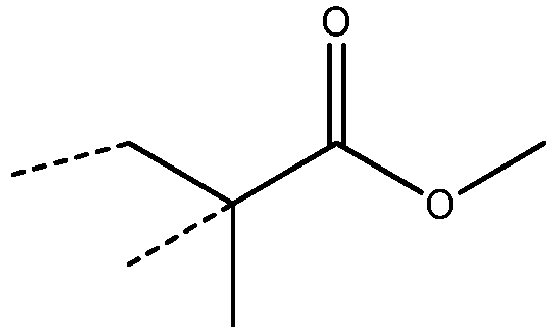
- a structural unit of MMA is as illustrated: structural unit of MMA where the dotted lines represent the points of attachment of the structural unit to the polymer backbone.
- the first polymer particles preferably further comprise from 0.2, more preferably from 0.5, more preferably from 0.8, and most preferably from 1.0 weight percent to 5, more preferably to 3, and most preferably to 2 weight percent structural units of a phosphorus acid monomer or a salt thereof, based on the weight of the first polymer particles.
- suitable phosphorus acid monomers include phosphonates and dihydrogen phosphate esters of an alcohol in which the alcohol contains or is substituted with a polymerizable vinyl or olefinic group.
- Preferred dihydrogen phosphate esters are phosphates of hydroxyalkyl(meth)acrylates, including phosphoethyl methacrylate and phosphopropyl methacrylates, with phosphoethyl methacrylate being especially preferred.
- PEM hosphoethyl methacrylate
- the second polymer particles are advantageously prepared in a second step, after substantial or complete polymerization of the first monomers, by contacting the aqueous dispersion of first polymer particles with the second monomer under emulsion polymerization conditions; the second monomer preferably comprises at least 92, more preferably at least 95, more preferably at least 98, and more preferably at least 99 weight percent methyl methacrylate.
- the second monomer may comprise up to 8 weight percent of another monomer such as methacrylic acid (MAA).
- the consequent high T g second polymer particles form discrete high T g (hard) domains within the low T g (soft) domain first polymer particles, as opposed to forming a distinct outer layer superposing the low T g polymer particles as disclosed in WO 2018/062546 A1 .
- the discrete domains are said to be occluded (incorporated into) the first polymer particles. Occlusion was confirmed by atomic force microscopy. A discussion and description of the morphology of occluded multiphase latex particles can be found in J.Coat. Technol. Res., 5 (2) 169-180, 2008 .
- the weight-to-weight ratio of occluded second polymer particles to first polymer particles is preferably in the range of from 6:94, more preferably from 8:92, to 19:81, more preferably to 17:83.
- the occluded polymer particles preferably have a z-average particle size by dynamic light scattering in the range of from 80 nm, and more preferably 100 nm, to 400 nm, more preferably 300 nm, and most preferably to 200 nm.
- the polymer particles preferably have a M n (measured by gel permeation chromatography described hereinbelow) in the range of from 10,000, more preferably from 11,000 g/mole, to preferably 22,000, more preferably to 18,000, more preferably to 15,000, to most preferably 13,000 g/mole.
- the solids content of the aqueous dispersion of occluded multiphase polymer particles is preferably in the range of from 20 to 60 weight percent.
- the multiphase polymer particles are 2-phase polymer particles.
- the aqueous dispersion of occluded polymer particles is advantageously used as part of a formulation suitable for LASD applications.
- the formulation comprises at least one additive selected from the group consisting of extenders, baking additives such as starches, and rheology modifiers.
- the formulation comprises all of these additives.
- the formulation further preferably comprises a nonionic compound of Structure I: where R 1 is H or C 6 -C 18 -alkyl; R 2 is H or CH 3 ; and x is from 30, preferably from 45, and more preferably from 80; to 300, preferably to 250, and more preferably to 200.
- Preferred nonionic compounds are polyethylene glycols (where R 1 is H) or polyethylene oxide secondary alcohol ethoxylates (where R 1 is a branched alkyl group).
- Commercially available suitable nonionic compounds include CARBOWAX TM PEG 4000 and 8000 Polyethylene Glycols (PEG 4000 and PEG 8000, respectively), and TERGITOL TM 15-S-20 and 15-S-40 Secondary Alcohol Ethoxylates (Trademarks of The Dow Chemical Company or Its affiliates).
- the concentration of the nonionic compound of Structure I in the formulation is in the range of from 0.2, more preferably from 0.5 weight percent, to 5, more preferably to 3, and most preferably to 2 weight percent, based on the weight of the formulation.
- phosphorus acid functionalization preferably PEM functionalization
- PEM functionalization of the soft domain of the occluded polymer particles
- the inclusion of the nonionic compound of Structure I in the formulation along with the phosphorus acid functionalized occluded polymer particles has been found to improve these critical properties.
- GPC samples were prepared in THF at a concentration of 5 mg/mL based on the occluded polymer solids content.
- the sample solutions were kept on a flatbed shaker at room temperature overnight, then filtered through a 0.45 ⁇ m PTFE filter (Whatman) prior to GPC analysis.
- the GPC instrument setup consisted of an Agilent 1200 series HPLC system (degasser, pump, autosampler), and a Wyatt T-rEX refractive index detector.
- the polymer separation was carried out on a column set that consisted of one TOSOH TSKgel GMH x1 -L and one TOSOH TSKgel G5000H x1 column (each packed with 9 ⁇ m styrene divinylbenzene gels; each dimension: 7.5 mm ID x 30 cm) using THF as the mobile phase at a flow rate of 1 mL/min; the injection volume was 40 ⁇ L.
- Astra 7 software (Wyatt Technology) was used for data acquisition and processing.
- M n and M w were calculated using a conventional calibration method based on polystyrene standards (Agilent Technology) as shown in Table 1 below: Table 1 - Polystyrene Standard Peak PS mixA1 (g/mol) PSmixB1 (g/mol) 1 6,035,000 2,698,000 2 597,500 290,300 3 126,000 69,650 4 30,230 9,960 5 2,970 580
- h i is the GPC curve height at the ith volume increment and the M i is the molecular weight of the species eluted at the ith retention volume based on polystyrene calibration curve.
- Example 1 Preparation of an Aqueous Dispersion of 2-Stage Occluded Polymer Particles with 10% Hard Stage
- a first monomer emulsion was prepared by mixing deionized water (492 g), sodium lauryl ether sulfate (43 g, 31% active in water), BA (1066 g, 8.32 moles), MMA (797 g, 7.96 moles), PEM (43 g, 60% active, 0.12 mole), and n-DDM (37 g, 0.18 mole).
- a second monomer emulsion was prepared by mixing deionized water (134 g), sodium lauryl ether sulfate (5 g, 30% active in water) and MMA (214 g, 2.14 moles).
- Deionized water (881 g) and sodium lauryl ether sulfate (2.4 g, 31% active) were added to a 5-L, four-necked round bottom flask equipped with a paddle stirrer, a thermometer, a nitrogen inlet, and a reflux condenser. The contents of the flask were heated to 84 °C under nitrogen and stirring was initiated. A portion of the first monomer emulsion (132 g) was then added quickly, followed by addition of a solution of ammonium persulfate (5 g) in deionized water (55 g).
- the batch was then cooled and residual monomer reduced with a redox pair then neutralized to a pH of 9.
- the z-average particle size was measured by a Brookhaven BI-90 Plus Particle Size Analyzer to be 165 nm, and the percent solids was found to be 51%.
- the gel permeation chromatographic calculated M n was found to be 12,000 g/mole.
- Example 2 Preparation of an Aqueous Dispersion of 2-Stage Occluded Polymer Particles with 15% Hard Stage
- Example 2 The process described in Example 1 was followed except that the relative amounts of monomer emulsion 1 and monomer emulsion 2 were adjusted to a weight-to-weight ratio of 85:15.
- the z-average particle size was measured to be 160 nm and the percent solids was found to be 51%.
- the gel permeation chromatographic calculated M n was found to be 12,000 g/mole.
- Example 3 Preparation of an Aqueous Dispersion of 2-Stage Occluded Polymer Particles with an MMA/MAA 10% Hard Stage
- Example 2 The process described in Example 1 was followed except that 1.5 weight percent of the MMA (3.2 g) was replaced with an equal amount (3.2 g) of MAA in the second monomer emulsion.
- the z-average particle size was measured to be 163 nm and the percent solids was found to be 52%.
- the gel permeation chromatographic calculated M n was found to be 12,000 g/mole.
- Example 2 The process described in Example 1 was repeated except that the amount of n-DDM in the first monomer emulsion was reduced from 37 g to 18.5 g (0.09 mole). The particle size was measured to be 168 nm and the percent solids was found to be 51%. The gel permeation chromatographic calculated M n was found to be 20,000 g/mole.
- Example 2 The process described in Example 1 was repeated except that the amount of n-DDM in the first monomer emulsion was reduced from 37 g to 29 g (0.14 mole). The z-average particle size was measured to be 175 nm and the percent solids was found to be 51%. The gel permeation chromatographic calculated M n was found to be 15,000 g/mole.
- Example 2 The process described in Example 1 was repeated except that the amount of n-DDM in the first monomer emulsion was increased from 37 g to 48 g (0.24 mole). The z-average particle size was measured to be 192 nm and the percent solids was found to be 51%. The gel permeation chromatographic calculated M n was found to be 10,000 g/mole.
- Example 2 The process as described in Example 1 was followed except that the monomer composition of the second monomer emulsion was BA (10.7 g) and MMA (203.3 g) instead of all MMA.
- the z-average particle size was found to be 170 nm and the percent solids was found to be 51%.
- the gel permeation chromatographic calculated M n was found to be 12,000 g/mole.
- Example 2 The process described in Example 1 was repeated except that the amount of n-DDM in the first monomer emulsion was decreased from 37 g to 9.6 g (0.05 mole). The z-average particle size was measured to be 167 nm and the percent solids was found to be 51%. The gel permeation chromatographic calculated M n was found to be 34,000 g/mole.
- Example 2 The process described in Example 1 was repeated except that the amount of n-DDM in the first monomer emulsion was increased from 37 g to 57 g (0.28 mole). The z-average particle size was measured to be 164 nm and the percent solids was found to be 52%. The gel permeation chromatographic calculated M n was found to be 8600 g/mole.
- Example 2 The process as described in Example 1 was repeated except that styrene (214 g) was used in the second monomer emulsion instead of MMA, and the feed time of the second monomer emulsion was added to the reactor over 30 min.
- the z-average particle size was measured to be 163 nm and the percent solids was found to be 51%.
- the gel permeation chromatographic calculated M n was found to be 13,000 g/mole.
- Coating formulations were prepared from the components listed in Table 2 in the order listed. The components were mixed with an overhead stirrer for 10 min, then allowed to equilibrate overnight.
- Emulsion polymer refers to the aqueous dispersions of occluded polymer particles of Examples 1-7 and Comparative Examples 1-5.
- Coatings were drawn down into 4 x 100 x 80-mm samples on aluminum panels. The samples were then left at room temperature for 30 min and subsequently baked at 150 °C for 30 min. Samples were cooled to room temperature and weighed to determine their total mass. Samples were then immersed in 10 cm of water for 48 h and weighed again. The water uptake was reported as the percentage mass difference between soaked and unsoaked samples.
- Table 3 summarizes the water uptake, blistering, and texture results for coatings prepared from the formulations.
- Table 3 - Water Uptake, Blistering, and Texture of Coatings Formulation # Example # Texture Blistering Water Uptake - 48h (%) 1 Ex. 1 10 10 5.2 2 Ex. 2 9 10 4.8 3 Ex. 3 9 10 3.7 4 Ex. 4 10 10 7.9 5 Ex. 5 10 10 4.6 6 Ex. 6 8 10 3.4 7 Ex. 1 10 10 3.0 8 Ex. 7 10 9 4.9 Comp. 1 Comp. Ex. 1 9 3 11.0 Comp. 2 Comp. Ex. 2 6 6 3.4 Comp. 3 Comp. Ex. 3 3 6 2.3 Comp. 4 Comp. Ex. 4 5 6 2.7
- compositions of Examples 1-7 all show excellent appearance without major defects as demonstrated by numerical ratings for texture and blistering of at least 8. Moreover, each of the coatings from Examples 1-7 have an acceptable water uptake of less than 10%. In contrast, the compositions of the comparative examples all fail in at least one aspect of appearance. The results show the criticality of M n as well as the high weight fraction of structural units of MMA in the occluded second polymer.
Landscapes
- Chemical & Material Sciences (AREA)
- Organic Chemistry (AREA)
- Chemical Kinetics & Catalysis (AREA)
- Polymers & Plastics (AREA)
- Health & Medical Sciences (AREA)
- Medicinal Chemistry (AREA)
- Materials Engineering (AREA)
- Engineering & Computer Science (AREA)
- Wood Science & Technology (AREA)
- Life Sciences & Earth Sciences (AREA)
- Paints Or Removers (AREA)
- Compositions Of Macromolecular Compounds (AREA)
- Graft Or Block Polymers (AREA)
Description
- Damping materials are used to mitigate vibration in rigid structures to reduce noise. In motor vehicles, two major vibration damping technologies dominate: bitumen pads and liquid applied sound damping (LASD) coatings derived from waterborne latexes. Bitumen pads, a low cost alternative widely used in the 20th century, exhibit relatively poor damping performance and require laborious manual application. LASD coatings, on the other hand, have gained significant market share because they may be rapidly applied by robotic spray techniques. Moreover, LASD coatings exhibit better damping properties, environmental, health, and safety (EH&S) profiles, and lower densities. Together, these benefits have led automotive OEMs to increasingly employ LASD for noise vibration and harshness (NVH) management over the incumbent bitumen pads.
WO 2018/062546 A1 describes aqueous dispersions of polymer particles suitable for vibration damping applications. Although improved suppression of blistering is reported, water resistance is not described.EP 3181604 A1 describes a two-stages polymer in which the ratio by weight of the first phase to the second phase is 65:35. The first phase is prepared in the absence of a chain transfer agent.EP 2840092 A1 also describes a two-stages polymer. The first phase is prepared in the presence of a small amount of a chain transfer agent.WO 2017/206162 A1 describes the preparation of aqueous coating compositions that comprise polymer particles that correspond to the first phase of the polymers of the present invention. There is still a need in the art to develop LASD coatings with excellent water resistance compared to bitumen pads. Water-resistant LASD coatings would likely facilitate adoption of this technology with customers. Additionally, improved water resistance could allow LASD coatings to be used in new application areas, such as inside the wheel wells of a vehicle. It would therefore be an advance in the art to develop an aqueous dispersion of polymer particles that may be formulated into an LASD coating that is water resistant, exhibits an excellent appearance, and maintains high vibration damping performance. - The present invention is a composition comprising an aqueous dispersion of multiphase polymer particles comprising, based on the weight of the polymer particles, from greater than 80 to less than 95 weight percent of first polymer particles having a Tg of less than 30 °C, and from greater than 5 to less than 20 weight percent of second polymer particles having a Tg in the range of from 90 °C to 110 °C, wherein the second polymer particles are phase separated from and occluded within the first polymer particles; wherein the number average molecular weight (Mn) of the multiphase polymer particles is in the range of from 9,000 to 25,000 g/mole; and wherein the second polymer particles comprise at least 90 weight percent methyl methacrylate, based on the weight of the second polymer particles.
- The present invention addresses a need in the art by providing an aqueous composition that forms a water-resistant blister free coating that is useful in sound dampening applications.
- The present invention is an aqueous dispersion of multiphase polymer particles comprising, based on the weight of the multiphase polymer particles, from greater than 80 to less than 95 weight percent of first polymer particles having a Tg of less than 30 °C, and from greater than 5 to less than 20 weight percent of second polymer particles having a Tg in the range of from 90 °C to 110 °C, wherein the second polymer particles are phase separated from and occluded within the first polymer particles; wherein the number average molecular weight (Mn) of the multiphase polymer particles is in the range of from 9,000 to 25,000 g/mole; and wherein the second polymer particles comprise at least 90 weight percent methyl methacrylate, based on the weight of the second polymer particles.
- The first polymer particles are advantageously prepared by contacting under emulsion polymerization conditions first monomers and a chain transfer agent to form an aqueous dispersion of first polymer particles having a Tg, as calculated by the Fox equation, in the range of -30 °C, preferably from -20 °C, to 30 °C, preferably to 20 °C, more preferably to 10 °C, wherein the concentration of the chain transfer agent is from 0.5, preferably from 0.7, more preferably from 1 mole percent, to 1.5, preferably to 1.3, and more preferably to 1.2 mole percent based upon the moles of first monomers and the chain transfer agent.
- The chain transfer agent is any compound that is capable of regulating the molecular weight of the polymer during the polymerization process. Especially suitable chain transfer agents include alkyl mercaptans such as n-dodecyl mercaptan (n-DDM) and t-dodecyl mercaptan (t-DDM).
- As used herein, "first monomers" refers to monomers selected to form first polymer particles having a Tg in the range of from -30 °C to 30 °C. The first polymer particles preferably comprise structural units of a) methyl methacrylate (MMA) or styrene; and b) one or more monomers selected from the group consisting of butyl acrylate (BA), ethyl acrylate, 2-ethylhexyl acrylate, and 2-propylheptyl acrylate, with the combination of structural units of MMA and BA being preferred. As used herein, "structural unit" of the named monomer refers to the remnant of the monomer after polymerization. For example, a structural unit of MMA is as illustrated:
where the dotted lines represent the points of attachment of the structural unit to the polymer backbone. - The first polymer particles preferably further comprise from 0.2, more preferably from 0.5, more preferably from 0.8, and most preferably from 1.0 weight percent to 5, more preferably to 3, and most preferably to 2 weight percent structural units of a phosphorus acid monomer or a salt thereof, based on the weight of the first polymer particles. Examples of suitable phosphorus acid monomers include phosphonates and dihydrogen phosphate esters of an alcohol in which the alcohol contains or is substituted with a polymerizable vinyl or olefinic group. Preferred dihydrogen phosphate esters are phosphates of hydroxyalkyl(meth)acrylates, including phosphoethyl methacrylate and phosphopropyl methacrylates, with phosphoethyl methacrylate being especially preferred. "Phosphoethyl methacrylate" (PEM) is used herein to refer to the following structure:

- where R is H or

- wherein the dotted line represents the point of attachment to the oxygen atom.
- The second polymer particles are advantageously prepared in a second step, after substantial or complete polymerization of the first monomers, by contacting the aqueous dispersion of first polymer particles with the second monomer under emulsion polymerization conditions; the second monomer preferably comprises at least 92, more preferably at least 95, more preferably at least 98, and more preferably at least 99 weight percent methyl methacrylate. The second monomer may comprise up to 8 weight percent of another monomer such as methacrylic acid (MAA).
- The consequent high Tg second polymer particles form discrete high Tg (hard) domains within the low Tg (soft) domain first polymer particles, as opposed to forming a distinct outer layer superposing the low Tg polymer particles as disclosed in
WO 2018/062546 A1 . The discrete domains are said to be occluded (incorporated into) the first polymer particles. Occlusion was confirmed by atomic force microscopy. A discussion and description of the morphology of occluded multiphase latex particles can be found in J.Coat. Technol. Res., 5 (2) 169-180, 2008. The weight-to-weight ratio of occluded second polymer particles to first polymer particles is preferably in the range of from 6:94, more preferably from 8:92, to 19:81, more preferably to 17:83. - The occluded polymer particles preferably have a z-average particle size by dynamic light scattering in the range of from 80 nm, and more preferably 100 nm, to 400 nm, more preferably 300 nm, and most preferably to 200 nm. The polymer particles preferably have a Mn (measured by gel permeation chromatography described hereinbelow) in the range of from 10,000, more preferably from 11,000 g/mole, to preferably 22,000, more preferably to 18,000, more preferably to 15,000, to most preferably 13,000 g/mole.
- The solids content of the aqueous dispersion of occluded multiphase polymer particles is preferably in the range of from 20 to 60 weight percent. Preferably, the multiphase polymer particles are 2-phase polymer particles.
- The aqueous dispersion of occluded polymer particles is advantageously used as part of a formulation suitable for LASD applications. The formulation comprises at least one additive selected from the group consisting of extenders, baking additives such as starches, and rheology modifiers. Preferably, the formulation comprises all of these additives.
- The formulation further preferably comprises a nonionic compound of Structure I:

- Preferred nonionic compounds are polyethylene glycols (where R1 is H) or polyethylene oxide secondary alcohol ethoxylates (where R1 is a branched alkyl group). Commercially available suitable nonionic compounds include CARBOWAX™ PEG 4000 and 8000 Polyethylene Glycols (PEG 4000 and PEG 8000, respectively), and TERGITOL™ 15-S-20 and 15-S-40 Secondary Alcohol Ethoxylates (Trademarks of The Dow Chemical Company or Its Affiliates).
- The concentration of the nonionic compound of Structure I in the formulation is in the range of from 0.2, more preferably from 0.5 weight percent, to 5, more preferably to 3, and most preferably to 2 weight percent, based on the weight of the formulation.
- It has been found that phosphorus acid functionalization, preferably PEM functionalization, of the soft domain of the occluded polymer particles has a particularly beneficial effect on texture, blistering, and water-uptake profiles of formulations comprising these occluded polymer particles over the prescribed narrow Mn range; moreover, the inclusion of the nonionic compound of Structure I in the formulation along with the phosphorus acid functionalized occluded polymer particles has been found to improve these critical properties.
- It has been surprisingly discovered that coatings suitable for vibration damping applications can be prepared with desirable texture very low water uptake, as well little or no evidence of blistering.
- GPC samples were prepared in THF at a concentration of 5 mg/mL based on the occluded polymer solids content. The sample solutions were kept on a flatbed shaker at room temperature overnight, then filtered through a 0.45 µm PTFE filter (Whatman) prior to GPC analysis. The GPC instrument setup consisted of an Agilent 1200 series HPLC system (degasser, pump, autosampler), and a Wyatt T-rEX refractive index detector. The polymer separation was carried out on a column set that consisted of one TOSOH TSKgel GMHx1-L and one TOSOH TSKgel G5000Hx1 column (each packed with 9 µm styrene divinylbenzene gels; each dimension: 7.5 mm ID x 30 cm) using THF as the mobile phase at a flow rate of 1 mL/min; the injection volume was 40 µL.
- Astra 7 software (Wyatt Technology) was used for data acquisition and processing. Mn and Mw were calculated using a conventional calibration method based on polystyrene standards (Agilent Technology) as shown in Table 1 below:
Table 1 - Polystyrene Standard Peak PS mixA1 (g/mol) PSmixB1 (g/mol) 1 6,035,000 2,698,000 2 597,500 290,300 3 126,000 69,650 4 30,230 9,960 5 2,970 580 - The number- and weight-average molecular weight were obtained based on the polystyrene calibration curve and sample elution profile by equations:


- Where hi is the GPC curve height at the ith volume increment and the Mi is the molecular weight of the species eluted at the ith retention volume based on polystyrene calibration curve.
- A first monomer emulsion was prepared by mixing deionized water (492 g), sodium lauryl ether sulfate (43 g, 31% active in water), BA (1066 g, 8.32 moles), MMA (797 g, 7.96 moles), PEM (43 g, 60% active, 0.12 mole), and n-DDM (37 g, 0.18 mole). A second monomer emulsion was prepared by mixing deionized water (134 g), sodium lauryl ether sulfate (5 g, 30% active in water) and MMA (214 g, 2.14 moles).
- Deionized water (881 g) and sodium lauryl ether sulfate (2.4 g, 31% active) were added to a 5-L, four-necked round bottom flask equipped with a paddle stirrer, a thermometer, a nitrogen inlet, and a reflux condenser. The contents of the flask were heated to 84 °C under nitrogen and stirring was initiated. A portion of the first monomer emulsion (132 g) was then added quickly, followed by addition of a solution of ammonium persulfate (5 g) in deionized water (55 g). After stirring for 10 min, the remainder of the first monomer emulsion, and an initiator solution of ammonium persulfate (2.1 g) in deionized water (90 g) were added separately over 80 min. The contents of the flask were held at 84 °C for 10 min, after which time the second monomer emulsion and an initiator solution containing sodium persulfate (0.2 g) in deionized water (10 g) were added separately to the flask over a period of 10 min.
- The batch was then cooled and residual monomer reduced with a redox pair then neutralized to a pH of 9. The z-average particle size was measured by a Brookhaven BI-90 Plus Particle Size Analyzer to be 165 nm, and the percent solids was found to be 51%. The gel permeation chromatographic calculated Mn was found to be 12,000 g/mole.
- The process described in Example 1 was followed except that the relative amounts of monomer emulsion 1 and monomer emulsion 2 were adjusted to a weight-to-weight ratio of 85:15. The z-average particle size was measured to be 160 nm and the percent solids was found to be 51%. The gel permeation chromatographic calculated Mn was found to be 12,000 g/mole.
- The process described in Example 1 was followed except that 1.5 weight percent of the MMA (3.2 g) was replaced with an equal amount (3.2 g) of MAA in the second monomer emulsion. The z-average particle size was measured to be 163 nm and the percent solids was found to be 52%. The gel permeation chromatographic calculated Mn was found to be 12,000 g/mole.
- The process described in Example 1 was repeated except that the amount of n-DDM in the first monomer emulsion was reduced from 37 g to 18.5 g (0.09 mole). The particle size was measured to be 168 nm and the percent solids was found to be 51%. The gel permeation chromatographic calculated Mn was found to be 20,000 g/mole.
- The process described in Example 1 was repeated except that the amount of n-DDM in the first monomer emulsion was reduced from 37 g to 29 g (0.14 mole). The z-average particle size was measured to be 175 nm and the percent solids was found to be 51%. The gel permeation chromatographic calculated Mn was found to be 15,000 g/mole.
- The process described in Example 1 was repeated except that the amount of n-DDM in the first monomer emulsion was increased from 37 g to 48 g (0.24 mole). The z-average particle size was measured to be 192 nm and the percent solids was found to be 51%. The gel permeation chromatographic calculated Mn was found to be 10,000 g/mole.
- The process as described in Example 1 was followed except that the monomer composition of the second monomer emulsion was BA (10.7 g) and MMA (203.3 g) instead of all MMA. The z-average particle size was found to be 170 nm and the percent solids was found to be 51%. The gel permeation chromatographic calculated Mn was found to be 12,000 g/mole.
- The process described in Example 1 was repeated except that the amount of n-DDM in the first monomer emulsion was decreased from 37 g to 9.6 g (0.05 mole). The z-average particle size was measured to be 167 nm and the percent solids was found to be 51%. The gel permeation chromatographic calculated Mn was found to be 34,000 g/mole.
- The process described in Example 1 was repeated except that the amount of n-DDM in the first monomer emulsion was increased from 37 g to 57 g (0.28 mole). The z-average particle size was measured to be 164 nm and the percent solids was found to be 52%. The gel permeation chromatographic calculated Mn was found to be 8600 g/mole.
- The process as described in Example 1 was repeated except that isobornyl methacrylate (106 g) replaced an equal amount of MMA (106 g) in the second monomer emulsion. The z-average particle size was measured to be 164 nm and the percent solids was found to be 51%. The gel permeation chromatographic calculated Mn was found to be 12,000 g/mole.
- The process as described in Example 1 was repeated except that styrene (214 g) was used in the second monomer emulsion instead of MMA, and the feed time of the second monomer emulsion was added to the reactor over 30 min. The z-average particle size was measured to be 163 nm and the percent solids was found to be 51%. The gel permeation chromatographic calculated Mn was found to be 13,000 g/mole.
- Coating formulations were prepared from the components listed in Table 2 in the order listed. The components were mixed with an overhead stirrer for 10 min, then allowed to equilibrate overnight. Emulsion polymer refers to the aqueous dispersions of occluded polymer particles of Examples 1-7 and Comparative Examples 1-5.
Table 2 - Coating Formulation Component Mass (g) Emulsion Polymer 39.2 Bayferrox Black 318 Pigment 0.2 Durcal 10 CaCO3 57.9 Kollotex 1500 potato starch 2.5 ACRYSOL™ RM-12W Rheology Modifier 1.0 CARBOWAX™ PEG 8000 Polyethylene Glycola 1.0 a Only Formulations 4-7, and Comparative Formulations 1 and 2 include PEG 8000 (see Table 2). - Coatings were drawn down into 4 x 100 x 80-mm samples on aluminum panels. The samples were then left at room temperature for 30 min and subsequently baked at 150 °C for 30 min. Samples were cooled to room temperature and weighed to determine their total mass. Samples were then immersed in 10 cm of water for 48 h and weighed again. The water uptake was reported as the percentage mass difference between soaked and unsoaked samples.
- Blistering was evaluated on scale of 1-10 as defined below:
- 10: Trace or no surface defects
- 8: Slight bumps
- 6: Moderate bumps
- 4: Heavy bumps
- 2: Severe bumps
- Texture was evaluated on a scale of 1-10 as defined below:
- 10: Trace or no surface defects
- 8: Slight craters, pinholes
- 6: Moderate craters, pinholes
- 4: Heavy craters, pinholes
- 2: Severe craters, pinholes
- Table 3 summarizes the water uptake, blistering, and texture results for coatings prepared from the formulations.
Table 3 - Water Uptake, Blistering, and Texture of Coatings Formulation # Example # Texture Blistering Water Uptake - 48h (%) 1 Ex. 1 10 10 5.2 2 Ex. 2 9 10 4.8 3 Ex. 3 9 10 3.7 4 Ex. 4 10 10 7.9 5 Ex. 5 10 10 4.6 6 Ex. 6 8 10 3.4 7 Ex. 1 10 10 3.0 8 Ex. 7 10 9 4.9 Comp. 1 Comp. Ex. 1 9 3 11.0 Comp. 2 Comp. Ex. 2 6 6 3.4 Comp. 3 Comp. Ex. 3 3 6 2.3 Comp. 4 Comp. Ex. 4 5 6 2.7 - The coatings formed from the compositions of Examples 1-7 all show excellent appearance without major defects as demonstrated by numerical ratings for texture and blistering of at least 8. Moreover, each of the coatings from Examples 1-7 have an acceptable water uptake of less than 10%. In contrast, the compositions of the comparative examples all fail in at least one aspect of appearance. The results show the criticality of Mn as well as the high weight fraction of structural units of MMA in the occluded second polymer.
Claims (9)
- A composition comprising an aqueous dispersion of multiphase polymer particles comprising, based on the weight of the polymer particles, from greater than 80 to less than 95 weight percent of first polymer particles having a Tg of less than 30 °C, and from greater than 5 to less than 20 weight percent of second polymer particles having a Tg in the range of from 90 °C to 110 °C, wherein Tg are calculated by the Fox equation;the second polymer particles are phase separated from and occluded within the first polymer particles; wherein the number average molecular weight (Mn) of the multiphase polymer particles measured by GPC according to the method described in the specification is in the range of from 9,000 to 25,000 g/mole; andwherein the second polymer particles comprise at least 90 weight percent methyl methacrylate, based on the weight of the second polymer particles.
- The composition of Claim 1 wherein the first polymer particles further comprise from 0.2 to 5 weight percent structural units of a phosphorus acid monomer or a salt thereof, based on the weight of the first polymer particles.
- The composition of Claim 2 wherein the phosphorus acid monomer is phosphoethyl methacrylate; wherein the second polymer particles comprise at least 92 weight percent methyl methacrylate.
- The composition of Claim 3 wherein the number average molecular weight (Mn) of the multiphase polymer particles is in the range of from 10,000 to 18000 g/mole; and wherein the second polymer particles comprise at least 95 weight percent methyl methacrylate.
- The composition of Claim 4 wherein the number average molecular weight (Mn) of the multiphase polymer particles is in the range of from 11,000 to 15,000 g/mole.
- The composition of Claim 3 wherein:a) the multiphase polymer particles have a z-average particle size measured by a Brookhaven BI-90 Plus Particle Size Analyzer in the range of from 80 nm to 400 nm;b) the weight-to-weight ratio of occluded second polymer particles to first polymer particles is in the range of from 6:94 to 19:81;c) the first polymer particles comprise structural units of i) methyl methacrylate or styrene; and ii) one or more monomers selected from the group consisting of butyl acrylate, ethyl acrylate, 2-ethylhexyl acrylate, and 2-propylheptyl acrylate.
- The composition of Claim 1 which further comprises at least one additive selected from the group consisting of extenders, baking additives, and rheology modifiers.
- The composition of Claim 3 which further comprises, based on the weight of the composition, from 0.2 to 5 weight percent of a nonionic compound of Structure I:

- The composition of Claim 6 which further includes an extender, potato starch, rheology modifiers, and a compound of Structure I:
 where R1 is H; R2 is H; and x is from 80 to 250; wherein,the second polymer particles comprise at least 98 weight percent methyl methacrylate; andwherein the number average molecular weight (Mn) of the multiphase polymer particles is in the range of from 10,000 to 18000 g/mole.
Applications Claiming Priority (2)
| Application Number | Priority Date | Filing Date | Title |
|---|---|---|---|
| US201962949470P | 2019-12-18 | 2019-12-18 | |
| PCT/US2020/061226 WO2021126453A1 (en) | 2019-12-18 | 2020-11-19 | Aqueous dispersion of occluded polymer particles |
Publications (2)
| Publication Number | Publication Date |
|---|---|
| EP4077427A1 EP4077427A1 (en) | 2022-10-26 |
| EP4077427B1 true EP4077427B1 (en) | 2024-01-03 |
Family
ID=74106111
Family Applications (1)
| Application Number | Title | Priority Date | Filing Date |
|---|---|---|---|
| EP20833998.6A Active EP4077427B1 (en) | 2019-12-18 | 2020-11-19 | Aqueous dispersion of occluded polymer particles |
Country Status (7)
| Country | Link |
|---|---|
| US (1) | US12466945B2 (en) |
| EP (1) | EP4077427B1 (en) |
| JP (1) | JP7664246B2 (en) |
| KR (1) | KR20220118471A (en) |
| CN (1) | CN115244092B (en) |
| MX (1) | MX2022006550A (en) |
| WO (1) | WO2021126453A1 (en) |
Families Citing this family (2)
| Publication number | Priority date | Publication date | Assignee | Title |
|---|---|---|---|---|
| KR20240166853A (en) | 2023-05-18 | 2024-11-26 | 주식회사 엘지화학 | Acryl based latex and method for preparing thereof |
| KR20250151812A (en) | 2024-04-15 | 2025-10-22 | 주식회사 엘지화학 | Acrylic latex and method for preparing thereof |
Family Cites Families (23)
| Publication number | Priority date | Publication date | Assignee | Title |
|---|---|---|---|---|
| US4497917A (en) * | 1982-09-29 | 1985-02-05 | Eastman Kodak Company | Latex composition comprising core-shell polymer particles |
| EP1496091A1 (en) * | 2003-07-08 | 2005-01-12 | Rohm And Haas Company | Aqueous polymer composition |
| KR100775564B1 (en) | 2003-09-30 | 2007-11-09 | 니폰 쇼쿠바이 컴파니 리미티드 | Aqueous emulsion for vibration damping materials |
| US7285590B2 (en) * | 2003-11-13 | 2007-10-23 | Hexion Specialty Chemicals, Inc. | Aqueous dispersions containing multi-stage emulsion polymers |
| DE602005003249T2 (en) * | 2004-03-09 | 2008-09-18 | Rohm And Haas Co. | Aqueous dispersion of polymer particles |
| JP2008038115A (en) * | 2006-08-10 | 2008-02-21 | Asahi Kasei Chemicals Corp | Acrylic aqueous emulsion |
| EP1894951B1 (en) * | 2006-08-31 | 2018-11-28 | Rohm and Haas Company | Aqueous dispersion of polymeric particles |
| WO2008034816A1 (en) * | 2006-09-20 | 2008-03-27 | Basf Se | Use of polymer dispersions in coating materials |
| JP5765869B2 (en) | 2006-12-20 | 2015-08-19 | ローム アンド ハース カンパニーRohm And Haas Company | Liquid applied sound damping material |
| US7893151B2 (en) | 2007-11-08 | 2011-02-22 | Rohm And Haas Company | Liquid-applied sound damping |
| JP6001241B2 (en) * | 2010-05-18 | 2016-10-05 | 日東電工株式会社 | Optical film adhesive composition, optical film adhesive layer, adhesive optical film, and image display device |
| CN102286127B (en) * | 2010-06-18 | 2014-12-10 | 罗门哈斯公司 | Emulsion polymer containing microdomains |
| JP2014500236A (en) * | 2010-09-30 | 2014-01-09 | ルブリゾル アドバンスド マテリアルズ, インコーポレイテッド | Structured acrylate copolymers for use in multiphase systems |
| WO2012166830A1 (en) * | 2011-06-03 | 2012-12-06 | Rohm And Haas Company | Aqueous coating compositions |
| EP2762502B1 (en) * | 2013-02-04 | 2020-07-29 | Rohm and Haas Company | Acrylic latex binder and method of preparation |
| BR102014017358B1 (en) * | 2013-07-30 | 2020-06-02 | Rohm And Haas Company | STABLE AQUEOUS DISPERSION OF POLYMER PARTICLES, AND, METHOD |
| CA2923254C (en) * | 2015-03-24 | 2023-10-17 | Rohm And Haas Company | In situ preparation of a bimorphological latex |
| BR102016028498B1 (en) * | 2015-12-18 | 2022-04-12 | Rohm And Haas Company | Multi-phase aqueous emulsion copolymer composition, use of a multi-phase aqueous emulsion copolymer composition, and method for preparing multi-phase aqueous emulsion copolymer compositions |
| JP6678254B2 (en) * | 2016-06-03 | 2020-04-08 | ダウ グローバル テクノロジーズ エルエルシー | Aqueous polymer dispersion and aqueous coating composition containing the same |
| JP6784768B2 (en) | 2016-09-30 | 2020-11-11 | 株式会社日本触媒 | Resin composition for vibration damping paint and its manufacturing method |
| WO2018118679A1 (en) * | 2016-12-19 | 2018-06-28 | Lubrizol Advanced Materials, Inc. | Surfactant responsive emulsion polymerized micro-gels |
| CA3060327C (en) * | 2017-04-24 | 2024-06-18 | Dow Global Technologies Llc | Aqueous polymer dispersion |
| US12404351B2 (en) * | 2019-12-18 | 2025-09-02 | Rohm And Haas Company | Preparation of an aqueous dispersion of occluded polymer particles |
-
2020
- 2020-11-19 JP JP2022532008A patent/JP7664246B2/en active Active
- 2020-11-19 MX MX2022006550A patent/MX2022006550A/en unknown
- 2020-11-19 EP EP20833998.6A patent/EP4077427B1/en active Active
- 2020-11-19 KR KR1020227024061A patent/KR20220118471A/en active Pending
- 2020-11-19 CN CN202080082738.0A patent/CN115244092B/en active Active
- 2020-11-19 WO PCT/US2020/061226 patent/WO2021126453A1/en not_active Ceased
- 2020-11-19 US US17/784,345 patent/US12466945B2/en active Active
Also Published As
| Publication number | Publication date |
|---|---|
| MX2022006550A (en) | 2022-07-01 |
| JP2023507556A (en) | 2023-02-24 |
| WO2021126453A1 (en) | 2021-06-24 |
| CN115244092B (en) | 2024-02-13 |
| CA3161848A1 (en) | 2021-06-24 |
| CN115244092A (en) | 2022-10-25 |
| US12466945B2 (en) | 2025-11-11 |
| JP7664246B2 (en) | 2025-04-17 |
| US20230058018A1 (en) | 2023-02-23 |
| EP4077427A1 (en) | 2022-10-26 |
| KR20220118471A (en) | 2022-08-25 |
Similar Documents
| Publication | Publication Date | Title |
|---|---|---|
| AU2014200431B2 (en) | Acrylic latex binder and method of preparation | |
| EP1710284B1 (en) | Aqueous polymer dispersions | |
| CA1145871A (en) | Process for preparing aqueous emulsions of copolymers of n-methylol derivatives | |
| US12466945B2 (en) | Aqueous dispersion of occluded polymer particles | |
| EP2279213A1 (en) | Novel cross-linking mechanism for thin organic coatings based on the hantzsch dihydropyridine synthesis reaction | |
| EP4077417B1 (en) | Preparation of an aqueous dispersion of occluded polymer particles | |
| JP2003226834A (en) | Smoothing agent for nonaqueous coating material | |
| CA3161848C (en) | Aqueous dispersion of occluded polymer particles | |
| Malshe et al. | Fluorinated acrylic copolymers: part II: polymeric surfactants | |
| US20240043700A1 (en) | Liquid applied sound dampening composition | |
| CN117304383A (en) | High-performance aqueous acrylic emulsion and preparation method thereof | |
| JP3519119B2 (en) | Aqueous coating composition and method for producing the same | |
| JP2003002926A (en) | Antifoaming agent for water paint | |
| WO2024126838A1 (en) | Waterborne polymer composition and preparation method thereof | |
| EP4386057A1 (en) | Waterborne polymer composition and preparation method thereof | |
| CN114763398A (en) | Preparation method of stain-resistant acrylic resin emulsion | |
| JP3978738B2 (en) | Resin composition for paint | |
| JPS598306B2 (en) | Netsukoukaseihifufussaibutsu | |
| US20210179884A1 (en) | Redox chased suspension bead additives for paints and stains | |
| JPH11302328A (en) | Low contamination type paint leveling agent |
Legal Events
| Date | Code | Title | Description |
|---|---|---|---|
| STAA | Information on the status of an ep patent application or granted ep patent |
Free format text: STATUS: UNKNOWN |
|
| STAA | Information on the status of an ep patent application or granted ep patent |
Free format text: STATUS: THE INTERNATIONAL PUBLICATION HAS BEEN MADE |
|
| PUAI | Public reference made under article 153(3) epc to a published international application that has entered the european phase |
Free format text: ORIGINAL CODE: 0009012 |
|
| STAA | Information on the status of an ep patent application or granted ep patent |
Free format text: STATUS: REQUEST FOR EXAMINATION WAS MADE |
|
| 17P | Request for examination filed |
Effective date: 20220628 |
|
| AK | Designated contracting states |
Kind code of ref document: A1 Designated state(s): AL AT BE BG CH CY CZ DE DK EE ES FI FR GB GR HR HU IE IS IT LI LT LU LV MC MK MT NL NO PL PT RO RS SE SI SK SM TR |
|
| DAV | Request for validation of the european patent (deleted) | ||
| DAX | Request for extension of the european patent (deleted) | ||
| P01 | Opt-out of the competence of the unified patent court (upc) registered |
Effective date: 20230526 |
|
| GRAP | Despatch of communication of intention to grant a patent |
Free format text: ORIGINAL CODE: EPIDOSNIGR1 |
|
| STAA | Information on the status of an ep patent application or granted ep patent |
Free format text: STATUS: GRANT OF PATENT IS INTENDED |
|
| INTG | Intention to grant announced |
Effective date: 20230907 |
|
| RIN1 | Information on inventor provided before grant (corrected) |
Inventor name: ROBERTSON, IAN D. Inventor name: GIMBAL, JUSTIN Inventor name: GAO, WEI Inventor name: BOHLING, JAMES C. |
|
| GRAS | Grant fee paid |
Free format text: ORIGINAL CODE: EPIDOSNIGR3 |
|
| GRAA | (expected) grant |
Free format text: ORIGINAL CODE: 0009210 |
|
| STAA | Information on the status of an ep patent application or granted ep patent |
Free format text: STATUS: THE PATENT HAS BEEN GRANTED |
|
| AK | Designated contracting states |
Kind code of ref document: B1 Designated state(s): AL AT BE BG CH CY CZ DE DK EE ES FI FR GB GR HR HU IE IS IT LI LT LU LV MC MK MT NL NO PL PT RO RS SE SI SK SM TR |
|
| REG | Reference to a national code |
Ref country code: GB Ref legal event code: FG4D |
|
| REG | Reference to a national code |
Ref country code: CH Ref legal event code: EP |
|
| REG | Reference to a national code |
Ref country code: DE Ref legal event code: R096 Ref document number: 602020024014 Country of ref document: DE |
|
| REG | Reference to a national code |
Ref country code: IE Ref legal event code: FG4D |
|
| REG | Reference to a national code |
Ref country code: LT Ref legal event code: MG9D |
|
| PG25 | Lapsed in a contracting state [announced via postgrant information from national office to epo] |
Ref country code: ES Free format text: LAPSE BECAUSE OF FAILURE TO SUBMIT A TRANSLATION OF THE DESCRIPTION OR TO PAY THE FEE WITHIN THE PRESCRIBED TIME-LIMIT Effective date: 20240103 |
|
| PG25 | Lapsed in a contracting state [announced via postgrant information from national office to epo] |
Ref country code: ES Free format text: LAPSE BECAUSE OF FAILURE TO SUBMIT A TRANSLATION OF THE DESCRIPTION OR TO PAY THE FEE WITHIN THE PRESCRIBED TIME-LIMIT Effective date: 20240103 |
|
| REG | Reference to a national code |
Ref country code: NL Ref legal event code: MP Effective date: 20240103 |
|
| REG | Reference to a national code |
Ref country code: AT Ref legal event code: MK05 Ref document number: 1646722 Country of ref document: AT Kind code of ref document: T Effective date: 20240103 |
|
| PG25 | Lapsed in a contracting state [announced via postgrant information from national office to epo] |
Ref country code: NL Free format text: LAPSE BECAUSE OF FAILURE TO SUBMIT A TRANSLATION OF THE DESCRIPTION OR TO PAY THE FEE WITHIN THE PRESCRIBED TIME-LIMIT Effective date: 20240103 |
|
| PG25 | Lapsed in a contracting state [announced via postgrant information from national office to epo] |
Ref country code: NL Free format text: LAPSE BECAUSE OF FAILURE TO SUBMIT A TRANSLATION OF THE DESCRIPTION OR TO PAY THE FEE WITHIN THE PRESCRIBED TIME-LIMIT Effective date: 20240103 |
|
| PG25 | Lapsed in a contracting state [announced via postgrant information from national office to epo] |
Ref country code: IS Free format text: LAPSE BECAUSE OF FAILURE TO SUBMIT A TRANSLATION OF THE DESCRIPTION OR TO PAY THE FEE WITHIN THE PRESCRIBED TIME-LIMIT Effective date: 20240503 |
|
| PG25 | Lapsed in a contracting state [announced via postgrant information from national office to epo] |
Ref country code: LT Free format text: LAPSE BECAUSE OF FAILURE TO SUBMIT A TRANSLATION OF THE DESCRIPTION OR TO PAY THE FEE WITHIN THE PRESCRIBED TIME-LIMIT Effective date: 20240103 |
|
| PG25 | Lapsed in a contracting state [announced via postgrant information from national office to epo] |
Ref country code: GR Free format text: LAPSE BECAUSE OF FAILURE TO SUBMIT A TRANSLATION OF THE DESCRIPTION OR TO PAY THE FEE WITHIN THE PRESCRIBED TIME-LIMIT Effective date: 20240404 |
|
| PG25 | Lapsed in a contracting state [announced via postgrant information from national office to epo] |
Ref country code: HR Free format text: LAPSE BECAUSE OF FAILURE TO SUBMIT A TRANSLATION OF THE DESCRIPTION OR TO PAY THE FEE WITHIN THE PRESCRIBED TIME-LIMIT Effective date: 20240103 Ref country code: RS Free format text: LAPSE BECAUSE OF FAILURE TO SUBMIT A TRANSLATION OF THE DESCRIPTION OR TO PAY THE FEE WITHIN THE PRESCRIBED TIME-LIMIT Effective date: 20240403 |
|
| PG25 | Lapsed in a contracting state [announced via postgrant information from national office to epo] |
Ref country code: CZ Free format text: LAPSE BECAUSE OF FAILURE TO SUBMIT A TRANSLATION OF THE DESCRIPTION OR TO PAY THE FEE WITHIN THE PRESCRIBED TIME-LIMIT Effective date: 20240103 Ref country code: AT Free format text: LAPSE BECAUSE OF FAILURE TO SUBMIT A TRANSLATION OF THE DESCRIPTION OR TO PAY THE FEE WITHIN THE PRESCRIBED TIME-LIMIT Effective date: 20240103 |
|
| PG25 | Lapsed in a contracting state [announced via postgrant information from national office to epo] |
Ref country code: RS Free format text: LAPSE BECAUSE OF FAILURE TO SUBMIT A TRANSLATION OF THE DESCRIPTION OR TO PAY THE FEE WITHIN THE PRESCRIBED TIME-LIMIT Effective date: 20240403 Ref country code: NO Free format text: LAPSE BECAUSE OF FAILURE TO SUBMIT A TRANSLATION OF THE DESCRIPTION OR TO PAY THE FEE WITHIN THE PRESCRIBED TIME-LIMIT Effective date: 20240403 Ref country code: LT Free format text: LAPSE BECAUSE OF FAILURE TO SUBMIT A TRANSLATION OF THE DESCRIPTION OR TO PAY THE FEE WITHIN THE PRESCRIBED TIME-LIMIT Effective date: 20240103 Ref country code: IS Free format text: LAPSE BECAUSE OF FAILURE TO SUBMIT A TRANSLATION OF THE DESCRIPTION OR TO PAY THE FEE WITHIN THE PRESCRIBED TIME-LIMIT Effective date: 20240503 Ref country code: HR Free format text: LAPSE BECAUSE OF FAILURE TO SUBMIT A TRANSLATION OF THE DESCRIPTION OR TO PAY THE FEE WITHIN THE PRESCRIBED TIME-LIMIT Effective date: 20240103 Ref country code: GR Free format text: LAPSE BECAUSE OF FAILURE TO SUBMIT A TRANSLATION OF THE DESCRIPTION OR TO PAY THE FEE WITHIN THE PRESCRIBED TIME-LIMIT Effective date: 20240404 Ref country code: CZ Free format text: LAPSE BECAUSE OF FAILURE TO SUBMIT A TRANSLATION OF THE DESCRIPTION OR TO PAY THE FEE WITHIN THE PRESCRIBED TIME-LIMIT Effective date: 20240103 Ref country code: BG Free format text: LAPSE BECAUSE OF FAILURE TO SUBMIT A TRANSLATION OF THE DESCRIPTION OR TO PAY THE FEE WITHIN THE PRESCRIBED TIME-LIMIT Effective date: 20240103 Ref country code: AT Free format text: LAPSE BECAUSE OF FAILURE TO SUBMIT A TRANSLATION OF THE DESCRIPTION OR TO PAY THE FEE WITHIN THE PRESCRIBED TIME-LIMIT Effective date: 20240103 |
|
| PG25 | Lapsed in a contracting state [announced via postgrant information from national office to epo] |
Ref country code: PL Free format text: LAPSE BECAUSE OF FAILURE TO SUBMIT A TRANSLATION OF THE DESCRIPTION OR TO PAY THE FEE WITHIN THE PRESCRIBED TIME-LIMIT Effective date: 20240103 Ref country code: PT Free format text: LAPSE BECAUSE OF FAILURE TO SUBMIT A TRANSLATION OF THE DESCRIPTION OR TO PAY THE FEE WITHIN THE PRESCRIBED TIME-LIMIT Effective date: 20240503 |
|
| PG25 | Lapsed in a contracting state [announced via postgrant information from national office to epo] |
Ref country code: SE Free format text: LAPSE BECAUSE OF FAILURE TO SUBMIT A TRANSLATION OF THE DESCRIPTION OR TO PAY THE FEE WITHIN THE PRESCRIBED TIME-LIMIT Effective date: 20240103 Ref country code: PT Free format text: LAPSE BECAUSE OF FAILURE TO SUBMIT A TRANSLATION OF THE DESCRIPTION OR TO PAY THE FEE WITHIN THE PRESCRIBED TIME-LIMIT Effective date: 20240503 Ref country code: PL Free format text: LAPSE BECAUSE OF FAILURE TO SUBMIT A TRANSLATION OF THE DESCRIPTION OR TO PAY THE FEE WITHIN THE PRESCRIBED TIME-LIMIT Effective date: 20240103 Ref country code: LV Free format text: LAPSE BECAUSE OF FAILURE TO SUBMIT A TRANSLATION OF THE DESCRIPTION OR TO PAY THE FEE WITHIN THE PRESCRIBED TIME-LIMIT Effective date: 20240103 |
|
| REG | Reference to a national code |
Ref country code: DE Ref legal event code: R097 Ref document number: 602020024014 Country of ref document: DE |
|
| PG25 | Lapsed in a contracting state [announced via postgrant information from national office to epo] |
Ref country code: DK Free format text: LAPSE BECAUSE OF FAILURE TO SUBMIT A TRANSLATION OF THE DESCRIPTION OR TO PAY THE FEE WITHIN THE PRESCRIBED TIME-LIMIT Effective date: 20240103 |
|
| PG25 | Lapsed in a contracting state [announced via postgrant information from national office to epo] |
Ref country code: SM Free format text: LAPSE BECAUSE OF FAILURE TO SUBMIT A TRANSLATION OF THE DESCRIPTION OR TO PAY THE FEE WITHIN THE PRESCRIBED TIME-LIMIT Effective date: 20240103 |
|
| PG25 | Lapsed in a contracting state [announced via postgrant information from national office to epo] |
Ref country code: EE Free format text: LAPSE BECAUSE OF FAILURE TO SUBMIT A TRANSLATION OF THE DESCRIPTION OR TO PAY THE FEE WITHIN THE PRESCRIBED TIME-LIMIT Effective date: 20240103 |
|
| PG25 | Lapsed in a contracting state [announced via postgrant information from national office to epo] |
Ref country code: SK Free format text: LAPSE BECAUSE OF FAILURE TO SUBMIT A TRANSLATION OF THE DESCRIPTION OR TO PAY THE FEE WITHIN THE PRESCRIBED TIME-LIMIT Effective date: 20240103 |
|
| PG25 | Lapsed in a contracting state [announced via postgrant information from national office to epo] |
Ref country code: SM Free format text: LAPSE BECAUSE OF FAILURE TO SUBMIT A TRANSLATION OF THE DESCRIPTION OR TO PAY THE FEE WITHIN THE PRESCRIBED TIME-LIMIT Effective date: 20240103 Ref country code: SK Free format text: LAPSE BECAUSE OF FAILURE TO SUBMIT A TRANSLATION OF THE DESCRIPTION OR TO PAY THE FEE WITHIN THE PRESCRIBED TIME-LIMIT Effective date: 20240103 Ref country code: RO Free format text: LAPSE BECAUSE OF FAILURE TO SUBMIT A TRANSLATION OF THE DESCRIPTION OR TO PAY THE FEE WITHIN THE PRESCRIBED TIME-LIMIT Effective date: 20240103 Ref country code: EE Free format text: LAPSE BECAUSE OF FAILURE TO SUBMIT A TRANSLATION OF THE DESCRIPTION OR TO PAY THE FEE WITHIN THE PRESCRIBED TIME-LIMIT Effective date: 20240103 Ref country code: DK Free format text: LAPSE BECAUSE OF FAILURE TO SUBMIT A TRANSLATION OF THE DESCRIPTION OR TO PAY THE FEE WITHIN THE PRESCRIBED TIME-LIMIT Effective date: 20240103 |
|
| PLBE | No opposition filed within time limit |
Free format text: ORIGINAL CODE: 0009261 |
|
| STAA | Information on the status of an ep patent application or granted ep patent |
Free format text: STATUS: NO OPPOSITION FILED WITHIN TIME LIMIT |
|
| PG25 | Lapsed in a contracting state [announced via postgrant information from national office to epo] |
Ref country code: IT Free format text: LAPSE BECAUSE OF FAILURE TO SUBMIT A TRANSLATION OF THE DESCRIPTION OR TO PAY THE FEE WITHIN THE PRESCRIBED TIME-LIMIT Effective date: 20240103 |
|
| 26N | No opposition filed |
Effective date: 20241007 |
|
| PG25 | Lapsed in a contracting state [announced via postgrant information from national office to epo] |
Ref country code: IT Free format text: LAPSE BECAUSE OF FAILURE TO SUBMIT A TRANSLATION OF THE DESCRIPTION OR TO PAY THE FEE WITHIN THE PRESCRIBED TIME-LIMIT Effective date: 20240103 |
|
| PG25 | Lapsed in a contracting state [announced via postgrant information from national office to epo] |
Ref country code: SI Free format text: LAPSE BECAUSE OF FAILURE TO SUBMIT A TRANSLATION OF THE DESCRIPTION OR TO PAY THE FEE WITHIN THE PRESCRIBED TIME-LIMIT Effective date: 20240103 |
|
| REG | Reference to a national code |
Ref country code: CH Ref legal event code: PL |
|
| PG25 | Lapsed in a contracting state [announced via postgrant information from national office to epo] |
Ref country code: MC Free format text: LAPSE BECAUSE OF FAILURE TO SUBMIT A TRANSLATION OF THE DESCRIPTION OR TO PAY THE FEE WITHIN THE PRESCRIBED TIME-LIMIT Effective date: 20240103 |
|
| PG25 | Lapsed in a contracting state [announced via postgrant information from national office to epo] |
Ref country code: LU Free format text: LAPSE BECAUSE OF NON-PAYMENT OF DUE FEES Effective date: 20241119 |
|
| REG | Reference to a national code |
Ref country code: CH Ref legal event code: PL |
|
| PG25 | Lapsed in a contracting state [announced via postgrant information from national office to epo] |
Ref country code: CH Free format text: LAPSE BECAUSE OF NON-PAYMENT OF DUE FEES Effective date: 20241130 |
|
| REG | Reference to a national code |
Ref country code: BE Ref legal event code: MM Effective date: 20241130 |
|
| PG25 | Lapsed in a contracting state [announced via postgrant information from national office to epo] |
Ref country code: FI Free format text: LAPSE BECAUSE OF FAILURE TO SUBMIT A TRANSLATION OF THE DESCRIPTION OR TO PAY THE FEE WITHIN THE PRESCRIBED TIME-LIMIT Effective date: 20240103 |
|
| PG25 | Lapsed in a contracting state [announced via postgrant information from national office to epo] |
Ref country code: BE Free format text: LAPSE BECAUSE OF NON-PAYMENT OF DUE FEES Effective date: 20241130 |
|
| PGFP | Annual fee paid to national office [announced via postgrant information from national office to epo] |
Ref country code: GB Payment date: 20250925 Year of fee payment: 6 |
|
| PGFP | Annual fee paid to national office [announced via postgrant information from national office to epo] |
Ref country code: FR Payment date: 20250908 Year of fee payment: 6 |
|
| PG25 | Lapsed in a contracting state [announced via postgrant information from national office to epo] |
Ref country code: IE Free format text: LAPSE BECAUSE OF NON-PAYMENT OF DUE FEES Effective date: 20241119 |
|
| PGFP | Annual fee paid to national office [announced via postgrant information from national office to epo] |
Ref country code: DE Payment date: 20250923 Year of fee payment: 6 |
|
| PG25 | Lapsed in a contracting state [announced via postgrant information from national office to epo] |
Ref country code: HU Free format text: LAPSE BECAUSE OF FAILURE TO SUBMIT A TRANSLATION OF THE DESCRIPTION OR TO PAY THE FEE WITHIN THE PRESCRIBED TIME-LIMIT; INVALID AB INITIO Effective date: 20201119 |
|
| PG25 | Lapsed in a contracting state [announced via postgrant information from national office to epo] |
Ref country code: CY Free format text: LAPSE BECAUSE OF FAILURE TO SUBMIT A TRANSLATION OF THE DESCRIPTION OR TO PAY THE FEE WITHIN THE PRESCRIBED TIME-LIMIT; INVALID AB INITIO Effective date: 20201119 |