EP4077278B1 - Process for the preparation of brivaracetam - Google Patents
Process for the preparation of brivaracetam Download PDFInfo
- Publication number
- EP4077278B1 EP4077278B1 EP20903648.2A EP20903648A EP4077278B1 EP 4077278 B1 EP4077278 B1 EP 4077278B1 EP 20903648 A EP20903648 A EP 20903648A EP 4077278 B1 EP4077278 B1 EP 4077278B1
- Authority
- EP
- European Patent Office
- Prior art keywords
- compound
- formula
- group
- iia
- diastereomer
- Prior art date
- Legal status (The legal status is an assumption and is not a legal conclusion. Google has not performed a legal analysis and makes no representation as to the accuracy of the status listed.)
- Active
Links
Classifications
-
- C—CHEMISTRY; METALLURGY
- C07—ORGANIC CHEMISTRY
- C07D—HETEROCYCLIC COMPOUNDS
- C07D207/00—Heterocyclic compounds containing five-membered rings not condensed with other rings, with one nitrogen atom as the only ring hetero atom
- C07D207/02—Heterocyclic compounds containing five-membered rings not condensed with other rings, with one nitrogen atom as the only ring hetero atom with only hydrogen or carbon atoms directly attached to the ring nitrogen atom
- C07D207/04—Heterocyclic compounds containing five-membered rings not condensed with other rings, with one nitrogen atom as the only ring hetero atom with only hydrogen or carbon atoms directly attached to the ring nitrogen atom having no double bonds between ring members or between ring members and non-ring members
- C07D207/10—Heterocyclic compounds containing five-membered rings not condensed with other rings, with one nitrogen atom as the only ring hetero atom with only hydrogen or carbon atoms directly attached to the ring nitrogen atom having no double bonds between ring members or between ring members and non-ring members with hetero atoms or with carbon atoms having three bonds to hetero atoms with at the most one bond to halogen, e.g. ester or nitrile radicals, directly attached to ring carbon atoms
- C07D207/12—Oxygen or sulfur atoms
-
- C—CHEMISTRY; METALLURGY
- C07—ORGANIC CHEMISTRY
- C07C—ACYCLIC OR CARBOCYCLIC COMPOUNDS
- C07C237/00—Carboxylic acid amides, the carbon skeleton of the acid part being further substituted by amino groups
- C07C237/02—Carboxylic acid amides, the carbon skeleton of the acid part being further substituted by amino groups having the carbon atoms of the carboxamide groups bound to acyclic carbon atoms of the carbon skeleton
- C07C237/04—Carboxylic acid amides, the carbon skeleton of the acid part being further substituted by amino groups having the carbon atoms of the carboxamide groups bound to acyclic carbon atoms of the carbon skeleton the carbon skeleton being acyclic and saturated
- C07C237/06—Carboxylic acid amides, the carbon skeleton of the acid part being further substituted by amino groups having the carbon atoms of the carboxamide groups bound to acyclic carbon atoms of the carbon skeleton the carbon skeleton being acyclic and saturated having the nitrogen atoms of the carboxamide groups bound to hydrogen atoms or to acyclic carbon atoms
-
- A—HUMAN NECESSITIES
- A61—MEDICAL OR VETERINARY SCIENCE; HYGIENE
- A61K—PREPARATIONS FOR MEDICAL, DENTAL OR TOILETRY PURPOSES
- A61K31/00—Medicinal preparations containing organic active ingredients
- A61K31/21—Esters, e.g. nitroglycerine, selenocyanates
- A61K31/215—Esters, e.g. nitroglycerine, selenocyanates of carboxylic acids
- A61K31/22—Esters, e.g. nitroglycerine, selenocyanates of carboxylic acids of acyclic acids, e.g. pravastatin
-
- A—HUMAN NECESSITIES
- A61—MEDICAL OR VETERINARY SCIENCE; HYGIENE
- A61K—PREPARATIONS FOR MEDICAL, DENTAL OR TOILETRY PURPOSES
- A61K31/00—Medicinal preparations containing organic active ingredients
- A61K31/21—Esters, e.g. nitroglycerine, selenocyanates
- A61K31/215—Esters, e.g. nitroglycerine, selenocyanates of carboxylic acids
- A61K31/22—Esters, e.g. nitroglycerine, selenocyanates of carboxylic acids of acyclic acids, e.g. pravastatin
- A61K31/225—Polycarboxylic acids
-
- A—HUMAN NECESSITIES
- A61—MEDICAL OR VETERINARY SCIENCE; HYGIENE
- A61K—PREPARATIONS FOR MEDICAL, DENTAL OR TOILETRY PURPOSES
- A61K9/00—Medicinal preparations characterised by special physical form
- A61K9/14—Particulate form, e.g. powders, Processes for size reducing of pure drugs or the resulting products, Pure drug nanoparticles
- A61K9/141—Intimate drug-carrier mixtures characterised by the carrier, e.g. ordered mixtures, adsorbates, solid solutions, eutectica, co-dried, co-solubilised, co-kneaded, co-milled, co-ground products, co-precipitates, co-evaporates, co-extrudates, co-melts; Drug nanoparticles with adsorbed surface modifiers
- A61K9/146—Intimate drug-carrier mixtures characterised by the carrier, e.g. ordered mixtures, adsorbates, solid solutions, eutectica, co-dried, co-solubilised, co-kneaded, co-milled, co-ground products, co-precipitates, co-evaporates, co-extrudates, co-melts; Drug nanoparticles with adsorbed surface modifiers with organic macromolecular compounds
-
- A—HUMAN NECESSITIES
- A61—MEDICAL OR VETERINARY SCIENCE; HYGIENE
- A61K—PREPARATIONS FOR MEDICAL, DENTAL OR TOILETRY PURPOSES
- A61K9/00—Medicinal preparations characterised by special physical form
- A61K9/20—Pills, tablets, discs, rods
- A61K9/2004—Excipients; Inactive ingredients
- A61K9/2022—Organic macromolecular compounds
- A61K9/2031—Organic macromolecular compounds obtained otherwise than by reactions only involving carbon-to-carbon unsaturated bonds, e.g. polyethylene glycol, polyethylene oxide, poloxamers
-
- A—HUMAN NECESSITIES
- A61—MEDICAL OR VETERINARY SCIENCE; HYGIENE
- A61K—PREPARATIONS FOR MEDICAL, DENTAL OR TOILETRY PURPOSES
- A61K9/00—Medicinal preparations characterised by special physical form
- A61K9/48—Preparations in capsules, e.g. of gelatin, of chocolate
- A61K9/4808—Preparations in capsules, e.g. of gelatin, of chocolate characterised by the form of the capsule or the structure of the filling; Capsules containing small tablets; Capsules with outer layer for immediate drug release
-
- A—HUMAN NECESSITIES
- A61—MEDICAL OR VETERINARY SCIENCE; HYGIENE
- A61K—PREPARATIONS FOR MEDICAL, DENTAL OR TOILETRY PURPOSES
- A61K9/00—Medicinal preparations characterised by special physical form
- A61K9/48—Preparations in capsules, e.g. of gelatin, of chocolate
- A61K9/4841—Filling excipients; Inactive ingredients
- A61K9/4858—Organic compounds
-
- A—HUMAN NECESSITIES
- A61—MEDICAL OR VETERINARY SCIENCE; HYGIENE
- A61P—SPECIFIC THERAPEUTIC ACTIVITY OF CHEMICAL COMPOUNDS OR MEDICINAL PREPARATIONS
- A61P17/00—Drugs for dermatological disorders
- A61P17/06—Antipsoriatics
-
- A—HUMAN NECESSITIES
- A61—MEDICAL OR VETERINARY SCIENCE; HYGIENE
- A61P—SPECIFIC THERAPEUTIC ACTIVITY OF CHEMICAL COMPOUNDS OR MEDICINAL PREPARATIONS
- A61P25/00—Drugs for disorders of the nervous system
-
- B—PERFORMING OPERATIONS; TRANSPORTING
- B01—PHYSICAL OR CHEMICAL PROCESSES OR APPARATUS IN GENERAL
- B01J—CHEMICAL OR PHYSICAL PROCESSES, e.g. CATALYSIS OR COLLOID CHEMISTRY; THEIR RELEVANT APPARATUS
- B01J23/00—Catalysts comprising metals or metal oxides or hydroxides, not provided for in group B01J21/00
- B01J23/38—Catalysts comprising metals or metal oxides or hydroxides, not provided for in group B01J21/00 of noble metals
- B01J23/40—Catalysts comprising metals or metal oxides or hydroxides, not provided for in group B01J21/00 of noble metals of the platinum group metals
-
- B—PERFORMING OPERATIONS; TRANSPORTING
- B01—PHYSICAL OR CHEMICAL PROCESSES OR APPARATUS IN GENERAL
- B01J—CHEMICAL OR PHYSICAL PROCESSES, e.g. CATALYSIS OR COLLOID CHEMISTRY; THEIR RELEVANT APPARATUS
- B01J23/00—Catalysts comprising metals or metal oxides or hydroxides, not provided for in group B01J21/00
- B01J23/70—Catalysts comprising metals or metal oxides or hydroxides, not provided for in group B01J21/00 of the iron group metals or copper
- B01J23/74—Iron group metals
- B01J23/755—Nickel
-
- B—PERFORMING OPERATIONS; TRANSPORTING
- B01—PHYSICAL OR CHEMICAL PROCESSES OR APPARATUS IN GENERAL
- B01J—CHEMICAL OR PHYSICAL PROCESSES, e.g. CATALYSIS OR COLLOID CHEMISTRY; THEIR RELEVANT APPARATUS
- B01J27/00—Catalysts comprising the elements or compounds of halogens, sulfur, selenium, tellurium, phosphorus or nitrogen; Catalysts comprising carbon compounds
- B01J27/24—Nitrogen compounds
-
- C—CHEMISTRY; METALLURGY
- C07—ORGANIC CHEMISTRY
- C07D—HETEROCYCLIC COMPOUNDS
- C07D207/00—Heterocyclic compounds containing five-membered rings not condensed with other rings, with one nitrogen atom as the only ring hetero atom
- C07D207/02—Heterocyclic compounds containing five-membered rings not condensed with other rings, with one nitrogen atom as the only ring hetero atom with only hydrogen or carbon atoms directly attached to the ring nitrogen atom
- C07D207/18—Heterocyclic compounds containing five-membered rings not condensed with other rings, with one nitrogen atom as the only ring hetero atom with only hydrogen or carbon atoms directly attached to the ring nitrogen atom having one double bond between ring members or between a ring member and a non-ring member
- C07D207/22—Heterocyclic compounds containing five-membered rings not condensed with other rings, with one nitrogen atom as the only ring hetero atom with only hydrogen or carbon atoms directly attached to the ring nitrogen atom having one double bond between ring members or between a ring member and a non-ring member with hetero atoms or with carbon atoms having three bonds to hetero atoms with at the most one bond to halogen, e.g. ester or nitrile radicals, directly attached to ring carbon atoms
- C07D207/24—Oxygen or sulfur atoms
- C07D207/26—2-Pyrrolidones
- C07D207/263—2-Pyrrolidones with only hydrogen atoms or radicals containing only hydrogen and carbon atoms directly attached to other ring carbon atoms
- C07D207/27—2-Pyrrolidones with only hydrogen atoms or radicals containing only hydrogen and carbon atoms directly attached to other ring carbon atoms with substituted hydrocarbon radicals directly attached to the ring nitrogen atom
-
- A—HUMAN NECESSITIES
- A61—MEDICAL OR VETERINARY SCIENCE; HYGIENE
- A61K—PREPARATIONS FOR MEDICAL, DENTAL OR TOILETRY PURPOSES
- A61K9/00—Medicinal preparations characterised by special physical form
- A61K9/48—Preparations in capsules, e.g. of gelatin, of chocolate
- A61K9/4891—Coated capsules; Multilayered drug free capsule shells
-
- C—CHEMISTRY; METALLURGY
- C07—ORGANIC CHEMISTRY
- C07B—GENERAL METHODS OF ORGANIC CHEMISTRY; APPARATUS THEREFOR
- C07B2200/00—Indexing scheme relating to specific properties of organic compounds
- C07B2200/07—Optical isomers
-
- C—CHEMISTRY; METALLURGY
- C07—ORGANIC CHEMISTRY
- C07C—ACYCLIC OR CARBOCYCLIC COMPOUNDS
- C07C2601/00—Systems containing only non-condensed rings
- C07C2601/12—Systems containing only non-condensed rings with a six-membered ring
- C07C2601/14—The ring being saturated
Definitions
- the present invention relates to a process for the preparation of brivaracetam and salts thereof.
- BRIVIACT brivaracetam
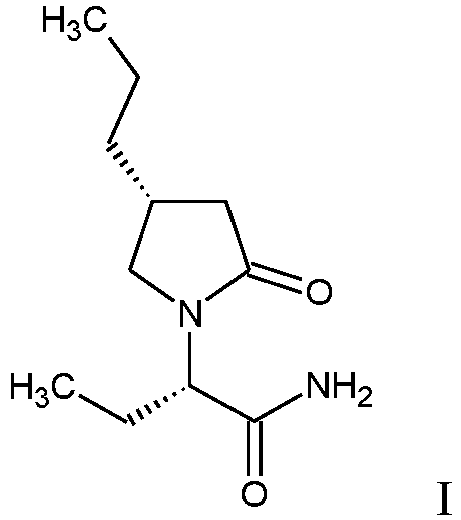
- (2S)-2-[(4R)-2-oxo-4-propyltetrahydro-1 H -pyrrol-1-yl] butanamide depicted by compound of formula I.
- BRIVIACT ® is indicated as adjunctive therapy in the treatment of partial-onset seizures in patients 16 years of age and older with epilepsy.
- BRIVIACT ® is available as 10mg, 25mg, 50mg, 75mg, and 100mg tablets, as 10mg/ml oral solution and as 50mg/5ml single-dose vial injection, for intravenous use.
- the present invention provides a process for the preparation of brivaracetam, a compound of formula I, or a salt thereof, the process comprising:
- brivaracetam a compound of formula I, or salt thereof, comprising the steps of:
- the present invention provides a process for the preparation of brivaracetam, a compound of formula I, or a salt thereof, the process comprising:
- step 'i' of the above process the compound of formula VI is reacted with L-menthol in the presence of a coupling reagent.
- the coupling reagent may be selected from the group consisting of thionyl chloride, carbodiimides, 1-hydroxybenzotriazole based or 1-hydroxy-7-azabenzotriazole based phosphonium and uronium salts, sulfinyl halide, phosphorus halide, oxalyl chloride, and the like.
- the carbodiimide coupling reagent may be selected from the group consisting of N,N'-dialkylcarbodiimides such as N,N'-dicyclohexylcarbodiimide (DCC) or diisopropylcarbodiimide (DIPC), 1-ethyl-3-(3-dimethylaminopropyl)-carbodiimide (EDC) and the like.
- N,N'-dialkylcarbodiimides such as N,N'-dicyclohexylcarbodiimide (DCC) or diisopropylcarbodiimide (DIPC), 1-ethyl-3-(3-dimethylaminopropyl)-carbodiimide (EDC) and the like.
- 1-hydroxybenzotriazole and 1-hydroxy-7-azabenzotriazole based phosphonium salt may be selected from the group consisting of benzotriazol-1-yl-N-oxy-tris(dimethylamino)phosphoniumhexafluorophosphate (BOP), benzotriazol-1-yl-N-oxy-tris(pyrrolidino)phosphonium hexafluorophosphate (PyBOP), 7-azabenzotriazol-1-yl-N-oxy-tris(pyrrolidino)phosphonium hexafluoro phosphate (PyAOP) and the like.
- BOP benzotriazol-1-yl-N-oxy-tris(dimethylamino)phosphoniumhexafluorophosphate
- PyBOP benzotriazol-1-yl-N-oxy-tris(pyrrolidino)phosphonium hexafluorophosphate
- PyAOP 7-azabenzo
- 1-hydroxybenzotriazole and 1-hydroxy-7-azabenzotriazole based uronium salt may be selected from the group consisting of N-[(1Hbenzotriazol-1-yl)(dimethylamino)methylene]-N-methylmethan-aminium hexafluorophosphate N-oxide (HBTU) and the like.
- phosphorus halide may be selected from the group consisting of phosphorus oxychloride, phosphorus trichloride, phosphorus pentachloride and the like.
- the present invention provides a process wherein the reaction of the compound of formula VI with L-menthol in step 'i' may be carried out in the presence of coupling reagent, wherein the coupling reagent is thionyl chloride.
- reaction of compound of formula VI with L-menthol, to obtain a compound of formula IV may be carried out in a solvent.
- the solvent may be selected from the group consisting of haloalkane such as methylene dichloride, chloroform, ethylene dichloride and the like; ether such as tetrahydrofuran, dioxane; amide such as dimethylformamide; hydrocarbon such as toluene, xylene and the like and mixtures thereof.
- haloalkane such as methylene dichloride, chloroform, ethylene dichloride and the like
- ether such as tetrahydrofuran, dioxane
- amide such as dimethylformamide
- hydrocarbon such as toluene, xylene and the like and mixtures thereof.
- the compound of formula V may be isolated or formed in situ.
- the present invention provides a process wherein a compound of formula VA, may be formed as an intermediate in the reaction of compound of formula VIA with L-menthol, in the presence of a coupling reagent, wherein the coupling reagent is thionyl chloride.
- step 'ii' of the above process compound of formula IV may be reacted with (2S)-2-aminobutanamide, compound of formula III, to obtain a diastereomeric mixture a compound of formula II.
- the present invention provides a process, wherein the compound of formula IV may be reacted with (2S)-2-aminobutanamide, a compound of formula III, to obtain a diastereomeric mixture, a compound of formula II in the presence of a base.
- the base may be selected from the group consisting of alkali metal hydroxide like sodium hydroxide, potassium hydroxide, alkaline earth metal hydroxides like calcium hydroxide, alkoxides like sodium methoxide, sodium or potassium tert butoxide, alkali metal carbonate such as sodium carbonate, alkaline earth metal carbonates like calcium carbonates, sodium hydride, lithium bis(trimethylsilyl)amide and the like, and mixtures thereof.
- the reaction of the compound of formula IV with (2S)-2-aminobutanamide, the compound of formula III may be carried out in presence of a phase transfer catalyst.
- the phase transfer catalyst may be selected from the group consisting of quaternary ammonium salts like tetra butyl ammonium bromide (TBAB), tetrabutyl ammonium fluoride (TBAF), tetra butyl ammonium hydroxide (TBAH), tetrabutyl ammonium iodide (TBAI), crown ether, phosphonium salts, sodium iodide, potassium iodide, and the like; and mixtures thereof.
- TBAB tetra butyl ammonium bromide
- TBAF tetrabutyl ammonium fluoride
- TBAH tetra butyl ammonium hydroxide
- TBAI tetrabutyl ammonium iodide
- crown ether phosphonium salts,
- the compound of formula IV may be reacted with (2S)-2-aminobutanamide, the compound of formula III, in a solvent.
- the solvent may be selected from the group consisting of C1-C6 aliphatic ester such as ethyl acetate, isopropyl acetate, n-butyl acetate and the like; amide such as dimethyl formamide, dimethyl acetamide and the like; nitrile such as acetonitrile and the like; sulfoxide such dimethyl sulfoxide and the like and the mixture thereof.
- C1-C6 aliphatic ester such as ethyl acetate, isopropyl acetate, n-butyl acetate and the like
- amide such as dimethyl formamide, dimethyl acetamide and the like
- nitrile such as acetonitrile and the like
- sulfoxide such dimethyl sulfoxide and the like and the mixture thereof.
- step 'iii' of the above process the desired diastereomer, a compound of formula IIA and the undesired diastereomer, a compound of formula IIB, may be separated from the diastereomeric mixture, the compound of formula II.
- the present invention provides a process, wherein in step 'iii', the separation of desired diastereomer, the compound of formula IIA, and the undesired diastereomer, the compound of formula IIB, from the diastereomeric mixture, the compound of formula II, may be carried out by any of the following:
- the separation of desired diastereomer, the compound of formula IIA, and the undesired diastereomer, the compound of formula IIB from the diastereomeric mixture, the compound of formula II may be carried out by treatment with a solvent, in 'x', wherein one of the diastereomer is selectively precipitated based on the differential solubility of the diastereomers, IIA and IIB in the solvent.
- the treatment with solvent comprises subjecting the diastereomeric mixture, the compound of formula II to washing, slurrying, crystallizing with the solvent.
- the treatment with solvent comprises subjecting the diastereomeric mixture, the compound of formula II to washing, slurrying, crystallizing with the solvent at a temperature in the range of 0°C to about 100°C
- the desired diastereomer, the compound of formula IIA may be selectively separated from the undesired diastereomer, the compound of formula IIB, by being insoluble and precipitated in the solvent, and the undesired diastereomer, the compound of formula IIB, being soluble in the solvent.
- the solvent used in 'x' may be selected from the group consisting of C1-C6 aliphatic ester and C1-6 aliphatic ketone.
- C1-C6 aliphatic ester may be selected from the group consisting of ethyl acetate, propyl acetate, isopropyl acetate, butyl acetate, isobutyl acetate, and t-butyl acetate and the like.
- C1-C6 ketone may be selected from the group consisting of acetone, ethyl methyl ketone and methyl isobutyl ketone and the like.
- the desired diastereomer, the compound of formula IIA may be selectively separated from the undesired diastereomer, the compound of formula IIB, by being insoluble and precipitated in isopropyl acetate, and the undesired diastereomer, the compound of formula IIB, being soluble in isopropyl acetate.
- the desired diastereomer, the compound of formula IIA may be selectively separated from the undesired diastereomer, the compound of formula IIB, by being insoluble and precipitated in acetone, and the undesired diastereomer, the compound of formula IIB, being soluble in acetone.
- the diastereomeric mixture, the compound of formula II may be treated with a solvent, in 'x', wherein the desired diastereomer, the compound of formula IIA, is soluble and undesired diastereomer, the compound of formula IIB, is insoluble and precipitated out.
- the diastereomeric mixture, the compound of formula II may be treated with a solvent at the temperature of about 0°C to about 100°C. In one embodiment, the diastereomeric mixture, the compound of formula II, may be treated with a solvent at the temperature of about 0°C to about 80°C. In one embodiment, the diastereomeric mixture, the compound of formula II, may be treated with a solvent at the temperature of about 20°C to about 100°C. In one embodiment, the diastereomeric mixture, the compound of formula II, may be treated with a solvent at the temperature of about 20°C to about 80°C.
- the diastereomeric mixture, the compound of formula II may be treated with a solvent for about 1h to about 12h. In one embodiment, the diastereomeric mixture, the compound of formula II, may be treated with a solvent for about 2h to about 8h. In one embodiment, the diastereomeric mixture, the compound of formula II, may be treated with a solvent for about 2h to about 6h. In one embodiment, the diastereomeric mixture, the compound of formula II, may be treated with a solvent for about 1h to about 2h.
- the desired diastereomer, the compound of formula IIA is selectively separated from the undesired diastereomer, the compound of formula IIB, by treatment of diastereomeric mixture, the compound of formula II, with a solvent, wherein treatment with a solvent may involve slurrying in a solvent, recrystallization.
- the slurrying of diastereomeric mixture, the compound of formula II, in a solvent may be carried out at the temperature of about 0°C to about 100°C. In one embodiment, the slurrying of diastereomeric mixture, the compound of formula II, in a solvent may be carried out at the temperature of about 0°C to about 80°C. In one embodiment, the slurrying of diastereomeric mixture, the compound of formula II, in a solvent may be carried out at the temperature of about 0°C to about 40°C. In one embodiment, the slurrying of diastereomeric mixture, the compound of formula II, in a solvent may be carried out at the temperature of about 0°C to about 5°C.
- the slurrying of diastereomeric mixture, the compound of formula II, in a solvent may be carried out for about 2h to about 24h. In one embodiment, the slurrying of diastereomeric mixture, the compound of formula II, in a solvent may be carried out for about 12 to about 24h. In one embodiment, the slurrying of diastereomeric mixture, the compound of formula II, in a solvent may be carried out for about 6h to about 12h.
- the desired diastereomer, the compound of formula IIA may be selectively separated from the undesired diastereomer, the compound of formula IIB by recrystallizing the diastereomeric mixture, the compound of formula II.
- the recrystallization may be carried out by heating the diastereomeric mixture, the compound of formula II in a solvent at about 40°C to about 100°C and subsequently cooling to about 0°C to about 30°C, wherein the desired diastereomer, the compound of formula IIA, precipitate out.
- the desired diastereomer, the compound of formula IIA is separated from the undesired diastereomer, the compound of formula IIB, by dissolving the diastereomeric mixture, the compound of formula II, in a solvent and by addition of suitable anti-solvent wherein, one of the diastereomer is precipitated out.
- the desired diastereomer, the compound of formula IIA is selectively separated from the undesired diastereomer, the compound of formula IIB, by dissolving the diastereomeric mixture, the compound of formula II, in a solvent and by addition of a suitable anti-solvent, wherein the desired diastereomer is insoluble and precipitated out.
- the solvent may be selected from the group consisting of C1-C6 alcohol such as methanol, ethanol, isopropyl alcohol and the like; haloalkane such methylene dichloride, chloroform, ethylene dichloride and the like; ethers such as tetrahydrofuran and the like and mixtures thereof.
- C1-C6 alcohol such as methanol, ethanol, isopropyl alcohol and the like
- haloalkane such methylene dichloride, chloroform, ethylene dichloride and the like
- ethers such as tetrahydrofuran and the like and mixtures thereof.
- the anti-solvent may be selected from the group consisting of C1-C6 aliphatic ester such as ethyl acetate, isopropyl acetate, n-butyl acetate and the like; hydrocarbon such as n-heptane, cyclohexane and the like; nitrile such as acetonitrile and the like; and the mixtures thereof.
- the undesired diastereomer, the compound of formula IIB which is soluble in a solvent is recycled.
- the undesired diastereomer, the compound of formula IIB is recycled to generate the diastereomeric mixture, the compound of formula II by stirring and/or heating the solution containing the compound of formula IIB.
- step 'iv' of the above process the compound IIA is cyclized to obtain brivaracetam, the compound of formula I.
- the compound of formula IIA may be purified several times.
- step 'iv' the cyclization of the compound of formula IIA is carried out in presence of an acid.
- the acid may be selected from the group consisting of inorganic acid, organic acid and mixture thereof.
- the inorganic acid may be selected from hydrochloric acid, sulphuric acid and the like.
- the organic acid may be selected from the group consisting of acetic acid, trifluoroacetic acid, formic acid and the like.
- step 'iv' the cyclization of the compound of formula IIA is carried out in presence of a base.
- the base may be selected from an organic or an inorganic base.
- the organic base may be selected from the group consisting of amines, organolithiums, tetraalkylammonium hydroxides
- the amine may be selected from the group consisting of cyclic aliphatic amine, trialkyl amines, heterocyclic amine, C1-C6 aliphatic amine, C6-C12 aryl alkyl amines, C6-C12 aryl amines and the like.
- the cyclic aliphatic amine may be selected from the group consisting of cyclohexyl amine, dicyclohexyl amine, piperidine, piperazine and the like.
- the trialkyl amine may be selected from the group consisting of triethylamine, diisoporpylethylamine (DIPEA) and the like.
- the heterocyclic amine may be selected from the group consisting of 1,8-diazabicyclo[5.4.0]undec-7-ene (DBU), 1,5-diazabicyclo[4.3.0]non-5-ene (DBN), 1,4-diazabicyclo[2.2.2]octane (Dabco) pyridine, pyrimidine, 4-(dimethylamino)pyridine (DMAP) and the like.
- the C1-C6 aliphatic amine may be selected from the group consisting of methyl amine, propyl amine, n-butylamine and the like.
- the C6-C12 aryl alkylamine may be selected from the group consisting of benzyl amine, phenyl ethyl amine, and the like.
- the C6-C12 aryl amine may be selected from the group consisting of aniline and the like.
- the organolithium may be selected from the group consisting of methyllithium, n-butyllihtium, t-butyllithium and the like.
- the inorganic base may be selected from the group consisting of metal carbonate, metal bicarbonate, metal hydroxide and metal alkoxides wherein the metal may be selected from the group consisting of sodium, potassium, lithium, calcium, cesium or magnesium.
- the metal carbonate may be selected from the group consisting of sodium carbonate, potassium carbonate, lithium carbonate, calcium carbonate, cesium carbonate, magnesium carbonate and the like.
- the metal bicarbonate may be selected from the group consisting of sodium bicarbonate, potassium bicarbonate, lithium bicarbonate, calcium bicarbonate, cesium bicarbonate, magnesium bicarbonate and the like.
- the metal hydroxide may be selected from the group consisting of sodium hydroxide, potassium hydroxide, lithium hydroxide, calcium hydroxide, cesium hydroxide, magnesium hydroxide and the like.
- the metal alkoxide may be selected from the group consisting of sodium methoxide, potassium t-butoxide, sodium ethoxide and the like.
- the ring opening of the compound of formula VII may be carried out by reacting it with hydrogen halide in presence of an acid.
- the present invention provides a compound of formula IV, wherein X is Br.
- X is Br
- 1H NMR having characteristics peaks at ⁇ : 4.74-4.67(m, 1H), 3.57-3.47 (m,2H), 2.51-2.50 (d,1H), 2.49-2.44 (dd, 1H), 2.36-2.35 (d, 1H), 2.32-2.31 (d, 1H), 2.20-1.87 (m, 1H), 1.71-1.66 (m, 2H), 1.50-1.27 (m, 6H), 1.08-0.86 (m, 12H), 0.78-0.76 (d, 3H).
- the present invention provides a compound of formula II,
- the present invention provides (1R,2S,5R)-5-methyl-2-(propan-2-yl)cyclohexyl 3-( ⁇ [(2S)-1-amino-1-oxobutan-2-yl]amino ⁇ methyl) hexanoate, the compound of formula II.
- the present invention provides a compound of formula IIA,
- the present invention provides (1R,2S,5R)-5-methyl-2-(propan-2-yl)cyclohexyl (3R)-3-( ⁇ [(2S)-1-amino-1-oxobutan-2-yl]amino ⁇ methyl) hexanoate, the compound of formula IIA.
- the present invention provides a compound of formula IIA, wherein the content of the compound of formula IIB, is less than 1% with respect to compound of formula IIA, as determined by HPLC.
- brivaracetam a compound of formula I, or salt thereof, comprising the steps of:
- the process used is as discussed supra.
- present invention provides a process wherein brivaracetam, the compound of formula I, is obtained in a diastereomeric excess of at least 98%, as determined by HPLC.
- the present invention provides use of the compound of formula II, IIA and IV, in the preparation of brivaracetam, the compound of formula I.
- the present invention provides brivaracetam obtained by above process, as analyzed by chemical purity using high performance liquid chromatography (HPLC) with the conditions described below:
- Apparatus A High Performance Liquid Chromatograph equipped with quaternary gradient pumps, variable wavelength UV detector attached with data recorder and integrator software.
- the retention time of brivaracetam is about 11.7 minutes under these conditions.
- Relative retention time for compound of formula A is about 1.37
- compound of formula B is about 0.83
- compound of formula C is about 1.86 with respect to brivaracetam.
- Apparatus A High Performance Liquid Chromatograph equipped with quaternary gradient pumps, variable wavelength UV detector attached with data recorder and integrator software.
- Mobile Phase B Acetonitrile Time (min.) % Mobile Phase A % Mobile Phase B 0.01 70 30 30 30 30 70 35 30 70 38 70 30 45 70 30
- the retention time of compound of formula IIA is about 26.0 minutes under these conditions.
- the retention time of brivaracetam is about 27.0 minutes under these conditions.
- Relative retention time for (2S,4S), (2R,4S) and (2R,4R) isomer of the compound of formula I is about 0.73, 0.43 and 0.47 respectively with respect to brivaracetam.
- brivaracetam a compound of formula I, or a salt thereof, the process comprising:
- the chiral alcohol R-OH, R may be selected from the group consisting of L-menthol, D-menthol, (+)-neomenthol, (1R)-(-)-nopol, 2-methylisoborneol and menthol derivatives.
- the process step (ai) is as discussed supra.
- the process step (aii) is carried out by reacting the compound of formula VIII with L-menthol in presence of a catalyst.
- the catalyst selected is DMAP.
- the reaction is carried out by azeotropically.
- the process step (aiii) is carried out by reacting the compound of formula IX with L-menthol in presence of a coupling reagent.
- the coupling reagent is selected from the group consisting of thionyl chloride, carbodiimides, 1-hydroxybenzotriazole based or 1-hydroxy-7-azabenzotriazole based phosphonium and uronium salts, sulfinyl halide and phosphorus halide.
- the process step (aiv) is carried out by reducing a compound of formula X using hydrogen source in the presence a metal catalyst.
- the hydrogen source is selected from the group consisting of hydrogen gas, formic acid, isopropanol, and dihydroanthracene.
- the metal catalyst is selected from the group consisting of nickel, palladium, platinum, ruthenium, rhodium and iridium.
- Morpholine (256.5g) was added to n-heptane (800ml) and cooled to about 0°C to about 5°C.
- Glyoxylic acid was added to the reaction mass by maintaining the temperature between 0°C to about 10°C.
- the reaction mixture was stirred for about 2h to about 3h at about 25°C to about 30°C.
- N-Valeraldehyde (246.6g) was added to the reaction mass at about 25°C to about 30°C.
- the temperature of reaction mass slowly raised to 40-45°C and stirred for about 18h to about 24h. After the completion of reaction, the reaction mass was cooled to about 25°C to about 30°C, quenched with conc.
- the compound IIA (179g) was added in isopropyl acetate (1790ml) and stirred for about 2h to about 4h at about 80°C to about 85°C. The reaction mass was cooled to about 0°C to about 5°C. The precipitated solid was filtered and dried to obtain pure (1R,2S,5R)-5-methyl-2-(propan-2-yl)cyclohexyl(3R)-3-( ⁇ [(2S)-1-amino-1-oxobutan-2-yl]amino ⁇ methyl)hexanoate (yield:156g), HPLC purity: >97%.
- the compound IIA (100.0g) was charged in a mixture of isopropyl acetate (1500.0mL) and acetic acid (65.0g), and stirred for about 4h to about 5h at about 85°C to about 90°C. After the completion of reaction, the reaction mass was cooled to about 20°C to about 30°C and quenched in sodium chloride solution stirred for about 10min to about 15min and the layers were separated. To the organic layer, water and sodium bicarbonate (100g) was slowly added and stirred for about 1h to about 2h. The layers were separated and organic layer was washed with sodium chloride solution, followed by distillation under reduced pressure to get oily mass.
- Example 14 To the solid of Example 14, acetone (5.46mL) was added and the reaction mass was heated to get clear solution. The reaction mass was cooled to about 20°C to about 25°C and further cooled to about 0-5°C and stirred for about one hour. The solid was filtered and washed with acetone and dried at about 45°C to about 55°C under reduced pressure to obtain (1R,2S,5R)-5-methyl-2-(propan-2-yl)cyclohexyl-(3R)-3-( ⁇ [(2S)-1-amino-1-oxobutan-2-yl]amino ⁇ methyl)hexanoate (compound IIA, 7g) as a white solid.
- a mixture of compound IIA (10g), n-heptane (150mL) and acetic acid (4.89g) was stirred for about 4h to about 5h at about 85°C to about 90°C.
- the reaction mass was cooled to about 20°C to about 30°C and water was added to it.
- the reaction mass was stirred for about 15min to about 20min and the two layers were separated.
- sodium chloride which was stirred for 10 to 15 minutes.
- Ethyl acetate was added to the reaction mass and was stirred for 10-15 minutes. The two layers were separated and the organic layer was washed with sodium bicarbonate solution to adjust pH between 6-8.
- the organic layer was washed with brine solution.
Landscapes
- Health & Medical Sciences (AREA)
- Chemical & Material Sciences (AREA)
- Organic Chemistry (AREA)
- Medicinal Chemistry (AREA)
- Pharmacology & Pharmacy (AREA)
- Life Sciences & Earth Sciences (AREA)
- Animal Behavior & Ethology (AREA)
- General Health & Medical Sciences (AREA)
- Public Health (AREA)
- Veterinary Medicine (AREA)
- Engineering & Computer Science (AREA)
- Epidemiology (AREA)
- Chemical Kinetics & Catalysis (AREA)
- Bioinformatics & Cheminformatics (AREA)
- Materials Engineering (AREA)
- Emergency Medicine (AREA)
- General Chemical & Material Sciences (AREA)
- Nuclear Medicine, Radiotherapy & Molecular Imaging (AREA)
- Dermatology (AREA)
- Biomedical Technology (AREA)
- Neurology (AREA)
- Neurosurgery (AREA)
- Organic Low-Molecular-Weight Compounds And Preparation Thereof (AREA)
- Pharmaceuticals Containing Other Organic And Inorganic Compounds (AREA)
Description
- This application claims the benefit of
Indian Provisional Application 201921053171 filed on December 20, 2019 - The present invention relates to a process for the preparation of brivaracetam and salts thereof.
- The chemical name of BRIVIACT (brivaracetam) is (2S)-2-[(4R)-2-oxo-4-propyltetrahydro-1H-pyrrol-1-yl] butanamide, depicted by compound of formula I.

- BRIVIACT® is indicated as adjunctive therapy in the treatment of partial-onset seizures in patients 16 years of age and older with epilepsy. BRIVIACT® is available as 10mg, 25mg, 50mg, 75mg, and 100mg tablets, as 10mg/ml oral solution and as 50mg/5ml single-dose vial injection, for intravenous use.
- The invention is only disclosed in the appended claims. In one embodiment, the present invention provides a process for the preparation of brivaracetam, a compound of formula I, or a salt thereof,

- i) reacting a compound of formula VI with L-menthol to obtain a compound of formula IV,

- ii) reacting the compound of formula IV with (2S)-2-aminobutanamide, a compound of formula III, to obtain a diastereomeric mixture, a compound of formula II;

- iii) separating the desired diastereomer, a compound of formula IIA and the undesired diastereomer, a compound of formula IIB, from the diastereomeric mixture, the compound of formula II; and

- iv) cyclizing the compound of formula IIA, to obtain brivaracetam, the compound of formula I.
- In one embodiment, the present invention provides a compound of formula II, IIA and a compound of formula IV,

- Disclosed herein is a process for the preparation of brivaracetam, a compound of formula I, or salt thereof,

- i) reacting the compound of formula IV with (2S)-2-aminobutanamide, a compound of formula III, to obtain a diastereomeric mixture, a compound of formula II; and

- ii) separating the desired diastereomer, a compound of formula IIA and the undesired diastereomer, a compound of formula IIB, from the diastereomeric mixture, the compound of formula II.

- In one embodiment, the present invention provides use of compound of formula II, IIA and IV in the preparation of brivaracetam, the compound of formula I,

- Disclosed herein is a process for the preparation of bivaracetam, a compound of formula I, or a salt thereof,

- (a) obtaining a diastereomeric mixture, a compound of formula II,

- (i) reacting the compound of formula IV wherein X= Cl, Br, I, OMs or OTs, with (2S)-2-aminobutanamide, a compound of formula III,

- (ii) reacting a compound of formula VIII with L-menthol,

- (iii) reacting a compound of formula IX with L-menthol,

- (iv) reducing a compound of formula X,

- (i) reacting the compound of formula IV wherein X= Cl, Br, I, OMs or OTs, with (2S)-2-aminobutanamide, a compound of formula III,
- (b) separating the desired diastereomer, a compound of formula IIA and the undesired diastereomer, a compound of formula IIB, from the diastereomeric mixture, the compound of formula II; and

- c) cyclizing the compound of formula IIA, to obtain brivaracetam the compound of formula I.
- In one embodiment, the present invention provides a process for the preparation of brivaracetam, a compound of formula I, or a salt thereof,
- i) reacting a compound of formula VI with L-menthol to obtain a compound of formula IV,

- ii) reacting the compound of formula IV with (2S)-2-aminobutanamide, a compound of formula III, to obtain a diastereomeric mixture, a compound of formula II;

- iii) separating the desired diastereomer, a compound of formula IIA and the undesired diastereomer, a compound of formula IIB, from the diastereomeric mixture, the compound of formula II; and

- iv) cyclizing the compound of formula IIA, to obtain brivaracetam the compound of formula I.
- In step 'i' of the above process, the compound of formula VI is reacted with L-menthol in the presence of a coupling reagent.
- In one embodiment, the coupling reagent may be selected from the group consisting of thionyl chloride, carbodiimides, 1-hydroxybenzotriazole based or 1-hydroxy-7-azabenzotriazole based phosphonium and uronium salts, sulfinyl halide, phosphorus halide, oxalyl chloride, and the like.
- In one embodiment, the carbodiimide coupling reagent may be selected from the group consisting of N,N'-dialkylcarbodiimides such as N,N'-dicyclohexylcarbodiimide (DCC) or diisopropylcarbodiimide (DIPC), 1-ethyl-3-(3-dimethylaminopropyl)-carbodiimide (EDC) and the like.
- In one embodiment, 1-hydroxybenzotriazole and 1-hydroxy-7-azabenzotriazole based phosphonium salt may be selected from the group consisting of benzotriazol-1-yl-N-oxy-tris(dimethylamino)phosphoniumhexafluorophosphate (BOP), benzotriazol-1-yl-N-oxy-tris(pyrrolidino)phosphonium hexafluorophosphate (PyBOP), 7-azabenzotriazol-1-yl-N-oxy-tris(pyrrolidino)phosphonium hexafluoro phosphate (PyAOP) and the like.
- In one embodiment, 1-hydroxybenzotriazole and 1-hydroxy-7-azabenzotriazole based uronium salt may be selected from the group consisting of N-[(1Hbenzotriazol-1-yl)(dimethylamino)methylene]-N-methylmethan-aminium hexafluorophosphate N-oxide (HBTU) and the like.
- In one embodiment, phosphorus halide may be selected from the group consisting of phosphorus oxychloride, phosphorus trichloride, phosphorus pentachloride and the like.
- In one embodiment, the present invention provides a process wherein the reaction of the compound of formula VI with L-menthol in step 'i' may be carried out in the presence of coupling reagent, wherein the coupling reagent is thionyl chloride.
- In one embodiment, the reaction of compound of formula VI with L-menthol, to obtain a compound of formula IV may be carried out in a solvent.
- In one embodiment, the solvent may be selected from the group consisting of haloalkane such as methylene dichloride, chloroform, ethylene dichloride and the like; ether such as tetrahydrofuran, dioxane; amide such as dimethylformamide; hydrocarbon such as toluene, xylene and the like and mixtures thereof.
- In one embodiment, the present invention provides a process wherein a compound of formula V,

- In one embodiment, the compound of formula V may be isolated or formed in situ.
- In one embodiment, the present invention provides a process wherein a compound of formula VA,

- In step 'ii' of the above process, compound of formula IV may be reacted with (2S)-2-aminobutanamide, compound of formula III, to obtain a diastereomeric mixture a compound of formula II.

- In one embodiment, the present invention provides a process, wherein the compound of formula IV may be reacted with (2S)-2-aminobutanamide, a compound of formula III, to obtain a diastereomeric mixture, a compound of formula II in the presence of a base.
- In one embodiment, the base may be selected from the group consisting of alkali metal hydroxide like sodium hydroxide, potassium hydroxide, alkaline earth metal hydroxides like calcium hydroxide, alkoxides like sodium methoxide, sodium or potassium tert butoxide, alkali metal carbonate such as sodium carbonate, alkaline earth metal carbonates like calcium carbonates, sodium hydride, lithium bis(trimethylsilyl)amide and the like, and mixtures thereof.
- In one embodiment, the reaction of the compound of formula IV with (2S)-2-aminobutanamide, the compound of formula III, may be carried out in presence of a phase transfer catalyst. In one embodiment, the phase transfer catalyst may be selected from the group consisting of quaternary ammonium salts like tetra butyl ammonium bromide (TBAB), tetrabutyl ammonium fluoride (TBAF), tetra butyl ammonium hydroxide (TBAH), tetrabutyl ammonium iodide (TBAI), crown ether, phosphonium salts, sodium iodide, potassium iodide, and the like; and mixtures thereof.
- In one embodiment, the compound of formula IV may be reacted with (2S)-2-aminobutanamide, the compound of formula III, in a solvent.
- In embodiment, the solvent may be selected from the group consisting of C1-C6 aliphatic ester such as ethyl acetate, isopropyl acetate, n-butyl acetate and the like; amide such as dimethyl formamide, dimethyl acetamide and the like; nitrile such as acetonitrile and the like; sulfoxide such dimethyl sulfoxide and the like and the mixture thereof.
- In step 'iii' of the above process, the desired diastereomer, a compound of formula IIA and the undesired diastereomer, a compound of formula IIB, may be separated from the diastereomeric mixture, the compound of formula II.
- In one embodiment, the present invention provides a process, wherein in step 'iii', the separation of desired diastereomer, the compound of formula IIA, and the undesired diastereomer, the compound of formula IIB, from the diastereomeric mixture, the compound of formula II, may be carried out by any of the following:
- x) by treating diastereomeric mixture, the compound of formula II, with a solvent in which one of the diastereomer is soluble and other diastereomer is insoluble and precipitated out; or
- y) by treating diastereomeric mixture, the compound of formula II, with a solvent and adding an anti-solvent to it in which one of the diastereomer is soluble and other diastereomer is insoluble and precipitated out.
- In one embodiment, the separation of desired diastereomer, the compound of formula IIA, and the undesired diastereomer, the compound of formula IIB from the diastereomeric mixture, the compound of formula II, may be carried out by treatment with a solvent, in 'x', wherein one of the diastereomer is selectively precipitated based on the differential solubility of the diastereomers, IIA and IIB in the solvent.
- In one embodiment, the treatment with solvent comprises subjecting the diastereomeric mixture, the compound of formula II to washing, slurrying, crystallizing with the solvent.
- In one embodiment, the treatment with solvent comprises subjecting the diastereomeric mixture, the compound of formula II to washing, slurrying, crystallizing with the solvent at a temperature in the range of 0°C to about 100°C
- In one embodiment, the desired diastereomer, the compound of formula IIA may be selectively separated from the undesired diastereomer, the compound of formula IIB, by being insoluble and precipitated in the solvent, and the undesired diastereomer, the compound of formula IIB, being soluble in the solvent.
- In one embodiment, the solvent used in 'x' may be selected from the group consisting of C1-C6 aliphatic ester and C1-6 aliphatic ketone.
- In one embodiment, C1-C6 aliphatic ester may be selected from the group consisting of ethyl acetate, propyl acetate, isopropyl acetate, butyl acetate, isobutyl acetate, and t-butyl acetate and the like.
- In one embodiment, C1-C6 ketone may be selected from the group consisting of acetone, ethyl methyl ketone and methyl isobutyl ketone and the like.
- In one embodiment, the desired diastereomer, the compound of formula IIA may be selectively separated from the undesired diastereomer, the compound of formula IIB, by being insoluble and precipitated in isopropyl acetate, and the undesired diastereomer, the compound of formula IIB, being soluble in isopropyl acetate.
- In one embodiment, the desired diastereomer, the compound of formula IIA may be selectively separated from the undesired diastereomer, the compound of formula IIB, by being insoluble and precipitated in acetone, and the undesired diastereomer, the compound of formula IIB, being soluble in acetone.
- In one embodiment, the diastereomeric mixture, the compound of formula II may be treated with a solvent, in 'x', wherein the desired diastereomer, the compound of formula IIA, is soluble and undesired diastereomer, the compound of formula IIB, is insoluble and precipitated out.
- In one embodiment, the diastereomeric mixture, the compound of formula II, may be treated with a solvent at the temperature of about 0°C to about 100°C. In one embodiment, the diastereomeric mixture, the compound of formula II, may be treated with a solvent at the temperature of about 0°C to about 80°C. In one embodiment, the diastereomeric mixture, the compound of formula II, may be treated with a solvent at the temperature of about 20°C to about 100°C. In one embodiment, the diastereomeric mixture, the compound of formula II, may be treated with a solvent at the temperature of about 20°C to about 80°C.
- In one embodiment, the diastereomeric mixture, the compound of formula II, may be treated with a solvent for about 1h to about 12h. In one embodiment, the diastereomeric mixture, the compound of formula II, may be treated with a solvent for about 2h to about 8h. In one embodiment, the diastereomeric mixture, the compound of formula II, may be treated with a solvent for about 2h to about 6h. In one embodiment, the diastereomeric mixture, the compound of formula II, may be treated with a solvent for about 1h to about 2h.
- In one embodiment, the desired diastereomer, the compound of formula IIA is selectively separated from the undesired diastereomer, the compound of formula IIB, by treatment of diastereomeric mixture, the compound of formula II, with a solvent, wherein treatment with a solvent may involve slurrying in a solvent, recrystallization.
- In one embodiment, the slurrying of diastereomeric mixture, the compound of formula II, in a solvent may be carried out at the temperature of about 0°C to about 100°C. In one embodiment, the slurrying of diastereomeric mixture, the compound of formula II, in a solvent may be carried out at the temperature of about 0°C to about 80°C. In one embodiment, the slurrying of diastereomeric mixture, the compound of formula II, in a solvent may be carried out at the temperature of about 0°C to about 40°C. In one embodiment, the slurrying of diastereomeric mixture, the compound of formula II, in a solvent may be carried out at the temperature of about 0°C to about 5°C.
- In one embodiment, the slurrying of diastereomeric mixture, the compound of formula II, in a solvent may be carried out for about 2h to about 24h. In one embodiment, the slurrying of diastereomeric mixture, the compound of formula II, in a solvent may be carried out for about 12 to about 24h. In one embodiment, the slurrying of diastereomeric mixture, the compound of formula II, in a solvent may be carried out for about 6h to about 12h.
- In one embodiment, the desired diastereomer, the compound of formula IIA may be selectively separated from the undesired diastereomer, the compound of formula IIB by recrystallizing the diastereomeric mixture, the compound of formula II.
- In one embodiment, the recrystallization may be carried out by heating the diastereomeric mixture, the compound of formula II in a solvent at about 40°C to about 100°C and subsequently cooling to about 0°C to about 30°C, wherein the desired diastereomer, the compound of formula IIA, precipitate out.
- In one embodiment, the desired diastereomer, the compound of formula IIA, is separated from the undesired diastereomer, the compound of formula IIB, by dissolving the diastereomeric mixture, the compound of formula II, in a solvent and by addition of suitable anti-solvent wherein, one of the diastereomer is precipitated out.
- In one embodiment, the desired diastereomer, the compound of formula IIA, is selectively separated from the undesired diastereomer, the compound of formula IIB, by dissolving the diastereomeric mixture, the compound of formula II, in a solvent and by addition of a suitable anti-solvent, wherein the desired diastereomer is insoluble and precipitated out.
- In one embodiment, the solvent may be selected from the group consisting of C1-C6 alcohol such as methanol, ethanol, isopropyl alcohol and the like; haloalkane such methylene dichloride, chloroform, ethylene dichloride and the like; ethers such as tetrahydrofuran and the like and mixtures thereof. In one embodiment, the anti-solvent may be selected from the group consisting of C1-C6 aliphatic ester such as ethyl acetate, isopropyl acetate, n-butyl acetate and the like; hydrocarbon such as n-heptane, cyclohexane and the like; nitrile such as acetonitrile and the like; and the mixtures thereof.
- In one embodiment, the undesired diastereomer, the compound of formula IIB which is soluble in a solvent, is recycled.
- In one embodiment, the undesired diastereomer, the compound of formula IIB, is recycled to generate the diastereomeric mixture, the compound of formula II by stirring and/or heating the solution containing the compound of formula IIB.
- In step 'iv' of the above process, the compound IIA is cyclized to obtain brivaracetam, the compound of formula I.
- In one embodiment, if required, the compound of formula IIA may be purified several times.
- In one embodiment, in step 'iv', the cyclization of the compound of formula IIA is carried out in presence of an acid.
- In one embodiment the acid may be selected from the group consisting of inorganic acid, organic acid and mixture thereof.
- In one embodiment the inorganic acid may be selected from hydrochloric acid, sulphuric acid and the like. In one embodiment, the organic acid may be selected from the group consisting of acetic acid, trifluoroacetic acid, formic acid and the like.
- In one embodiment, in step 'iv', the cyclization of the compound of formula IIA is carried out in presence of a base.
- In one embodiment, the base may be selected from an organic or an inorganic base.
- In one embodiment, the organic base may be selected from the group consisting of amines, organolithiums, tetraalkylammonium hydroxides, The amine may be selected from the group consisting of cyclic aliphatic amine, trialkyl amines, heterocyclic amine, C1-C6 aliphatic amine, C6-C12 aryl alkyl amines, C6-C12 aryl amines and the like. The cyclic aliphatic amine may be selected from the group consisting of cyclohexyl amine, dicyclohexyl amine, piperidine, piperazine and the like. The trialkyl amine may be selected from the group consisting of triethylamine, diisoporpylethylamine (DIPEA) and the like. The heterocyclic amine may be selected from the group consisting of 1,8-diazabicyclo[5.4.0]undec-7-ene (DBU), 1,5-diazabicyclo[4.3.0]non-5-ene (DBN), 1,4-diazabicyclo[2.2.2]octane (Dabco) pyridine, pyrimidine, 4-(dimethylamino)pyridine (DMAP) and the like. The C1-C6 aliphatic amine may be selected from the group consisting of methyl amine, propyl amine, n-butylamine and the like. The C6-C12 aryl alkylamine may be selected from the group consisting of benzyl amine, phenyl ethyl amine, and the like. The C6-C12 aryl amine may be selected from the group consisting of aniline and the like. The organolithium may be selected from the group consisting of methyllithium, n-butyllihtium, t-butyllithium and the like.
- In one embodiment the inorganic base may be selected from the group consisting of metal carbonate, metal bicarbonate, metal hydroxide and metal alkoxides wherein the metal may be selected from the group consisting of sodium, potassium, lithium, calcium, cesium or magnesium. The metal carbonate may be selected from the group consisting of sodium carbonate, potassium carbonate, lithium carbonate, calcium carbonate, cesium carbonate, magnesium carbonate and the like. The metal bicarbonate may be selected from the group consisting of sodium bicarbonate, potassium bicarbonate, lithium bicarbonate, calcium bicarbonate, cesium bicarbonate, magnesium bicarbonate and the like. The metal hydroxide may be selected from the group consisting of sodium hydroxide, potassium hydroxide, lithium hydroxide, calcium hydroxide, cesium hydroxide, magnesium hydroxide and the like. The metal alkoxide may be selected from the group consisting of sodium methoxide, potassium t-butoxide, sodium ethoxide and the like.
- Disclosed herein is a process wherein the compound of formula VI is prepared by ring opening of a compound of formula VII.

- In one embodiment, the ring opening of the compound of formula VII may be carried out by reacting it with hydrogen halide in presence of an acid.
- In one embodiment, the present invention provides a compound of formula IV,


- In one embodiment, the present invention provides a compound of formula IV, wherein X is Br.
- Disclosed herein is a compound of formula IV, wherein X is Br, characterized with 1H NMR having characteristics peaks at δ: 4.74-4.67(m, 1H), 3.57-3.47 (m,2H), 2.51-2.50 (d,1H), 2.49-2.44 (dd, 1H), 2.36-2.35 (d, 1H), 2.32-2.31 (d, 1H), 2.20-1.87 (m, 1H), 1.71-1.66 (m, 2H), 1.50-1.27 (m, 6H), 1.08-0.86 (m, 12H), 0.78-0.76 (d, 3H).
- In one embodiment, the present invention provides a compound of formula II,

- In one embodiment, the present invention provides (1R,2S,5R)-5-methyl-2-(propan-2-yl)cyclohexyl 3-({[(2S)-1-amino-1-oxobutan-2-yl]amino}methyl) hexanoate, the compound of formula II.
- In one embodiment, the present invention provides a compound of formula IIA,

- In one embodiment, the present invention provides (1R,2S,5R)-5-methyl-2-(propan-2-yl)cyclohexyl (3R)-3-({[(2S)-1-amino-1-oxobutan-2-yl]amino}methyl) hexanoate, the compound of formula IIA.
- Disclosed herein is a compound of formula IIA, characterized with 1H NMR having characteristics peaks at δ: 7.08, 5.46, 4.73-4.66, 3.40-3.36, 2.58-2.53, 2.34-2.31, 2.02-1.96, 1.87-1.75, 1.70-1.30, 1.28-0.9, 0.7.
- Disclosed herein is a crystalline compound of formula IIA.
- In one embodiment, the present invention provides a compound of formula IIA, wherein the content of the compound of formula IIB, is less than 1% with respect to compound of formula IIA, as determined by HPLC.
- Disclosed herein is a process for the preparation of brivaracetam, a compound of formula I, or salt thereof, comprising the steps of:
- i) reacting the compound of formula IV with (2S)-2-aminobutanamide, a compound of formula III, to obtain a diastereomeric mixture, a compound of formula II; and
- ii) separating the desired diastereomer, a compound of formula IIA and the undesired diastereomer, a compound of formula IIB, from the diastereomeric mixture, the compound of formula II.
- In one embodiment, the process used is as discussed supra.
- In one embodiment, present invention provides a process wherein brivaracetam, the compound of formula I, is obtained in a diastereomeric excess of at least 98%, as determined by HPLC.
- In one embodiment, the present invention provides use of the compound of formula II, IIA and IV, in the preparation of brivaracetam, the compound of formula I.
- Disclosed herein is a process wherein (2S)-2-[(4R)-2-oxo-4-propylpyrrolidin-1-yl]butanamide, brivaracetam, the compound of formula I, is obtained in a chemical purity of at least 99% and wherein the level of one or more compounds of formula A, B, C or IIA is less than 0.15% w/w relative to the amount of brivaracetam as determined by HPLC,


- Provided herein is (2S)-2-[(4R)-2-oxo-4-propylpyrrolidin-1-yl]butanamide, brivaracetam, the compound of formula I, wherein the content of (2S,4S) and/or (2R,4S) and/or (2R,4R) isomers of the compound of formula I, is less than 1% w/w with respect to (2S)-2-[(4R)-2-oxo-4-propylpyrrolidin-1-yl]butanamide, the compound of formula I, as determined by HPLC.
- The present invention provides brivaracetam obtained by above process, as analyzed by chemical purity using high performance liquid chromatography (HPLC) with the conditions described below:
-
Apparatus: A High Performance Liquid Chromatograph equipped with quaternary gradient pumps, variable wavelength UV detector attached with data recorder and integrator software.
Column: Zorbax Eclipse plus C8, 150 x 4.6mm, 3.5µ; Column temperature: 50°C
Sample Cooler temperature: 10°C
Mobile Phase A: Water: Acetonitrile: Ortho-phosphoric acid (90:10:0.1) v/v/v.
Mobile Phase B: Water: Acetonitrile: Ortho-phosphoric acid (10:90:0.1) v/v/v.Time (min.) % Mobile Phase A % Mobile Phase B 0.01 95 05 18.0 72 28 35.0 55 45 45.0 30 70 54.0 30 70 55.0 95 05 60.0 95 05
Diluent: Water: Acetonitrile (80: 20, v/v); Flow Rate: 1.0mL/minute; Detection: UV 215nm; Injection Volume: 50µL; Run time: 60minutes - The retention time of brivaracetam is about 11.7 minutes under these conditions. Relative retention time for compound of formula A is about 1.37, compound of formula B is about 0.83 and compound of formula C is about 1.86 with respect to brivaracetam.
-
Apparatus: A High Performance Liquid Chromatograph equipped with quaternary gradient pumps, variable wavelength UV detector attached with data recorder and integrator software.
Column: YMC triart, C8, 150 x 4.6mm, 3µ; Column temperature: 40°C
Sample Cooler temperature: 10°C
Mobile Phase A: Buffer: Acetonitrile (95:05, v/v); Buffer: 0.01M Disodium hydrogen phosphate in water adjust the pH to 8.00 with 10% v/v Orthophosphoric acid in water
Mobile Phase B: AcetonitrileTime (min.) % Mobile Phase A % Mobile Phase B 0.01 70 30 30 30 70 35 30 70 38 70 30 45 70 30
Diluent: Methanol: Water (95: 05, v/v); Flow Rate: 1.0 mL/minute; Detection: UV 215nm; Injection Volume: 40µL; Run time: 45 minutes - The retention time of compound of formula IIA is about 26.0 minutes under these conditions.
-
- Apparatus: A High Performance Liquid Chromatograph equipped with quaternary gradient pumps, variable wavelength UV detector attached with data recorder and integrator software.
- Column: Chiralpak AD-H, 250 X 4.6mm, 5µ; Column temperature: 30°C
- Sample cooler temperature: 25°C
- Mobile Phase: n-Hexane: Isopropyl alcohol: Trifluroacetic acid: Diethylamine (930: 70: 1:1, v/v/v/v)
- Diluent: n-Hexane: Isopropyl alcohol (80: 20, v/v); Flow Rate: 1.0 mL/minute;
- Detection: UV 215nm; Injection Volume: 30µL; Run time: 50 minutes
- The retention time of brivaracetam is about 27.0 minutes under these conditions. Relative retention time for (2S,4S), (2R,4S) and (2R,4R) isomer of the compound of formula I is about 0.73, 0.43 and 0.47 respectively with respect to brivaracetam.
- Disclosed herein is a process for the preparation of brivaracetam, a compound of formula I, or a salt thereof, the process comprising:
- i) reacting a compound of formula VI with chiral alcohol R-OH to obtain a compound of formula IV" in presence of a coupling reagent,

- ii) reacting the compound of formula IV" with (2S)-2-aminobutanamide, a compound of formula III, to obtain a diastereomeric mixture, a compound of formula II";

- iii) separating the desired diastereomer, a compound of formula II"A and the undesired diastereomer, a compound of formula II"B, from the diastereomeric mixture, the compound of formula II"; and

- iv) cyclizing the compound of formula II"A, to obtain brivaracetam the compound of formula I.
- In one embodiment, the chiral alcohol R-OH, R may be selected from the group consisting of L-menthol, D-menthol, (+)-neomenthol, (1R)-(-)-nopol, 2-methylisoborneol and menthol derivatives.
- Disclosed herein is a process for the preparation of compound of formula IIA as depicted in scheme 1.

- Disclosed herein is a process for the preparation of compound of formula IIA as depicted in scheme 2.

- Disclosed herein is a process for the preparation of compound of formula IIA as depicted in scheme 3.

- Disclosed herein is a process for the preparation of compound of formula IIA as depicted in scheme 4.

- Disclosed herein is a process for the preparation of bivaracetam, a compound of formula I, or a salt thereof,

- (a) obtaining a diastereomeric mixture, a compound of formula II,

- (i) reacting the compound of formula IV wherein X= Cl, Br, I, OMs or OTs, with (2S)-2-aminobutanamide, a compound of formula III,

- (ii) reacting a compound of formula VIII with L-menthol,

- (iii) reacting a compound of formula IX with L-menthol,

- (iv) reducing a compound of formula X,

- (i) reacting the compound of formula IV wherein X= Cl, Br, I, OMs or OTs, with (2S)-2-aminobutanamide, a compound of formula III,
- (b) separating the desired diastereomer, a compound of formula IIA and the undesired diastereomer, a compound of formula IIB, from the diastereomeric mixture, the compound of formula II; and

- c) cyclizing the compound of formula IIA, to obtain brivaracetam the compound of formula I.
- The process step (ai) is as discussed supra.
- In one embodiment, the process step (aii) is carried out by reacting the compound of formula VIII with L-menthol in presence of a catalyst.
- In one embodiment, the catalyst selected is DMAP.
- In one embodiment, the reaction is carried out by azeotropically.
- In one embodiment, the process step (aiii) is carried out by reacting the compound of formula IX with L-menthol in presence of a coupling reagent.
- In one embodiment, the coupling reagent is selected from the group consisting of thionyl chloride, carbodiimides, 1-hydroxybenzotriazole based or 1-hydroxy-7-azabenzotriazole based phosphonium and uronium salts, sulfinyl halide and phosphorus halide.
- In one embodiment, the process step (aiv) is carried out by reducing a compound of formula X using hydrogen source in the presence a metal catalyst.
- In one embodiment, the hydrogen source is selected from the group consisting of hydrogen gas, formic acid, isopropanol, and dihydroanthracene.
- In one embodiment, the metal catalyst is selected from the group consisting of nickel, palladium, platinum, ruthenium, rhodium and iridium.
- The process steps (b) and (c) are as discussed supra.
- The examples that follow are provided to enable one skilled in the art to practice the invention and are merely illustrative of the invention. The examples should not be read as limiting the scope of the invention as defined in the claims. Examples 4-10 and 12-16 illustrate the process of the invention.
- Morpholine (256.5g) was added to n-heptane (800ml) and cooled to about 0°C to about 5°C. Glyoxylic acid was added to the reaction mass by maintaining the temperature between 0°C to about 10°C. The reaction mixture was stirred for about 2h to about 3h at about 25°C to about 30°C. N-Valeraldehyde (246.6g) was added to the reaction mass at about 25°C to about 30°C. The temperature of reaction mass slowly raised to 40-45°C and stirred for about 18h to about 24h. After the completion of reaction, the reaction mass was cooled to about 25°C to about 30°C, quenched with conc. hydrochloric acid (500ml) and stirred for about 2h to about 3h at about 25°C to about 30°C. The layers were separated and aqueous layer was washed with n-heptane (400ml). To the residue, ethyl acetate (800ml) was added under stirring; sodium carbonate (84g) was added by controlling frothing and stirred for about 20min to about 30min. The layers were separated and aqueous layer was extracted with ethyl acetate, washed with 20.0% sodium chloride solution. The organic layer thus obtained was distilled out under reduced pressure and degassed to obtain 5-hydroxy-4-propylfuran-2(5H)-one as oily mass (Yield: 375g).
- 5-hydroxy-4-propylfuran-2(5H)-one (365g) was added to ethanol (1825ml) and cooled to about 0°C to about 5°C under inert atmosphere. Sodium borohydride (106.8g) was added in lots by maintaining temperature below 10°C. The reaction mass stirred for about 1h to about 2h. After the completion of reaction, the reaction mass was quenched with acetic acid (169.5g). The temperature of mass then raised to 40°C, distilled out under vacuum to obtain an oily mass. To this reaction mass water (1825ml), conc. hydrochloric acid (274ml) was added and stirred for about 2h to about 3h. To this, ethyl acetate (1825ml) was added, stirred and the layer were separated. The aqueous layer was extracted with ethyl acetate, washed with 5.0% sodium chloride solution. The organic layer thus obtained was distilled out under reduced pressure and degassed to get title 4-propylfuran-2(5H)-one as an oily mass (263g).
- 4-propylfuran-2(5H)-one (260g) dissolved in Methanol (1820mL) and transferred to hydrogenator. To the reaction mass 10%, 50.0% wet Pd/C (13g) was added and stirred under hydrogen gas pressure (2-3Kg) for about 2h to about 3h. After the completion of reaction, the reaction mass was filtered through hyflo bed and washed with methanol. The filtrate was distilled out under reduced pressure to obtain oily mass (250g). The oily mass was distilled out under high vacuum to obtain compound VII (190g).
- Hydrobromic acid in acetic acid (30-33%, 600 ml) was added to (R,S)-dihydro-4-propylfuran-2(3H)-one (200g) at about 25°C to about 30°C under stirring. The reaction mixture was heated to about 50°C to about 55°C for about 2h to about 3h. After the completion of reaction, methylene dichloride (600ml), water (400ml) was added to the reaction mixture, stirred and layers were separated. The aqueous layer was extracted with methylene dichloride. The organic layer was washed with water, dried over anhydrous sodium sulphate and filtered to obtain solution of (R,S)-3-(bromomethyl)hexanoic acid compound VI.
- Dimethylformamide (1.0g) was added to the methylene dichloride solution of compound VI from Ex-1 and stirred. Thionyl chloride (371.34g) was slowly added to the reaction mixture at about 20°C to about 25°C. After the completion of reaction, the solvent was distilled out under reduced pressure to obtain (R,S)-3-(bromomethyl)hexanoyl chloride (compound V) as residue and was dissolved in methylene dichloride (200ml). To this solution, L-Menthol (243.2g) was added and stirred for about 2h to about 3h at the temperature of about 30°C to about 35°C. After completion of reaction, methylene dichloride (600ml), water (800ml) was added to the reaction mixture, stirred and layers were separated. The organic layer was washed with water and aq sodium bicarbonate solution, dried over sodium sulphate and distilled out under reduced pressure to obtain (1R,2S,5R)-5-methyl-2-(propan-2-yl)cyclohexyl 3-(bromomethyl)hexanoate (compound IV) as oily mass which was dissolved in isopropyl acetate (2.5ltr).
- To the solution of compound IV from Ex-2, (S)-2-aminobutanamide hydrochloride (323g, compound III), tetrabutyl ammonium bromide (230g) & anhydrous sodium carbonate (573g) was added under stirring at about 20°C to about 25°C. The suspension was then stirred for about 27h to about 30h at about 80°C to about 85°C. After the completion of reaction, the reaction mass was cooled to about 25°C to about 30°C, filtered to remove insolubles, washed Isopropyl acetate (200ml). The filtrate was distilled out under reduced pressure and degassed to obtain the compound II as residue (yield: 550g).
- To the residue obtained in Ex-3, isopropyl acetate was added, cooled to about 0oC to about 5°C, stirred for about 2h to about 3h and filtered. The wet cake was washed with isopropyl acetate and dried at about 40oC to about 45°C under reduced pressure to obtain (1R,2S,5R)-5-methyl-2-(propan-2-yl)cyclohexyl (3R)-3-({[(2S)-1-amino-1-oxobutan-2-yl]amino}methyl)hexanoate (compound IIA, 179.0g) as off white solids. HPLC purity >96%.
- The compound IIA (179g) was added in isopropyl acetate (1790ml) and stirred for about 2h to about 4h at about 80°C to about 85°C. The reaction mass was cooled to about 25°C to about 30°C. The precipitated solid was filtered and dried to obtain pure (1R,2S,5R)-5-methyl-2-(propan-2-yl)cyclohexyl(3R)-3-({[(2S)-1-amino-1-oxobutan-2-yl]amino}methyl)hexanoate (153g); HPLC purity: 98% [α]D25 = -48.54°, (c 1.0%, CHCl3). 1H NMR (400MHz, CDCl3): δ 7.08 (b, 1H), 5.46 (b,1H), 4.73-4.66 (m,1H), 3.40-3.36 (m, 1H), 2.58-2.53 (m, 2H), 2.34-2.31 (m, 2H), 2.02-1.96 (m, 2H), 1.87-1.75 (m, 11H), 1.70-1.30 (m, 8H), 1.28-0.9 (m, 8H), 0.7 (m, 3H) Mass: M/Z = 369 (M+H).
- The compound IIA (179g) was added in isopropyl acetate (1790ml) and stirred for about 2h to about 4h at about 80°C to about 85°C. The reaction mass was cooled to about 0°C to about 5°C. The precipitated solid was filtered and dried to obtain pure (1R,2S,5R)-5-methyl-2-(propan-2-yl)cyclohexyl(3R)-3-({[(2S)-1-amino-1-oxobutan-2-yl]amino}methyl)hexanoate (yield:156g), HPLC purity: >97%.
- The compound IIA (100.0g) was charged in a mixture of isopropyl acetate (1500.0mL) and acetic acid (65.0g), and stirred for about 4h to about 5h at about 85°C to about 90°C. After the completion of reaction, the reaction mass was cooled to about 20°C to about 30°C and quenched in sodium chloride solution stirred for about 10min to about 15min and the layers were separated. To the organic layer, water and sodium bicarbonate (100g) was slowly added and stirred for about 1h to about 2h. The layers were separated and organic layer was washed with sodium chloride solution, followed by distillation under reduced pressure to get oily mass. The oily mass was stirred in n-Heptane (700ml) for about 10h to about 12h at about 25°C to about 30°C and filtered. The wet cake washed with n-heptane and dried to get crude brivaracetam (45g). HPLC purity >99.50% and chiral purity 99.45%, 2S,4S isomer - 0.50%, 2R,4S isomer -0.15%, 2R,4R isomer - 0.15%.
- Crude Brivaracetam (100.0g) added to isopropyl acetate (200.0mL) and stirred at about 50 to about 55°C, charcoalised and filtered through hyflo bed and washed with isopropyl acetate. The filtrate was heated to about 50°C to about 55°C, n-heptane (1000.0mL) was added slowly, and cooled gradually to 20°C to about 25°C and stirred for about 4h to about 5h and filtered. The wet cake was washed with mixture of isopropyl acetate (25ml) and n-Heptane (50ml) and dried. The obtained solid, diisopropyl ether (800.0mL) was added and stirred at about 50°C to about 55°C. The reaction mass was cooled gradually to about 0oC to about 5°C, stirred, filtered and washed with chilled diisopropyl ether (80.0mL). The solid was dried at about 50°C to about 55°C under reduced pressure to obtain brivaracetam (I). HPLC purity: >99.85%; Chiral purity: 99.85%, 2S,4S isomer:0.15%
- Hydrobromic acid in acetic acid (30-33%, 40ml) was added to (R,S)-dihydro-4-propylfuran-2(3H)-one (10g) at about 25°C to about 30°C under stirring. The reaction mixture was heated to about 50°C to about 55°C for about 2h to about 3h. Methylene dichloride, water was added to the reaction mixture and the two layers were separated. The aqueous layer was extracted with methylene dichloride. The combined organic layer was washed with water, dried over anhydrous sodium sulphate and filtered to obtain solution of (R,S)-3-(bromomethyl)hexanoic acid compound VI.
- Dimethylformamide (0.025g) was added to the methylene dichloride solution of compound VI obtained in Example 12. To the stirred reaction mixture was added thionyl chloride (18.6g) at about 27°C to about 32°C. After the completion of reaction, the solvent was distilled out under reduced pressure to obtain (R,S)-3-(bromomethyl)hexanoyl chloride (compound V) as residue and was dissolved in methylene dichloride (10ml). To this solution, L-Menthol (12.2g) was added and stirred for about 4h to about 5h at about 30°C to about 35°C. After completion of reaction, water was added to the reaction mixture, stirred and layers were separated. The organic layer was washed with water and aqueous sodium bicarbonate solution, dried over sodium sulphate and distilled out under reduced pressure to obtain (1R,2S,5R)-5-methyl-2-(propan-2-yl)cyclohexyl 3-(bromomethyl)hexanoate (IV) as oily mass which was dissolved in isopropyl acetate (100ml).
- 1H NMR (400MHz, CDCl3): δ 4.74-4.67(m, 1H), 3.57-3.47 (m,2H), 2.51-2.50 (d,1H), 2.49-2.44 (dd, 1H), 2.36-2.35 (d, 1H), 2.32-2.31 (d, 1H), 2.20-1.87 (m, 1H), 1.71-1.66 (m, 2H), 1.50-1.27 (m, 6H), 1.08-0.86 (m, 12H), 0.78-0.76 (d, 3H)
- Mass: M/Z = 348.51 (M+H)
- IR: 3439.31, 2949.21, 2874.82, 1724.89, 1416.23, 1096.68, 740.52 cm-1
- To the solution of above compound IV, (S)-2-aminobutanamide hydrochloride (16.22g, compound III), tetrabutyl ammonium bromide (8.64g) & anhydrous sodium carbonate (28.61g) was added under stirring at about 20°C to about 25°C. The suspension was then stirred for about 27h to about 30h at about 80°C to about 85°C. The reaction mass was cooled to about 25°C to about 30°C and dichloromethane and water was added to it. The reaction mass was stirred and the organic layer was separated and concentrated. Acetone was added and the reaction mass was heated to obtain clear solution. The reaction mass was cooled to about 20-25°C. The solid obtained was filtered, washed with acetone and dried. Yield: 7.8g; HPLC purity: >99%, Chiral purity: 96.40%, S,S-isomer 3.6%
- To the solid of Example 14, acetone (5.46mL) was added and the reaction mass was heated to get clear solution. The reaction mass was cooled to about 20°C to about 25°C and further cooled to about 0-5°C and stirred for about one hour. The solid was filtered and washed with acetone and dried at about 45°C to about 55°C under reduced pressure to obtain (1R,2S,5R)-5-methyl-2-(propan-2-yl)cyclohexyl-(3R)-3-({[(2S)-1-amino-1-oxobutan-2-yl]amino}methyl)hexanoate (compound IIA, 7g) as a white solid.
- HPLC purity: 99.88%, Chiral purity: 99.89%, S,S-isomer 0.11%
- SOR [α]D25 = -57.29° (c 1.0%, CHCl3)
- Melting point: 119-119.7°C
- 1H NMR (400MHz, DMSO): δ 7.26 (b, 1H), 6.95 (b,1H), 4.61-4.54 (m,1H), 2.75-2.73 (m, 1H), 2.47-2.40 (m, 2H), 2.19-2.14 (dd, 2H), 1.85-1.82 (m, 3H), 1.66-1.61 (m, 3H), 1.48-1.39 (m, 4H), 1.37-1.30 (m, 5H), 1.28-1.18 (m, 3H), 1.04-0.83 (m, 12H), 0.72-0.70 (d, 3H)
- Mass: M/Z = 369.29 (M+H)
- XPRD: 2 theta value 4.13, 8.20, 12.28, 18.16, 20.48, and 24.62.
- 13C NMR (400MHz, CDCl3): C1-10.30, C2-14.22, C3-16.19, C4-19.92, C5-20.74, C6-22.01, C7-23.27, C8-26.20, C9-26.40, C10-31.35, C11-34.19, C12-34.57, C13-35.87, C14-37.94, C15-40.89, C16-46.92, C17-52.32, C18-64.60, C19-74.20, C20-172.83, C21-177.70
- IR: 3265.33, 2958.98, 2867.87, 1728.45, 1678.29, 1560.07, 1426.38, 1059.39, 726.58 cm-1
- A mixture of compound IIA (10g), n-heptane (150mL) and acetic acid (4.89g) was stirred for about 4h to about 5h at about 85°C to about 90°C. The reaction mass was cooled to about 20°C to about 30°C and water was added to it. The reaction mass was stirred for about 15min to about 20min and the two layers were separated. To the aqueous layer was added sodium chloride which was stirred for 10 to 15 minutes. Ethyl acetate was added to the reaction mass and was stirred for 10-15 minutes. The two layers were separated and the organic layer was washed with sodium bicarbonate solution to adjust pH between 6-8. The organic layer was washed with brine solution. To the organic layer was added activated charcoal and the reaction mass was heated to 50-60°C for one hour. The reaction mass was filtered through hyflo bed, washed with ethyl acetate and concentrated under vacuum at about 45-50°C. Diisopropyl ether was added and the reaction mass was heated to about 50-60°C. The reaction mass was cooled gradually to about 20-30°C and then about 0-5°C for about 2h. The solid was filtered, washed with chilled diisopropyl ether and dried at about 45°C to 55°C for about 7-8 h. Yield: 5g
- HPLC purity: >99.70%, Chiral purity: >99.5%, 2S,4S isomer: 0.10%, 2R,4S isomer: not detected, 2R,4R isomer: not detected
- 1H NMR (400MHz, CDC13): δ 6.38 (brs,lH), 5.70 (brs,lH), 4.44-4.48 (dd,lH), 3.47-3.51 (dd,1H), 3.02-3.06- (dd,1H), 2.54-2.61 (dd,lH), 2.31-2.37 (m,lH), 2.05-2.11 (dd,lH), 1.89-1.99 (m,lH), 1.63-1.74 (m,lH), 1.32-1.45 (m,4H), 0.8-0.9 (m,6H),
- Mass: M/Z = 213.15 (M+H); IR: 3323.32, 2967.33, 2850.44, 1693.35, 1681.96, 1495.88,1349.20, 1249.22, 1031.30 cm-1.
- XPRD characteristic peak 2 theta value 8.94, 10.09, 15.05, 19.19, 21.64 and 25.02
- To a cooled solution of sodium hydride (7g) in hexamethylphosphoramide (100mL) was added slowly a solution of 5-hydroxy-4-propylfuran-2(5H)-one (25g) in hexamethylphosphoramide (100mL). The reaction mixture was stirred for about 1h at about 0-5°C and then methyl iodide (16.5mL) was added to it. The reaction mixture was stirred at about 25-30°C for about 30min and then cooled to about 0-5°C. Water and methyl tert-butyl ether was added to the reaction mixture. The reaction mixture was stirred for about 10mins and the two layers were separated. The organic layer was concentrated under reduced pressure and degassed. Yield: 26g
- To a stirred solution of S-2-aminobutyramide HCl (22.32g) in isopropyl alcohol (100mL), was added triethylamine (18.15g) at about 25-30°C. The reaction mixture was stirred for about 15mins at about the same temperature. Methyl-3-formylhex-2-enoate (25g) in isopropyl alcohol (25mL) was added slowly to the reaction mixture. The reaction mixture was stirred for about 90mins and ethyl acetate was added to it. The two layers were separated and the organic layer was concentrated under reduced pressure. Yield: 31.2g
- A mixture of methyl (2Z)-3-({[(2S)-1-amino-1-oxobutan-2-yl]imino}methyl)hex-2-enoate (30g) in methanol (300mL) was hydrogenated in an autoclave using 20% Pd-C (1.5g) by maintaining 2kg hydrogen gas pressure. The reaction mixture was filtered through hyflo bed and washed with methanol. The filtrate was concentrated under reduced pressure. Yield: 30g
- A mixture of methyl 3-({[(2S)-1-amino-1-oxobutan-2-yl]amino}methyl)hexanoate (25g), L-menthol (16g) and catalytic dimethylaminopyridine in n-heptane (250mL) was heated azeotropically to remove methanol. The compound II was obtained as residue.
- To a mixture of 5-hydroxy-4-propylfuran-2(5H)-one (10g) and S-2-aminobutyramide HCl (8.87g) in toluene (100mL) was added triethylamine (16.15g) and the reaction mixture was stirred for about 2h. The reaction mixture was filtered and the filtrate was concentrated under reduced pressure. Yield: 12g
- A mixture of 2-(2-hydroxy-5-oxo-3-propyl-2,5-dihydro-1H-pyrrol-1-yl)butanamide (11g) in methanol (100mL) was hydrogenated in an autoclave using Pd-C (0.55g) by maintaining 15-20kg hydrogen gas pressure for about 6h at about 25-30°C. The reaction mixture was filtered through hyflo bed and washed with methanol. The filtrate was concentrated under reduced pressure. Yield: 11g
- A mixture of 3-({[(2S)-1-amino-1-oxobutan-2-yl]amino}methyl) hexanoic acid (25g) and L-menthol (17g) in dichloromethane (250mL) was stirred for about 30mins at about 25-30°C. Thionyl chloride (14.2g) was drop wise added to it at about 25-30°C. The reaction mixture was heated. After completion of reaction, the reaction mixture was concentrated. The compound II was obtained as residue.
Claims (14)
- A process for the preparation of brivaracetam, a compound of formula I, or a salt thereof,
 i) reacting a compound of formula VI with L-menthol to obtain a compound of formula IV,
 ii) reacting the compound of formula IV with (2S)-2-aminobutanamide, a compound of formula III, to obtain a diastereomeric mixture, a compound of formula II;
 iii) separating the desired diastereomer, a compound of formula IIA and the undesired diastereomer, a compound of formula IIB, from the diastereomeric mixture, the compound of formula II; and
 iv) cyclizing the compound of formula IIA, to obtain brivaracetam the compound of formula I.
 - The process of claim 1, wherein the reaction of the compound of formula VI with L-menthol is carried out in the presence of a coupling reagent.
- The process of claim 2, wherein the coupling reagent is selected from the group consisting of thionyl chloride, carbodiimides, 1-hydroxybenzotriazole based or 1-hydroxy-7-azabenzotriazole based phosphonium and uronium salts, sulfinyl halide and phosphorus halide.
- The process of claim 2 or claim 3, wherein a compound of formula V,

- The process of claim 1, wherein in step 'iii', the separation of desired diastereomer, the compound of formula IIA, and the undesired diastereomer, the compound of formula IIB, from the diastereomeric mixture, the compound of formula II, is carried out by any of the following:x) by treating the diastereomeric mixture, the compound of formula II, with a solvent in which one of the diastereomer is soluble and other diastereomer is insoluble and precipitated out; ory) by treating the diastereomeric mixture, the compound of formula II, with a solvent and adding an anti-solvent to it in which one of the diastereomer is soluble and other diastereomer is insoluble and precipitated out.
- The process of claim 5, wherein the solvent used in 'x' is C1-C6 aliphatic ester selected from the group consisting of ethyl acetate, propyl acetate, isopropyl acetate, butyl acetate, isobutyl acetate, and t-butyl acetate; or C1-6 aliphatic ketone selected from the group consisting of acetone, ethyl methyl ketone and methyl isobutyl ketone.
- The process of claim 5, wherein the solvent used in 'y', is such that the diastereomeric mixture, the compound of formula II is soluble in it, and the solvent is C1-C6 alcohol selected from the group consisting of methanol, ethanol, isopropyl alcohol, t-butyl alcohol, propyl alcohol and butanol; C1-C6 haloalkane selected from the group consisting of methylene dichloride, ethylene dichloride and chloroform; or ether selected from the group consisting of t-butyl ether, tetrahydrofuran and dioxane.
- The process of claim 5, wherein the anti-solvent is hydrocarbon selected from the group consisting of n-heptane, cyclohexane and hexane; C1-C6 aliphatic ester selected from the group consisting of ethyl acetate, isopropyl acetate and n-butyl acetate; or nitrile selected from the group consisting of acetonitrile and propyl nitrile.
- The process of any one of claims 1, 5, 6, 7 and 8, wherein the compound of formula IIA is obtained in step 'iii', wherein the content of the compound of formula IIB, is less than 1% with respect to the compound of formula IIA, as determined by HPLC.
- The process of claim 1, wherein cyclization of the compound of formula IIA, in step 'iv' is carried out in the presence of an acid; wherein the acid is an organic acid selected from the group consisting of formic acid, acetic acid and trifluoroacetic acid; an inorganic acid selected from hydrochloric acid and sulfuric acid; or a mixture thereof.
- The process of claim 1, wherein cyclization of the compound of formula IIA, in step 'iv' is carried out in the presence of a base; wherein the base is an organic base selected from the group consisting of trialkyl amine, heterocyclic amine and organolithium; an inorganic base selected from the group consisting of metal alkoxides, metal carbonates, metal bicarbonates, metal hydroxides, wherein the metal is selected from the group consisting of sodium, potassium, lithium, calcium, cesium and magnesium; or a mixture thereof.
- The process of any one of claims 1 to 11, wherein brivaracetam, the compound of formula I, is obtained in a diastereoisomeric excess of at least 98%, as determined by HPLC.
- A compound of formula II, IIA and a compound of formula IV,

- Use of compound of formula IV, II or IIA for the preparation of brivaracetam, a compound of formula I,

Applications Claiming Priority (2)
| Application Number | Priority Date | Filing Date | Title |
|---|---|---|---|
| PCT/IB2020/061884 WO2021124066A1 (en) | 2019-12-20 | 2020-12-14 | Process for the preparation of brivaracetam |
| IN201921053171 | 2021-12-23 |
Publications (3)
| Publication Number | Publication Date |
|---|---|
| EP4077278A1 EP4077278A1 (en) | 2022-10-26 |
| EP4077278A4 EP4077278A4 (en) | 2023-12-06 |
| EP4077278B1 true EP4077278B1 (en) | 2025-03-12 |
Family
ID=76476542
Family Applications (1)
| Application Number | Title | Priority Date | Filing Date |
|---|---|---|---|
| EP20903648.2A Active EP4077278B1 (en) | 2020-12-14 | 2020-12-14 | Process for the preparation of brivaracetam |
Country Status (4)
| Country | Link |
|---|---|
| US (1) | US12365649B2 (en) |
| EP (1) | EP4077278B1 (en) |
| ES (1) | ES3032398T3 (en) |
| WO (1) | WO2021124066A1 (en) |
Families Citing this family (3)
| Publication number | Priority date | Publication date | Assignee | Title |
|---|---|---|---|---|
| CN114989061A (en) * | 2022-08-03 | 2022-09-02 | 江苏同禾药业有限公司 | Preparation method of brivaracetam |
| CN116124922B (en) * | 2022-12-09 | 2025-03-07 | 贵州黄果树立爽药业有限公司 | Determination of the content of active ingredients in Yanlishuang oral drops and establishment of GC-MS fingerprint |
| CN117658957B (en) * | 2023-12-05 | 2025-08-08 | 南京杰运医药科技有限公司 | Buvaracetam Synthesis method of intermediate |
Family Cites Families (6)
| Publication number | Priority date | Publication date | Assignee | Title |
|---|---|---|---|---|
| US10221134B2 (en) | 2015-05-25 | 2019-03-05 | Esteve Quimica S.A. | Processes to produce brivaracetam |
| CN105646319B (en) | 2015-12-30 | 2018-05-18 | 佛山市隆信医药科技有限公司 | A kind of preparation method of Bu Waxitan |
| US20210163410A1 (en) * | 2017-05-29 | 2021-06-03 | Msn Laboratories Private Limited, R&D Center | An improved process for the preparation of (2s)-2-[(4r)-2-oxo-4-propyltetrahydro-1h-pyrrol-1-yl] butanamide and its intermediates thereof |
| WO2019087172A1 (en) * | 2017-12-19 | 2019-05-09 | Glenmark Pharmaceuticals Limited | Process for preparation of brivaracetam |
| IN201721045662A (en) * | 2017-12-19 | 2019-07-12 | ||
| US10781170B1 (en) * | 2019-10-21 | 2020-09-22 | Divi's Laboratories Ltd. | Process for preparing Brivaracetam |
-
2020
- 2020-12-14 US US17/785,586 patent/US12365649B2/en active Active
- 2020-12-14 EP EP20903648.2A patent/EP4077278B1/en active Active
- 2020-12-14 ES ES20903648T patent/ES3032398T3/en active Active
- 2020-12-14 WO PCT/IB2020/061884 patent/WO2021124066A1/en not_active Ceased
Also Published As
| Publication number | Publication date |
|---|---|
| EP4077278A4 (en) | 2023-12-06 |
| US12365649B2 (en) | 2025-07-22 |
| ES3032398T3 (en) | 2025-07-18 |
| US20240010618A1 (en) | 2024-01-11 |
| WO2021124066A1 (en) | 2021-06-24 |
| EP4077278A1 (en) | 2022-10-26 |
Similar Documents
| Publication | Publication Date | Title |
|---|---|---|
| AU2022203506B2 (en) | PROCESS FOR PREPARING 7H-PYRROLO[2,3-d]PYRIMIDINE DERIVATIVES AND SYNTHETIC INTERMEDIATES THEREOF | |
| EP3297678B1 (en) | An improved processes for the preparation of carfilzomib or pharmaceutically acceptable salts thereof | |
| US20240010618A1 (en) | Process for the preparation of brivaracetam | |
| US20130158265A1 (en) | Sitagliptin, salts and polymorphs thereof | |
| JP5979230B2 (en) | Prodrugs of fluorine-containing amino acids | |
| WO2018042393A1 (en) | Novel process for the preparation of brivaracetam | |
| JP2017186350A (en) | Manufacturing method of process intermediate for synthesizing argatroban monohydrate | |
| CN116751136A (en) | Novel preparation methods and key intermediates of oxopyridine compounds | |
| WO2019087172A1 (en) | Process for preparation of brivaracetam | |
| EP2797925B1 (en) | Process for the preparation of (1r,4r)-6'-fluoro-(n,n-dimethyl- and n-methyl)-4-phenyl-4',9'-dihydro-3'h-spiro[cyclohexane-1,1'-pyrano-[3,4,b]indol]-4-amine | |
| US20260109669A1 (en) | Synthesis of (2s,5r)-5-(2-chlorophenyl)-1-(2'-methoxy-[1,1'-biphenyl]-4- carbonyl)pyrrolidine-2-carboxylic acid | |
| JP5983713B2 (en) | Pharmaceuticals containing prodrugs of fluorine-containing amino acids | |
| US9604986B2 (en) | Polymorphs and process for preparation of (2S, 5R)-7-oxo-N-[(2S)-pyrrolidin-2-yl-methyloxy]-6-(sulfooxy)-1,6-diazabicyclo[3.2.1]octane-2-carboxamide | |
| CN116730861A (en) | Novel preparation method of oxo-pyridine compound and key intermediate | |
| JP5704763B2 (en) | Production of trans-4-aminocyclopent-2-ene-1-carboxylic acid derivative | |
| US20160340362A1 (en) | Process For The Preparation Of Oxymorphone Freebase | |
| EP4739693A2 (en) | Improved manufacturing process and intermediates for a pyrrolo[2,3-d]pyrimidine compound and use thereof | |
| CN122003413A (en) | Crystalline polymorph form a of JAK inhibitor and process for preparing the same | |
| HK1202526B (en) | Prodrug of fluorine-containing amino acid | |
| WO2017145028A1 (en) | Process for preparation of ledipasvir | |
| HK1168086A1 (en) | Improved method for manufacturing dipeptidyl peptidase-iv inhibitor and intermediate | |
| HK1168086B (en) | Improved method for manufacturing dipeptidyl peptidase-iv inhibitor and intermediate | |
| HK1199257B (en) | Process for the preparation of (1r,4r)-6'-fluoro-(n,n-dimethyl- and n-methyl)-4-phenyl-4',9'-dihydro-3'h-spiro[cyclohexane-1,1'-pyrano-[3,4,b]indol]-4-amine |
Legal Events
| Date | Code | Title | Description |
|---|---|---|---|
| STAA | Information on the status of an ep patent application or granted ep patent |
Free format text: STATUS: THE INTERNATIONAL PUBLICATION HAS BEEN MADE |
|
| PUAI | Public reference made under article 153(3) epc to a published international application that has entered the european phase |
Free format text: ORIGINAL CODE: 0009012 |
|
| STAA | Information on the status of an ep patent application or granted ep patent |
Free format text: STATUS: REQUEST FOR EXAMINATION WAS MADE |
|
| 17P | Request for examination filed |
Effective date: 20220713 |
|
| AK | Designated contracting states |
Kind code of ref document: A1 Designated state(s): AL AT BE BG CH CY CZ DE DK EE ES FI FR GB GR HR HU IE IS IT LI LT LU LV MC MK MT NL NO PL PT RO RS SE SI SK SM TR |
|
| DAV | Request for validation of the european patent (deleted) | ||
| DAX | Request for extension of the european patent (deleted) | ||
| P01 | Opt-out of the competence of the unified patent court (upc) registered |
Effective date: 20230602 |
|
| A4 | Supplementary search report drawn up and despatched |
Effective date: 20231106 |
|
| RIC1 | Information provided on ipc code assigned before grant |
Ipc: C07C 237/06 20060101ALI20231030BHEP Ipc: C07D 207/27 20060101AFI20231030BHEP |
|
| GRAP | Despatch of communication of intention to grant a patent |
Free format text: ORIGINAL CODE: EPIDOSNIGR1 |
|
| STAA | Information on the status of an ep patent application or granted ep patent |
Free format text: STATUS: GRANT OF PATENT IS INTENDED |
|
| INTG | Intention to grant announced |
Effective date: 20241010 |
|
| RIN1 | Information on inventor provided before grant (corrected) |
Inventor name: PALLE, VENKATA RAGHAVENDRA ACHARYULU Inventor name: BHIRUD, SHEKHAR BHASKAR Inventor name: KADAM, SURESH Inventor name: THANKI, BHAVIN PRABHUDAS Inventor name: CHAUDHARI, GANESH BHASKAR Inventor name: GORE, SHARAD Inventor name: JAGDHANE, RAJENDRA Inventor name: GAIKWAD, NANDKUMAR Inventor name: KESHAV, SHRIKANT PRABHAKAR Inventor name: GADGE, SANDIP TUKARAM |
|
| GRAS | Grant fee paid |
Free format text: ORIGINAL CODE: EPIDOSNIGR3 |
|
| GRAA | (expected) grant |
Free format text: ORIGINAL CODE: 0009210 |
|
| STAA | Information on the status of an ep patent application or granted ep patent |
Free format text: STATUS: THE PATENT HAS BEEN GRANTED |
|
| RAP3 | Party data changed (applicant data changed or rights of an application transferred) |
Owner name: ALIVUS LIFE SCIENCES LIMITED |
|
| AK | Designated contracting states |
Kind code of ref document: B1 Designated state(s): AL AT BE BG CH CY CZ DE DK EE ES FI FR GB GR HR HU IE IS IT LI LT LU LV MC MK MT NL NO PL PT RO RS SE SI SK SM TR |
|
| REG | Reference to a national code |
Ref country code: GB Ref legal event code: FG4D |
|
| REG | Reference to a national code |
Ref country code: CH Ref legal event code: EP |
|
| REG | Reference to a national code |
Ref country code: DE Ref legal event code: R096 Ref document number: 602020047758 Country of ref document: DE |
|
| REG | Reference to a national code |
Ref country code: IE Ref legal event code: FG4D |
|
| PG25 | Lapsed in a contracting state [announced via postgrant information from national office to epo] |
Ref country code: RS Free format text: LAPSE BECAUSE OF FAILURE TO SUBMIT A TRANSLATION OF THE DESCRIPTION OR TO PAY THE FEE WITHIN THE PRESCRIBED TIME-LIMIT Effective date: 20250612 |
|
| PG25 | Lapsed in a contracting state [announced via postgrant information from national office to epo] |
Ref country code: FI Free format text: LAPSE BECAUSE OF FAILURE TO SUBMIT A TRANSLATION OF THE DESCRIPTION OR TO PAY THE FEE WITHIN THE PRESCRIBED TIME-LIMIT Effective date: 20250312 |
|
| REG | Reference to a national code |
Ref country code: LT Ref legal event code: MG9D |
|
| PG25 | Lapsed in a contracting state [announced via postgrant information from national office to epo] |
Ref country code: NO Free format text: LAPSE BECAUSE OF FAILURE TO SUBMIT A TRANSLATION OF THE DESCRIPTION OR TO PAY THE FEE WITHIN THE PRESCRIBED TIME-LIMIT Effective date: 20250612 |
|
| PG25 | Lapsed in a contracting state [announced via postgrant information from national office to epo] |
Ref country code: HR Free format text: LAPSE BECAUSE OF FAILURE TO SUBMIT A TRANSLATION OF THE DESCRIPTION OR TO PAY THE FEE WITHIN THE PRESCRIBED TIME-LIMIT Effective date: 20250312 |
|
| REG | Reference to a national code |
Ref country code: NL Ref legal event code: MP Effective date: 20250312 |
|
| PG25 | Lapsed in a contracting state [announced via postgrant information from national office to epo] |
Ref country code: LV Free format text: LAPSE BECAUSE OF FAILURE TO SUBMIT A TRANSLATION OF THE DESCRIPTION OR TO PAY THE FEE WITHIN THE PRESCRIBED TIME-LIMIT Effective date: 20250312 |
|
| REG | Reference to a national code |
Ref country code: ES Ref legal event code: FG2A Ref document number: 3032398 Country of ref document: ES Kind code of ref document: T3 Effective date: 20250718 |
|
| PG25 | Lapsed in a contracting state [announced via postgrant information from national office to epo] |
Ref country code: GR Free format text: LAPSE BECAUSE OF FAILURE TO SUBMIT A TRANSLATION OF THE DESCRIPTION OR TO PAY THE FEE WITHIN THE PRESCRIBED TIME-LIMIT Effective date: 20250613 Ref country code: BG Free format text: LAPSE BECAUSE OF FAILURE TO SUBMIT A TRANSLATION OF THE DESCRIPTION OR TO PAY THE FEE WITHIN THE PRESCRIBED TIME-LIMIT Effective date: 20250312 |
|
| REG | Reference to a national code |
Ref country code: AT Ref legal event code: MK05 Ref document number: 1774951 Country of ref document: AT Kind code of ref document: T Effective date: 20250312 |
|
| PG25 | Lapsed in a contracting state [announced via postgrant information from national office to epo] |
Ref country code: NL Free format text: LAPSE BECAUSE OF FAILURE TO SUBMIT A TRANSLATION OF THE DESCRIPTION OR TO PAY THE FEE WITHIN THE PRESCRIBED TIME-LIMIT Effective date: 20250312 |
|
| PG25 | Lapsed in a contracting state [announced via postgrant information from national office to epo] |
Ref country code: SE Free format text: LAPSE BECAUSE OF FAILURE TO SUBMIT A TRANSLATION OF THE DESCRIPTION OR TO PAY THE FEE WITHIN THE PRESCRIBED TIME-LIMIT Effective date: 20250312 |
|
| PG25 | Lapsed in a contracting state [announced via postgrant information from national office to epo] |
Ref country code: SM Free format text: LAPSE BECAUSE OF FAILURE TO SUBMIT A TRANSLATION OF THE DESCRIPTION OR TO PAY THE FEE WITHIN THE PRESCRIBED TIME-LIMIT Effective date: 20250312 |
|
| PG25 | Lapsed in a contracting state [announced via postgrant information from national office to epo] |
Ref country code: PT Free format text: LAPSE BECAUSE OF FAILURE TO SUBMIT A TRANSLATION OF THE DESCRIPTION OR TO PAY THE FEE WITHIN THE PRESCRIBED TIME-LIMIT Effective date: 20250714 |
|
| PG25 | Lapsed in a contracting state [announced via postgrant information from national office to epo] |
Ref country code: PL Free format text: LAPSE BECAUSE OF FAILURE TO SUBMIT A TRANSLATION OF THE DESCRIPTION OR TO PAY THE FEE WITHIN THE PRESCRIBED TIME-LIMIT Effective date: 20250312 |
|
| PG25 | Lapsed in a contracting state [announced via postgrant information from national office to epo] |
Ref country code: AT Free format text: LAPSE BECAUSE OF FAILURE TO SUBMIT A TRANSLATION OF THE DESCRIPTION OR TO PAY THE FEE WITHIN THE PRESCRIBED TIME-LIMIT Effective date: 20250312 |
|
| PG25 | Lapsed in a contracting state [announced via postgrant information from national office to epo] |
Ref country code: CZ Free format text: LAPSE BECAUSE OF FAILURE TO SUBMIT A TRANSLATION OF THE DESCRIPTION OR TO PAY THE FEE WITHIN THE PRESCRIBED TIME-LIMIT Effective date: 20250312 Ref country code: EE Free format text: LAPSE BECAUSE OF FAILURE TO SUBMIT A TRANSLATION OF THE DESCRIPTION OR TO PAY THE FEE WITHIN THE PRESCRIBED TIME-LIMIT Effective date: 20250312 |
|
| PG25 | Lapsed in a contracting state [announced via postgrant information from national office to epo] |
Ref country code: RO Free format text: LAPSE BECAUSE OF FAILURE TO SUBMIT A TRANSLATION OF THE DESCRIPTION OR TO PAY THE FEE WITHIN THE PRESCRIBED TIME-LIMIT Effective date: 20250312 |
|
| PG25 | Lapsed in a contracting state [announced via postgrant information from national office to epo] |
Ref country code: SK Free format text: LAPSE BECAUSE OF FAILURE TO SUBMIT A TRANSLATION OF THE DESCRIPTION OR TO PAY THE FEE WITHIN THE PRESCRIBED TIME-LIMIT Effective date: 20250312 |
|
| PG25 | Lapsed in a contracting state [announced via postgrant information from national office to epo] |
Ref country code: IS Free format text: LAPSE BECAUSE OF FAILURE TO SUBMIT A TRANSLATION OF THE DESCRIPTION OR TO PAY THE FEE WITHIN THE PRESCRIBED TIME-LIMIT Effective date: 20250712 |
|
| REG | Reference to a national code |
Ref country code: DE Ref legal event code: R097 Ref document number: 602020047758 Country of ref document: DE |
|
| PGFP | Annual fee paid to national office [announced via postgrant information from national office to epo] |
Ref country code: GB Payment date: 20251223 Year of fee payment: 6 |
|
| PG25 | Lapsed in a contracting state [announced via postgrant information from national office to epo] |
Ref country code: DK Free format text: LAPSE BECAUSE OF FAILURE TO SUBMIT A TRANSLATION OF THE DESCRIPTION OR TO PAY THE FEE WITHIN THE PRESCRIBED TIME-LIMIT Effective date: 20250312 |
|
| PGFP | Annual fee paid to national office [announced via postgrant information from national office to epo] |
Ref country code: IT Payment date: 20251218 Year of fee payment: 6 |
|
| PGFP | Annual fee paid to national office [announced via postgrant information from national office to epo] |
Ref country code: FR Payment date: 20251230 Year of fee payment: 6 |
|
| PLBE | No opposition filed within time limit |
Free format text: ORIGINAL CODE: 0009261 |
|
| STAA | Information on the status of an ep patent application or granted ep patent |
Free format text: STATUS: NO OPPOSITION FILED WITHIN TIME LIMIT |
|
| REG | Reference to a national code |
Ref country code: CH Ref legal event code: L10 Free format text: ST27 STATUS EVENT CODE: U-0-0-L10-L00 (AS PROVIDED BY THE NATIONAL OFFICE) Effective date: 20260121 |
|
| 26N | No opposition filed |
Effective date: 20251215 |
|
| PGFP | Annual fee paid to national office [announced via postgrant information from national office to epo] |
Ref country code: ES Payment date: 20260122 Year of fee payment: 6 |
|
| PGFP | Annual fee paid to national office [announced via postgrant information from national office to epo] |
Ref country code: DE Payment date: 20251229 Year of fee payment: 6 |