EP4076741B1 - Complexes - Google Patents
Complexes Download PDFInfo
- Publication number
- EP4076741B1 EP4076741B1 EP20751655.0A EP20751655A EP4076741B1 EP 4076741 B1 EP4076741 B1 EP 4076741B1 EP 20751655 A EP20751655 A EP 20751655A EP 4076741 B1 EP4076741 B1 EP 4076741B1
- Authority
- EP
- European Patent Office
- Prior art keywords
- group
- compound
- alkyl
- formula
- nmr
- Prior art date
- Legal status (The legal status is an assumption and is not a legal conclusion. Google has not performed a legal analysis and makes no representation as to the accuracy of the status listed.)
- Active
Links
Images


Classifications
-
- C—CHEMISTRY; METALLURGY
- C07—ORGANIC CHEMISTRY
- C07F—ACYCLIC, CARBOCYCLIC OR HETEROCYCLIC COMPOUNDS CONTAINING ELEMENTS OTHER THAN CARBON, HYDROGEN, HALOGEN, OXYGEN, NITROGEN, SULFUR, SELENIUM OR TELLURIUM
- C07F15/00—Compounds containing elements of Groups 8, 9, 10 or 18 of the Periodic Table
- C07F15/04—Nickel compounds
- C07F15/045—Nickel compounds without a metal-carbon linkage
-
- B—PERFORMING OPERATIONS; TRANSPORTING
- B01—PHYSICAL OR CHEMICAL PROCESSES OR APPARATUS IN GENERAL
- B01J—CHEMICAL OR PHYSICAL PROCESSES, e.g. CATALYSIS OR COLLOID CHEMISTRY; THEIR RELEVANT APPARATUS
- B01J31/00—Catalysts comprising hydrides, coordination complexes or organic compounds
- B01J31/16—Catalysts comprising hydrides, coordination complexes or organic compounds containing coordination complexes
- B01J31/24—Phosphines, i.e. phosphorus bonded to only carbon atoms, or to both carbon and hydrogen atoms, including e.g. sp2-hybridised phosphorus compounds such as phosphabenzene, phosphole or anionic phospholide ligands
-
- B—PERFORMING OPERATIONS; TRANSPORTING
- B01—PHYSICAL OR CHEMICAL PROCESSES OR APPARATUS IN GENERAL
- B01J—CHEMICAL OR PHYSICAL PROCESSES, e.g. CATALYSIS OR COLLOID CHEMISTRY; THEIR RELEVANT APPARATUS
- B01J31/00—Catalysts comprising hydrides, coordination complexes or organic compounds
- B01J31/16—Catalysts comprising hydrides, coordination complexes or organic compounds containing coordination complexes
- B01J31/24—Phosphines, i.e. phosphorus bonded to only carbon atoms, or to both carbon and hydrogen atoms, including e.g. sp2-hybridised phosphorus compounds such as phosphabenzene, phosphole or anionic phospholide ligands
- B01J31/2404—Cyclic ligands, including e.g. non-condensed polycyclic ligands, the phosphine-P atom being a ring member or a substituent on the ring
-
- B—PERFORMING OPERATIONS; TRANSPORTING
- B01—PHYSICAL OR CHEMICAL PROCESSES OR APPARATUS IN GENERAL
- B01J—CHEMICAL OR PHYSICAL PROCESSES, e.g. CATALYSIS OR COLLOID CHEMISTRY; THEIR RELEVANT APPARATUS
- B01J31/00—Catalysts comprising hydrides, coordination complexes or organic compounds
- B01J31/26—Catalysts comprising hydrides, coordination complexes or organic compounds containing in addition, inorganic metal compounds not provided for in groups B01J31/02 - B01J31/24
- B01J31/28—Catalysts comprising hydrides, coordination complexes or organic compounds containing in addition, inorganic metal compounds not provided for in groups B01J31/02 - B01J31/24 of the platinum group metals, iron group metals or copper
- B01J31/30—Halides
-
- C—CHEMISTRY; METALLURGY
- C07—ORGANIC CHEMISTRY
- C07F—ACYCLIC, CARBOCYCLIC OR HETEROCYCLIC COMPOUNDS CONTAINING ELEMENTS OTHER THAN CARBON, HYDROGEN, HALOGEN, OXYGEN, NITROGEN, SULFUR, SELENIUM OR TELLURIUM
- C07F15/00—Compounds containing elements of Groups 8, 9, 10 or 18 of the Periodic Table
- C07F15/0006—Compounds containing elements of Groups 8, 9, 10 or 18 of the Periodic Table compounds of the platinum group
- C07F15/006—Palladium compounds
- C07F15/0066—Palladium compounds without a metal-carbon linkage
-
- C—CHEMISTRY; METALLURGY
- C07—ORGANIC CHEMISTRY
- C07F—ACYCLIC, CARBOCYCLIC OR HETEROCYCLIC COMPOUNDS CONTAINING ELEMENTS OTHER THAN CARBON, HYDROGEN, HALOGEN, OXYGEN, NITROGEN, SULFUR, SELENIUM OR TELLURIUM
- C07F17/00—Metallocenes
- C07F17/02—Metallocenes of metals of Groups 8, 9 or 10 of the Periodic Table
-
- B—PERFORMING OPERATIONS; TRANSPORTING
- B01—PHYSICAL OR CHEMICAL PROCESSES OR APPARATUS IN GENERAL
- B01J—CHEMICAL OR PHYSICAL PROCESSES, e.g. CATALYSIS OR COLLOID CHEMISTRY; THEIR RELEVANT APPARATUS
- B01J2231/00—Catalytic reactions performed with catalysts classified in B01J31/00
- B01J2231/40—Substitution reactions at carbon centres, e.g. C-C or C-X, i.e. carbon-hetero atom, cross-coupling, C-H activation or ring-opening reactions
- B01J2231/42—Catalytic cross-coupling, i.e. connection of previously not connected C-atoms or C- and X-atoms without rearrangement
- B01J2231/4205—C-C cross-coupling, e.g. metal catalyzed or Friedel-Crafts type
-
- B—PERFORMING OPERATIONS; TRANSPORTING
- B01—PHYSICAL OR CHEMICAL PROCESSES OR APPARATUS IN GENERAL
- B01J—CHEMICAL OR PHYSICAL PROCESSES, e.g. CATALYSIS OR COLLOID CHEMISTRY; THEIR RELEVANT APPARATUS
- B01J2231/00—Catalytic reactions performed with catalysts classified in B01J31/00
- B01J2231/40—Substitution reactions at carbon centres, e.g. C-C or C-X, i.e. carbon-hetero atom, cross-coupling, C-H activation or ring-opening reactions
- B01J2231/42—Catalytic cross-coupling, i.e. connection of previously not connected C-atoms or C- and X-atoms without rearrangement
- B01J2231/4277—C-X Cross-coupling, e.g. nucleophilic aromatic amination, alkoxylation or analogues
-
- B—PERFORMING OPERATIONS; TRANSPORTING
- B01—PHYSICAL OR CHEMICAL PROCESSES OR APPARATUS IN GENERAL
- B01J—CHEMICAL OR PHYSICAL PROCESSES, e.g. CATALYSIS OR COLLOID CHEMISTRY; THEIR RELEVANT APPARATUS
- B01J2531/00—Additional information regarding catalytic systems classified in B01J31/00
- B01J2531/02—Compositional aspects of complexes used, e.g. polynuclearity
- B01J2531/0213—Complexes without C-metal linkages
- B01J2531/0216—Bi- or polynuclear complexes, i.e. comprising two or more metal coordination centres, without metal-metal bonds, e.g. Cp(Lx)Zr-imidazole-Zr(Lx)Cp
-
- B—PERFORMING OPERATIONS; TRANSPORTING
- B01—PHYSICAL OR CHEMICAL PROCESSES OR APPARATUS IN GENERAL
- B01J—CHEMICAL OR PHYSICAL PROCESSES, e.g. CATALYSIS OR COLLOID CHEMISTRY; THEIR RELEVANT APPARATUS
- B01J2531/00—Additional information regarding catalytic systems classified in B01J31/00
- B01J2531/80—Complexes comprising metals of Group VIII as the central metal
- B01J2531/82—Metals of the platinum group
- B01J2531/824—Palladium
-
- B—PERFORMING OPERATIONS; TRANSPORTING
- B01—PHYSICAL OR CHEMICAL PROCESSES OR APPARATUS IN GENERAL
- B01J—CHEMICAL OR PHYSICAL PROCESSES, e.g. CATALYSIS OR COLLOID CHEMISTRY; THEIR RELEVANT APPARATUS
- B01J2531/00—Additional information regarding catalytic systems classified in B01J31/00
- B01J2531/80—Complexes comprising metals of Group VIII as the central metal
- B01J2531/84—Metals of the iron group
- B01J2531/847—Nickel
-
- B—PERFORMING OPERATIONS; TRANSPORTING
- B01—PHYSICAL OR CHEMICAL PROCESSES OR APPARATUS IN GENERAL
- B01J—CHEMICAL OR PHYSICAL PROCESSES, e.g. CATALYSIS OR COLLOID CHEMISTRY; THEIR RELEVANT APPARATUS
- B01J2540/00—Compositional aspects of coordination complexes or ligands in catalyst systems
- B01J2540/10—Non-coordinating groups comprising only oxygen beside carbon or hydrogen
Definitions
- the present invention relates to transition metal complexes and in particular to metal (II) dimer complexes.
- the invention further relates to a process for preparing the complexes and their use to catalyse cross-coupling reactions.
- Palladium (II) complexes comprising phosphine ligands are known as active catalysts for cross-coupling reactions.
- the catalysts PdCl 2 (AmPhos) 2 , AmPhosPd(crotyl)CI, XPhosPd(crotyl)CI, RuPhosPd(crotyl)CI and [BrettPhosPd(crotyl)]OTf are available commercially by Johnson Matthey PLC.
- Palladium (II) dimers are also known to be useful in certain cross-coupling reactions.
- Naghipour et al (Polyhedron 105 (2016) 18-26 ) show that [Pd 2 Br 6 ][Ph 3 PCH 2 C 6 H 4 CH 2 OC(O)CH 3 ] 2 can be used for the Stille cross-coupling reaction.
- Evans et al J. Chem. Soc., Dalton Trans., 2002, 2207-2212 ) disclose [Pd 2 I 6 ][NEt 3 H] 2 formed in-situ and is used as a precatalyst.
- the inventors have developed alternative palladium (II) complexes which have simple routes of preparation using greener solvents.
- the invention provides a compound of formula (I) wherein:
- the invention further provides a process for the preparation of a compound of formula (IA) [M 2 Cl 6 ][HPR 1 R 2 R 3 ] 2 (IA) wherein M, R 1 , R 2 and R 3 are as hereinbefore defined, said process comprising the step of reacting a compound of formula H 2 PdCl 4 with ligand PR 1 R 2 R 3 or a salt thereof.
- the invention further provides a process for the preparation of a compound of formula (IB) [M 2 X' 6 ][HPR 1 R 2 R 3 ] 2 (IB) wherein M, R 1 , R 2 and R 3 are as hereinbefore defined and X' is bromide, iodide or fluoride, said process comprising the step of reacting a compound of formula H 2 PdCl 4 with ligand PR 1 R 2 R 3 or a salt thereof and a compound ZX' wherein Z is hydrogen or a metal.
- the invention further provides a process for carrying out a carbon-carbon coupling reaction in the presence of a catalyst, the process comprising the use of a compound of formula (I) as hereinbefore defined.
- the invention provides the use of a compound of formula (I) as hereinbefore defined to catalyse a carbon-carbon coupling reaction.
- the invention further provides a process for carrying out a carbon-heteroatom coupling reaction, the process comprising the use of a compound of formula (I) as hereinbefore defined.
- the present invention provides the use of a compound of formula (I) as hereinbefore defined to catalyse a carbon-heteroatom coupling reaction.
- Alkyl refers to a straight-chain or branched saturated hydrocarbon group. In certain embodiments, the alkyl group has from 1-20 carbon atoms. In other embodiments, the alkyl group has from 1-15 carbon atoms. In other embodiments, the alkyl group has from 1-8 carbon atoms. Unless otherwise specified, the alkyl group is attached at any suitable carbon atom. The alkyl group may be unsubstituted. Alternatively, the alkyl group may be substituted at any suitable carbon atom.
- alkyl groups include, but are not limited to, methyl, ethyl, n-propyl, iso-propyl, n-butyl, iso-butyl, sec-butyl, tert-butyl, n-pentyl, n-hexyl and the like.
- Alkoxy refers to an optionally substituted group of the formula alkyl-O- or cycloalkyl-O-, wherein alkyl and cycloalkyl are as herein defined.
- Alkoxyalkyl refers to an optionally substituted group of the formula alkoxy-alkyl-, wherein alkoxy and alkyl are as herein defined.
- Cycloalkyl refers to a saturated carbocyclic hydrocarbon radical.
- the cycloalkyl group may have a single ring or multiple condensed rings. In certain embodiments, the cycloalkyl group has from 3-15 carbon atoms. In other embodiments the cycloalkyl group has from 3-10 carbon atoms. In other embodiments, the cycloalkyl group has from 6-10 carbon atoms. Unless otherwise specified, the cycloalkyl group is attached at any suitable carbon atom. The cycloalkyl group may be unsubstituted. Alternatively, the cycloalkyl group may be substituted at any suitable carbon atom. Examples of cycloalkyl groups include, but are not limited to, cyclopropyl, cyclobutyl, cyclopentyl, cyclohexyl, adamantyl and the like.
- Aryl refers to an aromatic carbocyclic group.
- the aryl group may have a single ring or multiple condensed rings. In certain embodiments, the aryl group has from 6-20 carbon atoms. In other embodiments, the aryl group has from 6-15 carbon atoms. In other embodiments, the aryl group has from 6-12 carbon atoms. Unless otherwise specified, the aryl group is attached at any suitable carbon atom. The aryl group may be unsubstituted. Alternatively, the aryl group may be substituted at any suitable carbon atom. Examples of aryl groups include, but are not limited to, phenyl, naphthyl, anthracenyl and the like.
- Arylalkyl refers to an optionally substituted group of the formula aryl-alkyl-, where aryl and alkyl are as herein defined.
- Coupling refers to a chemical reaction in which two molecules or parts of a molecule join together ( Oxford Dictionary of Chemistry, Sixth Edition, 2008 ).
- Halo refers to -F, -Cl, -Br and -I.
- Heteroalkyl refers to an alkyl group (wherein alkyl is herein defined) wherein one or more carbon atoms are independently replaced with one or more heteroatoms (e.g. nitrogen, oxygen, phosphorus and/or sulphur atoms). Unless otherwise specified, the heteroalkyl group is attached at any suitable atom. The heteroalkyl group may be unsubstituted. Alternatively, the heteroalkyl group may be substituted at any suitable atom. Examples of heteroalkyl groups include, but are not limited to, ethers, thioethers, primary amines, secondary amines, tertiary amines and the like.
- Heterocycloalkyl refers to a cycloalkyl group (wherein cycloalkyl is herein defined) wherein one or more carbon atoms are independently replaced with one or more heteroatoms (e.g. nitrogen, oxygen, phosphorus and/or sulphur atoms). Unless otherwise specified, the heterocycloalkyl group is attached at any suitable atom. The heterocycloalkyl group may be unsubstituted. Alternatively, the heterocycloalkyl group may be substituted at any suitable atom.
- heterocycloalkyl groups include, but are not limited to, epoxide, morpholinyl, piperadinyl, piperazinyl, thirranyl, pyrrolidinyl, pyrazolidinyl, imidazolidinyl, thiazolidinyl, thiomorpholinyl and the like.
- Heteroaryl refers to an aryl group (wherein aryl is herein defined) wherein one or more carbon atoms are independently replaced with one or more heteroatoms (e.g. nitrogen, oxygen, phosphorus and/or sulphur atoms). Unless otherwise specified, the heteroaryl group is attached at any suitable atom. The heteroaryl group may be unsubstituted. Alternatively, the heteroaryl group may be substituted at any suitable atom.
- heteroaryl groups include, but are not limited to, thienyl, furanyl, pyrrolyl, imidazolyl, pyrazolyl, thiazolyl, isothiazolyl, oxazolyl, isoxazolyl, triazolyl, thiadiazolyl, thiophenyl, oxadiazolyl, pyridinyl, pyrimidyl, benzoxazolyl, benzthiazolyl, benzimidazolyl, indolyl, quinolinyl and the like.
- Metallocenyl refers to a transition metal complex group wherein a transition metal atom or ion is "sandwiched" between two rings of atoms.
- the metallocenyl group may be substituted or unsubstituted. Unless otherwise specified, the metallocenyl group may be attached at any suitable atom and, if substituted, may be substituted at any suitable atom.
- transition metal atoms or ions include but are not limited to chromium, manganese, cobalt, ruthenium, osmium, nickel and iron. Any example of a suitable ring of atoms is a cyclopentadienyl ring.
- metallocenyl group includes, but is not limited to, ferrocenyl, which comprises a Fe(ll) ion sandwiched between two cyclopentadienyl rings, wherein each cyclopentadienyl ring may be independently unsubstituted or substituted.
- Substituted refers to a group in which one or more hydrogen atoms are each independently replaced with substituents (e.g. 1, 2, 3, 4, 5 or more) which may be the same or different. Unless the context demands otherwise, all groups defined above and referred to below may be unsubstituted or substituted where substitution is possible.
- the invention provides a compound of formula (I) wherein:
- M is Pd.
- X is suitably C!, Br or I; more suitably CI or Br.
- R 1 and R 2 are the same.
- R 1 and R 2 are different.
- R 1 and R 2 are linked to form a ring structure with the P atom to which they are attached.
- the ring structure is a 4 - 7 membered ring.
- R 1 and R 2 are independently selected from the group consisting of alkyl, cycloalkyl, aryl, and heteroaryl wherein the heteroatoms are independently selected from sulphur, nitrogen and oxygen.
- R 1 and R 2 are independently selected from the group consisting of alkyl, cycloalkyl and aryl.
- R 1 or R 2 examples include methyl, ethyl, n-propyl, iso-propyl, n-butyl, iso-butyl, sec-butyl, tert-butyl, pentyl (e.g. n-pentyl or neopentyl), hexyl, heptyl, octyl, nonyl, decyl, dodecyl or stearyl (all either unsubstituted or substituted).
- pentyl e.g. n-pentyl or neopentyl
- hexyl heptyl
- octyl nonyl
- decyl dodecyl or stearyl (all either unsubstituted or substituted).
- Suitable cycloalkyl groups for R 1 or R 2 include cyclopropyl, cyclobutyl, cyclopentyl, cyclohexyl or adamantyl (all either unsubstituted or substituted).
- suitable aryl groups for R 1 or R 2 include phenyl, naphthyl or anthracyl (all either unsubstituted or substituted).
- R 1 or R 2 examples include pyridyl (either unsubstituted or substituted).
- Any alkyl or cycloalkyl groups may be independently optionally substituted with one or more (e.g. 1, 2, 3, 4, or 5) substituents each of which may be the same or different.
- Suitable substituents include, but are not limited to, halide (F, Cl, Br or I) or alkoxy groups, (e.g. methoxy, ethoxy or propoxy).
- Any aryl or heteroaryl groups may be independently optionally substituted with one or more (e.g. 1, 2, 3, 4, or 5) substituents each of which may be the same or different.
- Suitable substituents include, but are not limited to, halide (F, Cl, Br or I), straight- or branched-chain alkyl (e.g. C 1 -C 10 ), alkoxy (e.g. C 1 -C 10 alkoxy), straight- or branched-chain (dialkyl)amino (e.g. (C 1 -C 10 dialkyl)amino), heterocycloalkyl (e.g.
- C 3-10 heterocycloalkyl groups such as morpholinyl and piperadinyl) or tri(halo)methyl (e.g. F 3 C-).
- Suitable substituted aryl groups include but are not limited to 2,4,6-trimethylphenyl and 2,6-dimethoxyphenyl.
- R 1 and R 2 are independently selected from the group consisting of n-propyl, iso-propyl, n-butyl, iso-butyl, sec-butyl, tert-butyl, pentyl (e.g. n-pentyl or neopentyl), hexyl, cyclopentyl, cyclohexyl or adamantyl and phenyl, wherein each group may be unsubstituted or substituted, for example with one or more substituents as hereinbefore mentioned.
- R 1 and R 2 are independently selected from the group consisting of tert-butyl, n-butyl, cyclohexyl, adamantyl 2,4,6-trimethylphenyl and 2,6-dimethoxyphenyl.
- R 3 is selected from the group consisting of alkyl, cycloalkyl, aryl, heteroaryl and metallocenyl.
- R 3 is selected from the group consisting of alkyl, cycloalkyl, aryl and metallocenyl.
- R 3 is alkyl
- the alkyl group is optionally substituted with one or more (e.g. 1, 2, 3, 4, or 5) substituents each of which may be the same or different.
- Suitable substituents include, but are not limited to, halide (F, Cl, Br or I), alkoxy groups, (e.g. methoxy, ethoxy or propoxy) and aryl (itself optionally substituted) (e.g. phenyl).
- alkyl groups for R 3 include methyl, ethyl, n-propyl, iso-propyl, n-butyl, iso-butyl, sec-butyl, tert-butyl, pentyl (e.g. n-pentyl or neopentyl), hexyl, heptyl, octyl, nonyl, decyl, dodecyl stearyl, wherein each group may be unsubstituted or substituted, for example with one or more substituents as hereinbefore mentioned
- Suitable R 3 alkyl groups include, t-butyl, hexyl and benzyl.
- R 3 is cycloalkyl
- the cycloalkyl group is cyclopropyl, cyclobutyl, cyclopentyl, cyclohexyl or adamantyl.
- the cycloalkyl group is cyclohexyl or adamantyl.
- R 3 is aryl
- the aryl group is a group of formula (II) wherein: R 4 , R 5 , R 6 , R 7 and R 8 are independently hydrogen, or organic groups having 1-20 carbon atoms and are selected up to limitation imposed by stability and the rules of valence.
- R 4 , R 5 , R 6 , R 7 and R 8 are independently selected from the group consisting of hydrogen, alkyl, cycloalkyl, heterocycloalkyl, alkoxy, aryl, heteroaryl, -N(alkyl) 2 (wherein the alkyl groups may be the same or different and are independently selected from straight-chain or branched-chain groups), -N(cycloalkyl) 2 (wherein the cycloalkyl groups may be the same or different), -N(aryl) 2 (wherein the aryl groups may be the same or different), -N(heteroaryl) 2 (wherein the heteroaryl groups may be the same or different) and heterocycloalkyl groups.
- the heteroatoms in the heteroaryl or heterocycloalkyl groups may be independently selected from sulphur, nitrogen and/or oxygen.
- R 4 , R 5 , R 6 , R 7 and R 8 are independently selected from the group consisting of hydrogen, alkyl, heterocycloalkyl, alkoxy, aryl and -N(alkyl) 2 (wherein the alkyl groups may be the same or different and are independently selected from straight-chain or branched-chain groups).
- Alkyl groups may include groups such as methyl, ethyl, n-propyl, iso-propyl, n-butyl, iso-butyl, sec-butyl, tert-butyl, pentyl (e.g.
- n-pentyl or neopentyl hexyl, heptyl, octyl, nonyl, decyl, dodecyl or stearyl; suitably methyl, ethyl, n-propyl, iso-propyl, n-butyl, iso-butyl, sec-butyl, tert-butyl; more suitably, methyl, ethyl, n-propyl, iso-propyl; preferably methyl or ethyl.
- the alkyl groups may be optionally substituted with one or more (e.g. 1, 2, 3, 4, or 5) substituents each of which may be the same or different such as halide (F, Cl, Br or I), alkoxy groups, e.g. methoxy, ethoxy or propoxy.
- Heterocycloalkyl groups may include groups such as epoxide, morpholinyl, piperadinyl, piperaxinyl, thirranyl, pyrrolidinyl, pyrazolidinyl, imazolidinyl, thiazonidinyl, thiomorpholinyl.
- the heterocycloalkyl group is morpholinyl.
- Alkoxy groups may include groups such as methoxy, ethoxy, n-propoxy, iso-propoxy, n-butoxy, iso-butoxy, sec-butoxy, tert-butoxy, -O-pentyl, -O-hexyl, -O-heptyl, -O-octyl, -O-nonyl, -O-decyl, -O-dodecyl.
- the alkoxy group is methoxy, ethoxy, n-propoxy, iso-propoxy, n-butoxy, iso-butoxy, sec-butoxy, tert-butoxy; more suitably, methoxy, ethoxy, n-propoxy, iso-propoxy; preferably, methoxy.
- Aryl groups may include groups such as phenyl, napthyl and anthracenyl; suitably phenyl.
- the aryl group may be optionally substituted with one or more (e.g. 1, 2, 3, 4, or 5) substituents each of which may be the same of different.
- Suitable substituent include, but are not limited to, alkyl, cycloalkyl, alkoxy, aryl, heteroaryl,-N(alkyl) 2 (wherein the alkyl groups may be the same or different and are independently selected from straight-chain or branched-chain groups),-N(cycloalkyl) 2 (wherein the cycloalkyl groups may be the same or different),-N(aryl) 2 (wherein the aryl groups may be the same or different),-N(heteroaryl) 2 (wherein the heteroaryl groups may be the same or different) and heterocycloalkyl groups.
- the substituents are selected from alkyl or alkoxy.
- Suitable substituted aryl groups include, but are not limited to, 2,6-dimethoxyphenyl, 2,6-diisopropoxyphenyl and 2,4,6-triisopropylphenyl.
- -N(alkyl) 2 groups may include groups such as -NMe 2 , -NEt 2 , -N(n-Pr) 2 or -N(i-Pr) 2 .
- heteroatoms in the heteroaryl or heterocycloalkyl groups may be independently selected from sulphur, nitrogen or/and oxygen.
- R 9 , R 10 , R 11 , R 12 and R 13 are independently selected from the group consisting of hydrogen, alkyl and alkoxy.
- R 4 , R 5 , R 6 and R 7 may be independently selected from the group consisting of hydrogen, alkyl, heterocycloalkyl, alkoxy, aryl and -N(alkyl) 2 (wherein the alkyl groups may be the same or different and are independently selected from straight-chain or branched-chain groups), suitably, hydrogen or alkoxy and R 8 is an unsubstituted heterocycloalkyl group, such as a C 4-8 heterocycloalkyl groups, such as piperidinyl and morpholinyl, preferably morpholinyl.
- R 4 , R 5 , R 6 and R 7 may be independently selected from the group consisting of hydrogen, alkyl, heterocycloalkyl, alkoxy, aryl and -N(alkyl) 2 (wherein the alkyl groups may be the same or different and are independently selected from straight-chain or branched-chain groups), suitably, hydrogen or alkoxy and R 8 is hydrogen.
- R 3 is heteroaryl.
- the heteroaryl group may be optionally substituted with one or more (e.g. 1, 2, 3, 4 or 5) substituents such as halide, straight- or branched-chain alkyl, alkoxy, substituted or unsubstituted aryl, straight-or branched-chain (dialkyl)amino, heterocycloalkyl or tri(halo)alkyl.
- R 3 is metallocenyl.
- the metallocenyl group is ferrocenyl, preferably where the cyclopentadienyl rings are substituted.
- PR 1 R 2 R 3 is selected from the group consisting of:
- a further aspect of the invention provides a process for the preparation of a compound of formula (IA) [M 2 Cl 6 ][HPR 1 R 2 R 3 ] 2 (IA) wherein M, R 1 , R 2 and R 3 are as hereinbefore defined, said process comprising the step of reacting a compound of formula H 2 PdCl 4 with ligand PR 1 R 2 R 3 or a salt thereof.
- Suitable salts include but are not limited to, the chloride and tetrafluoroborate.
- Another aspect of the invention provides a process for the preparation of a compound of formula (IB) [M 2 X' 6 ][HPR 1 R 2 R 3 ] 2 (IB) wherein M, R 1 , R 2 and R 3 are as hereinbefore defined and X' is bromide, iodide or fluoride (suitably bromide), said process comprising the step of reacting a compound of formula H 2 PdCl 4 with ligand PR 1 R 2 R 3 or a salt thereof and a compound ZX' wherein Z is hydrogen or a monovalent metal ion, such as Li or K.
- Suitable salts include but are not limited to, the chloride and tetrafluoroborate.
- Compound ZX' is commercially available, for example from Aldrich, Alfa Aesar etc.
- the solvent is any suitable aprotic solvent or combination of aprotic solvents.
- aprotic solvents are toluene, benzene, tetrahydrofuran (THF), 2-methyltetrahydrofuran, dichloromethane (DCM), dioxane, acetone, acetonitrile, dimethylformamide (DMF), N-methylpyrrolidine (NMP), dimethalacetamide (DMAc), methyltertbutylether (MTBE), diethylether, eucalyptol, hexane, heptane, pentane or ethylacetate.
- a protic solvent such as ethanol, methanol or water, can be used or a combination of protic/aprotic solvent.
- the choice of solvent system is within the capability and
- the solvent is acetone.
- the concentration of the compound of formula H 2 PdCl 4 in the solvent is suitably about 0.001 mol/L to about 3.00 mol/L, more suitably about 0.03 mol/L to about 2.50 mol/L, preferably about 0.1 mol/L to about 1.0 mol/L.
- any suitable quantity of ligand PR 1 R 2 R 3 may be used, although it is preferred that the molar ratio of the compound of formula H 2 PdCl 4 to ligand PR 1 R 2 R 3 is from about 15:1 to about 1:15, suitably from about 10:1 to about 1:10, preferably from about 5:1 to about 1:5. In one embodiment the molar ratio of the compound of formula H 2 PdCl 4 to ligand PR 1 R 2 R 3 is from about 1.5:1 to about 1:1.5. If the ligand is insoluble in the solvent, an excess of the Pd salt is preferred.
- ZX' is added to the reaction mixture, suitably it is added in an excess compared to the compound of formula H 2 PdCl 4 and ligand PR 1 R 2 R 3 , such as at least 5 mole equivalents, suitably at least 8 mole equivalents.
- the reaction is suitably carried out under an inert atmosphere, such as under nitrogen or argon; preferably, the reaction is carried out under nitrogen.
- the reaction may be carried out in air.
- the process of the invention may be carried out at a temperature in the range of -10°C to about 100°C, suitably about 0°C to about 60°C, preferably about 0°C to about 35°C and more preferably at ambient temperature (i.e. about 15°C to about 30°C, such as about 18°C to about 27°C). It is preferred that the temperature is maintained below the decomposition temperature and so when the compound for formula (I) is known to decompose with the temperature ranges given above, the temperature should be maintained below the decomposition temperature.
- the reaction may be carried out for a period of from about 30 minutes to about 24 hours. Usually, the reaction is complete within about 6 hours, such as within 4 hours, such as within 1 hour. Often the reaction is essentially instantaneous.
- the resulting suspension is filtered, washed and dried. Drying may be performed using known methods, for example at temperatures in the range of about 10°C to about 60°C, preferably about 20°C to about 40°C under 1-30mbar vacuum for 1 hour to 5 days. If desired, the compound may be recrystallised. An antisolvent may be used when the compound is soluble.
- the compounds of the invention may be used for carbon-carbon coupling reactions.
- Examples of carbon-carbon coupling reactions include Heck, Suzuki or Negishi reactions, ketone ⁇ -arylation reactions, aldehyde ⁇ -arylations reactions, allylic substitution reactions and trifluoromethylation reactions.
- the catalysts of the present invention may also be used for carbon-heteroatom coupling reactions, such as carbon-nitrogen coupling reactions (ie Buchwald-Hartwig) or carbon-oxygen or carbon-sulphur coupling reactions.
- the present invention provides a process for carrying out a carbon-carbon coupling reaction in the presence of a catalyst, the process comprising the use of a compound of formula (I) as hereinbefore defined.
- the present invention provides the use of a compound of formula (I) as hereinbefore define to catalyse a carbon-carbon coupling reaction.
- the present invention provides a process for carrying out a carbon-heteroatom coupling reaction, the process comprising the use of a compound of formula (I) as hereinbefore defined.
- the present invention provides the use of a compound of formula (I) as hereinbefore defined to catalyse a carbon-heteroatom coupling reaction.
- Coupling constants J are reported in Hz and apparent splitting patterns are designated using the following abbreviations: s (singlet), d (doublet), t (triplet), q (quartet), m (multiplet), br (broad), app. (apparent) and the appropriate combinations.
- Crystals of sufficient size and quality for analysis by single crystal Xray diffraction were isolated, and data were collected using a Rigaku Oxford Diffraction Supernova Dual Source (four-circle-diffractometer equipped with Oxford Cryosystems Cobra cooling device). The data were collected using Cu K ⁇ radiation as stated in the experimental tables. Structures were solved and refined against F 2 values using the Bruker AXS SHELXTL suite or the OLEX 2 crystallographic software. All non-hydrogen atoms were refined anisotropically. Hydrogen atoms attached to carbon were placed geometrically and allowed to refine with a riding isotropic displacement parameter. Hydrogen atoms attached to a phosphorus were located in a difference Fourier synthesis and were allowed to refine freely with an isotropic displacement parameter.
- [HAmPhos] 2 [Pd 2 Cl 6 ] Following general procedure A, H 2 PdCl 4 solution (12.0 g Pd, 0.113 mol) and AmPhos (30.0 g, 0.113 mol) are reacted in acetone (140 mL) at rt for 60 min. The resulting suspension is filtered, washed and dried to afford [HAmPhos] 2 [Pd 2 Cl 6 ] (51.4 g, 95%) as beige solids. 31 P solid-state CPMAS NMR spectra: ⁇ (ppm) 66.4. Anal. Calc for C 32 H 58 N 2 P 2 Cl 6 Pd 2 : C 40.11; H 6.10; N 2.92. Found: C 39.86; H 6.12; N 2.83. Pd Assay w/w% Calc: 22.21. Found 21.36.
- [HSPhos] 2 [Pd 2 Cl 6 ] Following general procedure A, H 2 PdCl 4 solution (9.07 g Pd, 85.3 mmol) and SPhos (35.0 g, 85.2 mmol) are reacted in acetone (100 mL) at rt for 70 min. The resulting suspension is filtered, washed and dried to afford [HSPhos] 2 [Pd 2 Cl 6 ] (49.6 g, 93%) as orange solids.
- [HSPhos] 2 [Pd 2 Br 6 ] Following general procedure B, H 2 PdCl 4 solution (0.527 g Pd, 4.96 mmol) and SPhos (2.03 g, 4.95 mmol) are reacted in acetone (15.0 g) at rt for 30 min. To the suspension was added a solution of LiBr (1.76 g, 20.3 mmol) in deionized water (5.0 g) The resulting suspension is filtered, washed and dried to afford [HSPhos] 2 [Pd 2 Br 6 ] (3.62 g, 96%) as red solids.
- [HSPhos] 2 [Pd 2 Br 6 ] was recrystallised from acetone to obtain red block crystals.
- the asymmetric unit contains one molecule of HSPhos, half of the Pd 2 Br 6 moiety and one molecule of acetone.
- FIG. 1 A view of [HSPhos] 2 [Pd 2 Br 6 ] from the crystal structure (grown fragment) is shown in Figure 1 .
- Anisotropic atomic displacement ellipsoids for the non-hydrogen atoms are shown at the 50% probability level. Hydrogen atoms are displayed with an arbitrarily small radius.
- Asymmetric unit contains two independent molecules of HtBuXPhos and one Pd 2 Cl 6 moiety.
- [HMorDalPhos] 2 [Pd 2 Cl 6 ] Following general procedure A, H 2 PdCl 4 solution (0.117 g Pd, 1.10 mmol) and MorDalPhos (0.500 g, 1.08 mmol) are reacted in acetone (10 mL) at rt for 110 min. The resulting suspension is filtered, washed and dried to afford [HMorDalPhos] 2 [Pd 2 Cl 6 (0.663 g, 94%) as brown solids.
- [HQPhos] 2 [Pd 2 Cl 6 ] Following general procedure A, H 2 PdCl 4 solution (0.301 g Pd, 2.83 mmol) and QPhos (2.00 g, 2.81 mmol) are reacted in acetone (15 mL) at rt for 45 min. The resulting suspension is filtered, washed and dried to afford [HQPhos] 2 [Pd 2 Cl 6 ] as red solids (2.28 g, 87%).
- FIG. 3 A view of [HPCy 3 ] 2 [Pd 2 Cl 6 ] from the crystal structure (grown fragment) is shown in Figure 3 .
- Anisotropic atomic displacement ellipsoids for the non-hydrogen atoms are shown at the 50% probability level. Hydrogen atoms are displayed with an arbitrarily small radius.
- Asymmetric unit contains two independent molecules of HP(2,4,6-trimethylphenyl) 3 and one Pd 2 Cl 6 moiety.
- FIG. 4 A view of [HP(2,4,6-trimethylphenyl) 3 ] 2 [Pd 2 Cl 6 ] from the crystal structure (asymmetric part is) is shown in Figure 4 .
- Anisotropic atomic displacement ellipsoids for the non-hydrogen atoms are shown at the 50% probability level. Hydrogen atoms are displayed with an arbitrarily small radius.
Landscapes
- Chemical & Material Sciences (AREA)
- Organic Chemistry (AREA)
- Inorganic Chemistry (AREA)
- Engineering & Computer Science (AREA)
- Materials Engineering (AREA)
- Chemical Kinetics & Catalysis (AREA)
- Organic Low-Molecular-Weight Compounds And Preparation Thereof (AREA)
- Low-Molecular Organic Synthesis Reactions Using Catalysts (AREA)
- Catalysts (AREA)
Description
- The present invention relates to transition metal complexes and in particular to metal (II) dimer complexes. The invention further relates to a process for preparing the complexes and their use to catalyse cross-coupling reactions.
- Palladium (II) complexes comprising phosphine ligands are known as active catalysts for cross-coupling reactions. For example, the catalysts PdCl2(AmPhos)2, AmPhosPd(crotyl)CI, XPhosPd(crotyl)CI, RuPhosPd(crotyl)CI and [BrettPhosPd(crotyl)]OTf are available commercially by Johnson Matthey PLC.
- Palladium (II) dimers are also known to be useful in certain cross-coupling reactions. For example, Naghipour et al (Polyhedron 105 (2016) 18-26) show that [Pd2Br6][Ph3PCH2C6H4CH2OC(O)CH3]2 can be used for the Stille cross-coupling reaction. Evans et al (J. Chem. Soc., Dalton Trans., 2002, 2207-2212) disclose [Pd2I6][NEt3H]2 formed in-situ and is used as a precatalyst.
- Hajipour et. al. (Synlett 2013, 24, 254-258) describes pre-catalysts having formula [RPPh3]2[Pd2X6] and their use in Heck cross-coupling reactions.
- The inventors have developed alternative palladium (II) complexes which have simple routes of preparation using greener solvents.
- The invention provides a compound of formula (I)

- M is Pd(ll) or Ni(II);
- X is a halide;
- R1 and R2 are independently organic groups having 1-20 carbon atoms, or R1 and R2 are linked to form a ring structure with the phosphorus atom;
- R3 is an organic group having 1-20 carbon atoms;
- provided that R1, R2, R3 are not each phenyl.
- The invention further provides a process for the preparation of a compound of formula (IA)
[M2Cl6][HPR1R2R3]2 (IA)
wherein M, R1, R2 and R3 are as hereinbefore defined, said process comprising the step of reacting a compound of formula H2PdCl4 with ligand PR1R2R3 or a salt thereof. - The invention further provides a process for the preparation of a compound of formula (IB)
[M2X'6][HPR1R2R3]2 (IB)
wherein M, R1, R2 and R3 are as hereinbefore defined and X' is bromide, iodide or fluoride, said process comprising the step of reacting a compound of formula H2PdCl4 with ligand PR1R2R3 or a salt thereof and a compound ZX' wherein Z is hydrogen or a metal. - The invention further provides a process for carrying out a carbon-carbon coupling reaction in the presence of a catalyst, the process comprising the use of a compound of formula (I) as hereinbefore defined. Alternatively, the invention provides the use of a compound of formula (I) as hereinbefore defined to catalyse a carbon-carbon coupling reaction.
- The invention further provides a process for carrying out a carbon-heteroatom coupling reaction, the process comprising the use of a compound of formula (I) as hereinbefore defined. Alternatively, the present invention provides the use of a compound of formula (I) as hereinbefore defined to catalyse a carbon-heteroatom coupling reaction.
-
-
Figure 1 shows the crystal structure of [HSPhos]2[Pd2Br6]. -
Figure 2 shows the crystal structure of [HtBuXPhos]2[Pd2Cl6]. -
Figure 3 shows the crystal structure of [HPCy3]2[Pd2Cl6]. -
Figure 4 shows the crystal structure of [HP(2,4,6-trimethylphenyl)3]2[Pd2Cl6]. - The point of attachment of a moiety or substituent is represented by "-". For example,-OH is attached through the oxygen atom.
- "Alkyl" refers to a straight-chain or branched saturated hydrocarbon group. In certain embodiments, the alkyl group has from 1-20 carbon atoms. In other embodiments, the alkyl group has from 1-15 carbon atoms. In other embodiments, the alkyl group has from 1-8 carbon atoms. Unless otherwise specified, the alkyl group is attached at any suitable carbon atom. The alkyl group may be unsubstituted. Alternatively, the alkyl group may be substituted at any suitable carbon atom. Examples of alkyl groups include, but are not limited to, methyl, ethyl, n-propyl, iso-propyl, n-butyl, iso-butyl, sec-butyl, tert-butyl, n-pentyl, n-hexyl and the like.
- "Alkoxy" refers to an optionally substituted group of the formula alkyl-O- or cycloalkyl-O-, wherein alkyl and cycloalkyl are as herein defined.
- "Alkoxyalkyl" refers to an optionally substituted group of the formula alkoxy-alkyl-, wherein alkoxy and alkyl are as herein defined.
- "Cycloalkyl" refers to a saturated carbocyclic hydrocarbon radical. The cycloalkyl group may have a single ring or multiple condensed rings. In certain embodiments, the cycloalkyl group has from 3-15 carbon atoms. In other embodiments the cycloalkyl group has from 3-10 carbon atoms. In other embodiments, the cycloalkyl group has from 6-10 carbon atoms. Unless otherwise specified, the cycloalkyl group is attached at any suitable carbon atom. The cycloalkyl group may be unsubstituted. Alternatively, the cycloalkyl group may be substituted at any suitable carbon atom. Examples of cycloalkyl groups include, but are not limited to, cyclopropyl, cyclobutyl, cyclopentyl, cyclohexyl, adamantyl and the like.
- "Aryl" refers to an aromatic carbocyclic group. The aryl group may have a single ring or multiple condensed rings. In certain embodiments, the aryl group has from 6-20 carbon atoms. In other embodiments, the aryl group has from 6-15 carbon atoms. In other embodiments, the aryl group has from 6-12 carbon atoms. Unless otherwise specified, the aryl group is attached at any suitable carbon atom. The aryl group may be unsubstituted. Alternatively, the aryl group may be substituted at any suitable carbon atom. Examples of aryl groups include, but are not limited to, phenyl, naphthyl, anthracenyl and the like.
- "Arylalkyl" refers to an optionally substituted group of the formula aryl-alkyl-, where aryl and alkyl are as herein defined.
- "Coupling" refers to a chemical reaction in which two molecules or parts of a molecule join together (Oxford Dictionary of Chemistry, Sixth Edition, 2008).
- "Halo", "halide" or "hal" refers to -F, -Cl, -Br and -I.
- "Heteroalkyl" refers to an alkyl group (wherein alkyl is herein defined) wherein one or more carbon atoms are independently replaced with one or more heteroatoms (e.g. nitrogen, oxygen, phosphorus and/or sulphur atoms). Unless otherwise specified, the heteroalkyl group is attached at any suitable atom. The heteroalkyl group may be unsubstituted. Alternatively, the heteroalkyl group may be substituted at any suitable atom. Examples of heteroalkyl groups include, but are not limited to, ethers, thioethers, primary amines, secondary amines, tertiary amines and the like.
- "Heterocycloalkyl" refers to a cycloalkyl group (wherein cycloalkyl is herein defined) wherein one or more carbon atoms are independently replaced with one or more heteroatoms (e.g. nitrogen, oxygen, phosphorus and/or sulphur atoms). Unless otherwise specified, the heterocycloalkyl group is attached at any suitable atom. The heterocycloalkyl group may be unsubstituted. Alternatively, the heterocycloalkyl group may be substituted at any suitable atom. Examples of heterocycloalkyl groups include, but are not limited to, epoxide, morpholinyl, piperadinyl, piperazinyl, thirranyl, pyrrolidinyl, pyrazolidinyl, imidazolidinyl, thiazolidinyl, thiomorpholinyl and the like.
- "Heteroaryl" refers to an aryl group (wherein aryl is herein defined) wherein one or more carbon atoms are independently replaced with one or more heteroatoms (e.g. nitrogen, oxygen, phosphorus and/or sulphur atoms). Unless otherwise specified, the heteroaryl group is attached at any suitable atom. The heteroaryl group may be unsubstituted. Alternatively, the heteroaryl group may be substituted at any suitable atom. Examples of heteroaryl groups include, but are not limited to, thienyl, furanyl, pyrrolyl, imidazolyl, pyrazolyl, thiazolyl, isothiazolyl, oxazolyl, isoxazolyl, triazolyl, thiadiazolyl, thiophenyl, oxadiazolyl, pyridinyl, pyrimidyl, benzoxazolyl, benzthiazolyl, benzimidazolyl, indolyl, quinolinyl and the like.
- "Metallocenyl" refers to a transition metal complex group wherein a transition metal atom or ion is "sandwiched" between two rings of atoms. The metallocenyl group may be substituted or unsubstituted. Unless otherwise specified, the metallocenyl group may be attached at any suitable atom and, if substituted, may be substituted at any suitable atom. Examples of transition metal atoms or ions include but are not limited to chromium, manganese, cobalt, ruthenium, osmium, nickel and iron. Any example of a suitable ring of atoms is a cyclopentadienyl ring. An example of a metallocenyl group includes, but is not limited to, ferrocenyl, which comprises a Fe(ll) ion sandwiched between two cyclopentadienyl rings, wherein each cyclopentadienyl ring may be independently unsubstituted or substituted.
- "Substituted" refers to a group in which one or more hydrogen atoms are each independently replaced with substituents (e.g. 1, 2, 3, 4, 5 or more) which may be the same or different. Unless the context demands otherwise, all groups defined above and referred to below may be unsubstituted or substituted where substitution is possible.
- Preferred and/or optional features of the invention will now be set out. Any aspect of the invention may be combined with any other aspect of the invention, unless the context demands otherwise. Any of the preferred or optional features of any aspect may be combined, singly or in combination, with any aspect of the invention, unless the context demands otherwise.
- The invention provides a compound of formula (I)

- M is Pd(ll) or Ni(II);
- X is a halide;
- R1 and R2 are independently organic groups having 1-20 carbon atoms, or R1 and R2 are linked to form a ring structure with the phosphorus atom;
- R3 is an organic group having 1-20 carbon atoms;
- provided that R1, R2, R3 are not each phenyl.
- Preferably, M is Pd.
- X is suitably C!, Br or I; more suitably CI or Br.
- In one embodiment, R1 and R2 are the same.
- In an alternative embodiment, R1 and R2 are different.
- In one embodiment of the invention, R1 and R2 are linked to form a ring structure with the P atom to which they are attached. Suitably, the ring structure is a 4 - 7 membered ring.
- Suitably, R1 and R2 are independently selected from the group consisting of alkyl, cycloalkyl, aryl, and heteroaryl wherein the heteroatoms are independently selected from sulphur, nitrogen and oxygen.
- More suitably, R1 and R2 are independently selected from the group consisting of alkyl, cycloalkyl and aryl.
- Examples of suitable alkyl groups for R1 or R2 include methyl, ethyl, n-propyl, iso-propyl, n-butyl, iso-butyl, sec-butyl, tert-butyl, pentyl (e.g. n-pentyl or neopentyl), hexyl, heptyl, octyl, nonyl, decyl, dodecyl or stearyl (all either unsubstituted or substituted).
- Examples of suitable cycloalkyl groups for R1 or R2 include cyclopropyl, cyclobutyl, cyclopentyl, cyclohexyl or adamantyl (all either unsubstituted or substituted). Examples of suitable aryl groups for R1 or R2 include phenyl, naphthyl or anthracyl (all either unsubstituted or substituted).
- Examples of suitable heteroaryl groups for R1 or R2 includes pyridyl (either unsubstituted or substituted).
- Any alkyl or cycloalkyl groups may be independently optionally substituted with one or more (e.g. 1, 2, 3, 4, or 5) substituents each of which may be the same or different. Suitable substituents include, but are not limited to, halide (F, Cl, Br or I) or alkoxy groups, (e.g. methoxy, ethoxy or propoxy).
- Any aryl or heteroaryl groups may be independently optionally substituted with one or more (e.g. 1, 2, 3, 4, or 5) substituents each of which may be the same or different. Suitable substituents include, but are not limited to, halide (F, Cl, Br or I), straight- or branched-chain alkyl (e.g. C1-C10), alkoxy (e.g. C1-C10 alkoxy), straight- or branched-chain (dialkyl)amino (e.g. (C1-C10 dialkyl)amino), heterocycloalkyl (e.g. C3-10 heterocycloalkyl groups, such as morpholinyl and piperadinyl) or tri(halo)methyl (e.g. F3C-). Suitable substituted aryl groups include but are not limited to 2,4,6-trimethylphenyl and 2,6-dimethoxyphenyl.
- Preferably, R1 and R2 are independently selected from the group consisting of n-propyl, iso-propyl, n-butyl, iso-butyl, sec-butyl, tert-butyl, pentyl (e.g. n-pentyl or neopentyl), hexyl, cyclopentyl, cyclohexyl or adamantyl and phenyl, wherein each group may be unsubstituted or substituted, for example with one or more substituents as hereinbefore mentioned.
- More preferably, R1 and R2 are independently selected from the group consisting of tert-butyl, n-butyl, cyclohexyl,
adamantyl 2,4,6-trimethylphenyl and 2,6-dimethoxyphenyl. - Suitably, R3 is selected from the group consisting of alkyl, cycloalkyl, aryl, heteroaryl and metallocenyl.
- Suitably, R3 is selected from the group consisting of alkyl, cycloalkyl, aryl and metallocenyl.
- In a first aspect of the invention, R3 is alkyl.
- The alkyl group is optionally substituted with one or more (e.g. 1, 2, 3, 4, or 5) substituents each of which may be the same or different. Suitable substituents include, but are not limited to, halide (F, Cl, Br or I), alkoxy groups, (e.g. methoxy, ethoxy or propoxy) and aryl (itself optionally substituted) (e.g. phenyl).
- Examples of suitable alkyl groups for R3 include methyl, ethyl, n-propyl, iso-propyl, n-butyl, iso-butyl, sec-butyl, tert-butyl, pentyl (e.g. n-pentyl or neopentyl), hexyl, heptyl, octyl, nonyl, decyl, dodecyl stearyl, wherein each group may be unsubstituted or substituted, for example with one or more substituents as hereinbefore mentioned
- Suitable R3 alkyl groups include, t-butyl, hexyl and benzyl.
- In a second aspect of the invention, R3 is cycloalkyl.
- Suitably, the cycloalkyl group is cyclopropyl, cyclobutyl, cyclopentyl, cyclohexyl or adamantyl.
- More suitably, the cycloalkyl group is cyclohexyl or adamantyl.
- In a third aspect of the invention, R3 is aryl.
- Suitably, the aryl group is a group of formula (II)

R4, R5, R6, R7 and R8 are independently hydrogen, or organic groups having 1-20 carbon atoms and are selected up to limitation imposed by stability and the rules of valence. - Suitably, R4, R5, R6, R7 and R8 are independently selected from the group consisting of hydrogen, alkyl, cycloalkyl, heterocycloalkyl, alkoxy, aryl, heteroaryl, -N(alkyl)2 (wherein the alkyl groups may be the same or different and are independently selected from straight-chain or branched-chain groups), -N(cycloalkyl)2 (wherein the cycloalkyl groups may be the same or different), -N(aryl)2 (wherein the aryl groups may be the same or different), -N(heteroaryl)2 (wherein the heteroaryl groups may be the same or different) and heterocycloalkyl groups. The heteroatoms in the heteroaryl or heterocycloalkyl groups may be independently selected from sulphur, nitrogen and/or oxygen.
- More suitably, R4, R5, R6, R7 and R8 are independently selected from the group consisting of hydrogen, alkyl, heterocycloalkyl, alkoxy, aryl and -N(alkyl)2 (wherein the alkyl groups may be the same or different and are independently selected from straight-chain or branched-chain groups).
- Alkyl groups may include groups such as methyl, ethyl, n-propyl, iso-propyl, n-butyl, iso-butyl, sec-butyl, tert-butyl, pentyl (e.g. n-pentyl or neopentyl), hexyl, heptyl, octyl, nonyl, decyl, dodecyl or stearyl; suitably methyl, ethyl, n-propyl, iso-propyl, n-butyl, iso-butyl, sec-butyl, tert-butyl; more suitably, methyl, ethyl, n-propyl, iso-propyl; preferably methyl or ethyl. The alkyl groups may be optionally substituted with one or more (e.g. 1, 2, 3, 4, or 5) substituents each of which may be the same or different such as halide (F, Cl, Br or I), alkoxy groups, e.g. methoxy, ethoxy or propoxy.
- Heterocycloalkyl groups may include groups such as epoxide, morpholinyl, piperadinyl, piperaxinyl, thirranyl, pyrrolidinyl, pyrazolidinyl, imazolidinyl, thiazonidinyl, thiomorpholinyl. Preferably, the heterocycloalkyl group is morpholinyl.
- Alkoxy groups may include groups such as methoxy, ethoxy, n-propoxy, iso-propoxy, n-butoxy, iso-butoxy, sec-butoxy, tert-butoxy, -O-pentyl, -O-hexyl, -O-heptyl, -O-octyl, -O-nonyl, -O-decyl, -O-dodecyl. Suitably, the alkoxy group is methoxy, ethoxy, n-propoxy, iso-propoxy, n-butoxy, iso-butoxy, sec-butoxy, tert-butoxy; more suitably, methoxy, ethoxy, n-propoxy, iso-propoxy; preferably, methoxy.
- Aryl groups may include groups such as phenyl, napthyl and anthracenyl; suitably phenyl. The aryl group may be optionally substituted with one or more (e.g. 1, 2, 3, 4, or 5) substituents each of which may be the same of different. Suitable substituent include, but are not limited to, alkyl, cycloalkyl, alkoxy, aryl, heteroaryl,-N(alkyl)2 (wherein the alkyl groups may be the same or different and are independently selected from straight-chain or branched-chain groups),-N(cycloalkyl)2 (wherein the cycloalkyl groups may be the same or different),-N(aryl)2 (wherein the aryl groups may be the same or different),-N(heteroaryl)2 (wherein the heteroaryl groups may be the same or different) and heterocycloalkyl groups. Suitably, the substituents are selected from alkyl or alkoxy. Suitable substituted aryl groups include, but are not limited to, 2,6-dimethoxyphenyl, 2,6-diisopropoxyphenyl and 2,4,6-triisopropylphenyl.
- -N(alkyl)2 groups may include groups such as -NMe2, -NEt2, -N(n-Pr)2 or -N(i-Pr)2.
- In one embodiment of the third aspect of the invention, R4, R5, R6 and R7 are independently selected from the group consisting of hydrogen, alkyl, heterocycloalkyl, alkoxy, aryl and -N(alkyl)2 (wherein the alkyl groups may be the same or different and are independently selected from straight-chain or branched-chain groups), suitably, hydrogen or alkoxy and R8 is an aryl of formula (III)

- In an alternative embodiment of the third aspect of the invention, R4, R5, R6 and R7 may be independently selected from the group consisting of hydrogen, alkyl, heterocycloalkyl, alkoxy, aryl and -N(alkyl)2 (wherein the alkyl groups may be the same or different and are independently selected from straight-chain or branched-chain groups), suitably, hydrogen or alkoxy and R8 is an unsubstituted heterocycloalkyl group, such as a C4-8 heterocycloalkyl groups, such as piperidinyl and morpholinyl, preferably morpholinyl.
- In a yet further embodiment of the third aspect of the invention, R4, R5, R6 and R7 may be independently selected from the group consisting of hydrogen, alkyl, heterocycloalkyl, alkoxy, aryl and -N(alkyl)2 (wherein the alkyl groups may be the same or different and are independently selected from straight-chain or branched-chain groups), suitably, hydrogen or alkoxy and R8 is hydrogen.
- In a fourth aspect of the invention, R3 is heteroaryl. The heteroaryl group may be optionally substituted with one or more (e.g. 1, 2, 3, 4 or 5) substituents such as halide, straight- or branched-chain alkyl, alkoxy, substituted or unsubstituted aryl, straight-or branched-chain (dialkyl)amino, heterocycloalkyl or tri(halo)alkyl.
- In a fifth aspect of the invention, R3 is metallocenyl. Suitably, the metallocenyl group is ferrocenyl, preferably where the cyclopentadienyl rings are substituted.
- Suitably, PR1R2R3 is selected from the group consisting of:


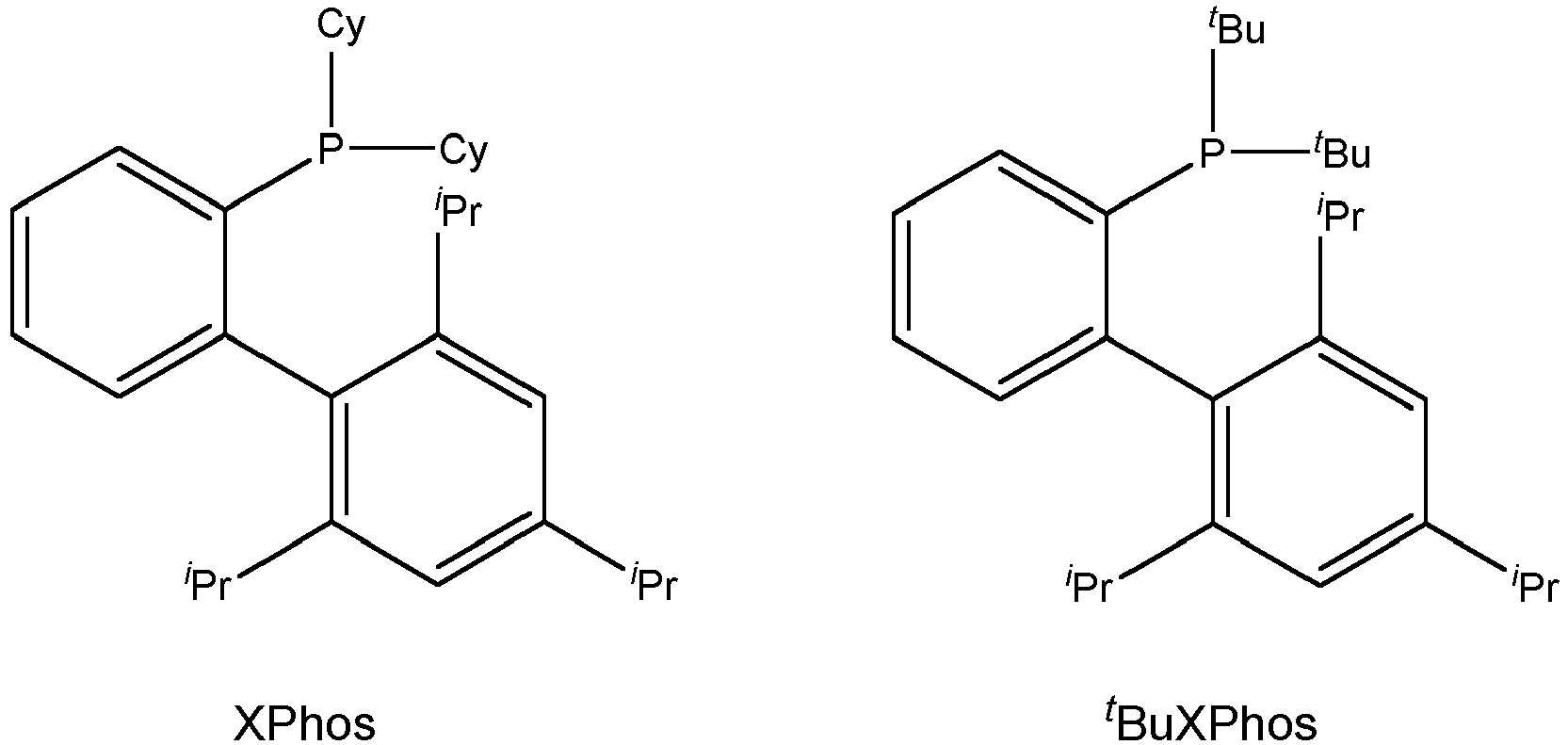


- Ad = adamantyl
- Cy = cyclohexyl
- Bn = benzyl
- Ar = 2,6 dimethoxyphenyl
- Mes = 2,4,6-trimethylphenyl
- The compounds of formula (I) are readily synthesised in a single step from H2PdCl4 in high yield. When X (in the compound for formula (I)) is Cl, the process comprises the step of reacting a compound of formula H2PdCl4 with ligand PR1R2R3. When X (in the compound of formula (I)) is other than CI (i.e. when X is Br, F or I), the process comprises the step of reacting a compound of formula H2PdCl4 with ligand PR1R2R3 and a compound ZX' (where Z is hydrogen or a monovalent metal ion, (such as Li or K) and X' is Br, F or I).
- Thus, a further aspect of the invention provides a process for the preparation of a compound of formula (IA)
[M2Cl6][HPR1R2R3]2 (IA)
wherein M, R1, R2 and R3 are as hereinbefore defined, said process comprising the step of reacting a compound of formula H2PdCl4 with ligand PR1R2R3 or a salt thereof. Suitable salts include but are not limited to, the chloride and tetrafluoroborate. - Another aspect of the invention provides a process for the preparation of a compound of formula (IB)
[M2X'6][HPR1R2R3]2 (IB)
wherein M, R1, R2 and R3 are as hereinbefore defined and X' is bromide, iodide or fluoride (suitably bromide), said process comprising the step of reacting a compound of formula H2PdCl4 with ligand PR1R2R3 or a salt thereof and a compound ZX' wherein Z is hydrogen or a monovalent metal ion, such as Li or K. Suitable salts include but are not limited to, the chloride and tetrafluoroborate. - Compound H2PdCl4 and ligands PR1R2R3 are commercially available from Johnson Matthey PLC, or any other commercial supplier, such as Aldrich, Dalchem, TCI Chemicals
- Compound ZX' is commercially available, for example from Aldrich, Alfa Aesar etc.
- The compound of formula H2PdCl4, ligand PR1R2R3 and, where used, compound ZX' are combined in a solvent. In this case, the solvent is any suitable aprotic solvent or combination of aprotic solvents. Examples of aprotic solvents are toluene, benzene, tetrahydrofuran (THF), 2-methyltetrahydrofuran, dichloromethane (DCM), dioxane, acetone, acetonitrile, dimethylformamide (DMF), N-methylpyrrolidine (NMP), dimethalacetamide (DMAc), methyltertbutylether (MTBE), diethylether, eucalyptol, hexane, heptane, pentane or ethylacetate. Alternatively, a protic solvent, such as ethanol, methanol or water, can be used or a combination of protic/aprotic solvent. The choice of solvent system is within the capability and knowledge of the skilled person knowing the starting materials which will be used.
- In one embodiment, the solvent is acetone.
- The concentration of the compound of formula H2PdCl4 in the solvent is suitably about 0.001 mol/L to about 3.00 mol/L, more suitably about 0.03 mol/L to about 2.50 mol/L, preferably about 0.1 mol/L to about 1.0 mol/L.
- Any suitable quantity of ligand PR1R2R3 may be used, although it is preferred that the molar ratio of the compound of formula H2PdCl4 to ligand PR1R2R3 is from about 15:1 to about 1:15, suitably from about 10:1 to about 1:10, preferably from about 5:1 to about 1:5. In one embodiment the molar ratio of the compound of formula H2PdCl4 to ligand PR1R2R3 is from about 1.5:1 to about 1:1.5. If the ligand is insoluble in the solvent, an excess of the Pd salt is preferred.
- When ZX' is added to the reaction mixture, suitably it is added in an excess compared to the compound of formula H2PdCl4 and ligand PR1R2R3, such as at least 5 mole equivalents, suitably at least 8 mole equivalents.
- The reaction is suitably carried out under an inert atmosphere, such as under nitrogen or argon; preferably, the reaction is carried out under nitrogen. Alternatively, if the ligand is stable, the reaction may be carried out in air.
- The process of the invention may be carried out at a temperature in the range of -10°C to about 100°C, suitably about 0°C to about 60°C, preferably about 0°C to about 35°C and more preferably at ambient temperature (i.e. about 15°C to about 30°C, such as about 18°C to about 27°C). It is preferred that the temperature is maintained below the decomposition temperature and so when the compound for formula (I) is known to decompose with the temperature ranges given above, the temperature should be maintained below the decomposition temperature.
- The reaction may be carried out for a period of from about 30 minutes to about 24 hours. Usually, the reaction is complete within about 6 hours, such as within 4 hours, such as within 1 hour. Often the reaction is essentially instantaneous. After the reaction is complete, the resulting suspension is filtered, washed and dried. Drying may be performed using known methods, for example at temperatures in the range of about 10°C to about 60°C, preferably about 20°C to about 40°C under 1-30mbar vacuum for 1 hour to 5 days. If desired, the compound may be recrystallised. An antisolvent may be used when the compound is soluble.
- The compounds of the invention may be used for carbon-carbon coupling reactions. Examples of carbon-carbon coupling reactions include Heck, Suzuki or Negishi reactions, ketone α-arylation reactions, aldehyde α-arylations reactions, allylic substitution reactions and trifluoromethylation reactions. The catalysts of the present invention may also be used for carbon-heteroatom coupling reactions, such as carbon-nitrogen coupling reactions (ie Buchwald-Hartwig) or carbon-oxygen or carbon-sulphur coupling reactions.
- Thus, in a further aspect the present invention provides a process for carrying out a carbon-carbon coupling reaction in the presence of a catalyst, the process comprising the use of a compound of formula (I) as hereinbefore defined. Alternatively, the present invention provides the use of a compound of formula (I) as hereinbefore define to catalyse a carbon-carbon coupling reaction.
- In a still further aspect, the present invention provides a process for carrying out a carbon-heteroatom coupling reaction, the process comprising the use of a compound of formula (I) as hereinbefore defined. Alternatively, the present invention provides the use of a compound of formula (I) as hereinbefore defined to catalyse a carbon-heteroatom coupling reaction.
- The invention will now be further described by way of the following non-limiting examples.
- All solvents and reagents were purchased from commercial sources and used as received. All catalysts, ligands or precious metal precursors were obtained from Johnson Matthey PLC or commercial sources. All solution phase 1H NMR, 13C NMR, 31P NMR and 19F NMR spectra were recorded on a Bruker Avance DRX-400 spectrometer at ambient temperature; chemical shifts (δ) are given in ppm. 1H and 13C NMR spectra were referenced to the NMR solvent peaks or internal TMS. 31P NMR spectra were calibrated to an external phosphoric acid standard (85% in D2O as provided by Sigma Aldrich). Coupling constants (J) are reported in Hz and apparent splitting patterns are designated using the following abbreviations: s (singlet), d (doublet), t (triplet), q (quartet), m (multiplet), br (broad), app. (apparent) and the appropriate combinations. Solid state 31P NMR were acquired at a static magnetic field strength of 14.1 T (v0 (1H) = 600 MHz) on a Bruker Avance Neo console. The probe was tuned to 242:98 MHz and referenced to ADP at 0:9 ppm. Powdered samples of known mass were packed into zirconia MAS rotors with Kel-F caps. The rotors were spun using ambient temperature purified compressed air. All spectra were recorded using cross polarisation (CP), in which magnetisation is transferred from 1H to 31P nuclei via dipolar coupling. A contact time of 2 ms was used for the 31P experiments and high power (100 kHz) SPINAL-64 decoupling was applied to the 1H channel during acquisition.
- Crystals of sufficient size and quality for analysis by single crystal Xray diffraction were isolated, and data were collected using a Rigaku Oxford Diffraction Supernova Dual Source (four-circle-diffractometer equipped with Oxford Cryosystems Cobra cooling device). The data were collected using Cu Kα radiation as stated in the experimental tables. Structures were solved and refined against F2 values using the Bruker AXS SHELXTL suite or the OLEX2 crystallographic software. All non-hydrogen atoms were refined anisotropically. Hydrogen atoms attached to carbon were placed geometrically and allowed to refine with a riding isotropic displacement parameter. Hydrogen atoms attached to a phosphorus were located in a difference Fourier synthesis and were allowed to refine freely with an isotropic displacement parameter.
- All GC were recorded on a Varian CP-3800 Gas Chromatograph with an Agilent DB-1, 20 m x 0.18 mm column and CP-8400 Autosampler. All samples were run with a standard split injection mode using either He or N2 carrier gas. Samples were run using ethyl acetate or acetonitrile eluent. Conversion was determined by comparative integration of appropriate reagents, products and impurities. Preferably conversion is determined from the ratio of product to aryl halide.
- A 100 mL round bottomed flask equipped with a stir bar and condenser was charged with the ligand or a salt thereof and acetone. The flask was purged with nitrogen then a solution of H2PdCl4 in acetone was added rapidly. The mixture was stirred for a minimum of 0.5 h at ambient temperature (18 - 27 °C). The resulting suspension was filtered then washed with acetone then heptane under air. The catalyst was dried in vacuo at ambient temperature. For reactions producing >40 g catalyst, the round bottomed flask and stir bar was replaced with either a 600 mL beaker or jacketed reactor with overhead stirrer.
- A 100 mL round bottomed flask equipped with a stir bar and condenser was charged with the ligand or a salt thereof and acetone. The flask was purged with nitrogen then a solution of H2PdCl4 in acetone was added rapidly. The mixture was stirred for a minimum of 0.5 h at ambient temperature (18 - 27 °C) then a solution of MBr (M = H, Li, K) in deionized water was added dropwise. The resulting suspension was stirred for a minimum of 90 mins then filtered. The solids were washed with acetone then heptane under air. The catalyst was dried in vacuo at ambient temperature. For reactions producing >40 g catalyst, the round bottomed flask and stir bar was replaced with either a 600 mL beaker or jacketed reactor with overhead stirrer.

- [HAmPhos]2[Pd2Cl6]: Following general procedure A, H2PdCl4 solution (12.0 g Pd, 0.113 mol) and AmPhos (30.0 g, 0.113 mol) are reacted in acetone (140 mL) at rt for 60 min. The resulting suspension is filtered, washed and dried to afford [HAmPhos]2[Pd2Cl6] (51.4 g, 95%) as beige solids. 31P solid-state CPMAS NMR spectra: δ (ppm) 66.4. Anal. Calc for C32H58N2P2Cl6Pd2: C 40.11; H 6.10; N 2.92. Found: C 39.86; H 6.12; N 2.83. Pd Assay w/w% Calc: 22.21. Found 21.36.

- [HCyAmPhos]2[Pd2Cl6]: Following general procedure A, H2PdCl4 solution (0.402 g Pd, 3.78 mmol) and CyAmPhos (1.19 g, 3.74 mmol) are reacted in acetone (15 mL) at rt for 60 min. The resulting suspension is filtered, washed and dried to afford [HCyAmPhos]2[Pd2Cl6] (1.63 g, 83%) as beige solids. 1H NMR (CDCl3): δ (ppm) 7.83 (m, 2H), 7.69 (m, 2H), 3.21 (s, 6H), 2.55 (m, 2H), 2.2 - 1.0 (m, 20H). 31P{1H} = 30.2 ppm in CDCl3.

- [HRuPhos]2[Pd2Cl6]: Following general procedure A, H2PdCl4 solution (7.89 g Pd, 74.1 mmol) and RuPhos (34.5 g, 73.9 mmol) are reacted in acetone (150 mL) at rt for 70 min. The resulting suspension is filtered, washed and dried to afford [HRuPhos]2[Pd2Cl6] (45.9 g, 91%) as red solids. 1H NMR (CDCl3): δ (ppm) 8.51 (dd, J = 12.0, 7.8 Hz, 1H), 7.92 (td, J = 7.7, 1.3 Hz, 1H), 7.72 (t, J = 7.6 Hz, 1H), 7.47 (t, J = 8.4 Hz, 1H), 7.31 (dd, J = 7.4, 1.2 Hz, 1H), 6.77 (s, J = 8.4 Hz, 2H), 6.02 (dt, 1JHP = 468 Hz, 3JHH = 6.7 Hz, 1H), 4.53 (hept, J = 6.1 Hz, 2H), 3.28 (m, 2H), 2.15 (m, 4H), 1.9 - 1.6 (m, 10H), 1.6 - 1.4 (m, 4H), 1.3 - 1.2 (m, 2H), 1.24 (d, J = Hz, 6.1Hz, 6H) 1.08 (d, J = 6.0 Hz, 6H). 13C{1H} NMR (CDCl3): δ (ppm) 156.0, 141.8, 141.7, 134.3, 134.2, 133.6, 133.6, 133.0, 132.9, 131.4, 129.2, 129.1, 118.5, 118.5, 114.6, 113.8, 107.8, 72.0, 29.6, 29.2, 28.3, 28.3, 27.4, 27.4, 25.9, 25.8, 25.7, 25.6, 25.2, 25.2, 22.6, 21.9.31P NMR (CDCl3): δ (ppm) 22.2 (d, 1JHP = 469 Hz). Anal. Calc for C60H88O4P2Cl6Pd2: C 52.96; H 6.62; N 0.00. Found: C 52.91; H 6.57; N 0.00. Pd Assay w/w% Calc: 15.64. Found 15.56.

- [HRuPhos]2[Pd2Br6]: Following general procedure B, H2PdCl4 solution (0.524 g Pd, 4.92 mmol) and RuPhos (2.26 g, 4.84 mmol) are reacted in acetone (15.0 g) at rt for 30 min. To the suspension was added a solution of LiBr (1.80 g, 20.8 mmol) in deionized water (5.0 g) The resulting suspension is filtered, washed and dried to afford [HRuPhos]2[Pd2Br6] (3.9 g, 97%) as red solids. 1H NMR (CDCl3): δ (ppm) 8.47 (dd, J = 12.0, 7.8 Hz, 1H), 7.93 (m, 1H), 7.73 (t, J = 7.7 Hz, 1H), 7.46 (t, J = 8.4 Hz, 1H), 7.32 (dd, J = 7.8, 4.4 Hz, 1H), 6.75 (d, J = 7.9 Hz, 2H), 6.13 (dt, 1JHP = 470 Hz, 3JHH = 6.7 Hz, 1H), 4.53 (hept, J = 6.1 Hz, 2H), 4.39 (m, 2H), 3.30 (m, 2H), 2.18 (m, 4H), 2.0 - 1.3 (m, 14H), 1.26 (d, J = 6.1 Hz, 6H), 1.08 (d, J = 5.9 Hz, 6H). 31P NMR (CDCl3): δ (ppm) 21.7 (d, 1JHP = 470 Hz).

- [HSPhos]2[Pd2Cl6]: Following general procedure A, H2PdCl4 solution (9.07 g Pd, 85.3 mmol) and SPhos (35.0 g, 85.2 mmol) are reacted in acetone (100 mL) at rt for 70 min. The resulting suspension is filtered, washed and dried to afford [HSPhos]2[Pd2Cl6] (49.6 g, 93%) as orange solids. 1H NMR (CDCl3): δ (ppm) 8.14 (m, 1H), 7.76 (m, 2H), 7.69 (t, J = 8.5 Hz, 1H), 7.43 (m, 1H), 6.92 (d, J = 8.2 Hz, 2H), 6.63 (d, 1JHP = 490 Hz, 1H), 3.81 (s, 6H), 3.1 (m, 2H), 2.2-1.2 (m, 20H). 13C{1H} NMR (CDCl3): δ (ppm) 156.8, 141.8, 141.7, 134.0, 134.0, 133.7, 133.6, 133.5, 133.4, 132.5, 128.6, 128.4, 114.5, 114.5, 105.0, 55.8, 30.9, 29.9, 29.5, 27.7, 27.7, 26.8, 26.7, 26.2, 26.0, 26.0, 25.9, 25.2. 31P NMR (CDCl3): δ (ppm) 18.0 (d, 1JHP = 490 Hz). Anal. Calc for C58H72O4P2Cl6Pd2: C 50.02; H 5.81; N 0.00. Found: C 50.30; H 5.86; N 0.00. Pd Assay w/w% Calc: 17.05. Found 16.59.

- [HSPhos]2[Pd2Br6]: Following general procedure B, H2PdCl4 solution (0.527 g Pd, 4.96 mmol) and SPhos (2.03 g, 4.95 mmol) are reacted in acetone (15.0 g) at rt for 30 min. To the suspension was added a solution of LiBr (1.76 g, 20.3 mmol) in deionized water (5.0 g) The resulting suspension is filtered, washed and dried to afford [HSPhos]2[Pd2Br6] (3.62 g, 96%) as red solids. 1H NMR (CDCl3): δ (ppm) 8.11 (m, 1H), 7.77 (m, 2H), 7.70 (t, J = 8.4 Hz, 1H), 7.44 (m, 1H), 6.93 (d, J = 8.5 Hz, 2H), 6.54 (dt, 1JHP = 484 Hz, 3JHH = 6.4 Hz, 1H), 3.81 (s, 6H), 3.13 (m, 2H), 2.2 - 2.0 (m, 4H), 2.0 1.2 (m, 16H). 31P NMR (CDCl3): δ (ppm) 17.9 (d, 1JHP = 484 Hz).
- [HSPhos]2[Pd2Br6] was recrystallised from acetone to obtain red block crystals. The asymmetric unit contains one molecule of HSPhos, half of the Pd2Br6 moiety and one molecule of acetone. Empirical formula: C58H84Br6O6P2Pd2; Formula weight: 1631.45; Temperature: 100 K; Wavelength: 1.54178 Å; Crystal size: 0.200 x 0.200 x 0.070 mm; Crystal habit: dark red cut block; Crystal system: Triclinic; Space group: P-1; Unit cell dimensions: a = 8.4964(3) Å, b = 11.2493(4) Å, c = 16.6037(4) Å, α= 88.969(2)°, β= 78.219(2)°, γ = 80.045(3)°; Volume: 1529.90(8) Å3; Z=1; Density (calculated): 1.771 Mg/m3; Absorption coefficient µ: 10.200 mm-1; F(000): 812; Theta range for data collection: 3.990 to 70.283°; Index ranges: -10 ≤ h ≤ 9,-13 ≤ k ≤ 13, -20 ≤ l ≤ 12; Reflections collected: 29205; Independent reflections: 5809 [R(int) = 0.0350]; Coverage of independent reflections: 100.0 %; Data / restraints / parameters: 5809 / 0 / 342; Goodness-of-fit on F2: 1.068; Δ/σmax: 0.001; Final R indices: 5297 data; I>2σ(I)R1 = 0.0241, wR2 = 0.0574; all data: R1 = 0.0276, wR2 = 0.0598; Δρ: 0.471 and -0.855 eÅ-3.
- A view of [HSPhos]2[Pd2Br6] from the crystal structure (grown fragment) is shown in
Figure 1 . Anisotropic atomic displacement ellipsoids for the non-hydrogen atoms are shown at the 50% probability level. Hydrogen atoms are displayed with an arbitrarily small radius.
- [HXPhos]2[Pd2Cl6]: A 250 mL round bottomed flask equipped with a stir bar and condenser was charged with XPhos (10.3 g, 21.6 mmol) and acetone (55 mL). The flask was purged with nitrogen then 37% w/w HCl (2.40 g, 65.9 mmol) was added dropwise until the XPhos fully dissolved. To the round bottomed flask, a solution of H2PdCl4 (2.33 g, 21.9 mmol) in acetone (15 mL) was added rapidly. The mixture was stirred for 60 min at ambient temperature. The resulting suspension is filtered, washed and dried to afford [HXPhos]2[Pd2Cl6] (2.37 g, 91%) as peach solids. 1H NMR (CDCl3): δ (ppm) 9.12 (dd, J = 12.4, 7.8 Hz, 1H), 8.19 (m, 1H), 7.79 (m, 1H), 7.45 (dd, J = 7.7, 4.8 Hz, 1H), 7.45 (s, 2H), 5.71 (d, 1JHP = 454 Hz, 1H), 3.35 (m, 2H), 2.99 (hept, J = 6.9 Hz, 1H), 2.4 - 2.2 (m, 4H), 2.1 - 1.9 (m, 4H), 1.9 1.6 (m, 12H), 1.5 1.2 (m, 14H), 1.04 (d, J = 6.6 Hz, 6H) . 13C{1H} NMR (CDCl3): δ (ppm) 150.9, 146.6, 145.0, 144.9, 136.6, 136.5, 134.1, 134.0, 132.7, 132.6, 132.0, 132.0, 130.6, 130.4, 121.5, 114.2, 113.4, 34.3, 30.9, 30.7, 30.5, 28.7, 28.7, 28.6, 28.6, 26.4, 26.0, 25.9, 25.9, 25.8, 25.1, 24.0, 22.5. 31P NMR (CDCl3): δ (ppm) 20.4 (d, 1JHP = 452 Hz). Anal. Calc for C66H100P2Cl6Pd2: C 57.40; H 7.30; N 0.00. Found: C 57.68; H 7.51; N 0.00.

- [HtBuXPhos]2[Pd2Cl6]: Following general procedure A, H2PdCl4 solution (8.31 g Pd, 78.5 mmol) and tBuXPhos (33.3 g, 78.3 mmol) are reacted in acetone (100 mL) at rt for 60 min. The resulting suspension is filtered, washed and dried to afford [HtBuXPhos]2[Pd2Cl6] (37.3 g, 75%) as orange solids. Reaction supernatant and acetone washings were combined and concentrated to furnish orange crystals. (7.61 g, 15%). 1H NMR (CDCl3): δ (ppm) 8.51 (dd, J = 11.0, 8.0 Hz, 1H), 8.30 (t, J = 7.0 Hz, 1H), 7.86 (t, J = 7.6 Hz, 1H), 7.54 (dd, J = 6.9, 4.9 Hz, 1H), 7.13 (s, 2H), 5.58 (d, 1JHP = 446 Hz, 1H), 2.98 (hept, J = 6.9 Hz, 1H), 2.37 (hept, J = 6.7 Hz, 2H), 1.77 (s, 9H), 1.73 (s, 9H), 1.32 (d, J = 6.9 Hz, 6H), 1.26 (d, J = 6.9 Hz, 6H), 1.02 (d, J = 6.5 Hz, 6H). 13C{1H} NMR (CDCl3): δ (ppm) 150.9, 146.7, 145.8, 145.7, 135.1, 135.0, 134.2, 134.2, 133.9, 133.8, 131.4, 131.3, 130.5, 130.4, 121.6, 115.0, 114.3, 35.9, 35.6, 34.1, 31.0, 29.2, 26.8, 23.9, 22.2. 31P NMR (CDCl3): δ (ppm) 32.5 (d, 1JHP = 463 Hz). Anal. Calc for C58H92P2Cl6Pd2: C 54.56; H 7.26; N 0.00. Found: C 54.14; H 7.22; N 0.00. Pd Assay w/w% Calc: 16.67. Found 16.47.
- Asymmetric unit contains two independent molecules of HtBuXPhos and one Pd2Cl6 moiety. Empirical formula: C29H46Cl3PPd; Formula weight: 638.38; Temperature: 100(2) K; Wavelength: 1.54178 Å; Crystal size: 0.180 x 0.150 x 0.070 mm; Crystal habit: dark orange fragment; Crystal system: Triclinic; Space group: P-1; Unit cell dimensions: a = 8.5276(2) Å b = 9.6987(2) Å c = 38.5644(6) Å α= 92.1220(10)° β= 94.6160(10)° γ = 104.303(2)°; Volume: 3075.29(11) Å3; Z=4; Density (calculated): 1.379 Mg/m3; Absorption coefficient µ: 7.861 mm-1; F(000): 1328; Theta range for data collection: 3.455 to 70.231°; Index ranges: -10 ≤ h ≤ 10, -11 ≤ k ≤ 11, -39 ≤ l ≤ 47; Reflections collected: 60094; Independent reflections: 11681 [R(int) = 0.0433]; Coverage of independent reflections: 100.0 %; Data / restraints / parameters: 11681 / 0 / 645; Goodness-of-fit on F 2: 1.066; Δ/σmax. 0.009; Final R indices: 9941 data; I>2σ(I)R1 = 0.0296, wR2 = 0.0687; all data: R1 = 0.0387, wR2 = 0.0742; Δρ: 0.657 and -0.492 eÅ-3.
- A view of [HtBuXPhos]2[Pd2Cl6] from the crystal structure is shown in
Figure 2 . Anisotropic atomic displacement ellipsoids for the non-hydrogen atoms are shown at the 50% probability level. Hydrogen atoms are displayed with an arbitrarily small radius
- [HJohnPhos]2[Pd2Cl6]: Following general procedure A, H2PdCl4 solution (0.404 g Pd, 3.79 mmol) and JohnPhos (1.12 g, 3.76 mmol) are reacted in acetone (15 mL) at rt for 40 min. The resulting suspension is filtered, washed and dried to afford [HJohnPhos]2[Pd2Cl6] (1.68 g, 87%) as orange-brown solids. 1H NMR (CD3CN): δ (ppm) 8.00 (m, 1H), 7.92 (tt, J = 7.7, 1.3 Hz, 1H), 7.81 (m, 1H), 7.62 (m, 1H), 7.59 (m, 3H), 7.32 (m, 2H), 6.07 (d, 1JHP = 470 Hz, 1H), 1.47 (s, 9H), 1.43 (s, 9H). 13C{1H} NMR (CD3CN): δ (ppm) 149.4, 149.3, 139.1, 139.0, 135.1, 135.0, 133.4, 133.3, 133.1, 133.1, 130.1, 129.7, 129.5, 129.5, 129.4, 114.8, 114.1, 35.6, 35.3, 27.8.. 31P NMR (CD3CN): δ (ppm) 29.8 (m, 1JHP = 470 Hz). Anal. Calc for C46H56P2Cl6Pd2: C 46.90; H 5.51; N 0.00. Found: C 46.89; H 5.50; N 0.00.
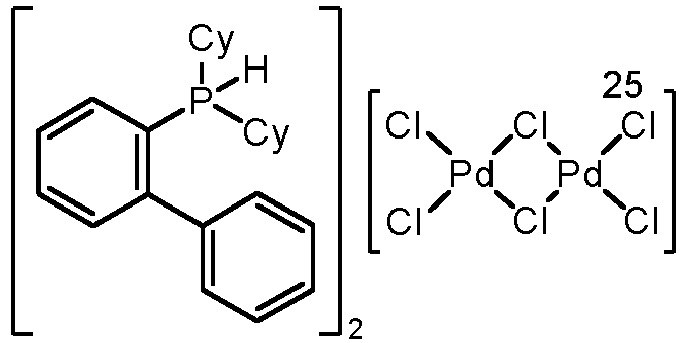
- [HCyJohnPhos]2[Pd2Cl6]: Following general procedure A, H2PdCl4 solution (0.401 g Pd, 3.77 mmol) and CyJohnPhos (1.31 g, 3.75 mmol) are reacted in acetone (15 mL) at rt for 90 min. The resulting suspension is filtered, washed and dried to afford [HCyJohnPhos]2[Pd2Cl6] (1.77 g, 83%) as orange-brown solids. 1H NMR (CDCl3): δ (ppm) 8.58 (dd, J = 12.8, 7.8 Hz, 1H), 7.95 (t, J = 7.4 Hz, 1H), 7.80 (t, J = 7.6 Hz, 1H), 7.63 (m, 3H), 7.53 (dd, J = 7.2, 4.6 Hz, 1H), 7.29 (m, 2H), 6.85 (dt, 1JHP = 473 Hz, 3JHH = 12.3 Hz, 1H), 3.05 (m, 2H), 2.00 (s, 2H), 1.86 (m, 4H), 1.8 - 1.4 (m, 12H), 1.33 (m, 2H). 13C{1H} NMR (CDCl3): δ (ppm) 207.0, 148.0, 148.0, 138.6, 138.6, 135.7, 135.6, 134.4, 134.4, 131.8, 131.7, 130.0, 129.9, 129.6, 129.5, 129.2, 112.9, 112.1, 30.9, 30.7, 30.3, 28.6, 28.5, 27.5, 27.5, 26.0, 25.8, 25.1, 25.1. 31P NMR (CDCl3): δ (ppm) 20.5 (d, 1JHP = 474 Hz). Anal. Calc for C48H64P2Cl6Pd2: C 51.09; H 5.72; N 0.00. Found: C 51.52; H 6.00; N 0.00.

- [HBrettPhos]2[Pd2Cl6]: Following general procedure A, H2PdCl4 solution (7.94 g Pd, 74.6 mmol) and BrettPhos (40.0 g, 74.5 mmol) are reacted in acetone (180 mL) at rt for 70 min. The resulting suspension is filtered, washed and dried to afford [HBrettPhos]2[Pd2Cl6] (45.2 g, 81%) as orange solids. 1H NMR (CDCl3): δ (ppm) 7.78 (m, 2H), 7.10 (s, 2H), 4.96 (dt 1JHP = 444 Hz, 3JHH = 6.2 Hz, 1H), 4.42 (s, 3H), 3.77 (s, 3H), 2.98 (hept, J = 7.0 Hz, 2H), 2.37 (hept J = 6.6 Hz, 1H), 2.22 (m, 2H), 1.95 (m, 2H), 1.9 - 1.5 (m, 10H), 1.59 (m, 2H), 1.4 - 1.1 (m, 18H), 1.02 (d, J = 6.4 Hz, 6H) . 13C{1H} NMR (CDCl3): δ (ppm) 155.5, 155.4, 153.2, 153.1, 150.4, 146.8, 134.8, 134.7, 128.0, 128.0, 121.3, 119.9, 112.9, 112.8, 104.6, 103.8, 58.4, 55.6, 34.1, 31.8, 31.4, 30.8, 30.0, 30.0, 28.4, 28.4, 26.3, 26.2, 26.2, 26.0, 25.4, 25.1, 25.0, 23.9, 23.3. 31P NMR (CDCl3): δ (ppm) 23.0.0 (d, 1JHP = 445 Hz). Anal. Calc for C70H108O4P2Cl6Pd2: C 56.01; H 7.25; N 0.00. Found: C 55.83; H 7.24; N 0.00. Pd Assay w/w% Calc: 14.18. Found 14.06.

- [HtBuBrettPhos]2[Pd2Cl6]: Following general procedure A, H2PdCl4 solution (7.63 g Pd, 71.8 mmol) and tBuBrettPhos (34.8 g, 71.8 mmol) are reacted in acetone (100 mL) at rt for 55 min. The resulting suspension is filtered, washed and dried to afford [HtBuBrettPhos]2[Pd2Cl6] (46.7 g, 93%) as red solids. Reaction supernatant and acetone washings were combined and layered with deionized water to furnish red crystals (2.3 g, 4%).1H NMR (CDCl3): δ (ppm) 8.05 (m, 1H), 7.95 (m, 1H), 7.06 (s, 2H), 5.11 (d, 1JHP = 435 Hz, 1H), 4.35 (m, 3H), 3.76 (s, 3H), 2.94 (m, 1H), 2.37 (m, 2H), 1.54 (s, 9H), 1.50 (s, 9H), 1.29 (m, 6H), 1.22 (m, 6H), 0.97 (m, 6H). 13C{1H} NMR (CDCl3): δ (ppm) 155.2, 155.2, 155.2, 153.7, 153.6, 150.2, 147.3, 147.3, 147.3, 135.2, 135.1, 127.6, 127.6, 121.2, 120.5, 113.4, 113.3, 105.5, 104.8, 57.6, 57.6, 57.5, 55.4, 37.1, 36.8, 33.9, 31.1, 29.6, 29.6, 25.8, 23.8, 22.9. 31P NMR (CDCl3): δ (ppm) 44.0 (d, 1JHP = 436 Hz). Anal. Calc for C62H100O4P2Cl6Pd2: C 53.31; H 7.22; N 0.00. Found: C 53.34; H 7.29; N 0.00. Pd Assay w/w% Calc: 15.24. Found 15.09.

- [HMorDalPhos]2[Pd2Cl6]: Following general procedure A, H2PdCl4 solution (0.117 g Pd, 1.10 mmol) and MorDalPhos (0.500 g, 1.08 mmol) are reacted in acetone (10 mL) at rt for 110 min. The resulting suspension is filtered, washed and dried to afford [HMorDalPhos]2[Pd2Cl6 (0.663 g, 94%) as brown solids. 1H NMR (CD3CN): δ (ppm) 7.88 (t, J = 7.8 Hz, 1H), 7.82 (t, J = 8.9 Hz, 1H), 7.74 (dd, J = 8.0, 4.6 Hz, 1H), 7.56 (td, J = 7.8, 2.2 Hz, 1H), 6.78 (d, 1JHP = 482.4 Hz, 1H), 3.86 (t, J = 4.5 Hz, 4H), 2.90 (m, 4H), 2.20 (s, 24H), 1.81 (s, 6H).13C{1H} NMR (CD3CN): δ (ppm) 158.5, 136.7, 136.6, 134.7, 134.6, 127.4, 127.3, 126.4, 126.3, 112.6, 111.8, 78.8, 66.9, 54.4, 39.4, 39.1, 39.0, 38.9, 35.6, 35.6, 28.4, 28.3. 31P NMR (CD3CN): δ (ppm) 16.16 (d, 1JHP = 483 Hz). Anal. Calc for C60H86O2N2P2Cl6Pd2: C 53.19; H 6.40; N 2.07. Found: C 52.90; H 6.31; N 1.98.

- [HQPhos]2[Pd2Cl6]: Following general procedure A, H2PdCl4 solution (0.301 g Pd, 2.83 mmol) and QPhos (2.00 g, 2.81 mmol) are reacted in acetone (15 mL) at rt for 45 min. The resulting suspension is filtered, washed and dried to afford [HQPhos]2[Pd2Cl6] as red solids (2.28 g, 87%). 1H NMR (CD3CN): δ (ppm) 7.28 (m, 10H), 7.19 (m, 5H), 7.13 (m, 10H), 6.11 (d, 1JHP = 467.4 Hz, 1H), 5.31 (m, 2H), 5.10 (m, 2H), 1.17 (s, 9H), 1.12 (s, 9H).13C{1H} NMR (CD3CN): δ (ppm) 135.1, 133.6, 128.4, 128.2, 91.1, 80.3, 62.5, 61.7, 35.8, 28.4. 31P NMR (CD3CN): δ (ppm) 41.1 (m, 1JHP = 467.6 Hz). Anal. Calc for C96H96Fe2P2Cl6Pd2: C 62.36; H 5.23; N 0.00. Found: C 61.95; H 5.47; N 0.00.

- [HPCys]2[Pd2Cl6]: Following general procedure A, H2PdCl4 solution (0.404 g Pd, 3.79 mmol) and PCy3 (1.05 g, 3.75 mmol) are reacted in acetone (25 mL) at rt for 45 min. The resulting suspension is filtered, washed and dried to afford [HPCy3]2[Pd2Cl6] and (PCy3)PdCl2 in approximately 9:1 ratio. 1H NMR (CDCl3): δ (ppm) 7.31 (d, 1JHP = 473.9 Hz, 1H), 2.77 (m, 3H), 2.32 (m, 6H), 2.1 - 1.2 (m, 24H). 31P NMR (CDCl3): δ (ppm) 24.3 (m, 1JHP = 474.0 Hz).
- [HPCy3]2[Pd2Cl6] was recrystallised from chloroform to obtain orange plates. The asymmetric unit contains one molecule of HPCy3, half of the Pd2Cl6 moiety and one molecule of chloroform. Empirical formula: C19H35Cl6PPd; Formula weight: 613.54; Temperature: 100(2) K; Wavelength: 1.54178 Å; Crystal size: 0.150 x 0.150 x 0.005 mm; Crystal habit: pale orange plate; Crystal system: Monoclinic; Space group: P21/n; Unit cell dimensions: a = 11.2868(2) Å b = 17.1273(4) Å c = 13.1224(3) Å α= 90° β= 93.959(2)° γ = 90°; Volume: 2530.67(9) Å3; Z=4; Density (calculated): 1.610 Mg/m3; Absorption coefficient µ: 12.368 mm-1; F(000): 1248; Theta range for data collection: 4.251 to 70.246°; Index ranges: -13 ≤ h ≤ 13, -18 ≤ k ≤ 20,-15 ≤ l ≤ 15; Reflections collected: 24631; Independent reflections: 4779 [R(int) = 0.0574]; Coverage of independent reflections: 100.0 %; Data / restraints / parameters: 4779 / 0 / 248; Goodness-of-fit on F 2: 1.040; Δ/σmax: 0.001; Final R indices: 4130 data; I>2σ(I)R1 = 0.0353, wR2 = 0.0925; all data: R1 = 0.0427, wR2 = 0.0992; Δρ: 1.213 and -0.896 eÅ-3.
- A view of [HPCy3]2[Pd2Cl6] from the crystal structure (grown fragment) is shown in
Figure 3 . Anisotropic atomic displacement ellipsoids for the non-hydrogen atoms are shown at the 50% probability level. Hydrogen atoms are displayed with an arbitrarily small radius.
- [HP t Bu3]2[Pd2Cl6]: Following general procedure A, H2PdCl4 solution (63 mg Pd, 0.59 mmol) and P t Bu3 (12 wt% in xylenes, 0.96 g, 0.57 mmol) are reacted in acetone (2 mL) at rt for 30 min. Water (2 mL) is added to the mixture and the resulting suspension is filtered, washed and dried to afford [HP t Bu3]2[Pd2Cl6] as red solids. 1H NMR (CDCl3): δ (ppm) 7.93 (d, 1JHP = 461.0 Hz, 1H), 1.91 (d, J = 15.2 Hz, 27H), 31P NMR (CDCl3): δ (ppm) 48.2 (m, 1JHP = 465.8 Hz).

- [HP t Bu2 n hexyl]2[Pd2Cl6]: Following general procedure A, H2PdCl4 solution (35 mg Pd, 0.33 mmol) and di-tert-butyl(n-hexyl)phosphonium tetrafluoroborate (0.10 g, 0.32 mmol) are reacted in acetone (2 mL) at rt for 30 min. Water (2 mL) is added to the mixture and the product precipitates over 15 min. The resulting suspension is filtered, washed and dried to afford [HP t Bu2 nhexyl]2[Pd2Cl6] as orange solids (0.11 g, 75%). 1H NMR (CDCl3): δ (ppm) 7.70 (d, 1JHP = 471.6 Hz, 1H), 2.45 (m, 2H), 2.15 (m, 2H), 1.76 (d, J = 16.2 Hz, 18H), 1.61 (m, 2H), 1.40 (m, 4H), 0.91 (t, J = 7.0 Hz, 3H). 31P NMR (CDCl3): δ (ppm) 40.1 (m, 1JHP = 472.7 Hz).

- [HPAd3]2[Pd2Cl6]: Following general procedure A, H2PdCl4 solution (31 mg Pd, 0.29 mmol) and PAd3 (125 mg, 0.29 mmol) are reacted in acetone (4 mL) at rt for 60 min. The resulting suspension is filtered, washed and dried to afford [HPAd3]2[Pd2Cl6] as orange solids (136 mg, 72%). 1H NMR (CDCl3): δ (ppm) 7.28 (d, 1JHP = 450.2 Hz, 1H), 2.84 (s, 12H), 2.3-2.1 (m, 13H), 2.02 (m, 6H), 1.82 (m, 6H), 1.66 (m, 8H). 31P NMR (CDCl3): δ (ppm) 25.9 (m, 1JHP = 447.7 Hz).

- [HCataCXiumA]2[Pd2Cl6]: Following general procedure A, H2PdCl4 solution (39 mg Pd, 0.37 mmol) and CataCXiumA (133 mg, 0.37 mmol) are reacted in acetone (4 mL) at rt for 40 min. Water (1 mL) is added to the mixture and the resulting suspension is filtered, washed and dried to afford [HCataCXiumA]2[Pd2Cl6] as orange solids (148 mg, 68%). 1H NMR (CDCl3): δ (ppm) 7.29 (d, 1JHP = 464.6 Hz, 1H), 2.6 - 2.4 (m, 11H), 2.25 (s, 4H), 2.1 - 1.9 (m, 6H), 1.85 (m, 4H), 1.64 (m, 2H), 1.29 (m, 6H), 1.05 (m, 3H), 0.89 (m, 3H). 31P NMR (CDCl3): δ (ppm) 29.8 (m, 1JHP = 464.6 Hz).

- [HCataCXiumABn]2[Pd2Cl6]: Following general procedure A, H2PdCl4 solution (38 mg Pd, 0.36 mmol) and CataCXiumABn (137 mg, 0.35 mmol) are reacted in acetone (2 mL) at rt for 40 min. The resulting suspension is filtered, washed and dried to afford [HCataCXiumABn]2[Pd2Cl6] as beige solids (175 mg, 82%). 1H NMR (CDCl3): δ (ppm) 7.5 - 7.3 (m, 5H), 5.58 (dt, 1JHP = 457.2 Hz, 3JHH = 5.5 Hz, 1H), 3.73 (dd, J = 12.7, 5.5 Hz, 2H), 2.2 - 2.0 (m, 18H), 1.84 (m, 12H).31P NMR (CDCl3): δ (ppm) 37.5 (m, 1JHP = 458.0 Hz).

- [HP(2,6-dimethoxyphenyl)3]2[Pd2Cl6]: Following general procedure A, H2PdCl4 solution (0.13 g Pd, 1.16 mmol) and tris(2,6-dimethoxyphenyl)phosphine (0.51 g, 1.16 mmol) are reacted in acetone (4 mL) at rt for 60 min. The resulting suspension is filtered, washed and dried to afford [HP(2,6-dimethoxyphenyl)3]2[Pd2Cl6] as orange solids (0.667 g, 87%). 1H NMR (CD3CN): δ (ppm) 8.53 (d, 1JHP = 548.5 Hz, 1H), 7.64 (t, J = 8.4 Hz, 3H), 6.76 (d, J = 8.4 Hz, 3H), 6.74 (d, J = 8.5 Hz, 3H), 3.67 (s, 18H). 31P NMR (CD3CN): δ (ppm) -51.1 (d, 1JHP = 548.7 Hz). (Ar = 2,6-dimethoxyphenyl)

- [HP(2,4,6-trimethylphenyl)3]2[Pd2Cl6]: Following general procedure A, H2PdCl4 solution (0.11 g Pd, 1.07 mmol) and tris(2,4,6-trimethylphenyl)phosphine (0.41 g, 1.06 mmol) are reacted in acetone (6 mL) at rt for 30 min. Water (5 mL) is added to the mixture and the resulting suspension is filtered, washed and dried to afford [HP(2,4,6-trimethylphenyl)3]2[Pd2Cl6] as red solids (0.52 g, 81%). Mother liquor and acetone washings were combined and concentrated to furnish orange crystals. 1H NMR (CDCl3): δ (ppm) 8.81 (d, 1JHP = 499.3 Hz, 1H), 7.15 (m, br, 6H), 2.66 (s, br 9H), 2.41 (s, 9H), 2.04 (s, 9H). 31P NMR (CDCl3): δ (ppm) -26.4 (d, 1JHP = 499.5.7 Hz).
- Asymmetric unit contains two independent molecules of HP(2,4,6-trimethylphenyl)3 and one Pd2Cl6 moiety. Empirical formula: C27H34Cl3PPd; Formula weight: 602.26; Temperature: 100(2) K; Wavelength: 1.54178 Å; Crystal size: 0.180 x 0.060 x 0.060 mm; Crystal habit: dark orange fragment; Crystal system: Monoclinic; Space group: P21/c; Unit cell dimensions: a = 14.43655(17) Å b = 25.5543(3) Å c = 15.31900(19) Å α= 90° β= 108.3280(13)° γ = 90°; Volume: 5364.73(12) Å3; Z=8; Density (calculated): 1.491 Mg/m3; Absorption coefficient: 8.985 mm-1; F(000): 2464; Theta range for data collection: 3.459 to 70.251°; Index ranges: -17 ≤ h ≤ 14, -30 ≤ k ≤ 30, -18 ≤ l ≤ 18; Reflections collected: 53878; Independent reflections: 10155 [R(int) = 0.0521]; Coverage of independent reflections: 99.9 %; = Data / restraints / parameters: 10155/0/603; Goodness-of-fit on F2: 1.051; Δ/σmax. 0.004; Final R indices 8700 data; I>2σ(I)R1 = 0.0304, wR2 = 0.0714; all data: R1 = 0.0391, wR2 = 0.0769; = Δρ: 0.633 and -0.419 eÅ-3.
- A view of [HP(2,4,6-trimethylphenyl)3]2[Pd2Cl6] from the crystal structure (asymmetric part is) is shown in
Figure 4 . Anisotropic atomic displacement ellipsoids for the non-hydrogen atoms are shown at the 50% probability level. Hydrogen atoms are displayed with an arbitrarily small radius. -

- A 4mL vial quipped with a stir bar and polypropylene cap with PTFE-faced silicone septum was charged with catalyst and NaO t Bu (2.5 mmol) in the glovebox. On the bench 5-chloro-1,5-dimethyl pyrazole (1.0mmol), 1-tetralone (1.3 mmol) and dioxane (2 mL) were added via needle. The vials were placed in a pre-heated aluminium block at 100 °C and stirred for 22 hours. After cooling to room temperature an aliquot was diluted in ethyl acetate and filtered for GC analysis.
* average conversion over 2 runs Example [Pd] GC Yield % * 2a (not of the invention) Pd-132 73 2b (not of the invention) AmPhos G3 78 2c [HAmPhos]2[Pd2Cl6] 79 -

- A 4 mL vial equipped with a stir bar and polypropylene cap with PTFE-faced silicone septum was charged with catalyst and CsCOs (2.2 mmol) in the glovebox. On the bench 5-chloro-1,5-dimethylpyrazole (1.0 mmol), 1-decyne (1.3 mmol) and acetontrile (2 mL) were added via needle. The vials were placed in a pre-heated aluminium block at 90 °C and stirred for 5 h. After cooling to room temperature an aliquot was diluted in ethyl acetate and filtered for GC analysis.
Example [Pd] GC Yield % * 3a (not of the invention) Pd-161 10 3b (not of the invention) AmPhos G3 20 3c [HAmPhos]2[Pd2Cl6] 9 3d (not of the invention) Pd-171 14 3e (not of the invention) RuPhos G3 11 3f [HRuPhos]2[Pd2Cl6] 23 3g (not of the invention) Pd-170 25 3h (not of the invention) XPhos G3 21 3i [HXPhos]2[Pd2Cl6] 53 3j (not of the invention) Pd-173 77 3k (not of the invention) BrettPhosG3 16 3l [HBrettPhos]2[Pd2Cl6] 76 * average conversion over 2 runs -

- A 4 mL vial equipped with a stir bar and polypropylene cap with PTFE-faced silicone septum was charged with catalyst and K3PO4 (3.1 mmol) and 3-thienylboronic acid (2.3 mmol) in the glovebox. On the bench 5-chloro-1,5-dimethylpyrazole (1.5 mmol), THF (1.0 mL) and water (2.0 mL) were added via needle. The vials were placed in a pre-heated aluminium block at 40 °C and stirred for 3 h. After cooling to room temperature an aliquot was diluted in ethyl acetate and filtered for GC analysis.
Example [Pd] GC Yield % * 4a (not of the invention) Pd-170 60 4b (not of the invention) XPhos G4 59 4c (not of the invention) XPhos G3 61 4d (not of the invention) Pd-111 + XPhos 56 4e [HXPhos]2[Pd2Cl6] 64 * average conversion over 2 runs -

- A 4 mL vial equipped with a stir bar and polypropylene cap with PTFE-faced silicone septum was charged with catalyst and NaO t Bu (2.4 mmol) in the glovebox. On the bench 4-chloroanisole (2.0 mmol), morpholine (2.4 mmol) and THF (2 mL) were added via needle. The vials were placed in a pre-heated aluminium block at 80 °C and stirred for 4 h. After cooling to room temperature an aliquot was diluted in acetonitrile and filtered for GC analysis.
Example [Pd] GC Yield % * 5a (not of the invention) Pd-170 >99 5b (not of the invention) XPhos G3 29 5c [HXPhos]2[Pd2Cl6] >99 * average conversion over 2 runs -
- Pd-111: Palladium acetate
- Pd-132: PdCl2(AmPhos)2
- Pd-161: AmPhos Pd(crotyl)CI
- Pd-170: XPhos Pd(crotyl)CI
- Pd-171: RuPhos Pd(crotyl)CI
- Pd-173: [BrettPhos Pd(crotyl)]OTf
- G3 Palladacycles:

- AmPhos G3: L = AmPhos
- RuPhos G3: L = RuPhos
- XPhos G3: L = XPhos
- BrettPhos G3: L = BrettPhos
- G4 Palladacycles:

- AmPhos G4: L = AmPhos
- XPhos G4: L = XPhos
Claims (14)
- A compound of formula (I)
 wherein M is Pd(ll) or Ni(II);X is a halide;R1 and R2 are independently organic groups having 1-20 carbon atoms, or R1 and R2 are linked to form a ring structure with the phosphorus atom;R3 is an organic group having 1-20 carbon atoms;provided that R1, R2, R3 are not each phenyl.
 - A compound according to claim 1, wherein M is Pd.
- A compound according to claim 1 or 2, wherein X is Cl, Br or I.
- A compound according to claim 3, wherein X is Cl or Br.
- A compound according to any preceding claim, wherein R1 and R2 are independently selected from the group consisting of alkyl, cycloalkyl, aryl, and heteroaryl wherein the heteroatoms are independently selected from sulphur, nitrogen and oxygen.
- A compound according to claim 5, wherein R1 and R2 are independently selected from the group consisting of alkyl, cycloalkyl and aryl.
- A compound according to any preceding claim, wherein R3 is selected from the group consisting of alkyl, cycloalkyl, aryl, heteroaryl and metallocenyl.
- A compound according to any one of claims 1 to 4, wherein PR1R2R3 is selected from the group:


 Ad = adamantylCy = cyclohexylBn = benzylAr = 2,6 dimethoxyphenylMes = 2,4,6-trimethylphenyl
 - A process for the preparation of a compound of formula (IA)
[M2Cl6][HPR1R2R3]2 (IA)
wherein M is Pd(ll) or Ni(II);R1 and R2 are independently organic groups having 1-20 carbon atoms, or R1 and R2 are linked to form a ring structure with the phosphorus atom;and R3 is an organic group having 1-20 carbon atomsprovided that R1, R2, and R3 are not each phenyl,said process comprising the step of reacting a compound of formula H2PdCl4 with ligand PR1R2R3 or a salt thereof. - A process for the preparation of a compound of formula (IB)
[M2X'6][HPR1R2R3]2 (IB)
wherein M is Pd(ll) or Ni(II);R1 and R2 are independently organic groups having 1-20 carbon atoms, or R1 and R2 are linked to form a ring structure with the phosphorus atom;R3 is an organic group having 1-20 carbon atoms provided that R1, R2, and R3 are not each phenyl;and X' is bromide, iodide or fluoride, said process comprising the step of reacting a compound of formula H2PdCl4 with ligand PR1R2R3 or a salt thereof and a compound ZX' wherein Z is hydrogen or a monovalent metal ion. - A process for carrying out a carbon-carbon coupling reaction in the presence of a catalyst, the process comprising the use of a compound according to any one of claims 1 to 8.
- The use of a compound according to any one of claims 1 to 8 to catalyse a carbon-carbon coupling reaction.
- A process for carrying out a carbon-heteroatom coupling reaction in the presence of a catalyst, the process comprising the use of a compound according to any one of claims 1 to 8.
- The use of a compound according to any one of claims 1 to 8 to catalyse a carbon-heteroatom coupling reaction.
Applications Claiming Priority (2)
| Application Number | Priority Date | Filing Date | Title |
|---|---|---|---|
| GBGB1918871.3A GB201918871D0 (en) | 2019-12-19 | 2019-12-19 | Complexes |
| PCT/GB2020/051858 WO2020229848A1 (en) | 2019-12-19 | 2020-08-03 | Complexes |
Publications (3)
| Publication Number | Publication Date |
|---|---|
| EP4076741A1 EP4076741A1 (en) | 2022-10-26 |
| EP4076741B1 true EP4076741B1 (en) | 2024-09-25 |
| EP4076741C0 EP4076741C0 (en) | 2024-09-25 |
Family
ID=69322963
Family Applications (1)
| Application Number | Title | Priority Date | Filing Date |
|---|---|---|---|
| EP20751655.0A Active EP4076741B1 (en) | 2019-12-19 | 2020-08-03 | Complexes |
Country Status (8)
| Country | Link |
|---|---|
| US (1) | US12240866B2 (en) |
| EP (1) | EP4076741B1 (en) |
| JP (1) | JP7607035B2 (en) |
| KR (1) | KR20220111247A (en) |
| CN (1) | CN114555615B (en) |
| ES (1) | ES2993147T3 (en) |
| GB (1) | GB201918871D0 (en) |
| WO (1) | WO2020229848A1 (en) |
Family Cites Families (7)
| Publication number | Priority date | Publication date | Assignee | Title |
|---|---|---|---|---|
| EP2019107A1 (en) * | 2007-07-26 | 2009-01-28 | Dynamit Nobel GmbH Explosivstoff- und Systemtechnik | Use of phosphonium salts in coupling reactions and process for their manufacture |
| EP2871199B1 (en) * | 2012-07-06 | 2018-02-21 | Sumitomo Chemical Company Limited | Method for producing aromatic compound |
| WO2015189554A1 (en) | 2014-06-12 | 2015-12-17 | Johnson Matthey Public Limited Company | Complexes |
| EP3154689B1 (en) | 2014-06-12 | 2021-01-27 | Johnson Matthey Public Limited Company | Complexes |
| EP3385270A4 (en) * | 2015-12-02 | 2020-01-22 | Sumitomo Chemical Company, Ltd | PROCESS FOR PRODUCING AROMATIC COMPOUND AND PALLADIUM COMPLEX |
| WO2018073559A1 (en) | 2016-10-21 | 2018-04-26 | Johnson Matthey Public Limited Company | Process |
| CN110240616B (en) | 2018-03-07 | 2021-03-23 | 东莞市均成高新材料有限公司 | Triarylmonophosphine ligands, methods for their preparation and use in catalytic coupling reactions |
-
2019
- 2019-12-19 GB GBGB1918871.3A patent/GB201918871D0/en not_active Ceased
-
2020
- 2020-08-03 WO PCT/GB2020/051858 patent/WO2020229848A1/en not_active Ceased
- 2020-08-03 KR KR1020227009482A patent/KR20220111247A/en active Pending
- 2020-08-03 CN CN202080067010.0A patent/CN114555615B/en active Active
- 2020-08-03 EP EP20751655.0A patent/EP4076741B1/en active Active
- 2020-08-03 ES ES20751655T patent/ES2993147T3/en active Active
- 2020-08-03 US US17/753,700 patent/US12240866B2/en active Active
- 2020-08-03 JP JP2022518371A patent/JP7607035B2/en active Active
Also Published As
| Publication number | Publication date |
|---|---|
| US20220356200A1 (en) | 2022-11-10 |
| EP4076741A1 (en) | 2022-10-26 |
| CN114555615B (en) | 2026-05-12 |
| GB201918871D0 (en) | 2020-02-05 |
| US12240866B2 (en) | 2025-03-04 |
| KR20220111247A (en) | 2022-08-09 |
| ES2993147T3 (en) | 2024-12-23 |
| JP7607035B2 (en) | 2024-12-26 |
| CN114555615A (en) | 2022-05-27 |
| JP2023506676A (en) | 2023-02-20 |
| WO2020229848A1 (en) | 2020-11-19 |
| EP4076741C0 (en) | 2024-09-25 |
Similar Documents
| Publication | Publication Date | Title |
|---|---|---|
| Field et al. | Synthesis and structure of FeCl (C. tplbond. CPh)(DMPE) 2 | |
| Machnitzki et al. | Water-soluble phosphines: Part XII. Pd catalyzed PC coupling reactions: a novel synthetic route to cationic phosphines with para-and meta-guanidiniumphenyl moieties | |
| Harris et al. | Lead and tin β-diketiminato amido/anilido complexes: competitive nucleophilic reactivity at the β-diketiminato γ-carbon | |
| Dange et al. | Synthesis and characterisation of anionic and neutral gallium (I) N-heterocyclic carbene analogues | |
| Carey et al. | Structures and reactions of monomeric and dimeric lithium diazapentadienyl complexes with electrophiles: synthesis of α-C, C′-dialkyl-β-diimines, and dissolution-reversible synthesis of an α-alkoxylithium-β-diimine | |
| Perry et al. | Mono, bis, and tris (phosphoramidate) titanium complexes: synthesis, structure, and reactivity investigations | |
| Zhang et al. | Nickel complexes supported by quinoline-based ligands: synthesis, characterization and catalysis in the cross-coupling of arylzinc reagents and aryl chlorides or aryltrimethylammonium salts | |
| Todd et al. | Organoaluminum (iii) complexes of the bis-N, N′-(2, 6-diisopropylphenyl) imidazolin-2-imine ligand | |
| Deeming et al. | para-Ethynyl aniline as a building block for fully π-conjugated ligands and acetylide complexes: crystal structures of trans-[Pt (PPh3) 2 (C CC6H4NH2) 2] and [(μ-H) Ru3 (CO) 9 (μ3-C CC6H4NH2)] | |
| Findlater et al. | Synthesis and structure of two new (guanidinate) boron dichlorides and their attempted conversion to boron (i) derivatives | |
| Jia et al. | Synthesis and reactivity of ruthenium hydride complexes of chelating triphosphines. 3. Synthesis and characterization of new ruthenium hydride complexes containing C6H5P (CH2CH2CH2P (c-C6H11) 2) 2 (Cyttp) | |
| Yang et al. | The behavior of pyrrolyl ligands within the rare-earth metal alkyl complexes. Insertion of C [double bond, length as m-dash] N and C [double bond, length as m-dash] O double bonds into Ln–σ-C bonds | |
| Hegetschweiler et al. | Structural studies on [Mo3S4] 4+ and [Mo3S4Cu] 4+ complexes with tripodal ligands providing various NxOy (x+ y= 3) donor sets | |
| Deblon et al. | Highly distorted d 8-rhodium (+ I) and d 10-rhodium (− I) complexes: synthesis, reactivity, and structures in solution and solid state | |
| He et al. | Effects of substituents on the formation of rhenium carbyne and η 2-vinyl complexes from the reactions of ReH 5 (PMe 2 Ph) 3 with terminal alkynes | |
| Guo et al. | Potassium complexes containing bidentate pyrrole ligands: synthesis, structures, and catalytic activity for the cyclotrimerization of isocyanates | |
| Freund et al. | Nickelalactones with an allyl subunit–the effect of penta-coordination on structures and stability | |
| US12240866B2 (en) | Transition metal dimer complex as a catalyst | |
| Jenkins et al. | Double lithiation of 2, 4, 6-triphenylbromobenzene: synthesis of bis-amidines and an aluminium bis-amidinate complex | |
| Frøseth et al. | Synthesis and characterization of novel Pd (ii) complexes with chelating and non-chelating heterocyclic iminocarbene ligands | |
| Guo et al. | Synthesis and structural characterization of novel mixed-valent samarium and divalent ytterbium and europium complexes supported by amine bis (phenolate) ligands | |
| US9150597B2 (en) | Arylalcohols and metal complexes thereof | |
| Shishkov et al. | Reversible substrate binding at copper centers in neutral copper (I) carbene complexes derived from bis (3-tert-butylimidazole-2-ylidene) methane | |
| Qi et al. | Synthesis, characterization and reactivity of heteroleptic rare earth metal bis (phenolate) complexes | |
| Schüler et al. | Sterically shielded primary anilides of the alkaline-earth metals of the type (thf) n Ae (NH-Ar*) 2 (Ae= Mg, Ca, Sr, and Ba; Ar*= bulky aryl) |
Legal Events
| Date | Code | Title | Description |
|---|---|---|---|
| STAA | Information on the status of an ep patent application or granted ep patent |
Free format text: STATUS: UNKNOWN |
|
| STAA | Information on the status of an ep patent application or granted ep patent |
Free format text: STATUS: THE INTERNATIONAL PUBLICATION HAS BEEN MADE |
|
| PUAI | Public reference made under article 153(3) epc to a published international application that has entered the european phase |
Free format text: ORIGINAL CODE: 0009012 |
|
| STAA | Information on the status of an ep patent application or granted ep patent |
Free format text: STATUS: REQUEST FOR EXAMINATION WAS MADE |
|
| 17P | Request for examination filed |
Effective date: 20220510 |
|
| AK | Designated contracting states |
Kind code of ref document: A1 Designated state(s): AL AT BE BG CH CY CZ DE DK EE ES FI FR GB GR HR HU IE IS IT LI LT LU LV MC MK MT NL NO PL PT RO RS SE SI SK SM TR |
|
| DAV | Request for validation of the european patent (deleted) | ||
| DAX | Request for extension of the european patent (deleted) | ||
| P01 | Opt-out of the competence of the unified patent court (upc) registered |
Effective date: 20230526 |
|
| STAA | Information on the status of an ep patent application or granted ep patent |
Free format text: STATUS: EXAMINATION IS IN PROGRESS |
|
| 17Q | First examination report despatched |
Effective date: 20231010 |
|
| REG | Reference to a national code |
Ref country code: DE Ref legal event code: R079 Free format text: PREVIOUS MAIN CLASS: B01J0031300000 Ipc: C07F0015000000 Ref country code: DE Ref legal event code: R079 Ref document number: 602020038323 Country of ref document: DE Free format text: PREVIOUS MAIN CLASS: B01J0031300000 Ipc: C07F0015000000 |
|
| GRAP | Despatch of communication of intention to grant a patent |
Free format text: ORIGINAL CODE: EPIDOSNIGR1 |
|
| STAA | Information on the status of an ep patent application or granted ep patent |
Free format text: STATUS: GRANT OF PATENT IS INTENDED |
|
| RIC1 | Information provided on ipc code assigned before grant |
Ipc: B01J 31/24 20060101ALI20240216BHEP Ipc: B01J 31/30 20060101ALI20240216BHEP Ipc: C07F 17/02 20060101ALI20240216BHEP Ipc: C07F 15/00 20060101AFI20240216BHEP |
|
| INTG | Intention to grant announced |
Effective date: 20240321 |
|
| GRAS | Grant fee paid |
Free format text: ORIGINAL CODE: EPIDOSNIGR3 |
|
| GRAA | (expected) grant |
Free format text: ORIGINAL CODE: 0009210 |
|
| STAA | Information on the status of an ep patent application or granted ep patent |
Free format text: STATUS: THE PATENT HAS BEEN GRANTED |
|
| AK | Designated contracting states |
Kind code of ref document: B1 Designated state(s): AL AT BE BG CH CY CZ DE DK EE ES FI FR GB GR HR HU IE IS IT LI LT LU LV MC MK MT NL NO PL PT RO RS SE SI SK SM TR |
|
| REG | Reference to a national code |
Ref country code: GB Ref legal event code: FG4D |
|
| REG | Reference to a national code |
Ref country code: CH Ref legal event code: EP |
|
| REG | Reference to a national code |
Ref country code: DE Ref legal event code: R096 Ref document number: 602020038323 Country of ref document: DE |
|
| REG | Reference to a national code |
Ref country code: IE Ref legal event code: FG4D |
|
| U01 | Request for unitary effect filed |
Effective date: 20241002 |
|
| P04 | Withdrawal of opt-out of the competence of the unified patent court (upc) registered |
Free format text: CASE NUMBER: APP_57814/2024 Effective date: 20241022 |
|
| U07 | Unitary effect registered |
Designated state(s): AT BE BG DE DK EE FI FR IT LT LU LV MT NL PT RO SE SI Effective date: 20241024 |
|
| REG | Reference to a national code |
Ref country code: ES Ref legal event code: FG2A Ref document number: 2993147 Country of ref document: ES Kind code of ref document: T3 Effective date: 20241223 |
|
| PG25 | Lapsed in a contracting state [announced via postgrant information from national office to epo] |
Ref country code: NO Free format text: LAPSE BECAUSE OF FAILURE TO SUBMIT A TRANSLATION OF THE DESCRIPTION OR TO PAY THE FEE WITHIN THE PRESCRIBED TIME-LIMIT Effective date: 20241225 |
|
| PG25 | Lapsed in a contracting state [announced via postgrant information from national office to epo] |
Ref country code: GR Free format text: LAPSE BECAUSE OF FAILURE TO SUBMIT A TRANSLATION OF THE DESCRIPTION OR TO PAY THE FEE WITHIN THE PRESCRIBED TIME-LIMIT Effective date: 20241226 |
|
| PG25 | Lapsed in a contracting state [announced via postgrant information from national office to epo] |
Ref country code: RS Free format text: LAPSE BECAUSE OF FAILURE TO SUBMIT A TRANSLATION OF THE DESCRIPTION OR TO PAY THE FEE WITHIN THE PRESCRIBED TIME-LIMIT Effective date: 20241225 |
|
| PG25 | Lapsed in a contracting state [announced via postgrant information from national office to epo] |
Ref country code: RS Free format text: LAPSE BECAUSE OF FAILURE TO SUBMIT A TRANSLATION OF THE DESCRIPTION OR TO PAY THE FEE WITHIN THE PRESCRIBED TIME-LIMIT Effective date: 20241225 Ref country code: NO Free format text: LAPSE BECAUSE OF FAILURE TO SUBMIT A TRANSLATION OF THE DESCRIPTION OR TO PAY THE FEE WITHIN THE PRESCRIBED TIME-LIMIT Effective date: 20241225 Ref country code: GR Free format text: LAPSE BECAUSE OF FAILURE TO SUBMIT A TRANSLATION OF THE DESCRIPTION OR TO PAY THE FEE WITHIN THE PRESCRIBED TIME-LIMIT Effective date: 20241226 |
|
| RAP4 | Party data changed (patent owner data changed or rights of a patent transferred) |
Owner name: JOHNSON MATTHEY PUBLIC LIMITED COMPANY |
|
| U1H | Name or address of the proprietor changed after the registration of the unitary effect |
Owner name: JOHNSON MATTHEY PUBLIC LIMITED COMPANY; GB |
|
| PG25 | Lapsed in a contracting state [announced via postgrant information from national office to epo] |
Ref country code: IS Free format text: LAPSE BECAUSE OF FAILURE TO SUBMIT A TRANSLATION OF THE DESCRIPTION OR TO PAY THE FEE WITHIN THE PRESCRIBED TIME-LIMIT Effective date: 20250125 |
|
| PG25 | Lapsed in a contracting state [announced via postgrant information from national office to epo] |
Ref country code: SM Free format text: LAPSE BECAUSE OF FAILURE TO SUBMIT A TRANSLATION OF THE DESCRIPTION OR TO PAY THE FEE WITHIN THE PRESCRIBED TIME-LIMIT Effective date: 20240925 |
|
| PG25 | Lapsed in a contracting state [announced via postgrant information from national office to epo] |
Ref country code: PL Free format text: LAPSE BECAUSE OF FAILURE TO SUBMIT A TRANSLATION OF THE DESCRIPTION OR TO PAY THE FEE WITHIN THE PRESCRIBED TIME-LIMIT Effective date: 20240925 Ref country code: CZ Free format text: LAPSE BECAUSE OF FAILURE TO SUBMIT A TRANSLATION OF THE DESCRIPTION OR TO PAY THE FEE WITHIN THE PRESCRIBED TIME-LIMIT Effective date: 20240925 |
|
| PG25 | Lapsed in a contracting state [announced via postgrant information from national office to epo] |
Ref country code: SK Free format text: LAPSE BECAUSE OF FAILURE TO SUBMIT A TRANSLATION OF THE DESCRIPTION OR TO PAY THE FEE WITHIN THE PRESCRIBED TIME-LIMIT Effective date: 20240925 |
|
| PLBE | No opposition filed within time limit |
Free format text: ORIGINAL CODE: 0009261 |
|
| STAA | Information on the status of an ep patent application or granted ep patent |
Free format text: STATUS: NO OPPOSITION FILED WITHIN TIME LIMIT |
|
| U20 | Renewal fee for the european patent with unitary effect paid |
Year of fee payment: 6 Effective date: 20250723 |
|
| 26N | No opposition filed |
Effective date: 20250626 |
|
| PGFP | Annual fee paid to national office [announced via postgrant information from national office to epo] |
Ref country code: ES Payment date: 20250901 Year of fee payment: 6 |
|
| PGFP | Annual fee paid to national office [announced via postgrant information from national office to epo] |
Ref country code: GB Payment date: 20250725 Year of fee payment: 6 |
|
| PGFP | Annual fee paid to national office [announced via postgrant information from national office to epo] |
Ref country code: CH Payment date: 20250901 Year of fee payment: 6 |
|
| PGFP | Annual fee paid to national office [announced via postgrant information from national office to epo] |
Ref country code: IE Payment date: 20250725 Year of fee payment: 6 |
|
| PG25 | Lapsed in a contracting state [announced via postgrant information from national office to epo] |
Ref country code: HR Free format text: LAPSE BECAUSE OF FAILURE TO SUBMIT A TRANSLATION OF THE DESCRIPTION OR TO PAY THE FEE WITHIN THE PRESCRIBED TIME-LIMIT Effective date: 20240925 |
|
| REG | Reference to a national code |
Ref country code: CH Ref legal event code: R18 Free format text: ST27 STATUS EVENT CODE: U-0-0-R10-R18 (AS PROVIDED BY THE NATIONAL OFFICE) Effective date: 20260202 |
|
| PG25 | Lapsed in a contracting state [announced via postgrant information from national office to epo] |
Ref country code: MC Free format text: LAPSE BECAUSE OF FAILURE TO SUBMIT A TRANSLATION OF THE DESCRIPTION OR TO PAY THE FEE WITHIN THE PRESCRIBED TIME-LIMIT Effective date: 20240925 |