EP4075559A1 - Electrolyte and electrochemical device comprising same, and electronic device - Google Patents
Electrolyte and electrochemical device comprising same, and electronic device Download PDFInfo
- Publication number
- EP4075559A1 EP4075559A1 EP21867909.0A EP21867909A EP4075559A1 EP 4075559 A1 EP4075559 A1 EP 4075559A1 EP 21867909 A EP21867909 A EP 21867909A EP 4075559 A1 EP4075559 A1 EP 4075559A1
- Authority
- EP
- European Patent Office
- Prior art keywords
- electrolyte
- positive electrode
- active material
- lithium
- weight percentage
- Prior art date
- Legal status (The legal status is an assumption and is not a legal conclusion. Google has not performed a legal analysis and makes no representation as to the accuracy of the status listed.)
- Pending
Links
- 239000003792 electrolyte Substances 0.000 title claims abstract description 243
- FKRCODPIKNYEAC-UHFFFAOYSA-N ethyl propionate Chemical compound CCOC(=O)CC FKRCODPIKNYEAC-UHFFFAOYSA-N 0.000 claims abstract description 54
- SBLRHMKNNHXPHG-UHFFFAOYSA-N 4-fluoro-1,3-dioxolan-2-one Chemical compound FC1COC(=O)O1 SBLRHMKNNHXPHG-UHFFFAOYSA-N 0.000 claims abstract description 25
- 239000007774 positive electrode material Substances 0.000 claims description 43
- -1 lithium difluoroacetate borate Chemical compound 0.000 claims description 37
- 150000001875 compounds Chemical class 0.000 claims description 29
- 150000005676 cyclic carbonates Chemical class 0.000 claims description 15
- FSSPGSAQUIYDCN-UHFFFAOYSA-N 1,3-Propane sultone Chemical compound O=S1(=O)CCCO1 FSSPGSAQUIYDCN-UHFFFAOYSA-N 0.000 claims description 14
- 229910052796 boron Inorganic materials 0.000 claims description 12
- 229910003002 lithium salt Inorganic materials 0.000 claims description 12
- 159000000002 lithium salts Chemical class 0.000 claims description 12
- ZOXJGFHDIHLPTG-UHFFFAOYSA-N Boron Chemical compound [B] ZOXJGFHDIHLPTG-UHFFFAOYSA-N 0.000 claims description 10
- 239000002245 particle Substances 0.000 claims description 10
- PSHMSSXLYVAENJ-UHFFFAOYSA-N dilithium;[oxido(oxoboranyloxy)boranyl]oxy-oxoboranyloxyborinate Chemical compound [Li+].[Li+].O=BOB([O-])OB([O-])OB=O PSHMSSXLYVAENJ-UHFFFAOYSA-N 0.000 claims description 5
- 229910001496 lithium tetrafluoroborate Inorganic materials 0.000 claims description 5
- BTGRAWJCKBQKAO-UHFFFAOYSA-N adiponitrile Chemical compound N#CCCCCC#N BTGRAWJCKBQKAO-UHFFFAOYSA-N 0.000 claims description 4
- IAHFWCOBPZCAEA-UHFFFAOYSA-N succinonitrile Chemical compound N#CCCC#N IAHFWCOBPZCAEA-UHFFFAOYSA-N 0.000 claims description 4
- ALGVJKNIAOBBBJ-UHFFFAOYSA-N 3-[2,3-bis(2-cyanoethoxy)propoxy]propanenitrile Chemical compound N#CCCOCC(OCCC#N)COCCC#N ALGVJKNIAOBBBJ-UHFFFAOYSA-N 0.000 claims description 3
- VTHRQKSLPFJQHN-UHFFFAOYSA-N 3-[2-(2-cyanoethoxy)ethoxy]propanenitrile Chemical compound N#CCCOCCOCCC#N VTHRQKSLPFJQHN-UHFFFAOYSA-N 0.000 claims description 3
- LNLFLMCWDHZINJ-UHFFFAOYSA-N hexane-1,3,6-tricarbonitrile Chemical compound N#CCCCC(C#N)CCC#N LNLFLMCWDHZINJ-UHFFFAOYSA-N 0.000 claims description 3
- DEUISMFZZMAAOJ-UHFFFAOYSA-N lithium dihydrogen borate oxalic acid Chemical compound B([O-])(O)O.C(C(=O)O)(=O)O.C(C(=O)O)(=O)O.[Li+] DEUISMFZZMAAOJ-UHFFFAOYSA-N 0.000 claims description 3
- AUUBCQYRIBDKHO-UHFFFAOYSA-N methyl prop-2-ynyl carbonate Chemical compound COC(=O)OCC#C AUUBCQYRIBDKHO-UHFFFAOYSA-N 0.000 claims description 3
- LLVCOZOEWQQTAV-UHFFFAOYSA-N prop-2-ynyl imidazole-1-carboxylate Chemical compound C#CCOC(=O)N1C=CN=C1 LLVCOZOEWQQTAV-UHFFFAOYSA-N 0.000 claims description 3
- 230000001351 cycling effect Effects 0.000 abstract description 29
- 230000000052 comparative effect Effects 0.000 description 62
- HBBGRARXTFLTSG-UHFFFAOYSA-N Lithium ion Chemical compound [Li+] HBBGRARXTFLTSG-UHFFFAOYSA-N 0.000 description 36
- 229910001416 lithium ion Inorganic materials 0.000 description 36
- 239000010410 layer Substances 0.000 description 30
- 238000002360 preparation method Methods 0.000 description 14
- 239000011230 binding agent Substances 0.000 description 11
- 239000000463 material Substances 0.000 description 11
- 229920000642 polymer Polymers 0.000 description 11
- 239000000203 mixture Substances 0.000 description 10
- 238000000576 coating method Methods 0.000 description 9
- 229910052782 aluminium Inorganic materials 0.000 description 8
- 239000011248 coating agent Substances 0.000 description 8
- 238000003860 storage Methods 0.000 description 8
- 239000000126 substance Substances 0.000 description 8
- 230000008961 swelling Effects 0.000 description 8
- PXHVJJICTQNCMI-UHFFFAOYSA-N Nickel Chemical compound [Ni] PXHVJJICTQNCMI-UHFFFAOYSA-N 0.000 description 7
- 239000004020 conductor Substances 0.000 description 7
- 229910052744 lithium Inorganic materials 0.000 description 7
- 239000007773 negative electrode material Substances 0.000 description 7
- OKTJSMMVPCPJKN-UHFFFAOYSA-N Carbon Chemical group [C] OKTJSMMVPCPJKN-UHFFFAOYSA-N 0.000 description 6
- RYGMFSIKBFXOCR-UHFFFAOYSA-N Copper Chemical compound [Cu] RYGMFSIKBFXOCR-UHFFFAOYSA-N 0.000 description 6
- 229910001290 LiPF6 Inorganic materials 0.000 description 6
- 239000004698 Polyethylene Substances 0.000 description 6
- 239000004743 Polypropylene Substances 0.000 description 6
- XAGFODPZIPBFFR-UHFFFAOYSA-N aluminium Chemical compound [Al] XAGFODPZIPBFFR-UHFFFAOYSA-N 0.000 description 6
- 239000011247 coating layer Substances 0.000 description 6
- 238000000034 method Methods 0.000 description 6
- 229920000573 polyethylene Polymers 0.000 description 6
- 229920001155 polypropylene Polymers 0.000 description 6
- 229910052751 metal Inorganic materials 0.000 description 5
- 239000002184 metal Substances 0.000 description 5
- 229920003048 styrene butadiene rubber Polymers 0.000 description 5
- 238000012360 testing method Methods 0.000 description 5
- VAYTZRYEBVHVLE-UHFFFAOYSA-N 1,3-dioxol-2-one Chemical compound O=C1OC=CO1 VAYTZRYEBVHVLE-UHFFFAOYSA-N 0.000 description 4
- 239000002033 PVDF binder Substances 0.000 description 4
- VNWKTOKETHGBQD-UHFFFAOYSA-N methane Chemical compound C VNWKTOKETHGBQD-UHFFFAOYSA-N 0.000 description 4
- 229920000058 polyacrylate Polymers 0.000 description 4
- 229920000036 polyvinylpyrrolidone Polymers 0.000 description 4
- 239000001267 polyvinylpyrrolidone Substances 0.000 description 4
- 235000013855 polyvinylpyrrolidone Nutrition 0.000 description 4
- 239000002904 solvent Substances 0.000 description 4
- 239000000758 substrate Substances 0.000 description 4
- BJWMSGRKJIOCNR-UHFFFAOYSA-N 4-ethenyl-1,3-dioxolan-2-one Chemical compound C=CC1COC(=O)O1 BJWMSGRKJIOCNR-UHFFFAOYSA-N 0.000 description 3
- WHXSMMKQMYFTQS-UHFFFAOYSA-N Lithium Chemical compound [Li] WHXSMMKQMYFTQS-UHFFFAOYSA-N 0.000 description 3
- SECXISVLQFMRJM-UHFFFAOYSA-N N-Methylpyrrolidone Chemical compound CN1CCCC1=O SECXISVLQFMRJM-UHFFFAOYSA-N 0.000 description 3
- 229920002125 Sokalan® Polymers 0.000 description 3
- 239000011149 active material Substances 0.000 description 3
- 229910021383 artificial graphite Inorganic materials 0.000 description 3
- 229910052802 copper Inorganic materials 0.000 description 3
- 239000010949 copper Substances 0.000 description 3
- 239000011889 copper foil Substances 0.000 description 3
- 238000005516 engineering process Methods 0.000 description 3
- 239000011888 foil Substances 0.000 description 3
- 230000008595 infiltration Effects 0.000 description 3
- 238000001764 infiltration Methods 0.000 description 3
- 229910000625 lithium cobalt oxide Inorganic materials 0.000 description 3
- BFZPBUKRYWOWDV-UHFFFAOYSA-N lithium;oxido(oxo)cobalt Chemical compound [Li+].[O-][Co]=O BFZPBUKRYWOWDV-UHFFFAOYSA-N 0.000 description 3
- 239000012528 membrane Substances 0.000 description 3
- 238000002156 mixing Methods 0.000 description 3
- 229910052759 nickel Inorganic materials 0.000 description 3
- 239000004745 nonwoven fabric Substances 0.000 description 3
- 239000004584 polyacrylic acid Substances 0.000 description 3
- 229920001343 polytetrafluoroethylene Polymers 0.000 description 3
- 239000004810 polytetrafluoroethylene Substances 0.000 description 3
- 229920002981 polyvinylidene fluoride Polymers 0.000 description 3
- 239000000843 powder Substances 0.000 description 3
- 238000003825 pressing Methods 0.000 description 3
- 229910052710 silicon Inorganic materials 0.000 description 3
- 239000002335 surface treatment layer Substances 0.000 description 3
- XOLBLPGZBRYERU-UHFFFAOYSA-N tin dioxide Chemical compound O=[Sn]=O XOLBLPGZBRYERU-UHFFFAOYSA-N 0.000 description 3
- DEXFNLNNUZKHNO-UHFFFAOYSA-N 6-[3-[4-[2-(2,3-dihydro-1H-inden-2-ylamino)pyrimidin-5-yl]piperidin-1-yl]-3-oxopropyl]-3H-1,3-benzoxazol-2-one Chemical compound C1C(CC2=CC=CC=C12)NC1=NC=C(C=N1)C1CCN(CC1)C(CCC1=CC2=C(NC(O2)=O)C=C1)=O DEXFNLNNUZKHNO-UHFFFAOYSA-N 0.000 description 2
- 229920000049 Carbon (fiber) Polymers 0.000 description 2
- OIFBSDVPJOWBCH-UHFFFAOYSA-N Diethyl carbonate Chemical compound CCOC(=O)OCC OIFBSDVPJOWBCH-UHFFFAOYSA-N 0.000 description 2
- KMTRUDSVKNLOMY-UHFFFAOYSA-N Ethylene carbonate Chemical compound O=C1OCCO1 KMTRUDSVKNLOMY-UHFFFAOYSA-N 0.000 description 2
- IAYPIBMASNFSPL-UHFFFAOYSA-N Ethylene oxide Chemical compound C1CO1 IAYPIBMASNFSPL-UHFFFAOYSA-N 0.000 description 2
- 229920002153 Hydroxypropyl cellulose Polymers 0.000 description 2
- 239000004677 Nylon Substances 0.000 description 2
- 239000004952 Polyamide Substances 0.000 description 2
- 229920000265 Polyparaphenylene Polymers 0.000 description 2
- 239000004372 Polyvinyl alcohol Substances 0.000 description 2
- VYPSYNLAJGMNEJ-UHFFFAOYSA-N Silicium dioxide Chemical compound O=[Si]=O VYPSYNLAJGMNEJ-UHFFFAOYSA-N 0.000 description 2
- BQCADISMDOOEFD-UHFFFAOYSA-N Silver Chemical compound [Ag] BQCADISMDOOEFD-UHFFFAOYSA-N 0.000 description 2
- XLOMVQKBTHCTTD-UHFFFAOYSA-N Zinc monoxide Chemical compound [Zn]=O XLOMVQKBTHCTTD-UHFFFAOYSA-N 0.000 description 2
- 239000006230 acetylene black Substances 0.000 description 2
- NIXOWILDQLNWCW-UHFFFAOYSA-N acrylic acid group Chemical group C(C=C)(=O)O NIXOWILDQLNWCW-UHFFFAOYSA-N 0.000 description 2
- 230000009471 action Effects 0.000 description 2
- 239000013543 active substance Substances 0.000 description 2
- 150000001339 alkali metal compounds Chemical class 0.000 description 2
- 229910045601 alloy Inorganic materials 0.000 description 2
- 239000000956 alloy Substances 0.000 description 2
- 229910052785 arsenic Inorganic materials 0.000 description 2
- TZCXTZWJZNENPQ-UHFFFAOYSA-L barium sulfate Chemical compound [Ba+2].[O-]S([O-])(=O)=O TZCXTZWJZNENPQ-UHFFFAOYSA-L 0.000 description 2
- 239000004917 carbon fiber Substances 0.000 description 2
- 229910021393 carbon nanotube Inorganic materials 0.000 description 2
- 239000002041 carbon nanotube Substances 0.000 description 2
- 239000003575 carbonaceous material Substances 0.000 description 2
- 239000001768 carboxy methyl cellulose Substances 0.000 description 2
- 239000005466 carboxylated polyvinylchloride Substances 0.000 description 2
- 239000002131 composite material Substances 0.000 description 2
- 229920001940 conductive polymer Polymers 0.000 description 2
- 238000005520 cutting process Methods 0.000 description 2
- 239000008367 deionised water Substances 0.000 description 2
- 229910021641 deionized water Inorganic materials 0.000 description 2
- 229920005994 diacetyl cellulose Polymers 0.000 description 2
- 239000011267 electrode slurry Substances 0.000 description 2
- 238000004146 energy storage Methods 0.000 description 2
- 239000003822 epoxy resin Substances 0.000 description 2
- 239000000835 fiber Substances 0.000 description 2
- 229910052732 germanium Inorganic materials 0.000 description 2
- 229910021389 graphene Inorganic materials 0.000 description 2
- 239000001863 hydroxypropyl cellulose Substances 0.000 description 2
- 235000010977 hydroxypropyl cellulose Nutrition 0.000 description 2
- 239000010954 inorganic particle Substances 0.000 description 2
- 239000003273 ketjen black Substances 0.000 description 2
- 229910052749 magnesium Inorganic materials 0.000 description 2
- 239000011777 magnesium Substances 0.000 description 2
- 230000014759 maintenance of location Effects 0.000 description 2
- 239000002931 mesocarbon microbead Substances 0.000 description 2
- 229910021645 metal ion Inorganic materials 0.000 description 2
- 239000007769 metal material Substances 0.000 description 2
- 239000012046 mixed solvent Substances 0.000 description 2
- 229910021382 natural graphite Inorganic materials 0.000 description 2
- 229920001778 nylon Polymers 0.000 description 2
- 230000003647 oxidation Effects 0.000 description 2
- 238000007254 oxidation reaction Methods 0.000 description 2
- 238000011056 performance test Methods 0.000 description 2
- 229920002239 polyacrylonitrile Polymers 0.000 description 2
- 229920002647 polyamide Polymers 0.000 description 2
- 229920000647 polyepoxide Polymers 0.000 description 2
- 229920002635 polyurethane Polymers 0.000 description 2
- 239000004814 polyurethane Substances 0.000 description 2
- 229920002451 polyvinyl alcohol Polymers 0.000 description 2
- 229920000915 polyvinyl chloride Polymers 0.000 description 2
- 239000004800 polyvinyl chloride Substances 0.000 description 2
- 229920001289 polyvinyl ether Polymers 0.000 description 2
- 229920002620 polyvinyl fluoride Polymers 0.000 description 2
- 229920000973 polyvinylchloride carboxylated Polymers 0.000 description 2
- 238000001556 precipitation Methods 0.000 description 2
- 238000000926 separation method Methods 0.000 description 2
- 229910052814 silicon oxide Inorganic materials 0.000 description 2
- 229910052709 silver Inorganic materials 0.000 description 2
- 239000004332 silver Substances 0.000 description 2
- 229910052718 tin Inorganic materials 0.000 description 2
- 239000010936 titanium Substances 0.000 description 2
- 229910052719 titanium Inorganic materials 0.000 description 2
- 229910001428 transition metal ion Inorganic materials 0.000 description 2
- 229910052720 vanadium Inorganic materials 0.000 description 2
- XLYOFNOQVPJJNP-UHFFFAOYSA-N water Chemical compound O XLYOFNOQVPJJNP-UHFFFAOYSA-N 0.000 description 2
- 229910052726 zirconium Inorganic materials 0.000 description 2
- MGGVALXERJRIRO-UHFFFAOYSA-N 4-[2-(2,3-dihydro-1H-inden-2-ylamino)pyrimidin-5-yl]-2-[2-oxo-2-(2,4,6,7-tetrahydrotriazolo[4,5-c]pyridin-5-yl)ethyl]-1H-pyrazol-5-one Chemical compound C1C(CC2=CC=CC=C12)NC1=NC=C(C=N1)C=1C(=NN(C=1)CC(=O)N1CC2=C(CC1)NN=N2)O MGGVALXERJRIRO-UHFFFAOYSA-N 0.000 description 1
- 229910001148 Al-Li alloy Inorganic materials 0.000 description 1
- 229920002134 Carboxymethyl cellulose Polymers 0.000 description 1
- 229910008365 Li-Sn Inorganic materials 0.000 description 1
- 229910008410 Li-Sn-O Inorganic materials 0.000 description 1
- 229910006759 Li—Sn Inorganic materials 0.000 description 1
- 229910006763 Li—Sn—O Inorganic materials 0.000 description 1
- 239000004642 Polyimide Substances 0.000 description 1
- PZBFGYYEXUXCOF-UHFFFAOYSA-N TCEP Chemical compound OC(=O)CCP(CCC(O)=O)CCC(O)=O PZBFGYYEXUXCOF-UHFFFAOYSA-N 0.000 description 1
- 229910010248 TiO2—Li4Ti5O12 Inorganic materials 0.000 description 1
- GWEVSGVZZGPLCZ-UHFFFAOYSA-N Titan oxide Chemical compound O=[Ti]=O GWEVSGVZZGPLCZ-UHFFFAOYSA-N 0.000 description 1
- RTAQQCXQSZGOHL-UHFFFAOYSA-N Titanium Chemical compound [Ti] RTAQQCXQSZGOHL-UHFFFAOYSA-N 0.000 description 1
- HFCVPDYCRZVZDF-UHFFFAOYSA-N [Li+].[Co+2].[Ni+2].[O-][Mn]([O-])(=O)=O Chemical compound [Li+].[Co+2].[Ni+2].[O-][Mn]([O-])(=O)=O HFCVPDYCRZVZDF-UHFFFAOYSA-N 0.000 description 1
- DPXJVFZANSGRMM-UHFFFAOYSA-N acetic acid;2,3,4,5,6-pentahydroxyhexanal;sodium Chemical compound [Na].CC(O)=O.OCC(O)C(O)C(O)C(O)C=O DPXJVFZANSGRMM-UHFFFAOYSA-N 0.000 description 1
- 230000002411 adverse Effects 0.000 description 1
- WNROFYMDJYEPJX-UHFFFAOYSA-K aluminium hydroxide Chemical compound [OH-].[OH-].[OH-].[Al+3] WNROFYMDJYEPJX-UHFFFAOYSA-K 0.000 description 1
- 239000002585 base Substances 0.000 description 1
- 229910001593 boehmite Inorganic materials 0.000 description 1
- 238000009835 boiling Methods 0.000 description 1
- AXCZMVOFGPJBDE-UHFFFAOYSA-L calcium dihydroxide Chemical compound [OH-].[OH-].[Ca+2] AXCZMVOFGPJBDE-UHFFFAOYSA-L 0.000 description 1
- 239000000920 calcium hydroxide Substances 0.000 description 1
- 229910001861 calcium hydroxide Inorganic materials 0.000 description 1
- BRPQOXSCLDDYGP-UHFFFAOYSA-N calcium oxide Chemical compound [O-2].[Ca+2] BRPQOXSCLDDYGP-UHFFFAOYSA-N 0.000 description 1
- 239000000292 calcium oxide Substances 0.000 description 1
- ODINCKMPIJJUCX-UHFFFAOYSA-N calcium oxide Inorganic materials [Ca]=O ODINCKMPIJJUCX-UHFFFAOYSA-N 0.000 description 1
- 239000003990 capacitor Substances 0.000 description 1
- MMCOUVMKNAHQOY-UHFFFAOYSA-N carbonoperoxoic acid Chemical class OOC(O)=O MMCOUVMKNAHQOY-UHFFFAOYSA-N 0.000 description 1
- 235000010948 carboxy methyl cellulose Nutrition 0.000 description 1
- 239000008112 carboxymethyl-cellulose Substances 0.000 description 1
- CETPSERCERDGAM-UHFFFAOYSA-N ceric oxide Chemical compound O=[Ce]=O CETPSERCERDGAM-UHFFFAOYSA-N 0.000 description 1
- 229910000422 cerium(IV) oxide Inorganic materials 0.000 description 1
- 238000006243 chemical reaction Methods 0.000 description 1
- 229920001577 copolymer Polymers 0.000 description 1
- 230000000593 degrading effect Effects 0.000 description 1
- 230000006866 deterioration Effects 0.000 description 1
- 238000007598 dipping method Methods 0.000 description 1
- 238000007580 dry-mixing Methods 0.000 description 1
- 238000003487 electrochemical reaction Methods 0.000 description 1
- 229910052731 fluorine Inorganic materials 0.000 description 1
- 229910000449 hafnium oxide Inorganic materials 0.000 description 1
- WIHZLLGSGQNAGK-UHFFFAOYSA-N hafnium(4+);oxygen(2-) Chemical compound [O-2].[O-2].[Hf+4] WIHZLLGSGQNAGK-UHFFFAOYSA-N 0.000 description 1
- 229910021385 hard carbon Inorganic materials 0.000 description 1
- 150000004679 hydroxides Chemical class 0.000 description 1
- FAHBNUUHRFUEAI-UHFFFAOYSA-M hydroxidooxidoaluminium Chemical compound O[Al]=O FAHBNUUHRFUEAI-UHFFFAOYSA-M 0.000 description 1
- 150000002500 ions Chemical class 0.000 description 1
- 238000002386 leaching Methods 0.000 description 1
- 239000007788 liquid Substances 0.000 description 1
- 239000004973 liquid crystal related substance Substances 0.000 description 1
- GELKBWJHTRAYNV-UHFFFAOYSA-K lithium iron phosphate Chemical compound [Li+].[Fe+2].[O-]P([O-])([O-])=O GELKBWJHTRAYNV-UHFFFAOYSA-K 0.000 description 1
- VTHJTEIRLNZDEV-UHFFFAOYSA-L magnesium dihydroxide Chemical compound [OH-].[OH-].[Mg+2] VTHJTEIRLNZDEV-UHFFFAOYSA-L 0.000 description 1
- 239000000347 magnesium hydroxide Substances 0.000 description 1
- 229910001862 magnesium hydroxide Inorganic materials 0.000 description 1
- 239000000395 magnesium oxide Substances 0.000 description 1
- CPLXHLVBOLITMK-UHFFFAOYSA-N magnesium oxide Inorganic materials [Mg]=O CPLXHLVBOLITMK-UHFFFAOYSA-N 0.000 description 1
- AXZKOIWUVFPNLO-UHFFFAOYSA-N magnesium;oxygen(2-) Chemical compound [O-2].[Mg+2] AXZKOIWUVFPNLO-UHFFFAOYSA-N 0.000 description 1
- LBSANEJBGMCTBH-UHFFFAOYSA-N manganate Chemical compound [O-][Mn]([O-])(=O)=O LBSANEJBGMCTBH-UHFFFAOYSA-N 0.000 description 1
- 238000004519 manufacturing process Methods 0.000 description 1
- 238000002844 melting Methods 0.000 description 1
- 230000008018 melting Effects 0.000 description 1
- 230000003446 memory effect Effects 0.000 description 1
- 229910000480 nickel oxide Inorganic materials 0.000 description 1
- TWNQGVIAIRXVLR-UHFFFAOYSA-N oxo(oxoalumanyloxy)alumane Chemical compound O=[Al]O[Al]=O TWNQGVIAIRXVLR-UHFFFAOYSA-N 0.000 description 1
- SIWVEOZUMHYXCS-UHFFFAOYSA-N oxo(oxoyttriooxy)yttrium Chemical compound O=[Y]O[Y]=O SIWVEOZUMHYXCS-UHFFFAOYSA-N 0.000 description 1
- GNRSAWUEBMWBQH-UHFFFAOYSA-N oxonickel Chemical compound [Ni]=O GNRSAWUEBMWBQH-UHFFFAOYSA-N 0.000 description 1
- RVTZCBVAJQQJTK-UHFFFAOYSA-N oxygen(2-);zirconium(4+) Chemical compound [O-2].[O-2].[Zr+4] RVTZCBVAJQQJTK-UHFFFAOYSA-N 0.000 description 1
- 239000002985 plastic film Substances 0.000 description 1
- 229920006255 plastic film Polymers 0.000 description 1
- 230000010287 polarization Effects 0.000 description 1
- 229920003229 poly(methyl methacrylate) Polymers 0.000 description 1
- 229920005569 poly(vinylidene fluoride-co-hexafluoropropylene) Polymers 0.000 description 1
- 229920000139 polyethylene terephthalate Polymers 0.000 description 1
- 239000005020 polyethylene terephthalate Substances 0.000 description 1
- 229920001721 polyimide Polymers 0.000 description 1
- 239000004926 polymethyl methacrylate Substances 0.000 description 1
- 229920000131 polyvinylidene Polymers 0.000 description 1
- 239000011148 porous material Substances 0.000 description 1
- 229910052700 potassium Inorganic materials 0.000 description 1
- 230000008569 process Effects 0.000 description 1
- 230000008439 repair process Effects 0.000 description 1
- 238000012827 research and development Methods 0.000 description 1
- 238000007493 shaping process Methods 0.000 description 1
- 238000007086 side reaction Methods 0.000 description 1
- 239000010703 silicon Substances 0.000 description 1
- HBMJWWWQQXIZIP-UHFFFAOYSA-N silicon carbide Chemical compound [Si+]#[C-] HBMJWWWQQXIZIP-UHFFFAOYSA-N 0.000 description 1
- 229910010271 silicon carbide Inorganic materials 0.000 description 1
- 239000002153 silicon-carbon composite material Substances 0.000 description 1
- 239000002002 slurry Substances 0.000 description 1
- 229910052708 sodium Inorganic materials 0.000 description 1
- 239000011734 sodium Substances 0.000 description 1
- 235000019812 sodium carboxymethyl cellulose Nutrition 0.000 description 1
- 229920001027 sodium carboxymethylcellulose Polymers 0.000 description 1
- 229910021384 soft carbon Inorganic materials 0.000 description 1
- 239000007784 solid electrolyte Substances 0.000 description 1
- 229910052596 spinel Inorganic materials 0.000 description 1
- 239000011029 spinel Substances 0.000 description 1
- 238000005507 spraying Methods 0.000 description 1
- 239000010935 stainless steel Substances 0.000 description 1
- 229910001220 stainless steel Inorganic materials 0.000 description 1
- 238000010998 test method Methods 0.000 description 1
- 239000002562 thickening agent Substances 0.000 description 1
- 229910001887 tin oxide Inorganic materials 0.000 description 1
- QHGNHLZPVBIIPX-UHFFFAOYSA-N tin(II) oxide Inorganic materials [Sn]=O QHGNHLZPVBIIPX-UHFFFAOYSA-N 0.000 description 1
- OGIDPMRJRNCKJF-UHFFFAOYSA-N titanium oxide Inorganic materials [Ti]=O OGIDPMRJRNCKJF-UHFFFAOYSA-N 0.000 description 1
- 229910052723 transition metal Inorganic materials 0.000 description 1
- JSPLKZUTYZBBKA-UHFFFAOYSA-N trioxidane Chemical class OOO JSPLKZUTYZBBKA-UHFFFAOYSA-N 0.000 description 1
- 238000009461 vacuum packaging Methods 0.000 description 1
- 239000011787 zinc oxide Substances 0.000 description 1
- 229910001928 zirconium oxide Inorganic materials 0.000 description 1
Classifications
-
- H—ELECTRICITY
- H01—ELECTRIC ELEMENTS
- H01M—PROCESSES OR MEANS, e.g. BATTERIES, FOR THE DIRECT CONVERSION OF CHEMICAL ENERGY INTO ELECTRICAL ENERGY
- H01M10/00—Secondary cells; Manufacture thereof
- H01M10/05—Accumulators with non-aqueous electrolyte
- H01M10/056—Accumulators with non-aqueous electrolyte characterised by the materials used as electrolytes, e.g. mixed inorganic/organic electrolytes
- H01M10/0564—Accumulators with non-aqueous electrolyte characterised by the materials used as electrolytes, e.g. mixed inorganic/organic electrolytes the electrolyte being constituted of organic materials only
- H01M10/0566—Liquid materials
- H01M10/0569—Liquid materials characterised by the solvents
-
- H—ELECTRICITY
- H01—ELECTRIC ELEMENTS
- H01M—PROCESSES OR MEANS, e.g. BATTERIES, FOR THE DIRECT CONVERSION OF CHEMICAL ENERGY INTO ELECTRICAL ENERGY
- H01M10/00—Secondary cells; Manufacture thereof
- H01M10/05—Accumulators with non-aqueous electrolyte
- H01M10/052—Li-accumulators
- H01M10/0525—Rocking-chair batteries, i.e. batteries with lithium insertion or intercalation in both electrodes; Lithium-ion batteries
-
- H—ELECTRICITY
- H01—ELECTRIC ELEMENTS
- H01M—PROCESSES OR MEANS, e.g. BATTERIES, FOR THE DIRECT CONVERSION OF CHEMICAL ENERGY INTO ELECTRICAL ENERGY
- H01M10/00—Secondary cells; Manufacture thereof
- H01M10/05—Accumulators with non-aqueous electrolyte
- H01M10/056—Accumulators with non-aqueous electrolyte characterised by the materials used as electrolytes, e.g. mixed inorganic/organic electrolytes
- H01M10/0564—Accumulators with non-aqueous electrolyte characterised by the materials used as electrolytes, e.g. mixed inorganic/organic electrolytes the electrolyte being constituted of organic materials only
- H01M10/0566—Liquid materials
- H01M10/0567—Liquid materials characterised by the additives
-
- H—ELECTRICITY
- H01—ELECTRIC ELEMENTS
- H01M—PROCESSES OR MEANS, e.g. BATTERIES, FOR THE DIRECT CONVERSION OF CHEMICAL ENERGY INTO ELECTRICAL ENERGY
- H01M10/00—Secondary cells; Manufacture thereof
- H01M10/05—Accumulators with non-aqueous electrolyte
- H01M10/056—Accumulators with non-aqueous electrolyte characterised by the materials used as electrolytes, e.g. mixed inorganic/organic electrolytes
- H01M10/0564—Accumulators with non-aqueous electrolyte characterised by the materials used as electrolytes, e.g. mixed inorganic/organic electrolytes the electrolyte being constituted of organic materials only
- H01M10/0566—Liquid materials
- H01M10/0568—Liquid materials characterised by the solutes
-
- H—ELECTRICITY
- H01—ELECTRIC ELEMENTS
- H01M—PROCESSES OR MEANS, e.g. BATTERIES, FOR THE DIRECT CONVERSION OF CHEMICAL ENERGY INTO ELECTRICAL ENERGY
- H01M10/00—Secondary cells; Manufacture thereof
- H01M10/05—Accumulators with non-aqueous electrolyte
- H01M10/058—Construction or manufacture
-
- H—ELECTRICITY
- H01—ELECTRIC ELEMENTS
- H01M—PROCESSES OR MEANS, e.g. BATTERIES, FOR THE DIRECT CONVERSION OF CHEMICAL ENERGY INTO ELECTRICAL ENERGY
- H01M10/00—Secondary cells; Manufacture thereof
- H01M10/42—Methods or arrangements for servicing or maintenance of secondary cells or secondary half-cells
- H01M10/4235—Safety or regulating additives or arrangements in electrodes, separators or electrolyte
-
- H—ELECTRICITY
- H01—ELECTRIC ELEMENTS
- H01M—PROCESSES OR MEANS, e.g. BATTERIES, FOR THE DIRECT CONVERSION OF CHEMICAL ENERGY INTO ELECTRICAL ENERGY
- H01M4/00—Electrodes
- H01M4/02—Electrodes composed of, or comprising, active material
- H01M4/13—Electrodes for accumulators with non-aqueous electrolyte, e.g. for lithium-accumulators; Processes of manufacture thereof
- H01M4/131—Electrodes based on mixed oxides or hydroxides, or on mixtures of oxides or hydroxides, e.g. LiCoOx
-
- H—ELECTRICITY
- H01—ELECTRIC ELEMENTS
- H01M—PROCESSES OR MEANS, e.g. BATTERIES, FOR THE DIRECT CONVERSION OF CHEMICAL ENERGY INTO ELECTRICAL ENERGY
- H01M4/00—Electrodes
- H01M4/02—Electrodes composed of, or comprising, active material
- H01M4/13—Electrodes for accumulators with non-aqueous electrolyte, e.g. for lithium-accumulators; Processes of manufacture thereof
- H01M4/136—Electrodes based on inorganic compounds other than oxides or hydroxides, e.g. sulfides, selenides, tellurides, halogenides or LiCoFy
-
- H—ELECTRICITY
- H01—ELECTRIC ELEMENTS
- H01M—PROCESSES OR MEANS, e.g. BATTERIES, FOR THE DIRECT CONVERSION OF CHEMICAL ENERGY INTO ELECTRICAL ENERGY
- H01M4/00—Electrodes
- H01M4/02—Electrodes composed of, or comprising, active material
- H01M2004/021—Physical characteristics, e.g. porosity, surface area
-
- H—ELECTRICITY
- H01—ELECTRIC ELEMENTS
- H01M—PROCESSES OR MEANS, e.g. BATTERIES, FOR THE DIRECT CONVERSION OF CHEMICAL ENERGY INTO ELECTRICAL ENERGY
- H01M4/00—Electrodes
- H01M4/02—Electrodes composed of, or comprising, active material
- H01M2004/026—Electrodes composed of, or comprising, active material characterised by the polarity
- H01M2004/028—Positive electrodes
-
- H—ELECTRICITY
- H01—ELECTRIC ELEMENTS
- H01M—PROCESSES OR MEANS, e.g. BATTERIES, FOR THE DIRECT CONVERSION OF CHEMICAL ENERGY INTO ELECTRICAL ENERGY
- H01M2300/00—Electrolytes
- H01M2300/0017—Non-aqueous electrolytes
- H01M2300/0025—Organic electrolyte
- H01M2300/0028—Organic electrolyte characterised by the solvent
- H01M2300/0037—Mixture of solvents
-
- H—ELECTRICITY
- H01—ELECTRIC ELEMENTS
- H01M—PROCESSES OR MEANS, e.g. BATTERIES, FOR THE DIRECT CONVERSION OF CHEMICAL ENERGY INTO ELECTRICAL ENERGY
- H01M2300/00—Electrolytes
- H01M2300/0017—Non-aqueous electrolytes
- H01M2300/0025—Organic electrolyte
- H01M2300/0028—Organic electrolyte characterised by the solvent
- H01M2300/0037—Mixture of solvents
- H01M2300/004—Three solvents
-
- H—ELECTRICITY
- H01—ELECTRIC ELEMENTS
- H01M—PROCESSES OR MEANS, e.g. BATTERIES, FOR THE DIRECT CONVERSION OF CHEMICAL ENERGY INTO ELECTRICAL ENERGY
- H01M2300/00—Electrolytes
- H01M2300/0088—Composites
- H01M2300/0091—Composites in the form of mixtures
-
- Y—GENERAL TAGGING OF NEW TECHNOLOGICAL DEVELOPMENTS; GENERAL TAGGING OF CROSS-SECTIONAL TECHNOLOGIES SPANNING OVER SEVERAL SECTIONS OF THE IPC; TECHNICAL SUBJECTS COVERED BY FORMER USPC CROSS-REFERENCE ART COLLECTIONS [XRACs] AND DIGESTS
- Y02—TECHNOLOGIES OR APPLICATIONS FOR MITIGATION OR ADAPTATION AGAINST CLIMATE CHANGE
- Y02E—REDUCTION OF GREENHOUSE GAS [GHG] EMISSIONS, RELATED TO ENERGY GENERATION, TRANSMISSION OR DISTRIBUTION
- Y02E60/00—Enabling technologies; Technologies with a potential or indirect contribution to GHG emissions mitigation
- Y02E60/10—Energy storage using batteries
-
- Y—GENERAL TAGGING OF NEW TECHNOLOGICAL DEVELOPMENTS; GENERAL TAGGING OF CROSS-SECTIONAL TECHNOLOGIES SPANNING OVER SEVERAL SECTIONS OF THE IPC; TECHNICAL SUBJECTS COVERED BY FORMER USPC CROSS-REFERENCE ART COLLECTIONS [XRACs] AND DIGESTS
- Y02—TECHNOLOGIES OR APPLICATIONS FOR MITIGATION OR ADAPTATION AGAINST CLIMATE CHANGE
- Y02T—CLIMATE CHANGE MITIGATION TECHNOLOGIES RELATED TO TRANSPORTATION
- Y02T10/00—Road transport of goods or passengers
- Y02T10/60—Other road transportation technologies with climate change mitigation effect
- Y02T10/70—Energy storage systems for electromobility, e.g. batteries
Definitions
- This application relates to the field of energy storage technologies, and in particular, to an electrolyte, and an electrochemical apparatus and an electronic apparatus containing the same.
- Electrochemical apparatuses such as lithium-ion batteries have advantages such as high voltage, high capacity, long life, and no memory effect, and therefore have been widely applied in the fields such as digital products and electric vehicles.
- higher performance requirements are in turn imposed on the lithium-ion batteries, for example, wider operating temperature range and longer cycle life.
- Electrolyte is an important part of a lithium-ion battery. Adjustment of the electrolyte alone can effectively improve partial performance of the lithium-ion battery, such as cycling performance, high-temperature performance or low-temperature performance, but have difficulty in comprehensively ensuring both cycling performance and high- temperature performance and low-temperature performance.
- This application provides an electrolyte and an electrochemical apparatus containing the same in an attempt to resolve at least one problem in the related field to at least some extent.
- This application provides an electrolyte, including ethyl propionate and fluoroethylene carbonate, where based on a total weight of the electrolyte, a weight percentage of ethyl propionate is a%, and a weight percentage of fluoroethylene carbonate is b%, 0 ⁇ a ⁇ 10 and 0.01 ⁇ b/a ⁇ 0.5.
- the electrolyte further includes at least one of 1,3-propane sultone or unsaturated cyclic carbonate.
- a weight percentage of 1,3-propane sultone is c%, and 0.25 ⁇ c/b ⁇ 5; and when the electrolyte includes the unsaturated cyclic carbonate, based on the total weight of the electrolyte, a weight percentage of the unsaturated cyclic carbonate is d%, and at least one of 1 ⁇ b+d ⁇ 6 or 0.25 ⁇ d/b ⁇ 6.5 is satisfied.
- unsaturated cyclic carbonate includes at least one of vinylene carbonate or vinyl ethylene carbonate.
- the electrolyte further includes a dinitrile compound, and the dinitrile compound includes at least one of adiponitrile, succinonitrile, or ethylene glycol bis(2-cyanoethyl) ether, where based on the total weight of the electrolyte, a weight percentage of the dinitrile compound is e%, e ⁇ 2 and e/b ⁇ 0.3.
- the electrolyte further includes a trinitrile compound
- the trinitrile compound includes at least one of 1,3,6-hexanetricarbonitrile or 1,2,3-tris (2-cyanoethoxy) propane, where based on the total weight of the electrolyte, a weight percentage of the trinitrile compound is f%, f ⁇ 2.5.
- the electrolyte further includes a boron-containing lithium salt
- the boron-containing lithium salt includes at least one of lithium difluoroacetate borate, lithium bisoxalate borate, lithium tetrafluoroborate, or lithium tetraborate, where based on the total weight of the electrolyte, a weight percentage of the boron-containing lithium salt is g%, g ⁇ 1.
- the electrolyte further includes a propynyl compound
- the propynyl compound includes at least one of prop-2-ynyl imidazole-1-carboxylate or carbonic acid methyl 2-propynyl ester, where based on the total weight of the electrolyte, a weight percentage of the propynyl compound is h%, h ⁇ 1.
- This application further provides an electrochemical apparatus, where the electrochemical apparatus includes a positive electrode, a negative electrode, a separator, and any one of the electrolytes.
- the positive electrode includes a positive electrode current collector and a positive electrode active material layer applied on the positive electrode current collector, and the positive electrode active material layer includes a positive electrode active material, where a compacted density of the positive electrode active material layer is x g/cm 3 , 0.5 ⁇ a/x ⁇ 3.
- a particle size D 50 of the positive electrode active material is y ⁇ m, 0.1 ⁇ y/b ⁇ 100.
- This application further provides an electronic apparatus, including any one of the foregoing electrochemical apparatuses.
- the terms “about”, “roughly”, “substantially”, and “approximately” used herein are intended to describe and represent small variations.
- the term may refer to an example in which the exact event or circumstance occurs or an example in which an extremely similar event or circumstance occurs.
- the term when used in combination with a numerical value, the term may refer to a variation range of less than or equal to ⁇ 10% of the numerical value, for example, less than or equal to ⁇ 5%, less than or equal to ⁇ 4%, less than or equal to ⁇ 3%, less than or equal to ⁇ 2%, less than or equal to ⁇ 1%, less than or equal to ⁇ 0.5%, less than or equal to ⁇ 0.1%, or less than or equal to ⁇ 0.05%.
- a difference between two numerical values is less than or equal to ⁇ 10% of an average numerical value of the numerical values (for example, less than or equal to ⁇ 5%, less than or equal to ⁇ 4%, less than or equal to ⁇ 3%, less than or equal to ⁇ 2%, less than or equal to ⁇ 1%, less than or equal to ⁇ 0.5%, less than or equal to ⁇ 0.1%, or less than or equal to ⁇ 0.05%), the two numerical values may be considered "roughly" the same.
- an item list connected by the terms “at least one of”, “at least one piece of”, “at least one kind of” or other similar terms may mean any combination of the listed items.
- the phrase “at least one of A and B” means only A; only B; or A and B.
- the phrase “at least one of A, B, and C” means only A; only B; only C; A and B (exclusive of C); A and C (exclusive of B); B and C (exclusive of A); or all of A, B, and C.
- the item A may contain a single element or a plurality of elements.
- the item B may contain a single element or a plurality of elements.
- the item C may contain a single element or a plurality of elements.
- Some embodiments of this application relate to an electrochemical apparatus, where the electrochemical apparatus includes a positive electrode, a negative electrode, a separator, and an electrolyte.
- the electrochemical apparatus is a lithium-ion battery.
- Ethyl propionate has characteristics of low viscosity and low melting point, which can effectively improve infiltration of the electrolyte to the electrochemical apparatus and low-temperature performance of the electrochemical apparatus, but has a relatively low boiling point and relatively low oxidation resistance to the positive electrode. Adding too much ethyl propionate affects the high-temperature performance and the cycling performance of the electrochemical apparatus.
- Fluoroethylene carbonate can form an excellent solid electrolyte interface (SEI) film on the negative electrode, which overcomes the impact of ethyl propionate on the cycling performance of the electrochemical apparatus to some extent.
- SEI solid electrolyte interface
- thermal stability of fluoroethylene carbonate at high temperatures is not good either.
- both the cycling performance and high-temperature performance and low-temperature performance are ensured by controlling an amount of ethyl propionate in the electrolyte and optimizing a ratio of fluoroethylene carbonate to ethyl propionate.
- an electrochemical apparatus with both cycling performance and high- and low-temperature performance ensured can be implemented.
- the electrolyte according to this application includes ethyl propionate and fluoroethylene carbonate, where based on the total weight of the electrolyte, a weight percentage of ethyl propionate is a%, and a weight percentage of fluoroethylene carbonate is b%, 0 ⁇ a ⁇ 10 and 0.01 ⁇ b/a ⁇ 0.5.
- a is about 1, about 2, about 3, about 4, about 5, about 6, about 7, about 8, about 9, or about 10, or falls within a range defined by any two of the preceding numerical values, for example, from about 1 to about 5, from about 3 to about 10, or from about 5 to about 10.
- b/a is about 0.05, about 0.1, about 0.15, about 0.2, about 0.25, about 0.3, about 0.35, about 0.4, about 0.45, about 0.5, or falls within a range defined by any two of the preceding numerical values, for example, from about 0.05 to about 0.2, from about 0.1 to about 0.2, from about 0.05 to about 0.5, or from about 0.1 to about 0.5.
- the electrolyte further satisfies 4 ⁇ a+b ⁇ 15.
- a+b is about 4, about 4.5, about 5, about 5.5, about 6, about 6.5, about 7, about 7.5, about 8, about 8.5, about 9, about 9.5, about 10, about 10.5, about 11, about 11.5, about 12, about 12.5, about 13, about 13.5, about 14, about 14.5, or about 15, or falls within a range defined by any two of the preceding numerical values, for example, from about 4 to about 11, from about 4 to about 9.5, or from about 5 to about 9.5.
- the electrolyte further includes at least one of 1,3-propane sultone (PS) or unsaturated cyclic carbonate, to further improve the cycling performance and the high-temperature performance of the electrochemical apparatus.
- the electrolyte includes 1,3-propane sultone.
- the electrolyte includes unsaturated cyclic carbonate.
- the electrolyte further includes 1,3-propane sultone and unsaturated cyclic carbonate.
- the electrolyte includes 1,3-propane sultone.
- 1,3-propane sultone can further improve the high-temperature performance of the electrochemical apparatus, but may affect the impedance of the electrochemical apparatus, thereby affecting the low-temperature performance of the electrochemical apparatus.
- a weight percentage of 1,3-propane sultone is c%, and 0.1 ⁇ c ⁇ 3 is satisfied.
- c is about 0.1, about 0.25, about 0.3, about 0.5, about 0.8, about 1, about 1.5, about 2, or about 3, or falls within a range defined by any two of the preceding numerical values, for example, from about 0.1 to about 2, from about 0.25 to about 3, or from about 0.5 to about 3.
- a weight percentage of 1,3-propane sultone is c%, 0.25 ⁇ c/b ⁇ 5.
- c/b is about 0.25, about 0.3, about 0.5, about 0.8, about 1, about 1.5, about 2, about 3, about 4, or about 5, or falls within a range defined by any two of the preceding numerical values, for example, from about 0.25 to about 1, from about 0.3 to about 1.5, from about 0.5 to about 2, or from about 1 to about 5.
- the electrolyte satisfying 0.25 ⁇ c/b ⁇ 5 may further improve the high-temperature performance of the electrochemical apparatus while ensuring the low-temperature performance of the electrochemical apparatus.
- the electrolyte includes at least unsaturated cyclic carbonate.
- Unsaturated cyclic carbonate can form a SEI film on the negative electrode, further improving the cycling performance of the electrochemical apparatus, but it may affect the impedance of the electrochemical apparatus, thereby affecting the low-temperature performance of the electrochemical apparatus.
- the unsaturated cyclic carbonate may be at least one of vinylene carbonate (VC) or vinyl ethylene carbonate (VEC).
- a weight percentage of the unsaturated cyclic carbonate is d%, 0.1 ⁇ d ⁇ 4. In some embodiments, 1 ⁇ d ⁇ 3. In some embodiments, d is about 0.1, about 0.25, about 0.3, about 0.5, about 0.8, about 1, about 1.5, about 2, about 3, or about 4, or falls within a range defined by any two of the preceding numerical values.
- a weight percentage of the unsaturated cyclic carbonate is d%, and at least one of 1 ⁇ b+d ⁇ 6 or 0.25 ⁇ d/b ⁇ 6.5 is satisfied.
- the electrolyte satisfying at least one of 1 ⁇ b+d ⁇ 6 or 0.25 ⁇ d/b ⁇ 6.5 may further improve the cycling performance of the electrochemical apparatus while ensuring the low-temperature performance of the electrochemical apparatus.
- b+d is about 1, about 1.5, about 2, about 2.5, about 3, about 3.5, about 4, about 4.5, about 5, about 5.5, or about 6, or falls within a range defined by any two of the preceding numerical values, for example, from about 1 to about 3, from about 1.5 to about 5, or from about 3 to about 6.
- d/b is about 0.25, about 0.5, about 1, about 1.5, about 2, about 2.5, about 3, about 3.5, about 4, about 4.5, about 5, about 5.5, about 6, or about 6.5, or falls within a range defined by any two of the preceding numerical values, for example, from about 0.25 to about 3, from about 1.5 to about 5, or from about 3 to about 6.5.
- the electrolyte further includes a dinitrile compound
- the dinitrile compound includes at least one of adiponitrile (ADN), succinonitrile (SN), or ethylene glycol bis(2-cyanoethyl) ether (DENE).
- ADN adiponitrile
- SN succinonitrile
- DENE ethylene glycol bis(2-cyanoethyl) ether
- the dinitrile compound may complex transition metal ions of the positive electrode very well, reduce leaching of the transition metal ions of the positive electrode, suppress oxidation of the electrolyte by the positive electrode, and better improve the high-temperature performance of the electrochemical apparatus.
- controlling a weight percentage of the dinitrile compound and a ratio of the dinitrile compound to fluoroethylene carbonate may further improve the high-temperature performance of the electrochemical apparatus without causing LiPF 6 precipitation.
- a weight percentage of the dinitrile compound is e%, e ⁇ 2 and e/b ⁇ 0.3.
- e is about 0.1, about 0.5, about 1, about 1.5, or about 2, or falls within a range defined by any two of the preceding numerical values, for example, from about 0.1 to about 0.5, from about 0.5 to about 1, or from about 0.5 to about 2.
- e/b is about 0.3, about 0.5, about 1, about 1.5, about 2, about 3, greater than or equal to about 0.5, greater than or equal to about 1, greater than or equal to about 1.5, greater than or equal to about 2, or the like.
- the electrolyte further includes a trinitrile compound
- the trinitrile compound includes at least one of 1,3,6-hexanetricarbonitrile (HTCN) or 1,2,3-tris (2-cyanoethoxy) propane (TCEP).
- HTCN 1,3,6-hexanetricarbonitrile
- TCEP 1,2,3-tris (2-cyanoethoxy) propane
- the trinitrile compound may better improve the high-temperature performance of the electrochemical apparatus, but may cause the impedance of the battery to rise if excessive trinitrile compound is added. Therefore, controlling a weight percentage of the trinitrile compound can further improve the high-temperature performance of the electrochemical apparatus and prevent the low-temperature performance of the electrochemical apparatus from degrading due to too high impedance.
- a weight percentage of the trinitrile compound is f%, f ⁇ 2.5. In some embodiments, f is about 2, about 1.5, about 1, about 0.5, less than or equal to about 2, less than or equal to about 1.5, less than or equal to about 1, less than or equal to about 0.5, or the like.
- the electrolyte further includes a boron-containing lithium salt
- the boron-containing lithium salt includes at least one of lithium difluoroacetate borate (LiDFOB), lithium bisoxalate borate (LiBOB), lithium tetrafluoroborate (LiBF 4 ), or lithium tetraborate (Li 2 B 4 O 7 ), to further ensure both the cycling performance and high- and low-temperature performance of the electrochemical apparatus. If excessive LiDFOB or LiBOB is added, excessive gas is generated by the electrochemical apparatus during high-temperature storage; and if excessive LiBF 4 or Li 2 B 4 O 7 is added, charge performance of the electrochemical apparatus at low temperatures is affected. Therefore, controlling a weight percentage of the boron-containing lithium salt in the electrolyte can further improve the cycling performance of the electrochemical apparatus while ensuring the high- and low-temperature performance of the electrochemical apparatus.
- LiDFOB lithium difluoroacetate borate
- LiBOB lithium bisoxalate borate
- a weight percentage of the boron-containing lithium salt is g%, g ⁇ 1.
- g is about 0.9, about 0.8, about 0.7, about 0.6, about 0.5, about 0.4, about 0.3, about 0.2, about 0.1, less than or equal to about 0.8, less than or equal to about 0.5, less than or equal to about 0.3, or the like.
- the electrolyte further includes a propynyl compound
- the propynyl compound includes at least one of prop-2-ynyl imidazole-1-carboxylate or carbonic acid methyl 2-propynyl ester, to further improve the high-temperature performance and the cycling performance of the battery. If excessive propynyl compound is added, the impedance of the electrochemical apparatus is affected, thereby affecting the low-temperature performance of the electrochemical apparatus. Therefore, controlling a weight percentage of the propynyl compound in the electrolyte can further improve the high-temperature performance and the cycling performance of the electrochemical apparatus, but does not significantly affect the impedance of the electrochemical apparatus.
- a weight percentage of the propynyl compound is h%, h ⁇ 1.
- h is about 0.9, about 0.8, about 0.7, about 0.6, about 0.5, about 0.4, about 0.3, about 0.2, about 0.1, less than or equal to about 0.8, less than or equal to about 0.5, less than or equal to about 0.3, or the like.
- the electrolyte may further include LiPF 6 .
- a weight percentage of the LiPF 6 ranges from 8% to 20%.
- An embodiment of this application relates to an electrochemical apparatus, including a positive electrode, a negative electrode, a separator provided between the positive electrode and the negative electrode for separation, and the electrolyte according to any one of the embodiments of this application.
- the electrochemical apparatus is a lithium-ion battery.
- the electrochemical apparatus may include any apparatus in which an electrochemical reaction takes place.
- the apparatus include primary batteries or secondary batteries.
- the electrochemical apparatus is a lithium secondary battery, including a lithium metal secondary battery, a lithium-ion secondary battery, a lithium polymer secondary battery, or a lithium-ion polymer secondary battery.
- the electrochemical apparatus according to this application includes a positive electrode having a positive electrode active material capable of occluding and releasing metal ions, a negative electrode having a negative electrode active material capable of occluding and releasing metal ions, a separator provided between the positive electrode and the negative electrode, and the electrolyte according to this application.
- the electrolyte used in the electrochemical apparatus according to this application is any one of the foregoing electrolytes according to this application.
- the electrolyte used in the electrochemical apparatus according to this application may also include other electrolytes within the scope without departing from the essence of this application.
- the positive electrode includes a positive electrode current collector and a positive electrode active material layer applied on the positive electrode current collector, and the positive electrode active material layer contains a positive electrode active material.
- a higher compacted density of the positive electrode active material layer means fewer pores in the positive electrode active material layer, and makes it more difficult for the electrolyte to infiltrate the electrochemical apparatus. As a result, more ethyl propionate is required in the electrolyte. Therefore, controlling a proportional relationship between an amount of ethyl propionate and a compacted density of the positive electrode active material layer allows the electrochemical apparatus to well ensure both infiltration and high-temperature performance of the electrochemical apparatus.
- a compacted density of the positive electrode active material layer is x g/cm 3 , 0.5 ⁇ a/x ⁇ 3.
- a/x is about 0.5, about 1, about 1.5, about 2, about 2.5, or about 3, or falls within a range defined by any two of the preceding numerical values, for example, from about 0.5 to about 2, from about 1 to about 2, from about 1.5 to about 3, or from about 1 to 2.8.
- a compacted density of the positive electrode active material layer is x g/cm 3 , 3.3 ⁇ x ⁇ 4.5. In some embodiments, x is about 3.3, about 3.5, about 3.8, about 4, about 4.2, or about 4.5, or falls within a range defined by any two of the preceding numerical values.
- a particle size D 50 of the positive electrode active material is y ⁇ m, 0.1 ⁇ y/b ⁇ 100.
- y/b is about 0.1, about 0.5, about 1, about 5, about 10, about 20, about 30, about 40, about 50, about 60, about 70, about 80, about 90, or about 100, or falls within a range defined by any two of the preceding numerical values, for example, from about 0.1 to about 10, from about 1 to about 50, from about 1 to about 100, or from about 50 to about 100.
- a larger particle size of the positive electrode active material makes a specific surface of the positive electrode active material smaller, so that a contact area between the positive electrode active material and the electrolyte is also reduced, and correspondingly the required amount of fluoroethylene carbonate can be reduced as well.
- a larger particle size of the positive electrode active material makes the ion conduction path longer and the kinetics of the positive electrode active material worse, and the increased polarization increases side reactions on surfaces of the positive and negative electrodes, requiring a larger amount of fluoroethylene carbonate to dynamically repair the SEI film.
- controlling a particle size D 50 of the positive electrode active material and the amount of fluoroethylene carbonate to satisfy a specified proportional relationship can compromise impact brought about by the particle size of the positive electrode active material on both the specific surface and the kinetics, obtaining excellent cycling performance of the electrochemical apparatus.
- the positive electrode active material is selected from lithium cobalt oxide (LCO), lithium nickel cobalt manganate (NCM) ternary material, lithium iron phosphate, lithium manganate oxide, or any combinations thereof.
- the positive electrode active material may have a coating layer on its surface, or may be mixed with another compound having a coating layer.
- the coating layer may include at least one compound of a coating element selected from oxides of the coating element, hydroxides of the coating element, hydroxyl oxides of the coating element, oxycarbonates of the coating element, and hydroxy carbonates of the coating element.
- the compound used for the coating layer may be amorphous or crystalline.
- the coating element contained in the coating layer may include Mg, Al, Co, K, Na, CA, Si, Ti, V, Sn, Ge, GA, B, As, Zr or any combination thereof.
- the coating layer can be applied by any method as long as the method does not adversely affect the performance of the positive electrode active substance.
- the method may include any coating method known in the art, for example, spraying and dipping.
- particles of the positive electrode active material may include a doping element, where the doping element includes Mg, Al, Si, Ti, V, Sn, Ge, GA, B, As, Zr, F or any combination thereof.
- the positive electrode active material layer further includes a binder, and optionally includes a conductive material.
- the binder enhances binding between particles of the positive electrode active substance, and binding between the positive electrode active material and the current collector.
- the binder includes, but is not limited to: polyvinyl alcohol, hydroxypropyl cellulose, diacetyl cellulose, polyvinyl chloride, carboxylated polyvinyl chloride, polyvinyl fluoride, a polymer containing ethylene oxide, polyvinylpyrrolidone, polyurethane, polytetrafluoroethylene, polyvinylidene, polyethylene, polypropylene, styrene-butadiene rubber, acrylic styrene-butadiene rubber, epoxy resin, nylon, or the like.
- the conductive material includes, but is not limited to: a carbon-based material, a metal-based material, a conductive polymer and a mixture thereof.
- the carbon-based material is selected from natural graphite, artificial graphite, carbon black, acetylene black, Ketjen black, carbon fiber, carbon nanotube, graphene, or any combination thereof.
- the metal-based material is selected from metal powder, metal fiber, copper, nickel, aluminum or silver.
- the conductive polymer is a polyphenylene derivative.
- the current collector may be, but is not limited to, aluminum.
- the positive electrode can be prepared by a preparation method known in the art.
- the positive electrode may be obtained by using the following method: mixing the positive electrode active material, the conductive material, and the binder in a solvent to prepare a positive electrode active material composition, and applying the positive electrode active material composition on the current collector.
- the solvent may include, but is not limited to, N-methylpyrrolidone and the like.
- the positive electrode is made by forming, on the current collector, a positive electrode material using a positive electrode active material layer including lithium transition metal-based compound powder and a binder.
- the positive electrode active material layer can usually be made by the following operations: dry mixing the positive electrode active material and the binder (a conductive material and a thickener as required) to form a sheet, pressing the obtained sheet to the positive electrode current collector, or dissolving or dispersing these materials in a liquid medium to form a slurry, which is applied on the positive electrode current collector as a coating and dried.
- the positive electrode active material layer is made of any material known in the art.
- the material, composition, and manufacturing method of the negative electrode used in the electrochemical apparatus of this application may include any technology disclosed in the prior art.
- the negative electrode includes a current collector and a negative electrode active material layer on the current collector.
- the negative electrode active material layer includes a negative electrode active material.
- the negative electrode active material includes, but is not limited to: lithium metal, structured lithium metal, natural graphite, artificial graphite, mesocarbon microbeads (MCMB), hard carbon, soft carbon, silicon, a silicon-carbon composite, a silicon-oxide material, a Li-Sn alloy, a Li-Sn-O alloy, Sn, SnO, SnO 2 , spinel structure lithiated TiO 2 -Li 4 Ti 5 O 12 , a Li-Al alloy or any combination thereof.
- MCMB mesocarbon microbeads
- the negative electrode active material layer includes a binder.
- the binder includes, but is not limited to: polyvinyl alcohol, carboxymethyl cellulose and its alkali metal compounds, hydroxypropyl cellulose, diacetyl cellulose, polyvinyl chloride, carboxylated polyvinyl chloride, polyvinyl fluoride, a polymer containing ethylene oxide, polyvinylpyrrolidone, polyurethane, polytetrafluoroethylene, polyvinylidene fluoride, polyethylene, polypropylene, styrene-butadiene rubber, polyacrylic acid and its alkali metal compounds, acrylic styrene-butadiene rubber, epoxy resin, or nylon.
- the negative electrode active material layer includes a conductive material.
- the conductive material includes, but is not limited to: carbon black, acetylene black, Ketjen black, carbon fiber, carbon nanotube, graphene, metal powder, metal fiber, copper, nickel, aluminum, silver, or polyphenylene derivatives.
- the current collector includes, but is not limited to: copper foil, nickel foil, stainless steel foil, titanium foil, foamed nickel, foamed copper or a polymer base coated with conductive metal.
- the negative electrode may be obtained by using the following method: mixing the active material, the conductive material and the binder in a solvent to prepare an active material composition, and applying the active material composition on the current collector.
- the solvent may include, but is not limited to: deionized water and N-methylpyrrolidone.
- the electrochemical apparatus according to this application has a separator provided between the positive electrode and the negative electrode to prevent short circuits.
- the separator used in the electrochemical apparatus according to this application is not particularly limited to any material or shape, and may be based on any technology disclosed in the prior art.
- the separator includes a polymer or an inorganic substance formed by a material stable to the electrolyte of this application.
- the separator may include a substrate layer and a surface treatment layer.
- the substrate layer is a non-woven fabric, a film, or a composite film with a porous structure
- a material of the substrate layer is selected from at least one of polyethylene, polypropylene, polyethylene terephthalate, or polyimide.
- a polypropylene porous membrane, a polyethylene porous membrane, a polypropylene non-woven fabric, a polyethylene non-woven fabric or a polypropylene-polyethylene-polypropylene porous composite membrane can be selected.
- At least one surface of the substrate layer is provided with a surface treatment layer
- the surface treatment layer may be a polymer layer or an inorganic substance layer, or a layer formed by mixing a polymer and an inorganic substance.
- the inorganic substance layer includes inorganic particles and a binder.
- the inorganic particles are selected from one or more of aluminum oxide, silicon oxide, magnesium oxide, titanium oxide, hafnium oxide, tin oxide, ceria oxide, nickel oxide, zinc oxide, calcium oxide, zirconium oxide, yttrium oxide, silicon carbide, boehmite, aluminum hydroxide, magnesium hydroxide, calcium hydroxide, and barium sulfate.
- the binder is selected from one or more of polyvinylidene fluoride, a vinylidene fluoride-hexafluoropropylene copolymer, polyamide, polyacrylonitrile, polyacrylate, polyacrylic acid, polyacrylate, polyvinylpyrrolidone, polyvinyl ether, polymethyl methacrylate, polytetrafluoroethylene, and polyhexafluoropropylene.
- the polymer layer contains a polymer, and a material of the polymer includes at least one of polyamide, polyacrylonitrile, acrylate polymer, polyacrylic acid, polyacrylate, polyvinylpyrrolidone, polyvinyl ether, polyvinylidene fluoride, or poly(vinylidene fluoride-hexafluoropropylene).
- the electrochemical apparatus according to this application is applicable to electronic apparatuses in various fields.
- the electrochemical apparatus is not particularly limited to any purpose, and may be used for any known purposes in the prior art.
- the electrochemical apparatus of this application may be used for, but is not limited to, a notebook computer, a pen-input computer, a mobile computer, an electronic book player, a portable telephone, a portable fax machine, a portable copier, a portable printer, a stereo headset, a video recorder, a liquid crystal television, a portable cleaner, a portable CD player, a mini-disc, a transceiver, an electronic notebook, a calculator, a memory card, a portable recorder, a radio, a standby power source, a motor, an automobile, a motorcycle, a motor bicycle, a bicycle, a lighting appliance, a toy, a game console, a clock, an electric tool, a flash lamp, a camera, an energy storage apparatus, a large household battery, a lithium-ion capacitor, or the like.
- Electrolytes that is, Electrolytes 1# to 47#
- Electrolytes 1# to 47# were prepared in turn based on the following preparation method:
- Electrolytes in Example 48 to Example 54 were shown in Table 4.
- Electrolytes that is, Comparative Electrolytes 1# to 7#
- Comparative Electrolytes 1# to 7# were prepared in turn according to the following preparation method:
- Lithium cobalt oxide, conductive carbon black, and polyvinylidene fluoride with different particle sizes D 50 were mixed at a weight ratio of 96:2:2.
- N-methylpyrrolidone was added. Then the resulting mixture was stirred well under the action of a vacuum mixer to obtain a positive electrode slurry which was then applied uniformly on an aluminum foil positive electrode current collector.
- the aluminum foil was dried at 85°C, followed by cold pressing to obtain a corresponding compacted density in each example and comparative example of Table 4, cutting, and slitting, and then was dried under vacuum at 85°C for 4 hours to obtain a positive electrode.
- a polyethylene film was used as a separator.
- the positive electrode, the separator, and the negative electrode were stacked in sequence, so that the separator was located between the positive electrode and the negative electrode for separation. Then they were wound to obtain a bare cell. After tabs were welded, the bare cell was placed in an aluminum plastic film shell to obtain a soft package dry cell.
- the electrolyte in each example and comparative example was injected into the dried dry cell, and a lithium-ion battery was obtained after processes such as vacuum packaging, standing, chemical conversion, shaping, and capacity testing.
- the lithium-ion battery was placed in a 25°C thermostat and stood for 30 minutes to bring the lithium-ion battery to a constant temperature.
- the lithium-ion battery that had reached a constant temperature was charged at a constant current of 1C to a voltage of 4.2 V, charged at a constant voltage of 4.2 V to a current of 0.05C, stood for five minutes, and then discharged at a constant current of 1C to 2.8 V.
- the foregoing charge and discharge cycle was repeated, a discharge capacity for each cycle was recorded, and the number n of cycles was recorded when the discharge capacity decayed to 80% of the initial discharge capacity.
- the lithium-ion battery was placed in a 25°C thermostat and stood for 30 minutes to bring the lithium-ion battery to a constant temperature.
- the lithium-ion battery that had reached a constant temperature was charged at a constant current of 1C to a voltage of 4.2 V, and then charged at a constant voltage of 4.2 V to a current of 0.05C.
- the battery was placed in a refrigerator at -20°C, stood for 4 hours, discharged at a constant current of 0.5C to 2.8 V to obtain a low temperature discharge capacity of the lithium-ion battery.
- the low temperature discharge capacity was divided by the initial discharge capacity in Test (1) to obtain a capacity retention rate at -20°C and 0.5C.
- the lithium-ion battery was placed in a 25°C thermostat to bring the lithium-ion battery to a constant temperature.
- the battery was charged at a constant current of 1C to a voltage of 4.2 V, charged at a constant voltage of 4.2 V to a current of 0.05C.
- a thickness h 0 of the lithium-ion battery before storage was measured, then the lithium-ion battery was placed in an 85°C thermostat for 24 hours, and a thickness h 1 of the battery after storage was measured at 85°C.
- a thickness swelling rate after storage at 85°C for 24 hours was calculated as (h 1 -h 0 )/h 0 .
- Table 1 shows electrolyte compositions of Examples 1 to 47, and Table 2 shows electrolyte compositions of Comparative Examples 1 to 7.
- Table 3 shows electrolyte parameters of Examples 1 to 47 and Comparative Examples 1 to 7.
- Table 4 shows positive electrode parameters and electrolytes of Examples 1 to 54 and Comparative Examples 1 to 7.
- Table 5 shows test results of Examples 1 to 54 and Comparative Examples 1 to 7.
- Example 49 and Example 50 had better overall performance than Example 48 and Example 51.
- Example 53 It can be learned from comparison between Example 1 and Example 53 that, the positive electrode active material layer in Example 53 had a compacted density increased to 4.2 g/cm 3 , and after being combined with Electrolyte 1#, the positive electrode active material layer has a/x ⁇ 0.5, providing lower cycling performance and low-temperature performance than Example 1, but still significantly better overall performance than Example 1. Therefore, the positive electrode active material layer in Example 53 can help to keep performance of the electrochemical apparatus stable under a condition of a high compacted density.
- the electrolyte in this application can ensure to a large extent both the cycling performance and high- and low-temperature performance of the lithium-ion battery.
- the electrochemical apparatus in this application can have excellent cycling performance and high- and low-temperature performance.
- references to “some embodiments”, “some of the embodiments”, “an embodiment”, “another example”, “examples”, “specific examples”, or “some examples” in the specification mean the inclusion of specific features, structures, materials, or characteristics described in at least one embodiment or example of this application in the embodiment or example. Therefore, descriptions in various places throughout the specification, such as “in some embodiments”, “in the embodiments”, “in an embodiment”, “in another example”, “in an example”, “in a specific example”, or “examples”, do not necessarily refer to the same embodiment or example in this application.
- a specific feature, structure, material, or characteristic herein may be combined in any appropriate manner in one or more embodiments or examples.
Landscapes
- Chemical & Material Sciences (AREA)
- Engineering & Computer Science (AREA)
- Chemical Kinetics & Catalysis (AREA)
- Electrochemistry (AREA)
- General Chemical & Material Sciences (AREA)
- Manufacturing & Machinery (AREA)
- Inorganic Chemistry (AREA)
- Physics & Mathematics (AREA)
- Condensed Matter Physics & Semiconductors (AREA)
- General Physics & Mathematics (AREA)
- Materials Engineering (AREA)
- Secondary Cells (AREA)
Abstract
Description
- This application relates to the field of energy storage technologies, and in particular, to an electrolyte, and an electrochemical apparatus and an electronic apparatus containing the same.
- Electrochemical apparatuses such as lithium-ion batteries have advantages such as high voltage, high capacity, long life, and no memory effect, and therefore have been widely applied in the fields such as digital products and electric vehicles. In addition, as they are applied to increasing fields and used in increasing geographic areas and environments and increasingly complicated application scenarios, higher performance requirements are in turn imposed on the lithium-ion batteries, for example, wider operating temperature range and longer cycle life. Electrolyte is an important part of a lithium-ion battery. Adjustment of the electrolyte alone can effectively improve partial performance of the lithium-ion battery, such as cycling performance, high-temperature performance or low-temperature performance, but have difficulty in comprehensively ensuring both cycling performance and high- temperature performance and low-temperature performance.
- Currently, a focus of research and development in the battery field is on how to ensure both high-temperature performance and low-temperature performance and cycling performance of lithium-ion batteries.
- This application provides an electrolyte and an electrochemical apparatus containing the same in an attempt to resolve at least one problem in the related field to at least some extent.
- This application provides an electrolyte, including ethyl propionate and fluoroethylene carbonate, where based on a total weight of the electrolyte, a weight percentage of ethyl propionate is a%, and a weight percentage of fluoroethylene carbonate is b%, 0<a≤10 and 0.01<b/a≤0.5.
- In some embodiments, 4≤a+b≤15.
- In some embodiments, the electrolyte further includes at least one of 1,3-propane sultone or unsaturated cyclic carbonate.
- In some embodiments, when the electrolyte includes 1,3-propane sultone, based on the total weight of the electrolyte, a weight percentage of 1,3-propane sultone is c%, and 0.25≤c/b≤5; and when the electrolyte includes the unsaturated cyclic carbonate, based on the total weight of the electrolyte, a weight percentage of the unsaturated cyclic carbonate is d%, and at least one of 1≤b+d≤6 or 0.25≤d/b≤6.5 is satisfied.
- In some embodiments, unsaturated cyclic carbonate includes at least one of vinylene carbonate or vinyl ethylene carbonate.
- In some embodiments, the electrolyte further includes a dinitrile compound, and the dinitrile compound includes at least one of adiponitrile, succinonitrile, or ethylene glycol bis(2-cyanoethyl) ether, where based on the total weight of the electrolyte, a weight percentage of the dinitrile compound is e%, e≤2 and e/b≥0.3.
- In some embodiments, the electrolyte further includes a trinitrile compound, and the trinitrile compound includes at least one of 1,3,6-hexanetricarbonitrile or 1,2,3-tris (2-cyanoethoxy) propane, where based on the total weight of the electrolyte, a weight percentage of the trinitrile compound is f%, f<2.5.
- In some embodiments, the electrolyte further includes a boron-containing lithium salt, and the boron-containing lithium salt includes at least one of lithium difluoroacetate borate, lithium bisoxalate borate, lithium tetrafluoroborate, or lithium tetraborate, where based on the total weight of the electrolyte, a weight percentage of the boron-containing lithium salt is g%, g<1.
- In some embodiments, the electrolyte further includes a propynyl compound, and the propynyl compound includes at least one of prop-2-ynyl imidazole-1-carboxylate or carbonic acid methyl 2-propynyl ester, where based on the total weight of the electrolyte, a weight percentage of the propynyl compound is h%, h<1.
- This application further provides an electrochemical apparatus, where the electrochemical apparatus includes a positive electrode, a negative electrode, a separator, and any one of the electrolytes.
- In some embodiments, the positive electrode includes a positive electrode current collector and a positive electrode active material layer applied on the positive electrode current collector, and the positive electrode active material layer includes a positive electrode active material, where a compacted density of the positive electrode active material layer is x g/cm3, 0.5≤a/x≤3.
- In some embodiments, a particle size D50 of the positive electrode active material is y µm, 0.1≤y/b≤100.
- This application further provides an electronic apparatus, including any one of the foregoing electrochemical apparatuses.
- Additional aspects and advantages of the embodiments of this application are partially described and presented in subsequent descriptions, or explained by implementation of the embodiments of this application.
- Embodiments of this application are described in detail below. The embodiments described herein are illustrative in nature, and used to provide a basic understanding of this application. The embodiments of this application shall not be construed as a limitation on this application.
- The terms "about", "roughly", "substantially", and "approximately" used herein are intended to describe and represent small variations. When used in combination with an event or a circumstance, the term may refer to an example in which the exact event or circumstance occurs or an example in which an extremely similar event or circumstance occurs. For example, when used in combination with a numerical value, the term may refer to a variation range of less than or equal to ±10% of the numerical value, for example, less than or equal to ±5%, less than or equal to ±4%, less than or equal to ±3%, less than or equal to ±2%, less than or equal to ±1%, less than or equal to ±0.5%, less than or equal to ±0.1%, or less than or equal to ±0.05%. For example, if a difference between two numerical values is less than or equal to ±10% of an average numerical value of the numerical values (for example, less than or equal to ±5%, less than or equal to ±4%, less than or equal to ±3%, less than or equal to ±2%, less than or equal to ±1%, less than or equal to ±0.5%, less than or equal to ±0.1%, or less than or equal to ±0.05%), the two numerical values may be considered "roughly" the same.
- In addition, quantities, ratios, and other numerical values are sometimes presented in the format of ranges in this specification. It should be understood that such range formats are used for convenience and simplicity and should be flexibly understood as including not only numerical values clearly designated as falling within the range but also all individual numerical values or sub-ranges covered by the range as if each numerical value and sub-range are clearly designated.
- In the specific embodiments and claims, an item list connected by the terms "at least one of", "at least one piece of", "at least one kind of" or other similar terms may mean any combination of the listed items. For example, if items A and B are listed, the phrase "at least one of A and B" means only A; only B; or A and B. In another example, if items A, B, and C are listed, the phrase "at least one of A, B, and C" means only A; only B; only C; A and B (exclusive of C); A and C (exclusive of B); B and C (exclusive of A); or all of A, B, and C. The item A may contain a single element or a plurality of elements. The item B may contain a single element or a plurality of elements. The item C may contain a single element or a plurality of elements.
- Some embodiments of this application relate to an electrochemical apparatus, where the electrochemical apparatus includes a positive electrode, a negative electrode, a separator, and an electrolyte. In some embodiments, the electrochemical apparatus is a lithium-ion battery.
- Ethyl propionate (EP) has characteristics of low viscosity and low melting point, which can effectively improve infiltration of the electrolyte to the electrochemical apparatus and low-temperature performance of the electrochemical apparatus, but has a relatively low boiling point and relatively low oxidation resistance to the positive electrode. Adding too much ethyl propionate affects the high-temperature performance and the cycling performance of the electrochemical apparatus.
- Fluoroethylene carbonate (FEC) can form an excellent solid electrolyte interface (SEI) film on the negative electrode, which overcomes the impact of ethyl propionate on the cycling performance of the electrochemical apparatus to some extent. However, thermal stability of fluoroethylene carbonate at high temperatures is not good either.
- The inventor finds that it is conducive to ensure both high-temperature performance and low-temperature performance and cycling performance of the battery by controlling an amount of ethyl propionate and further controlling a total amount of ethyl propionate and fluoroethylene carbonate.
- In this application, both the cycling performance and high-temperature performance and low-temperature performance are ensured by controlling an amount of ethyl propionate in the electrolyte and optimizing a ratio of fluoroethylene carbonate to ethyl propionate. In this application, an electrochemical apparatus with both cycling performance and high- and low-temperature performance ensured can be implemented.
- The electrolyte according to this application includes ethyl propionate and fluoroethylene carbonate, where based on the total weight of the electrolyte, a weight percentage of ethyl propionate is a%, and a weight percentage of fluoroethylene carbonate is b%, 0<a≤10 and 0.01<b/a≤0.5.
- In some embodiments, a is about 1, about 2, about 3, about 4, about 5, about 6, about 7, about 8, about 9, or about 10, or falls within a range defined by any two of the preceding numerical values, for example, from about 1 to about 5, from about 3 to about 10, or from about 5 to about 10.
- In some embodiments, b/a is about 0.05, about 0.1, about 0.15, about 0.2, about 0.25, about 0.3, about 0.35, about 0.4, about 0.45, about 0.5, or falls within a range defined by any two of the preceding numerical values, for example, from about 0.05 to about 0.2, from about 0.1 to about 0.2, from about 0.05 to about 0.5, or from about 0.1 to about 0.5.
- In some embodiments, the electrolyte further satisfies 4≤a+b≤15. In some embodiments, a+b is about 4, about 4.5, about 5, about 5.5, about 6, about 6.5, about 7, about 7.5, about 8, about 8.5, about 9, about 9.5, about 10, about 10.5, about 11, about 11.5, about 12, about 12.5, about 13, about 13.5, about 14, about 14.5, or about 15, or falls within a range defined by any two of the preceding numerical values, for example, from about 4 to about 11, from about 4 to about 9.5, or from about 5 to about 9.5. When a total amount of ethyl propionate and fluoroethylene carbonate is controlled within a specified interval (4≤a+b≤15), the infiltration of the electrolyte to the electrochemical apparatus can be ensured, the cycling performance and the high-temperature performance of the electrochemical apparatus can be satisfied.
- In some embodiments, the electrolyte further includes at least one of 1,3-propane sultone (PS) or unsaturated cyclic carbonate, to further improve the cycling performance and the high-temperature performance of the electrochemical apparatus. In some embodiments, the electrolyte includes 1,3-propane sultone. In some embodiments, the electrolyte includes unsaturated cyclic carbonate. In some embodiments, the electrolyte further includes 1,3-propane sultone and unsaturated cyclic carbonate.
- In some embodiments, the electrolyte includes 1,3-propane sultone. 1,3-propane sultone can further improve the high-temperature performance of the electrochemical apparatus, but may affect the impedance of the electrochemical apparatus, thereby affecting the low-temperature performance of the electrochemical apparatus.
- In some embodiments, based on the total weight of the electrolyte, a weight percentage of 1,3-propane sultone is c%, and 0.1≤c≤3 is satisfied. In some embodiments, c is about 0.1, about 0.25, about 0.3, about 0.5, about 0.8, about 1, about 1.5, about 2, or about 3, or falls within a range defined by any two of the preceding numerical values, for example, from about 0.1 to about 2, from about 0.25 to about 3, or from about 0.5 to about 3.
- In some embodiments, based on the total weight of the electrolyte, a weight percentage of 1,3-propane sultone is c%, 0.25≤c/b≤5. In some embodiments, c/b is about 0.25, about 0.3, about 0.5, about 0.8, about 1, about 1.5, about 2, about 3, about 4, or about 5, or falls within a range defined by any two of the preceding numerical values, for example, from about 0.25 to about 1, from about 0.3 to about 1.5, from about 0.5 to about 2, or from about 1 to about 5. The electrolyte satisfying 0.25≤c/b≤5 may further improve the high-temperature performance of the electrochemical apparatus while ensuring the low-temperature performance of the electrochemical apparatus.
- In some embodiments, the electrolyte includes at least unsaturated cyclic carbonate. Unsaturated cyclic carbonate can form a SEI film on the negative electrode, further improving the cycling performance of the electrochemical apparatus, but it may affect the impedance of the electrochemical apparatus, thereby affecting the low-temperature performance of the electrochemical apparatus. In some embodiments, the unsaturated cyclic carbonate may be at least one of vinylene carbonate (VC) or vinyl ethylene carbonate (VEC).
- In some embodiments, based on the total weight of the electrolyte, a weight percentage of the unsaturated cyclic carbonate is d%, 0.1≤d≤4. In some embodiments, 1<d≤3. In some embodiments, d is about 0.1, about 0.25, about 0.3, about 0.5, about 0.8, about 1, about 1.5, about 2, about 3, or about 4, or falls within a range defined by any two of the preceding numerical values.
- In some embodiments, based on the total weight of the electrolyte, a weight percentage of the unsaturated cyclic carbonate is d%, and at least one of 1≤b+d≤6 or 0.25≤d/b≤6.5 is satisfied. The electrolyte satisfying at least one of 1≤b+d≤6 or 0.25≤d/b≤6.5 may further improve the cycling performance of the electrochemical apparatus while ensuring the low-temperature performance of the electrochemical apparatus.
- In some embodiments, b+d is about 1, about 1.5, about 2, about 2.5, about 3, about 3.5, about 4, about 4.5, about 5, about 5.5, or about 6, or falls within a range defined by any two of the preceding numerical values, for example, from about 1 to about 3, from about 1.5 to about 5, or from about 3 to about 6.
- In some embodiments, d/b is about 0.25, about 0.5, about 1, about 1.5, about 2, about 2.5, about 3, about 3.5, about 4, about 4.5, about 5, about 5.5, about 6, or about 6.5, or falls within a range defined by any two of the preceding numerical values, for example, from about 0.25 to about 3, from about 1.5 to about 5, or from about 3 to about 6.5.
- In some embodiments, the electrolyte further includes a dinitrile compound, and the dinitrile compound includes at least one of adiponitrile (ADN), succinonitrile (SN), or ethylene glycol bis(2-cyanoethyl) ether (DENE). The dinitrile compound may complex transition metal ions of the positive electrode very well, reduce leaching of the transition metal ions of the positive electrode, suppress oxidation of the electrolyte by the positive electrode, and better improve the high-temperature performance of the electrochemical apparatus. However, if excessive dinitrile compound is added, there is a risk of LiPF6 precipitation. Therefore, controlling a weight percentage of the dinitrile compound and a ratio of the dinitrile compound to fluoroethylene carbonate may further improve the high-temperature performance of the electrochemical apparatus without causing LiPF6 precipitation.
- In some embodiments, based on the total weight of the electrolyte, a weight percentage of the dinitrile compound is e%, e≤2 and e/b≥0.3.
- In some embodiments, e is about 0.1, about 0.5, about 1, about 1.5, or about 2, or falls within a range defined by any two of the preceding numerical values, for example, from about 0.1 to about 0.5, from about 0.5 to about 1, or from about 0.5 to about 2.
- In some embodiments, e/b is about 0.3, about 0.5, about 1, about 1.5, about 2, about 3, greater than or equal to about 0.5, greater than or equal to about 1, greater than or equal to about 1.5, greater than or equal to about 2, or the like.
- In some embodiments, the electrolyte further includes a trinitrile compound, and the trinitrile compound includes at least one of 1,3,6-hexanetricarbonitrile (HTCN) or 1,2,3-tris (2-cyanoethoxy) propane (TCEP). The trinitrile compound may better improve the high-temperature performance of the electrochemical apparatus, but may cause the impedance of the battery to rise if excessive trinitrile compound is added. Therefore, controlling a weight percentage of the trinitrile compound can further improve the high-temperature performance of the electrochemical apparatus and prevent the low-temperature performance of the electrochemical apparatus from degrading due to too high impedance.
- In some embodiments, based on the total weight of the electrolyte, a weight percentage of the trinitrile compound is f%, f<2.5. In some embodiments, f is about 2, about 1.5, about 1, about 0.5, less than or equal to about 2, less than or equal to about 1.5, less than or equal to about 1, less than or equal to about 0.5, or the like.
- In some embodiments, the electrolyte further includes a boron-containing lithium salt, and the boron-containing lithium salt includes at least one of lithium difluoroacetate borate (LiDFOB), lithium bisoxalate borate (LiBOB), lithium tetrafluoroborate (LiBF4), or lithium tetraborate (Li2B4O7), to further ensure both the cycling performance and high- and low-temperature performance of the electrochemical apparatus. If excessive LiDFOB or LiBOB is added, excessive gas is generated by the electrochemical apparatus during high-temperature storage; and if excessive LiBF4 or Li2B4O7 is added, charge performance of the electrochemical apparatus at low temperatures is affected. Therefore, controlling a weight percentage of the boron-containing lithium salt in the electrolyte can further improve the cycling performance of the electrochemical apparatus while ensuring the high- and low-temperature performance of the electrochemical apparatus.
- In some embodiments, based on the total weight of the electrolyte, a weight percentage of the boron-containing lithium salt is g%, g<1. In some embodiments, g is about 0.9, about 0.8, about 0.7, about 0.6, about 0.5, about 0.4, about 0.3, about 0.2, about 0.1, less than or equal to about 0.8, less than or equal to about 0.5, less than or equal to about 0.3, or the like.
- In some embodiments, the electrolyte further includes a propynyl compound, and the propynyl compound includes at least one of prop-2-ynyl imidazole-1-carboxylate or carbonic acid methyl 2-propynyl ester, to further improve the high-temperature performance and the cycling performance of the battery. If excessive propynyl compound is added, the impedance of the electrochemical apparatus is affected, thereby affecting the low-temperature performance of the electrochemical apparatus. Therefore, controlling a weight percentage of the propynyl compound in the electrolyte can further improve the high-temperature performance and the cycling performance of the electrochemical apparatus, but does not significantly affect the impedance of the electrochemical apparatus.
- In some embodiments, based on the total weight of the electrolyte, a weight percentage of the propynyl compound is h%, h<1. In some embodiments, h is about 0.9, about 0.8, about 0.7, about 0.6, about 0.5, about 0.4, about 0.3, about 0.2, about 0.1, less than or equal to about 0.8, less than or equal to about 0.5, less than or equal to about 0.3, or the like.
- In some embodiments, the electrolyte may further include LiPF6. In some embodiments, based on the total weight of the electrolyte, a weight percentage of the LiPF6 ranges from 8% to 20%.
- An embodiment of this application relates to an electrochemical apparatus, including a positive electrode, a negative electrode, a separator provided between the positive electrode and the negative electrode for separation, and the electrolyte according to any one of the embodiments of this application. In some embodiments, the electrochemical apparatus is a lithium-ion battery.
- The electrochemical apparatus according to this application may include any apparatus in which an electrochemical reaction takes place. Specific examples of the apparatus include primary batteries or secondary batteries. Particularly, the electrochemical apparatus is a lithium secondary battery, including a lithium metal secondary battery, a lithium-ion secondary battery, a lithium polymer secondary battery, or a lithium-ion polymer secondary battery. In some embodiments, the electrochemical apparatus according to this application includes a positive electrode having a positive electrode active material capable of occluding and releasing metal ions, a negative electrode having a negative electrode active material capable of occluding and releasing metal ions, a separator provided between the positive electrode and the negative electrode, and the electrolyte according to this application.
- The electrolyte used in the electrochemical apparatus according to this application is any one of the foregoing electrolytes according to this application. In addition, the electrolyte used in the electrochemical apparatus according to this application may also include other electrolytes within the scope without departing from the essence of this application.
- The positive electrode includes a positive electrode current collector and a positive electrode active material layer applied on the positive electrode current collector, and the positive electrode active material layer contains a positive electrode active material. A higher compacted density of the positive electrode active material layer means fewer pores in the positive electrode active material layer, and makes it more difficult for the electrolyte to infiltrate the electrochemical apparatus. As a result, more ethyl propionate is required in the electrolyte. Therefore, controlling a proportional relationship between an amount of ethyl propionate and a compacted density of the positive electrode active material layer allows the electrochemical apparatus to well ensure both infiltration and high-temperature performance of the electrochemical apparatus.
- In some embodiments, a compacted density of the positive electrode active material layer is x g/cm3, 0.5≤a/x≤3. In some embodiments, a/x is about 0.5, about 1, about 1.5, about 2, about 2.5, or about 3, or falls within a range defined by any two of the preceding numerical values, for example, from about 0.5 to about 2, from about 1 to about 2, from about 1.5 to about 3, or from about 1 to 2.8.
- In some embodiments, a compacted density of the positive electrode active material layer is x g/cm3, 3.3≤x≤4.5. In some embodiments, x is about 3.3, about 3.5, about 3.8, about 4, about 4.2, or about 4.5, or falls within a range defined by any two of the preceding numerical values.
- In some embodiments, a particle size D50 of the positive electrode active material is y µm, 0.1≤y/b≤100. In some embodiments, y/b is about 0.1, about 0.5, about 1, about 5, about 10, about 20, about 30, about 40, about 50, about 60, about 70, about 80, about 90, or about 100, or falls within a range defined by any two of the preceding numerical values, for example, from about 0.1 to about 10, from about 1 to about 50, from about 1 to about 100, or from about 50 to about 100.
- In one aspect, a larger particle size of the positive electrode active material makes a specific surface of the positive electrode active material smaller, so that a contact area between the positive electrode active material and the electrolyte is also reduced, and correspondingly the required amount of fluoroethylene carbonate can be reduced as well. In another aspect, a larger particle size of the positive electrode active material makes the ion conduction path longer and the kinetics of the positive electrode active material worse, and the increased polarization increases side reactions on surfaces of the positive and negative electrodes, requiring a larger amount of fluoroethylene carbonate to dynamically repair the SEI film. Therefore, controlling a particle size D50 of the positive electrode active material and the amount of fluoroethylene carbonate to satisfy a specified proportional relationship can compromise impact brought about by the particle size of the positive electrode active material on both the specific surface and the kinetics, obtaining excellent cycling performance of the electrochemical apparatus.
- In some embodiments, the positive electrode active material is selected from lithium cobalt oxide (LCO), lithium nickel cobalt manganate (NCM) ternary material, lithium iron phosphate, lithium manganate oxide, or any combinations thereof.
- In some embodiments, the positive electrode active material may have a coating layer on its surface, or may be mixed with another compound having a coating layer. The coating layer may include at least one compound of a coating element selected from oxides of the coating element, hydroxides of the coating element, hydroxyl oxides of the coating element, oxycarbonates of the coating element, and hydroxy carbonates of the coating element. The compound used for the coating layer may be amorphous or crystalline.
- In some embodiments, the coating element contained in the coating layer may include Mg, Al, Co, K, Na, CA, Si, Ti, V, Sn, Ge, GA, B, As, Zr or any combination thereof. The coating layer can be applied by any method as long as the method does not adversely affect the performance of the positive electrode active substance. For example, the method may include any coating method known in the art, for example, spraying and dipping.
- In some embodiments, particles of the positive electrode active material may include a doping element, where the doping element includes Mg, Al, Si, Ti, V, Sn, Ge, GA, B, As, Zr, F or any combination thereof.
- The positive electrode active material layer further includes a binder, and optionally includes a conductive material. The binder enhances binding between particles of the positive electrode active substance, and binding between the positive electrode active material and the current collector.
- In some embodiments, the binder includes, but is not limited to: polyvinyl alcohol, hydroxypropyl cellulose, diacetyl cellulose, polyvinyl chloride, carboxylated polyvinyl chloride, polyvinyl fluoride, a polymer containing ethylene oxide, polyvinylpyrrolidone, polyurethane, polytetrafluoroethylene, polyvinylidene, polyethylene, polypropylene, styrene-butadiene rubber, acrylic styrene-butadiene rubber, epoxy resin, nylon, or the like.
- In some embodiments, the conductive material includes, but is not limited to: a carbon-based material, a metal-based material, a conductive polymer and a mixture thereof. In some embodiments, the carbon-based material is selected from natural graphite, artificial graphite, carbon black, acetylene black, Ketjen black, carbon fiber, carbon nanotube, graphene, or any combination thereof. In some embodiments, the metal-based material is selected from metal powder, metal fiber, copper, nickel, aluminum or silver. In some embodiments, the conductive polymer is a polyphenylene derivative.
- In some embodiments, the current collector may be, but is not limited to, aluminum.
- The positive electrode can be prepared by a preparation method known in the art. For example, the positive electrode may be obtained by using the following method: mixing the positive electrode active material, the conductive material, and the binder in a solvent to prepare a positive electrode active material composition, and applying the positive electrode active material composition on the current collector. In some embodiments, the solvent may include, but is not limited to, N-methylpyrrolidone and the like.
- In some embodiments, the positive electrode is made by forming, on the current collector, a positive electrode material using a positive electrode active material layer including lithium transition metal-based compound powder and a binder.
- In some embodiments, the positive electrode active material layer can usually be made by the following operations: dry mixing the positive electrode active material and the binder (a conductive material and a thickener as required) to form a sheet, pressing the obtained sheet to the positive electrode current collector, or dissolving or dispersing these materials in a liquid medium to form a slurry, which is applied on the positive electrode current collector as a coating and dried. In some embodiments, the positive electrode active material layer is made of any material known in the art.
- The material, composition, and manufacturing method of the negative electrode used in the electrochemical apparatus of this application may include any technology disclosed in the prior art.
- In some embodiments, the negative electrode includes a current collector and a negative electrode active material layer on the current collector. In some embodiments, the negative electrode active material layer includes a negative electrode active material. In some embodiments, the negative electrode active material includes, but is not limited to: lithium metal, structured lithium metal, natural graphite, artificial graphite, mesocarbon microbeads (MCMB), hard carbon, soft carbon, silicon, a silicon-carbon composite, a silicon-oxide material, a Li-Sn alloy, a Li-Sn-O alloy, Sn, SnO, SnO2, spinel structure lithiated TiO2-Li4Ti5O12, a Li-Al alloy or any combination thereof.
- In some embodiments, the negative electrode active material layer includes a binder. In some embodiments, the binder includes, but is not limited to: polyvinyl alcohol, carboxymethyl cellulose and its alkali metal compounds, hydroxypropyl cellulose, diacetyl cellulose, polyvinyl chloride, carboxylated polyvinyl chloride, polyvinyl fluoride, a polymer containing ethylene oxide, polyvinylpyrrolidone, polyurethane, polytetrafluoroethylene, polyvinylidene fluoride, polyethylene, polypropylene, styrene-butadiene rubber, polyacrylic acid and its alkali metal compounds, acrylic styrene-butadiene rubber, epoxy resin, or nylon.
- In some embodiments, the negative electrode active material layer includes a conductive material. In some embodiments, the conductive material includes, but is not limited to: carbon black, acetylene black, Ketjen black, carbon fiber, carbon nanotube, graphene, metal powder, metal fiber, copper, nickel, aluminum, silver, or polyphenylene derivatives.
- In some embodiments, the current collector includes, but is not limited to: copper foil, nickel foil, stainless steel foil, titanium foil, foamed nickel, foamed copper or a polymer base coated with conductive metal.
- In some embodiments, the negative electrode may be obtained by using the following method: mixing the active material, the conductive material and the binder in a solvent to prepare an active material composition, and applying the active material composition on the current collector.
- In some embodiments, the solvent may include, but is not limited to: deionized water and N-methylpyrrolidone.
- In some embodiments, the electrochemical apparatus according to this application has a separator provided between the positive electrode and the negative electrode to prevent short circuits. The separator used in the electrochemical apparatus according to this application is not particularly limited to any material or shape, and may be based on any technology disclosed in the prior art. In some embodiments, the separator includes a polymer or an inorganic substance formed by a material stable to the electrolyte of this application.
- For example, the separator may include a substrate layer and a surface treatment layer. The substrate layer is a non-woven fabric, a film, or a composite film with a porous structure, and a material of the substrate layer is selected from at least one of polyethylene, polypropylene, polyethylene terephthalate, or polyimide. Specifically, a polypropylene porous membrane, a polyethylene porous membrane, a polypropylene non-woven fabric, a polyethylene non-woven fabric or a polypropylene-polyethylene-polypropylene porous composite membrane can be selected.
- In some embodiments, at least one surface of the substrate layer is provided with a surface treatment layer, and the surface treatment layer may be a polymer layer or an inorganic substance layer, or a layer formed by mixing a polymer and an inorganic substance.
- The inorganic substance layer includes inorganic particles and a binder. The inorganic particles are selected from one or more of aluminum oxide, silicon oxide, magnesium oxide, titanium oxide, hafnium oxide, tin oxide, ceria oxide, nickel oxide, zinc oxide, calcium oxide, zirconium oxide, yttrium oxide, silicon carbide, boehmite, aluminum hydroxide, magnesium hydroxide, calcium hydroxide, and barium sulfate. The binder is selected from one or more of polyvinylidene fluoride, a vinylidene fluoride-hexafluoropropylene copolymer, polyamide, polyacrylonitrile, polyacrylate, polyacrylic acid, polyacrylate, polyvinylpyrrolidone, polyvinyl ether, polymethyl methacrylate, polytetrafluoroethylene, and polyhexafluoropropylene.
- The polymer layer contains a polymer, and a material of the polymer includes at least one of polyamide, polyacrylonitrile, acrylate polymer, polyacrylic acid, polyacrylate, polyvinylpyrrolidone, polyvinyl ether, polyvinylidene fluoride, or poly(vinylidene fluoride-hexafluoropropylene).
- The electrochemical apparatus according to this application is applicable to electronic apparatuses in various fields.
- The electrochemical apparatus according to this application is not particularly limited to any purpose, and may be used for any known purposes in the prior art. In some embodiments, the electrochemical apparatus of this application may be used for, but is not limited to, a notebook computer, a pen-input computer, a mobile computer, an electronic book player, a portable telephone, a portable fax machine, a portable copier, a portable printer, a stereo headset, a video recorder, a liquid crystal television, a portable cleaner, a portable CD player, a mini-disc, a transceiver, an electronic notebook, a calculator, a memory card, a portable recorder, a radio, a standby power source, a motor, an automobile, a motorcycle, a motor bicycle, a bicycle, a lighting appliance, a toy, a game console, a clock, an electric tool, a flash lamp, a camera, an energy storage apparatus, a large household battery, a lithium-ion capacitor, or the like.
- The following uses a lithium-ion battery as an example and describes preparation of a lithium-ion battery with reference to specific embodiments. A person skilled in the art understands that a preparation method described in this application is only an example, and that all other suitable preparation methods fall within the scope of this application.
- Electrolytes (that is, Electrolytes 1# to 47#) in corresponding examples were prepared in turn based on the following preparation method:
- In a common mixed solvent of ethylene carbonate and diethyl carbonate (at a weight ratio of 1:1), substances in each example of Table 1 were mixed well at a corresponding weight ratio according to a preparation method commonly used in the electrolyte industry (where, based on the total weight of the electrolyte, a weight percentage of a lithium salt LiPF6 was 12.5%), to obtain a corresponding electrolyte in each example.
- Electrolytes in Example 48 to Example 54 were shown in Table 4.
- Electrolytes (that is, Comparative Electrolytes 1# to 7#) in corresponding comparative examples were prepared in turn according to the following preparation method:
- In a common mixed solvent of ethylene carbonate and diethyl carbonate (at a weight ratio of 1:1), substances in each example of Table 2 were mixed well at a corresponding weight ratio according to a preparation method common in the electrolyte industry and the same as that in the examples (where, based on the total weight of the electrolyte, a weight percentage of a lithium salt LiPF6 was 12.5%), to obtain a corresponding electrolyte in each comparative example.
- Lithium cobalt oxide, conductive carbon black, and polyvinylidene fluoride with different particle sizes D50 were mixed at a weight ratio of 96:2:2. N-methylpyrrolidone was added. Then the resulting mixture was stirred well under the action of a vacuum mixer to obtain a positive electrode slurry which was then applied uniformly on an aluminum foil positive electrode current collector. The aluminum foil was dried at 85°C, followed by cold pressing to obtain a corresponding compacted density in each example and comparative example of Table 4, cutting, and slitting, and then was dried under vacuum at 85°C for 4 hours to obtain a positive electrode.
- Artificial graphite, conductive carbon black, sodium carboxymethyl cellulose, and styrene butadiene rubber were mixed at a weight ratio of 96:1:1:2. Deionized water was added. Then, the resulting mixture was stirred under the action of a vacuum mixer to obtain a negative electrode slurry which was then applied uniformly on a copper foil negative electrode current collector. The copper foil was dried at 85°C, followed by cold pressing, cutting, and slitting, and then was dried under vacuum at 120°C for 12 hours to obtain a negative electrode.
- A polyethylene film was used as a separator.
- The positive electrode, the separator, and the negative electrode were stacked in sequence, so that the separator was located between the positive electrode and the negative electrode for separation. Then they were wound to obtain a bare cell. After tabs were welded, the bare cell was placed in an aluminum plastic film shell to obtain a soft package dry cell. The electrolyte in each example and comparative example was injected into the dried dry cell, and a lithium-ion battery was obtained after processes such as vacuum packaging, standing, chemical conversion, shaping, and capacity testing.
- The lithium-ion battery was placed in a 25°C thermostat and stood for 30 minutes to bring the lithium-ion battery to a constant temperature. The lithium-ion battery that had reached a constant temperature was charged at a constant current of 1C to a voltage of 4.2 V, charged at a constant voltage of 4.2 V to a current of 0.05C, stood for five minutes, and then discharged at a constant current of 1C to 2.8 V. This was one charge and discharge cycle, and a discharge capacity was recorded. The foregoing charge and discharge cycle was repeated, a discharge capacity for each cycle was recorded, and the number n of cycles was recorded when the discharge capacity decayed to 80% of the initial discharge capacity.
- The lithium-ion battery was placed in a 25°C thermostat and stood for 30 minutes to bring the lithium-ion battery to a constant temperature. The lithium-ion battery that had reached a constant temperature was charged at a constant current of 1C to a voltage of 4.2 V, and then charged at a constant voltage of 4.2 V to a current of 0.05C. Then the battery was placed in a refrigerator at -20°C, stood for 4 hours, discharged at a constant current of 0.5C to 2.8 V to obtain a low temperature discharge capacity of the lithium-ion battery. The low temperature discharge capacity was divided by the initial discharge capacity in Test (1) to obtain a capacity retention rate at -20°C and 0.5C.
- The lithium-ion battery was placed in a 25°C thermostat to bring the lithium-ion battery to a constant temperature. The battery was charged at a constant current of 1C to a voltage of 4.2 V, charged at a constant voltage of 4.2 V to a current of 0.05C. A thickness h0 of the lithium-ion battery before storage was measured, then the lithium-ion battery was placed in an 85°C thermostat for 24 hours, and a thickness h1 of the battery after storage was measured at 85°C. A thickness swelling rate after storage at 85°C for 24 hours was calculated as (h1-h0)/h0.
- Table 1 shows electrolyte compositions of Examples 1 to 47, and Table 2 shows electrolyte compositions of Comparative Examples 1 to 7. Table 3 shows electrolyte parameters of Examples 1 to 47 and Comparative Examples 1 to 7. Table 4 shows positive electrode parameters and electrolytes of Examples 1 to 54 and Comparative Examples 1 to 7. Table 5 shows test results of Examples 1 to 54 and Comparative Examples 1 to 7.
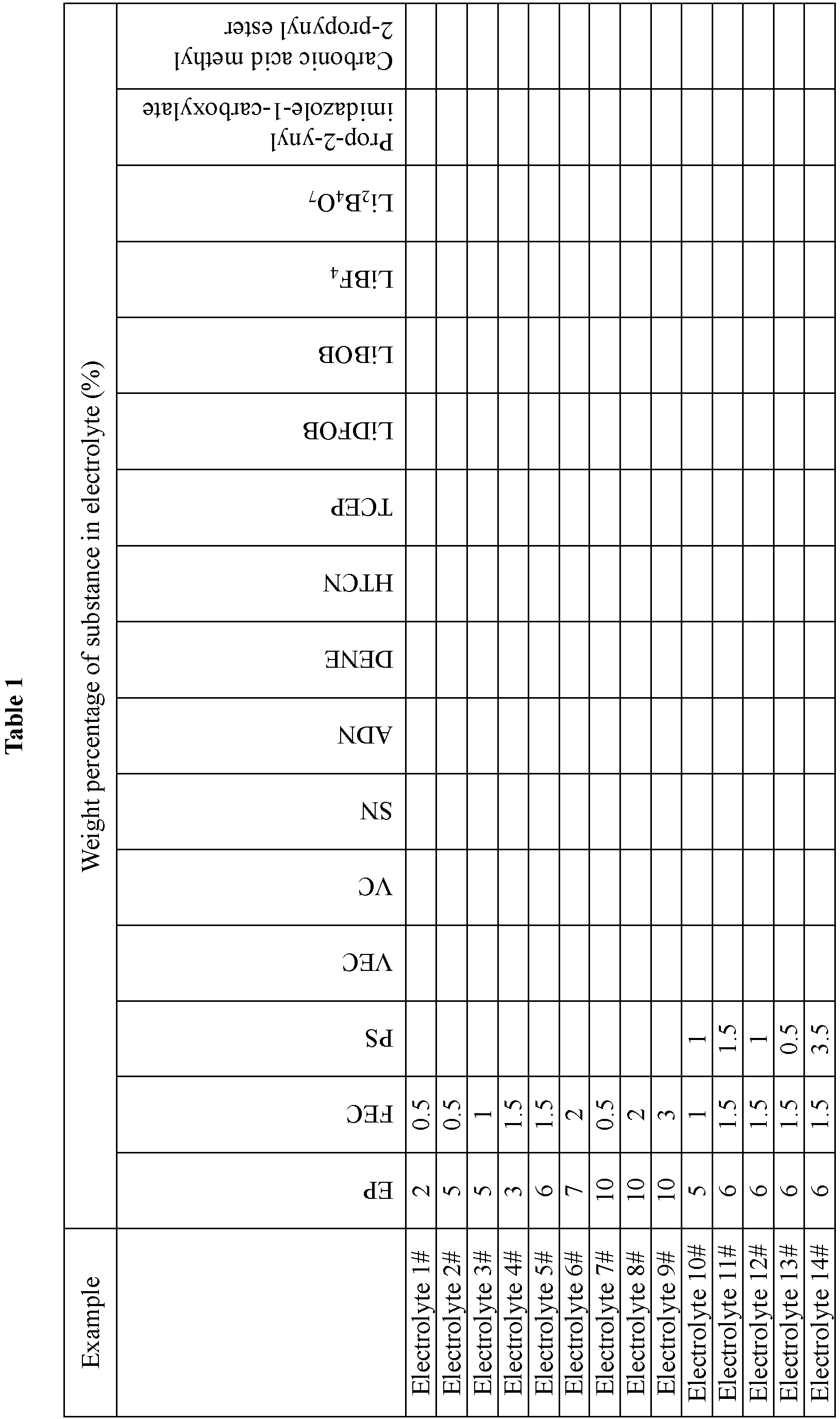


Table 2 Comparative example Weight percentage of substance in electrolyte (%) EP FEC VC PS Comparative Example 1 Comparative Electrolyte 1# 5 Comparative Example 2 Comparative Electrolyte 2# 2 Comparative Example 3 Comparative Electrolyte 3# 5 1 1 Comparative Example 4 Comparative Electrolyte 4# 15 1 Comparative Example 5 Comparative Electrolyte 5# 5 3 Comparative Example 6 Comparative Electrolyte 6# 11 3 Comparative Example 7 Comparative Electrolyte 7# 9 0.08 Table 3 Electrolyte a b/a a+b c/b b+d d/b e e/b f g h Electrolyte 1# 2 0.25 2.5 Electrolyte 2# 5 0.1 5.5 Electrolyte 3# 5 0.2 6 Electrolyte 4# 3 0.5 4.5 Electrolyte 5# 6 0.25 7.5 Electrolyte 6# 7 0.29 9 Electrolyte 7# 10 0.05 10.5 Electrolyte 8# 10 0.2 12 Electrolyte 9# 10 0.3 13 Electrolyte 10# 5 0.2 6 1 Electrolyte 11# 6 0.25 7.5 1 Electrolyte 12# 6 0.25 7.5 0.67 Electrolyte 13# 6 0.25 7.5 0.33 Electrolyte 14# 6 0.25 7.5 2.33 Electrolyte 15# 5 0.1 5.5 5 Electrolyte 16# 6 0.17 7 4.5 3.5 Electrolyte 17# 6 0.25 7.5 3.5 1.33 Electrolyte 18# 6 0.25 7.5 2.5 0.67 Electrolyte 19# 7 0.14 8 1.5 3 2 Electrolyte 20# 8 0.19 9.5 0.33 2.5 0.67 Electrolyte 21# 9 0.11 10 0.8 2.7 1.7 Electrolyte 22# 5 0.1 5.5 1 1 Electrolyte 23# 5 0.2 6 1 1 Electrolyte 24# 5 0.2 6 1 1 Electrolyte 25# 9 0.17 10.5 0.5 0.33 Electrolyte 26# 6 0.25 7.5 1.33 1.5 1 Electrolyte 27# 6 0.25 7.5 1.33 3.5 1.33 1.5 1 Electrolyte 28# 6 0.25 7.5 1.33 3.5 1.33 2 1.33 Electrolyte 29# 6 0.25 7.5 1.33 3.5 1.33 1.7 1.13 Electrolyte 30# 5 0.2 6 1.5 1.5 Electrolyte 31# 5 0.2 6 2 2 Electrolyte 32# 5 0.2 6 2 Electrolyte 33# 5 0.2 6 1 Electrolyte 34# 5 0.2 6 2.2 Electrolyte 35# 6 0.25 7.5 1.33 3.5 1.33 1.1 0.73 0.5 Electrolyte 36# 6 0.25 7.5 1.33 3.5 1.33 1.1 0.73 1.5 Electrolyte 37# 6 0.25 7.5 1.33 3.5 1.33 1.1 0.73 0.7 Electrolyte 38# 5 0.2 6 0.8 Electrolyte 39# 5 0.2 6 0.5 Electrolyte 40# 5 0.2 6 0.3 Electrolyte 41# 5 0.2 6 0.4 Electrolyte 42# 5 0.2 6 0.7 Electrolyte 43# 6 0.25 7.5 1 3.5 1.33 1.1 0.73 0.1 Electrolyte 44# 6 0.25 7.5 1.33 3.5 1.33 1.1 0.73 0.1 Electrolyte 45# 5 0.2 6 0.5 Electrolyte 46# 5 0.2 6 1 2.6 1.6 1 1 1 0.5 0.3 Electrolyte 47# 6 0.25 7.5 1.33 3.5 1.33 1.1 0.73 0.1 Comparative Electrolyte 1# 5 5 Comparative Electrolyte 2# 2 Comparative Electrolyte 3# 5 5 Comparative Electrolyte 4# 15 0.07 16 Comparative Electrolyte 5# 5 0.6 8 Comparative Electrolyte 6# 11 0.27 14 Comparative Electrolyte 7# 9 0.009 9.08 Table 4 Example or comparative example D50 (µm) y/b Compacted density (g/cm3) a/x Electrolyte Example 1 5 10 3.8 0.53 Electrolyte 1# Example 2 5 10 3.8 1.32 Electrolyte 2# Example 3 5 5 3.8 1.32 Electrolyte 3# Example 4 5 3.33 3.8 0.79 Electrolyte 4# Example 5 5 3.33 3.8 1.58 Electrolyte 5# Example 6 5 2.5 3.8 1.84 Electrolyte 6# Example 7 5 10 3.8 2.63 Electrolyte 7# Example 8 5 2.5 3.8 2.63 Electrolyte 8# Example 9 5 1.67 3.8 2.63 Electrolyte 9# Example 10 5 5 3.8 1.32 Electrolyte 10# Example 11 5 3.33 3.8 1.58 Electrolyte 11# Example 12 5 3.33 3.8 1.58 Electrolyte 12# Example 13 5 3.33 3.8 1.58 Electrolyte 13# Example 14 5 3.33 3.8 1.58 Electrolyte 14# Example 15 5 10 3.8 1.32 Electrolyte 15# Example 16 5 5 3.8 1.58 Electrolyte 16# Example 17 5 3.33 3.8 1.58 Electrolyte 17# Example 18 5 3.33 3.8 1.58 Electrolyte 18# Example 19 5 5 3.8 1.84 Electrolyte 19# Example 20 5 3.33 3.8 2.11 Electrolyte 20# Example 21 5 5 3.8 2.37 Electrolyte 21# Example 22 5 10 3.8 1.32 Electrolyte 22# Example 23 5 5 3.8 1.32 Electrolyte 23# Example 24 5 5 3.8 1.32 Electrolyte 24# Example 25 5 3.33 3.8 2.37 Electrolyte 25# Example 26 5 3.33 3.8 1.58 Electrolyte 26# Example 27 5 3.33 3.8 1.58 Electrolyte 27# Example 28 5 3.33 3.8 1.58 Electrolyte 28# Example 29 5 3.33 3.8 1.58 Electrolyte 29# Example 30 5 5 3.8 1.32 Electrolyte 30# Example 31 5 5 3.8 1.32 Electrolyte 31# Example 32 5 5 3.8 1.32 Electrolyte 32# Example 33 5 5 3.8 1.32 Electrolyte 33# Example 34 5 5 3.8 1.32 Electrolyte 34# Example 35 5 3.33 3.8 1.58 Electrolyte 35# Example 36 5 3.33 3.8 1.58 Electrolyte 36# Example 37 5 3.33 3.8 1.58 Electrolyte 37# Example 38 5 5 3.8 1.32 Electrolyte 38# Example 39 5 5 3.8 1.32 Electrolyte 39# Example 40 5 5 3.8 1.32 Electrolyte 40# Example 41 5 5 3.8 1.32 Electrolyte 41# Example 42 5 5 3.8 1.32 Electrolyte 42# Example 43 5 3.33 3.8 1.58 Electrolyte 43# Example 44 5 3.33 3.8 1.58 Electrolyte 44# Example 45 5 5 3.8 1.32 Electrolyte 45# Example 46 5 5 3.8 1.32 Electrolyte 46# Example 47 5 3.33 3.8 1.58 Electrolyte 47# Example 48 52 104 3.8 1.32 Electrolyte 2# Example 49 30 60 3.8 1.32 Electrolyte 2# Example 50 15 30 3.8 1.32 Electrolyte 2# Example 51 0.04 0.08 3.8 1.32 Electrolyte 2# Example 52 5 10 3.5 1.43 Electrolyte 2# Example 53 5 10 4.2 0.47 Electrolyte 1# Example 54 5 10 4.0 0.5 Electrolyte 1# Comparative Example 1 5 - 3.8 1.32 Comparative Electrolyte 1# Comparative Example 2 5 2.5 3.8 0 Comparative Electrolyte 2# Comparative Example 3 5 - 3.8 1.32 Comparative Electrolyte 3# Comparative Example 4 5 5 3.8 3.95 Comparative Electrolyte 4# Comparative Example 5 5 1.67 3.8 1.32 Comparative Electrolyte 5# Comparative Example 6 5 1.67 3.8 2.89 Comparative Electrolyte 6# Comparative Example 7 5 62.5 3.8 2.37 Comparative Electrolyte 7# Table 5 Battery number Number of cycles (n) Capacity retention rate at - 20°C and 0.5C (%) Thickness swelling rate after storage at 85°C for 24 hours (%) Example 1 921 72 2.1 Example 2 935 75 2.7 Example 3 970 77 3.5 Example 4 1002 77 4.5 Example 5 985 78 4.7 Example 6 1051 79 4.9 Example 7 963 81 5.2 Example 8 1039 82 6.0 Example 9 1088 81 8.6 Example 10 983 74 2.0 Example 11 996 73 2.5 Example 12 994 74 3.0 Example 13 990 76 3.8 Example 14 1001 68 1.1 Example 15 985 71 1.5 Example 16 1125 66 2.8 Example 17 996 68 2.2 Example 18 1022 75 3.9 Example 19 1107 71 1.8 Example 20 1081 73 1.9 Example 21 1098 77 1.9 Example 22 971 70 2.5 Example 23 980 75 3.8 Example 24 985 76 2.0 Example 25 1089 80 4.0 Example 26 1105 71 1.7 Example 27 1155 67 1.6 Example 28 1165 66 1.5 Example 29 1178 69 1.1 Example 30 988 78 2.3 Example 31 997 77 1.8 Example 32 1025 77 1.5 Example 33 1021 76 1.4 Example 34 996 78 2.1 Example 35 1175 67 1.5 Example 36 1215 65 1.3 Example 37 1190 66 1.3 Example 38 1138 83 2.8 Example 39 1127 78 3.1 Example 40 982 81 1.7 Example 41 996 85 1.6 Example 42 1011 75 1.2 Example 43 1143 70 2.2 Example 44 1159 69 1.7 Example 45 1008 75 1.3 Example 46 1268 78 1.9 Example 47 1161 69 1.6 Example 48 817 62 1.0 Example 49 889 69 1.5 Example 50 920 75 2.0 Example 51 825 90 7.9 Example 52 1053 87 2.8 Example 53 873 67 2.5 Example 54 875 68 2.0 Comparative Example 1 325 60 11.2 Comparative Example 2 804 55 6.2 Comparative Example 3 787 50 3.0 Comparative Example 4 977 87 13.1 Comparative Example 5 1038 73 11.6 Comparative Example 6 1096 82 10.5 Comparative Example 7 498 78 9.8 - It can be seen from Table 2 and Table 5 that the electrolyte in Comparativ Example 1 added with ethyl propionate instead of fluoroethylene carbonate showed poor cycling performance, poor high-emperature performance and low-temperature performance; the electrolyte in Comparative Example 2 added with fluoroethylene carbonate instead of ethyl propionate showed relatively poor low temperature and high-temperature performance; the electrolyte in Comparative Example 3 added with ethyl propionate added instead of fluoroethylene carbonate also showed relatively poor cycling performance and low-temperature performance; the electrolytes in Comparative Example 4 and Comparative Example 6 added with ethyl propionate and fluoroethylene carbonate showed significantly improved low-temperature performance, but the high-temperature storage thickness swelling rate of the electrochemical apparatus deteriorated because a weight percentage of the ethyl propionate was greater than 10%; and the electrolyte in Comparative Example 5 with a ratio of fluoroethylene carbonate to ethyl propionate greater than 0.5 (b/a = 0.6) also showed high-temperature storage thickness swelling rate deterioration. Generally, a thickness swelling rate greater than 10% was considered unacceptable for the lithium-ion battery. Therefore, the lithium-ion batteries in Comparative Examples 1 and 4 to 6 were unacceptable due to their swelling rates. The electrolyte in Comparative Example 7 with a ratio of fluoroethylene carbonate to ethyl propionate less than 0.01 (b/a = 0.009) showed relatively poor cycling performance and a relatively high high-temperature storage thickness swelling rate.
- It can be learned from comparison between Examples 1 to 54 and Comparative Examples 1 to 7 that, the lithium-ion batteries in the examples of this application all had a swelling rate less than 10%, and had excellent cycling performance and high- and low-temperature performance. Therefore, the lithium-ion batteries in the examples of this application could ensure both the cycling performance and high- and low-temperature performance of the lithium-ion batteries. It can be learned from comparison between Example 2 and Example 48 that, y/b≤100 was satisfied in Example 2, and therefore Example 2 further improved the cycling performance and the low-temperature performance compared with Example 48. It can be learned from comparison between Example 2 and Example 51 that, y/b≥0.1 was satisfied in Example 2, and therefore Example 2 further improved the cycling performance and the high-temperature performance compared with Example 51.
- It can be learned from comparison between Examples 48 to 51 that, 0.1≤y/b≤100 was satisfied in both Example 49 and Example 50, and therefore Example 49 and Example 50 had better overall performance than Example 48 and Example 51.
- It can be learned from comparison between Example 1 and Example 53 that, the positive electrode active material layer in Example 53 had a compacted density increased to 4.2 g/cm3, and after being combined with Electrolyte 1#, the positive electrode active material layer has a/x<0.5, providing lower cycling performance and low-temperature performance than Example 1, but still significantly better overall performance than Example 1. Therefore, the positive electrode active material layer in Example 53 can help to keep performance of the electrochemical apparatus stable under a condition of a high compacted density.
- The electrolyte in this application can ensure to a large extent both the cycling performance and high- and low-temperature performance of the lithium-ion battery.
- The electrochemical apparatus in this application can have excellent cycling performance and high- and low-temperature performance.
- References to "some embodiments", "some of the embodiments", "an embodiment", "another example", "examples", "specific examples", or "some examples" in the specification mean the inclusion of specific features, structures, materials, or characteristics described in at least one embodiment or example of this application in the embodiment or example. Therefore, descriptions in various places throughout the specification, such as "in some embodiments", "in the embodiments", "in an embodiment", "in another example", "in an example", "in a specific example", or "examples", do not necessarily refer to the same embodiment or example in this application. In addition, a specific feature, structure, material, or characteristic herein may be combined in any appropriate manner in one or more embodiments or examples.
- Although illustrative embodiments have been demonstrated and described, a person skilled in the art should understand that the foregoing embodiments are not to be construed as limiting this application, and that the embodiments may be changed, replaced, and modified without departing from the spirit, principle, and scope of this application.
Claims (12)
- An electrolyte, comprising ethyl propionate and fluoroethylene carbonate, wherein based on a total weight of the electrolyte, a weight percentage of ethyl propionate is a%, and a weight percentage of fluoroethylene carbonate is b%, and 0<a≤10 and 0.01<b/a≤0.5 are satisfied.
- The electrolyte according to claim 1, wherein the electrolyte further satisfies 4≤a+b≤15.
- The electrolyte according to claim 1, wherein the electrolyte further comprises at least one of 1,3-propane sultone or unsaturated cyclic carbonate.
- The electrolyte according to claim 3, wherein when the electrolyte comprises 1,3-propane sultone, based on the total weight of the electrolyte, a weight percentage of 1,3-propane sultone is c%, and 0.25≤c/b≤5 is satisfied; and when the electrolyte comprises the unsaturated cyclic carbonate, based on the total weight of the electrolyte, a weight percentage of the unsaturated cyclic carbonate is d%, and at least one of 1≤b+d≤6 or 0.25≤d/b≤6.5 is satisfied.
- The electrolyte according to claim 1, wherein the electrolyte further comprises a dinitrile compound, and the dinitrile compound comprises at least one of adiponitrile, succinonitrile, or ethylene glycol bis(2-cyanoethyl) ether, wherein based on the total weight of the electrolyte, a weight percentage of the dinitrile compound is e%, and e≤2 and e/b≥0.3 are satisfied.
- The electrolyte according to claim 1, wherein the electrolyte further comprises a trinitrile compound, and the trinitrile compound comprises at least one of 1,3,6-hexanetricarbonitrile or 1,2,3-tris (2-cyanoethoxy) propane, wherein based on the total weight of the electrolyte, a weight percentage of the trinitrile compound is f%, and f<2.5 is satisfied.
- The electrolyte according to claim 1, wherein the electrolyte further comprises a boron-containing lithium salt, and the boron-containing lithium salt comprises at least one of lithium difluoroacetate borate, lithium bisoxalate borate, lithium tetrafluoroborate, or lithium tetraborate, wherein based on the total weight of the electrolyte, a weight percentage of the boron-containing lithium salt is g%, and g<1 is satisfied.
- The electrolyte according to claim 1, wherein the electrolyte further comprises a propynyl compound, and the propynyl compound comprises at least one of prop-2-ynyl imidazole-1-carboxylate or carbonic acid methyl 2-propynyl ester, wherein based on the total weight of the electrolyte, a weight percentage of the propynyl compound is h%, and h<1 is satisfied.
- An electrochemical apparatus, comprising a positive electrode, a negative electrode, a separator and the electrolyte according to any one of claims 1 to 8.
- The electrochemical apparatus according to claim 9, wherein the positive electrode comprises a positive electrode current collector and a positive electrode active material layer applied on the positive electrode current collector, and the positive electrode active material layer comprises a positive electrode active material, wherein a compacted density of the positive electrode active material layer is x g/cm3, and 0.5≤a/x≤3 is satisfied.
- The electrochemical apparatus according to claim 10, wherein a particle size D50 of the positive electrode active material is y µm, and 0.1≤y/b≤100 is satisfied.
- An electronic apparatus, comprising the electrochemical apparatus according to any one of claims 9 to 11.
Applications Claiming Priority (1)
| Application Number | Priority Date | Filing Date | Title |
|---|---|---|---|
| PCT/CN2021/077035 WO2022174412A1 (en) | 2021-02-20 | 2021-02-20 | Electrolyte and electrochemical device comprising same, and electronic device |
Publications (2)
| Publication Number | Publication Date |
|---|---|
| EP4075559A1 true EP4075559A1 (en) | 2022-10-19 |
| EP4075559A4 EP4075559A4 (en) | 2023-05-31 |
Family
ID=80879998
Family Applications (1)
| Application Number | Title | Priority Date | Filing Date |
|---|---|---|---|
| EP21867909.0A Pending EP4075559A4 (en) | 2021-02-20 | 2021-02-20 | Electrolyte and electrochemical device comprising same, and electronic device |
Country Status (4)
| Country | Link |
|---|---|
| US (1) | US20220271341A1 (en) |
| EP (1) | EP4075559A4 (en) |
| CN (5) | CN116914256A (en) |
| WO (1) | WO2022174412A1 (en) |
Families Citing this family (4)
| Publication number | Priority date | Publication date | Assignee | Title |
|---|---|---|---|---|
| KR20240028866A (en) * | 2022-08-25 | 2024-03-05 | 삼성에스디아이 주식회사 | Electrolyte for rechargeable lithium battery and rechargeable lithium battery the same |
| WO2024197806A1 (en) * | 2023-03-31 | 2024-10-03 | 宁德新能源科技有限公司 | Electrochemical device and electronic device comprising electrochemical device |
| CN116864816A (en) * | 2023-06-27 | 2023-10-10 | 宁德新能源科技有限公司 | Electrochemical device and electronic device |
| CN118054086A (en) * | 2024-03-29 | 2024-05-17 | 宁德新能源科技有限公司 | Non-aqueous electrolyte, lithium-ion battery and electronic device |
Family Cites Families (10)
| Publication number | Priority date | Publication date | Assignee | Title |
|---|---|---|---|---|
| JP5593592B2 (en) * | 2007-06-28 | 2014-09-24 | 三菱化学株式会社 | Non-aqueous electrolyte for secondary battery and non-aqueous electrolyte secondary battery using the same |
| US20090081556A1 (en) * | 2007-09-26 | 2009-03-26 | Sanyo Electric Co., Ltd. | Non-aqueous electrolyte secondary battery |
| CN103682436A (en) * | 2012-09-26 | 2014-03-26 | 江苏海四达电源股份有限公司 | Electrolyte for high-ageing-resistance manganese-containing lithium ion battery and application of electrolyte |
| CN105576283A (en) * | 2016-02-03 | 2016-05-11 | 东莞市凯欣电池材料有限公司 | High voltage electrolyte considering high and low temperature performance and lithium ion battery using the electrolyte |
| CN106099187A (en) * | 2016-07-13 | 2016-11-09 | 东莞市凯欣电池材料有限公司 | A kind of wide homogeneous non-aqueous electrolytic solution of warm area |
| JP7019598B2 (en) * | 2016-12-22 | 2022-02-15 | Muアイオニックソリューションズ株式会社 | Non-aqueous electrolyte and storage device using it |
| KR102270869B1 (en) * | 2017-07-14 | 2021-07-01 | 주식회사 엘지에너지솔루션 | Additive for nonaqueous electrolyte, nonaqueous electrolyte for lithium secondary battery comprising the same, and lithium secondary battery |
| CN107706455A (en) * | 2017-09-20 | 2018-02-16 | 惠州亿纬锂能股份有限公司 | A kind of high voltage multiplying power electrolyte for taking into account high temperature performance and the lithium ion battery using the electrolyte |
| JP6831409B2 (en) * | 2019-02-27 | 2021-02-17 | トヨタ自動車株式会社 | Lithium-ion secondary battery electrolyte, lithium-ion secondary battery and module |
| CN111082129B (en) * | 2019-12-24 | 2021-01-12 | 东莞新能源科技有限公司 | Electrochemical and electronic devices |
-
2021
- 2021-02-20 WO PCT/CN2021/077035 patent/WO2022174412A1/en not_active Ceased
- 2021-02-20 CN CN202311038649.8A patent/CN116914256A/en active Pending
- 2021-02-20 CN CN202311038667.6A patent/CN116885280A/en active Pending
- 2021-02-20 CN CN202311038648.3A patent/CN116826174A/en active Pending
- 2021-02-20 CN CN202180005023.XA patent/CN114287078B/en active Active
- 2021-02-20 CN CN202311038645.XA patent/CN117013075A/en active Pending
- 2021-02-20 EP EP21867909.0A patent/EP4075559A4/en active Pending
-
2022
- 2022-03-31 US US17/709,645 patent/US20220271341A1/en active Pending
Also Published As
| Publication number | Publication date |
|---|---|
| CN114287078B (en) | 2023-09-15 |
| CN114287078A (en) | 2022-04-05 |
| CN116826174A (en) | 2023-09-29 |
| WO2022174412A1 (en) | 2022-08-25 |
| EP4075559A4 (en) | 2023-05-31 |
| CN117013075A (en) | 2023-11-07 |
| CN116885280A (en) | 2023-10-13 |
| US20220271341A1 (en) | 2022-08-25 |
| CN116914256A (en) | 2023-10-20 |
Similar Documents
| Publication | Publication Date | Title |
|---|---|---|
| CN112956063B (en) | Electrolyte and electrochemical device and electronic device including the same | |
| US20230343933A1 (en) | Negative electrode active material, electrochemical apparatus, and electronic apparatus | |
| EP3678229A1 (en) | Anode active material and anode using same, electrochemical device and electronic device | |
| EP4297138A1 (en) | Electrochemical device and electronic device comprising same | |
| US20220271341A1 (en) | Electrolyte, and electrochemical apparatus and electronic apparatus including same | |
| CN113130894A (en) | Negative electrode active material, and electrochemical device and electronic device using same | |
| WO2022178748A1 (en) | Negative electrode active material, negative electrode piece, electrochemical apparatus, and electronic apparatus | |
| EP4386908A1 (en) | Electrochemical device and electronic device | |
| US20230216026A1 (en) | Positive electrode material, and electrochemical apparatus and electronic apparatus containing same | |
| WO2022183648A1 (en) | Electrochemical apparatus and electronic apparatus | |
| EP4468386A1 (en) | Electrochemical device, and electronic device comprising same | |
| US20220223915A1 (en) | Electrolyte, electrochemical device including same, and electronic device | |
| JP7783325B2 (en) | Secondary battery and electronic device | |
| EP4456179A1 (en) | Electrochemical device and electronic device | |
| CN114335685A (en) | Electrochemical device and electronic device comprising same | |
| EP4489103A1 (en) | Electrochemical device and electronic device comprising same | |
| WO2021184247A1 (en) | Positive electrode active material and electrochemical device containing same | |
| CN113921914B (en) | Electrolyte solution, and electrochemical device and electronic device using same | |
| CN114497512B (en) | Electrochemical devices and electronic devices | |
| CN110137443A (en) | Positive electrode and electrochemical appliance comprising the positive electrode | |
| EP3913720B1 (en) | Electrochemical device and electronic device comprising same | |
| EP4089781A1 (en) | Electrochemical device and electronic device | |
| WO2026076693A1 (en) | Positive electrode material, electrochemical device, and electronic device | |
| WO2026090937A1 (en) | Electrochemical apparatus and electronic apparatus | |
| CN118782877A (en) | Electrochemical device and electronic device |
Legal Events
| Date | Code | Title | Description |
|---|---|---|---|
| STAA | Information on the status of an ep patent application or granted ep patent |
Free format text: STATUS: UNKNOWN |
|
| STAA | Information on the status of an ep patent application or granted ep patent |
Free format text: STATUS: THE INTERNATIONAL PUBLICATION HAS BEEN MADE |
|
| PUAI | Public reference made under article 153(3) epc to a published international application that has entered the european phase |
Free format text: ORIGINAL CODE: 0009012 |
|
| STAA | Information on the status of an ep patent application or granted ep patent |
Free format text: STATUS: REQUEST FOR EXAMINATION WAS MADE |
|
| 17P | Request for examination filed |
Effective date: 20220324 |
|
| AK | Designated contracting states |
Kind code of ref document: A1 Designated state(s): AL AT BE BG CH CY CZ DE DK EE ES FI FR GB GR HR HU IE IS IT LI LT LU LV MC MK MT NL NO PL PT RO RS SE SI SK SM TR |
|
| A4 | Supplementary search report drawn up and despatched |
Effective date: 20230428 |
|
| RIC1 | Information provided on ipc code assigned before grant |
Ipc: H01M 10/0525 20100101ALI20230421BHEP Ipc: H01M 10/0568 20100101ALI20230421BHEP Ipc: H01M 10/0567 20100101AFI20230421BHEP |
|
| DAV | Request for validation of the european patent (deleted) | ||
| DAX | Request for extension of the european patent (deleted) |