EP4074943B1 - Turbine load coupling cooling system - Google Patents
Turbine load coupling cooling system Download PDFInfo
- Publication number
- EP4074943B1 EP4074943B1 EP22165401.5A EP22165401A EP4074943B1 EP 4074943 B1 EP4074943 B1 EP 4074943B1 EP 22165401 A EP22165401 A EP 22165401A EP 4074943 B1 EP4074943 B1 EP 4074943B1
- Authority
- EP
- European Patent Office
- Prior art keywords
- shroud
- load coupling
- blades
- exhaust housing
- gas turbine
- Prior art date
- Legal status (The legal status is an assumption and is not a legal conclusion. Google has not performed a legal analysis and makes no representation as to the accuracy of the status listed.)
- Active
Links
Images





Classifications
-
- F—MECHANICAL ENGINEERING; LIGHTING; HEATING; WEAPONS; BLASTING
- F01—MACHINES OR ENGINES IN GENERAL; ENGINE PLANTS IN GENERAL; STEAM ENGINES
- F01D—NON-POSITIVE DISPLACEMENT MACHINES OR ENGINES, e.g. STEAM TURBINES
- F01D25/00—Component parts, details, or accessories, not provided for in, or of interest apart from, other groups
- F01D25/28—Supporting or mounting arrangements, e.g. for turbine casing
-
- F—MECHANICAL ENGINEERING; LIGHTING; HEATING; WEAPONS; BLASTING
- F02—COMBUSTION ENGINES; HOT-GAS OR COMBUSTION-PRODUCT ENGINE PLANTS
- F02C—GAS-TURBINE PLANTS; AIR INTAKES FOR JET-PROPULSION PLANTS; CONTROLLING FUEL SUPPLY IN AIR-BREATHING JET-PROPULSION PLANTS
- F02C7/00—Features, components parts, details or accessories, not provided for in, or of interest apart form groups F02C1/00 - F02C6/00; Air intakes for jet-propulsion plants
- F02C7/12—Cooling of plants
- F02C7/16—Cooling of plants characterised by cooling medium
- F02C7/18—Cooling of plants characterised by cooling medium the medium being gaseous, e.g. air
-
- F—MECHANICAL ENGINEERING; LIGHTING; HEATING; WEAPONS; BLASTING
- F01—MACHINES OR ENGINES IN GENERAL; ENGINE PLANTS IN GENERAL; STEAM ENGINES
- F01D—NON-POSITIVE DISPLACEMENT MACHINES OR ENGINES, e.g. STEAM TURBINES
- F01D15/00—Adaptations of machines or engines for special use; Combinations of engines with devices driven thereby
- F01D15/10—Adaptations for driving, or combinations with, electric generators
-
- F—MECHANICAL ENGINEERING; LIGHTING; HEATING; WEAPONS; BLASTING
- F01—MACHINES OR ENGINES IN GENERAL; ENGINE PLANTS IN GENERAL; STEAM ENGINES
- F01D—NON-POSITIVE DISPLACEMENT MACHINES OR ENGINES, e.g. STEAM TURBINES
- F01D25/00—Component parts, details, or accessories, not provided for in, or of interest apart from, other groups
- F01D25/08—Cooling; Heating; Heat-insulation
- F01D25/12—Cooling
-
- F—MECHANICAL ENGINEERING; LIGHTING; HEATING; WEAPONS; BLASTING
- F01—MACHINES OR ENGINES IN GENERAL; ENGINE PLANTS IN GENERAL; STEAM ENGINES
- F01D—NON-POSITIVE DISPLACEMENT MACHINES OR ENGINES, e.g. STEAM TURBINES
- F01D25/00—Component parts, details, or accessories, not provided for in, or of interest apart from, other groups
- F01D25/08—Cooling; Heating; Heat-insulation
- F01D25/14—Casings modified therefor
-
- F—MECHANICAL ENGINEERING; LIGHTING; HEATING; WEAPONS; BLASTING
- F01—MACHINES OR ENGINES IN GENERAL; ENGINE PLANTS IN GENERAL; STEAM ENGINES
- F01D—NON-POSITIVE DISPLACEMENT MACHINES OR ENGINES, e.g. STEAM TURBINES
- F01D25/00—Component parts, details, or accessories, not provided for in, or of interest apart from, other groups
- F01D25/16—Arrangement of bearings; Supporting or mounting bearings in casings
-
- F—MECHANICAL ENGINEERING; LIGHTING; HEATING; WEAPONS; BLASTING
- F01—MACHINES OR ENGINES IN GENERAL; ENGINE PLANTS IN GENERAL; STEAM ENGINES
- F01D—NON-POSITIVE DISPLACEMENT MACHINES OR ENGINES, e.g. STEAM TURBINES
- F01D5/00—Blades; Blade-carrying members; Heating, heat-insulating, cooling or antivibration means on the blades or the members
- F01D5/02—Blade-carrying members, e.g. rotors
- F01D5/026—Shaft to shaft connections
-
- F—MECHANICAL ENGINEERING; LIGHTING; HEATING; WEAPONS; BLASTING
- F01—MACHINES OR ENGINES IN GENERAL; ENGINE PLANTS IN GENERAL; STEAM ENGINES
- F01D—NON-POSITIVE DISPLACEMENT MACHINES OR ENGINES, e.g. STEAM TURBINES
- F01D5/00—Blades; Blade-carrying members; Heating, heat-insulating, cooling or antivibration means on the blades or the members
- F01D5/12—Blades
- F01D5/14—Form or construction
- F01D5/141—Shape, i.e. outer, aerodynamic form
-
- F—MECHANICAL ENGINEERING; LIGHTING; HEATING; WEAPONS; BLASTING
- F01—MACHINES OR ENGINES IN GENERAL; ENGINE PLANTS IN GENERAL; STEAM ENGINES
- F01D—NON-POSITIVE DISPLACEMENT MACHINES OR ENGINES, e.g. STEAM TURBINES
- F01D5/00—Blades; Blade-carrying members; Heating, heat-insulating, cooling or antivibration means on the blades or the members
- F01D5/12—Blades
- F01D5/14—Form or construction
- F01D5/147—Construction, i.e. structural features, e.g. of weight-saving hollow blades
-
- F—MECHANICAL ENGINEERING; LIGHTING; HEATING; WEAPONS; BLASTING
- F01—MACHINES OR ENGINES IN GENERAL; ENGINE PLANTS IN GENERAL; STEAM ENGINES
- F01D—NON-POSITIVE DISPLACEMENT MACHINES OR ENGINES, e.g. STEAM TURBINES
- F01D25/00—Component parts, details, or accessories, not provided for in, or of interest apart from, other groups
- F01D25/30—Exhaust heads, chambers, or the like
-
- F—MECHANICAL ENGINEERING; LIGHTING; HEATING; WEAPONS; BLASTING
- F05—INDEXING SCHEMES RELATING TO ENGINES OR PUMPS IN VARIOUS SUBCLASSES OF CLASSES F01-F04
- F05D—INDEXING SCHEME FOR ASPECTS RELATING TO NON-POSITIVE-DISPLACEMENT MACHINES OR ENGINES, GAS-TURBINES OR JET-PROPULSION PLANTS
- F05D2240/00—Components
- F05D2240/60—Shafts
-
- F—MECHANICAL ENGINEERING; LIGHTING; HEATING; WEAPONS; BLASTING
- F05—INDEXING SCHEMES RELATING TO ENGINES OR PUMPS IN VARIOUS SUBCLASSES OF CLASSES F01-F04
- F05D—INDEXING SCHEME FOR ASPECTS RELATING TO NON-POSITIVE-DISPLACEMENT MACHINES OR ENGINES, GAS-TURBINES OR JET-PROPULSION PLANTS
- F05D2260/00—Function
- F05D2260/20—Heat transfer, e.g. cooling
- F05D2260/201—Heat transfer, e.g. cooling by impingement of a fluid
Definitions
- the disclosure relates generally to gas turbines and, more particularly, to a system to cool a load coupling for a turbine.
- Gas turbines are rotationally coupled to a load, such as a generator, by a load coupling.
- the load coupling includes, for example, a shaft that couples at a forward end to the rotor shaft of the gas turbine and at a rearward end to a rotating shaft of the load.
- a number of bearings may be used to rotationally support the rotor shaft, the load coupling, and the rotating shaft of the load.
- the load coupling extends through a tunnel, e.g., a cylindrical housing, within an exhaust housing of the gas turbine. Exhaust from the gas turbine passes through the exhaust housing radially externally of the tunnel. Cooler gas than the exhaust may enter the tunnel from a forward end thereof to provide some cooling of the load coupling.
- the load coupling may also be cooled by circulating air toward a rearward end of the load coupling and the exhaust housing using external blowers.
- JP 2000 291446 A discloses a gas turbine engine system, comprising a gas turbine including a rotor shaft and an exhaust housing, a load coupling coupled to a rear end of the rotor shaft of the gas turbine and extending through the exhaust housing of the gas turbine, and a system for cooling the load coupling.
- the system for cooling the load coupling comprises a shroud in the form a cylindrical heat insulating material which is mounted about the load coupling to define an inlet passage between the shroud and the load coupling.
- the system further comprises an outlet passage in the form of a vent pipe which is passed through the heat insulating material.
- the system further comprises a fan including a set of blades which are coupled to the load coupling and arranged to draw air into the inlet passage as the set of blades rotates with the load coupling, wherein the air is then discharged to the outside through the vent pipe.
- EP 2 599 967 A1 discloses gas turbine engine system, comprising a gas turbine including a rotor shaft and an exhaust housing which defines an exhaust gas passage, a load coupling coupled to a rear end of the rotor shaft of the gas turbine and extending through the exhaust housing of the gas turbine, and a system for cooling the load coupling, the system comprising a shroud in the form a cylindrical sleeve which is mounted about the load coupling to define an inlet passage between the shroud and the load coupling.
- Cooling air is supplied via a ventilation duct from an air intake plenum of the gas turbine to the inlet passage inside the sleeve to cool the load coupling and is then discharged through an open end of the sleeve into the exhaust gas passage defined by the exhaust housing.
- downstream and upstream are terms that indicate a direction relative to the flow of a fluid, such as the working fluid through the turbine engine or, for example, the flow of air through the combustor or coolant through one of the turbine's component systems.
- the term “downstream” corresponds to the direction of flow of the fluid, and the term “upstream” refers to the direction opposite to the flow (i.e., the direction from which the flow originates).
- radial refers to movement or position perpendicular to an axis. For example, if a first component resides closer to the axis than a second component, it will be stated herein that the first component is “radially inward” or “inboard” of the second component. If, on the other hand, the first component resides further from the axis than the second component, it may be stated herein that the first component is “radially outward” or “outboard” of the second component.
- axial refers to movement or position parallel to an axis.
- circumumferential refers to movement or position around an axis. It will be appreciated that such terms may be applied in relation to the center axis of the turbine, i.e., the rotor shaft and/or load coupling thereof.
- the disclosure provides a turbine load coupling cooling system.
- the system adds a set of blades to the load coupling and a shroud along the load coupling in order to introduce air from the ambient or from ventilation ductwork about the load coupling, and to redirect the hot air away from the load coupling to reduce the temperature of the load coupling during operation.
- the intention of the cooling system is to cool the load coupling by adding a set of blades, i.e., a propeller, and a physical division in a space between the exhaust housing and load coupling using a shroud.
- the cooling system separates the flow of the air from the hot exhaust, creating a trap for both gases and keeping the colder air in contact with the load coupling.
- the system provides a reliable cooling system for various load couplings, new and old, and reduces the high temperature of the load coupling during operation.
- the system also cools other structure such as instrumentation, sensors, bearing housings and fluid piping that may be inside parts of the system.
- the system avoids the need to use more specialized materials in the load coupling to address higher temperatures, thus saving costs for the end user.
- FIG. 1 is a schematic diagram for an illustrative gas turbine (GT) system 100.
- GT system 100 may be considered as including a multi-stage axial flow compressor 112 having a rotating shaft 114. Air enters the inlet of compressor 112 at point 116 and is compressed by axial flow compressor 112 and then is discharged to a combustor 118 where fuel such as natural gas is burned to provide high energy combustion gases which drive a gas turbine 120. In gas turbine 120, the energy of the hot gases is converted into work, some of which is used to drive compressor 112 through rotating shaft 114, with the remainder available for useful work to drive a load, such as a generator 122, via a rotor shaft 124 (i.e., an extension of rotating shaft 114) for producing electricity. Exhaust from GT system 100 is collected in an exhaust housing 126.
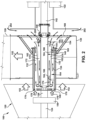
- FIG. 2 shows an enlarged schematic view of GT system 100 and, in particular, exhaust housing 126 and a load coupling 140.
- FIG. 3 shows a partial cross-sectional, perspective view of exhaust housing 126 and load coupling 140.
- exhaust housing 126 includes an outer enclosure 130 including a tunnel 132 extending axially therethrough. Tunnel 132 can have any cross-sectional shape, but oftentimes has a cylindrical cross-section. Tunnel 132 has an inner surface 134.
- Exhaust housing 126 is positioned at a rearward end of gas turbine 120 and receives gas turbine exhaust 152. Exhaust housing 126 collects the various exhaust flows and redirects exhaust 152 for subsequent heating use or for release to atmosphere after any necessary environmental treatment.
- Exhaust housing 126, including tunnel 132 can be made of any material, such as metal or metal alloys, capable of withstanding the high temperatures of exhaust 152, e.g., at or above 537°C ( ⁇ 1000°F).
- a load coupling 140 extends through tunnel 132 of exhaust housing 126.
- load coupling 140 couples rotor shaft 124 of gas turbine 120 to a rotating shaft 142 of load 122, such as a generator, allowing rotational power to be transmitted to load 122 from gas turbine 120.
- load coupling 140 couples to a rear end 128 ( FIG. 2 ) of rotor shaft 124 of gas turbine 120 and extends through tunnel 132 of exhaust housing 126 of gas turbine 120.
- Load coupling 140 can include any structure capable of coupling two rotating shafts 124, 142, and of withstanding the mechanical forces applied thereto.
- Load coupling 140 can include, for example, a metal or metal alloy shaft 144.
- Load coupling 140 may also include a forward shaft coupler 146 coupling shaft 144 to rotor shaft 124, and a rearward shaft coupler 148 coupling shaft 144 to rotating shaft 142 of load 122.
- Each shaft coupler 146, 148 may include any now known or later developed system of coupling rotating elements, such as but not limited to paired, radially extending flanges that can be bolted together.
- Any number and variety of bearings (not all shown) may be provided to rotationally support the various shafts.
- a gas turbine (GT) bearing 150 may rotationally support rotor shaft 124 and/or load coupling 140 upstream of exhaust housing 126.
- GT gas turbine
- exhaust 152 enters exhaust housing 126 and is collected and directed vertically (e.g., radially outward from load coupling 140).
- Exhaust housing 126 may also include an optional frusto-conical rear section 154 contiguous with tunnel 132 to direct exhaust 152 radially within exhaust housing 126.
- Exhaust 152 may be used, for example, as a heating source in any now known or later developed manner.
- the hot exhaust 152 has a temperature, e.g., at or above 537°C ( ⁇ 1000°F), which is too hot to provide cooling for load coupling 140.
- tunnel 132 prevents the hot exhaust 152 from directly contacting load coupling 140.
- current GT systems 122 are using higher firing temperatures, resulting in hotter exhaust 152 that negatively affects cooling of load coupling 140, despite the presence of tunnel 132.
- FIGS. 2 and 3 also show a system 160 for cooling load coupling 140, according to embodiments of the disclosure.
- load coupling 140 is coupled to gas turbine 120 and disposed within exhaust housing 126.
- System 160 includes a shroud 162 configured to be mounted about load coupling 140 and a set of blades 200 configured to draw air 202 ( FIG. 2 ) over load coupling 140.
- Tunnel 132 is radially spaced from shroud 162.
- shroud 162 acts to separate a space 164 between load coupling 140 and tunnel 132 into separate passages 170, 172.
- shroud 162 defines an inlet passage 170 between shroud 162 and load coupling 140, and an outlet passage 172 between shroud 162 and exhaust housing 126, e.g., tunnel 132 and/or frusto-conical rear section 154.
- Exhaust housing 126 includes inner surface 134 (of tunnel 132) that defines outlet passage 172 with shroud 162.
- Inlet passage 170 is shown as radially inward of outlet passage 172.
- Shroud 162 may have a forward end 174 that is axially spaced from an end of load coupling 140, e.g., near forward shaft coupler 146, such that gas can pass from inlet passage 170 to outlet passage 172 about forward end 174 of shroud 162.
- inlet passage 170 and outlet passage 172 are fluidly coupled together around forward end 174 of shroud 162 within tunnel 132.
- tunnel 132 and load coupling 140 (and more particularly, forward shaft coupler 146 of load coupling 140) define a radial opening 176 at a forward end of load coupling 140.
- a gas 178 from an upstream source may enter through radial opening 176 and mix with air in inlet and outlet passages 170, 172.
- the upstream source of gas 178 may include any upstream structure.
- the upstream source may be, in part, exhaust 152 and leakage from a housing for GT bearing 150 used to rotatably support rotor shaft 124. It is noted that, because gas 178 is not as hot as exhaust 152, gas 178 may provide some level of cooling for load coupling 140, instrumentation, sensors, bearing housings and/or fluid piping within of shroud 162.
- gas 178 may have a temperature in a range of 260°C ( ⁇ 500°F) to 370°C ( ⁇ 700°F).
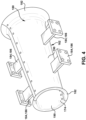
- FIG. 4 shows a perspective view of an illustrative shroud 162 apart from GT system 100 ( FIG. 3 ).
- Shroud 162 may include any structure and have any shape capable of segregating space 164 ( FIG. 3 ), as described.
- shroud 162 may have a cylindrical or slightly frusto-conical shape. As shown in FIG. 3 , shroud 162 can be more cylindrical and, as shown in FIG. 4 , shroud 162 can be more frusto-conical.
- shroud 162 may have at least one of a forward end 174 and a rear end 180 thereof with an outwardly flared surface 182, e.g., to direct gas in a desired direction.
- outwardly flared surface(s) 182 may be omitted.
- Shroud 162 may be made of any material, such as a metal or metal alloy, capable of withstanding the environment within space 164.
- Shroud 162 may also include a shroud mount 184 configured to mount shroud 162 in exhaust housing 126 in a spaced manner about load coupling 140.
- Shroud mount 184 may include any now known or later developed mounting system capable of positioning shroud 162 as described in space 164. In one non-limiting example, shown in FIGS.
- shroud mount 184 may include one or more arms 186 for coupling, e.g., with bolts, welds, or other fasteners, to exhaust housing 126, such as to tunnel 132.
- shroud 162 may be mounted to any form of structure 188 positioned between exhaust housing 126 and load coupler 140 near rearward shaft coupler 148.
- structure 188 may include a protective grille.
- Other mounting solutions may also be possible.
- shroud 162 may optionally include a number of segments 190 that are configured to collectively form shroud 162 in a mounted state.
- Each segment 190 may provide any angular extent and any axial extent of shroud 162 deemed appropriate for easing installation of shroud 162.
- each segment 190 provides 180° of shroud 162 and the full axial extent thereof.
- any form of segmentation can be implemented to ease installation of shroud 162, e.g., on new or older GT systems 100.
- system 160 for cooling load coupling 140 also includes a set of blades 200 configured to couple to load coupling 140.
- FIG. 5 shows a rearward perspective view
- FIG. 6 shows an enlarged forward perspective view of load coupling 140 and set of blades 200.
- Set of blades 200 may include any number of blades 204 required to create the desired air 202 flow rate, volume, etc., over load coupling 140.
- set of blades 200 i.e., each blade 204 are angled or curved so that they operate to draw air 202 along load coupling 140, i.e., in inlet passage 170. More particularly, as shown best in FIG.
- set of blades 200 are angled or curved to draw air 202 into inlet passage 170 as set of blades 200 rotate with load coupling 140.
- Each blade 204 may have the same angle or curve, or they may vary. In certain embodiments, shown for example in FIG. 6 , each blade 204 in set of blades 200 may extend to a larger radial distance at an axially forward end 206 thereof than at an axially rearward end 208 thereof. That is, they extend increasingly farther radially outward towards shroud 162 as air 202 passes into inlet passage 170. However, other variations in radial extent of blades 204 may also be employed. Axially forward ends 206 of blades may approach or contact load coupling 140 (see e.g., FIG.
- Air 202 may be sourced from any location, such as from ambient around generator 122, a ventilation system, a flow-creating propeller, or other source.
- FIG. 7 shows an enlarged perspective view of set of blades 200.
- Set of blades 200 includes blade mount 210 configured to couple to shaft coupler 148 at a rearward end of the load coupling 140.
- blade mount 210 may include a plurality of segments 212 to ease installation of set of blades 200. Any number of segments 212 can be provided, e.g., 2, 3, 4, 5, 6, etc.
- Each segment 212 includes at least one blade 204 of set of blades 200. In this manner, set of blades 200 can be easily coupled to load coupling 140 in parts.
- each segment 212 includes a radially extending arcuate flange 220 having a number of mounting holes 222 therein configured to match openings in, for example, rearward shaft coupler 148.
- Axially rearward ends 208 of blades 204 are fixedly coupled to a respective flange 220.
- set of blades 200 can be mounted to load coupling 140 as it is being coupled to rotating shaft 142 of load 122.
- Flange(s) 220 can replace washers or act as extensions of washers used with fasteners 224 that are part of rearward shaft coupler 148.
- FIG. 8 shows a rearward perspective view of load coupling 140 and set of blades 200, according to an alternative embodiment.
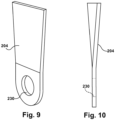
- FIG. 9 shows an enlarged perspective view
- FIG. 10 shows a side view of one of the blades 204, according to the alternative embodiments.
- each blade 204 is individually coupled to load coupling 140.
- each blade 204 may be coupled to load coupling 140 by a respective fastener 224, e.g., bolts or bolt/nut combinations, through openings 230 therein.
- Fasteners 224 may be part of, for example, rearward shaft coupler 148.
- blades 204 may be held in position by fasteners 224.
- each blade 204 in set of blades 200 is angled or curved so that they operate to draw air 202 along load coupling 140, i.e., in inlet passage 170. More particularly, as shown best in FIG. 10 , each blade 204 is angled or curved to draw air 202 into inlet passage 170 as set of blades 200 rotate with load coupling 140. Each blade 204 may have the same angle or curve, or they may vary.
- FIG. 11 shows a rearward perspective view of load coupling 140 and set of blades 200
- FIG. 12 shows an enlarged perspective view one of blades 204, according to other alternative embodiments.
- each blade 204 may include a positioning element 240 configured to hold a position of a respective blade 204 relative to at least load coupling 140, other blades 204, and shaft coupler 148.
- Positioning element 240 is configured to maintain a position of a blade 204 and, in particular, to limit rotation of blade 204 relative to at least load coupling 140.
- Positioning element 240 may replace the structures listed previously herein to limit rotation, e.g., lock washers, or it may be used in conjunction with those structures.
- positioning element 240 may include an extension 242, 244 extending from sides 246 of blades 204 that engage with similar extensions 242, 244 on an adjacent blade 204.
- an extension 244 engages with an extension 242 of adjacent blade 204 to hold the blade position and limit rotation of one or both blades 204.
- positioning elements 240 act to hold the blades' positions, interlock the blades and at least limit, and ideally prevent, rotation of blades 204 relative to at least load coupling 140. While a particular shape and size of positioning elements 240 have been disclosed, a large variety of alternative shapes and size of elements may be used. As shown in FIGS.
- each blade 204 in set of blades 200 may be angled or curved so that they operate to draw air 202 along load coupling 140, i.e., in inlet passage 170. That is, each blade 204 may be angled or curved to draw air 202 into inlet passage 170 as set of blades 200 rotate with load coupling 140.
- Each blade 204 may have the same angle or curve, or they may vary.
- each fastener 224 is shown with a respective blade 204, that is not necessary in all cases.
- different numbers of blades 204 may be used, including but not limited to with: every other fastener 224 or every third fastener 224.
- the number of blades 204 (among other factors such as blade size, curvature, etc.) can be controlled to control the volume of air drawn in to cool load coupling 140.
- cooling system 160 can be mounted in a new GT system 100, or it can be retrofitted to an older GT system 100. The installation can occur in a manufacturing setting or on-site of a power plant.
- a method of cooling load coupling 140 of gas turbine 120 includes drawing air 202 into space 164 through which load coupling 140 passes within exhaust housing 126 of the gas turbine.
- Air 202 is drawn by set of blades 200 rotating with load coupling 140 into space 164 and, more particularly, into inlet passage 170 defined between shroud 162 and load coupling 140.
- shroud 162 to divide space 164, air 202 can be drawn forward between shroud 162 and load coupling 140, i.e., in inlet passage 170.
- Inlet passage 170 and outlet passage 172 fluidly couple together around forward end 174 of shroud 162, e.g., within tunnel 132.
- air 202 passes about forward end 174 of shroud 162, and then passes rearward between shroud 162 and exhaust housing 126, e.g., tunnel 132 and/or frusto-conical rear section 154, and eventually out of exhaust housing 126.
- air 202 flows in a forward direction in inlet passage 170 (upstream when compared to working fluids in gas turbine 120 and exhaust 152), and a rearward direction in outlet passage 172 toward shaft coupler 148 at a rearward end of load coupling 140.
- inlet passage 170 upstream when compared to working fluids in gas turbine 120 and exhaust 152
- outlet passage 172 toward shaft coupler 148 at a rearward end of load coupling 140.
- cooling system 160 i.e., shroud 162 and set of blades 200
- Some limited amount of gas 178 may also enter space 164 through radial opening 176 ( FIGS. 2-3 ) to cool.
- the hotter exhaust 152 does not enter space 164, and is prevented from entering space 164 by air 202 in the space.
- Embodiments of cooling system 160 cool load coupling 140 by adding a set of blades, i.e., a propeller, and a physical division in space 164 between exhaust housing 126 and load coupling 140. Hence, cooling system 160 separates the flow of air 202 from the hot exhaust 152, creating a trap for both temperature gases and keeping the colder air 202 in contact with load coupling 140. Cooling system 160 thus provides reliable cooling for various load couplings 140, new and old, and reduces the high temperature of the load coupling during operation. The system also cools other structure such as instrumentation, sensors, bearing housings and fluid piping that may be inside parts of the system, to avoid failure or coking of these parts. In addition, cooling system 160 avoids the need to use more specialized materials in the load coupling to address high temperatures, thus saving costs for the end user.
- a set of blades i.e., a propeller
- Approximating language may be applied to modify any quantitative representation that could permissibly vary without resulting in a change in the basic function to which it is related. Accordingly, a value modified by a term or terms, such as “about,” “approximately” and “substantially,” are not to be limited to the precise value specified. In at least some instances, the approximating language may correspond to the precision of an instrument for measuring the value.
- range limitations may be combined and/or interchanged; such ranges are identified and include all the sub-ranges contained therein unless context or language indicates otherwise. "Approximately,” as applied to a particular value of a range, applies to both end values and, unless otherwise dependent on the precision of the instrument measuring the value, may indicate +/- 10% of the stated value(s).
Landscapes
- Engineering & Computer Science (AREA)
- Mechanical Engineering (AREA)
- General Engineering & Computer Science (AREA)
- Chemical & Material Sciences (AREA)
- Combustion & Propulsion (AREA)
- Architecture (AREA)
- Physics & Mathematics (AREA)
- Fluid Mechanics (AREA)
- Turbine Rotor Nozzle Sealing (AREA)
Description
- The disclosure relates generally to gas turbines and, more particularly, to a system to cool a load coupling for a turbine.
- Gas turbines are rotationally coupled to a load, such as a generator, by a load coupling. The load coupling includes, for example, a shaft that couples at a forward end to the rotor shaft of the gas turbine and at a rearward end to a rotating shaft of the load. A number of bearings may be used to rotationally support the rotor shaft, the load coupling, and the rotating shaft of the load. The load coupling extends through a tunnel, e.g., a cylindrical housing, within an exhaust housing of the gas turbine. Exhaust from the gas turbine passes through the exhaust housing radially externally of the tunnel. Cooler gas than the exhaust may enter the tunnel from a forward end thereof to provide some cooling of the load coupling. The load coupling may also be cooled by circulating air toward a rearward end of the load coupling and the exhaust housing using external blowers.
-
JP 2000 291446 A -
EP 2 599 967 A1 discloses gas turbine engine system, comprising a gas turbine including a rotor shaft and an exhaust housing which defines an exhaust gas passage, a load coupling coupled to a rear end of the rotor shaft of the gas turbine and extending through the exhaust housing of the gas turbine, and a system for cooling the load coupling, the system comprising a shroud in the form a cylindrical sleeve which is mounted about the load coupling to define an inlet passage between the shroud and the load coupling. Cooling air is supplied via a ventilation duct from an air intake plenum of the gas turbine to the inlet passage inside the sleeve to cool the load coupling and is then discharged through an open end of the sleeve into the exhaust gas passage defined by the exhaust housing. - The invention is as defined in claim 1 and dependent claims 2-11.
- These and other features of this disclosure will be more readily understood from the following detailed description of the various aspects of the disclosure taken in conjunction with the accompanying drawings that depict various embodiments of the disclosure, in which:
-
FIG. 1 shows a schematic diagram of an illustrative gas turbine system; -
FIG. 2 shows a cross-sectional view of an exhaust housing and a load coupling including a cooling system, according to embodiments of the disclosure; -
FIG. 3 shows a partial cross-sectional, perspective view of an exhaust housing and a load coupling including a cooling system, according to embodiments of the disclosure; -
FIG. 4 shows a perspective view of a shroud for a cooling system, according to embodiments of the disclosure; -
FIG. 5 shows a rearward perspective view of a set of blades on a load coupling, according to embodiments of the disclosure; -
FIG. 6 shows an enlarged forward perspective view of a set of blades on a load coupling, according to embodiments of the disclosure; -
FIG. 7 shows an enlarged rearward perspective view of a set of blades on a load coupling, according to embodiments of the disclosure; -
FIG. 8 shows a rearward perspective view of a load coupling and set of blades, according to alternative embodiments of the disclosure; -
FIG. 9 shows an enlarged perspective view of a blade, according to alternative embodiments of the disclosure; -
FIG. 10 shows a side view of the blade inFIG. 9 ; -
FIG. 11 shows a rearward perspective view of a load coupling and set of blades, according to additional alternative embodiments of the disclosure; and -
FIG. 12 shows an enlarged perspective view of one of the blades inFIG. 11 . - It is noted that the drawings of the disclosure are not necessarily to scale. The drawings are intended to depict only typical aspects of the disclosure and therefore should not be considered as limiting the scope of the disclosure. In the drawings, like numbering represents like elements between the drawings.
- As an initial matter, in order to clearly describe the subject matter of the current disclosure, it will become necessary to select certain terminology when referring to and describing relevant machine components within a gas turbine. To the extent possible, common industry terminology will be used and employed in a manner consistent with its accepted meaning. Unless otherwise stated, such terminology should be given a broad interpretation consistent with the context of the present application and the scope of the appended claims. Those of ordinary skill in the art will appreciate that often a particular component may be referred to using several different or overlapping terms. What may be described herein as being a single part may include and be referenced in another context as consisting of multiple components. Alternatively, what may be described herein as including multiple components may be referred to elsewhere as a single part.
- In addition, several descriptive terms may be used regularly herein, and it should prove helpful to define these terms at the onset of this section. These terms and their definitions, unless stated otherwise, are as follows. As used herein, "downstream" and "upstream" are terms that indicate a direction relative to the flow of a fluid, such as the working fluid through the turbine engine or, for example, the flow of air through the combustor or coolant through one of the turbine's component systems. The term "downstream" corresponds to the direction of flow of the fluid, and the term "upstream" refers to the direction opposite to the flow (i.e., the direction from which the flow originates). The terms "forward" and "rearward" or "aft," without any further specificity, refer to directions, with "forward" referring to the front or compressor end of the gas turbine system, and "rearward" and "aft" referring to the rearward section of the gas turbine system, i.e., closer to the load in a rear-end drive gas turbine system.
- It is often required to describe parts that are disposed at differing radial positions with regard to a center axis. The term "radial" refers to movement or position perpendicular to an axis. For example, if a first component resides closer to the axis than a second component, it will be stated herein that the first component is "radially inward" or "inboard" of the second component. If, on the other hand, the first component resides further from the axis than the second component, it may be stated herein that the first component is "radially outward" or "outboard" of the second component. The term "axial" refers to movement or position parallel to an axis. Finally, the term "circumferential" refers to movement or position around an axis. It will be appreciated that such terms may be applied in relation to the center axis of the turbine, i.e., the rotor shaft and/or load coupling thereof.
- In addition, several descriptive terms may be used regularly herein, as described below. The terms "first", "second", and "third" may be used interchangeably to distinguish one component from another and are not intended to signify location or importance of the individual components.
- The terminology used herein is for the purpose of describing particular embodiments only and is not intended to be limiting of the disclosure. As used herein, the singular forms "a", "an" and "the" are intended to include the plural forms as well, unless the context clearly indicates otherwise. It will be further understood that the terms "comprises" and/or "comprising," when used in this specification, specify the presence of stated features, integers, steps, operations, elements, and/or components but do not preclude the presence or addition of one or more other features, integers, steps, operations, elements, components, and/or groups thereof. "Optional" or "optionally" means that the subsequently described event or circumstance may or may not occur or that the subsequently describe component or element may or may not be present, and that the description includes instances where the event occurs or the component is present and instances where it does not or is not present.
- Where an element or layer is referred to as being "on," "engaged to," "connected to" or "coupled to" another element or layer, it may be directly on, engaged to, connected to, or coupled to the other element or layer, or intervening elements or layers may be present. In contrast, when an element is referred to as being "directly on," "directly engaged to," "directly connected to," or "directly coupled to" another element or layer, there may be no intervening elements or layers present. Other words used to describe the relationship between elements should be interpreted in a like fashion (e.g., "between" versus "directly between," "adjacent" versus "directly adjacent," etc.). As used herein, the term "and/or" includes any and all combinations of one or more of the associated listed items.
- As indicated above, the disclosure provides a turbine load coupling cooling system. The system adds a set of blades to the load coupling and a shroud along the load coupling in order to introduce air from the ambient or from ventilation ductwork about the load coupling, and to redirect the hot air away from the load coupling to reduce the temperature of the load coupling during operation. The intention of the cooling system is to cool the load coupling by adding a set of blades, i.e., a propeller, and a physical division in a space between the exhaust housing and load coupling using a shroud. The cooling system separates the flow of the air from the hot exhaust, creating a trap for both gases and keeping the colder air in contact with the load coupling. The system provides a reliable cooling system for various load couplings, new and old, and reduces the high temperature of the load coupling during operation. The system also cools other structure such as instrumentation, sensors, bearing housings and fluid piping that may be inside parts of the system. In addition, the system avoids the need to use more specialized materials in the load coupling to address higher temperatures, thus saving costs for the end user.
-
FIG. 1 is a schematic diagram for an illustrative gas turbine (GT)system 100.GT system 100 may be considered as including a multi-stageaxial flow compressor 112 having arotating shaft 114. Air enters the inlet ofcompressor 112 atpoint 116 and is compressed byaxial flow compressor 112 and then is discharged to acombustor 118 where fuel such as natural gas is burned to provide high energy combustion gases which drive agas turbine 120. Ingas turbine 120, the energy of the hot gases is converted into work, some of which is used to drivecompressor 112 throughrotating shaft 114, with the remainder available for useful work to drive a load, such as agenerator 122, via a rotor shaft 124 (i.e., an extension of rotating shaft 114) for producing electricity. Exhaust fromGT system 100 is collected in anexhaust housing 126. -
FIG. 2 shows an enlarged schematic view ofGT system 100 and, in particular,exhaust housing 126 and aload coupling 140.FIG. 3 shows a partial cross-sectional, perspective view ofexhaust housing 126 andload coupling 140. As shown,exhaust housing 126 includes anouter enclosure 130 including atunnel 132 extending axially therethrough.Tunnel 132 can have any cross-sectional shape, but oftentimes has a cylindrical cross-section.Tunnel 132 has aninner surface 134.Exhaust housing 126 is positioned at a rearward end ofgas turbine 120 and receivesgas turbine exhaust 152.Exhaust housing 126 collects the various exhaust flows and redirectsexhaust 152 for subsequent heating use or for release to atmosphere after any necessary environmental treatment.Exhaust housing 126, includingtunnel 132, can be made of any material, such as metal or metal alloys, capable of withstanding the high temperatures ofexhaust 152, e.g., at or above 537°C (~1000°F). - A
load coupling 140 extends throughtunnel 132 ofexhaust housing 126. As shown inFIG. 2 ,load coupling 140couples rotor shaft 124 ofgas turbine 120 to arotating shaft 142 ofload 122, such as a generator, allowing rotational power to be transmitted to load 122 fromgas turbine 120. More particularly,load coupling 140 couples to a rear end 128 (FIG. 2 ) ofrotor shaft 124 ofgas turbine 120 and extends throughtunnel 132 ofexhaust housing 126 ofgas turbine 120.Load coupling 140 can include any structure capable of coupling tworotating shafts Load coupling 140 can include, for example, a metal ormetal alloy shaft 144.Load coupling 140 may also include aforward shaft coupler 146coupling shaft 144 torotor shaft 124, and arearward shaft coupler 148coupling shaft 144 torotating shaft 142 ofload 122. Eachshaft coupler rotor shaft 124 and/orload coupling 140 upstream ofexhaust housing 126. - As shown in
FIGS. 2 and3 ,exhaust 152 entersexhaust housing 126 and is collected and directed vertically (e.g., radially outward from load coupling 140).Exhaust housing 126 may also include an optional frusto-conicalrear section 154 contiguous withtunnel 132 todirect exhaust 152 radially withinexhaust housing 126.Exhaust 152 may be used, for example, as a heating source in any now known or later developed manner. Thehot exhaust 152 has a temperature, e.g., at or above 537°C (~1000°F), which is too hot to provide cooling forload coupling 140. Here,tunnel 132 prevents thehot exhaust 152 from directly contactingload coupling 140. However,current GT systems 122 are using higher firing temperatures, resulting inhotter exhaust 152 that negatively affects cooling ofload coupling 140, despite the presence oftunnel 132. -
FIGS. 2 and3 also show asystem 160 for coolingload coupling 140, according to embodiments of the disclosure. As noted,load coupling 140 is coupled togas turbine 120 and disposed withinexhaust housing 126.System 160 includes ashroud 162 configured to be mounted aboutload coupling 140 and a set ofblades 200 configured to draw air 202 (FIG. 2 ) overload coupling 140.Tunnel 132 is radially spaced fromshroud 162. Thus,shroud 162 acts to separate aspace 164 betweenload coupling 140 andtunnel 132 intoseparate passages shroud 162 defines aninlet passage 170 betweenshroud 162 andload coupling 140, and anoutlet passage 172 betweenshroud 162 andexhaust housing 126, e.g.,tunnel 132 and/or frusto-conicalrear section 154.Exhaust housing 126 includes inner surface 134 (of tunnel 132) that definesoutlet passage 172 withshroud 162.Inlet passage 170 is shown as radially inward ofoutlet passage 172. -
Shroud 162 may have aforward end 174 that is axially spaced from an end ofload coupling 140, e.g., nearforward shaft coupler 146, such that gas can pass frominlet passage 170 tooutlet passage 172 aboutforward end 174 ofshroud 162. Hence,inlet passage 170 andoutlet passage 172 are fluidly coupled together aroundforward end 174 ofshroud 162 withintunnel 132. As shown best inFIG. 3 ,tunnel 132 and load coupling 140 (and more particularly,forward shaft coupler 146 of load coupling 140) define aradial opening 176 at a forward end ofload coupling 140. As will be described, agas 178 from an upstream source may enter throughradial opening 176 and mix with air in inlet andoutlet passages gas 178 may include any upstream structure. In one non-limiting example, the upstream source may be, in part,exhaust 152 and leakage from a housing for GT bearing 150 used to rotatablysupport rotor shaft 124. It is noted that, becausegas 178 is not as hot asexhaust 152,gas 178 may provide some level of cooling forload coupling 140, instrumentation, sensors, bearing housings and/or fluid piping within ofshroud 162. In one non-limiting example,gas 178 may have a temperature in a range of 260°C (~500°F) to 370°C (~700°F). -
FIG. 4 shows a perspective view of anillustrative shroud 162 apart from GT system 100 (FIG. 3 ).Shroud 162 may include any structure and have any shape capable of segregating space 164 (FIG. 3 ), as described. In one embodiment,shroud 162 may have a cylindrical or slightly frusto-conical shape. As shown inFIG. 3 ,shroud 162 can be more cylindrical and, as shown inFIG. 4 ,shroud 162 can be more frusto-conical. In any event,shroud 162 may have at least one of aforward end 174 and arear end 180 thereof with an outwardly flaredsurface 182, e.g., to direct gas in a desired direction. In alternative embodiments, outwardly flared surface(s) 182 may be omitted.Shroud 162 may be made of any material, such as a metal or metal alloy, capable of withstanding the environment withinspace 164.Shroud 162 may also include a shroud mount 184 configured to mountshroud 162 inexhaust housing 126 in a spaced manner aboutload coupling 140. Shroud mount 184 may include any now known or later developed mounting system capable of positioningshroud 162 as described inspace 164. In one non-limiting example, shown inFIGS. 3 and4 , shroud mount 184 may include one or more arms 186 for coupling, e.g., with bolts, welds, or other fasteners, to exhausthousing 126, such as totunnel 132. In other cases,shroud 162 may be mounted to any form ofstructure 188 positioned betweenexhaust housing 126 andload coupler 140 nearrearward shaft coupler 148. In one non-limiting example,structure 188 may include a protective grille. Other mounting solutions may also be possible. In any event, as shown inFIG. 4 ,shroud 162 may optionally include a number ofsegments 190 that are configured to collectively formshroud 162 in a mounted state. Eachsegment 190 may provide any angular extent and any axial extent ofshroud 162 deemed appropriate for easing installation ofshroud 162. In the non-limiting example shown, eachsegment 190 provides 180° ofshroud 162 and the full axial extent thereof. As will be recognized, any form of segmentation can be implemented to ease installation ofshroud 162, e.g., on new orolder GT systems 100. - As noted,
system 160 for coolingload coupling 140 also includes a set ofblades 200 configured to couple to loadcoupling 140.FIG. 5 shows a rearward perspective view, andFIG. 6 shows an enlarged forward perspective view ofload coupling 140 and set ofblades 200. Set ofblades 200 may include any number ofblades 204 required to create the desiredair 202 flow rate, volume, etc., overload coupling 140. As shown best inFIG. 5 , set of blades 200 (i.e., each blade 204) are angled or curved so that they operate to drawair 202 alongload coupling 140, i.e., ininlet passage 170. More particularly, as shown best inFIG. 2 , set ofblades 200 are angled or curved to drawair 202 intoinlet passage 170 as set ofblades 200 rotate withload coupling 140. Eachblade 204 may have the same angle or curve, or they may vary. In certain embodiments, shown for example inFIG. 6 , eachblade 204 in set ofblades 200 may extend to a larger radial distance at an axiallyforward end 206 thereof than at an axiallyrearward end 208 thereof. That is, they extend increasingly farther radially outward towardsshroud 162 asair 202 passes intoinlet passage 170. However, other variations in radial extent ofblades 204 may also be employed. Axially forward ends 206 of blades may approach or contact load coupling 140 (see e.g.,FIG. 5 ), and axially rearward ends 208 are coupled torearward shaft coupler 148 via ablade mount 210.Air 202 may be sourced from any location, such as from ambient aroundgenerator 122, a ventilation system, a flow-creating propeller, or other source. -
FIG. 7 shows an enlarged perspective view of set ofblades 200. Set ofblades 200 includesblade mount 210 configured to couple toshaft coupler 148 at a rearward end of theload coupling 140. As shown,blade mount 210 may include a plurality ofsegments 212 to ease installation of set ofblades 200. Any number ofsegments 212 can be provided, e.g., 2, 3, 4, 5, 6, etc. Eachsegment 212 includes at least oneblade 204 of set ofblades 200. In this manner, set ofblades 200 can be easily coupled to loadcoupling 140 in parts. In one embodiment, eachsegment 212 includes a radially extendingarcuate flange 220 having a number of mountingholes 222 therein configured to match openings in, for example,rearward shaft coupler 148. Axially rearward ends 208 ofblades 204 are fixedly coupled to arespective flange 220. In this manner, set ofblades 200 can be mounted to loadcoupling 140 as it is being coupled torotating shaft 142 ofload 122. Flange(s) 220 can replace washers or act as extensions of washers used withfasteners 224 that are part ofrearward shaft coupler 148. -
FIG. 8 shows a rearward perspective view ofload coupling 140 and set ofblades 200, according to an alternative embodiment.FIG. 9 shows an enlarged perspective view andFIG. 10 shows a side view of one of theblades 204, according to the alternative embodiments. Here, eachblade 204 is individually coupled to loadcoupling 140. In one example, eachblade 204 may be coupled to loadcoupling 140 by arespective fastener 224, e.g., bolts or bolt/nut combinations, throughopenings 230 therein.Fasteners 224 may be part of, for example,rearward shaft coupler 148. InFIG. 8 ,blades 204 may be held in position byfasteners 224. Where necessary, additional structure may be employed to limit or prevent rotation, e.g., lock washers, male-female mating surfaces onblades 204 andload coupling 140, etc. As shown inFIGS. 8-10 , eachblade 204 in set ofblades 200 is angled or curved so that they operate to drawair 202 alongload coupling 140, i.e., ininlet passage 170. More particularly, as shown best inFIG. 10 , eachblade 204 is angled or curved to drawair 202 intoinlet passage 170 as set ofblades 200 rotate withload coupling 140. Eachblade 204 may have the same angle or curve, or they may vary. -
FIG. 11 shows a rearward perspective view ofload coupling 140 and set ofblades 200, andFIG. 12 shows an enlarged perspective view one ofblades 204, according to other alternative embodiments. Here, eachblade 204 may include a positioning element 240 configured to hold a position of arespective blade 204 relative to at leastload coupling 140,other blades 204, andshaft coupler 148. Positioning element 240 is configured to maintain a position of ablade 204 and, in particular, to limit rotation ofblade 204 relative to at leastload coupling 140. Positioning element 240 may replace the structures listed previously herein to limit rotation, e.g., lock washers, or it may be used in conjunction with those structures. In one example, positioning element 240 may include an extension 242, 244 extending fromsides 246 ofblades 204 that engage with similar extensions 242, 244 on anadjacent blade 204. In the example shown, an extension 244 engages with an extension 242 ofadjacent blade 204 to hold the blade position and limit rotation of one or bothblades 204. In this manner, positioning elements 240 act to hold the blades' positions, interlock the blades and at least limit, and ideally prevent, rotation ofblades 204 relative to at leastload coupling 140. While a particular shape and size of positioning elements 240 have been disclosed, a large variety of alternative shapes and size of elements may be used. As shown inFIGS. 11-12 , as in the previous embodiment, eachblade 204 in set ofblades 200 may be angled or curved so that they operate to drawair 202 alongload coupling 140, i.e., ininlet passage 170. That is, eachblade 204 may be angled or curved to drawair 202 intoinlet passage 170 as set ofblades 200 rotate withload coupling 140. Eachblade 204 may have the same angle or curve, or they may vary. - With regard to the embodiments of
FIGS. 8-12 , while eachfastener 224 is shown with arespective blade 204, that is not necessary in all cases. For example, in some cases, different numbers ofblades 204 may be used, including but not limited to with: everyother fastener 224 or everythird fastener 224. In any of the embodiments described herein, the number of blades 204 (among other factors such as blade size, curvature, etc.) can be controlled to control the volume of air drawn in to coolload coupling 140. - As will be recognized, regardless of form,
cooling system 160 can be mounted in anew GT system 100, or it can be retrofitted to anolder GT system 100. The installation can occur in a manufacturing setting or on-site of a power plant. - In operation, a method of cooling
load coupling 140 ofgas turbine 120 includes drawingair 202 intospace 164 through whichload coupling 140 passes withinexhaust housing 126 of the gas turbine.Air 202 is drawn by set ofblades 200 rotating withload coupling 140 intospace 164 and, more particularly, intoinlet passage 170 defined betweenshroud 162 andload coupling 140. Usingshroud 162 to dividespace 164,air 202 can be drawn forward betweenshroud 162 andload coupling 140, i.e., ininlet passage 170.Inlet passage 170 andoutlet passage 172 fluidly couple together aroundforward end 174 ofshroud 162, e.g., withintunnel 132. Hence,air 202 passes aboutforward end 174 ofshroud 162, and then passes rearward betweenshroud 162 andexhaust housing 126, e.g.,tunnel 132 and/or frusto-conicalrear section 154, and eventually out ofexhaust housing 126. Hence,air 202 flows in a forward direction in inlet passage 170 (upstream when compared to working fluids ingas turbine 120 and exhaust 152), and a rearward direction inoutlet passage 172 towardshaft coupler 148 at a rearward end ofload coupling 140. As shown inFIGS. 2 and3 , in contrast to systems that blow air atexhaust housing 126,cooling system 160, i.e.,shroud 162 and set ofblades 200, are axially withinexhaust housing 126, allowing improved, direct application ofair 202 to loadcoupling 140. Some limited amount of gas 178 (FIGS. 2-3 ) may also enterspace 164 through radial opening 176 (FIGS. 2-3 ) to cool. However, thehotter exhaust 152 does not enterspace 164, and is prevented from enteringspace 164 byair 202 in the space. - Embodiments of
cooling system 160cool load coupling 140 by adding a set of blades, i.e., a propeller, and a physical division inspace 164 betweenexhaust housing 126 andload coupling 140. Hence,cooling system 160 separates the flow ofair 202 from thehot exhaust 152, creating a trap for both temperature gases and keeping thecolder air 202 in contact withload coupling 140.Cooling system 160 thus provides reliable cooling forvarious load couplings 140, new and old, and reduces the high temperature of the load coupling during operation. The system also cools other structure such as instrumentation, sensors, bearing housings and fluid piping that may be inside parts of the system, to avoid failure or coking of these parts. In addition,cooling system 160 avoids the need to use more specialized materials in the load coupling to address high temperatures, thus saving costs for the end user. - Approximating language, as used herein throughout the specification and claims, may be applied to modify any quantitative representation that could permissibly vary without resulting in a change in the basic function to which it is related. Accordingly, a value modified by a term or terms, such as "about," "approximately" and "substantially," are not to be limited to the precise value specified. In at least some instances, the approximating language may correspond to the precision of an instrument for measuring the value. Here and throughout the specification and claims, range limitations may be combined and/or interchanged; such ranges are identified and include all the sub-ranges contained therein unless context or language indicates otherwise. "Approximately," as applied to a particular value of a range, applies to both end values and, unless otherwise dependent on the precision of the instrument measuring the value, may indicate +/- 10% of the stated value(s).
- The corresponding structures, materials, acts, and equivalents of all means or step plus function elements in the claims below are intended to include any structure, material, or act for performing the function in combination with other claimed elements as specifically claimed. The description of the present disclosure has been presented for purposes of illustration and description but is not intended to be exhaustive or limited to the disclosure in the form disclosed. The embodiment was chosen and described in order to best explain the principles of the invention and the practical application and to enable others of ordinary skill in the art to understand the invention for various embodiments with various modifications as are suited to the particular use contemplated.
Claims (11)
- A system (160) for cooling a load coupling (140) coupled to a gas turbine (100) and disposed within an exhaust housing (126), the system (160) comprising:a shroud (162) configured to be mounted about the load coupling (140), the shroud (162) defining an inlet passage (170) between the shroud (162) and the load coupling (140) and an outlet passage (172) between the exhaust housing (126) and the shroud (162); anda set of blades (200, 204) configured to couple to the load coupling (140), the set of blades (200, 204) angled to draw air (202) into the inlet passage (170) as the set of blades (200, 204) rotate with the load coupling (140);characterised in thatthe shroud (162) defines an outlet passage (172) between the exhaust housing (126) and the shroud (162);wherein the exhaust housing (126) defines a tunnel (132) radially spaced from the shroud (162), and the inlet passage (170) and the outlet passage (172) fluidly couple together around a forward end (174) of the shroud (162) within the tunnel (132), wherein the air (202) flows in a forward direction in the inlet passage (170) and a rearward direction in the outlet passage (172); andwherein the tunnel (132) and the load coupling (140) define a radial opening (176) at the forward end (174) of the load coupling (140) through which a gas (178) from an upstream source enters and mixes with the air (202) in the inlet and outlet passages (170, 172).
- The system (160) of claim 1, wherein the shroud (162) has a frusto-conical body, and at least one of a forward end (174) and a rear end (180) of the frusto-conical body has an outwardly flared surface (182).
- The system (160) of claim 1, wherein the set of blades (200, 204) includes a blade mount (210) including a plurality of segments (212), each segment (212) including at least one blade (204) of the set of blades (200, 204).
- The system (160) of claim 3, wherein the blade mount (210) is configured to couple to a shaft coupler (148) at a rearward end of the load coupling (140).
- The system (160) of claim 1, further comprising a shroud mount (184) configured to mount the shroud (162) in the exhaust housing (126) in a spaced manner about the load coupling (140).
- The system (160) of claim 1, wherein the shroud (162) includes a number of segments (190), the number of segments (190) configured to collectively form the shroud (162) in a mounted state.
- The system (160) of claim 1, wherein the shroud (162) and the set of blades (200, 204) are positioned axially within the exhaust housing (126).
- The system (160) of claim 1, wherein the tunnel (132) includes a cylindrical inner surface (134); and wherein the shroud (162) and the cylindrical inner surface (134) of the tunnel (132) define the outlet passage (172).
- The system (160) of claim 1, wherein each blade (204) in the set of blades (200, 204) extends to a larger radial distance at a forward end (206) thereof than at a rearward end (208) thereof.
- A gas turbine system (100), comprising:a gas turbine (120) including a rotor shaft (124) and an exhaust housing (126);a load coupling (140) coupled to a rear end (128, 180) of the rotor shaft (124) of the gas turbine (120) and extending through the exhaust housing (126) of the gas turbine (120); anda system (160) for cooling the load coupling (140) according to claim 1.
- The gas turbine system (100) of claim 10, wherein the shroud (162) has a frusto-conical body, and at least one of a forward end (174) and a rear end (180) of the body has an outwardly flared surface (182).
Applications Claiming Priority (1)
| Application Number | Priority Date | Filing Date | Title |
|---|---|---|---|
| US17/228,794 US12071895B2 (en) | 2021-04-13 | 2021-04-13 | Turbine load coupling cooling system |
Publications (2)
| Publication Number | Publication Date |
|---|---|
| EP4074943A1 EP4074943A1 (en) | 2022-10-19 |
| EP4074943B1 true EP4074943B1 (en) | 2024-12-18 |
Family
ID=80999427
Family Applications (1)
| Application Number | Title | Priority Date | Filing Date |
|---|---|---|---|
| EP22165401.5A Active EP4074943B1 (en) | 2021-04-13 | 2022-03-30 | Turbine load coupling cooling system |
Country Status (4)
| Country | Link |
|---|---|
| US (1) | US12071895B2 (en) |
| EP (1) | EP4074943B1 (en) |
| JP (1) | JP2022162972A (en) |
| CN (1) | CN115199339A (en) |
Family Cites Families (8)
| Publication number | Priority date | Publication date | Assignee | Title |
|---|---|---|---|---|
| JPS6287133U (en) * | 1985-11-20 | 1987-06-03 | ||
| JP3776625B2 (en) | 1999-04-08 | 2006-05-17 | 三菱重工業株式会社 | Gas turbine equipment |
| US7493769B2 (en) * | 2005-10-25 | 2009-02-24 | General Electric Company | Assembly and method for cooling rear bearing and exhaust frame of gas turbine |
| GB2467582B (en) * | 2009-02-10 | 2011-07-06 | Rolls Royce Plc | Vibration damper assembly |
| ITFI20110257A1 (en) | 2011-12-02 | 2013-06-03 | Nuovo Pignone Spa | "COOLING SYSTEM FOR GAS TURBINE LOAD COUPLING" |
| US20160348584A1 (en) | 2015-05-26 | 2016-12-01 | General Electric Company | Turbomachine load coupling device having a natural convection ventilation system |
| US10240482B2 (en) | 2016-07-28 | 2019-03-26 | General Electric Company | Vent system for load coupling guard |
| PL243501B1 (en) | 2018-12-28 | 2023-09-04 | Gen Electric | Gas turbine system and method of installing a modular exhaust manifold |
-
2021
- 2021-04-13 US US17/228,794 patent/US12071895B2/en active Active
-
2022
- 2022-03-11 JP JP2022037834A patent/JP2022162972A/en active Pending
- 2022-03-17 CN CN202210263278.2A patent/CN115199339A/en active Pending
- 2022-03-30 EP EP22165401.5A patent/EP4074943B1/en active Active
Also Published As
| Publication number | Publication date |
|---|---|
| US12071895B2 (en) | 2024-08-27 |
| US20220325667A1 (en) | 2022-10-13 |
| CN115199339A (en) | 2022-10-18 |
| JP2022162972A (en) | 2022-10-25 |
| EP4074943A1 (en) | 2022-10-19 |
Similar Documents
| Publication | Publication Date | Title |
|---|---|---|
| CN108204250B (en) | Fluid Nozzle Assembly for Turbine Engines | |
| US10408073B2 (en) | Cooled CMC wall contouring | |
| EP2820272B1 (en) | Buffer cooling system providing gas turbine engine architecture cooling | |
| EP2964898B1 (en) | Gas turbine engine with soft mounted pre-swirl nozzle | |
| JP6399894B2 (en) | Exhaust device and gas turbine | |
| CA2927264A1 (en) | Shroud assembly and shroud for gas turbine engine | |
| CN106988887A (en) | Gas-turbine unit fluid cooling system and its assemble method | |
| US10018067B2 (en) | Suction-based active clearance control system | |
| CN115247578B (en) | Turbine containment system | |
| US20090317244A1 (en) | Gas turbine engine with improved thermal isolation | |
| EP3130768B1 (en) | Gas turbine engine with turbine ventilation structure | |
| US20200063583A1 (en) | Flow Control Wall for Heat Engine | |
| US11542833B2 (en) | Device for cooling an annular outer turbine casing | |
| EP4074943B1 (en) | Turbine load coupling cooling system | |
| US12560133B2 (en) | Multiple-flow aircraft turbine engine | |
| US20250198305A1 (en) | Gas turbine engine with turbine vane carrier cooling flow path | |
| CA3055582A1 (en) | Gas turbine engine and cooling air configuration for turbine section thereof | |
| EP4328419B1 (en) | Exhaust assembly for purging a nacelle cavity of a propulsion system | |
| US20210180468A1 (en) | Stress mitigating arrangement for working fluid dam in turbine system | |
| EP3312383B1 (en) | Air mixing systems having mixing chambers for gas turbine engines | |
| GB2559804A (en) | Heatshield for a gas turbine | |
| CN120187937A (en) | Turbine sealing ring removable upstream | |
| CN113994073A (en) | Sealing ring for a wheel of a turbine wheel | |
| WO2022150036A1 (en) | Turbine vane in gas turbine engine | |
| GB2530763A (en) | A heat shield |
Legal Events
| Date | Code | Title | Description |
|---|---|---|---|
| PUAI | Public reference made under article 153(3) epc to a published international application that has entered the european phase |
Free format text: ORIGINAL CODE: 0009012 |
|
| STAA | Information on the status of an ep patent application or granted ep patent |
Free format text: STATUS: THE APPLICATION HAS BEEN PUBLISHED |
|
| AK | Designated contracting states |
Kind code of ref document: A1 Designated state(s): AL AT BE BG CH CY CZ DE DK EE ES FI FR GB GR HR HU IE IS IT LI LT LU LV MC MK MT NL NO PL PT RO RS SE SI SK SM TR |
|
| STAA | Information on the status of an ep patent application or granted ep patent |
Free format text: STATUS: REQUEST FOR EXAMINATION WAS MADE |
|
| 17P | Request for examination filed |
Effective date: 20221207 |
|
| RBV | Designated contracting states (corrected) |
Designated state(s): AL AT BE BG CH CY CZ DE DK EE ES FI FR GB GR HR HU IE IS IT LI LT LU LV MC MK MT NL NO PL PT RO RS SE SI SK SM TR |
|
| RAP1 | Party data changed (applicant data changed or rights of an application transferred) |
Owner name: GENERAL ELECTRIC TECHNOLOGY GMBH |
|
| GRAP | Despatch of communication of intention to grant a patent |
Free format text: ORIGINAL CODE: EPIDOSNIGR1 |
|
| STAA | Information on the status of an ep patent application or granted ep patent |
Free format text: STATUS: GRANT OF PATENT IS INTENDED |
|
| RIC1 | Information provided on ipc code assigned before grant |
Ipc: F01D 5/02 20060101ALI20240527BHEP Ipc: F01D 25/30 20060101ALI20240527BHEP Ipc: F01D 25/12 20060101ALI20240527BHEP Ipc: F01D 15/10 20060101AFI20240527BHEP |
|
| INTG | Intention to grant announced |
Effective date: 20240627 |
|
| GRAS | Grant fee paid |
Free format text: ORIGINAL CODE: EPIDOSNIGR3 |
|
| GRAA | (expected) grant |
Free format text: ORIGINAL CODE: 0009210 |
|
| STAA | Information on the status of an ep patent application or granted ep patent |
Free format text: STATUS: THE PATENT HAS BEEN GRANTED |
|
| AK | Designated contracting states |
Kind code of ref document: B1 Designated state(s): AL AT BE BG CH CY CZ DE DK EE ES FI FR GB GR HR HU IE IS IT LI LT LU LV MC MK MT NL NO PL PT RO RS SE SI SK SM TR |
|
| REG | Reference to a national code |
Ref country code: CH Ref legal event code: EP |
|
| REG | Reference to a national code |
Ref country code: DE Ref legal event code: R096 Ref document number: 602022008724 Country of ref document: DE |
|
| REG | Reference to a national code |
Ref country code: IE Ref legal event code: FG4D |
|
| REG | Reference to a national code |
Ref country code: LT Ref legal event code: MG9D |
|
| PG25 | Lapsed in a contracting state [announced via postgrant information from national office to epo] |
Ref country code: HR Free format text: LAPSE BECAUSE OF FAILURE TO SUBMIT A TRANSLATION OF THE DESCRIPTION OR TO PAY THE FEE WITHIN THE PRESCRIBED TIME-LIMIT Effective date: 20241218 |
|
| PG25 | Lapsed in a contracting state [announced via postgrant information from national office to epo] |
Ref country code: FI Free format text: LAPSE BECAUSE OF FAILURE TO SUBMIT A TRANSLATION OF THE DESCRIPTION OR TO PAY THE FEE WITHIN THE PRESCRIBED TIME-LIMIT Effective date: 20241218 |
|
| PG25 | Lapsed in a contracting state [announced via postgrant information from national office to epo] |
Ref country code: BG Free format text: LAPSE BECAUSE OF FAILURE TO SUBMIT A TRANSLATION OF THE DESCRIPTION OR TO PAY THE FEE WITHIN THE PRESCRIBED TIME-LIMIT Effective date: 20241218 |
|
| PG25 | Lapsed in a contracting state [announced via postgrant information from national office to epo] |
Ref country code: NO Free format text: LAPSE BECAUSE OF FAILURE TO SUBMIT A TRANSLATION OF THE DESCRIPTION OR TO PAY THE FEE WITHIN THE PRESCRIBED TIME-LIMIT Effective date: 20250318 |
|
| REG | Reference to a national code |
Ref country code: NL Ref legal event code: MP Effective date: 20241218 |
|
| PG25 | Lapsed in a contracting state [announced via postgrant information from national office to epo] |
Ref country code: GR Free format text: LAPSE BECAUSE OF FAILURE TO SUBMIT A TRANSLATION OF THE DESCRIPTION OR TO PAY THE FEE WITHIN THE PRESCRIBED TIME-LIMIT Effective date: 20250319 Ref country code: LV Free format text: LAPSE BECAUSE OF FAILURE TO SUBMIT A TRANSLATION OF THE DESCRIPTION OR TO PAY THE FEE WITHIN THE PRESCRIBED TIME-LIMIT Effective date: 20241218 |
|
| PG25 | Lapsed in a contracting state [announced via postgrant information from national office to epo] |
Ref country code: RS Free format text: LAPSE BECAUSE OF FAILURE TO SUBMIT A TRANSLATION OF THE DESCRIPTION OR TO PAY THE FEE WITHIN THE PRESCRIBED TIME-LIMIT Effective date: 20250318 |
|
| PG25 | Lapsed in a contracting state [announced via postgrant information from national office to epo] |
Ref country code: NL Free format text: LAPSE BECAUSE OF FAILURE TO SUBMIT A TRANSLATION OF THE DESCRIPTION OR TO PAY THE FEE WITHIN THE PRESCRIBED TIME-LIMIT Effective date: 20241218 |
|
| REG | Reference to a national code |
Ref country code: AT Ref legal event code: MK05 Ref document number: 1752374 Country of ref document: AT Kind code of ref document: T Effective date: 20241218 |
|
| PG25 | Lapsed in a contracting state [announced via postgrant information from national office to epo] |
Ref country code: SM Free format text: LAPSE BECAUSE OF FAILURE TO SUBMIT A TRANSLATION OF THE DESCRIPTION OR TO PAY THE FEE WITHIN THE PRESCRIBED TIME-LIMIT Effective date: 20241218 |
|
| PG25 | Lapsed in a contracting state [announced via postgrant information from national office to epo] |
Ref country code: PL Free format text: LAPSE BECAUSE OF FAILURE TO SUBMIT A TRANSLATION OF THE DESCRIPTION OR TO PAY THE FEE WITHIN THE PRESCRIBED TIME-LIMIT Effective date: 20241218 |
|
| PG25 | Lapsed in a contracting state [announced via postgrant information from national office to epo] |
Ref country code: ES Free format text: LAPSE BECAUSE OF FAILURE TO SUBMIT A TRANSLATION OF THE DESCRIPTION OR TO PAY THE FEE WITHIN THE PRESCRIBED TIME-LIMIT Effective date: 20241218 |
|
| PG25 | Lapsed in a contracting state [announced via postgrant information from national office to epo] |
Ref country code: IS Free format text: LAPSE BECAUSE OF FAILURE TO SUBMIT A TRANSLATION OF THE DESCRIPTION OR TO PAY THE FEE WITHIN THE PRESCRIBED TIME-LIMIT Effective date: 20250418 |
|
| PG25 | Lapsed in a contracting state [announced via postgrant information from national office to epo] |
Ref country code: PT Free format text: LAPSE BECAUSE OF FAILURE TO SUBMIT A TRANSLATION OF THE DESCRIPTION OR TO PAY THE FEE WITHIN THE PRESCRIBED TIME-LIMIT Effective date: 20250421 |
|
| PG25 | Lapsed in a contracting state [announced via postgrant information from national office to epo] |
Ref country code: EE Free format text: LAPSE BECAUSE OF FAILURE TO SUBMIT A TRANSLATION OF THE DESCRIPTION OR TO PAY THE FEE WITHIN THE PRESCRIBED TIME-LIMIT Effective date: 20241218 |
|
| PG25 | Lapsed in a contracting state [announced via postgrant information from national office to epo] |
Ref country code: AT Free format text: LAPSE BECAUSE OF FAILURE TO SUBMIT A TRANSLATION OF THE DESCRIPTION OR TO PAY THE FEE WITHIN THE PRESCRIBED TIME-LIMIT Effective date: 20241218 Ref country code: RO Free format text: LAPSE BECAUSE OF FAILURE TO SUBMIT A TRANSLATION OF THE DESCRIPTION OR TO PAY THE FEE WITHIN THE PRESCRIBED TIME-LIMIT Effective date: 20241218 |
|
| PG25 | Lapsed in a contracting state [announced via postgrant information from national office to epo] |
Ref country code: SK Free format text: LAPSE BECAUSE OF FAILURE TO SUBMIT A TRANSLATION OF THE DESCRIPTION OR TO PAY THE FEE WITHIN THE PRESCRIBED TIME-LIMIT Effective date: 20241218 |
|
| PG25 | Lapsed in a contracting state [announced via postgrant information from national office to epo] |
Ref country code: CZ Free format text: LAPSE BECAUSE OF FAILURE TO SUBMIT A TRANSLATION OF THE DESCRIPTION OR TO PAY THE FEE WITHIN THE PRESCRIBED TIME-LIMIT Effective date: 20241218 |
|
| PG25 | Lapsed in a contracting state [announced via postgrant information from national office to epo] |
Ref country code: SE Free format text: LAPSE BECAUSE OF FAILURE TO SUBMIT A TRANSLATION OF THE DESCRIPTION OR TO PAY THE FEE WITHIN THE PRESCRIBED TIME-LIMIT Effective date: 20241218 |
|
| RAP4 | Party data changed (patent owner data changed or rights of a patent transferred) |
Owner name: GE VERNOVA TECHNOLOGY GMBH |
|
| REG | Reference to a national code |
Ref country code: DE Ref legal event code: R097 Ref document number: 602022008724 Country of ref document: DE |
|
| PG25 | Lapsed in a contracting state [announced via postgrant information from national office to epo] |
Ref country code: DK Free format text: LAPSE BECAUSE OF FAILURE TO SUBMIT A TRANSLATION OF THE DESCRIPTION OR TO PAY THE FEE WITHIN THE PRESCRIBED TIME-LIMIT Effective date: 20241218 |
|
| PG25 | Lapsed in a contracting state [announced via postgrant information from national office to epo] |
Ref country code: MC Free format text: LAPSE BECAUSE OF FAILURE TO SUBMIT A TRANSLATION OF THE DESCRIPTION OR TO PAY THE FEE WITHIN THE PRESCRIBED TIME-LIMIT Effective date: 20241218 |
|
| PLBE | No opposition filed within time limit |
Free format text: ORIGINAL CODE: 0009261 |
|
| REG | Reference to a national code |
Ref country code: CH Ref legal event code: H13 Free format text: ST27 STATUS EVENT CODE: U-0-0-H10-H13 (AS PROVIDED BY THE NATIONAL OFFICE) Effective date: 20251024 |
|
| STAA | Information on the status of an ep patent application or granted ep patent |
Free format text: STATUS: NO OPPOSITION FILED WITHIN TIME LIMIT |
|
| PG25 | Lapsed in a contracting state [announced via postgrant information from national office to epo] |
Ref country code: LU Free format text: LAPSE BECAUSE OF NON-PAYMENT OF DUE FEES Effective date: 20250330 |
|
| 26N | No opposition filed |
Effective date: 20250919 |
|
| REG | Reference to a national code |
Ref country code: BE Ref legal event code: MM Effective date: 20250331 |
|
| PG25 | Lapsed in a contracting state [announced via postgrant information from national office to epo] |
Ref country code: FR Free format text: LAPSE BECAUSE OF NON-PAYMENT OF DUE FEES Effective date: 20250331 |
|
| PG25 | Lapsed in a contracting state [announced via postgrant information from national office to epo] |
Ref country code: BE Free format text: LAPSE BECAUSE OF NON-PAYMENT OF DUE FEES Effective date: 20250331 |
|
| PG25 | Lapsed in a contracting state [announced via postgrant information from national office to epo] |
Ref country code: CH Free format text: LAPSE BECAUSE OF NON-PAYMENT OF DUE FEES Effective date: 20250331 |
|
| PG25 | Lapsed in a contracting state [announced via postgrant information from national office to epo] |
Ref country code: IE Free format text: LAPSE BECAUSE OF NON-PAYMENT OF DUE FEES Effective date: 20250330 |
|
| PGFP | Annual fee paid to national office [announced via postgrant information from national office to epo] |
Ref country code: DE Payment date: 20260219 Year of fee payment: 5 |
|
| PGFP | Annual fee paid to national office [announced via postgrant information from national office to epo] |
Ref country code: IT Payment date: 20260219 Year of fee payment: 5 |