EP4074697B1 - Novel adamantane derivatives as inhibitors of focal adhesion kinase - Google Patents
Novel adamantane derivatives as inhibitors of focal adhesion kinase Download PDFInfo
- Publication number
- EP4074697B1 EP4074697B1 EP20895884.3A EP20895884A EP4074697B1 EP 4074697 B1 EP4074697 B1 EP 4074697B1 EP 20895884 A EP20895884 A EP 20895884A EP 4074697 B1 EP4074697 B1 EP 4074697B1
- Authority
- EP
- European Patent Office
- Prior art keywords
- amino
- adamantan
- pyrimidin
- trifluoromethyl
- cancer
- Prior art date
- Legal status (The legal status is an assumption and is not a legal conclusion. Google has not performed a legal analysis and makes no representation as to the accuracy of the status listed.)
- Active
Links
Images


Classifications
-
- C—CHEMISTRY; METALLURGY
- C07—ORGANIC CHEMISTRY
- C07D—HETEROCYCLIC COMPOUNDS
- C07D239/00—Heterocyclic compounds containing 1,3-diazine or hydrogenated 1,3-diazine rings
- C07D239/02—Heterocyclic compounds containing 1,3-diazine or hydrogenated 1,3-diazine rings not condensed with other rings
- C07D239/24—Heterocyclic compounds containing 1,3-diazine or hydrogenated 1,3-diazine rings not condensed with other rings having three or more double bonds between ring members or between ring members and non-ring members
- C07D239/28—Heterocyclic compounds containing 1,3-diazine or hydrogenated 1,3-diazine rings not condensed with other rings having three or more double bonds between ring members or between ring members and non-ring members with hetero atoms or with carbon atoms having three bonds to hetero atoms with at the most one bond to halogen, directly attached to ring carbon atoms
- C07D239/46—Two or more oxygen, sulphur or nitrogen atoms
- C07D239/48—Two nitrogen atoms
-
- A—HUMAN NECESSITIES
- A61—MEDICAL OR VETERINARY SCIENCE; HYGIENE
- A61K—PREPARATIONS FOR MEDICAL, DENTAL OR TOILETRY PURPOSES
- A61K31/00—Medicinal preparations containing organic active ingredients
- A61K31/33—Heterocyclic compounds
- A61K31/395—Heterocyclic compounds having nitrogen as a ring hetero atom, e.g. guanethidine or rifamycins
- A61K31/495—Heterocyclic compounds having nitrogen as a ring hetero atom, e.g. guanethidine or rifamycins having six-membered rings with two or more nitrogen atoms as the only ring heteroatoms, e.g. piperazine or tetrazines
- A61K31/505—Pyrimidines; Hydrogenated pyrimidines, e.g. trimethoprim
-
- A—HUMAN NECESSITIES
- A61—MEDICAL OR VETERINARY SCIENCE; HYGIENE
- A61K—PREPARATIONS FOR MEDICAL, DENTAL OR TOILETRY PURPOSES
- A61K31/00—Medicinal preparations containing organic active ingredients
- A61K31/33—Heterocyclic compounds
- A61K31/395—Heterocyclic compounds having nitrogen as a ring hetero atom, e.g. guanethidine or rifamycins
- A61K31/495—Heterocyclic compounds having nitrogen as a ring hetero atom, e.g. guanethidine or rifamycins having six-membered rings with two or more nitrogen atoms as the only ring heteroatoms, e.g. piperazine or tetrazines
- A61K31/505—Pyrimidines; Hydrogenated pyrimidines, e.g. trimethoprim
- A61K31/506—Pyrimidines; Hydrogenated pyrimidines, e.g. trimethoprim not condensed and containing further heterocyclic rings
-
- A—HUMAN NECESSITIES
- A61—MEDICAL OR VETERINARY SCIENCE; HYGIENE
- A61P—SPECIFIC THERAPEUTIC ACTIVITY OF CHEMICAL COMPOUNDS OR MEDICINAL PREPARATIONS
- A61P35/00—Antineoplastic agents
-
- C—CHEMISTRY; METALLURGY
- C07—ORGANIC CHEMISTRY
- C07D—HETEROCYCLIC COMPOUNDS
- C07D401/00—Heterocyclic compounds containing two or more hetero rings, having nitrogen atoms as the only ring hetero atoms, at least one ring being a six-membered ring with only one nitrogen atom
- C07D401/02—Heterocyclic compounds containing two or more hetero rings, having nitrogen atoms as the only ring hetero atoms, at least one ring being a six-membered ring with only one nitrogen atom containing two hetero rings
- C07D401/12—Heterocyclic compounds containing two or more hetero rings, having nitrogen atoms as the only ring hetero atoms, at least one ring being a six-membered ring with only one nitrogen atom containing two hetero rings linked by a chain containing hetero atoms as chain links
-
- C—CHEMISTRY; METALLURGY
- C07—ORGANIC CHEMISTRY
- C07D—HETEROCYCLIC COMPOUNDS
- C07D403/00—Heterocyclic compounds containing two or more hetero rings, having nitrogen atoms as the only ring hetero atoms, not provided for by group C07D401/00
- C07D403/02—Heterocyclic compounds containing two or more hetero rings, having nitrogen atoms as the only ring hetero atoms, not provided for by group C07D401/00 containing two hetero rings
- C07D403/12—Heterocyclic compounds containing two or more hetero rings, having nitrogen atoms as the only ring hetero atoms, not provided for by group C07D401/00 containing two hetero rings linked by a chain containing hetero atoms as chain links
Definitions
- the present invention relates to novel adamantane derivatives as inhibitors of a focal adhesion kinase, pharmaceutically acceptable salts thereof, stereoisomers thereof, hydrates or solvates thereof, and a pharmaceutical composition including the same.
- Cancer is known as the most dreaded incurable disease, for which an appropriate treatment method has not been yet developed in modern medicine despite an increasing incidence of cancer as a disease with high mortality worldwide.
- anticancer drugs are mainly related to the mechanism of inhibiting cell growth or inducing apoptosis, but have side effects such as cytotoxicity, etc., by affecting not only cancer cells but also normal cells.
- unique properties of cancer cells have been revealed, and many new molecular-level targets involved in these properties have been discovered through a genome sequence analysis, thus resulting in the development of anticancer drugs with such targets.
- signal transduction systems present in cells are organically linked to each other to form a complex mechanism, thereby regulating cell proliferation, growth, metastasis, and death.
- a protein tyrosine kinase plays an important role in intracellular regulatory functions.
- Many diseases are associated with abnormal cellular responses triggered by the protein tyrosine kinase. These diseases include autoimmune disease, inflammatory disease, bone disease, metabolic disease, neurological and neurodegenerative disease, cancer, cardiovascular disease, allergy and asthma, Alzheimer's disease, viral disease and hormone-associated disease.
- the abnormal expression and mutation of the protein tyrosine kinase are often observed in cancer cells, and thus many studies are being conducted in medicinal chemistry to develop an effective protein tyrosine kinase inhibitor as anticancer therapeutics.
- FAM Focal adhesion kinase
- FAK protein and mRNA are overexpressed in various solid cancers such as breast cancer, colorectal cancer, lung cancer, ovarian cancer, prostate cancer, etc., as well as blood cancers such as acute myeloid leukemia, and phosphorylated FAK showing activity is increased in malignant tissues than in normal tissues.
- the higher the FAK activity the poorer the prognosis in cancer patients. Accordingly, it is considered that the activity of the FAK is importantly involved in the progression or metastasis of human cancer.
- proline-rich tyrosine kinase 2 (PYK2), the only subtype of the FAK, is most widely distributed in neurons, and has been recently confirmed to have a value as a molecular target for the development of anticancer drugs for small cell lung cancer, prostate cancer, hepatocellular carcinoma, glioma, etc.
- TAE226 has showed excellent efficacy in reducing a tumor size by 87 to 90% through a single administration or a combined administration with docetaxel in three types of breast cancer animal models formed with a taxane-sensitive cell line (HeyA8, SKOV3ip) and a taxane-resistant cell line (HeyA8-MDR), but has been found to inhibit an insuline receptor and cause serious side effects such as unexpected inhibition of glucose metabolism, a decrease in blood concentration and the like, thus failing in a preclinical study. Instead, PF-04554878 and GSK2256098 are in clinical phase studies.
- EP3392245 A1 describes an EGFR and ALK dual inhibitor which can be used alone or in combination with other therapeutic agents to treat diseases such as non-small cell lung cancer.
- WO 2005/016894 A1 describes pyrimidine derivatives for use in the treatment or prevention of a disease wich responds to inhibition of FAK and/or ALK and/or ZAP-70 and/or IGF-IR.
- one object of the present invention is to provide novel adamantane derivatives as inhibitors of a focal adhesion kinase, pharmaceutically acceptable salts thereof, stereoisomers thereof, hydrates or solvates thereof.
- Another object of the present invention is to provide a pharmaceutical composition including the novel adamantane derivatives as inhibitors of a focal adhesion kinase, pharmaceutically acceptable salts thereof, stereoisomers thereof, hydrates or solvates thereof as active ingredients.
- Another object of the present invention is to provide a pharmaceutical composition for preventing or treating FAK-associated diseases, including the novel adamantane derivatives as inhibitors of a focal adhesion kinase, pharmaceutically acceptable salts thereof, stereoisomers thereof, hydrates or solvates thereof as active ingredients.
- Another object of the present invention is to provide a method for preventing or treating FAK activity-associated diseases, including administering a therapeutically effective amount of the novel adamantane derivatives as inhibitors of a focal adhesion kinase, pharmaceutically acceptable salts thereof, stereoisomers thereof, hydrates or solvates thereof into an individual.
- Another object of the present invention is to provide a use of the novel adamantane derivatives as inhibitors of a focal adhesion kinase, pharmaceutically acceptable salts thereof, stereoisomers thereof, hydrates or solvates thereof for preventing or treating FAK activity-associated diseases.
- Another object of the present invention is to provide a use of the novel adamantane derivatives as inhibitors of a focal adhesion kinase, pharmaceutically acceptable salts thereof, stereoisomers thereof, hydrates or solvates thereof for manufacture of a medicament for preventing or treating FAK activity-associated diseases.
- novel adamantane derivatives as inhibitors of a focal adhesion kinase, pharmaceutically acceptable salts thereof, stereoisomers thereof, hydrates or solvates thereof are represented by formula 1 below: wherein in above formula 1,
- R 1 and R 2 of above formula 1 may be each independently
- R 1 and R 2 of above formula 1 may be each independently
- a compound represented by above formula 1 may be a compound represented by formula 2 below: wherein in above formula 2,
- Novel adamantane derivatives of the present invention as inhibitors of a focal adhesion kinase, pharmaceutically acceptable salts thereof, stereoisomers thereof, hydrates or solvates thereof can exhibit an action effect without inhibiting the activity of an insulin receptor (Ins-R) while selectively inhibiting the activity of FAK and Pyk2 (FAK2) at the same time.
- Ins-R insulin receptor
- FAK2 Pyk2
- Adamantane derivatives, pharmaceutically acceptable salts thereof, stereoisomers thereof, hydrates or solvates thereof according to the present invention can inhibit the abnormal activity of the FAK. By inhibiting the abnormal activity of the FAK, they can be advantageously used for the prevention and treatment of induced abnormal cell growth diseases.
- Cx may represent the number of carbons (C)
- Cx-y may mean a functional group having x or more and y or less carbons.
- substituted may represent a moiety having a substituent which replaces at least one hydrogen on carbon of a main chain.
- substitution or “substituted with ⁇ ” may be defined to include implicit conditions, in which the substitution follows a permitted valency of a substituted atom and a substituent and induces a compound stabilized by substitution, for example, a compound which is not naturally modified by rearrangement, cyclization, removal, etc.
- single bond may mean a case in which atoms or groups of atoms adjacent to L 1 or L 2 are directly bonded to each other.
- alkyl may mean a linear (or straight-chain) saturated hydrocarbon group or a branched (or side-chain) saturated hydrocarbon group, and may include methyl, ethyl, n-propyl, isopropyl, n-butyl, sec-butyl, isobutyl, tert-butyl, n-pentyl, n-hexyl, n-heptyl, etc., but is not limited thereto.
- alkylene may mean a divalent functional group which is induced from alkyl as defined above.
- alkenyl may mean an unsaturated hydrocarbon group including at least one double bond between carbons
- alkynyl may mean an unsaturated hydrocarbon group including at least one triple bond between carbons
- alkenylene may mean a divalent functional group derived from alkenyl as defined above
- alkynylene may mean a divalent functional group derived from alkynyl as defined above.
- halogen atom may mean F, Cl, Br or I.
- aryl may include a monocyclic aromatic structure or a polycyclic aromatic structure, as well as a structure in which a saturated hydrocarbon ring is fused into the monocyclic aromatic or polycyclic aromatic structure.
- Aryl may include a phenyl group, biphenyl, naphthalenyl, tetrahydronaphthalenyl, anthracenyl, phenanthrenyl, pyrenyl, etc., but is not limited thereto.
- heteroaryl may mean a monocyclic or polycyclic hetero ring in which at least one or more carbon atoms are substituted with nitrogen (N), oxygen (O) or sulfur (S) in the aryl group.
- Heteroaryl may include pyridinyl, thiophenyl, triazolyl, tetrazolyl, benzodioxolyl, benzothiazolyl, benzothiophenyl, quinolinyl, indolyl, isoindolyl, benzofuranyl, benzopyrrolyl, furanyl, pyrrolyl, thiazolyl, isothiazolyl, imidazolyl, pyrazolyl, oxazolyl, isoxazolyl, pyrazinyl, pyridazinyl, pyrimidinyl, isoquinolinyl, carbazolyl, benzoxazolyl, benzodioxazolyl,
- cycloalkyl may mean a saturated hydrocarbon ring generally having a specified number of carbon atoms containing a ring, and the saturated hydrocarbon ring may collectively refer to monocyclic and polycyclic structures, and a ring structure, in which at least two rings share at least one pair of carbon atoms.
- Cycloalkyl may include cyclohexyl, cycloheptyl, cyclooctyl, tetrahydronaphthalenyl, adamantyl, etc., but is not limited thereto.
- heterocycloalkyl may mean a saturated monocyclic and polycyclic hetero ring containing one to four hetero atoms independently selected from nitrogen (N), oxygen (O) and sulfur (S), or a ring structure, in which at least two rings share at least one pair of carbon atoms.
- Heterocycloalkyl may include oxiranyl, oxetanyl, morpholinyl, thietanyl, pyrrolidinyl, piperidinyl, piperazinyl, tetrahydrofuranyl, tetrahydrothiophenyl, tetrahydropyranyl, tetrahydrothiopyranyl, 6-azabicyclo[3.2.1]octanyl, etc., but is not limited thereto.
- cycloalkylene may mean a divalent functional group derived from cycloalkyl
- heterocycloalkylene may refer to a divalent functional group derived from heterocycloalkyl
- the adamantane derivatives represented by formula 1 according to the present invention may be any one compound selected from the group consisting of the compounds shown in table 1 below.
- Exam ple # Name Structure 1 2-((2-((4-((( trans )-5-hydroxyadamantan-2-yl)amino)-2-methoxyphenyl)amino)-5-(trifluoromethyl)pyrimidin-4-yl)amino)- N ,3-dimethylbenzamide 2 2-((2-((4-(adamantan-2-ylamino)-2-methoxyphenyl)amino)-5-(trifluoromethyl)pyrimidin-4-yl)amino)- N ,3-dimethylbenzamide 3 2-((2-((4-(4-(adamantan-2-yl)piperazin-1-yl)-2-methoxyphenyl)amino)-5-(trifluoromethyl)pyrimidin-4-yl)amino)- N
- stereoisomer may include a diastereomer and an optical isomer, in which the optical isomer may include not only an enantiomer, but also a mixture of the enantiomer and even a racemate.
- salts may refer to the salts conventionally used in a pharmaceutical industry, for example, inorganic ion salts prepared from calcium, potassium, sodium, magnesium and the like; inorganic acid salts prepared from hydrochloric acid, nitric acid, phosphoric acid, bromic acid, iodic acid, perchloric acid, hydroiodic acid, sulfuric acid and the like; organic acid salts prepared from acetic acid, trifluoroacetic acid, citric acid, maleic acid, succinic acid, oxalic acid, benzoic acid, tartaric acid, fumaric acid, mandelic acid, propionic acid, lactic acid, glycolic acid, gluconic acid, galacturonic acid, glutamic acid, glutaric acid, glucuronic acid, aspartic acid, ascorbric acid, carbonic acid, vanillic acid, and the like; sulfonic acid salts prepared from methanesulfonic acid, ethanes
- the "hydrate” of the present invention may refer to one, in which adamantane derivatives, isomers thereof or pharmaceutically acceptable salts thereof and water are bound by a non-covalent intermolecular force, and may include a stoichiometric or non-stoichiometric amount of water.
- the hydrate may contain water at a molar ratio of about 0.25 mol to about 10 mol based on 1 mol of an active ingredient, more particularly about 0.5 mol, about 1 mol, about 1.5 mol, about 2 mol, about 2.5 mol, 3 mol, about 5 mol, etc.
- the "solvate” of the present invention may refer to one, in which adamantane derivatives, isomers thereof or pharmaceutically acceptable salts thereof and a solvent other than water are bound by an intermolecular force, and may include a stoichiometric or non-stoichiometric amount of solvent.
- the solvate may contain a solvent molecule at a molar ratio of about 0.25 mol to about 10 mol based on 1 mol of an active ingredient, more particularly about 0.5 mol, about 1 mol, about 1.5 mol, about 2 mol, about 2.5 mol, about 3 mol, about 5 mol, etc.
- inhibitor may refer to a compound that blocks or reduces the activity of an enzyme.
- the inhibitor may be capable of reversible or irreversible binding, and thus the term may include a compound that kills the substrate of the enzyme.
- the inhibitor may modify one or more sites on or near an enzyme active site, or may result in a conformational change elsewhere on the enzyme.
- composition including adamantane derivative compound, use thereof and therapeutic method using the same
- references to methods of treatment in the subsequent paragraphs of this description are to be interpreted as references to the compounds, pharmaceutical compositions and medicaments of the present invention for use in a method for treatment of the human (or animal) body by therapy (or for diagnosis).
- the present invention provides a pharmaceutical composition including adamantane derivatives, pharmaceutically acceptable salts thereof, stereoisomers thereof, hydrates or solvates thereof as active ingredients.
- the present invention provides a pharmaceutical composition for preventing or treating FAK activity-associated diseases, including adamantane derivatives, pharmaceutically acceptable salts thereof, stereoisomers thereof, hydrates or solvates thereof as active ingredients.
- adamantane derivatives, stereoisomers thereof or pharmaceutically acceptable salts thereof according to the present invention may inhibit the activity of at least one of FAK and Pyk2(FAK2).
- the FAK activity-associated diseases may be abnormal cell growth diseases induced by the abnormal activity of the FAK, and may be at least one selected from the group consisting of autoimmune disease, inflammatory disease, bone disease, metabolic disease, neurological and neurodegenerative disease, cancer, cardiovascular disease, allergy and asthma, Alzheimer's disease, viral disease and hormone-associated disease, preferably any one selected from the group consisting of solid cancers including gastric cancer, lung cancer, liver cancer, colorectal cancer, small intestine cancer, pancreatic cancer, brain cancer, bone cancer, melanoma, breast cancer, uterine cancer, cervical cancer, ovarian cancer, head and neck cancer, thyroid cancer, parathyroid cancer, kidney cancer, prostate cancer, urethral cancer, bladder cancer, mesothelioma, etc., and blood cancers including leukemia, multiple myeloma, lymphoma, etc.
- the abnormal cell growth diseases induced by the abnormal activity of the FAK may be any one selected from the group consisting of highly invasive and metastatic triple-negative breast cancer, colorectal cancer, lung cancer and malignant mesothelioma.
- the above diseases may include symptoms or diseases related to the abnormal functions of the FAK.
- the present invention provides a use of adamantane derivatives according to the present invention, pharmaceutically acceptable salts thereof, stereoisomers thereof, hydrates or solvates thereof for preventing or treating FAK activity-associated diseases.
- the present invention provides a method for preventing or treating FAK activity-associated diseases, including administering a therapeutically effective amount of adamantane derivatives, pharmaceutically acceptable salts thereof, stereoisomers thereof, hydrates or solvates thereof into an individual.
- prevention means all the acts, which inhibit FAK activity-associated diseases or delay the occurrence thereof by administering the compound according to the present invention.
- treatment means all the acts, by which a symptom of FAK activity-associated diseases gets better or takes a favorable turn by administering the compound according to the present invention.
- the present invention provides a method for inhibiting FAK and Pyk2(FAK2) activities, including administering adamantane derivatives, stereoisomers thereof or pharmaceutically acceptable salts thereof into an individual.
- the method for preventing or treating FAK activity-associated diseases includes not only dealing with the diseases per se before expression of symptoms, but also inhibiting or avoiding such symptoms by administering an adamantane derivative compound, pharmaceutically acceptable salts thereof, stereoisomers thereof, hydrates or solvates thereof.
- a preventive or therapeutic dose of a certain active ingredient may vary depending on a nature and severity of the diseases or conditions and a route of administering the active ingredient.
- a dose and a frequency thereof may vary depending on an individual patient's age, weight and reactions.
- a suitable dose and usage may be easily selected by those skilled in the art, naturally considering such factors.
- the method for preventing or treating FAK activity-associated diseases according to the present invention may further include administering a therapeutically effective amount of an additional active agent, which is helpful in treating the diseases, along with adamantane derivatives, pharmaceutically acceptable salts thereof, stereoisomers thereof, hydrates or solvates thereof, and the additional active agent may exhibit a synergy effect or an adjuvant effect together with the adamantane derivatives, pharmaceutically acceptable salts thereof, stereoisomers thereof, hydrates or solvates thereof.
- the present invention also provides a use of adamantane derivatives, pharmaceutically acceptable salts thereof, stereoisomers thereof, hydrates or solvates thereof for manufacture of a medicament for preventing or treating FAK activity-associated diseases.
- adamantane derivatives, pharmaceutically acceptable salts thereof, stereoisomers thereof, hydrates or solvates thereof may be combined with acceptable adjuvants, diluents, carriers, etc., and may be prepared into a complex preparation together with other active agents and thus have a synergy action of active ingredients.
- the pharmaceutical composition of the present invention may further include a pharmaceutically acceptable carrier.
- the pharmaceutically acceptable carrier may be one which is conventionally used in formulating a preparation, including, but not limited thereto, lactose, dextrose, sucrose, sorbitol, mannitol, starch, acacia rubber, calcium phosphate, alginate, gelatin, calcium silicate, microcrystalline cellulose, polyvinyl pyrrolidone, cellulose, water, syrup, methyl cellulose, methyl hydroxybenzoate, propyl hydroxybenzoate, talc, magnesium stearate, mineral oil and the like.
- the pharmaceutical composition of the present invention may further include lubricant, humectant, a sweetening agent, a flavoring agent, emulsifier, a suspending agent, preservative, etc. in addition to the above ingredients.
- the pharmaceutical composition of the present invention may further include a medicament selected from the group consisting of cell signal transduction inhibitors, mitosis inhibitors, alkylating agents, antimetabolites, antibiotics, growth factor inhibitors, cell cycle inhibitors, topoisomerase inhibitors, biological reaction modifiers, antihormonal agents, antiandrogen, cell differentiation/proliferation/survival inhibitors, and apoptosis inducer, and may be used in combination with the medicament further included above or may be formulated into a complex medication when being formulated into a medicament.
- a medicament selected from the group consisting of cell signal transduction inhibitors, mitosis inhibitors, alkylating agents, antimetabolites, antibiotics, growth factor inhibitors, cell cycle inhibitors, topoisomerase inhibitors, biological reaction modifiers, antihormonal agents, antiandrogen, cell differentiation/proliferation/survival inhibitors, and apoptosis inducer, and may be used in combination with the medicament further included above or may be formulated into a complex medication when being
- the pharmaceutical composition of the present invention may be orally or parenterally administered (for example, applied intravenously, hypodermically, intraperitoneally or locally) according to an intended method, in which a dosage thereof varies depending on a patient's condition and weight, a degree of disease, a drug form, and an administration route and time, but may be appropriately selected by those skilled in the art.
- the pharmaceutical composition of the present invention is administered in a therapeutically effective amount.
- the "therapeutically effective amount” may refer to an amount enough to treat a disease at a reasonable benefit/risk ratio applicable to medical treatment, and a level of effective dose may be determined according to factors including a patient's disease type, severity, activity of a drug, sensitivity to the drug, an administration time, an administration route and excretion rate, a treatment period and a concurrently used drug, as well as other factors well known in a medical field.
- the pharmaceutical composition according to the present invention may be administered as an individual therapeutic agent or in combination with other therapeutic agents, may be administered sequentially or simultaneously with a conventional therapeutic agent, and may be administered in a single or multiple manner. Considering all the factors above, it is important to carry out an administration by an amount, in which the maximum effect may be achieved by the minimum amount without a side effect, in which such amount may be easily determined by those skilled in the art.
- the effective amount of the pharmaceutical composition of the present invention may vary depending on a patient's age, gender, condition and weight, a degree of absorption of an active ingredient into the body, an inactivation rate and excretion rate, a disease type, and a concurrently used drug, and may be generally administered in an amount of 0.001 to 160 mg per 1 kg of body weight, preferably 0.01 to 100 mg, which may be administered everyday or every other day, or administered at one time to three times a day by dividing the daily dosage of the composition.
- the effective amount may increase or decrease depending on the route of administration, the severity of obesity, gender, weight, age, etc., and thus the dosage may not be intended to limit the scope of the present invention in any way.
- “individual” may refer to a subject, whose disease needs to be prevented or treated, and more specifically to a mammal such as a human, monkey, mouse, dog, cat, horse, cow, etc., but is not limited thereto.
- trans -4-Aminoadamantan-1-ol, 4-fluoro-2-methoxy-1-nitrobenzene, potassium carbonate and dimethylsulfoxide were heated to 120°C for five hours while being well stirred. After cooling to room temperature, water was added to the reaction solution to precipitate while being well stirred, and the precipitated solid was obtained by filtration. The obtained solid was purified by column chromatography to obtain the title compound.
- 2,4-Dichloro-5-(trifluoromethyl)pyrimidine was dissolved in a mixed solvent of 1,2-dichloroethane and t-butanol (1:1), after which zinc dichloride was added and stirred at room temperature for 30 minutes. After cooling to 0°C, ( trans )-4-((4-amino-3-methoxyphenyl)amino)adamantan-1-ol prepared in above step 2 was dissolved in a mixed solvent of 1,2-dichloroethane and t-butanol (1:1) and slowly added. After stirring at 0°C for one hour, diisopropylamine was added and stirred at room temperature for 15 hours. Ice water was poured into the reaction solution, extracted with dichloromethane, dried over anhydrous magnesium sulfate, and filtered, after which the filtrate was concentrated and purified by column chromatography to obtain the title compound.
- the title compound was synthesized in the same manner as in Example 1 by using N -(4-(4-(adamantan-2-yl)piperazin-1-yl)-2-methoxyphenyl-4-chloro-5-(trifluoromethyl)pyrimidin-2-amine instead of ( trans )-4-((4-((4-chloro-5-(trifluoromethyl)pyrimidin-2-yl)amino)-3-methoxyphenyl)amino)adamantan-1-ol in step 4 of Example 1.
- the title compound was synthesized in the same manner as in Example 1 by using ( trans )-4-(4-(4-amino-3-methoxyphenyl)piperazin-1-yl)adamantan-1-ol instead of ( trans )-4-((4-amino-3-methoxyphenyl)amino)adamantan-1-ol in step 3 of Example 1.
- the title compound was synthesized in the same manner as in Example 1 by using ( cis )-4-(4-(4-((4-chloro-5-(trifluoromethyl)pyrimidin-2-yl)amino)-3-methoxyphenyl)piperazin-1-yl)adamantan-1-ol instead of ( trans )-4-((4-((4-chloro-5-(trifluoromethyl)pyrimidin-2-yl)amino)-3-methoxyphenyl)amino)adamantan-1-ol in step 4 of Example 1.
- Example 2 The title compound was synthesized in the same manner as in Example 1 by using 4-aminopiperidin-1-carboxylic acid tert -butyl instead of trans -4-aminoadamantan-1-ol in step 1 of Example 1.
- the title compound was synthesized in the same manner as in Example 1 by using ( trans )-4-(4-((4-amino-3-methoxyphenyl)amino)piperidin-1-yl)adamantan-1-ol instead of ( trans )-4-((4-amino-3-methoxyphenyl)amino)adamantan-1-ol in step 3 of Example 1.
- the title compound was synthesized in the same manner as in Example 1 by using ( trans )-4-(4-((4-((4-chloro-5-(trifluoromethyl)pyrimidin-2-yl)amino)-3-methoxyphenyl)amino)piperidin-1-yl)adamantan-1-ol instead of ( trans )-4-((4-((4-chloro-5-(trifluoromethyl)pyrimidin-2-yl)amino)-3-methoxyphenyl)amino)adamantan-1-ol in step 4 of Example 1.
- the title compound was synthesized in the same manner as in Example 1 by using ( cis )-4-(4-((4-amino-3-methoxyphenyl)amino)piperidin-1-yl)adamantan-1-ol instead of ( trans )-4-((4-amino-3-methoxyphenyl)amino)adamantan-1-ol in step 3 of Example 1.
- the title compound was synthesized in the same manner as in Example 1 by using ( cis )-4-(4-((4-((4-chloro-5-(trifluoromethyl)pyrimidin-2-yl)amino)-3-methoxyphenyl)amino)piperidin-1-yl)adamantan-1-ol instead of ( trans )-4-((4-((4-chloro-5-(trifluoromethyl)pyrimidin-2-yl)amino)-3-methoxyphenyl)amino)adamantan-1-ol in step 4 of Example 1.
- Example 2 The title compound was synthesized in the same manner as in Example 1 by using 4-hydroxypiperidin-1-carboxylic acid tert -butyl instead of trans -4-aminoadamantan-1-ol in step 1 of Example 1.
- Example 2 The title compound was synthesized in the same manner as in Example 1 by using 4-hydroxyadamantan-1-methyl carboxylate instead of trans -4-aminoadamantan-1-ol in step 1 of Example 1.
- the title compound was synthesized in the same manner as in Example 1 by using 4-(4-((4-chloro-5-(trifluoromethyl)pyrimidin-2-yl)amino)-3-methoxyphenoxy)adamantane-1-methyl carboxylate instead of (trans)-4-((4-((4- chloro-5-(trifluoromethyl)pyrimidin-2-yl)amino)-3-methoxyphenyl)amino)adamantan-1-ol in step 4 of Example 1.
- Example 2 The title compound was synthesized in the same manner as in Example 1 by using 4-aminoadamantan-1-methyl carboxylate instead of trans -4-aminoadamantan-1-ol in step 1 of Example 1.
- Example 2 The title compound was synthesized in the same manner as in Example 1 by using 4-((4-((4-chloro-5-(trifluoromethyl)pyrimidin-2-yl)amino)-3-methoxyphenyl)amino)adamantane-1-methyl carboxylate instead of ( trans )-4-((4-((4-chloro-5-(trifluoromethyl)pyrimidin-2-yl)amino)-3-methoxyphenyl)amino)adamantan-1-ol in step 4 of Example 1.
- the title compound was synthesized in the same manner as in Example 17 by using 4-((3-methoxy-4-((4-((2-methyl-6-(methylcarbamoyl)phenyl)amino)-5-(trifluoromethyl)pyrimidin-2-yl)amino)phenyl)amino)adamantane-1-methyl carboxylate instead of 4-(3-methoxy-4-((4-((2-methyl-6-(methylcarbamoyl)phenyl)amino)-5-(trifluoromethyl)pyrimidin-2-yl)amino)phenoxy)adamantan-1-methyl carboxylate in step 1 of Example 17.
- the title compound was synthesized in the same manner as in Example 19 by using 4-((3-methoxy-4-((4-((2-methyl-6-(methylcarbamoyl)phenyl)amino)-5-(trifluoromethyl)pyrimidin-2-yl)amino)phenyl)amino)adamantane-1-carboxylic acid instead of 4-(3-methoxy-4-((4-((2-methyl-6-(methylcarbamoyl)phenyl)amino)-5-(trifluoromethyl)pyrimidin-2-yl)amino)phenoxy)adamantan-1-carboxylic acid in step 1 of Example 19.
- the title compound was synthesized in the same manner as in Example 1 by using N -(4-((4-chloro-5-(trifluoromethyl)pyrimidin-2-yl)amino)-3-methoxyphenyl)-4-oxoadamantan-1-carboxamide instead of ( trans )-4-((4-((4-chloro-5-(trifluoromethyl)pyrimidin-2-yl)amino)-3-methoxyphenyl)amino)adamantan-1-ol in step 4 of Example 1.
- the title compound was synthesized in the same manner as in Example 12 by using N -(3-methoxy-4-((4-((2-methyl-6-(methylcarbamoyl)phenyl)amino)-5-(trifluoromethyl)pyrimidin-2-yl)amino)phenyl)-4-oxoadamantan-1-carboxamide instead of 2-((2-((2-methoxy-4-((4-oxoadamantan-1-yl)oxy)phenyl)amino)-5-(trifluoromethyl)pyrimidin-4-yl)amino)-N,3-dimethylbenzamide in step 1 of Example 12.
- Step 1 Preparation of tert -butyl ((3 S )-1-(( trans )-5-((3-methoxy-4-((4-((2-methyl-6-(methylcarbamoyl)phenyl)amino)-5-(trifluoromethyl)pyrimidin-2-yl)amino)phenyl)carbamoyl)adamantan-2-yl)pyrrolidin-3-yl)carbamate
- Example 25 The title compound was synthesized in the same manner as in Example 25 by using tert -butyl ( S )-pyrrolidin-3-ylcarbamate instead of morpholine in step 5 of Example 25.
- Step 1 Preparation of tert -butyl ((3 S )-1-(( trans )-5-((3-methoxy-4-((4-((2-methyl-6-(methylcarbamoyl)phenyl)amino)-5-(trifluoromethyl)pyrimidin-2-yl)amino)phenyl)carbamoyl)adamantan-2-yl)pyrrolidin-3-yl)carbamate
- Example 25 The title compound was synthesized in the same manner as in Example 25 by using tert -butyl ( S )-pyrrolidin-3-ylcarbamate instead of morpholine in step 5 of Example 25.
- the title compound was synthesized in the same manner as in Example 1 by using ( trans )-4-(4-(4-((4-chloro-5 - (trifluoromethyl)pyrimidin-2-yl)amino)-3-methoxyphenyl)piperidin-1-yl)adamantan-1-ol instead of ( trans )-4-((4-((4-chloro-5-(trifluoromethyl)pyrimidin-2-yl)amino)-3-methoxyphenyl)amino)adamantan-1-ol in step 4 of Example 1.
- the title compound was synthesized in the same manner as in Example 1 by using ( cis )-4-(4-(4-((4-chloro-5-(trifluoromethyl)pyrimidin-2-yl)amino)-3-methoxyphenyl)piperidin-1-yl)adamantan-1-ol instead of ( trans )-4-((4-((4-chloro-5-(trifluoromethyl)pyrimidin-2-yl)amino)-3-methoxyphenyl)amino)adamantan-1-ol in step 4 of Example 1.
- the title compound was synthesized in the same manner as in Example 1 by using methyl ( trans )-4-(4-(4-((4-chloro-5-(trifluoromethyl)pyrimidin-2 - yl)amino)-3-methoxyphenyl)piperazin-1-yl)adamantan-1-carboxylate instead of (trans)-4-((4-((4- chloro-5-(trifluoromethyl)pyrimidin-2-yl)amino)-3-methoxyphenyl)amino)adamantan-1-ol in step 4 of Example 1.
- the title compound was synthesized in the same manner as in Example 1 by using methyl ( cis )-4-(4-(4-((4-chloro-5 - (trifluoromethyl)pyrimidin-2-yl)amino)-3-methoxyphenyl)piperazin-1-yl)adamantan-1-carboxylate instead of (trans)-4-((4-((4- chloro-5-(trifluoromethyl)pyrimidin-2-yl)amino)-3-methoxyphenyl)amino)adamantan-1-ol in step 4 of Example 1.
- the title compound was synthesized in the same manner as in Example 17 by using methyl ( trans )-4-(4-(3-methoxy-4-((4-((2-methyl-6-(methylcarbamoyl)phenyl)amino)-5-(trifluoromethyl)pyrimidin-2-yl)amino)phenyl)piperazin-1-yl)adamantan-1-carboxylate instead of 4-(3-methoxy-4-((4-((2-methyl-6-(methylcarbamoyl)phenyl)amino)-5-(trifluoromethyl)pyrimidin-2-yl)amino)phenoxy)adamantan-1-methyl carboxylate in step 1 of Example 17.
- the title compound was synthesized in the same manner as in Example 17 by using methyl ( cis )-4-(4-(3-methoxy-4-((4-((2-methyl-6-(methylcarbamoyl)phenyl)amino)-5-(trifluoromethyl)pyrimidin-2-yl)amino)phenyl)piperazin-1-yl)adamantan-1-carboxylate instead of 4-(3-methoxy-4-((4-((2-methyl-6-(methylcarbamoyl)phenyl)amino)-5-(trifluoromethyl)pyrimidin-2-yl)amino)phenoxy)adamantan-1-methyl carboxylate in step 1 of Example 17.
- the title compound was synthesized in the same manner as in Example 18 by using 4-(4-(3-methoxy-4-((4-((2-methyl-6-(methylcarbamoyl)phenyl)amino)-5-(trifluoromethyl)pyrimidin-2-yl)amino)phenyl)piperazin-1-yl)adamantane-1-carboxylic acid instead of 4-(3-methoxy-4-((4-((2-methyl-6-(methylcarbamoyl)phenyl)amino)-5-(trifluoromethyl)pyrimidin-2-yl)amino)phenoxy)adamantan-1-carboxylic acid in step 1 of Example 18.
- adamantane derivative compounds of the present invention The inhibitory activity of the adamantane derivative compounds of the present invention to FAK, Pyk2 and InsR was confirmed through a biochemical kinase analysis, and table 1 below shows the IC 50 values for each kinase inhibitory activity of each compound. Briefly, a kinase test was performed and quantified according to the manufacturer's instructions after treating the adamantane derivative compound of the present invention by using the ADP-Glo TM Kinase Assay Kit (FAK, Promega, V1971; Pyk2, Promega, V4083; InsR, Promega, V9401) containing each kinase of Promega.
- ADP-Glo TM Kinase Assay Kit FAK, Promega, V1971; Pyk2, Promega, V4083; InsR, Promega, V9401
- the adamantane derivative according to the present invention has an excellent inhibitory activity to FAK and Pyk2(FAK2). Furthermore, it could be seen that the adamantane derivative does not inhibit the activity of insulin receptor (Ins-R) while selectively inhibiting the activity of FAK and Pyk2(FAK2).
- Ins-R insulin receptor
- the adamantane derivative according to the present invention has excellent FAK inhibitory activity in MDA-MB-231, a human triple-negative breast cancer cell line.
- the inhibitory activity ability of the compound 4 of the present invention on various kinases is as follows.
- the adamantane derivative according to the present invention has an excellent FAK inhibitory activity in MDA-MB-231, MDA-MB-453, HCC70, BT-20, BT-549 and Hs578T, which are various triple-negative breast cancer cell lines.
- a 3D spheroid assay was performed as a method for measuring the growth of cancer cells under three-dimensional (3D) culture conditions. Briefly, the 5 x 10 3 triple-negative breast cancer cells in each well of a 96-well flat plate were three-dimensionally cultured for three days by using MammoCult TM Human Medium Kit (Stemcell Technologies, #05620) and the formed cancer cell spheroids were treated with compound 4 at different concentrations (0, 0.2, 0.5, 1, 2, 5, 10, 20 ⁇ M) for 96 hours. The cancer cell growth inhibitory effect of the compound was quantified according to the manufacturer's instructions by using CellTiter-Glo ® 3D Cell Viability Assay Kit (Promega, G9681).
- FIG. 1 shows a degree of growth inhibition of cancer cell spheroids by treatment with the compound at different concentrations in MDA-MB-231 cells as a representative example of a 3D spheroid assay.
- Table 5 shows IC 50 values for the cancer cell spheroid growth inhibitory activity of compound 4, an adamantane derivative compound of the present invention in various triple-negative breast cancer cell lines including MDA-MB-231.
- the adamantane derivative according to the present invention has excellent cancer cell spheroid inhibitory activity at all the concentrations.
- the adamantane derivative according to the present invention has excellent cancer cell spheroid growth inhibitory activity in MDA-MB-231, MDA-MB-453, HCC70, BT-20, BT-549 and Hs578T, which are various triple-negative breast cancer cell lines.
- the adamantane derivative according to the present invention has excellent invasion inhibitory activity in MDA-MB-231, a human triple-negative breast cancer cell line.
- FIG. 4 is a graph showing the tumor volume calculated based on the following formula (Equation 2) with a starting date of drug treatment as day 1.
- Tumor volume mm 3 tumor short diameter 2 x tumor long diotwithstandingr / 2
- Table 6 shows the comparison of average tumor growth of each compound treated group compared to an average tumor growth of the control group by calculating a tumor growth inhibition rate (% TGI) based on the following formula (Equation 3).
- % TGI 100 x 1 ⁇ TV final treated ⁇ TV initial treated / TV final control ⁇ TV initial control [Table 6]
- Control Compound 4 (20 mg/kg)
- Compound 4 (40 mg/kg)
- Compound 4 80 mg/kg)
- the adamantane derivative according to the present invention has excellent tumor growth inhibitory activity in a triple-negative breast cancer xenograft mouse model.
Landscapes
- Chemical & Material Sciences (AREA)
- Organic Chemistry (AREA)
- Health & Medical Sciences (AREA)
- Veterinary Medicine (AREA)
- General Health & Medical Sciences (AREA)
- Medicinal Chemistry (AREA)
- Public Health (AREA)
- Pharmacology & Pharmacy (AREA)
- Life Sciences & Earth Sciences (AREA)
- Animal Behavior & Ethology (AREA)
- General Chemical & Material Sciences (AREA)
- Nuclear Medicine, Radiotherapy & Molecular Imaging (AREA)
- Chemical Kinetics & Catalysis (AREA)
- Epidemiology (AREA)
- Pharmaceuticals Containing Other Organic And Inorganic Compounds (AREA)
- Plural Heterocyclic Compounds (AREA)
- Organic Low-Molecular-Weight Compounds And Preparation Thereof (AREA)
- Acyclic And Carbocyclic Compounds In Medicinal Compositions (AREA)
Description
- The present invention relates to novel adamantane derivatives as inhibitors of a focal adhesion kinase, pharmaceutically acceptable salts thereof, stereoisomers thereof, hydrates or solvates thereof, and a pharmaceutical composition including the same.
- Cancer is known as the most dreaded incurable disease, for which an appropriate treatment method has not been yet developed in modern medicine despite an increasing incidence of cancer as a disease with high mortality worldwide. Currently developed anticancer drugs are mainly related to the mechanism of inhibiting cell growth or inducing apoptosis, but have side effects such as cytotoxicity, etc., by affecting not only cancer cells but also normal cells. With the recent development of medical biology and molecular biological technology, unique properties of cancer cells have been revealed, and many new molecular-level targets involved in these properties have been discovered through a genome sequence analysis, thus resulting in the development of anticancer drugs with such targets.
- In general, signal transduction systems present in cells are organically linked to each other to form a complex mechanism, thereby regulating cell proliferation, growth, metastasis, and death. In the signal transduction systems, a protein tyrosine kinase plays an important role in intracellular regulatory functions. Many diseases are associated with abnormal cellular responses triggered by the protein tyrosine kinase. These diseases include autoimmune disease, inflammatory disease, bone disease, metabolic disease, neurological and neurodegenerative disease, cancer, cardiovascular disease, allergy and asthma, Alzheimer's disease, viral disease and hormone-associated disease. In particular, the abnormal expression and mutation of the protein tyrosine kinase are often observed in cancer cells, and thus many studies are being conducted in medicinal chemistry to develop an effective protein tyrosine kinase inhibitor as anticancer therapeutics.
- Focal adhesion kinase (FAK), which is a protein encoded by PTK2 gene and a non-receptor tyrosine kinase present in the cytoplasm, is known to receive signals from integrin and growth factor receptors and play an important role in the regulation of cell growth, proliferation, adhesion, migration, invasion and self-reproduction of cancer stem cells. The FAK is regulated and activated through autophosphorylation of Y397 and binds to autophosphorylated Y397 through an SH2 domain of Src protein, which is another tyrosine kinase, and the Src protein phosphorylates Y925 of the FAK, thus attracting adapter protein Grb2 and inducing the activation of ras and MAP kinase pathways involved in regulating cell proliferation.
- In normal cells, signal transduction via the FAK is very tightly regulated, but in cells transformed into tumors, the FAK is overexpressed and activated, thus causing various properties of malignant tumors. It is known that the overexpression of the FAK plays a pivotal role in an oncogenic process (tumor formation, invasion, metastasis, etc.) by promoting tumor cell proliferation, invasion and metastasis, inhibiting cancer cell death, and increasing angiogenesis. As a result of the study confirming the association of the FAK in such process, it was observed that normal cell adhesion is inhibited in tumor cells in which an FAK activity is inhibited with FAK antisense oligonucleotides, thus undergoing an apoptosis process. In fibroblasts deficient in FAK expression, it was reported that a cell shape is changed from a spindle shape to a circular shape compared to normal cells and cell migration is inhibited in response to a chemotactic signal, and it was also confirmed that such phenomenon is returned to an original state through the reexpression of the FAK.
- It was confirmed that FAK protein and mRNA are overexpressed in various solid cancers such as breast cancer, colorectal cancer, lung cancer, ovarian cancer, prostate cancer, etc., as well as blood cancers such as acute myeloid leukemia, and phosphorylated FAK showing activity is increased in malignant tissues than in normal tissues. In particular, the higher the FAK activity, the poorer the prognosis in cancer patients. Accordingly, it is considered that the activity of the FAK is importantly involved in the progression or metastasis of human cancer.
- In addition, proline-rich tyrosine kinase 2 (PYK2), the only subtype of the FAK, is most widely distributed in neurons, and has been recently confirmed to have a value as a molecular target for the development of anticancer drugs for small cell lung cancer, prostate cancer, hepatocellular carcinoma, glioma, etc.
- As such, anti-cancer effects through inhibition of FAK activity are expected, and thus about 20 types of low-molecular compounds that inhibit the FAK activity are being developed worldwide. Among them, TAE226 has showed excellent efficacy in reducing a tumor size by 87 to 90% through a single administration or a combined administration with docetaxel in three types of breast cancer animal models formed with a taxane-sensitive cell line (HeyA8, SKOV3ip) and a taxane-resistant cell line (HeyA8-MDR), but has been found to inhibit an insuline receptor and cause serious side effects such as unexpected inhibition of glucose metabolism, a decrease in blood concentration and the like, thus failing in a preclinical study. Instead, PF-04554878 and GSK2256098 are in clinical phase studies.
-
- (Non-Patent Document 1) Cancer Res. 2007, 67: 10976-10983
- (Non-Patent Document 2) Expert Opin. Investing. Drugs, 2010, 19: 777-788
-
EP3392245 A1 describes an EGFR and ALK dual inhibitor which can be used alone or in combination with other therapeutic agents to treat diseases such as non-small cell lung cancer. -
WO 2005/016894 A1 describes pyrimidine derivatives for use in the treatment or prevention of a disease wich responds to inhibition of FAK and/or ALK and/or ZAP-70 and/or IGF-IR. - In order to solve the above problems, one object of the present invention is to provide novel adamantane derivatives as inhibitors of a focal adhesion kinase, pharmaceutically acceptable salts thereof, stereoisomers thereof, hydrates or solvates thereof.
- Another object of the present invention is to provide a pharmaceutical composition including the novel adamantane derivatives as inhibitors of a focal adhesion kinase, pharmaceutically acceptable salts thereof, stereoisomers thereof, hydrates or solvates thereof as active ingredients.
- Another object of the present invention is to provide a pharmaceutical composition for preventing or treating FAK-associated diseases, including the novel adamantane derivatives as inhibitors of a focal adhesion kinase, pharmaceutically acceptable salts thereof, stereoisomers thereof, hydrates or solvates thereof as active ingredients.
- Another object of the present invention is to provide a method for preventing or treating FAK activity-associated diseases, including administering a therapeutically effective amount of the novel adamantane derivatives as inhibitors of a focal adhesion kinase, pharmaceutically acceptable salts thereof, stereoisomers thereof, hydrates or solvates thereof into an individual.
- Another object of the present invention is to provide a use of the novel adamantane derivatives as inhibitors of a focal adhesion kinase, pharmaceutically acceptable salts thereof, stereoisomers thereof, hydrates or solvates thereof for preventing or treating FAK activity-associated diseases.
- Another object of the present invention is to provide a use of the novel adamantane derivatives as inhibitors of a focal adhesion kinase, pharmaceutically acceptable salts thereof, stereoisomers thereof, hydrates or solvates thereof for manufacture of a medicament for preventing or treating FAK activity-associated diseases.
- According to the present invention, novel adamantane derivatives as inhibitors of a focal adhesion kinase, pharmaceutically acceptable salts thereof, stereoisomers thereof, hydrates or solvates thereof are represented by
formula 1 below:
above formula 1, - L1 and L2 are each independently a single bond, C1-10 alkylene, C2-10 alkenylene, C2-10 alkynylene, -N(Ra)-, -C(=O)-N(Ra)-, -N(Ra)-C(=O)-, -C(=O)-, -O-, -C(=O)-O-, - N(Ra)-C(=O)-O-, -N(Ra)-S(=O)-, -N(Ra)-S(=O)2-, -S(=O)(=N-Ra)-, or -S-;
- R1 and R2 are each independently C1-10 heterocycloalkylene, C3-10 cycloalkylene, C5-16 arylene or C4-10 heteroarylene;
- R3 is H, C1-10 alkyl, C2-10 alkenyl, -O-Ra, =O, -NH-Ra, -NH(C=O)-Ra or C1-10 heterocycloalkyl;
- R4 is -O-Ra;
- R5 and R6 are each independently H or C1-10 alkyl;
- R7 is -CF3 or a halogen atom;
- Ra is H, -CF3 or C1-10 alkyl; and
- m, n, p and q are each independently 0 or 1.
- In one embodiment, R1 and R2 of
above formula 1 may be each independently
- R3 may be H, C1-10 alkyl, C2-10 alkenyl, -O-Ra, =O, -NH-Ra, -NH(C=O)-Ra or

- W1, W2 and W3 may be each independently CH or N;
- W4 may be CH2, NH or O;
- Ra may be H, -CF3 or C1-10 alkyl; and
- a, b, c and d may be each independently 1, 2 or 3.
- In one embodiment, R1 and R2 of
above formula 1 may be each independently
- R3 may be H, C1-10 alkyl, C2-10 alkenyl, -O-Ra, =O, -NH-Ra, -NH(C=O)-Ra or

- Ra may be H, -CF3 or C1-10 alkyl.
- In one embodiment, a compound represented by
above formula 1 may be a compound represented byformula 2 below:
above formula 2, - L1 is -N(Ra)-, -C(=O)-N(Ra)- or -O-;
- L2 is -N(Ra)-, -C(=O)-N(Ra)-, -N(Ra)-C(=O)-, -C(=O)- or -C(=O)-O-;
- R1 and R2 are each independently


- R3 is H, C1-10 alkyl, C2-10 alkenyl, -O-Ra, =O, -NH-Ra, -NH(C=O)-Ra or morpholinyl
- R6 is H or C1-10 alkyl;
- R7 is -CF3 or Cl;
- Ra is H, -CF3 or C1-10 alkyl; and
- m, n, p and q are each independently 0 or 1.
- Novel adamantane derivatives of the present invention as inhibitors of a focal adhesion kinase, pharmaceutically acceptable salts thereof, stereoisomers thereof, hydrates or solvates thereof can exhibit an action effect without inhibiting the activity of an insulin receptor (Ins-R) while selectively inhibiting the activity of FAK and Pyk2 (FAK2) at the same time.
- Adamantane derivatives, pharmaceutically acceptable salts thereof, stereoisomers thereof, hydrates or solvates thereof according to the present invention can inhibit the abnormal activity of the FAK. By inhibiting the abnormal activity of the FAK, they can be advantageously used for the prevention and treatment of induced abnormal cell growth diseases.
-
-
FIG. 1 shows the results of a 3D spheroid assay for analyzing a degree of growth inhibition of cancer cell spheroids by the adamantane derivative compound of the present invention. -
FIG. 2 shows the results of a microscopic analysis on a degree of 3D invasion inhibition of MDA-MB-231, a human triple-negative breast cancer cell line by the adamantane derivative compound of the present invention. -
FIG. 3 shows the results of analyzing a degree of 3D invasion inhibition of MDA-MB-231, a human triple-negative breast cancer cell line by the adamantane derivative compound of the present invention. -
FIG. 4 shows the results of analyzing a degree of tumor growth inhibition by the adamantane derivative compound of the present invention in a triple-negative breast cancer xenograft mouse model. - Hereinafter, terms used in the present application are used only to describe a certain exemplary embodiment and are not intended to limit the present invention. The terms of a singular form may include plural forms unless otherwise specified. In the present application, terms such as "include," "have" or the like shall be intended to designate a presence of features, steps, operations, components, parts or combinations thereof described herein, and shall not be construed to exclude a possible presence or addition of one or more other features, steps, operations, components, parts or combinations thereof in advance.
- All the terms used herein including technical or scientific terms have the same meaning as commonly understood by those ordinary skilled in the art, to which the present invention pertains, unless defined otherwise. Such terms as those defined in a generally used dictionary are to be interpreted to have the meanings equal to the contextual meanings in the relevant art, and are not to be interpreted to have ideal or excessively formal meanings, unless clearly defined in the present application.
- In the present invention, in the expression "Cx" of a functional group, x may represent the number of carbons (C), and Cx-y may mean a functional group having x or more and y or less carbons.
- In the present invention, the term "substituted" may represent a moiety having a substituent which replaces at least one hydrogen on carbon of a main chain. The "substitution" or "substituted with~" may be defined to include implicit conditions, in which the substitution follows a permitted valency of a substituted atom and a substituent and induces a compound stabilized by substitution, for example, a compound which is not naturally modified by rearrangement, cyclization, removal, etc.
- In the present invention, "single bond" may mean a case in which atoms or groups of atoms adjacent to L1 or L2 are directly bonded to each other.
- In the present invention, "alkyl" may mean a linear (or straight-chain) saturated hydrocarbon group or a branched (or side-chain) saturated hydrocarbon group, and may include methyl, ethyl, n-propyl, isopropyl, n-butyl, sec-butyl, isobutyl, tert-butyl, n-pentyl, n-hexyl, n-heptyl, etc., but is not limited thereto.
- In the present invention, "alkylene" may mean a divalent functional group which is induced from alkyl as defined above.
- In the present invention, "alkenyl" may mean an unsaturated hydrocarbon group including at least one double bond between carbons, and "alkynyl" may mean an unsaturated hydrocarbon group including at least one triple bond between carbons.
- In the present invention, "alkenylene" may mean a divalent functional group derived from alkenyl as defined above, and "alkynylene" may mean a divalent functional group derived from alkynyl as defined above.
- In the present invention, "halogen atom" may mean F, Cl, Br or I.
- In the present invention, "aryl" may include a monocyclic aromatic structure or a polycyclic aromatic structure, as well as a structure in which a saturated hydrocarbon ring is fused into the monocyclic aromatic or polycyclic aromatic structure. Aryl may include a phenyl group, biphenyl, naphthalenyl, tetrahydronaphthalenyl, anthracenyl, phenanthrenyl, pyrenyl, etc., but is not limited thereto.
- In the present invention, "heteroaryl" may mean a monocyclic or polycyclic hetero ring in which at least one or more carbon atoms are substituted with nitrogen (N), oxygen (O) or sulfur (S) in the aryl group. Heteroaryl may include pyridinyl, thiophenyl, triazolyl, tetrazolyl, benzodioxolyl, benzothiazolyl, benzothiophenyl, quinolinyl, indolyl, isoindolyl, benzofuranyl, benzopyrrolyl, furanyl, pyrrolyl, thiazolyl, isothiazolyl, imidazolyl, pyrazolyl, oxazolyl, isoxazolyl, pyrazinyl, pyridazinyl, pyrimidinyl, isoquinolinyl, carbazolyl, benzoxazolyl, benzodioxazolyl, benzodioxinyl, benzimidazolyl, dihydrobenzothiophenyl, dihydrobenzofuranyl, purinyl, indolizinyl, chromanyl, chromenyl, dihydrobenzodioxinyl, etc., but is not limited thereto.
- In the present invention, "cycloalkyl" may mean a saturated hydrocarbon ring generally having a specified number of carbon atoms containing a ring, and the saturated hydrocarbon ring may collectively refer to monocyclic and polycyclic structures, and a ring structure, in which at least two rings share at least one pair of carbon atoms. Cycloalkyl may include cyclohexyl, cycloheptyl, cyclooctyl, tetrahydronaphthalenyl, adamantyl, etc., but is not limited thereto.
- In the present invention, "heterocycloalkyl" may mean a saturated monocyclic and polycyclic hetero ring containing one to four hetero atoms independently selected from nitrogen (N), oxygen (O) and sulfur (S), or a ring structure, in which at least two rings share at least one pair of carbon atoms. Heterocycloalkyl may include oxiranyl, oxetanyl, morpholinyl, thietanyl, pyrrolidinyl, piperidinyl, piperazinyl, tetrahydrofuranyl, tetrahydrothiophenyl, tetrahydropyranyl, tetrahydrothiopyranyl, 6-azabicyclo[3.2.1]octanyl, etc., but is not limited thereto.
- In the present invention, "cycloalkylene" may mean a divalent functional group derived from cycloalkyl, and "heterocycloalkylene" may refer to a divalent functional group derived from heterocycloalkyl.
- The adamantane derivatives represented by
formula 1 according to the present invention may be any one compound selected from the group consisting of the compounds shown in table 1 below.Exam ple # Name Structure 1 2-((2-((4-(((trans)-5-hydroxyadamantan-2-yl)amino)-2-methoxyphenyl)amino)-5-(trifluoromethyl)pyrimidin-4-yl)amino)-N,3-dimethylbenzamide 
2 2-((2-((4-(adamantan-2-ylamino)-2-methoxyphenyl)amino)-5-(trifluoromethyl)pyrimidin-4-yl)amino)-N,3-dimethylbenzamide 
3 2-((2-((4-(4-(adamantan-2-yl)piperazin-1-yl)-2-methoxyphenyl)amino)-5-(trifluoromethyl)pyrimidin-4-yl)amino)-N,3-dimethylbenzamide 
4 2-((2-((4-(4-((trans)-5-hydroxyadamantan-2-yl)piperazin-1-yl)-2-methoxyphenyl)amino)-5-(trifluoromethyl)pyrimidin-4-yl)amino)-N,3-dimethylbenzamide 
5 2-((2-((4-(4-((cis)-5-hydroxyadamantan-2-yl)piperazin-1-yl)-2-methoxyphenyl)amino)-5-(trifluoromethyl)pyrimidin-4-yl)amino)-N,3-dimethylbenzamide 
6 2-((2-((4-((1-(adamantan-2-yl)piperidin-4-yl)amino)-2-methoxyphenyl)amino)-5-(trifluoromethyl)pyrimidin-4-yl)amino)-N,3-dimethylbenzamide 
7 2-((2-((4-((1-((trans)-5-hydroxyadamantan-2-yl)piperidin-4-yl)amino)-2-methoxyphenyl)amino)-5-(trifluoromethyl)pyrimidin-4-yl)amino)-N,3-dimethylbenzamide 
8 2-((2-((4-((1-((cis)-5-hydroxyadamantan-2-yl)piperidin-4-yl)amino)-2-methoxyphenyl)amino)-5-(trifluoromethyl)pyrimidin-4-yl)amino)-N,3-dimethylbenzamide 
9 2-((2-((4-((1-(adamantan-2-yl)piperidin-4-yl)oxy)-2-methoxyphenyl)amino)-5-(trifluoromethyl)pyrimidin-4-yl)amino)-N,3-dimethylbenzamide 
10 2-((2-((2-methoxy-4-((4-oxoadamantan-1-yl)oxy)phenyl)amino)-5-(trifluoromethyl)pyrimidin-4-yl)amino)-N,3-dimethylbenzamide 
11 2-((2-((4-((4-hydroxyadamantan-1-yl)oxy)-2-methoxyphenyl)amino)-5-(trifluoromethyl)pyrimidin-4-yl)amino)-N,3-dimethylbenzamide 
12 2-((2-((2-methoxy-4-((4-morpholinoadamantan-1-yl)oxy)phenyl)amino)-5-(trifluoromethyl)pyrimidin-4-yl)amino)-N,3-dimethylbenzamide 
13 2-((2-((2-methoxy-4-((4-(4-methylpiperazin-1-yl)adamantan-1-yl)oxy)phenyl)amino)-5-(trifluoromethyl)pyrimidin-4-yl)amino)-N,3-dimethylbenzamide 
14 2-((2-((4-(((trans)-4-((S)-3-acetamidopyrrolidin-1-yl)adamantan-1-yl)oxy)-2-methoxyphenyl)amino)-5-(trifluoromethyl)pyrimidin-4-yl)amino)-N,3-dimethylbenzamide 
15 2-((2-((4-(((cis)-4-((S)-3-acetamidopyrrolidin-1-yl)adamantan-1-yl)oxy)-2-methoxyphenyl)amino)-5-(trifluoromethyl)pyrimidin-4-yl)amino)-N,3-dimethylbenzamide 
16 4-(3-methoxy-4-((4-((2-methyl-6-(methylcarbamoyl)phenyl)amino) -5-(trifluoromethyl)pyrimidin-2-yl)amino)phenoxy)adamantan-1-methyl carboxylate 
17 4-(3-methoxy-4-((4-((2-methyl-6-(methylcarbamoyl)phenyl)amino) -5-(trifluoromethyl)pyrimidin-2-yl)amino)phenoxy)adamantan-1-carboxylic acid 
18 4-(3-methoxy-4-((4-((2-methyl-6-(methylcarbamoyl)phenyl)amino) -5-(trifluoromethyl)pyrimidin-2-yl)amino)phenoxy)-N-methyladamantan-1-carboxamide 
19 2-((2-((2-methoxy-4-((5-(morpholin-4-carbonyl)adamantan-2-yl)oxy)phenyl)amino)-5-(trifluoromethyl)pyrimidin-4-yl)amino)-N,3-dimethylbenzamide 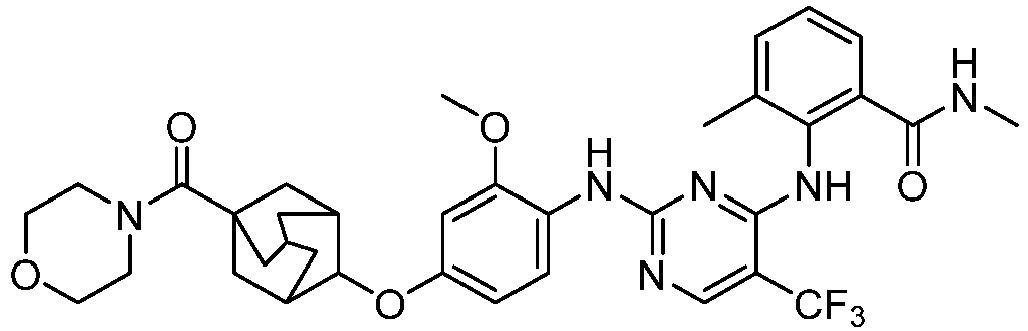
20 2-((2-((2-methoxy-4-((5-(4-methylpiperazin-1-carbonyl)adamantan-2-yl)oxy)phenyl)amino)-5-(trifluoromethyl)pyrimidin-4-yl)amino)-N,3-dimethylbenzamide 
21 2-((2-((2-methoxy-4-((5-((S)-3-acetamidopyrrolidin-1-carbonyl)adamantan-2-yl)oxy)phenyl)amino)-5-(trifluoromethyl)pyrimidin-4-yl)amino)-N,3-dimethylbenzamide 
22 2-((2-((2-methoxy-4-((5-(morpholin-4-carbonyl)adamantan-2-yl)amino)phenyl)amino)-5-(trifluoromethyl)pyrimidin-4-yl)amino)-N,3-dimethylbenzamide 
23 2-((2-((2-methoxy-4-((5-(4-methylpiperazin-1-carbonyl)adamantan-2-yl)amino)phenyl)amino)-5-(trifluoromethyl)pyrimidin-4-yl)amino)-N,3-dimethylbenzamide 
24 2-((2-((2-methoxy-4-((5-((S)-3-acetamidopyrrolidin-1-carbonyl)adamantan-2-yl)amino)phenyl)amino)-5-(trifluoromethyl)pyrimidin-4-yl)amino)-N,3-dimethylbenzamide 
25 N-(3-methoxy-4-((4-((2-methyl-6-(methylcarbamoyl)phenyl)amino) -5-(trifluoromethyl)pyrimidin-2-yl)amino)phenyl)-4-morpholinoadamantan-1-carboxamide 
26 N-(3-methoxy-4-((4-((2-methyl-6-(methylcarbamoyl)phenyl)amino) -5-(trifluoromethyl)pyrimidin-2-yl)amino)phenyl)-4-(4-methylpiperazin-1-yl)adamantan-1-carboxamide 
27 (trans)-4-((S)-3-acetamidopyrrolidin-1-yl)-N-(3-methoxy-4-((4-((2-methyl-6-(methylcarbamoyl)phenyl)amino) -5-(trifluoromethyl)pyrimidin-2-yl)amino)phenyl)adamantan-1-carboxamide 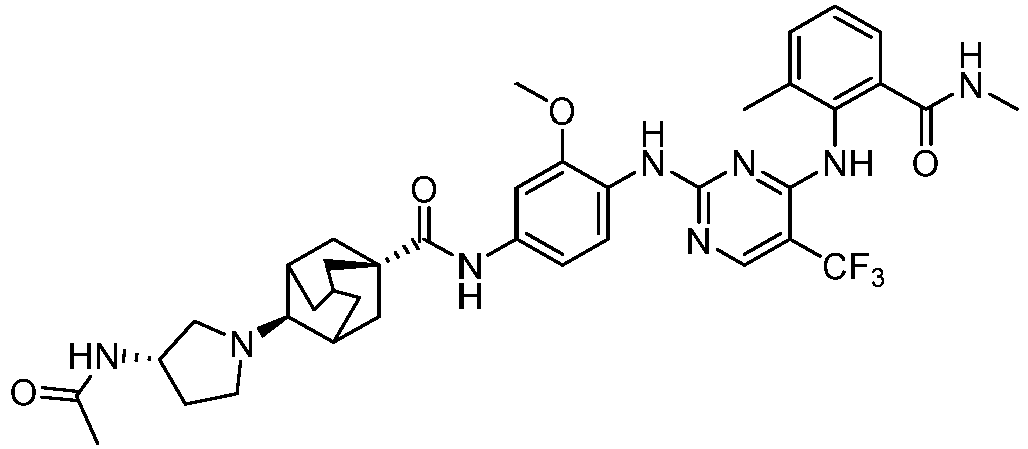
28 (cis)-4-((S)-3-acetamidopyrrolidin-1-yl)-N-(3-methoxy-4-((4-((2-methyl-6-(methylcarbamoyl)phenyl)amino) -5-(trifluoromethyl)pyrimidin-2-yl)amino)phenyl)adamantan-1-carboxamide 
29 4-hydroxy-N-(3-methoxy-4-((4-((2-methyl-6-(methylcarbamoyl)phenyl)amino) -5-(trifluoromethyl)pyrimidin-2-ylamino)phenyl)adamantan-1-carboxamide 
30 (trans)-4-((S)-3-aminopyrrolidin-1-yl)-N-(3-methoxy-4-((4-((2-methyl-6-(methylcarbamoyl)phenyl)amino) -5-(trifluoromethyl)pyrimidin-2-yl)amino)phenyl)adamantan-1-carboxamide 
31 (cis)-4-((S)-3-aminopyrrolidin-1-yl)-N-(3-methoxy-4-((4-((2-methyl-6-(methylcarbamoyl)phenyl)amino) -5-(trifluoromethyl)pyrimidin-2-yl)amino)phenyl)adamantan-1-carboxamide 
32 2-((2-((4-(1-((trans)-5-hydroxyadamantan-2-yl)piperidin-4-yl)-2-methoxyphenyl)amino)-5-(trifluoromethyl)pyrimidin-4-yl)amino)-N,3-dimethylbenzamide 
33 2-((2-((4-(1-((cis)-5-hydroxyadamantan-2-yl)piperidin-4-yl)-2-methoxyphenyl)amino)-5-(trifluoromethyl)pyrimidin-4-yl)amino)-N,3-dimethylbenzamide 
34 2-((2-((4-(1-((trans)-5-hydroxyadamantan-2-yl)piperidin-4-yl)-2-methoxyphenyl)amino)-5-(trifluoromethyl)pyrimidin-4-yl)amino)-3-methylbenzamide 
35 2-((2-((4-(1-((cis)-5-hydroxyadamantan-2-yl)piperidin-4-yl)-2-methoxyphenyl)amino)-5-(trifluoromethyl)pyrimidin-4-yl)amino)-3-methylbenzamide 
36 2-((5-chloro-2-((4-(4-((trans)-5-hydroxyadamantan-2-yl)piperazin-1-yl)-2-methoxyphenyl)amino)-pyrimidin-4-yl)amino)-N,3-dimethylbenzamide 
37 methyl (trans)-4-(4-(3-methoxy-4-((4-((2-methyl-6-(methylcarbamoyl)phenyl)amino) -5-(trifluoromethyl)pyrimidin-2-yl)amino)phenyl)piperazin-1-yl)adamantan-1-carboxylate 
38 methyl (cis)-4-(4-(3-methoxy-4-((4-((2-methyl-6-(methylcarbamoyl)phenyl)amino) -5-(trifluoromethyl)pyrimidin-2-yl)amino)phenyl)piperazin-1-yl)adamantan-1-carboxylate 
39 (trans)-4-(4-(3-methoxy-4-((4-((2-methyl-6-(methylcarbamoyl)phenyl)amino) -5-(trifluoromethyl)pyrimidin-2-yl)amino)phenyl)piperazin-1-yl)adamantan-1-carboxylic acid 
40 (cis)-4-(4-(3-methoxy-4-((4-((2-methyl-6-(methylcarbamoyl)phenyl)amino) -5-(trifluoromethyl)pyrimidin-2-yl)amino)phenyl)piperazin-1-yl)adamantan-1-carboxylic acid 
41 4-(4-(3-methoxy-4-((4-((2-methyl-6-(methylcarbamoyl)phenyl)amino) -5-(trifluoromethyl)pyrimidin-2-yl)amino)phenyl)piperazin-1-yl)-N-methyladamantan-1-carboxamide 
42 4-(4-(3-methoxy-4-((4-((2-methyl-6-(methylcarbamoyl)phenyl)amino) -5-(trifluoromethyl)pyrimidin-2-yl)amino)phenyl)piperazin-1-yl)adamantan-1-carboxamide 
43 4-(4-(3-methoxy-4-((4-((2-methyl-6-(methylcarbamoyl)phenyl)amino) -5-(trifluoromethyl)pyrimidin-2-yl)amino)phenyl)piperazin-1-yl)-N,N-dimethyladamantan-1-carboxamide 
44 2-((2-((4-(4-(5-aminoadamantan-2-yl)piperazin-1-yl)-2-methoxyphenyl)amino)-5-(trifluoromethyl)pyrimidin-4-yl)amino)-N,3-dimethylbenzamide 
45 2-((2-((4-(4-(5-(methylamino)adamantan-2-yl)piperazin-1-yl)-2-methoxyphenyl)amino)-5-(trifluoromethyl)pyrimidin-4-yl)amino)-N,3-dimethylbenzamide 
46 2-((2-((4-(4-(5-(dimethylamino)adamantan-2-yl)piperazin-1-yl)-2-methoxyphenyl)amino)-5-(trifluoromethyl)pyrimidin-4-yl)amino)-N,3-dimethylbenzamide 
47 2-((2-((4-(4-(5-acrylamidoadamantan-2-yl)piperazin-1-yl)-2-methoxyphenyl)amino)-5-(trifluoromethyl)pyrimidin-4-yl)amino)-N,3-dimethylbenzamide 
- In the present invention, "stereoisomer" may include a diastereomer and an optical isomer, in which the optical isomer may include not only an enantiomer, but also a mixture of the enantiomer and even a racemate.
- In the present invention, "pharmaceutically acceptable salts" may refer to the salts conventionally used in a pharmaceutical industry, for example, inorganic ion salts prepared from calcium, potassium, sodium, magnesium and the like; inorganic acid salts prepared from hydrochloric acid, nitric acid, phosphoric acid, bromic acid, iodic acid, perchloric acid, hydroiodic acid, sulfuric acid and the like; organic acid salts prepared from acetic acid, trifluoroacetic acid, citric acid, maleic acid, succinic acid, oxalic acid, benzoic acid, tartaric acid, fumaric acid, mandelic acid, propionic acid, lactic acid, glycolic acid, gluconic acid, galacturonic acid, glutamic acid, glutaric acid, glucuronic acid, aspartic acid, ascorbric acid, carbonic acid, vanillic acid, and the like; sulfonic acid salts prepared from methanesulfonic acid, ethanesulfonic acid, benzenesulfonic acid, p-toluenesulfonic acid, naphthalenesulfonic acid and the like; amino acid salts prepared from glycine, arginine, lysine, and the like; amine salts prepared from trimethylamine, triethylamine, ammonia, pyridine, picoline, and the like; and the like, but types of salts meant in the present invention are not limited to those listed salts.
- The "hydrate" of the present invention may refer to one, in which adamantane derivatives, isomers thereof or pharmaceutically acceptable salts thereof and water are bound by a non-covalent intermolecular force, and may include a stoichiometric or non-stoichiometric amount of water. Particularly, the hydrate may contain water at a molar ratio of about 0.25 mol to about 10 mol based on 1 mol of an active ingredient, more particularly about 0.5 mol, about 1 mol, about 1.5 mol, about 2 mol, about 2.5 mol, 3 mol, about 5 mol, etc.
- The "solvate" of the present invention may refer to one, in which adamantane derivatives, isomers thereof or pharmaceutically acceptable salts thereof and a solvent other than water are bound by an intermolecular force, and may include a stoichiometric or non-stoichiometric amount of solvent. Particularly, the solvate may contain a solvent molecule at a molar ratio of about 0.25 mol to about 10 mol based on 1 mol of an active ingredient, more particularly about 0.5 mol, about 1 mol, about 1.5 mol, about 2 mol, about 2.5 mol, about 3 mol, about 5 mol, etc.
- In the present invention, "inhibitor" may refer to a compound that blocks or reduces the activity of an enzyme. The inhibitor may be capable of reversible or irreversible binding, and thus the term may include a compound that kills the substrate of the enzyme. The inhibitor may modify one or more sites on or near an enzyme active site, or may result in a conformational change elsewhere on the enzyme.
- The references to methods of treatment in the subsequent paragraphs of this description are to be interpreted as references to the compounds, pharmaceutical compositions and medicaments of the present invention for use in a method for treatment of the human (or animal) body by therapy (or for diagnosis).
- The present invention provides a pharmaceutical composition including adamantane derivatives, pharmaceutically acceptable salts thereof, stereoisomers thereof, hydrates or solvates thereof as active ingredients.
- The present invention provides a pharmaceutical composition for preventing or treating FAK activity-associated diseases, including adamantane derivatives, pharmaceutically acceptable salts thereof, stereoisomers thereof, hydrates or solvates thereof as active ingredients.
- In addition, the adamantane derivatives, stereoisomers thereof or pharmaceutically acceptable salts thereof according to the present invention may inhibit the activity of at least one of FAK and Pyk2(FAK2).
- The FAK activity-associated diseases may be abnormal cell growth diseases induced by the abnormal activity of the FAK, and may be at least one selected from the group consisting of autoimmune disease, inflammatory disease, bone disease, metabolic disease, neurological and neurodegenerative disease, cancer, cardiovascular disease, allergy and asthma, Alzheimer's disease, viral disease and hormone-associated disease, preferably any one selected from the group consisting of solid cancers including gastric cancer, lung cancer, liver cancer, colorectal cancer, small intestine cancer, pancreatic cancer, brain cancer, bone cancer, melanoma, breast cancer, uterine cancer, cervical cancer, ovarian cancer, head and neck cancer, thyroid cancer, parathyroid cancer, kidney cancer, prostate cancer, urethral cancer, bladder cancer, mesothelioma, etc., and blood cancers including leukemia, multiple myeloma, lymphoma, etc. More preferably, the abnormal cell growth diseases induced by the abnormal activity of the FAK may be any one selected from the group consisting of highly invasive and metastatic triple-negative breast cancer, colorectal cancer, lung cancer and malignant mesothelioma. In addition, the above diseases may include symptoms or diseases related to the abnormal functions of the FAK.
- The present invention provides a use of adamantane derivatives according to the present invention, pharmaceutically acceptable salts thereof, stereoisomers thereof, hydrates or solvates thereof for preventing or treating FAK activity-associated diseases.
- In addition, the present invention provides a method for preventing or treating FAK activity-associated diseases, including administering a therapeutically effective amount of adamantane derivatives, pharmaceutically acceptable salts thereof, stereoisomers thereof, hydrates or solvates thereof into an individual.
- As used herein, the term "prevention" means all the acts, which inhibit FAK activity-associated diseases or delay the occurrence thereof by administering the compound according to the present invention.
- As used herein, the term "treatment" means all the acts, by which a symptom of FAK activity-associated diseases gets better or takes a favorable turn by administering the compound according to the present invention.
- In addition, the present invention provides a method for inhibiting FAK and Pyk2(FAK2) activities, including administering adamantane derivatives, stereoisomers thereof or pharmaceutically acceptable salts thereof into an individual.
- The method for preventing or treating FAK activity-associated diseases according to the present invention includes not only dealing with the diseases per se before expression of symptoms, but also inhibiting or avoiding such symptoms by administering an adamantane derivative compound, pharmaceutically acceptable salts thereof, stereoisomers thereof, hydrates or solvates thereof. In managing the diseases, a preventive or therapeutic dose of a certain active ingredient may vary depending on a nature and severity of the diseases or conditions and a route of administering the active ingredient. A dose and a frequency thereof may vary depending on an individual patient's age, weight and reactions. A suitable dose and usage may be easily selected by those skilled in the art, naturally considering such factors. In addition, the method for preventing or treating FAK activity-associated diseases according to the present invention may further include administering a therapeutically effective amount of an additional active agent, which is helpful in treating the diseases, along with adamantane derivatives, pharmaceutically acceptable salts thereof, stereoisomers thereof, hydrates or solvates thereof, and the additional active agent may exhibit a synergy effect or an adjuvant effect together with the adamantane derivatives, pharmaceutically acceptable salts thereof, stereoisomers thereof, hydrates or solvates thereof.
- The present invention also provides a use of adamantane derivatives, pharmaceutically acceptable salts thereof, stereoisomers thereof, hydrates or solvates thereof for manufacture of a medicament for preventing or treating FAK activity-associated diseases. For preparing a medicament, adamantane derivatives, pharmaceutically acceptable salts thereof, stereoisomers thereof, hydrates or solvates thereof may be combined with acceptable adjuvants, diluents, carriers, etc., and may be prepared into a complex preparation together with other active agents and thus have a synergy action of active ingredients.
- The pharmaceutical composition of the present invention may further include a pharmaceutically acceptable carrier.
- In this case, the pharmaceutically acceptable carrier may be one which is conventionally used in formulating a preparation, including, but not limited thereto, lactose, dextrose, sucrose, sorbitol, mannitol, starch, acacia rubber, calcium phosphate, alginate, gelatin, calcium silicate, microcrystalline cellulose, polyvinyl pyrrolidone, cellulose, water, syrup, methyl cellulose, methyl hydroxybenzoate, propyl hydroxybenzoate, talc, magnesium stearate, mineral oil and the like. In addition, the pharmaceutical composition of the present invention may further include lubricant, humectant, a sweetening agent, a flavoring agent, emulsifier, a suspending agent, preservative, etc. in addition to the above ingredients.
- Furthermore, the pharmaceutical composition of the present invention may further include a medicament selected from the group consisting of cell signal transduction inhibitors, mitosis inhibitors, alkylating agents, antimetabolites, antibiotics, growth factor inhibitors, cell cycle inhibitors, topoisomerase inhibitors, biological reaction modifiers, antihormonal agents, antiandrogen, cell differentiation/proliferation/survival inhibitors, and apoptosis inducer, and may be used in combination with the medicament further included above or may be formulated into a complex medication when being formulated into a medicament.
- The pharmaceutical composition of the present invention may be orally or parenterally administered (for example, applied intravenously, hypodermically, intraperitoneally or locally) according to an intended method, in which a dosage thereof varies depending on a patient's condition and weight, a degree of disease, a drug form, and an administration route and time, but may be appropriately selected by those skilled in the art.
- The pharmaceutical composition of the present invention is administered in a therapeutically effective amount.
- In the present invention, the "therapeutically effective amount" may refer to an amount enough to treat a disease at a reasonable benefit/risk ratio applicable to medical treatment, and a level of effective dose may be determined according to factors including a patient's disease type, severity, activity of a drug, sensitivity to the drug, an administration time, an administration route and excretion rate, a treatment period and a concurrently used drug, as well as other factors well known in a medical field. The pharmaceutical composition according to the present invention may be administered as an individual therapeutic agent or in combination with other therapeutic agents, may be administered sequentially or simultaneously with a conventional therapeutic agent, and may be administered in a single or multiple manner. Considering all the factors above, it is important to carry out an administration by an amount, in which the maximum effect may be achieved by the minimum amount without a side effect, in which such amount may be easily determined by those skilled in the art.
- Specifically, the effective amount of the pharmaceutical composition of the present invention may vary depending on a patient's age, gender, condition and weight, a degree of absorption of an active ingredient into the body, an inactivation rate and excretion rate, a disease type, and a concurrently used drug, and may be generally administered in an amount of 0.001 to 160 mg per 1 kg of body weight, preferably 0.01 to 100 mg, which may be administered everyday or every other day, or administered at one time to three times a day by dividing the daily dosage of the composition. However, the effective amount may increase or decrease depending on the route of administration, the severity of obesity, gender, weight, age, etc., and thus the dosage may not be intended to limit the scope of the present invention in any way.
- In the present invention, "individual" may refer to a subject, whose disease needs to be prevented or treated, and more specifically to a mammal such as a human, monkey, mouse, dog, cat, horse, cow, etc., but is not limited thereto.
- Matters mentioned in the use, composition and therapeutic method of the present invention may be equally applied, if not contradictory to each other. Besides, the terms and abbreviations used in the present specification have their original meanings, unless defined otherwise.
- Hereinafter, the present invention will be described in detail through Examples for better understanding of the present invention. However, the following Examples are provided only for the purpose of illustrating the present invention, and thus the scope of the present invention is not limited thereto. The Examples of the present invention are provided to more completely describe the present invention to those having ordinary skill in the art.
-

-

- trans-4-Aminoadamantan-1-ol, 4-fluoro-2-methoxy-1-nitrobenzene, potassium carbonate and dimethylsulfoxide were heated to 120°C for five hours while being well stirred. After cooling to room temperature, water was added to the reaction solution to precipitate while being well stirred, and the precipitated solid was obtained by filtration. The obtained solid was purified by column chromatography to obtain the title compound.
-

- After dissolving (trans)-4-((3-methoxy-4-nitrophenyl)amino)adamantan-1-ol prepared in
above step 1 in ethanol, 10% palladium/carbon catalyst was added thereto and stirred for 15 hours under hydrogen pressure. After completion of the reaction, the resulting solution was filtrated through celite and the filtrate was concentrated under reduced pressure and was immediately used in the next step without further purification. -

- 2,4-Dichloro-5-(trifluoromethyl)pyrimidine was dissolved in a mixed solvent of 1,2-dichloroethane and t-butanol (1:1), after which zinc dichloride was added and stirred at room temperature for 30 minutes. After cooling to 0°C, (trans)-4-((4-amino-3-methoxyphenyl)amino)adamantan-1-ol prepared in
above step 2 was dissolved in a mixed solvent of 1,2-dichloroethane and t-butanol (1:1) and slowly added. After stirring at 0°C for one hour, diisopropylamine was added and stirred at room temperature for 15 hours. Ice water was poured into the reaction solution, extracted with dichloromethane, dried over anhydrous magnesium sulfate, and filtered, after which the filtrate was concentrated and purified by column chromatography to obtain the title compound. -

- (trans)-4-((4-((4-Chloro-5-(trifluoromethyl)pyrimidin-2-yl)amino)-3-methoxyphenyl)amino)adamantan-1-ol prepared in
above step 3 and 2-amino-N,3-dimethylbenzamide were dissolved in 2-butanol, after which trifluoroacetic acid was added and stirred under reflux for five hours. After cooling to room temperature, distilled water was added to the reaction solution, followed by extraction with ethyl acetate. The resulting solution was dried over anhydrous magnesium sulfate, and filtered, after which the filtrate was concentrated and purified by column chromatography to obtain the title compound.
1H NMR (400 MHz, CDCl3): δ 8.24 (s, 1H), 8.19 (s, 1H), 7.38 (d, J = 7.4 Hz, 1H), 7.34 (d, J = 7.5 Hz, 1H), 7.27 - 7.22 (m, 1H), 6.12 (d, J = 1.8 Hz, 1H), 6.04 (s, 1H), 5.76 (s, 1H), 3.78 (s, 3H), 3.44 (s, 1H), 2.83 (d, J = 4.6 Hz, 3H), 2.22 - 2.11 (m, 5H), 1.92 - 1.69 (m, 8H), 1.60 - 1.40 (m, 3H) -
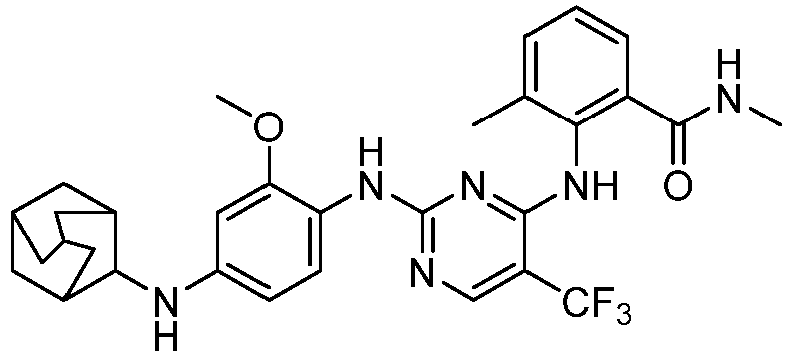
-

- The title compound was synthesized in the same manner as in Example 1 by using adamantan-2-amine instead of trans-4-aminoadamantan-1-ol in
step 1 of Example 1. -

- The title compound was synthesized in the same manner as in Example 1 by using N-(3-methoxy-4-nitrophenyl)adamantan-2-amine instead of (trans)-4-((3-methoxy-4-nitrophenyl)amino)adamantan-1-ol in
step 2 of Example 1. -

- The title compound was synthesized in the same manner as in Example 1 by using N-(adamantan-2-yl)-3-methoxybenzen-1,4-diamine instead of (trans)-4-((4-amino-3-methoxyphenyl)amino)adamantan-1-ol in
step 3 of Example 1. -

- The title compound was synthesized in the same manner as in Example 1 by using N-(adamantan-2-yl)-N-(4-chloro-5-(trifluoromethyl)pyrimidin-2-yl)-2-methoxybenzene-1,4-diamine instead of (trans)-4-((4-((4-chloro-5-(trifluoromethyl)pyrimidin-2-yl)amino)-3-methoxyphenyl)amino)adamantan-1-ol in
step 4 of Example 1.
1H NMR (400 MHz, DMSO-d6): δ 9.10 (s, 1H), 8.30 - 8.25 (m, 1H), 8.20 (s, 1H), 7.91 (s, 1H), 7.39 (d, J = 7.7 Hz, 1H), 7.34 (d, J = 6.9 Hz, 1H), 7.25 - 7.20 (m, 1H), 7.01 (br s, 1H), 6.32 (s, 1H), 5.40 (br s, 1H), 3.63 (s, 3H), 3.43 - 3.38 (m, 1H), 2.69 (d, J = 4.5 Hz, 3H), 2.15 - 2.00 (m, 5H), 1.94 - 1.69 (m, 9H), 1.51 - 1.45 (m, 2H) -

-

- The title compound was synthesized in the same manner as in Example 1 by using piperazine instead of trans-4-aminoadamantan-1-ol in
step 1 of Example 1. -

- 1-(3-Methoxy-4-nitrophenyl)piperazine prepared in
above step 1, adamantan-2-one, triacetoxysodium borohydride, tetrahydrofuran, and acetic acid were stirred at room temperature for 15 hours. Ice water was poured into the reaction solution, extracted with ethyl acetate, dried over anhydrous magnesium sulfate, and filtered, after which the filtrate was concentrated and purified by column chromatography to obtain the title compound. -

- The title compound was synthesized in the same manner as in Example 1 by using 1-(adamantan-2-yl)-4-(3-methoxy-4-nitrophenyl)piperazine instead of (trans)-4-((3-methoxy-4-nitrophenyl)amino)adamantan-1-ol in
step 2 of Example 1. -

- The title compound was synthesized in the same manner as in Example 1 by using 4-(4-(adamantan-2-yl)piperazin-1-yl)-2-methoxyaniline instead of (trans)-4-((4-amino-3-methoxyphenyl)amino)adamantan-1-ol in
step 3 of Example 1. -

- The title compound was synthesized in the same manner as in Example 1 by using N-(4-(4-(adamantan-2-yl)piperazin-1-yl)-2-methoxyphenyl-4-chloro-5-(trifluoromethyl)pyrimidin-2-amine instead of (trans)-4-((4-((4-chloro-5-(trifluoromethyl)pyrimidin-2-yl)amino)-3-methoxyphenyl)amino)adamantan-1-ol in
step 4 of Example 1.
1H NMR (400 MHz, CDCl3): δ 8.26 (s, 2H, overlapped), 7.41 (d, J = 7.3 Hz, 1H), 7.34 (d, J = 7.5 Hz, 1H), 7.31 - 7.26 (m, 1H), 6.47 (d, J = 2.0 Hz, 1H), 6.09 (br s, 1H), 6.00 (s, 1H), 3.82 (s, 3H), 3.09 (m, 4H), 2.84 (d, J = 4.8 Hz, 3H), 2.61 (m, 4H), 2.21 (s, 3H), 2.19 - 2.10 (m, 2H), 1.96 - 1.82 (m, 4H), 1.76 - 1.65 (m, 5H), 1.54 - 1.39 (m, 2H) -

-

- The title compound was synthesized in the same manner as in Example 3 by using 5-hydroxyadamantan-2-one instead of adamantan-2-one in
step 2 of Example 3. -

- The title compound was synthesized in the same manner as in Example 1 by using (trans)-4-(4-(3-methoxy-4-nitrophenyl)piperazin-1-yl)adamantan-1-ol instead of (trans)-4-((3-methoxy-4-nitrophenyl)amino)adamantan-1-ol in
step 2 of Example 1. -

- The title compound was synthesized in the same manner as in Example 1 by using (trans)-4-(4-(4-amino-3-methoxyphenyl)piperazin-1-yl)adamantan-1-ol instead of (trans)-4-((4-amino-3-methoxyphenyl)amino)adamantan-1-ol in
step 3 of Example 1. -

- The title compound was synthesized in the same manner as in Example 1 by using (trans)-4-(4-(4-((4-chloro-5-(trifluoromethyl)pyrimidin-2-yl)amino)-3-methoxyphenyl)piperazin-1-yl)adamantan-1-ol instead of (trans)-4-((4-((4-chloro-5-(trifluoromethyl)pyrimidin-2-yl)amino)-3-methoxyphenyl)amino)adamantan-1-ol in
step 4 of Example 1.
1H NMR (400 MHz, CDCl3): δ 8.26 (s, 2H, overlapped), 7.41 (d, J = 7.3 Hz, 1H), 7.34 (d, J = 7.5 Hz, 1H), 7.31 - 7.26 (m, 1H), 6.47 (d, J = 2.0 Hz, 1H), 6.09 (br s, 1H), 6.00 (s, 1H), 3.82 (s, 3H), 3.09 (m, 4H), 2.84 (d, J = 4.8 Hz, 3H), 2.61 (m, 4H), 2.32 - 2.26 (m, 1H), 2.21 (s, 3H), 2.14 - 1.98 (m, 4H), 1.81 - 1.59 (m, 6H), 1.42 - 1.24 (m, 3H) -

-

- The title compound was synthesized in the same manner as in Example 3 by using 5-hydroxyadamantan-2-one instead of adamantan-2-one in
step 2 of Example 3. -

- The title compound was synthesized in the same manner as in Example 1 by using (cis)-4-(4-(3-methoxy-4-nitrophenyl)piperazin-1-yl)adamantan-1-ol instead of (trans)-4-((3-methoxy-4-nitrophenyl)amino)adamantan-1-ol in
step 2 of Example 1. -

- The title compound was synthesized in the same manner as in Example 1 by using (cis)-4-(4-(4-amino-3-methoxyphenyl)piperazin-1-yl)adamantan-1-ol instead of (trans)-4-((4-amino-3-methoxyphenyl)amino)adamantan-1-ol in
step 3 of Example 1. -

- The title compound was synthesized in the same manner as in Example 1 by using (cis)-4-(4-(4-((4-chloro-5-(trifluoromethyl)pyrimidin-2-yl)amino)-3-methoxyphenyl)piperazin-1-yl)adamantan-1-ol instead of (trans)-4-((4-((4-chloro-5-(trifluoromethyl)pyrimidin-2-yl)amino)-3-methoxyphenyl)amino)adamantan-1-ol in
step 4 of Example 1.
1H NMR (400 MHz, CDCl3): δ 8.26 (s, 2H, overlapped), 7.41 (d, J = 7.3 Hz, 1H), 7.34 (d, J = 7.5 Hz, 1H), 7.31 - 7.26 (m, 1H), 6.47 (d, J = 2.0 Hz, 1H), 6.09 (br s, 1H), 6.00 (s, 1H), 3.82 (s, 3H), 3.09 (m, 4H), 2.84 (d, J = 4.8 Hz, 3H), 2.61 (m, 4H), 2.33 - 2.25 (m, 1H), 2.21 (s, 3H), 2.13 - 1.97 (m, 4H), 1.82 - 1.60 (m, 5H), 1.41 - 1.23 (m, 3H) -

-

- The title compound was synthesized in the same manner as in Example 1 by using 4-aminopiperidin-1-carboxylic acid tert-butyl instead of trans-4-aminoadamantan-1-ol in
step 1 of Example 1. -

- 4-((3-Methoxy-4-nitrophenyl)amino)piperidin-1-carboxylic acid tert-butyl prepared in
above step 1 was dissolved in dichloromethane, after which trifluoroacetic acid was added and stirred at room temperature for three hours. After completion of the reaction, distilled water was added to the reaction solution, followed by extraction with dichloromethane. The resulting solution was dried over anhydrous magnesium sulfate, and filtered, after which the filtrate was concentrated and purified by column chromatography to obtain the title compound. -

- The title compound was synthesized in the same manner as in Example 3 by using N-(3-methoxy-4-nitrophenyl)piperidin-4-amine instead of 1-(3-methoxy-4-nitrophenyl)piperazine in
step 2 of Example 3. -

- The title compound was synthesized in the same manner as in Example 1 by using 1-(adamantan-2-yl)-N-(3-methoxy-4-nitrophenyl)piperidin-4-amine instead of (trans)-4-((3-methoxy-4-nitrophenyl)amino)adamantan-1-ol in
step 2 of Example 1. -

- The title compound was synthesized in the same manner as in Example 1 by using N-(1-(adamantan-2-yl)piperidin-4-yl)-3-methoxybenzen-1,4-diamine instead of (trans)-4-((4-amino-3-methoxyphenyl)amino)adamantan-1-ol in
step 3 of Example 1. -

- The title compound was synthesized in the same manner as in Example 1 by using N-(1-(adamantan-2-yl)piperidin-4-yl)-N-(4-chloro-5-(trifluoromethyl)pyrimidin-2-yl)-2-methoxybenzen-1,4-diamine instead of (trans)-4-((4-((4-chloro-5-(trifluoromethyl)pyrimidin-2-yl)amino)-3-methoxyphenyl)amino)adamantan-1-ol in
step 4 of Example 1.
1H NMR (400 MHz, CDCl3): δ 8.25 (s, 1H), 8.13 (br s, 1H), 7.41 - 7.32 (m, 2H), 7.29 - 7.24 (m, 1H), 6.13 (d, J = 2.3 Hz, 1H), 5.97 (br s, 1H), 3.78 (s, 3H), 3.06 - 2.95 (m, 2H), 2.84 (d, J = 4.8 Hz, 3H), 2.21 (s, 3H), 2.12 - 1.92 (m, 8H), 1.90 - 1.75 (m, 5H), 1.74 - 1.62 (m, 5H), 1.47 - 1.35 (m, 4H) -
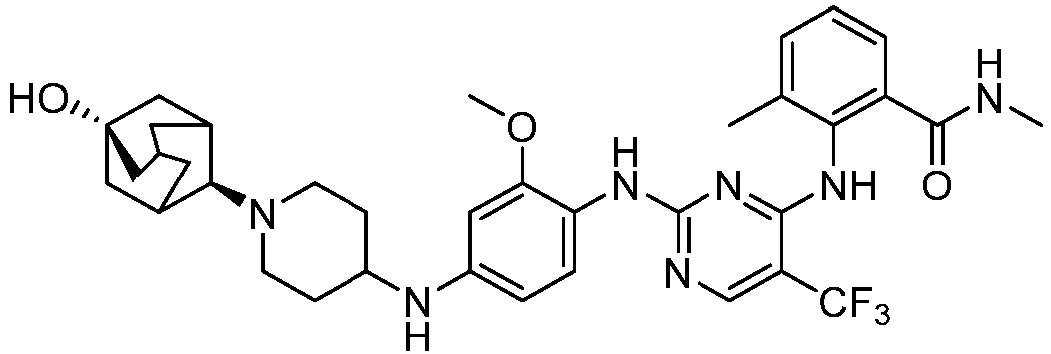
-

- The title compound was synthesized in the same manner as in Example 6 by using 5-hydroxyadamantan-2-one instead of adamantan-2-one in
step 3 of Example 6. -

- The title compound was synthesized in the same manner as in Example 1 by using (trans)-4-(4-((3-methoxy-4-nitrophenyl)amino)piperidin-1-yl)adamantan-1-ol instead of (trans)-4-((3-methoxy-4-nitrophenyl)amino)adamantan-1-ol in
step 2 of Example 1. -

- The title compound was synthesized in the same manner as in Example 1 by using (trans)-4-(4-((4-amino-3-methoxyphenyl)amino)piperidin-1-yl)adamantan-1-ol instead of (trans)-4-((4-amino-3-methoxyphenyl)amino)adamantan-1-ol in
step 3 of Example 1. -

- The title compound was synthesized in the same manner as in Example 1 by using (trans)-4-(4-((4-((4-chloro-5-(trifluoromethyl)pyrimidin-2-yl)amino)-3-methoxyphenyl)amino)piperidin-1-yl)adamantan-1-ol instead of (trans)-4-((4-((4-chloro-5-(trifluoromethyl)pyrimidin-2-yl)amino)-3-methoxyphenyl)amino)adamantan-1-ol in
step 4 of Example 1. - 1H NMR (400 MHz, CDCl3): δ 8.25 (s, 1H), 8.15 (s, 1H), 7.41 - 7.32 (m, 2H), 7.31 - 7.24 (m, 2H), 6.13 (d, J = 2.3 Hz, 1H), 5.97 (s, 1H), 5.76 (s, 1H), 3.78 (s, 3H), 3.25 - 3.14 (m, 1H), 3.05 - 2.91 (m, 2H), 2.84 (d, J = 4.8 Hz, 3H), 2.39 - 2.31 (m, 2H), 2.21 (s, 3H), 2.15 - 1.95 (m, 7H), 1.77 - 1.66 (m, 5H), 1.56 (m, 2H), 1.40 (m, 4H).
-

-

- The title compound was synthesized in the same manner as in Example 6 by using 5-hydroxyadamantan-2-one instead of adamantan-2-one in
step 3 of Example 6. -

- The title compound was synthesized in the same manner as in Example 1 by using (cis)-4-(4-((3-methoxy-4-nitrophenyl)amino)piperidin-1-yl)adamantan-1-ol instead of (trans)-4-((3-methoxy-4-nitrophenyl)amino)adamantan-1-ol in
step 2 of Example 1. -

- The title compound was synthesized in the same manner as in Example 1 by using (cis)-4-(4-((4-amino-3-methoxyphenyl)amino)piperidin-1-yl)adamantan-1-ol instead of (trans)-4-((4-amino-3-methoxyphenyl)amino)adamantan-1-ol in
step 3 of Example 1. -

- The title compound was synthesized in the same manner as in Example 1 by using (cis)-4-(4-((4-((4-chloro-5-(trifluoromethyl)pyrimidin-2-yl)amino)-3-methoxyphenyl)amino)piperidin-1-yl)adamantan-1-ol instead of (trans)-4-((4-((4-chloro-5-(trifluoromethyl)pyrimidin-2-yl)amino)-3-methoxyphenyl)amino)adamantan-1-ol in
step 4 of Example 1. - 1H NMR (400 MHz, CDCl3): δ 8.25 (s, 1H), 8.15 (s, 1H), 7.41 - 7.32 (m, 2H), 7.31 - 7.24 (m, 2H), 6.13 (d, J = 2.3 Hz, 1H), 5.97 (s, 1H), 5.76 (s, 1H), 3.78 (s, 3H), 3.25 - 3.14 (m, 1H), 3.05 - 2.91 (m, 2H), 2.84 (d, J = 4.8 Hz, 3H), 2.39 - 2.31 (m, 2H), 2.21 (s, 3H), 2.15 - 1.95 (m, 7H), 1.77 - 1.66 (m, 5H), 1.56 (m, 2H), 1.40 (m, 4H).
-

-

- The title compound was synthesized in the same manner as in Example 1 by using 4-hydroxypiperidin-1-carboxylic acid tert-butyl instead of trans-4-aminoadamantan-1-ol in
step 1 of Example 1. -

- The title compound was synthesized in the same manner as in Example 6 by using 4-((3-methoxy-4-nitrophenyl)oxy)piperidin-1-carboxylic acid tert-butyl instead of 4-((3-methoxy-4-nitrophenyl)amino)piperidin-1-carboxylic acid tert-butyl in
step 2 of Example 6. -

- The title compound was synthesized in the same manner as in Example 3 by using 4-(3-methoxy-4-nitrophenoxy)piperidine instead of 1-(3-methoxy-4-nitrophenyl)piperazine in
step 2 of Example 3. -

- The title compound was synthesized in the same manner as in Example 1 by using 1-(adamantan-2-yl)-4-(3-methoxy-4-nitrophenoxy)piperidine instead of (trans)-4-((3-methoxy-4-nitrophenyl)amino)adamantan-1-ol in
step 2 of Example 1. -

- The title compound was synthesized in the same manner as in Example 1 by using 4-((1-(adamantan-2-yl)piperidin-4-yl)oxy)-2-methoxyaniline instead of (trans)-4-((4-amino-3-methoxyphenyl)amino)adamantan-1-ol in
step 3 of Example 1. -

- The title compound was synthesized in the same manner as in Example 1 by using N-(4-((1-(adamantan-2-yl)piperidin-4-yl)oxy)-2-methoxyphenyl)-4-chloro-5-(trifluoromethyl)pyrimidin-2-amine instead of (trans)-4-((4-((4-chloro-5-(trifluoromethyl)pyrimidin-2-yl)amino)-3-methoxyphenyl)amino)adamantan-1-ol in
step 4 of Example 1. - 1H NMR (400 MHz, CDCl3): δ 8.31 (br s, 1H), 8.27 (s, 1H), 7.42 - 7.34 (m, 2H), 7.28 (t, J = 7.5 Hz, 1H), 6.44 (d, J = 1.9 Hz, 1H), 6.08 (br s, 1H), 5.98 (s, 1H), 4.16 (br s, 1H), 3.81 (s, 3H), 2.92 - 2.81 (m, 4H), 2.20 (s, 3H), 2.18 - 1.92 (m, 8H), 1.92 - 1.75 (m, 5H), 1.75 - 1.57 (m, 6H), 1.49 - 1.33 (m, 3H).
-

-

- The title compound was synthesized in the same manner as in Example 1 by using 5-hydroxyadamantan-2-one instead of trans-4-aminoadamantan-1-ol in
step 1 of Example 1. -

- The title compound was synthesized in the same manner as in Example 1 by using 5-(3-methoxy-4-nitrophenoxy)adamantan-2-one instead of (trans)-4-((3-methoxy-4-nitrophenyl)amino)adamantan-1-ol in
step 2 of Example 1. -

- The title compound was synthesized in the same manner as in Example 1 by using 5-(4-amino-3-methoxyphenoxy)adamantan-2-one instead of (trans)-4-((4-amino-3-methoxyphenyl)amino)adamantan-1-ol in
step 3 of Example 1. -

- The title compound was synthesized in the same manner as in Example 1 by using N-(4-((1-(adamantan-2-yl)piperidin-4-yl)oxy)-2-methoxyphenyl)-4-chloro-5-(trifluoromethyl)pyrimidin-2-amine instead of (trans)-4-((4-((4-chloro-5-(trifluoromethyl)pyrimidin-2-yl)amino)-3-methoxyphenyl)amino)adamantan-1-ol in
step 4 of Example 1.
1H NMR (400 MHz, CDCl3): δ 8.46 (s, 1H), 8.29 (s, 1H), 7.42 - 7.35 (m, 2H), 7.28 (t, J = 7.6 Hz, 1H), 6.45 (d, J = 2.4 Hz, 1H), 6.17 (br s, 1H), 6.02 - 5.96 (m, 1H), 3.81 (s, 3H), 2.88 (d, J = 4.9 Hz, 3H), 2.67 - 2.62 (m, 2H), 2.40 - 2.34 (m, 1H), 2.20 (s, 3H), 2.19 - 2.01 (m, 6H), 1.96 - 1.92 (m, 4H) -

-

- 2-((2-((2-Methoxy-4-((4-oxoadamantan-1-yl)oxy)phenyl)amino)-5-(trifluoromethyl)pyrimidin-4-yl)amino)-N,3-dimethylbenzamide prepared in above Example 10, triacetoxysodium borohydride, tetrahydrofuran, and acetic acid were stirred at room temperature for 15 hours. Ice water was poured into the reaction solution, extracted with ethyl acetate, dried over anhydrous magnesium sulfate, and filtered, after which the filtrate was concentrated and purified by column chromatography to obtain the title compound.
1H NMR (400 MHz, DMSO-d6): δ 9.15 (s, 1H), 8.30 (s, 1H), 8.29 - 8.25 (m, 1H), 8.06 (s, 1H), 7.42 (d, J = 7.4 Hz, 1H), 7.38 (d, J = 7.2 Hz, 1H), 7.32 - 7.24 (m, 2H), 6.51 (d, J = 1.8 Hz, 1H), 6.21 (br s, 1H), 4.66 (d, J = 3.1 Hz, 1H), 3.70 (s, 3H), 3.69 - 3.66 (m, 1H), 2.69 (d, J = 4.6, 3H), 2.10 (s, 3H), 2.05 - 1.91 (m, 5H), 1.84 - 1.71 (m, 6H), 1.26 - 1.23 (m, 2H) -

-

- 2-((2-((2-Methoxy-4-((4-oxoadamantan-1-yl)oxy)phenyl)amino)-5-(trifluoromethyl)pyrimidin-4-yl)amino)-N,3-dimethylbenzamide prepared in above Example 10, morpholine, triacetoxysodium borohydride, tetrahydrofuran, and acetic acid were stirred at room temperature for 15 hours. Ice water was poured into the reaction solution, extracted with ethyl acetate, dried over anhydrous magnesium sulfate, and filtered, after which the filtrate was concentrated and purified by column chromatography to obtain the title compound.
1H NMR (400 MHz, DMSO-d6): δ 9.07 (s, 1H), 8.24 (s, 1H), 8.23 - 8.17 (m, 1H), 8.01 (s, 1H), 7.38 - 7.30 (m, 2H), 7.26 - 7.19 (m, 2H), 6.46 (s, 1H), 6.15 (br s, 1H), 3.65 (s, 3H), 3.54 (br s, 4H), 3.27 (s, 3H), 2.63 (d, J = 4.5 Hz, 3H), 2.45 (br s, 4H), 2.34 - 2.15 (m, 5H), 2.04 (s, 3H), 1.92 - 1.64 (m, 7H), 1.21 - 1.11 (m, 2H) -

-

- The title compound was synthesized in the same manner as in Example 12 by using 4-methylpiperazine instead of morpholine in
step 1 of Example 12.
1H NMR (400 MHz, CDCl3): δ 8.50 (s, 1H), 8.26 (s, 1H), 7.42 - 7.36 (m, 2H), 7.28 (t, J = 7.5 Hz, 1H), 6.45 (d, J = 2.3 Hz, 1H), 6.21 - 6.08 (m, 2H), 3.80 (s, 3H), 3.50 - 3.40 (m, 2H), 3.15 - 2.65 (m, 12H), 2.28 - 2.22 (m, 1H), 2.20 (s, 3H), 2.16 - 1.64 (m, 11H), 1.32 - 1.22 (m, 2H) -

-

- The title compound was synthesized in the same manner as in Example 12 by using (S)-N-(pyrrolidin-3-yl)acetamide instead of morpholine in
step 1 of Example 12.
1H NMR (400 MHz, DMSO-d6): δ 9.14 (s, 1H), 8.29 (s, 1H), 8.28 - 8.24 (m, 1H), 8.04 (s, 1H), 7.95 (d, J = 6.6 Hz, 1H), 7.42 (d, J = 7.5 Hz, 1H), 7.38 (d, J = 7.1 Hz, 1H), 7.32 - 7.24 (m, 2H), 6.50 (d, J = 1.7 Hz, 1H), 6.20 (br s, 1H), 5.75 (s, 1H), 4.19 - 4.08 (m, 1H), 3.70 (s, 3H), 2.77 - 2.62 (m, 4H), 2.55 (m, 1H), 2.43 (m, 1H), 2.24 (m, 1H), 2.21 - 1.90 (m, 10H), 1.78 (s, 3H), 1.71 (m, 2H), 1.56 - 1.43 (m, 7H) -

-

- The title compound was synthesized in the same manner as in Example 12 by using (S)-N-(pyrrolidin-3-yl)acetamide instead of morpholine in
step 1 of Example 12. - 1H NMR (400 MHz, DMSO-d6): δ 9.13 (s, 1H), 8.30 (s, 1H), 8.29 - 8.23 (m, 1H), 8.05 (s, 1H), 7.93 (d, J = 4.9 Hz, 1H), 7.41 (d, J = 7.5 Hz, 1H), 7.38 (d, J = 7.1 Hz, 1H), 7.32 - 7.24 (m, 2H), 6.52 (d, J = 1.2 Hz, 1H), 6.21 (br s, 1H), 5.75 (s, 1H), 4.19 - 4.08 (m, 1H), 3.70 (s, 3H), 2.81 - 2.54 (m, 4H), 2.50 (m, 1H), 2.44 - 2.20 (m, 2H), 2.20 - 1.87 (m, 8H), 1.87 - 1.64 (m, 7H), 1.64 - 1.38 (m, 2H), 1.38 - 1.04 (m, 5H).
-

-

- The title compound was synthesized in the same manner as in Example 1 by using 4-hydroxyadamantan-1-methyl carboxylate instead of trans-4-aminoadamantan-1-ol in
step 1 of Example 1. -

- The title compound was synthesized in the same manner as in Example 1 by using 4-(3-methoxy-4-nitrophenoxy)adamantan-1-methyl carboxylate instead of (trans)-4-((3-methoxy-4-nitrophenyl)amino)adamantan-1-ol in
step 2 of Example 1. -

- The title compound was synthesized in the same manner as in Example 1 by using 4-(4-amino-3-methoxyphenoxy)adamantan-1-methyl carboxylate instead of (trans)-4-((4-amino-3-methoxyphenyl)amino)adamantan-1-ol in
step 3 of Example 1. -

- The title compound was synthesized in the same manner as in Example 1 by using 4-(4-((4-chloro-5-(trifluoromethyl)pyrimidin-2-yl)amino)-3-methoxyphenoxy)adamantane-1-methyl carboxylate instead of (trans)-4-((4-((4-chloro-5-(trifluoromethyl)pyrimidin-2-yl)amino)-3-methoxyphenyl)amino)adamantan-1-ol in
step 4 of Example 1.
1H NMR (400 MHz, CDCl3): δ 8.40 (s, 1H), 8.26 (s, 1H), 7.51 (s, 2H), 7.30 (m, 3H), 6.44 (s, 1H), 6.11 (m, 2H), 4.25 (m, 1H), 3.79 (s, 3H), 3.66 (m, 3H), 2.82 (d, J = 4.9 Hz, 3H), 2.32 - 2.10 (m, 6H), 2.06 - 1.80 (m, 7H), 1.77 - 1.65 (m, 2H), 1.48 (m, 1H) -

-

- Aqueous solution of hydrochloric acid was added to 4-(3-methoxy-4-((4-((2-methyl-6-(methylcarbamoyl)phenyl)amino)-5-(trifluoromethyl)pyrimidin-2-yl)amino)phenoxy)adamantan-1-methyl carboxylate prepared in above Example 16, and stirred under reflux for five hours. After completion of the reaction, distilled water was added to the reaction solution, followed by extraction with dichloromethane. The resulting solution was dried over anhydrous magnesium sulfate, and filtered, after which the filtrate was concentrated and purified by column chromatography to obtain the title compound.
1H NMR (400 MHz, CDCl3): δ 8.16 (s, 1H), 7.43 - 7.28 (m, 4H), 6.43 (m, 1H), 6.02 (s, 2H), 4.28 (m, 1H), 3.82 (m, 3H), 2.90 (d, J = 4.2 Hz, 3H), 2.61 (m, 1H), 2.27 (m, 3H), 2.16 (s, 3H), 2.11 - 1.84 (m, 5H), 1.79 - 1.70 (m, 3H), 1.52 (m, 1H) -

-

- 4-(3-Methoxy-4-((4-((2-methyl-6-(methylcarbamoyl)phenyl)amino)-5-(trifluoromethyl)pyrimidin-2-yl)amino)phenoxy)adamantan-1-carboxylic acid prepared in above Example 16, methylamine hydrochloride, 1-[bis(dimethylamino)methylene]-1H-1,2,3-triazolo[4,5-b]pyridinium 3-oxide hexafluorophosphate were dissolved in N,N-dimethylformamide, after which triethylamine was added and stirred at room temperature for five hours. After completion of the reaction, distilled water was added to the reaction solution, followed by extraction with ethyl acetate. The resulting solution was dried over anhydrous magnesium sulfate, and filtered, after which the filtrate was concentrated and purified by column chromatography to obtain the title compound.
1H NMR (400 MHz, CDCl3): δ 8.33 (s, 1H), 8.28 (s, 1H), 7.52 (s, 2H), 7.38 (m, 2H), 7.33 - 7.18 (m, 1H), 6.46 (s, 1H), 6.03 (m, 2H), 5.63 (s, 1H), 4.28 (m, 1H), 3.82 (s, 3H), 2.91 - 2.72 (m, 6H), 2.30 - 2.12 (m, 6H), 2.09 - 1.82 (m, 6H), 1.79 - 1.63 (m, 2H), 1.53 - 1.43 (m, 2H) -

-

- The title compound was synthesized in the same manner as in Example 18 by using morpholine instead of methylamine hydrochloride in
step 1 of Example 18.
1H NMR (400 MHz, CDCl3): δ 8.36 (m, 1H), 8.28 (s, 1H), 7.52 (s, 2H), 7.38 (m, 2H), 7.34 - 7.26 (m, 1H), 6.43 (m, 1H), 6.01 (m, 2H), 4.28 (s, 1H), 3.81 (m, 3H), 3.78 - 3.65 (m, 6H), 2.87 (m, 3H), 2.41 (m, 1H), 2.31 - 2.13 (m, 6H), 2.12 - 1.95 (m, 3H), 1.92 - 1.81 (m, 1H), 1.80 - 1.67 (m, 2H), 1.65 - 1.45 (m, 2H) -

-

- The title compound was synthesized in the same manner as in Example 18 by using 1-methylpiperazine instead of methylamine hydrochloride in
step 1 of Example 18.
1H NMR (400 MHz, CDCl3): δ 8.35 (s, 1H), 8.27 (s, 1H), 7.51 (s, 2H), 7.38 (m, 2H), 7.32 - 7.26 (m, 1H), 6.50 - 6.38 (m, 1H), 6.02 (s, 2H), 4.28 (m, 1H), 3.81 (m, 3H), 3.74 (m, 4H), 2.86 (d, J = 4.7 Hz, 3H), 2.41 (s, 5H), 2.31 (s, 3H), 2.29 - 2.12 (m, 6H), 2.01 (m, 4H), 1.87 (m, 2H), 1.71 (m, 2H), 1.51 (m, 1H) -

-

- The title compound was synthesized in the same manner as in Example 18 by using (S)-N-(pyrrolidin-3-yl)acetamide instead of methylamine hydrochloride in
step 1 of Example 18.
1H NMR (400 MHz, CDCl3): δ 8.37 (m, 1H), 8.27 (s, 1H), 7.50 (s, 2H), 7.43 - 7.34 (m, 2H), 7.29 (m, 1H), 6.46 (m, 1H), 6.10 (m, 2H), 5.58 (m, 1H), 4.45 (m, 1H), 4.27 (m, 1H), 3.82 (s, 3H), 3.75 - 3.52 (m, 3H), 2.86 (d, J = 4.7 Hz, 3H), 2.38 (m, 1H), 2.29 - 2.11 (m, 7H), 2.01 (m, 6H), 1.90 - 1.80 (m, 2H), 1.77 - 1.68 (m, 2H), 1.59 (br s, 2H), 1.50 (m, 1H) -

-

- The title compound was synthesized in the same manner as in Example 1 by using 4-aminoadamantan-1-methyl carboxylate instead of trans-4-aminoadamantan-1-ol in
step 1 of Example 1. -

- The title compound was synthesized in the same manner as in Example 1 by using 4-((3-methoxy-4-nitrophenyl)amino)adamantan-1-methyl carboxylate instead of (trans)-4-((3-methoxy-4-nitrophenyl)amino)adamantan-1-ol in
step 2 of Example 1. -

- The title compound was synthesized in the same manner as in Example 1 by using 4-((4-amino-3-methoxyphenyl)amino)adamantan-1-methyl carboxylate instead of (trans)-4-((4-amino-3-methoxyphenyl)amino)adamantan-1-ol in
step 3 of Example 1. -

- The title compound was synthesized in the same manner as in Example 1 by using 4-((4-((4-chloro-5-(trifluoromethyl)pyrimidin-2-yl)amino)-3-methoxyphenyl)amino)adamantane-1-methyl carboxylate instead of (trans)-4-((4-((4-chloro-5-(trifluoromethyl)pyrimidin-2-yl)amino)-3-methoxyphenyl)amino)adamantan-1-ol in
step 4 of Example 1. -

- The title compound was synthesized in the same manner as in Example 17 by using 4-((3-methoxy-4-((4-((2-methyl-6-(methylcarbamoyl)phenyl)amino)-5-(trifluoromethyl)pyrimidin-2-yl)amino)phenyl)amino)adamantane-1-methyl carboxylate instead of 4-(3-methoxy-4-((4-((2-methyl-6-(methylcarbamoyl)phenyl)amino)-5-(trifluoromethyl)pyrimidin-2-yl)amino)phenoxy)adamantan-1-methyl carboxylate in
step 1 of Example 17. -

- The title compound was synthesized in the same manner as in Example 19 by using 4-((3-methoxy-4-((4-((2-methyl-6-(methylcarbamoyl)phenyl)amino)-5-(trifluoromethyl)pyrimidin-2-yl)amino)phenyl)amino)adamantane-1-carboxylic acid instead of 4-(3-methoxy-4-((4-((2-methyl-6-(methylcarbamoyl)phenyl)amino)-5-(trifluoromethyl)pyrimidin-2-yl)amino)phenoxy)adamantan-1-carboxylic acid in
step 1 of Example 19.
1H NMR (400 MHz, CDCl3): δ 8.24 (s, 1H), 8.19 (s, 1H), 7.62 - 7.32 (m, 3H), 7.32 - 7.26 (m, 2H), 6.11 (d, J = 2.0 Hz, 1H), 6.03 (s, 1H), 5.73 (s, 1H), 3.77 (s, 3H), 3.68 (m, 8H), 3.41 (s, 1H), 2.84 (d, J = 4.7 Hz, 3H), 2.20 (s, 3H), 2.18 - 2.05 (m, 6H), 2.00 (s, 2H), 1.90 - 1.79 (m, 6H) -

-

- The title compound was synthesized in the same manner as in Example 22 by using 1-methylpiperazine instead of morpholine in
step 6 of Example 22.
1H NMR (400 MHz, CDCl3): δ 8.24 (s, 1H), 8.15 (s, 1H), 7.37 (m, 3H), 7.31 - 7.25 (m, 1H), 6.11 (d, J = 1.6 Hz, 1H), 6.03 (s, 1H), 5.72 (s, 1H), 3.77 (s, 3H), 3.71 (s, 4H), 3.41 (s, 1H), 2.83 (d, J = 4.6 Hz, 3H), 2.48 - 2.32 (m, 4H), 2.29 (s, 3H), 2.20 (s, 3H), 2.17 - 1.96 (m, 7H), 1.94 - 1.77 (m, 6H) -
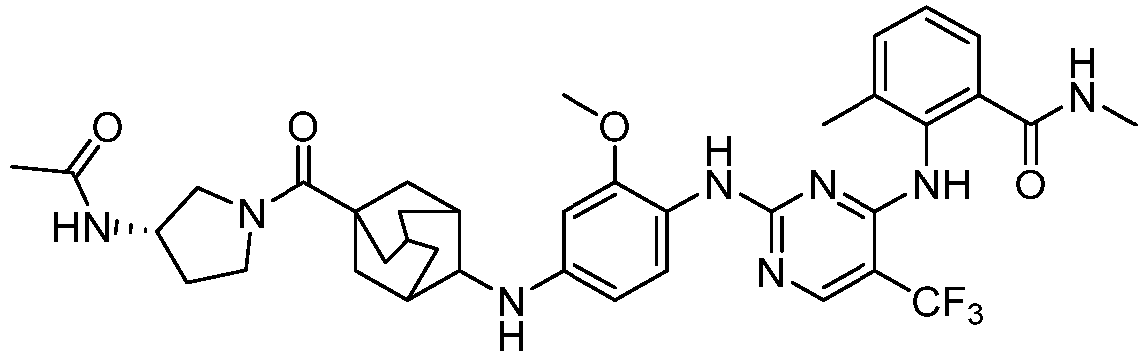
-

- The title compound was synthesized in the same manner as in Example 22 by using (S)-N-(pyrrolidin-3-yl)acetamide instead of morpholine in
step 6 of Example 22.
1H NMR (400 MHz, CDCl3): δ 8.24 (s, 1H), 8.14 (s, 1H), 7.45 - 7.32 (m, 3H), 7.32 - 7.26 (m, 1H), 6.13 (d, J = 2.2 Hz, 1H), 6.07 (s, 1H), 5.74 (s, 1H), 5.62 (m, 1H), 4.42 (m, 1H), 3.86 (s, 1H), 3.78 (s, 3H), 3.63 (m, 3H), 3.41 (s, 1H), 2.83 (d, J = 4.5 Hz, 3H), 2.21 (s, 3H), 2.18 - 2.03 (m, 8H), 1.98 (m, 4H), 1.83 (m, 6H) -

-

- 4-Oxoadamantan-1-carboxylic acid, 3-methoxy-4-nitroaniline, and 1-[bis(dimethylamino)methylene]-1H-1,2,3-triazolo[4,5-b]pyridinium 3-oxide hexafluorophosphate were dissolved in N,N-dimethylformamide, after which triethylamine was added and stirred at room temperature for five hours. After completion of the reaction, distilled water was added to the reaction solution, followed by extraction with ethyl acetate. The resulting solution was dried over anhydrous magnesium sulfate, and filtered, after which the filtrate was concentrated and purified by column chromatography to obtain the title compound.
-

- The title compound was synthesized in the same manner as in Example 1 by using N-(3-methoxy-4-nitrophenyl)-4-oxoadamantan-1-carboxamide instead of (trans)-4-((3-methoxy-4-nitrophenyl)amino)adamantan-1-ol in
step 2 of Example 1. -

- The title compound was synthesized in the same manner as in Example 1 by using N-(4-amino-3-methoxyphenyl)-4-oxoadamantan-1-carboxamide instead of (trans)-4-((4-amino-3-methoxyphenyl)amino)adamantan-1-ol in
step 3 of Example 1. -

- The title compound was synthesized in the same manner as in Example 1 by using N-(4-((4-chloro-5-(trifluoromethyl)pyrimidin-2-yl)amino)-3-methoxyphenyl)-4-oxoadamantan-1-carboxamide instead of (trans)-4-((4-((4-chloro-5-(trifluoromethyl)pyrimidin-2-yl)amino)-3-methoxyphenyl)amino)adamantan-1-ol in
step 4 of Example 1. -

- The title compound was synthesized in the same manner as in Example 12 by using N-(3-methoxy-4-((4-((2-methyl-6-(methylcarbamoyl)phenyl)amino)-5-(trifluoromethyl)pyrimidin-2-yl)amino)phenyl)-4-oxoadamantan-1-carboxamide instead of 2-((2-((2-methoxy-4-((4-oxoadamantan-1-yl)oxy)phenyl)amino)-5-(trifluoromethyl)pyrimidin-4-yl)amino)-N,3-dimethylbenzamide in
step 1 of Example 12.
1H NMR (400 MHz, CDCl3): δ 8.40 (s, 1H), 8.29 (s, 1H), 7.69 (s, 1H), 7.53 (s, 1H), 7.41 (m, 2H), 7.32 (t, J = 7.9 Hz, 1H), 7.19 (s, 1H), 6.34 (s, 1H), 6.01 (s, 1H), 3.86 (s, 3H), 3.75 (m, 4H), 2.88 (m, 3H), 2.45 (s, 3H), 2.21 (s, 3H), 2.16 - 2.01 (m, 6H), 1.93 (m, 4H), 1.58 (s, 3H), 1.40 (m, 2H) -

-

- The title compound was synthesized in the same manner as in Example 25 by using 4-methylpiperazine instead of morpholine in
step 5 of Example 25.
1H NMR (400 MHz, CDCl3): δ 8.39 (s, 1H), 8.29 (s, 1H), 7.69 (s, 1H), 7.53 (s, 1H), 7.40 (m, 2H), 7.35 - 7.29 (m, 1H), 7.18 (s, 1H), 6.34 (s, 1H), 6.00 (s, 1H), 3.86 (s, 3H), 2.87 (d, J = 4.8 Hz, 3H), 2.48 (s, 4H), 2.30 (s, 3H), 2.24 (s, 1H), 2.21 (s, 3H), 2.07 (m, 5H), 1.92 (m, 3H), 1.68 (s, 7H), 1.38 (m, 2H) -

-

- The title compound was synthesized in the same manner as in Example 25 by using (S)-N-(pyrrolidin-3-yl)acetamide instead of morpholine in
step 5 of Example 25.
1H NMR (400 MHz, CDCl3): δ 8.45 (s, 1H), 8.28 (s, 1H), 7.69 (s, 1H), 7.52 (s, 1H), 7.46 - 7.28 (m, 4H), 6.23 (s, 1H), 6.06 (s, 1H), 4.59 (s, 1H), 3.85 (s, 3H), 2.85 (d, J = 4.7 Hz, 3H), 2.46 (m, 4H), 2.26 - 2.08 (m, 6H), 2.09 - 1.83 (m, 12H), 1.71 (m, 5H) -

-

- The title compound was synthesized in the same manner as in Example 25 by using (S)-N-(pyrrolidin-3-yl)acetamide instead of morpholine in
step 5 of Example 25.
1H NMR (400 MHz, CDCl3): δ 8.43 (s, 1H), 8.29 (s, 1H), 7.69 (s, 1H), 7.50 (s, 1H), 7.40 (m, 2H), 7.31 (t, J = 7.4 Hz, 1H), 7.20 (s, 1H), 6.35 (s, 1H), 6.07 (d, J = 5.0 Hz, 1H), 4.49 (s, 1H), 3.86 (s, 3H), 2.87 (d, J = 4.9 Hz, 3H), 2.55 (s, 1H), 2.29 (s, 1H), 2.24 - 1.87 (m, 17H), 1.70 (s, 6H), 1.45 (d, 2H) -

-

- The title compound was synthesized in the same manner as in Example 11 by using N-(3-methoxy-4-((4-((2-methyl-6-(methylcarbamoyl)phenyl)amino)-5-(trifluoromethyl)pyrimidin-2-yl)amino)phenyl)-4-oxoadamantan-1-carboxamide instead of 2-((2-((2-methoxy-4-((4-oxoadamantan-1-yl)oxy)phenyl)amino)-5-(trifluoromethyl)pyrimidin-4-yl)amino)-N,3-dimethylbenzamide in
step 1 of Example 11.
1H NMR (400 MHz, DMSO-d6): δ 9.10 (s, 1H), 8.96 - 8.85 (m, 1H), 8.27 - 8.20 (m, 2H), 7.90 (s, 1H), 7.41 - 7.23 (m, 5H), 6.86 (br s, 1H), 4.59 (m, 1H), 3.69 (s, 3H), 3.68 - 3.54 (m, 1H), 2.63 (d, J = 4.5, 3H), 2.15 - 1.96 (m, 5H), 1.88 - 1.74 (m, 7H), 1.68 (m, 1H), 1.56 (m, 1H), 1.35 - 1.27 (m, 2H) -

-

- The title compound was synthesized in the same manner as in Example 25 by using tert-butyl (S)-pyrrolidin-3-ylcarbamate instead of morpholine in
step 5 of Example 25. -

- tert-Butyl ((3S)-1-((trans)-5-((3-methoxy-4-((4-((2-methyl-6-(methylcarbamoyl)phenyl)amino)-5-(trifluoromethyl)pyrimidin-2-yl)amino)phenyl)carbamoyl)adamantan-2-yl)pyrrolidin-3-yl)carbamate prepared in
above step 1 was dissolved in 4 M hydrochloric acid dioxane solution and stirred at room temperature. After completion of the reaction was confirmed by TLC, a saturated aqueous solution of NaHCO3 was added to the reaction solution, followed by extraction with ethyl acetate. The resulting solution was dried over anhydrous magnesium sulfate, and filtered, after which the filtrate was concentrated and purified by column chromatography to obtain the title compound.
1H NMR (400 MHz, CDCl3): δ 8.46 (s, 1H), 8.30 (s, 1H), 7.70 (s, 1H), 7.53 (s, 1H), 7.46 - 7.20 (m, 4H), 6.37 (m, 1H), 6.14 (m, 1H), 3.52 (s, 1H), 3.86 (s, 3H), 2.87 (d, J = 4.8 Hz, 3H), 2.85 - 1.25 (m, 24H) -

-

- The title compound was synthesized in the same manner as in Example 25 by using tert-butyl (S)-pyrrolidin-3-ylcarbamate instead of morpholine in
step 5 of Example 25. -

- tert-Butyl ((3S)-1-((cis)-5-((3-methoxy-4-((4-((2-methyl-6-(methylcarbamoyl)phenyl)amino)-5-(trifluoromethyl)pyrimidin-2-yl)amino)phenyl)carbamoyl)adamantan-2-yl)pyrrolidin-3-yl)carbamate prepared in
above step 1 was dissolved in 4 M hydrochloric acid dioxane solution and stirred at room temperature. After completion of the reaction was confirmed by TLC, a saturated aqueous solution of NaHCO3 was added to the reaction solution, followed by extraction with ethyl acetate. The resulting solution was dried over anhydrous magnesium sulfate, and filtered, after which the filtrate was concentrated and purified by column chromatography to obtain the title compound.
1H NMR (400 MHz, CDCl3): δ 8.45 (s, 1H), 8.29 (s, 1H), 7.70 (s, 1H), 7.53 (s, 1H), 7.46 - 7.20 (m, 4H), 6.36 (m, 1H), 6.14 (m, 1H), 3.52 (s, 1H), 3.86 (s, 3H), 2.87 (d, J = 4.8 Hz, 3H), 2.85 - 1.25 (m, 24H) -

-

- The title compound was synthesized in the same manner as in Example 1 by using (trans)-4-(4-(4-((4-chloro-5-(trifluoromethyl)pyrimidin-2-yl)amino)-3-methoxyphenyl)piperidin-1-yl)adamantan-1-ol instead of (trans)-4-((4-((4-chloro-5-(trifluoromethyl)pyrimidin-2-yl)amino)-3-methoxyphenyl)amino)adamantan-1-ol in
step 4 of Example 1.
1H NMR (400 MHz, CDCl3): δ 8.38 (s, 1H), 8.29 (s, 1H), 7.69 (br s, 1H), 7.46 - 7.28 (m, 3H), 6.70 (d, J = 7.0 Hz, 1H), 6.41 (br s, 1H), 6.06 (br s, 1H), 5.98 (s, 1H), 3.85 (s, 3H), 3.09 (m, 2H), 2.89 (m, 2H), 2.86 (d, J = 4.9 Hz, 3H), 2.72 - 2.59 (m, 2H), 2.53 (m, 1H), 2.37 (m, 1H), 2.31 (m, 1H), 2.24 (m, 1H), 2.22 (s, 3H), 2.13 - 1.20 (m, 13H) -

-

- The title compound was synthesized in the same manner as in Example 1 by using (cis)-4-(4-(4-((4-chloro-5-(trifluoromethyl)pyrimidin-2-yl)amino)-3-methoxyphenyl)piperidin-1-yl)adamantan-1-ol instead of (trans)-4-((4-((4-chloro-5-(trifluoromethyl)pyrimidin-2-yl)amino)-3-methoxyphenyl)amino)adamantan-1-ol in
step 4 of Example 1.
1H NMR (400 MHz, CDCl3): δ 8.38 (s, 1H), 8.29 (s, 1H), 7.69 (br s, 1H), 7.46 - 7.28 (m, 3H), 6.70 (d, J = 7.0 Hz, 1H), 6.41 (br s, 1H), 6.06 (br s, 1H), 5.99 (s, 1H), 3.85 (s, 3H), 3.09 (m, 2H), 2.89 (m, 2H), 2.87 (d, J = 4.9 Hz, 3H), 2.72 - 2.59 (m, 2H), 2.53 (m, 1H), 2.38 (m, 1H), 2.31 (m, 1H), 2.24 (m, 1H), 2.21 (s, 3H), 2.13 - 1.20 (m, 13H) -

-

- The title compound was synthesized in the same manner as in Example 32 by using 2-amino-3-methylbenzamide instead of 2-amino-N,3-dimethylbenzamide in
step 1 of Example 32.
1H NMR (400 MHz, CDCl3): δ 8.39 (s, 1H), 8.30 (s, 1H), 7.70 (br s, 1H), 7.54 - 7.43 (m, 2H), 7.35 (m, 1H), 6.70 (s, 1H), 6.41 (br s, 1H), 6.04 (br s, 1H), 5.57 (s, 1H), 3.85 (s, 3H), 3.09 (m, 2H), 2.87 (m, 2H), 2.63 (m, 2H), 2.53 (m, 1H), 2.37 (m, 1H), 2.31 (m, 1H), 2.23 (s, 3H), 2.13 - 1.20 (m, 14H) -

-

- The title compound was synthesized in the same manner as in Example 33 by using 2-amino-3-methylbenzamide instead of 2-amino-N,3-dimethylbenzamide in
step 1 of Example 33.
1H NMR (400 MHz, CDCl3): δ 8.41 (s, 1H), 8.30 (s, 1H), 7.70 (br s, 1H), 7.53 - 7.44 (m, 2H), 7.35 (t, J = 7.6 Hz, 1H), 6.69 (s, 1H), 6.41 (br s, 1H), 6.03 (br s, 1H), 5.59 (s, 1H), 3.85 (s, 3H), 3.09 (m, 2H), 2.87 (m, 2H), 2.63 (m, 2H), 2.53 (m, 1H), 2.37 (m, 1H), 2.31 (m, 1H), 2.23 (s, 3H), 2.13 - 1.20 (m, 14H) -

-

- After dissolving 2-amino-N,3-dimethylbenzamide and NaHCO3 in ethanol, 2,4,5-trichloropyrimidine was added and stirred at 80°C. After completion of the reaction was confirmed by TLC, a solvent was concentrated, and the resulting solid was dissolved in ethyl acetate and wiped with distilled water. The resulting solution was dried over anhydrous magnesium sulfate, and filtered, after which the filtrate was concentrated and recrystallized with acetonitrile: distilled water = 20: 1 to obtain the title compound.
-

- 4-(4-(4-Amino-3-methoxyphenyl)piperazin-1-yl)adamantan-1-ol and 2-((2,5-dichloropyrimidin-4-yl)amino)-N,3-dimethylbenzamide prepared in
above step 1 were dissolved in 2-butanol, after which methanesulfonic acid was added and stirred at 120°C. After completion of the reaction, distilled water was added to the reaction solution, followed by extraction with ethyl acetate. The resulting solution was dried over anhydrous magnesium sulfate, and filtered, after which the filtrate was concentrated and purified by column chromatography to obtain the title compound.
1H NMR (400 MHz, CDCl3): δ 8.66 (s, 1H), 8.01 (s, 1H), 7.67 (m, 2H), 7.45 - 7.16 (m, 5H), 6.48 (m, 2H), 6.18 (m, 1H), 6.07 (br s, 1H), 3.81 (s, 3H), 3.09 (m, 4H), 2.87 (d, J = 4.8 Hz, 3H), 2.62 (m, 4H), 2.34 - 2.26 (m, 1H), 2.22 (s, 3H), 2.14 - 1.98 (m, 4H), 1.83 - 1.61 (m, 5H), 1.42 - 1.24 (m, 3H) -

-

- The title compound was synthesized in the same manner as in Example 1 by using methyl (trans)-4-(4-(4-amino-3-methoxyphenyl)piperazin-1-yl)adamantan-1-carboxylate instead of (trans)-4-((4-amino-3-methoxyphenyl)amino)adamantan-1-ol in
step 3 of Example 1. -

- The title compound was synthesized in the same manner as in Example 1 by using methyl (trans)-4-(4-(4-((4-chloro-5-(trifluoromethyl)pyrimidin-2-yl)amino)-3-methoxyphenyl)piperazin-1-yl)adamantan-1-carboxylate instead of (trans)-4-((4-((4-chloro-5-(trifluoromethyl)pyrimidin-2-yl)amino)-3-methoxyphenyl)amino)adamantan-1-ol in
step 4 of Example 1.
1H NMR (400 MHz, CDCl3): δ 8.28 (s, 1H), 8.26 (s, 1H), 7.40 (d, J = 7.3 Hz, 1H), 7.36 (d, J = 7.5 Hz, 1H), 7.31 - 7.26 (m, 1H), 6.47 (d, J = 2.0 Hz, 1H), 6.15 - 5.95 (m, 2H), 3.82 (s, 3H), 3.66 (s, 3H), 3.09 (m, 4H), 2.84 (d, J = 4.8 Hz, 3H), 2.60 (m, 4H), 2.25 - 2.14 (m, 4H), 2.13 - 2.05 (m, 2H), 2.04 - 1.92 (m, 2H), 1.91 - 1.82 (m, 3H), 1.73 - 1.62 (m, 2H), 1.40 - 1.33 (m, 2H), 1.31 - 1.20 (m, 2H) -

-

- The title compound was synthesized in the same manner as in Example 1 by using methyl (cis)-4-(4-(4-amino-3-methoxyphenyl)piperazin-1-yl)adamantan-1-carboxylate instead of (trans)-4-((4-amino-3-methoxyphenyl)amino)adamantan-1-ol in
step 3 of Example 1. -
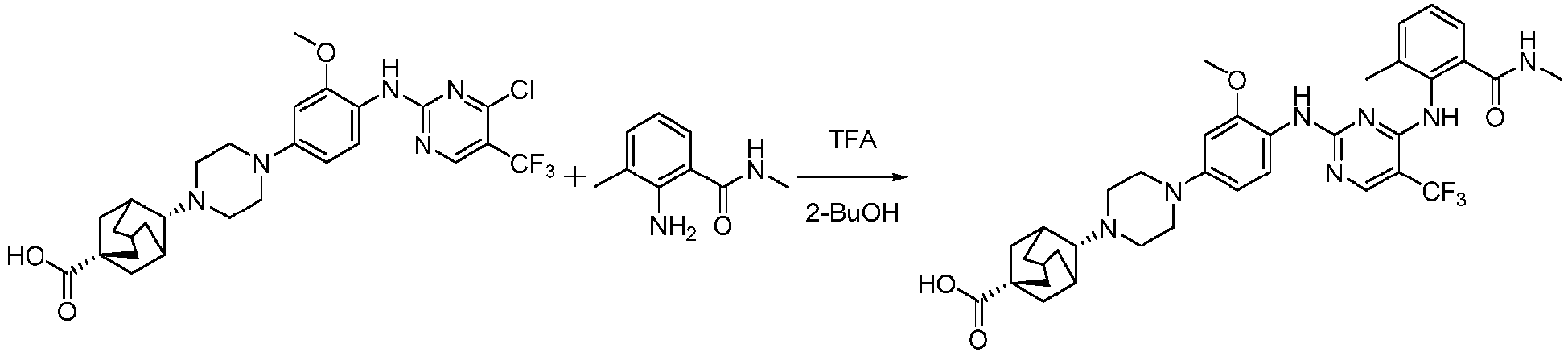
- The title compound was synthesized in the same manner as in Example 1 by using methyl (cis)-4-(4-(4-((4-chloro-5-(trifluoromethyl)pyrimidin-2-yl)amino)-3-methoxyphenyl)piperazin-1-yl)adamantan-1-carboxylate instead of (trans)-4-((4-((4-chloro-5-(trifluoromethyl)pyrimidin-2-yl)amino)-3-methoxyphenyl)amino)adamantan-1-ol in
step 4 of Example 1.
1H NMR (400 MHz, CDCl3): δ 8.27 (s, 1H), 8.26 (s, 1H), 7.41 (d, J = 7.3 Hz, 1H), 7.37 (d, J = 7.5 Hz, 1H), 7.31 - 7.26 (m, 1H), 6.47 (d, J = 2.0 Hz, 1H), 6.15 - 5.95 (m, 2H), 3.82 (s, 3H), 3.66 (s, 3H), 3.09 (m, 4H), 2.84 (d, J = 4.8 Hz, 3H), 2.60 (m, 4H), 2.28 - 2.13 (m, 5H), 2.07 (m, 1H), 1.98 (m, 1H), 1.90 - 1.77 (m, 4H), 1.75 - 1.48 (m, 6H) -
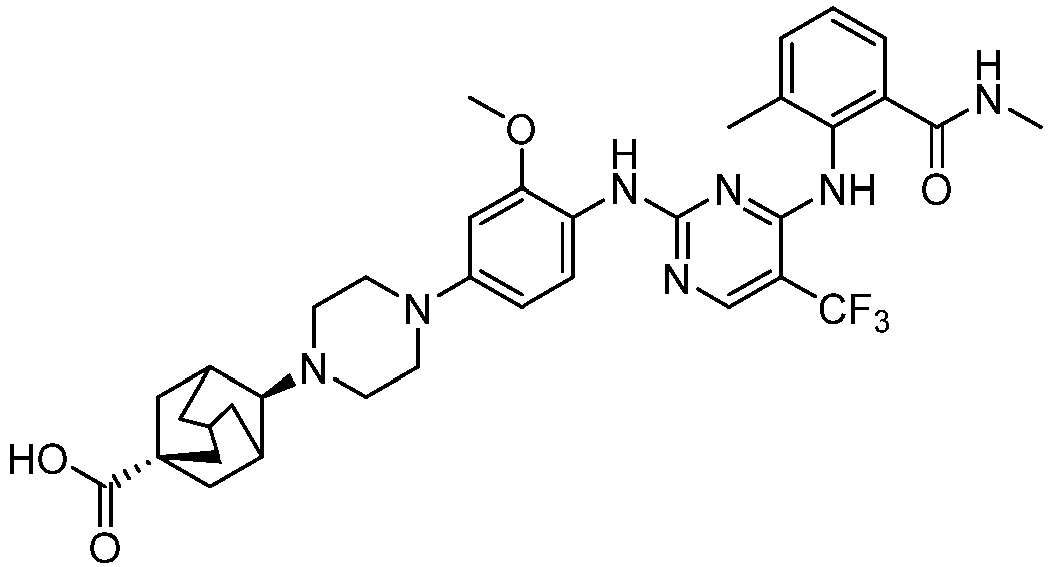
-

- The title compound was synthesized in the same manner as in Example 17 by using methyl (trans)-4-(4-(3-methoxy-4-((4-((2-methyl-6-(methylcarbamoyl)phenyl)amino)-5-(trifluoromethyl)pyrimidin-2-yl)amino)phenyl)piperazin-1-yl)adamantan-1-carboxylate instead of 4-(3-methoxy-4-((4-((2-methyl-6-(methylcarbamoyl)phenyl)amino)-5-(trifluoromethyl)pyrimidin-2-yl)amino)phenoxy)adamantan-1-methyl carboxylate in
step 1 of Example 17.
1H NMR (400 MHz, CD3OD): δ 8.20 (s, 1H), 7.48 - 7.32 (m, 3H), 6.56 (d, J = 2.4 Hz, 1H), 6.12 (m, 2H), 3.83 (s, 3H), 3.13 (m, 4H), 2.79 (s, 3H), 2.71 (m, 4H), 2.30 - 2.22 (m, 3H), 2.21 (s, 3H), 2.15 - 2.08 (m, 2H), 2.06 - 1.99 (m, 2H), 1.96 - 1.84 (m, 5H), 1.48 - 1.40 (m, 2H) -

-

- The title compound was synthesized in the same manner as in Example 17 by using methyl (cis)-4-(4-(3-methoxy-4-((4-((2-methyl-6-(methylcarbamoyl)phenyl)amino)-5-(trifluoromethyl)pyrimidin-2-yl)amino)phenyl)piperazin-1-yl)adamantan-1-carboxylate instead of 4-(3-methoxy-4-((4-((2-methyl-6-(methylcarbamoyl)phenyl)amino)-5-(trifluoromethyl)pyrimidin-2-yl)amino)phenoxy)adamantan-1-methyl carboxylate in
step 1 of Example 17.
1H NMR (400 MHz, CD3OD): δ 8.21 (s, 1H), 7.49 - 7.33 (m, 3H), 6.57 (d, J = 2.4 Hz, 1H), 6.13 (m, 2H), 3.84 (s, 3H), 3.14 (m, 4H), 2.80 (s, 3H), 2.72 (m, 4H), 2.31 - 2.23 (m, 3H), 2.22 (s, 3H), 2.16 - 2.09 (m, 2H), 2.07 - 2.00 (m, 2H), 1.97 - 1.85 (m, 5H), 1.49 - 1.41 (m, 2H) -

-

- The title compound was synthesized in the same manner as in Example 18 by using 4-(4-(3-methoxy-4-((4-((2-methyl-6-(methylcarbamoyl)phenyl)amino)-5-(trifluoromethyl)pyrimidin-2-yl)amino)phenyl)piperazin-1-yl)adamantane-1-carboxylic acid instead of 4-(3-methoxy-4-((4-((2-methyl-6-(methylcarbamoyl)phenyl)amino)-5-(trifluoromethyl)pyrimidin-2-yl)amino)phenoxy)adamantan-1-carboxylic acid in
step 1 of Example 18.
1H NMR (400 MHz, CD3OD): δ 8.19 (s, 1H), 7.47 - 7.31 (m, 3H), 6.55 (d, J = 2.4 Hz, 1H), 6.11 (m, 2H), 3.82 (s, 3H), 3.12 (m, 4H), 2.80 (s, 3H), 2.78 (s, 3H), 2.70 (m, 4H), 2.29 - 2.21 (m, 3H), 2.20 (s, 3H), 2.14 - 2.07 (m, 2H), 2.05 - 1.98 (m, 2H), 1.95 - 1.83 (m, 5H), 1.47 - 1.39 (m, 2H) -

-

- The title compound was synthesized in the same manner as in Example 41 by using ammonium chloride instead of methylamine hydrochloride in
step 1 of Example 41.
1H NMR (400 MHz, CD3OD): δ 8.19 (s, 1H), 7.47 - 7.31 (m, 3H), 6.55 (d, J = 2.4 Hz, 1H), 6.11 (m, 2H), 3.82 (s, 3H), 3.12 (m, 4H), 2.78 (s, 3H), 2.70 (m, 4H), 2.29 - 2.21 (m, 3H), 2.20 (s, 3H), 2.14 - 2.07 (m, 2H), 2.05 - 1.98 (m, 2H), 1.95 - 1.83 (m, 5H), 1.47 - 1.39 (m, 2H) -

-
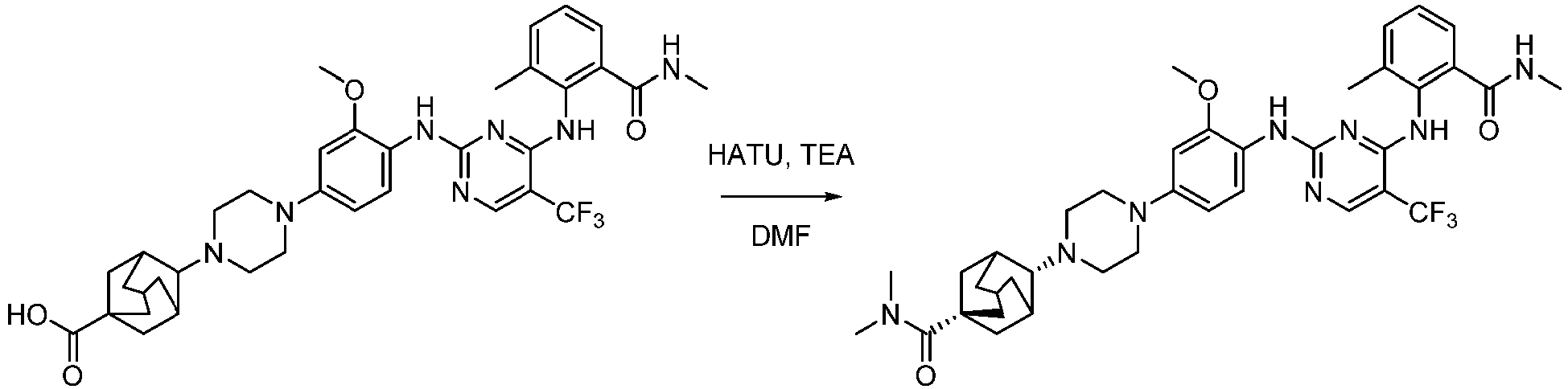
- The title compound was synthesized in the same manner as in Example 41 by using dimethylamine hydrochloride instead of methylamine hydrochloride in
step 1 of Example 41.
1H NMR (400 MHz, CD3OD): δ 8.19 (s, 1H), 7.47 - 7.31 (m, 3H), 6.55 (d, J = 2.4 Hz, 1H), 6.11 (m, 2H), 3.82 (s, 3H), 3.12 (m, 4H), 2.98, (s, 3H), 2.78 (s, 3H), 2.70 (m, 4H), 2.29 - 2.21 (m, 3H), 2.20 (s, 3H), 2.14 - 2.07 (m, 2H), 2.05 - 1.98 (m, 2H), 1.95 - 1.83 (m, 5H), 1.47 - 1.39 (m, 2H) -

-

- The title compound was synthesized in the same manner as in Example 1 by using (9H-fluoren-9-yl)methyl (4-(4-(4-amino-3-methoxyphenyl)piperazin-1-yl)adamantan-1-yl)carbamate instead of (trans)-4-((4-amino-3-methoxyphenyl)amino)adamantan-1-ol in
step 3 of Example 1. -

- The title compound was synthesized in the same manner as in Example 1 by using methyl (trans)-4-(4-(4-((4-chloro-5-(trifluoromethyl)pyrimidin-2-yl)amino)-3-methoxyphenyl)piperazin-1-yl)adamantan-1-carboxylate instead of (trans)-4-((4-((4-chloro-5-(trifluoromethyl)pyrimidin-2-yl)amino)-3-methoxyphenyl)amino)adamantan-1-ol in
step 4 of Example 1. -

- The (9H-fluoren-9-yl)methyl (4-(4-(3-methoxy-4-((4-((2-methyl-6-(methylcarbamoyl)phenyl)amino)-5-(trifluoromethyl)pyrimidin-2-yl)amino)phenyl)piperazin-1-yl)adamantan-1-yl)carbamate prepared in
above step 2 was dissolved in acetonitrile and cooled in an ice bath. Diethylamine was slowly added dropwise. The resulting solution was stirred at 0°C for one hour and stirred at room temperature for 15 hours. The solvent was concentrated under reduced pressure and purified by column chromatography to obtain the title compound.
1H NMR (400 MHz, CDCl3): δ 8.27 (s, 2H, overlapped), 7.42 (d, J = 7.3 Hz, 1H), 7.35 (d, J = 7.5 Hz, 1H), 7.32 - 7.27 (m, 1H), 6.48 (d, J = 2.0 Hz, 1H), 6.10 (br s, 1H), 6.01 (s, 1H), 3.83 (s, 3H), 3.10 (m, 4H), 2.85 (d, J = 4.8 Hz, 3H), 2.62 (m, 4H), 2.34 - 2.26 (m, 1H), 2.22 (s, 3H), 2.14 - 1.98 (m, 4H), 1.83 - 1.61 (m, 5H), 1.42 - 1.24 (m, 3H) -

-

- 2-((2-((4-(4-(5-Aminoadamantan)-2-yl)piperazin-1-yl)-2-methoxyphenyl)amino)-5-(trifluoromethyl)pyrimidin-4-yl)amino)-N,3-dimethylbenzamide prepared in above Example 44 was dissolved in chloroform, after which potassium carbonate was added and stirred. 1 equivalent of iodomethane was slowly added and stirred at room temperature. The solvent was concentrated under reduced pressure and purified by column chromatography to obtain the title compound.
1H NMR (400 MHz, CDCl3): δ 8.27 (s, 2H, overlapped), 7.42 (d, J = 7.3 Hz, 1H), 7.35 (d, J = 7.5 Hz, 1H), 7.32 - 7.27 (m, 1H), 6.48 (d, J = 2.0 Hz, 1H), 6.10 (br s, 1H), 6.01 (s, 1H), 3.83 (s, 3H), 3.10 (m, 4H), 2.85 (d, J = 4.8 Hz, 3H), 2.62 (m, 4H), 2.55 (s, 3H), 2.34 - 2.26 (m, 1H), 2.22 (s, 3H), 2.14 - 1.98 (m, 4H), 1.83 - 1.61 (m, 5H), 1.42 - 1.24 (m, 3H) -
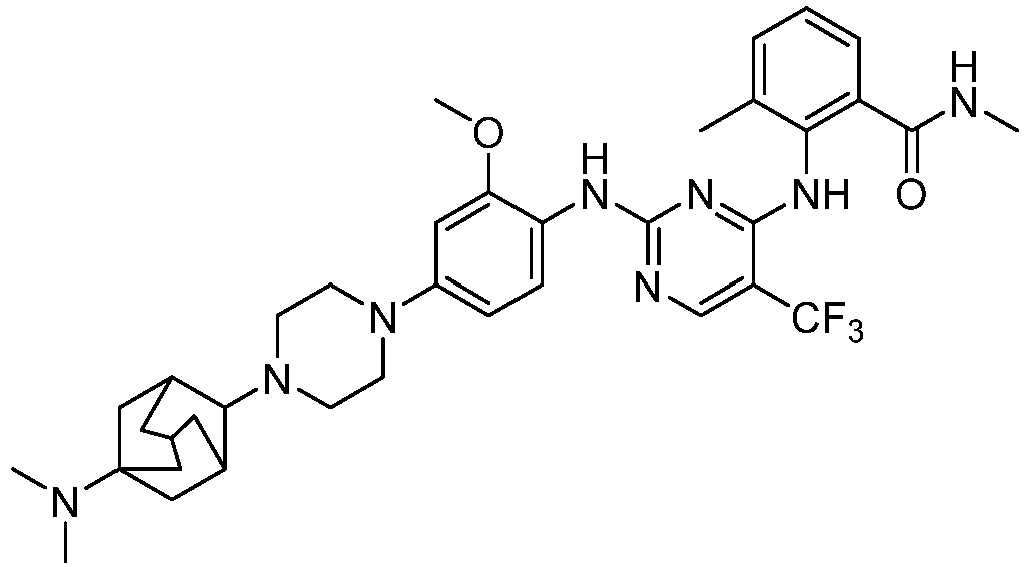
-
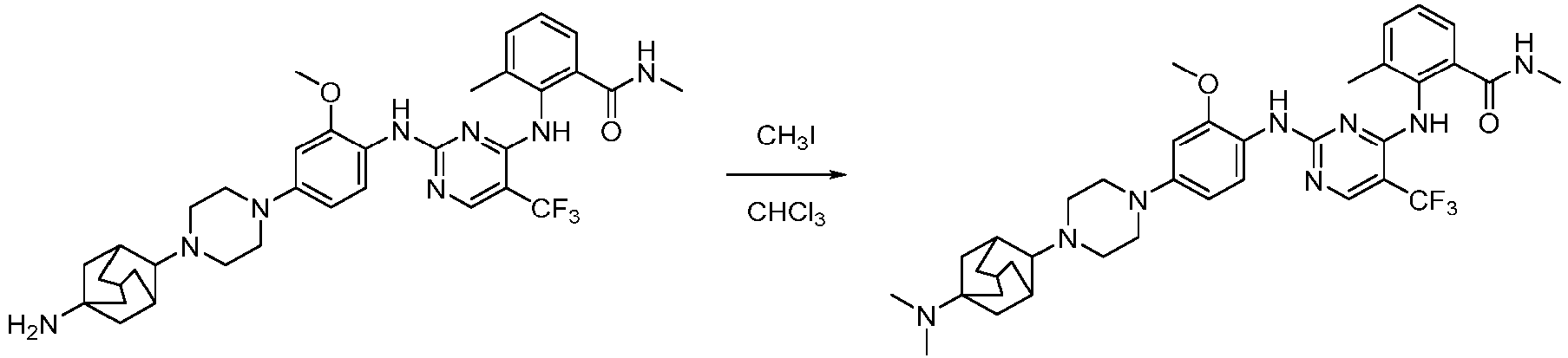
- 2-((2-((4-(4-(5-Aminoadamantan)-2-yl)piperazin-1-yl)-2-methoxyphenyl)amino)-5-(trifluoromethyl)pyrimidin-4-yl)amino)-N,3-dimethylbenzamide prepared in above Example 44 was dissolved in chloroform, after which potassium carbonate was added and stirred. Iodomethane (2 equiv.) was slowly added and stirred at room temperature. The solvent was concentrated under reduced pressure and purified by column chromatography to obtain the title compound.
1H NMR (400 MHz, CDCl3): δ 8.27 (s, 2H, overlapped), 7.42 (d, J = 7.3 Hz, 1H), 7.35 (d, J = 7.5 Hz, 1H), 7.32 - 7.27 (m, 1H), 6.48 (d, J = 2.0 Hz, 1H), 6.10 (br s, 1H), 6.01 (s, 1H), 3.83 (s, 3H), 3.10 (m, 4H), 2.85 (d, J = 4.8 Hz, 3H), 2.62 (m, 4H), 2.34 - 2.26 (m, 1H), 2.24 (s, 6H), 2.22 (s, 3H), 2.14 - 1.98 (m, 4H), 1.83 - 1.61 (m, 5H), 1.42 - 1.24 (m, 3H) -

-

- 2-((2-((4-(4-(5-Aminoadamantan)-2-yl)piperazin-1-yl)-2-methoxyphenyl)amino)-5-(trifluoromethyl)pyrimidin-4-yl)amino)-N,3-dimethylbenzamide prepared in above Example 44 was dissolved in chloroform, after which potassium carbonate was added and stirred. Acryloyl chloride was slowly added and stirred at room temperature. The solvent was concentrated under reduced pressure and purified by column chromatography to obtain the title compound.
1H NMR (400 MHz, CDCl3): δ 8.27 (s, 2H, overlapped), 7.42 (d, J = 7.3 Hz, 1H), 7.35 (d, J = 7.5 Hz, 1H), 7.32 - 7.27 (m, 1H), 6.52 (m, 1H), 6.48 (d, J = 2.0 Hz, 1H), 6.10 (br s, 1H), 6.06 (m, 1H), 6.01 (s, 1H), 5.74 (m, 1H), 3.83 (s, 3H), 3.10 (m, 4H), 2.85 (d, J = 4.8 Hz, 3H), 2.62 (m, 4H), 2.34 - 2.26 (m, 1H), 2.22 (s, 3H), 2.14 - 1.98 (m, 4H), 1.83 - 1.61 (m, 5H), 1.42 - 1.24 (m, 3H) - The inhibitory activity of the adamantane derivative compounds of the present invention to FAK, Pyk2 and InsR was confirmed through a biochemical kinase analysis, and table 1 below shows the IC50 values for each kinase inhibitory activity of each compound. Briefly, a kinase test was performed and quantified according to the manufacturer's instructions after treating the adamantane derivative compound of the present invention by using the ADP-Glo™ Kinase Assay Kit (FAK, Promega, V1971; Pyk2, Promega, V4083; InsR, Promega, V9401) containing each kinase of Promega.
[Table 1] Compound # FAK IC50 (nM) Pyk2 IC50 (nM) InsR IC50 (nM) 1 82.9 124.5 >10,000 2 205.5 - >10,000 3 154.2 255.9 >10,000 4 46.2 150.5 5,666 5 69.9 - 4,685 6 96.5 157.0 >10,000 7 46.9 108.1 6,148 8 53.3 - >10,000 9 98.1 - >10,000 10 96.7 - >10,000 11 65.1 231.0 >10,000 14 57.0 - - 18 92.9 - - 19 126.8 - - 20 98.9 - - 22 57.0 - - 23 77.5 - - 25 45.5 90.6 >10,000 27 39.5 81.4 >10,000 28 29.0 64.5 >10,000 30 - 18.2 3,804 32 - 153.6 2,153 33 - 100.6 2,054 34 - 427.0 1,636 35 - 417.6 1,437 36 61.4 - - 37 43.6 - - 38 70.0 - - 39 58.0 - - 40 58.3 - - - Referring to above table 1, it could be seen that the adamantane derivative according to the present invention has an excellent inhibitory activity to FAK and Pyk2(FAK2). Furthermore, it could be seen that the adamantane derivative does not inhibit the activity of insulin receptor (Ins-R) while selectively inhibiting the activity of FAK and Pyk2(FAK2).
- In order to measure the inhibitory activity of the adamantane derivative compounds of the present invention to the FAK in vitro, an FAK [pY397] enzyme-linked immunosorbent assay test was performed on MDA-MB-231, a human triple-negative breast cancer cell line, and table 2 below shows the IC50 values of each compound. Briefly, an enzyme-linked immunosorbent assay test was performed according to the manufacturer's instructions by using the FAK (Phospho) [pY397] Human ELISA Kit (Thermo Fisher Scientific, KHo0441) after dispensing 1×10⁶ MDA-MB-231 cells into each well of a 6-well plate, inducing cell stabilization for 24 hours, and treating each compound at different concentrations (0, 1, 5, 10, 50, 100, 500, 1000 nM) for one hour.
[Table 2] Compound # FAK inhibitory activity (IC50, nM) 1 83 2 111 3 92 4 34 5 32 6 118 7 38 8 121 10 382 11 118 20 153 23 234 25 27 27 55 - Referring to above table 2, it could be seen that the adamantane derivative according to the present invention has excellent FAK inhibitory activity in MDA-MB-231, a human triple-negative breast cancer cell line.
- The inhibitory activity of
compound 4, which is the adamantane derivative compound of the present invention, to the FAK in vitro was confirmed in various triple-negative breast cancer cell lines through the FAK [pY397] enzyme-linked immunosorbent assay as described above, and table 3 below shows the IC50 values of each cell line.
- The inhibitory activity ability of the
compound 4 of the present invention on various kinases is as follows. - The data on this kinase activity inhibition were obtained from the results of screening and profiling kinases performed by Eurofins, and table 4 below shows a degree of inhibitory activity (% inhibition rate) and IC50 values of the corresponding kinases that inhibit at least 70% of the 107 screened kinases at a single concentration (1 µM) of the compound.
[Table 4] Kinase FAK Pyk2 Met ALK % inhibition rate (at 1µM) 97 96 79 72 IC50 [nM] 78 301 542 802 - Referring to above table 3, it could be seen that the adamantane derivative according to the present invention has an excellent FAK inhibitory activity in MDA-MB-231, MDA-MB-453, HCC70, BT-20, BT-549 and Hs578T, which are various triple-negative breast cancer cell lines.
- A 3D spheroid assay was performed as a method for measuring the growth of cancer cells under three-dimensional (3D) culture conditions. Briefly, the 5 x 10³ triple-negative breast cancer cells in each well of a 96-well flat plate were three-dimensionally cultured for three days by using MammoCult™ Human Medium Kit (Stemcell Technologies, #05620) and the formed cancer cell spheroids were treated with
compound 4 at different concentrations (0, 0.2, 0.5, 1, 2, 5, 10, 20 µM) for 96 hours. The cancer cell growth inhibitory effect of the compound was quantified according to the manufacturer's instructions by using CellTiter-Glo® 3D Cell Viability Assay Kit (Promega, G9681). -
FIG. 1 shows a degree of growth inhibition of cancer cell spheroids by treatment with the compound at different concentrations in MDA-MB-231 cells as a representative example of a 3D spheroid assay. - Table 5 below shows IC50 values for the cancer cell spheroid growth inhibitory activity of
compound 4, an adamantane derivative compound of the present invention in various triple-negative breast cancer cell lines including MDA-MB-231.
- Referring to
FIG. 1 , it could be seen that the adamantane derivative according to the present invention has excellent cancer cell spheroid inhibitory activity at all the concentrations. In addition, referring to above table 5, it could be seen that the adamantane derivative according to the present invention has excellent cancer cell spheroid growth inhibitory activity in MDA-MB-231, MDA-MB-453, HCC70, BT-20, BT-549 and Hs578T, which are various triple-negative breast cancer cell lines. - A cell invasion assay was performed and quantified according to a 3D invasion assay. Briefly, MDA-MB-231 cells were cultured in a 96-well round plate (5 x 10³/well) for three days to form cancer cell spheroids, then fixed in a mixture of semi-solid Matrigel and type I collagen, and then treated with
compound 4 at different concentrations (1, 5 µM). A degree of infiltration was analyzed by using a microscope (seeFIG. 2 ) and an imaging software ImageJ in 72 hours later, and an obtained area value was quantified based on a following equation (Equation 1) and shown in a graph (seeFIG. 3 ).Relative invasion = (total area of compound treated group - spheroid area of compound treated group)/(total area of control - spheroid area of control) - Referring to
FIGS. 2 and3 , it could be seen that the adamantane derivative according to the present invention has excellent invasion inhibitory activity in MDA-MB-231, a human triple-negative breast cancer cell line. - In one week after acclimatization of five-week-old male nude mice, 1 x 10⁶ MDA-MB-231 cells were subcutaneously inoculated into the mice and observed until a tumor volume reached about 100 mm3 after 14 days. In order to confirm a tumor growth inhibitory effect of derived candidate materials in the triple-negative breast cancer xenograft mouse model, eight mice for each group were divided into a control group and three experimental groups at different concentrations (4-20 mg/kg, 4-40 mg/kg and 4-80 mg/kg), and each compound was treated once daily. A tumor volume of the mice was measured three times a week on every other day, and the mice were sacrificed on day 29 after cell inoculation.
FIG. 4 is a graph showing the tumor volume calculated based on the following formula (Equation 2) with a starting date of drug treatment asday 1.
- Table 6 below shows the comparison of average tumor growth of each compound treated group compared to an average tumor growth of the control group by calculating a tumor growth inhibition rate (% TGI) based on the following formula (Equation 3).

[Table 6] Control Compound 4 (20 mg/kg) Compound 4 (40 mg/kg) Compound 4 (80 mg/kg) % TGI - 72.11 74.03 81.28 - Referring to
FIG. 4 and Table 6, it could be seen that the adamantane derivative according to the present invention has excellent tumor growth inhibitory activity in a triple-negative breast cancer xenograft mouse model. - From the results of above Experimental Examples 1 to 6, it could be seen that the adamantane derivative according to the present invention has an excellent therapeutic effect on FAK activity-associated diseases.
Claims (11)
- Adamantane derivatives represented by formula 1 below, pharmaceutically acceptable salts thereof, stereoisomers thereof, hydrates or solvates thereof:
 L1 and L2 are each independently a single bond, C1-10 alkylene, C2-10 alkenylene, C2-10 alkynylene, -N(Ra)-, -C(=O)-N(Ra)-, -N(Ra)-C(=O)-, -C(=O)-, -O-, -C(=O)-O-, - N(Ra)-C(=O)-O-, -N(Ra)-S(=O)-, -N(Ra)-S(=O)2-, -S(=O)(=N-Ra)-, or -S-;R1 and R2 are each independently C1-10 heterocycloalkylene, C3-10 cycloalkylene, C5-16 arylene or C4-10 heteroarylene;R3 is H, C1-10 alkyl, C2-10 alkenyl, -O-Ra, =O, -NH-Ra, -NH(C=O)-Ra or C1-10 heterocycloalkyl;R4 is -O-Ra;R5 and R6 are each independently H or C1-10 alkyl;R7 is -CF3 or a halogen atom;Ra is H, -CF3 or C1-10 alkyl; andm, n, p and q are each independently 0 or 1.
 - The adamantane derivatives, pharmaceutically acceptable salts thereof, stereoisomers thereof, hydrates or solvates thereof according to claim 1:
wherein in above formula 1,R1 and R2 are each independently R3 is H, C1-10 alkyl, C2-10 alkenyl, -O-Ra, =O, -NH-Ra, -NH(C=O)-Ra or
 W1, W2 and W3 are each independently CH or N;W4 is CH2, NH or O;Ra is H, -CF3 or C1-10 alkyl; anda, b, c and d are each independently 1, 2 or 3.
 - The adamantane derivatives, pharmaceutically acceptable salts thereof, stereoisomers thereof, hydrates or solvates thereof according to claim 1:
wherein in above formula 1,R1 and R2 are each independently
 R3 is H, C1-10 alkyl, C2-10 alkenyl, -O-Ra, =O, -NH-Ra, -NH(C=O)-Ra or
 Ra is H, -CF3 or C1-10 alkyl.
 - The adamantane derivatives, pharmaceutically acceptable salts thereof, stereoisomers thereof, hydrates or solvates thereof according to claim 1, wherein the compound represented by above formula 1 is a compound represented by formula 2 below:
 L1 is -N(Ra)-, -C(=O)-N(Ra)- or -O-;L2 is -N(Ra)-, -C(=O)-N(Ra)-, -N(Ra)-C(=O)-, -C(=O)- or -C(=O)-O-;R1 and R2 are each independently
 R3 is H, C1-10 alkyl, C2-10 alkenyl, -O-Ra, =O, -NH-Ra, -NH(C=O)-Ra or morpholinyl;R6 is H or C1-10 alkyl;R7 is -CF3 or Cl;Ra is H, -CF3 or C1-10 alkyl; andm, n, p and q are each independently 0 or 1.
 - The adamantane derivatives, pharmaceutically acceptable salts thereof, stereoisomers thereof, hydrates or solvates thereof according to claim 1, wherein the compound represented by above formula 1 is any one selected from the group consisting of compounds shown in the following table:
Example # Structure 1 
2 
3 
4 
5 
6 
7 
8 
9 
10 
11 
12 
13 
14 
15 
16 
17 
18 
19 
20 
21 
22 
23 
24 
25 
26 
27 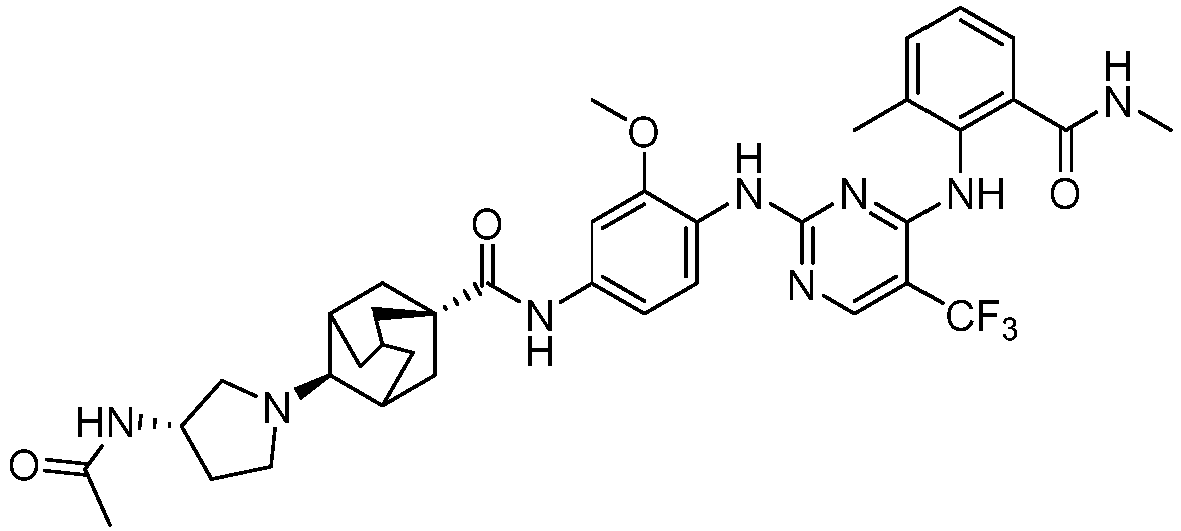
28 
29 
30 
31 
32 
33 
34 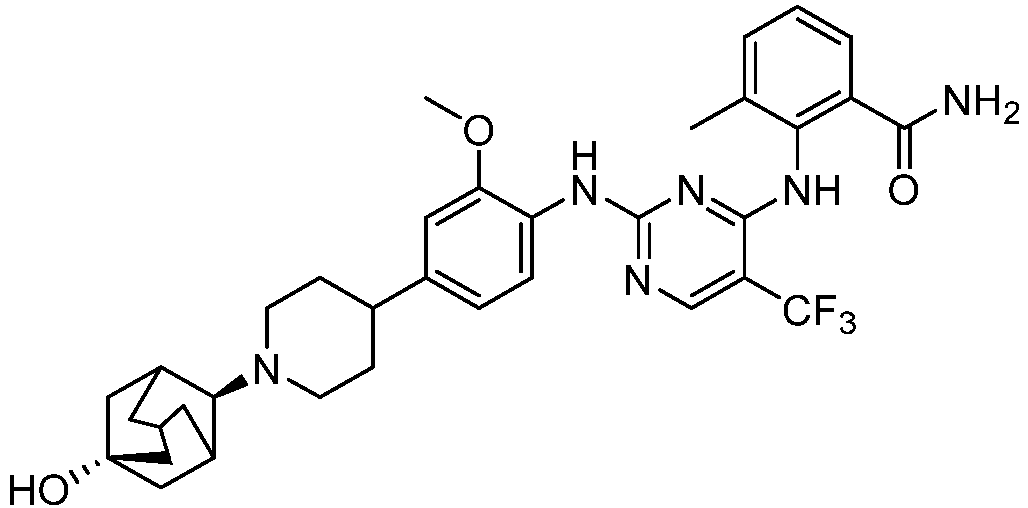
35 
36 
37 
38 
39 
40 
41 
42 
43 
44 
45 
46 
47 
- A pharmaceutical composition comprising the adamantane derivatives, pharmaceutically acceptable salts thereof, stereoisomers thereof, hydrates or solvates thereof according to one of claims 1 to 5 as active ingredients.
- The pharmaceutical composition according to claim 6, for use in preventing or treating FAK activity-associated diseases;
wherein the FAK activity-associated disease is at least one selected from the group consisting of solid cancers comprising gastric cancer, lung cancer, liver cancer, colorectal cancer, small intestine cancer, pancreatic cancer, brain cancer, bone cancer, melanoma, breast cancer, uterine cancer, cervical cancer, ovarian cancer, head and neck cancer, thyroid cancer, parathyroid cancer, kidney cancer, prostate cancer, urethral cancer, bladder cancer, mesothelioma, and blood cancers comprising leukemia, multiple myeloma and lymphoma. - The pharmaceutical composition for use according to claim 7, wherein the FAK activity-associated disease is a solid cancer selected from breast cancer, colorectal cancer, lung cancer, ovarian cancer and prostate cancer.
- The pharmaceutical composition for use according to claim 7, wherein the FAK activity-associated disease is breast cancer.
- The pharmaceutical composition for use according to claim 7, wherein the FAK activity-associated disease is triple-negative breast cancer.
- The pharmaceutical composition for use according to any one of claims 7 to 10, wherein the pharmaceutical composition is administered sequentially or simultaneously with another therapeutic agent.
Applications Claiming Priority (2)
| Application Number | Priority Date | Filing Date | Title |
|---|---|---|---|
| KR20190159011 | 2019-12-03 | ||
| PCT/IB2020/061350 WO2021111311A2 (en) | 2019-12-03 | 2020-12-02 | Novel adamantane derivatives as inhibitors of focal adhesion kinase |
Publications (3)
| Publication Number | Publication Date |
|---|---|
| EP4074697A2 EP4074697A2 (en) | 2022-10-19 |
| EP4074697A4 EP4074697A4 (en) | 2024-01-03 |
| EP4074697B1 true EP4074697B1 (en) | 2025-05-21 |
Family
ID=76221516
Family Applications (1)
| Application Number | Title | Priority Date | Filing Date |
|---|---|---|---|
| EP20895884.3A Active EP4074697B1 (en) | 2019-12-03 | 2020-12-02 | Novel adamantane derivatives as inhibitors of focal adhesion kinase |
Country Status (6)
| Country | Link |
|---|---|
| US (1) | US12590070B2 (en) |
| EP (1) | EP4074697B1 (en) |
| JP (1) | JP7390487B2 (en) |
| KR (1) | KR102472103B1 (en) |
| CN (1) | CN114929675B (en) |
| WO (1) | WO2021111311A2 (en) |
Families Citing this family (2)
| Publication number | Priority date | Publication date | Assignee | Title |
|---|---|---|---|---|
| CN112341406B (en) * | 2020-11-18 | 2023-02-10 | 韶远科技(上海)有限公司 | Synthesis method of trans-4- [4- (3-methoxy-4-nitrophenyl) -1-piperazinyl ] adamantane-1-ol |
| WO2024251270A1 (en) * | 2023-06-08 | 2024-12-12 | 希格生科(深圳)有限公司 | Nitrogen-containing aromatic ring compound and medical use thereof |
Family Cites Families (16)
| Publication number | Priority date | Publication date | Assignee | Title |
|---|---|---|---|---|
| ATE449764T1 (en) | 1999-12-28 | 2009-12-15 | Pharmacopeia Inc | CYTOKINE, ESPECIALLY TNF-ALPHA, INHIBITORS |
| US7115617B2 (en) | 2001-08-22 | 2006-10-03 | Amgen Inc. | Amino-substituted pyrimidinyl derivatives and methods of use |
| WO2003026664A1 (en) * | 2001-09-26 | 2003-04-03 | Bayer Corporation | 2-phenylamino-4- (5-pyrazolylamino) -pyramidine derivatives as kinase inhibitors, in particular, src kinase inhibitors |
| GB0305929D0 (en) * | 2003-03-14 | 2003-04-23 | Novartis Ag | Organic compounds |
| TWI378923B (en) * | 2003-08-15 | 2012-12-11 | Novartis Ag | Pyrimidine derivatives |
| KR20080110998A (en) | 2006-01-30 | 2008-12-22 | 엑셀리시스, 인코포레이티드 | As the BAX2 modulator, the aryl may be selected from the group consisting of ivaryl arylaminoaminopyrimidine or phenylarylaminoalkylpyrimidine and pharmaceutical compositions comprising the same. |
| WO2008073687A2 (en) * | 2006-12-08 | 2008-06-19 | Irm Llc | Compounds and compositions as protein kinase inhibitors |
| US8809325B2 (en) | 2011-03-08 | 2014-08-19 | Sanofi | Benzyl-oxathiazine derivatives substituted with adamantane and noradamantane, medicaments containing said compounds and use thereof |
| US20150119435A1 (en) * | 2012-05-11 | 2015-04-30 | Yale University | Compounds useful for promoting protein degradation and methods using same |
| CN106883213B (en) * | 2015-12-15 | 2021-04-20 | 合肥中科普瑞昇生物医药科技有限公司 | A dual inhibitor of EGFR and ALK kinases |
| WO2017162215A1 (en) * | 2016-03-25 | 2017-09-28 | 正大天晴药业集团股份有限公司 | Substituted pyrrolopyrimidine cdk inhibitor, pharmaceutical composition containing same and use thereof |
| CA3042731A1 (en) * | 2016-11-22 | 2018-05-31 | Dana-Farber Cancer Institute, Inc. | Inhibitors of interleukin-1 receptor-associated kinases and uses thereof |
| CN106905303A (en) * | 2017-03-16 | 2017-06-30 | 北京师范大学 | The compound and its label and their preparation method and application of one class targeting FAK |
| GB201708456D0 (en) * | 2017-05-26 | 2017-07-12 | Medical Res Council | Senolytic compounds |
| CA3109617A1 (en) * | 2018-09-27 | 2020-04-02 | Dana-Farber Cancer Institute, Inc. | Degradation of fak or fak and alk by conjugation of fak and alk inhibitors with e3 ligase ligands and methods of use |
| KR102163494B1 (en) | 2018-10-26 | 2020-10-08 | 한국과학기술연구원 | heteroaromatic macrocyclic derivatives as protein kinase inhibitors |
-
2020
- 2020-12-02 US US17/782,117 patent/US12590070B2/en active Active
- 2020-12-02 WO PCT/IB2020/061350 patent/WO2021111311A2/en not_active Ceased
- 2020-12-02 EP EP20895884.3A patent/EP4074697B1/en active Active
- 2020-12-02 KR KR1020200166369A patent/KR102472103B1/en active Active
- 2020-12-02 JP JP2022532125A patent/JP7390487B2/en active Active
- 2020-12-02 CN CN202080082764.3A patent/CN114929675B/en active Active
Also Published As
| Publication number | Publication date |
|---|---|
| KR102472103B1 (en) | 2022-11-29 |
| WO2021111311A3 (en) | 2021-07-22 |
| US20230049557A1 (en) | 2023-02-16 |
| US12590070B2 (en) | 2026-03-31 |
| KR20210069585A (en) | 2021-06-11 |
| CN114929675B (en) | 2024-02-13 |
| EP4074697A4 (en) | 2024-01-03 |
| JP7390487B2 (en) | 2023-12-01 |
| WO2021111311A2 (en) | 2021-06-10 |
| JP2023504468A (en) | 2023-02-03 |
| CN114929675A (en) | 2022-08-19 |
| EP4074697A2 (en) | 2022-10-19 |
Similar Documents
| Publication | Publication Date | Title |
|---|---|---|
| CN113717156B (en) | EGFR inhibitor, its preparation method and use | |
| EP3444254B1 (en) | Heterocyclic-substituted pyridinopyrimidinone derivative as cdk inhibitor and use thereof | |
| US10294221B2 (en) | 1, 3, 4-thiadiazole compounds and their use in treating cancer | |
| EP3612519B1 (en) | Phenyl-2-hydroxy-acetylamino-2-methyl-phenyl compounds | |
| EP3640248B1 (en) | Aminopyrimidine derivatives, preparation method therefor and use thereof | |
| CN104066735B (en) | Substituted imidazopyrazines as AKT kinase inhibitors | |
| EP4289843A1 (en) | Pyridopyrimidinone derivative, preparation method therefor, and use thereof | |
| EP3568396B1 (en) | Novel amino-imidazopyridine derivatives as janus kinase inhibitors and pharmaceutical use thereof | |
| US20190070154A1 (en) | New methods of use for an anti-diarrhea agent | |
| US10501466B2 (en) | WDR5 inhibitors and modulators | |
| JP6916562B2 (en) | Compounds, pharmaceutically acceptable salts thereof, solvates, stereoisomers and tautomers, and drug compositions, hyperproliferative disorder therapeutic agents, hyperproliferative disorder prophylaxis agents, drugs, cancer therapeutic agents, cancer Prophylactic agents and kinase signaling regulators | |
| CN116783183A (en) | 1-(2-(4-Cyclopropyl-1H-1,2,3-triazol-1-yl)acetyl)-4-hydroxy-N-(benzyl) as a VHL inhibitor for the treatment of anemia and cancer pyrrolidine-2-carboxamide derivatives | |
| EP4074697A2 (en) | Novel adamantane derivatives as inhibitors of focal adhesion kinase | |
| KR20180085814A (en) | Preparation of Substituted 5,6-dihydro-6-phenylbenzo [f] isoquinolin-2-amine | |
| CN116113406A (en) | GAS41 inhibitors and methods of use thereof | |
| EP4470608A1 (en) | Lysophosphatidylserine analogue, and lysophosphatidylserine analogue-containing phamaceutical composition for treating or preventing fibrosis | |
| EP4384518B1 (en) | Tyrosine kinase inhibitors | |
| US9371311B2 (en) | Benzoimidazol-2-yl pyrimidine derivatives | |
| EP4737453A1 (en) | Novel selenophene derivatives | |
| HK40079392B (en) | Phenyl-2-hydroxy-acetylamino-2-methyl-phenyl compounds | |
| HK40109178A (en) | Tyrosine kinase inhibitors | |
| WO2025169375A1 (en) | Tertiary amide derivative substituted with four-membered ring structure | |
| HK40079392A (en) | Phenyl-2-hydroxy-acetylamino-2-methyl-phenyl compounds | |
| WO2026068848A1 (en) | N-substituted 9-aminoacridines and their use in the treatment of cancer | |
| HK40103399A (en) | Pyridopyrimidinone derivative, preparation method therefor, and use thereof |
Legal Events
| Date | Code | Title | Description |
|---|---|---|---|
| STAA | Information on the status of an ep patent application or granted ep patent |
Free format text: STATUS: THE INTERNATIONAL PUBLICATION HAS BEEN MADE |
|
| PUAI | Public reference made under article 153(3) epc to a published international application that has entered the european phase |
Free format text: ORIGINAL CODE: 0009012 |
|
| STAA | Information on the status of an ep patent application or granted ep patent |
Free format text: STATUS: REQUEST FOR EXAMINATION WAS MADE |
|
| 17P | Request for examination filed |
Effective date: 20220630 |
|
| AK | Designated contracting states |
Kind code of ref document: A2 Designated state(s): AL AT BE BG CH CY CZ DE DK EE ES FI FR GB GR HR HU IE IS IT LI LT LU LV MC MK MT NL NO PL PT RO RS SE SI SK SM TR |
|
| DAV | Request for validation of the european patent (deleted) | ||
| DAX | Request for extension of the european patent (deleted) | ||
| A4 | Supplementary search report drawn up and despatched |
Effective date: 20231205 |
|
| RIC1 | Information provided on ipc code assigned before grant |
Ipc: A61P 35/00 20060101ALI20231129BHEP Ipc: C07D 403/12 20060101ALI20231129BHEP Ipc: C07D 401/12 20060101ALI20231129BHEP Ipc: A61K 31/506 20060101ALI20231129BHEP Ipc: A61K 31/505 20060101ALI20231129BHEP Ipc: C07D 239/48 20060101AFI20231129BHEP |
|
| GRAP | Despatch of communication of intention to grant a patent |
Free format text: ORIGINAL CODE: EPIDOSNIGR1 |
|
| STAA | Information on the status of an ep patent application or granted ep patent |
Free format text: STATUS: GRANT OF PATENT IS INTENDED |
|
| INTG | Intention to grant announced |
Effective date: 20241025 |
|
| GRAJ | Information related to disapproval of communication of intention to grant by the applicant or resumption of examination proceedings by the epo deleted |
Free format text: ORIGINAL CODE: EPIDOSDIGR1 |
|
| STAA | Information on the status of an ep patent application or granted ep patent |
Free format text: STATUS: REQUEST FOR EXAMINATION WAS MADE |
|
| GRAP | Despatch of communication of intention to grant a patent |
Free format text: ORIGINAL CODE: EPIDOSNIGR1 |
|
| STAA | Information on the status of an ep patent application or granted ep patent |
Free format text: STATUS: GRANT OF PATENT IS INTENDED |
|
| INTC | Intention to grant announced (deleted) | ||
| GRAS | Grant fee paid |
Free format text: ORIGINAL CODE: EPIDOSNIGR3 |
|
| GRAA | (expected) grant |
Free format text: ORIGINAL CODE: 0009210 |
|
| STAA | Information on the status of an ep patent application or granted ep patent |
Free format text: STATUS: THE PATENT HAS BEEN GRANTED |
|
| INTG | Intention to grant announced |
Effective date: 20250319 |
|
| AK | Designated contracting states |
Kind code of ref document: B1 Designated state(s): AL AT BE BG CH CY CZ DE DK EE ES FI FR GB GR HR HU IE IS IT LI LT LU LV MC MK MT NL NO PL PT RO RS SE SI SK SM TR |
|
| REG | Reference to a national code |
Ref country code: GB Ref legal event code: FG4D |
|
| REG | Reference to a national code |
Ref country code: CH Ref legal event code: EP |
|
| REG | Reference to a national code |
Ref country code: DE Ref legal event code: R096 Ref document number: 602020051854 Country of ref document: DE |
|
| REG | Reference to a national code |
Ref country code: IE Ref legal event code: FG4D |
|
| PG25 | Lapsed in a contracting state [announced via postgrant information from national office to epo] |
Ref country code: FI Free format text: LAPSE BECAUSE OF FAILURE TO SUBMIT A TRANSLATION OF THE DESCRIPTION OR TO PAY THE FEE WITHIN THE PRESCRIBED TIME-LIMIT Effective date: 20250521 Ref country code: PT Free format text: LAPSE BECAUSE OF FAILURE TO SUBMIT A TRANSLATION OF THE DESCRIPTION OR TO PAY THE FEE WITHIN THE PRESCRIBED TIME-LIMIT Effective date: 20250922 Ref country code: ES Free format text: LAPSE BECAUSE OF FAILURE TO SUBMIT A TRANSLATION OF THE DESCRIPTION OR TO PAY THE FEE WITHIN THE PRESCRIBED TIME-LIMIT Effective date: 20250521 |
|
| REG | Reference to a national code |
Ref country code: LT Ref legal event code: MG9D |
|
| PG25 | Lapsed in a contracting state [announced via postgrant information from national office to epo] |
Ref country code: NO Free format text: LAPSE BECAUSE OF FAILURE TO SUBMIT A TRANSLATION OF THE DESCRIPTION OR TO PAY THE FEE WITHIN THE PRESCRIBED TIME-LIMIT Effective date: 20250821 Ref country code: GR Free format text: LAPSE BECAUSE OF FAILURE TO SUBMIT A TRANSLATION OF THE DESCRIPTION OR TO PAY THE FEE WITHIN THE PRESCRIBED TIME-LIMIT Effective date: 20250822 |
|
| PG25 | Lapsed in a contracting state [announced via postgrant information from national office to epo] |
Ref country code: NL Free format text: LAPSE BECAUSE OF FAILURE TO SUBMIT A TRANSLATION OF THE DESCRIPTION OR TO PAY THE FEE WITHIN THE PRESCRIBED TIME-LIMIT Effective date: 20250521 Ref country code: PL Free format text: LAPSE BECAUSE OF FAILURE TO SUBMIT A TRANSLATION OF THE DESCRIPTION OR TO PAY THE FEE WITHIN THE PRESCRIBED TIME-LIMIT Effective date: 20250521 |
|
| PG25 | Lapsed in a contracting state [announced via postgrant information from national office to epo] |
Ref country code: BG Free format text: LAPSE BECAUSE OF FAILURE TO SUBMIT A TRANSLATION OF THE DESCRIPTION OR TO PAY THE FEE WITHIN THE PRESCRIBED TIME-LIMIT Effective date: 20250521 |
|
| PG25 | Lapsed in a contracting state [announced via postgrant information from national office to epo] |
Ref country code: HR Free format text: LAPSE BECAUSE OF FAILURE TO SUBMIT A TRANSLATION OF THE DESCRIPTION OR TO PAY THE FEE WITHIN THE PRESCRIBED TIME-LIMIT Effective date: 20250521 |
|
| PG25 | Lapsed in a contracting state [announced via postgrant information from national office to epo] |
Ref country code: RS Free format text: LAPSE BECAUSE OF FAILURE TO SUBMIT A TRANSLATION OF THE DESCRIPTION OR TO PAY THE FEE WITHIN THE PRESCRIBED TIME-LIMIT Effective date: 20250821 |
|
| PG25 | Lapsed in a contracting state [announced via postgrant information from national office to epo] |
Ref country code: IS Free format text: LAPSE BECAUSE OF FAILURE TO SUBMIT A TRANSLATION OF THE DESCRIPTION OR TO PAY THE FEE WITHIN THE PRESCRIBED TIME-LIMIT Effective date: 20250921 |
|
| PG25 | Lapsed in a contracting state [announced via postgrant information from national office to epo] |
Ref country code: LV Free format text: LAPSE BECAUSE OF FAILURE TO SUBMIT A TRANSLATION OF THE DESCRIPTION OR TO PAY THE FEE WITHIN THE PRESCRIBED TIME-LIMIT Effective date: 20250521 |
|
| REG | Reference to a national code |
Ref country code: AT Ref legal event code: MK05 Ref document number: 1796678 Country of ref document: AT Kind code of ref document: T Effective date: 20250521 |
|
| PGFP | Annual fee paid to national office [announced via postgrant information from national office to epo] |
Ref country code: DE Payment date: 20251210 Year of fee payment: 6 |
|
| PGFP | Annual fee paid to national office [announced via postgrant information from national office to epo] |
Ref country code: GB Payment date: 20251124 Year of fee payment: 6 |
|
| PG25 | Lapsed in a contracting state [announced via postgrant information from national office to epo] |
Ref country code: AT Free format text: LAPSE BECAUSE OF FAILURE TO SUBMIT A TRANSLATION OF THE DESCRIPTION OR TO PAY THE FEE WITHIN THE PRESCRIBED TIME-LIMIT Effective date: 20250521 Ref country code: SM Free format text: LAPSE BECAUSE OF FAILURE TO SUBMIT A TRANSLATION OF THE DESCRIPTION OR TO PAY THE FEE WITHIN THE PRESCRIBED TIME-LIMIT Effective date: 20250521 Ref country code: DK Free format text: LAPSE BECAUSE OF FAILURE TO SUBMIT A TRANSLATION OF THE DESCRIPTION OR TO PAY THE FEE WITHIN THE PRESCRIBED TIME-LIMIT Effective date: 20250521 |
|
| PGFP | Annual fee paid to national office [announced via postgrant information from national office to epo] |
Ref country code: FR Payment date: 20251205 Year of fee payment: 6 |
|
| PG25 | Lapsed in a contracting state [announced via postgrant information from national office to epo] |
Ref country code: CZ Free format text: LAPSE BECAUSE OF FAILURE TO SUBMIT A TRANSLATION OF THE DESCRIPTION OR TO PAY THE FEE WITHIN THE PRESCRIBED TIME-LIMIT Effective date: 20250521 |
|
| PG25 | Lapsed in a contracting state [announced via postgrant information from national office to epo] |
Ref country code: EE Free format text: LAPSE BECAUSE OF FAILURE TO SUBMIT A TRANSLATION OF THE DESCRIPTION OR TO PAY THE FEE WITHIN THE PRESCRIBED TIME-LIMIT Effective date: 20250521 |
|
| PG25 | Lapsed in a contracting state [announced via postgrant information from national office to epo] |
Ref country code: SK Free format text: LAPSE BECAUSE OF FAILURE TO SUBMIT A TRANSLATION OF THE DESCRIPTION OR TO PAY THE FEE WITHIN THE PRESCRIBED TIME-LIMIT Effective date: 20250521 |
|
| PG25 | Lapsed in a contracting state [announced via postgrant information from national office to epo] |
Ref country code: IT Free format text: LAPSE BECAUSE OF FAILURE TO SUBMIT A TRANSLATION OF THE DESCRIPTION OR TO PAY THE FEE WITHIN THE PRESCRIBED TIME-LIMIT Effective date: 20250521 |
|
| PG25 | Lapsed in a contracting state [announced via postgrant information from national office to epo] |
Ref country code: RO Free format text: LAPSE BECAUSE OF FAILURE TO SUBMIT A TRANSLATION OF THE DESCRIPTION OR TO PAY THE FEE WITHIN THE PRESCRIBED TIME-LIMIT Effective date: 20250521 |
|
| REG | Reference to a national code |
Ref country code: DE Ref legal event code: R097 Ref document number: 602020051854 Country of ref document: DE |
|
| PLBE | No opposition filed within time limit |
Free format text: ORIGINAL CODE: 0009261 |
|
| STAA | Information on the status of an ep patent application or granted ep patent |
Free format text: STATUS: NO OPPOSITION FILED WITHIN TIME LIMIT |
|
| REG | Reference to a national code |
Ref country code: CH Ref legal event code: L10 Free format text: ST27 STATUS EVENT CODE: U-0-0-L10-L00 (AS PROVIDED BY THE NATIONAL OFFICE) Effective date: 20260402 |
|
| 26N | No opposition filed |
Effective date: 20260224 |