EP4074682A1 - Verfahren zur hydroxymethylierung und hydroformylierung von alkenen mittels kupfer-ligand-komplex - Google Patents
Verfahren zur hydroxymethylierung und hydroformylierung von alkenen mittels kupfer-ligand-komplex Download PDFInfo
- Publication number
- EP4074682A1 EP4074682A1 EP21168761.1A EP21168761A EP4074682A1 EP 4074682 A1 EP4074682 A1 EP 4074682A1 EP 21168761 A EP21168761 A EP 21168761A EP 4074682 A1 EP4074682 A1 EP 4074682A1
- Authority
- EP
- European Patent Office
- Prior art keywords
- aryl
- process step
- variant
- bar
- range
- Prior art date
- Legal status (The legal status is an assumption and is not a legal conclusion. Google has not performed a legal analysis and makes no representation as to the accuracy of the status listed.)
- Withdrawn
Links
- 238000000034 method Methods 0.000 title claims abstract description 61
- 239000003446 ligand Substances 0.000 title claims abstract description 12
- 150000001336 alkenes Chemical class 0.000 title claims abstract description 9
- 229910052802 copper Inorganic materials 0.000 title claims description 5
- 238000007037 hydroformylation reaction Methods 0.000 title abstract description 5
- 238000007031 hydroxymethylation reaction Methods 0.000 title abstract description 3
- RYGMFSIKBFXOCR-UHFFFAOYSA-N Copper Chemical compound [Cu] RYGMFSIKBFXOCR-UHFFFAOYSA-N 0.000 title 1
- 239000010949 copper Substances 0.000 title 1
- YXFVVABEGXRONW-UHFFFAOYSA-N Toluene Chemical compound CC1=CC=CC=C1 YXFVVABEGXRONW-UHFFFAOYSA-N 0.000 claims description 12
- IAZDPXIOMUYVGZ-UHFFFAOYSA-N Dimethylsulphoxide Chemical compound CS(C)=O IAZDPXIOMUYVGZ-UHFFFAOYSA-N 0.000 claims description 6
- 239000011541 reaction mixture Substances 0.000 claims description 6
- 229910021591 Copper(I) chloride Inorganic materials 0.000 claims description 5
- OXBLHERUFWYNTN-UHFFFAOYSA-M copper(I) chloride Chemical compound [Cu]Cl OXBLHERUFWYNTN-UHFFFAOYSA-M 0.000 claims description 5
- 239000002904 solvent Substances 0.000 claims description 5
- 229910021589 Copper(I) bromide Inorganic materials 0.000 claims description 4
- LFQSCWFLJHTTHZ-UHFFFAOYSA-N Ethanol Chemical compound CCO LFQSCWFLJHTTHZ-UHFFFAOYSA-N 0.000 claims description 4
- 150000001875 compounds Chemical class 0.000 claims description 4
- -1 CH 3 CN Chemical compound 0.000 claims description 3
- XDTMQSROBMDMFD-UHFFFAOYSA-N Cyclohexane Chemical compound C1CCCCC1 XDTMQSROBMDMFD-UHFFFAOYSA-N 0.000 claims description 3
- 238000010438 heat treatment Methods 0.000 claims description 3
- GQHTUMJGOHRCHB-UHFFFAOYSA-N 2,3,4,6,7,8,9,10-octahydropyrimido[1,2-a]azepine Chemical compound C1CCCCN2CCCN=C21 GQHTUMJGOHRCHB-UHFFFAOYSA-N 0.000 claims description 2
- 229910002091 carbon monoxide Inorganic materials 0.000 claims description 2
- 125000002485 formyl group Chemical class [H]C(*)=O 0.000 claims description 2
- 125000001072 heteroaryl group Chemical group 0.000 claims description 2
- 229910052739 hydrogen Inorganic materials 0.000 claims description 2
- BDAWXSQJJCIFIK-UHFFFAOYSA-N potassium methoxide Chemical compound [K+].[O-]C BDAWXSQJJCIFIK-UHFFFAOYSA-N 0.000 claims description 2
- QDRKDTQENPPHOJ-UHFFFAOYSA-N sodium ethoxide Chemical compound [Na+].CC[O-] QDRKDTQENPPHOJ-UHFFFAOYSA-N 0.000 claims description 2
- 229910052751 metal Inorganic materials 0.000 description 6
- 239000002184 metal Substances 0.000 description 6
- 125000006413 ring segment Chemical group 0.000 description 6
- MZFPAWGWFDGCHP-UHFFFAOYSA-N 5-diphenylphosphanylpentyl(diphenyl)phosphane Chemical compound C=1C=CC=CC=1P(C=1C=CC=CC=1)CCCCCP(C=1C=CC=CC=1)C1=CC=CC=C1 MZFPAWGWFDGCHP-UHFFFAOYSA-N 0.000 description 4
- XKRFYHLGVUSROY-UHFFFAOYSA-N Argon Chemical compound [Ar] XKRFYHLGVUSROY-UHFFFAOYSA-N 0.000 description 4
- MUALRAIOVNYAIW-UHFFFAOYSA-N binap Chemical group C1=CC=CC=C1P(C=1C(=C2C=CC=CC2=CC=1)C=1C2=CC=CC=C2C=CC=1P(C=1C=CC=CC=1)C=1C=CC=CC=1)C1=CC=CC=C1 MUALRAIOVNYAIW-UHFFFAOYSA-N 0.000 description 4
- BOUYBUIVMHNXQB-UHFFFAOYSA-N dicyclohexyl(2-dicyclohexylphosphanylethyl)phosphane Chemical compound C1CCCCC1P(C1CCCCC1)CCP(C1CCCCC1)C1CCCCC1 BOUYBUIVMHNXQB-UHFFFAOYSA-N 0.000 description 4
- 150000002739 metals Chemical class 0.000 description 4
- QFMZQPDHXULLKC-UHFFFAOYSA-N 1,2-bis(diphenylphosphino)ethane Chemical compound C=1C=CC=CC=1P(C=1C=CC=CC=1)CCP(C=1C=CC=CC=1)C1=CC=CC=C1 QFMZQPDHXULLKC-UHFFFAOYSA-N 0.000 description 3
- BCJVBDBJSMFBRW-UHFFFAOYSA-N 4-diphenylphosphanylbutyl(diphenyl)phosphane Chemical compound C=1C=CC=CC=1P(C=1C=CC=CC=1)CCCCP(C=1C=CC=CC=1)C1=CC=CC=C1 BCJVBDBJSMFBRW-UHFFFAOYSA-N 0.000 description 3
- 125000003118 aryl group Chemical group 0.000 description 3
- 125000002950 monocyclic group Chemical group 0.000 description 3
- 125000004178 (C1-C4) alkyl group Chemical group 0.000 description 2
- IJGRMHOSHXDMSA-UHFFFAOYSA-N Atomic nitrogen Chemical compound N#N IJGRMHOSHXDMSA-UHFFFAOYSA-N 0.000 description 2
- XEKOWRVHYACXOJ-UHFFFAOYSA-N Ethyl acetate Chemical compound CCOC(C)=O XEKOWRVHYACXOJ-UHFFFAOYSA-N 0.000 description 2
- OFBQJSOFQDEBGM-UHFFFAOYSA-N Pentane Chemical compound CCCCC OFBQJSOFQDEBGM-UHFFFAOYSA-N 0.000 description 2
- PPBRXRYQALVLMV-UHFFFAOYSA-N Styrene Chemical compound C=CC1=CC=CC=C1 PPBRXRYQALVLMV-UHFFFAOYSA-N 0.000 description 2
- 229910052786 argon Inorganic materials 0.000 description 2
- HTJWUNNIRKDDIV-UHFFFAOYSA-N bis(1-adamantyl)-butylphosphane Chemical compound C1C(C2)CC(C3)CC2CC13P(CCCC)C1(C2)CC(C3)CC2CC3C1 HTJWUNNIRKDDIV-UHFFFAOYSA-N 0.000 description 2
- 125000004432 carbon atom Chemical group C* 0.000 description 2
- 238000006243 chemical reaction Methods 0.000 description 2
- 238000002474 experimental method Methods 0.000 description 2
- 229910052741 iridium Inorganic materials 0.000 description 2
- 229910052742 iron Inorganic materials 0.000 description 2
- 125000001624 naphthyl group Chemical group 0.000 description 2
- 229910052763 palladium Inorganic materials 0.000 description 2
- 125000001997 phenyl group Chemical group [H]C1=C([H])C([H])=C(*)C([H])=C1[H] 0.000 description 2
- 229910052697 platinum Inorganic materials 0.000 description 2
- 229910052707 ruthenium Inorganic materials 0.000 description 2
- YBYIRNPNPLQARY-UHFFFAOYSA-N 1H-indene Natural products C1=CC=C2CC=CC2=C1 YBYIRNPNPLQARY-UHFFFAOYSA-N 0.000 description 1
- 125000004105 2-pyridyl group Chemical group N1=C([*])C([H])=C([H])C([H])=C1[H] 0.000 description 1
- 229910021595 Copper(I) iodide Inorganic materials 0.000 description 1
- 125000000217 alkyl group Chemical group 0.000 description 1
- 229910052782 aluminium Inorganic materials 0.000 description 1
- XAGFODPZIPBFFR-UHFFFAOYSA-N aluminium Chemical compound [Al] XAGFODPZIPBFFR-UHFFFAOYSA-N 0.000 description 1
- 125000002178 anthracenyl group Chemical group C1(=CC=CC2=CC3=CC=CC=C3C=C12)* 0.000 description 1
- 239000012267 brine Substances 0.000 description 1
- 229910052799 carbon Inorganic materials 0.000 description 1
- 125000002676 chrysenyl group Chemical group C1(=CC=CC=2C3=CC=C4C=CC=CC4=C3C=CC12)* 0.000 description 1
- 239000012230 colorless oil Substances 0.000 description 1
- 238000004440 column chromatography Methods 0.000 description 1
- 230000000052 comparative effect Effects 0.000 description 1
- 125000003336 coronenyl group Chemical group C1(=CC2=CC=C3C=CC4=CC=C5C=CC6=CC=C1C1=C6C5=C4C3=C21)* 0.000 description 1
- 125000000113 cyclohexyl group Chemical group [H]C1([H])C([H])([H])C([H])([H])C([H])(*)C([H])([H])C1([H])[H] 0.000 description 1
- 229920001971 elastomer Polymers 0.000 description 1
- 235000019439 ethyl acetate Nutrition 0.000 description 1
- 125000003983 fluorenyl group Chemical group C1(=CC=CC=2C3=CC=CC=C3CC12)* 0.000 description 1
- 125000002541 furyl group Chemical group 0.000 description 1
- 125000005842 heteroatom Chemical group 0.000 description 1
- 125000002883 imidazolyl group Chemical group 0.000 description 1
- 125000003454 indenyl group Chemical group C1(C=CC2=CC=CC=C12)* 0.000 description 1
- 125000000842 isoxazolyl group Chemical group 0.000 description 1
- 229910052757 nitrogen Inorganic materials 0.000 description 1
- 229910052760 oxygen Inorganic materials 0.000 description 1
- 125000001792 phenanthrenyl group Chemical group C1(=CC=CC=2C3=CC=CC=C3C=CC12)* 0.000 description 1
- ISWSIDIOOBJBQZ-UHFFFAOYSA-N phenol group Chemical group C1(=CC=CC=C1)O ISWSIDIOOBJBQZ-UHFFFAOYSA-N 0.000 description 1
- 239000004810 polytetrafluoroethylene Substances 0.000 description 1
- 229920001343 polytetrafluoroethylene Polymers 0.000 description 1
- 125000003226 pyrazolyl group Chemical group 0.000 description 1
- 125000001725 pyrenyl group Chemical group 0.000 description 1
- 125000004076 pyridyl group Chemical group 0.000 description 1
- 125000000714 pyrimidinyl group Chemical group 0.000 description 1
- 125000000168 pyrrolyl group Chemical group 0.000 description 1
- 239000000376 reactant Substances 0.000 description 1
- 229920006395 saturated elastomer Polymers 0.000 description 1
- HPALAKNZSZLMCH-UHFFFAOYSA-M sodium;chloride;hydrate Chemical compound O.[Na+].[Cl-] HPALAKNZSZLMCH-UHFFFAOYSA-M 0.000 description 1
- 239000000243 solution Substances 0.000 description 1
- 238000003756 stirring Methods 0.000 description 1
- 229910052717 sulfur Inorganic materials 0.000 description 1
- 239000000725 suspension Substances 0.000 description 1
- 125000001935 tetracenyl group Chemical group C1(=CC=CC2=CC3=CC4=CC=CC=C4C=C3C=C12)* 0.000 description 1
- 125000000335 thiazolyl group Chemical group 0.000 description 1
Classifications
-
- C—CHEMISTRY; METALLURGY
- C07—ORGANIC CHEMISTRY
- C07C—ACYCLIC OR CARBOCYCLIC COMPOUNDS
- C07C5/00—Preparation of hydrocarbons from hydrocarbons containing the same number of carbon atoms
- C07C5/02—Preparation of hydrocarbons from hydrocarbons containing the same number of carbon atoms by hydrogenation
- C07C5/03—Preparation of hydrocarbons from hydrocarbons containing the same number of carbon atoms by hydrogenation of non-aromatic carbon-to-carbon double bonds
-
- C—CHEMISTRY; METALLURGY
- C07—ORGANIC CHEMISTRY
- C07C—ACYCLIC OR CARBOCYCLIC COMPOUNDS
- C07C29/00—Preparation of compounds having hydroxy or O-metal groups bound to a carbon atom not belonging to a six-membered aromatic ring
- C07C29/132—Preparation of compounds having hydroxy or O-metal groups bound to a carbon atom not belonging to a six-membered aromatic ring by reduction of an oxygen containing functional group
- C07C29/136—Preparation of compounds having hydroxy or O-metal groups bound to a carbon atom not belonging to a six-membered aromatic ring by reduction of an oxygen containing functional group of >C=O containing groups, e.g. —COOH
- C07C29/14—Preparation of compounds having hydroxy or O-metal groups bound to a carbon atom not belonging to a six-membered aromatic ring by reduction of an oxygen containing functional group of >C=O containing groups, e.g. —COOH of a —CHO group
- C07C29/141—Preparation of compounds having hydroxy or O-metal groups bound to a carbon atom not belonging to a six-membered aromatic ring by reduction of an oxygen containing functional group of >C=O containing groups, e.g. —COOH of a —CHO group with hydrogen or hydrogen-containing gases
-
- C—CHEMISTRY; METALLURGY
- C07—ORGANIC CHEMISTRY
- C07C—ACYCLIC OR CARBOCYCLIC COMPOUNDS
- C07C45/00—Preparation of compounds having >C = O groups bound only to carbon or hydrogen atoms; Preparation of chelates of such compounds
- C07C45/49—Preparation of compounds having >C = O groups bound only to carbon or hydrogen atoms; Preparation of chelates of such compounds by reaction with carbon monoxide
- C07C45/50—Preparation of compounds having >C = O groups bound only to carbon or hydrogen atoms; Preparation of chelates of such compounds by reaction with carbon monoxide by oxo-reactions
-
- C—CHEMISTRY; METALLURGY
- C07—ORGANIC CHEMISTRY
- C07C—ACYCLIC OR CARBOCYCLIC COMPOUNDS
- C07C2527/00—Catalysts comprising the elements or compounds of halogens, sulfur, selenium, tellurium, phosphorus or nitrogen; Catalysts comprising carbon compounds
- C07C2527/06—Halogens; Compounds thereof
- C07C2527/122—Compounds comprising a halogen and copper
-
- C—CHEMISTRY; METALLURGY
- C07—ORGANIC CHEMISTRY
- C07C—ACYCLIC OR CARBOCYCLIC COMPOUNDS
- C07C2531/00—Catalysts comprising hydrides, coordination complexes or organic compounds
- C07C2531/16—Catalysts comprising hydrides, coordination complexes or organic compounds containing coordination complexes
- C07C2531/24—Phosphines
Definitions
- the invention relates to a process for the hydroxymethylation and hydroformylation of alkenes using a copper-ligand complex.
- the technical problem on which the present invention was based is the provision of a process with which alkenes can be hydroxymethylated and/or hydroformylated.
- a metal other than the metals Ru, Ir, Pd, Pt and Fe is to be used in the process. An increased yield is to be achieved with this method.
- Process steps a), b), c) and d) can be carried out in any order.
- the addition of CO usually takes place after the reactants in steps a) to c) have been introduced.
- CO can also be supplied in several steps, so that, for example, part of the CO is supplied first, then it is heated and then another part of the CO is supplied.
- -(C 1 -C 12 )-alkyl or -O-(C 1 -C 12 )-alkyl includes straight-chain and branched alkyl groups having 1 to 12 carbon atoms. These are preferably -(C 1 -C 8 )-alkyl groups or -O-(C 1 -C 8 )-alkyl groups, particularly preferably -(C 1 -C 4 )-alkyl groups or -O-( C 1 -C 4 ) alkyl groups.
- the term -(C 6 -C 20 )-aryl and -O-(C 6 -C 20 )-aryl encompasses mono- or polycyclic aromatic hydrocarbon radicals. These have 6 to 20 ring atoms, particularly preferably 6 to 14 ring atoms, in particular 6 to 10 ring atoms.
- Aryl is preferably -(C 6 -C 10 )-aryl.
- Aryl is in particular phenyl, naphthyl, indenyl, fluorenyl, anthracenyl, phenanthrenyl, naphthacenyl, chrysenyl, pyrenyl, coronenyl.
- aryl represents phenyl, naphthyl and antracenyl.
- the term -(C 5 -C 20 )-heteroaryl encompasses mono- or polycyclic aromatic hydrocarbon radicals in which one or more carbon atoms have been replaced by heteroatoms, preferably N, O or S.
- N is particularly preferred.
- Examples include pyridyl, 2-pyridyl, pyrimidyl, imidazolyl, thiopenyl, furanyl, pyrrolyl, pyrazolyl, thiazolyl or isoxazolyl.
- the mono- or polycyclic aromatic hydrocarbon radicals have 5 to 20 ring atoms, preferably 5 to 14 ring atoms, in particular 5 and 6 ring atoms.
- R 1 , R 2 are -(C 6 -C 20 )-aryl.
- R 1 , R 2 are -Ph.
- R 1 , R 3 are -(C 6 -C 20 )-aryl.
- R 1 , R 3 are -Ph.
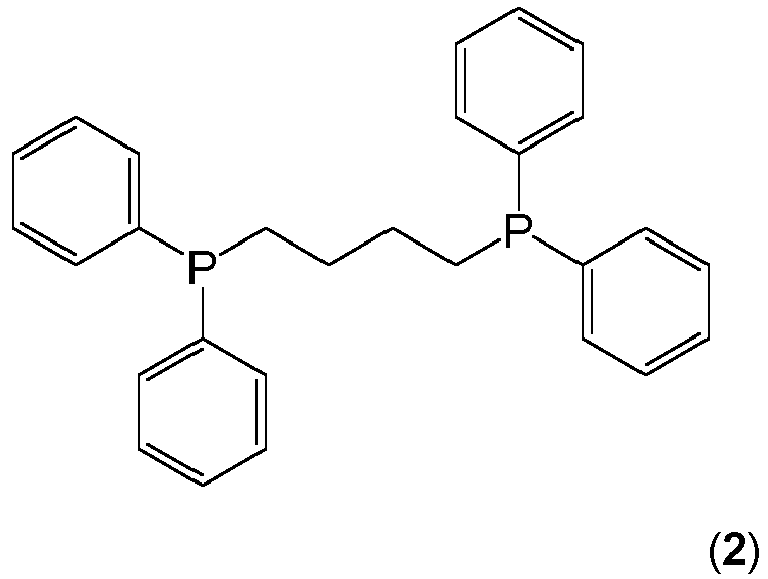
- the ligand has one of the structures (1), (2), (3):
- the compound comprising Cu is selected from: CuCl 2 , CuBr 2 , Cu(OAc) 2 , Cu(OTf) 2 , CuCl, CuBr, CuI, Cul(MeSMe).
- CO is fed in in process step d) at a pressure in the range from 0.5 to 5 MPa (5 to 50 bar).
- CO is fed in in process step d) at a pressure in the range from 0.5 to 3 MPa (5 to 30 bar).
- H 2 is fed in in process step d) at a pressure in the range from 1 to 5 MPa (10 to 50 bar).
- H 2 is fed in in process step d) at a pressure in the range from 1 to 3 MPa (10 to 30 bar).
- reaction mixture is heated in process step e) to a temperature in the range from 70.degree. C. to 150.degree.
- reaction mixture is heated in process step e) to a temperature in the range from 80.degree. C. to 120.degree.
- the method includes the additional method step d'): d') addition of a base.
- the base is selected from: KO t Bu, NaO t Bu, KOMe, NaOEt, DBU, NEt 3 .
- the additional method step d") d") Addition of a solvent.
- the solvent is selected from: cyclohexane, toluene, CH 3 CN, DMSO, DMF, tert -BuOH.
- n is a number from 1 to 6.
- n is a number from 1 to 5.
- a dried 4 mL screw-cap vial fitted with a septum and stirring bar was treated with CuCl (3.5 mg, 8 mol%), Ligand (12 mol%), and NaO t Bu (95 mg, 2.25 equiv ) filled.
- the vial was sealed with a PTFE/white rubber septum ( Wheaton® , 13mm) and phenolic cap, connected to atmosphere with a small cannula, evacuated and backfilled with argon. Cyclohexane (1.8 mL) and toluene (0.2 mL) were added via syringe under an argon countercurrent.
- the alkene in this case styrene
- 50 ⁇ L , 0.43 mmol was added via a Hamilton® syringe.
- the vial was placed on a metal plate and transferred to a 300 mL autoclave (4560 series from Parr instrument company® ).
- the autoclave was flushed once with nitrogen (10 bar) and three times with CO (10 bar).
- the autoclave was then filled with CO (10 bar) and then with H 2 (20 bar) in order to reach the desired pressure of 30 bar.
- the autoclave was then placed in an aluminum block on a magnetic stirrer.
- the reaction mixture was stirred (600 rpm) at 100°C for 20 h. It was then cooled to room temperature and the pressure released carefully.
- the ligands (4), (5) and (6) are comparison ligands.
- the object is achieved by the method according to the invention.
Landscapes
- Chemical & Material Sciences (AREA)
- Organic Chemistry (AREA)
- Chemical Kinetics & Catalysis (AREA)
- Organic Low-Molecular-Weight Compounds And Preparation Thereof (AREA)
Abstract
Description
- Die Erfindung betrifft ein Verfahren zur Hydroxymethylierung und Hydroformylierung von Alkenen mittels Kupfer-Ligand-Komplex.
- In "Alternative Metals for Homogeneous Catalyzed Hydroformylation Reactions" R. Franke, M. Beller et al., Angew. Chem. Int. Ed. 2013, 52, 2852 - 2872 werden eine Reihe von Metallen beschrieben, welche zur Katalyse von Hydroformylierungsreaktionen eingesetzt werden. Bei den Metallen handelt es sich um: Ru, Ir, Pd, Pt, und Fe.
- Die technische Aufgabe, welche der vorliegenden Erfindung zugrunde lag, ist die Bereitstellung eines Verfahrens, mit welchen Alkene hydroxymethyliert und/oder hydroformyliert werden können. In dem Verfahren soll ein anderes Metall zum Einsatz kommen als die Metalle Ru, Ir, Pd, Pt, und Fe. Mit diesem Verfahren soll eine gesteigerte Ausbeute erzielt werden.
- Diese Aufgabe wird gelöst durch ein Verfahren nach Anspruch 1.
- Verfahren umfassend die Verfahrensschritte:
- a) Vorlegen eines Alkens;
- b) Zugabe eines Liganden gemäß Formel (I):

- R1, R2, R3, R4 jeweils unabhängig voneinander ausgewählt sind aus: -H, -(C1-C12)-Alkyl, -O-(C1-C12)-Alkyl, -(C6-C20)-Aryl, -O-(C6-C20)-Aryl, -(C5-C20)-Heteroaryl,
- und n für eine Zahl von 1 bis 8 steht;
- c) Zugabe einer Verbindung, welche Cu umfasst;
- d) Zuführen von CO und H2;
- e) Erwärmen des Reaktionsgemisches aus a) bis d), wobei das Alken zu einem Aldehyd und/oder Alkohol umgesetzt wird.
- Hierbei können die Verfahrensschritte a), b), c) und d) in beliebiger Reihenfolge erfolgen. Üblicherweise erfolgt die Zugabe von CO jedoch, nachdem die Reaktionspartner in den Schritten a) bis c) vorgelegt wurden. Darüber hinaus kann CO auch in mehreren Schritten zugeführt werden, so dass beispielsweise zunächst ein Teil des CO zugeführt, dann erwärmt und anschließend ein weiterer Teil CO zugeführt wird.
- Der Begriff -(C1-C12)-Alkyl bzw. -O-(C1-C12)-Alkyl umfasst geradkettige und verzweigte Alkylgruppen mit 1 bis 12 Kohlenstoffatomen. Vorzugsweise handelt es sich dabei um -(C1-C8)-Alkylgruppen bzw. -O-(C1-C8)-Alkylgruppen, besonders bevorzugt um -(C1-C4)-Alkylgruppen bzw. -O-(C1-C4)-Alkylgruppen.
- Der Begriff -(C6-C20)-Aryl und -O-(C6-C20)-Aryl umfasst im Sinne der vorliegenden Erfindung mono- oder polycyclische aromatische Kohlenwasserstoffreste. Diese weisen 6 bis 20 Ringatome, besonders bevorzugt 6 bis 14 Ringatome, insbesondere 6 bis 10 Ringatome, auf. Aryl steht vorzugsweise für -(C6-C10)-Aryl. Aryl steht insbesondere für Phenyl, Naphthyl, Indenyl, Fluorenyl, Anthracenyl, Phenanthrenyl, Naphthacenyl, Chrysenyl, Pyrenyl, Coronenyl. Insbesondere steht Aryl für Phenyl, Naphthyl und Antracenyl.
- Der Begriff -(C5-C20)-Heteroaryl umfasst im Sinne der vorliegenden Erfindung mono- oder polycyclische aromatische Kohlenwasserstoffreste, in denen ein oder mehrere C-Atome durch Heteroatome, vorzugsweise N, O oder S ersetzt sind. Hierbei ist N besonders bevorzugt. Beispiele hierfür sind unter anderem Pyridyl, 2-Pyridyl, Pyrimidyl, Imidazolyl, Thiopenyl, Furanyl, Pyrrolyl, Pyrazoly, Thiazolyl oder Isoxazolyl. Die mono- oder polycyclische aromatische Kohlenwasserstoffreste weisen 5 bis 20 Ringatome, bevorzugt 5 bis 14 Ringatome, insbesondere 5 und 6 Ringatome, auf.
- In einer Variante des Verfahrens stehen R1, R2 für -(C6-C20)-Aryl.
- In einer Variante des Verfahrens stehen R1, R2 für -Ph.
- In einer Variante des Verfahrens stehen R1, R3 für -(C6-C20)-Aryl.
- In einer Variante des Verfahrens stehen R1, R3 für -Ph.
- In einer Variante des Verfahrens weist der Ligand eine der Strukturen (1), (2), (3) auf:


- In einer Variante des Verfahrens ist die Verbindung, welche Cu umfasst, ausgewählt aus: CuCl2, CuBr2, Cu(OAc)2, Cu(OTf)2, CuCl, CuBr, CuI, Cul(MeSMe).
- In einer Variante des Verfahrens erfolgt das Zuführen von CO in Verfahrensschritt d) mit einem Druck in dem Bereich von 0,5 bis 5 MPa (5 bis 50 bar).
- In einer Variante des Verfahrens erfolgt das Zuführen von CO in Verfahrensschritt d) mit einem Druck in dem Bereich von 0,5 bis 3 MPa (5 bis 30 bar).
- In einer Variante des Verfahrens erfolgt das Zuführen von H2 in Verfahrensschritt d) mit einem Druck in dem Bereich von 1 bis 5 MPa (10 bis 50 bar).
- In einer Variante des Verfahrens erfolgt das Zuführen von H2 in Verfahrensschritt d) mit einem Druck in dem Bereich von 1 bis 3 MPa (10 bis 30 bar).
- In einer Variante des Verfahrens erfolgt das Erwärmen des Reaktionsgemisches in Verfahrensschritt e) auf eine Temperatur in dem Bereich von 70 °C bis 150 °C.
- In einer Variante des Verfahrens erfolgt das Erwärmen des Reaktionsgemisches in Verfahrensschritt e) auf eine Temperatur in dem Bereich von 80 °C bis 120 °C.
- In einer Variante des Verfahrens umfasst das Verfahren den zusätzlichen Verfahrensschritt d'):
d') Zugabe einer Base. - In einer Variante des Verfahrens ist die Base ausgewählt aus: KOtBu, NaOtBu, KOMe, NaOEt, DBU, NEt3.
- In einer Variante des Verfahrens den zusätzlichen Verfahrensschritt d"):
d") Zugabe eines Lösungsmittels. - In einer Variante des Verfahrens ist das Lösungsmittel ausgewählt ist aus: Cyclohexan, Toluol, CH3CN, DMSO, DMF, tert-BuOH.
- In einer Variante des Verfahrens steht n für eine Zahl von 1 bis 6.
- In einer Variante des Verfahrens steht n für eine Zahl von 1 bis 5.
- Im Folgenden soll die Erfindung anhand von Ausführungsbeispielen näher erläutert werden.

- Ein getrocknetes 4-mL-Schraubdeckelgefäß, das mit einem Septum und einem Rührstab ausgestattet war, wurde mit CuCI (3,5 mg, 8 mol%), Ligand (12 mol%) und NaOtBu (95 mg, 2,25 äquiv) gefüllt. Das Fläschchen wurde mit einem PTFE/Weißgummi-Septum (Wheaton®, 13 mm) und einer Phenolkappe verschlossen, mit einer kleinen Kanüle an die Atmosphäre angeschlossen, evakuiert und mit Argon aufgefüllt. Cyclohexan (1,8 mL) und Toluol (0,2 mL) wurden per Spritze unter Argon-Gegenstrom zugegeben. Zu dieser Suspension wurde das Alken (in diesem Fall Styrol) (50 µL, 0,43 mmoL) über eine Hamilton® -Spritze zugegeben. Das Fläschchen wurde auf eine Metallplatte gestellt und in einen 300 mL Autoklaven (Serie 4560 von Parr instrument company®) überführt. Der Autoklav wurde einmal mit Stickstoff (10 bar) und drei Mal mit CO (10 bar) gespült. Anschließend wurde der Autoklav mit CO (10 bar) und anschließend mit H2 (20 bar) befüllt, um den gewünschten Druck von 30 bar zu erreichen. Der Autoklav wurde dann in einen Aluminiumblock auf einen Magnetrührer gestellt. Das Reaktionsgemisch wurde 20 h lang bei 100 °C gerührt (600 U/min). Anschließend wurde es auf Raumtemperatur abgekühlt und der Druck vorsichtig abgelassen. Die Reaktion wurde mit gesättigter NH4Cl-Lösung (3,0 mL) gequencht, mit Et2O drei Mal extrahiert, mit Salzlösung gewaschen, über Na2SO4 getrocknet und im Vakuum konzentriert. Der Rückstand wurde durch Gradientensäulenchromatographie (Pentan:EtOAc = 9:1 → 3:1) gereinigt, um Produkt als farbloses Öl zu erhalten (37,4 mg, 64 %).
- Der Versuch wurde unter analogen Bedingungen mit den folgenden Liganden durchgeführt:

- (1) (1,2-Bis(diphenylphosphino)ethan (DPPE))

- (2) (1,4-Bis(diphenylphosphino)butan (DPPB))

- (3) (1,5-Bis(diphenylphosphino)pentan (DPPPE))

- (4) (2,2'-Bis(diphenylphosphino)-1,1'-binaphthyl (BINAP))

- (5) (1,2-Bis(dicyclohexylphosphino)ethan (DCyPE))

- (6) (Butyldi-1-adamantylphosphine (BuPAd2))
- Bei den Liganden (4), (5) und (6) handelt es sich um Vergleichsliganden.
- T = 100 °C, p(CO) = 10 bar, p(H2) = 20 bar, t = 20 h, Lösungsmittel = Cyclohexan:Toluol (9:1)
- Die Versuchsergebnisse sind in der nachfolgenden Tabelle aufgeführt:
Ligand Ausbeute B + C [%] (1)* 28 (2)* 51 (3)* 26 (4) 0 (5) 3 (6) 3 * erfindungsgemäßes Verfahren - Mit den erfindungsgemäßen Verfahren konnten bessere Ausbeuten erzielt werden als in den Vergleichsversuchen.
- Wie die Ausführungsbeispiele zeigen, wird die Aufgabe durch die erfindungsgemäßen Verfahren gelöst.
Claims (15)
- Verfahren umfassend die Verfahrensschritte:a) Vorlegen eines Alkens;b) Zugabe eines Liganden gemäß Formel (I):
 R1, R2, R3, R4 jeweils unabhängig voneinander ausgewählt sind aus: -H, -(C1-C12)-Alkyl, -O-(C1-C12)-Alkyl, -(C6-C20)-Aryl, -O-(C6-C20)-Aryl, -(C5-C20)-Heteroaryl,und n für eine Zahl von 1 bis 8 steht;c) Zugabe einer Verbindung, welche Cu umfasst;d) Zuführen von CO und H2;e) Erwärmen des Reaktionsgemisches aus a) bis d), wobei das Alken zu einem Aldehyd und/oder Alkohol umgesetzt wird.
 - Verfahren nach Anspruch 1,
wobei R1, R2 für -(C6-C20)-Aryl stehen. - Verfahren nach einem der Ansprüche 1 oder 2,
wobei R1, R2 für -Ph stehen. - Verfahren nach einem der Ansprüche 1 bis 3,
wobei R1, R3 für -(C6-C20)-Aryl stehen. - Verfahren nach einem der Ansprüche 1 bis 4,
wobei R1, R3 für -Ph stehen. - Verfahren nach einem der Ansprüche 1 bis 5,
wobei der Ligand eine der Strukturen (1), (2), (3) aufweist:

- Verfahren nach einem der Ansprüche 1 bis 6,
wobei die Verbindung, welche Cu umfasst, ausgewählt ist aus: CuCl2, CuBr2, Cu(OAc)2, Cu(OTf)2, CuCI, CuBr, Cul, Cul(MeSMe). - Verfahren nach einem der Ansprüche 1 bis 7,
wobei das Zuführen von CO in Verfahrensschritt d) mit einem Druck in dem Bereich von 0,5 bis 5 MPa (5 bis 50 bar) erfolgt. - Verfahren nach einem der Ansprüche 1 bis 8,
wobei das Zuführen von H2 in Verfahrensschritt d) mit einem Druck in dem Bereich von 1 bis 5 MPa (10 bis 50 bar) erfolgt. - Verfahren nach einem der Ansprüche 1 bis 9,
wobei das Erwärmen des Reaktionsgemisches in Verfahrensschritt e) auf eine Temperatur in dem Bereich von 70 °C bis 150 °C erfolgt. - Verfahren nach einem der Ansprüche 1 bis 10,
umfassend den zusätzlichen Verfahrensschritt d'):
d') Zugabe einer Base. - Verfahren nach Anspruch 11,
wobei die Base ausgewählt ist aus: KOtBu, NaOtBu, KOMe, NaOEt, DBU, NEt3. - Verfahren nach einem der Ansprüche 1 bis 12,
umfassend den zusätzlichen Verfahrensschritt d"):
d") Zugabe eines Lösungsmittels. - Verfahren nach Anspruch 13,
wobei das Lösungsmittel ausgewählt ist aus: Cyclohexan, Toluol, CH3CN, DMSO, DMF, tert-BuOH. - Verfahren nach einem der Ansprüche 1 bis 14,
wobei n für eine Zahl von 1 bis 5 steht.
Priority Applications (1)
| Application Number | Priority Date | Filing Date | Title |
|---|---|---|---|
| EP21168761.1A EP4074682A1 (de) | 2021-04-16 | 2021-04-16 | Verfahren zur hydroxymethylierung und hydroformylierung von alkenen mittels kupfer-ligand-komplex |
Applications Claiming Priority (1)
| Application Number | Priority Date | Filing Date | Title |
|---|---|---|---|
| EP21168761.1A EP4074682A1 (de) | 2021-04-16 | 2021-04-16 | Verfahren zur hydroxymethylierung und hydroformylierung von alkenen mittels kupfer-ligand-komplex |
Publications (1)
| Publication Number | Publication Date |
|---|---|
| EP4074682A1 true EP4074682A1 (de) | 2022-10-19 |
Family
ID=75562563
Family Applications (1)
| Application Number | Title | Priority Date | Filing Date |
|---|---|---|---|
| EP21168761.1A Withdrawn EP4074682A1 (de) | 2021-04-16 | 2021-04-16 | Verfahren zur hydroxymethylierung und hydroformylierung von alkenen mittels kupfer-ligand-komplex |
Country Status (1)
| Country | Link |
|---|---|
| EP (1) | EP4074682A1 (de) |
Cited By (2)
| Publication number | Priority date | Publication date | Assignee | Title |
|---|---|---|---|---|
| EP4357325A1 (de) * | 2022-10-21 | 2024-04-24 | Evonik Operations GmbH | Verfahren zur herstellung eines mehrfach deuterierten alkohols mittels kupfer-katalysators |
| EP4725934A1 (de) * | 2024-10-11 | 2026-04-15 | Evonik Oxeno GmbH & Co. KG | Verfahren zur hydroformylierung von olefinen unter einsatz von 1,8-diazabicyclo[5.4.0]undec-7-en (dbu) |
Citations (1)
| Publication number | Priority date | Publication date | Assignee | Title |
|---|---|---|---|---|
| US4551543A (en) * | 1983-12-21 | 1985-11-05 | Exxon Research And Engineering Co. | Bimetallic carbonyl hydroformylation catalysts |
-
2021
- 2021-04-16 EP EP21168761.1A patent/EP4074682A1/de not_active Withdrawn
Patent Citations (1)
| Publication number | Priority date | Publication date | Assignee | Title |
|---|---|---|---|---|
| US4551543A (en) * | 1983-12-21 | 1985-11-05 | Exxon Research And Engineering Co. | Bimetallic carbonyl hydroformylation catalysts |
Non-Patent Citations (2)
| Title |
|---|
| POSPECH JOLA ET AL: "Alternative Metals for Homogeneous Catalyzed Hydroformylation Reactions", ANGEWANDTE CHEMIE INTERNATIONAL EDITION, vol. 52, no. 10, 4 March 2013 (2013-03-04), DE, pages 2852 - 2872, XP055843590, ISSN: 1433-7851, DOI: 10.1002/anie.201208330 * |
| R. FRANKEM. BELLER ET AL.: "Alternative Metals for Homogeneous Catalyzed Hydroformylation Reactions", ANGEW. CHEM. INT. ED., vol. 52, 2013, pages 2852 - 2872 |
Cited By (2)
| Publication number | Priority date | Publication date | Assignee | Title |
|---|---|---|---|---|
| EP4357325A1 (de) * | 2022-10-21 | 2024-04-24 | Evonik Operations GmbH | Verfahren zur herstellung eines mehrfach deuterierten alkohols mittels kupfer-katalysators |
| EP4725934A1 (de) * | 2024-10-11 | 2026-04-15 | Evonik Oxeno GmbH & Co. KG | Verfahren zur hydroformylierung von olefinen unter einsatz von 1,8-diazabicyclo[5.4.0]undec-7-en (dbu) |
Similar Documents
| Publication | Publication Date | Title |
|---|---|---|
| EP3121181B1 (de) | Monophosphinverbindungen und darauf basierende palladium-katalysatoren für die alkoxycarbonylierung ethylenisch ungesättigter verbindungen | |
| DE69518497T2 (de) | Verfahren zur Herstellung eines Alkohols | |
| EP1677911B1 (de) | Stabilisierung von hydroformylierungskatalysatoren auf basis von phosphoramiditliganden | |
| EP3763723B1 (de) | Bisphosphite mit einem geschlossenen und einem offenen flügelbaustein | |
| EP2947091B1 (de) | Gemische von monophosphitligand und deren verwendung zur katalyse einer hydroformylierungsreaktion | |
| EP3994117B1 (de) | Hydrierung von estern zu alkoholen in gegenwart eines ru-pnn-komplexes | |
| EP3272732A1 (de) | Verfahren zur alkoxycarbonylierung ethylenisch ungesättigter verbindungen mit monophosphinliganden | |
| EP3272760B1 (de) | 1,1'-bis(phosphino)ferrocenliganden für die alkoxycarbonylierung | |
| EP4074720B1 (de) | Gemisch von bisphosphiten mit einem offenen und einem geschlossenen flügelbaustein und dessen verwendung als katalysatorgemisch in der hydroformylierung | |
| EP3971195B1 (de) | Diphosphite mit einem offenen, 2,4-methylierten flügelbaustein | |
| EP3442982B1 (de) | Katalysator zur hydroformylierung von olefinen und dessen verwendung | |
| WO2000058319A1 (de) | Oligomerisierungskatalysator | |
| EP4001253A1 (de) | Doppelte alkoxycarbonylierung von dienen als eintopfsynthese | |
| EP4074683A1 (de) | Verfahren zur hydroxymethylierung und hydroformylierung von alkenen mittels cu-katalysators | |
| EP4074687A1 (de) | Verfahren zur hydroxymethylierung und hydroformylierung von alkenen mittels kupfer-katalysators | |
| EP4011894B1 (de) | Platin-komplexe mit binaphthyl-diphosphin-liganden für die katalyse der hydroxycarbonylierung ethylenisch ungesättigter verbindungen | |
| EP3272728B1 (de) | Verfahren zur alkoxycarbonylierung von alkoholen | |
| DE3819487A1 (de) | Uebergangsmetallkomplexe | |
| EP3272729B1 (de) | Verfahren zur herstellung von estern durch carbonylierung von ethern | |
| EP3763722B1 (de) | Bisphosphite mit einem offenen und einem geschlossenen flügelbaustein | |
| EP4074722A1 (de) | Diphosphite mit einem offenen, 3-methylierten flügelbaustein | |
| EP4043445A1 (de) | Verfahren zur herstellung von 2-aminobenzoxazinonen aus 1-azido-2-iodobenzolen und aminen | |
| EP3318570A1 (de) | Phosphorigsäure-p,p'-[5,5',6,6'-tetramethyl-3,3'-bis(1-methylethyl)[1,1'-biphenyl]-2,2'-diyl] p,p,p',p'-tetrakis(2,4-dimethylphenyl)-ester in der hydroformylierung | |
| EP4074721A1 (de) | Diphosphite mit einem offenen und einem geschlossenen 2,4-methylierten flügelbaustein | |
| EP3024837A2 (de) | Phosphoramiditderivate in der hydroformylierung von ungesättigten verbindungen |
Legal Events
| Date | Code | Title | Description |
|---|---|---|---|
| PUAI | Public reference made under article 153(3) epc to a published international application that has entered the european phase |
Free format text: ORIGINAL CODE: 0009012 |
|
| STAA | Information on the status of an ep patent application or granted ep patent |
Free format text: STATUS: THE APPLICATION HAS BEEN PUBLISHED |
|
| AK | Designated contracting states |
Kind code of ref document: A1 Designated state(s): AL AT BE BG CH CY CZ DE DK EE ES FI FR GB GR HR HU IE IS IT LI LT LU LV MC MK MT NL NO PL PT RO RS SE SI SK SM TR |
|
| STAA | Information on the status of an ep patent application or granted ep patent |
Free format text: STATUS: REQUEST FOR EXAMINATION WAS MADE |
|
| 17P | Request for examination filed |
Effective date: 20221104 |
|
| RBV | Designated contracting states (corrected) |
Designated state(s): AL AT BE BG CH CY CZ DE DK EE ES FI FR GB GR HR HU IE IS IT LI LT LU LV MC MK MT NL NO PL PT RO RS SE SI SK SM TR |
|
| STAA | Information on the status of an ep patent application or granted ep patent |
Free format text: STATUS: EXAMINATION IS IN PROGRESS |
|
| 17Q | First examination report despatched |
Effective date: 20230712 |
|
| STAA | Information on the status of an ep patent application or granted ep patent |
Free format text: STATUS: THE APPLICATION IS DEEMED TO BE WITHDRAWN |
|
| 18D | Application deemed to be withdrawn |
Effective date: 20231024 |