EP4073372B1 - Valve timing system for liquid fuel rockets - Google Patents
Valve timing system for liquid fuel rockets Download PDFInfo
- Publication number
- EP4073372B1 EP4073372B1 EP19832788.4A EP19832788A EP4073372B1 EP 4073372 B1 EP4073372 B1 EP 4073372B1 EP 19832788 A EP19832788 A EP 19832788A EP 4073372 B1 EP4073372 B1 EP 4073372B1
- Authority
- EP
- European Patent Office
- Prior art keywords
- valve
- controller
- minimum impulse
- time
- impulse bit
- Prior art date
- Legal status (The legal status is an assumption and is not a legal conclusion. Google has not performed a legal analysis and makes no representation as to the accuracy of the status listed.)
- Active
Links
Images


Classifications
-
- F—MECHANICAL ENGINEERING; LIGHTING; HEATING; WEAPONS; BLASTING
- F02—COMBUSTION ENGINES; HOT-GAS OR COMBUSTION-PRODUCT ENGINE PLANTS
- F02K—JET-PROPULSION PLANTS
- F02K9/00—Rocket-engine plants, i.e. plants carrying both fuel and oxidant therefor; Control thereof
- F02K9/42—Rocket-engine plants, i.e. plants carrying both fuel and oxidant therefor; Control thereof using liquid or gaseous propellants
- F02K9/44—Feeding propellants
- F02K9/56—Control
- F02K9/58—Propellant feed valves
-
- F—MECHANICAL ENGINEERING; LIGHTING; HEATING; WEAPONS; BLASTING
- F02—COMBUSTION ENGINES; HOT-GAS OR COMBUSTION-PRODUCT ENGINE PLANTS
- F02K—JET-PROPULSION PLANTS
- F02K9/00—Rocket-engine plants, i.e. plants carrying both fuel and oxidant therefor; Control thereof
- F02K9/80—Rocket-engine plants, i.e. plants carrying both fuel and oxidant therefor; Control thereof characterised by thrust or thrust vector control
- F02K9/805—Rocket-engine plants, i.e. plants carrying both fuel and oxidant therefor; Control thereof characterised by thrust or thrust vector control servo-mechanisms or control devices therefor
-
- F—MECHANICAL ENGINEERING; LIGHTING; HEATING; WEAPONS; BLASTING
- F05—INDEXING SCHEMES RELATING TO ENGINES OR PUMPS IN VARIOUS SUBCLASSES OF CLASSES F01-F04
- F05D—INDEXING SCHEME FOR ASPECTS RELATING TO NON-POSITIVE-DISPLACEMENT MACHINES OR ENGINES, GAS-TURBINES OR JET-PROPULSION PLANTS
- F05D2260/00—Function
- F05D2260/42—Storage of energy
-
- F—MECHANICAL ENGINEERING; LIGHTING; HEATING; WEAPONS; BLASTING
- F05—INDEXING SCHEMES RELATING TO ENGINES OR PUMPS IN VARIOUS SUBCLASSES OF CLASSES F01-F04
- F05D—INDEXING SCHEME FOR ASPECTS RELATING TO NON-POSITIVE-DISPLACEMENT MACHINES OR ENGINES, GAS-TURBINES OR JET-PROPULSION PLANTS
- F05D2270/00—Control
- F05D2270/30—Control parameters, e.g. input parameters
- F05D2270/301—Pressure
-
- F—MECHANICAL ENGINEERING; LIGHTING; HEATING; WEAPONS; BLASTING
- F05—INDEXING SCHEMES RELATING TO ENGINES OR PUMPS IN VARIOUS SUBCLASSES OF CLASSES F01-F04
- F05D—INDEXING SCHEME FOR ASPECTS RELATING TO NON-POSITIVE-DISPLACEMENT MACHINES OR ENGINES, GAS-TURBINES OR JET-PROPULSION PLANTS
- F05D2270/00—Control
- F05D2270/50—Control logic embodiments
- F05D2270/52—Control logic embodiments by electrical means, e.g. relays or switches
Definitions
- the present disclosure relates generally to valve control, and more specifically to valve timing and controls for reducing minimum impulse bit duration in a liquid fuel rocket.
- Liquid fuel rockets utilize valves and valve control to control the flow of fuel into a combustor, thereby controlling the thrust produced by the combustor.
- MIB minimum impulse bit
- the minimum impulse bit dictates the granularity of control that can be applied to fluid flow through the valve and thus, the granularity of the thrust controls of the liquid fuel rocket engine.
- the minimum impulse bit time of any given valve can vary due to variations in the opening and closing responses of the valve. This variance depends on any number factors including the age of the valve, wear on the valve, environmental conditions in which the valve is operating, and the like. In order to compensate for the variation, and provide consistent predictable controls, discrete valve operations are typically run at slightly longer than the actual minimum impulse bit of the valve.
- US 2015/167574 discloses a method and device for monitoring an actuator device.
- US 2008/236140 discloses noncircular transient fluid fuel injector control channels in propellant injector combustion systems.
- US 2017/248101 discloses a valve controller for pressure stabilization.
- a valve controller for a liquid fuel rocket engine includes at least one current sensor input, at least one voltage sensor input, a processor and a memory, the processor being connected to the at least one current sensor input and the at least one voltage sensor input, wherein the valve controller is configured to determine at least one actual minimum impulse bit of a valve based on a current profile and a voltage profile of a single valve operation, and wherein the valve controller is configured to adjust valve controls to account for the at least one actual minimum impulse bit.
- the actual minimum impulse bit is correlated with at least one external factor, and wherein the valve controller is configured to adjust the valve controls to account for the at least one actual minimum impulse bit and the at least one external factor.
- the external factor is at least one of an engine pressure and a battery voltage.
- valve controller is configured to determine the at least one actual minimum impulse bit on an initial operation of the valve.
- valve controller is further configured to periodically determine an updated minimum impulse bit of the valve.
- valve controller is further configured to adjust valve controls based on a most recently determined updated minimum impulse bit of the valve.
- the minimum impulse bit is based in part on an initial valve opening time, the initial valve opening time being determined to be a dip in a ramp up of the current profile.
- the minimum impulse bit is based in part on a fully closed valve time, the fully closed valve time being determined to be a time between a voltage spike and a valve control current being driven to zero by the valve controller.
- each of the at least one current sensor and the at least one voltage sensor are connected to, and configured to sense, a valve control signal line.
- valve control signal line is controllably connected to a liquid fuel rocket engine valve.
- the liquid fuel rocket engine valve at least partially controls a flow of liquid fuel form a fuel repository to a combustor.
- a method for determining a minimum impulse bit of a valve includes monitoring a current profile and a voltage profile of a valve control signal, determining an initial valve open time to be a beginning of a dip in a current ramp up and determining a valve fully closed time to be a voltage spike of the valve control signal, and determining the minimum impulse bit of the valve to be a length of time from the initial valve open time to the valve fully closed time.
- Another preferred embodiment of the above method includes correlating the minim impulse bit of the valve with at least one external environmental factor.
- the at least one external environmental factor includes at least one of an engine pressure and a battery voltage.
- Another preferred embodiment of any of the above methods includes periodically reiterating the method and updating the determined minimum impulse bit of the valve at each iteration.
- a liquid fuel rocket engine according to one preferred embodiment is provided in accordance with claim 15.
- FIG. 1 schematically illustrates an exemplary highly schematic liquid fuel rocket engine 10.
- the liquid fuel rocket engine 10 includes a liquid fuel repository 20, an oxidizer repository 30 and a combustor 40.
- the liquid fuel repository 20 is connected to the combustor 40 via a fuel line 22, and a fluid valve 24 controls the flow of liquid fuel into the combustor 40.
- the oxidizer repository 30 is connected to the combustor 40 via a fluid line 32, and the flow of oxidizer into the combustor 40 is controlled via a fluid valve 34.
- Each of the valves 24, 34 is controlled via a controller 50.
- the liquid fuel and the oxidizer are mixed and ignited, and the resultant combustion products are expelled through a nozzle 42 thereby generating thrust.
- the magnitude of the thrust generated is controlled by the amount of liquid fuel injected into the combustor 40. Due to various conditions, such as wear and environmental conditions, as well as manufacturing variations from valve to valve, the minimum impulse bit of the valve 24 can include variations and fall within a tolerance window. In order to provide the most discrete control possible it is desirable to minimize the variations.
- Figure 2 schematically illustrates a valve configuration 100 including an electrically controlled valve 110 that allows a fluid 120 to pass through the valve 110 while the valve 110 is open and prevents the fluid 120 from passing through while the valve 110 is closed.
- the valve 110 is controlled via a current signal 130.
- the current signal 130 originates from a current driver 142 portion of a controller 140.
- a voltage sensor 132 and a current sensor 134 are configured to monitor the voltage and current (respectively) of the current signal 130 being input to the valve 110.
- the sensor output of each sensor 132, 134 is provided to a processor 144 within the controller 140.
- control signal 130 is commanded to a high current level to initially open the valve 110, and then dropped to a lower "maintain" level to maintain the valve 110 in the open position for a sufficient time to allow fluid through the valve 110.
- the current signal 130 is driven to zero, and the valve 110 is allowed to close.
- the total duration from initial opening to fully closed is the minimum impulse bit.
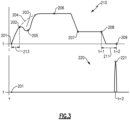
- Figure 3 illustrates a current (i) profile 210 and a voltage (v) profile 220 of a single exemplary minimum impulse bit with respect to time (t).
- the valve begins opening, and a current dip 203 occurs.
- the length of time between the controller beginning to output the open current and the valve beginning to open is referred to as an opening variable time 213.
- the minimum impulse bit (MIB) is the time period from the time when the valve 24, 34 is fully open (point 205) to the time when the valve 24, 34 is fully closed (point 209).
- Dashed line 204 represents the continued current ramp absent the valve opening.
- the current dip ceases at point 205, which represents the "fully open” position of the valve.
- the current profile then continues ramping to the maximum current 206 of the open valve control signal, which is held for a predefined duration.
- the controller lowers the control current from the opening control level (at point 206) to a maintain control level at point 207.
- the controller drives the current to zero amps, causing the valve to close.
- the controller monitors the voltage sensor signal as well as the current sensor signal.
- the controller can determine the time from when the valve is controlled closed to the time when the valve is actually closed, and the minimum bit time of the valve is determined to be the duration that the controller drove the valve to be open plus the variable time 211, 213.
- FIG. 4 schematically illustrates an exemplary method 300 to determine an exact minimum impulse bit length for a given valve 110.
- the valve 110 is assembled, installed and provided with a first open/close cycle in an "Initialize Valve" step 310.
- the controller stores the current and voltage profiles 210, 220 (as illustrated in Figure 3 ).
- variable parameters are the close variable time 211, and the open variable time 213.
- the controller determines the minimum impulse bit time in a "Determine Minimum Impulse bit” step 330.
- the minimum impulse bit is the length of time from when the valve begins opening to when the valve becomes fully closed and is the time from the initial command on at point 201 to the command off at point 208, plus the variable close time 211, minus the variable on time 213. Once determined, the minimum impulse bit is stored in a "Store MIB" step 340, and the control sequence is adjusted to account for the actual minimum impulse bit of the specific valve.
- the minimum impulse bit generated via the above process is estimated to be accurate under all conditions for the specific valve, and can be utilized throughout operations of the liquid fuel rocket engine. In alternative examples, such as those where additional control capacity is available, the minimum impulse bit can be recalculated throughout operation of the liquid fuel engine with subsequent valve operations utilizing the most recently determined minimum impulse bit.
- the minimum impulse bit can be determined under multiple conditions, such as engine pressure and battery voltage, and the like.
- the determined minimum impulse bits are correlated in the controller with the environmental or other conditions that were present when the minimum impulse bit was determined. Subsequent operations of the valve 110 utilize the minimum impulse bit corresponding to the currently detected conditions of the valve, and can provide more accurate timing with less variation.
- valve timing systems described herein can be applied to any fluid valve control system and are not limited to liquid fuel rocket engine applications.
Landscapes
- Engineering & Computer Science (AREA)
- Chemical & Material Sciences (AREA)
- Combustion & Propulsion (AREA)
- Mechanical Engineering (AREA)
- General Engineering & Computer Science (AREA)
- Magnetically Actuated Valves (AREA)
- Electrically Driven Valve-Operating Means (AREA)
- Indication Of The Valve Opening Or Closing Status (AREA)
Description
- The present disclosure relates generally to valve control, and more specifically to valve timing and controls for reducing minimum impulse bit duration in a liquid fuel rocket.
- Liquid fuel rockets, as well as other similar systems, utilize valves and valve control to control the flow of fuel into a combustor, thereby controlling the thrust produced by the combustor. During operation of a valve the smallest period of time that the valve is maintained open is referred to as the minimum impulse bit (MIB) and the minimum impulse bit dictates the granularity of control that can be applied to fluid flow through the valve and thus, the granularity of the thrust controls of the liquid fuel rocket engine.
- The minimum impulse bit time of any given valve can vary due to variations in the opening and closing responses of the valve. This variance depends on any number factors including the age of the valve, wear on the valve, environmental conditions in which the valve is operating, and the like. In order to compensate for the variation, and provide consistent predictable controls, discrete valve operations are typically run at slightly longer than the actual minimum impulse bit of the valve.
-
US 2015/167574 discloses a method and device for monitoring an actuator device. -
US 2008/236140 discloses noncircular transient fluid fuel injector control channels in propellant injector combustion systems. -
US 2017/248101 discloses a valve controller for pressure stabilization. - According to an aspect of the present invention, a valve controller for a liquid fuel rocket engine includes at least one current sensor input, at least one voltage sensor input, a processor and a memory, the processor being connected to the at least one current sensor input and the at least one voltage sensor input, wherein the valve controller is configured to determine at least one actual minimum impulse bit of a valve based on a current profile and a voltage profile of a single valve operation, and wherein the valve controller is configured to adjust valve controls to account for the at least one actual minimum impulse bit.
- In another preferred embodiment of the previously described valve controller, the actual minimum impulse bit is correlated with at least one external factor, and wherein the valve controller is configured to adjust the valve controls to account for the at least one actual minimum impulse bit and the at least one external factor.
- In another preferred embodiment of any of the previously described valve controllers, the external factor is at least one of an engine pressure and a battery voltage.
- In another preferred embodiment of any of the previously described valve controllers, the valve controller is configured to determine the at least one actual minimum impulse bit on an initial operation of the valve.
- In another preferred embodiment of any of the previously described valve controllers, the valve controller is further configured to periodically determine an updated minimum impulse bit of the valve.
- In another preferred embodiment of any of the previously described valve controllers, the valve controller is further configured to adjust valve controls based on a most recently determined updated minimum impulse bit of the valve.
- In another preferred embodiment of any of the previously described valve controllers, the minimum impulse bit is based in part on an initial valve opening time, the initial valve opening time being determined to be a dip in a ramp up of the current profile.
- In another preferred embodiment of any of the previously described valve controllers, the minimum impulse bit is based in part on a fully closed valve time, the fully closed valve time being determined to be a time between a voltage spike and a valve control current being driven to zero by the valve controller.
- In another preferred embodiment of any of the previously described valve controllers, each of the at least one current sensor and the at least one voltage sensor are connected to, and configured to sense, a valve control signal line.
- In another preferred embodiment of any of the previously described valve controllers, the valve control signal line is controllably connected to a liquid fuel rocket engine valve.
- In another preferred embodiment of any of the previously described valve controllers, the liquid fuel rocket engine valve at least partially controls a flow of liquid fuel form a fuel repository to a combustor.
- According to another aspect of the present invention a method for determining a minimum impulse bit of a valve includes monitoring a current profile and a voltage profile of a valve control signal, determining an initial valve open time to be a beginning of a dip in a current ramp up and determining a valve fully closed time to be a voltage spike of the valve control signal, and determining the minimum impulse bit of the valve to be a length of time from the initial valve open time to the valve fully closed time.
- Another preferred embodiment of the above method includes correlating the minim impulse bit of the valve with at least one external environmental factor.
- In another preferred embodiment of any of the above methods, the at least one external environmental factor includes at least one of an engine pressure and a battery voltage.
- Another preferred embodiment of any of the above methods includes periodically reiterating the method and updating the determined minimum impulse bit of the valve at each iteration.
- A liquid fuel rocket engine according to one preferred embodiment is provided in accordance with claim 15.
- These and other features of the present invention can be best understood from the following specification and drawings, the following of which is a brief description.
-
-
Figure 1 illustrates a highly schematic exemplary liquid fuel rocket engine. -
Figure 2 schematically illustrates an exemplary valve control system for utilization in the liquid fuel rocket engine ofFigure 1 . -
Figure 3 schematically illustrates a valve timing chart for the valve control system ofFigure 2 . -
Figure 4 schematically illustrates a process for operating a valve using experiential timing data to determine a minimum impulse bit of the specific valve. -
Figure 1 schematically illustrates an exemplary highly schematic liquidfuel rocket engine 10. Systems and controls of theengine 10 unrelated to this disclosure are omitted and/or simplified for the purposes of explanation, and a practical liquid fuel rocket engine implementing the concepts described herein can include any number of additional configurations and systems as would be necessary to implement the practical example. The liquidfuel rocket engine 10 includes aliquid fuel repository 20, anoxidizer repository 30 and acombustor 40. Theliquid fuel repository 20 is connected to thecombustor 40 via afuel line 22, and afluid valve 24 controls the flow of liquid fuel into thecombustor 40. Similarly, theoxidizer repository 30 is connected to thecombustor 40 via afluid line 32, and the flow of oxidizer into thecombustor 40 is controlled via afluid valve 34. Each of thevalves controller 50. - Within the
combustor 40, the liquid fuel and the oxidizer are mixed and ignited, and the resultant combustion products are expelled through anozzle 42 thereby generating thrust. The magnitude of the thrust generated is controlled by the amount of liquid fuel injected into thecombustor 40. Due to various conditions, such as wear and environmental conditions, as well as manufacturing variations from valve to valve, the minimum impulse bit of thevalve 24 can include variations and fall within a tolerance window. In order to provide the most discrete control possible it is desirable to minimize the variations. - With continued reference to
Figure 1, Figure 2 schematically illustrates avalve configuration 100 including an electrically controlledvalve 110 that allows afluid 120 to pass through thevalve 110 while thevalve 110 is open and prevents thefluid 120 from passing through while thevalve 110 is closed. Thevalve 110 is controlled via acurrent signal 130. Thecurrent signal 130 originates from acurrent driver 142 portion of acontroller 140. Avoltage sensor 132 and acurrent sensor 134 are configured to monitor the voltage and current (respectively) of thecurrent signal 130 being input to thevalve 110. The sensor output of eachsensor processor 144 within thecontroller 140. - During operation of the
valve 110, thecontrol signal 130 is commanded to a high current level to initially open thevalve 110, and then dropped to a lower "maintain" level to maintain thevalve 110 in the open position for a sufficient time to allow fluid through thevalve 110. After the predefined duration, thecurrent signal 130 is driven to zero, and thevalve 110 is allowed to close. The total duration from initial opening to fully closed is the minimum impulse bit. - With continued reference to
Figures 1 and 2 ,Figure 3 illustrates a current (i)profile 210 and a voltage (v)profile 220 of a single exemplary minimum impulse bit with respect to time (t). Thecurrent profile 210 and thevoltage profile 220 begin at t=0 (point 201), with the controller initiating a control open signal in the form of a steady current ramp up topoint 202. Atpoint 202 of the current profile, the valve begins opening, and acurrent dip 203 occurs. The length of time between the controller beginning to output the open current and the valve beginning to open is referred to as anopening variable time 213. The minimum impulse bit (MIB) is the time period from the time when thevalve valve - Dashed
line 204 represents the continued current ramp absent the valve opening. The current dip ceases atpoint 205, which represents the "fully open" position of the valve. The current profile then continues ramping to themaximum current 206 of the open valve control signal, which is held for a predefined duration. After the predefined duration, the controller lowers the control current from the opening control level (at point 206) to a maintain control level atpoint 207. The maintain control current is held steady until the controller determines that the valve should close at point 208 (t=1). Once the close determination has been made, the controller drives the current to zero amps, causing the valve to close. The valve fully closes a point 209 (t=2). - As the valve does not fully close until some delay after control current has been driven all the way to zero, the controller monitors the voltage sensor signal as well as the current sensor signal. When the valve fully closes, at t=2, a
voltage spike 221 occurs. Theadditional time 211 after the valve has been commanded closed and before the valve is fully closed impacts the minimum bit time, is a cause of variation within the minimum bit time, and is referred to as the closevariable time 211. - By monitoring the voltage and the current, the controller can determine the time from when the valve is controlled closed to the time when the valve is actually closed, and the minimum bit time of the valve is determined to be the duration that the controller drove the valve to be open plus the
variable time - Existing systems utilize a preset controller on time, and the variable time results in variations of the minimum impulse bit. With continued reference to
Figures 1-3 ,Figure 4 schematically illustrates anexemplary method 300 to determine an exact minimum impulse bit length for a givenvalve 110. Initially thevalve 110 is assembled, installed and provided with a first open/close cycle in an "Initialize Valve"step 310. During the open/close cycle the controller stores the current andvoltage profiles 210, 220 (as illustrated inFigure 3 ). - Once stored in a memory of the controller, the
current profile 210 and thevoltage profile 220 are analyzed to determine variable parameters in a "Determine Variable Parameters"step 320. In one example, the variable parameters are the closevariable time 211, and the openvariable time 213. Once determined the variable times are stored in a controller memory, and the controller determines the minimum impulse bit time in a "Determine Minimum Impulse bit"step 330. - The minimum impulse bit is the length of time from when the valve begins opening to when the valve becomes fully closed and is the time from the initial command on at
point 201 to the command off atpoint 208, plus the variableclose time 211, minus the variable ontime 213. Once determined, the minimum impulse bit is stored in a "Store MIB" step 340, and the control sequence is adjusted to account for the actual minimum impulse bit of the specific valve. - In some examples, the minimum impulse bit generated via the above process is estimated to be accurate under all conditions for the specific valve, and can be utilized throughout operations of the liquid fuel rocket engine. In alternative examples, such as those where additional control capacity is available, the minimum impulse bit can be recalculated throughout operation of the liquid fuel engine with subsequent valve operations utilizing the most recently determined minimum impulse bit.
- In yet another example, the minimum impulse bit can be determined under multiple conditions, such as engine pressure and battery voltage, and the like. In such an example, the determined minimum impulse bits are correlated in the controller with the environmental or other conditions that were present when the minimum impulse bit was determined. Subsequent operations of the
valve 110 utilize the minimum impulse bit corresponding to the currently detected conditions of the valve, and can provide more accurate timing with less variation. - While described above with regards to a minimum impulse bit of a liquid fuel rocket engine, it is appreciated that the valve timing systems described herein can be applied to any fluid valve control system and are not limited to liquid fuel rocket engine applications.
- Although an embodiment of this invention has been disclosed, a worker of ordinary skill in this art would recognize that certain modifications would come within the scope of this invention. For that reason, the following claims should be studied to determine the true scope and content of this invention.
Claims (15)
- A valve controller (140) for a liquid fuel rocket engine (10) comprising:at least one current sensor (134) input;at least one voltage sensor (132) input;a processor (144) and a memory, the processor (144) being connected to the at least one current sensor (134) input and the at least one voltage sensor (132) input, wherein the valve controller (140) is configured to determine at least one actual minimum impulse bit of a valve (110) based on a current profile (210) and a voltage profile (220) of a single valve operation, and wherein the valve controller (140) is configured to adjust valve controls to account for the at least one actual minimum impulse bit.
- The valve controller (140) of claim 1, wherein the actual minimum impulse bit is correlated with at least one external factor, and wherein the valve controller (140) is configured to adjust the valve controls to account for the at least one actual minimum impulse bit and the at least one external factor.
- The valve controller (140) of claim 2, wherein the external factor is at least one of an engine pressure and a battery voltage.
- The valve controller (140) of any preceding claim, wherein the valve controller (140) is configured to determine the at least one actual minimum impulse bit on an initial operation of the valve (110).
- The valve controller (140) of any preceding claim, wherein the valve controller (140) is further configured to periodically determine an updated minimum impulse bit of the valve (110).
- The valve controller (140) of claim 5, wherein the valve controller (140) is further configured to adjust valve controls based on a most recently determined updated minimum impulse bit of the valve (110).
- The valve controller (140) of any preceding claim, wherein the minimum impulse bit is based in part on an initial valve opening time, the initial valve opening time being determined to be a dip in a ramp up of the current profile (210).
- The valve controller (140) of any preceding claim, wherein the minimum impulse bit is based in part on a fully closed valve time, the fully closed valve time being determined to be a time between a voltage spike (221) and a valve control current being driven to zero by the valve controller (140).
- The valve controller (140) of any preceding claim, wherein each of the at least one current sensor (134) and the at least one voltage sensor (132) are connected to, and configured to sense, a valve control signal line.
- The valve controller (140) of claim 9, wherein the valve control signal line is controllably connected to a liquid fuel rocket engine valve (110).
- The valve controller (140) of claim 10, wherein the liquid fuel rocket engine valve (110) at least partially controls a flow of liquid fuel form a fuel repository to a combustor (40).
- A method for determining a minimum impulse bit of a valve (110) for a liquid fuel rocket engine (10) comprising:monitoring a current profile (210) and a voltage profile (220) of a valve control signal (130);determining an initial valve open time to be a beginning of a dip in a current ramp up and determining a valve fully closed time to be a voltage spike (221) of the valve control signal (130); anddetermining the minimum impulse bit of the valve (110) to be a length of time from the initial valve open time to the valve fully closed time.
- The method of claim 12, further comprising correlating the minim impulse bit of the valve (24) with at least one external environmental factor, wherein the at least one external environmental factor optionally includes at least one of an engine pressure and a battery voltage.
- The method of claim 12 or 13, further comprising periodically reiterating the method and updating the determined minimum impulse bit of the valve (110) at each iteration.
- A liquid fuel rocket engine (10) comprising:a combustor (40);a liquid fuel repository (20) connected to the combustor (40) via a fuel line (22) and a first valve (24);an oxidizer repository (30) connected to the combustor (40) via an oxidizer line and a second valve (24); andthe valve controller (140) of any of claims 1 to 11, wherein the valve controller (140) is configured to output a valve control current to the first valve (24).
Applications Claiming Priority (1)
| Application Number | Priority Date | Filing Date | Title |
|---|---|---|---|
| PCT/US2019/065420 WO2021118536A1 (en) | 2019-12-10 | 2019-12-10 | Valve timing system for liquid fuel rockets |
Publications (2)
| Publication Number | Publication Date |
|---|---|
| EP4073372A1 EP4073372A1 (en) | 2022-10-19 |
| EP4073372B1 true EP4073372B1 (en) | 2025-02-12 |
Family
ID=69143674
Family Applications (1)
| Application Number | Title | Priority Date | Filing Date |
|---|---|---|---|
| EP19832788.4A Active EP4073372B1 (en) | 2019-12-10 | 2019-12-10 | Valve timing system for liquid fuel rockets |
Country Status (5)
| Country | Link |
|---|---|
| US (1) | US12031506B2 (en) |
| EP (1) | EP4073372B1 (en) |
| JP (1) | JP7471410B2 (en) |
| CN (1) | CN114930013B (en) |
| WO (1) | WO2021118536A1 (en) |
Family Cites Families (17)
| Publication number | Priority date | Publication date | Assignee | Title |
|---|---|---|---|---|
| US4324096A (en) * | 1979-04-23 | 1982-04-13 | Hughes Aircraft Company | Hydrazine thruster |
| JPS60164181U (en) * | 1984-04-10 | 1985-10-31 | 三菱重工業株式会社 | Solenoid valve with valve body operation detection terminal |
| JPH05170194A (en) * | 1991-12-24 | 1993-07-09 | Mitsubishi Heavy Ind Ltd | Spacecraft thruster system |
| JP2716086B2 (en) * | 1996-02-21 | 1998-02-18 | 宇宙科学研究所長 | Injection valve control method and device |
| JP2001005514A (en) * | 1999-06-25 | 2001-01-12 | Ishikawajima Harima Heavy Ind Co Ltd | Self-checking device in electric drive for space. |
| JP2001207913A (en) | 2000-01-25 | 2001-08-03 | Ishikawajima Harima Heavy Ind Co Ltd | Injector heating system for rocket engines |
| EP1130300A1 (en) | 2000-02-29 | 2001-09-05 | Whirlpool Corporation | Method for controlling pulse width modulation-operated solenoid valves |
| JP4067384B2 (en) * | 2002-10-30 | 2008-03-26 | 株式会社ミクニ | Fuel injection method |
| US7958719B2 (en) * | 2007-03-28 | 2011-06-14 | The Aerospace Corporation | Noncircular transient fluid fuel injector control channels in propellant injector combustion systems |
| US8681468B2 (en) * | 2009-10-28 | 2014-03-25 | Raytheon Company | Method of controlling solenoid valve |
| DE102012010868A1 (en) * | 2012-05-31 | 2013-12-05 | Avl Deutschland Gmbh | Method and device for monitoring an actuator device |
| US9816897B2 (en) * | 2012-06-06 | 2017-11-14 | Harris Corporation | Wireless engine monitoring system and associated engine wireless sensor network |
| EP2999684B1 (en) | 2013-05-20 | 2020-05-06 | ECAPS Aktiebolag | Dual mode chemical rocket engine and dual mode propulsion system comprising the rocket engine |
| US9777698B2 (en) * | 2013-11-12 | 2017-10-03 | Daniel Keith Schlak | Multiple motor gas turbine engine system with auxiliary gas utilization |
| US9656756B2 (en) * | 2014-03-10 | 2017-05-23 | The Boeing Company | Turbo-compressor system and method for extracting energy from an aircraft engine |
| US10100748B2 (en) * | 2014-09-15 | 2018-10-16 | The Boeing Company | Dual fuel gas turbine thrust and power control |
| US9650996B2 (en) * | 2015-03-13 | 2017-05-16 | The Boeing Company | Valve controller for pressure stabilization |
-
2019
- 2019-12-10 US US17/770,156 patent/US12031506B2/en active Active
- 2019-12-10 CN CN201980102885.7A patent/CN114930013B/en active Active
- 2019-12-10 WO PCT/US2019/065420 patent/WO2021118536A1/en not_active Ceased
- 2019-12-10 EP EP19832788.4A patent/EP4073372B1/en active Active
- 2019-12-10 JP JP2022528216A patent/JP7471410B2/en active Active
Also Published As
| Publication number | Publication date |
|---|---|
| CN114930013A (en) | 2022-08-19 |
| US12031506B2 (en) | 2024-07-09 |
| WO2021118536A1 (en) | 2021-06-17 |
| US20220389885A1 (en) | 2022-12-08 |
| JP7471410B2 (en) | 2024-04-19 |
| EP4073372A1 (en) | 2022-10-19 |
| JP2023506139A (en) | 2023-02-15 |
| CN114930013B (en) | 2024-12-24 |
Similar Documents
| Publication | Publication Date | Title |
|---|---|---|
| EP3361072B1 (en) | Method and system for testing operation of solenoid valves | |
| US9677496B2 (en) | System and method of injector control for multipulse fuel injection | |
| US8833085B2 (en) | System and method for gas turbine startup control | |
| US10392099B2 (en) | System and method for aircraft propeller control | |
| EP0894965A4 (en) | Method and device for fuel injection of engine | |
| EP0916831A4 (en) | Fuel injection method and apparatus for engines | |
| US20200232395A1 (en) | Method and system for operating a gas turbine engine coupled to an aircraft propeller | |
| US5653210A (en) | Method and device for the open-loop and/or closed loop control of a final controlling element | |
| US10465613B2 (en) | Method and a device for generating a command for the flow rate of fuel that is to be injected into a combustion chamber of a turbine engine | |
| EP4073372B1 (en) | Valve timing system for liquid fuel rockets | |
| CN112747887A (en) | Multi-step presetting method for opening degree of regulating valve suitable for hypersonic wind tunnel | |
| EP2713028B1 (en) | Adaptive fuel manifold filling function for improved engine start | |
| EP2083158A1 (en) | Piezoelectrically actuated fuel injector and operating method thereof | |
| US10759548B2 (en) | Controller arrangement with adaptive adjusting of the regulating variable | |
| RU2794397C1 (en) | System for setting the times of opening and closure of valves for liquid rockets | |
| WO2006127794A3 (en) | Method and system for controlling fuel injection timing to maintain desired peak cylinder pressure for high altitude operation | |
| JP7157757B2 (en) | Method for controlling multiple engine bays, control system for multiple engine bays, and multiple engine bays | |
| JP2001521145A (en) | Speed adaptive control mechanism test system | |
| US9976505B2 (en) | Method for operating an injector of an injection system of an internal combustion engine | |
| EP3839234B1 (en) | Systems and methods for operating an on-off valve | |
| EP4644682A1 (en) | Gas turbine adaptive secondary fuel filling profile | |
| JP2716086B2 (en) | Injection valve control method and device | |
| CN106460700A (en) | Method for determining the closing moment of a fuel injector | |
| EP4729760A1 (en) | Systems and methods for filling a fuel manifold of a gas turbine engine | |
| RU2739203C1 (en) | Deep control engine control method |
Legal Events
| Date | Code | Title | Description |
|---|---|---|---|
| STAA | Information on the status of an ep patent application or granted ep patent |
Free format text: STATUS: UNKNOWN |
|
| STAA | Information on the status of an ep patent application or granted ep patent |
Free format text: STATUS: THE INTERNATIONAL PUBLICATION HAS BEEN MADE |
|
| PUAI | Public reference made under article 153(3) epc to a published international application that has entered the european phase |
Free format text: ORIGINAL CODE: 0009012 |
|
| STAA | Information on the status of an ep patent application or granted ep patent |
Free format text: STATUS: REQUEST FOR EXAMINATION WAS MADE |
|
| 17P | Request for examination filed |
Effective date: 20220521 |
|
| AK | Designated contracting states |
Kind code of ref document: A1 Designated state(s): AL AT BE BG CH CY CZ DE DK EE ES FI FR GB GR HR HU IE IS IT LI LT LU LV MC MK MT NL NO PL PT RO RS SE SI SK SM TR |
|
| DAV | Request for validation of the european patent (deleted) | ||
| DAX | Request for extension of the european patent (deleted) | ||
| GRAP | Despatch of communication of intention to grant a patent |
Free format text: ORIGINAL CODE: EPIDOSNIGR1 |
|
| STAA | Information on the status of an ep patent application or granted ep patent |
Free format text: STATUS: GRANT OF PATENT IS INTENDED |
|
| INTG | Intention to grant announced |
Effective date: 20240820 |
|
| GRAS | Grant fee paid |
Free format text: ORIGINAL CODE: EPIDOSNIGR3 |
|
| GRAA | (expected) grant |
Free format text: ORIGINAL CODE: 0009210 |
|
| STAA | Information on the status of an ep patent application or granted ep patent |
Free format text: STATUS: THE PATENT HAS BEEN GRANTED |
|
| P01 | Opt-out of the competence of the unified patent court (upc) registered |
Free format text: CASE NUMBER: APP_67573/2024 Effective date: 20241220 |
|
| RAP3 | Party data changed (applicant data changed or rights of an application transferred) |
Owner name: AEROJET ROCKETDYNE, INC. |
|
| AK | Designated contracting states |
Kind code of ref document: B1 Designated state(s): AL AT BE BG CH CY CZ DE DK EE ES FI FR GB GR HR HU IE IS IT LI LT LU LV MC MK MT NL NO PL PT RO RS SE SI SK SM TR |
|
| REG | Reference to a national code |
Ref country code: GB Ref legal event code: FG4D |
|
| REG | Reference to a national code |
Ref country code: CH Ref legal event code: EP |
|
| REG | Reference to a national code |
Ref country code: DE Ref legal event code: R096 Ref document number: 602019065887 Country of ref document: DE |
|
| REG | Reference to a national code |
Ref country code: IE Ref legal event code: FG4D |
|
| REG | Reference to a national code |
Ref country code: NL Ref legal event code: MP Effective date: 20250212 |
|
| PG25 | Lapsed in a contracting state [announced via postgrant information from national office to epo] |
Ref country code: RS Free format text: LAPSE BECAUSE OF FAILURE TO SUBMIT A TRANSLATION OF THE DESCRIPTION OR TO PAY THE FEE WITHIN THE PRESCRIBED TIME-LIMIT Effective date: 20250512 |
|
| PG25 | Lapsed in a contracting state [announced via postgrant information from national office to epo] |
Ref country code: FI Free format text: LAPSE BECAUSE OF FAILURE TO SUBMIT A TRANSLATION OF THE DESCRIPTION OR TO PAY THE FEE WITHIN THE PRESCRIBED TIME-LIMIT Effective date: 20250212 |
|
| PG25 | Lapsed in a contracting state [announced via postgrant information from national office to epo] |
Ref country code: PL Free format text: LAPSE BECAUSE OF FAILURE TO SUBMIT A TRANSLATION OF THE DESCRIPTION OR TO PAY THE FEE WITHIN THE PRESCRIBED TIME-LIMIT Effective date: 20250212 |
|
| PG25 | Lapsed in a contracting state [announced via postgrant information from national office to epo] |
Ref country code: ES Free format text: LAPSE BECAUSE OF FAILURE TO SUBMIT A TRANSLATION OF THE DESCRIPTION OR TO PAY THE FEE WITHIN THE PRESCRIBED TIME-LIMIT Effective date: 20250212 |
|
| REG | Reference to a national code |
Ref country code: LT Ref legal event code: MG9D |
|
| PG25 | Lapsed in a contracting state [announced via postgrant information from national office to epo] |
Ref country code: NO Free format text: LAPSE BECAUSE OF FAILURE TO SUBMIT A TRANSLATION OF THE DESCRIPTION OR TO PAY THE FEE WITHIN THE PRESCRIBED TIME-LIMIT Effective date: 20250512 Ref country code: IS Free format text: LAPSE BECAUSE OF FAILURE TO SUBMIT A TRANSLATION OF THE DESCRIPTION OR TO PAY THE FEE WITHIN THE PRESCRIBED TIME-LIMIT Effective date: 20250612 |
|
| PG25 | Lapsed in a contracting state [announced via postgrant information from national office to epo] |
Ref country code: NL Free format text: LAPSE BECAUSE OF FAILURE TO SUBMIT A TRANSLATION OF THE DESCRIPTION OR TO PAY THE FEE WITHIN THE PRESCRIBED TIME-LIMIT Effective date: 20250212 |
|
| PG25 | Lapsed in a contracting state [announced via postgrant information from national office to epo] |
Ref country code: HR Free format text: LAPSE BECAUSE OF FAILURE TO SUBMIT A TRANSLATION OF THE DESCRIPTION OR TO PAY THE FEE WITHIN THE PRESCRIBED TIME-LIMIT Effective date: 20250212 |
|
| PG25 | Lapsed in a contracting state [announced via postgrant information from national office to epo] |
Ref country code: LV Free format text: LAPSE BECAUSE OF FAILURE TO SUBMIT A TRANSLATION OF THE DESCRIPTION OR TO PAY THE FEE WITHIN THE PRESCRIBED TIME-LIMIT Effective date: 20250212 Ref country code: PT Free format text: LAPSE BECAUSE OF FAILURE TO SUBMIT A TRANSLATION OF THE DESCRIPTION OR TO PAY THE FEE WITHIN THE PRESCRIBED TIME-LIMIT Effective date: 20250612 |
|
| PG25 | Lapsed in a contracting state [announced via postgrant information from national office to epo] |
Ref country code: BG Free format text: LAPSE BECAUSE OF FAILURE TO SUBMIT A TRANSLATION OF THE DESCRIPTION OR TO PAY THE FEE WITHIN THE PRESCRIBED TIME-LIMIT Effective date: 20250212 Ref country code: GR Free format text: LAPSE BECAUSE OF FAILURE TO SUBMIT A TRANSLATION OF THE DESCRIPTION OR TO PAY THE FEE WITHIN THE PRESCRIBED TIME-LIMIT Effective date: 20250513 |
|
| REG | Reference to a national code |
Ref country code: AT Ref legal event code: MK05 Ref document number: 1766239 Country of ref document: AT Kind code of ref document: T Effective date: 20250212 |
|
| PG25 | Lapsed in a contracting state [announced via postgrant information from national office to epo] |
Ref country code: SE Free format text: LAPSE BECAUSE OF FAILURE TO SUBMIT A TRANSLATION OF THE DESCRIPTION OR TO PAY THE FEE WITHIN THE PRESCRIBED TIME-LIMIT Effective date: 20250212 |
|
| PG25 | Lapsed in a contracting state [announced via postgrant information from national office to epo] |
Ref country code: SM Free format text: LAPSE BECAUSE OF FAILURE TO SUBMIT A TRANSLATION OF THE DESCRIPTION OR TO PAY THE FEE WITHIN THE PRESCRIBED TIME-LIMIT Effective date: 20250212 |
|
| PG25 | Lapsed in a contracting state [announced via postgrant information from national office to epo] |
Ref country code: DK Free format text: LAPSE BECAUSE OF FAILURE TO SUBMIT A TRANSLATION OF THE DESCRIPTION OR TO PAY THE FEE WITHIN THE PRESCRIBED TIME-LIMIT Effective date: 20250212 |
|
| PG25 | Lapsed in a contracting state [announced via postgrant information from national office to epo] |
Ref country code: IT Free format text: LAPSE BECAUSE OF FAILURE TO SUBMIT A TRANSLATION OF THE DESCRIPTION OR TO PAY THE FEE WITHIN THE PRESCRIBED TIME-LIMIT Effective date: 20250212 |
|
| PG25 | Lapsed in a contracting state [announced via postgrant information from national office to epo] |
Ref country code: AT Free format text: LAPSE BECAUSE OF FAILURE TO SUBMIT A TRANSLATION OF THE DESCRIPTION OR TO PAY THE FEE WITHIN THE PRESCRIBED TIME-LIMIT Effective date: 20250212 |
|
| PG25 | Lapsed in a contracting state [announced via postgrant information from national office to epo] |
Ref country code: EE Free format text: LAPSE BECAUSE OF FAILURE TO SUBMIT A TRANSLATION OF THE DESCRIPTION OR TO PAY THE FEE WITHIN THE PRESCRIBED TIME-LIMIT Effective date: 20250212 Ref country code: CZ Free format text: LAPSE BECAUSE OF FAILURE TO SUBMIT A TRANSLATION OF THE DESCRIPTION OR TO PAY THE FEE WITHIN THE PRESCRIBED TIME-LIMIT Effective date: 20250212 |
|
| PG25 | Lapsed in a contracting state [announced via postgrant information from national office to epo] |
Ref country code: RO Free format text: LAPSE BECAUSE OF FAILURE TO SUBMIT A TRANSLATION OF THE DESCRIPTION OR TO PAY THE FEE WITHIN THE PRESCRIBED TIME-LIMIT Effective date: 20250212 |
|
| PG25 | Lapsed in a contracting state [announced via postgrant information from national office to epo] |
Ref country code: SK Free format text: LAPSE BECAUSE OF FAILURE TO SUBMIT A TRANSLATION OF THE DESCRIPTION OR TO PAY THE FEE WITHIN THE PRESCRIBED TIME-LIMIT Effective date: 20250212 |
|
| REG | Reference to a national code |
Ref country code: DE Ref legal event code: R097 Ref document number: 602019065887 Country of ref document: DE |
|
| PLBE | No opposition filed within time limit |
Free format text: ORIGINAL CODE: 0009261 |
|
| STAA | Information on the status of an ep patent application or granted ep patent |
Free format text: STATUS: NO OPPOSITION FILED WITHIN TIME LIMIT |
|
| PGFP | Annual fee paid to national office [announced via postgrant information from national office to epo] |
Ref country code: GB Payment date: 20251229 Year of fee payment: 7 |
|
| PGFP | Annual fee paid to national office [announced via postgrant information from national office to epo] |
Ref country code: FR Payment date: 20251226 Year of fee payment: 7 |
|
| 26N | No opposition filed |
Effective date: 20251113 |
|
| PGFP | Annual fee paid to national office [announced via postgrant information from national office to epo] |
Ref country code: DE Payment date: 20251229 Year of fee payment: 7 |