EP4073363B1 - Exhaust additive dosing system comprising a turbocharger - Google Patents
Exhaust additive dosing system comprising a turbocharger Download PDFInfo
- Publication number
- EP4073363B1 EP4073363B1 EP20898268.6A EP20898268A EP4073363B1 EP 4073363 B1 EP4073363 B1 EP 4073363B1 EP 20898268 A EP20898268 A EP 20898268A EP 4073363 B1 EP4073363 B1 EP 4073363B1
- Authority
- EP
- European Patent Office
- Prior art keywords
- bushing
- diffusor
- exhaust
- orifice
- turbine
- Prior art date
- Legal status (The legal status is an assumption and is not a legal conclusion. Google has not performed a legal analysis and makes no representation as to the accuracy of the status listed.)
- Active
Links
Images


Classifications
-
- F—MECHANICAL ENGINEERING; LIGHTING; HEATING; WEAPONS; BLASTING
- F01—MACHINES OR ENGINES IN GENERAL; ENGINE PLANTS IN GENERAL; STEAM ENGINES
- F01N—GAS-FLOW SILENCERS OR EXHAUST APPARATUS FOR MACHINES OR ENGINES IN GENERAL; GAS-FLOW SILENCERS OR EXHAUST APPARATUS FOR INTERNAL-COMBUSTION ENGINES
- F01N13/00—Exhaust or silencing apparatus characterised by constructional features
- F01N13/14—Exhaust or silencing apparatus characterised by constructional features having thermal insulation
- F01N13/141—Double-walled exhaust pipes or housings
-
- F—MECHANICAL ENGINEERING; LIGHTING; HEATING; WEAPONS; BLASTING
- F01—MACHINES OR ENGINES IN GENERAL; ENGINE PLANTS IN GENERAL; STEAM ENGINES
- F01N—GAS-FLOW SILENCERS OR EXHAUST APPARATUS FOR MACHINES OR ENGINES IN GENERAL; GAS-FLOW SILENCERS OR EXHAUST APPARATUS FOR INTERNAL-COMBUSTION ENGINES
- F01N13/00—Exhaust or silencing apparatus characterised by constructional features
- F01N13/18—Construction facilitating manufacture, assembly, or disassembly
- F01N13/1838—Construction facilitating manufacture, assembly, or disassembly characterised by the type of connection between parts of exhaust or silencing apparatus, e.g. between housing and tubes, between tubes and baffles
-
- F—MECHANICAL ENGINEERING; LIGHTING; HEATING; WEAPONS; BLASTING
- F01—MACHINES OR ENGINES IN GENERAL; ENGINE PLANTS IN GENERAL; STEAM ENGINES
- F01N—GAS-FLOW SILENCERS OR EXHAUST APPARATUS FOR MACHINES OR ENGINES IN GENERAL; GAS-FLOW SILENCERS OR EXHAUST APPARATUS FOR INTERNAL-COMBUSTION ENGINES
- F01N3/00—Exhaust or silencing apparatus having means for purifying, rendering innocuous, or otherwise treating exhaust
- F01N3/08—Exhaust or silencing apparatus having means for purifying, rendering innocuous, or otherwise treating exhaust for rendering innocuous
- F01N3/10—Exhaust or silencing apparatus having means for purifying, rendering innocuous, or otherwise treating exhaust for rendering innocuous by thermal or catalytic conversion of noxious components of exhaust
- F01N3/18—Exhaust or silencing apparatus having means for purifying, rendering innocuous, or otherwise treating exhaust for rendering innocuous by thermal or catalytic conversion of noxious components of exhaust characterised by methods of operation; Control
- F01N3/20—Exhaust or silencing apparatus having means for purifying, rendering innocuous, or otherwise treating exhaust for rendering innocuous by thermal or catalytic conversion of noxious components of exhaust characterised by methods of operation; Control specially adapted for catalytic conversion
- F01N3/206—Adding periodically or continuously substances to exhaust gases for promoting purification, e.g. catalytic material in liquid form, NOx reducing agents
-
- F—MECHANICAL ENGINEERING; LIGHTING; HEATING; WEAPONS; BLASTING
- F01—MACHINES OR ENGINES IN GENERAL; ENGINE PLANTS IN GENERAL; STEAM ENGINES
- F01N—GAS-FLOW SILENCERS OR EXHAUST APPARATUS FOR MACHINES OR ENGINES IN GENERAL; GAS-FLOW SILENCERS OR EXHAUST APPARATUS FOR INTERNAL-COMBUSTION ENGINES
- F01N3/00—Exhaust or silencing apparatus having means for purifying, rendering innocuous, or otherwise treating exhaust
- F01N3/08—Exhaust or silencing apparatus having means for purifying, rendering innocuous, or otherwise treating exhaust for rendering innocuous
- F01N3/10—Exhaust or silencing apparatus having means for purifying, rendering innocuous, or otherwise treating exhaust for rendering innocuous by thermal or catalytic conversion of noxious components of exhaust
- F01N3/18—Exhaust or silencing apparatus having means for purifying, rendering innocuous, or otherwise treating exhaust for rendering innocuous by thermal or catalytic conversion of noxious components of exhaust characterised by methods of operation; Control
- F01N3/20—Exhaust or silencing apparatus having means for purifying, rendering innocuous, or otherwise treating exhaust for rendering innocuous by thermal or catalytic conversion of noxious components of exhaust characterised by methods of operation; Control specially adapted for catalytic conversion
- F01N3/206—Adding periodically or continuously substances to exhaust gases for promoting purification, e.g. catalytic material in liquid form, NOx reducing agents
- F01N3/2066—Selective catalytic reduction [SCR]
-
- F—MECHANICAL ENGINEERING; LIGHTING; HEATING; WEAPONS; BLASTING
- F02—COMBUSTION ENGINES; HOT-GAS OR COMBUSTION-PRODUCT ENGINE PLANTS
- F02B—INTERNAL-COMBUSTION PISTON ENGINES; COMBUSTION ENGINES IN GENERAL
- F02B37/00—Engines characterised by provision of pumps driven at least for part of the time by exhaust
-
- F—MECHANICAL ENGINEERING; LIGHTING; HEATING; WEAPONS; BLASTING
- F02—COMBUSTION ENGINES; HOT-GAS OR COMBUSTION-PRODUCT ENGINE PLANTS
- F02B—INTERNAL-COMBUSTION PISTON ENGINES; COMBUSTION ENGINES IN GENERAL
- F02B39/00—Component parts, details, or accessories relating to, driven charging or scavenging pumps, not provided for in groups F02B33/00 - F02B37/00
-
- F—MECHANICAL ENGINEERING; LIGHTING; HEATING; WEAPONS; BLASTING
- F01—MACHINES OR ENGINES IN GENERAL; ENGINE PLANTS IN GENERAL; STEAM ENGINES
- F01N—GAS-FLOW SILENCERS OR EXHAUST APPARATUS FOR MACHINES OR ENGINES IN GENERAL; GAS-FLOW SILENCERS OR EXHAUST APPARATUS FOR INTERNAL-COMBUSTION ENGINES
- F01N2340/00—Dimensional characteristics of the exhaust system, e.g. length, diameter or volume of the exhaust apparatus; Spatial arrangements of exhaust apparatuses
- F01N2340/06—Arrangement of the exhaust apparatus relative to the turbine of a turbocharger
-
- F—MECHANICAL ENGINEERING; LIGHTING; HEATING; WEAPONS; BLASTING
- F01—MACHINES OR ENGINES IN GENERAL; ENGINE PLANTS IN GENERAL; STEAM ENGINES
- F01N—GAS-FLOW SILENCERS OR EXHAUST APPARATUS FOR MACHINES OR ENGINES IN GENERAL; GAS-FLOW SILENCERS OR EXHAUST APPARATUS FOR INTERNAL-COMBUSTION ENGINES
- F01N2610/00—Adding substances to exhaust gases
- F01N2610/02—Adding substances to exhaust gases the substance being ammonia or urea
-
- F—MECHANICAL ENGINEERING; LIGHTING; HEATING; WEAPONS; BLASTING
- F01—MACHINES OR ENGINES IN GENERAL; ENGINE PLANTS IN GENERAL; STEAM ENGINES
- F01N—GAS-FLOW SILENCERS OR EXHAUST APPARATUS FOR MACHINES OR ENGINES IN GENERAL; GAS-FLOW SILENCERS OR EXHAUST APPARATUS FOR INTERNAL-COMBUSTION ENGINES
- F01N2610/00—Adding substances to exhaust gases
- F01N2610/14—Arrangements for the supply of substances, e.g. conduits
-
- F—MECHANICAL ENGINEERING; LIGHTING; HEATING; WEAPONS; BLASTING
- F01—MACHINES OR ENGINES IN GENERAL; ENGINE PLANTS IN GENERAL; STEAM ENGINES
- F01N—GAS-FLOW SILENCERS OR EXHAUST APPARATUS FOR MACHINES OR ENGINES IN GENERAL; GAS-FLOW SILENCERS OR EXHAUST APPARATUS FOR INTERNAL-COMBUSTION ENGINES
- F01N2610/00—Adding substances to exhaust gases
- F01N2610/14—Arrangements for the supply of substances, e.g. conduits
- F01N2610/1453—Sprayers or atomisers; Arrangement thereof in the exhaust apparatus
-
- Y—GENERAL TAGGING OF NEW TECHNOLOGICAL DEVELOPMENTS; GENERAL TAGGING OF CROSS-SECTIONAL TECHNOLOGIES SPANNING OVER SEVERAL SECTIONS OF THE IPC; TECHNICAL SUBJECTS COVERED BY FORMER USPC CROSS-REFERENCE ART COLLECTIONS [XRACs] AND DIGESTS
- Y02—TECHNOLOGIES OR APPLICATIONS FOR MITIGATION OR ADAPTATION AGAINST CLIMATE CHANGE
- Y02A—TECHNOLOGIES FOR ADAPTATION TO CLIMATE CHANGE
- Y02A50/00—TECHNOLOGIES FOR ADAPTATION TO CLIMATE CHANGE in human health protection, e.g. against extreme weather
- Y02A50/20—Air quality improvement or preservation, e.g. vehicle emission control or emission reduction by using catalytic converters
-
- Y—GENERAL TAGGING OF NEW TECHNOLOGICAL DEVELOPMENTS; GENERAL TAGGING OF CROSS-SECTIONAL TECHNOLOGIES SPANNING OVER SEVERAL SECTIONS OF THE IPC; TECHNICAL SUBJECTS COVERED BY FORMER USPC CROSS-REFERENCE ART COLLECTIONS [XRACs] AND DIGESTS
- Y02—TECHNOLOGIES OR APPLICATIONS FOR MITIGATION OR ADAPTATION AGAINST CLIMATE CHANGE
- Y02T—CLIMATE CHANGE MITIGATION TECHNOLOGIES RELATED TO TRANSPORTATION
- Y02T10/00—Road transport of goods or passengers
- Y02T10/10—Internal combustion engine [ICE] based vehicles
- Y02T10/12—Improving ICE efficiencies
Definitions
- the present disclosure relates to a turbocharger for an internal combustion engine.
- the present disclosure also relates to an exhaust additive dosing system for an exhaust system for an internal combustion engine, the said exhaust additive dosing system comprising such a turbocharger.
- the disclosure further relates to a vehicle comprising such a turbocharger or exhaust additive dosing system.
- Emissions standards for motor vehicles are becoming increasingly stringent. Such standards typically specify maximum emission levels for a number of tailpipe pollutants including carbon monoxide (CO), hydrocarbons (HC), nitrogen oxides (NO x ) and particulate matter (PM).
- CO carbon monoxide
- HC hydrocarbons
- NO x nitrogen oxides
- PM particulate matter
- Selective catalytic reduction is an effective technology to reduce tailpipe nitrogen oxides (NO x ) emissions. It involves adding a reductant, such as ammonia, to the vehicle exhaust stream. The reductant, with the aid of a catalyst, reduces NO x in the exhaust stream to nitrogen gas (N 2 ) and water. In practical implementations in motor vehicles, an aqueous urea solution is used as a reductant and this urea solution is decomposed to ammonia and carbon dioxide in the hot exhaust stream.
- a reductant such as ammonia
- a further difficulty with SCR is the requirement for efficient mixing in order to achieve uniform distribution of reductant over the entire surface area of multiple SCR catalyst substrates.
- the space available for mixing is extremely limited and the reductant is commonly injected into the exhaust stream shortly upstream of the SCR catalyst substrates.
- a mixing device often resembling a turbine blade, is arranged in the exhaust pipe.
- it is difficult to achieve sufficiently uniform mixing.
- the presence of a mixing device in the exhaust pipe acts as an obstruction to flow, causing higher pressure upstream of the mixer (backpressure) and reducing the engine efficiency.
- Document WO 2018/080371 discloses an exhaust additive dosing system for a turbocharger turbine.
- a distribution device is arranged on a shaft or hub of the turbocharger turbine.
- a metering device is arranged to supply exhaust additive to the distribution device. Since the distribution device sits in the wake created by the turbine, exhaust additive is easily dosed to the distribution device without needing to overcome the high exhaust flow velocities present closer to the outlet walls of the turbine. Exhaust additive dosed to the distribution device is dispersed in the exhaust stream by utilising the centrifugal force of the spinning turbine.
- a further exhaust additive dosing system is known from SE 1 651 396 A1 .
- the inventors of the present invention have identified a number of shortcomings with regard to prior art solutions for dosing reductant at the outlet of a turbocharger turbine.
- Urea and byproducts therefrom are corrosive to the material of the turbine housing, especially at the high temperatures prevailing during operation.
- Arrangement of a diffuser cone in the outlet of the turbine housing may assist in preventing contact between the dosed urea and the turbine housing.
- the turbocharger comprises a turbine.
- the turbine comprises a turbine housing and a diffusor.
- the turbine housing comprises an exhaust gas outlet volume, and the diffusor is arranged in this volume.
- a housing orifice and a diffusor orifice are arranged through each of the turbine housing and diffusor respectively, and are mutually aligned to provide an opening into the exhaust gas outlet volume.
- the turbocharger further comprises a bushing.
- the bushing is arranged within the housing orifice, extends towards the diffusor orifice, and ends at a first end in association with the diffusor orifice.
- the first end of bushing has an internal diameter that is greater than or equal to a diameter of the diffusor orifice.
- the diffusor may comprise an orifice collar arranged to partially or fully encircle the diffusor orifice and arranged to interface with an outer wall of the bushing. This assists in sealing between the diffusor and bushing, as well as assists in correctly positioning the bushing and diffusor during assembly of the turbocharger.
- the orifice collar may be arranged to provide a labyrinth seal between the diffusor and the first end of the bushing. The orifice collar may thus provide a sufficient seal between the diffusor and the bushing, thereby lessening or eradicating any need for a separate sealing element.
- a sealing element may be arranged to provide a seal between the diffusor and the first end of the bushing.
- a sealing element may assist in providing an improved seal between the diffusor and the bushing, especially when the bushing is arranged at an angle that is not perpendicular to the wall of the diffusor at the location of the diffusor orifice.
- the sealing element may be adapted to provide a labyrinth seal between the diffusor and the bushing. Such seals can be effectively implemented even at the high temperatures prevailing in the turbocharger turbine.
- the sealing element may be a gasket.
- the turbocharger may further comprise a distribution device arranged on a shaft, hub or rotor of the turbine. Such a distribution device assists in effective distribution of the reductant in the exhaust system.
- the distribution device may be manufactured integrally with the shaft, hub or rotor of the turbocharger turbine.
- the bushing may be manufactured of stainless steel. This prevents corrosion due to contact with reductant.
- the turbine housing may be manufactured of cast iron. Thus, a housing material with appropriate thermal, mechanical and manufacturing properties may be used, without undue concern with regard to the anti-corrosive properties of the material.
- the bushing may comprise a bushing flange arranged at a second end of the bushing, the second end being arranged opposite to the first end of the bushing.
- a flange may provide a suitable interface with both the turbine housing and a dosing pipe inserted within the bushing.
- the bushing flange may be adapted at a first face to interface with the turbine housing such that displacement of the bushing further into the exhaust gas outlet volume is prevented. This assists in assembly of the turbocharger and reduces the risk of incorrect insertion of the bushing.
- the exhaust additive dosing system comprises a turbocharger as defined herein, and an exhaust additive metering device (26).
- the exhaust additive metering device comprises a dosing pipe arranged to supply exhaust additive to the exhaust gas outlet volume of the turbocharger.
- the dosing pipe comprises a surface arranged to sealably interact with a surface of the bushing. In this manner, the dosing pipe and bushing together define a container for the collection of leaked reductant.
- the dosing pipe may comprise a pipe flange arranged to sealably interact with a second face of the bushing flange, wherein the second face is arranged opposite the first face of the bushing flange.
- the exhaust additive dosing system may comprise a distribution device arranged on a shaft, hub, or rotor of the turbine.
- the exhaust additive metering device may be arranged to supply exhaust additive to the exhaust additive distribution device.
- Such a combination of metering device and distribution device provides a particularly simple and effective distribution of reductant in the exhaust stream.
- the objects of the invention are achieved by a vehicle comprising a turbocharger or exhaust additive dosing system as defined herein.
- the additive dosing system of the present disclosure is located in the exhaust system for an internal combustion engine.
- the internal combustion engine may be any internal combustion engine, but is preferably a four-stroke combustion engine, even more preferably a compression ignition four-stroke combustion engine.
- the engine may be used in any application commonly known for internal combustion engines. It may for example be retailed as a free-standing engine, for use for example in power generation or industrial settings. However, application in a vehicle is preferred.
- vehicle it is meant any machine utilising an internal combustion engine to provide motive force, either directly, or indirectly as in the case of series hybrid vehicles. This includes, but is not limited to, motor vehicles such as cars, trucks and buses; railed vehicles such as trains and trams; watercraft such as ships and boats; and aircraft.
- the exhaust additive is preferably a reductant, even more preferably diesel exhaust fluid comprising a solution of urea in water, in accordance with standard AUS 32 of ISO 22241.
- the exhaust additive may also be another liquid additive added to the exhaust stream, such as hydrocarbon fuel to "burn off” a diesel particulate filter arranged downstream in the exhaust system.
- the exhaust additive will be referred to simply as "reductant”.
- the exhaust system is equipped with a turbocharger for recovering energy from the exhaust gases.
- the turbocharger comprises a turbine rotor housed in a turbine housing.
- a shaft connects the turbine rotor to the impeller of a compressor for compressing the charge air of the internal combustion engine. This shaft may traverse the turbine rotor, in which case the end of the turbine shaft extends outwardly at the outlet side of the turbine rotor, or the shaft may terminate at a hub of the turbine rotor, within the turbine.
- the reductant dosing system is located in association with the turbocharger turbine.
- the dosing system comprises a metering device and preferably a distribution device.
- the metering device is arranged to convey reductant to the exhaust gas outlet volume of the turbine, where the reductant may then be distributed in the exhaust gas leaving the turbine. Preferably this is done in conjunction with a distribution device to facilitate distribution of the reductant, but the metering device may be used without a distribution device, or with an alternative device for improving distribution of reductant in the exhaust stream, such as a mixer.
- the distribution device if used may be mounted on the shaft or hub of the turbocharger, coaxially with the shaft, at the outlet side of the shaft or hub. This means that the distribution device spins in unison with the turbocharger shaft and turbine, around a common rotation axis. Preferably the distribution device forms an integral part of the shaft, hub or rotor. If the turbocharger is equipped with a distribution device, the metering device is arranged in conjunction with the distribution device. Its dosing outlet is arranged centrally over or within the distribution device for depositing reductant to the distribution device.
- the dosing pipe of the metering device leading to the dosing outlet traverses the wall of the turbine housing at an appropriate location downstream of the turbine rotor.
- the reductant and/or byproducts thereof are highly corrosive to the material of the turbine housing, which is typically cast iron.
- the turbine is equipped with a diffusor arranged in the exhaust gas outlet volume of the turbine.
- a diffusor may serve many purposes. Primarily, it provides a physical barrier to prevent reductant added to the exhaust gas outlet volume from coming into contact with the turbine housing. To this effect, it is preferred if the diffusor is manufactured from a corrosion-resistant material such as stainless steel. A diffusor may also serve to increase the efficiency of the turbine by providing a smooth transition from dynamic pressure to static pressure for the exhaust gases upon leaving the turbine, as in the case of prior art turbine diffusors. The diffusor may also function as an evaporation device for reductant droplets deposited on surface of the diffusor from the distribution device. The functioning of the diffusor as an evaporation device may be optimised in a number of ways. For example, the diffusor may be treated to optimise the contact angle of reductant droplets with the diffusor surface, and/or may be treated to optimise heat transfer to any deposited reductant droplets.
- the dosing pipe passes through not only the turbine housing, but also the diffusor. Therefore, an orifice or through-hole is required in each of the turbine housing (i.e. housing orifice) and diffusor (i.e. diffusor orifice) to permit access for the dosing pipe.
- the housing orifice and diffusor orifice should be mutually aligned and suitably dimensioned to permit insertion of the dosing pipe.
- the orifice in the diffusor that the dosing pipe passes through provides a leakage path for reductant or byproducts thereof to come into contact with the turbine housing.
- the present invention is based upon an insight by the inventors that it is not necessary to provide a seal between the dosing pipe and the diffusor orifice. Instead, it is sufficient that leakage through the diffusor orifice is confined to a corrosion-resistant volume where it may not come into contact with the turbine housing.
- Such a solution is achieved by providing the housing orifice with a bushing or sleeve that extends through the housing orifice and ends in association with the diffusor orifice.
- association with it is for example meant abutting, in close proximity to, or forming a sealed interface via a further component with the diffusor orifice.
- the bushing is manufactured in a corrosion-resistant material such as stainless steel. At the end of the bushing that is in association with the diffusor orifice, a seal may be provided with the diffusor sufficient to ensure that reductant does not escape into the volume between the diffusor and the housing.
- the bushing has an inner diameter that is preferably greater than the diameter of the diffusor orifice, or at least not smaller than the diffusor orifice, and that there is little or no gap between the bushing and the diffusor.
- the end of the bushing in association with the diffusor hole may partially or fully abut the diffusor.
- further sealing can be provided if required. Further sealing may be achieved by using a sealing element such as a gasket or packing.
- a cylindrical bushing arranged normal to the central axis of the turbine and abutting the diffusor at one point will have a small gap between the diffusor and the bushing at the point diametrically opposite the abutting point.
- a sealing element may be used to bridge and seal this gap, for example by creating a labyrinth seal between the diffusor and bushing. Alternatively, by offsetting the angle of the bushing such that it is normal to the diffusor wall, such a gap may be avoided. Alternatively, or in addition, further sealing may be achieved by equipping the diffusor with a collar extending partially or fully around the diffusor hole on the side arranged to interface with the bushing.
- Such a collar provides a sealing interface with the bushing and assists in correct positioning of the bushing relative to the diffusor.
- the collar may be arranged to provide a labyrinth seal between the bushing and diffusor, eliminating in some cases the need for a separate sealing element.
- the end of the bushing not in contact with the diffusor may be arranged to sealably interact with the dosing pipe, i.e. form a seal with the dosing pipe either directly or via an intermediate component such as a gasket or sealing element. This may suitably be performed by providing the bushing and the dosing pipe with flanges that abut when assembled. The flange of the bushing also assists accurate positioning of the bushing in the housing and prevents excessive extension into the exhaust outlet volume.
- the dosing pipe and bushing together form a chamber capable of collecting any reductant leaking through the diffusor orifice. Because this chamber is open to the exhaust gas outlet volume, the temperature prevailing is essentially the same as that prevailing in the exhaust gas outlet volume. This means that any reductant collected in the chamber will be rapidly evaporated and conveyed onwards to the exhaust aftertreatment system together with the exhaust gases.
- the reductant metering device of the reductant dosing system may be a liquid-only device, otherwise known as an airless injector. This means that the metering device does not utilize compressed air in order to facilitate injection of the reductant into the exhaust conduit. Since a compressor requires energy to run, this represents an energy saving compared to air-assisted systems. Moreover, some applications such as marine applications do not necessarily have a ready source of compressed air to hand, and thus the use extra, costly components can be avoided. However, the reductant metering device of the reductant dosing system may alternatively be an air-assisted device, i.e. a device that utilises compressed air to facilitate injection of the reductant. The metering device may be a component of a reductant metering system. Further components of the reductant metering system may include a reductant storage tank, a control unit, and a pressurising device such as a pump.
- the metering device comprises a controllable metering valve for dosing the required amount of reductant to the exhaust system. After passing the metering valve, the reductant is transported along a dosing pipe to a dosing outlet, whereby the reductant is deposited on the distribution device.
- the metering device is may be liquid-only, i.e. airless. Unlike typical airless injectors, the metering device has a length of dosing pipe arranged after the metering valve in the direction of reductant dosage flow.
- the metering valve may be located remotely from the exhaust system and thus not be exposed to the high temperatures of the exhaust system, thus potentially increasing the operational life of the injector and reducing the need for a cooling system.
- the reductant is preferably dosed in the wake of the turbine, lower reductant pressures are required.
- a distribution device it is the distribution device and not the dosing outlet of the metering device that disperses the reductant in the exhaust stream. This means that less kinetic energy is required to be supplied to the reductant and lower reductant pressures may be used.
- pumps of simpler, more robust construction may be used in the metering system.
- the dosing outlet of the metering device is not required to form an aerosol from the reductant, it can comprise fewer, larger orifices as compared to prior art nozzle heads. For example, it may comprise one or more orifices. This reduces the risk of the orifices being blocked by for example urea deposits.
- the dosing outlet may have a surface that forms a mating surface with the receiving surface of the distribution device in order to prevent leakage of reductant and assist deposition of reductant to the receiving surface of the distribution device.
- the reductant distribution device comprises a receiving surface, and at least one distribution surface.
- the distribution device may be an integral part of the turbocharger turbine shaft or hub, i.e. be manufactured integrally with the turbine shaft, hub or rotor.
- the reductant distribution device may comprise a fastening surface by which it may be fixedly attached to the turbine shaft, hub or rotor using nay means known in the art. Such fastening means are for example disclosed in WO 2018/080371 which is herein incorporated by reference.
- the distribution device may be constructed from any suitable material, such as steel or aluminium.
- the receiving and distribution surfaces are arranged together with the metering device to avoid any reductant coming into contact with the turbine blades and especially the turbine bearings.
- the distribution device may be shaped as a cup, for example a bell-cup or conical cup, and function as a rotating cup atomizer.
- the dosing outlet of the metering device may be arranged centrally within the cup.
- the reductant is deposited on the base or lower side wall of the cup. The spinning motion of the cup combined with the angle of the cup wall causes the reductant to be forced upwards and outwards from the base of the cup towards the outer rim of the cup, which acts as a distribution surface and disperses reductant into the exhaust stream.
- a stopping device may be located in the turbine housing. Such a stopping device prevents the turbine from escaping the turbine housing or dismounting the turbine shaft in the event of failure, and may essentially abut the distribution device. If such a stopping device is present, the dosing pipe of the metering device may be pass through or be integrated in the body of the stopping device, or may constitute a stopping device.
- a wastegate outlet arranged in the turbine housing may supply hot exhaust gases bypassing the turbine to the outer surface(s) of the diffusor, i.e. the opposite sides to the inner surfaces.
- the diffusor may be partially or fully integrated with the turbine housing.
- FIG. 1 shows schematically a side view of a vehicle 1 according to an embodiment of the invention.
- the vehicle 1 includes a combustion engine 2, a first exhaust conduit 4 leading to a turbocharger 5, and a second exhaust conduit leading from the turbocharger 5 to an SCR catalyst 10.
- a reductant metering device 26 is arranged in conjunction with the turbocharger 5.
- the vehicle 1 may be a heavy vehicle, e.g. a truck or a bus.
- the vehicle 1 may alternatively be a passenger car.
- the vehicle may be a hybrid vehicle comprising an electric machine (not shown) in addition to the combustion engine 2.
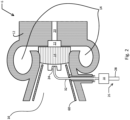
- Figure 2 schematically illustrates an exhaust additive dosing system according to an exemplifying embodiment of the present invention.
- a turbocharger turbine 6 is shown in cross-section, the turbine 6 comprising a turbine housing 12.
- the turbine housing 12 comprises exhaust gas inlets 14 and exhaust gas outlet volume 16.
- Located in the turbine housing 12 is a turbine rotor 18 arranged to rotate on a turbine shaft 20.
- a sealing member 22 prevents lubricant from leaking out from the turbine bearings (not shown), as well as preventing exhaust gas from leaking in.
- a reductant distribution device 24 is arranged on the outlet end of the shaft 18, manufactured integrally with the rotor 18.
- a reductant metering device 26 is arranged in the exhaust gas outlet volume 16 of the turbine 6.
- the reductant metering device 26 comprises a supply channel 28, a metering valve 30 and a dosing pipe 32.
- the distribution device 24 spins in unison with the turbine rotor 18 and shaft 20 whenever exhaust gas passes through the turbine 6.
- Reductant such as urea solution, upon being deposited to the distribution device 24 from the metering device 26, is dispersed in the exhaust gas passing through the turbine 6 by the spinning motion of the distribution device 24.
- a diffusor 60 is arranged in the exhaust gas outlet volume 16 to prevent corrosive reductant from coming into contact with the walls of the turbine housing 12.
- the outlet of the dosing pipe 32 must be arranged in conjunction with the distribution device. This is achieved by providing an orifice in both the diffusor 60 and the turbine housing 12 through which the dosing pipe 32 may pass.
- Figure 3 provides an enlarged schematic view of the area where the dosing pipe 32 traverses the diffusor 60 and turbine housing 12. It can be seen that an orifice 61 is provided in the diffusor 60 and another orifice 11 is provided in the wall of the turbine housing 12 in order that the dosing pipe 32 may access the exhaust gas outlet volume 16. Sealing is required for such an arrangement in order to prevent reductant from leaking through diffusor orifice 61 and coming into contact with turbine housing 12. It is however difficult for many reasons to provide a seal between the dosing pipe 32 and diffusor 60. This problem is solved by lining the housing orifice 11 with a bushing 63.
- the bushing 63 extends at a first end 63a to the diffusor 60 to provide a sealable interface with the diffusor 60.
- the bushing 63 has an internal diameter greater than the diameter of diffusor orifice 61, so that any reductant passing through orifice 61 is collected within the bushing 63.
- the interface between the bushing 63 and diffusor 60 may be further sealed in order to avoid leakage. In the illustrated exemplifying embodiment a more complete seal is achieved with the assistance of a sealing element 67, although other means are envisaged.
- the second end 63b of the bushing 63 is arranged to provide a sealable interface with the dosing pipe 32.
- this is achieved by providing the bushing 63 with a bushing flange 65 at the second end 63b, and providing the dosing pipe 32 with a pipe flange 33.
- the pipe flange 33 and bushing flange 65 together form a seal, preventing leakage of the contents of the bushing 63.
- the bushing flange 65 also assists in correct insertion of the bushing 63 within the exhaust gas outlet volume 16. Using such an arrangement, any reductant leaking through orifice 61 will be collected in the volume defined by the bushing 63 and pipe flange 33. Thus, leaking reductant cannot come into contact with the turbine housing 12. Moreover, since this volume is open to the exhaust gas outlet volume 16, any reductant collected in this volume will be rapidly evaporated and conveyed with exhaust gas to downstream components of the exhaust gas aftertreatment system.
- Figure 4 schematically illustrates an alternative means of sealing between the diffusor 60 and bushing 63.
- the diffusor 60 is equipped with an orifice collar 69 which may assist in sealing between the diffusor 60 and bushing 63 at the first end 63a.
- the orifice collar 69 may extent partly around the end of the bushing 63, as illustrated, or fully around the end of the bushing 63. If the orifice collar extends only partially around the bushing 63 it may be used in conjunction with a sealing element 67 as illustrated to gain an improved seal between bushing 63 and diffusor 60.
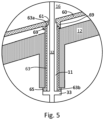
- Figure 5 schematically illustrates an exemplifying embodiment that does not comprise a sealing element.
- An orifice collar 69 extends fully around the first end 63a of the bushing 63 and is arranged to provide a labyrinth seal between the bushing 63 and diffusor 60.
Landscapes
- Engineering & Computer Science (AREA)
- Chemical & Material Sciences (AREA)
- Combustion & Propulsion (AREA)
- Mechanical Engineering (AREA)
- General Engineering & Computer Science (AREA)
- Chemical Kinetics & Catalysis (AREA)
- Health & Medical Sciences (AREA)
- Toxicology (AREA)
- Supercharger (AREA)
- Exhaust Gas After Treatment (AREA)
Description
- The present disclosure relates to a turbocharger for an internal combustion engine. The present disclosure also relates to an exhaust additive dosing system for an exhaust system for an internal combustion engine, the said exhaust additive dosing system comprising such a turbocharger. The disclosure further relates to a vehicle comprising such a turbocharger or exhaust additive dosing system.
- Emissions standards for motor vehicles are becoming increasingly stringent. Such standards typically specify maximum emission levels for a number of tailpipe pollutants including carbon monoxide (CO), hydrocarbons (HC), nitrogen oxides (NOx) and particulate matter (PM). In order to meet the requirements of the present and presumably future standards, vehicles are required to be equipped with emissions reduction technologies.
- Selective catalytic reduction (SCR) is an effective technology to reduce tailpipe nitrogen oxides (NOx) emissions. It involves adding a reductant, such as ammonia, to the vehicle exhaust stream. The reductant, with the aid of a catalyst, reduces NOx in the exhaust stream to nitrogen gas (N2) and water. In practical implementations in motor vehicles, an aqueous urea solution is used as a reductant and this urea solution is decomposed to ammonia and carbon dioxide in the hot exhaust stream.
- It is desirable to be able to remove substantially all NOx from the exhaust stream using only SCR. However, this is not without difficulties. In order to produce the quantities of ammonia required to reduce substantially all NOx, large quantities of urea solution must be injected into the exhaust stream. If the exhaust stream is sufficiently hot, the solution will evaporate and decompose to ammonia. The exact temperature that this occurs at depends on the injected mass flow of urea: the greater the mass flow, the higher the temperature required. At sub-optimal temperatures the urea solution may instead form deposits on surfaces of the exhaust conduit. Such deposits may include crystallised urea, as well as urea decomposition byproducts such as cyanuric acid. These deposits can be removed by heating the exhaust system at temperatures approaching 400 °C, but such temperatures are rarely achieved during normal operation of the vehicle and therefore, special procedures must be adopted to remove the exhaust deposits.
- A further difficulty with SCR is the requirement for efficient mixing in order to achieve uniform distribution of reductant over the entire surface area of multiple SCR catalyst substrates. The space available for mixing is extremely limited and the reductant is commonly injected into the exhaust stream shortly upstream of the SCR catalyst substrates. In order to improve mixing a mixing device, often resembling a turbine blade, is arranged in the exhaust pipe. However, even when using a mixing device, it is difficult to achieve sufficiently uniform mixing. Moreover, the presence of a mixing device in the exhaust pipe acts as an obstruction to flow, causing higher pressure upstream of the mixer (backpressure) and reducing the engine efficiency.
- These problems may be addressed by providing injection of the reductant further upstream in the exhaust system, for example in conjunction with a turbocharger turbine arranged in the exhaust system.
- Document
WO 2018/080371 discloses an exhaust additive dosing system for a turbocharger turbine. A distribution device is arranged on a shaft or hub of the turbocharger turbine. A metering device is arranged to supply exhaust additive to the distribution device. Since the distribution device sits in the wake created by the turbine, exhaust additive is easily dosed to the distribution device without needing to overcome the high exhaust flow velocities present closer to the outlet walls of the turbine. Exhaust additive dosed to the distribution device is dispersed in the exhaust stream by utilising the centrifugal force of the spinning turbine. A further exhaust additive dosing system is known fromSE 1 651 396 A1 - There remains a need for an improved means of adding a reductant to an exhaust stream.
- The inventors of the present invention have identified a number of shortcomings with regard to prior art solutions for dosing reductant at the outlet of a turbocharger turbine. Urea and byproducts therefrom are corrosive to the material of the turbine housing, especially at the high temperatures prevailing during operation. Arrangement of a diffuser cone in the outlet of the turbine housing may assist in preventing contact between the dosed urea and the turbine housing. However, in order to provide a dosing pipe of the metering device with access to the outlet of the turbine, it is necessary to provide a hole in the diffusor. This creates a leakage path for the urea into the turbine housing. Due to the thermal conditions prevailing in the turbine housing, as well as for reasons of manufacturability and ease of assembly, it is very difficult to provide an effective seal between the dosing pipe and the diffusor in order to prevent leakage.
- It would be advantageous to achieve a means of overcoming, or at least alleviating, at least some of the above mentioned shortcomings. In particular, it would be desirable to enable a dosing system that ameliorates the risk of urea leaking into the turbine housing when dosing urea in the outlet of a turbocharger. To better address one or more of these concerns, a turbocharger, exhaust additive dosing system and vehicle having the features defined in the independent claim is provided.
- The turbocharger comprises a turbine. The turbine comprises a turbine housing and a diffusor. The turbine housing comprises an exhaust gas outlet volume, and the diffusor is arranged in this volume. A housing orifice and a diffusor orifice are arranged through each of the turbine housing and diffusor respectively, and are mutually aligned to provide an opening into the exhaust gas outlet volume.
- The turbocharger further comprises a bushing. The bushing is arranged within the housing orifice, extends towards the diffusor orifice, and ends at a first end in association with the diffusor orifice. The first end of bushing has an internal diameter that is greater than or equal to a diameter of the diffusor orifice.
- By providing a suitably-dimensioned bushing between the diffusor orifice and housing orifice, it is ensured that any reductant leaking through the diffusor orifice will be collected in within the bushing, where it may evaporate in due course. Such an arrangement prevents contact between the corrosive reductant and the turbine housing.
- The diffusor may comprise an orifice collar arranged to partially or fully encircle the diffusor orifice and arranged to interface with an outer wall of the bushing. This assists in sealing between the diffusor and bushing, as well as assists in correctly positioning the bushing and diffusor during assembly of the turbocharger. The orifice collar may be arranged to provide a labyrinth seal between the diffusor and the first end of the bushing. The orifice collar may thus provide a sufficient seal between the diffusor and the bushing, thereby lessening or eradicating any need for a separate sealing element.
- A sealing element may be arranged to provide a seal between the diffusor and the first end of the bushing. A sealing element may assist in providing an improved seal between the diffusor and the bushing, especially when the bushing is arranged at an angle that is not perpendicular to the wall of the diffusor at the location of the diffusor orifice. The sealing element may be adapted to provide a labyrinth seal between the diffusor and the bushing. Such seals can be effectively implemented even at the high temperatures prevailing in the turbocharger turbine. The sealing element may be a gasket.
- The turbocharger may further comprise a distribution device arranged on a shaft, hub or rotor of the turbine. Such a distribution device assists in effective distribution of the reductant in the exhaust system. The distribution device may be manufactured integrally with the shaft, hub or rotor of the turbocharger turbine.
- The bushing may be manufactured of stainless steel. This prevents corrosion due to contact with reductant. The turbine housing may be manufactured of cast iron. Thus, a housing material with appropriate thermal, mechanical and manufacturing properties may be used, without undue concern with regard to the anti-corrosive properties of the material.
- The bushing may comprise a bushing flange arranged at a second end of the bushing, the second end being arranged opposite to the first end of the bushing. Such a flange may provide a suitable interface with both the turbine housing and a dosing pipe inserted within the bushing. The bushing flange may be adapted at a first face to interface with the turbine housing such that displacement of the bushing further into the exhaust gas outlet volume is prevented. This assists in assembly of the turbocharger and reduces the risk of incorrect insertion of the bushing.
- According to another aspect of the invention, the objects of the invention are achieved by an exhaust additive dosing system according to the appended claims.
- The exhaust additive dosing system comprises a turbocharger as defined herein, and an exhaust additive metering device (26). The exhaust additive metering device comprises a dosing pipe arranged to supply exhaust additive to the exhaust gas outlet volume of the turbocharger. The dosing pipe comprises a surface arranged to sealably interact with a surface of the bushing. In this manner, the dosing pipe and bushing together define a container for the collection of leaked reductant.
- The dosing pipe may comprise a pipe flange arranged to sealably interact with a second face of the bushing flange, wherein the second face is arranged opposite the first face of the bushing flange. This provides a simple means of providing a sealed interface between the bushing and the dosing pipe.
- The exhaust additive dosing system may comprise a distribution device arranged on a shaft, hub, or rotor of the turbine. The exhaust additive metering device may be arranged to supply exhaust additive to the exhaust additive distribution device. Such a combination of metering device and distribution device provides a particularly simple and effective distribution of reductant in the exhaust stream.
- According to a further aspect of the invention, the objects of the invention are achieved by a vehicle comprising a turbocharger or exhaust additive dosing system as defined herein.
- Further objects, advantages and novel features of the present invention will become apparent to one skilled in the art from the following detailed description.
- For a fuller understanding of the present invention and further objects and advantages of it, the detailed description set out below should be read together with the accompanying drawings, in which the same reference notations denote similar items in the various diagrams, and in which:
- Fig 1
- schematically illustrates a vehicle comprising an exhaust system according to an embodiment of the present invention.
- Fig. 2
- schematically illustrates an exhaust additive dosing system according to an exemplifying embodiment of the present invention.
- Fig. 3
- schematically illustrates an enlargement of the interface between the dosing pipe and the orifices.
- Fig. 4
- schematically illustrates an alternative exemplifying embodiment for sealing between the diffusor and bushing;
- Fig. 5
- schematically illustrates a further exemplifying embodiment for sealing between the diffusor and bushing.
- The additive dosing system of the present disclosure is located in the exhaust system for an internal combustion engine. The internal combustion engine may be any internal combustion engine, but is preferably a four-stroke combustion engine, even more preferably a compression ignition four-stroke combustion engine. The engine may be used in any application commonly known for internal combustion engines. It may for example be retailed as a free-standing engine, for use for example in power generation or industrial settings. However, application in a vehicle is preferred. By vehicle it is meant any machine utilising an internal combustion engine to provide motive force, either directly, or indirectly as in the case of series hybrid vehicles. This includes, but is not limited to, motor vehicles such as cars, trucks and buses; railed vehicles such as trains and trams; watercraft such as ships and boats; and aircraft. The exhaust additive is preferably a reductant, even more preferably diesel exhaust fluid comprising a solution of urea in water, in accordance with
standard AUS 32 of ISO 22241. However, the exhaust additive may also be another liquid additive added to the exhaust stream, such as hydrocarbon fuel to "burn off" a diesel particulate filter arranged downstream in the exhaust system. However, henceforth the exhaust additive will be referred to simply as "reductant". - The exhaust system is equipped with a turbocharger for recovering energy from the exhaust gases. The turbocharger comprises a turbine rotor housed in a turbine housing. A shaft connects the turbine rotor to the impeller of a compressor for compressing the charge air of the internal combustion engine. This shaft may traverse the turbine rotor, in which case the end of the turbine shaft extends outwardly at the outlet side of the turbine rotor, or the shaft may terminate at a hub of the turbine rotor, within the turbine.
- The reductant dosing system is located in association with the turbocharger turbine. The dosing system comprises a metering device and preferably a distribution device. The metering device is arranged to convey reductant to the exhaust gas outlet volume of the turbine, where the reductant may then be distributed in the exhaust gas leaving the turbine. Preferably this is done in conjunction with a distribution device to facilitate distribution of the reductant, but the metering device may be used without a distribution device, or with an alternative device for improving distribution of reductant in the exhaust stream, such as a mixer.
- The distribution device if used may be mounted on the shaft or hub of the turbocharger, coaxially with the shaft, at the outlet side of the shaft or hub. This means that the distribution device spins in unison with the turbocharger shaft and turbine, around a common rotation axis. Preferably the distribution device forms an integral part of the shaft, hub or rotor. If the turbocharger is equipped with a distribution device, the metering device is arranged in conjunction with the distribution device. Its dosing outlet is arranged centrally over or within the distribution device for depositing reductant to the distribution device.
- The dosing pipe of the metering device leading to the dosing outlet traverses the wall of the turbine housing at an appropriate location downstream of the turbine rotor. The reductant and/or byproducts thereof are highly corrosive to the material of the turbine housing, which is typically cast iron. In orderto avoid contact between the reductant and the turbine housing, the turbine is equipped with a diffusor arranged in the exhaust gas outlet volume of the turbine.
- A diffusor may serve many purposes. Primarily, it provides a physical barrier to prevent reductant added to the exhaust gas outlet volume from coming into contact with the turbine housing. To this effect, it is preferred if the diffusor is manufactured from a corrosion-resistant material such as stainless steel. A diffusor may also serve to increase the efficiency of the turbine by providing a smooth transition from dynamic pressure to static pressure for the exhaust gases upon leaving the turbine, as in the case of prior art turbine diffusors. The diffusor may also function as an evaporation device for reductant droplets deposited on surface of the diffusor from the distribution device. The functioning of the diffusor as an evaporation device may be optimised in a number of ways. For example, the diffusor may be treated to optimise the contact angle of reductant droplets with the diffusor surface, and/or may be treated to optimise heat transfer to any deposited reductant droplets.
- However, in order to provide the dosing pipe with access to the exhaust gas outlet volume, and in particular to the distribution device mounted axially in the turbine if such a distribution device is used, it is required that the dosing pipe passes through not only the turbine housing, but also the diffusor. Therefore, an orifice or through-hole is required in each of the turbine housing (i.e. housing orifice) and diffusor (i.e. diffusor orifice) to permit access for the dosing pipe. The housing orifice and diffusor orifice should be mutually aligned and suitably dimensioned to permit insertion of the dosing pipe. Due to manufacturing and assembly requirements, as well as the thermal properties of the materials used, it is extremely difficult to provide an adequate seal between the dosing pipe and the diffusor. Therefore, the orifice in the diffusor that the dosing pipe passes through provides a leakage path for reductant or byproducts thereof to come into contact with the turbine housing.
- The present invention is based upon an insight by the inventors that it is not necessary to provide a seal between the dosing pipe and the diffusor orifice. Instead, it is sufficient that leakage through the diffusor orifice is confined to a corrosion-resistant volume where it may not come into contact with the turbine housing.
- Such a solution is achieved by providing the housing orifice with a bushing or sleeve that extends through the housing orifice and ends in association with the diffusor orifice. By "in association with" it is for example meant abutting, in close proximity to, or forming a sealed interface via a further component with the diffusor orifice. The bushing is manufactured in a corrosion-resistant material such as stainless steel. At the end of the bushing that is in association with the diffusor orifice, a seal may be provided with the diffusor sufficient to ensure that reductant does not escape into the volume between the diffusor and the housing. This is primarily achieved by ensuring that the bushing has an inner diameter that is preferably greater than the diameter of the diffusor orifice, or at least not smaller than the diffusor orifice, and that there is little or no gap between the bushing and the diffusor. For example, the end of the bushing in association with the diffusor hole may partially or fully abut the diffusor. However, further sealing can be provided if required. Further sealing may be achieved by using a sealing element such as a gasket or packing. Because a diffusor is typically frustoconically shaped, a cylindrical bushing arranged normal to the central axis of the turbine and abutting the diffusor at one point will have a small gap between the diffusor and the bushing at the point diametrically opposite the abutting point. A sealing element may be used to bridge and seal this gap, for example by creating a labyrinth seal between the diffusor and bushing. Alternatively, by offsetting the angle of the bushing such that it is normal to the diffusor wall, such a gap may be avoided. Alternatively, or in addition, further sealing may be achieved by equipping the diffusor with a collar extending partially or fully around the diffusor hole on the side arranged to interface with the bushing. Such a collar provides a sealing interface with the bushing and assists in correct positioning of the bushing relative to the diffusor. The collar may be arranged to provide a labyrinth seal between the bushing and diffusor, eliminating in some cases the need for a separate sealing element.
- The end of the bushing not in contact with the diffusor may be arranged to sealably interact with the dosing pipe, i.e. form a seal with the dosing pipe either directly or via an intermediate component such as a gasket or sealing element. This may suitably be performed by providing the bushing and the dosing pipe with flanges that abut when assembled. The flange of the bushing also assists accurate positioning of the bushing in the housing and prevents excessive extension into the exhaust outlet volume.
- When assembled, the dosing pipe and bushing together form a chamber capable of collecting any reductant leaking through the diffusor orifice. Because this chamber is open to the exhaust gas outlet volume, the temperature prevailing is essentially the same as that prevailing in the exhaust gas outlet volume. This means that any reductant collected in the chamber will be rapidly evaporated and conveyed onwards to the exhaust aftertreatment system together with the exhaust gases.
- The reductant metering device of the reductant dosing system may be a liquid-only device, otherwise known as an airless injector. This means that the metering device does not utilize compressed air in order to facilitate injection of the reductant into the exhaust conduit. Since a compressor requires energy to run, this represents an energy saving compared to air-assisted systems. Moreover, some applications such as marine applications do not necessarily have a ready source of compressed air to hand, and thus the use extra, costly components can be avoided. However, the reductant metering device of the reductant dosing system may alternatively be an air-assisted device, i.e. a device that utilises compressed air to facilitate injection of the reductant. The metering device may be a component of a reductant metering system. Further components of the reductant metering system may include a reductant storage tank, a control unit, and a pressurising device such as a pump.
- Pressurised reductant is supplied to the metering device via a supply channel. The metering device comprises a controllable metering valve for dosing the required amount of reductant to the exhaust system. After passing the metering valve, the reductant is transported along a dosing pipe to a dosing outlet, whereby the reductant is deposited on the distribution device. As previously noted, the metering device is may be liquid-only, i.e. airless. Unlike typical airless injectors, the metering device has a length of dosing pipe arranged after the metering valve in the direction of reductant dosage flow. This means that the metering valve may be located remotely from the exhaust system and thus not be exposed to the high temperatures of the exhaust system, thus potentially increasing the operational life of the injector and reducing the need for a cooling system. Because the reductant is preferably dosed in the wake of the turbine, lower reductant pressures are required. If a distribution device is utilized, it is the distribution device and not the dosing outlet of the metering device that disperses the reductant in the exhaust stream. This means that less kinetic energy is required to be supplied to the reductant and lower reductant pressures may be used. Thus, pumps of simpler, more robust construction may be used in the metering system.
- Since the dosing outlet of the metering device is not required to form an aerosol from the reductant, it can comprise fewer, larger orifices as compared to prior art nozzle heads. For example, it may comprise one or more orifices. This reduces the risk of the orifices being blocked by for example urea deposits. The dosing outlet may have a surface that forms a mating surface with the receiving surface of the distribution device in order to prevent leakage of reductant and assist deposition of reductant to the receiving surface of the distribution device.
- The reductant distribution device comprises a receiving surface, and at least one distribution surface. The distribution device may be an integral part of the turbocharger turbine shaft or hub, i.e. be manufactured integrally with the turbine shaft, hub or rotor. Alternatively, the reductant distribution device may comprise a fastening surface by which it may be fixedly attached to the turbine shaft, hub or rotor using nay means known in the art. Such fastening means are for example disclosed in
WO 2018/080371 which is herein incorporated by reference. The distribution device may be constructed from any suitable material, such as steel or aluminium. - The receiving and distribution surfaces are arranged together with the metering device to avoid any reductant coming into contact with the turbine blades and especially the turbine bearings.
- The distribution device may be shaped as a cup, for example a bell-cup or conical cup, and function as a rotating cup atomizer. In this case, the dosing outlet of the metering device may be arranged centrally within the cup. The reductant is deposited on the base or lower side wall of the cup. The spinning motion of the cup combined with the angle of the cup wall causes the reductant to be forced upwards and outwards from the base of the cup towards the outer rim of the cup, which acts as a distribution surface and disperses reductant into the exhaust stream.
- Other means of forming a distribution device and means of interaction between the distribution device and metering device may be considered. Such means are disclosed in
WO 2018/080371 which is herein incorporated by reference. - A stopping device may be located in the turbine housing. Such a stopping device prevents the turbine from escaping the turbine housing or dismounting the turbine shaft in the event of failure, and may essentially abut the distribution device. If such a stopping device is present, the dosing pipe of the metering device may be pass through or be integrated in the body of the stopping device, or may constitute a stopping device.
- A wastegate outlet arranged in the turbine housing may supply hot exhaust gases bypassing the turbine to the outer surface(s) of the diffusor, i.e. the opposite sides to the inner surfaces. By directing hot wastegate exhaust gases along the outer surfaces of the diffusor, the reductant evaporation functioning of the diffusor is even further enhanced. The diffusor may be partially or fully integrated with the turbine housing.
- The invention will now be described in more detail with reference to certain exemplifying embodiments and the drawings. However, the invention is not limited to the exemplifying embodiments discussed herein and/or shown in the drawings, but may be varied within the scope of the appended claims. Furthermore, the drawings shall not be considered drawn to scale as some features may be exaggerated in order to more clearly illustrate certain features.
-
Figure 1 shows schematically a side view of avehicle 1 according to an embodiment of the invention. Thevehicle 1 includes a combustion engine 2, a first exhaust conduit 4 leading to aturbocharger 5, and a second exhaust conduit leading from theturbocharger 5 to anSCR catalyst 10. Areductant metering device 26 is arranged in conjunction with theturbocharger 5. Thevehicle 1 may be a heavy vehicle, e.g. a truck or a bus. Thevehicle 1 may alternatively be a passenger car. The vehicle may be a hybrid vehicle comprising an electric machine (not shown) in addition to the combustion engine 2. -
Figure 2 schematically illustrates an exhaust additive dosing system according to an exemplifying embodiment of the present invention. - A
turbocharger turbine 6 is shown in cross-section, theturbine 6 comprising aturbine housing 12. Theturbine housing 12 comprisesexhaust gas inlets 14 and exhaustgas outlet volume 16. Located in theturbine housing 12 is aturbine rotor 18 arranged to rotate on aturbine shaft 20. A sealing member 22 prevents lubricant from leaking out from the turbine bearings (not shown), as well as preventing exhaust gas from leaking in. Areductant distribution device 24 is arranged on the outlet end of theshaft 18, manufactured integrally with therotor 18. Areductant metering device 26 is arranged in the exhaustgas outlet volume 16 of theturbine 6. Thereductant metering device 26 comprises asupply channel 28, ametering valve 30 and adosing pipe 32. - In operation, the
distribution device 24 spins in unison with theturbine rotor 18 andshaft 20 whenever exhaust gas passes through theturbine 6. Reductant such as urea solution, upon being deposited to thedistribution device 24 from themetering device 26, is dispersed in the exhaust gas passing through theturbine 6 by the spinning motion of thedistribution device 24. - A
diffusor 60 is arranged in the exhaustgas outlet volume 16 to prevent corrosive reductant from coming into contact with the walls of theturbine housing 12. In order to be able to provide reductant to thedistribution device 24, the outlet of thedosing pipe 32 must be arranged in conjunction with the distribution device. This is achieved by providing an orifice in both thediffusor 60 and theturbine housing 12 through which thedosing pipe 32 may pass. -
Figure 3 provides an enlarged schematic view of the area where thedosing pipe 32 traverses thediffusor 60 andturbine housing 12. It can be seen that anorifice 61 is provided in thediffusor 60 and anotherorifice 11 is provided in the wall of theturbine housing 12 in order that thedosing pipe 32 may access the exhaustgas outlet volume 16. Sealing is required for such an arrangement in order to prevent reductant from leaking throughdiffusor orifice 61 and coming into contact withturbine housing 12. It is however difficult for many reasons to provide a seal between thedosing pipe 32 anddiffusor 60. This problem is solved by lining thehousing orifice 11 with abushing 63. Thebushing 63 extends at afirst end 63a to thediffusor 60 to provide a sealable interface with thediffusor 60. Thebushing 63 has an internal diameter greater than the diameter ofdiffusor orifice 61, so that any reductant passing throughorifice 61 is collected within thebushing 63. The interface between thebushing 63 anddiffusor 60 may be further sealed in order to avoid leakage. In the illustrated exemplifying embodiment a more complete seal is achieved with the assistance of a sealingelement 67, although other means are envisaged. Thesecond end 63b of thebushing 63 is arranged to provide a sealable interface with thedosing pipe 32. In the illustrated exemplifying embodiment this is achieved by providing thebushing 63 with abushing flange 65 at thesecond end 63b, and providing thedosing pipe 32 with apipe flange 33. Thepipe flange 33 andbushing flange 65 together form a seal, preventing leakage of the contents of thebushing 63. Thebushing flange 65 also assists in correct insertion of thebushing 63 within the exhaustgas outlet volume 16. Using such an arrangement, any reductant leaking throughorifice 61 will be collected in the volume defined by thebushing 63 andpipe flange 33. Thus, leaking reductant cannot come into contact with theturbine housing 12. Moreover, since this volume is open to the exhaustgas outlet volume 16, any reductant collected in this volume will be rapidly evaporated and conveyed with exhaust gas to downstream components of the exhaust gas aftertreatment system. -
Figure 4 schematically illustrates an alternative means of sealing between thediffusor 60 andbushing 63. Thediffusor 60 is equipped with anorifice collar 69 which may assist in sealing between thediffusor 60 andbushing 63 at thefirst end 63a. Theorifice collar 69 may extent partly around the end of thebushing 63, as illustrated, or fully around the end of thebushing 63. If the orifice collar extends only partially around thebushing 63 it may be used in conjunction with a sealingelement 67 as illustrated to gain an improved seal betweenbushing 63 anddiffusor 60. -
Figure 5 schematically illustrates an exemplifying embodiment that does not comprise a sealing element. Anorifice collar 69 extends fully around thefirst end 63a of thebushing 63 and is arranged to provide a labyrinth seal between thebushing 63 anddiffusor 60.
Claims (14)
- An exhaust additive dosing system for an exhaust system for an internal combustion engine (2), the exhaust additive dosing system comprising a turbocharger (5), and an exhaust additive metering device (26), the turbocharger (5) comprising a turbine (6); wherein the turbine (6) comprises a turbine housing (12) and a diffusor (60); wherein the turbine housing (12) comprises an exhaust gas outlet volume (16) and the diffusor (60) is arranged in the exhaust gas outlet volume (16); characterized in that a housing orifice (11) and a diffusor orifice (61) are arranged through each of the turbine housing (12) and diffusor (60) respectively, and wherein the housing orifice (11) and diffusor orifice (61) are mutually aligned to provide an opening into the exhaust gas outlet volume (16); wherein the turbocharger further comprises a bushing (63); wherein the bushing (63) is arranged within the housing orifice (11), extends towards the diffusor orifice (61) and ends at a first end (63a) in association with the diffusor orifice (61), and wherein the first end (63a) of bushing (63) has an internal diameter that is greater than or equal to a diameter of the diffusor orifice (61); wherein the exhaust additive metering device (26) comprises a dosing pipe (32) arranged to supply exhaust additive to the exhaust gas outlet volume (16) of the turbocharger (5), wherein the dosing pipe (32) passes through the diffusor orifice (61) and the housing orifice (11); and wherein the dosing pipe (32) comprises a surface arranged to sealably interact with a surface of the bushing (63).
- An exhaust additive dosing system according to claim 1, wherein the diffusor (60) comprises an orifice collar (69) arranged to partially or fully encircle the diffusor orifice (61) and arranged to interface with an outer wall of the bushing (63).
- An exhaust additive dosing system according to claim 2, wherein the orifice collar (69) is arranged to provide a labyrinth seal between the diffusor (60) and the first end (63a) of the bushing (63).
- An exhaust additive dosing system according to any one of the preceding claims, further comprising a sealing element (67) arranged to provide a seal between the diffusor (60) and the first end (63a) of the bushing (63).
- An exhaust additive dosing system according to claim 4, wherein the sealing element (67) is adapted to provide a labyrinth seal between the diffusor (60) and the bushing (63).
- An exhaust additive dosing system according to any one of the preceding claims, further comprising a distribution device (24) arranged on a shaft (20), hub or rotor (18) of the turbine.
- An exhaust additive dosing system according to claim 6, wherein the distribution device (24) is manufactured integrally with the shaft (20), hub or rotor (18) of the turbocharger turbine (6).
- An exhaust additive dosing system according to any one of the preceding claims, wherein the bushing (63) is manufactured of stainless steel.
- An exhaust additive dosing system according to any one of the preceding claims, wherein the turbine housing (12) is manufactured of cast iron.
- An exhaust additive dosing system according to any one of the preceding claims, wherein the bushing (63) comprises a bushing flange (65) arranged at a second end (63b) of the bushing (63), the second end (63b) being arranged opposite to the first end (63a).
- An exhaust additive dosing system according to claim 10, wherein the bushing flange (65) is adapted at a first face to interface with the turbine housing (12) such that displacement of the bushing (63) further into the exhaust gas outlet volume (16) is prevented.
- An exhaust additive dosing system according to any one of the preceding claims, wherein the dosing pipe (32) comprises a pipe flange (33) arranged to sealably interact with a second face of the bushing flange (65), the second face of the bushing flange (65) being arranged opposite the first face of the bushing flange.
- An exhaust additive dosing system according to any one of the preceding claims, wherein the exhaust additive dosing system comprises a distribution device (24) arranged on a shaft (20), hub, or rotor (18) of the turbine (6), and wherein the exhaust additive metering device (26) is arranged to supply exhaust additive to the exhaust additive distribution device (24).
- A vehicle (1), comprising an exhaust additive dosing system according to any one of the preceding claims.
Applications Claiming Priority (2)
| Application Number | Priority Date | Filing Date | Title |
|---|---|---|---|
| SE1951436A SE543851C2 (en) | 2019-12-12 | 2019-12-12 | Exhaust additive dosing system comprising a turbocharger |
| PCT/SE2020/051132 WO2021118428A1 (en) | 2019-12-12 | 2020-11-26 | Exhaust additive dosing system comprising a turbocharger |
Publications (3)
| Publication Number | Publication Date |
|---|---|
| EP4073363A1 EP4073363A1 (en) | 2022-10-19 |
| EP4073363A4 EP4073363A4 (en) | 2024-01-17 |
| EP4073363B1 true EP4073363B1 (en) | 2025-01-01 |
Family
ID=76330598
Family Applications (1)
| Application Number | Title | Priority Date | Filing Date |
|---|---|---|---|
| EP20898268.6A Active EP4073363B1 (en) | 2019-12-12 | 2020-11-26 | Exhaust additive dosing system comprising a turbocharger |
Country Status (6)
| Country | Link |
|---|---|
| US (1) | US11725559B2 (en) |
| EP (1) | EP4073363B1 (en) |
| CN (1) | CN114829754B (en) |
| BR (1) | BR112022010654A2 (en) |
| SE (1) | SE543851C2 (en) |
| WO (1) | WO2021118428A1 (en) |
Families Citing this family (8)
| Publication number | Priority date | Publication date | Assignee | Title |
|---|---|---|---|---|
| US11808192B2 (en) | 2019-08-14 | 2023-11-07 | Cummins Emission Solutions Inc. | Exhaust gas aftertreatment system |
| DE102020113041B4 (en) * | 2020-05-14 | 2025-06-05 | Man Energy Solutions Se | Exhaust gas turbine and method for operating the same |
| GB2602090A (en) * | 2020-12-17 | 2022-06-22 | Cummins Ltd | Turbine |
| GB2602098A (en) * | 2020-12-17 | 2022-06-22 | Cummins Ltd | Turbine |
| GB202203743D0 (en) * | 2022-03-17 | 2022-05-04 | Cummins Ltd | Turbine dosing system with bypass take off and delivery |
| GB202203712D0 (en) * | 2022-03-17 | 2022-05-04 | Cummins Ltd | Turbine dosing system |
| GB202203717D0 (en) * | 2022-03-17 | 2022-05-04 | Cummins Ltd | Turbine dosing system for dosing into regions of desirable flow properties |
| EP4542010A1 (en) * | 2023-10-19 | 2025-04-23 | Scania CV AB | Turbine arrangement, turbo device, internal combustion engine, and vehicle |
Family Cites Families (36)
| Publication number | Priority date | Publication date | Assignee | Title |
|---|---|---|---|---|
| SE516624C2 (en) * | 2000-06-14 | 2002-02-05 | Volvo Lastvagnar Ab | Apparatus for injecting urea into a turbine housing in an exhaust system |
| DE10344116A1 (en) * | 2003-09-24 | 2005-04-21 | Manfred Hauers | Continuous vertical bagging machine |
| DE102004004738A1 (en) * | 2004-01-30 | 2005-08-18 | Robert Bosch Gmbh | Method and device for the after-treatment of an exhaust gas of an internal combustion engine |
| WO2005073527A1 (en) | 2004-02-02 | 2005-08-11 | Nissan Diesel Motor Co., Ltd. | Device for purifying exhaust gas of internal combustion engine |
| JP2005226528A (en) * | 2004-02-12 | 2005-08-25 | Tokyo Roki Co Ltd | SCR muffler |
| ITRM20050219A1 (en) * | 2005-05-06 | 2006-11-07 | Luciano Alunni | MULTISTAGE CONDENSATION REACTOR IN SONICAL CAVITY. |
| FR2897646A3 (en) | 2006-02-20 | 2007-08-24 | Renault Sas | Exhaust line component for internal combustion engine of motor vehicle, has deflector placed upstream of cavity and projecting from inner surface of component to deflect exhaust gas flow from end of fuel injector |
| ATE512300T1 (en) * | 2006-07-12 | 2011-06-15 | Delphi Tech Holding Sarl | DOSING PUMP FOR A REDUCING AGENT |
| US7497077B2 (en) * | 2006-07-26 | 2009-03-03 | Southwest Research Institute | System and method for dispensing an aqueous urea solution into an exhaust gas stream |
| CN101506476B (en) * | 2006-08-24 | 2011-09-14 | Abb涡轮系统有限公司 | Turbine housing |
| US7941995B2 (en) * | 2007-10-02 | 2011-05-17 | Cummins Filtration Ip, Inc. | Exhaust aftertreatment system with compliantly coupled sections |
| JP2009114934A (en) * | 2007-11-06 | 2009-05-28 | Toyota Motor Corp | Exhaust gas purification device for internal combustion engine |
| JP2009121396A (en) | 2007-11-16 | 2009-06-04 | Denso Corp | Exhaust purification device |
| JP4332756B2 (en) * | 2007-12-25 | 2009-09-16 | 三菱自動車工業株式会社 | Exhaust gas purification device for internal combustion engine |
| GB0800451D0 (en) * | 2008-01-11 | 2008-02-20 | Cummins Turbo Tech Ltd | A turbomachine system and turbine therefor |
| US8297050B2 (en) * | 2008-07-11 | 2012-10-30 | GM Global Technology Operations LLC | Nozzle diffuser mixer |
| DE102009006278A1 (en) * | 2009-01-27 | 2010-07-29 | Daimler Ag | Exhaust gas turbocharger for an internal combustion engine |
| US8596063B2 (en) * | 2009-06-18 | 2013-12-03 | GM Global Technology Operations LLC | Exhaust treatment system for an internal combustion engine |
| US20110067680A1 (en) * | 2009-09-22 | 2011-03-24 | Gm Global Technology Operations, Inc. | Turbocharger and Air Induction System Incorporating the Same and Method of Making and Using the Same |
| JP5768331B2 (en) * | 2010-06-11 | 2015-08-26 | いすゞ自動車株式会社 | Exhaust pipe fuel injection system |
| WO2013192027A2 (en) * | 2012-06-21 | 2013-12-27 | Borgwarner Inc. | Exhaust-gas turbocharger |
| GB2512934C (en) * | 2013-04-12 | 2020-03-11 | Eminox Ltd | Reductant injection in an exhaust system |
| US9234445B2 (en) * | 2013-06-06 | 2016-01-12 | Cummins Emission Solutions Inc. | Systems and techniques for nozzle cooling of diesel exhaust fluid injection systems |
| US9528414B2 (en) * | 2013-10-14 | 2016-12-27 | Cummins Emission Solutions, Inc. | Diesel exhaust fluid deposit mitigation |
| CN106030064B (en) * | 2014-02-28 | 2018-10-19 | 天纳克汽车经营有限公司 | In-line arrangement current divider |
| KR20160034109A (en) * | 2014-09-19 | 2016-03-29 | 주식회사터보젠 | Centrifugal Type Turbo Blower |
| DE102014015868A1 (en) * | 2014-10-25 | 2016-04-28 | Daimler Ag | Exhaust after-treatment device for an internal combustion engine, in particular a motor vehicle |
| US20170087514A1 (en) * | 2015-09-30 | 2017-03-30 | Caterpillar Inc. | Uniform flow distribution of a reductant |
| SE540234C2 (en) * | 2016-09-30 | 2018-05-08 | Scania Cv Ab | Multiple bank exhaust system for a turbocharged internal combustion engine comprising reductant supply system |
| SE542040C2 (en) * | 2016-10-26 | 2020-02-18 | Scania Cv Ab | An exhaust additive distribution device attached to a turbocharger turbine and an exhaust additive dosing system including such a distribution device |
| SE541714C2 (en) * | 2017-06-27 | 2019-12-03 | Scania Cv Ab | Reducing agent dosing arrangement and exhaust gas system |
| CN111075520A (en) * | 2018-10-18 | 2020-04-28 | 福特全球技术公司 | Internal combustion engine with an exhaust gas aftertreatment system requiring a reducing agent and method for enriching an exhaust gas with a reducing agent |
| US10590793B1 (en) * | 2018-10-29 | 2020-03-17 | Borgwarner Inc. | Diffuser for diffusing the flow of exhaust gas and a system including the same |
| CN112539101B (en) * | 2020-11-27 | 2022-11-29 | 潍柴动力股份有限公司 | Turbocharger |
| GB2602098A (en) * | 2020-12-17 | 2022-06-22 | Cummins Ltd | Turbine |
| GB2602090A (en) * | 2020-12-17 | 2022-06-22 | Cummins Ltd | Turbine |
-
2019
- 2019-12-12 SE SE1951436A patent/SE543851C2/en unknown
-
2020
- 2020-11-26 US US17/783,313 patent/US11725559B2/en active Active
- 2020-11-26 WO PCT/SE2020/051132 patent/WO2021118428A1/en not_active Ceased
- 2020-11-26 BR BR112022010654A patent/BR112022010654A2/en unknown
- 2020-11-26 CN CN202080086102.3A patent/CN114829754B/en active Active
- 2020-11-26 EP EP20898268.6A patent/EP4073363B1/en active Active
Also Published As
| Publication number | Publication date |
|---|---|
| WO2021118428A1 (en) | 2021-06-17 |
| CN114829754A (en) | 2022-07-29 |
| US20230019174A1 (en) | 2023-01-19 |
| BR112022010654A2 (en) | 2022-08-16 |
| SE1951436A1 (en) | 2021-06-13 |
| CN114829754B (en) | 2024-10-25 |
| US11725559B2 (en) | 2023-08-15 |
| EP4073363A4 (en) | 2024-01-17 |
| SE543851C2 (en) | 2021-08-10 |
| EP4073363A1 (en) | 2022-10-19 |
Similar Documents
| Publication | Publication Date | Title |
|---|---|---|
| EP4073363B1 (en) | Exhaust additive dosing system comprising a turbocharger | |
| US11015508B2 (en) | Exhaust additive dosing system comprising an exhaust additive distribution device and an exhaust additive metering device | |
| CN102725056B (en) | Mixing system for an exhaust gases after-treatment arrangement | |
| CN103168155B (en) | Arrangement for introducing a liquid medium into exhaust gases from a combustion engine | |
| JP4869161B2 (en) | Exhaust gas purification device for internal combustion engine | |
| US9561470B2 (en) | Method for the purification of diesel engine exhaust gases | |
| US8261538B2 (en) | Compact exhaust gas aftertreatment system | |
| US11035276B2 (en) | Exhaust additive distribution arrangement and system | |
| JP2004503706A (en) | Urea injection device for exhaust gas turbine housing | |
| SE541714C2 (en) | Reducing agent dosing arrangement and exhaust gas system | |
| SE545036C2 (en) | Turbine Outlet Assembly for a Turbo Device comprising an exhaust additive dosing unit | |
| EP3303787B1 (en) | Method and system for introducing a reducing agent into exhaust gases from an internal combustion engine | |
| CN110446836A (en) | exhaust gas turbocharger | |
| RU2790305C1 (en) | Exhaust additive dosing system containing turbocharger | |
| SE545026C2 (en) | Heat resistant Exhaust Additive Dosing Arrangement | |
| CN112081649B (en) | Tail gas aftertreatment device and sandwich type mixing tube thereof | |
| WO2023235218A1 (en) | Valve assembly for internal combustion engine system with turbomachinery | |
| CN110848002A (en) | Premixing device, exhaust gas treatment device, and vehicle | |
| US20260049565A1 (en) | Vehicle system with injection housing and turbocharger having motor | |
| BR112019008355B1 (en) | EXHAUST ADDITIVE DISTRIBUTION DEVICE |
Legal Events
| Date | Code | Title | Description |
|---|---|---|---|
| STAA | Information on the status of an ep patent application or granted ep patent |
Free format text: STATUS: THE INTERNATIONAL PUBLICATION HAS BEEN MADE |
|
| PUAI | Public reference made under article 153(3) epc to a published international application that has entered the european phase |
Free format text: ORIGINAL CODE: 0009012 |
|
| STAA | Information on the status of an ep patent application or granted ep patent |
Free format text: STATUS: REQUEST FOR EXAMINATION WAS MADE |
|
| 17P | Request for examination filed |
Effective date: 20220712 |
|
| AK | Designated contracting states |
Kind code of ref document: A1 Designated state(s): AL AT BE BG CH CY CZ DE DK EE ES FI FR GB GR HR HU IE IS IT LI LT LU LV MC MK MT NL NO PL PT RO RS SE SI SK SM TR |
|
| DAV | Request for validation of the european patent (deleted) | ||
| DAX | Request for extension of the european patent (deleted) | ||
| P01 | Opt-out of the competence of the unified patent court (upc) registered |
Effective date: 20230518 |
|
| A4 | Supplementary search report drawn up and despatched |
Effective date: 20231214 |
|
| RIC1 | Information provided on ipc code assigned before grant |
Ipc: F02B 39/00 20060101ALI20231208BHEP Ipc: F01N 3/20 20060101ALI20231208BHEP Ipc: F02B 37/00 20060101AFI20231208BHEP |
|
| GRAP | Despatch of communication of intention to grant a patent |
Free format text: ORIGINAL CODE: EPIDOSNIGR1 |
|
| STAA | Information on the status of an ep patent application or granted ep patent |
Free format text: STATUS: GRANT OF PATENT IS INTENDED |
|
| INTG | Intention to grant announced |
Effective date: 20240730 |
|
| GRAS | Grant fee paid |
Free format text: ORIGINAL CODE: EPIDOSNIGR3 |
|
| GRAA | (expected) grant |
Free format text: ORIGINAL CODE: 0009210 |
|
| STAA | Information on the status of an ep patent application or granted ep patent |
Free format text: STATUS: THE PATENT HAS BEEN GRANTED |
|
| AK | Designated contracting states |
Kind code of ref document: B1 Designated state(s): AL AT BE BG CH CY CZ DE DK EE ES FI FR GB GR HR HU IE IS IT LI LT LU LV MC MK MT NL NO PL PT RO RS SE SI SK SM TR |
|
| REG | Reference to a national code |
Ref country code: GB Ref legal event code: FG4D |
|
| REG | Reference to a national code |
Ref country code: DE Ref legal event code: R096 Ref document number: 602020044317 Country of ref document: DE |
|
| REG | Reference to a national code |
Ref country code: CH Ref legal event code: EP |
|
| REG | Reference to a national code |
Ref country code: IE Ref legal event code: FG4D |
|
| REG | Reference to a national code |
Ref country code: LT Ref legal event code: MG9D |
|
| REG | Reference to a national code |
Ref country code: NL Ref legal event code: MP Effective date: 20250101 |
|
| REG | Reference to a national code |
Ref country code: AT Ref legal event code: MK05 Ref document number: 1756454 Country of ref document: AT Kind code of ref document: T Effective date: 20250101 |
|
| PG25 | Lapsed in a contracting state [announced via postgrant information from national office to epo] |
Ref country code: NL Free format text: LAPSE BECAUSE OF FAILURE TO SUBMIT A TRANSLATION OF THE DESCRIPTION OR TO PAY THE FEE WITHIN THE PRESCRIBED TIME-LIMIT Effective date: 20250101 |
|
| PG25 | Lapsed in a contracting state [announced via postgrant information from national office to epo] |
Ref country code: FI Free format text: LAPSE BECAUSE OF FAILURE TO SUBMIT A TRANSLATION OF THE DESCRIPTION OR TO PAY THE FEE WITHIN THE PRESCRIBED TIME-LIMIT Effective date: 20250101 |
|
| PG25 | Lapsed in a contracting state [announced via postgrant information from national office to epo] |
Ref country code: PL Free format text: LAPSE BECAUSE OF FAILURE TO SUBMIT A TRANSLATION OF THE DESCRIPTION OR TO PAY THE FEE WITHIN THE PRESCRIBED TIME-LIMIT Effective date: 20250101 |
|
| PG25 | Lapsed in a contracting state [announced via postgrant information from national office to epo] |
Ref country code: ES Free format text: LAPSE BECAUSE OF FAILURE TO SUBMIT A TRANSLATION OF THE DESCRIPTION OR TO PAY THE FEE WITHIN THE PRESCRIBED TIME-LIMIT Effective date: 20250101 |
|
| PG25 | Lapsed in a contracting state [announced via postgrant information from national office to epo] |
Ref country code: NO Free format text: LAPSE BECAUSE OF FAILURE TO SUBMIT A TRANSLATION OF THE DESCRIPTION OR TO PAY THE FEE WITHIN THE PRESCRIBED TIME-LIMIT Effective date: 20250401 Ref country code: IS Free format text: LAPSE BECAUSE OF FAILURE TO SUBMIT A TRANSLATION OF THE DESCRIPTION OR TO PAY THE FEE WITHIN THE PRESCRIBED TIME-LIMIT Effective date: 20250501 |
|
| PG25 | Lapsed in a contracting state [announced via postgrant information from national office to epo] |
Ref country code: HR Free format text: LAPSE BECAUSE OF FAILURE TO SUBMIT A TRANSLATION OF THE DESCRIPTION OR TO PAY THE FEE WITHIN THE PRESCRIBED TIME-LIMIT Effective date: 20250101 |
|
| PG25 | Lapsed in a contracting state [announced via postgrant information from national office to epo] |
Ref country code: LV Free format text: LAPSE BECAUSE OF FAILURE TO SUBMIT A TRANSLATION OF THE DESCRIPTION OR TO PAY THE FEE WITHIN THE PRESCRIBED TIME-LIMIT Effective date: 20250101 Ref country code: PT Free format text: LAPSE BECAUSE OF FAILURE TO SUBMIT A TRANSLATION OF THE DESCRIPTION OR TO PAY THE FEE WITHIN THE PRESCRIBED TIME-LIMIT Effective date: 20250502 |
|
| PG25 | Lapsed in a contracting state [announced via postgrant information from national office to epo] |
Ref country code: BG Free format text: LAPSE BECAUSE OF FAILURE TO SUBMIT A TRANSLATION OF THE DESCRIPTION OR TO PAY THE FEE WITHIN THE PRESCRIBED TIME-LIMIT Effective date: 20250101 Ref country code: GR Free format text: LAPSE BECAUSE OF FAILURE TO SUBMIT A TRANSLATION OF THE DESCRIPTION OR TO PAY THE FEE WITHIN THE PRESCRIBED TIME-LIMIT Effective date: 20250402 |
|
| PG25 | Lapsed in a contracting state [announced via postgrant information from national office to epo] |
Ref country code: AT Free format text: LAPSE BECAUSE OF FAILURE TO SUBMIT A TRANSLATION OF THE DESCRIPTION OR TO PAY THE FEE WITHIN THE PRESCRIBED TIME-LIMIT Effective date: 20250101 |
|
| PG25 | Lapsed in a contracting state [announced via postgrant information from national office to epo] |
Ref country code: CZ Free format text: LAPSE BECAUSE OF FAILURE TO SUBMIT A TRANSLATION OF THE DESCRIPTION OR TO PAY THE FEE WITHIN THE PRESCRIBED TIME-LIMIT Effective date: 20250101 |
|
| PG25 | Lapsed in a contracting state [announced via postgrant information from national office to epo] |
Ref country code: SE Free format text: LAPSE BECAUSE OF FAILURE TO SUBMIT A TRANSLATION OF THE DESCRIPTION OR TO PAY THE FEE WITHIN THE PRESCRIBED TIME-LIMIT Effective date: 20250101 |
|
| REG | Reference to a national code |
Ref country code: DE Ref legal event code: R097 Ref document number: 602020044317 Country of ref document: DE |
|
| PG25 | Lapsed in a contracting state [announced via postgrant information from national office to epo] |
Ref country code: SM Free format text: LAPSE BECAUSE OF FAILURE TO SUBMIT A TRANSLATION OF THE DESCRIPTION OR TO PAY THE FEE WITHIN THE PRESCRIBED TIME-LIMIT Effective date: 20250101 |
|
| PG25 | Lapsed in a contracting state [announced via postgrant information from national office to epo] |
Ref country code: DK Free format text: LAPSE BECAUSE OF FAILURE TO SUBMIT A TRANSLATION OF THE DESCRIPTION OR TO PAY THE FEE WITHIN THE PRESCRIBED TIME-LIMIT Effective date: 20250101 |
|
| PG25 | Lapsed in a contracting state [announced via postgrant information from national office to epo] |
Ref country code: IT Free format text: LAPSE BECAUSE OF FAILURE TO SUBMIT A TRANSLATION OF THE DESCRIPTION OR TO PAY THE FEE WITHIN THE PRESCRIBED TIME-LIMIT Effective date: 20250101 |
|
| PGFP | Annual fee paid to national office [announced via postgrant information from national office to epo] |
Ref country code: FR Payment date: 20250930 Year of fee payment: 6 |
|
| PG25 | Lapsed in a contracting state [announced via postgrant information from national office to epo] |
Ref country code: EE Free format text: LAPSE BECAUSE OF FAILURE TO SUBMIT A TRANSLATION OF THE DESCRIPTION OR TO PAY THE FEE WITHIN THE PRESCRIBED TIME-LIMIT Effective date: 20250101 |
|
| PG25 | Lapsed in a contracting state [announced via postgrant information from national office to epo] |
Ref country code: RO Free format text: LAPSE BECAUSE OF FAILURE TO SUBMIT A TRANSLATION OF THE DESCRIPTION OR TO PAY THE FEE WITHIN THE PRESCRIBED TIME-LIMIT Effective date: 20250101 |
|
| PG25 | Lapsed in a contracting state [announced via postgrant information from national office to epo] |
Ref country code: SK Free format text: LAPSE BECAUSE OF FAILURE TO SUBMIT A TRANSLATION OF THE DESCRIPTION OR TO PAY THE FEE WITHIN THE PRESCRIBED TIME-LIMIT Effective date: 20250101 |
|
| PLBE | No opposition filed within time limit |
Free format text: ORIGINAL CODE: 0009261 |
|
| STAA | Information on the status of an ep patent application or granted ep patent |
Free format text: STATUS: NO OPPOSITION FILED WITHIN TIME LIMIT |
|
| REG | Reference to a national code |
Ref country code: DE Ref legal event code: R081 Ref document number: 602020044317 Country of ref document: DE Owner name: TRATON AB, SE Free format text: FORMER OWNER: SCANIA CV AB, SOEDERTAELJE, SE |
|
| 26N | No opposition filed |
Effective date: 20251002 |
|
| REG | Reference to a national code |
Ref country code: GB Ref legal event code: 732E Free format text: REGISTERED BETWEEN 20251211 AND 20251217 |
|
| PGFP | Annual fee paid to national office [announced via postgrant information from national office to epo] |
Ref country code: DE Payment date: 20250930 Year of fee payment: 6 |
|
| PGFP | Annual fee paid to national office [announced via postgrant information from national office to epo] |
Ref country code: GB Payment date: 20251001 Year of fee payment: 6 |
|
| PGFP | Annual fee paid to national office [announced via postgrant information from national office to epo] |
Ref country code: BE Payment date: 20251003 Year of fee payment: 6 |
|
| REG | Reference to a national code |
Ref country code: BE Ref legal event code: PD Owner name: TRATON AB; SE Free format text: DETAILS ASSIGNMENT: CHANGE OF OWNER(S), ASSIGNMENT; FORMER OWNER NAME: SCANIA CV AB Effective date: 20251120 |