EP4072905B1 - Driver airbag module coupling assemblies - Google Patents
Driver airbag module coupling assemblies Download PDFInfo
- Publication number
- EP4072905B1 EP4072905B1 EP20828926.4A EP20828926A EP4072905B1 EP 4072905 B1 EP4072905 B1 EP 4072905B1 EP 20828926 A EP20828926 A EP 20828926A EP 4072905 B1 EP4072905 B1 EP 4072905B1
- Authority
- EP
- European Patent Office
- Prior art keywords
- spring
- airbag module
- mounting
- coupling
- prong
- Prior art date
- Legal status (The legal status is an assumption and is not a legal conclusion. Google has not performed a legal analysis and makes no representation as to the accuracy of the status listed.)
- Active
Links
Images


Classifications
-
- B—PERFORMING OPERATIONS; TRANSPORTING
- B60—VEHICLES IN GENERAL
- B60R—VEHICLES, VEHICLE FITTINGS, OR VEHICLE PARTS, NOT OTHERWISE PROVIDED FOR
- B60R21/00—Arrangements or fittings on vehicles for protecting or preventing injuries to occupants or pedestrians in case of accidents or other traffic risks
- B60R21/02—Occupant safety arrangements or fittings, e.g. crash pads
- B60R21/16—Inflatable occupant restraints or confinements designed to inflate upon impact or impending impact, e.g. air bags
- B60R21/20—Arrangements for storing inflatable members in their non-use or deflated condition; Arrangement or mounting of air bag modules or components
- B60R21/203—Arrangements for storing inflatable members in their non-use or deflated condition; Arrangement or mounting of air bag modules or components in steering wheels or steering columns
- B60R21/2035—Arrangements for storing inflatable members in their non-use or deflated condition; Arrangement or mounting of air bag modules or components in steering wheels or steering columns using modules containing inflator, bag and cover attachable to the steering wheel as a complete sub-unit
-
- B—PERFORMING OPERATIONS; TRANSPORTING
- B60—VEHICLES IN GENERAL
- B60R—VEHICLES, VEHICLE FITTINGS, OR VEHICLE PARTS, NOT OTHERWISE PROVIDED FOR
- B60R21/00—Arrangements or fittings on vehicles for protecting or preventing injuries to occupants or pedestrians in case of accidents or other traffic risks
- B60R21/02—Occupant safety arrangements or fittings, e.g. crash pads
- B60R21/16—Inflatable occupant restraints or confinements designed to inflate upon impact or impending impact, e.g. air bags
- B60R21/23—Inflatable members
- B60R21/231—Inflatable members characterised by their shape, construction or spatial configuration
-
- B—PERFORMING OPERATIONS; TRANSPORTING
- B62—LAND VEHICLES FOR TRAVELLING OTHERWISE THAN ON RAILS
- B62D—MOTOR VEHICLES; TRAILERS
- B62D1/00—Steering controls, i.e. means for initiating a change of direction of the vehicle
- B62D1/02—Steering controls, i.e. means for initiating a change of direction of the vehicle vehicle-mounted
- B62D1/04—Hand wheels
-
- B—PERFORMING OPERATIONS; TRANSPORTING
- B60—VEHICLES IN GENERAL
- B60Y—INDEXING SCHEME RELATING TO ASPECTS CROSS-CUTTING VEHICLE TECHNOLOGY
- B60Y2304/00—Optimising design; Manufacturing; Testing
- B60Y2304/07—Facilitating assembling or mounting
Definitions
- Airbag cushions are often assembled within steering wheels. However, in newer vehicles, steering wheels tend to incorporate more features and associated airbag modules are often more compact. Thus, it is important for airbag module interfaces to provide a small footprint and/or to otherwise impact the space and/or design of other features as minimally as possible. In addition, the ability to quickly and easily couple, and in some cases decouple, an airbag module to a steering wheel may be important.
- FR 2 790 044 A1 discloses an airbag assembly, comprising an airbag module, a mounting interface for coupling the airbag module to a vehicle structure, whereby the mounting interface comprises opposing mounting surfaces, a spring configured to engage the mounting interface, wherein the spring defines a perimeter comprising at least three sides and a coupling prong configured to engage the spring to secure the airbag module to the mounting interface, wherein the coupling prong is configured to engage one of the at least three sides.
- the inventive concepts disclosed herein may therefore provide a coupling interface/assembly having a relatively small footprint and/or one that is simple, easy to use, and/or provides the ability to uncouple the assembly for servicing and/or replacement of the airbag module as needed.
- the coupling assembly for coupling a driver airbag module to a steering wheel comprises a spring, such as a spring clip, which defines a perimeter, in some embodiments within a single plane, that comprises at least three sides and/or legs.
- a first side/leg of the at least three sides/legs extends opposite from a second side/leg of the at least three sides/legs.
- the first side/le is at least partially angled towards the second side/leg of the spring at an acute angle, such as an angle of between about 20 and about 40 degrees.
- the first and second sides/legs of the spring are connected along a third side/leg of the at least three sides/legs of the spring.
- the assembly may further comprise a spring mounting structure, which may be configured to provide a guiding interface for coupling the spring to the steering wheel.
- the spring mounting structure may comprise a linear interface surface configured to engage the first side/leg of the spring to inhibit rotation of the first side/leg of the spring as the second side/leg of the spring rotates during assembly.
- the spring may be configured to inhibit further rotation but allow a translation of the spring. Such translation may be provided by simply inserting a prong or other protruding member through the opening to engage the spring.
- the third side/leg may extend from the first and second sides/legs of the spring at an at least substantially perpendicular angle. In some embodiments, the third side/leg may extend from the first and/or second sides/legs of the spring at an angle between about 70 and about 90 degrees. Of course, this angle need not be perpendicular, nor at least substantially perpendicular, in other embodiments.
- first and/or second sides/legs of the spring may each comprise a straight portion extending from the third side/leg at the at least substantially perpendicular angle and an angled portion extending from the straight portion.
- the angled portions of the first and second sides/legs may be angled towards one another.
- the spring may further comprise a fourth side/leg opposite the third side/leg, which may extend at least substantially parallel to the third side/leg so as to at least substantially define a trapezoid in shape.
- the first side/leg may be symmetrical with the second side/leg about an axis of the spring extending between the third side/leg and the fourth side/leg.
- the airbag module and/or the steering wheel may comprise a plurality of springs and a plurality of corresponding spring mounting structures.
- the assembly may comprise an airbag module and one or more mounting interfaces for coupling the airbag module to a vehicle structure.
- the mounting interface may comprise opposing mounting structures and/or surfaces.
- the assembly may further comprise one or more springs configured to engage the mounting interface(s). Each spring may define a perimeter comprising at least three sides and/or legs.
- the assembly may further comprise one or more coupling prongs each configured to engage a spring to secure the airbag module to the mounting interface.
- the coupling prong(s) may be configured to engage one or more of the at least three sides and/or legs and translate the spring(s) during securement of the airbag module to the mounting interface in a first direction.
- the airbag module may comprise a driver airbag module and the vehicle structure may comprise a vehicle steering wheel.
- the opposing mounting surfaces may be defined by opposing mounting structures of the mounting interface.
- the coupling prong(s) may be attached to and/or extend from the airbag module.
- the coupling prong(s) may comprise a ramped tip and/or otherwise be configured to translate the spring during securement of the airbag module to the mounting interface.
- the coupling prong(s) may further comprise a hooked and/or recessed portion adjacent to the ramped tip. The hooked/recessed portion may be configured to receive a portion of the spring after the ramped tip has extended past the spring to allow the spring to translate in a second direction distinct from the first direction.
- the second direction may be opposite, or at least substantially opposite, from the first direction.
- the coupling prong(s) may be attached to and/or extend from a portion of the vehicle, such as the steering wheel.
- the mounting interface(s) may comprise an opening configured to receive a coupling prong.
- the opening may be positioned such that the coupling prong extends into a central region of the spring defined by the perimeter of the spring, and the opening may at least partially overlap with a position of the spring when the spring is coupled with the mounting interface to allow the coupling prong to contact and move the spring during assembly.
- the method may comprise coupling a spring to a mounting interface.
- the spring may define a perimeter, which, in some embodiments, may comprise at least three sides.
- the step of coupling the spring to the mounting interface may comprise engaging a first side of the spring with a first surface of the mounting interface while rotating a second side of the spring opposite the first side.
- the method may further comprise inserting a coupling prong through an opening formed in the mounting interface, which may translate the spring in a first direction and then in a second direction, which may be opposite, or at least substantially opposite, the first direction.
- the coupling prong may comprise a ramped tip.
- the step of inserting the coupling prong through the opening formed in the mounting interface may comprise engaging a third side of the spring extending between the first and second sides of the spring with a surface of the ramped tip.
- the coupling prong may further comprise a hooked portion adjacent to the ramped tip, and the step of inserting the coupling prong through the opening formed in the mounting interface may further comprise allowing the spring to extend into the hooked portion after the ramped tip has extended past the spring to allow the spring to translate in the second direction.
- the first surface may comprise a flat surface
- the step of coupling the spring to the mounting interface may comprise engaging the first side of the spring with the flat surface of the mounting interface to prevent rotation of the first side of the spring while the second side of the spring pivots about a second surface of the mounting interface.
- Some implementations may further comprise releasing the driver airbag module from the steering wheel, which may take place, for example, by translating the spring away from the coupling prong and withdrawing the coupling prong from the opening.
- the spring may, in some embodiments and implementations, comprise a third side and/or leg extending between the first and second sides/legs.
- the third side/leg may engage the coupling prong during the step of inserting the coupling prong through the opening formed in the mounting interface.
- the spring may further comprise a fourth side/leg opposite the third side/leg.
- the step of releasing the driver airbag module from the steering wheel may comprise engaging the fourth side to translate the spring away from the coupling prong.
- the term “substantially” refers to the complete or nearly complete extent or degree of an action, characteristic, property, state, structure, item, or result to function as indicated.
- an object that is “substantially” cylindrical or “substantially” perpendicular would mean that the object/feature is either cylindrical/perpendicular or nearly cylindrical/perpendicular so as to result in the same or nearly the same function.
- the exact allowable degree of deviation provided by this term may depend on the specific context.
- the use of “substantially” is equally applicable when used in a negative connotation to refer to the complete or near complete lack of an action, characteristic, property, state, structure, item, or result.
- structure which is "substantially free of" a bottom would either completely lack a bottom or so nearly completely lack a bottom that the effect would be effectively the same as if it completely lacked a bottom.
- the term “about” is used to provide flexibility to a numerical range endpoint by providing that a given value may be “a little above” or “a little below” the endpoint while still accomplishing the function associated with the range.
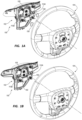
- FIGS. 1A and 1B depict an assembly 100 comprising an airbag module 102 configured to be coupled to a steering wheel 104 according to some embodiments.
- a coupling assembly may be provided to facilitate mounting or otherwise coupling of airbag module 102, which comprises an inflator 105, to steering wheel 104, which may comprise one or more mounting interfaces, such as mounting interfaces 110A and 110B shown in these figures. It should be understood that these mounting interfaces would typically comprise certain elements from both airbag module 102 and other elements on steering wheel 104. However, as those of ordinary skill in the art will appreciate, the depicted elements may be positioned at alternative locations as desired. For example, although most of the elements are shown in the exploded views of FIGS.
- one or more of the elements shown on airbag module 102 may instead be positioned on steering wheel 104, and vice versa.
- one or more of the mounting elements depicted and discussed in greater detail below may be overmolded to, for example, a horn plate or another portion of steering wheel 104.
- FIGS. 1-2 further comprises a plurality of spring clips 150 each configured to couple to one mounting interface 110 to lock airbag module 102 to steering wheel 104.
- any number of such mounting interfaces 110 may be used.
- a single, preferably centralized mounting interface 110 may be sufficient to secure airbag module 102 in place.
- four such mounting interfaces 110 may be used, or any other number as desired.
- FIG. 1A depicts spring clips 150 detached from their respective mounting interfaces 110 and FIG. 1B depicts them secured in place.
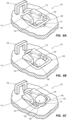
- FIGS. 3A and 3B depict close-up views of a mounting interface 110 with spring clip 150 positioned therein.
- spring clip 150 may, in some embodiments, comprise four legs or sides extending about an open center region.
- a coupling prong 160 or other protruding coupling member may be inserted within this center region during assembly to lock the spring clip 150 in place.
- Spring clip 150 comprises a first leg/side 152 that extends opposite a second leg/side 154.
- each of these legs/sides comprises a first portion that extends parallel to the corresponding opposite leg/side and then angels towards one another at an acute angle ⁇ , which may be between about 20 and about 40 degrees in some embodiments. In more preferred embodiments, angle ⁇ , may be between about 20 and about 40 degrees
- opposing legs 152/154 are symmetrical, both with respect to a central axis of spring clip 150 and about a central axis of mounting interface 110.
- spring clip 150 is preferably formed such that each of the various sides extends parallel to one another in the same plane but, as described herein and depicted in the accompanying figures, may be angled towards one another within this plane.
- Opposing sides/legs 152 and 154 are connected along a third side/leg 156, which may extend perpendicular, or at least substantially perpendicular, to sides/legs 152 and/or 154.
- a partial side/leg 158 may be provided, which, as discussed below, may provide for an interface with a tool that may be used to release spring clip 150 and thereby release an airbag module from a steering wheel or another mounting surface/element of a vehicle.
- spring 150 defines a trapezoid in shape.
- the tool interface region is outside of the aforementioned open/central region within which the prong 160 extends to lock the spring clip 150 in place.
- the mounting interface 110 comprises an opening 111 and one or more surrounding guiding/mounting features for guiding spring 150 and/or locking spring 150 into place.
- a first mounting structure 112 is provided on one side of interface 110 and a second mounting structure 114 is provided on the opposite side.
- mounting structure 112 is configured to engage the angled leg 154 of spring 150 and, similarly, mounting structure 114 is configured to engage the angled portion of leg 152 of spring 150.
- mounting structures 112/114 may comprise various features/surfaces to facilitate desired flexing/movement of spring 150 during assembly and/or disassembly.
- an angled surface may be provided that may engage an angled surface of one of the sides of spring 150 to inhibit rotation of that side while the opposite side has a point contact to facilitate rotation of just one side of spring 150 during installation.
- one or both of mounting structures 112/114 may comprise an overhang defining an underlying recessed region to allow spring 150 to flex over the overhang and seat within the recess defined thereunder to secure spring 150 in place and prevent unintentional disassembly.
- guiding/mounting structures 116 and 118 are provided opposite one another on opposing sides of opening 111. Structures 116 may keep spring 150 in position and guide it back and forth during various stages of installation/assembly, as discussed throughout this disclosure. As shown in FIG. 3B , once spring 150 is in place using one or more of the aforementioned guiding/mounting structures, a coupling prong 160, which may extend from and be a part of either airbag module 102 or steering wheel 104, may be extended through opening 111 to secure the airbag module 102 to the steering wheel 104 or, in other embodiments, to secure an airbag module to another suitable location within a vehicle.
- An adjacent structure 119 may also be provided if desired, which may be used to guide a tool for uninstalling airbag module 102 and/or may be used to confine spring 150, such as to prevent spring 150 from translating too far in the absence of the presence of prong 160.
- structure 119 may, in some embodiments, comprise a central opening to allow a tool to extend therethrough. The walls defining the opening may be used to engage spring 150 during use to, again, inhibit undue translation of spring 150 during installation.
- FIGS. 4A and 4B illustrate possible steps for uninstallation of airbag module 102 from steering wheel 104.
- a tool 50 may be used to contact leg 158 and to apply a force (downward from the perspective of these figures, as indicated by the arrow in FIG. 4A ) to allow spring 150 to translate away from prong 160 to allow prong 160 to be removed.
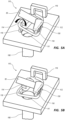
- FIGS. 5A and 5B illustrate steps involved in coupling of spring 150 to interface 110.
- spring 150 may initially be positioned about one side of interface 110, namely, mounting structure 112.
- Spring 150 may then be rotated so that the leg opposite the leg contacting mounting structure 112 rotates about the opposite mounting structure 114, as indicated by the arrow in FIG. 5A .
- linear contact is maintained between spring 150 on this side and mounting structure 112 so as provide a pivoting surface to inhibit rotation of a first side of the spring 150 as a second side of the spring 150 opposite the first side rotates.
- coupling of spring 150 to interface 110 involves both a translational and a rotational movement.
- a tool 55 may be used to facilitate this coupling procedure.
- prongs 160 may be extended through openings 111 to secure the mounting of, for example, airbag module 102 to steering wheel 104.
- FIGS. 6A-6C These steps are illustrated in FIGS. 6A-6C .
- interface 110 is configured to lock spring clip 150 in place and to, as shown in FIGS. 6A-6C , only allow for a translation of the spring clip 150 to accommodate a pin/prong 160 to lock two structures in place, such as an airbag module to a steering wheel.
- FIG. 6A depicts the initial stage of this process in which spring clip 150 is positioned and confined about structures 112-18. As also shown in this figure, spring clip 150 partially extends over opening 111, which allows prong 160, during entry therethrough, to automatically reposition spring clip 150 to accommodate prong 160 and then, as discussed below, automatically slide back into place to lock prong 160 therein.
- prong 160 may comprise a ramped tip 162 configured to translate the spring clip 150 during assembly.
- prong 160 may further comprise a recessed and/or hooked portion 164 adjacent to the ramped tip 162. Hooked portion 164 may be configured to receive a portion of the spring clip 150 after the ramped tip 162 has extended past the spring clip 150 during assembly to allow the spring clip 150 to translate back towards its initial configuration and lock into place.
- FIG. 6B depicts the aforementioned engagement of the ramped tip 162 of prong 160 with spring clip 150 as prong 160 is advanced through opening 111. Due to the overlap of spring clip 150 with opening 111 and the ramped tip 162 of prong 160, advancement of prong 160 therethrough results in a translation of spring clip 150 towards the bottom of mounting interface 110, as shown in FIG. 6B . Once prong 160 has been advanced to the point where spring clip 150 is able to seat within the adjacent recess/hooked portion 164 of prong 160, spring clip 150 then translates back in the opposite direction to allow prong 160 to lock spring clip 150 in place.
Landscapes
- Engineering & Computer Science (AREA)
- Mechanical Engineering (AREA)
- Chemical & Material Sciences (AREA)
- Combustion & Propulsion (AREA)
- Transportation (AREA)
- Air Bags (AREA)
Description
- Airbag cushions are often assembled within steering wheels. However, in newer vehicles, steering wheels tend to incorporate more features and associated airbag modules are often more compact. Thus, it is important for airbag module interfaces to provide a small footprint and/or to otherwise impact the space and/or design of other features as minimally as possible. In addition, the ability to quickly and easily couple, and in some cases decouple, an airbag module to a steering wheel may be important.
-
FR 2 790 044 A1 - In some embodiments, the inventive concepts disclosed herein may therefore provide a coupling interface/assembly having a relatively small footprint and/or one that is simple, easy to use, and/or provides the ability to uncouple the assembly for servicing and/or replacement of the airbag module as needed.
- The coupling assembly for coupling a driver airbag module to a steering wheel according to the invention comprises a spring, such as a spring clip, which defines a perimeter, in some embodiments within a single plane, that comprises at least three sides and/or legs. A first side/leg of the at least three sides/legs extends opposite from a second side/leg of the at least three sides/legs. The first side/le is at least partially angled towards the second side/leg of the spring at an acute angle, such as an angle of between about 20 and about 40 degrees. The first and second sides/legs of the spring are connected along a third side/leg of the at least three sides/legs of the spring. The assembly may further comprise a spring mounting structure, which may be configured to provide a guiding interface for coupling the spring to the steering wheel.
- In some embodiments, the spring mounting structure may comprise a linear interface surface configured to engage the first side/leg of the spring to inhibit rotation of the first side/leg of the spring as the second side/leg of the spring rotates during assembly. In some such embodiments, once the spring has been seated within the spring mounting structure, the spring may be configured to inhibit further rotation but allow a translation of the spring. Such translation may be provided by simply inserting a prong or other protruding member through the opening to engage the spring.
- In some embodiments, the third side/leg may extend from the first and second sides/legs of the spring at an at least substantially perpendicular angle. In some embodiments, the third side/leg may extend from the first and/or second sides/legs of the spring at an angle between about 70 and about 90 degrees. Of course, this angle need not be perpendicular, nor at least substantially perpendicular, in other embodiments.
- In some embodiments, the first and/or second sides/legs of the spring may each comprise a straight portion extending from the third side/leg at the at least substantially perpendicular angle and an angled portion extending from the straight portion. The angled portions of the first and second sides/legs may be angled towards one another.
- In some embodiments, the spring may further comprise a fourth side/leg opposite the third side/leg, which may extend at least substantially parallel to the third side/leg so as to at least substantially define a trapezoid in shape. In some embodiments, the first side/leg may be symmetrical with the second side/leg about an axis of the spring extending between the third side/leg and the fourth side/leg.
- In some embodiments, the airbag module and/or the steering wheel may comprise a plurality of springs and a plurality of corresponding spring mounting structures.
- In an example of an airbag assembly according to some embodiments, the assembly may comprise an airbag module and one or more mounting interfaces for coupling the airbag module to a vehicle structure. The mounting interface may comprise opposing mounting structures and/or surfaces. The assembly may further comprise one or more springs configured to engage the mounting interface(s). Each spring may define a perimeter comprising at least three sides and/or legs. The assembly may further comprise one or more coupling prongs each configured to engage a spring to secure the airbag module to the mounting interface. The coupling prong(s) may be configured to engage one or more of the at least three sides and/or legs and translate the spring(s) during securement of the airbag module to the mounting interface in a first direction.
- In some embodiments, the airbag module may comprise a driver airbag module and the vehicle structure may comprise a vehicle steering wheel. The opposing mounting surfaces may be defined by opposing mounting structures of the mounting interface.
- In some embodiments, the coupling prong(s) may be attached to and/or extend from the airbag module. The coupling prong(s) may comprise a ramped tip and/or otherwise be configured to translate the spring during securement of the airbag module to the mounting interface. In some embodiments, the coupling prong(s) may further comprise a hooked and/or recessed portion adjacent to the ramped tip. The hooked/recessed portion may be configured to receive a portion of the spring after the ramped tip has extended past the spring to allow the spring to translate in a second direction distinct from the first direction. In some such embodiments, the second direction may be opposite, or at least substantially opposite, from the first direction.
- In other embodiments, the coupling prong(s) may be attached to and/or extend from a portion of the vehicle, such as the steering wheel.
- In some embodiments, the mounting interface(s) may comprise an opening configured to receive a coupling prong. In some such embodiments, the opening may be positioned such that the coupling prong extends into a central region of the spring defined by the perimeter of the spring, and the opening may at least partially overlap with a position of the spring when the spring is coupled with the mounting interface to allow the coupling prong to contact and move the spring during assembly.
- In an example of a method for coupling a driver airbag module with a steering wheel according to some implementations, the method may comprise coupling a spring to a mounting interface. The spring may define a perimeter, which, in some embodiments, may comprise at least three sides. The step of coupling the spring to the mounting interface may comprise engaging a first side of the spring with a first surface of the mounting interface while rotating a second side of the spring opposite the first side. The method may further comprise inserting a coupling prong through an opening formed in the mounting interface, which may translate the spring in a first direction and then in a second direction, which may be opposite, or at least substantially opposite, the first direction.
- In some implementations, the coupling prong may comprise a ramped tip. IN some such implementations, the step of inserting the coupling prong through the opening formed in the mounting interface may comprise engaging a third side of the spring extending between the first and second sides of the spring with a surface of the ramped tip.
- In some implementations, the coupling prong may further comprise a hooked portion adjacent to the ramped tip, and the step of inserting the coupling prong through the opening formed in the mounting interface may further comprise allowing the spring to extend into the hooked portion after the ramped tip has extended past the spring to allow the spring to translate in the second direction.
- In some implementations, the first surface may comprise a flat surface, and the step of coupling the spring to the mounting interface may comprise engaging the first side of the spring with the flat surface of the mounting interface to prevent rotation of the first side of the spring while the second side of the spring pivots about a second surface of the mounting interface.
- Some implementations may further comprise releasing the driver airbag module from the steering wheel, which may take place, for example, by translating the spring away from the coupling prong and withdrawing the coupling prong from the opening.
- The spring may, in some embodiments and implementations, comprise a third side and/or leg extending between the first and second sides/legs. The third side/leg may engage the coupling prong during the step of inserting the coupling prong through the opening formed in the mounting interface. In some embodiments and implementations, the spring may further comprise a fourth side/leg opposite the third side/leg. In some such implementations, the step of releasing the driver airbag module from the steering wheel may comprise engaging the fourth side to translate the spring away from the coupling prong.
- The features, structures, steps, or characteristics disclosed herein in connection with one embodiment may be combined in any suitable manner in one or more alternative embodiments.
- Non-limiting and non-exhaustive embodiments of the disclosure are described, including various embodiments of the disclosure with reference to the figures, in which:
-
FIG. 1A is an exploded view of an airbag module and a mounting interface for coupling the airbag module to a steering wheel according to some embodiments; -
FIG. 1B depicted the airbag module and mounting interface ofFIG. 1A with mounting spring clips coupled to the mounting interface; -
FIG. 2 is a plan view of the airbag module and mounting interface ofFIGS. 1A and 1B ; -
FIG. 3A is a close-up view of a mounting interface and spring clip with various elements of the mounting interface shown in phantom to allow for viewing of contact interfaces between the spring clip and mounting structures of the mounting interface; -
FIG. 3B depicts the mounting interface and spring clip following engagement between the spring clip and a hooked prong; -
FIGS. 4A and 4B depict a tool being used to disengage the spring clip from the hooked prong to allow for disassembly of an airbag module with a steering wheel or other vehicle structure; -
FIGS. 5A and 5B depict steps in a method for coupling a spring clip to a mounting interface; and -
FIGS 6A-6C depict steps in a method for coupling a hooked prong to a spring clip seated within a mounting interface. - A detailed description of apparatus, systems, and methods consistent with various embodiments of the present disclosure is provided below. While several embodiments are described, it should be understood that the disclosure is not limited to any of the specific embodiments disclosed, but instead encompasses numerous alternatives, modifications, and equivalents. In addition, while numerous specific details are set forth in the following description in order to provide a thorough understanding of the embodiments disclosed herein, some embodiments can be practiced without some or all of these details. Moreover, for the purpose of clarity, certain technical material that is known in the related art has not been described in detail in order to avoid unnecessarily obscuring the disclosure.
- As used herein, the term "substantially" refers to the complete or nearly complete extent or degree of an action, characteristic, property, state, structure, item, or result to function as indicated. For example, an object that is "substantially" cylindrical or "substantially" perpendicular would mean that the object/feature is either cylindrical/perpendicular or nearly cylindrical/perpendicular so as to result in the same or nearly the same function. The exact allowable degree of deviation provided by this term may depend on the specific context. The use of "substantially" is equally applicable when used in a negative connotation to refer to the complete or near complete lack of an action, characteristic, property, state, structure, item, or result. For example, structure which is "substantially free of" a bottom would either completely lack a bottom or so nearly completely lack a bottom that the effect would be effectively the same as if it completely lacked a bottom.
- Similarly, as used herein, the term "about" is used to provide flexibility to a numerical range endpoint by providing that a given value may be "a little above" or "a little below" the endpoint while still accomplishing the function associated with the range.
- The embodiments of the disclosure may be best understood by reference to the drawings, wherein like parts may be designated by like numerals. It will be readily understood that the components of the disclosed embodiments, as generally described and illustrated in the figures herein, could be arranged and designed in a wide variety of different configurations. Thus, the following detailed description of the embodiments of the apparatus and methods of the disclosure is not intended to limit the scope of the disclosure, as claimed, but is merely representative of possible embodiments of the disclosure. In addition, the steps of a method do not necessarily need to be executed in any specific order, or even sequentially, nor need the steps be executed only once, unless otherwise specified. Additional details regarding certain preferred embodiments and implementations will now be described in greater detail with reference to the accompanying drawings.
-
FIGS. 1A and 1B depict anassembly 100 comprising anairbag module 102 configured to be coupled to asteering wheel 104 according to some embodiments. A coupling assembly may be provided to facilitate mounting or otherwise coupling ofairbag module 102, which comprises an inflator 105, tosteering wheel 104, which may comprise one or more mounting interfaces, such as mountinginterfaces airbag module 102 and other elements onsteering wheel 104. However, as those of ordinary skill in the art will appreciate, the depicted elements may be positioned at alternative locations as desired. For example, although most of the elements are shown in the exploded views ofFIGS. 1A and 1B as being part ofairbag module 102, one or more of the elements shown onairbag module 102 may instead be positioned onsteering wheel 104, and vice versa. In some embodiments, for example, one or more of the mounting elements depicted and discussed in greater detail below may be overmolded to, for example, a horn plate or another portion ofsteering wheel 104. - The embodiment depicted in
FIGS. 1-2 further comprises a plurality of spring clips 150 each configured to couple to one mountinginterface 110 to lockairbag module 102 tosteering wheel 104. It should also be understood, however, that any number of such mountinginterfaces 110 may be used. For example, in some embodiments, a single, preferably centralized mountinginterface 110 may be sufficient to secureairbag module 102 in place. In other embodiments, four such mountinginterfaces 110 may be used, or any other number as desired.FIG. 1A depicts spring clips 150 detached from theirrespective mounting interfaces 110 andFIG. 1B depicts them secured in place. It should be understood, however, that typically the pins, prongs or other coupling members to which spring clips 150 are coupled would either extend fromairbag module 102 orsteering wheel 104 and therefore the prongs depicted inFIG. 1-2 are shown detached in these figures and/or the interface itself is shown detached in these figures for ease of illustration, as should be apparent from the more detailed discussion below. -
FIGS. 3A and 3B depict close-up views of a mountinginterface 110 withspring clip 150 positioned therein. As shown in these figures,spring clip 150 may, in some embodiments, comprise four legs or sides extending about an open center region. As discussed further below, acoupling prong 160 or other protruding coupling member may be inserted within this center region during assembly to lock thespring clip 150 in place. -
Spring clip 150 comprises a first leg/side 152 that extends opposite a second leg/side 154. In the depicted embodiment, each of these legs/sides comprises a first portion that extends parallel to the corresponding opposite leg/side and then angels towards one another at an acute angle β, which may be between about 20 and about 40 degrees in some embodiments. In more preferred embodiments, angle β, may be between about 20 and about 40 degrees It can also be seen that, in preferred embodiments including the depicted embodiment, opposinglegs 152/154 are symmetrical, both with respect to a central axis ofspring clip 150 and about a central axis of mountinginterface 110. It can also be seen thatspring clip 150 is preferably formed such that each of the various sides extends parallel to one another in the same plane but, as described herein and depicted in the accompanying figures, may be angled towards one another within this plane. - Opposing sides/
legs legs 152 and/or 154. Opposite side/leg 156, a partial side/leg 158 may be provided, which, as discussed below, may provide for an interface with a tool that may be used to releasespring clip 150 and thereby release an airbag module from a steering wheel or another mounting surface/element of a vehicle. Thus, in the depicted embodiment,spring 150 defines a trapezoid in shape. In addition, the tool interface region is outside of the aforementioned open/central region within which theprong 160 extends to lock thespring clip 150 in place. - The mounting
interface 110 comprises anopening 111 and one or more surrounding guiding/mounting features for guidingspring 150 and/or lockingspring 150 into place. In particular, as shown inFIG. 3B , afirst mounting structure 112 is provided on one side ofinterface 110 and asecond mounting structure 114 is provided on the opposite side. Thus, mountingstructure 112 is configured to engage theangled leg 154 ofspring 150 and, similarly, mountingstructure 114 is configured to engage the angled portion ofleg 152 ofspring 150. One or both of these mountingstructures 112/114 may comprise various features/surfaces to facilitate desired flexing/movement ofspring 150 during assembly and/or disassembly. For example, as discussed in greater detail below, an angled surface may be provided that may engage an angled surface of one of the sides ofspring 150 to inhibit rotation of that side while the opposite side has a point contact to facilitate rotation of just one side ofspring 150 during installation. Similarly, one or both of mountingstructures 112/114 may comprise an overhang defining an underlying recessed region to allowspring 150 to flex over the overhang and seat within the recess defined thereunder to securespring 150 in place and prevent unintentional disassembly. - Other guiding features may also be provided if desired. For example, in the depicted embodiment, guiding/mounting
structures opening 111.Structures 116 may keepspring 150 in position and guide it back and forth during various stages of installation/assembly, as discussed throughout this disclosure. As shown inFIG. 3B , oncespring 150 is in place using one or more of the aforementioned guiding/mounting structures, acoupling prong 160, which may extend from and be a part of eitherairbag module 102 orsteering wheel 104, may be extended throughopening 111 to secure theairbag module 102 to thesteering wheel 104 or, in other embodiments, to secure an airbag module to another suitable location within a vehicle. Anadjacent structure 119 may also be provided if desired, which may be used to guide a tool for uninstallingairbag module 102 and/or may be used to confinespring 150, such as to preventspring 150 from translating too far in the absence of the presence ofprong 160. As shown inFIGS. 5A and 5B ,structure 119 may, in some embodiments, comprise a central opening to allow a tool to extend therethrough. The walls defining the opening may be used to engagespring 150 during use to, again, inhibit undue translation ofspring 150 during installation. -
FIGS. 4A and 4B illustrate possible steps for uninstallation ofairbag module 102 fromsteering wheel 104. In particular, atool 50 may be used to contactleg 158 and to apply a force (downward from the perspective of these figures, as indicated by the arrow inFIG. 4A ) to allowspring 150 to translate away fromprong 160 to allowprong 160 to be removed. -
FIGS. 5A and 5B illustrate steps involved in coupling ofspring 150 tointerface 110. As shown inFIG. 5A ,spring 150 may initially be positioned about one side ofinterface 110, namely, mountingstructure 112.Spring 150 may then be rotated so that the leg opposite the leg contacting mountingstructure 112 rotates about theopposite mounting structure 114, as indicated by the arrow inFIG. 5A . As indicated by the dashed line inFIG. 5A , preferably, linear contact is maintained betweenspring 150 on this side and mountingstructure 112 so as provide a pivoting surface to inhibit rotation of a first side of thespring 150 as a second side of thespring 150 opposite the first side rotates. Thus, coupling ofspring 150 to interface 110 involves both a translational and a rotational movement. Optionally, atool 55 may be used to facilitate this coupling procedure. - Once the
spring clip 150 is in place, properly confined by the various mounting/guiding structures ofinterface 110,prongs 160 may be extended throughopenings 111 to secure the mounting of, for example,airbag module 102 tosteering wheel 104. These steps are illustrated inFIGS. 6A-6C . It should be understood, that, as described elsewhere herein,interface 110 is configured to lockspring clip 150 in place and to, as shown inFIGS. 6A-6C , only allow for a translation of thespring clip 150 to accommodate a pin/prong 160 to lock two structures in place, such as an airbag module to a steering wheel. -
FIG. 6A depicts the initial stage of this process in whichspring clip 150 is positioned and confined about structures 112-18. As also shown in this figure,spring clip 150 partially extends overopening 111, which allowsprong 160, during entry therethrough, to automatically repositionspring clip 150 to accommodateprong 160 and then, as discussed below, automatically slide back into place to lockprong 160 therein. - As best seen in
FIG. 6C , in some embodiments,prong 160 may comprise a rampedtip 162 configured to translate thespring clip 150 during assembly. Similarly,prong 160 may further comprise a recessed and/or hookedportion 164 adjacent to the rampedtip 162.Hooked portion 164 may be configured to receive a portion of thespring clip 150 after the rampedtip 162 has extended past thespring clip 150 during assembly to allow thespring clip 150 to translate back towards its initial configuration and lock into place. - In particular,
FIG. 6B depicts the aforementioned engagement of the rampedtip 162 ofprong 160 withspring clip 150 asprong 160 is advanced throughopening 111. Due to the overlap ofspring clip 150 withopening 111 and the rampedtip 162 ofprong 160, advancement ofprong 160 therethrough results in a translation ofspring clip 150 towards the bottom of mountinginterface 110, as shown inFIG. 6B . Onceprong 160 has been advanced to the point wherespring clip 150 is able to seat within the adjacent recess/hookedportion 164 ofprong 160,spring clip 150 then translates back in the opposite direction to allowprong 160 to lockspring clip 150 in place. Because of the angled portions ofspring clip 150 and their engagement with the various guiding/mounting elements ofinterface 110, the translation ofspring clip 150 in the downward direction results in a force/bias in the opposite direction so that, as soon asspring clip 150 has advanced past the surface of rampedtip 162, this translation/movement in the opposite direction takes place automatically, and results in the final configuration depicted inFIG. 6C in whichprong 160 is locked into place, thereby lockingairbag module 102 into place vis-à-vissteering wheel 104. Of course, although only onespring clip 150, oneprong 160, and one corresponding mountinginterface 110 is shown inFIGS. 6A-6C , it should be understood that multiple similar or identical spring clips, prongs, and mounting interfaces may be provided, each of which may be coupled simultaneously to provide this coupling/mounting. - The foregoing specification has been described with reference to various embodiments and implementations. However, one of ordinary skill in the art will appreciate that various modifications and changes can be made without departing from the scope of the present disclosure. For example, various operational steps, as well as components for carrying out operational steps, may be implemented in various ways depending upon the particular application or in consideration of any number of cost functions associated with the operation of the system. Accordingly, any one or more of the steps may be deleted, modified, or combined with other steps. Further, this disclosure is to be regarded in an illustrative rather than a restrictive sense, and all such modifications are intended to be included within the scope thereof. Likewise, benefits, other advantages, and solutions to problems have been described above with regard to various embodiments. However, benefits, advantages, solutions to problems, and any element(s) that may cause any benefit, advantage, or solution to occur or become more pronounced, are not to be construed as a critical, a required, or an essential feature or element.
- Those having skill in the art will appreciate that many changes may be made to the details of the above-described embodiments without departing from the underlying principles of the invention. The scope of the present invention should, therefore, be determined only by the following claims.
Claims (6)
- A driver airbag assembly, comprising:a driver airbag module [102];a mounting interface [110] for coupling the driver airbag module [102] to a steering wheel [104], wherein the mounting interface [110] comprises:opposing mounting surfaces;a spring [150] configured to engage the mounting interface [110], wherein the spring [150] defines a perimeter comprising at least three sides [152, 154, 156], namely a first side [152], a second side [152], and a third side [156], wherein the first side [152] of the at least three sides [152, 154, 156] extends opposite from the second side [154] of the at least three sides [152, 154, 156] and wherein the first and second sides [152, 154] of the spring [150] are connected along the third side [156] of the at least three sides of the spring [156]; anda coupling prong [160] configured to engage the spring [150] to secure the airbag module [102] to the mounting interface [110], wherein the coupling prong [160] is configured to engage one of the at least three sides [152, 154, 156];characterized in that the first side [152] is least partially angled towards the second side [154] of the spring [150] at an acute angle; andthe coupling prong is configured to engage the third side [156] of the spring [150] during installation and translate the spring [150] during securement of the airbag module [102] to the mounting interface [110] in a first direction.
- The airbag assembly of any of claim 1, wherein the opposing mounting surfaces are defined by separate mounting structures of the mounting interface [110].
- The airbag assembly of any of claims 1-2, wherein the coupling prong [160] extends from the airbag module [102].
- The airbag assembly of any of claims 1-3, wherein the coupling prong [160] comprises a ramped tip [162] configured to translate the spring [150] during securement of the airbag module [102] to the mounting interface [110].
- The airbag assembly of claim 4, wherein the coupling prong [160] further comprises a hooked portion [164] adjacent to the ramped tip [162], and wherein the hooked portion [164] is configured to receive a portion of the spring [150] after the ramped tip [162] has extended past the spring [150] to allow the spring [150] to translate in a second direction distinct from the first direction.
- The airbag assembly of any of claims 1-5, further comprising an opening [111] configured to receive a coupling prong [160], wherein the opening [111] is positioned such that the coupling prong [160] extends into a central region of the spring [150] defined by the perimeter, and wherein the opening [111] at least partially overlaps with a position of the spring [150] when the spring [150] is coupled with the mounting interface [111].
Applications Claiming Priority (2)
| Application Number | Priority Date | Filing Date | Title |
|---|---|---|---|
| US16/709,104 US11383665B2 (en) | 2019-12-10 | 2019-12-10 | Driver airbag module coupling assemblies |
| PCT/US2020/063850 WO2021119038A1 (en) | 2019-12-10 | 2020-12-08 | Driver airbag module coupling assemblies |
Publications (2)
| Publication Number | Publication Date |
|---|---|
| EP4072905A1 EP4072905A1 (en) | 2022-10-19 |
| EP4072905B1 true EP4072905B1 (en) | 2023-10-04 |
Family
ID=73943377
Family Applications (1)
| Application Number | Title | Priority Date | Filing Date |
|---|---|---|---|
| EP20828926.4A Active EP4072905B1 (en) | 2019-12-10 | 2020-12-08 | Driver airbag module coupling assemblies |
Country Status (5)
| Country | Link |
|---|---|
| US (1) | US11383665B2 (en) |
| EP (1) | EP4072905B1 (en) |
| KR (1) | KR102827486B1 (en) |
| CN (1) | CN114641413B (en) |
| WO (1) | WO2021119038A1 (en) |
Families Citing this family (3)
| Publication number | Priority date | Publication date | Assignee | Title |
|---|---|---|---|---|
| FR3098166B1 (en) * | 2019-07-04 | 2024-10-25 | Autoliv Dev | Removable mounting device for an airbag module on a steering wheel |
| JP7815561B2 (en) * | 2022-04-01 | 2026-02-18 | Joyson Safety Systems Japan合同会社 | Steering wheel |
| WO2024171688A1 (en) * | 2023-02-15 | 2024-08-22 | オートリブ ディベロップメント エービー | Vehicle steering wheel device |
Family Cites Families (31)
| Publication number | Priority date | Publication date | Assignee | Title |
|---|---|---|---|---|
| US5380037A (en) * | 1993-10-25 | 1995-01-10 | General Motors Corporation | Snap-in inflatable restraint module mounting mechanism including latch elements |
| FR2790044B1 (en) * | 1999-02-19 | 2001-05-25 | Gersteen Iso Delta | VEHICLE STEERING WHEEL ELEMENT AND STEERING WHEEL COMPRISING THIS ELEMENT |
| DE10030471C1 (en) * | 2000-06-21 | 2001-07-26 | Bosch Gmbh Robert | Automobile airbag module has mechanical locking device and electrical contact device for connecting gas generator detonation device to control device |
| EP1418095B1 (en) * | 2000-06-27 | 2006-04-26 | Toyoda Gosei Co., Ltd. | Steering wheel with an airbag device |
| FR2812606B1 (en) | 2000-08-02 | 2002-10-31 | Autoliv Isodelta | VEHICLE STEERING WHEEL ELEMENT WITH LOCKING SYSTEM, AND STEERING WHEEL COMPRISING SAME |
| DE20017527U1 (en) * | 2000-10-12 | 2001-02-22 | TRW Automotive Safety Systems GmbH & Co. KG, 63743 Aschaffenburg | Vehicle steering wheel |
| US7185915B2 (en) * | 2003-02-27 | 2007-03-06 | Toyoda Gosei Co., Ltd. | Steering wheel incorporating air bag device |
| US7059631B2 (en) | 2003-04-29 | 2006-06-13 | Toyoda Gosei Co., Ltd. | Method and apparatus for coupling a driver's side airbag to a steering wheel |
| DE20307142U1 (en) * | 2003-05-07 | 2003-09-18 | TRW Automotive Safety Systems GmbH, 63743 Aschaffenburg | module |
| US7533897B1 (en) * | 2005-02-16 | 2009-05-19 | Key Safety Systems, Inc. | Method and apparatus for securing an air bag |
| JP4797584B2 (en) | 2005-03-16 | 2011-10-19 | タカタ株式会社 | Steering wheel with airbag device |
| DE502005003191D1 (en) | 2005-03-21 | 2008-04-24 | Delphi Tech Inc | steering wheel assembly |
| GB2433234A (en) * | 2005-12-08 | 2007-06-20 | Autoliv Dev | A mounting arrangement for an airbag |
| KR20080026822A (en) * | 2006-09-21 | 2008-03-26 | 현대모비스 주식회사 | Driver's seat airbag module mounting structure |
| JP4758390B2 (en) | 2007-05-09 | 2011-08-24 | トヨタ自動車株式会社 | Knee airbag device with column and its assembly method |
| JP5153526B2 (en) * | 2008-02-01 | 2013-02-27 | 本田技研工業株式会社 | Steering wheel vibration reduction structure |
| DE102008013526B4 (en) * | 2008-03-07 | 2012-02-02 | Autoliv Development Ab | Safety arrangement and method for producing a safety arrangement |
| JP5497485B2 (en) * | 2010-03-04 | 2014-05-21 | 芦森工業株式会社 | Airbag device |
| JP5206756B2 (en) * | 2010-09-30 | 2013-06-12 | 豊田合成株式会社 | Steering wheel with airbag device |
| JP5714125B2 (en) * | 2011-11-30 | 2015-05-07 | オートリブ ディベロップメント エービー | Front airbag device |
| JP5826658B2 (en) * | 2012-02-07 | 2015-12-02 | タカタ株式会社 | Air bag device and horn switch device |
| DE102014001821A1 (en) * | 2014-02-13 | 2015-08-13 | Dalphi Metal Espana, S.A. | Device for positioning an airbag module in a motor vehicle |
| EP2910425B1 (en) * | 2014-02-20 | 2020-08-05 | Dalphi Metal España, S.A. | Horn circuit |
| EP3178707B1 (en) * | 2015-12-08 | 2018-07-18 | Autoliv Development AB | Steering wheel |
| WO2017214214A2 (en) * | 2016-06-10 | 2017-12-14 | Key Safety Systems, Inc. | Air bag module |
| JP2017222281A (en) * | 2016-06-16 | 2017-12-21 | 豊田合成株式会社 | Attachment structure of airbag device for driver seat |
| US11034374B2 (en) * | 2017-08-10 | 2021-06-15 | Toyoda Gosei Co., Ltd. | Steering wheel |
| DE102017119886A1 (en) * | 2017-08-30 | 2019-02-28 | Trw Automotive Safety Systems Gmbh | SPRING ELEMENT FOR FASTENING A GASSACK MODULE TO A VEHICLE WHEEL AND A STEERING WHEEL ASSEMBLY WITH SUCH A SPRING ELEMENT |
| DE102018102755A1 (en) * | 2018-02-07 | 2019-08-08 | Autoliv Development Ab | Airbag module, method for producing a gas bag module and steering wheel |
| US10926698B2 (en) * | 2018-12-17 | 2021-02-23 | Key Safety Systems, Inc. | Integrated steering wheel, vibration absorber, and driver airbag |
| US11518334B2 (en) * | 2019-06-24 | 2022-12-06 | Joyson Safety Systems Acquisition Llc | Methods and systems for pre-fixing an airbag module during installation |
-
2019
- 2019-12-10 US US16/709,104 patent/US11383665B2/en active Active
-
2020
- 2020-12-08 WO PCT/US2020/063850 patent/WO2021119038A1/en not_active Ceased
- 2020-12-08 EP EP20828926.4A patent/EP4072905B1/en active Active
- 2020-12-08 CN CN202080077218.0A patent/CN114641413B/en active Active
- 2020-12-08 KR KR1020227022983A patent/KR102827486B1/en active Active
Also Published As
| Publication number | Publication date |
|---|---|
| US11383665B2 (en) | 2022-07-12 |
| KR20220108151A (en) | 2022-08-02 |
| EP4072905A1 (en) | 2022-10-19 |
| WO2021119038A1 (en) | 2021-06-17 |
| KR102827486B1 (en) | 2025-07-02 |
| US20210170979A1 (en) | 2021-06-10 |
| CN114641413B (en) | 2023-11-10 |
| CN114641413A (en) | 2022-06-17 |
Similar Documents
| Publication | Publication Date | Title |
|---|---|---|
| EP4072905B1 (en) | Driver airbag module coupling assemblies | |
| CN111287029B (en) | Track assembly | |
| CN102245436B (en) | Device for fixing interior trim panel of vehicle | |
| JP2004323010A (en) | Method and device for connecting airbag on driver side with steering wheel | |
| US8584319B1 (en) | Self-aligning hinge | |
| KR20010040601A (en) | Turn fastener | |
| WO2009118936A1 (en) | Clip | |
| JP2018521272A (en) | Device for holding components | |
| US20190072127A1 (en) | One-hand operable end fitting connector assembly | |
| US5919057A (en) | Removable main connector | |
| US11591000B2 (en) | Steering apparatus assembly for a motor vehicle | |
| KR20190094220A (en) | Fastener assembly | |
| US11932192B2 (en) | Fastening strap clamp assembly | |
| US20070040404A1 (en) | Vehicle trim locating and attachment system | |
| US12454971B2 (en) | Cover fastening system for a vehicle | |
| US20220341457A1 (en) | Fasteners | |
| CN111596741A (en) | Server casing | |
| US9708838B2 (en) | Vehicle door handle device | |
| CN220060774U (en) | Y-valve base for interventional operation robot and interventional operation robot | |
| EP2778444B1 (en) | Retaining spring nutplate | |
| KR101829904B1 (en) | Glove box stopper | |
| JP3571868B2 (en) | Movable mounting device | |
| US12300935B2 (en) | Fool-proofing device, electrical connection assembly comprising said improved fool-proofing device and associated assembly method | |
| US11692571B2 (en) | Clip assembly for holding a component during a vehicle assembly/disassembly process | |
| EP3532735B1 (en) | A connection member |
Legal Events
| Date | Code | Title | Description |
|---|---|---|---|
| STAA | Information on the status of an ep patent application or granted ep patent |
Free format text: STATUS: UNKNOWN |
|
| STAA | Information on the status of an ep patent application or granted ep patent |
Free format text: STATUS: THE INTERNATIONAL PUBLICATION HAS BEEN MADE |
|
| PUAI | Public reference made under article 153(3) epc to a published international application that has entered the european phase |
Free format text: ORIGINAL CODE: 0009012 |
|
| STAA | Information on the status of an ep patent application or granted ep patent |
Free format text: STATUS: REQUEST FOR EXAMINATION WAS MADE |
|
| 17P | Request for examination filed |
Effective date: 20220701 |
|
| AK | Designated contracting states |
Kind code of ref document: A1 Designated state(s): AL AT BE BG CH CY CZ DE DK EE ES FI FR GB GR HR HU IE IS IT LI LT LU LV MC MK MT NL NO PL PT RO RS SE SI SK SM TR |
|
| DAV | Request for validation of the european patent (deleted) | ||
| DAX | Request for extension of the european patent (deleted) | ||
| GRAP | Despatch of communication of intention to grant a patent |
Free format text: ORIGINAL CODE: EPIDOSNIGR1 |
|
| STAA | Information on the status of an ep patent application or granted ep patent |
Free format text: STATUS: GRANT OF PATENT IS INTENDED |
|
| INTG | Intention to grant announced |
Effective date: 20230413 |
|
| GRAS | Grant fee paid |
Free format text: ORIGINAL CODE: EPIDOSNIGR3 |
|
| GRAA | (expected) grant |
Free format text: ORIGINAL CODE: 0009210 |
|
| STAA | Information on the status of an ep patent application or granted ep patent |
Free format text: STATUS: THE PATENT HAS BEEN GRANTED |
|
| AK | Designated contracting states |
Kind code of ref document: B1 Designated state(s): AL AT BE BG CH CY CZ DE DK EE ES FI FR GB GR HR HU IE IS IT LI LT LU LV MC MK MT NL NO PL PT RO RS SE SI SK SM TR |
|
| REG | Reference to a national code |
Ref country code: GB Ref legal event code: FG4D |
|
| REG | Reference to a national code |
Ref country code: CH Ref legal event code: EP |
|
| REG | Reference to a national code |
Ref country code: DE Ref legal event code: R096 Ref document number: 602020018801 Country of ref document: DE |
|
| REG | Reference to a national code |
Ref country code: IE Ref legal event code: FG4D |
|
| REG | Reference to a national code |
Ref country code: LT Ref legal event code: MG9D |
|
| REG | Reference to a national code |
Ref country code: NL Ref legal event code: MP Effective date: 20231004 |
|
| REG | Reference to a national code |
Ref country code: AT Ref legal event code: MK05 Ref document number: 1617463 Country of ref document: AT Kind code of ref document: T Effective date: 20231004 |
|
| PG25 | Lapsed in a contracting state [announced via postgrant information from national office to epo] |
Ref country code: NL Free format text: LAPSE BECAUSE OF FAILURE TO SUBMIT A TRANSLATION OF THE DESCRIPTION OR TO PAY THE FEE WITHIN THE PRESCRIBED TIME-LIMIT Effective date: 20231004 |
|
| PG25 | Lapsed in a contracting state [announced via postgrant information from national office to epo] |
Ref country code: GR Free format text: LAPSE BECAUSE OF FAILURE TO SUBMIT A TRANSLATION OF THE DESCRIPTION OR TO PAY THE FEE WITHIN THE PRESCRIBED TIME-LIMIT Effective date: 20240105 |
|
| PG25 | Lapsed in a contracting state [announced via postgrant information from national office to epo] |
Ref country code: IS Free format text: LAPSE BECAUSE OF FAILURE TO SUBMIT A TRANSLATION OF THE DESCRIPTION OR TO PAY THE FEE WITHIN THE PRESCRIBED TIME-LIMIT Effective date: 20240204 |
|
| PG25 | Lapsed in a contracting state [announced via postgrant information from national office to epo] |
Ref country code: LT Free format text: LAPSE BECAUSE OF FAILURE TO SUBMIT A TRANSLATION OF THE DESCRIPTION OR TO PAY THE FEE WITHIN THE PRESCRIBED TIME-LIMIT Effective date: 20231004 |
|
| PG25 | Lapsed in a contracting state [announced via postgrant information from national office to epo] |
Ref country code: AT Free format text: LAPSE BECAUSE OF FAILURE TO SUBMIT A TRANSLATION OF THE DESCRIPTION OR TO PAY THE FEE WITHIN THE PRESCRIBED TIME-LIMIT Effective date: 20231004 |
|
| PG25 | Lapsed in a contracting state [announced via postgrant information from national office to epo] |
Ref country code: ES Free format text: LAPSE BECAUSE OF FAILURE TO SUBMIT A TRANSLATION OF THE DESCRIPTION OR TO PAY THE FEE WITHIN THE PRESCRIBED TIME-LIMIT Effective date: 20231004 |
|
| PG25 | Lapsed in a contracting state [announced via postgrant information from national office to epo] |
Ref country code: LT Free format text: LAPSE BECAUSE OF FAILURE TO SUBMIT A TRANSLATION OF THE DESCRIPTION OR TO PAY THE FEE WITHIN THE PRESCRIBED TIME-LIMIT Effective date: 20231004 Ref country code: IS Free format text: LAPSE BECAUSE OF FAILURE TO SUBMIT A TRANSLATION OF THE DESCRIPTION OR TO PAY THE FEE WITHIN THE PRESCRIBED TIME-LIMIT Effective date: 20240204 Ref country code: GR Free format text: LAPSE BECAUSE OF FAILURE TO SUBMIT A TRANSLATION OF THE DESCRIPTION OR TO PAY THE FEE WITHIN THE PRESCRIBED TIME-LIMIT Effective date: 20240105 Ref country code: ES Free format text: LAPSE BECAUSE OF FAILURE TO SUBMIT A TRANSLATION OF THE DESCRIPTION OR TO PAY THE FEE WITHIN THE PRESCRIBED TIME-LIMIT Effective date: 20231004 Ref country code: BG Free format text: LAPSE BECAUSE OF FAILURE TO SUBMIT A TRANSLATION OF THE DESCRIPTION OR TO PAY THE FEE WITHIN THE PRESCRIBED TIME-LIMIT Effective date: 20240104 Ref country code: AT Free format text: LAPSE BECAUSE OF FAILURE TO SUBMIT A TRANSLATION OF THE DESCRIPTION OR TO PAY THE FEE WITHIN THE PRESCRIBED TIME-LIMIT Effective date: 20231004 Ref country code: PT Free format text: LAPSE BECAUSE OF FAILURE TO SUBMIT A TRANSLATION OF THE DESCRIPTION OR TO PAY THE FEE WITHIN THE PRESCRIBED TIME-LIMIT Effective date: 20240205 |
|
| PG25 | Lapsed in a contracting state [announced via postgrant information from national office to epo] |
Ref country code: SE Free format text: LAPSE BECAUSE OF FAILURE TO SUBMIT A TRANSLATION OF THE DESCRIPTION OR TO PAY THE FEE WITHIN THE PRESCRIBED TIME-LIMIT Effective date: 20231004 Ref country code: RS Free format text: LAPSE BECAUSE OF FAILURE TO SUBMIT A TRANSLATION OF THE DESCRIPTION OR TO PAY THE FEE WITHIN THE PRESCRIBED TIME-LIMIT Effective date: 20231004 Ref country code: PL Free format text: LAPSE BECAUSE OF FAILURE TO SUBMIT A TRANSLATION OF THE DESCRIPTION OR TO PAY THE FEE WITHIN THE PRESCRIBED TIME-LIMIT Effective date: 20231004 Ref country code: NO Free format text: LAPSE BECAUSE OF FAILURE TO SUBMIT A TRANSLATION OF THE DESCRIPTION OR TO PAY THE FEE WITHIN THE PRESCRIBED TIME-LIMIT Effective date: 20240104 Ref country code: LV Free format text: LAPSE BECAUSE OF FAILURE TO SUBMIT A TRANSLATION OF THE DESCRIPTION OR TO PAY THE FEE WITHIN THE PRESCRIBED TIME-LIMIT Effective date: 20231004 Ref country code: HR Free format text: LAPSE BECAUSE OF FAILURE TO SUBMIT A TRANSLATION OF THE DESCRIPTION OR TO PAY THE FEE WITHIN THE PRESCRIBED TIME-LIMIT Effective date: 20231004 |
|
| REG | Reference to a national code |
Ref country code: DE Ref legal event code: R097 Ref document number: 602020018801 Country of ref document: DE |
|
| PG25 | Lapsed in a contracting state [announced via postgrant information from national office to epo] |
Ref country code: DK Free format text: LAPSE BECAUSE OF FAILURE TO SUBMIT A TRANSLATION OF THE DESCRIPTION OR TO PAY THE FEE WITHIN THE PRESCRIBED TIME-LIMIT Effective date: 20231004 |
|
| PG25 | Lapsed in a contracting state [announced via postgrant information from national office to epo] |
Ref country code: CZ Free format text: LAPSE BECAUSE OF FAILURE TO SUBMIT A TRANSLATION OF THE DESCRIPTION OR TO PAY THE FEE WITHIN THE PRESCRIBED TIME-LIMIT Effective date: 20231004 |
|
| PG25 | Lapsed in a contracting state [announced via postgrant information from national office to epo] |
Ref country code: SK Free format text: LAPSE BECAUSE OF FAILURE TO SUBMIT A TRANSLATION OF THE DESCRIPTION OR TO PAY THE FEE WITHIN THE PRESCRIBED TIME-LIMIT Effective date: 20231004 |
|
| PG25 | Lapsed in a contracting state [announced via postgrant information from national office to epo] |
Ref country code: SM Free format text: LAPSE BECAUSE OF FAILURE TO SUBMIT A TRANSLATION OF THE DESCRIPTION OR TO PAY THE FEE WITHIN THE PRESCRIBED TIME-LIMIT Effective date: 20231004 Ref country code: SK Free format text: LAPSE BECAUSE OF FAILURE TO SUBMIT A TRANSLATION OF THE DESCRIPTION OR TO PAY THE FEE WITHIN THE PRESCRIBED TIME-LIMIT Effective date: 20231004 Ref country code: RO Free format text: LAPSE BECAUSE OF FAILURE TO SUBMIT A TRANSLATION OF THE DESCRIPTION OR TO PAY THE FEE WITHIN THE PRESCRIBED TIME-LIMIT Effective date: 20231004 Ref country code: IT Free format text: LAPSE BECAUSE OF FAILURE TO SUBMIT A TRANSLATION OF THE DESCRIPTION OR TO PAY THE FEE WITHIN THE PRESCRIBED TIME-LIMIT Effective date: 20231004 Ref country code: EE Free format text: LAPSE BECAUSE OF FAILURE TO SUBMIT A TRANSLATION OF THE DESCRIPTION OR TO PAY THE FEE WITHIN THE PRESCRIBED TIME-LIMIT Effective date: 20231004 Ref country code: DK Free format text: LAPSE BECAUSE OF FAILURE TO SUBMIT A TRANSLATION OF THE DESCRIPTION OR TO PAY THE FEE WITHIN THE PRESCRIBED TIME-LIMIT Effective date: 20231004 Ref country code: CZ Free format text: LAPSE BECAUSE OF FAILURE TO SUBMIT A TRANSLATION OF THE DESCRIPTION OR TO PAY THE FEE WITHIN THE PRESCRIBED TIME-LIMIT Effective date: 20231004 |
|
| REG | Reference to a national code |
Ref country code: CH Ref legal event code: PL |
|
| PLBE | No opposition filed within time limit |
Free format text: ORIGINAL CODE: 0009261 |
|
| STAA | Information on the status of an ep patent application or granted ep patent |
Free format text: STATUS: NO OPPOSITION FILED WITHIN TIME LIMIT |
|
| PG25 | Lapsed in a contracting state [announced via postgrant information from national office to epo] |
Ref country code: LU Free format text: LAPSE BECAUSE OF NON-PAYMENT OF DUE FEES Effective date: 20231208 |
|
| PG25 | Lapsed in a contracting state [announced via postgrant information from national office to epo] |
Ref country code: MC Free format text: LAPSE BECAUSE OF FAILURE TO SUBMIT A TRANSLATION OF THE DESCRIPTION OR TO PAY THE FEE WITHIN THE PRESCRIBED TIME-LIMIT Effective date: 20231004 |
|
| REG | Reference to a national code |
Ref country code: BE Ref legal event code: MM Effective date: 20231231 |
|
| PG25 | Lapsed in a contracting state [announced via postgrant information from national office to epo] |
Ref country code: MC Free format text: LAPSE BECAUSE OF FAILURE TO SUBMIT A TRANSLATION OF THE DESCRIPTION OR TO PAY THE FEE WITHIN THE PRESCRIBED TIME-LIMIT Effective date: 20231004 Ref country code: LU Free format text: LAPSE BECAUSE OF NON-PAYMENT OF DUE FEES Effective date: 20231208 |
|
| 26N | No opposition filed |
Effective date: 20240705 |
|
| REG | Reference to a national code |
Ref country code: IE Ref legal event code: MM4A |
|
| PG25 | Lapsed in a contracting state [announced via postgrant information from national office to epo] |
Ref country code: IE Free format text: LAPSE BECAUSE OF NON-PAYMENT OF DUE FEES Effective date: 20231208 |
|
| PG25 | Lapsed in a contracting state [announced via postgrant information from national office to epo] |
Ref country code: BE Free format text: LAPSE BECAUSE OF NON-PAYMENT OF DUE FEES Effective date: 20231231 |
|
| PG25 | Lapsed in a contracting state [announced via postgrant information from national office to epo] |
Ref country code: CH Free format text: LAPSE BECAUSE OF NON-PAYMENT OF DUE FEES Effective date: 20231231 |
|
| PG25 | Lapsed in a contracting state [announced via postgrant information from national office to epo] |
Ref country code: SI Free format text: LAPSE BECAUSE OF FAILURE TO SUBMIT A TRANSLATION OF THE DESCRIPTION OR TO PAY THE FEE WITHIN THE PRESCRIBED TIME-LIMIT Effective date: 20231004 |
|
| PG25 | Lapsed in a contracting state [announced via postgrant information from national office to epo] |
Ref country code: SI Free format text: LAPSE BECAUSE OF FAILURE TO SUBMIT A TRANSLATION OF THE DESCRIPTION OR TO PAY THE FEE WITHIN THE PRESCRIBED TIME-LIMIT Effective date: 20231004 Ref country code: IE Free format text: LAPSE BECAUSE OF NON-PAYMENT OF DUE FEES Effective date: 20231208 Ref country code: CH Free format text: LAPSE BECAUSE OF NON-PAYMENT OF DUE FEES Effective date: 20231231 Ref country code: BE Free format text: LAPSE BECAUSE OF NON-PAYMENT OF DUE FEES Effective date: 20231231 |
|
| PG25 | Lapsed in a contracting state [announced via postgrant information from national office to epo] |
Ref country code: FI Free format text: LAPSE BECAUSE OF FAILURE TO SUBMIT A TRANSLATION OF THE DESCRIPTION OR TO PAY THE FEE WITHIN THE PRESCRIBED TIME-LIMIT Effective date: 20231004 |
|
| PG25 | Lapsed in a contracting state [announced via postgrant information from national office to epo] |
Ref country code: CY Free format text: LAPSE BECAUSE OF FAILURE TO SUBMIT A TRANSLATION OF THE DESCRIPTION OR TO PAY THE FEE WITHIN THE PRESCRIBED TIME-LIMIT; INVALID AB INITIO Effective date: 20201208 |
|
| PG25 | Lapsed in a contracting state [announced via postgrant information from national office to epo] |
Ref country code: HU Free format text: LAPSE BECAUSE OF FAILURE TO SUBMIT A TRANSLATION OF THE DESCRIPTION OR TO PAY THE FEE WITHIN THE PRESCRIBED TIME-LIMIT; INVALID AB INITIO Effective date: 20201208 |
|
| PG25 | Lapsed in a contracting state [announced via postgrant information from national office to epo] |
Ref country code: TR Free format text: LAPSE BECAUSE OF FAILURE TO SUBMIT A TRANSLATION OF THE DESCRIPTION OR TO PAY THE FEE WITHIN THE PRESCRIBED TIME-LIMIT Effective date: 20231004 |
|
| PGFP | Annual fee paid to national office [announced via postgrant information from national office to epo] |
Ref country code: GB Payment date: 20251223 Year of fee payment: 6 |
|
| PGFP | Annual fee paid to national office [announced via postgrant information from national office to epo] |
Ref country code: FR Payment date: 20251223 Year of fee payment: 6 |
|
| PGFP | Annual fee paid to national office [announced via postgrant information from national office to epo] |
Ref country code: DE Payment date: 20251229 Year of fee payment: 6 |