EP4072888B1 - Powertrain for a motor vehicle and control method thereof - Google Patents
Powertrain for a motor vehicle and control method thereof Download PDFInfo
- Publication number
- EP4072888B1 EP4072888B1 EP20838291.1A EP20838291A EP4072888B1 EP 4072888 B1 EP4072888 B1 EP 4072888B1 EP 20838291 A EP20838291 A EP 20838291A EP 4072888 B1 EP4072888 B1 EP 4072888B1
- Authority
- EP
- European Patent Office
- Prior art keywords
- electric machine
- pulley
- powertrain
- belt
- internal combustion
- Prior art date
- Legal status (The legal status is an assumption and is not a legal conclusion. Google has not performed a legal analysis and makes no representation as to the accuracy of the status listed.)
- Active
Links
Images

Classifications
-
- B—PERFORMING OPERATIONS; TRANSPORTING
- B60—VEHICLES IN GENERAL
- B60K—ARRANGEMENT OR MOUNTING OF PROPULSION UNITS OR OF TRANSMISSIONS IN VEHICLES; ARRANGEMENT OR MOUNTING OF PLURAL DIVERSE PRIME-MOVERS IN VEHICLES; AUXILIARY DRIVES FOR VEHICLES; INSTRUMENTATION OR DASHBOARDS FOR VEHICLES; ARRANGEMENTS IN CONNECTION WITH COOLING, AIR INTAKE, GAS EXHAUST OR FUEL SUPPLY OF PROPULSION UNITS IN VEHICLES
- B60K25/00—Auxiliary drives
- B60K25/02—Auxiliary drives directly from an engine shaft
-
- B—PERFORMING OPERATIONS; TRANSPORTING
- B60—VEHICLES IN GENERAL
- B60K—ARRANGEMENT OR MOUNTING OF PROPULSION UNITS OR OF TRANSMISSIONS IN VEHICLES; ARRANGEMENT OR MOUNTING OF PLURAL DIVERSE PRIME-MOVERS IN VEHICLES; AUXILIARY DRIVES FOR VEHICLES; INSTRUMENTATION OR DASHBOARDS FOR VEHICLES; ARRANGEMENTS IN CONNECTION WITH COOLING, AIR INTAKE, GAS EXHAUST OR FUEL SUPPLY OF PROPULSION UNITS IN VEHICLES
- B60K6/00—Arrangement or mounting of plural diverse prime-movers for mutual or common propulsion, e.g. hybrid propulsion systems comprising electric motors and internal combustion engines
- B60K6/20—Arrangement or mounting of plural diverse prime-movers for mutual or common propulsion, e.g. hybrid propulsion systems comprising electric motors and internal combustion engines the prime-movers consisting of electric motors and internal combustion engines, e.g. HEVs
- B60K6/22—Arrangement or mounting of plural diverse prime-movers for mutual or common propulsion, e.g. hybrid propulsion systems comprising electric motors and internal combustion engines the prime-movers consisting of electric motors and internal combustion engines, e.g. HEVs characterised by apparatus, components or means specially adapted for HEVs
- B60K6/26—Arrangement or mounting of plural diverse prime-movers for mutual or common propulsion, e.g. hybrid propulsion systems comprising electric motors and internal combustion engines the prime-movers consisting of electric motors and internal combustion engines, e.g. HEVs characterised by apparatus, components or means specially adapted for HEVs characterised by the motors or the generators
-
- B—PERFORMING OPERATIONS; TRANSPORTING
- B60—VEHICLES IN GENERAL
- B60K—ARRANGEMENT OR MOUNTING OF PROPULSION UNITS OR OF TRANSMISSIONS IN VEHICLES; ARRANGEMENT OR MOUNTING OF PLURAL DIVERSE PRIME-MOVERS IN VEHICLES; AUXILIARY DRIVES FOR VEHICLES; INSTRUMENTATION OR DASHBOARDS FOR VEHICLES; ARRANGEMENTS IN CONNECTION WITH COOLING, AIR INTAKE, GAS EXHAUST OR FUEL SUPPLY OF PROPULSION UNITS IN VEHICLES
- B60K6/00—Arrangement or mounting of plural diverse prime-movers for mutual or common propulsion, e.g. hybrid propulsion systems comprising electric motors and internal combustion engines
- B60K6/20—Arrangement or mounting of plural diverse prime-movers for mutual or common propulsion, e.g. hybrid propulsion systems comprising electric motors and internal combustion engines the prime-movers consisting of electric motors and internal combustion engines, e.g. HEVs
- B60K6/42—Arrangement or mounting of plural diverse prime-movers for mutual or common propulsion, e.g. hybrid propulsion systems comprising electric motors and internal combustion engines the prime-movers consisting of electric motors and internal combustion engines, e.g. HEVs characterised by the architecture of the hybrid electric vehicle
- B60K6/48—Parallel type
-
- B—PERFORMING OPERATIONS; TRANSPORTING
- B60—VEHICLES IN GENERAL
- B60K—ARRANGEMENT OR MOUNTING OF PROPULSION UNITS OR OF TRANSMISSIONS IN VEHICLES; ARRANGEMENT OR MOUNTING OF PLURAL DIVERSE PRIME-MOVERS IN VEHICLES; AUXILIARY DRIVES FOR VEHICLES; INSTRUMENTATION OR DASHBOARDS FOR VEHICLES; ARRANGEMENTS IN CONNECTION WITH COOLING, AIR INTAKE, GAS EXHAUST OR FUEL SUPPLY OF PROPULSION UNITS IN VEHICLES
- B60K6/00—Arrangement or mounting of plural diverse prime-movers for mutual or common propulsion, e.g. hybrid propulsion systems comprising electric motors and internal combustion engines
- B60K6/20—Arrangement or mounting of plural diverse prime-movers for mutual or common propulsion, e.g. hybrid propulsion systems comprising electric motors and internal combustion engines the prime-movers consisting of electric motors and internal combustion engines, e.g. HEVs
- B60K6/42—Arrangement or mounting of plural diverse prime-movers for mutual or common propulsion, e.g. hybrid propulsion systems comprising electric motors and internal combustion engines the prime-movers consisting of electric motors and internal combustion engines, e.g. HEVs characterised by the architecture of the hybrid electric vehicle
- B60K6/48—Parallel type
- B60K6/485—Motor-assist type
-
- F—MECHANICAL ENGINEERING; LIGHTING; HEATING; WEAPONS; BLASTING
- F02—COMBUSTION ENGINES; HOT-GAS OR COMBUSTION-PRODUCT ENGINE PLANTS
- F02B—INTERNAL-COMBUSTION PISTON ENGINES; COMBUSTION ENGINES IN GENERAL
- F02B67/00—Engines characterised by the arrangement of auxiliary apparatus not being otherwise provided for, e.g. the apparatus having different functions; Driving auxiliary apparatus from engines, not otherwise provided for
- F02B67/04—Engines characterised by the arrangement of auxiliary apparatus not being otherwise provided for, e.g. the apparatus having different functions; Driving auxiliary apparatus from engines, not otherwise provided for of mechanically-driven auxiliary apparatus
- F02B67/06—Engines characterised by the arrangement of auxiliary apparatus not being otherwise provided for, e.g. the apparatus having different functions; Driving auxiliary apparatus from engines, not otherwise provided for of mechanically-driven auxiliary apparatus driven by means of chains, belts, or like endless members
-
- F—MECHANICAL ENGINEERING; LIGHTING; HEATING; WEAPONS; BLASTING
- F02—COMBUSTION ENGINES; HOT-GAS OR COMBUSTION-PRODUCT ENGINE PLANTS
- F02N—STARTING OF COMBUSTION ENGINES; STARTING AIDS FOR SUCH ENGINES, NOT OTHERWISE PROVIDED FOR
- F02N11/00—Starting of engines by means of electric motors
- F02N11/006—Starting of engines by means of electric motors using a plurality of electric motors
-
- F—MECHANICAL ENGINEERING; LIGHTING; HEATING; WEAPONS; BLASTING
- F02—COMBUSTION ENGINES; HOT-GAS OR COMBUSTION-PRODUCT ENGINE PLANTS
- F02N—STARTING OF COMBUSTION ENGINES; STARTING AIDS FOR SUCH ENGINES, NOT OTHERWISE PROVIDED FOR
- F02N11/00—Starting of engines by means of electric motors
- F02N11/04—Starting of engines by means of electric motors the motors being associated with current generators
-
- F—MECHANICAL ENGINEERING; LIGHTING; HEATING; WEAPONS; BLASTING
- F16—ENGINEERING ELEMENTS AND UNITS; GENERAL MEASURES FOR PRODUCING AND MAINTAINING EFFECTIVE FUNCTIONING OF MACHINES OR INSTALLATIONS; THERMAL INSULATION IN GENERAL
- F16H—GEARING
- F16H7/00—Gearings for conveying rotary motion by endless flexible members
-
- B—PERFORMING OPERATIONS; TRANSPORTING
- B60—VEHICLES IN GENERAL
- B60K—ARRANGEMENT OR MOUNTING OF PROPULSION UNITS OR OF TRANSMISSIONS IN VEHICLES; ARRANGEMENT OR MOUNTING OF PLURAL DIVERSE PRIME-MOVERS IN VEHICLES; AUXILIARY DRIVES FOR VEHICLES; INSTRUMENTATION OR DASHBOARDS FOR VEHICLES; ARRANGEMENTS IN CONNECTION WITH COOLING, AIR INTAKE, GAS EXHAUST OR FUEL SUPPLY OF PROPULSION UNITS IN VEHICLES
- B60K6/00—Arrangement or mounting of plural diverse prime-movers for mutual or common propulsion, e.g. hybrid propulsion systems comprising electric motors and internal combustion engines
- B60K6/20—Arrangement or mounting of plural diverse prime-movers for mutual or common propulsion, e.g. hybrid propulsion systems comprising electric motors and internal combustion engines the prime-movers consisting of electric motors and internal combustion engines, e.g. HEVs
- B60K6/22—Arrangement or mounting of plural diverse prime-movers for mutual or common propulsion, e.g. hybrid propulsion systems comprising electric motors and internal combustion engines the prime-movers consisting of electric motors and internal combustion engines, e.g. HEVs characterised by apparatus, components or means specially adapted for HEVs
- B60K6/26—Arrangement or mounting of plural diverse prime-movers for mutual or common propulsion, e.g. hybrid propulsion systems comprising electric motors and internal combustion engines the prime-movers consisting of electric motors and internal combustion engines, e.g. HEVs characterised by apparatus, components or means specially adapted for HEVs characterised by the motors or the generators
- B60K2006/268—Electric drive motor starts the engine, i.e. used as starter motor
-
- B—PERFORMING OPERATIONS; TRANSPORTING
- B60—VEHICLES IN GENERAL
- B60K—ARRANGEMENT OR MOUNTING OF PROPULSION UNITS OR OF TRANSMISSIONS IN VEHICLES; ARRANGEMENT OR MOUNTING OF PLURAL DIVERSE PRIME-MOVERS IN VEHICLES; AUXILIARY DRIVES FOR VEHICLES; INSTRUMENTATION OR DASHBOARDS FOR VEHICLES; ARRANGEMENTS IN CONNECTION WITH COOLING, AIR INTAKE, GAS EXHAUST OR FUEL SUPPLY OF PROPULSION UNITS IN VEHICLES
- B60K6/00—Arrangement or mounting of plural diverse prime-movers for mutual or common propulsion, e.g. hybrid propulsion systems comprising electric motors and internal combustion engines
- B60K6/20—Arrangement or mounting of plural diverse prime-movers for mutual or common propulsion, e.g. hybrid propulsion systems comprising electric motors and internal combustion engines the prime-movers consisting of electric motors and internal combustion engines, e.g. HEVs
- B60K6/42—Arrangement or mounting of plural diverse prime-movers for mutual or common propulsion, e.g. hybrid propulsion systems comprising electric motors and internal combustion engines the prime-movers consisting of electric motors and internal combustion engines, e.g. HEVs characterised by the architecture of the hybrid electric vehicle
- B60K6/48—Parallel type
- B60K2006/4825—Electric machine connected or connectable to gearbox input shaft
-
- B—PERFORMING OPERATIONS; TRANSPORTING
- B60—VEHICLES IN GENERAL
- B60K—ARRANGEMENT OR MOUNTING OF PROPULSION UNITS OR OF TRANSMISSIONS IN VEHICLES; ARRANGEMENT OR MOUNTING OF PLURAL DIVERSE PRIME-MOVERS IN VEHICLES; AUXILIARY DRIVES FOR VEHICLES; INSTRUMENTATION OR DASHBOARDS FOR VEHICLES; ARRANGEMENTS IN CONNECTION WITH COOLING, AIR INTAKE, GAS EXHAUST OR FUEL SUPPLY OF PROPULSION UNITS IN VEHICLES
- B60K25/00—Auxiliary drives
- B60K2025/005—Auxiliary drives driven by electric motors forming part of the propulsion unit
-
- B—PERFORMING OPERATIONS; TRANSPORTING
- B60—VEHICLES IN GENERAL
- B60K—ARRANGEMENT OR MOUNTING OF PROPULSION UNITS OR OF TRANSMISSIONS IN VEHICLES; ARRANGEMENT OR MOUNTING OF PLURAL DIVERSE PRIME-MOVERS IN VEHICLES; AUXILIARY DRIVES FOR VEHICLES; INSTRUMENTATION OR DASHBOARDS FOR VEHICLES; ARRANGEMENTS IN CONNECTION WITH COOLING, AIR INTAKE, GAS EXHAUST OR FUEL SUPPLY OF PROPULSION UNITS IN VEHICLES
- B60K25/00—Auxiliary drives
- B60K25/02—Auxiliary drives directly from an engine shaft
- B60K2025/022—Auxiliary drives directly from an engine shaft by a mechanical transmission
-
- B—PERFORMING OPERATIONS; TRANSPORTING
- B60—VEHICLES IN GENERAL
- B60Y—INDEXING SCHEME RELATING TO ASPECTS CROSS-CUTTING VEHICLE TECHNOLOGY
- B60Y2300/00—Purposes or special features of road vehicle drive control systems
- B60Y2300/60—Control of electric machines, e.g. problems related to electric motors or generators
- B60Y2300/63—Starter motor mode
-
- B—PERFORMING OPERATIONS; TRANSPORTING
- B60—VEHICLES IN GENERAL
- B60Y—INDEXING SCHEME RELATING TO ASPECTS CROSS-CUTTING VEHICLE TECHNOLOGY
- B60Y2400/00—Special features of vehicle units
- B60Y2400/47—Starter generator drive systems
-
- F—MECHANICAL ENGINEERING; LIGHTING; HEATING; WEAPONS; BLASTING
- F02—COMBUSTION ENGINES; HOT-GAS OR COMBUSTION-PRODUCT ENGINE PLANTS
- F02N—STARTING OF COMBUSTION ENGINES; STARTING AIDS FOR SUCH ENGINES, NOT OTHERWISE PROVIDED FOR
- F02N15/00—Other power-operated starting apparatus; Component parts, details, or accessories, not provided for in, or of interest apart from groups F02N5/00 - F02N13/00
- F02N15/02—Gearing between starting-engines and started engines; Engagement or disengagement thereof
- F02N15/022—Gearing between starting-engines and started engines; Engagement or disengagement thereof the starter comprising an intermediate clutch
-
- F—MECHANICAL ENGINEERING; LIGHTING; HEATING; WEAPONS; BLASTING
- F02—COMBUSTION ENGINES; HOT-GAS OR COMBUSTION-PRODUCT ENGINE PLANTS
- F02N—STARTING OF COMBUSTION ENGINES; STARTING AIDS FOR SUCH ENGINES, NOT OTHERWISE PROVIDED FOR
- F02N15/00—Other power-operated starting apparatus; Component parts, details, or accessories, not provided for in, or of interest apart from groups F02N5/00 - F02N13/00
- F02N15/02—Gearing between starting-engines and started engines; Engagement or disengagement thereof
- F02N15/08—Gearing between starting-engines and started engines; Engagement or disengagement thereof the gearing being of friction type
-
- Y—GENERAL TAGGING OF NEW TECHNOLOGICAL DEVELOPMENTS; GENERAL TAGGING OF CROSS-SECTIONAL TECHNOLOGIES SPANNING OVER SEVERAL SECTIONS OF THE IPC; TECHNICAL SUBJECTS COVERED BY FORMER USPC CROSS-REFERENCE ART COLLECTIONS [XRACs] AND DIGESTS
- Y02—TECHNOLOGIES OR APPLICATIONS FOR MITIGATION OR ADAPTATION AGAINST CLIMATE CHANGE
- Y02T—CLIMATE CHANGE MITIGATION TECHNOLOGIES RELATED TO TRANSPORTATION
- Y02T10/00—Road transport of goods or passengers
- Y02T10/60—Other road transportation technologies with climate change mitigation effect
- Y02T10/62—Hybrid vehicles
Definitions
- the present invention concerns a powertrain for a motor vehicle and a method for the control of said powertrain.
- the present invention is preferably but not exclusively applied in a hybrid powertrain, which will be referred to hereinafter without any loss of generality.
- hybrid traction vehicles comprise an internal combustion engine and at least one electric machine which can be used as a generator or as a motor to deliver torque in combination with (or alternatively to) the internal combustion engine, according to the vehicle operating conditions.
- P2 A configuration in which an electric machine is used connected between the internal combustion engine and the vehicle transmission is conventionally called "P2".
- Modular units are known designed to be interposed between the internal combustion engine and the transmission of a vehicle (and therefore currently called “P2 modules"), which comprise, in addition to the electric machine, one or more clutches to selectively connect to the transmission the internal combustion engine and/or the electric machine, as well as the relative actuators and transmission elements.
- the accessory drive generally a belt drive, connects one or more accessories to the crankshaft.
- Said accessories typically comprise an electric machine operating as an alternator and/or motor and a compressor for the air conditioning system, and the accessory drive comprises respective pulleys connected to the crankshaft and to each of the accessories, a belt cooperating with the above-mentioned pulleys and a tensioner designed to ensure a minimum belt tension.
- the electric machine is used exclusively as an alternator (generator)
- the electric machine is used also as a motor, the use of a free wheel as described above is not possible, since the electric machine must be able to receive or transmit torque to the relative pulley according to the operating conditions.
- a dual tensioner having a first tensioner pulley acting on the belt span upstream of the electric machine and a second tensioner pulley acting on the belt span downstream of the electric machine, since both spans can be the slack span according to the operating conditions.
- the internal combustion engine can be started by means of the electric machine P0, the electric machine P2 or by means of a third electric machine (a traditional starter motor) associated with the engine flywheel.
- a third electric machine a traditional starter motor
- the tension of the accessory drive belt can reach unacceptable minimum values, as can be seen in Figure 3 , which can determine noisiness and premature wear of the belt.
- US 2013/0066492 A1 discloses a hybrid powertrain including an IC engine, a starter motor, a gear train connecting the starter motor with the engine, and motor/generator connected to the engine crankshaft via a belt drive not including any accessory. This document does not disclose any method for controlling the belt tension.
- the object of the present invention is to produce a powertrain that solves the above-mentioned problem.
- the present invention also concerns a control method of the powertrain according to claim 4.
- the number 1 indicates overall a powertrain for a motor vehicle.
- the powertrain 1 comprises an internal combustion engine 2 (below, for the sake of brevity, "heat engine 2") having a crankshaft 3 and a hybrid module 4.
- the hybrid module 4 is interposed, in use, between the heat engine 2 and a transmission T of the vehicle, and is connected to one end 5 of the crankshaft 3 facing the transmission T.
- the hybrid module 4 comprises an electric machine 6 and a decoupling clutch 7 designed to selectively connect the electric machine 6 to the crankshaft 3 and to the transmission T.
- the clutch 7 comprises at least a clutch plate 8 axially fixed and rotationally integral with a flywheel 9 connected at the end 5 of the crankshaft 3, and a plate 10 axially movable and rotationally integral with an intermediate shaft 11 of the module 4.
- the clutch 7 lastly comprises a hydraulic actuator 12 acting on the plate 10 for control of the clutch.
- the intermediate shaft 11 is connected to a pulley 14 by means of a torsional vibration damper of known type and not illustrated, housed inside the pulley.
- the pulley 14 is connected by a belt 15 to a pulley 16 connected to the electric machine 6.
- a flex plate 17 is fixed to the pulley 14, said plate constitutes an output member of the module 4 designed to be connected to a torque converter 18 constituting an input member of the transmission T.
- the powertrain 1 lastly comprises an accessory transmission 19 connected to one end 20 of the crankshaft 3 opposite the end 5.
- the accessory transmission 19 ( Fig. 2 ) comprises a first pulley 21 fixed to the end 20 of the crankshaft 3, a second pulley 22 associated with a second electric machine 23 and a third pulley 24 to drive a compressor 25 of a conditioning system.
- the three pulleys 21, 22 and 24 are connected to one another by a belt 26.
- a conventional tensioner 28 acts on a span 26a of the belt 26 comprised between the second pulley 22 and the third pulley 24.
- the pulleys 21, 22 and 24 rotate in the same direction of rotation R indicated by an arrow in Figure 3 and coinciding with the direction of rotation of the crankshaft 3.
- the powertrain 1 comprises a third electric machine 30 operating as a starter motor, provided with an output pinion 31 that engages with a toothing of the flywheel 9.
- the third electric machine 30 is a brushless motor able to rapidly start the heat engine 2.
- the powertrain 1 lastly comprises a programmable control unit 34, which controls the electric machines in response to input signals representing the operating conditions of the powertrain 1 and of the driver controls.
- the operation of the powertrain 1 is the following.
- the intermediate shaft 11 is connected both to the heat engine 2 and to the electric machine 6 and to the vehicle transmission T.
- control unit 34 can operate the electric machine 6 both as generator (to recharge the battery during the thermal traction, or as a regenerative brake), and as a motor for the delivery of an additional torque (boosting) in combination with the electric machine 23, according to the operating conditions.
- generator to recharge the battery during the thermal traction, or as a regenerative brake
- additional torque boosting
- the electric machine 6 can be used for the electric traction, electric braking and coasting with the heat engine off.
- the heat engine 2 is started (both cold and starting from a condition of electric traction) by means of the third electric machine 30. During this phase, the clutch 7 is open.
- the electric machine 30 drives the crankshaft 3 and the first pulley 21 connected to it.
- the electric machine 23 is operated by the control unit 34 so as to supply an active torque to the pulley 22.
- This additional torque causes an increase in the tension in span 26c of the belt 26, and therefore eliminates the technical problem highlighted.
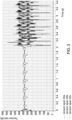
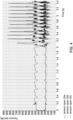
- Figures 3 and 4 illustrate the trend of the tension of the belt 26 in an accessory transmission of a conventional powertrain, and in the accessory transmission of the powertrain of the invention.
- the tensions are measured in the three spans 26a, 26b and 26c arranged respectively between the pulleys 22 and 24, between the pulleys 24 and 21, and between the pulleys 21 and 22, and shown in the graphs as a function of the time.
- the trend of the tensions is observed with the heat engine off (driven by the electric machine 6) ; as from 2s the trend of the tensions is observed in the starting phase of the heat engine 2 by means of the electric motor 30.
- Figure 4 illustrates the trend of said tensions in the presence of the additional torque transmitted by the electric machine 23 to the pulley 22 simultaneously with start-up by means of the electric motor 30.
- the value of the active torque to be transmitted to the pulley 22 can be easily determined experimentally. For example, for a three-cylinder engine with 1.0 1 displacement, the active torque necessary is in the order of only 5 Nm. The active torque must be maintained only for the duration of the first ignition cycles of the engine; once a stable combustion regime has been reached, the active torque is no longer necessary and can be interrupted.
Landscapes
- Engineering & Computer Science (AREA)
- Mechanical Engineering (AREA)
- Chemical & Material Sciences (AREA)
- Combustion & Propulsion (AREA)
- Transportation (AREA)
- General Engineering & Computer Science (AREA)
- Devices For Conveying Motion By Means Of Endless Flexible Members (AREA)
Description
- The present invention concerns a powertrain for a motor vehicle and a method for the control of said powertrain.
- The present invention is preferably but not exclusively applied in a hybrid powertrain, which will be referred to hereinafter without any loss of generality.
- As is known, hybrid traction vehicles comprise an internal combustion engine and at least one electric machine which can be used as a generator or as a motor to deliver torque in combination with (or alternatively to) the internal combustion engine, according to the vehicle operating conditions.
- A configuration in which an electric machine is used connected between the internal combustion engine and the vehicle transmission is conventionally called "P2". Modular units are known designed to be interposed between the internal combustion engine and the transmission of a vehicle (and therefore currently called "P2 modules"), which comprise, in addition to the electric machine, one or more clutches to selectively connect to the transmission the internal combustion engine and/or the electric machine, as well as the relative actuators and transmission elements.
- Powertrains for motor vehicles provided with an accessory drive arranged on one end of the internal combustion engine opposite the transmission (normally indicated by "front end", or "P0") are also known. The accessory drive, generally a belt drive, connects one or more accessories to the crankshaft. Said accessories typically comprise an electric machine operating as an alternator and/or motor and a compressor for the air conditioning system, and the accessory drive comprises respective pulleys connected to the crankshaft and to each of the accessories, a belt cooperating with the above-mentioned pulleys and a tensioner designed to ensure a minimum belt tension.
- If the electric machine is used exclusively as an alternator (generator), it is common practice to interpose between the same and the relative pulley a one-way joint or free wheel, having the object of transmitting the torque from the pulley to the electric machine when the latter is driven by the engine, but allowing the electric machine to override the pulley in the transitory operating conditions in which this can occur (for example in the case of a sudden deceleration of the crankshaft. This prevents the high inertia of the electric machine subjecting the belt to undesired tension peaks.
- If on the other hand, as occurs increasingly frequently, the electric machine is used also as a motor, the use of a free wheel as described above is not possible, since the electric machine must be able to receive or transmit torque to the relative pulley according to the operating conditions.
- In this case, to ensure a minimum belt tension in all operating conditions, a dual tensioner is used having a first tensioner pulley acting on the belt span upstream of the electric machine and a second tensioner pulley acting on the belt span downstream of the electric machine, since both spans can be the slack span according to the operating conditions.
- The known solutions described above can be combined so as to produce a hybrid powertrain having an electric machine in position P0 (below: the electric machine P0) and an electric machine in position P2 (below: the electric machine P2); the two machines can be used with different control strategies (for example one only as motor, the other in a reversible manner).
- Furthermore, the internal combustion engine can be started by means of the electric machine P0, the electric machine P2 or by means of a third electric machine (a traditional starter motor) associated with the engine flywheel.
- For example, if the electric machine P0 is used only as a motor and the internal combustion engine is started by means of the electric machine P2 or the starter motor, the tension of the accessory drive belt can reach unacceptable minimum values, as can be seen in
Figure 3 , which can determine noisiness and premature wear of the belt. -
US 2013/0066492 A1 discloses a hybrid powertrain including an IC engine, a starter motor, a gear train connecting the starter motor with the engine, and motor/generator connected to the engine crankshaft via a belt drive not including any accessory. This document does not disclose any method for controlling the belt tension. - The object of the present invention is to produce a powertrain that solves the above-mentioned problem.
- The above-mentioned object is achieved by a powertrain according to
claim 1. - The present invention also concerns a control method of the powertrain according to claim 4.
- For a better understanding of the present invention, a preferred embodiment is described, by way of non-limiting example and with reference to the attached drawings, in which:
-
Figure 1 is a schematic plan view of a powertrain according to the present invention; -
Figure 2 is a schematic frontal view of the powertrain according to the present invention; -
Figure 3 is a graph that shows the tension variations of the belt in an accessory drive of a conventional powertrain; and -
Figure 4 is a graph that shows the belt tension variations in an accessory drive of the powertrain according to the present invention. - With reference to
Figure 1 , thenumber 1 indicates overall a powertrain for a motor vehicle. - The
powertrain 1 comprises an internal combustion engine 2 (below, for the sake of brevity, "heat engine 2") having acrankshaft 3 and a hybrid module 4. - The hybrid module 4 is interposed, in use, between the
heat engine 2 and a transmission T of the vehicle, and is connected to oneend 5 of thecrankshaft 3 facing the transmission T. - The hybrid module 4 comprises an
electric machine 6 and a decouplingclutch 7 designed to selectively connect theelectric machine 6 to thecrankshaft 3 and to the transmission T. - The
clutch 7 comprises at least aclutch plate 8 axially fixed and rotationally integral with aflywheel 9 connected at theend 5 of thecrankshaft 3, and aplate 10 axially movable and rotationally integral with anintermediate shaft 11 of the module 4. Theclutch 7 lastly comprises ahydraulic actuator 12 acting on theplate 10 for control of the clutch. - The
intermediate shaft 11 is connected to apulley 14 by means of a torsional vibration damper of known type and not illustrated, housed inside the pulley. - The
pulley 14 is connected by abelt 15 to apulley 16 connected to theelectric machine 6. - A
flex plate 17 is fixed to thepulley 14, said plate constitutes an output member of the module 4 designed to be connected to atorque converter 18 constituting an input member of the transmission T. - The
powertrain 1 lastly comprises anaccessory transmission 19 connected to oneend 20 of thecrankshaft 3 opposite theend 5. - The accessory transmission 19 (
Fig. 2 ) comprises afirst pulley 21 fixed to theend 20 of thecrankshaft 3, asecond pulley 22 associated with a secondelectric machine 23 and athird pulley 24 to drive acompressor 25 of a conditioning system. The threepulleys belt 26. Aconventional tensioner 28 acts on aspan 26a of thebelt 26 comprised between thesecond pulley 22 and thethird pulley 24. Thepulleys Figure 3 and coinciding with the direction of rotation of thecrankshaft 3. - The
powertrain 1 comprises a thirdelectric machine 30 operating as a starter motor, provided with an output pinion 31 that engages with a toothing of theflywheel 9. Expediently, the thirdelectric machine 30 is a brushless motor able to rapidly start theheat engine 2. - The
powertrain 1 lastly comprises aprogrammable control unit 34, which controls the electric machines in response to input signals representing the operating conditions of thepowertrain 1 and of the driver controls. - The operation of the
powertrain 1 is the following. - When the
clutch 7 is closed, theintermediate shaft 11 is connected both to theheat engine 2 and to theelectric machine 6 and to the vehicle transmission T. - In this condition, the
control unit 34 can operate theelectric machine 6 both as generator (to recharge the battery during the thermal traction, or as a regenerative brake), and as a motor for the delivery of an additional torque (boosting) in combination with theelectric machine 23, according to the operating conditions. The specific control logics of the electric machines are not described here since they do not form part of the invention. - When the
clutch 7 is open, theelectric machine 6 can be used for the electric traction, electric braking and coasting with the heat engine off. - The
heat engine 2 is started (both cold and starting from a condition of electric traction) by means of the thirdelectric machine 30. During this phase, theclutch 7 is open. - During starting of the
heat engine 2, theelectric machine 30 drives thecrankshaft 3 and thefirst pulley 21 connected to it. - According to the present invention, to prevent the tension dropping below predetermined levels in the
span 26c of thebelt 26, immediately downstream of thefirst pulley 21 in the direction of movement of the belt, theelectric machine 23 is operated by thecontrol unit 34 so as to supply an active torque to thepulley 22. This additional torque causes an increase in the tension inspan 26c of thebelt 26, and therefore eliminates the technical problem highlighted. - For a better understanding of the effect of the additional torque according to the present invention,
Figures 3 and4 illustrate the trend of the tension of thebelt 26 in an accessory transmission of a conventional powertrain, and in the accessory transmission of the powertrain of the invention. - In particular, the tensions are measured in the three
spans pulleys pulleys pulleys heat engine 2 by means of theelectric motor 30. - As can be easily seen in
Figure 3 , with a mean belt tension value in the order of approximately 350 N when the motor is driven, significant tension oscillations occur at start-up in thebelt span 26c, in the order of approximately 400 N peak-peak, with minimum peak values in the order of 20-30 N. Such low values, essentially due to the inertia of theelectric machine 23 in the presence of the torsional vibrations induced by the combustion at start-up, can determine slipping and noise. -
Figure 4 illustrates the trend of said tensions in the presence of the additional torque transmitted by theelectric machine 23 to thepulley 22 simultaneously with start-up by means of theelectric motor 30. - The value of the active torque to be transmitted to the
pulley 22 can be easily determined experimentally. For example, for a three-cylinder engine with 1.0 1 displacement, the active torque necessary is in the order of only 5 Nm. The active torque must be maintained only for the duration of the first ignition cycles of the engine; once a stable combustion regime has been reached, the active torque is no longer necessary and can be interrupted. - From
Figure 4 the effect of increase in the tension values inspan 26c of thebelt 26 is evident, with minimum peak values in the order of 210 N. - Lastly, it is clear that modifications and variations can be made to the
powertrain 1 described that do not depart from the scope defined by the claims.
Claims (5)
- Powertrain for a vehicle comprising:an internal combustion engine (2) provided with a crankshaft (3) ;a first electric machine (30) operating at least as a starter motor and located on a first side of the internal combustion engine (2) facing in use towards a transmission (T) of the vehicle;an accessory drive (19) comprising:a first pulley (21) connected to one end (20) of the crankshaft (3) on a second side of the engine opposite in use to the transmission (T) of the vehicle;a second electric machine (23) located on the second side of the internal combustion engine (2);a second pulley (22) connected to the second electric machine (23) ;at least a third pulley (24) connected to an accessory (25) of the internal combustion engine (2);a belt (26) connecting the first, the second and the third pulley (21, 22, 24) together to rotate in the same direction of rotation (R) as the crankshaft (3);a tensioner (28) acting on a span (26a) of the belt (26) comprised between the second pulley (22) and the third pulley (24); anda control unit (34),wherein the control unit (34) is programmed to control the second electric machine (23) so as to transmit an active torque to said second pulley (22) during start-up of the internal combustion engine (2) by means of the first electric machine (30), so as to maintain a predetermined minimum tension level in a span (26c) of the belt (26) comprised between the first and the second pulleys (21, 22) in said direction of rotation.
- Powertrain as claimed in one of the previous claims, characterized by including a hybrid module (4) equipped with an additional electric machine (6) and a decoupling clutch (7) designed to selectively connect the additional electric machine (6) to the crankshaft (3).
- Powertrain as claimed in claim 2, characterized in that the additional electric machine (6) is reversible and can be operated as a motor or as a generator depending on the operating conditions, and in that the second electric machine (23) is used as a motor.
- Method of control of a powertrain as claimed in claim 1, characterized by including the step of driving the second electric machine (23) to transmit an active torque to said second pulley (22) during start-up of the internal combustion engine (2) by means of the first electric machine (30), so as to maintain a predetermined minimum tension level in a span (26c) of the belt (26) comprised between the first and the second pulleys (21, 22) in said direction of rotation.
- Method of control as claimed in claim 4, wherein the powertrain comprises a hybrid module (4) equipped with an additional electrical machine (6) and a decoupling clutch (7) designed to selectively connect the additional electrical machine (6) to the crankshaft (3), the method including the steps of operating said additional electrical machine (6) as a motor or as a generator depending on the operating conditions, and of operating the second electrical machine (23) as a motor.
Applications Claiming Priority (2)
| Application Number | Priority Date | Filing Date | Title |
|---|---|---|---|
| IT102019000023805A IT201900023805A1 (en) | 2019-12-12 | 2019-12-12 | MOTORPOWER UNIT FOR A MOTOR VEHICLE AND RELEVANT CONTROL METHOD |
| PCT/IB2020/061848 WO2021117006A1 (en) | 2019-12-12 | 2020-12-11 | Powertrain for a motor vehicle and control method thereof |
Publications (2)
| Publication Number | Publication Date |
|---|---|
| EP4072888A1 EP4072888A1 (en) | 2022-10-19 |
| EP4072888B1 true EP4072888B1 (en) | 2025-01-29 |
Family
ID=70228436
Family Applications (1)
| Application Number | Title | Priority Date | Filing Date |
|---|---|---|---|
| EP20838291.1A Active EP4072888B1 (en) | 2019-12-12 | 2020-12-11 | Powertrain for a motor vehicle and control method thereof |
Country Status (5)
| Country | Link |
|---|---|
| US (1) | US11872883B2 (en) |
| EP (1) | EP4072888B1 (en) |
| CN (1) | CN114929500B (en) |
| IT (1) | IT201900023805A1 (en) |
| WO (1) | WO2021117006A1 (en) |
Families Citing this family (1)
| Publication number | Priority date | Publication date | Assignee | Title |
|---|---|---|---|---|
| IT201900013350A1 (en) * | 2019-07-30 | 2021-01-30 | Dayco Europe Srl | TRANSMISSION ACCESSORIES FOR A MOTORPOWER UNIT OF A MOTOR VEHICLE AND POWERPOWER UNIT INCLUDING THIS TRANSMISSION |
Family Cites Families (8)
| Publication number | Priority date | Publication date | Assignee | Title |
|---|---|---|---|---|
| US7954580B2 (en) * | 2006-03-10 | 2011-06-07 | GM Global Technology Operations LLC | Accessory drive system and method for a belt-alternator-starter electric hybrid vehicle |
| US7748483B2 (en) * | 2006-03-10 | 2010-07-06 | Gm Global Technology Operations, Inc. | Accessory drive system and method for a parallel electric hybrid vehicle |
| US8167773B2 (en) * | 2007-10-26 | 2012-05-01 | GM Global Technology Operations LLC | Method and apparatus to control motor cooling in an electro-mechanical transmission |
| DE102010041631B4 (en) * | 2010-09-29 | 2016-12-15 | Bayerische Motoren Werke Aktiengesellschaft | Vehicle drive with at least two starting systems |
| US8606450B2 (en) * | 2011-09-09 | 2013-12-10 | GM Global Technology Operations LLC | Hybrid powertrain with geared starter motor and belt alternator starter and method of restarting an engine |
| GB2507985B (en) * | 2012-11-15 | 2018-06-13 | Ford Global Tech Llc | A method for controlling an engine drive belt tensioner system |
| US9481236B2 (en) * | 2014-03-13 | 2016-11-01 | GM Global Technology Operations LLC | Powertrain for a vehicle |
| US10029695B1 (en) * | 2017-03-03 | 2018-07-24 | Ford Global Technologies, Llc | Methods and systems for a belt-driven integrated starter generator |
-
2019
- 2019-12-12 IT IT102019000023805A patent/IT201900023805A1/en unknown
-
2020
- 2020-12-11 CN CN202080092030.3A patent/CN114929500B/en active Active
- 2020-12-11 WO PCT/IB2020/061848 patent/WO2021117006A1/en not_active Ceased
- 2020-12-11 US US17/757,153 patent/US11872883B2/en active Active
- 2020-12-11 EP EP20838291.1A patent/EP4072888B1/en active Active
Also Published As
| Publication number | Publication date |
|---|---|
| US20220410689A1 (en) | 2022-12-29 |
| CN114929500B (en) | 2025-11-21 |
| IT201900023805A1 (en) | 2021-06-12 |
| US11872883B2 (en) | 2024-01-16 |
| EP4072888A1 (en) | 2022-10-19 |
| WO2021117006A1 (en) | 2021-06-17 |
| CN114929500A (en) | 2022-08-19 |
Similar Documents
| Publication | Publication Date | Title |
|---|---|---|
| US12140073B2 (en) | Accessory transmission for a powertrain group of a vehicle and powertrain group comprising such transmission | |
| US8317652B2 (en) | Drive unit with an internal combustion engine | |
| US7360616B2 (en) | Method for controlling and regulating a power train of a hybrid vehicle and power train of a hybrid vehicle | |
| US7273119B2 (en) | Method for starting engine of vehicle with hybrid transmission and apparatus for carrying out the method | |
| US9074656B2 (en) | Drive train of a motor vehicle having an internal combustion engine and a starter generator | |
| JP3803205B2 (en) | Hybrid car | |
| EP1316721B1 (en) | Automotive internal combustion engine control system | |
| US6306056B1 (en) | Dual engine hybrid electric vehicle | |
| US8016717B2 (en) | Motor vehicle drive train and method for controlling a drive train | |
| US20130085634A1 (en) | Control apparatus for hybrid vehicle | |
| US7702444B2 (en) | Process for operating a vehicle power train during an activated engine start/stop function | |
| US9175659B2 (en) | Drive train of a motor vehicle having an internal combustion engine and a starter generator | |
| US6969338B2 (en) | Method for controlling and regulating a drive train | |
| EP4072888B1 (en) | Powertrain for a motor vehicle and control method thereof | |
| JP7414510B2 (en) | Vehicle drive system | |
| US20130296086A1 (en) | Traction drive of an internal combustion engine and method for operating the same | |
| US7736255B2 (en) | Drive device for at least one machine auxiliary unit | |
| JP3633409B2 (en) | Vehicle having intermittent operation function of internal combustion engine and start control device used for the vehicle | |
| US12351031B2 (en) | Compact P2 hybrid architecture | |
| EP3891003A1 (en) | A hybrid drive module | |
| JP5589938B2 (en) | Auxiliary drive | |
| JP2003252072A (en) | Starter generator unit, starter generator unit with transmission, operation method of starter generator with transmission |
Legal Events
| Date | Code | Title | Description |
|---|---|---|---|
| STAA | Information on the status of an ep patent application or granted ep patent |
Free format text: STATUS: UNKNOWN |
|
| STAA | Information on the status of an ep patent application or granted ep patent |
Free format text: STATUS: THE INTERNATIONAL PUBLICATION HAS BEEN MADE |
|
| PUAI | Public reference made under article 153(3) epc to a published international application that has entered the european phase |
Free format text: ORIGINAL CODE: 0009012 |
|
| STAA | Information on the status of an ep patent application or granted ep patent |
Free format text: STATUS: REQUEST FOR EXAMINATION WAS MADE |
|
| 17P | Request for examination filed |
Effective date: 20220627 |
|
| AK | Designated contracting states |
Kind code of ref document: A1 Designated state(s): AL AT BE BG CH CY CZ DE DK EE ES FI FR GB GR HR HU IE IS IT LI LT LU LV MC MK MT NL NO PL PT RO RS SE SI SK SM TR |
|
| DAV | Request for validation of the european patent (deleted) | ||
| DAX | Request for extension of the european patent (deleted) | ||
| P01 | Opt-out of the competence of the unified patent court (upc) registered |
Effective date: 20230505 |
|
| RAP1 | Party data changed (applicant data changed or rights of an application transferred) |
Owner name: PROPULSION SOLUTIONS S.R.L. |
|
| RAP1 | Party data changed (applicant data changed or rights of an application transferred) |
Owner name: PROPULSION SOLUTIONS S.R.L. |
|
| GRAP | Despatch of communication of intention to grant a patent |
Free format text: ORIGINAL CODE: EPIDOSNIGR1 |
|
| STAA | Information on the status of an ep patent application or granted ep patent |
Free format text: STATUS: GRANT OF PATENT IS INTENDED |
|
| RIC1 | Information provided on ipc code assigned before grant |
Ipc: F16H 7/00 20060101ALI20240628BHEP Ipc: F02N 15/08 20060101ALI20240628BHEP Ipc: F02N 15/02 20060101ALI20240628BHEP Ipc: F02N 11/04 20060101ALI20240628BHEP Ipc: F02N 11/00 20060101ALI20240628BHEP Ipc: F02B 67/06 20060101ALI20240628BHEP Ipc: B60K 6/48 20071001ALI20240628BHEP Ipc: B60K 6/26 20071001ALI20240628BHEP Ipc: B60K 6/20 20071001ALI20240628BHEP Ipc: B60K 25/02 20060101AFI20240628BHEP |
|
| INTG | Intention to grant announced |
Effective date: 20240711 |
|
| RAP3 | Party data changed (applicant data changed or rights of an application transferred) |
Owner name: MUVIQ S.R.L. |
|
| GRAS | Grant fee paid |
Free format text: ORIGINAL CODE: EPIDOSNIGR3 |
|
| GRAA | (expected) grant |
Free format text: ORIGINAL CODE: 0009210 |
|
| STAA | Information on the status of an ep patent application or granted ep patent |
Free format text: STATUS: THE PATENT HAS BEEN GRANTED |
|
| AK | Designated contracting states |
Kind code of ref document: B1 Designated state(s): AL AT BE BG CH CY CZ DE DK EE ES FI FR GB GR HR HU IE IS IT LI LT LU LV MC MK MT NL NO PL PT RO RS SE SI SK SM TR |
|
| REG | Reference to a national code |
Ref country code: GB Ref legal event code: FG4D |
|
| REG | Reference to a national code |
Ref country code: CH Ref legal event code: EP |
|
| REG | Reference to a national code |
Ref country code: DE Ref legal event code: R096 Ref document number: 602020045593 Country of ref document: DE |
|
| REG | Reference to a national code |
Ref country code: IE Ref legal event code: FG4D |
|
| REG | Reference to a national code |
Ref country code: NL Ref legal event code: MP Effective date: 20250129 |
|
| PG25 | Lapsed in a contracting state [announced via postgrant information from national office to epo] |
Ref country code: NL Free format text: LAPSE BECAUSE OF FAILURE TO SUBMIT A TRANSLATION OF THE DESCRIPTION OR TO PAY THE FEE WITHIN THE PRESCRIBED TIME-LIMIT Effective date: 20250129 |
|
| PG25 | Lapsed in a contracting state [announced via postgrant information from national office to epo] |
Ref country code: RS Free format text: LAPSE BECAUSE OF FAILURE TO SUBMIT A TRANSLATION OF THE DESCRIPTION OR TO PAY THE FEE WITHIN THE PRESCRIBED TIME-LIMIT Effective date: 20250429 |
|
| PG25 | Lapsed in a contracting state [announced via postgrant information from national office to epo] |
Ref country code: FI Free format text: LAPSE BECAUSE OF FAILURE TO SUBMIT A TRANSLATION OF THE DESCRIPTION OR TO PAY THE FEE WITHIN THE PRESCRIBED TIME-LIMIT Effective date: 20250129 |
|
| PG25 | Lapsed in a contracting state [announced via postgrant information from national office to epo] |
Ref country code: PL Free format text: LAPSE BECAUSE OF FAILURE TO SUBMIT A TRANSLATION OF THE DESCRIPTION OR TO PAY THE FEE WITHIN THE PRESCRIBED TIME-LIMIT Effective date: 20250129 |
|
| PG25 | Lapsed in a contracting state [announced via postgrant information from national office to epo] |
Ref country code: ES Free format text: LAPSE BECAUSE OF FAILURE TO SUBMIT A TRANSLATION OF THE DESCRIPTION OR TO PAY THE FEE WITHIN THE PRESCRIBED TIME-LIMIT Effective date: 20250129 |
|
| REG | Reference to a national code |
Ref country code: LT Ref legal event code: MG9D |
|
| PG25 | Lapsed in a contracting state [announced via postgrant information from national office to epo] |
Ref country code: NO Free format text: LAPSE BECAUSE OF FAILURE TO SUBMIT A TRANSLATION OF THE DESCRIPTION OR TO PAY THE FEE WITHIN THE PRESCRIBED TIME-LIMIT Effective date: 20250429 Ref country code: IS Free format text: LAPSE BECAUSE OF FAILURE TO SUBMIT A TRANSLATION OF THE DESCRIPTION OR TO PAY THE FEE WITHIN THE PRESCRIBED TIME-LIMIT Effective date: 20250529 |
|
| REG | Reference to a national code |
Ref country code: AT Ref legal event code: MK05 Ref document number: 1763136 Country of ref document: AT Kind code of ref document: T Effective date: 20250129 |
|
| PG25 | Lapsed in a contracting state [announced via postgrant information from national office to epo] |
Ref country code: HR Free format text: LAPSE BECAUSE OF FAILURE TO SUBMIT A TRANSLATION OF THE DESCRIPTION OR TO PAY THE FEE WITHIN THE PRESCRIBED TIME-LIMIT Effective date: 20250129 |
|
| PG25 | Lapsed in a contracting state [announced via postgrant information from national office to epo] |
Ref country code: LV Free format text: LAPSE BECAUSE OF FAILURE TO SUBMIT A TRANSLATION OF THE DESCRIPTION OR TO PAY THE FEE WITHIN THE PRESCRIBED TIME-LIMIT Effective date: 20250129 Ref country code: PT Free format text: LAPSE BECAUSE OF FAILURE TO SUBMIT A TRANSLATION OF THE DESCRIPTION OR TO PAY THE FEE WITHIN THE PRESCRIBED TIME-LIMIT Effective date: 20250529 |
|
| PG25 | Lapsed in a contracting state [announced via postgrant information from national office to epo] |
Ref country code: GR Free format text: LAPSE BECAUSE OF FAILURE TO SUBMIT A TRANSLATION OF THE DESCRIPTION OR TO PAY THE FEE WITHIN THE PRESCRIBED TIME-LIMIT Effective date: 20250430 Ref country code: BG Free format text: LAPSE BECAUSE OF FAILURE TO SUBMIT A TRANSLATION OF THE DESCRIPTION OR TO PAY THE FEE WITHIN THE PRESCRIBED TIME-LIMIT Effective date: 20250129 |
|
| PG25 | Lapsed in a contracting state [announced via postgrant information from national office to epo] |
Ref country code: AT Free format text: LAPSE BECAUSE OF FAILURE TO SUBMIT A TRANSLATION OF THE DESCRIPTION OR TO PAY THE FEE WITHIN THE PRESCRIBED TIME-LIMIT Effective date: 20250129 |
|
| PG25 | Lapsed in a contracting state [announced via postgrant information from national office to epo] |
Ref country code: SE Free format text: LAPSE BECAUSE OF FAILURE TO SUBMIT A TRANSLATION OF THE DESCRIPTION OR TO PAY THE FEE WITHIN THE PRESCRIBED TIME-LIMIT Effective date: 20250129 |
|
| PG25 | Lapsed in a contracting state [announced via postgrant information from national office to epo] |
Ref country code: SM Free format text: LAPSE BECAUSE OF FAILURE TO SUBMIT A TRANSLATION OF THE DESCRIPTION OR TO PAY THE FEE WITHIN THE PRESCRIBED TIME-LIMIT Effective date: 20250129 |
|
| PG25 | Lapsed in a contracting state [announced via postgrant information from national office to epo] |
Ref country code: DK Free format text: LAPSE BECAUSE OF FAILURE TO SUBMIT A TRANSLATION OF THE DESCRIPTION OR TO PAY THE FEE WITHIN THE PRESCRIBED TIME-LIMIT Effective date: 20250129 |
|
| PG25 | Lapsed in a contracting state [announced via postgrant information from national office to epo] |
Ref country code: EE Free format text: LAPSE BECAUSE OF FAILURE TO SUBMIT A TRANSLATION OF THE DESCRIPTION OR TO PAY THE FEE WITHIN THE PRESCRIBED TIME-LIMIT Effective date: 20250129 Ref country code: CZ Free format text: LAPSE BECAUSE OF FAILURE TO SUBMIT A TRANSLATION OF THE DESCRIPTION OR TO PAY THE FEE WITHIN THE PRESCRIBED TIME-LIMIT Effective date: 20250129 |
|
| PG25 | Lapsed in a contracting state [announced via postgrant information from national office to epo] |
Ref country code: RO Free format text: LAPSE BECAUSE OF FAILURE TO SUBMIT A TRANSLATION OF THE DESCRIPTION OR TO PAY THE FEE WITHIN THE PRESCRIBED TIME-LIMIT Effective date: 20250129 |
|
| PG25 | Lapsed in a contracting state [announced via postgrant information from national office to epo] |
Ref country code: SK Free format text: LAPSE BECAUSE OF FAILURE TO SUBMIT A TRANSLATION OF THE DESCRIPTION OR TO PAY THE FEE WITHIN THE PRESCRIBED TIME-LIMIT Effective date: 20250129 |
|
| REG | Reference to a national code |
Ref country code: DE Ref legal event code: R097 Ref document number: 602020045593 Country of ref document: DE |
|
| PLBE | No opposition filed within time limit |
Free format text: ORIGINAL CODE: 0009261 |
|
| STAA | Information on the status of an ep patent application or granted ep patent |
Free format text: STATUS: NO OPPOSITION FILED WITHIN TIME LIMIT |
|
| 26N | No opposition filed |
Effective date: 20251030 |
|
| PGFP | Annual fee paid to national office [announced via postgrant information from national office to epo] |
Ref country code: IT Payment date: 20251125 Year of fee payment: 6 |
|
| PGFP | Annual fee paid to national office [announced via postgrant information from national office to epo] |
Ref country code: FR Payment date: 20251223 Year of fee payment: 6 |
|
| PGFP | Annual fee paid to national office [announced via postgrant information from national office to epo] |
Ref country code: DE Payment date: 20251229 Year of fee payment: 6 |