EP4072681B1 - Lipophosphonoxins, their preparation and use - Google Patents
Lipophosphonoxins, their preparation and use Download PDFInfo
- Publication number
- EP4072681B1 EP4072681B1 EP20828017.2A EP20828017A EP4072681B1 EP 4072681 B1 EP4072681 B1 EP 4072681B1 EP 20828017 A EP20828017 A EP 20828017A EP 4072681 B1 EP4072681 B1 EP 4072681B1
- Authority
- EP
- European Patent Office
- Prior art keywords
- mhz
- nmr
- mmol
- bis
- vinylphosphonate
- Prior art date
- Legal status (The legal status is an assumption and is not a legal conclusion. Google has not performed a legal analysis and makes no representation as to the accuracy of the status listed.)
- Active
Links
Classifications
-
- A—HUMAN NECESSITIES
- A61—MEDICAL OR VETERINARY SCIENCE; HYGIENE
- A61K—PREPARATIONS FOR MEDICAL, DENTAL OR TOILETRY PURPOSES
- A61K31/00—Medicinal preparations containing organic active ingredients
- A61K31/66—Phosphorus compounds
- A61K31/662—Phosphorus acids or esters thereof having P—C bonds, e.g. foscarnet, trichlorfon
- A61K31/663—Compounds having two or more phosphorus acid groups or esters thereof, e.g. clodronic acid, pamidronic acid
-
- A—HUMAN NECESSITIES
- A61—MEDICAL OR VETERINARY SCIENCE; HYGIENE
- A61L—METHODS OR APPARATUS FOR STERILISING MATERIALS OR OBJECTS IN GENERAL; DISINFECTION, STERILISATION OR DEODORISATION OF AIR; CHEMICAL ASPECTS OF BANDAGES, DRESSINGS, ABSORBENT PADS OR SURGICAL ARTICLES; MATERIALS FOR BANDAGES, DRESSINGS, ABSORBENT PADS OR SURGICAL ARTICLES
- A61L2/00—Disinfection or sterilisation of materials or objects, in general; Accessories therefor
- A61L2/16—Disinfection or sterilisation of materials or objects, in general; Accessories therefor using chemical substances
-
- A—HUMAN NECESSITIES
- A61—MEDICAL OR VETERINARY SCIENCE; HYGIENE
- A61P—SPECIFIC THERAPEUTIC ACTIVITY OF CHEMICAL COMPOUNDS OR MEDICINAL PREPARATIONS
- A61P31/00—Antiinfectives, i.e. antibiotics, antiseptics, chemotherapeutics
- A61P31/04—Antibacterial agents
-
- C—CHEMISTRY; METALLURGY
- C07—ORGANIC CHEMISTRY
- C07F—ACYCLIC, CARBOCYCLIC OR HETEROCYCLIC COMPOUNDS CONTAINING ELEMENTS OTHER THAN CARBON, HYDROGEN, HALOGEN, OXYGEN, NITROGEN, SULFUR, SELENIUM OR TELLURIUM
- C07F9/00—Compounds containing elements of Groups 5 or 15 of the Periodic Table
- C07F9/02—Phosphorus compounds
- C07F9/28—Phosphorus compounds with one or more P—C bonds
- C07F9/38—Phosphonic acids [RP(=O)(OH)2]; Thiophosphonic acids ; [RP(=X1)(X2H)2(X1, X2 are each independently O, S or Se)]
- C07F9/40—Esters thereof
- C07F9/4003—Esters thereof the acid moiety containing a substituent or a structure which is considered as characteristic
- C07F9/4006—Esters of acyclic acids which can have further substituents on alkyl
- C07F9/4009—Esters containing the structure (RX)2P(=X)-alk-N...P (X = O, S, Se)
Definitions
- the invention relates to novel substances with antibacterial effects and their use in vitro and in vivo.
- Lipophosphonoxins are bactericidal substances with rapid kinetics, and they are not genotoxic.
- the maximum tolerated dose (MTD) in mice when administered orally is very high (> 2000 mg/kg) and the bacteria are unable to develop resistance.
- Lipophosphonoxins are chemically stable over a wide pH range and do not pass through the monolayer of CACO-2 cells, which means that they are unlikely to be absorbed when administered orally.
- LPPOs belong to a growing family of antibacterial peptidomimetics, such as cationic steroid antibiotics ( Fems Microbiol Lett. 2002, 217(1):1-7 ; Bba-Biomembranes 2007, 1768(10), 2500-2509 ; J. Med. Chem. 2002 45(3), 663-669 ), lipophilic derivatives of norspermidine ( J. Med. Chem. 2014, 57(22), 9409-9423 ), arylamide foldamers ( Antimicrob Agents Ch. 2011, 55(11), 5043-5053 ; Angew. Chem. Int. Edit.
- US 2002/0032164 discloses phosphoric acid esters as protonated antimicrobial agents. These compounds differ significantly from phosphonoxines.
- This invention describes novel lipophosphonoxins of the general formula I which have strong antibacterial effects against gram-positive and gram-negative bacteria.
- the advantage of these compounds is, in addition to easy preparation, also the large degree of modularity of their structure, which enables additional adaptation of their biological properties.
- the invention therefore relates to lipophosphonoxins of the general formula wherein
- the Y substituent is selected from: wherein n, o, p, R 1 , R 2 , R 3 are as described herein.
- R 1 , R 2 , R 3 are H or methyl.
- the X substituent is selected from: wherein m is 1-3.
- Z is wherein q is 4 to 14.
- Said salts include salts with inorganic or organic anions and in particular, but not exclusively, pharmaceutically acceptable salts suitable for physiological administration.
- salts may be salts derived from inorganic or organic acids.
- a person skilled in the art will be able to determine which salts are pharmaceutically acceptable; in particular, they are salts with one or more desirable physical properties such as increased pharmaceutical stability at various temperatures and humidities, the desired solubility in water or oil, or are non-toxic.
- Suitable pharmaceutically acceptable salts of the compounds of this invention preferably include anions derived from inorganic acids such as hydrochloric, hydrobromic, hydrofluoric, boric, fluoroboric, phosphoric, metaphosphoric, nitric, carbonic, sulfuric and sulfurous acids and from organic acids such as acetic acid, benzene sulfonic, benzoic, citric, ethanesulfonic, fumaric, gluconic, glycolic, isethionic, lactic, lactobionic, maleic, malonic, methanesulfonic, trifluoromethanesulfonic, succinic, toluenesulfonic, tartaric and trifluoroacetic acids.
- Suitable organic acids generally include, for example, the following classes of organic acids: aliphatic, cycloaliphatic, aromatic, arylaliphatic, heterocyclic, carboxylic and sulfonic acids.
- suitable organic acids include acetate, trifluoroacetate, formate, propionate, succinate, glycolate, gluconate, digluconate, hyaluronate, lactate, malate, tartrate, citrate, ascorbate, glucuronate, maleate, fumarate, pyruvate, aspartate, glutamate, benzoate, anthranilate, stearate, salicylate, p-hydroxybenzoate, phenylacetate, mandelate, pamoate, methane sulfonate, ethanesulfonate, benzenesulfonate, pantothenate, toluenesulfonate, 2-hydroxyethanesulfonate, sulfanilate, cyclohexylaminosulfonate, 13-hydroxybutyrate, galactarate, galacturonate, adipate, alginate, butyrate, camphorate, camphorsulfon
- the compounds of formula I contain several chiral centers (especially in the L groups and in some R 2 groups).
- the existence of a chiral center allows the compound to exist as one of two possible optical isomers ((R) - or (S)-enantiomer), or as a racemic mixture of both.
- all diastereomers and mixtures of diastereomers formed are also included in the range of the lipophosphonoxins of general formula I described in this invention.
- the invention furthermore relates to lipophosphonoxins of the general formula I or their diastereomers or to pharmaceutically acceptable salts and hydrates, and/or mixtures of such compounds, for use as medicaments.
- the invention furthermore relates to lipophosphonoxins of the general formula I or their diastereomers or to pharmaceutically acceptable salts and hydrates, and/or mixtures of such compounds, for use as antibacterial drugs.
- the invention also relates to a pharmaceutical composition, preferably to an antibacterial drug composition, comprising at least one lipophosphonoxin of the general formula I or diastereomer or a pharmaceutically acceptable salt or hydrate thereof, and/or a mixture of such compounds as the active ingredient.
- the invention furthermore relates to a disinfectant for non-therapeutic purposes and/or to a selective culture medium comprising at least one lipophosphonoxin of general formula I or a diastereomer or a pharmaceutically acceptable salt or hydrate thereof, and/or mixtures of such compounds as the active ingredient.
- the invention also relates to the use of lipophosphonoxins of general formula I or their diastereomers or pharmaceutically acceptable salts or hydrates, and/or mixtures of such compounds, for the preparation of an antibacterial drug.
- the invention relates to the use of lipophosphonoxins of general formula I or their diastereomers or pharmaceutically acceptable salts and hydrates, and/or mixtures of such compounds, as active ingredients of disinfectants for non-therapeutic purposes, and/or selective culture media for in vitro cultivation of bacteria, fungi or eukaryotic cell lines.
- a medicament / drug is any substance or combination of substances intended to treat or prevent disease in humans or animals, and any substance or combination of substances which may be administered to humans or animals to establish a medical diagnosis or to restore, ameliorate or modify physiological functions of humans or animals.
- the compounds of this invention exhibit antibacterial effects against strains of Escherichia coli, Pseudomonas aeruginosa, Enterococcus faecalis, Staphylococcus aureus, Staphylococcus haemolyticus, Enterococcus faecium, Staphylococcus epidermidis, Enterobacter kobei, and even against strains resistant to existing antibiotics.
- the herein presented third-generation lipophosphonoxins exhibit a wider spectrum of antibacterial activity, higher selectivity and easier preparation.
- the biggest benefit over the prior art is the fact that they exhibit significantly lower hemolytic activities as well as very low binding to serum albumins.
- Table 1 Comparison of the properties of the second (1) and third (2,3) generation of lipophosphonoxins - influencing antibacterial activity in the presence of serum albumins: MIC (mg/l) 0 % BSA 4 % BSA Compound Escherichia coli ATCC 25922 Staphylococcus aureus ATCC 29213 Escherichia coli ATCC 25922 Staphylococcus aureus ATCC 29213 1 LPPO II DR7030 2 2 >200 >200 2 LPPO III
- the greatest benefit of the claimed compounds is their surprisingly high potency, even against dangerous multi-resistant bacterial strains occurring in a hospital environment.
- the structure of the third-generation LPPOs is even more modular than the first- and second-generation LPPOs, allowing the fine tuning of physical and biological properties.
- third-generation LPPOs compared to first- and second-generation LPPOs, enabled by their easy synthesis and assembly of individual modules, provides extensive structural variations of the compounds of this invention that can be used to modulate their biological activity.
- Formula (I) includes the compounds listed in Examples 34-37 and 39-58.
- Methyl phosphonate (1 mmol) is dissolved in 60 % aqueous pyridine (20 mL) and the reaction mixture is stirred at 60 °C for 24 h.
- the reaction mixture is concentrated in vacuo at temperature below 40 °C, the residue is dissolved in ethanol (20 mL) and passed through a column of Dowex 50 v H + form (5 g). The column is washed with EtOH (40 ml). The solvent is removed in vacuo.
- Product is obtained by column chromatography on silica gel using linear gradient of solvent system H1 (ethyl acetate, acetone, ethanol, water 4:1:1:1) in ethyl acetate.
- Mono alkyl vinylphosphonate (1 mmol) is randered dry by co-evaporation with EtOH (10 ml/mmol) and toluene (10 ml), dissolved in DCM (3 ml) and cooled to -78 °C under argon atmosphere.
- Oxalylchloride (2 mol/L) in DCM (0.3 ml) is slowly added and the reaction mixture is stirred at rt for 30 min.
- Catalytic ammount of DMF (50 ⁇ L) is added and the reaction mixture is stirred until gass evolution ceassed.
- Hydroxyderivative (1 mmol) is then added folowed by addition of triethylamine (1.1 mmol).
- the reaction mixture is stirred at rt for 12 h under argon atmosphere.
- the reaction mixture is extracted with sat. soln. NaHCO 3 (10 mL) and sat. soln. NaCl (10 mL).
- Organic phase is dried over Na 2 SO 4 and concentrated in vacuo.
- Product is obtained by column chromatography using linear gradient of acetone in toluene or linear gradient of ethanol in chloroform.
- Butyl vinylphosphonate is prepared from mono methyl vinylphosphonate (7.0 g, 57.3 mmol) and 1-butanol using general method B2 and general method A in 47% (4,39 g, 26,7 mmol) overall yield in the form of colorless oil.
- Pentyl vinylphosphonate is prepared from mono methyl vinylphosphonate (6.50 g, 53.3 mmol) and 1-pentanol using general method B2 and general method A in 47% (4.43 g g, 24.9 mmol) overall yield in the form of colorless oil.
- Hexyl vinylphosphonate is prepared from mono methyl vinylphosphonate (5.70 g, 46.7 mmol) and 1-hexanol using general method B2 and general method A in 42% (3.77 g g, 19.6 mmol) overall yield in the form of colorless oil.
- Heptyl vinylphosphonate is prepared from mono methyl vinylphosphonate (9.65 g, 79.1 mmol) and 1-heptanol (11.2 mL, 79.1 mmol) using general method B1 and general method A in 70% (11.5 g, 55.5 mmol) overall yield in the form of colorless oil.
- IR ⁇ max (film) 3086 (w), 2957 (m), 2930 (s), 2872 (m), 2858 (m), 2594 (w, br), 2280 (w), 1615 (m), 1468 (m), 1457 (m), 1402 (m), 1276 (m), 1208 (s), 1064 (s), 1053 (s), 1013 (vs), 988 (vs), 850 (m), 727 (m), 607 (m).
- Octyl vinylphosphonate is prepared from mono methyl vinylphosphonate (4.0 g, 32.8 mmol) and 1-octanol using general method B1 and general method A in 27% (1.92 g, 8.86 mmol) overall yield in the form of colorless oil.
- Decyl vinylphosphonate is prepared from mono methyl vinylphosphonate (9.98 g, 81.8 mmol) and 1-octanol (12.9 mL, 81.8 mmol) using general method B1 and general method A in 41% (8.52 g, 34.3 mmol) overall yield in the form of colorless oil.
- Phenethyl vinylphosphonate is prepared from mono methyl vinylphosphonate (7.0 g, 57.5 mmol) and phenethyl bromide (98 %, 8.56 mL, 61.4 mmol) using general method C and general method A in 36% (4.42 g, 20.7 mmol) overall yield in the form of colorless oil.
- IR ⁇ max (film) 3086 (w), 3063 (w), 3029 (w), 2867 (w), 1614 (w), 1605 (m), 1497 (m), 1473 (w), 1454 (m), 1402 (m), 1276 (m), 1216 (s), 1179 (m), 1154 (m), 1061 (s), 1019 (vs), 1002(s), 988 (vs), 748 (m), 699 (s), 496 (m).
- 2-(Adamantan-1-yl)ethyl vinylphosphonate is prepared from mono methy vinylphosphonate (0.63 g, 5.18 mmol) and 2-(adamantan-1-yl)ethanol using general method B1 and general method A in overall 40% yield (0.56 g, 2.07 mmol) in the form of white foam.
- (Adamantan-1-yl)methyl vinylphosphonate is prepared from mono methy vinylphosphonate (1.68 g, 13.8 mmol) and (adamantan-1-yl)methanol using general method B1 and general method A in overall 40% yield (8.87 g, 34.61 mmol) bezbarvého oleje.
- 3-(Cyclohexyl)propyl vinylphosphonate is prepared from mono methyl vinylphosphonate (5 g, 40.96 mmol) and 3-(cyclohexyl)propanol (8.32 g, 58.52 mmol) general method B2 and general method A in 32% (3-01 g, 12-96 mmol) overall yield in the form of colorless oil.
- (Z)-non-3-en-1-yl vinylphosphonate is prepared from mono methyl vinylphosphonate (3.0 g, 24.6 mmol) and (Z)-non-3-en-1-ol using general method B1 and general method A in 35% (2.0 g, 8.61 mmol) overall yield in the form of colorless oil.
- (Z)-hept-3-en-1-yl vinylphosphonate is prepared from mono methyl vinylphosphonate (5.0 g, 41.0 mmol) and 1-hexanol using general method B2 and general method A in 46% (3.42 g, 19.6 mmol) overall yield in the form of colorless oil.
- (Z)-oct-3-en-1-yl vinylphosphonate is prepared from mono methyl vinylphosphonate (4.0 g, 32.8 mmol) and ( Z )-oct-3-en-1-ol using general method B2 and general method A in 60% (3.42 g, 15.7 mmol)
- Isobutyl vinylphosphonate is prepared from mono methyl vinylphosphonate (4.03 g, 33.0 mmol) and isobutyl alcohol (3.71 mL, 40.0 mmol) using general method B1 and general method A in 37% (2.00 g, 12.2 mmol) overall yield in the form of colorless oil.
- Example 16 Di(( Z )-oct-3-en-1-yl) pentane-1,5-diyl bis(vinylphosphonate)
- Di((Z)-oct-3-en-1-yl) pentane-1,5-diyl bis(vinylphosphonate) is prepared from compound in Example 13 (0.9 g, 4.12 mmol) and 1,5-dibromopropane (0.32 g, 1.37 mmol) using general method C in 79% (0.56 g, 1.11 mmol) overall yield in the form of colorless oil.
- Example 17 Di(( Z )-oct-3-en-1-yl) hexane-1,5-diyl bis(vinylphosphonate)
- Hexan-1,6-diyl di((Z)-oct-3-en-1-yl) bis(vinylphosphonate) is prepared from compound in Example 13 (0.9 g, 4.12 mmol) and 1,6-dibromohexane (0.32 g, 1.37 mmol) using general method C in 83% (0.59 g, 1.14 mmol) overall yield in the form of colorless oil.
- Di((Z)-hept-3-en-1-yl) hexane-1,6-diyl bis(vinylphosphonate) is prepared from compound in Example 12 (1.10 g, 5.39 mmol) and 1,6-dibromohexane (0.44 g, 1.80 mmol) using general method C in 79% (0.68 g, 1.42 mmol) overall yield in the form of colorless oil.
- Di(( Z )-hept-3-en-1-yl) pentane-1,5-diyl bis(vinylphosphonate) is prepared from compound in Example 12 (1.10 g, 5.39 mmol) and 1,6-dibromopentane (0.40 g, 1.80 mmol) using general method C in 84% (0.72 g, 1.50 mmol) overall yield in the form of colorless oil.
- Hexane-1,6-diyl dihexyl bis(vinylphosphonate) is prepared from compound in Example 3 (1.20 g, 6.24 mmol) and 1,6-dibromohexane (0.51 g, 2.08 mmol) using general method C in 71% (0.69 g, 1.48 mmol) overall yield in the form of colorless oil.
- Dihexyl octane-1,8-diyl bis(vinylphosphonate) is prepared from compound in Example 3 (1.0 g, 5.20 mmol) and 1,8-dibromooctane (0.64 g, 1.74 mmol) using general method C in 74% (0.64 g, 1.29 mmol) overall yield in the form of colorless oil.
- Example 22 Decane-1,10-diyl dihexyl bis(vinylphosphonate)
- Decane-1,10-diyl dihexyl bis(vinylphosphonate) is prepared from compound in Example 3 (1.0 g, 5.20 mmol) and 1,10-dibromodecane (0.62 g, 1.74 mmol) using general method C in 75% (0.68 g, 1.31 mmol) overall yield in the form of colorless oil.
- Dihexyl tetradecane-1,14-diyl bis(vinylphosphonate) is prepared from compound in Example 3 (1.0 g, 5.20 mmol) and 1,14-dibromotetradecane (0.62 g, 1.74 mmol) using general method C in 85% (0.86 g, 1.47 mmol) overall yield in the form of colorless oil.
- Octan-1,8-diyl dipentyl bis(vinylphosphonate) is prepared from compound in Example 2 (1.20 g, 6.73 mmol) and 1,8-dibromooctane (0.61 g, 2.24 mmol) using general method C in 71% (0.75 g, 1.61 mmol) overall yield in the form of colorless oil.
- Example 25 Decane-1,8-diyl dipentyl bis(vinylphosphonate)
- Dodecane-1,8-diyl dipentyl bis(vinylphosphonate) is prepared from compound in Example 2 (1.50 g, 8.42 mmol) and 1,12-dibromododecane (0.92 g, 2.81 mmol) using general method C in 78% (1.15 g, 2.19 mmol) overall yield in the form of colorless oil.
- Example 27 Dipentyl tetradecane-1,14-diyl bis(vinylphosphonate)
- Dipentyl tetradecane-1,14-diyl bis(vinylphosphonate) is prepared from compound in Example 2 (1.50 g, 8.42 mmol) and 1,14-dibromotetradecane (1.24 g, 2.25 mmol) using general method C in 80% (1.24 g, 2.25 mmol) overall yield in the form of colorless oil.
- Example 28 Dibutyl octane-1,8-diyl bis(vinylphosphonate)
- Dibutyl octane-1,8-diyl bis(vinylphosphonate) is prepared from compound in Example 1 (0.63 g, 3.84 mmol) and 1,8-dibromooctane (0.35 g, 1.28 mmol) using general method C in 71% (0.40 g, 0.91 mmol) overall yield in the form of colorless oil.
- Example 29 Decane-1,10-diyl dipentyl bis(vinylphosphonate)
- Decane-1,10-diyl dipentyl bis(vinylphosphonate) is prepared from compound in Example 1 (1.50 g, 9.14 mmol) and 1,10-dibromodecane (0.91 g, 3.05 mmol) using general method C in 62% (0.88 g, 1.89 mmol) overall yield in the form of colorless oil.
- Dibutyl dodecane-1,12-diyl bis(vinylphosphonate) is prepared from compound in Example 1 (1.50 g, 9.14 mmol) and 1,12-dibromododecane (1.0 g, 3.05 mmol) using general method C in 65% (0.98 g, 1.98 mmol) overall yield in the form of colorless oil.
- Dibutyl tetradecane-1,14-diyl bis(vinylphosphonate) is prepared from compound in Example 1 (1.50 g, 9.14 mmol) and 1,14-dibromododecane (1.09 g, 3.05 mmol) using general method C in 81% (1.29 g, 2.47 mmol) overall yield in the form of colorless oil.
- hexane-1,6-diyl di((Z)-non-3-en-1-yl) bis(vinylphosphonate) is prepared from compound in Example 11 (2 g, 8.61mmol) and 1,14-dibromhexane (0.74 g, 3.01 mmol) using general method C in 23% (1,1g, 2 mmol) overall yield in the form of colorless oil.
- Diisobutyl tetradecane-1,14-diyl bis(vinylphosphonate) is prepared from the compound from Example 14 (527 mg, 3.21 mmol) and 1,14-dibromotetradecane, (381 mg, 1.07 mmol) using general method C in 89% (496 mg, 0.95 mmol) overall yield in the form of colorless oil.
- Diisobutyl dodecane-1,12-diyl bis(vinylphosphonate) is prepared from the compound from Example 14 (523 mg, 3.19 mg) and 1,12-dibromododecane, (98 %, 356 ⁇ L, 1.06 mmol) using general method C in 69% (360 mg, 0.73 mmol) overall yield in the form of colorless oil.
- Hexan-1,8-diyl dihexyl bis((2-(bis(3-aminopropyl)amino)ethyl)phosphonate) hexahydrochloride is prepared from the compound from Example 3 using general methods C, D, and E, in ther form of white amorphous solide in 28% (0.41 g, 0.41mmol) overall yield.
- Hexan-1,8-diyl dioctyl bis((2-(bis(3-aminopropyl)amino)ethyl)phosphonate) hexahydrochloride is prepared fro the compound from Example 5 using general methods C, D, and E, in ther form of white amorphous solide in 28% (0.41 g, 0.41mmol).
- Octane-1,8-diyl dipentyl bis((2-(bis(3-aminopropyl)amino)ethyl)phosphonate) hexahydrochloride is prepared from compound in Example 24 (0.50 g, 1.0 mmol) using general methods D and E, in the form of a white amorphous solid in overall yield 53% (0.54 g, 0.57 mmol).
- Dihexyl octane-1,8-diyl bis((2-(bis(3-aminopropyl)amino)ethyl)phosphonate) hexahydrochloride is prepared from compound in Example 21 (0.78 g, 1.58 mmol) using general methods D and E, in the form of a white amorphous solid in overall yield 57% (0.88 g, 0.90 mmol).
- Decane-1,10-diyl diisobutyl bis(vinylphosphonate) is prepared from the compound from Example 14 (500 mg, 3.05 mmol) and 1,10-dibromodecane (97 %, 314 ⁇ L, 1.01 mmol) using general method C in 88% (416 mg, 0.89 mmol) overall yield in the form of colorless oil.
- Diisobutyl decane-1,10-diyl bis((2-(bis(3-aminopropyl)amino)ethyl)phosphonate) hexahydrochloride is prepared from the compound from Example 38 (416 mg, 0.89 mmol) using general methods D and E in 31% (258 mg, 0.28 mmol) overall yield in the form of white amorphous powder.
- IR ⁇ max (KBr tab. 1 mm) 2961 (s), 2929 (s), 2855 (m), 3200-2700 (vs, vbr), 2700-2500 (m, vbr), 1610 (m), 1513 (m), 1468 (s), 1401 (m), 1369 (m), 1227 (vs), 1005 (vs), ⁇ 869 (m, sh), 851 (m), 767 (m), 725 (w).
- Dibutyl decane-1,10-diyl bis((2-(bis(3-aminopropyl)amino)ethyl)phosphonate) hexahydrochloride is prepared from compound in Example 28 (0.65, 0.54 mmol) using general methods D and E, in the form of a white amorphous solid in 55% overall yield (0.88 g, 0.90 mmol).
- Example 42 Decane-1,10-diyl dipentyl bis((2-(bis(3-aminopropyl)amino)- ethyl)phosphonate) hexahydrochloride
- Decane-1,10-diyl dipentyl bis((2-(bis(3-aminopropyl)amino)ethyl)phosphonate) hexahydrochloride is prepared from compound in Example 25 (0.83, 1.67 mmol) using general methods D and E, in the form of a white amorphous solid in 45% overall yield (0.73 g, 0.75 mmol).
- Example 43 Decane-1,10-diyl dihexyl bis((2-(bis(3-aminopropyl)amino)- ethyl)phosphonate) tetrahydrochloride
- Decane-1,10-diyl dihexyl bis((2-(bis(3-aminopropyl)amino)ethyl)phosphonate) tetrahydrochloride is prepared from compound in Example 22 (0.65, 1.24 mmol) using general methods D and E, in the form of a white amorphous solid in 61% overall yield (0.70 g, 0.76 mmol).
- Example 44 Decan-1,10-diyl dioctyl bis((2-(bis(3-aminopropyl)amino)ethyl)- phosphonate) tetrahydrochloride
- Decan-1,10-diyl dioktyl bis((2-(bis(3-aminopropyl)amino)ethyl)- phosphonate) tetrahydrochloride se is prepared from the compound from Example 5 using general methods C, D, and E, in the form of a white amorphous solid in overall yield 32 % (1.18 g, 1.12 mmol).
- Example 45 Decan-1,10-diyl didecyl bis((2-(bis(3-aminopropyl)amino)ethyl)- phosphonate) tetrahydrochloride
- Decan-1,10-diyl didecyl bis((2-(bis(3-aminopropyl)amino)ethyl)- phosphonate) tetrahydrochloride is prepared from the compound from Example 6 using general methods C, D, and + E, in the form of a white amorphous solid in overall yield 46 % (0.41 g, 0.41mmol).
- Dodecane-1,12-diyl diisobutyl bis((2-(bis(3-aminopropyl)amino)ethyl)phosphonate) hexahydrochloride is prepared from the compound from Example 33 (360 mg, 0.728 mmol) using general methods D and E in 6% (43 mg, 43,6 ⁇ mol) overall yield in the form of white amorphous powder.
- Dodecane-1,12-diyl dipentyl bis((2-(bis(3-aminopropyl)amino)ethyl)phosphonate) hexahydrochloride is prepared from compound in Example 26 (1.10 g, 2.10 mmol) using general methods D and E, in the form of a white amorphous solid in overall yield 58 % (0.78 g, 0.84 mmol).
- Dodecan-1,10-diyl dioctyl bis((2-(bis(3-aminopropyl)amino)ethyl)phosphonate) tetrahydrochloride is prepared from compound in Example 6 using general methods C, D, and E, in the form of a white amorphous solid in overall yield 36 % (0.67 g, 0.61 mmol).
- Bis(2-benzylethyl)-dodecane-1,12-diyl bis((2-(bis(3-aminopropyl)amino)ethyl) phosphonate) hexahydrochloride is prepared from the compound from Example 7 (1 g, 5 mmol) and bis(3- tert- butyloxycarbonylaminopropyl)amine (1.37 g, 4.14 mmol) using general methods C, D and E in 15% (0.78 g, 0.73 mmol) overall yield in the form of white amorphous powder.
- IR v max (KBr) 3064 (s, sh), 3015 (s), 2927 (vs), 2854 (s), 2848 (m, sh), 2635 (m, vbr), 2556 (m, vbr), 2037 (w, vbr), 1618 (m), 1607 (m, sh), 1520 (w, sh), 1497 (m), 1467, 1455 (m), 1395 (w, br), 1256 (m, sh), 1230 (m), 1155 (w), 1061 (m), 1009 (s), 999 (s), 847 (vw), 751 (w), 700 (m).
- Tetradecane-1,14-diyl diisobutyl bis((2-(bis(3-aminopropyl)amino)ethyl)phosphonate) hexahydrochloride is prepared from the compound from Example 32 (496 mg, 0.949 mmol) using general methods D and E in 43% (409 mg, 0.407 mmol) overall yield in the form of white amorphous powder.
- Example 52 Dibutyl tetradecane-1,14-diyl bis((2-(bis(3-aminopropyl)amino)ethyl)phosphonate) hexahydrochloride
- Dibutyl tetradecane-1,14-diyl bis((2-(bis(3-aminopropyl)amino)ethyl)phosphonate) hexahydrochloride is prepared from compound in Example 30 (0.46, 0.88 mmol) using general methods D and E, in the form of a white amorphous solid in overall yield 57 % (0.50 g, 0.50 mmol).
- Tetradecane-1,14-diyl dipentyl bis((2-(bis(3-aminopropyl)amino)ethyl)phosphonate) hexahydrochloride is prepared from compound in Example 27 (0.61, 1.12 mmol) using general methods D and E, in the form of a white amorphous solid in overall yield 57 % (0.68 g, 0.65 mmol).
- Example 54 Dihexyl tetradecan-1,14-diyl bis((2-(bis(3-aminopropyl)amino)ethyl)-phosphonate) tetrahydrochloride
- Dihexyl tetradecan-1,14-diyl bis((2-(bis(3-aminopropyl)amino)ethyl)phosphonate) tetrahydrochloride is prepared from compound in Example 27 (0.85 g, 1.47 mmol) and bis (3 -tert- butyloxykarbonylaminopropyl)amine (1.95 g, 5.88 mmol) using general methods D and E, in the form of a white amorphous solid in overall yield 65 % (0.93 g, 0.95 mmol).
- Dihexyl octane-1,8-diyl bis((2-(bis(2-aminoethyl)amino)ethyl)phosphonate) hexahydrochloride is prepared from compound in Example 21 (0.40, 0.81 mmol) using general methods D and E, in the form of a white amorphous solid in 31% overall yield (0.21 g, 0.25 mmol).
- Dibutyl decane-1,10-diyl bis((2-(bis(2-aminoethyl)amino)ethyl)phosphonate) hexahydrochloride is prepared from compound in Example 28 (0.83, 1.77 mmol) using general methods D and E, in the form of a white amorphous solid in 29% overall yield (0.40 g, 0.49 mmol).
- Hexane-1,6-diyl di((Z)-oct-3-en-1-yl) bis((2-(bis(3-aminopropyl)amino)ethyl)phosphonate) hexahydrochloride is prepared from compound in Example 17 (0.59, 1.14 mmol) using general methods D and E, in the form of a white amorphous solid in 50% overall yield (0.66 g, 0.66 mmol).
- Di((Z)-oct-3-en-1-yl) pentane-1,5-diyl bis((2-(bis(3-aminopropyl)amino)ethyl)phosphonate) hexahydrochloride is prepared from compound in Example 16 (0.54, 1.07 mmol) using general methods D and E, in the form of a white amorphous solid in 51% overall yield (0.53 g, 0.54 mmol).
- Antibacterial activity is measured using a standard microdilution method determining the minimum inhibitory concentration (MIC) of a test sample that results in the inhibition of bacterial growth.
- Disposable microtiter plates are used for testing. Samples are dissolved in infusion medium from brain and heart (BHI, HiMedia Laboraties Pvt. Ltd., Czech Republic) and Mueller-Hinton broth (HiMedia Laboraties, see above) to a final concentration ranging from 200 ⁇ g/ml to 1.5625 ⁇ g/ml. Plates are inoculated with a standard amount of test bacteria - the density of the inoculum in the well corresponds to 10 5-6 CFU/ml (colony forming units / ml, i.e.
- MBC bactericidal concentration
- Blood from three donors is mixed and centrifuged (10 min, 1000 g, 4 °C).
- the erythrocytes obtained are washed three times with NaCl solution (150 mmol.l -1 ) and then used for experiments.
- Sample stock solutions are prepared in DMSO so that the final concentration of DMSO in NaCl is 0.5 % (v/v).
- NaCl solution with the appropriate volume of DMSO serves as the negative control.
- 1% Triton-X100 is the positive control.
- the erythrocytes obtained are diluted to 2% with NaCl solution and pipetted into Eppendorf tubes (250 ⁇ l) with constant stirring.
- the cells are centrifuged (5 min, 1000 g), then Drabkin's solution (200 ⁇ l) is added to the supernatant (40 ⁇ l) and after incubation (10 min), the absorbance at 540 nm is measured.
- the toxicity testing of soluble samples was performed on a Balb/c 3T3 mouse fibroblast cell line.
- the cryopreserved cells are taken out from the deep-freezer, left for 1 min at room temperature and then sterile transferred to a 25 cm 2 flask with 10 ml of culture medium (DMEM, penicillin 100 U.ml -1 , L-glutamine 2 mmol.l -1 , streptomycin 100 mg.l -1 , fetal calf serum 5%, neonatal calf serum 5%).
- the cells are stored in an incubator saturated with water vapour at 37 °C and in an atmosphere of 5% CO 2 , the medium is changed every 48 - 72 h.
- the cells are washed with sterile PBS (5 ml), released by incubation with 0.25% trypsin solution with EDTA (0.5 ml; 2-3 min, 37 °C), 5 ml of culture medium is added, and the samples are centrifuged (10 min, 1300 rpm, room temperature). The pellet is resuspended in 20 ml of culture medium and the cells are transferred to a 75 cm 2 culture flask and further cultured. After reaching the monolayer, the cells are washed with sterile PBS (10 ml), released by incubation with 0.25% trypsin solution with EDTA (1 ml; 2-3 min; 37 °C), and resuspended in 10 ml of culture medium. The suspension is centrifuged (10 min; 1300 rpm; room temperature). The pellet is resuspended in 10 ml of culture medium and the cells are used in experiments.
- sterile PBS 5 ml
- trypsin solution with EDTA 0.5
- Stock solutions are prepared in DMSO so that the final concentration of DMSO in the medium is 0.5 % (v/v).
- Control cells are prepared by incubation with an appropriate volume of DMSO.
- Cell concentrations are determined by trypan blue staining.
- the cells are diluted in culture medium and plated in 96-well plates at a concentration of 2 ⁇ 10 5 cells/ml at 0.2 ml per well. After incubating the culture for 24 hours (Jouan incubator - controlled atmosphere 95 % air, 5 % CO 2 , steam saturation, 37 °C), the culture medium is changed to serum-free medium containing the test substances and incubated for 24 hours in the incubator under the above conditions. After 24 h of incubation (37 °C, 5 % CO 2 ), cell damage is monitored by determining mitochondrial dehydrogenase activity (MTT assay). The IC 50 value is calculated from the measured absorbance values. The test is performed in three independent replicates.
- the yellow tetrazolium salt of MTT is reduced by mitochondrial dehydrogenases of metabolically active cells to a purple, water-insoluble formazan dye, the concentration of which, after dissolution in an organic solvent, is determined spectrophotometrically at 570 nm (Sieuwerts, 1995).
- Table 3 Toxicity of test substances determined by MTT test in Balb/c 3T3 mouse fibroblast line Compound from Example HC 50 ⁇ SD IC 50 ⁇ SD 34 >100 >100 35 >100 12 36 >100 >100 37 >100 76.4 39 >100 53.5 40 >100 >100 41 >100 41.3 42 74.5 19.3 43 6 2.1 44 5 4 45 >100 55.5 46 >100 31.7 47 >100 6.3 48 4 2.1 49 >100 8.4 50 >100 4.9 51 >100 4.5 52 56.4 2.4 53 10.6 2.1 54 >100 32 55 >100 70.2 56 16.8 2.7 57 34.8 62 58 70 100
- the lipophosphonoxins according to the invention can be used, as antibacterial agents, as an active ingredient in pharmaceutical compositions for the treatment of hitherto resistant bacterial infections, in disinfectants and/or in selective culture media.
Landscapes
- Chemical & Material Sciences (AREA)
- Health & Medical Sciences (AREA)
- Organic Chemistry (AREA)
- Life Sciences & Earth Sciences (AREA)
- General Health & Medical Sciences (AREA)
- Public Health (AREA)
- Veterinary Medicine (AREA)
- Animal Behavior & Ethology (AREA)
- Crystallography & Structural Chemistry (AREA)
- Biochemistry (AREA)
- Molecular Biology (AREA)
- Pharmacology & Pharmacy (AREA)
- Medicinal Chemistry (AREA)
- Chemical Kinetics & Catalysis (AREA)
- General Chemical & Material Sciences (AREA)
- Epidemiology (AREA)
- Communicable Diseases (AREA)
- Oncology (AREA)
- Nuclear Medicine, Radiotherapy & Molecular Imaging (AREA)
- Pharmaceuticals Containing Other Organic And Inorganic Compounds (AREA)
Description
- The invention relates to novel substances with antibacterial effects and their use in vitro and in vivo.
- The number of bacteria that are becoming resistant to conventional antibacterial drugs is growing, and therefore new drugs are needed to treat diseases caused by these resistant bacteria (Davies D., Davies J., Microbiol. Mol. Biol. Rev. 2010, 74(3), 417; Kesselheim A. S., Outterson K., Health Aff. 2010, 29, 1689).
- First-generation lipophosphonoxins with activity against gram-positive bacteria have been recently described ( J. Med. Chem. 2011, 54(22), 7884-7898,
CZ patent 303569 EP 2527351 ). Furthermore, the mechanism of their action, consisting of the selective disruption of the bacterial membrane, has also been described ( PLoS One 2015, 10(12), e0145918). This was followed by second-generation lipophosphonoxins (J. Med. Chem. 2017, 60(14):6098-6118,CZ 308344 EP 3448865 ,AU 2017257061 CA3021537 ). - Lipophosphonoxins (LPPOs) are bactericidal substances with rapid kinetics, and they are not genotoxic. The maximum tolerated dose (MTD) in mice when administered orally is very high (> 2000 mg/kg) and the bacteria are unable to develop resistance. Lipophosphonoxins are chemically stable over a wide pH range and do not pass through the monolayer of CACO-2 cells, which means that they are unlikely to be absorbed when administered orally.
- LPPOs belong to a growing family of antibacterial peptidomimetics, such as cationic steroid antibiotics (Fems Microbiol Lett. 2002, 217(1):1-7; Bba-Biomembranes 2007, 1768(10), 2500-2509; J. Med. Chem. 2002 45(3), 663-669), lipophilic derivatives of norspermidine ( J. Med. Chem. 2014, 57(22), 9409-9423), arylamide foldamers (Antimicrob Agents Ch. 2011, 55(11), 5043-5053; Angew. Chem. Int. Edit. 2004, 43(9), 1158-1162) or the promising synthetic bactericidal antimicrobial peptide LTX -109 (Angew Chem Int Edit 43:1158-62 . Antimicrob Agents Ch 55:5043-53), which degrades the membranes of harmful microorganisms. Although these compounds are structurally heterogeneous, they are all amphiphilic molecules containing a lipophilic moiety and a hydrophilic moiety, usually carrying a positive charge. Lipophosphonoxins also share this structural motif, however, the main advantage of lipophosphonoxins lies in their modular structure, enabling the systematic tuning of their biological properties.
-
US 2002/0032164 discloses phosphoric acid esters as protonated antimicrobial agents. These compounds differ significantly from phosphonoxines. - This invention describes novel lipophosphonoxins of the general formula I which have strong antibacterial effects against gram-positive and gram-negative bacteria. The advantage of these compounds is, in addition to easy preparation, also the large degree of modularity of their structure, which enables additional adaptation of their biological properties.
- The invention therefore relates to lipophosphonoxins of the general formula

- the X substituent is independently selected from the following structures:


- wherein m = 1-3;
- the Y substituent is independently selected from the following structures:
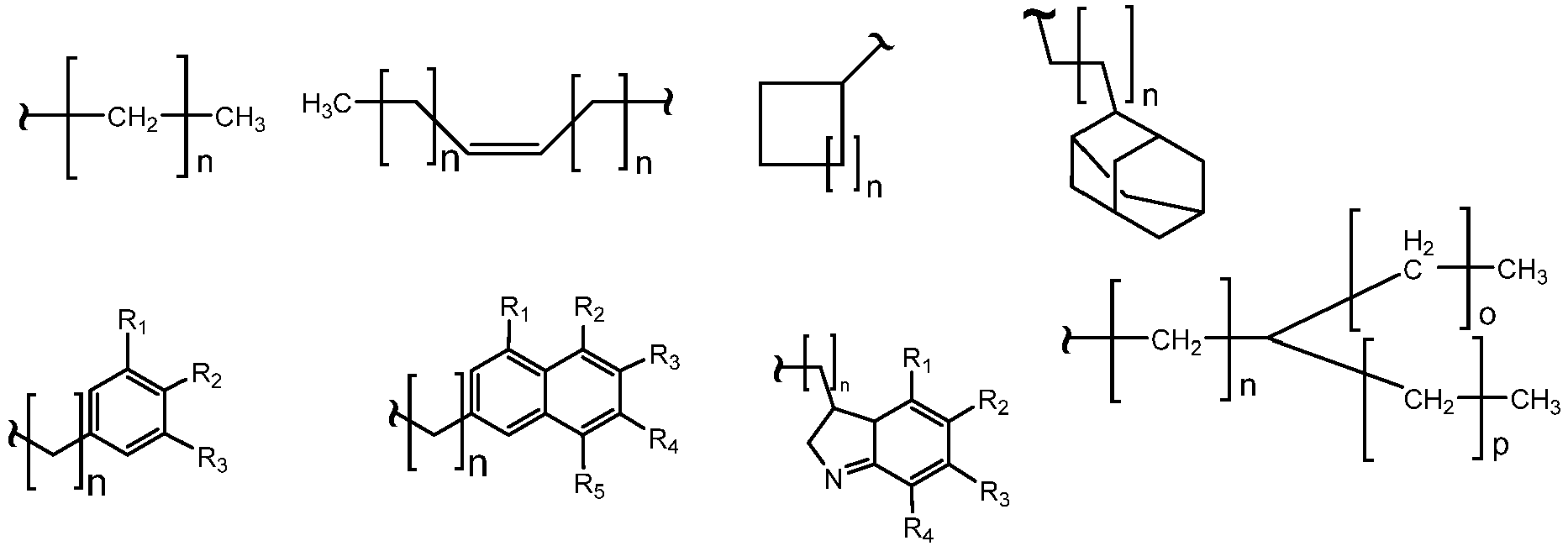
- wherein n = 0-12, and o = 0-12, and p = 0-12, and
- wherein R1, R2, R3, R4, and R5 are independently selected from the group consisting of: H-, CH3-, CH2CH3, propyl, isopropyl, isobutyl, tert-butyl, CH3O-, CH2CH3O-, propoxy, isopropoxy, isobutyloxy or tert-butyloxy;
and - the Z substituent is independently selected from the following structures:

- wherein q = 2-14, and r = 0-10, and s = 0-10;
- and diastereomers and mixtures of diastereomers of the compounds of formula I and their pharmaceutically acceptable salts and hydrates.
- Preferably, the Y substituent is selected from:


- Preferably, the X substituent is selected from:

- Preferably, Z is

- Said salts include salts with inorganic or organic anions and in particular, but not exclusively, pharmaceutically acceptable salts suitable for physiological administration.
- Pharmaceutically acceptable salts may be salts derived from inorganic or organic acids. A person skilled in the art will be able to determine which salts are pharmaceutically acceptable; in particular, they are salts with one or more desirable physical properties such as increased pharmaceutical stability at various temperatures and humidities, the desired solubility in water or oil, or are non-toxic.
- Suitable pharmaceutically acceptable salts of the compounds of this invention preferably include anions derived from inorganic acids such as hydrochloric, hydrobromic, hydrofluoric, boric, fluoroboric, phosphoric, metaphosphoric, nitric, carbonic, sulfuric and sulfurous acids and from organic acids such as acetic acid, benzene sulfonic, benzoic, citric, ethanesulfonic, fumaric, gluconic, glycolic, isethionic, lactic, lactobionic, maleic, malonic, methanesulfonic, trifluoromethanesulfonic, succinic, toluenesulfonic, tartaric and trifluoroacetic acids. Suitable organic acids generally include, for example, the following classes of organic acids: aliphatic, cycloaliphatic, aromatic, arylaliphatic, heterocyclic, carboxylic and sulfonic acids.
- Specific examples of suitable organic acids include acetate, trifluoroacetate, formate, propionate, succinate, glycolate, gluconate, digluconate, hyaluronate, lactate, malate, tartrate, citrate, ascorbate, glucuronate, maleate, fumarate, pyruvate, aspartate, glutamate, benzoate, anthranilate, stearate, salicylate, p-hydroxybenzoate, phenylacetate, mandelate, pamoate, methane sulfonate, ethanesulfonate, benzenesulfonate, pantothenate, toluenesulfonate, 2-hydroxyethanesulfonate, sulfanilate, cyclohexylaminosulfonate, 13-hydroxybutyrate, galactarate, galacturonate, adipate, alginate, butyrate, camphorate, camphorsulfonate, cyclopentanepropionate, dodecyl sulfate, glycoheptanoate, glycerophosphate, heptanoate, hexanoate, nicotinate, 2-naphthalenesulfonate, oxalate, palmoate, pectinate, 3-phenylpropionate, picrate, pivalate, thiocyanate and undecanoate.
- The compounds of formula I contain several chiral centers (especially in the L groups and in some R2 groups). The existence of a chiral center allows the compound to exist as one of two possible optical isomers ((R) - or (S)-enantiomer), or as a racemic mixture of both. In this case, where other chiral centers are present, all diastereomers and mixtures of diastereomers formed are also included in the range of the lipophosphonoxins of general formula I described in this invention.
- The invention furthermore relates to lipophosphonoxins of the general formula I or their diastereomers or to pharmaceutically acceptable salts and hydrates, and/or mixtures of such compounds, for use as medicaments.
- The invention furthermore relates to lipophosphonoxins of the general formula I or their diastereomers or to pharmaceutically acceptable salts and hydrates, and/or mixtures of such compounds, for use as antibacterial drugs.
- The invention also relates to a pharmaceutical composition, preferably to an antibacterial drug composition, comprising at least one lipophosphonoxin of the general formula I or diastereomer or a pharmaceutically acceptable salt or hydrate thereof, and/or a mixture of such compounds as the active ingredient.
- The invention furthermore relates to a disinfectant for non-therapeutic purposes and/or to a selective culture medium comprising at least one lipophosphonoxin of general formula I or a diastereomer or a pharmaceutically acceptable salt or hydrate thereof, and/or mixtures of such compounds as the active ingredient.
- The invention also relates to the use of lipophosphonoxins of general formula I or their diastereomers or pharmaceutically acceptable salts or hydrates, and/or mixtures of such compounds, for the preparation of an antibacterial drug.
- Finally, the invention relates to the use of lipophosphonoxins of general formula I or their diastereomers or pharmaceutically acceptable salts and hydrates, and/or mixtures of such compounds, as active ingredients of disinfectants for non-therapeutic purposes, and/or selective culture media for in vitro cultivation of bacteria, fungi or eukaryotic cell lines.
- A medicament / drug is any substance or combination of substances intended to treat or prevent disease in humans or animals, and any substance or combination of substances which may be administered to humans or animals to establish a medical diagnosis or to restore, ameliorate or modify physiological functions of humans or animals.
- The compounds of this invention exhibit antibacterial effects against strains of Escherichia coli, Pseudomonas aeruginosa, Enterococcus faecalis, Staphylococcus aureus, Staphylococcus haemolyticus, Enterococcus faecium, Staphylococcus epidermidis, Enterobacter kobei, and even against strains resistant to existing antibiotics.
- Compared to the first-generation LPPOs ( J. Med. Chem. 2011, 54(22), 7884-7898, patent
CZ 303569 EP2527351 ) and the second-generation LPPOs (J. Med. Chem. 2017, 60(14):6098-6118,CZ 308344 EP 3448865 ,AU 2017257061 Table 1: Comparison of the properties of the second (1) and third (2,3) generation of lipophosphonoxins - influencing antibacterial activity in the presence of serum albumins: MIC (mg/l) 0 % BSA 4 % BSA Compound Escherichia coli ATCC 25922 Staphylococcus aureus ATCC 29213 Escherichia coli ATCC 25922 Staphylococcus aureus ATCC 29213 1 LPPO II DR7030 2 2 >200 >200 2 LPPO III Example 37 of this invention 2 1 4 1 3 LPPO III Example 49 of this invention 4 1 8 2 
- The greatest benefit of the claimed compounds is their surprisingly high potency, even against dangerous multi-resistant bacterial strains occurring in a hospital environment. In addition, the structure of the third-generation LPPOs is even more modular than the first- and second-generation LPPOs, allowing the fine tuning of physical and biological properties.
- The higher degree of modularity of the structure of third-generation LPPOs compared to first- and second-generation LPPOs, enabled by their easy synthesis and assembly of individual modules, provides extensive structural variations of the compounds of this invention that can be used to modulate their biological activity.
- Formula (I) includes the compounds listed in Examples 34-37 and 39-58.
-
- DCM
- dichlormethan
- TPSCl
- triisopropyl benzenesulfonyl chloride
- IR
- infrared spectrum
- HR-ESI
- high resolution mass spectrum using electron spray ionization
- HR-EI
- high resolution mass spectrum using electron impact ionization
- n-BuOH
- n-butyl alcohol
- DMTr
- dimethoxy trityl
- THF
- tetrahydrofuran
- EC50
- mean effective concentration (causing 50 % of maximum effect)
- IC50
- inhibitory concentration (causing 50 % of the maximum inhibitory effect)
- rpm
- rotations per minute
- rt
- room temperature
- Methyl phosphonate (1 mmol) is dissolved in 60 % aqueous pyridine (20 mL) and the reaction mixture is stirred at 60 °C for 24 h. The reaction mixture is concentrated in vacuo at temperature below 40 °C, the residue is dissolved in ethanol (20 mL) and passed through a column of Dowex 50 v H+ form (5 g). The column is washed with EtOH (40 ml). The solvent is removed in vacuo. Product is obtained by column chromatography on silica gel using linear gradient of solvent system H1 (ethyl acetate, acetone, ethanol, water 4:1:1:1) in ethyl acetate.
- Mono alkyl vinylphosphonate (1 mmol) is randered dry by co-evaporation with EtOH (10 ml/mmol) and toluene (10 ml), dissolved in DCM (3 ml) and cooled to -78 °C under argon atmosphere.
- Oxalylchloride (2 mol/L) in DCM (0.3 ml) is slowly added and the reaction mixture is stirred at rt for 30 min. Catalytic ammount of DMF (50 µL) is added and the reaction mixture is stirred until gass evolution ceassed. Hydroxyderivative (1 mmol) is then added folowed by addition of triethylamine (1.1 mmol). The reaction mixture is stirred at rt for 12 h under argon atmosphere. The reaction mixture is extracted with sat. soln. NaHCO3 (10 mL) and sat. soln. NaCl (10 mL). Organic phase is dried over Na2SO4 and concentrated in vacuo. Product is obtained by column chromatography using linear gradient of acetone in toluene or linear gradient of ethanol in chloroform.
- Mono alkyl vinylphosphonate (1 mmol) and hydroxyderivative (2 mmol) is randered anhydrous by co-evaporation with DCM (2x10 ml) and dissolved in the same solvent (5 mL). Methylimidazole (3 mmol) and TPSCl (2 mmol) were added and the reaction mixture is stirred at re under argon atmosphere for 24-48 h. Progress of the reaction is followed by TLC using mixture of acetone/toluene (1:1). The reaction mixture is diluted with DCM (10 mL) and washed subsequently with sat. soln NaHCO3 (10 ml) and brine (10 mL). Organic phases were combined, dried over Na2SO4 and concentrated in vacuo. Product is obtained by column chromatography using linear gradient of acetone in toluene or linear gradient of ethanol in chloroform.
- Mono alkyl vinylphosphonate (1 mmol) and tetrabutylammonium hydroxide (1 mmol) is randered anhydrous by co-evaporation with ethanol (2x 10 mL) and DMF (10 mL) and dissolved in DMF (5 mL). α,ω-Dibromalkan (0.36 mmol) is added and the reaction mixture is stirred under argon atmosphere at 90°C for 24-48 h. Progress of the reaction is followed by TLC using mixture of acetone/toluene (1:1). The reaction mixture is concentrated in vacuo and product is obtained by column chromatography using linear gradient of acetone in toluene.
- The mixture of vinylphosphonate dimer (1 mmol) and secondary amine (3 mmol) in n-butanol (50 mL/mmol) is stirred at 105 °C for 24-72 h in sealed flask. Progress of the reaction is followed by TLC using mixture of EtOH/CHCl3 (1:10). The reaction mixture is concentrated in vacuo and product is obtained by column chromatography using linear gradient of ethanol in chloroform.
- Starting Boc derivative (1 mmol) is dissolved in 0.5M methanolic HCl (10 mL). The reaction mixture is stirred at rt for 24 h. The reaction mixture is concentrated in vacuo and product is obtained by precipitation from anhydrous ethyl acetate. If necessary, the final product is repurified by preparative HPLC on reversed phase using linear gradient of methanil in 0.1 % aqueous TFA.
-

- Butyl vinylphosphonate is prepared from mono methyl vinylphosphonate (7.0 g, 57.3 mmol) and 1-butanol using general method B2 and general method A in 47% (4,39 g, 26,7 mmol) overall yield in the form of colorless oil.
- 1H NMR (400.1 MHz, CDCl3): 0.90-0.95 (m, 3H), 1.35-1.45 (m, 2H,), 1.62-1.69 (m, 2H), 3.98-4.04 (m, 2H), 5.99-6.34 (m, 3H), 9.78 (s, 1H).
- 13C NMR (100.6 MHz, CDCl3): 13.57, 18.70, 32.35 (d, J C,P = 7.0), 65.46 (d, J C,P = 6.0), 126.19 (d, J C,P = 189.1), 134.61 (d, J C,P = 2.0).
- 1P{1H} NMR (162.0 MHz, CDCl3): 21.72.
- IR ν max (KBr) 3090 (vw), 2963 9s), 2935 (s), 2876 (m), 2847 (m), 2739 (w, vbr), 2671 (w, vbr), 2337 (m, vbr), 2177 (w, vbr), 1666 (m, vbr), 1615 (m), 1476 (w), 1466 (m), 1459 (w), 1403 (m), 1276 (w), 1199 (s), 1062 (s), 1031 (vs), 986 (vs), 899 (w).
- HR-MS(ESI+) For C6H13O3NaP (M+Na)+ calcd 187.04945, found 187.04951.
-

- Pentyl vinylphosphonate is prepared from mono methyl vinylphosphonate (6.50 g, 53.3 mmol) and 1-pentanol using general method B2 and general method A in 47% (4.43 g g, 24.9 mmol) overall yield in the form of colorless oil.
- 1H NMR (400.1 MHz, CDCl3): 0.87-0.93 (m, 3H), 1.28-1.39 (m, 4H), 1.64-1.71 (m, 2H), 3.72 (d, 3H, J H,P = 8.0), 3.98-4.05 (m, 2H), 5.97-6.36 (m, 3H).
- 13C NMR (100.6 MHz, CDCl3): 13.93, 22.21, 27.62, 30.14 (d, J C,P = 7.0), 52.31 (d, J C,P = 5.0), 66.08 (d, J C,P = 6.0), 125.21 (d, J C,P = 184.1), 135.91 (d, J C,P = 2.0).
- 31P{1H} NMR (162.0 MHz, CDCl3): 21.11.
- IR ν max (KBr) 3090 (vw), 2959 (s), 2934 (s), 2874 (m), 2861 (m), 1613 (w), 1467 (w), 1461 (w), 1435 (vw), 1400 (m), 1381 (w), 1280 (w), 1242 (s), 1185 (w), 1057 (vs), 1042 (vs), 1022 (vs), 1004 (s), 989 (s), 856 (w), 814 (m).
- HR-MS(ESI+) For C8H18O3P (M+H)+ calcd 193.09881, found 193.09872.
-

- Hexyl vinylphosphonate is prepared from mono methyl vinylphosphonate (5.70 g, 46.7 mmol) and 1-hexanol using general method B2 and general method A in 42% (3.77 g g, 19.6 mmol) overall yield in the form of colorless oil.
- 1H NMR (400.1 MHz, CDCl3): 0.86-0.90 (m, 3H), 1.23-1.40 (m, 6H), 1.63-1.70 (m, 2H), 3.97-4.02, 5.99-6.34 (m, 3H), 10.53 (s, 1H).
- 13C NMR (100.6 MHz, CDCl3): 13.98, 22.52, 25.15, 31.33, 30.31 (d, J C,P = 6.0), 65.79 (d, J C,P = 6.0), 126.2 (d, J C,P = 189.1), 134.61 (d, J C,P = 2.0).
- 1P{1H} NMR (162.0 MHz, CDCl3): 21.48.
- IR ν max (KBr) 3089 (vw), 2959 (s), 2932 (s), 2873 (s), 2861 (s), 2732 (m, vbr), 2672 (m, vbr), 2337 (m,vbr), 2181 (m, vbr), 1672 (m, vbr), 1615 (w), 1468 (m), 1462 (m), 1458 (m), 1276 (m), 1199 (s), 1059 (s), 1042 (vs), 1020 (vs), 986 (vs), 895 (w).
- HR-MS(ESI+) For C8H17O3NaP (M+Na)+ calcd 215.08075, found 215.08069.
-

- Heptyl vinylphosphonate is prepared from mono methyl vinylphosphonate (9.65 g, 79.1 mmol) and 1-heptanol (11.2 mL, 79.1 mmol) using general method B1 and general method A in 70% (11.5 g, 55.5 mmol) overall yield in the form of colorless oil.
- 1H NMR (401 MHz, Chloroform-d) δ 10.83 (s, 1H), 6.34-5.98 (m, 3H), 3.99 (q, J = 6.7 Hz, 2H), 1.66 (p, J = 6.6 Hz, 2H), 1.41-1.19 (m, 8H), 0.92-0.83 (m, 3H).
- 31P NMR (162 MHz, Chloroform-d) δ 21.89.
- 13C NMR (101 MHz, Chloroform-d) δ 134.92, 126.20 (d, J= 189.2 Hz), 66.02 (d, J= 6.1 Hz), 31.84, 30.48 (d, J= 7.0 Hz), 28.96, 25.57, 22.71, 14.19.
- IR ν max(film) 3086 (w), 2957 (m), 2930 (s), 2872 (m), 2858 (m), 2594 (w, br), 2280 (w), 1615 (m), 1468 (m), 1457 (m), 1402 (m), 1276 (m), 1208 (s), 1064 (s), 1053 (s), 1013 (vs), 988 (vs), 850 (m), 727 (m), 607 (m).
- HR-MS (ESI-): For C9H18O3P (M - H)- m/z calculated 205.09990, found 205.10001 ± 0.49665 ppm.
-

- Octyl vinylphosphonate is prepared from mono methyl vinylphosphonate (4.0 g, 32.8 mmol) and 1-octanol using general method B1 and general method A in 27% (1.92 g, 8.86 mmol) overall yield in the form of colorless oil.
- 1H NMR (401 MHz, Chloroform-d) δ 6.43-5.94 (m, 3H), 4.00 (q, J = 6.8 Hz, 2H), 1.66 (dt, J = 8.1, 6.5 Hz, 2H), 1.44-1.18 (m, 10H), 0.95-0.78 (m, 3H).
- 31P NMR (162 MHz, Chloroform-d) δ 22.38.
- 13C NMR (101 MHz, Chloroform-d) δ 134.87 (d, J = 2.0 Hz), 126.27 (d, J = 189.4 Hz), 65.95 (d, J = 6.1 Hz), 31.92, 30.49 (d, J = 6.6 Hz), 29.32, 29.27, 25.63, 22.78, 14.23.
- IR ν max(CHCl3) 3089 (vw), 2958 (s), 2929 (vs), 2872 (s), 2858 (s), 2673 (w, vbr), 2338 (w, vbr), 1673 (m, vbr), 1615 (m), 1468 (m), 1458 (m), 1403 (m), 1379 (w), 1277 (m), 1196 (s), ~1061 (s, sh), 1025 (vs), 986 (vs), 855 (w), 605 (w).
- HR-MS (APCI+): For C10H22O3P (M + H) + m/z calculated 221.13011, found 221.12992 ± 0.83273 ppm.
-

- Decyl vinylphosphonate is prepared from mono methyl vinylphosphonate (9.98 g, 81.8 mmol) and 1-octanol (12.9 mL, 81.8 mmol) using general method B1 and general method A in 41% (8.52 g, 34.3 mmol) overall yield in the form of colorless oil.
- 1H NMR (401 MHz, Chloroform-d) δ 10.98 (brs, 1H), 6.35-5.99 (m, 3H), 3.99 (q, J = 6.8 Hz, 2H), 1.71-1.62 (m, 2H), 1.40-1.19 (m, 14H), 0.91-0.84 (m, 3H).
- 31P NMR (162 MHz, Chloroform-d) δ 22.13.
- 13C NMR (101 MHz, Chloroform-d) δ 134.86, 126.27 (d, J = 189.3 Hz), 65.97 (d, J = 6.1 Hz), 32.03, 30.50 (d, J = 6.6 Hz), 29.68, 29.66, 29.45, 29.31, 25.63, 22.82, 14.26.
- IR ν max(CHCl3) 3090 (vw), 2957 (vs), 2928 (vs), 2872 (s), 2856 (vs), 2731 (m, br), 2675 (m, vbr), 2327 (m, br), 2174 (m, br, sh), 1667 (m, vbr), 1615 (s), 1467 (s), 1458 (m), 1403 (s), 1379 (m), 1277 (m), 1197 (vs), 1024 (vs, br), 986 (vs, br), 901 (m).
- HR-MS(ESI+): For C12H25O3NaP (M + Na)+ m/z calculated 271.14335, found 271.14340 ± 0.18190 ppm; for C12H26O3P (M + H) + m/z calculated 249.16141, found 249.16152 ± 0.45265 ppm.
-

- Phenethyl vinylphosphonate is prepared from mono methyl vinylphosphonate (7.0 g, 57.5 mmol) and phenethyl bromide (98 %, 8.56 mL, 61.4 mmol) using general method C and general method A in 36% (4.42 g, 20.7 mmol) overall yield in the form of colorless oil.
- 1H NMR (401 MHz, Chloroform-d) δ 8.49 (brs, 1H), 7.39-7.12 (m, 5H), 6.43-5.73 (m, 3H), 4.18 (q, J = 7.4 Hz, 2H), 2.98 (t, J = 7.2 Hz, 2H).
- 31P NMR (162 MHz, Chloroform-d) δ 22.26.
- 13C NMR (101 MHz, Chloroform-d) δ 137.28, 135.12, 129.17, 128.64, 126.81, 125.94 (d, J = 189.4 Hz), 66.23 (d, J = 6.0 Hz), 37.02 (d, J = 6.6 Hz).
- IR ν max(film) 3086 (w), 3063 (w), 3029 (w), 2867 (w), 1614 (w), 1605 (m), 1497 (m), 1473 (w), 1454 (m), 1402 (m), 1276 (m), 1216 (s), 1179 (m), 1154 (m), 1061 (s), 1019 (vs), 1002(s), 988 (vs), 748 (m), 699 (s), 496 (m).
- HR-MS(ESI+): For C10H13O3NaP (M + Na)+ m/z calculated 235.04945, found 235.04909 ± 1.55059 ppm. For C10H14O3P (M + H) + m/z calculated 213.06751, found 213.06721 ± 1.37212 ppm.
-

- 2-(Adamantan-1-yl)ethyl vinylphosphonate is prepared from mono methy vinylphosphonate (0.63 g, 5.18 mmol) and 2-(adamantan-1-yl)ethanol using general method B1 and general method A in overall 40% yield (0.56 g, 2.07 mmol) in the form of white foam.
- 1H NMR (400.1 MHz, CDCl3): 1H NMR (401 MHz, CDCl3) δ 1.37 - 1.46 (m, 2H); 1,49 (m, 6H); 1.51 - 1.75 (m, 6H); 1.91-1.92 (m, 3H); 3.60 - 4.09 (m, 2H); 5.75 - 6.12 (m, 3H).
- 31P{1H} NMR (162.0 MHz, CDCl3): δ 16.79.
- IR ν max(CHCl3) 3083 (vw), 2960 (m, sh), 2926 (s), 2904 (vs), 2849 (s), 2753-2637 (vw), 1160 (w, vbr), 1614 (w), 1451 (m), 1400 (m), 1362 (vw), 1346 (m), 1276 (m), 1201 (s), 1106 (m), 1072 (s), 1046 (s), 1029 (s, sh), 1018 (s), 989 (s), 972 (s), 811 (m), 437 (w).
- HR-MS (ESI-): For C14H22O3P (M - H)- m/z calcd 269.13120, found 269.13132.
-

- (Adamantan-1-yl)methyl vinylphosphonate is prepared from mono methy vinylphosphonate (1.68 g, 13.8 mmol) and (adamantan-1-yl)methanol using general method B1 and general method A in overall 40% yield (8.87 g, 34.61 mmol) bezbarvého oleje.
- 1H NMR (401 MHz, Chloroform-d) δ 1.53 (s, 6H), 1.59 - 1.79 (m, 6H), 1.98 (s, 3H), 3,55 (d, J = 5.8 Hz, 2H), 5.58 - 6.77 (m, 3H), 10.61 (s, 1H).
- 13C NMR (101 MHz, Chloroform-d) δ 28.14, 33.86 (d, J = 7,1 Hz), 38.96, 75.31, 75.37, 76.84, 77.16, 77.48, 126.23 (d, J = 189.8 Hz), 134.73 (d, J = 1.8 Hz).
- 31P NMR (162 MHz, Chloroform-d) δ 22.39.
- IR ν max (CHCl3) 3090 (vw), 2940 (vs, sh), 2906 (vs), 2851 (vs), 2799, 2777, 2720 (m, vbr), 2660, 2326 (m, vbr), 1666 (m, vbr), 1616 (m), 1462 (m), 1453 (m), 1403 (m), 1387 (w), 1365 (w), 1276 (m), 1196 (s), 1191 (s), 1106 (m), 1060 (s), 1029 (vs, br), 1002 (vs), 987 (vs), 975 (vs), 942 (m), 923 (m), 809 (m), 437 (w).
- HR-MS(ESI+) For C13H21O3NaP (M+Na)+ calcd 279.11205, found 279.11202.
-

- 3-(Cyclohexyl)propyl vinylphosphonate is prepared from mono methyl vinylphosphonate (5 g, 40.96 mmol) and 3-(cyclohexyl)propanol (8.32 g, 58.52 mmol) general method B2 and general method A in 32% (3-01 g, 12-96 mmol) overall yield in the form of colorless oil.
- 1H NMR (401 MHz, Chloroform-d) δ 0-71 - 0-99 (m, 2H), 1.02 - 1.44 (m, 6H), 1.47 - 1.93 (m, 7H), 3.84 - 4.15 (m, 2H), 5.74 - 6.49 (m, 3H), 9.98 (s, 1H).
- 13C NMR (101 MHz, Chloroform-d) δ 26.15, 26.45, 27.60 (d, J = 6,7 Hz), 32.92, 33.08, 37.10, 65,97 (d, J = 6,1 Hz), 76.53, 76.84, 77.16, 126.01 (d, J = 189.2 Hz), 134.49 (d, J = 1.8 Hz).
- 31P NMR (162 MHz, Chloroform-d) δ 22.18.
- IR ν max (CHCl3) 3090 (vw), 2926 (vs), 2853 (s), 2710 (w, vbr), 2330 (m, vbr), 1669 (m, vbr), 1615 (m), 1474 (w), 1463 (w), 1449 (m), 1403 (m), 1276 (w), 1198 (s), 1068 (s), 1053 (s), 1041 (s), 1013 (vs), 986 (vs).
- HR- TOF MS CI+ For C11H22O3P (M+H)+ calcd 233.1307, found 233.1310.
-

- (Z)-non-3-en-1-yl vinylphosphonate is prepared from mono methyl vinylphosphonate (3.0 g, 24.6 mmol) and (Z)-non-3-en-1-ol using general method B1 and general method A in 35% (2.0 g, 8.61 mmol) overall yield in the form of colorless oil.
- 1H NMR (401 MHz, Methanol-d 4) δ 0.87 - 0.95 (m, 3H), 1.23 - 1.44 (m, 6H), 2.06 (qd, J = 7.3, 1.3 Hz, 2H), 2.41 (qd, J = 7.0, 1.4 Hz, 2H), 3.92 (q, J = 7.0 Hz, 2H), 5.38 (ddd, J = 10.9, 7.1, 1.4 Hz, 1H), 5.51 (dtt, J = 10.3, 7.2, 1.5 Hz, 1H), 5.97 - 6.27 (m, 3H).
- 13C NMR (101 MHz, Methanol-d 4) δ 14.41, 23.61, 29.72 (d, J = 6.6 Hz), 29.75, 30.40, 32.62, 48.36, 48.58, 48.79, 49.00, 49.21, 49.42, 49.64, 66.04 (d, J C,P = 5.7 Hz), 125.37, 128.92 (d, J = 181.4 Hz), 133.87, 134.31 (d, J = 1.4 Hz).
- 31P NMR (162 MHz, Methanol-d 4) δ 18.44.
- IR ν max (KBr) 3088 (vw), 2959 (s), 2930 (s), 2873 (m), 2858 (s), 2733 (w), 2669 (w, vbr), 2337 (m, br), 1660 (m, vbr), 1655 (w), 1615 (m), 1468 (m), 1460 (m), 1403 (m), 1380 (w), 1277 (m), 1198 (s), 1165 (s, sh), 1155 (s), 1023 (vs), 986 (vs).
- HR-MS(ESI+) For C11H21O3NaP (M+Na)+ calcd 255.11205, found 255.11186.
-

- (Z)-hept-3-en-1-yl vinylphosphonate is prepared from mono methyl vinylphosphonate (5.0 g, 41.0 mmol) and 1-hexanol using general method B2 and general method A in 46% (3.42 g, 19.6 mmol) overall yield in the form of colorless oil.
- 1H NMR (400.1 MHz, CDCl3): 0.89 (m, 3H), 1.32-1.41 (m, 2H), 1.98-2.04 (m, 2H), 2.35-2.46 (m, 2H), 3.98 (q, 2H, J vic= 7.2), 5.31-5.38 (m, 1H), 5.47-5.54 (m, 1H), 5.99-6.34 (m, 3H), 11.10 (s, 1H).
- 13C NMR (100.6 MHz, CDCl3): 13.73, 22.67, 28.59 (d, J C,P = 7.0), 29.36, 65.06 (d, J C,P = 6.0), 123.80, 126.13 (d, J C,P = 189.1), 133.05, 134.72 (d, J C,P = 2.0).
- 1P{1H} NMR (162.0 MHz, CDCl3): 21.58.
- IR ν max (KBr) 3091 (w), 3013 (m), 2960 (m), 2931 (m), 2873 (s), 2700-2100 (w, vbr), 1665 (w), 1657 (w), 1615 (w), 1466 (w), 1458 (w), 1403 (m), 1379 (vw), 1277 (w), 1210 (m), 1144 (m, sh), 1066 (m), 1016 (vs), 1023 (vs), 989 (vs), 849 (w).
- HR-ESI(ESI+) For C9H16O3P (M-H)- calcd 203.08425, found 203.08435.
-

- (Z)-oct-3-en-1-yl vinylphosphonate is prepared from mono methyl vinylphosphonate (4.0 g, 32.8 mmol) and (Z)-oct-3-en-1-ol using general method B2 and general method A in 60% (3.42 g, 15.7 mmol)
1H NMR (400.1 MHz, CDCl3): 0.86-0.92 (m, 3H), 1.25-1.37 (m, 4H), 2.0-2.06 (m, 2H), 2.35-2.46 (m, 2H), 3.98 (q, 2H, J vic =12.0), 5.30-5.37 (m, 1H), 5.47-5.54 (m, 1H), 5.99-6.34 (m, 3H), 10.79 (s, 1H). 13C NMR (100.6 MHz, CDCl3): 13.96, 22.30, 27.04, 28.57 (d, J C,P = 7.0), 31.72, 65.06 (d, J C,P = 6.0, 123.59, 126.12 (d, J C,P = 189.1), 133.27, 134.73 (d, J C,P = 2.0). - 1P{1H} NMR (162.0 MHz, CDCl3): 21.66.
- IR ν max (KBr) 3090 (w), 2960 (s), 2930 (s), 2873 (s), 2860 (s), 2734 (m, br), 2672 (m, vbr), 2330 (m, vbr), 2169 (m, vbr), 1665 (m, vbr), 1654 (m), 1615 (m), 1467 (m), 1458 (m), 1403 (s), 1379 (m), 1277 (m), 1198 (s), 1066 (s), 1053 (s), 1023 (vs), 986 (vs), 894 (w).
- HR-MS(ESI+) For C10H19O3NaP (M+Na)+ calcd 241.09640, found 241.09653.
-

- Isobutyl vinylphosphonate is prepared from mono methyl vinylphosphonate (4.03 g, 33.0 mmol) and isobutyl alcohol (3.71 mL, 40.0 mmol) using general method B1 and general method A in 37% (2.00 g, 12.2 mmol) overall yield in the form of colorless oil.
- 1H NMR (401 MHz, Chloroform-d) δ 6.45 (brs, 1H), 6.36-5.98 (m, 3H), 3.77 (t, J = 6.6 Hz, 2H), 1.95 (dt, J = 13.3, 6.7 Hz, 1H), 0.94 (d, J = 6.7 Hz, 6H).
- 31P NMR (162 MHz, Chloroform-d) δ 22.26.
- 13C NMR (101 MHz, Chloroform-d) δ 134.69, 126.11 (d, J = 189.6 Hz), 71.63 (d, J = 6.6 Hz), 29.06 (d, J = 7.0 Hz), 18.69 (d, J = 1.8 Hz).
- IR ν max(CHCl3) 3088 (w), 2962 (m), 2877 (m), 2853 (w), 2585 (m, br), 2278 (m, br), 1673 (m), 1615 (m), 1472 (m), 1403 (m), 1370 (w), 1278 (m), 1206 (s), 1032 (vs), 989 (s), 854 (m), 732 (m), 610 (m). HR-MS(ESI+): For C6H13O3NaP (M + Na)+ m/z calculated 187.04945, found 187.04957 ± 0.64909 ppm.
-

- Di((Z)-oct-3-en-1-yl) propan-1,3-diyl bis(vinylphosphonate) is prepared from compound in Example 13 (0.9 g, 4.12 mmol) and 1,3-dibromopropane (0.32 g, 1.37 mmol) using general method C in 73% (0.48 g, 1.01 mmol) overall yield in the form of colorless oil.
- 1H NMR (400.1 MHz, CDCl3): 0.86-0.94 (m, 6H), 1.25-1.36 (m, 8H), 1.42-1.50 (m, 2H), 1.65-1.73 (m, 4H), 2.0-2.06 (m, 4H), 2.35-2.45 (m, 4H), 3.97-4.04 (m, 8H), 5.30-5.37 (m, 2H), 5.47-5.54 (m, 2H), 5.97-6.35 (m, 6H).
- 13C NMR (100.6 MHz, CDCl3): 13.97, 21.69, 22.31, 27.07, 28.68 (d, J C,P = 7.0), 29.99 (d, J C,P = 7.0), 31.71, 65.28, 65.48 (d, J C,P = 6.0), 123.68, 125.75 (d, J C,P = 184.1), 133.28, 135.63 (d, J C,P = 3.0). 1P{1H} NMR (162.0 MHz, CDCl3): 19.87.
- IR ν max (KBr) 3086 (w), 3011 (m), 2957 (s), 2929 (s), 2872 (m), 2860 (m), 1613 (w), 1467 (m), 1363 (w), 1278 (m, sh), 1251 (vs), 1184 (w), 1054 (s), 1007 (vs), 970 (s, sh), 726 (m), 608 (m). HR-MS(ESI+) For C25H47O6P2 (M+H)+ calcd 505.28424, found 505.28375.
-

- Di((Z)-oct-3-en-1-yl) pentane-1,5-diyl bis(vinylphosphonate) is prepared from compound in Example 13 (0.9 g, 4.12 mmol) and 1,5-dibromopropane (0.32 g, 1.37 mmol) using general method C in 79% (0.56 g, 1.11 mmol) overall yield in the form of colorless oil.
- 1H NMR (400.1 MHz, CDCl3): 0.86-0.94 (m, 6H), 1.25-1.36 (m, 8H), 1.42-1.50 (m, 2H), 1.65-1.73 (m, 4H), 2.0-2.06 (m, 4H), 2.35-2.45 (m, 4H), 3.97-4.04 (m, 8H), 5.30-5.37 (m, 2H), 5.47-5.54 (m, 2H), 5.97-6.35 (m, 6H).
- 13C NMR (100.6 MHz, CDCl3): 13.97, 21.69, 22.31, 27.07, 28.68 (d, J C,P = 7.0), 29.99 (d, J C,P = 7.0), 31.71, 65.28, 65.48 (d, J C,P = 6.0), 123.68, 125.75 (d, J C,P = 184.1), 133.28, 135.63 (d, J C,P = 3.0). 1P{1H} NMR (162.0 MHz, CDCl3): 19.87.
- IR ν max (KBr) 3086 (w), 3011 (m), 2957 (s), 2929 (s), 2872 (m), 2860 (m), 1613 (w), 1467 (m), 1363 (w), 1278 (m, sh), 1251 (vs), 1184 (w), 1054 (s), 1007 (vs), 970 (s, sh), 726 (m), 608 (m). HR-MS(ESI+) For C25H47O6P2 (M+H)+ calcd 505.28424, found 505.28375.
-

- Hexan-1,6-diyl di((Z)-oct-3-en-1-yl) bis(vinylphosphonate) is prepared from compound in Example 13 (0.9 g, 4.12 mmol) and 1,6-dibromohexane (0.32 g, 1.37 mmol) using general method C in 83% (0.59 g, 1.14 mmol) overall yield in the form of colorless oil.
- 1H NMR (400.1 MHz, CDCl3): 0.86-0.92 (m, 6H), 1.25-1.35 (m, 8H), 1.36-1.41 (m, 4H), 1.62-1.70 (m, 4H), 2.0-2.06 (m, 4H), 2.39-2.45 (m, 4H), 3.97-4.03 (m, 8H), 5.30-5.37 (m, 2H), 5.47-5.54 (m, 2H), 5.97-6.34 (m, 6H).
- 13C NMR (100.6 MHz, CDCl3): 13.96, 22.31, 25.15, 27.07, 28.67 (d, J C,P = 6.0), 30.35 (d, J C,P = 7.0), 31.71, 65.26 (d, J C,P = 6.0), 65.67 (d, J C,P = 6.0), 123.70, 125.78 (d, J C,P = 184.1), 133.26, 135.58 (d, J C,P = 3.0).
- 1P{1H} NMR (162.0 MHz, CDCl3): 19.83.
- IR ν max (KBr) 3085 (w), 3011 (m), 2956 (s), 2929 (s), 2871 (m), 2859 (m), 1654 (w), 1613 (w), 1467 (m), 1398 (m), 1278 (m, sh), 1251 (s), 1053 (s), 1003 (s), 970 (s, sh), 854 (m), 729 (m), 698 (m). HR-MS(ESI+) For C26H49O6P2 (M+H)+ calcd 519.29989, found 519.29947.
-

- Di((Z)-hept-3-en-1-yl) hexane-1,6-diyl bis(vinylphosphonate) is prepared from compound in Example 12 (1.10 g, 5.39 mmol) and 1,6-dibromohexane (0.44 g, 1.80 mmol) using general method C in 79% (0.68 g, 1.42 mmol) overall yield in the form of colorless oil.
- 1H NMR (400.1 MHz, CDCl3): 0.89 (m, 6H), 1.32-1.43 (m, 8H), 1.62-1.70 (m, 4H), 1.98-2.04 (m, 4H), 2.39-2.45 (m, 4H), 3.96-4.03 (m, 8H), 5.31-5.38 (m, 2H), 5.47-5.54 (m, 2H), 5.97-6.34 (m, 6H).
- 13C NMR (100.6 MHz, CDCl3): 13.74, 22.66, 25.15, 28.69 (d, J C,P = 6.0), 29.39, 30.35 (d, J C,P = 7.0), 65.24 (d, J C,P = 6.0), 65.66 (d, J C,P = 6.0), 123.91, 125.80 (d, J C,P = 184.1), 133.04, 135.56 (d, J C,P = 2.0). 1P{1H} NMR (162.0 MHz, CDCl3): 19.84.
- IR ν max (KBr) 3085 (vw), 3011 (m), 2958 (s), 2931 (m), 2871 (m), 1654 (w), 1613 (w), 1465 (m), 1398 (m), 1280 (m, sh), 1251 (vs), 1066 (vs), 1053 (vs), 1003 (vs), 976 (s, sh), 851 (m), 727 (m). HR-MS(ESI+) For C24H45O6P2 (M+H)+ calcd 491.26859, found 491.26863.
-

- Di((Z)-hept-3-en-1-yl) pentane-1,5-diyl bis(vinylphosphonate) is prepared from compound in Example 12 (1.10 g, 5.39 mmol) and 1,6-dibromopentane (0.40 g, 1.80 mmol) using general method C in 84% (0.72 g, 1.50 mmol) overall yield in the form of colorless oil.
- 1H NMR (400.1 MHz, CDCl3): 0.88 (m, 6H), 1.29-1.39 (m, 4H), 1.41-1.49 (m, 2H), 1.65-1.72 (m, 4H), 1.97-2.03 (m, 4H), 2.38-2.44 (m, 4H), 3.96-4.03 (m, 8H), 5.30-5.38 (m, 2H), 5.46-5.53 (m, 2H), 5.96-6.33 (m, 6H).
- 13C NMR (100.6 MHz, CDCl3): 13.74, 21.68, 22.65, 28.68 (d, J C,P = 6.0), 29.38, 29.97 (d, J C,P = 7.0), 65.27, 65.42 (d, J C,P = 6.0, 5.0), 123.88, 125.73 (d, J C,P = 184.1), 133.05, 135.62 (d, J C,P = 2.0).
- 1P{1H} NMR (162.0 MHz, CDCl3): 19.86.
- IR ν max (KBr) 3086 (vw), 3011 (m), 2960 (s), 2930 (m), 2872 (m), 1656 (w), 1613 (w), 1466 (m), 1457 (m, sh), 1380 (w), 1281 (m), 1252 (s), 1066 (vs), 1051 (vs), 1011 (vs), 981 (s, sh), 722 (m). HR-MS(ESI+) For C23H42O6NaP2 (M+Na)+ calcd 499.23488, found 499.23491.
-

- Hexane-1,6-diyl dihexyl bis(vinylphosphonate) is prepared from compound in Example 3 (1.20 g, 6.24 mmol) and 1,6-dibromohexane (0.51 g, 2.08 mmol) using general method C in 71% (0.69 g, 1.48 mmol) overall yield in the form of colorless oil.
- 1H NMR (400.1 MHz, CDCl3): 0.86-0.90 (m, 6H), 1.24-1.43 (m, 16H), 1.62-1.71 (m, 8H), 3.97-4.02 (m, 8H), 5.97-6.33 (m, 6H).
- 13CNMR (100.6 MHz, CDCl3): 13.98, 22.52, 25.16, 25.18, 31.33, 30.39 (d, J C,P = 7.0, 6.0), 65.63, 66.98 (d, J C,P = 6.0, 5.0), 135.47 (d, J C,P = 183.1), 135.47 (d, J C,P = 3.0).
- 1P{1H} NMR (162.0 MHz, CDCl3): 19.82.
- IR ν max (KBr) 3090 (vw), 2959 (s), 2934 (s), 2872 (m), 2861 (m), 1614 (w), 1468 (m), 1460 (m, sh), 1455 (m, sh), 1400 (m), 1380 (w), 1279 (m), 1241 (s), 1058 (s), 1039 (s), 1010 (vs, sh), 998 (vs), 862 (m).
- HR-MS(ESI+) For C22H45O6P2 (M+H)+ calcd 467.26859, found 467.26821.
-

- Dihexyl octane-1,8-diyl bis(vinylphosphonate) is prepared from compound in Example 3 (1.0 g, 5.20 mmol) and 1,8-dibromooctane (0.64 g, 1.74 mmol) using general method C in 74% (0.64 g, 1.29 mmol) overall yield in the form of colorless oil.
- 1H NMR (400.1 MHz, CDCl3): 0.83-0.90 (m, 6H), 1.24-1.40 (m, 20H), 1.62-1.70 (m, 8H), 3.97-4.11 (m, 8H), 5.97-6.34 (m, 6H).
- 13C NMR (100.6 MHz, CDCl3): 13.98, 22.52, 25.18, 25.45, 29.04, 31.33, 30.43 (d, J C,P = 6.0), 65.81, 65.94 (d, J C,P = 5.0), 125.91 (d, J C,P = 184.1), 135.38 (d, J C,P = 3.0).
- 1P{1H} NMR (162.0 MHz, CDCl3): 19.77.
- IR ν max (KBr) 3091 (vw), 2959 (s), 2934 (s), 2872 (m), 2860 (w), 1614 (w), 1468 (w), 1456 (w, sh), 1434 (w), 1400 (m), 1279 (m), 1241 (s), 1059 (s), 1040 (s, sh), 1009 (vs), 998 (vs), 606 (w). HR-MS(ESI+) For C24H49O6P2 (M+H)+ calcd 495.29989, found 495.29906.
-

- Decane-1,10-diyl dihexyl bis(vinylphosphonate) is prepared from compound in Example 3 (1.0 g, 5.20 mmol) and 1,10-dibromodecane (0.62 g, 1.74 mmol) using general method C in 75% (0.68 g, 1.31 mmol) overall yield in the form of colorless oil.
- 1H NMR (400.1 MHz, CDCl3): 0.85-0.90 (m, 6H), 1.25-1.40 (m, 24H), 1.62-1.69 (m, 8H), 3.96-4.04 (m, 8H), 5.97-6.33 (m, 6H).
- 13C NMR (100.6 MHz, CDCl3): 13.98, 22.52, 25.18, 25.51, 29.14, 29.42, 31.33, 30.42, 30.48 (d, J C,P = 6.0), 65.88, 65.93 (d, J C,P = 6.0), 125.92 (d, J C,P = 184.1), 135.35 (d, J C,P = 2.0).
- 1P{1H} NMR (162.0 MHz, CDCl3): 19.76.
- IR ν max (KBr) 3091 (vw), 2959 (s), 2932 (vs), 2872 (m), 2858 (m), 1614 (w), 1468 (m), 1458 (w), 1434 (w), 1400 (m), 1380 (w), 1279 (w), 1241 (s), 1058 (s), 1038 (s, sh), 1007 (vs), 997 (vs), 606 (w). HR-MS(ESI+) For C26H53O6P2 (M+H)+ calcd 523.33119, found 523.33031.
-

- Dihexyl tetradecane-1,14-diyl bis(vinylphosphonate) is prepared from compound in Example 3 (1.0 g, 5.20 mmol) and 1,14-dibromotetradecane (0.62 g, 1.74 mmol) using general method C in 85% (0.86 g, 1.47 mmol) overall yield in the form of colorless oil.
- 1H NMR (400.1 MHz, CDCl3): 0.86-0.90 (m, 6H), 1.24-1.39 (m), 1.62-1.69 (m, 8H), 3.95-4.04 (m, 8H), 5.97-6.33 (m, 6H).
- 13C NMR (100.6 MHz, CDCl3): 13.98, 22.52, 25.19, 25.53, 29.17, 29.52, 29.57, 29.62, 31.34, 30.44, 30.48, 65.91 (d, J C,P = 6.0), 125.95 (d, J C,P = 184.1), 135.31 (d, J C,P = 2.0).
- 1P{1H} NMR (162.0 MHz, CDCl3): 19.74.
- IR ν max (KBr) 3090 (vw); 2958 (s), 2930 (vs), 2871 (m), 2857 (s), 1614 (w), 1468 (m), 1458 (w), 1434 (w), 1400 (m), 1380 (w), 1279 (w), 1241 (s), 1058 (s), 1038 (s), 1010 (vs), 998 (vs), 861 (w), 606 (w).
- HR-MS(ESI+) For C30H61O6P2 (M+H)+ calcd 579.39379, found 579.39286.
-

- Octan-1,8-diyl dipentyl bis(vinylphosphonate) is prepared from compound in Example 2 (1.20 g, 6.73 mmol) and 1,8-dibromooctane (0.61 g, 2.24 mmol) using general method C in 71% (0.75 g, 1.61 mmol) overall yield in the form of colorless oil.
- 1H NMR (400.1 MHz, CDCl3): 0.84-0.89 (m, 6H), 1.26-1.37 (m, 16H), 1.60-1.68 (m, 8H), 3.95-4.02 (m, 8H), 5.97-6.33 (m, 6H).
- 13C NMR (100.6 MHz, CDCl3): 13.94, 22.21, 25.43, 27.63, 29.02, 30.14, 30.36 (d, J C,P = 7.0, 6.0), 64.40, 65.79 (d, J C,P = 6.0, 5.0), 125.86 (d, J C,P = 184.1), 135.40 (d, J C,P = 2.0).
- 1P{1H} NMR (162.0 MHz, CDCl3): 20.01.
- IR ν max (KBr) 3090 (vw), 2960 (s), 2935 (s), 2873 (m), 2860 (m), 1614 (w), 1467 (m), 1400 (m), 1381 (w), 1279 (w), 1240 (s), 1381 (w), 1075 (m, sh), 1051 (s), 1017 (vs), 992 (vs), 855 (w). HR-MS(ESI+) For C22H44O6NaP2 (M+Na)+ calcd 489.25053, found 489.25015.
-

- Decane-1,8-diyl dipentyl bis(vinylphosphonate) is prepared from compound in Example 2 (1.20 g, 6.73 mmol) and 1,10-dibromodecane (0.67 g, 2.24 mmol) using general method C in 76% (0.84 g, 1.70 mmol) overall yield in the form of colorless oil.
- 1H NMR (400.1 MHz, CDCl3): 0.85-0.92 (m, 6H), 1.25-1.39 (m, 20H), 1.62-1.70 (m, 8H), 3.97-4.04 (m, 8H), 5.97-6.33 (m, 6H).
- 13C NMR (100.6 MHz, CDCl3): 13.95, 22.23, 25.51, 27.65, 29.13, 29.41, 30.16, 30.47 (d, J C,P = 7.0, 6.0), 65.88, 65.91 (d, J C,P = 6.0, 5.0), 125.92 (d, J C,P = 184.1), 135.35 (d, J C,P = 2.0).
- 1P{1H} NMR (162.0 MHz, CDCl3): 19.76.
- IR ν max (KBr) 3085 (vw), 2956 (s), 2930 (vs), 2857 (s), 1613 (w), 1467 (m), 1458 (m), 1397 (m), 1377 (w,sh), 1280 (m), 1253 (vs), 1018 (vs), 1051 (s), 1074 (m), 990 (vs).
- HR-MS(ESI+) For C24H48O6NaP2 (M+Na)+ calcd 517.28183, found 517.28171.
-

- Dodecane-1,8-diyl dipentyl bis(vinylphosphonate) is prepared from compound in Example 2 (1.50 g, 8.42 mmol) and 1,12-dibromododecane (0.92 g, 2.81 mmol) using general method C in 78% (1.15 g, 2.19 mmol) overall yield in the form of colorless oil.
- 1H NMR (400.1 MHz, CD3OD): 0.91-0.96 (m, 6H), 1.29-1.43 (m, 24H), 1.65-1.73 (m, 8H), 3.99-4.05 (m, 8H), 6.08-6.32 (m, 6H).
- 13C NMR (100.6 MHz, CD3OD): 12.93, 21.87, 25.24, 27.44, 28.82, 29.24, 29.25, 29.82, 30.09 (d, J C,P = 6.0), 66.05 (d, J C,P = 6.0), 125.05 (d, J C,P = 184.1), 135.53 (d, J C,P = 2.0).
- 1P{1H} NMR (162.0 MHz, CD3OD): 20.44.
- IR ν max (KBr) 3089 (vw), 3013 (w), 2968 (s), 2930 (vs), 2873 (s), 2857 (s), 1614 (w), 1467 (m), 1458 (m), 1434 (w), 1398 (m), 1381 (w), 1279 (m), 1253 (vs), 1052 (vs), 1020 (vs, sh), 989 (vs), 854 (m). HR-MS(ESI+) For C26H52O6NaP2 (M+Na)+ calcd 545.31313, found 545.31275.
-

- Dipentyl tetradecane-1,14-diyl bis(vinylphosphonate) is prepared from compound in Example 2 (1.50 g, 8.42 mmol) and 1,14-dibromotetradecane (1.24 g, 2.25 mmol) using general method C in 80% (1.24 g, 2.25 mmol) overall yield in the form of colorless oil.
- 1H NMR (400.1 MHz, CD3OD): 0.91-0.96 (m, 6H), 1.31-1.42 (m, 28H), 1.65-1.73 (m, 8H), 3.99-4.05 (m, 8H), 6.08-6.32 (m, 6H).
- 13C NMR (100.6 MHz, CD3OD): 14.33, 23.27, 26.63, 28.84, 30.22, 30.64, 30.68, 30.75, 31.22, 31.49 (d, J C,P = 7.0, 6.0), 67.44 (d, J C,P = 6.0), 126.44 (d, J C,P = 185.1), 136.92 (d, J C,P = 2.0).
- 1P{1H} NMR (162.0 MHz, CD3OD): 20.44.
- IR ν max (KBr) 3090 (vw), 2960 (s), 2930 (vs), 2873 (m), 2857 (s), 1467 (m), 1455 (w, sh), 1381 (w), 1279 (m), 1240 (s), 1050 (s), 1021 (vs, sh), 993 (vs).
- HR-MS(ESI+) For C28H56O6NaP2 (M+Na)+ calcd 573.34443, found 545.34422.
-

- Dibutyl octane-1,8-diyl bis(vinylphosphonate) is prepared from compound in Example 1 (0.63 g, 3.84 mmol) and 1,8-dibromooctane (0.35 g, 1.28 mmol) using general method C in 71% (0.40 g, 0.91 mmol) overall yield in the form of colorless oil.
- 1H NMR (400.1 MHz, CDCl3): 0.93 (t, 6H, J vic = 8.0), 1.36-1.45 (m, 12H), 1.62-1.70 (m, 8H), 3.97-4.05 (m, 8H), 5.98-6.34 (m, 6H).
- 13C NMR (100.6 MHz, CDCl3): 13.46, 18.62, 25.31, 28.89, 30.30, 32.36 (d, J C,P = 6.0), 65.46, 65.66 (d, J C,P = 6.0), 125.80 (d, J C,P = 184.1), 135.24 (d, J C,P = 2.0).
- 1P{1H} NMR (162.0 MHz, CDCl3): 19.79.
- IR ν max (KBr) 3091 (vw), 2963 (s), 2936 (s), 2875 (m), 2860 (m), 1614 (w), 1466 (m), 1459 (m), 1433 (w), 1400 (m), 1380 (w, sh), 1279 (m), 1241 (s), 1063 (s), 1021 9vs, br), 988 (vs), 852 (m), 606 (m). HR-MS(ESI+) For C20H40O6NaP2 (M+Na)+ calcd 461.21923, found 461.21878.
-

- Decane-1,10-diyl dipentyl bis(vinylphosphonate) is prepared from compound in Example 1 (1.50 g, 9.14 mmol) and 1,10-dibromodecane (0.91 g, 3.05 mmol) using general method C in 62% (0.88 g, 1.89 mmol) overall yield in the form of colorless oil.
- 1H NMR (400.1 MHz, CDCl3): 0.92 (t, 6H, J vic = 8.0), 1.24-1.44 (m, 16H), 1.61-1.69 (m, 8H), 3.97-4.04 (m, 8H), 5.97-6.33 (m, 6H).
- 13C NMR (100.6 MHz, CDCl3: 13.59, 18.74, 25.50, 29.12, 29.40, 30.46, 32.47 (d, J C,P = 6.0), 65.60, 65.88 (d, J C,P = 6.0), 125.91 (d, J C,P = 184.1), 135.36 (d, J C,P = 2.0).
- 1P{1H} NMR (162.0 MHz, CDCl3): 19.77.
- IR ν max (KBr) 3090 (vw), 3001 (vw), 2962 (s), 2935 (vs), 2850 (s), 1612 (w), 1463 (m), 1395 (m), 1271 (m, sh), 1250 (vs), 1068 (vs), 1025 (vs), 985 (vs), 980 (m, sh), 726 (m).
- HR-MS(ESI+) For C22H44O6NaP2 (M+Na)+ calcd 489.25053, found 489.24997.
-

- Dibutyl dodecane-1,12-diyl bis(vinylphosphonate) is prepared from compound in Example 1 (1.50 g, 9.14 mmol) and 1,12-dibromododecane (1.0 g, 3.05 mmol) using general method C in 65% (0.98 g, 1.98 mmol) overall yield in the form of colorless oil.
- 1H NMR (400.1 MHz, CDCl3): 0.92 (t, 6H, J vic = 8.0), 1.24-1.44 (m, 20H), 1.61-1.69 (m, 8H), 3.96-4.04 (m, 8H), 5.97-6.33 (m, 6H).
- 13C NMR (100.6 MHz, CDCl3): 13.72, 18.87, 25.64, 29.28, 29.61, 29.64, 30.60, 32.61 (d, J C,P = 7.0), 65.71, 66.03 (d, J C,P = 6.0), 126.05 (d, J C,P = 183.1), 135.45 (d, J C,P = 2.0).
- 1P{1H} NMR (162.0 MHz, CDCl3): 19.74.
- IR ν max (KBr) 3086 (vw), 3007 (vw), 2959 (s), 2929 (vs), 2855 (s), 1613 (w), 1466 (m), 1397 (m), 1275 (m, sh), 1252 (vs), 1065 (vs), 1022 (vs), 985 (vs), 980 (m, sh), 721 (m).
- HR-MS(ESI+) For C24H49O6P2 (M+H)+ calcd 495.29989, found 495.29965.
-
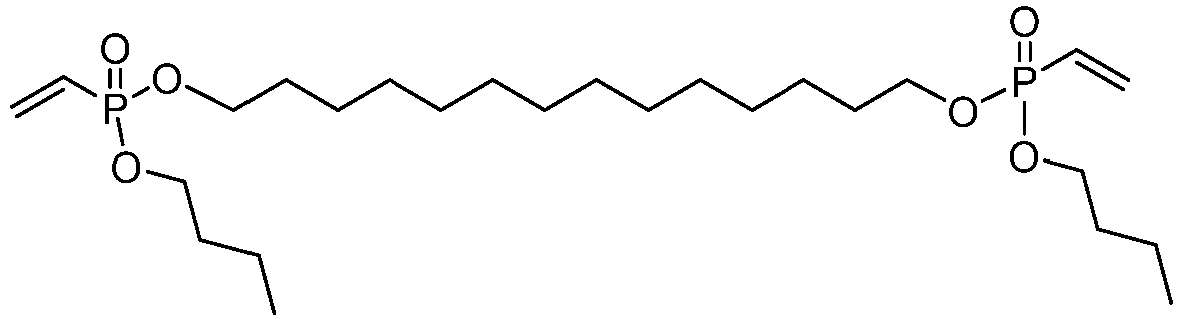
- Dibutyl tetradecane-1,14-diyl bis(vinylphosphonate) is prepared from compound in Example 1 (1.50 g, 9.14 mmol) and 1,14-dibromododecane (1.09 g, 3.05 mmol) using general method C in 81% (1.29 g, 2.47 mmol) overall yield in the form of colorless oil.
- 1H NMR (400.1 MHz, CDCl3): 0.91. (t, 6H, J vic = 8.0), 1.23-1.43 (m, 24H), 1.60-1.68 (m, 8H), 3.96-4.04 (m, 8H), 5.96-6.33 (m, 6H).
- 13C NMR (100.6 MHz, CDCl3): 13.58, 18.73, 25.50, 29.15, 29.50, 29.55, 29.60, 30.45, 32.46 (d, J C,P = 6.0), 65.62, 65.95 (d, J C,P = 6.0), 125.85 (d, J C,P = 184.1), 135.40 (d, J C,P = 2.0).
- 1P{1H} NMR (162.0 MHz, CDCl3): 20.04.
- IR ν max (KBr) 3091 (w), 3015 (m), 2963 (m), 2931 (s), 2872 (m), 2856 (m), 1614 (w), 1467 (w, sh), 1466 (w), 1400 (m), 1277 (m, sh), 1240 (m), 1020 (s), 988 (s), 980 (m, sh), 857 (w), 606 (w). HR-MS(ESI+) For C26H52O6NaP2 (M+Na)+ calcd 545.31313, found 545.31335.
-

- hexane-1,6-diyl di((Z)-non-3-en-1-yl) bis(vinylphosphonate) is prepared from compound in Example 11 (2 g, 8.61mmol) and 1,14-dibromhexane (0.74 g, 3.01 mmol) using general method C in 23% (1,1g, 2 mmol) overall yield in the form of colorless oil.
- 1H NMR (401 MHz, Chloroform-d) δ 0.91 (t, J = 7.0 Hz, 6H); 1.24 - 1.47 (m, 16H); 1.64 - 1.77 (m, 4H); 2.01 - 2.09 (qd, J = 7.3, 1,6 Hz, 4H); 2.34 - 2.56 (m, 4H); 4.03 (qd, J = 6.9, 4.5 Hz, 8H); 5.30-5.59 (m, 4H); 5.98 - 6.41 (m, 6H).
- 13C NMR (101 MHz, CDCl3) δ 14.04; 22.54; 25.14; 27.32; 28.66 (d, J = 6.4 Hz); 29.20; 30.34 (d, J = 6.4 Hz); 31.46; 65.23 (d, J = 5.8 Hz); 65.65 (d, J = 5.8 Hz); 76.68; 77.00; 77.32; 123.67; 125.77 (d, J = 184.1 Hz); 133.31; 135.58 (d, J = 2.0 Hz).
- 1P{1H} NMR (162.0 MHz, CDCl3): 20.09.
- IR ν max (CHCl3) 3090 (vw), 2959 (s), 2931 (s), 2872 (m), 2859 (m), 1653 (vw), 1614 (w), 1468 (w), 1455 (w, sh), 1434 (vw), 1400 (w), 1380 (w), 1279 (w), 1240 (s), 1070 (m, sh), 1054 (s), 1004 (vs), 986 (s, sh).
- HR-MS(ESI+) For C28H53O6P2 (M+H)+ vcalcd 547.33119, found 547.33133.
-

- Diisobutyl tetradecane-1,14-diyl bis(vinylphosphonate) is prepared from the compound from Example 14 (527 mg, 3.21 mmol) and 1,14-dibromotetradecane, (381 mg, 1.07 mmol) using general method C in 89% (496 mg, 0.95 mmol) overall yield in the form of colorless oil.
- 1H NMR (401 MHz, Chloroform-d) δ 6.38-5.96 (m, 6H), 4.08-3.96 (m, 4H), 3.77 (tt, J = 6.7, 1.0 Hz, 4H), 1.94 (dp, J = 13.3, 6.7 Hz, 2H), 1.66 (dt, J = 8.2, 6.5 Hz, 4H), 1.44-1.20 (m, 20H), 0.94 (d, J = 6.7 Hz, 12H).
- 31P NMR (162 MHz, Chloroform-d) δ 19.95.
- 13C NMR (101 MHz, Chloroform-d) δ 135.53, 125.97 (d, J = 184.6 Hz), 71.92 (d, J = 6.1 Hz), 66.09 (d, J = 6.0 Hz), 30.62 (d, J = 6.3 Hz), 29.76, 29.70, 29.65, 29.31 (d, J = 7.3 Hz), 29.30, 25.66, 18.86.
- IR ν max(CHCl3) 3091 (vw), 2964 (s), 2929 (vs), 2875 (m), 2856 (s), 1614 (w), 1471 (m), ~1458 (w, sh), 1400 (m), 1370 (w), 1279 (m), 1239 (s), ~1048 (s, sh), 1012 (vs), ~988 (s, sh).
- HR-MS(ESI+): For C26H53O6P2 (M + H) + m/z calculated 523.33119, found 523.33167 ± 0.91003 ppm. For C26H52O6NaP2 (M + Na)+ m/z calculated 545.31313, found 545.31342 ± 0.51726 ppm.
-

- Diisobutyl dodecane-1,12-diyl bis(vinylphosphonate) is prepared from the compound from Example 14 (523 mg, 3.19 mg) and 1,12-dibromododecane, (98 %, 356 µL, 1.06 mmol) using general method C in 69% (360 mg, 0.73 mmol) overall yield in the form of colorless oil.
- 1H NMR (401 MHz, Chloroform-d) δ 6.60-5.95 (m, 6H), 4.01 (q, J = 6.9 Hz, 4H), 3.77 (td, J = 6.6, 1.6 Hz, 4H), 1.94 (dt, J = 13.3, 6.7 Hz, 2H), 1.65 (dt, J = 8.1, 6.6 Hz, 4H), 1.47-1.21 (m, 16H), 0.94 (d, J = 6.7 Hz, 12H).
- 31P NMR (162 MHz, Chloroform-d) δ 19.95.
- 13C NMR (101 MHz, Chloroform-d) δ 135.54, 125.96 (d, J = 184.7 Hz), 71.92 (d, J = 6.2 Hz), 66.08 (d, J = 6.0 Hz), 30.61 (d, J = 6.4 Hz), 29.66, 29.63, 29.30 (d, J= 7.6 Hz), 29.30, 25.65, 18.88.
- IR ν max(CHCl3) 3090 (vw), 2964 (s), 2930 (vs), 2875 (m), 2856 (s), 1614 (w), 1471 (s), 1399 (s), 1370 (m), 1279 (m), 1240 (vs), 1167 (w), 1047 (vs, sh), 1012 (vs, vbr), ~988 (vs, sh), ~965 (s, sh), 862 (m). HR-MS(ESI+): For C24H48O6NaP2 (M + Na)+ m/z calculated 517.28183, found 517.28131 ± 1.00971 ppm.
-

- Hexan-1,8-diyl dihexyl bis((2-(bis(3-aminopropyl)amino)ethyl)phosphonate) hexahydrochloride is prepared from the compound from Example 3 using general methods C, D, and E, in ther form of white amorphous solide in 28% (0.41 g, 0.41mmol) overall yield.
- 1H NMR (500.2 MHz, CD3OD): 0.90 - 0.95 (m, 6H, CH3(CH2)4CH2O); 1.32 - 1.52 (m, 16H, CH3(CH2)3CH2CH2O, OCH2CH2(CH2)2CH2CH2O); 1.68 - 1.80 (m, 8H, CH3(CH2)3CH2CH2O, OCH2CH2(CH2)2CH2CH2O); 2.16 - 2.26 (m, 8H, NCH2CH2CH2NH2); 2.50 - 2.61 (m, 4H, PCH2CH2N); 3.11 (t, 8H, J vic = 7.5, NCH2CH2CH2NH2); 3.36 - 3.43 (m, 8H, NCH2CH2CH2NH2); 3.43 - 3.50 (m, 4H, PCH2CH2N); 4.09 - 4.21 (m, 8H, CH3(CH2)3CH2CH2O, OCH2CH2(CH2)2CH2CH2O).
- 13C NMR (125.8 MHz, CD3OD): 14.37 (CH3(CH2)6CH2O); 21.33, 21.35 (d, J C,P = 140.8, PCH2CH2N); 23.26 (NCH2CH2CH2NH2); 23.81, 26.14, 26.15, 26.29 (CH3(CH2)3CH2CH2O, OCH2CH2(CH2)2CH2CH2O); 31.37, 31.40, 31.55 (d, J C,P = 5.9, CH3(CH2)3CH2CH2O, OCH2CH2(CH2)2CH2CH2O); 32.49 (CH3(CH2)3CH2CH2O); 37.90 (NCH2CH2CH2NH2); 48.87 (PCH2CH2N); 51.07 (NCH2CH2CH2NH2); 68.05, 68.08, 68.25 (d, J C,P = 6.7, CH3(CH2)3CH2CH2O, OCH2CH2(CH2)2CH2CH2O).
- 31P{1H} NMR (202.5 MHz, CD3OD): 26.62.
- IR ν max (CHCl3) 2957 (vs), 2933 (vs), 2860 (s), 2745 (s, br), 2640 (m, br), 2558 (m, br), 2051 (w, br), 1615 (m, br), 1513 (w, br), 1468 (m), 1397 (w, br), 1379 (w, sh), 1265 (m, sh), 1229 (m, br), 1060 (m), 1040 (m, sh), 998 (s).
- HR-MS(ESI+): For C34H80O6P2 (M + 2H)2+ z=2 m/z calcd 365.28018, found 365.28030.
-

- Hexan-1,8-diyl dioctyl bis((2-(bis(3-aminopropyl)amino)ethyl)phosphonate) hexahydrochloride is prepared fro the compound from Example 5 using general methods C, D, and E, in ther form of white amorphous solide in 28% (0.41 g, 0.41mmol).
- 1H NMR (500.0 MHz, CD3OD): 0.88 - 0.93 (m, 6H, CH 3(CH2)6CH2O); 1.26 - 1.52 (m, 24H, CH3(CH2)5CH2CH2O, OCH2CH2(CH 2)2CH2CH2O); 1.67 - 1.79 (m, 8H, CH3(CH2)5CH 2CH2O, OCH2CH 2(CH 2)2CH 2CH2O); 2.17 - 2.27 (m, 8H, NCH2CH 2CH2NH2); 2.52 - 2.62 (m, 4H, PCH2CH2N); 3.11 (t, 8H, J vic = 7.5, NCH2CH2CH 2NH2); 3.36 - 3.45 (m, 8H, NCH 2CH2CH2NH2); 3.42 - 3.51 (m, 4H, PCH2CH 2N); 4.07 - 4.23 (m, 8H, CH3(CH2)5CH2CH 2O, OCH 2CH2(CH2)2CH2CH2O).
- 13C NMR (125.7 MHz, CD3OD): 14.47 (CH3(CH2)6CH2O); 21.28, 21.31 (d, J C,P = 140.5, PCH2CH2N); 23.21 (NCH2CH2CH2NH2); 23.73, 26.14, 26.16, 26.63, 30.28, 30.37 (CH3(CH2)5CH2CH2O, OCH2CH2(CH2)2CH2CH2O); 31.36, 31.40, 31.60 (d, J C,P = 6.0, CH3(CH2)5CH2CH2O, OCH2CH2(CH2)2CH2CH2O); 32.99 (CH3(CH2)5CH2CH2O); 37.86 (NCH2CH2CH2NH2); 48.83 (PCH2CH2N); 50.98 (NCH2CH2CH2NH2); 68.01, 68.03, 68.22 (d, J C,P = 6.6, CH3(CH2)5CH2CH2O, OCH2CH2(CH2)2CH2CH2O).
- 31P{1H} NMR (202.4 MHz, CD3OD): 27.32.
- HR-MS(ESI+): For C38H88N6O6P2 (M+2H)2+ z=2 m/z calcd 393.31148, found 393.31156.
-

- Octane-1,8-diyl dipentyl bis((2-(bis(3-aminopropyl)amino)ethyl)phosphonate) hexahydrochloride is prepared from compound in Example 24 (0.50 g, 1.0 mmol)
using general methods D and E, in the form of a white amorphous solid in overall yield 53% (0.54 g, 0.57 mmol). - 1H NMR (400.1 MHz, CD3OD): 0.92-0.96 (m, 6H), 1.36-1.44 (m, 16H), 1.69-1.76 (m, 8H), 2.17-2.25 (m, 8H), 2.49-2.59 (m, 4H), 3.11 (t, 8H, J vic = 8.0), 3.37-3.42 (m, 8H), 3.44-3.48 (m, 4H), 4.11-4.16 (m, 8H).
- 13C NMR (100.6 MHz, CD3OD): 14.34, 21.28 (d, J C,P = 139.8), 23.29, 26.54, 28.79, 30.15, 30.16, 31.29, 31.56 (d, J C,P = 6.0), 37.89, 48.84, 51.07, 68.22 (d, J C,P = 7.0).
- 31P{1H} NMR (162.0 MHz, CD3OD): 28.40.
- IR ν max (KBr) 2933 (s), 2634 (s), 2558 (m), 1600 (m), 1467 (m), 1224 (m), 1173 (m, sh), 1070 (m, sh), 1047 (s), 997 (s).
- HR-MS(ESI+): For C34H79N6O6P2 (M+H)+ calcd 729.55290, found 729.55308.
-

- Dihexyl octane-1,8-diyl bis((2-(bis(3-aminopropyl)amino)ethyl)phosphonate) hexahydrochloride is prepared from compound in Example 21 (0.78 g, 1.58 mmol)
using general methods D and E, in the form of a white amorphous solid in overall yield 57% (0.88 g, 0.90 mmol). - 1H NMR (400.1 MHz, CD3OD): 0.90-0.94 (m, 6H), 1.33-1.46 (m, 20H), 1.69-1.77 (m, 8H), 2.17-2.25 (m, 8H), 2.48-2.58 (m, 4H), 3.11 (t, 8H, J vic = 8,0), 3.34-3.41 (m, 8H), 3.43-3.49 (m, 4H), 4,11-4,16 (m, 8H).
- 13C NMR (100.6 MHz, CD3OD): 12.98, 19.90 (d, J C,P = 140.8), 21.89, 22.23, 24.90, 25.16, 28.78, 31.10, 30.17 (d, J C,P = 6.0), 36.49, 47.42, 49.68, 66.80, 66.86 (d, J C,P = 7.0, 6.0).
- 31P{1H} NMR (162.0 MHz, CD3OD): 28.42.
- IR ν max (KBr) 2966 (m), 2931 (m), 2872 (m), 2623 (w), 2553 (w), 1470 (m), 1384 (w), 1236 (w), 1050 (m), 1000 (m).
- HR-MS(ESI+): For C36H84N6O6P2 (M+2H)2+ calcd 379.29583, found 379.29553.
-

- Decane-1,10-diyl diisobutyl bis(vinylphosphonate) is prepared from the compound from Example 14 (500 mg, 3.05 mmol) and 1,10-dibromodecane (97 %, 314 µL, 1.01 mmol) using general method C in 88% (416 mg, 0.89 mmol) overall yield in the form of colorless oil.
- 1H NMR (401 MHz, Chloroform-d) δ 6.37-5.94 (m, 6H), 4.01 (q, J = 6.8 Hz, 4H), 3.77 (td, J = 6.6, 1.6 Hz, 4H), 1.94 (dp, J = 13.4, 6.7 Hz, 2H), 1.72-1.61 (m, 4H), 1.42-1.21 (m, 12H), 0.93 (d, J = 6.7 Hz, 12H).
- 31P NMR (162 MHz, Chloroform-d) δ 19.92.
- 13C NMR (101 MHz, Chloroform-d) δ 135.56 (d, J = 2.0 Hz), 125.94 (d, J = 184.4 Hz), 71.92 (d, J = 6.0 Hz), 66.04 (d, J = 5.9 Hz), 30.60 (d, J = 6.3 Hz), 29.54, 29.33, 29.25, 25.63, 18.86 (d, J = 1.9 Hz).
- IR ν max(CHCl3) 3091 (vw), 2964 (s), 2932 (vs), 2875 (m), 2857 (s), 1614 (w), 1471 (s), 1399 (s), 1370 (m), 1278 (s), 1240 (vs), 1167 (w), ~1047 (s, sh), 1013 (vs, br), ~990 (vs, sh), ~965 (s, sh), 862 (m). HR-MS(ESI+): For C22H44O6NaP2 (M + Na)+ m/z calculated 489.25053, found 489.25012 ± 0.83547 ppm.
-
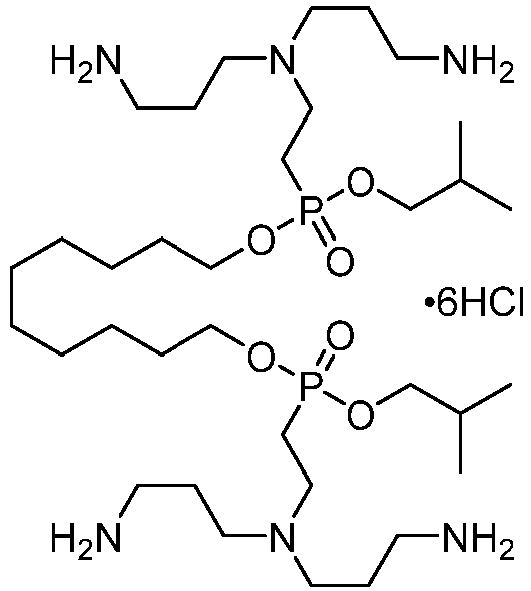
- Diisobutyl decane-1,10-diyl bis((2-(bis(3-aminopropyl)amino)ethyl)phosphonate) hexahydrochloride is prepared from the compound from Example 38 (416 mg, 0.89 mmol) using general methods D and E in 31% (258 mg, 0.28 mmol) overall yield in the form of white amorphous powder.
- 1H NMR (401 MHz, Methanol-d 4) δ 4.14 (q, J = 6.7 Hz, 4H), 3.90 (tt, J = 6.1, 3.2 Hz, 4H), 3.51-3.43 (m, 4H), 3.43-3.35 (m, 8H), 3.11 (t, J = 7.5 Hz, 8H), 2.74-2.47 (m, 4H), 2.21 (h, J = 6.4 Hz, 8H), 1.98 (dt, J = 13.3, 6.6 Hz, 2H), 1.83-1.65 (m, 4H), 1.53-1.27 (m, 12H), 0.99 (d, J = 6.7 Hz, 12H).
- 31P NMR (162 MHz, Methanol-d 4) δ 28.59.
- 13C NMR (101 MHz, Methanol-d 4) δ 73.92 (d, J = 7.1 Hz), 68.29 (d, J = 6.7 Hz), 51.09, 37.86, 31.63 (d, J = 5.9 Hz), 30.65, 30.47 (d, J = 6.4 Hz), 30.30, 26.63, 23.33, 21.86, 20.47, 19.02.
- IR ν max(KBr tab. 1 mm) 2961 (s), 2929 (s), 2855 (m), 3200-2700 (vs, vbr), 2700-2500 (m, vbr), 1610 (m), 1513 (m), 1468 (s), 1401 (m), 1369 (m), 1227 (vs), 1005 (vs), ~869 (m, sh), 851 (m), 767 (m), 725 (w).
- HR-MS(ESI+): For C34H79O6N6P2 (M + H) + m/z calculated 729.55308, found 729.55268 ± 0.54965 ppm.
-

- Dibutyl decane-1,10-diyl bis((2-(bis(3-aminopropyl)amino)ethyl)phosphonate) hexahydrochloride is prepared from compound in Example 28 (0.65, 0.54 mmol)
using general methods D and E, in the form of a white amorphous solid in 55% overall yield (0.88 g, 0.90 mmol). - 1H NMR (400.1 MHz, CD3OD): 0.96-0.99 (m, 6H), 1.35-1.50 (m, 16H), 1.67-1.76 (m, 8H), 2.17-2.25 (m, 8H), 2.48-2.58 (m, 4H), 3.10 (t, 8H, J vic = 8.0), 3.35-3.41 (m, 8H), 3.42-3.48 (m, 4H), 4.11-4.17 (m, 8H).
- 13C NMR (100.6 MHz, CD3OD): 13.96, 19.79, 21.27 (d, J C,P = 149.8), 23.25, 26.60, 30.26, 30.59, 31.59, 33.60 (d, J C,P = 6.0), 37.87, 48.85, 51.06, 67.91, 68.24 (d, J C,P = 6.0).
- 31P{1H} NMR (162.0 MHz, CD3OD): 28.42.
- IR ν max (KBr) 2932 (vs), 2632 (m), 2558 (m), 1598 (m), 1467 (m), 1224 (m), 1172 (m sh), 1070 (m, sh), 1063 (m), 1018 (vs), 997 (m, sh).
- HR-MS(ESI+): For C34H79N6O6P2 (M+H)+ calcd 729.55255, found 729.55308.
-

- Decane-1,10-diyl dipentyl bis((2-(bis(3-aminopropyl)amino)ethyl)phosphonate) hexahydrochloride is prepared from compound in Example 25 (0.83, 1.67 mmol)
using general methods D and E, in the form of a white amorphous solid in 45% overall yield (0.73 g, 0.75 mmol). - 1H NMR (400.1 MHz, CD3OD): 0.93-0.96 (m, 6H), 1.34-1.44 (m, 20H), 1,69-1,76 (m, 8H), 2.17-2.25 (m, 8H), 2.48-2.58 (m, 4H), 3.10 (t, 8H, J vic = 8.0), 3.37-3.41 (m, 8H), 3.44-3.49 (m, 4H), 4.11-4.16 (m, 8H).
- 13C NMR (100.6 MHz, CD3OD): 14.35, 21.25 (d, J C,P = 140.8), 23.27, 23.30, 26.62, 28.80, 30.29, 30.63, 31.29, 31.61 (d, J C,P = 6,0), 37,87, 48.83, 51.07, 68.20, 68.27 (d, J C,P = 2.0, 3.0).
- 31P{1H} NMR (162.0 MHz, CD3OD): 28.41.
- IR ν max (KBr) 2929 (s), 2831 (m, sh), 2677-2543 (m), 1611 (m), 1514 (m), 1467 (m), 1390 (m), 1263 (m), 1228 (s), 1077-991 (s).
- HR-MS(ESI+): For C36H83N6O6P2 (M+H)+ calcd 757.58403, found 729.58438.
-

- Decane-1,10-diyl dihexyl bis((2-(bis(3-aminopropyl)amino)ethyl)phosphonate) tetrahydrochloride is prepared from compound in Example 22 (0.65, 1.24 mmol)
using general methods D and E, in the form of a white amorphous solid in 61% overall yield (0.70 g, 0.76 mmol). - 1H NMR (400.1 MHz, CD3OD): 0.91-0.94 (m, 6H), 1.33-1.46 (m, 24H), 1.67-1.76 (m, 8H), 2.16-2.24 (m, 8H), 2.47-2.57 (m, 4H), 3.10 (t, 8H, J vic = 8.0), 3.35-3.40 (m, 8H), 3.42-3.48 (m, 4H), 4.10-4.16 (m, 8H).
- 13C NMR (100.6 MHz, CD3OD): 12.98, 19.80 (d, J C,P = 140.8), 21.91, 22.23, 24.91, 25.24, 28.91, 29.26, 30.02 (d, J C,P = 6.0, 5.0), 31.11, 36.48, 47.64, 49.68, 66.85 (d, J C,P = 7.0)
- 31P{1H} NMR (162.0 MHz, CD3OD): 28.45.
- IR ν max (KBr) 2974 (m), 2927 (w), 2895 (w), 2635 (w), 2510 (w), 1601 (w, sh), 1383 (w), 1273 (w), 1089 (m), 1050 (m).
- HR-MS(ESI+): For C38H87N6O6P2 (M+H)+ calcd 785.61568, found 785.61479.
-

- Decan-1,10-diyl dioktyl bis((2-(bis(3-aminopropyl)amino)ethyl)- phosphonate) tetrahydrochloride se is prepared from the compound from Example 5 using general methods C, D, and E, in the form of a white amorphous solid in overall yield 32 % (1.18 g, 1.12 mmol).
- 1H NMR (500.2 MHz, CD3OD): 0.88 - 0.93 (m, 6H, CH3(CH2)6CH2O); 1.26 - 1.46 (m, 32H, CH3(CH2)5CH2CH2O, OCH2CH2(CH2)6CH2CH2O); 1.68 - 1.76 (m, 8H, CH3(CH2)5CH2CH2O, OCH2CH2(CH2)6CH2CH2O); 2.17 - 2.26 (m, 8H, NCH2CH2CH2NH2); 2.49 - 2.59 (m, 4H, PCH2CH2N); 3.11 (t, 8H, J vic = 7.5, NCH2CH2CH2NH2); 3.36 - 3.43 (m, 8H, NCH2CH2CH2NH2); 3.43 - 3.49 (m, 4H, PCH2CH2N); 4.10 - 4.16 (m, 8H, CH3(CH2)5CH2CH2O, OCH2CH2(CH2)6CH2CH2O).
- 13C NMR (125.8 MHz, CD3OD): 14.45 (CH3(CH2)6CH2O); 21.28 (d, J C,P = 140.2, PCH2CH2N); 23.22 (NCH2CH2CH2NH2); 23.69, 26.62, 26.64, 30.24, 30.29, 30.34, 30.62 (CH3(CH2)5CH2CH2O, OCH2CH2(CH2)6CH2CH2O); 31.58, 31.59 (d, J C,P = 5.8, CH3(CH2)5CH2CH2O, OCH2CH2(CH2)6CH2CH2O); 32.96 (CH3(CH2)5CH2CH2O); 37.88 (NCH2CH2CH2NH2); 48.85 (PCH2CH2N); 51.04 (NCH2CH2CH2NH2); 68.23 (d, J C,P = 6.7, CH3(CH2)5CH2CH2O, OCH2CH2(CH2)6CH2CH2O).
- 31P{1H} NMR (202.5 MHz, CD3OD): 26.64.
- HR-MS(ESI+) For C42H96N6O6P2 (M+2H)21 calcd 421.34278, found 421.34273.
-
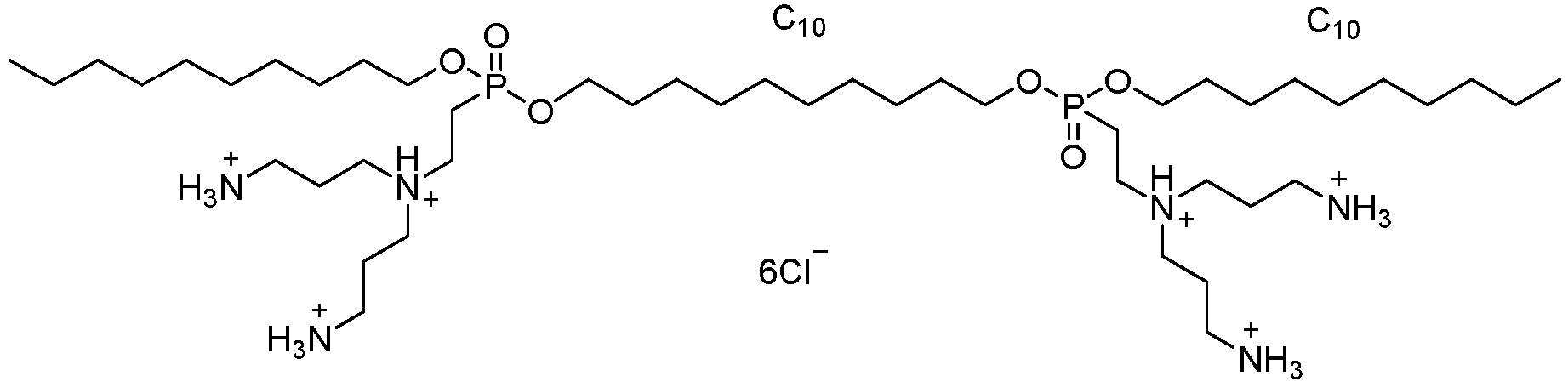
- Decan-1,10-diyl didecyl bis((2-(bis(3-aminopropyl)amino)ethyl)- phosphonate) tetrahydrochloride is prepared from the compound from Example 6 using general methods C, D, and +E, in the form of a white amorphous solid in overall yield 46 % (0.41 g, 0.41mmol).
- 1H NMR (500.2 MHz, CD3OD): 0.88 - 0.93 (m, 6H, CH3(CH2)8CH2O); 1.25 - 1.46 (m, 40H, CH3(CH2)7CH2CH2O, OCH2CH2(CH2)6CH2CH2O); 1.68 - 1.76 (m, 8H, CH3(CH2)7CH2CH2O, OCH2CH2(CH2)6CH2CH2O); 2.16 - 2.25 (m, 8H, NCH2CH2CH2NH2); 2.49 - 2.58 (m, 4H, PCH2CH2N); 3.11 (t, 8H, J vic = 7.5, NCH2CH2CH2NH2); 3.36 - 3.42 (m, 8H, NCH2CH2CH2NH2); 3.42 - 3.49 (m, 4H, PCH2CH2N); 4.10 - 4.16 (m, 8H, CH3(CH2)7CH2CH2O, OCH2CH2(CH2)6CH2CH2O).
- 13C NMR (125.8 MHz, CD3OD): 14.46 (CH3(CH2)8CH2O); 21.26 (d, J C,P = 140.3, PCH2CH2N); 23.26 (NCH2CH2CH2NH2); 23.72, 26.62, 26.64, 30.29, 30.31, 30.45, 30.66, 30.69 (CH3(CH2)7CH2CH2O, OCH2CH2(CH2)6CH2CH2O); 31.59, 31.62 (d, J C,P = 5.8, CH3(CH2)7CH2CH2O, OCH2CH2(CH2)6CH2CH2O); 33.05 (CH3(CH2)7CH2CH2O); 37.87 (NCH2CH2CH2NH2); 48.83 (PCH2CH2N); 51.06 (NCH2CH2CH2NH2); 68.24 (d, J C,P = 6.6, CH3(CH2)7CH2CH2O, OCH2CH2(CH2)6CH2CH2O).
- 31P{1H} NMR (202.5 MHz, CD3OD): 26.65.
- IR ν max (KBr) 2956 (vs), 2925 (vs), 2854 (vs), 2675 (m, br), 2620 (m, br), 2546 (s, br), 2059 (w, br), 1628 (m, sh), 1607 (m), 1542 (m), 1510 (m), 1484 (m), 1468 (m), 1456 (m, sh), 1401 (w), 1390 (w), 1377 (w, sh), 1338 (vw), 1305 (w), 1227 (s), 1075 (m), 1022 (s, sh), 992 (s), 722 (w).
- HR-MS(ESI+) For C46H104N6O6P2 (M+2H)2+ calcd 449.37408, found 449.37398.
-

- Dodecane-1,12-diyl diisobutyl bis((2-(bis(3-aminopropyl)amino)ethyl)phosphonate) hexahydrochloride is prepared from the compound from Example 33 (360 mg, 0.728 mmol) using general methods D and E in 6% (43 mg, 43,6 µmol) overall yield in the form of white amorphous powder.
- 1H NMR (401 MHz, Methanol-d 4) δ 4.15 (dt, J = 7.8, 6.6 Hz, 4H), 3.92 (td, J = 6.6, 2.4 Hz, 4H), 3.55-3.42 (m, 4H), 3.43-3.34 (m, 8H), 3.11 (t, J = 7.5 Hz, 8H), 2.67-2.46 (m, 4H), 2.33-2.15 (m, 8H), 1.99 (dp, J = 13.3, 6.7 Hz, 2H), 1.86-1.65 (m, 4H), 1.53-1.28 (m, 16H), 1.00 (d, J = 6.7 Hz, 12H).
- 31P NMR (162 MHz, Methanol-d 4) δ 27.12.
- 13C NMR (101 MHz, Methanol-d 4) δ 73.92 (d, J = 6.6 Hz), 68.29 (d, J = 6.7 Hz), 51.09, 37.87, 31.63 (d, J = 5.5 Hz), 30.74, 30.71, 30.47 (d, J = 6.4 Hz), 30.32, 26.62, 23.32, 21.88, 20.49, 19.03.
- IR ν max(KBr tab. 1 mm) 3200-2700 (vs, vbr), 2961 (s), 2927 (s), 2854 (m), 2700-2500 (m), 1607 (m), 1510 (w), 1470 (m), 1400 (w), 1369 (w), 1226 (m), 1002 (s), ~869 (w, sh), 851 (m), 768 (w), 724 (vw). HR-MS(ESI+): For C36H83O6N6P2 (M + H) + m/z calculated 757.58438, found 757.58375 ± 0.83066 ppm.
-

- Dibutyl dodecane-1,12-diyl bis((2-(bis(3-aminopropyl)amino)ethyl)phosphonate) hexahydrochloride is prepared from compound in Example 29 (0.97, 1.96 mmol)
using general methods D and E, in the form of a white amorphous solid in overall yield 48 % (0.73 g, 0.75 mmol). - 1H NMR (400.1 MHz, CD3OD): 0.95-0.99 (m, 6H), 1.32-1.50 (m, 20H), 1.64-1.76 (m, 8H), 2.16-2.24 (m, 8H), 2.47-2.57 (m, 4H), 3.10 (t, 8H, J vic = 8.0), 3.35-3.40 (m, 8H), 3.44-3.46 (m, 4H), 4.10-4.17 (m, 8H).
- 13C NMR (100.6 MHz, CD3OD): 13.96, 19.79, 21.27 (d, J C,P = 140.8), 23.24, 26.60, 30.26, 30.59, 31.59, 33.60 (d, J C,P = 6.0), 37.87, 48.84, 51.05, 67.90, 68.24 (d, J C,P = 6.0, 7.0)
- 31P{1H} NMR (162.0 MHz, CD3OD): 28.43.
- IR ν max (KBr) 2930 (s), 2780 (m), 2630 (m), 2557 (m), 1597 (m), 1467 (m), 1226 (m), 1168 (m, sh), 1070 (m, sh), 1064 (m), 1020 (s), 1004 (s),
- HR-MS(ESI+) For C34H79N6O6P2 (M+H)+ calcd 729.55308, found 729.55300.
-

- Dodecane-1,12-diyl dipentyl bis((2-(bis(3-aminopropyl)amino)ethyl)phosphonate) hexahydrochloride is prepared from compound in Example 26 (1.10 g, 2.10 mmol)
using general methods D and E, in the form of a white amorphous solid in overall yield 58 % (0.78 g, 0.84 mmol). - 1H NMR (400.1 MHz, CD3OD): 0.93-0.96 (m, 6H), 1.34-1.44 (m, 24H), 1.69-1.76 (m, 8H), 2.17-2.25 (m, 8H), 2.49-2.59 (m, 4H), 3.11 (t, 8H, J vic = 8.0), 3.34-3.43 (m, 8H), 3.45-3.49 (m, 4H), 4.10-4.16 (m, 8H).
- 13C NMR (100.6 MHz, CD3OD): 14.35, 21.27 (d, J C,P = 139.8), 23.24, 23.29, 26.62, 28.79, 30.30, 30.68, 30.71, 31.29, 31.60 (d, J C,P = 5.0, 6.0) 37.87, 48.86, 51.05, 68.20, 68.26 (d, J C,P = 3.0, 4.0).
- 31P{1H} NMR (162.0 MHz, CD3OD): 28.38.
- IR ν max (KBr) 2930 (vs), 2631 (m, sh), 2557 (m, sh), 1599 (m), 1467 (m), 1226 (s), 1170 (m, sh), 1065 (m, sh), 1052 (s, sh), 995 (s).
- HR-MS(ESI+) For C38H88N6O6P2 (M+2H)2+ calcd 393.31141, found 393.31148.
-

- Dodecan-1,10-diyl dioctyl bis((2-(bis(3-aminopropyl)amino)ethyl)phosphonate) tetrahydrochloride is prepared from compound in Example 6 using general methods C, D, and E, in the form of a white amorphous solid in overall yield 36 % (0.67 g, 0.61 mmol).
- 1H NMR (500.2 MHz, CD3OD): 0.88 - 0.93 (m, 6H, CH3(CH2)6CH2O); 1.26 - 1.46 (m, 36H, CH3(CH2)5CH2CH2O, OCH2CH2(CH2)8CH2CH2O); 1.68 - 1.76 (m, 8H, CH3(CH2)5CH2CH2O, OCH2CH2(CH2)8CH2CH2O); 2.15 - 2.25 (m, 8H, NCH2CH2CH2NH2); 2.46 - 2.57 (m, 4H, PCH2CH2N); 3.10 (t, 8H, J vic = 7.5, NCH2CH2CH2NH2); 3.34 - 3.41 (m, 8H, NCH2CH2CH2NH2); 3.41 - 3.48 (m, 4H, PCH2CH2N); 4.09 - 4.16 (m, 8H, CH3(CH2)5CH2CH2O, OCH2CH2(CH2)8CH2CH2O).
- 13C NMR (125,8 MHz, CD3OD): 14.45 (CH3(CH2)6CH2O); 21.24 (d, J C,P = 140.4, PCH2CH2N); 23.29 (NCH2CH2CH2NH2); 23.71, 26.64, 26.64, 30.26, 30.35, 30.36, 30.74, 30.77 (CH3(CH2)5CH2CH2O, OCH2CH2(CH2)8CH2CH2O); 31.61, 31.63 (d, J C,P = 5.8, CH3(CH2)5CH2CH2O, OCH2CH2(CH2)8CH2CH2O); 32.98 (CH3(CH2)5CH2CH2O); 37.88 (NCH2CH2CH2NH2); 48.80 (PCH2CH2N); 51.08 (NCH2CH2CH2NH2); 68.26 (d, J C,P = 6.7, CH3(CH2)5CH2CH2O, OCH2CH2(CH2)8CH2CH2O).
- 31P{1H} NMR (202.5 MHz, CD3OD): 26.67.
- HR-MS(ESI+) For C44H100N6O6P2 (M+2H)2+ z=2 calcd 435.35843, found 435.35823.
-

- Bis(2-benzylethyl)-dodecane-1,12-diyl bis((2-(bis(3-aminopropyl)amino)ethyl) phosphonate) hexahydrochloride is prepared from the compound from Example 7 (1 g, 5 mmol) and bis(3-tert-butyloxycarbonylaminopropyl)amine (1.37 g, 4.14 mmol) using general methods C, D and E in 15% (0.78 g, 0.73 mmol) overall yield in the form of white amorphous powder.
- 1H NMR (500.2 MHz, CD3OD): 1.28-1.37 (m, 16H, OCH2CH2(CH2)8CH2CH2O); 1.59-1.67 (m, 4H, OCH2CH2(CH2)8CH2CH2O); 2.13-2.22 (m, 8H, NCH2CH2CH2NH2); 2.41-2.51 (m, 4H, PCH2CH2N); 3.03 (t, 4H, J vic = 6.6, OCH2CH2Ph); 3.09 (t, 8H, J vic = 7.5, NCH2CH2CH2NH2); 3.30-3.36 (m, 12H, NCH2CH2CH2NH2, PCH2CH2N); 3.91-4.03 (m, 4H, OCH2CH2(CH2)8CH2CH2O); 4.30-4.40 (m, 4H, OCH2CH2Ph).
- 13C NMR (125.8 MHz, CD3OD): 21.18 (d, J C,P = 140.5, PCH2CH2N); 23.23 (NCH2CH2CH2NH2); 26.53, 30.25, 30.64, 30.68 (OCH2CH2(CH2)8CH2CH2O); 31.50 (d, J C,P = 6.0, OCH2CH2(CH2)8CH2CH2O); 37.71 (d, J C,P = 6.3, OCH2CH2Ph); 37.86 (NCH2CH2CH2NH2); 48.68 (PCH2CH2N); 51.04 (NCH2CH2CH2NH2); 68.11 (d, J C,P = 6.8, OCH2CH2(CH2)8CH2CH2O); 68.58 (d, J C,P = 6.8, OCH2CH2Ph).
- 31P{1H} NMR (202.5 MHz, CD3OD): 26.48.
- IR v max (KBr) 3064 (s, sh), 3015 (s), 2927 (vs), 2854 (s), 2848 (m, sh), 2635 (m, vbr), 2556 (m, vbr), 2037 (w, vbr), 1618 (m), 1607 (m, sh), 1520 (w, sh), 1497 (m), 1467, 1455 (m), 1395 (w, br), 1256 (m, sh), 1230 (m), 1155 (w), 1061 (m), 1009 (s), 999 (s), 847 (vw), 751 (w), 700 (m).
- HR-MS(ESI+): For C44H84O6N6P2 (M + H) + m/2z calculated 427.29583, found 427.29547 ± 0.84009 ppm.
-
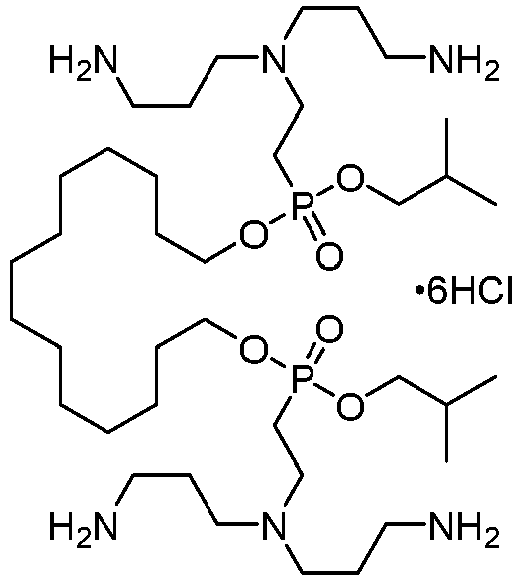
- Tetradecane-1,14-diyl diisobutyl bis((2-(bis(3-aminopropyl)amino)ethyl)phosphonate) hexahydrochloride is prepared from the compound from Example 32 (496 mg, 0.949 mmol) using general methods D and E in 43% (409 mg, 0.407 mmol) overall yield in the form of white amorphous powder.
- 1H NMR (401 MHz, Methanol-d 4) δ 4.15 (dt, J = 7.7, 6.6 Hz, 4H), 3.92 (td, J = 6.6, 2.5 Hz, 4H), 3.52-3.43 (m, 4H), 3.43-3.36 (m, 8H), 3.11 (t, J = 7.5 Hz, 8H), 2.64-2.45 (m, 4H), 2.22 (h, J = 7.7, 7.1 Hz, 8H), 1.99 (dp, J = 13.3, 6.6 Hz, 2H), 1.84-1.64 (m, 4H), 1.53-1.22 (m, 20H), 1.00 (d, J = 6.7 Hz, 12H). 31P NMR (162 MHz, Methanol-d 4) δ 28.60.
- 13C NMR (101 MHz, Methanol-d 4) δ 73.92 (d, J = 7.0 Hz), 68.29 (d, J = 6.8 Hz), 51.07, 37.86, 31.62 (d, J = 5.8 Hz), 30.81, 30.76, 30.71, 30.46 (d, J = 6.3 Hz), 30.31, 26.62, 23.30, 21.87, 20.48, 19.03. IR v max(KBr tab. 1 mm) 3200-2700 (vs, vbr), 2960 (s), 2926 (vs), 2854 (s), 2700-2500 (m), 1608 (m), 1511 (m), 1468 (m), 1400 (m), 1369 (w), 1227 (s), 1004 (vs), 852 (m), 768 (w), ~725 (w, sh). HR-MS(ESI+): For C38H87O6N6P2 (M + H) + m/z calculated 785.61568, found 785.61523 ± 0.57208 ppm.
-

- Dibutyl tetradecane-1,14-diyl bis((2-(bis(3-aminopropyl)amino)ethyl)phosphonate) hexahydrochloride is prepared from compound in Example 30 (0.46, 0.88 mmol)
using general methods D and E, in the form of a white amorphous solid in overall yield 57 % (0.50 g, 0.50 mmol). - 1H NMR (400.1 MHz, CD3OD): 0.95-0.99 (m, 6H), 1.31-1.50 (m, 24H), 1.67-1.76 (m, 8H), 2.16-2.24 (m, 8H), 2.47-2.57 (m, 4H), 3.10 (t, 8H, J vic = 8.0), 3.35-3.42 (m, 8H), 3.44-3.48 (m, 4H), 4.10-4.17 (m, 8H).
- 13C NMR (100.6 MHz, CD3OD): 13.96, 21.24 (d, J C,P = 140.8), 23.28, 19.80, 26.61, 30.30, 30.70, 30.75, 30.79, 31.59, 33.61 (d, J C,P = 6.0), 37.86, 48.90, 51.08, 67.92, 68.27 (d, J C,P = 6.0).
- 31P{1H} NMR (162.0 MHz, CD3OD): 28.40.
- IR v max (KBr) 2966 (m), 2928 (m), 2625 (m), 1604 (m), 1468 (m), 1384 (m), 1230 (m), 1050 (m), 1021 (m).
- HR-MS(ESI+): For C38H87N6O6P2 (M+H)+calcd 785.61506, found 785.61568.
-

- Tetradecane-1,14-diyl dipentyl bis((2-(bis(3-aminopropyl)amino)ethyl)phosphonate) hexahydrochloride is prepared from compound in Example 27 (0.61, 1.12 mmol)
using general methods D and E, in the form of a white amorphous solid in overall yield 57 % (0.68 g, 0.65 mmol). - 1H NMR (400.1 MHz, CD3OD): 0.92-0.97 (m, 6H), 1.34-1.44 (m, 28H), 1.69-1.76 (m, 8H), 2.17-2.25 (m, 8H), 2.48-2.58 (m, 4H), 3.10 (t, 8H, J vic = 8.0), 3.37-3.43 (m, 8H), 3.44-3.49 (m, 4H), 4.10-4.16 (m, 8H).
- 13C NMR (100.6 MHz, CD3OD): 14.34, 21.25 (d, J C,P = 139.8), 23.26, 23.30, 26.62, 28.80, 30.31, 30.70, 30.74, 30.79, 31.29, 31.61 (d, J C,P = 4.0, 6.0), 37.87, 48.83, 51.06 (NCH2CH2CH2NH2); 68.21, 68.27 (d, J C,P = 4.0, 5.0, CH3(CH2)2CH2CH2O, OCH2CH2(CH2)10CH2CH2O).
- 31P{1H} NMR (162.0 MHz, CD3OD): 28.41
- IR v max (KBr) 2928 (s), 2623 (m), 2553 (m), 1598 (m), 1468 (m), 1230 (m), 1171 (m), 1080 (m, sh), 1047 (m), 995 (vs).
- HR-MS(ESI+): For C40H91N6O6P2 (M+H)+calcd 813.64643, found 813.64698.
-

- Dihexyl tetradecan-1,14-diyl bis((2-(bis(3-aminopropyl)amino)ethyl)phosphonate) tetrahydrochloride is prepared from compound in Example 27 (0.85 g, 1.47 mmol) and bis (3-tert-butyloxykarbonylaminopropyl)amine (1.95 g, 5.88 mmol) using general methods D and E, in the form of a white amorphous solid in overall yield 65 % (0.93 g, 0.95 mmol).
- 1H NMR (400.1 MHz, CD3OD): 0.91-0.94 (m, 6H, CH3(CH2)4CH2O); 1.33-1.44 (m, 32H, CH3(CH2)3CH2CH2O, OCH2CH2(CH2)10CH2CH2O); 1.69-1.76 (m, 8H, CH3(CH2)3CH2CH2O, OCH2CH2(CH2)10CH2CH2O); 2.17-2.25 (m, 8H, NCH2CH2CH2NH2); 2.48-2.57 (m, 4H, PCH2CH2N); 3.10 (t, 8H, J vic = 8.0, NCH2CH2CH2NH2); 3.37-3.41 (m, 8H, NCH2CH2CH2NH2); 3.42-3.48 (m, 4H, PCH2CH2N); 4.10-4.16 (m, 8H, CH3(CH2)4CH2O, OCH2CH2(CH2)10CH2CH2O).
- 13C NMR (100.6 MHz, CD3OD): 12.99 (CH3(CH2)4CH2O); 19.90 (d, J C,P = 139.8, PCH2CH2N); 21.87 (NCH2CH2CH2NH2); 22.24, 24.92, 25.24, 28.92, 29.32, 29.36, 29.41 (CH3CH2 CH2CH2CH2CH2O, OCH2CH2(CH2)10CH2CH2O); 29.34 (d, J C,P = 4.0, CH3(CH2)3CH2CH2O, OCH2CH2(CH2)10CH2CH2O); 31.11 (CH3CH2CH2CH2CH2CH2O); 36.48 (NCH2CH2CH2NH2); 47.44 (PCH2CH2N); 49.68 (NCH2CH2CH2NH2); 66.82, 66.89 (d, J C,P = 2.0, CH3(CH2)4CH2O, OCH2CH2(CH2)10CH2CH2O).
- 31P{1H} NMR (162.0 MHz, CD3OD): 28.40.
- IR v max (KBr) 2925 (s), 2957 (s), 2857 (s), 2678 (m), 2488 (m, sh), 1608 (m ,sh). 1489 (m), 1467 (m), 1391 (m), 1227 (s), 1037 (m), 992 (s).
- HR-MS(ESI+): For C49H96N6O6P2 (M+2H)21 calcd 421.34278, found 421.34226.
-

- Dihexyl octane-1,8-diyl bis((2-(bis(2-aminoethyl)amino)ethyl)phosphonate) hexahydrochloride is prepared from compound in Example 21 (0.40, 0.81 mmol)
using general methods D and E, in the form of a white amorphous solid in 31% overall yield (0.21 g, 0.25 mmol). - 1H NMR (400.1 MHz, CD3OD): 0.90-0.94 (m, 6H), 1.32-1.45 (m, 20H), 1.68-1.76 (m, 8H), 2.31-2.40 (m, 4H), 3.10-3.26 (m, 12H), 3.29-3.31 (m, 8H), 4.06-4.14 (m, 8H).
- 13C NMR (100.6 MHz, CD3OD): 14.38, 21.78 (d, J C,P = 138.8), 23.63, 26.33, 26.54, 26.58, 30.18, 31.57, 32.51 (d, J C,P = 5.0), 36.96, 48.42, 51.50, 67.89, 67.96 (d, J C,P = 3.0, 4.0).
- 31P{1H} NMR (162.0 MHz, CD3OD): 31.25.
- IR v max (KBr) 2926 (m), 2793 (s), 2677 (m), 2617 (m), 2542 (s), 2438 (m, sh), 1611 (m), 1514 (m), 1467 (m), 1390 (m), 1228 (s), 1050 (m, sh), 990 (s).
- HR-MS(ESI+): For C30H69N4O6P2 (M+H)+calcd 701.52178, nalezeno 701.52194.
-

- Dibutyl decane-1,10-diyl bis((2-(bis(2-aminoethyl)amino)ethyl)phosphonate) hexahydrochloride is prepared from compound in Example 28 (0.83, 1.77 mmol)
using general methods D and E, in the form of a white amorphous solid in 29% overall yield (0.40 g, 0.49 mmol). - 1H NMR (400.1 MHz, CD3OD): 0.95-0.99 (m, 6H), 1.34-1.50 (m, 16H), 1.66-1.75 (m, 8H), 2.25-2.33 (m, 4H), 3.10-3.16 (m, 12H), 3.23-3.27 (m, 8H), 4.05-4.13 (m, 8H).
- 13C NMR (100.6 MHz, CD3OD): 12.57, 20.81 (d, J C,P = 138.8), 18.42, 25.23, 28.87, 29.20, 30.20, 32.20 (d, J C,P = 6.0), 35, 47.10 50.10, 66.2, 66.6 (d, J C,P = 7.0).
- 31P{1H} NMR (162.0 MHz, CD3OD): 28.43.
- IR v max (KBr) 2961 (m), 2926 (m), 2674 (m, sh), 2551 (m, br), 1613, (m), 1467 (m), 1391 (m), 1260 (m), 1236 (m), 1066 (m, sh), 991 (m, sh).
- HR-MS(ESI+): For C30H71N6O6P2 (M+H)+ calcd 673.49047, found 673.49048.
-

- Hexane-1,6-diyl di((Z)-oct-3-en-1-yl) bis((2-(bis(3-aminopropyl)amino)ethyl)phosphonate) hexahydrochloride is prepared from compound in Example 17 (0.59, 1.14 mmol)
using general methods D and E, in the form of a white amorphous solid in 50% overall yield (0.66 g, 0.66 mmol). - 1H NMR (400.1 MHz, CD3OD): 0.89-0.93 (m, 6H), 1.32-1.37 (m, 8H), 1.44-1.51 (m, 4H), 1.70-1.78 (m, 4H), 2.06-2.11 (m, 4H), 2.20-2.27 (m, 8H), 2.43-2.50 (m, 4H), 2.54-2.63 (m, 4H), 3.13 (t, 8H, J vic = 8.0), 3.38-3.49 (m, 12H), 4.09-4.20 (m, 8H), 5.38-5.45 (m, 2H), 5.53-5.60 (m, 2H).
- 13C NMR (100.6 MHz, CD3OD): 13.01, 20.06 (d, J C,P = 136.8), 21.83, 21.99, 24.77, 26.71, 28.27 (d, J C,P = 6.0), 29.98 (d, J C,P = 6.0), 31.53, 36.59, 47.54, 49.65, 66.23 (d, J C,P = 7.0), 66.67 (dd, J C,P = 7.0, 2.0), 123.68, 132.89.
- 31P{1H} NMR (162,0 MHz, CD3OD): 28.46.
- IR v max (KBr) 3432 (m, br), 3015 (s), 2957 (vs), 2931 (vs), 2872 (s), 2500-2300 (vs, vbr), 1611 (m), 1467 (m), 1380 (w, sh), 1228 (m), 1055 (s), 1003 (s).
- HR-MS(ESI+): For C38H84O6N6P2 (M+2H)2+ calcd 391.29583, found 391.29589.
-

- Di((Z)-oct-3-en-1-yl) pentane-1,5-diyl bis((2-(bis(3-aminopropyl)amino)ethyl)phosphonate) hexahydrochloride is prepared from compound in Example 16 (0.54, 1.07 mmol)
using general methods D and E, in the form of a white amorphous solid in 51% overall yield (0.53 g, 0.54 mmol). - 1H NMR (400.1 MHz, CD3OD): 0.90-0.93 (m, 6H), 1.28-1.39 (m, 8), 1.51-1.59 (m, 2H), 1.74-1.81 (m, 4H), 2.06-2.11 (4H), 2.21-2.28 (m, 8H), 2.45-2.51 (m, 4H), 2.57-2.66 (m, 4H), 3.14 (t, 8H, J vic = 7.5), 3.42-3.50 (m, 12H), 4.09-4.22 (m, 8H), 5.39-5.45 (m, 2H), 5.52-5.58 (m, 2H).
- 13C NMR (100.6 MHz, CD3OD): 13.0, 20.13 (d, J C,P = 139.8), 21.43, 21.82, 21.99, 26.72, 28.27 (d, J C,P = 6.0), 29.58 (d, J C,P = 6.0), 31.53, 36.62, 47.57, 49.65, 66.25 (d, J C,P = 6.0), 66.59 (dd, J C,P = 6.0), 123.71, 132.87.
- 31P{1H} NMR (162.0 MHz, CD3OD): 28.45.
- IR v max (KBr) 3435 (s, br), 3015 (m, sh), 2957 (m), 2927 (m), 2872 (m), 2857 (m), 2500-2300 (m, br), 1626 (w), 1467 (w), 1379 (w), 1275 (w, sh), 1226 (w), 1004 (m).
- HR-MS(ESI+):For C37H82O6N6P2 (M+2H)2+ calcd 384.28801, found 384.28824.
- Antibacterial activity is measured using a standard microdilution method determining the minimum inhibitory concentration (MIC) of a test sample that results in the inhibition of bacterial growth. Disposable microtiter plates are used for testing. Samples are dissolved in infusion medium from brain and heart (BHI, HiMedia Laboraties Pvt. Ltd., Czech Republic) and Mueller-Hinton broth (HiMedia Laboraties, see above) to a final concentration ranging from 200 µg/ml to 1.5625 µg/ml. Plates are inoculated with a standard amount of test bacteria - the density of the inoculum in the well corresponds to 105-6 CFU/ml (colony forming units / ml, i.e. the number of viable bacterial cells / ml). MIC values are read after 24/48 hours of incubation at 37 °C as the minimum inhibitory concentration of the test substance at which bacterial growth is inhibited. The minimum bactericidal concentration (MBC) is characterized as the minimum concentration of the sample required to achieve irreversible inhibition, i.e. to kill the bacteria after a defined incubation period. MBC is determined by the inoculation method. Using an applicator, 10 µl from the well of a microtiter plate with a defined concentration of the test substance is taken to inoculate the surface of blood agar (Trios, Czech Republic). MBC is determined as the lowest concentration that inhibits the visible growth of the bacterium used on agar.


- Blood from three donors is mixed and centrifuged (10 min, 1000 g, 4 °C). The erythrocytes obtained are washed three times with NaCl solution (150 mmol.l-1) and then used for experiments. Sample stock solutions are prepared in DMSO so that the final concentration of DMSO in NaCl is 0.5 % (v/v). NaCl solution with the appropriate volume of DMSO serves as the negative control. 1% Triton-X100 is the positive control. The erythrocytes obtained are diluted to 2% with NaCl solution and pipetted into Eppendorf tubes (250 µl) with constant stirring. Samples and positive and negative controls are added to the erythrocytes prepared in this way and incubated (3 hours, 37 °C). The tubes are stirred during the incubation. After centrifugation (5 min, 1000 g), haemolytic activity is monitored by haemoglobin determination. The HC50 value is calculated from the measured absorbance values. The test is performed in triplets in three independent replicates. Iron Fe2+ in haemoglobin is oxidized with potassium ferricyanide to iron Fe3+ in methaemoglobin, which produces stable cyanomethaemoglobin with potassium cyanide, the concentration of which is determined spectrophotometrically. After the incubation of the erythrocytes with the substances, the cells are centrifuged (5 min, 1000 g), then Drabkin's solution (200 µl) is added to the supernatant (40 µl) and after incubation (10 min), the absorbance at 540 nm is measured.
- The toxicity testing of soluble samples was performed on a Balb/c 3T3 mouse fibroblast cell line. The cryopreserved cells are taken out from the deep-freezer, left for 1 min at room temperature and then sterile transferred to a 25 cm2 flask with 10 ml of culture medium (DMEM, penicillin 100 U.ml-1, L-glutamine 2 mmol.l-1, streptomycin 100 mg.l-1, fetal calf serum 5%, neonatal calf serum 5%). The cells are stored in an incubator saturated with water vapour at 37 °C and in an atmosphere of 5% CO2, the medium is changed every 48 - 72 h. After reaching the monolayer, the cells are washed with sterile PBS (5 ml), released by incubation with 0.25% trypsin solution with EDTA (0.5 ml; 2-3 min, 37 °C), 5 ml of culture medium is added, and the samples are centrifuged (10 min, 1300 rpm, room temperature). The pellet is resuspended in 20 ml of culture medium and the cells are transferred to a 75 cm2 culture flask and further cultured. After reaching the monolayer, the cells are washed with sterile PBS (10 ml), released by incubation with 0.25% trypsin solution with EDTA (1 ml; 2-3 min; 37 °C), and resuspended in 10 ml of culture medium. The suspension is centrifuged (10 min; 1300 rpm; room temperature). The pellet is resuspended in 10 ml of culture medium and the cells are used in experiments.
- Stock solutions are prepared in DMSO so that the final concentration of DMSO in the medium is 0.5 % (v/v). Control cells are prepared by incubation with an appropriate volume of DMSO.
- Cell concentrations are determined by trypan blue staining. The cells are diluted in culture medium and plated in 96-well plates at a concentration of 2×10⁵ cells/ml at 0.2 ml per well. After incubating the culture for 24 hours (Jouan incubator - controlled atmosphere 95 % air, 5 % CO2, steam saturation, 37 °C), the culture medium is changed to serum-free medium containing the test substances and incubated for 24 hours in the incubator under the above conditions. After 24 h of incubation (37 °C, 5 % CO2), cell damage is monitored by determining mitochondrial dehydrogenase activity (MTT assay). The IC50 value is calculated from the measured absorbance values. The test is performed in three independent replicates.
- The yellow tetrazolium salt of MTT is reduced by mitochondrial dehydrogenases of metabolically active cells to a purple, water-insoluble formazan dye, the concentration of which, after dissolution in an organic solvent, is determined spectrophotometrically at 570 nm (Sieuwerts, 1995).
Table 3: Toxicity of test substances determined by MTT test in Balb/c 3T3 mouse fibroblast line Compound from Example HC50 ± SD IC50 ± SD 34 >100 >100 35 >100 12 36 >100 >100 37 >100 76.4 39 >100 53.5 40 >100 >100 41 >100 41.3 42 74.5 19.3 43 6 2.1 44 5 4 45 >100 55.5 46 >100 31.7 47 >100 6.3 48 4 2.1 49 >100 8.4 50 >100 4.9 51 >100 4.5 52 56.4 2.4 53 10.6 2.1 54 >100 32 55 >100 70.2 56 16.8 2.7 57 34.8 62 58 70 100 - The lipophosphonoxins according to the invention can be used, as antibacterial agents, as an active ingredient in pharmaceutical compositions for the treatment of hitherto resistant bacterial infections, in disinfectants and/or in selective culture media.
Claims (8)
- Lipopolyphosphonoxin of the general formula I
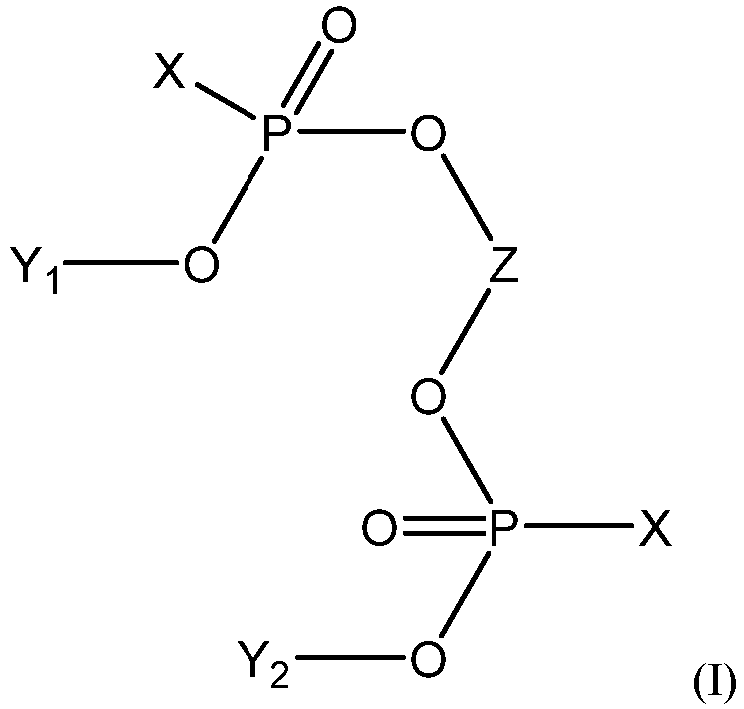 the X substituent is independently selected from the following structures:
 wherein m = 1-3;the Y substituent is independently selected from the following structures:
 wherein n = 0-12, , and o = 0-12, and p = 0-12, andR1, R2, R3, R4, and R5 are independently selected from the group consisting of: H-, CH3-, CH2CH3, propyl, isopropyl, isobutyl, tert-butyl, CH3O-, CH2CH3O-, propoxy, isopropoxy, isobutyloxy or tert-butyloxy;
andthe Z substituent is selected from the following structures: wherein q = 2-14, and r = 0-10, and s = 0-10,or a diastereomer or a mixture of diastereomers of the compound of formula I, or a pharmaceutically acceptable salt or hydrate thereof.
 - Lipophosphonoxin of general formula I according to claim 1 or a diastereomer or a pharmaceutically acceptable salt or hydrate thereof, and/or mixture of such compounds, for use as medicaments.
- Lipophosphonoxin of general formula I according to claim 1 or a diastereomer or a pharmaceutically acceptable salt or hydrate thereof, and/or mixture of such compounds, for use as antibacterial drugs.
- An antibacterial drug comprising at least one lipophosphonoxin of general formula I as claimed in claim 1, or a diastereomer or a pharmaceutically acceptable salt or hydrate thereof, and/or mixture of such compounds.
- A disinfectant for non-therapeutic purposes comprising at least one lipophosphonoxin of general formula I as claimed in claim 1, or a diastereomer or a pharmaceutically acceptable salt or hydrate thereof, and/or mixtures of such compounds as the active ingredient.
- A selective culture medium comprising at least one lipophosphonoxin of general formula I as claimed in claim 1, or a diastereomer or a pharmaceutically acceptable salt or hydrate thereof, and/or mixtures of such compounds as the active ingredient.
- Use of lipophosphonoxins of general formula I as claimed in claim 1, or their diastereomers or pharmaceutically acceptable salts or hydrates, and/or mixtures of such compounds, for the preparation of an antibacterial drug.
- Use of lipophosphonoxins of general formula I as claimed in claim 1, or their diastereomers or pharmaceutically acceptable salts or hydrates, and/or mixtures of such compounds, as active ingredients of disinfectants for non-therapeutic purposes and/or selective culture media for in vitro cultivation of bacteria, fungi or eukaryotic cells.
Applications Claiming Priority (2)
| Application Number | Priority Date | Filing Date | Title |
|---|---|---|---|
| CZ2019769A CZ2019769A3 (en) | 2019-12-12 | 2019-12-12 | Third generation lipophosphonoxins, preparing and using them |
| PCT/CZ2020/050095 WO2021115503A1 (en) | 2019-12-12 | 2020-12-09 | Lipophosphonoxins, their preparation and use |
Publications (3)
| Publication Number | Publication Date |
|---|---|
| EP4072681A1 EP4072681A1 (en) | 2022-10-19 |
| EP4072681B1 true EP4072681B1 (en) | 2025-03-12 |
| EP4072681C0 EP4072681C0 (en) | 2025-03-12 |
Family
ID=73855037
Family Applications (1)
| Application Number | Title | Priority Date | Filing Date |
|---|---|---|---|
| EP20828017.2A Active EP4072681B1 (en) | 2019-12-12 | 2020-12-09 | Lipophosphonoxins, their preparation and use |
Country Status (6)
| Country | Link |
|---|---|
| US (1) | US12540148B2 (en) |
| EP (1) | EP4072681B1 (en) |
| AU (1) | AU2020401174B2 (en) |
| CA (1) | CA3158242C (en) |
| CZ (1) | CZ2019769A3 (en) |
| WO (1) | WO2021115503A1 (en) |
Family Cites Families (5)
| Publication number | Priority date | Publication date | Assignee | Title |
|---|---|---|---|---|
| US20020032164A1 (en) | 1998-12-30 | 2002-03-14 | Dale Roderic M. K. | Antimicrobial compounds and methods for their use |
| CZ2011312A3 (en) | 2011-05-26 | 2012-12-12 | Ústav organické chemie a biochemie Akademie ved CR, v.v.i. | Lipophosphonoxins, their preparation and use |
| US9993490B2 (en) * | 2014-07-22 | 2018-06-12 | The Board Of Trustees Of The University Of Illinois | Phosphonic acid compounds and screening method |
| JP2018502818A (en) * | 2014-11-26 | 2018-02-01 | スードダンスク ウニヴァシテーツSyddansk Universitet | Novel artificial phospholipid-protein conjugates for biomolecule recognition |
| CZ308344B6 (en) | 2016-04-28 | 2020-06-10 | Ústav Organické Chemie A Biochemie Av Čr, V.V.I. | Second generation lipophosphonoxins and their use |
-
2019
- 2019-12-12 CZ CZ2019769A patent/CZ2019769A3/en unknown
-
2020
- 2020-12-09 CA CA3158242A patent/CA3158242C/en active Active
- 2020-12-09 EP EP20828017.2A patent/EP4072681B1/en active Active
- 2020-12-09 WO PCT/CZ2020/050095 patent/WO2021115503A1/en not_active Ceased
- 2020-12-09 US US17/779,491 patent/US12540148B2/en active Active
- 2020-12-09 AU AU2020401174A patent/AU2020401174B2/en active Active
Also Published As
| Publication number | Publication date |
|---|---|
| EP4072681A1 (en) | 2022-10-19 |
| US12540148B2 (en) | 2026-02-03 |
| CA3158242C (en) | 2024-06-18 |
| WO2021115503A1 (en) | 2021-06-17 |
| AU2020401174B2 (en) | 2023-08-31 |
| CA3158242A1 (en) | 2021-06-17 |
| AU2020401174A1 (en) | 2022-06-16 |
| EP4072681C0 (en) | 2025-03-12 |
| CZ308943B6 (en) | 2021-09-22 |
| US20230028523A1 (en) | 2023-01-26 |
| CZ2019769A3 (en) | 2021-09-22 |
Similar Documents
| Publication | Publication Date | Title |
|---|---|---|
| US4331803A (en) | Novel erythromycin compounds | |
| US5103018A (en) | Mitomycin derivatives | |
| EP2341886B1 (en) | Antimicrobial n-chlorinated compositions | |
| CN114616238B (en) | Echinocandin analogs and preparation methods thereof | |
| WO2010130007A1 (en) | Antimicrobial compounds | |
| EP3265083B1 (en) | Substituted urea depsipeptide analogs as activators of the clpp endopeptidase | |
| EP3450450B1 (en) | Vancomycin derivative, preparation method, pharmaceutical composition and use thereof | |
| Dahiya | Synthesis, characterization and antimicrobial studies on some newer imidazole analogs | |
| EA023667B1 (en) | Novel derivatives of hemin with antibacterial and antiviral activity | |
| EP3506922B1 (en) | Substituted urea depsipeptide analogs as activators of the clpp endopeptidase | |
| US12540148B2 (en) | Lipophosphonoxins, their preparation and use | |
| EP3071591B1 (en) | Antimicrobial peptidomimetics | |
| DE2301540A1 (en) | 5-0- (5-AMINO-5-DEOXY-D-PENTOFURANOSYL) N HIGH 1- (4-AMINO-2-HYDROXY-BUTYRYL) -4-0 (2,6-DIAMINO-2,6-DIDEOXY-D -GLUCO-PYRANOSYL) 2-DEOXYSTREPTAMINE | |
| EP4219437B1 (en) | Bakuchiol derivative, pharmaceutically acceptable salt thereof, preparation method therefor and application thereof | |
| EP3448865B1 (en) | Lipophosphonoxins of second generation, and their use | |
| CN115536716B (en) | Amphotericin B semisynthetic derivatives and their preparation methods and uses | |
| PL246762B1 (en) | New quaternary ammonium salts with a cation derived from lidocaine and a 2-furoate anion, method of their preparation and use as bacteriostatic and bactericidal agents | |
| EP1044985A1 (en) | Erythromycin derivatives | |
| AU767348B2 (en) | 5-imino-13-deoxy anthracycline derivatives, their uses, and processes for preparing them | |
| EP1973537A1 (en) | Carbamate antibiotics | |
| CHORNOUS et al. | SYNTHESIS AND ANTIMICROBIAL EFFICIENCY OF SOME NEW TYPES OF THE QUATERNARY AMMONIUM COMPOUNDS | |
| CZ20021404A3 (en) | Process for preparing aromatic diketo derivatives and their pharmaceutical use | |
| WO2021163493A1 (en) | Compounds, compositions, and methods for modulating calcium ion homeostasis | |
| KR100559494B1 (en) | Novel 1-betamethylcarbapenem derivatives, preparation method thereof and pharmaceutical composition for antibiotics containing the same as an active ingredient | |
| CA3178863A1 (en) | Guanidine-modified c-terminus vancomycin compounds, compositions and methods |
Legal Events
| Date | Code | Title | Description |
|---|---|---|---|
| STAA | Information on the status of an ep patent application or granted ep patent |
Free format text: STATUS: UNKNOWN |
|
| STAA | Information on the status of an ep patent application or granted ep patent |
Free format text: STATUS: THE INTERNATIONAL PUBLICATION HAS BEEN MADE |
|
| PUAI | Public reference made under article 153(3) epc to a published international application that has entered the european phase |
Free format text: ORIGINAL CODE: 0009012 |
|
| STAA | Information on the status of an ep patent application or granted ep patent |
Free format text: STATUS: REQUEST FOR EXAMINATION WAS MADE |
|
| 17P | Request for examination filed |
Effective date: 20220705 |
|
| AK | Designated contracting states |
Kind code of ref document: A1 Designated state(s): AL AT BE BG CH CY CZ DE DK EE ES FI FR GB GR HR HU IE IS IT LI LT LU LV MC MK MT NL NO PL PT RO RS SE SI SK SM TR |
|
| STAA | Information on the status of an ep patent application or granted ep patent |
Free format text: STATUS: EXAMINATION IS IN PROGRESS |
|
| 17Q | First examination report despatched |
Effective date: 20230125 |
|
| DAV | Request for validation of the european patent (deleted) | ||
| DAX | Request for extension of the european patent (deleted) | ||
| P01 | Opt-out of the competence of the unified patent court (upc) registered |
Effective date: 20230713 |
|
| GRAP | Despatch of communication of intention to grant a patent |
Free format text: ORIGINAL CODE: EPIDOSNIGR1 |
|
| STAA | Information on the status of an ep patent application or granted ep patent |
Free format text: STATUS: GRANT OF PATENT IS INTENDED |
|
| INTG | Intention to grant announced |
Effective date: 20241001 |
|
| GRAS | Grant fee paid |
Free format text: ORIGINAL CODE: EPIDOSNIGR3 |
|
| GRAA | (expected) grant |
Free format text: ORIGINAL CODE: 0009210 |
|
| STAA | Information on the status of an ep patent application or granted ep patent |
Free format text: STATUS: THE PATENT HAS BEEN GRANTED |
|
| AK | Designated contracting states |
Kind code of ref document: B1 Designated state(s): AL AT BE BG CH CY CZ DE DK EE ES FI FR GB GR HR HU IE IS IT LI LT LU LV MC MK MT NL NO PL PT RO RS SE SI SK SM TR |
|
| REG | Reference to a national code |
Ref country code: GB Ref legal event code: FG4D |
|
| REG | Reference to a national code |
Ref country code: CH Ref legal event code: EP |
|
| REG | Reference to a national code |
Ref country code: DE Ref legal event code: R096 Ref document number: 602020047680 Country of ref document: DE |
|
| REG | Reference to a national code |
Ref country code: IE Ref legal event code: FG4D |
|
| P04 | Withdrawal of opt-out of the competence of the unified patent court (upc) registered |
Free format text: CASE NUMBER: APP_17170/2025 Effective date: 20250408 |
|
| U01 | Request for unitary effect filed |
Effective date: 20250404 |
|
| U07 | Unitary effect registered |
Designated state(s): AT BE BG DE DK EE FI FR IT LT LU LV MT NL PT RO SE SI Effective date: 20250411 |
|
| PG25 | Lapsed in a contracting state [announced via postgrant information from national office to epo] |
Ref country code: RS Free format text: LAPSE BECAUSE OF FAILURE TO SUBMIT A TRANSLATION OF THE DESCRIPTION OR TO PAY THE FEE WITHIN THE PRESCRIBED TIME-LIMIT Effective date: 20250612 |
|
| PG25 | Lapsed in a contracting state [announced via postgrant information from national office to epo] |
Ref country code: ES Free format text: LAPSE BECAUSE OF FAILURE TO SUBMIT A TRANSLATION OF THE DESCRIPTION OR TO PAY THE FEE WITHIN THE PRESCRIBED TIME-LIMIT Effective date: 20250312 |
|
| PG25 | Lapsed in a contracting state [announced via postgrant information from national office to epo] |
Ref country code: NO Free format text: LAPSE BECAUSE OF FAILURE TO SUBMIT A TRANSLATION OF THE DESCRIPTION OR TO PAY THE FEE WITHIN THE PRESCRIBED TIME-LIMIT Effective date: 20250612 |
|
| PG25 | Lapsed in a contracting state [announced via postgrant information from national office to epo] |
Ref country code: HR Free format text: LAPSE BECAUSE OF FAILURE TO SUBMIT A TRANSLATION OF THE DESCRIPTION OR TO PAY THE FEE WITHIN THE PRESCRIBED TIME-LIMIT Effective date: 20250312 |
|
| PG25 | Lapsed in a contracting state [announced via postgrant information from national office to epo] |
Ref country code: GR Free format text: LAPSE BECAUSE OF FAILURE TO SUBMIT A TRANSLATION OF THE DESCRIPTION OR TO PAY THE FEE WITHIN THE PRESCRIBED TIME-LIMIT Effective date: 20250613 |
|
| PG25 | Lapsed in a contracting state [announced via postgrant information from national office to epo] |
Ref country code: SM Free format text: LAPSE BECAUSE OF FAILURE TO SUBMIT A TRANSLATION OF THE DESCRIPTION OR TO PAY THE FEE WITHIN THE PRESCRIBED TIME-LIMIT Effective date: 20250312 |
|
| PG25 | Lapsed in a contracting state [announced via postgrant information from national office to epo] |
Ref country code: PL Free format text: LAPSE BECAUSE OF FAILURE TO SUBMIT A TRANSLATION OF THE DESCRIPTION OR TO PAY THE FEE WITHIN THE PRESCRIBED TIME-LIMIT Effective date: 20250312 |
|
| PG25 | Lapsed in a contracting state [announced via postgrant information from national office to epo] |
Ref country code: SK Free format text: LAPSE BECAUSE OF FAILURE TO SUBMIT A TRANSLATION OF THE DESCRIPTION OR TO PAY THE FEE WITHIN THE PRESCRIBED TIME-LIMIT Effective date: 20250312 |
|
| PG25 | Lapsed in a contracting state [announced via postgrant information from national office to epo] |
Ref country code: IS Free format text: LAPSE BECAUSE OF FAILURE TO SUBMIT A TRANSLATION OF THE DESCRIPTION OR TO PAY THE FEE WITHIN THE PRESCRIBED TIME-LIMIT Effective date: 20250712 |
|
| REG | Reference to a national code |
Ref country code: CH Ref legal event code: U11 Free format text: ST27 STATUS EVENT CODE: U-0-0-U10-U11 (AS PROVIDED BY THE NATIONAL OFFICE) Effective date: 20260101 |
|
| PGFP | Annual fee paid to national office [announced via postgrant information from national office to epo] |
Ref country code: GB Payment date: 20251219 Year of fee payment: 6 |
|
| PLBE | No opposition filed within time limit |
Free format text: ORIGINAL CODE: 0009261 |
|
| STAA | Information on the status of an ep patent application or granted ep patent |
Free format text: STATUS: NO OPPOSITION FILED WITHIN TIME LIMIT |
|
| PGFP | Annual fee paid to national office [announced via postgrant information from national office to epo] |
Ref country code: CZ Payment date: 20251112 Year of fee payment: 6 |
|
| REG | Reference to a national code |
Ref country code: CH Ref legal event code: L10 Free format text: ST27 STATUS EVENT CODE: U-0-0-L10-L00 (AS PROVIDED BY THE NATIONAL OFFICE) Effective date: 20260121 |
|
| U20 | Renewal fee for the european patent with unitary effect paid |
Year of fee payment: 6 Effective date: 20251230 |
|
| 26N | No opposition filed |
Effective date: 20251215 |
|
| PGFP | Annual fee paid to national office [announced via postgrant information from national office to epo] |
Ref country code: CH Payment date: 20260101 Year of fee payment: 6 |