EP4072670B1 - Quinazoline derivatives as lpa receptor 2 inhibitors - Google Patents
Quinazoline derivatives as lpa receptor 2 inhibitors Download PDFInfo
- Publication number
- EP4072670B1 EP4072670B1 EP20820186.3A EP20820186A EP4072670B1 EP 4072670 B1 EP4072670 B1 EP 4072670B1 EP 20820186 A EP20820186 A EP 20820186A EP 4072670 B1 EP4072670 B1 EP 4072670B1
- Authority
- EP
- European Patent Office
- Prior art keywords
- piperazin
- methyl
- sulfonyl
- quinazolin
- amino
- Prior art date
- Legal status (The legal status is an assumption and is not a legal conclusion. Google has not performed a legal analysis and makes no representation as to the accuracy of the status listed.)
- Active
Links
Classifications
-
- C—CHEMISTRY; METALLURGY
- C07—ORGANIC CHEMISTRY
- C07D—HETEROCYCLIC COMPOUNDS
- C07D417/00—Heterocyclic compounds containing two or more hetero rings, at least one ring having nitrogen and sulfur atoms as the only ring hetero atoms, not provided for by group C07D415/00
- C07D417/14—Heterocyclic compounds containing two or more hetero rings, at least one ring having nitrogen and sulfur atoms as the only ring hetero atoms, not provided for by group C07D415/00 containing three or more hetero rings
-
- C—CHEMISTRY; METALLURGY
- C07—ORGANIC CHEMISTRY
- C07D—HETEROCYCLIC COMPOUNDS
- C07D417/00—Heterocyclic compounds containing two or more hetero rings, at least one ring having nitrogen and sulfur atoms as the only ring hetero atoms, not provided for by group C07D415/00
- C07D417/02—Heterocyclic compounds containing two or more hetero rings, at least one ring having nitrogen and sulfur atoms as the only ring hetero atoms, not provided for by group C07D415/00 containing two hetero rings
- C07D417/12—Heterocyclic compounds containing two or more hetero rings, at least one ring having nitrogen and sulfur atoms as the only ring hetero atoms, not provided for by group C07D415/00 containing two hetero rings linked by a chain containing hetero atoms as chain links
-
- A—HUMAN NECESSITIES
- A61—MEDICAL OR VETERINARY SCIENCE; HYGIENE
- A61P—SPECIFIC THERAPEUTIC ACTIVITY OF CHEMICAL COMPOUNDS OR MEDICINAL PREPARATIONS
- A61P1/00—Drugs for disorders of the alimentary tract or the digestive system
- A61P1/16—Drugs for disorders of the alimentary tract or the digestive system for liver or gallbladder disorders, e.g. hepatoprotective agents, cholagogues, litholytics
-
- A—HUMAN NECESSITIES
- A61—MEDICAL OR VETERINARY SCIENCE; HYGIENE
- A61P—SPECIFIC THERAPEUTIC ACTIVITY OF CHEMICAL COMPOUNDS OR MEDICINAL PREPARATIONS
- A61P11/00—Drugs for disorders of the respiratory system
-
- A—HUMAN NECESSITIES
- A61—MEDICAL OR VETERINARY SCIENCE; HYGIENE
- A61P—SPECIFIC THERAPEUTIC ACTIVITY OF CHEMICAL COMPOUNDS OR MEDICINAL PREPARATIONS
- A61P27/00—Drugs for disorders of the senses
- A61P27/02—Ophthalmic agents
-
- A—HUMAN NECESSITIES
- A61—MEDICAL OR VETERINARY SCIENCE; HYGIENE
- A61P—SPECIFIC THERAPEUTIC ACTIVITY OF CHEMICAL COMPOUNDS OR MEDICINAL PREPARATIONS
- A61P9/00—Drugs for disorders of the cardiovascular system
-
- C—CHEMISTRY; METALLURGY
- C07—ORGANIC CHEMISTRY
- C07D—HETEROCYCLIC COMPOUNDS
- C07D239/00—Heterocyclic compounds containing 1,3-diazine or hydrogenated 1,3-diazine rings
- C07D239/70—Heterocyclic compounds containing 1,3-diazine or hydrogenated 1,3-diazine rings condensed with carbocyclic rings or ring systems
- C07D239/72—Quinazolines; Hydrogenated quinazolines
- C07D239/86—Quinazolines; Hydrogenated quinazolines with hetero atoms directly attached in position 4
- C07D239/94—Nitrogen atoms
-
- C—CHEMISTRY; METALLURGY
- C07—ORGANIC CHEMISTRY
- C07D—HETEROCYCLIC COMPOUNDS
- C07D401/00—Heterocyclic compounds containing two or more hetero rings, having nitrogen atoms as the only ring hetero atoms, at least one ring being a six-membered ring with only one nitrogen atom
- C07D401/02—Heterocyclic compounds containing two or more hetero rings, having nitrogen atoms as the only ring hetero atoms, at least one ring being a six-membered ring with only one nitrogen atom containing two hetero rings
- C07D401/12—Heterocyclic compounds containing two or more hetero rings, having nitrogen atoms as the only ring hetero atoms, at least one ring being a six-membered ring with only one nitrogen atom containing two hetero rings linked by a chain containing hetero atoms as chain links
-
- C—CHEMISTRY; METALLURGY
- C07—ORGANIC CHEMISTRY
- C07D—HETEROCYCLIC COMPOUNDS
- C07D407/00—Heterocyclic compounds containing two or more hetero rings, at least one ring having oxygen atoms as the only ring hetero atoms, not provided for by group C07D405/00
- C07D407/14—Heterocyclic compounds containing two or more hetero rings, at least one ring having oxygen atoms as the only ring hetero atoms, not provided for by group C07D405/00 containing three or more hetero rings
-
- C—CHEMISTRY; METALLURGY
- C07—ORGANIC CHEMISTRY
- C07D—HETEROCYCLIC COMPOUNDS
- C07D409/00—Heterocyclic compounds containing two or more hetero rings, at least one ring having sulfur atoms as the only ring hetero atoms
- C07D409/02—Heterocyclic compounds containing two or more hetero rings, at least one ring having sulfur atoms as the only ring hetero atoms containing two hetero rings
- C07D409/12—Heterocyclic compounds containing two or more hetero rings, at least one ring having sulfur atoms as the only ring hetero atoms containing two hetero rings linked by a chain containing hetero atoms as chain links
-
- C—CHEMISTRY; METALLURGY
- C07—ORGANIC CHEMISTRY
- C07D—HETEROCYCLIC COMPOUNDS
- C07D409/00—Heterocyclic compounds containing two or more hetero rings, at least one ring having sulfur atoms as the only ring hetero atoms
- C07D409/14—Heterocyclic compounds containing two or more hetero rings, at least one ring having sulfur atoms as the only ring hetero atoms containing three or more hetero rings
-
- C—CHEMISTRY; METALLURGY
- C07—ORGANIC CHEMISTRY
- C07D—HETEROCYCLIC COMPOUNDS
- C07D413/00—Heterocyclic compounds containing two or more hetero rings, at least one ring having nitrogen and oxygen atoms as the only ring hetero atoms
- C07D413/02—Heterocyclic compounds containing two or more hetero rings, at least one ring having nitrogen and oxygen atoms as the only ring hetero atoms containing two hetero rings
- C07D413/12—Heterocyclic compounds containing two or more hetero rings, at least one ring having nitrogen and oxygen atoms as the only ring hetero atoms containing two hetero rings linked by a chain containing hetero atoms as chain links
-
- C—CHEMISTRY; METALLURGY
- C07—ORGANIC CHEMISTRY
- C07D—HETEROCYCLIC COMPOUNDS
- C07D413/00—Heterocyclic compounds containing two or more hetero rings, at least one ring having nitrogen and oxygen atoms as the only ring hetero atoms
- C07D413/14—Heterocyclic compounds containing two or more hetero rings, at least one ring having nitrogen and oxygen atoms as the only ring hetero atoms containing three or more hetero rings
Definitions
- the present invention generally relates to compounds inhibiting lysophosphatidic acid receptors (hereinafter LPA inhibitors); the invention relates to compounds that are quinazoline derivatives, methods of preparing such compounds, pharmaceutical compositions containing them and therapeutic use thereof.
- LPA inhibitors lysophosphatidic acid receptors
- the compounds of the invention may be useful for instance in the treatment of many disorders associated with LPA receptors mechanisms.
- Lysophosphatidic acid is a phospholipid mediator concentrated in serum that acts as a potent extracellular signalling molecule through at least six cognate G protein-coupled receptors (GPCRs) in numerous developmental and adult processes including cell survival, proliferation, migration, differentiation, vascular regulation, and cytokine release.
- GPCRs G protein-coupled receptors
- LPA-mediated processes involve nervous system function, vascular development, immune system function, cancer, reproduction, fibrosis, and obesity (see e.g. Yung et al., J Lipid Res. 2014 Jul;55(7):1192-214 ).
- the formation of an LPA species depends on its precursor phospholipid, which can vary typically by acyl chain length and degree of saturation.
- the term LPA generally refers to 18:1 oleoyl-LPA (1-acyl-2-hydroxy-sn-glycero3-phosphate), that is the most quantitatively abundant forms of LPA in human plasma with 16:0-, 18:2-, and 18:1-LPA (see e.g. Sano et al., J Biol Chem.
- LPA lipoprotein A1
- PLA2 phospholipase A2
- LCAT lecithin-cholesterol acyltransferase
- ATX Autotaxin
- the second pathway first converts the phospholipids into phosphatidic acid by the action of phospholipase D.
- PLA1 or PLA2 metabolize phosphatidic acid to the lysophosphatidic acids (see e.g. Riaz et al., Int J Mol Sci. 2016 Feb; 17(2): 215 ) .
- ATX activity is the major source of plasma extracellular LPA but the source of tissue LPA that contributes to signalling pools likely involves not only ATX but other enzymes as well.
- the biological functions of LPA are mediated by at least six recognized cell-surface receptors.
- All LPA receptors are rhodopsin-like 7-TM proteins that signal through at least two of the four G ⁇ subunit families (G ⁇ 12/13, G ⁇ q/11, G ⁇ i/o and G ⁇ S). LPA receptors usually trigger response from multiple heterotrimeric G-proteins, resulting in diverse outcomes in a context and cell type dependent manner. G ⁇ 12/13-mediated LPA signalling regulates cell migration, invasion and cytoskeletal re-adjustments through activation of RHO pathway proteins. RAC activation downstream of G ⁇ i/o-PI3K also regulates similar processes, but the most notable function of LPA-induced G ⁇ i/o is mitogenic signalling through the RAF-MEK-MAPK cascade and survival signalling through the PI3K-AKT pathway.
- the LPA-coupled G ⁇ q/11 protein primarily regulates Ca2+ homeostasis through PLC and the second messengers IP3 and DAG.
- G ⁇ S can activate adenylyl cyclase and increase cAMP concentration upon LPA stimulation (see e.g. Riaz et al., Int J Mol Sci. 2016 Feb; 17(2): 215 ).
- LPA especially LPA1, LPA2 and LPA3, have been implicated in migration, invasion, metastasis, proliferation and survival and differ in their tissue distribution and downstream signalling pathways.
- LPA1 is a 41-kD protein that is widely expressed, albeit at different levels, in all human adult tissues examined and the importance of LPA1 signalling during development and adult life has been demonstrated through numerous approaches (see e.g. Ye at al., 2002, Neuroreport. Dec 3;13(17):2169-75 ) .
- Wide expression of LPA1 is observed in adult mice, with clear presence in at least brain, uterus, testis, lung, small intestine, heart, stomach, kidney, spleen, thymus, placenta, and skeletal muscle. LPA1 is also widely expressed in humans where the expression is more spatially restricted during embryonic development.
- LPA1 couples with and activates three types of G proteins: G ⁇ i/o, G ⁇ q/11, and G ⁇ 12/13.
- LPA1 activation induces a range of cellular responses: cell proliferation and survival, cell migration, cytoskeletal changes, Ca2+ mobilization, adenylyl cyclase inhibition and activation of mitogen-activated protein kinase, phospholipase C, Akt, and Rho pathways (see e.g. Choi et al., Annu Rev Pharmacol Toxicol. 2010; 50:157-86 ) .
- LPA2 in humans is a 39-kD protein and shares -55% amino acid sequence homology with LPA1 (see e.g. Yung et al., J Lipid Res. 2014 Jul;55(7):1192-214 ) .
- LPA2 is highly expressed in kidney, uterus, and testis and moderately expressed in lung; in human tissues, high expression of LPA2 is detected in testis and leukocytes, with moderate expression found in prostate, spleen, thymus, and pancreas.
- LPA2 In terms of signalling activity, LPA2 mostly activates the same pathways as triggered by LPA1 with some exceptions that regards its unique cross-talk behaviour. For example, LPA2 promotes cell migration through interactions with focal adhesion molecule TRIP6 (see e.g. Lai YJ, 2005, Mol.Cell.Biol. 25:5859-68 ) , and several PDZ proteins and zinc finger proteins are also reported to interact directly with the carboxyl-terminal tail of LPA2 (see e.g. Lin FT, 2008, Biochim.Biophys.Acta 1781:558-62 ) .
- LPA3 Human LPA3 is a 40-kD protein and shares sequence homology with LPA1 (-54%) and LPA2 (-49%). In adult humans LPA3 is highly expressed in heart, pancreas, prostate and testis. Moderate levels of expression are also found in brain, lungs and ovary. Like LPA1 and LPA2 the signalling activity of LPA3 results from its coupling to G ⁇ i/o and G ⁇ q/11 (see e.g Ishii et al., Mol Pharmacol 58:895 902, 2000 ) . Each LPA has multiple important regulatory functions throughout the body.
- LPA signalling has been strongly implicated in many disease states, great interest has been expressed in developing specific LPA inhibitors (see e.g. Stoddard et el., Biomol Ther (Seoul) 2015 Jan;23(1):1-11 ) .
- LPA inhibitors see e.g. Stoddard et el., Biomol Ther (Seoul) 2015 Jan;23(1):1-11 .
- Different studies have demonstrated a positive role for LPA in the pathogenesis of pulmonary fibrosis (PF), a devastating disease characterized by alveolar epithelial cell injury, accumulation of myofibroblasts and deposition of extracellular matrix proteins leading to a loss of lung function and death (see e.g. Wilson MS, Wynn TA (2009), Mucosal Immunol 2: 103-121 ) .
- PF pulmonary fibrosis
- mice lacking LPA1 or LPA2 are markedly protected from fibrosis and mortality in a mouse model of the bleomycin induced pulmonary fibrosis (see e.g. Huang et al., Am J Respir Cell Mol Biol. 2013 Dec; 49(6): 912-922 and Tager et al., Nat Med. 2008 Jan;14(1):45-54 ) .
- LPA1 is known to induce the proliferation and differentiation of lung fibroblasts (see e.g. Shiomi et al., Wound Repair Regen. 2011 Mar Apr; 19(2): 229-240 ) , and to augment the fibroblast-mediated contraction of released collagen gels (see e.g. Mio et al., Journal of Laboratory and Clinical Medicine, Volume 139, Issue 1, January 2002, Pages 20-27 ) .
- the knockdown of LPA2 attenuated the LPA-induced expression of TGF- ⁇ 1 and the differentiation of lung fibroblasts to myofibroblasts, resulting in the decreased expression of different profibrotic markers such as FN, ⁇ -SMA, and collagen, as well as decreased activation of extracellular regulated kinase 1/2, Akt, Smad3, and p38 mitogen-activated protein kinase (see e.g. Huang et al., Am J Respir Cell Mol Biol. 2013 Dec; 49(6): 912-922 ) .
- LPA1/3 antagonist ameliorated irradiation-induced lung fibrosis (see e.g. Gan et al., 2011, Biochem Biophys Res Commun 409: 7-13 ).
- LPA1 administration of an LPA1 antagonist suppressed renal interstitial fibrosis (see e.g Pradere et al., JAm Soc Nephrol 2007;18:3110-3118 ) .
- LPA1 or LPA2 antagonists Various compounds have been described in the literature as LPA1 or LPA2 antagonist.
- WO2019126086 and WO2019126087 disclose cyclohexyl acid isoxazole azines as LPA1 antagonist, useful for the treatment of disorder or condition associated with dysregulation of lysophosphatidic acid receptor 1.
- WO2019126099 (Bristol-Myers Squibb ) discloses isoxazole N-linked carbamoyl cyclohexyl acid as LPA1 antagonist for the treatment of disorder or condition associated with dysregulation of lysophosphatidic acid receptor 1.
- WO2019126090 (Bristol-Myers Squibb ) discloses triazole N-linked carbamoyl cyclohexyl acids as LPA1 antagonists.
- the compounds are selective LPA1 receptor inhibitors and are useful for the treatment of disorder or condition associated with dysregulation of lysophosphatidic acid receptor 1.
- WO2017223016 (Bristol-Myers Squibb ) discloses carbamoyloxymethyl triazole cyclohexyl acids as LPA1 antagonist for the treatment of fibrosis including idiopathic pulmonary fibrosis.
- WO2012028243 discloses pyrazolopyridinone derivatives according to formula (I) and a process of manufacturing thereof as LPA2 receptor antagonists for the treatment of various diseases.
- antagonizing the LPA receptors may be useful for the treatment of fibrosis and diseases, disorders and conditions that result from fibrosis, and even more antagonizing receptor LPA2 may be particularly efficacious in the treatment of the above-mentioned diseases, disorders and conditions.
- the invention refers to a compound of formula (I) wherein
- the invention refers to pharmaceutical composition
- a compound of formula (I) in admixture with one or more pharmaceutically acceptable carrier or excipient.
- the invention refers to a compound of formula (I) for use as a medicament.
- the invention refers to a compound of formula (I) for use in treating diseases, disorders, or conditions associated with dysregulation of lysophosphatidic acid receptor 2 (LPA2).
- LPA2 lysophosphatidic acid receptor 2
- the invention refers to a compound of formula (I) for use in the prevention and/or treatment of fibrosis and/or diseases, disorders, or conditions that involve fibrosis.
- the invention refers to a compound of formula (I) for use in the prevention and/or treatment idiopathic pulmonary fibrosis (IPF).
- IPF idiopathic pulmonary fibrosis
- the compound of formula (I) of the present invention is intended to include also stereoisomer, tautomer or pharmaceutically acceptable salt or solvate thereof.
- pharmaceutically acceptable salts refers to derivatives of compounds of formula (I) wherein the parent compound is suitably modified by converting any of the free acid or basic group, if present, into the corresponding addition salt with any base or acid conventionally intended as being pharmaceutically acceptable.
- Suitable examples of said salts may thus include mineral or organic acid addition salts of basic residues such as amino groups, as well as mineral or organic basic addition salts of acid residues such as carboxylic groups.
- Cations of inorganic bases which can be suitably used to prepare salts comprise ions of alkali or alkaline earth metals such as potassium, sodium, calcium or magnesium.
- Those obtained by reacting the main compound, functioning as a base, with an inorganic or organic acid to form a salt comprise, for example, salts of hydrochloric acid, hydrobromic acid, sulfuric acid, phosphoric acid, methane sulfonic acid, camphor sulfonic acid, acetic acid, oxalic acid, maleic acid, fumaric acid, succinic acid and citric acid.
- solvate means a physical association of a compound of this invention with one or more solvent molecules, whether organic or inorganic. This physical association includes hydrogen bonding. In certain instances, the solvate will be capable of isolation, for example, when one or more solvent molecules are incorporated in the crystal lattice of the crystalline solid.
- the solvate may comprise either a stoichiometric or nonstoichiometric amount of the solvent molecules.
- stereoisomer refers to isomers of identical constitution that differ in the arrangement of their atoms in space. Enantiomers and diastereomers are examples of stereoisomers.
- enantiomer refers to one of a pair of molecular species that are mirror images of each other and are not superimposable.
- diastereomer refers to stereoisomers that are not mirror images.
- racemate or “racemic mixture” refers to a composition composed of equimolar quantities of two enantiomeric species, wherein the composition is devoid of optical activity.
- R and S represent the configuration of substituents around a chiral carbon atom(s).
- the isomeric descriptors “R” and “S” are used as described herein for indicating atom configuration(s) relative to a core molecule and are intended to be used as defined in the literature ( IUP AC Recommendations 1996, Pure and Applied Chemistry, 68:2193-2222 (1996 )).
- tautomer refers to each of two or more isomers of a compound that exist together in equilibrium and are readily interchanged by migration of an atom or group within the molecule.
- halogen or "halogen atoms” or “halo” as used herein includes fluorine, chlorine, bromine, and iodine atom.
- 5-membered heterocyclyl refers to a mono satured or unsatured group containing one or more heteroatoms selected from N and O.
- (C x -C y ) alkyl wherein x and y are integers, refers to a straight or branched chain alkyl group having from x to y carbon atoms.
- x is 1 and y is 6, for example, the term includes methyl, ethyl, n-propyl, isopropyl, n-butyl, isobutyl, sec-butyl, t-butyl, n-pentyl and n-hexyl.
- (C x -C y )alkylene wherein x and y are integers, refers to a C x -C y alkyl radical having in total two unsatisfied valencies, such as a divalent methylene radical.
- (C x -C y ) haloalkyl wherein x and y are integers, refer to the above defined “C x -C y alkyl” groups wherein one or more hydrogen atoms are replaced by one or more halogen atoms, which can be the same or different.
- Examples of said "(C x -C y ) haloalkyl” groups may thus include halogenated, poly-halogenated and fully halogenated alkyl groups wherein all hydrogen atoms are replaced by halogen atoms, e.g. trifluoromethyl.
- (C x -C y ) cycloalkyl wherein x and y are integers, refers to saturated cyclic hydrocarbon groups containing the indicated number of ring carbon atoms. Examples include cyclopropyl, cyclobutyl, cyclopentyl, cyclohexyl, cycloheptyl.
- aryl refers to mono cyclic carbon ring systems which have 6 ring atoms wherein the ring is aromatic.
- suitable aryl monocyclic ring systems include, for instance, phenyl.
- heteroaryl refers to a mono- or bi-cyclic aromatic group containing one or more heteroatoms selected from S, N and O, and includes groups having two such monocyclic rings, or one such monocyclic ring and one monocyclic aryl ring, which are fused through a common bond.
- Said heterocycloalkyl may be further optionally substituted on the available positions in the ring, namely on a carbon atom, or on an heteroatom available for substitution. Substitution on a carbon atom includes spiro disubstitution as well as substitution on two adjacent carbon atoms, in both cases thus form additional condensed 5 to 6 membered heterocyclic ring.
- (C x -C y ) aminoalkyl wherein x and y are integers, refers to the above defined “(C 1 -C 6 ) alkyl” groups wherein one or more hydrogen atoms are replaced by one or more amino group.
- (C x -C y ) hydroxyalkyl wherein x and y are integers, refers to the above defined “(C 1 -C 6 ) alkyl” groups wherein one or more hydrogen atoms are replaced by one or more hydroxy (OH) group.
- (C x -C y ) alkoxy or "(C x -C y ) alkoxyl” wherein x and y are integers, refer to a straight or branched hydrocarbon of the indicated number of carbons, attached to the rest of the molecule through an oxygen bridge.
- a dash (“-") that is not between two letters or symbols is meant to represent the point of attachment for a substituent.
- bracketed group is a lateral group, not included into the chain, and brackets are used, when deemed useful, to help disambiguating linear chemical formulas; e.g. the sulfonyl group -SO 2 - might be also represented as -S(O) 2 - to disambiguate e.g. with respect to the sulfinic group -S(O)O-.
- physiologically acceptable anions may be present, selected among chloride, bromide, iodide, trifluoroacetate, formate, sulfate, phosphate, methanesulfonate, nitrate, maleate, acetate, citrate, fumarate, tartrate, oxalate, succinate, benzoate, p-toluenesulfonate, pamoate and naphthalene disulfonate.
- acidic groups such as COOH groups
- corresponding physiological cation salts may be present as well, for instance including alkaline or alkaline earth metal ions.
- the present invention refers to a series of compounds represented by the general formula (I) as herein below described in details, which are endowed with an inhhinitory activity on receptor LPA2.
- the antagonist action receptor LPA2 can be effective in the treatment of those diseases where the LPA receptors play a relevant role in the pathogenesis such as fibrosis and disease, disorder and condition from fibrosis.
- the compounds of formula (I) of the present invention are much more acitve on the LPA2 receptor.
- the Merck and Amgen compounds show a maximum potency expressed as half maximal inhibitory concentration (IC 50 ) on LPA2 around 500 nm.
- the compounds of formual (I) of the present invention show a notable potency with respect to their inhibitory activity on receptor LPA2 below about 500 nm, confirming that they are able to antagonize the isoform of LPA2 receptor involved in fibrosis and diseases that result from fibrosis with a greater potency respect to the compounds of the prior art.
- the compounds of the present invention characterized by a very high potency, could be administered in human at a lower dosage in comparison to the compounds of the prior art, thus reducing the adverse events that typically occur administering higher dosages of drug.
- the compounds of the present invention are particularly appreciated by the skilled person when looking at a suitable and efficacious compounds useful for the treatment of fibrosis, in particular idiopatic pulmonary fibrosis.
- the present invention relates to a compound of general formula (I) as LPA2 antagonist wherein R is H or selected from the group consisting of (C 1 -C 4 )alkyl, halo, (C 1 -C 4 )haloalkyl, -NO 2 , -C(O)OR 1 -OR 1 -O(C 1 -C 4 )haloalkyl, -NR A R B , -OC(O)NR A R B , -C(O)R C , -C(O)NR A R B and -(C 1 -C 4 )alkylene-NR A R B ;
- A is selected from the group consisting of 5-6 membered heteroaryl and aryl wherein each of said heteroaryl and aryl may be optionally substituted by one or more group selected from (C 1 -C 4 )alkyl, -C(O)R 1 , -C(O)OR 1 , - C(O)R 1 , (C 1 -C 4 )haloalkyl, halo, -NR A C(O)R 1 , -NR A C(O)OR 1 , -NR A C(O)-(C 1 -C 4 )alkylene-OR 1 , -NR A C(O)R C , -NR A C(O)NR A R B , -N(C 1- C 4 )alkylene-NR A R B , aryl and heteroaryl optionally substituted by one or more (C 1 -C 4 )alkyl and (C 1 -C 4 )haloalkyl selected from the group consist
- R C is heteroaryl
- said heteroaryl is isoxazole optionally substituted by one or more (C 1 -C 4 )alkyl and -C(O)OR 1 .
- the invention refers to a compound of formula (I) wherein
- the invention refers to at least one of the compounds listed in the Table 1 below; those compounds are active on LPA2, as shown in Table 2.
- Table 1 List of preferred compounds of Formula (I) Example Structure Chemical name 1 methyl N-[4-methyl-5-( ⁇ 4-[(2S)-2- ⁇ [8-(trifluoromethyl)quinazolin-4-yl]amino ⁇ propyl]piperazin-1-yl ⁇ sulfonyl)-1,3 -thiazol-2-yl]carbamate 2 methyl N-[4-methyl-5-( ⁇ 4-[(2S)-2- ⁇ [2-methyl-8-(trifluoromethyl)quinazolin-4-yl]amino ⁇ propyl]piperazin-1-yl ⁇ sulfonyl)-1,3-thiazol-2-yl]carbamate 3 methyl N-[4-methyl-5-( ⁇ 4-[(2S)-2- ⁇ [8-(trifluoromethoxy)quinazol
- the compounds of the present invention can be prepared in a number of ways known to one skilled in the art of organic synthesis. It will be understood by those skilled in the art of organic synthesis that the functionality present on the molecule should be consistent with the transformation proposed. This will sometimes require a modification of the order of synthetic steps in order to obtain a desired compound of the invention.
- the compounds of formula (I), including all the compounds here above listed, can be generally prepared according to the procedure outlined in Schemes shown below using generally known methods.
- compound (II) in another embodiment of the present invention, can be synthesized as reported in Scheme 2.
- compound (XVIII) may be obtained according to Scheme 4. Reaction of intermediate (V) with N-acetyl thiazole sulfonyl chloride (XIII) followed by deacetylation under acidic conditions provides intermediate (XV). Final acetylation with a suitable acyl chloride in presence of a base, such as N,N-dimethyl-4-pyridinamine, leads to final compound (XVIII).
- a base such as N,N-dimethyl-4-pyridinamine
- the compounds of formula (I) of the present invention have surprisingly been found to effectively inhibit receptor LPA2.
- the inhibition of LPA2 may result in efficacious treatment of the diseases or condition wherein the LPA receptor is involved.
- the compounds of formula (I) of the present invention have an antagonist drug potency expressed as half maximal inhibitory concentration (IC 50 ) on LPA2 lesser or equal than 1000 nM as shown in the present experimental part.
- the compounds of the present invention have an IC 50 on LPA2 lesser or equal than 100 nM.
- the compounds of the present invention have an IC 50 on LPA2 lesser or equal than 10 nM.
- the present invention refers to a compound of formula (I) for use as a medicament.
- the invention refers to a compound of formula (I) for use in the treatment of disorders associated with LPA receptors mechanism.
- the present invention refers to a compound of formula (I) for use in the treatment of a disease, disorder or condition associated with dysregulation of lysophosphatidic acid receptor 2 (LPA2).
- LPA2 lysophosphatidic acid receptor 2
- the present invention refers to a compound of formula (I) useful for the prevention and/or treatment of fibrosis and/or diseases, disorders, or conditions that involve fibrosis.
- fibrosis refers to conditions that are associated with the abnormal accumulation of cells and/or fibronectin and/or collagen and/or increased fibroblast recruitment and include but are not limited to fibrosis of individual organs or tissues such as the heart, kidney, liver, joints, lung, pleural tissue, peritoneal tissue, skin, cornea, retina, musculoskeletal and digestive tract.
- the compounds of formula (I) of the present invention are useful for the treatment and/or prevention of fibrosis such as pulmonary fibrosis, idiopathic pulmonary fibrosis (IPF), hepatic fibrosis, renal fibrosis, ocular fibrosis, cardiac fibrosis, arterial fibrosis and systemic sclerosis.
- fibrosis such as pulmonary fibrosis, idiopathic pulmonary fibrosis (IPF), hepatic fibrosis, renal fibrosis, ocular fibrosis, cardiac fibrosis, arterial fibrosis and systemic sclerosis.
- the compounds of formula (I) of the present invention are useful for the treatment of idiopathic pulmonary fibrosis (IPF).
- IPF idiopathic pulmonary fibrosis
- the invention also refers to a method for the prevention and/or treatment of disorders associated with LPA receptors mechanisms, said method comprises administering to a patient in need of such treatment a therapeutically effective amount of a compound of formula (I).
- the invention refers to the use of a compound of formula (I) in the preparation of a medicament for the treatment of disorders associated with LPA receptors mechanism.
- the invention refers to a method for the prevention and/or treatment of disorder or condition associated with dysregulation of lysophosphatidic acid receptor 2 (LPA2) administering a patient in need of such treatment a therapeutically effective amount of a compound of formula (I).
- LPA2 lysophosphatidic acid receptor 2
- the invention refers to the use of a compound of formula (I) according to the invention for the treatment of disorders associated with LPA receptors mechanism.
- the present invention refers to the use of a compound of formula (I) for the treatment of a disease, disorder or condition associated with dysregulation of receptor 2 (LPA2).
- LPA2 dysregulation of receptor 2
- safety and effective amount in reference to a compound of formula (I) or a pharmaceutically acceptable salt thereof or other pharmaceutically-active agent means an amount of the compound sufficient to treat the patient's condition but low enough to avoid serious side effects and it can nevertheless be routinely determined by the skilled artisan.
- the compounds of formula (I) may be administered once or according to a dosing regimen wherein a number of doses are administered at varying intervals of time for a given period of time. Typical daily dosages may vary depending upon the route of administration chosen.
- the present invention also refers to a pharmaceutical composition
- a pharmaceutical composition comprising a compound of formula (I) thereof in admixture with at least one or more pharmaceutically acceptable carrier or excipient.
- the invention refers to a pharmaceutical composition of compounds of formula (I) in admixture with one or more pharmaceutically acceptable carrier or excipient, for example those described in Remington's Pharmaceutical Sciences Handbook, XVII Ed., Mack Pub., N.Y., U.S.A .
- Administration of the compounds of the invention and their pharmaceutical compositions may be accomplished according to patient needs, for example, orally, nasally, parenterally (subcutaneously, intravenously, intramuscularly, intrasternally and by infusion) and by inhalation.
- the compounds of the present invention are administered orally or by inhalation.
- the compounds of the present invention are administered orally.
- the pharmaceutical composition comprising the compound of formula (I) is a solid oral dosage form such as tablets, gelcaps, capsules, caplets, granules, lozenges and bulk powders.
- the pharmaceutical composition comprising the compound of formula (I) is a tablet.
- the compounds of the invention can be administered alone or combined with various pharmaceutically acceptable carriers, diluents (such as sucrose, mannitol, lactose, starches) and known excipients, including suspending agents, solubilizers, buffering agents, binders, disintegrants, preservatives, colorants, flavorants, lubricants and the like.
- diluents such as sucrose, mannitol, lactose, starches
- excipients including suspending agents, solubilizers, buffering agents, binders, disintegrants, preservatives, colorants, flavorants, lubricants and the like.
- the pharmaceutical composition comprising a compound of formula (I) is a liquid oral dosage forms such as aqueous and non-aqueous solutions, emulsions, suspensions, syrups, and elixirs.
- a liquid oral dosage forms such as aqueous and non-aqueous solutions, emulsions, suspensions, syrups, and elixirs.
- Such liquid dosage forms can also contain suitable known inert diluents such as water and suitable known excipients such as preservatives, wetting agents, sweeteners, flavorants, as well as agents for emulsifying and/or suspending the compounds of the invention.
- the pharmaceutical composition comprising the compound of formula (I) is an inhalable preparation such as inhalable powders, propellant-containing metering aerosols or propellant-free inhalable formulations.
- the powder may be filled in gelatine, plastic or other capsules, cartridges or blister packs or in a reservoir.
- a diluent or carrier chemically inert to the compounds of the invention e.g. lactose or any other additive suitable for improving the respirable fraction may be added to the powdered compounds of the invention.
- Inhalation aerosols containing propellant gas such as hydrofluoroalkanes may contain the compounds of the invention either in solution or in dispersed form.
- the propellant-driven formulations may also contain other ingredients such as co-solvents, stabilizers and optionally other excipients.
- the propellant-free inhalable formulations comprising the compounds of the invention may be in form of solutions or suspensions in an aqueous, alcoholic or hydroalcoholic medium and they may be delivered by jet or ultrasonic nebulizers known from the prior art or by soft-mist nebulizers.
- the compounds of the invention can be administered as the sole active agent or in combination with other pharmaceutical active ingredients.
- the dosages of the compounds of the invention depend upon a variety of factors including among others the particular disease to be treated, the severity of the symptoms, the route of administration and the like.
- the invention is also directed to a device comprising a pharmaceutical composition comprising a compound of Formula (I) according to the invention, in form of a single- or multi-dose dry powder inhaler or a metered dose inhaler.
- 1 H-NMR spectra were performed on a Varian MR-400 spectrometer operating at 400 MHZ (proton frequency), equipped with: a self-shielded Z-gradient coil 5 mm 1H/nX broadband probe head for reverse detection, deuterium digital lock channel unit, quadrature digital detection unit with trans mitter offset frequency shift, or on AgilentVNMRS-500 or on a Bruker Avance 400 or on a Bruker Avance 300 spectrometers. Chemical shift are reported as 6 values in ppm relative to trimethylsilane (TMS) as an internal standard.
- TMS trimethylsilane
- LC/MS retention times are estimated to be affected by an experimental error of +0.5 min.
- LCMS may be recorded under the following conditions: diode array DAD chromatographic traces, mass chromatograms and mass spectra may be taken on UPLC/PDA/MS AcquityTM system coupled with Micromass ZQTM or Waters SQD single quadrupole mass spectrometer operated in positive and/or negative electron spray ES ionization mode and/or Fractionlynx system used in analytical mode coupled with ZQTM single quadrupole operated in positive and/or negative ES ionisation mode or on a Waters Alliance e2695 with Photodiode Detector 2998 coupled with Column Oven and Mass Spectrometer ZQ operated in positive and/or negative ES ionisation mode.
- the UV detection range was 210-350 nm and ES+/ES- range was 100 to 1500 AMU.
- Method 5 low pH conditions: column: Acquity CSH C18 2.1x50mm 1.7 ⁇ m, the column temperature was 40°C; mobile phase solvent A was milliQ water/MeCN 95:5 +0.05% HCOOH, mobile phase solvent B MeCN/milliQ water 95:5 +0.05% HCOOH. The flow rate was 1 mL/min.
- the UV detection range was 210-400 nm and ES+/ES- range was 100 to 1200 AMU.
- Step 1 Preparation of tert-butyl 4-[(2S)-2- ⁇ [8-(trifluoromethyl)quinazolin-4-yl]amino ⁇ propyl]piperazine-1-carboxylate (Intermediate 1)
- Step 2 Preparation of N-[(2S)-1-piperazin-1-ylpropan-2-yl]-8-(trifluoromethyl)quinazolin-4-amine hydrochloride (Intermediate 2).
- Step 3 Preparation of methyl N-[4-methyl-5-( ⁇ 4-[(2S)-2- ⁇ [8-(trifluoromethyl)quinazolin-4-yl]amino ⁇ propyl]piperazin-1-yl ⁇ sulfonyl)-1,3-thiazol-2-yl]carbamate (Example 1)
- Step 1 Preparation of 2-methyl-8-(trifluoromethyl)-3,4-dihydroquinazolin-4-one (Intermediate 3)
- Step 2 Preparation of 4-chloro-2-methyl-8-(trifluoromethyl)quinazoline (Intermediate 4)
- Step 3 Preparation of tert-butyl 4-[(2S)-2- ⁇ [2-methyl-8-(trifluoromethyl)quinazolin-4-yl]amino ⁇ propyl]piperazine-1-carboxylate (Intermediate 5)
- Step 4 Preparation of 2-methyl-N-[(2S)-1-(piperazin-1-yl)propan-2-yl]-8-(trifluoromethyl)quinazolin-4-amine (Intermediate 6)
- Step 5 Preparation of methyl N-[4-methyl-5-( ⁇ 4-[(2S)-2- ⁇ [2-methyl-8-(trifluoromethyl)quinazolin-4-yl]amino ⁇ propyl]piperazin-1-yl ⁇ sulfonyl)-1,3-thiazol-2-yl]carbamate (Example 2).
- Example 6 Title compound was prepared following the procedure used for the synthesis of Example 1, starting from 2-methyl-N-[(2S)-1-(piperazin-1-yl)propan-2-yl]-8-(trifluoromethyl)quinazolin-4-amine (Intermediate 6, 100 mg, 0.28 mmol) to afford the title compound (135.1 mg, 0.23 mmol, 56% yield) as a white solid.
- Step 1 Preparation of 8-(trifluoromethoxy)quinazolin-4-ol (Intermediate 7)
- Step 2 Preparation of 4-chloro-8-(trifluoromethoxy)quinazoline (Intermediate 8)
- Step 3 Preparation of tert-butyl 4-[(2S)-2-[[8-(trifluoromethoxy)quinazolin-4-yl]amino]propyl]piperazine-1-carboxylate (Intermediate 9)
- Step 4 Preparation of N-[(2S)-1-piperazin-1-ylpropan-2-yl]-8-(trifluoromethoxy)quinazolin-4-amine hydrochloride (Intermediate 10)
- Step 5 Preparation of methyl N-[4-methyl-5-( ⁇ 4-[(2S)-2- ⁇ [8-(trifluoromethoxy)quinazolin-4-yl] amino ⁇ propyl]piperazin-1-yl ⁇ sulfonyl)-1,3-thiazol-2-yl]carbamate (Example 3)
- Example 2 Title compound was prepared following the procedure used for the synthesis of Example 1, starting from N-[(2S)-1-piperazin-1-ylpropan-2-yl]-8-(trifluoromethoxy)quinazolin-4-amine hydrochloride (Intermediate 10, 100 mg, 0.25 mmol) to afford the title compound (55 mg, 0.093 mmol, 40% yield) as a white solid.
- Step 4 Preparation of tert-butyl 4-[(2S)-2-[[8-(difluoromethoxy)quinazolin-4-yl]amino]propyl]piperazine-1-carboxylate (Intermediate 14)
- Step 5 Preparation of 8-(difluoromethoxy)-N-[(2S)-1-piperazin-1-ylpropan-2-yl]quinazolin-4-amine hydrochloride (Intermediate 15)
- Step 6 Preparation of 8-(difluoromethoxy)-N-[(2S)-1-(4- ⁇ [5-(3,4-dimethyl-1,2-oxazol-5-yl)thiophen-2-yl]sulfonyl ⁇ piperazin-1-yl)propan-2-yl]quinazolin-4-amine (Example 4)
- Example 2 Title compound was prepared following the procedure used for the synthesis of Example 1, starting from 8-(difluoromethoxy)-N-[(2S)-1-piperazin-1-ylpropan-2-yl]quinazolin-4-amine hydrochloride (Intermediate 15, 22 mg, crude) and 5-(3,4-dimethyl-1,2-oxazol-5-yl)thiophene-2-sulfonyl chloride (9.8 mg, 0.04 mmol) to afford the title compound (6 mg, 0.010 mmol, 32% yield) as a yellowish solid.
- Step 3 Preparation of tert-butyl 4-[(2S)-2-[(2-cyclopropyl-8-methylquinazolin-4-yl)amino]propyl]piperazine-1-carboxylate (Intermediate 18)
- Step 4 Preparation of 2-cyclopropyl-8-methyl-N-[(2S)-1-(piperazin-1-yl)propan-2-yl]quinazolin-4-amine hydrochloride (Intermediate 19)
- Step 5 Preparation of methyl N-[5-( ⁇ 4-[(2S)-2-[(2-cyclopropyl-8-methylquinazolin-4-yl)amino]propyl]piperazin-1-yl ⁇ sulfonyl)-4-methyl-1,3-thiazol-2-yl]carbamate (Example 18)
- Example 2 Title compound was prepared following the procedure used for the synthesis of Example 1, starting from 2-cyclopropyl-8-methyl-N-[(2S)-1-(piperazin-1-yl)propan-2-yl]quinazolin-4-amine hydrochloride (Intermediate 19, 0.215 mmol, crude) and 5-(3,4-dimethyl-1,2-oxazol-5-yl)thiophene-2-sulfonyl chloride (68 mg, 0.25 mmol) to afford the title compound (90 mg, 0.16 mmol, 75% yield) as a white solid.
- Step 1 Preparation of N-[(2S)-1- ⁇ 4-[(2-amino-1,3-thiazol-5-yl)sulfonyl]piperazin-1-yl ⁇ propan-2-yl]-8-(trifluoromethyl)quinazolin-4-amine (Intermediate 20)
- Step 2 Preparation of 2-methoxy-N-[5-( ⁇ 4-[(2S)-2- ⁇ [8-(trifluoromethyl)quinazolin-4- yl]amino ⁇ propyl]piperazin-1-yl ⁇ sulfonyl)-1,3-thiazol-2-yl]acetamide (Example 24)
- Example in the following table was prepared from commercially available reagents by using methods analogous to Example 24.
- Example No. Structure & Name Analytical data 26 methyl N-[5-( ⁇ 4-[(2S)-2- ⁇ [8-(trifluoromethyl)quinazolin-4-yl]amino ⁇ propyl]piperazin-1-yl ⁇ sulfonyl)-1,3-thiazol-2-yl]carbamate LC-MS (ESI): m/z (M+1): 560.1 (Method 5)
- Step 1 Preparation of N-[(2S)-1- ⁇ 4-[(2-amino-4-methyl-1,3-thiazol-5-yl)sulfonyl]piperazin-1-yl ⁇ propan-2-yl]-8-(trifluoromethyl)quinazolin-4-amine (Intermediate 21)
- Step 2 Preparation of
- Step 1 Preparation of methyl 4-[[(2S)-1-[4-[(2-methylpropan-2-yl)oxycarbonyl]piperazin-1-yl]propan-2-yl]amino]quinazoline-8-carboxylate (Intermediate 22)
- Step 2 Preparation of 4-[[(2S)-1-[4-[(2-methylpropan-2-yl)oxycarbonyl]piperazin-1-yl]propan-2-yl]amino]quinazoline-8-carboxylic acid (Intermediate 23)
- Step 3 Preparation of tert-butyl 4-[(2S)-2-[[8-(dimethylcarbamoyl)quinazolin-4-yl]amino]propyl]piperazine-1-carboxylate (Intermediate 24)
- Step 4 Preparation of N,N-dimethyl-4-[[(2S)1-piperazin-1-ylpropan-2-yl]amino]quinazoline-8-carboxamide hydrochloride (Intermediate 25)
- Step 5 Preparation of 4- ⁇ [(2S)-1-(4- ⁇ [5-(3,4-dimethyl-1,2-oxazol-5-yl)thiophen-2-yl]sulfonyl ⁇ piperazin-1-yl)propan-2-yl]amino ⁇ -N,N-dimethylquinazoline-8-carboxamide (Example 43)
- Example 2 Title compound was prepared following the procedure used for the synthesis of Example 1, starting from N,N-dimethyl-4-[[(2S)1-piperazin-1-ylpropan-2-yl]amino]quinazoline-8-carboxamide (Intermediate 25, 30 mg, 0.09 mmol) and 5-(3,4-dimethyl-1,2-oxazol-5-yl)thiophene-2-sulfonyl chloride (24.33 mg, 0.09 mmol) to afford the title compound (21.8 mg, 0.037 mmol, 43% yield) as a white solid.
- Example No. Structure & Name Analytical data 27 methyl N-[5-( ⁇ 4-[(2S)-2- ⁇ [8-(dimethylcarbamoyl)quinazolin-4-yl]amino ⁇ propyl]piperazin-1-yl ⁇ sulfonyl)-4-methyl-1,3-thiazol-2-yl]carbamate LC-MS (ESI): m/z (M+1): 577.3 (Method 2)
- Step 5 Preparation of tert-butyl 4-[(2S)-2-[[8-(cyclopropanecarbonyl)quinazolin-4-yl]amino]propyl]piperazine-1-carboxylate (Intermediate 30)
- Step 6 Preparation of cyclopropyl-[4-[[(2S)-1-piperazin-1-ylpropan-2-yl]amino]quinazolin-8-yl]methanone (Intermediate 31)
- Step 7 Preparation of methyl N-[5-( ⁇ 4-[(2S)-2-[(8-cyclopropanecarbonylquinazolin-4-yl)amino]propyl]piperazin-1-yl ⁇ sulfonyl)-4-methyl-1,3-thiazol-2-yl]carbamate (Example 46)
- Example 2 Title compound was prepared following the procedure used for the synthesis of Example 1, starting from cyclopropyl-[4-[[(2S)-1-piperazin-1-ylpropan-2-yl]amino]quinazolin-8-yl]methanone (Intermediate 31, 100 mg, 0.29 mmol) and N-[5-(chlorosulfonyl)-4-methyl-1,3-thiazol-2-yl]carbamate (96 mg, 0.35 mmol) to afford the title compound (98 mg, 0.17 mmol, 56% yield) as white solid.
- Example in the following table was prepared from commercially available reagents by using methods analogous to Example 46.
- Step 4 Preparation of tert-butyl 4-[(2S)-2-[[2-(methoxymethyl)-8-(trifluoromethyl)quinazolin-4-yl]amino]propyl]piperazine-1-carboxylate (Intermediate 35)
- Step 5 Preparation of 2-(methoxymethyl)-N-[(2S)-1-piperazin-1-ylpropan-2-yl]-8-(trifluoromethyl)quinazolin-4-amine hydrochloride (Intermediate 36)
- Step 6 Preparation of N-[(2S)-1-(4- ⁇ [5-(3,4-dimethyl-1,2-oxazol-5-yl)thiophen-2-yl]sulfonyl ⁇ piperazin-1-yl)propan-2-yl]-2-(methoxymethyl)-8(trifluoromethyl)quinazolin -4-amine (Example 61)
- Example 2 Title compound was prepared following the procedure used for the synthesis of Example 1, starting from 2-(methoxymethyl)-N-[(2S)-1-piperazin-1-ylpropan-2-yl]-8-(trifluoromethyl)quinazolin-4-amine hydrochloride (Intermediate 36, 8.2 mg, crude) and 5-(3,4-dimethyl-1,2-oxazol-5-yl)thiophene-2-sulfonyl chloride (6 mg, 0.02 mmol) to afford the title compound (5 mg, 0.008 mmol, 44.5 % yield) as a yellow solid.
- Step 1 Preparation of (E)-3-(dimethylamino)-1-(4-methyl-1,3-thiazol-2-yl)prop-2-en-1-one (Intermediate 37)
- Step 3 Preparation of 5-(5-benzylsulfanyl-1,3-thiazol-2-yl)-3-methyl-1,2-oxazole (Intermediate 39)
- Step 4 Preparation of 2-(3-methyl-1,2-oxazol-5-yl)-1,3-thiazole-5-sulfonyl chloride (Intermediate 40)
- Step 5 Preparation of N-[(2S)-1-(4- ⁇ [2-(3-methyl-1,2-oxazol-5-yl)-1,3-thiazol-5-yl]sulfonyl ⁇ piperazin-1-yl)propan-2-yl]-8-(trifluoromethyl)quinazolin-4-amine) (Example 63)
- Example 2 Title compound was prepared following the procedure used for the synthesis of Example 1, starting from N-[(2S)-1-piperazin-1-ylpropan-2-yl]-8-(trifluoromethyl)quinazolin-4-amine hydrochloride (Intermediate 2, 45 mg, 0.12 mmol) and 2-(3-methyl-1,2-oxazol-5-yl)-1,3-thiazole-5-sulfonyl chloride (Intermediate 40, 36.5 mg, 0.14 mmol) to afford title compound (13 mg, 0.023 mmol, 17% yield) as a whitenish solid.
- Step 1 Preparation of N-[(2S)-1-(4- ⁇ [5-(3,4-dimethyl-1,2-oxazol-5-yl)thiophen-2-yl]sulfonyl ⁇ piperazin-1-yl)propan-2-yl]-8-[(dimethylamino)methyl]-1,2-dihydroquinazolin-4-amine (Intermediate 41)
- Step 2 Preparation of N-[(2S)-1-(4- ⁇ [5-(3,4-dimethyl-1,2-oxazol-5-yl)thiophen-2-yl]sulfonyl ⁇ piperazin-1-yl)propan-2-yl]-8-[(dimethylamino)methyl]quinazolin-4-amine (Example 74)
- Step 1 Preparation of 4-methyl-2-(methylamino)-1,3-thiazole-5-sulfonyl chloride (Intermediate 42 )
- Step 2 Preparation of N,4-dimethyl-5-[4-[(2S)-2-[[8-(trifluoromethyl)quinazolin-4-yl]amino]propyl]piperazin-1-yl]sulfonyl-1,3-thiazol-2-amine (Intermediate 42)
- Example 2 Title compound was prepared following the procedure used for the synthesis of Example 1, starting from N-[(2S)-1-piperazin-1-ylpropan-2-yl]-8-(trifluoromethyl)quinazolin-4-amine hydrochloride (Intermediate 2, mg, mmol) and 4-methyl-2-(methylamino)-1,3-thiazole-5-sulfonyl chloride (Intermediate 41, 53 mg, 0.23 mmol) to afford the title compound (35 mg, 0.07 mmol, 38% yield).
- Step 3 Preparation of methyl N-methyl-N-[4-methyl-5-( ⁇ 4-[(2S)-2- ⁇ [8-(trifluoromethyl)quinazolin-4-yl]amino ⁇ propyl]piperazin-1-yl ⁇ sulfonyl)-1,3-thiazol-2-yl]carbamate (Example 89)
- Step 1 Preparation of tert-butyl 4-[(2S)-2-[(8-hydroxyquinazolin-4-yl)amino]propyl] piperazine-1-carboxylate (Intermediate 43)
- Step 2 Preparation of tert-butyl 4-[(2S)-2-[[8-(dimethylcarbamoyloxy)quinazolin-4-yl]amino]propyl]piperazine-1-carboxylate (Intermediate 44)
- Step 3 Preparation of [4-[[(2S)-1-piperazin-1-ylpropan-2-yl]amino]quinazolin-8-yl] N,N-dimethylcarbamate hydrochloride (Intermediate 45)
- Step 4 Preparation of 4- ⁇ [(2S)-1-(4- ⁇ [5-(3-methyl-1,2-oxazol-5-yl)thiophen-2-yl]sulfonyl ⁇ piperazin-1-yl)propan-2-yl]amino ⁇ quinazolin-8-yl N,N-dimethylcarbamate (Example 91)
- Example 2 Title compound was prepared following the procedure used for the synthesis of Example 1, starting from [4-[[(2S)-1-piperazin-1-ylpropan-2-yl]amino]quinazolin-8-yl] N,N-dimethylcarbamate hydrochloride (Intermediate 45, 40 mg, 0.1 mmol) and 5-(3-methyl-1,2-oxazol-5-yl)thiophene-2-sulfonyl chloride (27 mg, 0.11 mmol) to afford title compound (26 mg, 0.04 mmol, 48% yield) as a white solid.
- Step 1 Preparation of tert-butyl 4-[(2S)-2-[(8-hydroxyquinazolin-4-yl)amino]propyl] piperazine-1-carboxylate (Intermediate 46)
- Step 2 Preparation of tert-butyl 4-[(2S)-2-[(8-aminoquinazolin-4-yl)amino]propyl] piperazine-1-carboxylate (Intermediate 47)
- Step 3 Preparation of tert-butyl 4-[(2S)-2- ⁇ [8-(dimethylamino)quinazolin-4-yl]amino ⁇ propyl]piperazine-1-carboxylate (Intermediate 48)
- Step 4 N8,N8-dimethyl-N4-[(2S)-1-(piperazin-1-yl)propan-2-yl]quinazoline-4,8-diamine hydrochloride (Intermediate 49)
- Step 4 Preparation of N8,N8-dimethyl-N4-[(2S)-1-(4- ⁇ [5-(3-methyl-1,2-oxazol-5-yl)thiophen-2-yl]sulfonyl ⁇ piperazin-1-yl)propan-2-yl]quinazoline-4,8-diamine (Example 96)
- Example 2 Title compound was prepared following the procedure used for the synthesis of Example 1, starting from [4-[[(2S)-1-piperazin-1-ylpropan-2-yl]amino]quinazolin-8-yl] N,N-dimethylcarbamate hydrochloride (Intermediate 45, 100 mg, 0.26 mmol) and 5-(3-methyl-1,2-oxazol-5-yl)thiophene-2-sulfonyl chloride (68 mg, 0.26 mmol) to afford title compound (8 mg, 0.015 mmol, 5% yield)as a whitenish solid.
- Example in the following table was prepared from commercially available reagents by using methods analogous to Example 96.
- Example No. Structure & Name Analytical data 98 methyl N-[5-( ⁇ 4-[(2S)-2- ⁇ [8-(dimethylamino)quinazolin-4-yl]amino ⁇ propyl]piperazin-1-yl ⁇ sulfonyl)-4-methyl-1,3-thiazol-2-yl]carbamate LC-MS (ESI): m/z (M+1): 549.2 (Method 2)
- the effectiveness of compounds of the present invention as LPA2 antagonist can be determined at the human recombinant LPA2 expressed in CHO cells, using a FLIPR assay in 384 well format.
- CHO-hLPA2 cell lines are cultured in a humidified incubator at 5% CO2 in DMEM/F-12 (1:1) MIXTURE with 2mM Glutamax, supplemented with 10% of Foetal Bovine Serum, 1 mM Sodium Pyruvate, 11 mM Hepes and 1X Penicillin/Streptomycin.
- CHO hLPA2 cells are seeded into black walled clear-bottom 384-well plates (#781091, Greiner Bio-One GmbH) at a density of 7,500 cells per well in 50 ⁇ l culture media and grown overnight in a 37°C humidified CO2-incubator.
- Serial dilutions (1:3 or 1:4, 11 points CRC) of compounds are performed in 100% DMSO at 200X the final concentration.
- the compounds are diluted 1:50 prior to the experiment with Assay Buffer (20 mM HEPES, 145 mM NaCl, 5 mM KCl, 5.5 mM glucose, 1 mM MgCl2 and 2 mM CaCl2, pH 7.4 containing 0.01% Pluronic F-127) to obtain a solution corresponding to 5-fold the final concentration in the assay (4X, 2% DMSO).
- the final concentration of DMSO in the assay will be 0.5% in each well.
- the raw data obtained in unstimulated controls are set as "100% inhibition", while the raw data obtained in negative controls, i.e. in the absence of compounds and stimulating with LPA EC80, are set as "0% inhibition".
- the compounds of the present invention show a good activity as antagonist of LPA2 receptor.
- the comparative Example A shows an IC 50 greater than 1 ⁇ m, even greater than 3 ⁇ m, and thus the compound is inactive on receptor LPA2.
Landscapes
- Chemical & Material Sciences (AREA)
- Organic Chemistry (AREA)
- Health & Medical Sciences (AREA)
- Pharmacology & Pharmacy (AREA)
- Animal Behavior & Ethology (AREA)
- Chemical Kinetics & Catalysis (AREA)
- General Chemical & Material Sciences (AREA)
- Medicinal Chemistry (AREA)
- Nuclear Medicine, Radiotherapy & Molecular Imaging (AREA)
- Engineering & Computer Science (AREA)
- Veterinary Medicine (AREA)
- Life Sciences & Earth Sciences (AREA)
- Bioinformatics & Cheminformatics (AREA)
- General Health & Medical Sciences (AREA)
- Public Health (AREA)
- Gastroenterology & Hepatology (AREA)
- Pulmonology (AREA)
- Ophthalmology & Optometry (AREA)
- Cardiology (AREA)
- Heart & Thoracic Surgery (AREA)
- Pharmaceuticals Containing Other Organic And Inorganic Compounds (AREA)
- Plural Heterocyclic Compounds (AREA)
Description
- The present invention generally relates to compounds inhibiting lysophosphatidic acid receptors (hereinafter LPA inhibitors); the invention relates to compounds that are quinazoline derivatives, methods of preparing such compounds, pharmaceutical compositions containing them and therapeutic use thereof.
- The compounds of the invention may be useful for instance in the treatment of many disorders associated with LPA receptors mechanisms.
- Lysophosphatidic acid (LPA) is a phospholipid mediator concentrated in serum that acts as a potent extracellular signalling molecule through at least six cognate G protein-coupled receptors (GPCRs) in numerous developmental and adult processes including cell survival, proliferation, migration, differentiation, vascular regulation, and cytokine release.
- These LPA-mediated processes involve nervous system function, vascular development, immune system function, cancer, reproduction, fibrosis, and obesity (see e.g. Yung et al., J Lipid Res. 2014 Jul;55(7):1192-214). The formation of an LPA species depends on its precursor phospholipid, which can vary typically by acyl chain length and degree of saturation. The term LPA generally refers to 18:1 oleoyl-LPA (1-acyl-2-hydroxy-sn-glycero3-phosphate), that is the most quantitatively abundant forms of LPA in human plasma with 16:0-, 18:2-, and 18:1-LPA (see e.g. Sano et al., J Biol Chem. 2002 Dec 13; 277(50):21197-206). All LPA species are produced from membrane phospholipids via two major metabolic routes. Depending upon the site of synthesis, membrane phospholipids get converted to the corresponding lysophospholipids by the action of phospholipase A1 (PLA1), phospholipase A2 (PLA2), or PLA1 and lecithin-cholesterol acyltransferase (LCAT). Autotaxin (ATX) then acts on the lysophospholipids and converts them into LPA species. The second pathway first converts the phospholipids into phosphatidic acid by the action of phospholipase D. Then PLA1 or PLA2 metabolize phosphatidic acid to the lysophosphatidic acids (see e.g. Riaz et al., Int J Mol Sci. 2016 Feb; 17(2): 215).
- ATX activity is the major source of plasma extracellular LPA but the source of tissue LPA that contributes to signalling pools likely involves not only ATX but other enzymes as well. The biological functions of LPA are mediated by at least six recognized cell-surface receptors.
- All LPA receptors are rhodopsin-like 7-TM proteins that signal through at least two of the four Gα subunit families (Gα12/13, Gαq/11, Gαi/o and GαS). LPA receptors usually trigger response from multiple heterotrimeric G-proteins, resulting in diverse outcomes in a context and cell type dependent manner. Gα12/13-mediated LPA signalling regulates cell migration, invasion and cytoskeletal re-adjustments through activation of RHO pathway proteins. RAC activation downstream of Gαi/o-PI3K also regulates similar processes, but the most notable function of LPA-induced Gαi/o is mitogenic signalling through the RAF-MEK-MAPK cascade and survival signalling through the PI3K-AKT pathway. The LPA-coupled Gαq/11 protein primarily regulates Ca2+ homeostasis through PLC and the second messengers IP3 and DAG. Lastly, GαS can activate adenylyl cyclase and increase cAMP concentration upon LPA stimulation (see e.g. Riaz et al., Int J Mol Sci. 2016 Feb; 17(2): 215 ).
- LPA, especially LPA1, LPA2 and LPA3, have been implicated in migration, invasion, metastasis, proliferation and survival and differ in their tissue distribution and downstream signalling pathways.
- LPA1 is a 41-kD protein that is widely expressed, albeit at different levels, in all human adult tissues examined and the importance of LPA1 signalling during development and adult life has been demonstrated through numerous approaches (see e.g. Ye at al., 2002, Neuroreport. Dec 3;13(17):2169-75). Wide expression of LPA1 is observed in adult mice, with clear presence in at least brain, uterus, testis, lung, small intestine, heart, stomach, kidney, spleen, thymus, placenta, and skeletal muscle. LPA1 is also widely expressed in humans where the expression is more spatially restricted during embryonic development. LPA1 couples with and activates three types of G proteins: Gαi/o, Gαq/11, and Gα12/13. LPA1 activation induces a range of cellular responses: cell proliferation and survival, cell migration, cytoskeletal changes, Ca2+ mobilization, adenylyl cyclase inhibition and activation of mitogen-activated protein kinase, phospholipase C, Akt, and Rho pathways (see e.g. Choi et al., Annu Rev Pharmacol Toxicol. 2010; 50:157-86).
- LPA2 in humans is a 39-kD protein and shares -55% amino acid sequence homology with LPA1 (see e.g. Yung et al., J Lipid Res. 2014 Jul;55(7):1192-214). In mouse, LPA2 is highly expressed in kidney, uterus, and testis and moderately expressed in lung; in human tissues, high expression of LPA2 is detected in testis and leukocytes, with moderate expression found in prostate, spleen, thymus, and pancreas.
- In terms of signalling activity, LPA2 mostly activates the same pathways as triggered by LPA1 with some exceptions that regards its unique cross-talk behaviour. For example, LPA2 promotes cell migration through interactions with focal adhesion molecule TRIP6 (see e.g. Lai YJ, 2005, Mol.Cell.Biol. 25:5859-68), and several PDZ proteins and zinc finger proteins are also reported to interact directly with the carboxyl-terminal tail of LPA2 (see e.g. Lin FT, 2008, Biochim.Biophys.Acta 1781:558-62).
- Human LPA3 is a 40-kD protein and shares sequence homology with LPA1 (-54%) and LPA2 (-49%). In adult humans LPA3 is highly expressed in heart, pancreas, prostate and testis. Moderate levels of expression are also found in brain, lungs and ovary. Like LPA1 and LPA2 the signalling activity of LPA3 results from its coupling to Gαi/o and Gαq/11 (see e.g Ishii et al., Mol Pharmacol 58:895 902, 2000). Each LPA has multiple important regulatory functions throughout the body.
- As LPA signalling has been strongly implicated in many disease states, great interest has been expressed in developing specific LPA inhibitors (see e.g. Stoddard et el., Biomol Ther (Seoul) 2015 Jan;23(1):1-11). Different studies have demonstrated a positive role for LPA in the pathogenesis of pulmonary fibrosis (PF), a devastating disease characterized by alveolar epithelial cell injury, accumulation of myofibroblasts and deposition of extracellular matrix proteins leading to a loss of lung function and death (see e.g. Wilson MS, Wynn TA (2009), Mucosal Immunol 2: 103-121).
- Evidences showed that lysophosphatidic acid levels dramatically increase in bronchoalveolar lavage fluid of PF patients where it mediates fibroblast migration in the injured lung acting through LPA1 (see e.g. Tager et al., NatMed. 2008 Jan;14(1):45-54). In addition, mice lacking LPA1 or LPA2 are markedly protected from fibrosis and mortality in a mouse model of the bleomycin induced pulmonary fibrosis (see e.g. Huang et al., Am J Respir Cell Mol Biol. 2013 Dec; 49(6): 912-922 and Tager et al., Nat Med. 2008 Jan;14(1):45-54).
- In vitro, LPA1 is known to induce the proliferation and differentiation of lung fibroblasts (see e.g. Shiomi et al., Wound Repair Regen. 2011 Mar Apr; 19(2): 229-240), and to augment the fibroblast-mediated contraction of released collagen gels (see e.g. Mio et al., Journal of Laboratory and Clinical Medicine, Volume 139, Issue 1, January 2002, Pages 20-27). In human lung fibroblasts, the knockdown of LPA2 attenuated the LPA-induced expression of TGF-β1 and the differentiation of lung fibroblasts to myofibroblasts, resulting in the decreased expression of different profibrotic markers such as FN, α-SMA, and collagen, as well as decreased activation of extracellular regulated kinase 1/2, Akt, Smad3, and p38 mitogen-activated protein kinase (see e.g. Huang et al., Am J Respir Cell Mol Biol. 2013 Dec; 49(6): 912-922). Moreover Xu et al., confirmed that the expression of LPA2 was also up-regulated in lungs from bleomycin-challenged mice where it is able to induce the activation of TGF-β pathway, a key cytokine that play an essential role during the development of the disease, via a RhoA and Rho kinase pathway (see e.g. Xu et al., Am J Pathol. 2009 Apr;174(4):1264-79). In in vivo preclinical model, the oral administration of an LPA1 antagonist significantly reduced bleomycin-induced pulmonary fibrosis in mice (Tager et al., Nat Med. 2008 Jan; 14(1):45-54 ; Swaney et al., Br J Pharmacol. 2010 Aug; 160(7): 1699-1713), and the intraperitoneal injection of an LPA1/3 antagonist ameliorated irradiation-induced lung fibrosis (see e.g. Gan et al., 2011, Biochem Biophys Res Commun 409: 7-13). In a renal fibrosis model, LPA1 administration of an LPA1 antagonist suppressed renal interstitial fibrosis (see e.g Pradere et al., JAm Soc Nephrol 2007;18:3110-3118).
- Various compounds have been described in the literature as LPA1 or LPA2 antagonist.
-
WO2019126086 andWO2019126087 (Bristol-Myers Squibb ) disclose cyclohexyl acid isoxazole azines as LPA1 antagonist, useful for the treatment of disorder or condition associated with dysregulation of lysophosphatidic acid receptor 1. -
WO2019126099 (Bristol-Myers Squibb ) discloses isoxazole N-linked carbamoyl cyclohexyl acid as LPA1 antagonist for the treatment of disorder or condition associated with dysregulation of lysophosphatidic acid receptor 1. -
WO2019126090 (Bristol-Myers Squibb ) discloses triazole N-linked carbamoyl cyclohexyl acids as LPA1 antagonists. The compounds are selective LPA1 receptor inhibitors and are useful for the treatment of disorder or condition associated with dysregulation of lysophosphatidic acid receptor 1. -
WO2017223016 (Bristol-Myers Squibb ) discloses carbamoyloxymethyl triazole cyclohexyl acids as LPA1 antagonist for the treatment of fibrosis including idiopathic pulmonary fibrosis. -
WO2012028243 (Merck) discloses pyrazolopyridinone derivatives according to formula (I) and a process of manufacturing thereof as LPA2 receptor antagonists for the treatment of various diseases. - Amgen Inc. discloses in "Discovery of potent LPA2 (EDG4) antagonists as potential anticancer agents" Bioorg Med Chem Lett. 2008 Feb 1;18(3):1037-41, LPA2 antagonists. Key compounds were evaluated in vitro for inhibition of LPA2 mediated Erk activation and proliferation of HCT-116 cells. These compounds could be used as tool compounds to evaluate the anticancer effects of blocking LPA2 signalling.
- Of note, antagonizing the LPA receptors may be useful for the treatment of fibrosis and diseases, disorders and conditions that result from fibrosis, and even more antagonizing receptor LPA2 may be particularly efficacious in the treatment of the above-mentioned diseases, disorders and conditions.
- Several efforts have been done in the past years to develop novel LPA1 receptor antagonist useful for the treatment of several diseases and some of those compounds have shown efficacy also in humans.
- Thus, there remains a potential for developing inhibitors of receptors LPA2 useful for the treatment of diseases or conditions associated with a dysregulation of LPA receptors, in particular fibrosis.
- In this respect, the state of the art does not describe or suggest quinazoline derivatives of general formula (I) of the present invention having an antagonist activity on receptor LPA2 which represents a solution to the aforementioned need.
- In a first aspect the invention refers to a compound of formula (I)

- R is H or selected from the group consisting of (C1-C4)alkyl, halo, (C1-C4)haloalkyl, - NO2, -C(O)OR1 -OR1 -O(C1-C4)haloalkyl, -NRARB, -OC(O)NRARB, -C(O)RC, -C(O)NRARB and -(C1-C4)alkylene-NRaRB;
- R1 is H or (C1-C4)alkyl;
- R2 is H or selected from the group consisting of (C1-C4)alkyl, (C1-C4)haloalkyl, -(C1-C4)alkylene-OR1 and (C3-C8)cycloalkyl;
- R3 is H or selected form the group consisting of (C1-C4)alkyl;
- A is selected from the group consisting of 5-6 membered heteroaryl and aryl wherein each of said heteroaryl and aryl may be optionally substituted by one or more group selected from (C1-C4)alkyl, -C(O)R1, -C(O)OR1, -C(O)R1, (C1-C4)haloalkyl, halo, -NRAC(O)R1, -NRAC(O)OR1, -NRAC(O)-(C1-C4)alkylene-OR1, -NRAC(O)RC, -NRAC(O)NRARB, -N(C1-C4)alkylene-NRARB, aryl and heteroaryl optionally substituted by one or more (C1-C4)alkyl and (C1-C4)haloalkyl, or
- when A is aryl it may be fused to a second saturated or unsaturated ring optionally containing one or more heteroatoms selected from N, O and S to form a bicyclic ring system optionally substituted by one or more group selected from -C(O)R1, (C1-C4)alkyl and oxo;
- RC is selected from the group consisting of heteroaryl, aryl, (C3-C8) cycloalkyl and (C4-C8) heterocycloalkyl wherein said heteroaryl, aryl, heterocycloalkyl and cycloalkyl may be optionally substituted by one or more (C1-C4)alkyl and -C(O)OR1;
- RA and RB are at each occurrence independently H or selected from the group consisting of (C1-C4)alkyl, (C3-C8)cycloalkyl, (C1-C6)haloalkyl and halo, or
- RA and RB may form together with the nitrogen atom to which they are attached a 4-6 membered saturated heterocyclic ring system optionally containing a further heteroatom selected from N, S and O, said heterocyclic ring system may be optionally substituted by one or more groups selected from (C1-C4)alkyl, (C1-C4) haloalkyl and halo,
- with the proviso that when R2 is H, R is not H.
- In a second aspect, the invention refers to pharmaceutical composition comprising a compound of formula (I) in admixture with one or more pharmaceutically acceptable carrier or excipient.
- In a third aspect, the invention refers to a compound of formula (I) for use as a medicament.
- In a further aspect, the invention refers to a compound of formula (I) for use in treating diseases, disorders, or conditions associated with dysregulation of lysophosphatidic acid receptor 2 (LPA2).
- In a further aspect, the invention refers to a compound of formula (I) for use in the prevention and/or treatment of fibrosis and/or diseases, disorders, or conditions that involve fibrosis.
- In a further aspect, the invention refers to a compound of formula (I) for use in the prevention and/or treatment idiopathic pulmonary fibrosis (IPF).
- Unless otherwise specified, the compound of formula (I) of the present invention is intended to include also stereoisomer, tautomer or pharmaceutically acceptable salt or solvate thereof.
- The term "pharmaceutically acceptable salts", as used herein, refers to derivatives of compounds of formula (I) wherein the parent compound is suitably modified by converting any of the free acid or basic group, if present, into the corresponding addition salt with any base or acid conventionally intended as being pharmaceutically acceptable.
- Suitable examples of said salts may thus include mineral or organic acid addition salts of basic residues such as amino groups, as well as mineral or organic basic addition salts of acid residues such as carboxylic groups.
- Cations of inorganic bases which can be suitably used to prepare salts comprise ions of alkali or alkaline earth metals such as potassium, sodium, calcium or magnesium.
- Those obtained by reacting the main compound, functioning as a base, with an inorganic or organic acid to form a salt comprise, for example, salts of hydrochloric acid, hydrobromic acid, sulfuric acid, phosphoric acid, methane sulfonic acid, camphor sulfonic acid, acetic acid, oxalic acid, maleic acid, fumaric acid, succinic acid and citric acid.
- The term "solvate" means a physical association of a compound of this invention with one or more solvent molecules, whether organic or inorganic. This physical association includes hydrogen bonding. In certain instances, the solvate will be capable of
isolation, for example, when one or more solvent molecules are incorporated in the crystal lattice of the crystalline solid. The solvate may comprise either a stoichiometric or nonstoichiometric amount of the solvent molecules. - The term "stereoisomer" refers to isomers of identical constitution that differ in the arrangement of their atoms in space. Enantiomers and diastereomers are examples of stereoisomers.
- The term "enantiomer" refers to one of a pair of molecular species that are mirror images of each other and are not superimposable.
- The term "diastereomer" refers to stereoisomers that are not mirror images.
- The term "racemate" or "racemic mixture" refers to a composition composed of equimolar quantities of two enantiomeric species, wherein the composition is devoid of optical activity.
- The symbols "R" and "S" represent the configuration of substituents around a chiral carbon atom(s). The isomeric descriptors "R" and "S" are used as described herein for indicating atom configuration(s) relative to a core molecule and are intended to be used as defined in the literature (IUP AC Recommendations 1996, Pure and Applied Chemistry, 68:2193-2222 (1996)).
- The term "tautomer" refers to each of two or more isomers of a compound that exist together in equilibrium and are readily interchanged by migration of an atom or group within the molecule.
- The term "halogen" or "halogen atoms" or "halo" as used herein includes fluorine, chlorine, bromine, and iodine atom.
- The term "5-membered heterocyclyl" refers to a mono satured or unsatured group containing one or more heteroatoms selected from N and O.
- The term "(Cx-Cy) alkyl" wherein x and y are integers, refers to a straight or branched chain alkyl group having from x to y carbon atoms. Thus, when x is 1 and y is 6, for example, the term includes methyl, ethyl, n-propyl, isopropyl, n-butyl, isobutyl, sec-butyl, t-butyl, n-pentyl and n-hexyl.
- The term "(Cx-Cy)alkylene" wherein x and y are integers, refers to a Cx-Cyalkyl radical having in total two unsatisfied valencies, such as a divalent methylene radical.
- The expressions "(Cx-Cy) haloalkyl" wherein x and y are integers, refer to the above defined "Cx-Cyalkyl" groups wherein one or more hydrogen atoms are replaced by one or more halogen atoms, which can be the same or different.
- Examples of said "(Cx-Cy) haloalkyl" groups may thus include halogenated, poly-halogenated and fully halogenated alkyl groups wherein all hydrogen atoms are replaced by halogen atoms, e.g. trifluoromethyl.
- The term "(Cx-Cy) cycloalkyl" wherein x and y are integers, refers to saturated cyclic hydrocarbon groups containing the indicated number of ring carbon atoms. Examples include cyclopropyl, cyclobutyl, cyclopentyl, cyclohexyl, cycloheptyl.
- The term "aryl" refers to mono cyclic carbon ring systems which have 6 ring atoms wherein the ring is aromatic. Examples of suitable aryl monocyclic ring systems include, for instance, phenyl.
- The term "heteroaryl" refers to a mono- or bi-cyclic aromatic group containing one or more heteroatoms selected from S, N and O, and includes groups having two such monocyclic rings, or one such monocyclic ring and one monocyclic aryl ring, which are fused through a common bond.
- The term "(Cx-Cy) heterocycloalkyl" wherein x and y are integers, refers to saturated or partially unsaturated monocyclic (Cx-Cy) cycloalkyl groups in which at least one ring carbon atom is replaced by at least one heteroatom (e.g. N, S or O) or may bear an -oxo (=O) substituent group. Said heterocycloalkyl may be further optionally substituted on the available positions in the ring, namely on a carbon atom, or on an heteroatom available for substitution. Substitution on a carbon atom includes spiro disubstitution as well as substitution on two adjacent carbon atoms, in both cases thus form additional condensed 5 to 6 membered heterocyclic ring.
- The term "(Cx-Cy) aminoalkyl" wherein x and y are integers, refers to the above defined "(C1-C6) alkyl" groups wherein one or more hydrogen atoms are replaced by one or more amino group.
- The term "(Cx-Cy) hydroxyalkyl" wherein x and y are integers, refers to the above defined "(C1-C6) alkyl" groups wherein one or more hydrogen atoms are replaced by one or more hydroxy (OH) group.
- The term "(Cx-Cy) alkoxy" or "(Cx-Cy) alkoxyl" wherein x and y are integers, refer to a straight or branched hydrocarbon of the indicated number of carbons, attached to the rest of the molecule through an oxygen bridge.
- A dash ("-") that is not between two letters or symbols is meant to represent the point of attachment for a substituent.
- The carbonyl group is herein preferably represented as -C(O)- as an alternative to the other common representations such as -CO-, -(CO)- or -C(=O)-.
- In general, the bracketed group is a lateral group, not included into the chain, and brackets are used, when deemed useful, to help disambiguating linear chemical formulas; e.g. the sulfonyl group -SO2- might be also represented as -S(O)2- to disambiguate e.g. with respect to the sulfinic group -S(O)O-.
- Whenever basic amino or quaternary ammonium groups are present in the compounds of formula I, physiologically acceptable anions may be present, selected among chloride, bromide, iodide, trifluoroacetate, formate, sulfate, phosphate, methanesulfonate, nitrate, maleate, acetate, citrate, fumarate, tartrate, oxalate, succinate, benzoate,
p-toluenesulfonate, pamoate and naphthalene disulfonate. Likewise, in the presence of acidic groups such as COOH groups, corresponding physiological cation salts may be present as well, for instance including alkaline or alkaline earth metal ions. - As above indicated, the present invention refers to a series of compounds represented by the general formula (I) as herein below described in details, which are endowed with an inhhinitory activity on receptor LPA2.
- Advantageously, the antagonist action receptor LPA2 can be effective in the treatment of those diseases where the LPA receptors play a relevant role in the pathogenesis such as fibrosis and disease, disorder and condition from fibrosis.
- Differently from similar compounds of the prior art, such as compounds disclosed for example in
Merck WO2012028243 and Amgen compounds, the compounds of formula (I) of the present invention are much more acitve on the LPA2 receptor. - The Merck and Amgen compounds show a maximum potency expressed as half maximal inhibitory concentration (IC50) on LPA2 around 500 nm.
- As indicated in the experimental part, in particular in Table 2, the compounds of formual (I) of the present invention show a notable potency with respect to their inhibitory activity on receptor LPA2 below about 500 nm, confirming that they are able to antagonize the isoform of LPA2 receptor involved in fibrosis and diseases that result from fibrosis with a greater potency respect to the compounds of the prior art.
- Advantageously, the compounds of the present invention characterized by a very high potency, could be administered in human at a lower dosage in comparison to the compounds of the prior art, thus reducing the adverse events that typically occur administering higher dosages of drug.
- Therefore, the compounds of the present invention are particularly appreciated by the skilled person when looking at a suitable and efficacious compounds useful for the treatment of fibrosis, in particular idiopatic pulmonary fibrosis.
- Thus, in one aspect the present invention relates to a compound of general formula (I) as LPA2 antagonist

- R1 is H or (C1-C4)alkyl;
- R2 is H or selected from the group consisting of (C1-C4)alkyl, (C1-C4)haloalkyl, -(C1-C4)alkylene-OR1 and (C3-C8)cycloalkyl;
- R3 is H or selected form the group consisting of (C1-C4)alkyl,
- A is selected from the group consisting of 5-6 membered heteroaryl and aryl wherein each of said heteroaryl and aryl may be optionally substituted by one or more group selected from (C1-C4)alkyl, -C(O)R1, -C(O)OR1, -C(O)R1, (C1-C4)haloalkyl, halo, -NRAC(O)R1, -NRAC(O)OR1, -NRAC(O)-(C1-C4)alkylene-OR1, -NRAC(O)RC, -NRAC(O)NRARB, -N(C1-C4)alkylene-NRARB, aryl and heteroaryl optionally substituted by one or more (C1-C4)alkyl and (C1-C4)haloalkyl, or
- when A is aryl it may be fused to a second saturated or unsaturated ring optionally containing one or more heteroatoms selected from N, O and S to form a bicyclic ring system optionally substituted by one or more group selected from -C(O)R1, (C1-C4)alkyl and oxo;
- RC is selected from the group consisting of from heteroaryl, aryl, (C3-C8) cycloalkyl and (C4-C8) heterocycloalkyl wherein said heteroaryl, aryl, heterocycloalkyl and cycloalkyl may be optionally substituted by one or more (C1-C4)alkyl and -C(O)OR1;
- RA and RB are at each occurrence independently H or selected from the group consisting of (C1-C4)alkyl, (C3-C8)cycloalkyl, (C1-C6)haloalkyl and halo, or
- RA and RB may form together with the nitrogen atom to which they are attached a 4-6 membered saturated heterocyclic ring system optionally containing a further heteroatom selected from N, S and O, said heterocyclic ring system may be optionally substituted by one or more groups selected from (C1-C4)alkyl, (C1-C4) haloalkyl and halo,
- with the proviso that when R2 is H, R is not H.
- In one preferred embodiment A is selected from the group consisting of 5-6 membered heteroaryl and aryl wherein each of said heteroaryl and aryl may be optionally substituted by one or more group selected from (C1-C4)alkyl, -C(O)R1, -C(O)OR1, - C(O)R1, (C1-C4)haloalkyl, halo, -NRAC(O)R1, -NRAC(O)OR1, -NRAC(O)-(C1-C4)alkylene-OR1, -NRAC(O)RC, -NRAC(O)NRARB, -N(C1-C4)alkylene-NRARB, aryl and heteroaryl optionally substituted by one or more (C1-C4)alkyl and (C1-C4)haloalkyl selected from the group consisting of isoxazole, pyridine, thiazole, oxazole, 1,2,4-oxadiazole, 1,3,4-oxadiazole and pyrazole; or
when A is aryl it may be fused to a second saturated or unsaturated ring optionally containing one or more heteroatoms selected from N, O and S to form a bicyclic ring system optionally substituted by one or more group selected from -C(O)R1, (C1-C4)alkyl and oxo;
In one preferred embodiment when A is 5-6 membered heteroaryl said 5-6 membered heteroaryl is selected from the group consisting of thiazole, thiophene and furan. - In one preferred embodiment when RC is heteroaryl said heteroaryl is isoxazole optionally substituted by one or more (C1-C4)alkyl and -C(O)OR1.
- In one preferred embodiment, the invention refers to a compound of formula (I) wherein
- R is H or selected from the group consisting of (C1-C4)alkyl, halo, (C1-C4)haloalkyl, -NO2, -C(O)OR1 -OR1 -O(C1-C4)haloalkyl, -NRARB, -OC(O)NRARB, -C(O)RC, -C(O)NRARB, -(C1-C4)alkylene-NRARB;
- R1 is H or (C1-C4)alkyl,
- R2 is H or selected from the group consisting of (C1-C4)alkyl, (C1-C4)haloalkyl, -(C1-C4)alkylene-OR1 and (C3-C8)cycloalkyl;
- R3 is (C1-C4)alkyl;
- A is selected from the group consisting of 5-6 membered heteroaryl and aryl wherein each of said heteroaryl and aryl may be optionally substituted by one or more group selected from (C1-C4)alkyl, halo, -NRAC(O)R1, -NRAC(O)OR1, -NRAC(O)-(C1-C4)alkylene-OR1, -NRAC(O)RC, -NRAC(O)NRARB, aryl and heteroaryl optionally substituted by one or more (C1-C4)alkyl, or
- when A is aryl it may be fused to a second saturated ring optionally containing one or more heteroatoms selected from N, S and O, to form a bicyclic ring system optionally substituted by one or more oxo;
- RC is selected from (C3-C8)cycloalkyl and 5-6 membered heteroaryl optionally substituted by one or more (C1-C4)alkyl;
- RA and RB are at each occurrence independently H or selected from the group consisting of (C1-C4)alkyl, (C3-C8)cycloalkyl, (C1-C6)haloalkyl and halo, or
- RA and RB may form together with the nitrogen atom to which they are attached a 4-6 membered saturated heterocyclic ring system optionally containing a further heteroatom selected from N, S and O, said heterocyclic ring system may be optionally substituted by one or more groups selected from (C1-C4)alkyl, (C1-C4) haloalkyl and halo,
- with the proviso that when R2 is H, R is not H.
- According to the preferred embodiment, the invention refers to at least one of the compounds listed in the Table 1 below; those compounds are active on LPA2, as shown in Table 2.
Table 1 List of preferred compounds of Formula (I) Example Structure Chemical name 1 
methyl N-[4-methyl-5-({4-[(2S)-2-{[8-(trifluoromethyl)quinazolin-4-yl]amino}propyl]piperazin-1-yl}sulfonyl)-1,3 -thiazol-2-yl]carbamate 2 
methyl N-[4-methyl-5-({4-[(2S)-2-{[2-methyl-8-(trifluoromethyl)quinazolin-4-yl]amino}propyl]piperazin-1-yl}sulfonyl)-1,3-thiazol-2-yl]carbamate 3 
methyl N-[4-methyl-5-({4-[(2S)-2-{[8-(trifluoromethoxy)quinazolin-4-yl]amino}propyl]piperazin-1-yl}sulfonyl)-1,3-thiazol-2-yl]carbamate 4 
8-(difluoromethoxy)-N-[(2S)-1-(4-{[5-(3,4-dimethyl-1,2-oxazol-5-yl)thiophen-2-yl]sulfonyl}piperazin-1-yl)propan-2-yl]quinazolin-4-amine 5 
N-[(2S)-1-[4-(3,4-dichlorobenzenesulfonyl)piperazin-1- yl]propan-2-yl]-8-(trifluoromethyl)quinazolin-4-amine 6 
8-chloro-N-[(2S)-1-[4-(3,4-dichlorobenzenesulfonyl)piperazin-1- yl]propan-2-yl]quinazolin-4-amine 7 
N-[5-({4-[(2S)-2-{[8-(trifluoromethyl)quinazolin-4-yl]amino}propyl]piperazin-1-yl}sulfonyl)-1,3-thiazol-2-yl]acetamide 8 
N-[4-methyl-5-({4-[(2S)-2-{[8-(trifluoromethyl)quinazolin-4-yl]amino}propyl]piperazin-1-yl}sulfonyl)-1,3-thiazol-2-yl] acetamide 9 
N-[4-methyl-5-({4-[(2S)-2-{[8-(trifluoromethyl)quinazolin-4-yl]amino}propyl]piperazin-1-yl}sulfonyl)-1,3-thiazol-2-yl]propanamide 10 
methyl 4-{[(2S)-1-[4-(3,4-dichlorobenzenesulfonyl)piperazin-1- yl]propan-2-yl]amino}quinazoline-8-carboxylate 11 
methyl N-[4-methyl-5-({4-[(2S)-2-{[2-(trifluoromethyl)quinazolin-4-yl]amino}propyl]piperazin-1-yl}sulfonyl)-1,3-thiazol-2-yl]carbamate 12 
methyl 4-{[(2S)-1-{4-[(2-phenyl-1,3-thiazol-5-yl)sulfonyl]piperazin-1-yl}propan-2-yl]amino}quinazoline-8-carboxylate 13 
N-[5-({4-[(2S)-2-{[2-methyl-8-(trifluoromethyl)quinazolin-4-yl]amino}propyl]piperazin-1-yl}sulfonyl)-1,3-thiazol-2-yl]acetamide 14 
N-[(2S)-1-(4-{[5-(1,2-oxazol-5-yl)thiophen-2-yl] sulfonyl }piperazin-1-yl)propan-2-yl]-8-(trifluoromethyl)quinazolin-4-amine 15 
methyl N-[5-({4-[(2S)-2-[(2-cyclopropylquinazolin-4-yl)amino]propyl]piperazin-1-yl}sulfonyl)-4-methyl-1,3-thiazol-2-yl]carbamate 16 
methyl 4-{[(2S)-1-(4-{[5-(1,2-oxazol-5-yl)thiophen-2-yl]sulfonyl}piperazin-1-yl)propan-2-yl]amino}quinazoline-8-carboxylate 17 
methyl 4-{[(2S)-1-[4-({2-[(methoxycarbonyl)amino]-4-methyl-1,3-thiazol-5-yl}sulfonyl)piperazin-1-yl]propan-2-yl]amino}quinazoline-8-carboxylate 18 
methyl N-[5-({4-[(2S)-2-[(2-cyclopropyl-8-methylquinazolin-4-yl)amino]propyl]piperazin-1-yl}sulfonyl)-4-methyl-1,3-thiazol-2-yl]carbamate 19 
N-[5-({4-[(2S)-2-[(2-cyclopropyl-8-methylquinazolin-4-yl)amino]propyl]piperazin-1-yl}sulfonyl)-1,3-thiazol-2-yl] acetamide 20 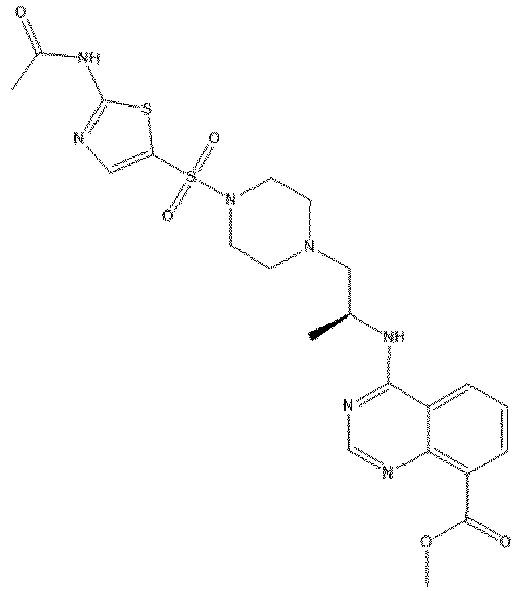
methyl4-{[(2S)-1-{4-[(2-acetamido-1,3-thiazol-5-yl)sulfonyl]piperazin-1-yl}propan-2-yl]amino}quinazoline-8-carboxylate 21 
methyl N-[5-({4-[(2S)-2-{[2-cyclopropyl-8-(trifluoromethyl)quinazolin-4-yl]amino}propyl]piperazin-1-yl}sulfonyl)-4-methyl-1,3-thiazol-2-yl]carbamate 22 
N-[5-({4-[(2S)-2-{[2-cyclopropyl-8-(trifluoromethyl)quinazolin-4-yl]amino }propyl]piperazin-1-yl}sulfonyl)-1,3-thiazol-2-yl] acetamide 23 
2-methyl-N-[(2s)-1-(4-{[5-(1,2-oxazol-5-yl)thiophen-2-yl] sulfonyl} piperazin-1-yl)propan-2-yl]-8-(trifluoromethyl)quinazolin-4-amine 24 
2-methoxy-N-[5-({4-[(2S)-2-{[8-(trifluoromethyl)quinazolin-4-yl]amino}propyl]piperazin-1-yl}sulfonyl)-1,3-thiazol-2-yl]acetamide 25 
2-methoxy-N-[4-methyl-5-({4-[(2S)-2-{[8-(trifluoromethyl)quinazolin-4-yl]amino}propyl]piperazin-1-yl}sulfonyl)-1,3-thiazol-2-yl]acetamide 26 
methyl N-[5-({4-[(2S)-2-{[8-(trifluoromethyl)quinazolin-4-yl]amino}propyl]piperazin-1-yl}sulfonyl)-1,3-thiazol-2-yl]carbamate 27 
methyl N-[5-({4-[(2S)-2-{[8-(dimethylcarbamoyl)quinazolin-4-yl]amino}propyl]piperazin-1-yl}sulfonyl)-4-methyl-1,3-thiazol-2-yl]carbamate 28 
N-[(2S)-1-(4-{[5-(pyridin-2-yl)thiophen-2-yl]sulfonyl}piperazin-1-yl)propan-2-yl]-8-(trifluoromethyl)quinazolin-4-amine 29 
N-[(2S)-1-{4-[4-(2-methyl-1,3-oxazol-4-yl)benzenesulfonyl]piperazin-1-yl}propan-2-yl]-8-(trifluoromethyl)quinazolin-4-amine 30 
N-[(2s)-1-(4-{[5-(3,4-dimethyl-1,2-oxazol-5-yl)thiophen-2-yl]sulfonyl}piperazin-1-yl)propan-2-yl]-8-(trifluoromethyl)quinazolin-4-amine 31 
N-[(2S)-1-{4-[4-(3,5-dimethyl-1,2-oxazol-4-yl)benzenesulfonyl]piperazin-1- yl}propan-2-yl]-8-(trifluoromethyl)quinazolin-4-amine 32 
N-[(2S)-1-(4-{[5-(2-methyl-1,3-thiazol-4-yl)thiophen-2-yl]sulfonyl}piperazin-1-yl)propan-2-yl]-8-(trifluoromethyl)quinazolin-4-amine 33 
N-[(2S)-1-{4-[3-(1,2-oxazol-5-yl)benzenesulfonyl]piperazin-1- yl}propan-2-yl]-8-(trifluoromethyl)quinazolin-4-amine 34 
N-[(2S)-1-{4-[4-(1,2-oxazol-5-yl)benzenesulfonyl]piperazin-1-yl}propan-2-yl]-8-(trifluoromethyl)quinazolin-4-amine 35 
N-[(2S)-1-{4-[(2-phenyl-1,3-thiazol-5-yl)sulfonyl]piperazin-1-yl}propan-2-yl]-8-(trifluoromethyl)quinazolin-4-amine 36 
N-[(2S)-1-(4-{[5-(3-methyl-1,2-oxazol-5-yl)thiophen-2-yl]sulfonyl}piperazin-1-yl)propan-2-yl]-8-(trifluoromethyl)quinazolin-4-amine 37 
N-[(2S)-1-(4-{[5-(1,3-oxazol-5-yl)thiophen-2-yl]sulfonyl}piperazin-1-yl)propan-2-yl]-8-(trifluoromethyl)quinazolin-4-amine 38 
4-{[(2S)-1-{4-[(2-acetamido-4-methyl-1,3-thiazol-5-yl)sulfonyl]piperazin-1-yl}propan-2-yl]amino}-N,N-dimethylquinazoline-8-carboxamide 39 
methyl N-[5-({4-[(2S)-2-({8-[ethyl(methyl)carbamoyl]quinazolin-4-yl}amino)propyl]piperazin-1-yl}sulfonyl)-4-methyl-1,3-thiazol-2-yl]carbamate 40 
methyl N-[4-methyl-5-({4-[(2S)-2-({ 8-[methyl(2,2,2-trifluoroethyl)carbamoyl]quinazolin-4-yl}amino)propyl]piperazin-1- yl}sulfonyl)-1,3-thiazol-2-yl]carbamate 41 
N-[(2S)-1-(4-([5-(3,5-dimethyl-1,2-oxazol-4-yl)thiophen-2-yl]sulfonyl}piperazin-1-yl)propan-2-yl]-8-(trifluoromethyl)quinazolin-4-amine 42 
N-[2-chloro-5-fluoro-4-({4-[(2S)-2-{[8-(trifluoromethyl)quinazolin-4-yl]amino}propyl]piperazin-1-yl}sulfonyl)phenyl]acetamide 43 
4-{[(2S)-1-(4-{[5-(3,4-dimethyl-1,2-oxazol-5-yl)thiophen-2-yl]sulfonyl}piperazin-1-yl)propan-2-yl]amino}-N,N-dimethylquinazoline-8-carboxamide 44 
N,N-dimethyl-4-{[(2S)-1-{4-[(2-phenyl-1,3-thiazol-5-yl)sulfonyl]piperazin-1-yl}propan-2-yl]amino}quinazoline-8-carboxamide 45 
methyl N-[4-methyl-5-({4-[(2S)-2-{[8-(pyrrolidine-1-carbonyl)quinazolin-4-yl]amino}propyl]piperazin-1-yl}sulfonyl)-1,3-thiazol-2-yl]carbamate 46 
methyl N-[5-({4-[(2S)-2-[(8-cyclopropanecarbonylquinazolin-4-yl)amino]propyl]piperazin-1-yl}sulfonyl)-4-methyl-1,3-thiazol-2-yl]carbamate 47 
methyl N-[5-({4-[(2S)-2-{[8-(azetidine-1-carbonyl)quinazolin-4-yl]amino}propyl]piperazin-1-yl}sulfonyl)-4-methyl-1,3-thiazol-2-yl]carbamate 48 
N,N-dimethyl-4-{[(2S)-1-(4-{[5-(3- methyl-1,2-oxazol-5-yl)thiophen-2-yl]sulfonyl}piperazin-1-yl)propan-2-yl]amino}quinazoline-8-carboxamide 49 
4-{[(2S)-1-[4-(3,4-dichlorobenzenesulfonyl)piperazin-1- yl]propan-2-yl]amino}-N,N-dimethylquinazoline-8-carboxamide 50 
N-[(2S)-1-{4-[3-(5-methyl-1,2,4-oxadiazol-3-yl)benzenesulfonyl]piperazin-1-yl}propan-2-yl]-8-(trifluoromethyl)quinazolin-4-amine 51 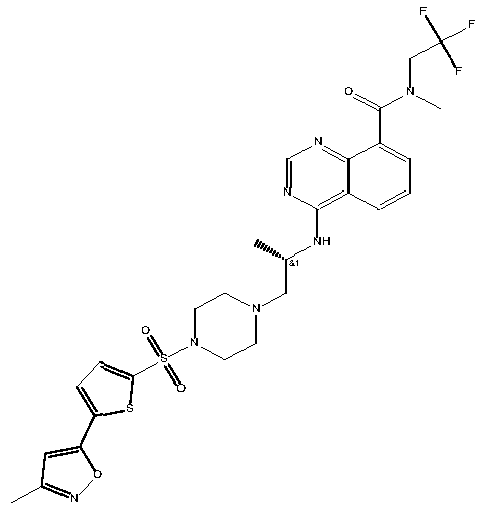
N-methyl-4-{[(2S)-1-(4-{[5-(3-methyl-1,2-oxazol-5-yl)thiophen-2-yl] sulfonyl} piperazin-1-yl)propan-2-yl]amino}-N-(2,2,2-trifluoroethyl)quinazoline-8-carboxamide 52 
N-[(2S)-1-(4-{[5-(3-methyl-1,2-oxazol-5-yl)furan-2-yl] sulfonyl}piperazin-1-yl)propan-2-yl]-8-(trifluoromethyl)quinazolin-4-amine 53 
N-[(2S)-1-(4-{[5-(1,2-oxazol-3-yl)thiophen-2-yl]sulfonyl}piperazin-1-yl)propan-2-yl]-8-(trifluoromethyl)quinazolin-4-amine 54 
N-[(2S)-1-(4-{[5-(1,2-oxazol-5-yl)furan-2-yl]sulfonyl}piperazin-1-yl)propan-2-yl]-8-(trifluoromethyl)quinazolin-4-amine 55 
methyl N-[4-methyl-5-({4-[(2S)-2-[(8-nitroquinazolin-4-yl)amino]propyl]piperazin-1-yl}sulfonyl)-1,3 -thiazol-2-yl]carbamate 56 
N-[(2S)-1-(4-{[5-(3,4-dimethyl-1H-pyrazol-5-yl)furan-2-yl] sulfonyl} piperazin-1-yl)propan-2-yl]-8-(trifluoromethyl)quinazolin-4-amine 57 
N-[(2S)-1-{4-[3-(5-methyl-1,3,4-oxadiazol-2-yl)benzenesulfonyl]piperazin-1-yl}propan-2-yl]-8-(trifluoromethyl)quinazolin-4-amine 58 
N-[(2S)-1-(4-{[5-(3-methyl-1,2-oxazol-5-yl)thiophen-2-yl]sulfonyl}piperazin-1-yl)propan-2-yl]-8-(pyrrolidine-1-carbonyl)quinazolin-4-amine 59 
N-[(2S)-1-{4-[2-methyl-5-(1,2-oxazol-5-yl)benzenesulfonyl]piperazin-1-yl}propan-2-yl]-8-(trifluoromethyl)quinazolin-4-amine 60 
N-[(2S)-1-{4-[2-methyl-5-(3-methyl-1,2-oxazol-5-yl)benzenesulfonyl]piperazin-1- yl}propan-2-yl]-8-(trifluoromethyl)quinazolin-4-amine 61 
N-[(2S)-1-(4-{[5-(3,4-dimethyl-1,2-oxazol-5-yl)thiophen-2-yl]sulfonyl}piperazin-1-yl)propan-2-yl]-2-(methoxymethyl)-8-(trifluoromethyl)quinazolin-4-amine 62 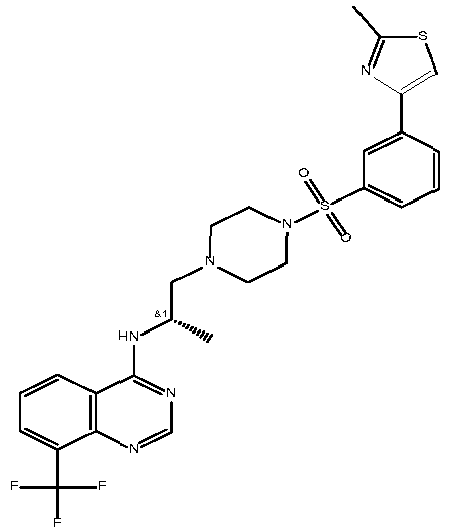
N-[(2S)-1-{4-[3-(2-methyl-1,3-thiazol-4-yl)benzenesulfonyl]piperazin-1- yl}propan-2-yl]-8-(trifluoromethyl)quinazolin-4-amine 63 
N-[(2S)-1-(4-{[2-(3-methyl-1,2-oxazol-5-yl)-1,3-thiazol-5-yl]sulfonyl}piperazin-1-yl)propan-2-yl]-8-(trifluoromethyl)quinazolin-4-amine 64 
4-{[(2S)-1-(4-{[5-(3,4-dimethyl-1,2-oxazol-5-yl)thiophen-2-yl]sulfonyl}piperazin-1-yl)propan-2-yl]amino}-N,N-diethylquinazoline-8-carboxamide 65 
N-cyclopentyl-4-{[(2S)-1-(4-{[5-(3,4-dimethyl-1,2-oxazol-5-yl)thiophen-2-yl]sulfonyl}piperazin-1-yl)propan-2-yl]amino}-N-methylquinazoline-8-carboxamide 66 
4-{[(2S)-1-[4-(5-chloro-4-acetamido-2-fluorobenzenesulfonyl)piperazin-1-yl]propan-2-yl]amino}-N,N-dimethylquinazoline-8-carboxamide 67 
N-[(2S)-1-(4-{[5-(1H-pyrazol-5-yl)furan-2-yl]sulfonyl}piperazin-1-yl)propan-2-yl]-8-(trifluoromethyl)quinazolin-4-amine 68 
N-[(2S)-1-(4-{[5-(3,4-dimethyl-1,2-oxazol-5-yl)furan-2-yl]sulfonyl}piperazin-1-yl)propan-2-yl]-8-(trifluoromethyl)quinazolin-4-amine 69 
N-[(2S)-1-(4-{[5-(3,4-dimethyl-1,2-oxazol-5-yl)thiophen-2-yl]sulfonyl}piperazin-1-yl)propan-2-yl]-8-[(2S)-2-(trifluoromethyl)pyrrolidine-1-carbonyl]quinazolin-4-amine 70 
N-[(2S)-1-(4-{[5-(3-methyl-1,2-oxazol-5-yl)thiophen-2-yl]sulfonyl}piperazin-1-yl)propan-2-yl]-8-(piperidine-1-carbonyl)quinazolin-4-amine 71 
N-[(2S)-1-(4-{[4-(1,2-oxazol-5-yl)thiophen-2-yl]sulfonyl}piperazin-1-yl)propan-2-yl]-8-(trifluoromethyl)quinazolin-4-amine 72 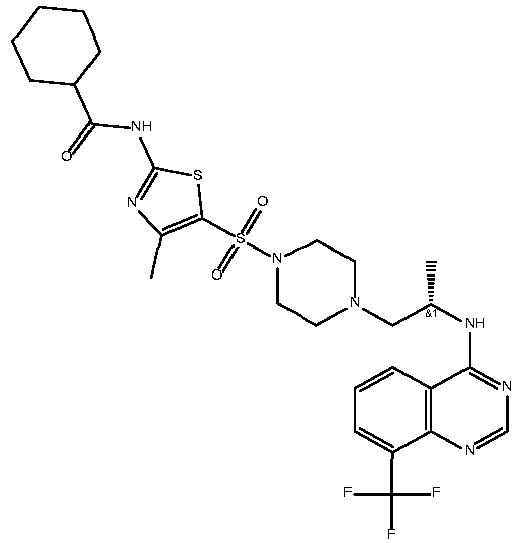
N-[4-methyl-5-(4-[(2S)-2-{[8-(trifluoromethyl)quinazolin-4-yl]amino}propyl]piperazin-1-yl}sulfonyl)-1,3-thiazol-2-yl]cyclohexanecarboxamide 73 
methyl N-[4-methyl-5-({4-[(2S)-2-[(8-methylquinazolin-4-yl)amino]propyl]piperazin-1-yl}sulfonyl)-1,3-thiazol-2-yl]carbamate 74 
N-[(2S)-1-(4-{[5-(3,4-dimethyl-1,2-oxazol-5-yl)thiophen-2-yl]sulfonyl}piperazin-1-yl)propan-2-yl]-8-[(dimethylamino)methyl]quinazolin-4-amine 75 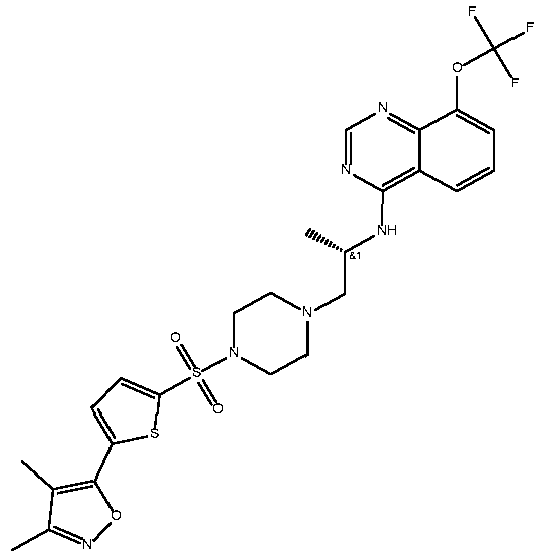
N-[(2S)-1-(4-{[5-(3,4-dimethyl-1,2-oxazol-5-yl)thiophen-2-yl]sulfonyl}piperazin-1-yl)propan-2-yl]-8-(trifluoromethoxy)quinazolin-4-amine 76 
N-[(2S)-1-(4-{[5-(3,4-dimethyl-1,2-oxazol-5-yl)thiophen-2-yl]sulfonyl}piperazin-1-yl)propan-2-yl]-8-[(2R)-2-(trifluoromethyl)pyrrolidine-1-carbonyl]quinazolin-4-amine 77 
8-(3,3-difluoropyrrolidine-1-carbonyl)-N-[(2S)-1-(4-{1[5-(3,4-dimethyl-1,2-oxazol-5-yl)thiophen-2-yl]sulfonyl}piperazin-1-yl)propan-2-yl]quinazolin-4-amine 78 
N-[(2S)-1-(4-{[5-(3,4-dimethyl-1,2-oxazol-5-yl)thiophen-2-yl]sulfonyl}piperazin-1-yl)propan-2-yl]-8-(2,2-dimethylpyrrolidine-1-carbonyl)quinazolin-4-amine 79 
methyl N-[4-methyl-5-({4-[(2S)-2-({8-[(2R)-2-(trifluoromethyl)pyrrolidine-1-carbonyl]quinazolin-4-yl}amino)propyl]piperazin-1-yl} sulfonyl)-1,3-thiazol-2-yl]carbamate 80 
methyl N-[5-({4-[(2S)-2-{[8-(3,3-difluoropyrrolidine-1- carbonyl)quinazolin-4-yl]amino}propyl]piperazin-1-yl } sulfonyl)-4-methyl-1,3-thiazol-2-yl]carbamate 81 
N-[4-methyl-5-({4-[(2S)-2-{[8-(trifluoromethyl)quinazolin-4-yl]amino}propyl]piperazin-1-yl}sulfonyl)-1,3-thiazol-2-yl]morpholine-4-carboxamide 82 
methyl N-[4-methyl-5-({4-[(2S)-2-({8-[(2S)-2-methylpyrrolidine-1-carbonyl]quinazolin-4-yl}amino)propyl]piperazin-1-yl }sulfonyl)-1,3-thiazol-2-yl]carbamate 83 
methyl N-[5-({4-[(2S)-2-{[8-(2,2-dimethylpyrrolidine-1-carbonyl)quinazolin-4-yl]amino}propyl]piperazin-1-yl}sulfonyl)-4-methyl-1,3-thiazol-2-yl]carbamate 84 
methyl N-[4-methyl-5-({4-[(2S)-2-({8-[(2S)-2-(trifluoromethyl)pyrrolidine-1-carbonyl]quinazolin-4-yl}amino)propyl]piperazin-1-yl} sulfonyl)-1,3-thiazol-2-yl]carbamate 85 
8-{3-azabicyclo[3.1.0]hexane-3-carbonyl}-N-[(2S)-1-(4-{[5-(3,4-dimethyl-1,2-oxazol-5-yl)thiophen-2-yl]sulfonyl}piperazin-1-yl)propan-2-yl]quinazolin-4-amine 86 
N-[(2S)-1-(4-{[5-(3,4-dimethyl-1,2-oxazol-5-yl)thiophen-2-yl]sulfonyl}piperazin-1-yl)propan-2-yl]-8-[(2S)-2-methylpyrrolidine-1-carbonyl]quinazolin-4-amine 87 
methyl N-[5-({4-[(2S)-2-[(8-{3-azabicyclo[3.1.0]hexane-3-carbonyl}quinazolin-4-yl)amino]propyl]piperazin-1-yl}sulfonyl)-4-methyl-1,3-thiazol-2-yl]carbamate 88 
5-methyl-N-[4-methyl-5-({4-[(2S)-2-{[8-(trifluoromethyl)quinazolin-4-yl]amino}propyl]piperazin-1-yl} sulfonyl)-1,3-thiazol-2-yl]-1,2-oxazole-3-carboxamide 89 
methyl N-methyl-N-[4-methyl-5-({4-[(2S)-2-{[8-(trifluoromethyl)quinazolin-4-yl]amino}propyl]piperazin-1-yl}sulfonyl)-1,3-thiazol-2-yl]carbamate 90 
N-[5-({4-[(2S)-2-{[8-(trifluoromethyl)quinazolin-4-yl]amino}propyl]piperazin-1-yl}sulfonyl)thiophen-2-yl]acetamide 91 
4-{[(2S)-1-(4-{[5-(3-methyl-1,2-oxazol-5-yl)thiophen-2-yl] sulfonyl} piperazin-1-yl)propan-2-yl]amino}quinazolin-8-yl N,N-dimethylcarbamate 92 
8-cyclopropanecarbonyl-N-[(2S)-1-(4-{[5-(3,4-dimethyl-1,2-oxazol-5-yl)thiophen-2-yl]sulfonyl}piperazin-1-yl)propan-2-yl]quinazolin-4-amine 93 
N-[(2S)-1-{4-[3-(1,3-oxazol-5-yl)benzenesulfonyl]piperazin-1-yl}propan-2-yl]-8-(trifluoromethyl)quinazolin-4-amine 94 
methyl N-[5-({4-[(2S)-2-{[8-(trifluoromethoxy)quinazolin-4-yl]amino}propyl]piperazin-1-yl} sulfonyl)-1,3-thiazol-2-yl]carbamate 95 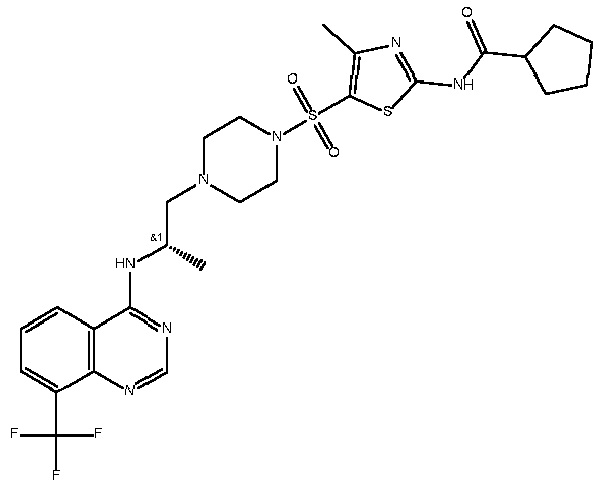
N-[4-methyl-5-({4-[(2S)-2-{[8-(trifluoromethyl)quinazolin-4-yl]amino}propyl]piperazin-1-yl} sulfonyl)-1,3-thiazol-2-yl]cyclopentanecarboxamide 96 
N8,N8-dimethyl-N4-[(2S)-1-(4- { [5-(3-methyl-1,2-oxazol-5-yl)thiophen-2-yl]sulfonyl}piperazin-1-yl)propan-2-yl]quinazoline-4,8-diamine 97 
6-({4-[(2S)-2-{[8-(trifluoromethyl)quinazolin-4-yl]amino}propyl]piperazin-1-yl}sulfonyl)-2,3-dihydro-1,3-benzothiazol-2-one 98 
methyl N-[5-({4-[(2S)-2-{[8-(dimethylamino)quinazolin-4-yl]amino}propyl]piperazin-1-yl}sulfonyl)-4-methyl-1,3-thiazol-2-yl]carbamate 99 
6-({4-[(2S)-2-{[8-(trifluoromethyl)quinazolin-4-yl]amino }propyl]piperazin-1-yl}sulfonyl)-2,3 -dihydro-1,3-benzoxazol-2-one 100 
5-({4-[(2S)-2-{[8-(trifluoromethyl)quinazolin-4-yl]amino}propyl]piperazin-1-yl}sulfonyl)-2,3-dihydro-1H-1,3-benzodiazol-2-one 101 
methyl N-[5-({4-[(2S)-2-[(8-bromoquinazolin-4-yl)amino]propyl]piperazin-1-yl}sulfonyl)-4-methyl-1,3-thiazol-2-yl]carbamate - The compounds of the present invention can be prepared in a number of ways known to one skilled in the art of organic synthesis. It will be understood by those skilled in the art of organic synthesis that the functionality present on the molecule should be consistent with the transformation proposed. This will sometimes require a modification of the order of synthetic steps in order to obtain a desired compound of the invention. The compounds of formula (I), including all the compounds here above listed, can be generally prepared according to the procedure outlined in Schemes shown below using generally known methods.
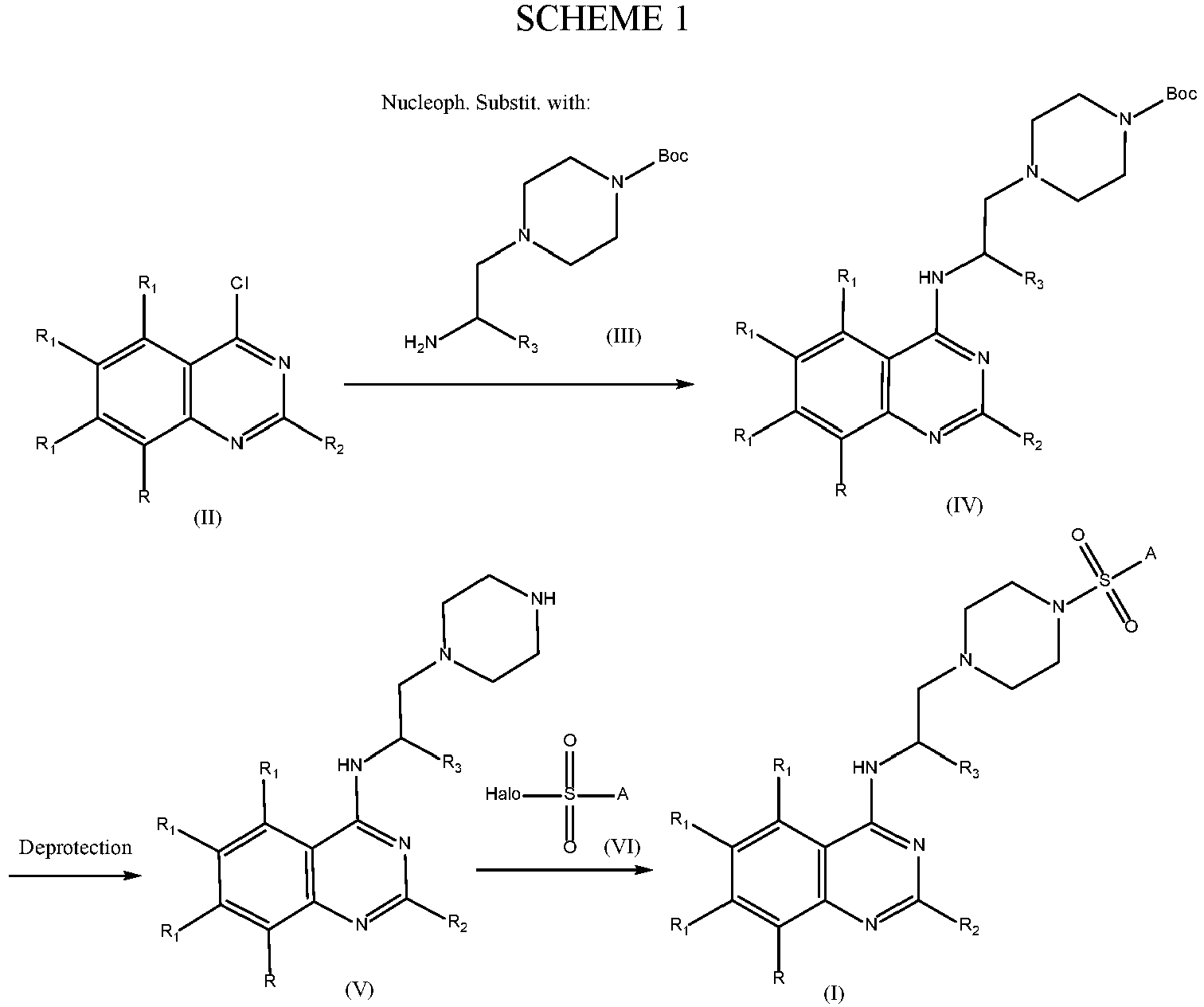
- Compound of formula (II) can be reacted with a nitrogen based nucleophile of formula (III), in the presence of a suitable base e.g. N,N-diisopropylethylamine in a suitable solvent such as Acetonitrile, to provide compound (IV), containing a Boc-protected amino group. Deprotection under well-known procedures gives compound (V) and final reaction with a suitable sulphonyl halide (VI) leads to compound of formula (I).
- In another embodiment of the present invention, compound (II) can be synthesized as reported in Scheme 2.

- Cyclization of commercially available compound (VII) with the appropriate carboximidamide (VIII) and subsequent chlorination with a suitable chlorinating agent such as POCl3 provides intermediate (II). Compound (II) is then converted to the final compound (I) by following the synthetic sequence previously outlined in Scheme 1.
- Alternatively, for compounds where R2=CH3, compound (XII) can be synthesized as reported in Scheme 3.

- In another embodiment of the present invention, wherein A is an N-acylated aminothiazole with R4 and R5= H, CH3, compound (XVIII) may be obtained according to Scheme 4. Reaction of intermediate (V) with N-acetyl thiazole sulfonyl chloride (XIII) followed by deacetylation under acidic conditions provides intermediate (XV). Final acetylation with a suitable acyl chloride in presence of a base, such as N,N-dimethyl-4-pyridinamine, leads to final compound (XVIII).

- For compounds wherein R is an amide or an amino-methyl group, compounds (XXI) and (XXII) can be synthesized as outlined in Scheme 5.

- Commercially available compound (XVIII) is converted into compound (XIX) following the synthetic route outlined in Scheme 1. Subsequent ester hydrolysis and amide coupling with a commercially available amine in the presence of a suitable coupling reagent such as HATU leads to compound (XX). Deprotection under well-known procedure and reaction with a suitable sulphonyl halide (VI) provides final compound (XXI) that could be eventually reduced to give the corresponding amino-methyl derivative (XXII).
- In another embodiment of the present invention, wherein R=-(CO)Cyclopropyl, final compound (XXXI) can be obtained ad highlighted in Scheme 6.
- Cyclization of commercially available compound (XXIII) with formamidine (XXIV) and subsequent Weinreb amidation in the presence of a suitable coupling reagent leads to intermediate (XXVII). Chlorination using well-known procedures provides intermediate (XXVIII) that is then reacted with Cyclopropylmagnesium bromide to obtain the desired ketone intermediate (XXX). Final compound (XXXI) is then obtained by following the synthetic sequence previously outlined in Scheme 1.

- The compounds of formula (I) of the present invention have surprisingly been found to effectively inhibit receptor LPA2. Advantageously, the inhibition of LPA2 may result in efficacious treatment of the diseases or condition wherein the LPA receptor is involved.
- In this respect, it has now been found that the compounds of formula (I) of the present invention have an antagonist drug potency expressed as half maximal inhibitory concentration (IC50) on LPA2 lesser or equal than 1000 nM as shown in the present experimental part.
- Preferably, the compounds of the present invention have an IC50 on LPA2 lesser or equal than 100 nM.
- More preferably, the compounds of the present invention have an IC50 on LPA2 lesser or equal than 10 nM.
- In one aspect, the present invention refers to a compound of formula (I) for use as a medicament.
- In a preferred embodiment, the invention refers to a compound of formula (I) for use in the treatment of disorders associated with LPA receptors mechanism.
- In a further embodiment, the present invention refers to a compound of formula (I) for use in the treatment of a disease, disorder or condition associated with dysregulation of lysophosphatidic acid receptor 2 (LPA2).
- In one embodiment, the present invention refers to a compound of formula (I) useful for the prevention and/or treatment of fibrosis and/or diseases, disorders, or conditions that involve fibrosis.
- The terms "fibrosis" or "fibrosing disorder," as used herein, refers to conditions that are associated with the abnormal accumulation of cells and/or fibronectin and/or collagen and/or increased fibroblast recruitment and include but are not limited to fibrosis of individual organs or tissues such as the heart, kidney, liver, joints, lung, pleural tissue, peritoneal tissue, skin, cornea, retina, musculoskeletal and digestive tract.
- Preferably, the compounds of formula (I) of the present invention are useful for the treatment and/or prevention of fibrosis such as pulmonary fibrosis, idiopathic pulmonary fibrosis (IPF), hepatic fibrosis, renal fibrosis, ocular fibrosis, cardiac fibrosis, arterial fibrosis and systemic sclerosis.
- More preferably, the compounds of formula (I) of the present invention are useful for the treatment of idiopathic pulmonary fibrosis (IPF).
- In one aspect, the invention also refers to a method for the prevention and/or treatment of disorders associated with LPA receptors mechanisms, said method comprises administering to a patient in need of such treatment a therapeutically effective amount of a compound of formula (I).
- In one aspect, the invention refers to the use of a compound of formula (I) in the preparation of a medicament for the treatment of disorders associated with LPA receptors mechanism.
- In a further aspect, the invention refers to a method for the prevention and/or treatment of disorder or condition associated with dysregulation of lysophosphatidic acid receptor 2 (LPA2) administering a patient in need of such treatment a therapeutically effective amount of a compound of formula (I).
- In a further aspect, the invention refers to the use of a compound of formula (I) according to the invention for the treatment of disorders associated with LPA receptors mechanism.
- In a further aspect, the present invention refers to the use of a compound of formula (I) for the treatment of a disease, disorder or condition associated with dysregulation of receptor 2 (LPA2).
- As used herein, "safe and effective amount" in reference to a compound of formula (I) or a pharmaceutically acceptable salt thereof or other pharmaceutically-active agent means an amount of the compound sufficient to treat the patient's condition but low enough to avoid serious side effects and it can nevertheless be routinely determined by the skilled artisan.
- The compounds of formula (I) may be administered once or according to a dosing regimen wherein a number of doses are administered at varying intervals of time for a given period of time. Typical daily dosages may vary depending upon the route of administration chosen.
- The present invention also refers to a pharmaceutical composition comprising a compound of formula (I) thereof in admixture with at least one or more pharmaceutically acceptable carrier or excipient.
- In one embodiment, the invention refers to a pharmaceutical composition of compounds of formula (I) in admixture with one or more pharmaceutically acceptable carrier or excipient, for example those described in Remington's Pharmaceutical Sciences Handbook, XVII Ed., Mack Pub., N.Y., U.S.A.
- Administration of the compounds of the invention and their pharmaceutical compositions may be accomplished according to patient needs, for example, orally, nasally, parenterally (subcutaneously, intravenously, intramuscularly, intrasternally and by infusion) and by inhalation.
- Preferably, the compounds of the present invention are administered orally or by inhalation.
- More preferably, the compounds of the present invention are administered orally.
- In one preferred embodiment, the pharmaceutical composition comprising the compound of formula (I) is a solid oral dosage form such as tablets, gelcaps, capsules, caplets, granules, lozenges and bulk powders.
- In one embodiment, the pharmaceutical composition comprising the compound of formula (I) is a tablet.
- The compounds of the invention can be administered alone or combined with various pharmaceutically acceptable carriers, diluents (such as sucrose, mannitol, lactose, starches) and known excipients, including suspending agents, solubilizers, buffering agents, binders, disintegrants, preservatives, colorants, flavorants, lubricants and the like.
- In a further embodiment, the pharmaceutical composition comprising a compound of formula (I) is a liquid oral dosage forms such as aqueous and non-aqueous solutions, emulsions, suspensions, syrups, and elixirs. Such liquid dosage forms can also contain suitable known inert diluents such as water and suitable known excipients such as preservatives, wetting agents, sweeteners, flavorants, as well as agents for emulsifying and/or suspending the compounds of the invention.
- In a further embodiment, the pharmaceutical composition comprising the compound of formula (I) is an inhalable preparation such as inhalable powders, propellant-containing metering aerosols or propellant-free inhalable formulations.
- For administration as a dry powder, single- or multi-dose inhalers known from the prior art may be utilized. In that case the powder may be filled in gelatine, plastic or other capsules, cartridges or blister packs or in a reservoir.
- A diluent or carrier chemically inert to the compounds of the invention, e.g. lactose or any other additive suitable for improving the respirable fraction may be added to the powdered compounds of the invention.
- Inhalation aerosols containing propellant gas such as hydrofluoroalkanes may contain the compounds of the invention either in solution or in dispersed form. The propellant-driven formulations may also contain other ingredients such as co-solvents, stabilizers and optionally other excipients.
- The propellant-free inhalable formulations comprising the compounds of the invention may be in form of solutions or suspensions in an aqueous, alcoholic or hydroalcoholic medium and they may be delivered by jet or ultrasonic nebulizers known from the prior art or by soft-mist nebulizers.
- The compounds of the invention can be administered as the sole active agent or in combination with other pharmaceutical active ingredients.
- The dosages of the compounds of the invention depend upon a variety of factors including among others the particular disease to be treated, the severity of the symptoms, the route of administration and the like.
- The invention is also directed to a device comprising a pharmaceutical composition comprising a compound of Formula (I) according to the invention, in form of a single- or multi-dose dry powder inhaler or a metered dose inhaler.
- All preferred groups or embodiments described above for compounds of formula I may be combined among each other and apply as well mutatis mutandis.
- The various aspects of the invention described in this application are illustrated by the following examples which are not meant to limit the invention in any way.
- Chemical Names of the compounds were generated with Structure To Name Enterprise 10.0 Cambridge Software.
- All reagents, for which the synthesis is not described in the experimental part, are either commercially available, or are known compounds or may be formed from known compounds by known methods by a person skilled in the art.
-
- AC2O= Acetic anhydride
- BBr3= Boron tribromide
- BH3= Borane
- CCl4= Carbon tetrachloride
- Cs2CO3= Cesium carbonate
- CuI= Copper iodide
- DCM= Dichloromethane
- DIPEA= N,N-diisopropylethylamine
- DMAP= 4-Dimethylaminopyridine
- DMF= N,N-Dimethylformamide
- DMSO= Dimethylsulfoxide
- EtOAc= Ethyl acetate
- EtOH= Ethanol
- Fe0= Metallic iron
- h= hour
- HATU= 1-[Bis(dimethylamino)methylene]-1H-1,2,3-triazolo[4,5-b]pyridinium 3-oxid hexafluorophosphate
- H2O= Water
- HCOOH= Formic acid
- K2CO3= Potassium carbonate
- LC-MS= liquid chromatography/mass spectrometry
- MeCN= Acetonitrile
- MeOH= Methanol
- MW= Microwave
- NaHCO3= Sodium hydrogen carbonate
- Na2SO4= Sodium sulfate
- NBS= N-Bromosuccinimide
- NH4Cl= Ammonium chloride
- NH4HCO3= Ammonium hydrogen carbonate
- NH4OH= Ammonium hydroxide
- NH3= Ammonia
- Pd2(dba)3= Tris(dibenzylideneacetone)dipalladium(0)
- POCl3= Phosphorus(V) oxychloride
- r.t.= room temperature
- SCX= strong cation exchange
- STAB= Sodium triacetoxyborohydride
- TFA= Trifluoroacetic acid
- UPLC= ultra-performance liquid chromatography
- Xantphos= 4,5-Bis(diphenylphosphino)-9,9-dimethylxanthene
- 1H-NMR spectra were performed on a Varian MR-400 spectrometer operating at 400 MHZ (proton frequency), equipped with: a self-shielded Z-gradient coil 5 mm 1H/nX broadband probe head for reverse detection, deuterium digital lock channel unit, quadrature digital detection unit with trans mitter offset frequency shift, or on AgilentVNMRS-500 or on a Bruker Avance 400 or on a Bruker Avance 300 spectrometers. Chemical shift are reported as 6 values in ppm relative to trimethylsilane (TMS) as an internal standard. Coupling constants (J values) are given in hertz (Hz) and multiplicities are reported using the following abbreviation (s=singlet, d=doublet, trtriplet, q=quartet, m=multiplet, br. s=broad singlet, nd=not determined).
- LC/MS retention times are estimated to be affected by an experimental error of +0.5 min. LCMS may be recorded under the following conditions: diode array DAD chromatographic traces, mass chromatograms and mass spectra may be taken on UPLC/PDA/MS AcquityTM system coupled with Micromass ZQTM or Waters SQD single quadrupole mass spectrometer operated in positive and/or negative electron spray ES ionization mode and/or Fractionlynx system used in analytical mode coupled with ZQTM single quadrupole operated in positive and/or negative ES ionisation mode or on a Waters Alliance e2695 with Photodiode Detector 2998 coupled with Column Oven and Mass Spectrometer ZQ operated in positive and/or negative ES ionisation mode. Quality Control methods used operated under low pH conditions or under high pH conditions:
Method 1, low pH conditions column: Acquity CSH C18 2.1x50mm 1.7um, the column temperature was 40°C; mobile phase solvent A was milliQ water+0.1% HCOOH, mobile phase solvent B MeCN+0.1% HCOOH. The flow rate was 1 mL/min. - The gradient table was t=0 min 97% A 3% B, t=1.5 min 0.1% A 99.9% B, t=1.9 min 0.1% A 99.9% B and t=2 min 97% A 3% B. The UV detection range was 210-350 nm and ES+/ES- range was 100 to 1500 AMU.
- Method 2, high pH conditions: column: Acquity Kinetex 1.7 um EVO C18 100A, 2.1×50mm, the column temperature was 40°C; mobile phase solvent A was 10 mM aqueous solution of NH4HCO3 adjusted to pH=10 with ammonia, mobile phase solvent B MeCN. The flow rate was 1 mL/min. The gradient table was t=0 min 97% A 3% B, t=1.5 min 0.1% A 99.9% B, t=1.9 min 0.1% A 99.9% B and t=2 min 97% A 3% B. The UV detection range was 210-350 nm and ES+/ES- range was 100 to 1500 AMU.
- Method 3, low pH conditions: column: Acquity CSH C18 2.1x50mm 1.7µm, the column temperature was 40°C; mobile phase solvent A was milliQ water/MeCN 95:5 +0.05% HCOOH, mobile phase solvent B MeCN/milliQ water 95:5 +0.05% HCOOH. The flow rate was 1 mL/min. The gradient table was t=0 min 99% A 1% B, t=1.5 min 0.1% A 99.9% B, t=1.9 min 0.1% A 99.9% B and t=2 min 99% A 1% B. The UV detection range was 210-400 nm and ES+/ES- range was 100 to 1200 AMU.
- Method 4, low pH conditions: column: Phenomenex Gemini-NX C18, 150x2.0mm, 3µm with security guard Gemini-NX C18, 4x2.0mm, 3µm, the column temperature was 25°C; mobile phase solvent A was water + 0.1% Formic acid filtered with 0.22 µm nylon filter, mobile phase solvent B Acetonitrile + 0.1% Formic acid filtered with 0.22 µm nylon filter. The flow rate was 0.2 mL/min. The gradient table was t=0 min 95% A 5% B, t=10 min 20% A 80% B, t=30 min 20% A 80 B. The UV detection λ was 210 nm and ES+/ES-range was 50 to 900 Da.
- Method 5 (Chiesi), low pH conditions: column: Acquity CSH C18 2.1x50mm 1.7µm, the column temperature was 40°C; mobile phase solvent A was milliQ water/MeCN 95:5 +0.05% HCOOH, mobile phase solvent B MeCN/milliQ water 95:5 +0.05% HCOOH. The flow rate was 1 mL/min. The gradient table was t=0 min 99% A 1% B, t=3.5 min 0.1% A 99.9% B, t=3.9 min 0.1% A 99.9% B and t=4 min 99% A 1% B. The UV detection range was 210-400 nm and ES+/ES- range was 100 to 1200 AMU.
-

-

- To a solution of 4-chloro-8-(trifluoromethyl)quinazoline (232 mg, 1 mmol) in MeCN (7 mL), tert-butyl 4-[(2S)-2-aminopropyl]piperazine-1-carboxylate (267 mg, 1.1 mmol) and DIPEA (0.260 mL, 1.5 mmol) were added and the solution was heated under stirring at 85 °C for 4h. The mixture was partitioned between H2O and EtOAc. The aqueous phase was extracted again with EtOAc and the combined organic phases were concentrated under vacuum to afford Intermediate 1 (473 mg, crude).
LC-MS (ESI): m/z (M+1): 440.3 (Method 1) -

- To a solution of Intermediate 1 (473 mg, crude) in 1,4-dioxane (3 mL), HCl 4M in dioxane (1.33 mL, 5.35 mmol) was added. The reaction mixture was stirred at 25°C for 6h. The crude was then concentrated under reduced pressure to provide Intermediate 2 (400 mg, crude)
LC-MS (ESI): m/z (M+1): 340.2. (Method 1) - Intermediate 2 (100 mg, 0.26 mmol) was dissolved in DCM/Pyridine 1:4 (5 mL) then methyl N-[5-(chlorosulfonyl)-4-methyl-1,3-thiazol-2-yl]carbamate (81 mg, 0.30 mmol) was added and the reaction was stirred at rt for 1 hour. The solvent was removed under vacuum and the crude product was purified by flash chromatography eluting with MeOH in DCM from 0% to 10% to provide the title compound (30 mg, 0.05 mmol, 20% yield) as a white solid.
- LC-MS (ESI): m/z (M+1): 574.2 (Method 1)
- 1H NMR (500 MHz, DMSO-d6) δ ppm 1.21 (d, J=6.31 Hz, 3 H), 2.39 - 2.65 (m, 2 H), 2.42 (s, 3 H), 2.53 - 2.59 (m, 4 H), 2.98 (br. s., 4 H), 3.75 (s, 3 H), 4.61 (spt, J=6.91 Hz, 1 H), 7.60 (t, J=7.82 Hz, 1 H), 8.01 - 8.25 (m, 2 H), 8.44 - 8.66 (m, 2 H), 12.33 (br. s., 1 H)
- The Examples in the following table were prepared from commercially available reagents by using methods analogous to Example 1.
Example No. Structure & Name Analytical data 5 
LC-MS (ESI): m/z (M+1): 548 (Method 1) 1H NMR (400 MHz, DMSO-d6) δ ppm 8.50 - 8.56 (m, 2H), 8.08 - 8.16 (m, 2 H), 7.90 (d, J=2.10 Hz, 1 H), 7.88 (d, J=8.40 Hz, 1 H), 7.67 (dd, J=8.41, 2.13 Hz, 1 H), 7.59 (t, J=7.91 Hz, 1 H), 4.56 - 4.66 (m, 1 H), 2.87 - 2.96 (m, 4 H), 2.56 - 2.64 (m, 1 H), 2.51 - 2.55 (m, 4 H), 2.36 - 2.44 (m, 1 H), 1.19 (d, J=6.53 Hz, 3 H) 6 
LC-MS (ESI): m/z (M+1): 516.1 (Method 1) 1H NMR (500 MHz, DMSO-d6) δ ppm 8.50 (s, 1 H), 8.21 (d, J=8.31 Hz, 1 H), 8.00 (d, J=8.07 Hz, 1 H), 7.85 - 7.94 (m, 3 H), 7.67 (dd, J=8.44, 2.08 Hz, 1 H), 7.44 (t, J=7.95 Hz, 1 H), 4.59 (dt, J=13.63, 7.00 Hz, 1 H), 2.84 - 2.95 (m, 4 H), 2.55 - 2.62 (m, 1 H), 2.49 - 2.56 (m, 4 H), 2.34 - 2.43 (m, 1 H), 1.18 (d, J=6.60 Hz, 3 H) 7 
LC-MS (ESI): m/z (M+1): 544.1 (Method 1) 1H NMR (400 MHz, DMSO-d6) δ ppm 1.20 (d, J=6.58 Hz, 3 H), 2.18 (s, 3 H), 2.36 - 2.66 (m, 2 H), 2.57 (br. s., 4 H), 2.91 (br. s., 4H), 4.61 (dt, J=13.92, 6.85 Hz, 1 H), 7.60 (t, J=7.89 Hz, 1 H), 7.93 (s, 1 H), 8.13 (d, J=7.23 Hz, 2 H), 8.46 - 8.64 (m, 2 H), 12.67 (br. s., 1 H) 8 
LC-MS (ESI): m/z (M+1): 558.2 (Method 1) 1H NMR (400 MHz, DMSO-d6) δ ppm 12.60 (br. s., 1 H), 8.43 - 8.63 (m, 2 H), 8.13 (d, J=7.24 Hz, 2 H), 7.60 (t, J=7.89 Hz, 1 H), 4.61 (dt, J=13.87, 6.99 Hz, 1 H), 2.97 (br. s., 4 H), 2.60 - 2.66 (m, 1 H), 2.56 (br. s., 4 H), 2.45 (s, 3 H), 2.37 - 2.43 (m, 1 H), 2.16 (s, 3 H), 1.20 (d, J=6.58 Hz, 3 H) 9 
LC-MS (ESI): m/z (M+1): 572.2 (Method 1) 1H NMR (500 MHz, DMSO-d6) δ ppm 1.07 (t, J=7.55 Hz, 3 H), 1.20 (d, J=6.59 Hz, 3 H), 2.37 - 2.66 (m, 2 H), 2.40 - 2.48 (m, 2 H), 2.45 (s, 3 H), 2.52 - 2.59 (m, 4 H), 2.97 (br. s., 4 H), 4.61 (spt, J=6.91 Hz, 1 H), 7.60 (t, J=7.96 Hz, 1 H), 8.03 - 8.17 (m, 2H), 8.47 - 8.62 (m, 2 H), 12.58 (br. s., 1 H) 10 
LC-MS (ESI): m/z (M+1): 538.1 (Method 1) 1H NMR (500 MHz, DMSO-d6) δ ppm 1.18 (d, J=6.60 Hz, 3 H), 2.34 - 2.63 (m, 2 H), 2.48-2.55 (m, 4 H), 2.92 (br. s., 4 H), 3.86 (s, 3 H), 4.59 (spt, J=6.89 Hz, 1 H), 7.51 (dd, J=8.07, 7.34 Hz, 1 H), 7.67 (dd, J=8.31, 2.20 Hz, 1 H), 7.86 - 7.92 (m, 3 H), 7.99 (d, J=8.07 Hz, 1 H), 8.37 (dd, J=8.31, 1.22 Hz, 1 H), 8.44 (s, 1H) 11 
LC-MS (ESI): m/z (M+1): 574.2 (Method 1) 1H NMR (500 MHz, DMSO-d6) δ ppm 1.24 (d, J=6.59 Hz, 3 H), 2.31 - 2.46 (m, 4 H), 2.46-2.53 (m, 2 H), 2.54 - 2.68 (m, 3 H), 2.74 - 3.03 (m, 4 H), 3.77 (s, 3 H), 4.54 - 4.67 (m, 1 H), 7.59 - 7.73 (m, 1 H), 7.77 - 7.81 (m, 1 H), 7.81 - 7.86 (m, 1 H), 8.29 - 8.38 (m, 2 H), 12.28 (br. s., 1 H) 12 
LC-MS (ESI): m/z (M+1): 553.2 (Method 2) 1H NMR (400 MHz, DMSO-d6) δ ppm 1.20 (d, J=6.53 Hz, 3 H), 2.40 - 2.47 (m, 1 H), 2.58 - 2.67 (m, 5 H), 2.94 - 3.11 (m, 4 H), 3.85 (s, 3 H), 4.53 - 4.69 (m, 1 H), 7.50 (dd, J=8.28, 7.28 Hz, 1 H), 7.53 - 7.63 (m, 3 H), 7.87 (dd, J=7.28, 1.25 Hz, 1 H), 7.97 - 8.06 (m, 3 H), 8.35 (s, 1 H), 8.38 (dd, J=8.41, 1.13 Hz, 1 H), 8.46 (s, 1 H) 14 
LC-MS (ESI): m/z (M+1): 553.2 (Method 2) 1H NMR (500 MHz, DMSO-d6) δ ppm 1.19 (d, J=6.59 Hz, 3 H), 2.39 - 2.46 (m, 1 H), 2.54 - 2.63 (m, 5 H), 2.88 - 3.06 (m, 4 H), 4.61 (dt, J=14.00, 7.00 Hz, 1 H), 7.12 (d, J=1.92 Hz, 1 H), 7.58 (t, J=7.82 Hz, 1 H), 7.71 (d, J=3.84 Hz, 1 H), 7.81 (d, J=4.12 Hz, 1 H), 8.09 - 8.16 (m, 2H), 8.50 - 8.57 (m, 2 H), 8.74 (d, J=1.92 Hz, 1 H) 15 
LC-MS (ESI): m/z (M+1): 546.3 (Method 2) 1H NMR (400 MHz, DMSO-d6) δ ppm 0.74 - 1.07 (m, 4 H), 1.11 - 1.32 (m, 3 H), 1.93-2.06 (m, 1 H), 2.29 - 2.63 (m, 6 H), 2.43 (s, 3 H), 2.96 (br. s., 4 H), 3.77 (s, 3 H), 4.49 (dt, J=13.99, 6.93 Hz, 1 H), 7.33 (td, J=7.59, 1.13 Hz, 1 H), 7.41 - 8.25 (m, 4 H), 12.37 (br. s., 1 H) 16 
LC-MS (ESI): m/z (M+1): 543.2 (Method 2) 1H NMR (400 MH z, DMSO-d6) δ ppm 1.17 (d, J=6.65 Hz, 3 H), 2.35 - 2.62 (m, 6 H), 2.96 (br. s., 4 H), 3.84 (s, 3 H), 4.53 - 4.64 (m, 1 H), 7.11 (d, J=1.96 Hz, 1 H), 7.49 (t, J=7.83 Hz, 1 H), 7.69 (d, J=3.91 Hz, 1 H), 7.80 (d, J=3.91 Hz, 1 H), 7.86 (d, J=6.26 Hz, 1 H), 7.98 (d, J=7.83 Hz, 1 H), 8.36 (d, J=7.43 Hz, 1 H), 8.43 (s, 1 H), 8.72 (d, J=1.96 Hz, 1 H) 17 
LC-MS (ESI): m/z (M+1): 564.9 (Method 1) 1H NMR (400 MHz, DMSO-d6) δ ppm 1.20 (d, J=6.53 Hz, 3 H), 2.37 - 2.66 (m, 2 H), 2.43 (s, 3 H), 2.53 - 2.60 (m, 4 H), 2.99 (br. s., 4 H), 3.76 (s, 3 H), 3.86 (s, 3 H), 4.54 - 4.65 (m, 1 H), 7.52 (dd, J=8.28, 7.28 Hz, 1 H), 7.90 (dd, J=7.28, 1.25 Hz, 1 H), 8.00 (d, J=8.28 Hz, 1 H), 8.39 (dd, J=8.41, 1.13 Hz, 1 H), 8.45 (s, 1 H), 12.32 (br. s., 1 H) 20 
LC-MS (ESI): m/z (M+1): 534.8 (Method 1) 1H NMR (400 MHz, DMSO-d6) δ ppm 1.20 (d, J=6.53 Hz, 3 H), 2.19 (s, 3 H), 2.35 - 2.44 (m, 1 H), 2.54 - 2.65 (m, 5 H), 2.85 - 3.02 (m, 4 H), 3.87 (s, 3 H), 4.52 - 4.70 (m, 1 H), 7.54 (t, J=7.65 Hz, 1 H), 7.88 - 8.28 (m, 3 H), 8.40 (d, J=8.53 Hz, 1 H), 8.43 - 8.50 (m, 1 H), 12.66 - 12.75 (m, 1 H) 28 
LC-MS (ESI): m/z (M+1): 563.2 (Method 2) 1H NMR (400 MHz, DMSO-d6) δ ppm 1.19 (d, J=6.6 Hz, 3 H), 2.42 (dd, J=12.5, 6.8 Hz, 1 H), 2.55 - 2.64 (m, 5 H), 2.95 (br s, 4 H), 4.60 (dt, J=14.0, 6.9 Hz, 1 H), 7.40 (ddd, J=7.5, 4.8, 0.9 Hz, 1 H), 7.56 (t, J=7.7 Hz, 1 H), 7.62 (d, J=4.0 Hz, 1 H), 7.87 - 7.95 (m, 2 H), 8.02 - 8.15 (m, 3 H), 8.49 - 8.54 (m, 2 H), 8.57 (d, J=4.8 Hz, 1 H) 29 
LC-MS (ESI): m/z (M+1): 561.3 (Method 2) 1H NMR (500 MHz, DMSO-d6) δ ppm 1.17 (d, J=6.59 Hz, 3 H), 2.36 - 2.43 (m, 1 H), 2.48 (s, 3 H), 2.49 - 2.55 (m, 4 H), 2.55 - 2.62 (m, 1 H), 2.87 (br. s., 4 H), 4.58 (dt, J=14.13, 6.93 Hz, 1 H), 7.57 (t, J=7.82 Hz, 1 H), 7.73 (d, J=8.23 Hz, 2 H), 7.96 (d, J=8.51 Hz, 2 H), 8.07 - 8.14 (m, 2 H), 8.47 - 8.55 (m, 2 H), 8.66 (s, 1 H) 30 
LC-MS (ESI): m/z (M+1): 581.3 (Method 2) 1H NMR (500 MHz, DMSO-d6) δ ppm 1.19 (d, J=6.59 Hz, 3 H), 2.14 (s, 3 H), 2.24 (s, 3 H), 2.38 - 2.45 (m, 1 H), 2.56 - 2.60 (m, 4 H), 2.60 - 2.63 (m, 1 H), 2.89 - 3.08 (m, 4 H), 4.62 (quin, J=7.00 Hz, 1 H), 7.58 (t, J=7.82 Hz, 1 H), 7.65 (d, J=4.12 Hz, 1 H), 7.70 (d, J=3.84 Hz, 1 H), 8.08 - 8.16 (m, 2 H), 8.50 - 8.55 (m, 2 H) 31 
LC-MS (ESI): m/z (M+1): 575.3 (Method 2) 1H NMR (500 MHz, DMSO-d6) δ ppm 1.18 (d, J=6.59 Hz, 3 H), 2.24 (s, 3 H), 2.37 - 2.41 (m, 1 H), 2.42 (s, 3 H), 2.53 - 2.62 (m, 5 H), 2.89 (br. s., 4 H), 4.62 (dt, J=13.86, 7.07 Hz, 1 H), 7.59 (t, J=7.82 Hz, 1 H), 7.64 (d, J=8.23 Hz, 2 H), 7.76 (d, J=8.23 Hz, 2 H), 8.12 (d, J=7.41 Hz, 2 H), 8.47 - 8.57 (m, 2H) 32 
LC-MS (ESI): m/z (M+1): 583.3 (Method 2) 1H NMR (400 MHz, DMSO-d6) δ ppm 8.49 - 8.55 (m, 2 H), 8.05 - 8.15 (m, 3 H), 7.66 (d, J=3.95 Hz, 1 H), 7.53 - 7.61 (m, 2 H), 4.60 (dt, J=13.98, 6.71 Hz, 1H), 2.87 - 3.01 (m, 4 H), 2.69 (s, 3 H), 2.55 - 2.63 (m, 5 H), 2.44 (s, 1 H), 1.19 (d, J=6.50 Hz, 3 H) 33 
LC-MS (ESI): m/z (M+1): 547.3 (Method 2) 1H NMR (400 MHz, DMSO-d6) δ ppm 8.73 (d, J=1.97 Hz, 1 H), 8.45 - 8.54 (m, 2 H), 8.20 (dt, J=6.80, 1.86 Hz, 1 H), 8.06 - 8.14 (m, 3 H), 7.75 - 7.85 (m, 2 H), 7.56 (t, J=7.89 Hz, 1 H), 7.26 (d, J=1.97 Hz, 1 H), 4.58 (dt, J=14.09, 6.88 Hz, 1 H), 2.91 (br. s., 4 H), 2.52 - 2.62 (m, 5 H), 2.35 - 2.43 (m, 1 H), 1.16 (d, J=6.58 Hz, 3 H) 34 
LC-MS (ESI): m/z (M+1): 547.3 (Method 2) 1H NMR (400 MHz, DMSO-d6 ) δ ppm 1.17 (d, J=6.36 Hz, 3 H), 2.34 - 2.65 (m, 6 H), 2.89 (br. s., 4 H), 4.49 - 4.78 (m, 1 H), 7.23 (d, J=1.75 Hz, 1 H), 7.57 (t, J=7.78 Hz, 1 H), 7.84 (d, J=8.55 Hz, 2 H), 8.01 - 8.20 (m, 4 H), 8.45 - 8.57 (m, 2 H), 8.74 (d, J=1.97 Hz, 1 H) 35 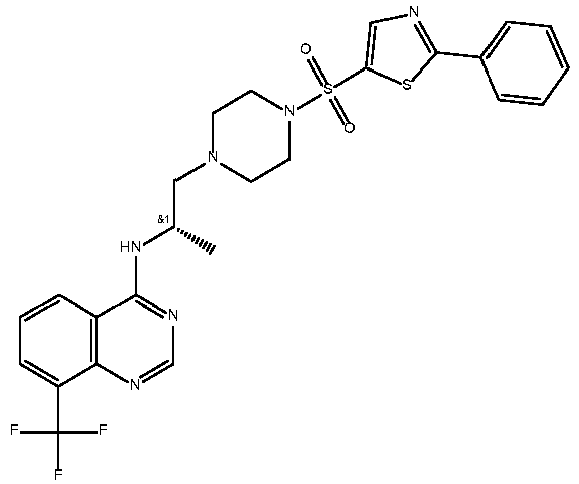
LC-MS (ESI): m/z (M+1): 563.3 (Method 2) 1H NMR (400 MHz, DMSO-d6) δ ppm 1.20 (d, J=6.58 Hz, 3 H), 2.40 - 2.46 (m, 1 H), 2.55 - 2.66 (m, 5H), 3.02 (br. s., 4 H), 4.52 - 4.71 (m, 1 H), 7.49 - 7.64 (m, 4 H), 7.95 - 8.03 (m, 2 H), 8.05 - 8.18 (m, 2 H), 8.34 (s, 1 H), 8.48 - 8.59 (m, 2 H) 36 
LC-MS (ESI): m/z (M+1): 567.3 (Method 2) 1H NMR (400 MHz, DMSO-d6) δ ppm 1.19 (d, J=6.58 Hz, 3 H), 2.29 (s, 3 H), 2.36 - 2.69 (m, 6 H), 2.96 (br. s., 4 H), 4.53 - 4.73 (m, 1 H), 6.96 (s, 1 H), 7.58 (t, J=7.89 Hz, 1 H), 7.69 (d, J=3.95 Hz, 1 H), 7.75 (d, J=3.95 Hz, 1 H), 8.05 - 8.23 (m, 2 H), 8.46 - 8.59 (m, 2 H) 37 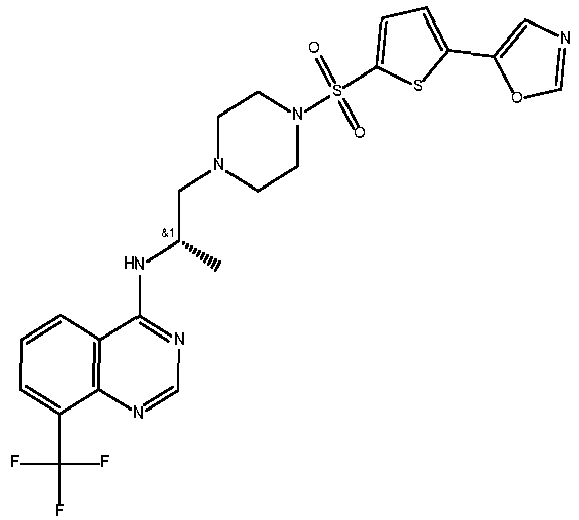
LC-MS (ESI): m/z (M+1): 553.3 (Method 2) 1H NMR (400 MHz, DMSO-d6) δ ppm 1.19 (d, J=6.58 Hz, 3 H), 2.38 - 2.45 (m, 1 H), 2.54 - 2.65 (m, 5 H), 2.94 (br. s., 4 H), 4.62 (dt, J=13.76, 6.82 Hz, 1 H), 7.53 - 7.61 (m, 2 H), 7.62 - 7.66 (m, 1 H), 7.77 (s, 1 H), 8.07 - 8.18 (m, 2 H), 8.47 - 8.60 (m, 3 H) 41 
LC-MS (ESI): m/z (M+1): 581.3 (Method 1) 1H NMR (400 MHz, DMSO-d6) δ ppm 1.10 - 1.31 (m, 3 H), 2.31 (s, 3 H), 2.36 - 2.66 (m, 9 H), 2.94 (br. s., 4 H), 4.63 (dt, J=13.98, 7.15 Hz, 1 H), 7.34 (d, J=3.95 Hz, 1 H), 7.59 (t, J=7.89 Hz, 1 H), 7.64 (d, J=3.95 Hz, 1 H), 8.05 - 8.22 (m, 2 H), 8.47 - 8.59 (m, 2 H) 42 
LC-MS (ESI): m/z (M+1): 589.1 (Method 5) 1H NMR (400 MHz, ACETONE-d6) δ ppm 8.98 (br s, 1 H) 8.55 (s, 1 H) 8.32 - 8.44 (m, 2 H) 8.06 - 8.13 (m, 1 H) 7.75 (d, J=7.02 Hz, 1 H) 7.55 (t, J=7.89 Hz, 1 H) 7.44 (br s, 1 H) 4.64 - 4.76 (m, 1 H) 3.14 (br s, 4 H) 2.45 - 2.75 (m, 6 H) 2.28 (s, 3 H) 1.31 (d, J=6.36 Hz, 3 H) 50 
LC-MS (ESI): m/z (M+1): 562.3 (Method 1) 1H NMR (500 MHz, DMSO-d6) δ ppm 1.16 (d, J=6.59 Hz, 3 H), 2.39 (dd, J=12.62, 6.59 Hz, 1 H), 2.51 - 2.55 (m, 4 H), 2.56 - 2.62 (m, 1 H), 2.69 (s, 3 H), 2.82 - 3.00 (m, 4 H), 4.54 - 4.64 (m, 1 H), 7.56 (t, J=7.82 Hz, 1 H), 7.82 (t, J=7.80 Hz, 1 H), 7.89 - 7.93 (m, 1 H), 8.07 - 8.13 (m, 2H), 8.20 (t, J=1.65 Hz, 1 H), 8.28 (dt, J=7.96, 1.37 Hz, 1 H), 8.47 - 8.53 (m, 2 H) 52 
LC-MS (ESI): m/z (M+1): 550.8 (Method 3) 1H NMR (400 MHz, ACETONE-d6) δ ppm 8.55 (s, 1 H), 8.35 (d, J=8.33 Hz, 1 H), 8.08 (d, J=7.45 Hz, 1 H), 7.51 (t, J=7.89 Hz, 1 H), 7.42 (br d, J=7.02 Hz, 1 H), 7.22 (d, J=3.51 Hz, 1 H), 7.13 (d, J=3.95 Hz, 1 H), 6.70 (s, 1 H), 4.63 - 4.73 (m, 1 H), 3.14 - 3.25 (m, 4 H), 2.43 - 2.74 (m, 6 H), 2.32 (s, 3 H), 1.30 (d, J=6.58 Hz, 3 H) 53 
LC-MS (ESI): m/z (M+1): 552.7 (Method 3) 1H NMR (400 MHz, ACETONE-d6 ) δ ppm 8.48 - 8.58 (m, 2 H), 8.32 (d, J=8.11 Hz, 1 H), 8.06 (d, J=7.23 Hz, 1 H), 7.71 (d, J=3.95 Hz, 1 H), 7.60 (d, J=3.95 Hz, 1 H), 7.49 (t, J=7.89 Hz, 1 H), 7.38 (br d, J=7.02 Hz, 1 H), 6.92 (d, J=1.97 Hz, 1 H), 4.60 - 4.75 (m, 1 H), 3.07 (br s, 4 H), 2.51 - 2.83 (m, 6 H), 1.28 (d, J=6.36 Hz, 3 H) 54 
LC-MS (ESI): m/z (M+1): 536.8 (Method 3) 1H NMR (400 MHz, ACETONE-d6) δ ppm 8.55 (s, 2 H) 8.36 (br d, J=8.33 Hz, 1 H) 8.08 (d, J=7.45 Hz, 1 H) 7.51 (t, J=7.89 Hz, 1 H) 7.45 (br s, 1 H) 7.25 (d, J=3.51 Hz, 1 H) 7.19 (d, J=3.51 Hz, 1 H) 6.85 (d, J=1.75 Hz, 1 H) 4.73 (s, 1 H) 3.24 (br s, 4 H) 2.33 - 2.68 (m, 6 H) 1.32 (br d, J=6.36 Hz, 3 H) 55 
LC-MS (ESI): m/z (M+1): 551.2 (Method 5) 1H NMR (400 MHz, ACETONE-d6) δ ppm 10.87 (br s, 1 H) 8.51 (s, 1 H) 8.31 (d, J=8.33 Hz, 1 H) 8.07 (d, J=7.28 Hz, 1 H) 7.55 (t, J=8.00 Hz, 2 H) 4.74 (spt, J=6.80 Hz, 1 H) 3.84 (s, 3 H) 3.04 - 3.15 (m, 4 H) 2.68 - 2.77 (m, 3 H) 2.60 - 2.68 (m, 2 H) 2.52 (dd, J=12.50, 5.92 Hz, 1 H) 2.41 (s, 3 H) 1.32 (d, J=6.58 Hz, 3 H) 56 
LC-MS (ESI): m/z (M+1): 563.8 (Method 3) 1H NMR (400 MHz, ACETONE-d6) δ ppm 8.55 (s, 1 H) 8.33 (d, J=8.33 Hz, 1 H) 8.06 (d, J=7.23 Hz, 1 H) 7.48 (t, J=7.89 Hz, 1 H) 7.41 (br d, J=6.14 Hz, 1 H) 7.12 (d, J=3.73 Hz, 1 H) 6.74 (d, J=3.51 Hz, 1 H) 4.63 - 4.72 (m, 1 H) 3.11 - 3.24 (m, 4 H) 2.59 - 2.72 (m, 5 H) 2.51 (dd, J=12.50, 6.14 Hz, 1 H) 2.23 (s, 3 H) 2.11 (s, 3 H) 1.30 (d, J=6.36 Hz, 3 H) 57 
LC-MS (ESI): m/z (M+1): 562.2 (Method 1) 1H NMR (400 MHz, DMSO-d6) δ ppm 1.16 (d,7=6.58 Hz, 3 H), 2.35 - 2.44 (m, 1 H), 2.52 - 2.56 (m, 4 H), 2.55 - 2.59 (m, 1 H), 2.60 (s, 3 H), 2.91 (br. s., 4 H), 4.59 (dt, J=13.81, 6.69 Hz, 1 H), 7.57 (t, J=7.89 Hz, 1 H), 7.84 (t, J=7.90 Hz, 1 H), 7.90 - 7.95 (m, 1 H), 8.07 - 8.13 (m, 2 H), 8.14 (t, J=1.53 Hz, 1 H), 8.25 (dd, J=7.78, 1.21 Hz, 1 H), 8.46 - 8.54 (m, 2 H) 59 
LC-MS (ESI): m/z (M+1): 561.2 (Method 2) 1H NMR (400 MHz, DMSO-d6) δ ppm 1.20 (d, J=6.58 Hz, 3 H), 2.38 - 2.45 (m, 1 H), 2.51 - 2.55 (m, 4 H), 2.58 (s, 3 H), 2.60 - 2.65 (m, 1 H), 3.05 (br. s., 4 H), 4.53 - 4.72 (m, 1 H), 7.16 (d, J=1.97 Hz, 1 H), 7.60 (d, J=7.89 Hz, 2 H), 8.06 (dd, J=8.00, 1.86 Hz, 1 H), 8.13 (d, J=7.45 Hz, 2 H), 8.17 (d, J=1.75 Hz, 1 H), 8.49 - 8.57 (m, 2 H), 8.70 (d, J=1.97 Hz, 1 H) 60 
LC-MS (ESI): m/z (M+1): 575.3 (Method 2) 1H NMR (400 MHz, DMSO-d6) δ ppm 1.20 (d, J=6.58 Hz, 3 H), 2.29 (s, 3 H), 2.38 - 2.46 (m, 1 H), 2.51 - 2.54 (m, 4 H), 2.57 (s, 3 H), 2.60 - 2.65 (m, 1 H), 3.04 (br. s., 4 H), 4.62 (dt, J=13.81, 6.91 Hz, 1 H), 7.00 (s, 1 H), 7.52 - 7.66 (m, 2 H), 7.99 (dd, J=8.00, 1.86 Hz, 1 H), 8.08 - 8.16 (m, 3 H), 8.48 - 8.59 (m, 2H) 62 
LC-MS (ESI): m/z (M+1): 577.3 (Method 2) 1H NMR (400 MHz, DMSO-d6) δ ppm 1.16 (d, J=6.65 Hz, 3 H), 2.36 - 2.44 (m, 1 H), 2.51 - 2.62 (m, 5 H), 2.73 (s, 3 H), 2.89 (br. s., 4 H), 4.57 (dt, J=14.18, 6.99 Hz, 1 H), 7.56 (t, J=7.92 Hz, 1 H), 7.60 - 7.74 (m, 2 H), 8.10 (t, J=6.46 Hz, 2 H), 8.16 (s, 1 H), 8.19-8.27 (m, 2 H), 8.44-8.57 (m, 2 H) 67 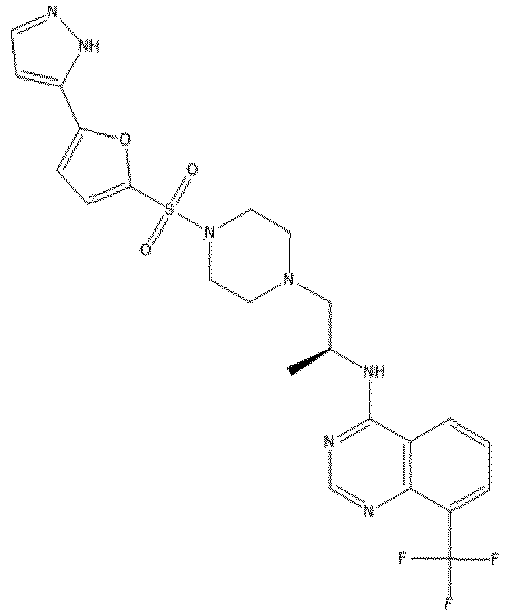
LC-MS (ESI): m/z (M+1): 535.8 (Method 3) 1H NMR (400 MHz, ACETONE-d6) δ ppm 8.54 (s, 1 H) 8.31 (d, J=8.33 Hz, 1 H) 8.05 (d, J=7.23 Hz, 1 H) 7.79 (d, J=2.41 Hz, 1 H) 7.46 (t, J=7.89 Hz, 1 H) 7.39 (br d, J=7.31 Hz, 1 H) 7.11 (d, J=3.73 Hz, 1 H) 6.83 (d, J=3.51 Hz, 1 H) 6.63 (d, J=2.19 Hz, 1 H) 4.65 (spt, J=6.76 Hz, 1 H) 3.10 - 3.22 (m, 4 H) 2.67 (br d, J=7.89 Hz, 1 H) 2.58 - 2.66 (m, 4 H) 2.49 (dd, J=12.50, 6.36 Hz, 1 H) 1.29 (d, J=6.58 Hz, 3 H) 68 
LC-MS (ESI): m/z (M+1): 564.7 (Method 3) 1H NMR (400 MHz, ACETONE-d6) δ ppm 8.53 (s, 1 H) 8.33 (d, J=8.33 Hz, 1 H) 8.06 (d, J=7.23 Hz, 1 H) 7.50 (t, J=7.89 Hz, 1 H) 7.40 (br d, J=6.58 Hz, 1 H) 7.21 (d, J=3.73 Hz, 1 H) 7.02 (d, J=3.73 Hz, 1 H) 4.69 (spt, J=6.83 Hz, 1 H) 3.12 - 3.25 (m, 4 H) 2.61 - 2.71 (m, 5 H) 2.50 (dd, J=12.50, 6.14 Hz, 1 H) 2.23 (s, 3 H) 2.15 (s, 3 H) 1.29 (d, J=6.58 Hz, 3 H) 71 
LC-MS (ESI): m/z (M+1): 552.7 (Method 3) 1H NMR (400 MHz, ACETONE-d6) δ ppm 8.54 (s, 1 H), 8.30 - 8.48 (m, 2 H), 8.04 - 8.10 (m, 2 H), 7.96 (bs, 1 H), 7.37 - 7.57 (m, 1 H), 6.85 (d, J=1.75 Hz, 1 H), 4.47 - 4.89 (m, 1 H), 3.08 (br s, 4 H), 2.77 (br s, 6 H), 1.31 (br s, 3 H) 73 
LC-MS (ESI): m/z (M+1): 520.2 (Method 2) 1H NMR (400 MHz, DMSO-d6) δ ppm 1.19 (d, J=6.6 Hz, 3 H), 2.37-2.45 (m, 4 H), 2.53 -2.64 (m, 8 H), 2.88 - 3.05 (m, 4 H), 3.76 (s, 3 H), 4.59 (spt, J=6.8 Hz, 1 H), 7.28 - 7.39 (m, 1 H), 7.59 (d,J=7.0 Hz, 1 H), 7.72 (d, J=8.1 Hz, 1 H), 8.06 (d, J=8.3 Hz, 1 H), 8.46 (s, 1 H), 12.32 (br s, 1 H) 90 
LC-MS (ESI): m/z (M+1): 543.1 (Method 4) 1H NMR (300 MHz, DMSO-d6) δ ppm 11.76 (s, 1 H), 8.50 - 8.60 (m, 2 H), 8.08 - 8.20 (m, 2 H), 7.60 (t, 1 H), 7.36 (d, J = 4.19 Hz, 1 H), 6.68 (d, J= 4.19 Hz, 1 H), 4.52 - 4.70 (m, 1 H), 2.75 - 2.96 (m, 4 H), 2.52 - 2.67 (m, 5 H), 2.31 - 2.48 (m, 1 H), 2.12 (s, 3 H), 1.19 (d, J=6.48 Hz, 3 H) 93 
LC-MS (ESI): m/z (M+1): 547.4 (Method 1) 1H NMR (400 MHz, DMSO-d6) δ ppm 1.16 (d, J=6.6 Hz, 3 H), 2.39 (dd, J=12.3, 6.6 Hz, 1 H), 2.51 - 2.63 (m, 5 H), 2.89 (br s, 4 H), 4.58 (dt, J=14.0, 7.0 Hz, 1 H), 7.56 (t, J=7.9 Hz, 1 H), 7.65 - 7.80 (m, 2 H), 7.90 (s, 1 H), 7.92 - 7.97 (m, 1 H), 8.04 (dt, J=7.7, 1.4 Hz, 1 H), 8.07 - 8.16 (m, 2 H), 8.45 - 8.57 (m, 3 H) 97 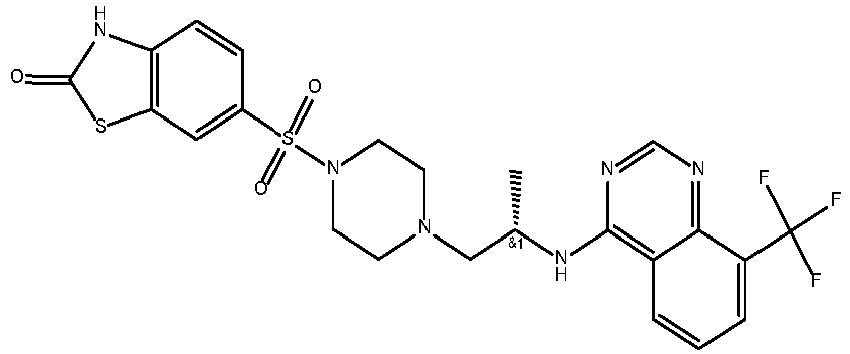
LC-MS (ESI): m/z (M+1): 553.1 (Method 2) 1H NMR (400 MHz, DMSO-d6) δ ppm 1.17 (d, J=6.6 Hz, 3 H), 2.35 - 2.44 (m, 1 H), 2.52 (br s, 4H), 2.55 - 2.66 (m, 1 H), 2.83 (br s, 4 H), 4.59 (dt, J=13.8, 6.7 Hz, 1 H), 7.23 (d, J=8.6 Hz, 1 H), 7.51 - 7.64 (m, 2 H), 7.96 (d, J=1.5 Hz, 1 H), 8.08 - 8.17 (m, 2 H), 8.48 - 8.55 (m, 2 H), 12.35 (br s, 1 H) 99 
LC-MS (ESI): m/z (M+1): 537.1 (Method 2) 1H NMR (500 MHz, DMSO-d6) δ ppm 1.16 (d, J=6.6 Hz, 3 H), 2.33 - 2.42 (m, 1 H), 2.51 - 2.55 (m, 4 H), 2.59 (dd, J=12.5, 7.6 Hz, 1 H), 2.82 (br s, 4 H), 4.51 - 4.65 (m, 1 H), 7.24 (d, J=8.2 Hz, 1 H), 7.48 (dd, J=8.2, 1.6 Hz, 1 H), 7.56 (d, J=1.5 Hz, 1 H), 7.58 (t, J=7.9 Hz, 1 H), 8.06 - 8.16 (m, 2 H), 8.47 - 8.55 (m, 2 H), 12.15 (br s, 1 H) 100 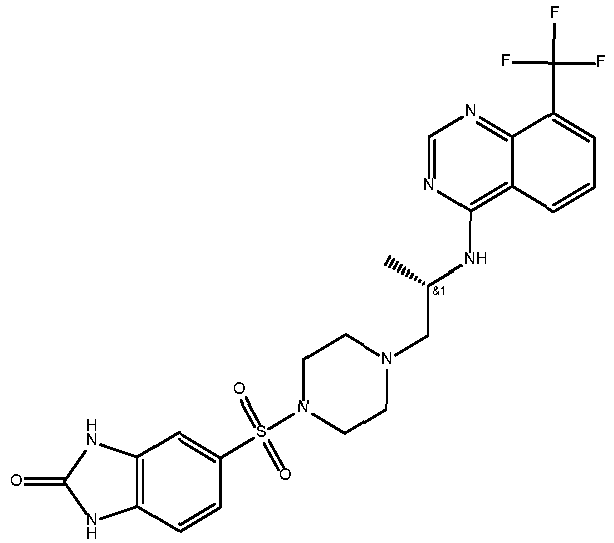
LC-MS (ESI): m/z (M+1): 536.1 (Method 2) 1H NMR (500 MHz, DMSO-d6) δ ppm 1.16 (d, J=6.6 Hz, 3 H), 2.32 - 2.42 (m, 1 H), 2.44 - 2.54 (m, 4 H), 2.57 (dd, J=12.5, 7.2 Hz, 1 H), 2.81 (br s, 4 H), 4.49 - 4.65 (m, 1 H), 7.08 (d, J=8.2 Hz, 1 H), 7.14 (d, J=1.6 Hz, 1 H), 7.28 (dd, J=8.2, 1.6 Hz, 1 H), 7.58 (t, J=7.9 Hz, 1 H), 8.03 - 8.17 (m, 2 H), 8.46 - 8.56 (m, 2 H), 11.03 (br s, 2 H) 101 
LC-MS (ESI): m/z (M+1): 586.1 (Method 2) 1H NMR (400 MHz, DMSO-d6) δ ppm 1.20 (d, J=6.6 Hz, 3 H), 2.37 - 2.47 (m, 4 H), 2.53 - 2.64 (m, 5 H), 2.97 (br s, 4 H), 3.75 (s, 3 H), 4.53 - 4.66 (m, 1 H), 7.39 (t, J=7.9 Hz, 1 H), 8.02 (d, J=7.9 Hz, 1 H), 8.07 - 8.13 (m, 1 H), 8.27 (d, J=7.7 Hz, 1 H), 8.51 (s, 1 H), 12.33 (br s, 1 H) -

-

- A solution of 2-amino-3-(trifluoromethyl)benzoic acid (1.2 g, 5.85 mmol) in Ac2O (12 mL) was heated at reflux for 12 hours and the mixture was concentrated under vacuum to obtain the crude material as a solid. The crude was dissolved in a mixture of EtOH (12 mL) and conc. NH4OH (12 mL) and the mixture was stirred at 80°C for 5 hours. The reaction mixture was cooled to room temperature, filtered and washed with water. The solid residue was dried under vacuum to obtain Intermediate 3 (706 mg, 3 mmol, 53% yield) as a yellowish solid.
- LC-MS (ESI): m/z (M+1): 229 (Method 1)
- 1H NMR (400 MHz, DMSO-d6) δ ppm 12.55 - 12.50 (m, 1H), 8.35 (dd, J = 8.1, 1.5 Hz, 1H), 8.14 (dd, J = 7.6, 1.5 Hz, 1H), 7.58 (t, J = 7.8 Hz, 1H), 2.40 (s, 3H)
-

- A suspension of Intermediate 3 (706 mg, 3 mmol) in toluene (20 mL) was added with POCl3 (1.15 mL, 12.36 mmol) followed by DIPEA (1 mL, 6 mmol). The reaction was heated to 90 °C for 5 h then cooled to r.t. and the solution was concentrated under reduced pressure. The solid was taken up in DCM and concentrated again. The crude material was purified by flash chromatography eluting with a gradient from 0 to 5% of acetonitrile in water (0.1% HCOOH), yielding Intermediate 4 (418 mg, 1.7 mmol. 55% yield) as a white solid.
- LC-MS (ESI): m/z (M+1): 247 (Method 1)
- 1H NMR (400 MHz, DMSO-d6 ) δ ppm 8.56 (dd, J = 8.5, 1.4 Hz, 1H), 8.53 - 8.46 (m, 1H), 7.93 (t, J = 7.9 Hz, 1H), 2.81 (s, 3H)
-
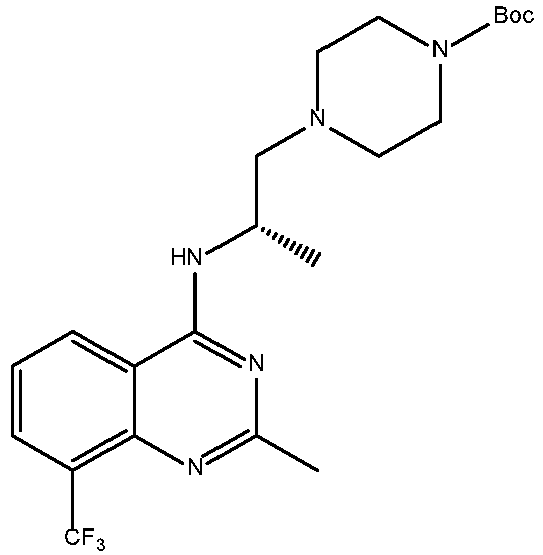
- Title compound was prepared following the procedure used for the synthesis of Intermediate 1, starting from Intermediate 4 (418 mg, 1.7 mmol) to afford Intermediate 5 (700 mg, 1.54 mmol, 91% yield) as a yellowish solid.
- LC-MS (ESI): m/z (M+1): 454.29 (Method 1)
- 1H NMR (400 MHz, DMSO-d6) δ ppm 8.53 (dd, J = 8.4, 1.4 Hz, 1H), 8.09 (d, J = 7.3 Hz, 1H), 8.01 (d, J = 8.0 Hz, 1H), 7.54 (t, J = 7.9 Hz, 1H), 4.71 - 4.64 (m, 1H), 3.28 - 3.21 (m, 4H), 2.61 - 2.56 (m, 1H), 2.49 - 2.31 (m, 8H), 1.38 (s, 9H), 1.25 (d, J = 6.6 Hz, 3H)
-

- To a solution of Intermediate 5 (700 mg, 1.54 mmol) in DCM (15 mL), TFA (2.4 mL, 30.8 mmol) was added. The reaction mixture was stirred at room temperature overnight. The mixture was concentrated under reduced pressure to obtain the crude target material. This was purified on a SCX cartridge eluting with 2N NH3 in methanol to provide 2-methyl-N-[(2S)-1-(piperazin-1-yl)propan-2-yl]-8-(trifluoromethyl)quinazolin-4-amine (0.539 g, 1.52 mmol) as a yellow foam.
- LC-MS (ESI): m/z (M+1): 354.25 (Method 2)
- 1H NMR (400 MHz, Chloroform-d) δ ppm 8.03 (d, J = 7.4 Hz, 1H), 7.94 -7.87 (m, 1H), 7.43 (t, J = 7.8 Hz, 1H), 6.56 (d, J = 4.3 Hz, 1H), 4.35 - 4.29 (m, 1H), 2.96 - 2.83 (m, 4H), 2.61 - 251 (m, 4H), 2.46 (br. s., 2 H), 1.68 (br. s., 4 H), 1.40 (d, J = 6.2 Hz, 3H)
- Title compound was prepared following the procedure used for the synthesis of Example 1, starting from 2-methyl-N-[(2S)-1-(piperazin-1-yl)propan-2-yl]-8-(trifluoromethyl)quinazolin-4-amine (Intermediate 6, 100 mg, 0.28 mmol) to afford the title compound (135.1 mg, 0.23 mmol, 56% yield) as a white solid.
- LC-MS (ESI): m/z (M+1): 588.23 (Method 1)
- 1H NMR (400 MHz, DMSO-d6) δ ppm 1.21 (d, J=6.58 Hz, 3 H), 2.44 (d, J=10.52 Hz, 7 H), 2.58 (br. s., 5 H), 2.98 (br. s., 4 H), 3.76 (s, 3 H), 4.58 (br. s., 1H), 7.50 (t, J=7.67 Hz, 1 H), 7.97 (d, J=7.45 Hz, 1 H), 8.07 (d, J=7.02 Hz, 1 H), 8.49 (d, J=8.33 Hz, 1 H), 12.32 (br. s., 1 H)
- The Examples in the following table were prepared from commercially available reagents by using methods analogous to Example 2.
Example No. Structure & Name Analytical data 13 
LC-MS (ESI): m/z (M+1): 558.2 (Method 1) 1H NMR (400 MHz, DMSO-d6 ) δ ppm 1.18 (d, J=6.58 Hz, 3 H), 2.17 (s, 3 H), 2.33 - 2.41 (m, 1 H), 2.43 (s, 3 H), 2.53 - 2.64 (m, 5 H), 2.90 (br. s., 4 H), 4.56 (dt, J=13.70, 6.96 Hz, 1 H), 7.48 (t, J=7.89 Hz, 1 H), 7.92 (s, 1 H), 7.95 (d, J=7.45 Hz, 1 H), 8.05 (d, J=7.45 Hz, 1 H), 8.46 (d, J=8.33 Hz, 1 H), 12.70 (s, 1 H) 23 
LC-MS (ESI): m/z (M+1): 567.2 (Method 1) 1H NMR (400 MHz, DMSO-d6) δ ppm 1.16 (d, J=6.58 Hz, 3 H), 2.31 - 2.39 (m, 1 H), 2.41 (s, 3 H), 2.51 - 2.62 (m, 5 H), 2.93 (br. s., 3 H), 4.55 (dt, J=14.03, 7.02 Hz, 1 H), 7.08 (d, J=1.97 Hz, 1 H), 7.45 (t, J=7.89 Hz, 1 H), 7.67 (d, J=3.95 Hz, 1 H), 7.78 (d, J=3.95 Hz, 1 H), 7.93 (d, J=7.89 Hz, 1 H), 8.00 (d, J=7.45 Hz, 1 H), 8.43 (d, J=7.89 Hz, 1 H), 8.71 (d, J=1.97 Hz, 1 H) -

-

- A solution of 2-amino-3-(trifluoromethoxy)benzoic acid (500 mg, 2.26 mmol) and formamidine acetate (259 mg, 2.5 mmol) in EtOH (5 mL) was heated at 85 °C for 16 hours. The solvent was removed under vacuum and the crude was added with DCM, causing the precipitation of a white solid. The solid was filtered-off and the filtrate was concentrated under reduced pressure to provide crude 8-(trifluoromethoxy)quinazolin-4-ol that was used in the next step without further purification (276 mg, 1.2 mmol, 53% yield).
LC-MS (ESI): m/z (M+1): 231.1 (Method 1) -

- Title compound was prepared following the procedure used for the synthesis of Intermediate 4, starting from 8-(trifluoromethoxy)quinazolin-4-ol (Intermediate 7, 276 mg, 1.2 mmol) to afford Intermediate 8 (65 mg, 0.261 mmol, 22% yield)
LC-MS (ESI): m/z (M+1): 249.1 (Method 1) -

- Title compound was prepared following the procedure used for the synthesis of Intermediate 1, starting from 4-chloro-8-(trifluoromethoxy)quinazoline (Intermediate 8, 65 mg, 0.261 mmol) to afford Intermediate 9 (180 mg, 0.4 mmol, crude) that was used in the next step without further purification.
LC-MS (ESI): m/z (M+1): 456.3 (Method 1) -

- Title compound was prepared following the procedure used for the synthesis of Intermediate 2, starting from tert-butyl 4-[(2S)-2-[[8-(trifluoromethoxy)quinazolin-4-yl]amino]propyl]piperazine-1-carboxylate (Intermediate 9, 180 mg, 0.4 mmol) to afford Intermediate 10 (202 mg, crude) that was used in the next step without further purification.
LC-MS (ESI): m/z (M+1): 356.2 (Method 2) - Title compound was prepared following the procedure used for the synthesis of Example 1, starting from N-[(2S)-1-piperazin-1-ylpropan-2-yl]-8-(trifluoromethoxy)quinazolin-4-amine hydrochloride (Intermediate 10, 100 mg, 0.25 mmol) to afford the title compound (55 mg, 0.093 mmol, 40% yield) as a white solid. LC-MS (ESI): m/z (M+1): 590.33 (Method 2) 1H NMR (400 MHz, DMSO-d6) δ ppm 1.20 (d, J=6.6 Hz, 3 H), 2.38 - 2.45 (m, 4 H), 2.56 (br s, 5 H), 2.97 (br s, 4 H), 3.72 (br s, 3 H), 4.55 - 4.66 (m, 1 H), 7.54 (t, J=8.1 Hz, 1 H), 7.76 - 7.82 (m, 1 H), 8.08 (d, J=8.0 Hz, 1 H), 8.29 (dd, J=8.5, 1.1 Hz, 1 H), 8.50 (s, 1 H), 12.30 (br s, 1 H)
- The Examples in the following table were prepared from commercially available reagents by using methods analogous to Example 3.
Example No. Structure & Name Analytical data 75 
LC-MS (ESI): m/z (M+1): 597.36 (Method 2) 1H NMR (400 MHz, DMSO-d6) δ ppm 1.19 (d, J=6.6 Hz, 3 H), 2.15 (s, 3 H), 2.24 (s, 3 H), 2.41 (dd, J=12.4, 6.7 Hz, 1 H), 2.54 - 2.65 (m, 5 H), 2.89 - 3.04 (m, 4 H), 4.61 (spt, J=6.9 Hz, 1 H), 7.52 (t, J=8.1 Hz, 1 H), 7.64 (d, J=3.9 Hz, 1 H), 7.70 (d, J=3.9 Hz, 1 H), 7.75 (d, J=7.9 Hz, 1 H), 8.06 (d, J=7.9 Hz, 1 H), 8.27 (d, J=7.7 Hz, 1 H), 8.49 (s, 1 H) 
LC-MS (ESI): m/z (M+1): 576 (Method 2) 1H NMR (400 MHz, DMSO-d6) δ ppm 1.20 (d, J=6.6 Hz, 3 H), 2.41 (dd, J=12.5, 6.8 Hz, 1 H), 2.58 (br d, J=4.6 Hz, 5 H), 2.92 (br s, 4H), 3.76 (s, 3 H), 4.60 (dt, J=14.0, 6.8 Hz, 1 H), 7.53 (t, J=8.1 Hz, 1 H), 7.78 (d, J=7.9 Hz, 1 H), 7.85 (s, 1 H), 8.08 (d, J=7.9 Hz, 1 H), 8.29 (d, J=7.9 Hz, 1 H), 8.50 (s, 1 H), 12.47 (br s, 1 H) -

-

- To a solution of 4-chloro-8-methoxyquinazoline (300.0 mg, 1.54 mmol) in dry DCM (1.5 mL), BBr3 1 M in DCM (9.25 mL, 9.25 mmol) was added at 0°C and the solution was stirred at room temperature for 12 hour. The solution was cooled to 0°C and ice/water was added. After stirring for 15 min., DCM and water were added. The organic solvent was separated and removed under vacuum to provide Intermediate 11 (385 mg, crude).
- LC-MS (ESI): m/z (M+1): 180.9 (Method 1)
- HNMR (400 MHz, DMSO-d6 ) δ 8.60 (s, 1H), 7.59 (dd, J = 7.9, 1.3 Hz, 1H), 7.46 (t, J = 7.9 Hz, 1H), 7.33 (dd, J = 8.0, 1.4 Hz, 1H)
-

- To a solution of Intermediate 11 (94 mg, 0.52 mmol) in DCM (1.5 mL), potassium hydroxide 2M aqueous solution (0.1 mL, 0.100 mmol) and then [bromo(difluoro)methyl]-trimethylsilane (0.16 mL, 1.04 mmol) were added at r.t. The reaction was stirred at r.t. for 8h. Additional [bromo(difluoro)methyl]-trimethylsilane (0.16 mL, 1.04 mmol) and 2M potassium hydroxide (0.1 mL, 0.100 mmol) were added and the reaction was stirred at r.t. for 24h. The solvent was removed under vacuum to provide Intermediate 12 (156 mg, crude) that was used in the next step without further purification.
LC-MS (ESI): m/z (M+1): 213 (Method 1) -

- Title compound was prepared following the procedure used for the synthesis of Intermediate 4 starting from 8-(difluoromethoxy)quinazolin-4-ol (Intermediate 12, 110 mg, 0.52 mmol) to afford Intermediate 13 (84 mg, 0.36 mmol, 70% yield).
LC-MS (ESI): m/z (M+1): 231 (Method 1) -

- Title compound was prepared following the procedure used for the synthesis of Intermediate 1 starting from 4-chloro-8-(difluoromethoxy)quinazoline (Intermediate 13, 84 mg, 0.36 mmol) to afford Intermediate 14 (14 mg, 0.032 mmol, 9% yield).
LC-MS (ESI): m/z (M+1): 438.2 (Method 2) -
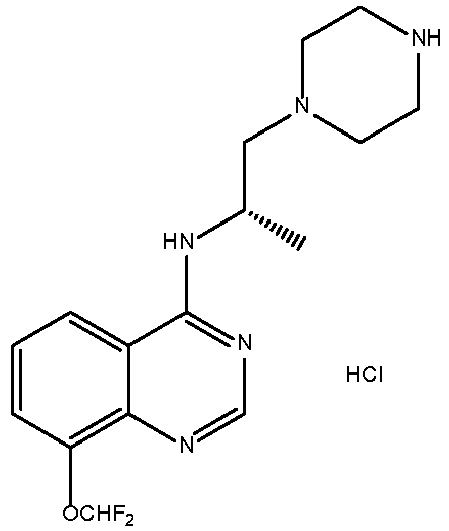
- Title compound was prepared following the procedure used for the synthesis of Intermediate 2, starting from tert-butyl 4-[(2S)-2-[[8-(difluoromethoxy)quinazolin-4-yl]amino]propyl]piperazine-1-carboxylate (Intermediate 14, 14 mg, 0.032 mmol) to afford Intermediate 15 (22 mg, crude) that was used in the next step without further purification.
LC-MS (ESI): m/z (M+1): 338.2 (Method 2) - Title compound was prepared following the procedure used for the synthesis of Example 1, starting from 8-(difluoromethoxy)-N-[(2S)-1-piperazin-1-ylpropan-2-yl]quinazolin-4-amine hydrochloride (Intermediate 15, 22 mg, crude) and 5-(3,4-dimethyl-1,2-oxazol-5-yl)thiophene-2-sulfonyl chloride (9.8 mg, 0.04 mmol) to afford the title compound (6 mg, 0.010 mmol, 32% yield) as a yellowish solid.
LC-MS (ESI): m/z (M+1): 579.13 (Method 2)
1H NMR (500 MHz, DMSO-d6 ) δ ppm 1.18 (d, J=6.6 Hz, 3 H), 2.15 (s, 3 H), 2.24 (s, 3 H), 2.39 - 2.45 (m, 1 H), 2.55 - 2.63 (m, 5 H), 2.96 (br s, 4 H), 4.54 - 4.70(m, 1 H), 7.35 (t, J=75.5 Hz, 1 H), 7.41 - 7.49 (m, 1 H), 7.54 (d, J=7.7 Hz, 1 H), 7.65 (d, J=4.1 Hz, 1 H), 7.71 (d, J=4.1 Hz, 1 H), 8.00 (br d, J=8.0 Hz, 1 H), 8.13 (d, J=8.2 Hz, 1 H), 8.47 (s, 1 H) -

-

- To a solution of 2-bromo-3-methylbenzoic acid (500 mg, 2.33 mmol) in dry DMF (6 mL), cyclopropanecarboximidamide hydrochloride (416 mg, 3.45 mmol), CuI (222 mg, 1.165 mmol), Cs2CO3 (1.518 g, 4.66 mmol) were added in a sealed tube under nitrogen atmosphere and the suspension was stirred at room temperature for 12 hour. The mixture was then partitioned between DCM and water, the organic solvent was separated and removed under vacuum to provide crude Intermediate 16 (240 mg, 1.2 mmol, 52% yield) that was used in the next step without further purifications.
LC-MS (ESI): m/z (M+1): 201.1 (Method 1) -

- Title compound was prepared following the procedure used for the synthesis of Intermediate 4 starting from 2-cyclopropyl-8-methyl-3,4-dihydroquinazolin-4-one (Intermediate 16, 240 mg, 1.2 mmol) to afford Intermediate 17 as a crude (1.2 mmol) that was used in the next step without further purifications.
LC-MS (ESI): m/z (M+1): 219.3 (Method 1) -

- Title compound was prepared following the procedure used for the synthesis of Intermediate 1 starting from 4-chloro-2-cyclopropyl-8-methylquinazoline (Intermediate 17, 1.2 mmol, crude) to afford Intermediate 18 (181 mg, 0.43 mmol, 36% yield).
LC-MS (ESI): m/z (M+1): 426.3 (Method 1) -

- Title compound was prepared following the procedure used for the synthesis of Intermediate 2, starting from tert-butyl 4-[(2S)-2-[(2-cyclopropyl-8-methylquinazolin-4-yl)amino]propyl]piperazine-1-carboxylate (Intermediate 18, 181 mg, 0.43 mmol) to afford Intermediate 19 as a crude (0.43 mmol) that was used in the next step without further purification.
LC-MS (ESI): m/z (M+1): 326.3 (Method 2) - Title compound was prepared following the procedure used for the synthesis of Example 1, starting from 2-cyclopropyl-8-methyl-N-[(2S)-1-(piperazin-1-yl)propan-2-yl]quinazolin-4-amine hydrochloride (Intermediate 19, 0.215 mmol, crude) and 5-(3,4-dimethyl-1,2-oxazol-5-yl)thiophene-2-sulfonyl chloride (68 mg, 0.25 mmol) to afford the title compound (90 mg, 0.16 mmol, 75% yield) as a white solid.
- LC-MS (ESI): m/z (M+1): 560.2 (Method 1)
- 1H NMR (400 MHz, DMSO-d6 ) ppm 0.84 - 0.93 (m, 2 H), 0.94 - 1.08 (m, 2 H), 1.20 (d, J=6.58 Hz, 3 H), 1.94 - 2.11 (m, 1 H), 2.33 - 2.38 (m, 1 H), 2.43 (s,3 H), 2.46 - 2.53 (m, 3 H), 2.53 - 2.63 (m, 5 H), 2.98 (br. s., 4 H), 3.76 (s, 3 H), 4.48 (dt, J=13.81, 6.91 Hz, 1 H), 7.02 - 7.31 (m, 1 H), 7.39 - 7.64 (m, 2 H), 7.97 (d, J=8.11 Hz, 1 H), 12.33 (br. s., 1 H)
- The Examples in the following table were prepared from commercially available reagents by using methods analogous to Example 18.
Example No. Structure & Name Analytical data 19 
LC-MS (ESI): m/z (M+1): 530.2 (Method 1) 1H NMR (400 MHz, DMSO-d6 ) δ ppm 0.77 - 1.09 (m, 4 H), 1.19 (d, J=6.58 Hz, 3 H), 1.95 - 2.09 (m, 1 H), 2.19 (s, 3 H), 2.27 - 2.64 (m, 9 H), 2.92 (br. s., 4 H), 4.47 (dt, J=13.92, 6.85 Hz, 1 H), 7.20 (t, J=7.67 Hz, 1 H), 7.41 - 7.64 (m, 2 H), 7.82 - 8.10 (m, 2H), 12.73 (br. s., 1 H) 21 
LC-MS (ESI): m/z (M+1): 614.3 (Method 1) 1H NMR (500 MHz, DMSO-d6 ) δ ppm 0.86 - 1.11 (m, 4 H), 1.21 (d, J=6.59 Hz, 3 H), 1.97 - 2.05 (m, 1 H), 2.34 - 2.39 (m, 1 H), 2.43 (s, 3 H), 2.57 (d, J=6.31 Hz, 5 H), 2.98 (br. s., 4 H), 3.76 (s, 3 H), 4.52 (dt, J=13.86, 6.79 Hz, 1 H), 7.45 (t, J=7.82 Hz, 1 H), 7.94 (d, J=7.68 Hz, 1 H), 8.04 (d, J=7.41 Hz, 1 H), 8.45 (d, J=8.51 Hz, 1 H), 11.85 - 12.48 (m, 1 H) 22 
LC-MS (ESI): m/z (M+1): 584.2 (Method 1) 1H NMR (400 MHz, DMSO-d6 ) δ ppm 0.89 - 1.05 (m, 4 H), 1.20 (d, J=6.53 Hz, 3 H), 1.96 - 2.06 (m, 1 H), 2.16 (s, 3 H), 2.34 - 2.40 (m, 1 H), 2.54 - 2.64 (m, 5 H), 2.92 (br. s., 4H), 4.51 (dt, J=13.87, 6.74 Hz, 1 H), 7.44 (t, J=7.91 Hz, 1 H), 7.86 - 7.96 (m, 2 H), 8.03 (d, J=7.03 Hz, 1 H), 8.44 (d, J=7.78 Hz, 1 H), 12.71 (br. s., 1 H) -

-

- Compound of Example 7 (2.5g 4.60, mmol) was dissolved in 10 g of 50% H2SO4, the solution was stirred 5hr at 70°C, then the crude was refrigerated to 0°C and cautiously poured into a flask containing water (25 g) and ice (25 g). To the cold mixture 2N NaOH was cautiously added until neutral pH. The precipitate was filtered, washed with water and dried under vacuum.
- N-[(2S)-1-{4-[(2-amino-1,3-thiazol-5-yl)sulfonyl]piperazin-1-yl}propan-2-yl]-8-(trifluoromethyl)quinazolin-4-amine (1.8 g, 3.59 mmol, 78% yield) was obtained as a light brown solid
- LC-MS (ESI): rt= 0.37 min; m/z (M+1): 502.5 (Method 3 Chiesi)
- 1H NMR (400 MHz, DMSO-d6) δ ppm 8.52 - 8.60 (m, 2 H) 8.08 - 8.25 (m, 2 H) 7.92 (s, 2 H) 7.62 (t, J=7.89 Hz, 1 H) 7.43 (s, 1 H) 4.66 (br s, 1 H) 2.94 (br s, 4 H) 2.53 - 2.83 (m, 5 H) 1.23 (d, J=6.58 Hz, 3 H)
- To a stirred solution of Intermediate 20 (89.5 mg, 0.178 mmol) and triethylamine (0.050 mL, 0.357 mmol) in DMA (2mL) at 0°C, 2-methoxyacetyl chloride (0.020 mL, 0.214 mmol) was added, then the mixture was heated to 45°C and stirred overnight. The solvent was evaporated under vacuum and the crude was purified by flash chromatography (30g column KP- C18 ultra gradient A:B from 100:0 to 60:40 with 10 CV Eluent A: Water:ACN:HCOOH 95:5:0.1 B:Water:ACN:HCOOH 5:95:0.1 ). Appropriate fractions were combined and evaporated to give 2-methoxy-N-[5-({4-[(2S)-2-{[8-(trifluoromethyl)quinazolin-4- yl]amino}propyl]piperazin-1-yl}sulfonyl)-1,3-thiazol-2-yl]acetamide (61.1mg, 0.107 mmol, 59.7 % yield)as an off-white solid
- LC-MS (ESI): m/z (M+1): 574.2 (Method 5)
- 1H NMR (400 MHz, ACETONE-d6) δ ppm 11.12 (br s, 1 H), 8.55 (s, 1 H), 8.40 (br d, J=8.11 Hz, 1 H), 8.10 (br d, J=7.45 Hz, 1 H), 7.84 (s, 1 H), 7.60 (br s, 1 H), 7.52 (br t, J=7.89 Hz, 1 H), 4.66 - 4.83 (m, 1 H), 4.25 (s, 2 H), 3.48 (s, 3 H), 3.02 - 3.26 (m, 4 H), 2.46 - 3.00 (m, 6 H), 1.31 (d, J=6.58 Hz, 3 H)
- The Example in the following table was prepared from commercially available reagents by using methods analogous to Example 24.
Example No. Structure & Name Analytical data 26 
LC-MS (ESI): m/z (M+1): 560.1 (Method 5) 1H NMR (400 MHz, ACETONE-d6) δ ppm 10.90 - 11.18 (bs, 1 H), 8.56 (d, J=3.73 Hz, 1 H), 8.37 (br d, J=7.67 Hz, 1 H), 8.07 - 8.13 (m, 1 H), 7.75 (d, J=3.73 Hz, 1 H), 7.44 - 7.58 (m, 2 H), 4.72 (br s, 1 H), 3.86 (s, 3 H), 3.07 (br s, 4 H), 2.59-2.77 (m, 6 H), 1.28 - 1.32 (m, 3 H) -

-
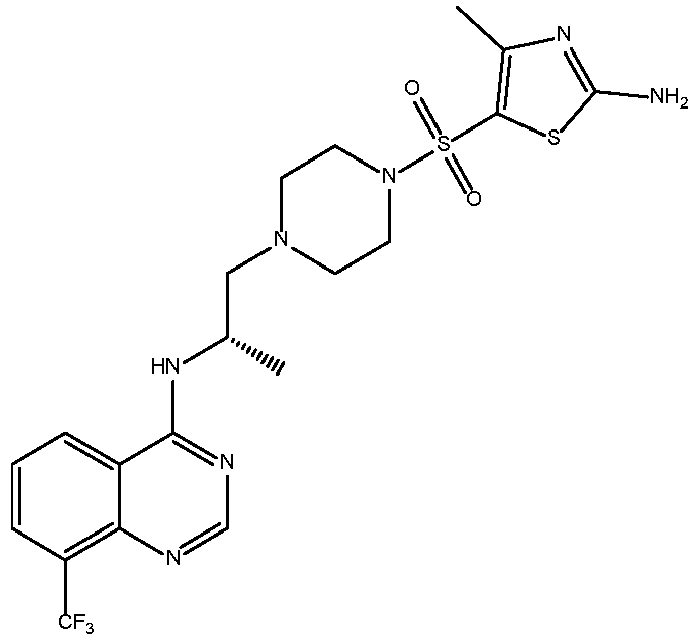
- Title compound was prepared following the procedure used for the synthesis of Intermediate 20, starting from Example 8 (5g, 8.97 mmol), to afford N-[(2S)-1-{4-[(2-amino-4-methyl-1,3-thiazol-5-yl)sulfonyl]piperazin-1-yl}propan-2-yl]-8-(trifluoromethyl)quinazolin-4-amine (2.0 g, 3.88 mmol, 43% yield) as a white solid
- LC-MS (ESI): rt= 0.37 min; m/z (M+1) (Method 3)
- 1H NMR (400 MHz, DMSO-d6 ) δ ppm 8.47 - 8.64 (m, 2 H) 8.08 - 8.21 (m, 2 H) 7.74 (s, 2 H) 7.61 (t, J=7.89 Hz, 1 H) 4.55 - 4.72 (m, 1 H) 2.95 (br s, 4 H) 2.58 - 2.67 (m, 1 H) 2.56 (br s, 4 H) 2.35 - 2.47 (m, 1 H) 2.27 (s, 3 H) 1.23 (d, J=6.58 Hz, 3 H)
- To a stirred solution of Intermediate 21 (95.1 mg, 0.184 mmol) and triethylamine (0.051 mL, 0.369 mmol) in DMA (2mL) at 0°C 2-methoxyacetyl chloride (0.020 mL, 0.221 mmol) was added, then the mixture was heated to 45°C and stirred overnight. The solvent was evaporated under vacuum and the residue was purified by flash chromatography (30g column KP- C18 ultra gradient A:B from 100:0 to 60:40 with 10 CV Eluent A: Water:ACN:HCOOH 95:5:0.1 B:Water:ACN:HCOOH 5:95:0.1 ). Appropriate fractions were combined and evaporated to give 2-methoxy-N-[4-methyl-5-({4-[(2S)-2-{[8-(trifluoromethyl)quinazolin-4-yl] amino}propyl]piperazin-1-yl } sulfonyl)-1,3-thiazol-2-yl]acetamide (56.5 mg, 0.096 mmol, 52.1 % yield) as white solid.
- LC-MS (ESI): m/z (M+1): 588.2 (Method 5)
- 1H NMR (400 MHz, ACETONE-d6) δ ppm 10.74 - 11.02 (bs, 1 H), 8.54 (s, 1 H), 8.39 (br d, J=8.33 Hz, 1 H), 8.08 (d, J=6.80 Hz, 1 H), 7.58 (br s, 1 H), 7.50 (t, J=7.89 Hz, 1 H), 4.69 - 4.80 (m, 1 H), 4.20 (s, 2 H), 3.47 (s, 3 H), 3.07 - 3.20 (m, 4 H), 2.62 - 3.03 (m, 6 H), 2.45 (s, 3 H), 1.30 (d, J=6.36 Hz, 3 H)
- The Examples in the following table were prepared from commercially available reagents by using methods analogous to Example 25.
Example No. Structure & Name Analytical data 72 
LC-MS (ESI): m/z (M+1): 626.3 (Method 2) 1H NMR (400 MHz, DMSO-d6 ) δ ppm 1.08 - 1.44 (m, 8 H), 1.52 - 1.86 (m, 5 H), 2.37 - 2.48 (m, 5 H), 2.52 - 2.66 (m, 5 H), 2.97 (br. s., 4 H), 4.61 (spt, J=6.94 Hz, 1 H), 7.60 (t, J=7.89 Hz, 1 H), 8.13 (d, J=7.45 Hz, 2 H), 8.49 - 8.58 (m, 2 H), 12.35 - 12.77 (m, 1 H) 81 
LC-MS (ESI): m/z (M+1): 629.3 (Method 1) 1H NMR (500 MHz, DMSO-d6 ) δ ppm 1.21 (d, J=6.6 Hz, 3 H), 2.38 - 2.45 (m, 1 H), 2.41 (s, 3 H), 2.56 (br s, 4 H), 2.57 - 2.68 (m, 1 H), 2.87 - 3.08 (m, 4H), 3.43 - 3.53 (m, 4 H), 3.53 - 3.63 (m, 4 H), 4.61 (spt, J=6.9 Hz, 1 H), 7.61 (t, J=7.8 Hz, 1 H), 8.04 - 8.24 (m, 2 H), 8.44 - 8.64 (m, 2 H), 9.88 - 12.97 (m, 1 H) 88 
LC-MS (ESI): m/z (M+1): 625.41 (Method 1) 1H NMR (500 MHz, DMSO-d6 ) δ ppm 1.20 (d, J=6.6 Hz, 3 H), 2.39 - 2.46 (m, 1 H), 2.48 (s, 3 H), 2.49 - 2.52 (m, 3 H), 2.55 - 2.66 (m, 5 H), 3.00 (br s, 4 H), 4.60 (dt, J=14.1, 6.9 Hz, 1 H), 6.74 (br s, 1 H), 7.59 (t, J=8.0 Hz, 1 H), 8.10 - 8.17 (m, 2 H), 8.50 - 8.57 (m, 2H), 11.73 - 14.45 (m, 1 H) 95 
LC-MS (ESI): m/z (M+1): 612.1 (Method 2) 1H NMR (400 MHz, DMSO-d6 ) δ ppm 1.10 - 1.29 (m, 3 H), 1.44 - 1.94 (m, 8 H), 2.35 - 2.45 (m, 1 H), 2.45 (s, 3 H), 2.52 - 2.65 (m, 5 H), 2.81 - 3.06 (m, 5 H), 4.61 (spt, J=6.8 Hz, 1 H), 7.48 - 7.70 (m, 1 H), 8.13 (d, J=7.5 Hz, 2 H), 8.47 - 8.62 (m, 2 H), 12.60 (br s, 1 H) -
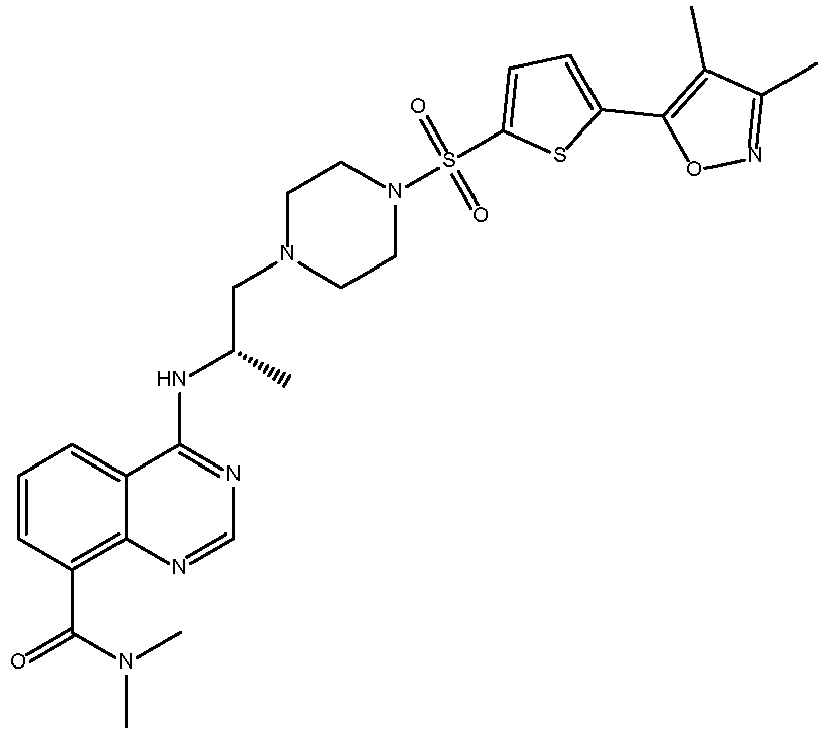
-

- Title compound was prepared following the procedure used for the synthesis of Intermediate 1, starting from methyl 4-chloroquinazoline-8-carboxylate (500 mg, 2.25 mmol) to afford Intermediate 22 (772 mg, 1.8 mmol, 80% yield) as a yellow foam.
LC-MS (ESI): m/z (M+1): 430 (Method 1) -

- To a solution of Intermediate 22 (772 mg, 1.78 mmol) in Methanol (3 mL), sodium hydroxide 3M solution in water (2.97 mL, 8.9 mmol) was added. The yellow solution was stirred at rt for 2h. The solvent was removed under vacuum to afford title compound (1.08 g, 2.6 mmol, crude) that was used in the next step without further purifications.
LC-MS (ESI): m/z (M+1): 416 (Method 1) -

- To a solution of Intermediate 23 (200 mg, 0.48 mmol) in DMF (1mL), HATU (219.63 mg, 0.58 mmol), N-methylmethanamine 2M solution in THF (0.24 mL, 0.48 mmol) and DIPEA (0.12 mL, 0.72 mmol) were added and the mixture was stirred overnight at room temperature. The mixture was evaporated to dryness to obtain the crude material that was purified by reverse phase flash chromatography eluting with acetonitrile (from 5% to 40%) in basic water (+ 0.1% NH3) to afford title compound (80 mg, 0.181 mmol, 37.55% yield) as a yellowish solid.
LC-MS (ESI): m/z (M+1): 443 (Method 1) -

- Title compound was prepared following the procedure used for the synthesis of Intermediate 2, starting from tert-butyl 4-[(2S)-2-[[8-(dimethylcarbamoyl)quinazolin-4-yl]amino]propyl]piperazine-1-carboxylate (Intermediate 24, 80 mg, 0.18 mmol) to afford Intermediate 25 (62 mg, 0.18 mmol, crude) that was used in the next step without further purification.
LC-MS (ESI): m/z (M+1): 343 (Method 2) - Title compound was prepared following the procedure used for the synthesis of Example 1, starting from N,N-dimethyl-4-[[(2S)1-piperazin-1-ylpropan-2-yl]amino]quinazoline-8-carboxamide (Intermediate 25, 30 mg, 0.09 mmol) and 5-(3,4-dimethyl-1,2-oxazol-5-yl)thiophene-2-sulfonyl chloride (24.33 mg, 0.09 mmol) to afford the title compound (21.8 mg, 0.037 mmol, 43% yield) as a white solid.
- LC-MS (ESI): m/z (M+1): 584.4 (Method 2)
- 1H NMR (400 MHz, DMSO-d6) δ ppm 1.19 (d, J=6.58 Hz, 3 H), 2.15 (d, J=1.53 Hz, 3 H), 2.24 (s, 3 H), 2.37 - 2.45 (m, 1 H), 2.54 - 2.66 (m, 8 H), 2.97 (br.s., 4 H), 3.00 - 3.05 (m, 3 H), 4.60 (dq, J=13.92, 6.98 Hz, 1 H), 7.44 - 7.52 (m, 1 H), 7.59 (dd, J=7.13, 0.99 Hz, 1 H), 7.63 - 7.68 (m, 1 H), 7.68 - 7.73 (m, 1 H), 7.94 (dd, J=7.67, 4.82 Hz, 1 H), 8.26 (dd, J=8.33, 1.10 Hz, 1 H), 8.42 (s, 1 H)
- The Examples in the following table were prepared from commercially available reagents by using methods analogous to Example 43.
Example No. Structure & Name Analytical data 27 
LC-MS (ESI): m/z (M+1): 577.3 (Method 2) 1H NMR (500 MHz, DMSO-d6 ) δ ppm 1.20 (d, J=6.31 Hz, 3 H), 2.37 - 2.62 (m, 6 H), 2.41 (s, 3 H), 2.62 - 3.12 (m, 6 H), 2.98 (br. s., 4 H), 3.74 (br. s., 3 H), 4.52 - 4.70 (m, 1 H), 7.50 (t, J=7.68 Hz, 1 H), 7.61 (d, J=6.59 Hz, 1 H), 7.95 (t, J=7.82 Hz, 1 H), 8.28 (d, J=8.51 Hz, 1 H), 8.43 (s, 1 H), 12.34 (br. s., 1 H) 38 
LC-MS (ESI): m/z (M+1): 561.3 (Method 2) 1H NMR (400 MHz, DMSO-d6 ) δ ppm 1.20 (d, J=6.78 Hz, 3 H), 2.15 (s, 3 H), 2.36 - 2.71 (m, 5 H), 2.42 - 3.06 (m, 6 H), 2.56 (br. s., 4 H), 2.97 (br. s., 4 H), 4.51 - 4.68 (m, 1 H), 7.46 - 7.53 (m, 1 H), 7.61 (d, J=6.53 Hz, 1 H), 7.90 - 7.98 (m, 1 H), 8.25 - 8.30 (m, 1 H), 8.43 (s, 1 H), 12.55 (br. s., 1 H) 39 
LC-MS (ESI): m/z (M+1): 591.3 (Method 2) 1H NMR (500 MHz, DMSO-d6 ) δ ppm 0.87 - 1.18 (m, 3 H), 1.20 (d, J=6.31 Hz, 3 H), 2.37 - 2.71 (m, 6 H), 2.38 - 2.45 (m, 3 H), 2.59 - 3.02 (m, 3 H), 2.89 - 3.07 (m, 5 H), 3.39 - 3.66 (m, 1 H), 3.74 (br. s., 3 H), 4.48 - 4.76 (m, 1 H), 7.49 (t, J=7.68 Hz, 1 H), 7.55 - 7.67 (m, 1 H), 7.83 - 8.03 (m, 1 H), 8.27 (d, J=8.23 Hz, 1 H), 8.36 - 8.49 (m, 1 H), 11.83 - 13.01 (m, 1 H) 40 
LC-MS (ESI): m/z (M+1): 645.3 (Method 2) 1H NMR (400 MHz, DMSO-d6 ) δ ppm 1.11 - 1.34 (m, 3 H), 2.34 - 2.64 (m, 6 H), 2.41 (s, 3 H), 2.72 - 3.22 (m, 3 H), 2.98 (br. s., 4 H), 3.73 (br. s., 3 H), 4.15 - 4.80 (m, 3 H), 7.44 - 7.57 (m, 1 H), 7.58 -7.71 (m, 1 H), 7.92 -8.10 (m, 1 H), 8.33 (d, J=8.41 Hz, 1 H), 8.44 (s, 1 H), 11.72 - 12.65 (m, 1 H) 44 
LC-MS (ESI): m/z (M+1): 566.42 (Method 2) 1H NMR (500 MHz, DMSO-d6 ) δ ppm 1.19 (d, J=6.6 Hz, 3 H), 2.42 (ddd, J=12.1, 6.8, 4.9 Hz, 1 H), 2.54 - 2.68 (m, 8 H), 2.91 - 3.12 (m, 7 H), 4.52 - 4.71 (m, 1 H), 7.47 (t, J=7.7 Hz, 1 H), 7.52 - 7.64 (m, 4 H), 7.88 - 7.97 (m, 1 H), 7.98 - 8.06 (m, 2 H), 8.21 - 8.29 (m, 1 H), 8.35 (s, 1 H), 8.39 - 8.45 (m, 1 H) 45 
LC-MS (ESI): m/z (M+1): 603.3 (Method 1) 1H NMR (400 MHz, DMSO-d6 ) δ ppm 1.20 (d, J=6.58 Hz, 3 H), 1.63 - 1.99 (m, 4 H), 2.35 - 2.46 (m, 1 H), 2.42 (s, 3 H), 2.53 - 2.65 (m, 5 H), 2.77 - 3.20 (m, 6 H), 3.51 (br. s., 2 H), 3.75 (s, 3 H), 4.59 (dquin, J=13.59, 6.80, 6.80, 6.80, 6.80 Hz, 1 H), 7.50 (t, J=7.67 Hz, 1 H), 7.63 (dd, J=7.13, 0.99 Hz, 1 H), 7.94 (d, J=7.89 Hz, 1 H), 8.28 (d, J=7.45 Hz, 1 H), 8.44 (s, 1 H), 12.33 (br. s., 1 H) 47 
LC-MS (ESI): m/z (M+1): 589.3 (Method 1) 1H NMR (400 MHz, METHANOL-d4) d ppm 1.29 (d, J=6.58 Hz, 3 H), 2.33 (quin, J=7.73 Hz, 2 H), 2.44 (s, 3 H), 2.49 (dd, J=12.61, 5.59 Hz, 1 H), 2.57 - 2.77 (m, 5 H), 3.00 - 3.15 (m, 4 H), 3.82 (s, 3 H), 3.87 (t, J=7.78 Hz, 2 H), 4.27 (t, J=7.89 Hz, 2 H), 4.72 (dd, J=14.69, 6.36 Hz, 1 H), 7.52 (t, J=8.10 Hz, 1 H), 7.74 (dd, J=7.23, 1.10 Hz, 1 H), 8.21 (dd, J=8.33, 1.10 Hz, 1 H), 8.46 (s, 1 H) 48 
LC-MS (ESI): m/z (M+1): 570.3 (Method 2) 1H NMR (500 MHz, METHANOL-d4) d ppm 1.28 (d, J=6.59 Hz, 3 H), 2.33 (s, 3 H), 2.48 (dd, J=12.62, 5.49 Hz, 1 H), 2.57 - 2.66 (m, 2 H), 2.67 - 2.80 (m, 6 H), 2.95 - 3.12 (m, 4 H), 3.15 - 3.20 (m, 3 H), 4.67 - 4.78 (m, 1 H), 6.69 (s, 1 H), 7.50 (t, J=7.68 Hz, 1 H), 7.52 - 7.57 (m, 1 H), 7.59 (d, J=4.12 Hz, 1 H), 7.64 (d, J=6.86 Hz, 1 H), 8.17 (dd, J=8.23, 1.10 Hz, 1 H), 8.40 (s, 1 H) 49 
LC-MS (ESI): m/z (M+1): 551.3 (Method 2) 1H NMR (500 MHz, METHANOL-d4) d ppm 1.27 (d, J=6.59 Hz, 3 H), 2.45 (d, J=5.76 Hz, 1 H), 2.55 - 2.71 (m, 4 H), 2.70 (dd, J=12.60, 8.51 Hz, 2 H), 2.74 - 2.81 (m, 3 H), 2.88 - 3.10 (m, 4 H), 3.19 (s, 3 H), 4.65 - 4.77 (m, 1 H), 7.52 (dd, J=8.23, 7.14 Hz, 1 H), 7.61 - 7.66 (m, 1 H), 7.68 (dd, J=7.27, 1.24 Hz, 1 H), 7.75 (d, J=8.51 Hz, 1 H), 7.88 (d, J=2.20 Hz, 1 H), 8.17 (dd, J=8.23, 1.37 Hz, 1 H), 8.40 (s, 1 H) 51 
LC-MS (ESI): m/z (M+1): 638.2 (Method 2) 1H NMR (400 MHz, DMSO-d6) δ ppm 1.19 (d, J=6.58 Hz, 3 H), 2.29 (s, 3 H), 2.35 - 2.46 (m, 1 H), 2.52 - 2.66 (m, 5 H), 2.68 - 3.20 (m, 3 H), 2.97 (br. s., 4 H), 3.58 - 4.70 (m, 2 H), 4.53 - 4.70 (m, 1 H), 6.94 - 7.08 (m, 1 H), 7.45 - 7.56 (m, 1 H), 7.58 -7.65 (m, 1 H), 7.65 -7.72 (m, 1 H), 7.73 - 7.80 (m, 1 H), 7.93 - 8.08 (m, 1 H), 8.22 - 8.36 (m, 1 H), 8.43 (s, 1 H) 58 
LC-MS (ESI): m/z (M+1): 596.3 (Method 2) 1H NMR (400 MHz, DMSO-d6 ) δ ppm 1.15 (d, J=6.58 Hz, 3 H), 1.64 - 1.90 (m, 4 H), 2.26 (s, 3 H), 2.33 - 2.43 (m, 1 H), 2.51 - 2.62 (m, 5 H), 2.77 - 3.15 (m, 6 H), 3.48 (br. s., 2 H), 4.56 (br. s., 1 H), 6.94 (s, 1 H), 7.45 (t, J=7.67 Hz, 1 H), 7.56 - 7.61 (m, 1 H), 7.62 - 7.69 (m, 1 H), 7.73 (d, J=3.95 Hz, 1 H), 7.90 (d, J=7.89 Hz, 1 H), 8.23 (d, J=8.33 Hz, 1 H), 8.40 (s, 1 H) 64 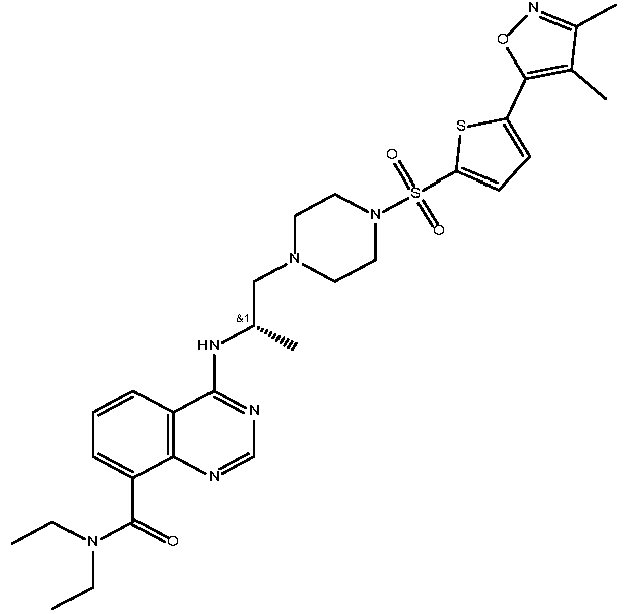
LC-MS (ESI): m/z (M+1): 612.3 (Method 2) 1H NMR (400 MHz, DMSO-d6 ) δ ppm 0.83 - 0.94 (m, 3 H), 1.14 - 1.22 (m, 6 H), 2.13 - 2.18 (m, 3 H), 2.24 (s, 3 H), 2.41 (dt, J=11.93, 6.16 Hz, 1 H), 2.53 - 2.65 (m, 5 H), 2.86 - 3.06 (m, 6 H), 3.41 - 3.56 (m, 2 H), 4.60 (dq, J=14.11, 7.10 Hz, 1 H), 7.43 - 7.51 (m, 1 H), 7.54 - 7.59 (m, 1 H), 7.64 - 7.68 (m, 1 H), 7.68 - 7.74 (m, 1 H), 7.92 (dd, J=7.83, 2.93 Hz, 1 H), 8.25 (dd, J=8.41, 1.57 Hz, 1 H), 8.41 (s, 1 H) 65 
LC-MS (ESI): m/z (M+1): 638.3 (Method 2) 1H NMR (500 MHz, DMSO-d6 ) δ ppm 1.19 (br d, J=6.6 Hz, 3 H), 1.20 - 1.92 (m, 8 H), 2.11 - 2.17 (m, 3 H), 2.21 - 2.28 (m, 3 H), 2.37 - 2.44 (m, 1 H), 2.44 - 2.93 (m, 3 H), 2.54 - 2.68 (m, 5 H), 2.92 - 3.11 (m, 4 H), 3.54 - 5.14 (m, 1 H), 4.47 - 4.75 (m, 1 H), 7.42 - 7.51 (m, 1 H), 7.52 - 7.59 (m, 1 H), 7.62 - 7.68 (m, 1 H), 7.68 -7.77 (m, 1 H), 7.83 - 8.03 (m, 1 H), 8.16 - 8.32 (m, 1 H), 8.36 - 8.46 (m, 1 H) 66 
LC-MS (ESI): m/z (M+1): 592.3 (Method 2) 1H NMR (500 MHz, DMSO-d6 ) δ ppm 1.20 (d, J=6.04 Hz, 3 H), 2.20 (s, 3 H), 2.36 - 2.45 (m, 1 H), 2.52 - 2.62 (m, 5 H), 2.62 - 2.67 (m, 3 H), 2.95 - 3.12 (m, 7 H), 4.60 (dq, J=14.41, 7.27 Hz, 1 H), 7.50 (t, J=7.68 Hz, 1 H), 7.58 - 7.64 (m, 1 H), 7.74 (t, J=6.59 Hz, 1 H), 7.94 (t, J=7.14 Hz, 1 H), 8.13 (dd, J=12.62, 6.59 Hz, 1 H), 8.27 (d, J=8.23 Hz, 1 H), 8.42 (s, 1 H), 9.82 (br. s., 1 H) 69 
LC-MS (ESI): m/z (M+1): 678.41 (Method 2) 1H NMR (400 MHz, DMSO-d6 ) δ ppm 1.19 (d, J=6.6 Hz, 3 H), 1.75 - 2.22 (m, 4 H), 2.15 (s, 3 H), 2.24 (s, 3 H), 2.36 - 2.45 (m, 1 H), 2.59 (m, J=2.6 Hz, 4 H), 2.62 (br d, J=5.3 Hz, 1 H), 2.92 - 3.03 (m, 4 H), 2.97 - 3.97 (m, 2 H), 4.06 - 5.11 (m, 1 H), 4.53 - 4.69 (m, 1 H), 7.46 - 7.55 (m, 1 H), 7.57 - 7.76 (m, 3 H), 7.90 - 8.09 (m, 1 H), 8.31 (d, J=8.3 Hz, 1 H), 8.39 - 8.48 (m, 1 H) 70 
LC-MS (ESI): m/z (M+1): 610.3 (Method 2) 1H NMR (400 MHz, DMSO-d6 ) δ ppm 1.19 (d, J=5.9 Hz, 3 H), 1.22 - 1.68 (m, 6 H), 2.29 (s, 3 H), 2.35 - 2.46 (m, 1 H), 2.54 - 2.66 (m, 5 H), 2.88 - 3.07 (m, 6 H), 3.45 - 3.59 (m, 1 H), 3.78 (br dd, J=12.8, 3.6 Hz, 1 H), 4.59 (dt, J=10.7, 7.0 Hz, 1 H), 6.97 (d, J=1.5 Hz, 1 H), 7.44 - 7.52 (m, 1 H), 7.59 (dd, J=7.1, 1.0 Hz, 1 H), 7.65 - 7.73 (m, 1 H), 7.76 (dd, J=3.9, 1.5 Hz, 1 H), 7.93 (br d, J=6.6 Hz, 1 H), 8.25 (d, J=8.3 Hz, 1 H), 8.41 (s, 1 H) 76 
LC-MS (ESI): m/z (M+1): 678.3 (Method 1) 1H NMR (500 MHz, DMSO-d6 ) δ ppm 1.19 (d, J=6.6 Hz, 3 H), 1.71 - 2.30 (m, 4 H), 2.15 (s, 3 H), 2.24 (s, 3 H), 2.38 - 2.46 (m, 1 H), 2.53 - 2.68 (m, 5 H), 2.93 - 3.05 (m, 4 H), 3.03 - 3.99 (m, 2H), 4.06 - 5.10 (m, 1 H), 4.51 - 4.68 (m, 1H), 7.51 (t, J=7.8 Hz, 1 H), 7.57 - 7.78 (m, 3 H), 7.90 - 8.12 (m, 1 H), 8.27 - 8.36 (m, 1 H), 8.38 - 8.50 (m, 1 H) 77 
LC-MS (ESI): m/z (M+1): 646.3 (Method 1) 1H NMR (400 MHz, DMSO-d6 ) δ ppm 1.19 (d, J=6.5 Hz, 3 H), 2.16 (s, 3 H), 2.25 (s, 3 H), 2.35 - 2.46 (m, 2 H), 2.47 - 2.54 (m, 1 H), 2.55 - 2.66 (m, 5 H), 2.99 (br s, 4 H), 3.10 - 3.65 (m, 2 H), 3.77 (br t, J=7.5 Hz, 1 H), 3.95 (t, J=13.4 Hz, 1 H), 4.49 - 4.69 (m, 1 H), 7.52 (td, J=7.7, 3.3 Hz, 1 H), 7.62 - 7.79 (m, 3 H), 8.00 (br d, J=7.8 Hz, 1 H), 8.24 - 8.39 (m, 1 H), 8.45 (s, 1 H) 78 
LC-MS (ESI): m/z (M+1): 638.3 (Method 2) 1H NMR (500 MHz, DMSO-d6 ) δ ppm 1.18 (dd, J=6.3, 3.3 Hz, 3 H), 1.49 - 1.57 (m, 6 H), 1.60 - 1.72 (m, 2 H), 1.79 (td, J=6.8, 1.5 Hz, 2 H), 2.15 (d, J=2.2 Hz, 3 H), 2.24 (s, 3 H), 2.34 - 2.46 (m, 1 H), 2.54 - 2.68 (m, 5 H), 2.85 - 3.13 (m, 6 H), 4.53 - 4.67 (m, 1 H), 7.46 (td, J=7.7, 3.8 Hz, 1 H), 7.54 (br d, J=7.4 Hz, 1 H), 7.66 (d, J=4.1 Hz, 1 H), 7.71 (dd, J=12.6, 4.1 Hz, 1 H), 7.90 (d, J=7.7 Hz, 1 H), 8.22 (d, J=8.2 Hz, 1 H), 8.41 - 8.46 (m, 1 H) 79 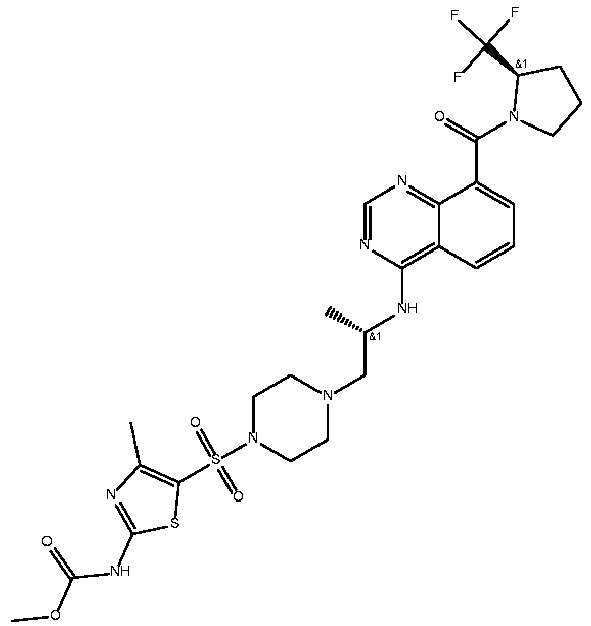
LC-MS (ESI): m/z (M+1): 671.2 (Method 1) 1H NMR (500 MHz, DMSO-d6 ) δ ppm 1.20 (d, J=6.6 Hz, 3 H), 1.76 - 2.30 (m, 4 H), 2.37 - 2.46 (m, 4 H), 2.53 - 2.69 (m, 5 H), 2.91 - 3.04 (m, 4 H), 3.02 - 3.99 (m, 2 H), 3.74 (s, 3 H), 4.02 - 5.22 (m, 1 H), 4.60 (dt, J=13.9, 6.9 Hz, 1 H), 7.53 (t, J=7.7 Hz, 1 H), 7.58 - 7.74 (m, 1 H), 7.90 - 8.12 (m, 1 H), 8.33 (br d, J=8.3 Hz, 1 H), 8.43 (s, 1 H), 12.17 - 12.49 (m, 1 H) 80 
LC-MS (ESI): m/z (M+1): 639.3 (Method 1) 1H NMR (500 MHz, DMSO-d6 ) δ ppm 1.20 (d, J=6.4 Hz, 3 H), 2.38 - 2.53 (m, 3 H), 2.42 (s, 3 H), 2.53 - 2.66 (m, 5 H), 2.99 (br s, 4 H), 3.11 - 3.57 (m, 2H), 3.71 - 3.81 (m, 4 H), 3.95 (t, J=13.3 Hz, 1 H), 4.54 - 4.66 (m, 1 H), 7.49 -7.57 (m, 1 H), 7.67 - 7.73 (m, 1 H), 7.98 - 8.05 (m, 1 H), 8.33 (d, J=8.6 Hz, 1 H), 8.46 (s, 1 H), 12.33 (br s, 1 H) 82 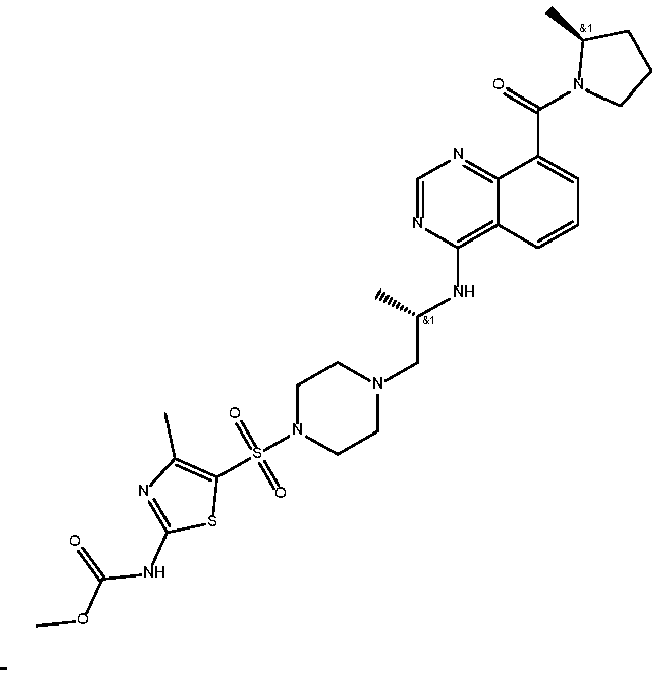
LC-MS (ESI): m/z (M+1): 617.3 (Method 1) 1H NMR (500 MHz, DMSO-d6 ) δ ppm 0.59 - 1.39 (m, 3 H), 1.17 - 1.23 (m, 3 H), 1.44 - 2.14 (m, 4 H), 2.40 (s, 3 H), 2.41 - 2.46 (m, 1 H), 2.54 - 2.62 (m, 5 H), 2.91 - 3.03 (m, 4 H), 3.04 - 3.64 (m, 2 H), 3.52 - 4.27 (m, 1 H), 3.71 (br s, 3 H), 4.59 (dt, J=14.1, 6.9 Hz, 1 H), 7.44 - 7.54 (m, 1 H), 7.56 - 7.73 (m, 1 H), 7.86 - 8.03 (m, 1 H), 8.24 - 8.32 (m, 1 H), 8.43 (s, 1 H), 12.33 (br s, 1 H) 83 
LC-MS (ESI): m/z (M+1): 631.3 (Method 1) 1H NMR (500 MHz, DMSO-d6 ) δ ppm 1.20 (dd, J=6.5, 2.3 Hz, 3 H), 1.50 - 1.59 (m, 6 H), 1.60 - 1.86 (m, 4 H), 2.38 - 2.46 (m, 4 H), 2.52 - 2.66 (m, 5 H), 2.86 - 3.18 (m, 2 H), 2.95 - 3.06 (m, 4 H), 3.74 (s, 3 H), 4.53 - 4.68 (m, 1 H), 7.46 - 7.50 (m, 1 H), 7.56 (dd, J=7.1, 1.2 Hz, 1 H), 7.91 (d, J=8.1 Hz, 1 H), 8.24 (dd, J=8.3, 1.2 Hz, 1 H), 8.44 (s, 1 H), 12.33 (br s, 1 H) 84 
LC-MS (ESI): m/z (M+1): 671.3 (Method 1) 1H NMR (500 MHz, DMSO-d6 ) δ ppm 1.20 (d, J=6.6 Hz, 3 H), 1.76 - 2.30 (m, 4 H), 2.37 - 2.46 (m, 4 H), 2.53 - 2.69 (m, 5 H), 2.91 - 3.04 (m, 4 H), 3.02 - 3.99 (m, 2 H), 3.74 (s, 3 H), 4.02 - 5.22 (m, 1 H), 4.60 (dt, J=13.9, 6.9 Hz, 1 H), 7.53 (t, J=7.7 Hz, 1 H), 7.58 - 7.74 (m, 1 H), 7.90 - 8.12 (m, 1 H), 8.33 (br d, J=8.3 Hz, 1 H), 8.43 (s, 1 H), 12.17 - 12.49 (m, 1 H) 85 
LC-MS (ESI): m/z (M+1): 622.3 (Method 1) 1H NMR (400 MHz, DMSO-d6 ) δ ppm 0.09 - 0.49 (m, 1 H), 0.55 - 0.68 (m, 1 H), 1.19 (d, J=6.4 Hz, 3 H), 1.34 - 1.46 (m, 1 H), 1.51 - 1.63 (m, 1 H), 2.15 (s, 3 H), 2.24 (s, 3 H), 2.41 (br dd, J=11.8, 6.8 Hz, 1 H), 2.54 - 2.66 (m, 5 H), 2.78 - 2.90 (m, 1 H), 2.98 (br s, 4 H), 3.15 - 3.48 (m, 2 H), 3.81 - 3.96 (m, 1 H), 4.51 - 4.67 (m, 1 H), 7.43 - 7.51 (m, 1 H), 7.54 - 7.63 (m, 1 H), 7.64 - 7.76 (m, 2 H), 7.90 - 7.98 (m, 1 H), 8.26 (d, J=8.3 Hz, 1 H), 8.39 - 8.44 (m, 1 H) 86 
LC-MS (ESI): m/z (M+1): 624.3 (Method 1) 1H NMR (500 MHz, DMSO-d6 ) δ ppm 0.59 - 1.36 (m, 3 H), 1.16 - 1.23 (m, 3 H), 1.41 - 2.08 (m, 4 H), 2.15 (s, 3 H), 2.24 (s, 3 H), 2.37 - 2.44 (m, 1 H), 2.53 - 2.70 (m, 5 H), 2.98 (br s, 5 H), 3.41 - 4.33 (m, 2 H), 4.49 - 4.68 (m, 1 H), 7.44 - 7.68 (m, 3 H), 7.68 -7.75 (m, 1 H), 7.88 - 8.00 (m, 1 H), 8.20 - 8.31 (m, 1 H), 8.35 - 8.50 (m, 1 H) 87 
LC-MS (ESI): m/z (M+1): 615.2 (Method 1) 1H NMR (400 MHz, DMSO-d6 ) δ ppm 0.08 - 0.51 (m, 1 H), 0.57 - 0.70 (m, 1 H), 1.20 (d, J=6.4 Hz, 3 H), 1.34 - 1.47 (m, 1 H), 1.52 - 1.63 (m, 1 H), 2.36 - 2.46 (m, 4 H), 2.53 - 2.65 (m, 5 H), 2.78 - 2.90 (m, 1 H), 2.99 (br s, 4 H), 3.12 - 3.51 (m, 2H), 3.73 (s, 3 H), 3.82 - 3.98 (m, 1 H), 4.49 - 4.70 (m, 1 H), 7.42 -7.53 (m, 1 H), 7.54 - 7.65 (m, 1 H), 7.95 (br d, J=8.1 Hz, 1 H), 8.27 (d, J=8.6 Hz, 1 H), 8.43 (br s, 1 H), 12.33 (br s, 1 H) -

-

- A mixture of 2-aminobenzene-1,3-dicarboxylic acid (2.5 g, 13.8 mmol) and formamide (8.22 mL, 207 mmol) was heated at 150 °C for 2 hour under MW irradiation. After cooling down the temperature, formation of a precipitate was observed. The reaction mixture was diluted with MeOH and filtered on a buchner funnel. Solid precipitate was washed with MeOH and dried under vacuum to afford title compound (1.59 g, 8.36 mmol, 30% yield) that was used in the next step without further purification.
LC-MS (ESI): m/z (M+1): 190.9 (Method 1) -

- Title compound was prepared following the procedure used for the synthesis of Intermediate 24, starting from 4-hydroxyquinazoline-8-carboxylic acid (Intermediate 26, 1.59 g, 8.36 mmol) and N-methoxymethanamine hydrochloride (815 mg, 8.36 mmol) to afford the title compound (1.19 g, 5.4 mmol, 65% yield).
LC-MS (ESI): m/z (M+1): 234 (Method 1) -

- Title compound was prepared following the procedure used for the synthesis of Intermediate 4 starting from 4-hydroxy-N-methoxy-N-methylquinazoline-8-carboxamide (Intermediate 27, 919 mg, 3.9 mmol) to afford Intermediate 28 (350 mg, 1.4 mmol, 36% yield).
LC-MS (ESI): m/z (M+1): 252 (Method 1) -

- To a solution of Intermediate 28 (100 mg, 0.39 mmol) in THF (5 mL) at 0 °C, cyclopropylmagnesium bromide 1M solution in THF (68.58 mg, 0.470 mmol) was added dropwise and the reaction mixture was stirred at 0 °C for 2 hours. Then a saturated solution of ammonium chloride in water was added and the mixture was extracted with EtOAc (2 times). The collected organic layers were dried over Na2SO4 and concentrated under reduced pressure. The crude product was purified by flash chromatography eluting with EtOAc in Cyclohexane from 0% to 20% to afford title compound (82 mg, 0.345 mmol, 90% yield).
LC-MS (ESI): m/z (M+1): 233 (Method 1) -

- Title compound was prepared following the procedure used for the synthesis of Intermediate 1, starting from (4-chloroquinazolin-8-yl)-cyclopropylmethanone (Intermediate 29, 82 mg, 0.345 mmol) to afford Intermediate 30 (150 mg, 0.341 mmol, 99% yield).
LC-MS (ESI): m/z (M+1): 440 (Method 1) -

- To a solution of Intermediate 30 (930 mg, 2.12 mmol), in DCM (25 mL), TFA (2.43 mL, 32 mmol) was added. The reaction was stirred at room temperature overnight. The mixture was then concentrated under reduced pressure and the residue was purified using a SCX cartridge eluting with a solution of NH3 2M in methanol to afford title compound (600 mg, 1.768 mmol, 83.55% yield) as a white off foam.
LC-MS (ESI): m/z (M+1): 340 (Method 2) - Title compound was prepared following the procedure used for the synthesis of Example 1, starting from cyclopropyl-[4-[[(2S)-1-piperazin-1-ylpropan-2-yl]amino]quinazolin-8-yl]methanone (Intermediate 31, 100 mg, 0.29 mmol) and N-[5-(chlorosulfonyl)-4-methyl-1,3-thiazol-2-yl]carbamate (96 mg, 0.35 mmol) to afford the title compound (98 mg, 0.17 mmol, 56% yield) as white solid.
LC-MS (ESI): m/z (M+1): 574.1 (Method 1) 1H NMR (400 MHz, DMSO-d6 ) δ ppm 1.01 - 1.12 (m, 4 H), 1.21 (d, J=6.60 Hz, 3 H), 2.38 - 2.47 (m, 4 H), 2.54 - 2.66 (m, 5 H), 2.88 - 3.07 (m, 5 H), 3.68 - 3.80 (m, 3 H), 4.55 - 4.69 (m, 1 H), 7.53 (t, J=7.50 Hz, 1 H), 7.77 (dd, J=7.48, 1.32 Hz, 1 H), 8.02 (d, J=7.92 Hz, 1 H), 8.41 (dd, J=8.36, 1.32 Hz, 1 H), 8.51 (s, 1 H), 12.31 (br. s., 1 H) - The Example in the following table was prepared from commercially available reagents by using methods analogous to Example 46.
Example No. Structure & Name Analytical data 92 
LC-MS (ESI): m/z (M+ 1): 581.6 (Method 1) 1H NMR (400 MHz, DMSO-d6 ) δ ppm 0.96 - 1.11 (m, 4 H), 1.20 (d, J=6.4 Hz, 3 H), 2.14 (s, 3 H), 2.24 (s, 3 H), 2.43 (dd, J=12.4, 6.5 Hz, 1 H), 2.55 - 2.66 (m, 5 H), 2.87 - 2.96 (m, 1 H), 2.98 (br s, 4 H), 4.62 (dt, J=13.9, 7.0 Hz, 1 H), 7.51 (dd, J=8.1, 7.5 Hz, 1 H), 7.65 (d, J=4.2 Hz, 1 H), 7.70 (d, J=4.2 Hz, 1 H), 7.74 (dd, J=7.3, 1.3 Hz, 1 H), 8.01 (d, J=8.1 Hz, 1 H), 8.39 (dd, J=8.4, 1.3 Hz, 1 H), 8.50 (s, 1 H) -

-

- To a solution of 4-chloro-2-methyl-8-(trifluoromethyl)quinazoline (Intermediate 4, 123 mg, 0.5 mmol) in CCl4 (1 mL) NBS (52 mg, 0.29 mmol) was added followed by benzoyl peroxide (6 mg, 0.02 mmol). The reaction was heated at 80 °C for 12h. The solvent was removed under vacuum and the crude was purified by flash column chromatography eluting with a gradient of EtOAc in cyclohexane from 0% to 50% affording Intermediate 32 (15 mg, 0.05 mmol, 10% yield).
1H NMR (400 MHz, DMSO-d6 ) δ 4.55 (s, 3H), 7.93 - 7.96 (m, 1H), 8.17 (d, J = 7.92 Hz, 1H), 8.35 - 8.42 (m, 1H), 12.94 (s, 1H). -

- 2-(bromomethyl)-8-(trifluoromethyl)quinazolin-4-ol (Intermediate 32, 15.0 mg, 0.05 mmol) was dissolved in Methanol (1 mL), followed by the addition of K2CO3 (6.75 mg, 0.05 mmol). The reaction was heated at 65 °C for 24h, then warmed up to r.t. and solvent was removed under reduced pressure. H2O was added and the mixture was extracted with EtOAc for 3 times. The combined organic layer was further washed with water and brine, dried over Na2SO4, and the solvent was removed under vacuum to provide Intermediate 33 (6 mg, 0.02 mmol, 48% yield) that was used in the next step without further purification.
LC-MS (ESI): m/z (M+1): 259.1 (Method 1) -

- Title compound was prepared following the procedure used for the synthesis of Intermediate 4 starting from 2-(methoxymethyl)-8-(trifluoromethyl)quinazolin-4-ol (Intermediate 33, 6 mg, 0.02 mmol) to afford Intermediate 34 (5 mg, 0.02 mmol) that was used in the next step without further purification.
LC-MS (ESI): m/z (M+1): 277.1 (Method 1) -

- Title compound was prepared following the procedure used for the synthesis of Intermediate 1, starting from 4-chloro-2-(methoxymethyl)-8-(trifluoromethyl)quinazoline (Intermediate 34, 5 mg, 0.02 mmol) to afford Intermediate 35 (8.7 mg, 0.02 mmol) that was used in the next step without further purification.
LC-MS (ESI): m/z (M+1): 484.3 (Method 2) -

- Title compound was prepared following the procedure used for the synthesis of Intermediate 2, starting from tert-butyl 4-[(2S)-2-[[2-(methoxymethyl)-8-(trifluoromethyl)quinazolin-4-yl]amino]propyl]piperazine-1-carboxylate (Intermediate 35, 8.7 mg, 0.02 mmol) to afford Intermediate 36 (8.2 mg, crude) that was used in the next step without further purification.
LC-MS (ESI): m/z (M+1): 384.2 (Method 1) - Title compound was prepared following the procedure used for the synthesis of Example 1, starting from 2-(methoxymethyl)-N-[(2S)-1-piperazin-1-ylpropan-2-yl]-8-(trifluoromethyl)quinazolin-4-amine hydrochloride (Intermediate 36, 8.2 mg, crude) and 5-(3,4-dimethyl-1,2-oxazol-5-yl)thiophene-2-sulfonyl chloride (6 mg, 0.02 mmol) to afford the title compound (5 mg, 0.008 mmol, 44.5 % yield) as a yellow solid.
- LC-MS (ESI): m/z (M+1): 625.3 (Method 2)
- 1H NMR (400 MHz, DMSO-d6 ) δ ppm 1.21 (d, J=6.65 Hz, 3 H), 2.14 (s, 3 H), 2.24 (s, 3 H), 2.36 - 2.43 (m, 1 H), 2.55 - 2.66 (m, 5 H), 2.87 - 3.04 (m, 4 H), 3.42 (s, 3 H), 4.38 (s, 2 H), 4.55 - 4.66 (m, 1 H), 7.55 (t, J=7.83 Hz, 1 H), 7.64 (d, J=4.11 Hz, 1 H), 7.69 (d, J=3.91 Hz, 1 H), 8.03 - 8.14 (m, 2 H), 8.51 (d, J=8.22 Hz, 1 H)
-

-

- To a solution of 1-(5-bromo-1,3-thiazol-2-yl)ethanone (400 mg, 1.94 mmol) in anhydrous THF (4 mL) N,N-Dimethylacetamide dimethyl acetal (0.43 mL, 2.91 mmol) was added and the resulting mixture was stirred at 65 °C for 12h. Solvent was removed under vacuum to provide Intermediate 37 (1.94 mmol theoric) that was used in the next step without further purification.
LC-MS (ESI): m/z (M+1): 277 (Method 1) -

- To a solution of Intermediate 37 (381 mg, 1.94 mmol) in Ethanol (2.854 mL) hydroxylamine hydrochloride (134.88 mg, 1.94 mmol) was added and the orange solution was stirred at 80 °C for 3h. Solvent was removed under vacuum and the crude was purified by flash column chromatography eluting with a gradient of MeOH in DCM from 0% to 1% to afford title compound (90 mg, 0.36 mmol, 19% yield).
LC-MS (ESI): m/z (M+1): 247.1 (Method 1) -

- A mixture of Intermediate 38 (34 mg, 0.14 mmol), phenylmethanethiol (0.02 mL, 0.14 mmol) and DIPEA (0.05 mL, 0.280 mmol) in 1,4-Dioxane (1.2 mL) was degassed under nitrogen atmosphere for 5 min. Pd2(dba)3 (2.52 mg, 0 mmol) and Xantphos (6.37 mg, 0.01 mmol) were then added and the reaction was heated at 100 °C for 90 min. After cooling the mixture was diluted with DCM and washed with sat. aqueous NaHCO3. The organic layer was concentrated under reduced pressure to provide Intermediate 39 (58.5 mg, 0.14 mmol) that was used in the next step without further purification.
LC-MS (ESI): m/z (M+1): 289.1 (Method 1) -

- To a solution of Intermediate 39 (58.5 mg, 0.14 mmol) in MeCN (0.8 mL), Acetic acid (0.042 mL) and H2O (0.021 mL) were added. After cooling at 0 °C under nitrogen atmosphere, 1,3-dichloro-5,5-dimethylimidazolidine-2,4-dione (27.19 mg, 0.14 mmol) was added dropwise. The mixture was stirred at 0 °C for 1h. Solvent was removed under vacuum to afford title compound (36.5 mg, 0.14 mmol) that was used in the next step without purification.
LC-MS (ESI): m/z (M+1): 265 (Method 1) - Title compound was prepared following the procedure used for the synthesis of Example 1, starting from N-[(2S)-1-piperazin-1-ylpropan-2-yl]-8-(trifluoromethyl)quinazolin-4-amine hydrochloride (Intermediate 2, 45 mg, 0.12 mmol) and 2-(3-methyl-1,2-oxazol-5-yl)-1,3-thiazole-5-sulfonyl chloride (Intermediate 40, 36.5 mg, 0.14 mmol) to afford title compound (13 mg, 0.023 mmol, 17% yield) as a whitenish solid.
- LC-MS (ESI): m/z (M+1): 568.2 (Method 2)
- 1H NMR (400 MHz, DMSO-d6 ) δ ppm 1.20 (d, J=6.46 Hz, 3 H), 2.34 (s, 3 H), 2.38 - 2.65 (m, 6 H), 3.03 (br. s., 4 H), 4.62 (dt, J=13.79, 6.80 Hz, 1 H), 7.21 (s, 1 H), 7.59 (t, J=7.83 Hz, 1 H), 8.06 - 8.20 (m, 2 H), 8.42 - 8.62 (m, 3 H)
-

-

- To a solution of Example 43 (40 mg, 0.07 mmol) in THF (1 mL) BH3 1M in THF (0.07 mL, 0.07 mmol) was added dropwise at 0°C. The reaction was allowed to reach rt in 1h and then stirred overnight. Solvent was removed under vacuum and H2O was added and the solution was acidified with aqueous HCl 6M till pH< 2. MeOH was then added and the reaction was refluxed at 65 °C for 2.5 h allowing the de-complexation of the compound. NaOH 5M in H2O was finally added till pH=7 and then solvent was removed under reduced pressure to afford the crude product (120 mg, crude) that was used in the next step without further purification.
LC-MS (ESI): m/z (M+1): 572.3 (Method 2) - To a solution of Intermediate 41 (120 mg, crude) in DCM (2 mL) Manganese (IV) oxide (91.4 mg, 1.05 mmol) was added and the mixture was stirred at r.t. for 2h. Solvent was removed under reduced pressure and the crude was purified by flash column chromatography eluting with a gradient of MeCN in basic H2O (10 mM ammonium bicarbonate aqueous solution adjusted to pH 10 with ammonia) from 5% to 55% to afford title compound (4.5 mg, 0.008 mmol, 7 % yield).
- LC-MS (ESI): m/z (M+1): 570.42 (Method 2)
- 1H NMR ((500 MHz, METHANOL-d4 ) δ ppm 1.28 (d, J=6.6 Hz, 3 H), 2.19 (s, 3 H), 2.29 (s, 3 H), 2.40 (br s, 6 H), 2.49 (dd, J=12.8, 5.6 Hz, 1 H), 2.59 - 2.65 (m, 2 H), 2.67 - 2.76 (m, 3 H), 2.95 - 3.12 (m, 4 H), 3.94 - 4.24 (m, 2 H), 4.66 - 4.75 (m, 1 H), 7.44 (dd, J=8.2, 7.1 Hz, 1 H), 7.54 (d, J=4.0 Hz, 1 H), 7.59 (d, J=4.0 Hz, 1 H), 7.74 (d, J=7.1 Hz, 1 H), 8.08 (br d, J=8.2 Hz, 1 H), 8.46 (s, 1 H)
-

-

- To a solution of N,4-dimethyl-1,3-thiazol-2-amine (250 mg, 1.95 mmol) in DCM (2.5 mL), sulfurochloridic acid (1.95 mL, 29.25 mmol) was slowly added at 25 °C. The reaction was then stirred at 25 °C for 2h and then quenched with cold water and extracted with DCM (twice). The solvent was removed under vacuum and the crude product 4-methyl-2-(methylamino)-1,3-thiazole-5-sulfonyl chloride (53 mg, 0.23 mmol, 12 % yield) was used in the next step without any further purification.
LC-MS (ESI): m/z (M+1): 223 (Method 1) -

- Title compound was prepared following the procedure used for the synthesis of Example 1, starting from N-[(2S)-1-piperazin-1-ylpropan-2-yl]-8-(trifluoromethyl)quinazolin-4-amine hydrochloride (Intermediate 2, mg, mmol) and 4-methyl-2-(methylamino)-1,3-thiazole-5-sulfonyl chloride (Intermediate 41, 53 mg, 0.23 mmol) to afford the title compound (35 mg, 0.07 mmol, 38% yield).
LC-MS (ESI): m/z (M+1): 530.2 (Method 2) - To a solution of Intermediate 42 (35mg, 0.07 mmol) in DCM (1.7 mL) at 0 °C was added N,N-dimethyl-4-pyridinamine (40 mg, 0.33 mmol), followed by Chloroformic acid methyl ester (0.01 mL, 0.130 mmol) and the mixture was stirred at room temperature for 1.5 h. Solvent was removed under reduced pressure and the crude was purified by flash chromatography eluting with a gradient ofMeCN in basic H2O (10 mM NH4HCO3 aqueous solution adjusted to pH 10 with NH4) from 5% to 95 % to afford title compound as a white solid (34 mg, 0.06 mmol, 86 % yield)
- LC-MS (ESI): m/z (M+1): 588.2 (Method 2)
- 1H NMR (400 MHz, DMSO-d6 ) δ ppm 1.20 (d, J=6.4 Hz, 3 H), 2.41 (dd, J=12.5, 6.6 Hz, 1 H), 2.46 (s, 3 H), 2.54 - 2.59 (m, 4 H), 2.63 (dd, J=12.5, 7.5 Hz, 1 H), 2.90 - 3.05 (m, 4 H), 3.46 (s, 3 H), 3.85 (s, 3 H), 4.62 (spt, J=6.9 Hz, 1 H), 7.60 (t, J=7.9 Hz, 1 H), 8.10 - 8.15 (m, 2 H), 8.51 - 8.57 (m, 2 H)
-
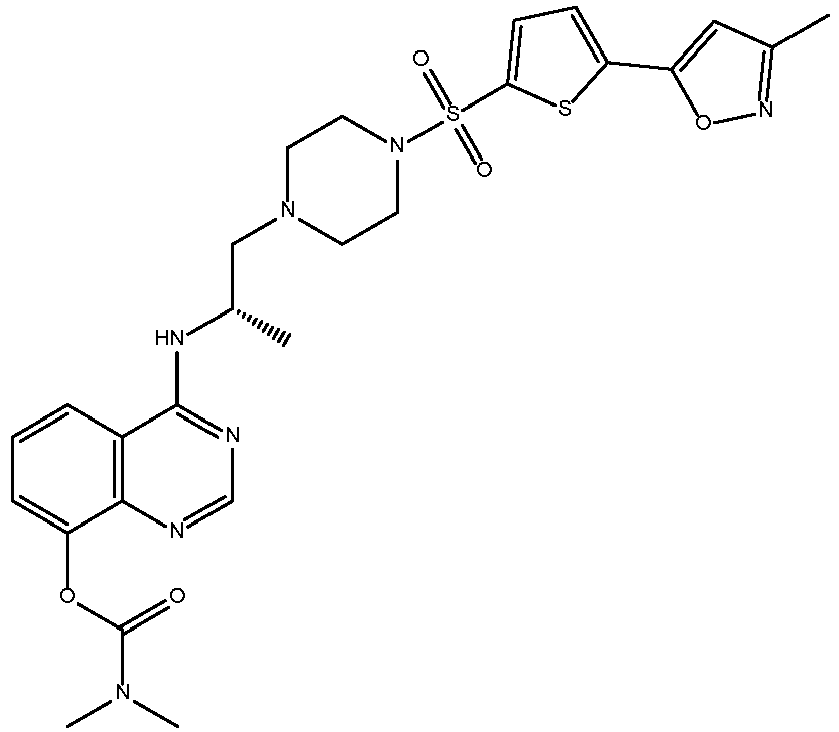
-

- Title compound was prepared following the procedure used for the synthesis of Intermediate 1, starting from 4-chloroquinazolin-8-ol (Intermediate 11, 50 mg, 0.277 mmol) to afford Intermediate 43 (99 mg, 0.25 mmol, 92% yield).
LC-MS (ESI): m/z (M+1): 388.2 (Method 2) -

- To a solution of tert-butyl 4-[(2S)-2-[(8-hydroxyquinazolin-4-yl)amino]propyl]piperazine-1-carboxylate (Intermediate 43, 99 mg, 0.25 mmol) in DCM (5 mL) at 0 °C DMAP (101mg, 0.8 mmol) was added, followed by N,N-dimethylcarbamoyl chloride (0.12 mL, 1.32 mmol). The mixture was stirred at room temperature for 24 h. The solvent was removed under vacuum and the crude was purified by flash chromatograpy using a gradient of MeCN in basic H2O (10 mM ammonium bicarbonate aqueous solution adjusted to pH 10 with ammonia) from 5% to 45% affording title compound (42 mg, 0.09 mmol, 36 % yield) as a white solid.
LC-MS (ESI): m/z (M+1): 459.3 (Method 1) -

- Title compound was prepared following the procedure used for the synthesis of Intermediate 2, starting from tert-butyl 4-[(2S)-2-[[8-(dimethylcarbamoyloxy)quinazolin-4-yl]amino]propyl]piperazine-1-carboxylate (Intermediate 44, 42 mg, 0.09 mmol) to afford Intermediate 45 (46 mg, crude) that was used in the next step without further purification.
LC-MS (ESI): m/z (M+1): 359.2 (Method 1) - Title compound was prepared following the procedure used for the synthesis of Example 1, starting from [4-[[(2S)-1-piperazin-1-ylpropan-2-yl]amino]quinazolin-8-yl] N,N-dimethylcarbamate hydrochloride (Intermediate 45, 40 mg, 0.1 mmol) and 5-(3-methyl-1,2-oxazol-5-yl)thiophene-2-sulfonyl chloride (27 mg, 0.11 mmol) to afford title compound (26 mg, 0.04 mmol, 48% yield) as a white solid.
- LC-MS (ESI): m/z (M+1): 586.12 (Method 2)
- 1H NMR (400 MHz, DMSO-d6 ) δ ppm 1.18 (d, J=6.4 Hz, 3 H), 2.29 (s, 3 H), 2.41 (dd, J=12.4, 6.7 Hz, 1 H), 2.54 - 2.65 (m, 5 H), 2.91 (s, 3 H), 2.98 (br s, 4 H), 3.13 (s, 3 H), 4.59 (dquin, J=13.9, 6.8, 6.8, 6.8, 6.8 Hz, 1 H), 6.96 (s, 1 H), 7.42 (t, J=7.9 Hz, 1 H), 7.45 - 7.49 (m, 1 H), 7.69 (d, J=4.0 Hz, 1 H), 7.75 (d, J=4.0 Hz, 1 H), 7.90 (d, J=8.1 Hz, 1 H), 8.09 (dd, J=8.1, 1.5 Hz, 1 H), 8.41 (s, 1 H)
-

-
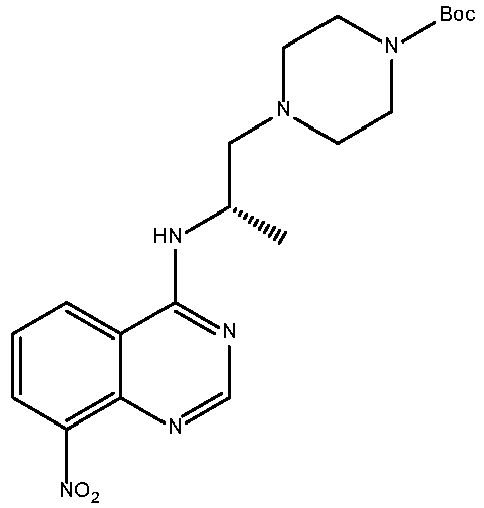
- Title compound was prepared following the procedure used for the synthesis of Intermediate 1, starting from 4-chloro-8-nitroquinazoline (350 mg, 1.67 mmol) to afford Intermediate 46 (485 mg, 1.17 mmol, 70% yield).
LC-MS (ESI): m/z (M+1): 417.1 (Method 2) -

- To a solution of tert-butyl 4-[(2S)-2-[(8-nitroquinazolin-4-yl)amino]propyl]piperazine-1-carboxylate (Intermediate 46, 485 mg, 1.17 mmol) in Ethanol (6 mL) Fe0 (651 mg, 11.6 mmol) was added followed by NH4Cl (499 mg, 9.33 mmol). The reaction was stirred at 75 °C for 48 h. The solvent was removed under vacuum and the crude was dissolved in DCM, washed with NaHCO3 sat. sol. and the organic layer was concentrated under reduced pressure to afford Intermediate 47 (1.17 mmol theoric) that was used in the next step without further purification.
LC-MS (ESI): m/z (M+1): 387.1 (Method 2) -

- To a solution of tert-butyl 4-[(2S)-2-[(8-aminoquinazolin-4-yl)amino]propyl]piperazine-1-carboxylate (Intermediate 47, 100 mg, 0.26 mmol) in DCM (1 mL) and Acetic acid (0.05 mL) formaldehyde (0.02 mL, 0.57 mmol) was added followed by STAB (222 mg, 0.390 mmol). NaHCO3 sat. sol. was added and the aqueous layer was extracted with DCM. The organic layer was separated and concentrated under reduced pressure to afford title compound (0.26 mmol theoric) that was used in the following step without further purification.
LC-MS (ESI): m/z (M+1): 415.2 (Method 2) -
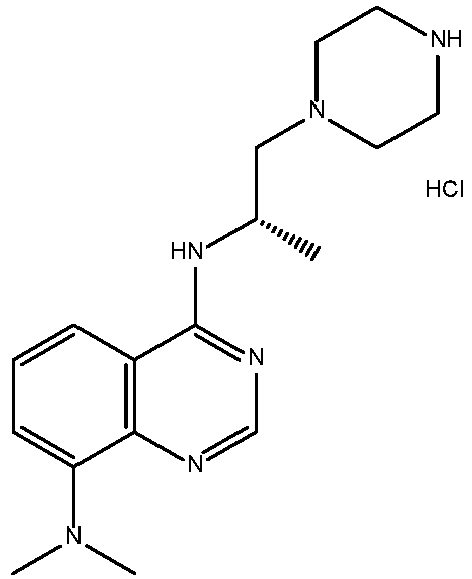
- Title compound was prepared following the procedure used for the synthesis of Intermediate 2, starting from Intermediate 48 (107 mg, 0.26 mmol) to afford Intermediate 49 (120 mg, crude) that was used in the next step without further purification.
LC-MS (ESI): m/z (M+1): 315.2 (Method 2) - Title compound was prepared following the procedure used for the synthesis of Example 1, starting from [4-[[(2S)-1-piperazin-1-ylpropan-2-yl]amino]quinazolin-8-yl] N,N-dimethylcarbamate hydrochloride (Intermediate 45, 100 mg, 0.26 mmol) and 5-(3-methyl-1,2-oxazol-5-yl)thiophene-2-sulfonyl chloride (68 mg, 0.26 mmol) to afford title compound (8 mg, 0.015 mmol, 5% yield)as a whitenish solid.
- LC-MS (ESI): m/z (M+1): 542.1 (Method 2)
- 1H NMR (500 MHz, DMSO-d6 ) δ ppm 1.17 (d, J=6.6 Hz, 3 H), 2.29 (s, 3 H), 2.40 (br dd, J=12.4, 6.9 Hz, 1 H), 2.54 - 2.62 (m, 5 H), 2.96 (br s, 4 H), 2.94 (s, 6 H), 4.50 - 4.63 (m, 1 H), 6.97 (s, 1 H), 7.04 (d, J=7.7 Hz, 1 H), 7.28 (t, J=8.1 Hz, 1 H), 7.59 (d, J=8.0 Hz, 1 H), 7.65 (d, J=8.2 Hz, 1 H), 7.69 (d, J=3.8 Hz, 1 H), 7.76 (d, J=3.8 Hz, 1 H), 8.38 (s, 1 H)
- The Example in the following table was prepared from commercially available reagents by using methods analogous to Example 96.
Example No. Structure & Name Analytical data 98 
LC-MS (ESI): m/z (M+1): 549.2 (Method 2) 1H NMR (500 MHz, DMSO-d6 ) δ ppm 1.18 (d, J=6.6 Hz, 3 H), 2.37 - 2.41 (m, 1 H), 2.42 (s, 3 H), 2.53 - 2.62 (m, 5 H), 2.93 - 3.06 (m, 10 H), 3.75 (s, 3 H), 4.57 (dt, J=13.9, 6.9 Hz, 1 H), 7.06 (d, J=7.7 Hz, 1 H), 7.30 (t, J=8.0 Hz, 1 H), 7.60 (d, J=8.0 Hz, 1 H), 7.67 (d, J=8.2 Hz, 1 H), 8.39 (s, 1 H), 12.33 (br s, 1 H) - The effectiveness of compounds of the present invention as LPA2 antagonist can be determined at the human recombinant LPA2 expressed in CHO cells, using a FLIPR assay in 384 well format.
- CHO-hLPA2 cell lines are cultured in a humidified incubator at 5% CO2 in DMEM/F-12 (1:1) MIXTURE with 2mM Glutamax, supplemented with 10% of Foetal Bovine Serum, 1 mM Sodium Pyruvate, 11 mM Hepes and 1X Penicillin/Streptomycin. CHO hLPA2 cells are seeded into black walled clear-bottom 384-well plates (#781091, Greiner Bio-One GmbH) at a density of 7,500 cells per well in 50 µl culture media and grown overnight in a 37°C humidified CO2-incubator. Serial dilutions (1:3 or 1:4, 11 points CRC) of compounds are performed in 100% DMSO at 200X the final concentration. The compounds are diluted 1:50 prior to the experiment with Assay Buffer (20 mM HEPES, 145 mM NaCl, 5 mM KCl, 5.5 mM glucose, 1 mM MgCl2 and 2 mM CaCl2, pH 7.4 containing 0.01% Pluronic F-127) to obtain a solution corresponding to 5-fold the final concentration in the assay (4X, 2% DMSO). The final concentration of DMSO in the assay will be 0.5% in each well. Medium is removed by aspiration and cells are then incubated with 30 µl of a loading solution containing 5 µM of the cytoplasmic Ca2+ indicator Cal-520 AM in Assay Buffer containing 2.5 mM probenecid for 30 min at 37°C incubator (cell loading). The loaded cell plates are transferred into the FLIPR instrument and calcium responses are monitored during the on-line addition protocols. For testing of compounds, after the cell loading, 10 µl/well of 4X antagonists' solution was added onto the cells. After 30 min pre-incubation (at 37°C), 10 µl/well of 5X concentrated LPA EC80 was added and Ca2+ mobilization responses was followed during the on-line addition protocol. Intracellular peak fluorescence values subtracted by baseline fluorescence are exported and analysed to determine IC50 values, respectively. The calcium response is expressed as percentage of the maximal inhibition of the EC80 agonist response.
- The raw data obtained in unstimulated controls (DMSO, no LPA) are set as "100% inhibition", while the raw data obtained in negative controls, i.e. in the absence of compounds and stimulating with LPA EC80, are set as "0% inhibition".
- The raw data (peak height expressed as relative fluorescence units) are normalized and transformed into "percent of inhibition". Curve fitting and pIC50 (-LogIC50) estimations are carried out using a four-parameter logistic model using XLfit Software.
- The results for individual compounds are provided below in Table 2 wherein the compounds are classified in term of potency with respect to their inhibitory activity on LPA2 isoform, according to the following classification criterion:
- LPA receptor 2 (LPA2)
- +: LPA2 IC50 less than 1000 nM
- ++: LPA2 IC50 comprised between about 100 nM and 10 nm
- +++: LPA2 IC50 less than about 10 nM.
- As it can be appreciated in Table 2, the compounds of the present invention show a good activity as antagonist of LPA2 receptor.
-

- The activity of comparative Example A as has been tested in the in vitro assay for the determination of activity on LPA2 receptor as described above.
- Differently from the compounds of formula (I) of the present invention, the comparative Example A shows an IC50 greater than 1 µm, even greater than 3 µm, and thus the compound is inactive on receptor LPA2.
- The above results demonstrate that the scaffold of the compounds of formula (I) of the invention comprising a quinazoline moiety linked to the piperazine through an aminoalkyl linker leads unexpectedly to a series of compounds that is active on receptor LPA2.
| Example No. | LPA2 IC50 |
| 5 | + |
| 11 | + |
| 6 | + |
| 100 | + |
| 24 | + |
| 74 | + |
| 73 | + |
| 7 | + |
| 15 | + |
| 99 | + |
| 57 | + |
| 49 | + |
| 19 | + |
| 81 | + |
| 41 | + |
| 38 | + |
| 22 | + |
| 26 | + |
| 27 | + |
| 34 | + |
| 25 | + |
| 31 | + |
| 8 | + |
| 62 | + |
| 39 | + |
| 66 | + |
| 9 | + |
| 61 | + |
| 40 | + |
| 90 | + |
| 23 | + |
| 59 | + |
| 29 | + |
| 21 | + |
| 35 | + |
| 55 | + |
| 60 | + |
| 84 | + |
| 93 | + |
| 54 | + |
| 47 | + |
| 10 | + |
| 42 | + |
| 72 | + |
| 67 | + |
| 88 | + |
| 13 | ++ |
| 37 | ++ |
| 101 | ++ |
| 97 | ++ |
| 33 | ++ |
| 20 | ++ |
| 16 | ++ |
| 50 | ++ |
| 83 | ++ |
| 17 | ++ |
| 4 | ++ |
| 44 | ++ |
| 12 | ++ |
| 52 | ++ |
| 1 | ++ |
| 56 | ++ |
| 32 | ++ |
| 80 | ++ |
| 18 | ++ |
| 28 | ++ |
| 94 | ++ |
| 79 | ++ |
| 82 | ++ |
| 2 | ++ |
| 71 | ++ |
| 46 | ++ |
| 89 | ++ |
| 63 | ++ |
| 45 | ++ |
| 53 | ++ |
| 14 | ++ |
| 98 | ++ |
| 3 | ++ |
| 91 | ++ |
| 68 | ++ |
| 95 | ++ |
| 87 | ++ |
| 75 | ++ |
| 69 | +++ |
| 65 | +++ |
| 36 | +++ |
| 48 | +++ |
| 30 | +++ |
| 64 | +++ |
| 77 | +++ |
| 78 | +++ |
| 76 | +++ |
| 51 | +++ |
| 43 | +++ |
| 70 | +++ |
| 86 | +++ |
| 85 | +++ |
| 96 | +++ |
| 58 | +++ |
| 92 | +++ |
Claims (12)
- A compound of formula (I)
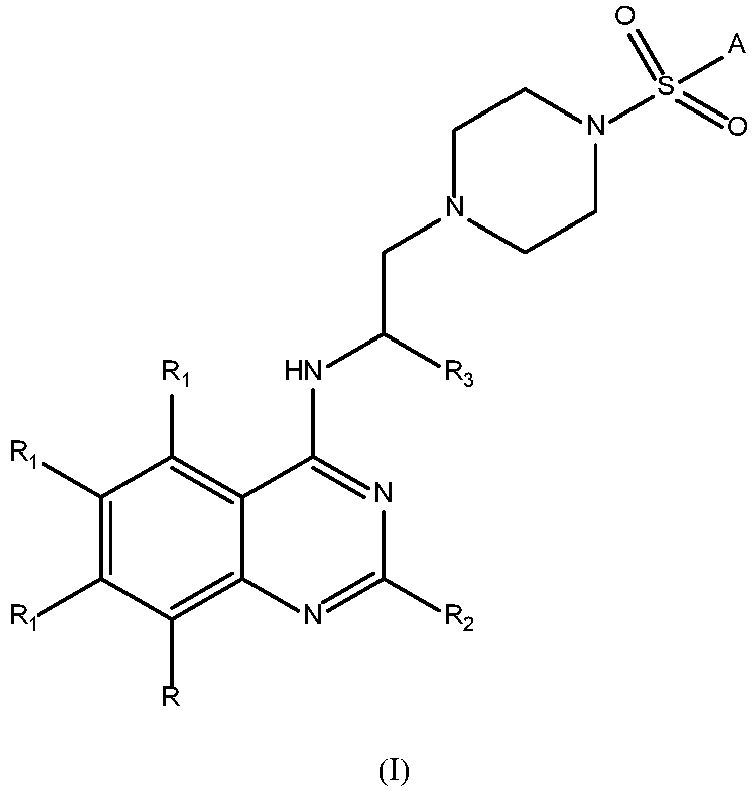 R is H or selected from the group consisting of (C1-C4)alkyl, halo, (C1-C4)haloalkyl, -NO2, -C(O)OR1, -OR1, -O(C1-C4)haloalkyl, -NRARB, -OC(O)NRARB, -C(O)Rc, -C(O)NRARB, and -(C1-C4)alkylene-NRARB;R1 is H or (C1-C4)alkyl;R2 is H or selected from the group consisting of (C1-C4)alkyl, (C1-C4)haloalkyl, -(C1-C4)alkylene-OR1 and (C3-C8)cycloalkyl;R3 is H or selected form the group consisting of (C1-C4)alkyl;A is selected from the group consisting of 5-6 membered heteroaryl and aryl wherein each of said heteroaryl and aryl may be optionally substituted by one or more group selected from (C1-C4)alkyl, -C(O)R1, -C(O)OR1, -C(O)R1, (C1-C4)haloalkyl, halo, -NRAC(O)R1, -NRAC(O)OR1, -NRAC(O)-(C1-C4)alkylene-OR1, -NRAC(O)RC, -NRAC(O)NRARB, -N(C1-C4)alkylene-NRARB, aryl and heteroaryl optionally substituted by one or more (C1-C4)alkyl and (C1-C4)haloalkyl, orwhen A is aryl it may be fused to a second saturated or unsaturated ring optionally containing one or more heteroatoms selected from N, O and S to form a bicyclic ring system optionally substituted by one or more group selected from -C(O)R1, (C1-C4)alkyl and oxo;RC is selected from the group consisting of from heteroaryl, aryl, (C3-C8) cycloalkyl and (C4-C8) heterocycloalkyl wherein said heteroaryl, aryl, heterocycloalkyl and cycloalkyl may be optionally substituted by one or more (C1-C4)alkyl and -C(O)OR1;RA and RB are at each occurrence independently H or selected from the group consisting of (C1-C4)alkyl, (C3-C8)cycloalkyl, (C1-C6)haloalkyl and halo, orRA and RB may form together with the nitrogen atom to which they are attached a 4-6 membered saturated heterocyclic ring system optionally containing a further heteroatom selected from N, S and O, said heterocyclic ring system may be optionally substituted by one or more groups selected from (C1-C4)alkyl, (C1-C4) haloalkyl and halo,with the proviso that when R2 is H, R is not H.
 - The compound of formula (I) according to claim 1, whereinR is H or selected from the group consisting of (C1-C4)alkyl, halo, (C1-C4)haloalkyl, -NO2, -C(O)OR1, -OR1, -O(C1-C4)haloalkyl, -NRARB, -OC(O)NRARB, -C(O)Rc, -C(O)NRARB and -(C1-C4)alkylene-NRARB;R1 is H or (C1-C4)alkyl,R2 is H or selected from the group consisting of (C1-C4)alkyl, (C1-C4)haloalkyl, -(C1-C4)alkylene-OR1 and (C3-C8)cycloalkyl;R3 is (C1-C4)alkyl;A is selected from the group consisting of 5-6 membered heteroaryl and aryl wherein each of said heteroaryl and aryl may be optionally substituted by one or more group selected from (C1-C4)alkyl, halo, -NRAC(O)R1, -NRAC(O)OR1, -NRAC(O)-(C1-C4)alkylene-OR1, -NRAC(O)RC, -NRAC(O)NRARB, aryl and heteroaryl optionally substituted by one or more (C1-C4)alkyl, orwhen A is aryl it may be fused to a second saturated ring optionally containing one or more heteroatoms selected from N, S and O, to form a bicyclic ring system optionally substituted by one or more oxo;RC is selected from (C3-C8)cycloalkyl and 5-6 membered heteroaryl optionally substituted by one or more (C1-C4)alkyl;RA and RB are at each occurrence independently H or selected from the group consisting of (C1-C4)alkyl, (C3-C8)cycloalkyl, (C1-C6)haloalkyl and halo, orRA and RB may form together with the nitrogen atom to which they are attached a 4-6 membered saturated heterocyclic ring system optionally containing a further heteroatom selected from N, S and O, said heterocyclic ring system may be optionally substituted by one or more groups selected from (C1-C4)alkyl, (C1-C4) haloalkyl and halo,with the proviso that when R2 is H, R is not H.
- The compound of formula (I) according to claims 1 and 2, wherein A is selected from the group consisting of 5-6 membered heteroaryl and aryl wherein each of said heteroaryl and aryl may be optionally substituted by one or more group selected from (C1-C4)alkyl, -C(O)R1, -C(O)OR1, -C(O)R1, (C1-C4)haloalkyl, halo, -NRAC(O)R1, -NRAC(O)OR1, -NRAC(O)-(C1-C4)alkylene-OR1, -NRAC(O)RC, -NRAC(O)NRARB, -N(C1-C4)alkylene-NRARB, aryl and heteroaryl optionally substituted by one or more (C1-C4)alkyl and (C1-C4)haloalkyl selected from the group consisting of isoxazole, pyridine, thiazole, oxazole, 1,2,4-oxadiazole, 1,3,4-oxadiazole and pyrazole; or when A is aryl it may be fused to a second saturated or unsaturated ring optionally containing one or more heteroatoms selected from N, O and S to form a bicyclic ring system optionally substituted by one or more group selected from -C(O)R1, (C1-C4)alkyl and oxo.
- The compound of formula (I) according to any claims 1 to 3, wherein when A is 5-6 membered heteroaryl said 5-6 membered heteroaryl is selected from the group consisting of thiazole, thiophene and furan.
- The compound of formula (I) according to any claims 1 to 3, wherein when Rc is heteroaryl said heteroaryl is isoxazole optionally substituted by one or more (C1-C4)alkyl and -C(O)OR1.
- The compound of formula (I) according to any claims 1 to 5 selected from at least one of:methyl N-[4-methyl-5-({4-[(2S)-2-{[8-(trifluoromethyl)quinazolin-4-yl]amino}propyl]piperazin-1-yl}sulfonyl)-1,3-thiazol-2-yl]carbamate,methyl N-[4-methyl-5-({4-[(2S)-2-{[2-methyl-8-(trifluoromethyl)quinazolin-4-yl]amino}propyl]piperazin-1-yl}sulfonyl)-1,3-thiazol-2-yl]carbamate,methyl N-[4-methyl-5-({4-[(2S)-2-{[8-(trifluoromethoxy)quinazolin-4-yl]amino}propyl]piperazin-1-yl}sulfonyl)-1,3-thiazol-2-yl]carbamate,8-(difluoromethoxy)-N-[(2S)-1-(4-{[5-(3,4-dimethyl-1,2-oxazol-5-yl)thiophen-2-yl]sulfonyl}piperazin-1-yl)propan-2-yl]quinazolin-4-amine,N-[(2 S)-1-[4-(3, 4-dichlorobenzenesulfonyl)piperazin-1-yl]propan-2-yl]-8-(trifluoromethyl)quinazolin-4-amine,8-chloro-N-[(2S)-1-[4-(3,4-dichlorobenzenesulfonyl)piperazin-1-yl]propan-2-yl]quinazolin-4-amine,N-[5-({4-[(2S)-2-{ [8-(trifluoromethyl)quinazolin-4-yl]amino}propyl]piperazin-1-yl}sulfonyl)-1,3-thiazol-2-yl]acetamide,N-[4-methyl-5-({4-[(2S)-2-{ [8-(trifluoromethyl)quinazolin-4-yl]amino}propyl]piperazin-1-yl}sulfonyl)-1,3-thiazol-2-yl]acetamide,N-[4-methyl-5-({4-[(2S)-2-{ [8-(trifluoromethyl)quinazolin-4-yl]amino}propyl]piperazin-1-yl}sulfonyl)-1,3-thiazol-2-yl]propanamide,methyl 4-{[(2S)-1-[4-(3,4-dichlorobenzenesulfonyl)piperazin-1-yl]propan-2-yl]amino}quinazoline-8-carboxylate,methyl N-[4-methyl-5-({4-[(2S)-2-{[2-(trifluoromethyl)quinazolin-4-yl]amino}propyl]piperazin-1-yl}sulfonyl)-1,3-thiazol-2-yl]carbamate,methyl 4-{[(2S)-1-{4-[(2-phenyl-1,3-thiazol-5-yl)sulfonyl]piperazin-1-yl}propan-2-yl]amino}quinazoline-8-carboxylate,N-[5-({4-[(2S)-2-{ [2-methyl-8-(trifluoromethyl)quinazolin-4-yl]amino}propyl]piperazin-1-yl}sulfonyl)-1,3-thiazol-2-yl]acetamide,N-[(2S)-1-(4-{[5-(1,2-oxazol-5-yl)thiophen-2-yl]sulfonyl}piperazin-1-yl)propan-2-yl]-8-(trifluoromethyl)quinazolin-4-amine,methyl N-[5-({4-[(2S)-2-[(2-cyclopropylquinazolin-4-yl)amino]propyl]piperazin-1-yl}sulfonyl)-4-methyl-1,3-thiazol-2-yl]carbamate,methyl 4-{[(2S)-1-(4-{[5-(1,2-oxazol-5-yl)thiophen-2-yl]sulfonyl}piperazin-1-yl)propan-2-yl]amino}quinazoline-8-carboxylate,methyl 4-{[(2S)-1-[4-({2-[(methoxycarbonyl)amino]-4-methyl-1,3-thiazol-5-yl}sulfonyl)piperazin-1-yl]propan-2-yl]amino}quinazoline-8-carboxylate,methyl N-[5-({4-[(2S)-2-[(2-cyclopropyl-8-methylquinazolin-4-yl)amino]propyl]piperazin-1-yl} sulfonyl)-4-methyl-1,3 -thiazol-2-yl]carbamate,N-[5-({4-[(2S)-2-[(2-cyclopropyl-8-methylquinazolin-4-yl)amino]propyl]piperazin-1-yl}sulfonyl)-1,3-thiazol-2-yl]acetamide,methyl 4-{ [(2S)-1-{4-[(2-acetamido-1,3-thiazol-5-yl)sulfonyl]piperazin-1-yl}propan-2-yl]amino}quinazoline-8-carboxylate,methyl N-[5-({4-[(2S)-2-{[2-cyclopropyl-8-(trifluoromethyl)quinazolin-4-yl]amino}propyl]piperazin-1-yl}sulfonyl)-4-methyl-1,3-thiazol-2-yl]carbamate,N-[5-({4-[(2S)-2-{ [2-cyclopropyl-8-(trifluoromethyl)quinazolin-4-yl]amino}propyl]piperazin-1-yl}sulfonyl)-1,3-thiazol-2-yl]acetamide,2-methyl-N-[(2S)-1-(4-{[5-(1,2-oxazol-5-yl)thiophen-2-yl]sulfonyl}piperazin-1-yl)propan-2-yl]-8-(trifluoromethyl)quinazolin-4-amine,2-methoxy-N-[5-({4-[(2S)-2-{[8-(trifluoromethyl)quinazolin-4-yl]amino}propyl]piperazin-1-yl}sulfonyl)-1,3-thiazol-2-yl]acetamide,2-methoxy-N-[4-methyl-5-({4-[(2S)-2-{[8-(trifluoromethyl)quinazolin-4-yl]amino}propyl]piperazin-1-yl}sulfonyl)-1,3-thiazol-2-yl]acetamide,methyl N-[5-({4-[(2S)-2-{[8-(trifluoromethyl)quinazolin-4-yl]amino}propyl]piperazin-1-yl}sulfonyl)-1,3-thiazol-2-yl]carbamate,methyl N-[5-({4-[(2S)-2-{[8-(dimethylcarbamoyl)quinazolin-4-yl]amino}propyl]piperazin-1-yl}sulfonyl)-4-methyl-1,3-thiazol-2-yl]carbamate,N-[(2S)-1-(4-{[5-(pyridin-2-yl)thiophen-2-yl]sulfonyl}piperazin-1-yl)propan-2-yl]-8-(trifluoromethyl)quinazolin-4-amine,N-[(2S)-1-{4-[4-(2-methyl-1,3-oxazol-4-yl)benzenesulfonyl]piperazin-1-yl}propan-2-yl]-8-(trifluoromethyl)quinazolin-4-amine,N-[(2S)-1-(4-{[5-(3,4-dimethyl-1,2-oxazol-5-yl)thiophen-2-yl]sulfonyl}piperazin-1-yl)propan-2-yl]-8-(trifluoromethyl)quinazolin-4-amine,N-[(2S)-1-{4-[4-(3,5-dimethyl-1,2-oxazol-4-yl)benzenesulfonyl]piperazin-1-yl}propan-2-yl]-8-(trifluoromethyl)quinazolin-4-amine,N-[(2S)-1-(4-{[5-(2-methyl-1,3-thiazol-4-yl)thiophen-2-yl]sulfonyllpiperazin-1-yl)propan-2-yl]-8-(trifluoromethyl)quinazolin-4-amine,N-[(2S)-1-{4-[3-(1,2-oxazol-5-yl)benzenesulfonyl]piperazin-1-yl}propan-2-yl]-8-(trifluoromethyl)quinazolin-4-amine,N-[(2S)-1-{4-[4-(1,2-oxazol-5-yl)benzenesulfonyl]piperazin-1-yl}propan-2-yl]-8-(trifluoromethyl)quinazolin-4-amine,N-[(2S)-1-{4-[(2-phenyl-1,3-thiazol-5-yl)sulfonyl]piperazin-1-yl}propan-2-yl]-8-(trifluoromethyl)quinazolin-4-amine,N-[(2S)-1-(4-{[5-(3-methyl-1,2-oxazol-5-yl)thiophen-2-yl]sulfonyl}piperazin-1-yl)propan-2-yl]-8-(trifluoromethyl)quinazolin-4-amine,N-[(2S)-1-(4-{[5-(1,3-oxazol-5-yl)thiophen-2-yl]sulfonyl}piperazin-1-yl)propan-2-yl]-8-(trifluoromethyl)quinazolin-4-amine,4-{[(2S)-1-{4-[(2-acetamido-4-methyl-1,3-thiazol-5-yl)sulfonyl]piperazin-1-yl}propan-2-yl]amino}-N,N-dimethylquinazoline-8-carboxamide,methyl N-[5-({4-[(2S)-2-({8-[ethyl(methyl)carbamoyl]quinazolin-4-yl}amino)propyl]piperazin-1-yl}sulfonyl)-4-methyl-1,3-thiazol-2-yl]carbamate,methyl N-[4-methyl-5-({4-[(2S)-2-({8-[methyl(2,2,2-trifluoroethyl)carbamoyl]quinazolin-4-yl}amino)propyl]piperazin-1-yl}sulfonyl)-1,3-thiazol-2-yl]carbamate,N-[(2S)-1-(4-{[5-(3,5-dimethyl-1,2-oxazol-4-yl)thiophen-2-yl]sulfonyl}piperazin-1-yl)propan-2-yl]-8-(trifluoromethyl)quinazolin-4-amine,N-[2-chloro-5-fluoro-4-({4-[(2S)-2-{[8-(trifluoromethyl)quinazolin-4-yl]amino}propyl]piperazin-1-yl}sulfonyl)phenyl]acetamide,4-{[(2S)-1-(4-{[5-(3,4-dimethyl-1,2-oxazol-5-yl)thiophen-2-yl]sulfonyl}piperazin-l-yl)propan-2-yl]amino}-N,N-dimethylquinazoline-8-carboxamide,N,N-dimethyl-4-{[(2S)-1-{4-[(2-phenyl-1,3-thiazol-5-yl)sulfonyl]piperazin-1-yl}propan-2-yl]amino}quinazoline-8-carboxamide,methyl N-[4-methyl-5-({4-[(2S)-2-{[8-(pyrrolidine-1-carbonyl)quinazolin-4-yl]amino}propyl]piperazin-1-yl}sulfonyl)-1,3-thiazol-2-yl]carbamate,methyl N-[5-({4-[(2S)-2-[(8-cyclopropanecarbonylquinazolin-4-yl)amino]propyl]piperazin-1-yl} sulfonyl)-4-methyl-1,3 -thiazol-2-yl]carbamate,methyl N-[5-({4-[(2S)-2-{[8-(azetidine-1-carbonyl)quinazolin-4-yl]amino}propyl]piperazin-1-yl}sulfonyl)-4-methyl-1,3-thiazol-2-yl]carbamate,N,N-dimethyl-4-{[(2S)-1-(4-{[5-(3-methyl-1,2-oxazol-5-yl)thiophen-2-yl]sulfonyl}piperazin-1-yl)propan-2-yl]amino}quinazoline-8-carboxamide,4-{[(2S)-1-[4-(3,4-dichlorobenzenesulfonyl)piperazin-1-yl]propan-2-yl]amino}-N,N-dimethylquinazoline-8-carboxamide,N-[(2S)-1-{4-[3-(5-methyl-1,2,4-oxadiazol-3-yl)benzenesulfonyl]piperazin-1-yl}propan-2-yl]-8-(trifluoromethyl)quinazolin-4-amine,N-methyl-4-{[(2S)-1-(4-{[5-(3-methyl-1,2-oxazol-5-yl)thiophen-2-yl]sulfonyl}piperazin-1-yl)propan-2-yl]amino}-N-(2,2,2-trifluoroethyl)quinazoline-8-carboxamide,N-[(2S)-1-(4-{[5-(3-methyl-1,2-oxazol-5-yl)furan-2-yl]sulfonyl}piperazin-1-yl)propan-2-yl]-8-(trifluoromethyl)quinazolin-4-amine,N-[(2S)-1-(4-{[5-(1,2-oxazol-3-yl)thiophen-2-yl]sulfonyl}piperazin-1-yl)propan-2-yl]-8-(trifluoromethyl)quinazolin-4-amine,N-[(2S)-1-(4-{[5-(1,2-oxazol-5-yl)furan-2-yl]sulfonyl}piperazin-1-yl)propan-2-yl]-8-(trifluoromethyl)quinazolin-4-amine,methyl N-[4-methyl-5-({4-[(2S)-2-[(8-nitroquinazolin-4-yl)amino]propyl]piperazin-1-yl}sulfonyl)-1,3-thiazol-2-yl]carbamate,N-[(2S)-1-(4- f [5-(3,4-dimethyl-1H-pyrazol-5-yl)furan-2-yl]sulfonyllpiperazin-1-yl)propan-2-yl]-8-(trifluoromethyl)quinazolin-4-amine,N-[(2S)-1-{4-[3-(5-methyl-1,3,4-oxadiazol-2-yl)benzenesulfonyl]piperazin-1-yl}propan-2-yl]-8-(trifluoromethyl)quinazolin-4-amine,N-[(2S)-1-(4-{[5-(3-methyl-1,2-oxazol-5-yl)thiophen-2-yl]sulfonyl}piperazin-1-yl)propan-2-yl]-8-(pyrrolidine-1-carbonyl)quinazolin-4-amine,N-[(2S)-1-{4-[2-methyl-5-(1,2-oxazol-5-yl)benzenesulfonyl]piperazin-1-yl}propan-2-yl]-8-(trifluoromethyl)quinazolin-4-amine,N-[(2S)-1-{4-[2-methyl-5-(3-methyl-1,2-oxazol-5-yl)benzenesulfonyl]piperazin-1-yl}propan-2-yl]-8-(trifluoromethyl)quinazolin-4-amine,N-[(2S)-1-(4-{[5-(3,4-dimethyl-1,2-oxazol-5-yl)thiophen-2-yl]sulfonyl}piperazin-1-yl)propan-2-yl]-2-(methoxymethyl)-8-(trifluoromethyl)quinazolin-4-amine,N-[(2S)-1-{4-[3-(2-methyl-1,3-thiazol-4-yl)benzenesulfonyl]piperazin-1-yl}propan-2-yl]-8-(trifluoromethyl)quinazolin-4-amine,N-[(2S)-1-(4-{[2-(3-methyl-1,2-oxazol-5-yl)-1,3-thiazol-5-yl]sulfonyl}piperazin-1-yl)propan-2-yl]-8-(trifluoromethyl)quinazolin-4-amine,4-{[(2S)-1-(4-{[5-(3,4-dimethyl-1,2-oxazol-5-yl)thiophen-2-yl]sulfonyl}piperazin-1-yl)propan-2-yl]amino}-N,N-diethylquinazoline-8-carboxamide,N-cyclopentyl-4-{[(2S)-1-(4-{[5-(3,4-dimethyl-1,2-oxazol-5-yl)thiophen-2-yl]sulfonyl}piperazin-1-yl)propan-2-yl]amino}-N-methylquinazoline-8-carboxamide,4-{[(2S)-1-[4-(5-chloro-4-acetamido-2-fluorobenzenesulfonyl)piperazin-1-yl]propan-2-yl]amino}-N,N-dimethylquinazoline-8-carboxamide,N-[(2S)-1-(4-{[5-(1H-pyrazol-5-yl)furan-2-yl]sulfonyl}piperazin-1-yl)propan-2-yl]-8-(trifluoromethyl)quinazolin-4-amine,N-[(2S)-1-(4-{[5-(3,4-dimethyl-1,2-oxazol-5-yl)furan-2-yl]sulfonyl}piperazin-1-yl)propan-2-yl]-8-(trifluoromethyl)quinazolin-4-amine,N-[(2S)-1-(4-{[5-(3,4-dimethyl-1,2-oxazol-5-yl)thiophen-2-yl]sulfonyl}piperazin-1-yl)propan-2-yl]-8-[(2S)-2-(trifluoromethyl)pyrrolidine-1-carbonyl]quinazolin-4-amine,N-[(2S)-1-(4-{[5-(3-methyl-1,2-oxazol-5-yl)thiophen-2-yl]sulfonyl}piperazin-1-yl)propan-2-yl]-8-(piperidine-1-carbonyl)quinazolin-4-amine,N-[(2S)-1-(4-{[4-(1,2-oxazol-5-yl)thiophen-2-yl]sulfonyl}piperazin-1-yl)propan-2-yl]-8-(trifluoromethyl)quinazolin-4-amine,N-[4-methyl-5-({4-[(2S)-2-{ [8-(trifluoromethyl)quinazolin-4-yl]amino}propyl]piperazin-1-yl}sulfonyl)-1,3-thiazol-2-yl]cyclohexanecarboxamide,methyl N-[4-methyl-5-({4-[(2S)-2-[(8-methylquinazolin-4-yl)amino]propyl]piperazin-1-yl}sulfonyl)-1,3-thiazol-2-yl]carbamate,N-[(2S)-1-(4-{[5-(3,4-dimethyl-1,2-oxazol-5-yl)thiophen-2-yl]sulfonyl}piperazin-1-yl)propan-2-yl]-8-[(dimethylamino)methyl]quinazolin-4-amine,N-[(2S)-1-(4-{[5-(3,4-dimethyl-1,2-oxazol-5-yl)thiophen-2-yl]sulfonyl}piperazin-1-yl)propan-2-yl]-8-(trifluoromethoxy)quinazolin-4-amine,N-[(2S)-1-(4-{[5-(3,4-dimethyl-1,2-oxazol-5-yl)thiophen-2-yl]sulfonyl}piperazin-1-yl)propan-2-yl]-8-[(2R)-2-(trifluoromethyl)pyrrolidine-1-carbonyl]quinazolin-4-amine,8-(3,3-difluoropyrrolidine-1-carbonyl)-N-[(2S)-1-(4-{[5-(3,4-dimethyl-1,2-oxazol-5-yl)thiophen-2-yl]sulfonyl}piperazin-1-yl)propan-2-yl]quinazolin-4-amine,N-[(2S)-1-(4-{[5-(3,4-dimethyl-1,2-oxazol-5-yl)thiophen-2-yl]sulfonyl}piperazin-1-yl)propan-2-yl]-8-(2,2-dimethylpyrrolidine-1-carbonyl)quinazolin-4-amine,methyl N-[4-methyl-5-({4-[(2S)-2-({8-[(2R)-2-(trifluoromethyl)pyrrolidine-1-carbonyl]quinazolin-4-yl}amino)propyl]piperazin-1-yl}sulfonyl)-1,3-thiazol-2-yl]carbamate,methyl N-[5-({4-[(2S)-2-{ [8-(3,3-difluoropyrrolidine-1-carbonyl)quinazolin-4-yl]amino}propyl]piperazin-1-yl}sulfonyl)-4-methyl-1,3-thiazol-2-yl]carbamate,N-[4-methyl-5-({4-[(2S)-2-{ [8-(trifluoromethyl)quinazolin-4-yl]amino}propyl]piperazin-1-yl}sulfonyl)-1,3-thiazol-2-yl]morpholine-4-carboxamide,methyl N-[4-methyl-5-({4-[(2S)-2-({8-[(2S)-2-methylpyrrolidine-1-carbonyl]quinazolin-4-yl}amino)propyl]piperazin-1-yl}sulfonyl)-1,3-thiazol-2-yl]carbamate,methyl N-[5-({4-[(2S)-2-{ [8-(2,2-dimethylpyrrolidine-1-carbonyl)quinazolin-4-yl] amino}propyl]piperazin-1-yl} sulfonyl)-4-methyl-1,3-thiazol-2-yl]carbamate,methyl N-[4-methyl-5-({4-[(2S)-2-({8-[(2S)-2-(trifluoromethyl)pyrrolidine-1-carbonyl]quinazolin-4-yl}amino)propyl]piperazin-1-yl}sulfonyl)-1,3-thiazol-2-yl]carbamate,8-{3-azabicyclo[3.1.0]hexane-3-carbonyl}-N-[(2S)-1-(4-{[5-(3,4-dimethyl-1,2-oxazol-5-yl)thiophen-2-yl]sulfonyl}piperazin-1-yl)propan-2-yl]quinazolin-4-amine,N-[(2S)-1-(4-{[5-(3,4-dimethyl-1,2-oxazol-5-yl)thiophen-2-yl]sulfonyl}piperazin-1-yl)propan-2-yl]-8-[(2S)-2-methylpyrrolidine-1-carbonyl]quinazolin-4-amine,methyl N-[5-({4-[(2S)-2-[(8-{3-azabicyclo[3.1.0]hexane-3-carbonyl}quinazolin-4-yl)amino]propyl]piperazin-1-yl}sulfonyl)-4-methyl-1,3-thiazol-2-yl]carbamate,5-methyl-N-[4-methyl-5-({4-[(2S)-2-{[8-(trifluoromethyl)quinazolin-4-yl]amino}propyl]piperazin-1-yl}sulfonyl)-1,3-thiazol-2-yl]-1,2-oxazole-3-carboxamide,methyl N-methyl-N-[4-methyl-5-({4-[(2S)-2-{[8-(trifluoromethyl)quinazolin-4-yl]amino}propyl]piperazin-1-yl}sulfonyl)-1,3-thiazol-2-yl]carbamate,N-[5-({4-[(2S)-2-{ [8-(trifluoromethyl)quinazolin-4-yl]amino}propyl]piperazin-1-yl}sulfonyl)thiophen-2-yl]acetamide,4-{[(2S)-1-(4-{[5-(3-methyl-1,2-oxazol-5-yl)thiophen-2-yl]sulfonyl}piperazin-1-yl)propan-2-yl]amino}quinazolin-8-yl N,N-dimethylcarbamate,8-cyclopropanecarbonyl-N-[(2S)-1-(4-{[5-(3,4-dimethyl-1,2-oxazol-5-yl)thiophen-2-yl]sulfonyl}piperazin-1-yl)propan-2-yl]quinazolin-4-amine,N-[(2S)-1-{4-[3-(1,3-oxazol-5-yl)benzenesulfonyl]piperazin-1-yl}propan-2-yl]-8-(trifluoromethyl)quinazolin-4-amine,methyl N-[5-({4-[(2S)-2-{ [8-(trifluoromethoxy)quinazolin-4-yl]amino}propyl]piperazin-1-yl}sulfonyl)-1,3-thiazol-2-yl]carbamate,N-[4-methyl-5-({4-[(2S)-2-{[8-(trifluoromethyl)quinazolin-4-yl]amino}propyl]piperazin-1-yl}sulfonyl)-1,3-thiazol-2-yl]cyclopentanecarboxamide,N8,N8-dimethyl-N4-[(2S)-1-(4-{ [5-(3-methyl-1,2-oxazol-5-yl)thiophen-2-yl]sulfonyl}piperazin-1-yl)propan-2-yl]quinazoline-4,8-diamine,6-({4-[(2S)-2-{ [8-(trifluoromethyl)quinazolin-4-yl]amino}propyl]piperazin-1-yl}sulfonyl)-2,3-dihydro-1,3-benzothiazol-2-one,methyl N-[5-({4-[(2S)-2-{ [8-(dimethylamino)quinazolin-4-yl]amino}propyl]piperazin-1-yl}sulfonyl)-4-methyl-1,3-thiazol-2-yl]carbamate,6-({4-[(2S)-2-{ [8-(trifluoromethyl)quinazolin-4-yl]amino}propyl]piperazin-1-yl}sulfonyl)-2,3-dihydro-1,3-benzoxazol-2-one,5-({4-[(2S)-2-{ [8-(trifluoromethyl)quinazolin-4-yl]amino}propyl]piperazin-1-yl}sulfonyl)-2,3-dihydro-1H-1,3-benzodiazol-2-one,methyl N-[5-({4-[(2S)-2-[(8-bromoquinazolin-4-yl)amino]propyl]piperazin-1-yl} sulfonyl)-4-methyl-1,3 -thiazol-2-yl]carbamate.
- A pharmaceutical composition comprising a compound of formula (I) according to any one of claims 1 to 6, in admixture with one or more pharmaceutically acceptable carrier or excipient.
- The pharmaceutical composition according to claim 7 for oral administration.
- A compound of formula (I) according to any one of claims 1 to 5 or a pharmaceutical composition according to claims 7 and 8 for use as a medicament.
- A compound of formula (I) or a pharmaceutical composition for use according to claim 9 in the prevention and/or treatment of fibrosis and/or diseases, disorders, or conditions that involve fibrosis.
- A compound of formula (I) or a pharmaceutical composition for use according to claim 10 in the prevention and/or treatment of fibrosis including pulmonary fibrosis, idiopathic pulmonary fibrosis (IPF), hepatic fibrosis, renal fibrosis, ocular fibrosis, cardiac fibrosis, arterial fibrosis and systemic sclerosis.
- A compound of formula (I) or a pharmaceutical composition for use according to claim 11 in the prevention and/or treatment idiopathic pulmonary fibrosis (IPF).
Applications Claiming Priority (2)
| Application Number | Priority Date | Filing Date | Title |
|---|---|---|---|
| EP19215719 | 2019-12-12 | ||
| PCT/EP2020/085460 WO2021116260A1 (en) | 2019-12-12 | 2020-12-10 | Quinazoline derivatives as lpa receptor 2 inhibitors |
Publications (3)
| Publication Number | Publication Date |
|---|---|
| EP4072670A1 EP4072670A1 (en) | 2022-10-19 |
| EP4072670C0 EP4072670C0 (en) | 2023-11-22 |
| EP4072670B1 true EP4072670B1 (en) | 2023-11-22 |
Family
ID=68916201
Family Applications (1)
| Application Number | Title | Priority Date | Filing Date |
|---|---|---|---|
| EP20820186.3A Active EP4072670B1 (en) | 2019-12-12 | 2020-12-10 | Quinazoline derivatives as lpa receptor 2 inhibitors |
Country Status (6)
| Country | Link |
|---|---|
| US (1) | US12404270B2 (en) |
| EP (1) | EP4072670B1 (en) |
| JP (1) | JP2023505704A (en) |
| CN (1) | CN114786771A (en) |
| CA (1) | CA3157600A1 (en) |
| WO (1) | WO2021116260A1 (en) |
Families Citing this family (2)
| Publication number | Priority date | Publication date | Assignee | Title |
|---|---|---|---|---|
| CN120917018A (en) * | 2023-03-31 | 2025-11-07 | 株式会社次代生物科学 | Novel azabicyclo derivatives and pharmaceutical compositions for inhibiting autotaxin comprising the same |
| CN117551083B (en) * | 2023-11-22 | 2026-02-10 | 中山大学 | An aromatic amide compound, its preparation method and application |
Family Cites Families (7)
| Publication number | Priority date | Publication date | Assignee | Title |
|---|---|---|---|---|
| EP2611808B1 (en) | 2010-09-02 | 2014-11-12 | Merck Patent GmbH | Pyrazolopyridinone derivatives as lpa receptor antagonists |
| CN103347510B (en) | 2010-12-07 | 2015-11-25 | 艾米拉医药股份有限公司 | Lysophosphatidic acid receptor antagonists and their use in the treatment of fibrosis |
| AR108838A1 (en) | 2016-06-21 | 2018-10-03 | Bristol Myers Squibb Co | CARBAMOYLOXIMETHYL ACID TRIAZOL CYCLOHEXILO AS LPA ANTAGONISTS |
| WO2019126099A1 (en) | 2017-12-19 | 2019-06-27 | Bristol-Myers Squibb Company | Isoxazole n-linked carbamoyl cyclohexyl acids as lpa antagonists |
| AR113964A1 (en) | 2017-12-19 | 2020-07-01 | Bristol Myers Squibb Co | CARBAMOIL CYCLOHEXYL N-LINKED ACIDS OF TRIAZOLE AS ANTAGONISTS OF LPA |
| US11319309B2 (en) | 2017-12-19 | 2022-05-03 | Bristol-Myers Squibb Company | Cyclohexyl acid isoxazole azines as LPA antagonists |
| WO2019126087A1 (en) | 2017-12-19 | 2019-06-27 | Bristol-Myers Squibb Company | Cyclohexyl acid isoxazole azoles as lpa antagonists |
-
2020
- 2020-12-10 CN CN202080085862.2A patent/CN114786771A/en active Pending
- 2020-12-10 CA CA3157600A patent/CA3157600A1/en active Pending
- 2020-12-10 US US17/784,557 patent/US12404270B2/en active Active
- 2020-12-10 WO PCT/EP2020/085460 patent/WO2021116260A1/en not_active Ceased
- 2020-12-10 EP EP20820186.3A patent/EP4072670B1/en active Active
- 2020-12-10 JP JP2022535580A patent/JP2023505704A/en not_active Withdrawn
Also Published As
| Publication number | Publication date |
|---|---|
| EP4072670A1 (en) | 2022-10-19 |
| EP4072670C0 (en) | 2023-11-22 |
| JP2023505704A (en) | 2023-02-10 |
| CA3157600A1 (en) | 2021-06-17 |
| US20230063121A1 (en) | 2023-03-02 |
| CN114786771A (en) | 2022-07-22 |
| WO2021116260A1 (en) | 2021-06-17 |
| US12404270B2 (en) | 2025-09-02 |
Similar Documents
| Publication | Publication Date | Title |
|---|---|---|
| US11306081B2 (en) | Phenylacetamides as inhibitors of rock | |
| ES2866152T3 (en) | Tyrosine amide derivatives as Rho-kinase inhibitors | |
| CA3218569A1 (en) | Lpa receptor antagonists and uses thereof | |
| JP2023533851A (en) | Amidocyclohexanoic acid derivatives as LPA receptor inhibitors | |
| EP4251273B1 (en) | Phthalazine derivatives as p2x3 inhibitors | |
| US12404270B2 (en) | Quinazoline derivatives as LPA receptor 2 inhibitors | |
| EP4251617B1 (en) | (aza)quinoline 4-amines derivatives as p2x3 inhibitors | |
| EP4073073B1 (en) | Thienopyrimidine derivatives as lpa receptor 2 inhibitors | |
| EP4073069B1 (en) | Aromatic amido derivatives as lpa receptor 2 inhibitors | |
| EP4251620B1 (en) | Amino quinazoline derivatives as p2x3 inhibitors | |
| EP4313956A1 (en) | 8-cyclo-substituted quinazoline derivatives as lpa receptor 2 inhibitors | |
| HK40093660A (en) | 8-cyclo-substituted quinazoline derivatives as lpa receptor 2 inhibitors | |
| HK40068822A (en) | Quinazoline derivatives as lpa receptor 2 inhibitors | |
| HK40091208A (en) | Phthalazine derivatives as p2x3 inhibitors | |
| KR20260021028A (en) | Small molecule inhibitor of ribosome biogenesis factor NVL2 | |
| JP2023552902A (en) | Dihydrofuropyridine derivatives as RHO-kinase inhibitors | |
| HK40067957A (en) | Thienopyrimidine derivatives as lpa receptor 2 inhibitors | |
| HK40068829A (en) | Aromatic amido derivatives as lpa receptor 2 inhibitors |
Legal Events
| Date | Code | Title | Description |
|---|---|---|---|
| STAA | Information on the status of an ep patent application or granted ep patent |
Free format text: STATUS: UNKNOWN |
|
| STAA | Information on the status of an ep patent application or granted ep patent |
Free format text: STATUS: THE INTERNATIONAL PUBLICATION HAS BEEN MADE |
|
| PUAI | Public reference made under article 153(3) epc to a published international application that has entered the european phase |
Free format text: ORIGINAL CODE: 0009012 |
|
| STAA | Information on the status of an ep patent application or granted ep patent |
Free format text: STATUS: REQUEST FOR EXAMINATION WAS MADE |
|
| 17P | Request for examination filed |
Effective date: 20220622 |
|
| AK | Designated contracting states |
Kind code of ref document: A1 Designated state(s): AL AT BE BG CH CY CZ DE DK EE ES FI FR GB GR HR HU IE IS IT LI LT LU LV MC MK MT NL NO PL PT RO RS SE SI SK SM TR |
|
| RAV | Requested validation state of the european patent: fee paid |
Extension state: TN Effective date: 20220622 Extension state: MD Effective date: 20220622 Extension state: MA Effective date: 20220622 |
|
| GRAP | Despatch of communication of intention to grant a patent |
Free format text: ORIGINAL CODE: EPIDOSNIGR1 |
|
| STAA | Information on the status of an ep patent application or granted ep patent |
Free format text: STATUS: GRANT OF PATENT IS INTENDED |
|
| INTG | Intention to grant announced |
Effective date: 20230619 |
|
| GRAS | Grant fee paid |
Free format text: ORIGINAL CODE: EPIDOSNIGR3 |
|
| GRAA | (expected) grant |
Free format text: ORIGINAL CODE: 0009210 |
|
| STAA | Information on the status of an ep patent application or granted ep patent |
Free format text: STATUS: THE PATENT HAS BEEN GRANTED |
|
| AK | Designated contracting states |
Kind code of ref document: B1 Designated state(s): AL AT BE BG CH CY CZ DE DK EE ES FI FR GB GR HR HU IE IS IT LI LT LU LV MC MK MT NL NO PL PT RO RS SE SI SK SM TR |
|
| REG | Reference to a national code |
Ref country code: GB Ref legal event code: FG4D |
|
| REG | Reference to a national code |
Ref country code: CH Ref legal event code: EP Ref country code: DE Ref legal event code: R096 Ref document number: 602020021624 Country of ref document: DE |
|
| REG | Reference to a national code |
Ref country code: IE Ref legal event code: FG4D |
|
| U01 | Request for unitary effect filed |
Effective date: 20231213 |
|
| U07 | Unitary effect registered |
Designated state(s): AT BE BG DE DK EE FI FR IT LT LU LV MT NL PT SE SI Effective date: 20231220 |
|
| U20 | Renewal fee for the european patent with unitary effect paid |
Year of fee payment: 4 Effective date: 20231218 |
|
| PG25 | Lapsed in a contracting state [announced via postgrant information from national office to epo] |
Ref country code: GR Free format text: LAPSE BECAUSE OF FAILURE TO SUBMIT A TRANSLATION OF THE DESCRIPTION OR TO PAY THE FEE WITHIN THE PRESCRIBED TIME-LIMIT Effective date: 20240223 |
|
| PG25 | Lapsed in a contracting state [announced via postgrant information from national office to epo] |
Ref country code: IS Free format text: LAPSE BECAUSE OF FAILURE TO SUBMIT A TRANSLATION OF THE DESCRIPTION OR TO PAY THE FEE WITHIN THE PRESCRIBED TIME-LIMIT Effective date: 20240322 |
|
| PG25 | Lapsed in a contracting state [announced via postgrant information from national office to epo] |
Ref country code: ES Free format text: LAPSE BECAUSE OF FAILURE TO SUBMIT A TRANSLATION OF THE DESCRIPTION OR TO PAY THE FEE WITHIN THE PRESCRIBED TIME-LIMIT Effective date: 20231122 |
|
| PG25 | Lapsed in a contracting state [announced via postgrant information from national office to epo] |
Ref country code: IS Free format text: LAPSE BECAUSE OF FAILURE TO SUBMIT A TRANSLATION OF THE DESCRIPTION OR TO PAY THE FEE WITHIN THE PRESCRIBED TIME-LIMIT Effective date: 20240322 Ref country code: GR Free format text: LAPSE BECAUSE OF FAILURE TO SUBMIT A TRANSLATION OF THE DESCRIPTION OR TO PAY THE FEE WITHIN THE PRESCRIBED TIME-LIMIT Effective date: 20240223 Ref country code: ES Free format text: LAPSE BECAUSE OF FAILURE TO SUBMIT A TRANSLATION OF THE DESCRIPTION OR TO PAY THE FEE WITHIN THE PRESCRIBED TIME-LIMIT Effective date: 20231122 |
|
| PG25 | Lapsed in a contracting state [announced via postgrant information from national office to epo] |
Ref country code: RS Free format text: LAPSE BECAUSE OF FAILURE TO SUBMIT A TRANSLATION OF THE DESCRIPTION OR TO PAY THE FEE WITHIN THE PRESCRIBED TIME-LIMIT Effective date: 20231122 Ref country code: PL Free format text: LAPSE BECAUSE OF FAILURE TO SUBMIT A TRANSLATION OF THE DESCRIPTION OR TO PAY THE FEE WITHIN THE PRESCRIBED TIME-LIMIT Effective date: 20231122 Ref country code: NO Free format text: LAPSE BECAUSE OF FAILURE TO SUBMIT A TRANSLATION OF THE DESCRIPTION OR TO PAY THE FEE WITHIN THE PRESCRIBED TIME-LIMIT Effective date: 20240222 Ref country code: HR Free format text: LAPSE BECAUSE OF FAILURE TO SUBMIT A TRANSLATION OF THE DESCRIPTION OR TO PAY THE FEE WITHIN THE PRESCRIBED TIME-LIMIT Effective date: 20231122 |
|
| PG25 | Lapsed in a contracting state [announced via postgrant information from national office to epo] |
Ref country code: CZ Free format text: LAPSE BECAUSE OF FAILURE TO SUBMIT A TRANSLATION OF THE DESCRIPTION OR TO PAY THE FEE WITHIN THE PRESCRIBED TIME-LIMIT Effective date: 20231122 |
|
| PG25 | Lapsed in a contracting state [announced via postgrant information from national office to epo] |
Ref country code: SK Free format text: LAPSE BECAUSE OF FAILURE TO SUBMIT A TRANSLATION OF THE DESCRIPTION OR TO PAY THE FEE WITHIN THE PRESCRIBED TIME-LIMIT Effective date: 20231122 |
|
| PG25 | Lapsed in a contracting state [announced via postgrant information from national office to epo] |
Ref country code: SM Free format text: LAPSE BECAUSE OF FAILURE TO SUBMIT A TRANSLATION OF THE DESCRIPTION OR TO PAY THE FEE WITHIN THE PRESCRIBED TIME-LIMIT Effective date: 20231122 Ref country code: SK Free format text: LAPSE BECAUSE OF FAILURE TO SUBMIT A TRANSLATION OF THE DESCRIPTION OR TO PAY THE FEE WITHIN THE PRESCRIBED TIME-LIMIT Effective date: 20231122 Ref country code: RO Free format text: LAPSE BECAUSE OF FAILURE TO SUBMIT A TRANSLATION OF THE DESCRIPTION OR TO PAY THE FEE WITHIN THE PRESCRIBED TIME-LIMIT Effective date: 20231122 Ref country code: CZ Free format text: LAPSE BECAUSE OF FAILURE TO SUBMIT A TRANSLATION OF THE DESCRIPTION OR TO PAY THE FEE WITHIN THE PRESCRIBED TIME-LIMIT Effective date: 20231122 |
|
| REG | Reference to a national code |
Ref country code: CH Ref legal event code: PL |
|
| REG | Reference to a national code |
Ref country code: DE Ref legal event code: R097 Ref document number: 602020021624 Country of ref document: DE |
|
| PG25 | Lapsed in a contracting state [announced via postgrant information from national office to epo] |
Ref country code: MC Free format text: LAPSE BECAUSE OF FAILURE TO SUBMIT A TRANSLATION OF THE DESCRIPTION OR TO PAY THE FEE WITHIN THE PRESCRIBED TIME-LIMIT Effective date: 20231122 |
|
| PG25 | Lapsed in a contracting state [announced via postgrant information from national office to epo] |
Ref country code: MC Free format text: LAPSE BECAUSE OF FAILURE TO SUBMIT A TRANSLATION OF THE DESCRIPTION OR TO PAY THE FEE WITHIN THE PRESCRIBED TIME-LIMIT Effective date: 20231122 |
|
| PLBE | No opposition filed within time limit |
Free format text: ORIGINAL CODE: 0009261 |
|
| STAA | Information on the status of an ep patent application or granted ep patent |
Free format text: STATUS: NO OPPOSITION FILED WITHIN TIME LIMIT |
|
| VS25 | Lapsed in a validation state [announced via postgrant information from nat. office to epo] |
Ref country code: MD Free format text: LAPSE BECAUSE OF FAILURE TO SUBMIT A TRANSLATION OF THE DESCRIPTION OR TO PAY THE FEE WITHIN THE PRESCRIBED TIME-LIMIT Effective date: 20231122 |
|
| REG | Reference to a national code |
Ref country code: IE Ref legal event code: MM4A |
|
| PG25 | Lapsed in a contracting state [announced via postgrant information from national office to epo] |
Ref country code: IE Free format text: LAPSE BECAUSE OF NON-PAYMENT OF DUE FEES Effective date: 20231210 |
|
| PG25 | Lapsed in a contracting state [announced via postgrant information from national office to epo] |
Ref country code: CH Free format text: LAPSE BECAUSE OF NON-PAYMENT OF DUE FEES Effective date: 20231231 |
|
| 26N | No opposition filed |
Effective date: 20240823 |
|
| PG25 | Lapsed in a contracting state [announced via postgrant information from national office to epo] |
Ref country code: IE Free format text: LAPSE BECAUSE OF NON-PAYMENT OF DUE FEES Effective date: 20231210 Ref country code: CH Free format text: LAPSE BECAUSE OF NON-PAYMENT OF DUE FEES Effective date: 20231231 |
|
| PGFP | Annual fee paid to national office [announced via postgrant information from national office to epo] |
Ref country code: GB Payment date: 20241227 Year of fee payment: 5 |
|
| U20 | Renewal fee for the european patent with unitary effect paid |
Year of fee payment: 5 Effective date: 20241227 |
|
| PG25 | Lapsed in a contracting state [announced via postgrant information from national office to epo] |
Ref country code: CY Free format text: LAPSE BECAUSE OF FAILURE TO SUBMIT A TRANSLATION OF THE DESCRIPTION OR TO PAY THE FEE WITHIN THE PRESCRIBED TIME-LIMIT; INVALID AB INITIO Effective date: 20201210 |
|
| PG25 | Lapsed in a contracting state [announced via postgrant information from national office to epo] |
Ref country code: HU Free format text: LAPSE BECAUSE OF FAILURE TO SUBMIT A TRANSLATION OF THE DESCRIPTION OR TO PAY THE FEE WITHIN THE PRESCRIBED TIME-LIMIT; INVALID AB INITIO Effective date: 20201210 |
|
| VS25 | Lapsed in a validation state [announced via postgrant information from nat. office to epo] |
Ref country code: MA Free format text: FAILURE TO ELECT DOMICILE IN THE NATIONAL COUNTRY Effective date: 20240223 |
|
| PG25 | Lapsed in a contracting state [announced via postgrant information from national office to epo] |
Ref country code: TR Free format text: LAPSE BECAUSE OF FAILURE TO SUBMIT A TRANSLATION OF THE DESCRIPTION OR TO PAY THE FEE WITHIN THE PRESCRIBED TIME-LIMIT Effective date: 20231122 |
|
| VS25 | Lapsed in a validation state [announced via postgrant information from nat. office to epo] |
Ref country code: MA Free format text: LAPSE BECAUSE OF FAILURE TO SUBMIT A TRANSLATION OF THE DESCRIPTION OR TO PAY THE FEE WITHIN THE PRESCRIBED TIME-LIMIT Effective date: 20231122 |