EP4072103B1 - Systems and methods for communications node upgrade and selection - Google Patents
Systems and methods for communications node upgrade and selection Download PDFInfo
- Publication number
- EP4072103B1 EP4072103B1 EP22168217.2A EP22168217A EP4072103B1 EP 4072103 B1 EP4072103 B1 EP 4072103B1 EP 22168217 A EP22168217 A EP 22168217A EP 4072103 B1 EP4072103 B1 EP 4072103B1
- Authority
- EP
- European Patent Office
- Prior art keywords
- sites
- site
- customer
- network
- buildable
- Prior art date
- Legal status (The legal status is an assumption and is not a legal conclusion. Google has not performed a legal analysis and makes no representation as to the accuracy of the status listed.)
- Active
Links
Images







Classifications
-
- H—ELECTRICITY
- H04—ELECTRIC COMMUNICATION TECHNIQUE
- H04L—TRANSMISSION OF DIGITAL INFORMATION, e.g. TELEGRAPHIC COMMUNICATION
- H04L41/00—Arrangements for maintenance, administration or management of data switching networks, e.g. of packet switching networks
- H04L41/14—Network analysis or design
- H04L41/145—Network analysis or design involving simulating, designing, planning or modelling of a network
-
- G—PHYSICS
- G06—COMPUTING OR CALCULATING; COUNTING
- G06N—COMPUTING ARRANGEMENTS BASED ON SPECIFIC COMPUTATIONAL MODELS
- G06N20/00—Machine learning
-
- G—PHYSICS
- G06—COMPUTING OR CALCULATING; COUNTING
- G06N—COMPUTING ARRANGEMENTS BASED ON SPECIFIC COMPUTATIONAL MODELS
- G06N3/00—Computing arrangements based on biological models
- G06N3/02—Neural networks
-
- G—PHYSICS
- G06—COMPUTING OR CALCULATING; COUNTING
- G06Q—INFORMATION AND COMMUNICATION TECHNOLOGY [ICT] SPECIALLY ADAPTED FOR ADMINISTRATIVE, COMMERCIAL, FINANCIAL, MANAGERIAL OR SUPERVISORY PURPOSES; SYSTEMS OR METHODS SPECIALLY ADAPTED FOR ADMINISTRATIVE, COMMERCIAL, FINANCIAL, MANAGERIAL OR SUPERVISORY PURPOSES, NOT OTHERWISE PROVIDED FOR
- G06Q10/00—Administration; Management
- G06Q10/04—Forecasting or optimisation specially adapted for administrative or management purposes, e.g. linear programming or "cutting stock problem"
-
- H—ELECTRICITY
- H04—ELECTRIC COMMUNICATION TECHNIQUE
- H04B—TRANSMISSION
- H04B10/00—Transmission systems employing electromagnetic waves other than radio-waves, e.g. infrared, visible or ultraviolet light, or employing corpuscular radiation, e.g. quantum communication
- H04B10/27—Arrangements for networking
-
- H—ELECTRICITY
- H04—ELECTRIC COMMUNICATION TECHNIQUE
- H04L—TRANSMISSION OF DIGITAL INFORMATION, e.g. TELEGRAPHIC COMMUNICATION
- H04L12/00—Data switching networks
- H04L12/28—Data switching networks characterised by path configuration, e.g. LAN [Local Area Networks] or WAN [Wide Area Networks]
- H04L12/2854—Wide area networks, e.g. public data networks
- H04L12/2856—Access arrangements, e.g. Internet access
- H04L12/2858—Access network architectures
- H04L12/2861—Point-to-multipoint connection from the data network to the subscribers
-
- H—ELECTRICITY
- H04—ELECTRIC COMMUNICATION TECHNIQUE
- H04L—TRANSMISSION OF DIGITAL INFORMATION, e.g. TELEGRAPHIC COMMUNICATION
- H04L41/00—Arrangements for maintenance, administration or management of data switching networks, e.g. of packet switching networks
- H04L41/08—Configuration management of networks or network elements
- H04L41/0893—Assignment of logical groups to network elements
-
- H—ELECTRICITY
- H04—ELECTRIC COMMUNICATION TECHNIQUE
- H04L—TRANSMISSION OF DIGITAL INFORMATION, e.g. TELEGRAPHIC COMMUNICATION
- H04L41/00—Arrangements for maintenance, administration or management of data switching networks, e.g. of packet switching networks
- H04L41/16—Arrangements for maintenance, administration or management of data switching networks, e.g. of packet switching networks using machine learning or artificial intelligence
-
- H—ELECTRICITY
- H04—ELECTRIC COMMUNICATION TECHNIQUE
- H04Q—SELECTING
- H04Q11/00—Selecting arrangements for multiplex systems
- H04Q11/0001—Selecting arrangements for multiplex systems using optical switching
- H04Q11/0062—Network aspects
- H04Q11/0067—Provisions for optical access or distribution networks, e.g. Gigabit Ethernet Passive Optical Network (GE-PON), ATM-based Passive Optical Network (A-PON), PON-Ring
-
- H—ELECTRICITY
- H04—ELECTRIC COMMUNICATION TECHNIQUE
- H04Q—SELECTING
- H04Q3/00—Selecting arrangements
- H04Q3/0016—Arrangements providing connection between exchanges
- H04Q3/0025—Provisions for signalling
-
- H—ELECTRICITY
- H04—ELECTRIC COMMUNICATION TECHNIQUE
- H04Q—SELECTING
- H04Q3/00—Selecting arrangements
- H04Q3/0016—Arrangements providing connection between exchanges
- H04Q3/0029—Provisions for intelligent networking
-
- H—ELECTRICITY
- H04—ELECTRIC COMMUNICATION TECHNIQUE
- H04W—WIRELESS COMMUNICATION NETWORKS
- H04W16/00—Network planning, e.g. coverage or traffic planning tools; Network deployment, e.g. resource partitioning or cells structures
- H04W16/18—Network planning tools
-
- H—ELECTRICITY
- H04—ELECTRIC COMMUNICATION TECHNIQUE
- H04W—WIRELESS COMMUNICATION NETWORKS
- H04W24/00—Supervisory, monitoring or testing arrangements
- H04W24/02—Arrangements for optimising operational condition
-
- H—ELECTRICITY
- H04—ELECTRIC COMMUNICATION TECHNIQUE
- H04W—WIRELESS COMMUNICATION NETWORKS
- H04W24/00—Supervisory, monitoring or testing arrangements
- H04W24/06—Testing, supervising or monitoring using simulated traffic
-
- H—ELECTRICITY
- H04—ELECTRIC COMMUNICATION TECHNIQUE
- H04W—WIRELESS COMMUNICATION NETWORKS
- H04W64/00—Locating users or terminals or network equipment for network management purposes, e.g. mobility management
- H04W64/003—Locating users or terminals or network equipment for network management purposes, e.g. mobility management locating network equipment
Definitions
- aspects of the present disclosure relate to a method and system for intelligently upgrading or adding nodes in a communications network according to one or more distinct investment clusters, and in particular to an artificial intelligence network for simulating customer events over time for a node in a communications network and generating a model of an impact of the customer events from which nodes may be added or the node upgraded.
- Communications networks provide Internet service to a plethora of customers having disparate preferences on service types and price points.
- Such communications networks generally include one or more wire centers dispersed in the regions serviced by the network.
- a wire center connects to a plurality of sites, such as living units, business units, and/or the like, associated with the customers via one or more communications nodes, such as cross connects.
- Each of the communications nodes may involve a different node type, such as central office fed internet protocol (CoIP), fiber to the node (FTTN), fiber to the home/fiber to the premise (FTTH/FTTP), etc.
- the node type generally dictates the type of services that may be provided to a customer.
- Determining whether the node type of a particular communications node is suitable for the associated customer population is a labor intensive process involving significant resources and time. Further, the customer population for a given communications node may change dramatically over time, such that information is frequently outdated or incomplete. Exacerbating these challenges, if the decision is made to change the node type for the communications node, additional resources and time are expended to modify the structural architecture of the communications node in accordance with the new node type. Where this decision is made on outdated or incomplete information, these expenditures may be in vain, where the new node type fails to align to the preferences of the associated customer population. Additionally, if the change is not made timely, the associated customer population may decline. is not made timely, the associated customer population may decline.
- US-Patent Application Publication US2009/0222540 A1 discloses a communications network management system comprising a database storing a network inventory comprising information representative of network resources and comprising means for receiving a change request specifying a modification to be made to the network, and an inventory update component to modify the network inventory in response to the change request.
- the system also includes an implementation component adapted to access the inventory database, identify modifications made to the network inventory, and transmit configuration data to the network to implement the inventory modifications in the network.
- US-Patent Publication US7085697 B1 relates to designing, evaluating and optimizing the performance and/or costs of a communication system using a three-dimensional representation of the environment.
- an artificial intelligence network includes a neural network, a simulator, and a modeler for determining whether to upgrade or otherwise change a node type of a communications node.
- the neural network generates dynamic simulation inputs for the communications node that may change over time, such as customer demographics, competitor information, regional information, and/or the like to determine an expected penetration.
- the dynamic simulation inputs may be used to generate a new customer set based on a new sales rate and an offer distribution.
- a customer set for the communications node is generated based on the new customer set and an existing customers set.
- the simulator simulates the customer set over time as a discrete event simulation for a node type and outputs customer events.
- one or more communications nodes may involve disparate groups, each representing distinct demographics or network characteristics, such that modeling an impact of customer events for a single communications node as a whole provides an incomplete assessment of whether to alter the network configuration.
- an impact of customer events is modeled at an investment cluster level rather than at a communications node level.
- a dataset involving various sites is pre-partitioned based on geography into site footprints.
- site footprint Within each site footprint, one or more buildable areas are defined, breaking up the site footprint into one or more logical groupings of sites.
- Each of the buildable areas is clustered into one or more investment clusters, each with a subset of sites sharing common demographic and/or network characteristics.
- the simulator simulates a customer set corresponding to each subset of sites for an investment cluster over time as a discrete event simulation for a network modification and outputs customer events.
- the modeler generates a model of an impact of the customer events for the investment cluster, which may include performance analytics for the network modification for determining whether to upgrade or otherwise alter the network configuration for the investment cluster. For example, the performance analytics may be used to determine whether to build out a Gigabit Passive Optical Network (GPON) overlay for the investment cluster.
- GPON Gigabit Passive Optical Network
- the network environment 100 includes one or more wire centers 102.
- a network will include wire centers dispersed in the geographical regions serviced by the network.
- Each of the wire centers 102 is part of a network 104 comprising numerous network components for communicating data across the network 104 and to provide telecommunication services, such as broadband or other Internet services, to end users 108, such as existing or potential customers.
- the network 104 may be managed by or otherwise associated with a telecommunications provider, such as a large Internet Service Provider (ISP), that facilitates communication and exchanges network traffic to provide the telecommunication services.
- ISP Internet Service Provider
- each of the wire centers 102 includes central office switches providing connection to the network 104 and deploying network components enabling telecommunications services for the end user 108.
- one or more communications nodes such as cross connects or other network connection devices, communicate data between the wire center 102 and one or more sites associated with the end users 108 via one or more trunks, fibers, and/or other transmission channels between points.
- Each of the sites may involve a connection with a physical building, such as a business or residence, associated with one or more of the end users 108.
- the site may be a living unit that is a single family home or a living unit that is part of a multiple dwelling unit, such as an apartment complex.
- One or more of the communications nodes has a node type determined based on a simulation of customer events for that node over time, as described in more detail herein.
- the node type may be central office fed internet protocol (CoIP), Fiber to the Node (FFTN), Fiber to the Premises (FTTP) (also referred to as Fiber to the House (FTTH)), and/or the like.
- CoIP central office fed internet protocol
- FFTN Fiber to the Node
- FTTP Fiber to the Premises
- FTTH Fiber to the House
- a node 112 has a node type of CoIP
- a node 114 has a node type of FTTN
- a node 116 has a node type of FTTP.
- the ColP node type of the node 112 and the FTTN node type of the node 114 each involve the copper twisted pairs 130 and 132, with each channel of the pairs 130 and 132 communicating in opposite directions between the nodes 112/114 and each of the sites 124/126, respectively.
- the node 112/114 includes a box housing the connection to the wire center 102 and the pair of connections for each site.
- the FTTN node type of the node 114 deploys the DSL equipment closer in physical proximity to the sites 126 than the ColP node type of the node 112, reducing signal attenuation and increasing internet speed. To facilitate the closer proximity, however, a power pedestal and equipment cabinet are deployed at the node 114, increasing operational costs.
- each of the various node types is associated with a different customer experience, customer cost, and maintenance cost, among other differences for which the end users 108 may have disparate preferences. Further, determining if, when, and what change to make to a node type generally involves a significant investment of resources over a long period of time. To balance these disparate preferences along with resource investment for the network environment 100, the myriad of communications nodes in the network environment 100 each has a node type determined based on a simulation of customer events for that node over time. Accordingly, the network environment 100 is improved by the presently disclosed technology through the deployment of one or more communications nodes selected based on a simulation of events unique to each node over time.
- the presently disclosed technology thus customizes the network environment 100 for optimized provision of telecommunication services for both the customer population as a whole, as well as subsets of this population.
- the presently disclosed technology provides a technical solution for addressing the technical problem of whether to change a node type for one or more of a multitude of communications nodes in the network environment 100, when to perform the change, and what node type to select for the change.
- the presently disclosed technology deploys one or more communications nodes in the network environment 100 that are each customized for a particular population within the context of the network environment 100 as a whole and accordingly conserves and intelligently allocates resources for enhancing the network environment 100 through intelligent upgrading of communication nodes, among other advantages.
- modeling of a communications node may provide an incomplete representation of an investment scenario for upgrading or otherwise modifying network architecture within the network environment 100.
- a communications node or set of communications nodes may involve one or more disparate groups, each representing distinct demographics or network characteristics, such that modeling an impact of customer events for a communications node provides an incomplete assessment of whether to alter the network configuration of the network environment 100.
- some areas connected to a communication node may utilize aerial cable, while others utilize buried cable, which costs significantly more to upgrade or modify.
- a first percentage of sites may involve aerial connections, while a second percentage may involve buried connections. Upgrade or modification of aerial connections is a fraction of the cost and typically generates faster returns on investment.
- a GPON overbuild for one or more aspects of the network environment 100 further provides unique investment considerations. More particularly, GPON overbuild involves running fiber-optic cable from the wire center 102 to each site (e.g., the sites 128 via the node 116), which does not necessarily have to follow existing cabling routes and coverage areas. Stated differently, the build area for the GPON overbuild does not need to align with the existing node coverage areas because nothing from the existing copper network architecture can be reused.
- a telecommunications build involving GPON architecture may be Brownfield and/or Greenfield builds. Brownfield builds involve an upgrade to sites currently served by legacy technology, such as CO-IP or FTTN, and Greenfield builds involve a build service to new sites that are proposed but not yet built.
- optical line terminal (OLT) equipment is deployed, which sends data to and receives data from customer units using GPON specific optical standards.
- Bundles of fiber-optic cables run from the OLT rack to a series of fiber service area interfaces (FSAI) located at various locations within a proposed service area of the network environment 100. Cables from each OLT port are routed to a FSAI, which passively splits the fiber optic cable. The split fiber optics cables can then run to an endpoint or a further downstream splitter. Cables from the FSAI to each site are terminated at an optical network terminal (ONT), which converts the optical signal into ethernet packet traffic.
- ONT optical network terminal
- Costs per foot of both fiber optic cable and cable routing efforts are high, so identifying areas for GPON overbuild and optimizing buildout plans for those areas is important.
- one or more investment clusters are identified for determining optimal areas for GPON overbuild through simulation of customer events over time and generation of a model of an impact of the customer events.
- the artificial intelligence platform 200 simulating customer events over time for a node, a site, or an investment cluster within the network environment 100 and generating a model of an impact of the customer events
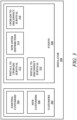
- the artificial intelligence platform 200 includes a neural network 202, a simulator 204, and a modeler 206.
- the artificial intelligence platform 200 may be deployed in a data center of the network 104, elsewhere in the network environment 100, or may be in operable communication with the network environment. While Figures 2-5 are described with respect to a communications node, it will be appreciated that the presently disclosed technology may be applied at the investment cluster level, site level, or other network level for generating an associated model of an impact of customer events.
- the artificial intelligence platform 200 analyzes each communications node in the network environment 100 to determine whether to change a particular communications node from a first node type to a second type in real time as conditions within the network environment 100 change. In one implementation, the artificial intelligence platform 200 generates a list of each communications node ranked according to a priority for changing the node type. As conditions within and surrounding the network environment 100 change and/or more detailed input data becomes available, the artificial intelligence platform 200 may generate one or more subsequent lists in real time, and if a communications node remains high on the priority list as additional rankings are generated, resources may be allocated to change the node type accordingly.
- the neural network 202 obtains input data that may change over time or involve subjective aspects, recognizes patterns in the input data, and interprets the patterns through machine perception, labeling, clustering raw input, and/or other clustering, classification, and correlating mechanisms. Through the interpretation of these patterns, the neural network 202 generates dynamic simulation inputs for the communications node to identify one or more customer populations with an increased expected penetration, thereby micro-targeting specific customer populations and associated communications nodes that have an increased probability of being a priority for changing the node type.
- the dynamic simulation inputs may include, without limitation, customer demographics, competitor information, regional information, and/or the like.
- the customer demographics may include various information about the makeup, behavior, and preferences of the customer population, such as likeliness to subscribe to the telecommunication services, price sensitivity, emphasis on certain features (e.g., weighing price versus internet speed), the type telecommunication services desired and at what level, and/or the like.
- the neural network 202 may generate customer demographics specifying that the customer population desires high speed internet and weighs price and internet speed, such that a medium speed service is desired that may not include the fastest speed or best service but provides a quality service at a reduced price.
- the competitor information may include data regarding how many competitors exist in the geographic region associated with the customer population, services offered by those competitors that are in direct competition with the services provided by the network provider, likelihood that the customers will select the network provider over a competitor, and/or the like.
- the regional information may include other changing or subjective information unique to the customer population or the network capabilities in the geographic region that may impact the customer population for a particular communications node. For example, the topology of the geographic region for the communications node may be such that certain node types are impractical to deploy regardless of other factors.
- the neural network 202 generates customer population statistics, such as a new sales rate, in the form of an expected penetration for a customer population associated with a selected communications node.
- the new sales rate is generated by the neural network 202 based on the dynamic simulation inputs for the communications node.
- the new sales rate may be limited to modeled sites without an active customer such that there cannot be more customers than sites.
- the current customer state is loaded into the simulator 204 as a customer set at a starting point (e.g., month 0).
- the simulator 204 simulates the customer set over time as a discrete event simulation for a node type and outputs customer events.
- the customer events indicate how the customer population for the communications node changes over time. For example, over time, customers may disconnect from service, subscribe to service, upgrade service, downgrade service, and/or the like.
- the simulator 204 outputs customer events, including a customer count and revenue curve, which may be aggregated by speed or otherwise by node type, bill rate, month, and/or the like.
- the modeler 206 generates a model of an impact of the customer events.
- the impact may include performance analytics for the communications node for the node type.
- the performance analytics for each node type may be compared to determine whether to modify the node type for the communications node.
- the simulator 204 and the modeler 206 may be run for each selected node type for aggregation and comparison.
- a particular node type that may be representative of an upgrade scenario, downgrade scenario, or no change scenario is selected, and the simulator 204 simulates customer events over time for the particular node type.
- the output of the simulation for the particular node type may then be compared to the output of the simulation of another node type with performance analytics for each simulation output generated by the modeler 206 for comparison.
- the modeler 206 generates cash flows for the communications node according to the node type based on the customer counts, associated revenue, and consumer costs. Stated differently, the modeler 206 outputs performance analytics, including a financial impact in the form of profit, for each simulation of a different node type, and the modeler 206 generates a comparison of the performance analytics for each node type. The comparison may be in the form of a priority list sorting the communications nodes according to one or more performance parameters. In one implementation, additional data for each of the communications nodes in the priority list is gathered and input into the simulator 204 to rerun the simulation of the node type and obtain a verified simulation output.
- the simulator 204 obtains a customer set 302 for a selected communications node.
- the customer set 302 may include existing customers 304 extracted for the selected communications node with internet speed, price, install date, and/or other input information.
- the customer set 302 may further include new customers 306 generated based on a new sales rate and offer distribution.
- the neural network 202 generates the new sales rate as a percentage of a customer population that subscribes to services. As noted above, the new sales rate may be limited to sites with no active customers to limit the number of customers to less than the number of sites.
- the new sales rate may be expressed in a continuous domain exponentially distributed random variable providing a population statistic of a number of sales per month that may be applied to a sub-population of living units associated with the communications node.
- the offer distribution provides a speed and price point of a sale by node type run against the living units of the customer population.
- the offer distribution assumes all offer types for services with a probability adding to one, so the offer distribution may be a uniformly distributed random variable.
- the new sales rate provides a time of a next sale identified from the exponential distributed random variable through discrete event simulation and the offer distribution identifies what services are involved with the next sale.
- the customer set 302 may be generated by the neural network 202 based on the dynamic simulation inputs and/or from an empirical sample of the customer population.
- the install to upgrade survival function 312 represents a customer that installs a service followed by the next event being the customer upgrading the service and is generated based on new sale service type and internet speed. Because the upgrade changes the service type, a new offer distribution 314 by speed and price point for each service type is utilized to determine what the customer upgrades to. Following the upgrade, an upgrade to disconnect survival function 316 represents the next event following the upgrade being the customer disconnecting the service and is generated based on an upgraded service type and internet speed.
- the survival functions 310, 312, and 316 predict how long it will take for each of these events to occur. Over a long enough time, each of the customers in the customer population will disconnect with a mean survival of the portion of the customer population that has upgraded service being longer than the portion of the customer population that has not upgraded.
- the survival functions 310, 312, and 316 are generated based on a Kaplan-Meier estimator survival analysis by service type and internet speed. However, other survival functions, such as proportional hazard models, and/or the like may be utilized.
- each of the survival functions 310, 312, and 316 are output as an interactive survival curve having a movable point that may be dragged along the survival curve to display a speed bucket of the different node types and/or service types for a communication node with survival probability at each month.
- the install to upgrade survival function 312 may be depicted as a survival curve showing a probability that a customer lasts until a given month without upgrading. Customers who ultimately disconnect may be included in the install to upgrade survival function 312 until the point of disconnection, at which time the customer drops from the survival curve.
- the survival curves may show a probability that a customer lasts until a given month without disconnecting.
- the survival curves are based on empirical data where they will each approach one point at which there is an insufficient sample size to continue to generate the survival curves based on empirical data.
- the various survival functions 310, 312, and 316 may be generated according to an exponential survival function, which assumes a constant death rate where over time customers will disconnect causing a number of the surviving population to decrease but that at any remaining time slice, the probability of disconnecting remains the same.
- the exponential survival function may be expressed as: e - ⁇ t , where ⁇ is the rate and t is time.
- the simulator 204 simulates the customer set 302 over time for a selected node type for the communications node as a discrete event simulation and outputs customer events 308 according to the new customers 306 and the survival functions 310, 312, and 316.
- the simulator 204 generally simulates customers and revenue for a selected node type for a given communications node.
- the simulation 204 models the customer set 302 for the node type over time, where an event 308 is simulated for each customer as a for loop discrete event simulation.
- the simulator 204 determines whether the next event is going to be an event with an existing customer 304 or an event with a new customer 306.
- the existing customers 304 are sorted into a list according to the next event for each customer, such that the customer at a top of the sorted list of the existing customers 306 is the customer for whom the next event 308 will occur first.
- a simulation time from time 0 to time t (in months) is set for the simulator 204.
- a randomly generated number is utilized in the install to upgrade survival function 312 and the install to disconnect survival function 310 to determine whether an upgrade event occurs first or a disconnect event occurs first for the first customer of the existing customers 304 during time t. If the upgrade event occurs first, the customer event 308 for the first customer is an upgrade event, and if the disconnect event occurs first, the customer event 308 for the first customer is a disconnect event.
- the new sales rate for obtaining the new customers 306 may be expressed as an exponentially distributed random variable to determine a time of a next sale event for a given site. As such, if the time to whichever of the upgrade event or disconnect event occurred earlier is less than or equal to the next sale event for a new customer 306, then the next event 308 will be the upgrade/disconnect event for the first customer of the existing customers 304. On the other hand, if the time to the upgrade or disconnect event for the first customer of the existing customers 304 is less than the next sale event for a new customer 306, then the next event is an install event occurring at the time of the next sales event.
- next event is with the existing customers 304 or the new customers 306
- the customer is appended to the events 308 and resorted within the customer set 302. More particularly, in one implementation, if the next event was an install with a new customer 306, the new customer 306 is added to the existing customers 306, and the existing customers 306 is resorted to position the next customer that will have an event at the top. If the next event was a disconnect with the first customer at the top of the list of the existing customers 306, then the first customer is removed from the existing customers 306.
- next event was an upgrade event with the first customer at the top of the list of the existing customers 306, then the new offer distribution 314 determines the new internet speed and price point by the service type for the first customer, and this information is appended to the first customer.
- the first customer is then resorted within the existing customers 306 where the next event for this customer will be a disconnect with timing dictated with the upgrade to disconnect survival function 316. As such, this customer will be further down the sorted list of the existing customers 306 for the next events.
- the simulator 204 will continue to run the simulation of the customer set 302 until the time t elapses, at which time the simulator 204 outputs the customer events for the selected node type of the particular communications node over time t.
- the customer events include a customer count aggregated by event type and a revenue curve.
- the customer count may include the number of customers at the end of the simulation that had an install event, an upgrade event, and a disconnect event, as well as the total number of customers remaining. These values may be expressed as an install count, an upgrade count, a disconnect count, and a customers end count.
- the revenue curve may include a total revenue, an install revenue, a customers end revenue, a downgrade revenue, an upgrade revenue, and a disconnect revenue.
- the simulation months represents the amount of time t in months (or some other interval) over which the communications node is simulated for the customer set 302.
- the simulation time indicates how long it took the simulator 204 to complete the simulation. For example, the simulator 204 may complete each simulation in milliseconds.
- an upgrade to disconnect mean survival of the upgrade to disconnect survival function 316 is calculated by install speed. More particularly, based on the new offer distribution 314, the upgrade to disconnect survival function 316 is probability weighted to obtain the upgrade to disconnect mean survival by the install speed. The mean times from install to upgrade and from install to disconnect are then calculated, and the upgrade to disconnect is combined with the install to upgrade time. A combined service survival is calculated from the install to upgrade time, including the upgrade to disconnect mean survival, and the install to disconnect time. The mean survival time based on install speed for the combined service survival is calculated in sigma discrete space with a continuous integral that integrates over continuous space.
- An operation 406 determines a second time until a disconnect event occurs for each customer of the existing customer set.
- the operation 406 utilizes an install to disconnect survival function in the form of a Kaplan-Meier estimator survival analysis by service type and internet speed.
- An operation 408 sorts the existing customer set into a sorted customer set according to a time until a next event for each of the plurality of existing customers. The sorted customer set includes a first customer having a first occurring next event of the next events.
- An operation 410 determines a third time until a next sales event occurs for a new customer.
- the operation 410 utilizes a new sales rate and offer distribution to determine the third time until the next sales event.
- An operation 412 generates a customer event for the first customer when the earlier of the first time and the second time occurs before the third time.
- the customer event is an upgrade event where the first time occurs before the second time, and the customer event is a disconnect event where the second time occurs before the first time.
- the customer event generated is an install event for the new customer.
- an operation 452 obtains an existing customer set.
- the existing customer set includes a plurality of existing customers corresponding to a plurality of sites, such as living units, commercial units, customer units, and/or the like, connected to a wire center through a communications node having a current node type.
- a simulation is independently completed, and then the simulations may be combined to represent a fully simulated set of existing customers and new customers.
- an operation 454 identifies each customer of the existing customer set with an active service at the corresponding site.
- an operation 456 determines a first time until an upgrade event occurs and an operation 458 determines a second time until a disconnect event occurs for each customer with an active service.
- An operation 460 compares the two times to determine a next event and a next event time.
- An operation 462 identifies, for each customer of the existing customer set, customers without an active service at the corresponding site. For customers without an active service, an operation 464 determines a time until a new sales event occurs for a new customer. An operation 466 then combines the simulations of each customer of the existing customer set based on the determined next events for each customer.
- an operation 502 obtains a customer set for the communications node.
- the customer set includes an existing customer set and a new customer set.
- the new customer set may be generated by a neural network using a new sales rate and offer distribution.
- An operation 504 generates a set of customer events for a selected node type of the communications node using a simulator by simulating the customer set over time through a discrete event simulation.
- the discrete event simulation may involve inputs of two types of offer distributions and three types of survival curves, such as an install to disconnect survival curve, an install to upgrade survival curve, and an upgrade to disconnect curve.
- the set of customer events may include customer counts for each event type, such as install events, disconnect events, upgrade events, and total customer count, as well as revenue curves for each type of event and total revenue for the selected node type.
- An operation 506 models an impact of the customer events for the selected node type. The impact may include performance analytics in the form of overall cost and profit for the selected node type of the communications node.
- An operation 508 selects the node type for the communications node based on the impact. For example, the operation 508 may selected the node type based on a comparison of the impact for the selected node type to a second impact for another node type. The node type of the communications node may then changed accordingly.
- clustering is typically in the n-squared space, such that as n objects, such as sites, are clustered together, the computational time for clustering is n-squared, making the computation time for clustering operations significantly high and introducing delays and challenges into the GPON overbuild analysis.
- the network constraints may be used to simplify the clustering process to a fast and computationally efficient two-step analysis involving pre-partitioning of sites into site footprints and clustering of the sites within defined buildable areas of a site footprint.
- data corresponding to sites within the network is pre-partitioned into one or more site footprints based on geography.
- the data may be pre-partitioned based on geography at a regional level, a state level, a core based statistical area (CBSA) level, a zip code level, and/or along other population, metropolitan, and/or geographical boundaries.
- CBSA core based statistical area
- the data may be pre-partitioned into one or more site footprints based on other network characteristics (e.g., characteristics of the sites), the customer population, and/or the like.
- data corresponding to network characteristics and customer populations of the network is obtained from various internal and external data sources and stored in one or more databases for pre-partitioning.
- data gathered from one or more internal sources of the network environment 100 may include, without limitation, distribution point data for all existing sites and potential new build sites and account information for all present customers associated with the sites.
- the distribution point data may include geospatial locations of each of the sites (e.g., as latitude and longitude coordinates), administrative information for each of the sites (e.g., state, zip code, census FIPS block, etc.), current network enablement for each of the sites, unit type of each of the sites (e.g., single family, multi-dwelling, small business, multi-business complex, etc.), and/or the like.
- the account information may include a current service status for each of the customers, including enablement type, purchased speed, and billing rates, and/or the like.
- Data gathered from one or more external sources of the network environment 100 may include, without limitation, unit-level demographics data, location details, and/or other information relevant to the sites and/or the customer population that is publicly available or available through purchase from external providers.
- the unit-level demographics data may include a primary occupant income level, an ownership status (i.e., whether the site is rented or owner occupied), occupant age, internet usage, education level, and/or the like.
- the location details may include competitor information for other broadband competitors, population density, census block IDs and geospatial shapes, and/or the like.
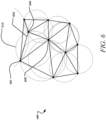
- a footprint graph 600 representing pre-partitioned sites is illustrated.
- the artificial intelligence platform 200 to define each buildable area, the artificial intelligence platform 200 generates the footprint graph 600, which provides a graphical representation of the sites within a site footprint with each of the sites represented as a vertex (e.g., vertices 602, 606, and 608).
- the location of each vertex on the footprint graph 600 may be based on geospatial information of each sites. For example, geospatial (e.g., latitude and longitude) coordinates for each sites obtained from the pre-partitioned data may be used to define corresponding vertices in the footprint graph 600.
- the geospatial coordinates may represent a center of a specific parcel of a site, a network distribution point within a parcel of a site, or another location defining a site.
- the nearest neighbor information is generated through Delaunay triangulation of the vertices within the footprint graph 600.
- Delaunay triangulation generally involves a triangulation of a convex hull of points in a diagram in which every circumcircle of a triangle is an empty circle, such that for a given set P of discrete points in a plane is a triangulation DT(P) such that no point in P is inside the circumcircle of any triangle in DT(P). More particularly, for every three vertices in the footprint graph 600, such as vertices 602, 606, and 608, a circle 610 is drawn through them.
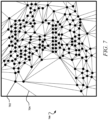
- the nearest neighbor connectivity of the fully connected graph 700 is a first operation of defining a buildable area.
- logic is applied to the nearest neighbor connectivity to determine which of the connections 704 are buildable connections to generate a validated buildable area.
- the nearest neighbor connectivity of the fully connected graph 700 generated through Delaunay triangulation for example, provides a default approximation of the connectivity of every vertex 702, but some of those connections 704 may not be valid for purposes of the buildable area.
- edge attributes may be aligned with various aspects of the network modification at issue, such as a GPON overbuild, that may impact expected return and/or costs.
- the Euclidean distance between the two vertices may be weighted to account for those attributes. For example, not being connected by the same wire center may be weighted with a representative distance that is added to the Euclidean distance. If the sum of the Euclidean distance and the representative distance exceeds the maximum edge distance, the connection is not considered a buildable connection and is removed. If the sum remains less than the maximum edge distance, the connection remains and is considered a buildable connection.
- a buildable area graph 800 is defined with buildable connections 706 of the connections 704 distinguished from other connections. Any connections that are not buildable connections 706 are deleted.
- the buildable connections 706 are a subset of the nearest neighbor connectivity, representing a connectivity between vertices that follows business considerations for buildable area within the context of the network environment 100. As such, the buildable area graph 800 is no longer fully connected once edges not meeting the edge thresholds have been trimmed, such that not every vertex 702 can reach every other vertex through a path of valid edges of the buildable connections 706.
- the buildable area graph 800 is specifically tied to the network environment 100 and the associated network constraints.
- a typical network constraint may be that a GPON overbuild will not include a fiber span that is longer than a specific distance, as described herein.
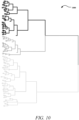
- each buildable area one or more investment clusters are generated for analysis as independent investment opportunities for network modification, for example, through GPON overlay.
- an initial clustering threshold is applied to the buildable area to distinguish buildable areas that are unlikely to be a viable investment.
- the initial clustering threshold may be, for example, a number of sites included within the buildable area. Thus, any buildable areas that have fewer sites that the initial clustering threshold may not be considered as a viable investment opportunity and are not further analyzed for network modification.
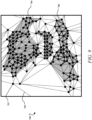
- a connected buildable area graph 900 is shown where the buildable area includes one or more buildable subgroups represented as disconnected subgraphs 708.
- Each of the disconnected subgraphs 708 is a portion of the fully connected graph 700 that remain connected internally but is disconnected from other subgraphs. Disconnected means that there is no buildable connection 706 (valid edge) that connects one of the vertices 702 in one disconnected subgraph 708 to one of the vertices 702 in another disconnected subgraph 708.
- each of the disconnected subgraphs 708 represents a set of sites that is contiguous according to logic that is relevant to the network architecture of the network environment 100 and network modification considerations, such as GPON build considerations.
- the fully connected graph 700 is a fully connected graphical object with each of the vertices 702 connected to nearest neighbors with the edges 704.
- the buildable area graph 800 is obtained by selectively removing or otherwise altering the edges 704, such that only buildable connections 706 remain. Based on the buildable connections 706, any disconnected subgraphs 708 are identified. To identify the disconnected subgraphs 708, the buildable area graph 800 may be traversed through breadth or depth traversal. If no disconnected subgraphs 708 exist, a single contiguous cluster is obtained. Further, some of the vertices 702 may end up isolated from any of the disconnected subgraphs 708. Such vertices correspond to sites that are in an area with a low enough population that they are not represented as part of any cluster.
- the intelligence platform provides a workflow to manage the process of evaluating potential investments in a telecommunications network.
- the workflow generally considers how much is a feed to a buildable area is going to cost, how many sites are there in the buildable area, and what competition exists for the buildable area, among other factors.
- a quick analysis of a viability of a telecommunications build is needed in real time without the burdens associated with computational simulation. For example, for a telecommunication build that is a Greenfield build where a plot of land is being developed with multiple different sites, there is no need to perform clustering.
- the intelligence platform reduces computation time by taking a given Greenfield market having a specific number of sites and generates a telecommunications build plan including estimated financials for the potential Greenfield build.
- the intelligence platform 200 may pre-simulate fundamental types of sites to generate a simulation set for each type of telecommunications build.
- the corresponding financials for a selected simulation may be aggregated according to the number of sites in the buildable area for the telecommunications build to obtain combined estimated financials for the potential telecommunications build.
- a simulation set is generated for each standard site type based on a site key and telecommunication build type.
- a simulation relevant to a particular telecommunications build may be identified using the site key and the telecommunications build type, with the output from the simulation being extracted for use in computing financials for the telecommunications build.
- the site key provides an envelope of possible outcomes that can be expected for a site of that type.
- the site key may be simulated for a particular telecommunications build type a predetermined number of times (e.g., 10,000) and averaged to generate to provide a smooth set of financials, providing an individual evaluation of a build type for a standard site.
- the financials for a site key may be multiplied by the number of sites in the build having a site type matching the site to obtain a complete estimated financial snapshot for the site type in a potential build. Further, where a telecommunications build has different site types, which is often the case, the complete estimated financial snapshot for each site type may be aggregated into a complete estimated financial snapshot for the potential build.
- a site key is added to the lookup table where the penetration rate for the segment of the customer population associated with the site key is robustly different from the penetration rates for the segments of the customer population corresponding to the existing standard site keys in the sense that they describe different population behavior characteristics.
- the intelligence platform 200 may determine whether the penetration rate for a site key corresponding to owners in high income areas serviced by GPON technology has different population behavior characteristics from renters in low income areas serviced by GPON technology.
- a simulation set with a plurality of simulations may be generated to provide quick finical information for different types of build scenarios.
- the plurality of simulations may include, for example, a base case where the site already exists with existing customers; a base case where the site already exists with no customers; a Brownfield build overbuilding an existing architecture with existing customers; a Brownfield build overbuilding an existing architecture with no customers; a Greenfield build creating a new build with existing customers; and a Greenfield build creating a new build with no customers.
- a telecommunications build will be dictated in part by an agreement.
- a build involving sites forming part of a multiple dwelling unit complex such as an apartment building, condominium building, a mixed use commercial development, and/or the like, may involve an exclusive contract providing a bulk deal servicing all the associated sites.
- Such an exclusive deal removes competitors as a factor, since each customer is limited to accepting the service or not having service.
- agreement types for a build may impact financial performance and thus be a parameter from which a site key is generated.
- each site key outputs a distinct customer performance without being too specific.
- the site keys focus on the groups that have distinct financial performance within a build and represent an average of each distinct group.
- One or more site keys are dictated by the specifics of each build and may be selected to analyze the financials of the build. For example, a drop down menu listing the site keys with differing level of detail may be used to select an appropriate site key.
- site keys may be automatically selected by the intelligence platform 200 based on an analysis of the build. The site key with the most specific detail available may be selected. For example, if the only information known about a site in a build is that the site is in a high income multiple dwelling unit, that site key may be selected.
- a site key for high income, owned multiple dwelling unit is selected. Based on the financials output for the telecommunication build, a telecommunication build plan is generated, including a determination of whether to move forward with the build, modify the build, or not move forward with the build.
- the intelligence platform 200 obtains a plurality of demographic parameters for a customer population associated with a telecommunications network and a plurality of site parameters for sites associated with the customer population of the telecommunications network.
- the plurality of demographic parameters may correspond to characteristics of customers in the customer population of the telecommunication network.
- the customers include existing customers, new customers, and/or potential customers.
- the plurality of demographic parameters may include, for example, income level, age, education level of the customers, and/or the like.
- the plurality of site parameters correspond to characteristics of the sites associated with the customer population of the telecommunications network.
- the sites include at least one of existing sites, new sites, or proposed sites.
- the plurality of site parameters may include ownership status, connection type, service type, occupancy status, unit type, node type of a communications node for the sites, and/or the like.
- the node type may be ColP, FTTN, or FTTP, for example.
- the unit type includes, without limitation, at least one of a multiple dwelling unit, a single family unit, a living unit, a business unit, and/or a customer unit.
- the ownership status includes leased, owned, and/or the like.
- the intelligence platform 200 generates a site key having a subset of the plurality of demographic parameters and/or a subset of the plurality of site parameters.
- the site key provides a penetration rate for a segment of the customer population associated with the telecommunication services.
- the intelligence platform 200 generates a simulation set for the site key.
- the simulation set includes a plurality of simulations for the site key, with each of the simulations having a set of customer events for a telecommunications build type.
- the set of customer events may be generated by simulating a customer set for the site key over time through a discrete event simulation, as described herein.
- the customer events include a customer count, a revenue curve, and/or the like, as described herein.
- the discrete event simulation may further be one of a plurality of discrete event simulations with the set of customer events being an average of a plurality of customer events generated through the plurality of discrete event simulations.
- the telecommunications build type is: a base build; a brownfield build; or a greenfield build
- the plurality of simulations for the site key include one or more of: a base build with no customers simulation; a base build with existing customers simulation; a brownfield build with no customers simulation; a brownfield build with existing customers simulation; a greenfield build with no customers simulation; and a greenfield build with existing customers simulation.
- the simulation set may be generated for the site key based on a determination of whether the site key has behavioral characteristics distinct from one or more standard site keys for the telecommunication network.
- the determination of whether the site key has behavioral characteristics distinct from the one or more standard site keys may include comparing a corresponding penetration rate for a corresponding segment of the customer population for each of the one or more standard site keys to the penetration rate for the site key.
- the simulation set may be stored in at least one database, with each of the plurality of simulations in the simulation set being selectable to generate a telecommunications build plan for providing the telecommunications services to a telecommunications buildable area of the telecommunications network.
- Figure 12 illustrates example operations 1200 for generating a simulation set for intelligent network optimization.
- an operation 1202 obtains a site type for a site in a telecommunications buildable area for providing telecommunication services in a telecommunications network
- operation 1204 obtains a telecommunications build type for the telecommunications buildable area.
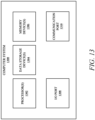
- the environment transducer devices may generate signals to impose some effect on the environment either local to or remote from the example computing device 1300, such as, physical movement of some object (e.g., a mechanical actuator), heating or cooling of a substance, adding a chemical substance, and/or the like.
- some object e.g., a mechanical actuator
- heating or cooling of a substance e.g., heating or cooling of a substance, adding a chemical substance, and/or the like.
- One or more such communication interface devices may be utilized via the communication port 1310 to communicate one or more other machines, either directly over a point-to-point communication path, over a wide area network (WAN) (e.g., the Intemet), over a local area network (LAN), over a cellular (e.g., third generation (3G) or fourth generation (4G)) network, or over another communication means. Further, the communication port 1310 may communicate with an antenna or other link for electromagnetic signal transmission and/or reception.
- WAN wide area network
- LAN local area network
- 4G fourth generation
- customer information, dynamic simulation inputs, network data, and software and other modules and services may be embodied by instructions stored on the data storage devices 1304 and/or the memory devices 1306 and executed by the processor 1302.
- the computer system 1300 may be integrated with or otherwise form part of various components of the network environment 100.
- the methods disclosed may be implemented as sets of instructions or software readable by a device. Further, it is understood that the specific order or hierarchy of steps in the methods disclosed are instances of example approaches. Based upon design preferences, it is understood that the specific order or hierarchy of steps in the method can be rearranged while remaining within the disclosed subject matter.
Landscapes
- Engineering & Computer Science (AREA)
- Computer Networks & Wireless Communication (AREA)
- Signal Processing (AREA)
- Theoretical Computer Science (AREA)
- Physics & Mathematics (AREA)
- Software Systems (AREA)
- Artificial Intelligence (AREA)
- Evolutionary Computation (AREA)
- Computing Systems (AREA)
- General Physics & Mathematics (AREA)
- Business, Economics & Management (AREA)
- Computer Vision & Pattern Recognition (AREA)
- General Engineering & Computer Science (AREA)
- Data Mining & Analysis (AREA)
- Mathematical Physics (AREA)
- Medical Informatics (AREA)
- Human Resources & Organizations (AREA)
- Economics (AREA)
- Strategic Management (AREA)
- Life Sciences & Earth Sciences (AREA)
- Biophysics (AREA)
- Computational Linguistics (AREA)
- General Health & Medical Sciences (AREA)
- Molecular Biology (AREA)
- Biomedical Technology (AREA)
- Databases & Information Systems (AREA)
- Health & Medical Sciences (AREA)
- Electromagnetism (AREA)
- Game Theory and Decision Science (AREA)
- Development Economics (AREA)
- Entrepreneurship & Innovation (AREA)
- Marketing (AREA)
- Operations Research (AREA)
- Quality & Reliability (AREA)
- Tourism & Hospitality (AREA)
- General Business, Economics & Management (AREA)
- Telephonic Communication Services (AREA)
- Management, Administration, Business Operations System, And Electronic Commerce (AREA)
- Mobile Radio Communication Systems (AREA)
Applications Claiming Priority (4)
| Application Number | Priority Date | Filing Date | Title |
|---|---|---|---|
| US201962808189P | 2019-02-20 | 2019-02-20 | |
| US201962808183P | 2019-02-20 | 2019-02-20 | |
| PCT/US2020/018877 WO2020172316A1 (en) | 2019-02-20 | 2020-02-19 | Systems and methods for communications node upgrade and selection |
| EP20758518.3A EP3928527A4 (en) | 2019-02-20 | 2020-02-19 | SYSTEMS AND METHODS FOR EXPANSION AND SELECTION OF COMMUNICATION NODES |
Related Parent Applications (2)
| Application Number | Title | Priority Date | Filing Date |
|---|---|---|---|
| EP20758518.3A Division EP3928527A4 (en) | 2019-02-20 | 2020-02-19 | SYSTEMS AND METHODS FOR EXPANSION AND SELECTION OF COMMUNICATION NODES |
| EP20758518.3A Division-Into EP3928527A4 (en) | 2019-02-20 | 2020-02-19 | SYSTEMS AND METHODS FOR EXPANSION AND SELECTION OF COMMUNICATION NODES |
Publications (2)
| Publication Number | Publication Date |
|---|---|
| EP4072103A1 EP4072103A1 (en) | 2022-10-12 |
| EP4072103B1 true EP4072103B1 (en) | 2025-04-09 |
Family
ID=69846565
Family Applications (3)
| Application Number | Title | Priority Date | Filing Date |
|---|---|---|---|
| EP20712744.0A Active EP3928473B1 (en) | 2019-02-20 | 2020-02-19 | Systems and methods for communications node upgrade and selection |
| EP22168217.2A Active EP4072103B1 (en) | 2019-02-20 | 2020-02-19 | Systems and methods for communications node upgrade and selection |
| EP20758518.3A Pending EP3928527A4 (en) | 2019-02-20 | 2020-02-19 | SYSTEMS AND METHODS FOR EXPANSION AND SELECTION OF COMMUNICATION NODES |
Family Applications Before (1)
| Application Number | Title | Priority Date | Filing Date |
|---|---|---|---|
| EP20712744.0A Active EP3928473B1 (en) | 2019-02-20 | 2020-02-19 | Systems and methods for communications node upgrade and selection |
Family Applications After (1)
| Application Number | Title | Priority Date | Filing Date |
|---|---|---|---|
| EP20758518.3A Pending EP3928527A4 (en) | 2019-02-20 | 2020-02-19 | SYSTEMS AND METHODS FOR EXPANSION AND SELECTION OF COMMUNICATION NODES |
Country Status (6)
| Country | Link |
|---|---|
| US (11) | US11246045B2 (pl) |
| EP (3) | EP3928473B1 (pl) |
| CA (4) | CA3130892A1 (pl) |
| ES (1) | ES3029870T3 (pl) |
| PL (1) | PL4072103T3 (pl) |
| WO (2) | WO2020172325A1 (pl) |
Families Citing this family (20)
| Publication number | Priority date | Publication date | Assignee | Title |
|---|---|---|---|---|
| PL4072103T3 (pl) * | 2019-02-20 | 2025-08-04 | Level 3 Communications, Llc | Systemy i sposoby aktualizacji i wyboru węzła komunikacyjnego |
| US11354593B2 (en) * | 2019-06-14 | 2022-06-07 | Subcom, Llc | Techniques to generate network simulation scenarios |
| EP3805993A1 (en) * | 2019-10-10 | 2021-04-14 | Siemens Aktiengesellschaft | Generation of graph-structured representations of brownfield systems |
| US11966927B2 (en) * | 2019-11-06 | 2024-04-23 | Adp, Inc. | Multi-task deep learning of customer demand |
| US11863298B1 (en) * | 2019-11-26 | 2024-01-02 | ZaiNar, Inc. | Method for identifying and diagnosing failures in pairwise time synchronization and frequency calibration in a mesh network |
| US11785482B1 (en) * | 2019-11-26 | 2023-10-10 | ZaiNar, Inc. | Method for identifying and diagnosing failures in pairwise time synchronization and frequency calibration in a mesh network |
| US11228523B2 (en) * | 2020-06-01 | 2022-01-18 | City University Of Hong Kong | Infrastructure link path arrangement determination method and system |
| US11178011B1 (en) * | 2020-07-16 | 2021-11-16 | Micro Focus Llc | Identifying representative entities in clusters for it management |
| US12133086B2 (en) * | 2020-08-19 | 2024-10-29 | Dish Wireless L.L.C. | System and method for radio frequency (rf) network design |
| US11212710B1 (en) * | 2020-11-13 | 2021-12-28 | At&T Intellectual Property I, L.P. | Zero touch cellular carrier configuration |
| PT116955B (pt) * | 2020-12-17 | 2023-01-16 | Altice Labs S A | Procedimento para configuração de uma célula de rede de distribuição ftth |
| CN113055988B (zh) * | 2021-02-04 | 2022-06-17 | 广州杰赛科技股份有限公司 | 一种基站群的集中供电方法、装置、设备及介质 |
| EP4092963B1 (en) * | 2021-05-20 | 2024-05-08 | Ovh | Method and system for datacenter network device maintenance |
| CN113490222A (zh) * | 2021-06-18 | 2021-10-08 | 哈尔滨理工大学 | 异构无线传感网络覆盖洞修补方法 |
| US11856412B2 (en) | 2021-12-17 | 2023-12-26 | T-Mobile Usa, Inc. | Telecommunications network planning system |
| US12160753B2 (en) | 2021-12-17 | 2024-12-03 | T-Mobile Usa, Inc. | Telecommunications network coverage optimization system |
| US12294407B1 (en) | 2024-08-12 | 2025-05-06 | Frontier Communications Holdings, Llc | Systems and methods for fiber upstream trace determination |
| US12294819B1 (en) | 2024-08-12 | 2025-05-06 | Frontier Communications Holdings, Llc | Systems and methods for external ethernet qualification |
| US12483814B1 (en) * | 2024-08-12 | 2025-11-25 | Frontier Communications Holdings, Llc | Systems and methods for qualifying on-ramp facilities in networking systems |
| US12294820B1 (en) | 2024-08-12 | 2025-05-06 | Frontier Communications Holdings, Llc | Systems and methods for providing route redundancy in networking systems |
Family Cites Families (29)
| Publication number | Priority date | Publication date | Assignee | Title |
|---|---|---|---|---|
| US6385312B1 (en) | 1993-02-22 | 2002-05-07 | Murex Securities, Ltd. | Automatic routing and information system for telephonic services |
| US6345239B1 (en) * | 1999-08-31 | 2002-02-05 | Accenture Llp | Remote demonstration of business capabilities in an e-commerce environment |
| US6606744B1 (en) * | 1999-11-22 | 2003-08-12 | Accenture, Llp | Providing collaborative installation management in a network-based supply chain environment |
| US7130807B1 (en) * | 1999-11-22 | 2006-10-31 | Accenture Llp | Technology sharing during demand and supply planning in a network-based supply chain environment |
| US7085697B1 (en) * | 2000-08-04 | 2006-08-01 | Motorola, Inc. | Method and system for designing or deploying a communications network which considers component attributes |
| US7243075B1 (en) | 2000-10-03 | 2007-07-10 | Shaffer James D | Real-time process for defining, processing and delivering a highly customized contact list over a network |
| US20050143077A1 (en) * | 2003-12-24 | 2005-06-30 | Hugo Charbonneau | System and method for designing a communications network |
| US20050169452A1 (en) * | 2004-02-03 | 2005-08-04 | Sigma Dynamics, Inc. | Method and apparatus for self-evaluation and randomization for predictive models |
| GB2432992B (en) | 2005-11-18 | 2008-09-10 | Cramer Systems Ltd | Network planning |
| US7620716B2 (en) * | 2006-01-31 | 2009-11-17 | Dell Products L.P. | System and method to predict the performance of streaming media over wireless links |
| US8965409B2 (en) * | 2006-03-17 | 2015-02-24 | Fatdoor, Inc. | User-generated community publication in an online neighborhood social network |
| US20100003030A1 (en) * | 2006-03-24 | 2010-01-07 | Gilfedder Timothy H | Optimisation of passive optical networks |
| US20090296584A1 (en) | 2008-06-03 | 2009-12-03 | Tellabs Vienna, Inc. | Method and apparatus to support customer premises diagnostics and service simulation via test user interface devices |
| US9152946B2 (en) * | 2010-05-21 | 2015-10-06 | Brokersavant Inc. | Apparatuses, methods and systems for a lead generating hub |
| US8930245B2 (en) * | 2010-06-23 | 2015-01-06 | Justin Streich | Methods, systems and machines for identifying geospatial compatibility between consumers and providers of goods or services |
| CA2732301A1 (en) | 2011-02-18 | 2012-08-18 | Doleweerd Consulting Inc. | Browser based mapping region builder |
| US20130185024A1 (en) * | 2012-01-12 | 2013-07-18 | Honeywell International Inc. | System for automatic object classification and tagging in an rf planning tool |
| US9660874B2 (en) | 2012-12-13 | 2017-05-23 | Level 3 Communications, Llc | Devices and methods supporting content delivery with delivery services having dynamically configurable log information |
| US10346862B2 (en) * | 2013-10-08 | 2019-07-09 | Accenture Global Solutions Limited | Migration system to migrate users to target services |
| WO2015200359A1 (en) | 2014-06-24 | 2015-12-30 | Level 3 Communcations, Llc | Apparatus, system, and method for visualizing telecommunications resources |
| US9753477B2 (en) * | 2014-09-15 | 2017-09-05 | Honeywell International Inc. | Load forecasting for residential sector demand response |
| US10142187B2 (en) * | 2015-04-29 | 2018-11-27 | Accenture Global Soltuions Limited | Predicting an effect of performing an action on a node of a geographical network |
| US9589210B1 (en) * | 2015-08-26 | 2017-03-07 | Digitalglobe, Inc. | Broad area geospatial object detection using autogenerated deep learning models |
| US10542330B2 (en) * | 2017-05-31 | 2020-01-21 | Netscout Systems, Inc. | Automatic adaptive network planning |
| US20190372857A1 (en) * | 2018-05-29 | 2019-12-05 | Arris Enterprises Llc | Capacity planning and recommendation system |
| US20200112489A1 (en) * | 2018-10-03 | 2020-04-09 | Centurylink Intellectual Property Llc | Intelligent Network Equipment Failure Prediction System |
| US12464041B2 (en) * | 2019-02-13 | 2025-11-04 | Telefonaktiebolaget Lm Ericsson (Publ) | Industrial automation with 5G and beyond |
| PL4072103T3 (pl) | 2019-02-20 | 2025-08-04 | Level 3 Communications, Llc | Systemy i sposoby aktualizacji i wyboru węzła komunikacyjnego |
| US11284215B2 (en) * | 2019-02-20 | 2022-03-22 | Level 3 Communications, Llc | Service area determination in a telecommunications network |
-
2020
- 2020-02-19 PL PL22168217.2T patent/PL4072103T3/pl unknown
- 2020-02-19 US US16/795,267 patent/US11246045B2/en active Active
- 2020-02-19 EP EP20712744.0A patent/EP3928473B1/en active Active
- 2020-02-19 CA CA3130892A patent/CA3130892A1/en active Pending
- 2020-02-19 US US16/795,225 patent/US11246044B2/en active Active
- 2020-02-19 WO PCT/US2020/018892 patent/WO2020172325A1/en not_active Ceased
- 2020-02-19 CA CA3222582A patent/CA3222582A1/en active Pending
- 2020-02-19 EP EP22168217.2A patent/EP4072103B1/en active Active
- 2020-02-19 ES ES22168217T patent/ES3029870T3/es active Active
- 2020-02-19 US US16/795,249 patent/US10924947B2/en active Active
- 2020-02-19 CA CA3130940A patent/CA3130940A1/en active Pending
- 2020-02-19 US US16/795,447 patent/US11445385B2/en active Active
- 2020-02-19 EP EP20758518.3A patent/EP3928527A4/en active Pending
- 2020-02-19 WO PCT/US2020/018877 patent/WO2020172316A1/en not_active Ceased
- 2020-02-19 CA CA3222672A patent/CA3222672A1/en active Pending
-
2021
- 2021-12-27 US US17/562,205 patent/US11706645B2/en active Active
- 2021-12-27 US US17/562,472 patent/US11700539B2/en active Active
-
2022
- 2022-09-12 US US17/942,967 patent/US11895515B2/en active Active
-
2023
- 2023-07-06 US US18/218,725 patent/US12089075B2/en active Active
- 2023-07-12 US US18/221,139 patent/US12238548B2/en active Active
-
2024
- 2024-02-02 US US18/431,198 patent/US20240172010A1/en active Pending
- 2024-09-09 US US18/828,317 patent/US20250016587A1/en active Pending
Also Published As
Similar Documents
| Publication | Publication Date | Title |
|---|---|---|
| US12089075B2 (en) | Systems and methods for communications node upgrade and selection | |
| CA2882904C (en) | Service provider network migration | |
| US10346862B2 (en) | Migration system to migrate users to target services | |
| CN110298687B (zh) | 一种区域吸引力评估方法及设备 | |
| CN108960912A (zh) | 用于确定目标位置的方法和装置 | |
| CN110532266A (zh) | 一种数据处理的方法和装置 | |
| HK40081569A (en) | Systems and methods for communications node upgrade and selection | |
| US20250310208A1 (en) | System and method for deploying a communication network | |
| US20250310781A1 (en) | System and method for deploying a communication network | |
| Masarie | Resource allocation for wildland fire suppression planning using a stochastic program |
Legal Events
| Date | Code | Title | Description |
|---|---|---|---|
| PUAI | Public reference made under article 153(3) epc to a published international application that has entered the european phase |
Free format text: ORIGINAL CODE: 0009012 |
|
| STAA | Information on the status of an ep patent application or granted ep patent |
Free format text: STATUS: REQUEST FOR EXAMINATION WAS MADE |
|
| 17P | Request for examination filed |
Effective date: 20220413 |
|
| AC | Divisional application: reference to earlier application |
Ref document number: 3928527 Country of ref document: EP Kind code of ref document: P |
|
| AK | Designated contracting states |
Kind code of ref document: A1 Designated state(s): AL AT BE BG CH CY CZ DE DK EE ES FI FR GB GR HR HU IE IS IT LI LT LU LV MC MK MT NL NO PL PT RO RS SE SI SK SM TR |
|
| REG | Reference to a national code |
Ref country code: HK Ref legal event code: DE Ref document number: 40081569 Country of ref document: HK |
|
| P01 | Opt-out of the competence of the unified patent court (upc) registered |
Effective date: 20230505 |
|
| GRAP | Despatch of communication of intention to grant a patent |
Free format text: ORIGINAL CODE: EPIDOSNIGR1 |
|
| STAA | Information on the status of an ep patent application or granted ep patent |
Free format text: STATUS: GRANT OF PATENT IS INTENDED |
|
| RIC1 | Information provided on ipc code assigned before grant |
Ipc: H04L 41/16 20220101ALN20241014BHEP Ipc: H04L 41/0893 20220101ALI20241014BHEP Ipc: H04L 41/14 20220101AFI20241014BHEP |
|
| INTG | Intention to grant announced |
Effective date: 20241030 |
|
| GRAS | Grant fee paid |
Free format text: ORIGINAL CODE: EPIDOSNIGR3 |
|
| GRAA | (expected) grant |
Free format text: ORIGINAL CODE: 0009210 |
|
| STAA | Information on the status of an ep patent application or granted ep patent |
Free format text: STATUS: THE PATENT HAS BEEN GRANTED |
|
| AC | Divisional application: reference to earlier application |
Ref document number: 3928527 Country of ref document: EP Kind code of ref document: P |
|
| AK | Designated contracting states |
Kind code of ref document: B1 Designated state(s): AL AT BE BG CH CY CZ DE DK EE ES FI FR GB GR HR HU IE IS IT LI LT LU LV MC MK MT NL NO PL PT RO RS SE SI SK SM TR |
|
| REG | Reference to a national code |
Ref country code: GB Ref legal event code: FG4D |
|
| REG | Reference to a national code |
Ref country code: CH Ref legal event code: EP |
|
| REG | Reference to a national code |
Ref country code: DE Ref legal event code: R096 Ref document number: 602020049382 Country of ref document: DE |
|
| REG | Reference to a national code |
Ref country code: IE Ref legal event code: FG4D |
|
| RAP4 | Party data changed (patent owner data changed or rights of a patent transferred) |
Owner name: LEVEL 3 COMMUNICATIONS, LLC |
|
| REG | Reference to a national code |
Ref country code: ES Ref legal event code: FG2A Ref document number: 3029870 Country of ref document: ES Kind code of ref document: T3 Effective date: 20250625 |
|
| REG | Reference to a national code |
Ref country code: NL Ref legal event code: MP Effective date: 20250409 |
|
| PG25 | Lapsed in a contracting state [announced via postgrant information from national office to epo] |
Ref country code: NL Free format text: LAPSE BECAUSE OF FAILURE TO SUBMIT A TRANSLATION OF THE DESCRIPTION OR TO PAY THE FEE WITHIN THE PRESCRIBED TIME-LIMIT Effective date: 20250409 |
|
| REG | Reference to a national code |
Ref country code: AT Ref legal event code: MK05 Ref document number: 1784591 Country of ref document: AT Kind code of ref document: T Effective date: 20250409 |
|
| PG25 | Lapsed in a contracting state [announced via postgrant information from national office to epo] |
Ref country code: FI Free format text: LAPSE BECAUSE OF FAILURE TO SUBMIT A TRANSLATION OF THE DESCRIPTION OR TO PAY THE FEE WITHIN THE PRESCRIBED TIME-LIMIT Effective date: 20250409 Ref country code: PT Free format text: LAPSE BECAUSE OF FAILURE TO SUBMIT A TRANSLATION OF THE DESCRIPTION OR TO PAY THE FEE WITHIN THE PRESCRIBED TIME-LIMIT Effective date: 20250811 |
|
| REG | Reference to a national code |
Ref country code: LT Ref legal event code: MG9D |
|
| PG25 | Lapsed in a contracting state [announced via postgrant information from national office to epo] |
Ref country code: NO Free format text: LAPSE BECAUSE OF FAILURE TO SUBMIT A TRANSLATION OF THE DESCRIPTION OR TO PAY THE FEE WITHIN THE PRESCRIBED TIME-LIMIT Effective date: 20250709 Ref country code: GR Free format text: LAPSE BECAUSE OF FAILURE TO SUBMIT A TRANSLATION OF THE DESCRIPTION OR TO PAY THE FEE WITHIN THE PRESCRIBED TIME-LIMIT Effective date: 20250710 |
|
| PG25 | Lapsed in a contracting state [announced via postgrant information from national office to epo] |
Ref country code: BG Free format text: LAPSE BECAUSE OF FAILURE TO SUBMIT A TRANSLATION OF THE DESCRIPTION OR TO PAY THE FEE WITHIN THE PRESCRIBED TIME-LIMIT Effective date: 20250409 |
|
| PG25 | Lapsed in a contracting state [announced via postgrant information from national office to epo] |
Ref country code: HR Free format text: LAPSE BECAUSE OF FAILURE TO SUBMIT A TRANSLATION OF THE DESCRIPTION OR TO PAY THE FEE WITHIN THE PRESCRIBED TIME-LIMIT Effective date: 20250409 |
|
| PG25 | Lapsed in a contracting state [announced via postgrant information from national office to epo] |
Ref country code: AT Free format text: LAPSE BECAUSE OF FAILURE TO SUBMIT A TRANSLATION OF THE DESCRIPTION OR TO PAY THE FEE WITHIN THE PRESCRIBED TIME-LIMIT Effective date: 20250409 |
|
| PG25 | Lapsed in a contracting state [announced via postgrant information from national office to epo] |
Ref country code: RS Free format text: LAPSE BECAUSE OF FAILURE TO SUBMIT A TRANSLATION OF THE DESCRIPTION OR TO PAY THE FEE WITHIN THE PRESCRIBED TIME-LIMIT Effective date: 20250709 |
|
| PG25 | Lapsed in a contracting state [announced via postgrant information from national office to epo] |
Ref country code: IS Free format text: LAPSE BECAUSE OF FAILURE TO SUBMIT A TRANSLATION OF THE DESCRIPTION OR TO PAY THE FEE WITHIN THE PRESCRIBED TIME-LIMIT Effective date: 20250809 |
|
| PG25 | Lapsed in a contracting state [announced via postgrant information from national office to epo] |
Ref country code: LV Free format text: LAPSE BECAUSE OF FAILURE TO SUBMIT A TRANSLATION OF THE DESCRIPTION OR TO PAY THE FEE WITHIN THE PRESCRIBED TIME-LIMIT Effective date: 20250409 |