EP4071853B1 - Electrode active material and preparation method therefor, electrode, battery, and device - Google Patents
Electrode active material and preparation method therefor, electrode, battery, and device Download PDFInfo
- Publication number
- EP4071853B1 EP4071853B1 EP20952770.4A EP20952770A EP4071853B1 EP 4071853 B1 EP4071853 B1 EP 4071853B1 EP 20952770 A EP20952770 A EP 20952770A EP 4071853 B1 EP4071853 B1 EP 4071853B1
- Authority
- EP
- European Patent Office
- Prior art keywords
- containing compound
- lithium
- coating layer
- sulfur
- electrode active
- Prior art date
- Legal status (The legal status is an assumption and is not a legal conclusion. Google has not performed a legal analysis and makes no representation as to the accuracy of the status listed.)
- Active
Links
Images



Classifications
-
- H—ELECTRICITY
- H01—ELECTRIC ELEMENTS
- H01M—PROCESSES OR MEANS, e.g. BATTERIES, FOR THE DIRECT CONVERSION OF CHEMICAL ENERGY INTO ELECTRICAL ENERGY
- H01M4/00—Electrodes
- H01M4/02—Electrodes composed of, or comprising, active material
- H01M4/36—Selection of substances as active materials, active masses, active liquids
- H01M4/362—Composites
- H01M4/366—Composites as layered products
-
- C—CHEMISTRY; METALLURGY
- C01—INORGANIC CHEMISTRY
- C01G—COMPOUNDS CONTAINING METALS NOT COVERED BY SUBCLASSES C01D OR C01F
- C01G53/00—Compounds of nickel
- C01G53/40—Complex oxides containing nickel and at least one other metal element
- C01G53/42—Complex oxides containing nickel and at least one other metal element containing alkali metals, e.g. LiNiO2
- C01G53/44—Complex oxides containing nickel and at least one other metal element containing alkali metals, e.g. LiNiO2 containing manganese
- C01G53/50—Complex oxides containing nickel and at least one other metal element containing alkali metals, e.g. LiNiO2 containing manganese of the type (MnO2)n-, e.g. Li(NixMn1-x)O2 or Li(MyNixMn1-x-y)O2
-
- H—ELECTRICITY
- H01—ELECTRIC ELEMENTS
- H01M—PROCESSES OR MEANS, e.g. BATTERIES, FOR THE DIRECT CONVERSION OF CHEMICAL ENERGY INTO ELECTRICAL ENERGY
- H01M4/00—Electrodes
- H01M4/02—Electrodes composed of, or comprising, active material
- H01M4/04—Processes of manufacture in general
- H01M4/0471—Processes of manufacture in general involving thermal treatment, e.g. firing, sintering, backing particulate active material, thermal decomposition, pyrolysis
-
- H—ELECTRICITY
- H01—ELECTRIC ELEMENTS
- H01M—PROCESSES OR MEANS, e.g. BATTERIES, FOR THE DIRECT CONVERSION OF CHEMICAL ENERGY INTO ELECTRICAL ENERGY
- H01M4/00—Electrodes
- H01M4/02—Electrodes composed of, or comprising, active material
- H01M4/13—Electrodes for accumulators with non-aqueous electrolyte, e.g. for lithium-accumulators; Processes of manufacture thereof
- H01M4/131—Electrodes based on mixed oxides or hydroxides, or on mixtures of oxides or hydroxides, e.g. LiCoOx
-
- H—ELECTRICITY
- H01—ELECTRIC ELEMENTS
- H01M—PROCESSES OR MEANS, e.g. BATTERIES, FOR THE DIRECT CONVERSION OF CHEMICAL ENERGY INTO ELECTRICAL ENERGY
- H01M4/00—Electrodes
- H01M4/02—Electrodes composed of, or comprising, active material
- H01M4/13—Electrodes for accumulators with non-aqueous electrolyte, e.g. for lithium-accumulators; Processes of manufacture thereof
- H01M4/139—Processes of manufacture
- H01M4/1391—Processes of manufacture of electrodes based on mixed oxides or hydroxides, or on mixtures of oxides or hydroxides, e.g. LiCoOx
-
- H—ELECTRICITY
- H01—ELECTRIC ELEMENTS
- H01M—PROCESSES OR MEANS, e.g. BATTERIES, FOR THE DIRECT CONVERSION OF CHEMICAL ENERGY INTO ELECTRICAL ENERGY
- H01M4/00—Electrodes
- H01M4/02—Electrodes composed of, or comprising, active material
- H01M4/36—Selection of substances as active materials, active masses, active liquids
- H01M4/48—Selection of substances as active materials, active masses, active liquids of inorganic oxides or hydroxides
- H01M4/50—Selection of substances as active materials, active masses, active liquids of inorganic oxides or hydroxides of manganese
- H01M4/505—Selection of substances as active materials, active masses, active liquids of inorganic oxides or hydroxides of manganese of mixed oxides or hydroxides containing manganese for inserting or intercalating light metals, e.g. LiMn2O4 or LiMn2OxFy
-
- H—ELECTRICITY
- H01—ELECTRIC ELEMENTS
- H01M—PROCESSES OR MEANS, e.g. BATTERIES, FOR THE DIRECT CONVERSION OF CHEMICAL ENERGY INTO ELECTRICAL ENERGY
- H01M4/00—Electrodes
- H01M4/02—Electrodes composed of, or comprising, active material
- H01M4/36—Selection of substances as active materials, active masses, active liquids
- H01M4/48—Selection of substances as active materials, active masses, active liquids of inorganic oxides or hydroxides
- H01M4/52—Selection of substances as active materials, active masses, active liquids of inorganic oxides or hydroxides of nickel, cobalt or iron
- H01M4/525—Selection of substances as active materials, active masses, active liquids of inorganic oxides or hydroxides of nickel, cobalt or iron of mixed oxides or hydroxides containing iron, cobalt or nickel for inserting or intercalating light metals, e.g. LiNiO2, LiCoO2 or LiCoOxFy
-
- H—ELECTRICITY
- H01—ELECTRIC ELEMENTS
- H01M—PROCESSES OR MEANS, e.g. BATTERIES, FOR THE DIRECT CONVERSION OF CHEMICAL ENERGY INTO ELECTRICAL ENERGY
- H01M4/00—Electrodes
- H01M4/02—Electrodes composed of, or comprising, active material
- H01M4/36—Selection of substances as active materials, active masses, active liquids
- H01M4/58—Selection of substances as active materials, active masses, active liquids of inorganic compounds other than oxides or hydroxides, e.g. sulfides, selenides, tellurides, halogenides or LiCoFy; of polyanionic structures, e.g. phosphates, silicates or borates
- H01M4/5825—Oxygenated metallic salts or polyanionic structures, e.g. borates, phosphates, silicates, olivines
-
- H—ELECTRICITY
- H01—ELECTRIC ELEMENTS
- H01M—PROCESSES OR MEANS, e.g. BATTERIES, FOR THE DIRECT CONVERSION OF CHEMICAL ENERGY INTO ELECTRICAL ENERGY
- H01M4/00—Electrodes
- H01M4/02—Electrodes composed of, or comprising, active material
- H01M4/62—Selection of inactive substances as ingredients for active masses, e.g. binders, fillers
-
- C—CHEMISTRY; METALLURGY
- C01—INORGANIC CHEMISTRY
- C01P—INDEXING SCHEME RELATING TO STRUCTURAL AND PHYSICAL ASPECTS OF SOLID INORGANIC COMPOUNDS
- C01P2004/00—Particle morphology
- C01P2004/51—Particles with a specific particle size distribution
-
- Y—GENERAL TAGGING OF NEW TECHNOLOGICAL DEVELOPMENTS; GENERAL TAGGING OF CROSS-SECTIONAL TECHNOLOGIES SPANNING OVER SEVERAL SECTIONS OF THE IPC; TECHNICAL SUBJECTS COVERED BY FORMER USPC CROSS-REFERENCE ART COLLECTIONS [XRACs] AND DIGESTS
- Y02—TECHNOLOGIES OR APPLICATIONS FOR MITIGATION OR ADAPTATION AGAINST CLIMATE CHANGE
- Y02E—REDUCTION OF GREENHOUSE GAS [GHG] EMISSIONS, RELATED TO ENERGY GENERATION, TRANSMISSION OR DISTRIBUTION
- Y02E60/00—Enabling technologies; Technologies with a potential or indirect contribution to GHG emissions mitigation
- Y02E60/10—Energy storage using batteries
Definitions
- This application relates to the field of lithium secondary battery technologies, and in particular, to an electrode active material and a preparation method thereof, an electrode, a battery, and an apparatus.
- Positive-electrode active materials of lithium-ion batteries usually include lithium cobalt oxides (LCO), lithium manganese oxides (LMO), lithium iron phosphates (LFP), lithium nickel cobalt aluminum oxides (NCA), lithium nickel cobalt manganese oxides (NMC), and the like. Lithium ions can be reversibly intercalated and deintercalated in the foregoing positive-electrode materials.
- US 2018/0145324 A1 discloses a lithium ion battery and a positive electrode material thereof including a high nickel material and a coating layer. The teaching suggests mixing ammonium sulphate (NH4) 2 SO 4 with the core material (high nickel material), thereby forming a coating of the active electrode material.
- JP 2011 082133 A discloses a positive-electrode active material including a composition with at least one of sulfur, phosphorus and fluorine (F) on the surface of a complex-oxide particle containing transition metal.
- This invention provides a new electrode active material as defined in claim 1. Preferred aspects are defined by the claims depending from claim 1.
- the electrode active material of this disclosure is applied to a battery, where the battery shows a reduced direct current resistance (DCR) growth rate during cycling.
- DCR direct current resistance
- the electrode active material includes:
- a weight content of element S in the electrode active material is 500-5000 ppm, for example, 500-1000 ppm, 1000-1500 ppm, 1500-2000 ppm, 2000-2500 ppm, 2500-3000 ppm, 3000-3500 ppm, 3500-4000 ppm, 4000-4500 ppm or 4500-5000 ppm, and for example, 540-4360 ppm.
- the coating layer further includes one or more of element B, element P, and element F;
- the lithium-containing compound includes a lithium salt; and optionally, the lithium-containing compound includes one or more of the following: Li 2 O, LiOH and Li 2 CO 3 , LiNO 3 , LiPF 6 , lithium oxalate, lithium acetate, LiClO 4 , LiBF 4 , LiCF 3 SO 3 , LiAsF 6 , LiAlCl4, LiN(CF 3 SO 2 ) 2 and LiC(SO 2 CF 3 ) 3 .
- the sulfur-containing compound is an organic sulfur-containing compound.
- the sulfur-containing compound includes one or more of the following: mercaptan, thiophenol, thioether, thioaldehyde, thioketone, thiocarboxylic acid, sulfoxide, sulfone, sulfur oxoacid, and derivatives thereof.
- the sulfur-containing compound includes one or more of the following: thioether (such as straight-chain thioether or cyclic thioether), sulfoxide, sulfone, sulfur oxoacid (such as sulfonic acid, sulfinic acid, or sulfenic acid), and derivatives thereof.
- thioether such as straight-chain thioether or cyclic thioether
- sulfoxide such as straight-chain thioether or cyclic thioether
- sulfur oxoacid such as sulfonic acid, sulfinic acid, or sulfenic acid
- the sulfur-containing compound includes one or more of the following: sulfoxide, sulfone, sulfur oxoacid (such as sulfonic acid, sulfinic acid, or sulfenic acid), and derivatives thereof.
- derivatives of the sulfur oxoacid include one or more of the following: an ester of the sulfur oxoacid, a salt of the sulfur oxoacid (optionally, a lithium salt of the sulfur oxoacid), an acyl halide of the sulfur oxoacid, an amide of the sulfur oxoacid, and a lithium amide salt of the sulfur oxoacid.
- the sulfur oxoacid is an organic sulfur oxoacid.
- the sulfur oxoacid is sulfonic acid, sulfinic acid, or sulfenic acid.
- derivatives of the sulfur oxoacid include one or more of the following: an ester of the sulfur oxoacid, a salt of the sulfur oxoacid (optionally, a lithium salt of the sulfur oxoacid), an acyl halide of the sulfur oxoacid, an amide of the sulfur oxoacid, and a lithium amide salt of the sulfur oxoacid.
- R1 and R2 each are selected from hydroxyl, amino, C 1- 6 alkyl, aryl, a halogen atom (for example, F, Cl, Br, or I), and a hydrogen atom.
- the sulfur-containing compound includes where R1 and R2 each are a hydrogen atom or C 1-6 alkyl.
- the sulfur-containing compound includes R1-C-S-C-R2, where R1 and R2 each are a hydrogen atom or C 1-6 alkyl.
- the sulfur-containing compound includes one or more of the following: sulfamide, aminomethanesulfonic acid, lithium bisfluorosulfonimide, thio-propionamide, thio-isobutyramide, propylene sulfide, and methyl ethyl sulfide.
- the sulfur-containing compound includes one or more of the following: sulfamide, aminomethanesulfonic acid, lithium bisfluorosulfonimide, thio-propionamide, thio-isobutyramide, propylene sulfide, and methyl ethyl sulfide.
- the ternary material includes one or more of the following: lithium nickel cobalt manganese oxides and lithium nickel cobalt aluminum oxides; optionally, a chemical formula of the lithium nickel cobalt manganese oxides is Li x Ni a Co b Mn c M 1 (1-a-b-c) O 2 , where 0.5 ⁇ x ⁇ 1.2, 0.3 ⁇ a ⁇ 1, 0 ⁇ b ⁇ 0.5, 0 ⁇ c ⁇ 0.6, and M 1 is selected from a combination of one or more of Zr, Zn, Ti, Sr, Sb, Y, W, Al, B, P, and F.
- x 0.5-0.6, 0.6-0.7, 0.7-0.8, 0.8-0.9, 0.9-1, 1-1.1, or 1.1-1.2.
- a 0.3-0.4, 0.4-0.5, 0.5-0.6, 0.6-0.7, 0.7-0.8, 0.8-0.9, or 0.9-1.
- b 0-0.1, 0.1-0.2, 0.2-0.3, 0.3-0.4, or 0.4-0.5.
- c 0-0.1, 0.1-0.2, 0.2-0.3, 0.3-0.4, 0.4-0.5, or 0.5-0.6.
- a chemical formula of the lithium nickel cobalt aluminum oxides is Li x Ni d Co e Al f M 2 (1-d-e-f) O 2 , where 0.5 ⁇ x ⁇ 1.2, 0.5 ⁇ d ⁇ 1, 0 ⁇ e ⁇ 0.5, 0 ⁇ f ⁇ 0.5, and M 2 is selected from a combination of one or more of Zr, Mg, Ba, Ti, Sr, Sb, Y, W, and B.
- x 0.5-0.6, 0.6-0.7, 0.7-0.8, 0.8-0.9, 0.9-1, 1-1.1, or 1.1-1.2.
- d 0.5-0.6, 0.6-0.7, 0.7-0.8, 0.8-0.9, or 0.9-1.
- e 0-0.1, 0.1-0.2, 0.2-0.3, 0.3-0.4, or 0.4-0.5
- f 0-0.1, 0.1-0.2, 0.2-0.3, 0.3-0.4, 0.4-0.5.
- the coating layer mentioned in this disclosure is a coating layer that includes the reaction product of the sulfur-containing compound and the lithium-containing compound.
- a particle size (D v 50 particle size) of the electrode active material is 1-25 ⁇ m, for example, 1-10 ⁇ m.
- the invention further provides a preparation method of an electrode active material with a coating layer according to the steps as defined by claim 5.
- Preferred embodiments are subject of the claims depending from claim 5. The method includes:
- the lithium-containing compound is an alkaline lithium-containing compound.
- the lithium-containing compound is a neutral lithium-containing compound or an acidic lithium-containing compound.
- the coating layer further includes one or more of element B, element P, and element F;
- the processing the core material by using the coating layer forming material includes: applying a solution containing the coating layer forming material to the surface of the core material, and performing heat treatment;
- the applying a solution containing the coating layer forming material to the surface of the core material includes: dispersing the core material in the solution dissolved with the coating layer forming material, then separating the core material from the solution.
- a concentration of the sulfur-containing compound in the solution containing the coating layer forming material, is 0.1-5 mol/L (for example, 0.2-2 mol/L).
- a concentration of the lithium-containing compound in the solution containing the coating layer forming material, is 0.1-3 mol/L (for example, 0.3-0.5 mol/L).
- a solvent in the solution containing the coating layer forming material, includes one or more of the following substances: water, ethanol, and NMP, and optionally, the solvent is alcohol with a concentration of 90-95 vol%.
- the lithium-containing compound is as defined in any one of the foregoing embodiments.
- the sulfur-containing compound is as defined in any one of the foregoing embodiments.
- the ternary material is as defined in any one of the foregoing embodiments.
- an electrode active material with a coating layer is provided and obtained by the preparation method according to any one of the foregoing embodiments.
- an electrode including the electrode active material according to any one of the foregoing embodiments.
- a battery including the electrode active material according to any one of the foregoing embodiments.
- an apparatus including the battery according to any one of the foregoing embodiments, where the battery is used as an energy storage unit of the apparatus.
- the apparatus is an electric apparatus
- the battery is configured to power the electric apparatus.
- a method for preparing an electrode active material with a coating layer is a wet method.
- an apparatus including the foregoing battery, where the battery is used as an energy storage unit of the apparatus.
- “comprising”, “including”, and “containing” may refer to a weight content greater than 0, for example, above 1%, above 10%, above 20%, above 30%, above 40%, above 50%, above 60%, above 70%, above 80%, above 90%, and 100%. When the percentage is 100%, “comprising", “including”, and “containing” means “consisting of”.
- any lower limit may be combined with any upper limit to form a range not expressly recorded; any lower limit may be combined with any other lower limit to form a range not expressly recorded; and any upper limit may be combined with any other upper limit to form a range not expressly recorded.
- each point or individual value between endpoints of a range is included in the range. Therefore, each site or single numerical value can be used as its own lower limit or upper limit in combination with any other site or single numerical value or in combination with other lower or upper limits to form a range not expressly recorded.
- the “electrode active material” is a battery material with a specific composition and a crystal structure for intercalating and deintercalating lithium ions.
- the “electrode” is a component that participates in an electrochemical reaction of the battery and that includes the electrode active material.
- the “battery” is a single physical module that includes one or more battery cells for providing a higher voltage and capacity.
- the “battery cell” is a battery cell that can be charged and discharged independently.
- a cell structure includes a positive electrode, a negative electrode, a separator, an electrolyte, an outer package for packaging a positive-electrode plate, a negative-electrode plate, the separator, and the electrolyte, and the like.
- the type and shape of the battery cell are not specifically limited in this application.
- the battery cell may be a soft package battery cell, or may be a cylinder cell, a prismatic cell, or another type of cell.
- the battery may include a battery cell, a battery module, and a battery pack.
- the battery module is formed by electrically connecting a specific quantity of battery cells and putting the battery cells into a frame to protect the battery cells from external impact, heat, vibration, and the like.
- the battery pack is a final state of a battery system assembled in an electric apparatus such as an electric vehicle. Most existing battery packs are formed by assembling various control and protection systems such as a battery management system and a thermal management part on one or more battery modules. With the development of technologies, the battery module may be omitted, that is, the battery pack is directly formed using battery cells. With this improvement, weight energy density and volumetric energy density of the battery system are improved, and the number of parts is remarkably reduced.
- the "single crystal” is also referred to as a single particle or a primary particle, and in terms of micro morphology, the single crystal is a particle that substantially does not agglomerate or disperse.
- the single crystal may be a particle with an irregular shape.
- the "polycrystal” is a secondary particle formed by agglomeration of more than two primary particles.
- the polycrystal may be a spherical particle.
- binder and “particle” may be used interchangeably in this specification. These terms further randomly have the following features: hollow, dense, porous, semiporous, coated, uncoated, multi-layer, laminated, simple, complex, dendritic, inorganic, organic, elemental, non-elemental, compound, doped, undoped, spherical, non-spherical, surface-functional, non-surface-functional, stoichiometric, and non-stoichiometric forms or substances.
- the term "powder” generally includes a one-dimensional material (fiber, tube, or the like), a two-dimensional material (a slice, a thin film, a laminated material, a flat surface, or the like), and a three-dimensional material (a sphere, a cone, an oval, a cylinder, a cube, a homocline, a dumbbell shape, a hexagon, a truncated icosahedron, an irregular structure, or the like).
- sphere herein is a regular sphere, an ellipsoid, or a sphere-like shape.
- Dv10 herein is a volume-based particle size at the 10-th percentile
- D v 50 is a volume-based particle size at the 50-th percentile
- Dv90 is a volume-based particle size at the 90-th percentile.
- the particle size is measured by using a laser diffraction method.
- lithium salt is a lithium-containing compound that can dissociate in a solvent to produce lithium ions.
- mercaptan refers to replacement of alcoholic hydroxyl in an ethanol molecule with -SH.
- thiophenol refers to replacement of a phenolic hydroxyl in a phenol molecule with -SH.
- thioether is a compound with an R3-S-R4 structure, where R3 and R4 are each independently alkyl.
- thioaldehyde refers to replacement of aldehyde C(O)H in an aldehyde molecule with C(S)H.
- thioketone refers to replacement of carbonyl -C(O)- in a ketone molecule with -C(S)-.
- thiocarboxylic acid refers to replacement of -COOH in a carboxylic acid molecule with CO-SH, CS-OH, or CSSH.
- sulfone is a compound having a group -S(O) 2 R, where R is alkyl, aryl, or heteroaryl.
- sulfoxide is a compound with a group -S(O)R, where R is alkyl, aryl, or heteroaryl.
- sulfonic acid is compounds with -S(O) 2 OH, -S(O)OH, and -SOH respectively.
- amino is unsubstituted or substituted amino.
- substituted amino is, for example, alkyl-substituted amino, for example, methylamino.
- C 1-6 alkyl refers to alkyl with 1 to 6 carbon atoms, and may be branched or straight-chain, saturated or unsaturated, and unsubstituted or mono/polysubstituted.
- This disclosure provides an electrode active material with a coating layer, including a core and a coating layer, where the core includes a ternary material; and the coating layer coats the core, the coating layer includes a reaction product of a sulfur-containing compound and a lithium-containing compound, and the reaction product includes element Li, element S, and element O.
- the following embodiments specifically describe an electrode active material with a coating layer and a preparation method thereof.
- a battery is assembled by using the electrode active material, and tested for one or more of the following performance: capacity retention rate, direct current resistance, gas production, and slurry processing performance.
- Electrode active material powder (core material)
- the electrode active material powder as a core material is a commercially available ternary material, specifically, NCMs 1-4 are lithium nickel cobalt manganese oxides and NCAis a lithium nickel cobalt aluminum oxide. Due to a preparation process, residual lithium is present on a surface of the core material. Relevant parameters of the core material are shown in the following table:
- Step 1 providing the ternary material as a core material.
- Step 2 providing a solution containing a coating layer formation material, where a formula of the solution containing the coating layer formation material is shown in Table 1.
- Step 3 mixing the products in step 1 and step 2 at a weight ratio of 1:1, stirring for 30 minutes after the mixing, and upon solid-liquid separation, collecting solids.
- Step 4 performing heat treatment to the solids obtained in the previous step in an inert atmosphere in a closed environment to obtain an electrode active material with a coating layer, with heat treatment conditions shown in Table 1.
- an alkaline lithium-containing compound (such as Li 2 O, LiOH, and Li 2 CO 3 ) was present on the surface of the core material, and the alkaline lithium-containing compound reacted with a sulfur-containing compound during a coating process, producing a reaction product of the sulfur-containing compound and the lithium-containing compound, where the reaction product included element Li, element S, and element O.
- the electrode active material prepared in the foregoing examples/comparative examples was mixed with conductive carbon black and a binder PVDF at a mass ratio of 96:2.5:1.5.
- a solvent N-methylpyrrolidone (NMP) was added, with a mass of the solvent accounting for 30% of a total weight of a slurry, to produce a uniform positive-electrode slurry after stirring.
- the positive-electrode slurry was evenly applied on both sides of a positive-electrode collector aluminum foil, the aluminum foil was cold pressed by using a roller press to obtain a positive-electrode plate, and a press density of the obtained positive-electrode plate was 3.5-4.0 g/cc.
- the negative-electrode slurry was evenly applied on both sides of a negative-electrode current collector copper foil, the copper foil was cold pressed by using a roller press to obtain a negative-electrode plate, and a press density of the negative-electrode plate was 1.65 g/cc.
- a PP/ PE composite separator was used.
- Electrolyte 1 mol/L of LiPF 6 solution was selected. Its solvent mainly includes ethylene carbonate (EC), ethyl methyl carbonate (EMC), and diethyl carbonate (DEC).
- EC ethylene carbonate
- EMC ethyl methyl carbonate
- DEC diethyl carbonate
- the negative-electrode plate, the separator, and the positive-electrode plate were stacked and then wound. After a roll core was obtained, a tab was welded on the copper and aluminum foil current collectors of the positive-electrode plate and the negative-electrode plate exposed from the core, and all are encapsulated in a packaging bag made of aluminum-plastic composite material. A thickness of the packaging bag was 153 ⁇ m. An electrolyte was injected and then the bag was sealed. Chemical conversion was performed at 45°C. After the chemical conversion, gas generated by the chemical conversion was extracted and excess packaging bags were removed to obtain a battery with a height of 130 mm, a thickness of 4 mm, and a width of 60 mm.
- the battery was charged and discharged at a constant test room temperature (25°C) by using a Neware charge and discharge machine (5V/6A).
- a charging and discharging method was as follows: 1. The battery was left standing for 10 minutes at a constant temperature of 25°C. 2. The battery was charged at a constant current rate of 0.33C to a charge cut-off voltage (charge cut-off voltages of battery cells corresponding to different active materials are shown in the following table) and then charged at a constant voltage of the charge cut-off voltage until a charge current was less than or equal to 0.05C; Table 2 Electrode active material Charge cut-off voltage of battery cell NCM1, NCM4, NCA 4.2V NCM2, NCM3 4.35V 3. The battery was left standing for 5 minutes; 4. The battery was discharged at a constant current rate of 0.33C to a discharge cut-off voltage (in the following examples, the discharge cut-off voltage is set to 2.8 V and may be adjusted based on different to-be-detected batteries);
- a first-cycle discharge specific capacity was determined as a test result.
- the charge/discharge current was a preset rate multiplied by a rated capacity of the battery cell.
- the rated capacity is based on a cell capacity identified in a GBT certification document for the cell, or the battery module to which the cell belongs, or the battery pack to which the cell belongs.
- a high/low temperature chamber of 220L from Tengda was used for testing.
- a charging and discharging method is as follows:
- the battery cell After fully charged, the battery cell was stored in a high-temperature furnace at 70°C. At regular intervals, the battery cell was taken out of the furnace and a volume of the battery was measured by using a drainage method. A volume change before and after the storage was found after comparison, and a volume change rate of the gas production was obtained.
- a laser particle size test was performed by using a Mastersizer 3000E laser particle size analyzer from Malvern instruments Ltd in UK.
- a test method can be referred to a GB/T 19077-2016 particle size distribution laser diffraction method.
- the electrode active material was dispersed in water to obtain a particle refractive index of 1.69.
- a method for testing a particle size of electrode active material in the finished electrode is as follows: powder was scraped from the positive-electrode plate, the scraped powder was collected, put in a sintering furnace, and sintered at 600°C for 4 hours to remove conductive carbon and binder from the powder and obtain an electrode active material. A laser particle size test was performed on the electrode active material by using a Mastersizer 3000E laser particle size analyzer.
- FIG. 1 shows scanning electron microscope images of an electrode active material numbered 10, with (a)-(d) sequentially showing images at scales of 10 ⁇ m, 2 ⁇ m, 1 ⁇ m, and 1 ⁇ m.
- Particles of the electrode active material have irregular particle shapes, with a single crystal micro-structure.
- FIG. 2 shows scanning electron microscope images of an electrode active material numbered 24, with (a)-(d) sequentially showing images at different magnifications or positions. (a)-(d) sequentially show images at scales of 10 ⁇ m, 2 ⁇ m, 1 ⁇ m, and 1 ⁇ m.
- Particles of the electrode active material have a spherical particle shape, with a polycrystal micro-structure.
- Particle size distributions of the electrode active materials numbered 1, 2, 3, 14, and 21 are as follows:
- Electrode active materials numbered 11 to 13, 18, and 24 Coating treatment is not performed on the electrode active materials numbered 11 to 13, 18, and 24. Because a raw material precursor contains elemental sulfur, the electrode active materials inevitably contain trace amounts of residual element sulfur ( ⁇ 400 ppm). Only exeamples 3, 7, 8, 9, 10, 17 and 21 contain contents of element S, element B, element P, or element F in the electrode active materials numbered, therefore, only these examples fall under the definition of the claims. The remaining examples are not part of the invention.
- Lithium-ion secondary batteries are assembled by using the electrode active materials numbered 1 to 24 based on the foregoing methods, and tested for performance. Results are as follows:
- the electrode active material numbered 23 was used to prepare a slurry in environment with a relative humidity of 2% and 45%, respectively, with the following formulation: the electrode active material, conductive carbon black, and a binder PVDF were mixed at a mass ratio of 96:2.5:1.5 A solvent N-methyl-pyrrolidone (NMP) was added, with a mass of the solvent accounting for 30% of a total weight of the slurry, and a resulting mixture was stirred to form a uniform positive-electrode slurry.
- NMP N-methyl-pyrrolidone
- the slurries prepared in environment with two different humidity were left standing, and viscosities of the electrode slurries were analyzed at regular intervals by using a rheological analyzer (Gemini 150 Rheometer, Malvern Instruments ltd).
- the electrode active material numbered 17 was used to prepare a slurry in environment with a relative humidity of 2% and 45%, respectively, with the following formulation: the electrode active material, conductive carbon black, and a binder PVDF are mixed at a mass ratio of 96:2.5:1.5.
- a solvent N-methyl-pyrrolidone (NMP) was added, with a mass of the solvent accounting for 30% of a total weight of the slurry, and a resulting mixture was stirred to form a uniform positive-electrode slurry.
- the slurries prepared in environment with two different humidity were left standing, and viscosities of the electrode slurries were analyzed at regular intervals by using a rheological analyzer (Gemini 150 Rheometer, Malvern Instruments ltd).
- the electrode active materials (No. 17 and 23) with a coating layer have improved processing performance.
- the electrode active materials (No. 17 and 23) with a coating layer have relatively low viscosity and no obvious gelation in appearance by visual observation, no matter whether the slurry is prepared at 2% or 45% relative humidity.
- Such a slurry is beneficial to subsequent processes of coating and cold pressing, and beneficial to improving electrical performance of the battery.
- a coating layer containing a reaction product of a lithium-containing compound and a sulfur-containing compound can improve performance of the electrode active material.
- the electrode active materials (No. 11-13, 18, and 24) without a coating layer have the following beneficial effects:
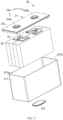
- FIG. 3 shows a battery 10 according to an embodiment of this application.
- FIG. 4(A) is a schematic diagram of a housing of a battery
- FIG. 4(B) is a schematic diagram of the housing and a cover plate of the battery.
- the battery may also be referred to as a battery cell 20.
- the battery cell 20 includes a housing 21, an electrode assembly 22, and an electrolyte, where the electrode assembly 22 is accommodated in the housing 21 of the battery cell 20, and the electrode assembly 22 includes a positive-electrode plate, a negative-electrode plate, and a separator.
- the separator may be the separator prepared in the embodiments of this application.
- the electrode assembly 22 may be a wound structure or a stacked structure, and may, for example, be the structure actually used in the embodiments of this application.
- the housing 21 includes a shell 211 and a cover plate 212.
- the shell 211 includes an accommodating cavity 211a formed by a plurality of walls, and an opening 211b.
- the cover plate 212 is disposed on the opening 211b to seal the accommodating cavity 211a.
- the accommodating cavity 211a further accommodates the electrolyte.
- the positive-electrode plate and the negative-electrode plate of the electrode plate assembly 22 are generally provided with tabs.
- the tabs generally include a positive-electrode tab and a negative-electrode tab. According to some embodiments of this application, a plurality of positive-electrode tabs are provided and stacked together, and a plurality of negative-electrode tabs are provided and stacked together.
- the tabs are connected to a positive-electrode terminal 214a and a negative-electrode terminal 214b outside the battery cell 20 through connection members 23.
- the positive-electrode terminal 214a and the negative-electrode terminal 214b are collectively referred to as an electrode terminal 214.
- the electrode terminal 214 may generally be disposed on the cover plate 212.
- this application provides an apparatus.
- the apparatus may include a mobile phone, a portable device, a laptop, an electric scooter, an electric vehicle, a steamship, a spacecraft, an electric toy, an electric tool, or the like.
- the spacecraft may include an airplane, a rocket, a space shuttle, a spaceship, or the like.
- the electric toy includes a fixed or mobile electric toy, such as a game console, an electric vehicle toy, an electric ship toy, and an electric airplane toy.
- the electric tool includes an electric metal cutting tool, an electric grinding tool, an electric assembly tool, and an electric railway-specific tool, such as an electric drill, an electric grinder, an electric wrench, an electric screwdriver, an electric hammer, an electric impact drill, a concrete vibrator, and an electric planer.
- an electric drill such as an electric drill, an electric grinder, an electric wrench, an electric screwdriver, an electric hammer, an electric impact drill, a concrete vibrator, and an electric planer.
- the apparatus includes a vehicle.
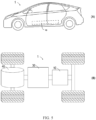
- FIG. 5(A) and FIG. 5(B) respectively show a side view and a bottom view of a vehicle according to an embodiment of this application.
- the vehicle may be an oil-fueled vehicle, a gas-powered vehicle, or a new energy vehicle.
- the new energy vehicle may be a battery electric vehicle, a hybrid electric vehicle, an extended-range electric vehicle, or the like.
- a battery 10 may be disposed in the vehicle 1.
- the battery 10 is disposed at the bottom of the vehicle.
- the battery 10 may alternatively be disposed at the head or the tail of the vehicle 1 as required.
- the battery 10 may intermittently or continuously supply power to the vehicle 1.
- the battery 10 may supply electrical energy to apparatuses of the vehicle 1 such as a lamp, a liquid crystal display, and an igniter.
- the battery 10 may also supply driving power to the vehicle 1.
- the vehicle 1 may further include a controller 30 and a motor 40, and the controller 30 is configured to control the battery 10 to supply power to the motor 40, for example, to satisfy a working electricity need during start, navigation, and driving of the vehicle 1.
- the battery 10 not only can be used as an operational power supply for the vehicle 1, but also can be used as a driving power supply for the vehicle 1, to totally or partially replace fossil fuel or natural gas to provide driving power for the vehicle 1.
- the battery 10 used in the vehicle may alternatively be a battery pack that includes a plurality of battery cells 20 shown in FIG. 3 to FIG. 4 .
Landscapes
- Chemical & Material Sciences (AREA)
- Chemical Kinetics & Catalysis (AREA)
- Electrochemistry (AREA)
- General Chemical & Material Sciences (AREA)
- Inorganic Chemistry (AREA)
- Engineering & Computer Science (AREA)
- Composite Materials (AREA)
- Materials Engineering (AREA)
- Organic Chemistry (AREA)
- Manufacturing & Machinery (AREA)
- Crystallography & Structural Chemistry (AREA)
- Battery Electrode And Active Subsutance (AREA)
Description
- This application relates to the field of lithium secondary battery technologies, and in particular, to an electrode active material and a preparation method thereof, an electrode, a battery, and an apparatus.
- Since the first commercialization, rechargeable lithium-ion batteries have been widely used in various portable electronic products as well as in large electric vehicles and energy storage grids.
- Positive-electrode active materials of lithium-ion batteries usually include lithium cobalt oxides (LCO), lithium manganese oxides (LMO), lithium iron phosphates (LFP), lithium nickel cobalt aluminum oxides (NCA), lithium nickel cobalt manganese oxides (NMC), and the like. Lithium ions can be reversibly intercalated and deintercalated in the foregoing positive-electrode materials.
- However, electrode active materials with better performance are still in need in the field.
-
US 2018/0145324 A1 discloses a lithium ion battery and a positive electrode material thereof including a high nickel material and a coating layer. The teaching suggests mixing ammonium sulphate (NH4)2SO4 with the core material (high nickel material), thereby forming a coating of the active electrode material.JP 2011 082133 A - This invention provides a new electrode active material as defined in
claim 1. Preferred aspects are defined by the claims depending fromclaim 1. The electrode active material of this disclosure is applied to a battery, where the battery shows a reduced direct current resistance (DCR) growth rate during cycling. - According to the invention the electrode active material includes:
- a core, where the core includes a ternary material; and
- a coating layer, where the coating layer coats at least part of a surface of the core, the coating layer includes a reaction product of a sulfur-containing compound and a lithium-containing compound, and the reaction product includes element Li, element S, and element O.
- In some embodiments, a weight content of element S in the electrode active material is 500-5000 ppm, for example, 500-1000 ppm, 1000-1500 ppm, 1500-2000 ppm, 2000-2500 ppm, 2500-3000 ppm, 3000-3500 ppm, 3500-4000 ppm, 4000-4500 ppm or 4500-5000 ppm, and for example, 540-4360 ppm.
- According to the invention, the coating layer further includes one or more of element B, element P, and element F;
- under a condition that element B is included, a weight content of element B in the electrode active material is 500-3000 ppm (for example 860-910 ppm);
- under a condition that element P is included, a weight content of element P in the electrode active material is 200-1500 ppm (for example, 690-870 ppm); and
- under a condition that element F is included, a weight content of element F in the electrode active material is 500-3000 ppm (for example, 1070-2100 ppm).
- In some embodiments, the lithium-containing compound includes a lithium salt; and
optionally, the lithium-containing compound includes one or more of the following: Li2O, LiOH and Li2CO3, LiNO3, LiPF6, lithium oxalate, lithium acetate, LiClO4, LiBF4, LiCF3SO3, LiAsF6, LiAlCl4, LiN(CF3SO2)2 and LiC(SO2CF3)3. - In some embodiments, the sulfur-containing compound is an organic sulfur-containing compound.
- In some embodiments, the sulfur-containing compound includes one or more of the following: mercaptan, thiophenol, thioether, thioaldehyde, thioketone, thiocarboxylic acid, sulfoxide, sulfone, sulfur oxoacid, and derivatives thereof.
- In some embodiments, the sulfur-containing compound includes one or more of the following: thioether (such as straight-chain thioether or cyclic thioether), sulfoxide, sulfone, sulfur oxoacid (such as sulfonic acid, sulfinic acid, or sulfenic acid), and derivatives thereof.
- In some embodiments, the sulfur-containing compound includes one or more of the following: sulfoxide, sulfone, sulfur oxoacid (such as sulfonic acid, sulfinic acid, or sulfenic acid), and derivatives thereof.
- In some embodiments, derivatives of the sulfur oxoacid include one or more of the following: an ester of the sulfur oxoacid, a salt of the sulfur oxoacid (optionally, a lithium salt of the sulfur oxoacid), an acyl halide of the sulfur oxoacid, an amide of the sulfur oxoacid, and a lithium amide salt of the sulfur oxoacid.
- In some embodiments, the sulfur oxoacid is an organic sulfur oxoacid.
- In some embodiments, the sulfur oxoacid is sulfonic acid, sulfinic acid, or sulfenic acid.
- In some embodiments, derivatives of the sulfur oxoacid include one or more of the following: an ester of the sulfur oxoacid, a salt of the sulfur oxoacid (optionally, a lithium salt of the sulfur oxoacid), an acyl halide of the sulfur oxoacid, an amide of the sulfur oxoacid, and a lithium amide salt of the sulfur oxoacid.
- In some embodiments, the sulfur-containing compound includes one or more of the following:
R1-S(=O)2-R2, R1-C(=S)-R2,
- In some embodiments, the sulfur-containing compound includes R1-S(=O)2-R2, where R1 is hydroxyl, and R2 is selected from amino, C1-6 alkyl, and the halogen atom (for example, F, Cl, Br, or I).
- In some embodiments, the sulfur-containing compound includes R1-C(=O)2-R2, where R1 is amino, and R2 is C1-6 alkyl.
- In some embodiments, the sulfur-containing compound includes

- In some embodiments, the sulfur-containing compound includes R1-C-S-C-R2, where R1 and R2 each are a hydrogen atom or C1-6 alkyl.
- In some embodiments, the sulfur-containing compound includes R1-S(=O)2-LiN-S(=O)2-R2, where R1 and R2 each are a halogen atom.
- In some embodiments, the sulfur-containing compound includes one or more of the following: sulfamide, aminomethanesulfonic acid, lithium bisfluorosulfonimide, thio-propionamide, thio-isobutyramide, propylene sulfide, and methyl ethyl sulfide.
- In some embodiments, the sulfur-containing compound includes one or more of the following: sulfamide, aminomethanesulfonic acid, lithium bisfluorosulfonimide, thio-propionamide, thio-isobutyramide, propylene sulfide, and methyl ethyl sulfide.
- According to the invention, the ternary material includes one or more of the following: lithium nickel cobalt manganese oxides and lithium nickel cobalt aluminum oxides;
optionally, a chemical formula of the lithium nickel cobalt manganese oxides is LixNiaCobMncM1 (1-a-b-c)O2, where 0.5≤x≤1.2, 0.3≤a≤1, 0≤b≤0.5, 0≤c≤0.6, and M1 is selected from a combination of one or more of Zr, Zn, Ti, Sr, Sb, Y, W, Al, B, P, and F. - In some embodiments, x=0.5-0.6, 0.6-0.7, 0.7-0.8, 0.8-0.9, 0.9-1, 1-1.1, or 1.1-1.2.
- In some embodiments, a=0.3-0.4, 0.4-0.5, 0.5-0.6, 0.6-0.7, 0.7-0.8, 0.8-0.9, or 0.9-1.
- In some embodiments, b=0-0.1, 0.1-0.2, 0.2-0.3, 0.3-0.4, or 0.4-0.5.
- In some embodiments, c=0-0.1, 0.1-0.2, 0.2-0.3, 0.3-0.4, 0.4-0.5, or 0.5-0.6.
- Optionally, a chemical formula of the lithium nickel cobalt aluminum oxides is LixNidCoeAlfM2 (1-d-e-f)O2, where 0.5≤x≤1.2, 0.5≤d≤1, 0≤e≤0.5, 0≤f≤0.5, and M2 is selected from a combination of one or more of Zr, Mg, Ba, Ti, Sr, Sb, Y, W, and B.
- In some embodiments, x=0.5-0.6, 0.6-0.7, 0.7-0.8, 0.8-0.9, 0.9-1, 1-1.1, or 1.1-1.2.
- In some embodiments, d=0.5-0.6, 0.6-0.7, 0.7-0.8, 0.8-0.9, or 0.9-1.
- In some embodiments, e=0-0.1, 0.1-0.2, 0.2-0.3, 0.3-0.4, or 0.4-0.5
- In some embodiments, f=0-0.1, 0.1-0.2, 0.2-0.3, 0.3-0.4, 0.4-0.5.
- Unless otherwise specified, the coating layer mentioned in this disclosure is a coating layer that includes the reaction product of the sulfur-containing compound and the lithium-containing compound.
- In some embodiments, a particle size (Dv50 particle size) of the electrode active material is 1-25 µm, for example, 1-10 µm.
- The invention further provides a preparation method of an electrode active material with a coating layer according to the steps as defined by claim 5. Preferred embodiments are subject of the claims depending from claim 5. The method includes:
- (a) providing a core material and a coating layer forming material, where the core material includes a ternary material, the ternary material comprising one or more of lithium nickel cobalt manganese oxides and lithium nickel cobalt aluminum oxides; and the coating layer forming material includes a sulfur-containing compound;
where step (a) includes one or more characteristics of the following (a1) and (a2):- (a1) a surface of the core material includes a lithium-containing compound;
- (a2) the coating layer forming material further includes the lithium-containing compound; and
- (b) processing the core material by using the coating layer forming material, so that a reaction product of the sulfur-containing compound and the lithium-containing compound is formed on the surface of the core material, and the reaction product includes element Li, element S, and element O.
- In some embodiments, in (a1), the lithium-containing compound is an alkaline lithium-containing compound.
- In some embodiments, in (a2), the lithium-containing compound is a neutral lithium-containing compound or an acidic lithium-containing compound.
- According to the invention, the coating layer further includes one or more of element B, element P, and element F;
- under a condition that element B is included, a molar ratio of element B to element S is 2-5:4-7 (for example, 2-5:5-7) in the coating layer forming material;
- under a condition that element P is included, a molar ratio of element P to element S is 1-3:4-6 (for example, 2:5) in the coating layer forming material; and
- under a condition that element F is included, a molar ratio of element F to element S is 10-15:4-6 (for example, 12:5) in the coating layer forming material.
- In some embodiments, the processing the core material by using the coating layer forming material includes: applying a solution containing the coating layer forming material to the surface of the core material, and performing heat treatment;
- optionally, a heat treatment temperature is 80-300°C; and
- optionally, a heat treatment time is 3-20 hours.
- In some embodiments, the applying a solution containing the coating layer forming material to the surface of the core material includes: dispersing the core material in the solution dissolved with the coating layer forming material, then separating the core material from the solution.
- In some embodiments, in the solution containing the coating layer forming material, a concentration of the sulfur-containing compound is 0.1-5 mol/L (for example, 0.2-2 mol/L).
- In some embodiments, in the solution containing the coating layer forming material, a concentration of the lithium-containing compound is 0.1-3 mol/L (for example, 0.3-0.5 mol/L).
- In some embodiments, in the solution containing the coating layer forming material, a solvent includes one or more of the following substances: water, ethanol, and NMP, and optionally, the solvent is alcohol with a concentration of 90-95 vol%.
- In some embodiments, the lithium-containing compound is as defined in any one of the foregoing embodiments.
- In some embodiments, the sulfur-containing compound is as defined in any one of the foregoing embodiments.
- In some embodiments, the ternary material is as defined in any one of the foregoing embodiments.
- In some aspects, an electrode active material with a coating layer is provided and obtained by the preparation method according to any one of the foregoing embodiments.
- In some aspects, an electrode is provided, including the electrode active material according to any one of the foregoing embodiments.
- In some aspects, a battery is provided, including the electrode active material according to any one of the foregoing embodiments.
- In some aspects, an apparatus is provided, including the battery according to any one of the foregoing embodiments, where the battery is used as an energy storage unit of the apparatus.
- In some embodiments, the apparatus is an electric apparatus, and the battery is configured to power the electric apparatus.
- In some embodiments, a method for preparing an electrode active material with a coating layer is a wet method.
- In some aspects, an apparatus is provided, including the foregoing battery, where the battery is used as an energy storage unit of the apparatus.
- In some embodiments, "comprising", "including", and "containing" may refer to a weight content greater than 0, for example, above 1%, above 10%, above 20%, above 30%, above 40%, above 50%, above 60%, above 70%, above 80%, above 90%, and 100%. When the percentage is 100%, "comprising", "including", and "containing" means "consisting of".
- For simplicity, only some numerical ranges are expressly disclosed in this specification. However, any lower limit may be combined with any upper limit to form a range not expressly recorded; any lower limit may be combined with any other lower limit to form a range not expressly recorded; and any upper limit may be combined with any other upper limit to form a range not expressly recorded. In addition, although not expressly recorded, each point or individual value between endpoints of a range is included in the range. Therefore, each site or single numerical value can be used as its own lower limit or upper limit in combination with any other site or single numerical value or in combination with other lower or upper limits to form a range not expressly recorded.
- In the descriptions of this specification, it should be noted that "more than" or "less than" is inclusive of the present number and that "more" in "one or more" means two or more than two, unless otherwise specified.
- The foregoing summary is not intended to describe each of the disclosed embodiments or implementations of this application. The following description illustrates exemplary embodiments in more detail by using examples. Throughout this application, guidance is provided by using a series of embodiments and the embodiments may be used in various combinations. In each example, enumeration is only representative but should not be interpreted as exhaustive.
- Where the following terms are used in the present invention, they can be understood in the following non-limiting manner.
- The "electrode active material" is a battery material with a specific composition and a crystal structure for intercalating and deintercalating lithium ions.
- The "electrode" is a component that participates in an electrochemical reaction of the battery and that includes the electrode active material.
- The "battery" is a single physical module that includes one or more battery cells for providing a higher voltage and capacity. The "battery cell" is a battery cell that can be charged and discharged independently. A cell structure includes a positive electrode, a negative electrode, a separator, an electrolyte, an outer package for packaging a positive-electrode plate, a negative-electrode plate, the separator, and the electrolyte, and the like. The type and shape of the battery cell are not specifically limited in this application. The battery cell may be a soft package battery cell, or may be a cylinder cell, a prismatic cell, or another type of cell.
- The battery may include a battery cell, a battery module, and a battery pack. The battery module is formed by electrically connecting a specific quantity of battery cells and putting the battery cells into a frame to protect the battery cells from external impact, heat, vibration, and the like. The battery pack is a final state of a battery system assembled in an electric apparatus such as an electric vehicle. Most existing battery packs are formed by assembling various control and protection systems such as a battery management system and a thermal management part on one or more battery modules. With the development of technologies, the battery module may be omitted, that is, the battery pack is directly formed using battery cells. With this improvement, weight energy density and volumetric energy density of the battery system are improved, and the number of parts is remarkably reduced.
- The "single crystal" is also referred to as a single particle or a primary particle, and in terms of micro morphology, the single crystal is a particle that substantially does not agglomerate or disperse. The single crystal may be a particle with an irregular shape.
- The "polycrystal" is a secondary particle formed by agglomeration of more than two primary particles. The polycrystal may be a spherical particle.
- The terms "powder" and "particle" may be used interchangeably in this specification. These terms further randomly have the following features: hollow, dense, porous, semiporous, coated, uncoated, multi-layer, laminated, simple, complex, dendritic, inorganic, organic, elemental, non-elemental, compound, doped, undoped, spherical, non-spherical, surface-functional, non-surface-functional, stoichiometric, and non-stoichiometric forms or substances. In addition, the term "powder" generally includes a one-dimensional material (fiber, tube, or the like), a two-dimensional material (a slice, a thin film, a laminated material, a flat surface, or the like), and a three-dimensional material (a sphere, a cone, an oval, a cylinder, a cube, a homocline, a dumbbell shape, a hexagon, a truncated icosahedron, an irregular structure, or the like).
- The term "sphere" herein is a regular sphere, an ellipsoid, or a sphere-like shape.
- The term "Dv10" herein is a volume-based particle size at the 10-th percentile; the term "Dv50" is a volume-based particle size at the 50-th percentile; and the term "Dv90" is a volume-based particle size at the 90-th percentile. The particle size is measured by using a laser diffraction method.
- The term "lithium salt" is a lithium-containing compound that can dissociate in a solvent to produce lithium ions.
- The term "mercaptan" refers to replacement of alcoholic hydroxyl in an ethanol molecule with -SH.
- The term "thiophenol" refers to replacement of a phenolic hydroxyl in a phenol molecule with -SH.
- The term "thioether" is a compound with an R3-S-R4 structure, where R3 and R4 are each independently alkyl.
- The term "thioaldehyde" refers to replacement of aldehyde C(O)H in an aldehyde molecule with C(S)H.
- The term "thioketone" refers to replacement of carbonyl -C(O)- in a ketone molecule with -C(S)-.
- The term "thiocarboxylic acid" refers to replacement of -COOH in a carboxylic acid molecule with CO-SH, CS-OH, or CSSH.
- The term "sulfone" is a compound having a group -S(O)2R, where R is alkyl, aryl, or heteroaryl.
- The term "sulfoxide" is a compound with a group -S(O)R, where R is alkyl, aryl, or heteroaryl.
- The terms "sulfonic acid", "sulfinic acid", and "sulfenic acid" are compounds with -S(O)2OH, -S(O)OH, and -SOH respectively.
- The term "amino" is unsubstituted or substituted amino. The substituted amino is, for example, alkyl-substituted amino, for example, methylamino.
- The term "C1-6 alkyl" refers to alkyl with 1 to 6 carbon atoms, and may be branched or straight-chain, saturated or unsaturated, and unsubstituted or mono/polysubstituted.
- This disclosure provides an electrode active material with a coating layer, including a core and a coating layer, where the core includes a ternary material; and the coating layer coats the core, the coating layer includes a reaction product of a sulfur-containing compound and a lithium-containing compound, and the reaction product includes element Li, element S, and element O.
- One or more technical solutions recorded in this disclosure have one or more of the following beneficial effects.
- 1) The electrode active material or a composition is applied to a battery, showing an increased specific capacity;
- 2) The electrode active material or a composition is applied to a battery, showing improved cycling performance;
- 3) The electrode active material or a composition is applied to a battery, showing a reduced direct current resistance growth rate during cycling;
- 4) The electrode active material or a composition is applied to a battery, showing lower gas production;
- 5) The electrode active material or a composition is applied to a battery, with the battery showing better performance at a higher voltage; and
- 6) Slurry prepared at higher humidity by using the electrode active material or a composition still has good processing performance and/or electrical performance.
-
-
FIG. 1 shows scanning electron microscope images of a lithium nickel cobalt manganese oxide numbered 10, with (a)-(d) showing images at different magnifications or positions. -
FIG. 2 shows scanning electron microscope images of a lithium nickel cobalt manganese oxide numbered 24, with (a)-(d) showing images at different magnifications or positions. -
FIG. 3 is a schematic diagram of a battery according to an embodiment of this application. -
FIG. 4(A) is a schematic diagram of a housing of a battery, andFIG. 4(B) is a schematic diagram of the housing and a cover plate of the battery. -
FIG. 5(A) and FIG. 5(B) respectively show a side view and a bottom view of a vehicle according to an embodiment of this application. - The following embodiments specifically describe an electrode active material with a coating layer and a preparation method thereof. A battery is assembled by using the electrode active material, and tested for one or more of the following performance: capacity retention rate, direct current resistance, gas production, and slurry processing performance.
- The following embodiments describe in more detail content disclosed in this application. These embodiments are intended only for illustrative purposes because various modifications and changes made without departing from the scope of the content disclosed in this application are apparent to those skilled in the art. Unless otherwise stated, all parts, percentages, and ratios reported in the following embodiments are based on weights, all reagents used in the embodiments are commercially available or synthesized in a conventional manner, and can be used directly without further processing, and all instruments used in the embodiments are commercially available.
- The electrode active material powder as a core material is a commercially available ternary material, specifically, NCMs 1-4 are lithium nickel cobalt manganese oxides and NCAis a lithium nickel cobalt aluminum oxide. Due to a preparation process, residual lithium is present on a surface of the core material. Relevant parameters of the core material are shown in the following table:


- Step 1: providing the ternary material as a core material.
- Step 2: providing a solution containing a coating layer formation material, where a formula of the solution containing the coating layer formation material is shown in Table 1.
- Step 3: mixing the products in
step 1 and step 2 at a weight ratio of 1:1, stirring for 30 minutes after the mixing, and upon solid-liquid separation, collecting solids. - Step 4: performing heat treatment to the solids obtained in the previous step in an inert atmosphere in a closed environment to obtain an electrode active material with a coating layer, with heat treatment conditions shown in Table 1.
- In the foregoing example, an alkaline lithium-containing compound (such as Li2O, LiOH, and Li2CO3) was present on the surface of the core material, and the alkaline lithium-containing compound reacted with a sulfur-containing compound during a coating process, producing a reaction product of the sulfur-containing compound and the lithium-containing compound, where the reaction product included element Li, element S, and element O.
- After the coating treatment was performed on the core material based on the foregoing method, an electrode active material with a coating layer was obtained. Specific process parameters are shown in Table 1.


- 24 samples are shown in Table 1, including coated and uncoated electrode active materials. These 24 samples are tested by using the following test methods.
- Preparation of a positive-electrode plate: At 2% environmental humidity, the electrode active material prepared in the foregoing examples/comparative examples was mixed with conductive carbon black and a binder PVDF at a mass ratio of 96:2.5:1.5. A solvent N-methylpyrrolidone (NMP) was added, with a mass of the solvent accounting for 30% of a total weight of a slurry, to produce a uniform positive-electrode slurry after stirring. The positive-electrode slurry was evenly applied on both sides of a positive-electrode collector aluminum foil, the aluminum foil was cold pressed by using a roller press to obtain a positive-electrode plate, and a press density of the obtained positive-electrode plate was 3.5-4.0 g/cc.
- Preparation of a negative-electrode plate: Artificial graphite was used as a negative-electrode active substance. In a negative-electrode slurry, solid components were formed by the artificial graphite, styrene polybutadiene rubber (SBR), sodium carboxymethyl cellulose (CMC), and conductive carbon black at a ratio of 96:2:1:1. A solvent of the slurry was water, and the solvent accounted for 50% of weight of the slurry. The negative-electrode slurry was evenly applied on both sides of a negative-electrode current collector copper foil, the copper foil was cold pressed by using a roller press to obtain a negative-electrode plate, and a press density of the negative-electrode plate was 1.65 g/cc.
- Separator: A PP/ PE composite separator was used.
- Electrolyte: 1 mol/L of LiPF6 solution was selected. Its solvent mainly includes ethylene carbonate (EC), ethyl methyl carbonate (EMC), and diethyl carbonate (DEC).
- Assembly of a battery: The negative-electrode plate, the separator, and the positive-electrode plate were stacked and then wound. After a roll core was obtained, a tab was welded on the copper and aluminum foil current collectors of the positive-electrode plate and the negative-electrode plate exposed from the core, and all are encapsulated in a packaging bag made of aluminum-plastic composite material. A thickness of the packaging bag was 153 µm. An electrolyte was injected and then the bag was sealed. Chemical conversion was performed at 45°C. After the chemical conversion, gas generated by the chemical conversion was extracted and excess packaging bags were removed to obtain a battery with a height of 130 mm, a thickness of 4 mm, and a width of 60 mm.
- The battery was charged and discharged at a constant test room temperature (25°C) by using a Neware charge and discharge machine (5V/6A). A charging and discharging method was as follows:
1. The battery was left standing for 10 minutes at a constant temperature of 25°C.
2. The battery was charged at a constant current rate of 0.33C to a charge cut-off voltage (charge cut-off voltages of battery cells corresponding to different active materials are shown in the following table) and then charged at a constant voltage of the charge cut-off voltage until a charge current was less than or equal to 0.05C;Table 2 Electrode active material Charge cut-off voltage of battery cell NCM1, NCM4, NCA 4.2V NCM2, NCM3 4.35V
3. The battery was left standing for 5 minutes;
4. The battery was discharged at a constant current rate of 0.33C to a discharge cut-off voltage (in the following examples, the discharge cut-off voltage is set to 2.8 V and may be adjusted based on different to-be-detected batteries); - A first-cycle discharge specific capacity was determined as a test result.
- The charge/discharge current was a preset rate multiplied by a rated capacity of the battery cell. The rated capacity is based on a cell capacity identified in a GBT certification document for the cell, or the battery module to which the cell belongs, or the battery pack to which the cell belongs.
- A high/low temperature chamber of 220L from Tengda was used for testing. A charging and discharging method is as follows:
- 1. The chamber was adjusted to a preset temperature and left standing for 2 hours;
- 2. The battery was charged at a constant current rate of 1C to a charge cut-off voltage (cut-off voltages for different active materials are shown above), and then charged at a constant voltage of the charge cut-off voltage until a charge current was less than or equal to 0.05C;
- 3. The battery was left standing for 5 minutes;
- 4. The battery was discharged at a constant current rate of 1C to a discharge cut-off voltage (a discharge cut-off voltage used in the following examples is specifically 2.8 V);
- 5. The battery was left standing for 5 minutes;
- 6. Steps 2-5 are repeated.
- After fully charged, the battery cell was stored in a high-temperature furnace at 70°C. At regular intervals, the battery cell was taken out of the furnace and a volume of the battery was measured by using a drainage method. A volume change before and after the storage was found after comparison, and a volume change rate of the gas production was obtained.
- During cycling, an average voltage/average current 30 seconds before charging to 100% SOC is extracted for each cycle to obtain a DCR at a corresponding number of cycles. After DCRs are extracted by the number of cycles, a DCR growth rate during the cycling is obtained.
- A laser particle size test was performed by using a Mastersizer 3000E laser particle size analyzer from Malvern instruments Ltd in UK. A test method can be referred to a
GB/T 19077-2016 - A method for testing a particle size of electrode active material in the finished electrode is as follows: powder was scraped from the positive-electrode plate, the scraped powder was collected, put in a sintering furnace, and sintered at 600°C for 4 hours to remove conductive carbon and binder from the powder and obtain an electrode active material. A laser particle size test was performed on the electrode active material by using a Mastersizer 3000E laser particle size analyzer.
-
- Testing method: inductively coupled plasma atomic emission spectrometry
- Instrument model: ICP-OES, Thermo ICAP7400
- Sample weight: 0.4 g
- Digestion method: plate digestion
- Type and volume of acids used for digestion: 10 mL of aqua regia (concentrated nitric acid: concentrated hydrochloric acid (volume ratio) = 1:1)
- Constant volume: 100 mL
- Quantitative method: standard curve method
-
- Instrument model: ICS-900 ion chromatography instrument
- Reference standard: General Rules for Ion Chromatography JY/T202-1996
- Measurement method: 0.4 g of the electrode active material was completely digested in 10 mL of aqua regia (concentrated nitric acid: concentrated hydrochloric acid (volume ratio) = 1:1), and an obtained solution was diluted to 250 mL for measurement.
- Test results obtained by testing samples 1-24 based on the foregoing methods are described in detail below.
-
FIG. 1 shows scanning electron microscope images of an electrode active material numbered 10, with (a)-(d) sequentially showing images at scales of 10 µm, 2 µm, 1 µm, and 1 µm. Particles of the electrode active material have irregular particle shapes, with a single crystal micro-structure. -
FIG. 2 shows scanning electron microscope images of an electrode active material numbered 24, with (a)-(d) sequentially showing images at different magnifications or positions. (a)-(d) sequentially show images at scales of 10 µm, 2 µm, 1 µm, and 1 µm. Particles of the electrode active material have a spherical particle shape, with a polycrystal micro-structure. - Particle size distributions of the electrode active materials numbered 1, 2, 3, 14, and 21 are as follows:

- Contents of element S, element B, element P, and element F in the electrode active materials numbered 1-24 are as follows:
Table 4 Number Element S (ppm) Element B (ppm) Element P (ppm) Element F (ppm) 1 1600 \ \ \ 2 1060 \ \ \ 3 840 \ \ 1070 4 540 \ \ \ 5 1620 \ \ \ 6 4360 \ \ \ 7 1550 860 \ \ 8 1630 \ 690 \ 9 1490 \ 820 2100 10 1570 910 870 2060 11 260 \ \ \ 12 190 \ \ \ 13 230 \ \ \ 14 1540 \ \ \ 15 1610 \ \ \ 16 1520 \ \ \ 17 1630 \ \ 1720 18 310 \ \ \ 19 1370 \ \ \ 20 1270 \ \ \ 21 1410 \ \ 1260 22 1460 \ \ \ 23 1560 \ \ \ 24 360 \ \ \ - Coating treatment is not performed on the electrode active materials numbered 11 to 13, 18, and 24. Because a raw material precursor contains elemental sulfur, the electrode active materials inevitably contain trace amounts of residual element sulfur (<400 ppm). Only exeamples 3, 7, 8, 9, 10, 17 and 21 contain contents of element S, element B, element P, or element F in the electrode active materials numbered, therefore, only these examples fall under the definition of the claims. The remaining examples are not part of the invention.
-
Table 5 Num ber First cycle discharge capacity (mAh/g) Capacity retention rate* (%) Direct current resistance* (mΩ) Gas production at 70°C Volume change rate (%) 100 cycles 500 cycles 100 cycles 500 cycles 10 days 50 days 1 197 96.2 90.1 17.7 28.7 7.38% 31.08 % 2 188 96.5 90.7 17.6 18.7 0.09% 7.25% 3 179 97.5 93.9 16.6 16.8 0.21% 5.68% 4 196 96.7 91.5 17.1 27.5 7.71% 28.14 % 5 197 96.8 91.3 19.5 25 8.50% 33.81 % 6 195 96.6 90.9 19 25 8.83% 33.15 % 7 198 97 90.9 19 25 8.69% 42.86 % 8 197 97 91.6 17.7 25 10.10 % 36.80 % 9 197 97.2 92.1 17.7 24.6 8.24% 24.99 % 10 198 97.2 92.4 17.5 24.6 7.00% 19.60 % 11 194 96.4 86.4 19.8 30 7.40% 52.40 % 12 187 95.7 86.5 19.8 24.3 1.75% 15.36 % 13 179 97.1 90.5 19.1 21 2.47% 12.13 % 14 191 95.9 85.7 19 35.4 5.22% 65.30 % 15 190 96.1 88.7 17.4 23.6 4.57% 60.04 % 16 191 95.9 88.2 16.7 22.9 11.21 % 32.49 % 17 190 96.2 90.2 17.4 18.7 15.71 % 35.23 % 18 189 95.7 83.9 14.1 74.3 8.39% 85.40 % 19 199 95.8 85.4 17.9 20.3 10.60 % 48.40 % 20 198 96.7 91.4 17.5 20 11.90 % 53.60 % 21 197 96.7 91 18.2 20.7 12.20 % 54.60 % 22 199 96.8 91.9 17.1 18.2 15.70 % 49.60 % 23 198 96.9 91.7 17.4 18.4 15.10 % 50.40 % 24 196 94.3 79.8 18.5 55.2 22.00 % 72.50 % *Capacity retention rate and direct current impedance are tested at a preset environmental temperature of 45°C - The electrode active material numbered 23 was used to prepare a slurry in environment with a relative humidity of 2% and 45%, respectively, with the following formulation: the electrode active material, conductive carbon black, and a binder PVDF were mixed at a mass ratio of 96:2.5:1.5 A solvent N-methyl-pyrrolidone (NMP) was added, with a mass of the solvent accounting for 30% of a total weight of the slurry, and a resulting mixture was stirred to form a uniform positive-electrode slurry. The slurries prepared in environment with two different humidity were left standing, and viscosities of the electrode slurries were analyzed at regular intervals by using a rheological analyzer (Gemini 150 Rheometer, Malvern Instruments ltd).
- In addition, based on the foregoing testing method, the sample numbered 24 was also treated in the same way and taken as a reference group, and results are shown in the following table:

- The electrode active material numbered 17 was used to prepare a slurry in environment with a relative humidity of 2% and 45%, respectively, with the following formulation: the electrode active material, conductive carbon black, and a binder PVDF are mixed at a mass ratio of 96:2.5:1.5. A solvent N-methyl-pyrrolidone (NMP) was added, with a mass of the solvent accounting for 30% of a total weight of the slurry, and a resulting mixture was stirred to form a uniform positive-electrode slurry. The slurries prepared in environment with two different humidity were left standing, and viscosities of the electrode slurries were analyzed at regular intervals by using a rheological analyzer (Gemini 150 Rheometer, Malvern Instruments ltd).
- In addition, based on the foregoing testing method, the sample numbered 18 was treated in the same way and taken as a reference group, and results are shown in the following table:

- From the foregoing experimental data, it can be learned that compared to the electrode active materials (No. 18 and 24) without a coating layer, the electrode active materials (No. 17 and 23) with a coating layer have improved processing performance. Specifically, the electrode active materials (No. 17 and 23) with a coating layer have relatively low viscosity and no obvious gelation in appearance by visual observation, no matter whether the slurry is prepared at 2% or 45% relative humidity. Such a slurry is beneficial to subsequent processes of coating and cold pressing, and beneficial to improving electrical performance of the battery.
- From the foregoing experimental data, it can be learned that a coating layer containing a reaction product of a lithium-containing compound and a sulfur-containing compound can improve performance of the electrode active material. Compared to the electrode active materials (No. 11-13, 18, and 24) without a coating layer, the electrode active materials (No. 1-10, 14-17, and 19-23) with a coating layer have the following beneficial effects:
- 1) Increased specific capacity;
- 2) Improved cycling performance;
- 3) Reduced direct current resistance;
- 4) Lower gas production;
- 5) Relatively good performance at a higher voltage; and
- 6) Stable production and processing at high relative humidity.
- According to some embodiments of this application, this application provides a battery.
FIG. 3 shows abattery 10 according to an embodiment of this application.FIG. 4(A) is a schematic diagram of a housing of a battery, andFIG. 4(B) is a schematic diagram of the housing and a cover plate of the battery. As shown inFIG. 3 andFIG. 4 , in this embodiment, the battery may also be referred to as abattery cell 20. Thebattery cell 20 includes ahousing 21, anelectrode assembly 22, and an electrolyte, where theelectrode assembly 22 is accommodated in thehousing 21 of thebattery cell 20, and theelectrode assembly 22 includes a positive-electrode plate, a negative-electrode plate, and a separator. The separator may be the separator prepared in the embodiments of this application. Theelectrode assembly 22 may be a wound structure or a stacked structure, and may, for example, be the structure actually used in the embodiments of this application. Thehousing 21 includes ashell 211 and acover plate 212. Theshell 211 includes anaccommodating cavity 211a formed by a plurality of walls, and anopening 211b. Thecover plate 212 is disposed on theopening 211b to seal theaccommodating cavity 211a. In addition to theelectrode assembly 22, theaccommodating cavity 211a further accommodates the electrolyte. The positive-electrode plate and the negative-electrode plate of theelectrode plate assembly 22 are generally provided with tabs. The tabs generally include a positive-electrode tab and a negative-electrode tab. According to some embodiments of this application, a plurality of positive-electrode tabs are provided and stacked together, and a plurality of negative-electrode tabs are provided and stacked together. The tabs are connected to a positive-electrode terminal 214a and a negative-electrode terminal 214b outside thebattery cell 20 throughconnection members 23. In the description of this application, the positive-electrode terminal 214a and the negative-electrode terminal 214b are collectively referred to as anelectrode terminal 214. For a prismatic cell, theelectrode terminal 214 may generally be disposed on thecover plate 212. - According to some embodiments of this application, this application provides an apparatus. The apparatus may include a mobile phone, a portable device, a laptop, an electric scooter, an electric vehicle, a steamship, a spacecraft, an electric toy, an electric tool, or the like. The spacecraft may include an airplane, a rocket, a space shuttle, a spaceship, or the like. The electric toy includes a fixed or mobile electric toy, such as a game console, an electric vehicle toy, an electric ship toy, and an electric airplane toy. The electric tool includes an electric metal cutting tool, an electric grinding tool, an electric assembly tool, and an electric railway-specific tool, such as an electric drill, an electric grinder, an electric wrench, an electric screwdriver, an electric hammer, an electric impact drill, a concrete vibrator, and an electric planer.
- In this embodiment, the apparatus includes a vehicle. For example,
FIG. 5(A) and FIG. 5(B) respectively show a side view and a bottom view of a vehicle according to an embodiment of this application. The vehicle may be an oil-fueled vehicle, a gas-powered vehicle, or a new energy vehicle. The new energy vehicle may be a battery electric vehicle, a hybrid electric vehicle, an extended-range electric vehicle, or the like. As shown inFIG. 5(A) , abattery 10 may be disposed in thevehicle 1. As shown inFIG. 5(A) , thebattery 10 is disposed at the bottom of the vehicle. However, thebattery 10 may alternatively be disposed at the head or the tail of thevehicle 1 as required. When the vehicle is driven, thebattery 10 may intermittently or continuously supply power to thevehicle 1. For example, thebattery 10 may supply electrical energy to apparatuses of thevehicle 1 such as a lamp, a liquid crystal display, and an igniter. For a hybrid electric vehicle or an electric vehicle, thebattery 10 may also supply driving power to thevehicle 1. As shown inFIG. 5(B) , thevehicle 1 may further include acontroller 30 and amotor 40, and thecontroller 30 is configured to control thebattery 10 to supply power to themotor 40, for example, to satisfy a working electricity need during start, navigation, and driving of thevehicle 1. In another embodiment of this application, thebattery 10 not only can be used as an operational power supply for thevehicle 1, but also can be used as a driving power supply for thevehicle 1, to totally or partially replace fossil fuel or natural gas to provide driving power for thevehicle 1. According to an embodiment of this application, thebattery 10 used in the vehicle may alternatively be a battery pack that includes a plurality ofbattery cells 20 shown inFIG. 3 to FIG. 4 .
Claims (14)
- An electrode active material with a coating layer, comprising:a core, comprising a ternary material, wherein the ternary material comprises one or more of the following: lithium nickel cobalt manganese oxides and lithium nickel cobalt aluminum oxides; anda coating layer, wherein the coating layer coats at least part of a surface of the core, the coating layer comprises a reaction product of a sulfur-containing compound and a lithium-containing compound, and the reaction product comprises element Li, an element S, and element O, characterized in that the coating layer further comprises one or more of element B, element P, and element F;under a condition that element B is comprised, a weight content of element B in the electrode active material is 500-3000 ppm;under a condition that element P is comprised, a weight content of element P in the electrode active material is 200-1500 ppm;under a condition that element F is comprised, a weight content of element F in the electrode active material is 500-3000 ppm.
- The electrode active material according to claim 1, wherein a weight content of element S in the electrode active material is 500-5000 ppm.
- The electrode active material according to any one of claims 1 or 2, wherein a chemical formula of the lithium nickel cobalt manganese oxides of the ternary material is LixNiaCobMncM1 (1-a-b-c)O2, wherein 0.5≤x≤1.2, 0.3<a<1, 0≤b≤0.5, 0≤c≤0.6, and M1 is selected from a combination of one or more of Zr, Zn, Ti, Sr, Sb, Y, W, Al, B, P, and F; and/or
a chemical formula of the lithium nickel cobalt aluminum oxides of the ternary material is LixNidCoeAlfM2 (1-d-e-f)O2, wherein 0.5≤x≤1.2, 0.5≤d≤1, 0≤e≤0.5, 0≤f≤0.5, and M2 is selected from a combination of one or more of Zr, Mg, Ba, Ti, Sr, Sb, Y, W, and B. - The electrode active material according to any one of claims 1 to 3, wherein a particle size Dv50 measured according to the description of the electrode active material is 1-25 µm, when determined as described in the application, and optionally, 1-10 µm.
- A preparation method of an electrode active material with a coating layer, comprising:(a) providing a core material and a coating layer forming material, wherein the core material comprises a ternary material, the ternary material comprising one or more of lithium nickel cobalt manganese oxides and lithium nickel cobalt aluminum oxides; and the coating layer forming material comprises a sulfur-containing compound;
wherein, step (a) comprises one or more characteristics of the following (a1) and (a2):(a1) a surface of the core material comprises a lithium-containing compound;(a2) the coating layer forming material further comprises a lithium-containing compound; and(b) processing the core material by using the coating layer forming material, so that a reaction product of the sulfur-containing compound and the lithium-containing compound is formed on the surface of the core material, and the reaction product comprises element Li, element S, and element O, wherein the coating layer forming material further comprises one or more of element B, element P, and element F;under a condition that element B is comprised, a molar ratio of element B to element S in the coating layer forming material is 2-5:4-7;under a condition that element P is comprised, a molar ratio of element P to element S in the coating layer forming material is 1-3:4-6;under a condition that element F is comprised, a molar ratio of element F to element S in the coating layer forming material is 10-15:4-6. - The preparation method according to claim 5, wherein, in (a1), the lithium-containing compound is an alkaline lithium-containing compound; and/or in (a2), the lithium-containing compound is a neutral lithium-containing compound or an acidic lithium-containing compound.
- The preparation method according to any one of claims 5or 6,the processing the core material by using the coating layer forming material comprises: applying a solution containing the coating layer forming material to the surface of the core material, and performing heat treatment; whereinoptionally, a heat treatment temperature is 80-300°C; andoptionally, a heat treatment time is 3-20 hours.
- The preparation method according to any one of claims 5 to 7, comprising one or more of the following characteristics:- in the solution containing the coating layer forming material, a concentration of the sulfur-containing compound is 0.1-5 mol/L (optionally, 0.2-2 mol/L);- in the solution containing the coating layer forming material, a concentration of the lithium-containing compound is 0.1-3 mol/L (optionally, 0.3-0.5 mol/L); and- in the solution containing the coating layer forming material, a solvent comprises one or more of the following substances: water, ethanol, and NMP, and optionally, the solvent is alcohol with a concentration of 90-95 vol%;and/or the preparation method comprises the following characteristics:the ternary material is as defined according to claim 3.
- The preparation method according to any one of claims 5 to 8, wherein the lithium-containing compound comprises a lithium salt; and
optionally, the lithium-containing compound comprises one or more of the following: Li2O, LiOH and Li2CO3, LiNO3, LiPF6, lithium oxalate, lithium acetate, LiClO4, LiBF4, LiCF3SO3, LiAsF6, LiAlCl4, LiN(CF3SO2)2 and LiC(SO2CF3)3. - The preparation method according to any one of claims 5 to 9, wherein the sulfur-containing compound comprises one or more of the following: mercaptan, thiophenol, thioether, thioaldehyde, thioketone, thiocarboxylic acid, sulfoxide, sulfone, sulfur oxoacid, and derivatives thereof;optionally, the sulfur oxoacid is sulfonic acid, sulfinic acid, or sulfenic acid; andoptionally, derivatives of the sulfur oxoacid comprise one or more of the following: an ester of the sulfur oxoacid, a salt of the sulfur oxoacid (optionally, a lithium salt of the sulfur oxoacid), an acyl halide of the sulfur oxoacid, an amide of the sulfur oxoacid, and a lithium amide salt of the sulfur oxoacid;and/or the sulfur-containing compound comprises one or more of the following:R1-S(=O)2-R2, R1-C(=S)-R2, R1-C-S-C-R2, or R1-S(=O)2-LiN-S(=O)2-R2, wherein R1 and R2 each are selected from hydroxyl, amino, C1-6 alkyl, aryl, a halogen atom (optionally, F, Cl, Br, or I), and a hydrogen atom;optionally, the sulfur-containing compound comprises R1-S(=O)2-R2, wherein R1 is hydroxyl, and R2 is selected from amino, C1-6 alkyl, and the halogen atom (optionally, F, Cl, Br, or I);optionally, the sulfur-containing compound comprises R1-C(=S)-R2, wherein R1 is amino, and R2 is C1-6 alkyl;optionally, the sulfur-containing compound comprises
 optionally, the sulfur-containing compound comprises R1-C-S-C-R2, wherein R1 and R2 each are a hydrogen atom or C1-6 alkyl; andoptionally, the sulfur-containing compound comprises R1-S(=O)2-LiN-S(=O)2-R2, wherein R1 and R2 each are a halogen atom;and/or the sulfur-containing compound comprises one or more of the following: sulfamide, aminomethanesulfonic acid, lithium bisfluorosulfonimide, thio-propionamide, thio-isobutyramide, propylene sulfide, and methyl ethyl sulfide.
 - An electrode active material with a coating layer, obtained by the preparation method according to any one of claims 5 to 10.
- An electrode, comprising the electrode active material according to any one of claims 1 to 4 and claim 11.
- A battery (10), comprising the electrode active material according to any one of claims 1 to 4 and claim 11.
- An apparatus, comprising the battery (10) according to claim 13, wherein the battery (10) is used as a power supply unit or an energy storage unit of the apparatus; and
optionally, the apparatus is an electric apparatus, and the battery (10) is configured to power the electric apparatus.
Applications Claiming Priority (1)
| Application Number | Priority Date | Filing Date | Title |
|---|---|---|---|
| PCT/CN2020/114477 WO2022051982A1 (en) | 2020-09-10 | 2020-09-10 | Electrode active material and preparation method therefor, electrode, battery, and device |
Publications (5)
| Publication Number | Publication Date |
|---|---|
| EP4071853A1 EP4071853A1 (en) | 2022-10-12 |
| EP4071853A4 EP4071853A4 (en) | 2023-05-10 |
| EP4071853C0 EP4071853C0 (en) | 2024-09-18 |
| EP4071853B1 true EP4071853B1 (en) | 2024-09-18 |
| EP4071853B8 EP4071853B8 (en) | 2024-10-23 |
Family
ID=80632447
Family Applications (1)
| Application Number | Title | Priority Date | Filing Date |
|---|---|---|---|
| EP20952770.4A Active EP4071853B8 (en) | 2020-09-10 | 2020-09-10 | Electrode active material and preparation method therefor, electrode, battery, and device |
Country Status (4)
| Country | Link |
|---|---|
| US (2) | US11949099B2 (en) |
| EP (1) | EP4071853B8 (en) |
| CN (1) | CN115836406B (en) |
| WO (1) | WO2022051982A1 (en) |
Families Citing this family (1)
| Publication number | Priority date | Publication date | Assignee | Title |
|---|---|---|---|---|
| WO2022051982A1 (en) * | 2020-09-10 | 2022-03-17 | 宁德时代新能源科技股份有限公司 | Electrode active material and preparation method therefor, electrode, battery, and device |
Family Cites Families (10)
| Publication number | Priority date | Publication date | Assignee | Title |
|---|---|---|---|---|
| JP5589536B2 (en) * | 2009-09-09 | 2014-09-17 | ソニー株式会社 | Positive electrode active material, positive electrode, nonaqueous electrolyte battery, and method for producing positive electrode active material |
| JPWO2014068931A1 (en) | 2012-10-30 | 2016-09-08 | 三洋電機株式会社 | Nonaqueous electrolyte secondary battery |
| CN103022499B (en) | 2012-12-03 | 2016-09-07 | 东莞新能源科技有限公司 | A kind of lithium ion battery blended anode material |
| CN104781960B (en) * | 2013-10-29 | 2018-03-06 | 株式会社Lg 化学 | Preparation method of positive electrode active material and positive electrode active material for lithium secondary battery prepared by the method |
| WO2017095134A1 (en) * | 2015-11-30 | 2017-06-08 | 주식회사 엘지화학 | Cathode active material for secondary battery, and secondary battery comprising same |
| CN108075111A (en) * | 2016-11-18 | 2018-05-25 | 宁德时代新能源科技股份有限公司 | Lithium ion battery and positive electrode material thereof |
| JP2019016483A (en) * | 2017-07-05 | 2019-01-31 | 三洋電機株式会社 | Nonaqueous electrolyte secondary battery |
| CN112909239B (en) * | 2018-11-06 | 2023-03-24 | Sk新能源株式会社 | Positive electrode active material for lithium secondary battery and method for manufacturing same |
| CN111422920A (en) * | 2019-12-26 | 2020-07-17 | 蜂巢能源科技有限公司 | Cobalt-free cathode material of lithium ion battery, preparation method of cobalt-free cathode material and lithium ion battery |
| WO2022051982A1 (en) * | 2020-09-10 | 2022-03-17 | 宁德时代新能源科技股份有限公司 | Electrode active material and preparation method therefor, electrode, battery, and device |
-
2020
- 2020-09-10 WO PCT/CN2020/114477 patent/WO2022051982A1/en not_active Ceased
- 2020-09-10 EP EP20952770.4A patent/EP4071853B8/en active Active
- 2020-09-10 CN CN202080102741.4A patent/CN115836406B/en active Active
-
2023
- 2023-02-10 US US18/108,515 patent/US11949099B2/en active Active
-
2024
- 2024-01-28 US US18/424,845 patent/US12191482B2/en active Active
Also Published As
| Publication number | Publication date |
|---|---|
| WO2022051982A1 (en) | 2022-03-17 |
| EP4071853C0 (en) | 2024-09-18 |
| US20230223521A1 (en) | 2023-07-13 |
| US20240186491A1 (en) | 2024-06-06 |
| US12191482B2 (en) | 2025-01-07 |
| EP4071853B8 (en) | 2024-10-23 |
| EP4071853A1 (en) | 2022-10-12 |
| EP4071853A4 (en) | 2023-05-10 |
| CN115836406A (en) | 2023-03-21 |
| CN115836406B (en) | 2025-02-21 |
| US11949099B2 (en) | 2024-04-02 |
Similar Documents
| Publication | Publication Date | Title |
|---|---|---|
| JP6380608B2 (en) | Method for producing lithium composite compound particle powder, method for using lithium composite compound particle powder in non-aqueous electrolyte secondary battery | |
| JP4859487B2 (en) | Nonaqueous electrolyte secondary battery | |
| US11605816B2 (en) | Lithium secondary battery and battery module, battery pack, and electric apparatus containing same | |
| KR101787141B1 (en) | Lithium composite compound particle powder, method for producing same, and nonaqueous electrolyte secondary battery | |
| CN112490518B (en) | Positive electrode lithium supplement additive, preparation method thereof, positive electrode and lithium ion battery | |
| KR102220490B1 (en) | Positive active material for rechargeable lithium battery, method of preparing the same, and rechargeable lithium battery including the same | |
| EP2115801A2 (en) | Lithium titanate and lithium cells and batteries including the same | |
| JP2024526829A (en) | Positive electrode active material, its manufacturing method, lithium ion battery including the same, battery module, battery pack, and power consumption device | |
| EP4611056A1 (en) | Negative electrode sheet and electrode assembly comprising same, battery cell, battery, and electric device | |
| US20230207812A1 (en) | Lithium supplement for lithium secondary battery, preparation method thereof, and lithium secondary battery, battery module, battery pack, and apparatus | |
| EP4425607A1 (en) | Secondary battery, battery module, battery pack, and electrical device | |
| WO2025000952A1 (en) | Positive electrode sheet, battery cell, battery and electric apparatus | |
| KR100886545B1 (en) | Nonaqueous Electrolyte Secondary Battery | |
| US12191482B2 (en) | Electrode active material and preparation method thereof, electrode, battery, and apparatus | |
| US20240213451A1 (en) | Electrode active composition, preparation method thereof, electrode, battery, and apparatus | |
| CN116936776B (en) | Positive electrode active material, pole piece, battery and electric equipment | |
| EP4614606A1 (en) | Positive-electrode active material for lithium ion secondary battery, and lithium ion secondary battery | |
| EP4593093A1 (en) | Preparation method for positive electrode slurry, secondary battery, battery pack and electrical apparatus | |
| EP4668359A1 (en) | Electrode material and preparation method therefor, battery, and electric device | |
| EP4614613A1 (en) | Method for producing positive electrode active material for lithium ion secondary batteries | |
| EP4614611A1 (en) | Method for producing positive electrode active material for lithium ion secondary batteries | |
| EP4614614A1 (en) | Method for manufacturing positive electrode active material for lithium-ion secondary battery | |
| EP4614610A1 (en) | Method for manufacturing positive electrode active material for lithium-ion secondary battery | |
| EP4614612A1 (en) | Method for manufacturing positive electrode active material for lithium-ion secondary battery | |
| CN120914318A (en) | Lithium iron manganese phosphate material, preparation method thereof, battery monomer, battery device and electricity utilization device |
Legal Events
| Date | Code | Title | Description |
|---|---|---|---|
| STAA | Information on the status of an ep patent application or granted ep patent |
Free format text: STATUS: THE INTERNATIONAL PUBLICATION HAS BEEN MADE |
|
| PUAI | Public reference made under article 153(3) epc to a published international application that has entered the european phase |
Free format text: ORIGINAL CODE: 0009012 |
|
| STAA | Information on the status of an ep patent application or granted ep patent |
Free format text: STATUS: REQUEST FOR EXAMINATION WAS MADE |
|
| 17P | Request for examination filed |
Effective date: 20220708 |
|
| AK | Designated contracting states |
Kind code of ref document: A1 Designated state(s): AL AT BE BG CH CY CZ DE DK EE ES FI FR GB GR HR HU IE IS IT LI LT LU LV MC MK MT NL NO PL PT RO RS SE SI SK SM TR |
|
| A4 | Supplementary search report drawn up and despatched |
Effective date: 20230412 |
|
| RIC1 | Information provided on ipc code assigned before grant |
Ipc: H01M 4/62 20060101ALI20230404BHEP Ipc: H01M 4/1391 20100101ALI20230404BHEP Ipc: H01M 4/04 20060101ALI20230404BHEP Ipc: H01M 4/131 20100101ALI20230404BHEP Ipc: H01M 10/0525 20100101ALI20230404BHEP Ipc: H01M 4/525 20100101ALI20230404BHEP Ipc: H01M 4/36 20060101AFI20230404BHEP |
|
| STAA | Information on the status of an ep patent application or granted ep patent |
Free format text: STATUS: EXAMINATION IS IN PROGRESS |
|
| 17Q | First examination report despatched |
Effective date: 20231012 |
|
| DAV | Request for validation of the european patent (deleted) | ||
| DAX | Request for extension of the european patent (deleted) | ||
| GRAP | Despatch of communication of intention to grant a patent |
Free format text: ORIGINAL CODE: EPIDOSNIGR1 |
|
| STAA | Information on the status of an ep patent application or granted ep patent |
Free format text: STATUS: GRANT OF PATENT IS INTENDED |
|
| INTG | Intention to grant announced |
Effective date: 20240606 |
|
| RAP3 | Party data changed (applicant data changed or rights of an application transferred) |
Owner name: CONTEMPORARY AMPEREX TECHNOLOGY CO., LIMITED |
|
| RIN1 | Information on inventor provided before grant (corrected) |
Inventor name: FU, WEI Inventor name: HUANG, QISEN Inventor name: GUAN, YINGJIE Inventor name: LIU, NA Inventor name: LIU, YONGCHAO Inventor name: LIANG, CHENGDU |
|
| GRAS | Grant fee paid |
Free format text: ORIGINAL CODE: EPIDOSNIGR3 |
|
| GRAA | (expected) grant |
Free format text: ORIGINAL CODE: 0009210 |
|
| STAA | Information on the status of an ep patent application or granted ep patent |
Free format text: STATUS: THE PATENT HAS BEEN GRANTED |
|
| GRAT | Correction requested after decision to grant or after decision to maintain patent in amended form |
Free format text: ORIGINAL CODE: EPIDOSNCDEC |
|
| REG | Reference to a national code |
Ref country code: DE Ref legal event code: R081 Ref document number: 602020038163 Country of ref document: DE Owner name: CONTEMPORARY AMPEREX TECHNOLOGY (HONG KONG) LI, HK Free format text: FORMER OWNER: CONTEMPORARY AMPEREX TECHNOLOGY CO., LIMITED, NINGDE CITY, FUJIAN, CN |
|
| AK | Designated contracting states |
Kind code of ref document: B1 Designated state(s): AL AT BE BG CH CY CZ DE DK EE ES FI FR GB GR HR HU IE IS IT LI LT LU LV MC MK MT NL NO PL PT RO RS SE SI SK SM TR |
|
| REG | Reference to a national code |
Ref country code: GB Ref legal event code: FG4D |
|
| REG | Reference to a national code |
Ref country code: CH Ref legal event code: PK Free format text: BERICHTIGUNG B8 Ref country code: CH Ref legal event code: EP |
|
| RAP2 | Party data changed (patent owner data changed or rights of a patent transferred) |
Owner name: CONTEMPORARY AMPEREX TECHNOLOGY(HONG KONG) LIMITED |
|
| REG | Reference to a national code |
Ref country code: DE Ref legal event code: R096 Ref document number: 602020038163 Country of ref document: DE |
|
| REG | Reference to a national code |
Ref country code: IE Ref legal event code: FG4D |
|
| U01 | Request for unitary effect filed |
Effective date: 20241018 |
|
| U07 | Unitary effect registered |
Designated state(s): AT BE BG DE DK EE FI FR IT LT LU LV MT NL PT RO SE SI Effective date: 20241104 |
|
| PG25 | Lapsed in a contracting state [announced via postgrant information from national office to epo] |
Ref country code: NO Free format text: LAPSE BECAUSE OF FAILURE TO SUBMIT A TRANSLATION OF THE DESCRIPTION OR TO PAY THE FEE WITHIN THE PRESCRIBED TIME-LIMIT Effective date: 20241218 |
|
| PG25 | Lapsed in a contracting state [announced via postgrant information from national office to epo] |
Ref country code: GR Free format text: LAPSE BECAUSE OF FAILURE TO SUBMIT A TRANSLATION OF THE DESCRIPTION OR TO PAY THE FEE WITHIN THE PRESCRIBED TIME-LIMIT Effective date: 20241219 |
|
| PG25 | Lapsed in a contracting state [announced via postgrant information from national office to epo] |
Ref country code: HR Free format text: LAPSE BECAUSE OF FAILURE TO SUBMIT A TRANSLATION OF THE DESCRIPTION OR TO PAY THE FEE WITHIN THE PRESCRIBED TIME-LIMIT Effective date: 20240918 |
|
| PG25 | Lapsed in a contracting state [announced via postgrant information from national office to epo] |
Ref country code: RS Free format text: LAPSE BECAUSE OF FAILURE TO SUBMIT A TRANSLATION OF THE DESCRIPTION OR TO PAY THE FEE WITHIN THE PRESCRIBED TIME-LIMIT Effective date: 20241218 |
|
| PG25 | Lapsed in a contracting state [announced via postgrant information from national office to epo] |
Ref country code: RS Free format text: LAPSE BECAUSE OF FAILURE TO SUBMIT A TRANSLATION OF THE DESCRIPTION OR TO PAY THE FEE WITHIN THE PRESCRIBED TIME-LIMIT Effective date: 20241218 Ref country code: NO Free format text: LAPSE BECAUSE OF FAILURE TO SUBMIT A TRANSLATION OF THE DESCRIPTION OR TO PAY THE FEE WITHIN THE PRESCRIBED TIME-LIMIT Effective date: 20241218 Ref country code: HR Free format text: LAPSE BECAUSE OF FAILURE TO SUBMIT A TRANSLATION OF THE DESCRIPTION OR TO PAY THE FEE WITHIN THE PRESCRIBED TIME-LIMIT Effective date: 20240918 Ref country code: GR Free format text: LAPSE BECAUSE OF FAILURE TO SUBMIT A TRANSLATION OF THE DESCRIPTION OR TO PAY THE FEE WITHIN THE PRESCRIBED TIME-LIMIT Effective date: 20241219 |
|
| PG25 | Lapsed in a contracting state [announced via postgrant information from national office to epo] |
Ref country code: IS Free format text: LAPSE BECAUSE OF FAILURE TO SUBMIT A TRANSLATION OF THE DESCRIPTION OR TO PAY THE FEE WITHIN THE PRESCRIBED TIME-LIMIT Effective date: 20250118 |
|
| PG25 | Lapsed in a contracting state [announced via postgrant information from national office to epo] |
Ref country code: SM Free format text: LAPSE BECAUSE OF FAILURE TO SUBMIT A TRANSLATION OF THE DESCRIPTION OR TO PAY THE FEE WITHIN THE PRESCRIBED TIME-LIMIT Effective date: 20240918 |
|
| PG25 | Lapsed in a contracting state [announced via postgrant information from national office to epo] |
Ref country code: ES Free format text: LAPSE BECAUSE OF FAILURE TO SUBMIT A TRANSLATION OF THE DESCRIPTION OR TO PAY THE FEE WITHIN THE PRESCRIBED TIME-LIMIT Effective date: 20240918 |
|
| PG25 | Lapsed in a contracting state [announced via postgrant information from national office to epo] |
Ref country code: PL Free format text: LAPSE BECAUSE OF FAILURE TO SUBMIT A TRANSLATION OF THE DESCRIPTION OR TO PAY THE FEE WITHIN THE PRESCRIBED TIME-LIMIT Effective date: 20240918 Ref country code: CZ Free format text: LAPSE BECAUSE OF FAILURE TO SUBMIT A TRANSLATION OF THE DESCRIPTION OR TO PAY THE FEE WITHIN THE PRESCRIBED TIME-LIMIT Effective date: 20240918 |
|
| PG25 | Lapsed in a contracting state [announced via postgrant information from national office to epo] |
Ref country code: SK Free format text: LAPSE BECAUSE OF FAILURE TO SUBMIT A TRANSLATION OF THE DESCRIPTION OR TO PAY THE FEE WITHIN THE PRESCRIBED TIME-LIMIT Effective date: 20240918 |
|
| PLBE | No opposition filed within time limit |
Free format text: ORIGINAL CODE: 0009261 |
|
| STAA | Information on the status of an ep patent application or granted ep patent |
Free format text: STATUS: NO OPPOSITION FILED WITHIN TIME LIMIT |
|
| 26N | No opposition filed |
Effective date: 20250619 |
|
| PGFP | Annual fee paid to national office [announced via postgrant information from national office to epo] |
Ref country code: GB Payment date: 20250916 Year of fee payment: 6 |
|
| U20 | Renewal fee for the european patent with unitary effect paid |
Year of fee payment: 6 Effective date: 20250916 |