EP4071750B1 - Method and apparatus for noise reduction, and headset - Google Patents
Method and apparatus for noise reduction, and headset Download PDFInfo
- Publication number
- EP4071750B1 EP4071750B1 EP22167340.3A EP22167340A EP4071750B1 EP 4071750 B1 EP4071750 B1 EP 4071750B1 EP 22167340 A EP22167340 A EP 22167340A EP 4071750 B1 EP4071750 B1 EP 4071750B1
- Authority
- EP
- European Patent Office
- Prior art keywords
- signal
- desired speech
- noise signal
- headset
- real
- Prior art date
- Legal status (The legal status is an assumption and is not a legal conclusion. Google has not performed a legal analysis and makes no representation as to the accuracy of the status listed.)
- Active
Links
Images


Classifications
-
- G—PHYSICS
- G10—MUSICAL INSTRUMENTS; ACOUSTICS
- G10K—SOUND-PRODUCING DEVICES; METHODS OR DEVICES FOR PROTECTING AGAINST, OR FOR DAMPING, NOISE OR OTHER ACOUSTIC WAVES IN GENERAL; ACOUSTICS NOT OTHERWISE PROVIDED FOR
- G10K11/00—Methods or devices for transmitting, conducting or directing sound in general; Methods or devices for protecting against, or for damping, noise or other acoustic waves in general
- G10K11/16—Methods or devices for protecting against, or for damping, noise or other acoustic waves in general
- G10K11/175—Methods or devices for protecting against, or for damping, noise or other acoustic waves in general using interference effects; Masking sound
- G10K11/178—Methods or devices for protecting against, or for damping, noise or other acoustic waves in general using interference effects; Masking sound by electro-acoustically regenerating the original acoustic waves in anti-phase
- G10K11/1785—Methods, e.g. algorithms; Devices
- G10K11/17853—Methods, e.g. algorithms; Devices of the filter
- G10K11/17854—Methods, e.g. algorithms; Devices of the filter the filter being an adaptive filter
-
- G—PHYSICS
- G01—MEASURING; TESTING
- G01C—MEASURING DISTANCES, LEVELS OR BEARINGS; SURVEYING; NAVIGATION; GYROSCOPIC INSTRUMENTS; PHOTOGRAMMETRY OR VIDEOGRAMMETRY
- G01C19/00—Gyroscopes; Turn-sensitive devices using vibrating masses; Turn-sensitive devices without moving masses; Measuring angular rate using gyroscopic effects
-
- G—PHYSICS
- G06—COMPUTING OR CALCULATING; COUNTING
- G06F—ELECTRIC DIGITAL DATA PROCESSING
- G06F3/00—Input arrangements for transferring data to be processed into a form capable of being handled by the computer; Output arrangements for transferring data from processing unit to output unit, e.g. interface arrangements
- G06F3/01—Input arrangements or combined input and output arrangements for interaction between user and computer
- G06F3/03—Arrangements for converting the position or the displacement of a member into a coded form
- G06F3/033—Pointing devices displaced or positioned by the user, e.g. mice, trackballs, pens or joysticks; Accessories therefor
- G06F3/0346—Pointing devices displaced or positioned by the user, e.g. mice, trackballs, pens or joysticks; Accessories therefor with detection of the device orientation or free movement in a three-dimensional [3D] space, e.g. 3D mice, 6-DOF [six degrees of freedom] pointers using gyroscopes, accelerometers or tilt-sensors
-
- G—PHYSICS
- G10—MUSICAL INSTRUMENTS; ACOUSTICS
- G10K—SOUND-PRODUCING DEVICES; METHODS OR DEVICES FOR PROTECTING AGAINST, OR FOR DAMPING, NOISE OR OTHER ACOUSTIC WAVES IN GENERAL; ACOUSTICS NOT OTHERWISE PROVIDED FOR
- G10K11/00—Methods or devices for transmitting, conducting or directing sound in general; Methods or devices for protecting against, or for damping, noise or other acoustic waves in general
- G10K11/16—Methods or devices for protecting against, or for damping, noise or other acoustic waves in general
- G10K11/175—Methods or devices for protecting against, or for damping, noise or other acoustic waves in general using interference effects; Masking sound
- G10K11/178—Methods or devices for protecting against, or for damping, noise or other acoustic waves in general using interference effects; Masking sound by electro-acoustically regenerating the original acoustic waves in anti-phase
- G10K11/1781—Methods or devices for protecting against, or for damping, noise or other acoustic waves in general using interference effects; Masking sound by electro-acoustically regenerating the original acoustic waves in anti-phase characterised by the analysis of input or output signals, e.g. frequency range, modes, transfer functions
- G10K11/17821—Methods or devices for protecting against, or for damping, noise or other acoustic waves in general using interference effects; Masking sound by electro-acoustically regenerating the original acoustic waves in anti-phase characterised by the analysis of input or output signals, e.g. frequency range, modes, transfer functions characterised by the analysis of the input signals only
- G10K11/17823—Reference signals, e.g. ambient acoustic environment
-
- G—PHYSICS
- G10—MUSICAL INSTRUMENTS; ACOUSTICS
- G10K—SOUND-PRODUCING DEVICES; METHODS OR DEVICES FOR PROTECTING AGAINST, OR FOR DAMPING, NOISE OR OTHER ACOUSTIC WAVES IN GENERAL; ACOUSTICS NOT OTHERWISE PROVIDED FOR
- G10K11/00—Methods or devices for transmitting, conducting or directing sound in general; Methods or devices for protecting against, or for damping, noise or other acoustic waves in general
- G10K11/16—Methods or devices for protecting against, or for damping, noise or other acoustic waves in general
- G10K11/175—Methods or devices for protecting against, or for damping, noise or other acoustic waves in general using interference effects; Masking sound
- G10K11/178—Methods or devices for protecting against, or for damping, noise or other acoustic waves in general using interference effects; Masking sound by electro-acoustically regenerating the original acoustic waves in anti-phase
- G10K11/1783—Methods or devices for protecting against, or for damping, noise or other acoustic waves in general using interference effects; Masking sound by electro-acoustically regenerating the original acoustic waves in anti-phase handling or detecting of non-standard events or conditions, e.g. changing operating modes under specific operating conditions
- G10K11/17837—Methods or devices for protecting against, or for damping, noise or other acoustic waves in general using interference effects; Masking sound by electro-acoustically regenerating the original acoustic waves in anti-phase handling or detecting of non-standard events or conditions, e.g. changing operating modes under specific operating conditions by retaining part of the ambient acoustic environment, e.g. speech or alarm signals that the user needs to hear
-
- G—PHYSICS
- G10—MUSICAL INSTRUMENTS; ACOUSTICS
- G10K—SOUND-PRODUCING DEVICES; METHODS OR DEVICES FOR PROTECTING AGAINST, OR FOR DAMPING, NOISE OR OTHER ACOUSTIC WAVES IN GENERAL; ACOUSTICS NOT OTHERWISE PROVIDED FOR
- G10K11/00—Methods or devices for transmitting, conducting or directing sound in general; Methods or devices for protecting against, or for damping, noise or other acoustic waves in general
- G10K11/16—Methods or devices for protecting against, or for damping, noise or other acoustic waves in general
- G10K11/175—Methods or devices for protecting against, or for damping, noise or other acoustic waves in general using interference effects; Masking sound
- G10K11/178—Methods or devices for protecting against, or for damping, noise or other acoustic waves in general using interference effects; Masking sound by electro-acoustically regenerating the original acoustic waves in anti-phase
- G10K11/1787—General system configurations
- G10K11/17879—General system configurations using both a reference signal and an error signal
- G10K11/17881—General system configurations using both a reference signal and an error signal the reference signal being an acoustic signal, e.g. recorded with a microphone
-
- H—ELECTRICITY
- H04—ELECTRIC COMMUNICATION TECHNIQUE
- H04R—LOUDSPEAKERS, MICROPHONES, GRAMOPHONE PICK-UPS OR LIKE ACOUSTIC ELECTROMECHANICAL TRANSDUCERS; ELECTRIC HEARING AIDS; PUBLIC ADDRESS SYSTEMS
- H04R1/00—Details of transducers, loudspeakers or microphones
- H04R1/10—Earpieces; Attachments therefor ; Earphones; Monophonic headphones
- H04R1/1041—Mechanical or electronic switches, or control elements
-
- H—ELECTRICITY
- H04—ELECTRIC COMMUNICATION TECHNIQUE
- H04R—LOUDSPEAKERS, MICROPHONES, GRAMOPHONE PICK-UPS OR LIKE ACOUSTIC ELECTROMECHANICAL TRANSDUCERS; ELECTRIC HEARING AIDS; PUBLIC ADDRESS SYSTEMS
- H04R1/00—Details of transducers, loudspeakers or microphones
- H04R1/10—Earpieces; Attachments therefor ; Earphones; Monophonic headphones
- H04R1/1083—Reduction of ambient noise
-
- H—ELECTRICITY
- H04—ELECTRIC COMMUNICATION TECHNIQUE
- H04R—LOUDSPEAKERS, MICROPHONES, GRAMOPHONE PICK-UPS OR LIKE ACOUSTIC ELECTROMECHANICAL TRANSDUCERS; ELECTRIC HEARING AIDS; PUBLIC ADDRESS SYSTEMS
- H04R1/00—Details of transducers, loudspeakers or microphones
- H04R1/20—Arrangements for obtaining desired frequency or directional characteristics
- H04R1/32—Arrangements for obtaining desired frequency or directional characteristics for obtaining desired directional characteristic only
- H04R1/40—Arrangements for obtaining desired frequency or directional characteristics for obtaining desired directional characteristic only by combining a number of identical transducers
- H04R1/406—Arrangements for obtaining desired frequency or directional characteristics for obtaining desired directional characteristic only by combining a number of identical transducers microphones
-
- H—ELECTRICITY
- H04—ELECTRIC COMMUNICATION TECHNIQUE
- H04R—LOUDSPEAKERS, MICROPHONES, GRAMOPHONE PICK-UPS OR LIKE ACOUSTIC ELECTROMECHANICAL TRANSDUCERS; ELECTRIC HEARING AIDS; PUBLIC ADDRESS SYSTEMS
- H04R3/00—Circuits for transducers
- H04R3/005—Circuits for transducers for combining the signals of two or more microphones
-
- G—PHYSICS
- G10—MUSICAL INSTRUMENTS; ACOUSTICS
- G10K—SOUND-PRODUCING DEVICES; METHODS OR DEVICES FOR PROTECTING AGAINST, OR FOR DAMPING, NOISE OR OTHER ACOUSTIC WAVES IN GENERAL; ACOUSTICS NOT OTHERWISE PROVIDED FOR
- G10K2210/00—Details of active noise control [ANC] covered by G10K11/178 but not provided for in any of its subgroups
- G10K2210/10—Applications
- G10K2210/108—Communication systems, e.g. where useful sound is kept and noise is cancelled
- G10K2210/1081—Earphones, e.g. for telephones, ear protectors or headsets
-
- G—PHYSICS
- G10—MUSICAL INSTRUMENTS; ACOUSTICS
- G10K—SOUND-PRODUCING DEVICES; METHODS OR DEVICES FOR PROTECTING AGAINST, OR FOR DAMPING, NOISE OR OTHER ACOUSTIC WAVES IN GENERAL; ACOUSTICS NOT OTHERWISE PROVIDED FOR
- G10K2210/00—Details of active noise control [ANC] covered by G10K11/178 but not provided for in any of its subgroups
- G10K2210/10—Applications
- G10K2210/111—Directivity control or beam pattern
-
- G—PHYSICS
- G10—MUSICAL INSTRUMENTS; ACOUSTICS
- G10K—SOUND-PRODUCING DEVICES; METHODS OR DEVICES FOR PROTECTING AGAINST, OR FOR DAMPING, NOISE OR OTHER ACOUSTIC WAVES IN GENERAL; ACOUSTICS NOT OTHERWISE PROVIDED FOR
- G10K2210/00—Details of active noise control [ANC] covered by G10K11/178 but not provided for in any of its subgroups
- G10K2210/30—Means
- G10K2210/301—Computational
- G10K2210/3027—Feedforward
-
- G—PHYSICS
- G10—MUSICAL INSTRUMENTS; ACOUSTICS
- G10K—SOUND-PRODUCING DEVICES; METHODS OR DEVICES FOR PROTECTING AGAINST, OR FOR DAMPING, NOISE OR OTHER ACOUSTIC WAVES IN GENERAL; ACOUSTICS NOT OTHERWISE PROVIDED FOR
- G10K2210/00—Details of active noise control [ANC] covered by G10K11/178 but not provided for in any of its subgroups
- G10K2210/30—Means
- G10K2210/301—Computational
- G10K2210/3028—Filtering, e.g. Kalman filters or special analogue or digital filters
-
- G—PHYSICS
- G10—MUSICAL INSTRUMENTS; ACOUSTICS
- G10K—SOUND-PRODUCING DEVICES; METHODS OR DEVICES FOR PROTECTING AGAINST, OR FOR DAMPING, NOISE OR OTHER ACOUSTIC WAVES IN GENERAL; ACOUSTICS NOT OTHERWISE PROVIDED FOR
- G10K2210/00—Details of active noise control [ANC] covered by G10K11/178 but not provided for in any of its subgroups
- G10K2210/30—Means
- G10K2210/301—Computational
- G10K2210/3044—Phase shift, e.g. complex envelope processing
-
- G—PHYSICS
- G10—MUSICAL INSTRUMENTS; ACOUSTICS
- G10K—SOUND-PRODUCING DEVICES; METHODS OR DEVICES FOR PROTECTING AGAINST, OR FOR DAMPING, NOISE OR OTHER ACOUSTIC WAVES IN GENERAL; ACOUSTICS NOT OTHERWISE PROVIDED FOR
- G10K2210/00—Details of active noise control [ANC] covered by G10K11/178 but not provided for in any of its subgroups
- G10K2210/30—Means
- G10K2210/321—Physical
- G10K2210/3215—Arrays, e.g. for beamforming
-
- G—PHYSICS
- G10—MUSICAL INSTRUMENTS; ACOUSTICS
- G10L—SPEECH ANALYSIS TECHNIQUES OR SPEECH SYNTHESIS; SPEECH RECOGNITION; SPEECH OR VOICE PROCESSING TECHNIQUES; SPEECH OR AUDIO CODING OR DECODING
- G10L21/00—Speech or voice signal processing techniques to produce another audible or non-audible signal, e.g. visual or tactile, in order to modify its quality or its intelligibility
- G10L21/02—Speech enhancement, e.g. noise reduction or echo cancellation
- G10L21/0208—Noise filtering
-
- H—ELECTRICITY
- H04—ELECTRIC COMMUNICATION TECHNIQUE
- H04R—LOUDSPEAKERS, MICROPHONES, GRAMOPHONE PICK-UPS OR LIKE ACOUSTIC ELECTROMECHANICAL TRANSDUCERS; ELECTRIC HEARING AIDS; PUBLIC ADDRESS SYSTEMS
- H04R2201/00—Details of transducers, loudspeakers or microphones covered by H04R1/00 but not provided for in any of its subgroups
- H04R2201/10—Details of earpieces, attachments therefor, earphones or monophonic headphones covered by H04R1/10 but not provided for in any of its subgroups
-
- H—ELECTRICITY
- H04—ELECTRIC COMMUNICATION TECHNIQUE
- H04R—LOUDSPEAKERS, MICROPHONES, GRAMOPHONE PICK-UPS OR LIKE ACOUSTIC ELECTROMECHANICAL TRANSDUCERS; ELECTRIC HEARING AIDS; PUBLIC ADDRESS SYSTEMS
- H04R2460/00—Details of hearing devices, i.e. of ear- or headphones covered by H04R1/10 or H04R5/033 but not provided for in any of their subgroups, or of hearing aids covered by H04R25/00 but not provided for in any of its subgroups
- H04R2460/01—Hearing devices using active noise cancellation
Definitions
- the present disclosure relates to the field of signal processing technologies, in particular to a method and an apparatus for noise reduction, and a headset.
- the external noise is firstly picked up by a reference microphone to acquire a reference noise signal.
- the reference noise signal is then filtered by an ANC filter to generate an inverse (i.e., phase-inversed) noise signal for speaker playback, and the inverse noise played by the speaker cancels the external noise.
- the uncancelled external noise is then picked up as residual noise by an error microphone to acquire an error noise signal, which is in turn used by an adaptive controller to update coefficients of the ANC filter, such that the inverse noise can better cancel influences of the external noise in the headset.
- the patent literature US20120215519A1 discloses a method of processing a multichannel signal according to a general configuration includes performing an active noise cancellation operation on a first audio input channel of the multichannel signal to produce an antinoise signal. This method also includes processing the multichannel signal to obtain a source component, where the processing includes performing a spatially selective processing operation on the multichannel signal to separate the source component from a background component.
- This method also includes processing the obtained source component to produce a target component, and combining the antinoise signal and an augmented signal that is based on the target component to produce an audio output signal.
- the patent literature US20100131269A1 discloses method of audio signal processing according to a general configuration includes producing an anti-noise signal based on information from a first audio signal, separating a target component of a second audio signal from a noise component of the second audio signal to produce at least one among (A) a separated target component and (B) a separated noise component, and producing an audio output signal based on the anti-noise signal.
- the audio output signal is based on at least one among (A) the separated target component and (B) the separated noise component.
- the patent literature US20150195641A1 discloses a method for generating an auditory environment for a user that may include receiving a signal representing an ambient auditory environment of the user, processing the signal using a microprocessor to identify at least one of a plurality of types of sounds in the ambient auditory environment, receiving user preferences corresponding to each of the plurality of types of sounds, modifying the signal for each type of sound in the ambient auditory environment based on the corresponding user preference, and outputting the modified signal to at least one speaker to generate the auditory environment for the user.
- An object of the present disclosure is to provide a method and an apparatus for noise reduction, and a headset to overcome the deficiencies of the prior art.
- embodiments of the present disclosure provide a method of noise reduction, applicable to a headset provided with a noise reduction function, according to claim 1.
- the method includes, among others, the following steps:
- embodiments of the present disclosure also provide an apparatus for noise reduction, applicable to a headset provided with a noise reduction function, according to claim 8.
- the apparatus includes, among others, the following features:
- embodiments of the present disclosure also provide a headset, which includes the aforesaid apparatus for noise reduction, and further includes: a microphone array for beamforming, a reference microphone for picking up a first reference noise signal, an error microphone for picking up an error noise signal, and a speaker for playing an inverse noise signal.
- the sound source of the desired speech has a relatively fixed location, and also a relatively fixed direction relative to the location of the headset wearer (or changes in the direction are negligible).
- the turning of the user's head may cause changes to the orientation of the headset.
- the direction of the sound source of the desired speech relative to the headset is changed in an opposite direction to the turning of the headset, such that the orientation of the desired speech signal relative to the headset can be determined in real time, thereby allowing to separate the desired speech signal from the undesired noise signal.
- the filter coefficient is updated merely based on the undesired noise signal, which enables the user to hear the external desired speech without being disturbed by the external undesired noise.
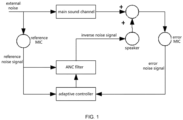
- FIG. 1 is a schematic structural diagram of an existing active noise cancellation (ANC) system.
- the active noise cancellation system in the prior art cannot identify the desired speech and undesired noise, which may cause a complete filtering out of the desired speech or a poor user experience due to the too loud undesired noise.
- Embodiments of the present disclosure provide a method of noise reduction which is executable by an apparatus for noise reduction installed on the headset or a program running on the headset. As shown in FIG. 2 , the method includes following steps:
- the first reference noise signal is picked up by a reference microphone installed on the headset and output to the apparatus for noise reduction on the headset.
- the trigger signal is entered into the apparatus for noise reduction by an external component of the apparatus for noise reduction.
- the orientation of the headset may be determined by the prior art such as a gyroscope.
- the sound source of the desired speech has a relatively fixed location, and also a relatively fixed direction relative to the location of the headset wearer (or changes in the direction are negligible).
- the turning of the user's head (or body) may cause changes to the orientation of the headset.
- the direction of the sound source of the desired speech relative to the headset is changed in an opposite direction to the turning of the headset, such that the orientation of the desired speech signal relative to the headset can be determined in real time, thereby allowing to separate the desired speech signal from the undesired noise signal.
- the filter coefficient is updated merely based on the undesired noise signal, which enables the user to hear the external desired speech without being disturbed by the external undesired noise.
- FIG. 3 provides a block diagram of an apparatus for noise reduction provided on a headset.
- the headset includes a microphone array (microphones 1, 2, 3 —N), a reference microphone, a speaker, an error microphone, a target orientation angle tracker, a beamformer, a target active confirmation signal generator, a sound filter, an ANC filter, and an adaptive controller.
- the user wearing the headset may face toward the sound source of the desired speech while noticing the desired speech in external noise, and then presses a specific trigger button on the headset.
- the target active confirmation signal generator may record the current orientation of the headset as the direction in which the user is facing toward the sound source of the desired speech.
- the target orientation angle tracker may record the changes in the orientation of the headset in real time to thereby acquire the angle change value.
- the beamformer processes the noise signal picked up by the microphone array, that is, picks up the ambient noise (i.e., external noise) in the direction of 45° to the right front of the user's head to acquire the second reference noise in FIG. 3 .
- the sound filter separates the desired components, i.e. the desired speech signal in FIG. 3 , from the second reference noise.
- the reference microphone picks up the external noise to acquire the first reference noise signal.
- the desired speech signal in the first reference noise signal is filtered out to acquire the undesired noise signal.
- the adaptive controller controls to pass the first reference noise directly to the ANC filter or pass the undesired noise signal to the ANC filter.
- the current user desires to retain the desired speech in the ambient noise.
- the undesired noise signal is passed to the ANC filter.
- the ANC filter filters the undesired noise signal to acquire the inverse noise signal, and then the speaker plays the inverse noise to cancel the undesired noise in the ambient noise (i.e., the external noise in FIG. 3 ).
- the ANC filter updates the filter coefficient based on the error noise signal to better cancel the undesired noise.
- acquiring an initial direction of desired speech in response to a trigger signal includes: taking a preset direction as the initial direction of desired speech after receiving the trigger signal.
- the trigger signal is provided to the filter device from the outer side of the filter device, and the direction of the desired speech is preset with respect to the direction of the headset.
- the preset direction is a head frontal orientation of the headset wearer.
- the headset wearer needs to straightly faces toward the sound source of the desired speech signal, and then notifies, via a specific operation, the apparatus for noise reduction that the current sound source of the desired speech signal is directly in front of him or her.
- the preset direction may also be a straight left direction of the headset wearer, and the straight right direction may be the sound source direction of the desired speech.
- the apparatus for noise reduction after receiving the trigger signal, the apparatus for noise reduction searches for the sound source of the desired speech and determines the direction of the desired speech, which may improve the cost of the apparatus for noise reduction.
- the trigger signal may be acquired based on a manual triggering of a user or based on a speech command.
- the user may press a specific button on the headset or issue a specific speech command.
- the speech command may, for example, be "keep the speech signal straight ahead” or “keep the speech signal in the upper left”.
- acquiring the real-time direction of desired speech based on the real-time orientation of the headset and the initial direction of desired speech includes: acquiring the real-time direction of desired speech by performing, on the initial direction of desired speech, a reverse compensation with equal angle according to a change in the real-time orientation of the headset relative to the initial orientation of the headset upon receiving the trigger signal.
- the headset is turned 90° horizontally to the right compared to the orientation of the headset when the user presses a specific button, the real-time direction of desired speech of the headset is turned 90° horizontally to the left.
- the orientation tracking for the headset is performed by a gyroscope installed in the headset. That is, the posture of the headset is detected by the gyroscope.
- the method of determining the posture of the headset is not limited to this.
- extracting the desired speech signal in the real-time direction of desired speech includes:
- the direction of the sound source of the desired speech is determinable.
- the desired speech signal contained in the second noise signal picked up in this direction is the clearest.
- extracting the desired speech signal from the picked second reference noise signal includes: filtering out, from the second reference noise signal, frequency components beyond a preset frequency range to acquire the desired speech signal.
- the components of the second reference noise signal at frequencies other than the human voice frequency may be filtered out.
- the components of the second reference noise signal with frequencies below 500 Hz or above 2000 Hz may be filtered out.
- the upper and lower boundaries of the human voice frequency may be set flexibly.
- extracting the desired speech signal from the picked second reference noise signal includes:
- the filter in an example may equalize and filter the reference noise signal in the direction of the desired speech, and the reference noise signal greater than the preset frequency value is filtered out.
- the retained reference noise signal is eigen-decomposed with a principal component analysis (PCA) algorithm, and the retained reference noise signal herein is a signal in the direction of desired speech and may originate from N reference noise sequences Xerr output by N reference microphones.
- PCA principal component analysis
- the retained reference noise signal is input to the signal feature analyzer that maps the signal onto a space orthogonal to each other with the classical PCA algorithm to acquire eigenvalues and eigenvectors as feature parameters.
- the number of eigenvalues and eigenvectors is same as the number of microphones.
- the maximum eigenvalue D 1 and the corresponding set of singular vectors U 1 and V 1 are adopted to restore the human voice signal S .
- the preset eigenvalue may be set adaptively based on experience and is all within the protection scope of this embodiment.
- filtering the undesired noise signal to output the inverse noise signal for speaker playback includes:
- the present disclosure further provides an apparatus for noise reduction, applicable to a headset provided with a noise reduction function.
- the apparatus includes:
- the second acquiring module 2 is specifically configured to: take a preset direction as the initial direction of desired speech after receiving the trigger signal.
- the preset direction is a head frontal orientation of the headset wearer.
- the second acquiring module 2 is specifically configured to acquire the trigger signal based on a manual triggering of a user or based on a speech command.
- the third acquiring module 3 is specifically configured to: acquire the real-time direction of desired speech by performing, on the initial direction of desired speech, a reverse compensation with equal angle according to a change in the real-time orientation of the headset relative to the initial orientation of the headset upon receiving the trigger signal.
- the third acquiring module includes a gyroscope for performing the orientation tracking for the headset.
- the first filtering module 4 is specifically configured to:
- the first filtering module 4 is specifically configured to: filter out, from the second reference noise signal, frequency components beyond a preset frequency range to acquire the desired speech signal.
- the first filtering module 4 is specifically configured to:
- the second filtering module 5 is specifically configured to:
- each module in the apparatus may be found in the corresponding descriptions of the method and will not be repeated herein.
- the functions of each module may be implemented in full software, full hardware, or a combination of software and hardware.
- the present disclosure further provides an apparatus for noise reduction.
- the apparatus includes: at least one processor 502; and a memory 501 communicatively connected with the at least one processor 502.
- the memory 501 has instructions executable by the at least one processor 502 stored therein, the instructions, when executed by the at least one processor 502, causing the at least one processor 502 to execute the aforesaid method.
- the memory 501 may be configured to have non-transitory software programs, non-transitory computer executable programs, and modules, such as the program instructions/modules corresponding to one method of noise reduction according to the method embodiments of the present disclosure stored therein.
- the processor 502 performs various functional applications of the server and data processing by running non-transitory software programs, instructions, and modules stored in the memory 501, which means to implement one method of noise reduction according to the method embodiments of the present disclosure.
- Embodiments of the present disclosure further provide a headset, which includes: the aforesaid apparatus for noise reduction, and further includes: a microphone array for beamforming, a reference microphone for picking up a first reference noise signal, an error microphone for picking up an error noise signal, and a speaker for broadcasting an inverse noise signal.
Landscapes
- Engineering & Computer Science (AREA)
- Physics & Mathematics (AREA)
- Acoustics & Sound (AREA)
- Multimedia (AREA)
- Signal Processing (AREA)
- Health & Medical Sciences (AREA)
- Otolaryngology (AREA)
- General Physics & Mathematics (AREA)
- Theoretical Computer Science (AREA)
- General Engineering & Computer Science (AREA)
- General Health & Medical Sciences (AREA)
- Human Computer Interaction (AREA)
- Remote Sensing (AREA)
- Radar, Positioning & Navigation (AREA)
- Audiology, Speech & Language Pathology (AREA)
- Soundproofing, Sound Blocking, And Sound Damping (AREA)
- Circuit For Audible Band Transducer (AREA)
Description
- The present disclosure relates to the field of signal processing technologies, in particular to a method and an apparatus for noise reduction, and a headset.
- In the existing active noise cancellation (ANC) system, the external noise is firstly picked up by a reference microphone to acquire a reference noise signal. The reference noise signal is then filtered by an ANC filter to generate an inverse (i.e., phase-inversed) noise signal for speaker playback, and the inverse noise played by the speaker cancels the external noise. The uncancelled external noise is then picked up as residual noise by an error microphone to acquire an error noise signal, which is in turn used by an adaptive controller to update coefficients of the ANC filter, such that the inverse noise can better cancel influences of the external noise in the headset.
- In occasions such as a waiting room or lounge, the user wearing the headset may desire to suppress the external noise without missing desired speech such as voice announcements. However, the desired speech such as voice announcements may be cancelled as noises by the existing ACN filter. Thus, to listen to the desired speech, the noise reduction function of the headset needs to be turned off, which results in a poor user experience. The patent literature
US20120215519A1 discloses a method of processing a multichannel signal according to a general configuration includes performing an active noise cancellation operation on a first audio input channel of the multichannel signal to produce an antinoise signal. This method also includes processing the multichannel signal to obtain a source component, where the processing includes performing a spatially selective processing operation on the multichannel signal to separate the source component from a background component. This method also includes processing the obtained source component to produce a target component, and combining the antinoise signal and an augmented signal that is based on the target component to produce an audio output signal. The patent literatureUS20100131269A1 discloses method of audio signal processing according to a general configuration includes producing an anti-noise signal based on information from a first audio signal, separating a target component of a second audio signal from a noise component of the second audio signal to produce at least one among (A) a separated target component and (B) a separated noise component, and producing an audio output signal based on the anti-noise signal. In this method, the audio output signal is based on at least one among (A) the separated target component and (B) the separated noise component. The patent literatureUS20150195641A1 discloses a method for generating an auditory environment for a user that may include receiving a signal representing an ambient auditory environment of the user, processing the signal using a microprocessor to identify at least one of a plurality of types of sounds in the ambient auditory environment, receiving user preferences corresponding to each of the plurality of types of sounds, modifying the signal for each type of sound in the ambient auditory environment based on the corresponding user preference, and outputting the modified signal to at least one speaker to generate the auditory environment for the user. - An object of the present disclosure is to provide a method and an apparatus for noise reduction, and a headset to overcome the deficiencies of the prior art.
- In order to solve the aforesaid technical problems, embodiments of the present disclosure provide a method of noise reduction, applicable to a headset provided with a noise reduction function, according to
claim 1. The method includes, among others, the following steps: - acquiring a first reference noise signal;
- acquiring an initial direction of desired speech in response to a trigger signal;
- acquiring a real-time direction of desired speech based on a real-time orientation of the headset and the initial direction of desired speech, the real-time orientation being obtained by orientation tracking for the headset;
- filtering out a desired speech signal from the first reference noise signal to acquire an undesired noise signal, the desired speech signal being extracted in the real-time direction of desired speech; and
- filtering the undesired noise signal to output an inverse noise signal for speaker playback.
- In order to solve the aforesaid technical problems, embodiments of the present disclosure also provide an apparatus for noise reduction, applicable to a headset provided with a noise reduction function, according to claim 8. The apparatus includes, among others, the following features:
- a first acquiring module configured to acquire a first reference noise signal;
- a second acquiring module configured to acquire an initial direction of desired speech in response to a trigger signal;
- a third acquiring module configured to acquire a real-time direction of desired speech based on a real-time orientation of the headset and the initial direction of desired speech, the real-time orientation being obtained by orientation tracking for the headset;
- a first filtering module configured to filter out a desired speech signal from the first reference noise signal to acquire an undesired noise signal, the desired speech signal being extracted in the real-time direction of desired speech; and
- a second filtering module configured to filter the undesired noise signal to output an inverse noise signal for speaker playback.
- In order to solve the aforesaid technical problems, examples outside the scope of the claims also provide an apparatus for noise reduction, which includes:
- at least one processor; and
- a memory communicatively connected with the at least one processor;
- wherein the memory has instructions executable by the at least one processor stored therein, the instructions, when executed by the at least one processor, causing the at least one processor to execute the aforesaid method.
- In order to solve the aforesaid technical problems, embodiments of the present disclosure also provide a headset, which includes the aforesaid apparatus for noise reduction, and further includes: a microphone array for beamforming, a reference microphone for picking up a first reference noise signal, an error microphone for picking up an error noise signal, and a speaker for playing an inverse noise signal.
- Compared with the prior art, embodiments of the present disclosure has following advantageous technical effects. In most cases, the sound source of the desired speech has a relatively fixed location, and also a relatively fixed direction relative to the location of the headset wearer (or changes in the direction are negligible). The turning of the user's head may cause changes to the orientation of the headset. Thus, it may be deduced that the direction of the sound source of the desired speech relative to the headset is changed in an opposite direction to the turning of the headset, such that the orientation of the desired speech signal relative to the headset can be determined in real time, thereby allowing to separate the desired speech signal from the undesired noise signal. In addition, the filter coefficient is updated merely based on the undesired noise signal, which enables the user to hear the external desired speech without being disturbed by the external undesired noise.
-
-
FIG. 1 is a schematic structural diagram of a headset in the prior art; -
FIG. 2 is a flow chart of a method of noise reduction according to embodiments of the present disclosure; -
FIG. 3 is a schematic structural diagram of a headset according to embodiments of the present disclosure; -
FIG. 4 is a block structural diagram of an apparatus for noise reduction according to embodiments of the present disclosure; and -
FIG. 5 is a block structural diagram of an apparatus for noise reduction according to embodiments of the present disclosure. - In the present disclosure, it should be understood that terms such as "include" or "have", etc., are intended to indicate the existence of the characteristics, figures, steps, actions, components and parts as disclosed in the present disclosure or combinations thereof, without excluding the existence of one or more other characteristics, figures, steps, actions, components, parts or combinations thereof.
- Furthermore, it should be noted that, in the case of no conflict, the embodiments of the present disclosure and features of the embodiments may be combined with each other. The present disclosure will be described in detail below with reference to the accompanying drawings and embodiments.
- The present disclosure will be further described in detail below in conjunction with embodiments shown by the accompanying drawings.
-
FIG. 1 is a schematic structural diagram of an existing active noise cancellation (ANC) system. The active noise cancellation system in the prior art cannot identify the desired speech and undesired noise, which may cause a complete filtering out of the desired speech or a poor user experience due to the too loud undesired noise. Embodiments of the present disclosure provide a method of noise reduction which is executable by an apparatus for noise reduction installed on the headset or a program running on the headset. As shown inFIG. 2 , the method includes following steps: - step 101: acquiring a first reference noise signal;
- step 102: acquiring an initial direction of desired speech in response to a trigger signal;
- step 103: acquiring a real-time direction of desired speech based on a real-time orientation of the headset and the initial direction of desired speech, the real-time orientation being obtained by orientation tracking for the headset;
- step 104: filtering out a desired speech signal from the first reference noise signal to acquire an undesired noise signal, the desired speech signal being extracted in the real-time direction of desired speech; and
- step 105: filtering the undesired noise signal to output an inverse noise signal for speaker playback.
- The first reference noise signal is picked up by a reference microphone installed on the headset and output to the apparatus for noise reduction on the headset. The trigger signal is entered into the apparatus for noise reduction by an external component of the apparatus for noise reduction. The orientation of the headset may be determined by the prior art such as a gyroscope.
- In most cases, the sound source of the desired speech has a relatively fixed location, and also a relatively fixed direction relative to the location of the headset wearer (or changes in the direction are negligible). The turning of the user's head (or body) may cause changes to the orientation of the headset. Thus, it may be deduced that the direction of the sound source of the desired speech relative to the headset is changed in an opposite direction to the turning of the headset, such that the orientation of the desired speech signal relative to the headset can be determined in real time, thereby allowing to separate the desired speech signal from the undesired noise signal. In addition, the filter coefficient is updated merely based on the undesired noise signal, which enables the user to hear the external desired speech without being disturbed by the external undesired noise.
- In an example, a reference is made to
FIG. 3 that provides a block diagram of an apparatus for noise reduction provided on a headset. The headset includes a microphone array (microphones - The user wearing the headset may face toward the sound source of the desired speech while noticing the desired speech in external noise, and then presses a specific trigger button on the headset. At this point, the target active confirmation signal generator may record the current orientation of the headset as the direction in which the user is facing toward the sound source of the desired speech. Subsequently, when changes occur to the orientation of the headset due to the turning of the user's body or head, the target orientation angle tracker may record the changes in the orientation of the headset in real time to thereby acquire the angle change value. For example, when the user presses the specific trigger button while looking horizontally directly at the sound source of the desired speech and subsequently turns the head 45° to the left along the horizontal direction, it may be inferred that the sound source of the desired speech at this point has turned 45° horizontally to the right relative to the headset. The beamformer processes the noise signal picked up by the microphone array, that is, picks up the ambient noise (i.e., external noise) in the direction of 45° to the right front of the user's head to acquire the second reference noise in
FIG. 3 . The sound filter separates the desired components, i.e. the desired speech signal inFIG. 3 , from the second reference noise. - The reference microphone picks up the external noise to acquire the first reference noise signal. The desired speech signal in the first reference noise signal is filtered out to acquire the undesired noise signal. The adaptive controller controls to pass the first reference noise directly to the ANC filter or pass the undesired noise signal to the ANC filter. The current user desires to retain the desired speech in the ambient noise. Thus, the undesired noise signal is passed to the ANC filter.
- The ANC filter filters the undesired noise signal to acquire the inverse noise signal, and then the speaker plays the inverse noise to cancel the undesired noise in the ambient noise (i.e., the external noise in
FIG. 3 ). The ANC filter updates the filter coefficient based on the error noise signal to better cancel the undesired noise. - In some embodiments, acquiring an initial direction of desired speech in response to a trigger signal includes:
taking a preset direction as the initial direction of desired speech after receiving the trigger signal. - That is, the trigger signal is provided to the filter device from the outer side of the filter device, and the direction of the desired speech is preset with respect to the direction of the headset.
- For example, the preset direction is a head frontal orientation of the headset wearer. The headset wearer needs to straightly faces toward the sound source of the desired speech signal, and then notifies, via a specific operation, the apparatus for noise reduction that the current sound source of the desired speech signal is directly in front of him or her.
- Of course, the preset direction may also be a straight left direction of the headset wearer, and the straight right direction may be the sound source direction of the desired speech. There may also be a plurality of preset directions. That is, the preset direction may also be the left ear orientation or right ear orientation of the headset wearer.
- In some other embodiments, after receiving the trigger signal, the apparatus for noise reduction searches for the sound source of the desired speech and determines the direction of the desired speech, which may improve the cost of the apparatus for noise reduction.
- In some other embodiments, the trigger signal may be acquired based on a manual triggering of a user or based on a speech command.
- For example, after the user adjusts the orientation of the headset to the sound source of the desired speech signal to which the user's head is facing, the user may press a specific button on the headset or issue a specific speech command. The speech command may, for example, be "keep the speech signal straight ahead" or "keep the speech signal in the upper left".
- In some embodiments, acquiring the real-time direction of desired speech based on the real-time orientation of the headset and the initial direction of desired speech includes:
acquiring the real-time direction of desired speech by performing, on the initial direction of desired speech, a reverse compensation with equal angle according to a change in the real-time orientation of the headset relative to the initial orientation of the headset upon receiving the trigger signal. - For example, if the headset is turned 90° horizontally to the right compared to the orientation of the headset when the user presses a specific button, the real-time direction of desired speech of the headset is turned 90° horizontally to the left.
- In this case, what is considered is only the changes in the posture of the headset rather than changes in the position of the headset relative to the speech source of the desired speech, because the influence of the movement of the headset on the direction of the desired speech is ignorable in most cases if the beamforming beam is set wide enough. In addition, the algorithm can be greatly simplified, and the number of operations can be reduced.
- In some embodiments, the orientation tracking for the headset is performed by a gyroscope installed in the headset. That is, the posture of the headset is detected by the gyroscope. Of course, the method of determining the posture of the headset is not limited to this.
- In some embodiments, extracting the desired speech signal in the real-time direction of desired speech includes:
- controlling a beamformer to pick up a second reference noise signal along the real-time direction of desired speech; and
- extracting the desired speech signal from the picked second reference noise signal.
- The direction of the sound source of the desired speech is determinable. Thus, the desired speech signal contained in the second noise signal picked up in this direction is the clearest.
- In some embodiments, extracting the desired speech signal from the picked second reference noise signal includes:
filtering out, from the second reference noise signal, frequency components beyond a preset frequency range to acquire the desired speech signal. - For example, the components of the second reference noise signal at frequencies other than the human voice frequency may be filtered out. For example, the components of the second reference noise signal with frequencies below 500 Hz or above 2000 Hz may be filtered out. Of course, the upper and lower boundaries of the human voice frequency may be set flexibly.
- In some embodiments, extracting the desired speech signal from the picked second reference noise signal includes:
- eigen-decomposing, with a principal component analysis algorithm, the second reference noise signal acquired by N microphones in a microphone array to acquire N eigenvalues Di (i=1, 2, ......, N) and corresponding N sets of singular vectors Ui and Vi , wherein N refers to the number of microphones in the microphone array; and
- selecting eigenvalues Dj that are greater than a preset eigenvalue to calculate the desired speech signal S = Σ Uj * Dj * Vj.
- The aforesaid two methods for extracting the desired speech signals may be adopted in combination. For example, the filter in an example may equalize and filter the reference noise signal in the direction of the desired speech, and the reference noise signal greater than the preset frequency value is filtered out. Then, the retained reference noise signal is eigen-decomposed with a principal component analysis (PCA) algorithm, and the retained reference noise signal herein is a signal in the direction of desired speech and may originate from N reference noise sequences Xerr output by N reference microphones. The retained reference noise signal is input to the signal feature analyzer that maps the signal onto a space orthogonal to each other with the classical PCA algorithm to acquire eigenvalues and eigenvectors as feature parameters. That is, a sequence of eigenvalues Di (i=1, 2, ..., N) composed of N eigenvalues corresponds to N sets of singular vectors Ui and Vi (i=1, 2, ..., N) by ordinal number, and the sequence of eigenvalues D and the corresponding set of singular vectors U and V are taken as a feature parameter set S. The number of eigenvalues and eigenvectors is same as the number of microphones. Then, eigenvalues Dj that are greater than a preset eigenvalue are selected to calculate the desired speech signal S = Σ Uj * Dj * Vj. For example, the eigenvalue of j=1 is the maximum eigenvalue, and the maximum eigenvalue D 1 and the corresponding set of singular vectors U 1 and V 1 are adopted to restore the human voice signal S. The preset eigenvalue may be set adaptively based on experience and is all within the protection scope of this embodiment.
- In some embodiments, filtering the undesired noise signal to output the inverse noise signal for speaker playback includes:
- acquiring an error noise signal;
- updating a filter coefficient based on the error noise signal and the undesired noise signal; and
- filtering the undesired noise signal with the updated filter coefficient to acquire the inverse noise signal.
- Referring to
FIG. 4 , the present disclosure further provides an apparatus for noise reduction, applicable to a headset provided with a noise reduction function. The apparatus includes: - a first acquiring
module 1 configured to acquire a first reference noise signal; - a second acquiring
module 2 configured to acquire an initial direction of desired speech in response to a trigger signal; - a third acquiring
module 3 configured to acquire a real-time direction of desired speech based on a real-time orientation of the headset and the initial direction of desired speech, the real-time orientation being obtained by orientation tracking for the headset; - a
first filtering module 4, configured to filter out a desired speech signal from the first reference noise signal to acquire an undesired noise signal, the desired speech signal being extracted in the real-time direction of desired speech; and - a second filtering module 5, configured to filter the undesired noise signal to output an inverse noise signal for speaker playback.
- In some embodiments, the second acquiring
module 2 is specifically configured to:
take a preset direction as the initial direction of desired speech after receiving the trigger signal. - In some embodiments, the preset direction is a head frontal orientation of the headset wearer.
- In some embodiments, the second acquiring
module 2 is specifically configured to acquire the trigger signal based on a manual triggering of a user or based on a speech command. - In some embodiments, the third acquiring
module 3 is specifically configured to:
acquire the real-time direction of desired speech by performing, on the initial direction of desired speech, a reverse compensation with equal angle according to a change in the real-time orientation of the headset relative to the initial orientation of the headset upon receiving the trigger signal. - In some embodiments, the third acquiring module includes a gyroscope for performing the orientation tracking for the headset.
- In some embodiments, the
first filtering module 4 is specifically configured to: - control a beamformer to pick up a second reference noise signal along the real-time direction of desired speech; and
- extract the desired speech signal from the picked second reference noise signal.
- In some embodiments, the
first filtering module 4 is specifically configured to:
filter out, from the second reference noise signal, frequency components beyond a preset frequency range to acquire the desired speech signal. - In some embodiments, the
first filtering module 4 is specifically configured to: - eigen-decompose, with a principal component analysis algorithm, the second reference noise signal acquired by N microphones in a microphone array to acquire N eigenvalues Di (i=1,2,......N) and corresponding N sets of singular vectors Ui and Vi , wherein N refers to the number of microphones in the microphone array; and
- select eigenvalues Dj that are greater than a preset eigenvalue to calculate the desired speech signal S = Σ Uj * Dj * Vj.
- In some embodiments, the second filtering module 5 is specifically configured to:
- acquire an error noise signal;
- update a filter coefficient based on the error noise signal and the undesired noise signal; and
- filter the undesired noise signal with the updated filter coefficient to acquire the inverse noise signal.
- The functions of each module in the apparatus according to embodiments of the present disclosure may be found in the corresponding descriptions of the method and will not be repeated herein. The functions of each module may be implemented in full software, full hardware, or a combination of software and hardware.
- Referring to
FIG. 5 , the present disclosure further provides an apparatus for noise reduction. The apparatus includes:
at least oneprocessor 502; and amemory 501 communicatively connected with the at least oneprocessor 502. - The
memory 501 has instructions executable by the at least oneprocessor 502 stored therein, the instructions, when executed by the at least oneprocessor 502, causing the at least oneprocessor 502 to execute the aforesaid method. - The
memory 501, as a non-transitory computer readable storage medium, may be configured to have non-transitory software programs, non-transitory computer executable programs, and modules, such as the program instructions/modules corresponding to one method of noise reduction according to the method embodiments of the present disclosure stored therein. Theprocessor 502 performs various functional applications of the server and data processing by running non-transitory software programs, instructions, and modules stored in thememory 501, which means to implement one method of noise reduction according to the method embodiments of the present disclosure. - Embodiments of the present disclosure further provide a headset, which includes: the aforesaid apparatus for noise reduction, and further includes: a microphone array for beamforming, a reference microphone for picking up a first reference noise signal, an error microphone for picking up an error noise signal, and a speaker for broadcasting an inverse noise signal.
- The respective embodiments of the present disclosure are described in a progressive manner. The reference may be made to each other for the same or similar parts of the respective embodiments, and each embodiment focuses on the differences from other embodiments.
- The scope of the present disclosure is not limited to the aforesaid embodiments, and obviously, one skilled in the art may make various modifications and variations to the present disclosure without departing from the scope of the present invention, as defined by the following claims.
Claims (11)
- A method of noise reduction, applicable to a headset provided with a noise reduction function, comprising:acquiring (101) a first reference noise signal;acquiring (102) an initial direction of desired speech in response to a trigger signal; andacquiring (103) a real-time direction of desired speech based on a real-time orientation of the headset and the initial direction of desired speech, the real-time orientation being obtained by orientation tracking for the headset; andextracting a desired speech signal in the real-time direction of desired speech, comprising:controlling a beamformer to pick up a second reference noise signal along the real-time direction of desired speech; andfiltering components with frequencies exceeding a preset frequency range out of the second reference noise signal to obtain a retained signal;characterised by:filtering (104) out the desired speech signal from the first reference noise signal to acquire an undesired noise signal; andfiltering (105) the undesired noise signal to output an inverse noise signal for speaker playback,wherein extracting the desired speech signal in the real-time direction of desired speech further comprises:eigen-decomposing, with a principal component analysis algorithm, the retained signal to acquire N eigenvalues Di (i=1, 2, ......, N) and corresponding N sets of singular vectors Ui and Vi , wherein N refers to the number of microphones configured for the beamformer; andselecting at least one eigenvalue Dj greater than a preset eigenvalue to calculate the desired speech signal S = Σ Uj * Dj * Vj.
- The method according to claim 1, wherein acquiring (102) the initial direction of desired speech in response to the trigger signal comprises:
taking a preset direction as the initial direction of desired speech after receiving the trigger signal. - The method according to claim 2, wherein the preset direction is a head frontal orientation, a left ear orientation, or a right ear orientation of wearer of the headset.
- The method according to claim 2, wherein the trigger signal is acquired based on a manual triggering of a user or based on a speech command.
- The method according to claim 1, wherein acquiring (103) the real-time direction of desired speech based on the real-time orientation of the headset and the initial direction of desired speech comprises:
acquiring the real-time direction of desired speech by performing, on the initial direction of desired speech, a reverse compensation with equal angle according to a change in the real-time orientation of the headset relative to an initial orientation of the headset upon receiving the trigger signal. - The method according to claim 1, wherein the orientation tracking for the headset is performed by a gyroscope installed in the headset.
- The method according to claim 1, wherein filtering (105) the undesired noise signal to output the inverse noise signal comprises:acquiring an error noise signal;updating a filter coefficient based on the error noise signal and the undesired noise signal; andfiltering the undesired noise signal with the updated filter coefficient to acquire the inverse noise signal.
- An apparatus for noise reduction, applicable to a headset provided with a noise reduction function, comprising:a first acquiring module (1) configured to acquire a first reference noise signal;a second acquiring module (2) configured to acquire an initial direction of desired speech in response to a trigger signal;a third acquiring module (3) configured to acquire a real-time direction of desired speech based on a real-time orientation of the headset and the initial direction of desired speech, the real-time orientation being obtained by orientation tracking for the headset; anda first filtering module (4) configured to extract a desired speech signal in the real-time direction of desired speech bycontrolling a beamformer to pick up a second reference noise signal along the real-time direction of desired speech andfiltering components with frequencies exceeding a preset frequency range out of the second reference noise signal to obtain a retained signal;characterised by:the first filtering module (4) being configured to filter out the desired speech signal from the first reference noise signal to acquire an undesired noise signal; anda second filtering module (5) configured to filter the undesired noise signal to output an inverse noise signal for speaker playback,wherein the first filtering module (4) is further configured to:eigen-decompose, with a principal component analysis algorithm, the retained signal to acquire N eigenvalues Di (i=1, 2, ......, N) and corresponding N sets of singular vectors Ui and Vi , wherein N refers to the number of microphones configured for the beamformer; andselect at least one eigenvalue Dj greater than a preset eigenvalue to calculate the desired speech signal S = Σ Uj * Dj * Vj.
- The apparatus according to claim 8, wherein the third acquiring module (3) is configured to:
acquire the real-time direction of desired speech by performing, on the initial direction of desired speech, a reverse compensation with equal angle according to a change in the real-time orientation of the headset relative to an initial orientation of the headset upon receiving the trigger signal. - The apparatus according to claim 8, wherein the second filtering module (5) is configured to:acquire an error noise signal;update a filter coefficient based on the error noise signal and the undesired noise signal; andfilter the undesired noise signal with the updated filter coefficient to acquire the inverse noise signal.
- A headset, characterized by comprising an apparatus according to any one of claims 8 to 10, a microphone array for beamforming, a reference microphone for picking up a first reference noise signal, an error microphone for picking up an error noise signal, and a speaker for playing an inverse noise signal.
Applications Claiming Priority (1)
| Application Number | Priority Date | Filing Date | Title |
|---|---|---|---|
| CN202110383255.0A CN113099348B (en) | 2021-04-09 | 2021-04-09 | Noise reduction method, noise reduction device and earphone |
Publications (2)
| Publication Number | Publication Date |
|---|---|
| EP4071750A1 EP4071750A1 (en) | 2022-10-12 |
| EP4071750B1 true EP4071750B1 (en) | 2024-07-31 |
Family
ID=76675679
Family Applications (1)
| Application Number | Title | Priority Date | Filing Date |
|---|---|---|---|
| EP22167340.3A Active EP4071750B1 (en) | 2021-04-09 | 2022-04-08 | Method and apparatus for noise reduction, and headset |
Country Status (3)
| Country | Link |
|---|---|
| US (1) | US11922919B2 (en) |
| EP (1) | EP4071750B1 (en) |
| CN (1) | CN113099348B (en) |
Families Citing this family (5)
| Publication number | Priority date | Publication date | Assignee | Title |
|---|---|---|---|---|
| CN113077779A (en) * | 2021-03-10 | 2021-07-06 | 泰凌微电子(上海)股份有限公司 | Noise reduction method and device, electronic equipment and storage medium |
| CN113596661A (en) * | 2021-07-28 | 2021-11-02 | 维沃移动通信有限公司 | Earphone, feedback noise reduction method and device |
| CN114173252A (en) * | 2021-12-14 | 2022-03-11 | Oppo广东移动通信有限公司 | Control method, device, earphone and storage medium for audio collection direction |
| CN114155871B (en) * | 2021-12-16 | 2024-10-29 | 科大讯飞股份有限公司 | A method, device, storage medium and equipment for reducing speech noise |
| CN116741137A (en) * | 2023-07-07 | 2023-09-12 | 中国船舶集团有限公司第七一五研究所 | Frogman breathing noise suppression method and device for underwater intercom |
Family Cites Families (15)
| Publication number | Priority date | Publication date | Assignee | Title |
|---|---|---|---|---|
| US8374854B2 (en) * | 2008-03-28 | 2013-02-12 | Southern Methodist University | Spatio-temporal speech enhancement technique based on generalized eigenvalue decomposition |
| US9202455B2 (en) * | 2008-11-24 | 2015-12-01 | Qualcomm Incorporated | Systems, methods, apparatus, and computer program products for enhanced active noise cancellation |
| US9202456B2 (en) * | 2009-04-23 | 2015-12-01 | Qualcomm Incorporated | Systems, methods, apparatus, and computer-readable media for automatic control of active noise cancellation |
| US9330675B2 (en) * | 2010-11-12 | 2016-05-03 | Broadcom Corporation | Method and apparatus for wind noise detection and suppression using multiple microphones |
| US9037458B2 (en) * | 2011-02-23 | 2015-05-19 | Qualcomm Incorporated | Systems, methods, apparatus, and computer-readable media for spatially selective audio augmentation |
| US9716939B2 (en) * | 2014-01-06 | 2017-07-25 | Harman International Industries, Inc. | System and method for user controllable auditory environment customization |
| CN108307486A (en) | 2016-08-11 | 2018-07-20 | 索尼公司 | Electronic equipment and method for network-control end and network node |
| US10224019B2 (en) * | 2017-02-10 | 2019-03-05 | Audio Analytic Ltd. | Wearable audio device |
| US10079026B1 (en) * | 2017-08-23 | 2018-09-18 | Cirrus Logic, Inc. | Spatially-controlled noise reduction for headsets with variable microphone array orientation |
| US10979812B2 (en) * | 2017-12-15 | 2021-04-13 | Gn Audio A/S | Headset with ambient noise reduction system |
| CN108962274A (en) * | 2018-07-11 | 2018-12-07 | 会听声学科技(北京)有限公司 | A kind of sound enhancement method, device and earphone |
| CN109218882B (en) * | 2018-08-16 | 2021-02-26 | 歌尔科技有限公司 | Earphone and ambient sound monitoring method thereof |
| US10679602B2 (en) | 2018-10-26 | 2020-06-09 | Facebook Technologies, Llc | Adaptive ANC based on environmental triggers |
| US10595149B1 (en) * | 2018-12-04 | 2020-03-17 | Facebook Technologies, Llc | Audio augmentation using environmental data |
| CN110808061B (en) * | 2019-11-11 | 2022-03-15 | 广州国音智能科技有限公司 | Voice separation method and device, mobile terminal and computer readable storage medium |
-
2021
- 2021-04-09 CN CN202110383255.0A patent/CN113099348B/en active Active
-
2022
- 2022-04-08 US US17/716,635 patent/US11922919B2/en active Active
- 2022-04-08 EP EP22167340.3A patent/EP4071750B1/en active Active
Also Published As
| Publication number | Publication date |
|---|---|
| CN113099348B (en) | 2024-06-21 |
| US20220328031A1 (en) | 2022-10-13 |
| EP4071750A1 (en) | 2022-10-12 |
| CN113099348A (en) | 2021-07-09 |
| US11922919B2 (en) | 2024-03-05 |
Similar Documents
| Publication | Publication Date | Title |
|---|---|---|
| EP4071750B1 (en) | Method and apparatus for noise reduction, and headset | |
| US11109163B2 (en) | Hearing aid comprising a beam former filtering unit comprising a smoothing unit | |
| CN106782584B (en) | Audio signal processing device, method and electronic device | |
| EP3189672B1 (en) | Controlling ambient sound volume | |
| US7613310B2 (en) | Audio input system | |
| JP5401760B2 (en) | Headphone device, audio reproduction system, and audio reproduction method | |
| US8300861B2 (en) | Hearing aid algorithms | |
| JP2008216375A (en) | Active silencer | |
| US11889261B2 (en) | Adaptive beamformer for enhanced far-field sound pickup | |
| EP4055834A1 (en) | Real-time augmented hearing platform | |
| CN109360578B (en) | Echo cancellation method of audio device, audio device and readable storage medium | |
| WO2024205944A1 (en) | Audio processing based on target signal-to-noise ratio | |
| EP1438708B1 (en) | Method for canceling unwanted loudspeaker signals | |
| EP4218011B1 (en) | Machine learning based self-speech removal | |
| US11158301B2 (en) | Method for eliminating specific object voice and ear-wearing audio device using same | |
| EP4451264A1 (en) | Active noise cancellation system and method | |
| CN113473345B (en) | Wearable device hearing assistance control method, device and system and readable storage medium | |
| WO2022250854A1 (en) | Wearable hearing assist device with sound pressure level shifting | |
| CN118632161A (en) | Audio device and method for dynamically adjusting active leakage in an audio device | |
| CN118870279A (en) | Headset conversation detection | |
| CN119400147A (en) | Noise reduction method based on sidetone, active noise reduction earphone and storage medium | |
| CN113347519A (en) | Method for eliminating specific object voice and ear-wearing type sound signal device using same |
Legal Events
| Date | Code | Title | Description |
|---|---|---|---|
| PUAI | Public reference made under article 153(3) epc to a published international application that has entered the european phase |
Free format text: ORIGINAL CODE: 0009012 |
|
| STAA | Information on the status of an ep patent application or granted ep patent |
Free format text: STATUS: THE APPLICATION HAS BEEN PUBLISHED |
|
| AK | Designated contracting states |
Kind code of ref document: A1 Designated state(s): AL AT BE BG CH CY CZ DE DK EE ES FI FR GB GR HR HU IE IS IT LI LT LU LV MC MK MT NL NO PL PT RO RS SE SI SK SM TR |
|
| STAA | Information on the status of an ep patent application or granted ep patent |
Free format text: STATUS: REQUEST FOR EXAMINATION WAS MADE |
|
| 17P | Request for examination filed |
Effective date: 20230224 |
|
| RBV | Designated contracting states (corrected) |
Designated state(s): AL AT BE BG CH CY CZ DE DK EE ES FI FR GB GR HR HU IE IS IT LI LT LU LV MC MK MT NL NO PL PT RO RS SE SI SK SM TR |
|
| GRAP | Despatch of communication of intention to grant a patent |
Free format text: ORIGINAL CODE: EPIDOSNIGR1 |
|
| STAA | Information on the status of an ep patent application or granted ep patent |
Free format text: STATUS: GRANT OF PATENT IS INTENDED |
|
| RIC1 | Information provided on ipc code assigned before grant |
Ipc: G10L 21/0208 20130101ALN20240326BHEP Ipc: H04R 3/00 20060101ALI20240326BHEP Ipc: H04R 1/10 20060101ALI20240326BHEP Ipc: G10K 11/178 20060101AFI20240326BHEP |
|
| RIC1 | Information provided on ipc code assigned before grant |
Ipc: G10L 21/0208 20130101ALN20240403BHEP Ipc: H04R 3/00 20060101ALI20240403BHEP Ipc: H04R 1/10 20060101ALI20240403BHEP Ipc: G10K 11/178 20060101AFI20240403BHEP |
|
| INTG | Intention to grant announced |
Effective date: 20240415 |
|
| RAP3 | Party data changed (applicant data changed or rights of an application transferred) |
Owner name: TELINK SEMICONDUCTOR (SHANGHAI) CO., LTD. |
|
| GRAS | Grant fee paid |
Free format text: ORIGINAL CODE: EPIDOSNIGR3 |
|
| GRAA | (expected) grant |
Free format text: ORIGINAL CODE: 0009210 |
|
| STAA | Information on the status of an ep patent application or granted ep patent |
Free format text: STATUS: THE PATENT HAS BEEN GRANTED |
|
| AK | Designated contracting states |
Kind code of ref document: B1 Designated state(s): AL AT BE BG CH CY CZ DE DK EE ES FI FR GB GR HR HU IE IS IT LI LT LU LV MC MK MT NL NO PL PT RO RS SE SI SK SM TR |
|
| REG | Reference to a national code |
Ref country code: CH Ref legal event code: EP Ref country code: GB Ref legal event code: FG4D |
|
| REG | Reference to a national code |
Ref country code: DE Ref legal event code: R096 Ref document number: 602022004890 Country of ref document: DE |
|
| REG | Reference to a national code |
Ref country code: IE Ref legal event code: FG4D |
|
| REG | Reference to a national code |
Ref country code: LT Ref legal event code: MG9D |
|
| REG | Reference to a national code |
Ref country code: NL Ref legal event code: MP Effective date: 20240731 |
|
| PG25 | Lapsed in a contracting state [announced via postgrant information from national office to epo] |
Ref country code: PT Free format text: LAPSE BECAUSE OF FAILURE TO SUBMIT A TRANSLATION OF THE DESCRIPTION OR TO PAY THE FEE WITHIN THE PRESCRIBED TIME-LIMIT Effective date: 20241202 |
|
| REG | Reference to a national code |
Ref country code: AT Ref legal event code: MK05 Ref document number: 1709241 Country of ref document: AT Kind code of ref document: T Effective date: 20240731 |
|
| PG25 | Lapsed in a contracting state [announced via postgrant information from national office to epo] |
Ref country code: PT Free format text: LAPSE BECAUSE OF FAILURE TO SUBMIT A TRANSLATION OF THE DESCRIPTION OR TO PAY THE FEE WITHIN THE PRESCRIBED TIME-LIMIT Effective date: 20241202 |
|
| PG25 | Lapsed in a contracting state [announced via postgrant information from national office to epo] |
Ref country code: NO Free format text: LAPSE BECAUSE OF FAILURE TO SUBMIT A TRANSLATION OF THE DESCRIPTION OR TO PAY THE FEE WITHIN THE PRESCRIBED TIME-LIMIT Effective date: 20241031 |
|
| PG25 | Lapsed in a contracting state [announced via postgrant information from national office to epo] |
Ref country code: NL Free format text: LAPSE BECAUSE OF FAILURE TO SUBMIT A TRANSLATION OF THE DESCRIPTION OR TO PAY THE FEE WITHIN THE PRESCRIBED TIME-LIMIT Effective date: 20240731 Ref country code: FI Free format text: LAPSE BECAUSE OF FAILURE TO SUBMIT A TRANSLATION OF THE DESCRIPTION OR TO PAY THE FEE WITHIN THE PRESCRIBED TIME-LIMIT Effective date: 20240731 Ref country code: GR Free format text: LAPSE BECAUSE OF FAILURE TO SUBMIT A TRANSLATION OF THE DESCRIPTION OR TO PAY THE FEE WITHIN THE PRESCRIBED TIME-LIMIT Effective date: 20241101 Ref country code: PL Free format text: LAPSE BECAUSE OF FAILURE TO SUBMIT A TRANSLATION OF THE DESCRIPTION OR TO PAY THE FEE WITHIN THE PRESCRIBED TIME-LIMIT Effective date: 20240731 |
|
| PG25 | Lapsed in a contracting state [announced via postgrant information from national office to epo] |
Ref country code: BG Free format text: LAPSE BECAUSE OF FAILURE TO SUBMIT A TRANSLATION OF THE DESCRIPTION OR TO PAY THE FEE WITHIN THE PRESCRIBED TIME-LIMIT Effective date: 20240731 |
|
| PG25 | Lapsed in a contracting state [announced via postgrant information from national office to epo] |
Ref country code: LV Free format text: LAPSE BECAUSE OF FAILURE TO SUBMIT A TRANSLATION OF THE DESCRIPTION OR TO PAY THE FEE WITHIN THE PRESCRIBED TIME-LIMIT Effective date: 20240731 |
|
| PG25 | Lapsed in a contracting state [announced via postgrant information from national office to epo] |
Ref country code: IS Free format text: LAPSE BECAUSE OF FAILURE TO SUBMIT A TRANSLATION OF THE DESCRIPTION OR TO PAY THE FEE WITHIN THE PRESCRIBED TIME-LIMIT Effective date: 20241130 Ref country code: AT Free format text: LAPSE BECAUSE OF FAILURE TO SUBMIT A TRANSLATION OF THE DESCRIPTION OR TO PAY THE FEE WITHIN THE PRESCRIBED TIME-LIMIT Effective date: 20240731 |
|
| PG25 | Lapsed in a contracting state [announced via postgrant information from national office to epo] |
Ref country code: HR Free format text: LAPSE BECAUSE OF FAILURE TO SUBMIT A TRANSLATION OF THE DESCRIPTION OR TO PAY THE FEE WITHIN THE PRESCRIBED TIME-LIMIT Effective date: 20240731 |
|
| PG25 | Lapsed in a contracting state [announced via postgrant information from national office to epo] |
Ref country code: ES Free format text: LAPSE BECAUSE OF FAILURE TO SUBMIT A TRANSLATION OF THE DESCRIPTION OR TO PAY THE FEE WITHIN THE PRESCRIBED TIME-LIMIT Effective date: 20240731 Ref country code: RS Free format text: LAPSE BECAUSE OF FAILURE TO SUBMIT A TRANSLATION OF THE DESCRIPTION OR TO PAY THE FEE WITHIN THE PRESCRIBED TIME-LIMIT Effective date: 20241031 |
|
| PG25 | Lapsed in a contracting state [announced via postgrant information from national office to epo] |
Ref country code: RS Free format text: LAPSE BECAUSE OF FAILURE TO SUBMIT A TRANSLATION OF THE DESCRIPTION OR TO PAY THE FEE WITHIN THE PRESCRIBED TIME-LIMIT Effective date: 20241031 Ref country code: PL Free format text: LAPSE BECAUSE OF FAILURE TO SUBMIT A TRANSLATION OF THE DESCRIPTION OR TO PAY THE FEE WITHIN THE PRESCRIBED TIME-LIMIT Effective date: 20240731 Ref country code: NO Free format text: LAPSE BECAUSE OF FAILURE TO SUBMIT A TRANSLATION OF THE DESCRIPTION OR TO PAY THE FEE WITHIN THE PRESCRIBED TIME-LIMIT Effective date: 20241031 Ref country code: NL Free format text: LAPSE BECAUSE OF FAILURE TO SUBMIT A TRANSLATION OF THE DESCRIPTION OR TO PAY THE FEE WITHIN THE PRESCRIBED TIME-LIMIT Effective date: 20240731 Ref country code: LV Free format text: LAPSE BECAUSE OF FAILURE TO SUBMIT A TRANSLATION OF THE DESCRIPTION OR TO PAY THE FEE WITHIN THE PRESCRIBED TIME-LIMIT Effective date: 20240731 Ref country code: IS Free format text: LAPSE BECAUSE OF FAILURE TO SUBMIT A TRANSLATION OF THE DESCRIPTION OR TO PAY THE FEE WITHIN THE PRESCRIBED TIME-LIMIT Effective date: 20241130 Ref country code: HR Free format text: LAPSE BECAUSE OF FAILURE TO SUBMIT A TRANSLATION OF THE DESCRIPTION OR TO PAY THE FEE WITHIN THE PRESCRIBED TIME-LIMIT Effective date: 20240731 Ref country code: GR Free format text: LAPSE BECAUSE OF FAILURE TO SUBMIT A TRANSLATION OF THE DESCRIPTION OR TO PAY THE FEE WITHIN THE PRESCRIBED TIME-LIMIT Effective date: 20241101 Ref country code: FI Free format text: LAPSE BECAUSE OF FAILURE TO SUBMIT A TRANSLATION OF THE DESCRIPTION OR TO PAY THE FEE WITHIN THE PRESCRIBED TIME-LIMIT Effective date: 20240731 Ref country code: ES Free format text: LAPSE BECAUSE OF FAILURE TO SUBMIT A TRANSLATION OF THE DESCRIPTION OR TO PAY THE FEE WITHIN THE PRESCRIBED TIME-LIMIT Effective date: 20240731 Ref country code: BG Free format text: LAPSE BECAUSE OF FAILURE TO SUBMIT A TRANSLATION OF THE DESCRIPTION OR TO PAY THE FEE WITHIN THE PRESCRIBED TIME-LIMIT Effective date: 20240731 Ref country code: AT Free format text: LAPSE BECAUSE OF FAILURE TO SUBMIT A TRANSLATION OF THE DESCRIPTION OR TO PAY THE FEE WITHIN THE PRESCRIBED TIME-LIMIT Effective date: 20240731 |
|
| PG25 | Lapsed in a contracting state [announced via postgrant information from national office to epo] |
Ref country code: RO Free format text: LAPSE BECAUSE OF FAILURE TO SUBMIT A TRANSLATION OF THE DESCRIPTION OR TO PAY THE FEE WITHIN THE PRESCRIBED TIME-LIMIT Effective date: 20240731 Ref country code: SM Free format text: LAPSE BECAUSE OF FAILURE TO SUBMIT A TRANSLATION OF THE DESCRIPTION OR TO PAY THE FEE WITHIN THE PRESCRIBED TIME-LIMIT Effective date: 20240731 Ref country code: DK Free format text: LAPSE BECAUSE OF FAILURE TO SUBMIT A TRANSLATION OF THE DESCRIPTION OR TO PAY THE FEE WITHIN THE PRESCRIBED TIME-LIMIT Effective date: 20240731 |
|
| PG25 | Lapsed in a contracting state [announced via postgrant information from national office to epo] |
Ref country code: EE Free format text: LAPSE BECAUSE OF FAILURE TO SUBMIT A TRANSLATION OF THE DESCRIPTION OR TO PAY THE FEE WITHIN THE PRESCRIBED TIME-LIMIT Effective date: 20240731 |
|
| PG25 | Lapsed in a contracting state [announced via postgrant information from national office to epo] |
Ref country code: CZ Free format text: LAPSE BECAUSE OF FAILURE TO SUBMIT A TRANSLATION OF THE DESCRIPTION OR TO PAY THE FEE WITHIN THE PRESCRIBED TIME-LIMIT Effective date: 20240731 |
|
| PG25 | Lapsed in a contracting state [announced via postgrant information from national office to epo] |
Ref country code: IT Free format text: LAPSE BECAUSE OF FAILURE TO SUBMIT A TRANSLATION OF THE DESCRIPTION OR TO PAY THE FEE WITHIN THE PRESCRIBED TIME-LIMIT Effective date: 20240731 Ref country code: SK Free format text: LAPSE BECAUSE OF FAILURE TO SUBMIT A TRANSLATION OF THE DESCRIPTION OR TO PAY THE FEE WITHIN THE PRESCRIBED TIME-LIMIT Effective date: 20240731 |
|
| REG | Reference to a national code |
Ref country code: DE Ref legal event code: R097 Ref document number: 602022004890 Country of ref document: DE |
|
| PLBE | No opposition filed within time limit |
Free format text: ORIGINAL CODE: 0009261 |
|
| STAA | Information on the status of an ep patent application or granted ep patent |
Free format text: STATUS: NO OPPOSITION FILED WITHIN TIME LIMIT |
|
| 26N | No opposition filed |
Effective date: 20250501 |
|
| PGFP | Annual fee paid to national office [announced via postgrant information from national office to epo] |
Ref country code: DE Payment date: 20250526 Year of fee payment: 4 |
|
| PGFP | Annual fee paid to national office [announced via postgrant information from national office to epo] |
Ref country code: FR Payment date: 20250528 Year of fee payment: 4 |
|
| PG25 | Lapsed in a contracting state [announced via postgrant information from national office to epo] |
Ref country code: SE Free format text: LAPSE BECAUSE OF FAILURE TO SUBMIT A TRANSLATION OF THE DESCRIPTION OR TO PAY THE FEE WITHIN THE PRESCRIBED TIME-LIMIT Effective date: 20240731 |
|
| REG | Reference to a national code |
Ref country code: CH Ref legal event code: H13 Free format text: ST27 STATUS EVENT CODE: U-0-0-H10-H13 (AS PROVIDED BY THE NATIONAL OFFICE) Effective date: 20251125 |
|
| PG25 | Lapsed in a contracting state [announced via postgrant information from national office to epo] |
Ref country code: LU Free format text: LAPSE BECAUSE OF NON-PAYMENT OF DUE FEES Effective date: 20250408 |
|
| PG25 | Lapsed in a contracting state [announced via postgrant information from national office to epo] |
Ref country code: MC Free format text: LAPSE BECAUSE OF FAILURE TO SUBMIT A TRANSLATION OF THE DESCRIPTION OR TO PAY THE FEE WITHIN THE PRESCRIBED TIME-LIMIT Effective date: 20240731 |
|
| REG | Reference to a national code |
Ref country code: BE Ref legal event code: MM Effective date: 20250430 |
|
| PG25 | Lapsed in a contracting state [announced via postgrant information from national office to epo] |
Ref country code: BE Free format text: LAPSE BECAUSE OF NON-PAYMENT OF DUE FEES Effective date: 20250430 |
|
| PG25 | Lapsed in a contracting state [announced via postgrant information from national office to epo] |
Ref country code: CH Free format text: LAPSE BECAUSE OF NON-PAYMENT OF DUE FEES Effective date: 20250430 |
|
| PGFP | Annual fee paid to national office [announced via postgrant information from national office to epo] |
Ref country code: GB Payment date: 20260327 Year of fee payment: 5 |
|
| PG25 | Lapsed in a contracting state [announced via postgrant information from national office to epo] |
Ref country code: IE Free format text: LAPSE BECAUSE OF NON-PAYMENT OF DUE FEES Effective date: 20250408 |