EP4071628A1 - Data update method and apparatus for refrigerator freshness preservation model, and storage medium - Google Patents
Data update method and apparatus for refrigerator freshness preservation model, and storage medium Download PDFInfo
- Publication number
- EP4071628A1 EP4071628A1 EP20895308.3A EP20895308A EP4071628A1 EP 4071628 A1 EP4071628 A1 EP 4071628A1 EP 20895308 A EP20895308 A EP 20895308A EP 4071628 A1 EP4071628 A1 EP 4071628A1
- Authority
- EP
- European Patent Office
- Prior art keywords
- refrigerator
- sum
- data
- variance
- preset
- Prior art date
- Legal status (The legal status is an assumption and is not a legal conclusion. Google has not performed a legal analysis and makes no representation as to the accuracy of the status listed.)
- Granted
Links
Images


Classifications
-
- F—MECHANICAL ENGINEERING; LIGHTING; HEATING; WEAPONS; BLASTING
- F25—REFRIGERATION OR COOLING; COMBINED HEATING AND REFRIGERATION SYSTEMS; HEAT PUMP SYSTEMS; MANUFACTURE OR STORAGE OF ICE; LIQUEFACTION SOLIDIFICATION OF GASES
- F25D—REFRIGERATORS; COLD ROOMS; ICE-BOXES; COOLING OR FREEZING APPARATUS NOT OTHERWISE PROVIDED FOR
- F25D29/00—Arrangement or mounting of control or safety devices
-
- G—PHYSICS
- G06—COMPUTING OR CALCULATING; COUNTING
- G06F—ELECTRIC DIGITAL DATA PROCESSING
- G06F16/00—Information retrieval; Database structures therefor; File system structures therefor
- G06F16/20—Information retrieval; Database structures therefor; File system structures therefor of structured data, e.g. relational data
- G06F16/23—Updating
-
- G—PHYSICS
- G06—COMPUTING OR CALCULATING; COUNTING
- G06F—ELECTRIC DIGITAL DATA PROCESSING
- G06F17/00—Digital computing or data processing equipment or methods, specially adapted for specific functions
- G06F17/10—Complex mathematical operations
- G06F17/18—Complex mathematical operations for evaluating statistical data, e.g. average values, frequency distributions, probability functions, regression analysis
-
- F—MECHANICAL ENGINEERING; LIGHTING; HEATING; WEAPONS; BLASTING
- F25—REFRIGERATION OR COOLING; COMBINED HEATING AND REFRIGERATION SYSTEMS; HEAT PUMP SYSTEMS; MANUFACTURE OR STORAGE OF ICE; LIQUEFACTION SOLIDIFICATION OF GASES
- F25D—REFRIGERATORS; COLD ROOMS; ICE-BOXES; COOLING OR FREEZING APPARATUS NOT OTHERWISE PROVIDED FOR
- F25D2500/00—Problems to be solved
- F25D2500/06—Stock management
Definitions
- the present invention relates to the technical field of household appliances, and more particularly, to a method for updating data of a refrigerator freshness reservation model, a device and a storage medium.
- the refrigerators tend to be smart in use over time.
- the realization of the smart refrigerators usually requires the support from big data.
- a server side collects refrigerator information through a network, and stores the collected refrigerator information in a database of the server side. The more information is stored, the more accurate statistical results are.
- there are more and more data in the database Accordingly, in order to store the collected data, it is required to continuously expand a capacity of the database, causing a slower and slower data processing speed.
- the present invention provides a method for updating data of a refrigerator freshness reservation model.
- the method can reasonably screen uploaded data, and maintain the calculation accuracy while reducing the pressure on a server.
- Objectives of the present invention are to provide a method for updating data of a refrigerator freshness reservation model, a device and a storage medium.
- an embodiment of the present invention provides a method for updating data of a refrigerator freshness reservation model.
- the method includes: S1, collecting refrigerator information of a plurality of users, wherein the refrigerator information of each user includes an item identifier corresponding to each of stored items in a refrigerator, and a usage frequency; and the usage frequency is a sum of times that each item is stored in the refrigerator within a unit time for each refrigerator, and/or a sum of times that each item is taken out from the refrigerator, and/or a difference between the sum of the times that the item is stored in the refrigerator and the sum of the times that the item is taken out from the refrigerator;
- the step S2 specifically includes:
- the step S3 specifically includes:
- the method further includes:
- the step S4 further includes: determining whether the public data of each food set is within a preset experience set; and if yes, updating the preset experience set based on the calculation data of the current food set; or if not, keeping the current experience set for next verification, wherein the preset experience set is ( ⁇ - 3 ⁇ 2 , ⁇ + 3 ⁇ 2 ), ⁇ represents a preset mean, and ⁇ 2 represents a preset variance.
- the method includes:
- step S4 if it is confirmed that the public data of the current food set is within the preset experience set, updating the preset experience set based on the calculation data of the current food set specifically includes: assigning the mean and the variance in the calculation data of the current food set to ⁇ and ⁇ 2 respectively.
- step S4 if it is confirmed that the public data of the current food set is within the preset experience set, updating the preset experience set based on the calculation data of the current food set specifically includes:
- an embodiment of the present invention provides an electronic device, including a processor and a memory storing a computer program operable on the processor, wherein the computer program, when executed by the processor, causes the processor to perform the steps in the method for updating the data of the refrigerator freshness reservation model as described above.
- an embodiment of the present invention provides a computer-readable storage medium, wherein a computer program in the computer-readable storage medium, when executed by a processor, causes the processor to perform the steps in the method for updating the data of the refrigerator freshness reservation model as described above.
- the present invention has the following beneficial effects.
- the uploaded data are automatically screened in an optimizing manner by mutual cooperation between the means and the variances, such that the uploaded data can be filtered, thereby maintaining the calculation accuracy while reducing the pressure on a server.
- a method for updating data of a refrigerator freshness reservation model is provided according to an embodiment of the present invention.
- the method includes the following steps.
- refrigerator information of a plurality of users is collected, wherein the refrigerator information of each user includes an item identifier corresponding to each of stored items in a refrigerator, and a usage frequency; and the usage frequency is a sum of times that each item is stored in the refrigerator within a unit time for each refrigerator, and/or a sum of times that each item is taken out from the refrigerator, and/or a difference between the sum of the times that the item is stored in the refrigerator and the sum of the times that the item is taken out from the refrigerator.
- the refrigerator information is screened based on the acquired mean and variance.
- each item usually has a unique item identifier corresponding to a specific item.
- the item identifier is, for example, the name of the item.
- the item identifier may also be a unique two-dimensional code, multi-dimensional code, RFID barcode, etc. on the item.
- the unit time defined in the present invention may be set according to specific requirements, such as one hour, one day and one week.
- the frequency may be selected as one or a combination of several of the number of times that the item is stored in the refrigerator, the number of times that the item is taken out from the refrigerator, and the difference between the number of times that the item is stored in the refrigerator and the number of times that the item is taken out from the refrigerator.
- the refrigerator information of the plurality of users may be remotely collected by means of communication.
- the method specifically includes: respectively performing statistical computation on usage frequencies corresponding to each item identifier for each user within a cycle prior to the end time of each preset time cycle at the end of the preset time cycle; allowing the usage frequencies with the same item identifier in all the users to form a food set; and performing statistical computation on a mean and a variance of the usage frequencies in each food set.
- the preset time cycle is the above unit time.
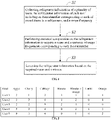
- FIG. 2 it is a list of food sets formed by refrigerator information collected in one cycle.
- a first column corresponds to respective users; a first row corresponds to item identifiers; each intersection in the table represents the use frequency of a specific item corresponding to a specific user; and each column of data corresponds to a data set.
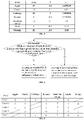
- the calculation results are shown in FIG. 3 .
- the data in the "sum” column represents the sum of the usage frequencies of each of the items corresponding to the food set; and ⁇ and ⁇ respectively represent the mean and the variance of the item corresponding to the food set.
- the method specifically includes: determining whether the variance of each food set is not greater than a preset variance of an item identifier corresponding to a current food set at the end of each preset time cycle; and if yes, keeping the acquired food set and using the food set as the screened refrigerator information; or if not, deleting at least one maximum value and/or minimum value from the current food set to form a new food set, and recalculating a variance and a mean of the new food set until the variance of the usage frequencies in the current food set is less than the preset variance of the item identifier, and using the current new food set as the screened refrigerator information.
- the selected preset variance being 2 is taken as an example for specific description.
- the variance of a certain food set is greater than 2
- one maximum value and one minimum value are deleted each time, and a diagonal line drawn in a cell represents data deletion.
- the means and the variances of the new data set shown in FIG. 5 are recalculated, and the calculation results are shown in FIG. 6 .
- the variances of all the food sets meet a keeping condition.
- each food set in FIG. 5 corresponding to FIG. 6 is kept, and respective food sets shown in FIG. 5 are used as the screened refrigerator information.
- the method further includes: S4, acquiring and keeping finally acquired calculation data of each food set at the end of each preset time cycle, wherein the calculation data includes a sum, a variance and a mean of usage frequencies of an item in the food set; and selecting the mean of each food set as public data of an item corresponding to a current food set.
- FIGs. 2 , 3 , 5 and 6 show that in the process of processing each food set, calculation data corresponding to the finally kept food sets can be acquired respectively.
- the step S4 further includes: determining whether the public data of each food set is within a preset experience set; and if yes, updating the preset experience set based on the calculation data of the current food set; or if not, keeping the current experience set for next verification, wherein the preset experience set is ( ⁇ - 3 ⁇ 2 , ⁇ + 3 ⁇ 2 ), ⁇ representing a preset mean, and ⁇ 2 representing a preset variance.
- a constant value is assigned to ⁇ and ⁇ 2 in the preset experience set respectively before the refrigerator information of the plurality of users is collected; or the preset experience set is configured to be empty before the refrigerator information of the plurality of users is collected, and a mean and a variance corresponding to remaining refrigerator information after first screening of each item are assigned to ⁇ and ⁇ 2 in the corresponding preset experience set respectively after the refrigerator information of the plurality of users is collected.
- updating the preset experience set based on the calculation data of the current food set specifically includes: assigning the mean and the variance in the calculation data of the current food set to ⁇ and ⁇ 2 respectively.
- the preset experience set is replaced with a value successfully verified upon the verification each time.
- sum 1 represents a sum of usage frequencies of an item in the new calculation data
- sum 2 represents a sum of usage frequencies of the item in the calculation data in the previous cycle
- sum 3 represents a sum of usage frequencies of the item in a current preset cycle
- ⁇ 1 represents a mean in the new calculation data
- ⁇ 2 represents a mean in the calculation data in the previous cycle
- ⁇ 3 represents a mean in the calculation data in the current cycle
- ⁇ 1 2 represents a variance in the new calculation data
- ⁇ 2 2 represents a variance in the calculation data in the previous cycle
- ⁇ 3 2 represents a variance in the calculation data in the current cycle.
- the mean and variance in the previous period call the data in the preset data set, and the usage frequency is 0.
- FIG. 9 shows food sets collected in a current cycle
- FIG. 10 shows calculation data corresponding to the food sets in FIG. 9
- FIG. 6 is the calculation data in the previous cycle
- the mean and the variance in FIG. 6 are assigned to ⁇ and ⁇ 2 in the corresponding preset experience set respectively.
- An embodiment of the present invention provides an electronic device, including a processor and a memory storing a computer program operatable on the processor, wherein the computer program, when executed by the processor, causes the processor to perform the steps in the method for updating the data of the refrigerator freshness reservation model as described above.
- An embodiment of the present invention provides a computer-readable storage medium, wherein a computer program in the computer-readable storage medium, when executed by a processor, causes the processor to perform the steps in the method for updating the data of the refrigerator freshness reservation model as described above.
- the uploaded data are automatically screened in an optimizing manner by mutual cooperation between the means and the variances, such that the uploaded data can be filtered, thereby maintaining the calculation accuracy while reducing the pressure on a server.
Landscapes
- Engineering & Computer Science (AREA)
- Physics & Mathematics (AREA)
- Data Mining & Analysis (AREA)
- General Physics & Mathematics (AREA)
- Theoretical Computer Science (AREA)
- General Engineering & Computer Science (AREA)
- Pure & Applied Mathematics (AREA)
- Mathematical Physics (AREA)
- Mathematical Analysis (AREA)
- Mathematical Optimization (AREA)
- Computational Mathematics (AREA)
- Databases & Information Systems (AREA)
- Algebra (AREA)
- Probability & Statistics with Applications (AREA)
- Operations Research (AREA)
- Bioinformatics & Computational Biology (AREA)
- Evolutionary Biology (AREA)
- Software Systems (AREA)
- Bioinformatics & Cheminformatics (AREA)
- Life Sciences & Earth Sciences (AREA)
- Chemical & Material Sciences (AREA)
- Combustion & Propulsion (AREA)
- Mechanical Engineering (AREA)
- Thermal Sciences (AREA)
- Cold Air Circulating Systems And Constructional Details In Refrigerators (AREA)
Abstract
Description
- The present application is based on and claims the priority of the
Chinese patent application No. 201911216065.9 filed on December 02, 2019 - The present invention relates to the technical field of household appliances, and more particularly, to a method for updating data of a refrigerator freshness reservation model, a device and a storage medium.
- With the development of science and technology, users have higher and higher requirements for the performances of refrigerators that have become necessary household appliances for many families.
- The refrigerators tend to be smart in use over time. In particular, the realization of the smart refrigerators usually requires the support from big data. In the existing smart refrigerators, a server side collects refrigerator information through a network, and stores the collected refrigerator information in a database of the server side. The more information is stored, the more accurate statistical results are. However, with the increase of refrigerator users and the extension of the use period, there are more and more data in the database. Accordingly, in order to store the collected data, it is required to continuously expand a capacity of the database, causing a slower and slower data processing speed.
- In order to avoid the above problems, the present invention provides a method for updating data of a refrigerator freshness reservation model. The method can reasonably screen uploaded data, and maintain the calculation accuracy while reducing the pressure on a server.
- Objectives of the present invention are to provide a method for updating data of a refrigerator freshness reservation model, a device and a storage medium.
- In order to achieve one of the above objectives of the present invention, an embodiment of the present invention provides a method for updating data of a refrigerator freshness reservation model. The method includes: S1, collecting refrigerator information of a plurality of users, wherein the refrigerator information of each user includes an item identifier corresponding to each of stored items in a refrigerator, and a usage frequency; and the usage frequency is a sum of times that each item is stored in the refrigerator within a unit time for each refrigerator, and/or a sum of times that each item is taken out from the refrigerator, and/or a difference between the sum of the times that the item is stored in the refrigerator and the sum of the times that the item is taken out from the refrigerator;
- S2, performing statistical computation on the refrigerator information to acquire a mean and a variance of usage frequencies corresponding to each food identifier; and
- S3, screening the refrigerator information based on the acquired mean and variance.
- As a further improvement of an embodiment of the present invention, the step S2 specifically includes:
- respectively performing statistical computation on usage frequencies corresponding to each item identifier for each user within a cycle prior to the end time of each preset time cycle at the end of the preset time cycle;
- allowing the usage frequencies with the same item identifier in all the users to form a food set; and
- performing statistical computation on a mean and a variance of the usage frequencies in each food set.
- As a further improvement of an embodiment of the present invention, the step S3 specifically includes:
- determining whether the variance of each food set is not greater than a preset variance of an item identifier corresponding to a current food set at the end of each preset time cycle; and
- if yes, keeping the acquired food set and using the food set as the screened refrigerator information; or
- if not, deleting at least one maximum value and/or minimum value from the current food set to form a new food set, and recalculating a variance and a mean of the new food set until the variance of the usage frequencies in the current food set is less than the preset variance of the item identifier, and using the current new food set as the screened refrigerator information.
- As a further improvement of an embodiment of the present invention, after the step S3, the method further includes:
- S4, acquiring and keeping finally acquired calculation data of each food set at the end of each preset time cycle, the calculation data including a sum, a variance and a mean of usage frequencies of an item in the food set; and
- selecting the mean of each food set as public data of an item corresponding to a current food set.
- As a further improvement of an embodiment of the present invention, at the end of each preset time cycle, the step S4 further includes:
determining whether the public data of each food set is within a preset experience set; and if yes, updating the preset experience set based on the calculation data of the current food set; or if not, keeping the current experience set for next verification, wherein the preset experience set is (µ - 3σ 2, µ + 3σ 2), µ represents a preset mean, and σ 2 represents a preset variance. - As a further improvement of an embodiment of the present invention, the method includes:
- assigning a constant value to µ and σ 2 in the preset experience set respectively before the refrigerator information of the plurality of users is collected; or
- configuring the preset experience set to be empty before the refrigerator information of the plurality of users is collected, and assigning a mean and a variance corresponding to remaining refrigerator information after first screening of each item to µ and σ 2 in the corresponding preset experience set respectively after the refrigerator information of the plurality of users is collected.
- As a further improvement of an embodiment of the present invention, in the step S4, if it is confirmed that the public data of the current food set is within the preset experience set, updating the preset experience set based on the calculation data of the current food set specifically includes:
assigning the mean and the variance in the calculation data of the current food set to µ and σ 2 respectively. - As a further improvement of an embodiment of the present invention, in the step S4, if it is confirmed that the public data of the current food set is within the preset experience set, updating the preset experience set based on the calculation data of the current food set specifically includes:
- fusing calculation data kept in a current cycle with calculation data kept in a previous cycle to form new calculation data; and
- assigning a mean and a variance in the new calculation data to µ and σ 2 in the preset experience set respectively,
- wherein


sum 1 represents a sum of usage frequencies of an item in the new calculation data; sum 2 represents a sum of usage frequencies of an item in the calculation data in the previous cycle; sum 3 represents a sum of usage frequencies of an item in a current preset cycle; µ 1 represents a mean in the new calculation data; µ 2 represents a mean in the calculation data in the previous cycle; µ 3 represents a mean in the calculation data in the current cycle;


- In order to achieve another objective of the present invention, an embodiment of the present invention provides an electronic device, including a processor and a memory storing a computer program operable on the processor, wherein the computer program, when executed by the processor, causes the processor to perform the steps in the method for updating the data of the refrigerator freshness reservation model as described above.
- In order to achieve yet another objective of the present invention, an embodiment of the present invention provides a computer-readable storage medium, wherein a computer program in the computer-readable storage medium, when executed by a processor, causes the processor to perform the steps in the method for updating the data of the refrigerator freshness reservation model as described above.
- The present invention has the following beneficial effects. In the method for updating the data of the refrigerator freshness reservation model, the device and the storage medium according to the present invention, the uploaded data are automatically screened in an optimizing manner by mutual cooperation between the means and the variances, such that the uploaded data can be filtered, thereby maintaining the calculation accuracy while reducing the pressure on a server.
-
-
FIG. 1 is a schematic flow chart of a method for updating data of a refrigerator freshness reservation model according to a first embodiment of the present invention; -
FIG. 4 is a schematic flow chart of one of steps inFIG. 1 according to a preferred embodiment; -
FIG. 7 is a schematic flow chart according to another preferred embodiment evolved fromFIG. 1 ; -
FIG. 8 is a schematic flow chart of one of steps inFIG. 7 according to a preferred embodiment; and -
FIGs. 2 ,3 ,5 ,6 ,9 ,10, and 11 are data list diagrams of specific examples of the present invention. - The present invention will be described in detail below with reference to all embodiments shown in the accompanying drawings. However, these embodiments are not intended to limit the present invention, and changes of structures, methods or functions, made by a person of ordinary skill in the art in accordance with these embodiments, are included within the protective scope of the present invention.
- As shown in
FIG. 1 , a method for updating data of a refrigerator freshness reservation model is provided according to an embodiment of the present invention. The method includes the following steps. - In S1, refrigerator information of a plurality of users is collected, wherein the refrigerator information of each user includes an item identifier corresponding to each of stored items in a refrigerator, and a usage frequency; and the usage frequency is a sum of times that each item is stored in the refrigerator within a unit time for each refrigerator, and/or a sum of times that each item is taken out from the refrigerator, and/or a difference between the sum of the times that the item is stored in the refrigerator and the sum of the times that the item is taken out from the refrigerator.
- In S2, statistical computation is performed on the refrigerator information to acquire a mean and a variance of usage frequencies corresponding to each food identifier.
- In S3, the refrigerator information is screened based on the acquired mean and variance.
- In implementable embodiments of the present invention, for step S1, during the use of the refrigerator, a user will frequently store/take out items in/from the refrigerator, wherein the items are usually real objects. Of course, other items such as cosmetics and medicines may also be stored according to different needs of the user. Based on the user's designation or system setting, each item usually has a unique item identifier corresponding to a specific item. Exemplarily, the item identifier is, for example, the name of the item. Of course, depending on different identification methods, the item identifier may also be a unique two-dimensional code, multi-dimensional code, RFID barcode, etc. on the item. Generally, the unit time defined in the present invention may be set according to specific requirements, such as one hour, one day and one week. For any item, the frequency may be selected as one or a combination of several of the number of times that the item is stored in the refrigerator, the number of times that the item is taken out from the refrigerator, and the difference between the number of times that the item is stored in the refrigerator and the number of times that the item is taken out from the refrigerator.
- In the embodiments of the present invention, it is required to centrally process and screen the refrigerator information of the plurality of users. Thus, the refrigerator information of the plurality of users may be remotely collected by means of communication.
- In a preferred embodiment of the present invention, for step S2, the method specifically includes: respectively performing statistical computation on usage frequencies corresponding to each item identifier for each user within a cycle prior to the end time of each preset time cycle at the end of the preset time cycle; allowing the usage frequencies with the same item identifier in all the users to form a food set; and performing statistical computation on a mean and a variance of the usage frequencies in each food set. Here, the preset time cycle is the above unit time.
- The mean and the variance of each food set are


- With reference to
FIG. 2 , it is a list of food sets formed by refrigerator information collected in one cycle. In this specific example, in the food set formed based on the first statistical computation, a first column corresponds to respective users; a first row corresponds to item identifiers; each intersection in the table represents the use frequency of a specific item corresponding to a specific user; and each column of data corresponds to a data set. - For the refrigerator information collected in one cycle, the calculation results are shown in
FIG. 3 . In this list, the data in the "sum" column represents the sum of the usage frequencies of each of the items corresponding to the food set; and µ and σ respectively represent the mean and the variance of the item corresponding to the food set. - For example, the item identifier is "apple", wherein


- For step S3, with reference to
FIG. 4 , in an embodiment of the present invention, the method specifically includes: determining whether the variance of each food set is not greater than a preset variance of an item identifier corresponding to a current food set at the end of each preset time cycle; and if yes, keeping the acquired food set and using the food set as the screened refrigerator information; or if not, deleting at least one maximum value and/or minimum value from the current food set to form a new food set, and recalculating a variance and a mean of the new food set until the variance of the usage frequencies in the current food set is less than the preset variance of the item identifier, and using the current new food set as the screened refrigerator information. - Following the examples shown in
FIGs. 2 and3 , in combination withFIG. 5 , in this specific example, the selected preset variance being 2 is taken as an example for specific description. When the variance of a certain food set is greater than 2, one maximum value and one minimum value are deleted each time, and a diagonal line drawn in a cell represents data deletion. - Correspondingly, for "apple", "cabbage" and "orange", their variances after calculation are all greater than 2. Thus, it is required to delete the maximum and minimum values from the corresponding food sets; and new food sets as shown in
FIG. 5 are formed after the parameters are deleted. - Further, the means and the variances of the new data set shown in
FIG. 5 are recalculated, and the calculation results are shown inFIG. 6 . After the second recalculation, the variances of all the food sets meet a keeping condition. Correspondingly, each food set inFIG. 5 corresponding toFIG. 6 is kept, and respective food sets shown inFIG. 5 are used as the screened refrigerator information. - In order to further reduce the pressure on a server, as shown in
FIG. 7 , in the preferred embodiment of the present invention, after step S3, the method further includes: S4, acquiring and keeping finally acquired calculation data of each food set at the end of each preset time cycle, wherein the calculation data includes a sum, a variance and a mean of usage frequencies of an item in the food set; and selecting the mean of each food set as public data of an item corresponding to a current food set. - The examples in
FIGs. 2 ,3 ,5 and6 show that in the process of processing each food set, calculation data corresponding to the finally kept food sets can be acquired respectively. - Further, with reference to
FIG. 8 , at the end of each preset time cycle, the step S4 further includes: determining whether the public data of each food set is within a preset experience set; and if yes, updating the preset experience set based on the calculation data of the current food set; or if not, keeping the current experience set for next verification, wherein the preset experience set is (µ - 3σ 2, µ + 3σ 2), µ representing a preset mean, and σ 2 representing a preset variance. - In an embodiment of the present invention, for the preset experience set, a constant value is assigned to µ and σ 2 in the preset experience set respectively before the refrigerator information of the plurality of users is collected; or the preset experience set is configured to be empty before the refrigerator information of the plurality of users is collected, and a mean and a variance corresponding to remaining refrigerator information after first screening of each item are assigned to µ and σ 2 in the corresponding preset experience set respectively after the refrigerator information of the plurality of users is collected.
- In a preferred embodiment of the present invention, if it is confirmed that the public data of the current food set is within the preset experience set, updating the preset experience set based on the calculation data of the current food set specifically includes: assigning the mean and the variance in the calculation data of the current food set to µ and σ 2 respectively. In this embodiment, the preset experience set is replaced with a value successfully verified upon the verification each time.
- In another preferred embodiment of the present invention, in the step S4, if it is confirmed that the public data of the current food set is within the preset experience set, updating the preset experience set based on the calculation data of the current food set specifically includes: fusing calculation data kept in a current cycle with calculation data kept in a previous cycle to form new calculation data; and assigning a mean and a variance in the new calculation data to µ and σ 2 in the preset experience set respectively, wherein sum 1 = sum 2 + sum 3 ,


- sum 1 represents a sum of usage frequencies of an item in the new calculation data; sum 2 represents a sum of usage frequencies of the item in the calculation data in the previous cycle; sum 3 represents a sum of usage frequencies of the item in a current preset cycle; µ 1 represents a mean in the new calculation data; µ 2 represents a mean in the calculation data in the previous cycle; µ 3 represents a mean in the calculation data in the current cycle;


- It should be noted that, in this embodiment, after the first preset cycle, the mean and variance in the previous period call the data in the preset data set, and the usage frequency is 0.
- In combination with
FIG. 9 based onFIG. 6 ,FIG. 9 shows food sets collected in a current cycle, andFIG. 10 shows calculation data corresponding to the food sets inFIG. 9 .FIG. 6 is the calculation data in the previous cycle, and the mean and the variance inFIG. 6 are assigned to µ and σ 2 in the corresponding preset experience set respectively. - Take "apple" and "cherry" as examples to illustrate the calculation.
- With respect to "apple", 1.6>2.333-0.222222, as the public data of "apple" is not within the preset experience set, "apple" is not be updated.
- With respect to "cherry", 2.4-0.64∗3<3<2.4+0.64∗3, as the public data of "cherry" is within in the preset experience set, "cherry" is updated through the equations:


- Accordingly, after calculation and fusion of the data in the two cycles in
FIGs. 5 and7 upon the calculation, data of "apple" and "litchi" are not updated, but data of "cherry", "cabbage", "banana" "mandarin orange" and "orange" are required to be updated. Updated results are shown inFIG. 11 , and are not repeated herein. - An embodiment of the present invention provides an electronic device, including a processor and a memory storing a computer program operatable on the processor, wherein the computer program, when executed by the processor, causes the processor to perform the steps in the method for updating the data of the refrigerator freshness reservation model as described above.
- An embodiment of the present invention provides a computer-readable storage medium, wherein a computer program in the computer-readable storage medium, when executed by a processor, causes the processor to perform the steps in the method for updating the data of the refrigerator freshness reservation model as described above.
- A person skilled in the art can clearly understand that for the sake of convenient and brief description, a particular working process of the above electronic device and the computer-readable storage medium can refer to a corresponding process in the foregoing method embodiments, and details are not repeated herein.
- To sum up, in the method for updating the data of the refrigerator freshness reservation model, the device and the storage medium according to the present invention, the uploaded data are automatically screened in an optimizing manner by mutual cooperation between the means and the variances, such that the uploaded data can be filtered, thereby maintaining the calculation accuracy while reducing the pressure on a server.
- It should be understood that although the description is described based on the embodiments, not every embodiment includes only one independent technical solution. This statement of the description is only for clarity. Those skilled in the art should treat the description as a whole, and technical solutions in all of the embodiments may also be properly combined to form other embodiments that will be understood by those skilled in the art.
- The above detailed description only aims to specifically illustrate the available embodiments of the present invention, and is not intended to limit the protection scope of the present invention. Equivalent embodiments or modifications thereof made without departing from the spirit of the present invention shall fall within the protection scope of the present invention.
Claims (10)
- A method for updating data of a refrigerator freshness reservation model, comprising:S1, collecting refrigerator information of a plurality of users, wherein the refrigerator information of each user comprises an item identifier corresponding to each of stored items in a refrigerator, and a usage frequency; and the usage frequency is a sum of times that each item is stored in the refrigerator within a unit time for each refrigerator, and/or a sum of times that each item is taken out from the refrigerator, and/or a difference between the sum of the times that the item is stored in the refrigerator and the sum of the times that the item is taken out from the refrigerator;S2, performing statistical computation on the refrigerator information to acquire a mean and a variance of usage frequencies corresponding to each food identifier; andS3, screening the refrigerator information based on the acquired mean and variance.
- The method for updating the data of the refrigerator freshness reservation model according to claim 1, wherein the step S2 specifically comprises:respectively performing statistical computation on usage frequencies corresponding to each item identifier for each user within a cycle prior to the end time of each preset time cycle at the end of the preset time cycle;allowing the usage frequencies with the same item identifier in all the users to form a food set; andperforming statistical computation on a mean and a variance of the usage frequencies of each food set.
- The method for updating the data of the refrigerator freshness reservation model according to claim 2, wherein the step S3 specifically comprises:determining whether a variance of each food set is not greater than a preset variance of an item identifier corresponding to a current food set at the end of each preset time cycle; andif yes, keeping an acquired food set and using the food set as the screened refrigerator information; orif not, deleting at least one maximum value and/or minimum value from the current food set to form a new food set, and recalculating a variance and a mean of the new food set until the variance of the usage frequencies in the current food set is less than the preset variance of the item identifier, and using the current new food set as the screened refrigerator information.
- The method for updating the data of the refrigerator freshness reservation model according to claim 3, wherein after the step S3, the method further comprises:S4, acquiring and keeping finally acquired calculation data of each food set at the end of each preset time cycle, the calculation data comprising a sum, a variance and a mean of usage frequencies of an item in the food set; andselecting a mean of the food set as public data of an item corresponding to a current food set.
- The method for updating the data of the refrigerator freshness reservation model according to claim 4, wherein at the end of each preset time cycle, the step S4 further comprises:
determining whether the public data of each food set is within a preset experience set; and if yes, updating the preset experience set based on calculation data of the current food set; or if not, keeping a current experience set for next verification, wherein the preset experience set is (µ - 3σ 2, µ + 3σ 2), µ representing a preset mean, and σ 2 representing a preset variance. - The method for updating the data of the refrigerator freshness reservation model according to claim 5, comprising:assigning a constant value to µ and σ 2 in the preset experience set respectively before the refrigerator information of the plurality of users is collected; orconfiguring the preset experience set to be empty before the refrigerator information of the plurality of users is collected, and assigning a mean and a variance corresponding to remaining refrigerator information after first screening of each item to µ and σ 2 in a corresponding preset experience set respectively after the refrigerator information of the plurality of users is collected.
- The method for updating the data of the refrigerator freshness reservation model according to claim 5, wherein in the step S4, if it is confirmed that the public data of the current food set is within the preset experience set, updating the preset experience set based on the calculation data of the current food set specifically comprises:
assigning the mean and the variance in the calculation data of the current food set to µ and σ 2 respectively. - The method for updating the data of the refrigerator freshness reservation model according to claim 5, wherein in the step S4, if it is confirmed that the public data of the current food set is within the preset experience set, updating the preset experience set based on the calculation data of the current food set specifically comprises:fusing calculation data kept in a current cycle with calculation data kept in a previous cycle to form new calculation data; andassigning a mean and a variance in the new calculation data to µ and σ 2 in the preset experience set respectively,wherein


 sum 1 represents a sum of usage frequencies of an item in the new calculation data; sum 2 represents a sum of usage frequencies of the item in the calculation data in the previous cycle; sum 3 represents a sum of usage frequencies of the item in a current preset cycle; µ 1 represents a mean in the new calculation data; µ 2 represents a mean in the calculation data in the previous cycle; µ 3 represents a mean in the calculation data in the current cycle;


- An electronic device, comprising: a processor and a memory storing a computer program operatable on the processor, wherein the computer program, when executed by the processor, causes the processor to perform the steps in the method for updating the data of the refrigerator freshness reservation model according to any one of claims 1 to 8.
- A computer-readable storage medium, wherein a computer program in the computer-readable storage medium, when executed by a processor, causes the processor to perform the steps in the method for updating the data of the refrigerator freshness reservation model according to any one of claims 1 to 8.
Applications Claiming Priority (2)
| Application Number | Priority Date | Filing Date | Title |
|---|---|---|---|
| CN201911216065.9A CN112988765B (en) | 2019-12-02 | 2019-12-02 | Refrigerator preservation model data update method, equipment and storage medium |
| PCT/CN2020/092476 WO2021109495A1 (en) | 2019-12-02 | 2020-05-27 | Data update method and apparatus for refrigerator freshness preservation model, and storage medium |
Publications (3)
| Publication Number | Publication Date |
|---|---|
| EP4071628A1 true EP4071628A1 (en) | 2022-10-12 |
| EP4071628A4 EP4071628A4 (en) | 2022-12-28 |
| EP4071628B1 EP4071628B1 (en) | 2026-03-11 |
Family
ID=76220948
Family Applications (1)
| Application Number | Title | Priority Date | Filing Date |
|---|---|---|---|
| EP20895308.3A Active EP4071628B1 (en) | 2019-12-02 | 2020-05-27 | Data update method and apparatus for refrigerator freshness preservation model, and storage medium |
Country Status (4)
| Country | Link |
|---|---|
| US (1) | US12320579B2 (en) |
| EP (1) | EP4071628B1 (en) |
| CN (1) | CN112988765B (en) |
| WO (1) | WO2021109495A1 (en) |
Family Cites Families (16)
| Publication number | Priority date | Publication date | Assignee | Title |
|---|---|---|---|---|
| CN102480385B (en) * | 2010-11-26 | 2014-10-22 | 北京启明星辰信息技术股份有限公司 | database security protection method and device |
| CN103793192B (en) * | 2014-02-25 | 2017-01-25 | 四川长虹电器股份有限公司 | Message outputting method, refrigerator and server |
| CN104197633B (en) * | 2014-09-22 | 2016-10-05 | 合肥华凌股份有限公司 | Food fresh keeping management refrigerator and the fresh-keeping management method of refrigerator food |
| US20160358508A1 (en) * | 2015-06-05 | 2016-12-08 | Elwha Llc | Smart refrigerator |
| CN104949465B (en) * | 2015-06-30 | 2018-09-14 | 合肥美的电冰箱有限公司 | A kind of refrigerator and article access method with face identification functions |
| CN106997358A (en) * | 2016-01-22 | 2017-08-01 | 中移(杭州)信息技术有限公司 | Information recommendation method and device |
| CN105953520B (en) * | 2016-05-06 | 2018-08-10 | 青岛海尔股份有限公司 | Intelligent refrigerator control method and its control system |
| CN106288589A (en) * | 2016-08-15 | 2017-01-04 | 合肥华凌股份有限公司 | A kind of intelligent refrigerator food materials choosing method, system and intelligent refrigerator |
| CN107062794A (en) * | 2017-03-29 | 2017-08-18 | 青岛海尔股份有限公司 | Intelligent refrigerator, its control method and control system |
| CN106996678B (en) * | 2017-05-08 | 2019-11-26 | 青岛海尔电冰箱有限公司 | The processing method of storing information, processing system and refrigerator in refrigerator |
| KR102327848B1 (en) * | 2017-05-18 | 2021-11-18 | 삼성전자주식회사 | Refrigerator and method of food management thereof |
| CN107341350A (en) * | 2017-07-05 | 2017-11-10 | 百度在线网络技术(北京)有限公司 | Food materials intelligent management and device, server, intelligent refrigerator, storage medium |
| CN109446206A (en) * | 2017-08-29 | 2019-03-08 | 合肥美的智能科技有限公司 | User's dietary data update method and more new system |
| EP3794542A1 (en) * | 2018-05-18 | 2021-03-24 | Avery Dennison Retail Information Services, LLC | Method of updating food product item information |
| KR102663888B1 (en) * | 2018-09-18 | 2024-05-08 | 삼성전자주식회사 | Refrigerator and method of controlling thereof |
| US11353259B2 (en) * | 2018-09-18 | 2022-06-07 | Samsung Electronics Co., Ltd. | Augmented-reality refrigerator and method of controlling thereof |
-
2019
- 2019-12-02 CN CN201911216065.9A patent/CN112988765B/en active Active
-
2020
- 2020-05-27 US US17/768,840 patent/US12320579B2/en active Active
- 2020-05-27 WO PCT/CN2020/092476 patent/WO2021109495A1/en not_active Ceased
- 2020-05-27 EP EP20895308.3A patent/EP4071628B1/en active Active
Also Published As
| Publication number | Publication date |
|---|---|
| CN112988765A (en) | 2021-06-18 |
| US12320579B2 (en) | 2025-06-03 |
| EP4071628A4 (en) | 2022-12-28 |
| CN112988765B (en) | 2023-11-03 |
| US20240133620A1 (en) | 2024-04-25 |
| WO2021109495A1 (en) | 2021-06-10 |
| EP4071628B1 (en) | 2026-03-11 |
| US20240230214A9 (en) | 2024-07-11 |
Similar Documents
| Publication | Publication Date | Title |
|---|---|---|
| US10877639B2 (en) | Page shortcut display method, apparatus, terminal, and server, and storage medium | |
| CN109597974B (en) | Report generation method and device | |
| CN112328842B (en) | Data processing method and device, electronic equipment and storage medium | |
| WO2019080662A1 (en) | Information recommendation method, device and apparatus | |
| US20110276920A1 (en) | Systems and methods for selecting data elements, such as population members, from a data source | |
| EP3217296A1 (en) | Data query method and apparatus | |
| CN110941608B (en) | Method, device and equipment for generating buried point analysis and funnel analysis report | |
| CN105224184A (en) | The method of menu dynamic adjustment and device | |
| CN113361954A (en) | Attribution analysis method, attribution analysis device, attribution analysis equipment and storage medium | |
| CN109240893B (en) | Application running state query method and terminal equipment | |
| CN111177337A (en) | Data processing method and device for questionnaire | |
| CN107451280B (en) | Data communication method and device and electronic equipment | |
| CN114723498A (en) | Big data-based early warning information pushing method, device, equipment and storage medium | |
| JP2005032079A (en) | Project pre-evaluation method | |
| CN116737300A (en) | Virtual list data rendering method, device, equipment and storage medium | |
| EP4071628B1 (en) | Data update method and apparatus for refrigerator freshness preservation model, and storage medium | |
| CN110968993A (en) | Information processing method and device, storage medium and processor | |
| CN108595534B (en) | Information refreshing method and device | |
| WO2012115662A1 (en) | Pattern recognition | |
| JP2012221315A (en) | Information recommendation device, method and program | |
| CN115310415B (en) | Data export method, device, equipment and storage medium | |
| CN118193609A (en) | A method and device for generating disassembly sequence in shield machine tunnel based on ant colony algorithm | |
| CN118113933A (en) | Metaverse data recommendation method and device | |
| CN108255893B (en) | Personalized object recommendation method and device | |
| US10909177B1 (en) | Percentile determination system |
Legal Events
| Date | Code | Title | Description |
|---|---|---|---|
| STAA | Information on the status of an ep patent application or granted ep patent |
Free format text: STATUS: THE INTERNATIONAL PUBLICATION HAS BEEN MADE |
|
| PUAI | Public reference made under article 153(3) epc to a published international application that has entered the european phase |
Free format text: ORIGINAL CODE: 0009012 |
|
| STAA | Information on the status of an ep patent application or granted ep patent |
Free format text: STATUS: REQUEST FOR EXAMINATION WAS MADE |
|
| 17P | Request for examination filed |
Effective date: 20220331 |
|
| AK | Designated contracting states |
Kind code of ref document: A1 Designated state(s): AL AT BE BG CH CY CZ DE DK EE ES FI FR GB GR HR HU IE IS IT LI LT LU LV MC MK MT NL NO PL PT RO RS SE SI SK SM TR |
|
| A4 | Supplementary search report drawn up and despatched |
Effective date: 20221129 |
|
| RIC1 | Information provided on ipc code assigned before grant |
Ipc: F25D 29/00 20060101ALI20221123BHEP Ipc: G06F 16/23 20190101AFI20221123BHEP |
|
| DAV | Request for validation of the european patent (deleted) | ||
| DAX | Request for extension of the european patent (deleted) | ||
| STAA | Information on the status of an ep patent application or granted ep patent |
Free format text: STATUS: EXAMINATION IS IN PROGRESS |
|
| 17Q | First examination report despatched |
Effective date: 20231026 |
|
| REG | Reference to a national code |
Ref country code: DE Ref legal event code: R079 Free format text: PREVIOUS MAIN CLASS: G06F0016230000 Ipc: G06F0017180000 Ref document number: 602020068590 Country of ref document: DE |
|
| GRAP | Despatch of communication of intention to grant a patent |
Free format text: ORIGINAL CODE: EPIDOSNIGR1 |
|
| STAA | Information on the status of an ep patent application or granted ep patent |
Free format text: STATUS: GRANT OF PATENT IS INTENDED |
|
| RIC1 | Information provided on ipc code assigned before grant |
Ipc: G06F 17/18 20060101AFI20250912BHEP |
|
| INTG | Intention to grant announced |
Effective date: 20251002 |
|
| GRAS | Grant fee paid |
Free format text: ORIGINAL CODE: EPIDOSNIGR3 |
|
| GRAA | (expected) grant |
Free format text: ORIGINAL CODE: 0009210 |
|
| STAA | Information on the status of an ep patent application or granted ep patent |
Free format text: STATUS: THE PATENT HAS BEEN GRANTED |
|
| RAP3 | Party data changed (applicant data changed or rights of an application transferred) |
Owner name: CHONGQING HAIER REFRIGERATION ELECTRIC APPLIANCECO., LTD. Owner name: QINGDAO HAIER REFRIGERATOR CO., LTD Owner name: HAIER SMART HOME CO., LTD. |
|
| AK | Designated contracting states |
Kind code of ref document: B1 Designated state(s): AL AT BE BG CH CY CZ DE DK EE ES FI FR GB GR HR HU IE IS IT LI LT LU LV MC MK MT NL NO PL PT RO RS SE SI SK SM TR |
|
| REG | Reference to a national code |
Ref country code: CH Ref legal event code: F10 Free format text: ST27 STATUS EVENT CODE: U-0-0-F10-F00 (AS PROVIDED BY THE NATIONAL OFFICE) Effective date: 20260311 Ref country code: GB Ref legal event code: FG4D |
|
| REG | Reference to a national code |
Ref country code: DE Ref legal event code: R096 Ref document number: 602020068590 Country of ref document: DE |
|
| REG | Reference to a national code |
Ref country code: IE Ref legal event code: FG4D |
|
| PG25 | Lapsed in a contracting state [announced via postgrant information from national office to epo] |
Ref country code: RS Free format text: LAPSE BECAUSE OF FAILURE TO SUBMIT A TRANSLATION OF THE DESCRIPTION OR TO PAY THE FEE WITHIN THE PRESCRIBED TIME-LIMIT Effective date: 20260611 |
|
| PG25 | Lapsed in a contracting state [announced via postgrant information from national office to epo] |
Ref country code: ES Free format text: LAPSE BECAUSE OF FAILURE TO SUBMIT A TRANSLATION OF THE DESCRIPTION OR TO PAY THE FEE WITHIN THE PRESCRIBED TIME-LIMIT Effective date: 20260311 |
|
| PGFP | Annual fee paid to national office [announced via postgrant information from national office to epo] |
Ref country code: GB Payment date: 20260521 Year of fee payment: 7 |
|
| PG25 | Lapsed in a contracting state [announced via postgrant information from national office to epo] |
Ref country code: GR Free format text: LAPSE BECAUSE OF FAILURE TO SUBMIT A TRANSLATION OF THE DESCRIPTION OR TO PAY THE FEE WITHIN THE PRESCRIBED TIME-LIMIT Effective date: 20260612 |
|
| REG | Reference to a national code |
Ref country code: LT Ref legal event code: MG9D |
|
| PG25 | Lapsed in a contracting state [announced via postgrant information from national office to epo] |
Ref country code: LT Free format text: LAPSE BECAUSE OF FAILURE TO SUBMIT A TRANSLATION OF THE DESCRIPTION OR TO PAY THE FEE WITHIN THE PRESCRIBED TIME-LIMIT Effective date: 20260311 |
|
| PGFP | Annual fee paid to national office [announced via postgrant information from national office to epo] |
Ref country code: DE Payment date: 20260513 Year of fee payment: 7 |
|
| PG25 | Lapsed in a contracting state [announced via postgrant information from national office to epo] |
Ref country code: NO Free format text: LAPSE BECAUSE OF FAILURE TO SUBMIT A TRANSLATION OF THE DESCRIPTION OR TO PAY THE FEE WITHIN THE PRESCRIBED TIME-LIMIT Effective date: 20260611 |
|
| PG25 | Lapsed in a contracting state [announced via postgrant information from national office to epo] |
Ref country code: SE Free format text: LAPSE BECAUSE OF FAILURE TO SUBMIT A TRANSLATION OF THE DESCRIPTION OR TO PAY THE FEE WITHIN THE PRESCRIBED TIME-LIMIT Effective date: 20260311 Ref country code: FI Free format text: LAPSE BECAUSE OF FAILURE TO SUBMIT A TRANSLATION OF THE DESCRIPTION OR TO PAY THE FEE WITHIN THE PRESCRIBED TIME-LIMIT Effective date: 20260311 |
|
| REG | Reference to a national code |
Ref country code: NL Ref legal event code: MP Effective date: 20260311 |
|
| PG25 | Lapsed in a contracting state [announced via postgrant information from national office to epo] |
Ref country code: HR Free format text: LAPSE BECAUSE OF FAILURE TO SUBMIT A TRANSLATION OF THE DESCRIPTION OR TO PAY THE FEE WITHIN THE PRESCRIBED TIME-LIMIT Effective date: 20260311 |
|
| PGFP | Annual fee paid to national office [announced via postgrant information from national office to epo] |
Ref country code: FR Payment date: 20260528 Year of fee payment: 7 |
|
| PG25 | Lapsed in a contracting state [announced via postgrant information from national office to epo] |
Ref country code: LV Free format text: LAPSE BECAUSE OF FAILURE TO SUBMIT A TRANSLATION OF THE DESCRIPTION OR TO PAY THE FEE WITHIN THE PRESCRIBED TIME-LIMIT Effective date: 20260311 |
|
| PG25 | Lapsed in a contracting state [announced via postgrant information from national office to epo] |
Ref country code: BG Free format text: LAPSE BECAUSE OF FAILURE TO SUBMIT A TRANSLATION OF THE DESCRIPTION OR TO PAY THE FEE WITHIN THE PRESCRIBED TIME-LIMIT Effective date: 20260311 |