EP4071445B1 - Encoder, servo motor, servo system, and encoder control method - Google Patents
Encoder, servo motor, servo system, and encoder control method Download PDFInfo
- Publication number
- EP4071445B1 EP4071445B1 EP22167429.4A EP22167429A EP4071445B1 EP 4071445 B1 EP4071445 B1 EP 4071445B1 EP 22167429 A EP22167429 A EP 22167429A EP 4071445 B1 EP4071445 B1 EP 4071445B1
- Authority
- EP
- European Patent Office
- Prior art keywords
- encoder
- battery
- processing module
- rotation
- power
- Prior art date
- Legal status (The legal status is an assumption and is not a legal conclusion. Google has not performed a legal analysis and makes no representation as to the accuracy of the status listed.)
- Active
Links
Images








Classifications
-
- G—PHYSICS
- G01—MEASURING; TESTING
- G01B—MEASURING LENGTH, THICKNESS OR SIMILAR LINEAR DIMENSIONS; MEASURING ANGLES; MEASURING AREAS; MEASURING IRREGULARITIES OF SURFACES OR CONTOURS
- G01B7/00—Measuring arrangements characterised by the use of electric or magnetic techniques
- G01B7/30—Measuring arrangements characterised by the use of electric or magnetic techniques for measuring angles or tapers; for testing the alignment of axes
-
- G—PHYSICS
- G01—MEASURING; TESTING
- G01D—MEASURING NOT SPECIALLY ADAPTED FOR A SPECIFIC VARIABLE; ARRANGEMENTS FOR MEASURING TWO OR MORE VARIABLES NOT COVERED IN A SINGLE OTHER SUBCLASS; TARIFF METERING APPARATUS; MEASURING OR TESTING NOT OTHERWISE PROVIDED FOR
- G01D5/00—Mechanical means for transferring the output of a sensing member; Means for converting the output of a sensing member to another variable where the form or nature of the sensing member does not constrain the means for converting; Transducers not specially adapted for a specific variable
- G01D5/54—Mechanical means for transferring the output of a sensing member; Means for converting the output of a sensing member to another variable where the form or nature of the sensing member does not constrain the means for converting; Transducers not specially adapted for a specific variable using means specified in two or more of groups G01D5/02, G01D5/12, G01D5/26, G01D5/42, and G01D5/48
-
- G—PHYSICS
- G01—MEASURING; TESTING
- G01D—MEASURING NOT SPECIALLY ADAPTED FOR A SPECIFIC VARIABLE; ARRANGEMENTS FOR MEASURING TWO OR MORE VARIABLES NOT COVERED IN A SINGLE OTHER SUBCLASS; TARIFF METERING APPARATUS; MEASURING OR TESTING NOT OTHERWISE PROVIDED FOR
- G01D5/00—Mechanical means for transferring the output of a sensing member; Means for converting the output of a sensing member to another variable where the form or nature of the sensing member does not constrain the means for converting; Transducers not specially adapted for a specific variable
- G01D5/26—Mechanical means for transferring the output of a sensing member; Means for converting the output of a sensing member to another variable where the form or nature of the sensing member does not constrain the means for converting; Transducers not specially adapted for a specific variable characterised by optical transfer means, i.e. using infrared, visible, or ultraviolet light
- G01D5/32—Mechanical means for transferring the output of a sensing member; Means for converting the output of a sensing member to another variable where the form or nature of the sensing member does not constrain the means for converting; Transducers not specially adapted for a specific variable characterised by optical transfer means, i.e. using infrared, visible, or ultraviolet light with attenuation or whole or partial obturation of beams of light
- G01D5/34—Mechanical means for transferring the output of a sensing member; Means for converting the output of a sensing member to another variable where the form or nature of the sensing member does not constrain the means for converting; Transducers not specially adapted for a specific variable characterised by optical transfer means, i.e. using infrared, visible, or ultraviolet light with attenuation or whole or partial obturation of beams of light the beams of light being detected by photocells
- G01D5/347—Mechanical means for transferring the output of a sensing member; Means for converting the output of a sensing member to another variable where the form or nature of the sensing member does not constrain the means for converting; Transducers not specially adapted for a specific variable characterised by optical transfer means, i.e. using infrared, visible, or ultraviolet light with attenuation or whole or partial obturation of beams of light the beams of light being detected by photocells using displacement encoding scales
- G01D5/34776—Absolute encoders with analogue or digital scales
- G01D5/34792—Absolute encoders with analogue or digital scales with only digital scales or both digital and incremental scales
-
- G—PHYSICS
- G01—MEASURING; TESTING
- G01D—MEASURING NOT SPECIALLY ADAPTED FOR A SPECIFIC VARIABLE; ARRANGEMENTS FOR MEASURING TWO OR MORE VARIABLES NOT COVERED IN A SINGLE OTHER SUBCLASS; TARIFF METERING APPARATUS; MEASURING OR TESTING NOT OTHERWISE PROVIDED FOR
- G01D5/00—Mechanical means for transferring the output of a sensing member; Means for converting the output of a sensing member to another variable where the form or nature of the sensing member does not constrain the means for converting; Transducers not specially adapted for a specific variable
- G01D5/12—Mechanical means for transferring the output of a sensing member; Means for converting the output of a sensing member to another variable where the form or nature of the sensing member does not constrain the means for converting; Transducers not specially adapted for a specific variable using electric or magnetic means
- G01D5/14—Mechanical means for transferring the output of a sensing member; Means for converting the output of a sensing member to another variable where the form or nature of the sensing member does not constrain the means for converting; Transducers not specially adapted for a specific variable using electric or magnetic means influencing the magnitude of a current or voltage
- G01D5/16—Mechanical means for transferring the output of a sensing member; Means for converting the output of a sensing member to another variable where the form or nature of the sensing member does not constrain the means for converting; Transducers not specially adapted for a specific variable using electric or magnetic means influencing the magnitude of a current or voltage by varying resistance
-
- G—PHYSICS
- G01—MEASURING; TESTING
- G01D—MEASURING NOT SPECIALLY ADAPTED FOR A SPECIFIC VARIABLE; ARRANGEMENTS FOR MEASURING TWO OR MORE VARIABLES NOT COVERED IN A SINGLE OTHER SUBCLASS; TARIFF METERING APPARATUS; MEASURING OR TESTING NOT OTHERWISE PROVIDED FOR
- G01D5/00—Mechanical means for transferring the output of a sensing member; Means for converting the output of a sensing member to another variable where the form or nature of the sensing member does not constrain the means for converting; Transducers not specially adapted for a specific variable
- G01D5/12—Mechanical means for transferring the output of a sensing member; Means for converting the output of a sensing member to another variable where the form or nature of the sensing member does not constrain the means for converting; Transducers not specially adapted for a specific variable using electric or magnetic means
- G01D5/14—Mechanical means for transferring the output of a sensing member; Means for converting the output of a sensing member to another variable where the form or nature of the sensing member does not constrain the means for converting; Transducers not specially adapted for a specific variable using electric or magnetic means influencing the magnitude of a current or voltage
- G01D5/20—Mechanical means for transferring the output of a sensing member; Means for converting the output of a sensing member to another variable where the form or nature of the sensing member does not constrain the means for converting; Transducers not specially adapted for a specific variable using electric or magnetic means influencing the magnitude of a current or voltage by varying inductance, e.g. by a movable armature
-
- G—PHYSICS
- G01—MEASURING; TESTING
- G01D—MEASURING NOT SPECIALLY ADAPTED FOR A SPECIFIC VARIABLE; ARRANGEMENTS FOR MEASURING TWO OR MORE VARIABLES NOT COVERED IN A SINGLE OTHER SUBCLASS; TARIFF METERING APPARATUS; MEASURING OR TESTING NOT OTHERWISE PROVIDED FOR
- G01D5/00—Mechanical means for transferring the output of a sensing member; Means for converting the output of a sensing member to another variable where the form or nature of the sensing member does not constrain the means for converting; Transducers not specially adapted for a specific variable
- G01D5/12—Mechanical means for transferring the output of a sensing member; Means for converting the output of a sensing member to another variable where the form or nature of the sensing member does not constrain the means for converting; Transducers not specially adapted for a specific variable using electric or magnetic means
- G01D5/244—Mechanical means for transferring the output of a sensing member; Means for converting the output of a sensing member to another variable where the form or nature of the sensing member does not constrain the means for converting; Transducers not specially adapted for a specific variable using electric or magnetic means influencing characteristics of pulses or pulse trains; generating pulses or pulse trains
-
- G—PHYSICS
- G01—MEASURING; TESTING
- G01D—MEASURING NOT SPECIALLY ADAPTED FOR A SPECIFIC VARIABLE; ARRANGEMENTS FOR MEASURING TWO OR MORE VARIABLES NOT COVERED IN A SINGLE OTHER SUBCLASS; TARIFF METERING APPARATUS; MEASURING OR TESTING NOT OTHERWISE PROVIDED FOR
- G01D5/00—Mechanical means for transferring the output of a sensing member; Means for converting the output of a sensing member to another variable where the form or nature of the sensing member does not constrain the means for converting; Transducers not specially adapted for a specific variable
- G01D5/26—Mechanical means for transferring the output of a sensing member; Means for converting the output of a sensing member to another variable where the form or nature of the sensing member does not constrain the means for converting; Transducers not specially adapted for a specific variable characterised by optical transfer means, i.e. using infrared, visible, or ultraviolet light
- G01D5/32—Mechanical means for transferring the output of a sensing member; Means for converting the output of a sensing member to another variable where the form or nature of the sensing member does not constrain the means for converting; Transducers not specially adapted for a specific variable characterised by optical transfer means, i.e. using infrared, visible, or ultraviolet light with attenuation or whole or partial obturation of beams of light
- G01D5/34—Mechanical means for transferring the output of a sensing member; Means for converting the output of a sensing member to another variable where the form or nature of the sensing member does not constrain the means for converting; Transducers not specially adapted for a specific variable characterised by optical transfer means, i.e. using infrared, visible, or ultraviolet light with attenuation or whole or partial obturation of beams of light the beams of light being detected by photocells
- G01D5/347—Mechanical means for transferring the output of a sensing member; Means for converting the output of a sensing member to another variable where the form or nature of the sensing member does not constrain the means for converting; Transducers not specially adapted for a specific variable characterised by optical transfer means, i.e. using infrared, visible, or ultraviolet light with attenuation or whole or partial obturation of beams of light the beams of light being detected by photocells using displacement encoding scales
- G01D5/3473—Circular or rotary encoders
-
- G—PHYSICS
- G01—MEASURING; TESTING
- G01D—MEASURING NOT SPECIALLY ADAPTED FOR A SPECIFIC VARIABLE; ARRANGEMENTS FOR MEASURING TWO OR MORE VARIABLES NOT COVERED IN A SINGLE OTHER SUBCLASS; TARIFF METERING APPARATUS; MEASURING OR TESTING NOT OTHERWISE PROVIDED FOR
- G01D5/00—Mechanical means for transferring the output of a sensing member; Means for converting the output of a sensing member to another variable where the form or nature of the sensing member does not constrain the means for converting; Transducers not specially adapted for a specific variable
- G01D5/54—Mechanical means for transferring the output of a sensing member; Means for converting the output of a sensing member to another variable where the form or nature of the sensing member does not constrain the means for converting; Transducers not specially adapted for a specific variable using means specified in two or more of groups G01D5/02, G01D5/12, G01D5/26, G01D5/42, and G01D5/48
- G01D5/56—Mechanical means for transferring the output of a sensing member; Means for converting the output of a sensing member to another variable where the form or nature of the sensing member does not constrain the means for converting; Transducers not specially adapted for a specific variable using means specified in two or more of groups G01D5/02, G01D5/12, G01D5/26, G01D5/42, and G01D5/48 using electric or magnetic means
-
- G—PHYSICS
- G01—MEASURING; TESTING
- G01D—MEASURING NOT SPECIALLY ADAPTED FOR A SPECIFIC VARIABLE; ARRANGEMENTS FOR MEASURING TWO OR MORE VARIABLES NOT COVERED IN A SINGLE OTHER SUBCLASS; TARIFF METERING APPARATUS; MEASURING OR TESTING NOT OTHERWISE PROVIDED FOR
- G01D5/00—Mechanical means for transferring the output of a sensing member; Means for converting the output of a sensing member to another variable where the form or nature of the sensing member does not constrain the means for converting; Transducers not specially adapted for a specific variable
- G01D5/54—Mechanical means for transferring the output of a sensing member; Means for converting the output of a sensing member to another variable where the form or nature of the sensing member does not constrain the means for converting; Transducers not specially adapted for a specific variable using means specified in two or more of groups G01D5/02, G01D5/12, G01D5/26, G01D5/42, and G01D5/48
- G01D5/58—Mechanical means for transferring the output of a sensing member; Means for converting the output of a sensing member to another variable where the form or nature of the sensing member does not constrain the means for converting; Transducers not specially adapted for a specific variable using means specified in two or more of groups G01D5/02, G01D5/12, G01D5/26, G01D5/42, and G01D5/48 using optical means, i.e. using infrared, visible or ultraviolet light
-
- G—PHYSICS
- G01—MEASURING; TESTING
- G01D—MEASURING NOT SPECIALLY ADAPTED FOR A SPECIFIC VARIABLE; ARRANGEMENTS FOR MEASURING TWO OR MORE VARIABLES NOT COVERED IN A SINGLE OTHER SUBCLASS; TARIFF METERING APPARATUS; MEASURING OR TESTING NOT OTHERWISE PROVIDED FOR
- G01D9/00—Recording measured values
- G01D9/02—Producing one or more recordings of the values of a single variable
-
- G—PHYSICS
- G05—CONTROLLING; REGULATING
- G05B—CONTROL OR REGULATING SYSTEMS IN GENERAL; FUNCTIONAL ELEMENTS OF SUCH SYSTEMS; MONITORING OR TESTING ARRANGEMENTS FOR SUCH SYSTEMS OR ELEMENTS
- G05B19/00—Program-control systems
- G05B19/02—Program-control systems electric
- G05B19/18—Numerical control [NC], i.e. automatically operating machines, in particular machine tools, e.g. in a manufacturing environment, so as to execute positioning, movement or co-ordinated operations by means of program data in numerical form
- G05B19/4155—Numerical control [NC], i.e. automatically operating machines, in particular machine tools, e.g. in a manufacturing environment, so as to execute positioning, movement or co-ordinated operations by means of program data in numerical form characterised by program execution, i.e. part program or machine function execution, e.g. selection of a program
-
- H—ELECTRICITY
- H01—ELECTRIC ELEMENTS
- H01M—PROCESSES OR MEANS, e.g. BATTERIES, FOR THE DIRECT CONVERSION OF CHEMICAL ENERGY INTO ELECTRICAL ENERGY
- H01M10/00—Secondary cells; Manufacture thereof
- H01M10/05—Accumulators with non-aqueous electrolyte
- H01M10/058—Construction or manufacture
- H01M10/0585—Construction or manufacture of accumulators having only flat construction elements, i.e. flat positive electrodes, flat negative electrodes and flat separators
-
- H—ELECTRICITY
- H01—ELECTRIC ELEMENTS
- H01M—PROCESSES OR MEANS, e.g. BATTERIES, FOR THE DIRECT CONVERSION OF CHEMICAL ENERGY INTO ELECTRICAL ENERGY
- H01M10/00—Secondary cells; Manufacture thereof
- H01M10/42—Methods or arrangements for servicing or maintenance of secondary cells or secondary half-cells
- H01M10/46—Accumulators structurally combined with charging apparatus
-
- H—ELECTRICITY
- H02—GENERATION; CONVERSION OR DISTRIBUTION OF ELECTRIC POWER
- H02J—ELECTRIC POWER NETWORKS; CIRCUIT ARRANGEMENTS OR SYSTEMS FOR SUPPLYING OR DISTRIBUTING ELECTRIC POWER; SYSTEMS FOR STORING ELECTRIC ENERGY
- H02J7/00—Circuit arrangements for charging or discharging batteries or for supplying loads from batteries
-
- H—ELECTRICITY
- H02—GENERATION; CONVERSION OR DISTRIBUTION OF ELECTRIC POWER
- H02J—ELECTRIC POWER NETWORKS; CIRCUIT ARRANGEMENTS OR SYSTEMS FOR SUPPLYING OR DISTRIBUTING ELECTRIC POWER; SYSTEMS FOR STORING ELECTRIC ENERGY
- H02J7/00—Circuit arrangements for charging or discharging batteries or for supplying loads from batteries
- H02J7/865—Battery or charger load switching, e.g. concurrent charging and load supply
-
- H—ELECTRICITY
- H02—GENERATION; CONVERSION OR DISTRIBUTION OF ELECTRIC POWER
- H02K—DYNAMO-ELECTRIC MACHINES
- H02K11/00—Structural association of dynamo-electric machines with electric components or with devices for shielding, monitoring or protection
- H02K11/20—Structural association of dynamo-electric machines with electric components or with devices for shielding, monitoring or protection for measuring, monitoring, testing, protecting or switching
- H02K11/21—Devices for sensing speed or position, or actuated thereby
-
- H—ELECTRICITY
- H02—GENERATION; CONVERSION OR DISTRIBUTION OF ELECTRIC POWER
- H02K—DYNAMO-ELECTRIC MACHINES
- H02K11/00—Structural association of dynamo-electric machines with electric components or with devices for shielding, monitoring or protection
- H02K11/20—Structural association of dynamo-electric machines with electric components or with devices for shielding, monitoring or protection for measuring, monitoring, testing, protecting or switching
- H02K11/21—Devices for sensing speed or position, or actuated thereby
- H02K11/215—Magnetic effect devices, e.g. Hall-effect or magneto-resistive elements
-
- H—ELECTRICITY
- H02—GENERATION; CONVERSION OR DISTRIBUTION OF ELECTRIC POWER
- H02P—CONTROL OR REGULATION OF ELECTRIC MOTORS, ELECTRIC GENERATORS OR DYNAMO-ELECTRIC CONVERTERS; CONTROLLING TRANSFORMERS, REACTORS OR CHOKE COILS
- H02P6/00—Arrangements for controlling synchronous motors or other dynamo-electric motors using electronic commutation dependent on the rotor position; Electronic commutators therefor
-
- G—PHYSICS
- G01—MEASURING; TESTING
- G01D—MEASURING NOT SPECIALLY ADAPTED FOR A SPECIFIC VARIABLE; ARRANGEMENTS FOR MEASURING TWO OR MORE VARIABLES NOT COVERED IN A SINGLE OTHER SUBCLASS; TARIFF METERING APPARATUS; MEASURING OR TESTING NOT OTHERWISE PROVIDED FOR
- G01D2205/00—Indexing scheme relating to details of means for transferring or converting the output of a sensing member
- G01D2205/20—Detecting rotary movement
- G01D2205/26—Details of encoders or position sensors specially adapted to detect rotation beyond a full turn of 360°, e.g. multi-rotation
-
- G—PHYSICS
- G05—CONTROLLING; REGULATING
- G05B—CONTROL OR REGULATING SYSTEMS IN GENERAL; FUNCTIONAL ELEMENTS OF SUCH SYSTEMS; MONITORING OR TESTING ARRANGEMENTS FOR SUCH SYSTEMS OR ELEMENTS
- G05B2219/00—Program-control systems
- G05B2219/30—Nc systems
- G05B2219/34—Director, elements to supervisory
- G05B2219/34013—Servocontroller
-
- H—ELECTRICITY
- H01—ELECTRIC ELEMENTS
- H01M—PROCESSES OR MEANS, e.g. BATTERIES, FOR THE DIRECT CONVERSION OF CHEMICAL ENERGY INTO ELECTRICAL ENERGY
- H01M2300/00—Electrolytes
- H01M2300/0017—Non-aqueous electrolytes
- H01M2300/0065—Solid electrolytes
-
- H—ELECTRICITY
- H02—GENERATION; CONVERSION OR DISTRIBUTION OF ELECTRIC POWER
- H02J—ELECTRIC POWER NETWORKS; CIRCUIT ARRANGEMENTS OR SYSTEMS FOR SUPPLYING OR DISTRIBUTING ELECTRIC POWER; SYSTEMS FOR STORING ELECTRIC ENERGY
- H02J7/00—Circuit arrangements for charging or discharging batteries or for supplying loads from batteries
- H02J7/90—Regulation of charging or discharging current or voltage
- H02J7/933—Regulation of charging or discharging current or voltage the cycle being controlled or terminated in response to electric parameters
-
- H—ELECTRICITY
- H02—GENERATION; CONVERSION OR DISTRIBUTION OF ELECTRIC POWER
- H02J—ELECTRIC POWER NETWORKS; CIRCUIT ARRANGEMENTS OR SYSTEMS FOR SUPPLYING OR DISTRIBUTING ELECTRIC POWER; SYSTEMS FOR STORING ELECTRIC ENERGY
- H02J9/00—Circuit arrangements for emergency or stand-by power supply, e.g. for emergency lighting
- H02J9/005—Circuit arrangements for emergency or stand-by power supply, e.g. for emergency lighting using a power saving mode
-
- Y—GENERAL TAGGING OF NEW TECHNOLOGICAL DEVELOPMENTS; GENERAL TAGGING OF CROSS-SECTIONAL TECHNOLOGIES SPANNING OVER SEVERAL SECTIONS OF THE IPC; TECHNICAL SUBJECTS COVERED BY FORMER USPC CROSS-REFERENCE ART COLLECTIONS [XRACs] AND DIGESTS
- Y02—TECHNOLOGIES OR APPLICATIONS FOR MITIGATION OR ADAPTATION AGAINST CLIMATE CHANGE
- Y02E—REDUCTION OF GREENHOUSE GAS [GHG] EMISSIONS, RELATED TO ENERGY GENERATION, TRANSMISSION OR DISTRIBUTION
- Y02E60/00—Enabling technologies; Technologies with a potential or indirect contribution to GHG emissions mitigation
- Y02E60/10—Energy storage using batteries
Definitions
- the present disclosure relates to an encoder, a servo motor, a servo system, and an encoder control method.
- WO 2017/126338 discloses an encoder apparatus including a position detection system which in turn includes a detecting unit that detects position information of a moving unit, an electric signal generating unit that generates an electric signal in response to the movement of the moving unit, and a battery that supplies at least a part of power consumed by the position detection system in accordance with the electric signal generated by the electric signal generating unit.
- the battery is accommodated in a battery housing, and held on a circuit board via electrodes and wirings.
- 2011 042190 A1 relates to detecting angle and number of turns of an axis. The angle within a turn and the number of turns (multi-turn) are both detected with different optical sensors.
- CN 111082148 A relates to a micro-usb connectable secondary battery.
- a Battery cell and control electronics is comprised inside a cylindrical structure to which a micro usb cable can be connected to charge the battery cell or draw form the cell.
- an encoder includes: an angular position information detector configured to detect angular position information indicating an angular position of a rotating disk within one rotation thereof; a multi-rotation information detector configured to detect multi-rotation information indicating a number of rotations of the disk; a battery configured to supply a power to the multi-rotation information detector when an external power is not supplied to the encoder; and a connector configured to connect a connection terminal of the battery to a substrate to which at least one of the angular position information detector and the multi-rotation information detector is connected, via a solder in contact with the connection terminal.
- an encoder includes: an angular position information detector configured to detect angular position information of a rotating disk within one rotation thereof; a multi-rotation information detector configured to detect multi-rotation information indicating a number of rotations of the disk; and a battery configured to supply a power to the multi-rotation information detector when an external power is not supplied to the encoder, and having a solid electrolyte.
- a servo motor includes: a motor in which a rotor rotates around a stator; and the above-described encoder configured to detect at least one of a position, speed, and acceleration of the rotator.
- a servo system includes: a motor in which a rotor rotates around a stator; the above-described encoder configured to detect at least one of a position, speed, and acceleration of the rotator; and a control device configured to control the motor based on a detection result of the encoder.
- an encoder control method controls an encoder including a multi-rotation information detector configured to detect multi-rotation information indicating a number of rotations of a disk, and a battery configured to supply a power to the multi-rotation information detector when an external power is not supplied.
- the encoder control method includes: causing a processing module to enter a sleep mode by the power from the battery when a supply of the external power is stopped; stopping the supply of the power of the battery to the multi-rotation information detector when the processing module enters the sleep mode; receiving an electric signal generated in response to a rotation of the disk, thereby causing the processing module to restore from the sleep mode; and starting the supply of the power to the multi-rotation information detector when the processing module restores from the sleep mode.
- the encoder apparatus since the encoder apparatus may have a problem in a case where an impact or vibration occurs in the apparatus, a higher durability is required.
- the present disclosure has been made in consideration of the problem, and an object thereof is to provide an encoder, a servo motor, a servo system, and an encoder control method which are capable of improving the durability.
- FIG. 1 is a view illustrating an example of the overall configuration of the servo system.
- a servo system 1 includes a servo motor 3 and a control device 5.
- the servo motor 3 includes an encoder 7 and a motor 9.
- the motor 9 is, for example, a rotary motor in which a rotor (not illustrated) rotates around a stator (not illustrated).
- the motor 9 rotates a shaft 11 fixed to the rotor around a rotation axis Ax. While the motor 9 alone may be called a servo motor, the configuration including the motor 9 and the encoder 7 will be referred to as a servo motor 3 in the embodiment.
- the encoder 7 is connected to, for example, the counter load side of the motor 9 (the right side in FIG. 1 ) opposite to the load side of the motor 9 (the side that outputs a rotational force; the left side in FIG. 1 ). However, the encoder 7 may well be connected to the load side of the motor 9.
- the encoder 7 detects at least one of angular position information indicating an angular position of the shaft 11 (rotor) of the motor 9 within one rotation thereof, and multi-rotation information indicating the number of rotations of the shaft 11, and outputs position data based on the information.
- the encoder 7 may detect at least one of the rotation speed and the rotational acceleration of the shaft 11, in addition to or instead of the angular position of the shaft 11.
- the control device 5 controls, for example, a current or voltage applied to the motor 9 based on the position data output from the encoder 7, so as to control the rotation of the motor 9.
- the control device 5 controls the motor 9 to implement, for example, a position, speed, or torque indicated in an upper level control signal output from an upper level control device.
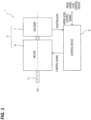
- FIG. 2 is a partial cross-sectional side view illustrating an example of the apparatus configuration of the encoder 7.
- FIG. 3 is a top view illustrating the example of the apparatus configuration of the encoder 7 when viewed from a substrate.
- the servo motor 3 includes the encoder 7 and the motor 9.
- the encoder 7 includes a substrate 13, a substrate support member 15, an optical module 17, a disk 19, a magnetic detecting unit 21, a magnet 23, a trigger signal generator 25, a plurality of magnets 27, a battery 29, and a processing module 31.
- the encoder 7 further includes connectors that connect the substrate 13 and the battery 29 to each other. Details of the connectors will be described later with reference to FIG. 4 .
- both the optical module 17 and the magnetic detecting unit 21 are connected to the substrate 13.
- any one of the optical module 17 and the magnetic detecting unit 21 may be connected to the substrate 13.
- the substrate 13 may be a printed circuit board obtained by mounting printed wirings (not illustrated) or a plurality of circuit components on a board made of an insulator.
- the substrate 13 has a substantially disc shape.
- the substrate 13 is disposed opposite to the motor 9 with respect to the disk 19 in the axial direction along the rotation axis Ax.
- the substrate 13 is supported substantially in parallel to the disk 19 by the substrate support member 15.
- the substrate 13 is not limited to a single substrate, and may be configured with a plurality of substrates.
- the substrate support member 15 is, for example, a cylindrical member, and fixes the substrate 13 to the end 9a of the housing of the motor 9 on the counter load side of the motor 9.
- the substrate support member 15 may be, for example, a plurality of columnar members.
- the optical module 17 detects angular position information indicating an angular position of the rotating disk 19 within one rotation thereof.
- the optical module 17 is provided on the surface of the substrate 13 that faces the disk 19.
- the power is also supplied to the optical module 17, and when the external power is not supplied to the encoder 7, the power supply to the optical module 17 is also stopped.
- the configuration of the optical module 17 is not particularly limited as long as the angular position information is optically detectable.
- the optical module 17 may include a light source 33 and light receiving arrays PA and PI on the surface thereof facing the disk 19.
- the light receiving array PA receives light reflected by a slit array SA of the disk 19, and outputs an absolute signal (an example of the angular position information).
- the light receiving array PI receives light reflected by a slit array SI of the disk 19, and outputs an incremental signal (an example of the angular position information).
- the optical module 17 is a so-called reflection type optical module in which the light source 33 and the light receiving arrays PA and PI are arranged on the same side that faces the disk 19.
- the disk 19 is, for example, a disc-shaped member.
- the disk 19 is connected to the shaft 11 of the motor 9, and rotates together with the shaft 11.
- the disk 19 includes the two slit arrays SA and SI on the surface thereof facing the optical module 17.
- Each of the slit arrays SA and SI includes a plurality of slits (not illustrated) arranged in a ring shape circumferentially around the center of the disk on the rotation axis Ax.
- the slits are formed in the surface of the disk 19, and are regions that perform, for example, an action of reflecting light emitted from the light source 33.
- the number of slit arrays formed in the disk 19 may be one or three or more as long as the absolute position of the disk 19 is detectable.
- the magnetic detecting unit 21 detects multi-rotation information indicating the number of rotations of the disk 19.
- the magnetic detecting unit 21 is provided, for example, on the surface of the substrate 13 that faces the disk 19.
- the magnetic detecting unit 21 is disposed, for example, at the position facing the magnet 23.
- the power is also supplied to the magnetic detecting unit 21, and when the external power is not supplied to the encoder 7, the power supply to the magnetic detecting unit 21 is controlled by the processing module 31.
- the configuration of the magnetic detecting unit 21 is not particularly limited as long as the multi-rotation information of the disk 19 is magnetically detectable.
- a magnetic resistive element such as, for example, an MR element, a GMR element, or a TMR element may be used.
- the magnet 23 is disposed, for example, on the surface of the disk 19 that faces the magnetic detecting unit 21.
- the magnet 23 is positioned, for example, on the rotation axis Ax.
- the configuration of the magnet 23 is not particularly limited as long as the direction of magnetic flux detected by the magnetic detecting unit 21 is reversed every time the disk 19 rotates by about 180°.
- the magnet 23 may be magnetized such that the N and S poles are formed in the diameter direction of the disk 19.
- FIG. 3 illustrates the N pole of the magnet 23 as 23N and the S pole of the magnet 23 as 23 S.
- the magnet 23 may have, for example, a disc shape or a ring shape.
- the magnetic detecting unit 21 detects the direction of magnetic flux of the magnet 23, and outputs a signal that changes by one cycle when the disk 19 rotates once, as two A-phase and B-phase signals having 90° different phases from each other (an example of the multi-rotation information).
- the trigger signal generator 25 (an example of an electric signal generating unit) generates a trigger signal (an example of an electric signal) in response to the rotation of the disk 19.
- the trigger signal generator 25 is provided, for example, on the surface of the substrate 13 opposite to the disk 19.
- the configuration of the trigger signal generator 25 is not particularly limited as long as the trigger signal may be periodically generated in response to the rotation of the disk 19.
- the trigger signal generator 25 may be configured to include a magnetic element (not illustrated) and a coil (not illustrated) that produce a large Barkhausen effect.
- the trigger signal generator 25 outputs the trigger signal which is, for example, a pulse signal, from the coil as a result of the large Barkhausen effect in which the magnetization direction of the magnetic element is rapidly reversed by an external magnetic field.
- the trigger signal generator 25 is positioned on the rotation locus of the magnets 27 when viewed from the axial direction of the rotation axis Ax.
- the magnets 27 are disposed, for example, on the surface of the disk 19 opposite to the substrate 13.
- the configuration of the magnets 27 is not particularly limited as long as the magnetic field applied to the magnetic element of the trigger signal generator 25 is periodically reversed in response to the rotation of the disk 19.
- the four magnets 27 may be arranged circumferentially at intervals of about 90° such that the magnetic poles thereof close to the substrate 13 are alternately different.
- FIG. 3 illustrates the magnets 27 of which magnetic poles close to the substrate 13 are N and S poles, as 27N and 27S, respectively.
- the trigger signal generator 25 generates the trigger signal four times for each rotation of the disk 19, by the four magnets 27.
- the battery 29 supplies a power to the magnetic detecting unit 21 when the external power is not supplied to the encoder 7.
- the battery 29 does not directly supply the power to the magnetic detecting unit 21, but supplies the power via the processing module 31. That is, the battery 29 is a supply source for supplying a power to the magnetic detecting unit 21 when the external power is not supplied to the encoder 7.
- the battery 29 may be a secondary battery which is usable repeatedly by being charged.
- the battery 29 may be, for example, an all-solid-state battery having a solid electrolyte.
- the embodiment describes a case where the battery 29 is the all-solid-state battery.
- the all-solid-state battery 29 is provided on the surface of the substrate 13 opposite to the disk 19.
- the all-solid-state battery 29 is electrically connected and mechanically fixed to the substrate 13 by solders.
- the processing module 31 generates position data of the disk 19 based on the angular position information and the multi-rotation information, when the external power is supplied to the encoder 7. When the external power is not supplied to the encoder 7, the processing module 31 controls the switching between the power supply from the all-solid-state battery 29 to the magnetic detecting unit 21, and the stop of the power supply.
- the processing module 31 is provided on the surface of the substrate 13 opposite to the disk 19.
- the configuration of the processing module 31 is not particularly limited, but the processing module 31 may be configured as a processor having a plurality of circuit elements such as a CPU and a memory.
- FIG. 4 is a cross-sectional view illustrating an example of the configuration of the connectors that connect the all-solid-state battery 29 and the substrate 13 to each other.
- FIG. 4 omits the illustration of the internal structure of the all-solid-state battery 29.
- the all-solid-state battery 29 includes connection terminals 34L and 34R at both ends thereof in the direction parallel to the substrate 13.
- Lands 35L and 35R are formed on the surface of the substrate 13 on which the all-solid-state battery 29 is provided, to correspond to the connection terminals 34L and 34R, respectively.
- the lands 35L and 35R are terminals made of, for example, copper foil.
- a connector 36L connects the connection terminal 34L of the all-solid-state battery 29 to the land 35L via a solder in contact with the connection terminal 34L.
- a connector 36R connects the connection terminal 34R of the all-solid-state battery 29 to the land 35R via a solder in contact with the connection terminal 34R.
- connection terminals 34L and 34R via a solder
- the description also includes, for example, a case where the connection terminals 34L and 34R are fixed to, for example, a child board by a solder, and the child board is connected to the substrate 13 by specific means ( e.g ., connectors).
- FIG. 4 illustrates a configuration where the connectors 36L and 36R directly connect the connection terminals 34L and 34R of the all-solid-state battery 29 to the substrate 13 by the solders, as an example. By the connectors 36L and 36R, the all-solid-state battery 29 is electrically connected to the wiring of the substrate 13, and mechanically fixed to the substrate 13.
- FIG. 5 is a block diagram illustrating an example of the functional configuration of the processing module 31.
- the processing module 31 generates the position data of the disk 19 based on both the angular position information and the multi-rotation information when the external power is supplied to the encoder 7, and generates a multi-rotation amount of the disk 19 based on the multi-rotation information detected by the magnetic detecting unit 21 using the power supplied from the all-solid-state battery 29 when the external power is not supplied to the encoder 7.
- An example of the functional configuration of the processing module 31 for implementing the above-described function will be described.
- the processing module 31 includes an angular position signal generating unit 37, an A-phase multi-rotation signal generating unit 39, a B-phase multi-rotation signal generating unit 41, a counter 43, and a position data generating unit 45, and a recording unit 47.
- the angular position signal generating unit 37 specifies an absolute position of the disk 19 within one rotation thereof based on the output of the light receiving array PA.
- the method of specifying the absolute position is not particularly limited.
- a plurality of light receiving elements provided in the light receiving array PA may treat each reception of light and each non-reception of light as bits based on the presence/absence of the detection of the slit array SA having an absolute pattern, to output an absolute signal having multiple bits.
- the angular position signal generating unit 37 specifies the absolute position by decoding the absolute position encrypted (encoded) into a serial bit pattern based on the absolute signal.
- the angular position signal generating unit 37 specifies a relative position of the disk 19 within one rotation thereof based on the output of the light receiving array PI.
- a plurality of light receiving elements provided in the light receiving array PI may output an incremental signal based on the result of the detection of the slit array SI having an incremental pattern.
- the angular position signal generating unit 37 specifies a position within one pitch of the incremental pattern based on the incremental signal.
- the angular position signal generating unit 37 superimposes the position within one pitch specified based on the incremental signal on the absolute position specified based on the absolute signal, thereby generating an angular position signal Ap indicating a highly accurate angular position of the disk 19 within one rotation thereof (see, e.g., FIG. 9 to be described later).
- the A-phase multi-rotation signal generating unit 39 converts an A-phase signal from the magnetic detecting unit 21 into a signal in a rectangular wave shape, to generate an A-phase multi-rotation signal Ma (see, e.g., FIG. 9 to be described later).
- the A-phase multi-rotation signal Ma has a duty ratio of 50 %, and becomes a signal of one pulse for each rotation of the disk 19.
- the B-phase multi-rotation signal generating unit 41 converts a B-phase signal from the magnetic detecting unit 21 into a signal in a rectangular wave shape, to generate a B-phase multi-rotation signal Mb (see, e.g., FIG. 9 to be described later).
- the B-phase multi-rotation signal Mb has a duty ratio of 50 %, and becomes a signal of one pulse for each rotation of the disk 19.
- the phase of the B-phase multi-rotation signal Mb is 90° different from that of the A-phase multi-rotation signal Ma.
- the counter 43 executes a count arithmetic process (an example of a predetermined arithmetic process) for counting the multi-rotation amount representing the number of rotations of the disk 19 based on the A-phase multi-rotation signal Ma and the B-phase multi-rotation signal Mb, so as to generate a multi-rotation signal Rn.
- a count arithmetic process an example of a predetermined arithmetic process
- the counter 43 outputs the multi-rotation signal Rn which is the result of the count arithmetic process, to the position data generating unit 45.
- the processing module 31 enters an active mode when the external power is supplied to the encoder 7. In the active mode by the external power, the processing module 31 supplies the power to the magnetic detecting unit 21.
- the position data generating unit 45 synthesizes the angular position signal Ap and the multi-rotation signal Rn with each other to generate position data (an example of first position data), and outputs the position data to the control device 5.
- the processing module 31 switches to a sleep mode when the external power is not supplied to the encoder 7. In the sleep mode, the processing module 31 stops the power supply to the magnetic detecting unit 21. In the sleep mode, the processing module 31 suspends various arithmetic processes including the generation of position data, while maintaining its started state by the power supplied from the all-solid-state battery 29 without entering a completely stopped state.
- the trigger signal generator 25 generates a trigger signal in response to the rotation of the disk 19.
- the processing module 31 returns to the active mode from the sleep mode by the power supplied from the all-solid-state battery 29.
- the processing module 31 supplies the power to the magnetic detecting unit 21, and acquires the A-phase signal and the B-phase signal from the magnetic detecting unit 21.
- the counter 43 receives the A-phase multi-rotation signal Ma from the A-phase multi-rotation signal generating unit 39 and the B-phase multi-rotation signal Mb from the B-phase multi-rotation signal generating unit 41, and executes the count arithmetic process.
- the counter 43 records the multi-rotation signal Rn (an example of second position data) which is the result of the count arithmetic process, in the recording unit 47.
- the processing module 31 stops the power supply from the all-solid-state battery 29 to the magnetic detecting unit 21.
- the power supply to the magnetic detecting unit 21 may be stopped before the start of the count arithmetic process.
- the recording unit 47 (an example of a nonvolatile memory) records the multi-rotation signal Rn from the counter 43.
- the recording unit 47 is not particularly limited as long as the recording unit 47 is a nonvolatile memory capable of reading and writing data and maintaining recorded contents even when power is OFF.
- a FRAM registered trademark
- FRAM ferrroelectric memory
- the recording unit 47 is equipped in the processing module 31. However, the recording unit 47 may be provided outside the processing module 31 (see, e.g., FIG. 14 to be described later).
- the position data generating unit 45 reads the multi-rotation signal Rn recorded in the recording unit 47, and synthesizes the read multi-rotation signal Rn with the angular position signal Ap output from the angular position signal generating unit 37, so as to generate an initial value of the position data. Then, the processing module 31 executes the normal position data generating process performed when the external power is supplied to the encoder 7.
- the distribution of the above-described processes in, for example, the angular position signal generating unit 37, the A-phase multi-rotation signal generating unit 39, the B-phase multi-rotation signal generating unit 41, the counter 43, the position data generating unit 45, and the recording unit 47 is not limited to the example described above.
- the processes may be performed by a smaller number of processing units (e.g. , one processing unit) or further sub-divided processing units.
- the processing module 31 only the portion that supplies the power to the magnetic detecting unit 21 may be implemented by an actual device, and the functions of the other processing units may be implemented by programs executed by a CPU 901 to be described later (see, e.g., FIG. 15 ).
- a portion or all of the functions of the respective processing units may be implemented by actual devices such as, for example, an ASIC, an FPGA or other electric circuits.
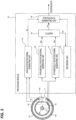
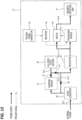
- FIG. 6 is a block diagram illustrating an example of the circuit configuration of the substrate 13.
- the solid arrow indicates the power supply line by the external power or the all-solid-state battery 29, and the dashed line arrow indicates the signal line of the trigger signal.
- the encoder 7 includes a DC/DC converter 49, a charging module 51, the all-solid-state battery 29, a regulator 53, the trigger signal generator 25, a rectifier 55, the processing module 31, the magnetic detecting unit 21, and a plurality of rectifying elements 57, 59, and 61, as the circuit configuration implemented on the substrate 13.
- FIG. 6 omits the illustration of the circuit configuration of the optical detection system including the optical module 17.
- the DC/DC converter 49 converts, for example, the voltage of the external power which is a DC power source, into a predetermined voltage, and outputs the converted voltage to the charging module 51 and the regulator 53.
- the charging module 51 controls the charging of the all-solid-state battery 29 which is a secondary battery.
- the charging module 51 charges the all-solid-state battery 29 when the external power is supplied to the encoder 7, and stops the charging of the all-solid-state battery 29 when the external power is not supplied to the encoder 7.
- the method of charging the all-solid-state battery 29 is not particularly limited.
- the charging module 51 is connected to a power supply line EL1 of the external power to be electrically parallel with the processing module 31.
- the rectifying element 57 is electrically connected to a power supply line EL2 between the charging module 51 and the all-solid-state battery 29.
- the rectifying element 57 regulates the current direction to the direction from the charging module 51 toward the all-solid-state battery 29.
- the rectifying element 59 is electrically connected to a power supply line EL3 between the DC/DC converter 49 and the regulator 53.
- the rectifying element 59 regulates the current direction to the direction from the DC/DC converter 49 toward the regulator 53.
- the rectifying element 61 is electrically connected to a power supply line EL4 between the all-solid-state battery 29 and the regulator 53.
- the rectifying element 61 regulates the current direction to the direction from the all-solid-state battery 29 toward the regulator 53.
- the rectifying elements 57, 59, and 61 are not particularly limited as long as the current direction may be regulated.
- transistors or diodes may be used.
- the all-solid-state battery 29 When the external power is not supplied to the encoder 7, the all-solid-state battery 29 outputs a power to the regulator 53 through the power supply line EL4.
- the regulator 53 controls the voltage and current of the power output from the DC/DC converter 49 or the all-solid-state battery 29 to be kept constant, and outputs the power to the processing module 31.
- the processing module 31 controls the power supply to the magnetic detecting unit 21.
- the processing module 31 supplies the power to the magnetic detecting unit 21.
- the processing module 31 stops the power supply to the magnetic detecting unit 21. In this case, as described above, the processing module 31 switches to the sleep mode by the power supplied from the all-solid-state battery 29.
- the trigger signal generator 25 generates the trigger signal in response to the rotation of the disk 19.
- the rectifier 55 rectifies the current of the trigger signal, and restricts the current and voltage of the trigger signal to be equal to or less than a predetermined value.
- the rectifier 55 outputs the rectified and restricted trigger signal to the processing module 31.
- the processing module 31 supplies the power from the all-solid-state battery 29 which serves as a power supply source, to the magnetic detecting unit 21. After acquiring the A-phase signal and the B-phase signal from the magnetic detecting unit 21, the processing module 31 stops the power supply to the magnetic detecting unit 21. The processing module 31 executes the count arithmetic process based on the A-phase signal and the B-phase signal, and switches to the sleep mode after the arithmetic process is completed. The processing module 31 repeats the same process each time the trigger signal is received in the sleep mode.
- FIG. 7 is a timing chart illustrating an example of the trigger signal, each process executed by the processing module, and the timing of turn-ON of the magnetic detecting unit.
- the processing module 31 switches from the sleep mode to the active mode.
- a time Td required from the generation of the trigger signal until the switching to the active mode is relatively short, as compared with a case where the processing module 31 is stopped instead of entering the sleep mode (see, e.g., FIG. 13 to be described later), because the process of starting the processing module 31 becomes unnecessary.
- the processing module 31 starts the power supply to the magnetic detecting unit 21 substantially at the same time as the switching to the active mode, so as to turn ON the magnetic detecting unit 21.
- the processing module 31 executes a plurality of processes. For example, the processing module 31 executes a process of acquiring a clock signal during the time 11, and executes a process of confirming a port for communicating with, for example, the magnetic detecting unit 21 during the time t2.
- the magnetic detecting unit 21 stabilizes the output of the A-phase signal and the B-phase signal during the time ts which is substantially the same as the sum of the times t1 and t2.
- the processing module 31 executes a process of acquiring the A-phase signal and the B-phase signal from the magnetic detecting unit 21.
- the processing module 31 stops the power supply to the magnetic detecting unit 21 to turn OFF the magnetic detecting unit 21.
- the processing module 31 executes predetermined arithmetic processes. For example, during the time t4, the processing module 31 executes a process of reading the multi-rotation amount (the multi-rotation signal Rn) of the disk 19 recorded in the recording unit 47. During the time t5, the processing module 31 executes the count arithmetic process for counting the multi-rotation amount of the disk 19 based on the A-phase signal and the B-phase signal acquired from the magnetic detecting unit 21. During the time 6, the processing module 31 executes a process of updating the multi-rotation amount read from the recording unit 47 based on the result of the count arithmetic process. These processes are examples of the predetermined arithmetic processes. When the predetermined arithmetic processes are completed, the processing module 31 switches from the active mode to the sleep mode.
- the processing module 31 stops the power supply to the magnetic detecting unit 21 between the times t3 and t4, that is, after the acquisition of the A-phase signal and the B-phase signal from the magnetic detecting unit 21 and before the start of the predetermined arithmetic processes.
- the timing for stopping the power supply is not limited thereto.
- the processing module 31 may stop the power supply to the magnetic detecting unit 21 during the execution of the predetermined arithmetic processes, for example, between the times t4 and t5, between the times t5 and t6, or during any one of the times t4, t5, and t6.
- the processing module 31 may stop the power supply to the magnetic detecting unit 21 substantially at the same time as the switching from the active mode to the sleep mode.
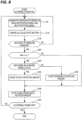
- FIG. 8 is a flowchart illustrating an example of the process procedure executed by the processing module 31 when the external power is supplied to the encoder 7.
- FIG. 9 is a view illustrating an example of waveforms of the angular position signal Ap, the A-phase multi-rotation signal Ma, and the B-phase multi-rotation signal Mb.
- FIG. 10 is a flowchart illustrating an example of the process procedure executed by the processing module 31 when the external power is not supplied to the encoder 7.
- the processing module 31 executes the process procedure illustrated in the flowchart of FIG. 8 when the external power is supplied to the encoder 7. As illustrated in FIG. 8 , in step S5, the processing module 31 generates the position data by the position data generating unit 45, based on the angular position signal Ap output from the angular position signal generating unit 37 and the multi-rotation signal Rn output from the counter 43. As illustrated in FIG. 9 , when the disk 19 rotates in the forward rotation direction, the angular position signal Ap increases proportionally from the minimum value Min as the rotation angle approaches 360° from 0°, and when the rotation angle reaches 360° (0°), the angular position signal Ap is reset from the maximum value Max to the minimum value Min.
- the angular position signal Ap decreases proportionally from the maximum value Max as the rotation angle approaches 0° from 360°, and when the rotation angle reaches 0° (360°), the angular position signal Ap is reset from the minimum value Min to the maximum value Max.
- the multi-rotation signal Rn indicates the multi-rotation amount of the disk 19 counted based on the A-phase multi-rotation signal Ma and the B-phase multi-rotation signal Mb.
- step S10 the processing module 31 charges the all-solid-state battery 29 by the charging module 51.
- step S15 the processing module 31 determines whether the edge of the A-phase multi-rotation signal Ma has changed, by the counter 43.
- the A-phase multi-rotation signal Ma becomes high (Hi) when the rotation angle of the disk 19 is in the range of 0° to 180°, and becomes low (Hi) in the range of 180° to 360° (0°).
- the B-phase multi-rotation signal Mb becomes high (Hi) when the rotation angle of the disk 19 is in the range of 90° to 270°, and becomes low (Lo) in the range of 270° to 90°.
- the angular position at which the edge of the A-phase multi-rotation signal Ma changes is either 0° (360°) or 180°.
- step S15: NO When it is determined that the edge of the A-phase multi-rotation signal Ma has not changed (step S15: NO), the process returns to step S5. When it is determined that the edge of the A-phase multi-rotation signal Ma has changed (step S15: YES), the process proceeds to step S20.
- step S20 the processing module 31 determines whether the B-phase multi-rotation signal Mb is low (Lo), by the counter 43. As illustrated in FIG. 9 , the angular position at which the edge of the A-phase multi-rotation signal Ma changes, and the B-phase multi-rotation signal Mb is low (Lo) is 0° (360°). The angular position at which the edge of the A-phase multi-rotation signal Ma changes, and the B-phase multi-rotation signal Mb is high (Hi) is 180°. When it is determined that the B-phase multi-rotation signal Mb is high (Hi) (step S20: NO), the process proceeds to step S40 to be described later. When it is determined that the B-phase multi-rotation signal Mb is low (Lo) (step S20: YES), the process proceeds to step S25.
- step S25 the processing module 31 refers to the A-phase multi-rotation signal Ma recorded in the recording unit 47 to determine whether the A-phase multi-rotation signal Ma has changed from low (Lo) to high (Hi), by the counter 43.
- the processing module 31 refers to the A-phase multi-rotation signal Ma recorded in the recording unit 47 to determine whether the A-phase multi-rotation signal Ma has changed from low (Lo) to high (Hi), by the counter 43.
- the processing module 31 refers to the A-phase multi-rotation signal Ma recorded in the recording unit 47 to determine whether the A-phase multi-rotation signal Ma has changed from low (Lo) to high (Hi), by the counter 43.
- FIG. 9 when the A-phase multi-rotation signal Ma changes from low (Lo) to high (Hi) at the angular position of 0° (360°), it indicates that the disk 19 has rotated once in the forward rotation direction.
- step S25: YES the process proceeds to step S30.
- step S30 the processing module 31 reads and counts up the multi-rotation amount recorded in the recording unit 47, by the counter 43.
- step S25 When it is determined in step S25 that the A-phase multi-rotation signal Ma has not changed from low (Lo) to high (Hi), that is, when the A-phase multi-rotation signal Ma has changed from high (Hi) to low (Lo) (step S25: NO), the process proceeds to step S35.
- step S35 As illustrated in FIG. 9 , when the A-phase multi-rotation signal Ma changes from high (Hi) to low (Lo) at the angular position of 0° (360°), it indicates that the disk 19 has rotated once in the reverse rotation direction.
- step S35 the processing module 31 reads and counts down the multi-rotation amount recorded in the recording unit 47, by the counter 43.
- step S40 the processing module 31 outputs the multi-rotation amount (the multi-rotation signal Rn) counted up or down in step S30 or S35, by the counter 43, to the position data generating unit 45.
- the counter 43 records whether the A-phase multi-rotation signal Ma is low (Lo) or high (Hi) at the time when the counting is performed, in the recording unit 47.
- the counter 43 may record the multi-rotation signal Rn in the recording unit 47.
- step S45 the processing module 31 determines whether the external power is no longer supplied to the encoder 7. When it is determined that the external power is supplied to the encoder 7 (step S45: NO), the process returns to previous step S5 to repeat the same procedure. When it is determined that the external power is no longer supplied to the encoder 7 due to, for example, an occurrence of power outage (step S45: YES), the flowchart ends.
- the above-described process procedure is an example, and at least a part of the procedure may be deleted or changed, or a procedure other than the above-described procedure may be added.
- the order of at least a part of the above-described procedure may be changed, or a plurality of procedures may be combined into a single procedure.
- steps S5 and S10 may not be performed in the order described above, and may be performed in the reverse order or simultaneously in parallel with each other.
- the processing module 31 executes the flowchart illustrated in FIG. 10 when the external power is no longer supplied to the encoder 7 due to, for example, a power outage. As illustrated in FIG. 10 , in step S101, the power supply from the all-solid-state battery 29 is performed. In step S105, the processing module 31 switches to the sleep mode from the active mode by the external power.
- step S 110 the processing module 31 stops the power supply to the magnetic detecting unit 21.
- step S115 the processing module 31 determines whether the trigger signal generated by the trigger signal generator 25 in response to the rotation of the disk 19 has been received via the rectifier 55. When it is determined that the trigger signal has not been received (step S115: NO), the process proceeds to step S150 to be described later. When it is determined that the trigger signal has been received (step S115: YES), the process proceeds to step S120.
- step S120 the processing module 31 switches from the sleep mode to the active mode.
- step S125 the processing module 31 starts the power supply to the magnetic detecting unit 21.
- step S130 the processing module 31 acquires the A-phase signal and the B-phase signal from the magnetic detecting unit 21, by the A-phase multi-rotation signal generating unit 39 and the B-phase multi-rotation signal generating unit 41.
- step S135 the processing module 31 stops the power supply to the magnetic detecting unit 21.
- step S140 the processing module 31 generates the A-phase multi-rotation signal Ma and the B-phase multi-rotation signal Mb based on the A-phase signal and the B-phase signal acquired from the magnetic detecting unit 21 in step S130, by the A-phase multi-rotation signal generating unit 39 and the B-phase multi-rotation signal generating unit 41.
- the processing module 31 executes the count arithmetic process by the counter 43 based on the A-phase multi-rotation signal Ma and the B-phase multi-rotation signal Mb, and records the multi-rotation signal Rn which is the result of the arithmetic process, in the recording unit 47.
- step S145 the processing module 31 switches from the active mode to the sleep mode.
- step S150 the processing module 31 determines whether the external power is to be supplied to the encoder 7. When it is determined that the external power is not to be supplied to the encoder 7 (step S150: NO), the process returns to previous step S115 to repeat the same procedure. When it is determined that the external power is to be supplied to the encoder 7 due to, for example, the recovery of power outage (step S150: YES), the flowchart ends.
- the foregoing process procedure is an example, and at least a part of the procedure may be deleted or changed, or a procedure other than the above-described procedure may be added.
- the order of at least a part of the above-described procedure may be changed, or a plurality of procedures may be combined into a single procedure.
- the encoder 7 of the embodiment includes the optical module 17 that detects the angular position information indicating the angular position of the rotating disk 19 within one rotation thereof, the magnetic detecting unit 21 that detects the multi-rotation information indicating the number of rotations of the disk 19, the battery 29 that supplies a power to the magnetic detecting unit 21 when the external power is not supplied to the encoder 7, and the connectors 36L and 36R that connect the connection terminals 34L and 34R of the battery 29 to the substrate 13 to which at least one of the optical module 17 and the magnetic detecting unit 21 is connected, via solders in contact with the connection terminals 34L and 34R.
- the battery 29 is not only electrically connected to the substrate 13, but also firmly fixed to the substrate 13. That is, the connection of the connection terminals 34L and 34R by the solders implements not only the electrical connection but also the fixing of the battery 29. As a result, for example, even in a case where an impact or vibration occurs in the encoder 7, a poor connection of the substrate 13 to the wiring (the lands 35L and 35R) or a detachment of the battery 29 from the substrate 13 may be suppressed, and the durability may be improved.
- the connectors 36L and 36R may directly connect the connection terminals 34L and 34R of the battery 29 to the substrate 13 by the solders.
- the electrical connection and the fixing are implemented only through the connection terminals 34L and 34R of the battery 29, for example, the housing for accommodating the battery 29 or lead wires become unnecessary, so that the encoder 7 may be downsized, and the number of parts may be reduced. Accordingly, this embodiment is further advantageous in terms of the ease of manufacture and the cost reduction.
- the battery 29 may be a secondary battery that is usable repeatedly by be charged.
- the power supply from the battery 29 becomes impossible when the battery capacity is used up. Further, when the battery 29 is fixed to the substrate 13 with solders, the battery 29 may not be replaced, so that the encoder 7 needs to be replaced or discarded. In the embodiment, the secondary battery is provided so that the battery may be used repeatedly by being charged. Thus, even though the battery 29 is fixed to the substrate 13 with solders, the encoder 7 may be used for an extended period of time without being replaced or discarded.
- the battery 29 may be an all-solid-state battery having a solid electrolyte.
- the operation of the battery may become unstable under a high temperature environment, and further, a heat generation or combustion may occur, which may require a protection circuit using a thermistor.
- the all-solid-state battery may be used under the high temperature condition, reduces the amount of heat generation thereby lowering the risk of combustion due to its solid electrolyte, has a relatively long life due to its property of low self-discharge, and has the property of relatively slow performance deterioration.
- the encoder 7 it is possible to implement the encoder 7 that is usable safely even under the high temperature environment, does not require the protection circuit, reduces the power consumption, and has the relatively long life.
- the encoder 7 may include the charging module 51 that charges the all-solid-state battery 29 when the external power is supplied, and stops the charging of the all-solid-state battery 29 when the external power is not supplied.
- the all-solid-state battery 29 may be charged in advance when the external power is supplied, the power supply from the all-solid-state battery 29 may be performed readily at any time when the external power is not supplied due to, for example, a power outage.
- the encoder 7 may include the rectifying element 57 that is electrically connected between the charging module 51 and the all-solid-state battery 29 to regulate the current direction to the direction from the charging module 51 toward the all-solid-state battery 29.
- the all-solid-state battery 29 supplies a power to the magnetic detecting unit 21 via the processing module 31, the backflow of current toward the charging module 51 may be prevented.
- the encoder 7 may include the processing module 31 that generates the position data of the disk 19 based on at least one of the angular position information and the multi-rotation information when the external power is supplied.
- the charging module 51 and the processing module 31 may be connected to the power supply line EL1 of the external power, to be electrically parallel with each other.
- the power when the external power is supplied by, for example, the recovery of power outage, the power may be promptly supplied to both the charging module 51 and the processing module 31 to immediately start the modules or immediately cause the modules to execute processes, as compared with a case where the charging module 51 and the processing module 31 are connected in series to the power supply line EL1.
- the encoder 7 may include the processing module 31 that controls the switching between the power supply from the all-solid-state batter 29 to the magnetic detecting unit 21 and the stop of the power supply.
- the processing module 31 may control the power supply from the all-solid-state battery 29 to the magnetic detecting unit 21. As a result, the power supply may be controlled based on, for example, the results of the predetermined arithmetic processes by the processing module 31, and, for example, the power consumption may be suppressed.
- the all-solid-state battery 29 may supply the power to the magnetic detecting unit 21 via the processing module 31 when the supply of external power to the encoder 7 is stopped.
- the processing module 31 may control the power supply, such as supplying the power to the magnetic detecting unit 21 only during, for example, the acquisition of multi-rotation information, so that the power consumption may be further suppressed.
- the processing module 31 may sleep by the power from the all-solid-state battery 29.
- the processing module 31 may immediately enter the active mode as necessary to execute the predetermined processes.
- the time necessary for starting the processing module 31 may be omitted, the time until the start of processes may be reduced, and the power consumption required for starting the processing module 31 may be reduced.
- the predetermined processes e.g., an abnormality detecting process for the all-solid-state battery 29
- the processes may be executed quickly.
- the encoder 7 may include the trigger signal generating unit 25 that generates the trigger signal in response to the rotation of the disk 19, and in that case, the processing module 31 may receive the trigger signal to be restored from the sleep mode and start the power supply to the magnetic detecting unit 21.
- the power supply from the all-solid-state battery 29 to the magnetic detecting unit 21 may be stopped, and the power may be supplied to the magnetic detecting unit 21 only in a case where the disk 19 rotates, so as to detect the multi-rotation information.
- the power consumption of the all-solid-state battery 29 may be suppressed, and the life of the battery may be extended.
- the processing module 31 may execute the predetermined arithmetic processes based on the multi-rotation information detected by the magnetic detecting unit 21.
- the processing module 31 may not only accumulate the multi-rotation information from the magnetic detecting unit 21, but also perform the arithmetic processes based on the multi-rotation information. Accordingly, the storage area of the processing module 31 may be saved, and the arithmetic operation related to the multi-rotation amount (e.g ., the count arithmetic process) may be executed at the time when the multi-rotation information is detected, so that the reliability may be improved.
- the battery 29 is an all-solid-state battery
- processes such as, for example, checking the soundness of the all-solid-state battery may be executed so that the reliability of the entire encoder may be improved.
- the processing module 31 becomes active from the sleep state, the processes may be executed quickly, the power consumption of the all-solid-state battery 29 may be suppressed, and the life of the battery may be extended.
- the processing module 31 may stop the power supply from the all-solid-state battery 29 to the magnetic detecting unit 21, after the acquisition of the multi-rotation information from the magnetic detecting unit 21 and before the start of the predetermined arithmetic processes.
- the processing module 31 may supply a power to the magnetic detecting unit 21 only in a case where the disk 19 rotates, so as to acquire the multi-rotation information, and may stop the power supply to the magnetic detecting unit 21 before starting the necessary arithmetic processes based on the acquired multi-rotation information.
- the processing module 31 separately controls the arithmetic processes and the stop of the power supply, so that even when the arithmetic processes require significant time, the power supply may be stopped earlier than the start of the processes, and thus, the power consumption of the all-solid-state battery 29 may be further suppressed.
- the encoder 7 may include the recording unit 47 which is a nonvolatile memory capable of reading and writing data and maintaining the recorded contents even when power is OFF.
- the processing module 31 may record the results of the predetermined arithmetic processes in the recording unit 47.
- the results of the predetermined arithmetic processes based on the multi-rotation information detected by the magnetic detecting unit 21 may be maintained even after the power supply to the magnetic detecting unit 21 is stopped. Further, when the processing module 31 is equipped with the recording unit 47 therein, the high-speed writing of data is possible, so that the power consumption of the battery may be further suppressed.
- the processing module 31 may be provided on the substrate 13, and may execute the generation of the position data of the disk 19 based on at least one of the angular position information and the multi-rotation information when the external power is supplied, and the generation of the multi-rotation signal Rn indicating the multi-rotation amount of the disk 19 based on the multi-rotation information detected by the magnetic detecting unit 21 using the power supplied from the all-solid-state battery 29 when the external power is not supplied.
- the processing module 31 may be configured as a common component mounted on the substrate 13.
- the switching of control at the time when the external power is ON/OFF may be quickly performed. For example, even when a momentary power outage occurs, the switching of control may be quickly performed so that the process for the case where the external power is OFF may be restored to the process for the case where the external power is ON. Further, in a case where the predetermined arithmetic processes are executed when the external power is restored, the processes may also be quickly executed.
- the encoder 7 of the embodiment includes the optical module 17 that detects the angular position information indicating the angular position of the rotating disk 19 within one rotation thereof, the magnetic detecting unit 21 that detects the multi-rotation information indicating the number of rotations of the disk 19, and the all-solid-state battery 29 that has a solid electrolyte and supplies a power to the magnetic detecting unit 21 when the external power is not supplied to the encoder 7.
- the encoder 7 that includes the all-solid-state battery 29, and thus, may store the multi-rotation information by the power supplied from the battery when the supply of external power is stopped, it is possible to implement the encoder 7 that is usable safely even under the high temperature environment, does not require the protection circuit, reduces the power consumption, and has the relatively long life.
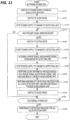
- steps S105 to S140 in FIG. 11 are the same as those in FIG. 10 described above, descriptions thereof will be omitted.
- step S143 the processing module 31 executes the process of detecting an abnormality of the all-solid-state battery 29.
- the method of detecting an abnormality of the all-solid-state battery 29 is not particularly limited.
- the voltage of the all-solid-state battery 29 may be detected, such that when the voltage value falls within a predetermined range, the all-solid-state battery 29 may be determined to be normal, and when the voltage value does not fall within the predetermined range, the all-solid-state battery 29 may be determined to be abnormal.
- the processing module 31 records the result of the abnormality detecting process in the recording unit 47.
- the processing module 31 may execute the process of step S143 together with, for example, the count arithmetic process during the time t5 of the time chart illustrated in FIG. 7 described above.
- Steps S145 and S150 are the same as those in FIG. 10 described above. However, when it is determined in step S150 that the external power is to be supplied to the encoder 7 (step S150: YES), the process proceeds to step S155.
- step S155 the processing module 31 executes the process of detecting an abnormality of the all-solid-state battery 29.
- the voltage of the all-solid-state battery 29 may be detected, such that when the voltage value falls within a predetermined range, the all-solid-state battery 29 may be determined to be normal, and when the voltage value does not fall within the predetermined range, the all-solid-state battery 29 may be determined to be abnormal.
- the processing module 31 may refer to the information recorded in the recording unit 47 in step S143 when the supply of external power is stopped, such that when there is no information indicating that an abnormality has been detected (e.g., an alarm code), the all-solid-state battery 29 may be determined to be normal, and when there is information indicating that an abnormality has been detected, the all-solid-state battery 29 may be determined to be abnormal.
- the processing module 31 may output the result of the abnormality detecting process to, for example, the control device 5. Then, the flowchart ends.
- step S143 When the normality or abnormality of the all-solid-state battery 29 is determined by the voltage value thereof in step S155, the process of step S143 may be omitted.
- the process of step S143 is executed, the determination based on only the information recorded in the recording unit 47 may be performed in step S155, and the process of determining the voltage value of the all-solid-state battery 29 may be omitted.
- the abnormality of the all-solid-state battery 29 may be checked, so that the soundness of the battery may be diagnosed and confirmed.
- the processing module 31 itself supplies the power to the magnetic detecting unit 21 or stops the power supply.
- the power supply to the magnetic detecting unit 21 may be switched by a switch.
- FIG. 12 an example of a circuit configuration of the substrate 13 in the present modification will be described.
- the same components as those in FIG. 6 described above will be denoted by the same reference numerals as used in FIG. 6 , and descriptions thereof will be omitted.
- the encoder 7 includes a switch 63 as a circuit configuration implemented on the substrate 13, in addition to the configuration illustrated in FIG. 6 described above.
- the switch 63 may only have a function of switching a circuit, such as, for example, a load switch or a transistor.
- the switch 63 is electrically connected to a power supply line EL5 between the regulator 53 and the magnetic detecting unit 21.
- the switching operation using the switch 63 is controlled by the processing module 31.
- the regulator 53 outputs the power output from the DC/DC converter 49 or the all-solid-state battery 29 to the processing module 31 and the switch 63.
- the processing module 31 When the external power is supplied to the encoder 7, the processing module 31 turns ON the switch 63. As a result, the power output from the regulator 53 is supplied to the magnetic detecting unit 21. When the external power is not supplied to the encoder 7, the processing module 31 enters the sleep mode, and turns OFF the switch 63. As a result, the power supply from the all-solid-state battery 29 to the magnetic detecting unit 21 is stopped.
- the processing module 31 When the trigger signal is received from the trigger signal generating unit 25 via the rectifier 55 in the sleep mode, the processing module 31 enters the active mode, and turns ON the switch 63. As a result, the power from the all-solid-state battery 29 is supplied to the magnetic detecting unit 21. The processing module 31 turns OFF the switch 63 after acquiring the A-phase signal and the B-phase signal from the magnetic detecting unit 21. As a result, the power supply from the all-solid-state battery 29 to the magnetic detecting unit21 is stopped.
- each process such as, for example, the count arithmetic process executed by the processing module 31 are the same as those in the above-described embodiment. According to the present modification, it is possible to apply a processing module that does not have the function of supplying a voltage to the magnetic detecting unit 21, and the versatility of the processing module may be improved.
- the processing module 31 is caused to sleep when the supply of external power is stopped. However, the processing module 31 may be turned OFF.
- FIG. 13 an example of a circuit configuration of the substrate 13 in the present modification will be described. In FIG. 13 , the same components as those in FIG. 6 described above will be denoted by the same reference numerals as used in FIG. 6 , and descriptions thereof will be omitted.
- the encoder 7 includes a switch 65 as a circuit configuration implemented on the substrate 13, in addition to the configuration illustrated in FIG. 6 described above.
- the switch 65 may only have the function of switching a circuit, such as, for example, a load switch or a transistor.
- the switch 65 is electrically connected to a power supply line EL6 between the regulator 53 and the processing module 31.
- the switching operation using the switch 65 is performed by the trigger signal input from the trigger signal generator 25 via the rectifier 55.
- the regulator 53 outputs the power output from the DC/DC converter 49 or the all-solid-state battery 29 to the switch 65.
- the switch 65 is turned ON when the external power is supplied to the encoder 7. As a result, the power output from the regulator 53 is supplied to the processing module 31. The switch 65 is turned OFF when the external power is not supplied to the encoder 7. As a result, the power supply from the all-solid-state battery 29 to the processing module 31 is stopped, and the processing module 31 enters a stopped state.
- the switch 65 is turned ON. As a result, the power from the all-solid-state battery 29 is supplied to the processing module 31, and the processing module 31 is started.
- the switch 65 is turned OFF when a predetermined time elapses after the trigger signal is received. As a result, the power supply from the all-solid-state battery 29 to the processing module 31 is stopped.
- the predetermined time is set to be equal to or more than the sum of the time Td required from the generation of the trigger signal to the start of the processing module 31 and the times t1 to t6 during which the processing module 31 executes the respective processes.
- the time Td is longer than the time Td (see, e.g., FIG. 7 ) in the above-described embodiment, by the time for executing the process of starting the processing module 31.
- each process such as, for example, the count arithmetic process executed by the process module 31 are the same as those in the above-described embodiment. According to the present modification, it is possible to apply a processing module that does not have the function of sleep mode, and the versatility of the processing module may be improved.
- the processing module 31 includes the recording unit 47 therein.
- the process module 31 may not include the recording unit 47.
- the recording unit 47 may be provided outside the processing module 31.
- the recording unit 47 may be provided on the substrate 13. In this case, it is possible to apply a processing module having no nonvolatile memory, and the versatility of the processing module may be improved.
- the optical module 17 is a reflection type optical module.
- the optical module 17 may be a transmission type optical module.
- the light source 33 and the light receiving arrays PA and PI may be arranged on the opposite sides with the disk 19 interposed between the light source 33 and the light receiving arrays PA and PI, and each slit of the slit arrays SA and SI of the disk 19 may be formed as a transmission slit ( e.g ., a hole).
- one type of an incremental pattern is formed on the disk 19.
- a plurality of types of incremental patterns having different pitches may be formed on the disk 19. In this case, it is possible to generate an angular position signal having a higher resolution based on the plurality of incremental signals having different resolutions.
- the embodiment may solve a problem that is not described herein or may achieve an effect that is not described herein. Further, the embodiment may solve only a portion of the problems described herein or may achieve only a portion of the effects described herein.
- FIG. 15 omits the illustration of the configuration related to the function of supplying a power to the magnetic detecting unit 21.
- the processing module 31 includes, for example, a CPU 901, a ROM 903, a RAM 905, a dedicated integrated circuit 907 constructed for a specific application such as an ASIC or FPGA, a recording device 917, and a connection port 921. These components are connected to each other to transmit signals each other via a bus 909 and an input/output interface 911.
- the program may be recorded in, for example, the ROM 903, the RAM 905, or the recording device 917 including the recording unit 47 described above.
- connection port 921 is used for transmitting/receiving signals to/from an external connection device 927 and for inputting/outputting a power. For example, the reception of the trigger signal from the rectifier 55, the input of the power from the regulator 53, and the output of the power to the magnetic detecting unit 21 may be performed through the connection port 921.
- the processes performed by, for example, the angular position signal generating unit 37, the A-phase multi-rotation signal generating unit 39, the B-phase multi-rotation signal generating unit 41, the counter 43, and the position data generating unit 45 are implemented in the manner that the CPU 901 executes the various processes according to programs, or implemented by, for example, the dedicated integrated circuit 907.
- the CPU 901 may, for example, directly read the programs from the recording device 917 and execute the programs, or may execute the programs after loading the programs into the RAM 905.
- the CPU 901 may transmit the results obtained from executing the above-described processes to the external connection device 927 through, for example, the connection port 921, or may record the results in the recording device 917.
- the terms “similar,” “same,” “equal,” and “different” in an external dimension or size, a shape, a position or the like do not have a strict meaning. That is, the terms “similar,” “same,” “equal,” and “different” allow tolerances and errors in design and manufacturing, and indicate “substantially similar,” “substantially the same,” “substantially equal,” “substantially different.”
- the terms “same,” “equal,” and “different” have a strict meaning, for a value which serves as a predetermined criterion or a value that serves as a delimiter, such as a threshold value (see, e.g., the flowcharts of FIGS. 8 and 10 ) or a reference value.
- the durability may be improved.
Landscapes
- Engineering & Computer Science (AREA)
- Physics & Mathematics (AREA)
- General Physics & Mathematics (AREA)
- Power Engineering (AREA)
- Manufacturing & Machinery (AREA)
- Chemical & Material Sciences (AREA)
- Chemical Kinetics & Catalysis (AREA)
- Electrochemistry (AREA)
- General Chemical & Material Sciences (AREA)
- Microelectronics & Electronic Packaging (AREA)
- Human Computer Interaction (AREA)
- Automation & Control Theory (AREA)
- Transmission And Conversion Of Sensor Element Output (AREA)
Description
- The present disclosure relates to an encoder, a servo motor, a servo system, and an encoder control method.
-
International Patent Publication No. WO 2017/126338 discloses an encoder apparatus including a position detection system which in turn includes a detecting unit that detects position information of a moving unit, an electric signal generating unit that generates an electric signal in response to the movement of the moving unit, and a battery that supplies at least a part of power consumed by the position detection system in accordance with the electric signal generated by the electric signal generating unit. The battery is accommodated in a battery housing, and held on a circuit board via electrodes and wirings.
2011 042190 A1 relates to detecting angle and number of turns of an axis. The angle within a turn and the number of turns (multi-turn) are both detected with different optical sensors. When the external power is shut off, the detector shuts down the optical detector that detects the angle within a turn. In a sleep mode, both sensors are shot off and the multi-turn sensor is started in response to a signal generated by magnetic induction when the axis stars rotating again.
CN 111082148 A relates to a micro-usb connectable secondary battery. A Battery cell and control electronics is comprised inside a cylindrical structure to which a micro usb cable can be connected to charge the battery cell or draw form the cell. - According to an aspect of the present disclosure, an encoder includes: an angular position information detector configured to detect angular position information indicating an angular position of a rotating disk within one rotation thereof; a multi-rotation information detector configured to detect multi-rotation information indicating a number of rotations of the disk; a battery configured to supply a power to the multi-rotation information detector when an external power is not supplied to the encoder; and a connector configured to connect a connection terminal of the battery to a substrate to which at least one of the angular position information detector and the multi-rotation information detector is connected, via a solder in contact with the connection terminal.
- According to another aspect of the present disclosure, an encoder includes: an angular position information detector configured to detect angular position information of a rotating disk within one rotation thereof; a multi-rotation information detector configured to detect multi-rotation information indicating a number of rotations of the disk; and a battery configured to supply a power to the multi-rotation information detector when an external power is not supplied to the encoder, and having a solid electrolyte.
- According to yet another aspect of the present disclosure, a servo motor includes: a motor in which a rotor rotates around a stator; and the above-described encoder configured to detect at least one of a position, speed, and acceleration of the rotator.
- According to yet another aspect of the present disclosure, a servo system includes: a motor in which a rotor rotates around a stator; the above-described encoder configured to detect at least one of a position, speed, and acceleration of the rotator; and a control device configured to control the motor based on a detection result of the encoder.
- According to yet another aspect of the present disclosure, an encoder control method controls an encoder including a multi-rotation information detector configured to detect multi-rotation information indicating a number of rotations of a disk, and a battery configured to supply a power to the multi-rotation information detector when an external power is not supplied. The encoder control method includes: causing a processing module to enter a sleep mode by the power from the battery when a supply of the external power is stopped; stopping the supply of the power of the battery to the multi-rotation information detector when the processing module enters the sleep mode; receiving an electric signal generated in response to a rotation of the disk, thereby causing the processing module to restore from the sleep mode; and starting the supply of the power to the multi-rotation information detector when the processing module restores from the sleep mode.
- The foregoing summary is illustrative only and is not intended to be in any way limiting. In addition to the illustrative aspects, embodiments, and features described above, further aspects, embodiments, and features will become apparent by reference to the drawings and the following detailed description.
-
-
FIG. 1 is a view illustrating an example of an overall configuration of a servo system. -
FIG. 2 is a partial cross-sectional side view illustrating an example of an apparatus configuration of an encoder. -
FIG. 3 is a top view illustrating the example of the apparatus configuration of the encoder when viewed from a substrate. -
FIG. 4 is a cross-sectional view illustrating an example of a configuration of connectors that connect an all-solid-state battery and the substrate. -
FIG. 5 is a block diagram illustrating an example of a functional configuration of a processing module. -
FIG. 6 is a block diagram illustrating an example of a circuit configuration of the substrate. -
FIG. 7 is a timing chart illustrating an example of a trigger signal, each process executed by the processing module, and a timing of power-ON of a magnetic detecting unit. -
FIG. 8 is a flowchart illustrating an example of a process procedure executed by the processing module when an external power is supplied to the encoder. -
FIG. 9 is a view illustrating an example of waveforms of an angular position signal, an A-phase multi-rotation signal, and a B-phase multi-rotation signal. -
FIG. 10 is a flowchart illustrating an example of a process procedure executed by the processing module when the external power is not supplied to the encoder. -
FIG. 11 is a flowchart illustrating an example of a process procedure executed by the processing module in a modification where a detection of abnormality of the all-solid-state battery is performed when the external power is restored. -
FIG. 12 is a block diagram illustrating an example of a circuit configuration of the substrate in a modification where the power supply to the magnetic detecting unit is switched by a switch. -
FIG. 13 is a block diagram illustrating an example of a circuit configuration of the substrate in a modification where the processing module is turned OFF when the supply of external power is stopped. -
FIG. 14 is a block diagram illustrating an example of a functional configuration of the processing module in a modification where a recording unit is provided outside the processing module. -
FIG. 15 is a block diagram illustrating an example of a hardware configuration of the processing module. - In the conventional technology described above, since the encoder apparatus may have a problem in a case where an impact or vibration occurs in the apparatus, a higher durability is required.
- The present disclosure has been made in consideration of the problem, and an object thereof is to provide an encoder, a servo motor, a servo system, and an encoder control method which are capable of improving the durability.
- Hereinafter, an embodiment of the present disclosure will be described with reference to the drawings.
- With reference to
FIG. 1 , an example of an overall configuration of a servo system according to an embodiment will be described.FIG. 1 is a view illustrating an example of the overall configuration of the servo system. - As illustrated in
FIG. 1 , a servo system 1 includes aservo motor 3 and acontrol device 5. Theservo motor 3 includes anencoder 7 and amotor 9. - The
motor 9 is, for example, a rotary motor in which a rotor (not illustrated) rotates around a stator (not illustrated). Themotor 9 rotates ashaft 11 fixed to the rotor around a rotation axis Ax. While themotor 9 alone may be called a servo motor, the configuration including themotor 9 and theencoder 7 will be referred to as aservo motor 3 in the embodiment. - The
encoder 7 is connected to, for example, the counter load side of the motor 9 (the right side inFIG. 1 ) opposite to the load side of the motor 9 (the side that outputs a rotational force; the left side inFIG. 1 ). However, theencoder 7 may well be connected to the load side of themotor 9. Theencoder 7 detects at least one of angular position information indicating an angular position of the shaft 11 (rotor) of themotor 9 within one rotation thereof, and multi-rotation information indicating the number of rotations of theshaft 11, and outputs position data based on the information. Theencoder 7 may detect at least one of the rotation speed and the rotational acceleration of theshaft 11, in addition to or instead of the angular position of theshaft 11. - The
control device 5 controls, for example, a current or voltage applied to themotor 9 based on the position data output from theencoder 7, so as to control the rotation of themotor 9. Thecontrol device 5 controls themotor 9 to implement, for example, a position, speed, or torque indicated in an upper level control signal output from an upper level control device. - With reference to
FIGS. 2 and 3 , an example of an apparatus configuration of theencoder 7 will be described.FIG. 2 is a partial cross-sectional side view illustrating an example of the apparatus configuration of theencoder 7.FIG. 3 is a top view illustrating the example of the apparatus configuration of theencoder 7 when viewed from a substrate. - As illustrated in
FIG. 2 , theservo motor 3 includes theencoder 7 and themotor 9. As illustrated inFIGS. 2 and 3 , theencoder 7 includes asubstrate 13, asubstrate support member 15, anoptical module 17, adisk 19, amagnetic detecting unit 21, amagnet 23, atrigger signal generator 25, a plurality of magnets 27, abattery 29, and aprocessing module 31. Although not illustrated inFIGS. 2 and 3 , theencoder 7 further includes connectors that connect thesubstrate 13 and thebattery 29 to each other. Details of the connectors will be described later with reference toFIG. 4 . In the embodiment illustrated inFIGS. 2 and 3 , both theoptical module 17 and the magnetic detectingunit 21 are connected to thesubstrate 13. However, any one of theoptical module 17 and the magnetic detectingunit 21 may be connected to thesubstrate 13. - The
substrate 13 may be a printed circuit board obtained by mounting printed wirings (not illustrated) or a plurality of circuit components on a board made of an insulator. Thesubstrate 13 has a substantially disc shape. Thesubstrate 13 is disposed opposite to themotor 9 with respect to thedisk 19 in the axial direction along the rotation axis Ax. Thesubstrate 13 is supported substantially in parallel to thedisk 19 by thesubstrate support member 15. Thesubstrate 13 is not limited to a single substrate, and may be configured with a plurality of substrates. - The
substrate support member 15 is, for example, a cylindrical member, and fixes thesubstrate 13 to theend 9a of the housing of themotor 9 on the counter load side of themotor 9. Thesubstrate support member 15 may be, for example, a plurality of columnar members. - The optical module 17 (an example of an angular position information detecting unit) detects angular position information indicating an angular position of the
rotating disk 19 within one rotation thereof. Theoptical module 17 is provided on the surface of thesubstrate 13 that faces thedisk 19. When an external power is supplied to theencoder 7, the power is also supplied to theoptical module 17, and when the external power is not supplied to theencoder 7, the power supply to theoptical module 17 is also stopped. The configuration of theoptical module 17 is not particularly limited as long as the angular position information is optically detectable. For example, as illustrated inFIG. 5 to be described later, theoptical module 17 may include alight source 33 and light receiving arrays PA and PI on the surface thereof facing thedisk 19. The light receiving array PA receives light reflected by a slit array SA of thedisk 19, and outputs an absolute signal (an example of the angular position information). The light receiving array PI receives light reflected by a slit array SI of thedisk 19, and outputs an incremental signal (an example of the angular position information). Theoptical module 17 is a so-called reflection type optical module in which thelight source 33 and the light receiving arrays PA and PI are arranged on the same side that faces thedisk 19. - The
disk 19 is, for example, a disc-shaped member. Thedisk 19 is connected to theshaft 11 of themotor 9, and rotates together with theshaft 11. Thedisk 19 includes the two slit arrays SA and SI on the surface thereof facing theoptical module 17. Each of the slit arrays SA and SI includes a plurality of slits (not illustrated) arranged in a ring shape circumferentially around the center of the disk on the rotation axis Ax. The slits are formed in the surface of thedisk 19, and are regions that perform, for example, an action of reflecting light emitted from thelight source 33. The number of slit arrays formed in thedisk 19 may be one or three or more as long as the absolute position of thedisk 19 is detectable. - The magnetic detecting unit 21 (an example of a multi-rotation information detecting unit) detects multi-rotation information indicating the number of rotations of the
disk 19. The magnetic detectingunit 21 is provided, for example, on the surface of thesubstrate 13 that faces thedisk 19. The magnetic detectingunit 21 is disposed, for example, at the position facing themagnet 23. When an external power is supplied to theencoder 7, the power is also supplied to the magnetic detectingunit 21, and when the external power is not supplied to theencoder 7, the power supply to the magnetic detectingunit 21 is controlled by theprocessing module 31. The configuration of the magnetic detectingunit 21 is not particularly limited as long as the multi-rotation information of thedisk 19 is magnetically detectable. As for the magnetic detectingunit 21, a magnetic resistive element such as, for example, an MR element, a GMR element, or a TMR element may be used. - The
magnet 23 is disposed, for example, on the surface of thedisk 19 that faces the magnetic detectingunit 21. Themagnet 23 is positioned, for example, on the rotation axis Ax. The configuration of themagnet 23 is not particularly limited as long as the direction of magnetic flux detected by the magnetic detectingunit 21 is reversed every time thedisk 19 rotates by about 180°. For example, as illustrated inFIG. 3 , themagnet 23 may be magnetized such that the N and S poles are formed in the diameter direction of thedisk 19.FIG. 3 illustrates the N pole of themagnet 23 as 23N and the S pole of themagnet 23 as 23 S. Themagnet 23 may have, for example, a disc shape or a ring shape. The magnetic detectingunit 21 detects the direction of magnetic flux of themagnet 23, and outputs a signal that changes by one cycle when thedisk 19 rotates once, as two A-phase and B-phase signals having 90° different phases from each other (an example of the multi-rotation information). - The trigger signal generator 25 (an example of an electric signal generating unit) generates a trigger signal (an example of an electric signal) in response to the rotation of the
disk 19. Thetrigger signal generator 25 is provided, for example, on the surface of thesubstrate 13 opposite to thedisk 19. The configuration of thetrigger signal generator 25 is not particularly limited as long as the trigger signal may be periodically generated in response to the rotation of thedisk 19. For example, thetrigger signal generator 25 may be configured to include a magnetic element (not illustrated) and a coil (not illustrated) that produce a large Barkhausen effect. In this case, thetrigger signal generator 25 outputs the trigger signal which is, for example, a pulse signal, from the coil as a result of the large Barkhausen effect in which the magnetization direction of the magnetic element is rapidly reversed by an external magnetic field. Thetrigger signal generator 25 is positioned on the rotation locus of the magnets 27 when viewed from the axial direction of the rotation axis Ax. - The magnets 27 are disposed, for example, on the surface of the
disk 19 opposite to thesubstrate 13. The configuration of the magnets 27 is not particularly limited as long as the magnetic field applied to the magnetic element of thetrigger signal generator 25 is periodically reversed in response to the rotation of thedisk 19. For example, as illustrated inFIG. 3 , the four magnets 27 may be arranged circumferentially at intervals of about 90° such that the magnetic poles thereof close to thesubstrate 13 are alternately different.FIG. 3 illustrates the magnets 27 of which magnetic poles close to thesubstrate 13 are N and S poles, as 27N and 27S, respectively. Thetrigger signal generator 25 generates the trigger signal four times for each rotation of thedisk 19, by the four magnets 27. - The
battery 29 supplies a power to the magnetic detectingunit 21 when the external power is not supplied to theencoder 7. Thebattery 29 does not directly supply the power to the magnetic detectingunit 21, but supplies the power via theprocessing module 31. That is, thebattery 29 is a supply source for supplying a power to the magnetic detectingunit 21 when the external power is not supplied to theencoder 7. Thebattery 29 may be a secondary battery which is usable repeatedly by being charged. Thebattery 29 may be, for example, an all-solid-state battery having a solid electrolyte. The embodiment describes a case where thebattery 29 is the all-solid-state battery. The all-solid-state battery 29 is provided on the surface of thesubstrate 13 opposite to thedisk 19. The all-solid-state battery 29 is electrically connected and mechanically fixed to thesubstrate 13 by solders. - The
processing module 31 generates position data of thedisk 19 based on the angular position information and the multi-rotation information, when the external power is supplied to theencoder 7. When the external power is not supplied to theencoder 7, theprocessing module 31 controls the switching between the power supply from the all-solid-state battery 29 to the magnetic detectingunit 21, and the stop of the power supply. Theprocessing module 31 is provided on the surface of thesubstrate 13 opposite to thedisk 19. The configuration of theprocessing module 31 is not particularly limited, but theprocessing module 31 may be configured as a processor having a plurality of circuit elements such as a CPU and a memory. - With reference to
FIG. 4 , descriptions will be made on an example of the configuration of connectors that connect the all-solid-state battery 29 and thesubstrate 13 to each other.FIG. 4 is a cross-sectional view illustrating an example of the configuration of the connectors that connect the all-solid-state battery 29 and thesubstrate 13 to each other.FIG. 4 omits the illustration of the internal structure of the all-solid-state battery 29. - As illustrated in
FIG. 4 , the all-solid-state battery 29 includesconnection terminals substrate 13.Lands substrate 13 on which the all-solid-state battery 29 is provided, to correspond to theconnection terminals lands connector 36L connects theconnection terminal 34L of the all-solid-state battery 29 to theland 35L via a solder in contact with theconnection terminal 34L. Aconnector 36R connects theconnection terminal 34R of the all-solid-state battery 29 to theland 35R via a solder in contact with theconnection terminal 34R. The meaning of the terms "via a solder" includes a configuration where theconnection terminals substrate 13 are connected to each other by solders interposed therebetween. Thus, the description also includes, for example, a case where theconnection terminals substrate 13 by specific means (e.g., connectors).FIG. 4 illustrates a configuration where theconnectors connection terminals state battery 29 to thesubstrate 13 by the solders, as an example. By theconnectors state battery 29 is electrically connected to the wiring of thesubstrate 13, and mechanically fixed to thesubstrate 13. - With reference to
FIG. 5 , an example of a functional configuration of theprocessing module 31 will be described.FIG. 5 is a block diagram illustrating an example of the functional configuration of theprocessing module 31. - The
processing module 31 generates the position data of thedisk 19 based on both the angular position information and the multi-rotation information when the external power is supplied to theencoder 7, and generates a multi-rotation amount of thedisk 19 based on the multi-rotation information detected by the magnetic detectingunit 21 using the power supplied from the all-solid-state battery 29 when the external power is not supplied to theencoder 7. An example of the functional configuration of theprocessing module 31 for implementing the above-described function will be described. - As illustrated in
FIG. 5 , theprocessing module 31 includes an angular positionsignal generating unit 37, an A-phase multi-rotationsignal generating unit 39, a B-phase multi-rotationsignal generating unit 41, acounter 43, and a positiondata generating unit 45, and arecording unit 47. - The angular position
signal generating unit 37 specifies an absolute position of thedisk 19 within one rotation thereof based on the output of the light receiving array PA. The method of specifying the absolute position is not particularly limited. For example, a plurality of light receiving elements provided in the light receiving array PA may treat each reception of light and each non-reception of light as bits based on the presence/absence of the detection of the slit array SA having an absolute pattern, to output an absolute signal having multiple bits. In this case, the angular positionsignal generating unit 37 specifies the absolute position by decoding the absolute position encrypted (encoded) into a serial bit pattern based on the absolute signal. - The angular position
signal generating unit 37 specifies a relative position of thedisk 19 within one rotation thereof based on the output of the light receiving array PI. For example, a plurality of light receiving elements provided in the light receiving array PI may output an incremental signal based on the result of the detection of the slit array SI having an incremental pattern. In this case, the angular positionsignal generating unit 37 specifies a position within one pitch of the incremental pattern based on the incremental signal. - The angular position
signal generating unit 37 superimposes the position within one pitch specified based on the incremental signal on the absolute position specified based on the absolute signal, thereby generating an angular position signal Ap indicating a highly accurate angular position of thedisk 19 within one rotation thereof (see, e.g.,FIG. 9 to be described later). - The A-phase multi-rotation
signal generating unit 39 converts an A-phase signal from the magnetic detectingunit 21 into a signal in a rectangular wave shape, to generate an A-phase multi-rotation signal Ma (see, e.g.,FIG. 9 to be described later). As described above, since the direction of the magnetic flux of themagnet 23 is reversed every rotation angle range of about 180°, the A-phase multi-rotation signal Ma has a duty ratio of 50 %, and becomes a signal of one pulse for each rotation of thedisk 19. - The B-phase multi-rotation
signal generating unit 41 converts a B-phase signal from the magnetic detectingunit 21 into a signal in a rectangular wave shape, to generate a B-phase multi-rotation signal Mb (see, e.g.,FIG. 9 to be described later). Similarly to the A-phase multi-rotation signal Ma, the B-phase multi-rotation signal Mb has a duty ratio of 50 %, and becomes a signal of one pulse for each rotation of thedisk 19. The phase of the B-phase multi-rotation signal Mb is 90° different from that of the A-phase multi-rotation signal Ma. - The
counter 43 executes a count arithmetic process (an example of a predetermined arithmetic process) for counting the multi-rotation amount representing the number of rotations of thedisk 19 based on the A-phase multi-rotation signal Ma and the B-phase multi-rotation signal Mb, so as to generate a multi-rotation signal Rn. A specific method for the counting by thecounter 43 will be described later (seeFIGS. 8 and9 to be described later). Thecounter 43 outputs the multi-rotation signal Rn which is the result of the count arithmetic process, to the positiondata generating unit 45. - The
processing module 31 enters an active mode when the external power is supplied to theencoder 7. In the active mode by the external power, theprocessing module 31 supplies the power to the magnetic detectingunit 21. The positiondata generating unit 45 synthesizes the angular position signal Ap and the multi-rotation signal Rn with each other to generate position data (an example of first position data), and outputs the position data to thecontrol device 5. Theprocessing module 31 switches to a sleep mode when the external power is not supplied to theencoder 7. In the sleep mode, theprocessing module 31 stops the power supply to the magnetic detectingunit 21. In the sleep mode, theprocessing module 31 suspends various arithmetic processes including the generation of position data, while maintaining its started state by the power supplied from the all-solid-state battery 29 without entering a completely stopped state. - As described above, the
trigger signal generator 25 generates a trigger signal in response to the rotation of thedisk 19. When the trigger signal is received from thetrigger signal generator 25 in the sleep mode, theprocessing module 31 returns to the active mode from the sleep mode by the power supplied from the all-solid-state battery 29. In the active mode by the all-solid-state battery 29, theprocessing module 31 supplies the power to the magnetic detectingunit 21, and acquires the A-phase signal and the B-phase signal from the magnetic detectingunit 21. Thecounter 43 receives the A-phase multi-rotation signal Ma from the A-phase multi-rotationsignal generating unit 39 and the B-phase multi-rotation signal Mb from the B-phase multi-rotationsignal generating unit 41, and executes the count arithmetic process. Thecounter 43 records the multi-rotation signal Rn (an example of second position data) which is the result of the count arithmetic process, in therecording unit 47. After acquiring the A-phase signal and the B-phase signal from the magnetic detectingunit 21, theprocessing module 31 stops the power supply from the all-solid-state battery 29 to the magnetic detectingunit 21. For example, the power supply to the magnetic detectingunit 21 may be stopped before the start of the count arithmetic process. - The recording unit 47 (an example of a nonvolatile memory) records the multi-rotation signal Rn from the
counter 43. Therecording unit 47 is not particularly limited as long as therecording unit 47 is a nonvolatile memory capable of reading and writing data and maintaining recorded contents even when power is OFF. As for therecording unit 47, for example, a FRAM (registered trademark) (ferroelectric memory) may be used. Therecording unit 47 is equipped in theprocessing module 31. However, therecording unit 47 may be provided outside the processing module 31 (see, e.g.,FIG. 14 to be described later). - When the state where the external power is not supplied to the
encoder 7 is restored to the state where the external power is supplied, the positiondata generating unit 45 reads the multi-rotation signal Rn recorded in therecording unit 47, and synthesizes the read multi-rotation signal Rn with the angular position signal Ap output from the angular positionsignal generating unit 37, so as to generate an initial value of the position data. Then, theprocessing module 31 executes the normal position data generating process performed when the external power is supplied to theencoder 7. - The distribution of the above-described processes in, for example, the angular position
signal generating unit 37, the A-phase multi-rotationsignal generating unit 39, the B-phase multi-rotationsignal generating unit 41, thecounter 43, the positiondata generating unit 45, and therecording unit 47 is not limited to the example described above. For example, the processes may be performed by a smaller number of processing units (e.g., one processing unit) or further sub-divided processing units. In theprocessing module 31, only the portion that supplies the power to the magnetic detectingunit 21 may be implemented by an actual device, and the functions of the other processing units may be implemented by programs executed by aCPU 901 to be described later (see, e.g.,FIG. 15 ). A portion or all of the functions of the respective processing units may be implemented by actual devices such as, for example, an ASIC, an FPGA or other electric circuits. - With reference to
FIG. 6 , an example of a circuit configuration of thesubstrate 13 will be described.FIG. 6 is a block diagram illustrating an example of the circuit configuration of thesubstrate 13. InFIG. 6 , the solid arrow indicates the power supply line by the external power or the all-solid-state battery 29, and the dashed line arrow indicates the signal line of the trigger signal. - As illustrated in
FIG. 6 , theencoder 7 includes a DC/DC converter 49, a chargingmodule 51, the all-solid-state battery 29, aregulator 53, thetrigger signal generator 25, arectifier 55, theprocessing module 31, the magnetic detectingunit 21, and a plurality of rectifyingelements substrate 13.FIG. 6 omits the illustration of the circuit configuration of the optical detection system including theoptical module 17. - The DC/
DC converter 49 converts, for example, the voltage of the external power which is a DC power source, into a predetermined voltage, and outputs the converted voltage to the chargingmodule 51 and theregulator 53. - The charging
module 51 controls the charging of the all-solid-state battery 29 which is a secondary battery. The chargingmodule 51 charges the all-solid-state battery 29 when the external power is supplied to theencoder 7, and stops the charging of the all-solid-state battery 29 when the external power is not supplied to theencoder 7. The method of charging the all-solid-state battery 29 is not particularly limited. The chargingmodule 51 is connected to a power supply line EL1 of the external power to be electrically parallel with theprocessing module 31. - The rectifying
element 57 is electrically connected to a power supply line EL2 between the chargingmodule 51 and the all-solid-state battery 29. The rectifyingelement 57 regulates the current direction to the direction from the chargingmodule 51 toward the all-solid-state battery 29. The rectifyingelement 59 is electrically connected to a power supply line EL3 between the DC/DC converter 49 and theregulator 53. The rectifyingelement 59 regulates the current direction to the direction from the DC/DC converter 49 toward theregulator 53. The rectifyingelement 61 is electrically connected to a power supply line EL4 between the all-solid-state battery 29 and theregulator 53. The rectifyingelement 61 regulates the current direction to the direction from the all-solid-state battery 29 toward theregulator 53. The rectifyingelements elements - When the external power is not supplied to the
encoder 7, the all-solid-state battery 29 outputs a power to theregulator 53 through the power supply line EL4. - The
regulator 53 controls the voltage and current of the power output from the DC/DC converter 49 or the all-solid-state battery 29 to be kept constant, and outputs the power to theprocessing module 31. - The
processing module 31 controls the power supply to the magnetic detectingunit 21. When the external power is supplied to theencoder 7, theprocessing module 31 supplies the power to the magnetic detectingunit 21. When the external power is not supplied to theencoder 7, theprocessing module 31 stops the power supply to the magnetic detectingunit 21. In this case, as described above, theprocessing module 31 switches to the sleep mode by the power supplied from the all-solid-state battery 29. - The
trigger signal generator 25 generates the trigger signal in response to the rotation of thedisk 19. Therectifier 55 rectifies the current of the trigger signal, and restricts the current and voltage of the trigger signal to be equal to or less than a predetermined value. Therectifier 55 outputs the rectified and restricted trigger signal to theprocessing module 31. - As described above, when the trigger signal is received in the sleep mode, the
processing module 31 supplies the power from the all-solid-state battery 29 which serves as a power supply source, to the magnetic detectingunit 21. After acquiring the A-phase signal and the B-phase signal from the magnetic detectingunit 21, theprocessing module 31 stops the power supply to the magnetic detectingunit 21. Theprocessing module 31 executes the count arithmetic process based on the A-phase signal and the B-phase signal, and switches to the sleep mode after the arithmetic process is completed. Theprocessing module 31 repeats the same process each time the trigger signal is received in the sleep mode. - With reference to
FIG. 7 , an example of the trigger signal, each process executed by the processing module, and a timing of turn-ON of the magnetic detecting unit will be described.FIG. 7 is a timing chart illustrating an example of the trigger signal, each process executed by the processing module, and the timing of turn-ON of the magnetic detecting unit. - As illustrated in
FIG. 7 , when thetrigger signal generator 25 generates the trigger signal, theprocessing module 31 switches from the sleep mode to the active mode. A time Td required from the generation of the trigger signal until the switching to the active mode is relatively short, as compared with a case where theprocessing module 31 is stopped instead of entering the sleep mode (see, e.g.,FIG. 13 to be described later), because the process of starting theprocessing module 31 becomes unnecessary. Theprocessing module 31 starts the power supply to the magnetic detectingunit 21 substantially at the same time as the switching to the active mode, so as to turn ON the magnetic detectingunit 21. - When the
processing module 31 switches to the active mode by the trigger signal, theprocessing module 31 executes a plurality of processes. For example, theprocessing module 31 executes a process of acquiring a clock signal during thetime 11, and executes a process of confirming a port for communicating with, for example, the magnetic detectingunit 21 during the time t2. The magnetic detectingunit 21 stabilizes the output of the A-phase signal and the B-phase signal during the time ts which is substantially the same as the sum of the times t1 and t2. During the time t3 after the signals are stabilized by the magnetic detectingunit 21, theprocessing module 31 executes a process of acquiring the A-phase signal and the B-phase signal from the magnetic detectingunit 21. After the elapse of the time t3, that is, after the acquisition of the A-phase signal and the B-phase signal from the magnetic detectingunit 21 is completed, theprocessing module 31 stops the power supply to the magnetic detectingunit 21 to turn OFF the magnetic detectingunit 21. - After stopping the power supply to the magnetic detecting
unit 21, theprocessing module 31 executes predetermined arithmetic processes. For example, during the time t4, theprocessing module 31 executes a process of reading the multi-rotation amount (the multi-rotation signal Rn) of thedisk 19 recorded in therecording unit 47. During the time t5, theprocessing module 31 executes the count arithmetic process for counting the multi-rotation amount of thedisk 19 based on the A-phase signal and the B-phase signal acquired from the magnetic detectingunit 21. During the time 6, theprocessing module 31 executes a process of updating the multi-rotation amount read from therecording unit 47 based on the result of the count arithmetic process. These processes are examples of the predetermined arithmetic processes. When the predetermined arithmetic processes are completed, theprocessing module 31 switches from the active mode to the sleep mode. - In the example illustrated in
FIG. 7 , theprocessing module 31 stops the power supply to the magnetic detectingunit 21 between the times t3 and t4, that is, after the acquisition of the A-phase signal and the B-phase signal from the magnetic detectingunit 21 and before the start of the predetermined arithmetic processes. However, the timing for stopping the power supply is not limited thereto. For example, theprocessing module 31 may stop the power supply to the magnetic detectingunit 21 during the execution of the predetermined arithmetic processes, for example, between the times t4 and t5, between the times t5 and t6, or during any one of the times t4, t5, and t6. For example, theprocessing module 31 may stop the power supply to the magnetic detectingunit 21 substantially at the same time as the switching from the active mode to the sleep mode. - With reference to
FIGS. 8 to 10 , an example of the process procedure executed by theprocessing module 31 will be described.FIG. 8 is a flowchart illustrating an example of the process procedure executed by theprocessing module 31 when the external power is supplied to theencoder 7.FIG. 9 is a view illustrating an example of waveforms of the angular position signal Ap, the A-phase multi-rotation signal Ma, and the B-phase multi-rotation signal Mb.FIG. 10 is a flowchart illustrating an example of the process procedure executed by theprocessing module 31 when the external power is not supplied to theencoder 7. - The
processing module 31 executes the process procedure illustrated in the flowchart ofFIG. 8 when the external power is supplied to theencoder 7. As illustrated inFIG. 8 , in step S5, theprocessing module 31 generates the position data by the positiondata generating unit 45, based on the angular position signal Ap output from the angular positionsignal generating unit 37 and the multi-rotation signal Rn output from thecounter 43. As illustrated inFIG. 9 , when thedisk 19 rotates in the forward rotation direction, the angular position signal Ap increases proportionally from the minimum value Min as the rotation angle approaches 360° from 0°, and when the rotation angle reaches 360° (0°), the angular position signal Ap is reset from the maximum value Max to the minimum value Min. When thedisk 19 rotates in the reverse rotation direction, the angular position signal Ap decreases proportionally from the maximum value Max as the rotation angle approaches 0° from 360°, and when the rotation angle reaches 0° (360°), the angular position signal Ap is reset from the minimum value Min to the maximum value Max. As described above, the multi-rotation signal Rn indicates the multi-rotation amount of thedisk 19 counted based on the A-phase multi-rotation signal Ma and the B-phase multi-rotation signal Mb. - In step S10, the
processing module 31 charges the all-solid-state battery 29 by the chargingmodule 51. - In step S15, the
processing module 31 determines whether the edge of the A-phase multi-rotation signal Ma has changed, by thecounter 43. As illustrated inFIG. 9 , for example, the A-phase multi-rotation signal Ma becomes high (Hi) when the rotation angle of thedisk 19 is in the range of 0° to 180°, and becomes low (Hi) in the range of 180° to 360° (0°). For example, the B-phase multi-rotation signal Mb becomes high (Hi) when the rotation angle of thedisk 19 is in the range of 90° to 270°, and becomes low (Lo) in the range of 270° to 90°. The angular position at which the edge of the A-phase multi-rotation signal Ma changes is either 0° (360°) or 180°. When it is determined that the edge of the A-phase multi-rotation signal Ma has not changed (step S15: NO), the process returns to step S5. When it is determined that the edge of the A-phase multi-rotation signal Ma has changed (step S15: YES), the process proceeds to step S20. - In step S20, the
processing module 31 determines whether the B-phase multi-rotation signal Mb is low (Lo), by thecounter 43. As illustrated inFIG. 9 , the angular position at which the edge of the A-phase multi-rotation signal Ma changes, and the B-phase multi-rotation signal Mb is low (Lo) is 0° (360°). The angular position at which the edge of the A-phase multi-rotation signal Ma changes, and the B-phase multi-rotation signal Mb is high (Hi) is 180°. When it is determined that the B-phase multi-rotation signal Mb is high (Hi) (step S20: NO), the process proceeds to step S40 to be described later. When it is determined that the B-phase multi-rotation signal Mb is low (Lo) (step S20: YES), the process proceeds to step S25. - In step S25, the
processing module 31 refers to the A-phase multi-rotation signal Ma recorded in therecording unit 47 to determine whether the A-phase multi-rotation signal Ma has changed from low (Lo) to high (Hi), by thecounter 43. As illustrated inFIG. 9 , when the A-phase multi-rotation signal Ma changes from low (Lo) to high (Hi) at the angular position of 0° (360°), it indicates that thedisk 19 has rotated once in the forward rotation direction. When it is determined that the A-phase multi-rotation signal Ma has changed from low (Lo) to high (Hi) (step S25: YES), the process proceeds to step S30. - In step S30, the
processing module 31 reads and counts up the multi-rotation amount recorded in therecording unit 47, by thecounter 43. - When it is determined in step S25 that the A-phase multi-rotation signal Ma has not changed from low (Lo) to high (Hi), that is, when the A-phase multi-rotation signal Ma has changed from high (Hi) to low (Lo) (step S25: NO), the process proceeds to step S35. As illustrated in
FIG. 9 , when the A-phase multi-rotation signal Ma changes from high (Hi) to low (Lo) at the angular position of 0° (360°), it indicates that thedisk 19 has rotated once in the reverse rotation direction. - In step S35, the
processing module 31 reads and counts down the multi-rotation amount recorded in therecording unit 47, by thecounter 43. - In step S40, the
processing module 31 outputs the multi-rotation amount (the multi-rotation signal Rn) counted up or down in step S30 or S35, by thecounter 43, to the positiondata generating unit 45. Thecounter 43 records whether the A-phase multi-rotation signal Ma is low (Lo) or high (Hi) at the time when the counting is performed, in therecording unit 47. Thecounter 43 may record the multi-rotation signal Rn in therecording unit 47. - In step S45, the
processing module 31 determines whether the external power is no longer supplied to theencoder 7. When it is determined that the external power is supplied to the encoder 7 (step S45: NO), the process returns to previous step S5 to repeat the same procedure. When it is determined that the external power is no longer supplied to theencoder 7 due to, for example, an occurrence of power outage (step S45: YES), the flowchart ends. - The above-described process procedure is an example, and at least a part of the procedure may be deleted or changed, or a procedure other than the above-described procedure may be added. The order of at least a part of the above-described procedure may be changed, or a plurality of procedures may be combined into a single procedure. For example, steps S5 and S10 may not be performed in the order described above, and may be performed in the reverse order or simultaneously in parallel with each other.
- The
processing module 31 executes the flowchart illustrated inFIG. 10 when the external power is no longer supplied to theencoder 7 due to, for example, a power outage. As illustrated inFIG. 10 , in step S101, the power supply from the all-solid-state battery 29 is performed. In step S105, theprocessing module 31 switches to the sleep mode from the active mode by the external power. - In
step S 110, theprocessing module 31 stops the power supply to the magnetic detectingunit 21. - In step S115, the
processing module 31 determines whether the trigger signal generated by thetrigger signal generator 25 in response to the rotation of thedisk 19 has been received via therectifier 55. When it is determined that the trigger signal has not been received (step S115: NO), the process proceeds to step S150 to be described later. When it is determined that the trigger signal has been received (step S115: YES), the process proceeds to step S120. - In step S120, the
processing module 31 switches from the sleep mode to the active mode. - In step S125, the
processing module 31 starts the power supply to the magnetic detectingunit 21. - In step S130, the
processing module 31 acquires the A-phase signal and the B-phase signal from the magnetic detectingunit 21, by the A-phase multi-rotationsignal generating unit 39 and the B-phase multi-rotationsignal generating unit 41. - In step S135, the
processing module 31 stops the power supply to the magnetic detectingunit 21. - In step S140, the
processing module 31 generates the A-phase multi-rotation signal Ma and the B-phase multi-rotation signal Mb based on the A-phase signal and the B-phase signal acquired from the magnetic detectingunit 21 in step S130, by the A-phase multi-rotationsignal generating unit 39 and the B-phase multi-rotationsignal generating unit 41. Theprocessing module 31 executes the count arithmetic process by thecounter 43 based on the A-phase multi-rotation signal Ma and the B-phase multi-rotation signal Mb, and records the multi-rotation signal Rn which is the result of the arithmetic process, in therecording unit 47. - In step S145, the
processing module 31 switches from the active mode to the sleep mode. - In step S150, the
processing module 31 determines whether the external power is to be supplied to theencoder 7. When it is determined that the external power is not to be supplied to the encoder 7 (step S150: NO), the process returns to previous step S115 to repeat the same procedure. When it is determined that the external power is to be supplied to theencoder 7 due to, for example, the recovery of power outage (step S150: YES), the flowchart ends. - The foregoing process procedure is an example, and at least a part of the procedure may be deleted or changed, or a procedure other than the above-described procedure may be added. The order of at least a part of the above-described procedure may be changed, or a plurality of procedures may be combined into a single procedure.
- As described above, the
encoder 7 of the embodiment includes theoptical module 17 that detects the angular position information indicating the angular position of therotating disk 19 within one rotation thereof, the magnetic detectingunit 21 that detects the multi-rotation information indicating the number of rotations of thedisk 19, thebattery 29 that supplies a power to the magnetic detectingunit 21 when the external power is not supplied to theencoder 7, and theconnectors connection terminals battery 29 to thesubstrate 13 to which at least one of theoptical module 17 and the magnetic detectingunit 21 is connected, via solders in contact with theconnection terminals - By the solders that electrically connect the
battery 29 to thesubstrate 13, thebattery 29 is not only electrically connected to thesubstrate 13, but also firmly fixed to thesubstrate 13. That is, the connection of theconnection terminals battery 29. As a result, for example, even in a case where an impact or vibration occurs in theencoder 7, a poor connection of thesubstrate 13 to the wiring (thelands battery 29 from thesubstrate 13 may be suppressed, and the durability may be improved. - In the embodiment, the
connectors connection terminals battery 29 to thesubstrate 13 by the solders. In this case, since the electrical connection and the fixing are implemented only through theconnection terminals battery 29, for example, the housing for accommodating thebattery 29 or lead wires become unnecessary, so that theencoder 7 may be downsized, and the number of parts may be reduced. Accordingly, this embodiment is further advantageous in terms of the ease of manufacture and the cost reduction. - In the embodiment, the
battery 29 may be a secondary battery that is usable repeatedly by be charged. - In a case where a primary battery is provided as the
battery 29, the power supply from thebattery 29 becomes impossible when the battery capacity is used up. Further, when thebattery 29 is fixed to thesubstrate 13 with solders, thebattery 29 may not be replaced, so that theencoder 7 needs to be replaced or discarded. In the embodiment, the secondary battery is provided so that the battery may be used repeatedly by being charged. Thus, even though thebattery 29 is fixed to thesubstrate 13 with solders, theencoder 7 may be used for an extended period of time without being replaced or discarded. - In the embodiment, the
battery 29 may be an all-solid-state battery having a solid electrolyte. - In a case where a lithium-ion battery is provided as the secondary battery, the operation of the battery may become unstable under a high temperature environment, and further, a heat generation or combustion may occur, which may require a protection circuit using a thermistor. Meanwhile, the all-solid-state battery may be used under the high temperature condition, reduces the amount of heat generation thereby lowering the risk of combustion due to its solid electrolyte, has a relatively long life due to its property of low self-discharge, and has the property of relatively slow performance deterioration. Thus, by providing the all-solid-state battery, it is possible to implement the
encoder 7 that is usable safely even under the high temperature environment, does not require the protection circuit, reduces the power consumption, and has the relatively long life. - In the embodiment, the
encoder 7 may include the chargingmodule 51 that charges the all-solid-state battery 29 when the external power is supplied, and stops the charging of the all-solid-state battery 29 when the external power is not supplied. - In this case, since the all-solid-
state battery 29 may be charged in advance when the external power is supplied, the power supply from the all-solid-state battery 29 may be performed readily at any time when the external power is not supplied due to, for example, a power outage. - In the embodiment, the
encoder 7 may include the rectifyingelement 57 that is electrically connected between the chargingmodule 51 and the all-solid-state battery 29 to regulate the current direction to the direction from the chargingmodule 51 toward the all-solid-state battery 29. In this case, when the all-solid-state battery 29 supplies a power to the magnetic detectingunit 21 via theprocessing module 31, the backflow of current toward the chargingmodule 51 may be prevented. - In the embodiment, the
encoder 7 may include theprocessing module 31 that generates the position data of thedisk 19 based on at least one of the angular position information and the multi-rotation information when the external power is supplied. In that case, the chargingmodule 51 and theprocessing module 31 may be connected to the power supply line EL1 of the external power, to be electrically parallel with each other. - In this case, when the external power is supplied by, for example, the recovery of power outage, the power may be promptly supplied to both the charging
module 51 and theprocessing module 31 to immediately start the modules or immediately cause the modules to execute processes, as compared with a case where the chargingmodule 51 and theprocessing module 31 are connected in series to the power supply line EL1. - In the embodiment, the
encoder 7 may include theprocessing module 31 that controls the switching between the power supply from the all-solid-state batter 29 to the magnetic detectingunit 21 and the stop of the power supply. - This configuration does not indicate that the power is supplied from the all-solid-
state battery 29 to the magnetic detectingunit 21 or the power supply is stopped, simply depending on, for example, whether the external power is supplied. Theprocessing module 31 may control the power supply from the all-solid-state battery 29 to the magnetic detectingunit 21. As a result, the power supply may be controlled based on, for example, the results of the predetermined arithmetic processes by theprocessing module 31, and, for example, the power consumption may be suppressed. - In the embodiment, the all-solid-
state battery 29 may supply the power to the magnetic detectingunit 21 via theprocessing module 31 when the supply of external power to theencoder 7 is stopped. - In this case, when the supply of external power is stopped, a power is not directly supplied from the all-solid-
state battery 29 to the magnetic detectingunit 21, but the power may be supplied from the all-solid-state battery 29 to the magnetic detectingunit 21 via theprocessing module 31. As a result, theprocessing module 31 may control the power supply, such as supplying the power to the magnetic detectingunit 21 only during, for example, the acquisition of multi-rotation information, so that the power consumption may be further suppressed. - In the embodiment, when the supply of external power to the
encoder 7 is stopped, theprocessing module 31 may sleep by the power from the all-solid-state battery 29. - In this case, since the started state of the
processing module 31 is maintained even when the external power is not supplied to theencoder 7, theprocessing module 31 may immediately enter the active mode as necessary to execute the predetermined processes. As a result, the time necessary for starting theprocessing module 31 may be omitted, the time until the start of processes may be reduced, and the power consumption required for starting theprocessing module 31 may be reduced. Further, in a case where the predetermined processes (e.g., an abnormality detecting process for the all-solid-state battery 29) are executed when the external power is restored, the processes may be executed quickly. - In the embodiment, the
encoder 7 may include the triggersignal generating unit 25 that generates the trigger signal in response to the rotation of thedisk 19, and in that case, theprocessing module 31 may receive the trigger signal to be restored from the sleep mode and start the power supply to the magnetic detectingunit 21. - In this case, when the external power is not supplied, the power supply from the all-solid-
state battery 29 to the magnetic detectingunit 21 may be stopped, and the power may be supplied to the magnetic detectingunit 21 only in a case where thedisk 19 rotates, so as to detect the multi-rotation information. As a result, the power consumption of the all-solid-state battery 29 may be suppressed, and the life of the battery may be extended. - In the embodiment, the
processing module 31 may execute the predetermined arithmetic processes based on the multi-rotation information detected by the magnetic detectingunit 21. - In this case, the
processing module 31 may not only accumulate the multi-rotation information from the magnetic detectingunit 21, but also perform the arithmetic processes based on the multi-rotation information. Accordingly, the storage area of theprocessing module 31 may be saved, and the arithmetic operation related to the multi-rotation amount (e.g., the count arithmetic process) may be executed at the time when the multi-rotation information is detected, so that the reliability may be improved. Especially, when thebattery 29 is an all-solid-state battery, processes such as, for example, checking the soundness of the all-solid-state battery may be executed so that the reliability of the entire encoder may be improved. Further, when theprocessing module 31 becomes active from the sleep state, the processes may be executed quickly, the power consumption of the all-solid-state battery 29 may be suppressed, and the life of the battery may be extended. - In the embodiment, the
processing module 31 may stop the power supply from the all-solid-state battery 29 to the magnetic detectingunit 21, after the acquisition of the multi-rotation information from the magnetic detectingunit 21 and before the start of the predetermined arithmetic processes. - In this case, when the supply of external power is stopped, the
processing module 31 may supply a power to the magnetic detectingunit 21 only in a case where thedisk 19 rotates, so as to acquire the multi-rotation information, and may stop the power supply to the magnetic detectingunit 21 before starting the necessary arithmetic processes based on the acquired multi-rotation information. In this way, theprocessing module 31 separately controls the arithmetic processes and the stop of the power supply, so that even when the arithmetic processes require significant time, the power supply may be stopped earlier than the start of the processes, and thus, the power consumption of the all-solid-state battery 29 may be further suppressed. - In the embodiment, the
encoder 7 may include therecording unit 47 which is a nonvolatile memory capable of reading and writing data and maintaining the recorded contents even when power is OFF. In that case, theprocessing module 31 may record the results of the predetermined arithmetic processes in therecording unit 47. - In this case, when the supply of external power is stopped, the results of the predetermined arithmetic processes based on the multi-rotation information detected by the magnetic detecting
unit 21 may be maintained even after the power supply to the magnetic detectingunit 21 is stopped. Further, when theprocessing module 31 is equipped with therecording unit 47 therein, the high-speed writing of data is possible, so that the power consumption of the battery may be further suppressed. - In the embodiment, the
processing module 31 may be provided on thesubstrate 13, and may execute the generation of the position data of thedisk 19 based on at least one of the angular position information and the multi-rotation information when the external power is supplied, and the generation of the multi-rotation signal Rn indicating the multi-rotation amount of thedisk 19 based on the multi-rotation information detected by the magnetic detectingunit 21 using the power supplied from the all-solid-state battery 29 when the external power is not supplied. - In this case, the
processing module 31 may be configured as a common component mounted on thesubstrate 13. As a result, the switching of control at the time when the external power is ON/OFF may be quickly performed. For example, even when a momentary power outage occurs, the switching of control may be quickly performed so that the process for the case where the external power is OFF may be restored to the process for the case where the external power is ON. Further, in a case where the predetermined arithmetic processes are executed when the external power is restored, the processes may also be quickly executed. - The
encoder 7 of the embodiment includes theoptical module 17 that detects the angular position information indicating the angular position of therotating disk 19 within one rotation thereof, the magnetic detectingunit 21 that detects the multi-rotation information indicating the number of rotations of thedisk 19, and the all-solid-state battery 29 that has a solid electrolyte and supplies a power to the magnetic detectingunit 21 when the external power is not supplied to theencoder 7. - With the
encoder 7 that includes the all-solid-state battery 29, and thus, may store the multi-rotation information by the power supplied from the battery when the supply of external power is stopped, it is possible to implement theencoder 7 that is usable safely even under the high temperature environment, does not require the protection circuit, reduces the power consumption, and has the relatively long life. - The embodiment is not limited to that described above, and various modifications may be made within the range that does not deviate from the gist and the technical idea of the present disclosure. Hereinafter, the modifications will be described.
- When the state where the external power is not supplied to the
encoder 7 is restored to the state where the external power is supplied, a process of detecting an abnormality of the all-solid-state battery 29 may be executed. With reference toFIG. 11 , an example of the process procedure executed by theprocessing module 31 in the present modification will be described. - Since steps S105 to S140 in
FIG. 11 are the same as those inFIG. 10 described above, descriptions thereof will be omitted. - In step S143, the
processing module 31 executes the process of detecting an abnormality of the all-solid-state battery 29. The method of detecting an abnormality of the all-solid-state battery 29 is not particularly limited. For example, the voltage of the all-solid-state battery 29 may be detected, such that when the voltage value falls within a predetermined range, the all-solid-state battery 29 may be determined to be normal, and when the voltage value does not fall within the predetermined range, the all-solid-state battery 29 may be determined to be abnormal. Theprocessing module 31 records the result of the abnormality detecting process in therecording unit 47. Theprocessing module 31 may execute the process of step S143 together with, for example, the count arithmetic process during the time t5 of the time chart illustrated inFIG. 7 described above. - Steps S145 and S150 are the same as those in
FIG. 10 described above. However, when it is determined in step S150 that the external power is to be supplied to the encoder 7 (step S150: YES), the process proceeds to step S155. - In step S155, the
processing module 31 executes the process of detecting an abnormality of the all-solid-state battery 29. For example, as in step S143, the voltage of the all-solid-state battery 29 may be detected, such that when the voltage value falls within a predetermined range, the all-solid-state battery 29 may be determined to be normal, and when the voltage value does not fall within the predetermined range, the all-solid-state battery 29 may be determined to be abnormal. For example, theprocessing module 31 may refer to the information recorded in therecording unit 47 in step S143 when the supply of external power is stopped, such that when there is no information indicating that an abnormality has been detected (e.g., an alarm code), the all-solid-state battery 29 may be determined to be normal, and when there is information indicating that an abnormality has been detected, the all-solid-state battery 29 may be determined to be abnormal. Theprocessing module 31 may output the result of the abnormality detecting process to, for example, thecontrol device 5. Then, the flowchart ends. - When the normality or abnormality of the all-solid-
state battery 29 is determined by the voltage value thereof in step S155, the process of step S143 may be omitted. When the process of step S143 is executed, the determination based on only the information recorded in therecording unit 47 may be performed in step S155, and the process of determining the voltage value of the all-solid-state battery 29 may be omitted. - According to the modification described above, when the supply of external power is restored after being stopped, the abnormality of the all-solid-
state battery 29 may be checked, so that the soundness of the battery may be diagnosed and confirmed. - In the embodiment, the
processing module 31 itself supplies the power to the magnetic detectingunit 21 or stops the power supply. However, the power supply to the magnetic detectingunit 21 may be switched by a switch. With reference toFIG. 12 , an example of a circuit configuration of thesubstrate 13 in the present modification will be described. InFIG. 12 , the same components as those inFIG. 6 described above will be denoted by the same reference numerals as used inFIG. 6 , and descriptions thereof will be omitted. - As illustrated in
FIG. 12 , theencoder 7 includes aswitch 63 as a circuit configuration implemented on thesubstrate 13, in addition to the configuration illustrated inFIG. 6 described above. Theswitch 63 may only have a function of switching a circuit, such as, for example, a load switch or a transistor. Theswitch 63 is electrically connected to a power supply line EL5 between theregulator 53 and the magnetic detectingunit 21. The switching operation using theswitch 63 is controlled by theprocessing module 31. Theregulator 53 outputs the power output from the DC/DC converter 49 or the all-solid-state battery 29 to theprocessing module 31 and theswitch 63. - When the external power is supplied to the
encoder 7, theprocessing module 31 turns ON theswitch 63. As a result, the power output from theregulator 53 is supplied to the magnetic detectingunit 21. When the external power is not supplied to theencoder 7, theprocessing module 31 enters the sleep mode, and turns OFF theswitch 63. As a result, the power supply from the all-solid-state battery 29 to the magnetic detectingunit 21 is stopped. - When the trigger signal is received from the trigger
signal generating unit 25 via therectifier 55 in the sleep mode, theprocessing module 31 enters the active mode, and turns ON theswitch 63. As a result, the power from the all-solid-state battery 29 is supplied to the magnetic detectingunit 21. Theprocessing module 31 turns OFF theswitch 63 after acquiring the A-phase signal and the B-phase signal from the magnetic detectingunit 21. As a result, the power supply from the all-solid-state battery 29 to the magnetic detecting unit21 is stopped. - The contents of each process such as, for example, the count arithmetic process executed by the
processing module 31 are the same as those in the above-described embodiment. According to the present modification, it is possible to apply a processing module that does not have the function of supplying a voltage to the magnetic detectingunit 21, and the versatility of the processing module may be improved. - In the embodiment, the
processing module 31 is caused to sleep when the supply of external power is stopped. However, theprocessing module 31 may be turned OFF. With reference toFIG. 13 , an example of a circuit configuration of thesubstrate 13 in the present modification will be described. InFIG. 13 , the same components as those inFIG. 6 described above will be denoted by the same reference numerals as used inFIG. 6 , and descriptions thereof will be omitted. - As illustrated in
FIG. 13 , theencoder 7 includes aswitch 65 as a circuit configuration implemented on thesubstrate 13, in addition to the configuration illustrated inFIG. 6 described above. Theswitch 65 may only have the function of switching a circuit, such as, for example, a load switch or a transistor. Theswitch 65 is electrically connected to a power supply line EL6 between theregulator 53 and theprocessing module 31. The switching operation using theswitch 65 is performed by the trigger signal input from thetrigger signal generator 25 via therectifier 55. Theregulator 53 outputs the power output from the DC/DC converter 49 or the all-solid-state battery 29 to theswitch 65. - The
switch 65 is turned ON when the external power is supplied to theencoder 7. As a result, the power output from theregulator 53 is supplied to theprocessing module 31. Theswitch 65 is turned OFF when the external power is not supplied to theencoder 7. As a result, the power supply from the all-solid-state battery 29 to theprocessing module 31 is stopped, and theprocessing module 31 enters a stopped state. - In a case where the trigger signal is received from the trigger
signal generating unit 25 via therectifier 55 when the supply of external power is stopped, theswitch 65 is turned ON. As a result, the power from the all-solid-state battery 29 is supplied to theprocessing module 31, and theprocessing module 31 is started. Theswitch 65 is turned OFF when a predetermined time elapses after the trigger signal is received. As a result, the power supply from the all-solid-state battery 29 to theprocessing module 31 is stopped. For example, the predetermined time is set to be equal to or more than the sum of the time Td required from the generation of the trigger signal to the start of theprocessing module 31 and the times t1 to t6 during which theprocessing module 31 executes the respective processes. In the present modification, the time Td is longer than the time Td (see, e.g.,FIG. 7 ) in the above-described embodiment, by the time for executing the process of starting theprocessing module 31. - The contents of each process such as, for example, the count arithmetic process executed by the
process module 31 are the same as those in the above-described embodiment. According to the present modification, it is possible to apply a processing module that does not have the function of sleep mode, and the versatility of the processing module may be improved. - In the embodiment, the
processing module 31 includes therecording unit 47 therein. However, theprocess module 31 may not include therecording unit 47. As illustrated inFIG. 14 , therecording unit 47 may be provided outside theprocessing module 31. For example, therecording unit 47 may be provided on thesubstrate 13. In this case, it is possible to apply a processing module having no nonvolatile memory, and the versatility of the processing module may be improved. - In the embodiment, the
optical module 17 is a reflection type optical module. However, theoptical module 17 may be a transmission type optical module. In this case, for example, thelight source 33 and the light receiving arrays PA and PI may be arranged on the opposite sides with thedisk 19 interposed between thelight source 33 and the light receiving arrays PA and PI, and each slit of the slit arrays SA and SI of thedisk 19 may be formed as a transmission slit (e.g., a hole). - In the embodiment, one type of an incremental pattern is formed on the
disk 19. However, a plurality of types of incremental patterns having different pitches may be formed on thedisk 19. In this case, it is possible to generate an angular position signal having a higher resolution based on the plurality of incremental signals having different resolutions. - The problems sought to be solved by the embodiment and the effects of the embodiment are not limited to those described above. That is, the embodiment may solve a problem that is not described herein or may achieve an effect that is not described herein. Further, the embodiment may solve only a portion of the problems described herein or may achieve only a portion of the effects described herein.
- With reference to
FIG. 15 , an example of a hardware configuration of theprocessing module 31 will be described.FIG. 15 omits the illustration of the configuration related to the function of supplying a power to the magnetic detectingunit 21. - As illustrated in
FIG. 15 , theprocessing module 31 includes, for example, aCPU 901, aROM 903, aRAM 905, a dedicatedintegrated circuit 907 constructed for a specific application such as an ASIC or FPGA, arecording device 917, and aconnection port 921. These components are connected to each other to transmit signals each other via abus 909 and an input/output interface 911. - The program may be recorded in, for example, the
ROM 903, theRAM 905, or therecording device 917 including therecording unit 47 described above. - The
connection port 921 is used for transmitting/receiving signals to/from anexternal connection device 927 and for inputting/outputting a power. For example, the reception of the trigger signal from therectifier 55, the input of the power from theregulator 53, and the output of the power to the magnetic detectingunit 21 may be performed through theconnection port 921. - The processes performed by, for example, the angular position
signal generating unit 37, the A-phase multi-rotationsignal generating unit 39, the B-phase multi-rotationsignal generating unit 41, thecounter 43, and the positiondata generating unit 45 are implemented in the manner that theCPU 901 executes the various processes according to programs, or implemented by, for example, the dedicatedintegrated circuit 907. TheCPU 901 may, for example, directly read the programs from therecording device 917 and execute the programs, or may execute the programs after loading the programs into theRAM 905. - Then, the
CPU 901 may transmit the results obtained from executing the above-described processes to theexternal connection device 927 through, for example, theconnection port 921, or may record the results in therecording device 917. - In the descriptions above, for example, the terms "vertical," "parallel," and "plane" do not have a strict meaning. That is, the terms "vertical," "parallel," and "plane" allow tolerances and errors in design and manufacturing, and indicate "substantially vertical," "substantially parallel," and "substantially plane."
- In the descriptions above, for example, the terms "similar," "same," "equal," and "different" in an external dimension or size, a shape, a position or the like do not have a strict meaning. That is, the terms "similar," "same," "equal," and "different" allow tolerances and errors in design and manufacturing, and indicate "substantially similar," "substantially the same," "substantially equal," "substantially different."
- However, the terms "same," "equal," and "different" have a strict meaning, for a value which serves as a predetermined criterion or a value that serves as a delimiter, such as a threshold value (see, e.g., the flowcharts of
FIGS. 8 and10 ) or a reference value. - According to, for example, an encoder of the present disclosure, the durability may be improved.
Claims (14)
- An encoder (7) comprising:an angular position information detector (17) configured to detect angular position information indicating an angular position of a rotating disk within one rotation thereof;a multi-rotation information detector (21) configured to detect multi-rotation information indicating a number of rotations of the disk;a battery (29) configured to supply a power to the multi-rotation information detector (21) when an external power is not supplied to the encoder (7); characterized by a connector configured to connect a connection terminal of the battery (29) to a substrate to which at least one of the angular position information detector (17) and the multi-rotation information detector (21) is connected, via a solder in contact with the connection terminal.
- The encoder (7) according to claim 1, wherein the connector directly connects the connection terminal of the battery (29) to the substrate by the solder.
- The encoder (7) according to claim 1 or 2, wherein the battery (29) is a secondary battery (29) that is usable repeatedly by being charged.
- The encoder (7) according to claim 3, wherein the battery (29) is an all-solid-state battery (29) having a solid electrolyte.
- The encoder (7) according to claim 4, further comprising:
a charger configured to charge the all-solid-state battery (29) when the external power is supplied, and to stop the charging of the all-solid-state battery (29) when the external power is not supplied. - The encoder (7) according to claim 5, further comprising:
a rectifier electrically connected between the charger and the all-solid-state battery (29), and configured to regulate a current direction to a direction from the charger toward the all-solid-state battery (29). - The encoder (7) according to claim 5 or 6, further comprising:a control processor configured to generate position data of the disk based on at least one of the angular position information and the multi-rotation information, when the external power is supplied,wherein the charger and the processor are connected to a power supply line of the external power, to be electrically parallel with each other.
- The encoder (7) according to any one of claims 1 to 6, further comprising:
a control processor configured to control a switching operation between a power supply from the battery (29) to the multi-rotation information detector (21) and a stop of the power supply. - The encoder (7) according to claim 8, wherein
when a supply of the external power is stopped, the battery (29) supplies a power to the multi-rotation information detector (21) via the control processor, and/or the control processor enters a sleep mode by the power from the battery (29). - The encoder (7) according to claim 9, further comprising:an electric signal generator configured to generate an electric signal in response to a rotation of the disk,wherein the control processor receives the electric signal to be restored from the sleep mode and start the power supply to the multi-rotation information detector (21).
- The encoder (7) according to claim 8 or 10, wherein the control processorexecutes a predetermined arithmetic process based on the multi-rotation information detected by the multi-rotation information detector (21), andstops the power supply from the battery (29) to the multi-rotation information detector (21), after acquiring the multi-rotation information from the multi-rotation information detector (21) and before starting the predetermined arithmetic process.
- The encoder (7) according to claim 11, further comprising:a nonvolatile memory capable of recording and reading data and maintaining recorded contents even when a power is OFF,wherein the control processor records a result of the predetermined arithmetic process in the nonvolatile memory.
- The encoder (7) according to any one of claims 8 to 12, wherein when a state in which the external power is not supplied is restored to a state in which the external power is supplied, the control processor executes a process of detecting an abnormality of the battery (29).
- The encoder (7) according to any one of claims 8 to 13, wherein the control processor is provided on the substrate, andgenerates first position data of the disk based on at least one of the angular position information and the multi-rotation information when the external power is supplied, andgenerates second position data of the disk based on the multi-rotation information detected by the multi-rotation information detector (21) using the power supplied from the battery (29), when the external power is not supplied.
Priority Applications (1)
| Application Number | Priority Date | Filing Date | Title |
|---|---|---|---|
| SI202230093T SI4071445T1 (en) | 2021-04-09 | 2022-04-08 | Encoder, servo motor, servo system, and encoder control method |
Applications Claiming Priority (1)
| Application Number | Priority Date | Filing Date | Title |
|---|---|---|---|
| JP2021066627A JP7284923B2 (en) | 2021-04-09 | 2021-04-09 | Encoders, servo motors, servo systems |
Publications (2)
| Publication Number | Publication Date |
|---|---|
| EP4071445A1 EP4071445A1 (en) | 2022-10-12 |
| EP4071445B1 true EP4071445B1 (en) | 2024-12-11 |
Family
ID=81307037
Family Applications (1)
| Application Number | Title | Priority Date | Filing Date |
|---|---|---|---|
| EP22167429.4A Active EP4071445B1 (en) | 2021-04-09 | 2022-04-08 | Encoder, servo motor, servo system, and encoder control method |
Country Status (6)
| Country | Link |
|---|---|
| US (2) | US11994388B2 (en) |
| EP (1) | EP4071445B1 (en) |
| JP (3) | JP7284923B2 (en) |
| KR (1) | KR102851732B1 (en) |
| CN (1) | CN115248053B (en) |
| SI (1) | SI4071445T1 (en) |
Families Citing this family (2)
| Publication number | Priority date | Publication date | Assignee | Title |
|---|---|---|---|---|
| JP7284923B2 (en) * | 2021-04-09 | 2023-06-01 | 株式会社安川電機 | Encoders, servo motors, servo systems |
| JP7701954B2 (en) * | 2023-06-16 | 2025-07-02 | 株式会社安川電機 | Encoders, servo motors, servo systems |
Family Cites Families (45)
| Publication number | Priority date | Publication date | Assignee | Title |
|---|---|---|---|---|
| JPH0647239B2 (en) | 1985-09-11 | 1994-06-22 | フアナツク株式会社 | Power supply for robot encoders |
| JPH02124422A (en) | 1988-11-02 | 1990-05-11 | Mitsubishi Heavy Ind Ltd | Absolute position operating circuit of incremental encoder |
| EP0609101B1 (en) | 1993-01-29 | 2002-06-26 | Canon Kabushiki Kaisha | Electric power accumulating apparatus and electric power system |
| JP3347300B2 (en) * | 1999-06-10 | 2002-11-20 | エヌイーシートーキン栃木株式会社 | Protection circuit for series-connected battery, battery pack provided with the protection circuit, and backup power supply |
| JP2001037094A (en) * | 1999-07-16 | 2001-02-09 | Casio Comput Co Ltd | Charge control device |
| JP2003168857A (en) | 2001-12-03 | 2003-06-13 | Seiko Instruments Inc | Mounting structure of circuit board and mounting method |
| US7084597B2 (en) * | 2002-06-03 | 2006-08-01 | Denso Corporation | Motor control apparatus |
| KR20050120874A (en) * | 2004-06-21 | 2005-12-26 | 주식회사 아트랑 | Mobile charger |
| JP2007288970A (en) | 2006-04-19 | 2007-11-01 | Fanuc Ltd | Backup power supply for absolute encoder having abnormality detection function of at least either secondary battery or charging circuit |
| WO2008105217A1 (en) | 2007-02-26 | 2008-09-04 | Kabushiki Kaisha Yaskawa Denki | Absolute value encoder device and multirotation detecting method |
| JP5176714B2 (en) | 2008-06-19 | 2013-04-03 | 株式会社ニコン | Encoder with backup power supply |
| CN102132126B (en) * | 2008-08-26 | 2015-04-08 | 株式会社尼康 | Encoder system, signal processing method |
| EP2486373B1 (en) | 2009-10-09 | 2017-01-04 | Baumer IVO GmbH & Co. KG | Locator with multi-turn positioning |
| JP5479236B2 (en) * | 2010-06-15 | 2014-04-23 | キヤノン株式会社 | Rotary encoder |
| JP2012225678A (en) | 2011-04-15 | 2012-11-15 | Nikon Corp | Encoder, driving device, and robot device |
| JP5679055B2 (en) * | 2011-06-10 | 2015-03-04 | トヨタ自動車株式会社 | Battery charging method and battery charging control device |
| JP5929024B2 (en) * | 2011-07-12 | 2016-06-01 | 株式会社ニコン | ENCODER, ENCODER INSTALLATION METHOD, AND MOTOR DEVICE |
| JP5956207B2 (en) * | 2012-03-19 | 2016-07-27 | 山洋電気株式会社 | Encoder |
| JP6020184B2 (en) | 2013-01-15 | 2016-11-02 | 株式会社安川電機 | motor |
| JP2015232448A (en) * | 2014-06-09 | 2015-12-24 | 株式会社安川電機 | Encoder, servo system, and encoder position data generation method |
| WO2016068302A1 (en) * | 2014-10-30 | 2016-05-06 | 株式会社ニコン | Encoder apparatus, drive apparatus, stage apparatus, robot apparatus, and multi-rotation information calculation method |
| KR20160104935A (en) * | 2015-02-27 | 2016-09-06 | 삼성전자주식회사 | Method for controlling a sensing devices of rotation member and electronic device thereof |
| JP6657584B2 (en) * | 2015-03-31 | 2020-03-04 | 株式会社ジェイテクト | Rotation detection device, rotation angle detection device, and electric power steering device |
| JP6512438B2 (en) * | 2015-05-20 | 2019-05-15 | 株式会社デンソー | Rotation angle detection device |
| JP2017055604A (en) * | 2015-09-10 | 2017-03-16 | ファナック株式会社 | Numerical control system that displays the voltage value of the backup battery |
| WO2017046854A1 (en) | 2015-09-14 | 2017-03-23 | 株式会社安川電機 | Motor encoder and motor |
| EP3407025B1 (en) * | 2016-01-18 | 2023-11-15 | Nikon Corporation | Encoder device, drive device, stage device, and robot device |
| JP6787345B2 (en) * | 2016-01-18 | 2020-11-18 | 株式会社ニコン | Encoder device, drive device, stage device, and robot device |
| CN105429249B (en) * | 2016-01-19 | 2018-08-24 | 宁德新能源科技有限公司 | Battery control device and the method for controlling battery |
| CN109936189B (en) * | 2016-07-08 | 2023-07-28 | 卓尔悦欧洲控股有限公司 | Equalizing charge circuit, device and method for series battery |
| JP6834288B2 (en) * | 2016-09-21 | 2021-02-24 | 株式会社ニコン | Encoder device, drive device, stage device, and robot device |
| JP2018054488A (en) * | 2016-09-29 | 2018-04-05 | 株式会社ニコン | Encoder device, drive device, stage device, and robot device |
| JP2018054573A (en) * | 2016-09-30 | 2018-04-05 | 株式会社ニコン | Encoder device, driving device, stage device, and robot device |
| JP2018059875A (en) | 2016-10-07 | 2018-04-12 | 株式会社ニコン | Encoder device, driving device, stage device, and robot apparatus |
| JP2020017551A (en) | 2016-11-15 | 2020-01-30 | 株式会社桑田 | Energy storage module and quick charging system for the same |
| JP6607459B2 (en) * | 2017-02-22 | 2019-11-20 | サミー株式会社 | Game machine |
| US11858132B2 (en) | 2018-01-15 | 2024-01-02 | Nikon Corporation | Encoder device, drive device, stage device, and robot device |
| JP7151732B2 (en) | 2018-02-09 | 2022-10-12 | 株式会社村田製作所 | Electronic component mounting boards, battery packs and electronic devices |
| JP6787939B2 (en) * | 2018-02-20 | 2020-11-18 | ファナック株式会社 | Encoder and backup current abnormality judgment method |
| US11946773B2 (en) * | 2019-03-28 | 2024-04-02 | Denso Corporation | Motor rotation and position detection device and control unit |
| JP7151618B2 (en) * | 2019-05-14 | 2022-10-12 | トヨタ自動車株式会社 | vehicle |
| DE102019209866A1 (en) * | 2019-07-04 | 2021-01-07 | Dr. Johannes Heidenhain Gmbh | Angle measuring device and method for operating an angle measuring device |
| CN111082148B (en) * | 2019-12-17 | 2022-03-18 | 深圳先进储能材料国家工程研究中心有限公司 | Secondary battery based on pin-shaped pin cell and hidden interface |
| US11342818B2 (en) * | 2019-12-23 | 2022-05-24 | Delta Electronics, Inc. | Encoder, motor and controlling method of encoder |
| JP7284923B2 (en) * | 2021-04-09 | 2023-06-01 | 株式会社安川電機 | Encoders, servo motors, servo systems |
-
2021
- 2021-04-09 JP JP2021066627A patent/JP7284923B2/en not_active Ceased
-
2022
- 2022-03-29 US US17/707,306 patent/US11994388B2/en active Active
- 2022-04-06 KR KR1020220042664A patent/KR102851732B1/en active Active
- 2022-04-08 EP EP22167429.4A patent/EP4071445B1/en active Active
- 2022-04-08 CN CN202210363466.2A patent/CN115248053B/en active Active
- 2022-04-08 SI SI202230093T patent/SI4071445T1/en unknown
-
2023
- 2023-05-19 JP JP2023083331A patent/JP7742378B2/en active Active
-
2024
- 2024-04-23 US US18/643,946 patent/US12422244B2/en active Active
-
2025
- 2025-09-08 JP JP2025148565A patent/JP2025170437A/en active Pending
Also Published As
| Publication number | Publication date |
|---|---|
| JP2023096162A (en) | 2023-07-06 |
| US20220326003A1 (en) | 2022-10-13 |
| US12422244B2 (en) | 2025-09-23 |
| US20240271921A1 (en) | 2024-08-15 |
| JP2022161654A (en) | 2022-10-21 |
| EP4071445A1 (en) | 2022-10-12 |
| JP7284923B2 (en) | 2023-06-01 |
| KR20220140422A (en) | 2022-10-18 |
| JP2025170437A (en) | 2025-11-18 |
| JP7742378B2 (en) | 2025-09-19 |
| SI4071445T1 (en) | 2025-03-31 |
| CN115248053A (en) | 2022-10-28 |
| CN115248053B (en) | 2026-04-14 |
| KR102851732B1 (en) | 2025-08-27 |
| US11994388B2 (en) | 2024-05-28 |
Similar Documents
| Publication | Publication Date | Title |
|---|---|---|
| US12422244B2 (en) | Encoder, servo motor, servo system, and encoder control method | |
| US11946773B2 (en) | Motor rotation and position detection device and control unit | |
| CN107444481B (en) | Rotation detection apparatus and electric power steering apparatus using the same | |
| JP6368936B2 (en) | motor | |
| JP7342729B2 (en) | Control device | |
| US11459025B2 (en) | Detection unit | |
| CN107650142B (en) | Servo driving system applied to mechanical arm joint | |
| US8277198B2 (en) | Fan motor control systems | |
| EP3416282A1 (en) | Motor device | |
| US5847483A (en) | Pulse generator | |
| CN105075076A (en) | Dynamo-electric machine for internal combustion engine | |
| KR20180080493A (en) | Detecting device for sensing the rotor position and method thereof | |
| CN105762992B (en) | Motor shaft end rotating permanent magnet angle sending device | |
| EP1693721A2 (en) | Step motor drive unit and analog electronic timepiece | |
| JP4495483B2 (en) | Rotating electric machine | |
| TWI757879B (en) | Encoding device, motor and controlling method of encoding device | |
| US9086300B2 (en) | Electric motor and method for the operation of an electric motor | |
| US20220366209A1 (en) | Devices having a turn counter and associated production methods | |
| CN219841982U (en) | Magnetic encoder | |
| CN119766002B (en) | Motor zero position learning method and related device | |
| US20220034933A1 (en) | Rotation detection device | |
| TW202337106A (en) | Back-up power supply apparatus | |
| WO2025154138A1 (en) | Rotation detecting device | |
| CN114256955A (en) | Encoder, motor, and control method for encoder | |
| JP2009294130A (en) | Rotation sensor |
Legal Events
| Date | Code | Title | Description |
|---|---|---|---|
| PUAI | Public reference made under article 153(3) epc to a published international application that has entered the european phase |
Free format text: ORIGINAL CODE: 0009012 |
|
| STAA | Information on the status of an ep patent application or granted ep patent |
Free format text: STATUS: THE APPLICATION HAS BEEN PUBLISHED |
|
| AK | Designated contracting states |
Kind code of ref document: A1 Designated state(s): AL AT BE BG CH CY CZ DE DK EE ES FI FR GB GR HR HU IE IS IT LI LT LU LV MC MK MT NL NO PL PT RO RS SE SI SK SM TR |
|
| STAA | Information on the status of an ep patent application or granted ep patent |
Free format text: STATUS: REQUEST FOR EXAMINATION WAS MADE |
|
| 17P | Request for examination filed |
Effective date: 20230405 |
|
| RBV | Designated contracting states (corrected) |
Designated state(s): AL AT BE BG CH CY CZ DE DK EE ES FI FR GB GR HR HU IE IS IT LI LT LU LV MC MK MT NL NO PL PT RO RS SE SI SK SM TR |
|
| GRAP | Despatch of communication of intention to grant a patent |
Free format text: ORIGINAL CODE: EPIDOSNIGR1 |
|
| STAA | Information on the status of an ep patent application or granted ep patent |
Free format text: STATUS: GRANT OF PATENT IS INTENDED |
|
| RIC1 | Information provided on ipc code assigned before grant |
Ipc: H01M 10/05 20100101ALN20240621BHEP Ipc: G01D 5/347 20060101AFI20240621BHEP |
|
| RIC1 | Information provided on ipc code assigned before grant |
Ipc: H01M 10/05 20100101ALN20240701BHEP Ipc: G01D 5/347 20060101AFI20240701BHEP |
|
| INTG | Intention to grant announced |
Effective date: 20240715 |
|
| GRAS | Grant fee paid |
Free format text: ORIGINAL CODE: EPIDOSNIGR3 |
|
| GRAA | (expected) grant |
Free format text: ORIGINAL CODE: 0009210 |
|
| STAA | Information on the status of an ep patent application or granted ep patent |
Free format text: STATUS: THE PATENT HAS BEEN GRANTED |
|
| AK | Designated contracting states |
Kind code of ref document: B1 Designated state(s): AL AT BE BG CH CY CZ DE DK EE ES FI FR GB GR HR HU IE IS IT LI LT LU LV MC MK MT NL NO PL PT RO RS SE SI SK SM TR |
|
| REG | Reference to a national code |
Ref country code: GB Ref legal event code: FG4D |
|
| REG | Reference to a national code |
Ref country code: CH Ref legal event code: EP |
|
| REG | Reference to a national code |
Ref country code: DE Ref legal event code: R096 Ref document number: 602022008532 Country of ref document: DE |
|
| REG | Reference to a national code |
Ref country code: IE Ref legal event code: FG4D |
|
| REG | Reference to a national code |
Ref country code: LT Ref legal event code: MG9D |
|
| PG25 | Lapsed in a contracting state [announced via postgrant information from national office to epo] |
Ref country code: HR Free format text: LAPSE BECAUSE OF FAILURE TO SUBMIT A TRANSLATION OF THE DESCRIPTION OR TO PAY THE FEE WITHIN THE PRESCRIBED TIME-LIMIT Effective date: 20241211 |
|
| PG25 | Lapsed in a contracting state [announced via postgrant information from national office to epo] |
Ref country code: FI Free format text: LAPSE BECAUSE OF FAILURE TO SUBMIT A TRANSLATION OF THE DESCRIPTION OR TO PAY THE FEE WITHIN THE PRESCRIBED TIME-LIMIT Effective date: 20241211 |
|
| PG25 | Lapsed in a contracting state [announced via postgrant information from national office to epo] |
Ref country code: BG Free format text: LAPSE BECAUSE OF FAILURE TO SUBMIT A TRANSLATION OF THE DESCRIPTION OR TO PAY THE FEE WITHIN THE PRESCRIBED TIME-LIMIT Effective date: 20241211 |
|
| REG | Reference to a national code |
Ref country code: NL Ref legal event code: MP Effective date: 20241211 |
|
| PG25 | Lapsed in a contracting state [announced via postgrant information from national office to epo] |
Ref country code: ES Free format text: LAPSE BECAUSE OF FAILURE TO SUBMIT A TRANSLATION OF THE DESCRIPTION OR TO PAY THE FEE WITHIN THE PRESCRIBED TIME-LIMIT Effective date: 20241211 |
|
| PG25 | Lapsed in a contracting state [announced via postgrant information from national office to epo] |
Ref country code: NO Free format text: LAPSE BECAUSE OF FAILURE TO SUBMIT A TRANSLATION OF THE DESCRIPTION OR TO PAY THE FEE WITHIN THE PRESCRIBED TIME-LIMIT Effective date: 20250311 |
|
| PG25 | Lapsed in a contracting state [announced via postgrant information from national office to epo] |
Ref country code: LV Free format text: LAPSE BECAUSE OF FAILURE TO SUBMIT A TRANSLATION OF THE DESCRIPTION OR TO PAY THE FEE WITHIN THE PRESCRIBED TIME-LIMIT Effective date: 20241211 Ref country code: GR Free format text: LAPSE BECAUSE OF FAILURE TO SUBMIT A TRANSLATION OF THE DESCRIPTION OR TO PAY THE FEE WITHIN THE PRESCRIBED TIME-LIMIT Effective date: 20250312 |
|
| PGFP | Annual fee paid to national office [announced via postgrant information from national office to epo] |
Ref country code: SI Payment date: 20250407 Year of fee payment: 4 |
|
| PG25 | Lapsed in a contracting state [announced via postgrant information from national office to epo] |
Ref country code: RS Free format text: LAPSE BECAUSE OF FAILURE TO SUBMIT A TRANSLATION OF THE DESCRIPTION OR TO PAY THE FEE WITHIN THE PRESCRIBED TIME-LIMIT Effective date: 20250311 |
|
| PG25 | Lapsed in a contracting state [announced via postgrant information from national office to epo] |
Ref country code: NL Free format text: LAPSE BECAUSE OF FAILURE TO SUBMIT A TRANSLATION OF THE DESCRIPTION OR TO PAY THE FEE WITHIN THE PRESCRIBED TIME-LIMIT Effective date: 20241211 |
|
| REG | Reference to a national code |
Ref country code: AT Ref legal event code: MK05 Ref document number: 1750698 Country of ref document: AT Kind code of ref document: T Effective date: 20241211 |
|
| PG25 | Lapsed in a contracting state [announced via postgrant information from national office to epo] |
Ref country code: SM Free format text: LAPSE BECAUSE OF FAILURE TO SUBMIT A TRANSLATION OF THE DESCRIPTION OR TO PAY THE FEE WITHIN THE PRESCRIBED TIME-LIMIT Effective date: 20241211 |
|
| PG25 | Lapsed in a contracting state [announced via postgrant information from national office to epo] |
Ref country code: PL Free format text: LAPSE BECAUSE OF FAILURE TO SUBMIT A TRANSLATION OF THE DESCRIPTION OR TO PAY THE FEE WITHIN THE PRESCRIBED TIME-LIMIT Effective date: 20241211 |
|
| PGFP | Annual fee paid to national office [announced via postgrant information from national office to epo] |
Ref country code: DE Payment date: 20250425 Year of fee payment: 4 |
|
| PG25 | Lapsed in a contracting state [announced via postgrant information from national office to epo] |
Ref country code: IS Free format text: LAPSE BECAUSE OF FAILURE TO SUBMIT A TRANSLATION OF THE DESCRIPTION OR TO PAY THE FEE WITHIN THE PRESCRIBED TIME-LIMIT Effective date: 20250411 |
|
| PG25 | Lapsed in a contracting state [announced via postgrant information from national office to epo] |
Ref country code: PT Free format text: LAPSE BECAUSE OF FAILURE TO SUBMIT A TRANSLATION OF THE DESCRIPTION OR TO PAY THE FEE WITHIN THE PRESCRIBED TIME-LIMIT Effective date: 20250411 |
|
| PG25 | Lapsed in a contracting state [announced via postgrant information from national office to epo] |
Ref country code: EE Free format text: LAPSE BECAUSE OF FAILURE TO SUBMIT A TRANSLATION OF THE DESCRIPTION OR TO PAY THE FEE WITHIN THE PRESCRIBED TIME-LIMIT Effective date: 20241211 |
|
| PG25 | Lapsed in a contracting state [announced via postgrant information from national office to epo] |
Ref country code: AT Free format text: LAPSE BECAUSE OF FAILURE TO SUBMIT A TRANSLATION OF THE DESCRIPTION OR TO PAY THE FEE WITHIN THE PRESCRIBED TIME-LIMIT Effective date: 20241211 Ref country code: RO Free format text: LAPSE BECAUSE OF FAILURE TO SUBMIT A TRANSLATION OF THE DESCRIPTION OR TO PAY THE FEE WITHIN THE PRESCRIBED TIME-LIMIT Effective date: 20241211 |
|
| PG25 | Lapsed in a contracting state [announced via postgrant information from national office to epo] |
Ref country code: SK Free format text: LAPSE BECAUSE OF FAILURE TO SUBMIT A TRANSLATION OF THE DESCRIPTION OR TO PAY THE FEE WITHIN THE PRESCRIBED TIME-LIMIT Effective date: 20241211 |
|
| PG25 | Lapsed in a contracting state [announced via postgrant information from national office to epo] |
Ref country code: CZ Free format text: LAPSE BECAUSE OF FAILURE TO SUBMIT A TRANSLATION OF THE DESCRIPTION OR TO PAY THE FEE WITHIN THE PRESCRIBED TIME-LIMIT Effective date: 20241211 |
|
| PG25 | Lapsed in a contracting state [announced via postgrant information from national office to epo] |
Ref country code: IT Free format text: LAPSE BECAUSE OF FAILURE TO SUBMIT A TRANSLATION OF THE DESCRIPTION OR TO PAY THE FEE WITHIN THE PRESCRIBED TIME-LIMIT Effective date: 20241211 |
|
| PG25 | Lapsed in a contracting state [announced via postgrant information from national office to epo] |
Ref country code: SE Free format text: LAPSE BECAUSE OF FAILURE TO SUBMIT A TRANSLATION OF THE DESCRIPTION OR TO PAY THE FEE WITHIN THE PRESCRIBED TIME-LIMIT Effective date: 20241211 |
|
| REG | Reference to a national code |
Ref country code: DE Ref legal event code: R097 Ref document number: 602022008532 Country of ref document: DE |
|
| PG25 | Lapsed in a contracting state [announced via postgrant information from national office to epo] |
Ref country code: DK Free format text: LAPSE BECAUSE OF FAILURE TO SUBMIT A TRANSLATION OF THE DESCRIPTION OR TO PAY THE FEE WITHIN THE PRESCRIBED TIME-LIMIT Effective date: 20241211 |
|
| PLBE | No opposition filed within time limit |
Free format text: ORIGINAL CODE: 0009261 |
|
| STAA | Information on the status of an ep patent application or granted ep patent |
Free format text: STATUS: NO OPPOSITION FILED WITHIN TIME LIMIT |
|
| REG | Reference to a national code |
Ref country code: CH Ref legal event code: L10 Free format text: ST27 STATUS EVENT CODE: U-0-0-L10-L00 (AS PROVIDED BY THE NATIONAL OFFICE) Effective date: 20251022 |
|
| 26N | No opposition filed |
Effective date: 20250912 |
|
| REG | Reference to a national code |
Ref country code: CH Ref legal event code: H13 Free format text: ST27 STATUS EVENT CODE: U-0-0-H10-H13 (AS PROVIDED BY THE NATIONAL OFFICE) Effective date: 20251125 |
|
| PG25 | Lapsed in a contracting state [announced via postgrant information from national office to epo] |
Ref country code: LU Free format text: LAPSE BECAUSE OF NON-PAYMENT OF DUE FEES Effective date: 20250408 |
|
| PG25 | Lapsed in a contracting state [announced via postgrant information from national office to epo] |
Ref country code: MC Free format text: LAPSE BECAUSE OF FAILURE TO SUBMIT A TRANSLATION OF THE DESCRIPTION OR TO PAY THE FEE WITHIN THE PRESCRIBED TIME-LIMIT Effective date: 20241211 |
|
| REG | Reference to a national code |
Ref country code: BE Ref legal event code: MM Effective date: 20250430 |
|
| PG25 | Lapsed in a contracting state [announced via postgrant information from national office to epo] |
Ref country code: FR Free format text: LAPSE BECAUSE OF NON-PAYMENT OF DUE FEES Effective date: 20250430 |
|
| PG25 | Lapsed in a contracting state [announced via postgrant information from national office to epo] |
Ref country code: BE Free format text: LAPSE BECAUSE OF NON-PAYMENT OF DUE FEES Effective date: 20250430 |
|
| PG25 | Lapsed in a contracting state [announced via postgrant information from national office to epo] |
Ref country code: CH Free format text: LAPSE BECAUSE OF NON-PAYMENT OF DUE FEES Effective date: 20250430 |
|
| PG25 | Lapsed in a contracting state [announced via postgrant information from national office to epo] |
Ref country code: IE Free format text: LAPSE BECAUSE OF NON-PAYMENT OF DUE FEES Effective date: 20250408 |