EP4071143B1 - Crystalline form of dimethylamino micheliolide fumarate monohydrate - Google Patents
Crystalline form of dimethylamino micheliolide fumarate monohydrate Download PDFInfo
- Publication number
- EP4071143B1 EP4071143B1 EP20926506.5A EP20926506A EP4071143B1 EP 4071143 B1 EP4071143 B1 EP 4071143B1 EP 20926506 A EP20926506 A EP 20926506A EP 4071143 B1 EP4071143 B1 EP 4071143B1
- Authority
- EP
- European Patent Office
- Prior art keywords
- dimethylaminomicheliolide
- solvent
- fumarate
- hydrate
- cancer
- Prior art date
- Legal status (The legal status is an assumption and is not a legal conclusion. Google has not performed a legal analysis and makes no representation as to the accuracy of the status listed.)
- Active
Links
Images


Classifications
-
- A—HUMAN NECESSITIES
- A61—MEDICAL OR VETERINARY SCIENCE; HYGIENE
- A61K—PREPARATIONS FOR MEDICAL, DENTAL OR TOILETRY PURPOSES
- A61K31/00—Medicinal preparations containing organic active ingredients
- A61K31/33—Heterocyclic compounds
- A61K31/335—Heterocyclic compounds having oxygen as the only ring hetero atom, e.g. fungichromin
- A61K31/34—Heterocyclic compounds having oxygen as the only ring hetero atom, e.g. fungichromin having five-membered rings with one oxygen as the only ring hetero atom, e.g. isosorbide
- A61K31/343—Heterocyclic compounds having oxygen as the only ring hetero atom, e.g. fungichromin having five-membered rings with one oxygen as the only ring hetero atom, e.g. isosorbide condensed with a carbocyclic ring, e.g. coumaran, bufuralol, befunolol, clobenfurol, amiodarone
-
- A—HUMAN NECESSITIES
- A61—MEDICAL OR VETERINARY SCIENCE; HYGIENE
- A61K—PREPARATIONS FOR MEDICAL, DENTAL OR TOILETRY PURPOSES
- A61K31/00—Medicinal preparations containing organic active ingredients
- A61K31/33—Heterocyclic compounds
- A61K31/335—Heterocyclic compounds having oxygen as the only ring hetero atom, e.g. fungichromin
- A61K31/365—Lactones
-
- A—HUMAN NECESSITIES
- A61—MEDICAL OR VETERINARY SCIENCE; HYGIENE
- A61K—PREPARATIONS FOR MEDICAL, DENTAL OR TOILETRY PURPOSES
- A61K45/00—Medicinal preparations containing active ingredients not provided for in groups A61K31/00 - A61K41/00
- A61K45/06—Mixtures of active ingredients without chemical characterisation, e.g. antiphlogistics and cardiaca
-
- A—HUMAN NECESSITIES
- A61—MEDICAL OR VETERINARY SCIENCE; HYGIENE
- A61K—PREPARATIONS FOR MEDICAL, DENTAL OR TOILETRY PURPOSES
- A61K9/00—Medicinal preparations characterised by special physical form
- A61K9/48—Preparations in capsules, e.g. of gelatin, of chocolate
- A61K9/4841—Filling excipients; Inactive ingredients
- A61K9/4866—Organic macromolecular compounds
-
- A—HUMAN NECESSITIES
- A61—MEDICAL OR VETERINARY SCIENCE; HYGIENE
- A61P—SPECIFIC THERAPEUTIC ACTIVITY OF CHEMICAL COMPOUNDS OR MEDICINAL PREPARATIONS
- A61P35/00—Antineoplastic agents
-
- A—HUMAN NECESSITIES
- A61—MEDICAL OR VETERINARY SCIENCE; HYGIENE
- A61P—SPECIFIC THERAPEUTIC ACTIVITY OF CHEMICAL COMPOUNDS OR MEDICINAL PREPARATIONS
- A61P35/00—Antineoplastic agents
- A61P35/02—Antineoplastic agents specific for leukemia
-
- C—CHEMISTRY; METALLURGY
- C07—ORGANIC CHEMISTRY
- C07C—ACYCLIC OR CARBOCYCLIC COMPOUNDS
- C07C57/00—Unsaturated compounds having carboxyl groups bound to acyclic carbon atoms
- C07C57/02—Unsaturated compounds having carboxyl groups bound to acyclic carbon atoms with only carbon-to-carbon double bonds as unsaturation
- C07C57/13—Dicarboxylic acids
- C07C57/15—Fumaric acid
-
- C—CHEMISTRY; METALLURGY
- C07—ORGANIC CHEMISTRY
- C07D—HETEROCYCLIC COMPOUNDS
- C07D307/00—Heterocyclic compounds containing five-membered rings having one oxygen atom as the only ring hetero atom
- C07D307/77—Heterocyclic compounds containing five-membered rings having one oxygen atom as the only ring hetero atom ortho- or peri-condensed with carbocyclic rings or ring systems
- C07D307/93—Heterocyclic compounds containing five-membered rings having one oxygen atom as the only ring hetero atom ortho- or peri-condensed with carbocyclic rings or ring systems condensed with a ring other than six-membered
-
- C—CHEMISTRY; METALLURGY
- C07—ORGANIC CHEMISTRY
- C07B—GENERAL METHODS OF ORGANIC CHEMISTRY; APPARATUS THEREFOR
- C07B2200/00—Indexing scheme relating to specific properties of organic compounds
- C07B2200/07—Optical isomers
-
- C—CHEMISTRY; METALLURGY
- C07—ORGANIC CHEMISTRY
- C07B—GENERAL METHODS OF ORGANIC CHEMISTRY; APPARATUS THEREFOR
- C07B2200/00—Indexing scheme relating to specific properties of organic compounds
- C07B2200/13—Crystalline forms, e.g. polymorphs
-
- Y—GENERAL TAGGING OF NEW TECHNOLOGICAL DEVELOPMENTS; GENERAL TAGGING OF CROSS-SECTIONAL TECHNOLOGIES SPANNING OVER SEVERAL SECTIONS OF THE IPC; TECHNICAL SUBJECTS COVERED BY FORMER USPC CROSS-REFERENCE ART COLLECTIONS [XRACs] AND DIGESTS
- Y02—TECHNOLOGIES OR APPLICATIONS FOR MITIGATION OR ADAPTATION AGAINST CLIMATE CHANGE
- Y02A—TECHNOLOGIES FOR ADAPTATION TO CLIMATE CHANGE
- Y02A50/00—TECHNOLOGIES FOR ADAPTATION TO CLIMATE CHANGE in human health protection, e.g. against extreme weather
- Y02A50/30—Against vector-borne diseases, e.g. mosquito-borne, fly-borne, tick-borne or waterborne diseases whose impact is exacerbated by climate change
Definitions
- Parthenolide is a main active ingredient extracted from Asteraceae plant herbs feverfew and tansy, and is a naturally occurring sesquiterpene lactone. Traditionally, feverfew is mainly used to treat diseases such as fever, rheumatoid arthritis, migraine and toothache. In recent years, studies in China and other countries have found that parthenolide also has an anti-tumor effect but is unstable in property under acidic or basic conditions.
- the compound parthenolide is modified to obtain micheliolide (MCL), a guaiane-type sesquiterpene lactone. It has been reported in the relevant literature(s) and patent(s) that micheliolide has an effect in treating cancer diseases but has poor solubility in water.
- MCL micheliolide
- a reaction is performed through heating in a methanol solvent to obtain a micheliolide derivative, i.e., dimethylaminomicheliolide (DMAMCL) with a molecular formula of C 17 H 27 NO 3 and a structural formula below.
- DMAMCL dimethylaminomicheliolide
- DMAMCL has improved solubility in water to a certain degree relative to MCL but is unstable as it will degrade after long-term storage. In order to further improve its solubility in water and stability, it is often prepared in the form of a salt.
- the inventors have discovered dimethylaminomicheliolide fumarate prepared from a parthenolide derivative.
- the patent WO2011/131103A1 discloses a preparation method for micheliolide derivatives or salts thereof or pharmaceutical compositions thereof including dimethylaminomicheliolide fumarate and their use in preparing a medicament for treating cancer.
- Dimethylaminomicheliolide fumarate has a molecular formula of C 21 H 31 NO 7 and a relative molecular mass of 409.
- Polymorphism refers to the existence of a substance in different crystal structures arising from different molecular arrangements or conformations. It occurs among 80% of commercially available drugs according to statistics. Different crystalline forms of a drug are different in physicochemical properties such as color, solubility, melting point, density, hardness and crystal morphology, thereby leading to differences in qualities such as stability, dissolution rate and bioavailability of the drug and thus affecting subsequent processing and treatment, as well as the therapeutic effects and safety of the drug to some extent. In the process of drug quality control and design of new pharmaceutical dosage forms, research on drug polymorphism has become an indispensable important part.
- the international patent application WO 2015/006893A1 describes the use of a sesquiterpene lactone compound (Formula I) in the preparation of drugs for the treatment in particular of rheumatoid arthritis and a cancer by means of inhibition of cancer stem cells.
- the Chinese patent application CN 104 876 899 A relates to a dimethylamino sphaelactone fumarate compound and its use for treating cancer.
- the present disclosure also provides a preparation method for a hydrate of dimethylaminomicheliolide fumarate, which can be implemented by reactive crystallization: under the action of stirring, adding dimethylaminomicheliolide and fumaric acid to a mixed solvent system of a solvent S1 and a solvent S2 at a constant temperature of 30 °C-70 °C, with the mass ratio of the solvent S2 to the solvent S1 being (0-3):1 and the molar ratio of dimethylaminomicheliolide to fumaric acid being (1-1.6):1; after 5-10 h of reaction, filtering the reaction mixture and drying the residue at 25 °C-45 °C under normal pressure for 6 h-10 h to obtain dimethylaminomicheliolide fumarate in a crystalline form D.
- the ester solvent is selected from any one or two of methyl acetate, ethyl acetate, hexyl acetate and isopropyl acetate.
- the ether solvent is selected from any one or two of diethyl ether, methyl ethyl ether, methyl tert- butyl ether, dipropyl ether, dibutyl ether, ethylene glycol dimethyl ether, ethylene glycol monomethyl ether, 1,4-dioxane, tetrahydrofuran and 2-methyl tetrahydrofuran.
- the mass ratio of the ester solvent to the ether solvent in the solvent S2 is (1-3):1.
- the crystal habit of the hydrate of dimethylaminomicheliolide fumarate is studied in the present disclosure, and a scanning electron micrograph thereof is shown in FIG. 3 .
- the crystal has a regular block crystal habit, and the surface of the particle is smooth without agglomeration, meanwhile, the crystal has a large average particle size that can reach 300 ⁇ m, a bulk density of 0.65 g/mL, and an angle of repose of 32°.
- the product features high bulk density and good fluidity.
- the fillers comprise at least one of maize starch, glucose, mannitol, sorbitol, silica, microcrystalline cellulose, sodium carboxymethyl starch, composite starch and pregelatinized starch.
- the flow aids comprise at least one of silica, hydrated silica, light anhydrous silicic acid, dry aluminum hydroxide gel, aluminum silicate and magnesium silicate.
- the present disclosure also provides the hydrate of dimethylaminomicheliolide fumarate according to the present invention or the pharmaceutical composition according to the present invention for use in the treatment or prevention of a disease or condition, wherein the disease or condition is preferably cancer selected from leukemia, breast cancer, prostate cancer, nasopharyngeal cancer, large intestine cancer, lung cancer, liver cancer, esophageal cancer, gastric cancer, intestinal cancer, renal cancer, oral cancer, Hodgkin's lymphoma, pancreatic cancer, colorectal cancer, cervical cancer, non-Hodgkin's lymphoma, glioma, melanoma, bladder cancer, ovarian cancer, thyroid cancer and Kaposi's sarcoma.
- cancer selected from leukemia, breast cancer, prostate cancer, nasopharyngeal cancer, large intestine cancer, lung cancer, liver cancer, esophageal cancer, gastric cancer, intestinal cancer, renal cancer, oral cancer, Hodgkin's lymphoma
- the hydrate of the present disclosure has good fluidity and is more suitable for being prepared as a medicament at a later stage. It is well known that the fluidity of an active ingredient per se is generally hard to meet the filling conditions of capsules or microcapsules, and auxiliary materials such as pregelatinized starch, silica and magnesium stearate are required to meet the requirements for fluidity by the filling conditions so as to achieve the desired quality of dosage forms and production efficiency. Taking the specification of 100 mg capsules as an example, if other forms such as crystalline form A are used as active ingredients, the weight of capsule contents reaches about 310 mg after auxiliary materials are added, and thus the largest 0# capsule shell must be used, and larger specification such as capsules containing 200 mg of active ingredients cannot be prepared.
- the hydrate of dimethylaminomicheliolide fumarate in the crystalline form D can significantly or even completely reduce the addition of auxiliary materials, and that a large amount of auxiliary materials are required for the crystalline form A to achieve the same fluidity as the crystalline form D, resulting in poor stability, the hydrate in the crystalline form D improves the stability of the preparation.
- the preparation method for the hydrate of dimethylaminomicheliolide fumarate in the crystalline form D is simple and features high product yield and good reproducibility, and the resulting product has high crystallinity, smooth and clean particle surfaces without agglomeration, no static electricity between particles and high bulk density, favoring large-scale production.
- the X-ray powder diffraction pattern of the product also shows characteristic peaks at 2 ⁇ angles of 10.5 ⁇ 0.2°, 11.7 ⁇ 0.2°, 12.0 ⁇ 0.2°, 15.6 ⁇ 0.2°, 15.9 ⁇ 0.2°, 16.2 ⁇ 0.2°, 21.3 ⁇ 0.2°, 22.1 ⁇ 0.2°, 23.0 ⁇ 0.2°, 26.4 ⁇ 0.2°, 27.2 ⁇ 0.2°, 28.2 ⁇ 0.2°, 28.6 ⁇ 0.2°, 29.3 ⁇ 0.2°, 30.4 ⁇ 0.2° and 31.1 ⁇ 0.2°.
- the SEM image of the crystal morphology is consistent with FIG. 4 , indicating bulk crystals with a large average particle size that may reach 300 ⁇ m, a tested bulk density of 0.646 g/mL and an angle of repose of 32.5°.
- thermogravimetric analysis/differential scanning calorimetry of the product is consistent with FIG. 1 .
- the thermogravimetric analysis shows a weight loss of 4.20% before decomposition
- the differential scanning calorimetry analysis shows a dehydration endothermic peak at 78 °C and a characteristic melting peak at 150 °C.
- the X-ray powder diffraction pattern of the product is consistent with FIG.
- the X-ray powder diffraction pattern of the product also shows characteristic peaks at 2 ⁇ angles of 10.6°, 11.8°, 12.2°, 15.1°, 15.7°, 16.0°, 21.4°, 22.0°, 22.3°, 23.1°, 27.3°, 28.2°, 28.7°, 29.4°, 30.5°, 30.6° and 31.3°.
- the SEM image of the crystal morphology is consistent with FIG. 4 , indicating bulk crystals with a large average particle size that may reach 300 ⁇ m, a tested bulk density of 0.655 g/mL and an angle of repose of 32°.
- thermogravimetric analysis/differential scanning calorimetry of the product is consistent with FIG. 1 .
- the thermogravimetric analysis shows a weight loss of 3.97% before decomposition, and the differential scanning calorimetry analysis shows a dehydration endothermic peak at 75 °C and a characteristic melting peak at 145 °C.
- the X-ray powder diffraction pattern of the product is consistent with FIG.
- the X-ray powder diffraction pattern of the product also shows characteristic peaks at 2 ⁇ angles of 10.5°, 11.7°, 12.0°, 15.6°, 15.9°, 16.2°, 21.3°, 22.2°, 22.9°, 26.4°, 27.3°, 28.2°, 28.6°, 29.3°, 30.4° and 31.1°.
- the SEM image of the crystal morphology is consistent with FIG. 4 , indicating bulk crystals with a large average particle size that may reach 300 ⁇ m, a tested bulk density of 0.65 g/mL and an angle of repose of 32°.
- thermogravimetric analysis/differential scanning calorimetry of the product is consistent with FIG. 1 .
- the thermogravimetric analysis shows a weight loss of 4.22% before decomposition, and the differential scanning calorimetry analysis shows a dehydration endothermic peak at 75 °C and a characteristic melting peak at 148 °C.
- the X-ray powder diffraction pattern of the product is consistent with FIG.
- the X-ray powder diffraction pattern of the product also shows characteristic peaks at 2 ⁇ angles of 10.5 ⁇ 0.2°, 11.7 ⁇ 0.2°, 12.0 ⁇ 0.2°, 15.6 ⁇ 0.2°, 15.9 ⁇ 0.2°, 16.2 ⁇ 0.2°, 21.3 ⁇ 0.2°, 22.1 ⁇ 0.2°, 23.0 ⁇ 0.2°, 26.4 ⁇ 0.2°, 27.2 ⁇ 0.2°, 28.2 ⁇ 0.2°, 28.6 ⁇ 0.2°, 29.3 ⁇ 0.2°, 30.4 ⁇ 0.2° and 31.1 ⁇ 0.2°.
- the SEM image of the crystal morphology is consistent with FIG. 4 , indicating bulk crystals with a large average particle size that may reach 300 ⁇ m, a tested bulk density of 0.645 g/mL and an angle of repose of 32°.
- thermogravimetric analysis/differential scanning calorimetry of the product is consistent with FIG. 1 .
- the thermogravimetric analysis shows a weight loss of 3.97% before decomposition, and the differential scanning calorimetry analysis shows a dehydration endothermic peak at 75 °C and a characteristic melting peak at 145 °C.
- the X-ray powder diffraction pattern of the product is consistent with FIG.
- thermogravimetric analysis/differential scanning calorimetry of the product is consistent with FIG. 1 .
- the thermogravimetric analysis shows a weight loss of 4.20% before decomposition
- the differential scanning calorimetry analysis shows a dehydration endothermic peak at 78 °C and a characteristic melting peak at 150 °C.
- the X-ray powder diffraction pattern of the product is consistent with FIG.
- the X-ray powder diffraction pattern of the product also shows characteristic peaks at 2 ⁇ angles of 10.6°, 11.8°, 12.2°, 15.1°, 15.7°, 16.0°, 21.4°, 22.0°, 22.3°, 23.1°, 27.3°, 28.2°, 28.7°, 29.4°, 30.5°, 30.6° and 31.3°.
- the SEM image of the crystal morphology is consistent with FIG. 4 , indicating bulk crystals with a large average particle size that may reach 300 ⁇ m, a tested bulk density of 0.65 g/mL and an angle of repose of 32°.
- thermogravimetric analysis/differential scanning calorimetry of the product is consistent with FIG. 1 .
- the thermogravimetric analysis shows a weight loss of 4.10% before decomposition
- the differential scanning calorimetry analysis shows a dehydration endothermic peak at 80 °C and a characteristic melting peak at 150 °C.
- the X-ray powder diffraction pattern of the product is consistent with FIG.
- thermogravimetric analysis/differential scanning calorimetry of the product is consistent with FIG. 1 .
- the thermogravimetric analysis shows a weight loss of 4.22% before decomposition, and the differential scanning calorimetry analysis shows a dehydration endothermic peak at 75 °C and a characteristic melting peak at 148 °C.
- the X-ray powder diffraction pattern of the product is consistent with FIG.
- Example 1 0.1 g of the product of Example 1 was weighed into a variable-temperature X-ray diffractometer, and heated at a constant temperature of 80 °C for 30 min. A sample was taken for XRD analysis, and the resulting pattern is consistent with FIG. 6 , indicating a solventless compound of dimethylaminomicheliolide fumarate in the crystalline form B. The scanning electron micrograph of the solid shows a morphology consistent with that shown in FIG. 5 , indicating that the blockshaped crystal habit was retained.
- Example 3 0.15 g of the product of Example 3 was weighed into a variable-temperature X-ray diffractometer, and heated at a constant temperature of 120 °C for 10 min. A sample was taken for XRD analysis, and the resulting pattern is consistent with FIG. 6 , indicating a solventless compound of dimethylaminomicheliolide fumarate in the crystalline form B. The scanning electron micrograph of the solid shows a morphology consistent with that shown in FIG. 5 , indicating that the blockshaped crystal habit was retained.
- the preparation formula for crystalline form A capsule 1 is as follows: Formula mg/capsule Crystalline form A (Preparation Example 1) 100 Pregelatinized starch (Starch ® 1500) 200 Silica 15 Magnesium stearate 4.5 Total 319.5
- Example 13 The formula of Example 13 was adopted again and the process below was used: (1) when the crystalline form A, together with pregelatinized starch, was passed through a 80-mesh sieve, the sieving results were somewhat improved but still not ideal, and much static electricity was produced; (2) silica was passed through an 80-mesh sieve and then mixed with the powder mixture above in a zipper bag for 3 min; (3) magnesium stearate was passed through a 80-mesh sieve and then mixed with the powder mixture above in a zipper bag for 1 min; (4) 0# gelatin capsules were filled with the resulting mixture manually.
- 100 capsules of the products of Examples 14 and 15 were placed in an open Petri dish in an incubator at 60 °C, and samples were taken at days 5 and 10. The characteristics and appearance were observed, the related substances were detected, and the content was determined.
- 100 capsules of the products of Examples 14 and 15 were placed in an open Petri dish in a closed container with a relative humidity of 90 ⁇ 5% (saturated solution of potassium nitrate), and samples were taken at days 5 and 10. The characteristics and appearance were observed, the related substances were detected, and the content was determined.
- the results above show that under similar fluidity, in the influencing factor experiments of the capsules of the hydrate in the crystalline form D, the MCL (micheliolide) content did not significantly change within 5 days, while in the experiments of the crystalline form A capsules, the MCL content significantly increased after 5 days or more. Therefore, due to the excellent fluidity, the hydrate in the crystalline form D can be prepared into capsules without adding auxiliary materials and clinically applied.
- the crystalline form A however, it has significantly poorer stability than the crystalline form D even if the fluidity of its capsules has been improved by adding auxiliary materials and optimizing the process. Therefore, the capsules of the hydrate in the crystalline form D are superior to the crystalline form A capsules in terms of whether preparation process, stability or compliance.
Landscapes
- Health & Medical Sciences (AREA)
- Chemical & Material Sciences (AREA)
- Organic Chemistry (AREA)
- Life Sciences & Earth Sciences (AREA)
- Pharmacology & Pharmacy (AREA)
- Animal Behavior & Ethology (AREA)
- General Health & Medical Sciences (AREA)
- Public Health (AREA)
- Veterinary Medicine (AREA)
- Medicinal Chemistry (AREA)
- General Chemical & Material Sciences (AREA)
- Nuclear Medicine, Radiotherapy & Molecular Imaging (AREA)
- Epidemiology (AREA)
- Chemical Kinetics & Catalysis (AREA)
- Oncology (AREA)
- Hematology (AREA)
- Organic Low-Molecular-Weight Compounds And Preparation Thereof (AREA)
- Pharmaceuticals Containing Other Organic And Inorganic Compounds (AREA)
- Medicinal Preparation (AREA)
- Agricultural Chemicals And Associated Chemicals (AREA)
- Acyclic And Carbocyclic Compounds In Medicinal Compositions (AREA)
Description
- The present disclosure belongs to the technical field of drug crystallization, and particularly relates to a hydrate of dimethylaminomicheliolide fumarate in crystalline form, a preparation method therefor, as well as said crystalline form for use in methods of medical treatement.
- Parthenolide is a main active ingredient extracted from Asteraceae plant herbs feverfew and tansy, and is a naturally occurring sesquiterpene lactone. Traditionally, feverfew is mainly used to treat diseases such as fever, rheumatoid arthritis, migraine and toothache. In recent years, studies in China and other countries have found that parthenolide also has an anti-tumor effect but is unstable in property under acidic or basic conditions.
- In order to improve its stability, the compound parthenolide is modified to obtain micheliolide (MCL), a guaiane-type sesquiterpene lactone. It has been reported in the relevant literature(s) and patent(s) that micheliolide has an effect in treating cancer diseases but has poor solubility in water. In order to improve the solubility in water and the biological activity, with triethylamine as a catalyst, a reaction is performed through heating in a methanol solvent to obtain a micheliolide derivative, i.e., dimethylaminomicheliolide (DMAMCL) with a molecular formula of C17H27NO3 and a structural formula below. DMAMCL has improved solubility in water to a certain degree relative to MCL but is unstable as it will degrade after long-term storage. In order to further improve its solubility in water and stability, it is often prepared in the form of a salt. The inventors have discovered dimethylaminomicheliolide fumarate prepared from a parthenolide derivative. Meanwhile, the patent
WO2011/131103A1 discloses a preparation method for micheliolide derivatives or salts thereof or pharmaceutical compositions thereof including dimethylaminomicheliolide fumarate and their use in preparing a medicament for treating cancer. Dimethylaminomicheliolide fumarate has a molecular formula of C21H31NO7 and a relative molecular mass of 409. It is a colorless and odorless white crystalline powder. It is soluble in water, methanol, ethanol, tetrahydrofuran, 1,4-dioxane, acetone, acetonitrile and isopropyl acetate, and is almost insoluble in cyclohexane, n-hexane, n-heptane, dichloromethane, isopropyl ether and toluene. The chemical structural formula is as follows:
- Polymorphism refers to the existence of a substance in different crystal structures arising from different molecular arrangements or conformations. It occurs among 80% of commercially available drugs according to statistics. Different crystalline forms of a drug are different in physicochemical properties such as color, solubility, melting point, density, hardness and crystal morphology, thereby leading to differences in qualities such as stability, dissolution rate and bioavailability of the drug and thus affecting subsequent processing and treatment, as well as the therapeutic effects and safety of the drug to some extent. In the process of drug quality control and design of new pharmaceutical dosage forms, research on drug polymorphism has become an indispensable important part.
- Chinese patent
CN103724307B (also published asWO 2014/056410A1 ) discloses dimethylaminomicheliolide fumarate in a crystalline form A and a preparation method therefor. The crystalline form A is characterized by XRPD in the patent, having characteristic peaks at 2θ of 7.10°, 7.58°, 11.72°, 12.26°, 13.30°, 14.24°, 15.70°, 16.38°, 17.04°, 19.02°, 19.86°, 20.14°, 20.66°, 21.20°, 21.78°, 22.64°, 23.58°, 23.8°, 24.48°, 25.08°, 26.24°, 27.08°, 27.60°, 28.40°, 28.94°, 34.48°, 34.82°, 36.12°, 38.72° and 45°. The crystalline form A is prepared by recrystallization from an ethyl acetate solvent. In this method, the product is prepared by natural cooling. However, as the recrystallization process is controlled by both of thermodynamics and dynamics, the conditions for the recrystallization by -natural cooling are greatly affected by changes in the environment, and the cooling rate is difficult to control, leading to a small particle size of the product, the primary particle size being 35.8 µm, a low bulk density of mere 0.270 g/mL, an angle of repose of 62°, poor fluidity and big differences in quality between crystal products of different batches. Meanwhile, the crystalline form A has poor stability as it is prone to transformation, and there is electrostatic action in the solid powder, leading to clouds of dust in the production process and thus causing many problems in processing and treatment at a later stage. - The international patent application
WO 2015/006893A1 describes the use of a sesquiterpene lactone compound (Formula I) in the preparation of drugs for the treatment in particular of rheumatoid arthritis and a cancer by means of inhibition of cancer stem cells. - The international patent application
WO 2017/128163A1 relates to the use of a chelate lactone dimethylamine in the manufacture of medicaments for the treatment of pulmonary fibrosis, whereby said medicaments include smear lactone dimethylamine, smecta lactone dimethylamine in pharmaceutically acceptable salts, esters, hydrates or combinations thereof. - The international patent application
WO 2011/131103A1 describes several sphaelactone derivatives of formula (I) or salts, and their pharmaceutical compositions as well as preparation methods and uses for preparing anti-cancer drugs. - The Chinese patent application
CN 104 876 899 A relates to a dimethylamino sphaelactone fumarate compound and its use for treating cancer. - The scientific article of Bommagani Shobanbabu, Penthala Narsimha Reddy, Janganati Venumadhav, Parkin Sean, Crooks Peter A.: "13-(N,N-Dimethyamino)micheliolide 0.08-hydrate", Acta Crystallographica Section E, vol.69, no.12, December 15, 2013 (XP055853364, GB; DOI: 10.1107/S1600536813030304) discloses the compound 13-(N,N-Di-methyl-amino)-micheliolide in the free base 0.08 hydrate form.
- In order to solve the above problems, the present disclosure provides a hydrate of dimethylaminomicheliolide fumarate, a preparation method therefor and use thereof. A crystal product of the hydrate of dimethylaminomicheliolide fumarate with high crystallinity, high bulk density, good fluidity, large particle size, smooth and clean crystal surfaces without agglomeration, and good stability is prepared by reactive crystallization. The preparation method is simple and features high product yield and good reproducibility, favoring large-scale production.
- The present disclosure provides a hydrate of dimethylaminomicheliolide fumarate, wherein the hydrate is in a crystalline form D, the molar ratio of dimethylaminomicheliolide fumarate to water is 1:1, and the hydrate has a molecular formula of C17H27NO3·C4H4O4·H2O; as shown in thermogravimetric analysis/differential scanning calorimetry analysis patterns, the thermogravimetric analysis shows a weight loss of 3.97%-4.22% before decomposition; the differential scanning calorimetry pattern shows a dehydration endothermic peak at 75±5 °C and a characteristic melting peak at 148±5 °C.
- The present disclosure provides a hydrate of dimethylaminomicheliolide fumarate, wherein the hydrate has characteristic peaks at 2θ angles of 7.8±0.2°, 11.1±0.2°, 11.4±0.2°, 12.6±0.2°, 12.9±0.2°, 14.4±0.2°, 15.3±0.2°, 17.0±0.2°, 18.7±0.2°, 19.7±0.2°, 20.6±0.2°, 21.0±0.2°, 22.5±0.2°, 23.7±0.2°, 24.3±0.2°, 25.5±0.2° and 26.2±0.2° in an X-ray powder diffraction pattern using Cu-Kα radiation, wherein the peak at 7.8±0.2° is an initial peak; the characteristic peak at 20.6±0.2° has a relative intensity of 100%; the crystalline form D is in an orthorhombic crystal system and has a space group of
P 2 12121, a cell parameter of a = 8.8346(18) Å, b = 14.796(3) Å, c= 16.385(3) Å, α = 90°, β = 90°, and γ = 90°; and a cell volume of 2141.8(8) Å3. - The present disclosure provides a hydrate of dimethylaminomicheliolide fumarate, wherein the hydrate also has characteristic peaks at 2θ angles of 10.5±0.2°, 11.7±0.2°, 12.0±0.2°, 15.6±0.2°, 15.9±0.2°, 16.2±0.2°, 21.3±0.2°, 22.1±0.2°, 23.0±0.2°, 26.4±0.2°, 27.2±0.2°, 28.2±0.2°, 28.6±0.2°, 29.3±0.2°, 30.4±0.2° and 31.1±0.2° in an X-ray powder diffraction pattern using Cu-Ka radiation.
- The present disclosure also provides a preparation method for a hydrate of dimethylaminomicheliolide fumarate, which can be implemented by reactive crystallization: under the action of stirring, adding dimethylaminomicheliolide and fumaric acid to a mixed solvent system of a solvent S1 and a solvent S2 at a constant temperature of 30 °C-70 °C, with the mass ratio of the solvent S2 to the solvent S1 being (0-3):1 and the molar ratio of dimethylaminomicheliolide to fumaric acid being (1-1.6):1; after 5-10 h of reaction, filtering the reaction mixture and drying the residue at 25 °C-45 °C under normal pressure for 6 h-10 h to obtain dimethylaminomicheliolide fumarate in a crystalline form D.
- The solvent S1 is a mixed solvent of water and any one of acetone, tetrahydrofuran, 1,4-dioxane, acetonitrile and methyl isobutyl ketone.
- The solvent S2 is a mixed solvent of ester and ether solvents.
- The ester solvent is selected from any one or two of methyl acetate, ethyl acetate, hexyl acetate and isopropyl acetate.
- The ether solvent is selected from any one or two of diethyl ether, methyl ethyl ether, methyl tert-butyl ether, dipropyl ether, dibutyl ether, ethylene glycol dimethyl ether, ethylene glycol monomethyl ether, 1,4-dioxane, tetrahydrofuran and 2-methyl tetrahydrofuran.
- The solvent S1 is a mixed solvent of water and any one of acetone, tetrahydrofuran, 1,4-dioxane, acetonitrile and methyl isobutyl ketone.
- The mass ratio of the ester solvent to the ether solvent in the solvent S2 is (1-3):1.
- The mass ratio of the solid starting material dimethylaminomicheliolide to S1 is 1:(6-10).
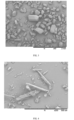
- The crystal habit of the hydrate of dimethylaminomicheliolide fumarate is studied in the present disclosure, and a scanning electron micrograph thereof is shown in
FIG. 3 . - The crystal has a regular block crystal habit, and the surface of the particle is smooth without agglomeration, meanwhile, the crystal has a large average particle size that can reach 300 µm, a bulk density of 0.65 g/mL, and an angle of repose of 32°. The product features high bulk density and good fluidity. In comparison, the crystalline form A prepared using the natural cooling recrystallization method disclosed in patentCN103724307B has a primary particle size of 35.8 µm, a bulk density of mere 0.270 g/mL and an angle of repose of 62°, and a scanning electron micrograph thereof is shown inFIG. 4 . The dimethylaminomicheliolide fumarate product in the crystalline form D provided in the present disclosure has a significantly improved particle size, solving the problems of the low bulk density and poor fluidity of the product in the crystalline form A. - The stability of the hydrate of dimethylaminomicheliolide fumarate is investigated in the present disclosure. The anhydrous crystal compound product is uniformly distributed in an open Petri dish. The temperature is controlled at 45 °C, the humidity is 75%, and the sample thickness is less than 5 mm. The Petri dish is hermetically placed in a drier for 30 days. Then the samples placed for 7, 14 and 30 days were examined by XRD and compared with the results on
day 0. The specific pattern is shown inFIG. 5 . The results show no significant change in the XRD pattern. Meanwhile, the samples atdays day 0, a change of mere 0.015% is observed in the purity of the sample atday 7, a change of mere 0.027% is observed in the purity of the sample atday 14, and a change of mere 0.046% is observed in the purity of the sample atday 30, suggesting no significant change in the purity of the sample. By combining the XRD patterns and the results of the purity analysis, the hydrate of dimethylaminomicheliolide fumarate is shown to have good stability. - The hydrate of dimethylaminomicheliolide fumarate provided in the present disclosure can be used to prepare a solventless compound of dimethylaminomicheliolide fumarate in a crystalline form B. The preparation method for the crystalline form B comprises: heating the hydrate of dimethylaminomicheliolide fumarate at a constant temperature of 80 °C-120 °C for 10 min-30 min to obtain the solventless compound of dimethylaminomicheliolide fumarate in a crystalline form B, whose X-ray powder diffraction pattern is shown in
FIG. 6 , showing characteristic peaks at 2θ angles of 8.1±0.2°, 10.7±0.2°, 11.5±0.2°, 11.9±0.2°, 13.0±0.2°, 13.3±0.2°, 14.7±0.2°, 15.9±0.2°, 16.1±0.2°, 16.7±0.2°, 17.1±0.2°, 19.0±0.2°, 19.9±0.2°, 20.3±0.2°, 21.2±0.2°, 21.5±0.2°, 22.1±0.2°, 23.0±0.2°, 23.5±0.2°, 24.4±0.2°, 26.0±0.2°, 26.6±0.2°, 26.9±0.2°, 27.4±0.2°, 27.9±0.2°, 28.6±0.2°, 29.4±0.2°, 30.2±0.2° and 31.0±0.2°. The scanning electron micrograph is similar to that inFIG. 5 , indicating that the crystal habit is consistent with the hydrate and the particle size is large. - The present disclosure also provides a pharmaceutical composition comprising the hydrate of dimethylaminomicheliolide fumarate according to the present invention, which comprises a pharmaceutically acceptable auxiliary material and may also comprise one, two or more other pharmacologically active ingredients other than the hydrate of dimethylaminomicheliolide fumarate.
- The pharmaceutically acceptable auxiliary material comprises other non-pharmacologically active ingredients other than active ingredients such as dimethylaminomicheliolide fumarate in a crystalline form, e.g., non-pharmacologically active ingredients that may be used for the pharmaceutical composition of the present disclosure, including carriers or excipients such as fillers, glidants, lubricants, binders, stabilizers and/or other auxiliary materials.
- The fillers comprise at least one of maize starch, glucose, mannitol, sorbitol, silica, microcrystalline cellulose, sodium carboxymethyl starch, composite starch and pregelatinized starch.
- The flow aidscomprise at least one of silica, hydrated silica, light anhydrous silicic acid, dry aluminum hydroxide gel, aluminum silicate and magnesium silicate.
- The lubricantscomprise at least one of wheat starch, rice starch, maize starch, stearic acid, calcium stearate, magnesium stearate, hydrated silica, light anhydrous silicic acid, synthetic aluminum silicate, dry aluminum hydroxide gel, talc, magnesium aluminometasilicate, dicalcium phosphate, anhydrous dicalcium phosphate, sucrose fatty acid esters, paraffins, hydrogenated vegetable oil and polyethylene glycol.
- The pharmaceutical composition according to the present disclosure is used for preparing a pharmaceutical preparation, wherein the pharmaceutical preparation includes the pharmaceutical composition in a tablet, capsule or granule dosage form. The pharmaceutical preparation is more preferably a capsule.
- The present disclosure also provides the hydrate of dimethylaminomicheliolide fumarate according to the present invention or the pharmaceutical composition according to the present invention for use in the treatment or prevention of a disease or condition, wherein the disease or condition is preferably cancer selected from leukemia, breast cancer, prostate cancer, nasopharyngeal cancer, large intestine cancer, lung cancer, liver cancer, esophageal cancer, gastric cancer, intestinal cancer, renal cancer, oral cancer, Hodgkin's lymphoma, pancreatic cancer, colorectal cancer, cervical cancer, non-Hodgkin's lymphoma, glioma, melanoma, bladder cancer, ovarian cancer, thyroid cancer and Kaposi's sarcoma.
- The hydrate of the present disclosure has good fluidity and is more suitable for being prepared as a medicament at a later stage. It is well known that the fluidity of an active ingredient per se is generally hard to meet the filling conditions of capsules or microcapsules, and auxiliary materials such as pregelatinized starch, silica and magnesium stearate are required to meet the requirements for fluidity by the filling conditions so as to achieve the desired quality of dosage forms and production efficiency. Taking the specification of 100 mg capsules as an example, if other forms such as crystalline form A are used as active ingredients, the weight of capsule contents reaches about 310 mg after auxiliary materials are added, and thus the largest 0# capsule shell must be used, and larger specification such as capsules containing 200 mg of active ingredients cannot be prepared. For this reason, patients would have to achieve high dose administration by increasing the number of capsules taken or the frequency of administrations, which would significantly reduce patient compliance. However, the inventors have found that an angle of repose of 32° can be achieved due to the excellent fluidity of the hydrate of dimethylaminomicheliolide fumarate in the crystalline form D even without adding auxiliary materials. For this reason, the required fluidity for the filling conditions of capsules or microcapsules can be achieved with significantly reduced amounts of auxiliary materials and even without adding any auxiliary material. Moreover, the reduction in the amounts of auxiliary materials makes it possible to produce capsules of high-dose specifications, significantly improving patient compliance.
- Furthermore, due to the fact that the hydrate of dimethylaminomicheliolide fumarate in the crystalline form D can significantly or even completely reduce the addition of auxiliary materials, and that a large amount of auxiliary materials are required for the crystalline form A to achieve the same fluidity as the crystalline form D, resulting in poor stability, the hydrate in the crystalline form D improves the stability of the preparation.
- In addition, the preparation method for the hydrate of dimethylaminomicheliolide fumarate in the crystalline form D is simple and features high product yield and good reproducibility, and the resulting product has high crystallinity, smooth and clean particle surfaces without agglomeration, no static electricity between particles and high bulk density, favoring large-scale production.
-
-
FIG. 1 shows a pattern of thermogravimetric analysis/differential scanning calorimetry of the hydrate of dimethylaminomicheliolide fumarate of the present disclosure. -
FIG. 2 shows a pattern of X-ray diffraction of the hydrate of dimethylaminomicheliolide fumarate of the present disclosure. -
FIG. 3 shows a scanning electron micrograph of the hydrate of dimethylaminomicheliolide fumarate of the present disclosure (at a magnification of 40). -
FIG. 4 shows a scanning electron micrograph of a product in the crystalline form A prepared according to the method disclosed in patentCN103724307B (at a magnification of 200). -
FIG. 5 shows comparisons of stability test patterns of the hydrate of dimethylaminomicheliolide fumarate of the present disclosure, wherein from bottom to top are sequentially placed the XRD patterns of samples atdays -
FIG. 6 shows an X-ray diffraction pattern of the solventless compound of dimethylaminomicheliolide fumarate in the crystalline form B of the present disclosure. - The above description of the present disclosure will be further explained in detail through specific embodiments in the form of examples.
- Under the action of stirring, 0.293 g of dimethylaminomicheliolide and 0.116 g of fumaric acid were added to a mixed solvent system of a solvent S1 and a solvent S2 at a constant temperature of 30 °C, with the mass of the solvent S1 being the same as that of the solvent S2, wherein the solvent S1 consisted of 1.598 g of acetone solvent and 0.16 g of water, and the solvent S2 consisted of 0.879 g of ethyl acetate and 0.879 g of diethyl ether. After 5 h of reaction, the reaction mixture was filtered, and the residue was dried at 25 °C under normal pressure for 6 h to obtain a product of dimethylaminomicheliolide fumarate in the crystalline form D. The thermogravimetric analysis/differential scanning calorimetry of the product is consistent with
FIG. 1 . The thermogravimetric analysis shows a weight loss of 4.22% before decomposition, and the differential scanning calorimetry analysis shows a dehydration endothermic peak at 75 °C and a characteristic melting peak at 148 °C. The X-ray powder diffraction pattern of the product is consistent withFIG. 2 , showing characteristic peaks at diffraction angles 2θ of 7.8°, 11.1°, 11.4°, 12.6°, 12.9°, 14.4°, 15.3°, 17.0°, 18.7°, 19.7°, 20.6°, 21.0°, 22.5°, 23.7°, 24.3°, 25.5° and 26.2°, wherein the peak at 7.8° is an initial peak, and the characteristic peak at 20.6° has a relative intensity of 100%. The X-ray powder diffraction pattern of the product also shows characteristic peaks at 2θ angles of 10.5±0.2°, 11.7±0.2°, 12.0±0.2°, 15.6±0.2°, 15.9±0.2°, 16.2±0.2°, 21.3±0.2°, 22.1±0.2°, 23.0±0.2°, 26.4±0.2°, 27.2±0.2°, 28.2±0.2°, 28.6±0.2°, 29.3±0.2°, 30.4±0.2° and 31.1±0.2°. The SEM image of the crystal morphology is consistent withFIG. 4 , indicating bulk crystals with a large average particle size that may reach 300 µm, a tested bulk density of 0.646 g/mL and an angle of repose of 32.5°. - Under the action of stirring, 1.758 g of dimethylaminomicheliolide and 0.58 g of fumaric acid were added to a mixed solvent system of a solvent S1 and a solvent S2 at a constant temperature of 50 °C, with the mass of the solvent S2 being 2 times that of the solvent S1, wherein the solvent S1 consisted of 12.306 g of tetrahydrofuran solvent and 1.758 g of water, and the solvent S2 consisted of 21.096 g of isopropyl acetate and 7.032 g of methyl tert-butyl ether. After 8 h of reaction, the reaction mixture was filtered, and the residue was dried at 30 °C under normal pressure for 10 h to obtain a product of dimethylaminomicheliolide fumarate in the crystalline form D. The thermogravimetric analysis/differential scanning calorimetry of the product is consistent with
FIG. 1 . The thermogravimetric analysis shows a weight loss of 4.20% before decomposition, and the differential scanning calorimetry analysis shows a dehydration endothermic peak at 78 °C and a characteristic melting peak at 150 °C. The X-ray powder diffraction pattern of the product is consistent withFIG. 2 , showing characteristic peaks at diffraction angles 2θ of 8.0°, 11.2°, 11.5°, 12.7°, 12.9°, 14.5°, 15.4°, 17.1°, 18.8°, 19.8°, 20.6°, 21.1°, 22.5°, 23.7°, 24.5°, 25.6° and 26.3°, wherein the peak at 7.8° is an initial peak, and the characteristic peak at 20.6° has a relative intensity of 100%. The X-ray powder diffraction pattern of the product also shows characteristic peaks at 2θ angles of 10.6°, 11.8°, 12.2°, 15.1°, 15.7°, 16.0°, 21.4°, 22.0°, 22.3°, 23.1°, 27.3°, 28.2°, 28.7°, 29.4°, 30.5°, 30.6° and 31.3°. The SEM image of the crystal morphology is consistent withFIG. 4 , indicating bulk crystals with a large average particle size that may reach 300 µm, a tested bulk density of 0.655 g/mL and an angle of repose of 32°. - Under the action of stirring, 4.688 g of dimethylaminomicheliolide and 1.16 g of fumaric acid were added to a mixed solvent system of a solvent S1 and a solvent S2 at a constant temperature of 70 °C, with the mass of the solvent S2 being 3 times that of the solvent S1, wherein the solvent S1 consisted of 39 g of 1,4-dioxane solvent and 7.88 g of water, and the solvent S2 consisted of 93.76 g of methyl acetate and 46.88 g of methyl ethyl ether. After 10 h of reaction, the reaction mixture was filtered, and the residue was dried at 45 °C under normal pressure for 8 h to obtain a product of dimethylaminomicheliolide fumarate in the crystalline form D. The thermogravimetric analysis/differential scanning calorimetry of the product is consistent with
FIG. 1 . The thermogravimetric analysis shows a weight loss of 3.97% before decomposition, and the differential scanning calorimetry analysis shows a dehydration endothermic peak at 75 °C and a characteristic melting peak at 145 °C. The X-ray powder diffraction pattern of the product is consistent withFIG. 2 , showing characteristic peaks at diffraction angles 2θ of 7.8°, 11.0°, 11.4°, 12.5°, 12.8°, 14.4°, 15.3°, 17.0°, 18.7°, 19.7°, 20.6°, 21.0°, 22.4°, 23.7°, 24.3°, 25.4° and 26.2°, wherein the peak at 7.8° is an initial peak, and the characteristic peak at 20.6° has a relative intensity of 100%. The X-ray powder diffraction pattern of the product also shows characteristic peaks at 2θ angles of 10.5°, 11.7°, 12.0°, 15.6°, 15.9°, 16.2°, 21.3°, 22.2°, 22.9°, 26.4°, 27.3°, 28.2°, 28.6°, 29.3°, 30.4° and 31.1°. The SEM image of the crystal morphology is consistent withFIG. 4 , indicating bulk crystals with a large average particle size that may reach 300 µm, a tested bulk density of 0.65 g/mL and an angle of repose of 32°. - Under the action of stirring, 4.102 g of dimethylaminomicheliolide and 1.16 g of fumaric acid were added to a mixed solvent system of a solvent S1 and a solvent S2 at a constant temperature of 60 °C, with the mass of the solvent S2 being 3 times that of the solvent S1, wherein the solvent S1 consisted of 35.8925 g of acetonitrile solvent and 5.1275 g of water, and the solvent S2 consisted of 87.9 g of hexyl acetate and 35.16 g of ethylene glycol dimethyl ether. After 10 h of reaction, the reaction mixture was filtered, and the residue was dried at 45 °C under normal pressure for 9 h to obtain a product of dimethylaminomicheliolide fumarate in the crystalline form D. The thermogravimetric analysis/differential scanning calorimetry of the product is consistent with
FIG. 1 . The thermogravimetric analysis shows a weight loss of 4.10% before decomposition, and the differential scanning calorimetry analysis shows a dehydration endothermic peak at 80 °C and a characteristic melting peak at 150 °C. The X-ray powder diffraction pattern of the product is consistent withFIG. 2 , showing characteristic peaks at diffraction angles 2θ of 7.8°, 11.1°, 11.4°, 12.6°, 12.9°, 14.4°, 15.4°, 17.0°, 18.8°, 19.8°, 20.6°, 21.0°, 22.5°, 23.7°, 24.4°, 25.5° and 26.2°, wherein the peak at 7.8° is an initial peak, and the characteristic peak at 20.6° has a relative intensity of 100%. The X-ray powder diffraction pattern of the product also shows characteristic peaks at 2θ angles of 10.6°, 11.8°, 12.1°, 15.9°, 16.3°, 21.4°, 22.2°, 23.0°, 26.5°, 27.3°, 28.7°, 29.3°, 30.4° and 31.1°. The SEM image of the crystal morphology is consistent withFIG. 4 , indicating bulk crystals with a large average particle size that may reach 300 µm, a tested bulk density of 0.659 g/mL and an angle of repose of 32.2°. - Under the action of stirring, 0.293 g of dimethylaminomicheliolide and 0.116 g of fumaric acid were added to a mixed solvent system of a solvent S1 and a solvent S2 at a constant temperature of 30 °C, with the mass of the solvent S1 being the same as that of the solvent S2, wherein the solvent S1 consisted of 1.598 g of acetonitrile solvent and 0.16 g of water, and the solvent S2 consisted of 0.879 g of isopropyl acetate and 0.879 g of ethylene glycol monomethyl ether. After 5 h of reaction, the reaction mixture was filtered, and the residue was dried at 25 °C under normal pressure for 6 h to obtain a product of dimethylaminomicheliolide fumarate in the crystalline form D. The thermogravimetric analysis/differential scanning calorimetry of the product is consistent with
FIG. 1 . The thermogravimetric analysis shows a weight loss of 4.22% before decomposition, and the differential scanning calorimetry analysis shows a dehydration endothermic peak at 75 °C and a characteristic melting peak at 148 °C. The X-ray powder diffraction pattern of the product is consistent withFIG. 2 , showing characteristic peaks at diffraction angles 2θ of 7.8°, 11.1°, 11.4°, 12.6°, 12.9°, 14.4°, 15.3°, 17.0°, 18.7°, 19.7°, 20.6°, 21.0°, 22.5°, 23.7°, 24.3°, 25.5° and 26.2°, wherein the peak at 7.8° is an initial peak, and the characteristic peak at 20.6° has a relative intensity of 100%. The X-ray powder diffraction pattern of the product also shows characteristic peaks at 2θ angles of 10.5±0.2°, 11.7±0.2°, 12.0±0.2°, 15.6±0.2°, 15.9±0.2°, 16.2±0.2°, 21.3±0.2°, 22.1±0.2°, 23.0±0.2°, 26.4±0.2°, 27.2±0.2°, 28.2±0.2°, 28.6±0.2°, 29.3±0.2°, 30.4±0.2° and 31.1±0.2°. The SEM image of the crystal morphology is consistent withFIG. 4 , indicating bulk crystals with a large average particle size that may reach 300 µm, a tested bulk density of 0.645 g/mL and an angle of repose of 32°. - Under the action of stirring, 4.688 g of dimethylaminomicheliolide and 1.16 g of fumaric acid were added to a mixed solvent system of a solvent S1 and a solvent S2 at a constant temperature of 70 °C, with the mass of the solvent S2 being 3 times that of the solvent S1, wherein the solvent S1 consisted of 39 g of methyl isobutyl ketone solvent and 7.88 g of water, and the solvent S2 consisted of 46.88 g of methyl acetate, 46.88 g of isopropyl acetate, 23.44 g of tetrahydrofuran and 23.44 g of dibutyl ether. After 10 h of reaction, the reaction mixture was filtered, and the residue was dried at 45 °C under normal pressure for 8 h to obtain a product of dimethylaminomicheliolide fumarate in the crystalline form D. The thermogravimetric analysis/differential scanning calorimetry of the product is consistent with
FIG. 1 . The thermogravimetric analysis shows a weight loss of 3.97% before decomposition, and the differential scanning calorimetry analysis shows a dehydration endothermic peak at 75 °C and a characteristic melting peak at 145 °C. The X-ray powder diffraction pattern of the product is consistent withFIG. 2 , showing characteristic peaks at diffraction angles 2θ of 7.8°, 11.0°, 11.4°, 12.5°, 12.8°, 14.4°, 15.3°, 17.0°, 18.7°, 19.7°, 20.6°, 21.0°, 22.4°, 23.7°, 24.3°, 25.4° and 26.2°, wherein the peak at 7.8° is an initial peak, and the characteristic peak at 20.6° has a relative intensity of 100%. The X-ray powder diffraction pattern of the product also shows characteristic peaks at 2θ angles of 10.5°, 11.7°, 12.0°, 15.6°, 15.9°, 16.2°, 21.3°, 22.2°, 22.9°, 26.4°, 27.3°, 28.2°, 28.6°, 29.3°, 30.4° and 31.1°. The SEM image of the crystal morphology is consistent withFIG. 4 , indicating bulk crystals with a large average particle size that may reach 300 µm, a tested bulk density of 0.65 g/mL and an angle of repose of 32.3°. - Under the action of stirring, 1.758 g of dimethylaminomicheliolide and 0.58 g of fumaric acid were added to a mixed solvent system of a solvent S1 and a solvent S2 at a constant temperature of 50 °C, with the mass of the solvent S2 being 2 times that of the solvent S1, wherein the solvent S1 consisted of 12.306 g of methyl isobutyl ketone solvent and 1.758 g of water, and the solvent S2 consisted of 21.096 g of methyl acetate and 7.032 g of 2-methyl tetrahydrofuran. After 9 h of reaction, the reaction mixture was filtered, and the residue was dried at 30 °C under normal pressure for 10 h to obtain a product of dimethylaminomicheliolide fumarate in the crystalline form D. The thermogravimetric analysis/differential scanning calorimetry of the product is consistent with
FIG. 1 . The thermogravimetric analysis shows a weight loss of 4.20% before decomposition, and the differential scanning calorimetry analysis shows a dehydration endothermic peak at 78 °C and a characteristic melting peak at 150 °C. The X-ray powder diffraction pattern of the product is consistent withFIG. 2 , showing characteristic peaks at diffraction angles 2θ of 8.0°, 11.2°, 11.5°, 12.7°, 12.9°, 14.5°, 15.4°, 17.1°, 18.8°, 19.8°, 20.6°, 21.1°, 22.5°, 23.7°, 24.5°, 25.6° and 26.3°, wherein the peak at 7.8° is an initial peak, and the characteristic peak at 20.6° has a relative intensity of 100%. The X-ray powder diffraction pattern of the product also shows characteristic peaks at 2θ angles of 10.6°, 11.8°, 12.2°, 15.1°, 15.7°, 16.0°, 21.4°, 22.0°, 22.3°, 23.1°, 27.3°, 28.2°, 28.7°, 29.4°, 30.5°, 30.6° and 31.3°. The SEM image of the crystal morphology is consistent withFIG. 4 , indicating bulk crystals with a large average particle size that may reach 300 µm, a tested bulk density of 0.65 g/mL and an angle of repose of 32°. - Under the action of stirring, 4.102 g of dimethylaminomicheliolide and 1.16 g of fumaric acid were added to a mixed solvent system of a solvent S1 and a solvent S2 at a constant temperature of 60 °C, with the mass of the solvent S2 being 3 times that of the solvent S1, wherein the solvent S1 consisted of 35.8925 g of tetrahydrofuran solvent and 5.1275 g of water, and the solvent S2 consisted of 87.9 g of methyl acetate and 35.16 g of 1,4-dioxane. After 10 h of reaction, the reaction mixture was filtered, and the residue was dried at 45 °C under normal pressure for 9 h to obtain a product of dimethylaminomicheliolide fumarate in the crystalline form D. The thermogravimetric analysis/differential scanning calorimetry of the product is consistent with
FIG. 1 . The thermogravimetric analysis shows a weight loss of 4.10% before decomposition, and the differential scanning calorimetry analysis shows a dehydration endothermic peak at 80 °C and a characteristic melting peak at 150 °C. The X-ray powder diffraction pattern of the product is consistent withFIG. 2 , showing characteristic peaks at diffraction angles 2θ of 7.8°, 11.1°, 11.4°, 12.6°, 12.9°, 14.4°, 15.3°, 17.0°, 18.7°, 19.7°, 20.6°, 21.0°, 22.5°, 23.7°, 24.3°, 25.5° and 26.2°, wherein the peak at 7.8° is an initial peak, and the characteristic peak at 20.6° has a relative intensity of 100%. The X-ray powder diffraction pattern of the product also shows characteristic peaks at 2θ angles of 10.5±0.2°, 11.7±0.2°, 12.0±0.2°, 15.6±0.2°, 15.9±0.2°, 16.2±0.2°, 21.3±0.2°, 22.1±0.2°, 23.0±0.2°, 26.4±0.2°, 27.2±0.2°, 28.2±0.2°, 28.6±0.2°, 29.3±0.2°, 30.4±0.2° and 31.1±0.2°. The SEM image of the crystal morphology is consistent withFIG. 4 , indicating bulk crystals with a large average particle size that may reach 300 µm, a tested bulk density of 0.654 g/mL and an angle of repose of 32.1°. - Under the action of stirring, 0.293 g of dimethylaminomicheliolide and 0.116 g of fumaric acid were added to a mixed solvent system of a solvent S1 and a solvent S2 at a constant temperature of 30 °C, with the mass of the solvent S1 being the same as that of the solvent S2, wherein the solvent S1 consisted of 1.598 g of acetone solvent and 0.16 g of water, and the solvent S2 consisted of 0.879 g of isopropyl acetate and 0.879 g of dipropyl ether. After 7 h of reaction, the reaction mixture was filtered, and the residue was dried at 25 °C under normal pressure for 6 h to obtain a product of dimethylaminomicheliolide fumarate in the crystalline form D. The thermogravimetric analysis/differential scanning calorimetry of the product is consistent with
FIG. 1 . The thermogravimetric analysis shows a weight loss of 4.22% before decomposition, and the differential scanning calorimetry analysis shows a dehydration endothermic peak at 75 °C and a characteristic melting peak at 148 °C. The X-ray powder diffraction pattern of the product is consistent withFIG. 2 , showing characteristic peaks at diffraction angles 2θ of 7.8°, 11.0°, 11.4°, 12.5°, 12.8°, 14.4°, 15.3°, 17.0°, 18.7°, 19.7°, 20.6°, 21.0°, 22.4°, 23.7°, 24.3°, 25.4° and 26.2°, wherein the peak at 7.8° is an initial peak, and the characteristic peak at 20.6° has a relative intensity of 100%. The X-ray powder diffraction pattern of the product also shows characteristic peaks at 2θ angles of 10.5°, 11.7°, 12.0°, 15.6°, 15.9°, 16.2°, 21.3°, 22.2°, 22.9°, 26.4°, 27.3°, 28.2°, 28.6°, 29.3°, 30.4° and 31.1°. The SEM image of the crystal morphology is consistent withFIG. 4 , indicating bulk crystals with a large average particle size that may reach 300 µm, a tested bulk density of 0.645 g/mL and an angle of repose of 32.3°. - 0.1 g of the product of Example 1 was weighed into a variable-temperature X-ray diffractometer, and heated at a constant temperature of 80 °C for 30 min. A sample was taken for XRD analysis, and the resulting pattern is consistent with
FIG. 6 , indicating a solventless compound of dimethylaminomicheliolide fumarate in the crystalline form B. The scanning electron micrograph of the solid shows a morphology consistent with that shown inFIG. 5 , indicating that the blockshaped crystal habit was retained. - 0.15 g of the product of Example 3 was weighed into a variable-temperature X-ray diffractometer, and heated at a constant temperature of 120 °C for 10 min. A sample was taken for XRD analysis, and the resulting pattern is consistent with
FIG. 6 , indicating a solventless compound of dimethylaminomicheliolide fumarate in the crystalline form B. The scanning electron micrograph of the solid shows a morphology consistent with that shown inFIG. 5 , indicating that the blockshaped crystal habit was retained. - 0.1 g of the product of Example 4 was weighed into a variable-temperature X-ray diffractometer, and heated at a constant temperature of 100 °C for 20 min. A sample was taken for XRD analysis, and the resulting pattern is consistent with
FIG. 6 , indicating a solventless compound of dimethylaminomicheliolide fumarate in the crystalline form B. The scanning electron micrograph of the solid shows a morphology consistent with that shown inFIG. 5 , indicating that the blockshaped crystal habit was retained. - The preparation formula for crystalline
form A capsule 1 is as follows:Formula mg/capsule Crystalline form A (Preparation Example 1) 100 Pregelatinized starch (Starch®1500) 200 Silica 15 Magnesium stearate 4.5 Total 319.5 - Process: (1) during passing the crystalline form A through a 100-mesh sieve, it was found that the sieving was difficult to perform, and much residue remained; after the sieving, much static electricity was produced; (2) pregelatinized starch and silica were passed through an 80-mesh sieve and then mixed with the crystalline form A in a zipper bag for 5 min; (3) magnesium stearate was passed through a 80-mesh sieve and then mixed with the powder mixture above in a zipper bag for 1 min; (4) 0# gelatin capsules were filled with the resulting mixture manually.
- The detection results show that the capsules of this example have an angle of repose of 32.91°, which is close to the fluidity data of the hydrate in the crystalline form D measured in Example 1.
- The formula of Example 13 was adopted again and the process below was used: (1) when the crystalline form A, together with pregelatinized starch, was passed through a 80-mesh sieve, the sieving results were somewhat improved but still not ideal, and much static electricity was produced; (2) silica was passed through an 80-mesh sieve and then mixed with the powder mixture above in a zipper bag for 3 min; (3) magnesium stearate was passed through a 80-mesh sieve and then mixed with the powder mixture above in a zipper bag for 1 min; (4) 0# gelatin capsules were filled with the resulting mixture manually.
- The detection results show that the capsules of this example have an angle of repose of 32.88°, which is close to the fluidity of the hydrate in the crystalline form D of Example 5. Influencing factor experiments were further conducted.
- The preparation formula for capsules of the hydrate in the crystalline form D is as follows, no other auxiliary materials involved:
Formula mg/capsule Crystalline form D (Example 1) 100 - Process: (1) a formula amount of the hydrate in the crystalline form D prepared in Example 1 was taken and passed through an 80-mesh sieve; (2) 3# gelatin capsules were filled, the starting materials were gently leveled, and capsule lids were put on; influencing factor experiments were conducted.
- 100 capsules of the products of Examples 14 and 15 were placed in an open Petri dish in an incubator at 60 °C, and samples were taken at
days - 100 capsules of the products of Examples 14 and 15 were placed in an open Petri dish in a closed container with a relative humidity of 90±5% (saturated solution of potassium nitrate), and samples were taken at
days - 100 capsules of the products of Examples 14 and 15 were placed in an open Petri dish and irradiated using a 4500±500 LX fluorescent lamp, and samples were taken at
days - The results are summarized below:
The results of the influencing factor experiments of the crystalline form A capsules of Example 14Time/conditions Appearance (Contents) Related substances MCL% Other impurities% Day 0 Off-white fine powder 0.00991 0.00846 Day 5Intense light Off-white fine powder 0.01179 0.00873 High humidity Off-white fine powder 0.01617 0.01136 60°C Off-white fine powder 0.01725 0.00934 Day 10Intense light Off-white fine powder 0.04447 0.00977 High humidity Off-white fine powder 0.04271 0.08056 60°C Off-white fine powder 0.13410 0.01245 - The results of the influencing factor experiments of the capsules of the hydrate in the crystalline form D of Example 15
Time/conditions Appearance (Contents) Related substances Content% MCL% Other impurities% Day 0 Off-white solid 0.00300 0.01989 Acceptable Day 5 High humidity Off-white solid 0.00250 0.01814 Acceptable 60°C Off-white solid 0.00912 0.01977 Acceptable Intense light Off-white solid 0.00253 0.02020 Acceptable Day 10 High humidity Off-white solid 0.00253 0.01918 Acceptable 60°C Off-white solid 0.01154 0.02050 Acceptable Intense light Off-white solid 0.00856 0.02046 Acceptable - The results above show that under similar fluidity, in the influencing factor experiments of the capsules of the hydrate in the crystalline form D, the MCL (micheliolide) content did not significantly change within 5 days, while in the experiments of the crystalline form A capsules, the MCL content significantly increased after 5 days or more. Therefore, due to the excellent fluidity, the hydrate in the crystalline form D can be prepared into capsules without adding auxiliary materials and clinically applied. For the crystalline form A, however, it has significantly poorer stability than the crystalline form D even if the fluidity of its capsules has been improved by adding auxiliary materials and optimizing the process. Therefore, the capsules of the hydrate in the crystalline form D are superior to the crystalline form A capsules in terms of whether preparation process, stability or compliance.
Claims (10)
- A hydrate of dimethylaminomicheliolide fumarate, characterized in that, the hydrate has characteristic peaks at 2θ angles of 7.8±0.2°, 11.1±0.2°, 11.4±0.2°, 12.6±0.2°, 12.9±0.2°, 14.4±0.2°, 15.3±0.2°, 17.0±0.2°, 18.7±0.2°, 19.7±0.2°, 20.6±0.2°, 21.0±0.2°, 22.5±0.2°, 23.7±0.2°, 24.3±0.2°, 25.5±0.2° and 26.2±0.2° in an X-ray powder diffraction pattern using Cu-Kα radiation, wherein the peak at 7.8±0.2° is an initial peak; the characteristic peak at 20.6±0.2° has a relative intensity of 100%; the crystalline form D is in an orthorhombic crystal system and has a space group of P212121, a cell parameter of a = 8.8346(18) Å, b = 14.796(3) Å, c= 16.385(3) Å, α = 90°, β = 90°, and γ = 90°; and a cell volume of 2141.8(8) Å3.
- The hydrate of dimethylaminomicheliolide fumarate according to claim 1, characterized in that, the hydrate is in a crystalline form D, the molar ratio of dimethylaminomicheliolide fumarate to water is 1:1, and the hydrate has a molecular formula of C17H27NO3 · C4H4O4 · H2O; a thermogravimetric analysis shows a weight loss of 3.97%-4.22% before decomposition; a differential scanning calorimetry pattern shows a dehydration endothermic peak at 75±5 °C and a characteristic melting peak at 148±5 °C.
- The hydrate of dimethylaminomicheliolide fumarate according to claim 1, characterized in that, the hydrate also has characteristic peaks at 2θ angles of 10.5±0.2°, 11.7±0.2°, 12.0±0.2°, 15.6±0.2°, 15.9±0.2°, 16.2±0.2°, 21.3±0.2°, 22.1±0.2°, 23.0±0.2°, 26.4±0.2°, 27.2±0.2°, 28.2±0.2°, 28.6±0.2°, 29.3±0.2°, 30.4±0.2° and 31.1±0.2° in an X-ray powder diffraction pattern using Cu-Kα radiation.
- A preparation method for the hydrate of dimethylaminomicheliolide fumarate according to any one of claims 1-3, characterized in that, the preparation is implemented by reactive crystallization: under the action of stirring, adding dimethylaminomicheliolide and fumaric acid to a mixed solvent system of a solvent S1 and a solvent S2 at a constant temperature of 30 °C-70 °C, with the mass ratio of the solvent S2 to the solvent S1 being (0-3):1 and the molar ratio of dimethylaminomicheliolide to fumaric acid being (1-1.6):1; after 5-10 h of reaction, filtering the reaction mixture and drying the residue at 25-45 °C under normal pressure for 6-10 h to obtain dimethylaminomicheliolide fumarate in a crystalline form D; the solvent S1 is a mixed solvent of water and any one of acetone, tetrahydrofuran, 1,4-dioxane, acetonitrile and methyl isobutyl ketone;the solvent S2 is a mixed solvent of an ester and an ether;the ester solvent may be selected from any one or two of methyl acetate, ethyl acetate, hexyl acetate and isopropyl acetate;the ether solvent may be selected from any one or two of diethyl ether, methyl ethyl ether, methyl tert-butyl ether, dipropyl ether, dibutyl ether, ethylene glycol dimethyl ether, ethylene glycol monomethyl ether, 1,4-dioxane, tetrahydrofuran and 2-methyl tetrahydrofuran.
- The preparation method for the hydrate of dimethylaminomicheliolide fumarate according to claim 4, characterized in that, the mass ratio of any one of acetone, tetrahydrofuran, 1,4-dioxane, acetonitrile and methyl isobutyl ketone to water in the solvent S1 is (5-10):1;the mass ratio of the ester solvent to the ether solvent in the solvent S2 is (1-3):1;the mass ratio of the solid starting material dimethylaminomicheliolide to S1 is 1:(6-10).
- Use of the hydrate of dimethylaminomicheliolide fumarate according to claim 1 for preparing a solventless compound of dimethylaminomicheliolide fumarate in a crystalline form B, wherein the preparation method for the solventless compound of dimethylaminomicheliolide fumarate in the crystalline form B comprises: heating the hydrate of dimethylaminomicheliolide fumarate at a constant temperature of 80 °C-120 °C for 10 min-30 min to obtain the solventless compound of dimethylaminomicheliolide fumarate in the crystalline form B.
- A pharmaceutical composition comprising the hydrate of dimethylaminomicheliolide fumarate according to claim 1, which comprises a pharmaceutically acceptable auxiliary material and may also comprise one, two or more other pharmacologically active ingredients other than the hydrate of dimethylaminomicheliolide fumarate.
- The pharmaceutical composition according to claim 7, wherein the pharmaceutically acceptable auxiliary material comprises other non-pharmacologically active ingredients other than active ingredients, the non-pharmacologically active ingredients include carriers or excipients, the carriers or excipients include fillers, glidants, lubricants, binders, stabilizers and/or other auxiliary materials;the fillers comprise at least one of maize starch, glucose, mannitol, sorbitol, silica, microcrystalline cellulose, sodium carboxymethyl starch, composite starch and pregelatinized starch;the glidants comprise at least one of silica, hydrated silica, light anhydrous silicic acid, dry aluminum hydroxide gel, aluminum silicate and magnesium silicate;the lubricants comprise at least one of wheat starch, rice starch, maize starch, stearic acid, calcium stearate, magnesium stearate, hydrated silica, light anhydrous silicic acid, synthetic aluminum silicate, dry aluminum hydroxide gel, talc, magnesium aluminometasilicate, dicalcium phosphate, anhydrous dicalcium phosphate, sucrose fatty acid esters, paraffins, hydrogenated vegetable oil and polyethylene glycol.
- A pharmaceutical preparation prepared from the pharmaceutical composition according to claim 7, characterized in that, the pharmaceutical preparation comprises the pharmaceutical composition in a tablet, capsule or granule dosage form.
- The hydrate of dimethylaminomicheliolide fumarate according to claim 1 or the pharmaceutical composition according to claim 7 for use in the treatment or prevention of a disease or condition, wherein the disease or condition is cancer selected from leukemia, breast cancer, prostate cancer, nasopharyngeal cancer, large intestine cancer, lung cancer, liver cancer, esophageal cancer, gastric cancer, intestinal cancer, renal cancer, oral cancer, Hodgkin's lymphoma, pancreatic cancer, colorectal cancer, cervical cancer, non-Hodgkin's lymphoma, glioma, melanoma, bladder cancer, ovarian cancer, thyroid cancer and Kaposi's sarcoma.
Applications Claiming Priority (1)
| Application Number | Priority Date | Filing Date | Title |
|---|---|---|---|
| PCT/CN2020/081349 WO2021189343A1 (en) | 2020-03-26 | 2020-03-26 | Hydrate of dimethylaminomicheliolide fumarate and preparation method therefor and use thereof |
Publications (3)
| Publication Number | Publication Date |
|---|---|
| EP4071143A1 EP4071143A1 (en) | 2022-10-12 |
| EP4071143A4 EP4071143A4 (en) | 2023-01-11 |
| EP4071143B1 true EP4071143B1 (en) | 2025-04-09 |
Family
ID=77891524
Family Applications (1)
| Application Number | Title | Priority Date | Filing Date |
|---|---|---|---|
| EP20926506.5A Active EP4071143B1 (en) | 2020-03-26 | 2020-03-26 | Crystalline form of dimethylamino micheliolide fumarate monohydrate |
Country Status (12)
| Country | Link |
|---|---|
| US (1) | US12319666B2 (en) |
| EP (1) | EP4071143B1 (en) |
| JP (1) | JP7591224B2 (en) |
| KR (1) | KR102834850B1 (en) |
| AU (1) | AU2020437428B2 (en) |
| DK (1) | DK4071143T3 (en) |
| ES (1) | ES3034503T3 (en) |
| FI (1) | FI4071143T3 (en) |
| IL (1) | IL295869A (en) |
| PL (1) | PL4071143T3 (en) |
| PT (1) | PT4071143T (en) |
| WO (1) | WO2021189343A1 (en) |
Family Cites Families (9)
| Publication number | Priority date | Publication date | Assignee | Title |
|---|---|---|---|---|
| KR101421140B1 (en) | 2010-04-23 | 2014-07-18 | 난카이 유니버시티 | Sphaelactone derivatives, their pharmaceutical compositions, preparation methods and uses |
| CN103724307B (en) * | 2012-10-12 | 2015-08-05 | 天津尚德药缘科技有限公司 | The with a smile crystal formation of lactone dimethyl amine fumarate and preparation method |
| WO2015006893A1 (en) | 2013-07-15 | 2015-01-22 | 天津尚德药缘科技有限公司 | Uses of sesquiterpene lactone compound and derivative thereof in preparation of drugs |
| CN104876899A (en) | 2014-02-28 | 2015-09-02 | 天津尚德药缘科技股份有限公司 | Dimethylamino sphaelactone fumarate and use thereof |
| PL3320901T3 (en) | 2016-01-28 | 2020-07-13 | Accendatech | Dimethylaminomicheliolide for use in the treatment of pulmonary fibrosis |
| CN111303099B (en) * | 2018-12-12 | 2022-12-02 | 天津尚德药缘科技股份有限公司 | Microlactone dimethylamine fumarate crystal form F and preparation method thereof |
| CN111303097B (en) * | 2018-12-12 | 2022-09-30 | 天津尚德药缘科技股份有限公司 | Crystal form C of michelia lactone fumarate dimethylamine and preparation method thereof |
| CN111303098B (en) * | 2018-12-12 | 2022-10-04 | 天津尚德药缘科技股份有限公司 | A kind of laughing lactone dimethylamine fumarate crystal form E and preparation method thereof |
| CN111303100B (en) | 2018-12-12 | 2022-10-04 | 天津尚德药缘科技股份有限公司 | A kind of hydrate containing laugholide dimethylamine fumarate, its preparation method and use |
-
2020
- 2020-03-26 WO PCT/CN2020/081349 patent/WO2021189343A1/en not_active Ceased
- 2020-03-26 KR KR1020227028865A patent/KR102834850B1/en active Active
- 2020-03-26 US US17/905,127 patent/US12319666B2/en active Active
- 2020-03-26 JP JP2023500114A patent/JP7591224B2/en active Active
- 2020-03-26 PL PL20926506.5T patent/PL4071143T3/en unknown
- 2020-03-26 DK DK20926506.5T patent/DK4071143T3/en active
- 2020-03-26 ES ES20926506T patent/ES3034503T3/en active Active
- 2020-03-26 IL IL295869A patent/IL295869A/en unknown
- 2020-03-26 FI FIEP20926506.5T patent/FI4071143T3/en active
- 2020-03-26 PT PT209265065T patent/PT4071143T/en unknown
- 2020-03-26 EP EP20926506.5A patent/EP4071143B1/en active Active
- 2020-03-26 AU AU2020437428A patent/AU2020437428B2/en active Active
Also Published As
| Publication number | Publication date |
|---|---|
| KR102834850B1 (en) | 2025-07-15 |
| WO2021189343A1 (en) | 2021-09-30 |
| EP4071143A4 (en) | 2023-01-11 |
| KR20220130212A (en) | 2022-09-26 |
| AU2020437428B2 (en) | 2024-03-28 |
| US12319666B2 (en) | 2025-06-03 |
| DK4071143T3 (en) | 2025-07-07 |
| AU2020437428A1 (en) | 2022-09-15 |
| PT4071143T (en) | 2025-06-30 |
| PL4071143T3 (en) | 2025-08-04 |
| CA3164892A1 (en) | 2021-09-30 |
| FI4071143T3 (en) | 2025-06-26 |
| JP7591224B2 (en) | 2024-11-28 |
| ES3034503T3 (en) | 2025-08-19 |
| IL295869A (en) | 2022-10-01 |
| EP4071143A1 (en) | 2022-10-12 |
| US20230089334A1 (en) | 2023-03-23 |
| JP2023522792A (en) | 2023-05-31 |
Similar Documents
| Publication | Publication Date | Title |
|---|---|---|
| EP2773620B1 (en) | Ivabradine hydrochloride form iv | |
| CN104761484B (en) | A kind of A Pusite crystal formations II without solvate of stabilization and preparation method thereof | |
| CN111303100B (en) | A kind of hydrate containing laugholide dimethylamine fumarate, its preparation method and use | |
| RU2603138C1 (en) | Crystalline form of hidamide, method of its production and use | |
| JP7402404B2 (en) | Solid preparations containing quinazoline derivatives | |
| CN118420586B (en) | Dihydroquercetin and pyridinecarboxylic acid cocrystal, its preparation method, pharmaceutical composition, and uses. | |
| JP2011520928A (en) | Composition comprising a quinazoline derivative, method for its preparation and use | |
| JP6887980B2 (en) | Solid form of pharmaceutically active compound | |
| US12319666B2 (en) | Hydrate of dimethylaminomicheliolide fumarate and preparation method therefor and use thereof | |
| US20190016733A1 (en) | Crystalline forms of thienopyrimidine compound | |
| CA3164892C (en) | Hydrate of dimethylaminomicheliolide fumarate and preparation method therefor and use thereof | |
| RU2824144C1 (en) | Dimethylaminocheliolide fumarate hydrate and method for preparation thereof, and use thereof | |
| CN115124420A (en) | Rhein and matrine eutectic crystal hydrate, preparation method, composition and application thereof | |
| CN113214208A (en) | Hesperetin and isonicotinamide eutectic crystal, preparation method, composition and application thereof | |
| AU2009321384A1 (en) | Polymorphs | |
| CN115477647A (en) | Berberine fumarate crystal form, preparation method, composition and application thereof | |
| CN118290383A (en) | Dihydromyricetin and picolinic acid co-crystal, preparation method, pharmaceutical composition and use thereof | |
| WO2026040323A1 (en) | Ibrutinib monododecyl sulfate, and preparation method therefor and use thereof | |
| WO2022253261A1 (en) | Hydrate crystal form of lazertinib methanesulfonate, preparation method therefor and use thereof | |
| WO2020151672A1 (en) | Dapagliflozin crystal form, preparation therefor, and use thereof | |
| HK40013337A (en) | Solid preparation comprising quinazoline derivative |
Legal Events
| Date | Code | Title | Description |
|---|---|---|---|
| STAA | Information on the status of an ep patent application or granted ep patent |
Free format text: STATUS: THE INTERNATIONAL PUBLICATION HAS BEEN MADE |
|
| PUAI | Public reference made under article 153(3) epc to a published international application that has entered the european phase |
Free format text: ORIGINAL CODE: 0009012 |
|
| STAA | Information on the status of an ep patent application or granted ep patent |
Free format text: STATUS: REQUEST FOR EXAMINATION WAS MADE |
|
| 17P | Request for examination filed |
Effective date: 20220708 |
|
| AK | Designated contracting states |
Kind code of ref document: A1 Designated state(s): AL AT BE BG CH CY CZ DE DK EE ES FI FR GB GR HR HU IE IS IT LI LT LU LV MC MK MT NL NO PL PT RO RS SE SI SK SM TR |
|
| A4 | Supplementary search report drawn up and despatched |
Effective date: 20221208 |
|
| RIC1 | Information provided on ipc code assigned before grant |
Ipc: A61P 35/02 20060101ALI20221202BHEP Ipc: A61P 35/00 20060101ALI20221202BHEP Ipc: A61K 31/343 20060101ALI20221202BHEP Ipc: C07C 57/15 20060101ALI20221202BHEP Ipc: C07D 307/93 20060101AFI20221202BHEP |
|
| DAV | Request for validation of the european patent (deleted) | ||
| DAX | Request for extension of the european patent (deleted) | ||
| STAA | Information on the status of an ep patent application or granted ep patent |
Free format text: STATUS: EXAMINATION IS IN PROGRESS |
|
| 17Q | First examination report despatched |
Effective date: 20231107 |
|
| RIC1 | Information provided on ipc code assigned before grant |
Ipc: A61P 35/02 20060101ALI20231031BHEP Ipc: A61P 35/00 20060101ALI20231031BHEP Ipc: A61K 45/06 20060101ALI20231031BHEP Ipc: A61K 9/48 20060101ALI20231031BHEP Ipc: A61K 31/343 20060101ALI20231031BHEP Ipc: C07C 57/15 20060101ALI20231031BHEP Ipc: C07D 307/93 20060101AFI20231031BHEP |
|
| GRAP | Despatch of communication of intention to grant a patent |
Free format text: ORIGINAL CODE: EPIDOSNIGR1 |
|
| STAA | Information on the status of an ep patent application or granted ep patent |
Free format text: STATUS: GRANT OF PATENT IS INTENDED |
|
| INTG | Intention to grant announced |
Effective date: 20241217 |
|
| RAP3 | Party data changed (applicant data changed or rights of an application transferred) |
Owner name: NANKAI UNIVERSITY Owner name: ACCENDATECH CO., LTD. |
|
| GRAS | Grant fee paid |
Free format text: ORIGINAL CODE: EPIDOSNIGR3 |
|
| GRAA | (expected) grant |
Free format text: ORIGINAL CODE: 0009210 |
|
| STAA | Information on the status of an ep patent application or granted ep patent |
Free format text: STATUS: THE PATENT HAS BEEN GRANTED |
|
| AK | Designated contracting states |
Kind code of ref document: B1 Designated state(s): AL AT BE BG CH CY CZ DE DK EE ES FI FR GB GR HR HU IE IS IT LI LT LU LV MC MK MT NL NO PL PT RO RS SE SI SK SM TR |
|
| REG | Reference to a national code |
Ref country code: GB Ref legal event code: FG4D |
|
| REG | Reference to a national code |
Ref country code: CH Ref legal event code: EP |
|
| REG | Reference to a national code |
Ref country code: DE Ref legal event code: R096 Ref document number: 602020049351 Country of ref document: DE |
|
| REG | Reference to a national code |
Ref country code: IE Ref legal event code: FG4D |
|
| P01 | Opt-out of the competence of the unified patent court (upc) registered |
Free format text: CASE NUMBER: APP_22160/2025 Effective date: 20250509 |
|
| REG | Reference to a national code |
Ref country code: FI Ref legal event code: FGE |
|
| REG | Reference to a national code |
Ref country code: PT Ref legal event code: SC4A Ref document number: 4071143 Country of ref document: PT Date of ref document: 20250630 Kind code of ref document: T Free format text: AVAILABILITY OF NATIONAL TRANSLATION Effective date: 20250625 |
|
| REG | Reference to a national code |
Ref country code: DK Ref legal event code: T3 Effective date: 20250630 |
|
| REG | Reference to a national code |
Ref country code: SE Ref legal event code: TRGR |
|
| REG | Reference to a national code |
Ref country code: NL Ref legal event code: FP |
|
| REG | Reference to a national code |
Ref country code: ES Ref legal event code: FG2A Ref document number: 3034503 Country of ref document: ES Kind code of ref document: T3 Effective date: 20250819 |
|
| REG | Reference to a national code |
Ref country code: LT Ref legal event code: MG9D |
|
| PG25 | Lapsed in a contracting state [announced via postgrant information from national office to epo] |
Ref country code: GR Free format text: LAPSE BECAUSE OF FAILURE TO SUBMIT A TRANSLATION OF THE DESCRIPTION OR TO PAY THE FEE WITHIN THE PRESCRIBED TIME-LIMIT Effective date: 20250710 |
|
| PG25 | Lapsed in a contracting state [announced via postgrant information from national office to epo] |
Ref country code: BG Free format text: LAPSE BECAUSE OF FAILURE TO SUBMIT A TRANSLATION OF THE DESCRIPTION OR TO PAY THE FEE WITHIN THE PRESCRIBED TIME-LIMIT Effective date: 20250409 |
|
| PG25 | Lapsed in a contracting state [announced via postgrant information from national office to epo] |
Ref country code: HR Free format text: LAPSE BECAUSE OF FAILURE TO SUBMIT A TRANSLATION OF THE DESCRIPTION OR TO PAY THE FEE WITHIN THE PRESCRIBED TIME-LIMIT Effective date: 20250409 |
|
| PG25 | Lapsed in a contracting state [announced via postgrant information from national office to epo] |
Ref country code: RS Free format text: LAPSE BECAUSE OF FAILURE TO SUBMIT A TRANSLATION OF THE DESCRIPTION OR TO PAY THE FEE WITHIN THE PRESCRIBED TIME-LIMIT Effective date: 20250709 |
|
| PG25 | Lapsed in a contracting state [announced via postgrant information from national office to epo] |
Ref country code: IS Free format text: LAPSE BECAUSE OF FAILURE TO SUBMIT A TRANSLATION OF THE DESCRIPTION OR TO PAY THE FEE WITHIN THE PRESCRIBED TIME-LIMIT Effective date: 20250809 |
|
| PG25 | Lapsed in a contracting state [announced via postgrant information from national office to epo] |
Ref country code: LV Free format text: LAPSE BECAUSE OF FAILURE TO SUBMIT A TRANSLATION OF THE DESCRIPTION OR TO PAY THE FEE WITHIN THE PRESCRIBED TIME-LIMIT Effective date: 20250409 |
|
| REG | Reference to a national code |
Ref country code: DE Ref legal event code: R097 Ref document number: 602020049351 Country of ref document: DE |
|
| PG25 | Lapsed in a contracting state [announced via postgrant information from national office to epo] |
Ref country code: SM Free format text: LAPSE BECAUSE OF FAILURE TO SUBMIT A TRANSLATION OF THE DESCRIPTION OR TO PAY THE FEE WITHIN THE PRESCRIBED TIME-LIMIT Effective date: 20250409 |
|
| PG25 | Lapsed in a contracting state [announced via postgrant information from national office to epo] |
Ref country code: CZ Free format text: LAPSE BECAUSE OF FAILURE TO SUBMIT A TRANSLATION OF THE DESCRIPTION OR TO PAY THE FEE WITHIN THE PRESCRIBED TIME-LIMIT Effective date: 20250409 |
|
| PG25 | Lapsed in a contracting state [announced via postgrant information from national office to epo] |
Ref country code: EE Free format text: LAPSE BECAUSE OF FAILURE TO SUBMIT A TRANSLATION OF THE DESCRIPTION OR TO PAY THE FEE WITHIN THE PRESCRIBED TIME-LIMIT Effective date: 20250409 |
|
| PG25 | Lapsed in a contracting state [announced via postgrant information from national office to epo] |
Ref country code: SK Free format text: LAPSE BECAUSE OF FAILURE TO SUBMIT A TRANSLATION OF THE DESCRIPTION OR TO PAY THE FEE WITHIN THE PRESCRIBED TIME-LIMIT Effective date: 20250409 |
|
| PLBE | No opposition filed within time limit |
Free format text: ORIGINAL CODE: 0009261 |
|
| STAA | Information on the status of an ep patent application or granted ep patent |
Free format text: STATUS: NO OPPOSITION FILED WITHIN TIME LIMIT |
|
| REG | Reference to a national code |
Ref country code: CH Ref legal event code: L10 Free format text: ST27 STATUS EVENT CODE: U-0-0-L10-L00 (AS PROVIDED BY THE NATIONAL OFFICE) Effective date: 20260218 |
|
| 26N | No opposition filed |
Effective date: 20260112 |
|
| REG | Reference to a national code |
Ref country code: CH Ref legal event code: U11 Free format text: ST27 STATUS EVENT CODE: U-0-0-U10-U11 (AS PROVIDED BY THE NATIONAL OFFICE) Effective date: 20260401 |
|
| PGFP | Annual fee paid to national office [announced via postgrant information from national office to epo] |
Ref country code: SE Payment date: 20260323 Year of fee payment: 7 |
|
| PGFP | Annual fee paid to national office [announced via postgrant information from national office to epo] |
Ref country code: GB Payment date: 20260324 Year of fee payment: 7 |
|
| PGFP | Annual fee paid to national office [announced via postgrant information from national office to epo] |
Ref country code: DE Payment date: 20260320 Year of fee payment: 7 Ref country code: NO Payment date: 20260320 Year of fee payment: 7 Ref country code: DK Payment date: 20260323 Year of fee payment: 7 Ref country code: IE Payment date: 20260323 Year of fee payment: 7 |
|
| PGFP | Annual fee paid to national office [announced via postgrant information from national office to epo] |
Ref country code: AT Payment date: 20260319 Year of fee payment: 7 |
|
| PGFP | Annual fee paid to national office [announced via postgrant information from national office to epo] |
Ref country code: FI Payment date: 20260320 Year of fee payment: 7 Ref country code: BE Payment date: 20260323 Year of fee payment: 7 |
|
| PGFP | Annual fee paid to national office [announced via postgrant information from national office to epo] |
Ref country code: NL Payment date: 20260323 Year of fee payment: 7 |
|
| PGFP | Annual fee paid to national office [announced via postgrant information from national office to epo] |
Ref country code: FR Payment date: 20260324 Year of fee payment: 7 |
|
| PGFP | Annual fee paid to national office [announced via postgrant information from national office to epo] |
Ref country code: TR Payment date: 20260325 Year of fee payment: 7 |
|
| PGFP | Annual fee paid to national office [announced via postgrant information from national office to epo] |
Ref country code: PT Payment date: 20260313 Year of fee payment: 7 |
|
| PGFP | Annual fee paid to national office [announced via postgrant information from national office to epo] |
Ref country code: PL Payment date: 20260203 Year of fee payment: 7 |