EP4070520B1 - Procede et systeme d'identification d'un individu sans friction - Google Patents
Procede et systeme d'identification d'un individu sans friction Download PDFInfo
- Publication number
- EP4070520B1 EP4070520B1 EP20812356.2A EP20812356A EP4070520B1 EP 4070520 B1 EP4070520 B1 EP 4070520B1 EP 20812356 A EP20812356 A EP 20812356A EP 4070520 B1 EP4070520 B1 EP 4070520B1
- Authority
- EP
- European Patent Office
- Prior art keywords
- token
- biometric
- individual
- server
- access control
- Prior art date
- Legal status (The legal status is an assumption and is not a legal conclusion. Google has not performed a legal analysis and makes no representation as to the accuracy of the status listed.)
- Active
Links
Images

Classifications
-
- H—ELECTRICITY
- H04—ELECTRIC COMMUNICATION TECHNIQUE
- H04W—WIRELESS COMMUNICATION NETWORKS
- H04W12/00—Security arrangements; Authentication; Protecting privacy or anonymity
- H04W12/06—Authentication
-
- G—PHYSICS
- G06—COMPUTING OR CALCULATING; COUNTING
- G06F—ELECTRIC DIGITAL DATA PROCESSING
- G06F21/00—Security arrangements for protecting computers, components thereof, programs or data against unauthorised activity
- G06F21/30—Authentication, i.e. establishing the identity or authorisation of security principals
- G06F21/31—User authentication
- G06F21/32—User authentication using biometric data, e.g. fingerprints, iris scans or voiceprints
-
- G—PHYSICS
- G06—COMPUTING OR CALCULATING; COUNTING
- G06F—ELECTRIC DIGITAL DATA PROCESSING
- G06F21/00—Security arrangements for protecting computers, components thereof, programs or data against unauthorised activity
- G06F21/30—Authentication, i.e. establishing the identity or authorisation of security principals
- G06F21/31—User authentication
- G06F21/36—User authentication by graphic or iconic representation
-
- H—ELECTRICITY
- H04—ELECTRIC COMMUNICATION TECHNIQUE
- H04L—TRANSMISSION OF DIGITAL INFORMATION, e.g. TELEGRAPHIC COMMUNICATION
- H04L63/00—Network architectures or network communication protocols for network security
- H04L63/08—Network architectures or network communication protocols for network security for authentication of entities
- H04L63/0861—Network architectures or network communication protocols for network security for authentication of entities using biometrical features, e.g. fingerprint, retina-scan
-
- H—ELECTRICITY
- H04—ELECTRIC COMMUNICATION TECHNIQUE
- H04L—TRANSMISSION OF DIGITAL INFORMATION, e.g. TELEGRAPHIC COMMUNICATION
- H04L67/00—Network arrangements or protocols for supporting network services or applications
- H04L67/01—Protocols
- H04L67/10—Protocols in which an application is distributed across nodes in the network
- H04L67/1097—Protocols in which an application is distributed across nodes in the network for distributed storage of data in networks, e.g. transport arrangements for network file system [NFS], storage area networks [SAN] or network attached storage [NAS]
-
- H—ELECTRICITY
- H04—ELECTRIC COMMUNICATION TECHNIQUE
- H04L—TRANSMISSION OF DIGITAL INFORMATION, e.g. TELEGRAPHIC COMMUNICATION
- H04L9/00—Cryptographic mechanisms or cryptographic arrangements for secret or secure communications; Network security protocols
- H04L9/08—Key distribution or management, e.g. generation, sharing or updating, of cryptographic keys or passwords
- H04L9/0894—Escrow, recovery or storing of secret information, e.g. secret key escrow or cryptographic key storage
-
- H—ELECTRICITY
- H04—ELECTRIC COMMUNICATION TECHNIQUE
- H04L—TRANSMISSION OF DIGITAL INFORMATION, e.g. TELEGRAPHIC COMMUNICATION
- H04L9/00—Cryptographic mechanisms or cryptographic arrangements for secret or secure communications; Network security protocols
- H04L9/32—Cryptographic mechanisms or cryptographic arrangements for secret or secure communications; Network security protocols including means for verifying the identity or authority of a user of the system or for message authentication, e.g. authorization, entity authentication, data integrity or data verification, non-repudiation, key authentication or verification of credentials
- H04L9/321—Cryptographic mechanisms or cryptographic arrangements for secret or secure communications; Network security protocols including means for verifying the identity or authority of a user of the system or for message authentication, e.g. authorization, entity authentication, data integrity or data verification, non-repudiation, key authentication or verification of credentials involving a third party or a trusted authority
- H04L9/3213—Cryptographic mechanisms or cryptographic arrangements for secret or secure communications; Network security protocols including means for verifying the identity or authority of a user of the system or for message authentication, e.g. authorization, entity authentication, data integrity or data verification, non-repudiation, key authentication or verification of credentials involving a third party or a trusted authority using tickets or tokens, e.g. Kerberos
-
- H—ELECTRICITY
- H04—ELECTRIC COMMUNICATION TECHNIQUE
- H04L—TRANSMISSION OF DIGITAL INFORMATION, e.g. TELEGRAPHIC COMMUNICATION
- H04L9/00—Cryptographic mechanisms or cryptographic arrangements for secret or secure communications; Network security protocols
- H04L9/32—Cryptographic mechanisms or cryptographic arrangements for secret or secure communications; Network security protocols including means for verifying the identity or authority of a user of the system or for message authentication, e.g. authorization, entity authentication, data integrity or data verification, non-repudiation, key authentication or verification of credentials
- H04L9/3226—Cryptographic mechanisms or cryptographic arrangements for secret or secure communications; Network security protocols including means for verifying the identity or authority of a user of the system or for message authentication, e.g. authorization, entity authentication, data integrity or data verification, non-repudiation, key authentication or verification of credentials using a predetermined code, e.g. password, passphrase or PIN
- H04L9/3231—Biological data, e.g. fingerprint, voice or retina
-
- H—ELECTRICITY
- H04—ELECTRIC COMMUNICATION TECHNIQUE
- H04L—TRANSMISSION OF DIGITAL INFORMATION, e.g. TELEGRAPHIC COMMUNICATION
- H04L9/00—Cryptographic mechanisms or cryptographic arrangements for secret or secure communications; Network security protocols
- H04L9/32—Cryptographic mechanisms or cryptographic arrangements for secret or secure communications; Network security protocols including means for verifying the identity or authority of a user of the system or for message authentication, e.g. authorization, entity authentication, data integrity or data verification, non-repudiation, key authentication or verification of credentials
- H04L9/3247—Cryptographic mechanisms or cryptographic arrangements for secret or secure communications; Network security protocols including means for verifying the identity or authority of a user of the system or for message authentication, e.g. authorization, entity authentication, data integrity or data verification, non-repudiation, key authentication or verification of credentials involving digital signatures
-
- H—ELECTRICITY
- H04—ELECTRIC COMMUNICATION TECHNIQUE
- H04W—WIRELESS COMMUNICATION NETWORKS
- H04W12/00—Security arrangements; Authentication; Protecting privacy or anonymity
- H04W12/02—Protecting privacy or anonymity, e.g. protecting personally identifiable information [PII]
-
- H—ELECTRICITY
- H04—ELECTRIC COMMUNICATION TECHNIQUE
- H04W—WIRELESS COMMUNICATION NETWORKS
- H04W12/00—Security arrangements; Authentication; Protecting privacy or anonymity
- H04W12/03—Protecting confidentiality, e.g. by encryption
-
- H—ELECTRICITY
- H04—ELECTRIC COMMUNICATION TECHNIQUE
- H04W—WIRELESS COMMUNICATION NETWORKS
- H04W12/00—Security arrangements; Authentication; Protecting privacy or anonymity
- H04W12/04—Key management, e.g. using generic bootstrapping architecture [GBA]
- H04W12/043—Key management, e.g. using generic bootstrapping architecture [GBA] using a trusted network node as an anchor
- H04W12/0431—Key distribution or pre-distribution; Key agreement
-
- H—ELECTRICITY
- H04—ELECTRIC COMMUNICATION TECHNIQUE
- H04W—WIRELESS COMMUNICATION NETWORKS
- H04W12/00—Security arrangements; Authentication; Protecting privacy or anonymity
- H04W12/08—Access security
-
- H—ELECTRICITY
- H04—ELECTRIC COMMUNICATION TECHNIQUE
- H04W—WIRELESS COMMUNICATION NETWORKS
- H04W12/00—Security arrangements; Authentication; Protecting privacy or anonymity
- H04W12/60—Context-dependent security
- H04W12/63—Location-dependent; Proximity-dependent
-
- H—ELECTRICITY
- H04—ELECTRIC COMMUNICATION TECHNIQUE
- H04W—WIRELESS COMMUNICATION NETWORKS
- H04W12/00—Security arrangements; Authentication; Protecting privacy or anonymity
- H04W12/60—Context-dependent security
- H04W12/69—Identity-dependent
- H04W12/77—Graphical identity
-
- H—ELECTRICITY
- H04—ELECTRIC COMMUNICATION TECHNIQUE
- H04W—WIRELESS COMMUNICATION NETWORKS
- H04W4/00—Services specially adapted for wireless communication networks; Facilities therefor
- H04W4/80—Services using short range communication, e.g. near-field communication [NFC], radio-frequency identification [RFID] or low energy communication
Definitions
- the invention relates to a method and a system for identifying individuals, without friction, while respecting their freedom and their privacy.
- the guarantor of compliance with the General Data Protection Regulation ensures that the storage of biometric data and its use respect the privacy of individuals.
- the document US 2013/339749 discloses a method for identifying an individual, the biometric data associated with that individual being stored in a smart card.
- the object of the invention is in particular to offer a method and a system allowing the identification of an individual without friction, meeting the objectives of respect for privacy.
- token is used in the remainder of the description to designate a set of data containing at least one encrypted biometric model specific to an individual for their authentication and other information which will be used for their identification (a data encryption key, an identifier Id, etc.).
- Frictionless communication is, for example, a Bluetooth, Ultrasound, or Wifi Aware type connection, known to those skilled in the art.
- Biometric data can be physical characteristics of the face
- the method acquires an image of the face and generates a corresponding biometric template for control.
- the method takes into account fingerprints, acquires the individual's fingerprints and generates the corresponding biometric models for the control step.
- a QR Code can be used as the support for the first part of the token.
- the process is used to check a traveler's identity when passing through checkpoints at an airport.
- the access control device may be an airport gate, the biometric template is a face and the device is equipped with a camera suitable for recording in real time the face of an individual presenting themselves at the gate after pairing.
- the enrollment device is, for example, a free-access registration terminal.
- the medium for part of the token is a QR Code.
- Identity control is that of a traveler within an airport, via the passage of one or more control gates to access a "secure" area, with limited access, cross a border, board a plane.
- FIG. 1 illustrates an example of enrolling an individual's data.
- the individual has a mobile terminal 1, such as a smartphone or a tablet, which will allow them to communicate with the control terminals and to memorize part of their identity data allowing them to authenticate themselves.
- a mobile terminal such as a smartphone or a tablet
- the mobile terminal 1 comprises communication means (antenna, transmitter, receiver) 10, a processor 11 configured to execute the steps of the method, an application 12 used to have part of a stored token in a secure container 13.
- the application 12 includes, for example, the following functionalities: import (scan) a new token, manage a token, consult information on its movement, give and/or withdraw consent.
- the traveler will enroll at a self-service check-in terminal or kiosk in an airport.
- the enrollment kiosk 2 is equipped with a device and an application 21 for displaying a QRCode containing at least part of the token.
- the QRCode is stored for a limited period in a temporary memory 22 of the kiosk.
- the check-in terminal 2 comprises, for example, a keyboard 23 or a physical interface that allows the traveler to enter their identity data.
- the system comprises a server 3 equipped with a data signature and encryption application 31, an application 32 configured to generate a biometric model, an application 36 to generate a QRCode or any other equivalent support, a data fusion application 35, a database 33 or memory storing part of the token, and communication means 34 to communicate with the kiosk 2 during the enrollment phase and an access gate 5 during the identity control phase ( Figure 2 ).
- the traveler will register at the kiosk in order to be able to complete a journey through the airport which will be based on biometric authentication, 101.
- the individual gives his explicit consent for the use of his personal data and his biometrics, according to a consent process known to those skilled in the art (dialogue HMI to request and accept the explicit consent of the traveler).
- the traveler 1 communicates his identity data to the kiosk, for example by entering his personal data at the keyboard or by reading his passport via the kiosk reading application and acquires the biometric data necessary for authentication.
- the kiosk 2 transmits this biometric data, 102, to the server 3 which via its application generates a biometric model, for example of a face, by mechanisms known to those skilled in the art.
- the individual traveler will scan the QR Code located on the kiosk with his smartphone equipped with the application which records the data contained in the QR Code in its memory 13, 107.
- the result of the scan is verified by a process known to those skilled in the art. He will use this part of the token for the identity check carried out by the control gates or access gates.
- FIG. 2 illustrates the access and use of the token during a check at an access gate.
- Biometric identification of an individual requires the consent or authorization of the traveler, which they gave when registering at the kiosk.
- an access gate 5 is equipped with a communication module 51 with the server, means 52 for detecting smartphones compatible with the system, an application 53 configured to select a smartphone, the closest for example, and to pair it 201, an application 54 which will perform a comparison between a biometric model and data acquired at the control gate, an image of the person for example.
- the result of the application is translated for example in the form of a signal which will trigger a mechanism 60 for opening the gate.
- the dialogue or exchange of data between the access gate 5 and the traveler's mobile terminal is carried out, for example, by means of frictionless communication, for example of the Bluetooth Low Energy, Ultrasound, Wifi Aware type, etc.
- the connection between the server and the access gate is a standard connection known to those skilled in the art.
- the access gate after detection 201 searches for the identifier, known by the system, of the service on the smartphone making available the part of the token T 1 stored in the traveler's smartphone.
- the first part T 1 of the token is recovered 202 by the access gate 5 and transmitted 203 to the server 3 which analyzes its content, searches for the corresponding identifier Id of the traveler and, using this identifier will search, 204, for the second part of the token T 2 in its database 33.
- the server 3 will merge 206 the first part T 1 of the token and the second part T 2 returned 205 by the database.
- the merging of the two parts is triggered automatically upon receipt of the first part of the token.
- the reconstituted token is then decrypted via the server's encryption/decryption application, then the signature is verified to guarantee the authenticity of the data.
- the server then returns the biometric template M, 207, to the access gate which will perform a biometric comparison between the video stream from the camera and this biometric template.
- the access gate triggers the opening of the passage to the traveler.
- the access gate includes a 55 camera or equivalent device to capture the individual's image.
- the communication module can be a Bluetooth dongle, a Wi-Fi card, a speaker, etc.
- the data is stored temporarily at the access control gate.
- the data can be deleted after a certain period of time, or as soon as the individual withdraws their consent, according to an erasure process known to those skilled in the art.
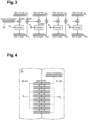
- FIG. 3 illustrates another unclaimed method of generating a token and the Figure 4 an example of splitting the token into two parts.
- the token generation method consists of chain cipher propagation encryption (AES PCBC).
- the method uses an initialization vector of 30.
- An “exclusive OR” is applied between an initialization vector 30 and the first plaintext block B 1 to obtain an XOR0 result.
- the result of the “exclusive OR” XOR0 is encrypted with a first AES key, K 1 .
- an “exclusive OR” is applied between the initial plaintext block and the encrypted block B 1C to obtain an XOR 1 result.
- the result of the XOR2 “exclusive OR” is encrypted with a second AES key.
- This principle is applied to all subsequent blocks by alternating encryption with one of the two keys.
- This mechanism ensures that all blocks are necessary to decrypt a block (i.e. to decrypt block B 2 , you need the key K 2 , the encrypted block B 1C and the decrypted block B 1 , which can only be decrypted using the key K 1 and the initialization vector).
- FIG. 4 illustrates the steps of separating or splitting a token into two parts.
- a first part of the token is generated containing: the initialization vector, the second encryption key K 2 and a part of each encrypted block.
- a second part of the token is generated containing: the first encryption key K 1 and the other parts of each encrypted block.
- QRCode type data carrier Any other carrier can be used.
- the token can be split into N parts depending on the storage capacity.
- the example is given in the context of an identification process within an airport, but can be extended to a control within a station to access the train, or to any type of transport or reception infrastructure for people, or even within a company for the access control of employees or visitors.
- the biometric data support may be a QR Code or any other support known to those skilled in the art.
- biometric model in the example was created from an image of an individual. Without departing from the scope of the invention, fingerprints, voice, etc. could also be used to enable identification.
- the method according to the invention can also be applied to the control of an employee or a visitor within a company equipped with gates.
- the mobile terminal could be in the form of a smart badge comprising all of the functionalities just described.
- the method and system according to the invention allow storage of data used to identify and authenticate an individual without friction, that is to say without the need for the user to have to perform a particular action (take out their passport or smartphone) and while respecting the rules of respect for privacy.
Landscapes
- Engineering & Computer Science (AREA)
- Computer Security & Cryptography (AREA)
- Signal Processing (AREA)
- Computer Networks & Wireless Communication (AREA)
- Theoretical Computer Science (AREA)
- Computer Hardware Design (AREA)
- General Engineering & Computer Science (AREA)
- Physics & Mathematics (AREA)
- General Physics & Mathematics (AREA)
- Software Systems (AREA)
- Health & Medical Sciences (AREA)
- Biomedical Technology (AREA)
- General Health & Medical Sciences (AREA)
- Life Sciences & Earth Sciences (AREA)
- Biodiversity & Conservation Biology (AREA)
- Computing Systems (AREA)
- Collating Specific Patterns (AREA)
Description
- L'invention concerne un procédé et un système pour identifier des individus, sans friction, tout en respectant le respect de leur liberté et de leur vie privée.
- Le garant du respect du règlement général sur la protection des données, veille à ce que le stockage des données biométriques et l'usage que l'on en fait respectent la vie privée des individus.
- De ce fait, la mise en œuvre d'un processus d'identification utilisant la biométrie nécessite la mise en place de mécanismes complexes ayant un haut niveau de sécurité garantissant la confidentialité des données et un usage maîtrisé.
- Le document
US 2013/339749 divulgue un procédé permettant l'identification d'un individu, les données biométriques associées à cet individu étant stockées dans une carte à puce. - Le document
US 2013/262873 divulgue un procédé et un système d'authentification d'utilisateurs. - L'enseignement technique du document
US 2003/088782 concerne le stockage de données biométriques au niveau d'un réseau. - L'objet de l'invention a notamment pour objectif d'offrir un procédé et un système permettant l'identification d'un individu sans friction, répondant aux objectifs de respect de la vie privée.
- Le mot « token » est utilisé dans la suite de la description pour désigner un ensemble de données contenant au moins un modèle biométrique chiffré propre à un individu pour son authentification et d'autres informations qui serviront à son identification (une clé de chiffrement des données, un identifiant Id, ...).
- L'invention est définie par les revendications indépendantes 1 et 6.
- L'invention concerne un procédé pour identifier un individu à partir de données biométriques au sein d'un système comprenant un dispositif de contrôle, un serveur sur lequel est installée une application de signature et de chiffrement, tel qu'il comporte au moins les étapes suivantes :
- enrôlement d'un individu et acquisition des données biométrique de l'individu,
- transmission desdites données biométriques audit serveur qui génère un modèle biométrique M,
- ledit serveur via son application de signature et de chiffrement signe et chiffre le modèle biométrique, génère un token contenant au moins ledit modèle biométrique M et des données d'identification,
- diviser le token chiffré en au moins deux parties T1, T2,
- transmettre une première partie du token T1 pour stockage sur un terminal mobile de l'individu et d'une deuxième partie du token T2 à une base de données d'un serveur distincte du stockage,
- contrôler des données d'identité de l'individu,
- détecter le terminal mobile de l'individu par le dispositif de contrôle,
- appairer le terminal mobile détecté avec le dispositif de contrôle,
- récupérer la première partie du token T1 et la deuxième partie du token T2, en utilisant une communication sans friction, puis fusionner les deux parties du token pour retrouver le token T initial, déchiffrer le token et vérifier sa signature, retourner le modèle biométrique correspondant,
- en parallèle, acquérir des données biométriques de l'individu, comparer les données biométriques au modèle biométrique et déclencher l'ouverture du moyen de contrôle si les données correspondent.
- La communication sans friction est par exemple une liaison de type Bluetooth, Ultrason, Wifi Aware, connues de l'homme du métier.
- Les données biométriques peuvent être des caractéristiques physiques du visage, le procédé acquiert une image du visage et génère un modèle biométrique correspondant pour le contrôle.
- Selon une autre variante de réalisation, le procédé prend en compte des empreintes digitales, acquiert les empreintes de l'individu et génère les modèles biométriques correspondant pour l'étape de contrôle.
- On peut utiliser un QRCode comme support de la première partie du token.
- On génère, par exemple, un token chiffré et on réalise sa séparation en deux parties en exécutant les étapes suivantes :
- génération d'une clé de chiffrement AES 256,
- chiffrement du modèle biométrique,
- constitution d'un token contenant la clé AES 256 et le modèle biométrique chiffré,
- transmission de la clé AES, T1, pour stockage sur le terminal mobile de l'individu,
- transmission de la partie T2, du modèle biométrique chiffré dans la base de données du serveur.
- Selon une autre variante de réalisation non revendiquée, la génération et la séparation du token en deux parties peut comprendre les étapes suivantes :
- on génère deux clés AES 256,
- on chiffre alternativement des blocs de données biométriques avec l'une des clés, puis,
- on transmet une première moitié de chaque bloc chiffré et une première clé pour stockage sur le terminal mobile et une deuxième moitié de chaque bloc chiffré et une deuxième clé pour stockage sur le serveur.
- Le procédé est utilisé pour contrôler l'identité d'un voyageur lors de passage des points de contrôle dans un aéroport.
- L'invention concerne aussi un système pour identifier un individu à partir de données biométriques au sein d'un système comprenant un dispositif de contrôle, un serveur, ledit individu étant équipé d'un terminal mobile, caractérisé en ce qu'il comporte au moins les éléments suivants :
- un dispositif d'enrôlement configuré pour acquérir les informations d'identité et les données biométriques de l'individu, un moyen de transmission desdites données vers le serveur,
- le serveur comporte une application de génération de modèle biométrique, de chiffrement d'un modèle biométrique et de génération d'un token, une application configurée pour séparer en au moins deux parties ledit token et générer une première partie du token T1 transmise pour stockage dans une mémoire du terminal mobile de l'individu et une deuxième partie du token T2 transmise à une base de données dudit serveur distincte de la mémoire, et comprend une application pour fusionner lesdites parties du token lors du contrôle d'accès,
- le dispositif de contrôle d'accès est équipé :
- i. d'un module de communication avec le serveur, de moyens de détection de téléphone mobile, d'un applicatif configuré pour détecter un téléphone mobile, l'appairer, d'une application configurée pour effectuer une comparaison entre un modèle biométrique et des données acquises au niveau du portique de contrôle,
- ii. d'un mécanisme permettant le passage de l'individu.
- Le dispositif de contrôle d'accès peut être un portique d'un aéroport, le modèle biométrique est un visage et le dispositif est équipé d'une caméra adaptée à enregistrer en temps réel le visage d'un individu se présentant au portique après appairage.
- Le dispositif d'enrôlement est par exemple une borne d'enregistrement en accès libre.
- D'autres caractéristiques, détails et avantages de l'invention ressortiront à la lecture de la description faite en référence aux dessins annexés donnés à titre d'exemples non limitatifs et qui représentent, respectivement :
- pour ce qui concerne la
figure 1 , une illustration des étapes d'enrôlement d'un individu et la génération d'un token représentant son identité, - pour ce qui concerne la
figure 2 , une illustration des étapes de vérification des données présentées par un individu, - pour ce qui concerne la
figure 3 , un exemple de génération d'un token, - pour ce qui concerne la
figure 4 , une méthode de séparation d'un token en deux parties. - La description qui suit est donnée à titre illustratif et nullement limitatif. Le support d'une partie du token est un QRCode. Le contrôle d'identité est celui d'un voyageur au sein d'un aéroport, via le passage d'un ou plusieurs portiques de contrôle pour accéder à une zone « sécurisée », à accès limité, passer une frontière, embarquer à bord d'un avion.
- La
figure 1 illustre un exemple d'enrôlement des données d'un individu. L'individu dispose d'un terminal mobile 1, tel qu'un smartphone, une tablette qui va lui permettre de dialoguer avec les bornes de contrôle et de mémoriser une partie de ses données d'identité lui permettant de s'authentifier. - Le terminal mobile 1 comprend des moyens de communication (antenne, émetteur, récepteur) 10, un processeur 11 configuré pour exécuter les étapes du procédé, une application 12 servant à disposer d'une partie d'un token mémorisé dans un conteneur sécurisé 13. L'application 12 comporte par exemple les fonctionnalités suivantes : importer (scanner) un nouveau token, gérer un token, consulter des informations sur son déplacement, donner et/ou supprimer son consentement.
- Le voyageur va s'enrôler sur une borne d'enregistrement ou kiosque en libre-service dans un aéroport. Le kiosque d'enrôlement 2 est équipé d'un dispositif et d'une application 21 permettant d'afficher un QRCode contenant une partie au moins du token. Le QRCode est stocké pour une durée limitée dans une mémoire temporaire 22 du kiosque. La borne d'enregistrement 2 comprend par un exemple un clavier 23 ou une interface physique qui permet au voyageur de saisir ses données d'identité.
- Le système comprend un serveur 3 équipé d'une application de signature et de chiffrement des données 31, une application 32 configurée pour générer un modèle biométrique, une application 36 pour générer un QRCode ou tout autre support équivalent, une application 35 de fusion de données, une base de données 33 ou mémoire mémorisant une partie du token, et des moyens de communication 34 pour dialoguer avec le kiosque 2 lors de la phase d'enrôlement et un portique d'accès 5 lors de la phase de contrôle d'identité (
figure 2 ). - Le voyageur va s'enrôler sur le kiosque afin de pouvoir réaliser un parcours dans l'aéroport qui s'appuiera sur une authentification biométrique, 101. Lors de cette phase d'enrôlement, l'individu donne son consentement explicite pour l'utilisation de ses données personnelles et de sa biométrie, selon un processus de consentement connu de l'homme du métier (IHM de dialogue pour demander et accepter le consentement explicite du voyageur). Puis, le voyageur 1 communique ses données d'identité au kiosque, par exemple en saisissant au niveau du clavier ses données personnelles ou par lecture de son passeport via l'application de lecture du kiosque et acquiert les données biométriques nécessaires à l'authentification. Le kiosque 2 transmet ces données biométriques, 102, au serveur 3 qui via son application génère un modèle biométrique, par exemple de visage, par des mécanismes connus de l'homme du métier.
- Le serveur 3 via son application de signature et de chiffrement va signer et chiffrer le modèle biométrique M et générer un token qui comporte à minima le modèle biométrique M. Il mémorise le token chiffré dans une mémoire temporaire, 104. Ce token T est ensuite scindé en N parties de tailles variables. A partir des N parties du token, dans l'exemple deux parties T1, T2, le serveur va :
- sauvegarder 105 la deuxième partie T2 du token dans une base de données 33, par exemple intégrée au serveur,
- générer 106 un QRCode support d'une première partie T1 du token qu'il transmet au kiosque 2 pour affichage.
- L'individu voyageur va scanner le QRCode se trouvant sur le kiosque avec son smartphone équipé de l'application qui enregistre les données contenues dans le QRCode dans sa mémoire 13, 107. Le résultat du scan est vérifié par un processus connu de l'homme du métier. Il utilisera cette partie de token pour le contrôle d'identité réalisé par les portiques de contrôle ou portillons d'accès.
- La
figure 2 illustre l'accès et l'usage du token lors d'un contrôle sur un portillon d'accès. L'identification biométrique d'un individu requiert le consentement ou l'autorisation du voyageur qu'il a donné au moment de son enrôlement sur le kiosque. - Dans cet exemple, un portique d'accès 5 est équipé d'un module de communication 51 avec le serveur, de moyens de détection 52 de smartphones compatibles avec le système, d'un applicatif 53 configuré pour sélectionner un smartphone, le plus proche par exemple et de l'appairer 201, une application 54 qui va effectuer une comparaison entre un modèle biométrique et des données acquises au niveau du portique de contrôle, une image de la personne par exemple. Le résultat de l'application se traduit par exemple sous la forme d'un signal qui va déclencher un mécanisme 60 d'ouverture du portique.
- Le dialogue ou échange de données entre le portique d'accès 5 et le terminal mobile du voyageur s'effectue par exemple au moyen de communication sans friction, par exemple de type Bluetooth Low Energy, Ultrason, Wifi Aware, etc. La liaison entre le serveur et le portique d'accès est une liaison standard connue de l'homme du métier.
- Le portique d'accès après détection 201 recherche l'identifiant, connu par le système, du service sur le smartphone mettant à disposition la partie du token T1 mémorisée dans le smartphone du voyageur. La première partie T1 du token est récupérée 202 par le portique d'accès 5 et transmise 203 au serveur 3 qui analyse son contenu, recherche l'identifiant correspondant Id du voyageur et, en utilisant cet identifiant va rechercher, 204, la deuxième partie du token T2 dans sa base de données 33. Puis le serveur 3 va fusionner 206 la première partie T1 du token et la deuxième partie T2 retournée 205 par la base de données. La fusion des deux parties est déclenchée automatiquement sur réception de la première partie du token. Le token reconstitué est ensuite déchiffré via l'application de chiffrement/déchiffrement du serveur, puis la signature est vérifiée afin de garantir l'authenticité des données. Le serveur retourne ensuite le modèle biométrique M, 207, au portique d'accès qui va effectuer une comparaison biométrique entre le flux vidéo de la caméra et ce modèle biométrique.
- Lorsque les données du flux vidéo correspondent au modèle biométrique, le portique d'accès déclenche l'ouverture du passage au voyageur.
- Le portique d'accès comprend une caméra 55 ou un dispositif équivalent pour capter l'image de l'individu. Le module communication peut être un Dongle Bluetooth, une carte Wifi, un Haut-parleur, etc.
- Les données sont stockées de manière temporaire au niveau de la porte de contrôle d'accès. Au niveau du serveur, les données peuvent être effacées au bout d'un certain temps, ou encore dès que l'individu retire son consentement, selon un processus d'effacement connu de l'homme du métier.
- Un exemple de séparation de token consiste à appliquer la méthode suivante :
- Chiffrage AES 256 du modèle biométrique
- Génération du token : clé AES 256 + modèle biométrique chiffré,
- Envoi de la clé AES sur le smartphone, T1
- Stockage du modèle biométrique chiffré dans la base de données, T2.
- La
figure 3 illustre une autre méthode de génération d'un token non revendiquée et lafigure 4 un exemple de séparation du token en deux parties. - 31 - La méthode de génération du token consiste en un chiffrement par propagation des chiffrés en chaîne (AES PCBC).
- La méthode utilise un vecteur d'initialisation 30.
- Un « OU exclusif » est appliqué entre un vecteur d'initialisation 30 et le premier bloc en clair B1 pour obtenir un résultat XOR0.
- Le résultat du « OU exclusif » XOR0 est chiffré avec une première clé AES, K1.
- En sortie de chiffrement, un « OU exclusif » est appliqué entre le bloc en clair initial et le bloc chiffré B1C pour obtenir un résultat XOR1.
- Un « OU exclusif » entre le résultat XOR1 et le deuxième bloc en clair B2 pour obtenir un résultat XOR2.
- Le résultat du « OU exclusif » XOR2 est chiffré avec une deuxième clé AES.
- On applique ce principe à tous les blocs suivants en alternant le chiffrement avec l'une des deux clés.
- Ce mécanisme permet de s'assurer que l'ensemble des blocs sont nécessaires pour déchiffrer un bloc (i.e. pour déchiffrer le bloc B2, il faut la clé K2, le bloc B1C crypté et le bloc B1 décrypté, qui ne peut l'être qu'à l'aide de la clé K1 et du vecteur d'initialisation).
- La
figure 4 illustre les étapes de séparation ou scission d'un token en deux parties. - 40 - Séparation des données.
- 41 - A partir d'un token, une première partie du token est générée contenant : le vecteur d'initialisation, la deuxième clé de chiffrement K2 et une partie de chaque bloc chiffré.
- 42 - Une deuxième partie du token est générée contenant : la première clé de chiffrement K1 et les autres parties de chaque bloc chiffré.
- 43 - Envoi d'une des deux parties du token sur le smartphone.
- 44 - Stockage de l'autre partie du token sur le serveur.
- La description ci-dessus est donnée pour un support de données de type QRCode. Tout autre support peut être utilisé.
- Le token peut être séparé en N parties selon la capacité de stockage.
- L'exemple est donné dans le cadre d'un parcours d'identification au sein d'un aéroport, mais peut être étendu à un contrôle au sein d'une gare pour accéder au train, ou bien à tout type d'infrastructure de transport ou d'accueil de personnes, ou encore au sein d'une entreprise pour le contrôle d'accès des salariés ou des visiteurs.
- Le support des données biométriques peut être un QRCode ou tout autre support connu de l'homme du métier.
- Le modèle biométrique dans l'exemple a été établi à partir d'une image d'un individu. Sans sortir du cadre de l'invention, on pourrait aussi utiliser les empreintes digitales, la voix, etc. permettant l'identification.
- Le procédé selon l'invention peut aussi s'appliquer pour le contrôle d'un salarié ou d'un visiteur au sein d'une entreprise équipée de portillons. Le terminal mobile pourrait se présenter sous la forme d'un badge intelligent comportant l'ensemble des fonctionnalités qui viennent d'être décrites.
- Le procédé et le système selon l'invention permettent un stockage des données utilisées pour identifier et authentifier un individu sans friction, c'est-à-dire sans nécessité pour l'utilisateur d'avoir à effectuer une action particulière (sortir son passeport ou son smartphone) et en respectant les règles de respect de la vie privée.
Claims (8)
- Procédé pour identifier un individu à partir de données biométriques au sein d'un système comprenant un dispositif de contrôle d'accès (5), un dispositif d'enrôlement (2) et un serveur (3), comportant :a. des étapes d'enrôlement (101, ..., 107) de l'individu consistant en :- une acquisition (101) de premières données biométriques de l'individu par le dispositif d'enrôlement (2) ;- une génération (103) d'un modèle biométrique M à partir desdites premières données biométriques ;- une signature du modèle biométrique, puis un chiffrement (104) du modèle biométrique signé à partir d'une clé de chiffrement, l'ensemble dudit modèle biométrique signé et chiffré et de la clé de chiffrement formant un token T généré par le serveur- un enregistrement (107) d'une première partie T1 dudit token T dans une mémoire de données (13) d'un terminal mobile (1) détenu par l'individu ;- un enregistrement (105) au sein d'une base de données (33) du serveur (3) d'une deuxième partie T2 dudit token T ;b. des étapes de vérification (201, ..., 207) consistant en :ledit procédé pour identifier un individu étant agencé en ce que :- une acquisition de deuxièmes données biométriques de l'individu par le dispositif de contrôle d'accès (5) ;- une exploitation conjointe desdites deuxièmes données biométriques et du modèle biométrique pour provoquer ou rejeter un déclenchement de l'ouverture du moyen de contrôle d'accès ;i. le procédé comporte une transmission (102) par ledit dispositif d'enrôlement (2) desdites premières données biométriques au serveur (3) préalablement à la génération (103) du modèle biométrique M ;ii. ladite génération (103) du modèle biométrique M à partir des premières données biométriques, la signature et le chiffrement de ce dernier (104) sont réalisés par ledit serveur (3), ce dernier contenant une application de signature et de chiffrement d'un modèle biométrique ;iii. la première partie T1 du token T comprend la clé de chiffrement du modèle biométrique signé et un identifiant Id de l'individu ;iv. la deuxième partie T2 dudit token T comprend le modèle biométrique signé et chiffré ;v. l'enregistrement (107) de la première partie T1 dudit token T dans une mémoire de données (13) du terminal mobile (1) détenu par l'individu est précédé par :- une génération par le serveur (3) d'un QRCode support de ladite première partie T1 du token T affichable par le dispositif d'enrôlement (2) ;- une transmission (106) dudit QRCode à destination du dispositif d'enrôlement (2) ;- un affichage par ledit dispositif d'enrôlement (2) dudit QRCode support de la première partie T1 dudit token T ;- un scan dudit QRCode support de ladite première partie T1 du token T affiché par le terminal mobile (1) détenu par l'individu pour retrouver ladite première partie T1 dudit token T à partir dudit QRCode scanné par ledit terminal mobile (1) détenu par l'individu ;vi. l'exploitation conjointe desdites deuxièmes données biométriques et du modèle biométrique pour provoquer ou rejeter un déclenchement de l'ouverture du moyen de contrôle d'accès est précédée par :- un appairage du terminal mobile (1) détenu par l'individu détecté avec le dispositif de contrôle d'accès (5) ;- une transmission (202) par le terminal mobile (1), au moyen d'une communication sans friction, de la première partie T1 du token T enregistrée dans la mémoire de données (13) dudit terminal mobile (1) au dispositif de contrôle d'accès (5) ;- une transmission (203) par le dispositif de contrôle d'accès (5) de ladite première partie T1 du token T au serveur (3) ;- une recherche (204) effectuée par ledit serveur (3) dans la base de données (33) dudit serveur (3) d'une deuxième partie T2 de token T à partir de la première partie T1 dudit token T ;- une fusion (206) par le serveur (3) desdites première et deuxième parties T1 et T2 dudit token T pour recouvrer ledit token T ;- un déchiffrement par le serveur (3) du modèle biométrique signé et chiffré compris dans ledit token T à partir de la première partie T1 de celui-ci et une vérification de la signature du modèle biométrique ;- une transmission dudit modèle biométrique déchiffré par le serveur au dispositif de contrôle d'accès (5) ;vii. l'exploitation conjointe desdites deuxièmes données biométriques et du modèle biométrique pour provoquer ou rejeter un déclenchement de l'ouverture du moyen de contrôle d'accès consiste en une comparaison par le dispositif de contrôle d'accès (5) desdites deuxième données biométriques acquises avec le modèle biométrique déchiffré et connu dudit dispositif de contrôle d'accès (5), le déclenchement de l'ouverture du moyen de contrôle d'accès étant provoqué si les deuxièmes données biométriques acquises correspondent au modèle biométrique déchiffré.
- Procédé selon la revendication 1 tel que la communication sans friction est une communication de type Bluetooth, Ultrason ou Wifi Aware.
- Procédé selon l'une des revendications 1 ou 2 tel que les premières et deuxièmes données biométriques sont des caractéristiques physiques d'un visage à partir d'une image dudit visage.
- Procédé selon l'une des revendications 1 ou 2 tel que les données biométriques consistent en des empreintes digitales.
- Procédé selon l'une des revendications 1 à 4 tel que le chiffrement (104) du modèle biométrique par ledit serveur (3) consiste en :- une génération de la clé de chiffrement du modèle biométrique sous la forme d'une clé de chiffrement AES 256 ;- le chiffrement en tant que tel du modèle biométrique à partir de ladite clé de chiffrement AES 256 .
- Système pour identifier un individu à partir de données biométriques comprenant un dispositif d'enrôlement (2), un dispositif de contrôle d'accès (5), un serveur (3), ledit individu étant équipé d'un terminal mobile (1), ledit système étant tel que, pour mettre en œuvre un procédé selon l'une quelconque des revendications précédentes :- le dispositif d'enrôlement (2) est configuré pour acquérir des informations d'identité et des premières données biométriques de l'individu et comporte un moyen de transmission desdites premières données biométriques à destination du serveur (3) ;- le serveur (3) comporte :∘ une application (31) de génération de modèle biométrique, de signature et de chiffrement d'un modèle biométrique et de génération d'un token T comportant ledit modèle biométrique M signé et chiffré et la clé de chiffrement,∘ une application (32) configurée pour séparer en au moins deux parties ledit token T et générer une première partie du token T1 transmise au moyen d'un QRCode affichable par le dispositif d'enrôlement (2) pour stockage, après scan dudit QRCode par le terminal mobile (1) de l'individu, dans une mémoire (13) de ce dernier et une deuxième partie du token T2 transmise à une base de données (33) dudit serveur (3) distincte de la mémoire (13) du terminal mobile (1),∘ une application (35) pour fusionner lesdites parties T1 et T2 du token T lors du contrôle d'accès,- le dispositif de contrôle d'accès (5) est équipé :- d'un module de communication (51) avec le serveur (3), de moyens d'acquisition (55) de deuxièmes données biométriques, de moyens de détection (52) de terminal (1), d'un applicatif (53) configuré pour détecter un tel terminal mobile (1), l'appairer, d'une application (54) configurée pour effectuer une comparaison entre un modèle biométrique et lesdites deuxièmes données biométriques,- d'un mécanisme (60) permettant le passage de l'individu.
- Système selon la revendication 6 pour lequel le dispositif de contrôle d'accès (5) est un portique d'un aéroport, le modèle biométrique est celui d'un visage, les moyens d'acquisition (55) de deuxièmes données biométriques consistant en une caméra adaptée pour capter en temps réel le visage d'un individu se présentant au portique après appairage dudit dispositif de contrôle d'accès (5) avec le terminal mobile (1) de l'individu, ledit terminal mobile (1) consistant en un smartphone ou une tablette.
- Système selon l'une des revendications 6 ou 7 tel que le dispositif d'enrôlement est une borne d'enregistrement en accès libre.
Applications Claiming Priority (2)
| Application Number | Priority Date | Filing Date | Title |
|---|---|---|---|
| FR1913751A FR3104287B1 (fr) | 2019-12-04 | 2019-12-04 | Procédé et système d’identification d’un individu sans friction. |
| PCT/EP2020/084120 WO2021110673A1 (fr) | 2019-12-04 | 2020-12-01 | Procede et systeme d'identification d'un individu sans friction |
Publications (2)
| Publication Number | Publication Date |
|---|---|
| EP4070520A1 EP4070520A1 (fr) | 2022-10-12 |
| EP4070520B1 true EP4070520B1 (fr) | 2025-05-28 |
Family
ID=70456848
Family Applications (1)
| Application Number | Title | Priority Date | Filing Date |
|---|---|---|---|
| EP20812356.2A Active EP4070520B1 (fr) | 2019-12-04 | 2020-12-01 | Procede et systeme d'identification d'un individu sans friction |
Country Status (3)
| Country | Link |
|---|---|
| EP (1) | EP4070520B1 (fr) |
| FR (1) | FR3104287B1 (fr) |
| WO (1) | WO2021110673A1 (fr) |
Family Cites Families (3)
| Publication number | Priority date | Publication date | Assignee | Title |
|---|---|---|---|---|
| GB2381916B (en) * | 2001-11-08 | 2005-03-23 | Ncr Int Inc | Biometrics template |
| US20130262873A1 (en) * | 2012-03-30 | 2013-10-03 | Cgi Federal Inc. | Method and system for authenticating remote users |
| US20130339749A1 (en) * | 2012-06-19 | 2013-12-19 | Philippe Spuehier | Distributed biometric data storage and validation |
-
2019
- 2019-12-04 FR FR1913751A patent/FR3104287B1/fr active Active
-
2020
- 2020-12-01 EP EP20812356.2A patent/EP4070520B1/fr active Active
- 2020-12-01 WO PCT/EP2020/084120 patent/WO2021110673A1/fr not_active Ceased
Also Published As
| Publication number | Publication date |
|---|---|
| WO2021110673A1 (fr) | 2021-06-10 |
| FR3104287A1 (fr) | 2021-06-11 |
| FR3104287B1 (fr) | 2022-01-14 |
| EP4070520A1 (fr) | 2022-10-12 |
Similar Documents
| Publication | Publication Date | Title |
|---|---|---|
| US9189612B2 (en) | Biometric verification with improved privacy and network performance in client-server networks | |
| US12293367B2 (en) | Systems and methods for facilitating biometric tokenless authentication for services | |
| US11681883B2 (en) | Systems and methods of identification verification using near-field communication and optical authentication | |
| EP4007968A1 (fr) | Systèmes et procédés de vérification d'identification utilisant une communication en champ proche hybride et une authentification optique | |
| US20160071101A1 (en) | Selfie financial security transaction system | |
| WO2019094071A1 (fr) | Procédé de validation biométrique faisant appel à un dispositif d'accès et à une localisation | |
| US7130452B2 (en) | System and method for multi-party validation, authentication and/or authorization via biometrics | |
| EP2048814A1 (fr) | Procédé d'authentification biométrique, programme d'ordinateur, serveur d'authentification, terminal et objet portatif correspondants. | |
| KR20180054575A (ko) | 전자 서명 세션의 권한 검증을 위한 시스템 및 방법 | |
| FR3006790B1 (fr) | Procede d'identification biometrique | |
| US20160196509A1 (en) | Ticket authorisation | |
| US20250111367A1 (en) | Systems and methods for facilitating biometric authentication using quantum cryptography and/or blockchain | |
| EP2987124B1 (fr) | Methode et systeme d'amelioration de la securite des transactions electroniques | |
| US12423397B2 (en) | Method for checking individuals with simplified authentication | |
| CN104835039A (zh) | 一种数据标签生成方法 | |
| EP4070520A1 (fr) | Procede et systeme d'identification d'un individu sans friction | |
| EP4107706B1 (fr) | Procédé et système d'authentification sans contact | |
| Lott | Biometrics: modernising customer authentication for financial services and payments | |
| EP4193283B1 (fr) | Procédé pour générer un document numérique sécurisé stocké sur un terminal mobile et associé à une identité numérique | |
| Kumar et al. | Design and development of biometrics secure person detection system for E-passport using cryptographic security protocols | |
| FR3161962A1 (fr) | Procédé et terminal d’encodage biométrique et d’identification biométrique | |
| FR3149410A1 (fr) | Procédé pour l'inscription d'une référence biométrique dans un dispositif portable | |
| EP1802026A2 (fr) | Procédé de déblocage d'une ressource par un dispositif sans contact | |
| GB2595214A (en) | A method and system for securing a transaction between a customer and a merchant | |
| Shanmugam | Fingerprint Extraction and Comparison for Payment Transaction in Mobile Commerce |
Legal Events
| Date | Code | Title | Description |
|---|---|---|---|
| STAA | Information on the status of an ep patent application or granted ep patent |
Free format text: STATUS: UNKNOWN |
|
| STAA | Information on the status of an ep patent application or granted ep patent |
Free format text: STATUS: THE INTERNATIONAL PUBLICATION HAS BEEN MADE |
|
| PUAI | Public reference made under article 153(3) epc to a published international application that has entered the european phase |
Free format text: ORIGINAL CODE: 0009012 |
|
| STAA | Information on the status of an ep patent application or granted ep patent |
Free format text: STATUS: REQUEST FOR EXAMINATION WAS MADE |
|
| 17P | Request for examination filed |
Effective date: 20220506 |
|
| AK | Designated contracting states |
Kind code of ref document: A1 Designated state(s): AL AT BE BG CH CY CZ DE DK EE ES FI FR GB GR HR HU IE IS IT LI LT LU LV MC MK MT NL NO PL PT RO RS SE SI SK SM TR |
|
| DAV | Request for validation of the european patent (deleted) | ||
| DAX | Request for extension of the european patent (deleted) | ||
| STAA | Information on the status of an ep patent application or granted ep patent |
Free format text: STATUS: EXAMINATION IS IN PROGRESS |
|
| 17Q | First examination report despatched |
Effective date: 20240115 |
|
| REG | Reference to a national code |
Ref country code: DE Ref legal event code: R079 Free format text: PREVIOUS MAIN CLASS: H04L0029060000 Ipc: H04W0012020000 Ref document number: 602020052070 Country of ref document: DE |
|
| GRAP | Despatch of communication of intention to grant a patent |
Free format text: ORIGINAL CODE: EPIDOSNIGR1 |
|
| STAA | Information on the status of an ep patent application or granted ep patent |
Free format text: STATUS: GRANT OF PATENT IS INTENDED |
|
| RIC1 | Information provided on ipc code assigned before grant |
Ipc: H04W 12/77 20210101ALN20241210BHEP Ipc: H04W 12/63 20210101ALN20241210BHEP Ipc: H04W 12/0431 20210101ALN20241210BHEP Ipc: H04W 12/08 20210101ALN20241210BHEP Ipc: H04W 4/80 20180101ALN20241210BHEP Ipc: G06F 21/36 20130101ALI20241210BHEP Ipc: H04W 12/03 20210101ALI20241210BHEP Ipc: H04L 9/08 20060101ALI20241210BHEP Ipc: H04L 9/32 20060101ALI20241210BHEP Ipc: G06F 21/32 20130101ALI20241210BHEP Ipc: H04L 67/1097 20220101ALI20241210BHEP Ipc: H04L 9/40 20220101ALI20241210BHEP Ipc: H04W 12/06 20210101ALI20241210BHEP Ipc: H04W 12/02 20090101AFI20241210BHEP |
|
| INTG | Intention to grant announced |
Effective date: 20241220 |
|
| GRAS | Grant fee paid |
Free format text: ORIGINAL CODE: EPIDOSNIGR3 |
|
| GRAA | (expected) grant |
Free format text: ORIGINAL CODE: 0009210 |
|
| STAA | Information on the status of an ep patent application or granted ep patent |
Free format text: STATUS: THE PATENT HAS BEEN GRANTED |
|
| RAP3 | Party data changed (applicant data changed or rights of an application transferred) |
Owner name: IMPRIMERIE NATIONALE |
|
| AK | Designated contracting states |
Kind code of ref document: B1 Designated state(s): AL AT BE BG CH CY CZ DE DK EE ES FI FR GB GR HR HU IE IS IT LI LT LU LV MC MK MT NL NO PL PT RO RS SE SI SK SM TR |
|
| P01 | Opt-out of the competence of the unified patent court (upc) registered |
Free format text: CASE NUMBER: APP_18884/2025 Effective date: 20250417 |
|
| REG | Reference to a national code |
Ref country code: GB Ref legal event code: FG4D Free format text: NOT ENGLISH |
|
| REG | Reference to a national code |
Ref country code: CH Ref legal event code: EP |
|
| REG | Reference to a national code |
Ref country code: DE Ref legal event code: R096 Ref document number: 602020052070 Country of ref document: DE |
|
| REG | Reference to a national code |
Ref country code: IE Ref legal event code: FG4D Free format text: LANGUAGE OF EP DOCUMENT: FRENCH |
|
| REG | Reference to a national code |
Ref country code: NL Ref legal event code: MP Effective date: 20250528 |
|
| PG25 | Lapsed in a contracting state [announced via postgrant information from national office to epo] |
Ref country code: ES Free format text: LAPSE BECAUSE OF FAILURE TO SUBMIT A TRANSLATION OF THE DESCRIPTION OR TO PAY THE FEE WITHIN THE PRESCRIBED TIME-LIMIT Effective date: 20250528 Ref country code: FI Free format text: LAPSE BECAUSE OF FAILURE TO SUBMIT A TRANSLATION OF THE DESCRIPTION OR TO PAY THE FEE WITHIN THE PRESCRIBED TIME-LIMIT Effective date: 20250528 |
|
| REG | Reference to a national code |
Ref country code: LT Ref legal event code: MG9D |
|
| PG25 | Lapsed in a contracting state [announced via postgrant information from national office to epo] |
Ref country code: NO Free format text: LAPSE BECAUSE OF FAILURE TO SUBMIT A TRANSLATION OF THE DESCRIPTION OR TO PAY THE FEE WITHIN THE PRESCRIBED TIME-LIMIT Effective date: 20250828 Ref country code: GR Free format text: LAPSE BECAUSE OF FAILURE TO SUBMIT A TRANSLATION OF THE DESCRIPTION OR TO PAY THE FEE WITHIN THE PRESCRIBED TIME-LIMIT Effective date: 20250829 |
|
| PG25 | Lapsed in a contracting state [announced via postgrant information from national office to epo] |
Ref country code: NL Free format text: LAPSE BECAUSE OF FAILURE TO SUBMIT A TRANSLATION OF THE DESCRIPTION OR TO PAY THE FEE WITHIN THE PRESCRIBED TIME-LIMIT Effective date: 20250528 Ref country code: PL Free format text: LAPSE BECAUSE OF FAILURE TO SUBMIT A TRANSLATION OF THE DESCRIPTION OR TO PAY THE FEE WITHIN THE PRESCRIBED TIME-LIMIT Effective date: 20250528 |
|
| PG25 | Lapsed in a contracting state [announced via postgrant information from national office to epo] |
Ref country code: BG Free format text: LAPSE BECAUSE OF FAILURE TO SUBMIT A TRANSLATION OF THE DESCRIPTION OR TO PAY THE FEE WITHIN THE PRESCRIBED TIME-LIMIT Effective date: 20250528 |
|
| PG25 | Lapsed in a contracting state [announced via postgrant information from national office to epo] |
Ref country code: HR Free format text: LAPSE BECAUSE OF FAILURE TO SUBMIT A TRANSLATION OF THE DESCRIPTION OR TO PAY THE FEE WITHIN THE PRESCRIBED TIME-LIMIT Effective date: 20250528 |
|
| PG25 | Lapsed in a contracting state [announced via postgrant information from national office to epo] |
Ref country code: RS Free format text: LAPSE BECAUSE OF FAILURE TO SUBMIT A TRANSLATION OF THE DESCRIPTION OR TO PAY THE FEE WITHIN THE PRESCRIBED TIME-LIMIT Effective date: 20250828 |
|
| PG25 | Lapsed in a contracting state [announced via postgrant information from national office to epo] |
Ref country code: IS Free format text: LAPSE BECAUSE OF FAILURE TO SUBMIT A TRANSLATION OF THE DESCRIPTION OR TO PAY THE FEE WITHIN THE PRESCRIBED TIME-LIMIT Effective date: 20250928 |
|
| PG25 | Lapsed in a contracting state [announced via postgrant information from national office to epo] |
Ref country code: LV Free format text: LAPSE BECAUSE OF FAILURE TO SUBMIT A TRANSLATION OF THE DESCRIPTION OR TO PAY THE FEE WITHIN THE PRESCRIBED TIME-LIMIT Effective date: 20250528 |
|
| REG | Reference to a national code |
Ref country code: AT Ref legal event code: MK05 Ref document number: 1799354 Country of ref document: AT Kind code of ref document: T Effective date: 20250528 |
|
| PGFP | Annual fee paid to national office [announced via postgrant information from national office to epo] |
Ref country code: DE Payment date: 20251126 Year of fee payment: 6 |
|
| PGFP | Annual fee paid to national office [announced via postgrant information from national office to epo] |
Ref country code: GB Payment date: 20251119 Year of fee payment: 6 |
|
| PG25 | Lapsed in a contracting state [announced via postgrant information from national office to epo] |
Ref country code: SM Free format text: LAPSE BECAUSE OF FAILURE TO SUBMIT A TRANSLATION OF THE DESCRIPTION OR TO PAY THE FEE WITHIN THE PRESCRIBED TIME-LIMIT Effective date: 20250528 Ref country code: AT Free format text: LAPSE BECAUSE OF FAILURE TO SUBMIT A TRANSLATION OF THE DESCRIPTION OR TO PAY THE FEE WITHIN THE PRESCRIBED TIME-LIMIT Effective date: 20250528 Ref country code: DK Free format text: LAPSE BECAUSE OF FAILURE TO SUBMIT A TRANSLATION OF THE DESCRIPTION OR TO PAY THE FEE WITHIN THE PRESCRIBED TIME-LIMIT Effective date: 20250528 |
|
| PGFP | Annual fee paid to national office [announced via postgrant information from national office to epo] |
Ref country code: FR Payment date: 20251119 Year of fee payment: 6 |
|
| PG25 | Lapsed in a contracting state [announced via postgrant information from national office to epo] |
Ref country code: CZ Free format text: LAPSE BECAUSE OF FAILURE TO SUBMIT A TRANSLATION OF THE DESCRIPTION OR TO PAY THE FEE WITHIN THE PRESCRIBED TIME-LIMIT Effective date: 20250528 |
|
| PG25 | Lapsed in a contracting state [announced via postgrant information from national office to epo] |
Ref country code: EE Free format text: LAPSE BECAUSE OF FAILURE TO SUBMIT A TRANSLATION OF THE DESCRIPTION OR TO PAY THE FEE WITHIN THE PRESCRIBED TIME-LIMIT Effective date: 20250528 |
|
| PG25 | Lapsed in a contracting state [announced via postgrant information from national office to epo] |
Ref country code: SK Free format text: LAPSE BECAUSE OF FAILURE TO SUBMIT A TRANSLATION OF THE DESCRIPTION OR TO PAY THE FEE WITHIN THE PRESCRIBED TIME-LIMIT Effective date: 20250528 |
|
| PG25 | Lapsed in a contracting state [announced via postgrant information from national office to epo] |
Ref country code: IT Free format text: LAPSE BECAUSE OF FAILURE TO SUBMIT A TRANSLATION OF THE DESCRIPTION OR TO PAY THE FEE WITHIN THE PRESCRIBED TIME-LIMIT Effective date: 20250528 |
|
| REG | Reference to a national code |
Ref country code: DE Ref legal event code: R097 Ref document number: 602020052070 Country of ref document: DE |
|
| PG25 | Lapsed in a contracting state [announced via postgrant information from national office to epo] |
Ref country code: RO Free format text: LAPSE BECAUSE OF FAILURE TO SUBMIT A TRANSLATION OF THE DESCRIPTION OR TO PAY THE FEE WITHIN THE PRESCRIBED TIME-LIMIT Effective date: 20250528 |
|
| PLBE | No opposition filed within time limit |
Free format text: ORIGINAL CODE: 0009261 |
|
| STAA | Information on the status of an ep patent application or granted ep patent |
Free format text: STATUS: NO OPPOSITION FILED WITHIN TIME LIMIT |
|
| REG | Reference to a national code |
Ref country code: CH Ref legal event code: L10 Free format text: ST27 STATUS EVENT CODE: U-0-0-L10-L00 (AS PROVIDED BY THE NATIONAL OFFICE) Effective date: 20260409 |
|
| 26N | No opposition filed |
Effective date: 20260303 |