EP4068882A1 - Communication system, communication method, and wireless base station - Google Patents
Communication system, communication method, and wireless base station Download PDFInfo
- Publication number
- EP4068882A1 EP4068882A1 EP20891537.1A EP20891537A EP4068882A1 EP 4068882 A1 EP4068882 A1 EP 4068882A1 EP 20891537 A EP20891537 A EP 20891537A EP 4068882 A1 EP4068882 A1 EP 4068882A1
- Authority
- EP
- European Patent Office
- Prior art keywords
- communication
- base station
- wireless base
- transmission rate
- traveling
- Prior art date
- Legal status (The legal status is an assumption and is not a legal conclusion. Google has not performed a legal analysis and makes no representation as to the accuracy of the status listed.)
- Pending
Links
Images



Classifications
-
- H—ELECTRICITY
- H04—ELECTRIC COMMUNICATION TECHNIQUE
- H04W—WIRELESS COMMUNICATION NETWORKS
- H04W72/00—Local resource management
- H04W72/04—Wireless resource allocation
-
- H—ELECTRICITY
- H04—ELECTRIC COMMUNICATION TECHNIQUE
- H04W—WIRELESS COMMUNICATION NETWORKS
- H04W28/00—Network traffic management; Network resource management
- H04W28/16—Central resource management; Negotiation of resources or communication parameters, e.g. negotiating bandwidth or QoS [Quality of Service]
- H04W28/18—Negotiating wireless communication parameters
- H04W28/22—Negotiating communication rate
-
- H—ELECTRICITY
- H04—ELECTRIC COMMUNICATION TECHNIQUE
- H04L—TRANSMISSION OF DIGITAL INFORMATION, e.g. TELEGRAPHIC COMMUNICATION
- H04L1/00—Arrangements for detecting or preventing errors in the information received
- H04L1/0001—Systems modifying transmission characteristics according to link quality, e.g. power backoff
- H04L1/0002—Systems modifying transmission characteristics according to link quality, e.g. power backoff by adapting the transmission rate
-
- H—ELECTRICITY
- H04—ELECTRIC COMMUNICATION TECHNIQUE
- H04L—TRANSMISSION OF DIGITAL INFORMATION, e.g. TELEGRAPHIC COMMUNICATION
- H04L1/00—Arrangements for detecting or preventing errors in the information received
- H04L1/0001—Systems modifying transmission characteristics according to link quality, e.g. power backoff
- H04L1/0015—Systems modifying transmission characteristics according to link quality, e.g. power backoff characterised by the adaptation strategy
- H04L1/0016—Systems modifying transmission characteristics according to link quality, e.g. power backoff characterised by the adaptation strategy involving special memory structures, e.g. look-up tables
-
- H—ELECTRICITY
- H04—ELECTRIC COMMUNICATION TECHNIQUE
- H04W—WIRELESS COMMUNICATION NETWORKS
- H04W24/00—Supervisory, monitoring or testing arrangements
- H04W24/02—Arrangements for optimising operational condition
-
- H—ELECTRICITY
- H04—ELECTRIC COMMUNICATION TECHNIQUE
- H04W—WIRELESS COMMUNICATION NETWORKS
- H04W4/00—Services specially adapted for wireless communication networks; Facilities therefor
- H04W4/30—Services specially adapted for particular environments, situations or purposes
- H04W4/40—Services specially adapted for particular environments, situations or purposes for vehicles, e.g. vehicle-to-pedestrians [V2P]
-
- H—ELECTRICITY
- H04—ELECTRIC COMMUNICATION TECHNIQUE
- H04W—WIRELESS COMMUNICATION NETWORKS
- H04W72/00—Local resource management
- H04W72/50—Allocation or scheduling criteria for wireless resources
- H04W72/51—Allocation or scheduling criteria for wireless resources based on terminal or device properties
-
- H—ELECTRICITY
- H04—ELECTRIC COMMUNICATION TECHNIQUE
- H04W—WIRELESS COMMUNICATION NETWORKS
- H04W88/00—Devices specially adapted for wireless communication networks, e.g. terminals, base stations or access point devices
- H04W88/18—Service support devices; Network management devices
- H04W88/181—Transcoding devices; Rate adaptation devices
-
- H—ELECTRICITY
- H04—ELECTRIC COMMUNICATION TECHNIQUE
- H04W—WIRELESS COMMUNICATION NETWORKS
- H04W24/00—Supervisory, monitoring or testing arrangements
- H04W24/10—Scheduling measurement reports ; Arrangements for measurement reports
-
- H—ELECTRICITY
- H04—ELECTRIC COMMUNICATION TECHNIQUE
- H04W—WIRELESS COMMUNICATION NETWORKS
- H04W4/00—Services specially adapted for wireless communication networks; Facilities therefor
- H04W4/30—Services specially adapted for particular environments, situations or purposes
- H04W4/33—Services specially adapted for particular environments, situations or purposes for indoor environments, e.g. buildings
-
- H—ELECTRICITY
- H04—ELECTRIC COMMUNICATION TECHNIQUE
- H04W—WIRELESS COMMUNICATION NETWORKS
- H04W64/00—Locating users or terminals or network equipment for network management purposes, e.g. mobility management
-
- H—ELECTRICITY
- H04—ELECTRIC COMMUNICATION TECHNIQUE
- H04W—WIRELESS COMMUNICATION NETWORKS
- H04W84/00—Network topologies
- H04W84/02—Hierarchically pre-organised networks, e.g. paging networks, cellular networks, WLAN [Wireless Local Area Network] or WLL [Wireless Local Loop]
- H04W84/10—Small scale networks; Flat hierarchical networks
- H04W84/12—WLAN [Wireless Local Area Networks]
Definitions
- This invention mainly relates to a wireless communication between a wireless communication device and a wireless base station. More particularly, it relates to determining a transmission rate according to a position of the wireless communication device that moves.
- PTL 1 discloses this type of wireless communication device.
- the wireless communication device in PTL 1 is configured to set a base transmission rate based on a signal quality such as received radio wave strength with the communication device to be communicated with before data transmission (a normal wireless communication), store it in the memory, and use it during data transmission.
- a signal quality such as received radio wave strength
- the present invention is made in view of the circumstances described above, and an object of the present invention is to provide a communication system that can quickly and appropriately indicate the transmission rate for being used in a wireless communication with a traveling cart that moves.
- a communication system having the following configuration. That is, the communication system includes a traveling cart traveling in a predetermined traveling area in a building, a wireless base station, and a controller communicating with the traveling cart via the wireless base station.
- the traveling cart includes a cart wireless communication unit and a cart control unit.
- the cart wireless communication unit performs a wireless communication with the wireless base station.
- the cart control unit can transmit traveling position information indicating a traveling position of the traveling cart itself in the traveling area to the wireless base station via the cart wireless communication unit.
- the wireless base station includes a first wireless base station communication unit and a second wireless base station communication unit.
- the first wireless base station communication unit performs a wireless communication with the traveling cart.
- the second wireless base station communication unit performs a communication with the controller.
- the controller includes a controller communication unit, a controller storage unit, and a controller control unit.
- the controller communication unit communicates with the wireless base station.
- the controller storage unit stores a transmission rate table designating correspondence relationships between position information indicating a plurality of positions where the traveling cart can travel in the traveling area and at least one transmission rate recommended for a wireless communication performed by the traveling cart and the wireless base station when the traveling cart is at each of the positions.
- the controller control unit acquires at least one transmission rate from the transmission rate table based on the position information corresponding to the traveling position information of the traveling cart received via the wireless base station, and generates transmission rate information from the transmission rate which is acquired.
- the controller control unit transmits the transmission rate information which is generated and the transmission information to be transmitted to the traveling cart to the wireless base station via the controller communication unit.
- the wireless base station receives the transmission rate information and the transmission information by communication between the second wireless base station communication unit and the controller communication unit, the wireless base station transmits the transmission information to the traveling cart at the transmission rate acquired from the transmission rate information, via the first wireless base station communication unit.
- the wireless base station determines the preferable transmission rate for wireless transmission of the transmission information to the traveling cart, according to the traveling position of the traveling cart. Therefore, retransmissions caused by wireless transmission at an inappropriate transmission rate can be suppressed.
- the communication system may be configured as follows. That is, the wireless base station transmits the transmission information and the transmission rate information to the traveling cart via the first wireless base station communication unit.
- the cart wireless communication unit performs a wireless communication with the wireless base station at the transmission rate which is acquired from the transmission rate information received from the wireless base station.
- the traveling cart can perform a wireless communication at the preferable transmission rate according to its traveling position.
- the communication system may be configured as follows. That is, the cart wireless communication unit performs a wireless communication with the wireless base station at the same transmission rate as that used by the wireless base station when the wireless base station performed a communication with the cart wireless communication unit.
- the traveling cart can perform a wireless communication at the preferable transmission rate according to its traveling position.
- the communication system is configured as follows. That is, the controller control unit of the controller includes a communication quality acquisition unit and a transmission rate table updating unit.
- the communication quality acquisition unit acquires a communication quality when the wireless base station and the traveling cart perform a wireless communication at the transmission rate, which is recommended corresponding to the position of the traveling cart, as communication quality information.
- the transmission rate table updating unit updates the transmission rate table stored in the controller storage unit based on the communication quality information acquired by the communication quality acquisition unit.
- the wireless base station can stably transmit the transmission information to the traveling cart even if the condition related to the wireless communication changes.
- the communication system is configured as follows. That is, the wireless base station includes a wireless base station control unit that acquires the transmission rate from the transmission rate information received from the controller via the second wireless base station communication unit. When there are a plurality of transmission rates acquired from the transmission rate information by the wireless base station control unit, the first wireless base station communication unit transmits the transmission information to the traveling cart at the transmission rate selected from the plurality of transmission rates.
- the communication system is configured as follows. That is, the controller can communicate with a plurality of the wireless base stations via the controller communication unit. When it is necessary to switch the wireless base station that is a wireless communication partner of the traveling cart due to the traveling position of the traveling cart, the controller control unit transmits the transmission rate information corresponding to the position where the traveling cart is traveling, and the transmission information to the wireless base station, which is a switching destination of the wireless communication partner of the traveling cart via the controller communication unit.
- the wireless base station which is the switching destination can start a preferable wireless communication with the traveling cart immediately by using the transmission rate recommended by the controller.
- the communication system is configured as follows. That is, in advance, the traveling cart performs a wireless communication with the wireless base station at each of the positions and at each of a plurality of different transmission rates.
- the transmission rate table is created by associating at least one transmission rate used for the wireless communication that was able to communicate at a quality higher than a predetermined level and the position information for each of the positions.
- the transmission rate information and the transmission information are described in a communication frame transmitted by the controller communication unit to the wireless base station.
- both the transmission rate information and the transmission information are described in a data body part in the communication frame.
- a following communication method is provided. That is, the communication method is used by a communication system including a traveling cart traveling in a predetermined traveling area in a building, a wireless base station, and a controller that communicates with the traveling cart via the wireless base station.
- the communication method includes a traveling position information notification process, a transmission rate instruction process, and a communication process.
- the traveling cart transmits traveling position information indicating the traveling position of the traveling cart itself in the traveling area to the wireless base station.
- the controller transmits transmission rate information indicating at least one transmission rate recommended for a wireless communication with the wireless base station when the traveling cart is at the traveling position indicated by the traveling position information to the wireless base station.
- the wireless base station performs a wireless communication with the traveling cart at the transmission rate acquired from the transmission rate information received from the controller.
- the wireless base station determines the preferable transmission rate for wireless transmission of the transmission information to the traveling cart, according to the traveling position of the traveling cart. Therefore, retransmissions caused by wireless transmission at an inappropriate transmission rate can be suppressed.
- a wireless base station having the following configuration. That is, the wireless base station includes a first wireless base station communication unit, a second wireless base station communication unit, and a wireless base station control unit.
- the first wireless base station communication unit performs a wireless communication with a wireless communication device that moves.
- the second wireless base station communication unit performs a communication with another communication device.
- the wireless base station control unit analyzes a communication frame received from the other communication device via the second wireless base station communication unit and acquires a transmission rate from transmission rate information included in the communication frame.
- the first wireless base station communication unit performs a wireless communication with the wireless communication device at the transmission rate acquired by the wireless base station control unit from the communication frame.
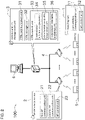
- FIG. 1 is a schematic diagram showing a communication system 100 for one embodiment of the present invention.
- FIG. 2 is an image diagram showing a configuration of the communication system 100.
- the communication system 100 shown in FIG. 1 is used, for example, in a semiconductor manufacturing plant with a plurality of processing devices (not shown) and an automated warehouse with a plurality of stacker racks (not shown).
- the communication system 100 mainly includes a plurality of traveling carts 1 (shown only one in FIG. 1 ), a plurality of wireless base stations 2, a communication management unit (controller) 3, and a wired LAN 4.
- the traveling cart 1 is a transport device that travels over a traveling area consisting of a track 5.
- the track 5 is laid in a semiconductor manufacturing plant, an automated warehouse, or other buildings.
- the traveling cart 1 can be used, for example, to transport a FOUP (Front Opening Unify Pod) and other objects to be transported between processing devices, stacker racks, and the like.
- FOUP Front Opening Unify Pod
- the traveling cart 1 may be, for example, an OHT (Overhead Hoist Transfer), and an OHS (Over Head Shuttle), which are overhead traveling vehicles, and RGV (Rail Guided Vehicles), etc., which are tracked unmanned transport vehicles, and etc., but not limited to.
- OHT Overhead Hoist Transfer
- OHS Over Head Shuttle
- RGV Rail Guided Vehicles
- the track 5 is provided, for example, suspended from the ceiling.
- the communication system 100 of this embodiment can be used for trackless traveling vehicles, for example, with AGVs (Automated Guided Vehicles) which are unmanned transport vehicles.
- travel routes and a traveling area of the traveling cart are substantially defined by guiding tapes such as magnetic tapes attached to the floor surface or guide sections including barcodes or the like.
- the traveling cart 1 has a cart wireless communication unit 11 and a cart control unit 12.
- the traveling cart 1 has a known computer built in.
- This computer is provided with a CPU, an HDD, a ROM, and a RAM, etc.
- the HDD, the ROM and the RAM constitute a cart storage unit that stores various types of information related to a wireless communication.
- the nonvolatile memory of the cart storage unit including the HDD and the ROM, stores programs and the like to realize a wireless communication.
- the computer can be operated as the cart wireless communication unit 11 and the cart control unit 12.
- the cart wireless communication unit 11 performs a wireless communication with the wireless base station 2 in accordance with the prescribed wireless communication standards.
- the wireless communication standards for example, IEEE 802.11, IEEE802.15, and ARIB STD-108, etc. can be used, but are not limited to these.
- the wireless communication can be realized by a wireless LAN that conforms to the wireless communication standards, etc., exemplified above.
- the cart wireless communication unit 11 performs a wireless communication with one wireless base station 2, out of the plurality of the wireless base stations 2, corresponding to a traveling position of the traveling cart 1.
- the wireless communication coverage areas of the plurality of the wireless base stations 2 are different from each other. Therefore, the wireless base station 2 with which the cart wireless communication unit 11 performs a wireless communication varies according to the traveling position of the traveling cart 1.
- the cart control unit 12 generates cart side transmission information and controls a wireless communication performed by the cart wireless communication unit 11.
- the cart side transmission information is information to be transmitted to the communication management unit 3.
- the cart side transmission information includes traveling position information etc.
- the traveling position information indicates the traveling position of the traveling cart 1.
- the traveling position information may include a cart status of the traveling cart 1.
- the cart status may be a target position, speed, acceleration/deceleration, operating status, or the like.
- the cart position information may include environmental information in the vicinity of the traveling cart 1.
- the cart control unit 12 instructs the cart wireless communication unit 11 on the transmission rate for being used in a wireless communication. This instruction of the transmission rate will be described later in detail.
- the cart control unit 12 acquires traveling position information indicating the traveling position of the vehicle itself in the traveling area by a position sensor or the like (not shown) attached to the traveling cart 1. This acquisition of traveling position information is performed, for example, as follows.
- the position sensor attached to the traveling cart 1 includes an optical receiver, for example.
- a plurality of optical transmitters are provided along the track 5 which the traveling cart 1 travels along.
- the coordinates of each optical transmitter in the traveling area, in correspondence with the identification information of each optical transmitter, are stored in the cart storage unit.
- Each optical transmitter transmits an optical signal including the identification information to identify the optical transmitter itself.
- the position sensor optical receiver
- the cart control unit 12 of the traveling cart 1 acquires the traveling position information of the traveling cart itself by identifying the optical transmitter based on the received optical signal.
- a plurality of indicators are provided along with the track 5 which the traveling cart 1 travels along, and the cart control unit 12 of the traveling cart 1 may acquire the traveling position information of the traveling cart itself by identifying the indicator based on the information read by an indicator reader (not shown).
- indicator reader not shown
- reference marks ID tags
- the cart control unit 12 of the traveling cart 1 may acquire the traveling position information of the traveling cart 1 itself by computing the distance from the reference mark by counting wheel encoder outputs.
- the cart control unit 12 describes the traveling position information of the traveling cart 1 itself acquired as described above in the cart side transmission information, and transmits it to the wireless base station 2 via the cart wireless communication unit 11. This allows the position of the traveling cart 1 to be notified to the communication management unit 3, which will be described below.
- the correspondence relationship between the identification information of the optical transmitter and the coordinates of the optical transmitter may be stored on the communication management unit 3 side instead of being stored in the traveling cart 1.
- the cart control unit 12 transmits the received identification information of the optical transmitter to the communication management unit 3 via the wireless base station 2 as traveling position information.
- the wireless base station 2 is a so-called access point that is connected to the communication management unit 3 via the wired LAN 4 using LAN cables.
- the wireless base station 2 performs wired communication with the communication management unit 3.
- the wired LAN 4 has an appropriate number of switching hubs 40.
- the wireless base station 2 performs wired communication with the communication management unit 3, and forms a wireless network around itself.
- the wireless base station 2 can perform a wireless communication with the traveling cart 1 that exists in the wireless communication coverage area around the wireless base station 2 itself.
- a plurality of the wireless base stations 2 are provided along the track 5 so that the entire traveling area in which the traveling cart 1 travels is covered by the wireless communication coverage area of those wireless base stations 2.
- each of the wireless base stations 2 has preset information on which position the traveling cart 1 is the target of a wireless communication by the wireless base station 2, in the traveling area of the traveling cart 1 included in the wireless communication coverage area.
- the wireless base station 2 that has jurisdiction for each position in the traveling area included in the overlapped part is preset.
- the correspondence relationship between each position of the traveling cart 1 and the wireless base station 2 that performs a wireless communication with that traveling cart 1 is predetermined. Therefore, at each position, the traveling cart 1 can somehow acquire in advance which transmission rate is preferred for a wireless communication with the wireless base station 2, and can perform a wireless communication according to the results acquired.
- the wireless base station 2 has a first AP communication unit 21, a second AP communication unit 22, and an AP control unit 23.
- AP is an abbreviation for wireless base station.
- the wireless base station 2 has a known computer built in.
- This computer has a CPU, an HDD, a ROM, and a RAM, etc.
- the HDD, the ROM, and the RAM constitute an AP storage unit (not shown) that stores various types of information related to a wireless communication.
- the nonvolatile memory of the AP storage unit including the HDD and the ROM, stores programs and the like to realize a wireless communication.
- the computer can be operated as the first AP communication unit 21, the second AP communication unit 22, and the AP control unit 23.
- the first AP communication unit 21 complies with the above-mentioned wireless communication standard, and performs a wireless communication with the cart wireless communication unit 11 of the traveling cart 1. Therefore, the traveling cart 1 corresponds to a wireless communication device.
- the first AP communication unit 21 transmits management side transmission information (transmission information) described below to the traveling cart 1 with an appropriate transmission rate.
- the management side transmission information is information received from the communication management unit 3 by the second AP communication unit 22.
- the second AP communication unit 22 performs wired communication with the communication management unit 3 via the wired LAN 4.
- the communication management unit 3 corresponds to a different communication device than the traveling cart 1 (that is, another communication device).
- the second AP communication unit 22 transmits cart side transmission information to the communication management unit 3.
- the cart side transmission information is information received from the traveling cart 1 by the first AP communication unit 21.
- the AP control unit 23 controls communications performed by the first AP communication unit 21 and the second AP communication unit 22.
- the AP control unit 23 instructs the transmission rate for being used in a wireless communication to the first AP communication unit 21. This instruction of the transmission rate will be described later in detail.
- the communication management unit 3 is a computer used to manage each of the plurality of traveling carts 1.
- the communication management unit 3 assigns each of a plurality of transport tasks to any of the plurality of traveling carts 1 that are managed, so as to determine the travel route and the like for each of the traveling carts 1.
- the transport tasks are given by a transport management unit 6, etc. in upper layer shown in FIG. 1 or FIG. 2 .
- the transport management unit 6 comprehensively controls the transport system to which the communication system 100 is applied.
- the transport management unit 6 includes one or more computers and performs various controls associated with transport management.
- the communication management unit 3 includes a CTRL communication unit 31, a CTRL storage unit 32, and a CTRL control unit 33.
- CTRL is an abbreviation for controller.
- the communication management unit 3 is, for example, configured as a known computer having a CPU, a ROM, a RAM, an HDD, and the like, which are not shown.
- the ROM, the RAM, and the HDD store various programs and data related to management.
- the computer can be operated as the CTRL communication unit 31, the CTRL storage unit 32, and the CTRL control unit 33.
- the CTRL communication unit 31 is connected to the second AP communication unit 22 of the wireless base station 2 via the wired LAN.
- the CTRL communication unit 31 performs wired communication with the second AP communication unit 22.
- the CTRL communication unit 31 transmits management side transmission information by performing wired communication with the second AP communication unit 22 included in the wireless base station 2.
- the first AP communication unit 21 forwards the management side transmission information to the target traveling cart 1 via a wireless communication. That is, the communication management unit 3 communicates with the traveling cart 1 via the wireless base station 2.
- the CTRL storage unit 32 includes the HDD, the ROM, and the like.
- the CTRL storage unit 32 stores programs to realize a wireless communication, a transmission rate table, and the like.
- the transmission rate table is used to instruct the transmission rate for being used in a wireless communication between the traveling cart 1 and the wireless base station 2.
- the transmission rate table designates, as shown in FIG. 3 for example, correspondence relationships between a number of positions (PI, P2, ..., Pn) belonging to the traveling area in which the traveling cart 1 is traveling, a plurality of recommended transmission rates when the traveling cart 1 is at each position (PI, P2, ..., Pn), and communication quality information at each transmission rate.
- FIG. 1 shows only two positions Pa, Pb as representatives, among the many positions P1, P2, ..., Pn that cover the entire traveling area.
- the transmission rates included in the transmission rate table are all recommended from the aspect of a high-quality wireless communication.
- the transmission rate table may, for example, only designate correspondence relationships between positions and transmission rates.
- a separate table designating the correspondence relationships between each transmission rate and communication quality information may be stored.
- the transmission rate table does not have to designate the correspondence relationships between each position included in the traveling area in which the traveling cart 1 travels and the transmission rate. For example, it may indicate correspondence relationships between each route range (equivalent to a line segment of a predetermined length) included in the traveling area and the transmission rate. Alternately, it may indicate the correspondence relationships between each area of a predetermined length (equivalent to a surface of a predetermined area) included in the traveling area and the transmission rate.
- the transmission rate table is prepared in advance based on previously acquired data. Specifically, when commissioning the communication system 100 for example, at each position of the traveling cart 1, a survey (survey work) is conducted on the transmission rate that enables a high-quality wireless communication with the wireless base station 2 that has jurisdiction over that position.
- the traveling cart 1 moves to a number of positions P1, P2, ..., Pn in the traveling area in order. At each position, the traveling cart 1 stops and performs a test wireless communication with the wireless base station 2 that has jurisdiction over that position using a number of different transmission rates. If the wireless base station 2 successfully receives data from the traveling cart 1, the wireless base station 2 transmits response data to the traveling cart 1 at the same transmission rate as that used by the traveling cart 1 for transmission.
- the traveling cart 1 and/or the wireless base station 2 aggregates the number of transmissions, the number of times they were able to receive within a predetermined time period after transmission, etc., with respect to the current position of the traveling cart 1. This makes it possible to acquire communication quality information for each of the different transmission rates.
- communication quality information may include the well-known packet error rate, timeout occurrence rate, transmission success rate, number of retransmissions, or the like. As long as it is possible to determine whether the wireless communication is good or bad for each of the transmission rates, there is no limitation on the format of the communication quality information and its computation (acquisition) method.
- the communication management unit 3 performs wired communication with the wireless base station 2 to acquire, for one position, communication quality information corresponding to each of the plurality of transmission rates used in the wireless communication which was performed by the traveling cart 1 and/or the wireless base station 2.
- the communication management unit 3 acquires this communication quality information for each of a number of positions P1, P2, ..., Pn.
- the communication management unit 3 can acquire the position information of the traveling cart 1 from the cart side transmission information received from the traveling cart 1 via the wireless base station 2.
- the communication management unit 3 can directly acquire communication quality information aggregated on the sides of the traveling cart 1 and/or wireless base station 2. Alternately, the communication management unit 3 itself may acquire communication quality information by aggregating the success or failure of a wireless communication via the wireless base station 2.
- the communication management unit 3 extracts, per one position at which the traveling cart travels, one or more transmission rates that achieved a communication quality that is equal to or higher than the preset communication quality threshold among the plurality of transmission rates which were used for a wireless communication performed at this position, and arrange them in order of best communication quality. If there is only one transmission rate that met the above condition, only one transmission rate is described in the table with respect to the position of the traveling cart 1.
- the communication management unit 3 generates a transmission rate table by associating at least one transmission rate created as described above to the position information of the traveling cart 1.
- the transmission rate table is not limited to being generated as described above.
- the transmission rate table may be generated, without being based on a survey using actual equipment, but for example based on the operating history data of other semiconductor manufacturing plants or automatic warehouses, where the positions at which the traveling cart 1 travels and the wireless base stations 2 are located in the same relationship.
- the transmission rate table may be generated by a machine-learned model trained by the positional relationship between each position of the traveling cart 1 and the wireless base station, the existence and types of obstacles between them, etc., and the corresponding transmission rate of communication.
- the transmission rate table may be generated by a management device provided separately from the communication management unit 3.
- the transmission rate table is stored in a memory in the CTRL storage unit 32 whose contents can be rewritten. Therefore, the contents of the transmission rate table can be updated as appropriate.
- the CTRL control unit 33 includes the transmission information generator 34, a communication quality acquisition unit 35, and a transmission rate table updating unit 36.
- the transmission information generator 34 generates management side transmission information.
- the management side transmission information is information transmitted from the communication management unit 3 to the traveling cart 1 via the wireless base station 2.
- This management side transmission information includes query information to inquire about the status of the traveling cart 1, or transport task information to instruct the above-mentioned transport task to the traveling cart 1.
- the management side transmission information is described in the communication frame transmitted from the communication management unit 3 to the wireless base station 2.
- the communication frame in which the management side transmission information is described may be referred to as management side transmission frame.
- the transmission rate information for a wireless communication between the wireless base station 2 and the traveling cart 1 is described in this management side transmission frame.
- the transmission rate information includes one or more recommended transmission rates corresponding to the position of the traveling cart 1, acquired by referring to a transmission rate table.
- the description of the transmission rate information is performed by the transmission information generator 34.
- An example of the management side transmission frame is shown in FIG. 4 .
- the communication quality acquisition unit 35 acquires communication quality information for each transmission rate used in a wireless communication performed between the traveling cart 1 and the wireless base station 2.
- This communication quality information includes, for example, at least some of the above-mentioned number of transmissions, number of times received within a predetermined time period after transmission, timeout occurrence rate, packet error rate, transmission success rate, and number of retransmissions.
- the communication quality information can be acquired through wired communication between the CTRL communication unit 31 and the wireless base station 2.
- Acquisition of the communication quality information can be realized, for example, by the communication quality acquisition unit 35 acquiring the communication quality information as it is, which is aggregated and acquired by the traveling cart 1 and/or the wireless base station 2.
- the communication quality information is acquired via wired communication between the traveling cart 1 and the wireless base station 2.
- the communication quality information can also be acquired on the communication quality acquisition unit 35 side by aggregating relevant data.
- the relevant data is the number of times that the cart side transmission information, which is the response information to the management side transmission information, was able to be received within a predetermined time after the management side transmission information was transmitted via the CTRL communication unit 31, or the like. It is preferable to acquire this communication quality information together with the corresponding transmission rate, position information of the position of the traveling cart 1 where the wireless communication using the transmission rate was performed, or the like.
- the CTRL control unit 33 makes the CTRL storage unit 32 store the communication quality information acquired by the communication quality acquisition unit 35.
- the communication quality information is stored in the CTRL storage unit 32 while being associated with the transmission rate used in acquiring the communication quality information, the position information indicating the position where the wireless communication using this transmission rate is performed (i.e., the traveling position information of the traveling cart 1 where the wireless communication took place), and the information (e.g., wireless base station number, MAC address, etc.) identifying the traveling base station 2 which is the wireless communication partner of the traveling cart 1.
- the transmission rate table updating unit 36 can update the contents of the transmission rate table stored in the CTRL storage unit 32. For example, when a plurality of transmission rates are described in the transmission rate table corresponding to the position information, the order in which transmission rates are recommended may change as a result of newly acquired communication quality information by the communication quality acquisition unit 35. In this case, the transmission rate table updating unit 36 updates the transmission rate table to reflect the new communication quality information.
- the communication management unit 3 transmits the management side transmission information generated by the transmission information generator 34 via the CTRL communication unit 31, every 100 milliseconds for example. At this time, the communication management unit 3 transmits not only the management side transmission information, but the transmission rate information indicating at which transmission rate the wireless base station 2 should communicate with the traveling cart 1 to the wireless base station 2. This transmission rate information is generated by the communication management unit 3 using the transmission rate table.
- the wireless base station 2 determines the transmission rate for a wireless communication with the traveling cart 1.
- the wireless base station 2 performs a wireless communication with the traveling cart 1 using this transmission rate, and transmits the management side transmission information and transmission rate information to the traveling cart 1.
- the traveling cart 1 After receiving the management side transmission information from the wireless base station 2, the traveling cart 1 generates the cart side transmission information as a response to the management side transmission information.
- This cart side transmission information includes the traveling position information of the traveling cart 1 itself acquired by the position sensor. Based on the received transmission rate information, the traveling cart 1 determines the transmission rate for communicating with the wireless base station 2. The traveling cart 1 performs a wireless communication with the wireless base station 2 using this transmission rate and transmits the cart side transmission information to the wireless base station 2. The wireless base station 2 transmits the cart side transmission information received from the traveling cart 1 to the communication management unit 3 by wired communication.
- the communication management unit 3 determines at least one transmission rate for being used by the traveling cart 1 and the wireless base station 2 depending on the traveling position of the traveling cart 1.
- the communication management unit 3 instructs at least one transmission rate to the traveling cart 1 and the wireless base station 2 in the form of a description in the management side transmission frame.
- the traveling cart 1 travels from the position Pa to the position Pb shown in FIG. 1
- the communication management unit 3 instructs the wireless base station 2 and the traveling cart 1 to use a transmission rate determined according to the traveling position of the traveling cart 1 will be described.
- the communication management unit 3 repeatedly transmits the management side transmission information to the traveling cart 1 at predetermined time intervals.
- the traveling cart 1 transmits the cart side transmission information to the communication management unit 3. Since the cart side transmission information is transmitted by the traveling cart 1 in the form of a response to the management side transmission information, the cart side transmission information may be referred to as response information in the following.
- Mutual communication is performed via the wireless base station 2.
- the traveling cart 1 When the traveling cart 1 receives the management side transmission information while traveling at the position Pa shown in FIG. 1 , it generates the cart side transmission information, which is a response to the management side transmission information.
- the position information of the position Pa is included as the traveling position information of the traveling cart 1 itself.
- the position information can be, for example, the identification information of the optical transmitter provided at the position Pa, or coordinate information based on the identification information.
- the traveling cart 1 wirelessly transmits the cart side transmission information to the wireless base station 2 (traveling position information notification process). As described above, the cart side transmission information is transmitted as a response to the management side transmission information. The transmission of the cart side transmission information by a wireless communication is performed at the transmission rate acquired based on the transmission rate information received by the traveling cart 1, together with the management side transmission information.
- the CTRL control unit 33 waits to receive the cart side transmission information, which is the response to the management side transmission information, from the traveling cart 1 via the wireless base station 2.
- the cart side transmission information is transmitted from the traveling cart 1 to the first AP communication unit 21 of the wireless base station 2.
- the cart side transmission information received by the wireless base station 2 is transmitted to communication management unit 3 by wired communication between the second AP communication unit 22 and the CTRL communication unit 31.
- the CTRL control unit 33 When the CTRL communication unit 31 receives the cart side transmission information, the CTRL control unit 33 reads the traveling position information of the traveling cart 1 from the cart side transmission information. The CTRL control unit 33 acquires the transmission rate corresponding to the position Pa (for example, the portion enclosed by thick lines in FIG. 3 ) from the transmission rate table stored in the CTRL storage unit 32.
- the position Pa is a position indicated in the traveling position information.
- three transmission rates (DBPS values) are described in the transmission rate table.
- the DBPS value is the number of bits per symbol, and DBPS is an abbreviation for Data Bit Per Symbol.
- MCS Modulation Coding Scheme
- the transmission information generator 34 creates management side transmission information and describes the management side transmission information in a single communication frame.
- the transmission information generator 34 also generates transmission rate information TRa including three transmission rates acquired as described above from the transmission rate table and describes this transmission rate information TRa in the communication frame in which the management side transmission information is described.
- the management side transmission frame is generated.
- the management side transmission frame follows the known L2 frame.
- the transmission rate information TRa is described at the beginning of the data body (payload) of the L2 frame.
- the transmission rate information TRa is represented by the DBPS value corresponding to each transmission rate (or the MCS value). In the example in FIG.
- the transmission rate information TRa corresponding to the position Pa is represented by three transmission rates, which are DBPS values (208, 104, 52).
- the three DBPS values are described at the beginning of the data body of the L2 frame in order of best communication quality. In other words, in order of most recommended.
- six bytes are used to describe one DBPS value. Therefore, in the example in FIG. 4 , eighteen bytes, three times six bytes, are allocated at the beginning of the payload of the L2 frame.
- the management side transmission information (for example, the query information described above) is described in the 19th and succeeding bytes of the payload.
- the management side transmission information and the transmission rate to be instructed to the wireless base station 2 are described in the data body of the same L2 frame.
- the CTRL control unit 33 transmits the transmission rate information and management side transmission information to the second AP communication unit 22 of the wireless base station 2a by the transmission information generator 34 (transmission rate indication process). This transmission is performed via the CTRL communication unit 31.
- the AP control unit 23 of the wireless base station 2a retrieves the transmission rate described first from the beginning in the transmission rate information (for example, a plurality of DBPS values).
- the transmission rate information is described in the communication frame received from the communication management unit 3 via the AP communication unit 22.
- the AP control unit 23 of wireless base station 2a instructs this transmission rate to the first AP communication unit 21.
- the first AP communication unit 21 wirelessly transmits the management side transmission information received via the second AP communication unit 22 to the corresponding traveling cart 1 (communication process).
- this communication process is realized by transmitting the management side transmission frame (including transmission rate information in addition to management side information) to the traveling cart 1 as it is.
- the transmission rate at this time is determined according to the transmission rate indicated by the AP control unit 23 (DBPS value: 208).
- the AP control unit 23 acquires the communication quality of the wireless communication, which uses the instructed transmission rate (DBPS value: 208). As described above, this communication quality information can be acquired by determining whether or not response information (cart side transmission information) to the management side transmission information was received within a predetermined time period after the management side transmission information was wirelessly transmitted to the traveling cart 1, or the like. The AP control unit 23 monitors the communication quality based on this aggregate result.
- the communication quality information may include, for example, the result of how many retransmissions were made out of the predetermined number of performing times (e.g., five times) in the wireless communication between the wireless base station 2a and the traveling cart 1 at a specific transmission rate. More specifically, for example, a wireless communication was performed between the wireless base station 2a and the traveling cart 1 using each of three DBPS values (208, 104, 52) as the transmission rates. Out of five performing times, retransmission occurred three times when the DBPS value was 208, retransmission occurred two times when the DBPS value was 104, retransmission occurred one time when the DBPS value was 52.
- the communication quality information includes the result above. The communication quality information is notified to the communication management unit 3 (communication quality acquisition unit 35) via the wireless base station 2a.
- the AP control unit 23 instructs the DBPS value (104) described second from the beginning in the transmission rate information received most recently to the first AP communication unit 21.
- the first AP communication unit 21 performs a wireless communication at the transmission rate (DBPS value: 104) according to the instruction from the AP control unit 23.
- the AP control unit 23 outputs the above instructions for changing the transmission rate to the first AP communication unit 21, and notifies the communication quality information corresponding to the transmission rate (DBPS value: 208) to the communication management unit 3 at the appropriate timing.
- the communication quality information for each of the transmission rates at which a wireless communication was performed may be notified to the communication management unit 3 at the appropriate timing.
- the traveling cart 1 receives the management side transmission information transmitted from the wireless base station 2a via the cart wireless communication unit 11.
- the traveling cart 1 is traveling from the position Pa to the position Pb, but at the time of reception of the management side transmission information, it has not yet been reached to the position Pb.
- the cart control unit 12 of the traveling cart 1 When the cart control unit 12 of the traveling cart 1 receives the management side transmission information via the cart wireless communication unit 11, it generates the cart side transmission information.
- This cart side transmission information includes current traveling position information (position Pa) of the traveling cart 1 itself, etc.
- the cart control unit 12 instructs the transmission rate to the cart wireless communication unit 11.
- the transmission rate is used when the cart wireless communication unit 11 transmits the cart side transmission information to the wireless base station 2a.
- DBPS value: 208 the management side transmission information at the transmission rate
- the cart control unit 12 retrieves the firstly-listed DBPS value (208) in the transmission rate information (for example, a plurality of DBPS values) that is received.
- the cart control unit 12 instructs this DBPS value as the transmission rate to the cart wireless communication unit 11.
- the cart wireless communication unit 11 transmits the cart side transmission information to the first AP communication unit 21 of the wireless base station 2a, using the transmission rate instructed by the cart control unit 12 (DBPS value: 208).
- the cart control unit 12 acquires the communication quality information of the wireless communication at the transmission rate (DBPS value: 208) as described above, and monitors the communication quality.
- the cart control unit 12 instructs the secondly-listed DBPS value (104) in the transmission rate information received most recently to the cart wireless communication unit 11.
- the cart wireless communication unit 11 performs a wireless communication at the transmission rate (DBPS value: 104) according to the instruction from the cart control unit 12.
- the transmission rate information described in the management side transmission frame is used, practically speaking, to instruct the transmission rate not only to the wireless base station 2a, but also to the traveling cart 1.
- the cart control unit 12 outputs the above instructions for changing the transmission rate to the cart wireless communication unit 11, and notifies the communication quality information corresponding to the transmission rate (DBPS value: 208) to the communication management unit 3 at the appropriate timing.
- the wireless base station 2a transmits the cart side transmission information received via the first AP communication unit 21 to the CTRL communication unit 31 of the communication management unit 3. This transmission is performed via the second AP communication unit 22.
- the traveling cart 1 has reached the position Pb at the time it receives the management side transmission information from the wireless base station 2a.
- the position Pb which is current traveling position information of the traveling cart 1 itself, is described in the cart side transmission information generated by the cart control unit 12.
- This cart side transmission information is transmitted via the wireless base station 2a to the CTRL control unit 33 of the communication management unit 3.
- the CTRL control unit 33 of the communication management unit 3 receives the cart side transmission information
- the CTRL control unit 33 acquires the wireless base station 2 that has jurisdiction over the position Pb. This acquisition is based on the position Pb which is the new traveling position information of the traveling cart 1. In this embodiment, it is the wireless base station 2b shown in FIG. 1 that has jurisdiction over the position Pb. Therefore, the wireless base station 2b is the switching destination, where the traveling cart 1 switches the wireless communication partner from the wireless base station 2a.
- the CTRL control unit 33 acquires one or more transmission rates corresponding to the position Pb based on the transmission rate table stored in the CTRL storage unit 32.
- the CTRL control unit 33 generates transmission rate information TRb.
- the transmission information generator 34 generates new management side transmission information.
- the transmission rate information TRb acquired as described above is described in the management side transmission frame transmitted from the communication management unit 3 to the wireless base station 2b.
- the CTRL control unit 33 transmits the new management side transmission information generated by the transmission information generator 34 to the wireless base station 2b via the CTRL communication unit 31.
- the wireless base station 2b can perform a wireless communication with the traveling cart 1 smoothly by referring to the transmission rate information received from the communication management unit 3.
- the transmission rate can be suitably determined even at the initial stage of a wireless communication.
- the communication system 100 in this embodiment includes the traveling cart 1, the wireless base station 2, and the communication management unit 3.
- the traveling cart 1 travels in the predetermined traveling area in the building.
- the communication management unit 3 communicates with the traveling cart 1 via the wireless base station 2.
- the traveling cart 1 includes the cart wireless communication unit 11 and the cart control unit 12.
- the cart wireless communication unit 11 performs a wireless communication with the wireless base station 2.
- the cart control unit 12 can transmit traveling position information indicating the traveling position of the traveling cart 1 itself in the traveling area to the wireless base station 2 via the cart wireless communication unit 11.
- the wireless base station 2 includes the first AP communication unit 21 and the second AP communication unit 22.
- the first AP communication unit 21 performs a wireless communication with the traveling cart 1.
- the second AP communication unit 22 performs a communication with the communication management unit 3.
- the communication management unit 3 includes the CTRL communication unit 31, the CTRL storage unit 32, and the CTRL control unit 33.
- the CTRL communication unit 31 communicates with the wireless base station 2.
- the CTRL storage unit 32 stores the transmission rate table designating the correspondence relationships between position information, which indicates a plurality of the positions where the traveling cart 1 can travel in the traveling area, and at least one transmission rate recommended for a wireless communication performed by the traveling cart 1 and the wireless base station 2 when the traveling cart 1 is at each of the positions.
- the CTRL control unit 33 acquires at least one transmission rate information from the transmission rate table based on the position information corresponding to the traveling position information of the traveling cart 1. The traveling position information of the traveling cart 1 is received via the wireless base station 2.
- the CTRL control unit 33 generates the transmission rate information from the acquired transmission rate which is acquired.
- the CTRL control unit 33 transmits the transmission rate information, which is generated, and the management side transmission information to be transmitted to the traveling cart 1 to the wireless base station 2 via the CTRL communication unit 31.
- the wireless base station 2 receives the transmission rate information and the management side transmission information by communication with the second AP communication unit 22 and the CTRL communication unit 31, the wireless base station 2 transmits the management side transmission information to the traveling cart 1 at the transmission rate acquired from the transmission rate information, via the first AP communication unit 21.
- the wireless base station 2 determines the preferable transmission rate for wireless transmission of the management side transmission information to the traveling cart 1, according to the traveling position of the traveling cart 1. Therefore, retransmissions caused by wireless transmission at an inappropriate transmission rate can be suppressed.
- the wireless base station 2 transmits the management side transmission information and the transmission rate information to the traveling cart 1 via the first AP communication unit 21.
- the cart wireless communication unit 11 performs a wireless communication with the wireless base station 2 at the transmission rate, which is acquired from the transmission rate information received from the wireless base station 2.
- the CTRL control unit 33 of the communication management unit 3 includes the communication quality acquisition unit 35 and the transmission rate table updating unit 36.
- the communication quality acquisition unit 35 acquires the communication quality when the wireless base station 2 and the traveling cart 1 perform a wireless communication at the transmission rate, which is recommended corresponding to the position of the traveling cart 1, as the communication quality information.
- the transmission rate table updating unit 36 updates the transmission rate table stored in the CTRL storage unit 32 based on the communication quality information acquired by the communication quality acquisition unit 35.
- the wireless base station 2 can stably transmit the management side transmission information to the traveling cart 1 even if the condition related to wireless communication changes.
- the wireless base station 2 includes an AP control unit 23.
- the AP control unit 23 acquires the transmission rate from the transmission rate information received from the communication management unit 3 via the second AP communication unit 22.
- the first AP communication unit 21 performs a wireless communication with the traveling cart 1 at the transmission rate selected in advance by the communication management unit 3 from the plurality of transmission rates.
- the communication management unit 3 can communicate with a plurality of wireless base stations 2 via the CTRL communication unit 31.
- the CTRL control unit 33 transmits the transmission rate information corresponding to the position where the traveling cart 1 is traveling and the management side transmission information to the wireless base station 2, which is the switching destination of the wireless communication partner of the traveling cart 1 via the CTRL communication unit 31.
- the wireless base station 2 which is the switching destination can start a preferable wireless communication with the traveling cart 1 immediately by using the transmission rate recommended by the communication management unit 3.
- the traveling cart 1 performs a wireless communication with the wireless base station 2 at each of the positions and at each of a plurality of different transmission rates.
- the transmission rate table is created by associating at least one transmission rate used for the wireless communication that was able to communicate at a quality higher than the predetermined level and the position information for each of the positions.
- the transmission rate information indicating the transmission rate and the management side transmission information are described in the communication frame transmitted by the CTRL communication unit 31 to the wireless base station 2.
- both the transmission rate information and the management side transmission information are described in the data body part in the communication frame.
- the traveling position of the traveling cart 1 at the time when the traveling cart 1 or the wireless base station 2 will receive the management side transmission information is estimated by the communication management unit 3.
- This estimation can be made based on the traveling position of the traveling cart 1 itself most recently detected by the position sensor, and using information such as the direction and speed of the traveling cart 1 since the timing of this detection.
- the information necessary for the above estimation is included in the cart side transmission information generated by the traveling cart 1 and transmitted to the communication management unit 3.
- the communication management unit 3 transmits the transmission rate information corresponding to the traveling position of the traveling cart 1 estimated as described above together with the management side transmission information to the wireless base station 2.
- the wireless base station 2 performs a wireless communication at the firstly-listed transmission rate in the transmission rate information included in the management side transmission frame.
- the traveling cart 1 Even if the traveling cart 1 receives the management side transmission frame from the wireless base station 2, the traveling cart 1 does not acquire the transmission rate from the management side transmission frame.
- the traveling cart 1 acquires the transmission rate by reading the information and the like contained in the preamble when the wireless base station 2 transmits the management side transmission information to the traveling cart 1. In other words, this transmission rate is the transmission rate that was actually used by the wireless base station 2 in a wireless communication.
- the traveling cart 1 performs a wireless communication with the wireless base station 2 using the same transmission rate acquired from the actual communication, not the transmission rate acquired from the management side transmission frame.
- the traveling cart 1 to perform a wireless communications at the same transmission rate as the wireless base station 2, as in the embodiments, etc., described above.
- the description of the transmission rate information can be omitted in the communication frame transmitted from the wireless base station 2 to the traveling cart 1.
- the transmission rate information consists of only one most recommended transmission rate, rather than a plurality of transmission rates.
- the communication management unit 3 transmits this transmission rate information together with the management side transmission information to the wireless base station 2.
- the wireless base station 2 transmits the management side transmission information to the traveling cart 1 according to the transmission rate.
- the communication quality acquisition unit 35 of the communication management unit 3 acquires communication quality information by performing various aggregation processes. For example, the communication quality acquisition unit 35 counts the number of times the communication management unit 3 transmitted the management side transmission information and the number of times the communication management unit 3 was able to receive the cart side transmission information within a predetermined time period after transmission. The communication quality acquisition unit 35 acquires communication quality information by calculating the ratio of the two count values.
- the communication quality acquisition unit 35 monitors the acquired communication quality information. When a decrease in communication quality is detected, the transmission rate stored in the transmission rate table as the second recommended one is used as the transmission rate information transmitted by the communication management unit 3 to the wireless base station 2. In addition, the communication management unit 3 updates the transmission rate table stored by the CTRL storage unit to reflect the communication quality degradation detected for the transmission rate that has been used until now. This updating is performed by the transmission rate table updating unit 36.
- the transmission rate information may be described at any position, at the end for example, instead of at the beginning of the data body of the communication frame.
- the transmission rate information may be described in a part other than the data body of the communication frame.
- the management side transmission information and the transmission rate information may be transmitted in separate communication frames.
- the transmission rate table may be configured to store only one recommended transmission rate per one position of the traveling cart 1. In this case, the transmission rate information always consists of only one transmission rate.
- the track 5 is not limited to be included in the same plane, but may be set up three-dimensionally in three-dimensional space, for example.
- the CTRL control unit 33 of the communication management unit 3 can acquire one or more transmission rates with the best communication quality, by comparing the communication quality information of each transmission rate.
- the transmission rate table updating unit 36 does not reorder the transmission rates in the transmission rate table, but instead simply reflects the new communication quality information.
- the transmission rate information based on one or more recommended transmission rates corresponding to the current position of the traveling cart 1, which is determined by referring to the transmission rate table, is described in the management side transmission information by the transmission information generator 34, and the management side transmission information is transmitted to the traveling cart 1.
- transmission rate information based on one or more recommended transmission rates corresponding to the future position of the traveling cart 1, which is determined by referring to the transmission rate table may be described in the management side transmission information, which is to be transmitted to the traveling cart 1.
- the future position of the traveling cart 1 is the position where the traveling cart 1 is expected to be after a given time period.
- the future position can be computed based on, for example, the current position of the traveling cart 1 acquired by the position sensor and the current speed of the traveling cart 1.
- traveling position information is not limited to the above and may be done, for example, by optically reading barcode or other marking information on the track 5, or by using an indoor GNSS or the like.
- the transmission rate table may be stored in both the traveling cart 1 and the communication management unit 3.
- the traveling cart 1 performs a wireless communication at the transmission rate read from the stored transmission rate table based on the position of the traveling cart 1 itself. This allows the traveling cart 1 to always perform a wireless communication without delay at the recommended transmission rate with respect to the position of the traveling cart 1 itself.
- the description of the transmission rate information may be omitted in the management side transmission frame.
- the wireless base station 2 and the traveling cart 1 determine the transmission rate during a wireless communication based on the transmission rate information described in the most recently received management side transmission frame.
- Communication between the communication management unit 3 and the wireless base station 2 may be performed wirelessly.
Landscapes
- Engineering & Computer Science (AREA)
- Computer Networks & Wireless Communication (AREA)
- Signal Processing (AREA)
- Quality & Reliability (AREA)
- Mobile Radio Communication Systems (AREA)
Abstract
Description
- This invention mainly relates to a wireless communication between a wireless communication device and a wireless base station. More particularly, it relates to determining a transmission rate according to a position of the wireless communication device that moves.
- Conventionally, there are known wireless communication devices that use trial communication to determine the transmission rate to be used in a wireless communication between devices that communicate with each other before starting a normal wireless communication.
PTL 1 discloses this type of wireless communication device. - The wireless communication device in
PTL 1 is configured to set a base transmission rate based on a signal quality such as received radio wave strength with the communication device to be communicated with before data transmission (a normal wireless communication), store it in the memory, and use it during data transmission. - PTL 1:
Japanese Unexamined Patent Application Publication No. 2018-019307 - However, in the configuration of
PTL 1 above, when the communication device to which the wireless communication device communicates moves, the received radio wave strength changes as the communication device moves, so the base transmission rate must be reset each time the communication device moves, resulting in frequent transmission delays. - The present invention is made in view of the circumstances described above, and an object of the present invention is to provide a communication system that can quickly and appropriately indicate the transmission rate for being used in a wireless communication with a traveling cart that moves.
- The problem to be solved by the present invention is as described above, and next, means for solving the problem and effects thereof will be described.
- In a first aspect of the present invention, a communication system having the following configuration is provided. That is, the communication system includes a traveling cart traveling in a predetermined traveling area in a building, a wireless base station, and a controller communicating with the traveling cart via the wireless base station. The traveling cart includes a cart wireless communication unit and a cart control unit. The cart wireless communication unit performs a wireless communication with the wireless base station. The cart control unit can transmit traveling position information indicating a traveling position of the traveling cart itself in the traveling area to the wireless base station via the cart wireless communication unit. The wireless base station includes a first wireless base station communication unit and a second wireless base station communication unit. The first wireless base station communication unit performs a wireless communication with the traveling cart. The second wireless base station communication unit performs a communication with the controller. The controller includes a controller communication unit, a controller storage unit, and a controller control unit. The controller communication unit communicates with the wireless base station. The controller storage unit stores a transmission rate table designating correspondence relationships between position information indicating a plurality of positions where the traveling cart can travel in the traveling area and at least one transmission rate recommended for a wireless communication performed by the traveling cart and the wireless base station when the traveling cart is at each of the positions. The controller control unit acquires at least one transmission rate from the transmission rate table based on the position information corresponding to the traveling position information of the traveling cart received via the wireless base station, and generates transmission rate information from the transmission rate which is acquired. The controller control unit transmits the transmission rate information which is generated and the transmission information to be transmitted to the traveling cart to the wireless base station via the controller communication unit. When the wireless base station receives the transmission rate information and the transmission information by communication between the second wireless base station communication unit and the controller communication unit, the wireless base station transmits the transmission information to the traveling cart at the transmission rate acquired from the transmission rate information, via the first wireless base station communication unit.
- This allows the wireless base station to determine the preferable transmission rate for wireless transmission of the transmission information to the traveling cart, according to the traveling position of the traveling cart. Therefore, retransmissions caused by wireless transmission at an inappropriate transmission rate can be suppressed.
- The communication system may be configured as follows. That is, the wireless base station transmits the transmission information and the transmission rate information to the traveling cart via the first wireless base station communication unit. The cart wireless communication unit performs a wireless communication with the wireless base station at the transmission rate which is acquired from the transmission rate information received from the wireless base station.
- In this case, the traveling cart can perform a wireless communication at the preferable transmission rate according to its traveling position.
- The communication system may be configured as follows. That is, the cart wireless communication unit performs a wireless communication with the wireless base station at the same transmission rate as that used by the wireless base station when the wireless base station performed a communication with the cart wireless communication unit.
- In this case, the traveling cart can perform a wireless communication at the preferable transmission rate according to its traveling position.
- It is preferable that the communication system is configured as follows. That is, the controller control unit of the controller includes a communication quality acquisition unit and a transmission rate table updating unit. The communication quality acquisition unit acquires a communication quality when the wireless base station and the traveling cart perform a wireless communication at the transmission rate, which is recommended corresponding to the position of the traveling cart, as communication quality information. The transmission rate table updating unit updates the transmission rate table stored in the controller storage unit based on the communication quality information acquired by the communication quality acquisition unit.
- This allows the recommended transmission rate to be flexibly changed in response to changes in the wireless communication environment or the like. As a result, the wireless base station can stably transmit the transmission information to the traveling cart even if the condition related to the wireless communication changes.
- It is preferable that the communication system is configured as follows. That is, the wireless base station includes a wireless base station control unit that acquires the transmission rate from the transmission rate information received from the controller via the second wireless base station communication unit. When there are a plurality of transmission rates acquired from the transmission rate information by the wireless base station control unit, the first wireless base station communication unit transmits the transmission information to the traveling cart at the transmission rate selected from the plurality of transmission rates.
- This allows the wireless base station to transmit the transmission information to the traveling cart while choosing depending on the case from the plurality of transmission rates that are recommended.
- It is preferable that the communication system is configured as follows. That is, the controller can communicate with a plurality of the wireless base stations via the controller communication unit. When it is necessary to switch the wireless base station that is a wireless communication partner of the traveling cart due to the traveling position of the traveling cart, the controller control unit transmits the transmission rate information corresponding to the position where the traveling cart is traveling, and the transmission information to the wireless base station, which is a switching destination of the wireless communication partner of the traveling cart via the controller communication unit.
- This allows, even if the wireless base station that is the wireless communication partner of the traveling cart is switched, the wireless base station which is the switching destination can start a preferable wireless communication with the traveling cart immediately by using the transmission rate recommended by the controller.
- It is preferable that the communication system is configured as follows. That is, in advance, the traveling cart performs a wireless communication with the wireless base station at each of the positions and at each of a plurality of different transmission rates. The transmission rate table is created by associating at least one transmission rate used for the wireless communication that was able to communicate at a quality higher than a predetermined level and the position information for each of the positions.
- This allows the recommended transmission rate to be accurately determined.
- In the communication system, it is preferable that the transmission rate information and the transmission information are described in a communication frame transmitted by the controller communication unit to the wireless base station.
- This allows for easy handling of information and more efficient communication by combining information indicating the two into one communication frame.
- In the communication system, it is preferred that both the transmission rate information and the transmission information are described in a data body part in the communication frame.
- This allows for transmission rate instruction to be given to the wireless base station without the need for a specially structured communication frame.
- In a second aspect of the present invention, a following communication method is provided. That is, the communication method is used by a communication system including a traveling cart traveling in a predetermined traveling area in a building, a wireless base station, and a controller that communicates with the traveling cart via the wireless base station. The communication method includes a traveling position information notification process, a transmission rate instruction process, and a communication process. In the traveling position information notification process, the traveling cart transmits traveling position information indicating the traveling position of the traveling cart itself in the traveling area to the wireless base station. In the transmission rate instruction process, based on the traveling position information of the traveling cart received by the controller via the wireless base station, the controller transmits transmission rate information indicating at least one transmission rate recommended for a wireless communication with the wireless base station when the traveling cart is at the traveling position indicated by the traveling position information to the wireless base station. In the communication process, the wireless base station performs a wireless communication with the traveling cart at the transmission rate acquired from the transmission rate information received from the controller.
- This allows the wireless base station to determine the preferable transmission rate for wireless transmission of the transmission information to the traveling cart, according to the traveling position of the traveling cart. Therefore, retransmissions caused by wireless transmission at an inappropriate transmission rate can be suppressed.
- In a third aspect of the present invention, a wireless base station having the following configuration is provided. That is, the wireless base station includes a first wireless base station communication unit, a second wireless base station communication unit, and a wireless base station control unit. The first wireless base station communication unit performs a wireless communication with a wireless communication device that moves. The second wireless base station communication unit performs a communication with another communication device. The wireless base station control unit analyzes a communication frame received from the other communication device via the second wireless base station communication unit and acquires a transmission rate from transmission rate information included in the communication frame. The first wireless base station communication unit performs a wireless communication with the wireless communication device at the transmission rate acquired by the wireless base station control unit from the communication frame.
- This allows a wireless communication by a simple process at a preferable transmission rate with the wireless communication device that moves, without attempting communication to determine the transmission rate.
-
-
FIG. 1 is a schematic diagram showing a communication system for one embodiment of the present invention. -
FIG. 2 is an image diagram showing a configuration of the communication system. -
FIG. 3 is a diagram showing an example of a transmission rate table. -
FIG. 4 is a diagram showing an example of a communication frame of management side transmission information. -
FIG. 5 is a sequence diagram showing an exchange between a communication management unit, a wireless base station, and a traveling cart. - Next, one embodiment of the present invention will be described with reference to the drawings.
FIG. 1 is a schematic diagram showing acommunication system 100 for one embodiment of the present invention.FIG. 2 is an image diagram showing a configuration of thecommunication system 100. - The
communication system 100 shown inFIG. 1 is used, for example, in a semiconductor manufacturing plant with a plurality of processing devices (not shown) and an automated warehouse with a plurality of stacker racks (not shown). As shown inFIG. 1 , thecommunication system 100 mainly includes a plurality of traveling carts 1 (shown only one inFIG. 1 ), a plurality ofwireless base stations 2, a communication management unit (controller) 3, and a wiredLAN 4. - The traveling
cart 1 is a transport device that travels over a traveling area consisting of atrack 5. Thetrack 5 is laid in a semiconductor manufacturing plant, an automated warehouse, or other buildings. The travelingcart 1 can be used, for example, to transport a FOUP (Front Opening Unify Pod) and other objects to be transported between processing devices, stacker racks, and the like. - The traveling
cart 1 may be, for example, an OHT (Overhead Hoist Transfer), and an OHS (Over Head Shuttle), which are overhead traveling vehicles, and RGV (Rail Guided Vehicles), etc., which are tracked unmanned transport vehicles, and etc., but not limited to. - The
track 5 is provided, for example, suspended from the ceiling. However, it is not limited to this, and thecommunication system 100 of this embodiment can be used for trackless traveling vehicles, for example, with AGVs (Automated Guided Vehicles) which are unmanned transport vehicles. In this case, travel routes and a traveling area of the traveling cart are substantially defined by guiding tapes such as magnetic tapes attached to the floor surface or guide sections including barcodes or the like. - The traveling
cart 1, as shown inFIG. 2 , has a cartwireless communication unit 11 and acart control unit 12. The travelingcart 1 has a known computer built in. This computer is provided with a CPU, an HDD, a ROM, and a RAM, etc. The HDD, the ROM and the RAM constitute a cart storage unit that stores various types of information related to a wireless communication. The nonvolatile memory of the cart storage unit, including the HDD and the ROM, stores programs and the like to realize a wireless communication. By the cooperation of the above hardware and software, the computer can be operated as the cartwireless communication unit 11 and thecart control unit 12. - The cart
wireless communication unit 11 performs a wireless communication with thewireless base station 2 in accordance with the prescribed wireless communication standards. The wireless communication standards, for example, IEEE 802.11, IEEE802.15, and ARIB STD-108, etc. can be used, but are not limited to these. The wireless communication can be realized by a wireless LAN that conforms to the wireless communication standards, etc., exemplified above. - The cart
wireless communication unit 11 performs a wireless communication with onewireless base station 2, out of the plurality of thewireless base stations 2, corresponding to a traveling position of the travelingcart 1. The wireless communication coverage areas of the plurality of thewireless base stations 2 are different from each other. Therefore, thewireless base station 2 with which the cartwireless communication unit 11 performs a wireless communication varies according to the traveling position of the travelingcart 1. - The
cart control unit 12 generates cart side transmission information and controls a wireless communication performed by the cartwireless communication unit 11. The cart side transmission information is information to be transmitted to thecommunication management unit 3. The cart side transmission information includes traveling position information etc. The traveling position information indicates the traveling position of the travelingcart 1. The traveling position information may include a cart status of the travelingcart 1. The cart status may be a target position, speed, acceleration/deceleration, operating status, or the like. The cart position information may include environmental information in the vicinity of the travelingcart 1. Thecart control unit 12 instructs the cartwireless communication unit 11 on the transmission rate for being used in a wireless communication. This instruction of the transmission rate will be described later in detail. - The
cart control unit 12 acquires traveling position information indicating the traveling position of the vehicle itself in the traveling area by a position sensor or the like (not shown) attached to the travelingcart 1. This acquisition of traveling position information is performed, for example, as follows. - That is, the position sensor attached to the traveling
cart 1 includes an optical receiver, for example. A plurality of optical transmitters are provided along thetrack 5 which the travelingcart 1 travels along. In advance, the coordinates of each optical transmitter in the traveling area, in correspondence with the identification information of each optical transmitter, are stored in the cart storage unit. Each optical transmitter transmits an optical signal including the identification information to identify the optical transmitter itself. When the travelingcart 1 passes a predetermined position on thetrack 5, the position sensor (optical receiver) receives the optical signal transmitted from the optical transmitter. Thecart control unit 12 of the travelingcart 1 acquires the traveling position information of the traveling cart itself by identifying the optical transmitter based on the received optical signal. Alternatively, a plurality of indicators (for example, barcodes, etc.) are provided along with thetrack 5 which the travelingcart 1 travels along, and thecart control unit 12 of the travelingcart 1 may acquire the traveling position information of the traveling cart itself by identifying the indicator based on the information read by an indicator reader (not shown). Alternatively, reference marks (ID tags) are provided at predetermined intervals along thetrack 5 which the travelingcart 1 travels along, and thecart control unit 12 of the travelingcart 1 may acquire the traveling position information of the travelingcart 1 itself by computing the distance from the reference mark by counting wheel encoder outputs. - The
cart control unit 12 describes the traveling position information of the travelingcart 1 itself acquired as described above in the cart side transmission information, and transmits it to thewireless base station 2 via the cartwireless communication unit 11. This allows the position of the travelingcart 1 to be notified to thecommunication management unit 3, which will be described below. - The correspondence relationship between the identification information of the optical transmitter and the coordinates of the optical transmitter may be stored on the
communication management unit 3 side instead of being stored in the travelingcart 1. In this case, thecart control unit 12 transmits the received identification information of the optical transmitter to thecommunication management unit 3 via thewireless base station 2 as traveling position information. - The
wireless base station 2 is a so-called access point that is connected to thecommunication management unit 3 via the wiredLAN 4 using LAN cables. Thewireless base station 2 performs wired communication with thecommunication management unit 3. As shown inFIG. 1 , the wiredLAN 4 has an appropriate number ofswitching hubs 40. - The
wireless base station 2 performs wired communication with thecommunication management unit 3, and forms a wireless network around itself. Thewireless base station 2 can perform a wireless communication with the travelingcart 1 that exists in the wireless communication coverage area around thewireless base station 2 itself. - In the
communication system 100 of this embodiment, a plurality of thewireless base stations 2 are provided along thetrack 5 so that the entire traveling area in which the travelingcart 1 travels is covered by the wireless communication coverage area of thosewireless base stations 2. - In this embodiment, each of the
wireless base stations 2 has preset information on which position the travelingcart 1 is the target of a wireless communication by thewireless base station 2, in the traveling area of the travelingcart 1 included in the wireless communication coverage area. In particular, in a part where the wireless communication coverage area of twowireless base stations 2 overlaps, thewireless base station 2 that has jurisdiction for each position in the traveling area included in the overlapped part is preset. - In this embodiment, the correspondence relationship between each position of the traveling
cart 1 and thewireless base station 2 that performs a wireless communication with that travelingcart 1 is predetermined. Therefore, at each position, the travelingcart 1 can somehow acquire in advance which transmission rate is preferred for a wireless communication with thewireless base station 2, and can perform a wireless communication according to the results acquired. - As shown in
FIG. 2 , thewireless base station 2 has a firstAP communication unit 21, a secondAP communication unit 22, and anAP control unit 23. Here, AP is an abbreviation for wireless base station. - Like the traveling
cart 1, thewireless base station 2 has a known computer built in. This computer has a CPU, an HDD, a ROM, and a RAM, etc. The HDD, the ROM, and the RAM constitute an AP storage unit (not shown) that stores various types of information related to a wireless communication. The nonvolatile memory of the AP storage unit, including the HDD and the ROM, stores programs and the like to realize a wireless communication. By the cooperation of the above hardware and software, the computer can be operated as the firstAP communication unit 21, the secondAP communication unit 22, and theAP control unit 23. - The first
AP communication unit 21 complies with the above-mentioned wireless communication standard, and performs a wireless communication with the cartwireless communication unit 11 of the travelingcart 1. Therefore, the travelingcart 1 corresponds to a wireless communication device. The firstAP communication unit 21 transmits management side transmission information (transmission information) described below to the travelingcart 1 with an appropriate transmission rate. The management side transmission information is information received from thecommunication management unit 3 by the secondAP communication unit 22. - The second
AP communication unit 22 performs wired communication with thecommunication management unit 3 via the wiredLAN 4. Here, in relation to thewireless base station 2, thecommunication management unit 3 corresponds to a different communication device than the traveling cart 1 (that is, another communication device). The secondAP communication unit 22 transmits cart side transmission information to thecommunication management unit 3. The cart side transmission information is information received from the travelingcart 1 by the firstAP communication unit 21. - The
AP control unit 23 controls communications performed by the firstAP communication unit 21 and the secondAP communication unit 22. TheAP control unit 23 instructs the transmission rate for being used in a wireless communication to the firstAP communication unit 21. This instruction of the transmission rate will be described later in detail. - The
communication management unit 3 is a computer used to manage each of the plurality of travelingcarts 1. Thecommunication management unit 3 assigns each of a plurality of transport tasks to any of the plurality of travelingcarts 1 that are managed, so as to determine the travel route and the like for each of the travelingcarts 1. The transport tasks are given by atransport management unit 6, etc. in upper layer shown inFIG. 1 orFIG. 2 . - In
FIG. 2 , thetransport management unit 6 comprehensively controls the transport system to which thecommunication system 100 is applied. Thetransport management unit 6 includes one or more computers and performs various controls associated with transport management. - As shown in
FIG. 2 , thecommunication management unit 3 includes aCTRL communication unit 31, aCTRL storage unit 32, and aCTRL control unit 33. Here, CTRL is an abbreviation for controller. - The
communication management unit 3 is, for example, configured as a known computer having a CPU, a ROM, a RAM, an HDD, and the like, which are not shown. The ROM, the RAM, and the HDD store various programs and data related to management. By the cooperation of the above hardware and software, the computer can be operated as theCTRL communication unit 31, theCTRL storage unit 32, and theCTRL control unit 33. - The
CTRL communication unit 31 is connected to the secondAP communication unit 22 of thewireless base station 2 via the wired LAN. TheCTRL communication unit 31 performs wired communication with the secondAP communication unit 22. In thecommunication management unit 3, theCTRL communication unit 31 transmits management side transmission information by performing wired communication with the secondAP communication unit 22 included in thewireless base station 2. In thewireless base station 2, when the secondAP communication unit 22 receives the management side transmission information, the firstAP communication unit 21 forwards the management side transmission information to thetarget traveling cart 1 via a wireless communication. That is, thecommunication management unit 3 communicates with the travelingcart 1 via thewireless base station 2. - The
CTRL storage unit 32 includes the HDD, the ROM, and the like. TheCTRL storage unit 32 stores programs to realize a wireless communication, a transmission rate table, and the like. The transmission rate table is used to instruct the transmission rate for being used in a wireless communication between the travelingcart 1 and thewireless base station 2. - The transmission rate table designates, as shown in
FIG. 3 for example, correspondence relationships between a number of positions (PI, P2, ..., Pn) belonging to the traveling area in which the travelingcart 1 is traveling, a plurality of recommended transmission rates when the travelingcart 1 is at each position (PI, P2, ..., Pn), and communication quality information at each transmission rate.FIG. 1 shows only two positions Pa, Pb as representatives, among the many positions P1, P2, ..., Pn that cover the entire traveling area. The transmission rates included in the transmission rate table are all recommended from the aspect of a high-quality wireless communication. - Not limited to the above, the transmission rate table may, for example, only designate correspondence relationships between positions and transmission rates. In this case, a separate table designating the correspondence relationships between each transmission rate and communication quality information may be stored.
- The transmission rate table does not have to designate the correspondence relationships between each position included in the traveling area in which the traveling
cart 1 travels and the transmission rate. For example, it may indicate correspondence relationships between each route range (equivalent to a line segment of a predetermined length) included in the traveling area and the transmission rate. Alternately, it may indicate the correspondence relationships between each area of a predetermined length (equivalent to a surface of a predetermined area) included in the traveling area and the transmission rate. - The transmission rate table is prepared in advance based on previously acquired data. Specifically, when commissioning the
communication system 100 for example, at each position of the travelingcart 1, a survey (survey work) is conducted on the transmission rate that enables a high-quality wireless communication with thewireless base station 2 that has jurisdiction over that position. - In this survey work, the traveling
cart 1 moves to a number of positions P1, P2, ..., Pn in the traveling area in order. At each position, the travelingcart 1 stops and performs a test wireless communication with thewireless base station 2 that has jurisdiction over that position using a number of different transmission rates. If thewireless base station 2 successfully receives data from the travelingcart 1, thewireless base station 2 transmits response data to the travelingcart 1 at the same transmission rate as that used by the travelingcart 1 for transmission. - The traveling
cart 1 and/or thewireless base station 2 aggregates the number of transmissions, the number of times they were able to receive within a predetermined time period after transmission, etc., with respect to the current position of the travelingcart 1. This makes it possible to acquire communication quality information for each of the different transmission rates. - Other examples of communication quality information may include the well-known packet error rate, timeout occurrence rate, transmission success rate, number of retransmissions, or the like. As long as it is possible to determine whether the wireless communication is good or bad for each of the transmission rates, there is no limitation on the format of the communication quality information and its computation (acquisition) method.
- The
communication management unit 3 performs wired communication with thewireless base station 2 to acquire, for one position, communication quality information corresponding to each of the plurality of transmission rates used in the wireless communication which was performed by the travelingcart 1 and/or thewireless base station 2. Thecommunication management unit 3 acquires this communication quality information for each of a number of positions P1, P2, ..., Pn. - The
communication management unit 3 can acquire the position information of the travelingcart 1 from the cart side transmission information received from the travelingcart 1 via thewireless base station 2. Thecommunication management unit 3 can directly acquire communication quality information aggregated on the sides of the travelingcart 1 and/orwireless base station 2. Alternately, thecommunication management unit 3 itself may acquire communication quality information by aggregating the success or failure of a wireless communication via thewireless base station 2. - Then, the
communication management unit 3 extracts, per one position at which the traveling cart travels, one or more transmission rates that achieved a communication quality that is equal to or higher than the preset communication quality threshold among the plurality of transmission rates which were used for a wireless communication performed at this position, and arrange them in order of best communication quality. If there is only one transmission rate that met the above condition, only one transmission rate is described in the table with respect to the position of the travelingcart 1. - The
communication management unit 3 generates a transmission rate table by associating at least one transmission rate created as described above to the position information of the travelingcart 1. - However, the transmission rate table is not limited to being generated as described above. The transmission rate table may be generated, without being based on a survey using actual equipment, but for example based on the operating history data of other semiconductor manufacturing plants or automatic warehouses, where the positions at which the traveling
cart 1 travels and thewireless base stations 2 are located in the same relationship. The transmission rate table may be generated by a machine-learned model trained by the positional relationship between each position of the travelingcart 1 and the wireless base station, the existence and types of obstacles between them, etc., and the corresponding transmission rate of communication. The transmission rate table may be generated by a management device provided separately from thecommunication management unit 3. - The transmission rate table is stored in a memory in the
CTRL storage unit 32 whose contents can be rewritten. Therefore, the contents of the transmission rate table can be updated as appropriate. - As shown in
FIG. 2 , theCTRL control unit 33 includes thetransmission information generator 34, a communicationquality acquisition unit 35, and a transmission ratetable updating unit 36. - The
transmission information generator 34 generates management side transmission information. The management side transmission information is information transmitted from thecommunication management unit 3 to the travelingcart 1 via thewireless base station 2. This management side transmission information includes query information to inquire about the status of the travelingcart 1, or transport task information to instruct the above-mentioned transport task to the travelingcart 1. The management side transmission information is described in the communication frame transmitted from thecommunication management unit 3 to thewireless base station 2. Hereafter, the communication frame in which the management side transmission information is described may be referred to as management side transmission frame. In addition to the management side transmission information, the transmission rate information for a wireless communication between thewireless base station 2 and the travelingcart 1 is described in this management side transmission frame. The transmission rate information includes one or more recommended transmission rates corresponding to the position of the travelingcart 1, acquired by referring to a transmission rate table. The description of the transmission rate information is performed by thetransmission information generator 34. An example of the management side transmission frame is shown inFIG. 4 . - The communication
quality acquisition unit 35 acquires communication quality information for each transmission rate used in a wireless communication performed between the travelingcart 1 and thewireless base station 2. This communication quality information includes, for example, at least some of the above-mentioned number of transmissions, number of times received within a predetermined time period after transmission, timeout occurrence rate, packet error rate, transmission success rate, and number of retransmissions. The communication quality information can be acquired through wired communication between theCTRL communication unit 31 and thewireless base station 2. - Acquisition of the communication quality information can be realized, for example, by the communication
quality acquisition unit 35 acquiring the communication quality information as it is, which is aggregated and acquired by the travelingcart 1 and/or thewireless base station 2. The communication quality information is acquired via wired communication between the travelingcart 1 and thewireless base station 2. The communication quality information can also be acquired on the communicationquality acquisition unit 35 side by aggregating relevant data. The relevant data is the number of times that the cart side transmission information, which is the response information to the management side transmission information, was able to be received within a predetermined time after the management side transmission information was transmitted via theCTRL communication unit 31, or the like. It is preferable to acquire this communication quality information together with the corresponding transmission rate, position information of the position of the travelingcart 1 where the wireless communication using the transmission rate was performed, or the like. - The
CTRL control unit 33 makes theCTRL storage unit 32 store the communication quality information acquired by the communicationquality acquisition unit 35. The communication quality information is stored in theCTRL storage unit 32 while being associated with the transmission rate used in acquiring the communication quality information, the position information indicating the position where the wireless communication using this transmission rate is performed (i.e., the traveling position information of the travelingcart 1 where the wireless communication took place), and the information (e.g., wireless base station number, MAC address, etc.) identifying the travelingbase station 2 which is the wireless communication partner of the travelingcart 1. - The transmission rate
table updating unit 36 can update the contents of the transmission rate table stored in theCTRL storage unit 32. For example, when a plurality of transmission rates are described in the transmission rate table corresponding to the position information, the order in which transmission rates are recommended may change as a result of newly acquired communication quality information by the communicationquality acquisition unit 35. In this case, the transmission ratetable updating unit 36 updates the transmission rate table to reflect the new communication quality information. - Next, the information exchange between the
communication management unit 3, thewireless base station 2, and the travelingcart 1 described above will be explained in detail with reference toFIG. 5 . - As shown in
FIG. 5 , thecommunication management unit 3 transmits the management side transmission information generated by thetransmission information generator 34 via theCTRL communication unit 31, every 100 milliseconds for example. At this time, thecommunication management unit 3 transmits not only the management side transmission information, but the transmission rate information indicating at which transmission rate thewireless base station 2 should communicate with the travelingcart 1 to thewireless base station 2. This transmission rate information is generated by thecommunication management unit 3 using the transmission rate table. - Based on the received transmission rate information, the
wireless base station 2 determines the transmission rate for a wireless communication with the travelingcart 1. Thewireless base station 2 performs a wireless communication with the travelingcart 1 using this transmission rate, and transmits the management side transmission information and transmission rate information to the travelingcart 1. - After receiving the management side transmission information from the
wireless base station 2, the travelingcart 1 generates the cart side transmission information as a response to the management side transmission information. This cart side transmission information includes the traveling position information of the travelingcart 1 itself acquired by the position sensor. Based on the received transmission rate information, the travelingcart 1 determines the transmission rate for communicating with thewireless base station 2. The travelingcart 1 performs a wireless communication with thewireless base station 2 using this transmission rate and transmits the cart side transmission information to thewireless base station 2. Thewireless base station 2 transmits the cart side transmission information received from the travelingcart 1 to thecommunication management unit 3 by wired communication. - Next, the communication method used for instructing the transmission rate for being used by the traveling
cart 1 and thewireless base station 2 that perform a wireless communication in thecommunication system 100 of this embodiment will be described in detail with reference toFIGS. 1 through 5 . - In the
communication system 100 of this embodiment, thecommunication management unit 3 determines at least one transmission rate for being used by the travelingcart 1 and thewireless base station 2 depending on the traveling position of the travelingcart 1. Thecommunication management unit 3 instructs at least one transmission rate to the travelingcart 1 and thewireless base station 2 in the form of a description in the management side transmission frame. In the following, in the example where the travelingcart 1 travels from the position Pa to the position Pb shown inFIG. 1 , the case in which thecommunication management unit 3 instructs thewireless base station 2 and the travelingcart 1 to use a transmission rate determined according to the traveling position of the travelingcart 1 will be described. - The
communication management unit 3 repeatedly transmits the management side transmission information to the travelingcart 1 at predetermined time intervals. The travelingcart 1 transmits the cart side transmission information to thecommunication management unit 3. Since the cart side transmission information is transmitted by the travelingcart 1 in the form of a response to the management side transmission information, the cart side transmission information may be referred to as response information in the following. Mutual communication is performed via thewireless base station 2. - When the traveling
cart 1 receives the management side transmission information while traveling at the position Pa shown inFIG. 1 , it generates the cart side transmission information, which is a response to the management side transmission information. In this cart side transmission information, the position information of the position Pa is included as the traveling position information of the travelingcart 1 itself. The position information can be, for example, the identification information of the optical transmitter provided at the position Pa, or coordinate information based on the identification information. - The traveling
cart 1 wirelessly transmits the cart side transmission information to the wireless base station 2 (traveling position information notification process). As described above, the cart side transmission information is transmitted as a response to the management side transmission information. The transmission of the cart side transmission information by a wireless communication is performed at the transmission rate acquired based on the transmission rate information received by the travelingcart 1, together with the management side transmission information. - After the
communication management unit 3 transmits the management side transmission information, theCTRL control unit 33 waits to receive the cart side transmission information, which is the response to the management side transmission information, from the travelingcart 1 via thewireless base station 2. The cart side transmission information is transmitted from the travelingcart 1 to the firstAP communication unit 21 of thewireless base station 2. The cart side transmission information received by thewireless base station 2 is transmitted tocommunication management unit 3 by wired communication between the secondAP communication unit 22 and theCTRL communication unit 31. - When the
CTRL communication unit 31 receives the cart side transmission information, theCTRL control unit 33 reads the traveling position information of the travelingcart 1 from the cart side transmission information. TheCTRL control unit 33 acquires the transmission rate corresponding to the position Pa (for example, the portion enclosed by thick lines inFIG. 3 ) from the transmission rate table stored in theCTRL storage unit 32. The position Pa is a position indicated in the traveling position information. In the example shown inFIG. 3 , corresponding to the position Pa, three transmission rates (DBPS values) are described in the transmission rate table. The DBPS value is the number of bits per symbol, and DBPS is an abbreviation for Data Bit Per Symbol. - In the coding and modulation scheme (MCS: Modulation Coding Scheme) defined in each communication standard, a transmission rate corresponding to each MCS value (MCS Index value) is defined. Therefore, the transmission rate can be expressed in the form of MCS value instead of DBPS value. The transmission rate can also be expressed in other known formats.
- The
transmission information generator 34 creates management side transmission information and describes the management side transmission information in a single communication frame. Thetransmission information generator 34 also generates transmission rate information TRa including three transmission rates acquired as described above from the transmission rate table and describes this transmission rate information TRa in the communication frame in which the management side transmission information is described. As a result of this, the management side transmission frame is generated. As shown inFIG. 4 , the management side transmission frame follows the known L2 frame. As shown by a portion enclosed by thick lines inFIG. 4 , in the management side transmission frame, the transmission rate information TRa is described at the beginning of the data body (payload) of the L2 frame. The transmission rate information TRa is represented by the DBPS value corresponding to each transmission rate (or the MCS value). In the example inFIG. 3 , the transmission rate information TRa corresponding to the position Pa is represented by three transmission rates, which are DBPS values (208, 104, 52). Correspondingly, the three DBPS values are described at the beginning of the data body of the L2 frame in order of best communication quality. In other words, in order of most recommended. In this embodiment, six bytes are used to describe one DBPS value. Therefore, in the example inFIG. 4 , eighteen bytes, three times six bytes, are allocated at the beginning of the payload of the L2 frame. The management side transmission information (for example, the query information described above) is described in the 19th and succeeding bytes of the payload. Thus, in this embodiment, the management side transmission information and the transmission rate to be instructed to thewireless base station 2 are described in the data body of the same L2 frame. - The
CTRL control unit 33 transmits the transmission rate information and management side transmission information to the secondAP communication unit 22 of thewireless base station 2a by the transmission information generator 34 (transmission rate indication process). This transmission is performed via theCTRL communication unit 31. - The
AP control unit 23 of thewireless base station 2a retrieves the transmission rate described first from the beginning in the transmission rate information (for example, a plurality of DBPS values). The transmission rate information is described in the communication frame received from thecommunication management unit 3 via theAP communication unit 22. TheAP control unit 23 ofwireless base station 2a instructs this transmission rate to the firstAP communication unit 21. - The first
AP communication unit 21 wirelessly transmits the management side transmission information received via the secondAP communication unit 22 to the corresponding traveling cart 1 (communication process). In this embodiment, this communication process is realized by transmitting the management side transmission frame (including transmission rate information in addition to management side information) to the travelingcart 1 as it is. The transmission rate at this time is determined according to the transmission rate indicated by the AP control unit 23 (DBPS value: 208). - While a wireless communication is performed by the first
AP communication unit 21, theAP control unit 23 acquires the communication quality of the wireless communication, which uses the instructed transmission rate (DBPS value: 208). As described above, this communication quality information can be acquired by determining whether or not response information (cart side transmission information) to the management side transmission information was received within a predetermined time period after the management side transmission information was wirelessly transmitted to the travelingcart 1, or the like. TheAP control unit 23 monitors the communication quality based on this aggregate result. - The communication quality information may include, for example, the result of how many retransmissions were made out of the predetermined number of performing times (e.g., five times) in the wireless communication between the
wireless base station 2a and the travelingcart 1 at a specific transmission rate. More specifically, for example, a wireless communication was performed between thewireless base station 2a and the travelingcart 1 using each of three DBPS values (208, 104, 52) as the transmission rates. Out of five performing times, retransmission occurred three times when the DBPS value was 208, retransmission occurred two times when the DBPS value was 104, retransmission occurred one time when the DBPS value was 52. The communication quality information includes the result above. The communication quality information is notified to the communication management unit 3 (communication quality acquisition unit 35) via thewireless base station 2a. - For example, during a wireless communication, there is a possibility that the communication quality may become lower than the predetermined threshold for some reason. The degradation of communication quality can be judged, for example, by whether or not the number of retransmissions falls within the specified number of times, but is not limited to this. When a decrease in communication quality is detected, the
AP control unit 23 instructs the DBPS value (104) described second from the beginning in the transmission rate information received most recently to the firstAP communication unit 21. The firstAP communication unit 21 performs a wireless communication at the transmission rate (DBPS value: 104) according to the instruction from theAP control unit 23. - The
AP control unit 23 outputs the above instructions for changing the transmission rate to the firstAP communication unit 21, and notifies the communication quality information corresponding to the transmission rate (DBPS value: 208) to thecommunication management unit 3 at the appropriate timing. The communication quality information for each of the transmission rates at which a wireless communication was performed may be notified to thecommunication management unit 3 at the appropriate timing. - The traveling
cart 1 receives the management side transmission information transmitted from thewireless base station 2a via the cartwireless communication unit 11. The travelingcart 1 is traveling from the position Pa to the position Pb, but at the time of reception of the management side transmission information, it has not yet been reached to the position Pb. - When the
cart control unit 12 of the travelingcart 1 receives the management side transmission information via the cartwireless communication unit 11, it generates the cart side transmission information. This cart side transmission information includes current traveling position information (position Pa) of the travelingcart 1 itself, etc. Furthermore, thecart control unit 12 instructs the transmission rate to the cartwireless communication unit 11. The transmission rate is used when the cartwireless communication unit 11 transmits the cart side transmission information to thewireless base station 2a. Here, an example in which thewireless base station 2a transmitted the management side transmission information at the transmission rate (DBPS value: 208), which is firstly listed, will be described. Thecart control unit 12 retrieves the firstly-listed DBPS value (208) in the transmission rate information (for example, a plurality of DBPS values) that is received. Thecart control unit 12 instructs this DBPS value as the transmission rate to the cartwireless communication unit 11. - The cart
wireless communication unit 11 transmits the cart side transmission information to the firstAP communication unit 21 of thewireless base station 2a, using the transmission rate instructed by the cart control unit 12 (DBPS value: 208). - While a wireless communication is performed by the cart
wireless communication unit 11, thecart control unit 12 acquires the communication quality information of the wireless communication at the transmission rate (DBPS value: 208) as described above, and monitors the communication quality. - As described above, there is a possibility that the communication quality may become lower than the predetermined threshold for some reason during a wireless communication. When a decrease in communication quality is detected, the
cart control unit 12 instructs the secondly-listed DBPS value (104) in the transmission rate information received most recently to the cartwireless communication unit 11. The cartwireless communication unit 11 performs a wireless communication at the transmission rate (DBPS value: 104) according to the instruction from thecart control unit 12. - Thus, in this embodiment, the transmission rate information described in the management side transmission frame is used, practically speaking, to instruct the transmission rate not only to the
wireless base station 2a, but also to the travelingcart 1. - The
cart control unit 12 outputs the above instructions for changing the transmission rate to the cartwireless communication unit 11, and notifies the communication quality information corresponding to the transmission rate (DBPS value: 208) to thecommunication management unit 3 at the appropriate timing. - The
wireless base station 2a transmits the cart side transmission information received via the firstAP communication unit 21 to theCTRL communication unit 31 of thecommunication management unit 3. This transmission is performed via the secondAP communication unit 22. - Next, consider the case where the traveling
cart 1 has reached the position Pb at the time it receives the management side transmission information from thewireless base station 2a. In this case, the position Pb, which is current traveling position information of the travelingcart 1 itself, is described in the cart side transmission information generated by thecart control unit 12. This cart side transmission information is transmitted via thewireless base station 2a to theCTRL control unit 33 of thecommunication management unit 3. - When the
CTRL control unit 33 of thecommunication management unit 3 receives the cart side transmission information, theCTRL control unit 33 acquires thewireless base station 2 that has jurisdiction over the position Pb. This acquisition is based on the position Pb which is the new traveling position information of the travelingcart 1. In this embodiment, it is thewireless base station 2b shown inFIG. 1 that has jurisdiction over the position Pb. Therefore, thewireless base station 2b is the switching destination, where the travelingcart 1 switches the wireless communication partner from thewireless base station 2a. TheCTRL control unit 33 acquires one or more transmission rates corresponding to the position Pb based on the transmission rate table stored in theCTRL storage unit 32. TheCTRL control unit 33 generates transmission rate information TRb. - The
transmission information generator 34 generates new management side transmission information. In addition to the management side transmission information, the transmission rate information TRb acquired as described above is described in the management side transmission frame transmitted from thecommunication management unit 3 to thewireless base station 2b. - The
CTRL control unit 33 transmits the new management side transmission information generated by thetransmission information generator 34 to thewireless base station 2b via theCTRL communication unit 31. - As a result, even if the
wireless base station 2b has not been in a wireless communication with the travelingcart 1 so far, thewireless base station 2b can perform a wireless communication with the travelingcart 1 smoothly by referring to the transmission rate information received from thecommunication management unit 3. In other words, the transmission rate can be suitably determined even at the initial stage of a wireless communication. Thus, there is no need to attempt communication at various transmission rates, and communication delays can be avoided. - As described above, the
communication system 100 in this embodiment includes the travelingcart 1, thewireless base station 2, and thecommunication management unit 3. The travelingcart 1 travels in the predetermined traveling area in the building. Thecommunication management unit 3 communicates with the travelingcart 1 via thewireless base station 2. The travelingcart 1 includes the cartwireless communication unit 11 and thecart control unit 12. The cartwireless communication unit 11 performs a wireless communication with thewireless base station 2. Thecart control unit 12 can transmit traveling position information indicating the traveling position of the travelingcart 1 itself in the traveling area to thewireless base station 2 via the cartwireless communication unit 11. Thewireless base station 2 includes the firstAP communication unit 21 and the secondAP communication unit 22. The firstAP communication unit 21 performs a wireless communication with the travelingcart 1. The secondAP communication unit 22 performs a communication with thecommunication management unit 3. Thecommunication management unit 3 includes theCTRL communication unit 31, theCTRL storage unit 32, and theCTRL control unit 33. TheCTRL communication unit 31 communicates with thewireless base station 2. TheCTRL storage unit 32 stores the transmission rate table designating the correspondence relationships between position information, which indicates a plurality of the positions where the travelingcart 1 can travel in the traveling area, and at least one transmission rate recommended for a wireless communication performed by the travelingcart 1 and thewireless base station 2 when the travelingcart 1 is at each of the positions. TheCTRL control unit 33 acquires at least one transmission rate information from the transmission rate table based on the position information corresponding to the traveling position information of the travelingcart 1. The traveling position information of the travelingcart 1 is received via thewireless base station 2. TheCTRL control unit 33 generates the transmission rate information from the acquired transmission rate which is acquired. TheCTRL control unit 33 transmits the transmission rate information, which is generated, and the management side transmission information to be transmitted to the travelingcart 1 to thewireless base station 2 via theCTRL communication unit 31. When thewireless base station 2 receives the transmission rate information and the management side transmission information by communication with the secondAP communication unit 22 and theCTRL communication unit 31, thewireless base station 2 transmits the management side transmission information to the travelingcart 1 at the transmission rate acquired from the transmission rate information, via the firstAP communication unit 21. - This allows the
wireless base station 2 to determine the preferable transmission rate for wireless transmission of the management side transmission information to the travelingcart 1, according to the traveling position of the travelingcart 1. Therefore, retransmissions caused by wireless transmission at an inappropriate transmission rate can be suppressed. - In the
communication system 100 of this embodiment, thewireless base station 2 transmits the management side transmission information and the transmission rate information to the travelingcart 1 via the firstAP communication unit 21. The cartwireless communication unit 11 performs a wireless communication with thewireless base station 2 at the transmission rate, which is acquired from the transmission rate information received from thewireless base station 2. - This allows the traveling
cart 1 to perform a wireless communication at the preferable transmission rate according to its traveling position. - In the
communication system 100 of this embodiment, theCTRL control unit 33 of thecommunication management unit 3 includes the communicationquality acquisition unit 35 and the transmission ratetable updating unit 36. The communicationquality acquisition unit 35 acquires the communication quality when thewireless base station 2 and the travelingcart 1 perform a wireless communication at the transmission rate, which is recommended corresponding to the position of the travelingcart 1, as the communication quality information. The transmission ratetable updating unit 36 updates the transmission rate table stored in theCTRL storage unit 32 based on the communication quality information acquired by the communicationquality acquisition unit 35. - This allows the transmission rate recommended by the
communication management unit 3 to thewireless base station 2 to be flexibly changed in response to changes in the wireless communication environment or the like. As a result, thewireless base station 2 can stably transmit the management side transmission information to the travelingcart 1 even if the condition related to wireless communication changes. - In the
communication system 100 of this embodiment, thewireless base station 2 includes anAP control unit 23. TheAP control unit 23 acquires the transmission rate from the transmission rate information received from thecommunication management unit 3 via the secondAP communication unit 22. When there are a plurality of transmission rates acquired from the transmission rate information by theAP control unit 23, the firstAP communication unit 21 performs a wireless communication with the travelingcart 1 at the transmission rate selected in advance by thecommunication management unit 3 from the plurality of transmission rates. - This allows the
wireless base station 2 to transmit the management side transmission information to the travelingcart 1 while choosing depending on the case from the plurality of transmission rates that are recommended. - In the
communication system 100 of this embodiment, thecommunication management unit 3 can communicate with a plurality ofwireless base stations 2 via theCTRL communication unit 31. When it is necessary to switch thewireless base station 2 that is a wireless communication partner of the travelingcart 1 due to the traveling position of the travelingcart 1, theCTRL control unit 33 transmits the transmission rate information corresponding to the position where the travelingcart 1 is traveling and the management side transmission information to thewireless base station 2, which is the switching destination of the wireless communication partner of the travelingcart 1 via theCTRL communication unit 31. - As a result, even if the
wireless base station 2 that is the wireless communication partner of the travelingcart 1 is switched, thewireless base station 2 which is the switching destination can start a preferable wireless communication with the travelingcart 1 immediately by using the transmission rate recommended by thecommunication management unit 3. - In the
communication system 100 of this embodiment, in advance, the travelingcart 1 performs a wireless communication with thewireless base station 2 at each of the positions and at each of a plurality of different transmission rates. The transmission rate table is created by associating at least one transmission rate used for the wireless communication that was able to communicate at a quality higher than the predetermined level and the position information for each of the positions. - This allows the recommended transmission rate to be accurately determined.
- In the
communication system 100 of this embodiment, the transmission rate information indicating the transmission rate and the management side transmission information are described in the communication frame transmitted by theCTRL communication unit 31 to thewireless base station 2. - This allows for easy handling of information and more efficient communication by combining information indicating the two into one communication frame.
- In the
communication system 100 of this embodiment, both the transmission rate information and the management side transmission information are described in the data body part in the communication frame. - This allows for transmission rate instruction to be given to the
wireless base station 2 and the travelingcart 1 without the need for a specially structured communication frame. - Next, the first modification of the above embodiment will be described. In a description of this embodiment, members identical or similar to those of the above-described embodiment are given the same corresponding reference numerals on the drawings, and descriptions thereof may be omitted.
- In the
communication system 100 of this modification, the traveling position of the travelingcart 1 at the time when the travelingcart 1 or thewireless base station 2 will receive the management side transmission information is estimated by thecommunication management unit 3. This estimation can be made based on the traveling position of the travelingcart 1 itself most recently detected by the position sensor, and using information such as the direction and speed of the travelingcart 1 since the timing of this detection. The information necessary for the above estimation is included in the cart side transmission information generated by the travelingcart 1 and transmitted to thecommunication management unit 3. - Instead of the traveling position of the traveling
cart 1 acquired from the most recent cart side transmission information, thecommunication management unit 3 transmits the transmission rate information corresponding to the traveling position of the travelingcart 1 estimated as described above together with the management side transmission information to thewireless base station 2. - This allows the transmission rate information corresponding to the actual traveling position of the traveling
cart 1 to be instructed to the travelingcart 1. - Next, a second modification of the above embodiment will be described. In a description of this modification, members identical or similar to those of the above-described embodiment are given the same corresponding reference numerals on the drawings, and descriptions thereof may be omitted.
- In the
communication system 100 of this modification, for example, thewireless base station 2 performs a wireless communication at the firstly-listed transmission rate in the transmission rate information included in the management side transmission frame. - Even if the traveling
cart 1 receives the management side transmission frame from thewireless base station 2, the travelingcart 1 does not acquire the transmission rate from the management side transmission frame. The travelingcart 1 acquires the transmission rate by reading the information and the like contained in the preamble when thewireless base station 2 transmits the management side transmission information to the travelingcart 1. In other words, this transmission rate is the transmission rate that was actually used by thewireless base station 2 in a wireless communication. The travelingcart 1 performs a wireless communication with thewireless base station 2 using the same transmission rate acquired from the actual communication, not the transmission rate acquired from the management side transmission frame. - This allows the traveling
cart 1 to perform a wireless communications at the same transmission rate as thewireless base station 2, as in the embodiments, etc., described above. In this configuration, the description of the transmission rate information can be omitted in the communication frame transmitted from thewireless base station 2 to the travelingcart 1. - Next, a third modification of the above embodiment will be described. In a description of this modification, members identical or similar to those of the above-described embodiment are given the same corresponding reference numerals on the drawings, and descriptions thereof may be omitted.
- In this modification, the transmission rate information consists of only one most recommended transmission rate, rather than a plurality of transmission rates. The
communication management unit 3 transmits this transmission rate information together with the management side transmission information to thewireless base station 2. In this modification, in the data body of the L2 frame, only the first six bytes (only one DBPS value) are allocated for the transmission rate information. Thewireless base station 2 transmits the management side transmission information to the travelingcart 1 according to the transmission rate. - The communication
quality acquisition unit 35 of thecommunication management unit 3 acquires communication quality information by performing various aggregation processes. For example, the communicationquality acquisition unit 35 counts the number of times thecommunication management unit 3 transmitted the management side transmission information and the number of times thecommunication management unit 3 was able to receive the cart side transmission information within a predetermined time period after transmission. The communicationquality acquisition unit 35 acquires communication quality information by calculating the ratio of the two count values. - The communication
quality acquisition unit 35 monitors the acquired communication quality information. When a decrease in communication quality is detected, the transmission rate stored in the transmission rate table as the second recommended one is used as the transmission rate information transmitted by thecommunication management unit 3 to thewireless base station 2. In addition, thecommunication management unit 3 updates the transmission rate table stored by the CTRL storage unit to reflect the communication quality degradation detected for the transmission rate that has been used until now. This updating is performed by the transmission ratetable updating unit 36. - As a result of this, all transmission rates are managed on the
communication management unit 3 side. Therefore, the processing performed by the travelingcart 1 and thewireless base station 2 is simplified, and the configuration of the travelingcart 1 and thewireless base station 2 can be simpler. - Although the preferred embodiment and the modifications of the present invention have been described above, the configurations described above may be modified as follows, for example.
- The transmission rate information may be described at any position, at the end for example, instead of at the beginning of the data body of the communication frame. The transmission rate information may be described in a part other than the data body of the communication frame. The management side transmission information and the transmission rate information may be transmitted in separate communication frames.
- The transmission rate table may be configured to store only one recommended transmission rate per one position of the traveling
cart 1. In this case, the transmission rate information always consists of only one transmission rate. - The
track 5 is not limited to be included in the same plane, but may be set up three-dimensionally in three-dimensional space, for example. - As shown in
FIG. 3 , consider the case where the communication quality information corresponding to each transmission rate is stored in the transmission rate table in association with the transmission rate. In this case, the plurality of transmission rates corresponding to one position do not have to be arranged in the recommended order. Even if the transmission rates are not sorted in advance, theCTRL control unit 33 of thecommunication management unit 3 can acquire one or more transmission rates with the best communication quality, by comparing the communication quality information of each transmission rate. In this configuration, when new communication quality information is acquired by the communicationquality acquisition unit 35, the transmission ratetable updating unit 36 does not reorder the transmission rates in the transmission rate table, but instead simply reflects the new communication quality information. - The transmission rate information based on one or more recommended transmission rates corresponding to the current position of the traveling
cart 1, which is determined by referring to the transmission rate table, is described in the management side transmission information by thetransmission information generator 34, and the management side transmission information is transmitted to the travelingcart 1. However, transmission rate information based on one or more recommended transmission rates corresponding to the future position of the travelingcart 1, which is determined by referring to the transmission rate table, may be described in the management side transmission information, which is to be transmitted to the travelingcart 1. The future position of the travelingcart 1 is the position where the travelingcart 1 is expected to be after a given time period. The future position can be computed based on, for example, the current position of the travelingcart 1 acquired by the position sensor and the current speed of the travelingcart 1. - The acquisition of traveling position information is not limited to the above and may be done, for example, by optically reading barcode or other marking information on the
track 5, or by using an indoor GNSS or the like. - The transmission rate table may be stored in both the traveling
cart 1 and thecommunication management unit 3. In this case, the travelingcart 1 performs a wireless communication at the transmission rate read from the stored transmission rate table based on the position of the travelingcart 1 itself. This allows the travelingcart 1 to always perform a wireless communication without delay at the recommended transmission rate with respect to the position of the travelingcart 1 itself. - When there is no need to change the transmission rate information from the most recent one, the description of the transmission rate information may be omitted in the management side transmission frame. In this case, the
wireless base station 2 and the travelingcart 1 determine the transmission rate during a wireless communication based on the transmission rate information described in the most recently received management side transmission frame. - Communication between the
communication management unit 3 and thewireless base station 2 may be performed wirelessly. -
- 1
- Traveling cart
- 11
- Cart wireless communication unit
- 12
- Cart control unit
- 2
- Wireless base station
- 21
- First AP communication unit
- 22
- Second AP communications unit
- 23
- AP control unit
- 3
- Communication management unit (controller)
- 31
- CTRL communication unit
- 32
- CTRL storage unit
- 33
- CTRL control unit
- 34
- Transmission information generator
- 35
- Communication quality acquisition unit
- 36
- Transmission rate table updating unit
- 4
- Wired LAN
- 5
- Track
- 6
- Transport management unit
Claims (11)
- A communication system comprising a traveling cart traveling in a predetermined traveling area in a building, a wireless base station, and a controller that communicates with the traveling cart via the wireless base station, whereinthe traveling cart comprises:a cart wireless communication unit that performs a wireless communication with the wireless base station; anda cart control unit that is capable of transmitting traveling position information indicating a traveling position of the traveling cart itself in the traveling area to the wireless base station via the cart wireless communication unit,the wireless base station comprises:a first wireless base station communication unit that performs a wireless communication with the traveling cart; anda second wireless base station communication unit that performs a communication with the controller,the controller comprises:a controller communication unit that communicates with the wireless base station;a controller storage unit that stores a transmission rate table designating correspondence relationships between respective position information indicating a plurality of positions where the traveling cart can travel in the traveling area and at least one transmission rate recommended for a wireless communication performed by the traveling cart and the wireless base station when the traveling cart is at each of the positions; anda controller control unit that acquires at least one transmission rate from the transmission rate table based on the position information corresponding to the traveling position information of the traveling cart received via the wireless base station, generates transmission rate information from the transmission rate which is acquired, and transmits the transmission rate information which is generated and transmission information to be transmitted to the traveling cart to the wireless base station via the controller communication unit, andwhen the wireless base station receives the transmission rate information and the transmission information by communication between the second wireless base station communication unit and the controller communication unit, the wireless base station transmits the transmission information to the traveling cart at the transmission rate acquired from the transmission rate information, via the first wireless base station communication unit.
- The communication system according to claim 1, whereinthe wireless base station transmits the transmission information and the transmission rate information to the traveling cart via the first wireless base station communication unit, andthe cart wireless communication unit performs a wireless communication with the wireless base station at the transmission rate which is acquired from the transmission rate information received from the wireless base station.
- The communication system according to claim 1, wherein
the cart wireless communication unit performs a wireless communication with the wireless base station at the same transmission rate as that used by the wireless base station when the cart wireless communication unit performed a communication with the wireless base station. - The communication system according to any one of claims 1 to 3, wherein
the controller control unit of the controller comprises:a communication quality acquisition unit that acquires a communication quality when the wireless base station and the traveling cart perform a wireless communication at the transmission rate which is recommended corresponding to the position of the traveling cart, as communication quality information; anda transmission rate table updating unit that updates the transmission rate table stored in the controller storage unit based on the communication quality information acquired by the communication quality acquisition unit. - The communication system according to any one of claims 1 to 4, whereinthe wireless base station includes a wireless base station control unit that acquires the transmission rate from the transmission rate information received from the controller via the second wireless base station communication unit, andwhen there are a plurality of transmission rates acquired from the transmission rate information by the wireless base station control unit, the first wireless base station communication unit transmits the transmission information to the traveling cart at the transmission rate selected from the plurality of transmission rates.
- The communication system according to any one of claims 1 to 5, whereinthe controller can communicate with a plurality of the wireless base stations via the controller communication unit, andwhen it is necessary to switch the wireless base station that is a wireless communication partner of the traveling cart due to the traveling position of the traveling cart, the controller control unit transmits the transmission rate information corresponding to the position where the traveling cart is traveling, and the transmission information, to the wireless base station which is a switching destination of the wireless communication partner of the traveling cart via the controller communication unit.
- The communication system according to any one of claims 1 to 6, whereinin advance, the traveling cart performs a wireless communication with the wireless base station at each of the positions and at each of a plurality of different transmission rates, andthe transmission rate table is created by associating at least one transmission rate used for the wireless communication that was able to communicate at a quality higher than a predetermined level and the position information for each of the positions.
- The communication system according to any one of claims 1 to 7, wherein
the transmission rate information and the transmission information are described in a communication frame transmitted by the controller communication unit to the wireless base station. - The communication system according to claim 8, wherein
both the transmission rate information and the transmission information are described in a data body part in the communication frame. - A communication method used by a communication system comprising a traveling cart traveling in a predetermined traveling area in a building, a wireless base station, and a controller that communicates with the traveling cart via the wireless base station, the communication method comprising:a traveling position information notification process in which the traveling cart transmits traveling position information indicating the traveling position of the traveling cart itself in the traveling area to the wireless base station;a transmission rate instruction process in which, based on the traveling position information of the traveling cart received by the controller via the wireless base station, the controller transmits transmission rate information indicating at least one transmission rate recommended for a wireless communication with the wireless base station when the traveling cart is at the traveling position indicated by the traveling position information to the wireless base station; anda communication process in which the wireless base station performs a wireless communication with the traveling cart at the transmission rate acquired from the transmission rate information received from the controller.
- A wireless base station comprising:a first wireless base station communication unit that performs a wireless communication with a wireless communication device that moves;a second wireless base station communication unit that performs a communication with another communication device; anda wireless base station control unit that analyzes a communication frame received from the other communication device via the second wireless base station communication unit and acquires a transmission rate from transmission rate information included in the communication frame, whereinthe first wireless base station communication unit performs a wireless communication with the wireless communication device at the transmission rate acquired by the wireless base station control unit from the communication frame.
Applications Claiming Priority (2)
| Application Number | Priority Date | Filing Date | Title |
|---|---|---|---|
| JP2019215152 | 2019-11-28 | ||
| PCT/JP2020/033389 WO2021106302A1 (en) | 2019-11-28 | 2020-09-03 | Communication system, communication method, and wireless base station |
Publications (2)
| Publication Number | Publication Date |
|---|---|
| EP4068882A1 true EP4068882A1 (en) | 2022-10-05 |
| EP4068882A4 EP4068882A4 (en) | 2023-12-27 |
Family
ID=76128842
Family Applications (1)
| Application Number | Title | Priority Date | Filing Date |
|---|---|---|---|
| EP20891537.1A Pending EP4068882A4 (en) | 2019-11-28 | 2020-09-03 | Communication system, communication method, and wireless base station |
Country Status (8)
| Country | Link |
|---|---|
| US (1) | US20220417796A1 (en) |
| EP (1) | EP4068882A4 (en) |
| JP (1) | JP7283706B2 (en) |
| KR (1) | KR20220107009A (en) |
| CN (1) | CN114762418A (en) |
| IL (1) | IL293371A (en) |
| TW (1) | TWI826749B (en) |
| WO (1) | WO2021106302A1 (en) |
Families Citing this family (2)
| Publication number | Priority date | Publication date | Assignee | Title |
|---|---|---|---|---|
| JP7486116B2 (en) * | 2020-04-01 | 2024-05-17 | 村田機械株式会社 | Wireless communication reception method and communication system using said method |
| CN117376984B (en) * | 2023-12-08 | 2024-03-08 | 华芯(武汉)智能装备有限公司 | Crown block scheduling data transmission method and readable storage medium |
Family Cites Families (13)
| Publication number | Priority date | Publication date | Assignee | Title |
|---|---|---|---|---|
| JP2003250178A (en) * | 2002-02-22 | 2003-09-05 | Nec Commun Syst Ltd | Mobile communication system |
| JP3996077B2 (en) * | 2003-03-25 | 2007-10-24 | 京セラ株式会社 | Data transfer system and radio base station management apparatus |
| JP4627407B2 (en) * | 2004-04-19 | 2011-02-09 | パイオニア株式会社 | Information distribution system |
| DE112009005313B4 (en) * | 2009-10-13 | 2016-07-21 | Mitsubishi Electric Corporation | Wireless vehicle communication device and wireless vehicle communication system |
| US10757660B2 (en) * | 2014-11-07 | 2020-08-25 | Parallel Wireless, Inc. | Self-calibrating and self-adjusting network |
| JP6539502B2 (en) * | 2015-06-03 | 2019-07-03 | 日立建機株式会社 | Wireless communication system, control server, and base station switching operation control method |
| JP2018019307A (en) | 2016-07-29 | 2018-02-01 | サイレックス・テクノロジー株式会社 | Radio communication equipment and communication control program |
| JP2018036867A (en) * | 2016-08-31 | 2018-03-08 | サイレックス・テクノロジー株式会社 | Unmanned travel vehicle, travel system for unmanned travel vehicle, and control method of unmanned travel vehicle |
| TWI636689B (en) * | 2016-11-25 | 2018-09-21 | 財團法人工業技術研究院 | Video stream transmission rate determination method and server |
| JP6895657B2 (en) * | 2017-01-31 | 2021-06-30 | サイレックス・テクノロジー株式会社 | Unmanned vehicle, driving system, and control method of unmanned vehicle |
| JP2018170596A (en) * | 2017-03-29 | 2018-11-01 | サイレックス・テクノロジー株式会社 | Mobile body, controller, mobile body system, and control method of mobile body |
| US10651970B2 (en) * | 2017-06-19 | 2020-05-12 | Northrop Grumman Systems Corporation | System and method for predictive link planning |
| JP6969922B2 (en) * | 2017-07-18 | 2021-11-24 | パナソニック株式会社 | Communication device, communication system, and connection destination control method |
-
2020
- 2020-09-03 IL IL293371A patent/IL293371A/en unknown
- 2020-09-03 KR KR1020227021431A patent/KR20220107009A/en not_active Ceased
- 2020-09-03 WO PCT/JP2020/033389 patent/WO2021106302A1/en not_active Ceased
- 2020-09-03 EP EP20891537.1A patent/EP4068882A4/en active Pending
- 2020-09-03 JP JP2021561169A patent/JP7283706B2/en active Active
- 2020-09-03 CN CN202080082580.7A patent/CN114762418A/en active Pending
- 2020-09-03 US US17/780,084 patent/US20220417796A1/en not_active Abandoned
- 2020-11-26 TW TW109141483A patent/TWI826749B/en active
Also Published As
| Publication number | Publication date |
|---|---|
| IL293371A (en) | 2022-07-01 |
| KR20220107009A (en) | 2022-08-01 |
| WO2021106302A1 (en) | 2021-06-03 |
| TW202126067A (en) | 2021-07-01 |
| CN114762418A (en) | 2022-07-15 |
| JPWO2021106302A1 (en) | 2021-06-03 |
| EP4068882A4 (en) | 2023-12-27 |
| JP7283706B2 (en) | 2023-05-30 |
| US20220417796A1 (en) | 2022-12-29 |
| TWI826749B (en) | 2023-12-21 |
Similar Documents
| Publication | Publication Date | Title |
|---|---|---|
| JP6963908B2 (en) | Goods carrier | |
| CN105182981B (en) | Robot traveling method, control system and server | |
| JP4438095B2 (en) | Transport system | |
| US20200223635A1 (en) | Warehouse Management System | |
| KR101385671B1 (en) | Moving carriage system and communication method for moving carriage system | |
| CN107636547A (en) | Equipment and methods for loading and unloading cargo | |
| US20190281578A1 (en) | Electronic apparatus and wireless communication method | |
| JP6854498B2 (en) | Transport system control method, transport system and management equipment | |
| US20220417796A1 (en) | Communication system, communication method, and wireless base station | |
| JP2018036867A (en) | Unmanned travel vehicle, travel system for unmanned travel vehicle, and control method of unmanned travel vehicle | |
| US20060069470A1 (en) | Bi-directional absolute automated tracking system for material handling | |
| US20060253244A1 (en) | Carriage system | |
| US12156248B2 (en) | Wireless communication acceptance method and communication system using the method | |
| JP2011166671A (en) | Traveling carriage system | |
| US11829127B2 (en) | Opportunistic information and inventory exchange via serendipitous encounters of autonomous mobile robots | |
| WO2024202949A1 (en) | Communication system | |
| JP5387435B2 (en) | Traveling cart system | |
| JP2024159213A (en) | Vehicle Control Systems | |
| CN114460938A (en) | A unmanned transport vehicle control system that traveles for intelligent storage | |
| TW202518649A (en) | Transport facility | |
| US20250207944A1 (en) | Hierarchical map-based localization | |
| EP4358569A1 (en) | Controlling wireless network performance in an industrial environment | |
| TW202610324A (en) | Wireless communication methods and wireless communication systems | |
| JP5305171B2 (en) | Traveling cart system | |
| WO2026048086A1 (en) | Wireless communication method and wireless communication system |
Legal Events
| Date | Code | Title | Description |
|---|---|---|---|
| STAA | Information on the status of an ep patent application or granted ep patent |
Free format text: STATUS: THE INTERNATIONAL PUBLICATION HAS BEEN MADE |
|
| PUAI | Public reference made under article 153(3) epc to a published international application that has entered the european phase |
Free format text: ORIGINAL CODE: 0009012 |
|
| STAA | Information on the status of an ep patent application or granted ep patent |
Free format text: STATUS: REQUEST FOR EXAMINATION WAS MADE |
|
| 17P | Request for examination filed |
Effective date: 20220621 |
|
| AK | Designated contracting states |
Kind code of ref document: A1 Designated state(s): AL AT BE BG CH CY CZ DE DK EE ES FI FR GB GR HR HU IE IS IT LI LT LU LV MC MK MT NL NO PL PT RO RS SE SI SK SM TR |
|
| DAV | Request for validation of the european patent (deleted) | ||
| DAX | Request for extension of the european patent (deleted) | ||
| REG | Reference to a national code |
Ref country code: DE Ref legal event code: R079 Free format text: PREVIOUS MAIN CLASS: H04W0072040000 Ipc: H04L0001000000 |
|
| A4 | Supplementary search report drawn up and despatched |
Effective date: 20231128 |
|
| RIC1 | Information provided on ipc code assigned before grant |
Ipc: H04W 84/12 20090101ALN20231122BHEP Ipc: H04W 24/10 20090101ALN20231122BHEP Ipc: H04W 4/33 20180101ALN20231122BHEP Ipc: H04W 72/51 20230101ALI20231122BHEP Ipc: H04W 24/02 20090101ALI20231122BHEP Ipc: H04L 1/00 20060101AFI20231122BHEP |
|
| GRAP | Despatch of communication of intention to grant a patent |
Free format text: ORIGINAL CODE: EPIDOSNIGR1 |
|
| STAA | Information on the status of an ep patent application or granted ep patent |
Free format text: STATUS: GRANT OF PATENT IS INTENDED |
|
| RIC1 | Information provided on ipc code assigned before grant |
Ipc: H04L 1/00 20060101AFI20251218BHEP Ipc: H04W 24/02 20090101ALI20251218BHEP Ipc: H04W 72/51 20230101ALI20251218BHEP Ipc: H04W 4/33 20180101ALN20251218BHEP Ipc: H04W 24/10 20090101ALN20251218BHEP Ipc: H04W 84/12 20090101ALN20251218BHEP |
|
| INTG | Intention to grant announced |
Effective date: 20260115 |
|
| GRAS | Grant fee paid |
Free format text: ORIGINAL CODE: EPIDOSNIGR3 |
|
| GRAA | (expected) grant |
Free format text: ORIGINAL CODE: 0009210 |
|
| STAA | Information on the status of an ep patent application or granted ep patent |
Free format text: STATUS: THE PATENT HAS BEEN GRANTED |