EP4068677A1 - Method and system for creating a quantum secured encryption key - Google Patents
Method and system for creating a quantum secured encryption key Download PDFInfo
- Publication number
- EP4068677A1 EP4068677A1 EP21166279.6A EP21166279A EP4068677A1 EP 4068677 A1 EP4068677 A1 EP 4068677A1 EP 21166279 A EP21166279 A EP 21166279A EP 4068677 A1 EP4068677 A1 EP 4068677A1
- Authority
- EP
- European Patent Office
- Prior art keywords
- key
- location
- quantum
- qkd
- pqc
- Prior art date
- Legal status (The legal status is an assumption and is not a legal conclusion. Google has not performed a legal analysis and makes no representation as to the accuracy of the status listed.)
- Granted
Links
Images


Classifications
-
- H—ELECTRICITY
- H04—ELECTRIC COMMUNICATION TECHNIQUE
- H04L—TRANSMISSION OF DIGITAL INFORMATION, e.g. TELEGRAPHIC COMMUNICATION
- H04L9/00—Cryptographic mechanisms or cryptographic arrangements for secret or secure communications; Network security protocols
- H04L9/08—Key distribution or management, e.g. generation, sharing or updating, of cryptographic keys or passwords
- H04L9/0816—Key establishment, i.e. cryptographic processes or cryptographic protocols whereby a shared secret becomes available to two or more parties, for subsequent use
- H04L9/0852—Quantum cryptography
-
- H—ELECTRICITY
- H04—ELECTRIC COMMUNICATION TECHNIQUE
- H04L—TRANSMISSION OF DIGITAL INFORMATION, e.g. TELEGRAPHIC COMMUNICATION
- H04L9/00—Cryptographic mechanisms or cryptographic arrangements for secret or secure communications; Network security protocols
- H04L9/08—Key distribution or management, e.g. generation, sharing or updating, of cryptographic keys or passwords
- H04L9/0816—Key establishment, i.e. cryptographic processes or cryptographic protocols whereby a shared secret becomes available to two or more parties, for subsequent use
- H04L9/0852—Quantum cryptography
- H04L9/0858—Details about key distillation or coding, e.g. reconciliation, error correction, privacy amplification, polarisation coding or phase coding
-
- H—ELECTRICITY
- H04—ELECTRIC COMMUNICATION TECHNIQUE
- H04L—TRANSMISSION OF DIGITAL INFORMATION, e.g. TELEGRAPHIC COMMUNICATION
- H04L9/00—Cryptographic mechanisms or cryptographic arrangements for secret or secure communications; Network security protocols
- H04L9/08—Key distribution or management, e.g. generation, sharing or updating, of cryptographic keys or passwords
- H04L9/0816—Key establishment, i.e. cryptographic processes or cryptographic protocols whereby a shared secret becomes available to two or more parties, for subsequent use
- H04L9/0838—Key agreement, i.e. key establishment technique in which a shared key is derived by parties as a function of information contributed by, or associated with, each of these
- H04L9/0841—Key agreement, i.e. key establishment technique in which a shared key is derived by parties as a function of information contributed by, or associated with, each of these involving Diffie-Hellman or related key agreement protocols
-
- H—ELECTRICITY
- H04—ELECTRIC COMMUNICATION TECHNIQUE
- H04L—TRANSMISSION OF DIGITAL INFORMATION, e.g. TELEGRAPHIC COMMUNICATION
- H04L9/00—Cryptographic mechanisms or cryptographic arrangements for secret or secure communications; Network security protocols
- H04L9/08—Key distribution or management, e.g. generation, sharing or updating, of cryptographic keys or passwords
- H04L9/0816—Key establishment, i.e. cryptographic processes or cryptographic protocols whereby a shared secret becomes available to two or more parties, for subsequent use
- H04L9/0852—Quantum cryptography
- H04L9/0855—Quantum cryptography involving additional nodes, e.g. quantum relays, repeaters, intermediate nodes or remote nodes
Definitions
- the invention relates to a method for creating an encryption key for use in a communication network, the method comprising a preparation step and a subsequent key agreement step wherein in the preparation step a quantum secured key is created according to a QKD (quantum key distribution) protocol and used in the key agreement step for creating an encryption key which is provided to at least one first application at a first location and at least one second application at a second location, respectively.
- QKD quantum key distribution
- Such a method is generally based on a two-channel communication of a QKD system, i.e. a QKD device pair consisting of a first QKD device and a second QKD device.
- the first QKD device is arranged at a first location in the communication network and the second QKD device is arranged at a second location distant from the first location.
- the first and second QKD devices simultaneously communicate via a quantum channel and an authenticated digital distillation channel according to a QKD protocol. Communicating comprises transmitting and/or receiving respective information, i.e. quantum information or control information, defined by the QKD protocol.
- the quantum channel and the authenticated digital distillation channel are preferably but not necessarily established via two separate glass fibers.
- the control information is digital, i.e. consists of binary values, e.g. 0 and 1.
- the quantum information consists of quantum mechanical superpositions of either discrete values, e.g. two orthogonal photon polarizations or as superposition of continuous variables.
- the quantum information might be thought of as a 'quantum bit' (qbit) which can take on any complex combination between 0 and 1
- the digital distillation channel may be public and unencrypted but must be authenticated for the control information to be transmitted and/or received by the QKD devices.
- Such a method succeeds in creating a quantum secured key only in case the creation process is not disturbed by an intruder intercepting the key creation process (man-in-the-middle attack). Any interception of the quantum channel would inevitably modify the quantum information due to the quantum nature. The modification of the quantum information would result in an error condition defined by the QKD protocol.
- the key creation process would terminate without successfully creating the quantum secured key and, hence, additionally reveal the intercepting intruder. Consequently, a quantum secured key successfully created is a secret key, i.e. a non-interceptable key being exclusively known, i.e. private, to the first and second QKD devices of the QKD device pair.
- the quantum mechanical features of light In order to use the quantum mechanical features of light efficiently, it is necessary to operate with single photons or with highly damped laser pulses. However, such laser pulses often have in average less than one photon within a pulse.
- the rate of the "surviving" photons decreases exponentially with the distance between the first location, also called Alice, and the second location, also called Bob.
- the reachable key rate is also influenced, particularly limited, and at distances of about 50 km an efficiently usable key rate of several kBits/s is obtained.
- R L R 0 10 ⁇ ⁇ ⁇ L 10
- R 0 corresponds to the maximum achievable key rate, if the QKD sender and the QKD receiver are positioned back to back of each other, and R 0 is given, for example as 50 kBits/s.
- a QKD platform comprises different logical levels.
- a first level is formed by QKD systems, i.e. by a first QKD device (Alice) and a second QKD device (Bob) and all components that are relevant for generating quantum keys, such as single photon sources and single photon detectors.
- QKD systems allow only short distances between the communication sites. It is assumed that the single QKD links, i.e. the quantum channel and the logical connections between the QKD devices necessary for the post processing, have an own (and probably manufacturer-dependent) operating system which controls the key generating process.
- Each QKD link and its characteristics depend heavily on the manufacturer, the used QKD protocol and further variables.
- trusted nodes In order to supply longer distances from end-to-end with quantum keys, so-called trusted nodes are used in order to realise a logical range extension of the key distribution mechanism.
- the name "trusted" quantum node implies that Alice and Bob have to trust such intermediate quantum node because at each such trusted quantum node the currently secret quantum keys are available in plain text.
- QKD links the so-called OTP procedure is used to extend and further transport the quantum keys.
- OTP One Time Pad
- the trusted quantum nodes are intermediate quantum nodes between the terminal communication sites, i.e. the first location (Alice) and the second location (Bob).
- Each such trusted node has a separate QKD system which provides a respective transport key for that trusted node. It does not matter here which technology is used.
- a method how an end-to-end quantum key between Alice and Bob can be generated operates as follows: the application quantum key to be transported from Alice to Bob for further communication is, along the distance between Alice (first location) and Bob (second location) at each trusted node, subjected to a bit-wise XOR operation with a transport quantum key of a respective directly following trusted node, i.e. the distance between Alice and Bob is formed by a sequence of nodes and communication links/edges connecting these nodes wherein the application quantum key is transferred edge by edge from Alice to Bob.
- the result of such bit by bit manipulation is transferred from a respective trusted node to the respective directly following trusted node in the sequence of nodes.
- the directly following trusted node is enabled, since it has knowledge of its own transport quantum key, to reconstruct therefrom the application quantum key to be transported in that it applies the XOR operation a second time. This procedure is repeated along the whole distance between Alice and Bob. That means that the respective transport quantum keys are used as One-Time-Pad in order to transfer the application quantum key in encrypted form from Alice to Bob. The respective transport quantum keys are discarded afterwards, i.e. are not used any longer.
- Such a QKD procedure involving a first QKD device at a first location, a second QKD device at a second location and, exemplarily, one single trusted node with a QKD device associated with the first QKD device and a QKD device associated with the second QKD device is schematically illustrated in Figure 1 .
- a first QKD system consisting of the first QKD device at the first location and the QKD device associated with the first QKD device and located at the trusted node, generates, using a first QKD protocol, a first quantum secure key along the connection between A1 and TN-A, and a second QKD system consisting of the second QKD device at the second location and the QKD device associated with the second QKD device and located at the trusted node, generates, using a second QKD protocol, another second quantum secure key between TN-B and B2.
- the first QKD protocol and the second QKD protocol can be the same or different from each other. It does not matter here which QKD protocol is used.
- One of these two quantum secure keys i.e.
- the first or the second quantum secure key is used as OTP to forward the other one, i.e. the second or the first quantum secure key, to the respective endpoint, i.e. to the first or second location depending on which of the two quantum secure keys was used as the OTP so that ultimately the respective other one quantum secure key is present in both locations and henceforth functions as the quantum secured key, K QKD .
- the quantum secured key, K QKD is distributed over the two QKD devices, the first QKD device A1 and the second QKD device B2, along the narrow-dashed path via one (or more) trusted nodes TN.
- OTP One-Time-Pad
- a second key, K PQC is created between a first PQC device at the first location and a second PQC device at the second location using post-quantum cryptography (PQC).
- PQC also sometimes referred to as quantum-proof, quantum-safe or quantum-resistant, refers to cryptographic algorithms (usually public-key algorithms) that are thought to be secure against an attack by a quantum computer.
- the key creation of the second key, K PQC is indicated by a dashed path between the first location A and the second location B.
- both keys, the quantum secured key, K QKD , and the second key, K PQC are subjected to a bit-wise XOR operation with each other and the resulting end-to-end key, K E2E , is provided to a respective first application App-A at the first location A and a respective second application App-B at the second location B, respectively.
- PQC refers to algorithms that, like traditional methods, use the principle of division into a public key and a private key.
- Known traditional public-key cryptosystems i.e. algorithms, of securely exchanging cryptographic keys are Diffie-Hellman key exchange (DH), (better: Diffie-Hellman-Merkle key exchange (DHM)), Diffie Hellman Elliptic Curve (DHEC) and RSA (Rivest-Shamir-Adleman).
- DH, DHEC and RSA are based on number theoretic methods and are not secure against attacks by a quantum computer.
- Newly developed PQC methods adopt similar strategies as the traditional ones mentioned above but increase the mathematical complexity. Those PQC methods are so-called asymmetric methods.
- the respective public keys (components) of the two communication partners, i.e. PQC-A and PQC-B, at the first location A and the second location B are used according to the respective PQC protocol such that when terminating the respective key exchange procedure a new secret key is generated that can then be used for a symmetric encryption according, for example, to AES (Advanced Encryption Standard).
- AES Advanced Encryption Standard
- the provider of the trusted node knows the quantum secured key, K QKD , he is enabled to receive the PQC key, K PQC , from the combined key, K E2E , in that he applies the XOR operation a second time.
- the provider of the trusted node can directly calculate the PQC key, K PQC , without using a quantum computer. It is sufficient to subject the combined key, K E2E , and the quantum secured key, K QKD , to the XOR operation.
- the combined method is secure against quantum attacks from a third party but does not protect against the fact that the provider of the trusted nodes can get access to the combined key.
- Complex key management systems have been developed to disguise which key is used when. However, such approaches require additional communication between the first location and the second location, i.e. between the communication partners. Such additional communication is accessible by the provider of the trusted nodes. Therefore, an extension to a plurality of key pairs does not provide real security. Further, such complex key management systems are not secure against so-called "Brute-Force" attacks.
- One aspect of the present invention refers to a method for creating an encryption key for use in a communication network, wherein the method comprises a preparation step and a subsequent key agreement step, wherein in the preparation step,
- the encryption key is provided to at least one first application at the first location and at least one second application at the second location, respectively.
- the key material to be exchanged for creating the encryption key comprises particularly at least one public key, generally respective public keys of the private / public key pairs which are used according to a respective public key protocol.
- the key material to be exchanged for creating the encryption key depends on the public key protocol used in the individual case.
- all the required key material is transmitted via the symmetrical encrypted channel so that the encryption key is finally located and/or available at both locations, the first location and the second location.
- a quantum secured key, K QKD is created and distributed between the first location and the second location via a QKD platform known from the art.
- a respective provider of the at least one trusted node has knowledge of the created quantum secured key.
- the created quantum secured key, K QKD is secure against external attacks of a quantum computer.
- this created quantum secured key, K QKD is used to establish a symmetric encryption between the first location and the second location, i.e. to establish a symmetrically encrypted channel between the first location and the second location.
- Such a system i.e. such a symmetrically encrypted channel is typically called 'a tunnel' between the first and the second location.
- the symmetrically encrypted channel between the first location and the second location is created using the Advanced Encryption Standard, AES.
- AES is assumed to be secure against quantum attacks.
- the asymmetric key exchange procedure operating with private / public key pairs according to a public key protocol is based on post-quantum cryptography, PQC.
- PQC post-quantum cryptography
- the first key agreement device is called first PQC device and the second key agreement device is called second PQC device and the encryption key is called K PQC .
- the asymmetric key exchange procedure is based on traditional public key cryptosystems / protocols like DH, DHEC or RSA.
- the quantum key K QKD is used in a symmetric method (like AES) to establish a securely encrypted connection between the two locations, i.e. the symmetrically encrypted channel.
- AES symmetrically encrypted channel.
- This offers protection against quantum attacks.
- a second layer of protection is established by using it as transport medium to negotiate another key, i.e. the encryption key by means of a suitable asymmetric key exchange procedure, i.e. a suitable asymmetric key exchange protocol.
- a post quantum algorithm i.e. PQC algorithm - as all asymmetric algorithms - uses a combination of public and private keys to negotiate a key, K PQC , that is finally used by applications at the first and second location.
- K PQC public and private keys used by the specific PQC algorithm, i.e. by the specific PQC protocol, are not shown in the figures 1 and 2 .
- the whole PQC key negotiation process is thereby, i.e. due to the symmetrically encrypted channel, shielded from possible attackers.
- the trusted node's provider could, in principle, follow this negotiation process, because the K QDK is known and the symmetric tunnel, i.e. the symmetrically encrypted channel, offers no protection against deciphering by someone who possesses the K QKD .
- the trusted node's provider could attack the post quantum algorithm, i.e. the PQC algorithm, to gain further knowledge.
- PQC algorithms are secure against known quantum algorithms and thus, they are sufficiently secure against attacks through the trusted node's provider. If in future, the used PQC algorithms become breakable, they can be replaced by stronger PQC algorithms specifically designed against the new attacks. Such, it is not necessary to change the described system according to the present invention, because the K QKD tunnel is already secure against all possible attacks by third parties except attacks from the trusted node's provider which are, however, warded off by the preceding described PQC algorithms.
- the respective public key is basically no longer a public key in the proper sense, but is treated confidentially within the communication between the first location and the second location.
- the first key agreement device and the second key agreement device are informed that a respective public key to be transferred between the first location and the second location must not be distributed publicly.
- the first key agreement device and the second key agreement device treat a respective public key to be transmitted confidentially so that the public key is not accessible to the general public
- the first key agreement device and the second key agreement device are provided with a signalling signal (from the QKD platform) triggering that the respective public key is transferred between the first key agreement device and the second key agreement device via the symmetrically encrypted channel.
- the first key agreement device and the second key agreement device are configured to process the signalling signal accordingly.
- a further aspect of the present invention refers to an encryption system for creating an encryption key for use in a communication network, the system comprising a first location, a second location distant from the first location, and at least one intermediate quantum node in the communication network, wherein
- the first key agreement device and the second key agreement device are further configured to provide the encryption key to at least one first application at the first location and at least one second application at the second location, respectively.
- the symmetrically encrypted channel between the first location and the second location is created using the Advanced Encryption Standard, AES.
- the asymmetric key exchange procedure operating with respective private / public key pairs according to a public key protocol is based on post-quantum cryptography, PQC, i.e. the public key protocol is chosen as a PQC protocol.
- the asymmetric key exchange procedure operating with respective private / public key pairs according to a public key protocol is based on DH, DHEC or RSA, i.e. the public key protocol is chosen as DH protocol, DHEC protocol or RSA protocol.
- the first key agreement device and the second key agreement device are configured to automatically transfer the key material to be exchanged, particularly the respective public key(s) between the first location and the second location via the symmetrically encrypted channel.
- the first QKD device and the second QKD device are configured to provide the first key agreement device and the second key agreement device, respectively, with a signalling signal indicating that the key material to be exchanged, particularly the respective public key(s), has to be transferred between the first key agreement device and the second key agreement device via the symmetrically encrypted channel.
- the control information is digital, i.e. consists of binary values, e.g. 0 and 1.
- the quantum information consists of quantum mechanical superpositions.
- the invention does not depend on a particular QKD protocol, but rather is generally compatible with each available or future QKD protocol defining and requiring a quantum channel and a digital distillation channel.
- the QKD protocol may define and require a photon generating device separate from the first and second QKD device at a location distant from the first location and/or the second location, the photon generation device also communicating via the respective quantum channel and the authenticated digital distillation channel.
- a plurality of intermediate nodes i.e. trusted nodes are provided.
- a QKD platform comprising the plurality of trusted nodes extends a QKD platform comprising a single trusted node in a natural way and helps to increase the range of the key distribution.
- the proposed encryption system is configured for carrying out an inventive method.
- the created encryption key does not require that users installed at the first location and the second location, respectively, and using the created encryption key, must trust the provider(s) of the trusted node(s).
- two different key exchange procedures are combined, preferably QKD and PQC.
- a QKD platform has the task to provide a quantum secured key, K QKD , between two locations separated from each other.
- This quantum secured key, K QKD is secure against attacks of a quantum computer. This applies also to at the moment still unknown quantum algorithms.
- K QKD a symmetrically encrypted channel between the two locations is established. Within this symmetrically encrypted channel a second key, i.e.
- the encryption key, K PQC is created between the two locations.
- the encryption key, K PQC is secured against quantum attacks due to the usage of the symmetrically encrypted channel, i.e. the usage of the quantum secured key, K QKD .
- the encryption key, K PQC is not accessible to the provider(s) of the trusted node(s) without the provider(s) developing an attack against the PQC procedure. Should an attack on the PQC procedure be found in the future, the respective PQC algorithm can be replaced by another PQC algorithm.
- K PQC the encryption key
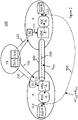
- Figure 1 schematically illustrates a QKD procedure involving a first QKD device A1 at a first location A, a second QKD device B2 at a second location B and, exemplarily, one single trusted node TN with a QKD device TN-A associated with the first QKD device A1 and a QKD device TN-B associated with the second QKD device B2.
- a first QKD system consisting of the first QKD device A1 at the first location A and the QKD device TN-A associated with the first QKD device A1 and located at the trusted node TN, generates, using a first QKD protocol, a first quantum secure key along the connection 11 between A1 and TN-A, and a second QKD system consisting of the second QKD device B2 at the second location B and the QKD device TN-B associated with the second QKD device B2 and located at the trusted node TN, generates, using a second QKD protocol, another second quantum secure key along the connection 12 between TN-B and B2.
- the first QKD protocol and the second QKD protocol can be the same or different from each other.
- One of these two quantum secure keys i.e. the first or the second quantum secure key
- OTP forwards the other one, i.e. the second or the first quantum secure key, to the respective endpoint, i.e. to the first location A or second location B depending on which of the two quantum secure keys was used as the OTP so that ultimately the respective other one quantum secure key is present in both locations and henceforth functions as the quantum secured key, K QKD .
- the quantum secured key, K QKD is distributed over the two QKD devices, the first QKD device A1 and the second QKD device B2, along the narrow-dashed path 15 via one (or more) trusted nodes TN.
- OTP One-Time-Pad
- a second key, K PQC is created between a first PQC device PQC-A at the first location A and a second PQC device PQC-B at the second location B using post-quantum cryptography (PQC).
- PQC also sometimes referred to as quantum-proof, quantum-safe or quantum-resistant, refers to cryptographic algorithms (usually public-key algorithms) that are thought to be secure against a quantum attack.
- the key creation of the second key, K PQC is indicated by a dashed path 25 between the first location A and the second location B.
- both keys, the quantum secured key, K QKD , and the second key, K PQC are subjected to a bit-wise XOR operation 20 with each other and the resulting end-to-end key, K E2E , is provided, as indicated by a dotted path 35, to a respective first application App-A at the first location A and a respective second application App-B at the second location B, respectively.
- K QKD 010010110011010101
- K PQC 001101010101001011
- the end-to-end key K E2E is then calculated by applying a XOR-operation to K QKD and K PQC :
- Figure 2 schematically shows a workflow of an embodiment of a method for creating an encryption key according to the present invention, using an embodiment of a system according to the present invention.
- the system 100 is located in a communication network.
- the method and the system of the present invention are exemplarily shown here using the example of only one trusted node, but can be extended to a large number of trusted nodes accordingly.
- the proposed method comprises a preparation step and a subsequent key agreement step.
- a first QKD device A1 at a first location A, also called first node, and a second QKD device B2 at a second location B, also called second node, distant from the first location A together create a quantum secured key, K QKD , according to a QKD protocol communicating via a first quantum channel 110 and a second quantum channel 120, respectively, with at least one common intermediate quantum node TN for transmitting or receiving a quantum information according to the QKD protocol and communicating via an authenticated digital distillation channel separate from the first quantum channel 110 and the second quantum channel 120 for transmitting and receiving a control information according to the QKD protocol.
- Analogue to the procedure described in Figure 1 first of all a first QKD system consisting of the first QKD device A1 at the first location A and the QKD device TN-A associated with the first QKD device A1 and located at the trusted node TN, generates, using a first QKD protocol, a first quantum secure key along the connection 110 between A1 and TN-A, and a second QKD system consisting of the second QKD device B2 at the second location B and the QKD device TN-B associated with the second QKD device B2 and located at the trusted node TN, generates, using a second QKD protocol, another second quantum secure key along the connection 120 between TN-B and B2.
- the first QKD protocol and the second QKD protocol can be the same or different from each other. It does not matter here which QKD protocol is used.
- One of these two quantum secure keys i.e. the first or the second quantum secure key, is used as OTP to forward the other one, i.e. the second or the first quantum secure key, to the respective endpoint, i.e. to the first location A or the second location B depending on which of the two quantum secure keys was used as the OTP so that ultimately the respective other one quantum secure key is present in both locations and henceforth functions as the quantum secured key, K QKD .
- the quantum secured key, K QKD is provided, as indicated by arrows 111 and 121, to a first encryption device ENC-A at the first location A and to a second encryption device ENC-B at the second location B.
- the quantum secured key, K QKD is distributed over the two QKD devices, the first QKD device A1 and the second QKD device B2, as indicated by the narrow-dashed line 150, via one (or more) trusted nodes.
- the first encryption device ENC-A at the first location A and the second encryption device ENC-B at the second location B together create a symmetrically encrypted channel 200 between the first location A and the second location B, using the quantum secured key, K QKD .
- the encryption key K* E2E which corresponds to the encryption key K PQC , is provided, as indicated by respective arrows 112, 122, to at least one first application App-A at the first location A and at least one second application App-B at the second location B, respectively, as indicated by dotted line 350.
- Respective components of the first location A here shown as A1, ENC-A, PQC-A and App-A, are functionally connected to each other by respective application programming interfaces (API) and respective components of the second location B, here shown as B2, ENC-B, PQC-B and App-B, are functionally connected to each other by respective application programming interfaces (API), respectively.
- API application programming interfaces
- the one (or more) trusted node TN with its QKD devices TN-A, TN-B, the first location A with its components A1, ENC-A, PQC-A and App-A and the second location B with its components B2, ENC-B, PQC-B, and App-B are components of the system 100.
- FIG. 3 schematically illustrates a key exchange procedure using a public-key protocol that can be used in the key agreement step of the method according to the invention as public-key protocol in the asymmetric key exchange procedure operating with respective private / public key pairs.
- Alice and Bob there are two communication partners, Alice and Bob, which intend to create a secure key for encrypting any communication between them.
- Alice has 301 a private key Pa and a public key Ps.
- Bob has 302 a private key Pb.
- Alice sends 305 the public key Ps to Bob.
- Bob receives 304 the public key Ps.
- Alice calculates 307 a protocol specific challenge C by using the public key Ps and the private key Pa.
- Alice sends 309 / 311 the calculated challenge C to Bob.
- Bob receives 306 the challenge C.
- Bob calculates 308 a protocol specific response R by using the public key Ps and the private key Pb.
- Bob sends 310 / 312 the protocol specific response R to Alice.
- Alice receives 313 the protocol specific response R.
- Alice calculates 315 an encryption key K asy using the protocol specific response R and her private key Pa.
- Bob calculates 314 the same encryption key K asy using the protocol specific challenge C and his private key Pb.
- the fact, that both, Alice and Bob can create the same encryption key K asy on their own side is an inherent feature / property of all public-key protocols.
Landscapes
- Engineering & Computer Science (AREA)
- Computer Security & Cryptography (AREA)
- Computer Networks & Wireless Communication (AREA)
- Signal Processing (AREA)
- Physics & Mathematics (AREA)
- Electromagnetism (AREA)
- Theoretical Computer Science (AREA)
- Optical Communication System (AREA)
Abstract
Description
- The invention relates to a method for creating an encryption key for use in a communication network, the method comprising a preparation step and a subsequent key agreement step wherein in the preparation step a quantum secured key is created according to a QKD (quantum key distribution) protocol and used in the key agreement step for creating an encryption key which is provided to at least one first application at a first location and at least one second application at a second location, respectively. The invention further relates to a system for creating a respective encryption key.
- Methods for creating encryption keys according to a QKD protocol are known. Such a method is generally based on a two-channel communication of a QKD system, i.e. a QKD device pair consisting of a first QKD device and a second QKD device. Usually, the first QKD device is arranged at a first location in the communication network and the second QKD device is arranged at a second location distant from the first location. The first and second QKD devices simultaneously communicate via a quantum channel and an authenticated digital distillation channel according to a QKD protocol. Communicating comprises transmitting and/or receiving respective information, i.e. quantum information or control information, defined by the QKD protocol. The quantum channel and the authenticated digital distillation channel are preferably but not necessarily established via two separate glass fibers.
- The control information is digital, i.e. consists of binary values, e.g. 0 and 1. In contrast, the quantum information consists of quantum mechanical superpositions of either discrete values, e.g. two orthogonal photon polarizations or as superposition of continuous variables. In the first case, the quantum information might be thought of as a 'quantum bit' (qbit) which can take on any complex combination between 0 and 1
- Only the control information transmitted or received via the authenticated digital distillation channel allow the first and second QKD devices for distilling the quantum secured key, also called quantum key, from the quantum information transmitted or received via the quantum channel. In other words, the quantum information is useless without the control information. Therefore, the channel for exchanging the control information is called digital distillation channel herein. The digital distillation channel may be public and unencrypted but must be authenticated for the control information to be transmitted and/or received by the QKD devices.
- Such a method succeeds in creating a quantum secured key only in case the creation process is not disturbed by an intruder intercepting the key creation process (man-in-the-middle attack). Any interception of the quantum channel would inevitably modify the quantum information due to the quantum nature. The modification of the quantum information would result in an error condition defined by the QKD protocol. The key creation process would terminate without successfully creating the quantum secured key and, hence, additionally reveal the intercepting intruder. Consequently, a quantum secured key successfully created is a secret key, i.e. a non-interceptable key being exclusively known, i.e. private, to the first and second QKD devices of the QKD device pair.
- In order to use the quantum mechanical features of light efficiently, it is necessary to operate with single photons or with highly damped laser pulses. However, such laser pulses often have in average less than one photon within a pulse. At typical damping values within a glass fiber (α = 0,21 - 0,28 dB per km with α being the fiber damping in dB/km) the rate of the "surviving" photons decreases exponentially with the distance between the first location, also called Alice, and the second location, also called Bob. Thus, the reachable key rate is also influenced, particularly limited, and at distances of about 50 km an efficiently usable key rate of several kBits/s is obtained. A known approximation for estimating the key rate R as a function of the distance L is given by the formula:

- A QKD platform comprises different logical levels. A first level is formed by QKD systems, i.e. by a first QKD device (Alice) and a second QKD device (Bob) and all components that are relevant for generating quantum keys, such as single photon sources and single photon detectors. Such QKD systems allow only short distances between the communication sites. It is assumed that the single QKD links, i.e. the quantum channel and the logical connections between the QKD devices necessary for the post processing, have an own (and probably manufacturer-dependent) operating system which controls the key generating process. Each QKD link and its characteristics depend heavily on the manufacturer, the used QKD protocol and further variables.
- In order to supply longer distances from end-to-end with quantum keys, so-called trusted nodes are used in order to realise a logical range extension of the key distribution mechanism. The name "trusted" quantum node implies that Alice and Bob have to trust such intermediate quantum node because at each such trusted quantum node the currently secret quantum keys are available in plain text. Along several individual quantum links, QKD links, the so-called OTP procedure is used to extend and further transport the quantum keys. OTP (One Time Pad) means, that the individual bits of the secret quantum key to be distributed are subjected bit wise to an XOR operation with a quantum secured transport key. The trusted quantum nodes are intermediate quantum nodes between the terminal communication sites, i.e. the first location (Alice) and the second location (Bob). Each such trusted node has a separate QKD system which provides a respective transport key for that trusted node. It does not matter here which technology is used. A method how an end-to-end quantum key between Alice and Bob can be generated, operates as follows: the application quantum key to be transported from Alice to Bob for further communication is, along the distance between Alice (first location) and Bob (second location) at each trusted node, subjected to a bit-wise XOR operation with a transport quantum key of a respective directly following trusted node, i.e. the distance between Alice and Bob is formed by a sequence of nodes and communication links/edges connecting these nodes wherein the application quantum key is transferred edge by edge from Alice to Bob. The result of such bit by bit manipulation is transferred from a respective trusted node to the respective directly following trusted node in the sequence of nodes. As the XOR operation is a self-inverse mapping, the directly following trusted node is enabled, since it has knowledge of its own transport quantum key, to reconstruct therefrom the application quantum key to be transported in that it applies the XOR operation a second time. This procedure is repeated along the whole distance between Alice and Bob. That means that the respective transport quantum keys are used as One-Time-Pad in order to transfer the application quantum key in encrypted form from Alice to Bob. The respective transport quantum keys are discarded afterwards, i.e. are not used any longer.
- Such a QKD procedure involving a first QKD device at a first location, a second QKD device at a second location and, exemplarily, one single trusted node with a QKD device associated with the first QKD device and a QKD device associated with the second QKD device is schematically illustrated in
Figure 1 . - A first QKD system consisting of the first QKD device at the first location and the QKD device associated with the first QKD device and located at the trusted node, generates, using a first QKD protocol, a first quantum secure key along the connection between A1 and TN-A, and a second QKD system consisting of the second QKD device at the second location and the QKD device associated with the second QKD device and located at the trusted node, generates, using a second QKD protocol, another second quantum secure key between TN-B and B2. The first QKD protocol and the second QKD protocol can be the same or different from each other. It does not matter here which QKD protocol is used. One of these two quantum secure keys, i.e. the first or the second quantum secure key, is used as OTP to forward the other one, i.e. the second or the first quantum secure key, to the respective endpoint, i.e. to the first or second location depending on which of the two quantum secure keys was used as the OTP so that ultimately the respective other one quantum secure key is present in both locations and henceforth functions as the quantum secured key, KQKD. Thus, the quantum secured key, KQKD, is distributed over the two QKD devices, the first QKD device A1 and the second QKD device B2, along the narrow-dashed path via one (or more) trusted nodes TN. The above described One-Time-Pad (OTP) Forwarding is known from the art.
- A problem may arise from the fact, that at each such trusted quantum node the currently secret (application) quantum keys are available in plain text. To meet this challenge, a method was discussed in the QKD community in which the QKD key, i.e. the quantum secure key, is subjected to an XOR operation with an alternatively classically generated key. Such scenario is schematically illustrated in
Figure 1 . - That means that a second key, KPQC, is created between a first PQC device at the first location and a second PQC device at the second location using post-quantum cryptography (PQC). PQC, also sometimes referred to as quantum-proof, quantum-safe or quantum-resistant, refers to cryptographic algorithms (usually public-key algorithms) that are thought to be secure against an attack by a quantum computer. In
Figure 1 , the key creation of the second key, KPQC, is indicated by a dashed path between the first location A and the second location B. At the first location A and the second location B, respectively, both keys, the quantum secured key, KQKD, and the second key, KPQC, are subjected to a bit-wise XOR operation with each other and the resulting end-to-end key, KE2E, is provided to a respective first application App-A at the first location A and a respective second application App-B at the second location B, respectively. - Generally, PQC refers to algorithms that, like traditional methods, use the principle of division into a public key and a private key. Known traditional public-key cryptosystems, i.e. algorithms, of securely exchanging cryptographic keys are Diffie-Hellman key exchange (DH), (better: Diffie-Hellman-Merkle key exchange (DHM)), Diffie Hellman Elliptic Curve (DHEC) and RSA (Rivest-Shamir-Adleman). DH, DHEC and RSA are based on number theoretic methods and are not secure against attacks by a quantum computer.
- Newly developed PQC methods adopt similar strategies as the traditional ones mentioned above but increase the mathematical complexity. Those PQC methods are so-called asymmetric methods. Depending on the details of a respective individual PQC method, the respective public keys (components) of the two communication partners, i.e. PQC-A and PQC-B, at the first location A and the second location B are used according to the respective PQC protocol such that when terminating the respective key exchange procedure a new secret key is generated that can then be used for a symmetric encryption according, for example, to AES (Advanced Encryption Standard).
- The idea of the above mentioned combination of the quantum secured key, KQKD, with the PQC key, KPQC, is that the resulting combined key, KE2E, offers security against a quantum attack and avoid that a provider of the trusted nodes has access to the finally used key, KE2E.
- However, as the provider of the trusted node knows the quantum secured key, KQKD, he is enabled to receive the PQC key, KPQC, from the combined key, KE2E, in that he applies the XOR operation a second time. Thus, the provider of the trusted node can directly calculate the PQC key, KPQC, without using a quantum computer. It is sufficient to subject the combined key, KE2E, and the quantum secured key, KQKD, to the XOR operation.
- The combined method is secure against quantum attacks from a third party but does not protect against the fact that the provider of the trusted nodes can get access to the combined key. Complex key management systems have been developed to disguise which key is used when. However, such approaches require additional communication between the first location and the second location, i.e. between the communication partners. Such additional communication is accessible by the provider of the trusted nodes. Therefore, an extension to a plurality of key pairs does not provide real security. Further, such complex key management systems are not secure against so-called "Brute-Force" attacks.
- It is therefore an object of the present invention to suggest a method for creating an encryption key that is secure against quantum attacks and that is not accessible to the provider(s) of the trusted nodes. Providing a respective system for creating such an encryption key is a further object of the present invention.
- One aspect of the present invention refers to a method for creating an encryption key for use in a communication network, wherein the method comprises a preparation step and a subsequent key agreement step, wherein in the preparation step,
- a. a first QKD device at a first location in the communication network, also called first node, and a second QKD device at a second location in the communication network, also called second node, distant from the first location together create a quantum secured key, KQKD, according to a QKD protocol communicating via a first quantum channel (also called first quantum link) and a second quantum channel (also called second quantum link), respectively, with at least one common intermediate quantum node for transmitting or receiving a quantum information according to the QKD protocol and communicating via an authenticated digital distillation channel separate from the first quantum channel and the second quantum channel for transmitting and receiving a control information according to the QKD protocol,
- b. a first encryption device at the first location and a second encryption device at the second location together create a symmetrically encrypted channel between the first location and the second location, using the quantum secured key, KQKD,
- The wording "quantum secure" and the wording "quantum secured" are used synonymously herein.
- According to one embodiment of the proposed method, the encryption key is provided to at least one first application at the first location and at least one second application at the second location, respectively.
- The key material to be exchanged for creating the encryption key comprises particularly at least one public key, generally respective public keys of the private / public key pairs which are used according to a respective public key protocol. Generally, the key material to be exchanged for creating the encryption key depends on the public key protocol used in the individual case. Ultimately, all the required key material is transmitted via the symmetrical encrypted channel so that the encryption key is finally located and/or available at both locations, the first location and the second location.
- According to the proposed method, in the key preparation step, a quantum secured key, KQKD, is created and distributed between the first location and the second location via a QKD platform known from the art. A respective provider of the at least one trusted node has knowledge of the created quantum secured key. However, the created quantum secured key, KQKD, is secure against external attacks of a quantum computer.
- According to the proposed method, this created quantum secured key, KQKD, is used to establish a symmetric encryption between the first location and the second location, i.e. to establish a symmetrically encrypted channel between the first location and the second location.
- Such a system, i.e. such a symmetrically encrypted channel is typically called 'a tunnel' between the first and the second location.
- According to one embodiment of the proposed method, the symmetrically encrypted channel between the first location and the second location is created using the Advanced Encryption Standard, AES. AES is assumed to be secure against quantum attacks.
- According to a further embodiment of the proposed method, the asymmetric key exchange procedure operating with private / public key pairs according to a public key protocol is based on post-quantum cryptography, PQC. In this case, the first key agreement device is called first PQC device and the second key agreement device is called second PQC device and the encryption key is called KPQC.
- However, alternatively, it is also possible according to another embodiment of the proposed method that the asymmetric key exchange procedure is based on traditional public key cryptosystems / protocols like DH, DHEC or RSA.
- Generally, according to the invention, in both embodiments, i.e. both when using PQC and when using one of the traditional public key protocols, according to the invention a twofold encryption is used: the quantum key KQKD is used in a symmetric method (like AES) to establish a securely encrypted connection between the two locations, i.e. the symmetrically encrypted channel. This offers protection against quantum attacks. Within this quantum secure tunnel / channel, a second layer of protection is established by using it as transport medium to negotiate another key, i.e. the encryption key by means of a suitable asymmetric key exchange procedure, i.e. a suitable asymmetric key exchange protocol.
- A post quantum algorithm, i.e. PQC algorithm - as all asymmetric algorithms - uses a combination of public and private keys to negotiate a key, KPQC, that is finally used by applications at the first and second location. These public and private keys used by the specific PQC algorithm, i.e. by the specific PQC protocol, are not shown in the
figures 1 and2 . The whole PQC key negotiation process is thereby, i.e. due to the symmetrically encrypted channel, shielded from possible attackers. However, the trusted node's provider could, in principle, follow this negotiation process, because the KQDK is known and the symmetric tunnel, i.e. the symmetrically encrypted channel, offers no protection against deciphering by someone who possesses the KQKD. But it would be necessary for the trusted node's provider to attack the post quantum algorithm, i.e. the PQC algorithm, to gain further knowledge. Currently, PQC algorithms are secure against known quantum algorithms and thus, they are sufficiently secure against attacks through the trusted node's provider. If in future, the used PQC algorithms become breakable, they can be replaced by stronger PQC algorithms specifically designed against the new attacks. Such, it is not necessary to change the described system according to the present invention, because the KQKD tunnel is already secure against all possible attacks by third parties except attacks from the trusted node's provider which are, however, warded off by the preceding described PQC algorithms. - As stated above, one could use traditional cryptological methods, i.e. traditional public key algorithms / protocols like DH, DHEC or RSA. The final encryption key, K*E2E, would still be secure against external attacks, but could be broken if the trusted node provider would decide to use a quantum computer to attack his customer.
- According to still a further embodiment of the proposed method, the first key agreement device and the second key agreement device are configured (by a respective administrator) to automatically transfer the respective key material to be exchanged, i.e. particularly the respective public key(s) between the first location and the second location via the symmetrically encrypted channel. That means that the first key agreement device and the second key agreement device recognize that they together create the end-to-end encryption key K*E2E (= KPQC) using the asymmetric key exchange procedure while being embedded in the QKD platform. That means that the first key agreement device and the second key agreement device treat a respective public key no longer as publicly accessible but as secret and worthy of protection. Accordingly, the respective public key is basically no longer a public key in the proper sense, but is treated confidentially within the communication between the first location and the second location. The first key agreement device and the second key agreement device are informed that a respective public key to be transferred between the first location and the second location must not be distributed publicly.
- In order to ensure that the first key agreement device and the second key agreement device treat a respective public key to be transmitted confidentially so that the public key is not accessible to the general public, the first key agreement device and the second key agreement device are provided with a signalling signal (from the QKD platform) triggering that the respective public key is transferred between the first key agreement device and the second key agreement device via the symmetrically encrypted channel. The first key agreement device and the second key agreement device, respectively, are configured to process the signalling signal accordingly.
- The proposed method may also be carried out with the involvement of a plurality of intermediate nodes, i.e. of a plurality of trusted nodes. Therefore, it is possible that multiple trusted nodes of a provider or of a plurality of different providers are connected in series between the first location and the second location. A further aspect of the present invention refers to an encryption system for creating an encryption key for use in a communication network, the system comprising a first location, a second location distant from the first location, and at least one intermediate quantum node in the communication network, wherein
- the at least one intermediate quantum node is linked in series via at least a first quantum channel (also called first quantum link) with a first QKD device at the first location and a second quantum channel (also called second quantum link) with a second QKD device at the second location,
- the first QKD device and the second QKD device are configured to together create a quantum secured key, KQKD, according to a QKD protocol communicating via the first quantum channel and the second quantum channel, respectively, with the at least one common intermediate quantum node for transmitting or receiving a quantum information according to the QKD protocol and communicating via an authenticated digital distillation channel separate from the first quantum channel and the second quantum channel for transmitting and receiving a control information according to the QKD protocol, and
- a first encryption device at the first location and a second encryption device at the second location are configured to create a symmetrically encrypted channel between the first location and the second location, using the quantum secured key, KQKD,
- a first key agreement device at the first location and a second key agreement device at the second location are configured to together create, in a key agreement step, an encryption key via the symmetrically encrypted channel, using an asymmetric key exchange procedure operating with respective private / public key pairs according to a public key protocol, wherein key material to be exchanged according to the public key protocol for creating the encryption key according to the public key protocol is transferred via the symmetrically encrypted channel between the first location and the second location.
- According to one embodiment of the proposed system, the first key agreement device and the second key agreement device are further configured to provide the encryption key to at least one first application at the first location and at least one second application at the second location, respectively.
- According to an embodiment of the proposed system, the symmetrically encrypted channel between the first location and the second location is created using the Advanced Encryption Standard, AES.
- According to a further embodiment of the proposed system, the asymmetric key exchange procedure operating with respective private / public key pairs according to a public key protocol is based on post-quantum cryptography, PQC, i.e. the public key protocol is chosen as a PQC protocol.
- According to an alternative embodiment of the proposed system, the asymmetric key exchange procedure operating with respective private / public key pairs according to a public key protocol is based on DH, DHEC or RSA, i.e. the public key protocol is chosen as DH protocol, DHEC protocol or RSA protocol.
- It is possible to perform an upgrade on the system from non-PQC procedures to PQC procedures at a later point in time, i.e. when the system has already been established / implemented, as there is no technical correlation/dependence between the external QKD protection, i.e. the symmetrically encrypted channel, and the embedded asymmetric key exchange procedure. A return to a non-PQC procedure is also possible at any time. Only the respective PQC hardware has to be replaced at both locations. It is also possible to protect only some very important connections of the connections running through the trusted node(s) from abrasive eavesdropping by the provider(s) of the trusted node(s) by means of PQC procedures and use non-PQC procedures for the remaining connections running through the trusted node(s).
- The first key agreement device and the second key agreement device are configured to automatically transfer the key material to be exchanged, particularly the respective public key(s) between the first location and the second location via the symmetrically encrypted channel.
- In order to ensure that the first key agreement device and the second key agreement device treat a respective public key to be transmitted confidentially so that the respective public key is not accessible to the general public, the first QKD device and the second QKD device, respectively, are configured to provide the first key agreement device and the second key agreement device, respectively, with a signalling signal indicating that the key material to be exchanged, particularly the respective public key(s), has to be transferred between the first key agreement device and the second key agreement device via the symmetrically encrypted channel.
- The control information is digital, i.e. consists of binary values, e.g. 0 and 1. The quantum information consists of quantum mechanical superpositions. Several embodiments of such methods are known in prior art. Hence, the invention may use a very plurality of encryption key creation processes according to the QKD protocol.
- Particularly, the invention does not depend on a particular QKD protocol, but rather is generally compatible with each available or future QKD protocol defining and requiring a quantum channel and a digital distillation channel. The QKD protocol may define and require a photon generating device separate from the first and second QKD device at a location distant from the first location and/or the second location, the photon generation device also communicating via the respective quantum channel and the authenticated digital distillation channel.
- In another embodiment, a plurality of intermediate nodes, i.e. trusted nodes are provided. A QKD platform comprising the plurality of trusted nodes extends a QKD platform comprising a single trusted node in a natural way and helps to increase the range of the key distribution.
- According to the invention, the proposed encryption system is configured for carrying out an inventive method.
- It is an essential advantage of the inventive method and the inventive system that the created encryption key does not require that users installed at the first location and the second location, respectively, and using the created encryption key, must trust the provider(s) of the trusted node(s). According to the invention two different key exchange procedures are combined, preferably QKD and PQC. A QKD platform has the task to provide a quantum secured key, KQKD, between two locations separated from each other. This quantum secured key, KQKD, is secure against attacks of a quantum computer. This applies also to at the moment still unknown quantum algorithms. By means of the quantum secured key, KQKD, a symmetrically encrypted channel between the two locations is established. Within this symmetrically encrypted channel a second key, i.e. the encryption key, KPQC, is created between the two locations. The encryption key, KPQC, is secured against quantum attacks due to the usage of the symmetrically encrypted channel, i.e. the usage of the quantum secured key, KQKD. Further, the encryption key, KPQC, is not accessible to the provider(s) of the trusted node(s) without the provider(s) developing an attack against the PQC procedure. Should an attack on the PQC procedure be found in the future, the respective PQC algorithm can be replaced by another PQC algorithm.
- It is not necessary that users situated at the first and second location, respectively, and using the encryption key, KPQC, must trust the provider(s) of the trusted node(s) and/or the provider of the QKD platform.
- Further advantages and configurations of the invention become apparent from the following description and the enclosed drawings.
- It shall be understood that the features described previously and to be described subsequently may be used not only in the indicated combinations but also in different combinations or on their own without leaving the scope of the present invention.
- The invention is described in detail by means of exemplary embodiments and with reference to the drawings.
- Fig. 1
- schematically shows an encryption system according to a prior art arrangement for creating an encryption key;
- Fig. 2
- schematically shows an encryption system according to an embodiment of the invention for creating an encryption key;
- Fig. 3
- schematically shows a key exchange scheme using a public-key protocol.
-
Figure 1 schematically illustrates a QKD procedure involving a first QKD device A1 at a first location A, a second QKD device B2 at a second location B and, exemplarily, one single trusted node TN with a QKD device TN-A associated with the first QKD device A1 and a QKD device TN-B associated with the second QKD device B2. A first QKD system consisting of the first QKD device A1 at the first location A and the QKD device TN-A associated with the first QKD device A1 and located at the trusted node TN, generates, using a first QKD protocol, a first quantum secure key along theconnection 11 between A1 and TN-A, and a second QKD system consisting of the second QKD device B2 at the second location B and the QKD device TN-B associated with the second QKD device B2 and located at the trusted node TN, generates, using a second QKD protocol, another second quantum secure key along theconnection 12 between TN-B and B2. The first QKD protocol and the second QKD protocol can be the same or different from each other. It does not matter here which QKD protocol is used. One of these two quantum secure keys, i.e. the first or the second quantum secure key, is used as OTP to forward the other one, i.e. the second or the first quantum secure key, to the respective endpoint, i.e. to the first location A or second location B depending on which of the two quantum secure keys was used as the OTP so that ultimately the respective other one quantum secure key is present in both locations and henceforth functions as the quantum secured key, KQKD. - Thus, the quantum secured key, KQKD, is distributed over the two QKD devices, the first QKD device A1 and the second QKD device B2, along the narrow-dashed
path 15 via one (or more) trusted nodes TN. The above described One-Time-Pad (OTP) Forwarding is known from the art. - A problem may arise from the fact, that at each such trusted quantum node TN the currently secret (application) quantum keys are available in plain text. To meet this challenge, a method was discussed in the QKD community in which the QKD key is subjected to an XOR operation with an alternatively classically generated key. Such scenario is schematically illustrated in
Figure 1 . - That means that a second key, KPQC, is created between a first PQC device PQC-A at the first location A and a second PQC device PQC-B at the second location B using post-quantum cryptography (PQC). PQC, also sometimes referred to as quantum-proof, quantum-safe or quantum-resistant, refers to cryptographic algorithms (usually public-key algorithms) that are thought to be secure against a quantum attack. In
Figure 1 , the key creation of the second key, KPQC, is indicated by a dashedpath 25 between the first location A and the second location B. At the first location A and the second location B, respectively, both keys, the quantum secured key, KQKD, and the second key, KPQC, are subjected to abit-wise XOR operation 20 with each other and the resulting end-to-end key, KE2E, is provided, as indicated by adotted path 35, to a respective first application App-A at the first location A and a respective second application App-B at the second location B, respectively. - The quantum secured key KQKD may be given as follows:
KQKD = 010010110011010101 - The second key KPQC may be given as follows:
KPQC = 001101010101001011 - The end-to-end key KE2E is then calculated by applying a XOR-operation to KQKD and KPQC:
- KE2E = KQKD XOR KPQC
- KE2E = 010010110011010101
XOR
001101010101001011
= 011111100110011110 -
Figure 2 schematically shows a workflow of an embodiment of a method for creating an encryption key according to the present invention, using an embodiment of a system according to the present invention. Thesystem 100 is located in a communication network. The method and the system of the present invention are exemplarily shown here using the example of only one trusted node, but can be extended to a large number of trusted nodes accordingly. The proposed method comprises a preparation step and a subsequent key agreement step. In the preparation step, a first QKD device A1 at a first location A, also called first node, and a second QKD device B2 at a second location B, also called second node, distant from the first location A together create a quantum secured key, KQKD, according to a QKD protocol communicating via a firstquantum channel 110 and a secondquantum channel 120, respectively, with at least one common intermediate quantum node TN for transmitting or receiving a quantum information according to the QKD protocol and communicating via an authenticated digital distillation channel separate from the firstquantum channel 110 and the secondquantum channel 120 for transmitting and receiving a control information according to the QKD protocol. - Analogue to the procedure described in
Figure 1 , first of all a first QKD system consisting of the first QKD device A1 at the first location A and the QKD device TN-A associated with the first QKD device A1 and located at the trusted node TN, generates, using a first QKD protocol, a first quantum secure key along theconnection 110 between A1 and TN-A, and a second QKD system consisting of the second QKD device B2 at the second location B and the QKD device TN-B associated with the second QKD device B2 and located at the trusted node TN, generates, using a second QKD protocol, another second quantum secure key along theconnection 120 between TN-B and B2. The first QKD protocol and the second QKD protocol can be the same or different from each other. It does not matter here which QKD protocol is used. One of these two quantum secure keys, i.e. the first or the second quantum secure key, is used as OTP to forward the other one, i.e. the second or the first quantum secure key, to the respective endpoint, i.e. to the first location A or the second location B depending on which of the two quantum secure keys was used as the OTP so that ultimately the respective other one quantum secure key is present in both locations and henceforth functions as the quantum secured key, KQKD. Further, in the key preparation step, the quantum secured key, KQKD, is provided, as indicated byarrows line 150, via one (or more) trusted nodes. The first encryption device ENC-A at the first location A and the second encryption device ENC-B at the second location B together create a symmetricallyencrypted channel 200 between the first location A and the second location B, using the quantum secured key, KQKD. - In the key agreement step, a first key agreement device PQC-A at the first location A and a second key agreement device PQC-B at the second location B together create an encryption key K*E2E (=KPQC) via the symmetrically
encrypted channel 200, using an asymmetric key exchange procedure operating with respective private / public key pairs according to a public-key protocol, wherein key material to be exchanged for creating the encryption key according to the public-key protocol is transferred via the symmetricallyencrypted channel 200 between the first location A and the second location B, as indicated by the dashedpath 250. The encryption key K*E2E which corresponds to the encryption key KPQC, is provided, as indicated byrespective arrows dotted line 350. - Respective components of the first location A, here shown as A1, ENC-A, PQC-A and App-A, are functionally connected to each other by respective application programming interfaces (API) and respective components of the second location B, here shown as B2, ENC-B, PQC-B and App-B, are functionally connected to each other by respective application programming interfaces (API), respectively.
- The one (or more) trusted node TN with its QKD devices TN-A, TN-B, the first location A with its components A1, ENC-A, PQC-A and App-A and the second location B with its components B2, ENC-B, PQC-B, and App-B are components of the
system 100. -
Figure 3 schematically illustrates a key exchange procedure using a public-key protocol that can be used in the key agreement step of the method according to the invention as public-key protocol in the asymmetric key exchange procedure operating with respective private / public key pairs. As shown inFigure 3 , there are two communication partners, Alice and Bob, which intend to create a secure key for encrypting any communication between them. Alice has 301 a private key Pa and a public key Ps. Bob has 302 a private key Pb. In afirst step 303 Alice sends 305 the public key Ps to Bob. Bob receives 304 the public key Ps. Alice calculates 307 a protocol specific challenge C by using the public key Ps and the private key Pa. Alice sends 309 / 311 the calculated challenge C to Bob. Bob receives 306 the challenge C. Bob calculates 308 a protocol specific response R by using the public key Ps and the private key Pb. Bob sends 310 / 312 the protocol specific response R to Alice. Alice receives 313 the protocol specific response R. Alice calculates 315 an encryption key Kasy using the protocol specific response R and her private key Pa. Bob calculates 314 the same encryption key Kasy using the protocol specific challenge C and his private key Pb. The fact, that both, Alice and Bob can create the same encryption key Kasy on their own side is an inherent feature / property of all public-key protocols. -
- A
- first location
- B
- second location
- TN
- trusted node
- A1
- first QKD device
- B2
- second QKD device
- TN-A
- QKD device associated with the first QKD device
- TN-B
- QKD device associated with the second QKD device
- PQC-A
- first key agreement device, e.g. first PQC device
- PQC-B
- second key agreement device, e.g. second PQC device
- App-A
- first application
- App-B
- second application
- ENC-A
- first encryption device
- ENC-B
- second encryption device
- 11
- first quantum link
- 12
- second quantum link
- 15
- transfer of KQKD
- 20
- XOR operation
- 25
- transfer of KPQC
- 35
- provisioning of KE2E
- 110
- first quantum link
- 111
- arrow indicating transfer of KQKD to ENC-A
- 112
- arrow indicating transfer of KPQC to App-A
- 120
- second quantum link
- 121
- arrow indicating transfer of KQKD to ENC-B
- 122
- arrow indicating transfer of KPQC to App-B
- 150
- authenticated digital distillation channel
- 200
- symmetrically encrypted channel
- 250
- transfer of KPQC
- 350
- provisioning of K*E2E
- Pa
- Alice's private key
- Pb
- Bob's private key
- Ps
- public key
- C
- protocol specific challenge
- R
- protocol specific response
- Kasy
- asymmetric encryption key
- 301-315
- method steps
Claims (14)
- A method for creating an encryption key (K*E2E) comprising a preparation step and a subsequent key agreement step, wherein in the preparation step,a. a first QKD device (A1) at a first location (A) and a second QKD device (B2) at a second location (B) distant from the first location (A) together create a quantum secured key (KQKD) according to a QKD protocol communicating via a first quantum channel (110) and a second quantum channel (120), respectively, with at least one common intermediate quantum node (TN) for transmitting or receiving a quantum information according to the QKD protocol and communicating via an authenticated digital distillation channel separate from the first (110) and second quantum channel (120) for transmitting and receiving a control information according to the QKD protocol,b. a first encryption device (ENC-A) at the first location (A) and a second encryption device (ENC-B) at the second location (B) together create a symmetrically encrypted channel (200) between the first location (A) and the second location (B), using the quantum secured key (KQKD),wherein, in the key agreement step, a first key agreement device (PQC-A) at the first location (A) and a second key agreement device (PQC-B) at the second location (B) together create an encryption key (K*E2E) via the symmetrically encrypted channel (200), using an asymmetric key exchange procedure operating with respective private / public key pairs according to a public-key protocol, wherein key material to be exchanged for creating the encryption key (K*E2E) is transferred via the symmetrically encrypted channel (200) between the first location (A) and the second location (B).
- The method according to claim 1 wherein the encryption key (K*E2E) is provided to at least one first application (App-A) at the first location (A) and at least one second application (App-B) at the second location (B), respectively.
- The method according to claim 1 or 2 wherein the symmetrically encrypted channel (200) between the first location (A) and the second location (B) is created using the Advanced Encryption Standard, AES.
- The method according to claim 1, 2 or 3 wherein the public-key protocol of the asymmetric key exchange procedure is based on post-quantum symmetric cryptography, PQC.
- The method according to claim 1, 2 or 3 wherein the public-key protocol of the asymmetric key exchange procedure is based on DH, DHEC or RSA.
- The method according to one of claims 1 to 5 wherein the first key agreement device (PQC-A) and the second key agreement device (PQC-B) are configured to automatically transfer the key material to be exchanged for creating the encryption key (K*E2E) between the first location (A) and the second location (B) via the symmetrically encrypted channel (200).
- The method according to one of claims 1 to 5 wherein the first key agreement device (PQC-A) and the second key agreement device (PQC-B) are provided with a signalling signal initiating that the key material to be exchanged for creating the encryption key (K*E2E) has to be transferred between the first key agreement device (PQC-A) and the second key agreement device (PQC-B) via the symmetrically encrypted channel (200).
- An encryption system (100) for creating an encryption key (K*E2E), the system comprising a first location (A), a second location (B) distant from the first location (A), and at least one intermediate quantum node (TN) wherein- the at least one intermediate quantum node (TN) is linked in series via at least a first quantum channel (110) with a first QKD device (A1) at the first location (A) and a second quantum channel (120) with a second QKD device (B2) at the second location (B),- the first QKD device (A1) and the second QKD device (B2) are configured to together create a quantum secured key (KQKD) according to a QKD protocol communicating via the first quantum channel (110) and the second quantum channel (120), respectively, with the at least one common intermediate quantum node (TN) for transmitting or receiving a quantum information according to the QKD protocol and communicating via an authenticated digital distillation channel separate from the first quantum channel (110) and the second quantum channel (120) for transmitting and receiving a control information according to the QKD protocol, and- a first encryption device (ENC-A) at the first location (A) and a second encryption device (ENC-B) at the second location (B) are configured to create a symmetrically encrypted channel (200) between the first location (A) and the second location (B), using the quantum secured key (KQKD),- a first key agreement device (PQC-A) at the first location (A) and a second key agreement device (PQC-B) at the second location (B) are configured to together create, in a key agreement step, an encryption key (K*E2E) via the symmetrically encrypted channel (200), using an asymmetric key exchange procedure operating with respective private / public key pairs according to a public-key protocol, wherein key material to be exchanged for creating the encryption key (K*E2E) according to the public-key protocol is transferred via the symmetrically encrypted channel (200) between the first location (A) and the second location (B).
- The system according to claim 8 wherein the first key agreement device (PQC-A) and the second key agreement device (PQC-B) are further configured to provide the encryption key (K*E2E) to at least one first application (App-A) at the first location (A) and at least one second application (App-B) at the second location (B), respectively.
- The system according to claim 8 or 9 wherein the symmetrically encrypted channel (200) between the first location (A) and the second location (B) is created using the Advanced Encryption Standard, AES.
- The system according to claim 8, 9 or 10 wherein the public-key protocol of the asymmetric key exchange procedure is based on post-quantum symmetric cryptography, PQC.
- The system according to claim 8, 9 or 10 wherein the public-key protocol of the asymmetric key exchange procedure is based on DH, DHEC or RSA.
- The system according to one of claims 8 to 12 wherein the first key agreement device (PQC-A) and the second key agreement device (PQC-B) are configured to automatically transfer the key material to be exchanged between the first location (A) and the second location (B) via the symmetrically encrypted channel (200).
- The system according to one of claims 8 to 13 wherein the first QKD device (A1) and the second QKD device (B2) are configured to provide the first key agreement device (PQC-A) and the second key agreement device (PQC-B), respectively, with a signalling signal initiating that the key material to be exchanged is transferred between the first key agreement device (PQC-A) and the second key agreement device (PQC-B) via the symmetrically encrypted channel (200).
Priority Applications (2)
| Application Number | Priority Date | Filing Date | Title |
|---|---|---|---|
| EP21166279.6A EP4068677B1 (en) | 2021-03-31 | 2021-03-31 | Method and system for creating a quantum secured encryption key |
| US17/706,631 US11936781B2 (en) | 2021-03-31 | 2022-03-29 | Method and system for creating a quantum secured encryption key |
Applications Claiming Priority (1)
| Application Number | Priority Date | Filing Date | Title |
|---|---|---|---|
| EP21166279.6A EP4068677B1 (en) | 2021-03-31 | 2021-03-31 | Method and system for creating a quantum secured encryption key |
Publications (2)
| Publication Number | Publication Date |
|---|---|
| EP4068677A1 true EP4068677A1 (en) | 2022-10-05 |
| EP4068677B1 EP4068677B1 (en) | 2023-06-07 |
Family
ID=75339532
Family Applications (1)
| Application Number | Title | Priority Date | Filing Date |
|---|---|---|---|
| EP21166279.6A Active EP4068677B1 (en) | 2021-03-31 | 2021-03-31 | Method and system for creating a quantum secured encryption key |
Country Status (2)
| Country | Link |
|---|---|
| US (1) | US11936781B2 (en) |
| EP (1) | EP4068677B1 (en) |
Cited By (3)
| Publication number | Priority date | Publication date | Assignee | Title |
|---|---|---|---|---|
| EP4485842A1 (en) * | 2023-06-26 | 2025-01-01 | ID Quantique S.A. | Communication method and setup using trusted nodes in quantum key distribution |
| US20250233736A1 (en) * | 2022-04-15 | 2025-07-17 | PERISO ShPK | Methods and systems for performing secure transactions |
| US12712717B2 (en) * | 2023-04-14 | 2026-08-18 | PERISO ShPK | Methods and systems for performing secure transactions |
Families Citing this family (14)
| Publication number | Priority date | Publication date | Assignee | Title |
|---|---|---|---|---|
| WO2023078639A1 (en) * | 2021-11-05 | 2023-05-11 | Universität Hamburg | Quantum-secured communication |
| US12362913B2 (en) * | 2022-03-16 | 2025-07-15 | Honeywell Limited Honeywell Limitée | Method and system for secure distribution of symmetric encryption keys using quantum key distribution (QKD) |
| JP7673019B2 (en) * | 2022-04-14 | 2025-05-08 | 株式会社東芝 | Encrypted communication system, encrypted communication device, and encrypted communication method |
| JPWO2024127593A1 (en) * | 2022-12-15 | 2024-06-20 | ||
| WO2024127597A1 (en) * | 2022-12-15 | 2024-06-20 | 日本電信電話株式会社 | Encryption device, key generation method, and key generation program |
| CN116094696B (en) * | 2022-12-28 | 2025-02-25 | 国科量子通信网络有限公司 | Data security protection method, data security management platform, system and storage medium |
| WO2024242541A1 (en) * | 2023-05-23 | 2024-11-28 | Samsung Electronics Co., Ltd. | Methods and systems for performing authentication and key agreement |
| IT202300016014A1 (en) * | 2023-07-28 | 2025-01-28 | Leonardo Spa | INNOVATIVE PROTOCOLS FOR KEY MANAGEMENT IN QUANTUM KEY DISTRIBUTION NETWORKS |
| JP2025138206A (en) * | 2024-03-11 | 2025-09-25 | 株式会社東芝 | Information processing device, quantum cryptography communication system, information processing method and program |
| CN118199878B (en) * | 2024-04-28 | 2025-04-08 | 矩阵时光数字科技有限公司 | A quantum security special variable acquisition terminal |
| CN118677657A (en) * | 2024-06-05 | 2024-09-20 | 捷德(中国)科技有限公司 | Data transmission method, device, equipment, medium and product |
| CN121396463B (en) * | 2025-12-23 | 2026-04-14 | 国科量子通信网络有限公司 | Quantum communication methods, devices and systems |
| CN122053062B (en) * | 2026-04-14 | 2026-08-04 | 云南大学 | Quantum key distribution management method, node and system based on post quantum cryptography |
| CN122053064B (en) * | 2026-04-15 | 2026-06-23 | 四川凉山水洛河电力开发有限公司 | Encryption method integrating quantum key and post quantum cryptography algorithm |
Citations (2)
| Publication number | Priority date | Publication date | Assignee | Title |
|---|---|---|---|---|
| US20060212936A1 (en) * | 2005-03-16 | 2006-09-21 | Audrius Berzanskis | Method of integrating QKD with IPSec |
| WO2020260751A1 (en) * | 2019-06-27 | 2020-12-30 | Nokia Technologies Oy | Encrypted communication based on quantum key |
Family Cites Families (11)
| Publication number | Priority date | Publication date | Assignee | Title |
|---|---|---|---|---|
| US7181011B2 (en) * | 2004-05-24 | 2007-02-20 | Magiq Technologies, Inc. | Key bank systems and methods for QKD |
| GB2427336B (en) * | 2005-06-16 | 2010-01-20 | Hewlett Packard Development Co | Secure transaction method and transaction terminal for use in implementing such method |
| CN101427509A (en) * | 2006-04-18 | 2009-05-06 | Magiq技术公司 | Key management and user authentication for quantum cryptography networks |
| GB0809044D0 (en) * | 2008-05-19 | 2008-06-25 | Qinetiq Ltd | Multiplexed QKD |
| GB0917060D0 (en) * | 2009-09-29 | 2009-11-11 | Qinetiq Ltd | Methods and apparatus for use in quantum key distribution |
| WO2014081677A1 (en) * | 2012-11-20 | 2014-05-30 | Ut-Battelle, Llc | Method for adding nodes to a quantum key distribution system |
| US20150215127A1 (en) * | 2014-01-26 | 2015-07-30 | Neurocryptonics Innovations L.L.C. | Method of Secure Communication Utilizing a Cryptographic Neural Implant for Reception of Visual System Signals |
| CN107404461B (en) * | 2016-05-19 | 2021-01-26 | 阿里巴巴集团控股有限公司 | Data secure transmission method, client and server method, device and system |
| US11251947B1 (en) * | 2019-05-08 | 2022-02-15 | Cable Television Laboratories, Inc. | Encrypted data transmission in optical- and radio-access networks based on quantum key distribution |
| US11366897B1 (en) * | 2020-01-17 | 2022-06-21 | Wells Fargo Bank, N.A. | Systems and methods for layered quantum computing detection |
| US11750379B2 (en) * | 2020-06-11 | 2023-09-05 | Western Digital Technologies, Inc. | Secure optical communication link |
-
2021
- 2021-03-31 EP EP21166279.6A patent/EP4068677B1/en active Active
-
2022
- 2022-03-29 US US17/706,631 patent/US11936781B2/en active Active
Patent Citations (2)
| Publication number | Priority date | Publication date | Assignee | Title |
|---|---|---|---|---|
| US20060212936A1 (en) * | 2005-03-16 | 2006-09-21 | Audrius Berzanskis | Method of integrating QKD with IPSec |
| WO2020260751A1 (en) * | 2019-06-27 | 2020-12-30 | Nokia Technologies Oy | Encrypted communication based on quantum key |
Non-Patent Citations (1)
| Title |
|---|
| AGUADO ALEJANDRO ET AL: "Hybrid conventional and quantum security for software defined and virtualized networks", JOURNAL OF OPTICAL COMMUNICATIONS AND NETWORKING, INSTITUTE OF ELECTRICAL AND ELECTRONICS ENGINEERS, US, vol. 9, no. 10, 1 October 2017 (2017-10-01), pages 819 - 825, XP011671107, ISSN: 1943-0620, [retrieved on 20171010], DOI: 10.1364/JOCN.9.000819 * |
Cited By (4)
| Publication number | Priority date | Publication date | Assignee | Title |
|---|---|---|---|---|
| US20250233736A1 (en) * | 2022-04-15 | 2025-07-17 | PERISO ShPK | Methods and systems for performing secure transactions |
| US12712717B2 (en) * | 2023-04-14 | 2026-08-18 | PERISO ShPK | Methods and systems for performing secure transactions |
| EP4485842A1 (en) * | 2023-06-26 | 2025-01-01 | ID Quantique S.A. | Communication method and setup using trusted nodes in quantum key distribution |
| WO2025002751A1 (en) * | 2023-06-26 | 2025-01-02 | Id Quantique Sa | Communication method and setup using trusted nodes in quantum key distribution |
Also Published As
| Publication number | Publication date |
|---|---|
| EP4068677B1 (en) | 2023-06-07 |
| US11936781B2 (en) | 2024-03-19 |
| US20220321333A1 (en) | 2022-10-06 |
Similar Documents
| Publication | Publication Date | Title |
|---|---|---|
| EP4068677B1 (en) | Method and system for creating a quantum secured encryption key | |
| Garcia et al. | Quantum-resistant transport layer security | |
| US8855316B2 (en) | Quantum cryptography apparatus | |
| Tatebayashi et al. | Key distribution protocol for digital mobile communication systems | |
| EP1755269B1 (en) | Secret communication system and method for generating shared secret information | |
| EP2248318B1 (en) | Network having quantum key distribution | |
| JP5672425B2 (en) | Cryptographic communication system and cryptographic communication method | |
| US8510558B2 (en) | Identity based authenticated key agreement protocol | |
| García et al. | Enhanced network security protocols for the quantum era: Combining classical and post-quantum cryptography, and quantum key distribution | |
| EP1137220A2 (en) | Key agreement method in secure communication system using multiple access method. | |
| US20100042841A1 (en) | Updating and Distributing Encryption Keys | |
| US9635003B1 (en) | Method of validating a private-public key pair | |
| Dervisevic et al. | Overview of quantum key distribution technique within IPsec architecture | |
| CN118984224A (en) | End-to-end encrypted data transmission and privacy security protection method | |
| Yeboah-Ofori et al. | Applied cryptography in network systems security for cyberattack prevention | |
| Otero-García et al. | Onion routing key distribution for QKDN | |
| Sathwik et al. | Securing the quantum transition: A cumulative review of RSA, AES, classical hybrid cryptography, and post-quantum systems | |
| JP7721753B2 (en) | Node for quantum communication network, quantum communication network, and method for producing signed messages | |
| Faba et al. | A hybrid approach to address the transition to quantum-resistant cryptography in telecommunication environments | |
| EP4485842A1 (en) | Communication method and setup using trusted nodes in quantum key distribution | |
| Gandhi et al. | On Implementing Hybrid Post-Quantum End-to-End Encryption | |
| EP3905094B1 (en) | System and method for distributing quantum-safe keys over longer distances | |
| JP5822083B2 (en) | Cryptographic communication system and cryptographic communication method | |
| Lintulampi | Quantum safe authentication of quantum key distribution protocol | |
| Gountia et al. | Towards security aspects of secret key transmission |
Legal Events
| Date | Code | Title | Description |
|---|---|---|---|
| PUAI | Public reference made under article 153(3) epc to a published international application that has entered the european phase |
Free format text: ORIGINAL CODE: 0009012 |
|
| STAA | Information on the status of an ep patent application or granted ep patent |
Free format text: STATUS: REQUEST FOR EXAMINATION WAS MADE |
|
| 17P | Request for examination filed |
Effective date: 20220119 |
|
| AK | Designated contracting states |
Kind code of ref document: A1 Designated state(s): AL AT BE BG CH CY CZ DE DK EE ES FI FR GB GR HR HU IE IS IT LI LT LU LV MC MK MT NL NO PL PT RO RS SE SI SK SM TR |
|
| GRAP | Despatch of communication of intention to grant a patent |
Free format text: ORIGINAL CODE: EPIDOSNIGR1 |
|
| STAA | Information on the status of an ep patent application or granted ep patent |
Free format text: STATUS: GRANT OF PATENT IS INTENDED |
|
| INTG | Intention to grant announced |
Effective date: 20230202 |
|
| GRAS | Grant fee paid |
Free format text: ORIGINAL CODE: EPIDOSNIGR3 |
|
| GRAA | (expected) grant |
Free format text: ORIGINAL CODE: 0009210 |
|
| STAA | Information on the status of an ep patent application or granted ep patent |
Free format text: STATUS: THE PATENT HAS BEEN GRANTED |
|
| AK | Designated contracting states |
Kind code of ref document: B1 Designated state(s): AL AT BE BG CH CY CZ DE DK EE ES FI FR GB GR HR HU IE IS IT LI LT LU LV MC MK MT NL NO PL PT RO RS SE SI SK SM TR |
|
| REG | Reference to a national code |
Ref country code: GB Ref legal event code: FG4D |
|
| REG | Reference to a national code |
Ref country code: CH Ref legal event code: EP Ref country code: AT Ref legal event code: REF Ref document number: 1578027 Country of ref document: AT Kind code of ref document: T Effective date: 20230615 Ref country code: DE Ref legal event code: R096 Ref document number: 602021002650 Country of ref document: DE |
|
| REG | Reference to a national code |
Ref country code: LT Ref legal event code: MG9D |
|
| REG | Reference to a national code |
Ref country code: NL Ref legal event code: MP Effective date: 20230607 |
|
| PG25 | Lapsed in a contracting state [announced via postgrant information from national office to epo] |
Ref country code: SE Free format text: LAPSE BECAUSE OF FAILURE TO SUBMIT A TRANSLATION OF THE DESCRIPTION OR TO PAY THE FEE WITHIN THE PRESCRIBED TIME-LIMIT Effective date: 20230607 Ref country code: NO Free format text: LAPSE BECAUSE OF FAILURE TO SUBMIT A TRANSLATION OF THE DESCRIPTION OR TO PAY THE FEE WITHIN THE PRESCRIBED TIME-LIMIT Effective date: 20230907 Ref country code: ES Free format text: LAPSE BECAUSE OF FAILURE TO SUBMIT A TRANSLATION OF THE DESCRIPTION OR TO PAY THE FEE WITHIN THE PRESCRIBED TIME-LIMIT Effective date: 20230607 |
|
| REG | Reference to a national code |
Ref country code: AT Ref legal event code: MK05 Ref document number: 1578027 Country of ref document: AT Kind code of ref document: T Effective date: 20230607 |
|
| PG25 | Lapsed in a contracting state [announced via postgrant information from national office to epo] |
Ref country code: RS Free format text: LAPSE BECAUSE OF FAILURE TO SUBMIT A TRANSLATION OF THE DESCRIPTION OR TO PAY THE FEE WITHIN THE PRESCRIBED TIME-LIMIT Effective date: 20230607 Ref country code: NL Free format text: LAPSE BECAUSE OF FAILURE TO SUBMIT A TRANSLATION OF THE DESCRIPTION OR TO PAY THE FEE WITHIN THE PRESCRIBED TIME-LIMIT Effective date: 20230607 Ref country code: LV Free format text: LAPSE BECAUSE OF FAILURE TO SUBMIT A TRANSLATION OF THE DESCRIPTION OR TO PAY THE FEE WITHIN THE PRESCRIBED TIME-LIMIT Effective date: 20230607 Ref country code: LT Free format text: LAPSE BECAUSE OF FAILURE TO SUBMIT A TRANSLATION OF THE DESCRIPTION OR TO PAY THE FEE WITHIN THE PRESCRIBED TIME-LIMIT Effective date: 20230607 Ref country code: HR Free format text: LAPSE BECAUSE OF FAILURE TO SUBMIT A TRANSLATION OF THE DESCRIPTION OR TO PAY THE FEE WITHIN THE PRESCRIBED TIME-LIMIT Effective date: 20230607 Ref country code: GR Free format text: LAPSE BECAUSE OF FAILURE TO SUBMIT A TRANSLATION OF THE DESCRIPTION OR TO PAY THE FEE WITHIN THE PRESCRIBED TIME-LIMIT Effective date: 20230908 |
|
| PG25 | Lapsed in a contracting state [announced via postgrant information from national office to epo] |
Ref country code: FI Free format text: LAPSE BECAUSE OF FAILURE TO SUBMIT A TRANSLATION OF THE DESCRIPTION OR TO PAY THE FEE WITHIN THE PRESCRIBED TIME-LIMIT Effective date: 20230607 |
|
| PG25 | Lapsed in a contracting state [announced via postgrant information from national office to epo] |
Ref country code: SK Free format text: LAPSE BECAUSE OF FAILURE TO SUBMIT A TRANSLATION OF THE DESCRIPTION OR TO PAY THE FEE WITHIN THE PRESCRIBED TIME-LIMIT Effective date: 20230607 |
|
| PG25 | Lapsed in a contracting state [announced via postgrant information from national office to epo] |
Ref country code: IS Free format text: LAPSE BECAUSE OF FAILURE TO SUBMIT A TRANSLATION OF THE DESCRIPTION OR TO PAY THE FEE WITHIN THE PRESCRIBED TIME-LIMIT Effective date: 20231007 |
|
| PG25 | Lapsed in a contracting state [announced via postgrant information from national office to epo] |
Ref country code: SM Free format text: LAPSE BECAUSE OF FAILURE TO SUBMIT A TRANSLATION OF THE DESCRIPTION OR TO PAY THE FEE WITHIN THE PRESCRIBED TIME-LIMIT Effective date: 20230607 Ref country code: SK Free format text: LAPSE BECAUSE OF FAILURE TO SUBMIT A TRANSLATION OF THE DESCRIPTION OR TO PAY THE FEE WITHIN THE PRESCRIBED TIME-LIMIT Effective date: 20230607 Ref country code: RO Free format text: LAPSE BECAUSE OF FAILURE TO SUBMIT A TRANSLATION OF THE DESCRIPTION OR TO PAY THE FEE WITHIN THE PRESCRIBED TIME-LIMIT Effective date: 20230607 Ref country code: PT Free format text: LAPSE BECAUSE OF FAILURE TO SUBMIT A TRANSLATION OF THE DESCRIPTION OR TO PAY THE FEE WITHIN THE PRESCRIBED TIME-LIMIT Effective date: 20231009 Ref country code: IS Free format text: LAPSE BECAUSE OF FAILURE TO SUBMIT A TRANSLATION OF THE DESCRIPTION OR TO PAY THE FEE WITHIN THE PRESCRIBED TIME-LIMIT Effective date: 20231007 Ref country code: EE Free format text: LAPSE BECAUSE OF FAILURE TO SUBMIT A TRANSLATION OF THE DESCRIPTION OR TO PAY THE FEE WITHIN THE PRESCRIBED TIME-LIMIT Effective date: 20230607 Ref country code: CZ Free format text: LAPSE BECAUSE OF FAILURE TO SUBMIT A TRANSLATION OF THE DESCRIPTION OR TO PAY THE FEE WITHIN THE PRESCRIBED TIME-LIMIT Effective date: 20230607 Ref country code: AT Free format text: LAPSE BECAUSE OF FAILURE TO SUBMIT A TRANSLATION OF THE DESCRIPTION OR TO PAY THE FEE WITHIN THE PRESCRIBED TIME-LIMIT Effective date: 20230607 |
|
| PG25 | Lapsed in a contracting state [announced via postgrant information from national office to epo] |
Ref country code: PL Free format text: LAPSE BECAUSE OF FAILURE TO SUBMIT A TRANSLATION OF THE DESCRIPTION OR TO PAY THE FEE WITHIN THE PRESCRIBED TIME-LIMIT Effective date: 20230607 |
|
| REG | Reference to a national code |
Ref country code: DE Ref legal event code: R097 Ref document number: 602021002650 Country of ref document: DE |
|
| PLBE | No opposition filed within time limit |
Free format text: ORIGINAL CODE: 0009261 |
|
| STAA | Information on the status of an ep patent application or granted ep patent |
Free format text: STATUS: NO OPPOSITION FILED WITHIN TIME LIMIT |
|
| PG25 | Lapsed in a contracting state [announced via postgrant information from national office to epo] |
Ref country code: DK Free format text: LAPSE BECAUSE OF FAILURE TO SUBMIT A TRANSLATION OF THE DESCRIPTION OR TO PAY THE FEE WITHIN THE PRESCRIBED TIME-LIMIT Effective date: 20230607 |
|
| PG25 | Lapsed in a contracting state [announced via postgrant information from national office to epo] |
Ref country code: SI Free format text: LAPSE BECAUSE OF FAILURE TO SUBMIT A TRANSLATION OF THE DESCRIPTION OR TO PAY THE FEE WITHIN THE PRESCRIBED TIME-LIMIT Effective date: 20230607 |
|
| 26N | No opposition filed |
Effective date: 20240308 |
|
| PG25 | Lapsed in a contracting state [announced via postgrant information from national office to epo] |
Ref country code: SI Free format text: LAPSE BECAUSE OF FAILURE TO SUBMIT A TRANSLATION OF THE DESCRIPTION OR TO PAY THE FEE WITHIN THE PRESCRIBED TIME-LIMIT Effective date: 20230607 Ref country code: IT Free format text: LAPSE BECAUSE OF FAILURE TO SUBMIT A TRANSLATION OF THE DESCRIPTION OR TO PAY THE FEE WITHIN THE PRESCRIBED TIME-LIMIT Effective date: 20230607 |
|
| REG | Reference to a national code |
Ref country code: CH Ref legal event code: PL |
|
| PG25 | Lapsed in a contracting state [announced via postgrant information from national office to epo] |
Ref country code: BG Free format text: LAPSE BECAUSE OF FAILURE TO SUBMIT A TRANSLATION OF THE DESCRIPTION OR TO PAY THE FEE WITHIN THE PRESCRIBED TIME-LIMIT Effective date: 20230607 |
|
| PG25 | Lapsed in a contracting state [announced via postgrant information from national office to epo] |
Ref country code: LU Free format text: LAPSE BECAUSE OF NON-PAYMENT OF DUE FEES Effective date: 20240331 |
|
| PG25 | Lapsed in a contracting state [announced via postgrant information from national office to epo] |
Ref country code: MC Free format text: LAPSE BECAUSE OF FAILURE TO SUBMIT A TRANSLATION OF THE DESCRIPTION OR TO PAY THE FEE WITHIN THE PRESCRIBED TIME-LIMIT Effective date: 20230607 |
|
| PG25 | Lapsed in a contracting state [announced via postgrant information from national office to epo] |
Ref country code: MC Free format text: LAPSE BECAUSE OF FAILURE TO SUBMIT A TRANSLATION OF THE DESCRIPTION OR TO PAY THE FEE WITHIN THE PRESCRIBED TIME-LIMIT Effective date: 20230607 Ref country code: LU Free format text: LAPSE BECAUSE OF NON-PAYMENT OF DUE FEES Effective date: 20240331 Ref country code: BG Free format text: LAPSE BECAUSE OF FAILURE TO SUBMIT A TRANSLATION OF THE DESCRIPTION OR TO PAY THE FEE WITHIN THE PRESCRIBED TIME-LIMIT Effective date: 20230607 |
|
| REG | Reference to a national code |
Ref country code: BE Ref legal event code: MM Effective date: 20240331 |
|
| PG25 | Lapsed in a contracting state [announced via postgrant information from national office to epo] |
Ref country code: BE Free format text: LAPSE BECAUSE OF NON-PAYMENT OF DUE FEES Effective date: 20240331 |
|
| PG25 | Lapsed in a contracting state [announced via postgrant information from national office to epo] |
Ref country code: IE Free format text: LAPSE BECAUSE OF NON-PAYMENT OF DUE FEES Effective date: 20240331 |
|
| PG25 | Lapsed in a contracting state [announced via postgrant information from national office to epo] |
Ref country code: IE Free format text: LAPSE BECAUSE OF NON-PAYMENT OF DUE FEES Effective date: 20240331 Ref country code: BE Free format text: LAPSE BECAUSE OF NON-PAYMENT OF DUE FEES Effective date: 20240331 Ref country code: CH Free format text: LAPSE BECAUSE OF NON-PAYMENT OF DUE FEES Effective date: 20240331 |
|
| PG25 | Lapsed in a contracting state [announced via postgrant information from national office to epo] |
Ref country code: CY Free format text: LAPSE BECAUSE OF FAILURE TO SUBMIT A TRANSLATION OF THE DESCRIPTION OR TO PAY THE FEE WITHIN THE PRESCRIBED TIME-LIMIT; INVALID AB INITIO Effective date: 20210331 |
|
| PG25 | Lapsed in a contracting state [announced via postgrant information from national office to epo] |
Ref country code: HU Free format text: LAPSE BECAUSE OF FAILURE TO SUBMIT A TRANSLATION OF THE DESCRIPTION OR TO PAY THE FEE WITHIN THE PRESCRIBED TIME-LIMIT; INVALID AB INITIO Effective date: 20210331 |
|
| PG25 | Lapsed in a contracting state [announced via postgrant information from national office to epo] |
Ref country code: TR Free format text: LAPSE BECAUSE OF FAILURE TO SUBMIT A TRANSLATION OF THE DESCRIPTION OR TO PAY THE FEE WITHIN THE PRESCRIBED TIME-LIMIT Effective date: 20230607 |
|
| PGFP | Annual fee paid to national office [announced via postgrant information from national office to epo] |
Ref country code: GB Payment date: 20260324 Year of fee payment: 6 |
|
| PGFP | Annual fee paid to national office [announced via postgrant information from national office to epo] |
Ref country code: DE Payment date: 20260320 Year of fee payment: 6 |
|
| PGFP | Annual fee paid to national office [announced via postgrant information from national office to epo] |
Ref country code: FR Payment date: 20260324 Year of fee payment: 6 |