EP4068497B1 - Hv busbar made of dissimilar metals and method of manufacturing the same - Google Patents
Hv busbar made of dissimilar metals and method of manufacturing the same Download PDFInfo
- Publication number
- EP4068497B1 EP4068497B1 EP21782031.5A EP21782031A EP4068497B1 EP 4068497 B1 EP4068497 B1 EP 4068497B1 EP 21782031 A EP21782031 A EP 21782031A EP 4068497 B1 EP4068497 B1 EP 4068497B1
- Authority
- EP
- European Patent Office
- Prior art keywords
- metal
- busbar
- metal plate
- metal powder
- metals
- Prior art date
- Legal status (The legal status is an assumption and is not a legal conclusion. Google has not performed a legal analysis and makes no representation as to the accuracy of the status listed.)
- Active
Links
Images





Classifications
-
- H—ELECTRICITY
- H01—ELECTRIC ELEMENTS
- H01M—PROCESSES OR MEANS, e.g. BATTERIES, FOR THE DIRECT CONVERSION OF CHEMICAL ENERGY INTO ELECTRICAL ENERGY
- H01M50/00—Constructional details or processes of manufacture of the non-active parts of electrochemical cells other than fuel cells, e.g. hybrid cells
- H01M50/50—Current conducting connections for cells or batteries
- H01M50/502—Interconnectors for connecting terminals of adjacent batteries; Interconnectors for connecting cells outside a battery casing
- H01M50/505—Interconnectors for connecting terminals of adjacent batteries; Interconnectors for connecting cells outside a battery casing comprising a single busbar
-
- H—ELECTRICITY
- H01—ELECTRIC ELEMENTS
- H01M—PROCESSES OR MEANS, e.g. BATTERIES, FOR THE DIRECT CONVERSION OF CHEMICAL ENERGY INTO ELECTRICAL ENERGY
- H01M50/00—Constructional details or processes of manufacture of the non-active parts of electrochemical cells other than fuel cells, e.g. hybrid cells
- H01M50/50—Current conducting connections for cells or batteries
- H01M50/502—Interconnectors for connecting terminals of adjacent batteries; Interconnectors for connecting cells outside a battery casing
- H01M50/507—Interconnectors for connecting terminals of adjacent batteries; Interconnectors for connecting cells outside a battery casing comprising an arrangement of two or more busbars within a container structure, e.g. busbar modules
-
- H—ELECTRICITY
- H01—ELECTRIC ELEMENTS
- H01B—CABLES; CONDUCTORS; INSULATORS; SELECTION OF MATERIALS FOR THEIR CONDUCTIVE, INSULATING OR DIELECTRIC PROPERTIES
- H01B13/00—Apparatus or processes specially adapted for manufacturing conductors or cables
- H01B13/0016—Apparatus or processes specially adapted for manufacturing conductors or cables for heat treatment
-
- H—ELECTRICITY
- H01—ELECTRIC ELEMENTS
- H01B—CABLES; CONDUCTORS; INSULATORS; SELECTION OF MATERIALS FOR THEIR CONDUCTIVE, INSULATING OR DIELECTRIC PROPERTIES
- H01B13/00—Apparatus or processes specially adapted for manufacturing conductors or cables
- H01B13/0036—Details
-
- H—ELECTRICITY
- H01—ELECTRIC ELEMENTS
- H01M—PROCESSES OR MEANS, e.g. BATTERIES, FOR THE DIRECT CONVERSION OF CHEMICAL ENERGY INTO ELECTRICAL ENERGY
- H01M50/00—Constructional details or processes of manufacture of the non-active parts of electrochemical cells other than fuel cells, e.g. hybrid cells
- H01M50/50—Current conducting connections for cells or batteries
- H01M50/502—Interconnectors for connecting terminals of adjacent batteries; Interconnectors for connecting cells outside a battery casing
-
- H—ELECTRICITY
- H01—ELECTRIC ELEMENTS
- H01M—PROCESSES OR MEANS, e.g. BATTERIES, FOR THE DIRECT CONVERSION OF CHEMICAL ENERGY INTO ELECTRICAL ENERGY
- H01M50/00—Constructional details or processes of manufacture of the non-active parts of electrochemical cells other than fuel cells, e.g. hybrid cells
- H01M50/50—Current conducting connections for cells or batteries
- H01M50/502—Interconnectors for connecting terminals of adjacent batteries; Interconnectors for connecting cells outside a battery casing
- H01M50/521—Interconnectors for connecting terminals of adjacent batteries; Interconnectors for connecting cells outside a battery casing characterised by the material
- H01M50/522—Inorganic material
-
- H—ELECTRICITY
- H01—ELECTRIC ELEMENTS
- H01M—PROCESSES OR MEANS, e.g. BATTERIES, FOR THE DIRECT CONVERSION OF CHEMICAL ENERGY INTO ELECTRICAL ENERGY
- H01M50/00—Constructional details or processes of manufacture of the non-active parts of electrochemical cells other than fuel cells, e.g. hybrid cells
- H01M50/50—Current conducting connections for cells or batteries
- H01M50/502—Interconnectors for connecting terminals of adjacent batteries; Interconnectors for connecting cells outside a battery casing
- H01M50/521—Interconnectors for connecting terminals of adjacent batteries; Interconnectors for connecting cells outside a battery casing characterised by the material
- H01M50/524—Organic material
-
- H—ELECTRICITY
- H01—ELECTRIC ELEMENTS
- H01M—PROCESSES OR MEANS, e.g. BATTERIES, FOR THE DIRECT CONVERSION OF CHEMICAL ENERGY INTO ELECTRICAL ENERGY
- H01M50/00—Constructional details or processes of manufacture of the non-active parts of electrochemical cells other than fuel cells, e.g. hybrid cells
- H01M50/50—Current conducting connections for cells or batteries
- H01M50/502—Interconnectors for connecting terminals of adjacent batteries; Interconnectors for connecting cells outside a battery casing
- H01M50/521—Interconnectors for connecting terminals of adjacent batteries; Interconnectors for connecting cells outside a battery casing characterised by the material
- H01M50/526—Interconnectors for connecting terminals of adjacent batteries; Interconnectors for connecting cells outside a battery casing characterised by the material having a layered structure
-
- H—ELECTRICITY
- H01—ELECTRIC ELEMENTS
- H01M—PROCESSES OR MEANS, e.g. BATTERIES, FOR THE DIRECT CONVERSION OF CHEMICAL ENERGY INTO ELECTRICAL ENERGY
- H01M50/00—Constructional details or processes of manufacture of the non-active parts of electrochemical cells other than fuel cells, e.g. hybrid cells
- H01M50/50—Current conducting connections for cells or batteries
- H01M50/572—Means for preventing undesired use or discharge
- H01M50/574—Devices or arrangements for the interruption of current
- H01M50/581—Devices or arrangements for the interruption of current in response to temperature
-
- H—ELECTRICITY
- H01—ELECTRIC ELEMENTS
- H01B—CABLES; CONDUCTORS; INSULATORS; SELECTION OF MATERIALS FOR THEIR CONDUCTIVE, INSULATING OR DIELECTRIC PROPERTIES
- H01B13/00—Apparatus or processes specially adapted for manufacturing conductors or cables
- H01B13/06—Insulating conductors or cables
- H01B13/16—Insulating conductors or cables by passing through or dipping in a liquid bath; by spraying
- H01B13/165—Insulating conductors or cables by passing through or dipping in a liquid bath; by spraying by spraying
-
- H—ELECTRICITY
- H01—ELECTRIC ELEMENTS
- H01M—PROCESSES OR MEANS, e.g. BATTERIES, FOR THE DIRECT CONVERSION OF CHEMICAL ENERGY INTO ELECTRICAL ENERGY
- H01M2200/00—Safety devices for primary or secondary batteries
- H01M2200/10—Temperature sensitive devices
-
- H—ELECTRICITY
- H01—ELECTRIC ELEMENTS
- H01M—PROCESSES OR MEANS, e.g. BATTERIES, FOR THE DIRECT CONVERSION OF CHEMICAL ENERGY INTO ELECTRICAL ENERGY
- H01M2220/00—Batteries for particular applications
- H01M2220/20—Batteries in motive systems, e.g. vehicle, ship, plane
-
- Y—GENERAL TAGGING OF NEW TECHNOLOGICAL DEVELOPMENTS; GENERAL TAGGING OF CROSS-SECTIONAL TECHNOLOGIES SPANNING OVER SEVERAL SECTIONS OF THE IPC; TECHNICAL SUBJECTS COVERED BY FORMER USPC CROSS-REFERENCE ART COLLECTIONS [XRACs] AND DIGESTS
- Y02—TECHNOLOGIES OR APPLICATIONS FOR MITIGATION OR ADAPTATION AGAINST CLIMATE CHANGE
- Y02E—REDUCTION OF GREENHOUSE GAS [GHG] EMISSIONS, RELATED TO ENERGY GENERATION, TRANSMISSION OR DISTRIBUTION
- Y02E60/00—Enabling technologies; Technologies with a potential or indirect contribution to GHG emissions mitigation
- Y02E60/10—Energy storage using batteries
Definitions
- the present invention relates to an HV busbar made of dissimilar metals and a method of manufacturing the same, and more particularly to an HV busbar that is capable of securely interrupting the flow of current while having high resistance to external impact and that is capable of easily adjusting current cutoff temperature in a battery pack and a method of manufacturing the same.
- the lithium secondary battery is in the spotlight, since the lithium secondary battery has little memory effect, whereby the lithium secondary battery is capable of being freely charged and discharged, has a very low self-discharge rate, and has high energy density, compared to the nickel-based secondary batteries.
- a secondary battery used for small devices includes several battery cells.
- a plurality of battery modules is electrically connected to each other using a high voltage busbar (HV busbar) in order to increase capacity and output thereof.
- the HV busbar may be classified as a rigid busbar or a flexible busbar.
- the flexible busbar is frequently used to connect various electronic devices to each other, in addition to connection between battery modules in series or in parallel.
- the flexible busbar is applied to a complicated path having a narrow or bent space.
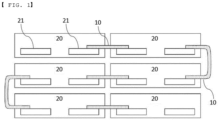
- FIG. 1 is a conceptual view of a conventional battery pack
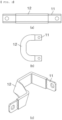
- FIG. 2 is an external perspective view of a conventional HV busbar.
- FIG. 1 in a battery pack including a total of six battery modules 20, terminals 21 of the battery modules 20 that are horizontally arranged are located on the same plane, whereby a general rigid flat HV busbar 10 shown (a) of FIG. 2 is used.
- a general rigid flat HV busbar 10 shown (a) of FIG. 2 is used.
- a flexible HV busbar 10 shown in (b) of FIG. 2 is adopted.
- an HV busbar 10 having a shape shown in (c) of FIG. 2 may be adopted.
- the HV busbar 10 includes a metal plate 11 having a predetermined thickness and width and an insulative resin coating layer 12 provided so as to wrap the outer surface of the metal plate 11.
- Patent Document Korean Patent Application Publication No. 2015-0062694 discloses a part for secondary batteries installed on a path of current flowing in a secondary battery, wherein the part includes a metal plate having a slit formed in a lateral direction and a metal bridge having a lower melting point than the metal plate, the metal bridge being joined to the metal plate in a state of filling the slit.
- the above patent document has an advantage in that, in the case in which overcurrent flows in the secondary battery, the part installed on the path of current flowing in the secondary battery is rapidly ruptured, whereby overcurrent is interrupted, and therefore safety in use of the secondary battery is secured, but has problems in that it is not easy to join the metal plate and the metal bridge to each other, since the metal plate and the metal bridge are dissimilar metals, and therefore the metal bridge must be joined to the metal plate so as to wrap the regions of the upper surface and the lower surface of the metal plate that are adjacent to the slit, whereby the part is structurally unstable, has low resistance to external impact, and is not easy to manufacture.
- Patent Document 1 Korean Patent Application Publication No. 2015-0062694
- the present invention has been made in view of the above problems, and it is an object of the present invention to provide an HV busbar capable of securely interrupting the flow of current even in the case in which the temperature of a battery pack is abnormally increased and a method of manufacturing the same.
- an HV busbar (100) configured to connect a plurality of battery modules to each other according to the present invention includes a conductor including a first metal plate (110) and a second metal plate (120) and an insulative resin coating layer on the outer circumferential surface of the conductor, wherein a first metal (111) constituting the first metal plate (110) and second metals (121) having a lower melting temperature than the first metal (111) are mixed in the second metal plate (120) in the state in which the second metals are dispersed.
- the upper surface and the lower surface of each of the second metals (121) may be exposed out of the second metal plate (120), and the side surface of each of the second metals may be in contact with the first metal (111).
- the second metals (121) may have different outer surface areas.
- the second metals (121) when heated to a predetermined temperature or higher, the second metals (121) may be melted, whereby the sectional area of the second metal plate (120) may be reduced.
- a rupture portion (140) may be formed in the second metal plate (120).
- the first metal (111) may be copper or aluminum
- the second metals (121) may include at least one of indium (In) and tin (Sn).
- the first metal plate (110) may be provided in two, the second metal plate (120) may be provided in one, and the second metal plate (120) may be located between the first metal plates (110).
- the first metal plate (110) and the second metal plate (120) may be alternately located in a longitudinal direction, and the first metal plates (110) may be located at opposite edges in the longitudinal direction.
- an HV busbar manufacturing method includes a first step of applying a predetermined temperature and pressure to first metal powder (112) while continuously supplying the first metal powder to form the first metal plate (110), a second step of applying a predetermined temperature and pressure to a metal powder mixture of first metal powder (112) and second metal powder (122) while continuously supplying the metal powder mixture for a predetermined time to form the second metal plate (120), and a third step of applying a predetermined temperature and pressure to the first metal powder (112) while continuously supplying the first metal powder to form the first metal plate (110), thereby preparing a conductor.
- the first metal powder (112) may be copper or aluminum
- the second metal powder (122) may be an alloy of indium (In) and tin (Sn).
- the particle size of the second metal powder (122) may be greater than the particle size of the first metal powder (112).
- the HV busbar manufacturing method according to the present invention may further include a fourth step of cutting the conductor to a predetermined length and a fifth step of coating the remaining surfaces of the conductor excluding opposite edges thereof with an insulative resin.
- the present invention provides a battery pack including the HV busbar.
- a second metal plate which is made of a mixture of a first metal and a second metal having a lower melting temperature than the first metal, is located between first metal plates, each of which is made of a first metal, whereby the first metal plate and the second metal plate are strongly coupled to each other, and therefore the HV busbar has high resistance to external impact.
- the HV busbar also serves as a fuse, whereby it is possible to omit a separate fuse and manual service disconnect (MSD) in the battery pack, and therefore it is possible to reduce manufacturing costs together with improvement in energy density.
- MSD manual service disconnect
- an HV busbar configured to electrically connect battery modules to each other, to electrically connect a battery module and a vehicle connector to each other, or to electrically connect battery packs to each other.
- the HV busbar according to the present invention which is an HV busbar configured to connect a plurality of battery modules to each other, may be rigid or flexible and may be formed so as to have various shapes, and the outer surface of a metal plate constituting a conductor may be coated with an insulative resin.
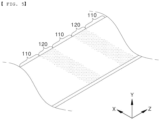
- FIG. 3 is a conceptual view of an HV busbar according to a first preferred embodiment of the present invention
- FIG. 4 is a conceptual view illustrating rupture of the HV busbar according to the present invention.
- the HV busbar 100 which electrically connects terminals of battery modules to each other, is configured in a flat shape having a predetermined thickness (Y-axis direction), a predetermined width (X-axis direction), and a predetermined length (Z-axis direction), and includes a first metal plate 110 corresponding to a non-cutting region and a second metal plate 120 corresponding to a cutting region.
- the second metal plate 120 further includes a second metal having a different melting temperature from the metal constituting the first metal plate. That is, second metals 121 having the same outer surface area or different outer surface areas are present in the second metal plate 120 in a dispersed state.
- the portions of the second metals 121 exposed from the upper and lower surfaces of the second metal plate 120 are present in a flat state, although the second metals may maintain the original shape at the time of manufacture thereof, such as a spherical shape or a needle shape.
- the first metal plate 110 constituting the HV busbar 100 is coupled to a positive electrode lead
- the first metal plate it is preferable for the first metal plate to be made of an aluminum (Al) material generally used for the positive electrode lead.
- Al aluminum
- the first metal plate be made of copper (Cu) or a copper material coated with nickel (Ni) generally used for the negative electrode lead.
- the material is not particularly restricted as long as the material exhibits bondability and conductivity.
- the second metal plate 120 may be made of a metal having a lower melting temperature than aluminum (Al) or copper (Cu) constituting the first metal plate 110, such as indium (In), tin (Sn), or an alloy thereof.
- a metal having a lower melting temperature than aluminum (Al) or copper (Cu) constituting the first metal plate 110 such as indium (In), tin (Sn), or an alloy thereof.
- the reason for this is that, in the case in which the battery module is overheated due to short circuit or overcharging, it is necessary to rapidly rupture the HV busbar 100 in order to release electrical connection of the battery module.
- the second metals may be freely changed depending on a desired current cutoff temperature.
- the second metals 121 it is preferable for the second metals 121 to be present so as to have a surface area equivalent to 20 to 90% of the surface area of the HV busbar 100 in the region thereof in the lateral direction (X-axis direction), the longitudinal direction (Z-axis direction), and the thickness direction (Y-axis direction) of the HV busbar.
- the surface area of the second metals is less than 20% of the surface area of the HV busbar, time taken until the HV busbar is ruptured is too long.
- the surface area of the second metals is greater than 90% of the surface area of the HV busbar, the HV busbar 100 may be ruptured by temporary overheating. Consequently, the above range is desirable.
- the second metals 121 may be located within a range of 5 to 10 mm in the longitudinal direction (Z-axis direction) of the HV busbar 100.
- FIG. 5 is a conceptual view of an HV busbar according to a second preferred embodiment of the present invention.
- the second embodiment is identical in construction to the first embodiment except that two second metal plates 120 are provided at the HV busbar 100 so as to be spaced apart from each other by a predetermined distance.
- two second metal plates 120 are provided at the HV busbar 100 so as to be spaced apart from each other by a predetermined distance.
- two second metal plates 120 each of which includes second metals 121, are provided so as to be spaced apart from each other by a predetermined distance, it is possible to further increase a safety factor. That is, in the case in which one second metal plate 120 is provided, relatively long time is incurred until the HV busbar is ruptured or the occurrence of short circuit may be inhibited. In the case in which two second metal plates 120 are present at the HV busbar 100, however, it is possible to more securely induce rupture of the HV busbar. Although two second metal plates 120 are shown in FIG. 5 , which is merely an illustration, it is obvious that three or more second metal plates may be provided.
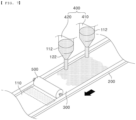
- FIG. 6 is a flowchart illustrating a method of manufacturing the HV busbar according to the first preferred embodiment of the present invention
- FIG. 7 is a schematic view of an apparatus for manufacturing the HV busbar according to the first preferred embodiment of the present invention.
- the method of manufacturing the HV busbar according to the first embodiment of the present invention includes a first step of applying a predetermined temperature and pressure to first metal powder 112 while continuously supplying the first metal powder to form a first metal plate 110, a second step of applying a predetermined temperature and pressure to a metal powder mixture of first metal powder 112 and second metal powder 122 while continuously supplying the metal powder mixture for a predetermined time to form a second metal plate 120, a third step of applying a predetermined temperature and pressure to first metal powder 112 while continuously supplying the first metal powder to form a first metal plate 110, thereby preparing a conductor, a fourth step of cutting the prepared conductor to a predetermined length, and a fifth step of coating the remaining surfaces of the conductor excluding opposite edges thereof with an insulative resin.
- the busbar manufacturing apparatus may include a conveyor belt 200, a tray 300, a metal particle supply tank 400, a roller 500, and a heating means (not shown).
- first metal powder 112 in a first supply tank 410 is continuously supplied to the tray 300, which is located on the conveyor belt 200, and at the same time the first metal powder is heated to a predetermined temperature while the first metal powder is pressed using the roller 500 to form a first metal plate 110 corresponding to a flat non-cutting region.
- supply of the first metal powder 112 from the first supply tank 410 is temporarily interrupted, and a metal powder mixture of first metal powder 112 and second metal powder 122 in a second supply tank 420 is heated and pressed using the roller 500 while the metal powder mixture is continuously supplied to the tray 300 to form a second metal plate 120 corresponding to a flat cutting region.
- the particle size of the second metal powder 122 may be changed depending on the target rupture current amount of an HV busbar 100.
- the particle size of each of the first metal powder 112 and the second metal powder 122 may range from several nm to several mm. It is preferable that the particle size of the second metal powder 122 be greater than the particle size of the first metal powder 112.
- the particle size of the second metal powder 122 may be 2 to 10 times the particle size of the first metal powder 112. That is, the particle size of the first metal powder 112, which has a relatively high melting point, is reduced in order to adjust sintering temperatures of the first metal powder 112 and the second metal powder 122 so as to be similar to each other.
- the particle size ratio therebetween is not limited to the above-defined particle size ratio.
- the heating temperature in the first step and the second step is not particularly restricted. Any temperature capable of sintering the first metal powder 112 and the second metal powder 122 depending on the particle sizes of the first metal powder and the second metal powder is allowed.
- the supply of the metal powder mixture from the second supply tank is temporarily interrupted, and first metal powder 112 in the first supply tank 410 is pressed and heated while the first metal powder is continuously supplied to the tray 300 to form a first metal plate 110 corresponding to a non-cutting region.
- a conductor configured such that the second metal plate 120, which is made of the mixture of the first metal powder 112 and the second metal powder 122 and which corresponds to the cutting region, is provided in the middle and such that a pair of first metal plates 110, each of which is made of only the first metal powder 112 and each of which corresponds to the non-cutting region, are provided at opposite sides of the second metal plate 120.
- the fourth step is a step of cutting the prepared conductor to an appropriate length in consideration of the distance between battery modules to be connected to each other.
- the fifth step is a step of uniformly forming a coating layer on the outer surface of the conductor using a thermosetting resin that exhibits high insulation, such as an epoxy resin or a polyester resin.
- a thermosetting resin that exhibits high insulation such as an epoxy resin or a polyester resin.
- the coating layer forming process corresponds to known technology, and therefore a detailed description thereof will be omitted.
- a step of bending the HV busbar 100 to a predetermined shape may be further included.
- the bending step may be performed after cutting in the fourth step or after the coating layer is formed.
- FIG. 8 is a flowchart illustrating a method of manufacturing the HV busbar according to the second preferred embodiment of the present invention
- FIG. 9 is a schematic view of an apparatus for manufacturing the HV busbar according to the second preferred embodiment of the present invention.
- the method of manufacturing the HV busbar according to the second embodiment of the present invention includes a first step of applying a predetermined temperature and pressure to first metal powder 112 while continuously supplying the first metal powder to form a first metal plate 110, a second step of applying a predetermined temperature and pressure to a metal powder mixture of first metal powder 112 and second metal powder 122 while continuously supplying the metal powder mixture for a predetermined time to form a second metal plate 120, a third step of applying a predetermined temperature and pressure to first metal powder 112 while continuously supplying the first metal powder to form a first metal plate 110, a fourth step of applying a predetermined temperature and pressure to a metal powder mixture of first metal powder 112 and second metal powder 122 while continuously supplying the metal powder mixture for a predetermined time to form a second metal plate 120, a fifth step of applying a predetermined temperature and pressure to first metal powder 112 while continuously supplying the first metal powder to form a first metal plate 110, thereby preparing a conductor,
- the manufacturing method according to the second embodiment is identical to the manufacturing method according to the first embodiment described above except that two second metal plates 120 are provided and a first metal plate 110 is further provided between the second metal plates 120. That is, the fourth step and the fifth step are repetitions of the second step and the third step, and another second metal plate 120 is formed through the fourth step and the fifth step.
Landscapes
- Chemical & Material Sciences (AREA)
- Chemical Kinetics & Catalysis (AREA)
- Electrochemistry (AREA)
- General Chemical & Material Sciences (AREA)
- Engineering & Computer Science (AREA)
- Manufacturing & Machinery (AREA)
- Physics & Mathematics (AREA)
- Thermal Sciences (AREA)
- Inorganic Chemistry (AREA)
- Connection Of Batteries Or Terminals (AREA)
Description
- This application claims the benefit of priority to
Korean Patent Application No. 2020-0039086 filed on March 31, 2020 - The present invention relates to an HV busbar made of dissimilar metals and a method of manufacturing the same, and more particularly to an HV busbar that is capable of securely interrupting the flow of current while having high resistance to external impact and that is capable of easily adjusting current cutoff temperature in a battery pack and a method of manufacturing the same.
- With technological development of mobile devices, such as mobile phones, laptop computers, camcorders, and digital cameras, and an increase in demand therefor, research on secondary batteries, which are capable of being charged and discharged, has been actively conducted. In addition, secondary batteries, which are energy sources substituting for fossil fuels causing air pollution, have been applied to an electric vehicle (EV), a hybrid electric vehicle (HEV), and a plug-in hybrid electric vehicle (P-HEV), and therefore there is an increasing necessity for development of secondary batteries.
CN 103650209 A discloses a battery pack and connecting bar applied to the same. - There are a nickel-cadmium battery, a nickel-hydride battery, a nickel-zinc battery, and a lithium secondary battery as currently commercialized secondary batteries. Thereamong, the lithium secondary battery is in the spotlight, since the lithium secondary battery has little memory effect, whereby the lithium secondary battery is capable of being freely charged and discharged, has a very low self-discharge rate, and has high energy density, compared to the nickel-based secondary batteries.
- Meanwhile, a secondary battery used for small devices includes several battery cells. For vehicles, however, a plurality of battery modules is electrically connected to each other using a high voltage busbar (HV busbar) in order to increase capacity and output thereof. The HV busbar may be classified as a rigid busbar or a flexible busbar. The flexible busbar is frequently used to connect various electronic devices to each other, in addition to connection between battery modules in series or in parallel. In particular, the flexible busbar is applied to a complicated path having a narrow or bent space.
-
FIG. 1 is a conceptual view of a conventional battery pack, andFIG. 2 is an external perspective view of a conventional HV busbar. - As shown in
FIG. 1 , in a battery pack including a total of sixbattery modules 20,terminals 21 of thebattery modules 20 that are horizontally arranged are located on the same plane, whereby a general rigidflat HV busbar 10 shown (a) ofFIG. 2 is used. Whenterminals 21 of thebattery modules 20 that are vertically arranged are connected to each other, aflexible HV busbar 10 shown in (b) ofFIG. 2 is adopted. In the case in which a path for electrical connection between thebattery modules 20 is further complicated, anHV busbar 10 having a shape shown in (c) ofFIG. 2 may be adopted. - In general, the
HV busbar 10 includes ametal plate 11 having a predetermined thickness and width and an insulativeresin coating layer 12 provided so as to wrap the outer surface of themetal plate 11. - Meanwhile, in the case in which high current flows in a battery pack due to exposure to high temperature, overcharging, external short circuit, needle penetration, or local damage, heat may be generated in a battery, whereby the battery may explode. For this reason, manual service disconnect (MSD), which is called a safety plug, and a fuse are generally mounted, whereby part expenses and volume of the battery pack are increased.
- In connection therewith, Patent Document (
Korean Patent Application Publication No. 2015-0062694 - The above patent document has an advantage in that, in the case in which overcurrent flows in the secondary battery, the part installed on the path of current flowing in the secondary battery is rapidly ruptured, whereby overcurrent is interrupted, and therefore safety in use of the secondary battery is secured, but has problems in that it is not easy to join the metal plate and the metal bridge to each other, since the metal plate and the metal bridge are dissimilar metals, and therefore the metal bridge must be joined to the metal plate so as to wrap the regions of the upper surface and the lower surface of the metal plate that are adjacent to the slit, whereby the part is structurally unstable, has low resistance to external impact, and is not easy to manufacture.
- (Patent Document 1)
Korean Patent Application Publication No. 2015-0062694 - The present invention has been made in view of the above problems, and it is an object of the present invention to provide an HV busbar capable of securely interrupting the flow of current even in the case in which the temperature of a battery pack is abnormally increased and a method of manufacturing the same.
- It is another object of the present invention to provide an HV busbar that has high resistance to external impact and that is easy to manufacture and a method of manufacturing the same.
- In order to accomplish the above objects, an HV busbar (100) configured to connect a plurality of battery modules to each other according to the present invention includes a conductor including a first metal plate (110) and a second metal plate (120) and an insulative resin coating layer on the outer circumferential surface of the conductor, wherein a first metal (111) constituting the first metal plate (110) and second metals (121) having a lower melting temperature than the first metal (111) are mixed in the second metal plate (120) in the state in which the second metals are dispersed.
- Also, in the HV busbar according to the present invention, the upper surface and the lower surface of each of the second metals (121) may be exposed out of the second metal plate (120), and the side surface of each of the second metals may be in contact with the first metal (111).
- Also, in the HV busbar according to the present invention, the second metals (121) may have different outer surface areas.
- Also, in the HV busbar according to the present invention, when heated to a predetermined temperature or higher, the second metals (121) may be melted, whereby the sectional area of the second metal plate (120) may be reduced.
- Also, in the HV busbar according to the present invention, when heated to a predetermined temperature or higher, a rupture portion (140) may be formed in the second metal plate (120).
- Also, in the HV busbar according to the present invention, the first metal (111) may be copper or aluminum, and the second metals (121) may include at least one of indium (In) and tin (Sn).
- Also, in the HV busbar according to the present invention, the first metal plate (110) may be provided in two, the second metal plate (120) may be provided in one, and the second metal plate (120) may be located between the first metal plates (110).
- Also, in the HV busbar according to the present invention, the first metal plate (110) and the second metal plate (120) may be alternately located in a longitudinal direction, and the first metal plates (110) may be located at opposite edges in the longitudinal direction.
- In addition, an HV busbar manufacturing method according to the present invention includes a first step of applying a predetermined temperature and pressure to first metal powder (112) while continuously supplying the first metal powder to form the first metal plate (110), a second step of applying a predetermined temperature and pressure to a metal powder mixture of first metal powder (112) and second metal powder (122) while continuously supplying the metal powder mixture for a predetermined time to form the second metal plate (120), and a third step of applying a predetermined temperature and pressure to the first metal powder (112) while continuously supplying the first metal powder to form the first metal plate (110), thereby preparing a conductor.
- Also, in the HV busbar manufacturing method according to the present invention, the first metal powder (112) may be copper or aluminum, and the second metal powder (122) may be an alloy of indium (In) and tin (Sn).
- Also, in the HV busbar manufacturing method according to the present invention, the particle size of the second metal powder (122) may be greater than the particle size of the first metal powder (112).
- Also, the HV busbar manufacturing method according to the present invention may further include a fourth step of cutting the conductor to a predetermined length and a fifth step of coating the remaining surfaces of the conductor excluding opposite edges thereof with an insulative resin.
- In addition, the present invention provides a battery pack including the HV busbar.
- In an HV busbar according to the present invention and a method of manufacturing the same, a second metal plate, which is made of a mixture of a first metal and a second metal having a lower melting temperature than the first metal, is located between first metal plates, each of which is made of a first metal, whereby the first metal plate and the second metal plate are strongly coupled to each other, and therefore the HV busbar has high resistance to external impact.
- Also, in the HV busbar according to the present invention and the method of manufacturing the same, when the temperature of a battery pack is increased to a melting temperature of the second metal, a predetermined region of the second metal plate is ruptured, whereby the flow of current is interrupted. Consequently, it is possible to easily adjust current cutoff temperature by changing the kind of the second metal.
- Furthermore, in the HV busbar according to the present invention and the method of manufacturing the same, the HV busbar also serves as a fuse, whereby it is possible to omit a separate fuse and manual service disconnect (MSD) in the battery pack, and therefore it is possible to reduce manufacturing costs together with improvement in energy density.
-
-
FIG. 1 is a conceptual view of a conventional battery pack. -
FIG. 2 is an external perspective view of a conventional HV busbar. -
FIG. 3 is a conceptual view of an HV busbar according to a first preferred embodiment of the present invention. -
FIG. 4 is a conceptual view illustrating rupture of the HV busbar according to the present invention. -
FIG. 5 is a conceptual view of an HV busbar according to a second preferred embodiment of the present invention. -
FIG. 6 is a flowchart illustrating a method of manufacturing the HV busbar according to the first preferred embodiment of the present invention. -
FIG. 7 is a schematic view of an apparatus for manufacturing the HV busbar according to the first preferred embodiment of the present invention. -
FIG. 8 is a flowchart illustrating a method of manufacturing the HV busbar according to the second preferred embodiment of the present invention. -
FIG. 9 is a schematic view of an apparatus for manufacturing the HV busbar according to the second preferred embodiment of the present invention. - In the present application, it should be understood that the terms "comprises," "has," "includes," etc. specify the presence of stated features, numbers, steps, operations, elements, components, or combinations thereof, but do not preclude the presence or addition of one or more other features, numbers, steps, operations, elements, components, or combinations thereof.
- In addition, the same reference numbers will be used throughout the drawings to refer to parts that perform similar functions or operations. In the case in which one part is said to be connected to another part in the specification, not only may the one part be directly connected to the other part, but also, the one part may be indirectly connected to the other part via a further part. In addition, that a certain element is included does not mean that other elements are excluded, but means that such elements may be further included unless mentioned otherwise.
- Meanwhile, an HV busbar according to the present invention is defined as a busbar configured to electrically connect battery modules to each other, to electrically connect a battery module and a vehicle connector to each other, or to electrically connect battery packs to each other.
- Hereinafter, an HV busbar made of dissimilar metals according to the present invention and a method of manufacturing the same will be described. As described with reference to
FIGS. 1 and2 , the HV busbar according to the present invention, which is an HV busbar configured to connect a plurality of battery modules to each other, may be rigid or flexible and may be formed so as to have various shapes, and the outer surface of a metal plate constituting a conductor may be coated with an insulative resin. -
FIG. 3 is a conceptual view of an HV busbar according to a first preferred embodiment of the present invention, andFIG. 4 is a conceptual view illustrating rupture of the HV busbar according to the present invention. - The HV busbar 100, which electrically connects terminals of battery modules to each other, is configured in a flat shape having a predetermined thickness (Y-axis direction), a predetermined width (X-axis direction), and a predetermined length (Z-axis direction), and includes a
first metal plate 110 corresponding to a non-cutting region and asecond metal plate 120 corresponding to a cutting region. - In addition to a metal constituting the
first metal plate 110, thesecond metal plate 120 further includes a second metal having a different melting temperature from the metal constituting the first metal plate. That is,second metals 121 having the same outer surface area or different outer surface areas are present in thesecond metal plate 120 in a dispersed state. - Here, that the
second metals 121 are dispersed in thesecond metal plate 120 means that thesecond metals 121 having predetermined sizes and surface areas are completely inserted or impregnated in a thickness direction of the second metal plate 120 (Y-axis direction) regularly or irregularly. That is, thesecond metals 121 are exposed outwards from the upper surface and the lower surface of thesecond metal plate 120, whereas the side surface of each of the second metals is in completely tight contact with the metal constituting thefirst metal plate 110. - Of course, the portions of the
second metals 121 exposed from the upper and lower surfaces of thesecond metal plate 120 are present in a flat state, although the second metals may maintain the original shape at the time of manufacture thereof, such as a spherical shape or a needle shape. - In the case in which the
first metal plate 110 constituting the HV busbar 100 is coupled to a positive electrode lead, it is preferable for the first metal plate to be made of an aluminum (Al) material generally used for the positive electrode lead. The reason for this is that it is possible to improve weldability and to minimize contact resistance at a coupling portion. In the same manner, it is preferable that, in the case in which thefirst metal plate 110 is coupled to a negative electrode lead, the first metal plate be made of copper (Cu) or a copper material coated with nickel (Ni) generally used for the negative electrode lead. However, the material is not particularly restricted as long as the material exhibits bondability and conductivity. - The
second metal plate 120 may be made of a metal having a lower melting temperature than aluminum (Al) or copper (Cu) constituting thefirst metal plate 110, such as indium (In), tin (Sn), or an alloy thereof. The reason for this is that, in the case in which the battery module is overheated due to short circuit or overcharging, it is necessary to rapidly rupture the HV busbar 100 in order to release electrical connection of the battery module. The second metals may be freely changed depending on a desired current cutoff temperature. - That is, as shown in
FIG. 4 , when the battery module is normally operated, current flows via the flat HV busbar 100 ((a) ofFIG. 4 ). When the battery module is overheated to a melting temperature or higher of thesecond metals 121 due to short circuit in the battery module, however, thesecond metals 121, each of which has a relatively low melting temperature, are melted first, wherebypores 130 are formed in the portions at which thesecond metals 121 have been present (see (b) ofFIG. 4 ). As a result, arupture portion 140 is formed in a predetermined region, i.e. a region at which thesecond metals 121 are located adjacent to each other, whereby the HV busbar 100 is ruptured (see (c) ofFIG. 4 ) . - Here, the technical principle by which rupture occurs based on the
pores 130, in which thesecond metals 121 have been present, will be described in brief. When thesecond metals 121 are melted and thus thepores 130 are formed, the surface area in which current is movable is reduced in the vicinity of thepores 130, whereby resistance is increased. Consequently, heat is abruptly generated based on the region in which thepores 130 are formed, whereby the temperature of afirst metal 111 is increased to the melting temperature thereof. As a result, the first metal connecting thepores 130 to each other is also melted, whereby therupture portion 140 is formed in thesecond metal plate 120 and thus the second metal plate is cut. - Meanwhile, it is preferable for the
second metals 121 to be present so as to have a surface area equivalent to 20 to 90% of the surface area of the HV busbar 100 in the region thereof in the lateral direction (X-axis direction), the longitudinal direction (Z-axis direction), and the thickness direction (Y-axis direction) of the HV busbar. In the case in which the surface area of the second metals is less than 20% of the surface area of the HV busbar, time taken until the HV busbar is ruptured is too long. In the case in which the surface area of the second metals is greater than 90% of the surface area of the HV busbar, the HV busbar 100 may be ruptured by temporary overheating. Consequently, the above range is desirable. - Here, the
second metals 121 may be located within a range of 5 to 10 mm in the longitudinal direction (Z-axis direction) of the HV busbar 100. - Next, a second preferred embodiment of the present invention will be described.
FIG. 5 is a conceptual view of an HV busbar according to a second preferred embodiment of the present invention. - The second embodiment is identical in construction to the first embodiment except that two
second metal plates 120 are provided at the HV busbar 100 so as to be spaced apart from each other by a predetermined distance. Hereinafter, therefore, only different constructions will be described. - In the case in which two
second metal plates 120, each of which includessecond metals 121, are provided so as to be spaced apart from each other by a predetermined distance, it is possible to further increase a safety factor. That is, in the case in which onesecond metal plate 120 is provided, relatively long time is incurred until the HV busbar is ruptured or the occurrence of short circuit may be inhibited. In the case in which twosecond metal plates 120 are present at the HV busbar 100, however, it is possible to more securely induce rupture of the HV busbar. Although twosecond metal plates 120 are shown inFIG. 5 , which is merely an illustration, it is obvious that three or more second metal plates may be provided. - Next, a method and apparatus for manufacturing the HV busbar according to the first embodiment of the present invention described above will be described.
-
FIG. 6 is a flowchart illustrating a method of manufacturing the HV busbar according to the first preferred embodiment of the present invention, andFIG. 7 is a schematic view of an apparatus for manufacturing the HV busbar according to the first preferred embodiment of the present invention. - The method of manufacturing the HV busbar according to the first embodiment of the present invention includes a first step of applying a predetermined temperature and pressure to
first metal powder 112 while continuously supplying the first metal powder to form afirst metal plate 110, a second step of applying a predetermined temperature and pressure to a metal powder mixture offirst metal powder 112 andsecond metal powder 122 while continuously supplying the metal powder mixture for a predetermined time to form asecond metal plate 120, a third step of applying a predetermined temperature and pressure tofirst metal powder 112 while continuously supplying the first metal powder to form afirst metal plate 110, thereby preparing a conductor, a fourth step of cutting the prepared conductor to a predetermined length, and a fifth step of coating the remaining surfaces of the conductor excluding opposite edges thereof with an insulative resin. - The busbar manufacturing apparatus according to the present invention may include a
conveyor belt 200, atray 300, a metalparticle supply tank 400, aroller 500, and a heating means (not shown). - Specifically, in the first step,
first metal powder 112 in afirst supply tank 410 is continuously supplied to thetray 300, which is located on theconveyor belt 200, and at the same time the first metal powder is heated to a predetermined temperature while the first metal powder is pressed using theroller 500 to form afirst metal plate 110 corresponding to a flat non-cutting region. - In the second step, supply of the
first metal powder 112 from thefirst supply tank 410 is temporarily interrupted, and a metal powder mixture offirst metal powder 112 andsecond metal powder 122 in asecond supply tank 420 is heated and pressed using theroller 500 while the metal powder mixture is continuously supplied to thetray 300 to form asecond metal plate 120 corresponding to a flat cutting region. - Here, the particle size of the
second metal powder 122 may be changed depending on the target rupture current amount of an HV busbar 100. As an example, the particle size of each of thefirst metal powder 112 and thesecond metal powder 122 may range from several nm to several mm. It is preferable that the particle size of thesecond metal powder 122 be greater than the particle size of thefirst metal powder 112. The particle size of thesecond metal powder 122 may be 2 to 10 times the particle size of thefirst metal powder 112. That is, the particle size of thefirst metal powder 112, which has a relatively high melting point, is reduced in order to adjust sintering temperatures of thefirst metal powder 112 and thesecond metal powder 122 so as to be similar to each other. In the case in which the sintering temperatures of thefirst metal powder 112 and thesecond metal powder 122 are similar to each other, the particle size ratio therebetween is not limited to the above-defined particle size ratio. - In addition, the heating temperature in the first step and the second step is not particularly restricted. Any temperature capable of sintering the
first metal powder 112 and thesecond metal powder 122 depending on the particle sizes of the first metal powder and the second metal powder is allowed. - In the third step, the supply of the metal powder mixture from the second supply tank is temporarily interrupted, and
first metal powder 112 in thefirst supply tank 410 is pressed and heated while the first metal powder is continuously supplied to thetray 300 to form afirst metal plate 110 corresponding to a non-cutting region. - After the first to third steps are performed, there is formed a conductor configured such that the
second metal plate 120, which is made of the mixture of thefirst metal powder 112 and thesecond metal powder 122 and which corresponds to the cutting region, is provided in the middle and such that a pair offirst metal plates 110, each of which is made of only thefirst metal powder 112 and each of which corresponds to the non-cutting region, are provided at opposite sides of thesecond metal plate 120. - The fourth step is a step of cutting the prepared conductor to an appropriate length in consideration of the distance between battery modules to be connected to each other.
- The fifth step is a step of uniformly forming a coating layer on the outer surface of the conductor using a thermosetting resin that exhibits high insulation, such as an epoxy resin or a polyester resin. Here, it is preferable to form the coating layer using a spray coating method. The reason for this is that, when the spray coating method is used, it is possible to easily adjust the thickness of the coating layer and to reduce coating time. The coating layer forming process corresponds to known technology, and therefore a detailed description thereof will be omitted.
- Meanwhile, a step of bending the HV busbar 100 to a predetermined shape may be further included. Specifically, the bending step may be performed after cutting in the fourth step or after the coating layer is formed. However, it is preferable for the bending step to be performed before the coating layer is formed. The reason for this is that, in the case in which the HV busbar is bent after the coating layer is formed, a portion of the coating layer may be loosened and the surface of the coating layer at the bent portion is not smooth.
- Next, a method of manufacturing the HV busbar according to the second embodiment of the present invention described above will be described.
-
FIG. 8 is a flowchart illustrating a method of manufacturing the HV busbar according to the second preferred embodiment of the present invention, andFIG. 9 is a schematic view of an apparatus for manufacturing the HV busbar according to the second preferred embodiment of the present invention. - As shown in
FIGS. 8 and9 , the method of manufacturing the HV busbar according to the second embodiment of the present invention includes a first step of applying a predetermined temperature and pressure tofirst metal powder 112 while continuously supplying the first metal powder to form afirst metal plate 110, a second step of applying a predetermined temperature and pressure to a metal powder mixture offirst metal powder 112 andsecond metal powder 122 while continuously supplying the metal powder mixture for a predetermined time to form asecond metal plate 120, a third step of applying a predetermined temperature and pressure tofirst metal powder 112 while continuously supplying the first metal powder to form afirst metal plate 110, a fourth step of applying a predetermined temperature and pressure to a metal powder mixture offirst metal powder 112 andsecond metal powder 122 while continuously supplying the metal powder mixture for a predetermined time to form asecond metal plate 120, a fifth step of applying a predetermined temperature and pressure tofirst metal powder 112 while continuously supplying the first metal powder to form afirst metal plate 110, thereby preparing a conductor, a sixth step of cutting the prepared conductor to a predetermined length, and a seventh step of coating the remaining surfaces of the conductor excluding opposite edges thereof with an insulative resin. - The manufacturing method according to the second embodiment is identical to the manufacturing method according to the first embodiment described above except that two
second metal plates 120 are provided and afirst metal plate 110 is further provided between thesecond metal plates 120. That is, the fourth step and the fifth step are repetitions of the second step and the third step, and anothersecond metal plate 120 is formed through the fourth step and the fifth step. - Although the specific details of the present invention have been described in detail, those skilled in the art will appreciate that the detailed description thereof discloses only preferred embodiments of the present invention and thus does not limit the scope of the present invention. Accordingly, those skilled in the art will appreciate that various changes and modifications are possible, without departing from the category and the technical idea of the present invention, and it will be obvious that such changes and modifications fall within the scope of the appended claims.
-
- 100:
- HV busbar
- 110:
- First metal plate
- 111:
- First metal 112: First metal powder
- 120:
- Second metal plate
- 121:
- Second metal 122: Second metal powder
- 130:
- Pore
- 140:
- Rupture portion
- 200:
- Conveyor belt
- 300:
- Tray
- 400:
- Metal particle supply tank
- 410:
- First supply tank
- 420:
- Second supply tank
- 500:
- Roller
Claims (14)
- An HV busbar (100) configured to connect a plurality of battery modules to each other, the HV busbar (100) comprising:a conductor comprising a first metal plate (110) and a second metal plate (120); whereina first metal (111) constitutes the first metal plate (110);characterized in thatsecond metals (121) having a lower melting temperature than the first metal (111) are mixed in the second metal plate (120) in a state in which the second metals (121) are dispersed;and in that the HV busbar comprises an insulative resin coating layer on an outer circumferential surface of the conductor.
- The HV busbar (100) according to claim 1, wherein an upper surface and a lower surface of each of the second metals (121) are exposed out of the second metal plate (120), and a side surface of each of the second metals (121) is in contact with the first metal (111).
- The HV busbar (100) according to claim 2, wherein the second metals (121) have different outer surface areas.
- The HV busbar (100) according to claim 3, wherein, when heated to a predetermined temperature or higher, the second metals (121) are melted, whereby a sectional area of the second metal plate (120) is reduced.
- The HV busbar (100) according to claim 4, wherein, when heated to a predetermined temperature or higher, a rupture portion (140) is formed in the second metal plate (120).
- The HV busbar (100) according to claim 1, whereinthe first metal (111) is copper or aluminum, andthe second metals (121) comprises at least one of indium (In) and tin (Sn).
- The HV busbar (100) according to claim 1, whereinthe first metal plate (110) is provided in two,the second metal plate (120) is provided in one, andthe second metal plate (120) is located between the first metal plates (110).
- The HV busbar (100) according to claim 7, whereinthe first metal plates (110) and the second metal plate (120) are alternately located in a longitudinal direction, andthe first metal plates (110) are located at opposite edges in the longitudinal direction.
- A method of manufacturing the HV busbar (100) according to claim 1, the method comprising:a first step of applying a predetermined temperature and pressure to first metal powder (112) while continuously supplying the first metal powder (112) to form the first metal plate (110);a second step of applying a predetermined temperature and pressure to a metal powder mixture of first metal powder (112) and second metal powder (122) while continuously supplying the metal powder mixture for a predetermined time to form the second metal plate (120); anda third step of applying a predetermined temperature and pressure to the first metal powder (112) while continuously supplying the first metal powder to form the first metal plate (110), thereby preparing a conductor.
- The method according to claim 9, whereinthe first metal powder (112) is copper or aluminum, andthe second metal powder (122) is an alloy of indium (In) and tin (Sn).
- The method according to claim 10, wherein a particle size of the second metal powder (122) is greater than a particle size of the first metal powder (112).
- The method according to claim 9, further comprising:a fourth step of cutting the conductor to a predetermined length; anda fifth step of coating remaining surfaces of the conductor excluding opposite edges thereof with an insulative resin.
- A battery pack comprising the HV busbar (100) according to any one of claims 1 to 8.
- The HV busbar (100) according to claim 1, wherein the second metals (121) being dispersed comprises second metals (121) having predetermined sizes and surface areas being completely inserted or impregnated in a thickness direction of the second metal plate (120) regularly or irregularly.
Applications Claiming Priority (2)
| Application Number | Priority Date | Filing Date | Title |
|---|---|---|---|
| KR1020200039086A KR102819127B1 (en) | 2020-03-31 | 2020-03-31 | High Voltage Busbar Having Dissimilar Metals and Manufacturing Method Thereof |
| PCT/KR2021/002658 WO2021201446A1 (en) | 2020-03-31 | 2021-03-04 | Hv bus bar made of dissimilar metals and manufacturing method therefor |
Publications (3)
| Publication Number | Publication Date |
|---|---|
| EP4068497A1 EP4068497A1 (en) | 2022-10-05 |
| EP4068497A4 EP4068497A4 (en) | 2024-09-04 |
| EP4068497B1 true EP4068497B1 (en) | 2025-05-21 |
Family
ID=77927380
Family Applications (1)
| Application Number | Title | Priority Date | Filing Date |
|---|---|---|---|
| EP21782031.5A Active EP4068497B1 (en) | 2020-03-31 | 2021-03-04 | Hv busbar made of dissimilar metals and method of manufacturing the same |
Country Status (9)
| Country | Link |
|---|---|
| US (1) | US12148954B2 (en) |
| EP (1) | EP4068497B1 (en) |
| JP (1) | JP7391458B2 (en) |
| KR (1) | KR102819127B1 (en) |
| CN (1) | CN114846693B (en) |
| ES (1) | ES3033849T3 (en) |
| HU (1) | HUE071577T2 (en) |
| PL (1) | PL4068497T3 (en) |
| WO (1) | WO2021201446A1 (en) |
Families Citing this family (4)
| Publication number | Priority date | Publication date | Assignee | Title |
|---|---|---|---|---|
| CN110667870B (en) | 2019-10-12 | 2023-01-20 | 内蒙古工业大学 | Unmanned aerial vehicle is energy autonomous base station of independently taking off and land trading battery based on solar energy power supply |
| US12519189B2 (en) * | 2022-01-11 | 2026-01-06 | Textron Innovations Inc. | Thermally disconnecting high power busbars for battery system propagation control |
| KR102924862B1 (en) | 2022-01-25 | 2026-02-09 | 이브 파워 코포레이션 리미티드 | Large cylindrical battery connection sheets, battery modules and battery packs |
| EP4393029A2 (en) * | 2022-05-04 | 2024-07-03 | Aspen Aerogels Inc. | Protection of electrical components in battery systems |
Family Cites Families (106)
| Publication number | Priority date | Publication date | Assignee | Title |
|---|---|---|---|---|
| US1943913A (en) * | 1928-04-23 | 1934-01-16 | Joseph H Cohen | Wire reel |
| US2375917A (en) * | 1943-10-11 | 1945-05-15 | Henry R Gross | Electric cable reel |
| US3600500A (en) * | 1969-06-02 | 1971-08-17 | Southwire Co | Twin conductor with filler |
| US3968587A (en) * | 1975-07-21 | 1976-07-13 | Dfk Inc. | Downrigger |
| US4156320A (en) * | 1977-06-09 | 1979-05-29 | Dfk Inc. | Downrigger |
| US4199854A (en) * | 1978-01-25 | 1980-04-29 | Ethyl Corporation | Cable stripping method |
| US4181047A (en) * | 1978-01-25 | 1980-01-01 | Ethyl Corporation | Cable stripping apparatus |
| US4454999A (en) * | 1981-04-20 | 1984-06-19 | Woodruff Harold F | Cable dispensing device and method |
| US4775328A (en) * | 1985-07-02 | 1988-10-04 | Electri-Cable Assemblies, Inc. | Modular seven wire electrical connector system |
| JPH064522Y2 (en) * | 1985-12-25 | 1994-02-02 | 内橋エステック株式会社 | Fuse element |
| US4758536A (en) * | 1986-09-18 | 1988-07-19 | Amp Incorporated | Receptacle for premise wiring system |
| US4794691A (en) * | 1986-10-02 | 1989-01-03 | Brandeau Edward P | Method and apparatus for terminating thin, flat power cable, particularly for under carpet use |
| US4743512A (en) | 1987-06-30 | 1988-05-10 | Carpenter Technology Corporation | Method of manufacturing flat forms from metal powder and product formed therefrom |
| US4830300A (en) * | 1987-11-24 | 1989-05-16 | Atlantic Richfield Company | Apparatus for reeling flexible cable |
| SE461843B (en) * | 1987-12-01 | 1990-04-02 | Electrolux Ab | SPRING DRIVE WIRE WITH BRAKE |
| US5094396B1 (en) * | 1988-11-04 | 1997-05-27 | Telefonix Inc | Retractable reel assembly for telephone extension cord |
| US5053583A (en) * | 1989-01-18 | 1991-10-01 | Amp Incorporated | Bundled hybrid ribbon electrical cable |
| US5245134A (en) * | 1990-08-29 | 1993-09-14 | W. L. Gore & Associates, Inc. | Polytetrafluoroethylene multiconductor cable and process for manufacture thereof |
| US5097099A (en) * | 1991-01-09 | 1992-03-17 | Amp Incorporated | Hybrid branch cable and shield |
| JPH04341508A (en) | 1991-05-17 | 1992-11-27 | Sumitomo Metal Ind Ltd | Production of coupling formed body for different kinds of materials |
| US5296648A (en) * | 1992-04-27 | 1994-03-22 | Belden Wire & Cable Company | Flat cable |
| US5385314A (en) * | 1992-08-18 | 1995-01-31 | Wagner Mining And Construction Equipment Co. | Cable reel level wind mechanism |
| US5535960A (en) * | 1994-08-31 | 1996-07-16 | Gte Airfone Incorporated | Cord reel assembly |
| JP3437675B2 (en) * | 1995-03-20 | 2003-08-18 | 日産自動車株式会社 | Spiral cable reel |
| AU5094596A (en) * | 1995-03-20 | 1996-10-08 | Cooper Industries, Inc. | Female automotive fuse |
| US5631619A (en) | 1995-03-20 | 1997-05-20 | Cooper Industries, Inc. | Female automotive fuse having fuse clips electrically connected to conductive thermal blocks |
| JP3080297B2 (en) | 1996-04-19 | 2000-08-21 | 片山特殊工業株式会社 | Method for producing metal sheet and metal sheet produced by the method |
| US6372988B1 (en) * | 1997-01-07 | 2002-04-16 | Paul C. Burke | Seamless flat-round conductive cable for a retractable cord reel |
| DE19826661C1 (en) * | 1998-06-16 | 1999-10-21 | Atlanta Kabel Steinmueller Gmb | Self-winding cable reel for electrical lead cable |
| DE19981927C1 (en) * | 1998-10-15 | 2003-07-03 | Kuester Automotive Door Sys | Cable window operating device for automobile has one of sliding elements at either side of window glass provided with play in direction of vehicle longitudinal axis relative to cooperating guide section |
| US6241063B1 (en) * | 1998-11-06 | 2001-06-05 | Quentin W. Van Ess | Cable reel having slip ring capsule and overwinding protection |
| US6578683B1 (en) * | 1999-11-12 | 2003-06-17 | Telefonix, Inc | Miniature retractable cord reel |
| US6730622B2 (en) * | 1999-12-21 | 2004-05-04 | The Procter & Gamble Company | Electrical cable |
| JP2003522375A (en) * | 2000-02-03 | 2003-07-22 | レステック インク | Retractable cable and reel assembly |
| JP3478785B2 (en) | 2000-07-21 | 2003-12-15 | 松下電器産業株式会社 | Thermal fuse and battery pack |
| US6926130B2 (en) * | 2001-05-08 | 2005-08-09 | Restech, Inc. | Portable docking station and cord reel assembly |
| DE10224196A1 (en) * | 2002-05-31 | 2003-12-11 | Sram De Gmbh | Cable retraction mechanism for trigger switches |
| US7219423B2 (en) * | 2002-07-15 | 2007-05-22 | Haworth, Inc. | Manufacturing process for a flex connector of an electrical system |
| AU2003251967A1 (en) * | 2002-07-15 | 2004-07-14 | Haworth, Inc. | Solid wire modular electrical system for office areas |
| US7108216B2 (en) * | 2003-04-11 | 2006-09-19 | Telefonix, Inc. | Retractable cord reels for use with flat electrical cable |
| WO2004099053A2 (en) * | 2003-05-07 | 2004-11-18 | Thomas William Fleming | A hand held cable reel |
| DE10331710B4 (en) * | 2003-07-11 | 2008-05-08 | W. L. Gore & Associates Gmbh | cable |
| US7272962B2 (en) * | 2004-09-10 | 2007-09-25 | Brady Worldwide, Inc. | Cable lockout assembly |
| WO2006046975A1 (en) * | 2004-10-22 | 2006-05-04 | Beast Cabling Systems, Inc. | Cabling continuous deployment system and tool |
| US7454829B2 (en) * | 2004-10-22 | 2008-11-25 | Bruce Anderson | Cable sorting threader and labeling tool |
| US7332677B2 (en) * | 2004-12-17 | 2008-02-19 | General Electric Company | Multiconductor cable assemblies and methods of making multiconductor cable assemblies |
| US7813091B2 (en) * | 2006-02-03 | 2010-10-12 | Leviton Manufacturing Company, Inc. | Leakage current detector interrupter with continuous duty relay |
| CN2900445Y (en) * | 2006-05-09 | 2007-05-16 | 黄健 | Tubular line winder |
| US9487970B2 (en) * | 2007-03-28 | 2016-11-08 | Checkpoint Systems, Inc. | Cable wrap security device |
| US7976052B1 (en) * | 2007-08-07 | 2011-07-12 | Williams Innovations, Llc | Lock and positioning assembly for the tongue of a steerable trailer |
| US8074916B2 (en) * | 2008-02-01 | 2011-12-13 | Applied Optical Systems, Inc. | Fiber optic/electrical cable reel assembly |
| US9126800B2 (en) * | 2008-02-01 | 2015-09-08 | Applied Optical Systems, Inc. | Fiber optic/electrical cable reel assembly with cable clip |
| US8595922B2 (en) * | 2008-05-12 | 2013-12-03 | Howard Lind | Flexible silicone cable system integrated with snap washer |
| KR101463198B1 (en) | 2008-10-31 | 2014-11-18 | 삼성전자주식회사 | Apparatus and methdo for emergency paging in a broadband wireless communication systmem |
| US8231827B2 (en) | 2009-06-17 | 2012-07-31 | The Gates Corporation | Method of manufacturing powder metal plates |
| US8118147B2 (en) * | 2009-09-11 | 2012-02-21 | Better Place GmbH | Cable dispensing system |
| CN102771017B (en) * | 2010-01-25 | 2015-06-03 | 恩菲斯能源公司 | Method and apparatus for interconnecting distributed power sources |
| US9806445B2 (en) * | 2010-01-25 | 2017-10-31 | Enphase Energy, Inc. | Method and apparatus for interconnecting distributed power sources |
| CA2787876C (en) * | 2010-02-24 | 2013-07-16 | Picote Oy Ltd | Power transmission device and power transmission method |
| US8387763B2 (en) * | 2010-11-22 | 2013-03-05 | Telefonix, Inc. | Retractable cord reel |
| KR101433199B1 (en) | 2011-11-28 | 2014-08-26 | 주식회사 엘지화학 | Battery module and Busbar applied for battery module |
| WO2013103244A1 (en) | 2012-01-03 | 2013-07-11 | 주식회사 엘지화학 | Battery pack and connecting bar applied to same |
| EP2834179B1 (en) * | 2012-04-06 | 2017-08-23 | Optical Cable Corporation | Fiber optic/electrical cable reel cartridge system |
| EP2845281A4 (en) * | 2012-04-30 | 2015-12-23 | Adc Telecommunications Inc | Cable storage spool with center feed |
| KR101401477B1 (en) | 2012-08-02 | 2014-05-29 | 주식회사 엘지화학 | Connecting element for secondary battery, Battery module and Battery pack comprising the same |
| KR101274720B1 (en) | 2012-10-30 | 2013-06-12 | 주식회사 에스에프씨 | Insulated bus bar, solar cell module including the bus bar, and manufacturing method of the same |
| JP2014107201A (en) * | 2012-11-29 | 2014-06-09 | Yazaki Corp | Conduction member and manufacturing method of conduction member |
| US9249921B1 (en) * | 2012-12-07 | 2016-02-02 | Sprint Communications Company L.P. | Raising and lowering telecommunications equipment on a telecommunications tower |
| US20140299704A1 (en) * | 2013-04-05 | 2014-10-09 | Edward J. Hollowed | Retractable cord reel |
| US9371217B1 (en) * | 2013-05-09 | 2016-06-21 | Mark C. DePumpo | Large wheeled, hand operated forklift |
| US9309087B2 (en) * | 2013-06-20 | 2016-04-12 | Amx Llc | Retractable cable and cable rewind spool configuration |
| CN105324896B (en) * | 2013-06-24 | 2017-12-01 | 施耐德电气美国股份有限公司 | Electric vehicle charging station locks cable drum |
| KR101554361B1 (en) * | 2013-07-09 | 2015-09-18 | 주식회사 엘지화학 | A welding method of different metal, different metal busbar manufactured by the same and secondary battery comprising the same |
| US11025345B2 (en) * | 2013-09-19 | 2021-06-01 | Radius Universal Llc | Hybrid cable providing data transmission through fiber optic cable and low voltage power over copper wire |
| JP6214318B2 (en) * | 2013-10-09 | 2017-10-18 | デクセリアルズ株式会社 | Current fuse |
| US20150102151A1 (en) * | 2013-10-15 | 2015-04-16 | Response Engineering, Inc. | Retractable cord reel with electrical contacts mounted on an axial movable spool |
| EP2865540A1 (en) | 2013-10-24 | 2015-04-29 | LANXESS Deutschland GmbH | Rubber compound |
| KR20150062694A (en) | 2013-11-29 | 2015-06-08 | 주식회사 엘지화학 | Element for secondary battery and Secondary battery comprising the same |
| JP5982652B2 (en) * | 2014-04-15 | 2016-08-31 | パナソニックIpマネジメント株式会社 | Dissimilar metal joint |
| KR20150121519A (en) | 2014-04-21 | 2015-10-29 | 에스케이배터리시스템즈 주식회사 | Battery Module and Battery Pack having welding structure for guarantee at safety for short circuit |
| EP3167460A4 (en) * | 2014-07-11 | 2018-03-14 | Panasonic Avionics Corporation | Flat flexible cable and apparatus |
| US10861075B2 (en) * | 2014-08-15 | 2020-12-08 | Howard Lind | Apparatus and method for a custom flat cable configurator |
| US20160048896A1 (en) * | 2014-08-15 | 2016-02-18 | Howard Lind | Custom flat cable configurator |
| US9960587B2 (en) * | 2014-12-10 | 2018-05-01 | Konnectronix, Inc. | Cord reel including a conductive polymeric sheath with a conductive EMI drain |
| KR101623717B1 (en) * | 2015-08-21 | 2016-05-24 | 대산전자(주) | Method of manufacturing electronical connection means |
| US10495835B2 (en) * | 2015-09-28 | 2019-12-03 | Commscope Technologies Llc | Fiber optic cable spool |
| JP6454262B2 (en) | 2015-12-24 | 2019-01-16 | タツタ電線株式会社 | Solder connection structure and film forming method |
| WO2017156157A1 (en) | 2016-03-09 | 2017-09-14 | View, Inc. | Metal accretion bus bars |
| CN109196401A (en) * | 2016-05-18 | 2019-01-11 | 康普连通比利时私人有限公司 | Cable slack portion stores equipment |
| US10988344B2 (en) * | 2016-06-07 | 2021-04-27 | Konnectronix, Inc. | Tinsel sheath for a continuous cable in a cord reel system |
| KR101760397B1 (en) | 2016-09-05 | 2017-07-21 | 서창석 | Apparatus for manufacturing bus bar |
| EP3337304B1 (en) | 2016-12-19 | 2020-02-05 | ABB Schweiz AG | Multi-phase busbur for conductiong electric energy and method of manufacturing the same |
| EP3391981A1 (en) * | 2017-04-18 | 2018-10-24 | Heraeus Additive Manufacturing GmbH | Continuous coating of metal strips by additive manufacturing |
| JP2018181780A (en) | 2017-04-21 | 2018-11-15 | 矢崎総業株式会社 | Stacked bus bars and battery modules |
| US10745975B2 (en) * | 2017-08-14 | 2020-08-18 | Schlumberger Technology Corporation | Electrical power transmission for well construction apparatus |
| US10699822B2 (en) * | 2017-08-14 | 2020-06-30 | Schlumberger Technology Corporation | Electrical power transmission for well construction apparatus |
| KR102382386B1 (en) | 2018-02-09 | 2022-04-01 | 주식회사 엘지에너지솔루션 | Bus Bar Having Current Interruption Part and Battery Module Having the Same |
| WO2019208247A1 (en) * | 2018-04-23 | 2019-10-31 | 住友電気工業株式会社 | Shield flat cable |
| US10672534B1 (en) * | 2018-05-08 | 2020-06-02 | Encore Wire Corporation | Hybrid cable assembly with internal nylon jacket |
| US11094429B2 (en) * | 2018-06-05 | 2021-08-17 | Cerro Wire Llc | Non-metallic cable having PCS subassembly |
| CN109261974B (en) * | 2018-08-23 | 2021-02-19 | 长沙升华微电子材料有限公司 | Multi-element pseudo alloy composite material and preparation method and application thereof |
| US11909055B2 (en) * | 2018-09-25 | 2024-02-20 | Panasonic Holdings Corporation | Secondary battery |
| KR102669395B1 (en) | 2018-10-04 | 2024-05-29 | 삼성디스플레이 주식회사 | Connector assembly and display apparatus having the same |
| JP7423938B2 (en) * | 2019-08-28 | 2024-01-30 | 住友電気工業株式会社 | shielded flat cable |
| KR102831411B1 (en) | 2019-10-28 | 2025-07-08 | 주식회사 엘지에너지솔루션 | Busbar Having Dissimilar Metals and Manufacturing Method Thereof |
| KR102773242B1 (en) * | 2020-04-07 | 2025-02-27 | 주식회사 엘지에너지솔루션 | Electrode Lead Having Dissimilar Metals and Manufacturing Method Thereof |
-
2020
- 2020-03-31 KR KR1020200039086A patent/KR102819127B1/en active Active
-
2021
- 2021-03-04 PL PL21782031.5T patent/PL4068497T3/en unknown
- 2021-03-04 ES ES21782031T patent/ES3033849T3/en active Active
- 2021-03-04 HU HUE21782031A patent/HUE071577T2/en unknown
- 2021-03-04 EP EP21782031.5A patent/EP4068497B1/en active Active
- 2021-03-04 WO PCT/KR2021/002658 patent/WO2021201446A1/en not_active Ceased
- 2021-03-04 US US17/781,240 patent/US12148954B2/en active Active
- 2021-03-04 JP JP2022529695A patent/JP7391458B2/en active Active
- 2021-03-04 CN CN202180007587.7A patent/CN114846693B/en active Active
Also Published As
| Publication number | Publication date |
|---|---|
| US12148954B2 (en) | 2024-11-19 |
| CN114846693B (en) | 2024-01-23 |
| CN114846693A (en) | 2022-08-02 |
| EP4068497A4 (en) | 2024-09-04 |
| JP2023503310A (en) | 2023-01-27 |
| US20220407188A1 (en) | 2022-12-22 |
| HUE071577T2 (en) | 2025-09-28 |
| JP7391458B2 (en) | 2023-12-05 |
| EP4068497A1 (en) | 2022-10-05 |
| KR102819127B1 (en) | 2025-06-12 |
| ES3033849T3 (en) | 2025-08-08 |
| PL4068497T3 (en) | 2025-08-04 |
| KR20210121786A (en) | 2021-10-08 |
| WO2021201446A1 (en) | 2021-10-07 |
Similar Documents
| Publication | Publication Date | Title |
|---|---|---|
| EP4068497B1 (en) | Hv busbar made of dissimilar metals and method of manufacturing the same | |
| CN103534839B (en) | The secondary cell and multiple battery systems manufactured for the part and its manufacture method of secondary cell and using the part | |
| US11749858B2 (en) | Bus bar and battery pack including the same | |
| CN103797618B (en) | Part for secondary battery, manufacturing method thereof, and secondary battery and multi-battery device manufactured using the same | |
| JP5188582B2 (en) | Battery system having interconnected battery packs, each having a plurality of electrochemical accumulators | |
| CN103081176B (en) | Collecting terminal of electrochemical cell | |
| US10601018B2 (en) | Electrode lead for a secondary battery, a pouch type secondary battery and a battery module comprising the same | |
| EP3258520B1 (en) | Lithium secondary battery having improved safety by using bimetal tab | |
| CN104508784B (en) | Protection element and battery pack | |
| US20170229208A1 (en) | Multi-functional busbar | |
| CN103608951A (en) | Soldered connector, battery module having the same, and battery pack including the same | |
| KR102831411B1 (en) | Busbar Having Dissimilar Metals and Manufacturing Method Thereof | |
| EP4084208B1 (en) | Electrode lead made of dissimilar metals and method of manufacturing the same | |
| US20210074986A1 (en) | Battery Cell and Method for Producing a Battery Cell | |
| EP4589738A1 (en) | Thermal propagation breaker and battery assembly including same | |
| KR20260064096A (en) | Battery module | |
| CN119920811A (en) | Electrode pieces, electrode assemblies, battery cells, batteries and electrical equipment |
Legal Events
| Date | Code | Title | Description |
|---|---|---|---|
| STAA | Information on the status of an ep patent application or granted ep patent |
Free format text: STATUS: THE INTERNATIONAL PUBLICATION HAS BEEN MADE |
|
| PUAI | Public reference made under article 153(3) epc to a published international application that has entered the european phase |
Free format text: ORIGINAL CODE: 0009012 |
|
| STAA | Information on the status of an ep patent application or granted ep patent |
Free format text: STATUS: REQUEST FOR EXAMINATION WAS MADE |
|
| 17P | Request for examination filed |
Effective date: 20220627 |
|
| AK | Designated contracting states |
Kind code of ref document: A1 Designated state(s): AL AT BE BG CH CY CZ DE DK EE ES FI FR GB GR HR HU IE IS IT LI LT LU LV MC MK MT NL NO PL PT RO RS SE SI SK SM TR |
|
| DAV | Request for validation of the european patent (deleted) | ||
| DAX | Request for extension of the european patent (deleted) | ||
| A4 | Supplementary search report drawn up and despatched |
Effective date: 20240802 |
|
| RIC1 | Information provided on ipc code assigned before grant |
Ipc: H01M 50/507 20210101ALI20240729BHEP Ipc: H01M 50/581 20210101AFI20240729BHEP |
|
| GRAP | Despatch of communication of intention to grant a patent |
Free format text: ORIGINAL CODE: EPIDOSNIGR1 |
|
| STAA | Information on the status of an ep patent application or granted ep patent |
Free format text: STATUS: GRANT OF PATENT IS INTENDED |
|
| INTG | Intention to grant announced |
Effective date: 20250227 |
|
| GRAS | Grant fee paid |
Free format text: ORIGINAL CODE: EPIDOSNIGR3 |
|
| GRAA | (expected) grant |
Free format text: ORIGINAL CODE: 0009210 |
|
| STAA | Information on the status of an ep patent application or granted ep patent |
Free format text: STATUS: THE PATENT HAS BEEN GRANTED |
|
| P01 | Opt-out of the competence of the unified patent court (upc) registered |
Free format text: CASE NUMBER: APP_13957/2025 Effective date: 20250321 |
|
| AK | Designated contracting states |
Kind code of ref document: B1 Designated state(s): AL AT BE BG CH CY CZ DE DK EE ES FI FR GB GR HR HU IE IS IT LI LT LU LV MC MK MT NL NO PL PT RO RS SE SI SK SM TR |
|
| REG | Reference to a national code |
Ref country code: GB Ref legal event code: FG4D |
|
| REG | Reference to a national code |
Ref country code: CH Ref legal event code: EP |
|
| REG | Reference to a national code |
Ref country code: DE Ref legal event code: R096 Ref document number: 602021031191 Country of ref document: DE |
|
| REG | Reference to a national code |
Ref country code: IE Ref legal event code: FG4D |
|
| REG | Reference to a national code |
Ref country code: SE Ref legal event code: TRGR |
|
| REG | Reference to a national code |
Ref country code: ES Ref legal event code: FG2A Ref document number: 3033849 Country of ref document: ES Kind code of ref document: T3 Effective date: 20250808 |
|
| REG | Reference to a national code |
Ref country code: NL Ref legal event code: MP Effective date: 20250521 |
|
| REG | Reference to a national code |
Ref country code: HU Ref legal event code: AG4A Ref document number: E071577 Country of ref document: HU |
|
| PG25 | Lapsed in a contracting state [announced via postgrant information from national office to epo] |
Ref country code: PT Free format text: LAPSE BECAUSE OF FAILURE TO SUBMIT A TRANSLATION OF THE DESCRIPTION OR TO PAY THE FEE WITHIN THE PRESCRIBED TIME-LIMIT Effective date: 20250922 Ref country code: FI Free format text: LAPSE BECAUSE OF FAILURE TO SUBMIT A TRANSLATION OF THE DESCRIPTION OR TO PAY THE FEE WITHIN THE PRESCRIBED TIME-LIMIT Effective date: 20250521 |
|
| REG | Reference to a national code |
Ref country code: LT Ref legal event code: MG9D |
|
| PG25 | Lapsed in a contracting state [announced via postgrant information from national office to epo] |
Ref country code: GR Free format text: LAPSE BECAUSE OF FAILURE TO SUBMIT A TRANSLATION OF THE DESCRIPTION OR TO PAY THE FEE WITHIN THE PRESCRIBED TIME-LIMIT Effective date: 20250822 Ref country code: NO Free format text: LAPSE BECAUSE OF FAILURE TO SUBMIT A TRANSLATION OF THE DESCRIPTION OR TO PAY THE FEE WITHIN THE PRESCRIBED TIME-LIMIT Effective date: 20250821 |
|
| PG25 | Lapsed in a contracting state [announced via postgrant information from national office to epo] |
Ref country code: NL Free format text: LAPSE BECAUSE OF FAILURE TO SUBMIT A TRANSLATION OF THE DESCRIPTION OR TO PAY THE FEE WITHIN THE PRESCRIBED TIME-LIMIT Effective date: 20250521 |
|
| PG25 | Lapsed in a contracting state [announced via postgrant information from national office to epo] |
Ref country code: BG Free format text: LAPSE BECAUSE OF FAILURE TO SUBMIT A TRANSLATION OF THE DESCRIPTION OR TO PAY THE FEE WITHIN THE PRESCRIBED TIME-LIMIT Effective date: 20250521 |
|
| PG25 | Lapsed in a contracting state [announced via postgrant information from national office to epo] |
Ref country code: HR Free format text: LAPSE BECAUSE OF FAILURE TO SUBMIT A TRANSLATION OF THE DESCRIPTION OR TO PAY THE FEE WITHIN THE PRESCRIBED TIME-LIMIT Effective date: 20250521 |
|
| PG25 | Lapsed in a contracting state [announced via postgrant information from national office to epo] |
Ref country code: RS Free format text: LAPSE BECAUSE OF FAILURE TO SUBMIT A TRANSLATION OF THE DESCRIPTION OR TO PAY THE FEE WITHIN THE PRESCRIBED TIME-LIMIT Effective date: 20250821 |
|
| PG25 | Lapsed in a contracting state [announced via postgrant information from national office to epo] |
Ref country code: IS Free format text: LAPSE BECAUSE OF FAILURE TO SUBMIT A TRANSLATION OF THE DESCRIPTION OR TO PAY THE FEE WITHIN THE PRESCRIBED TIME-LIMIT Effective date: 20250921 |
|
| PG25 | Lapsed in a contracting state [announced via postgrant information from national office to epo] |
Ref country code: LV Free format text: LAPSE BECAUSE OF FAILURE TO SUBMIT A TRANSLATION OF THE DESCRIPTION OR TO PAY THE FEE WITHIN THE PRESCRIBED TIME-LIMIT Effective date: 20250521 |
|
| REG | Reference to a national code |
Ref country code: AT Ref legal event code: MK05 Ref document number: 1797610 Country of ref document: AT Kind code of ref document: T Effective date: 20250521 |
|
| PG25 | Lapsed in a contracting state [announced via postgrant information from national office to epo] |
Ref country code: DK Free format text: LAPSE BECAUSE OF FAILURE TO SUBMIT A TRANSLATION OF THE DESCRIPTION OR TO PAY THE FEE WITHIN THE PRESCRIBED TIME-LIMIT Effective date: 20250521 Ref country code: AT Free format text: LAPSE BECAUSE OF FAILURE TO SUBMIT A TRANSLATION OF THE DESCRIPTION OR TO PAY THE FEE WITHIN THE PRESCRIBED TIME-LIMIT Effective date: 20250521 Ref country code: SM Free format text: LAPSE BECAUSE OF FAILURE TO SUBMIT A TRANSLATION OF THE DESCRIPTION OR TO PAY THE FEE WITHIN THE PRESCRIBED TIME-LIMIT Effective date: 20250521 |
|
| PG25 | Lapsed in a contracting state [announced via postgrant information from national office to epo] |
Ref country code: CZ Free format text: LAPSE BECAUSE OF FAILURE TO SUBMIT A TRANSLATION OF THE DESCRIPTION OR TO PAY THE FEE WITHIN THE PRESCRIBED TIME-LIMIT Effective date: 20250521 |
|
| PG25 | Lapsed in a contracting state [announced via postgrant information from national office to epo] |
Ref country code: EE Free format text: LAPSE BECAUSE OF FAILURE TO SUBMIT A TRANSLATION OF THE DESCRIPTION OR TO PAY THE FEE WITHIN THE PRESCRIBED TIME-LIMIT Effective date: 20250521 |
|
| PG25 | Lapsed in a contracting state [announced via postgrant information from national office to epo] |
Ref country code: SK Free format text: LAPSE BECAUSE OF FAILURE TO SUBMIT A TRANSLATION OF THE DESCRIPTION OR TO PAY THE FEE WITHIN THE PRESCRIBED TIME-LIMIT Effective date: 20250521 |
|
| PG25 | Lapsed in a contracting state [announced via postgrant information from national office to epo] |
Ref country code: IT Free format text: LAPSE BECAUSE OF FAILURE TO SUBMIT A TRANSLATION OF THE DESCRIPTION OR TO PAY THE FEE WITHIN THE PRESCRIBED TIME-LIMIT Effective date: 20250521 |
|
| REG | Reference to a national code |
Ref country code: DE Ref legal event code: R097 Ref document number: 602021031191 Country of ref document: DE |
|
| PLBE | No opposition filed within time limit |
Free format text: ORIGINAL CODE: 0009261 |
|
| STAA | Information on the status of an ep patent application or granted ep patent |
Free format text: STATUS: NO OPPOSITION FILED WITHIN TIME LIMIT |
|
| REG | Reference to a national code |
Ref country code: CH Ref legal event code: L10 Free format text: ST27 STATUS EVENT CODE: U-0-0-L10-L00 (AS PROVIDED BY THE NATIONAL OFFICE) Effective date: 20260402 |
|
| PGFP | Annual fee paid to national office [announced via postgrant information from national office to epo] |
Ref country code: SE Payment date: 20260223 Year of fee payment: 6 |
|
| PGFP | Annual fee paid to national office [announced via postgrant information from national office to epo] |
Ref country code: GB Payment date: 20260224 Year of fee payment: 6 |
|
| PGFP | Annual fee paid to national office [announced via postgrant information from national office to epo] |
Ref country code: DE Payment date: 20260220 Year of fee payment: 6 |
|
| PGFP | Annual fee paid to national office [announced via postgrant information from national office to epo] |
Ref country code: BE Payment date: 20260220 Year of fee payment: 6 |
|
| PGFP | Annual fee paid to national office [announced via postgrant information from national office to epo] |
Ref country code: HU Payment date: 20260310 Year of fee payment: 6 |
|
| PGFP | Annual fee paid to national office [announced via postgrant information from national office to epo] |
Ref country code: FR Payment date: 20260224 Year of fee payment: 6 |
|
| PGFP | Annual fee paid to national office [announced via postgrant information from national office to epo] |
Ref country code: PL Payment date: 20260223 Year of fee payment: 6 |
|
| 26N | No opposition filed |
Effective date: 20260224 |