EP4068453A1 - Solid-state polymer electrolyte containing boron-fluorine structure, preparation method therefor, and use thereof - Google Patents
Solid-state polymer electrolyte containing boron-fluorine structure, preparation method therefor, and use thereof Download PDFInfo
- Publication number
- EP4068453A1 EP4068453A1 EP20906924.4A EP20906924A EP4068453A1 EP 4068453 A1 EP4068453 A1 EP 4068453A1 EP 20906924 A EP20906924 A EP 20906924A EP 4068453 A1 EP4068453 A1 EP 4068453A1
- Authority
- EP
- European Patent Office
- Prior art keywords
- parts
- polymer electrolyte
- lithium
- fluorine
- boron
- Prior art date
- Legal status (The legal status is an assumption and is not a legal conclusion. Google has not performed a legal analysis and makes no representation as to the accuracy of the status listed.)
- Pending
Links
Images

Classifications
-
- H—ELECTRICITY
- H01—ELECTRIC ELEMENTS
- H01M—PROCESSES OR MEANS, e.g. BATTERIES, FOR THE DIRECT CONVERSION OF CHEMICAL ENERGY INTO ELECTRICAL ENERGY
- H01M10/00—Secondary cells; Manufacture thereof
- H01M10/05—Accumulators with non-aqueous electrolyte
- H01M10/056—Accumulators with non-aqueous electrolyte characterised by the materials used as electrolytes, e.g. mixed inorganic/organic electrolytes
- H01M10/0564—Accumulators with non-aqueous electrolyte characterised by the materials used as electrolytes, e.g. mixed inorganic/organic electrolytes the electrolyte being constituted of organic materials only
- H01M10/0565—Polymeric materials, e.g. gel-type or solid-type
-
- C—CHEMISTRY; METALLURGY
- C08—ORGANIC MACROMOLECULAR COMPOUNDS; THEIR PREPARATION OR CHEMICAL WORKING-UP; COMPOSITIONS BASED THEREON
- C08F—MACROMOLECULAR COMPOUNDS OBTAINED BY REACTIONS ONLY INVOLVING CARBON-TO-CARBON UNSATURATED BONDS
- C08F222/00—Copolymers of compounds having one or more unsaturated aliphatic radicals, each having only one carbon-to-carbon double bond, and at least one being terminated by a carboxyl radical and containing at least one other carboxyl radical in the molecule; Salts, anhydrides, esters, amides, imides, or nitriles thereof
- C08F222/10—Esters
- C08F222/1006—Esters of polyhydric alcohols or polyhydric phenols
- C08F222/106—Esters of polycondensation macromers
- C08F222/1063—Esters of polycondensation macromers of alcohol terminated polyethers
-
- C—CHEMISTRY; METALLURGY
- C08—ORGANIC MACROMOLECULAR COMPOUNDS; THEIR PREPARATION OR CHEMICAL WORKING-UP; COMPOSITIONS BASED THEREON
- C08F—MACROMOLECULAR COMPOUNDS OBTAINED BY REACTIONS ONLY INVOLVING CARBON-TO-CARBON UNSATURATED BONDS
- C08F230/00—Copolymers of compounds having one or more unsaturated aliphatic radicals, each having only one carbon-to-carbon double bond, and containing phosphorus, selenium, tellurium or a metal
- C08F230/04—Copolymers of compounds having one or more unsaturated aliphatic radicals, each having only one carbon-to-carbon double bond, and containing phosphorus, selenium, tellurium or a metal containing a metal
- C08F230/06—Copolymers of compounds having one or more unsaturated aliphatic radicals, each having only one carbon-to-carbon double bond, and containing phosphorus, selenium, tellurium or a metal containing a metal containing boron
-
- C—CHEMISTRY; METALLURGY
- C08—ORGANIC MACROMOLECULAR COMPOUNDS; THEIR PREPARATION OR CHEMICAL WORKING-UP; COMPOSITIONS BASED THEREON
- C08F—MACROMOLECULAR COMPOUNDS OBTAINED BY REACTIONS ONLY INVOLVING CARBON-TO-CARBON UNSATURATED BONDS
- C08F283/00—Macromolecular compounds obtained by polymerising monomers on to polymers provided for in subclass C08G
- C08F283/06—Macromolecular compounds obtained by polymerising monomers on to polymers provided for in subclass C08G on to polyethers, polyoxymethylenes or polyacetals
- C08F283/065—Macromolecular compounds obtained by polymerising monomers on to polymers provided for in subclass C08G on to polyethers, polyoxymethylenes or polyacetals on to unsaturated polyethers, polyoxymethylenes or polyacetals
-
- C—CHEMISTRY; METALLURGY
- C08—ORGANIC MACROMOLECULAR COMPOUNDS; THEIR PREPARATION OR CHEMICAL WORKING-UP; COMPOSITIONS BASED THEREON
- C08F—MACROMOLECULAR COMPOUNDS OBTAINED BY REACTIONS ONLY INVOLVING CARBON-TO-CARBON UNSATURATED BONDS
- C08F290/00—Macromolecular compounds obtained by polymerising monomers on to polymers modified by introduction of aliphatic unsaturated end or side groups
- C08F290/02—Macromolecular compounds obtained by polymerising monomers on to polymers modified by introduction of aliphatic unsaturated end or side groups on to polymers modified by introduction of unsaturated end groups
- C08F290/06—Polymers provided for in subclass C08G
- C08F290/062—Polyethers
-
- H—ELECTRICITY
- H01—ELECTRIC ELEMENTS
- H01M—PROCESSES OR MEANS, e.g. BATTERIES, FOR THE DIRECT CONVERSION OF CHEMICAL ENERGY INTO ELECTRICAL ENERGY
- H01M10/00—Secondary cells; Manufacture thereof
- H01M10/05—Accumulators with non-aqueous electrolyte
- H01M10/052—Li-accumulators
-
- H—ELECTRICITY
- H01—ELECTRIC ELEMENTS
- H01M—PROCESSES OR MEANS, e.g. BATTERIES, FOR THE DIRECT CONVERSION OF CHEMICAL ENERGY INTO ELECTRICAL ENERGY
- H01M10/00—Secondary cells; Manufacture thereof
- H01M10/05—Accumulators with non-aqueous electrolyte
- H01M10/052—Li-accumulators
- H01M10/0525—Rocking-chair batteries, i.e. batteries with lithium insertion or intercalation in both electrodes; Lithium-ion batteries
-
- H—ELECTRICITY
- H01—ELECTRIC ELEMENTS
- H01M—PROCESSES OR MEANS, e.g. BATTERIES, FOR THE DIRECT CONVERSION OF CHEMICAL ENERGY INTO ELECTRICAL ENERGY
- H01M2300/00—Electrolytes
- H01M2300/0017—Non-aqueous electrolytes
- H01M2300/0065—Solid electrolytes
- H01M2300/0082—Organic polymers
-
- H—ELECTRICITY
- H01—ELECTRIC ELEMENTS
- H01M—PROCESSES OR MEANS, e.g. BATTERIES, FOR THE DIRECT CONVERSION OF CHEMICAL ENERGY INTO ELECTRICAL ENERGY
- H01M2300/00—Electrolytes
- H01M2300/0085—Immobilising or gelification of electrolyte
-
- Y—GENERAL TAGGING OF NEW TECHNOLOGICAL DEVELOPMENTS; GENERAL TAGGING OF CROSS-SECTIONAL TECHNOLOGIES SPANNING OVER SEVERAL SECTIONS OF THE IPC; TECHNICAL SUBJECTS COVERED BY FORMER USPC CROSS-REFERENCE ART COLLECTIONS [XRACs] AND DIGESTS
- Y02—TECHNOLOGIES OR APPLICATIONS FOR MITIGATION OR ADAPTATION AGAINST CLIMATE CHANGE
- Y02E—REDUCTION OF GREENHOUSE GAS [GHG] EMISSIONS, RELATED TO ENERGY GENERATION, TRANSMISSION OR DISTRIBUTION
- Y02E60/00—Enabling technologies; Technologies with a potential or indirect contribution to GHG emissions mitigation
- Y02E60/10—Energy storage using batteries
-
- Y—GENERAL TAGGING OF NEW TECHNOLOGICAL DEVELOPMENTS; GENERAL TAGGING OF CROSS-SECTIONAL TECHNOLOGIES SPANNING OVER SEVERAL SECTIONS OF THE IPC; TECHNICAL SUBJECTS COVERED BY FORMER USPC CROSS-REFERENCE ART COLLECTIONS [XRACs] AND DIGESTS
- Y02—TECHNOLOGIES OR APPLICATIONS FOR MITIGATION OR ADAPTATION AGAINST CLIMATE CHANGE
- Y02P—CLIMATE CHANGE MITIGATION TECHNOLOGIES IN THE PRODUCTION OR PROCESSING OF GOODS
- Y02P70/00—Climate change mitigation technologies in the production process for final industrial or consumer products
- Y02P70/50—Manufacturing or production processes characterised by the final manufactured product
Definitions
- the present invention relates to the field of lithium ion battery technologies, and in particular, to a solid polymer electrolyte containing boron and fluorine structures, and a preparation method and application thereof.
- Lithium ion batteries have been widely used in digital, power and other energy storage fields.
- the lithium ion battery is mainly composed of a positive electrode material, a negative electrode material, an electrolyte, a diaphragm, and other main materials. Thermal runaway is easy to occur in the use of the lithium ion battery, resulting in safety problems such as fire and explosion.
- Solid-state batteries as the most likely next-generation lithium ion batteries, have characteristics of high mass energy density, high safety, or the like.
- the solid-state battery is mainly composed of a positive electrode material, a negative electrode material, and a solid electrolyte, where the solid electrolyte mainly includes a sulfide electrolyte, an oxide electrolyte, and a polymer electrolyte.
- the sulfide electrolyte has a high conductivity, it has problems such as poor processability and high cost.
- the oxide electrolyte has problems such as poor interface contact and poor flexibility.
- the polymer electrolyte is mainly represented by polyethylene oxide (PEO) and although the polymer electrolyte has defects such as low conductivity and low high-voltage resistance, electrochemical performances thereof may be improved by improving the structure of the polymer.
- PEO polyethylene oxide
- Chinese Invention Patent Application No. 201711049442.5 discloses a non-flammable polymer electrolyte, the polymer electrolyte is mainly composed of a polyether structure and a phosphate ester structure, and the polymer electrolyte contains a large amount of phosphorus-containing structures, and thus has a non-flammable characteristic; however, epoxy structures that are not resistant to a high voltage are introduced thereto, which results in partial oxidation and decomposition of the polymer electrolyte.
- Chinese Invention Patent Application No. 201711049442.5 discloses a non-flammable polymer electrolyte, the polymer electrolyte is mainly composed of a polyether structure and a phosphate ester structure, and the polymer electrolyte contains a large amount of phosphorus-containing structures, and thus has a non-flammable characteristic; however, epoxy structures that are not resistant to a high voltage are introduced thereto, which results in partial oxidation and decomposition of the polymer electrolyte.
- 201810950307.6 discloses a composite high-voltage resistant solid polymer electrolyte prepared from polyethylene oxide, a lithium salt, and an inorganic additive, where the inorganic additive is a boron-containing inorganic additive; however, in the composite solid polymer electrolyte prepared through this patent, boron-containing structures and lithium-conducting polyether structures are simply physically mixed, and the lithium ion conductivity is low at room temperature, both of which directly affects performances and effects thereof.
- One object of the present invention is to provide a polymer electrolyte.
- a second object of the present invention is to provide a preparation method of a polymer electrolyte.
- a third object of the present invention is to provide a lithium ion battery and a preparation method thereof.
- a first aspect of the present invention discloses a polymer electrolyte, having a structural formula represented by Formula (I): where A, A1, A2, R, R1, R2, or R3 are all organic functional groups.
- the boron structure includes C-B, B-O or B-F.
- polymer electrolyte in unit mole contains 0.1-0.9 moles of boron structure.
- polymer electrolyte in unit mole contains 0.1-18 moles of fluorine structure.
- a molar ratio of the boron structure to the fluorine structure is between (1: 20) and (1: 1). More preferably, the molar ratio of the boron structure to the fluorine structure is between (1: 12) and (1: 1).
- a second aspect of the present invention discloses a preparation method of a polymer electrolyte, including following steps:
- the mixed solution is obtained in S2
- other methods may be used in addition to uniformly coating the mixed solution on the mold to form a film.
- the mixed solution is cast in a mold, and then is dried to form a film.
- a molecular structural formula of the vinyl boron-fluorine monomer is , where R, R1, R2 or R3 are all organic functional groups and at least one of R, R1, R2 or R3 is a fluorine-containing structure.
- R1, R2, and R3 may be connected with each other in a ring shape, or may normally be a separate organic functional group.
- the vinyl boron fluorine monomer is alpha-(trifluoromethyl)vinyl boronic acid, trans-2-[4-(trifluoromethyl)phenyl]vinyl boronic acid, 2-trifluoromethyl-trans-beta-styryl boronic acid pinacol ester, 1-(trifluoromethyl)vinyl boronic acid hexanol ester, 1-(4-fluorophenyl)vinyl boronic acid pinacol ester, trans-2-(3-fluorophenyl)vinyl boronic acid, trans-2-(4-fluorophenyl)vinyl boronic acid, 1-(1-(difluoroboryl)-oxy-3H-benzo(f)chromen-2-yl)-ethanone, E-2-[3, 5-bis(trifluoromethyl)phenyl]vinyl boronic acid pinacol ester, trans-2-[3-(trifluoromethyl)pheny
- vinyl boron fluorine monomer in the present invention is not limited to the above structures, and any suitable vinyl boron fluorine monomer may be selected by those skilled in the art to achieve the present invention without beyond the protection scope of the present invention.
- a molecular structural formula of the vinyl polyether monomer is where A, A1 or A2 are all organic functional groups, and n is a positive integer, and a molecular weight of the vinyl polyether monomer is 100 to 50,000.
- the vinyl polyether monomer is polyethylene glycol methacrylic acid, polyethylene glycol diallyl ether, polyethylene glycol allyl methyl ether, polyethylene glycol mono allyl ether, polyethylene glycol methacrylate, polyethylene glycol dimethacrylate, polyethylene glycol phenyl ether acrylate, triethylene glycol dimethacrylate, methoxy polyethylene glycol acrylate, or carboxy polyethylene glycol acrylate.
- vinyl polyether monomer in the present invention is not limited to the above structures, and any suitable vinyl polyether monomer may be selected by those skilled in the art to achieve the present invention without beyond the protection scope of the present invention.
- the stirring condition is: stirring at a rotation speed of 200-2,000 r/min for 20-200 min.
- the reaction is carried out for 3-50 h at 50-120 °C, and the polymer system B is obtained after the purification treatment.
- the modified monomer is one of a monomer of an acrylate system, a monomer of a vinyl nitrile system, a monomer of an acrylic acid system, a monomer of a vinyl benzene system, and a monomer of a vinyl anhydride system, or any combination thereof.
- the acrylate system is preferably methyl methacrylate, ethyl acrylate, methyl 2-methacrylate, and ethyl 2-methacrylate, etc.
- the vinyl nitrile system is preferably acrylonitrile, styryl nitrile, dimethyl vinyl hexane nitrile, etc.
- the monomer of the acrylic acid system is preferably acrylic acid, butenic acid, etc.
- the monomer of the vinyl benzene system is preferably styrene, diphenylethene, styrenesulfonic acid, etc.
- the monomer of the vinyl anhydride system is preferably vinyl sulfonic acid, maleic anhydride, vinyl acetic acid, etc.
- modified monomer in the present invention is not limited to the above structures, and any suitable modified monomer may be selected by those skilled in the art to achieve the present invention without beyond the protection scope of the present invention.
- the functional polymer is one of soluble polyolefin, soluble polynitrile, soluble polyester, soluble fluorine-containing polymer, polyacrylic acid, polystyrene acrylic acid copolymer, and poly-phenylene terephthamide, or any combination thereof.
- the soluble polyolefin is preferably poly-p-phenylene vinylene, polystyrene, or olefin copolymer;
- the soluble polynitrile is preferably polyacrylonitrile, aromatic nitrile-based polymer, or nitrile copolymer;
- the soluble polyester is preferably polymethyl methacrylate, polymethyl acrylate, or ester copolymer;
- the soluble fluorine-containing polymer is preferably polytetrafluoroethylene, polyvinylidene fluoride, or polyvinylidene fluoride-hexafluoropropylene.
- the initiator is an azo-based and/or peroxy-based initiator. More preferably, the initiator is one of azobisisobutyronitrile, azobisisoheptonitrile, dimethyl azodiisobutyrate, benzoyl peroxide, and tert-butyl peroxybenzoate, or any combination thereof.
- the initiator in the present invention is not limited to the above structures, and any suitable initiator may be selected by those skilled in the art to achieve the present invention without beyond the protection scope of the present invention.
- the auxiliary agent is one of methoxy polyethylene glycol borate, methoxy polyethylene glycol aluminate, butanedinitrile, vinyl ethylene carbonate, vinylene carbonate, fluoro carbonate, tetraethylene glycol dimethyl ether, fluorobenzene, and ionic liquid, or any combination thereof.
- auxiliary agent in the present invention is not limited to the above structures, and any suitable functional polymer may be selected by those skilled in the art to achieve the present invention without beyond the protection scope of the present invention.
- the solvent is one of toluene, xylene, benzene, N,N-dimethylformamide, N-methyl pyrrolidone, acetonitrile, ethyl acetate, tetrahydrofuran, acetone, dimethyl sulfoxide, dichloromethane, chloroform, and carbon tetrachloride, or any combination thereof.
- solvent in the present invention is not limited to the above types, and any suitable solvent may be selected by those skilled in the art to achieve the present invention without beyond the protection scope of the present invention.
- the lithium salt is one of lithium perchlorate (LiClO 4 ), lithium hexafluorophosphate (LiPF 6 ), lithium hexafluoroarsenate (LiAsF 6 ), lithium tetrafluoroborate (LiBF 4 ), lithium bisoxalate borate (LiBOB), lithium difluorooxalato borate (LiDFOB), lithium bis(difluorosulfonyl)imide (LiFSI), lithium bis(trifluoromethanesulfonyl)imide (LiTFSI), lithium trifluoromethanesulfonate (LiCF 3 SO 3 ), bis(malonato) borate (LiBMB), lithium malonatooxalato borate (LiMOB), lithium hexafluoroantimonate (LiSbF 6 ), lithium difluorophosphate (LiPF 2 O 2 ), lithium 4,5-di
- lithium salt in the present invention is not limited to the above types, and any suitable lithium salt may be selected by those skilled in the art to achieve the present invention without beyond the protection scope of the present invention.
- the filler is one of nano-silica, nano-titania, nano-alumina, nano-zirconia, diatomite, bentonite, kaolin, attapulgite, lithium phosphate, lithium titanate, lithium titanium phosphate, lithium aluminum titanium phosphate, lithium lanthanum titanate, lithium lanthanum tantalate, lithium aluminum germanium phosphate, lithium aluminosilicate, lithium silicon phosphate, lithium lanthanum titanate, boron trioxide doped lithium phosphate, lithium platinum lanthanum, and lithium lanthanum platinum aluminum oxide, which are organically treated, or any combination thereof.
- filler in the present invention is not limited to the above types, and any suitable filler may be selected by those skilled in the art to achieve the present invention without beyond the protection scope of the present invention.
- the crosslinking agent is a carboxyl crosslinking agent.
- the crosslinking agent is one of trifunctional aziridine crosslinking agent, a difunctional aziridine crosslinking agent, trimethylolpropane tris(3-aziridinylpropionate), pentaerythritol tris[3-(1-(aziridinyl) propionic acid], aliphatic polycarbodiimide, aromatic polycarbodiimide, toluene diisocyanate, isophorone diisocyanate (IPDI), diphenylmethane diisocyanate (MDI), dicyclohexylmethane diisocyanate (HMDI), hexamethylene diisocyanate (HDI), lysine diisocyanate (LDI), adipaldehyde, glutaraldehyde, adipoyl chloride, aliphatic polycarbodiimide, aromatic polycarcar
- crosslinking agent in the present invention is not limited to the above types, and any suitable crosslinking agent may be selected by those skilled in the art to achieve the present invention without beyond the protection scope of the present invention.
- auxiliary agent based on parts by weight, 40-100 parts of polymer system B, 3-50 parts of lithium salt, 0-20 parts of filler, and 0-15 parts of auxiliary agent are added into 200-400 parts of solvent.
- 0-5.00 parts of crosslinking agent is added into the mixed system.
- the mixed solution is uniformly coated on the mold with a smooth surface, and reacts for 8-36 hours at 50-120 °C in a vacuum drying oven in which nitrogen or inert gas is introduced and thus in an atmosphere of nitrogen or inert gas.
- the preparation method of the solid polymer electrolyte includes following steps:
- a third aspect of the present invention discloses a solid polymer electrolyte obtained by the above method.
- a solid polymer electrolyte in a solid-state lithium ion battery is required to meet following conditions: high voltage resistance, good interface contact, good compatibility with lithium metal, mechanical property, processability, conductivity, or the like.
- a main component of the solid polymer electrolyte is polyethylene oxide electrolyte.
- polyethylene oxide has problems such as poor contact, low high-voltage resistance, and high room-temperature crystallinity in a practical use process.
- the solid polymer electrolyte disclosed in the present invention is different from the traditional polyethylene oxide, and introduces boron and fluorine structures that have high voltage resistance by adopting a molecular design method on the premise of not affecting polyether polymer electrolyte, which is able to effectively improve high voltage resistant performance of the solid polymer electrolyte, and the boron and fluorine structures have good compatibility with lithium metal and good interface contact.
- a fourth aspect of the present invention discloses a lithium ion battery, including the solid polymer electrolyte above.
- the lithium ion battery has characteristics of high mass energy density, high safety, or the like.
- a fourth aspect of the present invention discloses a preparation method of a lithium ion battery, including following steps. assembling the solid polymer electrolyte, a positive electrode plate, and a negative electrode plate into a solid-state battery core, then welding tabs, and performing a heat treatment and an encapsulation treatment, to obtain the lithium ion battery.
- an active material in the positive electrode plate is lithium iron phosphate, lithium cobaltate, nickel-cobalt-manganese ternary battery material, lithium manganate, nickel-cobalt-aluminum ternary battery material, or lithium-rich manganese-based material;
- an active material in the negative electrode plate is one of carbon material, metal bismuth, lithium metal, nitride, magnesium-based alloy, indium-based alloy, boron-based material, silicon-based material, tin-based material, antimony-based alloy, gallium-based alloy, germanium-based alloy, aluminum-based alloy, lead-based alloy, zinc-based alloy, oxides of titanium, nano transition metal oxide MO, oxides of iron, oxide of chromium, oxide of molybdenum, and phosphide, or a combination of more of the above, where M is Co, Ni, Cu, or Fe.
- the present invention is not limited to the above steps, and may further include other steps.
- other additional steps are further included before welding the tabs, between welding the tabs and the heat treatment, between the heat treatment and the encapsulation treatment, and after the encapsulation treatment without beyond the protection scope of the present invention.
- the vinyl boron fluorine monomer and the vinyl polyether monomer are mainly used as main raw materials to prepare the solid polymer electrolyte containing the boron and fluorine structures.
- a structure-controllable solid polymer electrolyte containing the boron and fluorine structures are prepared by controlling, for example, proportions of monomers, type and quantity of initiator, reaction time, and reaction temperature.
- the solid polymer electrolyte containing the boron and fluorine structures and obtained in the present invention has good processability, high voltage resistance, high conductivity, and high compatibility with lithium metal, may be used to prepare a lithium ion battery with high energy density and high safety, and has good application potential.
- the polymer electrolyte in the solid polymer electrolyte disclosed in the present invention has at least following advantages: 1. the boron structure mainly exists as a borate structure in a vinyl boron fluorine structure, and the borate structure has good electrochemical stability, and is able to effectively improve high voltage resistence of the solid polymer electrolyte; 2.
- the fluorine structure mainly exists as fluorine substitution in the vinyl boron fluorine structure, and the fluorine-containing structure has good chemical stability, requires high energy for cleavage of a chemical bond, and is able to improve electrochemical stability of the solid polymer electrolyte, and in addition, fluorine element in the fluorine-containing structure has good compatibility with lithium metal in charging and discharging processes of a battery, and is able to form a stable lithium fluoride protective layer on a surface of lithium metal, and the lithium fluoride protective layer can not only effectively improve the compatibility of the solid polymer electrolyte with lithium metal, but also effectively improve uniform deposition of lithium ions in the charging and discharging processes, thereby improving performance of a solid-state battery; 3.
- the main chain in the solid polymer electrolyte is a vinyl structure, and a structure of the polyether is a comb-shaped branched chain, so that the conductivity of the solid polymer electrolyte at room temperature may be effectively improved;
- the solid polymer electrolyte monomer in the present invention is the vinyl boron fluorine structure, where the boron structure and the fluorine structure are in the same monomer structure, and the combination of the two has a certain chelation effect on a lithium salt with a large anion, is able to promote dissociation of the lithium salt, and improve the electrochemical stability and the conductivity of the solid polymer electrolyte.
- FIG. 1 shows results of charging and discharging tests of a solid-state battery in embodiments of the present invention.
- a preparation method of a solid polymer electrolyte is disclosed in the present example, including following steps:
- a preparation method of a solid-state lithium ion battery is further disclosed in the present example, including following steps:
- the obtained solid polymer electrolyte, a positive electrode plate, and a negative electrode plate are assembled into a solid-state battery core, and after a tab welding, a heat treatment, and an encapsulation treatment are performed, the solid-state lithium ion battery is obtained, where an active material in the positive electrode plate is lithium iron phosphate, lithium cobaltate, nickel-cobalt-manganese ternary battery material, lithium manganate, nickel-cobalt-aluminum ternary battery material, or lithium-rich manganese-based material;
- an active material in the negative electrode plate is one of carbon material, metal bismuth, lithium metal, nitride, magnesium-based alloy, indium-based alloy, boron-based material, silicon-based material, tin-based material, antimony-based alloy, gallium-based alloy, germanium-based alloy, aluminum-based alloy, lead-based alloy, zinc
- the preparation of the electrode plates in the lithium ion battery and the processes of the tab welding, the heat treatment, and the encapsulation treatment of the battery, which are involved in the above steps, belong to conventional test means in the field.
- a preparation method of a solid polymer electrolyte is disclosed in the present example, including following steps:
- a preparation method of a solid-state lithium ion battery is further disclosed in the present example, including following steps:
- the obtained solid polymer electrolyte, a positive electrode plate, and a negative electrode plate are assembled into a solid-state battery core, and after a tab welding, a heat treatment, and an encapsulation treatment are performed, the solid-state lithium ion battery is obtained.
- An active material in the positive electrode plate is lithium iron phosphate, lithium cobaltate, nickel-cobalt-manganese ternary battery material, lithium manganate, nickel-cobalt-aluminum ternary battery material, or lithium-rich manganese-based material;
- an active material in the negative electrode plate is one of carbon material, metal bismuth, lithium metal, nitride, magnesium-based alloy, indium-based alloy, boron-based material, silicon-based material, tin-based material, antimony-based alloy, gallium-based alloy, germanium-based alloy, aluminum-based alloy, lead-based alloy, zinc-based alloy, oxide of titanium, nanometer transition metal oxide MO, oxide of iron, oxide of chromium, oxide of molybdenum, and phosphide, or a combination of more of the above, where M is Co, Ni, Cu, or Fe.
- the preparation of the electrode plates in the lithium ion battery and the processes of the tab welding, the heat treatment, and the encapsulation treatment of the battery, which are involved in the above steps, belong to conventional test means in the field.
- a preparation method of a solid polymer electrolyte is disclosed in the present example, including following steps:
- a preparation method of a solid-state lithium ion battery is further disclosed in the present example, including following steps:
- the obtained solid polymer electrolyte, a positive electrode plate, and a negative electrode plate are assembled into a solid-state battery core, and after a tab welding, a heat treatment, and an encapsulation treatment are performed, the solid-state lithium ion battery is obtained, where an active material in the positive electrode plate is lithium iron phosphate, lithium cobaltate, nickel-cobalt-manganese ternary battery material, lithium manganate, nickel-cobalt-aluminum ternary battery material, or lithium-rich manganese-based material;
- an active material in the negative electrode plate is one of carbon material, metal bismuth, lithium metal, nitride, magnesium-based alloy, indium-based alloy, boron-based material, silicon-based material, tin-based material, antimony-based alloy, gallium-based alloy, germanium-based alloy, aluminum-based alloy, lead-based alloy, zinc
- the preparation of the electrode plates in the lithium ion battery and the processes of the tab welding, the heat treatment, and the encapsulation treatment of the battery, which are involved in the above steps, belong to conventional test means in the field.
- a preparation method of a solid polymer electrolyte is disclosed in the present example, including following steps:
- a preparation method of a solid-state lithium ion battery is further disclosed in the present example, including following steps:
- the obtained solid polymer electrolyte, a positive electrode plate, and a negative electrode plate are assembled into a solid-state battery core, and after a tab welding, a heat treatment, and an encapsulation treatment are performed, the solid-state lithium ion battery is obtained, where an active material in the positive electrode plate is lithium iron phosphate, lithium cobaltate, nickel-cobalt-manganese ternary battery material, lithium manganate, nickel-cobalt-aluminum ternary battery material, or lithium-rich manganese-based material; and an active material in the negative electrode plate is one of carbon material, metal bismuth, lithium metal, nitride, magnesium-based alloy, indium-based alloy, boron-based material, silicon-based material, tin-based material, antimony-based alloy, gallium-based alloy, germanium-based alloy, aluminum-based alloy, lead-based alloy, zinc-
- the preparation of the electrode plates in the lithium ion battery and the processes of the tab welding, the heat treatment, and the encapsulation treatment of the battery, which are involved in the above steps, belong to conventional test means in the field.
- a preparation method of a solid polymer electrolyte is disclosed in the present example, including following steps:
- a preparation method of a solid-state lithium ion battery is further disclosed in the present example, including following steps:
- the obtained solid polymer electrolyte, a positive electrode plate, and a negative electrode plate are assembled into a solid-state battery core, and after a tab welding, a heat treatment, and an encapsulation treatment are performed, the solid-state lithium ion battery is obtained, where an active material in the positive electrode plate is lithium iron phosphate, lithium cobaltate, nickel-cobalt-manganese ternary battery material, lithium manganate, nickel-cobalt-aluminum ternary battery material, or lithium-rich manganese-based material; and an active material in the negative electrode plate is one of carbon material, metal bismuth, lithium metal, nitride, magnesium-based alloy, indium-based alloy, boron-based material, silicon-based material, tin-based material, antimony-based alloy, gallium-based alloy, germanium-based alloy, aluminum-based alloy, lead-based alloy, zinc-
- the preparation of the electrode plates in the lithium ion battery and the processes of the tab welding, the heat treatment, and the encapsulation treatment of the battery, which are involved in the above steps, belong to conventional test means in the field.
- a preparation method of a solid polymer electrolyte is disclosed in the present example, including following steps:
- a preparation method of a solid-state lithium ion battery is further disclosed in the present example, including following steps.
- the obtained solid polymer electrolyte, a positive electrode plate, and a negative electrode plate are assembled into a solid-state battery core, and after a tab welding, a heat treatment, and an encapsulation treatment are performed, the solid-state lithium ion battery is obtained, where an active material in the positive electrode plate is lithium iron phosphate, lithium cobaltate, nickel-cobalt-manganese ternary battery material, lithium manganate, nickel-cobalt-aluminum ternary battery material, or lithium-rich manganese-based material; and an active material in the negative electrode plate is one of carbon material, metal bismuth, lithium metal, nitride, magnesium-based alloy, indium-based alloy, boron-based material, silicon-based material, tin-based material, antimony-based alloy, gallium-based alloy, germanium-based alloy, aluminum-based alloy, lead-based alloy, zinc-based alloy, oxide of titanium, nano transition metal oxide MO, oxide of iron, oxide of chromium, oxide of moly
- the preparation of the electrode plates in the lithium ion battery and the processes of the tab welding, the heat treatment, and the encapsulation treatment of the battery, which are involved in the above steps, belong to conventional test means in the field.
- a preparation method of a solid polymer electrolyte is disclosed in the present example, including following steps:
- a preparation method of a solid-state lithium ion battery is further disclosed in the present example, including following steps:
- the obtained solid polymer electrolyte, a positive electrode plate, and a negative electrode plate are assembled into a solid-state battery core, and after a tab welding, a heat treatment, and an encapsulation treatment are performed, the solid-state lithium ion battery is obtained, where an active material in the positive electrode plate is lithium iron phosphate, lithium cobaltate, nickel-cobalt-manganese ternary battery material, lithium manganate, nickel-cobalt-aluminum ternary battery material, or lithium-rich manganese-based material; and an active material in the negative electrode plate is one of carbon material, metal bismuth, lithium metal, nitride, magnesium-based alloy, indium-based alloy, boron-based material, silicon-based material, tin-based material, antimony-based alloy, gallium-based alloy, germanium-based alloy, aluminum-based alloy, lead-based alloy, zinc-
- the preparation of the electrode plates in the lithium ion battery and the processes of the tab welding, the heat treatment, and the encapsulation treatment of the battery, which are involved in the above steps, belong to conventional test means in the field.
- a preparation method of a solid polymer electrolyte is disclosed in the present example, including following steps:
- a preparation method of a solid-state lithium ion battery is further disclosed in the present example, including following steps:
- the obtained solid polymer electrolyte, a positive electrode plate, and a negative electrode plate are assembled into a solid-state battery core, and after a tab welding, a heat treatment, and an encapsulation treatment are performed, the solid-state lithium ion battery is obtained, where an active material in the positive electrode plate is lithium iron phosphate, lithium cobaltate, nickel-cobalt-manganese ternary battery material, lithium manganate, nickel-cobalt-aluminum ternary battery material, or lithium-rich manganese-based material; and where an active material in the negative electrode plate is one of carbon material, metal bismuth, lithium metal, nitride, magnesium-based alloy, indium-based alloy, boron-based material, silicon-based material, tin-based material, antimony-based alloy, gallium-based alloy, germanium-based alloy, aluminum-based alloy, lead-based alloy, zinc
- the preparation of the electrode plates in the lithium ion battery and the processes of the tab welding, the heat treatment, and the encapsulation treatment of the battery, which are involved in the above steps, belong to conventional test means in the field.
- a preparation method of a solid polymer electrolyte is disclosed in the present comparative example, including following steps:
- a preparation method of a solid polymer electrolyte is disclosed in the present comparative example, including following steps:
- the polymer electrolytes prepared in Examples 1-8, Comparative example 1 and Comparative example 2 were each uniformly mixed with a ternary material, a conductive agent, a binder and a solvent, and then were each coated on an aluminum foil to prepare a positive electrode of a composite solid-state battery.
- the positive electrode and a polymer electrolyte corresponding thereto, and lithium metal were assembled into a solid-state battery. Charge and discharge tests were performed on solid-state batteries, and test results were shown in FIG. 1 .
- Comparative example 1 is superior to Comparative example 2, which shows that the composite multiple lithium salts of the polymer electrolyte and preparation method thereof in the present invention patent are able to effectively improve the performance of the polymer electrolyte, and improve the performance of the solid-state battery; and secondly, by comparing the test results of Examples 1-8 and Comparative examples land 2, it can be known that the solid-state batteries prepared from the polymer electrolytes containing the boron and fluorine structures obtained by the method of the present invention have good charge and discharge performances and better application potential.
Landscapes
- Chemical & Material Sciences (AREA)
- Chemical Kinetics & Catalysis (AREA)
- Engineering & Computer Science (AREA)
- General Chemical & Material Sciences (AREA)
- Manufacturing & Machinery (AREA)
- Electrochemistry (AREA)
- Medicinal Chemistry (AREA)
- Health & Medical Sciences (AREA)
- Polymers & Plastics (AREA)
- Organic Chemistry (AREA)
- Physics & Mathematics (AREA)
- Condensed Matter Physics & Semiconductors (AREA)
- Dispersion Chemistry (AREA)
- General Physics & Mathematics (AREA)
- Inorganic Chemistry (AREA)
- Materials Engineering (AREA)
- Secondary Cells (AREA)
Abstract
Description
- The present invention relates to the field of lithium ion battery technologies, and in particular, to a solid polymer electrolyte containing boron and fluorine structures, and a preparation method and application thereof.
- Lithium ion batteries have been widely used in digital, power and other energy storage fields. The lithium ion battery is mainly composed of a positive electrode material, a negative electrode material, an electrolyte, a diaphragm, and other main materials. Thermal runaway is easy to occur in the use of the lithium ion battery, resulting in safety problems such as fire and explosion. Solid-state batteries, as the most likely next-generation lithium ion batteries, have characteristics of high mass energy density, high safety, or the like. The solid-state battery is mainly composed of a positive electrode material, a negative electrode material, and a solid electrolyte, where the solid electrolyte mainly includes a sulfide electrolyte, an oxide electrolyte, and a polymer electrolyte. Although the sulfide electrolyte has a high conductivity, it has problems such as poor processability and high cost. The oxide electrolyte has problems such as poor interface contact and poor flexibility. At present, the polymer electrolyte is mainly represented by polyethylene oxide (PEO) and although the polymer electrolyte has defects such as low conductivity and low high-voltage resistance, electrochemical performances thereof may be improved by improving the structure of the polymer.
- In order to improve electrochemical performances of a solid polymer electrolyte,
Chinese Invention Patent Application No. 201711049442.5 Chinese Invention Patent Application No. 201810950307.6 - One object of the present invention is to provide a polymer electrolyte.
- A second object of the present invention is to provide a preparation method of a polymer electrolyte.
- A third object of the present invention is to provide a lithium ion battery and a preparation method thereof.
- A specific technical solution of the present invention is as follows.
- A first aspect of the present invention discloses a polymer electrolyte, having a structural formula represented by Formula (I):

- R, R1, R2, and R3 contain at least one fluorine structure;
- a molar ration of Formula


- n, m and p are a positive integer.
- Preferably, the boron structure includes C-B, B-O or B-F.
- Preferably, polymer electrolyte in unit mole contains 0.1-0.9 moles of boron structure.
- Preferably, polymer electrolyte in unit mole contains 0.1-18 moles of fluorine structure.
- Preferably, a molar ratio of the boron structure to the fluorine structure is between (1: 20) and (1: 1). More preferably, the molar ratio of the boron structure to the fluorine structure is between (1: 12) and (1: 1).
- A second aspect of the present invention discloses a preparation method of a polymer electrolyte, including following steps:
- S1, adding a vinyl boron fluorine monomer, a vinyl polyether monomer, a modified monomer, and a functional polymer into a solvent, and stirring in an atmosphere of nitrogen or inert gas until uniform, and then adding an initiator, and after a reaction is finished, performing a purification treatment to obtain a polymer system B;
- S2, adding the polymer system B, a lithium salt, a filler, and an auxiliary agent into a solvent, and stirring in an atmosphere of nitrogen or inert gas until uniform, and then adding a crosslinking agent to obtain a mixed solution, and uniformly coating the mixed solution on a mold, and placing it into a vacuum drying oven and introducing nitrogen or inert gas therein for reaction; and
- S3, after the reaction is finished, in nitrogen or inert gas as a replacement gas, performing a drying treatment in the vacuum drying oven to obtain the polymer electrolyte.
- It will be understood that the present invention is not limited to the above steps, and may further include other steps. For example, before S1, between S1 and S2, between S2 and S3, and after S3, other additional steps are included without beyond the protection scope of the present invention.
- It will be understood that after the mixed solution is obtained in S2, other methods may be used in addition to uniformly coating the mixed solution on the mold to form a film. For example, the mixed solution is cast in a mold, and then is dried to form a film.
- Preferably, a molecular structural formula of the vinyl boron-fluorine monomer is

- More preferably, the vinyl boron fluorine monomer is alpha-(trifluoromethyl)vinyl boronic acid, trans-2-[4-(trifluoromethyl)phenyl]vinyl boronic acid, 2-trifluoromethyl-trans-beta-styryl boronic acid pinacol ester, 1-(trifluoromethyl)vinyl boronic acid hexanol ester, 1-(4-fluorophenyl)vinyl boronic acid pinacol ester, trans-2-(3-fluorophenyl)vinyl boronic acid, trans-2-(4-fluorophenyl)vinyl boronic acid, 1-(1-(difluoroboryl)-oxy-3H-benzo(f)chromen-2-yl)-ethanone, E-2-[3, 5-bis(trifluoromethyl)phenyl]vinyl boronic acid pinacol ester, trans-2-[3-(trifluoromethyl)phenyl]vinyl boronic acid, 3-trifluoromethyl-trans-beta-styryl boronic acid pinacol ester, 4-trifluoromethyl-trans-beta-styryl boronic acid pinacol ester, trans-2-(3,5-difluorophenyl)vinyl boronic acid pinacol ester, or 1-trifluoromethyl vinyl boronic acid, and molecular structural formulas of them are


- It will be understood that the vinyl boron fluorine monomer in the present invention is not limited to the above structures, and any suitable vinyl boron fluorine monomer may be selected by those skilled in the art to achieve the present invention without beyond the protection scope of the present invention.
- Preferably, a molecular structural formula of the vinyl polyether monomer is
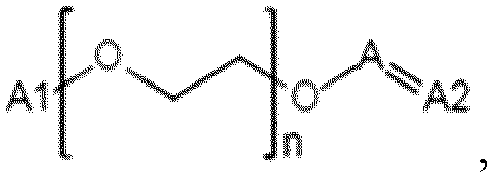
- More preferably, the vinyl polyether monomer is polyethylene glycol methacrylic acid, polyethylene glycol diallyl ether, polyethylene glycol allyl methyl ether, polyethylene glycol mono allyl ether, polyethylene glycol methacrylate, polyethylene glycol dimethacrylate, polyethylene glycol phenyl ether acrylate, triethylene glycol dimethacrylate, methoxy polyethylene glycol acrylate, or carboxy polyethylene glycol acrylate.
- It will be understood that the vinyl polyether monomer in the present invention is not limited to the above structures, and any suitable vinyl polyether monomer may be selected by those skilled in the art to achieve the present invention without beyond the protection scope of the present invention.
- Preferably, in S1, based on parts by weight, 10-90 parts of vinyl boron fluorine monomer, 10-90 parts of vinyl polyether monomer, 0-5 parts of modified monomer, and 0-10 parts of functional polymer are added into 200-500 parts of solvent.
- Preferably, in S1, the stirring condition is: stirring at a rotation speed of 200-2,000 r/min for 20-200 min.
- Preferably, based on parts by weight, in S1, 0.05-2.00 parts of initiator are added, and then the reaction is carried out for 3-50 h at 50-120 °C, and the polymer system B is obtained after the purification treatment.
- Preferably, the modified monomer is one of a monomer of an acrylate system, a monomer of a vinyl nitrile system, a monomer of an acrylic acid system, a monomer of a vinyl benzene system, and a monomer of a vinyl anhydride system, or any combination thereof.
- In some specific embodiments of the present invention, the acrylate system is preferably methyl methacrylate, ethyl acrylate, methyl 2-methacrylate, and ethyl 2-methacrylate, etc.; the vinyl nitrile system is preferably acrylonitrile, styryl nitrile, dimethyl vinyl hexane nitrile, etc.; the monomer of the acrylic acid system is preferably acrylic acid, butenic acid, etc.; the monomer of the vinyl benzene system is preferably styrene, diphenylethene, styrenesulfonic acid, etc.; and the monomer of the vinyl anhydride system is preferably vinyl sulfonic acid, maleic anhydride, vinyl acetic acid, etc.
- It will be understood that the modified monomer in the present invention is not limited to the above structures, and any suitable modified monomer may be selected by those skilled in the art to achieve the present invention without beyond the protection scope of the present invention.
- Preferably, the functional polymer is one of soluble polyolefin, soluble polynitrile, soluble polyester, soluble fluorine-containing polymer, polyacrylic acid, polystyrene acrylic acid copolymer, and poly-phenylene terephthamide, or any combination thereof.
- In some specific embodiments of the present invention, the soluble polyolefin is preferably poly-p-phenylene vinylene, polystyrene, or olefin copolymer; the soluble polynitrile is preferably polyacrylonitrile, aromatic nitrile-based polymer, or nitrile copolymer; the soluble polyester is preferably polymethyl methacrylate, polymethyl acrylate, or ester copolymer; and the soluble fluorine-containing polymer is preferably polytetrafluoroethylene, polyvinylidene fluoride, or polyvinylidene fluoride-hexafluoropropylene.
- It will be understood that the functional polymer in the present invention is not limited to the above structures, and any suitable functional polymer may be selected by those skilled in the art to achieve the present invention without beyond the protection scope of the present invention.
- Preferably, in S1, the initiator is an azo-based and/or peroxy-based initiator. More preferably, the initiator is one of azobisisobutyronitrile, azobisisoheptonitrile, dimethyl azodiisobutyrate, benzoyl peroxide, and tert-butyl peroxybenzoate, or any combination thereof.
- It will be understood that the initiator in the present invention is not limited to the above structures, and any suitable initiator may be selected by those skilled in the art to achieve the present invention without beyond the protection scope of the present invention.
- Preferably, in S2, the auxiliary agent is one of methoxy polyethylene glycol borate, methoxy polyethylene glycol aluminate, butanedinitrile, vinyl ethylene carbonate, vinylene carbonate, fluoro carbonate, tetraethylene glycol dimethyl ether, fluorobenzene, and ionic liquid, or any combination thereof.
- It will be understood that the auxiliary agent in the present invention is not limited to the above structures, and any suitable functional polymer may be selected by those skilled in the art to achieve the present invention without beyond the protection scope of the present invention.
- Preferably, in S1, the solvent is one of toluene, xylene, benzene, N,N-dimethylformamide, N-methyl pyrrolidone, acetonitrile, ethyl acetate, tetrahydrofuran, acetone, dimethyl sulfoxide, dichloromethane, chloroform, and carbon tetrachloride, or any combination thereof.
- It will be understood that the solvent in the present invention is not limited to the above types, and any suitable solvent may be selected by those skilled in the art to achieve the present invention without beyond the protection scope of the present invention.
- Preferably, in S2, the lithium salt is one of lithium perchlorate (LiClO4), lithium hexafluorophosphate (LiPF6), lithium hexafluoroarsenate (LiAsF6), lithium tetrafluoroborate (LiBF4), lithium bisoxalate borate (LiBOB), lithium difluorooxalato borate (LiDFOB), lithium bis(difluorosulfonyl)imide (LiFSI), lithium bis(trifluoromethanesulfonyl)imide (LiTFSI), lithium trifluoromethanesulfonate (LiCF3SO3), bis(malonato) borate (LiBMB), lithium malonatooxalato borate (LiMOB), lithium hexafluoroantimonate (LiSbF6), lithium difluorophosphate (LiPF2O2),
lithium 4,5-dicyano-2-(trifluoromethyl)imidazol (LiDTI), lithium bis(trifluoromethanesulfonyl)imide (LiN(SO2CF3)2), LiN(SO2C2F5)2, LiC(SO2CF3)3, LiN(SO2F)2, and lithium difluoro(oxalate) borate (LiODFB), or any combination thereof. - It will be understood that the lithium salt in the present invention is not limited to the above types, and any suitable lithium salt may be selected by those skilled in the art to achieve the present invention without beyond the protection scope of the present invention.
- Preferably, in S2, the filler is one of nano-silica, nano-titania, nano-alumina, nano-zirconia, diatomite, bentonite, kaolin, attapulgite, lithium phosphate, lithium titanate, lithium titanium phosphate, lithium aluminum titanium phosphate, lithium lanthanum titanate, lithium lanthanum tantalate, lithium aluminum germanium phosphate, lithium aluminosilicate, lithium silicon phosphate, lithium lanthanum titanate, boron trioxide doped lithium phosphate, lithium platinum lanthanum, and lithium lanthanum platinum aluminum oxide, which are organically treated, or any combination thereof.
- It will be understood that the filler in the present invention is not limited to the above types, and any suitable filler may be selected by those skilled in the art to achieve the present invention without beyond the protection scope of the present invention.
- Preferably, in S2, the crosslinking agent is a carboxyl crosslinking agent. Specifically, the crosslinking agent is one of trifunctional aziridine crosslinking agent, a difunctional aziridine crosslinking agent, trimethylolpropane tris(3-aziridinylpropionate), pentaerythritol tris[3-(1-(aziridinyl) propionic acid], aliphatic polycarbodiimide, aromatic polycarbodiimide, toluene diisocyanate, isophorone diisocyanate (IPDI), diphenylmethane diisocyanate (MDI), dicyclohexylmethane diisocyanate (HMDI), hexamethylene diisocyanate (HDI), lysine diisocyanate (LDI), adipaldehyde, glutaraldehyde, adipoyl chloride, aliphatic polycarbodiimide, aromatic polycarbodiimide, and genipin, or any combination thereof.
- It will be understood that the crosslinking agent in the present invention is not limited to the above types, and any suitable crosslinking agent may be selected by those skilled in the art to achieve the present invention without beyond the protection scope of the present invention.
- Preferably, based on parts by weight, 40-100 parts of polymer system B, 3-50 parts of lithium salt, 0-20 parts of filler, and 0-15 parts of auxiliary agent are added into 200-400 parts of solvent.
- Preferably, based on parts by weight, 0-5.00 parts of crosslinking agent is added into the mixed system. The mixed solution is uniformly coated on the mold with a smooth surface, and reacts for 8-36 hours at 50-120 °C in a vacuum drying oven in which nitrogen or inert gas is introduced and thus in an atmosphere of nitrogen or inert gas.
- In a preferred embodiment of the present invention, specifically, the preparation method of the solid polymer electrolyte includes following steps:
- S1, based on parts by weight, 10-90 parts of vinyl boron fluorine monomer, 10-90 parts of vinyl polyether monomer, 0-5 parts of modified monomer, and 0-10 parts of functional polymer are added into 200-500 parts of solvent, and are stirred for 20-200 min at a rotation speed of 200-2,000 r/min in an atmosphere of nitrogen or inert gas, and then 0.05-2.00 parts of initiator is added, next, the reaction is carried out for 3-50 h at 50-120 °C, and a polymer system B is obtained after a purification treatment;
- S2, based on parts by weight, 40-100 parts of polymer system B, 3-50 parts of lithium salt, 0-20 parts of filler, and 0-15 parts of auxiliary agent are added into 200-400 parts of solvent, and are stirred for 4-15 h at a rotation speed of 200-2,000 r/min in an atmosphere of nitrogen or inert gas, and then 0-5.00 parts of crosslinking agent is added into the mixed system, the mixed solution is uniformly coated on the mold with a smooth surface, and reacts for 8-36 h at 50-120 °C in the vacuum drying oven into which nitrogen or inert gas is introduced and thus in an atmosphere of nitrogen or inert gas; and
- S3, after the reaction is finished, in nitrogen or inert gas as the replacement gas, the drying treatment is carried out for 20-60 h at 60-120 °C in the vacuum drying oven, so as to obtain the solid polymer electrolyte.
- A third aspect of the present invention discloses a solid polymer electrolyte obtained by the above method.
- A solid polymer electrolyte in a solid-state lithium ion battery is required to meet following conditions: high voltage resistance, good interface contact, good compatibility with lithium metal, mechanical property, processability, conductivity, or the like. At present, a main component of the solid polymer electrolyte is polyethylene oxide electrolyte. However, polyethylene oxide has problems such as poor contact, low high-voltage resistance, and high room-temperature crystallinity in a practical use process. The solid polymer electrolyte disclosed in the present invention is different from the traditional polyethylene oxide, and introduces boron and fluorine structures that have high voltage resistance by adopting a molecular design method on the premise of not affecting polyether polymer electrolyte, which is able to effectively improve high voltage resistant performance of the solid polymer electrolyte, and the boron and fluorine structures have good compatibility with lithium metal and good interface contact.
- A fourth aspect of the present invention discloses a lithium ion battery, including the solid polymer electrolyte above. The lithium ion battery has characteristics of high mass energy density, high safety, or the like.
- A fourth aspect of the present invention discloses a preparation method of a lithium ion battery, including following steps.
assembling the solid polymer electrolyte, a positive electrode plate, and a negative electrode plate into a solid-state battery core, then welding tabs, and performing a heat treatment and an encapsulation treatment, to obtain the lithium ion battery. - Preferably, an active material in the positive electrode plate is lithium iron phosphate, lithium cobaltate, nickel-cobalt-manganese ternary battery material, lithium manganate, nickel-cobalt-aluminum ternary battery material, or lithium-rich manganese-based material; an active material in the negative electrode plate is one of carbon material, metal bismuth, lithium metal, nitride, magnesium-based alloy, indium-based alloy, boron-based material, silicon-based material, tin-based material, antimony-based alloy, gallium-based alloy, germanium-based alloy, aluminum-based alloy, lead-based alloy, zinc-based alloy, oxides of titanium, nano transition metal oxide MO, oxides of iron, oxide of chromium, oxide of molybdenum, and phosphide, or a combination of more of the above, where M is Co, Ni, Cu, or Fe.
- It will be understood that the present invention is not limited to the above steps, and may further include other steps. For example, other additional steps are further included before welding the tabs, between welding the tabs and the heat treatment, between the heat treatment and the encapsulation treatment, and after the encapsulation treatment without beyond the protection scope of the present invention.
- On the basis of conformity with general knowledge in the art, the above preferred conditions may be combined at will, without beyond the concepts and the protection scope of the present invention.
- In the present invention, the vinyl boron fluorine monomer and the vinyl polyether monomer are mainly used as main raw materials to prepare the solid polymer electrolyte containing the boron and fluorine structures. In the present invention, a structure-controllable solid polymer electrolyte containing the boron and fluorine structures are prepared by controlling, for example, proportions of monomers, type and quantity of initiator, reaction time, and reaction temperature. The solid polymer electrolyte containing the boron and fluorine structures and obtained in the present invention has good processability, high voltage resistance, high conductivity, and high compatibility with lithium metal, may be used to prepare a lithium ion battery with high energy density and high safety, and has good application potential.
- The polymer electrolyte in the solid polymer electrolyte disclosed in the present invention has at least following advantages: 1. the boron structure mainly exists as a borate structure in a vinyl boron fluorine structure, and the borate structure has good electrochemical stability, and is able to effectively improve high voltage resistence of the solid polymer electrolyte; 2. the fluorine structure mainly exists as fluorine substitution in the vinyl boron fluorine structure, and the fluorine-containing structure has good chemical stability, requires high energy for cleavage of a chemical bond, and is able to improve electrochemical stability of the solid polymer electrolyte, and in addition, fluorine element in the fluorine-containing structure has good compatibility with lithium metal in charging and discharging processes of a battery, and is able to form a stable lithium fluoride protective layer on a surface of lithium metal, and the lithium fluoride protective layer can not only effectively improve the compatibility of the solid polymer electrolyte with lithium metal, but also effectively improve uniform deposition of lithium ions in the charging and discharging processes, thereby improving performance of a solid-state battery; 3. the main chain in the solid polymer electrolyte is a vinyl structure, and a structure of the polyether is a comb-shaped branched chain, so that the conductivity of the solid polymer electrolyte at room temperature may be effectively improved; 4. the solid polymer electrolyte monomer in the present invention is the vinyl boron fluorine structure, where the boron structure and the fluorine structure are in the same monomer structure, and the combination of the two has a certain chelation effect on a lithium salt with a large anion, is able to promote dissociation of the lithium salt, and improve the electrochemical stability and the conductivity of the solid polymer electrolyte.
-
FIG. 1 shows results of charging and discharging tests of a solid-state battery in embodiments of the present invention. - The technical solutions in the present invention are described in detail below with reference to the accompanying drawings and the embodiments. However, the present invention is not limited to the scope of the embodiments.
- Experimental methods without specifying specific conditions in the following embodiments are selected in accordance with conventional methods and conditions, or in accordance with commercial instructions. The reagents and raw materials used in the present invention are commercially available.
- A preparation method of a solid polymer electrolyte is disclosed in the present example, including following steps:
- S1, based on parts by weight, 5 parts of alpha-(trifluoromethyl) vinyl boric acid, 5 parts of 1-(trifluoromethyl)vinyl boronic acid hexanol ester, 60 parts of polyethylene glycol dimethacrylate, 30 parts of polyethylene glycol phenyl ether acrylate, 0.5 parts of polymethyl methacrylate, and 0.5 parts of polyacrylic acid are added into 150 parts of acetonitrile and 50 parts of N-methyl pyrrolidone, kept in an atmosphere of nitrogen or inert gas, and are stirred for 200 min at a rotation speed of 200 r/min, and then 0.05 parts of azobisisobutyronitrile are added and react for 10 h at 50 °C, and after a purification treatment, a polymer system B is obtained;
- S2, based on parts by weight, 40 parts of the polymer system B, 2 parts of lithium difluoro(oxalato) borate, 1 part of lithium bis(trifluoromethylsulfonyl)imide, and 2 parts of lithium phosphate doped with boron trioxide, 2 parts of lithium titanium phosphate, 1 part of nano-alumina, 1 part of methoxy polyethylene glycol borate, and 1 part of butanedinitrile are added into 200 parts of tetrahydrofuran, and are stirred for 15 hours at a rotation speed of 200 r/min in an atmosphere of dry nitrogen or inert gas, the mixed solution is uniformly coated on a mold with a smooth surface, and reacts for 8 h at 60 °C in a vacuum drying oven into which nitrogen or inert gas is introduced and thus in an atmosphere of nitrogen or inert gas; and
- S3, after the reaction is finished, in nitrogen or inert gas as a replacement gas, a drying treatment is carried out for 60 h at 60 °C in the vacuum drying oven, so as to obtain the solid polymer electrolyte.
- A preparation method of a solid-state lithium ion battery is further disclosed in the present example, including following steps:
The obtained solid polymer electrolyte, a positive electrode plate, and a negative electrode plate are assembled into a solid-state battery core, and after a tab welding, a heat treatment, and an encapsulation treatment are performed, the solid-state lithium ion battery is obtained, where an active material in the positive electrode plate is lithium iron phosphate, lithium cobaltate, nickel-cobalt-manganese ternary battery material, lithium manganate, nickel-cobalt-aluminum ternary battery material, or lithium-rich manganese-based material; an active material in the negative electrode plate is one of carbon material, metal bismuth, lithium metal, nitride, magnesium-based alloy, indium-based alloy, boron-based material, silicon-based material, tin-based material, antimony-based alloy, gallium-based alloy, germanium-based alloy, aluminum-based alloy, lead-based alloy, zinc-based alloy, oxide of titanium, nano transition metal oxide MO, oxide of iron, oxide of chromium, oxide of molybdenum, and phosphide, or a combination of more of the above, where M is Co, Ni, Cu, or Fe. - The preparation of the electrode plates in the lithium ion battery and the processes of the tab welding, the heat treatment, and the encapsulation treatment of the battery, which are involved in the above steps, belong to conventional test means in the field.
- A preparation method of a solid polymer electrolyte is disclosed in the present example, including following steps:
- S1, based on parts by weight, 20 parts of trans-2-[4-(trifluoromethyl)phenyl]vinyl boronic acid, 70 parts of 1-trifluoromethyl vinyl boronic acid, 10 parts of polyethylene glycol methacrylate, and 10 parts of polyethylene glycol methacrylate are added into 300 parts of toluene and 100 parts of N,N-dimethylformamide, kept in an atmosphere of nitrogen or inert gas and are stirred for 100 min at a rotation speed of 1000 r/min, and then 0.1 parts of benzoyl peroxide are added, and react for 3 h at 120 °C, and after a purification treatment, a polymer system B is obtained;
- S2, based on parts by weight, 70 parts of the polymer system B, 15 parts of lithium tetrafluoroborate (LiBF4), 10 parts of
lithium 4,5-dicyano-2-trifluoromethylimidazol (LiDTI), 5 parts of lithium bis(trifluoromethanesulfonyl)imide, 5 parts of lithium silicon phosphate, and 1 part of lithium lanthanum titanate are added into 100 parts of acetone and 200 parts of acetonitrile, and are stirred for 8 hours at a rotation speed of 600 r/min in an atmosphere of dry nitrogen or inert gas, the mixed solution is uniformly coated on a mold with a smooth surface, and reacts for 20 h at 80 °C in a vacuum drying oven into which nitrogen or inert gas is introduced and thus in the atmosphere of nitrogen or inert gas; and - S3, after the reaction is finished, in nitrogen or inert gas as a replacement gas, a drying treatment is carried out for 40 h at 70 °C in the vacuum drying oven, so as to obtain the solid polymer electrolyte.
- A preparation method of a solid-state lithium ion battery is further disclosed in the present example, including following steps:
- The obtained solid polymer electrolyte, a positive electrode plate, and a negative electrode plate are assembled into a solid-state battery core, and after a tab welding, a heat treatment, and an encapsulation treatment are performed, the solid-state lithium ion battery is obtained. An active material in the positive electrode plate is lithium iron phosphate, lithium cobaltate, nickel-cobalt-manganese ternary battery material, lithium manganate, nickel-cobalt-aluminum ternary battery material, or lithium-rich manganese-based material; an active material in the negative electrode plate is one of carbon material, metal bismuth, lithium metal, nitride, magnesium-based alloy, indium-based alloy, boron-based material, silicon-based material, tin-based material, antimony-based alloy, gallium-based alloy, germanium-based alloy, aluminum-based alloy, lead-based alloy, zinc-based alloy, oxide of titanium, nanometer transition metal oxide MO, oxide of iron, oxide of chromium, oxide of molybdenum, and phosphide, or a combination of more of the above, where M is Co, Ni, Cu, or Fe.
- The preparation of the electrode plates in the lithium ion battery and the processes of the tab welding, the heat treatment, and the encapsulation treatment of the battery, which are involved in the above steps, belong to conventional test means in the field.
- A preparation method of a solid polymer electrolyte is disclosed in the present example, including following steps:
- S1, based on parts by weight, 20 parts of 1-(4-fluorophenyl)vinyl boronic acid pinacol ester, 5 parts of trans-2-(3-fluorophenyl)vinyl boronic acid, 20 parts of polyethylene glycol methacrylic acid, 10 parts of polyethylene glycol methacrylate, 10 parts of triethylene glycol dimethacrylate, 3 parts of methyl methacrylate, 2 parts of acrylonitrile, and 5 parts of polystyrene are added into 200 parts of benzene and 100 parts of acetonitrile, kept in an atmosphere of nitrogen or inert gas and are stirred for 80 min at a rotation speed of 800 r/min, and then 0.5 parts of tert-butyl peroxybenzoate are added, and react for 20 h at 100 °C, and after a purification treatment, a polymer system B is obtained;
- S2, based on parts by weight, 80 parts of the polymer system B, 20 parts of lithium bis(difluorosulfonyl)imide (LiFSI), 5 parts of lithium perchlorate (LiClO4), 5 parts of lithium hexafluorophosphate (LiPF6), 5 parts of lithium hexafluoroarsenate (LiAsF6), 2 parts of nano-zirconia, 2 parts of diatomite, 2 parts of lithium phosphate, 2 parts of lithium titanate, 5 parts of vinyl ethylene carbonate, 3 parts of vinylene carbonate, and 2 parts of fluorocarbonate are added into 150 parts of xylene and 200 parts of ethyl acetate, and are stirred for 12 hours at a rotation speed of 800 r/min in an atmosphere of dry nitrogen or inert gas, and then 2 parts of dicyclohexylmethane diisocyanate and 1 part of toluene diisocyanate are added into the mixed system, the mixed solution is uniformly coated on a mold with a smooth surface, and reacts for 15 h at 70 °C in a vacuum drying oven into which nitrogen or inert gas is introduced and thus in an atmosphere of nitrogen or inert gas; and
- S3, after the reaction is finished, in nitrogen or inert gas as a replacement gas, a drying treatment is carried out for 30 h at 90 °C in the vacuum drying oven, so as to obtain the solid polymer electrolyte.
- A preparation method of a solid-state lithium ion battery is further disclosed in the present example, including following steps:
The obtained solid polymer electrolyte, a positive electrode plate, and a negative electrode plate are assembled into a solid-state battery core, and after a tab welding, a heat treatment, and an encapsulation treatment are performed, the solid-state lithium ion battery is obtained, where an active material in the positive electrode plate is lithium iron phosphate, lithium cobaltate, nickel-cobalt-manganese ternary battery material, lithium manganate, nickel-cobalt-aluminum ternary battery material, or lithium-rich manganese-based material; an active material in the negative electrode plate is one of carbon material, metal bismuth, lithium metal, nitride, magnesium-based alloy, indium-based alloy, boron-based material, silicon-based material, tin-based material, antimony-based alloy, gallium-based alloy, germanium-based alloy, aluminum-based alloy, lead-based alloy, zinc-based alloy, oxide of titanium, nanometer transition metal oxide MO, oxide of iron, oxide of chromium, oxide of molybdenum, and phosphide, or a combination of more of the above, where M is Co, Ni, Cu, or Fe. - The preparation of the electrode plates in the lithium ion battery and the processes of the tab welding, the heat treatment, and the encapsulation treatment of the battery, which are involved in the above steps, belong to conventional test means in the field.
- A preparation method of a solid polymer electrolyte is disclosed in the present example, including following steps:
- S1, based on parts by weight, 20 parts of 2-trifluoromethyl-trans-beta-styryl boronic acid pinacol ester, 10 parts of trans-2-(4-fluorophenyl)vinyl boronic acid, 10 parts of E-2-[3, 5-bis(trifluoromethyl)phenyl]vinyl boronic acid pinacol ester, 10 parts of polyethylene glycol allyl methyl ether, 20 parts of carboxy polyethylene glycol acrylate, 50 parts of methoxy polyethylene glycol acrylate, 2 parts of ethyl acrylate, 2 parts of acrylic acid, 3 parts of polymethyl acrylate, and 3 parts of polymethyl acrylate are added into 150 parts of toluene, 150 parts of dimethyl sulfoxide, and 150 parts of ethyl acetate, kept in an atmosphere of nitrogen or inert gas and are stirred for 120 min at a rotation speed of 1400 r/min, and then 2.00 parts of tert-butyl peroxybenzoate are added, and react for 40 h at 80 °C, and after a purification treatment, a polymer system B is obtained;
- S2, based on parts by weight, 75 parts of the polymer system B, 20 parts of lithium trifluoromethanesulfonate (LiCF3SO3), 10 parts of bis(malonato) borate (LiBMB), 10 parts of lithium malonatooxalato borate (LiMOB), 5 parts of lithium titanium aluminum phosphate, 3 parts of lithium lanthanum titanate, 2 parts of lithium lanthanum tantalate, 10 parts of methoxy polyethylene glycol aluminate, and 5 parts of tetraethylene glycol dimethyl ether are added into 150 parts of tetrahydrofuran, 50 parts of acetonitrile, and 50 parts of dichloromethane, and are stirred for 6 hours at a rotation speed of 300 r/min in an atmosphere of dry nitrogen or inert gas, and then 2 parts of trifunctional aziridine crosslinking agent, 2 parts of difunctional aziridine crosslinking agent are added into the mixed system, the mixed solution is uniformly coated on a mold with a smooth surface, and reacts for 18h at 50 °C in a vacuum drying oven into which nitrogen or inert gas is introduced and thus in an atmosphere of nitrogen or inert gas; and
- S3, after the reaction is finished, in nitrogen or inert gas as a replacement gas, a drying treatment is carried out for 25 h at 85 °C in the vacuum drying oven, so as to obtain the solid polymer electrolyte.
- A preparation method of a solid-state lithium ion battery is further disclosed in the present example, including following steps:
The obtained solid polymer electrolyte, a positive electrode plate, and a negative electrode plate are assembled into a solid-state battery core, and after a tab welding, a heat treatment, and an encapsulation treatment are performed, the solid-state lithium ion battery is obtained, where an active material in the positive electrode plate is lithium iron phosphate, lithium cobaltate, nickel-cobalt-manganese ternary battery material, lithium manganate, nickel-cobalt-aluminum ternary battery material, or lithium-rich manganese-based material; and an active material in the negative electrode plate is one of carbon material, metal bismuth, lithium metal, nitride, magnesium-based alloy, indium-based alloy, boron-based material, silicon-based material, tin-based material, antimony-based alloy, gallium-based alloy, germanium-based alloy, aluminum-based alloy, lead-based alloy, zinc-based alloy, oxide of titanium, nano transition metal oxide MO, oxide of iron, oxide of chromium, oxide of molybdenum, and phosphide, or a combination of more of the above, where M is Co, Ni, Cu, or Fe. - The preparation of the electrode plates in the lithium ion battery and the processes of the tab welding, the heat treatment, and the encapsulation treatment of the battery, which are involved in the above steps, belong to conventional test means in the field.
- A preparation method of a solid polymer electrolyte is disclosed in the present example, including following steps:
- S1, based on parts by weight, 20 parts of 1-(1-(difluoroboryl)-oxy-3H-benzo(f)chromen-2-yl)-ethanone, 15 parts of trans-2-[3-(trifluoromethyl)phenyl]vinyl boronic acid, 15 parts of 4-trifluoromethyl-trans-beta-styryl boronic acid pinacol ester, 10 parts of polyethylene glycol methacrylic acid, 10 parts of polyethylene glycol diallyl ether, 10 parts of polyethylene glycol allyl methyl ether, 2 parts of 2-methyl methacrylate, 1 part of 2-methyl methacrylate, 1 part of polyacrylonitrile, and 1 part of polyvinylidene fluoride-hexafluoropropylene are added into 200 parts of N-methyl pyrrolidone, 50 parts of carbon tetrachloride, and 100 parts of tetrahydrofuran, kept in an atmosphere of nitrogen or inert gas and are stirred for 150 min at a rotation speed of 1600 r/min, and then 1 parts of tert-butyl peroxybenzoate and 0.1 parts of azobisisoheptonitrile are added, and react for 50 h at 90 °C, and after a purification treatment, a polymer system B is obtained;
- S2, based on parts by weight, 60 parts of the polymer system B, 5 parts of lithium bis(oxalato) borate (LiBOB), 3 parts of lithium difluoro(oxalato) borate (LiDFOB), 2 parts of lithium bis(difluorosulfonyl)imide (LiFSI), 2 parts of ionic liquid, and 10 parts of methoxy polyethylene glycol borate are added into 120 parts of toluene and 200 parts of N-methyl pyrrolidone, and are stirred for 12 hours at a rotation speed of 1000 r/min in an atmosphere of dry nitrogen or inert gas, and then 1.00 part of trimethylolpropanetris-(3-aziridinylpropionate) and 1.00 part of pentaerythritol tris[3-(1-aziridinyl)propionic acid] are added into the mixed system, the mixed solution is uniformly coated on a mold with a smooth surface, and reacts for 12 h at 90 °C in a vacuum drying oven into which nitrogen or inert gas is introduced and thus in an atmosphere of nitrogen or inert gas; and
- S3, after the reaction is finished, in nitrogen or inert gas as a replacement gas, a drying treatment is carried out for 35 h at 110 °C in the vacuum drying oven, so as to obtain the solid polymer electrolyte.
- A preparation method of a solid-state lithium ion battery is further disclosed in the present example, including following steps:
The obtained solid polymer electrolyte, a positive electrode plate, and a negative electrode plate are assembled into a solid-state battery core, and after a tab welding, a heat treatment, and an encapsulation treatment are performed, the solid-state lithium ion battery is obtained, where an active material in the positive electrode plate is lithium iron phosphate, lithium cobaltate, nickel-cobalt-manganese ternary battery material, lithium manganate, nickel-cobalt-aluminum ternary battery material, or lithium-rich manganese-based material; and an active material in the negative electrode plate is one of carbon material, metal bismuth, lithium metal, nitride, magnesium-based alloy, indium-based alloy, boron-based material, silicon-based material, tin-based material, antimony-based alloy, gallium-based alloy, germanium-based alloy, aluminum-based alloy, lead-based alloy, zinc-based alloy, oxide of titanium, nano transition metal oxide MO, oxide of iron, oxide of chromium, oxide of molybdenum, and phosphide, or a combination of more of the above, where M is Co, Ni, Cu, or Fe. - The preparation of the electrode plates in the lithium ion battery and the processes of the tab welding, the heat treatment, and the encapsulation treatment of the battery, which are involved in the above steps, belong to conventional test means in the field.
- A preparation method of a solid polymer electrolyte is disclosed in the present example, including following steps:
- S1, based on parts by weight, 20 parts of 3-trifluoromethyl-trans-beta-styryl boronic acid pinacol ester, 40 parts of trans-2-(3,5-difluorophenyl)vinyl boronic acid pinacol ester, 9 parts of carboxy polyethylene glycol acrylate, 1 part of polyethylene glycol dimethacrylate, 1 part of styrenesulfonic acid, 1 part of butenic acid, 4 parts of polytetrafluoroethylene, and 4 parts of polymethyl methacrylate are added into 100 parts of N-methyl pyrrolidone, 100 parts of chloroform, and 50 parts of acetonitrile, and are stirred for 60 min at a rotation speed of 400 r/min in an atmosphere of nitrogen or inert gas, and then 0.4 parts of azobisisoheptonitrile and 0.4 parts of dimethyl azodiisobutyrate are added, and then react for 25 h at 70 °C, and the polymer system B is obtained after a purification treatment;
- S2, based on parts by weight, 85 parts of the polymer system B, 15 parts of lithium bis(trifluoromethylsulfonyl)imide (LiTFSI), 5 parts of lithium hexafluoroantimonate (LiSbF6), 5 parts of lithium difluorophosphate (LiPF2O2), 10 parts of lithium lanthanum platinum, 2 parts of lithium lanthanum platinum aluminum oxide, 1 part of fluorobenzene, 4 parts of methoxy polyethylene glycol borate, and 4 parts of methoxy polyethylene glycol aluminate are added into 300 parts of acetonitrile, 100 parts of toluene, and 100 parts of N-methyl pyrrolidone, and are stirred for 14 hours at a rotation speed of 1500 r/min in an atmosphere of dry nitrogen or inert gas, and then 1.00 part of isophorone diisocyanate is added into the mixed system, the mixed solution is uniformly coated on a mold with a smooth surface, and reacts for 26 h at 100 °C in a vacuum drying oven into which nitrogen or inert gas is introduced and thus in an atmosphere of nitrogen or inert gas; and
- S3, after the reaction is finished, in nitrogen or inert gas as a replacement gas, a drying treatment is carried out for 45 h at 80 °C in the vacuum drying oven, so as to obtain the solid polymer electrolyte.
- A preparation method of a solid-state lithium ion battery is further disclosed in the present example, including following steps.
- The obtained solid polymer electrolyte, a positive electrode plate, and a negative electrode plate are assembled into a solid-state battery core, and after a tab welding, a heat treatment, and an encapsulation treatment are performed, the solid-state lithium ion battery is obtained, where an active material in the positive electrode plate is lithium iron phosphate, lithium cobaltate, nickel-cobalt-manganese ternary battery material, lithium manganate, nickel-cobalt-aluminum ternary battery material, or lithium-rich manganese-based material; and an active material in the negative electrode plate is one of carbon material, metal bismuth, lithium metal, nitride, magnesium-based alloy, indium-based alloy, boron-based material, silicon-based material, tin-based material, antimony-based alloy, gallium-based alloy, germanium-based alloy, aluminum-based alloy, lead-based alloy, zinc-based alloy, oxide of titanium, nano transition metal oxide MO, oxide of iron, oxide of chromium, oxide of molybdenum, and phosphide, or a combination of more of the above, where M is Co, Ni, Cu, or Fe.
- The preparation of the electrode plates in the lithium ion battery and the processes of the tab welding, the heat treatment, and the encapsulation treatment of the battery, which are involved in the above steps, belong to conventional test means in the field.
- A preparation method of a solid polymer electrolyte is disclosed in the present example, including following steps:
- S1, based on parts by weight, 40 parts of alpha-(trifluoromethyl)vinyl boronic acid, 20 parts of 1-(1-(difluoroboryl)-oxy-3H-benzo(f)chromen-2-yl)-ethanone, 20 parts of 3-trifluoromethyl-trans-beta-styryl boronic acid pinacol ester, 20 parts of polyethylene glycol methacrylic acid, 15 parts of polyethylene glycol methacrylate, 15 parts of carboxy polyethylene glycol acrylate, 1 part of styrenesulfonic acid, 5 parts of styrenesulfonic acid, and 5 parts of polymethyl methacrylate are added into 400 parts of N-methyl pyrrolidone and 100 parts of acetonitrile, and are stirred for 20 min at a rotation speed of 2000 r/min in an atmosphere of nitrogen or inert gas, and then 1 part of dimethyl azodiisobutyrate and 0.5 parts of benzoyl peroxide are added, and then react for 35 h at 85 °C, and a polymer system B is obtained after a purification treatment;
- S2, based on parts by weight, 100 parts of the polymer system B, 20 parts of lithium bis(difluorosulfonyl)imide (LiFSI), 20 parts of lithium bis(trifluoromethylsulfonyl)imide (LiTFSI), 10 parts of LiN(SO2F)2, 10 parts of lithium germanium aluminum phosphate, 10 parts of lithium aluminosilicate, 10 parts of methoxy polyethylene glycol aluminate, and 3 parts of butanedinitrile are added into 300 parts of acetonitrile and 100 parts of toluene, and are stirred for 4 hours at a rotation speed of 2000 r/min in an atmosphere of dry nitrogen or inert gas, and then 2.00 parts of pentaerythritol tris[3-(1-aziridinyl)propionic acid] and 3 parts of aliphatic polycarbodiimide are added into the mixed system, the mixed solution is uniformly coated on a mold with a smooth surface, and reacts for 36 h at 120 °C in a vacuum drying oven into which nitrogen or inert gas is introduced and thus in an atmosphere of nitrogen or inert gas; and
- S3, after the reaction is finished, in nitrogen or inert gas as a replacement gas, a drying treatment is carried out for 20 h at 120 °C in the vacuum drying oven, so as to obtain the solid polymer electrolyte.
- A preparation method of a solid-state lithium ion battery is further disclosed in the present example, including following steps:
The obtained solid polymer electrolyte, a positive electrode plate, and a negative electrode plate are assembled into a solid-state battery core, and after a tab welding, a heat treatment, and an encapsulation treatment are performed, the solid-state lithium ion battery is obtained, where an active material in the positive electrode plate is lithium iron phosphate, lithium cobaltate, nickel-cobalt-manganese ternary battery material, lithium manganate, nickel-cobalt-aluminum ternary battery material, or lithium-rich manganese-based material; and an active material in the negative electrode plate is one of carbon material, metal bismuth, lithium metal, nitride, magnesium-based alloy, indium-based alloy, boron-based material, silicon-based material, tin-based material, antimony-based alloy, gallium-based alloy, germanium-based alloy, aluminum-based alloy, lead-based alloy, zinc-based alloy, oxide of titanium, nano transition metal oxide MO, oxide of iron, oxide of chromium, oxide of molybdenum, and phosphide, or a combination of more of the above, where M is Co, Ni, Cu, or Fe. - The preparation of the electrode plates in the lithium ion battery and the processes of the tab welding, the heat treatment, and the encapsulation treatment of the battery, which are involved in the above steps, belong to conventional test means in the field.
- A preparation method of a solid polymer electrolyte is disclosed in the present example, including following steps:
- S1, based on parts by weight, 10 parts of 1-(1-(difluoroboryl)-oxy-3H-benzo(f)chromen-2-yl)-ethanone, 10 parts of 3-trifluoromethyl-trans-beta-styryl boronic acid pinacol ester, 10 parts of 1-trifluoromethyl vinyl boronic acid, 15 parts of polyethylene glycol phenyl ether acrylate, 15 parts of triethylene glycol dimethylacrylate, 15 parts of methoxy polyethylene glycol acrylate, and 4 parts of polymethyl acrylate are added into 100 parts of xylene, 100 parts of tetrahydrofuran, and 100 parts of N-methyl pyrrolidone, and are stirred for 60 min at a rotation speed of 1800 r/min in an atmosphere of nitrogen or inert gas, and then 1.00 part of azobisisoheptonitrile is added, and react for 45 h at 60 °C, and a polymer system B is obtained after a purification treatment;
- S2, based on parts by weight, 90 parts of the polymer system B, 10 parts of lithium tetrafluoroborate (LiBF4), lithium bis(oxalato) borate (LiBOB), 10 parts of lithium difluoro(oxalato) borate (LiDFOB), 10 parts of lithium bis(difluorosulfonyl)imide (LiFSI), 15 parts of lithium bis(trifluoromethylsulfonyl)imide (LiTFSI), 6 parts of lithium phosphate, 6 parts of lithium titanium aluminum phosphate, 6 parts of boron trioxide doped lithium phosphate, 4 parts of butanedinitrile, and 2 parts of vinyl ethylene carbonate are added into 100 parts of acetonitrile and 100 parts of N-methyl pyrrolidone, and are stirred for 9 hours at a rotation speed of 1800 r/min in an atmosphere of dry nitrogen or inert gas, the mixed solution is uniformly coated on a mold with a smooth surface, and reacts for 24 h at 110 °C in a vacuum drying oven into which nitrogen or inert gas is introduced and thus in an atmosphere of nitrogen or inert gas; and
- S3, after the reaction is finished, in nitrogen or inert gas as a replacement gas, a drying treatment is carried out for 50 h at 90 °C in the vacuum drying oven, so as to obtain the solid polymer electrolyte.
- A preparation method of a solid-state lithium ion battery is further disclosed in the present example, including following steps:
The obtained solid polymer electrolyte, a positive electrode plate, and a negative electrode plate are assembled into a solid-state battery core, and after a tab welding, a heat treatment, and an encapsulation treatment are performed, the solid-state lithium ion battery is obtained, where an active material in the positive electrode plate is lithium iron phosphate, lithium cobaltate, nickel-cobalt-manganese ternary battery material, lithium manganate, nickel-cobalt-aluminum ternary battery material, or lithium-rich manganese-based material; and where an active material in the negative electrode plate is one of carbon material, metal bismuth, lithium metal, nitride, magnesium-based alloy, indium-based alloy, boron-based material, silicon-based material, tin-based material, antimony-based alloy, gallium-based alloy, germanium-based alloy, aluminum-based alloy, lead-based alloy, zinc-based alloy, oxide of titanium, nano transition metal oxide MO, oxide of iron, oxide of chromium, oxide of molybdenum, and phosphide, or a combination of more of the above, where M is Co, Ni, Cu, or Fe. - The preparation of the electrode plates in the lithium ion battery and the processes of the tab welding, the heat treatment, and the encapsulation treatment of the battery, which are involved in the above steps, belong to conventional test means in the field.
- A preparation method of a solid polymer electrolyte is disclosed in the present comparative example, including following steps:
- S1, based on parts by weight, 10 parts of polyethylene oxide (with a molecular weight of 500 W) are added into 300 parts of acetonitrile, and are stirred for 60 min at a rotation speed of 1800 r/min in an atmosphere of nitrogen or inert gas, so as to obtain a polymer system B;
- S2, based on parts by weight, 90 parts of the polymer system B, 10 parts of lithium tetrafluoroborate (LiBF4), lithium bis(oxalato) borate (LiBOB), 10 parts of lithium difluoro(oxalato) borate (LiDFOB), 10 parts of lithium bis(difluorosulfonyl)imide (LiFSI), 15 parts of lithium bis(trifluoromethylsulfonyl)imide (LiTFSI), 6 parts of lithium phosphate, 6 parts of lithium titanium aluminum phosphate, 6 parts of boron trioxide doped lithium phosphate, 4 parts of butanedinitrile, and 2 parts of vinyl ethylene carbonate are added into 100 parts of acetonitrile and 100 parts of N-methyl pyrrolidone, and are stirred for 9 hours at a rotation speed of 1800 r/min in an atmosphere of dry nitrogen or inert gas, the mixed solution is uniformly coated on a mold with a smooth surface, and reacts for 24 h at 110 °C in a vacuum drying oven into which nitrogen or inert gas is introduced and thus in an atmosphere of nitrogen or inert gas; and
- S3, after the reaction is finished, in nitrogen or inert gas as a replacement gas, a drying treatment is carried out for 50 h at 90 °C in the vacuum drying oven, so as to obtain the solid polymer electrolyte.
- A preparation method of a solid polymer electrolyte is disclosed in the present comparative example, including following steps:
- S1, based on parts by weight, 10 parts of polyethylene oxide (with a molecular weight of 500 W) are added into 300 parts of acetonitrile, and are stirred for 60 min at a rotation speed of 1800 r/min in an atmosphere of nitrogen or inert gas, so as to obtain a polymer system B;
- S2, based on parts by weight, 90 parts of the polymer system B and 45 parts of lithium bis(trifluoromethylsulfonyl)imide (LiTFSI) are added into 200 parts of acetonitrile, and are stirred for 9 hours at a rotation speed of 1800 r/min in an atmosphere of dry nitrogen or inert gas, the mixed solution is uniformly coated on a mold with a smooth surface, and reacts for 24 h at 110 °C in a vacuum drying oven into which nitrogen or inert gas is introduced and thus in an atmosphere of nitrogen or inert gas; and
- S3, after the reaction is finished, in nitrogen or inert gas as a replacement gas, a drying treatment is carried out for 50 h at 90 °C in the vacuum drying oven, so as to obtain the solid polymer electrolyte.
- The composite all-solid polymer electrolytes prepared in Examples 1-8 and the polyethylene oxide (with the molecular weight of 500 W) electrolytes in Comparative example 1 and Comparative example 2 were subjected to room temperature conductivity and electrochemical window tests, and test results were shown in Table 1 below.
Table 1 Number Ionic conductivity at room temperature (S/cm) Electrochemical window (V) Comparative example 1 1.57×10⁻⁵ 3.8 Comparative example 2 1.26×10⁻⁵ 3.8 Example 1 2.92×10⁻⁴ 4.7 Example 2 3.76×10⁻⁴ 4.9 Example 3 2.68×10⁻⁴ 5.0 Example 4 1.73×10⁻⁴ 5.0 Example 5 2.85×10⁻⁴ 4.8 Example 6 1.60×10⁻⁵ 5.1 Example 7 3.26×10⁻⁴ 4.7 Example 8 4.26×10⁻⁴ 4.8 - It can be seen from the test results in the above table that, the conductivity of the polyethylene oxide polymer electrolyte (polymer+lithium salt) at room temperature is 1.26×10⁻⁵ S/cm, and the electrochemical window is 3.8V. Compared with conventional polyethylene oxide, novel polymers (Examples 1-8) prepared in the present invention patent structurally introduce boron and fluorine structures by adopting molecular design method, and have more excellent ionic conductivity at room temperature, electrochemical window and tensile strength, and have better application potential. Moreover, comparison between Comparative examples 1 and 2 and Examples 1-8 in test results showed that the polymers containing boron and fluorine structures prepared in the present invention patent have good dissociation effect on lithium salt, and are able to effectively improve lithium ion conductivity.
- In the present example, the polymer electrolytes prepared in Examples 1-8, Comparative example 1 and Comparative example 2 were each uniformly mixed with a ternary material, a conductive agent, a binder and a solvent, and then were each coated on an aluminum foil to prepare a positive electrode of a composite solid-state battery. The positive electrode and a polymer electrolyte corresponding thereto, and lithium metal were assembled into a solid-state battery. Charge and discharge tests were performed on solid-state batteries, and test results were shown in
FIG. 1 . - From the charge and discharge test results (
FIG. 1 ) of the solid-state batteries, it can be seen that the polymer electrolytes containing the boron and fluorine structures prepared in the present invention patent (Examples 1-8) have more excellent ionic conductivity and electrochemical window, compared with conventional polyethylene oxide (Comparative examples 1 and 2). A specific analysis is as follows: firstly, from comparison of the test results of Comparative examples 1 and 2 using polyethylene oxide, Comparative example 1 is superior to Comparative example 2, which shows that the composite multiple lithium salts of the polymer electrolyte and preparation method thereof in the present invention patent are able to effectively improve the performance of the polymer electrolyte, and improve the performance of the solid-state battery; and secondly, by comparing the test results of Examples 1-8 and Comparative examples land 2, it can be known that the solid-state batteries prepared from the polymer electrolytes containing the boron and fluorine structures obtained by the method of the present invention have good charge and discharge performances and better application potential. - The above examples are preferred embodiments of the present invention, but embodiments of the present invention are not limited to the above examples, and any other changes, modifications, substitutions, combinations, and simplifications without departing from the spirit and principle of the present invention shall be equivalent replacement, and all included in the protection scope of the present invention.
Claims (10)
- A polymer electrolyte, characterized by having a structural formula represented by Formula (I):
 wherein A, A1, A2, R, R1, R2 or R3 are all organic functional groups;R, R1, R2, and R3 contain at least one fluorine structure;a molar ration of Formula
 n, m and p are positive integers.
 - The polymer electrolyte according to claim 1, characterized in that the boron structure includes C-B, B-O or B-F.
- The polymer electrolyte according to claim 1, characterized in that polymer electrolysis in unit mole contains 0.1 to 0.9 moles of boron structure.
- The polymer electrolyte according to claim 1, characterized in that polymer electrolyte in unit mole contains 0.1 to 18 moles of fluorine structure.
- The polymer electrolyte according to claim 1, characterized in that a molar ratio of the boron structure to the fluorine structure is between (1:20) and (1:1); preferably, the molar ratio of the boron structure to the fluorine structure is between (1:12) and (1:1).
- A preparation method of a polymer electrolyte, characterized by comprising the following steps:S1, adding a vinyl boron fluorine monomer, a vinyl polyether monomer, a modified monomer, and a functional polymer into a solvent, stirring uniformly in an atmosphere of nitrogen or inert gas, and then adding an initiator; after a reaction is finished, performing a purification treatment to obtain a polymer system B;S2, adding the polymer system B, a lithium salt, a filler, and an auxiliary agent into a solvent, stirring uniformly in an atmosphere of nitrogen or inert gas, and then adding a crosslinking agent to obtain a mixed solution; coating the mixed solution on a mold uniformly, and introducing nitrogen or inert gas into a vacuum drying oven for reaction;S3, after the reaction is finished, in nitrogen or inert gas as a replacement gas, performing a drying treatment in the vacuum drying oven to obtain the polymer electrolyte.
- The method according to claim 6, characterized in that a molecular structural formula of the vinyl boron fluorine monomer is

- The method according to claim 6, characterized in that a molecular structural formula of the vinyl polyether monomer is

- A polymer electrolyte obtained by the method according to any one of claims 6 to 8.
- A lithium ion battery, comprising the polymer electrolyte according to any one of claims 1 to 5 or 9.
Applications Claiming Priority (2)
| Application Number | Priority Date | Filing Date | Title |
|---|---|---|---|
| CN201911339899.9A CN111162312B (en) | 2019-12-23 | 2019-12-23 | Solid polymer electrolyte containing boron-fluorine structure and preparation method and application thereof |
| PCT/CN2020/138139 WO2021129582A1 (en) | 2019-12-23 | 2020-12-21 | Solid-state polymer electrolyte containing boron-fluorine structure, preparation method therefor, and use thereof |
Publications (2)
| Publication Number | Publication Date |
|---|---|
| EP4068453A1 true EP4068453A1 (en) | 2022-10-05 |
| EP4068453A4 EP4068453A4 (en) | 2023-05-24 |
Family
ID=70557788
Family Applications (1)
| Application Number | Title | Priority Date | Filing Date |
|---|---|---|---|
| EP20906924.4A Pending EP4068453A4 (en) | 2019-12-23 | 2020-12-21 | SOLID STATE POLYMERIC ELECTROLYTE HAVING A BORINE-FLUORINE STRUCTURE, METHOD FOR PREPARATION AND USE |
Country Status (4)
| Country | Link |
|---|---|
| US (1) | US12512511B2 (en) |
| EP (1) | EP4068453A4 (en) |
| CN (1) | CN111162312B (en) |
| WO (1) | WO2021129582A1 (en) |
Families Citing this family (10)
| Publication number | Priority date | Publication date | Assignee | Title |
|---|---|---|---|---|
| CN111162312B (en) * | 2019-12-23 | 2022-04-01 | 珠海冠宇电池股份有限公司 | Solid polymer electrolyte containing boron-fluorine structure and preparation method and application thereof |
| CN111934006B (en) * | 2020-07-23 | 2021-09-21 | 深圳技术大学 | Intrinsically microporous polyaluminum/borate solid electrolytes and batteries |
| CN112210268A (en) * | 2020-10-13 | 2021-01-12 | 溧阳市佳禾电子材料有限公司 | B-grade acetal wire enamel capable of being coated at high speed and preparation process thereof |
| CN113307910B (en) * | 2021-05-28 | 2022-05-20 | 复旦大学 | Synthesis method of fluoropolymer rich in borate and hydroxyl |
| CN113991175B (en) * | 2021-11-29 | 2022-11-15 | 傲普(上海)新能源有限公司 | Polycarbonate-based solid electrolyte and preparation method and application thereof |
| CN117013084A (en) * | 2022-04-29 | 2023-11-07 | 中国科学院苏州纳米技术与纳米仿生研究所 | Single ion conductor quasi-solid electrolyte and preparation method thereof and lithium-ion battery |
| CN115799609A (en) * | 2022-12-27 | 2023-03-14 | 中国地质大学(武汉) | Composite solid electrolyte, lithium battery and preparation method thereof |
| CN117558986B (en) * | 2024-01-10 | 2024-03-22 | 河北省科学院能源研究所 | Electrolyte for lithium ion battery and preparation method and application thereof |
| CN117801260B (en) * | 2024-03-01 | 2024-06-25 | 上海极氪蓝色新能源技术有限公司 | Polymer electrolyte, electrolyte membrane, battery and preparation method thereof |
| CN120637590B (en) * | 2025-08-13 | 2025-10-17 | 南开大学 | Single ion conductive solid polymer electrolyte membrane and preparation method thereof, lithium battery |
Family Cites Families (23)
| Publication number | Priority date | Publication date | Assignee | Title |
|---|---|---|---|---|
| KR100413800B1 (en) * | 2001-10-17 | 2004-01-03 | 삼성에스디아이 주식회사 | Fluoride copolymer, polymer electrolyte comprising the same and lithium battery employing the polymer electrolyte |
| JP2008094825A (en) * | 2006-09-13 | 2008-04-24 | National Univ Corp Shizuoka Univ | BF3 complex and method for producing the same |
| CN101563807B (en) * | 2006-10-12 | 2011-10-05 | 日油株式会社 | Ion-conductive polymer electrolyte and secondary battery using same |
| JP5289727B2 (en) * | 2007-03-23 | 2013-09-11 | 国立大学法人静岡大学 | Borate compound and method for producing the same |
| JP2010177001A (en) * | 2009-01-28 | 2010-08-12 | Nof Corp | Ion conductive polymer electrolyte for electrochemical device and secondary battery using the same |
| US9362599B2 (en) * | 2011-04-06 | 2016-06-07 | Uchicago Argonne Llc | Non-aqueous electrolytes for lithium-air batteries |
| CN103509153B (en) * | 2012-06-15 | 2016-05-25 | 华中科技大学 | A kind of polymer list ionic electrolytes and preparation method thereof |
| US20140113203A1 (en) * | 2012-10-22 | 2014-04-24 | Battelle Memorial Institute | Electrolyte additives for lithium ion battery and lithium ion battery containing same |
| WO2017049471A1 (en) * | 2015-09-23 | 2017-03-30 | Basf Corporation | Electrolyte for lto type lithium ion batteries |
| CN107331892B (en) * | 2016-04-28 | 2021-06-18 | 比亚迪股份有限公司 | An electrolyte, a positive electrode and a preparation method thereof, and a lithium ion battery |
| CN105914397B (en) * | 2016-06-28 | 2018-06-22 | 哈尔滨工业大学 | Fluoropolymer electrolyte and its preparation method and application |
| CN106432608B (en) * | 2016-09-20 | 2019-12-03 | 复旦大学 | A kind of boron-containing gel polymer electrolyte and its preparation method and application |
| CN106229547A (en) * | 2016-09-20 | 2016-12-14 | 复旦大学 | A kind of boracic solid polymer electrolyte and its preparation method and application |
| CN107819156B (en) | 2017-10-31 | 2020-04-14 | 江汉大学 | Preparation method of non-combustible solid polymer electrolyte and secondary lithium battery containing the solid polymer electrolyte |
| CN108414485A (en) * | 2018-03-05 | 2018-08-17 | 武汉纺织大学 | The method of fluorescent type Bacteria Detection film and preparation method and its Bacteria Detection |
| CN108444961A (en) * | 2018-03-05 | 2018-08-24 | 武汉纺织大学 | The method that pseudomonas aeruginosa detects film and preparation method and its Bacteria Detection |
| CN108417894B (en) * | 2018-03-13 | 2020-11-06 | 广州天赐高新材料股份有限公司 | Lithium secondary battery electrolyte and lithium secondary battery |
| CN109301317B (en) | 2018-08-20 | 2021-02-02 | 浙江工业大学 | A kind of preparation method of high-pressure solid polymer electrolyte |
| CN109509911B (en) * | 2018-11-05 | 2021-05-11 | 珠海冠宇电池股份有限公司 | A kind of preparation method of fluoride gel polymer electrolyte membrane and lithium ion battery |
| CN109326822B (en) * | 2018-11-05 | 2020-11-17 | 珠海冠宇电池股份有限公司 | Preparation method of all-solid fluoropolymer electrolyte membrane and lithium ion battery |
| CN109575187B (en) * | 2018-11-26 | 2021-07-16 | 中南大学 | Preparation method of cross-linked polymer electrolyte, semi-solid polymer battery and preparation method |
| CN109904010B (en) * | 2019-03-13 | 2021-09-03 | 同济大学 | High and low temperature resistant gel electrolyte super capacitor and preparation method thereof |
| CN111162312B (en) * | 2019-12-23 | 2022-04-01 | 珠海冠宇电池股份有限公司 | Solid polymer electrolyte containing boron-fluorine structure and preparation method and application thereof |
-
2019
- 2019-12-23 CN CN201911339899.9A patent/CN111162312B/en active Active
-
2020
- 2020-12-21 WO PCT/CN2020/138139 patent/WO2021129582A1/en not_active Ceased
- 2020-12-21 EP EP20906924.4A patent/EP4068453A4/en active Pending
-
2022
- 2022-06-23 US US17/847,196 patent/US12512511B2/en active Active
Also Published As
| Publication number | Publication date |
|---|---|
| CN111162312B (en) | 2022-04-01 |
| WO2021129582A1 (en) | 2021-07-01 |
| US20220328874A1 (en) | 2022-10-13 |
| US12512511B2 (en) | 2025-12-30 |
| CN111162312A (en) | 2020-05-15 |
| EP4068453A4 (en) | 2023-05-24 |
Similar Documents
| Publication | Publication Date | Title |
|---|---|---|
| US12512511B2 (en) | Solid electrolyte including polymer containing boron and fluorine structure, preparation method, and lithium ion battery including the same | |
| Che et al. | Electrolyte design strategies and research progress for room-temperature sodium-ion batteries | |
| CN109776423B (en) | A kind of double imidazole ring functional ionic liquid and its preparation method and electrolyte and lithium secondary battery | |
| JP2024503376A (en) | Flame-resistant quasi-solid and solid state electrolytes and manufacturing methods for lithium ion and lithium metal batteries | |
| CN107534128B (en) | Negative electrode for lithium secondary battery and lithium secondary battery comprising same | |
| US7674557B2 (en) | Electrode active materials for lithium secondary batteries, method for preparing the same, and lithium secondary batteries using the same | |
| CN109390632B (en) | Preparation method of polymer solid-state battery with wide temperature range | |
| JP2024510499A (en) | Flame-resistant bipolar electrode, bipolar lithium battery, and production method | |
| Yu et al. | Lithium salt-induced in situ living radical polymerizations enable polymer electrolytes for lithium-ion batteries | |
| CN108123172A (en) | Electrolyte and secondary lithium battery | |
| CN111799502B (en) | Garnet-type solid-state composite electrolyte, preparation method and application | |
| US20220359857A1 (en) | Prelithiated anode, lithium-ion batteries containing a prelithiated anode and method of producing same | |
| WO2024230010A1 (en) | Cross-linked polymer solid electrolyte, and preparation method therefor and use thereof | |
| CN114335700A (en) | Solid electrolyte membrane and preparation method thereof, secondary battery and preparation method | |
| CN113871708A (en) | Solid electrolyte and application thereof | |
| CN112086684A (en) | Cesium-containing high-voltage lithium ion battery electrolyte composite additive, electrolyte and battery thereof | |
| Che et al. | Fundamental Chemistry and Functional Mechanisms of Nitrile‐Based Electrolyte in Advanced Battery Systems | |
| CN115064779A (en) | Dual-functional interface modification layer for solid-state lithium battery and lithium battery | |
| CN110875497B (en) | Ternary lithium ion battery and preparation method thereof | |
| CN113809333A (en) | A kind of organic coating layer and electrode material and lithium ion battery containing the coating layer | |
| CN116914245A (en) | An electrolyte and a battery including the electrolyte | |
| CN112599874A (en) | Electrochemical pretreatment method for improving performance of quasi-solid lithium ion battery | |
| EP4718556A1 (en) | Composition for forming solid electrolyte, solid electrolyte and lithium secondary battery | |
| CN120527472B (en) | A solid electrolyte and its preparation method and solid battery | |
| CN120657244B (en) | A low-temperature solid polymer electrolyte, its preparation method, and the battery |
Legal Events
| Date | Code | Title | Description |
|---|---|---|---|
| STAA | Information on the status of an ep patent application or granted ep patent |
Free format text: STATUS: THE INTERNATIONAL PUBLICATION HAS BEEN MADE |
|
| PUAI | Public reference made under article 153(3) epc to a published international application that has entered the european phase |
Free format text: ORIGINAL CODE: 0009012 |
|
| STAA | Information on the status of an ep patent application or granted ep patent |
Free format text: STATUS: REQUEST FOR EXAMINATION WAS MADE |
|
| 17P | Request for examination filed |
Effective date: 20220629 |
|
| AK | Designated contracting states |
Kind code of ref document: A1 Designated state(s): AL AT BE BG CH CY CZ DE DK EE ES FI FR GB GR HR HU IE IS IT LI LT LU LV MC MK MT NL NO PL PT RO RS SE SI SK SM TR |
|
| DAV | Request for validation of the european patent (deleted) | ||
| DAX | Request for extension of the european patent (deleted) | ||
| A4 | Supplementary search report drawn up and despatched |
Effective date: 20230420 |
|
| RIC1 | Information provided on ipc code assigned before grant |
Ipc: C08F 283/06 20060101ALI20230414BHEP Ipc: C08F 290/06 20060101ALI20230414BHEP Ipc: H01M 10/0525 20100101ALI20230414BHEP Ipc: H01M 10/0565 20100101AFI20230414BHEP |