EP4068439B1 - Fuel cell humidifier - Google Patents
Fuel cell humidifier Download PDFInfo
- Publication number
- EP4068439B1 EP4068439B1 EP20893005.7A EP20893005A EP4068439B1 EP 4068439 B1 EP4068439 B1 EP 4068439B1 EP 20893005 A EP20893005 A EP 20893005A EP 4068439 B1 EP4068439 B1 EP 4068439B1
- Authority
- EP
- European Patent Office
- Prior art keywords
- cartridge
- case
- mid
- groove
- packing
- Prior art date
- Legal status (The legal status is an assumption and is not a legal conclusion. Google has not performed a legal analysis and makes no representation as to the accuracy of the status listed.)
- Active
Links
Images








Classifications
-
- B—PERFORMING OPERATIONS; TRANSPORTING
- B01—PHYSICAL OR CHEMICAL PROCESSES OR APPARATUS IN GENERAL
- B01D—SEPARATION
- B01D63/00—Apparatus in general for separation processes using semi-permeable membranes
- B01D63/02—Hollow fibre modules
- B01D63/04—Hollow fibre modules comprising multiple hollow fibre assemblies
- B01D63/043—Hollow fibre modules comprising multiple hollow fibre assemblies with separate tube sheets
-
- H—ELECTRICITY
- H01—ELECTRIC ELEMENTS
- H01M—PROCESSES OR MEANS, e.g. BATTERIES, FOR THE DIRECT CONVERSION OF CHEMICAL ENERGY INTO ELECTRICAL ENERGY
- H01M8/00—Fuel cells; Manufacture thereof
- H01M8/04—Auxiliary arrangements, e.g. for control of pressure or for circulation of fluids
- H01M8/04082—Arrangements for control of reactant parameters, e.g. pressure or concentration
- H01M8/04089—Arrangements for control of reactant parameters, e.g. pressure or concentration of gaseous reactants
- H01M8/04119—Arrangements for control of reactant parameters, e.g. pressure or concentration of gaseous reactants with simultaneous supply or evacuation of electrolyte; Humidifying or dehumidifying
- H01M8/04126—Humidifying
- H01M8/04149—Humidifying by diffusion, e.g. making use of membranes
-
- B—PERFORMING OPERATIONS; TRANSPORTING
- B01—PHYSICAL OR CHEMICAL PROCESSES OR APPARATUS IN GENERAL
- B01D—SEPARATION
- B01D53/00—Separation of gases or vapours; Recovering vapours of volatile solvents from gases; Chemical or biological purification of waste gases, e.g. engine exhaust gases, smoke, fumes, flue gases, aerosols
- B01D53/26—Drying gases or vapours
- B01D53/268—Drying gases or vapours by diffusion
-
- H—ELECTRICITY
- H01—ELECTRIC ELEMENTS
- H01M—PROCESSES OR MEANS, e.g. BATTERIES, FOR THE DIRECT CONVERSION OF CHEMICAL ENERGY INTO ELECTRICAL ENERGY
- H01M8/00—Fuel cells; Manufacture thereof
- H01M8/04—Auxiliary arrangements, e.g. for control of pressure or for circulation of fluids
- H01M8/04082—Arrangements for control of reactant parameters, e.g. pressure or concentration
- H01M8/04089—Arrangements for control of reactant parameters, e.g. pressure or concentration of gaseous reactants
- H01M8/04119—Arrangements for control of reactant parameters, e.g. pressure or concentration of gaseous reactants with simultaneous supply or evacuation of electrolyte; Humidifying or dehumidifying
- H01M8/04126—Humidifying
-
- H—ELECTRICITY
- H01—ELECTRIC ELEMENTS
- H01M—PROCESSES OR MEANS, e.g. BATTERIES, FOR THE DIRECT CONVERSION OF CHEMICAL ENERGY INTO ELECTRICAL ENERGY
- H01M8/00—Fuel cells; Manufacture thereof
- H01M8/04—Auxiliary arrangements, e.g. for control of pressure or for circulation of fluids
- H01M8/04082—Arrangements for control of reactant parameters, e.g. pressure or concentration
- H01M8/04089—Arrangements for control of reactant parameters, e.g. pressure or concentration of gaseous reactants
- H01M8/04119—Arrangements for control of reactant parameters, e.g. pressure or concentration of gaseous reactants with simultaneous supply or evacuation of electrolyte; Humidifying or dehumidifying
- H01M8/04126—Humidifying
- H01M8/04141—Humidifying by water containing exhaust gases
-
- B—PERFORMING OPERATIONS; TRANSPORTING
- B01—PHYSICAL OR CHEMICAL PROCESSES OR APPARATUS IN GENERAL
- B01D—SEPARATION
- B01D2258/00—Sources of waste gases
- B01D2258/02—Other waste gases
- B01D2258/0208—Other waste gases from fuel cells
-
- B—PERFORMING OPERATIONS; TRANSPORTING
- B01—PHYSICAL OR CHEMICAL PROCESSES OR APPARATUS IN GENERAL
- B01D—SEPARATION
- B01D2313/00—Details relating to membrane modules or apparatus
- B01D2313/04—Specific sealing means
- B01D2313/041—Gaskets or O-rings
-
- B—PERFORMING OPERATIONS; TRANSPORTING
- B01—PHYSICAL OR CHEMICAL PROCESSES OR APPARATUS IN GENERAL
- B01D—SEPARATION
- B01D2313/00—Details relating to membrane modules or apparatus
- B01D2313/21—Specific headers, end caps
-
- H—ELECTRICITY
- H01—ELECTRIC ELEMENTS
- H01M—PROCESSES OR MEANS, e.g. BATTERIES, FOR THE DIRECT CONVERSION OF CHEMICAL ENERGY INTO ELECTRICAL ENERGY
- H01M8/00—Fuel cells; Manufacture thereof
- H01M8/10—Fuel cells with solid electrolytes
- H01M2008/1095—Fuel cells with polymeric electrolytes
-
- Y—GENERAL TAGGING OF NEW TECHNOLOGICAL DEVELOPMENTS; GENERAL TAGGING OF CROSS-SECTIONAL TECHNOLOGIES SPANNING OVER SEVERAL SECTIONS OF THE IPC; TECHNICAL SUBJECTS COVERED BY FORMER USPC CROSS-REFERENCE ART COLLECTIONS [XRACs] AND DIGESTS
- Y02—TECHNOLOGIES OR APPLICATIONS FOR MITIGATION OR ADAPTATION AGAINST CLIMATE CHANGE
- Y02E—REDUCTION OF GREENHOUSE GAS [GHG] EMISSIONS, RELATED TO ENERGY GENERATION, TRANSMISSION OR DISTRIBUTION
- Y02E60/00—Enabling technologies; Technologies with a potential or indirect contribution to GHG emissions mitigation
- Y02E60/30—Hydrogen technology
- Y02E60/50—Fuel cells
Definitions
- the present disclosure relates to a humidifier for fuel cells configured to supply humidified gas to a fuel cell.
- a fuel cell has advantages in that it is possible to continuously generate electricity as long as hydrogen and oxygen are supplied, unlike a general chemical cell, such as a dry cell or a storage cell, and in that there is no heat loss, whereby efficiency of the fuel cell is about twice as high as efficiency of an internal combustion engine.
- the fuel cell directly converts chemical energy generated by combination of hydrogen and oxygen into electrical energy, whereby the amount of contaminants that are discharged is small. Consequently, the fuel cell has advantages in that the fuel cell is environmentally friendly and in that a concern about depletion of resources due to an increase in energy consumption can be reduced.
- such a fuel cell may be classified as a polymer electrolyte membrane fuel cell (PEMFC), a phosphoric acid fuel cell (PAFC), a molten carbonate fuel cell (MCFC), a solid oxide fuel cell (SOFC), or an alkaline fuel cell (AFC).
- PEMFC polymer electrolyte membrane fuel cell
- PAFC phosphoric acid fuel cell
- MCFC molten carbonate fuel cell
- SOFC solid oxide fuel cell
- AFC alkaline fuel cell
- PEMFC polymer electrolyte membrane fuel cell
- PEMFC polymer electrolyte membrane fuel cell
- MEA membrane electrode assembly
- a bubbler humidification method of filling a pressure-resistant container with water and allowing a target gas to pass through a diffuser in order to supply moisture 2) a direct injection method of calculating the amount of moisture to be supplied that is necessary for fuel cell reaction and directly supplying moisture to a gas stream pipe through a solenoid valve, and 3) a membrane humidification method of supplying moisture to a gas fluid bed using a polymer separation membrane are used as methods of humidifying the polymer electrolyte membrane or the proton exchange membrane.
- the membrane humidification method which provides water vapor to air that is supplied to the polymer electrolyte membrane or the proton exchange membrane using a membrane configured to selectively transmit only water vapor included in off-gas in order to humidify the polymer electrolyte membrane or the proton exchange membrane, is advantageous in that it is possible to reduce the weight and size of a humidifier.
- a hollow fiber membrane having large transmission area per unit volume is suitable for a permselective membrane used in the membrane humidification method. That is, when a humidifier is manufactured using a hollow fiber membrane, high integration of the hollow fiber membrane having large contact surface area is possible, whereby it is possible to sufficiently humidify the fuel cell even at a small capacity, it is possible to use a low-priced material, and it is possible to collect moisture and heat included in off-gas discharged from the fuel cell at a high temperature and to reuse the collected moisture and heat through the humidifier.
- FIG. 1 is a schematic exploded perspective view of a conventional humidifier for fuel cells.
- a conventional membrane humidification type humidifier 100 includes a humidifying module 110, in which moisture exchange is performed between air supplied from the outside and off-gas discharged from a fuel cell stack (not shown), and caps 1200 coupled respectively to opposite ends of the humidifying module 110.
- One of the caps 120 transmits air supplied from the outside to the humidifying module 110, and the other cap transmits air humidified by the humidifying module 110 to the fuel cell stack.
- the humidifying module 110 includes a mid-case 111 having an off-gas inlet 111a and an off-gas outlet 111b and a plurality of hollow fiber membranes 112 in the mid-case 111. Opposite ends of a bundle of hollow fiber membranes 112 are potted in fixing layers 113.
- each of the fixing layers 113 is formed by hardening a liquid polymer, such as liquid polyurethane resin, using a casting method.
- moisture contained in the off-gas is transmitted through the hollow fiber membranes 112 to humidify air flowing along the hollow parts of the hollow fiber membranes 112.
- Inner spaces of the caps 120 must fluidly communicate with only the hollow parts of the hollow fiber membranes 112 in a state of being completely isolated from an inner space of the mid-case 111. If not, air leakage due to pressure difference occurs, whereby the amount of humidified air that is supplied to the fuel cell stack is reduced and power generation efficiency of a fuel cell is lowered.
- each of the resin layers 114 is generally formed by hardening a liquid polymer, such as liquid polyurethane resin, using a casting method.
- KR 2019 0081736 A relates to a fuel cell membrane humidifier, and more particularly, to a fuel cell membrane humidifier capable of performing an airtight function in a high temperature / high pressure / high humidity environment by a mechanical assembly structure.
- KR 2018 0001849 A relates to a structure for preventing leakage of a vacuum membrane distillation module using a hollow fiber membrane in a membrane distillation system and more particularly to a structure for preventing leakage of water generated between a membrane bundle having different thermal expansion coefficients and a housing module in a seawater desalination technology and more particularly, to a module leakage preventing structure using a hollow fiber membrane vacuum distillation method.
- US 2014/291874 A1 relates to a membrane humidifier, and more particularly, to a membrane humidifier having a sealing member interposed between a housing and a potting portion fixing an end portion of a hollow fiber membrane bundle to the housing.
- WO 2020/213990 A1 relates to a humidifier for a fuel cell and a packing member therefor, and more specifically, to a humidifier for a fuel cell capable of significantly reducing maintenance cost as well as being manufactured with improved productivity, and a packing member for the same.
- the present invention has been made in view of the above problems, and it is an object of the present invention to provide a humidifier for fuel cells capable of preventing lowering in productivity of the humidifier due to formation of a resin layer through a casting process.
- the present invention provides for a humidifier as defined in claim 1.
- a humidifier for fuel cells according to the present disclosure may include a humidifying module configured to humidify dry gas supplied from outside using wet gas discharged from a fuel cell stack and a first cap coupled to one end of the humidifying module.
- the humidifying module may include a mid-case and at least one cartridge disposed in the mid-case, the cartridge being configured to receive a plurality of hollow fiber membranes.
- the humidifier for fuel cells according to the present disclosure may further include a first packing member airtightly coupled to at least one end of the humidifying module through mechanical assembly such that the first cap fluidly communicates with only the hollow fiber membranes. The first packing member may be brought into tight contact with the cartridge using pressure of at least one of dry gas and wet gas.
- the present disclosure is implemented such that a casting process for hermetically sealing an inner space of a cap and an inner space of a mid-case is omitted. In the present disclosure, therefore, it is possible to improve productivity through reduction in process time for production.
- hermetic sealing force using the pressure of at least one of dry gas and wet gas. Also, in the present disclosure, it is possible to increase hermetic sealing force without an additional construction, whereby it is possible to reduce cost necessary to increase hermetic sealing force.
- a humidifier 1 for fuel cells humidifies dry gas supplied from the outside using wet gas discharged from a fuel cell stack.
- the dry gas may be fuel gas or air.
- the humidifier 1 for fuel cells includes a humidifying module 2 configured to humidify dry gas and a first cap 3 coupled to one end of the humidifying module 2.
- the humidifying module 2 includes a cartridge 21, to which a plurality of hollow fiber membranes 211 is coupled, a mid-case 22, to which the cartridge 21 is coupled, and a first packing member 23 disposed between the cartridge 21 and the mid-case 22 to hermetically seal between the cartridge 21 and the mid-case 22.
- the first packing member 23 may hermetically seal between the cartridge 21 and the mid-case 22 through coupling without a casting process. Consequently, the first packing member 23 may hermetically seal an inner space of the first cap 3 and an inner space of the mid-case 22.
- the casting process which requires a relatively long process time, may be omitted, whereby it is possible to improve productivity through reduction in process time for production.
- the humidifying module 2 humidifies dry gas supplied from the outside using wet gas discharged from the fuel cell stack.
- the first cap 3 may be coupled to one end of the humidifying module 2.
- a second cap 4 may be coupled to the other end of the humidifying module 2.
- the first cap 3 may transmit dry gas supplied from the outside to the humidifying module 2.
- the second cap 4 may transmit the dry gas humidified by the humidifying module 2 to the fuel cell stack.
- the second cap 4 may transmit dry gas supplied from the outside to the humidifying module 2, and the first cap 3 may transmit the dry gas humidified by the humidifying module 2 to the fuel cell stack.
- the humidifying module 2 includes the cartridge 21, the mid-case 22, and the first packing member 23.
- the cartridge 21 includes the plurality of hollow fiber membranes 211.
- the hollow fiber membranes 211 may be implemented as the cartridge 21 so as to be modularized. Consequently, the hollow fiber membranes 211 may be installed in the mid-case 22 through a process of coupling the cartridge 21 to the mid-case 22. In the humidifier 1 for fuel cells according to the present disclosure, therefore, ease in installation, separation, and replacement of the hollow fiber membranes 211 may be improved.
- the cartridge 21 may include an inner case 210 configured to receive the hollow fiber membranes 211.
- the hollow fiber membranes 211 may be disposed in the inner case 210 so as to be modularized.
- Each of the hollow fiber membranes 211 may include a polymer membrane made of polysulfone resin, polyethersulfone resin, sulfonated polysulfone resin, polyvinylidene fluoride (PVDF) resin, polyacrylonitrile (PAN) resin, polyimide resin, polyamide imide resin, polyester imide resin, or a mixture of two or more thereof.
- PVDF polyvinylidene fluoride
- PAN polyacrylonitrile
- the cartridge 21 may include a first potting portion 212.
- the first potting portion 212 fixes the hollow fiber membranes 211.
- the first potting portion 212 may fix one side of each of the hollow fiber membranes 211.
- the first potting portion 212 may be formed so as not to block hollow portions of the hollow fiber membranes 211.
- the first potting portion 212 may be formed by hardening a liquid resin, such as liquid polyurethane resin, using a casting process.
- the first potting portion 212 may fix the inner case 210 and one side of each of the hollow fiber membranes 211 to each other.
- the cartridge 21 may include a second potting portion 213.
- the second potting portion 213 fixes the other side of each of the hollow fiber membranes 211.
- the second potting portion 213 may be formed so as not to block the hollow portions of the hollow fiber membranes 211. Consequently, dry gas may be supplied to the hollow portions of the hollow fiber membranes 211, may be humidified, and may be supplied to the fuel cell stack without being disturbed by the second potting portion 213 and the first potting portion 212.
- the second potting portion 213 may be formed by hardening a liquid resin, such as liquid polyurethane resin, using a casting process. The second potting portion 213 may fix the inner case 210 and the other side of each of the hollow fiber membranes 211 to each other.
- the cartridge 21 is coupled to the mid-case 22.
- the cartridge 21 may be disposed in the mid-case 22 such that a space is defined between the inner surface of the mid-case 22 and the outer surface of the cartridge 21.
- the mid-case 22 may include an inlet 221 and an outlet 222.
- Wet gas containing moisture may be introduced into the mid-case 22 through the inlet 221, and may then come into contact with the outer surfaces of the hollow fiber membranes 211. During this process, the moisture contained in the wet gas may be transmitted through the hollow fiber membranes 211, whereby the dry gas flowing along the hollow portions of the hollow fiber membranes 211 may be humidified.
- the humidified dry gas may be discharged from the hollow fiber membranes 211, and may then be supplied to the fuel cell stack. After humidifying the dry gas, the wet gas may be discharged from the mid-case 22 through the outlet 222.
- the inlet 221 may be connected to the fuel cell stack. In this case, the wet gas may be off-gas discharged from the
- the cartridge 21 may be provided with an introduction hole (not shown) configured to allow the wet gas to be introduced therethrough and a discharge hole (not shown) configured to allow the wet gas, after humidifying the dry gas flowing along the hollow portions of the hollow fiber membranes 211, to be discharged therethrough.
- the wet gas may be introduced between the inner surface of the mid-case 22 and the outer surface of the cartridge 21 through the inlet 221, may be introduced into the cartridge 21 through the introduction hole, may humidify the dry gas flowing along the hollow portions of the hollow fiber membranes 211, may be discharged between the inner surface of the mid-case 22 and the outer surface of the cartridge 21 through the discharge hole, and may be discharged from the mid-case 22 through the outlet 222.
- the first packing member 23 hermetically seals between the cartridge 21 and the mid-case 22.
- the first packing member 23 may be airtightly coupled to at least one end of the humidifying module 2 through mechanical assembly. Consequently, the first packing member 23 allows the first cap 3 to fluidly communicate with only the hollow fiber membranes 112. Consequently, the first packing member 23 may prevent direct mixing between dry gas to be supplied to the fuel cell stack and wet gas supplied into the mid-case 22.
- the first packing member 23 may be inserted between the cartridge 21 and the mid-case 22. In this case, the cartridge 21 may be inserted into a first passing hole 23a formed in the first packing member 23.
- the first packing member 23 may contact each of an inner wall of the mid-case 22, an outer wall of the cartridge 21, and the first potting portion 212. Through such contact, the first packing member 23 may be airtightly coupled to one end of the humidifying module 2. In this case, the first packing member 23 may contact each of a portion of the inner wall of the mid-case 22, a portion of the outer wall of the cartridge 21, and a portion of the first potting portion 212.
- the humidifier 1 for fuel cells may include a plurality of first packing members 23.
- the first packing members 23 and 23' may be airtightly coupled to opposite ends of the humidifying module 2, respectively.
- the first packing members 23 and 23' may be disposed at opposite sides of the cartridge 21.
- the first packing member 23' may contact each of the inner wall of the mid-case 22, the outer wall of the cartridge 21, and the second potting portion 213, whereby the first packing member 23' may be airtightly coupled to the other end of the humidifying module 2.
- the first packing member 23' may contact each of a portion of the inner wall of the mid-case 22, a portion of the outer wall of the cartridge 21, and a portion of the second potting portion 213.
- first packing members 23 and 23' are implemented so as to have the same structure except that the positions thereof are different from each other, a description will be given based on the first packing member 23 disposed at one end of the humidifying module 2. It is obvious to those skilled in the art to which the present disclosure pertains that the first packing member 23' disposed at the other end of the humidifying module 2 is derived therefrom.
- the first packing member 23 may be brought into tight contact with the cartridge 21 using the pressure of at least one of dry gas and wet gas.
- both the dry gas and the wet gas flow at a considerable pressure, whereby each of the dry gas and the wet gas has pressure sufficient to press the first packing member 23 toward the cartridge 21. Consequently, the humidifier 1 for fuel cells according to the present disclosure is implemented such that the first packing member 23 is brought into tight contact with the cartridge 21 using the pressure of at least one of the dry gas and the wet gas during the humidification process.
- the first packing member 23 may be made of an elastically deformable material.
- the first packing member 23 may be made of rubber.
- the first packing member 23 may be formed in a ring shape so as to hermetically seal between the cartridge 21 and the mid-case 22.
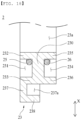
- the first packing member 23 may include a first packing body 230.
- the first packing body 230 defines the overall external appearance of the first packing member 23.
- a first outer surface 230a of the first packing body 230 may be disposed so as to face the first cap 3.
- a first inner surface 230b of the first packing body 230 may be disposed so as to face the interior of the mid-case 22.
- the first inner surface 230b and the first outer surface 230a may be disposed so as to face in opposite directions.
- the first packing member 23 may include a first outer groove 231 and a first outer member 232.
- the first outer groove 231 receives dry gas.
- the first outer groove 231 may be formed in the first outer surface 230a. Consequently, the first outer groove 231 may be disposed so as to face the first cap 3, and therefore the first outer groove may receive dry gas located between the first cap 3 and the cartridge 21.
- the first outer member 232 contacts the cartridge 21 between the first outer groove 231 and the cartridge 21. Depending on the pressure of the dry gas received in the first outer groove 231, the first outer member 232 may be pressed toward the cartridge 21, and therefore the first outer member may be brought into tight contact with the cartridge 21. In the humidifier 1 for fuel cells according to the present disclosure, therefore, it is possible to increase hermetic sealing force between the first packing member 23 and the cartridge 21 using the pressure of the dry gas received in the first outer groove 231. The first outer member 232 may be brought into tight contact with the first potting portion 212.
- the first packing member 23 may include a first outer protrusion 233.
- the first outer protrusion 233 contacts the mid-case 22 between the first outer groove 231 and the mid-case 22.
- the first outer protrusion 233 may be pressed toward the mid-case 22, and therefore the first outer protrusion may be brought into tight contact with the mid-case 22.
- the humidifier 1 for fuel cells according to the present disclosure, therefore, it is possible to increase hermetic sealing force between the first packing member 23 and the mid-case 22 using the pressure of the dry gas received in the first outer groove 231.
- the first outer groove 231 may be disposed between the first outer member 232 and the first outer protrusion 233 in a first-axis direction (X-axis direction). Consequently, the pressure of the dry gas received in the first outer groove 231 may act in a direction in which the distance between the first outer member 232 and the first outer protrusion 233 is increased. Using the pressure of the dry gas received in the first outer groove 231, therefore, the first outer member 232 may be brought into tight contact with the cartridge 21, and the first outer protrusion 233 may be brought into tight contact with the mid-case 22.
- the first outer member 232, the first outer protrusion 233, and the first packing body 230 may be integrally formed.
- the first packing member 23 may include a first inner groove 234 and a first inner member 235.
- the first inner groove 234 receives wet gas.
- the first inner groove 234 may be formed in the first inner surface 230b. Consequently, the first inner groove 234 may be disposed so as to face the interior of the mid-case 22, and therefore the first inner groove may receive wet gas located in the mid-case 22. In this case, wet gas located between the inner surface of the mid-case 22 and the outer surface of the cartridge 21 may be received in the first inner groove 234.
- the first inner member 235 contacts the cartridge 21 between the first inner groove 234 and the cartridge 21. Depending on the pressure of the wet gas received in the first inner groove 234, the first inner member 235 may be pressed toward the cartridge 21, and therefore the first inner member may be brought into tight contact with the cartridge 21. In the humidifier 1 for fuel cells according to the present disclosure, therefore, it is possible to increase hermetic sealing force between the first packing member 23 and the cartridge 21 using the pressure of the wet gas received in the first inner groove 234.
- the first inner member 235 may be brought into tight contact with the inner case 210. A portion of the first inner member 235 may be brought into tight contact with the first potting portion 212, and a portion of the first inner member may also be brought into tight contact with the inner case 210.
- the first packing member 23 may include a first inner protrusion 236.
- the first inner protrusion 236 contacts the mid-case 22 between the first inner groove 234 and the mid-case 22.
- the first inner protrusion 236 may be pressed toward the mid-case 22, and therefore the first inner protrusion may be brought into tight contact with the mid-case 22.
- the humidifier 1 for fuel cells according to the present disclosure, therefore, it is possible to increase hermetic sealing force between the first packing member 23 and the mid-case 22 using the pressure of the wet gas received in the first inner groove 234.
- the first inner groove 234 may be disposed between the first inner member 235 and the first inner protrusion 236. Consequently, the pressure of the wet gas received in the first inner groove 234 may act in a direction in which the distance between the first inner member 235 and the first inner protrusion 236 is increased. Using the pressure of the wet gas received in the first inner groove 234, therefore, the first inner member 235 may be brought into tight contact with the cartridge 21, and the first inner protrusion 236 may be brought into tight contact with the mid-case 22.
- the first inner member 235, the first inner protrusion 236, and the first packing body 230 may be integrally formed.
- the first packing member 23 may include an extension member 237 and a catching member 238.
- the extension member 237 extends toward the mid-case 22.
- the extension member 237 may extend from the first outer protrusion 233 toward the mid-case 22.
- the extension member 237 may be supported by the mid-case 22.
- the extension member 237 may connect the catching member 238 and the first outer protrusion 233 to each other.
- the extension member 237, the catching member 238, the first outer protrusion 233, and the first packing body 230 may be integrally formed.
- the extension member 237 may extend from the first packing body 230 toward the mid-case 22.
- a catching groove 237a may be formed in the extension member 237.
- the catching groove 237a may be disposed between the first outer protrusion 233 and the catching member 238.
- the mid-case 22 may be inserted into the catching groove 237a.
- the catching member 238 is coupled to the extension member 237.
- the catching member 238 may be disposed outside of the mid-case 22 inserted into the catching groove 237a.
- the mid-case 22 may be disposed between the catching member 238 and the first outer protrusion 233.
- the mid-case 22 may also be disposed between the catching member 238 and the first packing body 230.
- the depth by which the first packing member 23 is inserted into the mid-case 22 may be limited during the process of increasing hermetic sealing force using the pressure of at least one of the dry gas and the wet gas.
- the humidifier 1 for fuel cells according to the present disclosure therefore, it is possible to improve stability in increasing hermetic sealing force using the pressure of at least one of the dry gas and the wet gas.
- the first packing member 23 may include a first reinforcement member 239.
- the first reinforcement member 239 may be disposed in the first packing body 230.
- the first reinforcement member 239 may be made of a material that has higher rigidity than the first packing body 230.
- the first reinforcement member 239 may be made of metal or plastic.
- the first reinforcement member 239 may be implemented so as to be disposed in the first packing body 230 by insert molding.
- the first packing member 23 may be implemented so as to include all of the first outer groove 231, the first outer member 232, the first outer protrusion 233, the first inner groove 234, the first inner member 235, and the first inner protrusion 236.
- the first packing member 23 may be implemented so as to include only the first outer groove 231, the first outer member 232, and the first outer protrusion 233.
- the first packing member 23 may be implemented so as to include only the first inner groove 234, the first inner member 235, and the first inner protrusion 236.
- the first cap 3 is coupled to one end of the humidifying module 2.
- the space between the first cap 3 and the cartridge 21 may be isolated from the space between the cartridge 21 and the mid-case 22 in a hermetically sealed state by the first packing member 23.
- the first cap 3 may include a first pushing member 31.
- the first pushing member 31 may push the extension member 237 toward the mid-case 22. Consequently, the first pushing member 31 may further increase fixing force necessary for the first packing member 23 to be maintained in a state of hermetically sealing between the cartridge 21 and the mid-case 22.
- the second cap 4 is coupled to the other end of the humidifying module 2.
- the space between the second cap 4 and the cartridge 21 may be isolated from the space between the cartridge 21 and the mid-case 22 in a hermetically sealed state by the first packing member 23'.
- the first packing member 23' is approximately identical to the first packing member 23 described above, and a detailed description thereof will be omitted.
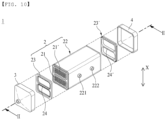
- the humidifier 1 for fuel cells may be implemented such that a plurality of cartridges 21 is coupled in the mid-case 22.
- the mid-case 22 may include a partition member (not shown) disposed between the cartridges 21 and 21'.
- the cartridges 21 and 21' may be individually detachably coupled to the mid-case 22 in a state of being disposed between the partition members.
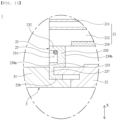
- FIGS. 11 to 13 only the first potting portion is shown with omission of a plurality of hollow fiber membranes and an inner case, although each of the cartridges 21 and 21' includes the plurality of hollow fiber membranes and the inner case.
- the humidifying module 2 When the humidifying module 2 is implemented such that the plurality of cartridges 21 is coupled to the mid-case 22, the humidifying module may include a second packing member 24.
- the second packing member 24 is disposed between the cartridges 21 and 21' to hermetically seal between the cartridges 21 and 21'.
- the second packing member 24 may prevent direct mixing between dry gas and wet gas through the space between the cartridges 21 and 21'.
- the humidifier 1 for fuel cells according to the present disclosure may include a plurality of second packing members 24.
- the second packing members 24 and 24' may be disposed at opposite sides of the cartridges 21 and 21'. Since the second packing members 24 and 24' are implemented so as to have the same structure except that the positions thereof are different from each other, a description will be given based on the second packing member 24 disposed at one side of each of the cartridges 21 and 21'. It is obvious to those skilled in the art to which the present disclosure pertains that the second packing member 24' disposed at the other side of each of the cartridges 21 and 21' is derived therefrom.
- the second packing member 24 may be brought into tight contact with the cartridges 21 and 21' using the pressure of at least one of dry gas and wet gas.
- the humidifier 1 for fuel cells according to the present disclosure therefore, it is possible to implement hermetic sealing force necessary to prevent direct mixing between the dry gas and the wet gas through the space between the cartridges 21 and 21' without an additional construction, whereby it is possible to reduce cost necessary to increase hermetic sealing force.
- the second packing member 24 may be made of an elastically deformable material.
- the second packing member 24 may be made of rubber.
- the second packing member 24 may include a second packing body 240.
- the second packing body 240 defines the overall external appearance of the second packing member 24.
- a second outer surface 240a of the second packing body 240 may be disposed so as to face the first cap 3.
- a second inner surface 240b of the second packing body 240 may be disposed so as to face the interior of the mid-case 22.
- the second inner surface 240b may be disposed so as to face the partition member.
- the second inner surface 240b and the second outer surface 240a may be disposed so as to face in opposite directions.
- the second packing member 24 may include a second outer groove 241 and a plurality of second outer members 242 and 242'.
- the second outer groove 241 receives dry gas.
- the second outer groove 241 may be formed in the second outer surface 240a. Consequently, the second outer groove 241 may be disposed so as to face the first cap 3, and therefore the first outer groove may receive dry gas located between the first cap 3 and the cartridge 21.
- the second outer members 242 and 242' contact the cartridges 21 and 21' between the second outer groove 241 and the cartridges 21 and 21'.
- the second outer members 242 and 242' may be pressed toward the cartridges 21 and 21', and therefore the second outer members may be brought into tight contact with the cartridges 21 and 21', respectively.
- the humidifier 1 for fuel cells according to the present disclosure, therefore, it is possible to increase hermetic sealing force between the second packing member 24 and the cartridges 21 and 21' using the pressure of the dry gas received in the second outer groove 241.
- the second outer members 242 and 242' may be brought into tight contact with the first potting portion 212.
- the second outer groove 241 may be disposed between the second outer members 242 and 242'. Consequently, the pressure of the dry gas received in the second outer groove 241 may act in a direction in which the distance between the second outer members 242 and 242' is increased.
- the second outer members 242 and 242' and the second packing body 240 may be integrally formed.
- the second packing member 24 may include a second inner groove 243 and second inner members 244 and 244'.
- the second inner groove 243 receives wet gas.
- the second inner groove 243 may be formed in the second inner surface 240b. Consequently, the second inner groove 243 may be disposed so as to face the interior of the mid-case 22, and therefore the first inner groove may receive wet gas located in the mid-case 22. In this case, wet gas located between the outer surfaces of the cartridges 21 and 21' may be received in the second inner groove 243.
- the second inner members 244 and 244' contact the cartridges 21 and 21' between the second inner groove 243 and the cartridges 21 and 21'. Depending on the pressure of the wet gas received in the second inner groove 243, the second inner members 244 and 244' may be pressed toward the cartridges 21 and 21', and therefore the second inner members may be brought into tight contact with the cartridges 21 and 21', respectively. In the humidifier 1 for fuel cells according to the present disclosure, therefore, it is possible to increase hermetic sealing force between the second packing member 24 and the cartridges 21 and 21' using the pressure of the wet gas received in the second inner groove 243. The second inner members 244 and 244' may be brought into tight contact with the inner cases 210 of the cartridges 21 and 21', respectively.
- each of the second inner members 244 and 244' may be brought into tight contact with a corresponding one of the first potting portions 212 and 212' of the cartridges 21 and 21', and a portion of each of the second inner members may be brought into tight contact with a corresponding one of the inner cases 210 of the cartridges 21 and 21'.
- the second inner groove 243 may be disposed between the second inner members 244 and 244'. Consequently, the pressure of the wet gas received in the second inner groove 243 may act in a direction in which the distance between the second inner members 244 and 244' is increased.
- the second inner members 244 and 244' and the second packing body 240 may be integrally formed.
- the second packing member 24 and the first packing member 23 may be integrally formed. Consequently, the second packing member 24 and the first packing member 23 may be installed through single insertion. In the humidifier 1 for fuel cells according to the present disclosure, therefore, it is possible to improve ease in hermetically sealing between the mid-case 22 and the cartridge 21 and between the cartridges 21 even when the plurality of cartridges 21 is coupled to the mid-case 22.
- the second packing member 24 may include a second reinforcement member 245.
- the second reinforcement member 245 may be disposed in the second packing body 240.
- the second reinforcement member 245 may be made of a material that has higher rigidity than the second packing body 240.
- the second reinforcement member 245 may be made of metal or plastic.
- the second reinforcement member 245 may be implemented so as to be disposed in the second packing body 240 by insert molding.
- the second packing member 24 may be implemented so as to include all of the second outer groove 241, the second outer members 242 and 242', the second inner groove 243, and the second inner members 244 and 244'. Although not shown, the second packing member 24 may be implemented so as to include only the second outer groove 241 and the second outer members 242 and 242'. Although not shown, the second packing member 24 may be implemented so as to include only the second inner groove 243 and the second inner members 244 and 244'.
- FIGS. 10 to 13 show that two cartridges 21 are coupled to the mid-case 22.
- the humidifier 1 for fuel cells according to the present disclosure may be implemented such that three cartridges 21, 21', and 21" are coupled to the mid-case 22.
- two second packing members 24 may be provided at one side of the humidifying module 2
- two second packing members 24' may be provided at the other side of the humidifying module 2.
- the humidifier 1 for fuel cells according to the present disclosure may be implemented such that four or more cartridges 21 are coupled to the mid-case 22. In this case, the number of second packing members 24 and 24' may be increased in proportion to the number of cartridges 21 coupled to the mid-case 22.
- the humidifying module 2 may include a first elastic member 25.
- the first packing member 23 may be brought into tight contact with the cartridge 21 using elastic force of the first elastic member 25.
- the humidifier 1 for fuel cells according to the present disclosure therefore, it is possible to increase hermetic sealing force necessary to prevent direct mixing between the dry gas and the wet gas using the first elastic member 25.
- the humidifier 1 for fuel cells according to the present disclosure therefore, it is possible to improve stability in humidifying the dry gas.
- the first elastic member 25 is coupled to the first packing member 23.
- the first elastic member 25 may bring the first packing member 23 into tight contact with the cartridge 21 using elastic force thereof.
- the first elastic member 25 may be implemented as a spring having elastic force.
- the first elastic member 25 may be formed in a ring shape.
- the first elastic member 25 may be inserted into the first outer groove 231.
- the first elastic member 25 may press the first outer member 232 toward the cartridge 21 using elastic force thereof, whereby the first outer member 232 may be brought into tight contact with the cartridge 21.
- the first outer member 232 may be pressed toward the cartridge 21 by the elastic force of the first elastic member 25, and therefore the first outer member may be brought into tight contact with the cartridge 21.
- the first outer member 232 may be brought into tight contact with the first potting portion 212.
- the first packing member 23 When the first packing member 23 includes the first outer groove 231 and the first outer member 232, the first packing member 23 may be brought into tight contact with the cartridge 21 using the pressure of dry gas.
- both the dry gas and the wet gas flow at a considerable pressure, whereby the dry gas has pressure sufficient to press the first packing member 23 toward the cartridge 21. Consequently, the humidifier 1 for fuel cells according to the present disclosure is implemented such that the first packing member 23 is brought into tighter contact with the cartridge 21 using the pressure of the dry gas during the humidification process, in addition to using the elastic force of the first elastic member 25. In the humidifier 1 for fuel cells according to the present disclosure, therefore, it is possible to further increase hermetic sealing force necessary to prevent direct mixing between the dry gas and the wet gas.
- the humidifier 1 for fuel cells according to the present disclosure it is possible to further increase hermetic sealing force without an additional construction, since the pressure of the dry gas is used. In the humidifier 1 for fuel cells according to the present disclosure, therefore, it is possible to reduce cost necessary to further increase hermetic sealing force.
- the first outer groove 231 may receive the dry gas located between the first cap 3 and the cartridge 21.
- the first outer member 232 may be pressed toward the cartridge 21 depending on the pressure of the dry gas received in the first outer groove 231, whereby the first outer member may be brought into tight contact with the cartridge 21.
- the first elastic member 25 may be disposed in the first packing body 230.
- the first elastic member 25 may press the first packing body 230 toward the cartridge 21 using the elastic force thereof, whereby the first packing body 230 may be brought into tight contact with the cartridge 21. Consequently, the humidifier 1 for fuel cells according to the present disclosure is implemented such that the first outer member 232 is brought into tight contact with the cartridge 21 using the pressure of the dry gas received in the first outer groove 231 and such that the first packing body 230 is brought into tight contact with the cartridge 21 using the elastic force of the first elastic member 25.
- the first elastic member 25 may be implemented so as to be disposed in the first packing body 230 by insert molding.
- the first elastic member 25 may be disposed at the first inner surface 230b such that the first packing member 23 is brought into tight contact with the cartridge 21.
- the first elastic member 25 may be inserted into the first inner groove 234 so as to contact the first inner member 235. Consequently, the first elastic member 25 may bring the first inner member 235 into tight contact with the cartridge 21 using the elastic force thereof.
- the first inner member 235 may be pressed toward the cartridge 21 by the elastic force of the first elastic member 25, whereby the first inner member may be brought into tight contact with the cartridge 21.
- the first inner member 235 may be brought into tight contact with the inner case 210. A portion of the first inner member 235 may be brought into tight contact with the first potting portion 212, and a portion of the first inner member may be brought into tight contact with the inner case 210.
- the first packing member 23 When the first packing member 23 includes the first inner groove 234 and the first inner member 235, the first packing member 23 may be brought into tight contact with the cartridge 21 using the pressure of wet gas. Consequently, the humidifier 1 for fuel cells according to the present disclosure is implemented such that the first packing member 23 is brought into tighter contact with the cartridge 21 using the pressure of the wet gas during the humidification process, in addition to using the elastic force of the first elastic member 25.
- the first inner groove 234 may receive the wet gas located between the first cap 3 and the cartridge 21.
- the first inner member 235 may be pressed toward the cartridge 21 depending on the pressure of the wet gas received in the first inner groove 234, whereby the first inner member may be brought into tight contact with the cartridge 21.
- the first packing member 23 may also be implemented such that the first outer member 232 is brought into tight contact with the cartridge 21 by the elastic force of the first elastic member 25 disposed in the first outer groove 231 and such that the first inner member 235 is brought into tight contact with the cartridge 21 by the pressure of the wet gas received in the first inner groove 234.
- the first outer member 232 may also be brought into tight contact with the cartridge 21 by the elastic force of the first elastic member 25 and the pressure of the dry gas received in the first outer groove 231.
- the first packing member 23 may also be implemented such that the first inner member 235 is brought into tight contact with the cartridge 21 by the elastic force of the first elastic member 25 disposed in the first outer groove 231 and such that the first outer member 232 is brought into tight contact with the cartridge 21 by the pressure of the dry gas received in the first outer groove 231.
- the first inner member 235 may also be brought into tight contact with the cartridge 21 by the elastic force of the first elastic member 25 and the pressure of the wet gas received in the first inner groove 234.
- the first packing member 23 may also be implemented such that the first packing body 230 is brought into tight contact with the cartridge 21 by the elastic force of the first elastic member 25 disposed in the first packing body 230 and such that the first inner member 235 is brought into tight contact with the cartridge 21 by the pressure of the wet gas received in the first inner groove 234.
- the first packing member 23 may also be implemented such that the first packing body 230 is brought into tight contact with the cartridge 21 by the elastic force of the first elastic member 25 disposed in the first packing body 230, such that the first outer member 232 is brought into tight contact with the cartridge 21 by the pressure of the dry gas received in the first outer groove 231, and such that the first inner member 235 is brought into tight contact with the cartridge 21 by the pressure of the wet gas received in the first inner groove 234.
- the humidifying module 2 may include a second elastic member 26.
- the second elastic member 26 is coupled to the first packing member 23.
- the second elastic member 26 may bring the first packing member 23 into tight contact with the cartridge 21 using elastic force thereof.
- the second elastic member 26 may be implemented as a spring having elastic force.
- the second elastic member 26 may be formed in a ring shape.
- the second elastic member 26 may be inserted into the first inner groove 234.
- the second elastic member 26 may press the first inner member 235 toward the cartridge 21 using elastic force thereof, whereby the first inner member 235 may be brought into tight contact with the cartridge 21.
- the first elastic member 25 may bring the first outer member 232 into contact with the cartridge 21 using the elastic force thereof in a state of being disposed in the first outer groove 231.
- the first inner member 235 and the first outer member 232 may be brought into tight contact with the cartridge 21 using the elastic force of the second elastic member 26 and the elastic force of the first elastic member 25.
- different portions of the first packing member 23 may be brought into tight contact with the cartridge 21, whereby it is possible to increase hermetic sealing force through a dual structure.
- the first inner member 235 may be brought into tighter contact with the cartridge 21 by the elastic force of the second elastic member 26 and the pressure of the wet gas received in the first inner groove 234.
- the first outer member 232 may be brought into tighter contact with the cartridge 21 by the elastic force of the first elastic member 25 and the pressure of the dry gas received in the first outer groove 231.
- one of the second elastic member 26 and the first elastic member 25 may be disposed in the first packing body 230, and the other elastic member may be disposed in one of the first inner groove 234 and the first outer groove 231.
- the humidifying module 2 may include a plurality of first elastic members 25.
- the first elastic members 25 and 25' may be inserted respectively into the first outer groove 231 and the second outer groove 241 to bring the first packing member 23 and the second packing member 24 into tight contact with the cartridges 21 and 21', respectively.
- the first elastic members 25 and 25' may be disposed so as to surround the cartridges 21 and 21', respectively, to elastically press the first packing member 23 and the second packing member 24 toward the cartridges 21 and 21', respectively.
- the humidifier 1 for fuel cells according to the present disclosure is implemented such that the first packing member 23 and the second packing member 24 are brought into tight contact with the cartridges 21 and 21', respectively, using the pressure of the dry gas received in the first outer groove 231 and the second outer groove 241 and the elastic force of the first elastic members 25 and 25' .
- the humidifier 1 for fuel cells according to the present disclosure therefore, it is possible to increase hermetic sealing force through a dual structure.
- the humidifying module 2 may further include a plurality of second elastic members 26, in addition to the first elastic members 25 and 25'.
- the second elastic members 26 and 26' may be inserted respectively into the first inner groove 234 and the second inner groove 243 to bring the first packing member 23 and the second packing member 24 into tight contact with the cartridges 21 and 21', respectively.
- the second elastic members 26 and 26' may be disposed so as to surround the cartridges 21 and 21', respectively, to elastically press the first packing member 23 and the second packing member 24 toward the cartridges 21 and 21', respectively.
- the humidifier 1 for fuel cells according to the present disclosure is implemented such that the first packing member 23 and the second packing member 24 are brought into tight contact with the cartridges 21 and 21', respectively, using the pressure of the dry gas received in the first inner groove 234 and the second inner groove 243 and the elastic force of the second elastic members 26 and 26'.
- the humidifier 1 for fuel cells according to the present disclosure therefore, it is possible to further increase hermetic sealing force.
- the humidifying module 2 may be implemented such that the first elastic members 25 and 25' are inserted respectively into the first inner groove 234 and the second inner groove 243 to bring the first packing member 23 and the second packing member 24 into tight contact with the cartridges 21 and 21', respectively.
- the first elastic members 25 and 25' may be inserted respectively into the first inner groove 234 and the second inner groove 243 so as to surround the cartridges 21 and 21', respectively, whereby the first packing member 23 and the second packing member 24 may be elastically pressed toward the cartridges 21 and 21', respectively.
- the cartridge 21 may include a first support 214.
- the first packing member 23 may be implemented so as to be brought into tight contact with the cartridge 21 in a state of being compressed through interference fit using the first support 214.
- the first support 214 may be coupled to the first potting portion 212.
- the first support 214 may be disposed so as to surround the periphery of the first potting portion 212.
- the first potting portion 212 may be disposed inside the first support 214.
- the first support 214 may be formed in a ring shape.
- the first support 214 may be disposed so as to protrude to the outside of the first potting portion 212.
- the first support 214 may be supported by the inner case 210 through hook coupling such that movement of the first support in a second-axis direction (Y-axis direction) is limited.
- the second-axis direction (Y-axis direction) is an axis direction perpendicular to the first-axis direction (X-axis direction) and is an axis direction parallel to a direction in which the first cap 3 and the second cap 4 are spaced apart from each other.
- the first potting portion 212 may be formed through a casting process, whereby the first support 214 may be implemented so as to be coupled to the first potting portion 212.
- the first packing member 23 may be inserted between the cartridge 21 and the mid-case 22.
- the first support 214 may be made of a material that has higher rigidity than the first packing member 23.
- the first support 214 may be made of metal or plastic.
- the first support 214 may be implemented so as to be shorter than the first packing member 23 in the second-axis direction (Y-axis direction).
- the first support 214 may be implemented such that the first support 214 is not present between the first outer member 232 and the first potting portion 212 but is present only between the first packing body 230 and the first potting portion 212. Consequently, the first outer member 232 may be pressed by the pressure of the dry gas received in the first outer groove 231, whereby the first outer member may be brought into tight contact with the first potting portion 212.
- the first packing body 230 may be compressed between the mid-case 22 and the first support 214 as the result of interference fit, whereby the first packing body may be brought into tight contact with the first support 214.
- the first support 214 may be implemented so as to have the same length as the first packing member 23 or to have a larger length than the first packing member 23 in the second-axis direction (Y-axis direction).
- the first support 214 may be implemented such that the first support 214 is present between the first outer member 232 and the first potting portion 212 and is also present between the first packing body 230 and the first potting portion 212. Consequently, the first outer member 232 and the first packing body 230 may be compressed between the mid-case 22 and the first support 214 as the result of interference fit, whereby the first outer member and the first packing body may be brought into tight contact with the first support 214.
- the first outer member 232 may be brought into tight contact with the cartridge 21 by both pressing by the first support 214 and the pressure of the dry gas received in the first outer groove 231.
- the first support 214 When the first support 214 is implemented so as to contact both the first outer member 232 and the first packing body 230, the first support 214 may be used as a potting cap during formation of the first potting portion 212 through a casting process.
- the first potting portion 212 is formed through a casting process in the state in which the first support 214 is coupled to the inner case 210 so as to be implemented as a potting cap, and then the cartridge 21 may be manufactured through a cutting process of cutting a portion CP of the first support 214 and a portion of the first potting portion 212 such that the hollow portions of the hollow fiber membranes 211 are opened.
- first support 214 is used as the potting cap
- a potting cap assembly process and a potting cap removal process may be omitted, compared to a comparative example using a separate potting cap.
- the first support 214 is used as the potting cap, therefore, it is possible to reduce manufacturing cost and to improve productivity through shortening of a manufacturing time.
- the cartridge 21 may include a second support (not shown).
- the second support may be coupled to the second potting portion 213. Since the second support and the first support 214 are implemented so as to have the same structure except that the positions thereof are different from each other, it is obvious to those skilled in the art to which the present disclosure pertains that the structure of the second support can be understood from the description of the first support 214. Therefore, a detailed description of the second support will be omitted.
- the first cap 3 may include a first pushing protrusion 32.
- the first pushing protrusion 32 protrudes from the first pushing member 31.
- the first pushing protrusion 32 may push the extension member 237 toward the mid-case 22, whereby the extension member 237 may be brought into tight contact with the mid-case 22. Consequently, the first pushing protrusion 32 may further increase hermetic sealing force between the first cap 3 and the mid-case 22 and may further increase force that fixes the first packing member 23.
- the first pushing protrusion 32 may be formed such that the size of the first pushing protrusion is gradually decreased as the first pushing protrusion protrudes from the first pushing member 31.
- the first pushing protrusion 32 may be formed in a ring shape.
- the first cap 3 includes a first supporting member 33.
- the first supporting member 33 is inserted into the first outer groove 231 to support the first packing body 230. Consequently, the first supporting member 33 may limit movement of the first packing member 23, whereby it is possible to prevent separation of the first packing member 23 due to vibration and shaking.
- the first supporting member 33 may be formed so as to have a length capable of pressing the first packing body 230. In this case, the first supporting member 33 may press the first packing body 230 such that the first outer groove 231 is maintained in a state of having a size sufficient to receive a fluid for cells. In addition, the first supporting member 33 may press the first packing body 230 in order to further increase tight contact force by which the first packing member 23 is brought into tight contact with the cartridge 21.
- the first supporting member 33 may be formed in a ring shape.
- the second cap 4 may include a second pushing member, a second pushing protrusion, and a second supporting member.
- the second pushing member, the second pushing protrusion, and the second supporting member are implemented so as to be approximately identical respectively to the first pushing member 31, the first pushing protrusion 32, and the first supporting member 33 described above, and therefore a detailed description thereof will be omitted.
- the cartridges 21 and 21' may include the first supports 214 and 214', respectively.
- Each of the first supports 214 and 214' may be disposed so as to surround the periphery of a corresponding one of the cartridges 21 and 21'.
- the portion of the second packing member 24 disposed between the first supports 214 and 214' may be extruded as the result of interference fit. Consequently, hermetic sealing force using the second packing member 24 may be further increased.
- Each of the first supports 214 and 214' may be made of a material that has higher rigidity than the second packing member 24.
- each of the first supports 214 and 214' may be made of metal or plastic.
- Each of the first supports 214 and 214' may be implemented so as to be shorter than the second packing member 24 in the second-axis direction (Y-axis direction).
- the first supports 214 and 214' may be implemented such that the first supports 214 and 214' are not present between the second outer members 242 and 242' and the first potting portions 212 and 212' but are present only between the second packing body 240 and the first potting portions 212 and 212'. Consequently, the second outer members 242 and 242' may be pressed by the pressure of the dry gas received in the second outer groove 241, whereby the second outer members may be brought into tight contact with the first potting portions 212 and 212', respectively.
- the second packing body 240 may be compressed between the first supports 214 and 214' as the result of interference fit, whereby the second packing body may be brought into tight contact with the first supports 214 and 214'.
- Each of the first supports 214 and 214' may be implemented so as to have the same length as the second packing member 24 or to have a larger length than the second packing member 24 in the second-axis direction (Y-axis direction).
- the first supports 214 and 214' may be implemented such that the first supports 214 and 214' are present between the second outer members 242 and 242' and the first potting portions 212 and 212' and are also present between the second packing body 240 and the first potting portions 212 and 212'.
- the second outer members 242 and 242' and the second packing body 240 may be compressed between the first supports 214 and 214' as the result of interference fit, whereby the second outer members and the second packing body may be brought into tight contact with the first supports 214 and 214'.
- the second outer members 242 and 242' may be brought into tight contact with the cartridges 21 and 21', respectively, by both pressing by the first supports 214 and 214' and the pressure of the dry gas received in the second outer groove 241.
Landscapes
- Chemical & Material Sciences (AREA)
- Chemical Kinetics & Catalysis (AREA)
- Engineering & Computer Science (AREA)
- General Chemical & Material Sciences (AREA)
- Sustainable Development (AREA)
- Sustainable Energy (AREA)
- Life Sciences & Earth Sciences (AREA)
- Electrochemistry (AREA)
- Manufacturing & Machinery (AREA)
- Fuel Cell (AREA)
- Analytical Chemistry (AREA)
- Oil, Petroleum & Natural Gas (AREA)
- Air Humidification (AREA)
Description
- The present disclosure relates to a humidifier for fuel cells configured to supply humidified gas to a fuel cell.
- A fuel cell has advantages in that it is possible to continuously generate electricity as long as hydrogen and oxygen are supplied, unlike a general chemical cell, such as a dry cell or a storage cell, and in that there is no heat loss, whereby efficiency of the fuel cell is about twice as high as efficiency of an internal combustion engine.
- In addition, the fuel cell directly converts chemical energy generated by combination of hydrogen and oxygen into electrical energy, whereby the amount of contaminants that are discharged is small. Consequently, the fuel cell has advantages in that the fuel cell is environmentally friendly and in that a concern about depletion of resources due to an increase in energy consumption can be reduced.
- Based on the kind of an electrolyte that is used, such a fuel cell may be classified as a polymer electrolyte membrane fuel cell (PEMFC), a phosphoric acid fuel cell (PAFC), a molten carbonate fuel cell (MCFC), a solid oxide fuel cell (SOFC), or an alkaline fuel cell (AFC).
- These fuel cells are operated fundamentally by the same principle, but are different from each other in terms of the kind of fuel that is used, operating temperature, catalyst, and electrolyte. Among these fuel cells, the polymer electrolyte membrane fuel cell (PEMFC) is known as being the most favorable to a transportation system as well as small-scale stationary power generation equipment, since the polymer electrolyte membrane fuel cell is operated at a lower temperature than the other fuel cells and the output density of the polymer electrolyte membrane fuel cell is high, whereby it is possible to miniaturize the polymer electrolyte membrane fuel cell.
- One of the most important factors in improving the performance of the polymer electrolyte membrane fuel cell (PEMFC) is to supply a predetermined amount or more of moisture to a polymer electrolyte membrane or a proton exchange membrane (PEM) of a membrane electrode assembly (MEA) in order to retain moisture content. The reason for this is that, if the polymer electrolyte membrane or the proton exchange membrane is dried, power generation efficiency is abruptly reduced.
- 1) A bubbler humidification method of filling a pressure-resistant container with water and allowing a target gas to pass through a diffuser in order to supply moisture, 2) a direct injection method of calculating the amount of moisture to be supplied that is necessary for fuel cell reaction and directly supplying moisture to a gas stream pipe through a solenoid valve, and 3) a membrane humidification method of supplying moisture to a gas fluid bed using a polymer separation membrane are used as methods of humidifying the polymer electrolyte membrane or the proton exchange membrane.
- Among these methods, the membrane humidification method, which provides water vapor to air that is supplied to the polymer electrolyte membrane or the proton exchange membrane using a membrane configured to selectively transmit only water vapor included in off-gas in order to humidify the polymer electrolyte membrane or the proton exchange membrane, is advantageous in that it is possible to reduce the weight and size of a humidifier.
- When a module is formed, a hollow fiber membrane having large transmission area per unit volume is suitable for a permselective membrane used in the membrane humidification method. That is, when a humidifier is manufactured using a hollow fiber membrane, high integration of the hollow fiber membrane having large contact surface area is possible, whereby it is possible to sufficiently humidify the fuel cell even at a small capacity, it is possible to use a low-priced material, and it is possible to collect moisture and heat included in off-gas discharged from the fuel cell at a high temperature and to reuse the collected moisture and heat through the humidifier.
-
FIG. 1 is a schematic exploded perspective view of a conventional humidifier for fuel cells. - As illustrated in
FIG. 1 , a conventional membranehumidification type humidifier 100 includes ahumidifying module 110, in which moisture exchange is performed between air supplied from the outside and off-gas discharged from a fuel cell stack (not shown), and caps 1200 coupled respectively to opposite ends of thehumidifying module 110. - One of the
caps 120 transmits air supplied from the outside to thehumidifying module 110, and the other cap transmits air humidified by the humidifyingmodule 110 to the fuel cell stack. - The
humidifying module 110 includes amid-case 111 having an off-gas inlet 111a and an off-gas outlet 111b and a plurality ofhollow fiber membranes 112 in themid-case 111. Opposite ends of a bundle ofhollow fiber membranes 112 are potted infixing layers 113. In general, each of thefixing layers 113 is formed by hardening a liquid polymer, such as liquid polyurethane resin, using a casting method. - Air supplied from the outside flows along hollow parts of the
hollow fiber membranes 112. Off-gas introduced into themid-case 111 through the off-gas inlet 111a comes into contact with the outer surfaces of thehollow fiber membranes 112, and is discharged from themid-case 111 through the off-gas outlet 111b. When the off-gas comes into contact with the outer surfaces of thehollow fiber membranes 112, moisture contained in the off-gas is transmitted through thehollow fiber membranes 112 to humidify air flowing along the hollow parts of thehollow fiber membranes 112. - Inner spaces of the
caps 120 must fluidly communicate with only the hollow parts of thehollow fiber membranes 112 in a state of being completely isolated from an inner space of themid-case 111. If not, air leakage due to pressure difference occurs, whereby the amount of humidified air that is supplied to the fuel cell stack is reduced and power generation efficiency of a fuel cell is lowered. - In general, as illustrated in
FIG. 1 , thefixing layers 113, in which opposite ends of thehollow fiber membranes 112 are potted, andresin layers 114 provided between thefixing layers 113 and themid-case 111 isolate the inner spaces of thecaps 120 from the inner space of themid-case 111. Similarly to thefixing layers 113, each of theresin layers 114 is generally formed by hardening a liquid polymer, such as liquid polyurethane resin, using a casting method. - However, a casting process for forming the
resin layers 114 requires a relatively long process time, whereby productivity of thehumidifier 100 is lowered.KR 2019 0081736 A KR 2018 0001849 A US 2014/291874 A1 relates to a membrane humidifier, and more particularly, to a membrane humidifier having a sealing member interposed between a housing and a potting portion fixing an end portion of a hollow fiber membrane bundle to the housing.WO 2020/213990 A1 relates to a humidifier for a fuel cell and a packing member therefor, and more specifically, to a humidifier for a fuel cell capable of significantly reducing maintenance cost as well as being manufactured with improved productivity, and a packing member for the same. - The present invention has been made in view of the above problems, and it is an object of the present invention to provide a humidifier for fuel cells capable of preventing lowering in productivity of the humidifier due to formation of a resin layer through a casting process.
- In order to accomplish the above object, the present invention provides for a humidifier as defined in
claim 1. - A humidifier for fuel cells according to the present disclosure may include a humidifying module configured to humidify dry gas supplied from outside using wet gas discharged from a fuel cell stack and a first cap coupled to one end of the humidifying module. The humidifying module may include a mid-case and at least one cartridge disposed in the mid-case, the cartridge being configured to receive a plurality of hollow fiber membranes. The humidifier for fuel cells according to the present disclosure may further include a first packing member airtightly coupled to at least one end of the humidifying module through mechanical assembly such that the first cap fluidly communicates with only the hollow fiber membranes. The first packing member may be brought into tight contact with the cartridge using pressure of at least one of dry gas and wet gas.
- The present disclosure is implemented such that a casting process for hermetically sealing an inner space of a cap and an inner space of a mid-case is omitted. In the present disclosure, therefore, it is possible to improve productivity through reduction in process time for production.
- In the present disclosure, it is possible to increase hermetic sealing force using the pressure of at least one of dry gas and wet gas. Also, in the present disclosure, it is possible to increase hermetic sealing force without an additional construction, whereby it is possible to reduce cost necessary to increase hermetic sealing force.
-
-
FIG. 1 is a schematic exploded perspective view of a conventional humidifier for fuel cells. -
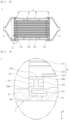
FIG. 2 is a schematic exploded perspective view of a humidifier for fuel cells according to the present disclosure. -
FIG. 3 is a schematic exploded sectional view showing the humidifier for fuel cells according to the present disclosure, taken along line I-I ofFIG. 2 . -
FIG. 4 is a schematic coupled sectional view showing the humidifier for fuel cells according to the present disclosure, taken along line I-I ofFIG. 2 . -
FIG. 5 is a schematic enlarged sectional view showing part A ofFIG. 4 . -
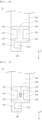
FIGS. 6 to 9 are schematic enlarged sectional views showing a first packing member, taken along line I-I ofFIG. 2 . -
FIG. 10 is a schematic exploded perspective view showing an embodiment in which two cartridges are coupled to a mid-case in the humidifier for fuel cells according to the present disclosure. -
FIG. 11 is a schematic enlarged sectional view showing the first packing member, taken along line II-II ofFIG. 10 . -
FIGS. 12 and13 are schematic enlarged sectional views showing the state in which the first packing member and a second packing member are coupled to the mid-case and the cartridges, taken along line II-II ofFIG. 10 . -
FIG. 14 is a schematic exploded perspective view showing an embodiment in which three cartridges are coupled to the mid-case in the humidifier for fuel cells according to the present disclosure. -
FIG. 15 is a schematic enlarged sectional view showing part A ofFIG. 4 . -
FIGS. 16 to 18 are schematic enlarged sectional views showing the first packing member, taken along line I-I ofFIG. 2 . -
FIG. 19 is a schematic enlarged sectional view showing the state in which the first packing member and the second packing member are coupled to the mid-case and the cartridges, taken along line II-II ofFIG. 10 . -
FIGS. 20 and21 are schematic enlarged sectional views showing part A ofFIG. 4 . -
FIGS. 22 to 24 are schematic enlarged sectional views showing the state in which the first packing member and the second packing member are coupled to the mid-case and the cartridges, taken along line II-II ofFIG. 10 . - Hereinafter, embodiments of a humidifier for fuel cells according to the present disclosure will be described in detail with reference to the accompanying drawings.
- Referring to
FIGS. 2 to 4 , ahumidifier 1 for fuel cells according to the present disclosure humidifies dry gas supplied from the outside using wet gas discharged from a fuel cell stack. The dry gas may be fuel gas or air. - The
humidifier 1 for fuel cells according to the present disclosure includes ahumidifying module 2 configured to humidify dry gas and afirst cap 3 coupled to one end of thehumidifying module 2. Thehumidifying module 2 includes acartridge 21, to which a plurality ofhollow fiber membranes 211 is coupled, a mid-case 22, to which thecartridge 21 is coupled, and afirst packing member 23 disposed between thecartridge 21 and the mid-case 22 to hermetically seal between thecartridge 21 and the mid-case 22. Thefirst packing member 23 may hermetically seal between thecartridge 21 and the mid-case 22 through coupling without a casting process. Consequently, thefirst packing member 23 may hermetically seal an inner space of thefirst cap 3 and an inner space of the mid-case 22. In thehumidifier 1 for fuel cells according to the present disclosure, therefore, the casting process, which requires a relatively long process time, may be omitted, whereby it is possible to improve productivity through reduction in process time for production. - Hereinafter, the
humidifying module 2 and thefirst cap 3 will be described in detail with reference to the accompanying drawings. - Referring to
FIGS. 2 to 4 , thehumidifying module 2 humidifies dry gas supplied from the outside using wet gas discharged from the fuel cell stack. Thefirst cap 3 may be coupled to one end of thehumidifying module 2. Asecond cap 4 may be coupled to the other end of thehumidifying module 2. Thefirst cap 3 may transmit dry gas supplied from the outside to thehumidifying module 2. Thesecond cap 4 may transmit the dry gas humidified by thehumidifying module 2 to the fuel cell stack. Thesecond cap 4 may transmit dry gas supplied from the outside to thehumidifying module 2, and thefirst cap 3 may transmit the dry gas humidified by thehumidifying module 2 to the fuel cell stack. - The
humidifying module 2 includes thecartridge 21, the mid-case 22, and thefirst packing member 23. - The
cartridge 21 includes the plurality ofhollow fiber membranes 211. Thehollow fiber membranes 211 may be implemented as thecartridge 21 so as to be modularized. Consequently, thehollow fiber membranes 211 may be installed in the mid-case 22 through a process of coupling thecartridge 21 to the mid-case 22. In thehumidifier 1 for fuel cells according to the present disclosure, therefore, ease in installation, separation, and replacement of thehollow fiber membranes 211 may be improved. Thecartridge 21 may include aninner case 210 configured to receive thehollow fiber membranes 211. Thehollow fiber membranes 211 may be disposed in theinner case 210 so as to be modularized. Each of thehollow fiber membranes 211 may include a polymer membrane made of polysulfone resin, polyethersulfone resin, sulfonated polysulfone resin, polyvinylidene fluoride (PVDF) resin, polyacrylonitrile (PAN) resin, polyimide resin, polyamide imide resin, polyester imide resin, or a mixture of two or more thereof. - The
cartridge 21 may include afirst potting portion 212. Thefirst potting portion 212 fixes thehollow fiber membranes 211. Thefirst potting portion 212 may fix one side of each of thehollow fiber membranes 211. In this case, thefirst potting portion 212 may be formed so as not to block hollow portions of thehollow fiber membranes 211. Thefirst potting portion 212 may be formed by hardening a liquid resin, such as liquid polyurethane resin, using a casting process. Thefirst potting portion 212 may fix theinner case 210 and one side of each of thehollow fiber membranes 211 to each other. - The
cartridge 21 may include asecond potting portion 213. Thesecond potting portion 213 fixes the other side of each of thehollow fiber membranes 211. In this case, thesecond potting portion 213 may be formed so as not to block the hollow portions of thehollow fiber membranes 211. Consequently, dry gas may be supplied to the hollow portions of thehollow fiber membranes 211, may be humidified, and may be supplied to the fuel cell stack without being disturbed by thesecond potting portion 213 and thefirst potting portion 212. Thesecond potting portion 213 may be formed by hardening a liquid resin, such as liquid polyurethane resin, using a casting process. Thesecond potting portion 213 may fix theinner case 210 and the other side of each of thehollow fiber membranes 211 to each other. - The
cartridge 21 is coupled to the mid-case 22. Thecartridge 21 may be disposed in the mid-case 22 such that a space is defined between the inner surface of the mid-case 22 and the outer surface of thecartridge 21. The mid-case 22 may include aninlet 221 and anoutlet 222. Wet gas containing moisture may be introduced into the mid-case 22 through theinlet 221, and may then come into contact with the outer surfaces of thehollow fiber membranes 211. During this process, the moisture contained in the wet gas may be transmitted through thehollow fiber membranes 211, whereby the dry gas flowing along the hollow portions of thehollow fiber membranes 211 may be humidified. The humidified dry gas may be discharged from thehollow fiber membranes 211, and may then be supplied to the fuel cell stack. After humidifying the dry gas, the wet gas may be discharged from the mid-case 22 through theoutlet 222. Theinlet 221 may be connected to the fuel cell stack. In this case, the wet gas may be off-gas discharged from the fuel cell stack. - Meanwhile, the
cartridge 21 may be provided with an introduction hole (not shown) configured to allow the wet gas to be introduced therethrough and a discharge hole (not shown) configured to allow the wet gas, after humidifying the dry gas flowing along the hollow portions of thehollow fiber membranes 211, to be discharged therethrough. In this case, the wet gas may be introduced between the inner surface of the mid-case 22 and the outer surface of thecartridge 21 through theinlet 221, may be introduced into thecartridge 21 through the introduction hole, may humidify the dry gas flowing along the hollow portions of thehollow fiber membranes 211, may be discharged between the inner surface of the mid-case 22 and the outer surface of thecartridge 21 through the discharge hole, and may be discharged from the mid-case 22 through theoutlet 222. - Referring to
FIGS. 2 to 6 , thefirst packing member 23 hermetically seals between thecartridge 21 and the mid-case 22. Thefirst packing member 23 may be airtightly coupled to at least one end of thehumidifying module 2 through mechanical assembly. Consequently, thefirst packing member 23 allows thefirst cap 3 to fluidly communicate with only thehollow fiber membranes 112. Consequently, thefirst packing member 23 may prevent direct mixing between dry gas to be supplied to the fuel cell stack and wet gas supplied into the mid-case 22. Thefirst packing member 23 may be inserted between thecartridge 21 and the mid-case 22. In this case, thecartridge 21 may be inserted into afirst passing hole 23a formed in thefirst packing member 23. Thefirst packing member 23 may contact each of an inner wall of the mid-case 22, an outer wall of thecartridge 21, and thefirst potting portion 212. Through such contact, thefirst packing member 23 may be airtightly coupled to one end of thehumidifying module 2. In this case, thefirst packing member 23 may contact each of a portion of the inner wall of the mid-case 22, a portion of the outer wall of thecartridge 21, and a portion of thefirst potting portion 212. - The
humidifier 1 for fuel cells according to the present disclosure may include a plurality offirst packing members 23. Thefirst packing members 23 and 23' may be airtightly coupled to opposite ends of thehumidifying module 2, respectively. In this case, thefirst packing members 23 and 23' may be disposed at opposite sides of thecartridge 21. The first packing member 23' may contact each of the inner wall of the mid-case 22, the outer wall of thecartridge 21, and thesecond potting portion 213, whereby the first packing member 23' may be airtightly coupled to the other end of thehumidifying module 2. In this case, the first packing member 23' may contact each of a portion of the inner wall of the mid-case 22, a portion of the outer wall of thecartridge 21, and a portion of thesecond potting portion 213. Since thefirst packing members 23 and 23' are implemented so as to have the same structure except that the positions thereof are different from each other, a description will be given based on thefirst packing member 23 disposed at one end of thehumidifying module 2. It is obvious to those skilled in the art to which the present disclosure pertains that the first packing member 23' disposed at the other end of thehumidifying module 2 is derived therefrom. - The
first packing member 23 may be brought into tight contact with thecartridge 21 using the pressure of at least one of dry gas and wet gas. During a humidification process, both the dry gas and the wet gas flow at a considerable pressure, whereby each of the dry gas and the wet gas has pressure sufficient to press thefirst packing member 23 toward thecartridge 21. Consequently, thehumidifier 1 for fuel cells according to the present disclosure is implemented such that thefirst packing member 23 is brought into tight contact with thecartridge 21 using the pressure of at least one of the dry gas and the wet gas during the humidification process. In thehumidifier 1 for fuel cells according to the present disclosure, therefore, it is possible to implement hermetic sealing force necessary to prevent direct mixing between the dry gas and the wet gas without an additional construction, whereby it is possible to reduce cost necessary to increase hermetic sealing force. Thefirst packing member 23 may be made of an elastically deformable material. For example, thefirst packing member 23 may be made of rubber. Thefirst packing member 23 may be formed in a ring shape so as to hermetically seal between thecartridge 21 and the mid-case 22. - The
first packing member 23 may include afirst packing body 230. Thefirst packing body 230 defines the overall external appearance of thefirst packing member 23. When thefirst packing body 230 is inserted between thecartridge 21 and the mid-case 22, a firstouter surface 230a of thefirst packing body 230 may be disposed so as to face thefirst cap 3. In this case, a firstinner surface 230b of thefirst packing body 230 may be disposed so as to face the interior of the mid-case 22. The firstinner surface 230b and the firstouter surface 230a may be disposed so as to face in opposite directions. - The
first packing member 23 may include a firstouter groove 231 and a firstouter member 232. - The first
outer groove 231 receives dry gas. The firstouter groove 231 may be formed in the firstouter surface 230a. Consequently, the firstouter groove 231 may be disposed so as to face thefirst cap 3, and therefore the first outer groove may receive dry gas located between thefirst cap 3 and thecartridge 21. - The first
outer member 232 contacts thecartridge 21 between the firstouter groove 231 and thecartridge 21. Depending on the pressure of the dry gas received in the firstouter groove 231, the firstouter member 232 may be pressed toward thecartridge 21, and therefore the first outer member may be brought into tight contact with thecartridge 21. In thehumidifier 1 for fuel cells according to the present disclosure, therefore, it is possible to increase hermetic sealing force between thefirst packing member 23 and thecartridge 21 using the pressure of the dry gas received in the firstouter groove 231. The firstouter member 232 may be brought into tight contact with thefirst potting portion 212. - The
first packing member 23 may include a firstouter protrusion 233. The firstouter protrusion 233 contacts the mid-case 22 between the firstouter groove 231 and the mid-case 22. Depending on the pressure of the dry gas received in the firstouter groove 231, the firstouter protrusion 233 may be pressed toward the mid-case 22, and therefore the first outer protrusion may be brought into tight contact with the mid-case 22. In thehumidifier 1 for fuel cells according to the present disclosure, therefore, it is possible to increase hermetic sealing force between thefirst packing member 23 and the mid-case 22 using the pressure of the dry gas received in the firstouter groove 231. - When the
first packing member 23 includes both the firstouter member 232 and the firstouter protrusion 233, the firstouter groove 231 may be disposed between the firstouter member 232 and the firstouter protrusion 233 in a first-axis direction (X-axis direction). Consequently, the pressure of the dry gas received in the firstouter groove 231 may act in a direction in which the distance between the firstouter member 232 and the firstouter protrusion 233 is increased. Using the pressure of the dry gas received in the firstouter groove 231, therefore, the firstouter member 232 may be brought into tight contact with thecartridge 21, and the firstouter protrusion 233 may be brought into tight contact with the mid-case 22. The firstouter member 232, the firstouter protrusion 233, and thefirst packing body 230 may be integrally formed. - The
first packing member 23 may include a firstinner groove 234 and a firstinner member 235. - The first
inner groove 234 receives wet gas. The firstinner groove 234 may be formed in the firstinner surface 230b. Consequently, the firstinner groove 234 may be disposed so as to face the interior of the mid-case 22, and therefore the first inner groove may receive wet gas located in the mid-case 22. In this case, wet gas located between the inner surface of the mid-case 22 and the outer surface of thecartridge 21 may be received in the firstinner groove 234. - The first
inner member 235 contacts thecartridge 21 between the firstinner groove 234 and thecartridge 21. Depending on the pressure of the wet gas received in the firstinner groove 234, the firstinner member 235 may be pressed toward thecartridge 21, and therefore the first inner member may be brought into tight contact with thecartridge 21. In thehumidifier 1 for fuel cells according to the present disclosure, therefore, it is possible to increase hermetic sealing force between thefirst packing member 23 and thecartridge 21 using the pressure of the wet gas received in the firstinner groove 234. The firstinner member 235 may be brought into tight contact with theinner case 210. A portion of the firstinner member 235 may be brought into tight contact with thefirst potting portion 212, and a portion of the first inner member may also be brought into tight contact with theinner case 210. - The
first packing member 23 may include a firstinner protrusion 236. The firstinner protrusion 236 contacts the mid-case 22 between the firstinner groove 234 and the mid-case 22. Depending on the pressure of the wet gas received in the firstinner groove 234, the firstinner protrusion 236 may be pressed toward the mid-case 22, and therefore the first inner protrusion may be brought into tight contact with the mid-case 22. In thehumidifier 1 for fuel cells according to the present disclosure, therefore, it is possible to increase hermetic sealing force between thefirst packing member 23 and the mid-case 22 using the pressure of the wet gas received in the firstinner groove 234. - When the
first packing member 23 includes both the firstinner member 235 and the firstinner protrusion 236, the firstinner groove 234 may be disposed between the firstinner member 235 and the firstinner protrusion 236. Consequently, the pressure of the wet gas received in the firstinner groove 234 may act in a direction in which the distance between the firstinner member 235 and the firstinner protrusion 236 is increased. Using the pressure of the wet gas received in the firstinner groove 234, therefore, the firstinner member 235 may be brought into tight contact with thecartridge 21, and the firstinner protrusion 236 may be brought into tight contact with the mid-case 22. The firstinner member 235, the firstinner protrusion 236, and thefirst packing body 230 may be integrally formed. - The
first packing member 23 may include anextension member 237 and a catchingmember 238. - The
extension member 237 extends toward the mid-case 22. Theextension member 237 may extend from the firstouter protrusion 233 toward the mid-case 22. Theextension member 237 may be supported by the mid-case 22. Theextension member 237 may connect the catchingmember 238 and the firstouter protrusion 233 to each other. Theextension member 237, the catchingmember 238, the firstouter protrusion 233, and thefirst packing body 230 may be integrally formed. Theextension member 237 may extend from thefirst packing body 230 toward the mid-case 22. - A catching
groove 237a may be formed in theextension member 237. The catchinggroove 237a may be disposed between the firstouter protrusion 233 and the catchingmember 238. The mid-case 22 may be inserted into the catchinggroove 237a. - The catching
member 238 is coupled to theextension member 237. The catchingmember 238 may be disposed outside of the mid-case 22 inserted into the catchinggroove 237a. In this case, the mid-case 22 may be disposed between the catchingmember 238 and the firstouter protrusion 233. The mid-case 22 may also be disposed between the catchingmember 238 and thefirst packing body 230. - Since the
first packing member 23 is coupled to the mid-case 22 by catching, as described above, the depth by which thefirst packing member 23 is inserted into the mid-case 22 may be limited during the process of increasing hermetic sealing force using the pressure of at least one of the dry gas and the wet gas. In thehumidifier 1 for fuel cells according to the present disclosure, therefore, it is possible to improve stability in increasing hermetic sealing force using the pressure of at least one of the dry gas and the wet gas. - Referring to
FIG. 7 , thefirst packing member 23 may include afirst reinforcement member 239. Thefirst reinforcement member 239 may be disposed in thefirst packing body 230. Thefirst reinforcement member 239 may be made of a material that has higher rigidity than thefirst packing body 230. For example, thefirst reinforcement member 239 may be made of metal or plastic. Thefirst reinforcement member 239 may be implemented so as to be disposed in thefirst packing body 230 by insert molding. - As shown in
FIGS. 5 to 7 , thefirst packing member 23 may be implemented so as to include all of the firstouter groove 231, the firstouter member 232, the firstouter protrusion 233, the firstinner groove 234, the firstinner member 235, and the firstinner protrusion 236. As shown inFIG. 8 , thefirst packing member 23 may be implemented so as to include only the firstouter groove 231, the firstouter member 232, and the firstouter protrusion 233. As shown inFIG. 9 , thefirst packing member 23 may be implemented so as to include only the firstinner groove 234, the firstinner member 235, and the firstinner protrusion 236. - Referring to
FIGS. 2 to 9 , thefirst cap 3 is coupled to one end of thehumidifying module 2. The space between thefirst cap 3 and thecartridge 21 may be isolated from the space between thecartridge 21 and the mid-case 22 in a hermetically sealed state by thefirst packing member 23. - The
first cap 3 may include a first pushingmember 31. When thefirst cap 3 is coupled to one end of thehumidifying module 2, the first pushingmember 31 may push theextension member 237 toward the mid-case 22. Consequently, the first pushingmember 31 may further increase fixing force necessary for thefirst packing member 23 to be maintained in a state of hermetically sealing between thecartridge 21 and the mid-case 22. - Referring to
FIGS. 2 to 4 , thesecond cap 4 is coupled to the other end of thehumidifying module 2. The space between thesecond cap 4 and thecartridge 21 may be isolated from the space between thecartridge 21 and the mid-case 22 in a hermetically sealed state by the first packing member 23'. The first packing member 23' is approximately identical to thefirst packing member 23 described above, and a detailed description thereof will be omitted. - Referring to
FIGS. 10 to 13 , thehumidifier 1 for fuel cells according to the present disclosure may be implemented such that a plurality ofcartridges 21 is coupled in the mid-case 22. In this case, the mid-case 22 may include a partition member (not shown) disposed between thecartridges 21 and 21'. Thecartridges 21 and 21' may be individually detachably coupled to the mid-case 22 in a state of being disposed between the partition members. Meanwhile, inFIGS. 11 to 13 , only the first potting portion is shown with omission of a plurality of hollow fiber membranes and an inner case, although each of thecartridges 21 and 21' includes the plurality of hollow fiber membranes and the inner case. - When the
humidifying module 2 is implemented such that the plurality ofcartridges 21 is coupled to the mid-case 22, the humidifying module may include asecond packing member 24. - The
second packing member 24 is disposed between thecartridges 21 and 21' to hermetically seal between thecartridges 21 and 21'. Thesecond packing member 24 may prevent direct mixing between dry gas and wet gas through the space between thecartridges 21 and 21'. Thehumidifier 1 for fuel cells according to the present disclosure may include a plurality ofsecond packing members 24. Thesecond packing members 24 and 24' may be disposed at opposite sides of thecartridges 21 and 21'. Since thesecond packing members 24 and 24' are implemented so as to have the same structure except that the positions thereof are different from each other, a description will be given based on thesecond packing member 24 disposed at one side of each of thecartridges 21 and 21'. It is obvious to those skilled in the art to which the present disclosure pertains that the second packing member 24' disposed at the other side of each of thecartridges 21 and 21' is derived therefrom. - The
second packing member 24 may be brought into tight contact with thecartridges 21 and 21' using the pressure of at least one of dry gas and wet gas. In thehumidifier 1 for fuel cells according to the present disclosure, therefore, it is possible to implement hermetic sealing force necessary to prevent direct mixing between the dry gas and the wet gas through the space between thecartridges 21 and 21' without an additional construction, whereby it is possible to reduce cost necessary to increase hermetic sealing force. Thesecond packing member 24 may be made of an elastically deformable material. For example, thesecond packing member 24 may be made of rubber. - The
second packing member 24 may include asecond packing body 240. Thesecond packing body 240 defines the overall external appearance of thesecond packing member 24. When thesecond packing body 240 is inserted between thecartridges 21 and 21', a secondouter surface 240a of thesecond packing body 240 may be disposed so as to face thefirst cap 3. In this case, a secondinner surface 240b of thesecond packing body 240 may be disposed so as to face the interior of the mid-case 22. When a partition member is provided in the mid-case 22, the secondinner surface 240b may be disposed so as to face the partition member. The secondinner surface 240b and the secondouter surface 240a may be disposed so as to face in opposite directions. - The
second packing member 24 may include a secondouter groove 241 and a plurality of secondouter members 242 and 242'. - The second
outer groove 241 receives dry gas. The secondouter groove 241 may be formed in the secondouter surface 240a. Consequently, the secondouter groove 241 may be disposed so as to face thefirst cap 3, and therefore the first outer groove may receive dry gas located between thefirst cap 3 and thecartridge 21. - The second
outer members 242 and 242' contact thecartridges 21 and 21' between the secondouter groove 241 and thecartridges 21 and 21'. Depending on the pressure of the dry gas received in the secondouter groove 241, the secondouter members 242 and 242' may be pressed toward thecartridges 21 and 21', and therefore the second outer members may be brought into tight contact with thecartridges 21 and 21', respectively. In thehumidifier 1 for fuel cells according to the present disclosure, therefore, it is possible to increase hermetic sealing force between thesecond packing member 24 and thecartridges 21 and 21' using the pressure of the dry gas received in the secondouter groove 241. The secondouter members 242 and 242' may be brought into tight contact with thefirst potting portion 212. The secondouter groove 241 may be disposed between the secondouter members 242 and 242'. Consequently, the pressure of the dry gas received in the secondouter groove 241 may act in a direction in which the distance between the secondouter members 242 and 242' is increased. The secondouter members 242 and 242' and thesecond packing body 240 may be integrally formed. - The
second packing member 24 may include a secondinner groove 243 and secondinner members 244 and 244'. - The second
inner groove 243 receives wet gas. The secondinner groove 243 may be formed in the secondinner surface 240b. Consequently, the secondinner groove 243 may be disposed so as to face the interior of the mid-case 22, and therefore the first inner groove may receive wet gas located in the mid-case 22. In this case, wet gas located between the outer surfaces of thecartridges 21 and 21' may be received in the secondinner groove 243. - The second
inner members 244 and 244' contact thecartridges 21 and 21' between the secondinner groove 243 and thecartridges 21 and 21'. Depending on the pressure of the wet gas received in the secondinner groove 243, the secondinner members 244 and 244' may be pressed toward thecartridges 21 and 21', and therefore the second inner members may be brought into tight contact with thecartridges 21 and 21', respectively. In thehumidifier 1 for fuel cells according to the present disclosure, therefore, it is possible to increase hermetic sealing force between thesecond packing member 24 and thecartridges 21 and 21' using the pressure of the wet gas received in the secondinner groove 243. The secondinner members 244 and 244' may be brought into tight contact with theinner cases 210 of thecartridges 21 and 21', respectively. A portion of each of the secondinner members 244 and 244' may be brought into tight contact with a corresponding one of thefirst potting portions 212 and 212' of thecartridges 21 and 21', and a portion of each of the second inner members may be brought into tight contact with a corresponding one of theinner cases 210 of thecartridges 21 and 21'. The secondinner groove 243 may be disposed between the secondinner members 244 and 244'. Consequently, the pressure of the wet gas received in the secondinner groove 243 may act in a direction in which the distance between the secondinner members 244 and 244' is increased. The secondinner members 244 and 244' and thesecond packing body 240 may be integrally formed. - Here, the
second packing member 24 and thefirst packing member 23 may be integrally formed. Consequently, thesecond packing member 24 and thefirst packing member 23 may be installed through single insertion. In thehumidifier 1 for fuel cells according to the present disclosure, therefore, it is possible to improve ease in hermetically sealing between the mid-case 22 and thecartridge 21 and between thecartridges 21 even when the plurality ofcartridges 21 is coupled to the mid-case 22. - Referring to
FIG. 13 , thesecond packing member 24 may include asecond reinforcement member 245. Thesecond reinforcement member 245 may be disposed in thesecond packing body 240. Thesecond reinforcement member 245 may be made of a material that has higher rigidity than thesecond packing body 240. For example, thesecond reinforcement member 245 may be made of metal or plastic. Thesecond reinforcement member 245 may be implemented so as to be disposed in thesecond packing body 240 by insert molding. - As shown in
FIGS. 11 to 13 , thesecond packing member 24 may be implemented so as to include all of the secondouter groove 241, the secondouter members 242 and 242', the secondinner groove 243, and the secondinner members 244 and 244'. Although not shown, thesecond packing member 24 may be implemented so as to include only the secondouter groove 241 and the secondouter members 242 and 242'. Although not shown, thesecond packing member 24 may be implemented so as to include only the secondinner groove 243 and the secondinner members 244 and 244'. -
FIGS. 10 to 13 show that twocartridges 21 are coupled to the mid-case 22. However, the present disclosure is not limited thereto. As shown inFIG. 14 , thehumidifier 1 for fuel cells according to the present disclosure may be implemented such that threecartridges second packing members 24 may be provided at one side of thehumidifying module 2, and two second packing members 24' may be provided at the other side of thehumidifying module 2. Although not shown, thehumidifier 1 for fuel cells according to the present disclosure may be implemented such that four ormore cartridges 21 are coupled to the mid-case 22. In this case, the number ofsecond packing members 24 and 24' may be increased in proportion to the number ofcartridges 21 coupled to the mid-case 22. - Referring to
FIGS. 15 and16 , thehumidifying module 2 may include a firstelastic member 25. In this case, thefirst packing member 23 may be brought into tight contact with thecartridge 21 using elastic force of the firstelastic member 25. In thehumidifier 1 for fuel cells according to the present disclosure, therefore, it is possible to increase hermetic sealing force necessary to prevent direct mixing between the dry gas and the wet gas using the firstelastic member 25. In thehumidifier 1 for fuel cells according to the present disclosure, therefore, it is possible to improve stability in humidifying the dry gas. - The first
elastic member 25 is coupled to thefirst packing member 23. The firstelastic member 25 may bring thefirst packing member 23 into tight contact with thecartridge 21 using elastic force thereof. The firstelastic member 25 may be implemented as a spring having elastic force. The firstelastic member 25 may be formed in a ring shape. - The first
elastic member 25 may be inserted into the firstouter groove 231. In this case, the firstelastic member 25 may press the firstouter member 232 toward thecartridge 21 using elastic force thereof, whereby the firstouter member 232 may be brought into tight contact with thecartridge 21. In thehumidifier 1 for fuel cells according to the present disclosure, therefore, it is possible to increase hermetic sealing force between thefirst packing member 23 and thecartridge 21 using the elastic force of the firstelastic member 25. In this case, the firstouter member 232 may be pressed toward thecartridge 21 by the elastic force of the firstelastic member 25, and therefore the first outer member may be brought into tight contact with thecartridge 21. The firstouter member 232 may be brought into tight contact with thefirst potting portion 212. - When the
first packing member 23 includes the firstouter groove 231 and the firstouter member 232, thefirst packing member 23 may be brought into tight contact with thecartridge 21 using the pressure of dry gas. During the humidification process, both the dry gas and the wet gas flow at a considerable pressure, whereby the dry gas has pressure sufficient to press thefirst packing member 23 toward thecartridge 21. Consequently, thehumidifier 1 for fuel cells according to the present disclosure is implemented such that thefirst packing member 23 is brought into tighter contact with thecartridge 21 using the pressure of the dry gas during the humidification process, in addition to using the elastic force of the firstelastic member 25. In thehumidifier 1 for fuel cells according to the present disclosure, therefore, it is possible to further increase hermetic sealing force necessary to prevent direct mixing between the dry gas and the wet gas. Also, in thehumidifier 1 for fuel cells according to the present disclosure, it is possible to further increase hermetic sealing force without an additional construction, since the pressure of the dry gas is used. In thehumidifier 1 for fuel cells according to the present disclosure, therefore, it is possible to reduce cost necessary to further increase hermetic sealing force. - When the
first packing member 23 is brought into tight contact with thecartridge 21 using the elastic force of the firstelastic member 25 and the pressure of the dry gas, as described above, the firstouter groove 231 may receive the dry gas located between thefirst cap 3 and thecartridge 21. The firstouter member 232 may be pressed toward thecartridge 21 depending on the pressure of the dry gas received in the firstouter groove 231, whereby the first outer member may be brought into tight contact with thecartridge 21. - As shown in
FIG. 16 , the firstelastic member 25 may be disposed in thefirst packing body 230. In this case, the firstelastic member 25 may press thefirst packing body 230 toward thecartridge 21 using the elastic force thereof, whereby thefirst packing body 230 may be brought into tight contact with thecartridge 21. Consequently, thehumidifier 1 for fuel cells according to the present disclosure is implemented such that the firstouter member 232 is brought into tight contact with thecartridge 21 using the pressure of the dry gas received in the firstouter groove 231 and such that thefirst packing body 230 is brought into tight contact with thecartridge 21 using the elastic force of the firstelastic member 25. In thehumidifier 1 for fuel cells according to the present disclosure, therefore, different portions of thefirst packing member 23 may be brought into tight contact with thecartridge 21, whereby it is possible to increase hermetic sealing force through a dual structure. The firstelastic member 25 may be implemented so as to be disposed in thefirst packing body 230 by insert molding. - Referring to
FIG. 17 , the firstelastic member 25 may be disposed at the firstinner surface 230b such that thefirst packing member 23 is brought into tight contact with thecartridge 21. The firstelastic member 25 may be inserted into the firstinner groove 234 so as to contact the firstinner member 235. Consequently, the firstelastic member 25 may bring the firstinner member 235 into tight contact with thecartridge 21 using the elastic force thereof. In thehumidifier 1 for fuel cells according to the present disclosure, therefore, it is possible to increase hermetic sealing force between thefirst packing member 23 and thecartridge 21 using the elastic force of the firstelastic member 25. In this case, the firstinner member 235 may be pressed toward thecartridge 21 by the elastic force of the firstelastic member 25, whereby the first inner member may be brought into tight contact with thecartridge 21. The firstinner member 235 may be brought into tight contact with theinner case 210. A portion of the firstinner member 235 may be brought into tight contact with thefirst potting portion 212, and a portion of the first inner member may be brought into tight contact with theinner case 210. - When the
first packing member 23 includes the firstinner groove 234 and the firstinner member 235, thefirst packing member 23 may be brought into tight contact with thecartridge 21 using the pressure of wet gas. Consequently, thehumidifier 1 for fuel cells according to the present disclosure is implemented such that thefirst packing member 23 is brought into tighter contact with thecartridge 21 using the pressure of the wet gas during the humidification process, in addition to using the elastic force of the firstelastic member 25. - When the
first packing member 23 is brought into tight contact with thecartridge 21 using the elastic force of the firstelastic member 25 and the pressure of the wet gas, as described above, the firstinner groove 234 may receive the wet gas located between thefirst cap 3 and thecartridge 21. The firstinner member 235 may be pressed toward thecartridge 21 depending on the pressure of the wet gas received in the firstinner groove 234, whereby the first inner member may be brought into tight contact with thecartridge 21. - Although not shown, the
first packing member 23 may also be implemented such that the firstouter member 232 is brought into tight contact with thecartridge 21 by the elastic force of the firstelastic member 25 disposed in the firstouter groove 231 and such that the firstinner member 235 is brought into tight contact with thecartridge 21 by the pressure of the wet gas received in the firstinner groove 234. In this case, the firstouter member 232 may also be brought into tight contact with thecartridge 21 by the elastic force of the firstelastic member 25 and the pressure of the dry gas received in the firstouter groove 231. - Although not shown, the
first packing member 23 may also be implemented such that the firstinner member 235 is brought into tight contact with thecartridge 21 by the elastic force of the firstelastic member 25 disposed in the firstouter groove 231 and such that the firstouter member 232 is brought into tight contact with thecartridge 21 by the pressure of the dry gas received in the firstouter groove 231. In this case, the firstinner member 235 may also be brought into tight contact with thecartridge 21 by the elastic force of the firstelastic member 25 and the pressure of the wet gas received in the firstinner groove 234. - Although not shown, the
first packing member 23 may also be implemented such that thefirst packing body 230 is brought into tight contact with thecartridge 21 by the elastic force of the firstelastic member 25 disposed in thefirst packing body 230 and such that the firstinner member 235 is brought into tight contact with thecartridge 21 by the pressure of the wet gas received in the firstinner groove 234. - Although not shown, the
first packing member 23 may also be implemented such that thefirst packing body 230 is brought into tight contact with thecartridge 21 by the elastic force of the firstelastic member 25 disposed in thefirst packing body 230, such that the firstouter member 232 is brought into tight contact with thecartridge 21 by the pressure of the dry gas received in the firstouter groove 231, and such that the firstinner member 235 is brought into tight contact with thecartridge 21 by the pressure of the wet gas received in the firstinner groove 234. - Referring to
FIG. 18 , thehumidifying module 2 may include a secondelastic member 26. - The second
elastic member 26 is coupled to thefirst packing member 23. The secondelastic member 26 may bring thefirst packing member 23 into tight contact with thecartridge 21 using elastic force thereof. The secondelastic member 26 may be implemented as a spring having elastic force. The secondelastic member 26 may be formed in a ring shape. - The second
elastic member 26 may be inserted into the firstinner groove 234. In this case, the secondelastic member 26 may press the firstinner member 235 toward thecartridge 21 using elastic force thereof, whereby the firstinner member 235 may be brought into tight contact with thecartridge 21. In this case, the firstelastic member 25 may bring the firstouter member 232 into contact with thecartridge 21 using the elastic force thereof in a state of being disposed in the firstouter groove 231. - In the
humidifier 1 for fuel cells according to the present disclosure, therefore, the firstinner member 235 and the firstouter member 232 may be brought into tight contact with thecartridge 21 using the elastic force of the secondelastic member 26 and the elastic force of the firstelastic member 25. In thehumidifier 1 for fuel cells according to the present disclosure, therefore, different portions of thefirst packing member 23 may be brought into tight contact with thecartridge 21, whereby it is possible to increase hermetic sealing force through a dual structure. In this case, the firstinner member 235 may be brought into tighter contact with thecartridge 21 by the elastic force of the secondelastic member 26 and the pressure of the wet gas received in the firstinner groove 234. The firstouter member 232 may be brought into tighter contact with thecartridge 21 by the elastic force of the firstelastic member 25 and the pressure of the dry gas received in the firstouter groove 231. - Although not shown, one of the second
elastic member 26 and the firstelastic member 25 may be disposed in thefirst packing body 230, and the other elastic member may be disposed in one of the firstinner groove 234 and the firstouter groove 231. - Referring to
FIGS. 10 and19 , thehumidifying module 2 may include a plurality of firstelastic members 25. The firstelastic members 25 and 25' may be inserted respectively into the firstouter groove 231 and the secondouter groove 241 to bring thefirst packing member 23 and thesecond packing member 24 into tight contact with thecartridges 21 and 21', respectively. The firstelastic members 25 and 25' may be disposed so as to surround thecartridges 21 and 21', respectively, to elastically press thefirst packing member 23 and thesecond packing member 24 toward thecartridges 21 and 21', respectively. Consequently, thehumidifier 1 for fuel cells according to the present disclosure is implemented such that thefirst packing member 23 and thesecond packing member 24 are brought into tight contact with thecartridges 21 and 21', respectively, using the pressure of the dry gas received in the firstouter groove 231 and the secondouter groove 241 and the elastic force of the firstelastic members 25 and 25' . In thehumidifier 1 for fuel cells according to the present disclosure, therefore, it is possible to increase hermetic sealing force through a dual structure. - The
humidifying module 2 may further include a plurality of secondelastic members 26, in addition to the firstelastic members 25 and 25'. The secondelastic members 26 and 26' may be inserted respectively into the firstinner groove 234 and the secondinner groove 243 to bring thefirst packing member 23 and thesecond packing member 24 into tight contact with thecartridges 21 and 21', respectively. The secondelastic members 26 and 26' may be disposed so as to surround thecartridges 21 and 21', respectively, to elastically press thefirst packing member 23 and thesecond packing member 24 toward thecartridges 21 and 21', respectively. Consequently, thehumidifier 1 for fuel cells according to the present disclosure is implemented such that thefirst packing member 23 and thesecond packing member 24 are brought into tight contact with thecartridges 21 and 21', respectively, using the pressure of the dry gas received in the firstinner groove 234 and the secondinner groove 243 and the elastic force of the secondelastic members 26 and 26'. In thehumidifier 1 for fuel cells according to the present disclosure, therefore, it is possible to further increase hermetic sealing force. - Although not shown, the
humidifying module 2 may be implemented such that the firstelastic members 25 and 25' are inserted respectively into the firstinner groove 234 and the secondinner groove 243 to bring thefirst packing member 23 and thesecond packing member 24 into tight contact with thecartridges 21 and 21', respectively. The firstelastic members 25 and 25' may be inserted respectively into the firstinner groove 234 and the secondinner groove 243 so as to surround thecartridges 21 and 21', respectively, whereby thefirst packing member 23 and thesecond packing member 24 may be elastically pressed toward thecartridges 21 and 21', respectively. - Referring to
FIGS. 2 ,20 , and21 , thecartridge 21 may include afirst support 214. Thefirst packing member 23 may be implemented so as to be brought into tight contact with thecartridge 21 in a state of being compressed through interference fit using thefirst support 214. - The
first support 214 may be coupled to thefirst potting portion 212. Thefirst support 214 may be disposed so as to surround the periphery of thefirst potting portion 212. As a result, thefirst potting portion 212 may be disposed inside thefirst support 214. Thefirst support 214 may be formed in a ring shape. Thefirst support 214 may be disposed so as to protrude to the outside of thefirst potting portion 212. During insertion of thefirst packing member 23 between the mid-case 22 and thecartridge 21, therefore, the portion of thefirst packing member 23 disposed between the mid-case 22 and thefirst support 214 may be compressed as the result of interference fit. Consequently, it is possible to further increase hermetic sealing force using thefirst packing member 23. - The
first support 214 may be supported by theinner case 210 through hook coupling such that movement of the first support in a second-axis direction (Y-axis direction) is limited. The second-axis direction (Y-axis direction) is an axis direction perpendicular to the first-axis direction (X-axis direction) and is an axis direction parallel to a direction in which thefirst cap 3 and thesecond cap 4 are spaced apart from each other. In the state in which thefirst support 214 is coupled to theinner case 210, thefirst potting portion 212 may be formed through a casting process, whereby thefirst support 214 may be implemented so as to be coupled to thefirst potting portion 212. Afterwards, thefirst packing member 23 may be inserted between thecartridge 21 and the mid-case 22. Thefirst support 214 may be made of a material that has higher rigidity than thefirst packing member 23. For example, thefirst support 214 may be made of metal or plastic. - The
first support 214 may be implemented so as to be shorter than thefirst packing member 23 in the second-axis direction (Y-axis direction). For example, as shown inFIG. 20 , thefirst support 214 may be implemented such that thefirst support 214 is not present between the firstouter member 232 and thefirst potting portion 212 but is present only between thefirst packing body 230 and thefirst potting portion 212. Consequently, the firstouter member 232 may be pressed by the pressure of the dry gas received in the firstouter groove 231, whereby the first outer member may be brought into tight contact with thefirst potting portion 212. Thefirst packing body 230 may be compressed between the mid-case 22 and thefirst support 214 as the result of interference fit, whereby the first packing body may be brought into tight contact with thefirst support 214. - The
first support 214 may be implemented so as to have the same length as thefirst packing member 23 or to have a larger length than thefirst packing member 23 in the second-axis direction (Y-axis direction). For example, as shown inFIG. 21 , thefirst support 214 may be implemented such that thefirst support 214 is present between the firstouter member 232 and thefirst potting portion 212 and is also present between thefirst packing body 230 and thefirst potting portion 212. Consequently, the firstouter member 232 and thefirst packing body 230 may be compressed between the mid-case 22 and thefirst support 214 as the result of interference fit, whereby the first outer member and the first packing body may be brought into tight contact with thefirst support 214. In this case, the firstouter member 232 may be brought into tight contact with thecartridge 21 by both pressing by thefirst support 214 and the pressure of the dry gas received in the firstouter groove 231. - When the
first support 214 is implemented so as to contact both the firstouter member 232 and thefirst packing body 230, thefirst support 214 may be used as a potting cap during formation of thefirst potting portion 212 through a casting process. In this case, as indicated by a dotted line inFIG. 21 , thefirst potting portion 212 is formed through a casting process in the state in which thefirst support 214 is coupled to theinner case 210 so as to be implemented as a potting cap, and then thecartridge 21 may be manufactured through a cutting process of cutting a portion CP of thefirst support 214 and a portion of thefirst potting portion 212 such that the hollow portions of thehollow fiber membranes 211 are opened. In an embodiment in which thefirst support 214 is used as the potting cap, a potting cap assembly process and a potting cap removal process may be omitted, compared to a comparative example using a separate potting cap. In the embodiment in which thefirst support 214 is used as the potting cap, therefore, it is possible to reduce manufacturing cost and to improve productivity through shortening of a manufacturing time. - The
cartridge 21 may include a second support (not shown). The second support may be coupled to thesecond potting portion 213. Since the second support and thefirst support 214 are implemented so as to have the same structure except that the positions thereof are different from each other, it is obvious to those skilled in the art to which the present disclosure pertains that the structure of the second support can be understood from the description of thefirst support 214. Therefore, a detailed description of the second support will be omitted. - Referring to
FIG. 2 and21 , thefirst cap 3 may include a first pushing protrusion 32. The first pushing protrusion 32 protrudes from the first pushingmember 31. When thefirst cap 3 is coupled to one end of thehumidifying module 2, the first pushing protrusion 32 may push theextension member 237 toward the mid-case 22, whereby theextension member 237 may be brought into tight contact with the mid-case 22. Consequently, the first pushing protrusion 32 may further increase hermetic sealing force between thefirst cap 3 and the mid-case 22 and may further increase force that fixes thefirst packing member 23. The first pushing protrusion 32 may be formed such that the size of the first pushing protrusion is gradually decreased as the first pushing protrusion protrudes from the first pushingmember 31. The first pushing protrusion 32 may be formed in a ring shape. - The
first cap 3 includes a first supportingmember 33. The first supportingmember 33 is inserted into the firstouter groove 231 to support thefirst packing body 230. Consequently, the first supportingmember 33 may limit movement of thefirst packing member 23, whereby it is possible to prevent separation of thefirst packing member 23 due to vibration and shaking. The first supportingmember 33 may be formed so as to have a length capable of pressing thefirst packing body 230. In this case, the first supportingmember 33 may press thefirst packing body 230 such that the firstouter groove 231 is maintained in a state of having a size sufficient to receive a fluid for cells. In addition, the first supportingmember 33 may press thefirst packing body 230 in order to further increase tight contact force by which thefirst packing member 23 is brought into tight contact with thecartridge 21. The first supportingmember 33 may be formed in a ring shape. - Although not shown, the
second cap 4 may include a second pushing member, a second pushing protrusion, and a second supporting member. The second pushing member, the second pushing protrusion, and the second supporting member are implemented so as to be approximately identical respectively to the first pushingmember 31, the first pushing protrusion 32, and the first supportingmember 33 described above, and therefore a detailed description thereof will be omitted. - Referring to
FIGs. 22 to 24 , when thehumidifying module 2 includes a plurality ofcartridges 21 and 21', thecartridges 21 and 21' may include thefirst supports 214 and 214', respectively. Each of thefirst supports 214 and 214' may be disposed so as to surround the periphery of a corresponding one of thecartridges 21 and 21'. During insertion of thesecond packing member 24 between thecartridges 21 and 21', therefore, the portion of thesecond packing member 24 disposed between thefirst supports 214 and 214' may be extruded as the result of interference fit. Consequently, hermetic sealing force using thesecond packing member 24 may be further increased. Each of thefirst supports 214 and 214' may be made of a material that has higher rigidity than thesecond packing member 24. For example, each of thefirst supports 214 and 214' may be made of metal or plastic. - Each of the
first supports 214 and 214' may be implemented so as to be shorter than thesecond packing member 24 in the second-axis direction (Y-axis direction). For example, as shown inFIGS. 22 and23 , thefirst supports 214 and 214' may be implemented such that thefirst supports 214 and 214' are not present between the secondouter members 242 and 242' and thefirst potting portions 212 and 212' but are present only between thesecond packing body 240 and thefirst potting portions 212 and 212'. Consequently, the secondouter members 242 and 242' may be pressed by the pressure of the dry gas received in the secondouter groove 241, whereby the second outer members may be brought into tight contact with thefirst potting portions 212 and 212', respectively. Thesecond packing body 240 may be compressed between thefirst supports 214 and 214' as the result of interference fit, whereby the second packing body may be brought into tight contact with thefirst supports 214 and 214'. - Each of the
first supports 214 and 214' may be implemented so as to have the same length as thesecond packing member 24 or to have a larger length than thesecond packing member 24 in the second-axis direction (Y-axis direction). For example, as shown inFIG. 24 , thefirst supports 214 and 214' may be implemented such that thefirst supports 214 and 214' are present between the secondouter members 242 and 242' and thefirst potting portions 212 and 212' and are also present between thesecond packing body 240 and thefirst potting portions 212 and 212'. Consequently, the secondouter members 242 and 242' and thesecond packing body 240 may be compressed between thefirst supports 214 and 214' as the result of interference fit, whereby the second outer members and the second packing body may be brought into tight contact with thefirst supports 214 and 214'. In this case, the secondouter members 242 and 242' may be brought into tight contact with thecartridges 21 and 21', respectively, by both pressing by thefirst supports 214 and 214' and the pressure of the dry gas received in the secondouter groove 241. - The present invention described above is not limited to the above embodiments and the accompanying drawings, and is only limited by the subject matter of the attached claims.
Claims (14)
- A humidifier for fuel cells, the humidifier (1) comprising:a humidifying module (2) configured to humidify dry gas supplied from outside using wet gas discharged from a fuel cell stack; anda first cap (3) coupled to one end of the humidifying module (2), whereinthe humidifying module (2) comprises: a mid-case (22); and at least one cartridge (21) disposed in the mid-case (22), the cartridge (21) being configured to receive a plurality of hollow fiber membranes (211),the humidifier (1) further comprises a first packing member (23) airtightly coupled to at least one end of the humidifying module (2) through mechanical assembly such that the first cap (3) fluidly communicates with only the hollow fiber membranes (211),the first packing member (23) is configured to be brought into tight contact with the cartridge (21) using pressure of at least one of dry gas and wet gas,the first packing member (23) comprises: a first outer groove (231) configured to receive dry gas located between the first cap (3) and the cartridge (21); and a first packing body (230) having the first outer groove (231) formed therein, and
the first cap (3) comprises a first supporting member (33) inserted into the first outer groove (231), the first supporting member (33) being configured to support the first packing body (230). - The humidifier according to claim 1, whereinthe first packing member (23) comprises: a first outer surface (230a) disposed so as to face the first cap (3); the first outer groove (231) formed in the first outer surface (230a), the first outer groove (231) being configured to receive dry gas located between the first cap (3) and the cartridge (21); and a first outer member (232) configured to contact the cartridge (21) between the first outer groove (231) and the cartridge (21), andthe first outer member (232) is pressed toward the cartridge (21) depending on pressure of dry gas received in the first outer groove (231), whereby the first outer member (232) is brought into tight contact with the cartridge (21).
- The humidifier according to claim 2, whereinthe first packing member (23) comprises a first outer protrusion (233) configured to contact the mid-case (22) between the first outer groove (231) and the mid-case (22), andthe first outer protrusion (233) is pressed toward the mid-case (22) depending on pressure of dry gas received in the first outer groove (231), whereby the first outer protrusion (233) is brought into tight contact with the mid-case (22).
- The humidifier according to any one of claims 1 to 3, whereinthe first packing member (23) comprises: a first inner surface (230b) disposed so as to face an interior of the mid-case (22); a first inner groove (234) formed in the first inner surface (230b), the first inner groove (234) being configured to receive wet gas located in the mid-case (22); and a first inner member (235) configured to contact the cartridge (21) between the first inner groove (234) and the cartridge (21), andthe first inner member (235) is pressed toward the cartridge (21) depending on pressure of wet gas received in the first inner groove (234), whereby the first inner member (235) is brought into tight contact with the cartridge (21).
- The humidifier according to claim 4, whereinthe first packing member (23) comprises a first inner protrusion (236) configured to contact the mid-case (22) between the first inner groove (234) and the mid-case (22), andthe first inner protrusion (236) is pressed toward the mid-case (22) depending on pressure of wet gas received in the first inner groove (234), whereby the first inner protrusion (236) is brought into tight contact with the mid-case (22).
- The humidifier according to claim 1, whereinthe first packing member (23) comprises an extension member (237) extending toward the mid-case (22), a catching groove (237a) formed in the extension member (237), and a catching member (238) disposed outside of the mid-case (22) inserted into the catching groove (237a),the first cap (3) comprises a first pushing member (31) configured to push the extension member (237) toward the mid-case (22).
- The humidifier according to claim 1, whereinthe cartridge (21) is a plurality of cartridges coupled to the mid-case (22), andthe humidifying module (2) comprises a second packing member (24) disposed between the cartridges (21, 21', 21"), the second packing member (24) being configured to hermetically seal between the cartridges (21, 21', 21").
- The humidifier according to claim 7, whereinthe second packing member (24) comprises: a second outer surface (240a) disposed so as to face the first cap (3); a second outer groove (241) formed in the second outer surface (240a); and a plurality of second outer members (242, 242') configured respectively to contact the cartridges (21, 21', 21") between the second outer groove (241) and the cartridges (21, 21', 21"), andthe second outer members (242, 242') are pressed toward the cartridges (21, 21', 21") depending on pressure of dry gas received in the second outer groove (241), whereby the second outer members (242, 242') are brought into tight contact with the cartridges (21, 21', 21"), respectively.
- The humidifier according to claim 7 or 8, whereinthe second packing member (24) comprises: a second inner surface (240b) disposed so as to face an interior of the mid-case (22); a second inner groove (243) formed in the second inner surface (240b); and a plurality of second inner members (244, 244') configured respectively to contact the cartridges (21, 21', 21") between the second inner groove (243) and the cartridges (21, 21', 21"), andthe second inner members (244, 244') are pressed toward the cartridges (21, 21', 21") depending on pressure of wet gas received in the second inner groove (243), whereby the second inner members (244, 244') are brought into tight contact with the cartridges (21, 21', 21"), respectively.
- The humidifier according to claim 7, wherein the first packing member (23) and the second packing member (24) are integrally formed.
- The humidifier according to claim 1, whereinthe humidifying module (2) comprises a first elastic member (25) coupled to the first packing member (23), andthe first elastic member (25) brings the first packing member (23) into tight contact with the cartridge (21) using elastic force thereof.
- The humidifier according to claim 11, whereinthe first packing member (23) comprises: a first outer surface (230a) disposed so as to face the first cap; the first outer groove (231) formed in the first outer surface; and a first outer member (232) configured to contact the cartridge between the first outer groove and the cartridge,the first elastic member (25) is inserted into the first outer groove to bring the first outer member into tight contact with the cartridge,the humidifying module (2) comprises a second elastic member (26) coupled to the first packing member (23),the first packing member (23) comprises: a first inner surface (230b) disposed so as to face an interior of the mid-case (22); a first inner groove (234) formed in the first inner surface (230b); and a first inner member (235) configured to contact the cartridge (21) between the first inner groove (234) and the cartridge (21), andthe second elastic member (26) is inserted into the first inner groove (234) to bring the first inner member (235) into tight contact with the cartridge (21).
- The humidifier according to claim 11, whereinthe cartridge (21) is a plurality of cartridges coupled to the mid-case (22),the humidifying module (2) comprises a second packing member (24) disposed between the cartridges (21, 21', 21"), the second packing member (24) being configured to hermetically seal between the cartridges (21, 21', 21"), the humidifying module (2) comprising the first elastic member (25) in plural,the first packing member (23) comprises: a first outer surface (230a) disposed so as to face the first cap (3);the first outer groove (231) formed in the first outer surface (230a); and a first outer member (232) configured to contact the cartridge (21) between the first outer groove (231) and the cartridge (21),the second packing member (24) comprises: a second outer surface (240a) disposed so as to face the first cap (3); a second outer groove (241) formed in the second outer surface (240a); and a plurality of second outer members (242, 242') configured respectively to contact the cartridges (21, 21', 21") between the second outer groove (241) and the cartridges (21, 21', 21"), andthe first elastic members (25, 25') are inserted respectively into the first outer groove (231) and the second outer groove (241) to bring the first packing member (23) and the second packing member (24) into tight contact with the cartridges (21, 21', 21"), respectively.
- The humidifier according to claim 1, whereinthe cartridge (21) comprises: a first potting portion (212) configured to fix one side of each of the hollow fiber membranes (211); and a first support (214) coupled to the first potting portion (212),the first packing member (23) comprises: the first outer groove (231) configured to receive dry gas located between the first cap (3) and the cartridge (21); a first outer member (232) configured to be pressed toward the cartridge (21) so as to be brought into tight contact with the cartridge (21) depending on pressure of dry gas received in the first outer groove (231); and a first packing body (230) having the first outer groove (231) formed therein,the first packing body (230) is compressed between the mid-case (22) and the first support (214) as a result of interference fit, whereby the first packing body (230) is brought into tight contact with the first support (214), andthe first outer member is pressed and brought into tight contact with the first potting portion depending on the pressure of the dry gas received in the first outer groove.
Priority Applications (1)
| Application Number | Priority Date | Filing Date | Title |
|---|---|---|---|
| EP24215000.1A EP4491261A3 (en) | 2019-11-29 | 2020-11-27 | Fuel cell humidifier |
Applications Claiming Priority (4)
| Application Number | Priority Date | Filing Date | Title |
|---|---|---|---|
| KR1020190157111A KR102741308B1 (en) | 2019-11-29 | 2019-11-29 | Humidifier for Fuel Cell |
| KR1020190157214A KR102800842B1 (en) | 2019-11-29 | 2019-11-29 | Humidifier for Fuel Cell |
| KR1020190156903A KR102741342B1 (en) | 2019-11-29 | 2019-11-29 | Humidifier for Fuel Cell |
| PCT/KR2020/017078 WO2021107683A1 (en) | 2019-11-29 | 2020-11-27 | Fuel cell humidifier |
Related Child Applications (1)
| Application Number | Title | Priority Date | Filing Date |
|---|---|---|---|
| EP24215000.1A Division EP4491261A3 (en) | 2019-11-29 | 2020-11-27 | Fuel cell humidifier |
Publications (3)
| Publication Number | Publication Date |
|---|---|
| EP4068439A1 EP4068439A1 (en) | 2022-10-05 |
| EP4068439A4 EP4068439A4 (en) | 2023-11-15 |
| EP4068439B1 true EP4068439B1 (en) | 2024-11-27 |
Family
ID=76128708
Family Applications (2)
| Application Number | Title | Priority Date | Filing Date |
|---|---|---|---|
| EP24215000.1A Pending EP4491261A3 (en) | 2019-11-29 | 2020-11-27 | Fuel cell humidifier |
| EP20893005.7A Active EP4068439B1 (en) | 2019-11-29 | 2020-11-27 | Fuel cell humidifier |
Family Applications Before (1)
| Application Number | Title | Priority Date | Filing Date |
|---|---|---|---|
| EP24215000.1A Pending EP4491261A3 (en) | 2019-11-29 | 2020-11-27 | Fuel cell humidifier |
Country Status (5)
| Country | Link |
|---|---|
| EP (2) | EP4491261A3 (en) |
| JP (2) | JP7357781B2 (en) |
| CN (1) | CN114747056B (en) |
| CA (1) | CA3157147C (en) |
| WO (1) | WO2021107683A1 (en) |
Families Citing this family (3)
| Publication number | Priority date | Publication date | Assignee | Title |
|---|---|---|---|---|
| KR102577689B1 (en) | 2020-05-22 | 2023-09-12 | 코오롱인더스트리 주식회사 | Gasket assembly and fuel cell humidifier comprising it |
| KR102546259B1 (en) | 2020-05-22 | 2023-06-21 | 코오롱인더스트리 주식회사 | Gasket assembly and fuel cell humidifier comprising it |
| DE102021129241A1 (en) * | 2021-11-10 | 2023-05-11 | B.Braun Avitum Ag | Sealing adapter with a contour sealing element for filter assembly adaptation for functional testing of hollow fiber filter modules |
Family Cites Families (17)
| Publication number | Priority date | Publication date | Assignee | Title |
|---|---|---|---|---|
| JPH11151431A (en) * | 1997-09-16 | 1999-06-08 | Nikkiso Co Ltd | Filtration device |
| JP4854747B2 (en) * | 2006-12-14 | 2012-01-18 | パナソニック株式会社 | Separator for humidifier, humidifier, and fuel cell system including the same |
| JP4900018B2 (en) * | 2007-04-18 | 2012-03-21 | パナソニック株式会社 | Humidifier for fuel cell |
| DE102007043330A1 (en) | 2007-09-12 | 2009-03-19 | Carl Freudenberg Kg | humidifier |
| JP2009224211A (en) * | 2008-03-17 | 2009-10-01 | Casio Comput Co Ltd | Humidifier, power generation cell system, fuel cell device, and electronic apparatus |
| EP2507860B1 (en) * | 2009-12-04 | 2017-10-18 | Kolon Industries, Inc. | Humidifier for fuel cell |
| JP5690975B2 (en) | 2011-12-29 | 2015-03-25 | コーロン インダストリーズ インク | Membrane humidifier |
| KR101673667B1 (en) * | 2014-07-31 | 2016-11-07 | 현대자동차주식회사 | Device for adjusting hollow fiber density for humidification device of fuel cell |
| DE102015001866A1 (en) * | 2014-12-18 | 2016-06-23 | Daimler Ag | Humidifier for a fuel cell system, fuel cell system and vehicle having a fuel cell system |
| KR101694056B1 (en) * | 2015-09-10 | 2017-01-06 | 현대자동차주식회사 | Appratus and method for controlling humidification amount of membrane humidifier for fuel cell |
| KR101724898B1 (en) * | 2015-09-11 | 2017-04-07 | 현대자동차주식회사 | Humidification device for fuel cell |
| KR101944073B1 (en) * | 2016-06-28 | 2019-04-17 | 한국에너지기술연구원 | Structure for preventing leakage of module using membrane distillation |
| KR102170523B1 (en) * | 2017-11-15 | 2020-10-27 | 주식회사 하이필 | Fuel cell membrane humidifier |
| WO2019132141A1 (en) | 2017-12-29 | 2019-07-04 | 코오롱인더스트리 주식회사 | Membrane humidifier for fuel cell |
| KR102240511B1 (en) * | 2017-12-29 | 2021-04-14 | 코오롱인더스트리 주식회사 | Fuel cell membrane humidifier |
| CN109935854B (en) * | 2019-03-18 | 2024-04-16 | 深圳国氢新能源科技有限公司 | Humidifier, fuel cell and vehicle |
| US20220181655A1 (en) * | 2019-04-17 | 2022-06-09 | Kolon Industries, Inc. | Fuel cell humidifier and packing member for same |
-
2020
- 2020-11-27 CA CA3157147A patent/CA3157147C/en active Active
- 2020-11-27 EP EP24215000.1A patent/EP4491261A3/en active Pending
- 2020-11-27 CN CN202080083168.7A patent/CN114747056B/en active Active
- 2020-11-27 JP JP2022521543A patent/JP7357781B2/en active Active
- 2020-11-27 EP EP20893005.7A patent/EP4068439B1/en active Active
- 2020-11-27 WO PCT/KR2020/017078 patent/WO2021107683A1/en not_active Ceased
-
2023
- 2023-09-22 JP JP2023158406A patent/JP7555464B2/en active Active
Also Published As
| Publication number | Publication date |
|---|---|
| JP2022552509A (en) | 2022-12-16 |
| CA3157147A1 (en) | 2021-06-03 |
| US20230290971A1 (en) | 2023-09-14 |
| EP4491261A2 (en) | 2025-01-15 |
| JP2023175851A (en) | 2023-12-12 |
| JP7357781B2 (en) | 2023-10-06 |
| EP4491261A3 (en) | 2025-03-12 |
| WO2021107683A1 (en) | 2021-06-03 |
| EP4068439A1 (en) | 2022-10-05 |
| CA3157147C (en) | 2024-01-16 |
| JP7555464B2 (en) | 2024-09-24 |
| EP4068439A4 (en) | 2023-11-15 |
| CN114747056B (en) | 2024-07-12 |
| CN114747056A (en) | 2022-07-12 |
Similar Documents
| Publication | Publication Date | Title |
|---|---|---|
| US12191539B2 (en) | Cartridge of fuel cell humidifier and fuel cell humidifier | |
| EP4068441B1 (en) | Humidifier for fuel cell | |
| JP7555464B2 (en) | Humidifier for fuel cells | |
| EP4293765A1 (en) | Cartridge for fuel cell humidifier, and fuel cell humidifier | |
| EP4273975A1 (en) | Humidifier for fuel cell | |
| KR102741342B1 (en) | Humidifier for Fuel Cell | |
| EP4239737A1 (en) | Cartridge of fuel cell humidifier, and fuel cell humidifier | |
| EP4258395B1 (en) | Humidifier for fuel cell | |
| EP4258394B1 (en) | Humidifier for fuel cell | |
| JP7639174B2 (en) | Fuel Cell Membrane Humidifier | |
| KR20210067510A (en) | Humidifier for Fuel Cell | |
| US12620608B2 (en) | Fuel cell humidifier | |
| CA3202611C (en) | Humidifier for fuel cell | |
| CA3202604C (en) | Humidifier for fuel cell | |
| KR102835033B1 (en) | Humidifier for Fuel Cell | |
| CA3150084C (en) | Humidifier for fuel cells and cartridge therefor | |
| US20240356048A1 (en) | Humidifier for fuel cell |
Legal Events
| Date | Code | Title | Description |
|---|---|---|---|
| STAA | Information on the status of an ep patent application or granted ep patent |
Free format text: STATUS: THE INTERNATIONAL PUBLICATION HAS BEEN MADE |
|
| PUAI | Public reference made under article 153(3) epc to a published international application that has entered the european phase |
Free format text: ORIGINAL CODE: 0009012 |
|
| STAA | Information on the status of an ep patent application or granted ep patent |
Free format text: STATUS: REQUEST FOR EXAMINATION WAS MADE |
|
| 17P | Request for examination filed |
Effective date: 20220603 |
|
| AK | Designated contracting states |
Kind code of ref document: A1 Designated state(s): AL AT BE BG CH CY CZ DE DK EE ES FI FR GB GR HR HU IE IS IT LI LT LU LV MC MK MT NL NO PL PT RO RS SE SI SK SM TR |
|
| DAV | Request for validation of the european patent (deleted) | ||
| DAX | Request for extension of the european patent (deleted) | ||
| A4 | Supplementary search report drawn up and despatched |
Effective date: 20231013 |
|
| RIC1 | Information provided on ipc code assigned before grant |
Ipc: F24F 3/14 20060101ALN20231009BHEP Ipc: B01D 63/04 20060101ALI20231009BHEP Ipc: B01D 53/26 20060101ALI20231009BHEP Ipc: B01D 63/02 20060101ALI20231009BHEP Ipc: H01M 8/04119 20160101AFI20231009BHEP |
|
| GRAP | Despatch of communication of intention to grant a patent |
Free format text: ORIGINAL CODE: EPIDOSNIGR1 |
|
| STAA | Information on the status of an ep patent application or granted ep patent |
Free format text: STATUS: GRANT OF PATENT IS INTENDED |
|
| RIC1 | Information provided on ipc code assigned before grant |
Ipc: F24F 3/14 20060101ALN20240627BHEP Ipc: B01D 63/04 20060101ALI20240627BHEP Ipc: B01D 53/26 20060101ALI20240627BHEP Ipc: B01D 63/02 20060101ALI20240627BHEP Ipc: H01M 8/04119 20160101AFI20240627BHEP |
|
| INTG | Intention to grant announced |
Effective date: 20240715 |
|
| GRAS | Grant fee paid |
Free format text: ORIGINAL CODE: EPIDOSNIGR3 |
|
| GRAA | (expected) grant |
Free format text: ORIGINAL CODE: 0009210 |
|
| STAA | Information on the status of an ep patent application or granted ep patent |
Free format text: STATUS: THE PATENT HAS BEEN GRANTED |
|
| AK | Designated contracting states |
Kind code of ref document: B1 Designated state(s): AL AT BE BG CH CY CZ DE DK EE ES FI FR GB GR HR HU IE IS IT LI LT LU LV MC MK MT NL NO PL PT RO RS SE SI SK SM TR |
|
| REG | Reference to a national code |
Ref country code: GB Ref legal event code: FG4D |
|
| REG | Reference to a national code |
Ref country code: CH Ref legal event code: EP |
|
| REG | Reference to a national code |
Ref country code: IE Ref legal event code: FG4D |
|
| REG | Reference to a national code |
Ref country code: DE Ref legal event code: R096 Ref document number: 602020042281 Country of ref document: DE |
|
| REG | Reference to a national code |
Ref country code: LT Ref legal event code: MG9D |
|
| REG | Reference to a national code |
Ref country code: NL Ref legal event code: MP Effective date: 20241127 |
|
| PG25 | Lapsed in a contracting state [announced via postgrant information from national office to epo] |
Ref country code: PT Free format text: LAPSE BECAUSE OF FAILURE TO SUBMIT A TRANSLATION OF THE DESCRIPTION OR TO PAY THE FEE WITHIN THE PRESCRIBED TIME-LIMIT Effective date: 20250327 Ref country code: IS Free format text: LAPSE BECAUSE OF FAILURE TO SUBMIT A TRANSLATION OF THE DESCRIPTION OR TO PAY THE FEE WITHIN THE PRESCRIBED TIME-LIMIT Effective date: 20250327 Ref country code: HR Free format text: LAPSE BECAUSE OF FAILURE TO SUBMIT A TRANSLATION OF THE DESCRIPTION OR TO PAY THE FEE WITHIN THE PRESCRIBED TIME-LIMIT Effective date: 20241127 |
|
| PG25 | Lapsed in a contracting state [announced via postgrant information from national office to epo] |
Ref country code: FI Free format text: LAPSE BECAUSE OF FAILURE TO SUBMIT A TRANSLATION OF THE DESCRIPTION OR TO PAY THE FEE WITHIN THE PRESCRIBED TIME-LIMIT Effective date: 20241127 Ref country code: NL Free format text: LAPSE BECAUSE OF FAILURE TO SUBMIT A TRANSLATION OF THE DESCRIPTION OR TO PAY THE FEE WITHIN THE PRESCRIBED TIME-LIMIT Effective date: 20241127 |
|
| REG | Reference to a national code |
Ref country code: AT Ref legal event code: MK05 Ref document number: 1746612 Country of ref document: AT Kind code of ref document: T Effective date: 20241127 |
|
| PG25 | Lapsed in a contracting state [announced via postgrant information from national office to epo] |
Ref country code: BG Free format text: LAPSE BECAUSE OF FAILURE TO SUBMIT A TRANSLATION OF THE DESCRIPTION OR TO PAY THE FEE WITHIN THE PRESCRIBED TIME-LIMIT Effective date: 20241127 |
|
| PG25 | Lapsed in a contracting state [announced via postgrant information from national office to epo] |
Ref country code: ES Free format text: LAPSE BECAUSE OF FAILURE TO SUBMIT A TRANSLATION OF THE DESCRIPTION OR TO PAY THE FEE WITHIN THE PRESCRIBED TIME-LIMIT Effective date: 20241127 |
|
| PG25 | Lapsed in a contracting state [announced via postgrant information from national office to epo] |
Ref country code: NO Free format text: LAPSE BECAUSE OF FAILURE TO SUBMIT A TRANSLATION OF THE DESCRIPTION OR TO PAY THE FEE WITHIN THE PRESCRIBED TIME-LIMIT Effective date: 20250227 |
|
| PG25 | Lapsed in a contracting state [announced via postgrant information from national office to epo] |
Ref country code: GR Free format text: LAPSE BECAUSE OF FAILURE TO SUBMIT A TRANSLATION OF THE DESCRIPTION OR TO PAY THE FEE WITHIN THE PRESCRIBED TIME-LIMIT Effective date: 20250228 Ref country code: LV Free format text: LAPSE BECAUSE OF FAILURE TO SUBMIT A TRANSLATION OF THE DESCRIPTION OR TO PAY THE FEE WITHIN THE PRESCRIBED TIME-LIMIT Effective date: 20241127 Ref country code: AT Free format text: LAPSE BECAUSE OF FAILURE TO SUBMIT A TRANSLATION OF THE DESCRIPTION OR TO PAY THE FEE WITHIN THE PRESCRIBED TIME-LIMIT Effective date: 20241127 |
|
| PG25 | Lapsed in a contracting state [announced via postgrant information from national office to epo] |
Ref country code: PL Free format text: LAPSE BECAUSE OF FAILURE TO SUBMIT A TRANSLATION OF THE DESCRIPTION OR TO PAY THE FEE WITHIN THE PRESCRIBED TIME-LIMIT Effective date: 20241127 |
|
| PG25 | Lapsed in a contracting state [announced via postgrant information from national office to epo] |
Ref country code: RS Free format text: LAPSE BECAUSE OF FAILURE TO SUBMIT A TRANSLATION OF THE DESCRIPTION OR TO PAY THE FEE WITHIN THE PRESCRIBED TIME-LIMIT Effective date: 20250227 |
|
| REG | Reference to a national code |
Ref country code: CH Ref legal event code: PL |
|
| PG25 | Lapsed in a contracting state [announced via postgrant information from national office to epo] |
Ref country code: SM Free format text: LAPSE BECAUSE OF FAILURE TO SUBMIT A TRANSLATION OF THE DESCRIPTION OR TO PAY THE FEE WITHIN THE PRESCRIBED TIME-LIMIT Effective date: 20241127 |
|
| PG25 | Lapsed in a contracting state [announced via postgrant information from national office to epo] |
Ref country code: DK Free format text: LAPSE BECAUSE OF FAILURE TO SUBMIT A TRANSLATION OF THE DESCRIPTION OR TO PAY THE FEE WITHIN THE PRESCRIBED TIME-LIMIT Effective date: 20241127 |
|
| PG25 | Lapsed in a contracting state [announced via postgrant information from national office to epo] |
Ref country code: LU Free format text: LAPSE BECAUSE OF NON-PAYMENT OF DUE FEES Effective date: 20241127 |
|
| REG | Reference to a national code |
Ref country code: CH Ref legal event code: PL |
|
| PG25 | Lapsed in a contracting state [announced via postgrant information from national office to epo] |
Ref country code: EE Free format text: LAPSE BECAUSE OF FAILURE TO SUBMIT A TRANSLATION OF THE DESCRIPTION OR TO PAY THE FEE WITHIN THE PRESCRIBED TIME-LIMIT Effective date: 20241127 |
|
| PG25 | Lapsed in a contracting state [announced via postgrant information from national office to epo] |
Ref country code: CH Free format text: LAPSE BECAUSE OF NON-PAYMENT OF DUE FEES Effective date: 20241130 |
|
| PG25 | Lapsed in a contracting state [announced via postgrant information from national office to epo] |
Ref country code: RO Free format text: LAPSE BECAUSE OF FAILURE TO SUBMIT A TRANSLATION OF THE DESCRIPTION OR TO PAY THE FEE WITHIN THE PRESCRIBED TIME-LIMIT Effective date: 20241127 |
|
| PG25 | Lapsed in a contracting state [announced via postgrant information from national office to epo] |
Ref country code: SK Free format text: LAPSE BECAUSE OF FAILURE TO SUBMIT A TRANSLATION OF THE DESCRIPTION OR TO PAY THE FEE WITHIN THE PRESCRIBED TIME-LIMIT Effective date: 20241127 |
|
| PG25 | Lapsed in a contracting state [announced via postgrant information from national office to epo] |
Ref country code: CZ Free format text: LAPSE BECAUSE OF FAILURE TO SUBMIT A TRANSLATION OF THE DESCRIPTION OR TO PAY THE FEE WITHIN THE PRESCRIBED TIME-LIMIT Effective date: 20241127 |
|
| PG25 | Lapsed in a contracting state [announced via postgrant information from national office to epo] |
Ref country code: IT Free format text: LAPSE BECAUSE OF FAILURE TO SUBMIT A TRANSLATION OF THE DESCRIPTION OR TO PAY THE FEE WITHIN THE PRESCRIBED TIME-LIMIT Effective date: 20241127 |
|
| REG | Reference to a national code |
Ref country code: BE Ref legal event code: MM Effective date: 20241130 Ref country code: DE Ref legal event code: R097 Ref document number: 602020042281 Country of ref document: DE |
|
| PG25 | Lapsed in a contracting state [announced via postgrant information from national office to epo] |
Ref country code: SE Free format text: LAPSE BECAUSE OF FAILURE TO SUBMIT A TRANSLATION OF THE DESCRIPTION OR TO PAY THE FEE WITHIN THE PRESCRIBED TIME-LIMIT Effective date: 20241127 |
|
| PG25 | Lapsed in a contracting state [announced via postgrant information from national office to epo] |
Ref country code: MC Free format text: LAPSE BECAUSE OF FAILURE TO SUBMIT A TRANSLATION OF THE DESCRIPTION OR TO PAY THE FEE WITHIN THE PRESCRIBED TIME-LIMIT Effective date: 20241127 |
|
| PLBE | No opposition filed within time limit |
Free format text: ORIGINAL CODE: 0009261 |
|
| STAA | Information on the status of an ep patent application or granted ep patent |
Free format text: STATUS: NO OPPOSITION FILED WITHIN TIME LIMIT |
|
| PG25 | Lapsed in a contracting state [announced via postgrant information from national office to epo] |
Ref country code: BE Free format text: LAPSE BECAUSE OF NON-PAYMENT OF DUE FEES Effective date: 20241130 |
|
| PG25 | Lapsed in a contracting state [announced via postgrant information from national office to epo] |
Ref country code: IE Free format text: LAPSE BECAUSE OF NON-PAYMENT OF DUE FEES Effective date: 20241127 |
|
| 26N | No opposition filed |
Effective date: 20250828 |
|
| PGFP | Annual fee paid to national office [announced via postgrant information from national office to epo] |
Ref country code: DE Payment date: 20251002 Year of fee payment: 6 |
|
| PGFP | Annual fee paid to national office [announced via postgrant information from national office to epo] |
Ref country code: GB Payment date: 20251001 Year of fee payment: 6 |
|
| PGFP | Annual fee paid to national office [announced via postgrant information from national office to epo] |
Ref country code: FR Payment date: 20251001 Year of fee payment: 6 |
|
| PG25 | Lapsed in a contracting state [announced via postgrant information from national office to epo] |
Ref country code: HU Free format text: LAPSE BECAUSE OF FAILURE TO SUBMIT A TRANSLATION OF THE DESCRIPTION OR TO PAY THE FEE WITHIN THE PRESCRIBED TIME-LIMIT; INVALID AB INITIO Effective date: 20201127 |
|
| PG25 | Lapsed in a contracting state [announced via postgrant information from national office to epo] |
Ref country code: CY Free format text: LAPSE BECAUSE OF FAILURE TO SUBMIT A TRANSLATION OF THE DESCRIPTION OR TO PAY THE FEE WITHIN THE PRESCRIBED TIME-LIMIT; INVALID AB INITIO Effective date: 20201127 |