EP4068149A1 - Method and apparatus for joint-extracting clinical text entities and attributes and their relationships - Google Patents
Method and apparatus for joint-extracting clinical text entities and attributes and their relationships Download PDFInfo
- Publication number
- EP4068149A1 EP4068149A1 EP22162334.1A EP22162334A EP4068149A1 EP 4068149 A1 EP4068149 A1 EP 4068149A1 EP 22162334 A EP22162334 A EP 22162334A EP 4068149 A1 EP4068149 A1 EP 4068149A1
- Authority
- EP
- European Patent Office
- Prior art keywords
- feature vector
- data segment
- text
- relationship
- training
- Prior art date
- Legal status (The legal status is an assumption and is not a legal conclusion. Google has not performed a legal analysis and makes no representation as to the accuracy of the status listed.)
- Withdrawn
Links
Images




Classifications
-
- G—PHYSICS
- G06—COMPUTING OR CALCULATING; COUNTING
- G06F—ELECTRIC DIGITAL DATA PROCESSING
- G06F40/00—Handling natural language data
- G06F40/40—Processing or translation of natural language
- G06F40/53—Processing of non-Latin text
-
- G—PHYSICS
- G06—COMPUTING OR CALCULATING; COUNTING
- G06F—ELECTRIC DIGITAL DATA PROCESSING
- G06F40/00—Handling natural language data
- G06F40/20—Natural language analysis
- G06F40/279—Recognition of textual entities
- G06F40/289—Phrasal analysis, e.g. finite state techniques or chunking
- G06F40/295—Named entity recognition
-
- G—PHYSICS
- G06—COMPUTING OR CALCULATING; COUNTING
- G06F—ELECTRIC DIGITAL DATA PROCESSING
- G06F40/00—Handling natural language data
- G06F40/20—Natural language analysis
- G06F40/279—Recognition of textual entities
-
- G—PHYSICS
- G06—COMPUTING OR CALCULATING; COUNTING
- G06F—ELECTRIC DIGITAL DATA PROCESSING
- G06F40/00—Handling natural language data
- G06F40/20—Natural language analysis
- G06F40/279—Recognition of textual entities
- G06F40/284—Lexical analysis, e.g. tokenisation or collocates
-
- G—PHYSICS
- G06—COMPUTING OR CALCULATING; COUNTING
- G06N—COMPUTING ARRANGEMENTS BASED ON SPECIFIC COMPUTATIONAL MODELS
- G06N3/00—Computing arrangements based on biological models
- G06N3/02—Neural networks
- G06N3/04—Architecture, e.g. interconnection topology
-
- G—PHYSICS
- G06—COMPUTING OR CALCULATING; COUNTING
- G06N—COMPUTING ARRANGEMENTS BASED ON SPECIFIC COMPUTATIONAL MODELS
- G06N3/00—Computing arrangements based on biological models
- G06N3/02—Neural networks
- G06N3/04—Architecture, e.g. interconnection topology
- G06N3/044—Recurrent networks, e.g. Hopfield networks
-
- G—PHYSICS
- G06—COMPUTING OR CALCULATING; COUNTING
- G06N—COMPUTING ARRANGEMENTS BASED ON SPECIFIC COMPUTATIONAL MODELS
- G06N3/00—Computing arrangements based on biological models
- G06N3/02—Neural networks
- G06N3/04—Architecture, e.g. interconnection topology
- G06N3/044—Recurrent networks, e.g. Hopfield networks
- G06N3/0442—Recurrent networks, e.g. Hopfield networks characterised by memory or gating, e.g. long short-term memory [LSTM] or gated recurrent units [GRU]
-
- G—PHYSICS
- G06—COMPUTING OR CALCULATING; COUNTING
- G06N—COMPUTING ARRANGEMENTS BASED ON SPECIFIC COMPUTATIONAL MODELS
- G06N3/00—Computing arrangements based on biological models
- G06N3/02—Neural networks
- G06N3/04—Architecture, e.g. interconnection topology
- G06N3/045—Combinations of networks
-
- G—PHYSICS
- G06—COMPUTING OR CALCULATING; COUNTING
- G06N—COMPUTING ARRANGEMENTS BASED ON SPECIFIC COMPUTATIONAL MODELS
- G06N3/00—Computing arrangements based on biological models
- G06N3/02—Neural networks
- G06N3/04—Architecture, e.g. interconnection topology
- G06N3/0464—Convolutional networks [CNN, ConvNet]
-
- G—PHYSICS
- G06—COMPUTING OR CALCULATING; COUNTING
- G06N—COMPUTING ARRANGEMENTS BASED ON SPECIFIC COMPUTATIONAL MODELS
- G06N3/00—Computing arrangements based on biological models
- G06N3/02—Neural networks
- G06N3/08—Learning methods
-
- G—PHYSICS
- G06—COMPUTING OR CALCULATING; COUNTING
- G06N—COMPUTING ARRANGEMENTS BASED ON SPECIFIC COMPUTATIONAL MODELS
- G06N3/00—Computing arrangements based on biological models
- G06N3/02—Neural networks
- G06N3/08—Learning methods
- G06N3/09—Supervised learning
-
- G—PHYSICS
- G16—INFORMATION AND COMMUNICATION TECHNOLOGY [ICT] SPECIALLY ADAPTED FOR SPECIFIC APPLICATION FIELDS
- G16H—HEALTHCARE INFORMATICS, i.e. INFORMATION AND COMMUNICATION TECHNOLOGY [ICT] SPECIALLY ADAPTED FOR THE HANDLING OR PROCESSING OF MEDICAL OR HEALTHCARE DATA
- G16H50/00—ICT specially adapted for medical diagnosis, medical simulation or medical data mining; ICT specially adapted for detecting, monitoring or modelling epidemics or pandemics
- G16H50/20—ICT specially adapted for medical diagnosis, medical simulation or medical data mining; ICT specially adapted for detecting, monitoring or modelling epidemics or pandemics for computer-aided diagnosis, e.g. based on medical expert systems
Definitions
- the present disclosure relates to the field of data extraction, and particularly, a method and apparatus for joint-extracting clinical text (also called medical examination text) entities and attributes as well as their relationships.
- clinical text also called medical examination text
- Information extraction is a key technology.
- Information extraction is different from information processing technologies such as information retrieval and the like, and needs to recognize named entities in text and extract the relationships between the named entities.
- words are flexible and changeable, word formation is complicated, and there are no obvious tokens, thereby making it more difficult to identify Chinese named entities and extract their relationships.
- the present disclosure aims to provide a method and apparatus for joint-extracting clinical text entities and attributes as well as their relationships, by which it is possible to ameliorate the accuracy of the joint extraction result of the clinical text entities and attributes as well as their relationships and improve the efficiency of joint extraction of the clinical text entities and attributes as well as their relationships.
- a method of joint-extracting clinical text entities and attributes as well as their relationships includes steps of:
- the method further includes a step of training the boundary extraction model. This step includes:
- a training goal for training the boundary extraction model is to minimize a loss function L span that is calculated by adopting the following equations.
- 1 is an i-th label predicted by the boundary extraction model in the examination result
- s is the input examination result
- W span is a weight parameter of the boundary extraction model that is inclusive of a bi-directional long short-term memory network and a classifier
- h i is a word feature vector representation output from the bi-directional long short-term memory network
- is a length of the examination result
- t i is a real label of an i-th word in the examination result.
- the method further includes a step of training the graph convolutional network model. This step includes:
- a training goal for training a joint extraction model consisting of the graph convolutional network model and the boundary extraction model is to minimize a loss function L that is calculated by adopting the following equations.
- L L span + L ea + L rel P y ⁇
- L ea is a loss function of a data segment class in the graph convolutional network model
- L rel is a loss function of a data segment relationship class in the graph convolutional network model
- ⁇ is a class label of an i-th data segment predicted by the graph convolutional network model
- e i is the i-th data segment
- s is the input examination result
- W ea and W rel are weight parameters of the graph convolutional network model
- F e i is a feature vector representation of the i-th data segment output from the graph convolutional network model
- is a total number of all the data segments
- t i is a real label of the i-th data segment
- l ⁇ is a class label of a relationship r ij predicted by the graph convolutional network model
- the relationship r ij is a relationship between a data segment i and a data segment j
- F r ij is a feature vector representation of the relationship r
- the step of converting a text to be processed into structured data includes:
- an apparatus for joint-extracting clinical text entities and attributes as well as their relationships includes:
- the apparatus further includes a first training module configured to train the boundary extraction model.
- the first training module includes:
- a training goal for training the boundary extraction model is to minimize a loss function L span that is calculated by adopting the following equations.
- 1 is an i-th label predicted by the boundary extraction model in the examination result
- s is the input examination result
- W span is a weight parameter of the boundary extraction model that is inclusive of a bi-directional long short-term memory network and a classifier
- h i is a word feature vector representation output from the bi-directional long short-term memory network
- is a length of the examination result
- t i is a real label of an i-th word in the examination result.
- the apparatus further includes a second training module configured to train the graph convolutional network model.
- the second training module includes:
- a training goal for training a joint extraction model consisting of the graph convolutional network model and the boundary extraction model is to minimize a loss function L that is calculated by adopting the following equations.
- L L span + L ea + L rel P y ⁇
- L ea is a loss function of a data segment class in the graph convolutional network model
- L rel is a loss function of a data segment relationship class in the graph convolutional network model
- ⁇ is a class label of an i-th data segment predicted by the graph convolutional network model
- e i is the i-th data segment
- s is the input examination result
- W ea and W rel are weight parameters of the graph convolutional network model
- F e i is a feature vector representation of the i-th data segment output from the graph convolutional network model
- is a total number of all the data segments
- t i is a real label of the i-th data segment
- l ⁇ is a class label of a relationship r ij predicted by the graph convolutional network model
- the relationship r ij is a relationship between a data segment i and a data segment j
- F rij is a feature vector representation of the relationship r ij output
- the conversion module includes:
- an apparatus for joint-extracting clinical text entities and attributes as well as their relationships includes:
- a non-transitory computer-readable medium storing computer-executable instructions for execution by a processor.
- the computer-executable instructions when executed, cause the processor to perform the method according to the first aspect of the present disclosure.
- a computer program for causing a computer to execute the method according to the first aspect of the present disclosure is provided.
- entity and attribute extraction can be performed after a text to be processed is converted into structured data, thereby being able to reduce data noise, facilitate feature extraction, and improve computing performance.
- the text feature vector and the position feature vector of a data segment in the text to be processed as the feature vector of the data segment it is possible to better express the entities and attributes as well as their relationships.
- the technical solution in accordance with the embodiments is efficient and easy to implement, and can ameliorate the accuracy of the joint extraction result of the clinical text entities and attributes as well as their relationships and improve the efficiency of joint extraction of the clinical text entities and attributes as well as their relationships.
- a method and apparatus for joint-extracting clinical text entities and attributes as well as their relationships are provided by which it is possible to ameliorate the accuracy of the joint extraction result of the clinical text entities and attributes as well as their relationships and improve the efficiency of joint extraction of the clinical text entities and attributes as well as their relationships.
- a method of joint-extracting clinical text entities and attributes as well as their relationships is provided in this embodiment.
- FIG. 1 is a flowchart of a method of joint-extracting clinical text entities and attributes as well as their relationships in accordance with this embodiment. As shown in FIG. 1 , the method includes STEPS S101 to S104.
- STEP S101 is converting a text to be processed (also called a text waiting for processing) into structured data that contains at least one examination result.
- the text to be processed may be a clinical text (also called a medical examination text).
- FIG. 2 illustrates an exemplary clinical text in Chinese. As presented in FIG. 2 , each sentence in the clinical text is relatively long so that it is not conducive to entity and attribute extraction. As such, it is necessary to convert the clinical text into structured data with a predetermined format.
- a dictionary of examination item terms can be utilized to extract at least one examination item in the text to be processed.
- the terms in the dictionary may be collected and organized from a large amount of medical data (including medical treatment guidelines, medical records, etc.) by rules and manual labor, and then, sorted in descending order of term length. It is possible to extract, according to a longest matching and extraction principle, at least one examination item in a clinical text, such as TCT (Thin-prep Cytology Test), colposcopy biopsy pathology, etc.
- a time extraction rule and template can be utilized to extract at least one examination time in the text to be processed. After counting the possible appearance forms of the examination times in a large number of medical examination texts, it is found that an examination time and an examination result have a relative positional relation, i.e., the examination time is either before the examination result (positive order) or after the examination result (reverse order). Thus, it is possible to adopt a positive order based time extraction approach or a reverse order based time extraction approach to extract at least one examination time in the text to be processed.
- At least one examination result in the text to be processed can be extracted on the basis of at least one text punctuation mark and text distance.
- the examination item, examination time, and examination result extracted can be mapped mutually so as to establish a mapping relation of the three, thereby forming the structured data.
- the text to be processed is the clinical text shown in FIG. 2
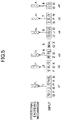
- the converted structured data is illustrated in FIG. 3 .
- STEP S102 is inputting the examination result into a pre-trained boundary extraction model to output an extraction result of all the data segments in the text to be processed.
- the data segments include at least one attribute and entity in the text to be processed.
- the input of the boundary extraction model is at least one examination result in a clinical text
- the output is an extraction result of all the data segments (here, a data segment (i.e., first data) is indicated by a span for short, and the data segments involve at least one attribute and entity) in the clinical text.
- the boundary extraction model may adopt any entity extraction model.
- the boundary extraction model includes a BiLSTM (bi-directional long short-term memory) model (network) and a classifier softmax.
- At least one training text is converted into structed data that contains at least one examination time, examination item, and examination result as well as the correspondence of the three.
- data segments and their types (classes) as well as the relationships between the data segments and the types of the relationships have been marked in advance.
- the training text is utilized to train the boundary extraction model.
- the input of the boundary extraction model is the examination result
- the output of the boundary extraction model is an extraction result of all the data segments involving at least one attribute and entitie in the training text.
- the input of the boundary extraction model is "Bu Fen Shang Pi Xi Bao Fei Dian Xing Zeng Sheng, Qing Xiang" which are the Chinese pronunciations of a part of Chinese characters contained in the clinal text presented in FIG. 2 , and are indicated by "B F S P X B F D X Z S, Q X" in FIG. 4 for the sake of convenience.
- the output of the boundary extraction model is an extraction result of spans.
- the concrete form of the extraction result of spans is a sequence of labels in which "B” refers to the beginning position of a span, "I” is indicative of belonging to a span, “O” is indicative of not belonging to a span, "A” indicates that the span is an attribute, and “E” indicates that the span is an entity.
- the training goal for training the boundary extraction model is to minimize a loss function L span that may be calculated by adopting the following equations.
- 1 is an i-th label predicted by the boundary extraction model in the examination result
- s is the input examination result
- W span is a weight parameter of the boundary extraction model that is inclusive of a bi-directional long short-term memory (BiLSTM) network and a classifier
- h i is a word feature vector representation output from the BiLSTM network
- is the length of the examination result
- t i is the real label of an i-th word in the examination result.
- the types of the spans are inclusive of entities and attributes.
- the entities mainly refer to diseases, lesions, symptoms, etc., for example, "Z S" (whose meaning in English is “proliferation") in FIG. 4 .
- the attributes are indicative of the terms describing the entities, such as the regions of lesions (e.g., "B F S P X B" (whose meaning in English is “some epithelial cells” ) in FIG. 4 ), the nature of the lesions (e.g., "F D X" (whose meaning in English is “atypical”) in FIG. 4 ), etc.
- STEP S103 is converting the word feature vector of the data segment into a text feature vector, performing positional encoding on the data segment to generate a position feature vector, and connecting the text feature vector and the position feature vector to form the feature vector of the data segment; and generating the feature vector of the data segment relationship between any one entity and attribute.
- the feature vector of the data segment relationship contains the feature vectors of two data segments as well as the previous text feature vector, the middle text feature vector, and the following text feature vector of the two data segments.
- the data segment may also be called a span node, and the data segment relationship may also be called a span relationship node (i.e., an inter-span relationship node).
- the span node and the span relationship node are nodes to be subsequently input into the graph convolutional network model.
- the data segment relationship is the relationship between two data segments.
- the two data segments include any one entity, and further include an attribute.
- the dimensional transformation model may be a CNN (Convolutional Neural Network) + pooling (pooling layer(s)) model or any other suitable dimensional transformation model.
- a positional encoding mechanism can be adopted to generate a span position feature vector representation, and then, the span text feature vector representation and the span position feature vector representation can be connected (combined) to express the feature vector of a span(s).
- the positional encoding mechanism is shown in FIG. 5 .
- the spans i.e., entities and attributes (e.g., a1, a2, e3, a4, a5, and e6 in FIG. 5 )
- the useful spans are called useful spans.
- Each of the useful spans occupies a position.
- a punctuation mark in the related examination result is regarded as a useless span (e.g., the comma "," in FIG. 5 )
- the text between two useful spans or between a useful span and a punctuation mark is also regarded as a useless span (e.g., the text "Q X" (whose meaning in English is "tend to”) in FIG. 5 ).
- Each of the useless spans also occupies a position.
- all the spans (including the useful and useless spans) are numbered from left to right, so as to attain a sequence of numbers (e.g., 1, 2, 3, 4, 5, 6, 7, and 8 in FIG. 5 ).
- Such a sequence of numbers may express the position or distance relationship of the useful spans, which is very effective information for the prediction of the final span type and span relationship type.
- the sequence of numbers i.e., the position numbers of all the spans (e.g., 1, 2, 3, 4, 5, 6, 7, and 8 in FIG. 5 ) can be converted, through the dimensional transformation model, into a feature vector representation of the useful spans, i.e., a span position feature vector p i (e.g., p 1 , p 2 , p 3 , p 4 , p 3 , and p 6 in FIG. 5 ).
- a span position feature vector p i e.g., p 1 , p 2 , p 3 , p 4 , p 3 , and p 6 in FIG. 5 ).
- the span (i.e., data segment) relationship refers to the relationship between an entity and an attribute.
- a relationship r 13 is formed between a1 and e3.
- the feature of a span relationship node mainly includes two parts, namely, (1) an entity span (i.e., e3) feature and an attribute span (i.e., a1) feature that form the span relationship; and (2) a context feature consisting of three parts (also called a previous text feature, a middle text feature, and a following text feature) that exist before, between, and after the two spans, respectively.
- the three parts i.e., the previous text feature, the middle text feature, and the following text feature forming the context feature
- they are converted, by using the dimensional transformation model in the same way as the span feature vector is generated, to produce a previous text feature vector, a middle text feature vector, and a following text feature vector, respectively.
- these five feature vectors i.e., the entity span feature vector, the attribute span feature vector, the previous text feature vector, the middle text feature vector, and the following text feature vector are connected to form, after size transformation, a final span relationship feature vector; that is, a span relationship node is generated, as shown in FIG. 7 .
- the size transformation is to ensure that the size of the final span relationship feature vector matches the size of the span feature vector.
- the size transformation may be achieved by an MLP (Multilayer Neural Network) model.
- STEP S104 is producing a bipartite graph by using the data segment and the data segment relationship, and inputting the feature vector of the data segment, the feature vector of the data segment relationship, and the connection relation of the two in the bipartite graph into a pre-trained graph convolutional network model, so as to output the class label of the data segment and the class label of the data segment relationship.
- the input of the graph convolutional network model is the span node, the span relationship node, and the structural relation between the two (i.e., the connection relation of the span node and the span relationship node in the bipartite graph), namely, the feature vector of the data segment, the feature vector of the data segment relationship, and the structural relation of the two.
- the output of the graph convolutional network model is the types of the said two nodes, i.e., the class labels of the data segment and the data segment relationship.
- a bipartite graph can be generated by utilizing the span nodes h 1 and h 3 as well as the span relationship node r 13 .
- the span relationship node r 13 is connected to the span nodes h 1 and h 3 , respectively.
- connection relation between the span relationship node r 13 and the span nodes h 1 and the connection relation between the span relationship node r 13 and the span nodes h 3 is the connection relation between the span node and the span relationship node, namely, the structural relation between the feature vector of the data segment and the feature vector of the data segment relationship.
- the graph convolutional network model includes a GCNN (Graph Convolutional Neural Network) model and a classifier softmax.
- GCNN Graph Convolutional Neural Network
- the step of training the graph convolutional network model is inclusive of:
- the training goal for training a joint extraction model consisting of the graph convolutional network model and the boundary extraction model is to minimize a loss function L that may be calculated by adopting the following equations.
- L L span + L ea + L rel P y ⁇
- L ea is a span node classification loss function, i.e., a loss function of the data segment class in the graph convolutional network model
- L rel is a span relationship node classification loss function, i.e., a loss function of a data segment relationship class in the graph convolutional network model
- ⁇ is the class label of an i-th data segment predicted by the graph convolutional network model
- e i is the i-th data segment
- s is the input examination result
- W ea and W rel are the weight parameters of the graph convolutional network model
- F e i is the feature vector representation of the i-th data segment output from the graph convolutional network model
- is the total number of all the data segments
- t i is the real label of the i-th data segment
- 1 is the class label of a relationship r ij predicted by the graph convolutional network model
- the relationship r ij is the relationship between a data segment i and a data
- the training goal of the entire joint extraction model is to obtain the minimum total loss function based score (i.e., the minimum overall cost). Subsequently, by storing the parameters of the model, it is possible to use the model to conduct prediction. Specifically, by inputting the span node and the span relationship node acquired in STEP S103 into the trained graph convolutional network model and utilizing a classifier (e.g., softmax) to classify the relevant features, it is possible to output the type of each node.
- a classifier e.g., softmax
- the span nodes and the span relationship nodes are employed to obtain the types of the nodes, and since the relationships between the nodes are considered, the accuracy of the joint extraction result of the clinical text entities and attributes as well as their relationships can be improved, and the efficiency of joint extraction of the clinical text entities and attributes as well as their relationships can also be ameliorated.
- the types of the entity nodes include diseases, symptoms, lesions, etc.
- the types of the attribute nodes include regions, nature of lesions, etc.
- the types of relationship nodes are formed by combining the types of the entity and attribute nodes.
- entity and attribute extraction can be performed after a text to be processed is converted into structured data, thereby being able to reduce data noise, facilitate feature extraction, and improve computing performance.
- the text feature vector and the position feature vector of a data segment in the text to be processed as the feature vector of the data segment it is possible to better express the entities and attributes as well as their relationships.
- the technical solution in accordance with this embodiment is efficient and easy to implement, and can ameliorate the accuracy of the joint extraction result of the clinical text entities and attributes as well as their relationships and improve the efficiency of joint extraction of the clinical text entities and attributes as well as their relationships.
- an apparatus for joint-extracting clinical text entities and attributes as well as their relationships is provided.
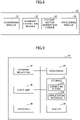
- FIG. 8 is a block diagram of an apparatus 20 for joint-extracting clinical text entities and attributes as well as their relationships, according to this embodiment.
- the apparatus 20 may contain a conversion module 21, a boundary extraction module 22, a feature vector generation module 23, and a processing module 24.
- the apparatus 20 may also include other modules as needed.
- the apparatus 20 can be configured to perform the method of joint-extracting clinical text entities and attributes as well as their relationships, in accordance with the first embodiment.
- the conversion module 21, the boundary extraction module 22, the feature vector generation module 23, and the processing module 24 may be configured to conduct STEPS S101 to S104 of FIG. 1 , respectively.
- the conversion module 21 may involve a first extraction unit, a second extraction unit, a third extraction unit, and a mapping relation establishment unit (not shown in the drawings) respectively configured to extract at least one examination item, examination time, and examination result in a text waiting for processing and establish a mapping relation of the three.
- a mapping relation establishment unit (not shown in the drawings) respectively configured to extract at least one examination item, examination time, and examination result in a text waiting for processing and establish a mapping relation of the three.
- the apparatus 20 may further include a first training module and a second training module (not presented in the drawings).
- the first training module may involve a conversion unit and a first training unit respectively configured to convert a training text into structured data and train a boundary extraction model by using the structured data of the training text.
- the second training module may involve a feature vector generation unit and a second training unit respectively configured to generate the feature vector of at least one data segment and the feature vector of at least one data segment relationship in a training text and train a graph conventional network model by utilizing the feature vector of the at least one data segment and the feature vector of the at least one data segment relationship in the training text.
- entity and attribute extraction can be performed after a text to be processed is converted into structured data, thereby being able to reduce data noise, facilitate feature extraction, and improve computing performance.
- the text feature vector and position feature vector of a data segment in the text to be processed as the feature vector of the data segment it is possible to better express the entities and attributes as well as their relationships.
- the technical solution in accordance with this embodiment is efficient and easy to implement, and can ameliorate the accuracy of the joint extraction result of the clinical text entities and attributes as well as their relationships and improve the efficiency of joint extraction of the clinical text entities and attributes as well as their relationships.
- FIG. 9 is a block diagram of an apparatus 30 for joint-extracting clinical text entities and attributes as well as their relationships, according to this embodiment.
- the apparatus 30 is inclusive of a network interface 31, a processor 32, an input unit 33, a storage 34 including an operating system 341 and an application program 342, a hard disk 35, and a display 36 which are connected by a bus.
- the network interface 31 may be configured to connect to a network such as the Internet, a local area network (LAN), or the like.
- the processor 32 may be used to execute a computer program, for example, the application program 342 stored in the storage 34, so as to fulfill the method according to the first embodiment.
- the input unit 33 may be configured to let a user input various instructions, which may be a keyboard or a touch panel, for instance.
- the storage 34 may be utilized to store requisite computer programs and data as well as the intermediate results generated when the processor 32 conducts the application program 342, for example.
- the hard disk 35 may be employed to store any information or data necessary to achieve the method according to the first embodiments, for instance.
- the display 36 may be used to display the results acquired when executing the application program 342 by the processor 32, for example.
- a computer-executable program and a non-transitory computer-readable medium are further provided.
- the computer-executable program may cause a computer to perform the method according to the first embodiment.
- the non-transitory computer-readable medium may store computer-executable instructions (i.e., the computer-executable program) for execution by a computer involving a processor.
- the computer-executable instructions may, when executed by the processor, render the processor to conduct the method in accordance with the first embodiment.
- the embodiments of the present disclosure may be implemented in any convenient form, for example, using dedicated hardware or a mixture of dedicated hardware and software.
- the embodiments of the present disclosure may be implemented as computer software implemented by one or more networked processing apparatuses.
- the network may comprise any conventional terrestrial or wireless communications network, such as the Internet.
- the processing apparatuses may comprise any suitably programmed apparatuses such as a generalpurpose computer, a personal digital assistant, a mobile telephone (such as a WAP or 3G, 4G, or 5G-compliant phone), and so on. Since the embodiments of the present disclosure may be implemented as software, each and every aspect of the present disclosure thus encompasses computer software implementable on a programmable device.
- the computer software may be provided to the programmable device using any storage medium for storing processor-readable code such as a floppy disk, a hard disk, a CD ROM, a magnetic tape device, or a solid state memory device.
- the hardware platform includes any desired hardware resources including, for example, a central processing unit (CPU), a random access memory (RAM), and a hard disk drive (HDD).
- the CPU may include processors of any desired type and number.
- the RAM may include any desired volatile or nonvolatile memory.
- the HDD may include any desired nonvolatile memory capable of storing a large amount of data.
- the hardware resources may further include an input device, an output device, and a network device in accordance with the type of the apparatus.
- the HDD may be provided external to the apparatus as long as the HDD is accessible from the apparatus.
- the CPU for example, the cache memory of the CPU, and the RAM may operate as a physical memory or a primary memory of the apparatus, while the HDD may operate as a secondary memory of the apparatus.
Landscapes
- Engineering & Computer Science (AREA)
- Theoretical Computer Science (AREA)
- Physics & Mathematics (AREA)
- Health & Medical Sciences (AREA)
- General Health & Medical Sciences (AREA)
- Artificial Intelligence (AREA)
- General Physics & Mathematics (AREA)
- Computational Linguistics (AREA)
- General Engineering & Computer Science (AREA)
- Biomedical Technology (AREA)
- Data Mining & Analysis (AREA)
- Computing Systems (AREA)
- Molecular Biology (AREA)
- Evolutionary Computation (AREA)
- Biophysics (AREA)
- Mathematical Physics (AREA)
- Software Systems (AREA)
- Life Sciences & Earth Sciences (AREA)
- Audiology, Speech & Language Pathology (AREA)
- Medical Informatics (AREA)
- Public Health (AREA)
- Databases & Information Systems (AREA)
- Pathology (AREA)
- Epidemiology (AREA)
- Primary Health Care (AREA)
- Information Retrieval, Db Structures And Fs Structures Therefor (AREA)
- Medical Treatment And Welfare Office Work (AREA)
Abstract
Description
- The present disclosure relates to the field of data extraction, and particularly, a method and apparatus for joint-extracting clinical text (also called medical examination text) entities and attributes as well as their relationships.
- In the field of information research, information extraction is a key technology. Information extraction is different from information processing technologies such as information retrieval and the like, and needs to recognize named entities in text and extract the relationships between the named entities. However, in a case of Chinese text, words are flexible and changeable, word formation is complicated, and there are no obvious tokens, thereby making it more difficult to identify Chinese named entities and extract their relationships.
- The present disclosure aims to provide a method and apparatus for joint-extracting clinical text entities and attributes as well as their relationships, by which it is possible to ameliorate the accuracy of the joint extraction result of the clinical text entities and attributes as well as their relationships and improve the efficiency of joint extraction of the clinical text entities and attributes as well as their relationships.
- According to a first aspect of the present disclosure, a method of joint-extracting clinical text entities and attributes as well as their relationships is provided that includes steps of:
- converting a text to be processed into structured data, wherein, the structured data includes at least one examination result;
- inputting the examination result into a pre-trained boundary extraction model to output an extraction result of all data segments in the text to be processed, wherein, the data segments include at least one attribute and entity in the text to be processed;
- converting a word feature vector of the data segment into a text feature vector, performing positional encoding on the data segment to generate a position feature vector, and connecting the text feature vector and the position feature vector to form a feature vector of the data segment;
- generating a feature vector of a data segment relationship between any one entity and attribute, wherein, the feature vector of the data segment relationship includes the feature vectors of two data segments as well as a previous text feature vector, a middle text feature vector, and a following text feature vector of the two data segments; and
- producing a bipartite graph of the data segment and the data segment relationship, and inputting the feature vector of the data segment, the feature vector of the data segment relationship, and a connection relation of the two in the bipartite graph into a pre-trained graph convolutional network model to output a class label of the data segment and a class label of the data segment relationship.
- Moreover, in accordance with at least one embodiment, the method further includes a step of training the boundary extraction model. This step includes:
- converting at least one training text into structured data, wherein, the structured data involves at least one examination time, examination item, examination result, and a correspondence of the three, and in the training text, the data segment and its class as well as relationships between the data segments and classes of these relationships have been marked in advance; and
- training the boundary extraction model by utilizing the training text, wherein, an input of the boundary extraction model is the examination result, an output of the boundary extraction model is an extraction result of all the data segments in the training text, and the data segments involve at least one attribute and entity in the training text.
- Furthermore, in accordance with at least one embodiment, a training goal for training the boundary extraction model is to minimize a loss function Lspan that is calculated by adopting the following equations.

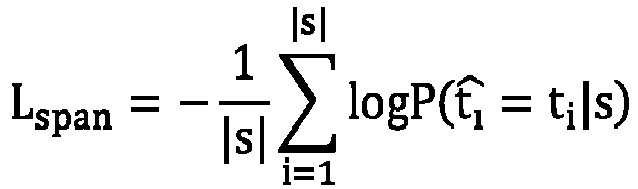
- Here,1 is an i-th label predicted by the boundary extraction model in the examination result; s is the input examination result; Wspan is a weight parameter of the boundary extraction model that is inclusive of a bi-directional long short-term memory network and a classifier; hi is a word feature vector representation output from the bi-directional long short-term memory network; |s| is a length of the examination result; and ti is a real label of an i-th word in the examination result.

- Additionally, in accordance with at least one embodiment, the method further includes a step of training the graph convolutional network model. This step includes:
- converting a word feature vector of the data segment in the training text into a text feature vector, performing positional encoding on the data segment to generate a position feature vector, and connecting the text feature vector and the position feature vector to form a feature vector of the data segment;
- generating a feature vector of the data segment relationship between any one entity and attribute in the training text, wherein, the feature vector of the data segment relationship involves the feature vectors of two data segments as well as a previous text feature vector, a middle text feature vector, and a following text feature vector of the two data segments; and
- producing a bipartite graph by using the data segment and the data segment relationship in the training text, and training the graph convolutional network model by utilizing the feature vector of the data segment and the feature vector of the data segment relationship in the training text, wherein, an input of the graph convolutional network model is the feature vector of the data segment, the feature vector of the data segment relationship, and a connection relation of the two in the bipartite graph, and an output of the graph convolutional network model is a class label of the data segment and a class label of the data segment relationship.
- Moreover, in accordance with at least one embodiment, a training goal for training a joint extraction model consisting of the graph convolutional network model and the boundary extraction model is to minimize a loss function L that is calculated by adopting the following equations.


- Here, Lea is a loss function of a data segment class in the graph convolutional network model; Lrel is a loss function of a data segment relationship class in the graph convolutional network model; ŷ is a class label of an i-th data segment predicted by the graph convolutional network model; ei is the i-th data segment; s is the input examination result; Wea and Wrel are weight parameters of the graph convolutional network model; Fe
i is a feature vector representation of the i-th data segment output from the graph convolutional network model; |ε̂| is a total number of all the data segments; ti is a real label of the i-th data segment; l̂ is a class label of a relationship rij predicted by the graph convolutional network model; the relationship rij is a relationship between a data segment i and a data segment j; Frij is a feature vector representation of the relationship rij output from the graph convolutional network model; |rij| is a total number of all the relationships; and l is a real label of the relationship |rij|. - In addition, in accordance with at least one embodiment, the step of converting a text to be processed into structured data includes:
- extracting at least one examination item in the text to be processed by using a dictionary of examination item terms;
- extracting at least one examination time in the text to be processed by utilizing a time extraction rule and template;
- extracting, based on at least one text punctuation mark and text distance, at least one examination result in the text to be processed; and
- establishing a mapping relation of the examination item, the examination time, and the examination result.
- According to a second aspect of the present disclosure, an apparatus for joint-extracting clinical text entities and attributes as well as their relationships is provided that includes:
- a conversion module configured to convert a text to be processed into structured data, wherein, the structured data includes at least one examination result;
- a boundary extraction module configured to input the examination result into a pre-trained boundary extraction model to output an extraction result of all data segments in the text to be processed, wherein, the data segments include at least one attribute and entity in the text to be processed;
- a feature vector generation module configured to convert a word feature vector of the data segment into a text feature vector, perform positional encoding on the data segment to generate a position feature vector, and connect the text feature vector and the position feature vector to form a feature vector of the data segment, and configured to generate a feature vector of a data segment relationship between any one entity and attribute, wherein, the feature vector of the data segment relationship includes the feature vectors of two data segments as well as a previous text feature vector, a middle text feature vector, and a following text feature vector of the two data segments; and
- a processing module configured to produce a bipartite graph of the data segment and the data segment relationship, and input the feature vector of the data segment, the feature vector of the data segment relationship, and a connection relation of the two in the bipartite graph into a pre-trained graph convolutional network model to output a class label of the data segment and a class label of the data segment relationship.
- Moreover, in accordance with at least one embodiment, the apparatus further includes a first training module configured to train the boundary extraction model. The first training module includes:
- a conversion unit configured to convert at least one training text into structured data, wherein, the structured data involves at least one examination time, examination item, examination result, and a correspondence of the three, and in the training text, the data segment and its class as well as relationships between the data segments and classes of these relationships have been marked in advance; and
- a first training unit configured to train the boundary extraction model by utilizing the training text, wherein, an input of the boundary extraction model is the examination result, an output of the boundary extraction model is an extraction result of all the data segments in the training text, and the data segments involve at least one attribute and entity in the training text.
- Furthermore, in accordance with at least one embodiment, a training goal for training the boundary extraction model is to minimize a loss function Lspan that is calculated by adopting the following equations.


- Here,1 is an i-th label predicted by the boundary extraction model in the examination result; s is the input examination result; Wspan is a weight parameter of the boundary extraction model that is inclusive of a bi-directional long short-term memory network and a classifier; hi is a word feature vector representation output from the bi-directional long short-term memory network; |s| is a length of the examination result; and ti is a real label of an i-th word in the examination result.

- Additionally, in accordance with at least one embodiment, the apparatus further includes a second training module configured to train the graph convolutional network model. The second training module includes:
- a feature vector generation unit configured to convert a word feature vector of the data segment in the training text into a text feature vector, perform positional encoding on the data segment to generate a position feature vector, and connect the text feature vector and the position feature vector to form a feature vector of the data segment, and configured to generate a feature vector of the data segment relationship between any one entity and attribute in the training text, wherein, the feature vector of the data segment relationship involves the feature vectors of two data segments as well as a previous text feature vector, a middle text feature vector, and a following text feature vector of the two data segments; and
- a second training unit configured to produce a bipartite graph by using the data segment and the data segment relationship in the training text, and train the graph convolutional network model by utilizing the feature vector of the data segment and the feature vector of the data segment relationship in the training text, wherein, an input of the graph convolutional network model is the feature vector of the data segment, the feature vector of the data segment relationship, and a connection relation of the two in the bipartite graph, and an output of the graph convolutional network model is a class label of the data segment and a class label of the data segment relationship.
- Moreover, in accordance with at least one embodiment, a training goal for training a joint extraction model consisting of the graph convolutional network model and the boundary extraction model is to minimize a loss function L that is calculated by adopting the following equations.


- Here, Lea is a loss function of a data segment class in the graph convolutional network model; Lrel is a loss function of a data segment relationship class in the graph convolutional network model; ŷ is a class label of an i-th data segment predicted by the graph convolutional network model; ei is the i-th data segment; s is the input examination result; Wea and Wrel are weight parameters of the graph convolutional network model; Fe
i is a feature vector representation of the i-th data segment output from the graph convolutional network model; |ε̂| is a total number of all the data segments; ti is a real label of the i-th data segment; l̂ is a class label of a relationship rij predicted by the graph convolutional network model; the relationship rij is a relationship between a data segment i and a data segment j; Frij is a feature vector representation of the relationship rij output from the graph convolutional network model; |rij| is a total number of all the relationships; and l is a real label of the relationship |rij|. - In addition, in accordance with at least one embodiment, the conversion module includes:
- a first extraction unit configured to extract at least one examination item in the text to be processed by using a dictionary of examination item terms;
- a second extraction unit configured to extract at least one examination time in the text to be processed by utilizing a time extraction rule and template;
- a third extraction unit configured to extract, based on at least one text punctuation mark and text distance, at least one examination result in the text to be processed; and
- a mapping relation establishment unit configured to establish a mapping relation of the examination item, the examination time, and the examination result.
- According to a third aspect of the present disclosure, an apparatus for joint-extracting clinical text entities and attributes as well as their relationships is provided that includes:
- a storage storing computer-executable instructions; and
- a processor coupled to the storage,
- wherein, the computer-executable instructions, when executed, cause the processor to conduct the method according to the first aspect of the present disclosure.
- According to a fourth aspect of the present disclosure, a non-transitory computer-readable medium storing computer-executable instructions for execution by a processor is provided. The computer-executable instructions, when executed, cause the processor to perform the method according to the first aspect of the present disclosure.
- According to a fifth aspect of the present disclosure, a computer program for causing a computer to execute the method according to the first aspect of the present disclosure is provided.
- Compared to the prior art, by making use of the method and apparatus for joint-extracting clinical text entities and attributes as well as their relationships, according to the embodiments of the present disclosure, entity and attribute extraction can be performed after a text to be processed is converted into structured data, thereby being able to reduce data noise, facilitate feature extraction, and improve computing performance. In addition, by combining the text feature vector and the position feature vector of a data segment in the text to be processed as the feature vector of the data segment, it is possible to better express the entities and attributes as well as their relationships. The technical solution in accordance with the embodiments is efficient and easy to implement, and can ameliorate the accuracy of the joint extraction result of the clinical text entities and attributes as well as their relationships and improve the efficiency of joint extraction of the clinical text entities and attributes as well as their relationships.
-
-
FIG. 1 is a flowchart of a method of joint-extracting clinical text entities and attributes as well as their relationships, according to a first embodiment of the present disclosure; -
FIG. 2 illustrates an exemplary clinical text in Chinese; -
FIG. 3 shows exemplary structured data in Chinese; -
FIG. 4 presents an example of extracting data segments; -
FIG. 5 shows an example of performing positional encoding; -
FIG. 6 illustrates an example of generating span nodes (here, a span means a data segment (also called first data)); -
FIG. 7 presents an example of generating span relationship nodes; -
FIG. 8 is a block diagram of an apparatus for joint-extracting clinical text entities and attributes as well as their relationships, according to a second embodiment of the present disclosure; and -
FIG. 9 is a block diagram of another apparatus for joint-extracting clinical text entities and attributes as well as their relationships, according to a third embodiment of the present disclosure. - In order to let a person skilled in the art better understand the present disclosure, hereinafter, the embodiments of the present disclosure are concretely described with reference to the drawings. However, it should be noted that the same symbols, that are in the specification and the drawings, stand for composition elements having basically the same function and structure, and the repetition of the explanations to the composition elements is omitted.
- In the embodiments of the present disclosure, a method and apparatus for joint-extracting clinical text entities and attributes as well as their relationships are provided by which it is possible to ameliorate the accuracy of the joint extraction result of the clinical text entities and attributes as well as their relationships and improve the efficiency of joint extraction of the clinical text entities and attributes as well as their relationships.
- A method of joint-extracting clinical text entities and attributes as well as their relationships is provided in this embodiment.
-
FIG. 1 is a flowchart of a method of joint-extracting clinical text entities and attributes as well as their relationships in accordance with this embodiment. As shown inFIG. 1 , the method includes STEPS S101 to S104. - STEP S101 is converting a text to be processed (also called a text waiting for processing) into structured data that contains at least one examination result.
- In this embodiment, the text to be processed may be a clinical text (also called a medical examination text).
FIG. 2 illustrates an exemplary clinical text in Chinese. As presented inFIG. 2 , each sentence in the clinical text is relatively long so that it is not conducive to entity and attribute extraction. As such, it is necessary to convert the clinical text into structured data with a predetermined format. - Furthermore, in this embodiment, a dictionary of examination item terms can be utilized to extract at least one examination item in the text to be processed. The terms in the dictionary may be collected and organized from a large amount of medical data (including medical treatment guidelines, medical records, etc.) by rules and manual labor, and then, sorted in descending order of term length. It is possible to extract, according to a longest matching and extraction principle, at least one examination item in a clinical text, such as TCT (Thin-prep Cytology Test), colposcopy biopsy pathology, etc.
- Moreover, in this embodiment, a time extraction rule and template can be utilized to extract at least one examination time in the text to be processed. After counting the possible appearance forms of the examination times in a large number of medical examination texts, it is found that an examination time and an examination result have a relative positional relation, i.e., the examination time is either before the examination result (positive order) or after the examination result (reverse order). Thus, it is possible to adopt a positive order based time extraction approach or a reverse order based time extraction approach to extract at least one examination time in the text to be processed.
- Additionally, in this embodiment, at least one examination result in the text to be processed can be extracted on the basis of at least one text punctuation mark and text distance. Through the investigation of a large number of medical examination texts, it is found that an examination time, an examination item, and an examination result in a medical examination text are usually close together, and in general, different examination descriptions in a medical examination text are separated by punctuation marks such as periods, semicolons, exclamation marks, question marks, and so on. Hence, it is possible to extract, based on at least one text punctuation mark and text distance, at least one examination result in the text to be processed.
- Subsequently, the examination item, examination time, and examination result extracted can be mapped mutually so as to establish a mapping relation of the three, thereby forming the structured data.
- In a specific example, the text to be processed is the clinical text shown in
FIG. 2 , and the converted structured data is illustrated inFIG. 3 . - STEP S102 is inputting the examination result into a pre-trained boundary extraction model to output an extraction result of all the data segments in the text to be processed. Here, the data segments include at least one attribute and entity in the text to be processed.
- In this embodiment, it is necessary to pre-train the boundary extraction model. The input of the boundary extraction model is at least one examination result in a clinical text, and the output is an extraction result of all the data segments (here, a data segment (i.e., first data) is indicated by a span for short, and the data segments involve at least one attribute and entity) in the clinical text.
- Furthermore, in this embodiment, the boundary extraction model may adopt any entity extraction model. In a specific example, as shown in
FIG. 4 , the boundary extraction model includes a BiLSTM (bi-directional long short-term memory) model (network) and a classifier softmax. - When training the boundary extraction model, first, at least one training text is converted into structed data that contains at least one examination time, examination item, and examination result as well as the correspondence of the three. Here, in the training text, data segments and their types (classes) as well as the relationships between the data segments and the types of the relationships have been marked in advance. Next, the training text is utilized to train the boundary extraction model. Here, the input of the boundary extraction model is the examination result, and the output of the boundary extraction model is an extraction result of all the data segments involving at least one attribute and entitie in the training text.
- As shown in
FIG. 4 , in a specific example, the input of the boundary extraction model is "Bu Fen Shang Pi Xi Bao Fei Dian Xing Zeng Sheng, Qing Xiang" which are the Chinese pronunciations of a part of Chinese characters contained in the clinal text presented inFIG. 2 , and are indicated by "B F S P X B F D X Z S, Q X" inFIG. 4 for the sake of convenience. The output of the boundary extraction model is an extraction result of spans. The concrete form of the extraction result of spans is a sequence of labels in which "B" refers to the beginning position of a span, "I" is indicative of belonging to a span, "O" is indicative of not belonging to a span, "A" indicates that the span is an attribute, and "E" indicates that the span is an entity. - The training goal for training the boundary extraction model is to minimize a loss function Lspan that may be calculated by adopting the following equations.


- Here,1 is an i-th label predicted by the boundary extraction model in the examination result; s is the input examination result; Wspan is a weight parameter of the boundary extraction model that is inclusive of a bi-directional long short-term memory (BiLSTM) network and a classifier; hi is a word feature vector representation output from the BiLSTM network; |s| is the length of the examination result; and ti is the real label of an i-th word in the examination result.

- After training the boundary extraction model, by inputting the examination result obtained in STEP S101 into the boundary extraction model, it is possible to acquire spans. However, in the step, only the spans are output; that is, their types are not given. In this embodiment, the types of the spans are inclusive of entities and attributes. The entities mainly refer to diseases, lesions, symptoms, etc., for example, "Z S" (whose meaning in English is "proliferation") in
FIG. 4 . The attributes are indicative of the terms describing the entities, such as the regions of lesions (e.g., "B F S P X B" (whose meaning in English is "some epithelial cells" ) inFIG. 4 ), the nature of the lesions (e.g., "F D X" (whose meaning in English is "atypical") inFIG. 4 ), etc. - STEP S103 is converting the word feature vector of the data segment into a text feature vector, performing positional encoding on the data segment to generate a position feature vector, and connecting the text feature vector and the position feature vector to form the feature vector of the data segment; and generating the feature vector of the data segment relationship between any one entity and attribute. The feature vector of the data segment relationship contains the feature vectors of two data segments as well as the previous text feature vector, the middle text feature vector, and the following text feature vector of the two data segments.
- Here, the data segment may also be called a span node, and the data segment relationship may also be called a span relationship node (i.e., an inter-span relationship node). The span node and the span relationship node are nodes to be subsequently input into the graph convolutional network model. The data segment relationship is the relationship between two data segments. The two data segments include any one entity, and further include an attribute.
- By letting the span boundary result obtained and the text vector feature representation eventually output from the BiLSTM model in STEP S102 pass through a dimensional transformation model, it is possible to convert a span (represented by multiple word feature vectors) into a feature vector representation to stand for the text feature vector of the span. Here, the dimensional transformation model may be a CNN (Convolutional Neural Network) + pooling (pooling layer(s)) model or any other suitable dimensional transformation model.
- In addition, a positional encoding mechanism can be adopted to generate a span position feature vector representation, and then, the span text feature vector representation and the span position feature vector representation can be connected (combined) to express the feature vector of a span(s).
- The positional encoding mechanism is shown in
FIG. 5 . The spans (i.e., entities and attributes (e.g., a1, a2, e3, a4, a5, and e6 inFIG. 5 )) obtained in STEP S102 are called useful spans. Each of the useful spans occupies a position. A punctuation mark in the related examination result is regarded as a useless span (e.g., the comma "," inFIG. 5 ), and the text between two useful spans or between a useful span and a punctuation mark is also regarded as a useless span (e.g., the text "Q X" (whose meaning in English is "tend to") inFIG. 5 ). Each of the useless spans also occupies a position. Finally, all the spans (including the useful and useless spans) are numbered from left to right, so as to attain a sequence of numbers (e.g., 1, 2, 3, 4, 5, 6, 7, and 8 inFIG. 5 ). Such a sequence of numbers may express the position or distance relationship of the useful spans, which is very effective information for the prediction of the final span type and span relationship type. - The sequence of numbers, i.e., the position numbers of all the spans (e.g., 1, 2, 3, 4, 5, 6, 7, and 8 in
FIG. 5 ) can be converted, through the dimensional transformation model, into a feature vector representation of the useful spans, i.e., a span position feature vector pi (e.g., p1, p2, p3, p4, p3, and p6 inFIG. 5 ). - As presented in
FIG. 6 , the position feature vector pi and the text feature vector si of the useful spans can be connected to form a feature vector hi of the useful spans; that is, the span nodes can be generated as follows.
- Here, the span (i.e., data segment) relationship refers to the relationship between an entity and an attribute. As illustrated in
FIG. 7 , a relationship r13 is formed between a1 and e3. The feature of a span relationship node mainly includes two parts, namely, (1) an entity span (i.e., e3) feature and an attribute span (i.e., a1) feature that form the span relationship; and (2) a context feature consisting of three parts (also called a previous text feature, a middle text feature, and a following text feature) that exist before, between, and after the two spans, respectively. - For the entity span and the attribute span that form the span relationship, respective feature vectors are generated.
- Additionally, for the three parts, i.e., the previous text feature, the middle text feature, and the following text feature forming the context feature, they are converted, by using the dimensional transformation model in the same way as the span feature vector is generated, to produce a previous text feature vector, a middle text feature vector, and a following text feature vector, respectively. Subsequently, these five feature vectors, i.e., the entity span feature vector, the attribute span feature vector, the previous text feature vector, the middle text feature vector, and the following text feature vector are connected to form, after size transformation, a final span relationship feature vector; that is, a span relationship node is generated, as shown in
FIG. 7 . - Here, the size transformation is to ensure that the size of the final span relationship feature vector matches the size of the span feature vector. The size transformation may be achieved by an MLP (Multilayer Neural Network) model.
- Referring again to
FIG. 1 ; STEP S104 is producing a bipartite graph by using the data segment and the data segment relationship, and inputting the feature vector of the data segment, the feature vector of the data segment relationship, and the connection relation of the two in the bipartite graph into a pre-trained graph convolutional network model, so as to output the class label of the data segment and the class label of the data segment relationship. - In this example, it is necessary to pre-train the graph convolutional network model. The input of the graph convolutional network model is the span node, the span relationship node, and the structural relation between the two (i.e., the connection relation of the span node and the span relationship node in the bipartite graph), namely, the feature vector of the data segment, the feature vector of the data segment relationship, and the structural relation of the two. The output of the graph convolutional network model is the types of the said two nodes, i.e., the class labels of the data segment and the data segment relationship.
- By letting the span relationship node be connected to the two span nodes forming the span relationship node, respectively, it is possible to produce the bipartite graph. For example, as illustrated in
FIG. 7 , a bipartite graph can be generated by utilizing the span nodes h1 and h3 as well as the span relationship node r13. In this bipartite graph, the span relationship node r13 is connected to the span nodes h1 and h3, respectively. Each of the connection relation between the span relationship node r13 and the span nodes h1 and the connection relation between the span relationship node r13 and the span nodes h3 is the connection relation between the span node and the span relationship node, namely, the structural relation between the feature vector of the data segment and the feature vector of the data segment relationship. - In this embodiment, the graph convolutional network model includes a GCNN (Graph Convolutional Neural Network) model and a classifier softmax.
- The step of training the graph convolutional network model is inclusive of:
- converting the word feature vector of the data segment in the training text into a text feature vector, performing positional encoding on the data segment to generate a position feature vector, and connecting the text feature vector and the position feature vector to form the feature vector of the data segment;
- generating the feature vector of the data segment relationship between any one entity and attribute in the training text, wherein, the feature vector of the data segment relationship includes the feature vectors of two data segments as well as the previous text feature vector, the middle text feature vector, and the following text feature vector of the two data segments; and
- producing a bipartite graph by using the data segment and the data segment relationship in the training text, and training the graph convolutional network model by utilizing the feature vector of the data segment and the feature vector of the data segment relationship, wherein, the input of the graph convolutional network model is the feature vector of the data segment, the feature vector of the data segment relationship, and the connection relation of the two in the bipartite graph, and the output of the graph convolutional network model is the class label of the data segment and the class label of the data segment relationship.
- The training goal for training a joint extraction model consisting of the graph convolutional network model and the boundary extraction model is to minimize a loss function L that may be calculated by adopting the following equations.


- Here, Lea is a span node classification loss function, i.e., a loss function of the data segment class in the graph convolutional network model; Lrel is a span relationship node classification loss function, i.e., a loss function of a data segment relationship class in the graph convolutional network model; ŷ is the class label of an i-th data segment predicted by the graph convolutional network model; ei is the i-th data segment; s is the input examination result; Wea and Wrel are the weight parameters of the graph convolutional network model; Fe
i is the feature vector representation of the i-th data segment output from the graph convolutional network model; |ε̂| is the total number of all the data segments; ti is the real label of the i-th data segment; 1 is the class label of a relationship rij predicted by the graph convolutional network model; the relationship rij is the relationship between a data segment i and a data segment j; Frij is the feature vector representation of the relationship rij output from the graph convolutional network model; |rij| is the total number of all the relationships; and 1 is the real label of the relationship |rjj|. - The training goal of the entire joint extraction model is to obtain the minimum total loss function based score (i.e., the minimum overall cost). Subsequently, by storing the parameters of the model, it is possible to use the model to conduct prediction. Specifically, by inputting the span node and the span relationship node acquired in STEP S103 into the trained graph convolutional network model and utilizing a classifier (e.g., softmax) to classify the relevant features, it is possible to output the type of each node.
- In this embodiment, because the span nodes and the span relationship nodes are employed to obtain the types of the nodes, and since the relationships between the nodes are considered, the accuracy of the joint extraction result of the clinical text entities and attributes as well as their relationships can be improved, and the efficiency of joint extraction of the clinical text entities and attributes as well as their relationships can also be ameliorated.
- Furthermore, in this embodiment, the types of the entity nodes include diseases, symptoms, lesions, etc., the types of the attribute nodes include regions, nature of lesions, etc., and the types of relationship nodes are formed by combining the types of the entity and attribute nodes. As a result, the types of the nodes can be adjusted according to practical applications.
- Compared to the prior art, by utilizing the method of joint-extracting clinical text entities and attributes as well as their relationships, according to this embodiment, entity and attribute extraction can be performed after a text to be processed is converted into structured data, thereby being able to reduce data noise, facilitate feature extraction, and improve computing performance. In addition, by combining the text feature vector and the position feature vector of a data segment in the text to be processed as the feature vector of the data segment, it is possible to better express the entities and attributes as well as their relationships. The technical solution in accordance with this embodiment is efficient and easy to implement, and can ameliorate the accuracy of the joint extraction result of the clinical text entities and attributes as well as their relationships and improve the efficiency of joint extraction of the clinical text entities and attributes as well as their relationships.
- In this embodiment, an apparatus for joint-extracting clinical text entities and attributes as well as their relationships is provided.
-
FIG. 8 is a block diagram of anapparatus 20 for joint-extracting clinical text entities and attributes as well as their relationships, according to this embodiment. - As illustrated in
FIG. 8 , theapparatus 20 may contain aconversion module 21, aboundary extraction module 22, a featurevector generation module 23, and aprocessing module 24. Of course, theapparatus 20 may also include other modules as needed. - The
apparatus 20 can be configured to perform the method of joint-extracting clinical text entities and attributes as well as their relationships, in accordance with the first embodiment. Specifically, theconversion module 21, theboundary extraction module 22, the featurevector generation module 23, and theprocessing module 24 may be configured to conduct STEPS S101 to S104 ofFIG. 1 , respectively. - Here, it should be mentioned that because STEPS S101 to S104 of
FIG. 1 have been concretely described in the first embodiment, the details of them are omitted in this embodiment for the sake of convenience. - Moreover, the
conversion module 21 may involve a first extraction unit, a second extraction unit, a third extraction unit, and a mapping relation establishment unit (not shown in the drawings) respectively configured to extract at least one examination item, examination time, and examination result in a text waiting for processing and establish a mapping relation of the three. For more information, it is possible to see the description related to STEP S101 in the first embodiment. - Furthermore, the
apparatus 20 may further include a first training module and a second training module (not presented in the drawings). The first training module may involve a conversion unit and a first training unit respectively configured to convert a training text into structured data and train a boundary extraction model by using the structured data of the training text. The second training module may involve a feature vector generation unit and a second training unit respectively configured to generate the feature vector of at least one data segment and the feature vector of at least one data segment relationship in a training text and train a graph conventional network model by utilizing the feature vector of the at least one data segment and the feature vector of the at least one data segment relationship in the training text. For more information, it is also possible to see the descriptions relating to the corresponding steps in the first embodiment. - Compared to the prior art, by taking advantage of the apparatus for joint-extracting clinical text entities and attributes as well as their relationships, according to this embodiment, entity and attribute extraction can be performed after a text to be processed is converted into structured data, thereby being able to reduce data noise, facilitate feature extraction, and improve computing performance. In addition, by combining the text feature vector and position feature vector of a data segment in the text to be processed as the feature vector of the data segment, it is possible to better express the entities and attributes as well as their relationships. The technical solution in accordance with this embodiment is efficient and easy to implement, and can ameliorate the accuracy of the joint extraction result of the clinical text entities and attributes as well as their relationships and improve the efficiency of joint extraction of the clinical text entities and attributes as well as their relationships.
- Another apparatus for joint-extracting clinical text entities and attributes as well as their relationships is provided in this embodiment.
-
FIG. 9 is a block diagram of anapparatus 30 for joint-extracting clinical text entities and attributes as well as their relationships, according to this embodiment. - As presented in
FIG. 9 , theapparatus 30 is inclusive of anetwork interface 31, aprocessor 32, aninput unit 33, astorage 34 including anoperating system 341 and anapplication program 342, ahard disk 35, and adisplay 36 which are connected by a bus. - The
network interface 31 may be configured to connect to a network such as the Internet, a local area network (LAN), or the like. Theprocessor 32 may be used to execute a computer program, for example, theapplication program 342 stored in thestorage 34, so as to fulfill the method according to the first embodiment. Theinput unit 33 may be configured to let a user input various instructions, which may be a keyboard or a touch panel, for instance. Thestorage 34 may be utilized to store requisite computer programs and data as well as the intermediate results generated when theprocessor 32 conducts theapplication program 342, for example. Thehard disk 35 may be employed to store any information or data necessary to achieve the method according to the first embodiments, for instance. Thedisplay 36 may be used to display the results acquired when executing theapplication program 342 by theprocessor 32, for example. - Additionally, a computer-executable program and a non-transitory computer-readable medium are further provided. The computer-executable program may cause a computer to perform the method according to the first embodiment. The non-transitory computer-readable medium may store computer-executable instructions (i.e., the computer-executable program) for execution by a computer involving a processor. The computer-executable instructions may, when executed by the processor, render the processor to conduct the method in accordance with the first embodiment.
- Here, it should be noted that because the steps involved in the method according to the first embodiment have been minutely set forth above, the descriptions of the steps are omitted in this embodiment for the sake of convenience.
- In addition, the above embodiments are just exemplary ones, and the specific structure and operation of them may not be used for limiting the present disclosure.
- Furthermore, the embodiments of the present disclosure may be implemented in any convenient form, for example, using dedicated hardware or a mixture of dedicated hardware and software. The embodiments of the present disclosure may be implemented as computer software implemented by one or more networked processing apparatuses. The network may comprise any conventional terrestrial or wireless communications network, such as the Internet. The processing apparatuses may comprise any suitably programmed apparatuses such as a generalpurpose computer, a personal digital assistant, a mobile telephone (such as a WAP or 3G, 4G, or 5G-compliant phone), and so on. Since the embodiments of the present disclosure may be implemented as software, each and every aspect of the present disclosure thus encompasses computer software implementable on a programmable device.
- The computer software may be provided to the programmable device using any storage medium for storing processor-readable code such as a floppy disk, a hard disk, a CD ROM, a magnetic tape device, or a solid state memory device.
- The hardware platform includes any desired hardware resources including, for example, a central processing unit (CPU), a random access memory (RAM), and a hard disk drive (HDD). The CPU may include processors of any desired type and number. The RAM may include any desired volatile or nonvolatile memory. The HDD may include any desired nonvolatile memory capable of storing a large amount of data. The hardware resources may further include an input device, an output device, and a network device in accordance with the type of the apparatus. The HDD may be provided external to the apparatus as long as the HDD is accessible from the apparatus. In this case, the CPU, for example, the cache memory of the CPU, and the RAM may operate as a physical memory or a primary memory of the apparatus, while the HDD may operate as a secondary memory of the apparatus.
- While the present disclosure is described with reference to the specific embodiments chosen for purpose of illustration, it should be apparent that the present disclosure is not limited to these embodiments, but numerous modifications could be made thereto by a person skilled in the art without departing from the basic concept and technical scope of the present disclosure.
- The present application is based on and claims the benefit of priority of
Chinese Patent Application No. 202110348806.X filed on March 31, 2021
Claims (15)
- A method of joint-extracting clinical text entities and attributes as well as their relationships, comprising:a step of converting a text to be processed into structured data, wherein, the structured data includes at least one examination result;a step of inputting the examination result into a pre-trained boundary extraction model to output an extraction result of all data segments in the text to be processed, wherein, the data segments include at least one attribute and entity in the text to be processed;a step of converting a word feature vector of the data segment into a text feature vector, performing positional encoding on the data segment to generate a position feature vector, and connecting the text feature vector and the position feature vector to form a feature vector of the data segment;a step of generating a feature vector of a data segment relationship between any one entity and attribute, wherein, the feature vector of the data segment relationship includes the feature vectors of two data segments as well as a previous text feature vector, a middle text feature vector, and a following text feature vector of the two data segments; anda step of producing a bipartite graph of the data segment and the data segment relationship, and inputting the feature vector of the data segment, the feature vector of the data segment relationship, and a connection relation of the two in the bipartite graph into a pre-trained graph convolutional network model to output a class label of the data segment and a class label of the data segment relationship.
- The method in accordance with claim 1, further comprising:
a step of training the boundary extraction model, includingconverting at least one training text into structured data, wherein, the structured data involves at least one examination time, examination item, examination result, and a correspondence of the three, and in the training text, the data segment and its class as well as relationships between the data segments and classes of these relationships have been marked in advance; andtraining the boundary extraction model by utilizing the training text, wherein, an input of the boundary extraction model is the examination result, an output of the boundary extraction model is an extraction result of all the data segments in the training text, and the data segments involve at least one attribute and entity in the training text. - The method in accordance with claim 2, wherein,
a training goal for training the boundary extraction model is to minimize a loss function Lspan that is calculated by adopting
 1 is an i-th label predicted by the boundary extraction model in the examination result; s is the input examination result; Wspan is a weight parameter of the boundary extraction model that is inclusive of a bi-directional long short-term memory network and a classifier; hi is a word feature vector representation output from the bi-directional long short-term memory network; |s| is a length of the examination result; and ti is a real label of an i-th word in the examination result.
- The method in accordance with claim 3, further comprising:
a step of training the graph convolutional network model, includingconverting a word feature vector of the data segment in the training text into a text feature vector, performing positional encoding on the data segment to generate a position feature vector, and connecting the text feature vector and the position feature vector to form a feature vector of the data segment;generating a feature vector of the data segment relationship between any one entity and attribute in the training text, wherein, the feature vector of the data segment relationship involves the feature vectors of two data segments as well as a previous text feature vector, a middle text feature vector, and a following text feature vector of the two data segments; andproducing a bipartite graph by using the data segment and the data segment relationship in the training text, and training the graph convolutional network model by utilizing the feature vector of the data segment and the feature vector of the data segment relationship in the training text, wherein, an input of the graph convolutional network model is the feature vector of the data segment, the feature vector of the data segment relationship, and a connection relation of the two in the bipartite graph, and an output of the graph convolutional network model is a class label of the data segment and a class label of the data segment relationship. - The method in accordance with claim 4, wherein,
a training goal for training a joint extraction model consisting of the graph convolutional network model and the boundary extraction model is to minimize a loss function L that is calculated by adopting


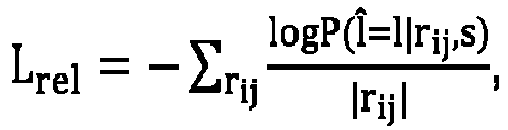
i is a feature vector representation of the i-th data segment output from the graph convolutional network model; |ε̂| is a total number of all the data segments; ti is a real label of the i-th data segment; l̂ is a class label of a relationship rij predicted by the graph convolutional network model; the relationship rij is a relationship between a data segment i and a data segment j; Frij is a feature vector representation of the relationship rij output from the graph convolutional network model; |rij| is a total number of all the relationships; and l is a real label of the relationship |rij|. - The method in accordance with claim 1, wherein,
the step of converting a text to be processed into structured data includesextracting at least one examination item in the text to be processed by using a dictionary of examination item terms;extracting at least one examination time in the text to be processed by utilizing a time extraction rule and template;extracting, based on at least one text punctuation mark and text distance, at least one examination result in the text to be processed; andestablishing a mapping relation of the examination item, the examination time, and the examination result. - An apparatus for joint-extracting clinical text entities and attributes as well as their relationships, comprising:a conversion module configured to convert a text to be processed into structured data, wherein, the structured data includes at least one examination result;a boundary extraction module configured to input the examination result into a pre-trained boundary extraction model to output an extraction result of all data segments in the text to be processed, wherein, the data segments include at least one attribute and entity in the text to be processed;a feature vector generation module configured to convert a word feature vector of the data segment into a text feature vector, perform positional encoding on the data segment to generate a position feature vector, and connect the text feature vector and the position feature vector to form a feature vector of the data segment, and configured to generate a feature vector of a data segment relationship between any one entity and attribute, wherein, the feature vector of the data segment relationship includes the feature vectors of two data segments as well as a previous text feature vector, a middle text feature vector, and a following text feature vector of the two data segments; anda processing module configured to produce a bipartite graph of the data segment and the data segment relationship, and input the feature vector of the data segment, the feature vector of the data segment relationship, and a connection relation of the two in the bipartite graph into a pre-trained graph convolutional network model to output a class label of the data segment and a class label of the data segment relationship.
- The apparatus in accordance with claim 7, further comprising:
a first training module configured to train the boundary extraction model, includinga conversion unit configured to convert at least one training text into structured data, wherein, the structured data involves at least one examination time, examination item, examination result, and a correspondence of the three, and in the training text, the data segment and its class as well as relationships between the data segments and classes of these relationships have been marked in advance; anda first training unit configured to train the boundary extraction model by utilizing the training text, wherein, an input of the boundary extraction model is the examination result, an output of the boundary extraction model is an extraction result of all the data segments in the training text, and the data segments involve at least one attribute and entity in the training text. - The apparatus in accordance with claim 8, wherein,
a training goal for training the boundary extraction model is to minimize a loss function Lspan that is calculated by adopting
 1 is an i-th label predicted by the boundary extraction model in the examination result; s is the input examination result; Wspan is a weight parameter of the boundary extraction model that is inclusive of a bi-directional long short-term memory network and a classifier; hi is a word feature vector representation output from the bi-directional long short-term memory network; |s| is a length of the examination result; and ti is a real label of an i-th word in the examination result.
- The apparatus in accordance with claim 9, further comprising:a second training module configured to train the graph convolutional network model, including
a feature vector generation unit configured to convert a word feature vector of the data segment in the training text into a text feature vector, perform positional encoding on the data segment to generate a position feature vector, and connect the text feature vector and the position feature vector to form a feature vector of the data segment, and configured to generate a feature vector of the data segment relationship between any one entity and attribute in the training text, wherein, the feature vector of the data segment relationship involves the feature vectors of two data segments as well as a previous text feature vector, a middle text feature vector, and a following text feature vector of the two data segments; anda second training unit configured to produce a bipartite graph by using the data segment and the data segment relationship in the training text, and train the graph convolutional network model by utilizing the feature vector of the data segment and the feature vector of the data segment relationship in the training text, wherein, an input of the graph convolutional network model is the feature vector of the data segment, the feature vector of the data segment relationship, and a connection relation of the two in the bipartite graph, and an output of the graph convolutional network model is a class label of the data segment and a class label of the data segment relationship. - The apparatus in accordance with claim 10, wherein,
a training goal for training a joint extraction model consisting of the graph convolutional network model and the boundary extraction model is to minimize a loss function L that is calculated by adopting


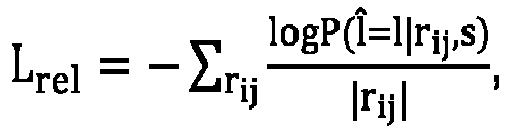
i is a feature vector representation of the i-th data segment output from the graph convolutional network model; |ε̂| is a total number of all the data segments; ti is a real label of the i-th data segment; l̂ is a class label of a relationship rij predicted by the graph convolutional network model; the relationship rij is a relationship between a data segment i and a data segment j; Frij is a feature vector representation of the relationship rij output from the graph convolutional network model; |rij| is a total number of all the relationships; and l is a real label of the relationship |rij|. - The apparatus in accordance with claim 7, wherein,
the conversion module includesa first extraction unit configured to extract at least one examination item in the text to be processed by using a dictionary of examination item terms;a second extraction unit configured to extract at least one examination time in the text to be processed by utilizing a time extraction rule and template;a third extraction unit configured to extract, based on at least one text punctuation mark and text distance, at least one examination result in the text to be processed; anda mapping relation establishment unit configured to establish a mapping relation of the examination item, the examination time, and the examination result. - A non-transitory computer-readable medium storing computer-executable instructions for execution by a processor, wherein,
the computer-executable instructions, when executed, cause the processor to perform the method in accordance with any one of claims 1 to 6. - An apparatus for joint-extracting clinical text entities and attributes as well as their relationships, comprising:a storage storing computer-executable instructions; anda processor coupled to the storage,wherein,the computer-executable instructions, when executed, cause the processor to conduct the method in accordance with any one of claims 1 to 6.
- A computer program for causing a computer to execute the method in accordance with any one of claims 1 to 6.
Applications Claiming Priority (1)
| Application Number | Priority Date | Filing Date | Title |
|---|---|---|---|
| CN202110348806.XA CN115146637A (en) | 2021-03-31 | 2021-03-31 | Method and device for jointly extracting text entities, attributes and relationships of text entities in medical examination |
Publications (1)
| Publication Number | Publication Date |
|---|---|
| EP4068149A1 true EP4068149A1 (en) | 2022-10-05 |
Family
ID=80780535
Family Applications (1)
| Application Number | Title | Priority Date | Filing Date |
|---|---|---|---|
| EP22162334.1A Withdrawn EP4068149A1 (en) | 2021-03-31 | 2022-03-15 | Method and apparatus for joint-extracting clinical text entities and attributes and their relationships |
Country Status (3)
| Country | Link |
|---|---|
| EP (1) | EP4068149A1 (en) |
| JP (1) | JP7416113B2 (en) |
| CN (1) | CN115146637A (en) |
Cited By (2)
| Publication number | Priority date | Publication date | Assignee | Title |
|---|---|---|---|---|
| CN117035086A (en) * | 2023-08-29 | 2023-11-10 | 齐鲁工业大学(山东省科学院) | Text bidirectional relationship extraction method and system based on hybrid deep relationship matrix |
| CN118551764A (en) * | 2024-07-30 | 2024-08-27 | 中国科学院自动化研究所 | Entity relation joint extraction method and device for discontinuous entity |
Families Citing this family (2)
| Publication number | Priority date | Publication date | Assignee | Title |
|---|---|---|---|---|
| CN115719067A (en) * | 2022-11-17 | 2023-02-28 | 基建通(三亚)国际科技有限公司 | Data labeling method and device for HTML (Hypertext markup language) document in engineering field and electronic equipment |
| CN116306655A (en) * | 2023-03-20 | 2023-06-23 | 山东师范大学 | Named entity recognition method and system based on Chinese character font and word boundary features |
Citations (4)
| Publication number | Priority date | Publication date | Assignee | Title |
|---|---|---|---|---|
| CN109800411A (en) * | 2018-12-03 | 2019-05-24 | 哈尔滨工业大学(深圳) | Clinical treatment entity and its attribute extraction method |
| WO2019137562A2 (en) * | 2019-04-25 | 2019-07-18 | Alibaba Group Holding Limited | Identifying entities in electronic medical records |
| CN112163416A (en) * | 2020-10-09 | 2021-01-01 | 北京理工大学 | Event joint extraction method for merging syntactic and entity relation graph convolution network |
| WO2021030915A1 (en) * | 2019-08-22 | 2021-02-25 | The Governing Council Of The University Of Toronto | Systems and methods for extracting information from a dialogue |
Family Cites Families (2)
| Publication number | Priority date | Publication date | Assignee | Title |
|---|---|---|---|---|
| US11031135B2 (en) * | 2017-09-26 | 2021-06-08 | Edge2020 LLC | Determination of cybersecurity recommendations |
| CN112541066B (en) * | 2020-12-11 | 2022-10-25 | 清华大学 | Text-structured-based medical and technical report detection method and related equipment |
-
2021
- 2021-03-31 CN CN202110348806.XA patent/CN115146637A/en active Pending
-
2022
- 2022-03-15 EP EP22162334.1A patent/EP4068149A1/en not_active Withdrawn
- 2022-03-23 JP JP2022046607A patent/JP7416113B2/en active Active
Patent Citations (4)
| Publication number | Priority date | Publication date | Assignee | Title |
|---|---|---|---|---|
| CN109800411A (en) * | 2018-12-03 | 2019-05-24 | 哈尔滨工业大学(深圳) | Clinical treatment entity and its attribute extraction method |
| WO2019137562A2 (en) * | 2019-04-25 | 2019-07-18 | Alibaba Group Holding Limited | Identifying entities in electronic medical records |
| WO2021030915A1 (en) * | 2019-08-22 | 2021-02-25 | The Governing Council Of The University Of Toronto | Systems and methods for extracting information from a dialogue |
| CN112163416A (en) * | 2020-10-09 | 2021-01-01 | 北京理工大学 | Event joint extraction method for merging syntactic and entity relation graph convolution network |
Non-Patent Citations (2)
| Title |
|---|
| DUAN GUIDUO ET AL: "A Relational Adaptive Neural Model for Joint Entity and Relation Extraction", vol. 15, 16 March 2021 (2021-03-16), pages 635492, XP055952929, Retrieved from the Internet <URL:https://europepmc.org/backend/ptpmcrender.fcgi?accid=PMC8008121&blobtype=pdf> DOI: 10.3389/fnbot.2021.635492 * |
| XI QISEN ET AL: "Chinese Named Entity Recognition: Applications and Challenges", 7 March 2021, ARXIV.ORG, PAGE(S) 51 - 81, XP047578589 * |
Cited By (2)
| Publication number | Priority date | Publication date | Assignee | Title |
|---|---|---|---|---|
| CN117035086A (en) * | 2023-08-29 | 2023-11-10 | 齐鲁工业大学(山东省科学院) | Text bidirectional relationship extraction method and system based on hybrid deep relationship matrix |
| CN118551764A (en) * | 2024-07-30 | 2024-08-27 | 中国科学院自动化研究所 | Entity relation joint extraction method and device for discontinuous entity |
Also Published As
| Publication number | Publication date |
|---|---|
| JP7416113B2 (en) | 2024-01-17 |
| JP2022159048A (en) | 2022-10-17 |
| CN115146637A (en) | 2022-10-04 |
Similar Documents
| Publication | Publication Date | Title |
|---|---|---|
| US12277401B2 (en) | Method and apparatus for acquiring pre-trained model | |
| CN112100332B (en) | Word embedding representation learning method and device, text recall method and device | |
| CN108959246B (en) | Answer selection method and device based on improved attention mechanism and electronic equipment | |
| CN110364234B (en) | Intelligent storage, analysis and retrieval system and method for electronic medical records | |
| CN110597997B (en) | Military scenario text event extraction corpus iterative construction method and device | |
| CN113987147B (en) | Sample processing method and device | |
| CN113220832B (en) | Text processing method and device | |
| CN105404632B (en) | System and method for carrying out serialized annotation on biomedical text based on deep neural network | |
| CN113707299A (en) | Auxiliary diagnosis method and device based on inquiry session and computer equipment | |
| WO2020062770A1 (en) | Method and apparatus for constructing domain dictionary, and device and storage medium | |
| CN112528654B (en) | Natural language processing method, device and electronic device | |
| CN113094533A (en) | Mixed granularity matching-based image-text cross-modal retrieval method | |
| WO2021082086A1 (en) | Machine reading method, system, device, and storage medium | |
| KR20210125449A (en) | Method for industry text increment, apparatus thereof, and computer program stored in medium | |
| Banik et al. | Gru based named entity recognition system for bangla online newspapers | |
| CN110968725B (en) | Image content description information generation method, electronic device and storage medium | |
| CN113657105A (en) | Method, Apparatus, Equipment and Medium for Medical Entity Extraction Based on Vocabulary Enhancement | |
| US12608556B2 (en) | Intention recognition method, electronic device, and storage medium | |
| SG11202112454RA (en) | Intelligent text cleaning method and apparatus, and computer-readable storage medium | |
| CN117422074A (en) | A method, device, equipment and medium for clinical information text standardization | |
| CN114356990A (en) | Base named entity recognition system and method based on transfer learning | |
| Bai et al. | Artificial intelligence-driven cross-language communication network: Using neural network to improve foreign language translation | |
| CN114722774B (en) | Data compression method, device, electronic equipment and storage medium | |
| CN114398474B (en) | Similar case recommendation method and related device | |
| CN103914447B (en) | Information processing device and information processing method |
Legal Events
| Date | Code | Title | Description |
|---|---|---|---|
| PUAI | Public reference made under article 153(3) epc to a published international application that has entered the european phase |
Free format text: ORIGINAL CODE: 0009012 |
|
| STAA | Information on the status of an ep patent application or granted ep patent |
Free format text: STATUS: REQUEST FOR EXAMINATION WAS MADE |
|
| 17P | Request for examination filed |
Effective date: 20220316 |
|
| AK | Designated contracting states |
Kind code of ref document: A1 Designated state(s): AL AT BE BG CH CY CZ DE DK EE ES FI FR GB GR HR HU IE IS IT LI LT LU LV MC MK MT NL NO PL PT RO RS SE SI SK SM TR |
|
| STAA | Information on the status of an ep patent application or granted ep patent |
Free format text: STATUS: EXAMINATION IS IN PROGRESS |
|
| 17Q | First examination report despatched |
Effective date: 20250716 |
|
| STAA | Information on the status of an ep patent application or granted ep patent |
Free format text: STATUS: THE APPLICATION HAS BEEN WITHDRAWN |
|
| 18W | Application withdrawn |
Effective date: 20251106 |