EP4067489A1 - Method for reducing toxicity of antisense nucleic acids - Google Patents
Method for reducing toxicity of antisense nucleic acids Download PDFInfo
- Publication number
- EP4067489A1 EP4067489A1 EP20894697.0A EP20894697A EP4067489A1 EP 4067489 A1 EP4067489 A1 EP 4067489A1 EP 20894697 A EP20894697 A EP 20894697A EP 4067489 A1 EP4067489 A1 EP 4067489A1
- Authority
- EP
- European Patent Office
- Prior art keywords
- nucleic acid
- antisense nucleic
- bridged
- substituted
- group
- Prior art date
- Legal status (The legal status is an assumption and is not a legal conclusion. Google has not performed a legal analysis and makes no representation as to the accuracy of the status listed.)
- Pending
Links
- 150000007523 nucleic acids Chemical class 0.000 title claims abstract description 164
- 102000039446 nucleic acids Human genes 0.000 title claims abstract description 161
- 108020004707 nucleic acids Proteins 0.000 title claims abstract description 161
- 230000000692 anti-sense effect Effects 0.000 title claims abstract description 94
- 230000001988 toxicity Effects 0.000 title claims abstract description 14
- 231100000419 toxicity Toxicity 0.000 title claims abstract description 14
- 238000000034 method Methods 0.000 title description 11
- 239000003814 drug Substances 0.000 claims abstract description 20
- 230000002829 reductive effect Effects 0.000 claims abstract description 12
- 108020004414 DNA Proteins 0.000 claims description 15
- 125000000217 alkyl group Chemical group 0.000 claims description 15
- 125000003710 aryl alkyl group Chemical group 0.000 claims description 12
- 125000003118 aryl group Chemical group 0.000 claims description 12
- 125000003342 alkenyl group Chemical group 0.000 claims description 11
- 125000000304 alkynyl group Chemical group 0.000 claims description 10
- 229910052717 sulfur Inorganic materials 0.000 claims description 10
- 102000053602 DNA Human genes 0.000 claims description 9
- 125000006239 protecting group Chemical group 0.000 claims description 9
- 229910052760 oxygen Inorganic materials 0.000 claims description 7
- 229910052739 hydrogen Inorganic materials 0.000 claims description 6
- 125000002496 methyl group Chemical group [H]C([H])([H])* 0.000 claims description 4
- 125000004434 sulfur atom Chemical group 0.000 claims description 4
- 206010019851 Hepatotoxicity Diseases 0.000 abstract description 17
- 230000007686 hepatotoxicity Effects 0.000 abstract description 17
- 231100000304 hepatotoxicity Toxicity 0.000 abstract description 17
- 230000000153 supplemental effect Effects 0.000 abstract description 3
- 230000000694 effects Effects 0.000 description 17
- 239000000203 mixture Substances 0.000 description 14
- 208000037924 multicystic encephalomalacia Diseases 0.000 description 13
- 125000003729 nucleotide group Chemical group 0.000 description 11
- 238000012230 antisense oligonucleotides Methods 0.000 description 10
- 108091034117 Oligonucleotide Proteins 0.000 description 9
- 239000002773 nucleotide Substances 0.000 description 9
- -1 uracil-5-yl Chemical group 0.000 description 9
- 108090000623 proteins and genes Proteins 0.000 description 8
- 229940079593 drug Drugs 0.000 description 7
- 108091032973 (ribonucleotides)n+m Proteins 0.000 description 6
- 125000002252 acyl group Chemical group 0.000 description 6
- 238000004458 analytical method Methods 0.000 description 6
- 230000000295 complement effect Effects 0.000 description 6
- 238000000746 purification Methods 0.000 description 6
- 230000009467 reduction Effects 0.000 description 6
- 238000004007 reversed phase HPLC Methods 0.000 description 6
- 125000001424 substituent group Chemical group 0.000 description 6
- 108091028043 Nucleic acid sequence Proteins 0.000 description 5
- 239000000074 antisense oligonucleotide Substances 0.000 description 5
- 230000015572 biosynthetic process Effects 0.000 description 5
- 125000004432 carbon atom Chemical group C* 0.000 description 5
- 239000007924 injection Substances 0.000 description 5
- 238000002347 injection Methods 0.000 description 5
- 238000012986 modification Methods 0.000 description 5
- 230000004048 modification Effects 0.000 description 5
- 239000002904 solvent Substances 0.000 description 5
- 238000003786 synthesis reaction Methods 0.000 description 5
- 229940124597 therapeutic agent Drugs 0.000 description 5
- 241001465754 Metazoa Species 0.000 description 4
- ISAKRJDGNUQOIC-UHFFFAOYSA-N Uracil Chemical compound O=C1C=CNC(=O)N1 ISAKRJDGNUQOIC-UHFFFAOYSA-N 0.000 description 4
- 239000003085 diluting agent Substances 0.000 description 4
- 230000014509 gene expression Effects 0.000 description 4
- JVTAAEKCZFNVCJ-UHFFFAOYSA-N lactic acid Chemical compound CC(O)C(O)=O JVTAAEKCZFNVCJ-UHFFFAOYSA-N 0.000 description 4
- 108020004999 messenger RNA Proteins 0.000 description 4
- 125000004430 oxygen atom Chemical group O* 0.000 description 4
- RWQNBRDOKXIBIV-UHFFFAOYSA-N thymine Chemical compound CC1=CNC(=O)NC1=O RWQNBRDOKXIBIV-UHFFFAOYSA-N 0.000 description 4
- XLYOFNOQVPJJNP-UHFFFAOYSA-N water Substances O XLYOFNOQVPJJNP-UHFFFAOYSA-N 0.000 description 4
- UHOVQNZJYSORNB-UHFFFAOYSA-N Benzene Chemical compound C1=CC=CC=C1 UHOVQNZJYSORNB-UHFFFAOYSA-N 0.000 description 3
- WVDDGKGOMKODPV-UHFFFAOYSA-N Benzyl alcohol Chemical compound OCC1=CC=CC=C1 WVDDGKGOMKODPV-UHFFFAOYSA-N 0.000 description 3
- PEDCQBHIVMGVHV-UHFFFAOYSA-N Glycerine Chemical compound OCC(O)CO PEDCQBHIVMGVHV-UHFFFAOYSA-N 0.000 description 3
- 208000026350 Inborn Genetic disease Diseases 0.000 description 3
- 241000699670 Mus sp. Species 0.000 description 3
- JLCPHMBAVCMARE-UHFFFAOYSA-N [3-[[3-[[3-[[3-[[3-[[3-[[3-[[3-[[3-[[3-[[3-[[5-(2-amino-6-oxo-1H-purin-9-yl)-3-[[3-[[3-[[3-[[3-[[3-[[5-(2-amino-6-oxo-1H-purin-9-yl)-3-[[5-(2-amino-6-oxo-1H-purin-9-yl)-3-hydroxyoxolan-2-yl]methoxy-hydroxyphosphoryl]oxyoxolan-2-yl]methoxy-hydroxyphosphoryl]oxy-5-(5-methyl-2,4-dioxopyrimidin-1-yl)oxolan-2-yl]methoxy-hydroxyphosphoryl]oxy-5-(6-aminopurin-9-yl)oxolan-2-yl]methoxy-hydroxyphosphoryl]oxy-5-(6-aminopurin-9-yl)oxolan-2-yl]methoxy-hydroxyphosphoryl]oxy-5-(6-aminopurin-9-yl)oxolan-2-yl]methoxy-hydroxyphosphoryl]oxy-5-(6-aminopurin-9-yl)oxolan-2-yl]methoxy-hydroxyphosphoryl]oxyoxolan-2-yl]methoxy-hydroxyphosphoryl]oxy-5-(5-methyl-2,4-dioxopyrimidin-1-yl)oxolan-2-yl]methoxy-hydroxyphosphoryl]oxy-5-(4-amino-2-oxopyrimidin-1-yl)oxolan-2-yl]methoxy-hydroxyphosphoryl]oxy-5-(5-methyl-2,4-dioxopyrimidin-1-yl)oxolan-2-yl]methoxy-hydroxyphosphoryl]oxy-5-(5-methyl-2,4-dioxopyrimidin-1-yl)oxolan-2-yl]methoxy-hydroxyphosphoryl]oxy-5-(6-aminopurin-9-yl)oxolan-2-yl]methoxy-hydroxyphosphoryl]oxy-5-(6-aminopurin-9-yl)oxolan-2-yl]methoxy-hydroxyphosphoryl]oxy-5-(4-amino-2-oxopyrimidin-1-yl)oxolan-2-yl]methoxy-hydroxyphosphoryl]oxy-5-(4-amino-2-oxopyrimidin-1-yl)oxolan-2-yl]methoxy-hydroxyphosphoryl]oxy-5-(4-amino-2-oxopyrimidin-1-yl)oxolan-2-yl]methoxy-hydroxyphosphoryl]oxy-5-(6-aminopurin-9-yl)oxolan-2-yl]methoxy-hydroxyphosphoryl]oxy-5-(4-amino-2-oxopyrimidin-1-yl)oxolan-2-yl]methyl [5-(6-aminopurin-9-yl)-2-(hydroxymethyl)oxolan-3-yl] hydrogen phosphate Polymers Cc1cn(C2CC(OP(O)(=O)OCC3OC(CC3OP(O)(=O)OCC3OC(CC3O)n3cnc4c3nc(N)[nH]c4=O)n3cnc4c3nc(N)[nH]c4=O)C(COP(O)(=O)OC3CC(OC3COP(O)(=O)OC3CC(OC3COP(O)(=O)OC3CC(OC3COP(O)(=O)OC3CC(OC3COP(O)(=O)OC3CC(OC3COP(O)(=O)OC3CC(OC3COP(O)(=O)OC3CC(OC3COP(O)(=O)OC3CC(OC3COP(O)(=O)OC3CC(OC3COP(O)(=O)OC3CC(OC3COP(O)(=O)OC3CC(OC3COP(O)(=O)OC3CC(OC3COP(O)(=O)OC3CC(OC3COP(O)(=O)OC3CC(OC3COP(O)(=O)OC3CC(OC3COP(O)(=O)OC3CC(OC3COP(O)(=O)OC3CC(OC3CO)n3cnc4c(N)ncnc34)n3ccc(N)nc3=O)n3cnc4c(N)ncnc34)n3ccc(N)nc3=O)n3ccc(N)nc3=O)n3ccc(N)nc3=O)n3cnc4c(N)ncnc34)n3cnc4c(N)ncnc34)n3cc(C)c(=O)[nH]c3=O)n3cc(C)c(=O)[nH]c3=O)n3ccc(N)nc3=O)n3cc(C)c(=O)[nH]c3=O)n3cnc4c3nc(N)[nH]c4=O)n3cnc4c(N)ncnc34)n3cnc4c(N)ncnc34)n3cnc4c(N)ncnc34)n3cnc4c(N)ncnc34)O2)c(=O)[nH]c1=O JLCPHMBAVCMARE-UHFFFAOYSA-N 0.000 description 3
- 239000002253 acid Substances 0.000 description 3
- 125000004442 acylamino group Chemical group 0.000 description 3
- 125000004423 acyloxy group Chemical group 0.000 description 3
- 125000001931 aliphatic group Chemical group 0.000 description 3
- 125000003545 alkoxy group Chemical group 0.000 description 3
- 125000004414 alkyl thio group Chemical group 0.000 description 3
- 125000003917 carbamoyl group Chemical group [H]N([H])C(*)=O 0.000 description 3
- 125000003178 carboxy group Chemical group [H]OC(*)=O 0.000 description 3
- 239000000969 carrier Substances 0.000 description 3
- 150000001875 compounds Chemical class 0.000 description 3
- 125000004093 cyano group Chemical group *C#N 0.000 description 3
- 238000009472 formulation Methods 0.000 description 3
- 208000016361 genetic disease Diseases 0.000 description 3
- 229910052736 halogen Inorganic materials 0.000 description 3
- 150000002367 halogens Chemical class 0.000 description 3
- 238000003780 insertion Methods 0.000 description 3
- 230000037431 insertion Effects 0.000 description 3
- 210000004185 liver Anatomy 0.000 description 3
- 125000002924 primary amino group Chemical group [H]N([H])* 0.000 description 3
- 230000001105 regulatory effect Effects 0.000 description 3
- 210000002966 serum Anatomy 0.000 description 3
- 238000010532 solid phase synthesis reaction Methods 0.000 description 3
- 239000000243 solution Substances 0.000 description 3
- FWMNVWWHGCHHJJ-SKKKGAJSSA-N 4-amino-1-[(2r)-6-amino-2-[[(2r)-2-[[(2r)-2-[[(2r)-2-amino-3-phenylpropanoyl]amino]-3-phenylpropanoyl]amino]-4-methylpentanoyl]amino]hexanoyl]piperidine-4-carboxylic acid Chemical compound C([C@H](C(=O)N[C@H](CC(C)C)C(=O)N[C@H](CCCCN)C(=O)N1CCC(N)(CC1)C(O)=O)NC(=O)[C@H](N)CC=1C=CC=CC=1)C1=CC=CC=C1 FWMNVWWHGCHHJJ-SKKKGAJSSA-N 0.000 description 2
- PEHVGBZKEYRQSX-UHFFFAOYSA-N 7-deaza-adenine Chemical compound NC1=NC=NC2=C1C=CN2 PEHVGBZKEYRQSX-UHFFFAOYSA-N 0.000 description 2
- 102100036475 Alanine aminotransferase 1 Human genes 0.000 description 2
- 108010082126 Alanine transaminase Proteins 0.000 description 2
- CIWBSHSKHKDKBQ-JLAZNSOCSA-N Ascorbic acid Chemical compound OC[C@H](O)[C@H]1OC(=O)C(O)=C1O CIWBSHSKHKDKBQ-JLAZNSOCSA-N 0.000 description 2
- 101710088194 Dehydrogenase Proteins 0.000 description 2
- 108010074864 Factor XI Proteins 0.000 description 2
- 102100031181 Glyceraldehyde-3-phosphate dehydrogenase Human genes 0.000 description 2
- 102100034343 Integrase Human genes 0.000 description 2
- 101710203526 Integrase Proteins 0.000 description 2
- CKLJMWTZIZZHCS-REOHCLBHSA-N L-aspartic acid Chemical compound OC(=O)[C@@H](N)CC(O)=O CKLJMWTZIZZHCS-REOHCLBHSA-N 0.000 description 2
- 101710163270 Nuclease Proteins 0.000 description 2
- 108090000340 Transaminases Proteins 0.000 description 2
- 239000002671 adjuvant Substances 0.000 description 2
- 125000003277 amino group Chemical group 0.000 description 2
- 235000003704 aspartic acid Nutrition 0.000 description 2
- 230000003190 augmentative effect Effects 0.000 description 2
- OQFSQFPPLPISGP-UHFFFAOYSA-N beta-carboxyaspartic acid Natural products OC(=O)C(N)C(C(O)=O)C(O)=O OQFSQFPPLPISGP-UHFFFAOYSA-N 0.000 description 2
- 238000010804 cDNA synthesis Methods 0.000 description 2
- 239000011203 carbon fibre reinforced carbon Substances 0.000 description 2
- 210000004027 cell Anatomy 0.000 description 2
- 238000006243 chemical reaction Methods 0.000 description 2
- 239000003153 chemical reaction reagent Substances 0.000 description 2
- OPTASPLRGRRNAP-UHFFFAOYSA-N cytosine Chemical compound NC=1C=CNC(=O)N=1 OPTASPLRGRRNAP-UHFFFAOYSA-N 0.000 description 2
- 230000001419 dependent effect Effects 0.000 description 2
- 238000011161 development Methods 0.000 description 2
- 239000003889 eye drop Substances 0.000 description 2
- 108020004445 glyceraldehyde-3-phosphate dehydrogenase Proteins 0.000 description 2
- UYTPUPDQBNUYGX-UHFFFAOYSA-N guanine Chemical compound O=C1NC(N)=NC2=C1N=CN2 UYTPUPDQBNUYGX-UHFFFAOYSA-N 0.000 description 2
- 238000001727 in vivo Methods 0.000 description 2
- 235000014655 lactic acid Nutrition 0.000 description 2
- 239000004310 lactic acid Substances 0.000 description 2
- 239000007788 liquid Substances 0.000 description 2
- 239000006193 liquid solution Substances 0.000 description 2
- 238000012423 maintenance Methods 0.000 description 2
- 238000004519 manufacturing process Methods 0.000 description 2
- 239000003550 marker Substances 0.000 description 2
- OSGPYAHSKOGBFY-KMHHXCEHSA-A mipomersen sodium Chemical compound [Na+].[Na+].[Na+].[Na+].[Na+].[Na+].[Na+].[Na+].[Na+].[Na+].[Na+].[Na+].[Na+].[Na+].[Na+].[Na+].[Na+].[Na+].[Na+].N1([C@H]2C[C@@H]([C@H](O2)COP([O-])(=O)S[C@@H]2[C@H](O[C@H](C2)N2C3=C(C(NC(N)=N3)=O)N=C2)COP([O-])(=O)S[C@@H]2[C@H](O[C@H](C2)N2C(NC(=O)C(C)=C2)=O)COP([O-])(=O)S[C@@H]2[C@H](O[C@H](C2)N2C(N=C(N)C(C)=C2)=O)COP([O-])(=O)S[C@@H]2[C@H](O[C@H](C2)N2C(NC(=O)C(C)=C2)=O)COP([O-])(=O)S[C@@H]2[C@H](O[C@H](C2)N2C3=C(C(NC(N)=N3)=O)N=C2)COP([O-])(=O)S[C@@H]2[C@H](O[C@H](C2)N2C3=NC=NC(N)=C3N=C2)COP([O-])(=O)S[C@H]2[C@H]([C@@H](O[C@@H]2COP([O-])(=O)S[C@H]2[C@H]([C@@H](O[C@@H]2COP([O-])(=O)S[C@H]2[C@H]([C@@H](O[C@@H]2COP([O-])(=O)S[C@H]2[C@H]([C@@H](O[C@@H]2COP([O-])(=O)S[C@H]2[C@H]([C@@H](O[C@@H]2CO)N2C3=C(C(NC(N)=N3)=O)N=C2)OCCOC)N2C(N=C(N)C(C)=C2)=O)OCCOC)N2C(N=C(N)C(C)=C2)=O)OCCOC)N2C(NC(=O)C(C)=C2)=O)OCCOC)N2C(N=C(N)C(C)=C2)=O)OCCOC)SP([O-])(=O)OC[C@H]2O[C@H](C[C@@H]2SP([O-])(=O)OC[C@H]2O[C@H](C[C@@H]2SP([O-])(=O)OC[C@H]2O[C@H](C[C@@H]2SP([O-])(=O)OC[C@@H]2[C@H]([C@H]([C@@H](O2)N2C3=C(C(NC(N)=N3)=O)N=C2)OCCOC)SP([O-])(=O)OC[C@H]2[C@@H]([C@@H]([C@H](O2)N2C(N=C(N)C(C)=C2)=O)OCCOC)SP([O-])(=O)OC[C@H]2[C@@H]([C@@H]([C@H](O2)N2C3=NC=NC(N)=C3N=C2)OCCOC)SP([O-])(=O)OC[C@H]2[C@@H]([C@@H]([C@H](O2)N2C(N=C(N)C(C)=C2)=O)OCCOC)SP([O-])(=O)OC[C@H]2[C@H](O)[C@@H]([C@H](O2)N2C(N=C(N)C(C)=C2)=O)OCCOC)N2C(N=C(N)C(C)=C2)=O)N2C(NC(=O)C(C)=C2)=O)N2C(NC(=O)C(C)=C2)=O)C=C(C)C(N)=NC1=O OSGPYAHSKOGBFY-KMHHXCEHSA-A 0.000 description 2
- 239000003921 oil Substances 0.000 description 2
- 235000019198 oils Nutrition 0.000 description 2
- 230000036961 partial effect Effects 0.000 description 2
- NRNCYVBFPDDJNE-UHFFFAOYSA-N pemoline Chemical compound O1C(N)=NC(=O)C1C1=CC=CC=C1 NRNCYVBFPDDJNE-UHFFFAOYSA-N 0.000 description 2
- 239000000546 pharmaceutical excipient Substances 0.000 description 2
- 125000002467 phosphate group Chemical group [H]OP(=O)(O[H])O[*] 0.000 description 2
- SXADIBFZNXBEGI-UHFFFAOYSA-N phosphoramidous acid Chemical compound NP(O)O SXADIBFZNXBEGI-UHFFFAOYSA-N 0.000 description 2
- 239000002504 physiological saline solution Substances 0.000 description 2
- 235000010482 polyoxyethylene sorbitan monooleate Nutrition 0.000 description 2
- 229920000053 polysorbate 80 Polymers 0.000 description 2
- 239000003755 preservative agent Substances 0.000 description 2
- 229940113082 thymine Drugs 0.000 description 2
- WYWHKKSPHMUBEB-UHFFFAOYSA-N tioguanine Chemical compound N1C(N)=NC(=S)C2=C1N=CN2 WYWHKKSPHMUBEB-UHFFFAOYSA-N 0.000 description 2
- 102000014898 transaminase activity proteins Human genes 0.000 description 2
- 229940035893 uracil Drugs 0.000 description 2
- 239000003981 vehicle Substances 0.000 description 2
- UHUHBFMZVCOEOV-UHFFFAOYSA-N 1h-imidazo[4,5-c]pyridin-4-amine Chemical compound NC1=NC=CC2=C1N=CN2 UHUHBFMZVCOEOV-UHFFFAOYSA-N 0.000 description 1
- 125000000453 2,2,2-trichloroethyl group Chemical group [H]C([H])(*)C(Cl)(Cl)Cl 0.000 description 1
- 125000004206 2,2,2-trifluoroethyl group Chemical group [H]C([H])(*)C(F)(F)F 0.000 description 1
- QKNYBSVHEMOAJP-UHFFFAOYSA-N 2-amino-2-(hydroxymethyl)propane-1,3-diol;hydron;chloride Chemical compound Cl.OCC(N)(CO)CO QKNYBSVHEMOAJP-UHFFFAOYSA-N 0.000 description 1
- 125000001731 2-cyanoethyl group Chemical group [H]C([H])(*)C([H])([H])C#N 0.000 description 1
- 125000003903 2-propenyl group Chemical group [H]C([*])([H])C([H])=C([H])[H] 0.000 description 1
- 125000001494 2-propynyl group Chemical group [H]C#CC([H])([H])* 0.000 description 1
- 125000006283 4-chlorobenzyl group Chemical group [H]C1=C([H])C(=C([H])C([H])=C1Cl)C([H])([H])* 0.000 description 1
- ZLAQATDNGLKIEV-UHFFFAOYSA-N 5-methyl-2-sulfanylidene-1h-pyrimidin-4-one Chemical compound CC1=CNC(=S)NC1=O ZLAQATDNGLKIEV-UHFFFAOYSA-N 0.000 description 1
- LRSASMSXMSNRBT-UHFFFAOYSA-N 5-methylcytosine Chemical compound CC1=CNC(=O)N=C1N LRSASMSXMSNRBT-UHFFFAOYSA-N 0.000 description 1
- KXBCLNRMQPRVTP-UHFFFAOYSA-N 6-amino-1,5-dihydroimidazo[4,5-c]pyridin-4-one Chemical compound O=C1NC(N)=CC2=C1N=CN2 KXBCLNRMQPRVTP-UHFFFAOYSA-N 0.000 description 1
- DCPSTSVLRXOYGS-UHFFFAOYSA-N 6-amino-1h-pyrimidine-2-thione Chemical compound NC1=CC=NC(S)=N1 DCPSTSVLRXOYGS-UHFFFAOYSA-N 0.000 description 1
- LOSIULRWFAEMFL-UHFFFAOYSA-N 7-deazaguanine Chemical compound O=C1NC(N)=NC2=C1CC=N2 LOSIULRWFAEMFL-UHFFFAOYSA-N 0.000 description 1
- QTBSBXVTEAMEQO-UHFFFAOYSA-M Acetate Chemical compound CC([O-])=O QTBSBXVTEAMEQO-UHFFFAOYSA-M 0.000 description 1
- 229930024421 Adenine Natural products 0.000 description 1
- GFFGJBXGBJISGV-UHFFFAOYSA-N Adenine Chemical compound NC1=NC=NC2=C1N=CN2 GFFGJBXGBJISGV-UHFFFAOYSA-N 0.000 description 1
- GUBGYTABKSRVRQ-XLOQQCSPSA-N Alpha-Lactose Chemical compound O[C@@H]1[C@@H](O)[C@@H](O)[C@@H](CO)O[C@H]1O[C@@H]1[C@@H](CO)O[C@H](O)[C@H](O)[C@H]1O GUBGYTABKSRVRQ-XLOQQCSPSA-N 0.000 description 1
- 238000011740 C57BL/6 mouse Methods 0.000 description 1
- OKTJSMMVPCPJKN-UHFFFAOYSA-N Carbon Chemical compound [C] OKTJSMMVPCPJKN-UHFFFAOYSA-N 0.000 description 1
- FBPFZTCFMRRESA-KVTDHHQDSA-N D-Mannitol Chemical compound OC[C@@H](O)[C@@H](O)[C@H](O)[C@H](O)CO FBPFZTCFMRRESA-KVTDHHQDSA-N 0.000 description 1
- 102000016911 Deoxyribonucleases Human genes 0.000 description 1
- 108010053770 Deoxyribonucleases Proteins 0.000 description 1
- 208000035859 Drug effect increased Diseases 0.000 description 1
- 241000196324 Embryophyta Species 0.000 description 1
- WQZGKKKJIJFFOK-GASJEMHNSA-N Glucose Natural products OC[C@H]1OC(O)[C@H](O)[C@@H](O)[C@@H]1O WQZGKKKJIJFFOK-GASJEMHNSA-N 0.000 description 1
- 208000030673 Homozygous familial hypercholesterolemia Diseases 0.000 description 1
- 206010020751 Hypersensitivity Diseases 0.000 description 1
- 241000764238 Isis Species 0.000 description 1
- PIWKPBJCKXDKJR-UHFFFAOYSA-N Isoflurane Chemical compound FC(F)OC(Cl)C(F)(F)F PIWKPBJCKXDKJR-UHFFFAOYSA-N 0.000 description 1
- 208000022120 Jeavons syndrome Diseases 0.000 description 1
- GUBGYTABKSRVRQ-QKKXKWKRSA-N Lactose Natural products OC[C@H]1O[C@@H](O[C@H]2[C@H](O)[C@@H](O)C(O)O[C@@H]2CO)[C@H](O)[C@@H](O)[C@H]1O GUBGYTABKSRVRQ-QKKXKWKRSA-N 0.000 description 1
- 229930195725 Mannitol Natural products 0.000 description 1
- 108700011259 MicroRNAs Proteins 0.000 description 1
- 229910019142 PO4 Inorganic materials 0.000 description 1
- 235000019483 Peanut oil Nutrition 0.000 description 1
- 238000011530 RNeasy Mini Kit Methods 0.000 description 1
- CGNLCCVKSWNSDG-UHFFFAOYSA-N SYBR Green I Chemical compound CN(C)CCCN(CCC)C1=CC(C=C2N(C3=CC=CC=C3S2)C)=C2C=CC=CC2=[N+]1C1=CC=CC=C1 CGNLCCVKSWNSDG-UHFFFAOYSA-N 0.000 description 1
- 108091081021 Sense strand Proteins 0.000 description 1
- 108020004682 Single-Stranded DNA Proteins 0.000 description 1
- 108020004566 Transfer RNA Proteins 0.000 description 1
- 206010045261 Type IIa hyperlipidaemia Diseases 0.000 description 1
- 238000010521 absorption reaction Methods 0.000 description 1
- 230000004913 activation Effects 0.000 description 1
- 239000004480 active ingredient Substances 0.000 description 1
- 230000001154 acute effect Effects 0.000 description 1
- 125000005042 acyloxymethyl group Chemical group 0.000 description 1
- 239000000654 additive Substances 0.000 description 1
- 229960000643 adenine Drugs 0.000 description 1
- 208000030961 allergic reaction Diseases 0.000 description 1
- 239000003963 antioxidant agent Substances 0.000 description 1
- 235000006708 antioxidants Nutrition 0.000 description 1
- 210000000709 aorta Anatomy 0.000 description 1
- 239000007864 aqueous solution Substances 0.000 description 1
- 235000010323 ascorbic acid Nutrition 0.000 description 1
- 229960005070 ascorbic acid Drugs 0.000 description 1
- 239000011668 ascorbic acid Substances 0.000 description 1
- QVGXLLKOCUKJST-UHFFFAOYSA-N atomic oxygen Chemical compound [O] QVGXLLKOCUKJST-UHFFFAOYSA-N 0.000 description 1
- 150000001555 benzenes Chemical class 0.000 description 1
- 235000019445 benzyl alcohol Nutrition 0.000 description 1
- 125000001797 benzyl group Chemical group [H]C1=C([H])C([H])=C(C([H])=C1[H])C([H])([H])* 0.000 description 1
- WQZGKKKJIJFFOK-VFUOTHLCSA-N beta-D-glucose Chemical compound OC[C@H]1O[C@@H](O)[C@H](O)[C@@H](O)[C@@H]1O WQZGKKKJIJFFOK-VFUOTHLCSA-N 0.000 description 1
- 125000004057 biotinyl group Chemical group [H]N1C(=O)N([H])[C@]2([H])[C@@]([H])(SC([H])([H])[C@]12[H])C([H])([H])C([H])([H])C([H])([H])C([H])([H])C(*)=O 0.000 description 1
- 238000010241 blood sampling Methods 0.000 description 1
- 230000037396 body weight Effects 0.000 description 1
- 239000000872 buffer Substances 0.000 description 1
- 125000000484 butyl group Chemical group [H]C([*])([H])C([H])([H])C([H])([H])C([H])([H])[H] 0.000 description 1
- 238000010805 cDNA synthesis kit Methods 0.000 description 1
- 229910052799 carbon Inorganic materials 0.000 description 1
- 238000007385 chemical modification Methods 0.000 description 1
- 230000007012 clinical effect Effects 0.000 description 1
- 125000000113 cyclohexyl group Chemical group [H]C1([H])C([H])([H])C([H])([H])C([H])(*)C([H])([H])C1([H])[H] 0.000 description 1
- 229940104302 cytosine Drugs 0.000 description 1
- 125000002637 deoxyribonucleotide group Chemical class 0.000 description 1
- 239000003599 detergent Substances 0.000 description 1
- 239000008121 dextrose Substances 0.000 description 1
- 125000005982 diphenylmethyl group Chemical group [H]C1=C([H])C([H])=C(C([H])=C1[H])C([H])(*)C1=C([H])C([H])=C([H])C([H])=C1[H] 0.000 description 1
- 238000009826 distribution Methods 0.000 description 1
- 239000003937 drug carrier Substances 0.000 description 1
- 230000000857 drug effect Effects 0.000 description 1
- 239000003995 emulsifying agent Substances 0.000 description 1
- 238000005516 engineering process Methods 0.000 description 1
- 125000001495 ethyl group Chemical group [H]C([H])([H])C([H])([H])* 0.000 description 1
- 238000011156 evaluation Methods 0.000 description 1
- 230000001747 exhibiting effect Effects 0.000 description 1
- 238000002474 experimental method Methods 0.000 description 1
- 125000000524 functional group Chemical group 0.000 description 1
- 230000002496 gastric effect Effects 0.000 description 1
- 229920000669 heparin Polymers 0.000 description 1
- ZFGMDIBRIDKWMY-PASTXAENSA-N heparin Chemical compound CC(O)=N[C@@H]1[C@@H](O)[C@H](O)[C@@H](COS(O)(=O)=O)O[C@@H]1O[C@@H]1[C@@H](C(O)=O)O[C@@H](O[C@H]2[C@@H]([C@@H](OS(O)(=O)=O)[C@@H](O[C@@H]3[C@@H](OC(O)[C@H](OS(O)(=O)=O)[C@H]3O)C(O)=O)O[C@@H]2O)CS(O)(=O)=O)[C@H](O)[C@H]1O ZFGMDIBRIDKWMY-PASTXAENSA-N 0.000 description 1
- 229960001008 heparin sodium Drugs 0.000 description 1
- 125000002887 hydroxy group Chemical group [H]O* 0.000 description 1
- 238000000338 in vitro Methods 0.000 description 1
- 230000002401 inhibitory effect Effects 0.000 description 1
- 238000001361 intraarterial administration Methods 0.000 description 1
- 238000007918 intramuscular administration Methods 0.000 description 1
- 238000007912 intraperitoneal administration Methods 0.000 description 1
- 238000001990 intravenous administration Methods 0.000 description 1
- 125000000959 isobutyl group Chemical group [H]C([H])([H])C([H])(C([H])([H])[H])C([H])([H])* 0.000 description 1
- 229960002725 isoflurane Drugs 0.000 description 1
- 125000001449 isopropyl group Chemical group [H]C([H])([H])C([H])(*)C([H])([H])[H] 0.000 description 1
- 125000000468 ketone group Chemical group 0.000 description 1
- 229940098262 kynamro Drugs 0.000 description 1
- 239000008101 lactose Substances 0.000 description 1
- 239000002502 liposome Substances 0.000 description 1
- 239000007791 liquid phase Substances 0.000 description 1
- 210000004072 lung Anatomy 0.000 description 1
- 239000000594 mannitol Substances 0.000 description 1
- 235000010355 mannitol Nutrition 0.000 description 1
- 238000005259 measurement Methods 0.000 description 1
- 125000001570 methylene group Chemical group [H]C([H])([*:1])[*:2] 0.000 description 1
- 125000004373 methylthiopropyl group Chemical group [H]C([H])([H])SC([H])([H])C([H])([H])C([H])([H])* 0.000 description 1
- 239000002679 microRNA Substances 0.000 description 1
- 235000010446 mineral oil Nutrition 0.000 description 1
- 239000002480 mineral oil Substances 0.000 description 1
- 108091060283 mipomersen Proteins 0.000 description 1
- 229960000602 mipomersen sodium Drugs 0.000 description 1
- 125000001624 naphthyl group Chemical group 0.000 description 1
- 108091027963 non-coding RNA Proteins 0.000 description 1
- 102000042567 non-coding RNA Human genes 0.000 description 1
- 239000001301 oxygen Substances 0.000 description 1
- 125000006503 p-nitrobenzyl group Chemical group [H]C1=C([H])C(=C([H])C([H])=C1[N+]([O-])=O)C([H])([H])* 0.000 description 1
- 125000000636 p-nitrophenyl group Chemical group [H]C1=C([H])C(=C([H])C([H])=C1*)[N+]([O-])=O 0.000 description 1
- 239000000312 peanut oil Substances 0.000 description 1
- 230000008855 peristalsis Effects 0.000 description 1
- 239000003208 petroleum Substances 0.000 description 1
- 125000001997 phenyl group Chemical group [H]C1=C([H])C([H])=C(*)C([H])=C1[H] 0.000 description 1
- NBIIXXVUZAFLBC-UHFFFAOYSA-K phosphate Chemical compound [O-]P([O-])([O-])=O NBIIXXVUZAFLBC-UHFFFAOYSA-K 0.000 description 1
- 239000010452 phosphate Substances 0.000 description 1
- 210000002381 plasma Anatomy 0.000 description 1
- 239000000244 polyoxyethylene sorbitan monooleate Substances 0.000 description 1
- 229940068968 polysorbate 80 Drugs 0.000 description 1
- 239000000843 powder Substances 0.000 description 1
- 230000002265 prevention Effects 0.000 description 1
- 230000003449 preventive effect Effects 0.000 description 1
- 125000001436 propyl group Chemical group [H]C([*])([H])C([H])([H])C([H])([H])[H] 0.000 description 1
- 235000018102 proteins Nutrition 0.000 description 1
- 102000004169 proteins and genes Human genes 0.000 description 1
- PSHHQIGKVLIVBD-UHFFFAOYSA-N purine-2,4-diamine Chemical compound C1=NC(N)=NC2(N)N=CN=C21 PSHHQIGKVLIVBD-UHFFFAOYSA-N 0.000 description 1
- 238000003753 real-time PCR Methods 0.000 description 1
- 238000011160 research Methods 0.000 description 1
- 238000003757 reverse transcription PCR Methods 0.000 description 1
- 108020004418 ribosomal RNA Proteins 0.000 description 1
- 238000005070 sampling Methods 0.000 description 1
- 125000002914 sec-butyl group Chemical group [H]C([H])([H])C([H])([H])C([H])(*)C([H])([H])[H] 0.000 description 1
- 239000008159 sesame oil Substances 0.000 description 1
- 235000011803 sesame oil Nutrition 0.000 description 1
- HRZFUMHJMZEROT-UHFFFAOYSA-L sodium disulfite Chemical compound [Na+].[Na+].[O-]S(=O)S([O-])(=O)=O HRZFUMHJMZEROT-UHFFFAOYSA-L 0.000 description 1
- 229940001584 sodium metabisulfite Drugs 0.000 description 1
- 235000010262 sodium metabisulphite Nutrition 0.000 description 1
- 239000003549 soybean oil Substances 0.000 description 1
- 235000012424 soybean oil Nutrition 0.000 description 1
- 239000008223 sterile water Substances 0.000 description 1
- 238000007920 subcutaneous administration Methods 0.000 description 1
- 239000000126 substance Substances 0.000 description 1
- 238000006467 substitution reaction Methods 0.000 description 1
- 125000000999 tert-butyl group Chemical group [H]C([H])([H])C(*)(C([H])([H])[H])C([H])([H])[H] 0.000 description 1
- 229940126585 therapeutic drug Drugs 0.000 description 1
- RTKIYNMVFMVABJ-UHFFFAOYSA-L thimerosal Chemical compound [Na+].CC[Hg]SC1=CC=CC=C1C([O-])=O RTKIYNMVFMVABJ-UHFFFAOYSA-L 0.000 description 1
- 229940033663 thimerosal Drugs 0.000 description 1
- ZEMGGZBWXRYJHK-UHFFFAOYSA-N thiouracil Chemical compound O=C1C=CNC(=S)N1 ZEMGGZBWXRYJHK-UHFFFAOYSA-N 0.000 description 1
- 229960003087 tioguanine Drugs 0.000 description 1
Images


Classifications
-
- A—HUMAN NECESSITIES
- A61—MEDICAL OR VETERINARY SCIENCE; HYGIENE
- A61K—PREPARATIONS FOR MEDICAL, DENTAL OR TOILETRY PURPOSES
- A61K31/00—Medicinal preparations containing organic active ingredients
- A61K31/70—Carbohydrates; Sugars; Derivatives thereof
- A61K31/7088—Compounds having three or more nucleosides or nucleotides
- A61K31/7125—Nucleic acids or oligonucleotides having modified internucleoside linkage, i.e. other than 3'-5' phosphodiesters
-
- A—HUMAN NECESSITIES
- A61—MEDICAL OR VETERINARY SCIENCE; HYGIENE
- A61K—PREPARATIONS FOR MEDICAL, DENTAL OR TOILETRY PURPOSES
- A61K48/00—Medicinal preparations containing genetic material which is inserted into cells of the living body to treat genetic diseases; Gene therapy
-
- A—HUMAN NECESSITIES
- A61—MEDICAL OR VETERINARY SCIENCE; HYGIENE
- A61K—PREPARATIONS FOR MEDICAL, DENTAL OR TOILETRY PURPOSES
- A61K48/00—Medicinal preparations containing genetic material which is inserted into cells of the living body to treat genetic diseases; Gene therapy
- A61K48/005—Medicinal preparations containing genetic material which is inserted into cells of the living body to treat genetic diseases; Gene therapy characterised by an aspect of the 'active' part of the composition delivered, i.e. the nucleic acid delivered
-
- A—HUMAN NECESSITIES
- A61—MEDICAL OR VETERINARY SCIENCE; HYGIENE
- A61P—SPECIFIC THERAPEUTIC ACTIVITY OF CHEMICAL COMPOUNDS OR MEDICINAL PREPARATIONS
- A61P43/00—Drugs for specific purposes, not provided for in groups A61P1/00-A61P41/00
-
- C—CHEMISTRY; METALLURGY
- C07—ORGANIC CHEMISTRY
- C07H—SUGARS; DERIVATIVES THEREOF; NUCLEOSIDES; NUCLEOTIDES; NUCLEIC ACIDS
- C07H21/00—Compounds containing two or more mononucleotide units having separate phosphate or polyphosphate groups linked by saccharide radicals of nucleoside groups, e.g. nucleic acids
- C07H21/04—Compounds containing two or more mononucleotide units having separate phosphate or polyphosphate groups linked by saccharide radicals of nucleoside groups, e.g. nucleic acids with deoxyribosyl as saccharide radical
-
- C—CHEMISTRY; METALLURGY
- C12—BIOCHEMISTRY; BEER; SPIRITS; WINE; VINEGAR; MICROBIOLOGY; ENZYMOLOGY; MUTATION OR GENETIC ENGINEERING
- C12N—MICROORGANISMS OR ENZYMES; COMPOSITIONS THEREOF; PROPAGATING, PRESERVING, OR MAINTAINING MICROORGANISMS; MUTATION OR GENETIC ENGINEERING; CULTURE MEDIA
- C12N15/00—Mutation or genetic engineering; DNA or RNA concerning genetic engineering, vectors, e.g. plasmids, or their isolation, preparation or purification; Use of hosts therefor
- C12N15/09—Recombinant DNA-technology
- C12N15/11—DNA or RNA fragments; Modified forms thereof; Non-coding nucleic acids having a biological activity
- C12N15/113—Non-coding nucleic acids modulating the expression of genes, e.g. antisense oligonucleotides; Antisense DNA or RNA; Triplex- forming oligonucleotides; Catalytic nucleic acids, e.g. ribozymes; Nucleic acids used in co-suppression or gene silencing
-
- C—CHEMISTRY; METALLURGY
- C12—BIOCHEMISTRY; BEER; SPIRITS; WINE; VINEGAR; MICROBIOLOGY; ENZYMOLOGY; MUTATION OR GENETIC ENGINEERING
- C12N—MICROORGANISMS OR ENZYMES; COMPOSITIONS THEREOF; PROPAGATING, PRESERVING, OR MAINTAINING MICROORGANISMS; MUTATION OR GENETIC ENGINEERING; CULTURE MEDIA
- C12N2310/00—Structure or type of the nucleic acid
- C12N2310/10—Type of nucleic acid
- C12N2310/11—Antisense
-
- C—CHEMISTRY; METALLURGY
- C12—BIOCHEMISTRY; BEER; SPIRITS; WINE; VINEGAR; MICROBIOLOGY; ENZYMOLOGY; MUTATION OR GENETIC ENGINEERING
- C12N—MICROORGANISMS OR ENZYMES; COMPOSITIONS THEREOF; PROPAGATING, PRESERVING, OR MAINTAINING MICROORGANISMS; MUTATION OR GENETIC ENGINEERING; CULTURE MEDIA
- C12N2310/00—Structure or type of the nucleic acid
- C12N2310/30—Chemical structure
- C12N2310/31—Chemical structure of the backbone
- C12N2310/315—Phosphorothioates
-
- C—CHEMISTRY; METALLURGY
- C12—BIOCHEMISTRY; BEER; SPIRITS; WINE; VINEGAR; MICROBIOLOGY; ENZYMOLOGY; MUTATION OR GENETIC ENGINEERING
- C12N—MICROORGANISMS OR ENZYMES; COMPOSITIONS THEREOF; PROPAGATING, PRESERVING, OR MAINTAINING MICROORGANISMS; MUTATION OR GENETIC ENGINEERING; CULTURE MEDIA
- C12N2310/00—Structure or type of the nucleic acid
- C12N2310/30—Chemical structure
- C12N2310/32—Chemical structure of the sugar
- C12N2310/321—2'-O-R Modification
-
- C—CHEMISTRY; METALLURGY
- C12—BIOCHEMISTRY; BEER; SPIRITS; WINE; VINEGAR; MICROBIOLOGY; ENZYMOLOGY; MUTATION OR GENETIC ENGINEERING
- C12N—MICROORGANISMS OR ENZYMES; COMPOSITIONS THEREOF; PROPAGATING, PRESERVING, OR MAINTAINING MICROORGANISMS; MUTATION OR GENETIC ENGINEERING; CULTURE MEDIA
- C12N2310/00—Structure or type of the nucleic acid
- C12N2310/30—Chemical structure
- C12N2310/32—Chemical structure of the sugar
- C12N2310/323—Chemical structure of the sugar modified ring structure
- C12N2310/3231—Chemical structure of the sugar modified ring structure having an additional ring, e.g. LNA, ENA
-
- C—CHEMISTRY; METALLURGY
- C12—BIOCHEMISTRY; BEER; SPIRITS; WINE; VINEGAR; MICROBIOLOGY; ENZYMOLOGY; MUTATION OR GENETIC ENGINEERING
- C12N—MICROORGANISMS OR ENZYMES; COMPOSITIONS THEREOF; PROPAGATING, PRESERVING, OR MAINTAINING MICROORGANISMS; MUTATION OR GENETIC ENGINEERING; CULTURE MEDIA
- C12N2310/00—Structure or type of the nucleic acid
- C12N2310/30—Chemical structure
- C12N2310/34—Spatial arrangement of the modifications
- C12N2310/341—Gapmers, i.e. of the type ===---===
-
- C—CHEMISTRY; METALLURGY
- C12—BIOCHEMISTRY; BEER; SPIRITS; WINE; VINEGAR; MICROBIOLOGY; ENZYMOLOGY; MUTATION OR GENETIC ENGINEERING
- C12N—MICROORGANISMS OR ENZYMES; COMPOSITIONS THEREOF; PROPAGATING, PRESERVING, OR MAINTAINING MICROORGANISMS; MUTATION OR GENETIC ENGINEERING; CULTURE MEDIA
- C12N2320/00—Applications; Uses
- C12N2320/50—Methods for regulating/modulating their activity
- C12N2320/53—Methods for regulating/modulating their activity reducing unwanted side-effects
Definitions
- the present invention relates to antisense nucleic acid having activity of inhibiting and regulating expression of a target gene by an antisense effect, being bridged antisense nucleic acid whereby the toxicity of the antisense nucleic acid is reduced. More specifically, the invention relates to bridged antisense nucleic acid, whereby supplemental addition and/or insertion of 2'-modified nucleic acid to the nucleotide sequence of bridged nucleic acid allows the antisense effect to be maintained or augmented and allows side-effects to be reduced.
- An antisense method is a method in which an oligonucleotide (antisense oligonucleotide, ASO) complementary to a partial sequence of target gene mRNA (sense strand) is introduced into cells to selectively inhibit or regulate expression of the protein encoded by the target gene.
- ASO antisense oligonucleotide
- PS-type ASO is phosphorothioated (PS), meaning that one of the oxygen atoms of the phosphate group in a phosphodiester bond which is the naturally-occurring bond between nucleic acids, is replaced with a sulfur atom.
- PS results in improvements from the viewpoint of nuclease resistance (NPL 1) and uptake into cells (NPL 2), but it is also known to cause various side-effects such as hepatotoxicity (NPL 3).
- PS-type ASO is mipomersen sodium (trade name: Kynamro), developed by Ionis Pharmaceuticals as an anti-cholesterolemia therapeutic drug having a Gapmer structure, which is known as a "second-generation nucleic acid structure". While being the first systemically administered nucleic acid drug to be approved in the U.S. in 2013, and indicated for homozygous familial hypercholesterolemia, it has been found to have several side-effects such as hepatotoxicity, similar to PS-type ASOs. It has failed to gain approval in Europe because of its side-effects (NPL 4).
- ASOs that are known include bridged artificial nucleic acids such as 2',4'-BNA (LNA), cEt, ENA and AmNA, which have increased binding affinity for target RNA. These are all characterized by being 2',4'-modified, and are expected to improve the drug effect of ASOs due to their high binding strength for target RNA, increased activity, and shorter ASOs (NPL 5).
- LNA 2',4'-BNA
- cEt cEt
- ENA ENA
- AmNA AmNA
- antisense nucleic acids exhibiting clinical effects are useful when incorporating artificial nucleic acid bases (LNA), they usually exhibit strong hepatotoxicity. Possible methods for avoiding such toxicity include reducing the number of LNAs introduced or altering the sequence of the antisense nucleic acid itself, but such methods often lower the pharmaceutical activity. It is therefore an object of the present invention to provide a bridged antisense nucleic acid and drug having reduced hepatotoxicity while maintaining or augmenting the antisense nucleic acid activity.
- LNA artificial nucleic acid bases
- the present invention provides the following.
- the present invention relates to bridged antisense nucleic acid with reduced toxicity comprising 2'-modified nucleic acid, and to a therapeutic agent comprising the bridged antisense nucleic acid.
- the present invention will now be explained in greater detail.
- the bridged antisense nucleic acid of the invention comprises a gap region consisting of deoxyribonucleic acid and a wing region consisting of 2',4'-modified nucleic acids at each of the 5' and 3'-ends of the gap region, wherein additional 2'-modified nucleic acids are added and/or inserted in each wing region.
- the structure of the bridged antisense nucleic acid of the invention is that of conventional antisense nucleic acid ("L6 -D10") having a structure comprising a gap region consisting of a nucleotide sequence complementary to the nucleotide sequence of the target nucleic acid (a region consisting of "DNA", with no limitation on the form of bonding between the nucleic acids, which may be phosphorothioate bonding or phosphodiester bonding, and preferably phosphorothioate bonding) (of any length but preferably 8 to 10 bases), and wing regions situated on either end of the gap region (the two regions consisting of "LNA” in Fig. 1 , for example, are underlined), with 2'-modified nucleic acid (“MCE”) supplementally added and/or inserted at the ends or interior of the wing regions (MCE is shown in lowercase in Fig. 2 ).
- MCE 2'-modified nucleic acid
- the wing regions of the bridged antisense nucleic acid of the invention comprise or consist of 2',4'-modified nucleic acid, and the types and numbers of 2',4'-modified nucleic acid are not restricted so long as they contribute to the effect of reducing toxicity of the bridged antisense nucleic acid (see W. Brad Wan and Punit P. Seth, J. Med. Chem. 2016, 59, 9645-9667 , for example).
- the form of bonding between the nucleic acids is not restricted and may be phosphorothioate bonding or phosphodiester bonding, although phosphorothioate bonding is preferred.
- the "phosphorothioate bonding" form has one of the oxygen atoms of a phosphate group in a phosphodiester bond, which is the naturally-occurring bond between nucleic acids, replaced with a sulfur atom, thus being phosphorothioated (PS).
- the 2',4'-modified nucleic acid is not restricted and may have the following structural formula: [wherein
- the sugar portions of natural nucleic acid have a 5-membered ring consisting of four carbon atoms and one oxygen atom, the sugar portion being in either the N- or S-conformation. Since the target mRNA of ASO primarily adopts an A-type helical structure with the sugar chains in the N-conformation, it is important for ASO sugar chains to also be in the N-conformation from the viewpoint of higher affinity with RNA. Modified nucleic acids such as LNA (Locked Nucleic Acid; 2'-O,4'-C-methylene-bridged nucleic acid (2',4'-BNA/LNA)) have been developed based on this concept.
- LNA Locked Nucleic Acid; 2'-O,4'-C-methylene-bridged nucleic acid (2',4'-BNA/LNA
- the N-conformation becomes fixed and does not fluctuate.
- Oligonucleotides synthesized by incorporating several LNA units therefore have very high bonding strength and sequence specificity for RNA compared to oligonucleotides synthesized with conventional natural nucleic acid, and exhibit excellent heat resistance and nuclease resistance.
- Other artificial nucleic acids also have similar characteristics and can therefore be utilized for the present invention.
- the 2',4'-modified nucleic acid is preferably LNA.
- the number of 2'-modified nucleic acids in the wing regions is not limited so long as it is a number allowing the toxicity of the bridged antisense nucleic acid to be reduced, and it may be 1 to 10 bases, preferably 1 to 5 bases and more preferably 1 to 3 bases.
- the 2'-modified nucleic acid to be added and/or inserted into the wing regions is not restricted and may have the following structural formula: [wherein
- modified nucleic acid is preferred, wherein the substituent R 1 in the structural formula is preferably H and R 2 is a methyl group.
- R 1 in the structural formula is preferably H and R 2 is a methyl group.
- MCE 2'-O-(2-N-methylcarbamoylethyl)
- MOE 2'-O-methyloxyethyl
- the antisense oligonucleotide used is entirely MCE or entirely MOE as the modified nucleic acid in the wing region, while including no bridged nucleic acid such as LNA, and it therefore differs from the present invention.
- the bridged antisense nucleic acid of the invention has 2'-modified nucleic acid (typically MCE) supplementally added and/or inserted in the wing region, in a number that is not limited but may be 1 to 8, such as 1 to 5, 1 to 4, 1 to 3, 2 to 5, 2 to 4, 3 to 5, 6, 5, 4, 3, 2 or 1.
- 2'-modified nucleic acid typically MCE
- the positions are at both ends of the wing regions comprising 2',4'-modified nucleic acid, and it may also be introduced into the gap region by substitution of deoxyribonucleotide residues into the gap region.
- 2'-modified nucleic acid When 2'-modified nucleic acid is to be inserted, it may be within either of the 2',4'-modified nucleic acids.
- the nucleic acid sequences of the 5'-end wing region and 3'-end wing region after addition and/or insertion of the 2'-modified nucleic acid may be the same or different.
- the bridged antisense nucleic acid of the invention can be easily and routinely produced by known technology for solid phase synthesis. For example, it may be carried out by synthesis using the phosphoroamidite method reported by Masaki et al. for MCE-introduced RNase H-dependent antisense oligonucleotide (ibid). Alternatively, it may be carried out by liquid phase synthesis using the modified H-phosphonate method described by Reese et al. ( Colin B. Reese and Hongbin Yan, J. Chem. Soc., Perkin Trans. 1, 2002, 2619-2633 ), or the same method applied to solid phase synthesis.
- the bridged antisense nucleic acid of the invention is synthesized in vitro, and contains no antisense compositions from biological sources or gene vector constructs designed to direct in vivo synthesis of antisense molecules.
- the molecules of the invention may also be mixed, encapsulated, conjugated or bonded with other molecules, molecular structures or compound mixtures, such as liposomes, receptor-targeting molecules, or oral, rectal, local or other types of formulations, in order to facilitate their uptake, distribution and/or absorption.
- the bridged antisense nucleic acid of the invention has reduced hepatotoxicity compared to the antisense oligonucleic acid before modification (see Example 2).
- reduced means that the numerical values of markers used as indicators of hepatotoxicity after administration of a bridged antisense nucleic acid of the invention are lower compared to the antisense oligonucleic acid before modification.
- the serum concentrations of the hepatotoxicity markers ALT (alanine aminotransferase), AST (aspartic acid aminotransferase) and LDH (lactic acid dehydrogenase) after administration of bridged antisense nucleic acid are preferably 60% or lower, such as 50% or lower, 40% or lower, 30% or lower, 20% or lower, 10% or lower or 5% or lower, with respect to the serum concentrations measured under the same conditions but using the antisense oligonucleic acid before modification.
- the bridged antisense nucleic acid of the invention has reduced toxicity while also maintaining activation as an antisense nucleic acid. According to the invention it is possible to provide therapeutic agents (drugs, formulations or medical compositions) similar to commonly used antisense nucleic acids.
- therapeutic agents drug, formulations or medical compositions
- the bridged antisense nucleic acid of the invention is to be used as a therapeutic agent, there is no particular limitation on the type of genetic disease.
- the "deoxyribonucleic acid” forming the gap region incorporated into the bridged antisense nucleic acid can target non-coding RNA present in the body (such as microRNA, ribosomal RNA and tRNA), mRNA and single-stranded DNA
- antisense nucleic acid containing single-stranded nucleic acid consisting of nucleotide sequences either fully or sufficiently complementary to the nucleotide sequences of the target nucleic acids, where the total or partial sequences of the aforementioned targets are the "target nucleic acid” may be used as therapeutic agents for treatment and/or prevention of genetic diseases corresponding to the target nucleic acids.
- the length of the deoxyribonucleic acid is generally suitable at about 10 bases, but it is not particularly restricted so long as it is in the range of 5 to 15 bases. The length is preferably 8 to 10 bases and more preferably 10 bases.
- the phrase “consisting of a nucleotide sequence (single-stranded nucleic acid) that is sufficiently complementary (to the nucleotide sequence of a target nucleic acid)” encompasses nucleotide sequences that can form base pairs with ⁇ 50% and ⁇ 100%, preferably ⁇ 60% and ⁇ 100%, more preferably ⁇ 70% and ⁇ 100%, even more preferably ⁇ 80% and ⁇ 100% and yet more preferably ⁇ 90% and ⁇ 100% of the nucleotide sequences of the target nucleic acid.
- this includes cases where, as a result of substituting 1 or 2 to 4 bases with other bases in a nucleic acid chain consisting of a nucleotide sequence completely complementary to the nucleotide sequence of a target nucleic acid, for example, the nucleotide residues can no longer pair at the substituted positions (in which case the positions substituted with other bases are referred to as "mismatched positions"), and cases where, as a result of deleting 1 or 2 to 4 bases in the nucleic acid chain consisting of the nucleotide sequence completely complementary to the nucleotide sequence of the target nucleic acid, for example, the nucleotide residues can no longer pair at the deleted positions.
- the bridged antisense nucleic acid of the invention may also contain another bridged antisense nucleic acid as an active ingredient, as well as medically acceptable carriers, diluents or excipients.
- medically acceptable means that the molecular entity and composition is physiologically tolerable and does not produce an allergic reaction or similar harmful reaction, such as acute gastric peristalsis, when administered to a patient.
- carrier refers to a diluent, adjuvant, excipient or vehicle administered together with a compound.
- Such drug carriers may be inert liquids, examples of which are oils containing oils from petroleum, animal, plant or synthetic sources, such as peanut oil, soybean oil, mineral oil or sesame oil, or water. Water or physiological saline and aqueous dextrose and glycerol solutions are preferred as carriers, especially in the case of injections.
- compositions containing bridged antisense nucleic acids in therapeutically effective doses, together with medically acceptable diluents, preservatives, solubilizers, emulsifiers, adjuvants and/or carriers.
- the compositions also contain additives including various buffers (such as Tris-HCl, acetate or phosphate), pH and ionic strength diluents, detergents, solubilizers (such as Tween80 or polysorbate 80), antioxidants (such as ascorbic acid or sodium metabisulfite), preservatives (such as thimerosal and benzyl alcohol) and bulk substances (such as lactose and mannitol).
- a medical composition may be prepared in liquid form or as a dry powder such as a lyophilized form.
- compositions provided according to the invention are not restricted but are preferably administered by injection, orally, or through the lungs or nose. They are more preferably delivered by an intravenous, intraarterial, intraperitoneal, intramuscular or subcutaneous route of administration.
- the present invention provides a kit for treatment and/or preventive intervention for a patient with a genetic disease, the kit comprising at least one bridged antisense nucleic acid packaged in a suitable container, and an instruction manual for its use.
- the kit contents may be freeze-dried, and the kit may further include a solvent suited for reconstitution of the freeze-dried components.
- the individual components of the kit may be packaged in separate containers, and may have written information included with the containers, being information of a form established by the government agency regulating the production, use and sale of drugs or biological products, and reflecting approval by institutions regulating their production, use and sale for administration to humans.
- the liquid solution(s) may be aqueous solutions such as sterile water solutions.
- the expression construct may be formulated into a medically acceptable composition for injection.
- the container may be a simple inhalator, injector, pipette, eye drop container or similar apparatus, or the formulation may be applied to the affected area of an animal or injected into an animal, or it may be applied to or mixed with other components in the kit.
- kit components may also be provided in dry form or freeze-dried form.
- a reagent or component When a reagent or component is provided in dry form, it is generally reconstituted by addition of a suitable solvent for use. In some cases, the solvent may optionally be provided in a separate container.
- the kit of the invention may either include, or be packaged with, containers to aid in injection, administration or placement of final complex compositions into animal bodies.
- Such containers may be inhalators, injectors, pipettes, pincettes, measuring spoons, eye drop containers or other optional medically approved delivery vehicles.
- the bridged antisense nucleic acid shown in Figs. 1 to 6, having factor XI as the target gene, were synthesized in a DNA automatic synthesizer by solid phase synthesis using the phosphoroamidite method which is known to those skilled in the art, and were purified and analyzed by reverse-phase HPLC.
- the underlined portions represent LNA, the alphabetic uppercase represents DNA, and the alphabetic lowercase represents MCE nucleic acid. All of the nucleic acids were linked by phosphorothioate bonds.
- a physiological saline solution of bridged antisense nucleic acid (3 mg/mL) was subcutaneously administered to 5-week-old female C57BL/6 JJcl mice at 10 mL per 1 kg body weight. After 72 hours, all of the mice were anesthetized with isoflurane and a 23G injection needle and syringe containing 10,000 unit/10 mL of heparin sodium were used for heart blood sampling, from which the blood plasma was harvested. The mice were bled to death by incision in the ventral aorta, and the livers were sampled. The livers were partially trimmed.
- TRIzol reagent (Product No.: 15596018 by Invitrogen) was used for homogenizing of the sampled livers, and the Total RNA was extracted. A portion of the prepared samples was subjected to DNase treatment and purification using a RNeasy Mini Kit (Product No.: 74104 by Qiagen). A 1 st Strand cDNA Synthesis Kit for RT-PCR (AMV) (Product No.: 11483188001 by Roche) was used for cDNA synthesis. Synthesis was in a 20 ⁇ L reaction system using Oligo-p(dT) 15 primer. Following cDNA synthesis, 20 ⁇ L of sterilized water was added for a total of 40 ⁇ L. A LightCycler FastStart DNA Master SYBR Green I (Product No.: 12239264001 by Roche) was used for quantitation of the mRNA of each gene.
- ALT aminotransferase
- AST amino acid aminotransferase
- LDH lactic acid dehydrogenase
- L4_M2_D10, L6_M2_D8, L6_M2_D10 and L6_TM2_D10 were 0.03 times, 0.03 times, 0.04 times and 0.06 times L6_D10, respectively, indicating reduction in toxicity on the order of about 100-fold.
- FXI/GAPDH (%) as a marker of antisense activity
- the values for L4_M2_D10, L6_M2_D8, L6_M2_D10 and L6_TM2_D10 were only reductions at 4.5 times, 8 times, 2.5 times and 2 times L6_D10, respectively, clearly showing reduction in hepatotoxicity with maintenance of antisense activity.
- the bridged antisense nucleic acid of the invention can markedly reduce hepatotoxicity while maintaining its activity, it has very high industrial utility value for providing highly practical antisense nucleic acid drugs.
Landscapes
- Health & Medical Sciences (AREA)
- Life Sciences & Earth Sciences (AREA)
- Chemical & Material Sciences (AREA)
- Engineering & Computer Science (AREA)
- Molecular Biology (AREA)
- Genetics & Genomics (AREA)
- Organic Chemistry (AREA)
- General Health & Medical Sciences (AREA)
- Biochemistry (AREA)
- Biotechnology (AREA)
- Bioinformatics & Cheminformatics (AREA)
- Biomedical Technology (AREA)
- Pharmacology & Pharmacy (AREA)
- Animal Behavior & Ethology (AREA)
- Public Health (AREA)
- Veterinary Medicine (AREA)
- Medicinal Chemistry (AREA)
- Wood Science & Technology (AREA)
- Zoology (AREA)
- General Engineering & Computer Science (AREA)
- Epidemiology (AREA)
- Microbiology (AREA)
- Plant Pathology (AREA)
- Biophysics (AREA)
- Physics & Mathematics (AREA)
- Chemical Kinetics & Catalysis (AREA)
- General Chemical & Material Sciences (AREA)
- Nuclear Medicine, Radiotherapy & Molecular Imaging (AREA)
- Pharmaceuticals Containing Other Organic And Inorganic Compounds (AREA)
- Medicines That Contain Protein Lipid Enzymes And Other Medicines (AREA)
- Saccharide Compounds (AREA)
Abstract
Description
- The present invention relates to antisense nucleic acid having activity of inhibiting and regulating expression of a target gene by an antisense effect, being bridged antisense nucleic acid whereby the toxicity of the antisense nucleic acid is reduced. More specifically, the invention relates to bridged antisense nucleic acid, whereby supplemental addition and/or insertion of 2'-modified nucleic acid to the nucleotide sequence of bridged nucleic acid allows the antisense effect to be maintained or augmented and allows side-effects to be reduced.
- Amid the recent ongoing development of oligonucleotides to be used as pharmaceuticals known as nucleic acid drugs, development is particularly active in the area of nucleic acid drugs utilizing antisense methods, from the viewpoint of greater selectivity of target genes. An antisense method is a method in which an oligonucleotide (antisense oligonucleotide, ASO) complementary to a partial sequence of target gene mRNA (sense strand) is introduced into cells to selectively inhibit or regulate expression of the protein encoded by the target gene.
- Most pipelines of ASO clinical trials use PS-type ASOs. A PS-type ASO is phosphorothioated (PS), meaning that one of the oxygen atoms of the phosphate group in a phosphodiester bond which is the naturally-occurring bond between nucleic acids, is replaced with a sulfur atom. PS results in improvements from the viewpoint of nuclease resistance (NPL 1) and uptake into cells (NPL 2), but it is also known to cause various side-effects such as hepatotoxicity (NPL 3).
- One typical PS-type ASO is mipomersen sodium (trade name: Kynamro), developed by Ionis Pharmaceuticals as an anti-cholesterolemia therapeutic drug having a Gapmer structure, which is known as a "second-generation nucleic acid structure". While being the first systemically administered nucleic acid drug to be approved in the U.S. in 2013, and indicated for homozygous familial hypercholesterolemia, it has been found to have several side-effects such as hepatotoxicity, similar to PS-type ASOs. It has failed to gain approval in Europe because of its side-effects (NPL 4).
- Other ASOs that are known include bridged artificial nucleic acids such as 2',4'-BNA (LNA), cEt, ENA and AmNA, which have increased binding affinity for target RNA. These are all characterized by being 2',4'-modified, and are expected to improve the drug effect of ASOs due to their high binding strength for target RNA, increased activity, and shorter ASOs (NPL 5).
- It is recently being attempted to reduce the hepatotoxicity of bridged antisense nucleic acids by adding chemical modifications to the gap portions of the structure (PTL 1).
- [PTL 1] International Patent Publication No.
2018/155450 [NON PATENT LITERATURE] -
- [NPL 1] Stein, C. A., et al., Nucleic Acids Res., 16, 3209-3221 (1988)
- [NPL 2] Zhao, Q., et al., Antisense Res. Dev., 3, 53-66(2009), doi: 10.1089/ard.1993.3.53
- [NPL 3] Agrawal S., Trends Biotechnol., 14, 376-87 (1996)
- [NPL 4] European Medicines Agency, EMA/792736/2012, EMEA/H/C/002429, http://www.buenavistainv.com/dbimages/Isis%20Presentation.pdf
- [NPL 5] Obika, S., Kasahara, Y., Nippon Yakurigaku Zasshi 148,100-104 (2016)
- Thus, while antisense nucleic acids exhibiting clinical effects are useful when incorporating artificial nucleic acid bases (LNA), they usually exhibit strong hepatotoxicity. Possible methods for avoiding such toxicity include reducing the number of LNAs introduced or altering the sequence of the antisense nucleic acid itself, but such methods often lower the pharmaceutical activity. It is therefore an object of the present invention to provide a bridged antisense nucleic acid and drug having reduced hepatotoxicity while maintaining or augmenting the antisense nucleic acid activity.
- As a result of conducting much research with the aim of providing such an antisense nucleic acid drug, the present inventors have completed this invention upon finding that it is possible to reduce the toxicity of antisense nucleic acid by supplemental addition and/or insertion of a specific artificial nucleic acid base while maintaining the antisense nucleic acid sequence and number of LNAs.
- Specifically, the present invention provides the following.
- [1] Bridged antisense nucleic acid comprising a gap region consisting of deoxyribonucleic acid of 5 to 15 bases and a wing region consisting of two to ten 2',4'-modified nucleic acids at each of the 5' and 3'-ends of the gap region, wherein an additional one to four 2'-modified nucleic acids are added and/or inserted in at least one wing region.
- [2] The bridged antisense nucleic acid according to [1], wherein the 2'-modified nucleic acid has the following structural formula:

- R1 and R2 are each independently selected from the group consisting of H, substituted or unsubstituted alkyl groups, substituted or unsubstituted aralkyl groups, substituted or unsubstituted alkenyl groups, substituted or unsubstituted alkynyl groups and substituted or unsubstituted aryl groups;
- R3 is H or the structure:


- X is S or O);
- R4 is H or the bonding point with the adjacent nucleic acid; and
- B represents a nucleobase residue optionally having a protecting group or a modifying group].
- [3] The bridged antisense nucleic acid according to [2], wherein R1 is H and R2 is a methyl group.
- [4] The bridged antisense nucleic acid according to any one of [1] to [3], wherein one or two 2'-modified nucleic acids are added and/or inserted in each wing region.
- [5] The bridged antisense nucleic acid according to any one of [1] to [4], wherein the 2',4'-modified nucleic acid is selected from the group consisting of the following:


- R5 and R8 are each independently selected from the group consisting of H, substituted or unsubstituted alkyl groups, substituted or unsubstituted aralkyl groups, substituted or unsubstituted alkenyl groups, substituted or unsubstituted alkynyl groups and substituted or unsubstituted aryl groups;
- R6 is H or the structure:


- X is S or O);
- R7 is H or the bonding point with the adjacent nucleic acid; and
- B represents a nucleobase residue optionally having a protecting group or a modifying group].
- [6] The bridged antisense nucleic acid according to any one of [1] to [5], which comprises two to four 2',4'-modified nucleic acids.
- [7] The bridged antisense nucleic acid according to any one of [1] to [6], wherein X is a sulfur atom.
- [8] The bridged antisense nucleic acid according to any one of [1] to [7], wherein the deoxyribonucleic acid has a base length of 8 to 10.
- [9] An antisense nucleic acid drug with reduced toxicity by antisense nucleic acid, comprising bridged antisense nucleic acid according to any one of [1] to [8].
- According to the invention it is possible to reduce the toxicity produced by conventional bridged antisense nucleic acids and to provide antisense nucleic acids with further increased drug effects, by adding and/or inserting 2'-modified nucleic acid into the wing regions consisting of bridged nucleic acid, in bridged antisense nucleic acid.
-
-
Fig. 1 shows the results of purification and analysis of synthesized GTCTGTGCATCTCTCC (SEQ ID NO: 1) by reverse-phase HPLC. -
Fig. 2 shows the results of purification and analysis of synthesized GTcTGTGCATCTCtCC (SEQ ID NO: 2) by reverse-phase HPLC. -
Fig. 3 shows the results of purification and analysis of synthesized GTCtGTGCATCTcTCC (SEQ ID NO: 3) by reverse-phase HPLC. -
Fig. 4 shows the results of purification and analysis of synthesized cGTCTGTGCATCTCTCCt (SEQ ID NO: 4) by reverse-phase HPLC. -
Fig. 5 shows the results of purification and analysis of synthesized CGtCTGTGCATCTCtCCT (SEQ ID NO: 5) by reverse-phase HPLC. - The present invention relates to bridged antisense nucleic acid with reduced toxicity comprising 2'-modified nucleic acid, and to a therapeutic agent comprising the bridged antisense nucleic acid. The present invention will now be explained in greater detail.
- The bridged antisense nucleic acid of the invention comprises a gap region consisting of deoxyribonucleic acid and a wing region consisting of 2',4'-modified nucleic acids at each of the 5' and 3'-ends of the gap region, wherein additional 2'-modified nucleic acids are added and/or inserted in each wing region.
- The structure of the bridged antisense nucleic acid of the invention is that of conventional antisense nucleic acid ("L6 -D10") having a structure comprising a gap region consisting of a nucleotide sequence complementary to the nucleotide sequence of the target nucleic acid (a region consisting of "DNA", with no limitation on the form of bonding between the nucleic acids, which may be phosphorothioate bonding or phosphodiester bonding, and preferably phosphorothioate bonding) (of any length but preferably 8 to 10 bases), and wing regions situated on either end of the gap region (the two regions consisting of "LNA" in
Fig. 1 , for example, are underlined), with 2'-modified nucleic acid ("MCE") supplementally added and/or inserted at the ends or interior of the wing regions (MCE is shown in lowercase inFig. 2 ). - The wing regions of the bridged antisense nucleic acid of the invention comprise or consist of 2',4'-modified nucleic acid, and the types and numbers of 2',4'-modified nucleic acid are not restricted so long as they contribute to the effect of reducing toxicity of the bridged antisense nucleic acid (see W. Brad Wan and Punit P. Seth, J. Med. Chem. 2016, 59, 9645-9667, for example). Moreover, the form of bonding between the nucleic acids is not restricted and may be phosphorothioate bonding or phosphodiester bonding, although phosphorothioate bonding is preferred. The "phosphorothioate bonding" form has one of the oxygen atoms of a phosphate group in a phosphodiester bond, which is the naturally-occurring bond between nucleic acids, replaced with a sulfur atom, thus being phosphorothioated (PS).
- According to the invention, the 2',4'-modified nucleic acid is not restricted and may have the following structural formula:

- R5 and R8 are each independently selected from the group consisting of H, substituted or unsubstituted alkyl groups, substituted or unsubstituted aralkyl groups, substituted or unsubstituted alkenyl groups, substituted or unsubstituted alkynyl groups and substituted or unsubstituted aryl groups;
- R6 is H or the structure:


- X is S or O);
- R7 is H or the bonding point with the adjacent nucleic acid; and
- B represents a nucleobase residue optionally having a protecting group or a modifying group]. B represents a nucleobase residue optionally having a protecting group or a modifying group. Examples of nucleobases include naturally-occurring nucleobases such as adenine, cytosine, guanine, uracil, thymine and 5-methylcytosine, and non-naturally occurring nucleobases such as 2-thiouracil, 2-thiothymine, 2-thiocytosine, 2-thio-5-methylcytosine, 2,4-diaminopurine, 6-thioguanine, uracil-5-yl, 7-deazaguanine, 7-deazaadenine, 3-deazaguanine and 3-deazaadenine. Protecting groups or modifying groups to be introduced onto nucleobases may be one or two acyl groups protecting the amino group, or they may be amidine-type protecting groups. The oxygen atom of a keto group may be tautomerized to a hydroxyl group, and may be protected with an alkyl group such as a cyanoethyl, 2-(4-nitrophenyl)ethyl, 2-nitrobenzyl or acyloxymethyl group, or an acyl group such as a diphenylcarbamoyl group. For a uracil base or thymine base, the N3 position may be protected with an alkyl or acyl group. The carbon atoms of naturally-occurring nucleobases and non-naturally occurring nucleobases may have substituents including amino, halogen, acyl, cyano, alkyl, alkenyl, alkynyl, aryl, aralkyl, alkoxy, alkylthio, acylamino, carbamoyl, carboxy or acyloxy groups, which may further have fluorescent functional groups, biotinyl groups, amino groups or spin labels.
- As is publicly known, the sugar portions of natural nucleic acid (DNA or RNA) have a 5-membered ring consisting of four carbon atoms and one oxygen atom, the sugar portion being in either the N- or S-conformation. Since the target mRNA of ASO primarily adopts an A-type helical structure with the sugar chains in the N-conformation, it is important for ASO sugar chains to also be in the N-conformation from the viewpoint of higher affinity with RNA. Modified nucleic acids such as LNA (Locked Nucleic Acid; 2'-O,4'-C-methylene-bridged nucleic acid (2',4'-BNA/LNA)) have been developed based on this concept. In LNA, for example, by bridging the 2'-position oxygen and 4'-position carbon with a methylene group, the N-conformation becomes fixed and does not fluctuate. Oligonucleotides synthesized by incorporating several LNA units therefore have very high bonding strength and sequence specificity for RNA compared to oligonucleotides synthesized with conventional natural nucleic acid, and exhibit excellent heat resistance and nuclease resistance. Other artificial nucleic acids also have similar characteristics and can therefore be utilized for the present invention. For the purpose of the invention, the 2',4'-modified nucleic acid is preferably LNA.
- As mentioned above, the number of 2'-modified nucleic acids in the wing regions is not limited so long as it is a number allowing the toxicity of the bridged antisense nucleic acid to be reduced, and it may be 1 to 10 bases, preferably 1 to 5 bases and more preferably 1 to 3 bases.
- According to the invention, the 2'-modified nucleic acid to be added and/or inserted into the wing regions is not restricted and may have the following structural formula:

- R1 and R2 are each independently selected from the group consisting of H, substituted or unsubstituted alkyl groups, substituted or unsubstituted aralkyl groups, substituted or unsubstituted alkenyl groups, substituted or unsubstituted alkynyl groups and substituted or unsubstituted aryl groups;
- R3 is H or the structure:


- X is S or O);
- R4 is H or the bonding point with the adjacent nucleic acid; and
- B represents a nucleobase residue optionally having a protecting group or a modifying group]. The term "alkyl group" used here refers to a straight-chain or branched-chain saturated aliphatic hydrocarbon group of 1 to 20 carbon atoms, examples of which include methyl, ethyl, propyl, isopropyl, butyl, isobutyl, sec-butyl, tert-butyl and cyclohexyl groups. The term "aralkyl group" refers to an alkyl group further substituted with an aryl group, examples of which include benzyl and diphenylmethyl groups. The term "alkenyl group" refers to a straight-chain or branched-chain unsaturated aliphatic hydrocarbon group of 2 to 20 carbon atoms containing 1 to 3 carbon-carbon double bonds, examples of which include allyl and homoallyl groups. The term "alkynyl group" refers to a straight-chain or branched-chain unsaturated aliphatic hydrocarbon group of 2 to 20 carbon atoms containing 1 to 3 carbon-carbon triple bonds, an example of which is propargyl. The term "aryl group" refers to a monovalent residue derived from a compound containing benzene or a structure with two or more benzenes fused or bonded together, or a derivative of the same, and examples include phenyl and naphthyl groups. The term "alkyl group with a substituent" refers to any of the aforementioned alkyl groups further substituted with an amino, halogen, acyl, cyano, alkyl, alkenyl, alkynyl, aryl, aralkyl, alkoxy, alkylthio, acylamino, carbamoyl, carboxy or acyloxy group, examples of which include 2,2,2-trifluoroethyl, cyanomethyl, 2,2,2-trichloroethyl, methoxypropyl and methylthiopropyl groups. The term "aralkyl group with a substituent" refers to any of the aforementioned aralkyl groups further substituted with an amino, halogen, acyl, cyano, alkyl, alkenyl, alkynyl, aryl, aralkyl, alkoxy, alkylthio, acylamino, carbamoyl, carboxy or acyloxy group, examples of which include 4-chlorobenzyl, 4-nitrobenzyl and 2-nitrobenzyl groups. An "alkenyl group with a substituent" is a dichloroallyl group, for example. An "aryl group with a substituent" is a 4-nitrophenyl group, for example.
- According to one embodiment of the invention, modified nucleic acid is preferred, wherein the substituent R1 in the structural formula is preferably H and R2 is a methyl group. The present inventors have previously reported that an RNase H-dependent antisense oligonucleotide with introduction of this modified nucleic acid, i.e. 2'-O-(2-N-methylcarbamoylethyl) (MCE) nucleic acid, has lowered hepatotoxicity compared to an antisense oligonucleotide with conventional 2'-O-methyloxyethyl (MOE) modification (Masaki, Y., et al., Nucleic Acid Therapeutics, 28, 307-311 (2018)). It should be noted that the antisense oligonucleotide used is entirely MCE or entirely MOE as the modified nucleic acid in the wing region, while including no bridged nucleic acid such as LNA, and it therefore differs from the present invention.
- The bridged antisense nucleic acid of the invention has 2'-modified nucleic acid (typically MCE) supplementally added and/or inserted in the wing region, in a number that is not limited but may be 1 to 8, such as 1 to 5, 1 to 4, 1 to 3, 2 to 5, 2 to 4, 3 to 5, 6, 5, 4, 3, 2 or 1. When 2'-modified nucleic acid is to be added, the positions are at both ends of the wing regions comprising 2',4'-modified nucleic acid, and it may also be introduced into the gap region by substitution of deoxyribonucleotide residues into the gap region. When 2'-modified nucleic acid is to be inserted, it may be within either of the 2',4'-modified nucleic acids. The nucleic acid sequences of the 5'-end wing region and 3'-end wing region after addition and/or insertion of the 2'-modified nucleic acid may be the same or different.
- The bridged antisense nucleic acid of the invention can be easily and routinely produced by known technology for solid phase synthesis. For example, it may be carried out by synthesis using the phosphoroamidite method reported by Masaki et al. for MCE-introduced RNase H-dependent antisense oligonucleotide (ibid). Alternatively, it may be carried out by liquid phase synthesis using the modified H-phosphonate method described by Reese et al. (Colin B. Reese and Hongbin Yan, J. Chem. Soc., Perkin Trans. 1, 2002, 2619-2633), or the same method applied to solid phase synthesis. The bridged antisense nucleic acid of the invention is synthesized in vitro, and contains no antisense compositions from biological sources or gene vector constructs designed to direct in vivo synthesis of antisense molecules. The molecules of the invention may also be mixed, encapsulated, conjugated or bonded with other molecules, molecular structures or compound mixtures, such as liposomes, receptor-targeting molecules, or oral, rectal, local or other types of formulations, in order to facilitate their uptake, distribution and/or absorption.
- By having at least one 2'-modified nucleic acid supplementally added and/or inserted in the wing regions, the bridged antisense nucleic acid of the invention has reduced hepatotoxicity compared to the antisense oligonucleic acid before modification (see Example 2). The term "reduced" means that the numerical values of markers used as indicators of hepatotoxicity after administration of a bridged antisense nucleic acid of the invention are lower compared to the antisense oligonucleic acid before modification. For example, the serum concentrations of the hepatotoxicity markers ALT (alanine aminotransferase), AST (aspartic acid aminotransferase) and LDH (lactic acid dehydrogenase) after administration of bridged antisense nucleic acid are preferably 60% or lower, such as 50% or lower, 40% or lower, 30% or lower, 20% or lower, 10% or lower or 5% or lower, with respect to the serum concentrations measured under the same conditions but using the antisense oligonucleic acid before modification.
- As has been demonstrated in Example 2 described below, the bridged antisense nucleic acid of the invention has reduced toxicity while also maintaining activation as an antisense nucleic acid. According to the invention it is possible to provide therapeutic agents (drugs, formulations or medical compositions) similar to commonly used antisense nucleic acids. When the bridged antisense nucleic acid of the invention is to be used as a therapeutic agent, there is no particular limitation on the type of genetic disease. Since the "deoxyribonucleic acid" forming the gap region incorporated into the bridged antisense nucleic acid can target non-coding RNA present in the body (such as microRNA, ribosomal RNA and tRNA), mRNA and single-stranded DNA, antisense nucleic acid containing single-stranded nucleic acid consisting of nucleotide sequences either fully or sufficiently complementary to the nucleotide sequences of the target nucleic acids, where the total or partial sequences of the aforementioned targets are the "target nucleic acid", may be used as therapeutic agents for treatment and/or prevention of genetic diseases corresponding to the target nucleic acids. The length of the deoxyribonucleic acid is generally suitable at about 10 bases, but it is not particularly restricted so long as it is in the range of 5 to 15 bases. The length is preferably 8 to 10 bases and more preferably 10 bases.
- Throughout the present specification, the phrase "consisting of a nucleotide sequence (single-stranded nucleic acid) that is sufficiently complementary (to the nucleotide sequence of a target nucleic acid)" encompasses nucleotide sequences that can form base pairs with ≥50% and <100%, preferably ≥60% and <100%, more preferably ≥70% and <100%, even more preferably ≥ 80% and <100% and yet more preferably ≥90% and <100% of the nucleotide sequences of the target nucleic acid. More specifically, this includes cases where, as a result of substituting 1 or 2 to 4 bases with other bases in a nucleic acid chain consisting of a nucleotide sequence completely complementary to the nucleotide sequence of a target nucleic acid, for example, the nucleotide residues can no longer pair at the substituted positions (in which case the positions substituted with other bases are referred to as "mismatched positions"), and cases where, as a result of deleting 1 or 2 to 4 bases in the nucleic acid chain consisting of the nucleotide sequence completely complementary to the nucleotide sequence of the target nucleic acid, for example, the nucleotide residues can no longer pair at the deleted positions.
- When the bridged antisense nucleic acid of the invention is to be used as a medical composition, it may also contain another bridged antisense nucleic acid as an active ingredient, as well as medically acceptable carriers, diluents or excipients. The term "medically acceptable" means that the molecular entity and composition is physiologically tolerable and does not produce an allergic reaction or similar harmful reaction, such as acute gastric peristalsis, when administered to a patient. The term "carrier" refers to a diluent, adjuvant, excipient or vehicle administered together with a compound. Such drug carriers may be inert liquids, examples of which are oils containing oils from petroleum, animal, plant or synthetic sources, such as peanut oil, soybean oil, mineral oil or sesame oil, or water. Water or physiological saline and aqueous dextrose and glycerol solutions are preferred as carriers, especially in the case of injections.
- As more concrete embodiments of the invention, medical compositions are provided containing bridged antisense nucleic acids in therapeutically effective doses, together with medically acceptable diluents, preservatives, solubilizers, emulsifiers, adjuvants and/or carriers. The compositions also contain additives including various buffers (such as Tris-HCl, acetate or phosphate), pH and ionic strength diluents, detergents, solubilizers (such as Tween80 or polysorbate 80), antioxidants (such as ascorbic acid or sodium metabisulfite), preservatives (such as thimerosal and benzyl alcohol) and bulk substances (such as lactose and mannitol). A medical composition may be prepared in liquid form or as a dry powder such as a lyophilized form.
- The medical compositions provided according to the invention are not restricted but are preferably administered by injection, orally, or through the lungs or nose. They are more preferably delivered by an intravenous, intraarterial, intraperitoneal, intramuscular or subcutaneous route of administration.
- The present invention provides a kit for treatment and/or preventive intervention for a patient with a genetic disease, the kit comprising at least one bridged antisense nucleic acid packaged in a suitable container, and an instruction manual for its use.
- The kit contents may be freeze-dried, and the kit may further include a solvent suited for reconstitution of the freeze-dried components. The individual components of the kit may be packaged in separate containers, and may have written information included with the containers, being information of a form established by the government agency regulating the production, use and sale of drugs or biological products, and reflecting approval by institutions regulating their production, use and sale for administration to humans.
- When a kit component is provided as one or more liquid solutions, the liquid solution(s) may be aqueous solutions such as sterile water solutions. For in vivo use, the expression construct may be formulated into a medically acceptable composition for injection. In this case, the container may be a simple inhalator, injector, pipette, eye drop container or similar apparatus, or the formulation may be applied to the affected area of an animal or injected into an animal, or it may be applied to or mixed with other components in the kit.
- The kit components may also be provided in dry form or freeze-dried form. When a reagent or component is provided in dry form, it is generally reconstituted by addition of a suitable solvent for use. In some cases, the solvent may optionally be provided in a separate container. Regardless of the number and types of containers, the kit of the invention may either include, or be packaged with, containers to aid in injection, administration or placement of final complex compositions into animal bodies. Such containers may be inhalators, injectors, pipettes, pincettes, measuring spoons, eye drop containers or other optional medically approved delivery vehicles.
- The present invention will now be explained in more specific detail through the following examples, with the understanding that the invention is in no way limited by the examples.
- The bridged antisense nucleic acid shown in
Figs. 1 to 6, having factor XI as the target gene, were synthesized in a DNA automatic synthesizer by solid phase synthesis using the phosphoroamidite method which is known to those skilled in the art, and were purified and analyzed by reverse-phase HPLC. The underlined portions represent LNA, the alphabetic uppercase represents DNA, and the alphabetic lowercase represents MCE nucleic acid. All of the nucleic acids were linked by phosphorothioate bonds. -
- L6_D10: GTCTGTGCATCTCTCC (SEQ ID NO: 1)
- L4_M2_D10: GTcTGTGCATCTCtCC (SEQ ID NO: 2)
- L6_M2_D8: GTCtGTGCATCTcTCC (SEQ ID NO: 3)
- L6_M2_D10: cGTCTGTGCATCTCTCCt (SEQ ID NO: 4)
- L6_TM2_D10: CGtCTGTGCATCTCtCCT (SEQ ID NO: 5)
- L4_M2_D10_mid: GtCTGTGCATCTCTcC (SEQ ID NO: 6)
- L5_M1_D10.5: GTcTGTGCATCTCTCC (SEQ ID NO: 7)
- L6_M1_D9_nat: GTCTgTGCATCTCTCC (SEQ ID NO: 8)
- L6_M2_D10_mm: tGTCTGTGCATCTCTCCc (SEQ ID NO: 9)
- Naming of the bridged antisense nucleic acids is "L (LNA)", "D (factor XI gene deoxyribonucleic acid)" or "M (MCE)", with the number of each. For example, "L4_M2_D10" indicates a structure of 4 LNAs, 2 MCEs and 10 DNAs, the nucleic acid conformation being as described above.
- A physiological saline solution of bridged antisense nucleic acid (3 mg/mL) was subcutaneously administered to 5-week-old female C57BL/6 JJcl mice at 10 mL per 1 kg body weight. After 72 hours, all of the mice were anesthetized with isoflurane and a 23G injection needle and syringe containing 10,000 unit/10 mL of heparin sodium were used for heart blood sampling, from which the blood plasma was harvested. The mice were bled to death by incision in the ventral aorta, and the livers were sampled. The livers were partially trimmed.
- TRIzol reagent (Product No.: 15596018 by Invitrogen) was used for homogenizing of the sampled livers, and the Total RNA was extracted. A portion of the prepared samples was subjected to DNase treatment and purification using a RNeasy Mini Kit (Product No.: 74104 by Qiagen). A 1 st Strand cDNA Synthesis Kit for RT-PCR (AMV) (Product No.: 11483188001 by Roche) was used for cDNA synthesis. Synthesis was in a 20 µL reaction system using Oligo-p(dT)15 primer. Following cDNA synthesis, 20 µL of sterilized water was added for a total of 40 µL. A LightCycler FastStart DNA Master SYBR Green I (Product No.: 12239264001 by Roche) was used for quantitation of the mRNA of each gene.
- After administering the bridged antisense nucleic acid, the serum concentrations of ALT (alanine aminotransferase), AST (aspartic acid aminotransferase) and LDH (lactic acid dehydrogenase), serving as hepatotoxicity markers, were measured by the JSCC standardized method. As seen by the results in Table 1 below, L6_D10 which did not have MCE introduced exhibited high values for ALT, AST and LDH, but the other bridged antisense nucleic acids containing MCE had low ALT, AST and LDH. Upon typical comparison using the average AST values, the values for L4_M2_D10, L6_M2_D8, L6_M2_D10 and L6_TM2_D10 were 0.03 times, 0.03 times, 0.04 times and 0.06 times L6_D10, respectively, indicating reduction in toxicity on the order of about 100-fold. For FXI/GAPDH (%) as a marker of antisense activity, on the other hand, the values for L4_M2_D10, L6_M2_D8, L6_M2_D10 and L6_TM2_D10 were only reductions at 4.5 times, 8 times, 2.5 times and 2 times L6_D10, respectively, clearly showing reduction in hepatotoxicity with maintenance of antisense activity.
-

- The same experiment was also carried out separately for the four synthesized bridged antisense nucleic acids. The hepatotoxicity and activity of these bridged antisense nucleic acids were measured in terms of AST and ALT.
-


- By comparing Table 1 and Table 2 it is seen that the L6_D10 in Table 1, which did not have MCE introduced, exhibited high values for ALT and AST, but the other bridged antisense nucleic acids containing MCE had low ALT, AST and LDH. Upon typical comparison using the average AST values, the values for L4_M2_D10_mid, L5_M1_D10_5, L6_M1_D9_nat, L6_M2 D10_mm were 0.04 times, 0.04 times, 0.02 times and 0.13 times L6_D10, respectively, indicating reduction in toxicity on the order of about 10- to 100-fold. For FXI/GAPDH (%) as a marker of antisense activity, on the other hand, the values for L4_M2_D10_mid, L5_M1_D10_5, L6 M1_D9_nat, L6_M2_D10_mm were only reductions at 1.5 times, 1.5 times, 3 times and 3 times L6 D10, respectively, clearly showing reduction in hepatotoxicity with maintenance of antisense activity.
- Since the bridged antisense nucleic acid of the invention can markedly reduce hepatotoxicity while maintaining its activity, it has very high industrial utility value for providing highly practical antisense nucleic acid drugs.
- All of the publications and patent literature cited herein are incorporated into the present specification in their entirety as reference. The specific embodiments of the invention were explained in the present specification for the purpose of example, and it will be readily appreciated by a person skilled in the art that various modifications may be employed such as are not outside of the spirit and scope of the invention.
-
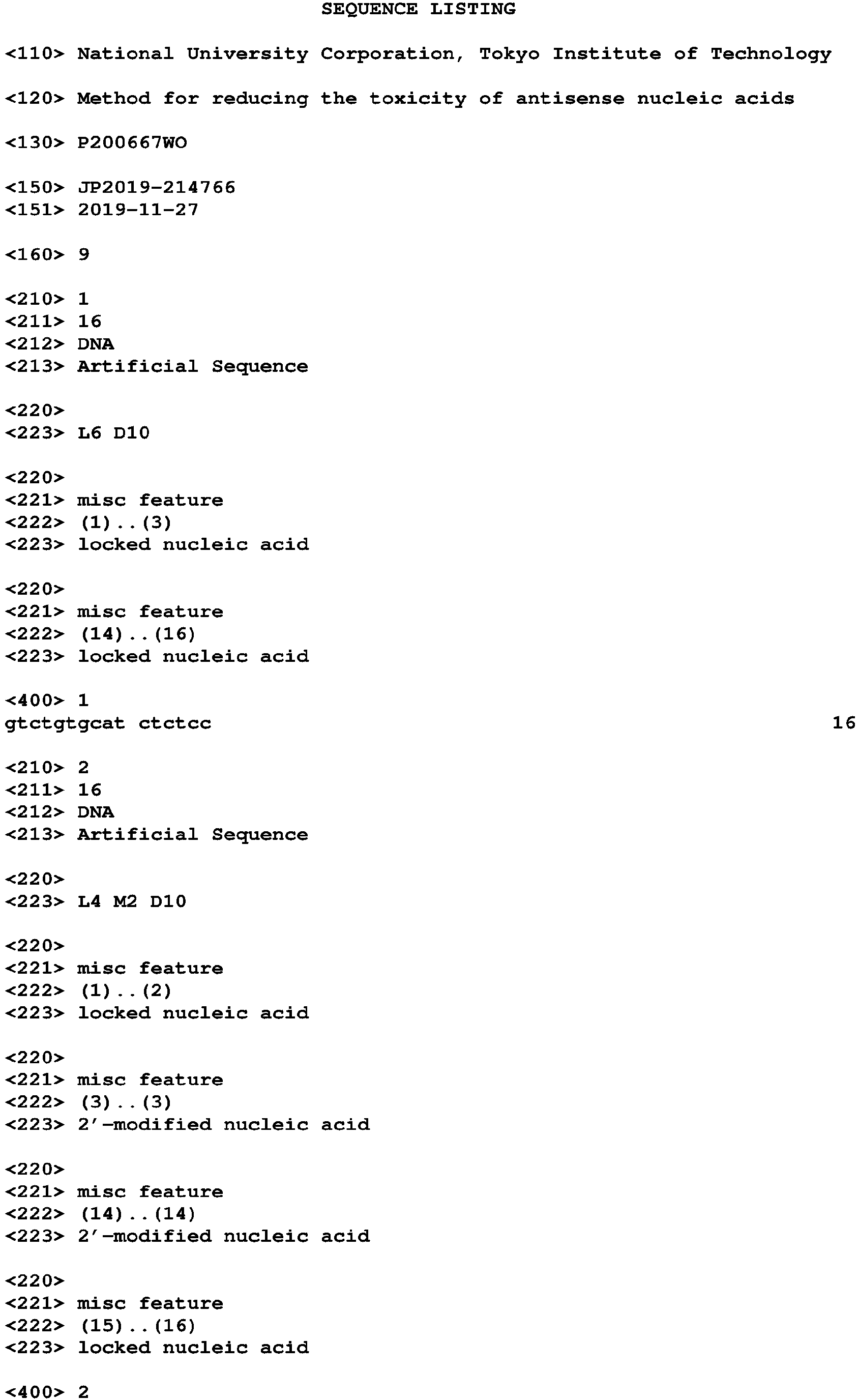


Claims (9)
- Bridged antisense nucleic acid comprising a gap region consisting of deoxyribonucleic acid of 5 to 15 bases and a wing region consisting of two to ten 2',4'-modified nucleic acids at each of the 5' and 3'-ends of the gap region, wherein one to four 2'-modified nucleic acids are supplementally added and/or inserted in at least one wing region.
- The bridged antisense nucleic acid according to claim 1, wherein the 2'-modified nucleic acid has the following structural formula:
 R1 and R2 are each independently selected from the group consisting of H, substituted or unsubstituted alkyl groups, substituted or unsubstituted aralkyl groups, substituted or unsubstituted alkenyl groups, substituted or unsubstituted alkynyl groups and substituted or unsubstituted aryl groups;R3 is H or the structure:
 X is S or O);R4 is H or the bonding point with the adjacent nucleic acid; andB represents a nucleobase residue optionally having a protecting group or a modifying group].
 - The bridged antisense nucleic acid according to claim 2, wherein R1 is H and R2 is a methyl group.
- The bridged antisense nucleic acid according to any one of claims 1 to 3, wherein one or two 2'-modified nucleic acids are added and/or inserted in each wing region.
- The bridged antisense nucleic acid according to any one of claims 1 to 4, wherein the 2',4'-modified nucleic acid is selected from the group consisting of the following:
 R5 and R8 are each independently selected from the group consisting of H, substituted or unsubstituted alkyl groups, substituted or unsubstituted aralkyl groups, substituted or unsubstituted alkenyl groups, substituted or unsubstituted alkynyl groups and substituted or unsubstituted aryl groups;R6 is H or the structure: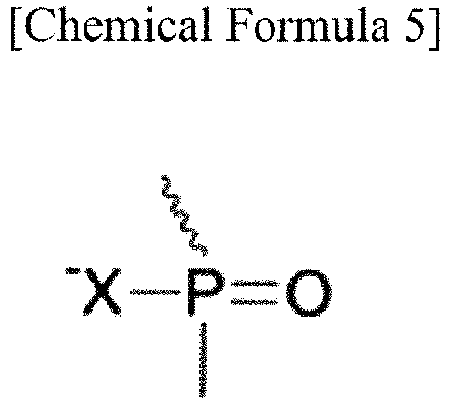
 X is S or O);R7 is H or the bonding point with the adjacent nucleic acid; andB represents a nucleobase residue optionally having a protecting group or a modifying group] .
 - The bridged antisense nucleic acid according to any one of claims 1 to 5, which comprises one to four 2',4'-modified nucleic acids.
- The bridged antisense nucleic acid according to any one of claims 1 to 6, wherein X is a sulfur atom.
- The bridged antisense nucleic acid according to any one of claims 1 to 7, wherein the deoxyribonucleic acid has a base length of 8 to 10.
- An antisense nucleic acid drug with reduced toxicity by antisense nucleic acid, comprising bridged antisense nucleic acid according to any one of claims 1 to 8.
Applications Claiming Priority (2)
| Application Number | Priority Date | Filing Date | Title |
|---|---|---|---|
| JP2019214766 | 2019-11-27 | ||
| PCT/JP2020/044370 WO2021107143A1 (en) | 2019-11-27 | 2020-11-27 | Method for reducing toxicity of antisense nucleic acids |
Publications (2)
| Publication Number | Publication Date |
|---|---|
| EP4067489A1 true EP4067489A1 (en) | 2022-10-05 |
| EP4067489A4 EP4067489A4 (en) | 2024-06-12 |
Family
ID=76129685
Family Applications (1)
| Application Number | Title | Priority Date | Filing Date |
|---|---|---|---|
| EP20894697.0A Pending EP4067489A4 (en) | 2019-11-27 | 2020-11-27 | Method for reducing toxicity of antisense nucleic acids |
Country Status (5)
| Country | Link |
|---|---|
| US (1) | US20220251557A1 (en) |
| EP (1) | EP4067489A4 (en) |
| JP (2) | JP7644499B2 (en) |
| CN (1) | CN114127292A (en) |
| WO (1) | WO2021107143A1 (en) |
Families Citing this family (1)
| Publication number | Priority date | Publication date | Assignee | Title |
|---|---|---|---|---|
| TW202516006A (en) * | 2023-08-30 | 2025-04-16 | 日商Stratoimmune股份有限公司 | RasGRP4 antisense oligonucleotide |
Family Cites Families (11)
| Publication number | Priority date | Publication date | Assignee | Title |
|---|---|---|---|---|
| US6147200A (en) * | 1999-08-19 | 2000-11-14 | Isis Pharmaceuticals, Inc. | 2'-O-acetamido modified monomers and oligomers |
| WO2007102581A1 (en) * | 2006-03-08 | 2007-09-13 | Tokyo Institute Of Technology | 2'-hydroxyl-modified ribonucleoside derivative |
| CA2667055C (en) * | 2006-10-18 | 2017-05-09 | Isis Pharmaceuticals, Inc. | Antisense compounds |
| EP2534262B1 (en) * | 2010-02-08 | 2016-12-14 | Ionis Pharmaceuticals, Inc. | Selective reduction of allelic variants |
| EP3067421B1 (en) * | 2011-02-08 | 2018-10-10 | Ionis Pharmaceuticals, Inc. | Oligomeric compounds comprising bicyclic nucleotides and uses thereof |
| WO2014132671A1 (en) * | 2013-03-01 | 2014-09-04 | National University Corporation Tokyo Medical And Dental University | Chimeric single-stranded antisense polynucleotides and double-stranded antisense agent |
| CA2939822C (en) * | 2014-02-18 | 2018-09-25 | Osaka University | Crosslinked nucleoside and nucleotide |
| EP3124609A1 (en) * | 2015-07-29 | 2017-02-01 | IFOM Fondazione Istituto Firc di Oncologia Molecolare | Therapeutics oligonucleotides |
| JP6853537B2 (en) * | 2016-02-17 | 2021-03-31 | 国立大学法人東京工業大学 | Artificial nucleosides and artificial nucleotides and artificial oligonucleotides |
| EP3587576A4 (en) | 2017-02-21 | 2021-01-06 | Osaka University | ANTI-SENSE OLIGONUCLEIC ACID |
| CN111868244A (en) * | 2018-03-20 | 2020-10-30 | 国立大学法人东京工业大学 | Antisense oligonucleotides with reduced toxicity |
-
2020
- 2020-11-27 EP EP20894697.0A patent/EP4067489A4/en active Pending
- 2020-11-27 CN CN202080052461.7A patent/CN114127292A/en active Pending
- 2020-11-27 WO PCT/JP2020/044370 patent/WO2021107143A1/en not_active Ceased
- 2020-11-27 JP JP2021561576A patent/JP7644499B2/en active Active
- 2020-11-27 US US17/628,881 patent/US20220251557A1/en active Pending
-
2025
- 2025-02-20 JP JP2025026091A patent/JP2025081562A/en active Pending
Also Published As
| Publication number | Publication date |
|---|---|
| JPWO2021107143A1 (en) | 2021-06-03 |
| CN114127292A (en) | 2022-03-01 |
| WO2021107143A1 (en) | 2021-06-03 |
| JP2025081562A (en) | 2025-05-27 |
| JP7644499B2 (en) | 2025-03-12 |
| US20220251557A1 (en) | 2022-08-11 |
| EP4067489A4 (en) | 2024-06-12 |
Similar Documents
| Publication | Publication Date | Title |
|---|---|---|
| JP7488254B2 (en) | RNAi agents for inhibiting expression of 17β-HSD13 (HSD17B13), compositions thereof, and methods of use | |
| CN111107853B (en) | RNAi agents and compositions for inhibiting expression of apolipoprotein C-III (APOC 3) | |
| CN111343994B (en) | RNAi agents and compositions for inhibiting expression of angiopoietin-like 3 (ANGPTL3) and methods of use | |
| EP2530155B1 (en) | ENA nucleic acid drugs modifying splicing in mRNA precursor | |
| EP2961841B1 (en) | Chimeric single-stranded antisense polynucleotides and double-stranded antisense agent | |
| JP2021011501A (en) | Chimeric double-stranded nucleic acid | |
| JP7830340B2 (en) | RNAi drug for inhibiting PNPLA3 expression, pharmaceutical composition thereof, and method of use | |
| KR20180104075A (en) | Treatment of atopic dermatitis and asthma using RNA complexes targeting IL4Ra, TRPA1, or F2RL1 | |
| CN114901821A (en) | Use of SEPT9 inhibitors for treating hepatitis B virus infection | |
| JP2025081562A (en) | Methods for reducing toxicity of antisense nucleic acids | |
| CN118979036B (en) | SiRNA for inhibiting APP gene expression, conjugate and application thereof | |
| JP6029147B2 (en) | Oligonucleotide derivatives for miRNA function suppression | |
| CN107709561B (en) | Modified siRNA and pharmaceutical composition containing the modified siRNA | |
| JP6934695B2 (en) | Nucleic acid medicine and its use | |
| JP2007104971A (en) | Antisense oligonucleotide for splicing control of myostatin | |
| CN114829601A (en) | Use of SBDS inhibitors for the treatment of hepatitis b virus infection | |
| EP4446414A1 (en) | Antisense oligonucleotide complex | |
| TW202444904A (en) | Rnai agents for inhibiting expression of mitochondrial amidoxime reducing component 1 (marc1), pharmaceutical compositions thereof, and methods of use | |
| KR20260040626A (en) | Oligonucleotides targeting angiotensinogen and their uses | |
| WO2023112931A1 (en) | Antisense oligonucleotide targeting atn1 mrna or pre-mrna | |
| HK40078456A (en) | Use of sbds inhibitors for treating hepatitis b virus infection | |
| HK40084771A (en) | Rnai agents for inhibiting expression of pnpla3, pharmaceutical compositions thereof, and methods of use | |
| HK40084771B (en) | RNAi AGENTS FOR INHIBITING EXPRESSION OF PNPLA3, PHARMACEUTICAL COMPOSITIONS THEREOF, AND METHODS OF USE | |
| EA048885B1 (en) | RNAi AGENTS AND COMPOSITIONS FOR INHIBITING THE EXPRESSION OF ANGIOPOIETIN-LIKE PROTEIN 3 (ANGPTL3) AND METHODS OF APPLICATION | |
| JPWO2018123925A1 (en) | Alport syndrome drug |
Legal Events
| Date | Code | Title | Description |
|---|---|---|---|
| STAA | Information on the status of an ep patent application or granted ep patent |
Free format text: STATUS: THE INTERNATIONAL PUBLICATION HAS BEEN MADE |
|
| PUAI | Public reference made under article 153(3) epc to a published international application that has entered the european phase |
Free format text: ORIGINAL CODE: 0009012 |
|
| STAA | Information on the status of an ep patent application or granted ep patent |
Free format text: STATUS: REQUEST FOR EXAMINATION WAS MADE |
|
| 17P | Request for examination filed |
Effective date: 20220301 |
|
| AK | Designated contracting states |
Kind code of ref document: A1 Designated state(s): AL AT BE BG CH CY CZ DE DK EE ES FI FR GB GR HR HU IE IS IT LI LT LU LV MC MK MT NL NO PL PT RO RS SE SI SK SM TR |
|
| DAV | Request for validation of the european patent (deleted) | ||
| DAX | Request for extension of the european patent (deleted) | ||
| A4 | Supplementary search report drawn up and despatched |
Effective date: 20240513 |
|
| RIC1 | Information provided on ipc code assigned before grant |
Ipc: A61K 31/7125 20060101ALI20240506BHEP Ipc: C12N 15/113 20100101AFI20240506BHEP |