EP4067468A1 - Dishwasher detergents comprising surfactants on magnesium carbonate carrier - Google Patents
Dishwasher detergents comprising surfactants on magnesium carbonate carrier Download PDFInfo
- Publication number
- EP4067468A1 EP4067468A1 EP21166655.7A EP21166655A EP4067468A1 EP 4067468 A1 EP4067468 A1 EP 4067468A1 EP 21166655 A EP21166655 A EP 21166655A EP 4067468 A1 EP4067468 A1 EP 4067468A1
- Authority
- EP
- European Patent Office
- Prior art keywords
- group
- carbon atoms
- linear
- component
- groups
- Prior art date
- Legal status (The legal status is an assumption and is not a legal conclusion. Google has not performed a legal analysis and makes no representation as to the accuracy of the status listed.)
- Withdrawn
Links
- 239000003599 detergent Substances 0.000 title claims abstract description 255
- 239000004094 surface-active agent Substances 0.000 title claims abstract description 165
- ZLNQQNXFFQJAID-UHFFFAOYSA-L magnesium carbonate Chemical compound [Mg+2].[O-]C([O-])=O ZLNQQNXFFQJAID-UHFFFAOYSA-L 0.000 title claims abstract description 150
- 229910000021 magnesium carbonate Inorganic materials 0.000 title claims abstract description 150
- 239000001095 magnesium carbonate Substances 0.000 title claims abstract description 144
- 102000004190 Enzymes Human genes 0.000 claims abstract description 33
- 108090000790 Enzymes Proteins 0.000 claims abstract description 33
- 239000003112 inhibitor Substances 0.000 claims abstract description 25
- 238000001035 drying Methods 0.000 claims abstract description 22
- 239000011521 glass Substances 0.000 claims abstract description 22
- 238000005260 corrosion Methods 0.000 claims abstract description 20
- 230000007797 corrosion Effects 0.000 claims abstract description 20
- 125000004432 carbon atom Chemical group C* 0.000 claims description 105
- -1 glycerol triester Chemical class 0.000 claims description 91
- 125000000217 alkyl group Chemical group 0.000 claims description 83
- 239000000203 mixture Substances 0.000 claims description 64
- XLYOFNOQVPJJNP-UHFFFAOYSA-N water Substances O XLYOFNOQVPJJNP-UHFFFAOYSA-N 0.000 claims description 56
- 125000003342 alkenyl group Chemical group 0.000 claims description 45
- 239000012876 carrier material Substances 0.000 claims description 39
- 238000004851 dishwashing Methods 0.000 claims description 39
- 238000000034 method Methods 0.000 claims description 37
- 239000002245 particle Substances 0.000 claims description 36
- 229940088598 enzyme Drugs 0.000 claims description 32
- 150000001875 compounds Chemical class 0.000 claims description 30
- 239000002904 solvent Substances 0.000 claims description 30
- 238000004140 cleaning Methods 0.000 claims description 28
- 150000002191 fatty alcohols Chemical class 0.000 claims description 25
- 229920000642 polymer Polymers 0.000 claims description 25
- 239000011777 magnesium Substances 0.000 claims description 20
- 238000004061 bleaching Methods 0.000 claims description 18
- PEDCQBHIVMGVHV-UHFFFAOYSA-N Glycerol Natural products OCC(O)CO PEDCQBHIVMGVHV-UHFFFAOYSA-N 0.000 claims description 17
- 239000003054 catalyst Substances 0.000 claims description 16
- 229910052701 rubidium Inorganic materials 0.000 claims description 16
- 150000003839 salts Chemical class 0.000 claims description 16
- 239000000126 substance Substances 0.000 claims description 16
- 125000002496 methyl group Chemical group [H]C([H])([H])* 0.000 claims description 15
- 239000007787 solid Substances 0.000 claims description 15
- 239000003795 chemical substances by application Substances 0.000 claims description 14
- 229910019142 PO4 Inorganic materials 0.000 claims description 12
- 239000001257 hydrogen Substances 0.000 claims description 10
- 229910052739 hydrogen Inorganic materials 0.000 claims description 10
- 239000003960 organic solvent Substances 0.000 claims description 9
- 239000002202 Polyethylene glycol Substances 0.000 claims description 8
- BQCADISMDOOEFD-UHFFFAOYSA-N Silver Chemical compound [Ag] BQCADISMDOOEFD-UHFFFAOYSA-N 0.000 claims description 8
- 229920001223 polyethylene glycol Polymers 0.000 claims description 8
- 229910052709 silver Inorganic materials 0.000 claims description 8
- 239000004332 silver Substances 0.000 claims description 8
- 150000002148 esters Chemical group 0.000 claims description 7
- 125000001301 ethoxy group Chemical group [H]C([H])([H])C([H])([H])O* 0.000 claims description 7
- 239000003381 stabilizer Substances 0.000 claims description 7
- 239000002562 thickening agent Substances 0.000 claims description 7
- OYPRJOBELJOOCE-UHFFFAOYSA-N Calcium Chemical compound [Ca] OYPRJOBELJOOCE-UHFFFAOYSA-N 0.000 claims description 6
- 108091005804 Peptidases Proteins 0.000 claims description 6
- 239000004365 Protease Substances 0.000 claims description 6
- 239000000654 additive Substances 0.000 claims description 6
- 229910052797 bismuth Inorganic materials 0.000 claims description 6
- 239000011575 calcium Substances 0.000 claims description 6
- 229910052791 calcium Inorganic materials 0.000 claims description 6
- 229910017052 cobalt Inorganic materials 0.000 claims description 6
- 239000010941 cobalt Substances 0.000 claims description 6
- 239000000945 filler Substances 0.000 claims description 6
- 229910052749 magnesium Inorganic materials 0.000 claims description 6
- NBIIXXVUZAFLBC-UHFFFAOYSA-K phosphate Chemical compound [O-]P([O-])([O-])=O NBIIXXVUZAFLBC-UHFFFAOYSA-K 0.000 claims description 6
- 239000010452 phosphate Substances 0.000 claims description 6
- 239000000049 pigment Substances 0.000 claims description 6
- 238000002360 preparation method Methods 0.000 claims description 6
- 229910052725 zinc Inorganic materials 0.000 claims description 6
- 239000011701 zinc Substances 0.000 claims description 6
- WRIDQFICGBMAFQ-UHFFFAOYSA-N (E)-8-Octadecenoic acid Natural products CCCCCCCCCC=CCCCCCCC(O)=O WRIDQFICGBMAFQ-UHFFFAOYSA-N 0.000 claims description 5
- LQJBNNIYVWPHFW-UHFFFAOYSA-N 20:1omega9c fatty acid Natural products CCCCCCCCCCC=CCCCCCCCC(O)=O LQJBNNIYVWPHFW-UHFFFAOYSA-N 0.000 claims description 5
- QSBYPNXLFMSGKH-UHFFFAOYSA-N 9-Heptadecensaeure Natural products CCCCCCCC=CCCCCCCCC(O)=O QSBYPNXLFMSGKH-UHFFFAOYSA-N 0.000 claims description 5
- 108010065511 Amylases Proteins 0.000 claims description 5
- 102000013142 Amylases Human genes 0.000 claims description 5
- 108090001060 Lipase Proteins 0.000 claims description 5
- 239000004367 Lipase Substances 0.000 claims description 5
- 102000004882 Lipase Human genes 0.000 claims description 5
- FYYHWMGAXLPEAU-UHFFFAOYSA-N Magnesium Chemical compound [Mg] FYYHWMGAXLPEAU-UHFFFAOYSA-N 0.000 claims description 5
- 239000005642 Oleic acid Substances 0.000 claims description 5
- ZQPPMHVWECSIRJ-UHFFFAOYSA-N Oleic acid Natural products CCCCCCCCC=CCCCCCCCC(O)=O ZQPPMHVWECSIRJ-UHFFFAOYSA-N 0.000 claims description 5
- 108090000854 Oxidoreductases Proteins 0.000 claims description 5
- 102000004316 Oxidoreductases Human genes 0.000 claims description 5
- HCHKCACWOHOZIP-UHFFFAOYSA-N Zinc Chemical compound [Zn] HCHKCACWOHOZIP-UHFFFAOYSA-N 0.000 claims description 5
- 235000019418 amylase Nutrition 0.000 claims description 5
- 150000001449 anionic compounds Chemical group 0.000 claims description 5
- JCXGWMGPZLAOME-UHFFFAOYSA-N bismuth atom Chemical compound [Bi] JCXGWMGPZLAOME-UHFFFAOYSA-N 0.000 claims description 5
- AXCZMVOFGPJBDE-UHFFFAOYSA-L calcium dihydroxide Chemical compound [OH-].[OH-].[Ca+2] AXCZMVOFGPJBDE-UHFFFAOYSA-L 0.000 claims description 5
- 239000000920 calcium hydroxide Substances 0.000 claims description 5
- 229910001861 calcium hydroxide Inorganic materials 0.000 claims description 5
- GUTLYIVDDKVIGB-UHFFFAOYSA-N cobalt atom Chemical compound [Co] GUTLYIVDDKVIGB-UHFFFAOYSA-N 0.000 claims description 5
- 239000000975 dye Substances 0.000 claims description 5
- 239000006260 foam Substances 0.000 claims description 5
- 239000003752 hydrotrope Substances 0.000 claims description 5
- QXJSBBXBKPUZAA-UHFFFAOYSA-N isooleic acid Natural products CCCCCCCC=CCCCCCCCCC(O)=O QXJSBBXBKPUZAA-UHFFFAOYSA-N 0.000 claims description 5
- 235000019421 lipase Nutrition 0.000 claims description 5
- 229910052751 metal Inorganic materials 0.000 claims description 5
- 239000002184 metal Substances 0.000 claims description 5
- ZQPPMHVWECSIRJ-KTKRTIGZSA-N oleic acid Chemical compound CCCCCCCC\C=C/CCCCCCCC(O)=O ZQPPMHVWECSIRJ-KTKRTIGZSA-N 0.000 claims description 5
- 150000002891 organic anions Chemical group 0.000 claims description 5
- UFHFLCQGNIYNRP-UHFFFAOYSA-N Hydrogen Chemical compound [H][H] UFHFLCQGNIYNRP-UHFFFAOYSA-N 0.000 claims description 4
- 102000035195 Peptidases Human genes 0.000 claims description 4
- 229940025131 amylases Drugs 0.000 claims description 4
- 239000003963 antioxidant agent Substances 0.000 claims description 4
- 150000001732 carboxylic acid derivatives Chemical class 0.000 claims description 4
- 238000006243 chemical reaction Methods 0.000 claims description 4
- 125000001495 ethyl group Chemical group [H]C([H])([H])C([H])([H])* 0.000 claims description 4
- 239000003205 fragrance Substances 0.000 claims description 4
- 150000004676 glycans Chemical class 0.000 claims description 4
- 150000002431 hydrogen Chemical class 0.000 claims description 4
- 230000003641 microbiacidal effect Effects 0.000 claims description 4
- 229940124561 microbicide Drugs 0.000 claims description 4
- 125000004430 oxygen atom Chemical group O* 0.000 claims description 4
- 239000003002 pH adjusting agent Substances 0.000 claims description 4
- 229920001282 polysaccharide Polymers 0.000 claims description 4
- 239000005017 polysaccharide Substances 0.000 claims description 4
- 238000012545 processing Methods 0.000 claims description 4
- 238000005494 tarnishing Methods 0.000 claims description 4
- 150000005691 triesters Chemical class 0.000 claims description 4
- 239000008139 complexing agent Substances 0.000 claims description 3
- 108010002430 hemicellulase Proteins 0.000 claims description 3
- 108010084185 Cellulases Proteins 0.000 claims description 2
- 102000005575 Cellulases Human genes 0.000 claims description 2
- IAYPIBMASNFSPL-UHFFFAOYSA-N Ethylene oxide Chemical compound C1CO1 IAYPIBMASNFSPL-UHFFFAOYSA-N 0.000 claims description 2
- 229920001400 block copolymer Polymers 0.000 claims description 2
- 150000001768 cations Chemical class 0.000 claims description 2
- 125000004435 hydrogen atom Chemical group [H]* 0.000 claims description 2
- 150000003626 triacylglycerols Chemical class 0.000 claims description 2
- 235000014380 magnesium carbonate Nutrition 0.000 description 122
- 239000011148 porous material Substances 0.000 description 34
- IJGRMHOSHXDMSA-UHFFFAOYSA-N Atomic nitrogen Chemical compound N#N IJGRMHOSHXDMSA-UHFFFAOYSA-N 0.000 description 30
- KRKNYBCHXYNGOX-UHFFFAOYSA-N citric acid Chemical compound OC(=O)CC(O)(C(O)=O)CC(O)=O KRKNYBCHXYNGOX-UHFFFAOYSA-N 0.000 description 30
- BXWNKGSJHAJOGX-UHFFFAOYSA-N hexadecan-1-ol Chemical compound CCCCCCCCCCCCCCCCO BXWNKGSJHAJOGX-UHFFFAOYSA-N 0.000 description 28
- GLDOVTGHNKAZLK-UHFFFAOYSA-N octadecan-1-ol Chemical compound CCCCCCCCCCCCCCCCCCO GLDOVTGHNKAZLK-UHFFFAOYSA-N 0.000 description 20
- 239000002253 acid Substances 0.000 description 19
- 229920001577 copolymer Polymers 0.000 description 18
- 239000007788 liquid Substances 0.000 description 18
- 239000000463 material Substances 0.000 description 18
- 229910052757 nitrogen Inorganic materials 0.000 description 17
- WNWHHMBRJJOGFJ-UHFFFAOYSA-N 16-methylheptadecan-1-ol Chemical compound CC(C)CCCCCCCCCCCCCCCO WNWHHMBRJJOGFJ-UHFFFAOYSA-N 0.000 description 16
- 229960000541 cetyl alcohol Drugs 0.000 description 16
- 238000009472 formulation Methods 0.000 description 16
- BTFJIXJJCSYFAL-UHFFFAOYSA-N icosan-1-ol Chemical compound CCCCCCCCCCCCCCCCCCCCO BTFJIXJJCSYFAL-UHFFFAOYSA-N 0.000 description 16
- HLZKNKRTKFSKGZ-UHFFFAOYSA-N tetradecan-1-ol Chemical compound CCCCCCCCCCCCCCO HLZKNKRTKFSKGZ-UHFFFAOYSA-N 0.000 description 16
- LYCAIKOWRPUZTN-UHFFFAOYSA-N Ethylene glycol Chemical compound OCCO LYCAIKOWRPUZTN-UHFFFAOYSA-N 0.000 description 15
- 238000004438 BET method Methods 0.000 description 14
- 239000000178 monomer Substances 0.000 description 14
- LFQSCWFLJHTTHZ-UHFFFAOYSA-N Ethanol Chemical compound CCO LFQSCWFLJHTTHZ-UHFFFAOYSA-N 0.000 description 13
- 150000007513 acids Chemical class 0.000 description 13
- 239000003826 tablet Substances 0.000 description 13
- ALSTYHKOOCGGFT-KTKRTIGZSA-N (9Z)-octadecen-1-ol Chemical compound CCCCCCCC\C=C/CCCCCCCCO ALSTYHKOOCGGFT-KTKRTIGZSA-N 0.000 description 12
- KBPLFHHGFOOTCA-UHFFFAOYSA-N 1-Octanol Chemical compound CCCCCCCCO KBPLFHHGFOOTCA-UHFFFAOYSA-N 0.000 description 12
- LQZZUXJYWNFBMV-UHFFFAOYSA-N dodecan-1-ol Chemical compound CCCCCCCCCCCCO LQZZUXJYWNFBMV-UHFFFAOYSA-N 0.000 description 12
- GOQYKNQRPGWPLP-UHFFFAOYSA-N heptadecan-1-ol Chemical compound CCCCCCCCCCCCCCCCCO GOQYKNQRPGWPLP-UHFFFAOYSA-N 0.000 description 12
- QSHDDOUJBYECFT-UHFFFAOYSA-N mercury Chemical compound [Hg] QSHDDOUJBYECFT-UHFFFAOYSA-N 0.000 description 12
- 229910052753 mercury Inorganic materials 0.000 description 12
- 239000000843 powder Substances 0.000 description 12
- 239000007844 bleaching agent Substances 0.000 description 11
- 238000011068 loading method Methods 0.000 description 11
- CIEZZGWIJBXOTE-UHFFFAOYSA-N 2-[bis(carboxymethyl)amino]propanoic acid Chemical compound OC(=O)C(C)N(CC(O)=O)CC(O)=O CIEZZGWIJBXOTE-UHFFFAOYSA-N 0.000 description 10
- 239000011888 foil Substances 0.000 description 10
- 239000008187 granular material Substances 0.000 description 10
- 239000002736 nonionic surfactant Substances 0.000 description 10
- 235000021317 phosphate Nutrition 0.000 description 10
- 239000011734 sodium Substances 0.000 description 10
- VZCYOOQTPOCHFL-UHFFFAOYSA-N trans-butenedioic acid Natural products OC(=O)C=CC(O)=O VZCYOOQTPOCHFL-UHFFFAOYSA-N 0.000 description 10
- CERQOIWHTDAKMF-UHFFFAOYSA-N Methacrylic acid Chemical compound CC(=C)C(O)=O CERQOIWHTDAKMF-UHFFFAOYSA-N 0.000 description 9
- 239000012190 activator Substances 0.000 description 9
- 229910052760 oxygen Inorganic materials 0.000 description 9
- 239000000047 product Substances 0.000 description 9
- XFRVVPUIAFSTFO-UHFFFAOYSA-N 1-Tridecanol Chemical compound CCCCCCCCCCCCCO XFRVVPUIAFSTFO-UHFFFAOYSA-N 0.000 description 8
- YIWUKEYIRIRTPP-UHFFFAOYSA-N 2-ethylhexan-1-ol Chemical compound CCCCC(CC)CO YIWUKEYIRIRTPP-UHFFFAOYSA-N 0.000 description 8
- NIXOWILDQLNWCW-UHFFFAOYSA-M Acrylate Chemical compound [O-]C(=O)C=C NIXOWILDQLNWCW-UHFFFAOYSA-M 0.000 description 8
- DBVJJBKOTRCVKF-UHFFFAOYSA-N Etidronic acid Chemical compound OP(=O)(O)C(O)(C)P(O)(O)=O DBVJJBKOTRCVKF-UHFFFAOYSA-N 0.000 description 8
- VZCYOOQTPOCHFL-OWOJBTEDSA-N Fumaric acid Chemical compound OC(=O)\C=C\C(O)=O VZCYOOQTPOCHFL-OWOJBTEDSA-N 0.000 description 8
- 125000002091 cationic group Chemical group 0.000 description 8
- MWKFXSUHUHTGQN-UHFFFAOYSA-N decan-1-ol Chemical compound CCCCCCCCCCO MWKFXSUHUHTGQN-UHFFFAOYSA-N 0.000 description 8
- 238000009826 distribution Methods 0.000 description 8
- NOPFSRXAKWQILS-UHFFFAOYSA-N docosan-1-ol Chemical compound CCCCCCCCCCCCCCCCCCCCCCO NOPFSRXAKWQILS-UHFFFAOYSA-N 0.000 description 8
- IRHTZOCLLONTOC-UHFFFAOYSA-N hexacosan-1-ol Chemical compound CCCCCCCCCCCCCCCCCCCCCCCCCCO IRHTZOCLLONTOC-UHFFFAOYSA-N 0.000 description 8
- 238000005259 measurement Methods 0.000 description 8
- 238000002156 mixing Methods 0.000 description 8
- XGFDHKJUZCCPKQ-UHFFFAOYSA-N nonadecan-1-ol Chemical compound CCCCCCCCCCCCCCCCCCCO XGFDHKJUZCCPKQ-UHFFFAOYSA-N 0.000 description 8
- ZWRUINPWMLAQRD-UHFFFAOYSA-N nonan-1-ol Chemical compound CCCCCCCCCO ZWRUINPWMLAQRD-UHFFFAOYSA-N 0.000 description 8
- 229940055577 oleyl alcohol Drugs 0.000 description 8
- XMLQWXUVTXCDDL-UHFFFAOYSA-N oleyl alcohol Natural products CCCCCCC=CCCCCCCCCCCO XMLQWXUVTXCDDL-UHFFFAOYSA-N 0.000 description 8
- REIUXOLGHVXAEO-UHFFFAOYSA-N pentadecan-1-ol Chemical compound CCCCCCCCCCCCCCCO REIUXOLGHVXAEO-UHFFFAOYSA-N 0.000 description 8
- 229920002451 polyvinyl alcohol Polymers 0.000 description 8
- 235000019422 polyvinyl alcohol Nutrition 0.000 description 8
- 238000002459 porosimetry Methods 0.000 description 8
- 150000004760 silicates Chemical class 0.000 description 8
- 235000019832 sodium triphosphate Nutrition 0.000 description 8
- TYWMIZZBOVGFOV-UHFFFAOYSA-N tetracosan-1-ol Chemical compound CCCCCCCCCCCCCCCCCCCCCCCCO TYWMIZZBOVGFOV-UHFFFAOYSA-N 0.000 description 8
- REZQBEBOWJAQKS-UHFFFAOYSA-N triacontan-1-ol Chemical compound CCCCCCCCCCCCCCCCCCCCCCCCCCCCCCO REZQBEBOWJAQKS-UHFFFAOYSA-N 0.000 description 8
- KJIOQYGWTQBHNH-UHFFFAOYSA-N undecanol Chemical compound CCCCCCCCCCCO KJIOQYGWTQBHNH-UHFFFAOYSA-N 0.000 description 8
- SMZOUWXMTYCWNB-UHFFFAOYSA-N 2-(2-methoxy-5-methylphenyl)ethanamine Chemical compound COC1=CC=C(C)C=C1CCN SMZOUWXMTYCWNB-UHFFFAOYSA-N 0.000 description 7
- NIXOWILDQLNWCW-UHFFFAOYSA-N 2-Propenoic acid Natural products OC(=O)C=C NIXOWILDQLNWCW-UHFFFAOYSA-N 0.000 description 7
- QVGXLLKOCUKJST-UHFFFAOYSA-N atomic oxygen Chemical compound [O] QVGXLLKOCUKJST-UHFFFAOYSA-N 0.000 description 7
- 150000007942 carboxylates Chemical class 0.000 description 7
- 229920006317 cationic polymer Polymers 0.000 description 7
- 230000000694 effects Effects 0.000 description 7
- 238000005469 granulation Methods 0.000 description 7
- 230000003179 granulation Effects 0.000 description 7
- 239000001301 oxygen Substances 0.000 description 7
- 238000012360 testing method Methods 0.000 description 7
- ITWBWJFEJCHKSN-UHFFFAOYSA-N 1,4,7-triazonane Chemical compound C1CNCCNCCN1 ITWBWJFEJCHKSN-UHFFFAOYSA-N 0.000 description 6
- CSCPPACGZOOCGX-UHFFFAOYSA-N Acetone Chemical compound CC(C)=O CSCPPACGZOOCGX-UHFFFAOYSA-N 0.000 description 6
- DGAQECJNVWCQMB-PUAWFVPOSA-M Ilexoside XXIX Chemical compound C[C@@H]1CC[C@@]2(CC[C@@]3(C(=CC[C@H]4[C@]3(CC[C@@H]5[C@@]4(CC[C@@H](C5(C)C)OS(=O)(=O)[O-])C)C)[C@@H]2[C@]1(C)O)C)C(=O)O[C@H]6[C@@H]([C@H]([C@@H]([C@H](O6)CO)O)O)O.[Na+] DGAQECJNVWCQMB-PUAWFVPOSA-M 0.000 description 6
- ABLZXFCXXLZCGV-UHFFFAOYSA-N Phosphorous acid Chemical class OP(O)=O ABLZXFCXXLZCGV-UHFFFAOYSA-N 0.000 description 6
- 229920000289 Polyquaternium Polymers 0.000 description 6
- OFOBLEOULBTSOW-UHFFFAOYSA-N Propanedioic acid Natural products OC(=O)CC(O)=O OFOBLEOULBTSOW-UHFFFAOYSA-N 0.000 description 6
- CDBYLPFSWZWCQE-UHFFFAOYSA-L Sodium Carbonate Chemical compound [Na+].[Na+].[O-]C([O-])=O CDBYLPFSWZWCQE-UHFFFAOYSA-L 0.000 description 6
- 239000013543 active substance Substances 0.000 description 6
- 125000003545 alkoxy group Chemical group 0.000 description 6
- WGCNASOHLSPBMP-UHFFFAOYSA-N hydroxyacetaldehyde Natural products OCC=O WGCNASOHLSPBMP-UHFFFAOYSA-N 0.000 description 6
- 239000004615 ingredient Substances 0.000 description 6
- VZCYOOQTPOCHFL-UPHRSURJSA-N maleic acid Chemical compound OC(=O)\C=C/C(O)=O VZCYOOQTPOCHFL-UPHRSURJSA-N 0.000 description 6
- 239000011976 maleic acid Substances 0.000 description 6
- CNNRPFQICPFDPO-UHFFFAOYSA-N octacosan-1-ol Chemical compound CCCCCCCCCCCCCCCCCCCCCCCCCCCCO CNNRPFQICPFDPO-UHFFFAOYSA-N 0.000 description 6
- 150000003013 phosphoric acid derivatives Chemical class 0.000 description 6
- 229920003023 plastic Polymers 0.000 description 6
- 239000004033 plastic Substances 0.000 description 6
- 229910052573 porcelain Inorganic materials 0.000 description 6
- 239000000523 sample Substances 0.000 description 6
- 229910052708 sodium Inorganic materials 0.000 description 6
- 239000000243 solution Substances 0.000 description 6
- FRPJTGXMTIIFIT-UHFFFAOYSA-N tetraacetylethylenediamine Chemical compound CC(=O)C(N)(C(C)=O)C(N)(C(C)=O)C(C)=O FRPJTGXMTIIFIT-UHFFFAOYSA-N 0.000 description 6
- 229920002126 Acrylic acid copolymer Polymers 0.000 description 5
- KRKNYBCHXYNGOX-UHFFFAOYSA-K Citrate Chemical compound [O-]C(=O)CC(O)(CC([O-])=O)C([O-])=O KRKNYBCHXYNGOX-UHFFFAOYSA-K 0.000 description 5
- 229910016887 MnIV Inorganic materials 0.000 description 5
- 239000004743 Polypropylene Substances 0.000 description 5
- 239000004115 Sodium Silicate Substances 0.000 description 5
- 150000001298 alcohols Chemical class 0.000 description 5
- 229910052783 alkali metal Inorganic materials 0.000 description 5
- 238000004458 analytical method Methods 0.000 description 5
- 239000003945 anionic surfactant Substances 0.000 description 5
- 150000004965 peroxy acids Chemical class 0.000 description 5
- 239000001226 triphosphate Substances 0.000 description 5
- CFOQKXQWGLAKSK-KTKRTIGZSA-N (13Z)-docosen-1-ol Chemical compound CCCCCCCC\C=C/CCCCCCCCCCCCO CFOQKXQWGLAKSK-KTKRTIGZSA-N 0.000 description 4
- JXNPEDYJTDQORS-HZJYTTRNSA-N (9Z,12Z)-octadecadien-1-ol Chemical compound CCCCC\C=C/C\C=C/CCCCCCCCO JXNPEDYJTDQORS-HZJYTTRNSA-N 0.000 description 4
- IKYKEVDKGZYRMQ-PDBXOOCHSA-N (9Z,12Z,15Z)-octadecatrien-1-ol Chemical compound CC\C=C/C\C=C/C\C=C/CCCCCCCCO IKYKEVDKGZYRMQ-PDBXOOCHSA-N 0.000 description 4
- JXNPEDYJTDQORS-AVQMFFATSA-N (9e,12e)-octadeca-9,12-dien-1-ol Chemical compound CCCCC\C=C\C\C=C\CCCCCCCCO JXNPEDYJTDQORS-AVQMFFATSA-N 0.000 description 4
- 239000005968 1-Decanol Substances 0.000 description 4
- 229960002666 1-octacosanol Drugs 0.000 description 4
- XUJLWPFSUCHPQL-UHFFFAOYSA-N 11-methyldodecan-1-ol Chemical compound CC(C)CCCCCCCCCCO XUJLWPFSUCHPQL-UHFFFAOYSA-N 0.000 description 4
- IKYKEVDKGZYRMQ-IUQGRGSQSA-N 9,12,15-Octadecatrien-1-ol Chemical compound CC\C=C\C\C=C\C\C=C\CCCCCCCCO IKYKEVDKGZYRMQ-IUQGRGSQSA-N 0.000 description 4
- VTYYLEPIZMXCLO-UHFFFAOYSA-L Calcium carbonate Chemical compound [Ca+2].[O-]C([O-])=O VTYYLEPIZMXCLO-UHFFFAOYSA-L 0.000 description 4
- 229910016884 MnIII Inorganic materials 0.000 description 4
- 229920002873 Polyethylenimine Polymers 0.000 description 4
- 239000004372 Polyvinyl alcohol Substances 0.000 description 4
- ZLMJMSJWJFRBEC-UHFFFAOYSA-N Potassium Chemical compound [K] ZLMJMSJWJFRBEC-UHFFFAOYSA-N 0.000 description 4
- WNLRTRBMVRJNCN-UHFFFAOYSA-N adipic acid Chemical compound OC(=O)CCCCC(O)=O WNLRTRBMVRJNCN-UHFFFAOYSA-N 0.000 description 4
- 125000002947 alkylene group Chemical group 0.000 description 4
- 150000001408 amides Chemical class 0.000 description 4
- 230000015572 biosynthetic process Effects 0.000 description 4
- 150000001735 carboxylic acids Chemical class 0.000 description 4
- 229920002678 cellulose Polymers 0.000 description 4
- 229940081733 cetearyl alcohol Drugs 0.000 description 4
- ALSTYHKOOCGGFT-UHFFFAOYSA-N cis-oleyl alcohol Natural products CCCCCCCCC=CCCCCCCCCO ALSTYHKOOCGGFT-UHFFFAOYSA-N 0.000 description 4
- 229960000735 docosanol Drugs 0.000 description 4
- 238000011156 evaluation Methods 0.000 description 4
- 238000005187 foaming Methods 0.000 description 4
- 239000001530 fumaric acid Substances 0.000 description 4
- FIPPFBHCBUDBRR-UHFFFAOYSA-N henicosan-1-ol Chemical compound CCCCCCCCCCCCCCCCCCCCCO FIPPFBHCBUDBRR-UHFFFAOYSA-N 0.000 description 4
- 239000003446 ligand Substances 0.000 description 4
- JXNPEDYJTDQORS-UHFFFAOYSA-N linoleyl alcohol Natural products CCCCCC=CCC=CCCCCCCCCO JXNPEDYJTDQORS-UHFFFAOYSA-N 0.000 description 4
- 229940043348 myristyl alcohol Drugs 0.000 description 4
- FBUKVWPVBMHYJY-UHFFFAOYSA-N nonanoic acid Chemical compound CCCCCCCCC(O)=O FBUKVWPVBMHYJY-UHFFFAOYSA-N 0.000 description 4
- 235000021313 oleic acid Nutrition 0.000 description 4
- ALSTYHKOOCGGFT-MDZDMXLPSA-N oleyl alcohol Chemical compound CCCCCCCC\C=C\CCCCCCCCO ALSTYHKOOCGGFT-MDZDMXLPSA-N 0.000 description 4
- LBIYNOAMNIKVKF-FPLPWBNLSA-N palmitoleyl alcohol Chemical compound CCCCCC\C=C/CCCCCCCCO LBIYNOAMNIKVKF-FPLPWBNLSA-N 0.000 description 4
- LBIYNOAMNIKVKF-UHFFFAOYSA-N palmitoleyl alcohol Natural products CCCCCCC=CCCCCCCCCO LBIYNOAMNIKVKF-UHFFFAOYSA-N 0.000 description 4
- HWGNBUXHKFFFIH-UHFFFAOYSA-I pentasodium;[oxido(phosphonatooxy)phosphoryl] phosphate Chemical compound [Na+].[Na+].[Na+].[Na+].[Na+].[O-]P([O-])(=O)OP([O-])(=O)OP([O-])([O-])=O HWGNBUXHKFFFIH-UHFFFAOYSA-I 0.000 description 4
- 229910052700 potassium Inorganic materials 0.000 description 4
- 239000011591 potassium Substances 0.000 description 4
- 235000018102 proteins Nutrition 0.000 description 4
- 102000004169 proteins and genes Human genes 0.000 description 4
- 108090000623 proteins and genes Proteins 0.000 description 4
- 235000019351 sodium silicates Nutrition 0.000 description 4
- 239000012265 solid product Substances 0.000 description 4
- 229910001220 stainless steel Inorganic materials 0.000 description 4
- 239000010935 stainless steel Substances 0.000 description 4
- 239000000725 suspension Substances 0.000 description 4
- 229910052723 transition metal Inorganic materials 0.000 description 4
- BVKZGUZCCUSVTD-UHFFFAOYSA-L Carbonate Chemical compound [O-]C([O-])=O BVKZGUZCCUSVTD-UHFFFAOYSA-L 0.000 description 3
- OYHQOLUKZRVURQ-HZJYTTRNSA-N Linoleic acid Chemical compound CCCCC\C=C/C\C=C/CCCCCCCC(O)=O OYHQOLUKZRVURQ-HZJYTTRNSA-N 0.000 description 3
- OKKJLVBELUTLKV-UHFFFAOYSA-N Methanol Chemical compound OC OKKJLVBELUTLKV-UHFFFAOYSA-N 0.000 description 3
- ZMXDDKWLCZADIW-UHFFFAOYSA-N N,N-Dimethylformamide Chemical compound CN(C)C=O ZMXDDKWLCZADIW-UHFFFAOYSA-N 0.000 description 3
- NBIIXXVUZAFLBC-UHFFFAOYSA-N Phosphoric acid Chemical compound OP(O)(O)=O NBIIXXVUZAFLBC-UHFFFAOYSA-N 0.000 description 3
- 229920002125 Sokalan® Polymers 0.000 description 3
- 108010056079 Subtilisins Proteins 0.000 description 3
- 102000005158 Subtilisins Human genes 0.000 description 3
- QAOWNCQODCNURD-UHFFFAOYSA-L Sulfate Chemical compound [O-]S([O-])(=O)=O QAOWNCQODCNURD-UHFFFAOYSA-L 0.000 description 3
- 239000004480 active ingredient Substances 0.000 description 3
- 229910000318 alkali metal phosphate Inorganic materials 0.000 description 3
- 150000001340 alkali metals Chemical class 0.000 description 3
- 125000000278 alkyl amino alkyl group Chemical group 0.000 description 3
- 108090000637 alpha-Amylases Proteins 0.000 description 3
- DTOSIQBPPRVQHS-PDBXOOCHSA-N alpha-linolenic acid Chemical compound CC\C=C/C\C=C/C\C=C/CCCCCCCC(O)=O DTOSIQBPPRVQHS-PDBXOOCHSA-N 0.000 description 3
- 235000020661 alpha-linolenic acid Nutrition 0.000 description 3
- 150000003863 ammonium salts Chemical class 0.000 description 3
- 125000000129 anionic group Chemical group 0.000 description 3
- 230000008901 benefit Effects 0.000 description 3
- 229910001424 calcium ion Inorganic materials 0.000 description 3
- 239000002775 capsule Substances 0.000 description 3
- 239000003093 cationic surfactant Substances 0.000 description 3
- 239000001913 cellulose Substances 0.000 description 3
- 108010005400 cutinase Proteins 0.000 description 3
- 230000035622 drinking Effects 0.000 description 3
- 238000007046 ethoxylation reaction Methods 0.000 description 3
- 238000002474 experimental method Methods 0.000 description 3
- 239000000499 gel Substances 0.000 description 3
- XLYOFNOQVPJJNP-ZSJDYOACSA-N heavy water Substances [2H]O[2H] XLYOFNOQVPJJNP-ZSJDYOACSA-N 0.000 description 3
- 230000006872 improvement Effects 0.000 description 3
- 239000012535 impurity Substances 0.000 description 3
- 235000020778 linoleic acid Nutrition 0.000 description 3
- OYHQOLUKZRVURQ-IXWMQOLASA-N linoleic acid Natural products CCCCC\C=C/C\C=C\CCCCCCCC(O)=O OYHQOLUKZRVURQ-IXWMQOLASA-N 0.000 description 3
- 229960004488 linolenic acid Drugs 0.000 description 3
- KQQKGWQCNNTQJW-UHFFFAOYSA-N linolenic acid Natural products CC=CCCC=CCC=CCCCCCCCC(O)=O KQQKGWQCNNTQJW-UHFFFAOYSA-N 0.000 description 3
- ZEYIGTRJOAQUPJ-UHFFFAOYSA-L magnesium;carbonate;dihydrate Chemical compound O.O.[Mg+2].[O-]C([O-])=O ZEYIGTRJOAQUPJ-UHFFFAOYSA-L 0.000 description 3
- 239000008188 pellet Substances 0.000 description 3
- 229920005646 polycarboxylate Polymers 0.000 description 3
- 125000002572 propoxy group Chemical group [*]OC([H])([H])C(C([H])([H])[H])([H])[H] 0.000 description 3
- 229910000029 sodium carbonate Inorganic materials 0.000 description 3
- 159000000000 sodium salts Chemical class 0.000 description 3
- UNXRWKVEANCORM-UHFFFAOYSA-I triphosphate(5-) Chemical compound [O-]P([O-])(=O)OP([O-])(=O)OP([O-])([O-])=O UNXRWKVEANCORM-UHFFFAOYSA-I 0.000 description 3
- 230000000007 visual effect Effects 0.000 description 3
- 239000002888 zwitterionic surfactant Substances 0.000 description 3
- UYXFOIMFLBVYDL-UHFFFAOYSA-N 1,2,4,7-tetramethyl-1,4,7-triazonane Chemical compound CC1CN(C)CCN(C)CCN1C UYXFOIMFLBVYDL-UHFFFAOYSA-N 0.000 description 2
- WLDGDTPNAKWAIR-UHFFFAOYSA-N 1,4,7-trimethyl-1,4,7-triazonane Chemical compound CN1CCN(C)CCN(C)CC1 WLDGDTPNAKWAIR-UHFFFAOYSA-N 0.000 description 2
- OMXANELYEWRDAW-UHFFFAOYSA-N 1-Hexacosene Chemical compound CCCCCCCCCCCCCCCCCCCCCCCCC=C OMXANELYEWRDAW-UHFFFAOYSA-N 0.000 description 2
- AFFLGGQVNFXPEV-UHFFFAOYSA-N 1-decene Chemical compound CCCCCCCCC=C AFFLGGQVNFXPEV-UHFFFAOYSA-N 0.000 description 2
- SPURMHFLEKVAAS-UHFFFAOYSA-N 1-docosene Chemical compound CCCCCCCCCCCCCCCCCCCCC=C SPURMHFLEKVAAS-UHFFFAOYSA-N 0.000 description 2
- CRSBERNSMYQZNG-UHFFFAOYSA-N 1-dodecene Chemical compound CCCCCCCCCCC=C CRSBERNSMYQZNG-UHFFFAOYSA-N 0.000 description 2
- GQEZCXVZFLOKMC-UHFFFAOYSA-N 1-hexadecene Chemical compound CCCCCCCCCCCCCCC=C GQEZCXVZFLOKMC-UHFFFAOYSA-N 0.000 description 2
- 125000004066 1-hydroxyethyl group Chemical group [H]OC([H])([*])C([H])([H])[H] 0.000 description 2
- RTBFRGCFXZNCOE-UHFFFAOYSA-N 1-methylsulfonylpiperidin-4-one Chemical compound CS(=O)(=O)N1CCC(=O)CC1 RTBFRGCFXZNCOE-UHFFFAOYSA-N 0.000 description 2
- 229940094997 1-tetracosanol Drugs 0.000 description 2
- HFDVRLIODXPAHB-UHFFFAOYSA-N 1-tetradecene Chemical compound CCCCCCCCCCCCC=C HFDVRLIODXPAHB-UHFFFAOYSA-N 0.000 description 2
- CFOQKXQWGLAKSK-UHFFFAOYSA-N 13-docosen-1-ol Natural products CCCCCCCCC=CCCCCCCCCCCCCO CFOQKXQWGLAKSK-UHFFFAOYSA-N 0.000 description 2
- JAHNSTQSQJOJLO-UHFFFAOYSA-N 2-(3-fluorophenyl)-1h-imidazole Chemical compound FC1=CC=CC(C=2NC=CN=2)=C1 JAHNSTQSQJOJLO-UHFFFAOYSA-N 0.000 description 2
- OSCJHTSDLYVCQC-UHFFFAOYSA-N 2-ethylhexyl 4-[[4-[4-(tert-butylcarbamoyl)anilino]-6-[4-(2-ethylhexoxycarbonyl)anilino]-1,3,5-triazin-2-yl]amino]benzoate Chemical compound C1=CC(C(=O)OCC(CC)CCCC)=CC=C1NC1=NC(NC=2C=CC(=CC=2)C(=O)NC(C)(C)C)=NC(NC=2C=CC(=CC=2)C(=O)OCC(CC)CCCC)=N1 OSCJHTSDLYVCQC-UHFFFAOYSA-N 0.000 description 2
- 125000004918 2-methyl-2-pentyl group Chemical group CC(C)(CCC)* 0.000 description 2
- 125000004922 2-methyl-3-pentyl group Chemical group CC(C)C(CC)* 0.000 description 2
- 125000004493 2-methylbut-1-yl group Chemical group CC(C*)CC 0.000 description 2
- XEEYSDHEOQHCDA-UHFFFAOYSA-N 2-methylprop-2-ene-1-sulfonic acid Chemical compound CC(=C)CS(O)(=O)=O XEEYSDHEOQHCDA-UHFFFAOYSA-N 0.000 description 2
- 125000004919 3-methyl-2-pentyl group Chemical group CC(C(C)*)CC 0.000 description 2
- 125000004921 3-methyl-3-pentyl group Chemical group CC(CC)(CC)* 0.000 description 2
- 125000004920 4-methyl-2-pentyl group Chemical group CC(CC(C)*)C 0.000 description 2
- UIERETOOQGIECD-UHFFFAOYSA-N Angelic acid Natural products CC=C(C)C(O)=O UIERETOOQGIECD-UHFFFAOYSA-N 0.000 description 2
- KXDHJXZQYSOELW-UHFFFAOYSA-N Carbamic acid Chemical class NC(O)=O KXDHJXZQYSOELW-UHFFFAOYSA-N 0.000 description 2
- VEXZGXHMUGYJMC-UHFFFAOYSA-M Chloride anion Chemical compound [Cl-] VEXZGXHMUGYJMC-UHFFFAOYSA-M 0.000 description 2
- 244000303965 Cyamopsis psoralioides Species 0.000 description 2
- 108010025880 Cyclomaltodextrin glucanotransferase Proteins 0.000 description 2
- RGHNJXZEOKUKBD-SQOUGZDYSA-N D-gluconic acid Chemical compound OC[C@@H](O)[C@@H](O)[C@H](O)[C@@H](O)C(O)=O RGHNJXZEOKUKBD-SQOUGZDYSA-N 0.000 description 2
- FEWJPZIEWOKRBE-JCYAYHJZSA-N Dextrotartaric acid Chemical compound OC(=O)[C@H](O)[C@@H](O)C(O)=O FEWJPZIEWOKRBE-JCYAYHJZSA-N 0.000 description 2
- RTZKZFJDLAIYFH-UHFFFAOYSA-N Diethyl ether Chemical compound CCOCC RTZKZFJDLAIYFH-UHFFFAOYSA-N 0.000 description 2
- KCXVZYZYPLLWCC-UHFFFAOYSA-N EDTA Chemical compound OC(=O)CN(CC(O)=O)CCN(CC(O)=O)CC(O)=O KCXVZYZYPLLWCC-UHFFFAOYSA-N 0.000 description 2
- 229920005682 EO-PO block copolymer Polymers 0.000 description 2
- VQTUBCCKSQIDNK-UHFFFAOYSA-N Isobutene Chemical compound CC(C)=C VQTUBCCKSQIDNK-UHFFFAOYSA-N 0.000 description 2
- KFZMGEQAYNKOFK-UHFFFAOYSA-N Isopropanol Chemical compound CC(C)O KFZMGEQAYNKOFK-UHFFFAOYSA-N 0.000 description 2
- TWRXJAOTZQYOKJ-UHFFFAOYSA-L Magnesium chloride Chemical compound [Mg+2].[Cl-].[Cl-] TWRXJAOTZQYOKJ-UHFFFAOYSA-L 0.000 description 2
- CSNNHWWHGAXBCP-UHFFFAOYSA-L Magnesium sulfate Chemical compound [Mg+2].[O-][S+2]([O-])([O-])[O-] CSNNHWWHGAXBCP-UHFFFAOYSA-L 0.000 description 2
- LRHPLDYGYMQRHN-UHFFFAOYSA-N N-Butanol Chemical compound CCCCO LRHPLDYGYMQRHN-UHFFFAOYSA-N 0.000 description 2
- BPQQTUXANYXVAA-UHFFFAOYSA-N Orthosilicate Chemical compound [O-][Si]([O-])([O-])[O-] BPQQTUXANYXVAA-UHFFFAOYSA-N 0.000 description 2
- 229920000691 Poly[bis(2-chloroethyl) ether-alt-1,3-bis[3-(dimethylamino)propyl]urea] Polymers 0.000 description 2
- 102100037486 Reverse transcriptase/ribonuclease H Human genes 0.000 description 2
- VYPSYNLAJGMNEJ-UHFFFAOYSA-N Silicium dioxide Chemical compound O=[Si]=O VYPSYNLAJGMNEJ-UHFFFAOYSA-N 0.000 description 2
- PMZURENOXWZQFD-UHFFFAOYSA-L Sodium Sulfate Chemical compound [Na+].[Na+].[O-]S([O-])(=O)=O PMZURENOXWZQFD-UHFFFAOYSA-L 0.000 description 2
- 229920002472 Starch Polymers 0.000 description 2
- 235000021355 Stearic acid Nutrition 0.000 description 2
- PPBRXRYQALVLMV-UHFFFAOYSA-N Styrene Chemical compound C=CC1=CC=CC=C1 PPBRXRYQALVLMV-UHFFFAOYSA-N 0.000 description 2
- KDYFGRWQOYBRFD-UHFFFAOYSA-N Succinic acid Natural products OC(=O)CCC(O)=O KDYFGRWQOYBRFD-UHFFFAOYSA-N 0.000 description 2
- FEWJPZIEWOKRBE-UHFFFAOYSA-N Tartaric acid Natural products [H+].[H+].[O-]C(=O)C(O)C(O)C([O-])=O FEWJPZIEWOKRBE-UHFFFAOYSA-N 0.000 description 2
- 241000223258 Thermomyces lanuginosus Species 0.000 description 2
- 238000010521 absorption reaction Methods 0.000 description 2
- 150000003926 acrylamides Chemical class 0.000 description 2
- 239000001361 adipic acid Substances 0.000 description 2
- 235000011037 adipic acid Nutrition 0.000 description 2
- 150000008044 alkali metal hydroxides Chemical class 0.000 description 2
- 150000008052 alkyl sulfonates Chemical class 0.000 description 2
- XXROGKLTLUQVRX-UHFFFAOYSA-N allyl alcohol Chemical compound OCC=C XXROGKLTLUQVRX-UHFFFAOYSA-N 0.000 description 2
- 102000004139 alpha-Amylases Human genes 0.000 description 2
- 150000001412 amines Chemical class 0.000 description 2
- 239000002280 amphoteric surfactant Substances 0.000 description 2
- JFCQEDHGNNZCLN-UHFFFAOYSA-N anhydrous glutaric acid Natural products OC(=O)CCCC(O)=O JFCQEDHGNNZCLN-UHFFFAOYSA-N 0.000 description 2
- 125000003118 aryl group Chemical group 0.000 description 2
- 125000002511 behenyl group Chemical group [H]C([*])([H])C([H])([H])C([H])([H])C([H])([H])C([H])([H])C([H])([H])C([H])([H])C([H])([H])C([H])([H])C([H])([H])C([H])([H])C([H])([H])C([H])([H])C([H])([H])C([H])([H])C([H])([H])C([H])([H])C([H])([H])C([H])([H])C([H])([H])C([H])([H])C([H])([H])[H] 0.000 description 2
- KDYFGRWQOYBRFD-NUQCWPJISA-N butanedioic acid Chemical compound O[14C](=O)CC[14C](O)=O KDYFGRWQOYBRFD-NUQCWPJISA-N 0.000 description 2
- 229910000019 calcium carbonate Inorganic materials 0.000 description 2
- 229910052799 carbon Inorganic materials 0.000 description 2
- 239000000969 carrier Substances 0.000 description 2
- HNEGQIOMVPPMNR-IHWYPQMZSA-N citraconic acid Chemical compound OC(=O)C(/C)=C\C(O)=O HNEGQIOMVPPMNR-IHWYPQMZSA-N 0.000 description 2
- 229940018557 citraconic acid Drugs 0.000 description 2
- 238000007906 compression Methods 0.000 description 2
- 230000006835 compression Effects 0.000 description 2
- 238000011109 contamination Methods 0.000 description 2
- 230000001186 cumulative effect Effects 0.000 description 2
- 150000001991 dicarboxylic acids Chemical class 0.000 description 2
- 238000004090 dissolution Methods 0.000 description 2
- POULHZVOKOAJMA-UHFFFAOYSA-N dodecanoic acid Chemical compound CCCCCCCCCCCC(O)=O POULHZVOKOAJMA-UHFFFAOYSA-N 0.000 description 2
- 150000002170 ethers Chemical class 0.000 description 2
- 238000001125 extrusion Methods 0.000 description 2
- 238000004108 freeze drying Methods 0.000 description 2
- ZZUFCTLCJUWOSV-UHFFFAOYSA-N furosemide Chemical compound C1=C(Cl)C(S(=O)(=O)N)=CC(C(O)=O)=C1NCC1=CC=CO1 ZZUFCTLCJUWOSV-UHFFFAOYSA-N 0.000 description 2
- 125000005843 halogen group Chemical group 0.000 description 2
- IPCSVZSSVZVIGE-UHFFFAOYSA-N hexadecanoic acid Chemical compound CCCCCCCCCCCCCCCC(O)=O IPCSVZSSVZVIGE-UHFFFAOYSA-N 0.000 description 2
- 125000000959 isobutyl group Chemical group [H]C([H])([H])C([H])(C([H])([H])[H])C([H])([H])* 0.000 description 2
- 125000001449 isopropyl group Chemical group [H]C([H])([H])C([H])(*)C([H])([H])[H] 0.000 description 2
- YIXJRHPUWRPCBB-UHFFFAOYSA-N magnesium nitrate Chemical compound [Mg+2].[O-][N+]([O-])=O.[O-][N+]([O-])=O YIXJRHPUWRPCBB-UHFFFAOYSA-N 0.000 description 2
- FPYJFEHAWHCUMM-UHFFFAOYSA-N maleic anhydride Chemical compound O=C1OC(=O)C=C1 FPYJFEHAWHCUMM-UHFFFAOYSA-N 0.000 description 2
- 150000002696 manganese Chemical class 0.000 description 2
- 229910052748 manganese Inorganic materials 0.000 description 2
- 239000011572 manganese Substances 0.000 description 2
- MMIPFLVOWGHZQD-UHFFFAOYSA-N manganese(3+) Chemical compound [Mn+3] MMIPFLVOWGHZQD-UHFFFAOYSA-N 0.000 description 2
- 229920003145 methacrylic acid copolymer Polymers 0.000 description 2
- LVHBHZANLOWSRM-UHFFFAOYSA-N methylenebutanedioic acid Natural products OC(=O)CC(=C)C(O)=O LVHBHZANLOWSRM-UHFFFAOYSA-N 0.000 description 2
- VAMFXQBUQXONLZ-UHFFFAOYSA-N n-alpha-eicosene Natural products CCCCCCCCCCCCCCCCCCC=C VAMFXQBUQXONLZ-UHFFFAOYSA-N 0.000 description 2
- 125000004108 n-butyl group Chemical group [H]C([H])([H])C([H])([H])C([H])([H])C([H])([H])* 0.000 description 2
- 125000001280 n-hexyl group Chemical group C(CCCCC)* 0.000 description 2
- 125000000740 n-pentyl group Chemical group [H]C([H])([H])C([H])([H])C([H])([H])C([H])([H])C([H])([H])* 0.000 description 2
- 125000004123 n-propyl group Chemical group [H]C([H])([H])C([H])([H])C([H])([H])* 0.000 description 2
- CCCMONHAUSKTEQ-UHFFFAOYSA-N octadec-1-ene Chemical compound CCCCCCCCCCCCCCCCC=C CCCMONHAUSKTEQ-UHFFFAOYSA-N 0.000 description 2
- QIQXTHQIDYTFRH-UHFFFAOYSA-N octadecanoic acid Chemical compound CCCCCCCCCCCCCCCCCC(O)=O QIQXTHQIDYTFRH-UHFFFAOYSA-N 0.000 description 2
- OQCDKBAXFALNLD-UHFFFAOYSA-N octadecanoic acid Natural products CCCCCCCC(C)CCCCCCCCC(O)=O OQCDKBAXFALNLD-UHFFFAOYSA-N 0.000 description 2
- 230000003647 oxidation Effects 0.000 description 2
- 238000007254 oxidation reaction Methods 0.000 description 2
- 238000012856 packing Methods 0.000 description 2
- 239000011236 particulate material Substances 0.000 description 2
- 125000003538 pentan-3-yl group Chemical group [H]C([H])([H])C([H])([H])C([H])(*)C([H])([H])C([H])([H])[H] 0.000 description 2
- 235000019831 pentapotassium triphosphate Nutrition 0.000 description 2
- ATGAWOHQWWULNK-UHFFFAOYSA-I pentapotassium;[oxido(phosphonatooxy)phosphoryl] phosphate Chemical compound [K+].[K+].[K+].[K+].[K+].[O-]P([O-])(=O)OP([O-])(=O)OP([O-])([O-])=O ATGAWOHQWWULNK-UHFFFAOYSA-I 0.000 description 2
- 235000011007 phosphoric acid Nutrition 0.000 description 2
- 229920000233 poly(alkylene oxides) Polymers 0.000 description 2
- 229920000058 polyacrylate Polymers 0.000 description 2
- 239000002243 precursor Substances 0.000 description 2
- BDERNNFJNOPAEC-UHFFFAOYSA-N propan-1-ol Chemical compound CCCO BDERNNFJNOPAEC-UHFFFAOYSA-N 0.000 description 2
- QQONPFPTGQHPMA-UHFFFAOYSA-N propylene Natural products CC=C QQONPFPTGQHPMA-UHFFFAOYSA-N 0.000 description 2
- 125000004805 propylene group Chemical group [H]C([H])([H])C([H])([*:1])C([H])([H])[*:2] 0.000 description 2
- 125000002914 sec-butyl group Chemical group [H]C([H])([H])C([H])([H])C([H])(*)C([H])([H])[H] 0.000 description 2
- 239000002002 slurry Substances 0.000 description 2
- NTHWMYGWWRZVTN-UHFFFAOYSA-N sodium silicate Chemical compound [Na+].[Na+].[O-][Si]([O-])=O NTHWMYGWWRZVTN-UHFFFAOYSA-N 0.000 description 2
- 229910052938 sodium sulfate Inorganic materials 0.000 description 2
- 235000011152 sodium sulphate Nutrition 0.000 description 2
- 238000001694 spray drying Methods 0.000 description 2
- 239000008107 starch Substances 0.000 description 2
- 235000019698 starch Nutrition 0.000 description 2
- 239000008117 stearic acid Substances 0.000 description 2
- 238000003860 storage Methods 0.000 description 2
- 239000011975 tartaric acid Substances 0.000 description 2
- 235000002906 tartaric acid Nutrition 0.000 description 2
- 125000000999 tert-butyl group Chemical group [H]C([H])([H])C(*)(C([H])([H])[H])C([H])([H])[H] 0.000 description 2
- ZDLBWMYNYNATIW-UHFFFAOYSA-N tetracos-1-ene Chemical compound CCCCCCCCCCCCCCCCCCCCCCC=C ZDLBWMYNYNATIW-UHFFFAOYSA-N 0.000 description 2
- 150000003624 transition metals Chemical class 0.000 description 2
- 229920003169 water-soluble polymer Polymers 0.000 description 2
- 229910052727 yttrium Inorganic materials 0.000 description 2
- JIAARYAFYJHUJI-UHFFFAOYSA-L zinc dichloride Chemical compound [Cl-].[Cl-].[Zn+2] JIAARYAFYJHUJI-UHFFFAOYSA-L 0.000 description 2
- ONDPHDOFVYQSGI-UHFFFAOYSA-N zinc nitrate Chemical compound [Zn+2].[O-][N+]([O-])=O.[O-][N+]([O-])=O ONDPHDOFVYQSGI-UHFFFAOYSA-N 0.000 description 2
- NWONKYPBYAMBJT-UHFFFAOYSA-L zinc sulfate Chemical compound [Zn+2].[O-]S([O-])(=O)=O NWONKYPBYAMBJT-UHFFFAOYSA-L 0.000 description 2
- 229910000368 zinc sulfate Inorganic materials 0.000 description 2
- 229960001763 zinc sulfate Drugs 0.000 description 2
- 239000004711 α-olefin Substances 0.000 description 2
- BJEPYKJPYRNKOW-REOHCLBHSA-N (S)-malic acid Chemical compound OC(=O)[C@@H](O)CC(O)=O BJEPYKJPYRNKOW-REOHCLBHSA-N 0.000 description 1
- YXYPSYDCUBSOOB-LUAWRHEFSA-N (Z)-N-hydroxy-11-methyldodec-2-enamide Chemical compound CC(C)CCCCCCC\C=C/C(=O)NO YXYPSYDCUBSOOB-LUAWRHEFSA-N 0.000 description 1
- LRPVVAOGGZFVFO-UHFFFAOYSA-N 1,5,9-trimethyl-1,5,9-triazacyclododecane Chemical compound CN1CCCN(C)CCCN(C)CCC1 LRPVVAOGGZFVFO-UHFFFAOYSA-N 0.000 description 1
- QYIGOGBGVKONDY-UHFFFAOYSA-N 1-(2-bromo-5-chlorophenyl)-3-methylpyrazole Chemical compound N1=C(C)C=CN1C1=CC(Cl)=CC=C1Br QYIGOGBGVKONDY-UHFFFAOYSA-N 0.000 description 1
- IAUGBVWVWDTCJV-UHFFFAOYSA-N 1-(prop-2-enoylamino)propane-1-sulfonic acid Chemical compound CCC(S(O)(=O)=O)NC(=O)C=C IAUGBVWVWDTCJV-UHFFFAOYSA-N 0.000 description 1
- 229940106006 1-eicosene Drugs 0.000 description 1
- FIKTURVKRGQNQD-UHFFFAOYSA-N 1-eicosene Natural products CCCCCCCCCCCCCCCCCC=CC(O)=O FIKTURVKRGQNQD-UHFFFAOYSA-N 0.000 description 1
- LIKMAJRDDDTEIG-UHFFFAOYSA-N 1-hexene Chemical compound CCCCC=C LIKMAJRDDDTEIG-UHFFFAOYSA-N 0.000 description 1
- FXNDIJDIPNCZQJ-UHFFFAOYSA-N 2,4,4-trimethylpent-1-ene Chemical compound CC(=C)CC(C)(C)C FXNDIJDIPNCZQJ-UHFFFAOYSA-N 0.000 description 1
- CFPOJWPDQWJEMO-UHFFFAOYSA-N 2-(1,2-dicarboxyethoxy)butanedioic acid Chemical class OC(=O)CC(C(O)=O)OC(C(O)=O)CC(O)=O CFPOJWPDQWJEMO-UHFFFAOYSA-N 0.000 description 1
- PRAMZQXXPOLCIY-UHFFFAOYSA-N 2-(2-methylprop-2-enoyloxy)ethanesulfonic acid Chemical compound CC(=C)C(=O)OCCS(O)(=O)=O PRAMZQXXPOLCIY-UHFFFAOYSA-N 0.000 description 1
- AIIITCMZOKMJIM-UHFFFAOYSA-N 2-(prop-2-enoylamino)propane-2-sulfonic acid Chemical compound OS(=O)(=O)C(C)(C)NC(=O)C=C AIIITCMZOKMJIM-UHFFFAOYSA-N 0.000 description 1
- OARDBPIZDHVTCK-UHFFFAOYSA-N 2-butyloctanoic acid Chemical compound CCCCCCC(C(O)=O)CCCC OARDBPIZDHVTCK-UHFFFAOYSA-N 0.000 description 1
- XMWLVXXYIYBETQ-UHFFFAOYSA-N 2-hydroxy-3-(2-methylprop-2-enoylamino)propane-1-sulfonic acid Chemical compound CC(=C)C(=O)NCC(O)CS(O)(=O)=O XMWLVXXYIYBETQ-UHFFFAOYSA-N 0.000 description 1
- KOQQKLZTINXBAS-UHFFFAOYSA-N 2-hydroxy-3-prop-2-enoxypropane-1-sulfonic acid Chemical compound OS(=O)(=O)CC(O)COCC=C KOQQKLZTINXBAS-UHFFFAOYSA-N 0.000 description 1
- NZCIWANIJJJEML-UHFFFAOYSA-N 2-methyl-1,4,7-triazonane Chemical compound CC1CNCCNCCN1 NZCIWANIJJJEML-UHFFFAOYSA-N 0.000 description 1
- VSSGDAWBDKMCMI-UHFFFAOYSA-N 2-methyl-2-(2-methylprop-2-enoylamino)propane-1-sulfonic acid Chemical compound CC(=C)C(=O)NC(C)(C)CS(O)(=O)=O VSSGDAWBDKMCMI-UHFFFAOYSA-N 0.000 description 1
- LZPMXOHEHLXPNA-UHFFFAOYSA-N 2-methyl-2-(prop-2-enoylamino)propane-1-sulfonic acid Chemical compound CC(CS(=O)(=O)O)(C)NC(C=C)=O.CC(CS(=O)(=O)O)(C)NC(C=C)=O LZPMXOHEHLXPNA-UHFFFAOYSA-N 0.000 description 1
- AGBXYHCHUYARJY-UHFFFAOYSA-N 2-phenylethenesulfonic acid Chemical compound OS(=O)(=O)C=CC1=CC=CC=C1 AGBXYHCHUYARJY-UHFFFAOYSA-N 0.000 description 1
- KFNGWPXYNSJXOP-UHFFFAOYSA-N 3-(2-methylprop-2-enoyloxy)propane-1-sulfonic acid Chemical compound CC(=C)C(=O)OCCCS(O)(=O)=O KFNGWPXYNSJXOP-UHFFFAOYSA-N 0.000 description 1
- YNJSNEKCXVFDKW-UHFFFAOYSA-N 3-(5-amino-1h-indol-3-yl)-2-azaniumylpropanoate Chemical class C1=C(N)C=C2C(CC(N)C(O)=O)=CNC2=C1 YNJSNEKCXVFDKW-UHFFFAOYSA-N 0.000 description 1
- ZRKSKKQONQUFMR-UHFFFAOYSA-N 3-amino-2-methyl-3-oxoprop-1-ene-1-sulfonic acid Chemical compound NC(=O)C(C)=CS(O)(=O)=O ZRKSKKQONQUFMR-UHFFFAOYSA-N 0.000 description 1
- NYUTUWAFOUJLKI-UHFFFAOYSA-N 3-prop-2-enoyloxypropane-1-sulfonic acid Chemical compound OS(=O)(=O)CCCOC(=O)C=C NYUTUWAFOUJLKI-UHFFFAOYSA-N 0.000 description 1
- UHPMCKVQTMMPCG-UHFFFAOYSA-N 5,8-dihydroxy-2-methoxy-6-methyl-7-(2-oxopropyl)naphthalene-1,4-dione Chemical compound CC1=C(CC(C)=O)C(O)=C2C(=O)C(OC)=CC(=O)C2=C1O UHPMCKVQTMMPCG-UHFFFAOYSA-N 0.000 description 1
- XSVSPKKXQGNHMD-UHFFFAOYSA-N 5-bromo-3-methyl-1,2-thiazole Chemical compound CC=1C=C(Br)SN=1 XSVSPKKXQGNHMD-UHFFFAOYSA-N 0.000 description 1
- QTBSBXVTEAMEQO-UHFFFAOYSA-M Acetate Chemical compound CC([O-])=O QTBSBXVTEAMEQO-UHFFFAOYSA-M 0.000 description 1
- 239000004382 Amylase Substances 0.000 description 1
- 241000228245 Aspergillus niger Species 0.000 description 1
- 240000006439 Aspergillus oryzae Species 0.000 description 1
- 241000193744 Bacillus amyloliquefaciens Species 0.000 description 1
- 241000193422 Bacillus lentus Species 0.000 description 1
- 241000194108 Bacillus licheniformis Species 0.000 description 1
- 241000194110 Bacillus sp. (in: Bacteria) Species 0.000 description 1
- 108091005658 Basic proteases Proteins 0.000 description 1
- OMPJBNCRMGITSC-UHFFFAOYSA-N Benzoylperoxide Chemical compound C=1C=CC=CC=1C(=O)OOC(=O)C1=CC=CC=C1 OMPJBNCRMGITSC-UHFFFAOYSA-N 0.000 description 1
- 108700038091 Beta-glucanases Proteins 0.000 description 1
- 102100032487 Beta-mannosidase Human genes 0.000 description 1
- BVKZGUZCCUSVTD-UHFFFAOYSA-M Bicarbonate Chemical compound OC([O-])=O BVKZGUZCCUSVTD-UHFFFAOYSA-M 0.000 description 1
- 108010073997 Bromide peroxidase Proteins 0.000 description 1
- BHPQYMZQTOCNFJ-UHFFFAOYSA-N Calcium cation Chemical compound [Ca+2] BHPQYMZQTOCNFJ-UHFFFAOYSA-N 0.000 description 1
- 108010053835 Catalase Proteins 0.000 description 1
- 102000016938 Catalase Human genes 0.000 description 1
- 108010031396 Catechol oxidase Proteins 0.000 description 1
- 102000030523 Catechol oxidase Human genes 0.000 description 1
- 108010035722 Chloride peroxidase Proteins 0.000 description 1
- RGHNJXZEOKUKBD-UHFFFAOYSA-N D-gluconic acid Natural products OCC(O)C(O)C(O)C(O)C(O)=O RGHNJXZEOKUKBD-UHFFFAOYSA-N 0.000 description 1
- 229920001353 Dextrin Polymers 0.000 description 1
- 239000004375 Dextrin Substances 0.000 description 1
- IAZDPXIOMUYVGZ-UHFFFAOYSA-N Dimethylsulphoxide Chemical compound CS(C)=O IAZDPXIOMUYVGZ-UHFFFAOYSA-N 0.000 description 1
- 102000016680 Dioxygenases Human genes 0.000 description 1
- 108010028143 Dioxygenases Proteins 0.000 description 1
- QXNVGIXVLWOKEQ-UHFFFAOYSA-N Disodium Chemical class [Na][Na] QXNVGIXVLWOKEQ-UHFFFAOYSA-N 0.000 description 1
- 101710121765 Endo-1,4-beta-xylanase Proteins 0.000 description 1
- 241000223218 Fusarium Species 0.000 description 1
- 241000427940 Fusarium solani Species 0.000 description 1
- 102220644676 Galectin-related protein_D96L_mutation Human genes 0.000 description 1
- 239000001828 Gelatine Substances 0.000 description 1
- 241000193385 Geobacillus stearothermophilus Species 0.000 description 1
- WQZGKKKJIJFFOK-GASJEMHNSA-N Glucose Natural products OC[C@H]1OC(O)[C@H](O)[C@@H](O)[C@@H]1O WQZGKKKJIJFFOK-GASJEMHNSA-N 0.000 description 1
- 241001480714 Humicola insolens Species 0.000 description 1
- CKLJMWTZIZZHCS-REOHCLBHSA-N L-aspartic acid Chemical compound OC(=O)[C@@H](N)CC(O)=O CKLJMWTZIZZHCS-REOHCLBHSA-N 0.000 description 1
- 108010029541 Laccase Proteins 0.000 description 1
- 239000005639 Lauric acid Substances 0.000 description 1
- 108010054320 Lignin peroxidase Proteins 0.000 description 1
- PWHULOQIROXLJO-UHFFFAOYSA-N Manganese Chemical compound [Mn] PWHULOQIROXLJO-UHFFFAOYSA-N 0.000 description 1
- 108010059896 Manganese peroxidase Proteins 0.000 description 1
- 229920000877 Melamine resin Polymers 0.000 description 1
- 229920000881 Modified starch Polymers 0.000 description 1
- WHNWPMSKXPGLAX-UHFFFAOYSA-N N-Vinyl-2-pyrrolidone Chemical compound C=CN1CCCC1=O WHNWPMSKXPGLAX-UHFFFAOYSA-N 0.000 description 1
- UDPYEFRYPGXIAL-UHFFFAOYSA-N NC(=O)C(C)=CCS(O)(=O)=O Chemical compound NC(=O)C(C)=CCS(O)(=O)=O UDPYEFRYPGXIAL-UHFFFAOYSA-N 0.000 description 1
- 229910002651 NO3 Inorganic materials 0.000 description 1
- KKCBUQHMOMHUOY-UHFFFAOYSA-N Na2O Inorganic materials [O-2].[Na+].[Na+] KKCBUQHMOMHUOY-UHFFFAOYSA-N 0.000 description 1
- NHNBFGGVMKEFGY-UHFFFAOYSA-N Nitrate Chemical compound [O-][N+]([O-])=O NHNBFGGVMKEFGY-UHFFFAOYSA-N 0.000 description 1
- 108090000417 Oxygenases Proteins 0.000 description 1
- 102000004020 Oxygenases Human genes 0.000 description 1
- 235000021314 Palmitic acid Nutrition 0.000 description 1
- 108010029182 Pectin lyase Proteins 0.000 description 1
- 108700020962 Peroxidase Proteins 0.000 description 1
- 102000003992 Peroxidases Human genes 0.000 description 1
- 229920003171 Poly (ethylene oxide) Polymers 0.000 description 1
- 229920002845 Poly(methacrylic acid) Polymers 0.000 description 1
- 229920000805 Polyaspartic acid Polymers 0.000 description 1
- 108010059820 Polygalacturonase Proteins 0.000 description 1
- 229920002367 Polyisobutene Polymers 0.000 description 1
- 241000589516 Pseudomonas Species 0.000 description 1
- 241001292348 Salipaludibacillus agaradhaerens Species 0.000 description 1
- 108090000787 Subtilisin Proteins 0.000 description 1
- 101710135785 Subtilisin-like protease Proteins 0.000 description 1
- WYURNTSHIVDZCO-UHFFFAOYSA-N Tetrahydrofuran Chemical compound C1CCOC1 WYURNTSHIVDZCO-UHFFFAOYSA-N 0.000 description 1
- 244000269722 Thea sinensis Species 0.000 description 1
- 102000003425 Tyrosinase Human genes 0.000 description 1
- 108060008724 Tyrosinase Proteins 0.000 description 1
- 238000002441 X-ray diffraction Methods 0.000 description 1
- FMRLDPWIRHBCCC-UHFFFAOYSA-L Zinc carbonate Chemical compound [Zn+2].[O-]C([O-])=O FMRLDPWIRHBCCC-UHFFFAOYSA-L 0.000 description 1
- FVRSQWGTUKVMMG-UHFFFAOYSA-I [O-]P([O-])(=O)OP(=O)([O-])OP(=O)([O-])[O-].[K+].[K+].[K+].[K+].[K+].[K+] Chemical compound [O-]P([O-])(=O)OP(=O)([O-])OP(=O)([O-])[O-].[K+].[K+].[K+].[K+].[K+].[K+] FVRSQWGTUKVMMG-UHFFFAOYSA-I 0.000 description 1
- ZOIORXHNWRGPMV-UHFFFAOYSA-N acetic acid;zinc Chemical compound [Zn].CC(O)=O.CC(O)=O ZOIORXHNWRGPMV-UHFFFAOYSA-N 0.000 description 1
- 230000001464 adherent effect Effects 0.000 description 1
- 150000001335 aliphatic alkanes Chemical class 0.000 description 1
- 125000001931 aliphatic group Chemical group 0.000 description 1
- 150000001338 aliphatic hydrocarbons Chemical group 0.000 description 1
- 229910000288 alkali metal carbonate Inorganic materials 0.000 description 1
- 150000008041 alkali metal carbonates Chemical class 0.000 description 1
- 229910000272 alkali metal oxide Inorganic materials 0.000 description 1
- 229910052910 alkali metal silicate Inorganic materials 0.000 description 1
- 150000001336 alkenes Chemical class 0.000 description 1
- 125000005599 alkyl carboxylate group Chemical group 0.000 description 1
- 229940045714 alkyl sulfonate alkylating agent Drugs 0.000 description 1
- 125000005263 alkylenediamine group Polymers 0.000 description 1
- 229940024171 alpha-amylase Drugs 0.000 description 1
- BJEPYKJPYRNKOW-UHFFFAOYSA-N alpha-hydroxysuccinic acid Natural products OC(=O)C(O)CC(O)=O BJEPYKJPYRNKOW-UHFFFAOYSA-N 0.000 description 1
- 235000001014 amino acid Nutrition 0.000 description 1
- 150000001413 amino acids Chemical class 0.000 description 1
- QGZKDVFQNNGYKY-UHFFFAOYSA-O ammonium group Chemical group [NH4+] QGZKDVFQNNGYKY-UHFFFAOYSA-O 0.000 description 1
- 150000008064 anhydrides Chemical class 0.000 description 1
- 239000010775 animal oil Substances 0.000 description 1
- 150000001450 anions Chemical class 0.000 description 1
- 235000003704 aspartic acid Nutrition 0.000 description 1
- 125000003236 benzoyl group Chemical group [H]C1=C([H])C([H])=C(C([H])=C1[H])C(*)=O 0.000 description 1
- 235000019400 benzoyl peroxide Nutrition 0.000 description 1
- WQZGKKKJIJFFOK-VFUOTHLCSA-N beta-D-glucose Chemical compound OC[C@H]1O[C@@H](O)[C@H](O)[C@@H](O)[C@@H]1O WQZGKKKJIJFFOK-VFUOTHLCSA-N 0.000 description 1
- 108010055059 beta-Mannosidase Proteins 0.000 description 1
- OQFSQFPPLPISGP-UHFFFAOYSA-N beta-carboxyaspartic acid Natural products OC(=O)C(N)C(C(O)=O)C(O)=O OQFSQFPPLPISGP-UHFFFAOYSA-N 0.000 description 1
- 229940036348 bismuth carbonate Drugs 0.000 description 1
- JHXKRIRFYBPWGE-UHFFFAOYSA-K bismuth chloride Chemical compound Cl[Bi](Cl)Cl JHXKRIRFYBPWGE-UHFFFAOYSA-K 0.000 description 1
- 229910000380 bismuth sulfate Inorganic materials 0.000 description 1
- SFOQXWSZZPWNCL-UHFFFAOYSA-K bismuth;phosphate Chemical compound [Bi+3].[O-]P([O-])([O-])=O SFOQXWSZZPWNCL-UHFFFAOYSA-K 0.000 description 1
- OHJMTUPIZMNBFR-UHFFFAOYSA-N biuret Chemical compound NC(=O)NC(N)=O OHJMTUPIZMNBFR-UHFFFAOYSA-N 0.000 description 1
- 239000001273 butane Substances 0.000 description 1
- 235000014121 butter Nutrition 0.000 description 1
- 238000011088 calibration curve Methods 0.000 description 1
- BVKZGUZCCUSVTD-UHFFFAOYSA-N carbonic acid Chemical class OC(O)=O BVKZGUZCCUSVTD-UHFFFAOYSA-N 0.000 description 1
- 150000004649 carbonic acid derivatives Chemical class 0.000 description 1
- 229920003086 cellulose ether Polymers 0.000 description 1
- 150000001860 citric acid derivatives Chemical class 0.000 description 1
- 239000011248 coating agent Substances 0.000 description 1
- 239000008199 coating composition Substances 0.000 description 1
- 238000000576 coating method Methods 0.000 description 1
- 229940011182 cobalt acetate Drugs 0.000 description 1
- 229910021446 cobalt carbonate Inorganic materials 0.000 description 1
- GVPFVAHMJGGAJG-UHFFFAOYSA-L cobalt dichloride Chemical compound [Cl-].[Cl-].[Co+2] GVPFVAHMJGGAJG-UHFFFAOYSA-L 0.000 description 1
- UFMZWBIQTDUYBN-UHFFFAOYSA-N cobalt dinitrate Chemical compound [Co+2].[O-][N+]([O-])=O.[O-][N+]([O-])=O UFMZWBIQTDUYBN-UHFFFAOYSA-N 0.000 description 1
- 229910001981 cobalt nitrate Inorganic materials 0.000 description 1
- 229910000152 cobalt phosphate Inorganic materials 0.000 description 1
- 229910000361 cobalt sulfate Inorganic materials 0.000 description 1
- 229940044175 cobalt sulfate Drugs 0.000 description 1
- KTVIXTQDYHMGHF-UHFFFAOYSA-L cobalt(2+) sulfate Chemical compound [Co+2].[O-]S([O-])(=O)=O KTVIXTQDYHMGHF-UHFFFAOYSA-L 0.000 description 1
- ZOTKGJBKKKVBJZ-UHFFFAOYSA-L cobalt(2+);carbonate Chemical compound [Co+2].[O-]C([O-])=O ZOTKGJBKKKVBJZ-UHFFFAOYSA-L 0.000 description 1
- ZBDSFTZNNQNSQM-UHFFFAOYSA-H cobalt(2+);diphosphate Chemical compound [Co+2].[Co+2].[Co+2].[O-]P([O-])([O-])=O.[O-]P([O-])([O-])=O ZBDSFTZNNQNSQM-UHFFFAOYSA-H 0.000 description 1
- QAHREYKOYSIQPH-UHFFFAOYSA-L cobalt(II) acetate Chemical compound [Co+2].CC([O-])=O.CC([O-])=O QAHREYKOYSIQPH-UHFFFAOYSA-L 0.000 description 1
- 229910052681 coesite Inorganic materials 0.000 description 1
- 238000005056 compaction Methods 0.000 description 1
- 238000013329 compounding Methods 0.000 description 1
- 239000000470 constituent Substances 0.000 description 1
- 229910052802 copper Inorganic materials 0.000 description 1
- 239000011258 core-shell material Substances 0.000 description 1
- 229910052906 cristobalite Inorganic materials 0.000 description 1
- 239000013078 crystal Substances 0.000 description 1
- 238000000280 densification Methods 0.000 description 1
- 238000011161 development Methods 0.000 description 1
- 230000018109 developmental process Effects 0.000 description 1
- 235000019425 dextrin Nutrition 0.000 description 1
- 239000012933 diacyl peroxide Substances 0.000 description 1
- GMZOPRQQINFLPQ-UHFFFAOYSA-H dibismuth;tricarbonate Chemical compound [Bi+3].[Bi+3].[O-]C([O-])=O.[O-]C([O-])=O.[O-]C([O-])=O GMZOPRQQINFLPQ-UHFFFAOYSA-H 0.000 description 1
- BEQZMQXCOWIHRY-UHFFFAOYSA-H dibismuth;trisulfate Chemical compound [Bi+3].[Bi+3].[O-]S([O-])(=O)=O.[O-]S([O-])(=O)=O.[O-]S([O-])(=O)=O BEQZMQXCOWIHRY-UHFFFAOYSA-H 0.000 description 1
- 229960001760 dimethyl sulfoxide Drugs 0.000 description 1
- YIOJGTBNHQAVBO-UHFFFAOYSA-N dimethyl-bis(prop-2-enyl)azanium Chemical class C=CC[N+](C)(C)CC=C YIOJGTBNHQAVBO-UHFFFAOYSA-N 0.000 description 1
- 150000002009 diols Chemical class 0.000 description 1
- VTIIJXUACCWYHX-UHFFFAOYSA-L disodium;carboxylatooxy carbonate Chemical compound [Na+].[Na+].[O-]C(=O)OOC([O-])=O VTIIJXUACCWYHX-UHFFFAOYSA-L 0.000 description 1
- 239000006185 dispersion Substances 0.000 description 1
- 229940069096 dodecene Drugs 0.000 description 1
- DUYCTCQXNHFCSJ-UHFFFAOYSA-N dtpmp Chemical compound OP(=O)(O)CN(CP(O)(O)=O)CCN(CP(O)(=O)O)CCN(CP(O)(O)=O)CP(O)(O)=O DUYCTCQXNHFCSJ-UHFFFAOYSA-N 0.000 description 1
- 239000000428 dust Substances 0.000 description 1
- 238000002003 electron diffraction Methods 0.000 description 1
- 230000008030 elimination Effects 0.000 description 1
- 238000003379 elimination reaction Methods 0.000 description 1
- 239000003995 emulsifying agent Substances 0.000 description 1
- 239000003623 enhancer Substances 0.000 description 1
- 230000002708 enhancing effect Effects 0.000 description 1
- 238000011067 equilibration Methods 0.000 description 1
- 229940071087 ethylenediamine disuccinate Drugs 0.000 description 1
- 238000001704 evaporation Methods 0.000 description 1
- 230000008020 evaporation Effects 0.000 description 1
- 108010093305 exopolygalacturonase Proteins 0.000 description 1
- 239000003925 fat Substances 0.000 description 1
- 235000019197 fats Nutrition 0.000 description 1
- 239000000194 fatty acid Substances 0.000 description 1
- 239000012065 filter cake Substances 0.000 description 1
- 230000009969 flowable effect Effects 0.000 description 1
- 239000012530 fluid Substances 0.000 description 1
- 239000010794 food waste Substances 0.000 description 1
- 239000007789 gas Substances 0.000 description 1
- 229920000159 gelatin Polymers 0.000 description 1
- 235000019322 gelatine Nutrition 0.000 description 1
- 239000000174 gluconic acid Substances 0.000 description 1
- 235000012208 gluconic acid Nutrition 0.000 description 1
- 239000008103 glucose Substances 0.000 description 1
- 108010046301 glucose peroxidase Proteins 0.000 description 1
- 150000004820 halides Chemical class 0.000 description 1
- 238000010438 heat treatment Methods 0.000 description 1
- 150000002430 hydrocarbons Chemical group 0.000 description 1
- RXPAJWPEYBDXOG-UHFFFAOYSA-N hydron;methyl 4-methoxypyridine-2-carboxylate;chloride Chemical compound Cl.COC(=O)C1=CC(OC)=CC=N1 RXPAJWPEYBDXOG-UHFFFAOYSA-N 0.000 description 1
- 230000002209 hydrophobic effect Effects 0.000 description 1
- 125000004356 hydroxy functional group Chemical group O* 0.000 description 1
- 125000002768 hydroxyalkyl group Chemical group 0.000 description 1
- 229920003063 hydroxymethyl cellulose Polymers 0.000 description 1
- 229940031574 hydroxymethyl cellulose Drugs 0.000 description 1
- 238000005286 illumination Methods 0.000 description 1
- 238000011065 in-situ storage Methods 0.000 description 1
- 230000002779 inactivation Effects 0.000 description 1
- 230000002401 inhibitory effect Effects 0.000 description 1
- 229910052742 iron Inorganic materials 0.000 description 1
- CPJRRXSHAYUTGL-UHFFFAOYSA-N isopentenyl alcohol Chemical compound CC(=C)CCO CPJRRXSHAYUTGL-UHFFFAOYSA-N 0.000 description 1
- 150000002576 ketones Chemical class 0.000 description 1
- 239000010410 layer Substances 0.000 description 1
- 229920005610 lignin Polymers 0.000 description 1
- 235000001055 magnesium Nutrition 0.000 description 1
- UEGPKNKPLBYCNK-UHFFFAOYSA-L magnesium acetate Chemical compound [Mg+2].CC([O-])=O.CC([O-])=O UEGPKNKPLBYCNK-UHFFFAOYSA-L 0.000 description 1
- 239000011654 magnesium acetate Substances 0.000 description 1
- 235000011285 magnesium acetate Nutrition 0.000 description 1
- 229940069446 magnesium acetate Drugs 0.000 description 1
- 229910001629 magnesium chloride Inorganic materials 0.000 description 1
- VTHJTEIRLNZDEV-UHFFFAOYSA-L magnesium dihydroxide Chemical compound [OH-].[OH-].[Mg+2] VTHJTEIRLNZDEV-UHFFFAOYSA-L 0.000 description 1
- 239000000347 magnesium hydroxide Substances 0.000 description 1
- 229910001862 magnesium hydroxide Inorganic materials 0.000 description 1
- GVALZJMUIHGIMD-UHFFFAOYSA-H magnesium phosphate Chemical compound [Mg+2].[Mg+2].[Mg+2].[O-]P([O-])([O-])=O.[O-]P([O-])([O-])=O GVALZJMUIHGIMD-UHFFFAOYSA-H 0.000 description 1
- 239000004137 magnesium phosphate Substances 0.000 description 1
- 229910000157 magnesium phosphate Inorganic materials 0.000 description 1
- 229960002261 magnesium phosphate Drugs 0.000 description 1
- 235000010994 magnesium phosphates Nutrition 0.000 description 1
- 159000000003 magnesium salts Chemical class 0.000 description 1
- 229910052943 magnesium sulfate Inorganic materials 0.000 description 1
- 235000019341 magnesium sulphate Nutrition 0.000 description 1
- 229940091250 magnesium supplement Drugs 0.000 description 1
- 239000001630 malic acid Substances 0.000 description 1
- 235000011090 malic acid Nutrition 0.000 description 1
- JDSHMPZPIAZGSV-UHFFFAOYSA-N melamine Chemical compound NC1=NC(N)=NC(N)=N1 JDSHMPZPIAZGSV-UHFFFAOYSA-N 0.000 description 1
- 150000002734 metacrylic acid derivatives Chemical class 0.000 description 1
- 229920000609 methyl cellulose Polymers 0.000 description 1
- 239000001923 methylcellulose Substances 0.000 description 1
- 235000010981 methylcellulose Nutrition 0.000 description 1
- 238000012986 modification Methods 0.000 description 1
- 230000004048 modification Effects 0.000 description 1
- 235000019426 modified starch Nutrition 0.000 description 1
- 229940088644 n,n-dimethylacrylamide Drugs 0.000 description 1
- YLGYACDQVQQZSW-UHFFFAOYSA-N n,n-dimethylprop-2-enamide Chemical compound CN(C)C(=O)C=C YLGYACDQVQQZSW-UHFFFAOYSA-N 0.000 description 1
- WQEPLUUGTLDZJY-UHFFFAOYSA-N n-Pentadecanoic acid Natural products CCCCCCCCCCCCCCC(O)=O WQEPLUUGTLDZJY-UHFFFAOYSA-N 0.000 description 1
- IJDNQMDRQITEOD-UHFFFAOYSA-N n-butane Chemical compound CCCC IJDNQMDRQITEOD-UHFFFAOYSA-N 0.000 description 1
- OFBQJSOFQDEBGM-UHFFFAOYSA-N n-pentane Natural products CCCCC OFBQJSOFQDEBGM-UHFFFAOYSA-N 0.000 description 1
- 229920005615 natural polymer Polymers 0.000 description 1
- 230000023837 negative regulation of proteolysis Effects 0.000 description 1
- 230000007935 neutral effect Effects 0.000 description 1
- MGFYIUFZLHCRTH-UHFFFAOYSA-N nitrilotriacetic acid Chemical compound OC(=O)CN(CC(O)=O)CC(O)=O MGFYIUFZLHCRTH-UHFFFAOYSA-N 0.000 description 1
- 125000004433 nitrogen atom Chemical group N* 0.000 description 1
- QJGQUHMNIGDVPM-UHFFFAOYSA-N nitrogen group Chemical group [N] QJGQUHMNIGDVPM-UHFFFAOYSA-N 0.000 description 1
- SXLLDUPXUVRMEE-UHFFFAOYSA-N nonanediperoxoic acid Chemical compound OOC(=O)CCCCCCCC(=O)OO SXLLDUPXUVRMEE-UHFFFAOYSA-N 0.000 description 1
- 150000007524 organic acids Chemical class 0.000 description 1
- 235000005985 organic acids Nutrition 0.000 description 1
- 230000001590 oxidative effect Effects 0.000 description 1
- 125000000963 oxybis(methylene) group Chemical group [H]C([H])(*)OC([H])([H])* 0.000 description 1
- 239000006072 paste Substances 0.000 description 1
- 108010087558 pectate lyase Proteins 0.000 description 1
- 108020004410 pectinesterase Proteins 0.000 description 1
- YWAKXRMUMFPDSH-UHFFFAOYSA-N pentene Chemical compound CCCC=C YWAKXRMUMFPDSH-UHFFFAOYSA-N 0.000 description 1
- UEZVMMHDMIWARA-UHFFFAOYSA-M phosphonate Chemical compound [O-]P(=O)=O UEZVMMHDMIWARA-UHFFFAOYSA-M 0.000 description 1
- 150000003009 phosphonic acids Chemical class 0.000 description 1
- 150000003016 phosphoric acids Chemical class 0.000 description 1
- 229920001308 poly(aminoacid) Polymers 0.000 description 1
- 239000004584 polyacrylic acid Substances 0.000 description 1
- 229920001515 polyalkylene glycol Polymers 0.000 description 1
- 229920000151 polyglycol Polymers 0.000 description 1
- 239000010695 polyglycol Substances 0.000 description 1
- 238000006116 polymerization reaction Methods 0.000 description 1
- 229920005862 polyol Polymers 0.000 description 1
- 150000003077 polyols Chemical class 0.000 description 1
- 229920006324 polyoxymethylene Polymers 0.000 description 1
- 229920001155 polypropylene Polymers 0.000 description 1
- 229920001296 polysiloxane Polymers 0.000 description 1
- 229920002689 polyvinyl acetate Polymers 0.000 description 1
- 239000011118 polyvinyl acetate Substances 0.000 description 1
- 229920000036 polyvinylpyrrolidone Polymers 0.000 description 1
- 235000013855 polyvinylpyrrolidone Nutrition 0.000 description 1
- BITYAPCSNKJESK-UHFFFAOYSA-N potassiosodium Chemical compound [Na].[K] BITYAPCSNKJESK-UHFFFAOYSA-N 0.000 description 1
- 159000000001 potassium salts Chemical class 0.000 description 1
- 235000019353 potassium silicate Nutrition 0.000 description 1
- 230000008569 process Effects 0.000 description 1
- 102000004196 processed proteins & peptides Human genes 0.000 description 1
- 108090000765 processed proteins & peptides Proteins 0.000 description 1
- UIIIBRHUICCMAI-UHFFFAOYSA-N prop-2-ene-1-sulfonic acid Chemical compound OS(=O)(=O)CC=C UIIIBRHUICCMAI-UHFFFAOYSA-N 0.000 description 1
- 239000011241 protective layer Substances 0.000 description 1
- 230000006337 proteolytic cleavage Effects 0.000 description 1
- 238000011160 research Methods 0.000 description 1
- 230000002000 scavenging effect Effects 0.000 description 1
- 230000035945 sensitivity Effects 0.000 description 1
- 239000003352 sequestering agent Substances 0.000 description 1
- 239000000377 silicon dioxide Substances 0.000 description 1
- 238000001542 size-exclusion chromatography Methods 0.000 description 1
- NLJMYIDDQXHKNR-UHFFFAOYSA-K sodium citrate Chemical compound O.O.[Na+].[Na+].[Na+].[O-]C(=O)CC(O)(CC([O-])=O)C([O-])=O NLJMYIDDQXHKNR-UHFFFAOYSA-K 0.000 description 1
- 239000012418 sodium perborate tetrahydrate Substances 0.000 description 1
- 229940045872 sodium percarbonate Drugs 0.000 description 1
- 229910052911 sodium silicate Inorganic materials 0.000 description 1
- IBDSNZLUHYKHQP-UHFFFAOYSA-N sodium;3-oxidodioxaborirane;tetrahydrate Chemical compound O.O.O.O.[Na+].[O-]B1OO1 IBDSNZLUHYKHQP-UHFFFAOYSA-N 0.000 description 1
- 239000008247 solid mixture Substances 0.000 description 1
- 238000001179 sorption measurement Methods 0.000 description 1
- 239000012798 spherical particle Substances 0.000 description 1
- 239000012086 standard solution Substances 0.000 description 1
- 229910052682 stishovite Inorganic materials 0.000 description 1
- 125000005480 straight-chain fatty acid group Chemical group 0.000 description 1
- BDHFUVZGWQCTTF-UHFFFAOYSA-M sulfonate Chemical compound [O-]S(=O)=O BDHFUVZGWQCTTF-UHFFFAOYSA-M 0.000 description 1
- 125000000542 sulfonic acid group Chemical group 0.000 description 1
- 150000003460 sulfonic acids Chemical class 0.000 description 1
- 150000003467 sulfuric acid derivatives Chemical class 0.000 description 1
- 238000004381 surface treatment Methods 0.000 description 1
- MSLRPWGRFCKNIZ-UHFFFAOYSA-J tetrasodium;hydrogen peroxide;dicarbonate Chemical compound [Na+].[Na+].[Na+].[Na+].OO.OO.OO.[O-]C([O-])=O.[O-]C([O-])=O MSLRPWGRFCKNIZ-UHFFFAOYSA-J 0.000 description 1
- UIERETOOQGIECD-ONEGZZNKSA-N tiglic acid Chemical compound C\C=C(/C)C(O)=O UIERETOOQGIECD-ONEGZZNKSA-N 0.000 description 1
- 229910052719 titanium Inorganic materials 0.000 description 1
- 229910052905 tridymite Inorganic materials 0.000 description 1
- 150000004072 triols Chemical class 0.000 description 1
- HRXKRNGNAMMEHJ-UHFFFAOYSA-K trisodium citrate Chemical compound [Na+].[Na+].[Na+].[O-]C(=O)CC(O)(CC([O-])=O)C([O-])=O HRXKRNGNAMMEHJ-UHFFFAOYSA-K 0.000 description 1
- 229910052720 vanadium Inorganic materials 0.000 description 1
- 235000015112 vegetable and seed oil Nutrition 0.000 description 1
- 239000008158 vegetable oil Substances 0.000 description 1
- 235000013311 vegetables Nutrition 0.000 description 1
- ZTWTYVWXUKTLCP-UHFFFAOYSA-N vinylphosphonic acid Chemical compound OP(O)(=O)C=C ZTWTYVWXUKTLCP-UHFFFAOYSA-N 0.000 description 1
- NLVXSWCKKBEXTG-UHFFFAOYSA-N vinylsulfonic acid Chemical compound OS(=O)(=O)C=C NLVXSWCKKBEXTG-UHFFFAOYSA-N 0.000 description 1
- 239000011800 void material Substances 0.000 description 1
- 238000005406 washing Methods 0.000 description 1
- 239000001993 wax Substances 0.000 description 1
- 108010068608 xanthan lyase Proteins 0.000 description 1
- 108010083879 xyloglucan endo(1-4)-beta-D-glucanase Proteins 0.000 description 1
- 150000003751 zinc Chemical class 0.000 description 1
- 239000004246 zinc acetate Substances 0.000 description 1
- 239000011667 zinc carbonate Substances 0.000 description 1
- 235000004416 zinc carbonate Nutrition 0.000 description 1
- 229910000010 zinc carbonate Inorganic materials 0.000 description 1
- 239000011592 zinc chloride Substances 0.000 description 1
- 235000005074 zinc chloride Nutrition 0.000 description 1
- LRXTYHSAJDENHV-UHFFFAOYSA-H zinc phosphate Chemical compound [Zn+2].[Zn+2].[Zn+2].[O-]P([O-])([O-])=O.[O-]P([O-])([O-])=O LRXTYHSAJDENHV-UHFFFAOYSA-H 0.000 description 1
- 229910000165 zinc phosphate Inorganic materials 0.000 description 1
Classifications
-
- C—CHEMISTRY; METALLURGY
- C11—ANIMAL OR VEGETABLE OILS, FATS, FATTY SUBSTANCES OR WAXES; FATTY ACIDS THEREFROM; DETERGENTS; CANDLES
- C11D—DETERGENT COMPOSITIONS; USE OF SINGLE SUBSTANCES AS DETERGENTS; SOAP OR SOAP-MAKING; RESIN SOAPS; RECOVERY OF GLYCEROL
- C11D17/00—Detergent materials or soaps characterised by their shape or physical properties
- C11D17/0034—Fixed on a solid conventional detergent ingredient
-
- C—CHEMISTRY; METALLURGY
- C11—ANIMAL OR VEGETABLE OILS, FATS, FATTY SUBSTANCES OR WAXES; FATTY ACIDS THEREFROM; DETERGENTS; CANDLES
- C11D—DETERGENT COMPOSITIONS; USE OF SINGLE SUBSTANCES AS DETERGENTS; SOAP OR SOAP-MAKING; RESIN SOAPS; RECOVERY OF GLYCEROL
- C11D1/00—Detergent compositions based essentially on surface-active compounds; Use of these compounds as a detergent
- C11D1/66—Non-ionic compounds
- C11D1/72—Ethers of polyoxyalkylene glycols
-
- C—CHEMISTRY; METALLURGY
- C11—ANIMAL OR VEGETABLE OILS, FATS, FATTY SUBSTANCES OR WAXES; FATTY ACIDS THEREFROM; DETERGENTS; CANDLES
- C11D—DETERGENT COMPOSITIONS; USE OF SINGLE SUBSTANCES AS DETERGENTS; SOAP OR SOAP-MAKING; RESIN SOAPS; RECOVERY OF GLYCEROL
- C11D1/00—Detergent compositions based essentially on surface-active compounds; Use of these compounds as a detergent
- C11D1/66—Non-ionic compounds
- C11D1/72—Ethers of polyoxyalkylene glycols
- C11D1/721—End blocked ethers
-
- C—CHEMISTRY; METALLURGY
- C11—ANIMAL OR VEGETABLE OILS, FATS, FATTY SUBSTANCES OR WAXES; FATTY ACIDS THEREFROM; DETERGENTS; CANDLES
- C11D—DETERGENT COMPOSITIONS; USE OF SINGLE SUBSTANCES AS DETERGENTS; SOAP OR SOAP-MAKING; RESIN SOAPS; RECOVERY OF GLYCEROL
- C11D17/00—Detergent materials or soaps characterised by their shape or physical properties
- C11D17/0047—Detergents in the form of bars or tablets
- C11D17/0065—Solid detergents containing builders
- C11D17/0073—Tablets
- C11D17/0091—Dishwashing tablets
-
- C—CHEMISTRY; METALLURGY
- C11—ANIMAL OR VEGETABLE OILS, FATS, FATTY SUBSTANCES OR WAXES; FATTY ACIDS THEREFROM; DETERGENTS; CANDLES
- C11D—DETERGENT COMPOSITIONS; USE OF SINGLE SUBSTANCES AS DETERGENTS; SOAP OR SOAP-MAKING; RESIN SOAPS; RECOVERY OF GLYCEROL
- C11D3/00—Other compounding ingredients of detergent compositions covered in group C11D1/00
- C11D3/0005—Other compounding ingredients characterised by their effect
- C11D3/0073—Anticorrosion compositions
-
- C—CHEMISTRY; METALLURGY
- C11—ANIMAL OR VEGETABLE OILS, FATS, FATTY SUBSTANCES OR WAXES; FATTY ACIDS THEREFROM; DETERGENTS; CANDLES
- C11D—DETERGENT COMPOSITIONS; USE OF SINGLE SUBSTANCES AS DETERGENTS; SOAP OR SOAP-MAKING; RESIN SOAPS; RECOVERY OF GLYCEROL
- C11D3/00—Other compounding ingredients of detergent compositions covered in group C11D1/00
- C11D3/16—Organic compounds
- C11D3/38—Products with no well-defined composition, e.g. natural products
- C11D3/386—Preparations containing enzymes, e.g. protease or amylase
Definitions
- the present invention relates to dishwasher detergents comprising one or more surfactants on magnesium carbonate carrier Z1), one or more enzymes Z2), and optionally Z3) one or more glass corrosion inhibitors, to a method for cleaning dishware in dishwashers with aqueous alkaline compositions comprising a dishwasher detergent of the invention, and also to the use of the dishwasher detergents of the invention or the surfactants on magnesium carbonate carrier Z1) contained in these dishwasher detergents as rinse agents in machine dishwashing, for improving the wettability of dishware, for reducing the spotting and filming on dishware, for reducing, minimizing or preventing fatty residues in the machine department of an automatic dishwashing machine, for improving the rinse performance of a dishwasher detergent, or for improving the drying performance of a dishwasher detergent.
- the dishwasher detergents of the invention comprehend not only dishwasher detergents in the conventional sense but also rinse agents.
- rinse aids have been successfully used for improved rinse performance in rinse agents and dishwasher detergents, in order to obtain spotless, streak-free, and residue-free dishware.
- the rinse aid is dispensed automatically from a metering tank into the interior of the dishwasher in the rinse cycle of the cleaning program.
- the rinse aid is integrated into the dishwasher detergent itself.
- Conventional rinse aids are liquid mixtures of low-foaming nonionic surfactants, organic acids such as, for example, citric acid, scale-inhibiting polymers, solvents such as, for example, ethanol, and other additives such as hydrotropes, thickeners and/or foam inhibitors.
- the object of the present invention was to provide dishwasher detergents which at least display an advantageous rinse performance and an advantageous drying performance.
- dishwasher detergents comprising
- An aspect of the present invention relates to a dishwasher detergent comprising
- the dishwasher detergent comprises:
- Carrier materials for surfactants are already known in the prior art.
- magnesium carbonate can be used in home care formulations.
- US 4,303,542 refers to a powdered detergent suitable for use in home laundry machines.
- EP 3 517 502 A1 describes a magnesium carbonate carrier material for the release of one or more active agent(s) in a home care formulation, a delivery system for the release of one or more active agent(s) in a home care formulation, a home care formulation comprising the delivery system for the release of one or more active agent(s), a method for preparing the delivery system for the release of one or more active agent(s) in a home care formulation as well as the use of the delivery system for the release of one or more active agent(s) in a home care formulation.
- the poster " Disruptive carrier acts as sequestrant by enhancing performance and sustainability profile in ADW” (Ivanov and Keller, Sepawa Conference October 28-30, 2020 ), describes precipitated hydromagnesite as a material with high porosity which can release ingredients such as automatic dishwashing (ADW) surfactants and allows scavenging calcium ions and may reduce hardness of water.
- ADW automatic dishwashing
- An advantage of the present invention is that the dishwasher detergents of the invention can be prepared with high surfactant concentrations, in particular in solid automatic dishwashing product formats like tablets.
- the dishwasher detergents of the invention display, in addition to their cleaning performance, good dishware wettability, low spotting and filming on dishware, an advantageous rinse performance with no carrier residues, an advantageous drying performance, and less fatty residues, in particular in the machine department of automatic dishwashing machines and specifically on plastic parts of the machine department of the automatic dishwashing machines.
- Surfactants are often wax-like or highly viscous and therefore their use in solid product formats, in particular in tablets, is limited up to a certain concentration. If the amount of wax-like or highly viscous surfactants is too high, the tablet itself tends to be sticky.
- Using surfactants on carrier material allows to incorporate more surfactants into the solid product formats, in particular into tablets, in comparison to the sole use of surfactants which are not present on a carrier. It is thereby possible to obtain non-sticky solid product formats with high surfactant amount. For example, in a solid product format the surfactants which are not present on a carrier could be used in their usual amounts and the total amount of the surfactants could be increased by additionally using surfactants on a carrier.
- -C 2 H 4 - preferably is a linear alkylene residue -CH 2 -CH 2 -.
- -C 3 H 6 - may preferably be -CH 2 -CH 2 -CH 2 - or -CH(CH 3 )-CH 2 - or -CH 2 -CH(CH 3 )-.
- -C 3 H 6 - is -CH 2 -CH(CH 3 )-.
- -C 2 H 4 -O- preferably is a linear alkylene residue -CH 2 -CH 2 -O-.
- -C 3 H 6 -O- may preferably be -CH 2 -CH 2 -CH 2 -O- or -CH(CH 3 )-CH 2 -O- or -CH 2 -CH(CH 3 )-O-.
- a further advantage of the invention is that the handling of surfactants on magnesium carbonate carrier is easier compared to the handling of highly viscous or wax-like surfactants.
- the surfactants on magnesium carbonate carrier of component Z1) can be employed both in conventional and multifunctional combination products or can be employed with broad variability in the dishwasher detergents of the invention and develop their advantageous properties independently of their preparation form.
- the surfactants on magnesium carbonate carrier of component Z1) do not contribute to increased foaming, and accordingly the dishwasher detergents of the invention are low-foaming detergents.
- the dishwasher detergents of the invention are automatic dishwashing (detergent) compositions or automatic dishwashing (detergent) formulations.
- one or more surfactants of formula (XI) comprised in a dishwasher detergent of the present invention are selected from the group consisting of nonionic and cationic surfactants.
- nonionic and cationic surfactants are preferred.
- one or more surfactants comprised in a dishwasher detergent of the present invention are selected from the group consisting of fatty alcohol alkoxylates, end-capped fatty alcohol alkoxylates, ethyleneoxide-propyleneoxide-blockcopolymers, N-acylglucamines / N-acylglucamides, gylcerol triester alkoxylates, esterquats, and mixtures thereof.
- one or more surfactants comprised in a dishwasher detergent of the present invention are selected from the group consisting of end-capped fatty alcohol alkoxylates, preferably end-capped fatty alcohol ethoxylates, N-acylglucamines / N-acylglucamides, gylcerol triester alkoxylates, preferably glycerol triester ethoxylates, and mixtures thereof.
- alkyl and alkenyl groups R a in the formula (XI) are, for example, the alkyl and alkenyl groups of the following alcohols R a -OH: 1-octanol (caprylyl alcohol), 2-ethylhexanol, 1-nonanol (pelargon alcohol), 1-decanol (caprinyl alcohol), 1-undecanol, 1-dodecanol (lauryl alcohol), 1-tridecanol, isotridecanol, 1-tetradecanol (myristyl alcohol), 1-pentadecanol, 1-hexadecanol (cetyl alcohol), cis-9-hexadecen-1-ol (palmitoleyl alcohol), 1-heptadecanol, 1-octadecanol (stearyl alcohol), cetearyl alcohol, 16-methylheptadecan-1-ol (isostearyl alcohol), 9E-octadecen-1
- R a in formula (XI) is preferably a linear or branched saturated alkyl group having 8 to 22 carbon atoms, or a linear or branched unsaturated alkenyl group having one or more double bonds and 8 to 22 carbon atoms, more preferably a linear or branched saturated alkyl group having 8 to 20 carbon atoms, or a linear or branched unsaturated alkenyl group having one or more double bonds and 8 to 20 carbon atoms, and especially preferably a linear or branched saturated alkyl group having 8 to 18 carbon atoms, or a linear or branched unsaturated alkenyl group having one or more double bonds and 8 to 18 carbon atoms.
- the groups R a in formula (XI) are saturated alkyl groups.
- x is preferably a number from 1 to 50, more preferably a number from 1 to 25, especially preferably a number from 5 to 25 and particularly preferably a number from 15 to 25.
- Examples of the linear or branched saturated alkyl groups Y and R b in the compounds of the formula (XI) include the examples specified above for the saturated alkyl group R a in the compound of the formula (XI). Further examples are the alkyl groups methyl, ethyl, n-propyl, isopropyl, n-butyl, sec-butyl, isobutyl, tert-butyl, n-pentyl, sec-pentyl (2-pentyl), 3-pentyl, 2-methylbutyl, isopentyl (3-methylbutyl), 3-methylbut-2-yl, 2-methylbut-2-yl, neopentyl (2,2-dimethylpropyl), 1-hexyl, 2-hexyl, 3-hexyl, 2-methyl-1-pentyl, 3-methyl-1-pentyl, 4-methyl-1-pentyl, 2-methyl-2-pentyl, 3-methyl-2-pentyl, 4-methyl
- Y in formula (XI) is a linear or branched saturated alkyl group
- the saturated alkyl group in question preferably has 1 to 22 carbon atoms.
- R b preferably is a linear or branched saturated alkyl group having 8 to 22 and more preferably 8 to 20 carbon atoms.
- the group -(AO) x - consists of one or more -C 2 H 4 -O- groups and contains no -C 3 H 6 -O- groups.
- the group -(AO) x - comprises one or more -C 2 H 4 -O- groups and one or more -C 3 H 6 -O- groups.
- the molar amount of the -C 3 H 6 -O- groups in the group -(AO) x -, based on the total amount of -C 2 H 4 -O- and -C 3 H 6 -O- groups in the group -(AO) x - is preferably less than 50%, more preferably 45% or less than 45%, especially preferably 40% or less than 40%, and particularly preferably 33% or less than 33%.
- Y in formula (XI) is H.
- the molar amount of the -C 3 H 6 -O- groups in the group -(AO) x -, based on the total amount of -C 2 H 4 -O- and -C 3 H 6 -O- groups in the group -(AO) x - is preferably 20 to less than 50%, more preferably 33 to 45%, and especially preferably 33 to 40%.
- the molar amount of the -C 3 H 6 -O- groups in the group -(AO) x -, based on the total amount of -C 2 H 4 -O- and -C 3 H 6 -O- groups in the group -(AO) x -, is preferably 20% or less than 20% and more preferably 10% or less than 10%.
- Y in formula (XI) is a saturated alkyl group with 1 to 4 carbon atoms.
- the molar amount of the -C 3 H 6 -O- groups in the group -(AO) x -, based on the total amount of -C 2 H 4 -O- and -C 3 H 6 -O- groups in the group -(AO) x -, is preferably 20% or less than 20% and more preferably 10% or less than 10%.
- Y in formula (XI) is the group -CH 2 -CH(OH)-R b , in which R b is a linear or branched saturated alkyl group having 8 to 22 and preferably 8 to 20 carbon atoms.
- the molar amount of the -C 3 H 6 -O- groups in the group -(AO) x -, based on the total amount of -C 2 H 4 -O- and -C 3 H 6 -O- groups in the group -(AO) x - is preferably 20% or less than 20% and more preferably 10% or less than 10%.
- the group -(AO) x - especially preferably consists of one or more -C 2 H 4 -O- groups and contains no -C 3 H 6 -O- groups.
- the group -(AO) x - in formula (XI) comprises on molar average 8 -C 2 H 4 -O- groups and 4 -C 3 H 6 -O-groups and R a is a linear or branched saturated alkyl group having 12 to 15 carbon atoms, or a linear or branched unsaturated alkenyl group having one or more double bonds and 12 to 15 carbon atoms.
- variable "x" in the one or more compounds of the formula (XI) preferably represents molar averages, meaning that the dishwasher detergents of the invention may comprise a plurality of compounds of the formula (XI) having different degrees of alkoxylation.
- dishwasher detergents of the invention wherein at least one surfactant of the one or more surfactants, and preferably the one or more surfactants on magnesium carbonate carrier of component Z1) of the dishwasher detergents of the invention are selected from the group consisting of the end-capped fatty alcohol ethoxylates of the formula (XI-a) R a O-(AO) x -Y (XI-a) in which
- alkyl and alkenyl groups R a in the formula (XI-a) are, for example, the alkyl and alkenyl groups of the following alcohols R a -OH: 1-octanol (caprylyl alcohol), 2-ethylhexanol, 1-nonanol (pelargon alcohol), 1-decanol (caprinyl alcohol), 1-undecanol, 1-dodecanol (lauryl alcohol), 1-tridecanol, isotridecanol, 1-tetradecanol (myristyl alcohol), 1-pentadecanol, 1-hexadecanol (cetyl alcohol), cis-9-hexadecen-1-ol (palmitoleyl alcohol), 1-heptadecanol, 1-octadecanol (stearyl alcohol), cetearyl alcohol, 16-methylheptadecan-1-ol (isostearyl alcohol), 9E-octadec
- R a in formula (XI-a) is preferably a linear or branched saturated alkyl group having 8 to 18 carbon atoms, or a linear or branched unsaturated alkenyl group having one or more double bonds and 8 to 18 carbon atoms.
- the groups R a in formula (XI-a) are saturated alkyl groups.
- x is preferably a number from 16 to 24 and more preferably from 19 to 23.
- Examples of the linear or branched saturated alkyl groups R b in the compounds of the formula (XI-a) include the examples specified above for the saturated alkyl group R a in the compound of the formula (XI-a). Further examples are the alkyl groups heneicosyl and behenyl.
- variable "x" in the one or more compounds of the formula (XI-a) preferably represents molar averages, meaning that the dishwasher detergents of the invention may comprise a plurality of compounds of the formula (XI-a) having different degrees of alkoxylation.
- dishwasher detergents of the invention wherein at least one surfactant of the one or more surfactants, and preferably the one or more surfactants on magnesium carbonate carrier of component Z1) are selected from the group consisting of zwitterionic surfactants and anionic surfactants.
- component Z1 comprises the one or more surfactants in an amount ranging from 10 to 300 wt.-%, preferably from 40 to 250 wt.-%, more preferably from 50 to 200 wt.-%, especially preferably from 60 to 170 wt.-%, and particularly preferably from 70 to 150 wt.-%, based on the total weight of the magnesium carbonate carrier.
- the dishwasher detergents of the invention preferably comprise the one or more surfactants on magnesium carbonate carrier of component Z1) in amounts from 0.5 to 30 wt.-% and more preferably in amounts from 3 to 25 wt.-%, based in each case on the total weight of the dishwasher detergent of the invention.
- the term "the one or more surfactants on magnesium carbonate carrier” may be understood as the combination of the magnesium carbonate carrier with the one or more surfactants thereon, i.e., as component Z1) as a whole. Accordingly, in other words, in a preferred embodiment of the present invention, the dishwasher detergents of the invention comprise component Z1) in amounts from 0.5 to 30 wt.-% and more preferably in amounts from 3 to 25 wt.-%, based in each case on the total weight of the dishwasher detergent of the invention.
- the carrier material of component Z1) of the dishwasher detergent of the invention consists of magnesium carbonate, preferably having a specific surface area of ⁇ 25 m 2 /g, measured using nitrogen and the BET method according to ISO 9277:2010.
- magnesium carbonate refers to a material that comprises at least 80 wt.-% magnesium carbonate, e.g. at least 85 wt.-%, preferably between 85 and 100 wt.-%, more preferably between 90 and 99.95 wt.-%, based on the total dry weight of the material.
- the magnesium carbonate may further comprise impurities typically associated with the type of material used.
- the magnesium carbonate may further comprise impurities such as magnesium hydroxide, calcium hydroxide, calcium carbonate and mixtures thereof.
- impurities are present in amounts of less than 20 wt.-%, preferably less than 15 wt.-% and more preferably from 0.05 to 10 wt.-%, based on the total dry weight of the material.
- the magnesium carbonate can be a naturally occurring or synthetic magnesium carbonate.
- the magnesium carbonate encompasses naturally occurring or synthetic magnesium carbonate selected from the group comprising magnesite (MgCO 3 ), hydromagnesite (Mg 5 (CO 3 ) 4 (OH) 2 ⁇ 4H 2 O), artinite (Mg2(CO3)(OH)2 ⁇ 3H 2 O), dypingite (Mg 5 (CO 3 ) 4 (OH) 2 ⁇ 5H 2 O), giorgiosite (Mg 5 (CO 3 ) 4 (OH) 2 ⁇ 5H 2 O), pokrovskite (Mg 2 (CO 3 )(OH) 2 ⁇ 0.5H 2 O), barringtonite (MgCO 3 ⁇ 2H 2 O, lansfordite (MgCO 3 ⁇ 5H 2 O), nesquehonite (MgCO 3 ⁇ 3H 2 O) and mixtures thereof.
- MgCO 3 magnesite
- hydromagnesite Mg 5 (CO 3
- the magnesium carbonate encompasses synthetic magnesium carbonate selected from the group comprising magnesite (MgCO 3 ), hydromagnesite (Mg 5 (CO 3 ) 4 (OH) 2 ⁇ 4H 2 O), artinite (Mg2(CO3)(OH)2 ⁇ 3H 2 O), dypingite (Mg 5 (CO 3 ) 4 (OH) 2 ⁇ 5H 2 O), giorgiosite (Mg 5 (CO 3 ) 4 (OH) 2 ⁇ 5H 2 O), pokrovskite (Mg 2 (CO 3 )(OH) 2 ⁇ 0.5H 2 O), barringtonite (MgCO 3 2H 2 O, lansfordite (MgCO 3 ⁇ 5H 2 O), nesquehonite (MgCO 3 ⁇ 3H 2 O) and mixtures thereof.
- synthetic magnesium carbonate selected from the group comprising magnesite (MgCO 3 ), hydromagnesite (Mg 5 (CO 3 ) 4 (OH) 2 ⁇ 4H 2
- the magnesium carbonate comprises the synthetic magnesium carbonate selected from the group comprising magnesite (MgCO 3 ), hydromagnesite (Mg 5 (CO 3 ) 4 (OH) 2 ⁇ 4H 2 O), artinite (Mg2(CO3)(OH)2 ⁇ 3H 2 O), dypingite (Mg 5 (CO 3 ) 4 (OH) 2 ⁇ 5H 2 O), giorgiosite (Mg 5 (CO 3 ) 4 (OH) 2 ⁇ 5H 2 O), pokrovskite (Mg 2 (CO 3 )(OH) 2 ⁇ 0.5H 2 O), barringtonite (MgCO 3 ⁇ 2H 2 O, lansfordite (MgCO 3 ⁇ 5H 2 O), nesquehonite (MgCO 3 ⁇ 3H 2 O) and mixtures thereof in an amount of at least 80 wt.-%, preferably at least 85 wt.-%, more preferably between 85 and 100 wt.-%, and especially preferably
- the magnesium carbonate comprises synthetic hydromagnesite (Mg 5 (CO 3 ) 4 (OH) 2 ⁇ 4H 2 O).
- the magnesium carbonate comprises synthetic hydromagnesite (Mg 5 (CO 3 ) 4 (OH) 2 ⁇ 4H 2 O) in an amount of at least 80 wt.-%, more preferably at least 85 wt.-%, especially preferably between 85 and 100 wt.-%, and particularly preferably between 90 and 99.95 wt.-%, based on the total dry weight of the material.
- a carrier material having a specific surface area of ⁇ 25 m 2 /g, measured using nitrogen and the BET method according to ISO 9277:2010 has a high loading capacity for surfactant(s) together with a high release efficiency when loaded with surfactant(s). Accordingly, such carrier material is specifically suitable as delivery system for the release of one or more surfactants in dishwasher detergents of the invention.
- the magnesium carbonate has a specific surface area of ⁇ 25 m 2 /g, measured using nitrogen and the BET method according to ISO 9277:2010. It is preferred that the magnesium carbonate has a specific surface area in the range from 25 to 150 m 2 /g, more preferably from 35 to 120 m 2 /g, and especially preferably from 35 to 100 m 2 /g, measured using nitrogen and the BET method according to ISO 9277:2010.
- the magnesium carbonate has a high intra-particle intruded specific pore volume.
- the magnesium carbonate has an intra-particle intruded specific pore volume in the range from 0.9 to 2.3 cm 3 /g, calculated from mercury intrusion porosimetry.
- the magnesium carbonate has an intra-particle intruded specific pore volume in the range from 1.1 to 2.1 cm 3 /g, and most preferably from 1.2 to 2.0 cm 3 /g, calculated from mercury intrusion porosimetry.
- the magnesium carbonate has
- the magnesium carbonate has a specific surface area in the range from 35 to 100 m 2 /g, measured using nitrogen and the BET method according to ISO 9277:2010, and an intra-particle intruded specific pore volume in the range from 1.2 to 2.0 cm 3 /g, calculated from mercury porosimetry measurement.
- the magnesium carbonate is in the form of a particulate material and may have a particle size distribution as conventionally employed for the material(s) involved in the type of product to be produced.
- the magnesium carbonate has a d 50 (vol) in the range from 1 to 75 ⁇ m, as determined by laser diffraction.
- the magnesium carbonate has a d 50 (vol) in the range from 1.2 to 50 ⁇ m, more preferably from 1.5 to 30 ⁇ m, especially preferably from 1.7 to 15 ⁇ m and particularly preferably from 1.9 to 10 ⁇ m, as determined by laser diffraction.
- the magnesium carbonate has a d 98 (vol) in the range from 2 to 150 ⁇ m, as determined by laser diffraction.
- the magnesium carbonate has a d 98 (vol) in the range from 4 to 100 ⁇ m, more preferably from 6 to 80 ⁇ m, especially preferably from 8 to 60 ⁇ m and particularly preferably from 10 to 40 ⁇ m, as determined by laser diffraction.
- the magnesium carbonate preferably has a
- the magnesium carbonate has a d 50 (vol) in the range from 1.9 to 10 ⁇ m, as determined by laser diffraction, and a d 98 (vol) in the range from 10 to 40 ⁇ m, as determined by laser diffraction.
- magnesium carbonate has
- the magnesium carbonate has
- the magnesium carbonate has
- the carrier material consists of magnesium carbonate. That is to say, the carrier material contains the magnesium carbonate in an amount of at least 96.0 wt.-%, preferably between 96.0 and 100 wt.-%, more preferably between 99.0 and 99.99 wt.-%, and especially preferably between 99.3 and 99.8 wt.-%, based on the total dry weight of the carrier material.
- the magnesium carbonate contains up to 15 000 ppm Ca 2+ ions.
- the magnesium carbonate contains up to 10 000 ppm, more preferably up to 5 000 ppm and especially preferably up to 2 000 ppm Ca 2+ ions.
- the magnesium carbonate preferably has a residual total moisture content of from 0.01 to 20 wt.-%, more preferably from 0.01 to 15 wt.-%, especially preferably from 0.02 to 12 wt.-% and particularly preferably from 0.04 to 10 wt.-%, based on the total dry weight of the magnesium carbonate. It is appreciated that the total moisture content includes crystal water as well as free water.
- Component Z1) of the dishwasher detergents of the invention is a delivery system for the release of one or more surfactants in the dishwasher detergents of the invention, i.e. in automatic dishwashing formulations. It is required that the delivery system comprises the carrier material as defined herein, i.e. the magnesium carbonate carrier, and one or more surfactant(s) which is/are loaded on the carrier material.
- the carrier material as defined herein, i.e. the magnesium carbonate carrier, and one or more surfactant(s) which is/are loaded on the carrier material.
- the delivery system for the release of one or more surfactant(s) in an automatic dishwashing formulation of the invention thus comprises
- one requirement of the present invention is that one or more surfactant(s) is/are loaded on the carrier material.
- the one or more surfactant(s) can be one kind of surfactant.
- the one or more surfactant(s) can be a mixture of two or more kinds of surfactants.
- the one or more surfactant(s) is/are loaded on the carrier material as defined herein.
- the loading is preferably an adsorption onto the surface of the carrier material, be it the outer or the inner surface of the material or an absorption into the carrier material, which is possible due to its porosity.
- this material is a superior carrier material to release previously loaded surfactant(s) over time relative to common carrier materials having lower specific surface areas and/or intra-particle intruded specific pore volume.
- the one or more surfactant(s) is/are adsorbed onto and/or adsorbed and/or absorbed into the carrier material.
- the delivery system comprises the carrier material as defined herein and one or more surfactant(s) which is/are loaded on the carrier material.
- the amount of the one or more surfactant(s) which is/are loaded on the carrier material depends on the surfactant(s) and the intended use.
- the delivery system comprises the one or more surfactant(s) in an amount ranging from 10 to 300 wt.-%, based on the total weight of the carrier material.
- the delivery system comprises the one or more surfactant(s) in an amount preferably ranging from 40 to 250 wt.-%, more preferably from 50 to 200 wt.-%, especially preferably from 60 to 170 wt.-% and particularly preferably from 70 to 150 wt.-%, based on the total weight of the carrier material.
- the delivery system can be provided in any form that is conventionally employed for the material(s) involved in the type of product to be produced. It is appreciated that the carrier material is in the form of a particulate material.
- the term "particulate" in the meaning of the present application refers to a material which is composed of a plurality of particles.
- the delivery system is preferably in the form of a powder, a tablet, a pellet, or granules. More preferably, the delivery system is in the form of a powder.
- Such forms and methods for their preparation are well known in the art and do not need to be described in more detail in the present application.
- the method for preparing a delivery system for the release of one or more surfactant(s) in a dishwasher detergent of the invention comprises the steps of
- the magnesium carbonate may be provided in any suitable liquid or dry form in step a).
- the magnesium carbonate may be in form of a powder and/or a suspension.
- the suspension can be obtained by mixing the magnesium carbonate with a solvent, preferably water.
- the magnesium carbonate to be mixed with a solvent, and preferably water, may be provided in any form, for example, as suspension, slurry, dispersion, paste, powder, a moist filter cake or in pressed or granulated form.
- the magnesium carbonate is preferably provided in dry from, i.e. as a powder.
- the moisture content of the magnesium carbonate can be between 0.01 and 20 wt.-%, based on the total weight of the magnesium carbonate.
- the moisture content of the magnesium carbonate can be, for example, in the range from 0.01 to 15 wt.-%, based on the total weight of the magnesium carbonate, preferably in the range from 0.02 to 12 wt.-%, and more preferably in the range from 0.04 to 10 wt.-%.
- the one or more surfactant(s) is/are provided in the form of a liquid or dissolved in a solvent.
- the one or more surfactant(s) is/are in the form of a liquid.
- liquid with regard to the one or more surfactant(s) refers to non-gaseous fluid surfactant(s), which is/are readily flowable at the pressure conditions and temperature of use, i.e. the pressure and temperature at which the method, preferably method step c), is carried out.
- the one or more surfactant(s) can be liquid in a temperature range from 5 to 200°C, preferably from 10 to 120°C and more preferably from 10 to 100°C.
- the one or more surfactant(s) can be liquid in a temperature range from 5 to 200°C, preferably from 10 to 120°C and more preferably from 10 to 100°C at ambient pressure conditions, i.e. at atmospheric pressure.
- the one or more surfactant(s) can be liquid in a temperature range from 5 to 200°C, preferably from 10 to 120°C and more preferably from 10 to 100°C at reduced pressure conditions, e.g. a pressure of from 100 to 700 mbar.
- the one or more surfactant(s) is/are dissolved in a solvent. That is to say, the one or more surfactant(s) and the solvent form a system in which no discrete solid particles are observed in the solvent and thus form a "solution".
- the solvent is selected from the group comprising water, methanol, ethanol, n-butanol, isopropanol, n-propanol, acetone, dimethylsulphoxide, dimethylformamide, tetrahydrofurane, vegetable oils and the derivatives thereof, animal oils and the derivatives thereof, molten fats and waxes, and mixtures thereof.
- the solvent is selected from water, alkanes, esters, ethers, alcohols, such as ethanol, ethylene glycol and glycerol, and/or ketones, such as acetone. More preferably, the solvent is water.
- the contacting of the magnesium carbonate of step a) with the one or more surfactant(s) of step b) may be carried out in any manner known by the skilled person.
- the contacting is preferably carried out under mixing.
- the mixing may be carried out under conventional mixing conditions.
- the skilled person will adapt these mixing conditions (such as the configuration of mixing pallets and mixing speed) according to his process equipment. It is appreciated that any mixing method which would be suitable to form the delivery system may be used.
- step a) is loaded with the one or more surfactant(s) of step b) by contacting step c) to form the delivery system.
- the loading may be achieved by adding the one or more surfactant(s) to the dry magnesium carbonate.
- the magnesium carbonate is defined to be loaded, if the specific surface area is at least partially covered and/or the intra-particle pore volume of same is at least partially filled by the one or more surfactant(s), and if present, the solvent in which the one or more surfactant(s) is/are dissolved.
- the magnesium carbonate is loaded, if the specific surface area is at least partially covered and/or the intra-particle pore volume of same is at least partially filled preferably by at least 10 wt.-%, more preferably at least 40 wt.-%, especially preferably at least 50 wt.-%, particularly preferably at least 60 wt.-%, and exceptionally preferably at least 70 wt.-%, based on the total weight of the magnesium carbonate, with the one or more surfactant(s), and if present, the solvent in which the one or more surfactant(s) is/are dissolved.
- the magnesium carbonate is loaded, if the specific surface area is at least partially covered and/or the intra-particle pore volume of same is at least partially filled by 10 to 300 wt.-%, more preferably from 40 to 250 wt.-%, especially preferably from 50 to 200 wt.-%, particularly preferably from 60 to 170 wt.-%, and exceptionally preferably from 70 to 150 wt.-%, based on the total weight of the magnesium carbonate, with the one or more surfactant(s), and if present, the solvent in which the one or more surfactant(s) is/are dissolved.
- method step c) can be carried out over a broad temperature and/or pressure range, provided that the one or more surfactant(s) is/are in liquid form.
- method step c) is carried out in a temperature range from 5 to 200°C, preferably from 10 to 120°C and more preferably from 10 to 100°C at ambient pressure conditions, i.e. at atmospheric pressure.
- method step c) is carried out in a temperature range from 5 to 200°C, preferably from 10 to 120°C and more preferably from 10 to 100°C at reduced pressure conditions, e.g. a pressure of from 100 to 700 mbar.
- method step c) is carried out at ambient temperature and pressure conditions, e.g., at room temperature, such as from about 5 to 35°C, preferably from 10 to 30°C and more preferably from 15 to 25°C, and at atmospheric pressure.
- room temperature such as from about 5 to 35°C, preferably from 10 to 30°C and more preferably from 15 to 25°C, and at atmospheric pressure.
- This embodiment preferably applies in case the one or more surfactant(s) is/are liquid at room temperature or are dissolved in a solvent.
- the solvent is preferably removed after method step c), e.g. by evaporation.
- the method thus preferably comprises a further step of separating the prepared delivery system from the excess solvent.
- the solvent is preferably removed by means of separating the solvent from the loaded magnesium carbonate. This is preferably achieved by drying by means selected from the group comprising drying in a rotational oven, jet-drying, fluidized bed drying, freeze drying, flash drying, spray drying and temperature-controlled high or low shear mixer.
- the delivery system according to the present invention may thus be produced by a method comprising the following steps:
- the method may further comprise an optional step e) of granulating the mixture obtained in step c) or optional step d) for obtaining tablets, pellets or granules of the desired form and size.
- the granulation equipment may be selected from the conventionally used ones for granulation purposes.
- the granulation device may be selected from the group comprising Eirich mixers, fluidized bed dryers/granulators, plate granulators, table granulators, drum granulators, disc granulators, dish granulators, ploughshare mixer, vertical or horizontal mixers, high or low shear mixer, high speed blenders, roller compactor and rapid mixer granulators.
- the use of a fluidized bed mixer for granulation appears to provide a more uniform granule size distribution than the Lödige mixer, whereas the Lödige mixer gives a wider size distribution.
- multiple size ranges may be provided.
- the method for preparing a delivery system for the release of one or more surfactant(s) in an automatic dishwashing formulation of the invention comprises the steps of
- the carrier material has a high loading capacity for surfactant(s) together with a high release efficiency when loaded with surfactant(s).
- release efficiency 100 * m surfactant released m surfactant loaded of ⁇ 50%.
- the delivery system provides a release efficiency for the one or more surfactant (s) represented by the formula (I) of ⁇ 72%, and more preferably ⁇ 80%.
- the release efficiency is attained within a time period of 15 min, preferably within 5 min and more preferably within 1 min.
- volume determined median particle size d 50 (vol) and the volume determined top cut particle size d 98 (vol) is evaluated using a Malvern Mastersizer 3000 Laser Diffraction System (Malvern Instruments Pic., Great Britain) equipped with a Hydro LV system.
- the d 50 (vol) or d 98 (vol) value indicates a diameter value such that 50% or 98% by volume, respectively, of the particles have a diameter of less than this value.
- the powders are suspended in 0.1 wt.-% Na 4 O 7 P 2 solution.
- SSA Specific surface area
- the specific surface area is measured via the BET method according to ISO 9277:201 using nitrogen as adsorbing gas on a Micromeritics ASAP 2460 instrument from Micromeritics.
- the samples are pretreated in vacuum (10 -5 bar) by heating at 100°C for a period of 120 min prior to measurement.
- the specific pore volume is measured using a mercury intrusion porosimetry measurement using a Micromeritics Autopore V 9620 mercury porosimeter having a maximum applied pressure of mercury 414 MPa (60 000 psi), equivalent to a Laplace throat diameter of 0.004 ⁇ m ( ⁇ nm).
- the equilibration time used at each pressure step is 20 seconds.
- the sample material is sealed in a 3 cm 3 chamber powder penetrometer for analysis.
- the data are corrected for mercury compression, penetrometer expansion and sample material compression using the software Pore-Camp ( Gane, P.A.C., Kettle, J.P., Matthews, G.P. and Ridgway, C.J., "Void Space Structure of Compressible Polymer Spheres and Consolidated Calcium Carbonate Paper-Coating Formulations", Industrial and Engineering Chemistry Research, 35(5), 1996, p1753-1764 .).
- the total pore volume seen in the cumulative intrusion data can be separated into two regions with the intrusion data from 208 ⁇ m down to about 1 - 4 ⁇ m showing the coarse packing of the sample between any agglomerate structures contributing strongly. Below these diameters lies the fine inter-particle packing of the particles themselves. If they also have intra-particle pores, then this region appears bi-modal, and by taking the specific pore volume intruded by mercury into pores finer than the modal turning point, i.e. finer than the bi-modal point of inflection, the specific intra-particle pore volume is defined. The sum of these three regions gives the total overall pore volume of the powder, but depends strongly on the original sample compaction/settling of the powder at the coarse pore end of the distribution.
- COD chemical oxygen demand
- suspensions are filtered (Chromafil ® Xtra RC-20/25 syringe filter) and adequately diluted for the analysis.
- Active concentrations are determined using a cell test (according to ISO 15705; Spectroquant ® for non-Merck photometers; 0-1500 mg L -1 ) in an Aqualytics COD250 varia photometer. For each sample, 5 readings are taken and the result averaged. The concentration of the samples is calculated based on a calibration curve with previously prepared standard solutions.
- the one or more enzymes of component Z2) of the dishwasher detergents of the invention are selected from the group consisting of proteases, amylases, lipases, hemicellulases, cellulases, perhydrolases, oxidoreductases, and mixtures thereof. These enzymes are typically of natural origin. Improved variants based on the natural molecules are obtainable for use in dishwasher detergents and accordingly are preferred.
- subtilisin type preference is given to those of the subtilisin type.
- subtilisins BPN' and Carlsberg and also the further-developed forms thereof, the protease PB92, the subtilisins 147 and 309, the alkaline protease from Bacillus lentus, subtilisin DY, and subtilases.
- amylases which can be used in accordance with the invention are the ⁇ -amylases from Bacillus licheniformis, from B . amyloliquefaciens, from B . stearothermophilus, from Aspergillus niger and A. oryzae, and also the further-developed forms of the aforesaid amylases that have been improved for use in dishwasher detergents. Further deserving of emphasis for this purpose are the ⁇ -amylase from Bacillus sp. A 7-7 (DSM 12368) and the cyclodextrin glucanotransferase (CGTase) from B. agaradherens (DSM 9948).
- lipases or cutinases are lipases or cutinases, particularly on the basis of their triglyceride-cleaving activities, but also for generating peracids in situ from suitable precursors. They include, for example, the lipases obtainable originally from Humicola lanuginosa ( Thermomyces lanuginosus ) and/or further developments thereof, particularly those with the amino acid replacement D96L. Further of possible use, for example, are the cutinases isolated originally from Fusarium solani pisi and Humicola insolens. It is also possible to use lipases, and/or cutinases, whose initial enzymes were originally isolated from Pseudomonas mendocma and Fusarium solanii.
- oxidoreductases examples being oxidases, oxygenases, catalases, peroxidases, such as halo-, chloro-, or bromo-peroxidases, lignin, glucose or manganese peroxidases, dioxygenases or laccases (phenol oxidases, polyphenol oxidases).
- peroxidases such as halo-, chloro-, or bromo-peroxidases
- lignin such as halo-, chloro-, or bromo-peroxidases
- lignin such as halo-, chloro-, or bromo-peroxidases
- lignin such as halo-, chloro-, or bromo-peroxidases
- lignin such as halo-, chloro-, or bromo-peroxidases
- lignin such as halo-, chloro-, or bromo-peroxidases
- lignin such as halo
- the enzymes can be used in any form established according to the prior art. These forms include, for example, the solid preparations obtained by granulation, extrusion or lyophilization, or else - particularly in the case of liquid or gel compositions - solutions of the enzymes, advantageously in very highly concentrated form, of low water content and/or with stabilizers added.
- the enzymes for both the solid and the liquid presentation forms, may be encapsulated, by spray drying or extrusion of the enzyme solution, for example, together with a preferably natural polymer, or in the form of capsules, examples being those wherein the enzymes are included as in a solidified gel, or in those of the core-shell type, for which an enzyme-containing core is coated with a protective layer which is impermeable to water, air and/or chemicals.
- a protective layer which is impermeable to water, air and/or chemicals.
- additional-on layers there may additionally be further active ingredients applied, examples being stabilizers, emulsifiers, pigments, bleaches or dyes.
- Capsules of these kinds are applied by techniques that are known per se, as for example by agitated granulation or roll granulation or in fluid-bed operations.
- such granules as a result of application of polymeric film-formers, for example, are low in dust and stable in storage by virtue of the coating.
- Dishwasher detergents of the invention comprise the one or more enzymes of component Z2) preferably in amounts from 1 x 10 -6 to 5 wt.-%, more preferably in amounts from 1 x 10 -5 to 3 wt.-%, and especially preferably in amounts from 1 x 10 -4 to 2 wt.-%, based in each case on the total weight of the dishwasher detergents of the invention.
- the amount of the one or more enzymes of component Z2) of the dishwasher detergents of the invention is also based on active protein.
- the protein concentration may be determined by known techniques, such as by the BCA method or the biuret method, for example.
- Glass corrosion inhibitors may be ingredients of the dishwasher detergents of the present invention. Glass corrosion inhibitors may prevent the appearance of clouding, streaks and scratches, but may also prevent the surface of machine-cleaned glassware becoming iridescent.
- a glass corrosion inhibitor may be any glass corrosion inhibitor known in the art.
- Preferred glass corrosion inhibitors may include one or more salts selected from the group consisting of magnesium (which different from the magnesium carbonate carrier of component Z1), cobalt, bismuth, and zinc, and also complexes of one or more of magnesium (which different from the magnesium carbonate carrier of component Z1), cobalt, bismuth, and/or zinc.
- the one or more glass corrosion inhibitors of component Z3) are selected from the group consisting of, preferably water-soluble, salts or complexes of one or more cations selected from the group consisting of zinc, magnesium, cobalt, bismuth, and combinations of two or more thereof.
- the one or more glass corrosion inhibitors of component Z3) are, preferably water-soluble, salts comprising one or more anions selected from the group consisting of sulfate, nitrate, acetate, oxide, sulfate, phosphate, halide, carbonate or carboxylate salt.
- the one or more glass corrosion inhibitors may be selected from the group consisting of zinc sulfate, zinc nitrate, zinc acetate, zinc phosphate, zinc a zinc halide (e.g., zinc chloride), zinc carbonate, magnesium sulfate, magnesium nitrate, magnesium acetate, magnesium phosphate, magnesium, a magnesium halide (e.g., magnesium chloride), magnesium carbonate, cobalt sulfate, cobalt nitrate, cobalt acetate, cobalt phosphate, cobalt, a cobalt halide (e.g., cobalt chloride), cobalt carbonate, bismuth sulfate, bismuth nitrate, bismuth acetate, bismuth phosphate, bismuth, a bismuth halide (e.g., bismuth chloride), bismuth carbonate, and combinations of two or more thereof or complexes comprising one or more of these salts.
- the dishwasher detergent according to the present invention comprises component Z3) in an amount from 0.01 to 10 wt.-%, more preferably in an amount from 0.1 to 5 wt.-%, even more preferably in an amount from 0.2 to 4 wt.-%, and especially preferably in an amount from 0.4 to 3 wt.-%, from 0.5 to 2 wt.-% or from 0.2 to 1 wt.-%, based in each case on the total weight of the dishwasher detergent.
- component Z3 in an amount from 0.01 to 10 wt.-%, more preferably in an amount from 0.1 to 5 wt.-%, even more preferably in an amount from 0.2 to 4 wt.-%, and especially preferably in an amount from 0.4 to 3 wt.-%, from 0.5 to 2 wt.-% or from 0.2 to 1 wt.-%, based in each case on the total weight of the dishwasher detergent.
- the dishwasher detergents of the invention may optionally additionally comprise one or more further substances.
- these further substances optionally present in the dishwasher detergents of the invention are selected from the components Z4), Z5), Z6), Z7), and/or Z8):
- the one or more surfactants other than those of component Z1) of component Z5) are selected from the group consisting of fatty alcohol alkoxylates, end-capped fatty alcohol alkoxylates, ethyleneoxide-propylenoxide-blockcopolymers, N-acylglucamines, N-acylglucamides, gylcerol triester alkoxylates, esterquats, and mixtures thereof, preferably wherein the one or more surfactants of component Z5) are on the magnesium carbonate carrier,
- the pH of the dishwasher detergents of the invention at 20°C is preferably from 8 to 14, more preferably from 9 to 11.5, and especially preferably from 9.5 to 11.5, measured as a 10 wt.-% solution of the solid or liquid dishwasher detergent of the invention in water.
- the dishwasher detergents of the invention may also comprise a bleaching system.
- the bleaching system of the dishwasher detergents of the invention comprises preferably one or more substances from the group consisting of bleaches, bleach activators, and bleaching catalysts.
- the dishwasher detergents of the invention may comprise an oxygen bleach.
- oxygen bleaches which in water yield H 2 O 2 , particular importance is possessed by sodium percarbonate, sodium perborate tetrahydrate, and sodium perborate monohydrate.
- other useful bleaches are peroxypyrophosphates, citrate perhydrates, and also H 2 O 2 -donating peracid salts or peracids, such as perbenzoates, peroxophthalates, diperazelaic acid, phthaloimino peracid or diperdodecanedioic acid.
- Organic bleaches can also be used. Typical organic bleaches are the diacyl peroxides, such as dibenzoyl peroxide. Further typical organic bleaches are the peroxy acids, such as alkylperoxy acids and the arylperoxy acids.
- the dishwasher detergents of the invention preferably comprise one or more bleaches from the group consisting of oxygen bleaches, peroxypyrophosphates, citrate perhydrates, H 2 O 2 -donating peracid salts or peracids, and organic bleaches.
- the dishwasher detergents of the invention comprise 1.0 to 20 wt.-%, preferably 4.0 to 18 wt.-%, and more preferably 8 to 15 wt.-%, of an oxygen bleach, preferably sodium carbonate, based in each case on the total weight of the dishwasher detergent of the invention.
- the dishwasher detergents of the invention may additionally comprise one or more bleach activators.
- the bleach activator or bleach activators are preferably selected from the group consisting of compounds which under perhydrolysis conditions furnish aliphatic peroxycarboxylic acids having preferably 1 to 10 carbon atoms, more preferably 2 to 4 carbon atoms, and/or optionally substituted perbenzoic acid.
- Suitable substances are those which carry O- and/or N-acyl groups with the stated number of carbon atoms, and/or optionally substituted benzoyl groups.
- Preferred are polyacylated alkylenediamines, with tetraacetylethylenediamine (TAED) having proven particularly suitable.
- Bleach activators especially TAED are used preferably in amounts of up to 10 wt.-%, more preferably in amounts of 0.1 to 8 wt.-%, especially preferably in amounts of 2 to 8 wt.-%, and particularly preferably in amounts of 2 to 6 wt.-%, based in each case on the total weight of the bleach activator-containing dishwasher detergent of the invention.
- bleaching catalysts are bleach-boosting transition metal salts or transition metal complexes such as, for example, Mn-, Fe-, Co-, Ru- or Mo-salen complexes or -carbonyl complexes. Also possible for use as bleaching catalysts are Mn, Fe, Co, Ru, Mo, Ti, V, and Cu complexes with nitrogen-containing tripod ligands, and also Co-, Fe-, Cu-, and Ru-amine complexes.
- complexes of manganese in the II, III, IV or V oxidation state preferably containing one or more macrocyclic ligands with N, NR, PR, O and/or S donor functions.
- Preferred ligands are those having nitrogen donor functions.
- bleaching catalyst(s) comprising as macromolecular ligands 1,4,7-trimethyl-1,4,7-triazacyclononane (Me-TACN), 1,4,7-triazacyclononane (TACN), 1,5,9-trimethyl-1,5,9-triazacyclododecane (Me-TACD), 2-methyl-1,4,7-trimethyl-1,4,7-triazacyclononane (Me/Me-TACN) and/or 2-methyl-1,4,7-triazacyclononane (Me/TACN).
- Me-TACN 1,4,7-trimethyl-1,4,7-triazacyclononane
- TACN 1,4,7-triazacyclononane
- TACD 1,5,9-trimethyl-1,5,9-triazacyclododecane
- Me-TACD 2-methyl-1,4,7-trimethyl-1,4,7-triazacyclononane
- Me/TACN 2-methyl-1,4,7-triazacyclononane
- the dishwasher detergents of the invention comprise one or more bleaching catalysts from the group of the bleach-boosting transition metal salts and transition metal complexes, preferably from the group of the manganese complexes with 1,4,7-trimethyl-1,4,7-triazacyclononane (Me-TACN) and 1,2,4,7-tetramethyl-1,4,7-triazacyclononane (Me 4 -TACN), since by means of these bleaching catalysts it is possible to pose significant improvements in the cleaning outcome.
- the bleach-TACN 1,4,7-trimethyl-1,4,7-triazacyclononane
- Me 4 -TACN 1,2,4,7-tetramethyl-1,4,7-triazacyclononane
- the bleaching system preferably comprises one or more bleaches and one or more substances from the group of the bleach activators and bleaching catalysts.
- the bleaching system comprises one or more bleaches, one or more bleach activators, and one or more bleaching catalysts.
- the dishwasher detergents of the invention comprise the bleaching system of component Z4) preferably in amounts of 1 to 40 wt.-%, more preferably in amounts of 0.5 to 30 wt.-%, and especially preferably in amounts of 3 to 25 wt.-%, based in each case on the total weight of the dishwasher detergent of the invention.
- Preferred dishwasher detergents of the invention further comprise one or more surfactants of component Z5), the group of the surfactants including the nonionic, the anionic, the cationic, and the amphoteric surfactants.
- these surfactants of component Z5) are not present on a carrier material and in this preferred embodiment the surfactants themselves may be optionally the same as those used in component Z1).
- the surfactants of component Z5) can be on magnesium carbonate carrier and in this other preferred embodiment the surfactants themselves are different from those used in component Z1).
- At least one surfactant of the one or more surfactants, and more preferably the one or more surfactants of component Z5) of the dishwasher detergents of the invention are selected from the group consisting of the nonionic surfactants and more preferably of the low-foaming nonionic surfactants.
- Nonionic surfactants which can be used in the context of the present invention are all nonionic surfactants known to the skilled person.
- At least one surfactant of the one or more surfactants, and even more preferably the one or more surfactants of component Z5) of the dishwasher detergents of the invention are selected from the group of nonionic surfactants consisting of fatty alcohol alkoxylates, endgroup-capped fatty alcohol alkoxylates, preferably end-capped fatty alcohol ethoxylates, e.g.
- epoxy-capped poly(alkoxylated) fatty alcohols preferably epoxy-capped poly(ethoxylated) fatty alcohols, ethyleneoxide-propyleneoxide-blockcopolymers, N-acylglucamines / N-acylglucamides, glycerol triester alkoxylates, preferably glycerol triester ethoxylates, and mixtures thereof.
- dishwasher detergents of the invention wherein at least one surfactant of the one or more surfactants, and preferably the one or more surfactants of component Z5) of the dishwasher detergents of the invention are selected from the group consisting of the fatty alcohol alkoxylates and end-capped fatty alcohol alkoxylates of the formula (XI-b) RaO-(AO)x-Y (XI-b), in which
- alkyl and alkenyl groups R a in the formula (XI-b) are, for example, the alkyl and alkenyl groups of the following alcohols R a -OH: 1-octanol (caprylyl alcohol), 2-ethylhexanol, 1-nonanol (pelargon alcohol), 1-decanol (caprinyl alcohol), 1-undecanol, 1-dodecanol (lauryl alcohol), 1-tridecanol, isotridecanol, 1-tetradecanol (myristyl alcohol), 1-pentadecanol, 1-hexadecanol (cetyl alcohol), cis-9-hexadecen-1-ol (palmitoleyl alcohol), 1-heptadecanol, 1-octadecanol (stearyl alcohol), cetearyl alcohol, 16-methylheptadecan-1-ol (isostearyl alcohol), 9E-octadec
- R a in formula (XI-b) is preferably a linear or branched saturated alkyl group having 8 to 22 carbon atoms, or a linear or branched unsaturated alkenyl group having one or more double bonds and 8 to 22 carbon atoms, more preferably a linear or branched saturated alkyl group having 8 to 20 carbon atoms, or a linear or branched unsaturated alkenyl group having one or more double bonds and 8 to 20 carbon atoms, and especially preferably a linear or branched saturated alkyl group having 8 to 18 carbon atoms, or a linear or branched unsaturated alkenyl group having one or more double bonds and 8 to 18 carbon atoms.
- the groups R a in formula (XI-b) are saturated alkyl groups.
- x is preferably a number from 1 to 50, more preferably a number from 1 to 25, especially preferably a number from 5 to 25 and particularly preferably a number from 15 to 25.
- Examples of the linear or branched saturated alkyl groups Y and R b in the compounds of the formula (XI-b) include the examples specified above for the saturated alkyl group R a in the compound of the formula (XI-b). Further examples are the alkyl groups methyl, ethyl, n-propyl, isopropyl, n-butyl, sec-butyl, isobutyl, tert-butyl, n-pentyl, sec-pentyl (2-pentyl), 3-pentyl, 2-methylbutyl, isopentyl (3-methylbutyl), 3-methylbut-2-yl, 2-methylbut-2-yl, neopentyl (2,2-dimethylpropyl), 1-hexyl, 2-hexyl, 3-hexyl, 2-methyl-1-pentyl, 3-methyl-1-pentyl, 4-methyl-1-pentyl, 2-methyl-2-pentyl, 3-methyl-2-penty
- Y in formula (XI-b) is a linear or branched saturated alkyl group
- the saturated alkyl group in question preferably has 1 to 22 carbon atoms.
- R b preferably is a linear or branched saturated alkyl group having 8 to 22 and more preferably 8 to 20 carbon atoms.
- the group -(AO) x - consists of one or more -C 2 H 4 -O- groups and contains no -C 3 H 6 -O- groups.
- the group -(AO) x - comprises one or more -C 2 H 4 -O- groups and one or more -C 3 H 6 -O- groups.
- the molar amount of the -C 3 H 6 -O- groups in the group -(AO) x -, based on the total amount of -C 2 H 4 -O- and -C 3 H 6 -O- groups in the group -(AO) x - is preferably less than 50%, more preferably 45% or less than 45%, especially preferably 40% or less than 40%, and particularly preferably 33% or less than 33%.
- Y in formula (XI-b) is H.
- the molar amount of the -C 3 H 6 -O- groups in the group -(AO) x -, based on the total amount of -C 2 H 4 -O- and -C 3 H 6 -O- groups in the group -(AO) x - is preferably 20 to less than 50%, more preferably 33 to 45%, and especially preferably 33 to 40%.
- the molar amount of the -C 3 H 6 -O- groups in the group -(AO) x -, based on the total amount of -C 2 H 4 -O- and -C 3 H 6 -O- groups in the group -(AO) x -, is preferably 20% or less than 20% and more preferably 10% or less than 10%.
- Y in formula (XI-b) is a saturated alkyl group with 1 to 4 carbon atoms.
- the molar amount of the -C 3 H 6 -O- groups in the group -(AO) x -, based on the total amount of -C 2 H 4 -O- and -C 3 H 6 -O- groups in the group -(AO) x -, is preferably 20% or less than 20% and more preferably 10% or less than 10%.
- Y in formula (XI-b) is the group -CH 2 -CH(OH)-R b , in which R b is a linear or branched saturated alkyl group having 8 to 22 and preferably 8 to 20 carbon atoms.
- the molar amount of the -C 3 H 6 -O- groups in the group -(AO) x -, based on the total amount of -C 2 H 4 -O- and -C 3 H 6 -O- groups in the group -(AO) x - is preferably 20% or less than 20% and more preferably 10% or less than 10%.
- the group -(AO) x - especially preferably consists of one or more -C 2 H 4 -O- groups and contains no -C 3 H 6 -O- groups.
- the group -(AO) x - in formula (XI-b) comprises on molar average 8 -C 2 H 4 -O- groups and 4 -C 3 H 6 -O-groups and R a is a linear or branched saturated alkyl group having 12 to 15 carbon atoms, or a linear or branched unsaturated alkenyl group having one or more double bonds and 12 to 15 carbon atoms.
- the one or more nonionic surfactants of component Z5) of the dishwasher detergents of the invention have with particular preference a cloud point of 40 to 60°C.
- variable "x" in the one or more compounds of the formula (XI-b) preferably represents molar averages, meaning that the dishwasher detergents of the invention may comprise a plurality of compounds of the formula (XI-b) having different degrees of alkoxylation.
- dishwasher detergents of the invention wherein at least one surfactant of the one or more surfactants, and preferably the one or more surfactants of component Z5) of the dishwasher detergents of the invention are selected from the group consisting of the end-capped fatty alcohol ethoxylates of the formula (XI-c) R a O-(AO) x -Y (XI-c) in which
- alkyl and alkenyl groups R a in the formula (XI-c) are, for example, the alkyl and alkenyl groups of the following alcohols R a -OH: 1-octanol (caprylyl alcohol), 2-ethylhexanol, 1-nonanol (pelargon alcohol), 1-decanol (caprinyl alcohol), 1-undecanol, 1-dodecanol (lauryl alcohol), 1-tridecanol, isotridecanol, 1-tetradecanol (myristyl alcohol), 1-pentadecanol, 1-hexadecanol (cetyl alcohol), cis-9-hexadecen-1-ol (palmitoleyl alcohol), 1-heptadecanol, 1-octadecanol (stearyl alcohol), cetearyl alcohol, 16-methylheptadecan-1-ol (isostearyl alcohol), 9E-octadec
- R a in formula (XI-c) is preferably a linear or branched saturated alkyl group having 8 to 18 carbon atoms, or a linear or branched unsaturated alkenyl group having one or more double bonds and 8 to 18 carbon atoms.
- the groups R a in formula (XI-c) are saturated alkyl groups.
- x is preferably a number from 16 to 24 and more preferably from 19 to 23.
- Examples of the linear or branched saturated alkyl groups R b in the compounds of the formula (XI-c) include the examples specified above for the saturated alkyl group R a in the compound of the formula (XI-c). Further examples are the alkyl groups heneicosyl and behenyl.
- variable "x" in the one or more compounds of the formula (XI-c) preferably represents molar averages, meaning that the dishwasher detergents of the invention may comprise a plurality of compounds of the formula (XI-c) having different degrees of alkoxylation.
- the dishwasher detergent of the invention further comprises one or more further surfactants as component Z5), which optionally may also be on a magnesium carbonate carrier (optionally the magnesium carbonate carrier of component Z1)).
- Such optional further surfactants are preferably selected from the group consisting of the N-acylglucamides, which are also known as N-1-deoxysorbityl-fatty acid amides or glucamides, of the formula (XII) in which
- Rc is more preferably a methyl group.
- Rb is preferably a linear or branched saturated alkyl group having 11 to 17 carbon atoms, or a linear or branched unsaturated alkenyl group having one or more double bonds and 11 to 17 carbon atoms.
- Rb is more preferably a linear or branched saturated alkyl group having 15 to 17 carbon atoms, or a linear or branched unsaturated alkenyl group having one or more double bonds and 15 to 17 carbon atoms.
- 50 wt.-% or more, preferably 60 to 99 wt.-%, and more preferably 70 to 98 wt.-%, of the groups Rb in the one or more N-acylglucamides of the formula (XII) are linear or branched saturated alkyl groups having 17 carbon atoms.
- 0.1 to 50 wt.-%, preferably 0.5 to 40 wt.-%, and more preferably 1.0 to 30 wt.-% of the groups Rb in the one or more N-acylglucamides of the formula (XII) are linear or branched saturated alkyl groups having 15 carbon atoms.
- 50 wt.-% or more of the groups Rb in the one or more N-acylglucamides of the formula (XII) are linear or branched unsaturated alkenyl groups having one or more double bonds.
- 50 wt.-% or more, preferably 80 wt.-% or more and more preferably 90 wt.-% or more of the groups Rb in the one or more N-acylglucamides of the formula (XII) are linear or branched unsaturated alkenyl groups having one or more double bonds and 17 carbon atoms.
- Rb preferably is a linear group.
- RbCO in the one or more N-acylglucamides of the formula (XII) derives from lauric acid, palmitic acid, stearic acid, oleic acid, linoleic acid or linolenic acid, preferably from stearic acid, oleic acid, linoleic acid or linolenic acid, more preferably from oleic acid, linoleic acid or linolenic acid, and especially preferably from oleic acid.
- surfactants which may optionally be comprised in a dishwasher detergent of the present invention as component Z5) (optionally also on a magnesium carbonate carrier such as, e.g., that of component Z1)) may preferably be selected from the group consisting of the glycerol triester ethoxylates of formula (I) wherein R 1 , R 2 and R 3 are equal or different and are independently selected from linear or branched saturated alkyl groups having 7 to 25 carbon atoms or linear or branched unsaturated alkenyl groups having one or more double bonds and 7 to 25 carbon atoms; m, n and o are equal or different and are each independently a number from 1 to 200, preferably from 1 to 80, more preferably from 2 to 70, with the proviso that the number-average of the sum of m + n + o is greater than 5, preferably from 20 to 70, more preferably from 30 to 60.
- R 1 , R 2 and R 3 are equal or different and are independently selected from linear or branched saturated al
- dishwasher detergents of the invention wherein at least one surfactant of the one or more surfactants, and preferably the one or more surfactants of component Z5) of the dishwasher detergents of the invention are selected from the group consisting of the glycerol triester ethoxylates of formula (I) prepared from ethylene oxide and one or more triglycerides of formula (II) in the presence of a calcium catalyst (C), wherein R 1 , R 2 and R 3 in formulae (I) and (II) are equal or different and are independently selected from linear or branched saturated alkyl groups having 7 to 25 carbon atoms or linear or branched unsaturated alkenyl groups having one or more double bonds and 7 to 25 carbon atoms; m, n and o in formula (I) are equal or different and are each independently a number from 1 to 200, preferably from 1 to 80, more preferably from 2 to 70, with the proviso that the number-average of the sum of m + n + o is
- variables "m”, “n” and “o” in the one or more compounds of the formula (I) preferably represent molar averages, meaning that the dishwasher detergents of the invention may comprise a plurality of compounds of the formula (I) having different degrees of ethoxylation.
- surfactants which may optionally be comprised in a dishwasher detergent of the present invention as component Z5) (optionally also on a magnesium carbonate carrier such as, e.g., that of component Z1)) may preferably be selected from the group consisting of the surfactants of formulae (VII), (VIII) and/or (IX) wherein each R 10 group is independently selected from linear or branched, preferably linear, saturated alkyl groups having 1 to 6 carbon atoms, linear or branched, preferably linear, unsaturated alkenyl groups having one or more double bonds and 2 to 6 carbon atoms, and linear or branched, preferably linear, saturated hydroxyalkyl groups having 1 to 6 carbon atoms; each R 11 group is independently selected from linear or branched saturated alkyl groups having 8 to 28 carbon atoms, linear or branched unsaturated alkenyl groups having one or more double bonds and 8 to 28 carbon atoms; R 12 is the same as R 10 or (CH 2 ) n -T-R 11
- surfactants which may optionally be comprised in a dishwasher detergent of the present invention as component Z5) (optionally also on a magnesium carbonate carrier such as, e.g., that of component Z1)) may preferably be selected from the group consisting of the compounds of formula (X) wherein
- dishwasher detergents of the invention wherein at least one surfactant of the one or more surfactants, and preferably the one or more surfactants of component Z5) of the dishwasher detergents of the invention are selected from the group consisting of the compounds formula (X), wherein
- variables "r”, “s” and “t” in the one or more compounds of the formula (X) preferably represent molar averages, meaning that the dishwasher detergents of the invention may comprise a plurality of compounds of the formula (X) having different degrees of ethoxylation.
- dishwasher detergents of the invention wherein at least one surfactant of the one or more surfactants, and preferably the one or more surfactants of the component Z5) of the dishwasher detergents of the invention are selected from the group consisting of zwitterionic surfactants and anionic surfactants.
- the zwitterionic surfactants are preferably selected from the group consisting of C 8 to C 18 (preferably C 12 to C 18 ) amine oxides, sulfobetaines and hydroxylbetaines, such as N-alkyl-N,N-dimethylamino-1-propanesulfonate, where the alkyl group may be C 9 to C 18 , preferably C 10 to C 14 .
- the anionic surfactants are preferably selected from alkyl ethoxysulfates having a degree of ethoxylation of more than 3, more preferably 4 to 10, and especially preferably 6 to 8, and a chain length in the range from C 8 to C 16 and preferably C 11 to C 15 . Also, branched alkyl carboxylates are preferred if the branching occurs in the middle and the average overall chain length is 10 to 18 and preferably 12 to 16 in the case of a side-chain length of 2 to 4 carbon atoms. One example thereof is 2-butyloctanoic acid.
- the anionic surfactant is commonly of a type having good solubility in the presence of calcium.
- Anionic surfactants of this kind are further represented by sulfobetaines, alkyl (polyethoxy)sulfates (AES), short-chain C 6 -C 10 alkyl sulfates and alkylsulfonates. It has emerged that straight-chain fatty acids are ineffective because of their sensitivity toward calcium.
- the dishwasher detergents of the invention comprise the one or more surfactants of component Z5) preferably in amounts of 0 to 15 wt.-%, more preferably in amounts of 0 to 10 wt.-%, especially preferably in amounts of 0.5 to 7 wt.-% and particularly preferably in amounts of 3 to 7 wt.-%, based in each case on the total weight of the dishwasher detergent of the invention.
- the dishwasher detergents of the invention may comprise further ingredients which are commonly used in dishwasher detergents.
- the dishwasher detergents of the invention comprise one or more substances selected from the group consisting of complexing agents, water, organic solvents, thickeners, foam inhibitors, color particles, silver protectants, agents for preventing the tarnishing of silver, dyes, fillers, microbicides, hydrotropes, antioxidants, enzyme stabilizers, fragrances, solubilizers, carrier materials, processing assistants, pigments, and pH modifiers.
- the dishwasher detergents of the invention may also comprise one or more builders.
- the dishwasher detergents of the invention preferably comprise one or more builders of the group consisting of carbonates, hydrogencarbonates, organic builders, preferably citrate, methylglycinediacetic acid (MGDA), silicates, phosphates, phosphonates, and alkali metal hydroxides.
- MGDA methylglycinediacetic acid
- silicates phosphates, phosphonates, and alkali metal hydroxides.
- These compounds are used preferably in amounts of 2 to 50 wt.-%, more preferably of 10 to 30 wt.-%, and especially preferably of 10 to 25 wt.-%, based on the total weight of the dishwasher detergent of the invention.
- the organic builders include polycarboxylates, polycarboxylic acids, polymeric carboxylates, aspartic acid, polyacetals, and dextrins.
- Useful organic builders include the polycarboxylic acids, which can be used in the form of the free acid and/or the sodium salts thereof, with polycarboxylic acids being understood to mean those carboxylic acids which carry more than one acid function. These are, for example, citric acid, adipic acid, succinic acid, glutaric acid, malic acid, tartaric acid, maleic acid, fumaric acid, sugar acids, aminocarboxylic acids, and nitrilotriacetic acid (NTA), and also mixtures thereof.
- the free acids typically also possess the property of an acidifying component, as well as their builder effect, and hence also serve to establish a lower and milder pH for the dishwasher detergents of the invention.
- Preferred in this context are citric acid, succinic acid, glutaric acid, adipic acid, gluconic acid, tartaric acid, and any desired mixtures thereof.
- customary aminocarboxylic acids which are preferred in the context of the present invention are ethylenediaminetetraacetic acid (EDTA), methylglycinediacetic acid (MGDA), and glutaminediacetic acid (GLDA). Mixtures can also be used.
- EDTA ethylenediaminetetraacetic acid
- MGDA methylglycinediacetic acid
- GLDA glutaminediacetic acid
- polymeric aminodicarboxylic acids are also to be mentioned as further preferred builders. Particular preference is given to using polyaspartic acids, their salts and/or their derivatives.
- dishwasher detergents of the invention which comprise citric acid or a salt of citric acid, in which case the weight fraction of the citric acid or of the salt of citric acid is preferably from 2 to 50 wt.-%, more preferably 5 to 30 wt.-%, and especially preferably 10 to 30 wt.-%, based in each case on the total weight of the dishwasher detergent of the invention.
- the dishwasher detergents of the invention comprise MGDA as one of their builders.
- Dishwasher detergents of the invention comprise preferably 0.5 to 25 wt.-% and more preferably 2 to 25 wt.-% of MGDA, based on the total weight of the dishwasher detergent of the invention.
- polymeric carboxylates are also suitable as organic builders. These are, for example, the alkali metal salts of polyacrylic acid or of polymethacrylic acid, examples being those having a relative molecular mass of 500 to 70 000 g/mol.
- Suitable polymeric carboxylates are, in particular, polyacrylates, preferably having a molecular mass of 2000 to 20 000 g/mol. By virtue of their superior solubility, preference may be given in turn, from this group, to the short-chain polyacrylates having molar masses of 2000 to 10 000 g/mol and more preferably of 3000 to 5000 g/mol.
- Suitable co-monomers are monoethylenically unsaturated dicarboxylic acids such as maleic acid, fumaric acid, maleic anhydride, itaconic acid, and citraconic acid.
- copolymeric carboxylates of acrylic acid with methacrylic acid and of acrylic acid or methacrylic acid with maleic acid and/or fumaric acid are particularly suitable.
- copolymers of acrylic acid with maleic acid which contain 50 to 90 wt.-% of acrylic acid and 10 to 50 wt.-% of maleic acid.
- Their relative molecular mass, based on free acids is preferably 2000 to 70 000 g/mol, more preferably 20 000 to 50 000 g/mol, and especially preferably 30 000 to 40 000 g/mol.
- copolymers of at least one monomer from the group consisting of monoethylenically unsaturated C 3 -C 10 monocarboxylic and/or C 4 -C 10 dicarboxylic acids or their anhydrides such as maleic acid, maleic anhydride, acrylic acid, methacrylic acid, fumaric acid, itaconic acid, and citraconic acid, with at least one hydrophilically or hydrophobically modified monomer as recited below.
- Suitable hydrophobic monomers are, for example, isobutene, diisobutene, butane, pentene, hexene, and styrene, olefins having 10 or more carbon atoms or mixtures thereof, such as, for example, 1-decene, 1-dodecene, 1-tetradecene, 1-hexadecene, 1-octadecene, 1-eicosene, 1-docosene, 1-tetracosene, and 1-hexacosene, C 22 ⁇ -olefin, a mixture of C 20 -C 24 ⁇ -olefins and polyisobutene having on average 12 to 100 carbon atoms per molecule.
- Suitable hydrophilic monomers are monomers having sulfonate or phosphonate groups, and also nonionic monomers with hydroxy function or alkylene oxide groups, and optionally further ionic or nonionic monomers.
- hydrophilic monomers examples include allyl alcohol, isoprenol, methoxypolyethylene glycol (meth)acrylate, methoxypolypropylene glycol (meth)acrylate, methoxypolybutylene glycol (meth)acrylate, methoxypoly(propylene oxide-co-ethylene oxide) (meth)acrylate, ethoxypolyethylene glycol (meth)acrylate, ethoxypolypropylene glycol (meth)acrylate, ethoxypolybutylene glycol (meth)acrylate, and ethoxypoly(propylene oxide-co-ethylene oxide) (meth)acrylate.
- Polyalkylene glycols here may contain 3 to 50, preferably 5 to 40, and more preferably 10 to 30 alkylene oxide units per molecule.
- Particularly preferred monomers containing sulfonic acid groups are 1-acrylamido-1-propanesulfonic acid, 2-acrylamido-2-propanesulfonic acid, 2-acrylamido-2-methylpropanesulfonic acid (2-acryloylamino-2-methylpropanesulfonic acid), 2-methacrylamido-2-methylpropanesulfonic acid, 3-methacrylamido-2-hydroxypropanesulfonic acid, allylsulfonic acid, methallylsulfonic acid, allyloxybenzenesulfonic acid, methallyloxybenzenesulfonic acid, 2-hydroxy-3-(2-propenyloxy)propanesulfonic acid, 2-methyl-2-propene-1-sulfonic acid, styrenesulfonic acid, vinylsulfonic acid, 3-sulfopropyl acrylate, 2-sulfoethyl methacrylate, 3-sulfopropyl methacrylate, 2-
- Particularly preferred monomers containing phosphonate groups are vinylphosphonic acid and its salts.
- amphoteric polymers may also be used as builders.
- the amount of these (co)polymeric carboxylates in the dishwasher detergent of the invention is preferably 0.5 to 20 wt.-% and more particularly 3 to 10 wt.-%, based on the total weight of the dishwasher detergent of the invention.
- Oxydisuccinates and other derivatives of disuccinates are also further preferred organic builders, which are frequently also referred to as cobuilders.
- ethylenediamine-N,N'-disuccinate (EDDS) is used preferably in the form of its sodium or magnesium salts.
- Further preferred as builder or co-builder in this context are also glyceroldisuccinates and glyceroltrisuccinates.
- Dishwasher detergents of the invention may as builders preferably comprise crystalline sheet-like sodium silicates of the formula NaMSi x O 2x+1 ⁇ yH 2 O, in which M is sodium or hydrogen, x is a number from 1.9 to 22, preferably from 1.9 to 4, with particularly preferred values for x being 2, 3 or 4, and y is a number from 0 to 33, preferably 0 to 20.
- the dishwasher detergents of the invention comprise preferably a weight fraction of the crystalline sheet-like silicate of the formula NaMSi x O 2x+1 ⁇ yH 2 O of 0.1 to 20 wt.-%, more preferably of 0.2 to 15 wt.-%, and especially preferably of 0.4 to 10 wt.-%, based in each case on the total weight of the dishwasher detergents of the invention.
- amorphous sodium silicates having a Na 2 O:SiO 2 modulus of 1:2 to 1:3.3, preferably of 1:2 to 1:2.8, and more preferably of 1:2 to 1:2.6, which are preferably dissolution-retarded and have secondary cleaning properties.
- Retarded dissolution relative to conventional amorphous sodium silicates may have been brought about in a variety of ways, as for example by surface treatment, compounding, compacting, densification, or by overdrying.
- the term "amorphous" is understood to mean that in x-ray diffraction experiments, the silicates provide none of the sharp x-ray reflections of the kind typical of crystalline substances, but instead invoke at most one or more maxima in the scattered x-radiation, with a latitude of several degree units of the diffraction angle.
- x-ray-amorphous silicates are used, whose silicate particles in electron diffraction experiments yield indistinct or even sharp diffraction maxima. This is to be interpreted to mean that the products have microcrystalline regions of ten to several hundred nm in size, with preference being given to values up to a maximum of 50 nm and more particularly up to a maximum of 20 nm.
- X-ray-amorphous silicates of this kind likewise have retarded dissolution in relation to the conventional waterglasses.
- densified/compacted amorphous silicates, compounded amorphous silicates, and overdried x-ray-amorphous silicates are densified/compacted amorphous silicates, compounded amorphous silicates, and overdried x-ray-amorphous silicates.
- these silicates preferably alkali metal silicates, more preferably crystalline or amorphous alkali metal disilicates, to be present in the dishwasher detergents of the invention in amounts of 3 to 60 wt.-%, preferably of 8 to 50 wt.-%, and more particularly of 20 to 40 wt.-%, based in each case on the total weight of the dishwasher detergent of the invention.
- the phosphates have proven to be effective builders in relation to the cleaning performance.
- the multiplicity of phosphates available commercially the greatest significance in the detergents industry is possessed by the alkali metal phosphates, especially pentasodium and/or pentapotassium triphosphate (sodium and/or potassium tripolyphosphate).
- Alkali metal phosphates here is the overarching designation for the alkali metal salts (especially sodium and potassium salts) of the various phosphoric acids, among which it is possible to differentiate metaphosphoric acids (HPO 3 ) m and orthophosphoric acid H 3 PO 4 , as well as representatives of higher molecular mass.
- the phosphates here unite a number of advantages: they act as alkali metal carriers, prevent limescale deposits on machine components, and contribute to the cleaning performance.
- Phosphates particularly important technically are pentasodium triphosphate Na 5 P 3 O 10 (sodium tripolyphosphate) and also the corresponding potassium salt pentapotassium triphosphate K 5 P 3 O 10 (potassium tripolyphosphate). Also used preferably in accordance with the invention are the sodium potassium tripolyphosphates.
- preferred compositions comprise phosphate(s), preferably alkali metal phosphate(s), more preferably pentasodium and/or pentapotassium triphosphate (sodium and/or potassium tripolyphosphate), in amounts of 2 to 50 wt.-%, preferably of 2 to 30 wt.-%, more preferably of 3 to 25 wt.-%, and especially preferably of 3 to 15 wt.-%, based in each case on the weight of the dishwasher detergent of the invention.
- phosphate(s) preferably alkali metal phosphate(s), more preferably pentasodium and/or pentapotassium triphosphate (sodium and/or potassium tripolyphosphate)
- 2 to 50 wt.-% preferably of 2 to 30 wt.-%, more preferably of 3 to 25 wt.-%, and especially preferably of 3 to 15 wt.-%, based in each case on the weight of the dishwasher detergent of the invention.
- dishwasher detergents of the invention may comprise are one or more phosphonates, which are frequently also referred to as cobuilders.
- the weight fraction of phosphonate is preferably 0.5 to 20 wt.-% and more preferably 1.0 to 10 wt.-%.
- the complex-forming phosphonates embrace a series of different compounds such as, for example, 1-hydroxyethane-1,1-diphosphonic acid (HEDP) or diethylenetriaminepenta(methylenephosphonic acid) (DTPMP). Particularly preferred are hydroxyalkane- and aminoalkanephosphonates.
- HEDP 1-hydroxyethane-1,1-diphosphonate
- DTPMP diethylenetriaminepenta(methylenephosphonic acid)
- hydroxyalkane- and aminoalkanephosphonates particularly preferred.
- HEDP 1-hydroxyethane-1,1-diphosphonate
- It is used preferably as the sodium salt, with the disodium salt giving a neutral reaction and the tetrasodium salt an alkaline reaction (pH 9).
- Suitable aminoalkanephosphonates include ethylenediaminetetramethylenephosphonate (EDTMP), diethylenetriaminepentamethylenephosphonate (DTPMP), and also their higher homologs. They are used preferably in the form of the neutrally reacting sodium salts (e.g., as the hexasodium salt of EDTMP and/or as the hepta- and octasodium salt of DTPMP). From the class of the phosphonates, preference is given to using HEDP.
- Dishwasher detergents of the invention may comprise alkali metal hydroxides as further builders. These alkali metal carriers are preferably used only in small amounts, preferably in amounts of 10 wt.-% or less, more preferably 6 wt.-% or less, especially preferably 5 wt.-% or less, particularly preferably 0.1 to 5 wt.-%, and exceptionally preferably 0.5 to 5 wt.-%, based on the total weight of the dishwasher detergent of the invention.
- the dishwasher detergents of the invention comprise one or more builders from the group of the organic builders.
- the dishwasher detergents of the invention comprise one or more builders from the group consisting of citrate, methylglycinediacetic acid (MGDA), and ethylenediamine-N,N'-disuccinate (EDDS).
- the dishwasher detergents of the invention comprise MGDA.
- the dishwasher detergents of the invention may comprise the aforesaid builders either individually or else in the form of mixtures of two, three, four or more builders.
- the dishwasher detergents of the invention comprise no phosphate builders and no phosphate-based builders and preferably are phosphate-free.
- the dishwasher detergents of the invention comprise the one or more builders preferably in amounts of 2 to 50 wt.-%, more preferably in amounts of 10 to 30 wt.-%, and especially preferably in amounts of 10 to 25 wt.-%, based in each case on the total weight of the dishwasher detergent of the invention.
- a protein and/or enzyme may be protected, particularly during storage, against forms of damage such as inactivation, denaturing or disintegration (as a result, for example, of physical influences, oxidation or proteolytic cleavage).
- the proteins and/or enzymes are obtained microbially, inhibition of proteolysis is particularly preferred, especially if the dishwasher detergents of the invention also comprise proteases.
- Dishwasher detergents of the invention may comprise stabilizers for this purpose. The provision of such agents in dishwasher detergents of the invention represents a preferred embodiment of the present invention.
- dishwasher detergents which comprise 0.1 to 12 wt.-%, more preferably 0.2 to 10 wt.-%, and especially preferably 0.5 to 8 wt.-%, of enzyme preparation, based in each case on the total weight of the dishwasher detergent of the invention.
- dishwasher detergents of the invention comprise at least one organic solvent.
- Preferred liquid dishwasher detergents of the invention comprise organic solvent in amounts of 0.2 to 15 wt.-%, more preferably in amounts of 0.5 to 12 wt.-%, and especially preferably in amounts of 1.0 to 10 wt.-%, based in each case on the total weight of the dishwasher detergent of the invention.
- organic solvents are, for example, monoalcohols, diols, triols, polyols, ethers, esters and/or amides. Particularly preferred here are organic solvents which are water-soluble, with “water-soluble” solvents in the sense of the present specification being solvents which at room temperature are miscible with water completely (i.e., without a miscibility gap).
- the organic solvents from the group of the organic amines and/or the alkanolamines are effective in relation to the cleaning performance and especially in relation to the cleaning performance on bleachable stains, particularly on tea stains.
- the dishwasher detergents of the invention may have thickeners added to them.
- the dishwasher detergents of the invention it is possible to use the thickeners that are typically used in dishwasher detergents.
- the respective dishwasher detergents of the invention advantageously comprise the thickener in amounts which are preferably from 0.1 to 8 wt.-%, more preferably from 0.2 to 6 wt.-%, and especially preferably from 0.4 to 4 wt.-%, based on the total weight of the dishwasher detergent of the invention.
- the foam inhibitors, color particles, silver protectants, agents for preventing the tarnishing of silver may be selected from the corresponding substances which are typically used in dishwasher detergents.
- a tableting aid may be understood in the broadest sense as generally understood in the art.
- a tableting agent supports the formation of a compact and cohesive tablet when formed from the other ingredients.
- the tableting aid is selected from one or more types of polyethylene glycol (PEG), one or more polysaccharides (e.g., cylclodextrine, starch, cellulose) and derivatives thereof (e.g., methyl cellulose, hydroxymethyl cellulose, starch derivatives).
- the tableting aid has a mean molecular weight (e.g., determined by means of size exclusion chromatography) of more than 500 Da, of more than 100 Da, or of more than 5000 Da.
- Suitable polymers of component Z8) include washing or cleaning-active polymers, for example rinse aid polymers and/or polymers which act as softeners.
- the dishwasher detergent of the present invention may include, as polymers of component Z8), nonionic, cationic, anionic and/or amphoteric polymers.
- Cationic polymers in the context of the present invention are polymers which carry a positive charge in the polymer molecule. This can be realized, for example, by (alkyl) ammonium groups or other positively charged groups present in the polymer chain.
- Particularly preferred cationic polymers come from the groups of quaternized cellulose derivatives, polysiloxanes with quaternary groups, cationic guar derivatives, polymeric dimethyldiallylammonium salts and their copolymers with esters and amides of acrylic acid and methacrylic acid, copolymers of vinylpyrrolidone with quaternized derivatives of dialkylaminoacrylates and methacrylates, vinylpyrrolidone-methoimidazolinium chloride copolymers, quaternized polyvinyl alcohols, or polymers having the INCI names polyquaternium 2, polyquaternium 17, polyquaternium 18 and polyquaternium 27.
- cationic polymers are used in component Z8), they are preferably selected from copolymers comprising polyalkylene oxide groups and quaternary nitrogen atoms. More preferably the cationic polymers of component Z8) are copolymers comprising 0.1 to 99.9 mol-%, preferably 20.0 to 80.0 mol-%, more preferably 22.0 to 77.6 mol-% of one or more cationic structural units (D); and 0.1 to 99.9 mol-%, preferably 0.4 to 20.0 mol-%, more preferably 0.5 to 4.4 mol-% of one or more macromonomeric structural units (E), wherein the one or more cationic structural units (D) are represented by the following general formulae (XI) and/or (XII): wherein R 19 and R 21 are equal or different and are independently selected from hydrogen and/or a methyl group; R 20 , R 22 , R 23 and R 24 are equal or different and are independently selected from the group consisting of hydrogen, an aliphatic hydro
- cationic polymers In these cationic polymers the molar amounts of the structural units (D) and (E) are based on the total weight of the cationic polymer.
- the cationic polymers comprising structural units (D) and E) may preferably also comprise structural units resulting from the polymerization of further monomers such as further nonionic monomers, preferably amides and more preferably N,N-dimethyl acrylamide.
- Amphoteric polymers in the context of the present invention have, alongside positively charged groups, also negatively charged groups or monomeric units in the polymer chain. These negatively charged groups or monomeric units may be derived, e.g. from carboxylic acids, sulfonic acids ot phosphonic acids.
- Preferable amphoteric polymers applicable in component Z8) of the dishwasher detergent of the invention are selected from the group consisting of alkylacrylamide/acrylic acid-copolymers, alkylacrylamide/methacrylic acid copolymers, alkylacrylamide/methylmethacrylic acid copolymers, alkylacrylamide/acrylic acid/alkyl aminoalkyl(meth)acrylic acid copolymers, alkylacrylamide/methacrylic acid/alkylaminoalkyl(meth)acrylic acid copolymers, alkylacrylamide/methylmethacrylic acid/alkylaminoalkyl(meth)acrylic acid copolymers, alkylacrylamide/alkylmethacrylate/alkylaminoethylmethacrylate/alkylmethacrylate copolymers, and copolymers of unsaturated carboxylic acids, cationically derivatized unsaturated carboxylic acids and optionally further ionic or not-ionogenic mono
- amphoteric polymers are selected from the group consisting of acrylamidoalkyl-trialkylammonium chloride/acrylic acid copolymers and their alkaline metal or ammonium salts, acrylamidoalkyl-trialkylammonium chloride/methacrylic acid copolymers and their alkaline metal or ammonium salts, and methacroylethylmetaine/methacrylate copolymers.
- the dishwasher detergent of the invention contains cationic and/or amphoteric polymers in component Z8), these polymers are preferably present in amounts of from 0.01 to 10 wt.-%, based on the total weight of the dishwasher detergent of the invention.
- Another group of preferably applicable polymers applicable in component Z8) of the dishwasher detergent of the invention are alkoxylated polyalkyleneimines.
- Alkoxylated polyalkyleneimines have a polyalkyleneimine backbone and alkoxy chains.
- the polyalkyleneimine is polyethyleneimine. More preferably, the alkoxylated polyalkyleneimine is not quaternized.
- the dishwasher detergent comprises alkoxylated polyalkyleneimines in component Z8), it preferably comprises from 1% to 10 wt.-%, more preferably from 1% to 8 wt.-% of alkoxylated polyalkyleneimines, based on the total weight of the dishwasher detergent of the invention.
- the alkoxylated polyalkyleneimine used in component Z8) comprises 0.5 to 40 wt.-%, more preferably 1 to 30 wt.-%, especially preferably 2 to 20 wt.-% of the polyalkyleneimine backbone and 60 to 99 wt.-%, more preferably 60 to 95 wt.-%, especially preferably from 60 to 90 wt.-% of the alkoxy chains.
- the alkoxy chains have an average of from about 1 to about 50, more preferably from about 2 to about 40, especially preferably from about 3 to about 30, particularly preferably from about 3 to about 20, and exceptionally preferably from about 4 to about 15 alkoxy units, which are preferably ethoxy units.
- the alkoxy chains have an average of from about 0 to 30, more preferably from about 1 to about 12, especially preferably from about 1 to about 10 and particularly preferably from about 1 to about 8 propoxy units.
- alkoxylated polyethyleneimines wherein the alkoxy chains comprise a combination of ethoxy and propoxy chains, in particular polyethyleneimines comprising chains of from 4 to 20 ethoxy units and from 0 to 6 propoxy units.
- the alkoxylated polyalkyleneimine is obtained from alkoxylation wherein the starting polyalkyleneimine has a weight-average molecular weight of from about 100 to about 60,000, preferably from about 200 to about 40,000, more preferably from about 300 to about 10,000 g/mol.
- a polyethyleneimine with a weight average molecular weight of 600 g/mol ethoxylated with 20 EO groups per NH group is used as the alkoxylated polyalkyleneimine.
- Suitable polyalkyleneimines for applicable in component Z8) of the dishwasher detergent of the invention include compounds having the following general structure: bis((C 2 H 5 O)(C 2 H 4 O) n )(CH 3 )-N + -C 2 H 2x -N + -(CH 3 )-bis((C 2 H 5 O)(C 2 H 40 ) n ), wherein n is a number from 20 to 30, and x is a number from 3 to 8, or sulfated or sulfonated variants thereof.
- the dishwasher detergent of the invention comprises 0.5 to 30 wt.-%, preferably 1 to 25 wt.-%, more preferably 2 to 20 wt.-%, especially preferably 3 to 15 wt.-%, and particularly preferably 5 to 10 wt.-% of component Z1), based in each case on the total weight of the dishwasher detergent of the invention.
- the dishwasher detergent of the invention comprises 7 to 20 wt.-%, preferably 10 to 18 wt.-%, and more preferably 12 to 15 wt.-% of component Z1), based in each case on the total weight of the dishwasher detergent of the invention.
- ratio of surfactant which is on magnesium carbonate to magnesium carbonate is in the range of 0.1 : 10 to 10: 0.1, or in the range of 0.5 : 5 to 5: 0.5, or in the range of 0.7 : 2 to 2: 0.7.
- the dishwasher detergent comprises 0.1 to 20 wt.-%, preferably 0.5 to 15 wt.-%, more preferably 5 to 10 wt.-%, especially preferably 2 to 5 wt.-%, and particularly preferably 3 to 4 wt.-% of surfactant which is comprised on magnesium carbonate in component Z1), based in each case on the total weight of the dishwasher detergent of the invention.
- the dishwasher detergent comprises 1 x 10 -6 to 5 wt.-% of component Z2), based on the total weight of the dishwasher detergent of the invention.
- the dishwasher detergent comprises 0.01 to 10 wt.-%, preferably 0.1 to 5 wt.-%, more preferably 0.2 to 4 wt.-%, even more preferably 0.4 to 3 wt.-%, 0.5 to 2 wt.-% or 0.2 to 1 wt.-%, of component Z3), based in each case on the total weight of the dishwasher detergent of the invention,.
- the dishwasher detergent comprises 0 to 40 wt.-%, preferably 1 to 40 wt.-%, more preferably 2 to 20 wt.-%, even more preferably 5 to 10 wt.-%, of component Z4), based in each case on the total weight of the dishwasher detergent of the invention.
- the dishwasher detergent comprises 0 to 50 wt.-%, preferably 0 to 15 wt.-%, more preferably 0 to 10 wt.-%, even more preferably 0.5 to 7 wt.-%, and especially preferably 3 to 7 wt.-%, of component Z5), based in each case on the total weight of the dishwasher detergent of the invention.
- the dishwasher detergent comprises 0 to 80 wt.-%, preferably 0 to 70 wt.-%, more preferably 0 to 60 wt.-%, of component Z6), based in each case on the total weight of the dishwasher detergent of the invention (e.g., including 2 to 50 wt.-% of one or more builders, based on the total weight of the dishwasher detergent).
- the dishwasher detergent comprises 0 to 50 wt.-%, preferably 0.1 to 40 wt.-%, more preferably 0.5 to 20 wt.-%, even more preferably 1 to 10 wt.-%, of component Z7), based in each case on the total weight of the dishwasher detergent of the invention.
- the dishwasher detergent comprises 0 to 10 wt.-%, of component Z8), based on the total weight of the dishwasher detergent of the invention.
- dishwasher detergents of the invention comprise
- the dishwasher detergents of the invention may be produced in solid form and also as a combination of solid and liquid presentation forms.
- Preferred dishwasher detergents of the invention are those which are solid at 20°C or in which at least one phase is solid.
- Suitable solid presentation forms include, in particular, powders, granules, extrudates or compacts, especially tablets, in single-phase or multiphase form. Tablets are formulated for single-dose applications.
- the solid compositions of the invention preferably comprise 20 wt.-% or less than 20 wt.-% of water, more preferably 0.1 to 20 wt.-% of water, and especially preferably 0.5 to 5 wt.-% of water, based in each case on the total weight of the dishwasher detergent of the invention.
- the dishwasher detergents of the invention are anhydrous.
- the dishwasher detergent of the invention is solid at 20°C and is in the form of a tablet.
- detergent compositions for machine dishwashing according to the invention which comprise dishwasher detergents of the invention and are enclosed in a water-soluble foil, preferably a polyvinyl alcohol containing foil.
- water soluble foil means that the foil comprises a water-soluble polymer, copolymer or mixtures thereof in a weight fraction of at least 90 wt.-%, based on the weight of the foil.
- Water soluble polymers in the context of the present invention are polymers which are soluble in water at 25°C to an amount of more than 2.5 wt.-%, based on the amount of water.
- Preferable materials of the water soluble foil are at least partially composed of a substance selected from the group consisting of polyvinyl alcohols, acetalized polyvinyl alcohols, polyvinylpyrrolidones, gelatine, polyvinyl alcohols substituted with sulfate, carbonate and/or citrate, polyalkylene oxides such as polyethylene oxides, acrylamides, cellulose esters, cellulose ethers, cellulose acetate, polycarboxylic acids and their salts, polyaminoacids or peptides, copolymers of acrylamides and (meth)acrylic acid, polysaccharides such as starch or guar derivatives, and compounds with the INCI names polyquaternium 2, polyquaternium 17, polyquaternium 18 and polyquaternium 27.
- the material of the water-soluble foil comprises polyvinyl alcohol.
- the material of the water-soluble foil comprises mixtures of different substances, such as copolymers. Such mixtures enable the adjustment of the mechanical properties of the foil and the container formed thereof and may affect the degree of water solubility.
- the water-soluble foil contains at least one polyvinyl alcohol and/or at least one polyvinyl alcohol copolymer.
- a further subject of the invention is a method for cleaning dishware in a dishwasher, wherein soiled dishware is treated in a dishwasher with an aqueous alkaline composition comprising a dishwasher detergent of the invention.
- the pH of the aqueous alkaline composition is preferably 8 or more and more preferably 9 or more.
- the dishwasher detergent of the invention or surfactants on magnesium carbonate carrier Z1) of the dishwasher detergents of the invention may be advantageously suitable as rinse agent in machine dishwashing, preferably in a method of the invention for cleaning dishware in a dishwasher.
- a further subject of the present invention is therefore the use of a dishwasher detergent of the invention or of one or more surfactants on magnesium carbonate carrier Z1) of the dishwasher detergents of the invention may be for use as a rinse agent in machine dishwashing, preferably in a method of the invention for cleaning dishware in a dishwasher.
- the dishwasher detergents of the invention or the one or more surfactants on magnesium carbonate carrier Z1) of the dishwasher detergents of the invention are advantageously suitable for improving the wettability of dishware, for reducing the spotting and filming on dishware, for reducing, minimizing or preventing fatty residues in the machine department of an automatic dishwashing machine, for improving the rinse performance of a dishwasher detergent, preferably of a dishwasher detergent of the invention, or for improving the drying performance of a dishwasher detergent, preferably of a dishwasher detergent of the invention, more preferably in a method of the invention for cleaning dishware in a dishwasher.
- a further subject of the present invention is therefore the use of a dishwasher detergent of the invention or of one or more surfactants on magnesium carbonate carrier Z1) of the dishwasher detergents of the invention for improving the wettability of dishware or for reducing spotting and filming on dishware, preferably in a method of the invention for cleaning dishware in a dishwasher.
- a further subject of the present invention is the use of a dishwasher detergent of the invention or of one or more surfactants on magnesium carbonate carrier Z1) of the dishwasher detergents of the invention for reducing, minimizing or preventing fatty residues in the machine department of an automatic dishwashing machine, preferably in a method of the invention for cleaning dishware in a dishwasher.
- a further subject of the present invention is the use of a dishwasher detergent of the invention or of one or more surfactants on magnesium carbonate carrier Z1) of the dishwasher detergents of the invention for improving the rinse performance of a dishwasher detergent, preferably of a dishwasher detergent of the invention, more preferably in a method of the invention for cleaning dishware in a dishwasher.
- a further subject of the present invention is the use of a dishwasher detergent of the invention or of one or more surfactants on magnesium carbonate carrier Z1) of the dishwasher detergents of the invention for improving the drying performance of a dishwasher detergent, preferably of a dishwasher detergent of the invention, more preferably in a method of the invention for cleaning dishware in a dishwasher.
- the preferred embodiments specified above for the dishwasher detergents of the invention are also valid correspondingly for the method of the invention for cleaning dishware in a dishwasher and also for the inventive use of the dishwasher detergents of the invention or of the one or more surfactants on magnesium carbonate carrier Z1) of the dishwasher detergents of the invention as rinse agents in machine dishwashing, for reducing, minimizing or preventing fatty residues in the machine department of an automatic dishwashing machine, for improving the wettability of dishware, for reducing the spotting and filming on dishware, for improving the rinse performance of a dishwasher detergent, preferably of a dishwasher detergent of the invention, and for improving the drying performance of a dishwasher detergent, preferably of a dishwasher detergent of the invention.
- Example 1 Drying performance and clean dishwasher interior
- testware was started 30 minutes after the dishwashing cycle was completed. During this time, the dishwasher door was closed. For each test, dishwashing cycles 2 to 4 were evaluated. The assessment was carried out in each case with an illumination of 1000 - 1500 lux.
- composition of the formulation F1 is shown in the following Table A.
- Dishwashing Machine Miele G 1222 SC GSL
- Testware dishes 6 drinking glasses (higher quality) (8 material groups) 6 drinking glasses (lower quality) 3 PP bowls 3 melamine plates 3 butter dishes + 4 knives (stainless steel; lower quality) 4 knives (stainless steel; higher quality) 3 porcelain plates (higher quality) 3 porcelain plates (lower quality)
- composition of the formulation F1 according to the invention is shown in the following table A. The results are also shown in Table A.
- Table A Composition, drying performance, fatty residues and rinse performance of formulation F1
- Component F1 wt.-% *) Trisodium citrate Dihydrate 28.5 Sodium carbonate 19.5 Sodium silicate (Britesil H20 ® (PQ Corp., PA, USA)) 2.0 MGDA-Na 3 (Trilon ® M Max Granules (BASF SE, Germany)) 15.0 Polycarboxylate (Sokalan ® PA 30 CL (BASF SE, Germany)) 10.0 Natriumpercarbonate (Oxyper SCS ® (Solvay, Belgium)) 9.0 TAED (Peractive AC white ® (WeylChem, Germany)) 2.0 HEDP 0.9 Protease (Blaze Evity 100T ® , Novozymes, Denmark) 0.9 Amylase (Stainzyme 120T ® , Novozymes, Denmark)
Landscapes
- Chemical & Material Sciences (AREA)
- Life Sciences & Earth Sciences (AREA)
- Engineering & Computer Science (AREA)
- Chemical Kinetics & Catalysis (AREA)
- Oil, Petroleum & Natural Gas (AREA)
- Wood Science & Technology (AREA)
- Organic Chemistry (AREA)
- Detergent Compositions (AREA)
Abstract
The invention concerns dishwasher detergents comprising
Z1) one or more surfactants on magnesium carbonate carrier;
Z2) one or more enzymes; and optionally
Z3) one or more glass corrosion inhibitors.
Z1) one or more surfactants on magnesium carbonate carrier;
Z2) one or more enzymes; and optionally
Z3) one or more glass corrosion inhibitors.
These dishwasher detergents display in particular an advantageous rinse performance and an advantageous drying performance.
Description
- The present invention relates to dishwasher detergents comprising one or more surfactants on magnesium carbonate carrier Z1), one or more enzymes Z2), and optionally Z3) one or more glass corrosion inhibitors, to a method for cleaning dishware in dishwashers with aqueous alkaline compositions comprising a dishwasher detergent of the invention, and also to the use of the dishwasher detergents of the invention or the surfactants on magnesium carbonate carrier Z1) contained in these dishwasher detergents as rinse agents in machine dishwashing, for improving the wettability of dishware, for reducing the spotting and filming on dishware, for reducing, minimizing or preventing fatty residues in the machine department of an automatic dishwashing machine, for improving the rinse performance of a dishwasher detergent, or for improving the drying performance of a dishwasher detergent.
- For the purposes of the present invention, the dishwasher detergents of the invention comprehend not only dishwasher detergents in the conventional sense but also rinse agents.
- The requirements imposed on machine-washed dishware are nowadays very high, particularly by comparison with manual dishwashing. In addition to residue-free cleaning, the dishware after the complete cleaning program - generally consisting of a prewash cycle, a main wash cycle, followed by a rinse cycle with concluding drying phase, where the individual cycles are interrupted by intermediate cycles - is to be present in a streak-free and spot-free, flawlessly sparkling condition. Even in the case of the flawless elimination of food residues from the dishware, residues attributable to water hardness or other inorganic or organic salts, and spots which originate from dried-on water drops and water films, lead to the wash performance being rated not as flawless. For a long time, therefore, rinse aids have been successfully used for improved rinse performance in rinse agents and dishwasher detergents, in order to obtain spotless, streak-free, and residue-free dishware. In the case of rinse agents, the rinse aid is dispensed automatically from a metering tank into the interior of the dishwasher in the rinse cycle of the cleaning program. In products referred to as multifunctional combination products, the rinse aid is integrated into the dishwasher detergent itself.
- Conventional rinse aids are liquid mixtures of low-foaming nonionic surfactants, organic acids such as, for example, citric acid, scale-inhibiting polymers, solvents such as, for example, ethanol, and other additives such as hydrotropes, thickeners and/or foam inhibitors.
- The cleaning of dishware in dishwashers, particularly for domestic use, is continually subject to modifications and improvements. For example, new formats of multifunctional combination products ("all-in-one" metering systems) are continually being developed, such as single-phase or multiphase tablets, pouches, pods, and capsules ("caps"), or liquid formats such as multifunctional gels. Such multifunctional combination products require new rinse aid additives which are active against spotting and filming and which exhibit advantageous rinse performance and/or advantageous drying performance while they are present in the overall cleaning operation.
- Surfactants have long been established in the prior art as active ingredients of detergents, especially of dishwasher detergents. In dishwasher detergents they are used in particular as rinse aid additives. In the prior art, both nonionic and anionic and also cationic or amphoteric surfactants have been described for these purposes.
- Dishwasher detergents showing cleaning, rinse or drying performance already exist. However, in many dishwasher detergents of the prior art, there is still a need for improvement.
- The object of the present invention was to provide dishwasher detergents which at least display an advantageous rinse performance and an advantageous drying performance.
- Surprisingly it has been found that this object can be solved by means of dishwasher detergents comprising
- Z1) one or more specific surfactants on magnesium carbonate carrier;
- Z2) one or more enzymes; and optionally
- Z3) one or more glass corrosion inhibitors.
- Subject matter of the invention are therefore dishwasher detergents comprising
- Z1) one or more specific surfactants on magnesium carbonate carrier and
- Z2) one or more enzymes; and optionally
- Z3) one or more glass corrosion inhibitors.
- An aspect of the present invention relates to a dishwasher detergent comprising
- Z1) one or more surfactants on magnesium carbonate carrier which are selected from the group consisting of fatty alcohol alkoxylates and end-capped fatty alcohol alkoxylates of the formula (XI)
RaO-(AO)x-Y (XI),
in which- Ra
- is a linear or branched saturated alkyl group having 8 to 30 carbon atoms, or a linear or branched unsaturated alkenyl group having one or more double bonds and 8 to 30 carbon atoms,
- A
- is selected from the group consisting of -C2H4- and -C3H6-,
- X
- is a number from 1 to 150,
- Y
- is a group -CH2-CH(OH)-Rb, Rb is a linear or branched saturated alkyl group having 1 to 30 carbon atoms, and where the group -(AO)x- comprises one or more -C2H4-O- groups and may additionally comprise one or more -C3H6-O- groups, and, when the group -(AO)x- simultaneously comprises -C2H4-O- and -C3H6-O- groups, the -C2H4-O- and -C3H6-O- groups may be distributed over the -(AO)x- group in any desired way, preferably in random, gradient-like or block-like manner and more preferably in block-like manner, and the molar amount of the -C2H4-O- groups in the group -(AO)x- is preferably greater than the molar amount of the -C3H6-O- groups in the group -(AO)x-;
- Z2) one or more enzymes; and
- Z3) one or more glass corrosion inhibitors.
- Preferably, the dishwasher detergent comprises:
- Z1) one or more surfactants on magnesium carbonate carrier which are selected from the group consisting of fatty alcohol alkoxylates and end-capped fatty alcohol alkoxylates of the formula (XI)
RaO-(AO)x-Y (XI),
in which- Ra
- is a linear or branched saturated alkyl group having 8 to 30 carbon atoms, or a linear or branched unsaturated alkenyl group having one or more double bonds and 8 to 30 carbon atoms,
- A
- is selected from the group consisting of -CH2-CH2- and -CH2-CH(CH3)-,
- X
- is a number from 1 to 150,
- Y
- is a group -CH2-CH(OH)-Rb, Rb is a linear or branched saturated alkyl group having 1 to 30 carbon atoms, and where the group -(AO)x- comprises one or more -C2H4-O- groups and may additionally comprise one or more -C3H6-O- groups, and, when the group -(AO)x- simultaneously comprises -C2H4-O- and -C3H6-O- groups, the -C2H4-O- and -C3H6-O- groups may be distributed over the -(AO)x- group in any desired way, preferably in random, gradient-like or block-like manner and more preferably in block-like manner, and the molar amount of the -C2H4-O- groups in the group -(AO)x- is preferably greater than the molar amount of the -C3H6-O- groups in the group -(AO)x-;
- Z2) one or more enzymes; and
- Z3) one or more glass corrosion inhibitors.
- Carrier materials for surfactants are already known in the prior art.
- It is well known that magnesium carbonate can be used in home care formulations. For example,
US 4,303,542 refers to a powdered detergent suitable for use in home laundry machines. -
EP 3 517 502 A1 describes a magnesium carbonate carrier material for the release of one or more active agent(s) in a home care formulation, a delivery system for the release of one or more active agent(s) in a home care formulation, a home care formulation comprising the delivery system for the release of one or more active agent(s), a method for preparing the delivery system for the release of one or more active agent(s) in a home care formulation as well as the use of the delivery system for the release of one or more active agent(s) in a home care formulation. - The poster "Disruptive carrier acts as sequestrant by enhancing performance and sustainability profile in ADW" (Ivanov and Keller, Sepawa Conference October 28-30, 2020), describes precipitated hydromagnesite as a material with high porosity which can release ingredients such as automatic dishwashing (ADW) surfactants and allows scavenging calcium ions and may reduce hardness of water.
- An advantage of the present invention is that the dishwasher detergents of the invention can be prepared with high surfactant concentrations, in particular in solid automatic dishwashing product formats like tablets. The dishwasher detergents of the invention display, in addition to their cleaning performance, good dishware wettability, low spotting and filming on dishware, an advantageous rinse performance with no carrier residues, an advantageous drying performance, and less fatty residues, in particular in the machine department of automatic dishwashing machines and specifically on plastic parts of the machine department of the automatic dishwashing machines.
- Surfactants are often wax-like or highly viscous and therefore their use in solid product formats, in particular in tablets, is limited up to a certain concentration. If the amount of wax-like or highly viscous surfactants is too high, the tablet itself tends to be sticky. Using surfactants on carrier material allows to incorporate more surfactants into the solid product formats, in particular into tablets, in comparison to the sole use of surfactants which are not present on a carrier. It is thereby possible to obtain non-sticky solid product formats with high surfactant amount. For example, in a solid product format the surfactants which are not present on a carrier could be used in their usual amounts and the total amount of the surfactants could be increased by additionally using surfactants on a carrier.
- As used herein, -C2H4- preferably is a linear alkylene residue -CH2-CH2-. As used herein, -C3H6- may preferably be -CH2-CH2-CH2- or -CH(CH3)-CH2- or -CH2-CH(CH3)-. Preferably and typically, -C3H6- is -CH2-CH(CH3)-. As used herein, -C2H4-O- preferably is a linear alkylene residue -CH2-CH2-O-. As used herein, -C3H6-O- may preferably be -CH2-CH2-CH2-O- or -CH(CH3)-CH2-O- or -CH2-CH(CH3)-O-.
- A further advantage of the invention is that the handling of surfactants on magnesium carbonate carrier is easier compared to the handling of highly viscous or wax-like surfactants.
- The surfactants on magnesium carbonate carrier of component Z1) can be employed both in conventional and multifunctional combination products or can be employed with broad variability in the dishwasher detergents of the invention and develop their advantageous properties independently of their preparation form.
- The surfactants on magnesium carbonate carrier of component Z1) do not contribute to increased foaming, and accordingly the dishwasher detergents of the invention are low-foaming detergents.
- The dishwasher detergents of the invention are automatic dishwashing (detergent) compositions or automatic dishwashing (detergent) formulations.
- Preferably, one or more surfactants of formula (XI) comprised in a dishwasher detergent of the present invention, which are on a magnesium carbonate carrier, are selected from the group consisting of nonionic and cationic surfactants. Among the aforementioned nonionic and cationic surfactants, the nonionic surfactants are preferred.
- Preferably, one or more surfactants comprised in a dishwasher detergent of the present invention, which are optionally on a magnesium carbonate carrier, are selected from the group consisting of fatty alcohol alkoxylates, end-capped fatty alcohol alkoxylates, ethyleneoxide-propyleneoxide-blockcopolymers, N-acylglucamines / N-acylglucamides, gylcerol triester alkoxylates, esterquats, and mixtures thereof.
- Preferably, one or more surfactants comprised in a dishwasher detergent of the present invention, which are optionally on a magnesium carbonate carrier, are selected from the group consisting of end-capped fatty alcohol alkoxylates, preferably end-capped fatty alcohol ethoxylates, N-acylglucamines / N-acylglucamides, gylcerol triester alkoxylates, preferably glycerol triester ethoxylates, and mixtures thereof.
- Examples of the alkyl and alkenyl groups Ra in the formula (XI) are, for example, the alkyl and alkenyl groups of the following alcohols Ra-OH: 1-octanol (caprylyl alcohol), 2-ethylhexanol, 1-nonanol (pelargon alcohol), 1-decanol (caprinyl alcohol), 1-undecanol, 1-dodecanol (lauryl alcohol), 1-tridecanol, isotridecanol, 1-tetradecanol (myristyl alcohol), 1-pentadecanol, 1-hexadecanol (cetyl alcohol), cis-9-hexadecen-1-ol (palmitoleyl alcohol), 1-heptadecanol, 1-octadecanol (stearyl alcohol), cetearyl alcohol, 16-methylheptadecan-1-ol (isostearyl alcohol), 9E-octadecen-1-ol (elaidyl alcohol), cis-9-octadecen-1-ol (oleyl alcohol), oleyl cetyl alcohol (i.e., a mixture of oleyl alcohol and cetyl alcohol), 9Z,12Z-octadecadien-1-ol (linoleyl alcohol), 9E,12E-octadecadien-1-ol (elaidolinoleyl alcohol), 9Z,12Z,15Z-octadecatrien-1-ol (linolenyl alcohol), 9E,12E,15E-octadecatrien-1-ol (elaidolinolenyl alcohol), 1-nonadecanol, 1-eicosanol (arachidyl alcohol), 1-heneicosanol, 1-docosanol (behenyl alcohol), cis-13-docosen-1-ol (erucyl alcohol), 1-tetracosanol (lignoceryl alcohol), 1-hexacosanol (ceryl alcohol), 1-octacosanol (montanyl alcohol), and 1-triacontanol (myricyl alcohol), or mixtures thereof.
- Ra in formula (XI) is preferably a linear or branched saturated alkyl group having 8 to 22 carbon atoms, or a linear or branched unsaturated alkenyl group having one or more double bonds and 8 to 22 carbon atoms, more preferably a linear or branched saturated alkyl group having 8 to 20 carbon atoms, or a linear or branched unsaturated alkenyl group having one or more double bonds and 8 to 20 carbon atoms, and especially preferably a linear or branched saturated alkyl group having 8 to 18 carbon atoms, or a linear or branched unsaturated alkenyl group having one or more double bonds and 8 to 18 carbon atoms.
- Preferably the groups Ra in formula (XI) are saturated alkyl groups.
- In formula (XI), x is preferably a number from 1 to 50, more preferably a number from 1 to 25, especially preferably a number from 5 to 25 and particularly preferably a number from 15 to 25.
- Examples of the linear or branched saturated alkyl groups Y and Rb in the compounds of the formula (XI) include the examples specified above for the saturated alkyl group Ra in the compound of the formula (XI). Further examples are the alkyl groups methyl, ethyl, n-propyl, isopropyl, n-butyl, sec-butyl, isobutyl, tert-butyl, n-pentyl, sec-pentyl (2-pentyl), 3-pentyl, 2-methylbutyl, isopentyl (3-methylbutyl), 3-methylbut-2-yl, 2-methylbut-2-yl, neopentyl (2,2-dimethylpropyl), 1-hexyl, 2-hexyl, 3-hexyl, 2-methyl-1-pentyl, 3-methyl-1-pentyl, 4-methyl-1-pentyl, 2-methyl-2-pentyl, 3-methyl-2-pentyl, 4-methyl-2-pentyl, 2-methyl-3-pentyl, 3-methyl-3-pentyl, 2,2-dimethyl-1-butyl, 2,3-dimethyl-1-butyl, 2,3-dimethyl-1-butyl, 3,3-dimethyl-1-butyl, 2,3-dimethyl-2-butyl, 3,3-dimethyl-2-butyl, 2-ethyl-1-butyl, 1-heptyl, 2-heptyl, 3-heptyl, and 4-heptyl.
- If Y in formula (XI) is a linear or branched saturated alkyl group, the saturated alkyl group in question preferably has 1 to 22 carbon atoms.
- If Y in formula (XI) is the group -CH2-CH(OH)-Rb, Rb preferably is a linear or branched saturated alkyl group having 8 to 22 and more preferably 8 to 20 carbon atoms.
- In a particularly preferred embodiment of the invention, the group -(AO)x- consists of one or more -C2H4-O- groups and contains no -C3H6-O- groups.
- In another particularly preferred embodiment of the invention, the group -(AO)x- comprises one or more -C2H4-O- groups and one or more -C3H6-O- groups. In this particularly preferred embodiment of the invention, the molar amount of the -C3H6-O- groups in the group -(AO)x-, based on the total amount of -C2H4-O- and -C3H6-O- groups in the group -(AO)x-, is preferably less than 50%, more preferably 45% or less than 45%, especially preferably 40% or less than 40%, and particularly preferably 33% or less than 33%.
- In another particularly preferred embodiment of the invention, Y in formula (XI) is H. In this particularly preferred embodiment of the invention, the molar amount of the -C3H6-O- groups in the group -(AO)x-, based on the total amount of -C2H4-O- and -C3H6-O- groups in the group -(AO)x-, is preferably 20 to less than 50%, more preferably 33 to 45%, and especially preferably 33 to 40%.
- If Y has a definition other than H, the molar amount of the -C3H6-O- groups in the group -(AO)x-, based on the total amount of -C2H4-O- and -C3H6-O- groups in the group -(AO)x-, is preferably 20% or less than 20% and more preferably 10% or less than 10%.
- In another particularly preferred embodiment of the invention, Y in formula (XI) is a saturated alkyl group with 1 to 4 carbon atoms. In this particularly preferred embodiment the molar amount of the -C3H6-O- groups in the group -(AO)x-, based on the total amount of -C2H4-O- and -C3H6-O- groups in the group -(AO)x-, is preferably 20% or less than 20% and more preferably 10% or less than 10%.
- In another particularly preferred embodiment of the invention, Y in formula (XI) is the group -CH2-CH(OH)-Rb, in which Rb is a linear or branched saturated alkyl group having 8 to 22 and preferably 8 to 20 carbon atoms. In this particularly preferred embodiment of the invention the molar amount of the -C3H6-O- groups in the group -(AO)x-, based on the total amount of -C2H4-O- and -C3H6-O- groups in the group -(AO)x-, is preferably 20% or less than 20% and more preferably 10% or less than 10%. In this particularly preferred embodiment of the invention the group -(AO)x- especially preferably consists of one or more -C2H4-O- groups and contains no -C3H6-O- groups.
- In another particularly preferred embodiment of the invention, the group -(AO)x- in formula (XI) comprises on molar average 8 -C2H4-O- groups and 4 -C3H6-O-groups and Ra is a linear or branched saturated alkyl group having 12 to 15 carbon atoms, or a linear or branched unsaturated alkenyl group having one or more double bonds and 12 to 15 carbon atoms.
- The variable "x" in the one or more compounds of the formula (XI) preferably represents molar averages, meaning that the dishwasher detergents of the invention may comprise a plurality of compounds of the formula (XI) having different degrees of alkoxylation.
- Extraordinarily preferred are dishwasher detergents of the invention wherein at least one surfactant of the one or more surfactants, and preferably the one or more surfactants on magnesium carbonate carrier of component Z1) of the dishwasher detergents of the invention are selected from the group consisting of the end-capped fatty alcohol ethoxylates of the formula (XI-a)
RaO-(AO)x-Y (XI-a)
in which - Ra
- is a linear or branched saturated alkyl group having 8 to 20 carbon atoms, or a linear or branched unsaturated alkenyl group having one or more double bonds and 8 to 20 carbon atoms,
- A
- is -C2H4-,
- x
- is a number from 15 to 25,
- Y
- is -CH2-CH(OH)-Rb, wherein Rb is a linear or branched saturated alkyl group having 8 to 22 and preferably 8 to 20 carbon atoms.
- Examples of the alkyl and alkenyl groups Ra in the formula (XI-a) are, for example, the alkyl and alkenyl groups of the following alcohols Ra-OH: 1-octanol (caprylyl alcohol), 2-ethylhexanol, 1-nonanol (pelargon alcohol), 1-decanol (caprinyl alcohol), 1-undecanol, 1-dodecanol (lauryl alcohol), 1-tridecanol, isotridecanol, 1-tetradecanol (myristyl alcohol), 1-pentadecanol, 1-hexadecanol (cetyl alcohol), cis-9-hexadecen-1-ol (palmitoleyl alcohol), 1-heptadecanol, 1-octadecanol (stearyl alcohol), cetearyl alcohol, 16-methylheptadecan-1-ol (isostearyl alcohol), 9E-octadecen-1-ol (elaidyl alcohol), cis-9-octadecen-1-ol (oleyl alcohol), oleyl cetyl alcohol (i.e., a mixture of oleyl alcohol and cetyl alcohol), 9Z,12Z-octadecadien-1-ol (linoleyl alcohol), 9E,12E-octadecadien-1-ol (elaidolinoleyl alcohol), 9Z,12Z,15Z-octadecatrien-1-ol (linolenyl alcohol), 9E,12E,15E-octadecatrien-1-ol (elaidolinolenyl alcohol), 1-nonadecanol, and 1-eicosanol (arachidyl alcohol), or mixtures thereof.
- Ra in formula (XI-a) is preferably a linear or branched saturated alkyl group having 8 to 18 carbon atoms, or a linear or branched unsaturated alkenyl group having one or more double bonds and 8 to 18 carbon atoms.
- Preferably the groups Ra in formula (XI-a) are saturated alkyl groups.
- In formula (XI-a), x is preferably a number from 16 to 24 and more preferably from 19 to 23.
- Examples of the linear or branched saturated alkyl groups Rb in the compounds of the formula (XI-a) include the examples specified above for the saturated alkyl group Ra in the compound of the formula (XI-a). Further examples are the alkyl groups heneicosyl and behenyl.
- The variable "x" in the one or more compounds of the formula (XI-a) preferably represents molar averages, meaning that the dishwasher detergents of the invention may comprise a plurality of compounds of the formula (XI-a) having different degrees of alkoxylation.
- It will be understood that furthermore, combinations of surfactants can be used.
- Further preferred are dishwasher detergents of the invention wherein at least one surfactant of the one or more surfactants, and preferably the one or more surfactants on magnesium carbonate carrier of component Z1) are selected from the group consisting of zwitterionic surfactants and anionic surfactants.
- Preferred are dishwasher detergents of the invention, wherein component Z1) comprises the one or more surfactants in an amount ranging from 10 to 300 wt.-%, preferably from 40 to 250 wt.-%, more preferably from 50 to 200 wt.-%, especially preferably from 60 to 170 wt.-%, and particularly preferably from 70 to 150 wt.-%, based on the total weight of the magnesium carbonate carrier.
- The dishwasher detergents of the invention preferably comprise the one or more surfactants on magnesium carbonate carrier of component Z1) in amounts from 0.5 to 30 wt.-% and more preferably in amounts from 3 to 25 wt.-%, based in each case on the total weight of the dishwasher detergent of the invention.
- As used herein, the term "the one or more surfactants on magnesium carbonate carrier" may be understood as the combination of the magnesium carbonate carrier with the one or more surfactants thereon, i.e., as component Z1) as a whole. Accordingly, in other words, in a preferred embodiment of the present invention, the dishwasher detergents of the invention comprise component Z1) in amounts from 0.5 to 30 wt.-% and more preferably in amounts from 3 to 25 wt.-%, based in each case on the total weight of the dishwasher detergent of the invention.
- The carrier material of component Z1) of the dishwasher detergent of the invention consists of magnesium carbonate, preferably having a specific surface area of ≥ 25 m2/g, measured using nitrogen and the BET method according to ISO 9277:2010.
- It is appreciated that the term "magnesium carbonate" refers to a material that comprises at least 80 wt.-% magnesium carbonate, e.g. at least 85 wt.-%, preferably between 85 and 100 wt.-%, more preferably between 90 and 99.95 wt.-%, based on the total dry weight of the material. Thus, it is to be noted that the magnesium carbonate may further comprise impurities typically associated with the type of material used. For example, the magnesium carbonate may further comprise impurities such as magnesium hydroxide, calcium hydroxide, calcium carbonate and mixtures thereof. However, such impurities are present in amounts of less than 20 wt.-%, preferably less than 15 wt.-% and more preferably from 0.05 to 10 wt.-%, based on the total dry weight of the material.
- The magnesium carbonate can be a naturally occurring or synthetic magnesium carbonate. For example, the magnesium carbonate encompasses naturally occurring or synthetic magnesium carbonate selected from the group comprising magnesite (MgCO3), hydromagnesite (Mg5(CO3)4(OH)2 · 4H2O), artinite (Mg2(CO3)(OH)2 · 3H2O), dypingite (Mg5(CO3)4(OH)2 · 5H2O), giorgiosite (Mg5(CO3)4(OH)2 · 5H2O), pokrovskite (Mg2(CO3)(OH)2 · 0.5H2O), barringtonite (MgCO3 · 2H2O, lansfordite (MgCO3 · 5H2O), nesquehonite (MgCO3 · 3H2O) and mixtures thereof.
- Preferably, the magnesium carbonate encompasses synthetic magnesium carbonate selected from the group comprising magnesite (MgCO3), hydromagnesite (Mg5(CO3)4(OH)2 · 4H2O), artinite (Mg2(CO3)(OH)2 · 3H2O), dypingite (Mg5(CO3)4(OH)2 · 5H2O), giorgiosite (Mg5(CO3)4(OH)2 · 5H2O), pokrovskite (Mg2(CO3)(OH)2 · 0.5H2O), barringtonite (MgCO3 2H2O, lansfordite (MgCO3 · 5H2O), nesquehonite (MgCO3 · 3H2O) and mixtures thereof. For example, the magnesium carbonate comprises the synthetic magnesium carbonate selected from the group comprising magnesite (MgCO3), hydromagnesite (Mg5(CO3)4(OH)2 · 4H2O), artinite (Mg2(CO3)(OH)2 · 3H2O), dypingite (Mg5(CO3)4(OH)2 · 5H2O), giorgiosite (Mg5(CO3)4(OH)2 · 5H2O), pokrovskite (Mg2(CO3)(OH)2 · 0.5H2O), barringtonite (MgCO3 · 2H2O, lansfordite (MgCO3 · 5H2O), nesquehonite (MgCO3 · 3H2O) and mixtures thereof in an amount of at least 80 wt.-%, preferably at least 85 wt.-%, more preferably between 85 and 100 wt.-%, and especially preferably between 90 and 99.95 wt.-%, based on the total dry weight of the material.
- In one embodiment, the magnesium carbonate comprises synthetic hydromagnesite (Mg5(CO3)4(OH)2 · 4H2O). Preferably, the magnesium carbonate comprises synthetic hydromagnesite (Mg5(CO3)4(OH)2 · 4H2O) in an amount of at least 80 wt.-%, more preferably at least 85 wt.-%, especially preferably between 85 and 100 wt.-%, and particularly preferably between 90 and 99.95 wt.-%, based on the total dry weight of the material.
- A carrier material having a specific surface area of ≥ 25 m2/g, measured using nitrogen and the BET method according to ISO 9277:2010 has a high loading capacity for surfactant(s) together with a high release efficiency when loaded with surfactant(s). Accordingly, such carrier material is specifically suitable as delivery system for the release of one or more surfactants in dishwasher detergents of the invention.
- It is thus one specific requirement of the present invention that the magnesium carbonate has a specific surface area of ≥ 25 m2/g, measured using nitrogen and the BET method according to ISO 9277:2010. It is preferred that the magnesium carbonate has a specific surface area in the range from 25 to 150 m2/g, more preferably from 35 to 120 m2/g, and especially preferably from 35 to 100 m2/g, measured using nitrogen and the BET method according to ISO 9277:2010.
- Furthermore, it is specifically advantageous if the magnesium carbonate has a high intra-particle intruded specific pore volume. For example, it is preferred that the magnesium carbonate has an intra-particle intruded specific pore volume in the range from 0.9 to 2.3 cm3/g, calculated from mercury intrusion porosimetry. In one embodiment, the magnesium carbonate has an intra-particle intruded specific pore volume in the range from 1.1 to 2.1 cm3/g, and most preferably from 1.2 to 2.0 cm3/g, calculated from mercury intrusion porosimetry.
- According to one embodiment of the present invention, the magnesium carbonate has
- a) a specific surface area of ≥ 25 m2/g, preferably in the range from 25 to 150 m2/g, more preferably from 35 to 120 m2/g, and especially preferably from 35 to 100 m2/g, measured using nitrogen and the BET method according to ISO 9277:2010, and
- b) an intra-particle intruded specific pore volume in the range from 0.9 to 2.3 cm3/g, preferably from 1.1 to 2.1 cm3/g, and more preferably from 1.2 to 2.0 cm3/g, calculated from mercury porosimetry measurement.
- Preferably, the magnesium carbonate has a specific surface area in the range from 35 to 100 m2/g, measured using nitrogen and the BET method according to ISO 9277:2010, and an intra-particle intruded specific pore volume in the range from 1.2 to 2.0 cm3/g, calculated from mercury porosimetry measurement.
- The magnesium carbonate is in the form of a particulate material and may have a particle size distribution as conventionally employed for the material(s) involved in the type of product to be produced. In general, it is preferred that the magnesium carbonate has a d50(vol) in the range from 1 to 75 µm, as determined by laser diffraction. For example, the magnesium carbonate has a d50(vol) in the range from 1.2 to 50 µm, more preferably from 1.5 to 30 µm, especially preferably from 1.7 to 15 µm and particularly preferably from 1.9 to 10 µm, as determined by laser diffraction.
- Additionally, or alternatively, the magnesium carbonate has a d98(vol) in the range from 2 to 150 µm, as determined by laser diffraction. For example, the magnesium carbonate has a d98(vol) in the range from 4 to 100 µm, more preferably from 6 to 80 µm, especially preferably from 8 to 60 µm and particularly preferably from 10 to 40 µm, as determined by laser diffraction.
- Thus, the magnesium carbonate preferably has a
- a) a d50(vol) in the range from 1 to 75 µm, preferably from 1.2 to 50 µm, more preferably from 1.5 to 30 µm, especially preferably from 1.7 to 15 µm and particularly preferably from 1.9 to 10 µm, as determined by laser diffraction, and
- b) a d98(vol) in the range from 2 to 150 µm, preferably from 4 to 100 µm, more preferably from 6 to 80 µm, especially preferably from 8 to 60 µm and particularly preferably from 10 to 40 µm, as determined by laser diffraction.
- In one embodiment, the magnesium carbonate has a d50(vol) in the range from 1.9 to 10 µm, as determined by laser diffraction, and a d98(vol) in the range from 10 to 40 µm, as determined by laser diffraction.
- In order to obtain a carrier material having a high loading capacity together with a high release efficiency when loaded with active agent(s), it is especially preferred that the magnesium carbonate has
- a) a specific surface area of 25 m2/g, preferably in the range from 25 to 150 m2/g, more preferably from 35 to 120 m2/g, and especially preferably from 35 to 100 m2/g, measured using nitrogen and the BET method according to ISO 9277:2010, and
- b) an intra-particle intruded specific pore volume in the range from 0.9 to 2.3 cm3/g, preferably from 1.1 to 2.1 cm3/g, and more preferably from 1.2 to 2.0 cm3/g, calculated from mercury porosimetry measurement, and
- c) a d50(vol) in the range from 1 to 75 µm, preferably from 1.2 to 50 µm, more preferably from 1.5 to 30 µm, especially preferably from 1.7 to 15 µm and particularly preferably from 1.9 to 10 µm, as determined by laser diffraction, and/or
- d) a d98(vol) in the range from 2 to 150 µm, preferably from 4 to 100 µm, more preferably from 6 to 80 µm, even more preferably from 8 to 60 µm and most preferably from 10 to 40 µm, as determined by laser diffraction.
- Preferably, the magnesium carbonate has
- a) a specific surface area of 25 m2/g, preferably in the range from 25 to 150 m2/g, more preferably from 35 to 120 m2/g, and especially preferably from 35 to 100 m2/g, measured using nitrogen and the BET method according to ISO 9277:2010, and
- b) an intra-particle intruded specific pore volume in the range from 0.9 to 2.3 cm3/g, preferably from 1.1 to 2.1 cm3/g, and more preferably from 1.2 to 2.0 cm3/g, calculated from mercury porosimetry measurement, and
- c) a d50(vol) in the range from 1 to 75 µm, preferably from 1.2 to 50 µm, more preferably from 1.5 to 30 µm, especially preferably from 1.7 to 15 µm and particularly preferably from 1.9 to 10 µm, as determined by laser diffraction, and
- d) a d98(vol) in the range from 2 to 150 µm, preferably from 4 to 100 µm, more preferably from 6 to 80 µm, especially preferably from 8 to 60 µm and particularly preferably from 10 to 40 µm, as determined by laser diffraction.
- In one embodiment, the magnesium carbonate has
- a) a specific surface area in the range from 35 to 100 m2/g, measured using nitrogen and the BET method according to ISO 9277:2010, and
- b) an intra-particle intruded specific pore volume in the range from 1.2 to 2.0 cm3/g, calculated from mercury porosimetry measurement, and
- c) a d50(vol) in the range from 1.9 to 10 µm, as determined by laser diffraction, and
- d) a d98(vol) in the range from 10 to 40 µm, as determined by laser diffraction.
- It is one requirement that the carrier material consists of magnesium carbonate. That is to say, the carrier material contains the magnesium carbonate in an amount of at least 96.0 wt.-%, preferably between 96.0 and 100 wt.-%, more preferably between 99.0 and 99.99 wt.-%, and especially preferably between 99.3 and 99.8 wt.-%, based on the total dry weight of the carrier material.
- In one embodiment, the magnesium carbonate contains up to 15 000 ppm Ca2+ ions. For example, the magnesium carbonate contains up to 10 000 ppm, more preferably up to 5 000 ppm and especially preferably up to 2 000 ppm Ca2+ ions. Depending on the magnesium carbonate, the magnesium carbonate preferably has a residual total moisture content of from 0.01 to 20 wt.-%, more preferably from 0.01 to 15 wt.-%, especially preferably from 0.02 to 12 wt.-% and particularly preferably from 0.04 to 10 wt.-%, based on the total dry weight of the magnesium carbonate. It is appreciated that the total moisture content includes crystal water as well as free water.
- Component Z1) of the dishwasher detergents of the invention is a delivery system for the release of one or more surfactants in the dishwasher detergents of the invention, i.e. in automatic dishwashing formulations. It is required that the delivery system comprises the carrier material as defined herein, i.e. the magnesium carbonate carrier, and one or more surfactant(s) which is/are loaded on the carrier material.
- With regard to the definition of the carrier material and preferred embodiments thereof, reference is made to the statements provided above when discussing the technical details of the carrier material of the present invention.
- The delivery system for the release of one or more surfactant(s) in an automatic dishwashing formulation of the invention thus comprises
- a) a carrier material consisting of magnesium carbonate having a specific surface area of ≥ 25 m2/g, measured using nitrogen and the BET method according to ISO 9277:2010, and
- b) the one or more surfactant(s) which is/are loaded on the carrier material.
- Thus, one requirement of the present invention is that one or more surfactant(s) is/are loaded on the carrier material.
- The one or more surfactant(s) can be one kind of surfactant. Alternatively, the one or more surfactant(s) can be a mixture of two or more kinds of surfactants.
- The one or more surfactant(s) is/are loaded on the carrier material as defined herein. The loading is preferably an adsorption onto the surface of the carrier material, be it the outer or the inner surface of the material or an absorption into the carrier material, which is possible due to its porosity.
- In this respect, it is believed that because of the advantageous high specific surface area in combination with a high intra-particle intruded specific pore volume of the magnesium carbonate, this material is a superior carrier material to release previously loaded surfactant(s) over time relative to common carrier materials having lower specific surface areas and/or intra-particle intruded specific pore volume.
- Thus, it is appreciated that the one or more surfactant(s) is/are adsorbed onto and/or adsorbed and/or absorbed into the carrier material.
- As already mentioned, the delivery system comprises the carrier material as defined herein and one or more surfactant(s) which is/are loaded on the carrier material.
- The amount of the one or more surfactant(s) which is/are loaded on the carrier material depends on the surfactant(s) and the intended use. Generally, the delivery system comprises the one or more surfactant(s) in an amount ranging from 10 to 300 wt.-%, based on the total weight of the carrier material.
- For example, the delivery system comprises the one or more surfactant(s) in an amount preferably ranging from 40 to 250 wt.-%, more preferably from 50 to 200 wt.-%, especially preferably from 60 to 170 wt.-% and particularly preferably from 70 to 150 wt.-%, based on the total weight of the carrier material.
- The delivery system can be provided in any form that is conventionally employed for the material(s) involved in the type of product to be produced. It is appreciated that the carrier material is in the form of a particulate material. The term "particulate" in the meaning of the present application refers to a material which is composed of a plurality of particles.
- Thus, the delivery system is preferably in the form of a powder, a tablet, a pellet, or granules. More preferably, the delivery system is in the form of a powder. Such forms and methods for their preparation are well known in the art and do not need to be described in more detail in the present application.
- The method for preparing a delivery system for the release of one or more surfactant(s) in a dishwasher detergent of the invention comprises the steps of
- a) providing magnesium carbonate having a specific surface area of ≥ 25 m2/g, measured using nitrogen and the BET method according to ISO 9277:2010,
- b) providing one or more surfactant(s) in the form of a liquid or dissolved in a solvent, and
- c) contacting the magnesium carbonate of step a) with the one or more surfactant(s) of step b).
- With regard to the definition of the delivery system, the magnesium carbonate and preferred embodiments thereof, reference is made to the statements provided above when discussing the technical details of the carrier material and the delivery system of the present invention.
- The magnesium carbonate may be provided in any suitable liquid or dry form in step a). For example, the magnesium carbonate may be in form of a powder and/or a suspension. The suspension can be obtained by mixing the magnesium carbonate with a solvent, preferably water. The magnesium carbonate to be mixed with a solvent, and preferably water, may be provided in any form, for example, as suspension, slurry, dispersion, paste, powder, a moist filter cake or in pressed or granulated form.
- In order to obtain a high loading of the one or more surfactant(s) on the carrier material, it is advantageous to provide the magnesium carbonate as concentrated as possible, i.e. the water content should be as low as possible. Thus, the magnesium carbonate is preferably provided in dry from, i.e. as a powder.
- In case the magnesium carbonate is provided in dry form, the moisture content of the magnesium carbonate can be between 0.01 and 20 wt.-%, based on the total weight of the magnesium carbonate. The moisture content of the magnesium carbonate can be, for example, in the range from 0.01 to 15 wt.-%, based on the total weight of the magnesium carbonate, preferably in the range from 0.02 to 12 wt.-%, and more preferably in the range from 0.04 to 10 wt.-%.
- According to step b) of the present method, the one or more surfactant(s) is/are provided in the form of a liquid or dissolved in a solvent.
- That is to say, in one embodiment the one or more surfactant(s) is/are in the form of a liquid. The term "liquid" with regard to the one or more surfactant(s) refers to non-gaseous fluid surfactant(s), which is/are readily flowable at the pressure conditions and temperature of use, i.e. the pressure and temperature at which the method, preferably method step c), is carried out.
- Thus, it is appreciated that the one or more surfactant(s) can be liquid in a temperature range from 5 to 200°C, preferably from 10 to 120°C and more preferably from 10 to 100°C. For example, the one or more surfactant(s) can be liquid in a temperature range from 5 to 200°C, preferably from 10 to 120°C and more preferably from 10 to 100°C at ambient pressure conditions, i.e. at atmospheric pressure. Alternatively, the one or more surfactant(s) can be liquid in a temperature range from 5 to 200°C, preferably from 10 to 120°C and more preferably from 10 to 100°C at reduced pressure conditions, e.g. a pressure of from 100 to 700 mbar.
- Alternatively, the one or more surfactant(s) is/are dissolved in a solvent. That is to say, the one or more surfactant(s) and the solvent form a system in which no discrete solid particles are observed in the solvent and thus form a "solution".
- In one embodiment of the present invention, the solvent is selected from the group comprising water, methanol, ethanol, n-butanol, isopropanol, n-propanol, acetone, dimethylsulphoxide, dimethylformamide, tetrahydrofurane, vegetable oils and the derivatives thereof, animal oils and the derivatives thereof, molten fats and waxes, and mixtures thereof. Preferably, the solvent is selected from water, alkanes, esters, ethers, alcohols, such as ethanol, ethylene glycol and glycerol, and/or ketones, such as acetone. More preferably, the solvent is water.
- The contacting of the magnesium carbonate of step a) with the one or more surfactant(s) of step b) may be carried out in any manner known by the skilled person. The contacting is preferably carried out under mixing. The mixing may be carried out under conventional mixing conditions. The skilled person will adapt these mixing conditions (such as the configuration of mixing pallets and mixing speed) according to his process equipment. It is appreciated that any mixing method which would be suitable to form the delivery system may be used.
- It is appreciated that the magnesium carbonate of step a) is loaded with the one or more surfactant(s) of step b) by contacting step c) to form the delivery system.
- The loading may be achieved by adding the one or more surfactant(s) to the dry magnesium carbonate.
- According to the present invention, the magnesium carbonate is defined to be loaded, if the specific surface area is at least partially covered and/or the intra-particle pore volume of same is at least partially filled by the one or more surfactant(s), and if present, the solvent in which the one or more surfactant(s) is/are dissolved. For example, the magnesium carbonate is loaded, if the specific surface area is at least partially covered and/or the intra-particle pore volume of same is at least partially filled preferably by at least 10 wt.-%, more preferably at least 40 wt.-%, especially preferably at least 50 wt.-%, particularly preferably at least 60 wt.-%, and exceptionally preferably at least 70 wt.-%, based on the total weight of the magnesium carbonate, with the one or more surfactant(s), and if present, the solvent in which the one or more surfactant(s) is/are dissolved. Preferably, the magnesium carbonate is loaded, if the specific surface area is at least partially covered and/or the intra-particle pore volume of same is at least partially filled by 10 to 300 wt.-%, more preferably from 40 to 250 wt.-%, especially preferably from 50 to 200 wt.-%, particularly preferably from 60 to 170 wt.-%, and exceptionally preferably from 70 to 150 wt.-%, based on the total weight of the magnesium carbonate, with the one or more surfactant(s), and if present, the solvent in which the one or more surfactant(s) is/are dissolved.
- It is appreciated that method step c) can be carried out over a broad temperature and/or pressure range, provided that the one or more surfactant(s) is/are in liquid form. For example, method step c) is carried out in a temperature range from 5 to 200°C, preferably from 10 to 120°C and more preferably from 10 to 100°C at ambient pressure conditions, i.e. at atmospheric pressure. Alternatively, method step c) is carried out in a temperature range from 5 to 200°C, preferably from 10 to 120°C and more preferably from 10 to 100°C at reduced pressure conditions, e.g. a pressure of from 100 to 700 mbar.
- In one embodiment, method step c) is carried out at ambient temperature and pressure conditions, e.g., at room temperature, such as from about 5 to 35°C, preferably from 10 to 30°C and more preferably from 15 to 25°C, and at atmospheric pressure. This embodiment preferably applies in case the one or more surfactant(s) is/are liquid at room temperature or are dissolved in a solvent.
- In case the one or more surfactant(s) is/are dissolved in a solvent, the solvent is preferably removed after method step c), e.g. by evaporation. In this embodiment, the method thus preferably comprises a further step of separating the prepared delivery system from the excess solvent.
- The solvent is preferably removed by means of separating the solvent from the loaded magnesium carbonate. This is preferably achieved by drying by means selected from the group comprising drying in a rotational oven, jet-drying, fluidized bed drying, freeze drying, flash drying, spray drying and temperature-controlled high or low shear mixer.
- The delivery system according to the present invention may thus be produced by a method comprising the following steps:
- a) providing magnesium carbonate having a specific surface area of ≥ 25 m2/g, measured using nitrogen and the BET method according to ISO 9277:2010,
- b) providing one or more surfactant(s) dissolved in a solvent,
- c) contacting the magnesium carbonate of step a) with the one or more surfactant(s) of step b), and d) separating the delivery system formed in step c) from the excess solvent.
- The method may further comprise an optional step e) of granulating the mixture obtained in step c) or optional step d) for obtaining tablets, pellets or granules of the desired form and size.
- The granulation equipment may be selected from the conventionally used ones for granulation purposes. Thus, the granulation device may be selected from the group comprising Eirich mixers, fluidized bed dryers/granulators, plate granulators, table granulators, drum granulators, disc granulators, dish granulators, ploughshare mixer, vertical or horizontal mixers, high or low shear mixer, high speed blenders, roller compactor and rapid mixer granulators.
- It might be noted that there may be differences as regards the granule sizes or granule size distributions to be achieved depending on the method used.
- For example, the use of a fluidized bed mixer for granulation appears to provide a more uniform granule size distribution than the Lödige mixer, whereas the Lödige mixer gives a wider size distribution. Thus, multiple size ranges may be provided.
- In one embodiment, the method for preparing a delivery system for the release of one or more surfactant(s) in an automatic dishwashing formulation of the invention comprises the steps of
- a) providing magnesium carbonate having a specific surface area of ≥ 25 m2/g, measured using nitrogen and the BET method according to ISO 9277:2010,
- b) providing one or more surfactant(s) in the form of a liquid or dissolved in a solvent,
- c) contacting the magnesium carbonate of step a) with the one or more surfactant(s) of step b),
- d) optionally separating the delivery system formed in step c) from the excess solvent, and
- e) granulating the delivery system formed in step c) or optional step d) for obtaining tablets, pellets or granules.
- It is appreciated that the carrier material has a high loading capacity for surfactant(s) together with a high release efficiency when loaded with surfactant(s).
- It is appreciated that the delivery system provides a release efficiency for the one or surfactant(s) represented by the following formula (I)

- Preferably, the delivery system provides a release efficiency for the one or more surfactant (s) represented by the formula (I) of ≥ 72%, and more preferably ≥ 80%.
- It is preferred that the release efficiency is attained within a time period of 15 min, preferably within 5 min and more preferably within 1 min.
- Volume determined median particle size d50(vol) and the volume determined top cut particle size d98(vol) is evaluated using a Malvern Mastersizer 3000 Laser Diffraction System (Malvern Instruments Pic., Great Britain) equipped with a Hydro LV system. The d50(vol) or d98(vol) value indicates a diameter value such that 50% or 98% by volume, respectively, of the particles have a diameter of less than this value. The powders are suspended in 0.1 wt.-% Na4O7P2 solution. 10 mL of 0.1 wt.-% Na4O7P2 is added to the Hydro LV tank, then the sample slurry is introduced until an obscuration between 10-20% is achieved and the system is ultrasonicated at the 40% setting for 1 min. Measurements are conducted with red and blue light for 10 s each. For the analysis of the raw data, the models for non-spherical particle sizes with the Fraunhofer assumption is utilized, and a particle refractive index of 1.57, a density of 2.70 g/cm3, and an absorption index of 0.005 is assumed. The methods and instruments are known to the skilled person and are commonly used to determine particle size distributions of fillers and pigments.
- The specific surface area is measured via the BET method according to ISO 9277:201 using nitrogen as adsorbing gas on a Micromeritics ASAP 2460 instrument from Micromeritics. The samples are pretreated in vacuum (10-5 bar) by heating at 100°C for a period of 120 min prior to measurement.
- The specific pore volume is measured using a mercury intrusion porosimetry measurement using a Micromeritics Autopore V 9620 mercury porosimeter having a maximum applied pressure of mercury 414 MPa (60 000 psi), equivalent to a Laplace throat diameter of 0.004 µm (∼ nm). The equilibration time used at each pressure step is 20 seconds. The sample material is sealed in a 3 cm3 chamber powder penetrometer for analysis. The data are corrected for mercury compression, penetrometer expansion and sample material compression using the software Pore-Camp (Gane, P.A.C., Kettle, J.P., Matthews, G.P. and Ridgway, C.J., "Void Space Structure of Compressible Polymer Spheres and Consolidated Calcium Carbonate Paper-Coating Formulations", Industrial and Engineering Chemistry Research, 35(5), 1996, p1753-1764.).
- The total pore volume seen in the cumulative intrusion data can be separated into two regions with the intrusion data from 208 µm down to about 1 - 4 µm showing the coarse packing of the sample between any agglomerate structures contributing strongly. Below these diameters lies the fine inter-particle packing of the particles themselves. If they also have intra-particle pores, then this region appears bi-modal, and by taking the specific pore volume intruded by mercury into pores finer than the modal turning point, i.e. finer than the bi-modal point of inflection, the specific intra-particle pore volume is defined. The sum of these three regions gives the total overall pore volume of the powder, but depends strongly on the original sample compaction/settling of the powder at the coarse pore end of the distribution.
- By taking the first derivative of the cumulative intrusion curve the pore size distributions based on equivalent Laplace diameter, inevitably including pore-shielding, are revealed. The differential curves clearly show the coarse agglomerate pore structure region, the inter-particle pore region and the intra-particle pore region, if present. Knowing the intra-particle pore diameter range it is possible to subtract the remainder inter-particle and inter-agglomerate pore volume from the total pore volume to deliver the desired pore volume of the internal pores alone in terms of the pore volume per unit mass (specific pore volume). The same principle of subtraction, of course, applies for isolating any of the other pore size regions of interest.
- For chemical oxygen demand (COD) analysis, suspensions are filtered (Chromafil® Xtra RC-20/25 syringe filter) and adequately diluted for the analysis. Active concentrations are determined using a cell test (according to ISO 15705; Spectroquant® for non-Merck photometers; 0-1500 mg L-1) in an Aqualytics COD250 varia photometer. For each sample, 5 readings are taken and the result averaged. The concentration of the samples is calculated based on a calibration curve with previously prepared standard solutions.
- For loading experiments, 10 g of the carrier material is weighed into a beaker and mechanically stirred. Then, the desired amount of surfactant solution is added dropwise using a pipette. Solid surfactants are dissolved in water at a suitable concentration before the loading procedure. The nominal loading of surfactant is calculated according to equation (I).

- Preferably, the one or more enzymes of component Z2) of the dishwasher detergents of the invention are selected from the group consisting of proteases, amylases, lipases, hemicellulases, cellulases, perhydrolases, oxidoreductases, and mixtures thereof. These enzymes are typically of natural origin. Improved variants based on the natural molecules are obtainable for use in dishwasher detergents and accordingly are preferred.
- Among the proteases, preference is given to those of the subtilisin type. Examples of such are the subtilisins BPN' and Carlsberg and also the further-developed forms thereof, the protease PB92, the subtilisins 147 and 309, the alkaline protease from Bacillus lentus, subtilisin DY, and subtilases.
- Examples of amylases which can be used in accordance with the invention are the α-amylases from Bacillus licheniformis, from B. amyloliquefaciens, from B. stearothermophilus, from Aspergillus niger and A. oryzae, and also the further-developed forms of the aforesaid amylases that have been improved for use in dishwasher detergents. Further deserving of emphasis for this purpose are the α-amylase from Bacillus sp. A 7-7 (DSM 12368) and the cyclodextrin glucanotransferase (CGTase) from B. agaradherens (DSM 9948).
- Other enzymes which can be used in accordance with the invention are lipases or cutinases, particularly on the basis of their triglyceride-cleaving activities, but also for generating peracids in situ from suitable precursors. They include, for example, the lipases obtainable originally from Humicola lanuginosa (Thermomyces lanuginosus) and/or further developments thereof, particularly those with the amino acid replacement D96L. Further of possible use, for example, are the cutinases isolated originally from Fusarium solani pisi and Humicola insolens. It is also possible to use lipases, and/or cutinases, whose initial enzymes were originally isolated from Pseudomonas mendocma and Fusarium solanii.
- It is possible, furthermore, to use enzymes referred to collectively as hemicellulases. These include, for example, mannanases, xanthan lyases, pectin lyases (= pectinases), pectinesterases, pectate lyases, xyloglucanases (= xylanases), pullulanases, and β-glucanases.
- To increase the bleaching activity, it is possible in accordance with the invention to use oxidoreductases, examples being oxidases, oxygenases, catalases, peroxidases, such as halo-, chloro-, or bromo-peroxidases, lignin, glucose or manganese peroxidases, dioxygenases or laccases (phenol oxidases, polyphenol oxidases). Added advantageously, additionally, are preferably organic, more preferably aromatic, compounds which interact with the enzymes in order to boost the activity of the oxidoreductases in question (enhancers) or in order to ensure electron flow (mediators) when there are sharp differences in redox potentials between the oxidizing enzymes and the soiling.
- The enzymes can be used in any form established according to the prior art. These forms include, for example, the solid preparations obtained by granulation, extrusion or lyophilization, or else - particularly in the case of liquid or gel compositions - solutions of the enzymes, advantageously in very highly concentrated form, of low water content and/or with stabilizers added.
- Alternatively, the enzymes, for both the solid and the liquid presentation forms, may be encapsulated, by spray drying or extrusion of the enzyme solution, for example, together with a preferably natural polymer, or in the form of capsules, examples being those wherein the enzymes are included as in a solidified gel, or in those of the core-shell type, for which an enzyme-containing core is coated with a protective layer which is impermeable to water, air and/or chemicals. In added-on layers there may additionally be further active ingredients applied, examples being stabilizers, emulsifiers, pigments, bleaches or dyes. Capsules of these kinds are applied by techniques that are known per se, as for example by agitated granulation or roll granulation or in fluid-bed operations. Advantageously, such granules, as a result of application of polymeric film-formers, for example, are low in dust and stable in storage by virtue of the coating.
- It is possible, furthermore, to formulate two or more enzymes together, so that a single type of granule contains a plurality of enzymes.
- Dishwasher detergents of the invention comprise the one or more enzymes of component Z2) preferably in amounts from 1 x 10⁻⁶ to 5 wt.-%, more preferably in amounts from 1 x 10⁻⁵ to 3 wt.-%, and especially preferably in amounts from 1 x 10⁻⁴ to 2 wt.-%, based in each case on the total weight of the dishwasher detergents of the invention. The amount of the one or more enzymes of component Z2) of the dishwasher detergents of the invention is also based on active protein. The protein concentration may be determined by known techniques, such as by the BCA method or the biuret method, for example.
- Glass corrosion inhibitors may be ingredients of the dishwasher detergents of the present invention. Glass corrosion inhibitors may prevent the appearance of clouding, streaks and scratches, but may also prevent the surface of machine-cleaned glassware becoming iridescent.
- A glass corrosion inhibitor may be any glass corrosion inhibitor known in the art. Preferred glass corrosion inhibitors may include one or more salts selected from the group consisting of magnesium (which different from the magnesium carbonate carrier of component Z1), cobalt, bismuth, and zinc, and also complexes of one or more of magnesium (which different from the magnesium carbonate carrier of component Z1), cobalt, bismuth, and/or zinc.
- Thus, in a preferred embodiment, the one or more glass corrosion inhibitors of component Z3) are selected from the group consisting of, preferably water-soluble, salts or complexes of one or more cations selected from the group consisting of zinc, magnesium, cobalt, bismuth, and combinations of two or more thereof.
- In a further preferred embodiment, the one or more glass corrosion inhibitors of component Z3) are, preferably water-soluble, salts comprising one or more anions selected from the group consisting of sulfate, nitrate, acetate, oxide, sulfate, phosphate, halide, carbonate or carboxylate salt.
- For instance, the one or more glass corrosion inhibitors may be selected from the group consisting of zinc sulfate, zinc nitrate, zinc acetate, zinc phosphate, zinc a zinc halide (e.g., zinc chloride), zinc carbonate, magnesium sulfate, magnesium nitrate, magnesium acetate, magnesium phosphate, magnesium, a magnesium halide (e.g., magnesium chloride), magnesium carbonate, cobalt sulfate, cobalt nitrate, cobalt acetate, cobalt phosphate, cobalt, a cobalt halide (e.g., cobalt chloride), cobalt carbonate, bismuth sulfate, bismuth nitrate, bismuth acetate, bismuth phosphate, bismuth, a bismuth halide (e.g., bismuth chloride), bismuth carbonate, and combinations of two or more thereof or complexes comprising one or more of these salts.
- Preferably, the dishwasher detergent according to the present invention comprises component Z3) in an amount from 0.01 to 10 wt.-%, more preferably in an amount from 0.1 to 5 wt.-%, even more preferably in an amount from 0.2 to 4 wt.-%, and especially preferably in an amount from 0.4 to 3 wt.-%, from 0.5 to 2 wt.-% or from 0.2 to 1 wt.-%, based in each case on the total weight of the dishwasher detergent.
- The dishwasher detergents of the invention may optionally additionally comprise one or more further substances. With particular preference, these further substances optionally present in the dishwasher detergents of the invention are selected from the components Z4), Z5), Z6), Z7), and/or Z8):
- Z4) a bleaching system,
- Z5) one or more surfactants other than those of component Z1),
- Z6) one or more further additives, preferably selected from the group consisting of builders, complexing agents, water, organic solvents, thickeners, foam inhibitors, color particles, silver protectants, agents for preventing tarnishing of silver, metal corrosion inhibitors, dyes, fillers, microbicides, hydrotropes, antioxidants, enzyme stabilizers, fragrances, solubilizers, carrier materials, processing assistants, pigments, and pH modifiers,
- Z7) one or more tableting aids, preferably selected from polyethylene glycol, polysaccharides, and derivatives thereof, and/or
- Z8) one or more polymers other that component Z7).
- In a preferred embodiment, the one or more surfactants other than those of component Z1) of component Z5) are selected from the group consisting of fatty alcohol alkoxylates, end-capped fatty alcohol alkoxylates, ethyleneoxide-propylenoxide-blockcopolymers, N-acylglucamines, N-acylglucamides, gylcerol triester alkoxylates, esterquats, and mixtures thereof, preferably wherein the one or more surfactants of component Z5) are on the magnesium carbonate carrier,
- The pH of the dishwasher detergents of the invention at 20°C is preferably from 8 to 14, more preferably from 9 to 11.5, and especially preferably from 9.5 to 11.5, measured as a 10 wt.-% solution of the solid or liquid dishwasher detergent of the invention in water.
- The above-mentioned stated substances and other preferred ingredients of the dishwasher detergents of the invention are described in more detail below.
- The dishwasher detergents of the invention may also comprise a bleaching system.
- The bleaching system of the dishwasher detergents of the invention comprises preferably one or more substances from the group consisting of bleaches, bleach activators, and bleaching catalysts.
- As bleaches, the dishwasher detergents of the invention may comprise an oxygen bleach. Among these oxygen bleaches, which in water yield H2O2, particular importance is possessed by sodium percarbonate, sodium perborate tetrahydrate, and sodium perborate monohydrate. Examples of other useful bleaches are peroxypyrophosphates, citrate perhydrates, and also H2O2-donating peracid salts or peracids, such as perbenzoates, peroxophthalates, diperazelaic acid, phthaloimino peracid or diperdodecanedioic acid. Organic bleaches can also be used. Typical organic bleaches are the diacyl peroxides, such as dibenzoyl peroxide. Further typical organic bleaches are the peroxy acids, such as alkylperoxy acids and the arylperoxy acids.
- The dishwasher detergents of the invention preferably comprise one or more bleaches from the group consisting of oxygen bleaches, peroxypyrophosphates, citrate perhydrates, H2O2-donating peracid salts or peracids, and organic bleaches.
- With particular preference the dishwasher detergents of the invention comprise 1.0 to 20 wt.-%, preferably 4.0 to 18 wt.-%, and more preferably 8 to 15 wt.-%, of an oxygen bleach, preferably sodium carbonate, based in each case on the total weight of the dishwasher detergent of the invention.
- In order to achieve an improved bleaching effect when cleaning at temperatures of around 60°C and below, the dishwasher detergents of the invention may additionally comprise one or more bleach activators. The bleach activator or bleach activators are preferably selected from the group consisting of compounds which under perhydrolysis conditions furnish aliphatic peroxycarboxylic acids having preferably 1 to 10 carbon atoms, more preferably 2 to 4 carbon atoms, and/or optionally substituted perbenzoic acid. Suitable substances are those which carry O- and/or N-acyl groups with the stated number of carbon atoms, and/or optionally substituted benzoyl groups. Preferred are polyacylated alkylenediamines, with tetraacetylethylenediamine (TAED) having proven particularly suitable.
- Bleach activators, especially TAED, are used preferably in amounts of up to 10 wt.-%, more preferably in amounts of 0.1 to 8 wt.-%, especially preferably in amounts of 2 to 8 wt.-%, and particularly preferably in amounts of 2 to 6 wt.-%, based in each case on the total weight of the bleach activator-containing dishwasher detergent of the invention.
- Further to the conventional bleach activators or in their place, use may also be made of what are called bleaching catalysts. These compounds are bleach-boosting transition metal salts or transition metal complexes such as, for example, Mn-, Fe-, Co-, Ru- or Mo-salen complexes or -carbonyl complexes. Also possible for use as bleaching catalysts are Mn, Fe, Co, Ru, Mo, Ti, V, and Cu complexes with nitrogen-containing tripod ligands, and also Co-, Fe-, Cu-, and Ru-amine complexes.
- Particular preference is given to using complexes of manganese in the II, III, IV or V oxidation state, preferably containing one or more macrocyclic ligands with N, NR, PR, O and/or S donor functions. Preferred ligands are those having nitrogen donor functions. It is particularly preferred in that case to use bleaching catalyst(s) comprising as macromolecular ligands 1,4,7-trimethyl-1,4,7-triazacyclononane (Me-TACN), 1,4,7-triazacyclononane (TACN), 1,5,9-trimethyl-1,5,9-triazacyclododecane (Me-TACD), 2-methyl-1,4,7-trimethyl-1,4,7-triazacyclononane (Me/Me-TACN) and/or 2-methyl-1,4,7-triazacyclononane (Me/TACN). Examples of suitable manganese complexes are [MnIII 2(µ-O)1(µ-OAc)2(TACN)2](CIO4)2, [MnIIIMnIV(µ-O)2(µ-OAc)1(TACN)2](BPh4)2, [MnIV 4(µ-O)6(TACN)4](CIO4)4, [MnIII 2(µ-O)1(µ-OAc)2(Me-TACN)2](CIO4)2, [MnIIIMnIV(µ-O)1(µ-OAc)2(Me-TACN)2](CIO4)3, [MnIV2(µ-O)3(Me-TACN)2](PF6)2, and [MnIV2(µ-O)3(Me/Me-TACN)2](PF6)2(OAc=OC(O)CH3).
- In another preferred embodiment of the invention, the dishwasher detergents of the invention comprise one or more bleaching catalysts from the group of the bleach-boosting transition metal salts and transition metal complexes, preferably from the group of the manganese complexes with 1,4,7-trimethyl-1,4,7-triazacyclononane (Me-TACN) and 1,2,4,7-tetramethyl-1,4,7-triazacyclononane (Me4-TACN), since by means of these bleaching catalysts it is possible to pose significant improvements in the cleaning outcome.
- The bleaching system preferably comprises one or more bleaches and one or more substances from the group of the bleach activators and bleaching catalysts. With particular preference the bleaching system comprises one or more bleaches, one or more bleach activators, and one or more bleaching catalysts.
- The dishwasher detergents of the invention comprise the bleaching system of component Z4) preferably in amounts of 1 to 40 wt.-%, more preferably in amounts of 0.5 to 30 wt.-%, and especially preferably in amounts of 3 to 25 wt.-%, based in each case on the total weight of the dishwasher detergent of the invention.
- Preferred dishwasher detergents of the invention further comprise one or more surfactants of component Z5), the group of the surfactants including the nonionic, the anionic, the cationic, and the amphoteric surfactants. In a preferred embodiment these surfactants of component Z5) are not present on a carrier material and in this preferred embodiment the surfactants themselves may be optionally the same as those used in component Z1). In another preferred embodiment, the surfactants of component Z5) can be on magnesium carbonate carrier and in this other preferred embodiment the surfactants themselves are different from those used in component Z1).
- Preferably at least one surfactant of the one or more surfactants, and more preferably the one or more surfactants of component Z5) of the dishwasher detergents of the invention are selected from the group consisting of the nonionic surfactants and more preferably of the low-foaming nonionic surfactants. Nonionic surfactants which can be used in the context of the present invention are all nonionic surfactants known to the skilled person.
- More preferably at least one surfactant of the one or more surfactants, and even more preferably the one or more surfactants of component Z5) of the dishwasher detergents of the invention are selected from the group of nonionic surfactants consisting of fatty alcohol alkoxylates, endgroup-capped fatty alcohol alkoxylates, preferably end-capped fatty alcohol ethoxylates, e.g. epoxy-capped poly(alkoxylated) fatty alcohols, preferably epoxy-capped poly(ethoxylated) fatty alcohols, ethyleneoxide-propyleneoxide-blockcopolymers, N-acylglucamines / N-acylglucamides, glycerol triester alkoxylates, preferably glycerol triester ethoxylates, and mixtures thereof.
- Especially preferred are dishwasher detergents of the invention wherein at least one surfactant of the one or more surfactants, and preferably the one or more surfactants of component Z5) of the dishwasher detergents of the invention are selected from the group consisting of the fatty alcohol alkoxylates and end-capped fatty alcohol alkoxylates of the formula (XI-b)
RaO-(AO)x-Y (XI-b),
in which - Ra
- is a linear or branched saturated alkyl group having 8 to 30 carbon atoms, or a linear or branched unsaturated alkenyl group having one or more double bonds and 8 to 30 carbon atoms,
- A
- is selected from the group consisting of -C2H4- and -C3H6-,
- x
- is a number from 1 to 150,
- Y
- is a group -CH2-CH(OH)-Rb, Rb is a linear or branched saturated alkyl group having 1 to 30 carbon atoms, and where the group -(AO)x- comprises one or more -C2H4-O- groups and may additionally comprise one or more -C3H6-O- groups, and, when the group -(AO)x- simultaneously comprises -C2H4-O- and -C3H6-O- groups, the -C2H4-O- and -C3H6-O- groups may be distributed over the -(AO)x- group in any desired way, preferably in random, gradient-like or block-like manner and more preferably in block-like manner, and the molar amount of the -C2H4-O- groups in the group -(AO)x- is preferably greater than the molar amount of the -C3H6-O- groups in the group -(AO)x-.
- Examples of the alkyl and alkenyl groups Ra in the formula (XI-b) are, for example, the alkyl and alkenyl groups of the following alcohols Ra-OH: 1-octanol (caprylyl alcohol), 2-ethylhexanol, 1-nonanol (pelargon alcohol), 1-decanol (caprinyl alcohol), 1-undecanol, 1-dodecanol (lauryl alcohol), 1-tridecanol, isotridecanol, 1-tetradecanol (myristyl alcohol), 1-pentadecanol, 1-hexadecanol (cetyl alcohol), cis-9-hexadecen-1-ol (palmitoleyl alcohol), 1-heptadecanol, 1-octadecanol (stearyl alcohol), cetearyl alcohol, 16-methylheptadecan-1-ol (isostearyl alcohol), 9E-octadecen-1-ol (elaidyl alcohol), cis-9-octadecen-1-ol (oleyl alcohol), oleyl cetyl alcohol (i.e., a mixture of oleyl alcohol and cetyl alcohol), 9Z,12Z-octadecadien-1-ol (linoleyl alcohol), 9E,12E-octadecadien-1-ol (elaidolinoleyl alcohol), 9Z,12Z,15Z-octadecatrien-1-ol (linolenyl alcohol), 9E,12E,15E-octadecatrien-1-ol (elaidolinolenyl alcohol), 1-nonadecanol, 1-eicosanol (arachidyl alcohol), 1-heneicosanol, 1-docosanol (behenyl alcohol), cis-13-docosen-1-ol (erucyl alcohol), 1-tetracosanol (lignoceryl alcohol), 1-hexacosanol (ceryl alcohol), 1-octacosanol (montanyl alcohol), and 1-triacontanol (myricyl alcohol), or mixtures thereof.
- Ra in formula (XI-b) is preferably a linear or branched saturated alkyl group having 8 to 22 carbon atoms, or a linear or branched unsaturated alkenyl group having one or more double bonds and 8 to 22 carbon atoms, more preferably a linear or branched saturated alkyl group having 8 to 20 carbon atoms, or a linear or branched unsaturated alkenyl group having one or more double bonds and 8 to 20 carbon atoms, and especially preferably a linear or branched saturated alkyl group having 8 to 18 carbon atoms, or a linear or branched unsaturated alkenyl group having one or more double bonds and 8 to 18 carbon atoms.
- Preferably the groups Ra in formula (XI-b) are saturated alkyl groups.
- In formula (XI-b), x is preferably a number from 1 to 50, more preferably a number from 1 to 25, especially preferably a number from 5 to 25 and particularly preferably a number from 15 to 25.
- Examples of the linear or branched saturated alkyl groups Y and Rb in the compounds of the formula (XI-b) include the examples specified above for the saturated alkyl group Ra in the compound of the formula (XI-b). Further examples are the alkyl groups methyl, ethyl, n-propyl, isopropyl, n-butyl, sec-butyl, isobutyl, tert-butyl, n-pentyl, sec-pentyl (2-pentyl), 3-pentyl, 2-methylbutyl, isopentyl (3-methylbutyl), 3-methylbut-2-yl, 2-methylbut-2-yl, neopentyl (2,2-dimethylpropyl), 1-hexyl, 2-hexyl, 3-hexyl, 2-methyl-1-pentyl, 3-methyl-1-pentyl, 4-methyl-1-pentyl, 2-methyl-2-pentyl, 3-methyl-2-pentyl, 4-methyl-2-pentyl, 2-methyl-3-pentyl, 3-methyl-3-pentyl, 2,2-dimethyl-1-butyl, 2,3-dimethyl-1-butyl, 2,3-dimethyl-1-butyl, 3,3-dimethyl-1-butyl, 2,3-dimethyl-2-butyl, 3,3-dimethyl-2-butyl, 2-ethyl-1-butyl, 1-heptyl, 2-heptyl, 3-heptyl, and 4-heptyl.
- If Y in formula (XI-b) is a linear or branched saturated alkyl group, the saturated alkyl group in question preferably has 1 to 22 carbon atoms.
- If Y in formula (XI-b) is the group -CH2-CH(OH)-Rb, Rb preferably is a linear or branched saturated alkyl group having 8 to 22 and more preferably 8 to 20 carbon atoms.
- In one particularly preferred embodiment of the invention, the group -(AO)x- consists of one or more -C2H4-O- groups and contains no -C3H6-O- groups.
- In another particularly preferred embodiment of the invention, the group -(AO)x- comprises one or more -C2H4-O- groups and one or more -C3H6-O- groups. In this particularly preferred embodiment of the invention, the molar amount of the -C3H6-O- groups in the group -(AO)x-, based on the total amount of -C2H4-O- and -C3H6-O- groups in the group -(AO)x-, is preferably less than 50%, more preferably 45% or less than 45%, especially preferably 40% or less than 40%, and particularly preferably 33% or less than 33%.
- In another particularly preferred embodiment of the invention, Y in formula (XI-b) is H. In this particularly preferred embodiment of the invention, the molar amount of the -C3H6-O- groups in the group -(AO)x-, based on the total amount of -C2H4-O- and -C3H6-O- groups in the group -(AO)x-, is preferably 20 to less than 50%, more preferably 33 to 45%, and especially preferably 33 to 40%.
- If Y has a definition other than H, the molar amount of the -C3H6-O- groups in the group -(AO)x-, based on the total amount of -C2H4-O- and -C3H6-O- groups in the group -(AO)x-, is preferably 20% or less than 20% and more preferably 10% or less than 10%.
- In another particularly preferred embodiment of the invention, Y in formula (XI-b) is a saturated alkyl group with 1 to 4 carbon atoms. In this particularly preferred embodiment the molar amount of the -C3H6-O- groups in the group -(AO)x-, based on the total amount of -C2H4-O- and -C3H6-O- groups in the group -(AO)x-, is preferably 20% or less than 20% and more preferably 10% or less than 10%.
- In another particularly preferred embodiment of the invention, Y in formula (XI-b) is the group -CH2-CH(OH)-Rb, in which Rb is a linear or branched saturated alkyl group having 8 to 22 and preferably 8 to 20 carbon atoms. In this particularly preferred embodiment of the invention the molar amount of the -C3H6-O- groups in the group -(AO)x-, based on the total amount of -C2H4-O- and -C3H6-O- groups in the group -(AO)x-, is preferably 20% or less than 20% and more preferably 10% or less than 10%. In this particularly preferred embodiment of the invention the group -(AO)x- especially preferably consists of one or more -C2H4-O- groups and contains no -C3H6-O- groups.
- In another particularly preferred embodiment of the invention, the group -(AO)x- in formula (XI-b) comprises on molar average 8 -C2H4-O- groups and 4 -C3H6-O-groups and Ra is a linear or branched saturated alkyl group having 12 to 15 carbon atoms, or a linear or branched unsaturated alkenyl group having one or more double bonds and 12 to 15 carbon atoms.
- The one or more nonionic surfactants of component Z5) of the dishwasher detergents of the invention have with particular preference a cloud point of 40 to 60°C.
- The variable "x" in the one or more compounds of the formula (XI-b) preferably represents molar averages, meaning that the dishwasher detergents of the invention may comprise a plurality of compounds of the formula (XI-b) having different degrees of alkoxylation.
- Extraordinarily preferred are dishwasher detergents of the invention wherein at least one surfactant of the one or more surfactants, and preferably the one or more surfactants of component Z5) of the dishwasher detergents of the invention are selected from the group consisting of the end-capped fatty alcohol ethoxylates of the formula (XI-c)
RaO-(AO)x-Y (XI-c)
in which - Ra
- is a linear or branched saturated alkyl group having 8 to 20 carbon atoms, or a linear or branched unsaturated alkenyl group having one or more double bonds and 8 to 20 carbon atoms,
- A
- is -C2H4-,
- x
- is a number from 15 to 25,
- Y
- is -CH2-CH(OH)-Rb, wherein Rb is a linear or branched saturated alkyl group having 8 to 22 and preferably 8 to 20 carbon atoms.
- Examples of the alkyl and alkenyl groups Ra in the formula (XI-c) are, for example, the alkyl and alkenyl groups of the following alcohols Ra-OH: 1-octanol (caprylyl alcohol), 2-ethylhexanol, 1-nonanol (pelargon alcohol), 1-decanol (caprinyl alcohol), 1-undecanol, 1-dodecanol (lauryl alcohol), 1-tridecanol, isotridecanol, 1-tetradecanol (myristyl alcohol), 1-pentadecanol, 1-hexadecanol (cetyl alcohol), cis-9-hexadecen-1-ol (palmitoleyl alcohol), 1-heptadecanol, 1-octadecanol (stearyl alcohol), cetearyl alcohol, 16-methylheptadecan-1-ol (isostearyl alcohol), 9E-octadecen-1-ol (elaidyl alcohol), cis-9-octadecen-1-ol (oleyl alcohol), oleyl cetyl alcohol (i.e., a mixture of oleyl alcohol and cetyl alcohol), 9Z,12Z-octadecadien-1-ol (linoleyl alcohol), 9E,12E-octadecadien-1-ol (elaidolinoleyl alcohol), 9Z,12Z,15Z-octadecatrien-1-ol (linolenyl alcohol), 9E,12E,15E-octadecatrien-1-ol (elaidolinolenyl alcohol), 1-nonadecanol, and 1-eicosanol (arachidyl alcohol), or mixtures thereof.
- Ra in formula (XI-c) is preferably a linear or branched saturated alkyl group having 8 to 18 carbon atoms, or a linear or branched unsaturated alkenyl group having one or more double bonds and 8 to 18 carbon atoms.
- Preferably the groups Ra in formula (XI-c) are saturated alkyl groups.
- In formula (XI-c), x is preferably a number from 16 to 24 and more preferably from 19 to 23.
- Examples of the linear or branched saturated alkyl groups Rb in the compounds of the formula (XI-c) include the examples specified above for the saturated alkyl group Ra in the compound of the formula (XI-c). Further examples are the alkyl groups heneicosyl and behenyl.
- The variable "x" in the one or more compounds of the formula (XI-c) preferably represents molar averages, meaning that the dishwasher detergents of the invention may comprise a plurality of compounds of the formula (XI-c) having different degrees of alkoxylation.
- In a preferred embodiment, the dishwasher detergent of the invention further comprises one or more further surfactants as component Z5), which optionally may also be on a magnesium carbonate carrier (optionally the magnesium carbonate carrier of component Z1)).
- Such optional further surfactants are preferably selected from the group consisting of the N-acylglucamides, which are also known as N-1-deoxysorbityl-fatty acid amides or glucamides, of the formula (XII)

- Rb
- is a linear or branched saturated alkyl group having 11 to 21 carbon atoms, or a linear or branched unsaturated alkenyl group having one or more double bonds and 11 to 21 carbon atoms, and
- Rc
- is hydrogen or a linear or branched saturated alkyl group having 1 to 4 carbon atoms and preferably a methyl or an ethyl group.
- In the one or more N-acylglucamides of the formula (XII), Rc is more preferably a methyl group.
- In the one or more N-acylglucamides of the formula (XII), Rb is preferably a linear or branched saturated alkyl group having 11 to 17 carbon atoms, or a linear or branched unsaturated alkenyl group having one or more double bonds and 11 to 17 carbon atoms.
- In the one or more N-acylglucamides of the formula (XII), Rb is more preferably a linear or branched saturated alkyl group having 15 to 17 carbon atoms, or a linear or branched unsaturated alkenyl group having one or more double bonds and 15 to 17 carbon atoms.
- In one particularly preferred embodiment of the invention, 50 wt.-% or more, preferably 60 to 99 wt.-%, and more preferably 70 to 98 wt.-%, of the groups Rb in the one or more N-acylglucamides of the formula (XII) are linear or branched saturated alkyl groups having 17 carbon atoms.
- In a further particularly preferred embodiment of the invention, 0.1 to 50 wt.-%, preferably 0.5 to 40 wt.-%, and more preferably 1.0 to 30 wt.-% of the groups Rb in the one or more N-acylglucamides of the formula (XII) are linear or branched saturated alkyl groups having 15 carbon atoms.
- In a further particularly preferred embodiment of the invention, 50 wt.-% or more of the groups Rb in the one or more N-acylglucamides of the formula (XII) are linear or branched unsaturated alkenyl groups having one or more double bonds.
- In one exceptionally preferred embodiment of the invention, 50 wt.-% or more, preferably 80 wt.-% or more and more preferably 90 wt.-% or more of the groups Rb in the one or more N-acylglucamides of the formula (XII) are linear or branched unsaturated alkenyl groups having one or more double bonds and 17 carbon atoms.
- In the one or more N-acylglucamides of the formula (XII), Rb preferably is a linear group.
- In another particularly preferred embodiment of the invention, RbCO in the one or more N-acylglucamides of the formula (XII) derives from lauric acid, palmitic acid, stearic acid, oleic acid, linoleic acid or linolenic acid, preferably from stearic acid, oleic acid, linoleic acid or linolenic acid, more preferably from oleic acid, linoleic acid or linolenic acid, and especially preferably from oleic acid.
- Further surfactants which may optionally be comprised in a dishwasher detergent of the present invention as component Z5) (optionally also on a magnesium carbonate carrier such as, e.g., that of component Z1)) may preferably be selected from the group consisting of the glycerol triester ethoxylates of formula (I)

m, n and o are equal or different and are each independently a number from 1 to 200, preferably from 1 to 80, more preferably from 2 to 70, with the proviso that the number-average of the sum of m + n + o is greater than 5, preferably from 20 to 70, more preferably from 30 to 60. - Particularly preferred are dishwasher detergents of the invention, wherein at least one surfactant of the one or more surfactants, and preferably the one or more surfactants of component Z5) of the dishwasher detergents of the invention are selected from the group consisting of the glycerol triester ethoxylates of formula (I)


R1, R2 and R3 in formulae (I) and (II) are equal or different and are independently selected from linear or branched saturated alkyl groups having 7 to 25 carbon atoms or linear or branched unsaturated alkenyl groups having one or more double bonds and 7 to 25 carbon atoms;
m, n and o in formula (I) are equal or different and are each independently a number from 1 to 200, preferably from 1 to 80, more preferably from 2 to 70, with the proviso that the number-average of the sum of m + n + o is greater than 5, preferably from 20 to 70, more preferably from 30 to 60; and
the calcium catalyst (C) is a catalyst obtainable by a reaction involving - (A) calcium hydroxide and
- (B) a carboxylic acid comprising 3 to 40 carbon atoms,
- The variables "m", "n" and "o" in the one or more compounds of the formula (I) preferably represent molar averages, meaning that the dishwasher detergents of the invention may comprise a plurality of compounds of the formula (I) having different degrees of ethoxylation.
- Further surfactants which may optionally be comprised in a dishwasher detergent of the present invention as component Z5) (optionally also on a magnesium carbonate carrier such as, e.g., that of component Z1)) may preferably be selected from the group consisting of the surfactants of formulae (VII), (VIII) and/or (IX)


each R10 group is independently selected from linear or branched, preferably linear, saturated alkyl groups having 1 to 6 carbon atoms, linear or branched, preferably linear, unsaturated alkenyl groups having one or more double bonds and 2 to 6 carbon atoms, and linear or branched, preferably linear, saturated hydroxyalkyl groups having 1 to 6 carbon atoms;
each R11 group is independently selected from linear or branched saturated alkyl groups having 8 to 28 carbon atoms, linear or branched unsaturated alkenyl groups having one or more double bonds and 8 to 28 carbon atoms;
R12 is the same as R10 or (CH2)n-T-R11;
R13 is the same as R10, R11 or (CH2)n-T-R11;
T is selected from -CH2-, -O-CO- or -CO-O-;
q is an integer from 0 to 5;
n is an integer from 0 to 5;
X is an inorganic or organic anion having the charge b-;
b is a number from 1 to 4; and
c is a number having a value of 1/b. - Further surfactants which may optionally be comprised in a dishwasher detergent of the present invention as component Z5) (optionally also on a magnesium carbonate carrier such as, e.g., that of component Z1)) may preferably be selected from the group consisting of the compounds of formula (X)
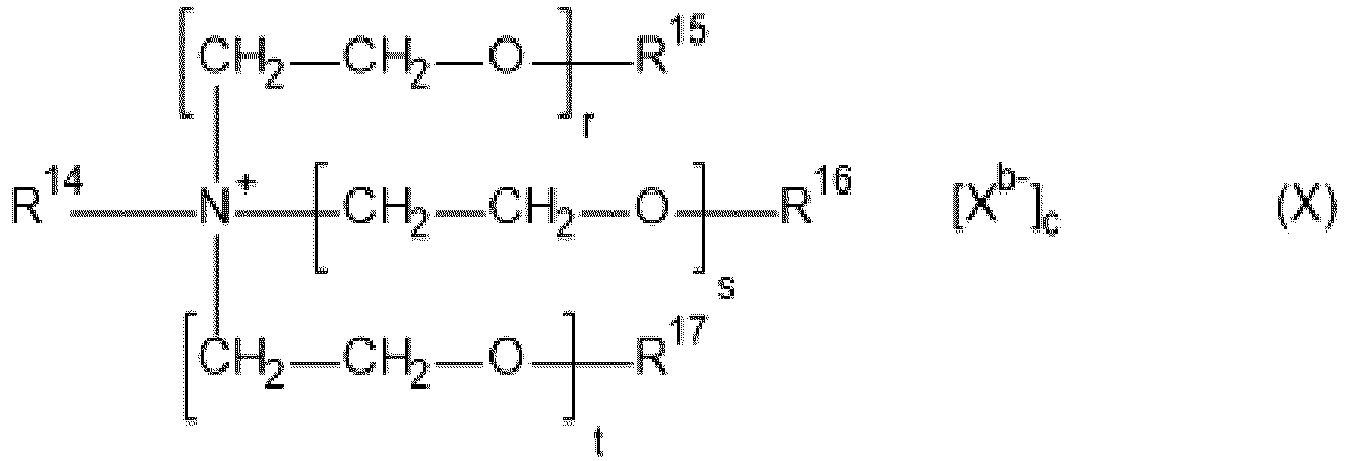
- R14
- is a linear or branched, preferably linear, saturated alkyl group having from 1 to 6 carbon atoms;
- R15, R16 and R17
- are equal or different and are independently selected from the group consisting of hydrogen, linear or branched saturated alkyl groups having from 1 to 18 carbon atoms, linear or branched unsaturated alkenyl groups having one or more double bonds and from 2 to 18 carbon atoms, and -CO-R18;
- R18
- is a linear or branched saturated alkyl group having 7 to 19 carbon atoms or a linear or branched unsaturated alkenyl group having one or more double bonds and 7 to 19 carbon atoms;
- r, s and t
- are equal or different and are independently a number from 0 to 50;
- X
- is an inorganic or organic anion having the charge b-;
- b
- is a number from 1 to 4; and
- c
- is a number having a value of 1/b;
- Particularly preferred are dishwasher detergents of the invention, wherein at least one surfactant of the one or more surfactants, and preferably the one or more surfactants of component Z5) of the dishwasher detergents of the invention are selected from the group consisting of the compounds formula (X), wherein
- R14
- is methyl,
- R15, R16 and R17
- are equal or different and are independently selected from the group consisting of hydrogen and -CO-R18; and R18 is a linear or branched saturated alkyl group having 7 to 19 carbon atoms or a linear or branched unsaturated alkenyl group having one or more double bonds and 7 to 19 carbon atoms; with the proviso that at least two of the groups R15, R16 and R17 are -CO-R18 which form an ester moiety with the oxygen atom of an ethoxy group;
- r, s and t
- are equal or different and are independently a number from 1 to 30; the sum of r + s + t is a number from 3 to 70;
- X
- is an inorganic or organic anion having the charge b-;
- b
- is 1, and
- c
- is 1.
- The variables "r", "s" and "t" in the one or more compounds of the formula (X) preferably represent molar averages, meaning that the dishwasher detergents of the invention may comprise a plurality of compounds of the formula (X) having different degrees of ethoxylation.
- Further preferred are dishwasher detergents of the invention wherein at least one surfactant of the one or more surfactants, and preferably the one or more surfactants of the component Z5) of the dishwasher detergents of the invention are selected from the group consisting of zwitterionic surfactants and anionic surfactants.
- The zwitterionic surfactants are preferably selected from the group consisting of C8 to C18 (preferably C12 to C18) amine oxides, sulfobetaines and hydroxylbetaines, such as N-alkyl-N,N-dimethylamino-1-propanesulfonate, where the alkyl group may be C9 to C18, preferably C10 to C14.
- The anionic surfactants are preferably selected from alkyl ethoxysulfates having a degree of ethoxylation of more than 3, more preferably 4 to 10, and especially preferably 6 to 8, and a chain length in the range from C8 to C16 and preferably C11 to C15. Also, branched alkyl carboxylates are preferred if the branching occurs in the middle and the average overall chain length is 10 to 18 and preferably 12 to 16 in the case of a side-chain length of 2 to 4 carbon atoms. One example thereof is 2-butyloctanoic acid. The anionic surfactant is commonly of a type having good solubility in the presence of calcium. Anionic surfactants of this kind are further represented by sulfobetaines, alkyl (polyethoxy)sulfates (AES), short-chain C6-C10 alkyl sulfates and alkylsulfonates. It has emerged that straight-chain fatty acids are ineffective because of their sensitivity toward calcium.
- The dishwasher detergents of the invention comprise the one or more surfactants of component Z5) preferably in amounts of 0 to 15 wt.-%, more preferably in amounts of 0 to 10 wt.-%, especially preferably in amounts of 0.5 to 7 wt.-% and particularly preferably in amounts of 3 to 7 wt.-%, based in each case on the total weight of the dishwasher detergent of the invention.
- The dishwasher detergents of the invention may comprise further ingredients which are commonly used in dishwasher detergents. In a further preferred embodiment of the invention, the dishwasher detergents of the invention comprise one or more substances selected from the group consisting of complexing agents, water, organic solvents, thickeners, foam inhibitors, color particles, silver protectants, agents for preventing the tarnishing of silver, dyes, fillers, microbicides, hydrotropes, antioxidants, enzyme stabilizers, fragrances, solubilizers, carrier materials, processing assistants, pigments, and pH modifiers.
- The dishwasher detergents of the invention may also comprise one or more builders.
- The builders and also other constituents which may be used in the dishwasher detergents of the invention are described for example in
US 2010/0160204 A1 andEP 1 757 676 A1 . - The dishwasher detergents of the invention preferably comprise one or more builders of the group consisting of carbonates, hydrogencarbonates, organic builders, preferably citrate, methylglycinediacetic acid (MGDA), silicates, phosphates, phosphonates, and alkali metal hydroxides.
- Preferred is the use of carbonate(s) and/or hydrogencarbonate(s), preferably alkali metal carbonate(s), more preferably sodium carbonate. These compounds are used preferably in amounts of 2 to 50 wt.-%, more preferably of 10 to 30 wt.-%, and especially preferably of 10 to 25 wt.-%, based on the total weight of the dishwasher detergent of the invention.
- The organic builders include polycarboxylates, polycarboxylic acids, polymeric carboxylates, aspartic acid, polyacetals, and dextrins.
- Useful organic builders include the polycarboxylic acids, which can be used in the form of the free acid and/or the sodium salts thereof, with polycarboxylic acids being understood to mean those carboxylic acids which carry more than one acid function. These are, for example, citric acid, adipic acid, succinic acid, glutaric acid, malic acid, tartaric acid, maleic acid, fumaric acid, sugar acids, aminocarboxylic acids, and nitrilotriacetic acid (NTA), and also mixtures thereof. The free acids typically also possess the property of an acidifying component, as well as their builder effect, and hence also serve to establish a lower and milder pH for the dishwasher detergents of the invention. Preferred in this context are citric acid, succinic acid, glutaric acid, adipic acid, gluconic acid, tartaric acid, and any desired mixtures thereof.
- Examples of customary aminocarboxylic acids which are preferred in the context of the present invention are ethylenediaminetetraacetic acid (EDTA), methylglycinediacetic acid (MGDA), and glutaminediacetic acid (GLDA). Mixtures can also be used.
- Also to be mentioned as further preferred builders are polymeric aminodicarboxylic acids, their salts, or their precursor substances. Particular preference is given to using polyaspartic acids, their salts and/or their derivatives.
- Particularly advantageous for the cleaning and rinse performance of dishwasher detergents of the invention is the use of citric acid and/or citrates in these compositions. Preference is therefore given to dishwasher detergents of the invention which comprise citric acid or a salt of citric acid, in which case the weight fraction of the citric acid or of the salt of citric acid is preferably from 2 to 50 wt.-%, more preferably 5 to 30 wt.-%, and especially preferably 10 to 30 wt.-%, based in each case on the total weight of the dishwasher detergent of the invention.
- In another preferred embodiment of the invention, the dishwasher detergents of the invention comprise MGDA as one of their builders. Dishwasher detergents of the invention comprise preferably 0.5 to 25 wt.-% and more preferably 2 to 25 wt.-% of MGDA, based on the total weight of the dishwasher detergent of the invention.
- Also suitable as organic builders are polymeric carboxylates. These are, for example, the alkali metal salts of polyacrylic acid or of polymethacrylic acid, examples being those having a relative molecular mass of 500 to 70 000 g/mol.
- Suitable polymeric carboxylates are, in particular, polyacrylates, preferably having a molecular mass of 2000 to 20 000 g/mol. By virtue of their superior solubility, preference may be given in turn, from this group, to the short-chain polyacrylates having molar masses of 2000 to 10 000 g/mol and more preferably of 3000 to 5000 g/mol.
- Additionally, suitable are copolymeric carboxylates. Suitable co-monomers are monoethylenically unsaturated dicarboxylic acids such as maleic acid, fumaric acid, maleic anhydride, itaconic acid, and citraconic acid. Especially suitable are copolymeric carboxylates of acrylic acid with methacrylic acid and of acrylic acid or methacrylic acid with maleic acid and/or fumaric acid. Having proved particularly suitable are copolymers of acrylic acid with maleic acid which contain 50 to 90 wt.-% of acrylic acid and 10 to 50 wt.-% of maleic acid. Their relative molecular mass, based on free acids, is preferably 2000 to 70 000 g/mol, more preferably 20 000 to 50 000 g/mol, and especially preferably 30 000 to 40 000 g/mol.
- It is also possible to use copolymers of at least one monomer from the group consisting of monoethylenically unsaturated C3-C10 monocarboxylic and/or C4-C10 dicarboxylic acids or their anhydrides, such as maleic acid, maleic anhydride, acrylic acid, methacrylic acid, fumaric acid, itaconic acid, and citraconic acid, with at least one hydrophilically or hydrophobically modified monomer as recited below.
- Suitable hydrophobic monomers are, for example, isobutene, diisobutene, butane, pentene, hexene, and styrene, olefins having 10 or more carbon atoms or mixtures thereof, such as, for example, 1-decene, 1-dodecene, 1-tetradecene, 1-hexadecene, 1-octadecene, 1-eicosene, 1-docosene, 1-tetracosene, and 1-hexacosene, C22 α-olefin, a mixture of C20-C24 α-olefins and polyisobutene having on average 12 to 100 carbon atoms per molecule.
- Suitable hydrophilic monomers are monomers having sulfonate or phosphonate groups, and also nonionic monomers with hydroxy function or alkylene oxide groups, and optionally further ionic or nonionic monomers.
- Examples of the above-recited hydrophilic monomers are allyl alcohol, isoprenol, methoxypolyethylene glycol (meth)acrylate, methoxypolypropylene glycol (meth)acrylate, methoxypolybutylene glycol (meth)acrylate, methoxypoly(propylene oxide-co-ethylene oxide) (meth)acrylate, ethoxypolyethylene glycol (meth)acrylate, ethoxypolypropylene glycol (meth)acrylate, ethoxypolybutylene glycol (meth)acrylate, and ethoxypoly(propylene oxide-co-ethylene oxide) (meth)acrylate. Polyalkylene glycols here may contain 3 to 50, preferably 5 to 40, and more preferably 10 to 30 alkylene oxide units per molecule.
- Particularly preferred monomers containing sulfonic acid groups here are 1-acrylamido-1-propanesulfonic acid, 2-acrylamido-2-propanesulfonic acid, 2-acrylamido-2-methylpropanesulfonic acid (2-acryloylamino-2-methylpropanesulfonic acid), 2-methacrylamido-2-methylpropanesulfonic acid, 3-methacrylamido-2-hydroxypropanesulfonic acid, allylsulfonic acid, methallylsulfonic acid, allyloxybenzenesulfonic acid, methallyloxybenzenesulfonic acid, 2-hydroxy-3-(2-propenyloxy)propanesulfonic acid, 2-methyl-2-propene-1-sulfonic acid, styrenesulfonic acid, vinylsulfonic acid, 3-sulfopropyl acrylate, 2-sulfoethyl methacrylate, 3-sulfopropyl methacrylate, sulfomethacrylamide, sulfomethylmethacrylamide, and also salts of the stated acids, such as their sodium, potassium or ammonium salts.
- Particularly preferred monomers containing phosphonate groups are vinylphosphonic acid and its salts.
- Furthermore, amphoteric polymers may also be used as builders.
- If the dishwasher detergents of the invention comprise one or more (co)polymeric carboxylates, the amount of these (co)polymeric carboxylates in the dishwasher detergent of the invention is preferably 0.5 to 20 wt.-% and more particularly 3 to 10 wt.-%, based on the total weight of the dishwasher detergent of the invention.
- Oxydisuccinates and other derivatives of disuccinates, preferably ethylenediaminedisuccinate, are also further preferred organic builders, which are frequently also referred to as cobuilders. In this case, ethylenediamine-N,N'-disuccinate (EDDS) is used preferably in the form of its sodium or magnesium salts. Further preferred as builder or co-builder in this context are also glyceroldisuccinates and glyceroltrisuccinates.
- Dishwasher detergents of the invention may as builders preferably comprise crystalline sheet-like sodium silicates of the formula NaMSixO2x+1 · yH2O, in which M is sodium or hydrogen, x is a number from 1.9 to 22, preferably from 1.9 to 4, with particularly preferred values for x being 2, 3 or 4, and y is a number from 0 to 33, preferably 0 to 20.
- The dishwasher detergents of the invention comprise preferably a weight fraction of the crystalline sheet-like silicate of the formula NaMSixO2x+1 · yH2O of 0.1 to 20 wt.-%, more preferably of 0.2 to 15 wt.-%, and especially preferably of 0.4 to 10 wt.-%, based in each case on the total weight of the dishwasher detergents of the invention.
- Also employable are amorphous sodium silicates having a Na2O:SiO2 modulus of 1:2 to 1:3.3, preferably of 1:2 to 1:2.8, and more preferably of 1:2 to 1:2.6, which are preferably dissolution-retarded and have secondary cleaning properties. Retarded dissolution relative to conventional amorphous sodium silicates may have been brought about in a variety of ways, as for example by surface treatment, compounding, compacting, densification, or by overdrying. For the purposes of this invention, the term "amorphous" is understood to mean that in x-ray diffraction experiments, the silicates provide none of the sharp x-ray reflections of the kind typical of crystalline substances, but instead invoke at most one or more maxima in the scattered x-radiation, with a latitude of several degree units of the diffraction angle.
- Alternatively, or in combination with the aforesaid amorphous sodium silicates, x-ray-amorphous silicates are used, whose silicate particles in electron diffraction experiments yield indistinct or even sharp diffraction maxima. This is to be interpreted to mean that the products have microcrystalline regions of ten to several hundred nm in size, with preference being given to values up to a maximum of 50 nm and more particularly up to a maximum of 20 nm. X-ray-amorphous silicates of this kind likewise have retarded dissolution in relation to the conventional waterglasses. Especially preferred are densified/compacted amorphous silicates, compounded amorphous silicates, and overdried x-ray-amorphous silicates.
- In accordance with the present invention it is preferred for these silicates, preferably alkali metal silicates, more preferably crystalline or amorphous alkali metal disilicates, to be present in the dishwasher detergents of the invention in amounts of 3 to 60 wt.-%, preferably of 8 to 50 wt.-%, and more particularly of 20 to 40 wt.-%, based in each case on the total weight of the dishwasher detergent of the invention.
- The phosphates have proven to be effective builders in relation to the cleaning performance. Among the multiplicity of phosphates available commercially, the greatest significance in the detergents industry is possessed by the alkali metal phosphates, especially pentasodium and/or pentapotassium triphosphate (sodium and/or potassium tripolyphosphate).
- Alkali metal phosphates here is the overarching designation for the alkali metal salts (especially sodium and potassium salts) of the various phosphoric acids, among which it is possible to differentiate metaphosphoric acids (HPO3)m and orthophosphoric acid H3PO4, as well as representatives of higher molecular mass. The phosphates here unite a number of advantages: they act as alkali metal carriers, prevent limescale deposits on machine components, and contribute to the cleaning performance.
- Phosphates particularly important technically are pentasodium triphosphate Na5P3O10 (sodium tripolyphosphate) and also the corresponding potassium salt pentapotassium triphosphate K5P3O10 (potassium tripolyphosphate). Also used preferably in accordance with the invention are the sodium potassium tripolyphosphates.
- Where phosphates are used in the dishwasher detergents of the invention, preferred compositions comprise phosphate(s), preferably alkali metal phosphate(s), more preferably pentasodium and/or pentapotassium triphosphate (sodium and/or potassium tripolyphosphate), in amounts of 2 to 50 wt.-%, preferably of 2 to 30 wt.-%, more preferably of 3 to 25 wt.-%, and especially preferably of 3 to 15 wt.-%, based in each case on the weight of the dishwasher detergent of the invention.
- Further builders which the dishwasher detergents of the invention may comprise are one or more phosphonates, which are frequently also referred to as cobuilders. The weight fraction of phosphonate, based on the total weight of the dishwasher detergent of the invention, is preferably 0.5 to 20 wt.-% and more preferably 1.0 to 10 wt.-%.
- The complex-forming phosphonates embrace a series of different compounds such as, for example, 1-hydroxyethane-1,1-diphosphonic acid (HEDP) or diethylenetriaminepenta(methylenephosphonic acid) (DTPMP). Particularly preferred are hydroxyalkane- and aminoalkanephosphonates. Among the hydroxyalkanephosphonates, particular significance, preferably as a cobuilder, is possessed by 1-hydroxyethane-1,1-diphosphonate (HEDP). It is used preferably as the sodium salt, with the disodium salt giving a neutral reaction and the tetrasodium salt an alkaline reaction (pH 9). Suitable aminoalkanephosphonates include ethylenediaminetetramethylenephosphonate (EDTMP), diethylenetriaminepentamethylenephosphonate (DTPMP), and also their higher homologs. They are used preferably in the form of the neutrally reacting sodium salts (e.g., as the hexasodium salt of EDTMP and/or as the hepta- and octasodium salt of DTPMP). From the class of the phosphonates, preference is given to using HEDP.
- Dishwasher detergents of the invention may comprise alkali metal hydroxides as further builders. These alkali metal carriers are preferably used only in small amounts, preferably in amounts of 10 wt.-% or less, more preferably 6 wt.-% or less, especially preferably 5 wt.-% or less, particularly preferably 0.1 to 5 wt.-%, and exceptionally preferably 0.5 to 5 wt.-%, based on the total weight of the dishwasher detergent of the invention.
- In a further preferred embodiment of the invention, the dishwasher detergents of the invention comprise one or more builders from the group of the organic builders. In one particularly preferred embodiment of the invention, the dishwasher detergents of the invention comprise one or more builders from the group consisting of citrate, methylglycinediacetic acid (MGDA), and ethylenediamine-N,N'-disuccinate (EDDS). In an especially preferred embodiment of the invention the dishwasher detergents of the invention comprise MGDA.
- The dishwasher detergents of the invention may comprise the aforesaid builders either individually or else in the form of mixtures of two, three, four or more builders.
- In one preferred embodiment of the invention the dishwasher detergents of the invention comprise no phosphate builders and no phosphate-based builders and preferably are phosphate-free.
- The dishwasher detergents of the invention comprise the one or more builders preferably in amounts of 2 to 50 wt.-%, more preferably in amounts of 10 to 30 wt.-%, and especially preferably in amounts of 10 to 25 wt.-%, based in each case on the total weight of the dishwasher detergent of the invention.
- A protein and/or enzyme may be protected, particularly during storage, against forms of damage such as inactivation, denaturing or disintegration (as a result, for example, of physical influences, oxidation or proteolytic cleavage). Where the proteins and/or enzymes are obtained microbially, inhibition of proteolysis is particularly preferred, especially if the dishwasher detergents of the invention also comprise proteases. Dishwasher detergents of the invention may comprise stabilizers for this purpose. The provision of such agents in dishwasher detergents of the invention represents a preferred embodiment of the present invention.
- Preference is given in particular to those dishwasher detergents which comprise 0.1 to 12 wt.-%, more preferably 0.2 to 10 wt.-%, and especially preferably 0.5 to 8 wt.-%, of enzyme preparation, based in each case on the total weight of the dishwasher detergent of the invention.
- The cleaning performance of dishwasher detergents of the invention may be improved through the addition of organic solvents. In one preferred embodiment of the present invention, therefore, dishwasher detergents of the invention comprise at least one organic solvent. Preferred liquid dishwasher detergents of the invention comprise organic solvent in amounts of 0.2 to 15 wt.-%, more preferably in amounts of 0.5 to 12 wt.-%, and especially preferably in amounts of 1.0 to 10 wt.-%, based in each case on the total weight of the dishwasher detergent of the invention.
- These organic solvents are, for example, monoalcohols, diols, triols, polyols, ethers, esters and/or amides. Particularly preferred here are organic solvents which are water-soluble, with "water-soluble" solvents in the sense of the present specification being solvents which at room temperature are miscible with water completely (i.e., without a miscibility gap).
- The organic solvents from the group of the organic amines and/or the alkanolamines are effective in relation to the cleaning performance and especially in relation to the cleaning performance on bleachable stains, particularly on tea stains.
- The dishwasher detergents of the invention may have thickeners added to them. In the dishwasher detergents of the invention it is possible to use the thickeners that are typically used in dishwasher detergents.
- The respective dishwasher detergents of the invention advantageously comprise the thickener in amounts which are preferably from 0.1 to 8 wt.-%, more preferably from 0.2 to 6 wt.-%, and especially preferably from 0.4 to 4 wt.-%, based on the total weight of the dishwasher detergent of the invention.
- The foam inhibitors, color particles, silver protectants, agents for preventing the tarnishing of silver, metal corrosion inhibitors, dyes, fillers, microbicides, hydrotropes, antioxidants, enzyme stabilizers, fragrances, solubilizers, carrier materials, processing assistants, pigments, and pH modifiers may be selected from the corresponding substances which are typically used in dishwasher detergents.
- As used herein, a tableting aid may be understood in the broadest sense as generally understood in the art. Typically, a tableting agent supports the formation of a compact and cohesive tablet when formed from the other ingredients. In a preferred embodiment, the tableting aid is selected from one or more types of polyethylene glycol (PEG), one or more polysaccharides (e.g., cylclodextrine, starch, cellulose) and derivatives thereof (e.g., methyl cellulose, hydroxymethyl cellulose, starch derivatives). In a preferred embodiment, the tableting aid has a mean molecular weight (e.g., determined by means of size exclusion chromatography) of more than 500 Da, of more than 100 Da, or of more than 5000 Da.
- Suitable polymers of component Z8) include washing or cleaning-active polymers, for example rinse aid polymers and/or polymers which act as softeners. In general, the dishwasher detergent of the present invention may include, as polymers of component Z8), nonionic, cationic, anionic and/or amphoteric polymers.
- Cationic polymers in the context of the present invention are polymers which carry a positive charge in the polymer molecule. This can be realized, for example, by (alkyl) ammonium groups or other positively charged groups present in the polymer chain. Particularly preferred cationic polymers come from the groups of quaternized cellulose derivatives, polysiloxanes with quaternary groups, cationic guar derivatives, polymeric dimethyldiallylammonium salts and their copolymers with esters and amides of acrylic acid and methacrylic acid, copolymers of vinylpyrrolidone with quaternized derivatives of dialkylaminoacrylates and methacrylates, vinylpyrrolidone-methoimidazolinium chloride copolymers, quaternized polyvinyl alcohols, or polymers having the INCI names polyquaternium 2, polyquaternium 17, polyquaternium 18 and polyquaternium 27.
- If cationic polymers are used in component Z8), they are preferably selected from copolymers comprising polyalkylene oxide groups and quaternary nitrogen atoms. More preferably the cationic polymers of component Z8) are copolymers comprising 0.1 to 99.9 mol-%, preferably 20.0 to 80.0 mol-%, more preferably 22.0 to 77.6 mol-% of one or more cationic structural units (D); and
0.1 to 99.9 mol-%, preferably 0.4 to 20.0 mol-%, more preferably 0.5 to 4.4 mol-% of one or more macromonomeric structural units (E),
wherein the one or more cationic structural units (D) are represented by the following general formulae (XI) and/or (XII):

R20, R22, R23 and R24 are equal or different and are independently selected from the group consisting of hydrogen, an aliphatic hydrocarbon residue having 1 to 20, preferably 1 to 4 carbon atoms, a cycloaliphatic hydrocarbon residue having 5 to 20, preferably 5 to 8 carbon atoms, an aryl group having 6 to 14 carbon atoms and/or polyethylene glycol (PEG), and preferably are equal or different and independently selected from the group consisting of hydrogen and/or methyl, and particularly preferably are methyl;
Y is the same or different and is selected from oxygen, NH and/or NR22,
V is the same or different and is selected from -(CH2)x-,
X and X1 are equal or different and are independently selected from a halogen atom, C1 to C4-alkylsulfate and/or C1 to C4 alkylsulfonate; and
the one or more macromonomeric structural units (E) are represented by the following general formula (XIII):
- R25
- is the same or different and is H and/or methyl;
- Z
- is the same or different and is C=O and/or O(CH2)4, preferably O(CH2)4,
- u
- is, on molar average, a number from 0 to 7, preferably from 0 to 6; and
- v
- is, on molar average, a number from 1 to 150, preferably from 11 to 150, more preferably from 12 to 150.
- In these cationic polymers the molar amounts of the structural units (D) and (E) are based on the total weight of the cationic polymer.
- The cationic polymers comprising structural units (D) and E) may preferably also comprise structural units resulting from the polymerization of further monomers such as further nonionic monomers, preferably amides and more preferably N,N-dimethyl acrylamide.
- Amphoteric polymers in the context of the present invention have, alongside positively charged groups, also negatively charged groups or monomeric units in the polymer chain. These negatively charged groups or monomeric units may be derived, e.g. from carboxylic acids, sulfonic acids ot phosphonic acids.
- Preferable amphoteric polymers applicable in component Z8) of the dishwasher detergent of the invention are selected from the group consisting of alkylacrylamide/acrylic acid-copolymers, alkylacrylamide/methacrylic acid copolymers, alkylacrylamide/methylmethacrylic acid copolymers, alkylacrylamide/acrylic acid/alkyl aminoalkyl(meth)acrylic acid copolymers, alkylacrylamide/methacrylic acid/alkylaminoalkyl(meth)acrylic acid copolymers, alkylacrylamide/methylmethacrylic acid/alkylaminoalkyl(meth)acrylic acid copolymers, alkylacrylamide/alkylmethacrylate/alkylaminoethylmethacrylate/alkylmethacrylate copolymers, and copolymers of unsaturated carboxylic acids, cationically derivatized unsaturated carboxylic acids and optionally further ionic or not-ionogenic monomers. Further preferably applicable amphoteric polymers are selected from the group consisting of acrylamidoalkyl-trialkylammonium chloride/acrylic acid copolymers and their alkaline metal or ammonium salts, acrylamidoalkyl-trialkylammonium chloride/methacrylic acid copolymers and their alkaline metal or ammonium salts, and methacroylethylmetaine/methacrylate copolymers.
- If the dishwasher detergent of the invention contains cationic and/or amphoteric polymers in component Z8), these polymers are preferably present in amounts of from 0.01 to 10 wt.-%, based on the total weight of the dishwasher detergent of the invention. In the context of the present invention, preference is given to those dishwasher detergents, in which the weight fraction of the cationic and/or amphoteric polymers is from 0.01 to 8 wt.-%, preferably 0.01 to 4 wt.-%, more preferably from 0.01 to 2 wt.-%, especially preferably 0.01 to 1 wt.-%, based on the total weight of the dishwasher detergent of the invention.
- Another group of preferably applicable polymers applicable in component Z8) of the dishwasher detergent of the invention are alkoxylated polyalkyleneimines.
- Alkoxylated polyalkyleneimines have a polyalkyleneimine backbone and alkoxy chains. Preferably, the polyalkyleneimine is polyethyleneimine. More preferably, the alkoxylated polyalkyleneimine is not quaternized.
- If the dishwasher detergent comprises alkoxylated polyalkyleneimines in component Z8), it preferably comprises from 1% to 10 wt.-%, more preferably from 1% to 8 wt.-% of alkoxylated polyalkyleneimines, based on the total weight of the dishwasher detergent of the invention.
- Preferably, the alkoxylated polyalkyleneimine used in component Z8) comprises 0.5 to 40 wt.-%, more preferably 1 to 30 wt.-%, especially preferably 2 to 20 wt.-% of the polyalkyleneimine backbone and
60 to 99 wt.-%, more preferably 60 to 95 wt.-%, especially preferably from 60 to 90 wt.-% of the alkoxy chains. - Preferably, the alkoxy chains have an average of from about 1 to about 50, more preferably from about 2 to about 40, especially preferably from about 3 to about 30, particularly preferably from about 3 to about 20, and exceptionally preferably from about 4 to about 15 alkoxy units, which are preferably ethoxy units. In other suitable alkoxylated polyalkyleneimines for use in component Z6), the alkoxy chains have an average of from about 0 to 30, more preferably from about 1 to about 12, especially preferably from about 1 to about 10 and particularly preferably from about 1 to about 8 propoxy units. Exceptionally preferred are alkoxylated polyethyleneimines wherein the alkoxy chains comprise a combination of ethoxy and propoxy chains, in particular polyethyleneimines comprising chains of from 4 to 20 ethoxy units and from 0 to 6 propoxy units.
- Preferably, the alkoxylated polyalkyleneimine is obtained from alkoxylation wherein the starting polyalkyleneimine has a weight-average molecular weight of from about 100 to about 60,000, preferably from about 200 to about 40,000, more preferably from about 300 to about 10,000 g/mol. In a preferred embodiment, a polyethyleneimine with a weight average molecular weight of 600 g/mol ethoxylated with 20 EO groups per NH group is used as the alkoxylated polyalkyleneimine.
- Other suitable polyalkyleneimines for applicable in component Z8) of the dishwasher detergent of the invention include compounds having the following general structure: bis((C2H5O)(C2H4O)n)(CH3)-N+-C2H2x-N+-(CH3)-bis((C2H5O)(C2H40)n), wherein n is a number from 20 to 30, and x is a number from 3 to 8, or sulfated or sulfonated variants thereof.
- In a preferred embodiment, the dishwasher detergent of the invention comprises 0.5 to 30 wt.-%, preferably 1 to 25 wt.-%, more preferably 2 to 20 wt.-%, especially preferably 3 to 15 wt.-%, and particularly preferably 5 to 10 wt.-% of component Z1), based in each case on the total weight of the dishwasher detergent of the invention. In an alternative preferred embodiment, the dishwasher detergent of the invention comprises 7 to 20 wt.-%, preferably 10 to 18 wt.-%, and more preferably 12 to 15 wt.-% of component Z1), based in each case on the total weight of the dishwasher detergent of the invention.
- In a preferred embodiment, ratio of surfactant which is on magnesium carbonate to magnesium carbonate is in the range of 0.1 : 10 to 10: 0.1, or in the range of 0.5 : 5 to 5: 0.5, or in the range of 0.7 : 2 to 2: 0.7.
- In a preferred embodiment, the dishwasher detergent comprises 0.1 to 20 wt.-%, preferably 0.5 to 15 wt.-%, more preferably 5 to 10 wt.-%, especially preferably 2 to 5 wt.-%, and particularly preferably 3 to 4 wt.-% of surfactant which is comprised on magnesium carbonate in component Z1), based in each case on the total weight of the dishwasher detergent of the invention.
- In a preferred embodiment, the dishwasher detergent comprises 1 x 10⁻⁶ to 5 wt.-% of component Z2), based on the total weight of the dishwasher detergent of the invention.
- In a preferred embodiment, the dishwasher detergent comprises 0.01 to 10 wt.-%, preferably 0.1 to 5 wt.-%, more preferably 0.2 to 4 wt.-%, even more preferably 0.4 to 3 wt.-%, 0.5 to 2 wt.-% or 0.2 to 1 wt.-%, of component Z3), based in each case on the total weight of the dishwasher detergent of the invention,.
- In a preferred embodiment, the dishwasher detergent comprises 0 to 40 wt.-%, preferably 1 to 40 wt.-%, more preferably 2 to 20 wt.-%, even more preferably 5 to 10 wt.-%, of component Z4), based in each case on the total weight of the dishwasher detergent of the invention.
- In a preferred embodiment, the dishwasher detergent comprises 0 to 50 wt.-%, preferably 0 to 15 wt.-%, more preferably 0 to 10 wt.-%, even more preferably 0.5 to 7 wt.-%, and especially preferably 3 to 7 wt.-%, of component Z5), based in each case on the total weight of the dishwasher detergent of the invention.
- In a preferred embodiment, the dishwasher detergent comprises 0 to 80 wt.-%, preferably 0 to 70 wt.-%, more preferably 0 to 60 wt.-%, of component Z6), based in each case on the total weight of the dishwasher detergent of the invention (e.g., including 2 to 50 wt.-% of one or more builders, based on the total weight of the dishwasher detergent).
- In a preferred embodiment, the dishwasher detergent comprises 0 to 50 wt.-%, preferably 0.1 to 40 wt.-%, more preferably 0.5 to 20 wt.-%, even more preferably 1 to 10 wt.-%, of component Z7), based in each case on the total weight of the dishwasher detergent of the invention.
- In a preferred embodiment, the dishwasher detergent comprises 0 to 10 wt.-%, of component Z8), based on the total weight of the dishwasher detergent of the invention.
- With particular preference the dishwasher detergents of the invention comprise
- Z1) 0.5 to 30 wt.-%, preferably 1 to 25 wt.-%, more preferably 2 to 20 wt.-%, especially preferably 3 to 15 wt.-%, and particularly preferably 5 to 10 wt.-% of component Z1),
- Z2) 1 x 10⁻⁶ to 5 wt.-% of component Z2), and
- Z3) 0.01 to 10 wt.-%, preferably 0.1 to 5 wt.-%, preferably 0.2 to 4 wt.-%, preferably 0.4 to 3 wt.-%, preferably 0.5 to 2 wt.-% or 0.2 to 1 wt.-%, of component Z3), and optionally
- Z4) 0 to 40 wt.-% of component Z4), and optionally
- Z5) 0 to 50 wt.-%, preferably 0 to 15 wt.-%, preferably 0 to 10 wt.-%, more preferably 0.5 to 7 wt.-%, and especially preferably 3 to 7 wt.-% of component Z5), and optionally
- Z6) 0 to 80 wt.-%, preferably 0 to 70 wt.-%, preferably 0 to 60 wt.-%, more of component Z6), and optionally
- Z7) 0 to 50 wt.-%, preferably 0.1 to 40 wt.-%, preferably 0.5 to 20 wt.-%, preferably 1 to 10 wt.-%, of component Z7), and optionally
- Z8) 0 to 10 wt.-% of component Z8),
- The dishwasher detergents of the invention may be produced in solid form and also as a combination of solid and liquid presentation forms.
- Preferred dishwasher detergents of the invention are those which are solid at 20°C or in which at least one phase is solid. Suitable solid presentation forms include, in particular, powders, granules, extrudates or compacts, especially tablets, in single-phase or multiphase form. Tablets are formulated for single-dose applications. The solid compositions of the invention preferably comprise 20 wt.-% or less than 20 wt.-% of water, more preferably 0.1 to 20 wt.-% of water, and especially preferably 0.5 to 5 wt.-% of water, based in each case on the total weight of the dishwasher detergent of the invention. In another preferred embodiment of the invention, the dishwasher detergents of the invention are anhydrous.
- In one especially preferred embodiment of the invention, the dishwasher detergent of the invention is solid at 20°C and is in the form of a tablet.
- Preference is also given to detergent compositions for machine dishwashing according to the invention, which comprise dishwasher detergents of the invention and are enclosed in a water-soluble foil, preferably a polyvinyl alcohol containing foil.
- In the context of the present invention, the term "water soluble foil" means that the foil comprises a water-soluble polymer, copolymer or mixtures thereof in a weight fraction of at least 90 wt.-%, based on the weight of the foil. Water soluble polymers in the context of the present invention are polymers which are soluble in water at 25°C to an amount of more than 2.5 wt.-%, based on the amount of water.
- Preferable materials of the water soluble foil are at least partially composed of a substance selected from the group consisting of polyvinyl alcohols, acetalized polyvinyl alcohols, polyvinylpyrrolidones, gelatine, polyvinyl alcohols substituted with sulfate, carbonate and/or citrate, polyalkylene oxides such as polyethylene oxides, acrylamides, cellulose esters, cellulose ethers, celullose amides, cellulose, polyvinyl acetate, polycarboxylic acids and their salts, polyaminoacids or peptides, copolymers of acrylamides and (meth)acrylic acid, polysaccharides such as starch or guar derivatives, and compounds with the INCI names polyquaternium 2, polyquaternium 17, polyquaternium 18 and polyquaternium 27. In a particularly preferred embodiment, the material of the water-soluble foil comprises polyvinyl alcohol.
- In a further preferred embodiment of the invention, the material of the water-soluble foil comprises mixtures of different substances, such as copolymers. Such mixtures enable the adjustment of the mechanical properties of the foil and the container formed thereof and may affect the degree of water solubility. Preferably, the water-soluble foil contains at least one polyvinyl alcohol and/or at least one polyvinyl alcohol copolymer.
- A further subject of the invention is a method for cleaning dishware in a dishwasher, wherein soiled dishware is treated in a dishwasher with an aqueous alkaline composition comprising a dishwasher detergent of the invention.
- In the method of the invention for cleaning dishware, the pH of the aqueous alkaline composition is preferably 8 or more and more preferably 9 or more.
- The dishwasher detergent of the invention or surfactants on magnesium carbonate carrier Z1) of the dishwasher detergents of the invention may be advantageously suitable as rinse agent in machine dishwashing, preferably in a method of the invention for cleaning dishware in a dishwasher.
- A further subject of the present invention is therefore the use of a dishwasher detergent of the invention or of one or more surfactants on magnesium carbonate carrier Z1) of the dishwasher detergents of the invention may be for use as a rinse agent in machine dishwashing, preferably in a method of the invention for cleaning dishware in a dishwasher.
- The dishwasher detergents of the invention or the one or more surfactants on magnesium carbonate carrier Z1) of the dishwasher detergents of the invention are advantageously suitable for improving the wettability of dishware, for reducing the spotting and filming on dishware, for reducing, minimizing or preventing fatty residues in the machine department of an automatic dishwashing machine, for improving the rinse performance of a dishwasher detergent, preferably of a dishwasher detergent of the invention, or for improving the drying performance of a dishwasher detergent, preferably of a dishwasher detergent of the invention, more preferably in a method of the invention for cleaning dishware in a dishwasher.
- A further subject of the present invention is therefore the use of a dishwasher detergent of the invention or of one or more surfactants on magnesium carbonate carrier Z1) of the dishwasher detergents of the invention for improving the wettability of dishware or for reducing spotting and filming on dishware, preferably in a method of the invention for cleaning dishware in a dishwasher.
- A further subject of the present invention is the use of a dishwasher detergent of the invention or of one or more surfactants on magnesium carbonate carrier Z1) of the dishwasher detergents of the invention for reducing, minimizing or preventing fatty residues in the machine department of an automatic dishwashing machine, preferably in a method of the invention for cleaning dishware in a dishwasher.
- A further subject of the present invention is the use of a dishwasher detergent of the invention or of one or more surfactants on magnesium carbonate carrier Z1) of the dishwasher detergents of the invention for improving the rinse performance of a dishwasher detergent, preferably of a dishwasher detergent of the invention, more preferably in a method of the invention for cleaning dishware in a dishwasher.
- A further subject of the present invention is the use of a dishwasher detergent of the invention or of one or more surfactants on magnesium carbonate carrier Z1) of the dishwasher detergents of the invention for improving the drying performance of a dishwasher detergent, preferably of a dishwasher detergent of the invention, more preferably in a method of the invention for cleaning dishware in a dishwasher.
- The preferred embodiments specified above for the dishwasher detergents of the invention are also valid correspondingly for the method of the invention for cleaning dishware in a dishwasher and also for the inventive use of the dishwasher detergents of the invention or of the one or more surfactants on magnesium carbonate carrier Z1) of the dishwasher detergents of the invention as rinse agents in machine dishwashing, for reducing, minimizing or preventing fatty residues in the machine department of an automatic dishwashing machine, for improving the wettability of dishware, for reducing the spotting and filming on dishware, for improving the rinse performance of a dishwasher detergent, preferably of a dishwasher detergent of the invention, and for improving the drying performance of a dishwasher detergent, preferably of a dishwasher detergent of the invention.
- The invention is elucidated in more detail below by means of examples, without being limited to these examples. Insofar as not explicitly stated otherwise in the examples, the percentages in the examples are to be understood as percentages by weight (wt.-%).
- Abbreviations used are as follows:
a.i. active ingredient MGDA-Na3 methylglycinediacetic acid, trisodium salt Polycarboxylate commercially available as Sokalan® PA 30 CL from BASF TAED Tetraacetylethylenediamine HEDP 1-hydroxyethane-1,1-diphosphonate Genapol® EC50 nonionic modified fatty alcohol polyglycol ether commercially available from Clariant (surfactant according to formula (XI)) (Clariant, Switzerland) - The drying performance of the detergent composition for machine dishwashing F1 (dishwasher detergents according to the invention) was investigated.
Testing conditions: Dishwashing machine: Miele G 1222 SC GSL-2 Testware dishes: 10 appetizer spoons 10 appetizer forks 10 appetizer knives 10 teaspoons 2 vegetable serving spoons 12 drinking glasses 10 porcelain cups 25 porcelain plates 3 SAN (poly-styrene-co-acrylonitrile) plates 3 PP (polypropylene) plates 6 PP bowls Dishwashing program: P4R0 without pre-rinsing main rinse at 50°C final rinse at 65°C Water hardness: 21 °dH Wasser softening: none Detergent dosage: 18 g, added into the detergent tablet tray immediately after opening of the dosing chamber Contamination: 50 g frozen dirt, added immediately after opening of the dosing chamber Rinse aid: none Cleaning cycles: 4 - All items were treated once with demineralized water, Neodisher A 8, citric acid, and demineralized water.
- Evaluation of the testware was started 30 minutes after the dishwashing cycle was completed. During this time, the dishwasher door was closed. For each test, dishwashing cycles 2 to 4 were evaluated. The assessment was carried out in each case with an illumination of 1000 - 1500 lux.
- In a fixed order and with a set time limit, the number of adherent drops of residual water was counted for each testware item. Depending on the counted number of drops, the following rating of the drying performance results for each testware item:
Rating for porcelain, stainless steel and glass: 0 dry, no water drops 1 1 water drop 2 2 water drops 3 3 water drops 4 4 water drops 5 5 water drops 6 more than 5 water drops Rating for plastics: 0 dry, no water drops 1 1 water drop 2 2 water drops 3 3 water drops 4 4 water drops 5 5 water drops 6 6 water drops 7 7 water drops 8 more than 7 water drops - In this rating scheme, there is a score of 0 for best performance and a score of 6 for worst performance for each testware dish made of porcelain, stainless steel or glass and a score of 8 for the worst performance for each testware dish made of plastic. For each dishwashing cycle 2, 3 and 4, the sum of the scores of all test dishes was formed. The overall result is categorized into performance groups:
○ = bad results + = good results ++ = very good results - Furthermore, the fatty residues in the machine department of the automatic dishwashing machine and in particular on plastic parts (e.g. filter, rinse aid chamber) of the machine department of the dishwashing machine were evaluated. The overall result is categorized into performance groups:
○ = bad results + = good results ++ = very good results - The composition of the formulation F1 is shown in the following Table A.
- The rinse performance of the formulation F1 according to the invention was investigated.
Testing conditions: Dishwashing Machine: Miele G 1222 SC GSL Testware dishes: 6 drinking glasses (higher quality) (8 material groups) 6 drinking glasses (lower quality) 3 PP bowls 3 melamine plates 3 butter dishes + 4 knives (stainless steel; lower quality) 4 knives (stainless steel; higher quality) 3 porcelain plates (higher quality) 3 porcelain plates (lower quality) Dishwashing program: program 4, R = 2 without pre-rinsing main rinse at 50°C final rinse at 65°C Water hardness: 21 °dH Water softening: none Detergent dosage: 18 g, added to the dosage chamber before starting the test Contamination: 100 g frozen dirt, added immediately after the opening of the dosage chamber Rinse aid: none Cleaning cycles: 4 - All testware dishes except for the PP bowls were treated once with demineralized water, Neodisher A 8, citric acid and again demineralized water.
- Evaluation of the testware was begun at least 60 minutes after opening the door of the dishwashing machine after completion of the dishwashing cycle. For each test, dishwashing cycles 2 to 4 were evaluated. The assessment was carried out according to the following rating:
Rinse performance effects considered for the visual rating: Stains Stains of different size and intensity Contact spots Stains resultant from contact points between the testware dishes and parts of the dishwashing machine Stripes Rinse aid stripes Film formation continuous film spread uniformly on the testware dishes Structured film formation Dispersed torn film Solid residues Solid powder or crystalline residues Fatty residues Fatty drops or fatty film formation Iridescence Shimmering, iridescence Visual rating marks: 10 Perfect 9 Perfect to barely visible 8 Barely visible 7 Barely visible to visible 6 Visible 5 Visible to disturbing 4 Disturbing 3 Disturbing to unacceptable 2 Unacceptable 1 Absolutely unacceptable - The combination of the above listed eight rinse performance effects leads to a rating from 1 to 10 according to the above visual rating marks, wherein a rating of 1 represents the worst performance and a rating of 10 represents the best performance. For each of the above 8 testware material groups in each dishwashing cycle, an average rating was determined, followed by calculating the sum of ratings for all material groups in each individual dishwashing cycle, followed by determining an average rating for the entirety of dishwashing cycles 2 to 4. The resultant average rating was used as the final rinse performance of the formulation F1 and is categorized into performance groups:
○ = bad results + = good results ++ = very good results - The composition of the formulation F1 according to the invention is shown in the following table A. The results are also shown in Table A.
Table A: Composition, drying performance, fatty residues and rinse performance of formulation F1 Component F1 wt.-%*) Trisodium citrate Dihydrate 28.5 Sodium carbonate 19.5 Sodium silicate (Britesil H20® (PQ Corp., PA, USA)) 2.0 MGDA-Na3 (Trilon® M Max Granules (BASF SE, Germany)) 15.0 Polycarboxylate (Sokalan® PA 30 CL (BASF SE, Germany)) 10.0 Natriumpercarbonate (Oxyper SCS® (Solvay, Belgium)) 9.0 TAED (Peractive AC white® (WeylChem, Germany)) 2.0 HEDP 0.9 Protease (Blaze Evity 100T®, Novozymes, Denmark) 0.9 Amylase (Stainzyme 120T®, Novozymes, Denmark) 0.9 Water 6.0 Polyethyleneglycol (PEG6000) 2.0 Zinc salt (Zinc sulfate) 0.5 50 wt.-% Genapol® EC50 on magnesium carbonate carrier (1) 3.5*** (7.0)**** Sodium sulfate Ad 100**) Technical performance: drying performance + rinse performance ++ Fatty residues ++ o = bad results
+ = good results
++ = very good results
*) The ingredients were added according to their active component content in wt.-%.
**) Sodium sulfate is added as a filler for a constant mass balance of the dishwasher detergent, without a function and without influence on the performance of the dishwasher detergent.
***) Active content of the surfactant on magnesium carbonate carrier in wt.-% (i.e., mass content of surfactant (without magnesium carbonate carrier) which is on magnesium carbonate carrier)
****) content of the surfactant on magnesium carbonate carrier in wt.-% (i.e., sum of the mass content of surfactant (which is on magnesium carbonate carrier) and magnesium carbonate carrier) - From the results in the above table A it is evident that the use of the dishwasher detergent F1 lead to good to very good results in the rinse and drying performance along with no significant fatty residues in the machine department of the automatic dishwashing machine and in particular on plastic parts of the machine department.
- Replacing Genapol® EC50 on magnesium carbonate carrier (3.5 wt.-% in surfactant) in F1 by Genapol® EC50 without carrier (F1') significantly more fatty residues are observed in the machine department of the automatic dishwashing machine and in particular on plastic parts of the machine department (see Table B).
Table B: Fatty residues of formulations F1, F1' Surfactant F1 wt.-%*) F1' wt.-%*) 50 wt.-% Genapol® EC50 on magnesium carbonate carrier (1) 3.5*** (7.0)**** - Genapol® EC50 - 3.5 Technical performance: Fatty residues ++ ○ ○ = bad results
+ = good results
++ = very good results
the sum of r + s + t is a number from 1 to 70; and
if one or more of r, s and/or t is 0, the corresponding group R15, R16 and/or R17 is a linear or branched saturated alkyl group having 1 to 18 carbon atoms or a linear or branched unsaturated alkenyl group having one or more double bonds and 2 to 18 carbon atoms.
Claims (16)
- A dishwasher detergent comprisingZ1) one or more surfactants on magnesium carbonate carrier which are selected from the group consisting of fatty alcohol alkoxylates and end-capped fatty alcohol alkoxylates of the formula (XI)
RaO-(AO)x-Y (XI),
in whichRa is a linear or branched saturated alkyl group having 8 to 30 carbon atoms, or a linear or branched unsaturated alkenyl group having one or more double bonds and 8 to 30 carbon atoms,A is selected from the group consisting of -C2H4- and -C3H6-,x is a number from 1 to 150,Y is a group -CH2-CH(OH)-Rb, Rb is a linear or branched saturated alkyl group having 1 to 30 carbon atoms, and where the group -(AO)x- comprises one or more -C2H4-O-groups and may additionally comprise one or more -C3H6-O- groups, and, when the group -(AO)x- simultaneously comprises -C2H4-O- and -C3H6-O- groups, the -C2H4-O- and -C3H6-O- groups may be distributed over the -(AO)x- group in any desired way, preferably in random, gradient-like or block-like manner and more preferably in block-like manner, and the molar amount of the -C2H4-O- groups in the group -(AO)x- is preferably greater than the molar amount of the -C3H6-O- groups in the group -(AO)x-;Z2) one or more enzymes; andZ3) one or more glass corrosion inhibitors. - The dishwasher detergent according to claim 1, characterized in that Y is -CH2-CH(OH)-Rb, wherein Rb is a linear or branched saturated alkyl group having 8 to 22 and preferably 8 to 20 carbon atoms.
- The dishwasher detergent according to claim 1 or 2, characterized in that:the molar amount of the -C3H6-O- groups in the group -(AO)x-, based on the total amount of -C2H4-O- and -C3H6-O- groups in the group -(AO)x-, is 20% or less than 20% and preferably 10% or less than 10%; orin formula (XI) the group -(AO)x- comprises on molar average 8 -C2H4-O- groups and 4 -C3H6-O- groups and Ra is a linear or branched saturated alkyl group having 12 to 15 carbon atoms, or a linear or branched unsaturated alkenyl group having one or more double bonds and 12 to 15 carbon atoms.
- The dishwasher detergent according to one or more of claims 1 to 3, characterized in that it comprises at least one surfactant, preferably one or more surfactants on magnesium carbonate carrier of component Z1), selected from the group consisting of the end-capped fatty alcohol ethoxylates of the formula (XI) in whichRa is a linear or branched saturated alkyl group having 8 to 20 carbon atoms, or a linear or branched unsaturated alkenyl group having one or more double bonds and 8 to 20 carbon atoms,A is -C2H4-,x is a number from 15 to 25,Y is -CH2-CH(OH)-Rb, wherein Rb is a linear or branched saturated alkyl group having 8 to 22 and preferably 8 to 20 carbon atoms.
- The dishwasher detergent according to one or more of claims 1 to 4, characterized in that the one or more glass corrosion inhibitors of component Z3) are selected from the group consisting of, preferably water-soluble, salts or complexes of one or more cations selected from the group consisting of zinc, magnesium, cobalt, bismuth, and combinations of two or more thereof.
- The dishwasher detergent according to one or more of claims 1 to 5, characterized in that it further comprises at least one further surfactant which is optionally on magnesium carbonate carrier selected from the group consisting of:(a) N-acylglucamides of the formula (XII),
 Rb is a linear or branched saturated alkyl group having 11 to 21 carbon atoms, or a linear or branched unsaturated alkenyl group having one or more double bonds and 11 to 21 carbon atoms, andRc is hydrogen or a linear or branched saturated alkyl group having 1 to 4 carbon atoms and preferably a methyl or an ethyl group,preferably wherein, in the formula (XII), Rc is a methyl group and/or RbCO derives from oleic acid;(b) glycerol triester ethoxylates of formula (I),
 R1, R2 and R3 are equal or different and are independently selected from linear or branched saturated alkyl groups having 7 to 25 carbon atoms or linear or branched unsaturated alkenyl groups having one or more double bonds and 7 to 25 carbon atoms;m, n and o are equal or different and are each independently a number from 1 to 200, preferably from 1 to 80, more preferably from 2 to 70, with the proviso that the number-average of the sum of m + n + o is greater than 5, preferably from 20 to 70, more preferably from 30 to 60,preferably wherein at least one glycerol triester ethoxylate of formula (I) is prepared from ethylene oxide and one or more triglycerides of formula (II)
the calcium catalyst (C) is a catalyst obtainable by a reaction involving(A) calcium hydroxide and(B) a carboxylic acid comprising 3 to 40 carbon atoms,wherein the molar ratio of calcium hydroxide (A) to carboxylic acid (B) in the preparation of the catalyst (C) is from 1:1 to 1:5;(c) compounds of formula (X),preferably, wherein the dishwasher detergent is characterized in that it further comprises at least one further surfactant which is optionally on magnesium carbonate carrier selected from the group consisting of (a), (b) and a combination of (a) and (b). R14 is a linear or branched, preferably linear, saturated alkyl group having from 1 to 6 carbon atoms;R15, R16 and R17 are equal or different and are independently selected from the group consisting of hydrogen, linear or branched saturated alkyl groups having from 1 to 18 carbon atoms, linear or branched unsaturated alkenyl groups having one or more double bonds and from 2 to 18 carbon atoms, and -CO-R18;R18 is a linear or branched saturated alkyl group having 7 to 19 carbon atoms or a linear or branched unsaturated alkenyl group having one or more double bonds and 7 to 19 carbon atoms;r, s and t are equal or different and are independently a number from 0 to 50;X is an inorganic or organic anion having the charge b-;b is a number from 1 to 4; andc is a number having a value of 1/b;with the proviso that at least one group of R15, R16 and R17 is -CO-R18 which forms an ester moiety with the oxygen atom of an ethoxy group;
the sum of r + s + t is a number from 1 to 70; and
if one or more of r, s and/or t is 0, the corresponding group R15, R16 and/or R17 is a linear or branched saturated alkyl group having 1 to 18 carbon atoms or a linear or branched unsaturated alkenyl group having one or more double bonds and 2 to 18 carbon atoms,
preferably wherein, in formula (X),R14 is methyl,R15, R16 and R17 are equal or different and are independently selected from the group consisting of hydrogen and -CO-R18; and R18 is a linear or branched saturated alkyl group having 7 to 19 carbon atoms or a linear or branched unsaturated alkenyl group having one or more double bonds and 7 to 19 carbon atoms; with the proviso that at least two of the groups R15, R16 and R17 are -CO-R18 which form an ester moiety with the oxygen atom of an ethoxy group;r, s and t are equal or different and are independently a number from 1 to 30; the sum of r + s + t is a number from 3 to 70;X is an inorganic or organic anion having the charge b-;b is 1; andc is 1; or(d) a combination of two or more thereof, such as a combination of (a) and (b), of (a) and (c), of (b) and (c), or pf (a), (b) and (c), - The dishwasher detergent according to one or more of claims 1 to 6, characterized in that component Z1) comprises the one or more surfactants in an amount ranging from 10 to 300 wt.-%, preferably from 40 to 250 wt.-%, more preferably from 50 to 200 wt.-%, especially preferably from 60 to 170 wt.-%, and particularly preferably from 70 to 150 wt.-%, based on the total weight of the magnesium carbonate carrier.
- The dishwasher detergent according to one or more of claims 1 to 7, characterized in that it comprises the one or more surfactants on magnesium carbonate carrier of component Z1) in an amount from 0.5 to 30 wt.-% and preferably in an amount from 3 to 25 wt.-%, based in each case on the total weight of the dishwasher detergent.
- The dishwasher detergent according to one or more of claims 1 to 8, characterized in that the one or more enzymes of component Z2) are selected from the group consisting of proteases, amylases, lipases, hemicellulases, cellulases, perhydrolases, oxidoreductases, and mixtures thereof.
- The dishwasher detergent according to one or more of claims 1 to 9, characterized in that it comprises the one or more enzymes of component Z2) in an amount from 1 x 10⁻⁶ to 5 wt.-%, preferably in an amount from 1 x 10⁻⁵ to 3 wt.-%, and more preferably in an amount from 1 x 10⁻⁴ to 2 wt.-%, based in each case on the total weight of the dishwasher detergent.
- The dishwasher detergent according to one or more of claims 1 to 10, characterized in that it comprises component Z3) in an amount from 0.01 to 10 wt.-%, preferably in an amount from 0.1 to 5 wt.-%, more preferably in an amount from 0.2 to 4 wt.-%, even more preferably in an amount from 0.4 to 3 wt.-%, from 0.5 to 2 wt.-% or from 0.2 to 1 wt.-%, based in each case on the total weight of the dishwasher detergent.
- The dishwasher detergent according to one or more of claims 1 to 11, characterized in that it further comprises one or more further substances selected from the components Z4), Z5), Z6), Z7), and/or Z8):Z4) a bleaching system,Z5) one or more surfactants other than those of component Z1), preferably wherein the one or more surfactants other than those of component Z1 are selected from the group consisting of fatty alcohol alkoxylates, end-capped fatty alcohol alkoxylates, ethyleneoxide-propylenoxide-blockcopolymers, N-acylglucamines, N-acylglucamides, gylcerol triester alkoxylates, esterquats, and mixtures thereof, and more preferably wherein the one or more surfactants of component Z5) are on the magnesium carbonate carrier,Z6) one or more further additives, preferably selected from the group consisting of builders, complexing agents, water, organic solvents, thickeners, foam inhibitors, color particles, silver protectants, agents for preventing tarnishing of silver, metal corrosion inhibitors, dyes, fillers, microbicides, hydrotropes, antioxidants, enzyme stabilizers, fragrances, solubilizers, carrier materials, processing assistants, pigments, and pH modifiers,Z7) one or more tableting aids, preferably selected from polyethylene glycol, polysaccharides, and derivatives thereof,Z8) one or more polymers other that component Z7),preferably wherein the dishwasher detergent comprises:
and the pH of the dishwasher detergent at 20°C is preferably from 8 to 14, more preferably from 9 to 11.5, and especially preferably from 9.5 to 11.5, measured as a 10 wt.-% solution of the dishwasher detergent in water,Z1) 0.5 to 30 wt.-%, preferably 1 to 25 wt.-%, more preferably 2 to 20 wt.-%, especially preferably 3 to 15 wt.-%, and particularly preferably 5 to 10 wt.-% of component Z1),Z2) 1 x 10⁻⁶ to 5 wt.-% of component Z2), andZ3) 0.01 to 10 wt.-%, preferably 0.1 to 5 wt.-%, preferably 0.2 to 4 wt.-%, preferably 0.4 to 3 wt.-%, preferably 0.5 to 2 wt.-% or 0.2 to 1 wt.-%, of component Z3), and optionallyZ4) 0 to 40 wt.-% of component Z4), and optionallyZ5) 0 to 50 wt.-%, preferably 0 to 15 wt.-%, preferably 0 to 10 wt.-%, more preferably 0.5 to 7 wt.-%, and especially preferably 3 to 7 wt.-% of component Z5), and optionallyZ6) 0 to 80 wt.-%, preferably 0 to 70 wt.-%, preferably 0 to 60 wt.-%, of component Z6), and optionallyZ7) 0 to 50 wt.-%, preferably 0.1 to 40 wt.-%, preferably 0.5 to 20 wt.-%, preferably 1 to 10 wt.-%, of component Z7), and optionallyZ8) 0 to 10 wt.-% of component Z8),
based in each case on the total weight of the dishwasher detergent. - The dishwasher detergent according to one or more of claims 1 to 12, characterized in that it comprises no phosphate builders and no phosphate-based builders and preferably is phosphate-free.
- The dishwasher detergent according to one or more of claims 1 to 13, characterized in that it is solid at 20°C and is in the form of a tablet.
- A method for cleaning dishware in a dishwasher, characterized in that soiled dishware is treated in a dishwasher with an aqueous alkaline composition comprising a dishwasher detergent according to one or more of claims 1 to 14.
- Use of one or more surfactants on magnesium carbonate carrier of component Z1) as described in one or more of claims 1 to 4 or a dishwasher detergent according to one or more of claims 1 to 14:(i) as a rinse agent in machine dishwashing;(ii) for improving the wettability of dishware or for reducing spotting and filming on dishware;(iii) for reducing, minimizing or preventing fatty residues in the machine department of an automatic dishwashing machine;(iv) for improving the rinse performance of a dishwasher detergent; or(v) for improving the drying performance of a dishwasher detergent, preferably in a method according to claim 15.
Priority Applications (1)
| Application Number | Priority Date | Filing Date | Title |
|---|---|---|---|
| EP21166655.7A EP4067468A1 (en) | 2021-04-01 | 2021-04-01 | Dishwasher detergents comprising surfactants on magnesium carbonate carrier |
Applications Claiming Priority (1)
| Application Number | Priority Date | Filing Date | Title |
|---|---|---|---|
| EP21166655.7A EP4067468A1 (en) | 2021-04-01 | 2021-04-01 | Dishwasher detergents comprising surfactants on magnesium carbonate carrier |
Publications (1)
| Publication Number | Publication Date |
|---|---|
| EP4067468A1 true EP4067468A1 (en) | 2022-10-05 |
Family
ID=75362471
Family Applications (1)
| Application Number | Title | Priority Date | Filing Date |
|---|---|---|---|
| EP21166655.7A Withdrawn EP4067468A1 (en) | 2021-04-01 | 2021-04-01 | Dishwasher detergents comprising surfactants on magnesium carbonate carrier |
Country Status (1)
| Country | Link |
|---|---|
| EP (1) | EP4067468A1 (en) |
Cited By (2)
| Publication number | Priority date | Publication date | Assignee | Title |
|---|---|---|---|---|
| WO2026052462A1 (en) | 2024-09-04 | 2026-03-12 | Unilever Ip Holdings B.V. | Laundry composition |
| WO2026119553A1 (en) | 2024-12-05 | 2026-06-11 | Clariant International Ltd | Coating composition comprising triglyceride alkoxylates |
Citations (5)
| Publication number | Priority date | Publication date | Assignee | Title |
|---|---|---|---|---|
| US4303542A (en) | 1979-04-23 | 1981-12-01 | Heinlein Karl H | Powdered detergent or soak |
| EP1757676A1 (en) | 1996-09-11 | 2007-02-28 | The Procter and Gamble Company | Low foaming automatic dishwashing compositions |
| US20100160204A1 (en) | 2007-09-10 | 2010-06-24 | Johannes Zipfel | Detergents |
| EP3517502A1 (en) | 2018-01-26 | 2019-07-31 | Omya International AG | Carrier material for the release of one or more active agent(s) in a home care formulation |
| WO2021078807A1 (en) * | 2019-10-22 | 2021-04-29 | Clariant International Ltd | Dishwasher detergents comprising surfactants on magnesium carbonate carrier |
-
2021
- 2021-04-01 EP EP21166655.7A patent/EP4067468A1/en not_active Withdrawn
Patent Citations (5)
| Publication number | Priority date | Publication date | Assignee | Title |
|---|---|---|---|---|
| US4303542A (en) | 1979-04-23 | 1981-12-01 | Heinlein Karl H | Powdered detergent or soak |
| EP1757676A1 (en) | 1996-09-11 | 2007-02-28 | The Procter and Gamble Company | Low foaming automatic dishwashing compositions |
| US20100160204A1 (en) | 2007-09-10 | 2010-06-24 | Johannes Zipfel | Detergents |
| EP3517502A1 (en) | 2018-01-26 | 2019-07-31 | Omya International AG | Carrier material for the release of one or more active agent(s) in a home care formulation |
| WO2021078807A1 (en) * | 2019-10-22 | 2021-04-29 | Clariant International Ltd | Dishwasher detergents comprising surfactants on magnesium carbonate carrier |
Non-Patent Citations (2)
| Title |
|---|
| GANE, P.A.C.KETTLE, J.P.MATTHEWS, G.P.RIDGWAY, C.J.: "Void Space Structure of Compressible Polymer Spheres and Consolidated Calcium Carbonate Paper-Coating Formulations", INDUSTRIAL AND ENGINEERING CHEMISTRY RESEARCH, vol. 35, no. 5, 1996, pages 1753 - 1764 |
| IVANOVKELLER: "Disruptive carrier acts as sequestrant by enhancing performance and sustainability profile in ADW", SEPAWA CONFERENCE, 28 October 2020 (2020-10-28) |
Cited By (3)
| Publication number | Priority date | Publication date | Assignee | Title |
|---|---|---|---|---|
| WO2026052462A1 (en) | 2024-09-04 | 2026-03-12 | Unilever Ip Holdings B.V. | Laundry composition |
| WO2026052461A1 (en) | 2024-09-04 | 2026-03-12 | Unilever Ip Holdings B.V. | Laundry composition |
| WO2026119553A1 (en) | 2024-12-05 | 2026-06-11 | Clariant International Ltd | Coating composition comprising triglyceride alkoxylates |
Similar Documents
| Publication | Publication Date | Title |
|---|---|---|
| CN114026211B (en) | Machine dishwashing detergents containing ethoxylated glycerides | |
| KR102265588B1 (en) | Itaconic acid polymers | |
| CA3017990C (en) | Granulate comprising an inorganic solid carrier with at least one biosurfactant contained thereon | |
| KR102402870B1 (en) | Dishwasher detergent containing metal complexes | |
| EP4413110A1 (en) | Detergent compositions for machine dishwashing comprising ethoxylated glycerol esters and modified fatty alcohol alkoxylates | |
| WO2021078807A1 (en) | Dishwasher detergents comprising surfactants on magnesium carbonate carrier | |
| DE102004048591A1 (en) | Detergent with rinse aid surfactant and a special α-amylase | |
| US20050261156A1 (en) | Detergent with sulfo-polymer rinse aid and a special alpha amylase | |
| JP2016536430A (en) | Use of modified polyaspartic acid in dishwashing detergents | |
| CN108774615B (en) | Special washing tablet for automatic dish-washing machine | |
| CN109983110A (en) | Machine dishwashing detergents containing copolymers | |
| US11220660B2 (en) | Portion bag having bleach activator/complexing agent compound | |
| US20240384202A1 (en) | End-group capped, bio-based low foaming surface active agents | |
| US20180142191A1 (en) | Use of a combination of a complexing agent and a surfactant for improving rinse performance | |
| EP2859078A1 (en) | Dishwashing detergent | |
| CN110331051B (en) | Detergent composition for automatic dish-washing machine | |
| US9512386B2 (en) | Machine dishwasher detergent comprising hydrophobically modified polysaccharides | |
| WO2024126313A1 (en) | Automatic dishwashing detergent compositions containing cucurbiturils and the use thereof to reduce malodour | |
| US20210087496A1 (en) | Non-Enzymatic Removal Of Proteinaceous Soils |
Legal Events
| Date | Code | Title | Description |
|---|---|---|---|
| PUAI | Public reference made under article 153(3) epc to a published international application that has entered the european phase |
Free format text: ORIGINAL CODE: 0009012 |
|
| STAA | Information on the status of an ep patent application or granted ep patent |
Free format text: STATUS: THE APPLICATION HAS BEEN PUBLISHED |
|
| AK | Designated contracting states |
Kind code of ref document: A1 Designated state(s): AL AT BE BG CH CY CZ DE DK EE ES FI FR GB GR HR HU IE IS IT LI LT LU LV MC MK MT NL NO PL PT RO RS SE SI SK SM TR |
|
| STAA | Information on the status of an ep patent application or granted ep patent |
Free format text: STATUS: THE APPLICATION HAS BEEN WITHDRAWN |
|
| 18W | Application withdrawn |
Effective date: 20221207 |