EP4067429A1 - Rubber composition and tire - Google Patents
Rubber composition and tire Download PDFInfo
- Publication number
- EP4067429A1 EP4067429A1 EP20892228.6A EP20892228A EP4067429A1 EP 4067429 A1 EP4067429 A1 EP 4067429A1 EP 20892228 A EP20892228 A EP 20892228A EP 4067429 A1 EP4067429 A1 EP 4067429A1
- Authority
- EP
- European Patent Office
- Prior art keywords
- mass
- conjugated diene
- rubber composition
- rubber
- based polymer
- Prior art date
- Legal status (The legal status is an assumption and is not a legal conclusion. Google has not performed a legal analysis and makes no representation as to the accuracy of the status listed.)
- Granted
Links
Classifications
-
- C—CHEMISTRY; METALLURGY
- C08—ORGANIC MACROMOLECULAR COMPOUNDS; THEIR PREPARATION OR CHEMICAL WORKING-UP; COMPOSITIONS BASED THEREON
- C08F—MACROMOLECULAR COMPOUNDS OBTAINED BY REACTIONS ONLY INVOLVING CARBON-TO-CARBON UNSATURATED BONDS
- C08F236/00—Copolymers of compounds having one or more unsaturated aliphatic radicals, at least one having two or more carbon-to-carbon double bonds
- C08F236/02—Copolymers of compounds having one or more unsaturated aliphatic radicals, at least one having two or more carbon-to-carbon double bonds the radical having only two carbon-to-carbon double bonds
- C08F236/04—Copolymers of compounds having one or more unsaturated aliphatic radicals, at least one having two or more carbon-to-carbon double bonds the radical having only two carbon-to-carbon double bonds conjugated
- C08F236/14—Copolymers of compounds having one or more unsaturated aliphatic radicals, at least one having two or more carbon-to-carbon double bonds the radical having only two carbon-to-carbon double bonds conjugated containing elements other than carbon and hydrogen
-
- C—CHEMISTRY; METALLURGY
- C08—ORGANIC MACROMOLECULAR COMPOUNDS; THEIR PREPARATION OR CHEMICAL WORKING-UP; COMPOSITIONS BASED THEREON
- C08L—COMPOSITIONS OF MACROMOLECULAR COMPOUNDS
- C08L15/00—Compositions of rubber derivatives
-
- B—PERFORMING OPERATIONS; TRANSPORTING
- B60—VEHICLES IN GENERAL
- B60C—VEHICLE TYRES; TYRE INFLATION; TYRE CHANGING; CONNECTING VALVES TO INFLATABLE ELASTIC BODIES IN GENERAL; DEVICES OR ARRANGEMENTS RELATED TO TYRES
- B60C1/00—Tyres characterised by the chemical composition or the physical arrangement or mixture of the composition
-
- B—PERFORMING OPERATIONS; TRANSPORTING
- B60—VEHICLES IN GENERAL
- B60C—VEHICLE TYRES; TYRE INFLATION; TYRE CHANGING; CONNECTING VALVES TO INFLATABLE ELASTIC BODIES IN GENERAL; DEVICES OR ARRANGEMENTS RELATED TO TYRES
- B60C1/00—Tyres characterised by the chemical composition or the physical arrangement or mixture of the composition
- B60C1/0016—Compositions of the tread
-
- B—PERFORMING OPERATIONS; TRANSPORTING
- B60—VEHICLES IN GENERAL
- B60C—VEHICLE TYRES; TYRE INFLATION; TYRE CHANGING; CONNECTING VALVES TO INFLATABLE ELASTIC BODIES IN GENERAL; DEVICES OR ARRANGEMENTS RELATED TO TYRES
- B60C11/00—Tyre tread bands; Tread patterns; Anti-skid inserts
- B60C11/0008—Tyre tread bands; Tread patterns; Anti-skid inserts characterised by the tread rubber
-
- C—CHEMISTRY; METALLURGY
- C07—ORGANIC CHEMISTRY
- C07F—ACYCLIC, CARBOCYCLIC OR HETEROCYCLIC COMPOUNDS CONTAINING ELEMENTS OTHER THAN CARBON, HYDROGEN, HALOGEN, OXYGEN, NITROGEN, SULFUR, SELENIUM OR TELLURIUM
- C07F7/00—Compounds containing elements of Groups 4 or 14 of the Periodic Table
- C07F7/02—Silicon compounds
- C07F7/08—Compounds having one or more C—Si linkages
- C07F7/0834—Compounds having one or more O-Si linkage
- C07F7/0838—Compounds with one or more Si-O-Si sequences
-
- C—CHEMISTRY; METALLURGY
- C08—ORGANIC MACROMOLECULAR COMPOUNDS; THEIR PREPARATION OR CHEMICAL WORKING-UP; COMPOSITIONS BASED THEREON
- C08C—TREATMENT OR CHEMICAL MODIFICATION OF RUBBERS
- C08C19/00—Chemical modification of rubber
- C08C19/22—Incorporating nitrogen atoms into the molecule
-
- C—CHEMISTRY; METALLURGY
- C08—ORGANIC MACROMOLECULAR COMPOUNDS; THEIR PREPARATION OR CHEMICAL WORKING-UP; COMPOSITIONS BASED THEREON
- C08C—TREATMENT OR CHEMICAL MODIFICATION OF RUBBERS
- C08C19/00—Chemical modification of rubber
- C08C19/25—Incorporating silicon atoms into the molecule
-
- C—CHEMISTRY; METALLURGY
- C08—ORGANIC MACROMOLECULAR COMPOUNDS; THEIR PREPARATION OR CHEMICAL WORKING-UP; COMPOSITIONS BASED THEREON
- C08C—TREATMENT OR CHEMICAL MODIFICATION OF RUBBERS
- C08C19/00—Chemical modification of rubber
- C08C19/30—Addition of a reagent which reacts with a hetero atom or a group containing hetero atoms of the macromolecule
- C08C19/42—Addition of a reagent which reacts with a hetero atom or a group containing hetero atoms of the macromolecule reacting with metals or metal-containing groups
- C08C19/44—Addition of a reagent which reacts with a hetero atom or a group containing hetero atoms of the macromolecule reacting with metals or metal-containing groups of polymers containing metal atoms exclusively at one or both ends of the skeleton
-
- C—CHEMISTRY; METALLURGY
- C08—ORGANIC MACROMOLECULAR COMPOUNDS; THEIR PREPARATION OR CHEMICAL WORKING-UP; COMPOSITIONS BASED THEREON
- C08F—MACROMOLECULAR COMPOUNDS OBTAINED BY REACTIONS ONLY INVOLVING CARBON-TO-CARBON UNSATURATED BONDS
- C08F236/00—Copolymers of compounds having one or more unsaturated aliphatic radicals, at least one having two or more carbon-to-carbon double bonds
- C08F236/02—Copolymers of compounds having one or more unsaturated aliphatic radicals, at least one having two or more carbon-to-carbon double bonds the radical having only two carbon-to-carbon double bonds
- C08F236/04—Copolymers of compounds having one or more unsaturated aliphatic radicals, at least one having two or more carbon-to-carbon double bonds the radical having only two carbon-to-carbon double bonds conjugated
- C08F236/10—Copolymers of compounds having one or more unsaturated aliphatic radicals, at least one having two or more carbon-to-carbon double bonds the radical having only two carbon-to-carbon double bonds conjugated with vinyl-aromatic monomers
-
- C—CHEMISTRY; METALLURGY
- C08—ORGANIC MACROMOLECULAR COMPOUNDS; THEIR PREPARATION OR CHEMICAL WORKING-UP; COMPOSITIONS BASED THEREON
- C08F—MACROMOLECULAR COMPOUNDS OBTAINED BY REACTIONS ONLY INVOLVING CARBON-TO-CARBON UNSATURATED BONDS
- C08F8/00—Chemical modification by after-treatment
- C08F8/30—Introducing nitrogen atoms or nitrogen-containing groups
- C08F8/32—Introducing nitrogen atoms or nitrogen-containing groups by reaction with amines
-
- C—CHEMISTRY; METALLURGY
- C08—ORGANIC MACROMOLECULAR COMPOUNDS; THEIR PREPARATION OR CHEMICAL WORKING-UP; COMPOSITIONS BASED THEREON
- C08F—MACROMOLECULAR COMPOUNDS OBTAINED BY REACTIONS ONLY INVOLVING CARBON-TO-CARBON UNSATURATED BONDS
- C08F8/00—Chemical modification by after-treatment
- C08F8/42—Introducing metal atoms or metal-containing groups
-
- C—CHEMISTRY; METALLURGY
- C08—ORGANIC MACROMOLECULAR COMPOUNDS; THEIR PREPARATION OR CHEMICAL WORKING-UP; COMPOSITIONS BASED THEREON
- C08K—Use of inorganic or non-macromolecular organic substances as compounding ingredients
- C08K3/00—Use of inorganic substances as compounding ingredients
- C08K3/34—Silicon-containing compounds
-
- C—CHEMISTRY; METALLURGY
- C08—ORGANIC MACROMOLECULAR COMPOUNDS; THEIR PREPARATION OR CHEMICAL WORKING-UP; COMPOSITIONS BASED THEREON
- C08K—Use of inorganic or non-macromolecular organic substances as compounding ingredients
- C08K3/00—Use of inorganic substances as compounding ingredients
- C08K3/34—Silicon-containing compounds
- C08K3/36—Silica
-
- C—CHEMISTRY; METALLURGY
- C08—ORGANIC MACROMOLECULAR COMPOUNDS; THEIR PREPARATION OR CHEMICAL WORKING-UP; COMPOSITIONS BASED THEREON
- C08K—Use of inorganic or non-macromolecular organic substances as compounding ingredients
- C08K5/00—Use of organic ingredients
- C08K5/54—Silicon-containing compounds
- C08K5/544—Silicon-containing compounds containing nitrogen
-
- B—PERFORMING OPERATIONS; TRANSPORTING
- B60—VEHICLES IN GENERAL
- B60C—VEHICLE TYRES; TYRE INFLATION; TYRE CHANGING; CONNECTING VALVES TO INFLATABLE ELASTIC BODIES IN GENERAL; DEVICES OR ARRANGEMENTS RELATED TO TYRES
- B60C11/00—Tyre tread bands; Tread patterns; Anti-skid inserts
- B60C11/0008—Tyre tread bands; Tread patterns; Anti-skid inserts characterised by the tread rubber
- B60C2011/0016—Physical properties or dimensions
- B60C2011/0025—Modulus or tan delta
-
- Y—GENERAL TAGGING OF NEW TECHNOLOGICAL DEVELOPMENTS; GENERAL TAGGING OF CROSS-SECTIONAL TECHNOLOGIES SPANNING OVER SEVERAL SECTIONS OF THE IPC; TECHNICAL SUBJECTS COVERED BY FORMER USPC CROSS-REFERENCE ART COLLECTIONS [XRACs] AND DIGESTS
- Y02—TECHNOLOGIES OR APPLICATIONS FOR MITIGATION OR ADAPTATION AGAINST CLIMATE CHANGE
- Y02T—CLIMATE CHANGE MITIGATION TECHNOLOGIES RELATED TO TRANSPORTATION
- Y02T10/00—Road transport of goods or passengers
- Y02T10/80—Technologies aiming to reduce greenhouse gasses emissions common to all road transportation technologies
- Y02T10/86—Optimisation of rolling resistance, e.g. weight reduction
Definitions
- This disclosure relates to a rubber composition and a tire.
- Examples of techniques of improving the low heat generating properties of a rubber composition include the one described in JP4478262B (PTL 1), where a rubber composition uses a modified conjugated diene-based polymer as a rubber component, and the modified conjugated diene-based polymer is obtained by reacting a specific imino group-containing hydrocarbyloxysilane compound.
- the dispersibility of filler is improved in the rubber composition of PTL 1, a certain rolling resistance-reducing effect can be obtained when the rubber composition is applied to a tire.
- the improvement effect of the rubber composition of PTL 1 is insufficient to meet the recent demand for fuel efficiency, and it is desired to further improve the low heat generating properties.
- the rubber composition of the present disclosure is a rubber composition containing a rubber component and a filler, wherein the rubber component contains a conjugated diene-based polymer modified with a modifier containing a compound represented by the formula (1), where R1 to R8 are each an independent alkyl group having 1 to 20 carbon atoms; L1 and L2 are each an independent alkylene group having 1 to 20 carbon atoms; and n is an integer of 2 to 4.
- the conjugated diene-based polymer of the modified conjugated diene-based polymer is preferably styrene butadiene rubber. This can realize excellent low heat generating properties more reliably without deteriorating other performance.
- the amount of styrene in the modified styrene butadiene rubber is more preferably 10 mass% to 45 mass%. This can further improve the wet performance.
- the modifier is preferably any one of the formulas (1a) to (1e).
- the filler preferably contains at least silica. This can further improve the low heat generating properties, wear resistance and wet performance.
- the tire of the present disclosure uses the rubber composition of the present disclosure described above.
- the rubber composition of the present disclosure is a rubber composition containing a rubber component and a filler.
- the rubber composition of the present disclosure contains a rubber component.
- the rubber component contain a conjugated diene-based polymer modified with a modifier containing a compound represented by the formula (1) (hereinafter, it may be referred to as "modified conjugated diene-based polymer").
- the dispersibility of a filler such as silica can be enhanced.
- the low heat generating properties are greatly improved and the dispersibility of the filler is improved in the rubber composition of the present disclosure, and other physical properties such as the reinforcing properties, the steering stability when applied to a tire, and the processability are not deteriorated.
- R1 to R8 are each an independent alkyl group having 1 to 20 carbon atoms; L 1 and L 2 are each an independent alkylene group having 1 to 20 carbon atoms; and n is an integer of 2 to 4.
- R1 to R4 may each independently be a substituted or unsubstituted alkyl group having 1 to 20 carbon atoms.
- R1 to R4 When the R1 to R4 are substituted, they may each independently be substituted with at least one substituent selected from the group consisting of an alkyl group having 1 to 10 carbon atoms, a cycloalkyl group having 3 to 10 carbon atoms, an alkoxy group having 1 to 10 carbon atoms, a cycloalkoxy group having 4 to 10 carbon atoms, an aryl group having 6 to 12 carbon atoms, an aryloxy group having 6 to 12 carbon atoms, an alkanoyloxy group having 2 to 12 carbon atoms (alkanoyl, RaCOO - , where Ra is an alkyl group having 1 to 9 carbon atoms), an aralkyloxy group having 7 to 13 carbon atoms, an arylalkyl group having 7 to 13 carbon atoms, and an alkylaryl group having 7
- the R1 to R4 may be a substituted or unsubstituted alkyl group having 1 to 10 carbon atoms. More specifically, the R1 to R4 may each independently be a substituted or unsubstituted alkyl group having 1 to 6 carbon atoms.
- R5 to R8 are each independently a substituted or unsubstituted alkyl group having 1 to 20 carbon atoms. Specifically, they may each independently be a substituted or unsubstituted alkyl group having 1 to 10 carbon atoms. More specifically, they may each independently be a substituted or unsubstituted alkyl group having 1 to 6 carbon atoms. When substituted, they can be substituted with a substituent as described above for R1 to R4. When R5 to R8 are not an alkyl group but a hydrolyzable substituent, the bonds of N-R5R6 and N-R7R8 may be hydrolyzed to N-H in the presence of water, which may adversely affect the processability of the polymer.
- R1 to R4 may be a methyl group or an ethyl group
- R5 to R8 may be an alkyl group having 1 to 10 carbon atoms.
- the amino group in the compound represented by the formula (1) that is, N-R5R6 and N-R7R8 are preferably a tertiary amino group.
- the tertiary amino group provides better processability when the compound represented by the formula (1) is used as a modifier.
- L 1 and L 2 are each independently a substituted or unsubstituted alkylene group having 1 to 20 carbon atoms.
- L 1 and L 2 are each independently an alkylene group having 1 to 10 carbon atoms. More specifically, they may be an alkylene group having 1 to 6 carbon atoms such as a methylene group, an ethylene group, or a propylene group.
- the effect improves as the distance between the Si atom and the N atom in the molecule decreases.
- the bond between Si and N may be broken during subsequent processing, and a secondary amino group formed in this case is likely to be washed away by water during subsequent processing.
- the L 1 and L 2 are more preferably each independently an alkylene group having 1 to 3 carbon atoms such as a methylene group, an ethylene group, or a propylene group, and more specifically, they may be a propylene group. Further, L 1 and L 2 may be substituted with a substituent as described above for R1 to R4.
- the compound represented by the formula (1) is preferably, for example, any one of the compounds represented by the following formulas (1a) to (1e). This can realize better low heat generating properties.
- an alkoxysilane structure is bonded to an activated terminal of the conjugated diene-based polymer, and a Si-O-Si structure and three or more amino groups bonded to a terminal exhibit affinity for a filler such as silica.
- a filler such as silica
- the degree of bonding of the activated terminal of the conjugated diene-based polymer is uniform, and it is found that, when observing the change in molecular weight distribution before and after coupling, the molecular weight distribution after coupling does not increase as compared to before coupling and is kept constant. Therefore, the physical properties of the modified conjugated diene-based polymer itself are not deteriorated, the aggregation of the filler in the rubber composition can be prevented, and the dispersibility of the filler can be improved. As a result, the processability of the rubber composition can be improved. These effects can particularly improve the fuel efficiency properties, wear properties and braking properties in a well-balanced manner when the rubber composition is applied to a tire.
- R1 to R8, L1 and L2, and n are the same as those defined in the formula (1) above, and R' and R" are arbitrary substituents that do not affect the condensation reaction.
- R' and R" may each independently be the same as any one of R1 to R4.
- the reaction of the reaction formula 1 is carried out under acid conditions, and the acid is not limited if it is a common one for a condensation reaction.
- a person skill in the art can select an optimum acid according to all kinds of process variables such as the type of reactor in which the reaction is carried out, the starting material, and the reaction temperature.
- the conjugated diene-based polymer of the conjugated diene-based polymer modified with a modifier containing a compound represented by the formula (1) is not particularly limited, and examples thereof include a homopolymer of a conjugated diene-based monomer, and a copolymer of a conjugated diene-based monomer and an aromatic vinyl-based monomer.
- the modified conjugated diene-based polymer when it is a copolymer, it may be a random copolymer in which structural units forming the copolymer are randomly arranged and bonded, including structural units derived from a conjugated diene-based monomer and structural units derived from an aromatic vinyl-based monomer.
- the modified conjugated diene-based polymer may have a narrow molecular weight distribution Mw/Mn (also referred to as polydispersity index (PDI)) of 1.1 to 3.0.
- Mw/Mn also referred to as polydispersity index (PDI)
- PDI polydispersity index
- the molecular weight distribution of the modified conjugated diene-based polymer exceeds 3.0 or is less than 1.1, the tensile properties and the viscoelasticity may deteriorate when applied to the rubber composition.
- the molecular weight distribution of the modified conjugated diene-based polymer is preferably 1.3 to 2.0. Note that the modified conjugated diene-based polymer has a similar molecular weight distribution to that of the conjugated diene-based polymer before being modified with the modifier.
- the molecular weight distribution of the modified conjugated diene-based polymer can be calculated from a ratio (Mw/Mn) of the weight average molecular weight (Mw) to the number average molecular weight (Mn).
- the number average molecular weight (Mn) is a common average of individual polymer molecular weights obtained by measuring the molecular weights of n polymer molecules and dividing the total of these molecular weights by n, and the weight average molecular weight (Mw) represents a molecular weight distribution of the polymer composition.
- the average of total molecular weight can be expressed in grams per mole (g/mol).
- the weight average molecular weight and the number average molecular weight each are a polystyrene-equivalent molecular weight analyzed by gel permeation chromatography (GPC).
- the modified conjugated diene-based polymer satisfies the above-mentioned molecular weight distribution conditions and has a number average molecular weight (Mn) of 50,000 g/mol to 2,000,000 g/mol, where the number average molecular weight may be, more specifically, 200,000 g/mol to 800,000 g/mol.
- Mn number average molecular weight
- the modified conjugated diene-based polymer has a weight average molecular weight (Mw) of 100,000 g/mol to 4,000,000 g/mol, where the weight average molecular weight may be, more specifically, 300,000 g/mol to 1,500,000 g/mol.
- the weight average molecular weight (Mw) of the modified conjugated diene-based polymer is less than 100,000 g/mol or the number average molecular weight (Mn) of the modified conjugated diene-based polymer is less than 50,000 g/mol
- the tensile properties when applied to the rubber composition may deteriorate.
- the weight average molecular weight (Mw) exceeds 4,000,000 g/mol or the number average molecular weight (Mn) exceeds 2,000,000 g/mol
- the workability of the rubber composition deteriorates due to the deterioration of the processability of the modified conjugated diene-based polymer, which may render kneading difficult and may render it difficult to sufficiently improve the physical properties of the rubber composition.
- the modified conjugated diene-based polymer of one embodiment of the present disclosure simultaneously satisfies the conditions of weight average molecular weight (Mw) and number average molecular weight (Mn) as well as the molecular weight distribution, it is possible to improve the viscoelasticity and the processability of the rubber composition when applied to a composition made of rubber in a well-balanced manner.
- Mw weight average molecular weight
- Mn number average molecular weight
- the modified conjugated diene-based polymer may have a vinyl group content of 5 mass% or more, specifically 10 mass% or more, and more specifically 10 mass% to 60 mass% with respect to the total weight of the polymer.
- the content of the vinyl group is in the above ranges, the glass transition temperature can be adjusted to an appropriate range, and the physical properties required for a tire, such as running resistance and braking force, can be improved when applied to a tire.
- the content of the vinyl group is a content in percentage of the repeating unit of a structure derived from a 1,2-added conjugated diene-based monomer rather than a 1,4-added conjugated diene-based monomer, with respect to the total weight of the conjugated diene-based polymer including a monomer having a vinyl group or a conjugated diene-based monomer.
- the modified conjugated diene-based polymer may have a Mooney viscosity (MV) at 100 °C of 40 to 140, specifically 60 to 100. When the Mooney viscosity is in the above ranges, better processability can be obtained.
- MV Mooney viscosity
- the Mooney viscosity can be measured using a Mooney viscometer such as Monsanto's MV2000E at 100 °C at a rotor speed of 20.02 rpm and Large Rotor.
- a sample used in this case may be left at room temperature (23 ⁇ 3 °C) for 30 minutes or longer, then 27 ⁇ 3 g of the sample is collected to fill the inside of a die cavity, and the measurement is carried out by operating a platen.
- the present disclosure can provide a method of producing the modified conjugated diene-based polymer using a modifier containing a compound represented by the formula (1).
- the method of producing the modified conjugated diene-based polymer may include a step 1) where a conjugated diene-based monomer, or an aromatic vinyl-based monomer and a conjugated diene-based monomer are polymerized in a hydrocarbon solvent in the presence of an organic alkali metal compound to obtain an active polymer in which an alkali metal is bonded to at least one terminal, and a step 2) where the active polymer is reacted with a modifier containing a compound represented by the chemical formula (1).
- the step 1) is a step for obtaining an active polymer in which an alkali metal is bonded to at least one terminal, which can be carried out by polymerizing a conjugated diene-based monomer, or an aromatic vinyl-based monomer and a conjugated diene-based monomer in a hydrocarbon solvent in the presence of an organic alkali metal compound.
- the polymerization in the step 1) may use a conjugated diene-based monomer alone or use a conjugated diene-based monomer and an aromatic vinyl-based monomer together as a monomer. That is, the polymer obtained with the production method of one embodiment of the present disclosure may be a homopolymer of a conjugated diene-based monomer or a copolymer derived from a conjugated diene-based monomer and an aromatic vinyl-based monomer.
- the conjugated diene-based monomer is not particularly limited, and it may be, for example, at least one selected from the group consisting of 1,3-butadiene, 2,3-dimethyl-1,3-butadiene, piperylene, 3-butyl-1,3-octadien, isoprene, and 2-phenyl-1,3-butadiene.
- the conjugated diene-based monomer is preferably contained as a unit derived from the conjugated diene-based monomer in an amount of 55 mass% or more, preferably 55 mass% to 90 mass%, in a finally obtained modified conjugated diene-based polymer.
- the aromatic vinyl-based monomer is not particularly limited, and it may be, for example, at least one selected from the group consisting of styrene, ⁇ -methylstyrene, 3-methylstyrene, 4-methylstyrene, 4-propylstyrene, 1-vinylnaphthalene, 4-cyclohexylstyrene, 4-(p-methylphenyl) styrene, and 1-vinyl-5-hexylnaphthalene.
- the aromatic vinyl-based monomer may be used in an amount so that a unit derived from the aromatic vinyl-based monomer is contained in an amount of 45 mass% or less, specifically 10 mass% to 45 mass% in a finally obtained modified conjugated diene-based polymer.
- the conjugated diene-based polymer to be modified with a modifier containing a compound represented by the formula (1) is preferably styrene butadiene rubber among copolymers using a conjugated diene-based monomer and an aromatic vinyl-based monomer as the monomer. This can more reliably realize excellent low heat generating properties without deteriorating other performance.
- the amount of styrene is preferably 45 mass% or less, more preferably 10 mass% to 45 mass%, and still more preferably 15 mass% to 45 mass%.
- the hydrocarbon solvent is not particularly limited, and it may be, for example, at least one selected from the group consisting of n-pentane, n-hexane, n-heptane, isooctane, cyclohexane, toluene, benzene, and xylene.
- the organic alkali metal compound may be used in an amount of 0.1 mmol to 1.0 mmol with respect to 100 g of the whole monomer.
- the organic alkali metal compound is not particularly limited, and it may be, for example, at least one selected from the group consisting of methyllithium, ethyllithium, propyllithium, n-butyllithium, s-butyllithium, t-butyllithium, hexyllithium, n-decyllithium, t-octyllithium, phenyllithium, 1-naphthyllithium, n-eicosyllithium, 4-butylphenyllithium, 4-tolyllithium, cyclohexyllithium, 3,5-di-n-heptylcyclohexyllithium, 4-cyclopentyllithium, naphthyl sodium, naphthyl potassium, lithium alkoxide, sodium alkoxide, potassium alkoxide, lithium sulfonate, sodium sulfonate, potassium sulfonate, lithium amide, sodium amide, potassium
- the polymerization in the step 1) may be carried out by further adding a polar additive, if necessary, where the polar additive can be added in an amount of 0.001 parts by weight to 1.0 part by weight with respect to 100 parts by weight of the whole monomer. Specifically, it can be added in an amount of 0.005 parts by weight to 0.5 parts by weight, and more specifically 0.01 parts by weight to 0.3 parts by weight, with respect to 100 parts by weight of the whole monomer.
- the polar additive may be, for example, at least one selected from the group consisting of tetrahydrofuran, ditetrahydrofurylpropane, diethyl ether, cycloamal ether, dipropyl ether, ethylene dimethyl ether, ethylene dimethyl ether, diethyl glycol, dimethyl ether, tertiary butoxyethoxyethane, bis (3-dimethylaminoethyl) ether, (dimethylaminoethyl) ethyl ether, trimethylamine, triethylamine, tripropylamine, and tetramethylethylenediamine.
- the difference in reaction rates may be compensated so that the formation of random copolymer is induced to be easy.
- the polymerization in the step 1) can be carried out via adiabatic polymerization or isothermal polymerization.
- the adiabatic polymerization is a polymerization method including a step of charging an organic alkali metal compound and then performing polymerization by self-reaction heat without arbitrarily applying heat
- the isothermal polymerization is a polymerization method in which the organic alkali metal compound is charged and then heat is arbitrarily applied or removed to maintain a constant temperature of the polymer.
- the polymerization may be carried out in a temperature range of 20 °C to 200 °C, specifically in a temperature range of 0 °C to 150 °C, and more specifically in a temperature range of 10 °C to 120 °C.
- the step 2) is a modification reaction step in which the active polymer is reacted with a modifier containing a compound represented by the formula (1) to produce a modified conjugated diene-based polymer.
- the modifier containing a compound represented by the formula (1) may be the same as that described above.
- the compound represented by the formula (1) can be used at a ratio of 0.1 mol to 2.0 mol with respect to 1 mol of the organic alkali metal compound.
- reaction in the step 2) is a modification reaction for introducing a functional group into the polymer, where each reaction may be carried out in a temperature range of 0 °C to 90 °C for 1 minute to 5 hours.
- the above-mentioned production method may further include one or more steps of recovering solvent and unreacted monomers and drying after the step 2), if necessary.
- the rubber component may contain a rubber component other than the conjugated diene-based polymer (hereinafter, may be referred to as "other rubber component").
- the other rubber component can be appropriately selected according to the required performance.
- it may be a natural rubber (NR) containing cis-1,4-polyisoprene; a modified natural rubber such as epoxidized natural rubber (ENR), deproteinized natural rubber (DPNR), and hydrogenated natural rubber obtained by modifying or purifying the above-mentioned common natural rubber; a synthetic rubber such as styrenebutadiene copolymer (SBR), polybutadiene (BR), polyisoprene (IR), butyl rubber (IIR), ethylene-propylene copolymer, polyisobutylene-co-isoprene, neoprene, poly (ethylene-co-propylene), poly (styrene-co-butadiene), poly (styrene-co-isoprene), poly (styrene-co-isoprene-co-butadiene), poly (isoprene-co-butadiene
- the content of the conjugated diene-based polymer modified with a modifier containing a compound represented by the formula (1) in the rubber component is not particularly limited, and it may be 0.1 mass% to 100 mass%, preferably 10 mass% to 100 mass%, and more preferably 20 mass% to 90 mass%.
- the content of the modified conjugated diene-based polymer is 0.1 mass% or more, the low heat generating properties can be improved while keeping other physical properties good.
- a formed product manufactured using the rubber composition such as a tire can more reliably obtain the effects such as fuel efficiency properties, wear properties and braking properties.
- the rubber composition of the present disclosure contains a filler in addition to the above-described rubber component.
- the dispersibility of the filler is enhanced, the performance such as strength, wear resistance, and wet grip properties is maintained at a high level, and excellent low heat generating properties can be realized at the same time.
- the content of the filler is not particularly limited, but it is preferably 10 parts by mass to 160 parts by mass and more preferably 30 parts by mass to 120 parts by mass with respect to 100 parts by mass of the rubber component. This is because better low heat generating properties and wear resistance can be realized by optimizing the amount of the filler. When the content is 10 parts by mass or more, sufficient wear resistance can be obtained. When the content is 160 parts by mass or less, deterioration of low heat generating properties can be suppressed.
- the type of the filler is not particularly limited.
- carbon black, silica, and other inorganic fillers can be contained.
- the filler preferably contains at least silica. This can further improve the low heat generating properties, the wear resistance, and the wet performance when used in a tire. It can also suppress deterioration of the processability of the composition.
- silica examples include wet silica (hydrous silicic acid), dry silica (anhydrous silicic acid), calcium silicate, and aluminum silicate, among which wet silica is preferable. These silicas may be used alone or in combination of two or more.
- the wet silica may be precipitated silica.
- the precipitated silica is silica obtained by aggregating primary particles by, at an initial stage of production, advancing the reaction of a reaction solution in a relatively high temperature and neutral to alkaline pH range to grow silica primary particles and then controlling them to acidic pH range.
- the content of the silica is not particularly limited, but it is preferably 10 parts by mass to 160 parts by mass and more preferably 30 parts by mass to 120 parts by mass with respect to 100 parts by mass of the rubber component. This is because better low heat generating properties and wear resistance can be realized by optimizing the amount of the filler. When the content is 10 parts by mass or more, sufficient wear resistance can be obtained. When the content is 160 parts by mass or less, deterioration of low heat generating properties can be suppressed.
- the filler preferably contains carbon black in addition to the silica. This can realize better reinforcing properties and wear resistance.
- Examples of the carbon black include carbon black of GPF, FEF, SRF, HAF, ISAF, IISAF, and SAF grades.
- the content of the carbon black is preferably 2 parts by mass or more and more preferably 4 parts by mass or more with respect to 100 parts by mass of the rubber component, from the viewpoint of obtaining better wear resistance. This is because the wear resistance of the rubber composition can be further improved by setting the content of the carbon black to 2 parts by mass or more with respect to 100 parts by mass of the rubber component.
- the content of the carbon black is preferably 90 parts by mass or less and more preferably 70 parts by mass or less with respect to 100 parts by mass of the rubber component. This is because, by setting the content of the carbon black to 160 parts by mass or less with respect to 100 parts by mass of the rubber component, it is possible to further improve the low heat generating properties and the processability while maintaining the wear resistance at a high level.
- Examples of the other filler include an inorganic compound represented by the following formula (A). nM ⁇ xSiO Y ⁇ zH 2 O (A) (where M is at least one selected from metals selected from the group consisting of Al, Mg, Ti, Ca and Zr, oxides or hydroxides of these metals, hydrates of these, and carbonates of these metals; and n, x, y and z are an integer of 1 to 5, an integer of 0 to 10, an integer of 2 to 5, and an integer of 0 to 10, respectively.)
- Examples of the inorganic compound of the formula (A) include alumina (Al 2 O 3 ) such as ⁇ -alumina and ⁇ -alumina; alumina monohydrate (Al 2 O 3 ⁇ H 2 O) such as boehmite and diaspore; aluminum hydroxide [Al(OH) 3 ] such as gibbsite and bayerite; aluminum carbonate [Al 2 (CO 3 ) 3 ], magnesium hydroxide [Mg(OH) 2 ], magnesium oxide (MgO), magnesium carbonate (MgCO 3 ), talc (3MgO ⁇ 4SiO 2 ⁇ H 2 O), attapulgite (5MgO ⁇ 8SiO 2 ⁇ 9H 2 O), titanium white (TiO 2 ), titanium black (TiO 2n-1 ), calcium oxide (CaO), calcium hydroxide [Ca(OH) 2 ], aluminum oxide magnesium (MgO ⁇ Al 2 O 3 ), clay (Al 2 O 3 ⁇ 2SiO 2 ), kaolin (A
- the rubber composition of the present disclosure may contain other components in addition to the above-described rubber component and filler if the effect of the present disclosure is not impaired.
- Examples of the other component include silane coupling agent, thermoplastic resin, plasticizer, liquid rubber, age resistor, crosslinking accelerator, crosslinking agent, crosslinking promoting aid, antiozonant, and surfactant, and additives that are commonly used in the rubber industry can be appropriately contained.
- silica When silica is contained as the filler, the dispersibility of the silica is enhanced and better low heat generating properties and reinforcing properties can be obtained by using the silane coupling agent together with the silica.
- the silane coupling agent is not particularly limited. Examples thereof include bis (3-triethoxysilylpropyl) tetrasulfide, bis (3-triethoxysilylpropyl) trisulfide, bis (3-triethoxysilylpropyl) disulfide, bis (2-triethoxysilylethyl) tetrasulfide, bis (3-trimethoxysilylpropyl) tetrasulfide, bis (2-trimethoxysilylethyl) tetrasulfide, 3-mercaptopropyltrimethoxysilane, 3-mercaptopropyltriethoxysilane, 2-mercaptoethyltrimethoxysilane, 2-mercaptoethyltriethoxysilane, 3-trimethoxysilylpropyl-N,N-dimethylthiocarbamoyl tetrasulfide, 3-triethoxysilylpropyl
- the silane coupling agent bis (3-triethoxysilylpropyl) polysulfide or 3-trimethoxysilylpropylbenzothiazyl tetrasulfide as the silane coupling agent.
- the rubber composition of the present disclosure uses a modified conjugated diene-based polymer where a functional group having a high affinity with a silica-based filler has been introduced into an active site as the rubber component, the blending amount of the silane coupling agent can be reduced as compared with common cases.
- the content of the silane coupling agent may be 1 part by mass to 20 parts by mass with respect to 100 parts by mass of the silica.
- the content of the silane coupling agent may be 5 parts by mass to 15 parts by mass with respect to 100 parts by mass of the silica.
- the rubber composition of the present disclosure may further contain a thermoplastic resin.
- a thermoplastic resin By containing the thermoplastic resin, the processability of the rubber composition can be improved, and additionally, it is possible to improve the braking performance on dry road surfaces and wet road surfaces when the rubber composition is used for a tire.
- thermoplastic resin is not particularly limited. Examples thereof include C5-based resin, C9-based resin, C5 to C9-based resin, dicyclopentadiene-based resin, rosin-based resin, alkyl phenol-based resin, and terpene phenol-based resin.
- the C5-based resin refers to a C5-based synthetic petroleum resin and refers to a solid polymer obtained by polymerizing a C5 fraction using a Friedel-Crafts catalyst such as AlCl 3 or BF 3 .
- a Friedel-Crafts catalyst such as AlCl 3 or BF 3 .
- Specific examples thereof include a copolymer containing isoprene, cyclopentadiene, 1,3-pentadiene, 1-pentene and the like as main components, a copolymer of 2-pentene and dicyclopentadiene, and a polymer mainly composed of 1,3-pentadiene.
- the C9-based resin refers to a C9-based synthetic petroleum resin and refers to a solid polymer obtained by polymerizing a C9 fraction using a Friedel-Crafts catalyst such as AlCl 3 or BF 3 . Specific examples thereof include a copolymer containing indene, methylindene, ⁇ -methylstyrene, vinyltoluene and the like as main components.
- the C5 to C9-based resin refers to a C5 to C9-based synthetic petroleum resin and refers to a solid polymer obtained by polymerizing a C5 to C9 fraction using a Friedel-Crafts catalyst such as AlCl 3 or BF 3 . Examples thereof include a copolymer containing styrene, vinyltoluene, ⁇ -methylstyrene, indene and the like as main components.
- the C5 to C9-based resin is preferably a resin having a small amount of C9 or more components from the viewpoint of the compatibility with the rubber component.
- the "small amount of C9 or more components” means that the C9 or more components in the total amount of the resin are less than 50 mass% and preferably 40 mass% or less.
- the dicyclopentadiene-based resin is a petroleum resin using dicyclopentadiene in the above-mentioned C5 fraction as a main raw material.
- Examples thereof include products of "MARUKAREZ M” Series (M-890A, M-845A, M-990A, etc.) of Maruzen Petrochemical Co., Ltd.
- the rosin-based resin may be a natural resin rosin such as gum rosin contained in crude turpentine and tall oil, tall oil rosin, and wood rosin, and it may be modified rosin, rosin derivative, or modified rosin derivative such as polymerized rosin, and partially hydrogenated rosin thereof; glycerin ester rosin, and partially hydrogenated rosin and fully hydrogenated rosin thereof; and pentaerythritol ester rosin, and partially hydrogenated rosin and polymerized rosin thereof.
- natural resin rosin such as gum rosin contained in crude turpentine and tall oil, tall oil rosin, and wood rosin
- modified rosin, rosin derivative, or modified rosin derivative such as polymerized rosin, and partially hydrogenated rosin thereof; glycerin ester rosin, and partially hydrogenated rosin and fully hydrogenated rosin thereof; and pentaerythritol ester ros
- the alkyl phenol-based resin is a phenol-based resin having an alkyl group.
- examples thereof include an alkyl phenol-acetylene resin such as p-tert-butylphenol-acetylene resin, and an alkyl phenol-formaldehyde resin having a low degree of polymerization.
- the terpene phenol-based resin is a resin that can be obtained by reacting terpenes with various phenols using a Friedel-Crafts catalyst, or by further performing condensation with formalin.
- the terpenes as a raw material are not particularly limited, but they are preferably monoterpene hydrocarbons such as ⁇ -pinene and limonene, more preferably those containing ⁇ -pinene, and particularly preferably ⁇ -pinene.
- a terpene phenol-based resin having a large proportion of phenol components is suitable for the present disclosure. These resins may be used alone or in combination of two or more.
- a novolak-type phenol resin is preferably contained as the phenol resin.
- the elastic modulus in the rubber composition can be increased and the steering stability can be improved without using a curing agent and without deteriorating the wet performance.
- the content of the thermoplastic resin is not particularly limited. However, from the viewpoint of improving the processability and the braking properties when applied to a tire without deteriorating the wear resistance and the reinforcing properties, it is preferably 3 parts by mass to 50 parts by mass and more preferably 5 parts by mass to 30 parts by mass with respect to 100 parts by mass of the rubber component.
- the age resistor may be a known one, which is not particularly limited. Examples thereof include a phenol-based age resistor, an imidazole-based age resistor, and an amine-based age resistor. These age resistors may be used alone or in combination of two or more.
- the crosslinking accelerator may be a known one, which is not particularly limited. Examples thereof include a thiazole-based vulcanization accelerator such as 2-mercaptobenzothiazole, dibenzothiazyl disulfide; a sulfenamide-based vulcanization accelerator such as N-cyclohexyl-2-benzothiazyl sulfenamide and N-t-butyl-2-benzothiazyl sulfenamide; a guanidine-based vulcanization accelerator such as diphenyl guanidine; a thiuram-based vulcanization accelerator such as tetramethyl thiuram disulfide, tetraethyl thiuram disulfide, tetrabutyl thiuram disulfide, tetradodecyl thiuram disulfide, tetraoctyl thiuram disulfide, tetrabenzyl thiuram dis
- the crosslinking agent is not particularly limited, either. Examples thereof include sulfur and a bismaleimide compound. These crosslinking agents may be used alone or in combination of two or more.
- Examples of the types of the bismaleimide compound include N,N'-o-phenylene bismaleimide, N,N'-m-phenylene bismaleimide, N,N'-p-phenylene bismaleimide, N,N'-(4,4'-diphenylmethane) bismaleimide, 2,2-bis-[4-(4-maleimidephenoxy)phenyl] propane, and bis(3-ether-5-methyl-4-maleimidephenyl) methane.
- N,N'-m-phenylene bismaleimide, N,N'-(4,4'-diphenylmethane) bismaleimide and the like may be suitably used.
- crosslinking promoting aid examples include zinc oxide (ZnO) and a fatty acid.
- the fatty acid may be a saturated or unsaturated, linear or branched fatty acid.
- the carbon number of the fatty acid is not particularly limited, and it may be a fatty acid with 1 to 30, preferably 15 to 30 carbon atoms, for example.
- naphthenic acids such as cyclohexanoic acid (cyclohexanecarboxylic acid) and alkylcyclopentane with side chains
- saturated fatty acids such as hexanoic acid, octanoic acid, decanoic acid (including branched carboxylic acids such as neodecanoic acid), dodecanoic acid, tetradecanoic acid, hexadecanoic acid, and octadecanoic acid (stearic acid); unsaturated fatty acids such as methacrylic acid, oleic acid, linoleic acid, and linolenic acid; resin acids such as rosin, tall oil acid, and abietic acid. These may be used alone or in combination of two or more. In the present disclosure, zinc oxide or stearic acid may be suitably used.
- a method of producing the rubber composition of the present disclosure is not particularly limited, and the rubber composition can be obtained by blending and kneading all the components (rubber component, filler, and other components) of the rubber composition.
- a tire of the present disclosure uses the rubber composition of the present disclosure described above. By using the rubber composition of the present disclosure as a tire material, the obtained tire can obtain greatly improved rolling resistance without deteriorating other performance.
- the above-described rubber composition is specifically applied to a member, and it is particularly preferable to apply the rubber composition to a tread among such tire members.
- a tire using the rubber composition in a tread can realize a high level of reinforcing properties (and thus wear resistance, steering stability, etc.) in addition to an effect of reducing rolling resistance.
- Examples of a gas to be filled in the tire of the present disclosure include normal air, air with different oxygen partial pressure, and an inert gas such as nitrogen.
- the polymer was transferred to the third reactor by the second reactor, and a solution in which a compound (1a) as a modifier was dissolved at 10 mass% was charged into the third reactor at a rate of 61.4 g/h. After that, the temperature of the third reactor was maintained at 65 °C.
- an IR1520 (BASF) solution dissolved at 30 mass% was injected as an antioxidant into the polymerization solution discharged from the third reactor at a rate of 167 g/h and stirred.
- the obtained polymer was put into warm water heated with steam and stirred to remove the solvent, thereby producing a modified conjugated diene-based polymer.
- a modified conjugated diene-based polymer was produced in the same manner as in Example 1 except that a compound of the following chemical formula (1b) as a 10.0 mass% n-hexane solution was injected at a rate of 78.1 g/h instead of the compound of the chemical formula (1a) as a modifier in Example 1.
- a modified conjugated diene-based polymer was produced in the same manner as in Example 1 except that a compound of the following chemical formula (1c) as a 10.0 mass% n-hexane solution was injected at a rate of 80.3 g/h instead of the compound of the chemical formula (1a) as a modifier in Example 1.
- a modified conjugated diene-based polymer was produced in the same manner as in Example 1 except that a compound of the following chemical formula (1d) as a 10.0 mass% n-hexane solution was injected at a rate of 99.3 g/h instead of the compound of the chemical formula (1a) as a modifier in Example 1.
- a modified conjugated diene-based polymer was produced in the same manner as in Example 1 except that a compound of the following chemical formula (1e) as a 10.0 mass% n-hexane solution was injected at a rate of 68.4 g/h instead of the compound of the chemical formula (1a) as a modifier in Example 1.
- An unmodified conjugated diene-based polymer was produced in the same manner as in Example 1 except that the modification reaction using a modifier in Example 1 was not performed.
- a modified conjugated diene-based polymer was produced in the same manner as in Example 1 except that a compound of the following chemical formula (2a) as a 10.0 mass% n-hexane solution was injected at a rate of 23.5 g/h instead of the compound of the chemical formula (1a) as a modifier in Example 1.
- a modified conjugated diene-based polymer was produced in the same manner as in Example 1 except that a compound of the following chemical formula (2b) as a 10.0 mass% n-hexane solution was injected at a rate of 42.5 g/h instead of the compound of the chemical formula (1a) as a modifier in Example 1.
- a modified conjugated diene-based polymer was produced in the same manner as in Example 1 except that a compound of the following chemical formula (2c) as a 10.0 mass% n-hexane solution was injected at a rate of 74.6 g/h instead of the compound of the chemical formula (1a) as a modifier in Example 1.
- a modified conjugated diene-based polymer was produced in the same manner as in Example 1 except that a compound of the following chemical formula (2d) as a 10.0 mass% n-hexane solution was injected at a rate of 88.0 g/h instead of the compound of the chemical formula (1a) as a modifier in Example 1.
- the weight average molecular weight (Mw), number average molecular weight (Mn), molecular weight distribution (or polydispersity index (PDI)), component analysis, and Mooney viscosity (MV) were measured respectively for each of the modified conjugated diene-based polymers produced in Examples 1 to 5 and Comparative Examples 1 to 5. The results are listed in Table 1 below.
- styrene-derived unit (SM) and vinyl in each copolymer were measured using NMR.
- the weight average molecular weight (Mw) and number average molecular weight (Mn) of each copolymer were measured by GPC (gel permeation chromatograph) analysis under the condition of 40 °C.
- the column used was a combination of two PLgel Olexis columns and one PLgel mixed-C column of Polymer Laboratories, and all newly replaced columns were columns of mixed bed type.
- PS polystyrene
- the polydispersity index (PDI) was calculated by a ratio (Mw/Mn) of the weight average molecular weight to the number average molecular weight measured with the above method.
- the tensile properties and viscoelastic properties were measured to compare and analyze the physical properties of rubber compositions containing the modified conjugated diene-based polymers of Examples 1 and 2 and Comparative Examples 1 to 5, respectively, and the physical properties of formed products produced with these rubber compositions.
- Each rubber composition was produced through processes of first-stage kneading, second-stage kneading and third-stage kneading. At this time, the amount of the substance used excluding the modified conjugated diene-based polymer is listed based on 100 parts by mass of the modified conjugated diene-based polymer.
- the first-stage kneading used a Banbury mixer equipped with a temperature control device, where 100 parts by mass of each of the copolymers, 70 parts by mass of silica, 11.02 parts by mass of bis (3-triethoxysilylpropyl) tetrasulfide as a silane coupling agent, 33.75 parts by mass of process oil (TDAE), 2.0 parts by mass of age resistor (TMDQ), 2.0 parts by mass of antioxidant, 3.0 parts by mass of zinc oxide (ZnO), 2.0 parts by mass of stearic acid, and 1.0 part by mass of wax were blended and kneaded at 80 rpm. At this time, the temperature of the kneader was controlled to obtain a primary compound at a discharging temperature of 140 °C to 150 °C.
- the secondary compound was formed by the third-stage kneading and vulcanized by vulcanization press at 180 °C for t90 + 10 minutes to produce each vulcanized rubber.
- the tensile properties were measured by preparing each test piece (thickness 25 mm, length 80 mm) according to the tensile test method of ASTM 412 and measuring the tensile strength at the time of cutting and the tensile stress at 300 % elongation (300 % modulus) of the test piece. Specifically, the tensile properties were measured at a speed of 50 cm/min at room temperature using a Universal Test Machin 4204 (Instron) tensile tester to obtain the tensile strength and the tensile stress value at 300 % elongation (300 % modulus). Each physical property value is listed in Table 2 with the numerical value of Comparative Example 3 being 100 and served as a reference, and the higher the numerical value is, the better.
- the viscoelastic properties were obtained by using a dynamic mechanical analyzer (TA) to change the deformation at a frequency of 10 Hz and at each measurement temperature (0 °C to 60 °C) in a twist mode to measure tan ⁇ .
- TA dynamic mechanical analyzer
- TA dynamic mechanical analyzer
- the Mooney viscosity (MV, (ML 1 + 4, @ 100 °C) MU) of the secondary compound obtained during the (1) production of rubber test piece was measured to compare and analyze the processability properties of each polymer. The lower the measured value of Mooney viscosity is, the better the processability properties are.
- the Mooney viscosity was measured using a MV-2000 (ALPHA Technologies) at 100 °C at a rotor speed of 2 ⁇ 0.02 rpm and Large Rotor. Each secondary compound was left at room temperature (23 ⁇ 3 °C) for 30 minutes or longer, then 27 ⁇ 3 g of the sample was collected to fill the inside of a die cavity, and the measurement was carried out by operating a platen for 4 minutes.
- the rubber composition containing the modified conjugated diene-based polymer of Examples 1 and 2 modified with the modifier of the present disclosure has excellent viscoelasticity as compared with Comparative Examples 1 to 3. This is considered as an effect obtained by applying oligomer as the modifier in Examples 1 to 5. Further, it can be seen that, although the viscoelasticity is similar to that of Comparative Examples 4 and 5 in which a primary or secondary amino group is introduced, the processability is improved.
Landscapes
- Chemical & Material Sciences (AREA)
- Organic Chemistry (AREA)
- Health & Medical Sciences (AREA)
- Chemical Kinetics & Catalysis (AREA)
- Medicinal Chemistry (AREA)
- Polymers & Plastics (AREA)
- General Chemical & Material Sciences (AREA)
- Engineering & Computer Science (AREA)
- Mechanical Engineering (AREA)
- Compositions Of Macromolecular Compounds (AREA)
- Tires In General (AREA)
- Addition Polymer Or Copolymer, Post-Treatments, Or Chemical Modifications (AREA)
Abstract
Description
- This disclosure relates to a rubber composition and a tire.
- In recent years, the demand for fuel efficiency of automobiles is increasing because of the movement of global carbon dioxide emission regulations caused by the social demand for energy saving and the growing interest in environmental problems. To meet such demand for fuel efficiency, it has been required to reduce the rolling resistance in terms of tire performance. A method of optimizing a tire structure has been studied as a method for reducing the rolling resistance of a tire, but a general method for reducing rolling resistance is to use a material with low heat generating properties as a rubber composition.
- Examples of techniques of improving the low heat generating properties of a rubber composition include the one described in
JP4478262B - Because the dispersibility of filler is improved in the rubber composition of PTL 1, a certain rolling resistance-reducing effect can be obtained when the rubber composition is applied to a tire. However, the improvement effect of the rubber composition of PTL 1 is insufficient to meet the recent demand for fuel efficiency, and it is desired to further improve the low heat generating properties.
- To improve the low heat generating properties of a rubber composition, it is conceivable to reduce the content of filler such as carbon black. However, this may deteriorate the performance of rubber such as processability, reinforcing properties, wear resistance, and steering stability when applied to a tire. Therefore, it is desired to develop a technique capable of greatly improving the low heat generating properties without deteriorating performance other than the low heat generating properties.
- PTL 1:
JP4478262B - It could thus be helpful to provide a rubber composition having excellent low heat generating properties without deteriorating other performance, and a tire having greatly improved rolling resistance.
- As a result of studies to solve the above problems, we found that, by using a conjugated diene-based polymer modified with a specific modifier having oligosiloxane and a tertiary amino group as a rubber component, excellent low heat generating properties can be obtained without deteriorating other performance. Further, we found that, by containing the above-mentioned modified rubber in the rubber component, the dispersibility of a filler such as silica can be enhanced, so that the reinforcing properties and the steering stability when applied to a tire can be further improved.
- We thus provide the following.
- The rubber composition of the present disclosure is a rubber composition containing a rubber component and a filler, wherein
the rubber component contains a conjugated diene-based polymer modified with a modifier containing a compound represented by the formula (1),
- With this configuration, excellent low heat generating properties can be realized without deteriorating other performance.
- For the rubber composition of the present disclosure, the conjugated diene-based polymer of the modified conjugated diene-based polymer is preferably styrene butadiene rubber. This can realize excellent low heat generating properties more reliably without deteriorating other performance.
- For the rubber composition of the present disclosure, the amount of styrene in the modified styrene butadiene rubber is more preferably 10 mass% to 45 mass%. This can further improve the wet performance.
- For the rubber composition of the present disclosure, the modifier is preferably any one of the formulas (1a) to (1e).


- This can realize better low heat generating properties.
- For the rubber composition of the present disclosure, the filler preferably contains at least silica. This can further improve the low heat generating properties, wear resistance and wet performance.
- The tire of the present disclosure uses the rubber composition of the present disclosure described above.
- With this configuration, excellent low heat generating properties can be realized without deteriorating other performance.
- According to the present disclosure, it is possible to provide a rubber composition that can realize excellent low heat generating properties without deteriorating other performance. Further, according to the present disclosure, it is possible to provide a tire with greatly improved rolling resistance.
- The following describes an embodiment of the present disclosure in detail.
- The rubber composition of the present disclosure is a rubber composition containing a rubber component and a filler.
- The following describes each component of the rubber composition of the present disclosure.
- The rubber composition of the present disclosure contains a rubber component.
- It is required that the rubber component contain a conjugated diene-based polymer modified with a modifier containing a compound represented by the formula (1) (hereinafter, it may be referred to as "modified conjugated diene-based polymer").

- By using a conjugated diene-based polymer that has been modified with a modifier containing a compound represented by the formula (1) containing oligosiloxane, which is a filler-affinity functional group, and a tertiary amino group as the rubber component, the dispersibility of a filler such as silica can be enhanced. As a result, the low heat generating properties are greatly improved and the dispersibility of the filler is improved in the rubber composition of the present disclosure, and other physical properties such as the reinforcing properties, the steering stability when applied to a tire, and the processability are not deteriorated.
- In the formula (1), R1 to R8 are each an independent alkyl group having 1 to 20 carbon atoms; L1 and L2 are each an independent alkylene group having 1 to 20 carbon atoms; and n is an integer of 2 to 4.
- Specifically, in the formula (1), R1 to R4 may each independently be a substituted or unsubstituted alkyl group having 1 to 20 carbon atoms. When the R1 to R4 are substituted, they may each independently be substituted with at least one substituent selected from the group consisting of an alkyl group having 1 to 10 carbon atoms, a cycloalkyl group having 3 to 10 carbon atoms, an alkoxy group having 1 to 10 carbon atoms, a cycloalkoxy group having 4 to 10 carbon atoms, an aryl group having 6 to 12 carbon atoms, an aryloxy group having 6 to 12 carbon atoms, an alkanoyloxy group having 2 to 12 carbon atoms (alkanoyl, RaCOO-, where Ra is an alkyl group having 1 to 9 carbon atoms), an aralkyloxy group having 7 to 13 carbon atoms, an arylalkyl group having 7 to 13 carbon atoms, and an alkylaryl group having 7 to 13 carbon atoms.
- More specifically, the R1 to R4 may be a substituted or unsubstituted alkyl group having 1 to 10 carbon atoms. More specifically, the R1 to R4 may each independently be a substituted or unsubstituted alkyl group having 1 to 6 carbon atoms.
- In the formula (1), R5 to R8 are each independently a substituted or unsubstituted alkyl group having 1 to 20 carbon atoms. Specifically, they may each independently be a substituted or unsubstituted alkyl group having 1 to 10 carbon atoms. More specifically, they may each independently be a substituted or unsubstituted alkyl group having 1 to 6 carbon atoms. When substituted, they can be substituted with a substituent as described above for R1 to R4. When R5 to R8 are not an alkyl group but a hydrolyzable substituent, the bonds of N-R5R6 and N-R7R8 may be hydrolyzed to N-H in the presence of water, which may adversely affect the processability of the polymer.
- More specifically, in the compound represented by the formula (1), R1 to R4 may be a methyl group or an ethyl group, and R5 to R8 may be an alkyl group having 1 to 10 carbon atoms.
- In the present disclosure, the amino group in the compound represented by the formula (1), that is, N-R5R6 and N-R7R8 are preferably a tertiary amino group. The tertiary amino group provides better processability when the compound represented by the formula (1) is used as a modifier.
- Note that when a protecting group for protecting an amino group is bonded to the R5 to R8, or hydrogen is bonded to the R5 to R8, it may be difficult to obtain the effect of the compound represented by the formula (1). When hydrogen is bonded, anions react with the hydrogen during the modification and lose their reactivity, rendering the modification reaction itself impossible. When a protecting group is bonded, the modification reaction will proceed, but it is deprotected by hydrolysis during subsequent processing in a state of being bonded to the polymer terminal, resulting in a primary or secondary amino group. The deprotected primary or secondary amino group may cause a high viscosity in the product during subsequent composition and may cause a decrease in processability.
- In the compound represented by the formula (1), L1 and L2 are each independently a substituted or unsubstituted alkylene group having 1 to 20 carbon atoms.
- More specifically, L1 and L2 are each independently an alkylene group having 1 to 10 carbon atoms. More specifically, they may be an alkylene group having 1 to 6 carbon atoms such as a methylene group, an ethylene group, or a propylene group.
- For L1 and L2 in the compound represented by the formula (1), the effect improves as the distance between the Si atom and the N atom in the molecule decreases. However, if Si is directly bonded to N, the bond between Si and N may be broken during subsequent processing, and a secondary amino group formed in this case is likely to be washed away by water during subsequent processing. Then, it is difficult to bond a modified conjugated diene-based polymer thus obtained to a silica filler through a member of the amino group that promotes the bond with a silica filler, which may deteriorate the dispersion effect of a dispersant. Considering the improvement effect by the length of the bond between Si and N, the L1 and L2 are more preferably each independently an alkylene group having 1 to 3 carbon atoms such as a methylene group, an ethylene group, or a propylene group, and more specifically, they may be a propylene group. Further, L1 and L2 may be substituted with a substituent as described above for R1 to R4.
- The compound represented by the formula (1) is preferably, for example, any one of the compounds represented by the following formulas (1a) to (1e). This can realize better low heat generating properties.


- In the compound represented by the formula (1) of the modifier of the present disclosure, an alkoxysilane structure is bonded to an activated terminal of the conjugated diene-based polymer, and a Si-O-Si structure and three or more amino groups bonded to a terminal exhibit affinity for a filler such as silica. In this way, the bond between the filler and the modified conjugated diene-based polymer can be promoted as compared with a conventional modifier containing one amino group in the molecule. Further, the degree of bonding of the activated terminal of the conjugated diene-based polymer is uniform, and it is found that, when observing the change in molecular weight distribution before and after coupling, the molecular weight distribution after coupling does not increase as compared to before coupling and is kept constant. Therefore, the physical properties of the modified conjugated diene-based polymer itself are not deteriorated, the aggregation of the filler in the rubber composition can be prevented, and the dispersibility of the filler can be improved. As a result, the processability of the rubber composition can be improved. These effects can particularly improve the fuel efficiency properties, wear properties and braking properties in a well-balanced manner when the rubber composition is applied to a tire.
- Note that the compound represented by the formula (1) can be obtained through a condensation reaction represented by the following reaction formula 1.

- In the reaction formula 1, R1 to R8, L1 and L2, and n are the same as those defined in the formula (1) above, and R' and R" are arbitrary substituents that do not affect the condensation reaction. For example, the R' and R" may each independently be the same as any one of R1 to R4.
- The reaction of the reaction formula 1 is carried out under acid conditions, and the acid is not limited if it is a common one for a condensation reaction. A person skill in the art can select an optimum acid according to all kinds of process variables such as the type of reactor in which the reaction is carried out, the starting material, and the reaction temperature.
- The conjugated diene-based polymer of the conjugated diene-based polymer modified with a modifier containing a compound represented by the formula (1) is not particularly limited, and examples thereof include a homopolymer of a conjugated diene-based monomer, and a copolymer of a conjugated diene-based monomer and an aromatic vinyl-based monomer.
- When the modified conjugated diene-based polymer is a copolymer, it may be a random copolymer in which structural units forming the copolymer are randomly arranged and bonded, including structural units derived from a conjugated diene-based monomer and structural units derived from an aromatic vinyl-based monomer.
- For example, the modified conjugated diene-based polymer may have a narrow molecular weight distribution Mw/Mn (also referred to as polydispersity index (PDI)) of 1.1 to 3.0. When the molecular weight distribution of the modified conjugated diene-based polymer exceeds 3.0 or is less than 1.1, the tensile properties and the viscoelasticity may deteriorate when applied to the rubber composition. Considering the remarkable effect of improving the tensile properties and the viscoelasticity of the polymer by controlling the molecular weight distribution of the modified conjugated diene-based polymer, the molecular weight distribution of the modified conjugated diene-based polymer is preferably 1.3 to 2.0. Note that the modified conjugated diene-based polymer has a similar molecular weight distribution to that of the conjugated diene-based polymer before being modified with the modifier.
- The molecular weight distribution of the modified conjugated diene-based polymer can be calculated from a ratio (Mw/Mn) of the weight average molecular weight (Mw) to the number average molecular weight (Mn). The number average molecular weight (Mn) is a common average of individual polymer molecular weights obtained by measuring the molecular weights of n polymer molecules and dividing the total of these molecular weights by n, and the weight average molecular weight (Mw) represents a molecular weight distribution of the polymer composition. The average of total molecular weight can be expressed in grams per mole (g/mol).
- In the present disclosure, the weight average molecular weight and the number average molecular weight each are a polystyrene-equivalent molecular weight analyzed by gel permeation chromatography (GPC).
- The modified conjugated diene-based polymer satisfies the above-mentioned molecular weight distribution conditions and has a number average molecular weight (Mn) of 50,000 g/mol to 2,000,000 g/mol, where the number average molecular weight may be, more specifically, 200,000 g/mol to 800,000 g/mol. The modified conjugated diene-based polymer has a weight average molecular weight (Mw) of 100,000 g/mol to 4,000,000 g/mol, where the weight average molecular weight may be, more specifically, 300,000 g/mol to 1,500,000 g/mol.
- When the weight average molecular weight (Mw) of the modified conjugated diene-based polymer is less than 100,000 g/mol or the number average molecular weight (Mn) of the modified conjugated diene-based polymer is less than 50,000 g/mol, the tensile properties when applied to the rubber composition may deteriorate. When the weight average molecular weight (Mw) exceeds 4,000,000 g/mol or the number average molecular weight (Mn) exceeds 2,000,000 g/mol, the workability of the rubber composition deteriorates due to the deterioration of the processability of the modified conjugated diene-based polymer, which may render kneading difficult and may render it difficult to sufficiently improve the physical properties of the rubber composition.
- More specifically, when the modified conjugated diene-based polymer of one embodiment of the present disclosure simultaneously satisfies the conditions of weight average molecular weight (Mw) and number average molecular weight (Mn) as well as the molecular weight distribution, it is possible to improve the viscoelasticity and the processability of the rubber composition when applied to a composition made of rubber in a well-balanced manner.
- The modified conjugated diene-based polymer may have a vinyl group content of 5 mass% or more, specifically 10 mass% or more, and more specifically 10 mass% to 60 mass% with respect to the total weight of the polymer. When the content of the vinyl group is in the above ranges, the glass transition temperature can be adjusted to an appropriate range, and the physical properties required for a tire, such as running resistance and braking force, can be improved when applied to a tire.
- At this time, the content of the vinyl group is a content in percentage of the repeating unit of a structure derived from a 1,2-added conjugated diene-based monomer rather than a 1,4-added conjugated diene-based monomer, with respect to the total weight of the conjugated diene-based polymer including a monomer having a vinyl group or a conjugated diene-based monomer.
- The modified conjugated diene-based polymer may have a Mooney viscosity (MV) at 100 °C of 40 to 140, specifically 60 to 100. When the Mooney viscosity is in the above ranges, better processability can be obtained.
- In the present disclosure, the Mooney viscosity can be measured using a Mooney viscometer such as Monsanto's MV2000E at 100 °C at a rotor speed of 20.02 rpm and Large Rotor. A sample used in this case may be left at room temperature (23 ± 3 °C) for 30 minutes or longer, then 27 ± 3 g of the sample is collected to fill the inside of a die cavity, and the measurement is carried out by operating a platen.
- Further, the present disclosure can provide a method of producing the modified conjugated diene-based polymer using a modifier containing a compound represented by the formula (1).
- Specifically, the method of producing the modified conjugated diene-based polymer may include a step 1) where a conjugated diene-based monomer, or an aromatic vinyl-based monomer and a conjugated diene-based monomer are polymerized in a hydrocarbon solvent in the presence of an organic alkali metal compound to obtain an active polymer in which an alkali metal is bonded to at least one terminal, and a step 2) where the active polymer is reacted with a modifier containing a compound represented by the chemical formula (1).
- The step 1) is a step for obtaining an active polymer in which an alkali metal is bonded to at least one terminal, which can be carried out by polymerizing a conjugated diene-based monomer, or an aromatic vinyl-based monomer and a conjugated diene-based monomer in a hydrocarbon solvent in the presence of an organic alkali metal compound.
- The polymerization in the step 1) may use a conjugated diene-based monomer alone or use a conjugated diene-based monomer and an aromatic vinyl-based monomer together as a monomer. That is, the polymer obtained with the production method of one embodiment of the present disclosure may be a homopolymer of a conjugated diene-based monomer or a copolymer derived from a conjugated diene-based monomer and an aromatic vinyl-based monomer.
- The conjugated diene-based monomer is not particularly limited, and it may be, for example, at least one selected from the group consisting of 1,3-butadiene, 2,3-dimethyl-1,3-butadiene, piperylene, 3-butyl-1,3-octadien, isoprene, and 2-phenyl-1,3-butadiene.
- When a conjugated diene-based monomer and an aromatic vinyl-based monomer are used together as the monomer, the conjugated diene-based monomer is preferably contained as a unit derived from the conjugated diene-based monomer in an amount of 55 mass% or more, preferably 55 mass% to 90 mass%, in a finally obtained modified conjugated diene-based polymer.
- The aromatic vinyl-based monomer is not particularly limited, and it may be, for example, at least one selected from the group consisting of styrene, α-methylstyrene, 3-methylstyrene, 4-methylstyrene, 4-propylstyrene, 1-vinylnaphthalene, 4-cyclohexylstyrene, 4-(p-methylphenyl) styrene, and 1-vinyl-5-hexylnaphthalene.
- When a conjugated diene-based monomer and an aromatic vinyl-based monomer are used together as the monomer, the aromatic vinyl-based monomer may be used in an amount so that a unit derived from the aromatic vinyl-based monomer is contained in an amount of 45 mass% or less, specifically 10 mass% to 45 mass% in a finally obtained modified conjugated diene-based polymer.
- The conjugated diene-based polymer to be modified with a modifier containing a compound represented by the formula (1) is preferably styrene butadiene rubber among copolymers using a conjugated diene-based monomer and an aromatic vinyl-based monomer as the monomer. This can more reliably realize excellent low heat generating properties without deteriorating other performance.
- When styrene butadiene rubber is used as the conjugated diene-based polymer, the amount of styrene is preferably 45 mass% or less, more preferably 10 mass% to 45 mass%, and still more preferably 15 mass% to 45 mass%.
- The hydrocarbon solvent is not particularly limited, and it may be, for example, at least one selected from the group consisting of n-pentane, n-hexane, n-heptane, isooctane, cyclohexane, toluene, benzene, and xylene.
- The organic alkali metal compound may be used in an amount of 0.1 mmol to 1.0 mmol with respect to 100 g of the whole monomer.
- The organic alkali metal compound is not particularly limited, and it may be, for example, at least one selected from the group consisting of methyllithium, ethyllithium, propyllithium, n-butyllithium, s-butyllithium, t-butyllithium, hexyllithium, n-decyllithium, t-octyllithium, phenyllithium, 1-naphthyllithium, n-eicosyllithium, 4-butylphenyllithium, 4-tolyllithium, cyclohexyllithium, 3,5-di-n-heptylcyclohexyllithium, 4-cyclopentyllithium, naphthyl sodium, naphthyl potassium, lithium alkoxide, sodium alkoxide, potassium alkoxide, lithium sulfonate, sodium sulfonate, potassium sulfonate, lithium amide, sodium amide, potassium amide, and lithium isopropylamide.
- The polymerization in the step 1) may be carried out by further adding a polar additive, if necessary, where the polar additive can be added in an amount of 0.001 parts by weight to 1.0 part by weight with respect to 100 parts by weight of the whole monomer. Specifically, it can be added in an amount of 0.005 parts by weight to 0.5 parts by weight, and more specifically 0.01 parts by weight to 0.3 parts by weight, with respect to 100 parts by weight of the whole monomer.
- The polar additive may be, for example, at least one selected from the group consisting of tetrahydrofuran, ditetrahydrofurylpropane, diethyl ether, cycloamal ether, dipropyl ether, ethylene dimethyl ether, ethylene dimethyl ether, diethyl glycol, dimethyl ether, tertiary butoxyethoxyethane, bis (3-dimethylaminoethyl) ether, (dimethylaminoethyl) ethyl ether, trimethylamine, triethylamine, tripropylamine, and tetramethylethylenediamine.
- When a conjugated diene-based monomer and an aromatic vinyl-based monomer are copolymerized using the polar additive in the production method, the difference in reaction rates may be compensated so that the formation of random copolymer is induced to be easy.
- The polymerization in the step 1) can be carried out via adiabatic polymerization or isothermal polymerization.
- As used herein, the adiabatic polymerization is a polymerization method including a step of charging an organic alkali metal compound and then performing polymerization by self-reaction heat without arbitrarily applying heat, and the isothermal polymerization is a polymerization method in which the organic alkali metal compound is charged and then heat is arbitrarily applied or removed to maintain a constant temperature of the polymer.
- The polymerization may be carried out in a temperature range of 20 °C to 200 °C, specifically in a temperature range of 0 °C to 150 °C, and more specifically in a temperature range of 10 °C to 120 °C.
- The step 2) is a modification reaction step in which the active polymer is reacted with a modifier containing a compound represented by the formula (1) to produce a modified conjugated diene-based polymer.
- At this time, the modifier containing a compound represented by the formula (1) may be the same as that described above. The compound represented by the formula (1) can be used at a ratio of 0.1 mol to 2.0 mol with respect to 1 mol of the organic alkali metal compound.
- Further, the reaction in the step 2) is a modification reaction for introducing a functional group into the polymer, where each reaction may be carried out in a temperature range of 0 °C to 90 °C for 1 minute to 5 hours.
- The above-mentioned production method may further include one or more steps of recovering solvent and unreacted monomers and drying after the step 2), if necessary.
- The rubber component may contain a rubber component other than the conjugated diene-based polymer (hereinafter, may be referred to as "other rubber component").
- The other rubber component can be appropriately selected according to the required performance. For example, it may be a natural rubber (NR) containing cis-1,4-polyisoprene; a modified natural rubber such as epoxidized natural rubber (ENR), deproteinized natural rubber (DPNR), and hydrogenated natural rubber obtained by modifying or purifying the above-mentioned common natural rubber; a synthetic rubber such as styrenebutadiene copolymer (SBR), polybutadiene (BR), polyisoprene (IR), butyl rubber (IIR), ethylene-propylene copolymer, polyisobutylene-co-isoprene, neoprene, poly (ethylene-co-propylene), poly (styrene-co-butadiene), poly (styrene-co-isoprene), poly (styrene-co-isoprene-co-butadiene), poly (isoprene-co-butadiene), poly (ethylene-co-propylene-co-diene), polysulfide rubber, acrylic rubber, urethane rubber, silicone rubber, epichlorohydrin rubber, butyl rubber, and halogenated butyl rubber; or a mixture of any one or more of the above.
- The content of the conjugated diene-based polymer modified with a modifier containing a compound represented by the formula (1) in the rubber component is not particularly limited, and it may be 0.1 mass% to 100 mass%, preferably 10 mass% to 100 mass%, and more preferably 20 mass% to 90 mass%. When the content of the modified conjugated diene-based polymer is 0.1 mass% or more, the low heat generating properties can be improved while keeping other physical properties good. As a result, a formed product manufactured using the rubber composition such as a tire can more reliably obtain the effects such as fuel efficiency properties, wear properties and braking properties.
- The rubber composition of the present disclosure contains a filler in addition to the above-described rubber component.
- By using a filler together with the rubber component containing the modified conjugated diene-based polymer, the dispersibility of the filler is enhanced, the performance such as strength, wear resistance, and wet grip properties is maintained at a high level, and excellent low heat generating properties can be realized at the same time.
- The content of the filler is not particularly limited, but it is preferably 10 parts by mass to 160 parts by mass and more preferably 30 parts by mass to 120 parts by mass with respect to 100 parts by mass of the rubber component. This is because better low heat generating properties and wear resistance can be realized by optimizing the amount of the filler. When the content is 10 parts by mass or more, sufficient wear resistance can be obtained. When the content is 160 parts by mass or less, deterioration of low heat generating properties can be suppressed.
- The type of the filler is not particularly limited. For example, carbon black, silica, and other inorganic fillers can be contained. Among the above, the filler preferably contains at least silica. This can further improve the low heat generating properties, the wear resistance, and the wet performance when used in a tire. It can also suppress deterioration of the processability of the composition.
- Examples of the silica include wet silica (hydrous silicic acid), dry silica (anhydrous silicic acid), calcium silicate, and aluminum silicate, among which wet silica is preferable. These silicas may be used alone or in combination of two or more.
- The wet silica may be precipitated silica. The precipitated silica is silica obtained by aggregating primary particles by, at an initial stage of production, advancing the reaction of a reaction solution in a relatively high temperature and neutral to alkaline pH range to grow silica primary particles and then controlling them to acidic pH range.
- The content of the silica is not particularly limited, but it is preferably 10 parts by mass to 160 parts by mass and more preferably 30 parts by mass to 120 parts by mass with respect to 100 parts by mass of the rubber component. This is because better low heat generating properties and wear resistance can be realized by optimizing the amount of the filler. When the content is 10 parts by mass or more, sufficient wear resistance can be obtained. When the content is 160 parts by mass or less, deterioration of low heat generating properties can be suppressed.
- The filler preferably contains carbon black in addition to the silica. This can realize better reinforcing properties and wear resistance.
- Examples of the carbon black include carbon black of GPF, FEF, SRF, HAF, ISAF, IISAF, and SAF grades.
- The content of the carbon black is preferably 2 parts by mass or more and more preferably 4 parts by mass or more with respect to 100 parts by mass of the rubber component, from the viewpoint of obtaining better wear resistance. This is because the wear resistance of the rubber composition can be further improved by setting the content of the carbon black to 2 parts by mass or more with respect to 100 parts by mass of the rubber component. The content of the carbon black is preferably 90 parts by mass or less and more preferably 70 parts by mass or less with respect to 100 parts by mass of the rubber component. This is because, by setting the content of the carbon black to 160 parts by mass or less with respect to 100 parts by mass of the rubber component, it is possible to further improve the low heat generating properties and the processability while maintaining the wear resistance at a high level.
- Examples of the other filler include an inorganic compound represented by the following formula (A).
nM·xSiOY·zH2O (A)
(where M is at least one selected from metals selected from the group consisting of Al, Mg, Ti, Ca and Zr, oxides or hydroxides of these metals, hydrates of these, and carbonates of these metals; and n, x, y and z are an integer of 1 to 5, an integer of 0 to 10, an integer of 2 to 5, and an integer of 0 to 10, respectively.) - Examples of the inorganic compound of the formula (A) include alumina (Al2O3) such as γ-alumina and α-alumina; alumina monohydrate (Al2O3·H2O) such as boehmite and diaspore; aluminum hydroxide [Al(OH)3] such as gibbsite and bayerite; aluminum carbonate [Al2(CO3)3], magnesium hydroxide [Mg(OH)2], magnesium oxide (MgO), magnesium carbonate (MgCO3), talc (3MgO·4SiO2·H2O), attapulgite (5MgO·8SiO2·9H2O), titanium white (TiO2), titanium black (TiO2n-1), calcium oxide (CaO), calcium hydroxide [Ca(OH)2], aluminum oxide magnesium (MgO·Al2O3), clay (Al2O3·2SiO2), kaolin (Al2O3·2SiO2·2H2O), pyrophyllite (Al2O3·4SiO2·H2O), bentonite (Al2O3·4SiO2·2H2O), aluminum silicate (Al2SiO5, Al4·3SiO4·5H2O, etc.), magnesium silicate (Mg2SiO4, MgSiO3, etc.), calcium silicate (Ca2SiO4, etc.), aluminum calcium silicate (Al2O3·CaO·2SiO2, etc.), calcium magnesium silicate (CaMgSiO4), calcium carbonate (CaCO3), zirconium oxide (ZrO2), zirconium hydroxide [ZrO(OH)2·nH2O], zirconium carbonate [Zr(CO3)2], and crystalline aluminosilicate containing hydrogen, alkali metal or alkaline earth metal that corrects the charge like various zeolites.
- The rubber composition of the present disclosure may contain other components in addition to the above-described rubber component and filler if the effect of the present disclosure is not impaired.
- Examples of the other component include silane coupling agent, thermoplastic resin, plasticizer, liquid rubber, age resistor, crosslinking accelerator, crosslinking agent, crosslinking promoting aid, antiozonant, and surfactant, and additives that are commonly used in the rubber industry can be appropriately contained.
- When silica is contained as the filler, the dispersibility of the silica is enhanced and better low heat generating properties and reinforcing properties can be obtained by using the silane coupling agent together with the silica.
- The silane coupling agent is not particularly limited. Examples thereof include bis (3-triethoxysilylpropyl) tetrasulfide, bis (3-triethoxysilylpropyl) trisulfide, bis (3-triethoxysilylpropyl) disulfide, bis (2-triethoxysilylethyl) tetrasulfide, bis (3-trimethoxysilylpropyl) tetrasulfide, bis (2-trimethoxysilylethyl) tetrasulfide, 3-mercaptopropyltrimethoxysilane, 3-mercaptopropyltriethoxysilane, 2-mercaptoethyltrimethoxysilane, 2-mercaptoethyltriethoxysilane, 3-trimethoxysilylpropyl-N,N-dimethylthiocarbamoyl tetrasulfide, 3-triethoxysilylpropyl-N,N-dimethylthiocarbamoyl tetrasulfide, 2-triethoxysilylethyl-N,N-dimethylthiocarbamoyl tetrasulfide, 3-trimethoxysilylpropylbenzothiazolyl tetrasulfide, 3-triethoxysilylpropylbenzolyl tetrasulfide, 3-triethoxysilylpropyl methacrylate monosulfide, 3-trimethoxysilylpropyl methacrylate monosulfide, bis (3-diethoxymethylsilylpropyl) tetrasulfide, 3-mercaptopropyl dimethoxymethylsilane, dimethoxymethylsilylpropyl-N,N-dimethylthiocarbamoyl tetrasulfide, and dimethoxymethylsilylpropylbenzothiazolyl tetrasulfide. A mixture of any one or more of these can also be used.
- From the viewpoint of improving the reinforcing properties of the rubber composition, it is preferable to contain bis (3-triethoxysilylpropyl) polysulfide or 3-trimethoxysilylpropylbenzothiazyl tetrasulfide as the silane coupling agent.
- Because the rubber composition of the present disclosure uses a modified conjugated diene-based polymer where a functional group having a high affinity with a silica-based filler has been introduced into an active site as the rubber component, the blending amount of the silane coupling agent can be reduced as compared with common cases. For example, the content of the silane coupling agent may be 1 part by mass to 20 parts by mass with respect to 100 parts by mass of the silica. When used in the above range, it is possible to sufficiently exhibit the effect as a coupling agent and prevent gelation of the rubber component at the same time. From the same viewpoint, the content of the silane coupling agent may be 5 parts by mass to 15 parts by mass with respect to 100 parts by mass of the silica.
- The rubber composition of the present disclosure may further contain a thermoplastic resin. By containing the thermoplastic resin, the processability of the rubber composition can be improved, and additionally, it is possible to improve the braking performance on dry road surfaces and wet road surfaces when the rubber composition is used for a tire.
- The type of the thermoplastic resin is not particularly limited. Examples thereof include C5-based resin, C9-based resin, C5 to C9-based resin, dicyclopentadiene-based resin, rosin-based resin, alkyl phenol-based resin, and terpene phenol-based resin.
- The C5-based resin refers to a C5-based synthetic petroleum resin and refers to a solid polymer obtained by polymerizing a C5 fraction using a Friedel-Crafts catalyst such as AlCl3 or BF3. Specific examples thereof include a copolymer containing isoprene, cyclopentadiene, 1,3-pentadiene, 1-pentene and the like as main components, a copolymer of 2-pentene and dicyclopentadiene, and a polymer mainly composed of 1,3-pentadiene.
- The C9-based resin refers to a C9-based synthetic petroleum resin and refers to a solid polymer obtained by polymerizing a C9 fraction using a Friedel-Crafts catalyst such as AlCl3 or BF3. Specific examples thereof include a copolymer containing indene, methylindene, α-methylstyrene, vinyltoluene and the like as main components.
- The C5 to C9-based resin refers to a C5 to C9-based synthetic petroleum resin and refers to a solid polymer obtained by polymerizing a C5 to C9 fraction using a Friedel-Crafts catalyst such as AlCl3 or BF3. Examples thereof include a copolymer containing styrene, vinyltoluene, α-methylstyrene, indene and the like as main components. In the present disclosure, the C5 to C9-based resin is preferably a resin having a small amount of C9 or more components from the viewpoint of the compatibility with the rubber component. As used herein, the "small amount of C9 or more components" means that the C9 or more components in the total amount of the resin are less than 50 mass% and preferably 40 mass% or less.
- The dicyclopentadiene-based resin is a petroleum resin using dicyclopentadiene in the above-mentioned C5 fraction as a main raw material. Examples thereof include products of "MARUKAREZ M" Series (M-890A, M-845A, M-990A, etc.) of Maruzen Petrochemical Co., Ltd.
- The rosin-based resin may be a natural resin rosin such as gum rosin contained in crude turpentine and tall oil, tall oil rosin, and wood rosin, and it may be modified rosin, rosin derivative, or modified rosin derivative such as polymerized rosin, and partially hydrogenated rosin thereof; glycerin ester rosin, and partially hydrogenated rosin and fully hydrogenated rosin thereof; and pentaerythritol ester rosin, and partially hydrogenated rosin and polymerized rosin thereof.
- The alkyl phenol-based resin is a phenol-based resin having an alkyl group. Examples thereof include an alkyl phenol-acetylene resin such as p-tert-butylphenol-acetylene resin, and an alkyl phenol-formaldehyde resin having a low degree of polymerization.
- The terpene phenol-based resin is a resin that can be obtained by reacting terpenes with various phenols using a Friedel-Crafts catalyst, or by further performing condensation with formalin. The terpenes as a raw material are not particularly limited, but they are preferably monoterpene hydrocarbons such as α-pinene and limonene, more preferably those containing α-pinene, and particularly preferably α-pinene. A terpene phenol-based resin having a large proportion of phenol components is suitable for the present disclosure. These resins may be used alone or in combination of two or more.
- Further, a novolak-type phenol resin is preferably contained as the phenol resin. By containing the novolak-type phenol resin, the elastic modulus in the rubber composition can be increased and the steering stability can be improved without using a curing agent and without deteriorating the wet performance.
- The content of the thermoplastic resin is not particularly limited. However, from the viewpoint of improving the processability and the braking properties when applied to a tire without deteriorating the wear resistance and the reinforcing properties, it is preferably 3 parts by mass to 50 parts by mass and more preferably 5 parts by mass to 30 parts by mass with respect to 100 parts by mass of the rubber component.
- The age resistor may be a known one, which is not particularly limited. Examples thereof include a phenol-based age resistor, an imidazole-based age resistor, and an amine-based age resistor. These age resistors may be used alone or in combination of two or more.
- The crosslinking accelerator may be a known one, which is not particularly limited. Examples thereof include a thiazole-based vulcanization accelerator such as 2-mercaptobenzothiazole, dibenzothiazyl disulfide; a sulfenamide-based vulcanization accelerator such as N-cyclohexyl-2-benzothiazyl sulfenamide and N-t-butyl-2-benzothiazyl sulfenamide; a guanidine-based vulcanization accelerator such as diphenyl guanidine; a thiuram-based vulcanization accelerator such as tetramethyl thiuram disulfide, tetraethyl thiuram disulfide, tetrabutyl thiuram disulfide, tetradodecyl thiuram disulfide, tetraoctyl thiuram disulfide, tetrabenzyl thiuram disulfide, and dipentamethylene thiuram tetrasulfide; a dithiocarbamate-based vulcanization accelerator such as zinc dimethyldithiocarbamate; and zinc dialkyldithiophosphate. These crosslinking accelerators may be used alone or in combination of two or more.
- The crosslinking agent is not particularly limited, either. Examples thereof include sulfur and a bismaleimide compound. These crosslinking agents may be used alone or in combination of two or more.
- Examples of the types of the bismaleimide compound include N,N'-o-phenylene bismaleimide, N,N'-m-phenylene bismaleimide, N,N'-p-phenylene bismaleimide, N,N'-(4,4'-diphenylmethane) bismaleimide, 2,2-bis-[4-(4-maleimidephenoxy)phenyl] propane, and bis(3-ether-5-methyl-4-maleimidephenyl) methane. In the present disclosure, N,N'-m-phenylene bismaleimide, N,N'-(4,4'-diphenylmethane) bismaleimide and the like may be suitably used.
- Examples of the crosslinking promoting aid include zinc oxide (ZnO) and a fatty acid. The fatty acid may be a saturated or unsaturated, linear or branched fatty acid. The carbon number of the fatty acid is not particularly limited, and it may be a fatty acid with 1 to 30, preferably 15 to 30 carbon atoms, for example. Specific examples thereof include naphthenic acids such as cyclohexanoic acid (cyclohexanecarboxylic acid) and alkylcyclopentane with side chains; saturated fatty acids such as hexanoic acid, octanoic acid, decanoic acid (including branched carboxylic acids such as neodecanoic acid), dodecanoic acid, tetradecanoic acid, hexadecanoic acid, and octadecanoic acid (stearic acid); unsaturated fatty acids such as methacrylic acid, oleic acid, linoleic acid, and linolenic acid; resin acids such as rosin, tall oil acid, and abietic acid. These may be used alone or in combination of two or more. In the present disclosure, zinc oxide or stearic acid may be suitably used.
- A method of producing the rubber composition of the present disclosure is not particularly limited, and the rubber composition can be obtained by blending and kneading all the components (rubber component, filler, and other components) of the rubber composition.
- A tire of the present disclosure uses the rubber composition of the present disclosure described above. By using the rubber composition of the present disclosure as a tire material, the obtained tire can obtain greatly improved rolling resistance without deteriorating other performance.
- In the tire of the present disclosure, the above-described rubber composition is specifically applied to a member, and it is particularly preferable to apply the rubber composition to a tread among such tire members. A tire using the rubber composition in a tread can realize a high level of reinforcing properties (and thus wear resistance, steering stability, etc.) in addition to an effect of reducing rolling resistance. Examples of a gas to be filled in the tire of the present disclosure include normal air, air with different oxygen partial pressure, and an inert gas such as nitrogen.
- The following describes the present disclosure in more detail with reference to examples, but the present disclosure is not limited to the following examples.
- Continuous reactors in which three reactors were connected in series were prepared, where in the first reactor, a styrene solution in which styrene was dissolved in n-hexane at 60 mass% was injected at a rate of 1.80 kg/h, a 1,3-butadiene solution in which 1,3-butadiene was dissolved in n-hexane at 60 mass% was injected at a rate of 14.2 kg/h, n-hexane was injected at a rate of 49.11 kg/h, a 1,2-butadiene solution in which 1,2-butadiene was dissolved in n-hexane at 2.0 mass% was injected at a rate of 40 g/h, a solution in which 2,2-(di-2(tetrahydrofuryl) propane was dissolved in n-hexane at 10 mass% was injected as a polar additive at a rate of 51.0 g/h, and a n-butyllithium solution in which n-butyllithium was dissolved in n-hexane at 10 mass% was injected at a rate of 59.0 g/h. At this time, the temperature of the first reactor was maintained at 50 °C.
- Next, a 1,3-butadiene solution in which 1,3-butadiene was dissolved in n-hexane at 60 mass% was injected into the second reactor at a rate of 0.74 kg/h. At this time, the temperature of the second reactor was maintained at 65 °C.
- The polymer was transferred to the third reactor by the second reactor, and a solution in which a compound (1a) as a modifier was dissolved at 10 mass% was charged into the third reactor at a rate of 61.4 g/h. After that, the temperature of the third reactor was maintained at 65 °C.
- Next, an IR1520 (BASF) solution dissolved at 30 mass% was injected as an antioxidant into the polymerization solution discharged from the third reactor at a rate of 167 g/h and stirred. As a result, the obtained polymer was put into warm water heated with steam and stirred to remove the solvent, thereby producing a modified conjugated diene-based polymer.

- A modified conjugated diene-based polymer was produced in the same manner as in Example 1 except that a compound of the following chemical formula (1b) as a 10.0 mass% n-hexane solution was injected at a rate of 78.1 g/h instead of the compound of the chemical formula (1a) as a modifier in Example 1.

- A modified conjugated diene-based polymer was produced in the same manner as in Example 1 except that a compound of the following chemical formula (1c) as a 10.0 mass% n-hexane solution was injected at a rate of 80.3 g/h instead of the compound of the chemical formula (1a) as a modifier in Example 1.

- A modified conjugated diene-based polymer was produced in the same manner as in Example 1 except that a compound of the following chemical formula (1d) as a 10.0 mass% n-hexane solution was injected at a rate of 99.3 g/h instead of the compound of the chemical formula (1a) as a modifier in Example 1.
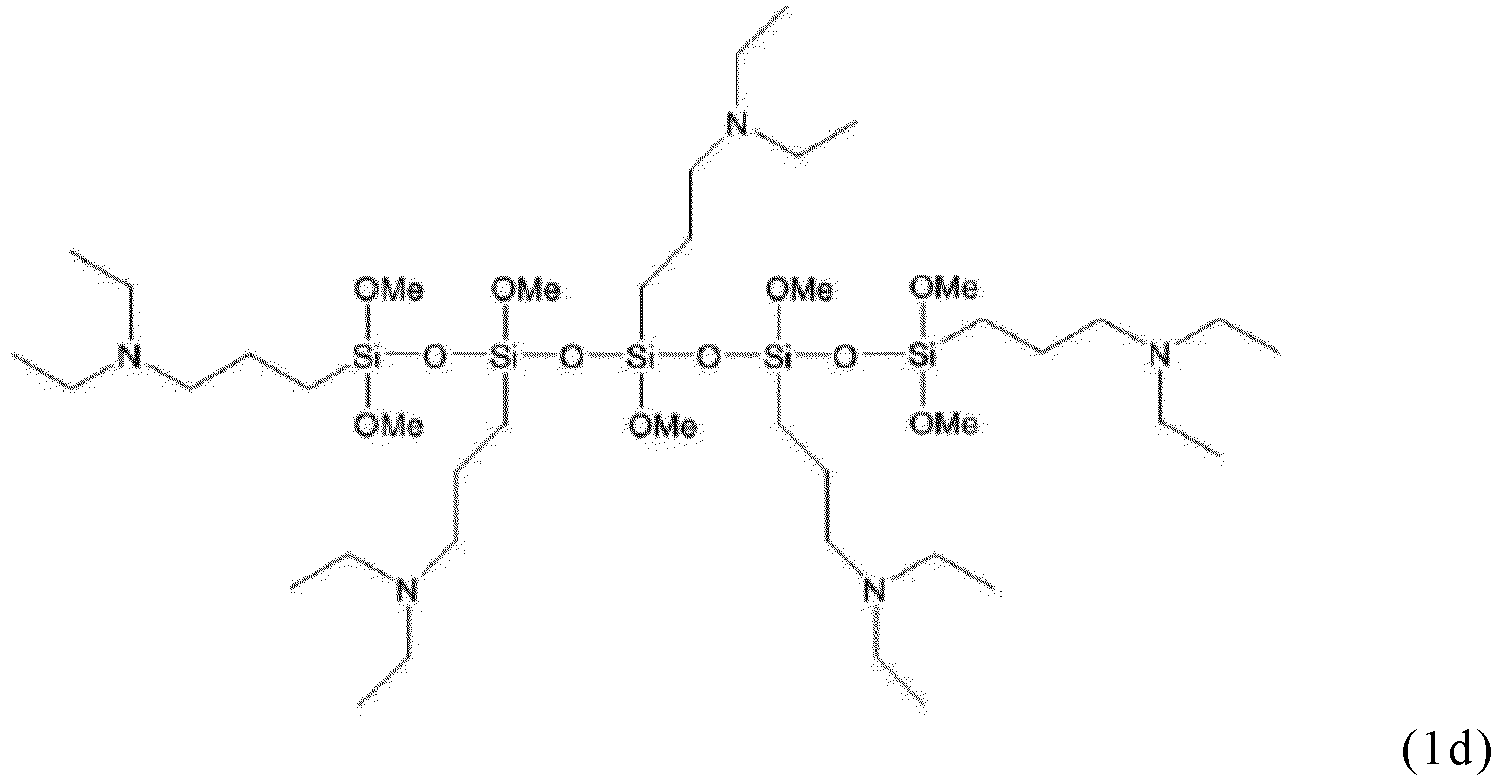
- A modified conjugated diene-based polymer was produced in the same manner as in Example 1 except that a compound of the following chemical formula (1e) as a 10.0 mass% n-hexane solution was injected at a rate of 68.4 g/h instead of the compound of the chemical formula (1a) as a modifier in Example 1.

- An unmodified conjugated diene-based polymer was produced in the same manner as in Example 1 except that the modification reaction using a modifier in Example 1 was not performed.
- A modified conjugated diene-based polymer was produced in the same manner as in Example 1 except that a compound of the following chemical formula (2a) as a 10.0 mass% n-hexane solution was injected at a rate of 23.5 g/h instead of the compound of the chemical formula (1a) as a modifier in Example 1.

- A modified conjugated diene-based polymer was produced in the same manner as in Example 1 except that a compound of the following chemical formula (2b) as a 10.0 mass% n-hexane solution was injected at a rate of 42.5 g/h instead of the compound of the chemical formula (1a) as a modifier in Example 1.

- A modified conjugated diene-based polymer was produced in the same manner as in Example 1 except that a compound of the following chemical formula (2c) as a 10.0 mass% n-hexane solution was injected at a rate of 74.6 g/h instead of the compound of the chemical formula (1a) as a modifier in Example 1.

- A modified conjugated diene-based polymer was produced in the same manner as in Example 1 except that a compound of the following chemical formula (2d) as a 10.0 mass% n-hexane solution was injected at a rate of 88.0 g/h instead of the compound of the chemical formula (1a) as a modifier in Example 1.

- The weight average molecular weight (Mw), number average molecular weight (Mn), molecular weight distribution (or polydispersity index (PDI)), component analysis, and Mooney viscosity (MV) were measured respectively for each of the modified conjugated diene-based polymers produced in Examples 1 to 5 and Comparative Examples 1 to 5. The results are listed in Table 1 below.
- The contents of styrene-derived unit (SM) and vinyl in each copolymer were measured using NMR.
- The weight average molecular weight (Mw) and number average molecular weight (Mn) of each copolymer were measured by GPC (gel permeation chromatograph) analysis under the condition of 40 °C. At this time, the column used was a combination of two PLgel Olexis columns and one PLgel mixed-C column of Polymer Laboratories, and all newly replaced columns were columns of mixed bed type. Further, PS (polystyrene) was used as the GPC standard material when calculating the molecular weight. The polydispersity index (PDI) was calculated by a ratio (Mw/Mn) of the weight average molecular weight to the number average molecular weight measured with the above method.
- The Mooney viscosity of each copolymer was measured at 100 °C for 4 minutes after preheating two samples with a mass of 15 g or more for 1 minute using MV-2000 (Alpha Technologies).
Table 1 Classification Example 1 Example 2 Comparative Example 1 Comparative Example 2 Comparative Example 3 Comparative Example 4 Comparative Example 5 Modifier 1a 1b - 2a 2b 2c 2d Mooney viscosity (MV) 54 55 50 57 54 55 57 NMR Styrene content (weight% based on total weight of polymer) 10 10 10 10 10 10 10 Vinyl content (weight% based on total weight of polymer) 38 38 38 38 38 38 38 GPC Mn (×104g/mol) 312 308 310 310 317 290 320 Mw (×104g/mol) 484 484 459 490 482 447 493 PDI (Mw/Mn) 1.55 1.57 1.48 1.58 1.52 1.60 1.54 - The tensile properties and viscoelastic properties were measured to compare and analyze the physical properties of rubber compositions containing the modified conjugated diene-based polymers of Examples 1 and 2 and Comparative Examples 1 to 5, respectively, and the physical properties of formed products produced with these rubber compositions.
- Each rubber composition was produced through processes of first-stage kneading, second-stage kneading and third-stage kneading. At this time, the amount of the substance used excluding the modified conjugated diene-based polymer is listed based on 100 parts by mass of the modified conjugated diene-based polymer.
- The first-stage kneading used a Banbury mixer equipped with a temperature control device, where 100 parts by mass of each of the copolymers, 70 parts by mass of silica, 11.02 parts by mass of bis (3-triethoxysilylpropyl) tetrasulfide as a silane coupling agent, 33.75 parts by mass of process oil (TDAE), 2.0 parts by mass of age resistor (TMDQ), 2.0 parts by mass of antioxidant, 3.0 parts by mass of zinc oxide (ZnO), 2.0 parts by mass of stearic acid, and 1.0 part by mass of wax were blended and kneaded at 80 rpm. At this time, the temperature of the kneader was controlled to obtain a primary compound at a discharging temperature of 140 °C to 150 °C.
- In the second-stage kneading, after cooling the primary compound to room temperature, 1.75 parts by mass of rubber accelerator (CZ), 1.5 parts by mass of sulfur powder, and 2.0 parts by mass of vulcanization accelerator were added to the kneader, and mixing was performed at a temperature of 60 °C or lower to obtain a secondary compound.
- After that, the secondary compound was formed by the third-stage kneading and vulcanized by vulcanization press at 180 °C for t90 + 10 minutes to produce each vulcanized rubber.
- The tensile properties were measured by preparing each test piece (thickness 25 mm, length 80 mm) according to the tensile test method of ASTM 412 and measuring the tensile strength at the time of cutting and the tensile stress at 300 % elongation (300 % modulus) of the test piece. Specifically, the tensile properties were measured at a speed of 50 cm/min at room temperature using a Universal Test Machin 4204 (Instron) tensile tester to obtain the tensile strength and the tensile stress value at 300 % elongation (300 % modulus). Each physical property value is listed in Table 2 with the numerical value of Comparative Example 3 being 100 and served as a reference, and the higher the numerical value is, the better.
- The viscoelastic properties were obtained by using a dynamic mechanical analyzer (TA) to change the deformation at a frequency of 10 Hz and at each measurement temperature (0 °C to 60 °C) in a twist mode to measure tan δ. The lower the tan δ at a high temperature of 60 °C is, the smaller the hysteresis loss is, and the better the low rolling resistance (fuel efficiency) is. Each physical property value is listed in Table 2 with the numerical value of Comparative Example 3 being 100 and served as a reference, and the higher the numerical value is, the better.
- The Mooney viscosity (MV, (ML 1 + 4, @ 100 °C) MU) of the secondary compound obtained during the (1) production of rubber test piece was measured to compare and analyze the processability properties of each polymer. The lower the measured value of Mooney viscosity is, the better the processability properties are.
- Specifically, the Mooney viscosity was measured using a MV-2000 (ALPHA Technologies) at 100 °C at a rotor speed of 2 ± 0.02 rpm and Large Rotor. Each secondary compound was left at room temperature (23 ± 3 °C) for 30 minutes or longer, then 27 ± 3 g of the sample was collected to fill the inside of a die cavity, and the measurement was carried out by operating a platen for 4 minutes.
Table 2 Classification Example 1 Example 2 Comparative Example 1 Comparative Example 2 Comparative Example 3 Comparative Example 4 Comparative Example 5 Tensile strength (Index) 103 101 95 99 100 100 97 300% modulus (Index) 105 101 94 96 100 99 98 tan δ @0°C (Index) 101 102 90 101 100 102 99 tan δ @60°C (Index) 111 115 81 91 100 112 109 Processability properties (Mooney viscosity, MV) 56 53 67 53 55 75 81 - From the results in Table 2, it is understood that the rubber composition containing the modified conjugated diene-based polymer of Examples 1 and 2 modified with the modifier of the present disclosure has excellent viscoelasticity as compared with Comparative Examples 1 to 3. This is considered as an effect obtained by applying oligomer as the modifier in Examples 1 to 5. Further, it can be seen that, although the viscoelasticity is similar to that of Comparative Examples 4 and 5 in which a primary or secondary amino group is introduced, the processability is improved.
- According to the present disclosure, it is possible to provide a rubber composition that can realize excellent low heat generating properties without deteriorating other performance. Further, according to the present disclosure, it is possible to provide a tire with greatly improved rolling resistance.
Claims (6)
- A rubber composition, comprising a rubber component and a filler, wherein
the rubber component contains a conjugated diene-based polymer modified with a modifier containing a compound represented by the formula (1),
- The rubber composition according to claim 1, wherein a conjugated diene-based polymer of the modified conjugated diene-based polymer is styrene butadiene rubber.
- The rubber composition according to claim 2, wherein an amount of styrene in the modified styrene butadiene rubber is 10 mass% to 45 mass%.
- The rubber composition according to any one of claims 1 to 3, wherein the modifier is any one of the formulas (1a) to (1e).
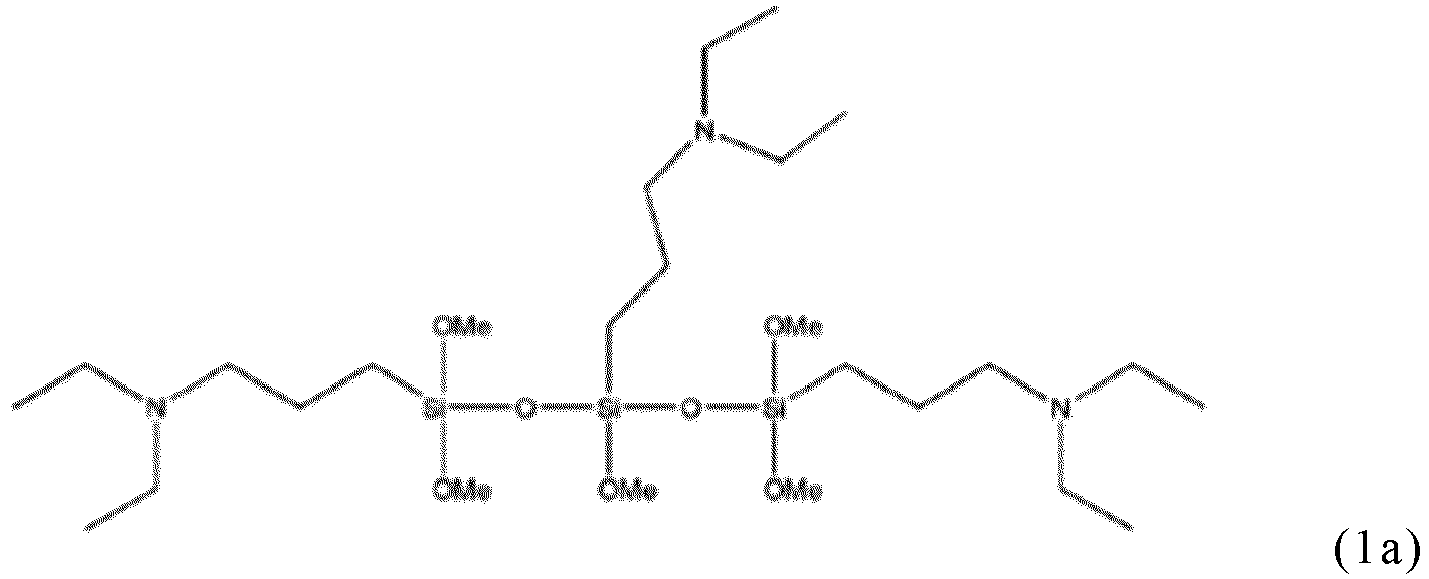


- The rubber composition according to any one of claims 1 to 4, wherein the filler contains at least silica.
- A tire, using the rubber composition according to any one of claims 1 to 5.
Applications Claiming Priority (2)
| Application Number | Priority Date | Filing Date | Title |
|---|---|---|---|
| JP2019217372A JP7364442B2 (en) | 2019-11-29 | 2019-11-29 | Rubber compositions and tires |
| PCT/JP2020/036732 WO2021106351A1 (en) | 2019-11-29 | 2020-09-28 | Rubber composition and tire |
Publications (3)
| Publication Number | Publication Date |
|---|---|
| EP4067429A1 true EP4067429A1 (en) | 2022-10-05 |
| EP4067429A4 EP4067429A4 (en) | 2022-12-21 |
| EP4067429B1 EP4067429B1 (en) | 2023-11-22 |
Family
ID=76086841
Family Applications (1)
| Application Number | Title | Priority Date | Filing Date |
|---|---|---|---|
| EP20892228.6A Active EP4067429B1 (en) | 2019-11-29 | 2020-09-28 | Rubber composition and tire |
Country Status (6)
| Country | Link |
|---|---|
| US (1) | US20230002533A1 (en) |
| EP (1) | EP4067429B1 (en) |
| JP (1) | JP7364442B2 (en) |
| KR (1) | KR102702145B1 (en) |
| CN (1) | CN114746498B (en) |
| WO (1) | WO2021106351A1 (en) |
Families Citing this family (4)
| Publication number | Priority date | Publication date | Assignee | Title |
|---|---|---|---|---|
| JP7314034B2 (en) * | 2019-11-29 | 2023-07-25 | 株式会社ブリヂストン | Rubber composition and tire |
| KR102536519B1 (en) * | 2019-11-29 | 2023-05-26 | 주식회사 엘지화학 | Modifying agent and modified conjugated diene polymer prepared by using the same |
| JPWO2022249766A1 (en) * | 2021-05-28 | 2022-12-01 | ||
| KR102800988B1 (en) | 2022-09-30 | 2025-04-29 | 금호타이어 주식회사 | Rubber composition for tire and tire manufactured therefrom |
Family Cites Families (19)
| Publication number | Priority date | Publication date | Assignee | Title |
|---|---|---|---|---|
| US5593483A (en) * | 1995-03-27 | 1997-01-14 | Advanced Chemical Technologies, Inc. | Water repellent composition for cellulose containing materials and method for producing same |
| JP4478262B2 (en) * | 1999-11-08 | 2010-06-09 | 株式会社ブリヂストン | Rubber composition and pneumatic tire using the same |
| CN100347208C (en) * | 2001-09-27 | 2007-11-07 | Jsr株式会社 | Conjugated diene homo-or copolymer rubber, method for producing homo-or copolymer rubber, rubber composition, composite, and tire |
| EP1505087B1 (en) * | 2002-04-12 | 2007-07-11 | Bridgestone Corporation | Process for producing modified polymer, modified polymer obtained by the process, and rubber composition |
| JP5745733B2 (en) * | 2006-10-25 | 2015-07-08 | Jsr株式会社 | Method for producing modified polymer, modified polymer obtained by the method and rubber composition thereof |
| JP4783356B2 (en) * | 2007-02-09 | 2011-09-28 | 住友ゴム工業株式会社 | Rubber composition |
| US9623705B2 (en) * | 2008-03-10 | 2017-04-18 | Bridgestone Corporation | Method for producing modified conjugated diene polymer/copolymer, modified conjugated diene polymer/copolymer, and rubber composition and tire using the same |
| WO2010030015A1 (en) * | 2008-09-11 | 2010-03-18 | 富士フイルム株式会社 | Polymer composition and manufacturing method therefor, hydrophilic composition and hydrophilic member |
| WO2017074423A1 (en) * | 2015-10-30 | 2017-05-04 | Compagnie Generale Des Etablissements Michelin | Silica tread with peroxide curing |
| KR102014521B1 (en) * | 2016-04-25 | 2019-10-21 | 주식회사 엘지화학 | Modified conjugated diene polymer and preparing method thereof |
| KR102150526B1 (en) * | 2016-06-17 | 2020-09-01 | 주식회사 엘지화학 | preparation method of modified conjugated diene polymer and modified conjugated diene polymer prepared by using the same |
| KR102099923B1 (en) * | 2016-08-12 | 2020-04-10 | 주식회사 엘지화학 | Modified conjugated diene polymer, method for preparing the same and rubber composition comprising the same |
| KR101865796B1 (en) * | 2017-01-03 | 2018-06-11 | 주식회사 엘지화학 | Modified conjugated diene polymer and rubber composition comprising the same |
| KR102122471B1 (en) * | 2017-12-05 | 2020-06-26 | 주식회사 엘지화학 | Modified conjugated diene polymer and rubber composition comprising the same |
| KR102167122B1 (en) * | 2017-12-05 | 2020-10-16 | 주식회사 엘지화학 | Modified conjugated diene polymer and rubber composition comprising the same |
| JP6968292B2 (en) * | 2018-05-08 | 2021-11-17 | エルジー・ケム・リミテッド | Modified conjugated diene polymer and rubber composition containing it |
| KR102536519B1 (en) * | 2019-11-29 | 2023-05-26 | 주식회사 엘지화학 | Modifying agent and modified conjugated diene polymer prepared by using the same |
| KR102509517B1 (en) * | 2019-11-29 | 2023-03-16 | 주식회사 엘지화학 | Modified conjugated diene-based polymer |
| JP7314034B2 (en) * | 2019-11-29 | 2023-07-25 | 株式会社ブリヂストン | Rubber composition and tire |
-
2019
- 2019-11-29 JP JP2019217372A patent/JP7364442B2/en active Active
-
2020
- 2020-09-28 WO PCT/JP2020/036732 patent/WO2021106351A1/en not_active Ceased
- 2020-09-28 CN CN202080082762.4A patent/CN114746498B/en active Active
- 2020-09-28 US US17/777,706 patent/US20230002533A1/en not_active Abandoned
- 2020-09-28 EP EP20892228.6A patent/EP4067429B1/en active Active
- 2020-09-28 KR KR1020227016866A patent/KR102702145B1/en active Active
Also Published As
| Publication number | Publication date |
|---|---|
| CN114746498B (en) | 2024-07-26 |
| WO2021106351A1 (en) | 2021-06-03 |
| KR102702145B1 (en) | 2024-09-04 |
| US20230002533A1 (en) | 2023-01-05 |
| EP4067429A4 (en) | 2022-12-21 |
| JP7364442B2 (en) | 2023-10-18 |
| JP2021085029A (en) | 2021-06-03 |
| EP4067429B1 (en) | 2023-11-22 |
| KR20220086633A (en) | 2022-06-23 |
| CN114746498A (en) | 2022-07-12 |
Similar Documents
| Publication | Publication Date | Title |
|---|---|---|
| EP3345940B1 (en) | Modified conjugated diene-based polymer and method for preparing the same | |
| KR102014521B1 (en) | Modified conjugated diene polymer and preparing method thereof | |
| EP4067429B1 (en) | Rubber composition and tire | |
| JP2003253051A (en) | Rubber composition and tire using the same | |
| JP6564882B2 (en) | Organolithium compound, method for producing modified conjugated diene polymer using the same, and modified conjugated diene polymer | |
| EP2871211A1 (en) | Rubber composition and pneumatic tire | |
| EP3059260A1 (en) | End-functionalized conjugated diene-based polymer and process for producing same | |
| JP6570747B2 (en) | Azasilane-based modifier and method for producing modified conjugated diene-based polymer using the same | |
| JP2024075734A (en) | Rubber composition and tire | |
| JP5183855B2 (en) | Rubber composition and tire using the same | |
| CN114008087B (en) | Modifier and modified conjugated diene polymer prepared using the modifier | |
| EP4067111B1 (en) | Rubber composition and tire | |
| EP4309915A1 (en) | Rubber composition and tire | |
| EP4349905A1 (en) | Tire rubber composition, tread rubber, and tire |
Legal Events
| Date | Code | Title | Description |
|---|---|---|---|
| STAA | Information on the status of an ep patent application or granted ep patent |
Free format text: STATUS: THE INTERNATIONAL PUBLICATION HAS BEEN MADE |
|
| PUAI | Public reference made under article 153(3) epc to a published international application that has entered the european phase |
Free format text: ORIGINAL CODE: 0009012 |
|
| STAA | Information on the status of an ep patent application or granted ep patent |
Free format text: STATUS: REQUEST FOR EXAMINATION WAS MADE |
|
| 17P | Request for examination filed |
Effective date: 20220509 |
|
| AK | Designated contracting states |
Kind code of ref document: A1 Designated state(s): AL AT BE BG CH CY CZ DE DK EE ES FI FR GB GR HR HU IE IS IT LI LT LU LV MC MK MT NL NO PL PT RO RS SE SI SK SM TR |
|
| A4 | Supplementary search report drawn up and despatched |
Effective date: 20221122 |
|
| RIC1 | Information provided on ipc code assigned before grant |
Ipc: C07F 7/18 20060101ALI20221116BHEP Ipc: C08F 236/10 20060101ALI20221116BHEP Ipc: C08C 19/44 20060101ALI20221116BHEP Ipc: C08K 3/36 20060101ALI20221116BHEP Ipc: C08C 19/25 20060101ALI20221116BHEP Ipc: C08C 19/22 20060101ALI20221116BHEP Ipc: B60C 1/00 20060101ALI20221116BHEP Ipc: C08L 15/00 20060101AFI20221116BHEP |
|
| DAV | Request for validation of the european patent (deleted) | ||
| DAX | Request for extension of the european patent (deleted) | ||
| RIC1 | Information provided on ipc code assigned before grant |
Ipc: C07F 7/18 20060101ALI20230517BHEP Ipc: C08F 236/10 20060101ALI20230517BHEP Ipc: C08C 19/44 20060101ALI20230517BHEP Ipc: C08K 3/36 20060101ALI20230517BHEP Ipc: C08C 19/25 20060101ALI20230517BHEP Ipc: C08C 19/22 20060101ALI20230517BHEP Ipc: B60C 1/00 20060101ALI20230517BHEP Ipc: C08L 15/00 20060101AFI20230517BHEP |
|
| GRAP | Despatch of communication of intention to grant a patent |
Free format text: ORIGINAL CODE: EPIDOSNIGR1 |
|
| STAA | Information on the status of an ep patent application or granted ep patent |
Free format text: STATUS: GRANT OF PATENT IS INTENDED |
|
| INTG | Intention to grant announced |
Effective date: 20230623 |
|
| P01 | Opt-out of the competence of the unified patent court (upc) registered |
Effective date: 20230712 |
|
| GRAS | Grant fee paid |
Free format text: ORIGINAL CODE: EPIDOSNIGR3 |
|
| GRAA | (expected) grant |
Free format text: ORIGINAL CODE: 0009210 |
|
| STAA | Information on the status of an ep patent application or granted ep patent |
Free format text: STATUS: THE PATENT HAS BEEN GRANTED |
|
| AK | Designated contracting states |
Kind code of ref document: B1 Designated state(s): AL AT BE BG CH CY CZ DE DK EE ES FI FR GB GR HR HU IE IS IT LI LT LU LV MC MK MT NL NO PL PT RO RS SE SI SK SM TR |
|
| REG | Reference to a national code |
Ref country code: GB Ref legal event code: FG4D |
|
| REG | Reference to a national code |
Ref country code: CH Ref legal event code: EP |
|
| REG | Reference to a national code |
Ref country code: DE Ref legal event code: R096 Ref document number: 602020021679 Country of ref document: DE |
|
| REG | Reference to a national code |
Ref country code: IE Ref legal event code: FG4D |
|
| REG | Reference to a national code |
Ref country code: LT Ref legal event code: MG9D |
|
| REG | Reference to a national code |
Ref country code: NL Ref legal event code: MP Effective date: 20231122 |
|
| PG25 | Lapsed in a contracting state [announced via postgrant information from national office to epo] |
Ref country code: GR Free format text: LAPSE BECAUSE OF FAILURE TO SUBMIT A TRANSLATION OF THE DESCRIPTION OR TO PAY THE FEE WITHIN THE PRESCRIBED TIME-LIMIT Effective date: 20240223 |
|
| PG25 | Lapsed in a contracting state [announced via postgrant information from national office to epo] |
Ref country code: IS Free format text: LAPSE BECAUSE OF FAILURE TO SUBMIT A TRANSLATION OF THE DESCRIPTION OR TO PAY THE FEE WITHIN THE PRESCRIBED TIME-LIMIT Effective date: 20240322 |
|
| PG25 | Lapsed in a contracting state [announced via postgrant information from national office to epo] |
Ref country code: LT Free format text: LAPSE BECAUSE OF FAILURE TO SUBMIT A TRANSLATION OF THE DESCRIPTION OR TO PAY THE FEE WITHIN THE PRESCRIBED TIME-LIMIT Effective date: 20231122 |
|
| REG | Reference to a national code |
Ref country code: AT Ref legal event code: MK05 Ref document number: 1633813 Country of ref document: AT Kind code of ref document: T Effective date: 20231122 |
|
| PG25 | Lapsed in a contracting state [announced via postgrant information from national office to epo] |
Ref country code: NL Free format text: LAPSE BECAUSE OF FAILURE TO SUBMIT A TRANSLATION OF THE DESCRIPTION OR TO PAY THE FEE WITHIN THE PRESCRIBED TIME-LIMIT Effective date: 20231122 |
|
| PG25 | Lapsed in a contracting state [announced via postgrant information from national office to epo] |
Ref country code: AT Free format text: LAPSE BECAUSE OF FAILURE TO SUBMIT A TRANSLATION OF THE DESCRIPTION OR TO PAY THE FEE WITHIN THE PRESCRIBED TIME-LIMIT Effective date: 20231122 |
|
| PG25 | Lapsed in a contracting state [announced via postgrant information from national office to epo] |
Ref country code: ES Free format text: LAPSE BECAUSE OF FAILURE TO SUBMIT A TRANSLATION OF THE DESCRIPTION OR TO PAY THE FEE WITHIN THE PRESCRIBED TIME-LIMIT Effective date: 20231122 |
|
| PG25 | Lapsed in a contracting state [announced via postgrant information from national office to epo] |
Ref country code: NL Free format text: LAPSE BECAUSE OF FAILURE TO SUBMIT A TRANSLATION OF THE DESCRIPTION OR TO PAY THE FEE WITHIN THE PRESCRIBED TIME-LIMIT Effective date: 20231122 Ref country code: LT Free format text: LAPSE BECAUSE OF FAILURE TO SUBMIT A TRANSLATION OF THE DESCRIPTION OR TO PAY THE FEE WITHIN THE PRESCRIBED TIME-LIMIT Effective date: 20231122 Ref country code: IS Free format text: LAPSE BECAUSE OF FAILURE TO SUBMIT A TRANSLATION OF THE DESCRIPTION OR TO PAY THE FEE WITHIN THE PRESCRIBED TIME-LIMIT Effective date: 20240322 Ref country code: GR Free format text: LAPSE BECAUSE OF FAILURE TO SUBMIT A TRANSLATION OF THE DESCRIPTION OR TO PAY THE FEE WITHIN THE PRESCRIBED TIME-LIMIT Effective date: 20240223 Ref country code: ES Free format text: LAPSE BECAUSE OF FAILURE TO SUBMIT A TRANSLATION OF THE DESCRIPTION OR TO PAY THE FEE WITHIN THE PRESCRIBED TIME-LIMIT Effective date: 20231122 Ref country code: BG Free format text: LAPSE BECAUSE OF FAILURE TO SUBMIT A TRANSLATION OF THE DESCRIPTION OR TO PAY THE FEE WITHIN THE PRESCRIBED TIME-LIMIT Effective date: 20240222 Ref country code: AT Free format text: LAPSE BECAUSE OF FAILURE TO SUBMIT A TRANSLATION OF THE DESCRIPTION OR TO PAY THE FEE WITHIN THE PRESCRIBED TIME-LIMIT Effective date: 20231122 Ref country code: PT Free format text: LAPSE BECAUSE OF FAILURE TO SUBMIT A TRANSLATION OF THE DESCRIPTION OR TO PAY THE FEE WITHIN THE PRESCRIBED TIME-LIMIT Effective date: 20240322 |
|
| PG25 | Lapsed in a contracting state [announced via postgrant information from national office to epo] |
Ref country code: SE Free format text: LAPSE BECAUSE OF FAILURE TO SUBMIT A TRANSLATION OF THE DESCRIPTION OR TO PAY THE FEE WITHIN THE PRESCRIBED TIME-LIMIT Effective date: 20231122 Ref country code: RS Free format text: LAPSE BECAUSE OF FAILURE TO SUBMIT A TRANSLATION OF THE DESCRIPTION OR TO PAY THE FEE WITHIN THE PRESCRIBED TIME-LIMIT Effective date: 20231122 Ref country code: PL Free format text: LAPSE BECAUSE OF FAILURE TO SUBMIT A TRANSLATION OF THE DESCRIPTION OR TO PAY THE FEE WITHIN THE PRESCRIBED TIME-LIMIT Effective date: 20231122 Ref country code: NO Free format text: LAPSE BECAUSE OF FAILURE TO SUBMIT A TRANSLATION OF THE DESCRIPTION OR TO PAY THE FEE WITHIN THE PRESCRIBED TIME-LIMIT Effective date: 20240222 Ref country code: LV Free format text: LAPSE BECAUSE OF FAILURE TO SUBMIT A TRANSLATION OF THE DESCRIPTION OR TO PAY THE FEE WITHIN THE PRESCRIBED TIME-LIMIT Effective date: 20231122 Ref country code: HR Free format text: LAPSE BECAUSE OF FAILURE TO SUBMIT A TRANSLATION OF THE DESCRIPTION OR TO PAY THE FEE WITHIN THE PRESCRIBED TIME-LIMIT Effective date: 20231122 |
|
| PG25 | Lapsed in a contracting state [announced via postgrant information from national office to epo] |
Ref country code: DK Free format text: LAPSE BECAUSE OF FAILURE TO SUBMIT A TRANSLATION OF THE DESCRIPTION OR TO PAY THE FEE WITHIN THE PRESCRIBED TIME-LIMIT Effective date: 20231122 |
|
| PG25 | Lapsed in a contracting state [announced via postgrant information from national office to epo] |
Ref country code: CZ Free format text: LAPSE BECAUSE OF FAILURE TO SUBMIT A TRANSLATION OF THE DESCRIPTION OR TO PAY THE FEE WITHIN THE PRESCRIBED TIME-LIMIT Effective date: 20231122 |
|
| PG25 | Lapsed in a contracting state [announced via postgrant information from national office to epo] |
Ref country code: SK Free format text: LAPSE BECAUSE OF FAILURE TO SUBMIT A TRANSLATION OF THE DESCRIPTION OR TO PAY THE FEE WITHIN THE PRESCRIBED TIME-LIMIT Effective date: 20231122 |
|
| PG25 | Lapsed in a contracting state [announced via postgrant information from national office to epo] |
Ref country code: SM Free format text: LAPSE BECAUSE OF FAILURE TO SUBMIT A TRANSLATION OF THE DESCRIPTION OR TO PAY THE FEE WITHIN THE PRESCRIBED TIME-LIMIT Effective date: 20231122 Ref country code: SK Free format text: LAPSE BECAUSE OF FAILURE TO SUBMIT A TRANSLATION OF THE DESCRIPTION OR TO PAY THE FEE WITHIN THE PRESCRIBED TIME-LIMIT Effective date: 20231122 Ref country code: RO Free format text: LAPSE BECAUSE OF FAILURE TO SUBMIT A TRANSLATION OF THE DESCRIPTION OR TO PAY THE FEE WITHIN THE PRESCRIBED TIME-LIMIT Effective date: 20231122 Ref country code: IT Free format text: LAPSE BECAUSE OF FAILURE TO SUBMIT A TRANSLATION OF THE DESCRIPTION OR TO PAY THE FEE WITHIN THE PRESCRIBED TIME-LIMIT Effective date: 20231122 Ref country code: EE Free format text: LAPSE BECAUSE OF FAILURE TO SUBMIT A TRANSLATION OF THE DESCRIPTION OR TO PAY THE FEE WITHIN THE PRESCRIBED TIME-LIMIT Effective date: 20231122 Ref country code: DK Free format text: LAPSE BECAUSE OF FAILURE TO SUBMIT A TRANSLATION OF THE DESCRIPTION OR TO PAY THE FEE WITHIN THE PRESCRIBED TIME-LIMIT Effective date: 20231122 Ref country code: CZ Free format text: LAPSE BECAUSE OF FAILURE TO SUBMIT A TRANSLATION OF THE DESCRIPTION OR TO PAY THE FEE WITHIN THE PRESCRIBED TIME-LIMIT Effective date: 20231122 |
|
| REG | Reference to a national code |
Ref country code: DE Ref legal event code: R097 Ref document number: 602020021679 Country of ref document: DE |
|
| PLBE | No opposition filed within time limit |
Free format text: ORIGINAL CODE: 0009261 |
|
| STAA | Information on the status of an ep patent application or granted ep patent |
Free format text: STATUS: NO OPPOSITION FILED WITHIN TIME LIMIT |
|
| PG25 | Lapsed in a contracting state [announced via postgrant information from national office to epo] |
Ref country code: SI Free format text: LAPSE BECAUSE OF FAILURE TO SUBMIT A TRANSLATION OF THE DESCRIPTION OR TO PAY THE FEE WITHIN THE PRESCRIBED TIME-LIMIT Effective date: 20231122 |
|
| 26N | No opposition filed |
Effective date: 20240823 |
|
| PG25 | Lapsed in a contracting state [announced via postgrant information from national office to epo] |
Ref country code: SI Free format text: LAPSE BECAUSE OF FAILURE TO SUBMIT A TRANSLATION OF THE DESCRIPTION OR TO PAY THE FEE WITHIN THE PRESCRIBED TIME-LIMIT Effective date: 20231122 |
|
| PG25 | Lapsed in a contracting state [announced via postgrant information from national office to epo] |
Ref country code: MC Free format text: LAPSE BECAUSE OF FAILURE TO SUBMIT A TRANSLATION OF THE DESCRIPTION OR TO PAY THE FEE WITHIN THE PRESCRIBED TIME-LIMIT Effective date: 20231122 |
|
| REG | Reference to a national code |
Ref country code: CH Ref legal event code: PL |
|
| PG25 | Lapsed in a contracting state [announced via postgrant information from national office to epo] |
Ref country code: LU Free format text: LAPSE BECAUSE OF NON-PAYMENT OF DUE FEES Effective date: 20240928 |
|
| GBPC | Gb: european patent ceased through non-payment of renewal fee |
Effective date: 20240928 |
|
| PG25 | Lapsed in a contracting state [announced via postgrant information from national office to epo] |
Ref country code: GB Free format text: LAPSE BECAUSE OF NON-PAYMENT OF DUE FEES Effective date: 20240928 |
|
| REG | Reference to a national code |
Ref country code: BE Ref legal event code: MM Effective date: 20240930 |
|
| PG25 | Lapsed in a contracting state [announced via postgrant information from national office to epo] |
Ref country code: BE Free format text: LAPSE BECAUSE OF NON-PAYMENT OF DUE FEES Effective date: 20240930 |
|
| PG25 | Lapsed in a contracting state [announced via postgrant information from national office to epo] |
Ref country code: CH Free format text: LAPSE BECAUSE OF NON-PAYMENT OF DUE FEES Effective date: 20240930 |
|
| PG25 | Lapsed in a contracting state [announced via postgrant information from national office to epo] |
Ref country code: IE Free format text: LAPSE BECAUSE OF NON-PAYMENT OF DUE FEES Effective date: 20240928 |
|
| PG25 | Lapsed in a contracting state [announced via postgrant information from national office to epo] |
Ref country code: FI Free format text: LAPSE BECAUSE OF FAILURE TO SUBMIT A TRANSLATION OF THE DESCRIPTION OR TO PAY THE FEE WITHIN THE PRESCRIBED TIME-LIMIT Effective date: 20231122 |
|
| PGFP | Annual fee paid to national office [announced via postgrant information from national office to epo] |
Ref country code: DE Payment date: 20250919 Year of fee payment: 6 |
|
| PGFP | Annual fee paid to national office [announced via postgrant information from national office to epo] |
Ref country code: FR Payment date: 20250922 Year of fee payment: 6 |
|
| PG25 | Lapsed in a contracting state [announced via postgrant information from national office to epo] |
Ref country code: CY Free format text: LAPSE BECAUSE OF FAILURE TO SUBMIT A TRANSLATION OF THE DESCRIPTION OR TO PAY THE FEE WITHIN THE PRESCRIBED TIME-LIMIT; INVALID AB INITIO Effective date: 20200928 |
|
| PG25 | Lapsed in a contracting state [announced via postgrant information from national office to epo] |
Ref country code: HU Free format text: LAPSE BECAUSE OF FAILURE TO SUBMIT A TRANSLATION OF THE DESCRIPTION OR TO PAY THE FEE WITHIN THE PRESCRIBED TIME-LIMIT; INVALID AB INITIO Effective date: 20200928 |