EP4067415A1 - Olefin-based polymer film and manufacturing method therefor - Google Patents
Olefin-based polymer film and manufacturing method therefor Download PDFInfo
- Publication number
- EP4067415A1 EP4067415A1 EP20894586.5A EP20894586A EP4067415A1 EP 4067415 A1 EP4067415 A1 EP 4067415A1 EP 20894586 A EP20894586 A EP 20894586A EP 4067415 A1 EP4067415 A1 EP 4067415A1
- Authority
- EP
- European Patent Office
- Prior art keywords
- substituted
- unsubstituted
- polyolefin
- polyolefin film
- film
- Prior art date
- Legal status (The legal status is an assumption and is not a legal conclusion. Google has not performed a legal analysis and makes no representation as to the accuracy of the status listed.)
- Pending
Links
Images




Classifications
-
- C—CHEMISTRY; METALLURGY
- C08—ORGANIC MACROMOLECULAR COMPOUNDS; THEIR PREPARATION OR CHEMICAL WORKING-UP; COMPOSITIONS BASED THEREON
- C08F—MACROMOLECULAR COMPOUNDS OBTAINED BY REACTIONS ONLY INVOLVING CARBON-TO-CARBON UNSATURATED BONDS
- C08F210/00—Copolymers of unsaturated aliphatic hydrocarbons having only one carbon-to-carbon double bond
- C08F210/16—Copolymers of ethene with alpha-alkenes, e.g. EP rubbers
-
- C—CHEMISTRY; METALLURGY
- C08—ORGANIC MACROMOLECULAR COMPOUNDS; THEIR PREPARATION OR CHEMICAL WORKING-UP; COMPOSITIONS BASED THEREON
- C08J—WORKING-UP; GENERAL PROCESSES OF COMPOUNDING; AFTER-TREATMENT NOT COVERED BY SUBCLASSES C08B, C08C, C08F, C08G or C08H
- C08J5/00—Manufacture of articles or shaped materials containing macromolecular substances
- C08J5/18—Manufacture of films or sheets
-
- C—CHEMISTRY; METALLURGY
- C08—ORGANIC MACROMOLECULAR COMPOUNDS; THEIR PREPARATION OR CHEMICAL WORKING-UP; COMPOSITIONS BASED THEREON
- C08F—MACROMOLECULAR COMPOUNDS OBTAINED BY REACTIONS ONLY INVOLVING CARBON-TO-CARBON UNSATURATED BONDS
- C08F10/00—Homopolymers and copolymers of unsaturated aliphatic hydrocarbons having only one carbon-to-carbon double bond
- C08F10/02—Ethene
-
- C—CHEMISTRY; METALLURGY
- C08—ORGANIC MACROMOLECULAR COMPOUNDS; THEIR PREPARATION OR CHEMICAL WORKING-UP; COMPOSITIONS BASED THEREON
- C08F—MACROMOLECULAR COMPOUNDS OBTAINED BY REACTIONS ONLY INVOLVING CARBON-TO-CARBON UNSATURATED BONDS
- C08F2/00—Processes of polymerisation
- C08F2/01—Processes of polymerisation characterised by special features of the polymerisation apparatus used
-
- C—CHEMISTRY; METALLURGY
- C08—ORGANIC MACROMOLECULAR COMPOUNDS; THEIR PREPARATION OR CHEMICAL WORKING-UP; COMPOSITIONS BASED THEREON
- C08F—MACROMOLECULAR COMPOUNDS OBTAINED BY REACTIONS ONLY INVOLVING CARBON-TO-CARBON UNSATURATED BONDS
- C08F2/00—Processes of polymerisation
- C08F2/34—Polymerisation in gaseous state
-
- C—CHEMISTRY; METALLURGY
- C08—ORGANIC MACROMOLECULAR COMPOUNDS; THEIR PREPARATION OR CHEMICAL WORKING-UP; COMPOSITIONS BASED THEREON
- C08F—MACROMOLECULAR COMPOUNDS OBTAINED BY REACTIONS ONLY INVOLVING CARBON-TO-CARBON UNSATURATED BONDS
- C08F210/00—Copolymers of unsaturated aliphatic hydrocarbons having only one carbon-to-carbon double bond
- C08F210/14—Monomers containing five or more carbon atoms
-
- C—CHEMISTRY; METALLURGY
- C08—ORGANIC MACROMOLECULAR COMPOUNDS; THEIR PREPARATION OR CHEMICAL WORKING-UP; COMPOSITIONS BASED THEREON
- C08F—MACROMOLECULAR COMPOUNDS OBTAINED BY REACTIONS ONLY INVOLVING CARBON-TO-CARBON UNSATURATED BONDS
- C08F4/00—Polymerisation catalysts
- C08F4/42—Metals; Metal hydrides; Metallo-organic compounds; Use thereof as catalyst precursors
- C08F4/44—Metals; Metal hydrides; Metallo-organic compounds; Use thereof as catalyst precursors selected from light metals, zinc, cadmium, mercury, copper, silver, gold, boron, gallium, indium, thallium, rare earths or actinides
- C08F4/60—Metals; Metal hydrides; Metallo-organic compounds; Use thereof as catalyst precursors selected from light metals, zinc, cadmium, mercury, copper, silver, gold, boron, gallium, indium, thallium, rare earths or actinides together with refractory metals, iron group metals, platinum group metals, manganese, rhenium technetium or compounds thereof
- C08F4/62—Refractory metals or compounds thereof
- C08F4/64—Titanium, zirconium, hafnium or compounds thereof
- C08F4/646—Catalysts comprising at least two different metals, in metallic form or as compounds thereof, in addition to the component covered by group C08F4/64
- C08F4/6465—Catalysts comprising at least two different metals, in metallic form or as compounds thereof, in addition to the component covered by group C08F4/64 containing silicium
-
- C—CHEMISTRY; METALLURGY
- C08—ORGANIC MACROMOLECULAR COMPOUNDS; THEIR PREPARATION OR CHEMICAL WORKING-UP; COMPOSITIONS BASED THEREON
- C08F—MACROMOLECULAR COMPOUNDS OBTAINED BY REACTIONS ONLY INVOLVING CARBON-TO-CARBON UNSATURATED BONDS
- C08F4/00—Polymerisation catalysts
- C08F4/42—Metals; Metal hydrides; Metallo-organic compounds; Use thereof as catalyst precursors
- C08F4/44—Metals; Metal hydrides; Metallo-organic compounds; Use thereof as catalyst precursors selected from light metals, zinc, cadmium, mercury, copper, silver, gold, boron, gallium, indium, thallium, rare earths or actinides
- C08F4/60—Metals; Metal hydrides; Metallo-organic compounds; Use thereof as catalyst precursors selected from light metals, zinc, cadmium, mercury, copper, silver, gold, boron, gallium, indium, thallium, rare earths or actinides together with refractory metals, iron group metals, platinum group metals, manganese, rhenium technetium or compounds thereof
- C08F4/62—Refractory metals or compounds thereof
- C08F4/64—Titanium, zirconium, hafnium or compounds thereof
- C08F4/659—Component covered by group C08F4/64 containing a transition metal-carbon bond
- C08F4/65908—Component covered by group C08F4/64 containing a transition metal-carbon bond in combination with an ionising compound other than alumoxane, e.g. (C6F5)4B-X+
-
- C—CHEMISTRY; METALLURGY
- C08—ORGANIC MACROMOLECULAR COMPOUNDS; THEIR PREPARATION OR CHEMICAL WORKING-UP; COMPOSITIONS BASED THEREON
- C08F—MACROMOLECULAR COMPOUNDS OBTAINED BY REACTIONS ONLY INVOLVING CARBON-TO-CARBON UNSATURATED BONDS
- C08F4/00—Polymerisation catalysts
- C08F4/42—Metals; Metal hydrides; Metallo-organic compounds; Use thereof as catalyst precursors
- C08F4/44—Metals; Metal hydrides; Metallo-organic compounds; Use thereof as catalyst precursors selected from light metals, zinc, cadmium, mercury, copper, silver, gold, boron, gallium, indium, thallium, rare earths or actinides
- C08F4/60—Metals; Metal hydrides; Metallo-organic compounds; Use thereof as catalyst precursors selected from light metals, zinc, cadmium, mercury, copper, silver, gold, boron, gallium, indium, thallium, rare earths or actinides together with refractory metals, iron group metals, platinum group metals, manganese, rhenium technetium or compounds thereof
- C08F4/62—Refractory metals or compounds thereof
- C08F4/64—Titanium, zirconium, hafnium or compounds thereof
- C08F4/659—Component covered by group C08F4/64 containing a transition metal-carbon bond
- C08F4/6592—Component covered by group C08F4/64 containing a transition metal-carbon bond containing at least one cyclopentadienyl ring, condensed or not, e.g. an indenyl or a fluorenyl ring
-
- C—CHEMISTRY; METALLURGY
- C08—ORGANIC MACROMOLECULAR COMPOUNDS; THEIR PREPARATION OR CHEMICAL WORKING-UP; COMPOSITIONS BASED THEREON
- C08F—MACROMOLECULAR COMPOUNDS OBTAINED BY REACTIONS ONLY INVOLVING CARBON-TO-CARBON UNSATURATED BONDS
- C08F4/00—Polymerisation catalysts
- C08F4/42—Metals; Metal hydrides; Metallo-organic compounds; Use thereof as catalyst precursors
- C08F4/44—Metals; Metal hydrides; Metallo-organic compounds; Use thereof as catalyst precursors selected from light metals, zinc, cadmium, mercury, copper, silver, gold, boron, gallium, indium, thallium, rare earths or actinides
- C08F4/60—Metals; Metal hydrides; Metallo-organic compounds; Use thereof as catalyst precursors selected from light metals, zinc, cadmium, mercury, copper, silver, gold, boron, gallium, indium, thallium, rare earths or actinides together with refractory metals, iron group metals, platinum group metals, manganese, rhenium technetium or compounds thereof
- C08F4/62—Refractory metals or compounds thereof
- C08F4/64—Titanium, zirconium, hafnium or compounds thereof
- C08F4/659—Component covered by group C08F4/64 containing a transition metal-carbon bond
- C08F4/6592—Component covered by group C08F4/64 containing a transition metal-carbon bond containing at least one cyclopentadienyl ring, condensed or not, e.g. an indenyl or a fluorenyl ring
- C08F4/65922—Component covered by group C08F4/64 containing a transition metal-carbon bond containing at least one cyclopentadienyl ring, condensed or not, e.g. an indenyl or a fluorenyl ring containing at least two cyclopentadienyl rings, fused or not
- C08F4/65925—Component covered by group C08F4/64 containing a transition metal-carbon bond containing at least one cyclopentadienyl ring, condensed or not, e.g. an indenyl or a fluorenyl ring containing at least two cyclopentadienyl rings, fused or not two cyclopentadienyl rings being mutually non-bridged
-
- C—CHEMISTRY; METALLURGY
- C08—ORGANIC MACROMOLECULAR COMPOUNDS; THEIR PREPARATION OR CHEMICAL WORKING-UP; COMPOSITIONS BASED THEREON
- C08F—MACROMOLECULAR COMPOUNDS OBTAINED BY REACTIONS ONLY INVOLVING CARBON-TO-CARBON UNSATURATED BONDS
- C08F2420/00—Metallocene catalysts
- C08F2420/07—Heteroatom-substituted Cp, i.e. Cp or analog where at least one of the substituent of the Cp or analog ring is or contains a heteroatom
-
- C—CHEMISTRY; METALLURGY
- C08—ORGANIC MACROMOLECULAR COMPOUNDS; THEIR PREPARATION OR CHEMICAL WORKING-UP; COMPOSITIONS BASED THEREON
- C08F—MACROMOLECULAR COMPOUNDS OBTAINED BY REACTIONS ONLY INVOLVING CARBON-TO-CARBON UNSATURATED BONDS
- C08F2500/00—Characteristics or properties of obtained polyolefins; Use thereof
- C08F2500/12—Melt flow index or melt flow ratio
-
- C—CHEMISTRY; METALLURGY
- C08—ORGANIC MACROMOLECULAR COMPOUNDS; THEIR PREPARATION OR CHEMICAL WORKING-UP; COMPOSITIONS BASED THEREON
- C08F—MACROMOLECULAR COMPOUNDS OBTAINED BY REACTIONS ONLY INVOLVING CARBON-TO-CARBON UNSATURATED BONDS
- C08F4/00—Polymerisation catalysts
- C08F4/42—Metals; Metal hydrides; Metallo-organic compounds; Use thereof as catalyst precursors
- C08F4/44—Metals; Metal hydrides; Metallo-organic compounds; Use thereof as catalyst precursors selected from light metals, zinc, cadmium, mercury, copper, silver, gold, boron, gallium, indium, thallium, rare earths or actinides
- C08F4/60—Metals; Metal hydrides; Metallo-organic compounds; Use thereof as catalyst precursors selected from light metals, zinc, cadmium, mercury, copper, silver, gold, boron, gallium, indium, thallium, rare earths or actinides together with refractory metals, iron group metals, platinum group metals, manganese, rhenium technetium or compounds thereof
- C08F4/62—Refractory metals or compounds thereof
- C08F4/64—Titanium, zirconium, hafnium or compounds thereof
- C08F4/659—Component covered by group C08F4/64 containing a transition metal-carbon bond
- C08F4/65912—Component covered by group C08F4/64 containing a transition metal-carbon bond in combination with an organoaluminium compound
-
- C—CHEMISTRY; METALLURGY
- C08—ORGANIC MACROMOLECULAR COMPOUNDS; THEIR PREPARATION OR CHEMICAL WORKING-UP; COMPOSITIONS BASED THEREON
- C08F—MACROMOLECULAR COMPOUNDS OBTAINED BY REACTIONS ONLY INVOLVING CARBON-TO-CARBON UNSATURATED BONDS
- C08F4/00—Polymerisation catalysts
- C08F4/42—Metals; Metal hydrides; Metallo-organic compounds; Use thereof as catalyst precursors
- C08F4/44—Metals; Metal hydrides; Metallo-organic compounds; Use thereof as catalyst precursors selected from light metals, zinc, cadmium, mercury, copper, silver, gold, boron, gallium, indium, thallium, rare earths or actinides
- C08F4/60—Metals; Metal hydrides; Metallo-organic compounds; Use thereof as catalyst precursors selected from light metals, zinc, cadmium, mercury, copper, silver, gold, boron, gallium, indium, thallium, rare earths or actinides together with refractory metals, iron group metals, platinum group metals, manganese, rhenium technetium or compounds thereof
- C08F4/62—Refractory metals or compounds thereof
- C08F4/64—Titanium, zirconium, hafnium or compounds thereof
- C08F4/659—Component covered by group C08F4/64 containing a transition metal-carbon bond
- C08F4/65916—Component covered by group C08F4/64 containing a transition metal-carbon bond supported on a carrier, e.g. silica, MgCl2, polymer
-
- C—CHEMISTRY; METALLURGY
- C08—ORGANIC MACROMOLECULAR COMPOUNDS; THEIR PREPARATION OR CHEMICAL WORKING-UP; COMPOSITIONS BASED THEREON
- C08J—WORKING-UP; GENERAL PROCESSES OF COMPOUNDING; AFTER-TREATMENT NOT COVERED BY SUBCLASSES C08B, C08C, C08F, C08G or C08H
- C08J2323/00—Characterised by the use of homopolymers or copolymers of unsaturated aliphatic hydrocarbons having only one carbon-to-carbon double bond; Derivatives of such polymers
- C08J2323/02—Characterised by the use of homopolymers or copolymers of unsaturated aliphatic hydrocarbons having only one carbon-to-carbon double bond; Derivatives of such polymers not modified by chemical after treatment
- C08J2323/04—Homopolymers or copolymers of ethene
- C08J2323/06—Polyethene
-
- C—CHEMISTRY; METALLURGY
- C08—ORGANIC MACROMOLECULAR COMPOUNDS; THEIR PREPARATION OR CHEMICAL WORKING-UP; COMPOSITIONS BASED THEREON
- C08J—WORKING-UP; GENERAL PROCESSES OF COMPOUNDING; AFTER-TREATMENT NOT COVERED BY SUBCLASSES C08B, C08C, C08F, C08G or C08H
- C08J2323/00—Characterised by the use of homopolymers or copolymers of unsaturated aliphatic hydrocarbons having only one carbon-to-carbon double bond; Derivatives of such polymers
- C08J2323/02—Characterised by the use of homopolymers or copolymers of unsaturated aliphatic hydrocarbons having only one carbon-to-carbon double bond; Derivatives of such polymers not modified by chemical after treatment
- C08J2323/04—Homopolymers or copolymers of ethene
- C08J2323/08—Copolymers of ethene
Definitions
- the present invention relates to a polyolefin film and to a process for preparing the same. Specifically, the present invention relates to a polyolefin film that is readily molded and has excellent heat seal strength, in particular, low-temperature heat seal strength, and to a process for preparing the same.
- a metallocene catalyst which is one of the catalysts used in the polymerization of olefins, is a compound in which a ligand such as cyclopentadienyl, indenyl, and cycloheptadienyl is coordinated to a transition metal or a transition metal halide compound. It has a sandwich structure in its basic form.
- a metallocene catalyst is a single compound having a specific structure, it is known as a single-site catalyst in which all active sites have the same polymerization characteristics.
- a polymer prepared by such a metallocene catalyst is characterized by a narrow molecular weight distribution, a uniform distribution of comonomers, and a higher copolymerization activity than Ziegler-Natta catalysts.
- a linear low-density polyethylene (LLDPE) is produced by copolymerizing ethylene and an alpha-olefin at a low pressure using a polymerization catalyst. It has a narrow molecular weight distribution and short chain branches (SCBs) having a certain length, but generally does not have long chain branches (LCBs). Films prepared from a linear low-density polyethylene have high strength at breakage, elongation, tear strength, and impact strength in addition to the characteristics of common polyethylene. They are widely used for stretch films and overlap films to which conventional low-density polyethylene or high-density polyethylene is hardly applicable.
- SCBs short chain branches
- LCBs long chain branches
- a linear low-density polyethylene produced by a metallocene catalyst has a narrow molecular weight distribution, resulting in poor processability, and a film produced therefrom tends to have deteriorated heat seal characteristics.
- An object of the present invention is to provide a polyolefin film, in particular, a linear low-density polyethylene film that is readily molded and has excellent mechanical strength and excellent heat seal characteristics, in particular, excellent low-temperature heat seal characteristics.
- Another object of the present invention is to provide a process for preparing a polyolefin film, in particular, a linear low-density polyethylene film that is readily molded and has excellent mechanical strength and excellent heat seal characteristics, in particular, excellent low-temperature heat seal characteristics.
- a polyolefin film which is molded from a polyolefin having (1) a density of 0.910 to 0.940 g/cm 3 , preferably, 0.910 to 0.920 g/cm 3 ; (2) a melt flow ratio (MFR) of 10 to 60, preferably, 20 to 40, when measured at 190°C as a ratio of the melt index (I 21.6 ) under a load of 21.6 kg to the melt index (I 2.16 ) under a load of 2.16 kg; and (3) a comonomer distribution slope (CDS) of 1 or more, preferably, 2 to 5, as defined by Equation 1, wherein the film has a heat seal strength of 90 gf/2.5 cm or more, preferably, 90 to 200 gf/2.5 cm, when measured at 0.2 bar, 1.5 seconds, and 125°C, and a heat seal strength of 210 gf/2.5 cm or more, preferably, 210 to 250 gf
- MFR melt flow ratio
- CDS comonomer
- C 20 and Cso are the comonomer contents at the point where the cumulative weight fraction in the comonomer distribution is 20% and 80%, respectively, and M 20 and Mso are the molecular weights at which the cumulative weight fraction in the comonomer distribution is 20% and 80%, respectively.
- the polyolefin may be prepared by polymerizing an olefinic monomer in the presence of a catalyst comprising at least one transition metal compound represented by Formula 1 and at least one cocatalyst compound.
- n is each independently an integer of 1 to 20,
- the cocatalyst compound may be selected from the group consisting of a compound represented by Formula 2, a compound represented by Formula 3, and a compound represented by Formula 4.
- a compound represented by Formula 2 a compound represented by Formula 3
- a compound represented by Formula 4 [L-H] + [Z(A) 4 ] - or [L] + [Z(A) 4 ] -
- n is an integer of 2 or more, and R a may each independently be a halogen atom, C 1-20 hydrocarbon, or C 1-20 hydrocarbon substituted with halogen.
- D is aluminum (Al) or boron
- R b , R c , and R d are each independently a halogen atom, C 1-20 hydrocarbon, C 1-20 hydrocarbon substituted with halogen, or C 1-20 alkoxy.
- L is a neutral or cationic Lewis acid
- Z is a group 13 element
- A is each independently substituted or unsubstituted C 6-20 aryl or substituted or unsubstituted C 1-20 alkyl.
- the catalyst may further comprise a carrier for supporting the transition metal compound and the cocatalyst compound.
- the polyolefin is a copolymer of an olefinic monomer and an olefinic comonomer.
- the olefinic monomer is ethylene
- the olefinic comonomer is at least one selected from the group consisting of propylene, 1-butene, 1-pentene, 4-methyl-1-pentene, 1-hexene, 1-heptene, 1-octene, 1-decene, 1-undecene, 1-dodecene, 1-tetradecene, and 1-hexadecene.
- the polyolefin is a linear low-density polyethylene in which the olefinic monomer is ethylene, and the olefinic comonomer is 1-hexene.
- the polyolefin film according to an embodiment of the present invention has a hot tack strength at 95°C of 0.5 N/2 cm or more, preferably, 0.5 to 3.5 N/2 cm, and a hot tack strength at 110°C of 3.5 N/2 cm or more, preferably, 3.5 to 7.5 N/2 cm.
- the polyolefin film according to an embodiment of the present invention may have a haze of 10% or less, preferably, 7% or less or 6% or less, when measured based on a thickness of 50 ⁇ m.
- the film according to an embodiment of the present invention may be at least one selected from the group consisting of a stretch film, an overlap film, a lamination, a silage wrap, an agricultural film, and the like.
- a process for preparing a polyolefin film which comprises (a) polymerizing an olefinic monomer in the presence of a catalyst comprising at least one transition metal compound represented by Formula 1 and at least one cocatalyst compound to obtain a polyolefin; and (b) molding the polyolefin to obtain a film, wherein the polyolefin has (1) a density of 0.910 to 0.940 g/cm 3 , preferably, 0.910 to 0.920 g/cm 3 ; (2) a melt flow ratio (MFR) of 10 to 60, preferably, 20 to 40, when measured at 190°C as a ratio of the melt index (I 21.6 ) under a load of 21.6 kg to the melt index (I 2.16 ) under a load of 2.16 kg; and (3) a comonomer distribution slope (CDS) of 1 or more, preferably, 2 to 5, as defined by Equation 1, and the film has a heat
- n, M, X, and R 1 to R 14 of Formula 1 and C 20 , C 80 , M 20 , and M 80 of Formula 1 are as defined above.
- step (a) the polymerization of an olefinic monomer may be carried out by gas-phase polymerization. Specifically, the polymerization of an olefinic monomer may be carried out in a gas-phase fluidized bed reactor.
- the polyolefin may be prepared by copolymerizing an olefinic monomer and an olefinic comonomer.
- the olefinic monomer may be ethylene
- the olefinic comonomer may be at least one selected from the group consisting of propylene, 1-butene, 1-pentene, 4-methyl-1-pentene, 1-hexene, 1-heptene, 1-octene, 1-decene, 1-undecene, 1-dodecene, 1-tetradecene, and 1-hexadecene.
- the olefinic monomer is ethylene
- the olefinic comonomer is 1-hexene.
- the polyolefin film prepared by the process for preparing a polyolefin film according to an embodiment of the present invention has a hot tack strength at 95°C of 0.5 N/2 cm or more, preferably, 0.5 to 3.5 N/2 cm, and a hot tack strength at 110°C of 3.5 N/2 cm or more, preferably, 3.5 to 7.5 N/2 cm.
- the polyolefin film in particular, the linear low-density polyethylene film according to an embodiment of the present invention is readily molded and has excellent mechanical strength and excellent heat seal characteristics, in particular, excellent low-temperature heat seal characteristics.
- the polyolefin film according to an embodiment of the present invention is prepared by molding a polyolefin.
- the polyolefin for preparing the polyolefin film according to an embodiment of the present invention may be prepared by polymerizing an olefinic monomer in the presence of a catalyst.
- the catalyst for preparing a polyolefin, in particular, a linear low-density polyethylene, for preparing a polyolefin film according to an embodiment of the present invention comprises at least one transition metal compound represented by Formula 1 and at least one cocatalyst compound.
- n is each independently an integer of 1 to 20, preferably an integer of 1 to 10, more preferably an integer of 1 to 5. Specifically, n may each be 1 or 2.
- M is titanium (Ti), zirconium (Zr), or hafnium (Hf). Specifically, M may be zirconium or hafnium.
- X is each independently halogen, C 1-20 alkyl, C 2-20 alkenyl, C 2-20 alkynyl, C 6-20 aryl, C 1-20 alkyl C 6-20 aryl, C 6-20 aryl C 1-20 alkyl, C 1-20 alkylamido, C 6-20 arylamido, or C 1-20 alkylidene.
- X may each be halogen or substituted or unsubstituted C 1-20 alkyl. More specifically, X may each be chlorine, a methyl group, or a butyl group.
- R 1 to R 4 and R 5 to R 8 are each independently hydrogen, substituted or unsubstituted C 1-20 alkyl, substituted or unsubstituted C 2-20 alkenyl, substituted or unsubstituted C 6-20 aryl, substituted or unsubstituted C 1-20 alkyl C 6-20 aryl, substituted or unsubstituted C 6-20 aryl C 1-20 alkyl, substituted or unsubstituted C 1-20 heteroalkyl, substituted or unsubstituted C 3-20 heteroaryl, substituted or unsubstituted C 1-20 alkylamido, substituted or unsubstituted C 6-20 arylamido, substituted or unsubstituted C 1-20 alkylidene, or substituted or unsubstituted C 1-20 silyl.
- R 1 to R 4 and R 5 to R 8 are each independently capable of being linked to adjacent groups to form a substituted or unsubstituted saturated or unsaturated C 4-20 ring.
- R 1 to R 4 and R 5 to R 8 may each be hydrogen.
- R 9 to R 11 and R 12 to R 14 are each independently substituted or unsubstituted C 1-20 alkyl, substituted or unsubstituted C 2-20 alkenyl, substituted or unsubstituted C 6-20 aryl, substituted or unsubstituted C 1-20 alkyl C 6-20 aryl, substituted or unsubstituted C 6-20 aryl C 1-20 alkyl, substituted or unsubstituted C 1-20 heteroalkyl, substituted or unsubstituted C 3-20 heteroaryl, substituted or unsubstituted C 1-20 alkylamido, substituted or unsubstituted C 6-20 arylamido, substituted or unsubstituted C 1-20 alkylidene, or substituted or unsubstituted C 1-20 silyl.
- R 9 to R 11 and R 12 to R 14 may each be substituted or unsubstituted C 1-20 alkyl or substituted or unsubstituted C 6-20 aryl. More specifically, R 9 to R 11 and R 12 to R 14 may each be a methyl group or a phenyl group.
- the compound represented by Formula 1 may be any one of the compounds represented by Formulae 1-1 to 1-8.
- M is zirconium or hafnium
- X is each halogen or substituted or unsubstituted C 1-20 alkyl, preferably chlorine, a methyl group, or a butyl group
- Me is a methyl group
- Ph is a phenyl group.
- the compound represented by Formula 1 may be any one of the compounds represented by Formulae 1-9 to 1-11.
- Me is a methyl group
- Ph is a phenyl group
- the cocatalyst compound may comprise at least one of a compound represented by Formula 2, a compound represented by Formula 3, and a compound represented by Formula 4.
- n is an integer of 2 or more, and R a may each independently be halogen, C 1-20 hydrocarbon, or C 1-20 hydrocarbon substituted with halogen. Specifically, R a may be methyl, ethyl, n -butyl, or isobutyl.
- D is aluminum (Al) or boron
- R b , R c , and R d are each independently a halogen atom, C 1-20 hydrocarbon, C 1-20 hydrocarbon substituted with halogen, or C 1-20 alkoxy.
- R b , R c , and R d may each independently be methyl or isobutyl
- D is boron (B)
- R b , R c , and R d may each be pentafluorophenyl.
- L is a neutral or cationic Lewis acid
- Z is a group 13 element
- A is each independently substituted or unsubstituted C 6-20 aryl or substituted or unsubstituted C 1-20 alkyl.
- [LH] + may be a dimethylanilinium cation
- [Z(A) 4 ] - may be [B(C 6 F 5 ) 4 ] -
- [L] + may be [(C 6 H 5 ) 3 C] + .
- examples of the compound represented by Formula 2 include methylaluminoxane, ethylaluminoxane, isobutylaluminoxane, butylaluminoxane, and the like. Preferred is methylaluminoxane. But it is not limited thereto.
- Examples of the compound represented by Formula 3 include trimethylaluminum, triethylaluminum, triisobutylaluminum, tripropylaluminum, tributylaluminum, dimethylchloroaluminum, triisopropylaluminum, tri- s -butylaluminum, tricyclopentylaluminum, tripentylaluminum, triisopentyaluminum, trihexyaluminum, trioctyaluminum, ethyldimethylaluminum, methyldiethylaluminum, triphenylaluminum, tri-p-tolylaluminum, dimethylaluminummethoxide, dimethylaluminumethoxide, trimethylboron, triethylboron, triisobutylboron, tripropylboron, and tributylboron. Preferred are trimethylaluminum, triethylaluminum, and tri
- Examples of the compound represented by Formula 4 include triethylammonium tetraphenylborate, tributylammonium tetraphenylborate, trimethylammonium tetraphenylborate, tripropylammonium tetraphenylborate, trimethylammonium tetra(p-tolyl)borate, trimethylammonium tetra( o , p -dimethylphenyl)borate, tributylammonium tetra(p-trifluoromethylphenyl)borate, trimethylammonium tetra(p-trifluoromethylphenyl)borate, tributylammonium tetrapentafluorophenylborate, N,N-diethylanilinium tetraphenylborate, N,N-diethylanilinium tetrapentafluorophenylborate, diethylammonium t
- the catalyst for olefin polymerization may further comprise a carrier for supporting the transition metal compound.
- the carrier may support both of the transition metal compound and the cocatalyst.
- the carrier may comprise a material containing a hydroxyl group on its surface.
- a material that has been dried to remove moisture from its surface and has a highly reactive hydroxyl group and a siloxane group may be used.
- the carrier may comprise at least one selected from the group consisting of silica, alumina, and magnesia.
- silica, silica-alumina, and silica-magnesia dried at high temperatures may be used as a carrier. They usually contain oxides, carbonates, sulfates, and nitrates components such as Na 2 O, K 2 CO 3 , BaSO 4 , and Mg(NO 3 ) 2 .
- they may comprise carbon, zeolite, magnesium chloride, and the like.
- the carrier is not limited thereto. It is not particularly limited as long as it can support the transition metal compound and the cocatalyst compound.
- the carrier may have an average particle size of 10 to 250 ⁇ m, preferably an average particle size of 10 to 150 ⁇ m, and more preferably 20 to 100 ⁇ m.
- the carrier may have a micropore volume of 0.1 to 10 cc/g, preferably 0.5 to 5 cc/g, and more preferably 1.0 to 3.0 cc/g.
- the carrier may have a specific surface area of 1 to 1,000 m 2 /g, preferably 100 to 800 m 2 /g, more preferably 200 to 600 m 2 /g.
- the drying temperature of the silica may be 200 to 900°C.
- the drying temperature may preferably be 300 to 800°C, more preferably 400 to 700°C. If the drying temperature is lower than 200°C, there would be too much moisture so that the moisture on the surface and the cocatalyst may react. If it exceeds 900°C, the structure of the carrier may collapse.
- the dried silica may have a concentration of hydroxy groups of 0.1 to 5 mmole/g, preferably 0.7 to 4 mmole/g, and more preferably 1.0 to 2 mmole/g. If the concentration of hydroxy groups is less than 0.1 mmole/g, the supported amount of the cocatalyst may be low. If it exceeds 5 mmole/g, there may arise a problem that the catalyst component may be deactivated.
- the amount of the transition metal compound supported on a carrier may be 0.001 to 1 mmole based on 1 g of the carrier.
- an appropriate activity of the supported catalyst may be exhibited, which is advantageous from the viewpoint of maintaining the activity of the catalyst and economical efficiency.
- the amount of the cocatalyst compound supported on a carrier may be 2 to 15 mmoles based on the 1 g of the carrier.
- One or two or more types of a carrier may be used.
- both the transition metal compound and the cocatalyst compound may be supported on one type of a carrier, or the transition metal compound and the cocatalyst compound may be supported on two or more types of a carrier, respectively.
- either one of the transition metal compound and the cocatalyst compound may be supported on a carrier.
- a physical adsorption method or a chemical adsorption method may be used as a method of supporting the transition metal compound and the cocatalyst compound employed in a catalyst for olefin polymerization on the carrier.
- the physical adsorption method may be a method of contacting a solution in which a transition metal compound has been dissolved with a carrier and then drying the same; a method of contacting a solution in which a transition metal compound and a cocatalyst compound have been dissolved with a carrier and then drying the same; or a method of contacting a solution in which a transition metal compound has been dissolved with a carrier and then drying the same to prepare the carrier that supports the transition metal compound, separately contacting a solution in which a cocatalyst compound has been dissolved with a carrier and then drying the same to prepare the carrier that supports the cocatalyst compound, and then mixing them.
- the chemical adsorption method may be a method of supporting a cocatalyst compound on the surface of a carrier, and then supporting a transition metal compound on the cocatalyst compound; or a method of covalently bonding a functional group on the surface of a carrier (e.g., a hydroxy group (-OH) on the silica surface in the case of silica) with a catalyst compound.
- a functional group on the surface of a carrier e.g., a hydroxy group (-OH) on the silica surface in the case of silica
- the polyolefin prepared by polymerizing an olefinic monomer in the presence of the catalyst for olefin polymerization as described above may be a homopolymer of an olefinic monomer or a copolymer of an olefinic monomer and an olefinic comonomer.
- the olefinic monomer is at least one selected from the group consisting of a C 2-20 alpha-olefin, a C 1-20 diolefin, a C 3-20 cycloolefin, and a C 3-20 cyclodiolefin.
- the olefinic monomer may be ethylene, propylene, 1-butene, 1-pentene, 4-methyl-1-pentene, 1-hexene, 1-heptene, 1-octene, 1-decene, 1-undecene, 1-dodecene, 1-tetradecene, 1-hexadecene, or the like
- the polyolefin may be a homopolymer comprising only one olefinic monomer or a copolymer comprising two or more olefinic monomers exemplified above.
- the polyolefin may be a copolymer in which ethylene and a C 3-20 alpha-olefin are copolymerized.
- Preferred is a copolymer in which ethylene and 1-hexene are copolymerized. But it is not limited thereto.
- the content of ethylene is preferably 55 to 99.9% by weight, more preferably 90 to 99.9% by weight.
- the content of the alpha-olefinic comonomer is preferably 0.1 to 45% by weight, more preferably 0.1 to 10% by weight.
- the polyolefin according to an embodiment of the present invention may be prepared by a polymerization reaction such as free radical, cationic, coordination, condensation, and addition, but it is not limited thereto.
- the polyolefin may be prepared by a gas phase polymerization method, a solution polymerization method, a slurry polymerization method, or the like.
- the polymerization of an olefinic monomer may be carried out by gas-phase polymerization.
- the polymerization of an olefinic monomer may be carried out in a gas-phase fluidized bed reactor.
- examples of a solvent that may be used include C 5-12 aliphatic hydrocarbon solvents such as pentane, hexane, heptane, nonane, decane, and isomers thereof; aromatic hydrocarbon solvents such as toluene and benzene; hydrocarbon solvents substituted with chlorine atoms such as dichloromethane and chlorobenzene; and mixtures thereof, but it is not limited thereto.
- the polyolefin for preparing a polyolefin film according to an embodiment of the present invention has (1) a density of 0.910 to 0.940 g/cm 3 ; (2) a melt flow ratio (MFR) of 10 to 60 when measured at 190°C as a ratio of the melt index (I 21.6 ) under a load of 21.6 kg to the melt index (I 2.16 ) under a load of 2.16 kg; and (3) a comonomer distribution slope (CDS) of 1 or more as defined by Equation 1.
- MFR melt flow ratio
- CDS comonomer distribution slope
- the polyolefin may have a density of 0.910 to 0.940 g/cm 3 .
- the density of the polyolefin may be 0.910 to 0.920 g/cm 3 or 0.915 to 0.925 g/cm 3 .
- the polyolefin may have a melt flow ratio (MFR) of 10 to 60 when measured at 190°C as a ratio of the melt index (I 21.6 ) under a load of 21.6 kg to the melt index (I 2.16 ) under a load of 2.16 kg.
- MFR melt flow ratio
- the MFR of the polyolefin may be 20 to 50 or 20 to 40.
- the polyolefin may have a comonomer distribution slope (CDS) of 1 or more as defined by Equation 1.
- CDS comonomer distribution slope
- the CDS of the polyolefin may be 2 to 5 or 2 to 4.
- CDS log C 80 ⁇ log C 20 log M 80 ⁇ log M 20
- C 20 and C 80 are the comonomer contents at the point where the cumulative weight fraction in the comonomer distribution is 20% and 80%, respectively, and M 20 and M 80 are the molecular weights at which the cumulative weight fraction in the comonomer distribution is 20% and 80%, respectively.
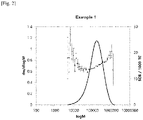
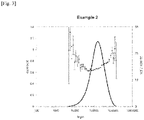
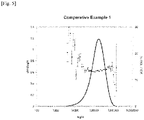
- the comonomer distribution of the polyolefin may be continuously measured together with the molecular weight and molecular weight distribution of the polymer using GPC-FTIR equipment.
- the CDS of a polyolefin indicates the slope of the comonomer content with respect to the molecular weight at the points where the cumulative weight fraction is 20% and 80%, respectively, in the comonomer distribution graph. As the CDS of a polyolefin increases, the comonomer is concentrated in the polymer chain having a high molecular weight, so that it can have excellent mechanical strength and heat seal properties.
- the polyolefin film according to an embodiment of the present invention may be prepared by molding the polyolefin described above.
- the polyolefin film according to an embodiment of the present invention comprises the polyolefin described above, it is excellent in mechanical properties and heat seal characteristics. It is understood that since the polyolefin described above has a relatively wide molecular weight distribution, and since short chain branches are relatively more present in the high molecular weight components, a polyolefin film produced therefrom is excellent in mechanical properties and heat seal characteristics.
- the polyolefin film according to an embodiment of the present invention has a heat seal strength of 90 gf/2.5 cm or more, preferably, 90 to 200 gf/2.5 cm, more preferably, 90 to 180 gf/2.5 cm, when measured at 0.2 bar, 1.5 seconds, and 125°C in accordance with ASTM F88.
- the polyolefin film according to an embodiment of the present invention has a heat seal strength of 210 gf/2.5 cm or more, preferably, 210 to 250 gf/2.5 cm, more preferably, 210 to 230 gf/2.5 cm, when measured at 0.2 bar, 1.5 seconds, and 140°C in accordance with ASTM F88.
- the polyolefin film according to an embodiment of the present invention has a hot tack strength at 95°C of 0.5 N/2 cm or more, preferably, 0.5 to 3.5 N/2 cm, more preferably, 0.5 to 2.0 N/2 cm, when measured in accordance with ASTM F1921.
- the polyolefin film according to an embodiment of the present invention has a hot tack strength at 110°C of 3.5 N/2 cm or more, preferably, 3.5 to 7.5 N/2 cm, more preferably, 3.5 to 5.0 N/2 cm, when measured in accordance with ASTM F1921.
- the polyolefin film according to an embodiment of the present invention may have a haze of 10% or less when measured based on a thickness of 50 ⁇ m in accordance with ASTM D 1003.
- the haze of the polyolefin film according to an embodiment of the present invention may be 7% or less or 6% or less.
- the polyolefin film according to an embodiment of the present invention can be advantageously used as a stretch film, an overlap film, a lamination, a silage wrap, an agricultural film, and the like.
- a process for preparing a polyolefin film which comprises (a) polymerizing an olefinic monomer in the presence of a catalyst comprising at least one transition metal compound represented by Formula 1 and at least one cocatalyst compound to obtain a polyolefin; and (b) molding the polyolefin to obtain a film, wherein the polyolefin has (1) a density of 0.910 to 0.940 g/cm 3 , preferably, 0.910 to 0.920 g/cm 3 ; (2) a melt flow ratio (MFR) of 10 to 60, preferably, 20 to 40, when measured at 190°C as a ratio of the melt index (I 21.6 ) under a load of 21.6 kg to the melt index (I 2.16 ) under a load of 2.16 kg; and (3) a comonomer distribution slope (CDS) of 1 or more, preferably, 2 to 5, as defined by Equation 1, and the film has a heat
- n, M, X, and R 1 to R 14 of Formula 1 and C 20 , C 80 , M 20 , and M 80 of Formula 1 are as defined above.
- the polyolefin may be prepared by a gas phase polymerization method, a solution polymerization method, a slurry polymerization method, or the like.
- the polymerization of an olefinic monomer may be carried out by gas-phase polymerization.
- the polymerization of an olefinic monomer may be carried out in a gas-phase fluidized bed reactor.
- the polyolefin may be prepared by copolymerizing an olefinic monomer and an olefinic comonomer.
- the olefinic monomer may be ethylene
- the olefinic comonomer may be at least one selected from the group consisting of propylene, 1-butene, 1-pentene, 4-methyl-1-pentene, 1-hexene, 1-heptene, 1-octene, 1-decene, 1-undecene, 1-dodecene, 1-tetradecene, and 1-hexadecene.
- the olefinic monomer is ethylene
- the olefinic comonomer is 1-hexene.
- step (b) there is no particular limitation to the method for producing a polyolefin film according to an embodiment of the present invention, and any method known in the technical field of the present invention can be used.
- the polyolefin described above may be molded by a conventional method such as blown film molding, extrusion molding, casting molding, or the like to prepare a polyolefin film. Blown film molding among the above is the most preferred.
- the polyolefin film prepared by the process for preparing a polyolefin film according to an embodiment of the present invention has a hot tack strength at 95°C of 0.5 N/2 cm or more, preferably 0.5 to 3.5 N/2 cm, more preferably 0.5 to 2.0 N/2 cm, and a hot tack strength at 110°C of 3.5 N/2 cm or more, preferably 3.5 to 7.5 N/2 cm, more preferably 3.5 to 5.0 N/2 cm, when measured in accordance with ASTM F1921.
- Methanesulfonyl chloride (1.8 g, 15.7 mmoles) was slowly added at 0°C to a solution in which 2-(trimethylsilylmethyl)-2-propen-1-ol (1.51 g, 10.5 mmoles) and triethylamine (1.91 g, 18.8 mmoles) had been diluted in dichloromethane (30 ml). Thereafter, it was stirred at 0°C for 3 hours. An aqueous solution of sodium hydrogen carbonate (NaHCO 3 ) was added thereto at 0°C to terminate the reaction, and the organic layer was then extracted with dichloromethane. Residual water was removed using sodium sulfate (Na 2 SO 4 ), and all solvents were removed under vacuum to obtain 1.9 g (82%) of a yellow oily compound.
- NaHCO 3 sodium hydrogen carbonate
- N-butyllithium (n-BuLi) (1.44 g, 2.93 mmoles, 1.6 M solution in hexane) was slowly added at -30°C to a solution of [2-(cyclopentadienylmethyl)allyl] trimethylsilane (620 mg, 3.22 mmoles) diluted in tetrahydrofuran (10 ml), and the temperature was gradually raised to room temperature, followed by stirring thereof for 12 hours. The solvents in the reaction solution were removed under vacuum, hexane was added thereto, followed by stirring thereof for 15 minutes. The resulting solid was filtered and dried under vacuum to obtain 528 mg (83%) of a pale yellow solid compound.
- hafnium chloride (HfCl 4 ) (226 mg, 0.71 mmole) dispersed in toluene (2 ml) was slowly added at -30°C to a solution in which [2-(trimethylsilylmethyl)allyl] cyclopentadienyl lithium (280 mg, 1.41 mmoles) had been diluted in toluene (3 ml), and the temperature was slowly raised to room temperature, followed by stirring thereof for 12 hours. Upon completion of the reaction, the reaction solution was filtered, and the solvent of the filtrate was dried under vacuum. The resulting solid was washed with hexane and dried to obtain 180 mg (41%) of a white solid compound.
- hafnium chloride HfCl 4
- MeMgBr (3.0 M solution in diethyl ether, 11.4 mmoles) was slowly added at - 30°C to a solution of bis[(2-trimethylsilylmethylallyl)cyclopentadienyl] hafnium dichloride (2.4 g, 3.79 mmoles) prepared in Preparation Example 1 diluted in toluene, and the temperature was slowly raised to room temperature, followed by stirring thereof for 12 hours. Upon completion of the reaction, it was extracted with toluene and then filtered. The solvent of the filtrate was dried under vacuum. The resulting solid was washed with hexane and dried to obtain 2.08 g (93%) of a white solid compound.
- n-Butyl lithium (5.5 g, 13 mmoles) was slowly added at -30°C to a solution of bis[(2-trimethylsilylmethylallyl)cyclopentadienyl] hafnium dichloride (4 g, 6 mmoles) prepared in Preparation Example 1 diluted in toluene (100 ml), and the temperature was slowly raised to room temperature, followed by stirring thereof for 12 hours. Upon completion of the reaction, the reaction solution was filtered, and the solvent of the filtrate was dried under vacuum to obtain 3.4 g (80%) of a yellow liquid compound.
- An ethylene/1-hexene copolymer was prepared in the presence of each of the supported catalysts obtained in Preparation Examples 1 to 3 in a gas-phase fluidized bed reactor.
- the partial pressure of ethylene in the reactor was maintained at about 15 kg/cm 2 , and the polymerization temperature was maintained at 80 to 90°C.
- linear low-density polyethylene M1810HN (density 0.918 g/cm 3 , melt index 1.0 g/10 min) and M2010HN (density 0.920 g/cm 3 , melt index 1.0 g/10 min) of Hanwha Chemical Corp. were used.
- the resins of Examples 1 to 3 and Comparative Examples 1 to 2 were each formed into a film having a thickness of 50 ⁇ m through a 40 mm blown film extruder (40 mm ⁇ screw, 75 mm ⁇ die, 2 mm die gap).
- the extrusion conditions were: C1/C2/C3/A/D1/D2 of 160/165/170/175/180/180°C, a screw speed of 60 rpm, and a blow-up ratio (BUR) of 2.
- the melting point of the polymer was measured using a differential scanning calorimeter (DSC; device name: DSC 2920, manufacturer: TA Instrument). Specifically, the polymer was heated to 200°C, the temperature was maintained for 5 minutes, it was cooled to 20°C, and the temperature was raised again. Here, the temperature elevation rate and cooling rate was 20°C/min, respectively.
- DSC differential scanning calorimeter
- a film was molded to a thickness of 50 ⁇ m and measured according to ASTM D 1003. Here, each specimen was measured 5 times, and the average value was taken.
- a film was molded to a thickness of 50 ⁇ m and measured according to ASTM D 1003. Here, each specimen was measured 5 times, and the average value was taken.
- the polyolefin film specifically, the linear low-density polyethylene film according to an embodiment of the present invention is readily formed and has excellent mechanical strength and excellent heat seal characteristics, in particular, excellent low-temperature heat seal characteristics.
Landscapes
- Chemical & Material Sciences (AREA)
- Health & Medical Sciences (AREA)
- Chemical Kinetics & Catalysis (AREA)
- Medicinal Chemistry (AREA)
- Polymers & Plastics (AREA)
- Organic Chemistry (AREA)
- Engineering & Computer Science (AREA)
- Materials Engineering (AREA)
- Manufacturing & Machinery (AREA)
- Crystallography & Structural Chemistry (AREA)
- Transition And Organic Metals Composition Catalysts For Addition Polymerization (AREA)
- Addition Polymer Or Copolymer, Post-Treatments, Or Chemical Modifications (AREA)
Abstract
Description
- The present invention relates to a polyolefin film and to a process for preparing the same. Specifically, the present invention relates to a polyolefin film that is readily molded and has excellent heat seal strength, in particular, low-temperature heat seal strength, and to a process for preparing the same.
- A metallocene catalyst, which is one of the catalysts used in the polymerization of olefins, is a compound in which a ligand such as cyclopentadienyl, indenyl, and cycloheptadienyl is coordinated to a transition metal or a transition metal halide compound. It has a sandwich structure in its basic form.
- In a Ziegler-Natta catalyst, which is another catalyst used in the polymerization of olefins, the metal component serving as the active sites is dispersed on an inert solid surface, whereby the properties of the active sites are not uniform. On the other hand, since a metallocene catalyst is a single compound having a specific structure, it is known as a single-site catalyst in which all active sites have the same polymerization characteristics. A polymer prepared by such a metallocene catalyst is characterized by a narrow molecular weight distribution, a uniform distribution of comonomers, and a higher copolymerization activity than Ziegler-Natta catalysts.
- Meanwhile, a linear low-density polyethylene (LLDPE) is produced by copolymerizing ethylene and an alpha-olefin at a low pressure using a polymerization catalyst. It has a narrow molecular weight distribution and short chain branches (SCBs) having a certain length, but generally does not have long chain branches (LCBs). Films prepared from a linear low-density polyethylene have high strength at breakage, elongation, tear strength, and impact strength in addition to the characteristics of common polyethylene. They are widely used for stretch films and overlap films to which conventional low-density polyethylene or high-density polyethylene is hardly applicable.
- However, a linear low-density polyethylene produced by a metallocene catalyst has a narrow molecular weight distribution, resulting in poor processability, and a film produced therefrom tends to have deteriorated heat seal characteristics.
- Accordingly, there is a demand for a polyolefin film that is readily molded and has excellent mechanical strength and excellent heat seal characteristics, in particular, excellent low-temperature heat seal characteristics.
- An object of the present invention is to provide a polyolefin film, in particular, a linear low-density polyethylene film that is readily molded and has excellent mechanical strength and excellent heat seal characteristics, in particular, excellent low-temperature heat seal characteristics.
- Another object of the present invention is to provide a process for preparing a polyolefin film, in particular, a linear low-density polyethylene film that is readily molded and has excellent mechanical strength and excellent heat seal characteristics, in particular, excellent low-temperature heat seal characteristics.
- According to an embodiment of the present invention to accomplish the object, there is provided a polyolefin film, which is molded from a polyolefin having (1) a density of 0.910 to 0.940 g/cm3, preferably, 0.910 to 0.920 g/cm3; (2) a melt flow ratio (MFR) of 10 to 60, preferably, 20 to 40, when measured at 190°C as a ratio of the melt index (I21.6) under a load of 21.6 kg to the melt index (I2.16) under a load of 2.16 kg; and (3) a comonomer distribution slope (CDS) of 1 or more, preferably, 2 to 5, as defined by
Equation 1, wherein the film has a heat seal strength of 90 gf/2.5 cm or more, preferably, 90 to 200 gf/2.5 cm, when measured at 0.2 bar, 1.5 seconds, and 125°C, and a heat seal strength of 210 gf/2.5 cm or more, preferably, 210 to 250 gf/2.5 cm, when measured at 0.2 bar, 1.5 seconds, and 140°C.
- Here, C20 and Cso are the comonomer contents at the point where the cumulative weight fraction in the comonomer distribution is 20% and 80%, respectively, and M20 and Mso are the molecular weights at which the cumulative weight fraction in the comonomer distribution is 20% and 80%, respectively.
- The polyolefin may be prepared by polymerizing an olefinic monomer in the presence of a catalyst comprising at least one transition metal compound represented by
Formula 1 and at least one cocatalyst compound.
- In Formula 1, n is each independently an integer of 1 to 20,
- M is titanium (Ti), zirconium (Zr), or hafnium (Hf),
- X is each independently halogen, C1-20 alkyl, C2-20 alkenyl, C2-20 alkynyl, C6-20 aryl, C1-20 alkyl C6-20 aryl, C6-20 aryl C1-20 alkyl, C1-20 alkylamido, C6-20 arylamido, or C1-20 alkylidene,
- R1 to R4 and R5 to R8 are each independently hydrogen, substituted or unsubstituted C1-20 alkyl, substituted or unsubstituted C2-20 alkenyl, substituted or unsubstituted C6-20 aryl, substituted or unsubstituted C1-20 alkyl C6-20 aryl, substituted or unsubstituted C6-20 aryl C1-20 alkyl, substituted or unsubstituted C1-20 heteroalkyl, substituted or unsubstituted C3-20 heteroaryl, substituted or unsubstituted C1-20 alkylamido, substituted or unsubstituted C6-20 arylamido, substituted or unsubstituted C1-20 alkylidene, or substituted or unsubstituted C1-20 silyl,
- R9 to R11 and R12 to R14 are each independently substituted or unsubstituted C1-20 alkyl, substituted or unsubstituted C2-20 alkenyl, substituted or unsubstituted C6-20 aryl, substituted or unsubstituted C1-20 alkyl C6-20 aryl, substituted or unsubstituted C6-20 aryl C1-20 alkyl, substituted or unsubstituted C1-20 heteroalkyl, substituted or unsubstituted C3-20 heteroaryl, substituted or unsubstituted C1-20 alkylamido, substituted or unsubstituted C6-20 arylamido, substituted or unsubstituted C1-20 alkylidene, or substituted or unsubstituted C1-20 silyl, and
- R1 to R4 and R5 to R8 are each independently capable of being linked to adjacent groups to form a substituted or unsubstituted saturated or unsaturated C4-20 ring.
- Meanwhile, the cocatalyst compound may be selected from the group consisting of a compound represented by Formula 2, a compound represented by Formula 3, and a compound represented by Formula 4.


[Formula 4] [L-H]+[Z(A)4]- or [L]+[Z(A)4]-
- In Formula 2, n is an integer of 2 or more, and Ra may each independently be a halogen atom, C1-20 hydrocarbon, or C1-20 hydrocarbon substituted with halogen.
- In Formula 3, D is aluminum (Al) or boron, and Rb, Rc, and Rd are each independently a halogen atom, C1-20 hydrocarbon, C1-20 hydrocarbon substituted with halogen, or C1-20 alkoxy.
- In Formula 4, L is a neutral or cationic Lewis acid, [L-H]+ and [L]+ a Bronsted acid, Z is a group 13 element, and A is each independently substituted or unsubstituted C6-20 aryl or substituted or unsubstituted C1-20 alkyl.
- In addition, the catalyst may further comprise a carrier for supporting the transition metal compound and the cocatalyst compound.
- Preferably, the polyolefin is a copolymer of an olefinic monomer and an olefinic comonomer. Specifically, the olefinic monomer is ethylene, and the olefinic comonomer is at least one selected from the group consisting of propylene, 1-butene, 1-pentene, 4-methyl-1-pentene, 1-hexene, 1-heptene, 1-octene, 1-decene, 1-undecene, 1-dodecene, 1-tetradecene, and 1-hexadecene. Preferably, the polyolefin is a linear low-density polyethylene in which the olefinic monomer is ethylene, and the olefinic comonomer is 1-hexene.
- Preferably, the polyolefin film according to an embodiment of the present invention has a hot tack strength at 95°C of 0.5 N/2 cm or more, preferably, 0.5 to 3.5 N/2 cm, and a hot tack strength at 110°C of 3.5 N/2 cm or more, preferably, 3.5 to 7.5 N/2 cm.
- Preferably, the polyolefin film according to an embodiment of the present invention may have a haze of 10% or less, preferably, 7% or less or 6% or less, when measured based on a thickness of 50 µm.
- Specifically, the film according to an embodiment of the present invention may be at least one selected from the group consisting of a stretch film, an overlap film, a lamination, a silage wrap, an agricultural film, and the like.
- According to another embodiment of the present invention, there is provided a process for preparing a polyolefin film, which comprises (a) polymerizing an olefinic monomer in the presence of a catalyst comprising at least one transition metal compound represented by
Formula 1 and at least one cocatalyst compound to obtain a polyolefin; and (b) molding the polyolefin to obtain a film, wherein the polyolefin has (1) a density of 0.910 to 0.940 g/cm3, preferably, 0.910 to 0.920 g/cm3; (2) a melt flow ratio (MFR) of 10 to 60, preferably, 20 to 40, when measured at 190°C as a ratio of the melt index (I21.6) under a load of 21.6 kg to the melt index (I2.16) under a load of 2.16 kg; and (3) a comonomer distribution slope (CDS) of 1 or more, preferably, 2 to 5, as defined byEquation 1, and the film has a heat seal strength of 90 gf/2.5 cm or more, preferably, 90 to 200 gf/2.5 cm, when measured at 0.2 bar, 1.5 seconds, and 125°C, and a heat seal strength of 210 gf/2.5 cm or more, preferably, 210 to 250 gf/2.5 cm, when measured at 0.2 bar, 1.5 seconds, and 140°C.

- n, M, X, and R1 to R14 of
Formula 1 and C20, C80, M20, and M80 ofFormula 1 are as defined above. - In step (a), the polymerization of an olefinic monomer may be carried out by gas-phase polymerization. Specifically, the polymerization of an olefinic monomer may be carried out in a gas-phase fluidized bed reactor.
- In step (a), the polyolefin may be prepared by copolymerizing an olefinic monomer and an olefinic comonomer. Here, the olefinic monomer may be ethylene, and the olefinic comonomer may be at least one selected from the group consisting of propylene, 1-butene, 1-pentene, 4-methyl-1-pentene, 1-hexene, 1-heptene, 1-octene, 1-decene, 1-undecene, 1-dodecene, 1-tetradecene, and 1-hexadecene. Preferably, the olefinic monomer is ethylene, and the olefinic comonomer is 1-hexene.
- The polyolefin film prepared by the process for preparing a polyolefin film according to an embodiment of the present invention has a hot tack strength at 95°C of 0.5 N/2 cm or more, preferably, 0.5 to 3.5 N/2 cm, and a hot tack strength at 110°C of 3.5 N/2 cm or more, preferably, 3.5 to 7.5 N/2 cm.
- The polyolefin film, in particular, the linear low-density polyethylene film according to an embodiment of the present invention is readily molded and has excellent mechanical strength and excellent heat seal characteristics, in particular, excellent low-temperature heat seal characteristics.
-
-
Fig. 1 is a GPC-FTIR graph for explaining a method of measuring CDS defined byEquation 1. -
Figs. 2 to 4 are GPC-FTIR graphs for measuring the CDS of the polyolefins of Examples 1 to 3, respectively. -
Figs. 5 and6 are GPC-FTIR graphs for measuring the CDS of the polyolefins of Comparative Examples 1 and 2, respectively. -
Fig. 7 is a graph showing the heat seal strength of Example 1, Comparative Example 1, and Comparative Example 2. -
Fig. 8 is a graph showing the hot tack strength of Example 1, Comparative Example 1, and Comparative Example 2. - Hereinafter, the present invention will be described in more detail.
- The polyolefin film according to an embodiment of the present invention is prepared by molding a polyolefin.
- Here, the polyolefin for preparing the polyolefin film according to an embodiment of the present invention may be prepared by polymerizing an olefinic monomer in the presence of a catalyst.
- The catalyst for preparing a polyolefin, in particular, a linear low-density polyethylene, for preparing a polyolefin film according to an embodiment of the present invention comprises at least one transition metal compound represented by Formula 1 and at least one cocatalyst compound.


- In Formula 1, n is each independently an integer of 1 to 20, preferably an integer of 1 to 10, more preferably an integer of 1 to 5. Specifically, n may each be 1 or 2.
- M is titanium (Ti), zirconium (Zr), or hafnium (Hf). Specifically, M may be zirconium or hafnium.
- X is each independently halogen, C1-20 alkyl, C2-20 alkenyl, C2-20 alkynyl, C6-20 aryl, C1-20 alkyl C6-20 aryl, C6-20 aryl C1-20 alkyl, C1-20 alkylamido, C6-20 arylamido, or C1-20 alkylidene. Specifically, X may each be halogen or substituted or unsubstituted C1-20 alkyl. More specifically, X may each be chlorine, a methyl group, or a butyl group.
- R1 to R4 and R5 to R8 are each independently hydrogen, substituted or unsubstituted C1-20 alkyl, substituted or unsubstituted C2-20 alkenyl, substituted or unsubstituted C6-20 aryl, substituted or unsubstituted C1-20 alkyl C6-20 aryl, substituted or unsubstituted C6-20 aryl C1-20 alkyl, substituted or unsubstituted C1-20 heteroalkyl, substituted or unsubstituted C3-20 heteroaryl, substituted or unsubstituted C1-20 alkylamido, substituted or unsubstituted C6-20 arylamido, substituted or unsubstituted C1-20 alkylidene, or substituted or unsubstituted C1-20 silyl. In addition, R1 to R4 and R5 to R8 are each independently capable of being linked to adjacent groups to form a substituted or unsubstituted saturated or unsaturated C4-20 ring. Specifically, R1 to R4 and R5 to R8 may each be hydrogen.
- R9 to R11 and R12 to R14 are each independently substituted or unsubstituted C1-20 alkyl, substituted or unsubstituted C2-20 alkenyl, substituted or unsubstituted C6-20 aryl, substituted or unsubstituted C1-20 alkyl C6-20 aryl, substituted or unsubstituted C6-20 aryl C1-20 alkyl, substituted or unsubstituted C1-20 heteroalkyl, substituted or unsubstituted C3-20 heteroaryl, substituted or unsubstituted C1-20 alkylamido, substituted or unsubstituted C6-20 arylamido, substituted or unsubstituted C1-20 alkylidene, or substituted or unsubstituted C1-20 silyl.
- Specifically, R9 to R11 and R12 to R14 may each be substituted or unsubstituted C1-20 alkyl or substituted or unsubstituted C6-20 aryl. More specifically, R9 to R11 and R12 to R14 may each be a methyl group or a phenyl group.
- In a preferred embodiment of the present invention, the compound represented by
Formula 1 may be any one of the compounds represented by Formulae 1-1 to 1-8.
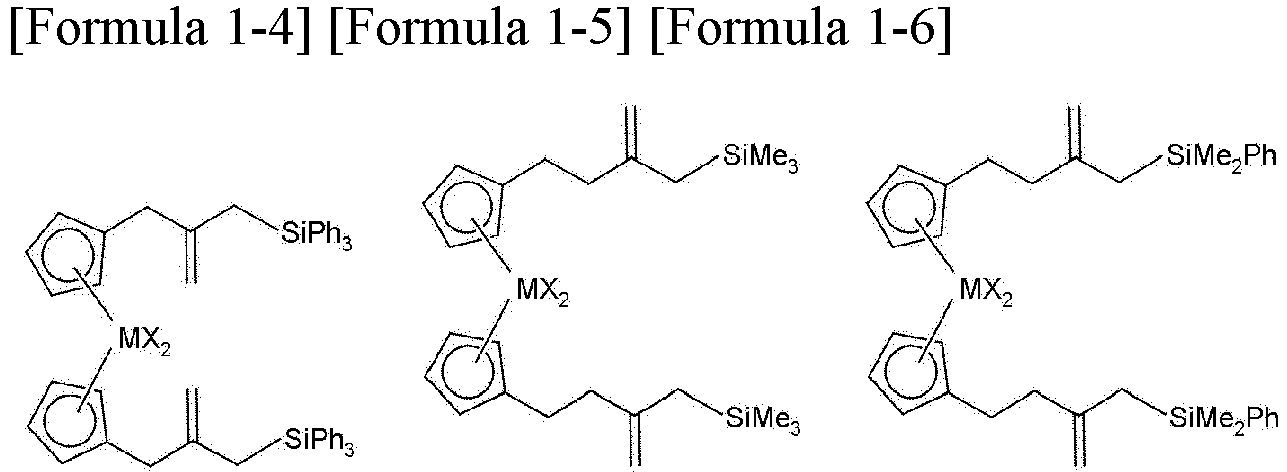

- In Formulae 1-1 to 1-8 above, M is zirconium or hafnium, X is each halogen or substituted or unsubstituted C1-20 alkyl, preferably chlorine, a methyl group, or a butyl group, Me is a methyl group, and Ph is a phenyl group.
- In a more preferred embodiment of the present invention, the compound represented by
Formula 1 may be any one of the compounds represented by Formulae 1-9 to 1-11.
- In Formulae 1-9 to 1-11, Me is a methyl group, and Ph is a phenyl group.
- Meanwhile, the cocatalyst compound may comprise at least one of a compound represented by
Formula 2, a compound represented byFormula 3, and a compound represented by Formula 4.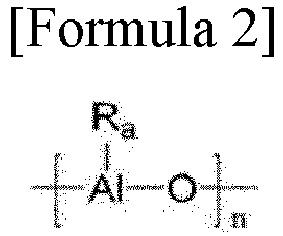
- In
Formula 2, n is an integer of 2 or more, and Ra may each independently be halogen, C1-20 hydrocarbon, or C1-20 hydrocarbon substituted with halogen. Specifically, Ra may be methyl, ethyl, n-butyl, or isobutyl.
- In
Formula 3, D is aluminum (Al) or boron, and Rb, Rc, and Rd are each independently a halogen atom, C1-20 hydrocarbon, C1-20 hydrocarbon substituted with halogen, or C1-20 alkoxy. Specifically, when D is aluminum (Al), Rb, Rc, and Rd may each independently be methyl or isobutyl, and when D is boron (B), Rb, Rc, and Rd may each be pentafluorophenyl.
[Formula 4] [L-H]+[Z(A)4]- or [L]+[Z(A)4]-
- In Formula 4, L is a neutral or cationic Lewis acid, [L-H]+ and [L]+ a Bronsted acid, Z is a group 13 element, and A is each independently substituted or unsubstituted C6-20 aryl or substituted or unsubstituted C1-20 alkyl. Specifically, [LH]+ may be a dimethylanilinium cation, [Z(A)4]- may be [B(C6F5)4]-, and [L]+ may be [(C6H5)3C]+.
- Specifically, examples of the compound represented by
Formula 2 include methylaluminoxane, ethylaluminoxane, isobutylaluminoxane, butylaluminoxane, and the like. Preferred is methylaluminoxane. But it is not limited thereto. - Examples of the compound represented by
Formula 3 include trimethylaluminum, triethylaluminum, triisobutylaluminum, tripropylaluminum, tributylaluminum, dimethylchloroaluminum, triisopropylaluminum, tri-s-butylaluminum, tricyclopentylaluminum, tripentylaluminum, triisopentyaluminum, trihexyaluminum, trioctyaluminum, ethyldimethylaluminum, methyldiethylaluminum, triphenylaluminum, tri-p-tolylaluminum, dimethylaluminummethoxide, dimethylaluminumethoxide, trimethylboron, triethylboron, triisobutylboron, tripropylboron, and tributylboron. Preferred are trimethylaluminum, triethylaluminum, and triisobutylaluminum. But it is not limited thereto. - Examples of the compound represented by Formula 4 include triethylammonium tetraphenylborate, tributylammonium tetraphenylborate, trimethylammonium tetraphenylborate, tripropylammonium tetraphenylborate, trimethylammonium tetra(p-tolyl)borate, trimethylammonium tetra(o,p-dimethylphenyl)borate, tributylammonium tetra(p-trifluoromethylphenyl)borate, trimethylammonium tetra(p-trifluoromethylphenyl)borate, tributylammonium tetrapentafluorophenylborate, N,N-diethylanilinium tetraphenylborate, N,N-diethylanilinium tetrapentafluorophenylborate, diethylammonium tetrapentafluorophenylborate, triphenylphosphonium tetraphenylborate, trimethylphosphonium tetraphenylborate, triethylammonium tetraphenylaluminate, tributylammonium tetraphenylaluminate, trimethylammonium tetraphenylaluminate, tripropylammonium tetraphenylaluminate, trimethylammonium tetra(p-tolyl)aluminate, tripropylammonium tetra(p-tolyl)aluminate, triethylammonium tetra(o,p-dimethylphenyl)aluminate, tributylammonium tetra(p-trifluoromethylphenyl)aluminate, trimethylammonium tetra(p-trifluoromethylphenyl)aluminate, tributylammonium tetrapentafluorophenylaluminate, N,N-diethylanilinium tetraphenylaluminate, N,N-diethylanilinium tetrapentafluorophenylaluminate, diethylammonium tetrapentatetraphenylaluminate, triphenylphosphonium tetraphenylaluminate, trimethylphosphonium tetraphenylaluminate, tripropylammonium tetra(p-tolyl)borate, triethylammonium tetra(o,p-dimethylphenyl)borate, triphenylcarbonium tetra(p-trifluoromethylphenyl)borate, and triphenylcarbonium tetrapentafluorophenylborate.
- In a preferred embodiment of the present invention, the catalyst for olefin polymerization may further comprise a carrier for supporting the transition metal compound. Specifically, the carrier may support both of the transition metal compound and the cocatalyst.
- In such an event, the carrier may comprise a material containing a hydroxyl group on its surface. Preferably, a material that has been dried to remove moisture from its surface and has a highly reactive hydroxyl group and a siloxane group may be used. For example, the carrier may comprise at least one selected from the group consisting of silica, alumina, and magnesia. Specifically, silica, silica-alumina, and silica-magnesia dried at high temperatures may be used as a carrier. They usually contain oxides, carbonates, sulfates, and nitrates components such as Na2O, K2CO3, BaSO4, and Mg(NO3)2. In addition, they may comprise carbon, zeolite, magnesium chloride, and the like. However, the carrier is not limited thereto. It is not particularly limited as long as it can support the transition metal compound and the cocatalyst compound.
- The carrier may have an average particle size of 10 to 250 µm, preferably an average particle size of 10 to 150 µm, and more preferably 20 to 100 µm.
- The carrier may have a micropore volume of 0.1 to 10 cc/g, preferably 0.5 to 5 cc/g, and more preferably 1.0 to 3.0 cc/g.
- The carrier may have a specific surface area of 1 to 1,000 m2/g, preferably 100 to 800 m2/g, more preferably 200 to 600 m2/g.
- In a preferred example, when the carrier is silica, the drying temperature of the silica may be 200 to 900°C. The drying temperature may preferably be 300 to 800°C, more preferably 400 to 700°C. If the drying temperature is lower than 200°C, there would be too much moisture so that the moisture on the surface and the cocatalyst may react. If it exceeds 900°C, the structure of the carrier may collapse.
- The dried silica may have a concentration of hydroxy groups of 0.1 to 5 mmole/g, preferably 0.7 to 4 mmole/g, and more preferably 1.0 to 2 mmole/g. If the concentration of hydroxy groups is less than 0.1 mmole/g, the supported amount of the cocatalyst may be low. If it exceeds 5 mmole/g, there may arise a problem that the catalyst component may be deactivated.
- The amount of the transition metal compound supported on a carrier may be 0.001 to 1 mmole based on 1 g of the carrier. When the content ratio of the transition metal compound and the carrier satisfies the above range, an appropriate activity of the supported catalyst may be exhibited, which is advantageous from the viewpoint of maintaining the activity of the catalyst and economical efficiency.
- The amount of the cocatalyst compound supported on a carrier may be 2 to 15 mmoles based on the 1 g of the carrier. When the content ratio of the cocatalyst compound and the carrier satisfies the above range, it is advantageous from the viewpoint of maintaining the activity of the catalyst and economical efficiency.
- One or two or more types of a carrier may be used. For example, both the transition metal compound and the cocatalyst compound may be supported on one type of a carrier, or the transition metal compound and the cocatalyst compound may be supported on two or more types of a carrier, respectively. In addition, either one of the transition metal compound and the cocatalyst compound may be supported on a carrier.
- As a method of supporting the transition metal compound and the cocatalyst compound employed in a catalyst for olefin polymerization on the carrier, a physical adsorption method or a chemical adsorption method may be used.
- For example, the physical adsorption method may be a method of contacting a solution in which a transition metal compound has been dissolved with a carrier and then drying the same; a method of contacting a solution in which a transition metal compound and a cocatalyst compound have been dissolved with a carrier and then drying the same; or a method of contacting a solution in which a transition metal compound has been dissolved with a carrier and then drying the same to prepare the carrier that supports the transition metal compound, separately contacting a solution in which a cocatalyst compound has been dissolved with a carrier and then drying the same to prepare the carrier that supports the cocatalyst compound, and then mixing them.
- The chemical adsorption method may be a method of supporting a cocatalyst compound on the surface of a carrier, and then supporting a transition metal compound on the cocatalyst compound; or a method of covalently bonding a functional group on the surface of a carrier (e.g., a hydroxy group (-OH) on the silica surface in the case of silica) with a catalyst compound.
- Here, the polyolefin prepared by polymerizing an olefinic monomer in the presence of the catalyst for olefin polymerization as described above may be a homopolymer of an olefinic monomer or a copolymer of an olefinic monomer and an olefinic comonomer.
- The olefinic monomer is at least one selected from the group consisting of a C2-20 alpha-olefin, a C1-20 diolefin, a C3-20 cycloolefin, and a C3-20 cyclodiolefin.
- For example, the olefinic monomer may be ethylene, propylene, 1-butene, 1-pentene, 4-methyl-1-pentene, 1-hexene, 1-heptene, 1-octene, 1-decene, 1-undecene, 1-dodecene, 1-tetradecene, 1-hexadecene, or the like, and the polyolefin may be a homopolymer comprising only one olefinic monomer or a copolymer comprising two or more olefinic monomers exemplified above.
- As an exemplary example, the polyolefin may be a copolymer in which ethylene and a C3-20 alpha-olefin are copolymerized. Preferred is a copolymer in which ethylene and 1-hexene are copolymerized. But it is not limited thereto.
- In such an event, the content of ethylene is preferably 55 to 99.9% by weight, more preferably 90 to 99.9% by weight. The content of the alpha-olefinic comonomer is preferably 0.1 to 45% by weight, more preferably 0.1 to 10% by weight.
- The polyolefin according to an embodiment of the present invention may be prepared by a polymerization reaction such as free radical, cationic, coordination, condensation, and addition, but it is not limited thereto.
- As an example of the present invention, the polyolefin may be prepared by a gas phase polymerization method, a solution polymerization method, a slurry polymerization method, or the like. Preferably, the polymerization of an olefinic monomer may be carried out by gas-phase polymerization. Specifically, the polymerization of an olefinic monomer may be carried out in a gas-phase fluidized bed reactor.
- When the polyolefin is prepared by a solution polymerization method or a slurry polymerization method, examples of a solvent that may be used include C5-12 aliphatic hydrocarbon solvents such as pentane, hexane, heptane, nonane, decane, and isomers thereof; aromatic hydrocarbon solvents such as toluene and benzene; hydrocarbon solvents substituted with chlorine atoms such as dichloromethane and chlorobenzene; and mixtures thereof, but it is not limited thereto.
- The polyolefin for preparing a polyolefin film according to an embodiment of the present invention has (1) a density of 0.910 to 0.940 g/cm3; (2) a melt flow ratio (MFR) of 10 to 60 when measured at 190°C as a ratio of the melt index (I21.6) under a load of 21.6 kg to the melt index (I2.16) under a load of 2.16 kg; and (3) a comonomer distribution slope (CDS) of 1 or more as defined by
Equation 1. - Specifically, the polyolefin may have a density of 0.910 to 0.940 g/cm3. Preferably, the density of the polyolefin may be 0.910 to 0.920 g/cm3 or 0.915 to 0.925 g/cm3.
- In addition, the polyolefin may have a melt flow ratio (MFR) of 10 to 60 when measured at 190°C as a ratio of the melt index (I21.6) under a load of 21.6 kg to the melt index (I2.16) under a load of 2.16 kg. Preferably, the MFR of the polyolefin may be 20 to 50 or 20 to 40.
- In addition, the polyolefin may have a comonomer distribution slope (CDS) of 1 or more as defined by
Equation 1. Preferably, the CDS of the polyolefin may be 2 to 5 or 2 to 4.
- In
Equation 1, C20 and C80 are the comonomer contents at the point where the cumulative weight fraction in the comonomer distribution is 20% and 80%, respectively, and M20 and M80 are the molecular weights at which the cumulative weight fraction in the comonomer distribution is 20% and 80%, respectively. - Here, the comonomer distribution of the polyolefin may be continuously measured together with the molecular weight and molecular weight distribution of the polymer using GPC-FTIR equipment.
- The CDS of a polyolefin indicates the slope of the comonomer content with respect to the molecular weight at the points where the cumulative weight fraction is 20% and 80%, respectively, in the comonomer distribution graph. As the CDS of a polyolefin increases, the comonomer is concentrated in the polymer chain having a high molecular weight, so that it can have excellent mechanical strength and heat seal properties.
- The polyolefin film according to an embodiment of the present invention may be prepared by molding the polyolefin described above.
- Since the polyolefin film according to an embodiment of the present invention comprises the polyolefin described above, it is excellent in mechanical properties and heat seal characteristics. It is understood that since the polyolefin described above has a relatively wide molecular weight distribution, and since short chain branches are relatively more present in the high molecular weight components, a polyolefin film produced therefrom is excellent in mechanical properties and heat seal characteristics.
- Specifically, the polyolefin film according to an embodiment of the present invention has a heat seal strength of 90 gf/2.5 cm or more, preferably, 90 to 200 gf/2.5 cm, more preferably, 90 to 180 gf/2.5 cm, when measured at 0.2 bar, 1.5 seconds, and 125°C in accordance with ASTM F88. The polyolefin film according to an embodiment of the present invention has a heat seal strength of 210 gf/2.5 cm or more, preferably, 210 to 250 gf/2.5 cm, more preferably, 210 to 230 gf/2.5 cm, when measured at 0.2 bar, 1.5 seconds, and 140°C in accordance with ASTM F88.
- In addition, the polyolefin film according to an embodiment of the present invention has a hot tack strength at 95°C of 0.5 N/2 cm or more, preferably, 0.5 to 3.5 N/2 cm, more preferably, 0.5 to 2.0 N/2 cm, when measured in accordance with ASTM F1921. The polyolefin film according to an embodiment of the present invention has a hot tack strength at 110°C of 3.5 N/2 cm or more, preferably, 3.5 to 7.5 N/2 cm, more preferably, 3.5 to 5.0 N/2 cm, when measured in accordance with ASTM F1921.
- In addition, the polyolefin film according to an embodiment of the present invention may have a haze of 10% or less when measured based on a thickness of 50 µm in accordance with ASTM D 1003. Preferably, the haze of the polyolefin film according to an embodiment of the present invention may be 7% or less or 6% or less.
- The polyolefin film according to an embodiment of the present invention can be advantageously used as a stretch film, an overlap film, a lamination, a silage wrap, an agricultural film, and the like.
- According to another embodiment of the present invention, there is provided a process for preparing a polyolefin film, which comprises (a) polymerizing an olefinic monomer in the presence of a catalyst comprising at least one transition metal compound represented by Formula 1 and at least one cocatalyst compound to obtain a polyolefin; and (b) molding the polyolefin to obtain a film, wherein the polyolefin has (1) a density of 0.910 to 0.940 g/cm3, preferably, 0.910 to 0.920 g/cm3; (2) a melt flow ratio (MFR) of 10 to 60, preferably, 20 to 40, when measured at 190°C as a ratio of the melt index (I21.6) under a load of 21.6 kg to the melt index (I2.16) under a load of 2.16 kg; and (3) a comonomer distribution slope (CDS) of 1 or more, preferably, 2 to 5, as defined by Equation 1, and the film has a heat seal strength of 90 gf/2.5 cm or more, preferably, 90 to 200 gf/2.5 cm, when measured at 0.2 bar, 1.5 seconds, and 125°C, and a heat seal strength of 210 gf/2.5 cm or more, preferably, 210 to 250 gf/2.5 cm, when measured at 0.2 bar, 1.5 seconds, and 140°C.


- n, M, X, and R1 to R14 of
Formula 1 and C20, C80, M20, and M80 ofFormula 1 are as defined above. - In step (a), the polyolefin may be prepared by a gas phase polymerization method, a solution polymerization method, a slurry polymerization method, or the like. Preferably, the polymerization of an olefinic monomer may be carried out by gas-phase polymerization. Specifically, the polymerization of an olefinic monomer may be carried out in a gas-phase fluidized bed reactor.
- In step (a), the polyolefin may be prepared by copolymerizing an olefinic monomer and an olefinic comonomer. Here, the olefinic monomer may be ethylene, and the olefinic comonomer may be at least one selected from the group consisting of propylene, 1-butene, 1-pentene, 4-methyl-1-pentene, 1-hexene, 1-heptene, 1-octene, 1-decene, 1-undecene, 1-dodecene, 1-tetradecene, and 1-hexadecene. Preferably, the olefinic monomer is ethylene, and the olefinic comonomer is 1-hexene.
- In step (b), there is no particular limitation to the method for producing a polyolefin film according to an embodiment of the present invention, and any method known in the technical field of the present invention can be used. For example, the polyolefin described above may be molded by a conventional method such as blown film molding, extrusion molding, casting molding, or the like to prepare a polyolefin film. Blown film molding among the above is the most preferred.
- The polyolefin film prepared by the process for preparing a polyolefin film according to an embodiment of the present invention has a hot tack strength at 95°C of 0.5 N/2 cm or more, preferably 0.5 to 3.5 N/2 cm, more preferably 0.5 to 2.0 N/2 cm, and a hot tack strength at 110°C of 3.5 N/2 cm or more, preferably 3.5 to 7.5 N/2 cm, more preferably 3.5 to 5.0 N/2 cm, when measured in accordance with ASTM F1921.
- Hereinafter, the present invention will be described in detail with reference to Examples, However, the following examples are intended to further illustrate the present invention. The scope of the present invention is not limited thereto only.
- An aqueous solution of potassium carbonate (K2CO3) (6.6 M, 14.4 mmoles) was slowly added to a solution of 2-(trimethylsilylmethyl)allyl acetate (2.69 g, 14.4 mmoles) in methanol (22 ml). Upon completion of the addition, it was stirred at room temperature for 4 hours. After stirring, water was added thereto to terminate the reaction. The organic layer was extracted with diethyl ether, and residual water was removed using magnesium sulfate (MgSO4). All solvents were removed under vacuum to obtain 1.51 g (72%) of a pale beige oily compound.
- 1H-NMR (CDCl3, 300 MHz): δ 4.90-4.88 (m, 1H), 4.66 (s, 1H), 3.97 (s, 2H), 1.53 (s, 2H), 0.03 (s, 9H).
- Methanesulfonyl chloride (1.8 g, 15.7 mmoles) was slowly added at 0°C to a solution in which 2-(trimethylsilylmethyl)-2-propen-1-ol (1.51 g, 10.5 mmoles) and triethylamine (1.91 g, 18.8 mmoles) had been diluted in dichloromethane (30 ml). Thereafter, it was stirred at 0°C for 3 hours. An aqueous solution of sodium hydrogen carbonate (NaHCO3) was added thereto at 0°C to terminate the reaction, and the organic layer was then extracted with dichloromethane. Residual water was removed using sodium sulfate (Na2SO4), and all solvents were removed under vacuum to obtain 1.9 g (82%) of a yellow oily compound.
- 1H-NMR (CDCl3, 300 MHz): δ 5.03 (d, 1H), 4.84 (s, 1H), 4.56 (s, 2H), 3.02 (s, 3H), 1.60 (s, 2H), 0.06 (s, 9H).
- A solution of lithium bromide dispersed in tetrahydrofuran (15 ml) was slowly added at room temperature to a solution in which 2-(trimethylsilylmethyl) methane sulfonate (1.9 g, 8.54 mmoles) had been diluted in tetrahydrofuran (20 ml). It was then stirred at 110°C for 4 hours. Distilled water was added thereto at 0°C to terminate the reaction, and the organic layer was then extracted with diethyl ether. Residual water was removed using sodium sulfate, and all solvents were removed under vacuum to obtain 1.12 g (65%) of a yellow oily compound.
- 1H-NMR (CDCl3, 300 MHz): δ 5.04 (s, 1H), 4.74 (d, 1H), 3.90 (d, 2H), 1.72 (d, 2H), 0.05 (s, 9H).
- Sodium cyclopentadienide (3.04 g, 6.49 mmoles, 2M in tetrahydrofuran) was slowly added dropwise at -30°C to a solution in which 2-(trimethylsilylmethyl)allyl bromide (1.12 g, 5.41 mmoles) had been diluted in tetrahydrofuran (20 ml), and the temperature was slowly raised to room temperature, followed by stirring thereof for 12 hours. Distilled water was added thereto at 0°C to terminate the reaction, and the organic layer was then extracted with diethyl ether. Residual water was removed using magnesium sulfate, and it was subjected to separation by column chromatography (hexane) to obtain 620 mg (60%) of a pale beige oily compound.
- 1H-NMR (CDCl3, 300 MHz): δ 6.42-6.02 (m, 4H), 4.60-4.55 (m, 2H), 3.06-2.97 (m, 2H), 2.87-2.85 (m, 2H), 1.54 (s, 2H), 0.03 (d, 9H).
- N-butyllithium (n-BuLi) (1.44 g, 2.93 mmoles, 1.6 M solution in hexane) was slowly added at -30°C to a solution of [2-(cyclopentadienylmethyl)allyl] trimethylsilane (620 mg, 3.22 mmoles) diluted in tetrahydrofuran (10 ml), and the temperature was gradually raised to room temperature, followed by stirring thereof for 12 hours. The solvents in the reaction solution were removed under vacuum, hexane was added thereto, followed by stirring thereof for 15 minutes. The resulting solid was filtered and dried under vacuum to obtain 528 mg (83%) of a pale yellow solid compound.
- A solution of hafnium chloride (HfCl4) (226 mg, 0.71 mmole) dispersed in toluene (2 ml) was slowly added at -30°C to a solution in which [2-(trimethylsilylmethyl)allyl] cyclopentadienyl lithium (280 mg, 1.41 mmoles) had been diluted in toluene (3 ml), and the temperature was slowly raised to room temperature, followed by stirring thereof for 12 hours. Upon completion of the reaction, the reaction solution was filtered, and the solvent of the filtrate was dried under vacuum. The resulting solid was washed with hexane and dried to obtain 180 mg (41%) of a white solid compound.
- 1H-NMR (CDCl3, 300 MHz): δ 6.21 (t, 2H), 6.12 (t, 2H), 4.54 (d, 2H), 4.44 (d, 1H), 3.28 (s, 2H), 1.52 (s, 2H), 0.05 (s, 9H).
- 624 g of a 10% methylaluminoxane solution in toluene was added to 4.15 g of the compound of Formula 1-9, followed by stirring thereof at room temperature for 1 hour. Upon completion of the reaction, the solution was added to 140 g of silica (XPO-2402), and 3 liters of toluene was further added thereto, followed by stirring thereof at 70°C for 2 hours. The supported catalyst thus obtained was washed with 1 liter of toluene and dried overnight under vacuum at 60°C to prepare 200 g of the supported catalyst in powder form.
- MeMgBr (3.0 M solution in diethyl ether, 11.4 mmoles) was slowly added at - 30°C to a solution of bis[(2-trimethylsilylmethylallyl)cyclopentadienyl] hafnium dichloride (2.4 g, 3.79 mmoles) prepared in Preparation Example 1 diluted in toluene, and the temperature was slowly raised to room temperature, followed by stirring thereof for 12 hours. Upon completion of the reaction, it was extracted with toluene and then filtered. The solvent of the filtrate was dried under vacuum. The resulting solid was washed with hexane and dried to obtain 2.08 g (93%) of a white solid compound.
- 200 g of a supported catalyst was prepared in the same manner as in Preparation Example 1, except that 3.87 g of the compound of Formula 1-10 was used.
- n-Butyl lithium (5.5 g, 13 mmoles) was slowly added at -30°C to a solution of bis[(2-trimethylsilylmethylallyl)cyclopentadienyl] hafnium dichloride (4 g, 6 mmoles) prepared in Preparation Example 1 diluted in toluene (100 ml), and the temperature was slowly raised to room temperature, followed by stirring thereof for 12 hours. Upon completion of the reaction, the reaction solution was filtered, and the solvent of the filtrate was dried under vacuum to obtain 3.4 g (80%) of a yellow liquid compound.
- 200 g of a supported catalyst was prepared in the same manner as in Preparation Example 1, except that 4.43 g of the compound of Formula 1-11 was used.
- An ethylene/1-hexene copolymer was prepared in the presence of each of the supported catalysts obtained in Preparation Examples 1 to 3 in a gas-phase fluidized bed reactor. The partial pressure of ethylene in the reactor was maintained at about 15 kg/cm2, and the polymerization temperature was maintained at 80 to 90°C.
- The reaction conditions of the Examples are shown in Table 1 below.
[Table 1] Catalyst feed amount (g) Ethylene partial pressure (kg/cm2) Molar ratio of hydrogen/ethylene (%) Molar ratio of 1-hexene/ethylene (%) Catalytic activity (gPE/gCat-hr) Ex. 1 4.12 15.0 0.04 1.35 1,700 Ex. 2 2.00 15.2 0.05 1.21 3,500 Ex. 3 3.50 14.7 0.07 1.18 2,000 - For comparison, linear low-density polyethylene M1810HN (density 0.918 g/cm3, melt index 1.0 g/10 min) and M2010HN (density 0.920 g/cm3, melt index 1.0 g/10 min) of Hanwha Chemical Corp. were used.
- The physical properties of the polyolefins prepared in the Examples were measured according to the following methods and standards. The results are shown in Table 2 below.
- It was measured at 190°C under a load of 21.6 kg and 2.16 kg in accordance with ASTM D1238. Their ratio (MI21.6/MI2.16) was calculated.
- It was measured in accordance with ASTM D1505.
- It was measured using gel permeation chromatography-FTIR (GPC-FTIR).
[Table 2] I2.16 (g/10 min) I21.6 (g/10 min) MFR CDS Density (g/cm3) Ex. 1 1.0 22.2 22.2 3.29 0.9180 Ex. 2 0.95 21.9 23.0 3.35 0.9182 Ex. 3 1.1 26.4 24.0 3.60 0.9179 - The resins of Examples 1 to 3 and Comparative Examples 1 to 2 were each formed into a film having a thickness of 50 µm through a 40 mm blown film extruder (40 mm Φ screw, 75 mm Φ die, 2 mm die gap). Here, the extrusion conditions were: C1/C2/C3/A/D1/D2 of 160/165/170/175/180/180°C, a screw speed of 60 rpm, and a blow-up ratio (BUR) of 2.
- The physical properties of the polyolefin films of Example 1 and Comparative Examples 1 and 2 were measured according to the following methods and standards. The results are shown in Table 3 below.
- The melting point of the polymer was measured using a differential scanning calorimeter (DSC; device name: DSC 2920, manufacturer: TA Instrument). Specifically, the polymer was heated to 200°C, the temperature was maintained for 5 minutes, it was cooled to 20°C, and the temperature was raised again. Here, the temperature elevation rate and cooling rate was 20°C/min, respectively.
- A film was molded to a thickness of 50 µm and measured according to ASTM D 1003. Here, each specimen was measured 5 times, and the average value was taken.
- A film was molded to a thickness of 50 µm and measured according to ASTM D 1003. Here, each specimen was measured 5 times, and the average value was taken.
- It was measured in accordance with ASTM F88.
- It was measured in accordance with ASTM F1921.
[Table 3] Unit Ex. 1 C. Ex. 1 C. Ex. 2 I2.16 (g/10 min) 1.0 1.08 1.0 MFR - 22.2 16 33.2 CDS - 3.29 0.07 0.01 Density (g/cm3) 0.9180 0.9182 0.9202 Melting temp. (°C) 119.3 117.2 108.3 Haze % 5.45 8.72 4.66 Transparency % 99.6 98.0 99.3 Heat seal strength (0.2 bar, 1.5 seconds, 125°C) (gf/2.5 cm) 93.06 2.16 5.22 Heat seal strength (0.2 bar, 1.5 seconds, 140°C) (gf/2.5 cm) 217.3 190.4 160.18 Hot tack strength (95°C) (N/2 cm) 0.657 0.307 0.280 Hot tack strength (110°C) (N/2 cm) 3.813 3.133 1.727 - The polyolefin film, specifically, the linear low-density polyethylene film according to an embodiment of the present invention is readily formed and has excellent mechanical strength and excellent heat seal characteristics, in particular, excellent low-temperature heat seal characteristics.
Claims (17)
- A polyolefin film, which is molded from a polyolefin having (1) a density of 0.910 to 0.940 g/cm3; (2) a melt flow ratio (MFR) of 10 to 60 when measured at 190°C as a ratio of the melt index (I21.6) under a load of 21.6 kg to the melt index (I2.16) under a load of 2.16 kg; and (3) a comonomer distribution slope (CDS) of 1 or more as defined by Equation 1, wherein the film has a heat seal strength of 90 gf/2.5 cm or more when measured at 0.2 bar, 1.5 seconds, and 125°C, and a heat seal strength of 210 gf/2.5 cm or more when measured at 0.2 bar, 1.5 seconds, and 140°C:
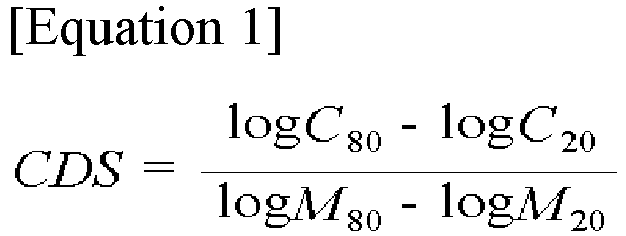
- The polyolefin film of claim 1, wherein the polyolefin has (1) a density of 0.910 to 0.920 g/cm3; (2) an MFR of 20 to 40; and (3) a CDS of 2 to 5.
- The polyolefin film of claim 1, wherein the polyolefin is prepared by polymerizing an olefinic monomer in the presence of a catalyst comprising at least one transition metal compound represented by Formula 1 and at least one cocatalyst compound:

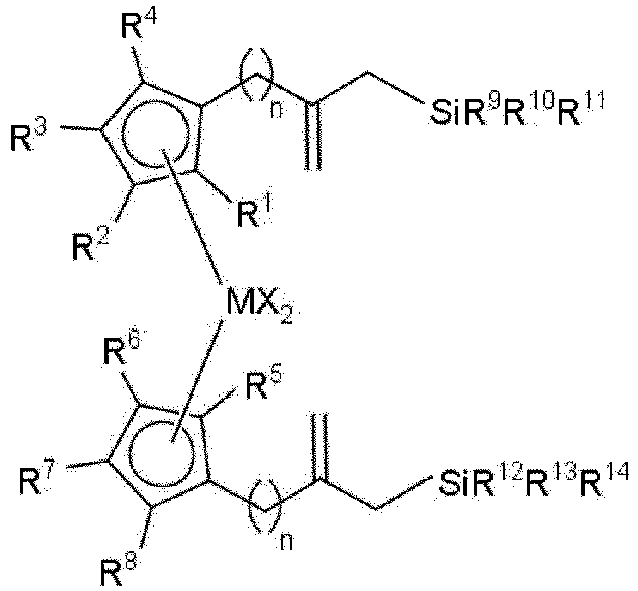 M is titanium (Ti), zirconium (Zr), or hafnium (Hf),X is each independently halogen, C1-20 alkyl, C2-20 alkenyl, C2-20 alkynyl, C6-20 aryl, C1-20 alkyl C6-20 aryl, C6-20 aryl C1-20 alkyl, C1-20 alkylamido, C6-20 arylamido, or C1-20 alkylidene,R1 to R4 and R5 to R8 are each independently hydrogen, substituted or unsubstituted C1-20 alkyl, substituted or unsubstituted C2-20 alkenyl, substituted or unsubstituted C6-20 aryl, substituted or unsubstituted C1-20 alkyl C6-20 aryl, substituted or unsubstituted C6-20 aryl C1-20 alkyl, substituted or unsubstituted C1-20 heteroalkyl, substituted or unsubstituted C3-20 heteroaryl, substituted or unsubstituted C1-20 alkylamido, substituted or unsubstituted C6-20 arylamido, substituted or unsubstituted C1-20 alkylidene, or substituted or unsubstituted C1-20 silyl,R9 to R11 and R12 to R14 are each independently substituted or unsubstituted C1-20 alkyl, substituted or unsubstituted C2-20 alkenyl, substituted or unsubstituted C6-20 aryl, substituted or unsubstituted C1-20 alkyl C6-20 aryl, substituted or unsubstituted C6-20 aryl C1-20 alkyl, substituted or unsubstituted C1-20 heteroalkyl, substituted or unsubstituted C3-20 heteroaryl, substituted or unsubstituted C1-20 alkylamido, substituted or unsubstituted C6-20 arylamido, substituted or unsubstituted C1-20 alkylidene, or substituted or unsubstituted C1-20 silyl, andR1 to R4 and R5 to R8 are each independently capable of being linked to adjacent groups to form a substituted or unsubstituted saturated or unsaturated C4-20 ring.
 - The polyolefin film of claim 3, wherein the cocatalyst compound is at least one selected from the group consisting of a compound represented by Formula 2, a compound represented by Formula 3, and a compound represented by Formula 4:


[Formula 4] [L-H]+[Z(A)4]- or [L]+[Z(A)4]-
in Formula 2, n is an integer of 2 or more, and Ra may each independently be a halogen atom, C1-20 hydrocarbon, or C1-20 hydrocarbon substituted with halogen,in Formula 3, D is aluminum (Al) or boron, and Rb, Rc, and Rd are each independently a halogen atom, C1-20 hydrocarbon, C1-20 hydrocarbon substituted with halogen, or C1-20 alkoxy, andin Formula 4, L is a neutral or cationic Lewis acid, [L-H]+ and [L]+ a Bronsted acid, Z is a group 13 element, and A is each independently substituted or unsubstituted C6-20 aryl or substituted or unsubstituted C1-20 alkyl. - The polyolefin film of claim 3, which further comprises a carrier for supporting the transition metal compound and the cocatalyst compound.
- The polyolefin film of claim 1, wherein the polyolefin is a copolymer of an olefinic monomer and an olefinic comonomer.
- The polyolefin film of claim 6, wherein the olefinic monomer is ethylene, and the olefinic comonomer is at least one selected from the group consisting of propylene, 1-butene, 1-pentene, 4-methyl-1-pentene, 1-hexene, 1-heptene, 1-octene, 1-decene, 1-undecene, 1-dodecene, 1-tetradecene, and 1-hexadecene.
- The polyolefin film of claim 7, wherein the polyolefin is a linear low-density polyethylene in which the olefinic monomer is ethylene, and the olefinic comonomer is 1-hexene.
- The polyolefin film of claim 1, which has a hot tack strength at 95°C of 0.5 N/2 cm or more and a hot tack strength at 110°C of 3.5 N/2 cm or more.
- The polyolefin film of claim 1, which has a haze of 10% or less when measured based on a thickness of 50 µm.
- The polyolefin film of claim 1, which is at least one selected from the group consisting of a stretch film, an overlap film, a lamination, a silage wrap, and an agricultural film.
- A process for preparing a polyolefin film, which comprises (a) polymerizing an olefinic monomer in the presence of a catalyst comprising at least one transition metal compound represented by Formula 1 and at least one cocatalyst compound to obtain a polyolefin; and (b) molding the polyolefin to obtain a film, wherein the polyolefin has (1) a density of 0.910 to 0.940 g/cm3; (2) a melt flow ratio (MFR) of 10 to 60 when measured at 190°C as a ratio of the melt index (I21.6) under a load of 21.6 kg to the melt index (I2.16) under a load of 2.16 kg; and (3) a comonomer distribution slope (CDS) of 1 or more as defined by Equation 1, and the film has a heat seal strength of 90 gf/2.5 cm or more when measured at 0.2 bar, 1.5 seconds, and 125°C, and a heat seal strength of 210 gf/2.5 cm or more when measured at 0.2 bar, 1.5 seconds, and 140°C:


- The process for preparing a polyolefin film of claim 12, wherein, in step (a), the polymerization of an olefinic monomer is carried out by gas-phase polymerization.
- The process for preparing a polyolefin film of claim 13, wherein, in step (a), the polymerization of an olefinic monomer is carried out in a gas-phase fluidized bed reactor.
- The process for preparing a polyolefin film of claim 12, wherein the polyolefin is prepared by copolymerizing an olefinic monomer and an olefinic comonomer, in which the olefinic monomer is ethylene, and the alpha-olefinic comonomer is at least one selected from the group consisting of propylene, 1-butene, 1-pentene, 4-methyl-1-pentene, 1-hexene, 1-heptene, 1-octene, 1-decene, 1-undecene, 1-dodecene, 1-tetradecene, and 1-hexadecene.
- The process for preparing a polyolefin film of claim 15, wherein the olefinic monomer is ethylene, and the olefinic comonomer is 1-hexene.
- The process for preparing a polyolefin film of claim 12, wherein the polyolefin film has a hot tack strength at 95°C of 0.5 N/2 cm or more and a hot tack strength at 110°C of 3.5 N/2 cm or more.
Applications Claiming Priority (2)
| Application Number | Priority Date | Filing Date | Title |
|---|---|---|---|
| KR1020190155703A KR102525719B1 (en) | 2019-11-28 | 2019-11-28 | Polyolefin Film and Process for Preparing the Same |
| PCT/KR2020/016424 WO2021107508A1 (en) | 2019-11-28 | 2020-11-20 | Olefin-based polymer film and manufacturing method therefor |
Publications (2)
| Publication Number | Publication Date |
|---|---|
| EP4067415A1 true EP4067415A1 (en) | 2022-10-05 |
| EP4067415A4 EP4067415A4 (en) | 2023-11-29 |
Family
ID=76130349
Family Applications (1)
| Application Number | Title | Priority Date | Filing Date |
|---|---|---|---|
| EP20894586.5A Pending EP4067415A4 (en) | 2019-11-28 | 2020-11-20 | OLEFIN-BASED POLYMER FILM AND METHOD FOR MANUFACTURING SAME |
Country Status (6)
| Country | Link |
|---|---|
| US (1) | US12404378B2 (en) |
| EP (1) | EP4067415A4 (en) |
| JP (1) | JP7417729B2 (en) |
| KR (1) | KR102525719B1 (en) |
| CN (1) | CN114746485B (en) |
| WO (1) | WO2021107508A1 (en) |
Cited By (1)
| Publication number | Priority date | Publication date | Assignee | Title |
|---|---|---|---|---|
| EP4265653A4 (en) * | 2020-12-17 | 2025-01-29 | Hanwha Solutions Corporation | OLEFIN POLYMER AND METHOD FOR PRODUCING SAME |
Families Citing this family (1)
| Publication number | Priority date | Publication date | Assignee | Title |
|---|---|---|---|---|
| KR102611798B1 (en) | 2020-11-23 | 2023-12-12 | 한화솔루션 주식회사 | Polyolefin, Film Prepared Therefrom, and Processes for Preparing the Same |
Family Cites Families (19)
| Publication number | Priority date | Publication date | Assignee | Title |
|---|---|---|---|---|
| GB0118010D0 (en) | 2001-07-24 | 2001-09-19 | Borealis Tech Oy | Catalysts |
| US20040152591A1 (en) * | 2002-10-25 | 2004-08-05 | Guo-Xin Jin | Polymerized metallocene catalyst composition |
| US8945702B2 (en) * | 2007-10-31 | 2015-02-03 | Bemis Company, Inc. | Barrier packaging webs having metallized non-oriented film |
| KR101485566B1 (en) * | 2010-10-14 | 2015-01-23 | 주식회사 엘지화학 | Polyethylene having excellent sealing property at low temperature, and method for preparing the same |
| JP5906893B2 (en) * | 2011-03-30 | 2016-04-20 | 日本ポリエチレン株式会社 | Olefin polymerization catalyst component, olefin polymerization catalyst containing the component, method for producing olefin polymer using the catalyst, and olefin polymer produced by the method |
| US8993693B2 (en) * | 2012-03-23 | 2015-03-31 | Formosa Plastics Corporation | Ethylene copolymers with a novel composition distribution and processes for making the same |
| US9115233B2 (en) * | 2012-06-21 | 2015-08-25 | Nova Chemicals (International) S.A. | Ethylene copolymer compositions, film and polymerization processes |
| CA2798855C (en) * | 2012-06-21 | 2021-01-26 | Nova Chemicals Corporation | Ethylene copolymers having reverse comonomer incorporation |
| CA2835740C (en) * | 2012-12-14 | 2020-12-29 | Nova Chemicals Corporation | Ethylene copolymer compositions, film and polymerization processes |
| CA2800056A1 (en) * | 2012-12-24 | 2014-06-24 | Nova Chemicals Corporation | Polyethylene blend compositions |
| KR101747396B1 (en) * | 2014-12-15 | 2017-06-14 | 주식회사 엘지화학 | Olefin based polymer having excellent processibility |
| KR102060639B1 (en) * | 2015-07-01 | 2019-12-30 | 주식회사 엘지화학 | Transition metal compound, catalyst composition comprising the same, and method for preparing polyolefin using the same |
| WO2018151790A1 (en) | 2017-02-20 | 2018-08-23 | Exxonmobil Chemical Patents Inc. | Hafnocene catalyst compounds and process for use thereof |
| US10538654B2 (en) * | 2017-04-19 | 2020-01-21 | Nova Chemicals (International) S.A. | Multi reactor solution polymerization, polyethylene and polyethylene film |
| CA2964562C (en) * | 2017-04-19 | 2024-07-02 | Nova Chemicals Corporation | Multi reactor solution polymerization, polyethylene and polyethylene film |
| KR102013170B1 (en) * | 2018-04-05 | 2019-08-22 | 대림산업 주식회사 | Polyolefin resin composition and method for preparation thereof |
| EP3880739B1 (en) * | 2018-11-13 | 2025-03-19 | ExxonMobil Chemical Patents Inc. | Polyethylene films |
| KR102219407B1 (en) * | 2018-11-20 | 2021-02-23 | 한화솔루션 주식회사 | Transition metal compound for a catalyst for polymerizing an olefin and catalyst for polymerizing an olefin comprising the same |
| KR102611798B1 (en) * | 2020-11-23 | 2023-12-12 | 한화솔루션 주식회사 | Polyolefin, Film Prepared Therefrom, and Processes for Preparing the Same |
-
2019
- 2019-11-28 KR KR1020190155703A patent/KR102525719B1/en active Active
-
2020
- 2020-11-20 US US17/779,211 patent/US12404378B2/en active Active
- 2020-11-20 JP JP2022528951A patent/JP7417729B2/en active Active
- 2020-11-20 EP EP20894586.5A patent/EP4067415A4/en active Pending
- 2020-11-20 WO PCT/KR2020/016424 patent/WO2021107508A1/en not_active Ceased
- 2020-11-20 CN CN202080082827.5A patent/CN114746485B/en active Active
Cited By (1)
| Publication number | Priority date | Publication date | Assignee | Title |
|---|---|---|---|---|
| EP4265653A4 (en) * | 2020-12-17 | 2025-01-29 | Hanwha Solutions Corporation | OLEFIN POLYMER AND METHOD FOR PRODUCING SAME |
Also Published As
| Publication number | Publication date |
|---|---|
| CN114746485B (en) | 2025-03-11 |
| JP2023505420A (en) | 2023-02-09 |
| KR102525719B1 (en) | 2023-04-26 |
| US20230002573A1 (en) | 2023-01-05 |
| CN114746485A (en) | 2022-07-12 |
| US12404378B2 (en) | 2025-09-02 |
| EP4067415A4 (en) | 2023-11-29 |
| WO2021107508A1 (en) | 2021-06-03 |
| KR20210066992A (en) | 2021-06-08 |
| JP7417729B2 (en) | 2024-01-18 |
Similar Documents
| Publication | Publication Date | Title |
|---|---|---|
| EP3885374A1 (en) | Catalyst for olefin polymerization, and olefin-based polymer produced using same | |
| KR101773722B1 (en) | High density ethylene polymer with excellent processability using supported hybrid metallocene catalyst and methods for producing the same | |
| EP3492498A1 (en) | High-processability high-density ethylene-based polymer using hybrid supported metallocene catalyst, and preparation method therefor | |
| US12552886B2 (en) | Olefin-based polymer, film prepared therefrom, and preparation methods therefor | |
| US12583956B2 (en) | Olefin-based polymer, film prepared therefrom, and preparation methods therefor | |
| AU3067297A (en) | Polyolefin composition with molecular weight maximum occuring in that part of the composition that has the highest comonomer content | |
| JP6569667B2 (en) | Ethylene / α-olefin copolymer and olefin resin composition | |
| CN103857706A (en) | Kinetic Modulation of Metallocene Catalysts | |
| JP5414971B2 (en) | Film made of ethylene resin composition | |
| KR20190139466A (en) | Ethylene polymer mixture, process for producing the same, and a molded article using the same | |
| US12404378B2 (en) | Polyolefin film and process for preparing the same | |
| KR20180037846A (en) | blown film | |
| EP4047025A1 (en) | Method for preparing olefin polymerization hybrid catalyst, olefin polymerization hybrid catalyst, and olefin-based polymer | |
| EP4506351A1 (en) | Transition metal compound for olefin polymerization catalyst, olefin polymerization catalyst comprising same, and polyolefin polymerized using same | |
| EP4006044A1 (en) | Transition metal compound for olefin polymerization catalyst, olefin polymerization catalyst including same, and polyolefin polymerized using same | |
| JP7603162B2 (en) | Olefin-based polymer, film produced therefrom, and method for producing same | |
| EP4400521A1 (en) | Method for preparing olefin-based polymer and olefin-based polymer prepared using same | |
| KR102486137B1 (en) | Processes for Preparing Polyolefin and Film | |
| US20240084057A1 (en) | Olefin polymer and preparation method therefor | |
| EP4269453A1 (en) | Hybrid catalyst composition, catalyst comprising same, and method for preparing olefin-based polymer using same | |
| EP4265653A1 (en) | Olefinic polymer, and method for preparing same | |
| KR102859439B1 (en) | Method for preparing homo polyethylene and stretch film prepared by using the same | |
| EP4592345A1 (en) | Polyethylene composition, and film comprising same | |
| KR20260005640A (en) | Polyolefin and film comprising the same | |
| KR20130044641A (en) | A film for drink packing using elastic polyolefin copolymer with high sealing strength |
Legal Events
| Date | Code | Title | Description |
|---|---|---|---|
| STAA | Information on the status of an ep patent application or granted ep patent |
Free format text: STATUS: THE INTERNATIONAL PUBLICATION HAS BEEN MADE |
|
| PUAI | Public reference made under article 153(3) epc to a published international application that has entered the european phase |
Free format text: ORIGINAL CODE: 0009012 |
|
| STAA | Information on the status of an ep patent application or granted ep patent |
Free format text: STATUS: REQUEST FOR EXAMINATION WAS MADE |
|
| 17P | Request for examination filed |
Effective date: 20220530 |
|
| AK | Designated contracting states |
Kind code of ref document: A1 Designated state(s): AL AT BE BG CH CY CZ DE DK EE ES FI FR GB GR HR HU IE IS IT LI LT LU LV MC MK MT NL NO PL PT RO RS SE SI SK SM TR |
|
| DAV | Request for validation of the european patent (deleted) | ||
| DAX | Request for extension of the european patent (deleted) | ||
| A4 | Supplementary search report drawn up and despatched |
Effective date: 20231102 |
|
| RIC1 | Information provided on ipc code assigned before grant |
Ipc: C08F 2/01 20060101ALI20231026BHEP Ipc: C08F 2/34 20060101ALI20231026BHEP Ipc: C08F 4/646 20060101ALI20231026BHEP Ipc: C08F 4/659 20060101ALI20231026BHEP Ipc: C08F 4/6592 20060101ALI20231026BHEP Ipc: C08F 210/14 20060101ALI20231026BHEP Ipc: C08F 210/16 20060101ALI20231026BHEP Ipc: C08J 5/18 20060101AFI20231026BHEP |